Search Results: "Jonathan McDowell"

8 December 2008

Jonathan McDowell: We need a STFU option

The Debian Project recognises that on occasion the General Resolution process is dominated by a vocal minority of the project members, while the majority are uninterested in the topic under discussion. Without wishing to curtail the democratic process it is felt that it should be possible for the silent majority to indicate its desire to move on from the topic of a GR rather than continuing to rehash the same arguments ad infinitum. In order to facilitate this the project resolves to add a further option to all ballets, "No Further Discussion". It is hoped that in the event of the "No Further Discussion" option being the winner of any vote that the project as a whole will accept that discussion of the subject of the vote is not considered to be a worthwhile use of project time or resources, and that we should therefore concentrate on more important matters. (I thought about signing this post, but decided against it)

28 November 2008

Jonathan McDowell: Perl regex help

Dear Lazyweb, please put me out of my misery.

I have a string that looks something like:

a b c foo 0 1 2 fred 3 4 5 5 4 3 2 1 0 quux
I want to output:
a
b
c
foo
 0 1 2 
fred
 3 4 5 
 5 4 3   2 1 0 
quux

(actually I want each line to be an array element, but that's obviously easy)

Can I do this with a Perl regex? Originally I thought I was going to have to walk the string like I would in C, but some playing around (and local help) got me to:

my $match = qr/(?:\s*[^\ \ \s]+\s* \ (?R)\ )/;
while ($cur =~ m/($match)\s+(.*)/o)  
        print $1, "\n";
        $cur = $2;
 

which sort of gets me there, except I get
0 1 2 fred 3 4 5 5 4 3 2 1 0
as one line instead of 4.
What obvious thing am I missing here?

4 November 2008

Jonathan McDowell: FDMI success

This is the point where I should be writing something witty and intelligent about the election going on across the pond, but I can't think of anything worth saying. If you can, go and vote. Even if you think your side is going to win, go and bloody do it anyway.

Anyway. Today I achieved FDMI success; my code successfully registered my test cluster against the fabric switch it's connected to and reported various bits of information about itself. Hardly earth shattering but does at least indicate that I'm beginning to understand some details of Fibre Channel at the packet level and how to make our code send/receive them. Go 'bama me.

(FDMI is the Fabric Device Management Interface and a way for Fibre Channel devices to report things like their manufacturer, serial number, OS, HBA model and driver/firmware versions to a management controller on the switch fabric. It's not a complex protocol in any manner, but there's a distinct lack of clear Fibre Channel documentation around that's at a lower level than "So you want to hook up a SAN?")

3 November 2008

Jonathan McDowell: NM gets longer and longer

If you ask the old timers about how they got started in Debian they'll tell you about sending off an email saying they wanted to get involved and having an account setup the same day. By the time I got round to joining it was during tbm's blitz when NM opened up again and it took only a few days to get through the process. When I first AMed, back in 2002, it took anywhere from a few days to a few months to process an applicant. I've recently started AMing again and so far my NM and I have exchanged 9 mails over the course of 2 weeks and still aren't through Philosophy and Procedures.

This isn't due to any failing on the part of my NM. It's just that there's a lot more "paperwork" to get through these days. There's currently a lot of discussion going on about the idea of introducing new classes of Debian involvement. I think that's something that's definitely worth looking at; it's already in existence for Debian Maintainers vs Debian Developers. However anything new that's introduced really needs to make some effort to be lighter than NM; someone who just wants to handle a few packages is going to get put off by too many hoops and the current NM process is already largely constrained by available AM time rather than anything else. I don't pretend to know what the right solution is, but I think anyone attempting to produce one should be praised for that rather than attacked.

2 November 2008

Jonathan McDowell: Shrinking the keyring

Apparently I'm supposed to be blogging once a day, every day, for November. I missed yesterday and doubt I'll have something to say every day, but let's try...

Today I have been playing with the export-clean and import-clean options to gnupg, in particular in conjunction with the debian-keyring. The options result in only signatures that can be verified (ie that are from keys that exist in your keyring) being allowed, and remove signatures other than the revocation from revoked keys/uids.
Why is this interesting to me? Well, a number of reasons:There's an argument that this "weakens" the web of trust (after all, we're throwing away signatures from keys), but I'm not really convinced. The full keys can still be downloaded from the keyserver network and it's not like any of the Debian infrastructure scripts make use of web of trust; all that's important is that a key is present in the keyring. I've been asked about export-minimal (ie keys + self sigs only) in the past, but I prefer this method of keeping verifiable signatures as it provides some measure of checking key trust for people importing the keyrings locally or auditing the keyring.

(Note I haven't actually rolled any of this out, it's just something I've been playing with locally at present to get a feel for the savings/benefits to be had.)

13 October 2008

Julian Andres Klode: I am a Debian Developer now!


14 months after applying for the NM process, I’m a Debian Developer. On Mon, Oct 13, 2008 at 10:51:43PM +0000, Martin Zobel-Helas wrote:
> [ This is a long mail with important information, so please read it all
> carefully. ]
>
> Dear Julian Andres Klode!
>
> Your account ‘jak’ has just been created in the central LDAP
> database of the Debian project. [...] Thank you everyone (in chronological order):
  • Daniel Baumann (daniel) - Sponsored my first packages
  • Joerg Jaspert (joerg) - The first DD who signed my key
  • Niv Sardi-Altivanik (xaiki) - Advocated me for NM
  • Martin Zobel-Helas (zobel) - My first AM
  • Alexander Reichle-Schmehl (tolimar) - The second DD who signed my key (at CeBIT)
  • Bernd Zeimetz (bzed) - Took over in June, because zobel was very busy
  • Christoph Berg (myon) - For checking the AM report and requesting the account creation
  • Jonathan McDowell (noodles) - For adding me to the keyring
  • Martin Zobel-Helas (zobel) - This time for creating my account
And many thanks to Google - for helping me to find answers to important questions. Without you, I would know nothing. And of course all the others who helped to make this possible. Posted in Debian      

4 October 2008

Jonathan McDowell: Asus EEE 901

As mentioned I bought an EEE 901. The battery life was the clincher. I've had it for about 3 weeks now, but have only really been using it for a week - since I finished doing my mobile broadband survey and got an Orange contract.

I can't really comment on the supplied Xandros install. I used it for a week or so, with Firefox + a shell for ssh (Ctrl-Alt-T IYF) but once I found time I installed Debian. I used the EEE installer which I think mainly does the appropriate ethernet driver magic without faff. Certainly went smoothly and all up and running minus wifi, which was soon sorted out with the rt2860-source package. Ethernet, bluetooth and camera all seem fine. SD reader is a USB device that appears when a card is inserted.

Battery life rocks. I can use it on the morning on the train (1hr30 or so), suspend to ram all day, use it on the train on the way home and then around the house in the evening without needing to charge it up. And that's while powering the USB 3G dongle and without any real tuning in terms of trying to save power by dimming the screen etc.

The keyboard *is* small. I wouldn't want this to be my main machine. However it is just about touch typable and the overall machine size is superb - even if I get a bad seat on the train I can still unfold the screen fully and it's my arms/elbows that end up being the issue rather than the laptop itself. I also notice the decrease in screen resolution down to 1024x600 (my old laptop is 1024x768); I can't fit enough xterms. :)

Speed seems fine too. I've not really pushed it hard (I've been resisting installing build-essential) but for a handful of xterms and Iceweasel it's doing a fine job. Equally firing up mplayer resulted in perfectly smooth playback of some mpeg4 over the network. Must actually remember to put something on it to watch on train journeys...

Speaking of train journeys the Orange dongle has integrated without too much hassle. 2.6.27-rc kernels have the appropriate hso driver but I found it caused crashes in areas of low/no signal. Patching up to the latest 1.6 driver solved the problem and adding PPTP to my work VPN into the mix means I can use offlineimap to pull mail locally and then read it with mutt on my journey even when the signal is fluctuating. Hopefully ridiculous starts can be mostly a thing of the past if I can get work done on the train.

What else to say? I'm quite liking the trackpad. The buttons are a bit stiff, but I'm getting used to the double tap, or tap and drag gestures in a way I never seemed to on the R200. Wifi reception seems fine. All in all I'm happy with my choice; the small keyboard is the main drawback and that's the (acceptable) price I pay for a small laptop.

28 September 2008

Jonathan McDowell: Which data contract?

I bought an EEE 901. More on that later.

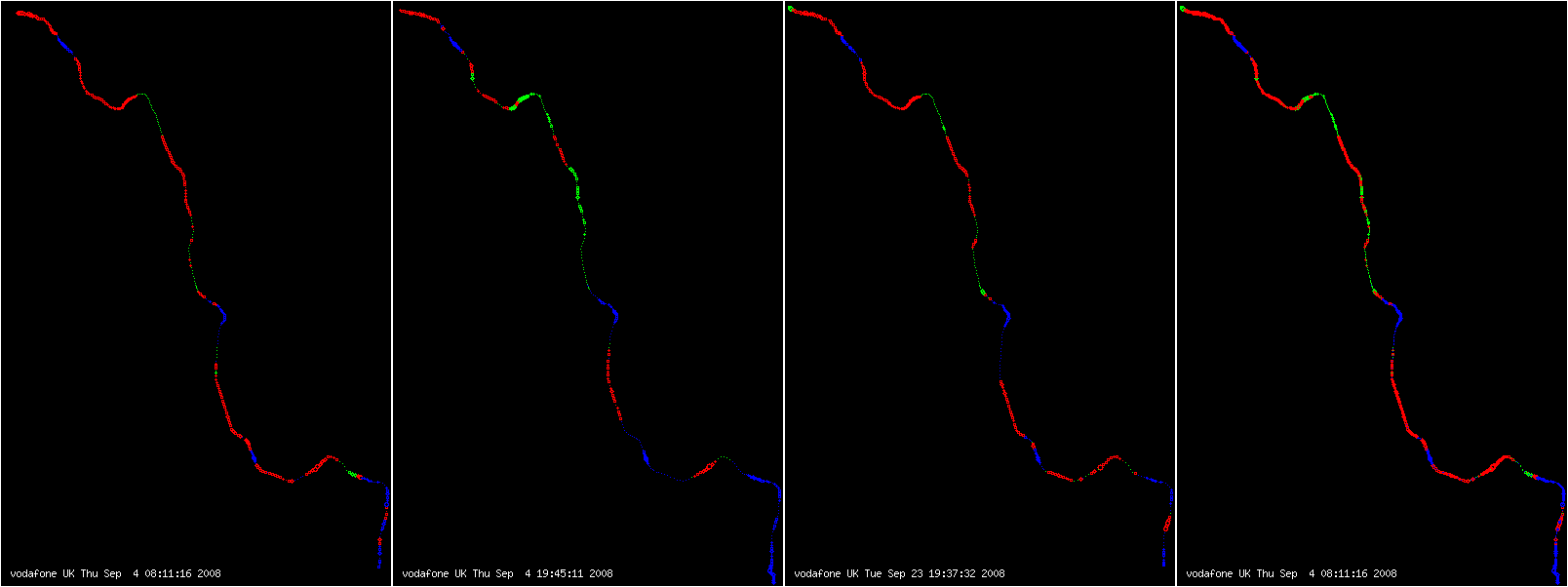
For the past few weeks I've been trying to work out which "mobile broadband" provider to go with for my daily commute. It's a train journey from the north coast of Northern Ireland to Belfast and goes through some sparsely populated areas, so I wasn't expecting to get anything that would provide 3G all the way. However I do want a provider that can do their best to keep a session up for the journey, handing over between 2G + 3G as necessary. Coverage maps/checkers aren't too bad if you just want to check a static point, but really even then it's better to actually try the provider in the location yourself. So, armed with a bluetooth GPS (Bl eNEXT BN-909GR), an Option GT 3G Quad PCMCIA card and my laptop I set about measuring signal strength along my train journey for each of the 5 providers available. I also made sure to actually try a session with them for at least one journey, because signal strength is not everything.

I wrote some Perl using Net::GPSD and Device::Gsm to query my current location, signal strength, 2G/3G status and network every 10 seconds. I did this for 3 train journeys (except for O2) and then also produced an "optimistic" file of all the data points combined for that provider.

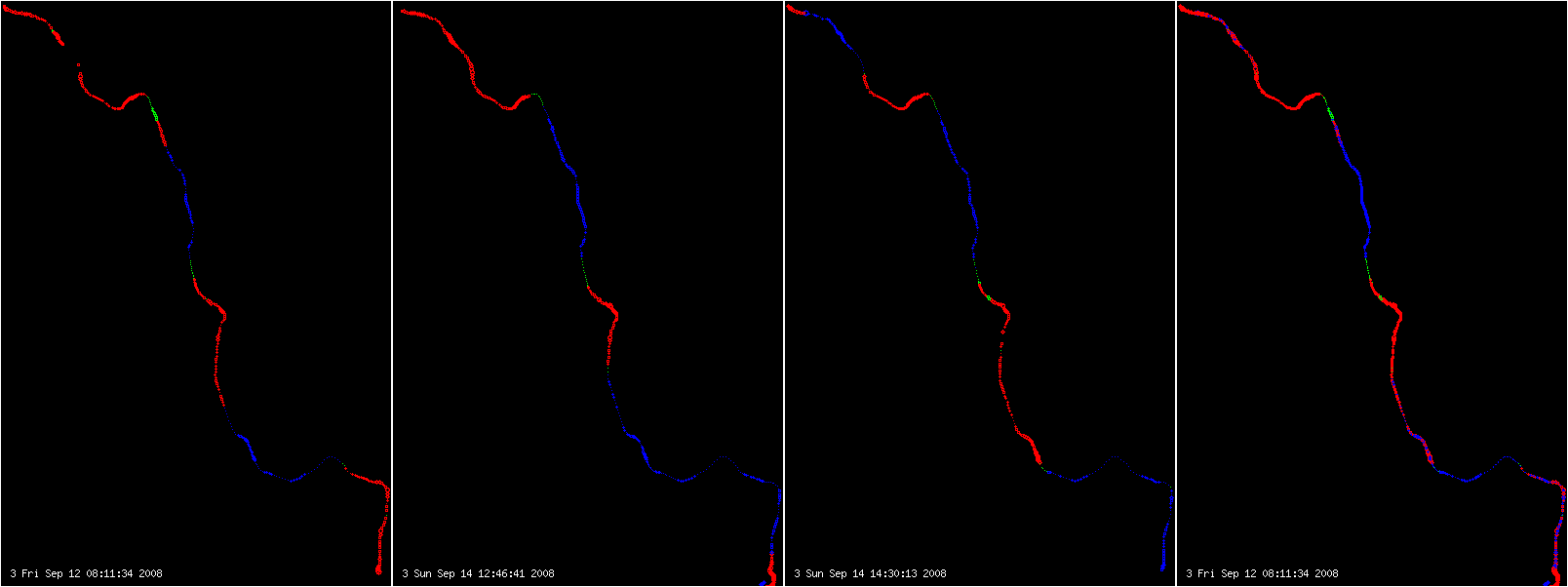
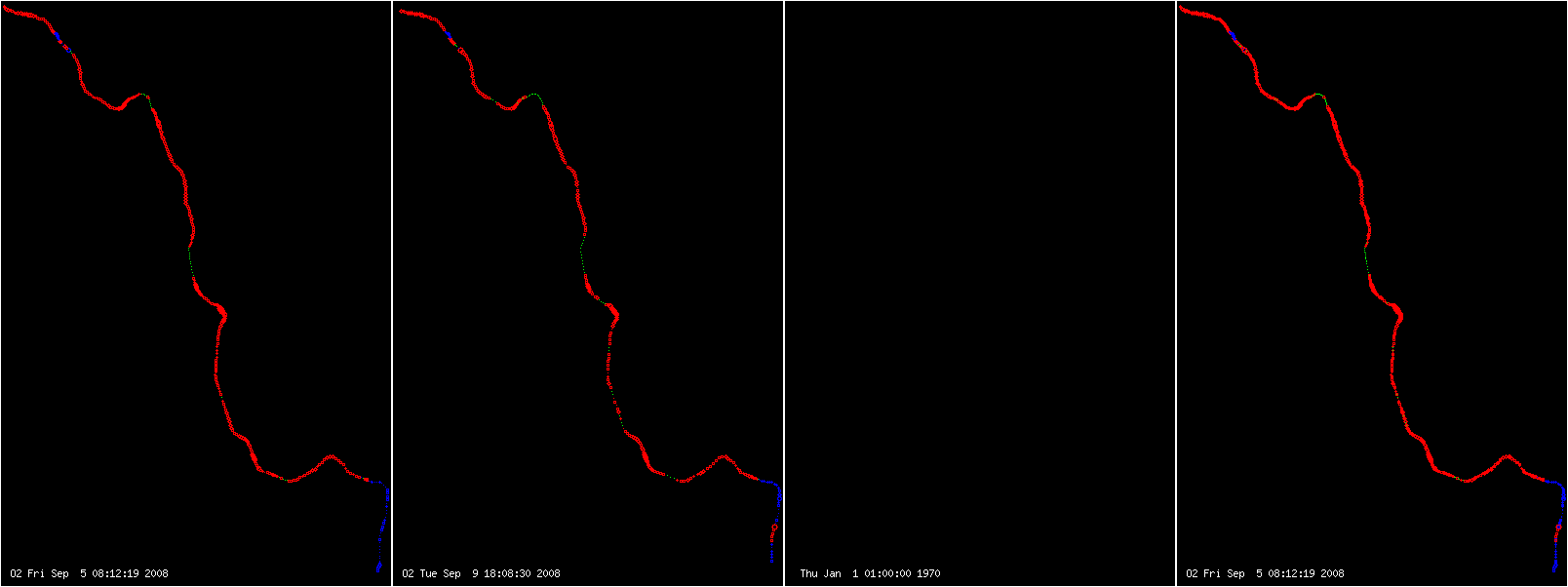
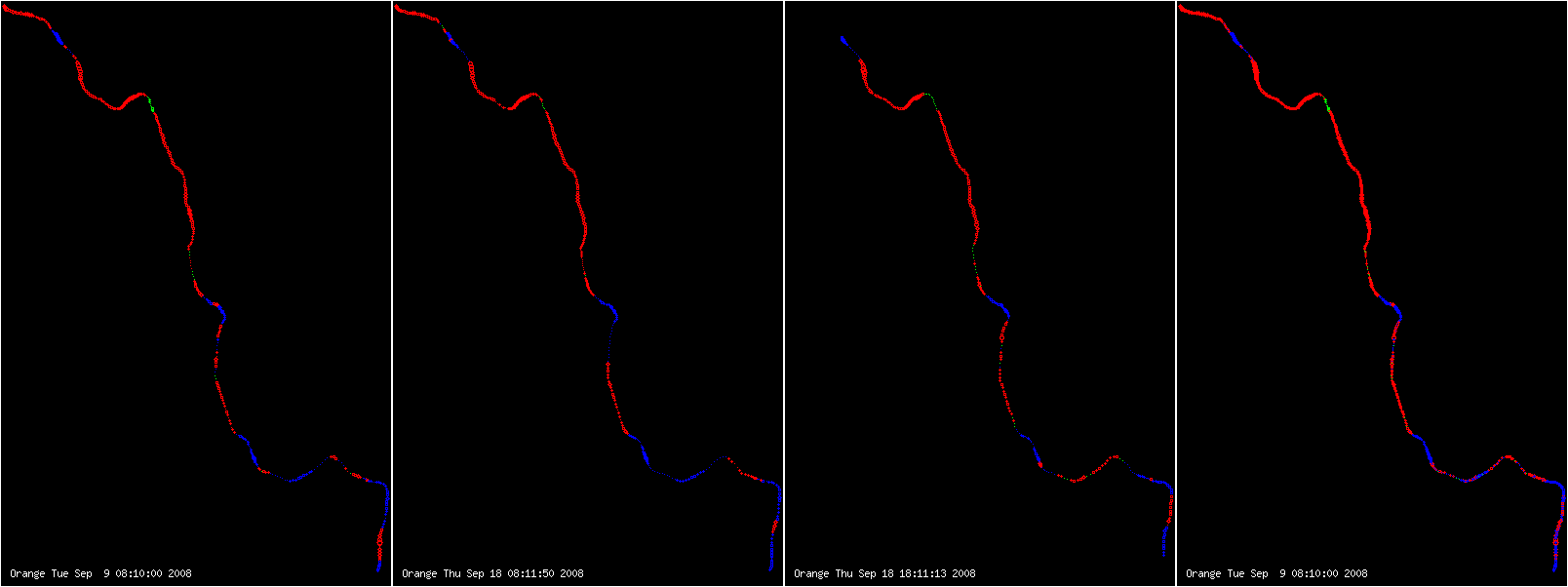
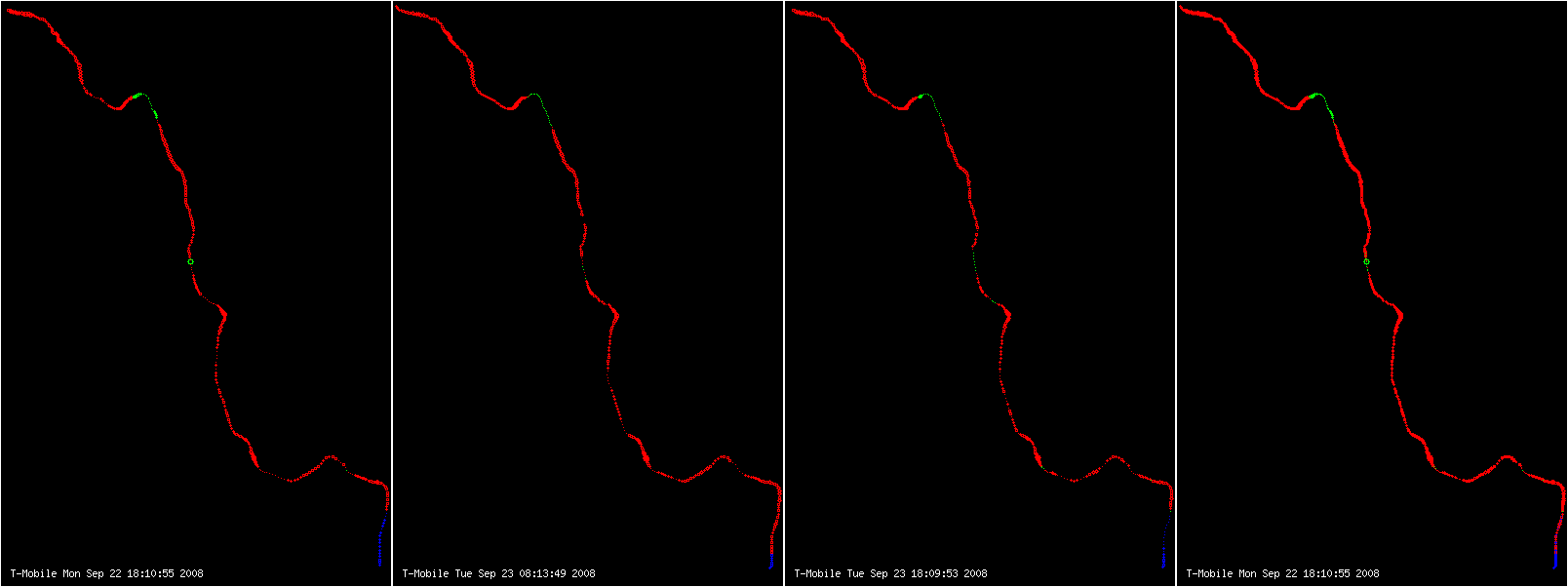
A second piece of Perl took this data and drew the maps you see below. The graph on the right for each provider is all data points. Red means 2G, blue means 3G, green means "Limited Service" (ie it could see a signal, but not one it was allowed to connect to). White means that we had a GPS location and no signal at all. Click on the maps for bigger versions. You can see the route on OpenStreetMap - my graphs are a little squished horizontally, but the journey is from Castlerock (top left on the coast near Coleraine) to Belfast (bottom right).

3
O2
Orange
T-Mobile
Vodafone

At first glance 3 look to be the best bet. Lots of blue, a reasonably priced data plan. Except they can't hold up a session to save themselves. Not only does a 2G/3G handover almost always seem to result in a drop, but I had periods of failing to get a 2G session up at all and had some random drops while in 3G coverage as well. So strike them off.

O2 and T-Mobile don't manage any 3G outside Belfast (that's the bottom right corner btw). I found that a few periods of 3G along the journey helped a lot; it meant I could do a quick mail sync rather than the long drawn out affair it was on a 2G connection. They can both handle handover between 2G/3G and keep a session up for most of the journey, but the lack of speed counts them out.

Vodafone managed the worst reception, which is disappointing. I found them quite good when I lived in England (my datacard is from a Vodafone Pay as You Use data contract). I did find sessions being dropped during the no signal regions, so they just don't seem to be a good bet.

Which leaves Orange. I've had issues with Orange and data in the past (pre 2004 IIRC) but in testing they were able to keep a session up between Belfast and Castlerock, handling 2G/3G handover fine. Coverage was reasonably good and they manage 3G at several points along the journey (the blue points roughly correspond to Coleraine, Ballymena, Antrim and Belfast). I understand Orange have some EDGE capability, but my card doesn't do EDGE so I've no idea if that'll be an extra gain or not. I had a few issues with getting dud DNS servers but this happened with the other providers too so I was beginning to suspect the datacard of playing up. Manually setting known good servers in resolv.conf worked fine.

So, before I go and sign up to an 18 month Orange contract, what have I forgotten?

17 September 2008

Chris Lamb: Debian Developer

A few days ago I was awarded official Debian Developer status. Many thanks to: For posterity, my first experience with the Debian development process was with #400550. Never underestimate the importance of giving credit in changelog entries.

10 September 2008

Jonathan McDowell: Which netbook?

I think I want a netbook. Although I'm still happy with my R200 (especially since I replaced the battery) something smaller would be handy for the train and general carting about. With the R200 being 12" I'm more drawn to the 8.9" variants; 10" isn't a lot smaller and at the cheaper end doesn't appear to result in any higher a resolution than 8.9"

Really I'd like something with built in 3G/HSDPA, but only the Dell Inspiron Mini 9 seems to have this, and the Linux model isn't even on sale yet in the UK, let alone the 3G version.

If I can't get 3G then I'm drawn to the EEE 901. It seems to have the best battery life, has bluetooth and isn't too expensive (though at the higher end of what I'd want to pay for a 2nd machine). Plus it has the appeal that I should be able to walk into a shop and pick one up. Main drawback is that I've read the Ralink RT2860 wifi ain't great (and the driver isn't in mainline yet, though there is one kicking around). Any truth in this? Any other gotchas?

Thoughts, people? I've seen an MSI Wind in the flesh and it was a bit big. The Acer Aspire One looks nice enough, but not great battery life and no bluetooth. Any others I should be looking at instead of the 901? Must be easily available in the UK. I will, of course, be running Debian on it.

2 September 2008

Jonathan McDowell: No so clever now, eh?

I've been quite pleased with my evil Perl script that logs into my OpenID account and then uses the credentials to pull authorised LiveJournal feeds to local files, ready for Liferea to read. Except I keep breaking my OpenID stuff (because I haven't got round to putting the openid.server/delegate headers in the Movable Type index template) and not noticing. And the OpenID login works fine, but then LJ just doesn't auth me rather than erroring, so I see some posts but not friends locked stuff. Tonight I noticed. And discovered posts all the way back to before June.

So if I've missed some major event in your life in the past 3 months, sorry. And if you get comments from me on old posts in the next few days, this is why.

28 August 2008

Jonathan McDowell: Neither really means neither

Our Belfast office has finally got large enough to have to partake in the NI Equality Commission monitoring. This covers religion and gender. The options for religion are:

Which all seems fine, except for the bit below that says "If you do not complete this questionaire, we are encouraged to use the "residuary" method, which means that we can make a determination on the basis of personal infomation on file/application form". It turns out that also applies to the neither option. So I clarified with the poor guy who's having to deal with this what he'd do if I ticked neither. And he rang the Equality Commission for some advice. And it turns out that although the wording in the step-by-step guide for employers is "we strongly advise" essentially if you end up with more than a certain number of neithers then you put yourself at risk of an investigation.

FFS. How the hell is this country supposed to get any better if even the Equality Commission is forcing us all to be one side or the other?

(I ticked the neither box and told the guy handling it that if he had to apply the residual method then I'd provide him some suitable information to support whichever side was most convenient. It's not his fault some silly buggers want to make me a Protestant or Catholic atheist, or imply I only hang round with one side or the other.)

26 August 2008

Jonathan McDowell: I'll have what she's having

pleia2 wants a new smartphone. Me too.The current options seem to be a Nokia E90 or an HTC Touch Pro. Both have disadvantages, but nothing else appears to offer a keyboard and decent screen. I'd quite like to have a play with a Touch Pro to see what it's like and if the interface is fast enough to not be annoying for normal phone use. I've also seen various snippets about the forthcoming HTC Dream Google Android based device suggesting it might be out in October. I'd been expecting it not to happen until next year, but October is tantalisingly close...

24 August 2008

Jonathan McDowell: DebConf8 writeup

I took a note of the various talks I attended at DebConf, with the aim of writing a few notes about each so that I could try to explain to my work mates exactly what I get out of going. However I think a lot of the benefit is about general face to face contact with fellow DDs and random conversations that happen. Having worked from home for over 3 years I'm finding it quite nice to be back in an office with people working on the same things as me; there are conversations that you will have over a quick cup of coffee or in the corridor that you wouldn't bother typing on IRC or email or picking up the phone for. Debian is a lot like a large organisation full of telecommuters and DebConf provides a vital opportunity for us to have those "minor" conversations that prove quite useful and to remind each other what we're actually like in person. I didn't end up writing a lot of notes during the talks so these are just snippets after the fact. If I'd been more organised I'd have done a write up on a daily basis rather than leaving it all until the week after. A lot of the below is fragmented thoughts, but the longer I leave it the less relevant it gets and the more chance I forget something. It'd have been up faster if I hadn't been fighting Movable Type to try and get some sort of headings. Sunday
Introduction, Marga The "Welcome to DebConf" bit. Marga got up and talked about how at DebConf4 (Brazil) she hadn't been a DD and now she was and how it had been a life changing event. She'd thought she was to blame for DebConf8 in Argentina, but trawling mail archives had shown it was originally Mart n's idea. She hadn't realised at the start quite how much work it would be. Steve's DPL talk, Steve McIntyre The DPL welcomes us to DebConf and talks about Debian's achievements, some of the results of his team survey (the teams largely say they need more manpower. Not really a huge surprise.). NM/User Survey BOF, Paul Wise Paul emailed debian-user, debian-newmaint and various other places (I think) asking about people's experiences as a Debian user or applicant to New Maint. His final results aren't yet published and I got the impression a disappointing number of our users had replied. The NM problems these days seem to be largely down to a lack of AMs, at least according to the stats on nm.debian.org. Meet SPI board - bdale, maulkin, jimmy, michael, others A chance to meet those of the SPI board who were present. The usual "If you're involved with Debian you should seriously consider joining SPI". Some discussion about the fact that although SPI was originally mostly Debian these days other projects are making more and more use of it - OFTC, PostgreSQL and Madwifi for example. Not a huge amount of new information for me. I've been an SPI member for some time and I think they perform a vital role for Debian. They've had issues in the past but it's really good to see them overcome and more projects on board. Monday
http://hp.com/go/debian, bdale Bdale talks about the history of Debian and HP. And makes the point that HP aren't doing any of this to be "nice"; their primary responsibility is to their shareholders. Not surprising, but it's good that even with that criteria at the fore front Debian ends up a good idea for a large multinational. Managing 666 packages, Mart n Ferrari Mostly centered around the pkg-perl experience and the tools/workflow they have to help manage things. Impressive web tool (DEHS) to help track packages with new upstreams, issues or pending uploads. Quality Assurance in Lenny + 1 I can't remember a lot of this, which is a bit bad. I remember a discussion about whether we should release with orphaned packages, or if they should be removed. The argument for not removing them seemed to revolve around a theory that if they weren't buggy then what was the harm, the argument for was that if they were unmaintained and not really used than how did we actually know they weren't buggy, and was it reasonable that they potentially held up library transitions etc? Bugs in large packages Don Armstrong and ways in which the BTS can help people with lots of bugs. This (thankfully) doesn't affect me, but it was interesting to hear Don talk about his work on the BTS and his various ideas. I was sorry I'd missed his talk on SOAP access to it; I shall have to find time to watch the video. Tuesday
Debian and Ubuntu, Mark Shuttleworth The usual interaction with Debian stuff, including how we interact with our upstreams. If a bug is raised with an Ubuntu package then it might well be appropriate to raise it with Debian and upstream as well, but each set of people should be able to use their own bug reporting systems rather than having to go to a foreign system. I don't think it was actually said, but I guess the idea is that launchpad is the thing that will do this gluing together. He also talked about Ubuntu as an "experiment" rather than a fork of Debian; something that has potentially different ideas about how to do things but that these ideas may lead to things that should be fed back into Debian. The point was made that even if you consider Ubuntu a fork they've forked 9 times now; it hasn't been a case of forking once and diverging wildly since thast point. I have a few thoughts on all the whole Debian/Ubuntu stuff which I should really try to form into something coherant and post. I think it's important to take Mark's talk in the context of bdale's "Shareholders come first" point. Derivatives round table Didn't stay for most of this. Ubuntu, Debian-EDU (which I hadn't realised was a derivative rather than a team within Debian, but apparently there are various things it was much easier for them just to patch now and try to work towards a generic solution later), someone from Extramadura and someone from the Munich government Linux stuff. I'm sure I've missed someone off. tdebs/i18n This was a useful BOF. It helped that we said no to the usual video team requirement that if you want to speak you had to wait for the microphone. This works fine for a normal talk, but really impedes the flow of conversation in something like a BOF. tdebs are something that have partly come from a need of Emdebian to reduce installed package size and partly from the desire of the i18n team to be able to update package translations without having to do a full binary NMU of a package. We had some of the FTP team, the release team, the i18n team and Emdebian there and I think some progress has been made. There'd been various conversations had before this meeting which I think helped people think about the issues and objections so that we had answers by the time we all sat down together - an excellent example of the use of DebConf. DebConf9 C ceres Various bits of discussion about next year's DebConf in Extramadura. Temperature is likely to be an issue for me as they reckon it could easily get up to 40C! I'll melt! Venue sounds good; some queries regarding late night hacklabs and net connections to same, but I'm sure the networking team will sort it all out as usual. ;) DebConf10 bids Venezela and New York were both pitching. Lots of people don't want to travel to the US or think they'll have problems doing so (I hadn't realised there was such an issue for people from South America). I suspect various people will have issues with Venezela as well; I heard expressions of doubt over their political stability expressed. However I'd be happy to go to either (and preferably both! DebConf10 + 12 perhaps?) Speaking of which, what ever happened to the Sarajevo bid? If they're reading, have you considered DebConf11? Wednesday
A day trip to an Argentinian ranch and lunch was an asido. Fantastic food and a pleasant afternoon spent sitting in the sun chatting to people. That evening was the formal, but thanks to having stayed up until after 4 on Tuesday I had to wimp out and go to bed fairly early. Not until I'd seen the DPL dance though. :) Thursday
Internationalization in Debian I forget most of this other than pretty graphs from Christian regarding what's translated and what other languages we might have; e.g. you can consider South America to be covered largely by Spanish and Portuguese, or you can consider it to not be covered very much at all by the local indigenous languages. dh-make-webapp: yeah right! Mainly what I took away from this was "It'll never happen thanks to the fact that every web app author uses a different system" and that more work needs to be done on the web apps best practices document. I don't really do web apps, but having them easily installable on my systems is a good thing so I hope some standardisation within Debian comes from this. Best practises in team-maintaining packages Various team members got up to talk about work flow in their teams. Not unsurprisingly different things seem to work for different people. Predictable PRNG in the Vulnerable Debian OpenSSL Package Lucian giving his Black Hat talk about the OpenSSL issues we faced earlier this year. Some queries about automated testing and that it should have found this, which originally I agreed with until I thought about it - you'd have to have run > 65536 tests and compared all the data to find this; something like the FIPS tests against a single run wouldn't have shown any issues. Lucian wanted feedback on ensuring he was presenting the Debian side of things acceptably as well. Keysigning Run by Don Armstrong. Nothing to really remark except I think key signing attendance is dropping off after things like the Helsinki experience. Also I've now managed to get my new RSA key signed by keys other than my own (and I'll try to get sorted out to sign keys myself soon). Friday
LessWatts Intel's drive towards reducing power usage. Odd to hear such things from someone who wasn't Matthew Garrett and I think I'd heard most of it before. Debian technical policy update Sorry Manoj, I should have been paying more attention. Debian Policy is something I think is important, but I'm not enough of a nitpicker to really feel I can contribute a whole lot. Virtualisation in Debian - Present and future This was depressing. What I took away was "We had 2 forms of virtualisation in etch (Xen + vserver) and we're supporting neither for Lenny". As someone running a Xen machine this is problematic. The host does have the hardware support that would allow kvm, but I'm worried about smooth migration (it's a colo box). There was some mention of Xenner, which isn't packaged for Debian. I took a look at doing so but there are some worrying items in the TODO list (like, oh, locking to enable reliable SMP) and I've spectacularly failed to get it compiling so far. I should have another go. Emdebian update Neil Williams about where Emdebian is and waved his Balloon3 about. Some interest from the Openmoko guys and discussion about why it might be better than OpenEmbedded. And equally what it couldn't do that OpenEmbedded can manage (mainly very small installs; a minimal Emdebian install is 24MB+ and with X that goes up to 75MB+ I believe). netconf I'd never actually seen Martin talk about netconf before. Am impressive flow of control diagram. It all sounds quite complex for little benefit at present, but if he pulls it off then I can see it being a much more flexible replacement for the likes of Network Manager. Saturday
Lenny - The Road To Release Neil played with putting the heads of the release team on random images. And tried to tell us all how to behave during the release process in terms of what should and shouldn't be uploaded etc. Most of it is just common sense, but apparently everything he talked about he'd experienced. Also pointed out we were supposed to release in 3 weeks and didn't even have the appropriate kernel in testing yet so it's probably not going to happen. Colour me surprised. Sustainable Computing Low power consumption/affordable computing. Interesting points about the OLPC being used in the middle of nowhere with no chance of an Internet connection being close by compared to neighbours in large cities where people can't necessarily afford top of the line computers or individual connections - in this sort of scenario mesh networking is really viable in terms of getting people connected up. Multi winner voting Manoj needs pretty diagrams, probably drawn by Martin Krafft. ;) Semi-interesting discussion about multi-winner voting (e.g. SPI board elections) and how the current Debian voting system is completely tied to Debian's infrastructure eg the LDAP setup. Manoj would like to make it more generic so it could be used by other groups as well as for different sorts of votes in Debian.

19 August 2008

Jonathan McDowell: Back from DebConf8

I got back home from DebConf8 about 11pm last night, having left Mar del Plata at 11am on Sunday morning. 4 hours time difference makes for a 32 hour trip time covering minibus, 2 planes, a coach and a car, 3 time zones (I flew via Madrid) and 4 countries. Not fun, and I'm glad I booked today off to recover. However I'm also exceptionally glad I went to what's probably my best DebConf so far.

Marga and Mart n, along with the rest of the local team, did a fantastic job. The venue was great - I really like it when the talks and accomodation are in the same building. It helps convince me to roll out of bed to the first talk of the day after a late night playing Mao if I know I only have to walk upstairs to get to it! ;) Bonus points for the hotel being actually in the middle of the city so it was possible to go out and walk about during the breaks or in the evening. Special mention to zer0 (website looks down at present, but given that he gave his machine up to act as the schedule announce by the restaurant it should hopefully be back soonish) who arranged for the hotel to supply us with Antares beer, as well as taking us to their pub/restaurant several times.

Mark, Steve and Joerg did the usual great job of running the network. They were hampered by a dodgy 3com switch (don't think they'll be using one of those again), but wireless that coped with roaming between the ground, 1st, 3rd and 7th floors without dropping connections is pretty impressive. Phil Hands' VOIP setup was much appreciated too.

I've got a few notes about the talks I attended that I'll try to write up this week (it might help explain to my workmates just exactly why I went as well), as well as a few todo things I should really post so I actually do some of them. For now I'm going back to relaxing on my sofa and trying not to think about having to go to work tomorrow.

14 August 2008

Jonathan McDowell: Jonathan's Essential DebConf Spanish

Sin queso

13 July 2008

Jonathan McDowell: Too many secrets

FFS. If you're running a forum site (Ubuntu Forums, I'm currently looking at you, though you're not the only offender), please don't require logins to download attachments. It's really annoying and I'm fed up of having to create user accounts I'll only ever use once.

23 June 2008

Jonathan McDowell: BarCamp Belfast 2008

I spent Saturday at BarCamp Belfast. There were more people than I expected; I'm no good at judging exact numbers but the wiki lists 62. As it turned out not everyone ended up talking; this worked out well for me because I don't think I'm Web2.0 enough (is that a bit ironic given I'm writing this on a blog?). I don't really do user interfaces or website stuff and that seemed to be the primary focus of a lot of the attendees. Nice to know there's a fairly active crowd in
Belfast though; I discovered the existence of Belfast Open Coffee which I'll have to try and make at some point.

I went to at least the following talks::

Gerard McBreen on Digital Circle & Adobe Flex: Quite a cute demonstration of the Flex framework for Flash. I'd have been more convinced if Flash could be considered truly cross platform; Adobe can't even manage a 64 bit client yet and Gnash is far from ready.

Daniel McLaughlin on Nagios: Not really anything I didn't already know, but always interesting to see how other people are using these things to see if there's any nice tricks you've missed.

Andrew Gribbon from Exile Coffee on speciality coffee: This was really interesting. A complete tangent from IT but enjoyable and I must buy some roasted beans from him (I've been meaning to place a Roast and Post order for ages anyway).

Brian O'Neill on freelancing: Tailored towards the web market in my opinion, which is fair enough but things like aiming to never employ anyone and stay a one man operation doesn't really work if you're doing something that a customer wants supported around the clock. Or even just during the working day if you're crossing time zones. Interesting to hear that Brian had run an agency in the past but preferred working on his own these days. I kinda feel I've gone a bit the other way. :)

Linux Hardware workshop: Not really a lot of interest here; a clutch of EEEs, an N800 and a Debian box or two. However I had a chat with David Newman about his MythTV setup which convinced me I really should give it another try. After I get someone to install a bigger aerial in the hope of stabilising our Freeview reception.

Brian Cleland on Linux Trends: Talking about lots of Linux takeup by big names and general market adoption eg the recent selection of cheap subnotebooks. Main thing of interest was OpenPandora which I hadn't heard of before; OMAP3 based handheld device running Linux with a 800x480 4.3" screen. Aimed as a gaming device, but has a keyboard and bluetooth/wifi so has potential as a PDA as well. Hopefully the build quality will be better than the GP2X I saw.

Andy McMillan on coffee shop working: I've thought about this in the past myself; I worked from Cafe Java in Norwich a few times while doing Black Cat, but in general didn't find it as conducive to work as I'd hoped. He mentioned Coworking Belfast which is an idea Tristam has talked about in the past, in terms of people who work from home getting to have some form of social contact with like minded individuals, without having to go to the expense of a whole office. It'll be interesting to see if it takes off.

Darragh Doyle and Grannymar on blogging: I think everyone in the audience already had a blog of some description. I don't really consider my blog a social forum; it's not something I expect to have a long conversation on, just ask a quick question or discuss something
I've done that I think might interest people or give a general "this is what's happening at present" post. Blog commenting systems are all a bit crap to keep up anything sustained. Someone needs to write a blog<>nntp gateway that correctly cross posts comments as well. I suppose the issue with that is then everyone needs to run a news server, or all agree on
using the same one. Fine for groups of people who know each other but not if you want to read a dozen blogs from different areas in a single client that'll let you properly follow conversations. Mind you, people seem to cope with forums and I don't really understand how. Supporters of news and mailing lists seem to be dwindling. :(

Anyway, that was my first BarCamp. I wasn't quite sure what to expect, it was a bit more Web2.0 than I'd have liked (which is fair enough, but I'd have liked to have seen some talks about low level bits really) but I'd go again and will keep an eye out for the next one. And hopefully I'll see some of the people I met there at the BLUG meeting this Wednesday (Tap House in Lower Crescent from 6pm for anyone who's not on the mailing list).

19 June 2008

Jonathan McDowell: BarCamp - What to say?

Dear Membersofthelazywebwhoknowme,

I am planning to attend BarCamp Belfast on Saturday. They seem to have this idea that everyone should talk about something. I can't think of anything particularly interesting I've done recently to talk about. What have I bored you about that you think might potentially be reasonable to bore a bunch of strangers about? I've been pondering the calendaring/syncing rant, but it really is just that rather than something with a nice conclusion...

12 June 2008

Jonathan McDowell: Missing small IPv6 packets

I have this IPv6 issue with my ADSL. It's kinda bizarre and I'd be interested in whether anyone has any ideas or has seen anything similar themselves.

I don't get IPv6 packets smaller than 71 bytes (excluding the PPP header).

Small IPv4 packets? No problem. Sending small IPv6 packets? Also fine. Getting them back again? No go.

I first noticed the problem because I couldn't get to Google's IPv6 site. I ended up getting some quite useful help from various Google engineers, who were prepared to take my report seriously even though I'm just an end user these days. I've promised to get back to them with what the problem was when I find out. If.

My ADSL is provided by Enta, through a reseller. My parents also use them, but via a different reseller. My understanding is this shouldn't make a difference, as Enta are responsible for terminating the connection in both cases. On my parents' line IPv6 seems to work fine. They have a Linux box with a Conexant based PCI card. I have an AR7 router running OpenWRT. My first thought was that it might be some weird hardware issue, so I dug out my Speedtouch, hooked it up to my laptop and tried that. Still no small packets. I tried a different AR7 ADSL router. I downgraded to a 2.6.16.x kernel (which is what my parents are on). All gave the same results; anything over 70 bytes would get through fine, anything under wouldn't.

So I took my router to my parents'. I unplugged their kit and plugged the router in, with only my laptop attached. I left it configured with my username/password. And it worked. Small packets came though fine. To make absolutely certain I tried the same thing again at home. And it didn't work.

Now. Exactly the same kit at my end in both instances. Exactly the same ISP at the other end (who confirm all their end points are configured identically and even if they're not I'd have expected to get a duff one at my parent's once or twice and a working one at my end given the number of reconnections I've made over the period of trying this all out). That leaves BT as the variable (we're about 100 miles apart, so very different exchanges).

My questions to you, the reader:

Update: will-h has pointed out it's 70 bytes excluding the PPP header, not including it.

Next.

Previous.