Search Results: "John Goerzen"

17 April 2013

John Goerzen: Amazement

One of the benefits of working from home is that I have a great view of Kansas from my desk. While I work, I have seen sunrises, snowfall, birds, rain, ice, and all sorts of wildlife. I heard this verse of Home on the Range the other day, which reminded me of this:
How often at night when the heavens are bright
With the light from the glittering stars
Have I stood here amazed and asked as I gazed
If their glory exceeds that of ours.
One time, I asked Jacob if I should wake him up at night to see the stars. He said an excited yes! So when it was dark outside, I woke him up, carried him outside, and held him while he looked up. He said a long, breathy Wooooow! Then he went back to bed, curled up with his butterfly, and fell asleep smiling. Every so often, we repeat this little routine. There are many opportunities in life to just stand somewhere and be amazed. You don t have to be in Kansas. Children know this. The rest of us just have to notice.

28 March 2013

John Goerzen: No Hate

God hates people that are I heard a sentence that began that way on an interview with a protestor outside the Supreme Court yesterday. It is a deeply sad, and deeply wrong, statement. If someone reads the Bible, and can come up with a word, any word, that completes that sentence, they re doing it wrong. If someone thinks that there is anyone God hates, then I have this to say: No. Just no. I saw an article today, taking pages and pages to assess what the Christian response to gay marriage should be. I don t need pages. It s very simple. It s this: God is the God of love. That is all. Where people are doing good, there is God. Where people care about each other, there is God. Where there are flowers blooming and trees shading and birds singing, there is God. Where people marvel in the beauty of the landscape or of another person, there is God. And where people love, there is God. There is too much hate in the world already. Instead of adding more, let s celebrate compassion, devotion, and peace. People that say that God is the God of hate look at the spring landscape and see only last year s thistles. One day soon, I hope to see everyone s hearts set free. What a day of joy that will be! And I hope, too, that those that hate will find the peace of freed hearts, freed from hate and from fear.

15 March 2013

John Goerzen: It s Warm Enough For Mud

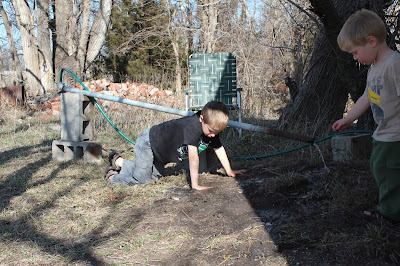
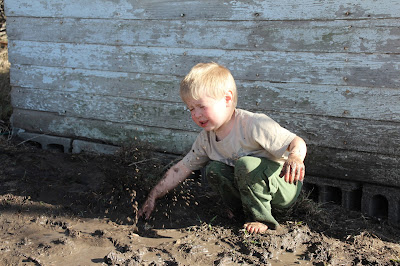
Today the outdoor temperatures got to nearly 75F/24C. The boys had this idea to go play with their streams . Here s one of the cleaner moments: I had set up an old pipe and a hose, with the water coming slowly out of the pipe onto a little mound of dirt. They can then use their fingers to make channels in the dirt for the water to flow through. They ve found that sticks can become bridges, making a hole in the earth makes a pond, and, oh yes, it s quite muddy and a lot of fun. Oliver at one point realized that he could splash the mud all around quite nicely. And he wanted to make sure I took photos of his hands. They could have played out there for hours, I m sure. When it was time to clean up, they enjoyed seeing the mud come off their sandals, arms, hands, and feet. It was a perfect use for the first really warm day of spring.

12 February 2013

John Goerzen: Catching the mudball

Dad, can I bring my mudball inside? Jacob Ooo, dad, I need a mudball too! Oliver You d have to have been there to see how excited Jacob was about his mudball. We had been out hiking down by the creek a day after a rain, and he, well, made a mudball and carried it around with him. I m not used to finding mud all that exciting. To me, mud is something that my car can get stuck in, that my boots can drag into the house, that needs to be suppressed by a little gravel on top. But to Jacob, he was holding a ball of excitement, of adventure, of discovery. And Oliver wanted in on the fun! Jacob wasn t thinking about consequences of bringing a mudball indoors, because he didn t need to. He wasn t visualizing the damage it could cause, the time of cleaning it up, or even the fact that a mudball doesn t really stay a mudball permanently. He just wanted to carry his ball of excitement with him. Being a parent means being a teacher, an example, and a leader. It is fine for Jacob to not think about the consequences of bringing a mudball into the house at age 6, but part of my duty as a parent is to make sure he thinks about consequences by the time he gets behind the wheel of a car. As we grow up, we are shown, taught, and prodded into thinking about consequences of our choices: getting good grades in school, thinking about the impression the clothes we wear to a job interview might leave, worrying about what people think about us when we talk in front of a group. We take on real responsibilities when we leave childhood, and the consequences of our actions become more significant. But where s the off switch? Shouldn t there be a way for us to wonder about bringing the mudball indoors, too? There was a time in our lives when we didn t care one bit about whether we were wearing fashionable clothes, making a good impression, or doing things the right way. After being in the mindset of taking careful responsibility over life for so many years, it s hard to re-discover that earlier time. A colleague forwarded a little speech about Thanksgiving. It contained, Those who live in thanksgiving daily have a way of opening their eyes and seeing the wonders and beauties of this world as though seeing them for the first time. This is something children know how to do, and we adults have often forgotten, because we are too busy worrying about dirty floors and stained curtains to see the potential for fun in mud. I am convinced that, just as important as being responsible, is learning how to let go, to let our hearts feel peace and joy as if a child. We can t open our eyes and see the wonders of this world if we re too busy worrying about convincing someone else to vote for our preferred candidate, about saying things perfectly, about being right. There s beauty in that daily commute in a car or subway. Look around, and you might see kids with their noses pressed to the window, even if it s mostly black tunnel outside. There s wonder in that business flight, in the mud, in the doctor s office waiting room. When I see people using insults in a discussion thread on the Internet, I am saddened, because it means they have lost sight of the wonder of being able to communicate with and understand a person thousands of miles away, instantly, and are more worried about their position looking good, or are unable to see the beauty in a person that thinks differently. I once had this conversation with Jacob in an airplane, probably surrounded by people impatiently waiting to turn on their electronic devices:
Jacob, we are in the air! Woooooooow! Jacob, we re flying! Dad, I don t know that I ve ever been a butterfly before!
I hope we can all find ways to be a butterfly more often.

5 February 2013

John Goerzen: The Superbowl Pirate Bus

I ll forgive you for not noticing the bus full of pirates at the Superbowl. Because, well, unless you saw my 6-year-old, you have a pretty good excuse for missing it. I ll give you the Goerzen Superbowl play-by-play, just to make sure you re caught up. It involved pirates, cops, tractors, cookies, a card game, and yes, even troubles with HDMI. We were invited to a Superbowl party, and were going to bring a party snack. The boys love to help cook, and I try to give them choices. I started naming off potential snacks, starting with healthy options. They listened attentively, until I mentioned cookies. COOKIES! ***COOKIES!*** Yes, cookies! This reaction was, I must say, not exactly a surprise. Then I asked them what KIND of cookies. Jacob immediately knew what he wanted, so of course Oliver took a minute to come up with something else. No matter; we could make two kinds of cookies. Jacob, of course, picked a kind of cookie that needs cherries, while Oliver picked one that needs chocolate chips. Thus they both had opportunities to have a small taste of ingredients while we prepared the batter. And so make cookies we did. Plus a loaf of bread. Anyhow, once we got to the party, Jacob and Oliver saw a huge tub of Legos and were at it in a flash. One of Jacob s friends was pretending everything was a tractor, but it wasn t long before Jacob started in on his evening s project: building the largest bus he could build. He was pleased when he got 4 lego people into it. Even more happy when he got 10 into it. And by the time he figured out how to get 35 into it, he was quite proud of himself indeed. Oliver, meanwhile, in classic little brother fashion, tried to corner the market on surplus lego people. He appears to have the hardline negotiation skill down already, and perhaps is appreciating the value of artificial scarcity in the lego market <grin> Eventually the bus seemed to hit the limits of engineering and joint strength, and Jacob gave up for a little while. He had a cookie and some carrots, commented on the exciting game of Uno going on, ( Who is the loudest? All of them! ), brought me some carrots, and periodically commented that The ball team is ahead of the SF team. Sure is. They have more points! (This from the BAL and SF text on the screen.) And then he went back to playing. And here s where the pirates come in. Jacob s new bus had a lego flag that he decided was a pirate flag. So the bus was a pirate bus. He built a platform out the back for them to use to steal things . So his pirate bus went around the lego area, stealing this from one pile, stealing that from another, until it got almost as long as his first bus. Pretty soon, along came a police boat to chase the pirates. But the police boat appeared to suffer a humorous series of logistical failures and never could quite disrupt the pirates. But never mind that, for little brother Oliver was getting bored with the lego mountain he was building and decided it would be more fun if he would disrupt the pirates. An opinion that Jacob quite strongly disagreed with. When it was time to go, Jacob tried to extract a promise from the party hosts to not let anyone take apart the pirate bus until next time we would be there. Then this morning, Jacob and I had a discussion about pirates. Dad, are pirates real? Yes, Jacob, they are. Do they steal things? Yes, but they are far away. There are no pirates here. Are there pirates in Kansas? No. There are some pirates in Africa though. Oh. What state is Africa in? Africa is so far away that it isn t even in a state. You d have to take a boat or a plane to get there. Or a train! Nope, a train couldn t get across the ocean. It s too wide! They d build a bridge! It s too wide for a bridge. It s more than a thousand miles! WOW a thousand miles! Great! OK dad, it s time for me to get on that school bus!

22 January 2013

Jon Dowland: Possible future coding project

Re-implement ikiwiki, or something like it, in go. See how much the language's features and philosophy colour the design. In particular I'm wondering how much the first-class treatment of concurrency might change how you structure things: one thread per page, or hot pages... you'd want to approach it with lots of micro-locks rather than one big lock to rule them all. I can see some future ikiwiki refactoring work being a bit like the Linux Kernel's efforts to get rid of their big kernel lock. See also: Joey's proposed Haskell ikiwiki rewrite. I may be remembering wrong, but I thought he had some beginning code up somewhere. Perhaps I'm conflating it with John Goerzen's one-time OfflineIMAP rewrite, which might also be lost to the sands of time...

John Goerzen: Today is Pretend St. Patrick s Day!

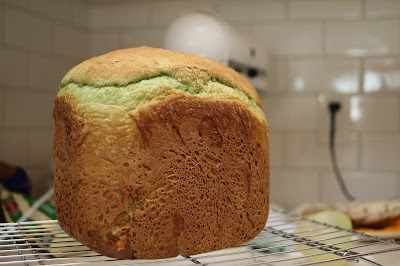
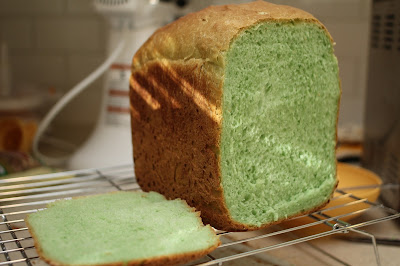
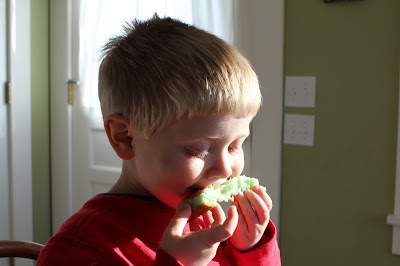
Today in the USA is Martin Luther King, Jr., day. But sometimes these holidays get confusing for a 6-year-old. I asked Jacob the other day if he knew what holiday was coming up. He thought about it for a second, then declared it would be St. Patrick s Day. He was excited because St. Patrick s Day is green. When he realized that it was really MLK Day, he was disappointed. That day isn t green. So I said, Jacob, how about we celebrate pretend St. Patrick s Day on Monday? His face lit up, he got a huge smile, and said, Oh yes! Great idea, dad! Oliver got all excited about it too. I was already planning on us doing some cooking, and thankfully had green food coloring already. So I sort of discarded my plans so each meal could have something green in it. When the boys woke up this morning, I wished each of them Happy Pretend St. Patrick s Day! We all wore green. Jacob put his shirt on backwards so the side with more green would be facing front. For breakfast, our green dish was green crepes with a succotash (based on baby lima beans and corn) filling. The boys were excited to discover that the crepes could be green on one side, and green and a little brown on the other. Jacob was unsure of the succotash idea, but after having a few bites, declared it excellent . After breakfast, we made bread. They loved watching the green food coloring disperse in the water. We checked on how green the dough looked periodically. We watched how it was rising and whether it was staying green. And we checked in on it backing, as the crust turned from green to brown. We discussed green bread over and over. Important questions were asked and answers were attempted. And then, of course, the moment of truth removing the loaf from the pan. The boys jabbered excitedly that there was some green peeking out. While we waited for it to cool, we went out to the creek. The creek is dry this year, so we got to walk in it. Jacob used his stick to make a line behind him. I asked him, Is that a line so we can find our way back? Oh! Uhm. Yes! And then he added arrows so we d know which way to go. Jacob stopped every 20 or so feet to collect pretend train tickets from Oliver and me. Oliver eventually grew tired of this, so Jacob started collecting Oliver s ticket from me. They climbed on some trees, managed to find some mud, drew outlines of train cars in the dirt, and then followed Jacob s line back down the creek bed. They pointed out any green things they saw. Then we went back to the house, took off our warm coats, and cut into the bread. Can you imagine the excitement? I hadn t realized green is a flavor, but it must have been somehow, because those boys absolutely loved this green bread. When we got out the jam, Jacob realized that it was red on the green bread, and that now his bread was Christmas-colored. All sorts of green bread discoveries were made, but the best among them was that if you hold a slice of green bread up to the bright sun, the sun makes it glow green and it looks like a stained-glass window. Sometimes a few drops of food coloring can add a ton of excitement to a day.

29 December 2012

John Goerzen: Milk, Cookies, and Delight

Sometimes an attic is all it takes to delight children. This afternoon, the boys and I made cookies. Jacob has been talking about setting out milk and cookies for Santa Claus for several days, and of course the fact that we had made cookies reminded him of this as I figured it would. So after the boys got into their pajamas and all ready for bed, we set out milk and cookies for Santa. The boys have always known that Santa is pretend, but love the stories and traditions anyhow. Never mind that Christmas was 3 days ago, and they ve already opened their presents. It s SANTA! It s magic! It doesn t matter! I asked Jacob, Would you like me to pretend to be Santa tonight? A big grin, then Oh yes, dad! Do it! So after I read them their bedtime story, sang them a song (Jacob chose a Latin hymn that s my boy!), and tucked them into bed, I pretended to be Santa. I went back downstairs. I drank the milk and ate the cookies. Then I went to my small future present stash, selected a few small items, and put them under the tree. I gave it a few minutes. Then I crept up to the attic. I snuck along the wood floors quietly, until I was above the boys room. Then I jumped. And I scraped a wood chair along the floor. And then I yelled out HO HO HO! Merry Christmas! I had a brief conversation with Rudolph, then made some sliding noises. I was silent for a few seconds, then made some more noise and said, Wow, Rudolph, Jacob and Oliver left some great milk and cookies! Let s go deliver the rest of our presents! And made some vague sleigh taking off from the roof of a house noises. I crept back down the stairs. I put my ear to the outside of the closed door to the boys bedroom. I heard Jacob excitedly jabbering, He said milk and cookies! He liked them! He really liked them! Ooo butterfly, he was here! (Butterfly is a stuffed, er, butterfly that he sleeps with.) I gave it a minute or two, then I went in. Jacob, did you hear something? Yes! What was it? Well, it was a loud thud! I sat straight up like this. [ he demonstrates ] Then I heard ho ho ho ! And milk and cookies ! And I was excited like this! [ more demonstrations ] What do you think happened? I don t know! Dad, what did you do? I told him. It only increased his delight. Did it sound like Santa s sleight landing? (annoyed) No, dad. It sounded like a crash. (brightening) And then Santa coming down the chimney with presents! Oh, it is so exciting! (We don t have a chimney) It was still magical, even though he knew exactly what happened. For his part, Oliver slept through it all. He will still discover the empty plate, empty cup, and slightly less empty area underneath the tree. And neither boy knows about the thank you note from Santa yet. I anticipate smiles in the morning!

23 December 2012

John Goerzen: Glockenklang, Forever

Jacob (and Oliver too, somewhat) has taken quite the interest in Christmas music this year. Perhaps it s singing in the choir at school, or perhaps it s just him getting older, but in any case, Christmas music fascinates him. And no song more than Jingle Bells. I have recordings of it by several artists in different styles, and he has his favorites and often wants to hear them again and again. The other night at supper, he said, Dad, can you sing Jingle Bells in German? Kind of a random question. I normally try to keep books and devices of all sorts away from the table, but my son had just asked me to sing. In German. I don t believe that had ever happened before, so I wasn t going to say no! I got my tablet, pulled up Google, and found some German lyrics. Not exactly a translation, but it fit the tune, so that s what counts. So I started singing, and when I got to the chorus, and sang Oh, Glockenklang, Glockenklang both boys bust up laughing. They thought Glockenklang was a hilarious word, and loved to hear it. Oliver requests I sing Glockenklang every so often now. He has this eager anticipation when he does it, as if he knows I m going to be hilarious so much so that he almost starts laughing before I even say a word. Then yesterday at breakfast, Jacob requested more German songs. I finally got a couple of hymn books (one of which, Gesangbuch mit Noten, really is a German songbook). I sang some songs in German for the boys, while they enjoyed their blueberry crepes. Sadly Stille Nacht and O du fr hliche did not prove as hilarious as Glockenklang, but they got impatient as I looked through the idnex between each song, saying Dad, just sing more German! Don t look at those pages! So I guess it was a hit. I m not sure where this sudden fascination with German music came from, but it appears to be leaving me hungry. While driving around, Oliver requested I sing Glockenklang in the car. I said yes, despite not remembering even one German word to that song except for, well, Glockenklang. So I just filled in with some random German words I do know. Fortunately, they didn t seem to have memorized the rest of it either. The other day, we went to the annual Christmas concert at the local high school. It was perfect for the boys various styles of music, an interesting old auditorium, nobody was going to care if they weren t perfectly quiet, and the price was right, too. The band played first, and both boys sat there, paying great attention, soaking it all in. They loved the cymbal crashes and Jacob seemed to dream of playing the chimes and bells. At one point, I whispered to Jacob that I could feel the timpani on the wood floor in the auditorium, and he tried it, and made his Hmm, I just learned something interesting! reaction. As is tradition, the concert concluded with singing the Hallelujah Chorus and anyone in the audience that wants to sing is invited on stage to join the choir. I remember being in high school for that concert, and after practicing it in school, the great fun of being joined by many powerful voices from the community all around me on the risers. So this time, while my parents stayed with the boys, I was one of the many that went up to join the choir. It was no less thrilling all these years later. Ending with Forever and ever, Hallelujah, Hallelujah. Hallelujah! , and feeling it, right then, put a huge smile on my face.

22 December 2012

John Goerzen: Faces

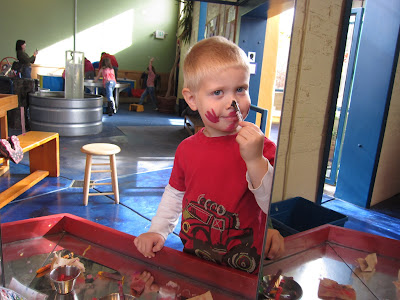
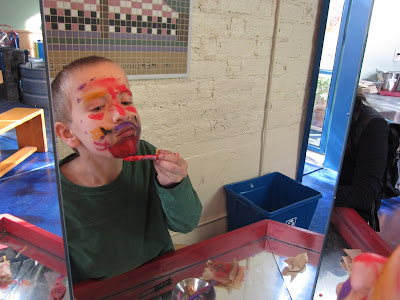
A couple of weeks ago, I walked in to a nice, sit-down restaurant, with a smile on my face. It s the kind of restaurant with folded cloth napkins on the tables. Table for three, please as Jacob and Oliver were with me. This much isn t unusual. I have periodically taken them out to eat for quite some time, and they enjoy it. But there were a few unusual things about this particular day. I suppose the main one is that they had just been doing this. Yes, painting your own face can be a lot of fun. And also serious business. The boys and I were in Santa Fe, NM on a train trip. It had been a year since their last train trip, and that s longer than they are typically used to. I d taken Jacob on a train trip with just the two of us before, but this was the first trip with just the two boys and me. And one of the places we visited was the excellent Santa Fe Children s Museum. It may be the best children s museum I ve ever seen. Not the largest, or the flashiest, but that s part of the reason I say best . They had chimes (and many other percussive instruments to produce different pitches, including mounted hubcaps and varying length wooden planks). They had a great magnets table with washers and nuts, so children can build their own bridges, stairs, etc. using magnetism. A giant bubble table, tunnels to crawl in outside, etc. A great place. And, apparently, the thing they were really known for I did not know this in advance is the paint your own face station. Jacob and Oliver really got into it. Oliver informed me he was a lion and I heard ROAR! ROAR! periodically all afternoon. Jacob asked me to help paint a J, and the spirals, on his cheeks. After some careful thought, he informed me that he was spiral man . Next to the paint your own face area was a clean your own face area. Most kids were being helped to clean their own face by their parents on their way out. Jacob and Oliver protested that plan, so I figured, if they want to enjoy painted faces all day, why not? And this, of course, led into lunch with self-painted faces. Nobody at the restaurant commented, but the owner had a huge grin when he saw them. (It was a Mediterranean place, and I m sure the owner would have commented had there not been a language barrier.) Incidentally, the boys became quite the fans of souvlaki. Later, as we walked around Santa Fe Plaza and another museum, they drew smiles all over the place. Several kind people asked them, Did you enjoy the children s museum? Yes, everyone in Santa Fe seemed to know precisely where kids with painted faces had been that day. Santa Fe is an amazing and beautiful city. It was warm and friendly, and the architecture and layout was fun to see and pedestrian-friendly. We walked past the Cathedral Basilica of St. Francis of Assisi several times, and went in once. For some reason I could never fully explain, I could often smell their incense even a block or two away. It added to the crisp wintry feel of the plaza. The point of the trip wasn t Santa Fe, though. It was Jacob and Oliver on Amtrak, which is the thing they were really most excited about of course. They were excited as usual, and despite the fact that the train comes through this area only at around 3AM, were plenty excited to be on the train. And, in fact, didn t fall asleep again until about 5 due to the excitement (though they did an excellent job of being quiet). Of course, 6AM was morning so they were wide awake by then. Jacob had been planning what he d eat on the train for days already, and had announced he would be having French toast for breakfast and pizza at lunch. He was a bit disappointed to see that French toast wasn t on the menu this time, but pancakes saved the day. While waiting for the dining car to open at 6:30, we went to the lounge car for awhile. I had brought along various things for them to do on the train, of course, and among them was a notebook and some markers. Jacob loved drawing suns and stars, and sometimes writing short notes. He gave notes to several friendly people that happened to be visiting with us on the train. Oliver enjoyed it too, but he was more intrigued by the cheap set of multi-colored post-it notes. There were two happy, and somewhat tired, boys getting off that train in the middle of the night when we returned.

16 December 2012

John Goerzen: The world is still a good place

At times like these, it is easy to think of the world as a cold, evil place. Perhaps in some ways, it is. I saw this quote from Fred Rogers floating around today:
When I was a boy and I would see scary things in the news, my mother would say to me, Look for the helpers. You will always find people who are helping. To this day, especially in times of disaster, I remember my mother s words, and I am always comforted by realizing that there are still so many helpers so many caring people in this world.
Sometimes I think that Fred Rogers wisdom is so often under-appreciated. What he says is true, very true. I know what it s like to fear for my child s life. And sometimes the shoe has been on the other foot, when I have been one of the helpers. Many of you know these last few months have been the most difficult in my life. And despite having gone through the deaths of three relatives, nothing has quite compared to this. I can not even begin to express my gratitude for all the care, compassion, and love that has come my way and towards the boys. People I barely knew before are now close friends. Random strangers have offered kindness and support. I have never before needed to be cared for like that, and in some ways perhaps it was hard to let myself be cared for. But I did, and all that caring and generosity has made an incredible difference in my life. Most of us don t see our pain on CNN or BBC, but that doesn t mean it s less real. And it doesn t mean there s nobody that cares. Open up to others, let them care for you. Things can and do get better. The people in Newtown did nothing to deserve this. No matter what evidence is found, they will never get an adequate answer to why? Children have been frightened, families torn apart, lives ended, for no reason at all. But they will survive the terrible pain. In time, they will find happiness again. And they will feel love and compassion from people around the world something to sustain them in their grief. I am certain of this. I recently read this quote, part of a story about a dying cancer patient: Don t forget that it doesn t take much to make someone s day. Yes, the world is still a good place.

3 October 2012

John Goerzen: Difficult Times & Hope

This past month has been the most difficult in my life and that of my family as well. I m not going to go into it for the whole Internet, but any well wishes, happy thoughts, prayers, whatever you want to send our way, whether we know about it or not, would certainly be welcome. And, of course, the reason I m not very active online right now is that I m focusing on family, work, and other pressing matters. I have had some measure of comfort from hearing from others that have had pain in their lives. It is good to know I m not alone, good to have people to talk and share with. And it is good to find some way to have hope in the midst of difficulty and uncertainty. I sing with the Kansas Mennonite Men s Chorus, and when listening to one of our recordings recently, was struck by these words in a whole new way. Let music never die in me is a powerful message.
I dreamed a dream, a silent dream,
of a land not far away.
Where no bird sang,
no steeples rang
and teardrops fell like rain. I dreamed a dream.
No alleluia, not one hosanna,
No song of love, no lullaby. And no choir sang to change the world.
No pipers played, no dancers twirled.
I dreamed a dream, a silent dream.
Silent.
Silent. Awake! Awake!
Awake, my soul and sing!
The time for praise has come.
The silence of the night has passed;
a new day has begun.
Let music never die in me!
Forever let my spirit sing!
Wherever emptiness is found,
Let there be joy and glorious sound. Let music never die in me!
Forever let my spirit sing! Let all our voices join as one
to praise the giver of the song! Awake! Awake!
Let music live! The Awakening, Joseph M. Martin (excerpts)
See a performance here. Even when hope is dim, or the music is playing only softly, it s not dead. I hear it when an 85-year-old person in church, comes up to me with tears in her eyes and gives me a big, silent hug. I feel the music when when I can share about things with people, when I sing, when the beautiful Kansas sunset peeks out, when I share a smile or laugh with someone, and when I see the delight and happiness of children. Let music live!

6 September 2012

Joey Hess: UPS farce

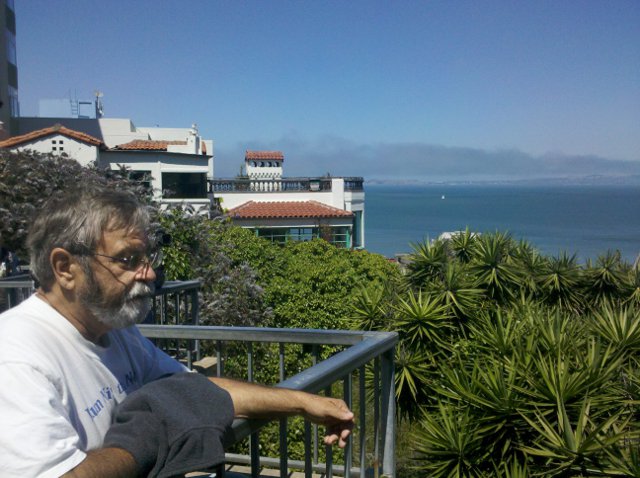
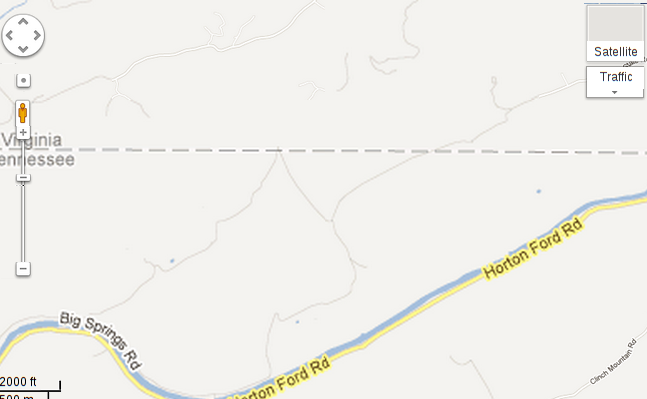
This is not the kind of place I live, though I don't mind a visit. Errol looking out over Salsalito and the Bay I'm not bothered by a more rural life, I thrive on peace and quiet, and am not bothered by needing to haul my water, split firewood, or spend an hour just mowing my driveway. I bought a GPS the other day, and it doesn't know where my driveway is..
or where the road leading to my driveway is..
or even about the highway leading to that road!
not many roads on this map.. The only thing that really bothers me about living here off the map is that I'm in the middle of a food desert too. The nearest semi-decent grocery store and produce market are 40 minutes away. There's one restaurant worth eating at, and while a very congenial place to eat rustic food while watching the river flow by, it serves almost no vegetables. Adding to the problem, my fridge is a rather expensive propane model, which is about half a normal size, and has no freezer. Managing a healthy meal plan is a constant struggle, though I do have time to cook, at least, thanks to not having the kind of commute that is typical around here. Well, the food desert was my only real problem. Now I can add to that the UPS emergency. A week ago, a package left Shenzen China for here. It quickly passed through Anchorage Alaska, and with a few days had arrived an hour and a half from here. Getting it here has taken the whole rest of the week.
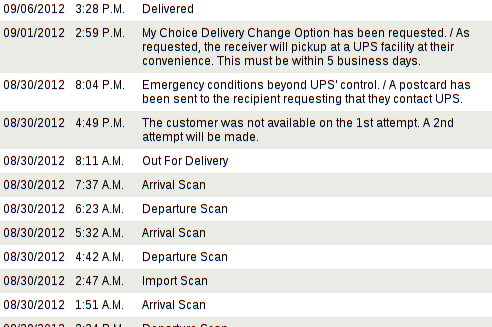
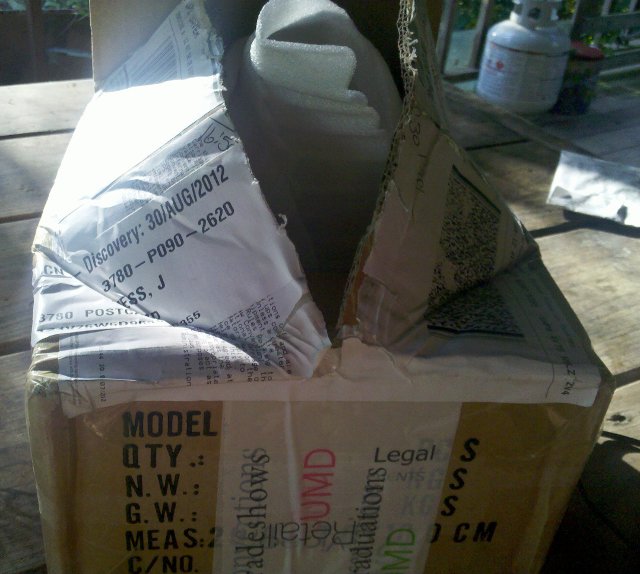
I only knew UPS attempted delivery because a neighbor told me. Seems they took one look at my driveway and turned around. They never tried again, and they didn't bother to leave a note on the mailbox, or anything. Now, the US postal service is happy to drive up this driveway; they drive a sensible 4x4 around here. I think DHL and Fedex have been here too. (Contrary to John Goerzen's experiences) My compact car is not bothered by my driveway either... But UPS's brand involves large brown trucks, even where inappropriate, and damage to them from such things as low-hanging branches apparently comes out of the driver's paycheck. And while normally UPS leaves small things in my mailbox, or with a neighbor, this was an important package from China, and it needed a signature. But really, a post card? "emergency"?! So, I bought the GPS to find UPS, because my package was in an industrial park in some town I've never been to. And on Tuesday I was within an hour of there and swung by. And it was closed. UPS's website had not mentioned this; other businesses are open the day after Memorial day. That turned out to be a really annoying day all around. When I got home, after a night away, I found my fridge's fire had blown out, and nearly all my food was only fit for the dog. Today I went out to try again (and buy groceries). When I reached the UPS depot.. it was closed! Until 3 pm. At this point I felt this story was reaching full-on farce. After cooling my heels in a library for three hours, I was finally able to open the most over-packed package I've probably ever seen. My kickstarter reward sample looks good.. I'll be ordering a lot more, but not to this address. As a coda to the UPS farce, arriving home today I checked my mailbox, and found the UPS postcard had finally arrived. It included mention of the 3 pm opening time, and noted that I had until tomorrow before they'd return my package to China. The coda to the coda is that on my way home from this second annoying day delivered courtesy of UPS, I stumbled on a restaurant overlooking a waterfall, just outside the town where I get my groceries. It serves food that satisfies both my Cajun and healthy cravings. Now I just need a larger fridge..

29 August 2012

John Goerzen: Kindergarten Computer Class and Password Security

Jacob started Kindergarten last week. More on that in another post. He s been loving it, until yesterday. At least part of his disgruntlement was because it was his first visit to computer class. Putting together a few conversations, we learned this:
Jacob: Something was different about Kindergarten today. Us: Oh? What was it? Jacob: I had computer class today. Us: What did you do? Jacob, super frustrated: Nothing. NOTHING, NOTHING, NOOOO THIIING. Nothing. Us: You didn t get to use a computer? Jacob: All we did was log on and log off the whole time. Log on and log off. My username is Jacob and my password is Jacob. (annoyed and confused voice) Why are they the same??
I guess his teachers weren t used to children that had been logging on to computers for two years before Kindergarten. And probably also weren t expecting any of them to take some sort of offense at their password poicy. He probably couldn t appreciate how reasonable it was to tech Kindergarteners how to log in to a computer on the first day of computer class

25 August 2012

John Goerzen: Voice Keying with bash, sox, and aplay

There are plenty of times where it is nice to have Linux transmit things out a radio. One obvious example is the digital communication modes, where software acts as a sort of modem. A prominent example of this in Debian is fldigi. Sometimes, it is nice to transmit voice instead of a digital signal. This is called voice keying. When operating a contest, for instance, a person might call CQ over and over, with just some brief gaps. Most people that interface a radio with a computer use a sound card interface of some sort. The more modern of these have a simple USB cable that connects to the computer and acts as a USB sound card. So, at a certain level, all that you have to do is play sound out a specific device. But it s not quite so easy, because there is one other wrinkle: you have to engage the radio s transmitter. This is obviously not something that is part of typical sound card APIs. There are all sorts of ways to do it, ranging from dedicated serial or parallel port circuits involving asserting voltage on certain pins, to voice-activated (VOX) circuits. I have used two of these interfaces: the basic Signalink USB and the more powerful RigExpert TI-5. The Signalink USB integrates a VOX circuit and provides cabling to engage the transmitter when VOX is tripped. The TI-5, on the other hand, emulates three USB serial ports, and if you raise RTS on one of them, it will keep the transmitter engaged as long as RTS is high. This is a more accurate and precise approach. VOX-based voice keying with the Signalink USB But let s first look at the Signalink USB case. The problem here is that its VOX circuit is really tuned for digital transmissions, which tend to be either really loud or completely silent. Human speech rises and falls in volume, and it tends to rapidly assert and drop PTT (Push-To-Talk, the name for the control that engages the radio s transmitter) when used with VOX. The solution I hit on was to add a constant, loud tone to the transmitted audio, but one which is outside the range of frequencies that the radio will transmit (which is usually no higher than 3kHz). This can be done using sox and aplay, the ALSA player. Here s my script to call cq with Signalink USB:
#!/bin/bash
# NOTE: use alsamixer and set playback gain to 99
set -e
playcmd ()  
        sox -V0 -m "$1" \
           "  sox -V0 -r 44100 $1 -t wav -c 1 -   synth sine 20000 gain -1" \
            -t wav -   \
           aplay -q  -D default:CARD=CODEC
 
DELAY=$ 1:-1.5 
echo -n "Started at: "
date
STARTTIME= date +%s 
while true; do
        printf "\r"
        echo -n $(( ( date +%s -$STARTTIME) / 60))
        printf "m/$ DELAY s: TRANSMIT"
        playcmd ~/audio/cq/cq.wav
        printf "\r"
        echo -n $(( ( date +%s -$STARTTIME) / 60))
        printf "m/$ DELAY s: off         "
        sleep $DELAY
done
Run this, and it will continuously play your message, with a 1.5s gap in between during which the transmitter is not keyed. The screen will look like this:
Started at: Fri Aug 24 21:17:47 CDT 2012
2m/1.5s: off
The 2m is how long it s been going this time, and the 1.5s shows the configured gap. The sox commands are really two nested ones. The -m causes sox to merge the .wav file in $1 with the 20kHz sine wave being generated, and the entire thing is piped to the ALSA player. Tweaks for RigExpert TI-5 This is actually a much simpler case. We just replace playcmd as follows:
playcmd ()  
        ~/bin/raiserts /dev/ttyUSB1 'aplay -q -D default:CARD=CODEC' < "$1"
 
Where raiserts is a program that simply keeps RTS asserted on the serial port while the given command executes. Here's its source, which I modified a bit from a program I found online:
/* modified from
 * https://www.linuxquestions.org/questions/programming-9/manually-controlling-rts-cts-326590/
 * */
#include <stdio.h>
#include <stdlib.h>
#include <termios.h>
#include <unistd.h>
#include <sys>ioctl.h>
#include <sys< sys="">types.h>
#include <sys>stat.h>
#include <fcntl.h>
static struct termios oldterminfo;
void closeserial(int fd)
 
    tcsetattr(fd, TCSANOW, &oldterminfo);
    if (close(fd) < 0)
        perror("closeserial()");
 
int openserial(char *devicename)
 
    int fd;
    struct termios attr;
    if ((fd = open(devicename, O_RDWR)) == -1)  
        perror("openserial(): open()");
        return 0;
     
    if (tcgetattr(fd, &oldterminfo) == -1)  
        perror("openserial(): tcgetattr()");
        return 0;
     
    attr = oldterminfo;
    attr.c_cflag  = CRTSCTS   CLOCAL;
    attr.c_oflag = 0;
    if (tcflush(fd, TCIOFLUSH) == -1)  
        perror("openserial(): tcflush()");
        return 0;
     
    if (tcsetattr(fd, TCSANOW, &attr) == -1)  
        perror("initserial(): tcsetattr()");
        return 0;
     
    return fd;
 
int setRTS(int fd, int level)
 
    int status;
    if (ioctl(fd, TIOCMGET, &status) == -1)  
        perror("setRTS(): TIOCMGET");
        return 0;
     
    status &= ~TIOCM_DTR;   </sys>* ALWAYS clear DTR */
    if (level)
        status  = TIOCM_RTS;
    else
        status &= ~TIOCM_RTS;
    if (ioctl(fd, TIOCMSET, &status) == -1)  
        perror("setRTS(): TIOCMSET");
        return 0;
     
    return 1;
 
int main(int argc, char *argv[])
 
    int fd, retval;
    char *serialdev;
    if (argc < 3)  
        printf("Syntax: raiserts /dev/ttyname 'command to run while RTS held'\n");
        return 5;
     
    serialdev = argv[1];
    fd = openserial(serialdev);
    if (!fd)  
        fprintf(stderr, "Error while initializing %s.\n", serialdev);
        return 1;
     
    setRTS(fd, 1);
    retval = system(argv[2]);
    setRTS(fd, 0);
    closeserial(fd);
    return retval;
 
This compiles to an executable less than 10K in size. I love it when that happens. So these examples support voice keying both with VOX circuits and with serial-controlled PTT. raiserts.c could be trivially modified to control other serial pins as well, should you have an interface which uses different ones.

19 August 2012

John Goerzen: Crazy Enough?

So far this year, I ve read somewhere in the neighborhood of 5000 pages. As I ve started to read more, I ve started to watch TV, movies, and Youtube less, because they are simply boring and shallow in comparison. War and Peace, in particular, deeply touched me. Lately I have been reading the Wheel of Time series, which has its own unique characteristics. Whether an epic (or super-epic, such as Wheel of Time) novel, or the Sherlock Holmes series, or nonfiction works, there is something magical about reading a book. We often see characters, real or fictional, that rise from obscurity to do great things for the world. We are transported in time and place to a time or place we will never be able to experience, perhaps because it is long past, or perhaps because it never was. But in any case, we can be inspired. I am reminded of this quote: The people crazy enough to think they can change the world are the ones that do. If someone told me that a street vendor in Tunisia would, in less than a year, cause the overthrow of 4 dictatorships and reform in a handful more, I would have, yes, thought that was crazy. And while Mohamed Bouazizi isn t a household name in much of the world, he managed exactly that. But not just him. It took crazy unarmed people to occupy Tahrir Square, some to die, for progress to be made in Egypt. This story is written all over history. People have done the impossible, have defied all odds, through sheer belief that they could. Civil rights have been granted due to the leaders we all know, but also due to the millions of marchers we don t. Changing the world doesn t have to mean that the world knows you. It just has to mean that you love the world, as Tolstoy pointed out:
Love hinders death. Love is life. All, everything that I understand, I understand only because I love. Everything is, everything exists, only because I love. Everything is united by it alone. Love is God, and to die means that I, a particle of love, shall return to the general and eternal source.
Whatever your stance on religion, this is a powerful quote. Sometimes particles of love might look crazy. But isn t it then that they are the most alive? Isn t it then that they are the greatest hindrance to death and despair?

16 August 2012

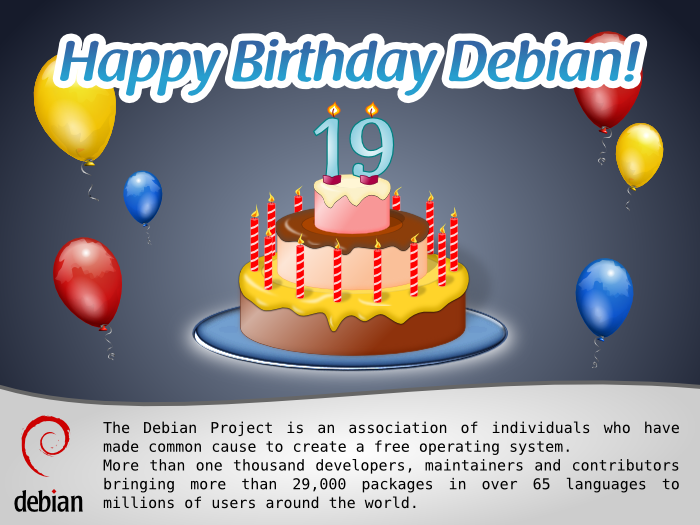
Rapha&#235;l Hertzog: Happy Birthday Debian! And memories of an old-timer

For Debian s birthday, Francesca Ciceri of the Debian Publicity team suggested that developers blog about their first experiences with Debian . I found this a good idea so I m going to share my own early experience. It s quite different from what happens nowadays Before speaking of my early Debian experience, I have to set some context. In my youth, I have always been a Windows user and a fan of Bill Gates. That is until I got Internet at home at that point, I got involved in Usenet and made some friends there. One of those made me discover Perl and it has been somewhat of a revelation for me who had only been programming in Visual Basic, Delphi or ObjectPal. Later the same friend explained me that Perl was working much better on Linux and that Debian Linux installs it by default so I should try this one. I had no idea of what Linux was, but given how I loved Perl, I was eager to try his advice. So I got myself a Tri-Linux CD with Debian/RedHat/Slackware on it and started the installation process (which involved preparing boot floppies). But I did not manage to get the graphical interface working despite lots of fiddling with Xfree86 s configuration file. So I ended up installing RedHat and used it for a few months. But since many of the smart guys in my Usenet community were Debian users, I persisted and finally managed to get it to work! After a few months of usage, I was amazed at everything that was available for free and I wanted to give back. I filed my first bug report in July 1998, I created my first Debian packages in August 1998 and I got accepted as an official Debian developer in September 1998 (after a quick chat over the phone with Martin Schulze or James Troup I never understood the name of my interlocutor on the phone and I was so embarassed to have to use my rusty English over the phone that I never asked). That s right, it took me less than 3 months to become a Debian developer (I was 19 years old back then). I learned a lot during those months by reading and interacting with other Debian developers. Many of those went away from Debian in the mean time but some of them are still involved (Joey Hess, Manoj Srivastava, Ian Jackson, Martin Schulze, Steve McIntyre, Bdale Garbee, Adam Heath, John Goerzen, Marco D Itri, Phil Hands, Lars Wirzenius, Santiago Vila, Matthias Klose, Dan Jacobowitz, Michael Meskes, ). My initial Debian work was centered around Perl: I adopted dpkg-ftp (the FTP method for dselect) because it was written in Perl and had lots of outstanding bug reports. But I also got involved in more generic Quality Assurance work and tried to organize the nascent QA team. It was all really a lot of fun, I could take initiatives and it was clear to me that my work was appreciated. I don t know if you find this story interesting but I had some fun time digging through archives to find out the precise dates if you want to learn more about what I did over the following years, I maintain a webpage for this purpose.

One comment Liked this article? Click here. My blog is Flattr-enabled.

13 August 2012

John Goerzen: Summer

It s been a hot year in Kansas this year. Really hot. Our average high for July was 101F / 38C. It s also been extremely dry. So we haven t had too many pleasant opportunities to enjoy a bit of an upcycling project I had with the boys. When we renovated our old farmhouse, we had two chimneys removed. The bricks were saved in a large pile out back, and we haven t really touched them in the last 5 years. I got the idea at some point that it would be nice to have a fire ring on our yard. The boys love campfire-style cooking, and enjoy helping gather kindling and watching the fire grow. I had looked at fire rings in stores, but just couldn t bring myself to pay $60 or $100 or even more for what was really a piece of round metal. I decided we would find a way to build our own fire ring. So the idea of chimney bricks seemed perfect. Some of these bricks still have mortar on them, so the result is imperfect, but it is functional. More importantly, the boys helped. They picked out bricks one at a time, set them in the wheelbarrow (or even carried a few themselves, as Jacob insisted on doing sometimes.) Then we d dump them out on the ground, and I d make some attempt at making the thing round, while the boys would put them on the pile. We did this over the course of several evenings, with me filling in on some of it after they lost interest. When we got it done, they of course loved cooking outside. I made sure that we placed it in a place that will be in the shade every summer evening so we d be comfortable. I made no attempt to mortar it in; this way, it s easy to move or resize. And it s safer for the boys than a metal one, since the outer edge never even gets warm to the touch. Anyhow, it finally got a little cooler last week, so we cooked out there for dinner two days in a row. One day, after eating, the boys came back out to help put out the fire with the hose. After that, Jacob and I went out there to eat dessert. He sat on the grass, and I sat down next to him. He scooted over a bit to be closer to me. Pretty soon, Oliver came running out too, and sat on my lap. The three of us just sat there on the grass, eating our desserts and enjoying the evening. It s the kind of moment that makes a dad happy. The other evening, they again helped me put out the fire with a hose. They d been active that day, so after I finished hosing down the fire ring, I gave them each a small spray with the hose. After a brief flicker of indecision, they both decided this was hilarious. Jacob took off running, yelling You ll never catch me! (And clearly hoping I would.) Oliver copied him, and so I proceeded to chase them around the yard with a hose for quite awhile. There was much laughter from them, and they wound up totally soaked and happy. Another good evening. You never know what will happen outdoors, but so often it is very good.

12 August 2012

John Goerzen: A Verbose, Hands-On Nexus 7 Review

Some of you may have noticed that I am not a concise author. Perhaps that has something to do with the fact that I am not a concise reader. I like facts, details, and lots of them. So as a recent Nexus 7 purchaser, here you go. Genesis I ve long used Android devices, and last year had a company-issued Motorola Xoom, which was the first Google Experience tablet with Honeycomb. That tablet has specs roughly similar to iPads; its 10.1 screen was the same, the 1280 800 screen was better than the iPad available at the time, and its 730g weight identical to the early iPads (though 10% higher than the current iPad). I lost access to it when I changed jobs, and had been without a tablet until recently. Other devices I own are the Galaxy Nexus, sporting a 4.65 screen; and what s now called the Kindle Keyboard, with an eInk screen. I had been somewhat interested in the Kindle Fire, but the closed nature and limited capability of the system kept me away. The Nexus 7 reviews, however, were stunning, as was the price. $200 for a great tablet. I wound up buying the $250 16GB model. But not until after I spent a great deal of time thinking about size. Physical Size My main concern was that the Nexus 7 would be too small to be useful. I had never been particularly pleased with my input speed on the Xoom. I tried to touch type on it, but was just never fast enough to surpass frustratingly slow. I have long been a fast and accurate typist on keyboard; well over 100 words per minute, and it is frustrating when my fingers can t maintain that speed. I figured the situation would be even worse on the Nexus 7, given its smaller size. I also found the Xoom to sometimes feel a little small with the 10 screen, and was concerned about that as well. And finally, 7 doesn t sound all that much larger than 4.65 . However, having actually had the Nexus 7 for a little while now, I m very pleased with the size, and may even prefer it. The 10 tablets are just too big and heavy to comfortably hold in one hand, and I ve realized that part of my Xoom frustration was the fact that I had to set it down and prop it up for anything beyond very brief use. At 340g, the Nexus 7 is less than half the weight of the Xoom or iPad, and it makes a huge difference. While still nowhere near where I d be with a keyboard, two-thumb typing in portrait mode, or even something approaching touch typing in landscape mode, is possible on the Nexus 7. The screen size hasn t been a bother, at all. This may be due to the fact that it s higher resolution (it s 1280 800 like the Xoom, but those pixels are crammed into only 7 ). I think it s also partly due to the fact that the browser in Jelly Bean is significantly better than the one in Honeycomb, and perhaps that websites are better at tablet-friendliness, too. Overall, the Nexus 7 feels a lot farther from the size of a laptop than did the Xoom, and as such is more prone to come with me in lots of situations, I think. It works reasonably well with foldable Bluetooth keyboards, so when thinking about a laptop replacement or alternative, that might be the way I go. A Bluetooth mouse also works with it, though I found it didn t provide near the utility that a BT keyboard does. Display The display is both amazing and disappointing. Browse some photos and some of them will show up in eye-popping clarity. Websites display fine. But the screen can also take on a washed-out appearance at times. I am notoriously picky in my displays, and this bothered me enough that I researched it. Analysis has shown that poor firmware calibration has lead to the compression of highlights, which mirrors what I was seeing. I am mostly used to it by now, but it s a disappointment. Most of the time, though, the screen is excellent. In comparison to my eInk Kindle, however, I don t think any tablet will ever be as good for book reading. The eInk screen truly is easier on the eyes, and the reflection of overhead lights on the Nexus 7 display can be distracting at first. I have had occasional issues with it not registering touches properly. This is always cleared up by touching the power button to put the unit to sleep, then waking it back up. Other Hardware There are three hardware buttons: power and volume up/down. Physically, the device fits my hand well, though I might wish it was a little lighter like my Kindle. Charging is accomplished via high-power 2A micro-USB, and there is, of course, a headphone port. There is no alert LED like my Galaxy Nexus has, and no vibration feature. The speaker is on the back, and the microphones along the left side a position which, it appears, many Nexus 7 cases are blocking. Battery Life I am astonished at how good this device is battery-wise, especially compared to the battery disaster that is the Galaxy Nexus. Google claims the Nexus 7 can survive 8 hours of solid screen-on use, and I don t doubt it. Mine s never gotten low enough to get a solid measurement. Wifi The wifi works well, as far as it goes. The wifi doesn t support 802.11n in 5GHz, which although somewhat common for devices like this, is a bit of a disappointment. Software The big story about the Nexus 7 is Jelly Bean. I had used Honeycomb on the Xoom, and Ice Cream Sandwich on my Galaxy Nexus, so I m familiar with its predecessors. Let s take a look. Project Butter Much has been made of Project Butter, Google s attempt to optimize Android to improve its responsiveness and the smoothness of things like scrolling. I can say they have done quite well. This device is so smooth you don t notice how smooth it is. It wasn t until I had been using it for a bit that I really noticed. That s a job well-done. Chrome The browser in Jelly Bean is now called Chrome. I am not sure if this is just marketing or not. It doesn t really feel all that different from previous versions of the Android browser, and the changes have been along the lines of incremental changes Google has introduced before. One of the very best new features happens when you touch a link that is close to other links on a page. Rather than getting a pretty much random page, Chrome pops up a partial-screen zoom box showing the part of the page near where your finger touched. With everything showing up huge, it is now easy to touch the precise link you want. Do so, and the box goes away, and your page loads. I am amazed at how much improvement this one change brings. Compared to ICS Browser, bookmarks can be brought up quicker, and the tab interface is nicer. All is not perfect in the land of Chrome, however. It contains several regressions from the Ice Cream Sandwich browser. I have two complaints about bookmarks. One is that previous versions of the browser would show thumbnails of sites in the bookmark viewer. This was a nice navigation aid. Chrome shows only favorites icons, if one is available, or a generic icon if not. Also, the bookmarks synced with other Android devices are called, confusingly enough, Desktop Bookmarks now, and require an extra tap to access. I have had occasional trouble with Chrome not wanting to prompt for credentials for servers on my LAN that use HTTP auth. Chrome has also removed the ICS browser s ability to save a page, including all its elements, for offline viewing. Good for things like an airline checkin screen and such. I have no idea why Chrome removed this. I installed the Firefox Beta for Android, which also doesn t have the offline save feature, but it does have a save to PDF feature. Soft Keyboard The on-screen soft keyboard in Jelly Bean is a significant regression from previous versions of Android. My biggest complaint is the lack of visual feedback for keypresses. On earlier versions of Android, when you push a key, you ll see an image of it pop up on the screen, offset a little from the location of the key itself. In JB, all that happens is that the key itself changes colors. Not very helpful, because it is under your finger at the time. This small thing frustrates me to no end. The keyboard in ICS introduced some nice features as well, mainly long-presses as shortcuts to other features. For instance, you can long-press a key on the top row of letters to get numerals without having to switch to the number mode. Similarly, long press the period and you get other common punctuation. The JB keyboard removed both of those features. Thankfully, in the Market, there is an app called Ice Cream Sandwich Keyboard. It appears geared towards people running earlier versions of Android. Sadly, it is also a step up over what we have in JB. Google Now and Voice Recognition The other main headline feature in Jelly Bean is Google Now. The somewhat-competitor to Apple s Siri, Google Now takes a bit of a different approach than Apple. It is said that Siri is better than Google Now at responding to queries, but Google Now is better at predicting what you want to know before you ever ask. I haven t ever used Siri, but I would buy that explanation. Google Now is available with a swipe up from the bottom of the screen, or with a single touch from any Home screen. Bring it up and it shows you current information about what it thinks you need to know. Examples include weather and forecast information, time to get to home or work from your current location, alerts that you need to leave soon to get to a certain place on time, flight schedules, sports scores, etc. Google Now has been mostly a gimmick to me, but that may be because I fall outside its target demographic in significant ways. I live nowhere near a public transportation system, work at home for the most part, haven t flown wince I ve had the Nexus 7, don t follow sports, and already know how long it takes to get places (and when it varies, it s because of muddy roads or harvest neither things that traffic services know about.) The weather widget always seems to show the temperature from a couple of hours ago. It does show the weather in your current location. Well, mostly. I was in Newton, KS one day. I tapped on the icon for more detail. That simply took me to a Google search for weather Newton . Which showed me the weather for Newton, Massachusetts 1600 miles away. Fail. Speech recognition in JB is definitely improved. It is somewhat useful with Google Now. I like being able to simply say set alarm for 30 minutes. And it does it a lot quicker than I could in the interface. It s supposed to be able to let me bring up my contacts in the same way, but it is much more likely to try turning such an attempt into a Google search than an actual display of a contact. It s picky on the precise language used for setting an alarm too; say it slightly differently, and it s another Google search. JB also supports limited offline speech recognition. I say limited because it s a bit strange. I have, for instance, a Remember the Milk widget on my home screen. It has a microphone icon to use to speak a new reminder. Tap it, and you can t use it offline. It also has a button that brings up the on-screen keyboard. Do that, then touch the microphone on the keyboard, and you can use offline recognition. I have no idea how to explain this difference, since both are clearly using Google s engine. The speech recognition is indeed better, and might make it suitable for use instead of a keyboard for composing short texts and such. But it rarely produces even a sentence that I don t have to correct in some way, even now. Conclusion Despite some of its shortcomings, I am very fond of the Nexus 7. It is an excellent device. And at $200-$250, it is an AMAZING device. I am truly impressed with it, and don t regret my purchase at all.


31 July 2012

John Goerzen: Proof Humans Are Capable of Working Magic

What an astonishing thing a book is. It s a flat object made from a tree with flexible parts on which are imprinted lots of funny dark squiggles. But one glance at it and you re inside the mind of another person, maybe somebody dead for thousands of years. Across the millennia, an author is speaking clearly and silently inside your head, directly to you. Writing is perhaps the greatest of human inventions, binding together people who never knew each other, citizens of distant epochs. Books break the shackles of time. A book is proof that humans are capable of working magic.
Carl Sagan, The Persistence of Memory

Next.

Previous.