Search Results: "zobel"

2 December 2011

Raphaël Hertzog: My Debian Activities in November 2011

This is my monthly summary of my Debian related activities. If you re among the people who made a donation to support my work (310.73 , thanks everybody!), then you can learn how I spent your money. Otherwise it s just an interesting status update on my various projects. Dpkg: Multi-Arch Saga I know lots of people are waiting the landing of multiarch in Debian unstable, and so am I. Things are progressing, though not as quickly as I hoped. Guillem merged about half of the branch between the 24th October and the 6th of November. After that most of the work happened on his personal repository in his pu/multiarch/master branch. I verify this repository from time to time because Guillem does not inform me when he has made progress. I noticed changes on his repository on the 10th, 19th, 23th, 28th of November and on the 1th of December. He announced a long time ago that he had some interface changes and up to now only wrote about the switch from the command-line option --foreign-architecture (to put in /etc/dpkg/dpkg.cfg) to the explicit command dpkg --add-architecture that only needs to be called once (see mail here). As of today (December 2th), the promised email for the other interface changes is still not here. On November 23th, I reviewed Guillem s work and tried to run the code in his branch. I spent the whole day chasing up regressions and submitted lots of fixes to Guillem. Thanks to the extensive test-suite I wrote when I developed my branch, it has been fairly easy to track them all down. All the issues I reported have been fixed in the latest version of Guillem s branch although the fixes are often slightly different from those that I submitted. Dpkg: Squeeze Backport At the start of the month, I uploaded what I expected to be a fairly uncontroversial backport of dpkg 1.16.1.1. It turns out I was wrong. After some discussion, I think we came to an agreement that it was acceptable to backport dpkg-dev and libdpkg-perl only. My goal was not to bring the latest dpkg to users but to make it easier for package maintainers to backport packages using new features provided by dpkg-dev >= 1.16 (such as hardening build flags, the makefile snippets provided in /usr/share/dpkg/, or the improved dpkg-buildflags interface). Thus I modified the source package uploaded to squeeze-backports to build only dpkg-dev and libdpkg-perl. It has been uploaded on November 23th and it s waiting in the NEW queue for a backports admin to process it. Misc Dpkg Work I merged a patch of Colin Watson to be able to verify build-dependencies for a foreign architecture (taking into account the Multi-Arch status of each package listed). I released dpkg 1.16.1.2 with two minor fixes that were sitting in the sid branch. I wanted to get rid of this so that the path is clear for a 1.16.2 upload with multiarch. The package just migrated to testing so we re fine. I spent another day doing dpkg bug triaging on Launchpad, we re now down to 77 bugs with many of them tagged as incomplete and likely to expire in 2 months. The Debian Administrator s Handbook eBookWe released a sample chapter so that it s easier to have an idea of the quality of the book. The chapter covers the APT tools quite extensively. I bet that even you could learn something about apt-get/aptitude The crowfunding campaign on Ulule ended on November 28th.

With 675 supporters, we raised 24385 EUR. Of those, 14935 EUR have been put in the liberation fund and the rest corresponds to the various pre-orders and rewards offered. This means that the translation will happen (we just started) but that the book is currently not going to be released under a free license. Don t despair As planned, the liberation campaign is carried on until the 25 K target is reached! Instead of being hosted on Ulule, this permanent campaign is on the project website at debian-handbook.info/liberation/. Note that any contribution of 10 EUR or more means that you get a copy of the ebook as soon as it s available (even if the liberation target is not reached). Package Tracking System At the start of the month, I filed two ideas of improvements for the PTS in the bug tracking system: #647258 is about showing outstanding bugs that relate to a release goal and #647901 is about warning maintainers that the package is affected by a current transition. If you re a coder and want to start contributing to Debian and its QA team, those bugs could be interesting targets for a start. :-) In both cases, I have been in contact with members of the release team because those ideas require some structured data from the release team as input. Thanks to Meddi Dohguy and Niels Thykier for their help. Later in the month, the topic of relocating the PTS once again came up. For historical reasons, the PTS was hosted on master.debian.org together with the BTS. Nowadays the BTS has its own host and it made no sense anymore to have the PTS separate from the rest of the QA services hosted on qa.debian.org (currently quantz.debian.org). So together with Martin Zobel Helas we took care to plan the migration and on November 19th we executed the plan. It worked like a charm and almost nobody noticed (only one undocumented dependency was missed, which broke the SOAP interface). Misc Packaging Work WordPress was broken in Ubuntu and it was also not properly synchronized with Debian due to an almost useless change on their side. Thus I requested a sync so that the working version from Debian gets imported in Ubuntu. I sponsored the docbook-xsl 1.76.1 upload that I needed for Publican. Then I updated Publican just to discover that the test-suite triggers a new bug in fop (filed as #649476). I disabled the test-suite temporarily and uploaded Publican 2.8 to unstable. BTW, I also filed 2 upstream bugs with patches for issues I discovered while trying to generate the sample chapter of my book (see here and here). I uploaded a version 0.7.1 of nautilus-dropbox and fixed #648215 at the same time. I made an NMU of bison to fix a long-standing release critical bug that hit me once more during an upgrade (see #645038). I uploaded to experimental a new version of gnome-shell-timer compatible with GNOME 3.2. I took the opportunity to install from experimental the few GNOME 3.2 packages which are not yet in unstable Thanks See you next month for a new summary of my activities.

7 comments Liked this article? Click here. My blog is Flattr-enabled.

9 November 2011

Martin Zobel-Helas: How to read Debian's mailing list archives locally

From time to time i want to answer on mails on Debian mailinglists that i am not subcribed to. To have proper reply-headers set, i usually copied the archive mbox from master.debian.org to my local machine. Now i found a much nicer way.
apt-get install fuse afuse sshfs
adduser zobel fuse
mkdir ~/fuse/
afuse -o mount_template="sshfs %r:/ %m" -o unmount_template="fusermount -u -z %m" -o timeout=60 ~/fuse
mutt -f /home/zobel/fuse/master.debian.org/home/debian/lists/debian-user/debian-user.201111

18 August 2011

Raphaël Hertzog: People behind Debian: Peter Palfrader, Debian System Administrator

You might not know who Peter is because he s not very visible on Debian mailing lists. He s very active however and in particular on IRC. He was an admin of the OFTC IRC network at the time Debian switched from Freenode to OFTC. Nowadays he s a member of the Debian System Administration team who runs all the debian.org servers. If you went to a Debconf you probably met him since he s always looking for new signatures of his GPG key. He owns the best connected key in the PGP web of trust. He also wrote caff a popular GPG key signing tool. Raphael: Who are you? Peter: I m Peter Palfrader, also known as weasel. I m in my early 30s, born and raised in Innsbruck, Austria and am now living and working in Salzburg, Austria. In my copious free time, other than help running Debian s servers I also help maintaining the Tor project s infrastructure. Away from the computer I enjoy reading fiction (mostly English language Science Fiction and Fantasy), playing board games and going to the movies. Weather permitting, I also occasionally do some cycling. Raphael: How did you start contributing to Debian? Peter: I installed my first Debian the week slink came out. That was Debian 2.1 for the youngsters, in early 1999. The one thing I immediately liked about slink was that Debian s pppd supported RAS authentication which my university s dial-up system required. No way I d go back to SuSE 5.3 when I had working Internet with my Debian box. :) During that year I started getting involved in the German language Debian channel on IRCnet which got me in contact with some DDs. Christian Kurz (<shorty>) was working on Debian QA at the time and he asked my help in writing a couple of scripts. Some of that work, debcheck, still produces parts of the qa.d.o website, tho the relevance of that nowadays is probably negligible. While trying to learn more Perl earlier, I had written a program to produce syntax highlighted HTML for code snippets in various languages. I didn t really know what I was doing but it kinda worked, and probably still does since I still get mail from users every now and then. I figured that it would be really nice if people could just get my software together with Debian. According to code2html s Debian changelog the initial release of the package was done on a weekday at 2:30 in the morning early in 2000, and if my memory serves me correctly, shorty uploaded it shortly afterwards. I started packaging a couple of other piece of software and in the same year I sent my mail to the debian account managers to register my intent to become a DD. No new developers where being accepted at that time since the DAMs wanted to overhaul the entire process so I wasn t surprised to not get any immediate reply. Of course what the silence also meant was that the mail had been lost, but I only learned of that later when I took all my courage to ask DAM about the status of application a couple months later. Once that was sorted out I was assigned an AM, did the usual dance, and got my account late in November 2000. Raphael: Four years ago, the Debian System Administration team was a real bottleneck for the project and personal conflicts made it almost impossible to find solutions. You were eager to help and at some point you got dropped as a new member in that team. Can you share your story and how you managed the transition in the difficult climate at that time? Peter: Ah, that was quite the surprise for an awful lot of people, me included. Branden Robinson, who was our DPL for the 2005-2006 term, tried to get some new blood added to DSA who were at the time quite divided. He briefly talked to me on IRC some time in summer 2005, telling me I had come recommended for a role on the sysadmin team . In the course of these 15 minutes he outlined some of the issues he thought a new member of DSA would face and asked me if I thought I could help. My reply was cautiously positive, saying that I didn t want to step on anybody s toes but maybe I could be of some assistance. And that was the first and last of it, until some fine November day two years later I got an email from Phil Hands saying I ve just added you to the adm group, and added you to the debian-admin@d.o alias. and welcome on board . *blink* What!? My teammates at the time were James Troup (elmo), Phil Hands (fil), Martin Joey Schulze and Ryan Murray (neuro). The old team, while apparently not on good terms with one another, was however still around to do heavy lifting when required. I still remember when on my first or second day on the team two disks failed in the raid5 of ftp-master.debian.org aka ries. Neuro did the reinstall once new disks had arrived at Brown University. I m sure I d have been way out of my league had this job fallen to me. Fortunately my teammates were all willing and able to help me find whatever pieces of information existed that might help me learn how debian.org does its stuff. Unfortunately a lot of it only existed in various heads, or when lucky, in one of the huge mbox archives of the debian-admin alias or list. Anyway, soon I was able to get my hands dirty with upgrading from sarge to etch, which had been released about half a year earlier. Raphael: I know the DSA team has accomplished a lot over the last few years. Can you share some interesting figures? Peter: Indeed we have accomplished a lot. In my opinion the most important of these accomplishment is that we re actually once again a team nowadays. A team where people talk to one another and where nobody should be a SPoF. Since this year s debconf we are six people in the admin team: Tollef Fog Heen (Mithrandir) and Faidon Liambotis (paravoid) joined the existing members: Luca Filipozzi, Stephen Gran, Martin Zobel-Helas, and myself. Growing a core team, especially one where membership comes with uid0 on all machines, is not easy and that s why I m very glad we managed to actually do this step. I also think the infrastructure and our workflows have matured well over the last four years. We now have essential monitoring as a matter of course: Nagios not only checks whether all daemons that should be running are in fact running, but it also monitors hardware health of disks, fans, etc. where possible. We are alerted of outstanding security updates that need to be installed and of changes made to our systems that weren t then explicitly acked by one of us. We have set up a centralized configuration system, puppet, for some of our configuration that is the same, or at least similar, on all our machines. Most, if not all, pieces of software, scripts and helpers that we use on debian.org infrastructure is in publicly accessible git repositories. We have good communication with other teams in Debian that need our support, like the ftp folks or the buildd people. As for figures, I don t think there s anything spectacular. As of the time of our BoF at this year s DebConf, we take care of approximately 135 systems, about 100 of them being real iron, the other virtual machines (KVM). They are hosted at over 30 different locations, tho we are trying to cut down on that number, but that s a long and difficult process. We don t really collect a lot of other figures like web hits on www.debian.org or downloads from the ftp archive. The web team might do the former and the latter is pretty much impossible due to the distributed nature of our mirrors, as you well know. Raphael: The DSA team has a policy of eating its own dog food, i.e. you re trying to rely only on what s available in Debian. How does that work out and what are the remaining gaps? Peter: Mostly Debian, the OS, just meets our needs. Sure, the update frequency is a bit high, we probably wouldn t mind a longer release cycle. But on the other hand most software is recent enough. And when it s not, that s easy to fix with backports. If they aren t on backports.debian.org already, we ll just put them there (or ask somebody else to prepare a backport for us) and so everybody else benefits from that work too. Some things we need just don t, and probably won t, exist in Debian. These are mainly proprietary hardware health checks like HP s tools for their servers, or various vendors programs to query their raid controller. HP actually makes packages for their stuff which is very nice, but other things we just put into /usr/local, or if we really need it on a number of machines, package ourselves. The push to cripple our installers and kernels by removing firmware was quite annoying, since it made installing from the official media next to impossible in some cases. Support for working around these limitations has improved with squeeze so that s probably ok now. One of the other problems is that especially on embedded platforms most of the buildd work happens on some variation of development boards, usually due to increased memory and hard disk requirements than the intended market audience. This often implies that the kernel shipped with Debian won t be usable on our own debian.org machines. This makes keeping up with security and other kernel fixes way more error prone and time intensive. We keep annoying the right people in Debian to add kernel flavors that actually boot on our machines, and things are getting better, so maybe in the future this will no longer be a problem. Raphael: If you could spend all your time on Debian, what would you work on? Peter: One of the things that I think is a bit annoying for admins that maintain machines all over the globe is mirror selection. I shouldn t have to care where my packages come from, apt-get should just fetch them from a mirror, any mirror, that is close by, fast and recent. I don t need to know which one it was. We have deployed geodns for security.debian.org a while ago, and it seems to work quite well for the coarse granularity we desired for that setup, but geodns is an ugly hack (I think it is a layer violation), it might not scale to hundreds or thousands of mirrors, and it doesn t play well with DNSSEC. What I d really like to see is Debian support apt s mirror method that I think (and I apologize if I m wronging somebody) Michael Vogt implemented recently. The basic idea is that you simply add deb mirror://mirror.debian.org/ or something like that to your sources.list, and apt goes and asks that server for a list of mirrors it should use right now. The client code exists, but I don t know how well tested it is. What is missing is the server part. One that gives clients a mirror, or list of mirrors, that are close to them, current, and carry their architecture. It s probably not a huge amount of work, but at the same time it s also not entirely trivial. If I had more time on my hands this is something that I d try to do. Hopefully somebody will pick it up. Raphael: What motivates you to continue to contribute year after year? Peter: It s fun, mostly. Sure, there are things that need to be done regularly that are boring or become so after a while, but as a sysadmin you tend to do things once or twice and then seek to automate it. DSA s users, i.e. DDs, constantly want to play with new services or approaches to make Debian better and often they need our support or help in their endeavors. So that s a constant flow of interesting challenges. Another reason is that Debian is simply where some of my friends are. Working on Debian with them is interacting with friends. I not only use Debian at debian.org. I use it at work, I use it on my own machines, on the servers of the Tor project. When I was with OFTC Debian is what we put on our machines. Being a part of Debian is one way to ensure what Debian releases is actually usable to me, professionally and with other projects. Raphael: Is there someone in Debian that you admire for their contributions? Peter: That s a hard one. There are certainly people who I respect greatly for their technical or other contributions to Debian, but I don t want to single anybody out in particular. I think we all, everyone who ever contributed to Debian with code, support or a bug report, can be very proud of what we are producing one of the best operating systems out there.
Thank you to Peter for the time spent answering my questions. I hope you enjoyed reading his answers as I did. Subscribe to my newsletter to get my monthly summary of the Debian/Ubuntu news and to not miss further interviews. You can also follow along on Identi.ca, Twitter and Facebook.

No comment Liked this article? Click here. My blog is Flattr-enabled.

29 June 2011

Martin Zobel-Helas: Bosnian Beer?

When traveling I usually try local brands of beer. This became some sort of hobby, and usually gives me a good possibility to get in contact with the locals. For DebConf11 so far I have been suggested to try Tuzlanski (Tuzla) and Nektar (Banja Luka). Any other suggestions what should be tried?

22 June 2011

Martin Zobel-Helas: How YOU can help Debian!

I recently had been ask how persons usually not involved in Debian's development process can help Debian. This is a question that pops up quite often, so I thought I should write down a bit of that.

Help to make Debian a better OS
If you are using Debian, and you want something of your OS changed, open a bug report. This varies from wishlist bugs if you want to have an enhancement of a package over normal bugs for stuff that you think is a real bug up to serious or grave bug, if you found a security bug. Send a mail to submit@bugs.debian.org or use the tool reportbug and describe the problem you have found. Find more information here. Be as verbose as possible when explaining your problem. This will make it easier for the package maintainer to help you and to understand the problem. If you are not sure which package to report the bug against, report it against unknown. The bug will be taken care of, there are guys redirecting those bug reports to the appropriate package!
You could also help to verify bug reports. There are dozens of packages around, that have hundred of open bug reports. It will help the Debian package maintainer if you can tell him a "me too", esp for complex problems, or if you found out how to reproduce a bug.

Help by spreading the word
If you are using Debian, speak about it! If you have problems with Debian, speak about it! If you like Debian, speak about it. Read the debian-user mailing list (or a localized one) and jump in if users have the same problem you had, and help them.
All sort of publicity will help Debian. If there is a small exhibition near to your living, speak there about Debian, and how you are using it. Speak also to Debian, we can help you to announce your presence at that exhibition and provide you with information material in various languages. Good contact point for that is events@debian.org, or one of the debian-events-* mailing lists on lists.debian.org. If you need help, ask for it. Also, you can help Debian manning an exhibition. If you see events in your area, offer to help and don't be shy. Other way to help is working with the publicity team and prepare press announcements, the Debian Project News (DPN), contact journalists or press media if interesting things happen in Debian.

Help Debian to organize stuff
There are many ways to help Debian organize itself. For example the annual Debian Conference DebConf is a big organisation monster, and you don't need to be developer to help with that. Sometimes it's as easy as helping in the video team taping the conference, help at the front desk with registration, sorting badges or speaking to the caterer about needed foods. We also have miniDebConf or so called Debian Bug Squashing parties from time to time. Your company could provide office rooms, you could provide crash space for developers to sleep or even by sponsoring some beverages or food. Also helping around exhibition is a good idea. If your company is willing to print some flyers or posters this can help us.

Help by translating or writing documentation
Debian's website and all of the software Debian delivers should be available in all languages around the world! Good starting point for that is http://www.debian.org/international/ and the Debian Internationalization Mailing list. Also writing or extending documentation is a job everyone can do. If you are using a piece of software heavily and miss documentation, speak to the Debian package maintainer (you can find our at http://packages.debian.org/$yourpackage) and start submitting bugs with documentation.

Help by donating
There are actually many ways to help by donating (not only by money). Surely Debian will accept money donations via one of it's official representation (ffis, SPI, debian.ch, ...). On the other hand donating can be as simple as allowing your employees to work some specified time on the week on Debian! Or you donate machine hardware (probably not your old ones that you used five years and which are not under warranty now any more, sorry...), bandwith or colocation in your datacenter. Speak to the hardware donations team if you want to know the current needs.

Conclusion
I only wrote down a very few areas where you can help Debian, and there are plenty more! Don't hesitate to jump in to help. If you don't understand stuff: ask! But be prepared that you will be pointed to URLs where the stuff you ask for is documented. Helping Debian sometimes starts with reading tons of documentation (and i am sure you will find errors in that documentation to fix!), but after a while it makes a lot of fun to work for and with Debian. Find your own area to work on within Debian, and don't think you can't help. Even graphic designers, lawyers or clerks can help Debian!

I started using Debian around 15 years ago and became Debian Developer around 6 years ago. Within the last six years I had been in various positions inside Debian (listmaster team member, volatile team member, release team member and Stable Release Manager, Debian Sysadmin Team member) and got to those just by jumping in where help needed.


11 June 2011

Martin Zobel-Helas: I am going to DebConf11

DC11_web_120x240_03.pngI am going to DebCamp11 and DebConf11. I hope I can do some productive work with the website team, as well for the DSA team. Maybe I can find someone for a little skill-exchange regarding pylons.

During DebCamp I will most probably helping setting up the local infrastructure, esp for video streaming. Maybe I will also find some time for OpenStreetMap during DebCamp.

Let's hope for a good and productive DebConf with all the other DDs I haven't seen for years.

6 April 2011

Gerfried Fuchs: The Canterbury Project

The Background If you weren't online last Friday you probably have missed the big news announcement on the various community distribution websites. The main pages of them got replaced by a placeholder announcing the birth of The Canterbury Project. People started to wonder whether it is an April fool's prank or for real. This blog post is meant to shine a bit more light on it and address one comment received about it. If you go to the news item on the Debian site you'll get your answer about that it indeed was an April fool's prank. The idea for doing something in coordination with other distributions came to me when I thought about last year's (or was it already two year's ago?) prank that the various web cartoon sites pulled: they replaced their main page with the page of another cartoonist. My original idea was actually along that lines. So I started to dig up website contacts from different distributions, I was aiming at the big names in the community distribution sector. Given that my time is pretty limited these days with renovating the house we plan to live in soonish I knew I had to let in others in within Debian. I though didn't want to involve too many people, for several reasons: it should be a surprise to as many as possible, but more importantly, I didn't want to shy away other distributions by an overwhelming Debian involvement. That's also part of the reason why I didn't contact many Debian based distributions. So first contacts where made, a dedicated IRC channel used for coordination, and people involved joined in. Then the thing happened which the Free Software community is so well known for: additional ideas came in, two people independently addressed me whether it wouldn't be better that instead of a circle replacement of the frontpage, why not display the same page on all of them. And one of them added that a corresponding news item might make sense. So there we were, having to think about text to put into two things: the news item and the replacement page itself. At this stage Alexander threw in a project name with a background that was adopted. Francesca started with an idea for the news item, I started to put quotes in and asked for ones from the other involved people that fit their distribution well. Klaas came up with a template for the replacement page that we tweaked. Fortunately we ended up being five distributions and the colors of the banner did match the distribution ones rather well (except for one, we had to tweak the color of one banner). The Credits We were all set, and actually everything went fine. And it definitely caught the attention. This blog post goes out in thanks to the following people: I hopefully haven't forgotten anyone. There surely were some more people involved in the other distributions, and I guess the named people weren't aware of all the ones involved inside Debian. Feel free to drop missing names in the comments. Addressing Feedback Finally, let me address one concern raised: someone claimed that the real joke with this prank was that we would consider collaboration to be a joke. Actually, the total opposite is the case here. That it was possible to pull it off should be proof enough that Collaboration Across Borders actually is possible. And the background information put into the news section of the replacement site is real. Also, my personal quote in the news item was meant dead honest. I do believe that DEX has a limited point of view and only tackles part of the problem. Unfortunately, for such efforts to really come to life it takes people with a really long breath and dedication to it. Efforts like the VCS-PKG and the Freedesktop Games effort are more or less stalled. Even though a lot of people do believe in stronger collaboration to be a good thing, the basis is not working out too well. I'm in the fortunate position that for some of the packages I maintain there is exchange between packagers from different distributions to avoid common troubles. If it can't be done in the big it should at least be tried in the small. I want to specifically highlight again one part of the updates in the replacement page: the CrossDistro track at this year's FOSDEM. This one was more than fruitful, on several levels. From what I've heard a lot of discussion happened besides the talks too, and connections got established. It doesn't sound unlikely like this might be done again next year. So again, thanks for enjoying this April fool's prank, thanks to everyone who helped to deliver it, and especially a lot of thanks to the people who this might have got thinking of possibilities to improve on the collaboration front!

/debian permanent link Comments: 8 Flattr this

3 April 2011

Rapha&#235;l Hertzog: March 2011 wrap up

Since I m soliciting donations to support my Debian work, the least I can do is explain what I do. You can thus expect to see an article like this one every month. Multi-Arch work I updated the code to use another layout for the control files stored in /var/lib/dpkg/info/. Instead of using a sub-directory per architecture (arch/package.type), we decided to use package:arch.type but only for packages which are Multi-Arch: same. dpkg is taking care to rename the files the first time it is executed with write rights and then updates /var/lib/dpkg/info/format to remember that the upgrade has been done and that we can rely on the new structure. I filed a few bugs on packages that are improperly accessing those internal files instead of using the appropriate dpkg-query interface. I sent a heads-up mail on -devel to make other people aware of those problems in the hope to discover most of them as early as possible. After that, the work stalled because Guillem went away for 2 weeks and thus stopped his review of my work. I hope he will quickly resume the review and that we will get something final this month. With the arrival of dpkg 1.16.0, it s now possible to start converting libraries to multi-arch even if full multi-arch support has not yet landed in dpkg proper. See http://wiki.debian.org/Multiarch/Bootstrapping for the detailed plan. If you re curious about Multi-Arch, you might want to read this article of Steve Langasek as well. Bug triage for dpkg in launchpad At the start of the month, there was close to 500 bugs reported against the dpkg package in Launchpad. Unfortunately most of it is noise many of the reported bugs are misfiled, they show an upgrade problem of a random package and that upgrade problem confuses update-manager which tries to configure an already configured package. This generates a second error that apport attributes to dpkg and the resulting bug report is thus filed on dpkg. There are literally hundreds of those that have to be reclassified. Michael Vogt and Brian Murray did some triaging, and I also spend quite some hours on this task. It s a bit frustrating as I tend to mark many reports Incomplete because there s no way they can be acted upon and many of them are so old that the reporter is unlikely to be able to provide supplementary information. But in the middle of this noise, there are some useful bug reports, like LP#739179 which enabled me to fix a regression even before it reached Debian Unstable (because Ubuntu runs a snapshot of dpkg with multiarch support). I subscribed to the Launchpad bugs for dpkg via the Debian Package Tracking System (thanks to the derivatives-bugs keyword) and will try to keep up with the incoming reports. Misc dpkg work The ftpmasters came up with a request for a new field (see 619131) in source packages. After a quick discussion and a round of review on debian-policy@l.d.o, I implemented the new Package-List field. This should allow the ftpmasters to save some time in NEW processing, but we deferred the change for the next dpkg version (1.16.1) to ponder a bit more on the design of the field. I also fixed a bunch of bugs (#619541, #605719, #598922, #616096) and merged a patch of Mark Hymers to recognize the new Built-Using field. Developers-reference work The review process for changes to the developers-reference is not working as it should. And I suffered from it while trying to integrate the patch I wrote for the Developer duties chapter (see #548867). We purposely changed the maintainer field from debian-doc to debian-policy in the hope to have more reviews of suggested changes and to seek some sort of consensus before committing anything. But we don t get more reviews and deciding to commit a patch is now even harder than it was (except for trivial stuff where personal opinions can t interfere). In my case, I only got the feedback of Charles Plessy which was very mixed to say the least. I tried to improve my patch based on what he expressed but I also clearly disagreed with some of his assertions and was convinced that my wording was in line with the dominant point of view within Debian. We tried to involve the release team in the discussion because most of what I documented was about helping making stable release happen, but nobody of the team answered. Instead of letting the situation (and my patch) rot, I solicited feedback from the DPL and from another developers-reference editor to see whether my patch was an improvement or not. After some more time, I went ahead and committed it. It was not pleasant for anyone. I don t know how we can improve this. Contrary to the policy, the developers-reference is a document that is not normative, I believe the result is better when we put some soul into it. But it s a real challenge when you seek a consensus and that the interest in reviewing changes is so low. DVD shop listed on debian.org In February, I launched a DVD shop whose benefits are used to fund my Debian work. Shortly after the launch I used the official form to be added to the official listing of Debian CD vendors and offered a few suggestions to deal with vendors who are selling unofficial images (with firmware in my case). A few weeks later, I got no answers: neither for my request nor for my suggestions, I mailed the cdvendors@debian.org team directly asking for a status update and quickly got an answer suggesting that Simon Paillard usually does the work and can t process the backlog due to some injury. At this point no concerns had been raised about adding me to the list. To save some time and some work for the team, I added myself to the list since I had commit rights and I informed them that I did it, so that they can review it. Shortly after I did that, Martin Zobel Helas objected to my addition. I cleared some misunderstandings but the discussion also lead to some changes to please everybody: the listing now indicates that some images are unofficial and I have prepared a special landing page for people coming from the Debian website through this listing. Debian column on OMG! Ubuntu I have always been a firm believer that it s important for Debian to reach out to the widest public with its message of freedom. Thus when Benjamin Humphrey contacted the debian-publicity team to find volunteers to write a Debian column on OMG! Ubuntu, I immediately jumped in. I wrote 4 articles over there. The tone is very different from my articles on my blog and I like that duality. Check out Debian is dying! Oh my word!, Debian or Ubuntu, which is the best place to contribute?, Are you contributing your share? and Ubuntu s CTO reveals DEX: an effort to close the gap with Debian. It s a great win-win situation, OMG! Ubuntu benefits from my articles, Debian s values are relayed further, and OMG! Ubuntu s large audience also helps me develop my own blog. Work on my book I had lots of paperwork to do this month (annual accounting stuff for my company) and I did not have as much time as I hoped for my book. Still I have a updated a few more chapters of my French book and I certainly hope to complete the update during April. This means that the work on the English translation could start in may. Work on my blog Just like for my book, it has been relatively difficult for me to cope with my policy of two articles every week. But I still managed to get quite some good stuff out. I interviewed Christian Perrier (Debian s translation coordinator) and also Bdale Garbee (chair of Debian s technical committee). I finished my series of Debian Cleanup Tips with 2 supplementary articles: The removal of firmware is causing troubles to quite some users so I wrote an article explaining how to deal with the problem. A regular reader also asked me to write an article about Jigdo, I executed myself because it was a good idea and that he has been very nice with me: Download ISO images of Debian CD/DVD at light speed with Jigdo. Last but not least, I shared my package maintainer pledge which inspired my developers-reference patch (see discussion above). Thanks Many thanks to all the people who showed their appreciation of my work. The 324.37 EUR that you gave me in February represented 2 days and a half of my time that I have spent working on the above projects. See you next month for a new summary of my activities.

2 comments Liked this article? Click here. My blog is Flattr-enabled.

23 December 2010

Matt Zimmerman: Rejoining Debian

A couple of months ago, Debian project membership voted, after extensive discussion, to implement a fundamental change in the Debian community: to welcome as members people who make a valuable contribution to the project, even if they are contributing something other than source code. This was a tremendous milestone for Debian, and one which made me feel proud to have been a part of the project. Historically, only developers had been eligible for membership, including voting and other formal privileges. Although other kinds of contributions were welcome, this disparity gave the impression that they were less valued than code contributions. It seemed to me at the time that Debian s mission was to package all of the free software in the world, and if one s efforts didn t go directly to improving packages, they just weren t as important. I don t remember when I first installed Debian, but I made my first contributions to the project in 1999, and officially joined as a developer in 2000. After several fun and rewarding years of packaging and development, I started a very demanding day job, and spent more and more of my energy into that, and less and less coding for Debian as a volunteer. However, my job with Canonical involved working with Debian, and that was a primary reason why it was interesting to me. It was an opportunity to introduce a whole new population of people to the things I loved about Debian. The reality, of course, was more complicated. Following the launch in 2004, Ubuntu grew quickly in popularity and scope, diverged from Debian in significant ways, and relations between Debian and Ubuntu became strained. Canonical grew quickly as well, and the combination of a growing community, a growing company and growing user adoption was a challenge for everyone concerned. As a Canonical manager and a Debian developer, I felt the strain as much as anyone. Meanwhile, and I felt more and more alienated from Debian. Debian developers who had been friendly in the past became suspicious of Ubuntu and me and I quickly became an outsider. My code contributions to Debian continued to decline, and I was no longer maintaining any packages. In Debian at the time, that meant that I didn t exist. I saw it as an important part of my job to work with my counterparts in Debian, in a coordinating role, but found this increasingly impractical. In 2007, I received an inquiry from the Debian Account Manager, who had noticed I wasn t actively involved in packaging, and wished to disable my account for security reasons if I wasn t using it. Although I wanted to remain active in the Debian community, I had to agree that it wasn t good security practice for me to hold onto my developer privileges. I relinquished my upload rights, with the option to come back if I resumed my development work, and officially became a nobody: I lost the right to vote, my email address and mailing list subscriptions, and all other official ties with Debian, except for the record of my GPG key in a special emeritus keyring for informational purposes. Last month, Enrico Zini announced instructions for contributors to apply for membership under the new guidelines, which recognize many kinds of contributions, not only code. Today, after a three year hiatus, I am proud to be the first Debian member to be accepted through this new process. I expect to continue to submit the occasional patch, but my primary interest is in healing the rift which still exists between Debian and Ubuntu by contributing in a more personal way. Please feel free to contact me if you d like to work together on this. You can reach me as mdz at either debian.org or ubuntu.com, or on IRC. I would like to thank Stefano Zacchiroli, for proposing the General Resolution which enabled Debian to make this transition, and for all of his other work as Debian Project Leader to help Debian grow and improve. I also appreciate Enrico Zini, Jonathan McDowell and Martin Zobel-Helas for expediently processing me and working through the technical changes needed to implement the resolution correctly. It s good to be back.

12 October 2010

Martin Zobel-Helas: Congratulation go to KiBi

#600000

[Update: and to Rene Mayorga, for winning the 600000thBugContest!]

12 September 2010

Christian Perrier: Release team...

(update: yesterday's version was using http://wiki.debian.org/Teams/ReleaseTeam as reference, while http://www.debian.org/intro/organization is the one that's up-to-date. Those watching the current traffic in debian-release can probably realize the huge *thank you* deserved by the entire release team for the work they're doing. So, how about spamming the release team members with (private!) "thank you" messages when they unblock a package of yours? And (even more difficult) also one when they don't unblock your package...but spent time reviewing it and more time to explain you why they prefer not unblocking it... In any case, thank you, Neil Maulkin, Adam adsb, Dann dannf, Felipe faw, Jurij trave11er, Luk luk, Mehdi mehdi, Pierre MadCoder, Julien jcristau (doh, French Cabal!)...and Martin zobel (who's apparently forgotten on the page). Not to forget Adam adsb and Phil phil for managing stable releases....and the Wise Release Wizards (vorlon, aba, luk, HE). Hat off, guys (only guys there, yet another place for d-w to show up).

5 August 2010

Alexander Reichle-Schmehl: DDs, please feel free to commit to the DPN directly

The svn repository used to draft the Debian Project News just passed the sixth hundreds commit. If my calculations are correct, that's quite more than the number of edits done, back when the DPN was drafted in the wiki. I take it as a hint, that the new work flow works better than the old one. However, playing a bit with statistics (done by horrible shell one liners ;) I noticed, that - while every Debian Developer may commit to the subversion repository - not that many commits from other DDs where made: Of the 602 commits so far, only 70 where done by other DDs:

alex@melusine:~$ svn log --xml svn://svn.debian.org/svn/publicity \
 xmlstarlet sel -t -m "/log/logentry/author" -v "concat(.,' ')"   \
sed -e "s/ /\n/g" sort uniq -c sort -n grep -v guest grep -v tolimar
      1
      1 abe
      1 hertzog
      1 holger
      1 mika
      1 paravoid
      2 pabs
      3 alfie
     15 zobel
     20 gio
     25 spaillard
To give credit where credit is due, here are the guest commits:
     16 tpeteul-guest
     21 jeremiah-guest
     25 gmascellani-guest
     36 madamezou-guest
    122 taffit-guest
Many thanks so far, but I would like to advertise the Debian Project News and invite every DD to help us and to commit directly. It's quite easy: Run svn co svn+ssh://svn.debian.org/svn/publicity/dpn/en/current, edit the index.wml file, and then commit your changes back to the repository. (Well, ideally you would also honor Status flag and won't commit, if it's not open-for-edit.) As for the format: While we indeed use wml, you just need some basic HTML knowledge. To add a paragraph just use the following with proper content:
<a name="X"></a>
<h2>Fancy title</h2>
<p>More details about the topic.</p>
Usually the articles are kind of sorted by importance, so unless you are pretty sure it might be the easiest to just add your article at the end of the regular news, just before the other news sections. Should you not be able to fill an entire paragraph, feel free to just a one or two sentences to the other news section (just add a <p>...</p> with your content to the end of the other news). Don't worry about style, your English or syntax: It won't end up on the web page directly, it's reviewed and checked, so you can't do anything wrong. More details are available in the wiki at http://wiki.debian.org/ProjectNews/HowToContribute. Feel free to ask any questions unanswered on the publicity list at debian-publicity@lists.debian.org. Feel also free to contact us there, if you would like to help by translations or reviews. The more people help, the less work it's for everyone :) If you are not a Debian Developer, but still would like to help us, it's no problem. All you need is an account on our Alioth System (very easy to get, you just need to ask) and request to join the publicity project. See http://wiki.debian.org/ProjectNews/HowToContribute#Becominganeditoryourself for the respective links.

10 July 2010

Jonathan McDowell: SPI 2010 AGM & Board Election

As SPI secretary I announced that nominations for the SPI board were open at the start of the month. The nomination period closes this Tuesday (13th July) with voting opening up on Thursday 15th. This year over half the board is up for election - 5 seats (currently held by Luk Claes, Joshua D. Drake, Bdale Garbee, Joerg Jaspert & Martin Zobel-Helas). So far I've received only 2 nominations, though I'm aware these things are often left to the last minute, so hopefully more will appear in the next few days. All anyone who wants to stand needs to do is drop secretary@spi-inc.org a (preferably PGP signed) email nominating yourself and providing a position statement (which will all be published once the nomination period is over).

Oh, and if you're a contributing SPI member please do remember to vote once voting is open!

22 June 2010

Martin Zobel-Helas: Preview of updated page layout for lists.d.o available!

First of all, THANKS Rhonda for pushing me to do that! I did plan to integrate the Debian menubar for a long time, but it never made it high enough on my todo lists up to now.

So, what am i talking about? For those of you who don't follow debian-www@l.d.o too closely, there was a recent thread about debian.org's page layout, where Rhonda pointed the initial poster to the layout proposals from Kalle S dermann. Rhonda was so kind and mainly documented in the recent blog post how to convert the gitweb theme to that layout.

I took that documentation and sat down Friday evening and converted the layout of my local instance of the DSA internal wiki to that new layout. While not everything looks perfect yet, it took me less than an hour. WOW, that was fast.

Now i became megalomaniac. After copying over the current list archive to an other machine (to not destroy the current archive while playing with mhonarc), I started playing with the same layout for lists.debian.org. The whole scripts for lists.debian.org were a bit more complex than the ikiwiki code we use for dsa.debian.org, but i managed to render usefull pages yesterday early morning.

Not everything was easyly convertable, and I still have some smaller issues to work on, but if you compare for example the following posting using the old and the new layout, i think we can use my work as basis for further improvements of the layout. Eg. i am aware that the new HTML code does not fullly validate using the w3c validator.

Many thanks also go to Kalle, who responded to my problems with the CSS immediatly.

Not all lists are converted to the new layout yet, as a full list archive rebuild seems to run about 24 hours. Also i adjusted some minor stuff in the templates while the rebuild was running, so you will see some smaller differences in the breadcrumbs. That will go away when I start the next rebuild.

So what is next? Rhonda, do we want to see if we can take over qa.d.o? ;-)

PS: if someone wants to generate new icons for the thread view arrows, i am happy to integrate them.

20 May 2010

Martin Zobel-Helas: Brainstorming for DMUP 2.0

Now that we have released the slightly updated version of Debian's Machine Usage Policy (DMUP), I am thinking about a major rework for the next version. Maybe we should even start with a completely new text for it. I am currently doing a bit of brainstorming about how the new version could look.

Here are some of my ideas (completely unsorted):


Please note that this brain dump is my very personal opinion and does not reflect the opinion of the complete DSA team.

I would like to see a discussion on what the new DMUP should look like. Even though the final decision on which paragraphs make it into DMUP should stay with DSA, I think the Debian community should be involved in the evolution of this document.

Even though i am not attending DebConf10 (actually I think no one from DSA will make it), it might be a good idea if the conference could be used to do some further brainstorming. Maybe having a BoF on DMUP 2.0 might be a good idea.

26 March 2010

Clint Adams: DPL Campaign Questions 001

A while back, I promised some people that I would answer the campaign questions on -vote despite not being on the ballot. Many things came up to pre-empt me, including a short-lived surprise stint on the Release Team. I am still a bit behind on bug reports and such, but it might be inappropriate to start answering after the official campaign period has closed, so here is a start. J rg Jaspert:
Do you plan on taking on a "2IC" or a team?
I do not. I do not believe that either option is a good idea to begin with, and even if I did, I would not be in favor of undermining the Constitution by making an end run around it in this fashion. Martin Zobel-Helas:
The Debian Project receives quite a number of monetary donations as well as contributions in kind via several umbrella organization like SPI, ffis, debian.ch, etc. a) What do you think are valid goals to spend this money on? b) How would you think is a valid way to thank (hardware) contributors? b) What qualifies a contributor to become a "Debian Partner"? What qualifies a "Debian Partner"?
a) I think that it is important not to spend money on things that only benefit a single person or small group, such as ex-post facto legal defenses, core team travel expenses, or equipment for select persons. I would consider valid expenditures to be only those that directly benefit Debian as a whole. b) Ideally, contributors, whether they be hardware donors or developers or anything else, would be motivated solely out of doing good for the project and community, and not be seeking recognition, praise, power, or favors in return. However, since it is considered acceptable to have other motives, I think it fairly appropriate to display logos and give recognition on the Partners page. b) If I had my druthers, I would reserve the term Partners for those organizations who were fully aligned with us in a common goal. In the absence of such, though, the current usage seems fine. Paul Wise:
How much time do you currently devote to Debian? How will that amount of time change for the DPL term? How will you balance your DPL time and time for other Debian activities.
My time commitment varies due to a combination of external factors and Debian-related motivation. Since I have been slowly scaling back my involvement over the past several years, and unless you assume that the DPL role is inherently demotivating, I would presume to be spending about the same time or more on Debian if elected. I will be orphaning some more packages after squeeze is released, regardless of the outcome of the election. I would definitely not run if I doubted my ability to muster up the time and energy to be a good and effective DPL for the full length of the term.

3 March 2010

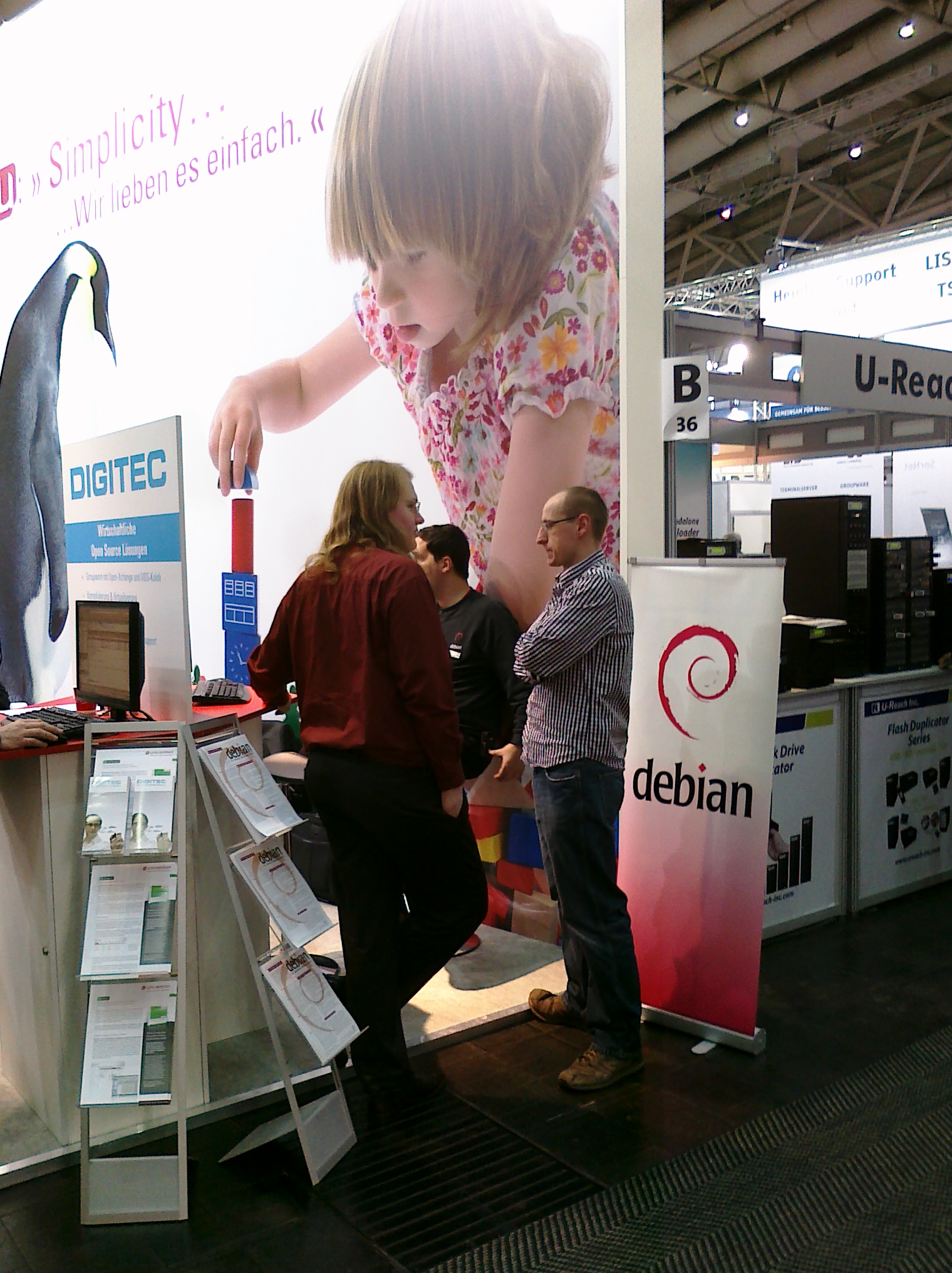
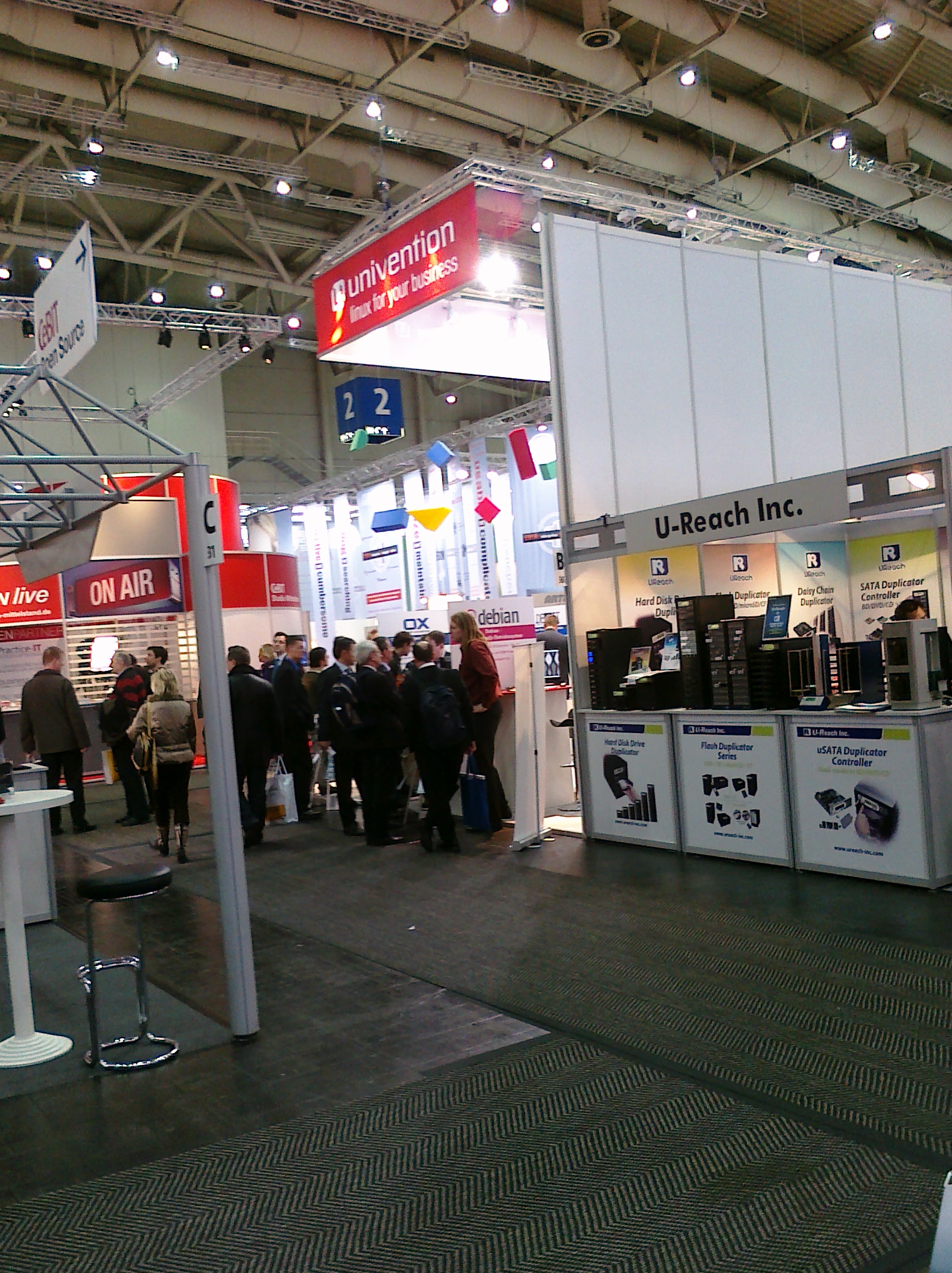
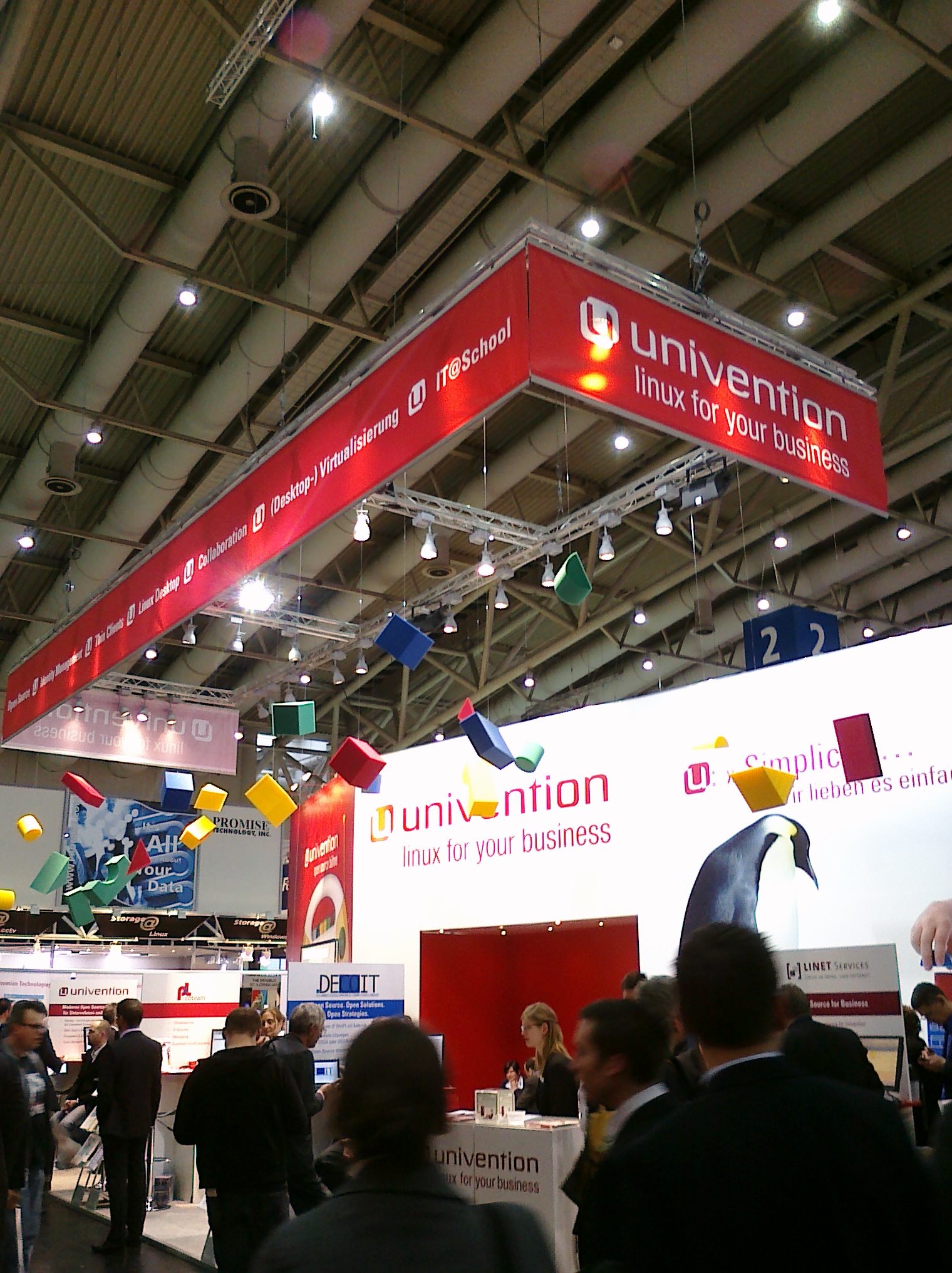
Alexander Reichle-Schmehl: [CeBIT] HOWTO find our booth

As some people had problems finding our booth, here's a small explanation. We are guest at the booth of Univention in Hall 2, stand B36. It's quite near to the north entry, where you arrive by the tram lines 8 and 18. Look for the univention booth:

If you are direct in front of the Univention booth, we are on the right hand side of the booth:

If you come from the other side, from the rest of the Open Source Area, it looks like this:

PS: And now, dear zobel, you have three guesses, what Pia is going to get for her birthday...

31 January 2010

Axel Beckert: abe@debian.org

On Wednesday I got DAM approval and since Saturday late evening I m officially a Debian Developer. Yay! :-) My thanks go to As Bernd cited in his AM report, my earliest activity within the Debian community I can remember was organising the Debian booth at LinuxDay.lu 2003, where I installed Debian 3.0 Woody on my Hamilton Hamstation hy (a Sun SparcStation 4 clone). I wrote my first bugreport in November 2004 (#283365), probably during the Sarge BSP in Frankfurt. And my first Debian package was wikipedia2text, starting to package it August 2005 (ITP #325417). My only earlier documented interest in the Debian community is subscribing to the lists debian-apache@l.d.o and debian-emacsen@l.d.o in June 2002. I though remember that I started playing around with Debian 2.0 Hamm, skipping 2.1 (for whatever reasons, I can t remember), using 2.2 quite regularily and started to dive into with Woody which also ran on my first ThinkPad bijou . I installed it over WLAN with just a boot floppy at the Chemnitzer Linux-Tage. :-) Anyway, this has led to what it had to lead to a new Debian Developer. :-) The first package I uploaded with my newly granted rights was a new conkeror snapshot. This version should work out of the box on Ubuntu again, so that conkeror in Ubuntu should not lag that much behind Debian Sid anymore. In other News Since Wednesday I own a Nokia N900 and use it as my primary mobile phone now. Although it s not as free as the OpenMoko (see two other recent posts by Lucas Nussbaum and by Tollef Fog Heen on Planet Debian) it s definitely what I hoped the OpenMoko will once become. And even if I can t run Debian natively on the N900 (yet), it at least has a Debian chroot on it. :-) I'm going to FOSDEM, the Free and Open Source Software Developers' European Meeting A few weeks ago, I took over the organisation of this year s Debian booth at FOSDEM from Wouter Verhelst who s busy enough with FOSDEM organisation itself. Last Monday the organiser of the BSD DevRoom at FOSDEM asked on #mirbsd for talk suggestions and they somehow talked me into giving a talk about Debian GNU/kFreeBSD. The slides should show up during the next days on my Debian GNU/kFreeBSD talks page. I hope, I ll survive that talk despite giving more or less a talk saying Jehova! . ;-) What a week.

25 January 2009

Ana Beatriz Guerrero Lopez: End of backports and about KDE in Lenny

About a week ago I updated the KDE 4.1 backports for Lenny with the fourth and last revision of KDE 4.1.
As previously announced, this will be the last update available at http://kde4.debian.net What is next? The repository will continue there, so Lenny users can choose between KDE 3.5.9+ and KDE 4.1.4. But since 4.1.4 packages are not official, they do not have support: no bugs in the BTS or security updates.
If you are using Debian Lenny for stability and security purposes, you should use KDE 3.5. Testing users (future squeeze, current Lenny) can continue using them until KDE 4.2 reaches testing. Again, remember, no bugs in the BTS or security updates, but they will get a clean upgrade to KDE 4.2 in the near future. Unstable users. I have found that there are people using unstable with the backports, when they should be using experimental KDE 4.1. If this is your case, you can stick with 4.1.4 until KDE 4.2 reaches unstable or switch to experimental in a few days and get KDE 4.2 (no yet! it needs to be released first :) ). Last, but not less important, thanks to all the people helping with the backports: MoDaX for helping as backup and the rest of the Qt/KDE team who worked in the experimental packages. HE, zobel and aba for his sysadmin tasks. apol for allowing me torture his PowerPC machine. All those who translated the instructions into their languages and
helped to others users in mailing lists and forums. A quick note about KDE 3.5 to be released in Lenny As most of you have realized, the packages of KDE 3.5 in Lenny and unstable are a mixture of KDE 3.5.9 and 3.5.10. Given that KDE 3.5.10 was released after Lenny was frozen, we could not push this new version into Lenny, however the KDE 3.5 packages were patched about June last year with the latest changes in KDE 3.5 from the KDE subversion. This means some of the modules with the version 3.5.9 are exactly the same that is shipped as 3.5.10.
The only big stuff missing are the kicker improvements shipped in kdebase and some bug fixes in kdepim. But in global, it is closer to KDE 3.5.10 that to KDE 3.5.9. If you want to see what changes are you missing, check the KDE 3.5.10 changelog.

21 January 2009

MJ Ray: SPI January 2009

The monthly board meeting of SPI will take place on irc.oftc.net #spi tonight (Wed 21 Jan) at 20:00 UTC. Members may have seen that the meeting announcement is delayed because the secretary has been ill and it seems that none of the other board members has stepped in to take over. I think the only new associated project currently under discussion is waiting for a legal opinion, so your guess about the meeting contents is probably as good as mine. My guesses: there will probably be a treasurer s report; Martin Zobel-Helas has been filling in the gaps in the 2007-8 minutes, so there ll be two or three sets for approval; the secretary may report on website redevelopment progress; Privoxy might have taken up the offer of associated project status from the SPI December 2008 meeting; and there might be a report on Tux4Kids trademarks. Watch the comments below this article for a link to the summary when posted.

Next.

Previous.