Carl Chenet: The Github threat
Many voices arise now and then against risks linked to the Github use by Free Software projects. Yet the infatuation for the collaborative forge of the Octocat Californian start-ups doesn t seem to fade away.

These recent years, Github and its services take an important role in software engineering as they are seen as easy to use, efficient for a daily workload with interesting functions in enterprise collaborative workflow or amid a Free Software project. What are the arguments against using its services and are they valid? We will list them first, then we ll examine their validity.
1. Critical points
1.1 Centralization
The Github application belongs to a single entity, Github Inc, a US company which manage it alone. So, a unique company under US legislation manages the access to most of Free Software application code sources, which may be a problem with groups using it when a code source is no longer available, for political or technical reason.

The Octocat, the Github mascot
This centralization leads to another trouble: as it obtained critical mass, it becomes more and more difficult not having a Github account. People who don t use Github, by choice or not, are becoming a silent minority. It is now fashionable to use Github, and not doing so is seen as out of date . The same phenomenon is a classic, and even the norm, for proprietary social networks (Facebook, Twitter, Instagram).
1.2 A Proprietary Software
When you interact with Github, you are using a proprietary software, with no access to its source code and which may not work the way you think it is. It is a problem at different levels. First, ideologically, but foremost in practice. In the Github case, we send them code we can control outside of their interface. We also send them personal information (profile, Github interactions). And mostly, Github forces any project which goes through the US platform to use a crucial proprietary tools: its bug tracking system.

Windows, the epitome of proprietary software, even if others took the same path
1.3 The Uniformization
Working with Github interface seems easy and intuitive to most. Lots of companies now use it as a source repository, and many developers leaving a company find the same Github working environment in the next one. This pervasive presence of Github in free software development environment is a part of the uniformization of said developers working space.

Uniforms always bring Army in my mind, here the Clone army
2 Critical points cross-examination
2.1 Regarding the centralization
2.1.1 Service availability rate
2.1.1 Service availability rate
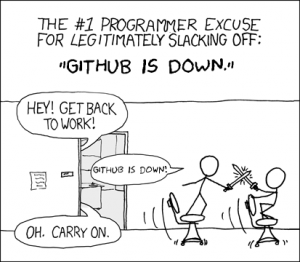
As said above, nowadays, Github is the main repository of Free Software source code. As such it is a favorite target for cyberattacks. DDOS hit it in March and August 2015. On December 15, 2015, an outage led to the inaccessibility of 5% of the repositories. The same occurred on November 15. And these are only the incident reported by Github itself. One can imagine that the mean outage rate of the platform is underestimated.
2.1.2 Chain reaction could block Free Software development
Today many dependency maintenance tools, as npm for javascript, Bundler for Ruby or even pip for Python can access an application source code directly from Github. Free Software projects getting more and more linked and codependents, if one component is down, all the developing process stop.
One of the best examples is the npmgate. Any company could legally demand that Github take down some source code from its repository, which could create a chain reaction and blocking the development of many Free Software projects, as suffered the Node.js community from the decisions of Npm, Inc, the company managing npm.
2.2 A historical precedent: SourceForge
Github didn t appear out of the blue. In his time, its predecessor, SourceForge, was also extremely popular.
Heavily centralized, based on strong interaction with the community, SourceForge is now seen as an aging SAAS (Software As A Service) and sees most of its customers fleeing to Github. Which creates lots of hurdles for those who stayed. The Gimp project suffered from spams and terrible advertising, which led to the departure of the VLC project, then from installers corrupted with adwares instead of the official Gimp installer for Windows. And finally, the Project Gimp s SourceForge account was hacked by SourceForge team itself!
These are very recent examples of what can do a commercial entity when it is under its stakeholders pressure. It is vital to really understand what it means to trust them with data and exchange centralization, where it could have tremendous repercussion on the day-to-day life and the habits of the Free Software and open source community.
2.3. Regarding proprietary software
2.3.1 One community, several opinions on proprietary software
Mostly based on ideology, this point deals with the definition every member of the community gives to Free Software and open source. Mostly about one thing: is it viral or not? Or GPL vs MIT/BSD.

Those on the side of the viral Free Software will have trouble to use a proprietary software as this last one shouldn t even exist. It must be assimilated, to quote Star Trek, as it is a connected black box, endangering privacy, corrupting for profit our uses and restrain our freedom to use as we re pleased what we own, etc.

Those on the side of complete freedom have no qualms using proprietary software as their very existence is a consequence of freedom without restriction. They even agree that code they developed may be a part of proprietary software, which is quite a common occurrence. This part of the Free Software community has no qualm using Github, which is well within their ideology parameters. Just take a look at the Janson amphitheater during Fosdem and check how many Apple laptops running on macOS are around.

FreeBSD, the main BSD project under the BSD license
2.3.2 Data loss and data restrictions linked to proprietary software use
Even without ideological consideration, and just focusing on Github infrastructure, the bug tracking system is a major problem by itself.
Bug report builds the memory of Free Software projects. It is the entrance point for new contributors, the place to find bug reporting, requests for new functions, etc. The project history can t be limited only to the code. It s very common to find bug reports when you copy and paste an error message in a search engine. Not their historical importance is precious for the project itself, but also for its present and future users.
Github gives the ability to extract bug reports through its API. What would happen if Github is down or if the platform doesn t support this feature anymore? In my opinion, not that many projects ever thought of this outcome. How could they move all the data generated by Github into a new bug tracking system? One old example now is Astrid, a TODO list bought by Yahoo a few years ago. Very popular, it grew fast until it was closed overnight, with only a few weeks for its users to extract their data. It was only a to-do list. The same situation with Github would be tremendously difficult to manage for several projects if they even have the ability to deal with it. Code would still be available and could still live somewhere else, but the project memory would be lost. A project like Debian has today more than 800,000 bug reports, which are a data treasure trove about problems solved, function requests and where the development stand on each. The developers of the Cpython project have anticipated the problem and decided not to use Github bug tracking systems.

Issues, the Github proprietary bug tracking system
Another thing we could lose if Github suddenly disappear: all the work currently done regarding the push requests (aka PRs). This Github function gives the ability to clone one project s Github repository, to modify it to fit your needs, then to offer your own modification to the original repository. The original repository s owner will then review said modification, and if he or she agrees with them will fuse them into the original repository. As such, it s one of the main advantages of Github, since it can be done easily through its graphic interface.
However reviewing all the PRs may be quite long, and most of the successful projects have several ongoing PRs. And this PRs and/or the proprietary bug tracking system are commonly used as a platform for comment and discussion between developers.
Code itself is not lost if Github is down (except one specific situation as seen below), but the peer review works materialized in the PRs and the bug tracking system is lost. Let s remember than the PR mechanism let you clone and modify projects and then generate PRs directly from its proprietary web interface without downloading a single code line on your computer. In this particular case, if Github is down, all the code and the work in progress is lost. Some also use Github as a bookmark place. They follow their favorite projects activity through the Watch function. This technological watch style of data collection would also be lost if Github is down.

Debian, one of the main Free Software projects with at least a thousand official contributors
2.4 Uniformization
The Free Software community is walking a thigh rope between normalization needed for an easier interoperability between its products and an attraction for novelty led by a strong need for differentiation from what is already there.
Github popularized the use of Git, a great tool now used through various sectors far away from its original programming field. Step by step, Git is now so prominent it s almost impossible to even think to another source control manager, even if awesome alternate solutions, unfortunately not as popular, exist as Mercurial.

A new Free Software project is now a Git repository on Github with README.md added as a quick description. All the other solutions are ostracized? How? None or very few potential contributors would notice said projects. It seems very difficult now to encourage potential contributors into learning a new source control manager AND a new forge for every project they want to contribute. Which was a basic requirement a few years ago. It s quite sad because Github, offering an original experience to its users, cut them out of a whole possibility realm. Maybe Github is one of the best web versioning control systems. But being the main one doesn t let room for a new competitor to grow. And it let Github initiate development newcomers into a narrow function set, totally unrelated to the strength of the Git tool itself.
3. Centralization, uniformization, proprietary software What s next? Laziness?
Fight against centralization is a main part of the Free Software ideology as centralization strengthens the power of those who manage it and who through it control those who are managed by it. Uniformization allergies born against main software companies and their wishes to impose a closed commercial software world was for a long time the main fuel for innovation thirst and intelligent alternative development. As we said above, part of the Free Software community was built as a reaction to proprietary software and their threat. The other part, without hoping for their disappearance, still chose a development model opposite to proprietary software, at least in the beginning, as now there s more and more bridges between the two.
The Github effect is a morbid one because of its consequences: at least centralization, uniformization, proprietary software usage as their bug tracking system. But some years ago the Dear Github buzz showed one more side effect, one I ve never thought about: laziness. For those who don t know what it is about, this letter is a complaint from several spokespersons from several Free Software projects which demand to Github team to finally implement, after years of polite asking, new functions. Since when Free Software project facing a roadblock request for clemency and don t build themselves the path they need? When Torvalds was involved in the Bitkeeper problem and the Linux kernel development team couldn t use anymore their revision control software, he developed Git. The mere fact of not being able to use one tool or functions lacking is the main motivation to seek alternative solutions and, as such, of the Free Software movement. Every Free Software community member able to code should have this reflex. You don t like what Github offers? Switch to Gitlab. You don t like it Gitlab? Improve it or make your own solution.

The Gitlab logo
Let s be crystal clear. I ve never said that every Free Software developers blocked should code his or her own alternative. We all have our own priorities, and some of us even like their beauty sleep, including me. But, to see that this open letter to Github has 1340 names attached to it, among them some spokespersons for major Free Software project showed me that need, willpower and strength to code a replacement are here. Maybe said replacement will be born from this letter, it would be the best outcome of this buzz.
In the end, Github usage is just another example of Internet usage massification. As Internet users are bound to go to massively centralized social network as Facebook or Twitter, developers are following the same path with Github. Even if a large fraction of developers realize the threat linked this centralized and proprietary organization, the whole community is following this centralization and uniformization trend. Github service is useful, free or with a reasonable price (depending on the functions you need) easy to use and up most of the time. Why would we try something else? Maybe because others are using us while we are savoring the convenience? The Free Software community seems to be quite sleepy to me.

The lion enjoying the hearth warm
- My Mastodon account : @carlchenet
- My Diaspora* account : @carlchenet
- My Twitter account : @carl_chenet

 The news media deliberately over-rates social media
News media outlets, including TV, radio and print, gain a significant benefit crowd-sourcing live information, free of charge, from the public on social media. It is only logical that they will cheer on social media sites and give them regular attention. Have you noticed that whenever Facebook's publicity department makes an announcement, the media are quick to publish it ahead of more significant stories about social or economic issues that impact our lives? Why do you think the media puts Facebook up on a podium like this, ahead of all other industries, if the media aren't getting something out of it too?
The tail doesn't wag the dog
One particular example is the news media's fascination with Donald Trump's Twitter account. Some people have gone as far as suggesting that this billionaire could have simply parked his jet and spent the whole of 2016 at one of his golf courses sending tweets and he would have won the presidency anyway. Suggesting that Trump's campaign revolved entirely around Twitter is like suggesting the tail wags the dog.
The reality is different: Trump has been a prominent public figure for decades, both in the business and entertainment world. During his presidential campaign, he
 Around 2 decades back and a bit more I was introduced to computers. The top-line was 386DX which was mainly used as fat servers and some lucky institutions had the 386SX where IF we were lucky we could be able to play some games on it. I was pretty bad at Prince of Persia or most of the games of the era as most of the games depended on lightning reflexes which I didn t possess. Then 1997 happened and I was introduced to GNU/Linux but my love of/for games still continued even though I was bad at most of them. The only saving grace was turn-based RPG s (role-playing games) which didn t have permadeath, so you could plan your next move. Sometimes a wrong decision would lead to getting a place from where it was impossible to move further. As the decision was taken far far break which lead to the tangent, the only recourse was to replay the game which eventually lead to giving most of those kind of games.
Then in/around 2000 Maxis came out with


 Sites like Twitter and Facebook are not fundamentally free platforms, despite the fact they don't ask their users for money. Look at how Facebook's censors
 Many marketing campaigns that have been successful today, whether they are crowdfunding, political activism or just finding a lost cat claim to have had great success because of Twitter or Facebook. Is this true? In reality, many users of those platforms follow hundreds of different friends and if they only check-in once a day, filtering algorithms show them only a small subset of what all their friends posted. Against these odds, just posting your great idea on Facebook doesn't mean that more than five people are actually going to see it. Those campaigns that have been successful have usually had something else going in their favour, perhaps it was a friend working in the media who gave their campaign a plug on his radio show or maybe they were lucky enough to be
 Ever since I read about
 I'm not an avid Kickstarter follower (if I were, I'd have gone broke
long ago). I tend to wind up backing campaigns that come to my attention via
other means (in other words, they're in the process of going viral). That said,
I've backed plenty of campaigns over the years, and so I'd like to think I have
a little bit of familiarity with how they usually operate.
When Ozobot came to my attention, I found it unusual, because they were
pre-promoting their Kickstarter campaign before it opened. To me, this looked
like a case of them trying to build hype prior to the campaign opening, which
was a new one to me. The whole thing seemed incredibly slick, and I was
surprised they were "only" seeking $100K.
The product looked like it'd be something cool for Zoe to play with, so I
decided to back it anyway. Then all the updates started flowing in about how
well it was being received at various trade shows and whatnot. Yet the amount
of dollars flowing into the Kickstarter campaign didn't seem to be reflecting
the external hype. I was watching the campaign's dashboard with great interest,
because as time marched on, it was looking more and more likely that it wasn't
going to make its funding target. This seemed highly unusual to me, given the
slickness of the product and purported external interest in it.
And then they pulled the plug on the campaign. Purportedly because they were
pursuing equity funding instead. They admitted they'd also read the writing on
the wall and it was unlikely they were going to make their funding target. I
haven't followed other campaigns to see how much of a last minute funding "pop"
they have. Usually I've found they've closed at many multiples of their
original target, and hit their target well in advance of their deadline, when
they're ridiculously popular. My interpretation of Ozobot's campaign, from a
funding perspective, is that Kickstarters gave it a big fat "MEH", which
surprised me somewhat.
Then the question comes up: was the Kickstarter campaign a ruse all along? Was
it just a new way of pitching for venture capital? The videos seemed pretty
slick. The product seemed already complete, and $100K didn't seem like enough
to take it to manufacturing.
It'll be interesting to see what becomes of Ozobot now.
