Search Results: "unera"

7 July 2015

Petter Reinholdtsen: MPEG LA on "Internet Broadcast AVC Video" licensing and non-private use

After asking the Norwegian Broadcasting Company (NRK) why they can broadcast and stream H.264 video without an agreement with the MPEG LA, I was wiser, but still confused. So I asked MPEG LA if their understanding matched that of NRK. As far as I can tell, it does not. I started by asking for more information about the various licensing classes and what exactly is covered by the "Internet Broadcast AVC Video" class that NRK pointed me at to explain why NRK did not need a license for streaming H.264 video:
According to a MPEG LA press release dated 2010-02-02, there is no charge when using MPEG AVC/H.264 according to the terms of "Internet Broadcast AVC Video". I am trying to understand exactly what the terms of "Internet Broadcast AVC Video" is, and wondered if you could help me. What exactly is covered by these terms, and what is not? The only source of more information I have been able to find is a PDF named AVC Patent Portfolio License Briefing, which states this about the fees:
  • Where End User pays for AVC Video
    • Subscription (not limited by title) 100,000 or fewer subscribers/yr = no royalty; > 100,000 to 250,000 subscribers/yr = $25,000; >250,000 to 500,000 subscribers/yr = $50,000; >500,000 to 1M subscribers/yr = $75,000; >1M subscribers/yr = $100,000
    • Title-by-Title - 12 minutes or less = no royalty; >12 minutes in length = lower of (a) 2% or (b) $0.02 per title
  • Where remuneration is from other sources
    • Free Television - (a) one-time $2,500 per transmission encoder or (b) annual fee starting at $2,500 for > 100,000 HH rising to maximum $10,000 for >1,000,000 HH
    • Internet Broadcast AVC Video (not title-by-title, not subscription) no royalty for life of the AVC Patent Portfolio License
Am I correct in assuming that the four categories listed is the categories used when selecting licensing terms, and that "Internet Broadcast AVC Video" is the category for things that do not fall into one of the other three categories? Can you point me to a good source explaining what is ment by "title-by-title" and "Free Television" in the license terms for AVC/H.264? Will a web service providing H.264 encoded video content in a "video on demand" fashing similar to Youtube and Vimeo, where no subscription is required and no payment is required from end users to get access to the videos, fall under the terms of the "Internet Broadcast AVC Video", ie no royalty for life of the AVC Patent Portfolio license? Does it matter if some users are subscribed to get access to personalized services? Note, this request and all answers will be published on the Internet.
The answer came quickly from Benjamin J. Myers, Licensing Associate with the MPEG LA:
Thank you for your message and for your interest in MPEG LA. We appreciate hearing from you and I will be happy to assist you. As you are aware, MPEG LA offers our AVC Patent Portfolio License which provides coverage under patents that are essential for use of the AVC/H.264 Standard (MPEG-4 Part 10). Specifically, coverage is provided for end products and video content that make use of AVC/H.264 technology. Accordingly, the party offering such end products and video to End Users concludes the AVC License and is responsible for paying the applicable royalties. Regarding Internet Broadcast AVC Video, the AVC License generally defines such content to be video that is distributed to End Users over the Internet free-of-charge. Therefore, if a party offers a service which allows users to upload AVC/H.264 video to its website, and such AVC Video is delivered to End Users for free, then such video would receive coverage under the sublicense for Internet Broadcast AVC Video, which is not subject to any royalties for the life of the AVC License. This would also apply in the scenario where a user creates a free online account in order to receive a customized offering of free AVC Video content. In other words, as long as the End User is given access to or views AVC Video content at no cost to the End User, then no royalties would be payable under our AVC License. On the other hand, if End Users pay for access to AVC Video for a specific period of time (e.g., one month, one year, etc.), then such video would constitute Subscription AVC Video. In cases where AVC Video is delivered to End Users on a pay-per-view basis, then such content would constitute Title-by-Title AVC Video. If a party offers Subscription or Title-by-Title AVC Video to End Users, then they would be responsible for paying the applicable royalties you noted below. Finally, in the case where AVC Video is distributed for free through an "over-the-air, satellite and/or cable transmission", then such content would constitute Free Television AVC Video and would be subject to the applicable royalties. For your reference, I have attached a .pdf copy of the AVC License. You will find the relevant sublicense information regarding AVC Video in Sections 2.2 through 2.5, and the corresponding royalties in Section 3.1.2 through 3.1.4. You will also find the definitions of Title-by-Title AVC Video, Subscription AVC Video, Free Television AVC Video, and Internet Broadcast AVC Video in Section 1 of the License. Please note that the electronic copy is provided for informational purposes only and cannot be used for execution. I hope the above information is helpful. If you have additional questions or need further assistance with the AVC License, please feel free to contact me directly.
Having a fresh copy of the license text was useful, and knowing that the definition of Title-by-Title required payment per title made me aware that my earlier understanding of that phrase had been wrong. But I still had a few questions:
I have a small followup question. Would it be possible for me to get a license with MPEG LA even if there are no royalties to be paid? The reason I ask, is that some video related products have a copyright clause limiting their use without a license with MPEG LA. The clauses typically look similar to this:
This product is licensed under the AVC patent portfolio license for the personal and non-commercial use of a consumer to (a) encode video in compliance with the AVC standard ("AVC video") and/or (b) decode AVC video that was encoded by a consumer engaged in a personal and non-commercial activity and/or AVC video that was obtained from a video provider licensed to provide AVC video. No license is granted or shall be implied for any other use. additional information may be obtained from MPEG LA L.L.C.
It is unclear to me if this clause mean that I need to enter into an agreement with MPEG LA to use the product in question, even if there are no royalties to be paid to MPEG LA. I suspect it will differ depending on the jurisdiction, and mine is Norway. What is MPEG LAs view on this?
According to the answer, MPEG LA believe those using such tools for non-personal or commercial use need a license with them:
With regard to the Notice to Customers, I would like to begin by clarifying that the Notice from Section 7.1 of the AVC License reads: THIS PRODUCT IS LICENSED UNDER THE AVC PATENT PORTFOLIO LICENSE FOR THE PERSONAL USE OF A CONSUMER OR OTHER USES IN WHICH IT DOES NOT RECEIVE REMUNERATION TO (i) ENCODE VIDEO IN COMPLIANCE WITH THE AVC STANDARD ("AVC VIDEO") AND/OR (ii) DECODE AVC VIDEO THAT WAS ENCODED BY A CONSUMER ENGAGED IN A PERSONAL ACTIVITY AND/OR WAS OBTAINED FROM A VIDEO PROVIDER LICENSED TO PROVIDE AVC VIDEO. NO LICENSE IS GRANTED OR SHALL BE IMPLIED FOR ANY OTHER USE. ADDITIONAL INFORMATION MAY BE OBTAINED FROM MPEG LA, L.L.C. SEE HTTP://WWW.MPEGLA.COM The Notice to Customers is intended to inform End Users of the personal usage rights (for example, to watch video content) included with the product they purchased, and to encourage any party using the product for commercial purposes to contact MPEG LA in order to become licensed for such use (for example, when they use an AVC Product to deliver Title-by-Title, Subscription, Free Television or Internet Broadcast AVC Video to End Users, or to re-Sell a third party's AVC Product as their own branded AVC Product). Therefore, if a party is to be licensed for its use of an AVC Product to Sell AVC Video on a Title-by-Title, Subscription, Free Television or Internet Broadcast basis, that party would need to conclude the AVC License, even in the case where no royalties were payable under the License. On the other hand, if that party (either a Consumer or business customer) simply uses an AVC Product for their own internal purposes and not for the commercial purposes referenced above, then such use would be included in the royalty paid for the AVC Products by the licensed supplier. Finally, I note that our AVC License provides worldwide coverage in countries that have AVC Patent Portfolio Patents, including Norway. I hope this clarification is helpful. If I may be of any further assistance, just let me know.
The mentioning of Norwegian patents made me a bit confused, so I asked for more information:
But one minor question at the end. If I understand you correctly, you state in the quote above that there are patents in the AVC Patent Portfolio that are valid in Norway. This make me believe I read the list available from <URL: http://www.mpegla.com/main/programs/AVC/Pages/PatentList.aspx > incorrectly, as I believed the "NO" prefix in front of patents were Norwegian patents, and the only one I could find under Mitsubishi Electric Corporation expired in 2012. Which patents are you referring to that are relevant for Norway?
Again, the quick answer explained how to read the list of patents in that list:
Your understanding is correct that the last AVC Patent Portfolio Patent in Norway expired on 21 October 2012. Therefore, where AVC Video is both made and Sold in Norway after that date, then no royalties would be payable for such AVC Video under the AVC License. With that said, our AVC License provides historic coverage for AVC Products and AVC Video that may have been manufactured or Sold before the last Norwegian AVC patent expired. I would also like to clarify that coverage is provided for the country of manufacture and the country of Sale that has active AVC Patent Portfolio Patents. Therefore, if a party offers AVC Products or AVC Video for Sale in a country with active AVC Patent Portfolio Patents (for example, Sweden, Denmark, Finland, etc.), then that party would still need coverage under the AVC License even if such products or video are initially made in a country without active AVC Patent Portfolio Patents (for example, Norway). Similarly, a party would need to conclude the AVC License if they make AVC Products or AVC Video in a country with active AVC Patent Portfolio Patents, but eventually Sell such AVC Products or AVC Video in a country without active AVC Patent Portfolio Patents.
As far as I understand it, MPEG LA believe anyone using Adobe Premiere and other video related software with a H.264 distribution license need a license agreement with MPEG LA to use such tools for anything non-private or commercial, while it is OK to set up a Youtube-like service as long as no-one pays to get access to the content. I still have no clear idea how this applies to Norway, where none of the patents MPEG LA is licensing are valid. Will the copyright terms take precedence or can those terms be ignored because the patents are not valid in Norway?

20 March 2015

Zlatan Todori : My journey into Debian

Notice: There were several requests for me to more elaborate on my path to Debian and impact on life so here it is. It's going to be a bit long so anyone who isn't interested in my personal Debian journey should skip it. :) In 2007. I enrolled into Faculty of Mechanical Engineering (at first at Department of Industrial Management and later transfered to Department of Mechatronics - this was possible because first 3 semesters are same for both departments). By the end of same year I was finishing my tasks (consisting primarily of calculations, some small graphical designs and write-ups) when famous virus, called by users "RECYCLER", sent my Windows XP machine into oblivion. Not only it took control over machine and just spawned so many processes that system would crash itself, it actually deleted all from hard-disk before it killed the system entirely. I raged - my month old work, full of precise calculations and a lot of design details, was just gone. I started cursing which was always continued with weeping: "Why isn't there an OS that can whithstand all of viruses, even if it looks like old DOS!". At that time, my roommate was my cousin who had used Kubuntu in past and currently was having SUSE dual-booted on his laptop. He called me over, started talking about this thing called Linux and how it's different but de facto has no viruses. Well, show me this Linux and my thought was, it's probably so ancient and not used that it probably looks like from pre Windows 3.1 era, but when SUSE booted up it had so much more beautiful UI look (it was KDE, and compared to XP it looked like the most professional OS ever). So I was thrilled, installed openSUSE, found some rough edges (I knew immediately that my work with professional CAD systems will not be possible on Linux machines) but overall I was bought. After that he even talked to me about distros. Wait, WTF distros?! So, he showed me distrowatch.com. I was amazed. There is not only a better OS then Windows - there where dozens, hundreds of them. After some poking around I installed Debian KDE - and it felt great, working better then openSUSE but now I was as most newbies, on fire to try more distros. So I was going around with Fedora, Mandriva, CentOS, Ubuntu, Mint, PCLinuxOS and in beginning of 2008 I stumbled upon Debian docs which where talking about GNU and GNU Manifesto. To be clear, I was always as a high-school kid very much attached to idea of freedom but started loosing faith by faculty time (Internet was still not taking too much of time here, youth still spent most of the day outside). So the GNU Manifesto was really a big thing for me and Debian is a social bastion of freedom. Debian (now with GNOME2) was being installed on my machine. As all that hackerdom in Debian was around I started trying to dig up some code. I never ever read a book on coding (until this day I still didn't start and finish one) so after a few days I decided to code tetris in C++ with thought that I will finish it in two days at most (the feeling that you are powerful and very bright person) - I ended it after one month in much pain. So instead I learned about keeping Debian system going on, and exploring some new packages. I got thrilled over radiotray, slimvolley (even held a tournament in my dorm room), started helping on #debian, was very active in conversation with others about Debian and even installed it on few laptops (I became de facto technical support for users of those laptops :D ). Then came 2010 which with negative flow that came in second half of 2009, started to crush me badly. I was promised to go to Norway, getting my studies on robotics and professor lied (that same professor is still on faculty even after he was caught in big corruption scandal over buying robots - he bought 15 years old robots from UK, although he got money from Norway to buy new ones). My relationship came to hard end and had big emotional impact on me. I fell a year on faculty. My father stopped financing me and stopped talking to me. My depression came back. Alcohol took over me. I was drunk every day just not to feel anything. Then came the end of 2010, I somehow got to the information that DebConf will be in Banja Luka. WHAT?! DebConf in city where I live. I got into #debconf and in December 2010/January 2011 I became part of the famous "local local organizers". I was still getting hammered by alcohol but at least I was getting out of depression. IIRC I met Holger and Moray in May, had a great day (a drop of rakia that was too much for all of us) and by their way of behaving there was something strange. Beatiful but strange. Both were sending unique energy of liberty although I am not sure they were aware of it. Later, during DebConf I felt that energy from almost all Debian people, which I can't explain. I don't feel it today - not because it's not there, it's because I think I integrated so much into Debian community that it's now a natural feeling which people here, that are close to me are saying that they feel it when I talk about Debian. DebConf time in Banja Luka was awesome - firstly I met Phil Hands and Andrew McMillan which were a crazy team, local local team was working hard (I even threw up during the work in Banski Dvor because of all heat and probably not much of sleep due to excitement), met also crazy Mexican Gunnar (aren't all Mexicans crazy?), played Mao (never again, thank you), was hanging around smart but crazy people (love all) from which I must notice Nattie (a bastion of positive energy), Christian Perrier (which had coordinated our Serbian translation effort), Steve Langasek (which asked me to find physiotherapist for his co-worker Mathias Klose, IIRC), Zach (not at all important guy at that time), Luca Capello (who gifted me a swirl on my birthday) and so many others that this would be a post for itself just naming them. During DebConf it was also a bit of hard time - my grandfather died on 6th July and I couldn't attend the funeral so I was still having that sadness in my heart, and Darjan Prtic, a local team member that came from Vienna, committed suicide on my birthday (23 July). But DebConf as conference was great, but more importantly the Debian community felt like a family and Meike Reichle told me that it was. The night it finished, me and Vedran Novakovic cried. A lot. Even days after, I was getting up in the morning having the feeling I need something to do for DebConf. After a long time I felt alive. By the end of year, I adopted package from Clint Adams and Moray became my sponsor. In last quarter of 2011 and beginning of 2012, I (as part of LUG) held talks about Linux, had Linux installation in Computer Center for the first time ever, and installed Debian on more machines. Now fast forwarding with some details - I was also on DebConf13 in Switzerland, met some great new friends such as Tincho and Santiago (and many many more), Santiago was also my roommate in Portland on the previous DebConf. In Switzerland I had really great and awesome time. Year 2014 - I was also at DebConf14, maintain a bit more packages and have applied for DD, met some new friends among which I must put out Apollon Oikonomopoulos and Costas Drogos which friendship is already deep for such a short time and I already know that they are life-long friends. Also thanks to Steve Langasek, because without his help I wouldn't be in Portland with my family and he also gave me Arduino. :) 2015. - I am currently at my village residence, have a 5 years of working experince as developer due to Debian and still a lot to go, learn and do but my love towards Debian community is by magnitude bigger then when I thought I love it at most. I am also going through my personal evolution and people from Debian showed me to fight for what you care, so I plan to do so. I can't write all and name all the people that I met, and believe me when I say that I remember most and all of you impacted my life for which I am eternally grateful. Debian, and it's community effect literally saved my life, spring new energy into me and changed me for better. Debian social impact is far bigger then technical, and when you know that Debian is a bastion of technical excellence - you can maybe picture the greatness of Debian. Some of greatest minds are in Debian but most important isn't the sheer amount of knowledge but the enormous empathy. I just hope I can in future show to more people what Debian is and to find all lost souls as me to give them the hope, to show them that we can make world a better place and that everyone is capable to live and do what they love. P.S. I am still hoping and waiting to see Bdale writing a book about Debian's history to this day - in which I think many of us would admire the work done by project members, laugh about many situations and have fun reading a book about project that was having nothing to do but fail and yet it stands stronger then ever with roots deep into our minds.

31 December 2014

Chris Lamb: 2014: Selected highlights

Previously: 2012 & 2013.


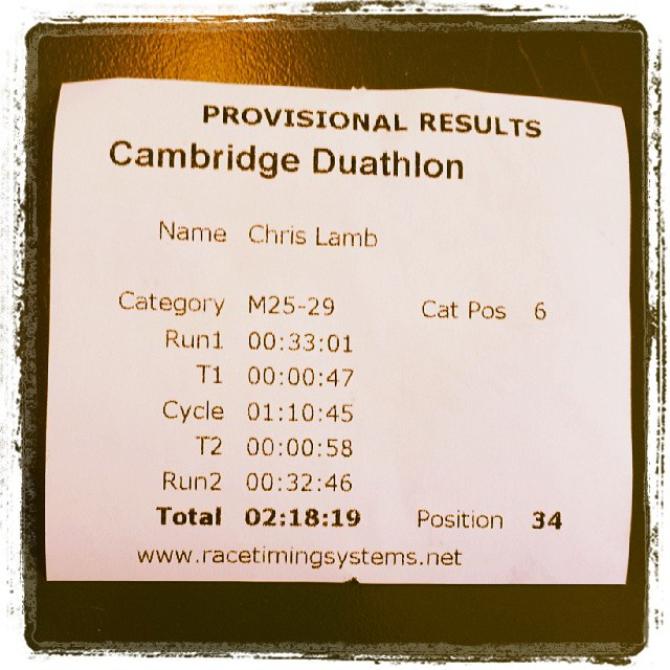
January https://d1icoid1cnixnp.cloudfront.net/yadt/blog.Image/image/cropped/15.jpeg Was lent a 15-course baroque lute. February https://d1icoid1cnixnp.cloudfront.net/yadt/blog.Image/image/cropped/19.jpeg Grandpa's funeral. In December he was posthumously awarded the Ushakov Medal (pictured) for his service in the Royal Navy's Arctic Convoys during the Second World War. March https://d1icoid1cnixnp.cloudfront.net/yadt/blog.Image/image/cropped/14.jpeg A lot of triathlon training but also got back into cooking. April https://d1icoid1cnixnp.cloudfront.net/yadt/blog.Image/image/cropped/2.jpeg Returned to the Cambridge Duathlon. May https://d1icoid1cnixnp.cloudfront.net/yadt/blog.Image/image/cropped/13.jpeg Raced 50 and 100 mile cycling time trials & visited the Stratford Olympic pool (pictured). June https://d1icoid1cnixnp.cloudfront.net/yadt/blog.Image/image/cropped/1.jpeg Ironman Austria. July https://d1icoid1cnixnp.cloudfront.net/yadt/blog.Image/image/cropped/9.jpeg Paced my sister at the Downtow-Upflow Half-marathon. Also released the first version of the Strava Enhancement Suite. August https://d1icoid1cnixnp.cloudfront.net/yadt/blog.Image/image/cropped/3.jpeg Visited Cornwall for my cousin's wedding (pictured). Another month for sport including my first ultramarathon and my first sub-20 minute 5k. September https://d1icoid1cnixnp.cloudfront.net/yadt/blog.Image/image/cropped/11.jpeg Entered a London Oxford London cycling brevet, my longest single-ride to date (269 km). Also visited the Tour of Britain and the Sri Chomnoy 24-hour endurance race. October https://d1icoid1cnixnp.cloudfront.net/yadt/blog.Image/image/cropped/10.jpeg London Paris London cycling tour (588 km). November https://d1icoid1cnixnp.cloudfront.net/yadt/blog.Image/image/cropped/5.jpeg Performed Handel's Messiah in Kettering. December https://d1icoid1cnixnp.cloudfront.net/yadt/blog.Image/image/cropped/18.jpeg Left Thread.com.

25 August 2014

Petter Reinholdtsen: Do you need an agreement with MPEG-LA to publish and broadcast H.264 video in Norway?

Two years later, I am still not sure if it is legal here in Norway to use or publish a video in H.264 or MPEG4 format edited by the commercially licensed video editors, without limiting the use to create "personal" or "non-commercial" videos or get a license agreement with MPEG LA. If one want to publish and broadcast video in a non-personal or commercial setting, it might be that those tools can not be used, or that video format can not be used, without breaking their copyright license. I am not sure. Back then, I found that the copyright license terms for Adobe Premiere and Apple Final Cut Pro both specified that one could not use the program to produce anything else without a patent license from MPEG LA. The issue is not limited to those two products, though. Other much used products like those from Avid and Sorenson Media have terms of use are similar to those from Adobe and Apple. The complicating factor making me unsure if those terms have effect in Norway or not is that the patents in question are not valid in Norway, but copyright licenses are. These are the terms for Avid Artist Suite, according to their published end user license text (converted to lower case text for easier reading):
18.2. MPEG-4. MPEG-4 technology may be included with the software. MPEG LA, L.L.C. requires this notice: This product is licensed under the MPEG-4 visual patent portfolio license for the personal and non-commercial use of a consumer for (i) encoding video in compliance with the MPEG-4 visual standard ( MPEG-4 video ) and/or (ii) decoding MPEG-4 video that was encoded by a consumer engaged in a personal and non-commercial activity and/or was obtained from a video provider licensed by MPEG LA to provide MPEG-4 video. No license is granted or shall be implied for any other use. Additional information including that relating to promotional, internal and commercial uses and licensing may be obtained from MPEG LA, LLC. See http://www.mpegla.com. This product is licensed under the MPEG-4 systems patent portfolio license for encoding in compliance with the MPEG-4 systems standard, except that an additional license and payment of royalties are necessary for encoding in connection with (i) data stored or replicated in physical media which is paid for on a title by title basis and/or (ii) data which is paid for on a title by title basis and is transmitted to an end user for permanent storage and/or use, such additional license may be obtained from MPEG LA, LLC. See http://www.mpegla.com for additional details. 18.3. H.264/AVC. H.264/AVC technology may be included with the software. MPEG LA, L.L.C. requires this notice: This product is licensed under the AVC patent portfolio license for the personal use of a consumer or other uses in which it does not receive remuneration to (i) encode video in compliance with the AVC standard ( AVC video ) and/or (ii) decode AVC video that was encoded by a consumer engaged in a personal activity and/or was obtained from a video provider licensed to provide AVC video. No license is granted or shall be implied for any other use. Additional information may be obtained from MPEG LA, L.L.C. See http://www.mpegla.com.
Note the requirement that the videos created can only be used for personal or non-commercial purposes. The Sorenson Media software have similar terms:
With respect to a license from Sorenson pertaining to MPEG-4 Video Decoders and/or Encoders: Any such product is licensed under the MPEG-4 visual patent portfolio license for the personal and non-commercial use of a consumer for (i) encoding video in compliance with the MPEG-4 visual standard ( MPEG-4 video ) and/or (ii) decoding MPEG-4 video that was encoded by a consumer engaged in a personal and non-commercial activity and/or was obtained from a video provider licensed by MPEG LA to provide MPEG-4 video. No license is granted or shall be implied for any other use. Additional information including that relating to promotional, internal and commercial uses and licensing may be obtained from MPEG LA, LLC. See http://www.mpegla.com. With respect to a license from Sorenson pertaining to MPEG-4 Consumer Recorded Data Encoder, MPEG-4 Systems Internet Data Encoder, MPEG-4 Mobile Data Encoder, and/or MPEG-4 Unique Use Encoder: Any such product is licensed under the MPEG-4 systems patent portfolio license for encoding in compliance with the MPEG-4 systems standard, except that an additional license and payment of royalties are necessary for encoding in connection with (i) data stored or replicated in physical media which is paid for on a title by title basis and/or (ii) data which is paid for on a title by title basis and is transmitted to an end user for permanent storage and/or use. Such additional license may be obtained from MPEG LA, LLC. See http://www.mpegla.com for additional details.
Some free software like Handbrake and FFMPEG uses GPL/LGPL licenses and do not have any such terms included, so for those, there is no requirement to limit the use to personal and non-commercial.

27 June 2014

Russ Allbery: Review: Due Diligence

Review: Due Diligence, by David Roodman
Publisher: Center for Global Development
Copyright: 2012
ISBN: 1-933286-48-2
Format: Trade paperback
Pages: 335
Due Diligence: An Impertinent Inquiry into Microfinance is a detailed analysis of the effects, philosophy, approaches, and merits of microfinance as an institution and as, increasingly, a charitable focus of the developed world. The author, David Roodman, was a senior fellow at the Center for Global Development at the time of writing this book, and is an expert in microfinance and economic development. This book starts as an overview and a history of the spectrum of microfinance institutions (something I found very valuable, since I knew very little about microfinance prior to Kiva's popularity), and then attempts a critical, data-driven analysis of whether, to what extent, and by which measures microfinance is successful. The most common aspect of microfinance, made popular and prominent by Kiva among others, is microcredit: small loans to people in developing countries. The underlying theory of microcredit is that lack of financial services handicaps prospective entrepreneurs and business owners in the third world, preventing them from growing businesses, funding expansion, and moving out of poverty. By extending relatively small amounts of credit to these people, or so the theory goes, they can better smooth out the uncertainties of day-to-day life and get the necessary capital to expand small local business. Microcredit is not the only type of microfinance, though, and Roodman's careful discussion of that point was one of the most informative parts of this book for me. It can also come in the form of microsavings tiny bank accounts or small-scale savings plans or microinsurance. Roodman makes a very interesting argument that these three forms of microfinance form two opposing continuums. Microcredit is the easiest to provide and microinsurance is the hardest, for many reasons he discusses including some that were surprising to me, but microinsurance is arguably the most helpful and beneficial to the individual poor and microcredit is the least. The opening history and survey does an excellent job showing the range of techniques and approaches used in microfinance, and showing the challenges of providing it. I had some vague understanding of the logistical challenges in serving areas far away from traditional infrastructure. I had much less understanding of the fascinating array of techniques in use, both inside and outside what's become the microfinance industry. Some of these techniques are brilliant examples of human economic creativity and skill at balancing incentives with risk protection. There are a much wider variety of approaches and instruments available than the individual or group loans that one typically sees on a site like Kiva, all with different trade-offs in group size, flexibility, rigidity, risk, and complexity. This book is well worth reading just to get a feel for the huge array of financial arrangements possible outside of the traditional banking structures that most readers of this review are used to. Another question Roodman answers thoroughly is why microfinance is so focused on microcredit. My vague unease with that was strengthened by reading David Graeber's Debt, which among many other things makes clear some of the social perils and power imbalances in lending. Due Diligence both crystallized that discomfort and explained why alternatives are difficult. Both microsavings and microinsurance necessarily involve considerably more regulation (which has both advantages and complexity), since they involve taking and safeguarding people's money and promising service in the future. Lenders require less trust; lenders instead extend trust and assume that risk themselves, and are in a position to do so. Microinsurance is also harder to explain and harder to target, although it is potentially the most helpful financial instrument when well-targeted. And microcredit can absorb huge influxes of capital from the outside, lending it out in a region, while both microsavings and microinsurance are necessarily built on the money already in the local economy and are inherently more resistant to external involvement. (I'm of the opinion this is a significant feature, but it makes it far harder for them to catch on as a charitable trend.) The heart of the book is a hard look at whether microfinance, and particularly microcredit, works. Roodman attempts this analysis for three different definitions of working: lifting people out of poverty (the most commonly claimed success), giving people more freedom and control over their lives even if their poverty level does not change in absolute terms, and developing the local economy. Sadly for charities like Kiva, microcredit does surprisingly poorly on the first two metrics. There is still little clear data, and the degree to which data from one region is applicable to a different region is highly debatable, but what evidence we have does not support the theory that microcredit lifts people out of poverty. In fact, the more intense the microcredit, the more likely it appears to be that credit pathologies common in the developed world, such as taking out loans from one organization to pay off loans from another, spirals of debt that is unlikely to ever be repaid, and aggressive debt collection methods, turn up in microcredit as well. The vision of the entrepreneur who succeeds through new-found access to capital is largely a myth. Indeed, the current packaging and presentation of loans to distant charities in developed countries means that even the supposed purpose of the loans is dubious. Loans are almost always presented as being for some sort of business activity, since that's what external charities want to fund, but money is fungible and the funds are more often used for all the things people normally need to use funds for: weddings, funerals, food for the family in hard times, paying off other loans to relatives, and other daily expenses. On the empowerment front, microcredit fairs little better, and here I particularly appreciated Roodman's clear-eyed and honest portrayal of common microcredit practices and their benefits for the creditors. For example, microcredit makes much of loaning to women, and presents this as a story of female empowerment. Roodman argues that there is some reality behind that, but it's also clear that microcredit organizations loan to women because women are more likely to repay not due to any inherent gender trait, but because women are easier to intimidate and shame into repaying. Similarly, the much-vaunted group loans, usually presented as a way for the community to support each other and teach each other financial skills, are most common in the poorest regions because they represent an outsourcing of costs. The main risk to the lender is that poor people have no such thing as credit histories, and detailed investigations of someone's trustworthiness is expensive. Groups are jointly liable and therefore will police themselves and check each other's reliability at no cost to the lender. Groups will also use intimidation tactics and even violence against members who don't or can't repay their share, without the lender having to get involved or have any responsibility for those tactics. Roodman takes a philosophical tone on this topic, noting several times that services for the very poor are generally of low quality and finance is no exception. I'm less inclined to be philosophical; after reading this book, I find it very hard to support group loans. This leaves economic development as the most compelling argument left for microcredit. This is weak tea for people like myself who wanted to believe in the transformative power of microcredit, but Roodman does a solid job explaining why it's still important. There is a great deal to be said for the perspective that only industrialization actually lifts people out of poverty on any substantial scale, and therefore the most useful type of aid is aid that somehow contributes towards industrialization. Building a native financial industry could arguably be such a step. And there seems to be some real merit and lasting effect to having a richer and more capable set of local financial institutions. However, here, it's not at all clear that external money helps. In fact, there's quite a bit of evidence that external money hurts, since it pushes microfinance institutions to find ways of using that money and pleasing external donors instead of building their infrastructure and capabilities as financial institutions. The earlier institutions, such as the Grameen Bank, seem to have done a better job at being local institutions woven into the local economy than have the later organizations that are largely supported by western donors. Roodman makes a good case for the usefulness of microfinance as a part of economic development, but it comes with a strong argument against too much external funding, and particularly against the practice of developed world donors funding specific loans. I came away from this book feeling like I had a much better understanding of the core problems and techniques of financial services for the poor, and with a strong desire to see more microsavings than microcredit. The two are closer in nature than I had expected, and Roodman's analysis of the similarities was fascinating, but microsavings seems less vulnerable to some of the credit pathologies. There is also some statistical evidence that microsavings does provide some modest reductions in poverty, while the evidence for microcredit is much less compelling. Sadly, from the perspective of a resident of the developed world such as myself who would very much like to help, neither microsavings nor effective microcredit seems likely to benefit from my contributions, and particularly not in the form of a site like Kiva. The end of this book is a long appendix that reprints multiple blog posts on related topics, including additional discussion of the problems with the Kiva model. Effectively, Kiva is a way for people like myself to subsidize microcredit organizations. It's not at all clear that subsidies are needed, and there's some reason to believe that they encourage negative and destructive behavior. The way they are marketed involves a certain amount of lying, or at least distortion, on the part of multiple actors in the microcredit picture. And they're a distraction from microsavings, and from microcredit based on loaning out savings from within the same local economy, both of which seem to have considerably more positive properties. Due Diligence is a book with a somewhat narrow target audience. It will appeal primarily to people with an interest in economics, particularly development economics, or who are evaluating microfinance charities or analyzing their support of groups like Kiva. But within that context, this is an excellent book, and I recommend it to your attention. Roodman is clear, thorough, and fair within my ability to measure that, and while no one book can be the final word on a topic, he adds considerable data and thoughtful analysis. If you are a supporter of Kiva, like I was, I fear you'll find this book rather discouraging. But it's better to have the information than not, and I found it a good reminder of the inherent drawbacks of loans and debt. There is, sadly, nothing magical about microcredit that removes those problems. Rating: 9 out of 10

7 April 2014

Russ Allbery: Review: Fantasy & Science Fiction, September/October 2011

Review: Fantasy & Science Fiction, September/October 2011
Editor: Gordon van Gelder
Issue: Volume 121, No. 3 & 4
ISSN: 1095-8258
Pages: 258
Another review of a magazine that I finished quite some time ago. Apologies for any inaccuracies or lack of depth in the reviews. There wasn't much in Charles de Lint's reviews in this issue that interested me, but Michelle West covers a great selection of books. Two of them (The Wise Man's Fear and The Quantum Thief) are already on my to-read list; the third, The Postmortal, sounded interesting and would go on my list to purchase if I didn't already have so many good books I've not read. Otherwise, this issue is short on non-fiction. The only other essay entry is a film review from Kathi Maio, which is the typical whining about all things film that F&SF publishes. "Rutger and Baby Do Jotenheim" by Esther M. Friesner: Baby is a former pole dancer with a toy poodle named Mister Snickers, which warns you right away that this story is going to involve a few over-the-top caricatures and more use of the word "piddle" than one might ideally want. Rutger is a mythology professor who tolerates her for the standard reasons in this sort of pairing. They're travelling across country to Baby's sister's wedding when their car breaks down in Minnesota, prompting an encounter with frost giants. As you might expect, this is a sort of fractured fairy tale, except based on Norse mythology instead of the more typical Grimm fare. The fun is in watching these two apparent incompetents (but with enough knowledge of mythology to clue in the reader) reproduce the confrontation between Thor and Utgard-Loki. The fight with old age is particularly entertaining. If you've read any of Friesner's other stories, you know what to expect: not much in the way of deeper meaning, but lots of fun playing with stereotypes and an optimistic, funny outcome. Good stuff. (7) "The Man Inside Black Betty" by Sarah Langan: This story comes with a mouthful of a subtitle: "Is Nicholas Wellington the World's Best Hope?" It's also a story that purports to be written by a fictional character, in this case one Saurub Ramesh (with Langan credited as having done "research"). It's told in the style of first-person journalism, relating the thoughts and impressions of Ramesh as he interviews Nicholas Wellington. The topic is Black Betty: a black hole above Long Island Sound. Wellington is a scientific genius and iconoclast with radical theories of black holes that contradict how the government has been attempting to deal with Black Betty, unsuccessfully. The structure here was well-handled, reminding me a lot of a Michael Lewis article during the financial collapse. Langan has a good feel for how journalism of this type mixes personalities, politics, and facts. But it's all setup and no story. We get some world building, and then it's over, with no resolution except pessimism. Meh. (4) "A Borrowed Heart" by Deborah J. Ross: Ross starts with the trappings of urban fantasy transplanted into a Victorian world: supernatural creatures about, a protagonist who is a high-class prostitute, and sex and a sucubus by the second page. It evolves from there into a family drama and an investigation, always giving the reader the impression that a vampire will jump out at any moment. But the ending caught me entirely by surprise and was far more effective due to its departure from the expected path. Well done. (7) "Bright Moment" by Daniel Marcus: The conflict between terraforming and appreciation for the universe as we find it is an old story pattern in science fiction, and Marcus doesn't add much here. I think the story would have been stronger if he'd found a way to write the same plot with a pure appeal to environmental beauty without the typical stakes-raising. But he does sprinkle the story with a few interesting bits, including a pod marriage and a futuristic version of extreme sports as a way of communing with nature. (6) "The Corpse Painter's Masterpiece" by M. Rickert: This is typical of my reaction to a Rickert story: shading a bit too much towards horror for me, a bit too cryptic, well-written but not really my thing. It's about a corpse painter who does the work of an informal mortician, improving the appearance of bodies for their funerals, and the sheriff who brings him all the dead bodies. It takes an odd macabre twist, and I have no idea what to make of the ending. (4) "Aisle 1047" by Jon Armstrong: Armstrong is best known for a couple of novels, Grey and Yarn, which entangle their stories in the future of marketing and commerce. One may be unsurprised, then, that this short story is on similar themes, with the intensity turned up to the parody point. Tiffan3 is a department-store saleswoman, spouting corporate slogans and advertising copy while trying to push customers towards particular products. The story follows the escalation into an all-out brand war, fought with the bubbly short-cut propaganda of a thirty-second commercial. For me, it fell awkwardly between two stools: it's a little too over-the-top and in love with its own bizarre alternate world to be effective satire, but the world is more depressing than funny and the advertising copy is grating. More of a curiosity than a successful story, I think. (5) "Anise" by Chris DeVito: Stories that undermine body integrity and focus on the fascinated horror of violation of physical boundaries aren't generally my thing, so take that into account in this review. Anise's husband died, but that's not as much of a problem as it used to be. Medical science can resurrect people via a sort of permanent, full-body life support system, making them more cyborg than human. "Anise" is about the social consequences of this technology in a world where a growing number of people have a much different relationship with their body than the typical living person today. It's a disturbing story that is deeply concerned with the physical: sex, blood, physical intimacy in various different forms, and a twisted type of psychological abuse. I think fans of horror will like this more than I did, although it's not precisely horror. It looks at the way one's perception of self and others can change by passing through a profound physical transformation. (5) "Spider Hill" by Donald Mead: I liked this story a lot better. It's about witchcraft and farm magic, about family secrets, and a sort of coming-of-age story (for a girl rather than a boy, for once). The main character is resourceful, determined, but also empathetic and aware of the impact of her actions, which made her more fun to read about. I doubt I'll remember this for too long, but when skimming through it again for a review, I had fond memories of it. (6) "Where Have All the Young Men Gone?" by Albert E. Cowdrey: Cowdrey in his paranormal investigation mode, which I like better than his horror mode. For once, the protagonist isn't even a lower-class or backwoods character. Instead, he's a military historian travelling in Austria who runs across a local ghost story. This is a fairly straightforward ghost investigation that follows a familiar path (albeit to an unusual final destination), but Cowdrey is a good story-teller and I liked the protagonist. (7) "Overtaken" by Karl Bunker: This is the sort of story that delivers its moral with the force of a hammer. It's not subtle. But if you're in the right mood for that, it's one of the better stories of its type. It's about a long-journey starship, crew in hibernation, that's overtaken by a far newer and faster mechanized ship from Earth that's attempting to re-establish contact with the old ships. The story is a conversation between the ship AIs. Save this one until you're in the mood for an old-fashioned defense of humanity. (8) "Time and Tide" by Alan Peter Ryan: Another pseudo-horror story, although I think it's better classified as a haunting. A wardrobe recalls a traumatic drowning in the childhood of the protagonist. As these things tend to do in stories like this, reality and memory start blurring and the wardrobe takes on a malevolent role. Not my sort of thing. (3) "What We Found" by Geoff Ryman: Any new Geoff Ryman story is something to celebrate. This is a haunting story on the boundaries between the scientific method and tribal superstition, deeply entangled with the question of how one recovers from national and familial trauma. How can we avoid passing the evils and madness of one generation down to the next? Much of the story is about family trauma, told with Ryman's exceptional grasp of character, but the science is entangled in an ingenious way that I won't spoil. As with Air, this is in no way science fiction. The science here would have fascinating and rather scary implications for our world, but clearly is not how science actually works. But as an insight into politics, and into healing, I found it a startlingly effective metaphor. I loved every bit of this. By far the best story of the issue. (9) Rating: 7 out of 10

9 October 2013

John Goerzen: Two Kittens

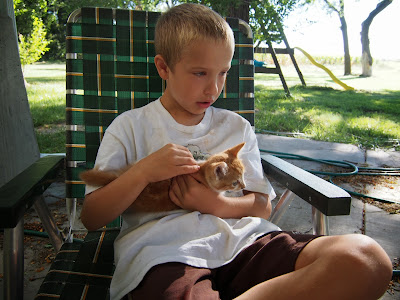
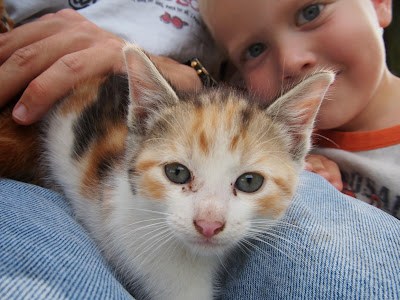
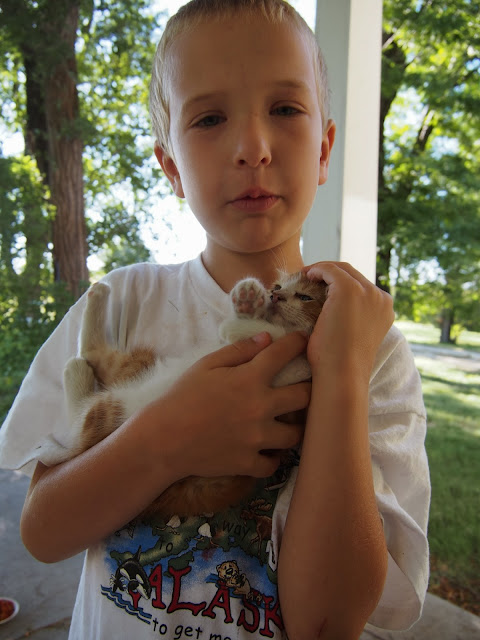
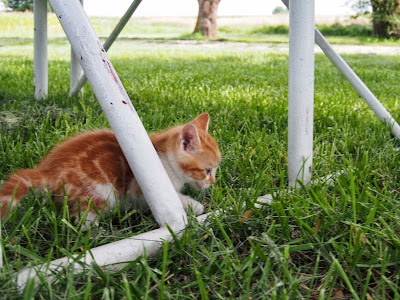
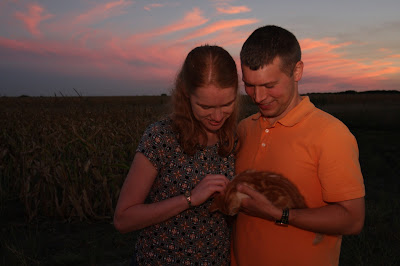
Almost every time he got off the bus for the past month and a half, Jacob started his afternoon in the same way. Before toys, before his trains and his toy bus, before anything indoors, he went for our cats. Here he is, cradling his favorite, Tigger: Laura and I both grew up around cats. We had been talking about kittens, and shortly after we got engaged, one of my relatives offered us some free kittens. We went to his place one evening and selected two of them one calico and one tiger-colored. Since what is now my place will soon be our place, they came to live with me. Our cats were one of the first things we did to prepare for our lives together. Oliver wanted to name them some rather impractical sentence-long names ( The Cat Who Always Likes To Run ), so Laura and I suggested some names from one of their favorite books: Tigger and Roo. They both liked the names, but Oliver thought they should be called Tigger the Digger and Roo the Runner . Never mind that they were just 6 weeks old at the time, and not really old enough to either dig or run. Here s Oliver with Roo, the day after the kittens arrived here. I have always had outside cats, both because I m allergic to cats so I need them to be outside, and because they sometimes literally quiver with joy of being outdoors. Tigger and Roo often chased insects, wrestled with each other, ran up (and slowly came back down) trees, and just loved the outside. Sometimes, I have taken my laptop and wireless headset and work from the back porch. The kittens climb up my jeans, inspect the laptop, and once Roo even fell asleep on my lap at one of those times. Jacob has been particularly attached to Tigger, calling him my very best friend. When Jacob picks him up after school, Tigger often purrs while cradled in Jacob s arms, and Jacob comments that Tigger loves me. Oh dad, he knows I am his friend! The kittens have been growing, and becoming more and more comfortable with their home in the country. Whenever I go outside, it isn t long before there are two energetic kittens near my feet, running back and forth, sometimes being very difficult to avoid stepping on. I call and I see little heads looking at me, from up in a tree, or peeking out from the grain elevator door, or from under the grill. They stare for just a second, and then start running, sometimes comically crashing into something in their haste. Yesterday when I went to give them food, I called and no cats came. I was concerned, and walked around the yard, but at some point either they come or they don t. Yesterday afternoon, just after the bus dropped off Jacob, I discovered Tigger on the ground, motionless. Once Jacob was in the house, I went to investigate, and found Tigger was dead. As I was moving his body, I saw Roo was dead, too. Both apparently from some sort of sudden physical injury a bit mysterious, because neither of them were at a place where they had ever gone before. While all this was happening, I had to also think about how I was going to tell the boys about this. I tried to minimize what he could see, Jacob had caught an unavoidable glimpse of Tigger as we were walking back from the bus, but didn t know exactly what had happened. He waited in the house, and when I came back, asked me if Tigger was dead. I said he was. Jacob started crying, saying, Oh Dad, I am so sad , and reached up for a hug. I picked him up and held him, then sat down on the couch and let him curl up on my lap. I could quite honestly let him know he wasn t alone, telling him I am sad, too. Oliver arrived not long after, and he too was sad, though not as much as Jacob. Both boys pretty soon wanted to see them. I decided this was important for them for closure, and to understand, so while they waited in the house, I went back out to arrange the kittens to hide their faces, the part that looks most unnatural after they die. The boys and I walked out to where I put them, then I carried both of them the last few feet. We stood a little ways back close enough to see who was there, far enough to not get too much detail and they were both sniffling. I tried to put voice to the occasion, saying, Goodbye, Tigger and Roo. We love you. Oliver asked if they could hear us. I said No, but I told them what I felt like anyway. Jacob, through tears, said, Dad, maybe they are in heaven now. We went back inside. Jacob said, Oh dad, I am so sad. This is the saddest day of my life. My heart is breaking. Hearing a 7-year-old say that isn t exactly easy for a dad. Pretty soon he was thinking of sort of comfort activities to do, saying I think I would feel better if we did So they decided to watch a favorite TV program. Jacob asked if Laura knew yet, and when I said no, he got his take-charge voice and said, Dad, you will start the TV show for us. While we are watching, you will send Laura an email to tell her about Tigger and Roo. OK? What could I say, it wasn t a bad idea. Pretty soon both boys were talking and laughing. It was Big Truck Night last night, at a town about half an hour away. It s an annual event we were already planning to attend, where all sorts of Big Trucks firetrucks, school bus, combine, bucket truck, cement truck, etc show up and are open for kids to climb in and explore. It s always a highlight for them. They played and sang happily as we drove, excitedly opened and closed the big door on the school bus and yelled All Aboard! from the top of the combine. We ate dinner, and drove back home. When we got home, Jacob mentioned the cats again, in a sort of matter-of-fact way, and also wanted to make sure he knew Laura had got the message. A person never wakes up expecting to have to dump a bowl of un-eaten cat food, or to give an impromptu cat funeral for little boys. As it was happening, I wished they hadn t been around right then. But in retrospect, I am glad they were. They had been part of life for those kittens, and it is only right that they could be included in being part of death. They got visual closure this way, and will never wonder if the cats are coming back someday. They had a chance to say goodbye. Here is how I remember the kittens.

9 July 2013

Brett Parker: It&#39;s been a looong time since the last blog post...

So, does anyone have any clue what's happened, because I'm at a loss. Apparently I didn't blog about the loss of my Dad back in December, he was found in Union Canal on the 13th December 2012, with his dinner in a carrier bag and his bike. The 'official' date of death is the 13th December 2012, but as far as we can work out (and I'm fairly sure on it), he died between 1930 and 2030 on the 12th. I was on the phone to him at 1930, and I was trying to call him back at 2030 on leaving a pub and wandering back in to town, apparently I wasn't the only one trying to call him, but we all put it down to him being out of signal at the time, until I got a call from my brother on the 13th at just gone midday, saying that the police had been round to tell him they'd found Dad in the canal that morning. The funeral was held on the 22nd January 2013, with a large turnout of friends and family, it was a good send off for the old chap, and we made damned sure that it was an even better wake - The Brewery Tap did a fantastic job for us, and all that turned up (ok, with some exceptions, but we can block them out!) were fantastic. The boy knew more people than we could possibly imagine, and most of them turned up to either the funeral, the wake or both. Still miss him, don't expect that to change anytime soon, if only because I used to talk to him most evenings after work between the train station and the pub, and I really miss being able to talk shit with him and being able to relate. Next week we should finally have the Certificate of Representation so that we can actually empty his canal boat ready to sell, at which point it's likely to go back down to Wilton Marina to be sold off. It's not a bad little boat, but it was his sanctuary, and none of us feel comfortable keeping it. In other news, work has been slightly a bit busy since then, and I'm still playing a bit of catchup from missing fair chunks of January (though, I was mostly still working from home when I could!). I'm sure other stuff must have happened... Oh, yeah, I got older, but obviously no wiser. I went and visited The Brewery Tap for Father's Day (that was a good day, 7 hours trains for 5 hours in the pub, but well worth it). Coming up: Cambridge Visitations! The August Bank Holiday Debian Party in Cambridge - now, that I am looking forward to!

17 January 2013

Benjamin Mako Hill: 1-800-INTERNET.COM

I just returned home from Aaron Swartz s funeral in Chicago. Aaron was a good friend. The home I ve returned to is an apartment that was Aaron s before it was mine, that I have lived in with Aaron during several stints, and that I still share with many of his old books and posters. Although, I ve spent what feels like most of the last five days reading things that people have written about Aaron, I m still processing and digesting myself. Right now, I m very sad and at a loss for words. While I reflect, I wanted to share this video recently put online by Finne Boonen. The video was made in 2006 at a Web 1.0 Elevator Pitch Competition held at Wikimania 2006 about a year after that both Aaron and I moved to Cambridge and met. The goal of the contest was to pitch Web 1.0 DotCom business ideas to a team of real Web 1.0 investors like it was still 1999. Aaron and I formed a team along with SJ Klein (who I traveled to the funeral with this week), and Wikimania general counsel and interim executive director Brad Patrick. The video shows how as Danny O Brien has reminded us Aaron was funny. He came up with many our teams best lines in addition to checking our Web 1.0 boxes for tech guru and Stanford dropout. Our pitch for 1-800-INTERNET.COM is in the video below. The transcript was done by Phoebe Ayers in Facebook and the video is also available in WebM. <iframe allowfullscreen="" frameborder="0" height="315" src="http://www.youtube.com/embed/NzFjWY6Fd_g" width="420"></iframe>
SJ: You know, Mako and I had some pretty good ideas for improving connectivity to the internet, and we think we can reach 90% of the world s population. So think about this. You re sitting in a Starbucks, and you need to connect to the internet. But you can t, because there s no internet. But what is there, near every Starbucks? There s a payphone! You pick up the payphone, and you call . 1-800-INTERNET. You can connect to our bank of researchers on our fast T1 connections and get any information you need! So, we don t actually have 1-800-INTERNET yet, we have 1-800-225-3224, so the first thing we need to do is buy the number. So here s Mako, who is our web designer from UC Santa Cruz and Bradford, our financial guru, and Aaron, who s handling all of our technical implementation. But Mako, you should explain the earballs. Mako: So, so, so yeah, so most people on the Internet are going for the eyeballs, but they ve just left all of these earballs. So I have some experience in web design, and it s true that this isn t really a website, but we still need good web design. So, so, I ve actually got a really experienced team, we can go into later, and we have some really great earcons not icons, but earcons.. And it s going to be all together, not apart like some of the websites. It s going to be together. Brad: so how does this work technically? Aaron: Well, I mean, so I only spent one year at Stanford but that s Ok, because there are new developmental technologies, we re going to throw away all that old stuff, we re going to use really reliable and efficient well-designed code that everyone can clearly understand, and write the whole thing in Perl. I know this is a risk, but I am confident that Perl is going to destroy those old C websites. No one will write websites in C anymore once we do this, it s going to be so much faster, and so dynamic, everythings going to be like, on top of everything. It s going to be great. Bradford: So here s the business model. It s really really simple, and it s a really really great idea. It s all about the licensing. Because what we re going to have are these underlying audio ads, While you re on the phone you re going to hear this subliminal advertising message. And the way it works is really really cool, because it s really really low volume, it s high impact! And it s even better, because we license it, and the way it works is when a caller calls 1-800-Internet, they re hearing the ad, but so is the representative, so we get to bill em twice! So that s it: All: 1-800-INTERNET.COM
We did not win and I still believe that we were robbed.

4 June 2012

Steve McIntyre: Visiting my grandfather in Hong Kong

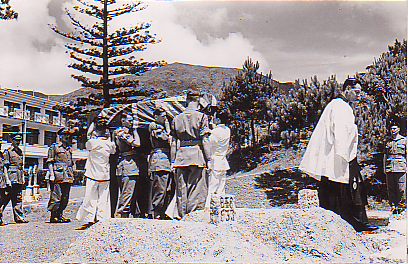
I never met my father's father, as he died many years before I was born. He was a soldier in the British Army and was killed in an accident in Burma in the 1950s. I'm told that back then the Army did not repatriate casualties as a matter of course like they do today, so none of the family got to see his funeral or even visit the grave. Like many of the military casualties in the Far East, he was buried in the Colonial Cemetery in Hong Kong. A few photographs were sent to my grandmother of the ceremony and the headstone, but that's all we ever saw.
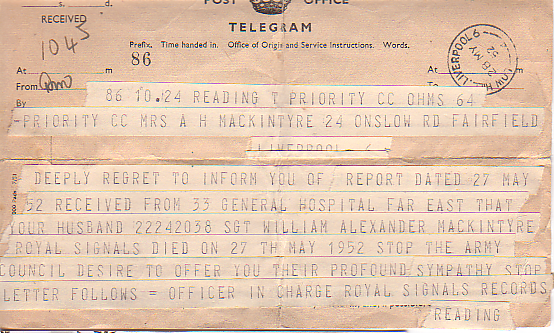
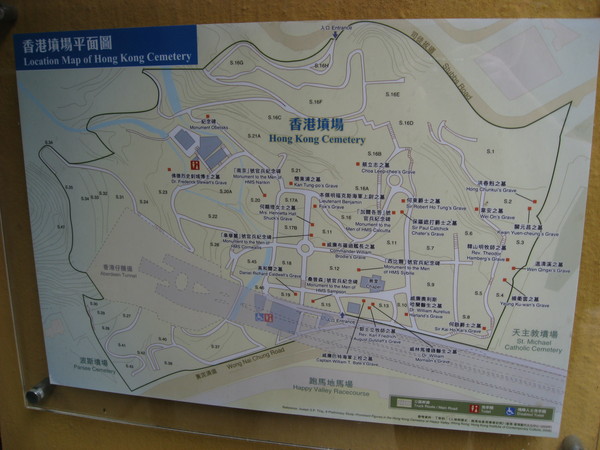
telegramfuneral Fast forward to 2012. I travelled to Hong Kong for a conference (Linaro Connect, more about that later...). I looked up the details of where grandad was laid to rest, and found a major coincidence. He was killed on 27th May 1952, almost exactly 60 years ago! I resolved to go to find him on 27th May 2012 to make the most of this lucky anniversary. Wikipedia told me that in the intervening years the Colonial Cemetery had been renamed to Happy Valley Cemetery, then simply Hong Kong Cemetery, and repurposed from military to civilian use. Jo and I bought some flowers and headed over to Happy Valley on Hong Kong Island on Sunday afternoon. We found a very large cemetery with a helpful map posted to show the different sections, but nothing to tell us where we should be looking. One of the attendants at the office on site looked at the details we had and shrugged to say "sorry, can't help". Ah well, nobody said this was going to be very easy... What we found after a few minutes was that the graves weren't laid out in any obviously logical fashion. In any given small area, you'd find people buried from roughly the same period, but people for any given period could (and would) be scattered across multiple sections at all corners of the site. Great, time for an exhaustive search then. I started combing the site, checking all the markers I could find that looked anything like the tiny grainy black and white photo we had of grandad's headstone.

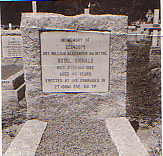
cemeteryheadstone Almost two hours later, I eventually found him. Two hours of heavy work: the cemetery is built on the side of quite a steep hill, and the prevailing weather was very hot with 100% humidity. But, I forgot all that as we eventually stumbled across the correct grave in (no exaggeration!) the very last part of the last section of the site, 20a.
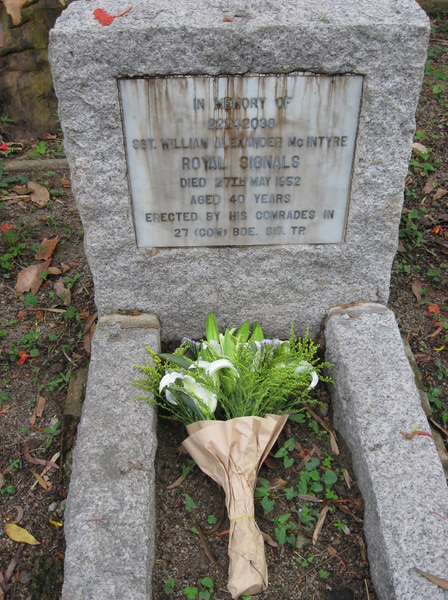
grave I was relieved at this point: as things had taken so long, I had started to worry that maybe the grave had been moved or the headstone damaged and lost. But no, I found the man who had gone off to war leaving my dad and aunt as small children. We took some photos and took note of where we had found the final resting place of Sergeant William Alexander McIntyre of the Royal Signals, a man I never met in life but clearly a very important member of our family.

5 February 2012

John Goerzen: Rain, A Funeral, and Excitement

Rain Friday was something of a rare day for February in Kansas. Starting at about 2AM, the wind picked up, blowing so hard that our windows rattled. That part isn t so rare. Then the cold rain started, dropping almost 2.5 throughout the day. As I worked, I had the blinds on the windows open, but they didn t let in very much light. Still, the wind had calmed down, so the intermittent rain outside was peaceful. Jacob went out to play for a little while, so every so often I saw a warmly-dressed and excited-looking 5-year-old run past my window. A little while after he came in, I told Jacob, I saw you playing outside. His response: Oh good! I got wet! Which, despite the fact that it was about 50 degrees, seemed to excite him. After the blustery start, the calm, slow, and peaceful rain was a pleasant thing to see throughout the day. Funeral My great aunt Alice Goerzen passed away last Sunday. So today, for the third time in a little over a year, I was at the funeral of a Goerzen relative and neighbor. Alice s husband, Milt, passed away in late 2010, and it was while I was at his funeral that Jacob got run over by a tractor. That memory certainly came back to me today. But I think I should set the stage and explain what funerals are like in this small, rural Kansas community. At the church, while people file in, family and close friends generally defined as loosely as desired meet in some other room before the funeral. Memories may be shared, or songs sung, or maybe just a brief meditation or prayer. Then the man from the funeral home there s only one in town will step in. Ivan Miller owned the business for decades, and although he s now retired, his replacement seems pretty similar. Kindly, respectful, and pretty much unchanging. This group then files into the church sanctuary to sit up front, while the rest of the congregation is standing and music is played. We typically sing some hymns, hear memories from the family, a message from a pastor, and then do downstairs for faspa: an light meal with coffee, zwieback, funeral cheese , and some relishes and dessert. You can, by the way, go to the local grocery store and find a product labeled funeral cheese . It s a sharp cheddar, sliced thick and cut into pie piece-shaped wedges. After everyone has picked up their food, microphones are passed around, and anybody that wants to can share memories and stories. These are often hilarious, or touching, and can be more random than anyone could expect. Today we heard a lot about how Aunt Alice loved her flowers and garden. We even saw a video of her giving a tour of her garden, with Milt s mower in the background occasionally accidentally causing a distraction (or maybe it wasn t so accidental; he d never miss an opportunity to cause some mischief ) I tend to think of attending funerals around here as a good time. Sadness is inevitable, but there are so many amazing stories that it is hard to leave feeling sad. Excitement This afternoon, Jacob found me in the office and as he often does, said, Dad, I want to do something with you. Usually I ask him what he d like to do, but his first instinct is usually to ask for watching train videos on Youtube. So sometimes I make other suggestions. Today we played hide and seek with radios, in which the person that is counting is supposed to radio to the other person when they are done. Today was the first time that Jacob came up with the trick of talking into the radio while I was hiding so he could hear where I was. I was sort of proud of him, and he failed to completely hide his smile when I told him I had to turn off my radio or else he d find me too fast. Then later, we played with Jacob s computer, a Linux-based command-line-only machine. I have set up a few shell scripts and aliases for him. Since it doesn t play videos, he doesn t use it as much as he does mine, but it is really fun to watch how his interaction with it changes as he gets older. He can now read amazingly well for a 5-year-old, and is starting to learn how to spell. He loves word games, writing, and typing. I thought I would install an ASCII art program for him. I told Jacob I had some ideas for a new game, and he was irresistibly intrigued. I offered him a choice between figlet and toilet. And, as is probably no surprise to anyone with a 5-year-old, he chose toilet based on its name, Jacob and Oliver both loved typing things and seeing them displayed bigger. I showed Jacob how I could make a freight train by typing ,<@-[]-(*)-@> (that s the comma-shaped snowplow, engine, boxcar [], tank car (*), and caboose @>). Then toilet drew them big, and though abstract, caused great excitement. I hooked up one of the speech synthesizers in Debian to a simple shell script named talk , which is a huge hit with the boys. They enjoy typing in nonsense and hearing the funny result, or in typing in real words and hearing how the computer says them right (or doesn t). All told, we had a good hour s worth of excitement up there.

6 August 2011

Andrew Pollock: [life] RIP Margaret Rutter

I got a call from Mum today to inform me that my grandmother had passed away last night, Brisbane time, at 94 years of age. Four generations If you want to get all genealogically correct, she's technically my step-maternal grandmother, but she's the grandmother I spent the most time with, growing up, so I'm not going to split hairs. It's come as a bit of a shock, because despite having had progressively worse dementia for probably over a decade, she's been in incredibly good physical condition. I think it was in her 70's that she had a heart valve replaced, and I for one had been expecting that to be the thing to wear out and take her down slowly. I last saw her in the flesh in January, when the above photo was taken, and more recently a few weeks ago on Skype. She was recently moved from an aged-care hostel in Toowoomba to a nursing home in Brisbane, as her dementia had progressed beyond the point that she could be cared for in the previous facility. Mum had visited her earlier in the day yesterday, and she was fine, but apparently the staff found her unconscious at around 5pm when they went to get her for dinner. She was taken to the Royal Brisbane and Women's Hospital where it was determined she had suffered from a stroke, and she passed away later that evening at around 11:30pm. So all in all, she had a very good innings, and of all the ways to leave this world, this was one of the quicker and more painless ways to do it. That's the problem with a quick exit - it's usually completely unexpected. It's looking like the funeral will be on Friday, and I've got a flight tentatively booked to leave on Wednesday and get in on Friday morning and return again on Monday. At the time I arranged this, I'd completely forgotten that I was flying to Calgary on Monday night to babysit the son of friends, while they go to the US Consulate for a visa appointment. Fortunately this travel doesn't conflict with that travel, it just means I'll be away from work for longer, and spending a lot of time inside pressurized tubes. I'm fairly confident with all of the short international trips, I'm going to look like a drug mule or something, and someone's going to thoroughly cavity search me.

29 May 2011

David Watson: Project 52 - Week 21

I happened to have some Arum Lillies on hand this week after taking some shots for use by a local funeral director. This is one of the shots I took once I had finished. Week 21 - Arum Lillies

15 February 2011

Gerfried Fuchs: Peter Alexander

I guess it won't be very many people reading this blog to know the name, even though he was without any doubt one of the biggest entertainers. Lots of movies, his own TV show, and an enormous amount of albums made him well known far outside the borders of Austria, his home country. Last saturday he died in the age of 84, yesterday was his funeral. This is a special dedication to him. Peter, you will be missed. Servus.

/music permanent link Comments: 1 Flattr this

22 January 2011

Tim Retout: Grandma

My paternal grandmother died a month ago today - I may have been quieter than usual since December. The most vivid memory I have of her is helping to collect runner beans from her garden - apparently this had been going on since the World War II "dig for victory" campaign. Her funeral was in Hastings on 10th January, and she was buried in Fairlight, in the Roman Catholic area of St. Andrew's - it was a very peaceful setting.

16 January 2011

John Goerzen: 24 hours with Jacob

Friday, I wrote about the train trip Jacob and I were planning to take. Here s the story about it. Friday night, Jacob was super excited. He was running around the house, talking about trains. I had him pack his own backpack with toys this time, which were you guessed it trains. Plus train track. His usual bedtime is around 7. He was still awake in his room at about 11, too excited to sleep. The train was an hour late into Newton, so got up, got ready, and then went into Jacob s room at 3:15AM. I put my arm around him and said his name softly. No response. I said, just a little louder, Jacob, it s time to wake up to go to the train station. There was about a 2-second pause and then he sat bolt upright rubbing his eyes. A couple seconds later, in a very tired but clear voice, OK dad, let s go! That is, I believe, a record for waking up speed for Jacob. We went downstairs, got coats, mittens, hats, etc. on, made sure we had the stuffed butterfly he always sleeps with, and went out the door. As usual, Jacob chattered happily during the entire 15-minute drive to the Amtrak station. One of these days I need to remember to record it because it s unique. He described things to me ranging from the difference between freight and passenger trains, to what the dining car is all about, to tractors and how to ride them safely. Newton has some winter lights , and a few places still had Christmas lights, which were of course big hits. We had to wait a few minutes at the Amtrak station, and Jacob hadn t shown any signs of slowing down yet. He wanted to look at every Amtrak poster, picture, logo, or sign in the building. This generally meant me holding him up high while he leaned over to touch it and make out a few words. Then, of course, he would pick out minute details about the trains, such as how many coach cars he thought they had, and we d visit about that for awhile. We got on at about 4:20. We found our seats, and Jacob showed no signs of calming down, despite having had only 4 hours of sleep (instead of his usual 11) so far. We checked out the buttons for lights. And, of course, he excitedly yelled out, Dad, the train is moving! He spent the next while mostly watching out his window, but also still exploring his space. Finally at about 5, I said, Jacob, I am really tired. I am going to sleep now. Will you sleep too? His response: Oh sure dad, I will sleep with my eyes open! As a result, no sleep was had for Jacob, and only a little for me. The dining car opens for breakfast at 6:30, which is normally a rather foreign time for breakfast on the train for us. But we were both awake so I figured might as well go. So Jacob and I went to the dining car. We sat with a woman going from New Mexico to Lawrence for her grandpa s funeral, though it was expected and she was having a good time on the train. Jacob turned completely shy, and refused to say a word, except maybe a few whispered into my ear. He got his favorite railroad French toast, and had me drizzle some syrup on it. I used the word drizzle for syrup the first time he had French toast on the train, and if I fail to use that word in the dining car, I will hear about it in no uncertain terms from Jacob. He loved his dining car breakfast, but we spent about an hour and a half there. He was really slow at eating because his face was pressed up against the window so much. But that was just fine; we had nowhere else to be, the person eating breakfast with us enjoyed visiting (and, apparently, scaring the dining car staff with tales of bears in the New Mexico mountains). This was what the train trip was all about, after all. We played in the lounge car for awhile. The almost floor-to-ceiling wrap-around windows provided a great view for him, and more opportunities to press his face against a window. We talked about freight trains that he saw, noticed the snow on some of them. Then we found the back of the train and he got to look out the back window. Back at our seat, he played with his toys for about 10 minutes, which was all he used them on the entire trip. There was just too much else to enjoy. When we used the restroom on the train, he d comment on how much he liked the Amtrak soap. It smells SO very very good! He wanted to wash his hands on the train. By late morning, he had decided: Dad, I LOVE this Amtrak soap. It smells like peaches! Shall your hands smell like peaches too? And, when we d get back up to our seats, he d put his hands in my face, saying, Dad, smell that! My hands smell like peaches! It was from the AMTRAK SOAP! At some point, he discovered the airline-style safety brochures in the seat back pockets. These were filled with diagrams of the train car, a few photos, and lots of icons with descriptions. I don t know how many times I read the thing to him, or really how many times he then recited it to me from memory. It was a lot. He spent hours with those brochures. Jacob had already told me that he wanted pizza for lunch, so I got him the kid-sized pizza. It wasn t all that big, and he could have devoured at least half of it when hungry. But he was getting really tired and ate only a few bites of pizza and a few chips. Pretty soon he was leaning up against me, the window, and eventually had his head on the table in some tomato sauce. But he didn t quite fall asleep by the time we went back to our seats, and of course was wide awake by that point. Jacob loves spotting the word Amtrak on things. It was very exciting when he noticed his orange juice at breakfast, and milk at lunch, were Amtrak juice and Amtrak milk due to the logo on the cups. At dinner he noticed we had Amtrak plates, and when I pointed out that his metal fork had the Amtrak logo on it, he got very excited and had to check every piece of silverware within reach. Dad, I have an Amtrak fork too! . And dad, YOU also have an Amtrak fork! We ALL have Amtrak forks! *cackling laughter* I finally insisted that Jacob lay down for some quiet time. I closed the curtains, and he finally did fall asleep less than an hour before our arrival into Galesburg. So by 2:15 he was up to 4.75 hours of sleep, I guess. We stopped in the train station briefly, then started our walk to the Discovery Depot Children s Museum, which was right nearby. Although I made no comment about it, Jacob said, Dad, there is a train museum RIGHT HERE! Yes, you re right Jacob. I can see a steam engine and some cars here. Let s go in! I don t think it s open today. It IS open shall we go check? It wasn t, and that was mighty sad though when he spotted another old caboose sitting outside the children s museum, the day suddenly seemed brighter. He complained of how cold he was, although my suggestion that he stop walking through the big piles of snowdrifts was met with a whiny, But dad, I WANT to do that! We went inside the museum (having to walk right buy the locked caboose thankfully the people at the desk promised to unlock it for us when we were ready) and Jacob started to explore. There was some wooden play trains big enough for children to climb in which he enjoyed, but in general he went from one thing to the next every minute or two as he does when he s really tired or overstimulated. Until, that is, he discovered the giant toy train table. It had a multi-level wooden track setup, and many toy trains with magnetic hitches. It was like what we have at home, only much bigger and fancier. He spent a LONG time with that. We then briefly explored the rest of the museum and went out into the caboose. It wasn t the hit it might have been, possibly because there are several at the Great Plains Transportation Museum that he gets to go in on a somewhat regular basis. After that, he was ready to go back into the museum, but I was feeling rather over-stimulated. On a day when the highs were still well below freezing, it seemed just about every family in Galesburg was crowded into the children s museum, making it loud and crowded which I don t enjoy at all. So I suggested maybe it was snack time instead. A moment s thought, then he started to pull me out of the caboose before I could get my gloves back on Yes dad, I think it IS snack time. Let s go. Let s go NOW! We walked over to Uncle Billy s Bakery (Google link or minimal website). Jacob spotted some sugar cookies shaped like mittens. Despite my reluctance to get him more sugar, he was so excited plus I had barely prevented a meltdown at lunch by promising him that he would get dessert later in the day so he picked two red mitten cookies. I got myself a wonderful peach muffin and a croissant and we sat down at one of the tables by the window. I taught Jacob how to hang his coat on his chair and he lit into those cookies. I spotted a guy at the next table over wearing a BNSF jacket, and asked him if he worked for the railroad. He had retired as an engineer a couple of years ago, and had worked various jobs before that. He grew up in Manhattan, KS and so was interested in our trip and very friendly. While we visited, Jacob devoured his cookies and increasing portions of my snack as well. He told us about a new shop The Stray Cat just two stores down that was having a grand opening event today. They make decorations and art out of basically discarded items, and had some really nifty things that I may have bought had I not been wanting for space in our backpack. Then I spotted Sweets Old-Fashioned Ice Cream, Candy, and Soda Shop across the road. I figured he d love it and I was already in for the sugar so might as well. He picked out some birthday cake flavor ice cream for himself. I got huckleberry ice cream, which he insisted on calling purpleberry and managed to get some tastes of as well. After that, we went to the train station. It was about an hour until our train would be there. I wasn t sure if we d find enough to do, but I shouldn t have worried. Earlier, we had made the happy discovery that the station s restroom featured the Amtrak soap, so there was that. Then there was the model Amtrak train in the ticket window, which Jacob kept wanting to look at while I d hold him. And also, the California Zephyr came in. We watched it arrive from the station window, saw people get off and on, and saw it leave maybe the first time Jacob has witnessed all that in person. And, of course, we looked at the pictures in that train station. The ticketmaster gave Jacob a paper conductor s hat with puzzles and mazes on the back side. And then it was time to get onto our train back home. We ate dinner Jacob again ate little and almost fell asleep and got back to our seats. I let Jacob stay awake until about 8, when he was starting to get a bit fragile. It took him awhile to fall asleep, but he finally did at about 8:30. Today he s still been all excited. He will randomly tell us about bits of the trip, that the man at supper called his grilled cheese sandwich piece little when it was really big, what we did at the ice cream store, etc. And I do think that he is now a train safety expert. All in all, I think that is probably the most excitement he s ever had in 24 hours and it was a lot of fun to be with him for it!

9 November 2010

John Goerzen: A Scary Day, and A Walking Miracle

I had been planning to write today about my great uncle Milt Goerzen. Milt passed away last Thursday after a long struggle with dementia, and his funeral was this morning. I was there, and was inspired by a few things I heard. But that will have to wait, because today brought one of those few moments in life that s a sense of an impending possible great loss. I can remember two others: one was when Terah passed out, and the other was when we heard that our place was on fire and our house had burned down (it turned out the house hadn t, but much of the rest had). I got a call during Milt s funeral. I didn t answer because I was, well, at a funeral, and the phone was on vibrate. When I had the chance to check the voicemail, it went something like this: I think we have an emergency with Jacob. He got run over by a tractor. He says he s OK, but I m taking him to the doctor right now. I tried to return the call, but cell phone reception wasn t cooperating. The most I got was he s OK . It s hard to describe how a moment like that feels. My mind jumped to telling Jacob I love you , and how lately when he hears that, he will snuggle in for a big hug, and say, Dad, I love you toooooooooo! On the one hand, I heard the he s OK part, and on the other hand I couldn t forget the tractor running over him part, and my mind leapt at the worst. It turns out that, while I was at the funeral, Jacob had been standing on his usual spot on the tractor, sort of to the side of the driver. He was enjoying himself like usual. The tractor hit a large hole that wasn t really visible. The combination of the jolt and the dip the tractor took towards Jacob s side knocked him off and he went directly under the big rear wheel before the tractor could be brought to a stop. I caught up with him and his grandpa after he had seen the doctor and just as he was being admitted to the hospital. He saw me and crawled over, making his sort of sad and scared sound he sometimes doesn t want to verbalize things when he s in that mood. I held him close and he seemed to appreciate it. He had to have blood drawn, and he was scared of that. I remembered his inquisitive mind, and reminded him how much he liked watching the tube fill up with blood last time he had a blood test (which he calls a blood shot ). That wasn t helping, until the actual blood test started. He cried when the needle went in, but then calmed down as the nurse, getting into the act, pointed out that there was blood filling up the tube. Hmmm! said Jacob. Then she gave him a band-aid. It has an airplane, said the nurse. Um-hmm! said Jacob. I pointed out that it looked like the airplane we were on when we flew home from New York. Jacob got a big smile and said, Yes, it IS that one! He got a sticker there too. Then it was off for an x-ray to check for broken bones and a CT scan to check for internal injuries the tractor had gone right over his abdomen. He had to get an IV at the CT scan, which he certainly didn t like. After it happened, however, he found it very interesting especially when the nurses explained that they would give him a drink through the hose attached to his hand. After that, we went to his room, with orders for him not to eat or drink anything until it was clear he didn t have digestive problems. While we waited at various steps along the way, Jacob wanted to sit on my lap and watch train videos on YouTube on my phone. He loves train videos, and brought my phone s battery nearly to depletion through the course of the afternoon. Jacob eventually seemed to get back to a bit of his usual self. At one point, while Terah had made a run home to pack an overnight bag and grandpa ran some errands of his own, Jacob wanted to leave the room. He had gone exploring in the hospital with me before: when Oliver was born, and when Terah had her thyroid surgery. So this was something he just associated with the hospital. That and lemonade, which is free any time of the day or night in the cafeteria. So we went exploring, even ventured outside into a courtyard for a bit. He was walking fast and seemed good. We had several visitors: grandparents and his aunt and uncle. Jacob got a stuffed rabbit and a colorful bug box with windows (for putting bugs inside for observation). Eventually the doctor came by and gave us the results: the x-rays showed no problems. The labs showed some elevated liver enzymes, which he expected, but no serious trouble. The CT showed contusions on his lung and bruising on his heart which would heal completely in time. He allowed Jacob to have a liquid supper (so I quickly got him the lemonade he had been wanting while the nurses got him some Jello). The doctor examined Jacob, pushing at various places, asking Does it hurt here? No. Does it hurt here? No. Here? No. Are you hungry? Yes. Does it hurt here? No. He gave me a look that said: really? It doesn t hurt ANYWHERE? What could I do but shrug my shoulders? Jacob has some abrasions on his face, arms, and back, which will probably eventually hurt (and sure enough, about 10 minutes later he started getting a little pain when he tried to move, which the doctor checked out) Then the doctor said, I hope you know you have a walking miracle today. This is just amazing. You have some thanking to whatever guardian angels you like tonight all I can say about this is that the Lord must have had some other plan for him. There s no way he could have survived that. Jacob s doctor is one that we really respect: he s scientific in his analysis, cites studies as a matter of routine, doesn t prescribe antibiotics for things that he knows they have a small chance of helping, is common-sense about not over-treating things and yet always engaged in an emergency. That little speech from him was something I d never expected to hear from him. He went on to add that I always visit my sickest patients first. You were my last visit this evening, so that should tell you something. Any other kid as healthy as he is, I might discharge already but I m just not justified doing that with a boy that s, well, been driven over by a tractor this morning. He also wanted to monitor Jacob s progress throughout the coming day, especially his digestive system. They wanted to measure his urine output, which he, predictably, found to be very interesting. Terah said I think it is about 150 ml. Jacob said, No mom, it is closer to the two hundred line. Me: Since when does Jacob know about the number 200? Terah: I don t know . he s 4, where would he have gotten it? Between that, and using every opportunity to tell people that there were not one but TWO red light switches in the x-ray room, Jacob s definitely himself in some ways already. So, that feeling of some impeding great loss is gone, replaced by being more than a bit overwhelmed by how fortunate we were today. We also appreciate all the help we ve had with Jacob and Oliver today.

31 August 2010

Steve McIntyre: Frans Pop

My good friend Frans Pop died on the 20th of August, just over a week ago. We had worked together for several years within Debian (especially within the Debian CD team), and we had become firm friends during that time. He was great to work with, always ready to help design new features or pick holes and find the bugs in the stuff I was developing myself, happy for others to dig into his own projects. On the more personal side, we met up many times at different Free Software events like DebConf and FOSDEM, and also for pure social things like BBQs and parties. We shared a lot of good times. Last week, along with some other Debian people who had worked with Frans, I headed over to the Netherlands for his funeral. His family also asked me to talk about him, and I was honoured to do so. I spoke briefly about Frans' work in Debian, highlighting the areas where he worked and the number of people he had worked with in various teams. I also told the group about the massive number of messages of sympathy and condolence which I had been asked to pass on from all over the world. His family knew that Debian was important to Frans, but were not aware of just how wide his influence and effect had been. They were especially surprised and grateful that people had travelled so far for the funeral; I told them that I would not have missed it for anything. Rest In Peace, my friend. You will be missed.

14 April 2010

Adrian von Bidder: Harold and Maude. And some others.

The friend who lent me his Kottan ermittelt DVDs gave me the 1981 movie (cinema, not TV) Den T chtigen geh rt die Welt. I guess a warning is in order: if you liked the TV series, it's possible that you'll share my disappointment with this film. There are reports of a new movie to be made this year, and I also haven't seen the first 9 episodes of the TV series yet, so I'll probably report on Kottan again some time in the future. I was surprised but liked the film: There's a coherent plot and even a happy end. And it's till a film by David Lynch: Wild at Heart. Also by Lynch: the very early Eraserhead. Now this is Lynch (at least for me, since I started with Lost Highway and Mulholland Drive ), and I really like the hairstyle of Henry Spencer. Something completely different: Harold and Maude, or what happens when a bored high society youth falls in love with an 80 years old eccentric who shares his hobby of going to funerals of some random people.

25 May 2009

Robert Collins: 25 May 2009

I'm leaving UDS early due to a loss in my family - I have to travel now to get to the funeral. Folk that I had specific meetings/planned discussiongs lined up with I have tried to contact in person, and this post is intended to act as a catchall for anyone I didn't find.

Next.

Previous.