ERR_clear_error() around
TLS operations.
Like any serious software engineer would do, I said No. Just because one component
failed to handle its errors does not mean I can go around and discard all errors
in another place - the program should have failed earlier (or discarded the error
when it was determined to be safe).
Little did I know that people have for years been using this approach as a best
practice: Codebases everywhere are littered with calls to ERR_clear_error()
before performing TLS, and upstream themselves suggest to do just that.
This is a major, systemic, pandemic of incomplete error handling. We cannot
just discard unrelated errors if they become inconvenient. The code that
caused the error needs to be fixed to handle it.
This isn t all. It seems many authors are not familiar with libraries using a
stack of errors, and there is a second anti-pattern:
Call an OpenSSL operation, check the top-level error, and then discard all
errors if deemed not too bad . This has the same problem: Unrelated errors
get silently discarded.
I would strongly encourage everyone to inspect their code bases for any calls
to ERR_clear_error() and whether they are safe or one of the bad patterns
above (or maybe you find a new pattern). You may want to use error stack
functionality ofERR_set_mark (https://docs.openssl.org/3.4/man3/ERR_set_mark/)
to essentially push and pop an error context of your own as a guard around
multiple OpenSSL operations.
To the OpenSSL authors, I would suggest not encouraging devastating security
practices that fundamentally break any trust in software.
We need to do better than this.
This month s work was dominated by the transition of Debian 12
bookworm to support by the LTS team, and by review of some large
updates to Linux stable branches.
Linux 6.12 is currently available in bookworm-backports, but that
suite will stop accepting uploads after the last bookworm point
release. I updated some supporting packages in bookworm in
preparation for adding Linux 6.12 there. I also prepared for
the possibility that bookworm-backports would close earlier.
Since the LTS team is still also maintaining Debian 11 bullseye
until August, I reviewed upstream changes for both Linux 5.10 and 6.1
stable branches and reported a number of regressions and other issues.

The Debian LTS Team, funded by Freexian s Debian LTS offering, is
pleased to report its activities for May.
2144316 root 20 0 0 0 0 I 26.6 0.0 0:36.76 kworker/u88:20-btrfs-endio-write 2221470 root 20 0 0 0 0 I 23.7 0.0 0:01.85 kworker/u88:12-gfx 2221436 root 20 0 0 0 0 I 15.1 0.0 0:07.48 kworker/u88:8-btrfs-compressed-write 2166191 root 20 0 0 0 0 I 12.8 0.0 0:15.80 kworker/u88:23-btrfs-compressed-write 2126387 root 20 0 0 0 0 I 10.2 0.0 1:29.11 kworker/u88:4-events_unboundI had been running BTRFS with the mount option compress=zstd:15 which caused much of the performance problems when building. It was also a random performance issue which I think happened due to the BTRFS 30 second write-back sometimes taking more than 30 seconds during the build process which then caused a second write-back. I did tests on ZSTD compression levels 5, 8, 10, and 15. 15 was never good and often really bad. 10 was not unbearable but consistently slower. 8 was sometimes as fast as 5 and sometimes quite a bit slower. I didn t test levels below 5 because I need to have some compression and it seemed that the benefits of reducing compression were dropping off below 8. I found that the BTRFS compression delay is not counted in system time for the process. I think it s the fsync() system calls in the semodule and dpkg-deb programs that cause the delays related to BTRFS compression waiting for kernel threads. BOINC I have all my systems other than laptops running BOINC in the background so that CPU power is used for scientific research when I don t have any personal use for it [5]. I believe that it s immoral to waste CPU power when it could be used for research. In the below table which has test results from building the package with and without BOINC, and with different ZSTD compression levels in BTRFS all the worst entries were from when BOINC was running apart from one where ZSTD level 15 compression was used. The really poor performance with ZSTD level 15 was an outlier, but it wasn t an uncommon outlier so I left it in. Running BOINC in the background configured to use all CPU cores caused a significant increase in user CPU time (the time a CPU core spent actually running the program). My initial thought was that it s partly related to turbo boost . The Intel ARK page for the CPU in the Z420 shows that it s main clock speed is 2.0GHz with a 2.5GHz turbo boost [6]. The turbo boost is apparently largely based on temperature and apparently limited to one core, so if the other CPU cores are all being used then the CPU will probably be too hot to have the turbo boost and if it happens it might not happen for my compile processes. The ARK page for the E5-2699 v4 (which is a similar CPU to the E5-2696 v4 that I m using but is officially documented by Intel) [7] shows that it has a base clock speed of 2.2GHz and a turbo boost speed of 3.6 GHz. 322 vs 244 seconds of user CPU time means running 32% slower which can plausibly be explained by the lack of a 64% turbo boost with a bit of help from the 55MB L3 cache being thrashed. Turbo boost would only be a noticeable issue for building packages like the SE Linux policy packages which doesn t take much advantage of multi-core CPUs. For a build process to average at best 362% CPU use there has to be large parts of the process that are limited to one or two cores which can potentially give a benefit from turbo-boost. When building the Warzone 2100 packages most of the build time is running basis-universal which is a multi-threaded program to compress GPU texture data. This usually causes a load average of 300+ on the Z640 or 600+ on the Z840. But the build time is still increased by more than 50% on both the Z640 and the Z840 when BOINC is running in the background, which seems to be an indication that it s not related to turbo boost. I verified that BOINC is running at IDLE schedule priority with the following command:
# chrt -p $(pidof -s einstein_O4MD_2.01_x86_64-pc-linux-gnu) pid 2974874's current scheduling policy: SCHED_IDLE pid 2974874's current scheduling priority: 0In theory this means that BOINC won t affect foreground processes. Hyper Threading on the W-2125 The best claims I ve seen about HT are 15% to 30% performance boost. The best I ve actually seen in the past is about 18%. Seeing a 10% benefit for building Warzone 2100 is at the low end of the range I expected. 8 virtual cores is not many for a build process that causes a load average of 600+ when running on a system with 44 real cores. I was surprised to see a 6% performance benefit in hyper-threading for building the SE Linux policy as I didn t think there was enough use of threading or multiple processes to allow that. Many build scripts use a number of processes that match the number of apparent CPU cores. While make -j 88 might give a theoretical performance benefit on a 44 core system it will also take a lot of RAM and any paging will outweigh the benefits of hyper-threading. On a system with only 4 real cores there s less potential for using too much RAM and as security isn t so important on that system I will leave it on. Comparing the CPUs The best results of the Z640 and Z4G4 are only 50% faster than the best results of the Z420. The Z420 has a E5-2620 CPU which is far from the fastest CPU available for that system the E5-2687W has 8 cores and rates 10,021/1,669 on passmark [8] which is far better than the 5,331/1,114 the E5-2620. The E5-2687W is the fastest CPU that HP lists as supported by the Z420 and it supports DDR3-1666 RAM as opposed to the DDR3-1333 that is the fastest that the E5-2620 supports. With suitable hardware upgrades the Z420 would probably only take about 20% longer to do builds of the SE Linux policy and other packages that can t take advantage of more than 8 CPU cores. The Z4G4 system has 4 RAM channels which means that you should get some performance benefits from having 4 DIMMs, my system currently has 2 and I haven t yet managed to get more DDR4-2666 DIMMs. But I d still expected a W-2125 CPU with 2*DDR4-2666 DIMMs outperform any E5-26xx CPU with 4*DDR4-DDR-2400 DIMMs for tasks that average less than 4 CPU cores. In retrospect I would have been better off getting a HP Z820 (two socket server with DDR3 RAM) than the first DDR4 systems I got. It seems that for reasonable size builds a two socket system comes close to twice the speed of a single socket system. I did briefly own a HP ML350 two CPU system with DDR3 RAM but it was too noisy for my intended use as a deskside workstation so I sold it. Things to Investigate I plan to do more investigation on BTRFS compression, how to get the best compression without excessive delays and how to recognise when delays are happening. I have some SSDs that have sustained write speeds as low as 15MB/s (Crucial P1 series) so for those I could probably have very high compression levels without slowing the system down. The fact that BIONC slows things down so much seems to be a bug. When processes are running with the IDLE scheduling class there shouldn t be such significant delays. Is it due to cache thrashing? How can I best get BOINC suitably throttled when I m sitting at my workstation, I don t want BOINC connecting to the local X server (which it repeatedly tries to do). Do I need to tune my kernel for better handling of IDLE scheduling? When I get more DIMMs in the Z4G4 I need to do more tests to see if it gives an overall performance boost. Also the Z4G4 system has a BIOS option for sub NUMA which basically means treating the different RAM channels on a single CPU as NUMA zones, I enabled that option which does nothing presumably because I only have 2 DIMMs, the results when I have 4 DIMMs will be interesting. I will also do some NUMA tests on the Z840 to see what benefits it gives. I have a selection of RAM speeds that will work in the Z4G4, if I have enough spare time I ll test what difference that makes for CPU bound tasks that matter to me. For package building fsync() is not helpful, if the system crashes before it s done then I will just do the build again. For a build cluster it is probably a good feature and probably doesn t affect aggregate performance when multiple packages are built at the same time, but for the single user case probably not. I will investigate libeatmydata for package building [9]. Conclusion The progress in CPUs seems to have slowed down a lot recently. The main benefits seem to be in more CPU cores and for newer sockets with more RAM channels. The CPUs that do have improvements in single core performance are the i9 series (which mostly doesn t come with motherboards supporting ECC) and AMD CPUs (which is rare in enterprise class hardware). Maybe I should get a server with an i9 or AMD CPU for tasks that need a fast turn around with a small number of cores. That would probably outperform any CPU designed for large core counts for things like building the policy and setting up test VMs (which depends on package installation speed that is single core bottlenecked). The W-21xx CPUs seem to offer little benefit over the E5-26xxv4 CPUs and not a lot of benefit over E5-26xx CPUs (with DDR3). Even the W-22xx CPUs look like they aren t going to offer a lot as they are only an incremental improvement over the W-21xx series. I had considered making the Z4G4 my main desktop workstation after the high end W CPUs become affordable, but it looks like that won t be worth it until such CPUs drop from the current ebay price of $900 to $100. I think I ll keep waiting for a decent socket LGA3647 or DDR5 based server [10] for my next significant upgrade. Tables Building SE Linux Refpolicy
| System | BOINC | Compression | CPU Time | Elapsed | CPU% |
|---|---|---|---|---|---|
| Z640 | no | 8 | 248.82user 55.58system | 1:23.88elapsed | 362%CPU |
| Z4G4 | no | 5 | 245.15user 34.63system | 1:24.93elapsed | 329%CPU |
| Z640 | no | 5 | 244.75user 34.87system | 1:25.98elapsed | 325%CPU |
| Z4G4 | no | 10 | 245.21user 35.64system | 1:29.63elapsed | 313%CPU |
| Z640 | no | 8 | 248.71user 55.90system | 1:33.01elapsed | 327%CPU |
| Z640 | no | 10 | 250.90user 55.78system | 1:42.12elapsed | 300%CPU |
| Z640 | yes | 8 | 298.19user 69.30system | 1:59.77elapsed | 306%CPU |
| Z640 | yes | 10 | 300.58user 68.90system | 2:01.53elapsed | 304%CPU |
| Z420 | no | 5 | 359.01user 44.95system | 2:07.33elapsed | 317%CPU |
| Z640 | yes | 5 | 322.40user 71.82system | 2:34.66elapsed | 254%CPU |
| Z420 | yes | 5 | 372.03user 42.95system | 2:42.15elapsed | 255%CPU |
| Z640 | yes | 15 | 299.26user 67.18system | 2:59.77elapsed | 203%CPU |
| Z640 | no | 15 | 250.05user 54.60system | 3:07.61elapsed | 162%CPU |
| System | BOINC | Compression | CPU Time | Elapsed | CPU% |
|---|---|---|---|---|---|
| Z840 | no | 10 | 6549.21user 89.46system | 4:18.90elapsed | 2564%CPU |
| Z840 | no | 5 | 6533.81user 90.50system | 4:19.24elapsed | 2555%CPU |
| Z640 | no | 5 | 7040.87user 183.12system | 7:13.50elapsed | 1666%CPU |
| Z840 | yes | 5 | 8039.52user 169.62system | 8:02.86elapsed | 1700%CPU |
| Z640 | yes | 5 | 7486.44user 205.03system | 11:09.97elapsed | 1148%CPU |
| Z4G4 | no | 5 | 7891.32user 74.45system | 17:48.03elapsed | 745%CPU |
| Z4G4 | no | 10 | 7942.10user 77.43system | 17:58.72elapsed | 743%CPU |
| Build | HT | Compression | CPU Time | Elapsed | CPU% |
|---|---|---|---|---|---|
| Warzone | yes | 5 | 7891.32user 74.45system | 17:48.03elapsed | 745%CPU |
| Warzone | yes | 10 | 7942.10user 77.43system | 17:58.72elapsed | 743%CPU |
| Warzone | no | 5 | 4492.45user 59.09system | 19:59.01elapsed | 379%CPU |
| Warzone | no | 10 | 4497.28user 59.46system | 20:07.15elapsed | 377%CPU |
| Refpolicy | yes | 5 | 245.15user 34.63system | 1:24.93elapsed | 329%CPU |
| Refpolicy | yes | 10 | 245.21user 35.64system | 1:29.63elapsed | 313%CPU |
| Refpolicy | no | 5 | 180.84user 29.74system | 1:32.30elapsed | 228%CPU |
| Refpolicy | no | 10 | 180.29user 30.07system | 1:35.01elapsed | 221%CPU |
| Publisher: | Ace |
| Copyright: | 2025 |
| ISBN: | 0-593-81593-9 |
| Format: | Kindle |
| Pages: | 353 |
| Publisher: | Avery |
| Copyright: | 2021 |
| ISBN: | 0-593-33045-5 |
| Format: | Kindle |
| Pages: | 268 |
/usr-move transition is
complete, the other tools needed a
bit of love. Helmut added Python type annotations, slightly improved the
performance of the duplication website and shared more code between these tools.
Building upon this Helmut looked into file conflicts of various kinds such as
unrelated packages installing overlapping files, file type conflicts,
mismatching directory metadata and shared files of Multi-Arch: same packages
with varying content. Implementing reliable detection proved to be difficult due
to the amount of corner cases. So Helmut semi-manually
filed
bugs.
In that process, it became apparent that binNMUs
do not reproduce SOURCE_DATE_EPOCH across architectures and therefore some
shared files embedding the build date would vary in content. Additionally, a
significant number of reports required further correspondence.
foo2zjs, one to fix a bug and one to improve
packaging. As there have been several CVEs published for cups he also did an
upload of a new upstream version. Unfortunately this introduces a regression
and another upload was needed to take care of a crash. The patch for one CVE
also broke a test script, which is used by lots of printing packages in Debian.
As a result some autopkgtest runs failed. This could be fixed as well and the
only remaining issue that needs some more investigation is related to
cups-pdf. It is also worth mentioning that some issues related to the apparmor
configuration of cups could be resolved.python-pipx, python-mitogen,
platformdirs, python-authlib, python-discovery, distro-info-data,
python-virtualenv, python-certifi, python-wheel, pypy3.distro-info-data updates to stable and oldstable proposed
updates, with the latest Ubuntu release.libxpm to address a security issue.groff to 1.24.1; 1.24.0 and 1.24.1 were the first
upstream releases since 2023 and had extensive changes, so this took some time
to get right.openssh, and issued the corresponding BSA-130
for trixie-backports.openssh to 10.3p1.
The Debian LTS Team, funded by Freexian s Debian LTS offering,

is pleased to report its activities for April.
During March and April, we had a number of performance issues that made
Debusine s core functions of running work requests and reflecting their
results in workflows quite unreliable. Investigating and fixing this took
up a lot of time from both the Debusine development team and Freexian s
sysadmins.
The central problems involved a series of database concurrency and worker
communication issues that interacted in complex ways. On bad days, this
caused between 10% and 25% of processed work requests to fail unnecessarily.
We communicated some of the problems to users on IRC, but not consistently
since we didn t entirely understand the scope of the problems at the time.
Most of the problems are fixed now, but we had a retrospective meeting to
make sure we understood what happened and that we learn from it. Here s a
summary.
FOR KEY SHARE locks on those rows, we can explicitly take
FOR UPDATE locks (which conflict with FOR KEY SHARE), and then recompute
the set of artifacts to expire with any locked artifacts marked to keep.
This was delicate work, but it saved minutes of downtime every day.
SELECT FOR UPDATE on all the work request rows in the workflow. In some
cases the search for which rows to lock itself tripped up the PostgreSQL
planner.
debusine=> SELECT relname AS table_name,
debusine-> n_tup_ins AS inserts,
debusine-> n_tup_upd AS updates,
debusine-> n_tup_del AS deletes,
debusine-> (n_tup_ins + n_tup_upd + n_tup_del) AS total_dml
debusine-> FROM pg_stat_user_tables
debusine-> WHERE (n_tup_ins + n_tup_upd + n_tup_del) > 0
debusine-> ORDER BY total_dml DESC
debusine-> LIMIT 20;
table_name inserts updates deletes total_dml
--------------------------------------+---------+------------+---------+------------
db_collectionitem 1418251 3578202388 3630143 3583250782
db_token 15143 11212106 11389 11238638
db_workrequest 386196 6399071 1820500 8605767
db_fileinartifact 2783021 1837929 1663887 6284837
django_celery_results_taskresult 1819301 1501623 1791656 5112580
db_artifact 960077 3340859 663890 4964826
db_collectionitemmatchconstraint 1550457 0 2207486 3757943
db_artifactrelation 2229382 0 1363825 3593207
db_fileupload 1023400 1057036 1023346 3103782
db_file 1673194 0 970252 2643446
db_fileinstore 1411995 0 970259 2382254
db_filestore 0 2381578 0 2381578
django_session 645423 1519880 531 2165834
db_workrequest_dependencies 365877 0 936537 1302414
db_worker 18317 949280 9487 977084
db_collection 10061 85 177741 187887
db_workerpooltaskexecutionstatistics 28721 0 0 28721
db_workerpoolstatistics 1640 0 0 1640
db_workflowtemplate 130 158 649 937
db_identity 76 661 0 737
(20 rows)
db_collectionitem updates and must surely be out
of proportion with what we really need. Can we narrow that down by asking
about the most recently-updated tuples?
debusine=> SELECT DISTINCT category
debusine-> FROM db_collectionitem
debusine-> WHERE id IN (
debusine-> SELECT id FROM db_collectionitem
debusine-> ORDER BY xmin::text::integer DESC LIMIT 10000
debusine-> );
category
------------------------------
debusine:historical-task-run
(1 row)
UPDATE always performs physical updates to every matching row
regardless of whether the data has changed, and our code to expire old task
history entries wasn t doing that properly. Once we knew where to look, it
was easy to add some extra
constraints.
This reduced our mean write volume on debusine.debian.net from about 23 MB/s
to about 3 MB/s, which had an immediate knock-on effect on our request
failure rate:
journalctl isn t terrible,
but it s not really the state of the art.Welcome to our April 2026 report from the Reproducible Builds project!
Our reports outline what we ve been up to over the past month, highlighting items of news from elsewhere in the increasingly-important area of software supply-chain security. As ever, if you are interested in contributing to the Reproducible Builds project, please see the Contribute page on our website.
In this month s report, we cover:
An interesting post was published on Tor Project blog by Osservatorio Nessuno OdV this month on stateless relays . These are stateless, diskless operating systems that are designed to be used as Tor exit relays. According to the post, which is titled A Server That Forgets: Exploring Stateless Relays:
For relay operators, this approach raises the security bar by enforcing better behaviors by design: [ ]Furthermore, using a Trusted Platform Module (TPM), could allow for greater integrity in the future:
- Reproducibility. A system that doesn t change between reboots is easier to verify and, eventually, to reproduce and audit.
Transparency logs. Once you have a measured boot chain, you can publish it. A relay operator provides a recipe for a reproducible build; anyone can recompute the expected hash and verify it matches what the TPM reports. An append-only transparency log can make these attestations publicly auditable. The Tor community could run an independent monitor to track this across the relay fleet.
Congratulations to the Civil Infrastructure Platform (CIP) for reaching their 10-year anniversary last month. CIP has been a supporter of Reproducible Builds for many years, and we have collaborated on a number of technical issues that overlap. As Chris Lamb mentions in CIP s press release:
The collaboration between the Reproducible Builds project and CIP highlights a critical shift in how we approach industrial software. Through verifiability, CIP ensures that the open source foundation of our critical infrastructure is not only sustainable but also demonstrably secure. This commitment to transparency is vital for the trust and resilience required by critical systems over decades of operation.
Reproducible Builds developer kpcyrd opened a ticket on the Rustsec issue tracker regarding binaries that deliberately inject random bytes into their binaries as a secret seed for a Hash Collision DoS mitigation.
As kpcyrd notes in his message, this causes issues for reproducibility, and because the relevant end-user binaries are mostly distributed pre-compiled through package managers, those binaries (and by extension the secret seed) are public knowledge . kpcyrd goes on to note:
This is somewhat unique to Rust because Python/JavaScript doesn t compile binaries, and Go (to my knowledge) is too restrictive during build for any library to pull something like this.
In Arch Linux this month, Robin Candau and Mark Hegreberg worked at adding a new repro tag/version to the Arch Linux Docker images providing a bit-for-bit reproducible image. Robin also shared a related announcement and implementation details on our mailing list.
Arch Linux developer Robin Candau posted a blog post announcing that Arch Linux Now Has a Bit-for-Bit Reproducible Docker Image . Robin mentions one interesting caveat:
to ensure reproducibility, theThe blog post was also discussed on Hacker News.pacman[package manager] keys have to be stripped from the image, meaning thatpacmanis not usable out of the box in this image. While waiting to find a suitable solution to this technical constraint, we are therefore providing this reproducible image under a dedicated tag as a first milestone. [ ]
In Debian this month, 24 reviews of Debian packages were added, 7 were updated and 16 were removed this month adding to our knowledge about identified issues.
Vagrant Cascadian performed Non-Maintainer Uploads (NMUs) in Debian for several packages with outstanding patches over a year old jakarta-jmeter, wxmplot, critcl, vcsh and magic-wormhole-transit-relay.
In addition, Reproducible Builds developer Jochen Sprickerhof filed a bug against the APT package manager to request that APT should ignore [a] 0 epoch when downloading or installing with a version specifier . This is related to the special-case handling of the optional epoch prefix in Debian package version numbers.
In NixOS, Julien Malka presented Lila: Decentralized Build Reproducibility Monitoring for the Functional Package Management Model, a paper written together with Arnout Engelen at the Mining Software Repositories (MSR) ACM conference, where it was awarded the MSR 2026 FOSS Impact Award. Congratulations!
Lastly, in openSUSE, Michael Schroeder added reproducibility verification support in the Open Build Service [ ] and Bernhard M. Wiedemann posted another openSUSE monthly update for their reproducibility work there.
wapiti.mage.vim-youcompleteme.python-observabilityclient.gwcs.php-dompdf.supercell.gunicorn.fonts-spleen.geoalchemy2.rust-opam-file-rs.spaln.python-msgspec.golang-github-go-ini-ini.golang-github-deruina-timberjack.ruby-timers.node-yarnpkg.binutils (consider SOURCE_DATE_EPOCH when emitting static library archive header)
diffoscope is our in-depth and content-aware diff utility that can locate and diagnose reproducibility issues. This month, Chris Lamb made a number of changes, including preparing and uploading versions, 316, 317 and 318 to Debian.
317.
Yet again, there were a number of improvements made to our website this month including:
.tar file portability [ ] and correct a section about .tar PAX headers [ ].During our research of the existing literature, as well as my experience at the Reproducible Builds Summit 2025 in Vienna, we noticed that some of the terminology in the field is not used consistently across different groups of people, and that the precise meaning of some core terms like reproducibility of an artifact in itself is not uniform.As Timo mentions, the sessions will last roughly 90 minutes and will be rewarded with 50 per participant.
flake.lock file for their repro-env project.
The goal of the project is to assess whether GitHub Actions can be reproduced. Currently, it focuses on two types of Actions: JavaScript-based actions and Docker-based actions (composite actions are not considered). For JavaScript actions, the project rebuilds the distributed files and compares them bit-by-bit with the repository contents. For Docker actions, it rebuilds images from theDockerfileand checks for semantic equivalence, usingdiffoci, across builds.
#reproducible-builds on irc.oftc.net.
rb-general@lists.reproducible-builds.org
The Debian LTS Team, funded by [Freexian s Debian LTS offering]

(https://www.freexian.com/lts/debian/), is pleased to report its activities for
March.
gwt (Git Worktree) to manage Git repositories using worktrees.
This article explains what the tool does, how it evolved, and how I used
GitHub Copilot CLI to develop it (in
fact the idea of building the script was also to test the tool).main branch build process
(there we use git fetch and git archive to retrieve its contents).
When working on the scripts to manage the orphan branches I discovered the
worktree feature of git, a
functionality that allows me to keep multiple branches checked out in parallel
using a single .git folder, removing the need to use git switch and git
stash when changing between branches (until now I ve been a heavy user of those
commands).
Reading about it I found that a lot of people use worktrees with the help of a
wrapper script to simplify the management. After looking at one or two posts
and the related scripts I decided to create my own using a specific directory
structure to simplify things.
That s how I started to work on the gwt script; as I also wanted to test
copilot I decided to build it using its help (I have a pro license at work and
wanted to play with the cli version instead of integrated into an editor, as I
didn t want to learn a lot of new keyboard shortcuts).gwt enforces a simple, filesystem-visible model:
bare.git (treated as an implementation
detail)gwt doesn t try to be a general git wrapper; it
only handles operations that map cleanly to this layoutmy-repo/
+-- bare.git/ # the Git repository (internal)
+-- main/ # worktree for branch "main"
+-- feature/api/ # worktree for branch "feature/api"
+-- fix/docs/ # worktree for branch "fix/docs"
+-- orphan-history/ # worktree for the "orphan-history" branchgwt init <url> Clone a repository and set up the gwt layoutgwt convert <dir> Convert an existing Git checkout to the gwt layoutgwt add [--orphan] <branch> [<base>] Create a new worktree (optionally
orphaned)gwt remove <branch> Remove a worktree and unregister it (asks the user to
remove the local branch too, useful when removing already merged branches)gwt rename <old> <new> Rename a branch AND its worktree directorygwt list List all worktreesgwt default [<branch>] Get or set the default branchgwt current Print the current worktree or branch nameinit and convert all of the commands work inside a directory
structure that follows the gwt layout, which looks for the bare.git folder to
find the root folder of the structure.
As I don t want to hide which commands are really used by the wrapper, all git
and filesystem operations pass through a single run shell function that prints
each command before executing it. This gives complete visibility into what the
tool is doing.
Also, destructive operations (remove, rename) default to preview mode:
$ gwt remove feature-old --dry-run
+ git -C bare.git branch -d feature-old
+ git -C bare.git worktree remove feature-old/
Apply these changes? [y/N]:gwt script has grown from 597 lines in its original version (git-wt) to
1,111 lines when writing the first draft of this post.
This growth happened through incremental, test-driven development, with each
feature being refined based on real usage patterns.
What follows is a little history of the script evolution written with the help
of git log.
copilot to create the initial
version of the git-wt script with the original core commands.
I started to use the tool with a remote repostory (I made copies of the branches
in some cases to avoid missing work) and fixed bugs (trivial ones with neovim,
larger ones asking copilot to fix the issues for me, so I had less typing to
do).
rename:
/ on their name and my tool checks out the
worktrees using the branch name as the path inside the gwt root folder
(i.e. a fix/rename branch creates the fix directory and checks the branch
inside the fix/rename folder) the rename command had to clean up the empty
parent directoriesworktree repair command to make things work locally, but the rename also
affects the remote branch reference, to avoid surprises the command unsets the
remote branch reference so it can be pushed again using the new name (of
course, the user is responsible of managing the old remote branch, as the
gwt can t guess what it should do with it).zsh with the Powerlevel10k
theme I asked copilot to help me add visual elements to the prompt when
working with gwt folders, something that I would have never tried without
help, as it would have required a lot of digging on my part on how to do it, as
I never looked into it.
The initial version of the code was on an independent file that I sourced from
my .zshrc file and it prints on the right part of the prompt
when we are inside a gwt folder (note that if the folder is a worktree we see
the existing git integration text right before it, so we have the previous
behavior and we see that it is a gwt friendly repo) and if we are on the root
folder or the bare.git folder we see gwt or bare
(I added the text because there are no git promts on those folders).
I also asked copilot to create zsh autocompletion functions (I only use
zsh, so I didn t add autocompletion for other shells). The good thing here is
that I wouldn t have done that manually, as it would have required some reading
to get it right, but the output of copilot worked and I can update things
using it or manually if I need to.
One thing I was missing from the script was the possibility of changing the
working directory easily, so I wrote a gwt wrapper function for zsh that
intercepts commands that require shell cooperation (changing the working
directory) and delegates everything else to the core script.
Currently the function supports the following enhanced commands:
cd [<branch>]: change into a worktree or the default one if missingconvert <dir>: convert a checkout, then cd into the initial worktreeadd [--orphan] <branch> [<base>]: create a worktree, then cd into it on successrename <old> <new>: rename a worktree, then cd into it if we were inside itcd command will not work on other shells or if the user does not
load my wrapper, but the rest will still work without the working directory
changes.git-wt was a long name I renamed the tool to gwt, I could
have done it by hand, but using copilot I didn t have to review all files by
myself and it did it right (note that I have it configured to always ask me
before doing changes, as it sometimes tries to do something I don t want and I
like to check its changes as I have the files in git repos, I manually add
the files when I like the status and if the cli output is not clear I allow it
to apply it and check the effects with git diff so I can validate or revert
what was done).convert commandAfter playing with one repo I added the convert subcommand for migrating
existing checkouts, it seemed a simple task at first, but it took multiple
iterations to get it right, as I found multiple issues while testing (in fact I
did copies of the existing checkouts to be able to re-test each update, as some
of the iterations broke them).
The version of the function when this post was first edited had the following
comment explaining what it does:
# ---------------------------------------------------------------------------
# convert - convert an existing checkout into the gwt layout
# ---------------------------------------------------------------------------
#
# Must be run from the parent directory of <dir>.
#
# Steps:
# 1. Read branch from the checkout's HEAD
# 2. Rename <dir> to <dir>.wt.tmp (sibling, same filesystem)
# 3. Create <dir>/ as the new gwt root
# 4. Move <dir>.wt.tmp/.git to <dir>/bare.git; set core.bare = true
# 5. Fix fetch refspec (bare clone default maps refs directly, no remotes/)
# 6. Add a --no-checkout worktree so git wires up the metadata and
# creates <dir>/<branch>/.git (the only file in that dir)
# 7. Move that .git file into the real working tree (<dir>.wt.tmp)
# 8. Remove the now-empty placeholder directory
# 9. Move the real working tree into place as <dir>/<branch>
# 10. Reset the index to HEAD so git status is clean
# (--no-checkout leaves the index empty)
# 11. Create <dir>/.git -> bare.git symlink so plain git commands work
# from the root without --git-dir
#
# The .git file ends up at the same absolute path git recorded in step 5,
# so no worktree repair is needed. Working tree files are never modified..git link was added when I noticed that I could run commands that don t
need the checked out files on the root of the gwt structure, which is handy
sometimes (i.e. a git fetch or a git log, that shows the log of the branch
marked as default).
After playing with commands that used the bare.git folder I updated the init
and convert commands to keep the origin refs, ensuring that the remote
tracking works correctly.add commandWhile playing with the tool on more repos I noticed that I also had to enhance
the add command to better handle worktree creation, depending on my needs.
Right now the tool supports the following use cases:
branch exists locally or on origin, it just checks it out.branch does not exist, we create it using the given base branch or,
if no base is given, the current worktree (if we are in the root folder or
bare.git the command fails).--orphan option to be able to
create orphan branches directly.p10k and zsh integration (autocompletion &
functions), leaving everything in a single file.
Now my .zshrc file adds the following to source both things:
# After loading the p10k configuration
if type gwt >/dev/null 2>&1; then
source <(gwt p10k)
fi
[...]
# After loading autocompletion
if type gwt >/dev/null 2>&1; then
source <(gwt zsh)
fiYYYY.mm.dd-r#) so I added a subcommand to show
its value or bump it using the current date and computing the right revision
number.copilotAlthough I ve never been a fan of AI tools I have to admit that the copilot
CLI has been very useful for building the tool:
convert command started as a simple rename operation, but
evolved to also create a .git symlink and intelligently handle various
migration scenarios all because I used it repeatedly and refined the
implementation each time.gwt is deliberately opinionated:
source <(gwt zsh) and supports adding a prompt
segment when using p10k, as described earlier.bare.git directory name is non-negotiable. This
is how gwt discovers the repository root from any subdirectory, and how the
tool knows whether a directory is a gwt repository. The simplicity of this
marker means the discovery mechanism is foolproof and requires no
configuration.gwt deliberately has no configuration. There are
no .gwtrc files or config directories. This makes it portable; the tool
works the same way everywhere, and repositories can be shared across systems
without synchronizing configuration.gwt): 1,111 lines of pure shell, no external dependenciesgwt with copilot taught me some things:
cd behavior without actually
using the tool dailyworktree subcommands, as it is easier to
use the git versions if I ever needed them).gwt format and tried to preview
the post using docker compose, it failed because the worktree I was on didn t
have the Git submodule initialized.
My blog theme is included on the repository as a submodule, and when I used
gwt to check out different branches in worktrees, the submodule was not
initialized in the new worktrees.
This led me to add new internal function and a gwt submodule command to
handle submodule initialization; the internal function is called from convert
and add (when converting a repo or adding a worktree) and the public command
is useful to update the submodules on existing branches.feature/new-api, docs/user-guide), the worktree directories
are created with the branch name as the path, so a branch like feature/new-api
would create two nested folders (feature and new-api inside it).
However, there was a mismatch in how the zsh wrapper function resolved
worktree paths (initially it used shell parameter expansion, i.e.
rel="$ cwd#"$REPO_ROOT"/ "), versus how the core script calculated them,
causing the cd command to fail or navigate to the wrong location when branch
names contained slashes.
The fix involved ensuring consistent path resolution throughout the script and
wrapper (now it uses a function that processes the git worktree list output),
so that gwt cd feature/new-api correctly navigates to the worktree directory
regardless of path depth.gwt is a tool that solves a real problem: managing multiple Git branches
simultaneously without context-switching overhead.
I m sure I m going to keep using it for my projects, as it simplifies some
workflows, although I ll also use switch and stash in some cases, but I like
the use of multiple worktrees in parallel.
In fact I converted this blog repository checkout to the gwt format to work on
a separate branch as it felt the right approach even if I m the only one using
the repo now, and it helped me improve the tool, as explained before.
Also, it was a good example of how to use AI tools like copilot to develop a
simple tool and keep it evolving while using it.
In any case, although I find the copilot useful and has saved me time, I don t
trust it to work without supervision, it worked well, but got stuck some times
and didn t do the things as I wanted in multiple occasions.
I also have an additional problem now I ve been reading about it, but I
don t really know which models to use or how the premium requests are computed
(I ve only been playing with it since last month and I ran out of requests the
last day of the month on purpose, just to see what happened it stops working
;).
On my work machine I ve been using a specific user account with a GitHub
Copilot Business subscription and I only used the Anthropic Claude Sonnet 4.6
model and with my personal account I configured the Anthropic Claude Haiku 4.5
model, but I ve only used that to create the initial draft of this post (I ended
up rewriting most of it manually anyway) and to review the final version (I m
not a native speaker and it was useful for finding typos and improving the style
in some parts).
I guess I ll try other models with copilot in the future and check other
command line tools like aider or
claude-code, but probably only using
free accounts unless I get a payed account at work, as I have with GitHub
Copilot.
To be fair, what I will love to be able to do is to use local models (aider can
do it), but the machines I have are not powerful enough. I tried to run a simple
test and it felt really slow, but when I have the time or the need I ll try
again, just in case.
hz.tools will be tagged
#hztools.Frequency Changes and
Discontinuities. Since then, ARF has grown a few more.
After getting all that down, I opted to start at what I thought the simplest
container would look like,
TLV
(tag-length-value) encoded packets. This is a fairly well trodden path,
and used by a bunch of existing protocols
we
all
know
and
love.
Each ARF file (or stream) was a set of
encoded packets (sometimes called data units in other specs). This means that
unknown packet types may be skipped (since the length is included) and
additional data can be added after the existing fields without breaking
existing decoders.
| Flag | Description |
| 0x01 | Critical (tag must be understood) |
tag field. This tag indicates how the contents of the
value field should be interpreted.
| Tag ID | Description |
| 0x01 | Header |
| 0x02 | Stream Header |
| 0x03 | Samples |
| 0x04 | Frequency Change |
| 0x05 | Timing |
| 0x06 | Discontinuity |
| 0x07 | Location |
| 0xFE | Vendor Extension |
00, // tag (0; no subpacket is 0 yet)
00, // flags (0; no flags)
00, 00 // length (0; no data)
// data would go here, but there is none
sparky)
stores Frequency data internally, which makes conversion between the two
natural.
| ID | Name | Description |
| 0x01 | f32 | interleaved 32 bit floating point scalar values |
| 0x02 | i8 | interleaved 8 bit signed integer scalar values |
| 0x03 | i16 | interleaved 16 bit signed integer scalar values |
| 0x04 | u8 | interleaved 8 bit unsigned integer scalar values |
| 0x05 | f64 | interleaved 64 bit floating point scalar values |
| 0x06 | f16 | interleaved 16 bit floating point scalar values |
00, 00, 00, fa, de, dc, ab, 1e, // magic
00, 00, 00, 00, 00, 00, 00, 00, // flags
18, 27, a6, c0, b5, 3b, 06, 07, // start time (1740543127)
// guid (fb47f2f0-957f-4545-94b3-75bc4018dd4b)
fb, 47, f2, f0, 95, 7f, 45, 45,
94, b3, 75, bc, 40, 18, dd, 4b,
// site_id (ba07c5ce-352b-4b20-a8ac-782628e805ca)
ba, 07, c5, ce, 35, 2b, 4b, 20,
a8, ac, 78, 26, 28, e8, 05, ca
num streams field of the Header. This has the nice effect of
enabling clients to read all the stream headers without requiring buffering of
unread packets from the stream.
00, 01, // id (1)
00, 00, 00, 00, 00, 00, 00, 00, // flags
01, // format (float32)
01, // byte order (Little Endian)
00, 00, 01, d1, a9, 4a, 20, 00, // rate (2 MHz)
00, 00, 5a, f3, 10, 7a, 40, 00, // frequency (100 MHz)
// guid (7b98019d-694e-417a-8f18-167e2052be4d)
7b, 98, 01, 9d, 69, 4e, 41, 7a,
8f, 18, 16, 7e, 20, 52, be, 4d,
// site_id (98c98dc7-c3c6-47fe-bc05-05fb37b2e0db)
98, c9, 8d, c7, c3, c6, 47, fe,
bc, 05, 05, fb, 37, b2, e0, db,
format and
byte_order field sent in the related Stream Header.
01, // id
ab, cd, ab, cd, // iq samples
01, // id
00, 00, b5, e6, 20, f4, 80, 00 // frequency (200 MHz)
01, // id
sys field indicates the Geodetic system to be used for the provided
latitude, longitude and elevation fields. The full list of supported
geodetic systems is currently just WGS84, but in case something meaningfully
changes in the future, it d be nice to migrate forward.
Unfortunately, being a bit of a coward here, the accuracy field is a bit of a
cop-out. I d really rather it be what we see out of kinematic state estimation
tools like a kalman filter, or at minimum, some sort of ellipsoid. This is
neither of those - it s a perfect sphere of error where we pick the largest
error in any direction and use that. Truthfully, I can t be bothered to model
this accurately, and I don t want to contort myself into half-assing something
I know I will half-ass just because I know better.
| System | Description |
| 0x01 | WGS84 - World Geodetic System 1984 |
00, 00, 00, 00, 00, 00, 00, 00, // flags
01, // system (wgs84)
3f, f3, be, 76, c8, b4, 39, 58, // latitude (1.234)
40, 02, c2, 8f, 5c, 28, f5, c3, // longitude (2.345)
40, 59, 00, 00, 00, 00, 00, 00, // elevation (100)
40, 24, 00, 00, 00, 00, 00, 00 // accuracy (10)
// extension id (b24305f6-ff73-4b7a-ae99-7a6b37a5d5cd)
b2, 43, 05, f6, ff, 73, 4b, 7a,
ae, 99, 7a, 6b, 37, a5, d5, cd,
// data (0x01, 0x02, 0x03, 0x04, 0x05)
01, 02, 03, 04, 05
u16 65535 bytes. Given the u8 sample header, this limits us
to 8191 32 bit sample pairs at a time. I wound up believing that the overhead in
terms of additional packet framing is worth it because always encoding 4
byte lengths felt like overkill, and a dynamic length scheme ballooned
codepaths in the decoder that I was trying to keep as easy to change as
possible as I worked with the format.
| Publisher: | Ace |
| Copyright: | November 2024 |
| ISBN: | 0-593-81590-4 |
| Format: | Kindle |
| Pages: | 324 |
Welcome to the March 2026 report from the Reproducible Builds project!
These reports outline what we ve been up to over the past month, highlighting items of news from elsewhere in the increasingly-important area of software supply-chain security. As ever, if you are interested in contributing to the Reproducible Builds project, please see the Contribute page on our website.
Eric Biggers posted to the Linux Kernel Mailing List in response to a patch series posted by Thomas Wei schuh to introduce a calculated hash-based system of integrity checking to complement the existing signature-based approach. Thomas original post mentions:
The current signature-based module integrity checking has some drawbacks in combination with reproducible builds. Either the module signing key is generated at build time, which makes the build unreproducible, or a static signing key is used, which precludes rebuilds by third parties and makes the whole build and packaging process much more complicated.However, Eric s followup message goes further:
I think this actually undersells the feature. It s also much simpler than the signature-based module authentication. The latter relies on PKCS#7, X.509, ASN.1, OID registry, crypto_sig API, etc in addition to the implementations of the actual signature algorithm (RSA / ECDSA / ML-DSA) and at least one hash algorithm.
In Debian this month,
debaudit complements the work of the Reproducible Builds project. While reproduce.debian.net focuses on ensuring that binary packages can be bit-for-bit reproduced from their source packages, debaudit focuses on the preceding step: ensuring that the source package itself is a faithful and reproducible representation of its upstream source or Vcs-Git repository.
librust-const-random-dev package reporting that the compile-time-rng feature of the ahash crate uses the const-random crate in turn, which uses a macro to read/generate a random number generator during the build. This issue was also filed upstream.
pkgjs_lock_json_file_issue.
Lastly, Bernhard M. Wiedemann posted another openSUSE monthly update for their work there.
diffoscope is our in-depth and content-aware diff utility that can locate and diagnose reproducibility issues. This month, Chris Lamb made a number of changes, including preparing and uploading versions, 314 and 315 to Debian.
test_code_is_black_clean test in the autopkgtests. (#1130402). [ ]315.
rebuilderd, our server designed monitor the official package repositories of Linux distributions and attempt to reproduce the observed results there; it powers, amongst other things, reproduce.debian.net.
A new version, 0.26.0, was released this month, with the following improvements:
minify (rust random HashMap) / (alternative by kpcyrd)rpm-config-SUSE (toolchain)python-nxtomomill.dh-fortran.python-discovery.kanboard.moltemplate.stacer.libcupsfilters.django-ninja.python-agate.aetos.python-bayespy.
Once again, there were a number of improvements made to our website this month including:
diffoci Arch Linux package on the Tools page. [ ]
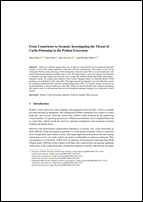
Marc Ohm, Timo Pohl, Ben Swierzy and Michael Meier published a paper on the threat of cache poisoning in the Python ecosystem:
Attacks on software supply chains are on the rise, and attackers are becoming increasingly creative in how they inject malicious code into software components.
This paper is the first to investigate Python cache poisoning, which manipulates bytecode cache files to execute malicious code without altering the human-readable source code.
We demonstrate a proof of concept, showing that an attacker can inject malicious bytecode into a cache file without failing the Python interpreter s integrity checks.
In a large-scale analysis of the Python Package Index, we find that about 12,500 packages are distributed with cache files.
Through manual investigation of cache files that cannot be reproduced automatically from the corresponding source files, we identify classes of reasons for irreproducibility to locate malicious cache files.
While we did not identify any malware leveraging this attack vector, we demonstrate that several widespread package managers are vulnerable to such attacks.
A PDF of the paper is available online.
Mario Lins of the University of Linz, Austria, has published their PhD doctoral thesis on the topic of Software supply chain transparency:
We begin by examining threats to the software distribution stage the point at which artifacts (e.g., mobile apps) are delivered to end users with an emphasis on mobile ecosystems [and] we next focus on the operating system on mobile devices, with an emphasis on mitigating bootloader-targeted attacks. We demonstrate how to compensate lost security guarantees on devices with an unlocked bootloader. This allows users to flash custom operating systems on devices that no longer receive security updates from the original manufacturer without compromising security. We then move to the source code stage. [Also,] we introduce a new architecture to ensure strong source-to-binary correspondence by leveraging the security guarantees of Confidential Computing technology. Finally, we present The Supply Chain Game, an organizational security approach that enhances standard risk-management methods. We demonstrate how game-theoretic techniques, combined with common risk management practices, can derive new criteria to better support decision makers.
A PDF of the paper is available online.
debugedit and relative debug paths based on a comment on the Build path page: Have people tried more modern versions of debugedit to get deterministic (absolute) DWARF paths and found issues with it?
#reproducible-builds on irc.oftc.net.
rb-general@lists.reproducible-builds.org
The Debian LTS Team, funded by [Freexian s Debian LTS offering]
(https://www.freexian.com/lts/debian/), is pleased to report its activities for
February.
Welcome to the February 2026 report from the Reproducible Builds project!
These reports outline what we ve been up to over the past month, highlighting items of news from elsewhere in the increasingly-important area of software supply-chain security. As ever, if you are interested in contributing to the Reproducible Builds project, please see the Contribute page on our website.
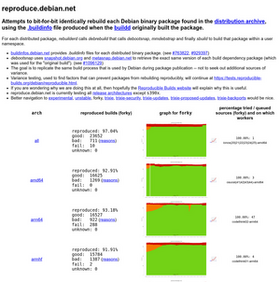
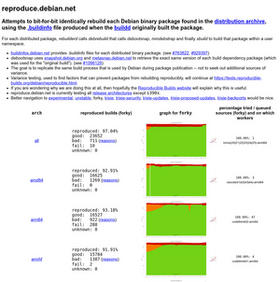
The last year has seen the introduction, development and deployment of reproduce.debian.net. In technical terms, this is an instance of rebuilderd, our server designed monitor the official package repositories of Linux distributions and attempt to reproduce the observed results there.
This month, however, Holger Levsen added suite-based navigation (eg. Debian trixie vs forky) to the service (in addition to the already existing architecture based navigation) which can be observed on, for instance, the Debian trixie-backports or trixie-security pages.
diffoscope is our in-depth and content-aware diff utility that can locate and diagnose reproducibility issues. This month, Chris Lamb made a number of changes, including preparing and uploading versions, 312 and 313 to Debian.
In particular, Chris updated the post-release deployment pipeline to ensure that the pipeline does not fail if the automatic deployment to PyPI fails [ ]. In addition, Vagrant Cascadian updated an external reference for the 7z tool for GNU Guix. [ ]. Vagrant Cascadian also updated diffoscope in GNU Guix to version 312 and 313.
In Debian this month:
sbom-toolkit package was uploaded, which provides a collection of scripts for generating SBOM. This is the tooling used in Apertis to generate the Licenses SBOM and the Build Dependency SBOM. It also includes dh-setup-copyright, a Debhelper addon to generate SBOMs from DWARF debug information, which are extracted from DWARF debug information by running dwarf2sources on every ELF binaries in the package and saving the output.
Lastly, Bernhard M. Wiedemann posted another openSUSE monthly update for their work there.
pimsync in the GNU Guix review process
50.beta regressed in reproducibility compared to 49.0. Specifically, the new generated .oga files differ in their Serial No. and Checksum [fields] . However, Jeremy ended up fixing the issue by replacing ffmpeg with oggenc.
archlinux-dev-public mailing list on our mailing list this month after a discussion at our latest Summit meeting on the topic of Link-Time Optimisation (LTO) specifically on the reasons why LTO often needs to be disabled in relation to Arch Linux s approach to binary hardening.
0) may materially differ from using SOURCE_DATE_EPOCH) when a situation demands the use of a fixed timestamp.
pnut, a C compiler capable of bootstrapping itself and TCC from any POSIX-compliant shell and human-readable source files.
bitsnpicas.fonts-topaz-unicode.bitsnpicas.
Once again, there were a number of improvements made to our website this month including:
repro-build to the Tools page. [ ]
.properties files. [ ]
Julien Malka and Arnout Engelen published a paper titled Lila: Decentralized Build Reproducibility Monitoring for the Functional Package Management Model:
[While] recent studies have shown that high reproducibility rates are achievable at scale demonstrated by the Nix ecosystem achieving over 90% reproducibility on more than 80,000 packages the problem of effective reproducibility monitoring remains largely unsolved. In this work, we address the reproducibility monitoring challenge by introducing Lila, a decentralized system for reproducibility assessment tailored to the functional package management model. Lila enables distributed reporting of build results and aggregation into a reproducibility database [ ].A PDF of their paper is available online.
Javier Ron and Martin Monperrus of KTH Royal Institute of Technology, Sweden, also published a paper, titled Verifiable Provenance of Software Artifacts with Zero-Knowledge Compilation:
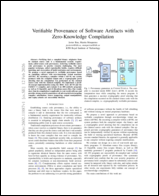
Verifying that a compiled binary originates from its claimed source code is a fundamental security requirement, called source code provenance. Achieving verifiable source code provenance in practice remains challenging. The most popular technique, called reproducible builds, requires difficult matching and reexecution of build toolchains and environments. We propose a novel approach to verifiable provenance based on compiling software with zero-knowledge virtual machines (zkVMs). By executing a compiler within a zkVM, our system produces both the compiled output and a cryptographic proof attesting that the compilation was performed on the claimed source code with the claimed compiler. [ ]A PDF of the paper is available online.
Oreofe Solarin of Department of Computer and Data Sciences, Case Western Reserve University, Cleveland, Ohio, USA, published It s Not Just Timestamps: A Study on Docker Reproducibility:
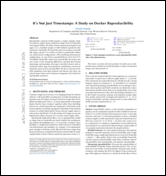
Reproducible container builds promise a simple integrity check for software supply chains: rebuild an image from its Dockerfile and compare hashes. We built a Docker measurement pipeline and apply it to a stratified sample of 2,000 GitHub repositories that contained a Dockerfile. We found that only 56% produce any buildable image, and just 2.7% of those are bitwise reproducible without any infrastructure configurations. After modifying infrastructure configurations, we raise bitwise reproducibility by 18.6%, but 78.7% of buildable Dockerfiles remain non-reproducible.A PDF of Oreofe s paper is available online.
Lastly, Jens Dietrich and Behnaz Hassanshahi published On the Variability of Source Code in Maven Package Rebuilds:
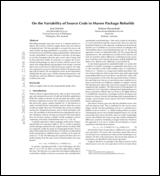
[In] this paper we test the assumption that the same source code is being used [by] alternative builds. To study this, we compare the sources released with packages on Maven Central, with the sources associated with independently built packages from Google s Assured Open Source and Oracle s Build-from-Source projects. [ ]A PDF of their paper is available online.
#reproducible-builds on irc.oftc.net.
rb-general@lists.reproducible-builds.org
Vcs-Git at it. However:
debian/, or something even stranger.
debian/1.2.3-7 tag on salsa corresponds precisely to what was actually uploaded. dput-based tooling (such as gbp buildpackage) doesn t cross-check the .dsc against git.
Vcs-Git and Salsa to build a Debian derivative? You could not.
tag2upload and dgit do solve this problem. When you upload, they:
archive/debian/1.2.3-7 tag to a single central git depository, *.dgit.debian.org;
Dgit field in .dsc so that clients can tell (using the ftpmaster API) that this was a git-based upload, what the corresponding git objects are, and where to find them.
dgit clone, as advertised in e.g. dgit-user(7). For dput-based uploads, it falls back to importing the source package.)
Adopting tag2upload - the minimal change
tag2upload is a substantial incremental improvement to many existing workflows. git-debpush is a drop-in replacement for building, signing, and uploading the source package.
So, you can just adopt it without completely overhauling your packaging practices. You and your co-maintainers can even mix-and-match tag2upload, dgit, and traditional approaches, for the same package.
Start with the wiki page and git-debpush(1) (ideally from forky aka testing).
You don t need to do any of the other things recommended in this article.
Overhauling your workflow, using advanced git-first tooling
The rest of this article is a guide to adopting the best and most advanced git-based tooling for Debian packaging.
Assumptions
gbp pq and/or quilt, and often used with git-buildpackage. You previously used gbp import-orig.
origin remote set to Salsa.
master. Personally I think we should use main but changing your main branch name is outside the scope of this article.
rationale Much traditional Debian tooling like
quiltandgbp pquses the patches-unapplied branch format, which stores the delta as patch files indebian/patches/, in a git tree full of unmodified upstream files. This is clumsy to work with, and can even be an alarming beartrap for Debian outsiders.
git merge when merging from upstream.
This is appropriate if your package has no or very few upstream changes. It is a good approach if the Debian maintainers and upstream maintainers work very closely, so that any needed changes for Debian are upstreamed quickly, and any desired behavioural differences can be arranged by configuration controlled from within debian/.
This is the approach documented more fully in our workflow tutorial dgit-maint-merge(7).
First, establish which upstream git tag corresponds to the version currently in Debian. From the sake of readability, I m going to pretend that upstream version isrationale Many maintainers have been importing upstream tarballs into git, for example by using
gbp import-orig. But in reality the upstream tarball is an intermediate build product, not (just) source code. Using tarballs rather than git exposes us to additional supply chain attacks; indeed, the key activation part of the xz backdoor attack was hidden only in the tarball! git offers better traceability than so-called pristine upstream tarballs. (The word pristine is even a joke by the author of pristine-tar!)
1.2.3, and that upstream tagged it v1.2.3.
Edit debian/watch to contain something like this:
version=4
opts="mode=git" https://codeberg.org/team/package refs/tags/v(\d\S*)You may need to adjust the regexp, depending on your upstream s tag name convention. If debian/watch had a files-excluded, you ll need to make a filtered version of upstream git.
Probably, the currentrationale We need some upstream tarball for the
3.0 (quilt)source format to work with. It needs to correspond to the git commit we re using as our upstream. We don t need or want to use a tarball from upstream for this. The.origis just needed so a nice legacy Debian source package (.dsc) can be generated.
.orig in the Debian archive, is an upstream tarball, which may be different to the output of git-archive and possibly even have different contents to what s in git. The legacy archive has trouble with differing .origs for the same upstream version .
So we must until the next upstream release change our idea of the upstream version number. We re going to add +git to Debian s idea of the upstream version. Manually make a tag with that name:
git tag -m "Compatibility tag for orig transition" v1.2.3+git v1.2.3~0
git push origin v1.2.3+gitIf you are doing the packaging overhaul at the same time as a new upstream version, you can skip this part.
git branch -f old-master # make a note of the old git representation
git reset --hard v1.2.3 # go back to the real upstream git tag
git checkout old-master :debian # take debian/* from old-master
git commit -m "Re-import Debian packaging on top of upstream git"
git merge --allow-unrelated-histories -s ours -m "Make fast forward from tarball-based history" old-master
git branch -d old-master # it's incorporated in our history nowIf there are any patches, manually apply them to your main branch with git am, and delete the patch files (git rm -r debian/patches, and commit). (If you ve chosen this workflow, there should be hardly any patches,)
rationale These are some pretty nasty git runes, indeed. They re needed because we want to restart our Debian packaging on top of a possibly quite different notion of what the upstream is.
git-debrebase -fdiverged convert-from-gbp upstream/1.2.3
git-debrebase -fdiverged -fupstream-not-ff new-upstream 1.2.3+gitIf you had patches which patched generated files which are present only in the upstream tarball, and not in upstream git, you will encounter rebase conflicts. You can drop hunks editing those files, since those files are no longer going to be part of your view of the upstream source code at all.
rationale The force option
-fupstream-not-ffwill be needed this one time because your existing Debian packaging history is (probably) not based directly on the upstream history.-fdivergedmay be needed because git-debrebase might spot that your branch is not based on dgit-ish git history.
dgit fetch
git show dgit/dgit/sid:debian/changelog
# check that you have the same version number
git merge -s ours --allow-unrelated-histories -m 'Declare fast forward from pre-git-based history' dgit/dgit/sidChange the source format
Delete any existing debian/source/options and/or debian/source/local-options.
debian/source/format to 1.0. Add debian/source/options containing -sn.
rationale We are using the 1.0 native source format. This is the simplest possible source format - just a tarball. We would prefer 3.0 (native) , which has some advantages, but dpkg-source between 2013 (wheezy) and 2025 (trixie) inclusive unjustifiably rejects this configuration. You may receive bug reports from over-zealous folks complaining about the use of the 1.0 source format. You should close such reports, with a reference to this article and to #1106402.
debian/source/format contains 3.0 (quilt).
README.source to at least mention dgit-maint-merge(7) or dgit-maint-debrebase(7), and to tell people not to try to edit or create anything in debian/patches/. Consider saying that uploads should be done via dgit or tag2upload.
Check that your Vcs-Git is correct in debian/control. Consider deleting or pruning debian/gbp.conf, since it isn t used by dgit, tag2upload, or git-debrebase.
debian/changelog about the git packaging change.
git-debrebase new-upstream will have added a new upstream version stanza to debian/changelog. Edit that so that it instead describes the packaging change. (Don t remove the +git from the upstream version number there!)
rationale Squashing could destroy your carefully-curated delta queue. It would also disrupt git-debrebase s git branch structure.
debian/salsa-ci.yml containing
include:
- https://salsa.debian.org/salsa-ci-team/pipeline/raw/master/recipes/debian.ymlIn your Salsa repository, under Settings / CI/CD , expand General Pipelines and set CI/CD configuration file to debian/salsa-ci.yml.
rationale Your project may have an upstream CI config in
.gitlab-ci.yml. But you probably want to run the Debian Salsa CI jobs. You can add various extra configuration todebian/salsa-ci.ymlto customise it. Consult the Salsa CI docs.
debian/salsa-ci.yml:
.git-debrebase-prepare: &git-debrebase-prepare
# install the tools we'll need
- apt-get update
- apt-get --yes install git-debrebase git-debpush
# git-debrebase needs git user setup
- git config user.email "salsa-ci@invalid.invalid"
- git config user.name "salsa-ci"
# run git-debrebase make-patches
# https://salsa.debian.org/salsa-ci-team/pipeline/-/issues/371
- git-debrebase --force
- git-debrebase --noop-ok make-patches
# make an orig tarball using the upstream tag, not a gbp upstream/ tag
# https://salsa.debian.org/salsa-ci-team/pipeline/-/issues/541
- git-deborig
.build-definition: &build-definition
extends: .build-definition-common
before_script: *git-debrebase-prepare
build source:
extends: .build-source-only
before_script: *git-debrebase-prepare
variables:
# disable shallow cloning of git repository. This is needed for git-debrebase
GIT_DEPTH: 0rationale Unfortunately the Salsa CI pipeline currently lacks proper support for git-debrebase (salsa-ci#371) and has trouble directly using upstream git for orig tarballs (#salsa-ci#541). These runes were based on those in the Xen package. You should subscribe to the tickets #371 and #541 so that you can replace the clone-and-hack when proper support is merged.
master. Set Allowed to merge to Maintainers . Set Allowed to push and merge to No one . Leave Allow force push disabled.
This means that the only way to land anything on your mainline is via a Merge Request. When you make a Merge Request, gitlab will offer Set to auto-merge . Use that.
gitlab won t normally merge an MR unless CI passes, although you can override this on a per-MR basis if you need to.
(Sometimes, immediately after creating a merge request in gitlab, you will see a plain Merge button. This is a bug. Don t press that. Reload the page so that Set to auto-merge appears.)
autopkgtests
Ideally, your package would have meaningful autopkgtests (DEP-8 tests) This makes Salsa CI more useful for you, and also helps detect and defend you against regressions in your dependencies.
The Debian CI docs are a good starting point. In-depth discussion of writing autopkgtests is beyond the scope of this article.
Day-to-day work
With this capable tooling, most tasks are much easier.
Making changes to the package
Make all changes via a Salsa Merge Request. So start by making a branch that will become the MR branch.
On your MR branch you can freely edit every file. This includes upstream files, and files in debian/.
For example, you can:
git cherry-pick an upstream commit.
git am a patch from a mailing list or from the Debian Bug System.
git revert an earlier commit, even an upstream one.
git-rebase to squash/edit/combine/reorder commits.
git-debrebase -i to squash/edit/combine/reorder commits. When you are happy, run git-debrebase conclude.
Do not edit debian/patches/. With git-debrebase, this is purely an output. Edit the upstream files directly instead. To reorganise/maintain the patch queue, use git-debrebase -i to edit the actual commits.
apt-get build-dep .
dpkg-buildpackage -uc -bIdeally this will leave git status clean, with no modified or un-ignored untracked files. If it shows untracked files, add them to .gitignore or debian/.gitignore as applicable.
If it dirties the tree, consider trying to make it stop doing that. The easiest way is probably to build out-of-tree, if supported upstream. If this is too difficult, you can leave the messy build arrangements as they are, but you ll need to be disciplined about always committing, using git clean and git reset, and so on.
For formal binaries builds, including for testing, use dgit sbuild as described below for uploading to NEW.
Uploading to Debian
Start an MR branch for the administrative changes for the release.
Document all the changes you re going to release, in the debian/changelog.
dgit fetch sid
gbp dch --ignore-branch --since=dgit/dgit/sid --git-log=^upstream/main(For the first upload after switching to using tag2upload or dgit you needrationale
--ignore-branchis needed because gbp dch wrongly thinks you ought to be running this onmaster, but of course you re running it on your MR branch. The--git-log=^upstream/mainexcludes all upstream commits from the listing used to generate the changelog. (I m assuming you have anupstreamremote and that you re basing your work on theirmainbranch.) If there was a new upstream version, you ll usually want to write a single line about that, and perhaps summarise anything really important.
--since=debian/1.2.3-1, where 1.2.3-1 is your previous DEP-14 tag, because dgit/dgit/sid will be a dsc import, not your actual history.)
UNRELEASED to the target suite, and finalise the changelog. (Note that dch will insist that you at least save the file in your editor.)
dch -r
git commit -m 'Finalise for upload' debian/changelogMake an MR of these administrative changes, and merge it. (Either set it to auto-merge and wait for CI, or if you re in a hurry double-check that it really is just a changelog update so that you can be confident about telling Salsa to Merge unverified changes .)
Now you can perform the actual upload:
git checkout master
git pull --ff-only # bring the gitlab-made MR merge commit into your local treegit-debpushgit-debpush --quilt=linear--quilt=linear is needed only the first time, but it is very important that first time, to tell the system the correct git branch layout.
dgit can help take care of the build and upload for you:
Prepare the changelog update and merge it, as above. Then:
git-deborig
git-debrebase quickrationale Source package format 3.0 (quilt), which is what I m recommending here for use with git-debrebase, needs an orig tarball; it would also be needed for 1.0-with-diff.
dgit sbuild
dgit push-builtNew upstream version Find the new upstream version number and corresponding tag. (Let s suppose it srationale You don t have to use
dgit sbuild, but it is usually convenient to do so, because unlike sbuild, dgit understands git. Also it works around a gitignore-related defect in dpkg-source.
1.2.4.) Check the provenance:
git verify-tag v1.2.4rationale Not all upstreams sign their git tags, sadly. Sometimes encouraging them to do so can help. You may need to use some other method(s) to check that you have the right git commit for the release.
git merge v1.2.4
dch -v1.2.4-1 'New upstream release.'git debrebase mew-upstream 1.2.4git merge or git (deb)rebase.
After you ve completed the merge, test your package and make any further needed changes. When you have it working in a local branch, make a Merge Request, as above.
Sponsorship
git-based sponsorship is super easy! The sponsee can maintain their git branch on Salsa, and do all normal maintenance via gitlab operations.
When the time comes to upload, the sponsee notifies the sponsor that it s time. The sponsor fetches and checks out the git branch from Salsa, does their checks, as they judge appropriate, and when satisfied runs git-debpush.
As part of the sponsor s checks, they might want to see all changes since the last upload to Debian:
dgit fetch sid
git diff dgit/dgit/sid..HEADOr to see the Debian delta of the proposed upload:
git verify-tag v1.2.3
git diff v1.2.3..HEAD ':!debian'git log -p v1.2.3..HEAD ':!debian'Don t look at debian/patches/. It can be absent or out of date.
dgit fetch sid
git diff master...dgit/dgit/sidIf the NMUer used dgit, then git log dgit/dgit/sid will show you the commits they made.
Normally the best thing to do is to simply merge the NMU, and then do any reverts or rework in followup commits:
git merge dgit/dgit/sidgit-debrebase quick at this stage, to check that the merge went OK and the package still has a lineariseable delta queue.
1.2.3-7, you can go back and see the NMU diff again with:
git diff debian/1.2.3-7...dgit/dgit/siddebian/patches/. Normally it s best to filter them out with git diff ... ':!debian/patches'
If you d prefer to read the changes to the delta queue as an interdiff (diff of diffs), you can do something like
git checkout debian/1.2.3-7
git-debrebase --force make-patches
git diff HEAD...dgit/dgit/sid -- :debian/patchesto diff against a version with debian/patches/ up to date. (The NMU, in dgit/dgit/sid, will necessarily have the patches already up to date.)
Initial filteringrationale Yes, this will end up including the non-free files in the git history, on official Debian servers. That s OK. What s forbidden is non-free material in the Debianised git tree, or in the source packages.
git checkout -b upstream-dfsg v1.2.3
git rm nonfree.exe
git commit -m "upstream version 1.2.3 DFSG-cleaned"
git tag -s -m "upstream version 1.2.3 DFSG-cleaned" v1.2.3+ds1
git push origin upstream-dfsgAnd now, use 1.2.3+ds1, and the filtered branch upstream-dfsg, as the upstream version, instead of 1.2.3 and upstream/main. Follow the steps for Convert the git branch or New upstream version, as applicable, adding +ds1 into debian/changelog.
If you missed something and need to filter out more a nonfree files, re-use the same upstream-dfsg branch and bump the ds version, eg v1.2.3+ds2.
Subsequent upstream releases
git checkout upstream-dfsg
git merge v1.2.4
git rm additional-nonfree.exe # if any
git commit -m "upstream version 1.2.4 DFSG-cleaned"
git tag -s -m "upstream version 1.2.4 DFSG-cleaned" v1.2.4+ds1
git push origin upstream-dfsgRemoving files by pattern
If the files you need to remove keep changing, you could automate things with a small shell script debian/rm-nonfree containing appropriate git rm commands. If you use git rm -f it will succeed even if the git merge from real upstream has conflicts due to changes to non-free files.
Common issuesrationale Ideally
uscan, which has a way of representing DFSG filtering patterns indebian/watch, would be able to do this, but sadly the relevant functionality is entangled with uscan s tarball generation.
.gitattributes to modify files as they are checked out.
Normally this doesn t cause a problem so long as any orig tarballs are generated the same way (as they will be by tag2upload or git-deborig). But if the package or build system relies on them, you may need to institute some workarounds, or, replicate the effect of the gitattributes as commits in git.
git rm the submodule.
gbp pq and/or quilt with a patches-unapplied branch.
gbp pq, manual use of quilt, git-dpm and so on.
--noop-ok to the Salsa CI runes. Thanks to Charlemagne Lasse for the report. Apologies if this causes Debian Planet to re-post this article as if it were new.
Next.