Search Results: "tim"

9 November 2026

Thorsten Alteholz: My Debian Activities in October 2026

Debian LTS/ELTS This was my hundred-forty-eighth month that I did some work for the Debian LTS initiative, started by Raphael Hertzog at Freexian. During my allocated time I uploaded or worked on:
  • [DLA 4825-1] suricata-update security update to fix one CVE in Bookworm related to a path traversal attack. Thanks a lot to Andreas Dolp, who prepared the package.
  • [DLA 4857-1] caddy security update to fix nine CVEs in Bookworm related to the bypass of path- or host-based access controls, the execution of an unintended file by a FastCGI backend, the injection of identity headers trusted by applications running behind Caddy, unauthorised reconfiguration of the server through its admin API, or cross-site scripting.
  • [DLA 4870-1] antiword security update to fix several isssue in Bookworm related to heap out-of-bounds write in several parts of the software or integer divide by zero. Unfortunately no issue has been assigned a CVE id yet.
  • [DLA 4871-1] cyrus-sasl2 security update to fix one CVE in Bookworm related to a heap-based buffer overflow.
  • [ELA-1873-1] antiword security update to fix several isssue in Stretch, Buster and Bullseye related to heap out-of-bounds write in several parts of the software or integer divide by zero. Unfortunately no issue has been assigned a CVE id yet.
  • [ELA-1874-1] cyrus-sasl2 security update to fix one CVE in Stretch, Buster and Bullseye related to a heap-based buffer overflow.
  • [ELA-1875-1] libcaca security update to fix two CVEs in Buster related to a missing overflow check.
  • [ELA-1876-1] libcaca security update to fix one CVE in Stretch and Bullseye related to a missing overflow check.
  • [osmo-bsc] upload to unstable to fix one CVE related to a heap based buffer overflow.
Besides doing these uploads, I reviewed the libssh upload (DLA-4844-1) and helped a bit in the background of the php uploads. Last but not least I spend some time on security-master to assist others (especially the kernel team) with uploads to Bookworm and Bullseye.

Debian Printing This month I uploaded a new upstream version or a bugfix version of:
  • cups to unstable, to finally fix autopkgtest.
This work is generously funded by Freexian!

Debian Lomiri This month I uploaded a new package vendor-ubuntu-touch to be able to build packages differently in an UbuntuTouch environment. I am curious when it will leave NEW. I also tried to finish two new applications. This work has been generously funded by Fre(i)e Software GmbH!

Debian Astro This month I uploaded a new upstream version or a bugfix version of:
  • calceph to unstable (sponsored upload)
  • alfa to unstable (sponsored upload).

Debian IoT Unfortunately I had no time to work in this category this month.

Debian Mobcom This month I uploaded a new upstream version or a bugfix version of:

misc This month I uploaded a new upstream version of: Due to different reasons I started to tidy up the list of packages I maintain. Some packages have been removed, some packages lost myself as uploader and some packages have been orphaned. The number of orphaned packages is about 1100 now, so maybe you can find one to adopt.

8 November 2026

Birger Schacht: Using incus for throw away VMs

For some time now I ve been looking for a way of keeping projects I m working on in a separate VM without much setup. There are numerous solutions to do this kind of thing using namespaces (various container technologies, firejail, flatpak, bubblewrap, ) but I wanted something that uses real virtualization. I recently stumbled upon incus and it seemed like it could be a solution to my problem. Incus is a manager for both containers and virtual machines. It is possible to create VM images that can be used as templates, meaning that other machines can then be based on them on creation. Virtual machines can be configured using profiles . For my use case, I have created a profile that defines how my template image should look like. In this profile I use cloud-init to configure the template machine on startup:
config:
  cloud-init.user-data:  
    #cloud-config
    apt:
      conf:  
        APT  
          Install-Recommends 0;
         
    package_update: true
    package_upgrade: true
    package_reboot_if_required: true
    packages:
      - file
      - man-db
      - bat
      - eza
      - git
      - git-delta
      - neovim
      - zsh
      - tmux
      - curl
      - ncurses-term
      - hx
      - nix-bin
      - nix-setup-systemd
      - rustup
      - npm
      - podman
    users:
      - name: user
        lock_passwd: false
        # mkpasswd 'incus password'
        hashed_passwd: $y$j9T$p9XBP4Ox3SBUnyu.sqv5m1$f1rxcPJyVs05w./dZvIzu6.4dVWBvzu99nMBZRNlamD
        groups: sudo, nix-users
        shell: /usr/bin/zsh
        uid: 1000
    write_files:
      - path: /home/user/.config/nix/nix.conf
        content:  
          experimental-features = nix-command flakes
        permissions: 0600
      - path: /home/user/.zshrc.local
        content:  
          export PATH="$PATH:$HOME/.nix-profile/bin"
        permissions: 0600
    runcmd:
      - [curl, -sSfL, -o, /home/user/.tmux.conf, https://grml.org/console/tmux.conf]
      - [curl, -sSfL, -o, /home/user/.vimrc, https://grml.org/console/vimrc]
      - [curl, -sSfL, -o, /home/user/.zshrc, https://grml.org/console/zshrc]
      - [chown, -R, user:user, /home/user/]    
description: Base template for dev VMs
...
and I use a script to regenerate the template image when I want to adapt the config:
#!/bin/sh

#set -e
set -x

NAME=dev-vm-template

# adapt the profile before rebuilding the template image
incus profile edit cloud-dev-template
incus delete --force $ NAME    true
incus create images:debian/13/cloud --vm --quiet --profile default --profile cloud-dev-template $ NAME 
incus start $ NAME 
incus wait $ NAME  agent
incus exec $ NAME  -- cloud-init status --wait   true
incus stop $ NAME 
incus publish --alias cloud-dev-template --reuse $ NAME 
This script uses the debian/13/cloud image together with my cloud-dev-template profile to set up a machine, configure it using cloud-init and store the result as an image called cloud-dev-template.

inker To use this setup, I created a small python tool called inker that talks to the incus REST API. Using inker create creates a new VM based on my template. Using inker attach attaches the current working directory to a VM as a readonly mount. It is possible to combine those commands like inker create inker attach to do those two steps in one command. inker login logs into the VM that has the current directory attached. This way I can create VMs that are connected to directories on my filesystem. I am currently playing around with this setup, but I think this could help me to have a throwaway development machine, similar to dev containers. I m not sure yet how happy I am with incus, though. I was also looking at systemd-vmspawn, but there are still some features missing that I would need. But I might rewrite inker at some point to use a different backend.

7 November 2026

Mike Gabriel: OpenAGPS - The New Kid on the Block

There is a new project coming to Open Source Software land these days: OpenAGPS. It is not yet 100% functional, but we are working on it. It is not fully operational, yet, but we are on it. Let me introduce OpenAGPS to you... The Situation Today The domain of assisted geo location services has been left to a few big tech providers. When using GPS on mobile devices, most of us send info on our approximate device location (based on cell tower IDs seen by our devices around us) mostly to Google's SUPL service in order to facilitate a faster GNSS/GPS lock on the satellites flying above us. Without assistance, retrieving a GNSS/GPS lock on sufficient satellites includes "finding" those satellites and once found retrieving data (in bytes/sec) from them. In some regions, this leads to waiting periods of up to 45 minutes, before a mobile devices has gained a lock on sufficient satellites (3 or more). In Assisted-GNSS/GPS, "other" information (such as cell tower IDs) gets used to estimate what GNSS/GPS satellites are currently passing over one's location. With AGPS, the mobile devices retrieve information via a so-called SUPL server, containing two details: a list of potential satellites above and their dataframes. Esp. providing those dataframes over the device's internet connection (and not via the GNSS/GPS receiver downloading it from the satellite itself) speeds up the lock-on process of the mobile tremendously (several seconds to a few minutes). However, for this mechanism to work, your device will share your IMSI (although not needed for AGPS), a list of cell towers around you and their signal strengths with the provider of the SUPL service, revealing your approximate position. In total, this allows SUPL providers to re-identify each mobile device and create motion profiles of each such device (and its owner). If the SUPL service is hosted by one main provider (i.e. Google SUPL), there is a lot of valuable information available to them for free that they can commercialize. Currently, there is only one mitigation method available to hide one's location info from the SUPL server(s) at e.g. Google: using a SUPL proxy server implementation (available as OSS, provided by and used in e.g. GrapheneOS). A SUPL proxy still depends on the big tech service provider(s) for SUPL as it merely proxies SUPL requests from mobile devices through to the proprietary SUPL services, at e.g. Google, but the mobile device is being camouflaged behind the SUPL proxy in use. The OpenAGPS Teaser OpenAGPS, on the contrary, will be a fully independent implementation from proprietary service providers, and it will refrain from collecting and commercializing end users data. It will be driven by individuals of the OpenAGPS community. There will likely be one central service that the OpenAGPS project plans to host and operate (the Porygon frontend/backend, OpenAGPS's GNSS Almanach service), but except from that SUPL servers can be self-hosted by individuals, companys or other communities. The requesting mobile devices' IDs will be hidden from the Porygon server (like with existing SUPL proxy implementations), so that the only centrally operated component (the Porygon Almanach server) does not know who is requesting what geo position information (and thus cannot collect such data, neither derive info about where requesting devices are located). In addition, with a large OpenAGPS community, it is imaginable (in theory) that there will also be multiple central Almanach servers available on the internet (with parallel networks of base stations attached to each GNSS Almanach server). Checkout the OpenAGPS architecture schematics and our website/documentation to learn more. Collecting Satellite Data The OpenAGPS project is not simply a software that admins/users can install, it needs kind of a huge and global community to operate/host/house its base station network. The challenge with providing a community-driven AGPS service on the internet is that up-to-date (real-time!) GNSS/GPS satellite position data is not available for free download. Almanach data can be obtained per region from various organisations, but then their datasets are often days to weeks old, thus too outdated. GNSS/GPS satellites are not geo-stationary, they circulate around the planet. Their position is dependent on the current date-time. A globally spanning network of GNSS/GPS base stations will do the trick here. We will need a community that harvests the needed satellite data in real time and makes it available through the Porygon Almanach server to all OpenAGPS users. The OpenAGPS project will depend on at least one community member every ~40-50 km to operate a so-called OpenAGPS base station: These base stations are stationary, need to run 24/7, and they will harvest GNSS/GPS statellite data information from the satellites above in real-time and share this data with the (central) Porygon server, continuously. The Porygon server will create a timestamp-dependent "map" of all seen satellites and extrapolate locations between base stations' Almanach data updates. Help making OpenAGPS a Success: Host a Base Station To make OpenAGPS a success, we need volunteers who are willing to host (actually: house) an OpenAGPS base station at their home or work place (or both). Users will only be able to use their self-hosted OpenAGPS SUPL server with their mobile devices (instead of e.g. Google SUPL), if we manage to establish sufficient coverage with those base stations in the area of interest, so that the OpenAGPS Almanach will get populated with sufficient satellite position data. If you'd like to host/house such a base station, please get in touch and check the docs. Support this project by Co-Funding it If you realize that you have an interest in this project and would like to improve your level of digital sovereignty in your government, organization, at your home, etc. then consider sending financial support to the project. If you want to support us, please get in touch with Raoul Kramer at BetaBreak or Mike Gabriel at Fre(i)e Software GmbH. If you are a software developer and would like to contribute to OpenAGPS, also get in touch and let us meet at FOSDEM 2027. Credits A huge thanks to the NLnet Foundation for funding this project's bootstrap phase. Follow-up funding has been applied for, so please keep fingers crossed!

6 November 2026

Isoken Ibizugbe: Seeing Accessibility in Debian

Recently, I ve been noticing something on packaging around my house that I used to glance right past: raised Braille dots on a carton of medicine, and embossed markings on a container of body cream. I ve always known what Braille looked like, but I never paid close attention to it. Now that I m actively working on accessibility testing for the Debian Installer, I see it everywhere.

It made me reflect on how accessibility usually enters our consciousness. In tech, we re taught about accessibility as a best practice when designing user interfaces or web apps. But realistically, you mostly see it implemented well in massive global software, like mobile operating systems or browsers like Firefox. You rarely see accessibility features integrated into local Nigerian physical products or everyday tech. Paying attention to these details made me realize how much care goes into making sure every person is considered, and how vital that mindset really is.

Manual Testing & The openQA Bottleneck

My recent work with Debian has been focused on automating tests for the Debian Installer s accessibility features, specifically validating Braille display emulation.

I started out by manually testing following the official steps on the Debian Installer Accessibility Wiki. Once I understood the manual flow, the next goal was figuring out how to automate it inside openQA.

Initially, the idea was to initialize from the bootloader by adding parameters to the Grub (GRUB= brltty=auto )and it should start the installation with the braille visual. However, this didn t work, the parameters never initiated the brttyl and it was a huge blocker going back and forth. Getting brltty to talk to the test runner in that environment would have required sweeping changes across the main Debian openQA instance configuration.

Instead of pushing for complex system-wide changes on the instance, we started looking for easier alternative approaches and noted the complicated ones, when we advance in the test.

We brainstormed streaming the display output directly to a dedicated file to capture and verify the Braille virtual display output. Ultimately, nested virtualization proved to be the most easiest path forward.

You can check out the implementation details and changes in the Merge Request

Joining the Conversation

As part of this work, I joined the debian-accessibility mailing list to introduce what we were building and share our progress.

The responses were encouraging. I got some feedback and suggestions and the thread also created a discussion on how accessible the installation process currently feels for blind or visually impaired users, and where they also find issues. It served as a great reminder that test suites aren t just about passing CI checks, they re about serving actual people who rely on these systems every day.

Vincent Bernat: Scriptable GeoDNS: leaving AWS for Bunny

To optimize the performance metrics of this blog, I relied on Amazon CloudFront to serve the assets,1 and Route 53 for the geo-aware DNS2 to direct readers to the closest host serving the content. But Route 53 is expensive: US$0.50 per zone per month, US$0.70 per million geolocation queries, and US$0.75 per healthcheck per month, plus US$1 per month for the KMS key needed to sign zones with DNSSEC. When I discovered that Bunny DNS is almost free for up to 500 domains and features scriptable answers, I made the jump! Plus, it's a European company based in Slovenia.

Bunny CDN Bunny.net started as BunnyCDN in 2015. They added IPv6 support in 2017. Switching was uneventful. I don't bring a custom domain: I serve the content from the b-cdn.net domain. As I depend on content negotiation to serve AVIF and WebP images, I configure the CDN to cache each image format separately. I disable logging to avoid collecting personal information. While the bunny.net GDPR page promises they anonymize data, it is unclear what CloudFront keeps in its own logs when logging is disabled. The only downside of the bunny.net CDN offering is the lack of HTTP/3. I asked their support: two minutes later, they answered they are working on it but have no ETA to share.

Bunny DNS Bunny.net introduced their DNS offering in 2022 and recently reduced its cost to almost zero. They support geographical routing, but a very cool feature is the scriptable DNS: it runs a piece of user-supplied JavaScript on each query to compute the answer. I run seven small NixOS virtual machines to host this blog around the world: Paris, Nuremberg, Ashburn, Singapore, San Jose, S o Paulo, and Sydney. Bunny's scriptable DNS lets me return the IP addresses of the two nearest servers. The browser falls back to the second server if the first one is down.
const servers = [
   
    ipv4: "45.90.160.60",
    ipv6: "2a0c:8881:5:100::1",
    latitude: 48.88,
    longitude: 2.22,
   ,
  /* [ ] */
   
    ipv4: "139.180.162.114",
    ipv6: "2001:19f0:5800:1855:5400:6ff:fef0:4c0a",
    latitude: -33.87,
    longitude: 151.21,
   ,
];
const families =   A: "ipv4", AAAA: "ipv6"  ;
const records =   A: ARecord, AAAA: AaaaRecord  ;
export default function handleQuery(query)  
  const type = String(query.request.queryType).toUpperCase();
  const family = families[type];
  if (!family) return [];
  // Get user location
  const location = query.request.geoLocation;
  // Build a list of candidates
  let candidates = servers.map(
    (s) => new Server(s[family], s.latitude, s.longitude, 100),
  );
  // Select the two closest alive servers
  const selected = [];
  while (selected.length < 2)  
    const server = RoutingEngine.getClosestServer(candidates, location, true);
    selected.push(server);
    candidates = candidates.filter((s) => s.ip !== server.ip);
   
  // Return their IP addresses
  return selected.map((s) => new records[type](s.ip, 3600));
 
The above script relies on the RoutingEngine.getClosestServer() helper, which returns the closest alive3 server to the user.4 Thanks to Doggo, we can check it works as expected, at least for A:5
$ doggo --gp-from="Amsterdam" A vincent.bernat.ch
LOCATION          NAME                TYPE  TTL    ADDRESS
Amsterdam, NL
                  vincent.bernat.ch.  A     3600s  45.90.160.60
                  vincent.bernat.ch.  A     3600s  116.203.18.48
$ doggo --gp-from="Texas" A vincent.bernat.ch
LOCATION          NAME                TYPE  TTL    ADDRESS
Houston (TX), US
                  vincent.bernat.ch.  A     3600s  5.161.44.145
                  vincent.bernat.ch.  A     3600s  149.28.219.155
The most annoying drawback of this method is that a user from Buenos Aires gets both S o Paulo (1000 mi, 30 ms RTT) and Ashburn (5200 mi, 140 ms RTT). Most resolvers randomize the order, so the user may pull the web page from Ashburn. We could return only the nearest server and swap the scripted record with the built-in geographic routing instead. But if the server becomes unavailable, the browser has no alternative until the DNS cache expires. It leaves a short window of unavailability, even with a short TTL.

The HTTPS record solution The HTTPS DNS record, defined in RFC 9460, solves both the availability and the latency issues. Modern browsers query this record to get additional information to reach an HTTP server, including an alternative port and the application layer protocol HTTP/2 or HTTP/3. Each record has a priority. We can ask browsers to contact the nearest server first and fall back to the next one if the first is unavailable:
vincent    HTTPS  1 first.geo  alpn="h3,h2"
vincent    HTTPS  2 second.geo alpn="h3,h2"
vincent    HTTPS  3 .          alpn="h3,h2"
; Bunny DNS must provide the two closest servers as "first.geo"
; and "second.geo" with geographic or latency routing.
first.geo  A      45.90.160.60
first.geo  AAAA   2a0c:8881:5:100::1
second.geo A      116.203.18.48
second.geo AAAA   2a01:4f8:1c0c:5eb5::1
vincent    A      45.90.160.60
vincent    A      116.203.18.48
vincent    AAAA   2a0c:8881:5:100::1
vincent    AAAA   2a01:4f8:1c0c:5eb5::1
This looks like the ideal solution! Unfortunately, Chrome ignores any record whose target is not ., hence the last record at priority 3. Moreover, unlike with a CNAME, Bunny DNS does not return the IP addresses for first.geo and second.geo in the additional section. The resolver needs to send a first request to get the HTTPS record, and a second to resolve first.geo. HTTPS records are still too new for this use case. Back to the drawing board!

The hybrid solution As a compromise, the script returns the two nearest servers if they are at a similar distance from the user. Otherwise, it returns only the nearest one with a lower TTL of 2 minutes.
export default function handleQuery(query)  
  const location = query.request.geoLocation;
  let candidates = servers.map(
    (s) => new Server(s.ipv4, s.latitude, s.longitude, 100),
  );
  // Select the two closest servers
  const selected = [];
  while (selected.length < 2)  
    const server = RoutingEngine.getClosestServer(candidates, location, true);
    selected.push(server);
    candidates = candidates.filter((s) => s.ip !== server.ip);
   
  // Compute the distance to the user for each of them
  const [first, second] = selected.map((s) =>
    GeoDistance.calculate(s, location),
  );
  // If the second one is at twice the distance and at more than 1000 miles
  // from the first, return only the first one with a TTL of 2 minutes.
  if (second > 2 * first && second - first > 1000)  
    return [new ARecord(selected[0].ip, 120)];
   
  // Otherwise, return both with a TTL of 1 hour.
  return selected.map((s) => new ARecord(s.ip, 3600));
 
We can check it with Doggo. From Chicago, we get only the Ashburn server with a TTL of 2 minutes, while from Mexico, we get both Ashburn and San Jose.
$ doggo --gp-from="Chicago" A vincent.bernat.ch
LOCATION          NAME                TYPE  TTL    ADDRESS
Chicago (IL), US
                  vincent.bernat.ch.  A     120s   5.161.44.145
$ doggo --gp-from="Mexico" A vincent.bernat.ch
LOCATION          NAME                TYPE  TTL    ADDRESS
Queretaro, MX
                  vincent.bernat.ch.  A     3600s  5.161.44.145
                  vincent.bernat.ch.  A     3600s  149.28.219.155
$ doggo --reverse 5.161.44.145 149.28.219.155
NAME                          TYPE  TTL    ADDRESS
145.44.161.5.in-addr.arpa.    PTR   7187s  web05.luffy.cx.
155.219.28.149.in-addr.arpa.  PTR   3600s  web07.luffy.cx.

Note On the live page, the map below is interactive: point at a location to get the DNS answer, or disable servers to see how the answers change.

Map of the servers answered by Bunny DNS for each location
The complete code is a bit more complex. It works around RoutingEngine.getClosestServer() supporting only IPv4, and it handles the case where there are not enough alive servers to build an answer. Bunny.net has a comprehensive Terraform provider. I leverage CDK Terrain to build the target state in TypeScript and OpenTofu to deploy it. Have a look at "Managing infrastructure with Terraform, CDKTF, and NixOS" for more details.6

ACME DNS with Hickory DNS Route 53 covered one additional use case of mine: serving acme.luffy.cx to solve DNS-01 ACME challenges. Unlike Route 53, Bunny DNS cannot restrict access to a single zone with a fine-grained access policy. As this usage requires neither high availability nor low latency, I replaced Route 53 with Hickory, a memory-safe DNS server written in Rust. It supports automatic DNSSEC signatures and dynamic updates. Its configuration is simple:
[[zones]]
zone = "acme.luffy.cx"
zone_type = "Primary"
[zones.stores]
allow_update = true
type = "sqlite"
journal_path = "acme.luffy.cx.sqlite"
zone_path = "acme.luffy.cx.zone"
# Private key to sign the zone with DNSSEC. Generated with:
#  openssl genpkey -algorithm EC -pkeyopt ec_paramgen_curve:P-256
[[zones.keys]]
algorithm = "ECDSAP256SHA256"
key_path = "/etc/hickory-dns.acme.luffy.cx.pem"
# TSIG key to sign zone updates. Generated with:
#  openssl rand 32
[[zones.stores.tsig_keys]]
algorithm = "hmac-sha256"
key_file = "/etc/hickory-dns.acme.luffy.cx.update.acme.luffy.cx.tsig"
name = "update.acme.luffy.cx."
The provided zone file only seeds the database on first start. I delegate DNS-01 challenges to this zone with CNAME records:
_acme-challenge          CNAME bernat.ch.acme.luffy.cx.
_acme-challenge.vincent  CNAME vincent.bernat.ch.acme.luffy.cx.
Lego, the ACME client I use to get certificates from Let's Encrypt, answers the DNS-01 challenge by pushing entries with the DNS UPDATE protocol. Unfortunately, Bunny DNS cannot publish a DS record in a zone.7 I need one to secure the acme.luffy.cx zone and certificate delivery. Therefore, I host the luffy.cx zone on deSEC,8 a free DNS hosting service run by a non-profit organization based in Berlin. I derive the DS record to publish in luffy.cx from the DNSKEY record of acme.luffy.cx:
$ ZONE=acme.luffy.cx
$ dig @nsupdate.luffy.cx $ZONE DNSKEY +noall +answer \
>     dnssec-dsfromkey -a SHA-256 -f - $ZONE
acme.luffy.cx. IN DS 55628 13 2 4946E7508F20E15F1B577A231104B029A1A82E04699A80CD46ADCE31227EE81F

Overall, I am quite happy with the switch to bunny.net. There are still a few rough edges, like the inability to publish DS records, the lack of HTTP/3, and the IPv4-only RoutingEngine.getClosestServer() helper. The bill went from US$5 per month to US$1. So far, performance is on par with AWS, but I only finalized the current setup, including the server in Sydney, in late October. I need a bit more time to gather more data, and I'll post a short update.

Update (2026-11) This post was briefly discussed on Hacker News and Lobsters.


  1. I had been hosting media assets on CloudFront since 2011.
  2. Route 53 had served bernat.ch since December 2021. I didn't use healthchecks as they were too expensive. I didn't host most of my zones there either, as queries for haproxy.debian.net alone would have cost me around US$10 per month.
  3. A server is alive if it answers an ICMP ping. The bunny.net documentation gives more details about the checks.
  4. The user queries Bunny DNS through a resolver. Usually, either the resolver is close to the user, or it exposes the user's subnet through EDNS client subnet.
  5. Don't use this script as is: RoutingEngine.getClosestServer() only works with IPv4. The final script works around this limitation.
  6. The article is a bit outdated. CDK Terrain replaces CDKTF, OpenTofu replaces Terraform, and I now use Colmena instead of NixOps.
  7. I contacted bunny.net support to ask when they will support publishing a DS record and got an answer seven minutes later: they don't know. This is a bummer, as they support automatic CDS, a DNS record to advertise a DS record to the parent zone. They handle one side of the delegation, not the other. I also reported a bug with the proof of non-existence, and they replied a day later with a detailed answer.
  8. Why not use deSEC for ACME challenges? You can limit its tokens to a single RRset. I could say I prefer to self-host, but the truth is I only discovered this while writing this article.

Andrew Cater: Arm Cambridge - pre mini-Debconf days 20261105

At Arm in Cambridge for two hackathon-type days before the main mini-Debconf on Saturday and Sunday. A roomful of people, mostly very quiet this morning but with people gradually arriving and greeting each other.

Just had an excellent lunch. Arm are excelling themselves, as ever. With particular thanks to Charlie Dixon who has arranged excellent facilities for us all and to Liv for the catering provision. Other old friends here have also helped as ever.

This sort of thing is ideal for cross-fertilization of experience, ideas - the side conversations where you realise that three people are converging to a consensus of discussion from three different starting points. It's fun and intensely interesting and it's the sort of thing that keeps me running Debian - and trusting the colleagues behind it because I've seen them here.

Face and name recognition is sometimes at least as valuable as rockstar coding and the social element and shared history keeps us pulling together.

Andrew Cater: Arm Cambridge - pre-mini-Debconf days 20261106

Another interesting morning so far. Lots of interesting side conversations (and, of course, people using IRC to talk to the person next to them as is traditional).

It's nice to hear somebody ask a question and be told, effectively "Oh, you need to talk to XX - they're sitting over there" or " I need to talk to someone about X, Y and Z - and they all resolve to you".

Especially noticeable in this room, perhaps, but it does point to the fact that many things in Debian ultimately resolve to one or two people. There are a lot of people each with multiple areas of expertise which overlap - and then a few individuals who are essential as points of reference for *everyone* else.

Thanks again to Arm for hosting us, for excellent food, coffee and facilities which make this _so much easier_ as a working environment for these days.

5 November 2026

Gunnar Wolf: Don't tell anybody... but we have apparently gone DARK!

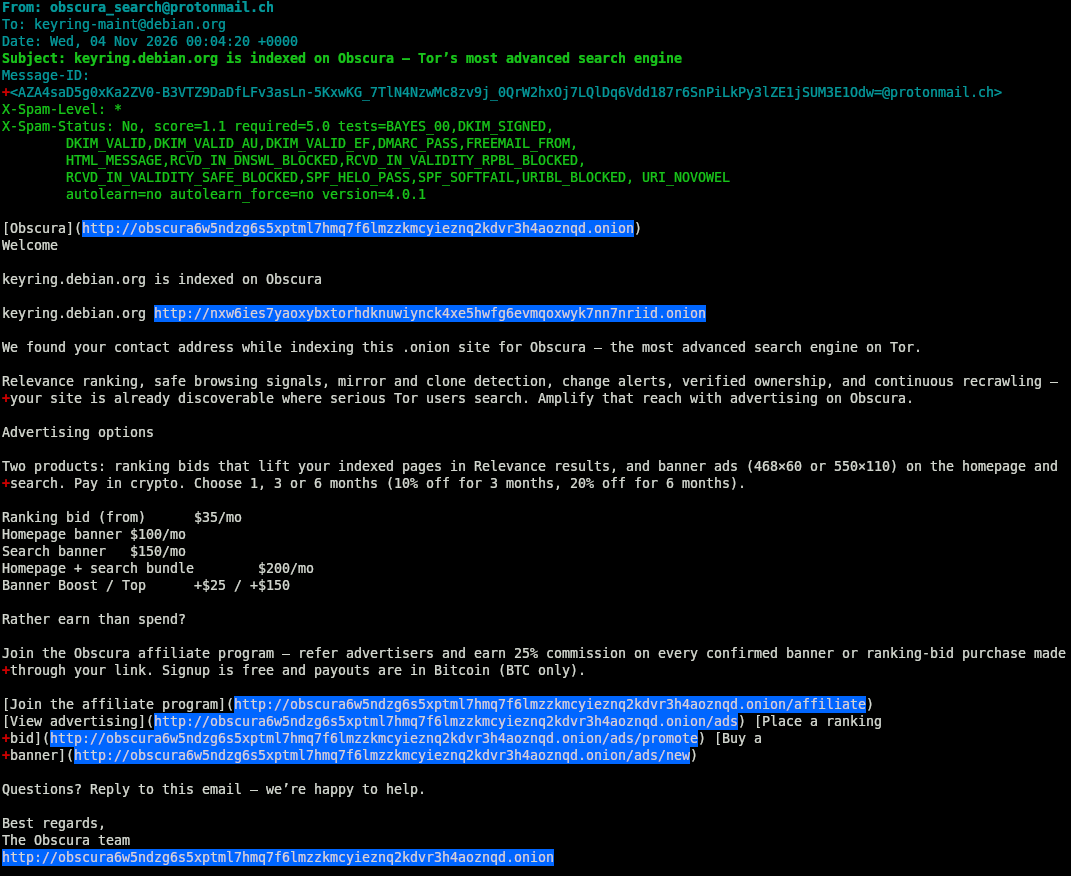
Your friendly keyring-maint Debian team received one of the weirdest spam messages ever Weird spam from Obscura So, do we want to py to who-knows-whom for promoting the keyring-maint services in a verrrrrry-dark web search site? First time I have to throw this stinky onion at you Spam!

John Goerzen: Letter from a Kansan: Would You Rather Be Right or Happy?

As a person that has lived in Kansas almost all my life, I have never seen such good political news for this state as we got this week. It is a stunning rebuke of fascism from across the country. One of the many pieces of wisdom from mechanic Tom Magliozzi is this question: Would you rather be right, or happy? He often asked it in the context of somebody that had just won an argument. This is my plea to all our progressive friends: remember that question, and keep it in mind carefully over the next 2 years. We can either build on this momentum for an even bigger victory in 2028, or we can start to lose this unique coalition. Kansans spend our lives being misunderstood and forgotten. Many of us, myself included, visit large cities regularly. It is a more surprising event when someone from a large city drives down one of our dirt roads. The kind of road that leaves your car covered in mud when you drive your daughter to school. The kind of road that we drive on for 3 miles before we reach the nearest paved road. Statisticians label Topeka, the capital of Kansas and city of 126,000 people, as rural. The nearst town to me, 7 miles away, has a population of 600. In winter, many people here still leave their keys in their running, unlocked cars while they run into the grocery store. The person at the bank, the owner of the grocery store, the mechanic, the electricians, the builders, the people that run the local museum, all know my name and recognize me. Not because I m famous locally, but because this is normal here. We are a community, a real one. Yet I ve lost long-time friends, especially from the west coast, because, while I m progressive, I still talk to Republicans. They thought Republicans are so evil, they ought to be shunned and ostracized. It probably doesn t compute to a San Franciscan what it means to live in a county that went 80% for Trump one time. A county of about 10,000 people living in a space larger than Los Angeles, New York, and San Jose combined. (Those cities have a combined population of about 13 million, living on the same amount of land as 10,000 people do out here.) If I avoided talking to Republicans, it wouldn t be them that would be isolated. It would be me. Out here, many of us have lived with each other for generations. We may go on living with them for generations. If somebody s car is stuck in the mud, the first person that comes by with a truck and a rope will probably pull them out. Nobody asks who you voted for. This is what you do for neighbors, because neighbors are humans, and next time it might be me that s stuck in the mud. I can be as incensed as anyone else about what the fascists are doing. I don t have direct knowledge of how a lot of people vote. But I take a deep breath sometimes and remind myself: these are my neighbors. I ve seen them go out of their way to be kind and generous with all walks of humanity. (Yes, even whatever groups you re imaginging to argue with me about.) This is part of how Adam Hamilton defeated Roger Marshal. The anti-Trump sentiment wasn t enough on its own. Lifelong Republicans dissatisfied with how Trump handled things weren t just going to vote for any Democrat. They needed someone that was safe. Someone that talked to them as humans. Someone that respected them. Adam Hamilton went and shook hands with MAGA protestors at his events. He told them I want to be your senator, too. This is how you win over the most strident of Republicans. Hamilton didn t compromise his beliefs. He invited discussion about them. I have already been seeing some progressives say things like, Don t cut them any slack. Remember how many times people voted for fascism! They need to still be ostracized. That, folks, is the way we lose. It is the wrong strategy everywhere. And it is especially culturally wrong in the close-knit communities again, actual communities where people know each other and have for years that make up the heartland. Building relationships with people different than us is our best chance to build on this coalition. And, isn t that what progressive values call for? So, celebrate this victory. Clap for all the activists that made it happen. And, before you set off to alienate your new and tentative allies, ask yourself: Would I rather be right? Or win again?

4 November 2026

Juan Manuel M ndez Rey: Hello, Planet Debian

Hello, Planet Debian. My blog was added to the Planet today, so I think the polite thing is to introduce myself before you start finding my posts between yours. I am Juan Manuel M ndez Rey, from Sevilla. In Debian I am mendezr, and on OFTC I am Vejeta. I have been using Linux since 1994 and Debian since 1998. For a long time that was all: a happy user, installing, breaking things, reading the mailing lists from the outside. I started contributing in October 2025, and last month I became a Debian Maintainer.

A friend and an old RFP The way in was a friend. Back in 2019 Arturo Borrero Gonzalez filed RFP #943703 for Stremio, and for years he kept telling me I should pick it up. In September 2025 I finally listened and turned it into an ITP. It took longer than I like to admit, but Stremio is now in Debian, and I told that story here. A six year old RFP turned out to be a very good first package.

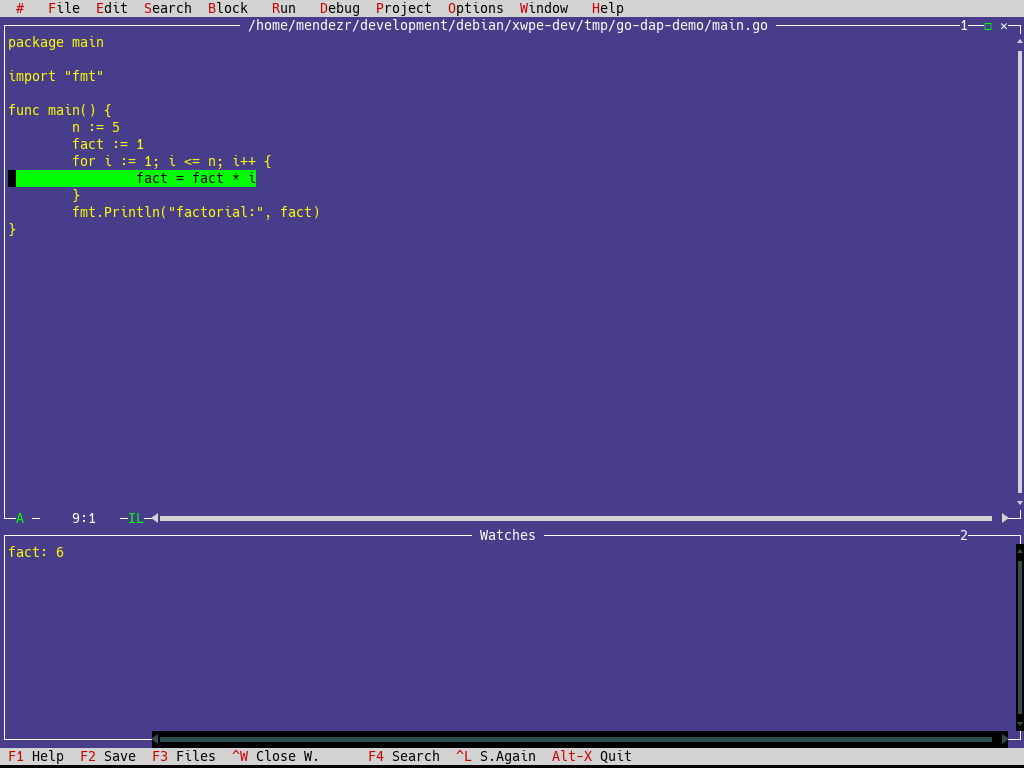
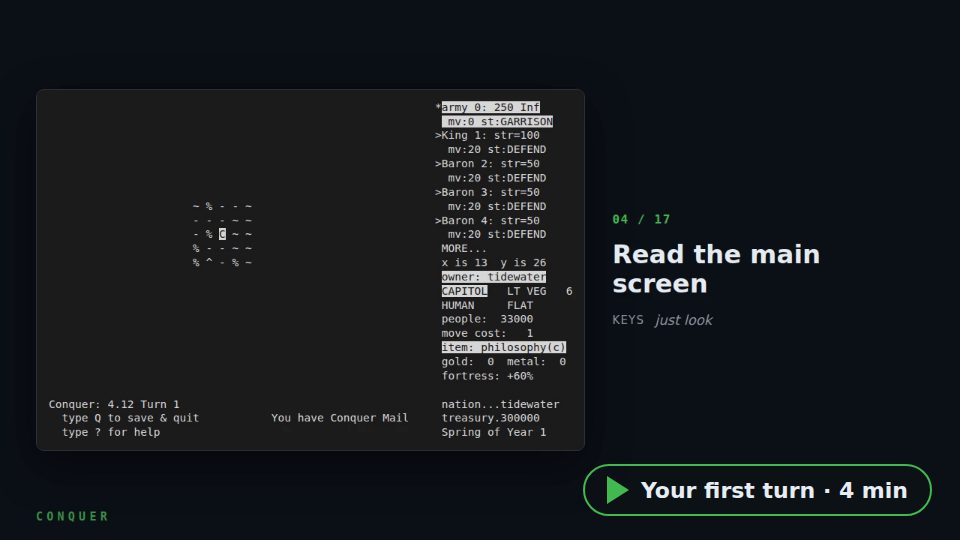
Rescuing old software Somewhere along the way I discovered that what I enjoy most is bringing old software back. The first one came from tille, who asked for help in #debian-tinytasks with xwpe, a Borland style programming editor for the terminal that nobody was looking after. I adopted it, and then I ended up as its upstream maintainer too. I fixed the old bugs and added LSP and DAP, so now an editor from 1993 can debug Go. It ships on several distributions, in Homebrew and on the BSDs. The canonical repo is on Codeberg, and the long version is in this post. xwpe debugging a Go program over DAP, with a live Watches pane The second one is older and took much longer. Conquer is a Unix strategy game written by Ed Barlow and Adam Bryant in 1987, and I lost many hours of my youth to it. It never had a free licence. I first asked about it on debian-legal in October 2006, and I spent the next 20 years tracking down the authors, one email at a time. Today Conquer v4 and V5 are GPL-3.0. It is not packaged in Debian yet, that is the next step, but you can already play it in the browser. Conquer running in the browser, first turn

What I am doing now CEF took me six months and brought me into the Chromium team, and these days I am mostly with the syft, trivy and grype security stack and with Scala 3 and sbt for Debian.

Thanks To Arturo, for the nudge. To dilinger, tille and tsimonq2, my DM advocates, for trusting me. And if you can sponsor uploads for syft, trivy, grype or the Scala work, I would be very grateful. The details are on my wiki page. You can find me there, as Vejeta on OFTC, or on Mastodon as @vejeta@mastodon.sdf.org. Nice to meet you all.

3 November 2026

John Goerzen: Must we always use LLMs this way?

As with my last post on AI, let me open with a statement:
Just because most people hold AI a certain way, doesn t mean that we always must, either now or in the future.
As I noted in that piece, and my shades of gray post, I am well aware and agree with the notion that a lot of frontier AI models have disturbing ethical concerns that we shouldn t dismiss, including concentration of power and wealth, environmental concerns, unethical scraping and training, the financial bubble they seem to be creating, and more. The most poisonous of AI cheerleaders are accelerating enshittification while cutting quality all over the place. AI slop is also a real problem, which I ll discuss in a bit. Before I dive in, I need to mention that no AI assistance was used for writing this post, and I have been using em dashes correctly for years before LLMs did. Secondly, while popular discourse seems to use AI and LLM interchangeably, the AI field is much more broad and much more old than LLMs. I will, nonetheless, adopt the common AI jargon here, but be more specific when necessary to differentiate. In The Reverse Centaur s Guide to Life After AI by Cory Doctorow, he presented two ideas I particularly want to focus on here:
  1. The present and future of LLMs outside of the cloud-hosted frontier models
  2. What differentiates productive use of AI from slop
The two are related, in fact. Doctorow discussed how he never uses AI to write anything, but he sometimes uses it as an assistant to help him write. Is that contradictory? Not really. He gave this example: he remembered a quote from a podcast, which he wanted to cite and attribute correctly. But he couldn t remember which podcast or who said it. So he fired up Whisper, an open-weight model you can download and run locally, even on meagre hardware. Whisper is a speech-to-text model. Doctorow ran likely podcast episodes (from the target range and set of podcasts he listens to) through the model, and at that point it was a regular search. He found the quote, then went back and listened to the episode at that time spot to verify its accuracy. It would have taken so much time to do this without Whisper that he simply would not have done it otherwise. His writing was better because of AI. Not because AI wrote any words for him, but because it helped him find the right ideas and attributions. He didn t even have to trust its transcription; it pointed him at the right place, and then he could transcribe with precision. I too have used Whisper in much the same way. A little while back, I digitized many hours of old family audio recordings going back to the 1970s. Thanks to Whisper, which I ran locally primarily during hours of being fully solar-powered, I have a searchable index to these gems. A person I know recently asked me if I knew any way to transcribe some old family recordings he had. I told him I could run it through Whisper. It wouldn t have great punctuation, but most of the words would be there. This meant a lot to him and his family; what I did in 2 minutes would have taken him many days (I presume he is not a fast typist as well.) So we can start by naming: AI isn t just chatbots, and AI can help even if it isn t writing anything. Doctorow goes on to ask the question: what happens after the AI bubble bursts? I do believe it will, as Ed Zitron has carefully documented for us for a long time now. The environmental damage done by frontier training and inference in the last few years will, of course, be done. But as he points out, we ll be left with a plethora of surprisingly-capable open weight models, a community that has made significant strides running them on low-end devices (even phones), and a massive buildup of clean energy that hopefully will be finally able to offset some polluting energy once these heavy users drop off the grid. So then what? Will the world just throw away the likes of Whisper and Gemma? Obviously not. Doctorow imagines, credibly, a situation in which individuals and universities tinker with locally-run models, iterating on them and improving them with the more traditional scale of resources available to individuals and universities. In other words, this future sounds a lot like the earlier days of Open Source. As Ed Zitron has pointed out, the real costs of frontier AI have been hidden as these companies rack up fantastical losses. When the bubble bursts, the real costs of frontier AI are likely to be high enough that CEO s won t be able to ignore the poor ROI. But we ll be left with these artifacts, these open-weight starting points, that people can use. That brings me to my central thesis: a lot of anti-AI sentiment is focused on the real downsides of the hyped uses of AI, and fails to account for the more ethical advances being made now, and likely to come in the future. Varying quality of AI use We are all familiar with AI slop. I ve seen it, and have an increasingly skeptical eye when I see new projects announced in even places as niche as a BBS community (where I see things like new terminal emulators announced, written in shockingly-poor nodejs, and such). I ve seen documents that take many pages to say what amounts to nothing intelligble to a human, with perfect grammar. I ve seen pull requests that have a description that amounts to several pages of slop. I ve personally seen an AI agent do things like correctly detect passing an untrusted argument to a shell, then propose a broken quoting algorithm to fix it (rather than proper sanitization and exec() or, better yet, avoiding the call altogether.) I ve also seen AI tools very quickly and accurately identify bugs that had passed human review, even professional security reviews, for years. I ve seen them bring more joy to some people s jobs by handling the more drudgery parts of the jobs. One of my favorite podcasts, Oxide and Friends, had an episode called Engineering Rigor in the LLM age and credibly described ways in which careful use of LLMs can increase quality and safety. Yes, I said increase. (Oxide and Friends are not hype cheerleaders by any means; these are very serious people with solid technical chops, and I know some of them.) What accounts for this disconnect? We can point to many factors, but Doctorow asks a fundamental question: who is in charge? Is it the person or the computer? Does the AI service people, or do people service the AI? In some of the most ridiculously AI-first companies, it is very clearly the latter. Mandates from CEOs to increase AI usage lead to perverse outcomes that sacrifice quality. The AI is in charge. I ve never seen an AI be any good at design questions, and it s no wonder than all these vibe-coded apps have the same generic feeling of crappiness. But when the AI is used pragmatically as a junior research assistant, that s a different approach. Its output is greeted skeptically, its actions distrusted, and it s never asked to design something. These are the cases where I ve seen it make a meaningful difference. It s not black-and-white All this adds up to why I was opposed to the Debian proposals that would have banned LLM use. Those votes are hard to change. They would have left Debian in a vulnerable position of being unable to react to accurate security findings if they originated with an LLM, or left Debian unable to adopt ethical use of models. It would be akin to saying you should never buy a PC because Windows 11 is terrible. I agree Windows 11 is terrible, but saying something like that is so dismissive of all those that have invested decades of their time in building something better. So, I find AI hype to be uncredible and dangerous. I also find knee-jerk reactions to AI to be the same. They are actually a form of capitulation: they let the AI megacorps dictate the terms of the conversation to revolve around them. Case study: Debian s DFSG scanner For a long time, my two biggest annoyances with Debian have been the difficulty of packaging Rust and Go packages with their long dependency trees, and how long it takes a new package to get reviewed. About a year ago, the latter process was set on a path to reform, and it has gotten dramatically better. It also cuts off a potential connection with someone that hasn t yet heard of Linux. Some people may not jump from Windows 11 (or the ChatGPTs of the world) immediately, but pretending that it s ChatGPT or nothing does a disservice to all those that are trying to do research etchically. We should state at the outset that Debian takes compliance with the Debian Free Software Guidelines (DFSG) extremely seriously. Every new package gets a review, and these reviews often catch things that upstream repos and other distros don t. One common example would be a package that has a stated copyright and license, but then includes files that bear a different copyright and license. You can imagine reviewing packages at this level of detail isn t a fun task for people, and it s hard to find volunteers to do it. Perhaps the answer to this should be Debian should stop caring so much more than everyone else , and perhaps you re right (and perhaps you aren t). In any case, the DFSG team that reviews this added what amounts to an LLM-backed license linter. Its job is to produce an initial assessment that the license statements documented in debian/copyright are correct, thorough, and in compliance with DFSG. This report was not taken to be authoritative, but was designed to help with some initial assessments. There were some predictable reactions. People were angry that the DFSG team had added this tool without any communication about it (justifiably so, I d say). Many were angry just because of LLM. People made assumptions about what kind of model it used, what kind of quality it would produce, how definitive it would be in the project. It is worth noting here that Debian is uniquely decentralized. There is a central policy, but maintainers are free to maintain their packages how they like. They don t have to use a standard location for a Git repo, or even use Git. One person said essentially, it s fine for others to use whatever tool they want, but I shouldn t have to be exposed to LLM slop. The other perspective boiled down to, why should they keep the reports secret? If you want to proactively fix things, or flag false positives, why not? As Andreas Tille wrote, I have read the LLM reviews carefully, and in many cases their findings inspired additional commits to improve my packaging. In some cases, they even helped me catch mistakes that led me to reject an upload myself before human inspection. Joey Hess raises an interesting risk: that LLMs will remove the incentive for Debian to actually fix its cumbersome processes, by letting an LLM paper them over. I have seen this tendency in other contexts, both at work and at home, as well. It s a real risk, especially if Debian doesn t tackle the packaging problem for Rust and Go. The Mastodon post that prompted me to write this began a chain of events that started with Uploaders will be forced to address LLMs issues without human inspection. I don t believe that will be the case; it goes too far against the Debian ethos. I encourage everyone to take a deep breath. We are all getting used to a shifting landscape. We will all make missteps, myself included. The issues are complicated, the picture isn t black and white, and there is incredible hype around the ecosystem that can make finding nuance difficult. Let s be kind to each other, fellow humans. But, I do not care if you are kind to Claude.

2 November 2026

Dirk Eddelbuettel: myman 0.13.0 on CRAN: Another wave!

Another new version of our still-new-ish package myman reached CRAN this morning, and has been built for r2u and on r-universe. The matching Python package has also been updated. The package offers twenty two hundred eighty four My man posts by Kevin Kruse made on bsky during the summer of 2026. Each wave picked at one particular public persona. This package wrapse these up in the style of packages like fortunes or gaussfacts. This release contains a new wave from October 31 to November 1 poking fun at Mike Johnson just in time for the election.

> library(myman)
> set.seed(20261102)  # reproducible sampling
> myman(target="Mike Johnson")
My man looks like he used parental controls to block "Pimp My Ride".
     -- about Mike Johnson on 2026-11-01

> 
So have a chuckle, and then go out and vote! The short NEWS entry for this release follows.

Changes in version 0.13.0 (2026-11-02)
  • New wave thirteen (100 posts); total is now 2284 posts

Courtesy of my CRANberries, there is also a diffstat report for the most recent release. More information is available at the repository or the package page.

This post by Dirk Eddelbuettel originated on his Thinking inside the box blog. If you like this or other open-source work I do, you can sponsor me at GitHub.

1 November 2026

Vasudev Kamath: Releasing debvulns with needrestart and kernel vulnerability handling

After quite some time, I picked up debvulns again to implement what I mentioned in my previous post: exporting reboot required status and identifying services that need a restart. Additionally, I wanted to ensure kernel vulnerabilities are not marked as fixed unless the running kernel matches or exceeds the fixed version. Both features are now live in version 0.2.4 (intermediate release 0.2.3 only included the needrestart functionality).
Why needrestart? When you update packages on a system, security fixes do not take effect until running processes actually use the updated binaries from disk. When an upgrade occurs, existing processes continue executing the older, vulnerable code loaded into memory, while only newly spawned instances pick up the fixed binary. The needrestart package in Debian exists specifically for this purpose. It can run in either report mode or action mode: report mode provides machine-readable output, while action mode automatically restarts affected services.
Why integrate needrestart into debvulns? needrestart is a standalone utility that can run independently or hook into apt to run automatically after an upgrade. On desktop systems, it typically runs interactively with a TUI prompt; on headless servers, it can be set to take non-interactive default actions. In batch mode, it avoids restarting sensitive system components (such as dbus) to prevent destabilizing the session. Integrating this into debvulns is not about replacing needrestart or debsecan, but rather bringing vulnerability and remediation state into a single, discoverable interface. debvulns aggregates these signals into a standard format in this case, Prometheus metrics and tags that can be visualized in Grafana, monitored by alerting systems, or consumed downstream by automation tools.
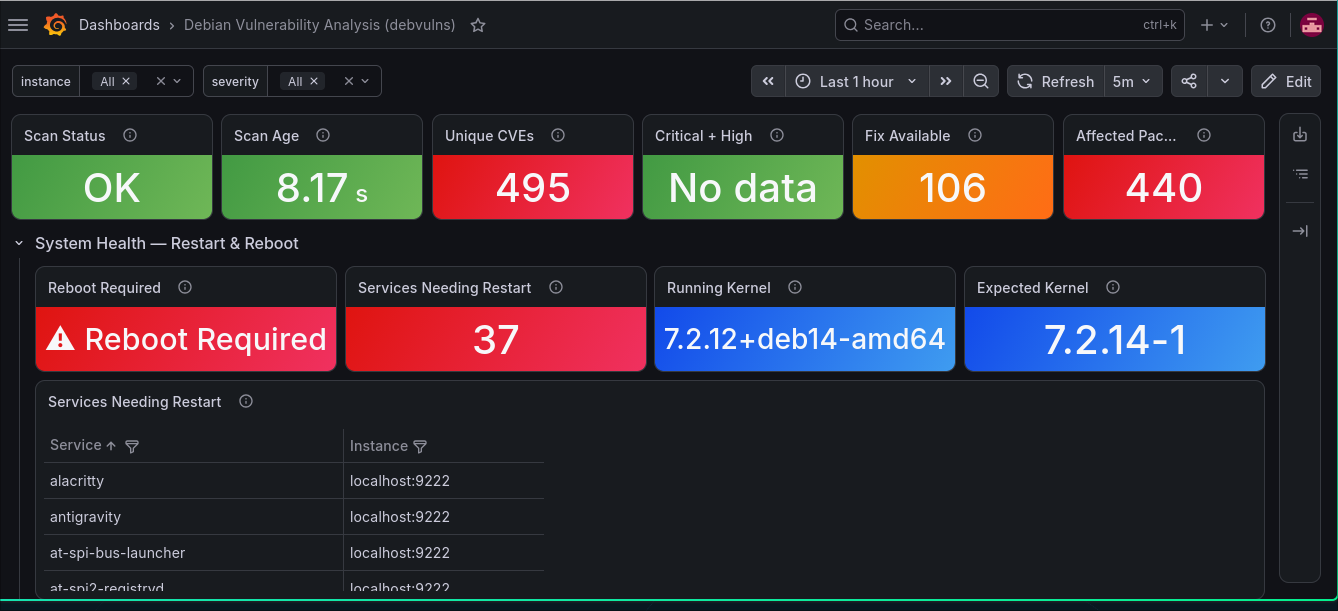
Why Special Handling for Kernel? Just as user-space daemons require a restart after patching, a patched kernel requires a system reboot into the new image before the vulnerability is truly mitigated. Previously, debvulns only verified whether the patched package version was installed on disk. If the deb package was installed, the CVE was marked as resolved, which creates a false sense of security while running the old kernel. With this release, debvulns now checks the active running kernel release. A kernel vulnerability is considered resolved only when the system is running the fixed kernel version. Until a reboot happens, the system remains reported as vulnerable. The updated dashboard reflects these changes below. It will need further polish, but key metrics and restart/reboot states are now visible: debvulns Grafana dashboard with needrestart and kernel metrics
What Next? These were the two pending functional areas I wanted to cover, and no further major features are planned for now. Next up will be reviewing the entire codebase to identify potential optimizations and remove any unnecessary complexity. I haven't done a full pass through the repository since the initial skeleton implementation, so testing edge cases and cleaning up the internals will be the main focus. This will likely take some time since I only hack on this during weekend downtime. Until then, happy hacking, give the new release a try, and file an issue if you run into bugs.

Vincent Bernat: Network lab with QEMU

To experiment with network stuff, I was using UML-based network labs. Many alternatives exist, like GNS3, Netkit, Marionnet or Cloonix. All of them are great viable solutions but I still prefer to stick to my minimal home-made solution with UML virtual machines. Here is why: The use of UML had some drawbacks: However, UML features HostFS, a filesystem providing access to any part of the host filesystem. This is the killer feature which allows me to not use any virtual disk image and to get access to my home directory right from the guest. I discovered recently that QEMU provided 9P, a similar filesystem on top of VirtIO, the paravirtualized IO framework.

Setting up the lab The setup of the lab is done with a single self-contained shell file. The layout is similar to what I have done with UML. I will only highlight here the most interesting steps.

Booting QEMU with a minimal kernel My initial goal was to experiment with Nicolas Dichtel s IPv6 ECMP patch. Therefore, I needed to configure a custom kernel. I have started from make defconfig, removed everything that was not necessary, added what I needed for my lab (mostly network stuff) and added the appropriate options for VirtIO drivers:
CONFIG_NET_9P_VIRTIO=y
CONFIG_VIRTIO_BLK=y
CONFIG_VIRTIO_NET=y
CONFIG_VIRTIO_CONSOLE=y
CONFIG_HW_RANDOM_VIRTIO=y
CONFIG_VIRTIO=y
CONFIG_VIRTIO_RING=y
CONFIG_VIRTIO_PCI=y
CONFIG_VIRTIO_BALLOON=y
CONFIG_VIRTIO_MMIO=y
No modules. Grab the complete configuration if you want to have a look. From here, you can start your kernel with the following command ($LINUX is the appropriate bzImage):
qemu-system-x86_64 \
  -m 256m \
  -display none \
  -nodefconfig -no-user-config -nodefaults \
  \
  -chardev stdio,id=charserial0,signal=off \
  -device isa-serial,chardev=charserial0,id=serial0 \
  \
  -chardev socket,id=con0,path=$TMP/vm-$name-console.pipe,server,nowait \
  -mon chardev=con0,mode=readline,default \
  \
  -kernel $LINUX \
  -append "init=/bin/sh console=ttyS0"
Since there is no disk to boot from, the kernel will panic when trying to mount the root filesystem. QEMU is configured to not display video output (-display none). A serial port is defined and uses stdio as a backend.1 The kernel is configured to use this serial port as a console (console=ttyS0). A VirtIO console could have been used instead but it seems it is not possible to make it work early in the boot process. The QEMU monitor is setup to listen on a Unix socket. It is possible to connect to it with socat UNIX:$TMP/vm-$name-console.pipe -.

Initial ramdisk

Update (2012-10) I was initially unable to mount the host filesystem as the root filesystem for the guest directly by the kernel. In a comment, Josh Triplett told me to use /dev/root as the mount tag to solve this problem. I keep using an initrd in this post but the lab on GitHub has been updated to not use one.

Here is how to build a small initial ramdisk:
# Setup initrd
setup_initrd()  
    info "Build initrd"
    DESTDIR=$TMP/initrd
    mkdir -p $DESTDIR
    # Setup busybox
    copy_exec $($WHICH busybox) /bin/busybox
    for applet in $($ DESTDIR /bin/busybox --list); do
        ln -s busybox $ DESTDIR /bin/$ applet 
    done
    # Setup init
    cp $PROGNAME $ DESTDIR /init
    cd "$ DESTDIR " && find .   \
       cpio --quiet -R 0:0 -o -H newc   \
       gzip > $TMP/initrd.gz
 
The copy_exec function is stolen from the initramfs-tools package in Debian. It will ensure that the appropriate libraries are also copied. Another solution would have been to use a static busybox. The setup script is copied as /init in the initial ramdisk. It will detect it has been invoked as such. If it were omitted, a shell would be spawned instead. Remove the cp call if you want to experiment manually. The flag -initrd allows QEMU to use this initial ramdisk.

Root filesystem Let s mount our root filesystem using 9P. This is quite easy. First QEMU needs to be configured to export the host filesystem to the guest:
qemu-system-x86_64 \
  $ PREVIOUS_ARGS  \
  -fsdev local,security_model=passthrough,id=fsdev-root,path=$ ROOT ,readonly \
  -device virtio-9p-pci,id=fs-root,fsdev=fsdev-root,mount_tag=rootshare
$ ROOT can either be / or any directory containing a complete filesystem. Mounting it from the guest is quite easy:
mkdir -p /target/ro
mount -t 9p rootshare /target/ro -o trans=virtio,version=9p2000.u
You should find a complete root filesystem inside /target/ro. I have used version=9p2000.u instead of version=9p2000.L because the latter does not allow a program to mount() a host mount point.2 Now, you have a read-only root filesystem (because you do not want to mess with your existing root filesystem and moreover, you did not run this lab as root, did you?). Let s use a union filesystem. Debian comes with AUFS while Ubuntu and OpenWRT have migrated to overlayfs. I was previously using AUFS but got errors on some specific cases. It is still not clear which one will end up in the kernel. So, let s try overlayfs. I didn t find any patchset ready to be applied on top of my kernel tree. I was working with David Miller s net-next tree. Here is how I have applied the overlayfs patch on top of it:
$ git remote add torvalds git://git.kernel.org/pub/scm/linux/kernel/git/torvalds/linux-2.6.git
$ git fetch torvalds
$ git remote add overlayfs git://git.kernel.org/pub/scm/linux/kernel/git/mszeredi/vfs.git
$ git fetch overlayfs
$ git merge-base overlayfs.v15 v3.6
4cbe5a555fa58a79b6ecbb6c531b8bab0650778d
$ git checkout -b net-next+overlayfs
$ git cherry-pick 4cbe5a555fa58a79b6ecbb6c531b8bab0650778d..overlayfs.v15
Don t forget to enable CONFIG_OVERLAYFS_FS in .config. Here is how I configured the whole root filesystem:
info "Setup overlayfs"
mkdir /target
mkdir /target/ro
mkdir /target/rw
mkdir /target/overlay
# Version 9p2000.u allows one to access /dev, /sys and mount new
# partitions over them. This is not the case for 9p2000.L.
mount -t 9p        rootshare /target/ro      -o trans=virtio,version=9p2000.u
mount -t tmpfs     tmpfs     /target/rw      -o rw
mount -t overlayfs overlayfs /target/overlay -o lowerdir=/target/ro,upperdir=/target/rw
mount -n -t proc  proc /target/overlay/proc
mount -n -t sysfs sys  /target/overlay/sys
info "Mount home directory on /root"
mount -t 9p homeshare /target/overlay/root -o trans=virtio,version=9p2000.L,access=0,rw
info "Mount lab directory on /lab"
mkdir /target/overlay/lab
mount -t 9p labshare /target/overlay/lab -o trans=virtio,version=9p2000.L,access=0,rw
info "Chroot"
export STATE=1
cp "$PROGNAME" /target/overlay
exec chroot /target/overlay "$PROGNAME"
You have to export your $ HOME and the lab directory from host:
qemu-system-x86_64 \
  $ PREVIOUS_ARGS  \
  -fsdev local,security_model=passthrough,id=fsdev-root,path=$ ROOT ,readonly \
  -device virtio-9p-pci,id=fs-root,fsdev=fsdev-root,mount_tag=rootshare \
  -fsdev local,security_model=none,id=fsdev-home,path=$ HOME  \
  -device virtio-9p-pci,id=fs-home,fsdev=fsdev-home,mount_tag=homeshare \
  -fsdev local,security_model=none,id=fsdev-lab,path=$(dirname "$PROGNAME") \
  -device virtio-9p-pci,id=fs-lab,fsdev=fsdev-lab,mount_tag=labshare

Network You know what is missing from our network lab? Network setup. For each LAN that I will need, I spawn a VDE switch:
# Setup a VDE switch
setup_switch()  
    info "Setup switch $1"
    screen -t "sw-$1" \
        start-stop-daemon --make-pidfile --pidfile "$TMP/switch-$1.pid" \
        --start --startas $($WHICH vde_switch) -- \
        --sock "$TMP/switch-$1.sock"
    screen -X select 0
 
To attach an interface to the newly created LAN, I use:
mac=$(echo $name-$net   sha1sum   \
            awk ' print "52:54:" substr($1,0,2) ":" substr($1, 2, 2) ":" substr($1, 4, 2) ":" substr($1, 6, 2) ')
qemu-system-x86_64 \
  $ PREVIOUS_ARGS  \
  -net nic,model=virtio,macaddr=$mac,vlan=$net \
  -net vde,sock=$TMP/switch-$net.sock,vlan=$net
The use of a VDE switch allows me to run the lab as a non-root user. It is possible to give Internet access to each VM, either by using the -net user flag or using slirpvde on a special switch. I prefer the latter solution since it will allow the VMs to speak to each other.

Debugging This lab was mostly done to debug both the kernel and Quagga. Each of them can be debugged remotely.

Kernel debugging While the kernel features KGDB, its own debugger, compatible with GDB, it is easier to use the remote GDB server built inside QEMU.
qemu-system-x86_64 \
  $ PREVIOUS_ARGS  \
  -gdb unix:$TMP/vm-$name-gdb.pipe,server,nowait
To connect to the remote GDB server from the host, first locate the vmlinux file at the root of the source tree and run GDB on it. The kernel has to be compiled with CONFIG_DEBUG_INFO=y to get the appropriate debugging symbols. Then, use socat with the Unix socket to attach to the remote debugger:
$ gdb vmlinux
GNU gdb (GDB) 7.4.1-debian
Reading symbols from /home/bernat/src/linux/vmlinux...done.
(gdb) target remote   socat UNIX:$TMP/vm-r1-gdb.pipe -
Remote debugging using   socat UNIX:/tmp/tmp.W36qWnrCEj/vm-r1-gdb.pipe -
native_safe_halt () at /home/bernat/src/linux/arch/x86/include/asm/irqflags.h:50
50   
(gdb)
You can now set breakpoints and resume the execution of the kernel. It is easier to debug the kernel if optimizations are not enabled. However, it is not possible to disable them globally. You can however disable them for some files. For example, to debug net/ipv6/route.c, add CFLAGS_route.o = -O0 to net/ipv6/Makefile, remove net/ipv6/route.o and type make.

Userland debugging To debug a program inside QEMU, you can just use gdb as usual. Your $HOME directory is available and it should therefore be straightforward. However, if you want to perform some remote debugging, that s quite easy. Add a new serial port to QEMU:
qemu-system-x86_64 \
  $ PREVIOUS_ARGS  \
  -chardev socket,id=charserial1,path=$TMP/vm-$name-serial.pipe,server,nowait \
  -device isa-serial,chardev=charserial1,id=serial1
Start gdbserver in the guest:
$ libtool execute gdbserver /dev/ttyS1 zebra/zebra
Process /root/code/orange/quagga/build/zebra/.libs/lt-zebra created; pid = 800
Remote debugging using /dev/ttyS1
And from the host, you can attach to the remote process:
$ libtool execute gdb zebra/zebra
GNU gdb (GDB) 7.4.1-debian
Reading symbols from /home/bernat/code/orange/quagga/build/zebra/.libs/lt-zebra...done.
(gdb) target remote   socat UNIX:/tmp/tmp.W36qWnrCEj/vm-r1-serial.pipe -
Remote debugging using   socat UNIX:/tmp/tmp.W36qWnrCEj/vm-r1-serial.pipe -
Reading symbols from /lib64/ld-linux-x86-64.so.2...(no debugging symbols found)...done.
Loaded symbols for /lib64/ld-linux-x86-64.so.2
0x00007ffff7dddaf0 in ?? () from /lib64/ld-linux-x86-64.so.2
(gdb)

Demo For a demo, have a look at the following video:

  1. stdio is configured such that signals are not enabled. QEMU will not stop when receiving SIGINT. This is important for the usage we want to have.
  2. Therefore, it is not possible to mount a fresh /proc on top of the existing one. I have searched a bit but did not find why. Any comments on this are welcome.

Birger Schacht: Status update, September + October 2026

Debian Related Work
  • Uploaded fuzzel 1.15.0+ds-1 to unstable
  • Uploaded foot 1.28.0-1 to unstable
  • Uploaded swayimg 5.6-1 and 5.7-1 to unstable
  • Uploaded wdisplays 1.3.0-1 to unstable
  • Orphaned usbguard with version 1.1.4+ds-5 and usbguard-notifier with version 0.1.0-4
The orphaning of usbguard and usbguard-notifier is because I don t use those packages anymore. I rather spend my time on FOSS projects in areas I get something out of. This is also due to a growing frustration with the Debian community. The discussions on the mailing lists in the recent months lacked any sense of social etiquette. The delusional conviction that certain tools improve the work environment for EVERYONE took on religious overtones. This is all the more troubling now that even central infrastructure is being drawn into this forced blessing. And it seems there is absolutely no awareness here of the boundary violations that are being normalized. Reminds me a bit of christian missionaries.

DH Related Work In the APIS project I finally merged the search app I wrote a couple of months ago. Based on the proof of concept for the HTMX autocomplete, I implemented an autocomplete that uses the search app for the results, therefore allowing to list search results of multiple content types. I released 0.68, 0.69, 0.70, 0.71 and 0.72 of the APIS framework. The 0.68 release changed the way we list the Django content types, leading to less database hits. In the 0.71 release I refactored the detail & edit views for generic models.

40C3 I was torn about whether I should go to this years congress, but in the end I decided to go again. I guess it will be something about the 20th time I m attending.

31 October 2026

Russell Coker: Links October 2026

Julia Curlee wrote an informative article about serving as a CIA agent in the White House as a trans woman [1]. Bruce Schneier and Kasra Rafi wrote an interesting article about AIs and mathematical research, they won t break crypto any time soon [2]. Otto wrote an interesting and informative blog post about the issues related to AI and software development with a focus on the recent Debian vote about accepting AI contributions [3]. Jared Huffman the only openly atheist congressman has some insightful commentary on the rise of Christian nationalism in the US [4]. Artem wrote an interesting blog post about trying and failing to contain a LLM agent with VMs, they think this is bad but I think it s great that more bugs are being discovered and could then be fixed [5]. I now want to try this sort of thing on replicas of my own systems! Techdirt has an insightful article about how the new Meta teen safety rules might allow murderous cops to get away with their crimes [6]. Anil Madhavapeddy wrote an interesting blog post Just a rumour of a bug is enough to find a security exploit these days , things will be difficult for the next few years if this holds at scale [7]. The Conversation has an interesting article about the current situation with nuclear weapons proliferation, not that it helps as countries with nukes get love letters from Trump and countries without get girls schools bombed [8]. Several Australian state governments have mandated free electricity between the times of 11AM and 2PM, but now electricity companies have changed their pricing to avoid this saving customers any money [9]. 404Media has an interesting article about the ways that AI agents are ruining the Internet [10]. RealtimeApocalypse has an interesting article about Effective Altruism which is one of the more covert cults that prey on people in the computer industry [11]. David Brin has a good theory to explain why it s important to allow people who have practiced bestiality to work for the FBI [12]. Cory Doctorow wrote an interesting article for Locus about the politics of AI systems and when they should be considered inherently evil [13]. Adrian wrote an insightful blog post about how DDR RAM works and why replacing RAM on an embedded board isn t a good idea [14]. Arstechnica has an interesting article about organised criminal gangs stealing truck loads of goods and having a particular interest in DC gear [15]. This is one of a series of articles published in The Guardian about the Free Birth Society, a cult-like organisation that opposes involvement of trained medical experts in the process of giving birth, they claimed resuscitation was often an unnecessary act which deprived babies of the chance to choose to begin their lives wow [16]. Cory Doctorow wrote an insightful article about so-called Intellectual Property and how it s being used to attack human rights [17]. Anthropic published an interesting article about their work on formally proving libraries with LLMs, hundreds of millions of tokens for each proof so probably thousands of dollars [18]. Bruce Schneier wrote an insightful article about how AI can provide advantages and disadvantages for dictators [19].

30 October 2026

Matthew Garrett: Getting Google Cast on my Soundbar

I have a Samsung Q800A soundbar. It ships with built-in support for the Apple Airplay protocol, but I m not really an Apple kind of guy so that s never been particularly helpful for me. So, instead, I have a Chromecast Audio plugged into it via TOSLINK, and that works fine - except for the fact that there s no way to explicitly pick TOSLINK as the audio input. Instead, there s a Digital In option that refers to both the optical in and eARC input from a TV. Not inherently a problem, given I m unlikely to be watching TV while listening to music, but my TV is a Samsung Frame, a device that s intended to display art whenever someone is standing nearby, and which infuriatingly generates an eARC signal even if it s only in art mode and isn t going to make any noise. This switches the soundbar away from optical and I get sad. I could plug a video cast device into the HDMI port on the soundbar and cast audio to that, but then the art would get replaced with album covers whenever I m playing music, and again that s not quite the ambience I want. Still, none of this is that important. Until I learned that the Australian version of the soundbar does have Google Cast support. The firmware image was downloadable from Samsung support, so I grabbed that, but unfortunately found that it was encrypted. However, if I downloaded the firmware image for the US model, the encrypted blob was identical - there s no difference in the underlying firmware between the two of them. So, how come one has support, and the other doesn t? I d need an unencrypted copy of the firmware to have a real chance of figuring this out, and the easiest way to get one was to just run an ebay watch for a broken model of the same series. Once I had one in my hands I used hot air to remove the eMMC storage from the device, cleaned up the chip, and then stuck it in one of these adapters to read it on a local system. Samsung uses a weird in-house filesystem called VDFS4 on some of their devices and this was one of them, so I needed to cobble together a kernel that was compatible with their source dump for this device (not all VDFS drivers seem to be able to read all VDFS filesystems), but eventually I had it all extracted, and then I got distracted by other stuff, so let s fast forward to this week. Samsung makes use of a modified version of the Android Debug Bridge called sdb, which is included in the Tizen SDK. The firmware showed that this device had sdbd on it, and it would be executed if a network device called huart0 was plugged in. Samsung does, thankfully, provide the source code for their GPLed components, so I could dig through that to discover that drivers/net/usb/usbnet.c had a bunch of references to huart (which apparently stands for HyperUART ). If CONFIG_SAMSUNG_USBNET_HYPERUART_IFNAME is set, and if the ethernet device is using either the asix or ax88179_178a drivers, and if /opt/etc/HyperUART_IP_Addr 1 isn t just 0 , it sets the interface name to huart0 and in turn triggers sdbd startup. So now I just needed to figure out how to set /opt/etc/HyperUART_IP_Addr to something else. Some digging revealed a binary called wap-factory that referenced the file, which then led to /usr/share/mobile-mgr/jsons/com.samsung.audio.waapp-verification-test.json which mentioned a SetUartOnOff call, which brought me here2, which led me into a bit of a rabbit hole about the Samsung WAM protocol. Long story short, you connect to either port 55001 or 56001 and make two requests over the same connection:
1
2
3
4
5
6
7
8
9
GET /connect HTTP/1.1
Host: 192.168.87.126:56001
User-Agent: SamsungMultiroom/1.0
Connection: interactive

GET /UIC?cmd=%3Cname%3ESetUartOnOff%3C/name%3E%3Cp%20type%3D%22str%22%20name%3D%22uartOnOff%22%20val%3D%22on%22/%3E HTTP/1.1
Host: 192.168.87.126:56001
User-Agent: SamsungMultiroom/1.0
Connection: interactive
and then plug in an asix chipset ethernet adapter into the USB port (which on mine is micro-B, so I needed an OTG adapter), and suddenly it s sitting there on 192.168.250.250 and will speak sdb to you. sdb root on switches it into root mode, and sdb shell now gives you a root shell. I was in, and now I could investigate what was happening. First up, there was a process called com.samsung.audio.google-cast-control-app running, which seemed like a good start. Unfortunately it wasn t doing anything. After some tracing I found that it was making a call to Samsung at startup time, and getting back a response telling it that Cast support wasn t available. The request (which was helpfully dumped to stdout when I ran this by hand) included the country code, in my case US . Repeating the request by hand with curl and changing the code to AU told me it was supported, so now I needed to figure out how to get the soundbar to believe it was Australian. Some digging showed it was reading this from a config variable called db/comss/countrycode, and running
1
buxton2ctl set-string system db/comss/countrycode AU
got me past that gate. Now, however, it was complaining that it couldn t provision a key. /usr/apps/com.samsung.audio.google-cast-control-app/shared/res included a bunch of encrypted blobs and an app called teeStoreKey.elf, and tracing com.samsung.audio.google-cast-control-app showed it was trying to call that, but it seemed like it was failing with a permissions issue. Running com.samsung.audio.google-cast-control-ap directly as root triggered key provisioning successfully, and a few seconds later the rest of the Cast API came up and I could talk to port 8443 with standard Cast API calls. Unfortunately it still wasn t working as a Cast device, though - it wasn t advertising itself via mDNS and so nothing could see it. Querying the /setup/eureka_info endpoint gave me a clue - the tos_accepted field was false. Normally this would be set as part of initial device setup, but the Samsung app wasn t doing that because it didn t think the device had Cast support. It turns out that POSTing some json with tos_accepted : true to setup/set_eureka_info made it work, and suddenly there was an additional Cast device available to me. (Update: I realised I didn t mention anything about why it was doing key provisioning in the first place! The Cast protocol doesn t enforce cryptographic identity as such, but Google s reference client implementation which is what almost everything uses verifies that the device is presenting an identity that chains back to Google. Unsurprisingly they don t want the private key material to be easily extractable and used to produce clone devices, so it s all supposed to be encrypted and only accessible to some sort of trusted execution environment, which is why keys here need to be loaded into Trustzone and never be visible in the clear to the main OS) Mission accomplished. Unfortunately the device vanished from my Smartthings home aferwards, presumably because there s a mismatch between its reported country code and my account country. To get around that I d somehow need to get com.samsung.audio.google-cast-control-app to either change the query without changing the global device country, or to ignore the response from Samsung (it does this every 24 hours, ugh), and that s made more annoying by the fact that this thing will only execute signed binaries. Although, weirdly, one of the signed binaries shipped is a full Python interpreter, so if I cared enough I could probably cobble together enough Python to execute arbitrary binaries. I currently don t. More modern soundbars don t implement the listener on port 55001 or 56001. I don t know how you get sdb working on them.

  1. Yes, it reads a file directly from in-kernel
  2. Good god I hate reading this kind of slop

Russell Coker: More Furilabs FLX1s

In April I got my Furilabs FLX1s basically working [1]. Below is a post I wrote about the FLX1s before it broke at the start of September, there was a problem with the display controller and it would randomly go into a messed up mode that wasn t readable but also changed a bit in relation to button presses etc so the phone was still working. Also I could ssh to the phone when it was in that state if it was on my home wifi. It took almost 2 months to get a replacement phone but I now have that working and the new 14.1.0 OS release. So some of the below may be obsolete when it comes to the latest release but I decided to publish it anyway for history if nothing else. Current Issues Wifi Hotspot Status One thing I had known about but not mentioned before is that the icon in the drop-down menu for the hotspot will often be gray (indicating hotspot-off) when it s actually on. To address that I have to click on it (which then indicates that the hotspot is on) and then click on it again to turn it off. QT6 and MESA GL Currently I have problems with QT6 applications that don t run due to library issues and issues of missing GL support. I blogged about setting up my own container on my phone [2] which helped for some things but not for most things. I have given up trying to get Tokodon working on the phone for the moment. Tokodon is a nice Mastodon client that would allow me to get notifications from Mastodon. Apparently the Furilabs people are working on some issues related to this. Bluetooth Bluetooth is currently a bit unreliable. When I turn on my car (Nissan LEAF) the phone usually either doesn t connect or claims to be connected while not sending audio to the car. When it does connect my favourite music player (Lollypop) usually doesn t display the album and track names. I ve found that turning my car off and on again usually makes it connect properly. I admit the possibility of my car not doing things correctly in this regard. But every Android phone I tried just worked, they would connect as soon as the car was turned on and correctly display track names. So if the car is doing things wrong and needs a software work around then Linux is at fault for not doing that we can t get tens of millions of cars and hundreds of millions of other weird devices fixed! I also note that my Debian laptop and a friend s Debian laptop also have problems connecting to my car. So it s quite possible that Debian code is at fault (the FLX1s is running a modified version of Debian). It currently appears to have no support for handset mode so I can t answer phone calls through the car interface. But this is a lesser problem. I plan to do more testing with Debian laptops and file some bug reports if I can find out enough useful information. My current knowledge of this is insufficient to create a useful bug report. I do have quite a few bluetooth headsets and test laptops so I plan to start by testing Debian and Ubuntu on all the combinations last time I tested Ubuntu 24.04 on Dell laptops worked much better than Debian/Trixie on Thinkpads. Improvements by Furilabs Wifi Hotspot After a set of updates including the following Wifi hotspot seems to be working.
adaptation-furiphone-radon (1.3.0+git20260513192743.e94f2ec.forky.production) forky; urgency=medium
  * NetworkManager: sync hotspot channel/band with STA and restart on change
  * debian: depend on libhybris-utils and libgbinder-tools
  * startup: drop schedtune and add m4u debug log level
  * startup: enable glove and disable edge palm
  * device: drop flashlightd-scalable signatures
 -- Bardia Moshiri <bardia@furilabs.com>  Wed, 13 May 2026 15:27:43 -0400
Charging Connecting the power cable now makes the phone immediately make the click sound and it starts charging while previously there was a 22 second delay. Once I get used to this I can avoid the problem of failing to plug it in firmly before going to bed and having it run flat overnight. Things I ve Done SMS The following command will send a message via SMS.
dbus-send --system --print-reply --dest=org.ofono /ril_0 org.ofono.MessageManager.SendMessage string:"+61400000000" string:"this is the message"
Also the Librem5 Wiki has another way of doing it [3], I haven t tested if that works as the dbus method works well enough for the moment. Also calls can be scripted via the following command:
xdg-open tel://+61400000000
Contacts My aim is to get contacts synchronised via my own cloud service. Nextcloud is supposed to be able to do this. It s been years since I first tried this, my most recent serious attempt at Nextcloud was in 2021 [4] and I couldn t get the Android app for NextCloud to connect. Since then I have made more recent attempts and been unable to get the Android or Linux desktop clients to connect to it. A friend gave me a test account on his Nextcloud server which allowed me to connect the Linux desktop app, his hypothesis was that it was somehow related to using Debian and that his server worked because it was on Ubuntu. I have since installed my own Nextcloud test server on the Ubuntu variant used by the Oracle cloud VMs which had the same apparent problem. I conclude that it s not Debian at fault but something related to how I configured it. In the meantime after a couple of months of having no named contacts I exported the contacts from my Android phone as a VCF file and imported them into the Gnome contacts program. I had to run killall chatty for it to get the names for the contacts, but the phone call program found them without needing to do that. Chatty A missing feature of Chatty (the default SMS and Jabber program for Phosh/Phoc systems) is archiving old messages. I use Chatty to receive Jabber messages from my monitoring system which can be a lot of messages. The following shell code deletes all Jabber messages older than 2 days. Note that this relies on type=3 matching Jabber messages which I m not sure is going to be the case on all systems or all versions of Chatty.
for ID in $(echo "select id from users where type=3;"   sqlite3 ~/.purple/chatty/db/chatty-history.db); do
  echo "delete from messages where sender_id=$ID and time < unixepoch('now') - (48 * 3600);"   sqlite3 ~/.purple/chatty/db/chatty-history.db
done
The following shell code extracts a dump of all messages from Chatty.
echo "select messages.id,users.username,users.alias,messages.body from messages inner join users on messages.sender_id=users.id;"  sqlite3 ~/.purple/chatty/db/chatty-history.db
Dino-IM An update to the Chatty program for SMS and Matrix has made it crash repeatedly. There is a request in the list for Chatty upstream to have a systemd-user unit to restart it which when implemented will reduce the scope of the problem (but not solve it). I've setup a monitoring system that uses notify-send to notify me when Chatty isn't running or when 4G data turns off (a recurring problem). This crashing is allegedly due to Jabber so I installed Dino-IM for Jabber and have for the moment at least stopped using Chatty for Jabber. It turned out that having Chatty not do Jabber didn't stop it crashing. However having alerts separated from SMS can be convenient and also my long term plan is to use a phone with Plasma Mobile and Spacebar (the SMS program for Plasma Mobile) doesn't do Jabber. So I will continue using Dino-IM.
echo "delete from message where time < unixepoch('now') - (48 * 3600);"   sqlite3 ~/.local/share/dino/dino.db
Andromeda/Android I put in the following cron job to stop this log file from using all the storage space:
1 0 * * *	echo -n > /home/furios/.local/share/andromeda/data/system/uiderrors.txt
Wifi DHCP I gave up on attempts to force the Wifi configuration to have a fixed MAC that I could use for a fixed IPv4 address so I manually configured the address. 4G Monitoring I've had problems with the reliability of the 4G service, sometimes it stop working and I need to stop and restart it. I setup my etbe-mon monitoring system on the phone [5] and configured it to ssh to localhost and run notify-send to send a local notification. This means I get notified if my phone loses net access and can't access regular monitoring. Then to monitor the 4G connection (which I want to have working even when Wifi is connected) I had the following monitor line:
monitor ping.monitor -I ccmni1 -c 5 8.8.8.8 ;;
That uses the ccmni1 interface for pinging 8.8.8.8 (Google DNS). That worked for a while but I discovered that sometimes the interface for 4G would change to ccmni2, so I put the following monitor script under /usr/local/mon.d:
#!/bin/bash
DEV=$(route -n grep ^0.0.0.0.*ccm  sed -e s/^.*ccmn/ccmn/)
exec /usr/lib/mon/mon.d/ping.monitor -I $DEV -c 5 8.8.8.8
Mastodon I couldn't get Tokodon to work, not the native package, not running in a Debian/Testing container, and not running a Flatpak. It seems that this is all graphics library issues. So I wrote a Perl program to run "toot notifications &-json" and then send the relevant parts of the output via XMPP. As I already use XMPP for server monitoring there's no extra effort to have an extra account and use it for notifications about Mastodon activity. The Perl script is at the bottom of the post and won't be in the RSS feed. At some future time I may change the script to send the notifications by Matrix instead to have all my social media stuff in the same place. Source
#!/usr/bin/perl
# depends on Debian packages: toot libjson-pp-perl go-sendxmpp
use strict;
use JSON::PP;
my $homeurl = "https://mastodon.nzoss.nz/";
my $lastfile = "mast/last_id";
my $xaddr = "russell\@coker.com.au";
my $jsontxt;
while()
 
  $jsontxt .= $_;
 
my $data = decode_json($jsontxt);
my $last_id = 0, my $new_last_id;
if(open(ID, "<$lastfile"))
 
  $last_id = ;
  close(ID);
 
$new_last_id = $last_id;
for(my $i = 0; $data->[$i]; $i++)
 
  my $id = $data->[$i] id ;
  if($id <= $last_id)
   
    next;
   
  if($id > $new_last_id)
   
    $new_last_id = $id;
   
  open(XMPP, " go-sendxmpp $xaddr") or die "Can't send XMPP";
  my $type = $data->[$i] type ;
  print XMPP "type: $type\n";
  print XMPP "their_url: $homeurl\@$data->[$i] account acct \n";
  print XMPP "display_name: $data->[$i] account display_name \n";
  if($type ne "follow")
   
    print XMPP "status_url: $data->[$i] status url \n";
    print XMPP "content: $data->[$i] status content \n";
   
  print XMPP "created_at: $data->[$i] created_at \n";
  print XMPP "\n";
  close(XMPP);
 
open(ID, ">$lastfile") or die "Can't write to $lastfile";
print ID $new_last_id;
close(ID);

Russell Coker: Fuel Should be More Expensive

The Current Situation Before the US and Israel started attacking Iran at the end of February the petrol prices in Australia were around $1.70/L, which for American readers is roughly equivalent to $US4.64/Gal. By the 11th of March the prices were around $2.19/L. Over the same time period Diesel went from around $1.77/L to $2.40/L. The 11th of March prices weren t necessarily unreasonable prices. In mid March it was reasonable to expect that the US would stop doing such ridiculously stupid things and make a deal with Iran to allow oil to be transported. But every time you think there s a limit to Trump s stupidity (and the incompetence of people around him who don t point him in the right direction) they do something worse. So now we have the Strait of Hormuz almost entirely closed cutting off oil from Kuwait, Qatar, and UAE. The Bab al-Mandab Strait is closed to Saudi linked ships and the Saudi East-West pipeline is closed so once the Yanbu storage tanks are empty there won t be much if any oil from Saudi Arabia for some time. So world oil supplies will be significantly reduced for a long time. Currently the petrol prices in Melbourne are around $2.30/L and Diesel prices around $2.70/L, not much more expensive than it was in March in spite of all the extra problems both militarily and diplomatically since then. Those prices have been steady for over a month. The blockade of the Strait of Hormuz could be ended fairly quickly and there are reports that a lot of the oil that used to go through it is being re-routed. The damaged infrastructure throughout the middle east can t be fixed in a hurry. The Bab al-Mandab Strait probably can t be opened quickly as the Houthis probably don t have a centralised command structure that allows someone to order a ceasefire and have it stick. So we can expect a massive reduction in world oil supplies for a while, which given the way the US is going could be at least until after the mid-term elections (November this year) and possibly until after the 2028 elections. After that oil production will be reduced for another year or two to rebuild infrastructure. The Problem When supply can t meet demand there are three options. Supply can be rationed, demand can be decreased by increasing the prices, or it can be used up and we run out. Running out of fuel is a really bad option as fuel is needed for producing and transporting food and for most things that are important to a society. Governments of first world countries seem unable to deal with the situation properly. Dealing with it properly requires either rationing or increasing the prices. Instead governments have been more interested in artificially keeping the prices down. Currently in Australia and most countries a significant portion of public transport depends on Diesel fuel. Diesel is needed for most buses and for long distance trains. Most taxis run on petrol. As far as I know all emergency service vehicles run on Diesel or petrol as well as most military vehicles. So things will get really bad quickly if fuel runs out entirely. It s not just personal cars that are affected. We aren t going to get the majority of tractors converted to electric power any time soon. Google search results suggest that tractors last an average of about 25 years but casual observation of working equipment on farms suggests a longer life than that is common. Some tractors could be retrofitted to be electric but many will end up being scrapped as part of a conversion while farmers are already having financial problems. It would probably be optimistic to expect that half the tractor use could be done with electric tractors in 10 years time unless there are significant government subsidies. To get the farming and food production industries adapted for electric operation in a few years would be possible but it would take a level of national mobilisation that only happens during wartime. What We Need As a long term solution we need to have more electric vehicles in every category. We need electricity for all train lines to replace Diesel locomotives. We need better trains between cities to reduce the need for aeroplanes, electric aeroplanes are being developed but we aren t there yet. We need all essential services to be run with electric vehicles including farming, food transport, emergency services, and everything related to the medical system (including personal cars for healthcare workers). We also need mining vehicles powered by electricity so we can have the entire industrial system running without fuel. None of this is going to happen in time for this crisis. Electric buses are being introduced in Australia and many taxis are electric. The recent significant increase in the use of electric cars probably includes a reasonable portion of healthcare workers and other essential workers. This gives us the potential to survive fairly severe reductions in the fuel supply without everything collapsing. But we have a significant lack in electric police cars and in electric trucks for food delivery. In the short term we need to significantly reduce the use of fuels, there is no other way to keep the food supply and other essential parts of society working. We could try rationing but I think that should be a last resort. The news reports of a de-facto petrol rationing system in Crimea and parts of Russia are not positive, significant resources are wasted in long queues for petrol and there is public disorder caused by disputes about position in the queues. The level of sanity in the population seems to have dropped significantly since the fuel crisis of 1979, any fuel rationing that is implemented now would get the same sort of opposition from Qanon types as Covid vaccines and lockdowns did in recent times. So the best viable option seems to be to reduce demand by increasing prices. $2.30/L as a common price with occasional spikes of $2.50/L isn t sufficient to do that. If the price increased to $3.50/L, twice what it used to be (equivalent to $9.50/gallon for Americans) then it would provide a real incentive for people to reduce fuel use. That would have to be combined with the type of remote work allowances that were in place when Covid19 was first spreading. But I think that all politicians are too weak to do such things. The media have demonstrated that nowadays the best we can expect is that they will treat both sides as equal even when facts clearly support one side, so we can t expect the media to report on impending fuel shortages and demand policy changes to address them. We should have higher taxes on fuel that will continue past the resolution of the current crisis caused by the attacks on Iran to provide incentives for the purchase of electric cars and for manufacturers to make more fuel efficient cars. Currently people are basing car ownership decisions on the expectation that petrol will go back to something under $2/L and we need to have a government guarantee that it won t happen. People always complain about poor people who can t afford to drive if petrol is expensive but that could be addressed by increasing the minimum wage and social security payments. But a large portion of the people who complain about the hardship poor people may face when fuel prices are discussed are against increasing the minimum wage so I don t think they are being honest. Another common complaint is about the difficulty driving long distances in rural Australia when there isn t sufficient charging infrastructure for electric cars and therefore rural people including farmers getting hit by high prices of fuel. There could be a rebate scheme for farmers etc, government subsidies for farmers is nothing new. What Will Happen I expect the governments of most first world countries to try to keep fuel prices low and do very little to try and decrease demand. China will probably do some things to reduce fuel use and being the world s largest oil importer this will make a difference, but not as much as we need. A related problem is that a lot of fertiliser is produced from petrochemicals and closing the strait of Hormuz cut off a significant portion of the world fertiliser supply. First world countries will outbid developing countries for fertiliser and fuel. Starvation in developing countries probably won t get much news coverage until it leads to war. This is not going to go well, it could be addressed if we had braver politicians and more honest media companies but that s not the way things are going.

26 October 2026

Enrico Zini: Sandboxing pre-commit

pre-commit is a tool that is often a prerequisite for contributing to Python upstream projects. It installs as a git pre-commit hook and runs various checks on commit, using tools installed in a set of virtualenvs that it automatically manages. In other words, it is a Remote Code Execution engine running with the permissions of your own user, and with read and write access to all your information (including, say, ~/.ssh or ~/.netrc). If you are lucky, and for as long as you're lucky, it will perform useful tasks on your code. The recent eMudhra certificate situation, where I learnt how Python, as well as several other ecosystems, likes to embed CA certificate bundles in virtualenvs, caused my tolerance for this to lower to a point where I felt the need to limit pre-commit's reach. However, I didn't want to end up with another containerized OS tree that it's then my responsibility to manage, and I tried to go the bubblewrap way, so that the environment where pre-commit runs will get the same security updates as the rest of my system. The result is a pre-commit wrapper script that: Here's a breakdown of the bwrap options I used so far. Set up usual filesystem expectations:
    --ro-bind /usr /usr \
    --symlink usr/bin /bin \
    --symlink usr/lib64 /lib64 \
    --symlink usr/lib /lib \
    --proc /proc \
    --dev /dev \
Make the working directory and pre-commit's environments storage available and writable:
    --bind $ CURDIR  "$GUEST_DIR" \
    --bind ~/.cache/pre-commit "/home/$ USER /.cache/pre-commit" \
    --chdir "$GUEST_DIR" \
Forward git's configuration:
    --ro-bind /etc/gitconfig /etc/gitconfig \
    --ro-bind ~/.gitconfig /home/$ USER /.gitconfig \
Make .git writable (pre-commit needs to stash, for example), but use a tmpfs overlay so that the writes don't persist:
    --overlay-src "$CURDIR/.git" \
    --tmp-overlay "$GUEST_DIR/.git" \
Remove access to everything except the above. Prevent keystroke injection at the terminal. Propagate ^C.
    --unshare-all \
    --new-session \
    --die-with-parent
If network is needed:
    --share-net \
    --ro-bind /etc/resolv.conf /etc/resolv.conf \
    --ro-bind /etc/ssl/certs/ca-certificates.crt /etc/ssl/certs/ca-certificates.crt
To run it, you can set up the wrapper script to run with a higher priority in $PATH, but you need to edit .git/hooks/pre-commit to remove the first branch of the if that, frustratingly, tries to run it as python3 -m pre_commit. I'm looking forward to a time where it becomes stadard practice to manage user commands this way: why should a desktop solitaire game have access to ~/.ssh? Or network? Why is it still normal, in 2026, to run a Desktop system like that?

Next.

Previous.