Search Results: "tar"

30 September 2026

Dirk Eddelbuettel: myman 0.1.0 on CRAN: New (fabulous !!) Package

Thrilled to share that our new package myman reached CRAN a few days ago. The package offers sixteen hundred ninety four My man posts by Kevin Kruse made on bsky during the summer of 2026. Each wave picked at one particular public persona. This package wrapse these up in the style of packages like fortunes or gaussfacts. A sample usage illustration shows how to extract by pattern:
> library(myman)
> myman("maitre")
My man looks like he's inquiring with the maitre'd about the house curly fries.
     -- about Howard Lutnick on 2026-08-28

My man looks like a maitre'd who deeply doubts you have a reservation.
     -- about Scott Bessent on 2026-08-31

My man looks like he's asked the maitre'd to remove a party of four he finds visually
unpleasant.
     -- about Scott Bessent on 2026-08-31

My man looks like the maitre'd at a very exclusive restaurant called The Berghof.
     -- about JD Vance on 2026-09-13

> 
One can also subset by target , or simple sample randomly (which is the default). As CRAN review for new package takes a little longer these days, the GitHub repo was updated once more with one (eighth !!) wave of posts since the submission was made. CRAN version 0.1.0 corresponds to the stock of messages from waves one to seven. We will update the CRAN version shortly but if you would like more posts right now consider installing from the repo. We include the full NEWS file since the package was started, this also includes an entry for the eights wave we will bring to CRAN soon.

Changes in version 0.1.0 (2026-09-27)
  • Initial CRAN version (minus the 0.0.8 changes which were made while CRAN reviewed the package)
  • Add an aspell dictionary to aid DESCRIPTION text

Changes in version 0.0.8 (2026-09-18)
  • Data set now comprises 1694 posts aiming at eight different 'men'
  • The number of 'sample()' object returned can not be set with 'posts'

Changes in version 0.0.7 (2026-09-14)
  • Data set now comprises 1494 posts aiming at seven different 'men'

Changes in version 0.0.6 (2026-09-07)
  • Data set now comprises 1394 posts aiming at six different 'men'

Changes in version 0.0.5 (2026-09-01)
  • Data set now comprises 1194 posts aiming at five different 'men'
  • The myman() function can now now subset by target permitting more focussed randlom sampling

Changes in version 0.0.4 (2026-08-28)
  • Data set now comprises 1040 posts aiming at four different 'men'

Changes in version 0.0.3 (2026-08-19)
  • Data set now comprises 916 posts aiming at three different 'men'
  • Csv file, processing and display extended to three columns also showing post creating date (in UTC) and 'man'

Changes in version 0.0.2 (2026-07-30)
  • Updated with full week of posts leading to a corpus of 698 posts
  • Added support for simple regular-expression lookup ability

Changes in version 0.0.1 (2026-07-19)
  • Initial release

This post by Dirk Eddelbuettel originated on his Thinking inside the box blog. If you like this or other open-source work I do, you can sponsor me at GitHub.

29 September 2026

Gunnar Wolf: The Origins of GPU Computing

This post is an unpublished review for The Origins of GPU Computing
This article appears in the Communications of the ACM magazine as part of a series devoting to showcasing relevant examples of technologies where federal funding of academic research have resulted in widely impacting, clearly identifiable technological advances that have visibly improved or, at least, changed life far beyond the technological arena. The road leading from the first parallel computing technologies built completely for research, through a phase that was preeminently directed at gaming, and back to leading current GPUs, that are basically massively parallel supercomputers used for LLM training and inference and other IA tasks, is far from trivial, and the authors make a good job outlining it in few pages. The article is written in a clearly divulgatory way, staying as clear of technical language as possible. The authors present three main enabling technologies for current GPU technologies: Parallel computing, parallel graphics systems, and stream processing. Coming from a technical formation myself, although clearly better grounded in the software side of Computer Engineering than on the electronics side, the most interesting nugget of information I take is that parallel computing was born due to the fact that transistor switching consumes very little energy, whereas communication along wires consumes much more so the more simultaneous operations can be carried out on-chip at once, the less power will be dissipated as heat (and the less time that will be lost due to data stores and loads). Graphics systems are a natural match for parallel systems, as rendering realistic images basically requires repeating the same blocks of instructions to a large array of items. Early GPU implementations were built on fixed-function graphics pipelines, but by the turn of the century, when nVidia spinned off the research labs at Stanford and started marketing their product, introducing along the way the Graphical Processing Unit term, product, they enabled it to implement the full OpenGL graphics pipeline on a single chip. Stream processing is the arrangement of in-chip electronics so that they can better exploit producer-consumer locality between stages, in order to achieve greater arithmetic intensity (this is, a greater computation-to-bandwidth ratio), decreasing the total number of access to memory accesses. The authors explain in broad terms the described technologies and how they fit together, and how the technology was transferred from the universities to the companies that became the most dynamic companies behind today s top trending technologies. I felt the article to be engaging and easy to read. As a technologist, I did miss more details dates when specific advances were made, how some of the advances joined into further inventions But I understand the aim of the Federal Funding of Academic Research series aim is more towards outsiders. And, as such, this work very well explains how trillion-dollar technologies are only the result of decades of funding research ideas.

28 September 2026

Otto Kek l inen: Using multiple git remotes for true distributed version control

Featured image of post Using multiple git remotes for true distributed version controlOne of the primary design principles for Linus Torvalds when creating Git is that it should be a distributed system, capable of working with multiple remotes. However, most people seem to use Git with just one remote, typically having GitHub or GitLab as the only origin. Version control systems before Git relied on a centralized model. For example in Subversion or CVS you could only sync with one single remote server, which was considered the primary host of the source code. Git however is not just a VCS, but a DVCS, for distributed version control system. If you currently use Git with just one single remote as if it was a centralized version control system, now is the time to change that and learn how to add multiple remotes, and configure more flexible git pull and git push rules. The first concept to grasp is that Git can have multiple remotes. For example, after running a basic clone command such as git clone https://github.com/ottok/debcraft.git you would end up with a single remote origin pointing to GitHub:
$ git remote --verbose
origin https://github.com/ottok/debcraft.git (fetch)
origin https://github.com/ottok/debcraft.git (push)
You can however configure multiple remotes with the command git remote:
$ git remote rename origin github
$ git remote add gitlab https://gitlab.com/ottok/debcraft.git
$ git remote --verbose
github https://github.com/ottok/debcraft.git (fetch)
github https://github.com/ottok/debcraft.git (push)
gitlab https://gitlab.com/ottok/debcraft.git (fetch)
gitlab https://gitlab.com/ottok/debcraft.git (push)
You can push and pull from these individually, or from all at once:
$ git pull --all
Fetching github
Fetching gitlab
Already up to date.
When you review the git history, note the labels gitlab/main and github/main which tell which commit the branch main points to on various remotes. In this case they are all in sync and point to the same 5d1815c:
$ git log --oneline
5d1815c (HEAD -> main, gitlab/main, github/main) Bump Debhelper version from 13 to 14
ca518a7 Temporarily disable automatic copyright year bumping due to frequent bugs
d6e201e Exclude .pm from codespell to decrease false positives (Closes: #1140488)
708ee35 Exclude debian/copyright from codespell due to frequent false positives
When pushing, you can choose what remote to push to. For example, if I am working on branch dev and I only want to push it to GitLab to trigger a CI run there, I can run git push gitlab dev. You can also configure a default remote by running once git push --set-upstream gitlab dev and thereafter simply run git push and it will automatically push the branch dev only to that remote. A related setting is remote.pushDefault, which tells git which remote to push to when a branch does not define one of its own, and it applies to every branch that lacks a [branch] section in .git/config. Setting it once is what lets a repository have a per-branch pull remote, like the debcraft example below, and still have a single, predictable git push target. To see which remote git will use for each of your branches, run git branch -vv, and to refresh the remote-tracking branches of all remotes at once, run git fetch --all --prune. If you want to have multiple remotes, but automatically push and pull to all of them at once, you configure one single remote to have multiple URLs with git remote set-url --add. Since git prints one line per push URL, git remote -v then shows the same remote several times, once for each URL it pushes to. As an illustration, in my actual local Debcraft development project I have all these configured:
$ git remote -v
github-pull-requests git@github.com:ottok/debcraft.git (fetch)
github-pull-requests git@github.com:ottok/debcraft.git (push)
gitlab-merge-requests git@gitlab.com:ottok/debcraft.git (fetch)
gitlab-merge-requests git@gitlab.com:ottok/debcraft.git (push)
origin git@salsa.debian.org:debian/debcraft.git (fetch)
origin git@salsa.debian.org:debian/debcraft.git (push)
origin git@gitlab.com:ottok/debcraft.git (push)
origin git@github.com:ottok/debcraft.git (push)
otto git@salsa.debian.org:otto/debcraft.git (fetch)
otto git@salsa.debian.org:otto/debcraft.git (push)
otto git@gitlab.com:ottok/debcraft.git (push)
otto git@github.com:ottok/debcraft.git (push)
otto git@git.sr.ht:~ottok/debcraft (push)
otto ssh://git@codeberg.org/ottok/Debcraft.git (push)
salsa-merge-requests git@salsa.debian.org:debian/debcraft.git (fetch)
salsa-merge-requests git@salsa.debian.org:debian/debcraft.git (push)
The settings can also be viewed directly in the config file:
$ cat .git/config
...
[remote "origin"]
url = git@salsa.debian.org:debian/debcraft.git
fetch = +refs/heads/*:refs/remotes/origin/*
pushurl = git@salsa.debian.org:debian/debcraft.git
pushurl = git@gitlab.com:ottok/debcraft.git
pushurl = git@github.com:ottok/debcraft.git
[remote "otto"]
url = git@salsa.debian.org:otto/debcraft.git
fetch = +refs/heads/*:refs/remotes/otto/*
pushurl = git@salsa.debian.org:otto/debcraft.git
pushurl = git@gitlab.com:ottok/debcraft.git
pushurl = git@github.com:ottok/debcraft.git
pushurl = git@git.sr.ht:~ottok/debcraft
pushurl = ssh://git@codeberg.org/ottok/Debcraft.git
...
[branch "main"]
remote = origin
merge = refs/heads/main
[branch "dev"]
remote = otto
merge = refs/heads/dev
...
On branch main: On branch dev: The command output will have the same message three times, once for each remote (assuming they were all already up-to-date):
$ git push
Everything up-to-date

Use cases for distributed version control The most obvious use case for any distributed system is improved availability. In this example, the salsa.debian.org is often overloaded/unavailable, so pushing to GitLab and GitHub as well allows collaborators to use them to fetch git commits if the primary code hosting site is unresponsive. Once it comes back online again, the next git push/pull will automatically bring it up to the same content as what backup hosts had. The second main benefit is that having the code live on multiple code forges allows collaborators to use their own favorite host. Debcraft itself is a great example of this, as collaborators who don t have a Salsa account can - and have - submitted Merge Requests on GitLab.com and Pull Requests on GitHub.com. A third use case is code hosting migrations. If you for example want to gradually phase out GitHub.com and replace it with something else, you could configure git to pull from the old location and push to both, ensuring that other collaborators can start using the new code hosting location without disruptions to those who have not yet updated their remotes or done a fresh git clone from the new location.

Automating setting up a project on multiple code forges While I don t push all projects I work on to all Salsa/GitLab/GitHub, I do set up multiple remotes for enough git projects that I have this script to automate configuring a git repository that is cloned from Salsa to also push to GitLab and GitHub. It accepts the repository whether it was cloned over SSH or HTTPS, and it adds the push URLs and then pushes the current branch, all branches, and tags for you:
#!/bin/bash
# Add GitLab and GitHub push URLs to an existing git remote, so that a plain
# "git push" writes the same commits to all three code forges.
#
# Usage: ./git-multipush-salsa.sh
#
# Environment:
# SALSA_REMOTE remote to turn into a mirror, default origin
# SALSA_USER your Salsa user, only used to detect that the source
# remote is somebody else's project
# GITLAB_USER your GitLab user, default ottok
# GITHUB_USER your GitHub user, default ottok
# PROTOCOL ssh (default) or https, for the push URLs
set -euo pipefail
SCRIPT=$(basename "$0")
SALSA_REMOTE=$ SALSA_REMOTE:-origin 
SALSA_USER=$ SALSA_USER:-otto 
GITLAB_USER=$ GITLAB_USER:-ottok 
GITHUB_USER=$ GITHUB_USER:-ottok 
PROTOCOL=$ PROTOCOL:-ssh 
die()   echo "$SCRIPT: $*" >&2; exit 1;  
# A failing command leaves the push URLs half configured behind, so say how
# to get back to where we started
fail()
 
echo "$SCRIPT: '$*' failed, the push URLs may already have been added" >&2
echo " git config --unset-all remote.$ SALSA_REMOTE .pushurl" >&2
echo " git remote set-url --add --push $ SALSA_REMOTE  $ SALSA_URL " >&2
exit 1
 
git rev-parse --git-dir > /dev/null 2>&1   die "not inside a git repository"
git remote   grep -qx "$SALSA_REMOTE"   die "no remote named '$SALSA_REMOTE'"
# Example: git@salsa.debian.org:otto/salsa-ci-pipeline.git
SALSA_URL=$(git remote get-url "$SALSA_REMOTE")
# The source remote may use any of the URL forms salsa.debian.org accepts,
# for example git@salsa.debian.org:otto/salsa-ci-pipeline.git or
# https://salsa.debian.org/otto/salsa-ci-pipeline.git
case "$SALSA_URL" in
git@salsa.debian.org:*) SALSA_PATH=$ SALSA_URL#git@salsa.debian.org:  ;;
ssh://git@salsa.debian.org/*) SALSA_PATH=$ SALSA_URL#ssh://git@salsa.debian.org/  ;;
https://salsa.debian.org/*) SALSA_PATH=$ SALSA_URL#https://salsa.debian.org/  ;;
http://salsa.debian.org/*) SALSA_PATH=$ SALSA_URL#http://salsa.debian.org/  ;;
*) die "unexpected source URL '$SALSA_URL', expected a salsa.debian.org URL" ;;
esac
SALSA_PATH=$ SALSA_PATH%/ 
SALSA_PATH=$ SALSA_PATH%.git 
SOURCE_USER=$ SALSA_PATH%%/* 
PROJECT=$ SALSA_PATH##*/ 
# Write the push URLs in one and the same protocol, no matter how the
# repository happens to have been cloned
if [ "$PROTOCOL" = "https" ]
then
SALSA_URL="https://salsa.debian.org/$ SALSA_PATH .git"
GITLAB_URL="https://gitlab.com/$ GITLAB_USER /$ PROJECT .git"
GITHUB_URL="https://github.com/$ GITHUB_USER /$ PROJECT .git"
else
SALSA_URL="git@salsa.debian.org:$ SALSA_PATH .git"
GITLAB_URL="git@gitlab.com:$ GITLAB_USER /$ PROJECT .git"
GITHUB_URL="git@github.com:$ GITHUB_USER /$ PROJECT .git"
fi
# Mirroring somebody else's project is fine, but it is usually not what you
# want: you most likely want to mirror your own fork instead
if [ "$SOURCE_USER" != "$SALSA_USER" ]
then
echo "Note: $SALSA_REMOTE points to $SOURCE_USER's project, not your own."
echo "To mirror your own fork, run this with SALSA_REMOTE set to its name."
echo
fi
# Bail out instead of adding the same push URLs twice
EXISTING=$(git remote get-url --push --all "$SALSA_REMOTE")
if [ "$(printf '%s\n' "$EXISTING"   wc -l)" -gt 1 ]
then
die "remote '$SALSA_REMOTE' already has multiple push URLs:
$EXISTING"
fi
echo "Mirroring $SALSA_URL to $GITLAB_URL and $GITHUB_URL"
git remote set-url --add --push "$SALSA_REMOTE" "$SALSA_URL"
git remote set-url --add --push "$SALSA_REMOTE" "$GITLAB_URL"
git remote set-url --add --push "$SALSA_REMOTE" "$GITHUB_URL"
# Push the branch you have checked out first, and never with --force: the
# first branch a GitLab or GitHub project receives becomes its default branch,
# the one you then protect
DEFAULT_BRANCH=$(git symbolic-ref --short HEAD)   die "not on a branch, check out a branch first"
git push -u "$SALSA_REMOTE" "$DEFAULT_BRANCH"
git push "$SALSA_REMOTE" --all
git push "$SALSA_REMOTE" --tags
# The push above creates the GitLab and GitHub projects, but GitLab projects
# are private by default, so make the new mirror public with glab if installed.
if command -v glab > /dev/null
then
echo "Make the GitLab project public and describe it as a mirror:"
glab api -X PUT "projects/$ GITLAB_USER %2F$ PROJECT " \
-f visibility=public \
-f description="Mirror of $ SALSA_URL " \
-f notification_email=disabled
else
echo "Install glab to do the same automatically, or visit"
echo "https://gitlab.com/$ GITLAB_USER /$ PROJECT /edit to make the project public"
fi
echo "To undo, drop all push URLs and add back only the original one:"
echo " git config --unset-all remote.$ SALSA_REMOTE .pushurl"
echo " git remote set-url --add --push $ SALSA_REMOTE  $ SALSA_URL "
If you prefer not to install glab, the last part simply reduces to visiting the GitLab project settings once and ticking the project public, and it is also worth setting a description like Mirror of https://salsa.debian.org/debian/debcraft and disabling notification email there, as nobody wants a mirror sending out a flood of emails every time you push. There are a few caveats worth knowing about before mirroring everything everywhere. Every push to a remote with multiple push URLs writes to all of them, so a project with continuous integration configured on three forges will run its CI three times and cost you roughly three times as much. If one of the push URLs fails, say because the host is momentarily unreachable, git prints the error and stops there, leaving the remotes listed after the failing one without the new commits. Simply re-run the push once the host is reachable again; the remotes that did get the commits will just respond with Everything up-to-date. And you should never force-push to only one of the remotes, as that leaves the mirrors permanently out of sync with your local repository.

Avoid pulling too much Related to multiple remotes, you should also be aware that git allows one to configure which branches to pull. By default a git clone will track all branches from the remote and pull everything, which in a typical open source project will bring in a lot of temporary development branches in vain. Thus it is better to run git clone with the --single-branch and --branch parameters to fetch only the branch that matters, which in most cases is the main branch. That can be accomplished with:
git clone --single-branch --branch main https://github.com/ottok/debcraft.git
If a repository was already cloned, it can be configured to track only one branch with:
git config remote.upstream.fetch "+refs/heads/main:refs/remotes/upstream/main"
git fetch upstream
git config --get-all remote.upstream.fetch
+refs/heads/main:refs/remotes/upstream/main
If you later need to track more branches, you can configure them with commands such as:
git config --add remote.upstream.fetch "+refs/heads/3.2.y:refs/remotes/upstream/3.2.y"
git fetch upstream
git checkout 3.2.y
For additional details about any of the tips in this post I recommend reading the git man pages.

Now go and spread your code around Distributing your code over multiple code forges costs you almost nothing in configuration, and in return you get availability, a choice of host for your collaborators, and freedom to migrate without a big bang. Add the push URLs to the remotes you already have, push once, and you are done. The rest of the git fundamentals are covered in my other posts. If your commits are not yet polished, start with what makes a good git commit message and git commit messages by example. If you work on Debian packaging, Git-based collaboration in Debian explains why the Salsa merge request workflow is built the way it is, and Salsa merge request best practices covers the review process itself.

Maytham Alsudany: Briefly looking at DNS and nameservers under the hood

I've always known that the browser uses the Domain Name Resolution (DNS) system to convert domain names like aezign.com.au into raw IP addresses, but have never actually understood how it works, outside of making sure my network config uses 1.1.1.1 or 8.8.8.8 instead of the crappy one the ISP provides. In this article, I set out to understand what nameservers do, and how they help anything that uses the internet find the right records.

DNS in a nutshellA well-used analogy is a phonebook; when you have someone's name and need to find their phone number, you look through the phonebook. Overall, DNS does the same thing: when you enter an address like example.com, your browser will contact a DNS server (the "phonebook") to determine its IP addresses. On Linux (or MacOS) systems, you can use dig on the command line to perform a DNS lookup and see what this looks like:
$ dig example.com
; <<>> DiG 9.20.29-1-Debian <<>> example.com
;; global options: +cmd
;; Got answer:
;; ->>HEADER<<- opcode: QUERY, status: NOERROR, id: 42782
;; flags: qr rd ra; QUERY: 1, ANSWER: 2, AUTHORITY: 0, ADDITIONAL: 1
;; OPT PSEUDOSECTION:
; EDNS: version: 0, flags:; udp: 1232
;; QUESTION SECTION:
;example.com.                   IN      A
;; ANSWER SECTION:
example.com.            221     IN      A       104.20.23.154
example.com.            221     IN      A       172.66.147.243
;; Query time: 20 msec
;; SERVER: 1.1.1.1#53(1.1.1.1) (UDP)
;; WHEN: Sun Sep 27 21:07:50 AWST 2026
;; MSG SIZE  rcvd: 72
Here, you can see the DNS server being used is 1.1.1.1 (Cloudflare's DNS server), and that it found the IPs 104.20.23.154 and 172.66.147.243 associated with the domain name example.com. Your browser will then contact these IP addresses directly to load the website you are trying to open.

Configuring DNS serversYou can configure DNS servers through your operating system's network settings, and for some applications such as Firefox, with the application itself. If you don't manually set a DNS server, your computer will use the ones provided by your modem. If those are not configured, the default defined by the modem manufacturer or your ISP will be used.The most well-used and reliable DNS servers you can use are Cloudflare's (1.1.1.1 and 1.0.0.1) and Google's (8.8.8.8 and 8.8.4.4). Having more than one DNS server means that if the first one in the list doesn't work or doesn't find the matching IPs for a domain name, it will move to the next one in the list, a backup DNS server.DNS servers must be configured as IP addresses. If your computer tried to use a DNS server at a domain name, then where would your computer find the IP address for that domain name? It wouldn't be able to, as this is the exact gap that DNS servers fulfill.

RecordsDNS is not used only to find IPs for a domain, but a whole host of other things. Collectively they are referred to as "records" (or "DNS records"). Each record is associated to a domain (e.g. example.com) or a subdomain (e.g. bar.example.com, foo.bar.example.com) Here are some of the most common and important types:
  • A - Map to an IPv4 address (e.g. 104.20.23.154).This is the fundamental function of DNS: to map from a domain name to a server's IP address. Multiple A records leads to load balancing, where browsers will randomly select one of the returned IP addresses such that traffic is evenly split between them.
  • AAAA - Map to an IPv6 address (e.g. 2606:4700:10::6814:179a).This serves the same purpose as A records but for IPv6. Multiple AAAA records results in the same load balancing behaviour. All modern websites should have both an A record for legacy compatibility, and an AAAA record to future-proof for the gradual shift towards IPv6 addresses.
  • CNAME - Alias to another domain name (e.g. example.com).DNS servers will recursively lookup records for the aliased domain name until they reach an IP address (in an A or AAAA record).
  • MX - Specify a Mail Exchange server (e.g. mail.example.com).This record tells email SMTP servers where to direct emails to. For instance, the MX record for aezign.com.au is mail.aezign.au; this directs SMTP servers like Gmail and Outlook to send emails to the mailserver running at mail.aezign.au. This also allows specifying a priority field, so that you can define multiple MX records (such as a main and a backup) and consumers will try to connect to the listed mailservers from lowest priority to highest.
  • TXT - Store arbitrary text dataThis is most commonly used for site verification (for instance, to link your website to Google Search Console) and for email security measures like DKIM, DMARC, and SPF.
  • NS - Specify the nameservers for a domain (e.g. zeus.ns.cloudflare.com).These authoritative nameservers are responsible for providing all the other record types when needed.
dig lets you query each of these. For instance, to list the MX records against aezign.com.au:
$ dig MX aezign.com.au
; <<>> DiG 9.20.29-1-Debian <<>> MX aezign.com.au
;; global options: +cmd
;; Got answer:
;; ->>HEADER<<- opcode: QUERY, status: NOERROR, id: 28213
;; flags: qr rd ra; QUERY: 1, ANSWER: 1, AUTHORITY: 0, ADDITIONAL: 1
;; OPT PSEUDOSECTION:
; EDNS: version: 0, flags:; udp: 1232
;; QUESTION SECTION:
;aezign.com.au.                 IN      MX
;; ANSWER SECTION:
aezign.com.au.          300     IN      MX      10 mail.aezign.au.
;; Query time: 104 msec
;; SERVER: 1.1.1.1#53(1.1.1.1) (UDP)
;; WHEN: Sun Sep 27 22:04:58 AWST 2026
;; MSG SIZE  rcvd: 70
Here you can see there is only one mailserver configured for aezign.com.au, which is mail.aezign.au, and it has a priority of 10.If you compare this against something like gmail.com:
$ dig MX gmail.com
; <<>> DiG 9.20.29-1-Debian <<>> MX gmail.com
;; global options: +cmd
;; Got answer:
;; ->>HEADER<<- opcode: QUERY, status: NOERROR, id: 16538
;; flags: qr rd ra; QUERY: 1, ANSWER: 5, AUTHORITY: 0, ADDITIONAL: 1
;; OPT PSEUDOSECTION:
; EDNS: version: 0, flags:; udp: 1232
;; QUESTION SECTION:
;gmail.com.                     IN      MX
;; ANSWER SECTION:
gmail.com.              2497    IN      MX      40 alt4.gmail-smtp-in.l.google.com.
gmail.com.              2497    IN      MX      20 alt2.gmail-smtp-in.l.google.com.
gmail.com.              2497    IN      MX      5 gmail-smtp-in.l.google.com.
gmail.com.              2497    IN      MX      10 alt1.gmail-smtp-in.l.google.com.
gmail.com.              2497    IN      MX      30 alt3.gmail-smtp-in.l.google.com.
;; Query time: 120 msec
;; SERVER: 1.1.1.1#53(1.1.1.1) (UDP)
;; WHEN: Sun Sep 27 22:06:04 AWST 2026
;; MSG SIZE  rcvd: 161
You can see that gmail.com has several mailservers configured as redundancies due to the Gmail's sheer scale. gmail-smtp-in.l.google.com has the highest priority of 5, so SMTP servers will attempt to contact that mailserver first, followed by alt1.gmail-smtp-in.l.google.com and so on.

NameserversNow there needs to be somewhere for DNS records against a domain name to be defined, right? This is where nameservers come in.Nameservers are DNS servers that answer queries about the domains they are authoritative for i.e. the domains they are in charge of. For example, the authoritative nameservers for example.com are hera.ns.cloudflare.com and elliott.ns.cloudflare.com, which means Cloudflare's nameservers are the source of truth when looking up DNS records for example.com. You can check this with dig:
$ dig NS example.com
; <<>> DiG 9.20.29-1-Debian <<>> NS example.com
;; global options: +cmd
;; Got answer:
;; ->>HEADER<<- opcode: QUERY, status: NOERROR, id: 37717
;; flags: qr rd ra; QUERY: 1, ANSWER: 2, AUTHORITY: 0, ADDITIONAL: 1
;; OPT PSEUDOSECTION:
; EDNS: version: 0, flags:; udp: 1232
;; QUESTION SECTION:
;example.com.                   IN      NS
;; ANSWER SECTION:
example.com.            81837   IN      NS      hera.ns.cloudflare.com.
example.com.            81837   IN      NS      elliott.ns.cloudflare.com.
;; Query time: 140 msec
;; SERVER: 1.1.1.1#53(1.1.1.1) (UDP)
;; WHEN: Sun Sep 27 23:27:19 AWST 2026
;; MSG SIZE  rcvd: 95
Nameservers are configured with your domain name's registrar. The nameserver you set dictates where your remaining DNS records will live. For example.com, this means you would configure all your records on Cloudflare's dashboard, since they are responsible for the domain's DNS records.

Recursive resolutionThe DNS servers that our computers use follow a recursive resolution process behind-the-scenes to find the authoritative nameservers for a domain, followed by the records you are querying.

Finding the root nameserversDue to the recursive nature of the resolution process, there needs to be a starting point: the root (.) nameservers. The resolver uses a fixed list of root nameservers called root hints issued by IANA (named.root), to locate and contact the root nameservers. Resolvers will have this provided to them initially, and can dynamically update it themselves by querying one of the root nameservers for the root NS records to obtain a fresh list. For instance, we can query 198.41.0.4 (a.root-servers.net) to obtain a new list of root nameservers:
$ dig @198.41.0.4 NS .
; <<>> DiG 9.20.29-1-Debian <<>> @198.41.0.4 NS .
; (1 server found)
;; global options: +cmd
;; Got answer:
;; ->>HEADER<<- opcode: QUERY, status: NOERROR, id: 43677
;; flags: qr aa rd; QUERY: 1, ANSWER: 13, AUTHORITY: 0, ADDITIONAL: 27
;; WARNING: recursion requested but not available
;; OPT PSEUDOSECTION:
; EDNS: version: 0, flags:; udp: 4096
;; QUESTION SECTION:
;.				IN	NS
;; ANSWER SECTION:
.			518400	IN	NS	l.root-servers.net.
.			518400	IN	NS	j.root-servers.net.
.			518400	IN	NS	f.root-servers.net.
.			518400	IN	NS	h.root-servers.net.
.			518400	IN	NS	d.root-servers.net.
.			518400	IN	NS	b.root-servers.net.
.			518400	IN	NS	k.root-servers.net.
.			518400	IN	NS	i.root-servers.net.
.			518400	IN	NS	m.root-servers.net.
.			518400	IN	NS	e.root-servers.net.
.			518400	IN	NS	g.root-servers.net.
.			518400	IN	NS	c.root-servers.net.
.			518400	IN	NS	a.root-servers.net.
;; ADDITIONAL SECTION:
l.root-servers.net.	518400	IN	A	199.7.83.42
l.root-servers.net.	518400	IN	AAAA	2001:500:9f::42
j.root-servers.net.	518400	IN	A	192.58.128.30
j.root-servers.net.	518400	IN	AAAA	2001:503:c27::2:30
f.root-servers.net.	518400	IN	A	192.5.5.241
f.root-servers.net.	518400	IN	AAAA	2001:500:2f::f
h.root-servers.net.	518400	IN	A	198.97.190.53
h.root-servers.net.	518400	IN	AAAA	2001:500:1::53
d.root-servers.net.	518400	IN	A	199.7.91.13
d.root-servers.net.	518400	IN	AAAA	2001:500:2d::d
b.root-servers.net.	518400	IN	A	170.247.170.2
b.root-servers.net.	518400	IN	AAAA	2801:1b8:10::b
k.root-servers.net.	518400	IN	A	193.0.14.129
k.root-servers.net.	518400	IN	AAAA	2001:7fd::1
i.root-servers.net.	518400	IN	A	192.36.148.17
i.root-servers.net.	518400	IN	AAAA	2001:7fe::53
m.root-servers.net.	518400	IN	A	202.12.27.33
m.root-servers.net.	518400	IN	AAAA	2001:dc3::35
e.root-servers.net.	518400	IN	A	192.203.230.10
e.root-servers.net.	518400	IN	AAAA	2001:500:a8::e
g.root-servers.net.	518400	IN	A	192.112.36.4
g.root-servers.net.	518400	IN	AAAA	2001:500:12::d0d
c.root-servers.net.	518400	IN	A	192.33.4.12
c.root-servers.net.	518400	IN	AAAA	2001:500:2::c
a.root-servers.net.	518400	IN	A	198.41.0.4
a.root-servers.net.	518400	IN	AAAA	2001:503:ba3e::2:30
;; Query time: 476 msec
;; SERVER: 198.41.0.4#53(198.41.0.4) (UDP)
;; WHEN: Mon Sep 28 00:01:08 AWST 2026
;; MSG SIZE  rcvd: 811

Querying the root nameserversFor example.com, the first step is to query the root (.) nameservers to find the nameservers for the .com top-level domain (TLD). Using a.root-servers.net again:
$ dig @198.41.0.4 NS com
; <<>> DiG 9.20.29-1-Debian <<>> @198.41.0.4 NS com
; (1 server found)
;; global options: +cmd
;; Got answer:
;; ->>HEADER<<- opcode: QUERY, status: NOERROR, id: 22528
;; flags: qr rd; QUERY: 1, ANSWER: 0, AUTHORITY: 13, ADDITIONAL: 27
;; WARNING: recursion requested but not available
;; OPT PSEUDOSECTION:
; EDNS: version: 0, flags:; udp: 4096
;; QUESTION SECTION:
;com.				IN	NS
;; AUTHORITY SECTION:
com.			172800	IN	NS	l.gtld-servers.net.
com.			172800	IN	NS	j.gtld-servers.net.
com.			172800	IN	NS	h.gtld-servers.net.
com.			172800	IN	NS	d.gtld-servers.net.
com.			172800	IN	NS	b.gtld-servers.net.
com.			172800	IN	NS	f.gtld-servers.net.
com.			172800	IN	NS	k.gtld-servers.net.
com.			172800	IN	NS	m.gtld-servers.net.
com.			172800	IN	NS	i.gtld-servers.net.
com.			172800	IN	NS	g.gtld-servers.net.
com.			172800	IN	NS	a.gtld-servers.net.
com.			172800	IN	NS	c.gtld-servers.net.
com.			172800	IN	NS	e.gtld-servers.net.
;; ADDITIONAL SECTION:
l.gtld-servers.net.	172800	IN	A	192.41.162.30
l.gtld-servers.net.	172800	IN	AAAA	2001:500:d937::30
j.gtld-servers.net.	172800	IN	A	192.48.79.30
j.gtld-servers.net.	172800	IN	AAAA	2001:502:7094::30
h.gtld-servers.net.	172800	IN	A	192.54.112.30
h.gtld-servers.net.	172800	IN	AAAA	2001:502:8cc::30
d.gtld-servers.net.	172800	IN	A	192.31.80.30
d.gtld-servers.net.	172800	IN	AAAA	2001:500:856e::30
b.gtld-servers.net.	172800	IN	A	192.33.14.30
b.gtld-servers.net.	172800	IN	AAAA	2001:503:231d::2:30
f.gtld-servers.net.	172800	IN	A	192.35.51.30
f.gtld-servers.net.	172800	IN	AAAA	2001:503:d414::30
k.gtld-servers.net.	172800	IN	A	192.52.178.30
k.gtld-servers.net.	172800	IN	AAAA	2001:503:d2d::30
m.gtld-servers.net.	172800	IN	A	192.55.83.30
m.gtld-servers.net.	172800	IN	AAAA	2001:501:b1f9::30
i.gtld-servers.net.	172800	IN	A	192.43.172.30
i.gtld-servers.net.	172800	IN	AAAA	2001:503:39c1::30
g.gtld-servers.net.	172800	IN	A	192.42.93.30
g.gtld-servers.net.	172800	IN	AAAA	2001:503:eea3::30
a.gtld-servers.net.	172800	IN	A	192.5.6.30
a.gtld-servers.net.	172800	IN	AAAA	2001:503:a83e::2:30
c.gtld-servers.net.	172800	IN	A	192.26.92.30
c.gtld-servers.net.	172800	IN	AAAA	2001:503:83eb::30
e.gtld-servers.net.	172800	IN	A	192.12.94.30
e.gtld-servers.net.	172800	IN	AAAA	2001:502:1ca1::30
;; Query time: 772 msec
;; SERVER: 198.41.0.4#53(198.41.0.4) (UDP)
;; WHEN: Mon Sep 28 00:09:25 AWST 2026
;; MSG SIZE  rcvd: 828

Querying the TLD nameserversNow the resolver has .com nameservers and their IPs. We can use one of these, such as 192.5.6.30 (a.gtld-servers.net) to find the nameservers for example.com:
$ dig @192.5.6.30 NS example.com
; <<>> DiG 9.20.29-1-Debian <<>> @192.5.6.30 NS example.com
; (1 server found)
;; global options: +cmd
;; Got answer:
;; ->>HEADER<<- opcode: QUERY, status: NOERROR, id: 37419
;; flags: qr rd; QUERY: 1, ANSWER: 0, AUTHORITY: 2, ADDITIONAL: 13
;; WARNING: recursion requested but not available
;; OPT PSEUDOSECTION:
; EDNS: version: 0, flags:; udp: 4096
;; QUESTION SECTION:
;example.com.                   IN      NS
;; AUTHORITY SECTION:
example.com.            172800  IN      NS      hera.ns.cloudflare.com.
example.com.            172800  IN      NS      elliott.ns.cloudflare.com.
;; ADDITIONAL SECTION:
hera.ns.cloudflare.com. 172800  IN      A       108.162.192.162
hera.ns.cloudflare.com. 172800  IN      A       172.64.32.162
hera.ns.cloudflare.com. 172800  IN      A       173.245.58.162
hera.ns.cloudflare.com. 172800  IN      AAAA    2606:4700:50::adf5:3aa2
hera.ns.cloudflare.com. 172800  IN      AAAA    2803:f800:50::6ca2:c0a2
hera.ns.cloudflare.com. 172800  IN      AAAA    2a06:98c1:50::ac40:20a2
elliott.ns.cloudflare.com. 172800 IN    A       108.162.195.228
elliott.ns.cloudflare.com. 172800 IN    A       162.159.44.228
elliott.ns.cloudflare.com. 172800 IN    A       172.64.35.228
elliott.ns.cloudflare.com. 172800 IN    AAAA    2606:4700:58::a29f:2ce4
elliott.ns.cloudflare.com. 172800 IN    AAAA    2803:f800:50::6ca2:c3e4
elliott.ns.cloudflare.com. 172800 IN    AAAA    2a06:98c1:50::ac40:23e4
;; Query time: 80 msec
;; SERVER: 192.5.6.30#53(192.5.6.30) (UDP)
;; WHEN: Mon Sep 28 00:12:19 AWST 2026
;; MSG SIZE  rcvd: 359

Finding the domain's nameserverThe response tells the resolver that the nameservers for example.com are hera.ns.cloudflare.com and elliott.ns.cloudflare.com. Now since these Cloudflare nameservers are also .com domains and Cloudflare is so commonly used, the .com nameserver provides optional sibling glue records as defined in RFC 9471 to prevent further roundtrips and optimize the process.If we ignore the sibling glue records provided, the resolver would have to ask the .com nameservers for the nameservers for cloudflare.com:
$ dig @192.5.6.30 NS cloudflare.com
; <<>> DiG 9.20.29-1-Debian <<>> @192.5.6.30 NS cloudflare.com
; (1 server found)
;; global options: +cmd
;; Got answer:
;; ->>HEADER<<- opcode: QUERY, status: NOERROR, id: 40307
;; flags: qr rd; QUERY: 1, ANSWER: 0, AUTHORITY: 5, ADDITIONAL: 21
;; WARNING: recursion requested but not available
;; OPT PSEUDOSECTION:
; EDNS: version: 0, flags:; udp: 4096
;; QUESTION SECTION:
;cloudflare.com.                        IN      NS
;; AUTHORITY SECTION:
cloudflare.com.         172800  IN      NS      ns3.cloudflare.com.
cloudflare.com.         172800  IN      NS      ns5.cloudflare.com.
cloudflare.com.         172800  IN      NS      ns4.cloudflare.com.
cloudflare.com.         172800  IN      NS      ns6.cloudflare.com.
cloudflare.com.         172800  IN      NS      ns7.cloudflare.com.
;; ADDITIONAL SECTION:
ns3.cloudflare.com.     172800  IN      A       162.159.0.33
ns3.cloudflare.com.     172800  IN      A       162.159.7.226
ns3.cloudflare.com.     172800  IN      AAAA    2400:cb00:2049:1::a29f:21
ns3.cloudflare.com.     172800  IN      AAAA    2400:cb00:2049:1::a29f:7e2
ns5.cloudflare.com.     172800  IN      A       162.159.2.9
ns5.cloudflare.com.     172800  IN      A       162.159.9.55
ns5.cloudflare.com.     172800  IN      AAAA    2400:cb00:2049:1::a29f:209
ns5.cloudflare.com.     172800  IN      AAAA    2400:cb00:2049:1::a29f:937
ns4.cloudflare.com.     172800  IN      A       162.159.1.33
ns4.cloudflare.com.     172800  IN      A       162.159.8.55
ns4.cloudflare.com.     172800  IN      AAAA    2400:cb00:2049:1::a29f:121
ns4.cloudflare.com.     172800  IN      AAAA    2400:cb00:2049:1::a29f:837
ns6.cloudflare.com.     172800  IN      A       162.159.3.11
ns6.cloudflare.com.     172800  IN      A       162.159.5.6
ns6.cloudflare.com.     172800  IN      AAAA    2400:cb00:2049:1::a29f:30b
ns6.cloudflare.com.     172800  IN      AAAA    2400:cb00:2049:1::a29f:506
ns7.cloudflare.com.     172800  IN      A       162.159.4.8
ns7.cloudflare.com.     172800  IN      A       162.159.6.6
ns7.cloudflare.com.     172800  IN      AAAA    2400:cb00:2049:1::a29f:408
ns7.cloudflare.com.     172800  IN      AAAA    2400:cb00:2049:1::a29f:606
;; Query time: 163 msec
;; SERVER: 192.5.6.30#53(192.5.6.30) (UDP)
;; WHEN: Mon Sep 28 00:26:53 AWST 2026
;; MSG SIZE  rcvd: 573
Here, the .com nameserver provides in-domain glue records for cloudflare.com's nameservers. Without these, there would be a circular dependency, since the nameserver named is a subdomain of the domain being queried for. This is because nameservers are always defined by name, which means that in order to actually contact the nameserver, your computer needs to obtain its IP address with another DNS lookup.Next, we'd use one of these nameservers, say ns3.cloudflare.com, to obtain the IP for hera.ns.cloudflare.com:
$ dig @162.159.0.33 hera.ns.cloudflare.com
; <<>> DiG 9.20.29-1-Debian <<>> @162.159.0.33 hera.ns.cloudflare.com
; (1 server found)
;; global options: +cmd
;; Got answer:
;; ->>HEADER<<- opcode: QUERY, status: NOERROR, id: 16801
;; flags: qr aa rd; QUERY: 1, ANSWER: 3, AUTHORITY: 0, ADDITIONAL: 1
;; WARNING: recursion requested but not available
;; OPT PSEUDOSECTION:
; EDNS: version: 0, flags:; udp: 1232
;; QUESTION SECTION:
;hera.ns.cloudflare.com.                IN      A
;; ANSWER SECTION:
hera.ns.cloudflare.com. 86353   IN      A       108.162.192.162
hera.ns.cloudflare.com. 86353   IN      A       173.245.58.162
hera.ns.cloudflare.com. 86353   IN      A       172.64.32.162
;; Query time: 123 msec
;; SERVER: 162.159.0.33#53(162.159.0.33) (UDP)
;; WHEN: Mon Sep 28 01:11:37 AWST 2026
;; MSG SIZE  rcvd: 99

Querying the domain's authoritative nameserverNow we've reached the authoritative nameserver for example.com! The last thing to do is to fetch the A record for example.com to obtain its server's IP address:
$ dig @108.162.192.162 example.com
; <<>> DiG 9.20.29-1-Debian <<>> @108.162.192.162 example.com
; (1 server found)
;; global options: +cmd
;; Got answer:
;; ->>HEADER<<- opcode: QUERY, status: NOERROR, id: 43082
;; flags: qr aa rd; QUERY: 1, ANSWER: 2, AUTHORITY: 0, ADDITIONAL: 1
;; WARNING: recursion requested but not available
;; OPT PSEUDOSECTION:
; EDNS: version: 0, flags:; udp: 1232
;; QUESTION SECTION:
;example.com.                   IN      A
;; ANSWER SECTION:
example.com.            300     IN      A       104.20.23.154
example.com.            300     IN      A       172.66.147.243
;; Query time: 123 msec
;; SERVER: 108.162.192.162#53(108.162.192.162) (UDP)
;; WHEN: Mon Sep 28 01:13:47 AWST 2026
;; MSG SIZE  rcvd: 72
At last, we've determined that the IP addresses of the servers behind example.com are 104.20.23.154 and 172.66.147.243. This matches our earlier lookup directly against your computer's configured DNS server.The DNS servers your computer uses encapsulate this recursive resolution process behind the scenes, so that your computer only needs to make one round trip, and the servers can use their much faster data center connections and caching to optimize the process and make the query as fast as possible.

Checking DNS recordsTo check a website's records, the first thing to do is to ensure the domain name is pointed at the correct nameserver. For instance, aezign.com.au is supposed to use Cloudflare, since that is where all the DNS records have been set up. We can verify this using dig, (or alternatively with online tools like dnschecker.org):
$ dig NS aezign.com.au
; <<>> DiG 9.20.29-1-Debian <<>> NS aezign.com.au
;; global options: +cmd
;; Got answer:
;; ->>HEADER<<- opcode: QUERY, status: NOERROR, id: 44172
;; flags: qr rd ra; QUERY: 1, ANSWER: 2, AUTHORITY: 0, ADDITIONAL: 1
;; OPT PSEUDOSECTION:
; EDNS: version: 0, flags:; udp: 1232
;; QUESTION SECTION:
;aezign.com.au.                 IN      NS
;; ANSWER SECTION:
aezign.com.au.          86400   IN      NS      rosalie.ns.cloudflare.com.
aezign.com.au.          86400   IN      NS      zeus.ns.cloudflare.com.
;; Query time: 92 msec
;; SERVER: 1.1.1.1#53(1.1.1.1) (UDP)
;; WHEN: Mon Sep 28 01:39:22 AWST 2026
;; MSG SIZE  rcvd: 100
If this is not set correctly, the DNS records you configure will not work, as resolvers will be fetching records from somewhere else. In most cases, you can update this in your domain registrar's settings. This is especially common for new domain names, which default to the registrar's nameservers; unless you plan to use their built-in DNS management, you'll need to point them to your chosen provider.Now we can check that the DNS records configured match those your DNS server returns. For aezign.com.au, these are the MX and TXT records configured on Cloudflare.
Extract of Cloudflare's DNS record listing showing the MX record and TXT records for aezign.com.au. The MX record and some TXT records configured for aezign.com.au on Cloudflare's dashboard.
We can check these using dig, and using the +short option to show only the content of the records.
$ dig MX aezign.com.au +short
10 mail.aezign.au.
$ dig TXT aezign.com.au +short
"google-site-verification=KFqTU5xH8fFf6OtszEL4oudfxple29Tm-TvxVtCWkAM"
"v=spf1 mx a:mail.aezign.au -all"
$ dig TXT _dmarc.aezign.com.au +short
"v=DMARC1;p=quarantine;sp=quarantine;adkim=r;aspf=r"
$ dig TXT aezign.com.au-2026._domainkey.aezign.com.au +short
"v=DKIM1; h=sha256; k=rsa; s=email; p=MIIBIjANBgkqhkiG9w0BAQEFAAOCAQ8AMIIBCgKCAQEAzL04yXZgB72YkoxS+tLK//aWx65TS4UA3F0qJ7el68SEuD4ehmg+61Ta9iS31H6U074dnjyoPDeaiGBa7ToTNCtiIts4/ghD/8nrENROE6hQAwRmTK18ODDHrRDW73hWe6Dg4cK5vmXi82/wWRZU9SDKbme28IE9uCVir3lCkKYLs1" "j16gR1Sjqr6a2+3o+EeVXnLJ4wXmJMm7KCIdn7zv0t9Z1eYcw672PdpYPAMpGb8uUsgaDBsNSpTcupPkz4SWj6TrOB80CPHjWseVY8EOJeRsNKQ/8LFoQEBl4Rxtb3HAmu4UIxSZ4QMVOLnXz67e85mA5XjcNIsVMzaWaowwIDAQAB"
As we can see, this matches, which means that the nameservers for aezign.com.au are correct and the DNS records are what we intend them to be.Note that if you've recently changed the nameserver or DNS records for your domain, it can take anywhere between 10 seconds and 24 hours for the changes to take effect and propagate across the different DNS servers globally. Tools like dnschecker.org can check your records on different DNS servers worldwide to see if they're reflecting your changes. The reason for this is caching: DNS servers like 1.1.1.1 will cache results so it doesn't have to do the full resolution process every time, and uses the Time-To-Live (TTL) you configure in your DNS records as a guideline for caching duration.

Maytham Alsudany: A Brief Explanation of DNS and Nameservers

The Domain Name System (DNS) is a fundamental piece of technology behind the modern internet. Thanks to its introduction in 1983, you're able to enter domain names like aezign.com.au instead of raw IP addresses in your browser's address bar and when sending emails. This article explains what it is, how it works, and how you can inspect your own website's DNS and ensure it is set up correctly.

DNS in a nutshellA well-used analogy is a phonebook; when you have someone's name and need to find their phone number, you look through the phonebook. Overall, DNS does the same thing: when you enter an address like example.com, your browser will contact a DNS server (the "phonebook") to determine its IP addresses. On Linux (or MacOS) systems, you can use dig on the command line to perform a DNS lookup and see what this looks like:
$ dig example.com
; <<>> DiG 9.20.29-1-Debian <<>> example.com
;; global options: +cmd
;; Got answer:
;; ->>HEADER<<- opcode: QUERY, status: NOERROR, id: 42782
;; flags: qr rd ra; QUERY: 1, ANSWER: 2, AUTHORITY: 0, ADDITIONAL: 1
;; OPT PSEUDOSECTION:
; EDNS: version: 0, flags:; udp: 1232
;; QUESTION SECTION:
;example.com.                   IN      A
;; ANSWER SECTION:
example.com.            221     IN      A       104.20.23.154
example.com.            221     IN      A       172.66.147.243
;; Query time: 20 msec
;; SERVER: 1.1.1.1#53(1.1.1.1) (UDP)
;; WHEN: Sun Sep 27 21:07:50 AWST 2026
;; MSG SIZE  rcvd: 72
Here, you can see the DNS server being used is 1.1.1.1 (Cloudflare's DNS server), and that it found the IPs 104.20.23.154 and 172.66.147.243 associated with the domain name example.com. Your browser will then contact these IP addresses directly to load the website you are trying to open.

Configuring DNS serversYou can configure DNS servers through your operating system's network settings, and for some applications such as Firefox, with the application itself. If you don't manually set a DNS server, your computer will use the ones provided by your modem. If those are not configured, the default defined by the modem manufacturer or your ISP will be used.The most well-used and reliable DNS servers you can use are Cloudflare's (1.1.1.1 and 1.0.0.1) and Google's (8.8.8.8 and 8.8.4.4). Having more than one DNS server means that if the first one in the list doesn't work or doesn't find the matching IPs for a domain name, it will move to the next one in the list, a backup DNS server.DNS servers must be configured as IP addresses. If your computer tried to use a DNS server at a domain name, then where would your computer find the IP address for that domain name? It wouldn't be able to, as this is the exact gap that DNS servers fulfill.

RecordsDNS is not used only to find IPs for a domain, but a whole host of other things. Collectively they are referred to as "records" (or "DNS records"). Each record is associated to a domain (e.g. example.com) or a subdomain (e.g. bar.example.com, foo.bar.example.com) Here are some of the most common and important types:
  • A - Map to an IPv4 address (e.g. 104.20.23.154).This is the fundamental function of DNS: to map from a domain name to a server's IP address. Multiple A records leads to load balancing, where browsers will randomly select one of the returned IP addresses such that traffic is evenly split between them.
  • AAAA - Map to an IPv6 address (e.g. 2606:4700:10::6814:179a).This serves the same purpose as A records but for IPv6. Multiple AAAA records results in the same load balancing behaviour. All modern websites should have both an A record for legacy compatibility, and an AAAA record to future-proof for the gradual shift towards IPv6 addresses.
  • CNAME - Alias to another domain name (e.g. example.com).DNS servers will recursively lookup records for the aliased domain name until they reach an IP address (in an A or AAAA record).
  • MX - Specify a Mail Exchange server (e.g. mail.example.com).This record tells email SMTP servers where to direct emails to. For instance, the MX record for aezign.com.au is mail.aezign.au; this directs SMTP servers like Gmail and Outlook to send emails to the mailserver running at mail.aezign.au. This also allows specifying a priority field, so that you can define multiple MX records (such as a main and a backup) and consumers will try to connect to the listed mailservers from lowest priority to highest.
  • TXT - Store arbitrary text dataThis is most commonly used for site verification (for instance, to link your website to Google Search Console) and for email security measures like DKIM, DMARC, and SPF.
  • NS - Specify the nameservers for a domain (e.g. zeus.ns.cloudflare.com).These authoritative nameservers are responsible for providing all the other record types when needed.
dig lets you query each of these. For instance, to list the MX records against aezign.com.au:
$ dig MX aezign.com.au
; <<>> DiG 9.20.29-1-Debian <<>> MX aezign.com.au
;; global options: +cmd
;; Got answer:
;; ->>HEADER<<- opcode: QUERY, status: NOERROR, id: 28213
;; flags: qr rd ra; QUERY: 1, ANSWER: 1, AUTHORITY: 0, ADDITIONAL: 1
;; OPT PSEUDOSECTION:
; EDNS: version: 0, flags:; udp: 1232
;; QUESTION SECTION:
;aezign.com.au.                 IN      MX
;; ANSWER SECTION:
aezign.com.au.          300     IN      MX      10 mail.aezign.au.
;; Query time: 104 msec
;; SERVER: 1.1.1.1#53(1.1.1.1) (UDP)
;; WHEN: Sun Sep 27 22:04:58 AWST 2026
;; MSG SIZE  rcvd: 70
Here you can see there is only one mailserver configured for aezign.com.au, which is mail.aezign.au, and it has a priority of 10.If you compare this against something like gmail.com:
$ dig MX gmail.com
; <<>> DiG 9.20.29-1-Debian <<>> MX gmail.com
;; global options: +cmd
;; Got answer:
;; ->>HEADER<<- opcode: QUERY, status: NOERROR, id: 16538
;; flags: qr rd ra; QUERY: 1, ANSWER: 5, AUTHORITY: 0, ADDITIONAL: 1
;; OPT PSEUDOSECTION:
; EDNS: version: 0, flags:; udp: 1232
;; QUESTION SECTION:
;gmail.com.                     IN      MX
;; ANSWER SECTION:
gmail.com.              2497    IN      MX      40 alt4.gmail-smtp-in.l.google.com.
gmail.com.              2497    IN      MX      20 alt2.gmail-smtp-in.l.google.com.
gmail.com.              2497    IN      MX      5 gmail-smtp-in.l.google.com.
gmail.com.              2497    IN      MX      10 alt1.gmail-smtp-in.l.google.com.
gmail.com.              2497    IN      MX      30 alt3.gmail-smtp-in.l.google.com.
;; Query time: 120 msec
;; SERVER: 1.1.1.1#53(1.1.1.1) (UDP)
;; WHEN: Sun Sep 27 22:06:04 AWST 2026
;; MSG SIZE  rcvd: 161
You can see that gmail.com has several mailservers configured as redundancies due to the Gmail's sheer scale. gmail-smtp-in.l.google.com has the highest priority of 5, so SMTP servers will attempt to contact that mailserver first, followed by alt1.gmail-smtp-in.l.google.com and so on.

NameserversNow there needs to be somewhere for DNS records against a domain name to be defined, right? This is where nameservers come in.Nameservers are DNS servers that answer queries about the domains they are authoritative for i.e. the domains they are in charge of. For example, the authoritative nameservers for example.com are hera.ns.cloudflare.com and elliott.ns.cloudflare.com, which means Cloudflare's nameservers are the source of truth when looking up DNS records for example.com. You can check this with dig:
$ dig NS example.com
; <<>> DiG 9.20.29-1-Debian <<>> NS example.com
;; global options: +cmd
;; Got answer:
;; ->>HEADER<<- opcode: QUERY, status: NOERROR, id: 37717
;; flags: qr rd ra; QUERY: 1, ANSWER: 2, AUTHORITY: 0, ADDITIONAL: 1
;; OPT PSEUDOSECTION:
; EDNS: version: 0, flags:; udp: 1232
;; QUESTION SECTION:
;example.com.                   IN      NS
;; ANSWER SECTION:
example.com.            81837   IN      NS      hera.ns.cloudflare.com.
example.com.            81837   IN      NS      elliott.ns.cloudflare.com.
;; Query time: 140 msec
;; SERVER: 1.1.1.1#53(1.1.1.1) (UDP)
;; WHEN: Sun Sep 27 23:27:19 AWST 2026
;; MSG SIZE  rcvd: 95
Nameservers are configured with your domain name's registrar. The nameserver you set dictates where your remaining DNS records will live. For example.com, this means you would configure all your records on Cloudflare's dashboard, since they are responsible for the domain's DNS records.

Recursive resolutionThe DNS servers that our computers use follow a recursive resolution process behind-the-scenes to find the authoritative nameservers for a domain, followed by the records you are querying.

Finding the root nameserversDue to the recursive nature of the resolution process, there needs to be a starting point: the root (.) nameservers. The resolver uses a fixed list of root nameservers called root hints issued by IANA (named.root), to locate and contact the root nameservers. Resolvers will have this provided to them initially, and can dynamically update it themselves by querying one of the root nameservers for the root NS records to obtain a fresh list. For instance, we can query 198.41.0.4 (a.root-servers.net) to obtain a new list of root nameservers:
$ dig @198.41.0.4 NS .
; <<>> DiG 9.20.29-1-Debian <<>> @198.41.0.4 NS .
; (1 server found)
;; global options: +cmd
;; Got answer:
;; ->>HEADER<<- opcode: QUERY, status: NOERROR, id: 43677
;; flags: qr aa rd; QUERY: 1, ANSWER: 13, AUTHORITY: 0, ADDITIONAL: 27
;; WARNING: recursion requested but not available
;; OPT PSEUDOSECTION:
; EDNS: version: 0, flags:; udp: 4096
;; QUESTION SECTION:
;.				IN	NS
;; ANSWER SECTION:
.			518400	IN	NS	l.root-servers.net.
.			518400	IN	NS	j.root-servers.net.
.			518400	IN	NS	f.root-servers.net.
.			518400	IN	NS	h.root-servers.net.
.			518400	IN	NS	d.root-servers.net.
.			518400	IN	NS	b.root-servers.net.
.			518400	IN	NS	k.root-servers.net.
.			518400	IN	NS	i.root-servers.net.
.			518400	IN	NS	m.root-servers.net.
.			518400	IN	NS	e.root-servers.net.
.			518400	IN	NS	g.root-servers.net.
.			518400	IN	NS	c.root-servers.net.
.			518400	IN	NS	a.root-servers.net.
;; ADDITIONAL SECTION:
l.root-servers.net.	518400	IN	A	199.7.83.42
l.root-servers.net.	518400	IN	AAAA	2001:500:9f::42
j.root-servers.net.	518400	IN	A	192.58.128.30
j.root-servers.net.	518400	IN	AAAA	2001:503:c27::2:30
f.root-servers.net.	518400	IN	A	192.5.5.241
f.root-servers.net.	518400	IN	AAAA	2001:500:2f::f
h.root-servers.net.	518400	IN	A	198.97.190.53
h.root-servers.net.	518400	IN	AAAA	2001:500:1::53
d.root-servers.net.	518400	IN	A	199.7.91.13
d.root-servers.net.	518400	IN	AAAA	2001:500:2d::d
b.root-servers.net.	518400	IN	A	170.247.170.2
b.root-servers.net.	518400	IN	AAAA	2801:1b8:10::b
k.root-servers.net.	518400	IN	A	193.0.14.129
k.root-servers.net.	518400	IN	AAAA	2001:7fd::1
i.root-servers.net.	518400	IN	A	192.36.148.17
i.root-servers.net.	518400	IN	AAAA	2001:7fe::53
m.root-servers.net.	518400	IN	A	202.12.27.33
m.root-servers.net.	518400	IN	AAAA	2001:dc3::35
e.root-servers.net.	518400	IN	A	192.203.230.10
e.root-servers.net.	518400	IN	AAAA	2001:500:a8::e
g.root-servers.net.	518400	IN	A	192.112.36.4
g.root-servers.net.	518400	IN	AAAA	2001:500:12::d0d
c.root-servers.net.	518400	IN	A	192.33.4.12
c.root-servers.net.	518400	IN	AAAA	2001:500:2::c
a.root-servers.net.	518400	IN	A	198.41.0.4
a.root-servers.net.	518400	IN	AAAA	2001:503:ba3e::2:30
;; Query time: 476 msec
;; SERVER: 198.41.0.4#53(198.41.0.4) (UDP)
;; WHEN: Mon Sep 28 00:01:08 AWST 2026
;; MSG SIZE  rcvd: 811

Querying the root nameserversFor example.com, the first step is to query the root (.) nameservers to find the nameservers for the .com top-level domain (TLD). Using a.root-servers.net again:
$ dig @198.41.0.4 NS com
; <<>> DiG 9.20.29-1-Debian <<>> @198.41.0.4 NS com
; (1 server found)
;; global options: +cmd
;; Got answer:
;; ->>HEADER<<- opcode: QUERY, status: NOERROR, id: 22528
;; flags: qr rd; QUERY: 1, ANSWER: 0, AUTHORITY: 13, ADDITIONAL: 27
;; WARNING: recursion requested but not available
;; OPT PSEUDOSECTION:
; EDNS: version: 0, flags:; udp: 4096
;; QUESTION SECTION:
;com.				IN	NS
;; AUTHORITY SECTION:
com.			172800	IN	NS	l.gtld-servers.net.
com.			172800	IN	NS	j.gtld-servers.net.
com.			172800	IN	NS	h.gtld-servers.net.
com.			172800	IN	NS	d.gtld-servers.net.
com.			172800	IN	NS	b.gtld-servers.net.
com.			172800	IN	NS	f.gtld-servers.net.
com.			172800	IN	NS	k.gtld-servers.net.
com.			172800	IN	NS	m.gtld-servers.net.
com.			172800	IN	NS	i.gtld-servers.net.
com.			172800	IN	NS	g.gtld-servers.net.
com.			172800	IN	NS	a.gtld-servers.net.
com.			172800	IN	NS	c.gtld-servers.net.
com.			172800	IN	NS	e.gtld-servers.net.
;; ADDITIONAL SECTION:
l.gtld-servers.net.	172800	IN	A	192.41.162.30
l.gtld-servers.net.	172800	IN	AAAA	2001:500:d937::30
j.gtld-servers.net.	172800	IN	A	192.48.79.30
j.gtld-servers.net.	172800	IN	AAAA	2001:502:7094::30
h.gtld-servers.net.	172800	IN	A	192.54.112.30
h.gtld-servers.net.	172800	IN	AAAA	2001:502:8cc::30
d.gtld-servers.net.	172800	IN	A	192.31.80.30
d.gtld-servers.net.	172800	IN	AAAA	2001:500:856e::30
b.gtld-servers.net.	172800	IN	A	192.33.14.30
b.gtld-servers.net.	172800	IN	AAAA	2001:503:231d::2:30
f.gtld-servers.net.	172800	IN	A	192.35.51.30
f.gtld-servers.net.	172800	IN	AAAA	2001:503:d414::30
k.gtld-servers.net.	172800	IN	A	192.52.178.30
k.gtld-servers.net.	172800	IN	AAAA	2001:503:d2d::30
m.gtld-servers.net.	172800	IN	A	192.55.83.30
m.gtld-servers.net.	172800	IN	AAAA	2001:501:b1f9::30
i.gtld-servers.net.	172800	IN	A	192.43.172.30
i.gtld-servers.net.	172800	IN	AAAA	2001:503:39c1::30
g.gtld-servers.net.	172800	IN	A	192.42.93.30
g.gtld-servers.net.	172800	IN	AAAA	2001:503:eea3::30
a.gtld-servers.net.	172800	IN	A	192.5.6.30
a.gtld-servers.net.	172800	IN	AAAA	2001:503:a83e::2:30
c.gtld-servers.net.	172800	IN	A	192.26.92.30
c.gtld-servers.net.	172800	IN	AAAA	2001:503:83eb::30
e.gtld-servers.net.	172800	IN	A	192.12.94.30
e.gtld-servers.net.	172800	IN	AAAA	2001:502:1ca1::30
;; Query time: 772 msec
;; SERVER: 198.41.0.4#53(198.41.0.4) (UDP)
;; WHEN: Mon Sep 28 00:09:25 AWST 2026
;; MSG SIZE  rcvd: 828

Querying the TLD nameserversNow the resolver has .com nameservers and their IPs. We can use one of these, such as 192.5.6.30 (a.gtld-servers.net) to find the nameservers for example.com:
$ dig @192.5.6.30 NS example.com
; <<>> DiG 9.20.29-1-Debian <<>> @192.5.6.30 NS example.com
; (1 server found)
;; global options: +cmd
;; Got answer:
;; ->>HEADER<<- opcode: QUERY, status: NOERROR, id: 37419
;; flags: qr rd; QUERY: 1, ANSWER: 0, AUTHORITY: 2, ADDITIONAL: 13
;; WARNING: recursion requested but not available
;; OPT PSEUDOSECTION:
; EDNS: version: 0, flags:; udp: 4096
;; QUESTION SECTION:
;example.com.                   IN      NS
;; AUTHORITY SECTION:
example.com.            172800  IN      NS      hera.ns.cloudflare.com.
example.com.            172800  IN      NS      elliott.ns.cloudflare.com.
;; ADDITIONAL SECTION:
hera.ns.cloudflare.com. 172800  IN      A       108.162.192.162
hera.ns.cloudflare.com. 172800  IN      A       172.64.32.162
hera.ns.cloudflare.com. 172800  IN      A       173.245.58.162
hera.ns.cloudflare.com. 172800  IN      AAAA    2606:4700:50::adf5:3aa2
hera.ns.cloudflare.com. 172800  IN      AAAA    2803:f800:50::6ca2:c0a2
hera.ns.cloudflare.com. 172800  IN      AAAA    2a06:98c1:50::ac40:20a2
elliott.ns.cloudflare.com. 172800 IN    A       108.162.195.228
elliott.ns.cloudflare.com. 172800 IN    A       162.159.44.228
elliott.ns.cloudflare.com. 172800 IN    A       172.64.35.228
elliott.ns.cloudflare.com. 172800 IN    AAAA    2606:4700:58::a29f:2ce4
elliott.ns.cloudflare.com. 172800 IN    AAAA    2803:f800:50::6ca2:c3e4
elliott.ns.cloudflare.com. 172800 IN    AAAA    2a06:98c1:50::ac40:23e4
;; Query time: 80 msec
;; SERVER: 192.5.6.30#53(192.5.6.30) (UDP)
;; WHEN: Mon Sep 28 00:12:19 AWST 2026
;; MSG SIZE  rcvd: 359

Finding the domain's nameserverThe response tells the resolver that the nameservers for example.com are hera.ns.cloudflare.com and elliott.ns.cloudflare.com. Now since these Cloudflare nameservers are also .com domains and Cloudflare is so commonly used, the .com nameserver provides optional sibling glue records as defined in RFC 9471 to prevent further roundtrips and optimize the process.If we ignore the sibling glue records provided, the resolver would have to ask the .com nameservers for the nameservers for cloudflare.com:
$ dig @192.5.6.30 NS cloudflare.com
; <<>> DiG 9.20.29-1-Debian <<>> @192.5.6.30 NS cloudflare.com
; (1 server found)
;; global options: +cmd
;; Got answer:
;; ->>HEADER<<- opcode: QUERY, status: NOERROR, id: 40307
;; flags: qr rd; QUERY: 1, ANSWER: 0, AUTHORITY: 5, ADDITIONAL: 21
;; WARNING: recursion requested but not available
;; OPT PSEUDOSECTION:
; EDNS: version: 0, flags:; udp: 4096
;; QUESTION SECTION:
;cloudflare.com.                        IN      NS
;; AUTHORITY SECTION:
cloudflare.com.         172800  IN      NS      ns3.cloudflare.com.
cloudflare.com.         172800  IN      NS      ns5.cloudflare.com.
cloudflare.com.         172800  IN      NS      ns4.cloudflare.com.
cloudflare.com.         172800  IN      NS      ns6.cloudflare.com.
cloudflare.com.         172800  IN      NS      ns7.cloudflare.com.
;; ADDITIONAL SECTION:
ns3.cloudflare.com.     172800  IN      A       162.159.0.33
ns3.cloudflare.com.     172800  IN      A       162.159.7.226
ns3.cloudflare.com.     172800  IN      AAAA    2400:cb00:2049:1::a29f:21
ns3.cloudflare.com.     172800  IN      AAAA    2400:cb00:2049:1::a29f:7e2
ns5.cloudflare.com.     172800  IN      A       162.159.2.9
ns5.cloudflare.com.     172800  IN      A       162.159.9.55
ns5.cloudflare.com.     172800  IN      AAAA    2400:cb00:2049:1::a29f:209
ns5.cloudflare.com.     172800  IN      AAAA    2400:cb00:2049:1::a29f:937
ns4.cloudflare.com.     172800  IN      A       162.159.1.33
ns4.cloudflare.com.     172800  IN      A       162.159.8.55
ns4.cloudflare.com.     172800  IN      AAAA    2400:cb00:2049:1::a29f:121
ns4.cloudflare.com.     172800  IN      AAAA    2400:cb00:2049:1::a29f:837
ns6.cloudflare.com.     172800  IN      A       162.159.3.11
ns6.cloudflare.com.     172800  IN      A       162.159.5.6
ns6.cloudflare.com.     172800  IN      AAAA    2400:cb00:2049:1::a29f:30b
ns6.cloudflare.com.     172800  IN      AAAA    2400:cb00:2049:1::a29f:506
ns7.cloudflare.com.     172800  IN      A       162.159.4.8
ns7.cloudflare.com.     172800  IN      A       162.159.6.6
ns7.cloudflare.com.     172800  IN      AAAA    2400:cb00:2049:1::a29f:408
ns7.cloudflare.com.     172800  IN      AAAA    2400:cb00:2049:1::a29f:606
;; Query time: 163 msec
;; SERVER: 192.5.6.30#53(192.5.6.30) (UDP)
;; WHEN: Mon Sep 28 00:26:53 AWST 2026
;; MSG SIZE  rcvd: 573
Here, the .com nameserver provides in-domain glue records for cloudflare.com's nameservers. Without these, there would be a circular dependency, since the nameserver named is a subdomain of the domain being queried for. This is because nameservers are always defined by name, which means that in order to actually contact the nameserver, your computer needs to obtain its IP address with another DNS lookup.Next, we'd use one of these nameservers, say ns3.cloudflare.com, to obtain the IP for hera.ns.cloudflare.com:
$ dig @162.159.0.33 hera.ns.cloudflare.com
; <<>> DiG 9.20.29-1-Debian <<>> @162.159.0.33 hera.ns.cloudflare.com
; (1 server found)
;; global options: +cmd
;; Got answer:
;; ->>HEADER<<- opcode: QUERY, status: NOERROR, id: 16801
;; flags: qr aa rd; QUERY: 1, ANSWER: 3, AUTHORITY: 0, ADDITIONAL: 1
;; WARNING: recursion requested but not available
;; OPT PSEUDOSECTION:
; EDNS: version: 0, flags:; udp: 1232
;; QUESTION SECTION:
;hera.ns.cloudflare.com.                IN      A
;; ANSWER SECTION:
hera.ns.cloudflare.com. 86353   IN      A       108.162.192.162
hera.ns.cloudflare.com. 86353   IN      A       173.245.58.162
hera.ns.cloudflare.com. 86353   IN      A       172.64.32.162
;; Query time: 123 msec
;; SERVER: 162.159.0.33#53(162.159.0.33) (UDP)
;; WHEN: Mon Sep 28 01:11:37 AWST 2026
;; MSG SIZE  rcvd: 99

Querying the domain's authoritative nameserverNow we've reached the authoritative nameserver for example.com! The last thing to do is to fetch the A record for example.com to obtain its server's IP address:
$ dig @108.162.192.162 example.com
; <<>> DiG 9.20.29-1-Debian <<>> @108.162.192.162 example.com
; (1 server found)
;; global options: +cmd
;; Got answer:
;; ->>HEADER<<- opcode: QUERY, status: NOERROR, id: 43082
;; flags: qr aa rd; QUERY: 1, ANSWER: 2, AUTHORITY: 0, ADDITIONAL: 1
;; WARNING: recursion requested but not available
;; OPT PSEUDOSECTION:
; EDNS: version: 0, flags:; udp: 1232
;; QUESTION SECTION:
;example.com.                   IN      A
;; ANSWER SECTION:
example.com.            300     IN      A       104.20.23.154
example.com.            300     IN      A       172.66.147.243
;; Query time: 123 msec
;; SERVER: 108.162.192.162#53(108.162.192.162) (UDP)
;; WHEN: Mon Sep 28 01:13:47 AWST 2026
;; MSG SIZE  rcvd: 72
At last, we've determined that the IP addresses of the servers behind example.com are 104.20.23.154 and 172.66.147.243. This matches our earlier lookup directly against your computer's configured DNS server.The DNS servers your computer uses employ this recursive resolution technique behind the scenes, so that your computer only needs to make one round trip, and the servers can use their much faster data center connections and caching to optimize the process and make the query as fast as possible.

Verify your DNS recordsTo check your website's records, the first thing you'll want to do is ensure your domain name is pointed at the correct nameserver. For instance, aezign.com.au is supposed to use Cloudflare, since that is where all the DNS records have been set up. We can verify this using dig, (or alternatively with online tools like dnschecker.org):
$ dig NS aezign.com.au
; <<>> DiG 9.20.29-1-Debian <<>> NS aezign.com.au
;; global options: +cmd
;; Got answer:
;; ->>HEADER<<- opcode: QUERY, status: NOERROR, id: 44172
;; flags: qr rd ra; QUERY: 1, ANSWER: 2, AUTHORITY: 0, ADDITIONAL: 1
;; OPT PSEUDOSECTION:
; EDNS: version: 0, flags:; udp: 1232
;; QUESTION SECTION:
;aezign.com.au.                 IN      NS
;; ANSWER SECTION:
aezign.com.au.          86400   IN      NS      rosalie.ns.cloudflare.com.
aezign.com.au.          86400   IN      NS      zeus.ns.cloudflare.com.
;; Query time: 92 msec
;; SERVER: 1.1.1.1#53(1.1.1.1) (UDP)
;; WHEN: Mon Sep 28 01:39:22 AWST 2026
;; MSG SIZE  rcvd: 100
If this is not set correctly, the DNS records you configure will not work, as resolvers will be fetching records from somewhere else. In most cases, you can update this in your domain registrar's settings. This is especially common for new domain names, which default to the registrar's nameservers; unless you plan to use their built-in DNS management, you'll need to point them to your chosen provider.Now we can check that the DNS records you've configured match those your DNS server returns. For aezign.com.au, these are the MX and TXT records configured on Cloudflare.
Extract of Cloudflare's DNS record listing showing the MX record and TXT records for aezign.com.au. The MX record and some TXT records configured for aezign.com.au on Cloudflare's dashboard.
We can check these using dig, and using the +short option to show only the content of the records.
$ dig MX aezign.com.au +short
10 mail.aezign.au.
$ dig TXT aezign.com.au +short
"google-site-verification=KFqTU5xH8fFf6OtszEL4oudfxple29Tm-TvxVtCWkAM"
"v=spf1 mx a:mail.aezign.au -all"
$ dig TXT _dmarc.aezign.com.au +short
"v=DMARC1;p=quarantine;sp=quarantine;adkim=r;aspf=r"
$ dig TXT aezign.com.au-2026._domainkey.aezign.com.au +short
"v=DKIM1; h=sha256; k=rsa; s=email; p=MIIBIjANBgkqhkiG9w0BAQEFAAOCAQ8AMIIBCgKCAQEAzL04yXZgB72YkoxS+tLK//aWx65TS4UA3F0qJ7el68SEuD4ehmg+61Ta9iS31H6U074dnjyoPDeaiGBa7ToTNCtiIts4/ghD/8nrENROE6hQAwRmTK18ODDHrRDW73hWe6Dg4cK5vmXi82/wWRZU9SDKbme28IE9uCVir3lCkKYLs1" "j16gR1Sjqr6a2+3o+EeVXnLJ4wXmJMm7KCIdn7zv0t9Z1eYcw672PdpYPAMpGb8uUsgaDBsNSpTcupPkz4SWj6TrOB80CPHjWseVY8EOJeRsNKQ/8LFoQEBl4Rxtb3HAmu4UIxSZ4QMVOLnXz67e85mA5XjcNIsVMzaWaowwIDAQAB"
As we can see, this matches, which means that the nameservers for aezign.com.au are correct and the DNS records are what we intend them to be.Note that if you've recently changed the nameserver or DNS records for your domain, it can take anywhere between 10 seconds and 24 hours for the changes to take effect and propagate across the different DNS servers worldwide. Tools like dnschecker.org can check your records on different DNS servers worldwide to see if they're reflecting your changes. The reason for this is caching: DNS servers like 1.1.1.1 will cache results so it doesn't have to do the full resolution process every time, and uses the Time-To-Live (TTL) you configure in your DNS records as a guideline for caching duration.

27 September 2026

Dirk Eddelbuettel: #060: Using bubblewrap for R sandboxing

Welcome to post 60 in the R4 series. bubblewrap is a great tool and very suitable for using with an agent harness. It is a very compelling and lightweight alternative to using a full-blown docker container as it offers low-level unprivileged sandboxing on Linux hosts. In a nutshell, bubblewrap can turn everything off (see unshare-all below) and allow access only to selected services and directories (as shown below). This makes it a very useful tool be used on a main workstation as it can provide a lower-risk deployment quite easily while taking advantage of the already installed software stack. I continue to get a lot of value out of docker, especially as r2u makes installing R package dependencies so trivial. Its slogan easy, fast, reliable: pick all three clearly holds for r2u. But sometimes bubblewrap is compelling, for example to launch opencode (documented for example at the debian-inference site). When using R we need add more directories to the example to provide /etc/alternatives which is governing inter alia the LAPACK / BLAS resolution on Debian / Ubuntu systems; this is now on debian-inference site but wasn t when I first tried it a few days ago ;-) as well as /etc/R for config files and possibly ~/.R/Makevars for compiler settings. With that my current wrapper is
#!/bin/bash
#
# cf https://inference.debian.net/doc
#    and 'curl' command to set bearer code
bwrap \
  --ro-bind /usr /usr \
  --symlink usr/bin /bin \
  --symlink usr/lib /lib \
  --symlink usr/lib64 /lib64 \
  --ro-bind /etc/ssl /etc/ssl \
  --ro-bind /etc/resolv.conf /etc/resolv.conf \
  --ro-bind $HOME/.gitconfig $HOME/.gitconfig \
  --bind $HOME/.config/opencode $HOME/.config/opencode \
  --bind $HOME/.cache/opencode $HOME/.cache/opencode \
  --bind $HOME/.opencode $HOME/.opencode \
  --bind $HOME/.local/share/opencode $HOME/.local/share/opencode \
  --bind $HOME/.local/state/opencode $HOME/.local/state/opencode \
  --ro-bind $HOME/.R/Makevars $HOME/.R/Makevars \
  --ro-bind /etc/R/ /etc/R \
  --ro-bind /etc/alternatives/ /etc/alternatives \
  --proc /proc \
  --dev /dev \
  --tmpfs /tmp \
  --bind $(pwd) $(pwd) \
  --chdir $(pwd) \
  --unshare-all \
  --share-net \
  --die-with-parent \
  /usr/local/bin/opencode "$@"
Launched that way we can have agents use R to check packages sources, builds, and triage for bugs. this works equally well with local models served via ollama (and with that a quick shoutout to packages.lingfish.net for providing an apt service for ollama) as it does with the various cloud-based offerings. So harness away with R!

This post by Dirk Eddelbuettel originated on his Thinking inside the box blog. If you like this or other open-source work I do, you can now sponsor me at GitHub.

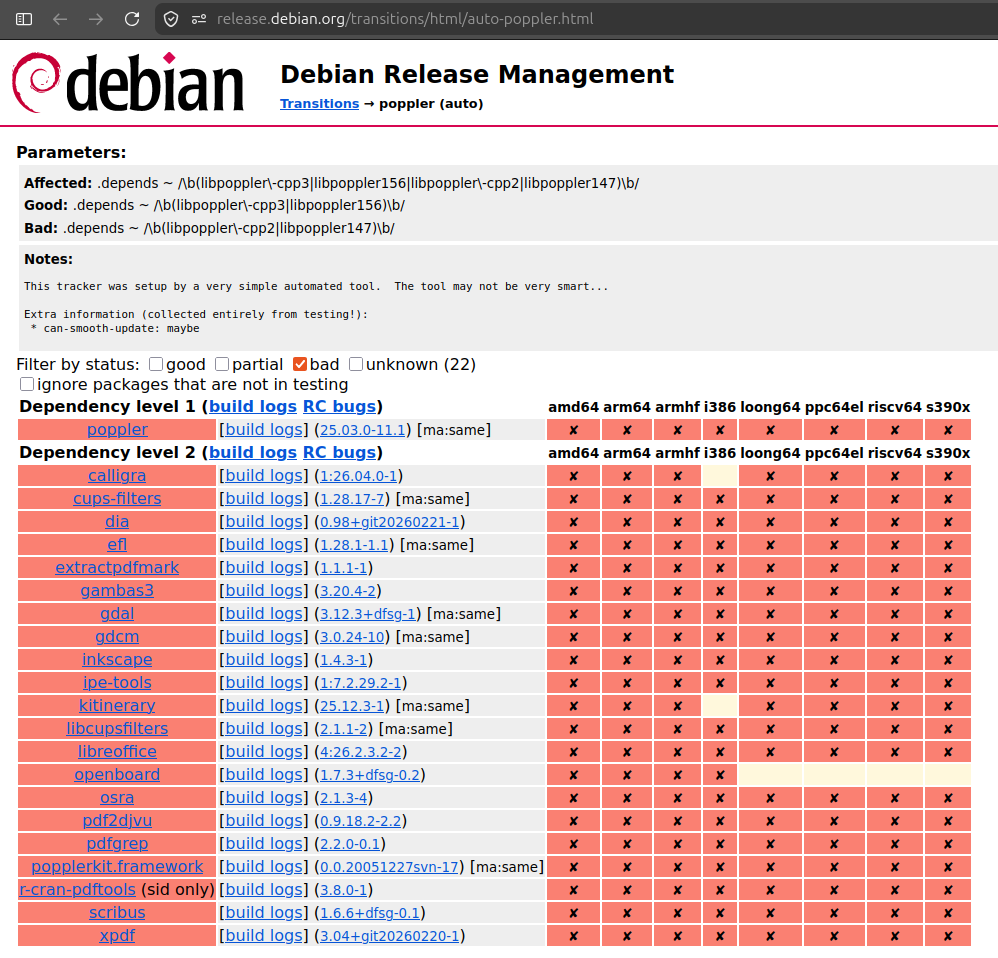
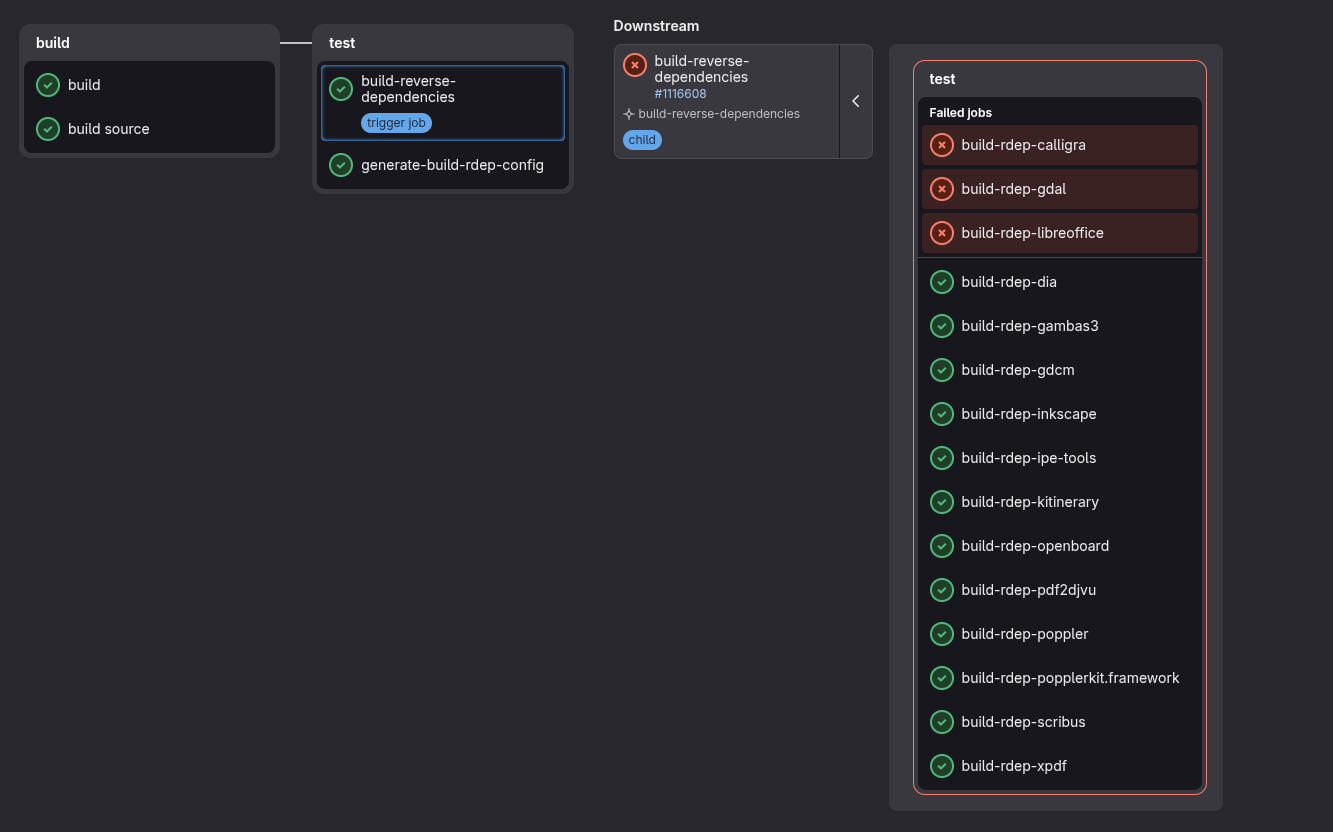
Aquila Macedo Costa: Testing library transitions before they reach unstable

A library transition can affect many packages in Debian. I added a way for Salsa CI to rebuild the ones that depend on the changing library, so maintainers can test the transition before it reaches unstable. The need for this became clear during a proposed Poppler transition. Poppler is a library for rendering PDFs. The reverse-dependency job I had added to Salsa CI queued 100 of 115 candidate rebuilds, even though only about 21 were relevant. The problem was documented in issue #571. Before this change, ratt used every binary package produced by Poppler to decide what to rebuild. That also picked up packages unrelated to the library transition. The tracker listed the old and new library package names, so I used them to focus the selection. Poppler transition tracker showing its Affected, Good, and Bad expressions The Poppler transition tracker identifies the old and new runtime library package names. I added -transition_affected to ratt to implement this selection. The option performs the scan against the selected archive indexes and injects locally built .deb files into each source rebuild. It expects a regex of dependency package names, not a complete Ben expression, so the tracker s Affected expression must be adapted first. I then integrated the mode into Salsa CI. Maintainers can enable transition-aware rebuilds by setting SALSA_CI_BUILD_REVERSE_DEPENDENCIES_TRANSITION_AFFECTED_REGEX. If the variable is unset, the pipeline keeps the existing selection. Salsa CI pipeline showing selected Poppler rebuild jobs A Poppler test showing the selected rebuild jobs. Three jobs reached the CI timeout, they were not confirmed package regressions. I also changed ratt to cover packages targeting experimental. By default, it resolves and rebuilds reverse dependencies from unstable while still injecting the locally built .deb files. This lets a maintainer test a transition staged in experimental against packages currently in unstable. Together, these changes help maintainers focus CI on packages relevant to a library transition and review rebuild results before the new library reaches unstable.

Russ Allbery: Review: Ode to the Half-Broken

Review: Ode to the Half-Broken, by Suzanne Palmer
Publisher: DAW
Copyright: May 2026
ISBN: 0-7564-2013-X
Format: Kindle
Pages: 441
Ode to the Half-Broken is a standalone post-apocalyptic (sort of) science fiction novel. As this novel opens, the unnamed first-person protagonist is waking up in a bathtub in an abandoned building. They are covered in electromagnets and missing one leg. Waking up involved a secure reboot from a protected core kernel, so it is immediately obvious that the protagonist is a robot. That also explains the electromagnets, which interfere with their ability to control their body. Or they would, if the protagonist didn't have long-dormant combat routines available to deploy EM shielding and free themselves from the bathtub. There are no immediate answers to why someone embedded a virus in the data attached to a scientific paper on ants, an act so precisely targeted that it had to be personal. Or what happened to their leg.
"There are a number of electromagnets in the next room," I say. I point. "Behind that wall with all the holes in it." "Those are big holes. And fresh, too," the dog says. "I wonder what made them." "Electromagnets experiencing sudden velocity." The dog gives another of its short barks, and I am more convinced now it is laughing, though I was not attempting to be funny.
Ode to the Half-Broken has a classic science fiction beginning: in medias res in a future science fiction version of Earth where nothing is immediately explained, leaving the reader to work out the date and the setting. Helping us out is the protagonist, who is neither chatty nor very sociable with other characters but keeps up an analytical monologue about the world as they narrate events. We are some decades into a grim future. The United States has largely collapsed. Large parts of New York City are dangerous to humans due to disease and radiation. Neither of those hazards bother the large number of sentient robots; their scarcity, and therefore economy, is instead based on power. Robots that control solar power stations act as low-level mob bosses, trading power for information or labor. Our protagonist doesn't want to care about any of this. They retreated from the world long ago for a solitary life in the former New York Botanical Gardens studying ants. But they need a new leg and the best robot repair person nearby is a human woman outside of the city, so they reluctantly head in that direction, accompanied somewhat surprisingly by a cyborg dog. The typical science fiction apocalypse is caused by something specific. Classically, that event is a nuclear war, but writers found various alternatives before, during, and after the Cold War era: alien invasions, meteor showers, plagues, sea level rise, and peak oil and general environmental collapse, among many others. Less common is a post-apocalyptic novel where the collapse comes from multiple overlapping crises and accumulating failures, from a general failure to meet what Adam Tooze and others call polycrisis. The first time I encountered that style of post-apocalyptic story was in Octavia Butler's Parable of the Sower. It was one of the choices that made (and still makes) that book feel so chillingly realistic. The world background in Ode to the Half-Broken is shaped by that sort of polycrisis collapse. There is no one reason why New York City is a dangerous, irradiated ruin and society has collapsed into isolated and sometimes warring factions. It is not runaway artificial intelligence, or at least not directly; sentient robots were a late-stage innovation of the collapsing US civilization and a tool and accelerator of its many wars, but they were not the cause and may be a critical ingredient in building some functional replacement. Instead, society fell apart because we failed to address any of the growing problems and then turned on each other in the resulting ruins. The reader gets an idiosyncratic view of that collapse in flashback chapters intermixed with the main narrative of the initially unnamed robot protagonist, flashbacks told from the perspective of the man who invented the key component for robot sentience. As you would expect, those two narratives are linked. The reader will not discover how they are linked until late in the story. This book could have been extremely depressing. It is not, which says a great deal about Palmer's skill in telling it. The clinical distance of the protagonist in the early chapters helps considerably: They have rejected involvement in this world and therefore can describe it in detached, factual terms, aided by the tendency of most robots in this story to be slightly more precise, logical, and verbose than the human characters. But as the protagonist's clinical distance fades, as it must to allow the story's emotional stakes to rise, Palmer fills this book with moments of beauty and hope. A former nuclear submarine that has become the mind of a subway car is a key early ally. A collective has turned the Hudson Bridge into a thriving if chaotic community. Self-regulating enclaves of humans and robots are working together to try to build a livable world. Robots oversee pollinator swarms that are attempting to restore plant life, for no reason other than that they like order and stability and see this as a way of restoring both. This is a grim, post-apocalyptic world that does not dwell on either the grimness or the apocalypse. It is instead full of small moments of hope, collaboration, and personal connection. This is a story with villains, danger, pain, and risk. Despite the similar keywords and cover aesthetics, it bears little resemblance to Becky Chambers's philosophical Monk and Robot series. It is not, in any definition of the term, cozy; it's a post-apocalyptic adventure story about a robot and a dog making their way through a ruined civilization and fighting people who are trying to build something even worse on the rubble. But it's also charming and oddly happy. There are strong found-family vibes in the way that a party coalesces around the protagonist and eventually gives them a name, there is the quiet happiness of seeing a grumpy misanthrope slowly come out of their protective shell, and the rail mechs are an absolute delight. Like a lot of stories of happy small-group anarchism, I didn't entirely believe the politics and have some qualms about the realism of the ending, although perhaps I should strive to be as optimistic as Palmer writes. The somewhat dry and fussily precise first-person narration will also not be to everyone's taste; it worked for me by the end of the book, but it took a bit of reading to get used to it. But those quibbles aside, this was quietly lovely. It's a satisfying science fiction adventure story in a world with disturbing parallels to the one we're living in, but which uses those parallels to focus on small-scale collective efforts to build something better. And all the small details of the world-building are delightful: the different tiers of robots and their odd behaviors, the machine sense of purpose, even the mix of suspicion and generosity. The plot has large-scale implications, but it was the human-level details that charmed me. I still want another Fergus novel, but this was a highly successful foray outside of that series. Palmer has won two Hugos for her novellas, so I can't really say she's overlooked, but her novels aren't getting anywhere near the attention they deserve. Highly recommended. There is plenty of world-building room here for a sequel, but Ode to the Half-Broken reaches a satisfying standalone conclusion. So far as I know, no sequel is currently planned. Rating: 8 out of 10

24 September 2026

Russell Coker: Links September 2026

Bjorn Stahl of the Arcan project wrote an insightful blog post The Day of a new Command-Line Interface: Shell [1]. He does a really good job of identifying problems and strategies for dealing with them, the UI of the results isn t suitable to what I do though. Using sqlite as an executable format (replacement for ELF) is one of the wildest ideas I ve seen in a while, it might actually have some good use cases too [2]. Andrew Dana Hudson wrote an interesting LongNow article about SciFi s focus on space travel when it seems unlikely [3]. TheDriven has an informative article about the Hands Off Our Fuel astroturf campaign that uses farmers as the face of an attempt to give tax exemptions to mining companies [4]. The Conversation has an interesting article about the new Chinese regulations restricting access to AI systems to prevent emotional dependence and prevent minors from having virtual partners or relatives [5]. Elana Hashman wrote an informative blog post about Python virtualenvs, has useful information for people who aren t Python experts and just need to get stuff done [6]. We need more systems in the NTP pool, I would consider doing this if I had a server with an IP address that won t change and no risk of bandwidth throttling [7]. Cory Doctorow has some interesting thoughts on the CEO fetish for AI even though it is almost never doing any good [8]. Steve Rose wrote an insightful article for The Guardian about the tech fascists of Silicon Valley [9]. Jacqui Lambie calls Pauline Hanson an angry little woman and a bloody coward , One Nation hate the rule of law [10]. The Conversation has an interesting article about Regime Change, the book about Trump by Maggie Haberman and Jonathan Swan [11]. Elvira Barry wrote an insightful article about the many failures of the Russian legal system, it s interesting to note that ALL those failures match things that the Trump regime is doing [12]. Pyotr Kurzin Geopolitics YouTube channel has an interesting interview about continental vs maritime powers in the context of what the US and Russia are doing [13]. Maxinomica has an interesting video about how China obtained a monopoly on rare earth metals and what happens next [14]. Anarcat wrote an insightful blog post The people vs the AI overlords about the problems that AI software development is bringing [15]. John Goerzen wrote an interesting blog post discussing the issues related to LLM use in FOSS projects [16]. Cybernews has an article about an exploit for Samsung, Xiaomi, Oppo, and OnePlus phones due to bad OEM kernel drivers and bad OEM API proxies, no company should release devices with proprietry drivers [17]. Scott Santens wrote an insightful article about how retraining fails laid-off workers and why UBI is needed when workers get replaced by LLMs [18]. libroot has some information on the Snowden archive and why so little of it has been used by journalists, we need more answers about this [19]. Drew Devault s list of Weird little guys of FOSS is interesting history about some people who are best avoided [20].

20 September 2026

Vincent Bernat: Bot-free self-hosted analytics with GoatCounter on NixOS

In 2016, I removed Google Analytics from this blog to avoid being complicit in feeding the biggest machine for harvesting personal data. Instead, I relied on GoAccess to analyze my server logs.1 For the past couple of years, the statistics have made no sense, despite my attempts to filter bots: AI scrapers inflate the number of visitors to around 2,000 per day. Eventually, I settled on GoatCounter, an open-source, privacy-friendly web analytics platform. I replaced the JavaScript client to filter bots more aggressively and added a CSS fallback. To improve reliability, I implemented a local proxy running on each of the five web servers serving this blog. The rest of this post details how these pieces fit together and how I deploy them on NixOS.

Why GoatCounter? GoatCounter does not collect personal data: instead of storing the reader s IP address or relying on cookies, it creates a session identifier valid for 8 hours from the user agent and the IP address. Its feature set is modest but sufficient for a blog. If you want to look at the interface, GoatCounter s author runs a public instance for his site. A hosted version lets you try it before running your own instance. With a single binary and an SQLite database, GoatCounter is one of the lightest self-hosted solutions. Privacy-friendly alternatives, in increasing order of complexity, include Umami, Plausible, and Rybbit.
GoatCounter dashboard showing some statistics from my blog, including an article on the spanning tree protocol with 1,224 views for the past week, the referrers, and the breakdown of browsers (52% Chrome, 32% Firefox, with 16% for Firefox 155 and 6% for Firefox 156)

Custom JavaScript client GoatCounter includes a small JavaScript client 2,189 bytes minified and gzipped. It ships some features I don t use: a visitor counter, tracking clicks, configurable settings, etc. I replace it with this function to register a hit:
const count = (  event, title   =  ) =>  
  const params = new URLSearchParams( 
    p: event   location.pathname,
    t: title   document.title,
    r: document.referrer,
    q: location.search,
    s: document.documentElement.clientWidth,
    e: !!event,
    rnd: Math.random().toString(36).slice(2, 7),
   );
  fetch( /count?$ params  ,   keepalive: true  ).catch(() =>  );
 ;
To filter bots,2 I go the extra mile by requiring a user interaction an idea I stole from Bear Blog.
let sendHit = () => (sendHit = () =>  , count());
["touchmove", "mousemove", "keydown", "pointerdown"].forEach((eventName) =>
  document.addEventListener(eventName, sendHit,  
    once: true,
    passive: true,
   ),
);
If a reader has disabled JavaScript in their browser, I record the hit using a CSS image. The :hover pseudo-class loads it only after an interaction, another trick stolen from Bear Blog. About 2% of my visitors fit into this bucket.3
<!DOCTYPE html>
<html lang="en" class="nojs">
  <head>
    <script>
      // The JavaScript code for this blog requires ES6
      if ("noModule" in HTMLScriptElement.prototype)
        document.documentElement.classList.remove("nojs");
    </script>
  </head>
  <body>
  <!-- ... -->
    <style>
      .nojs body:hover  
        border-width: 0;
        border-image: url('/count?p=/en/blog/2026-kpi-goodhart&t=Building...&r=NoJS&e=false');
       
    </style>
  </body>
</html>
Where GoAccess reported around 2,000 visitors a day, GoatCounter counts fewer than 200 humans.4 I assume AI scrapers use a low-effort approach: if the content is available without barriers, as on this blog, they don t spawn a complex mechanized browser that could trigger a page view. Even crawlers running JavaScript, like Googlebot with its headless Chromium, do not interact with the page and never trigger the events I listen to. The interaction-based proof of humanity I use is likely to keep working.5

Local proxy Five servers across the world in Europe and in North America serve the content of this website, but GoatCounter runs on only one of them. To avoid losing track of visitors when GoatCounter is down, I run a local proxy listening on the same /count endpoint. On each server, it stores the hits in memory with a buffer large enough to survive several days of downtime. It sends them in batches to the upstream backend using the /api/v0/count authenticated endpoint.
Servers on a map. web02 is in Paris, web03 in Helsinki, web04 in Nuremberg, web05 in Ashburn, web06 in Chicago.
I proposed the code for the proxy in pull request #909. GoatCounter s maintainer declined to maintain so much code for such a niche use case. As a fellow open-source developer, I often hold the same position for my own projects: a one-time contributor effort may translate into a long-term maintainer commitment. I expose the endpoint for the proxy on the domain of this website to evade ad blockers. This sounds like I don t respect the reader s choice, but as GoatCounter is privacy-friendly, I find it acceptable.
location = /count  
  access_log off;
  proxy_pass http://127.0.0.3:8087/count;
  proxy_pass_request_headers off;
  proxy_set_header Accept-Language $http_accept_language;
  proxy_set_header User-Agent $http_user_agent;
  proxy_set_header X-Real-Ip $remote_addr;
 

Deploying on NixOS My web servers run NixOS, a declarative Linux distribution with built-in configuration management. I manage this small fleet with Colmena, a stateless deployment tool for NixOS. My configuration is available on GitHub.

Deploying applications in containers For better isolation, each application runs inside an ephemeral lightweight container, powered by systemd-nspawn. Each container runs a stripped-down NixOS instance. A module wraps NixOS s containers options to avoid repeating the same options for each application.6 The containers share their network namespace with the host: the additional isolation is not worth the increased complexity. For a smaller footprint, I also disable a few non-essential services.
  config, lib, ...  :
let
  cfg = config.luffy.containers;
in
 
  # User-configurable settings for our custom module
  options.luffy.containers = lib.mkOption  
    default =    ;
    description = "Ephemeral containers sharing the host network.";
    type = lib.types.attrsOf (lib.types.submodule  
      options =  
        config = lib.mkOption  
          type = lib.types.deferredModule;
          default =    ;
          description = "NixOS configuration of the container.";
         ;
       ;
     );
   ;
  # Translate our options to NixOS containers
  config =  
    containers = lib.mapAttrs
      (name: container:  
        ephemeral = true;
        autoStart = true;
        privateNetwork = false;
        extraFlags = [ "--resolv-conf=replace-host" ];
        config =  
          imports = [ container.config ];
          networking.firewall.enable = false;
          system.stateVersion = config.system.stateVersion;
          systemd.services =  
            console-getty.enable = false;
            systemd-logind.enable = false;
            systemd-oomd.enable = false;
           ;
         ;
       )
      cfg;
   ;
 
To configure a GoatCounter instance running in a container and listening on 127.0.0.4:8088, we import the module7 and declare the container in the config.luffy.containers attribute set:
  pkgs, config, ...  :  
  imports = [ ./modules/container.nix ];
  config.luffy.containers.goatcounter =  
    config =  
      services.goatcounter =  
        enable = true;
        address = "127.0.0.4";
        port = 8088;
        proxy = true;
       ;
     ;
   ;
 
As the containers are ephemeral, we need to keep persistent data in directories on the host. We add a mounts option and ask NixOS s containers to expose the configured directories through the bindMounts option.
  config, lib, ...  :
let
  cfg = config.luffy.containers;
in
 
  options.luffy.containers = lib.mkOption  
    type = lib.types.attrsOf (lib.types.submodule  
      options =  
        mounts = lib.mkOption  
          type = lib.types.listOf lib.types.str;
          default = [ ];
          description = "Host directories mounted read-write at the same place.";
         ;
       ;
     );
   ;
  config =  
    containers = lib.mapAttrs
      (name: container:  
        bindMounts =
          lib.genAttrs container.mounts (path:   hostPath = path; isReadOnly = false;  );
       )
      cfg;
   ;
 
For example, to persist GoatCounter s database in the /var/db/goatcounter directory on the host, we add the directory to the mounts option and alter the service definition to tell GoatCounter where the database is.
  config, ...  :
let
  databaseDirectory = "/var/db/goatcounter";
in  
  config.luffy.containers.goatcounter =  
    mounts = [ databaseDirectory ];
    config =  
      services.goatcounter =  
        extraArgs = [ "-db=sqlite+$ databaseDirectory /db.sqlite" ];
       ;
     ;
   ;
 
A container may also need some secrets. Colmena can upload secrets without storing them in the Nix store. We add a keys option to our containers. It takes an attribute set mapping secret names to the commands to populate them. Then, the module declares the required secrets to Colmena in the deployment.keys option, makes the container depend on the presence of the secrets, and exposes them to the container.
  config, lib, ...  :
let
  cfg = config.luffy.containers;
in
 
  options.luffy.containers = lib.mkOption  
    type = lib.types.attrsOf (lib.types.submodule  
      options =  
        keys = lib.mkOption  
          type = lib.types.attrsOf (lib.types.listOf lib.types.str);
          default =    ;
          description = "Secrets, as a command to run locally. They are mounted in /etc.";
         ;
       ;
     );
   ;
  config =  
    # Colmena uploads each secret in  /var/keys  and make them available
    # to the group "keys".
    deployment.keys = lib.concatMapAttrs
      (_: container: lib.mapAttrs
        (_: keyCommand:  
          inherit keyCommand;
          group = "keys";
          permissions = "0640";
          destDir = "/var/keys";
         )
        container.keys)
      cfg;
    # The container can only start if the required secrets are available.
    systemd.services = lib.mapAttrs'
      (name: container:
        let
          units = map (key: "$ key -key.service") (lib.attrNames container.keys);
        in
        lib.nameValuePair "container@$ name "  
          requires = units;
          after = units;
         )
      cfg;
    # Mount each secret inside the container.
    containers = lib.mapAttrs
      (name: container:  
        bindMounts = lib.mapAttrs'
          (key: _: lib.nameValuePair "/etc/$ key "  
            hostPath = "/var/keys/$ key ";
            isReadOnly = true;
           )
          container.keys;
       )
      cfg;
   ;
 
For example, GoatCounter needs credentials to download the GeoIP database. I provide a local command to fetch the secret from my password manager and expose it inside the container through the /etc/goatcounter.env environment file.
  pkgs, config, ...  : 
let
  keyCommand = variable: [
    "$ pkgs.runtimeShell "
    "-c"
    "pass show personal/nixops/secrets   grep '^$ variable ='"
  ];
in  
  config.luffy.containers.goatcounter =  
    keys."goatcounter.env" = keyCommand "GOATCOUNTER_GEODB";
    config =  
      systemd.services.goatcounter.serviceConfig =  
        EnvironmentFile = "/etc/goatcounter.env";
        SupplementaryGroups = [ "keys" ];
       ;
     ;
   ;
 

GoatCounter server Nixpkgs already packages GoatCounter. By overriding the src and vendorHash attributes, I reuse its definition for my custom version with the proxy:
  goatcounter, fetchFromGitHub  :
goatcounter.overrideAttrs (_:  
  src = fetchFromGitHub  
    owner = "vincentbernat";
    repo = "goatcounter";
    rev = "feature/proxy";
    hash = "sha256-dJRlQlFu3tjcEgabT1LEbyFrasJlhmYu4L/T7EkoNcY=";
   ;
  vendorHash = "sha256-c9Q5OrbZR+q6pD3SgPPWe8JUzcZco1AVUKGaV61k5DE=";
 )
I wrote a NixOS module to encapsulate GoatCounter: the container definition, the service definition, and the secrets. The module accepts the following options: package, serve.enable, serve.listenAddress, serve.port, and serve.databaseFile. I already detailed the container configuration in the previous section. In the end, I chose not to reuse the GoatCounter module from NixOS: it s small, so it s better to insulate my module from unexpected future changes.
  config, pkgs, lib, ...  :
let
  cfg = config.luffy.goatcounter;
  databaseDirectory = builtins.dirOf cfg.serve.databaseFile;
  chown = "$ pkgs.coreutils /bin/chown -R";
in  
  config.luffy.containers.goatcounter =  
    config.systemd.services.goatcounter =  
      description = "GoatCounter Web Analytics";
      wantedBy = [ "multi-user.target" ];
      serviceConfig =  
        EnvironmentFile = "/etc/goatcounter.env";
        SupplementaryGroups = [ "keys" ];
        DynamicUser = true;
        Restart = "always";
        ExecStart = lib.escapeShellArgs [
          (lib.getExe cfg.package)
          "serve"
          "-listen=$ cfg.serve.listenAddress :$ toString cfg.serve.port "
          "-tls=none"
          "-db=sqlite+$ cfg.serve.databaseFile "
          "-automigrate"
        ];
        # Transfer database ownership to dynamically assigned user "goatcounter".
        ExecStartPre = "+$ chown  goatcounter:goatcounter $ databaseDirectory ";
        ReadWritePaths = databaseDirectory;
       ;
     ;
   ;
 
The following snippet configures GoatCounter to listen on 127.0.0.4:8088:
 
  luffy.goatcounter =  
    serve =  
      enable = true;
      listenAddress = "127.0.0.4";
      port = 8088;
     ;
   ;
 
The last step is to configure nginx to expose GoatCounter on the Internet. I disable the /count endpoint as the local proxy handles it.
  config, ...  :
let
  cfg = config.luffy.goatcounter.serve;
in
 
  services.nginx.virtualHosts."goatcounter.luffy.cx" =  
    forceSSL = true;
    locations =  
      "/" =  
        proxyPass = "http://$ cfg.listenAddress :$ toString cfg.port ";
       ;
      "= /count".extraConfig = ''
        return 404;
      '';
     ;
   ;
 

GoatCounter proxy The same NixOS module configures the local proxy, with the following options: proxy.enable, proxy.listenAddress, proxy.port, and proxy.site the site receiving the batches of page views. The local proxy has no persistent data, but it needs the API key to authenticate to the main GoatCounter instance: its container uses the keys option but not the mounts option.
  config, pkgs, lib, ...  :
let
  cfg = config.luffy.goatcounter;
  keyCommand = _: [ " " ];
in
 
  config.luffy.containers.goatcounter-proxy =  
    keys."goatcounter-proxy.env" = keyCommand "GOATCOUNTER_API_KEY";
    config.systemd.services.goatcounter =  
      description = "GoatCounter Proxy.";
      wantedBy = [ "multi-user.target" ];
      serviceConfig =  
        EnvironmentFile = "/etc/goatcounter-proxy.env";
        SupplementaryGroups = [ "keys" ];
        DynamicUser = true;
        Restart = "always";
        ExecStart = lib.escapeShellArgs [
          (lib.getExe cfg.package)
          "proxy"
          "-site=$ cfg.proxy.site "
          "-listen=$ cfg.proxy.listenAddress :$ toString cfg.proxy.port "
          "-ratelimit=10/1"  # 10 requests per second per IP
        ];
       ;
     ;
   ;
 
For each server, I enable the local proxy with the following snippet. The nginx configuration shown earlier exposes the /count endpoint under the same domain as my blog.
 
  luffy.goatcounter =  
    proxy =  
      enable = true;
      site = "goatcounter.luffy.cx";
      listenAddress = "127.0.0.3";
      port = 8087;
     ;
   ;
 

Backup of the SQLite database with Litestream Litestream is a streaming replication tool for SQLite databases. It compresses the changes committed to the write-ahead log (WAL) next to the database and sends them to a remote destination. I encapsulate its configuration in a NixOS module, which takes an attribute set databases mapping a name to the path of the database to back up. Litestream also runs in a container. I mount the databases to replicate, as well as the secrets to push the backups to a Hetzner storage box using SFTP:
  config, pkgs, lib, ...  :
let
  cfg = config.luffy.litestream;
  databaseDirs = lib.unique (map builtins.dirOf (builtins.attrValues cfg.databases));
in
 
  config = lib.mkIf (cfg.databases !=    )  
    luffy.containers.litestream =  
      mounts = databaseDirs;
      keys."litestream.env" = [
        "$ pkgs.runtimeShell "
        "-c"
        "pass show personal/nixops/secrets   grep '^SQLITE_BACKUP_'"
      ];
     ;
   ;
 
Inside the container, I configure Litestream through NixOS s services.litestream options:
  • full snapshots every day, kept for 15 days,
  • three levels of compaction for transaction files: 5 minutes, 30 minutes, and 3 hours,
  • auto-recovery,8
  • replica stored in a directory matching the host name, and
  • credentials read from /etc/litestream.env and exposed through variable expansion.
  config, pkgs, lib, ...  :
let
  cfg = config.luffy.litestream;
in
 
  config.luffy.containers.litestream =  
    config =  
      # The databases belong to dynamically allocated users, whose UID is
      # not known here, so Litestream runs as root.
      systemd.services.litestream.serviceConfig =  
        User = lib.mkForce "root";
        Group = lib.mkForce "root";
       ;
      # Use NixOS service.
      services.litestream =  
        enable = true;
        environmentFile = "/etc/litestream.env";
        settings =  
          auto-recover = true;
          snapshot =  
            interval = "24h";
            retention = "360h";
           ;
          levels = [
              interval = "5m";  
              interval = "30m";  
              interval = "3h";  
          ];
          dbs = lib.mapAttrsToList
            (name: path:  
              inherit path;
              replica =  
                type = "sftp";
                host = "\$ SQLITE_BACKUP_HOST ";
                user = "\$ SQLITE_BACKUP_USER ";
                password = "\$ SQLITE_BACKUP_PASSWORD ";
                host-key = "\$ SQLITE_BACKUP_HOSTKEY ";
                path = "$ config.networking.hostName /$ name ";
               ;
             )
            cfg.databases;
         ;
       ;
     ;
   ;
 
To back up GoatCounter s database, I declare a goatcounter attribute in luffy.litestream.databases, set to the database path:
  config, ...  :
let
  cfg = config.luffy.goatcounter.serve;
in
 
  luffy.litestream.databases.goatcounter = cfg.databaseFile;
 
On the SFTP server, we can inspect Litestream s work, with the compacted transactions and the full snapshots:
  ls web02/goatcounter/ltx
web02/goatcounter/ltx/0
web02/goatcounter/ltx/1
web02/goatcounter/ltx/2
web02/goatcounter/ltx/3
web02/goatcounter/ltx/9
  ls -lh web02/goatcounter/ltx/1
29.1K Sep  5 01:25 0000000000003f2a-0000000000003f2b.ltx
72.4K Sep  5 02:03 0000000000003f2c-0000000000003f2d.ltx
63.3K Sep  5 02:24 0000000000003f2e-0000000000003f2f.ltx
[ ]
  ls -lh web02/goatcounter/ltx/9
 8.5M Sep  5 02:00 0000000000000001-0000000000003f2b.ltx
 8.5M Sep  6 02:03 0000000000000001-0000000000004008.ltx
 8.6M Sep  7 02:03 0000000000000001-00000000000043a8.ltx
[ ]
We can restore the database from the backup with a few shell commands. First, we stop the containers. Then, we move the damaged database away, invoke litestream restore from the right environment, and restart the containers.9
# systemctl stop container@goatcounter container@litestream
# mv /var/db/goatcounter/db.sqlite ,.old 
# ( . /etc/nixos-containers/litestream.conf ; 
>   set -a ; . /var/keys/litestream.env ; set +a ;
>   $SYSTEM_PATH/sw/bin/litestream \
>     restore -config $SYSTEM_PATH/etc/litestream.yml /var/db/goatcounter/db.sqlite)
# ls -lh /var/db/goatcounter/db.sqlite
-rw-r--r-- 1 root root 20M Sep 20 07:33 /var/db/goatcounter/db.sqlite
# systemctl start container@goatcounter container@litestream

Ten years after removing Google Analytics, JavaScript-based analytics is back on this blog, but without storing cookies or IP addresses, and without involving a third party. I still write for myself first, notably because it lets me dig into a topic and refer back to it years later. But knowing a bit more about my fellow human readers is a nice bonus, even the ones disabling JavaScript.

  1. Nginx scrambles IP addresses before storing them, thanks to the ipscrub nginx module.
  2. GoatCounter already filters some bots based on the user agent or the IP address. But AI scrapers lie about their user agent and hide behind residential proxies.
  3. Without JavaScript, I cannot send the real referrer. I insert NoJS instead.
  4. I am missing the humans reading the RSS feed. I am not comfortable adding a tracking pixel, and bots are likely to fetch it, compromising the statistics. I ll live without counting these readers.
  5. In February 2025, I tested another CSS-only approach without the interaction trick: each page loaded an empty image as a background. Over a month, it recorded up to ten times fewer page views than the nginx logs, even after removing user agents identifying as bots. Compared to this experiment, GoatCounter counts about three times fewer views, 18 months later. As the time ranges differ, this is not an apples-to-apples comparison, but it gives a hint about how efficient bot filtering is.
  6. A NixOS module is a function receiving the configuration of the whole system as config and returning three attributes:
    • imports adds other modules to import,
    • options declares user-configurable settings, each with a type and a default value, and
    • config sets values for options declared by any module, like containers from NixOS.
    If a module does not need to declare options, you can return the config attribute set directly. When a module does not require any argument, you can define it as an attribute set instead.
  7. Most of the time, you don t need an explicit import. NixOS automatically imports the modules shipped with Nixpkgs. For my own modules, some machinery also imports them automatically.
  8. Litestream warns against using the auto-recover option as it can cause data loss. But I don t properly monitor my servers and I prefer uninterrupted backups to a slight chance of losing the last few records.
  9. In my case, the process is slow: around 20 minutes for a 20 MiB database. You can test by restoring to a copy with the -o option, but you still need to stop the Litestream container.

Andrew Cater: Debian 11 is at end of life from Long Term Support

Lots of posts in the debian-user mailing list complaining about updates with Debian 11.11 suddenly failing.

See Debian 11 Long Term Support reaches end-of-lifeAugust 31st, 2026 The Debian Long Term Support (LTS) Team hereby announces that Debian 11 bullseye support has reached its end-of-life today, 31 August 2026, five years after its initial release on 14 August 2021. Starting in September, Debian will not provide further security updates for Debian 11. A subset of bullseye packages will be supported by external parties. Detailed information can be found at Extended LTS. The Debian LTS Team is currently providing security support for Debian 12 bookworm, the current oldstable release. Thanks to the combined efforts of different teams including the Security Team, the Release Team, and the LTS Team, the Debian 12 life cycle encompasses five years. Debian 12 will receive Long Term Support until 30 June 2028. The supported architectures in Debian 12 LTS are amd64, i386, arm64, armhf and ppc64el. For further information about using bookworm LTS and upgrading from bullseye LTS, please refer to LTS/Using. Debian and its LTS Team would like to thank all contributing users, developers, sponsors and other Debian teams who are making it possible to extend the life of previous stable releases, and who have made Bullseye LTS a success. If you rely on Debian LTS, please consider joining the team, providing patches, testing or funding the efforts.

19 September 2026

Kentaro Hayashi: Building with dh-bazel, buildsystem support for debhelper experiment updates

Introduction After bazel-bootstrap 7.7.1 was landed into Debian unstable, I'm working on packaging newer Mozc (Most famous Japanese input method editor) with Bazel. Here is the blog entry initial efforts to build Mozc with Bazel at that time. kenhys.hatenablog.jp Then, I've shared implementing PoC dh-bazel experiment. See why dh-bazel is needed, and prototype about dh-bazel. kenhys.hatenablog.jp As a Bazel beginner, want to know what should pass to Bazel, what should not pass to Bazel.

What is improved in recent dh-bazel? In the previous versions of dh-bazel, it supports only basic features to build with Bazel as a thin wrapper.
%:
        dh $@ --buildsystem=bazel
override_dh_auto_build:
        dh_auto_build -- //:hello
Now, with recent changes, it supports the following environment variables to resolve required system libraries in dynamically. salsa.debian.org
  • DH_BAZEL_OVERRIDE_MODULE
It search the specified modules from bundled dummy modules in dh-bazel. It accept ',' separated paramesters. (e.g. DH_BAZEL_OVERRIDE_MODULE=zlib,zstd) dh-bazel bundles abseil-cpp, apple_support, buildozer, lz4, openssl, protobuf, rules_android_ndk, rules_apple, rules_swift, zlib and zstd as dummy modules to linking system libraries. Now you can use it in debian/rules like this:
#!/usr/bin/make -f
# -*- makefile -*-
#
export DH_BAZEL_OVERRIDE_MODULE=zlib
export DH_VERBOSE=1
%:
        dh $@ --buildsystem=bazel --without=single-binary
override_dh_auto_build:
        dh_auto_build -- //:hello
It is impossible to cover all of system libraries in Debian, so in that case, please consider to use the following DH_BAZEL_PKGCONF_MODULE.
  • DH_BAZEL_PKGCONF_MODULE
It search the specified modules with pkgconf. It is useful when there is no bundled modules in dh-bazel if you want. It accept ',' separated paramesters. (e.g. DH_BAZEL_PKGCONF_MODULE=gtk4-x11,gtk4-unix-print). If DH_BAZEL_PKGCONF_MODULE could not match, then dh-bazel fallback to dig into Build-Depends: field in debian/control. Note that if it is not deterministic (e.g. -dev package provides multiple .pc files) dh-bazel gives up fallback with pkgconf. Now you can use it in debian/rules like this:
#!/usr/bin/make -f
# -*- makefile -*-
#
export DH_BAZEL_PKGCONF_MODULE=gtk4-x11,gtk4-unix-print
export DH_VERBOSE=1
%:
        dh $@ --buildsystem=bazel --without=single-binary
override_dh_auto_build:
        dh_auto_build -- //:hello

Conclusion dh-bazel is still in very early stage prototype, but it resolves some sort of packaging glitches a bit by bit. I hope that it will help package maintainer using Bazel. (dh-bazel is not uploaded into debian/unstable yet, so stay tuned!)

18 September 2026

Paul Tagliamonte: Why Write?

As a graduate of a liberal arts university, I wound up, unsurprisingly, taking a lot of classes in every possible academic discipline. Thinking back to the person that I was going into university, I don t think I would have chosen to take them after all, my degree was in the sciences; I d have been stoked to do nothing more than wall-to-wall computer science until I ran out of coursework and filled the rest of my hours with research and independent studies with my professors (which, I guess I did actually do, just not as much as I would have otherwise). Even this blog s CSS theme (now 18 years old and starting to look it) was something I wrote after receiving and repeatedly re-reading a tattered third-hand copy of The Laws of Thought by George Boole. It was gifted to me by a college friend majoring in philosophy while I was crashing at his rental on the beach. He gave it to me because he knew I liked that shit and, while it was definitely computer science in nature, I would not have read it otherwise. I have vivid memories of sleeping on his la-z-boy surrounded by towers of books he was working through. He went on to do incredible work, getting his PhD, doing research, brilliant writing his death in 2023 has robbed humanity of more time with him. The Laws of Thought sits behind me in my office, and is one of my most valued possessions. My friends mean more to me than I could ever express, and I definitely don t show it enough. Each of my classes made me a more thoughtful person. My professors made me a better, more well-rounded person and a person who attempts to live up to the oft repeated credo of being men and women for others . I did the best I could, even though I was never a particularly good student. Without liberal arts, I don t think I would, dispositionally, have been capable of pushing myself to this day to continue to learn on nights and weekends, for no reason other than wanting to learn. I refuse to stop expanding my perspective, and do my best to approach new problems with as much humility and curiosity as I can muster. Every few days for the last year or so, I have been thinking back to a reading assignment from my junior year that, at the time, I thought was a borderline throwaway filler assignment for the class. The reading is an essay from 1947 by the french existentialist philosopher and libertarian marxist, Jean-Paul Sartre (as some of the more erudite may have now already worked out given the blog s title), Why Write? . I re-read it this week. It is not filler. I remember this essay better than some of the classwork I considered more important at the time.

Why Write? Why Write? starts off by describing the ways in which writing trying to communicate your thoughts, opinions, or feelings to others is an act of projection. The writer will only ever draw from a place of their own subjectivity writing is taking your person and putting it on display. You re choosing what words to use, how to use them, pulling from knowledge you ve accumulated (based on how you ve chosen to spend your time). Spending any amount of your finite existence in order to convey a thought is, itself, announcing to the world that you believe it to be a thought worth sharing. Meanwhile, the act of reading is not simply turning letters into words. Reading is engaging with the work, and understanding the work in a process that looks more like what Sartre terms re-invention or discovery the literary object, though realized through language, is never given in language . It is not enough to read the words in a book end-to-end; you must, as a reader, actively engage with the work to understand what is being communicated by those words. Reading is to take the words on the page, and exceed the mere words through what he calls directed creation . The reader is re-inventing / discovering the writer s thoughts by following their landmarks in the void . And this all makes pretty good sense to me I know if someone is being sarcastic because I know the writer; I have read their words and have read into their words, allowing myself to be directed by the writer into discovering the thought they have left me in their work. I understand that their words are humorous, not irate. Knowing who the author of a work is can completely change the point of a sentence. The fact I m writing about Sartre at all, or that this very writing has been constrained for presentation in this blog s CSS is only happening because of who I am, what things I ve experienced in life, and what has made me, me. Sartre argues that this dyadic coupling between writer and writing means that I, as a writer, can never truly read my own writing. I will never be capable of reading my own work and getting something out of it the work is already an extension of my own person. I can discover no thought in my own works. Of course, Sartre, as an existentialist, is honor bound to go one step further here the reader, by participating in reading a work, is asserting their own freedom. Every time a writer writes [ ] the writer appeals to the reader s freedom to collaborate in the production of [their] work . The creative act may only be complete if both writer and reader have recognized one another and made a choice to do so. No one is compelled to complete the creative act. The things you read matter. Reading something fundamentally alters you as a person you can not simply un-read a thought. Everything you read changes your universe. I have a hunch Sartre would find things like the (original early 2010s era) tl;dr reply to obviously terrible writing absolutely hilarious as a reader s expression of freedom (not to be confused with modern 2020s era usage as shorthand for summary section ). Using your freedom to choose to complete the writer s creative act (or not) is inherently asserting your humanity. I m a bit fuzzy on the specifics of this quote, but I think it was sj who told me at one year s Mystery Hunt that A puzzle is a contract between puzzle author and puzzle solver, the author promises that the puzzle is solvable if you re clever enough . The puzzle author and puzzle solver are engaging in a collaborative production of the work that is only possible by recognizing one another. Similarly, Sartre whatever connections [the reader] may establish among the different parts of the book among the chapters or the words [the reader] has a guarantee, namely, that they have been expressly willed .

Wall Drawing #123 It follows, Sartre argues, that the act of writing, as a means to convey a thought to a reader, may only be completed through the act of reading. Reading can only be done by others; writing, therefore, only exists to be read it can serve no other purpose. Writing and reading are two halves of the same creative, collaborative act, only satisfied when both writer and reader acknowledge one another. Combined, writing and reading are the act of recognizing one another s humanity, thoughts, experiences, consciousness the act of co-creation of thought is the critical aspect of writing and reading reconstructing the author s perspective, thought, intent, point. The co-creation is the point of both reading and writing. Writing without anyone to read the work leaves the writer s bid for co-creation unsatisfied and humanity unrecognized. No thought has been conveyed to any reader, no one has understood the reason behind the landmarks in the void you ve carefully placed, leaving you to either [ ] put down [your] pen or despair . Writing is an appeal to the reader s freedom, and the nature of that freedom is the writer can not control it never being understood is always a possibility any time anyone sets out to write. Nearly 12 years ago, I attempted to read the text on the git manpage generator for the first time I remember the exact feeling of my brain going into git manpage parsing mode where every word was dragging git plumbing megaliths through the sand from their far-flung homes. I can still feel the surface of my desk as I instinctually started to trace out logical connections between git internals referenced as I read along. It took me a good 20 seconds to realize what I was reading made no sense. This website broke Sartre s writer-reader agreement I was attempting to read this website, but there was nothing there. You can mechanically read the git-man-page-generator, but you can never read it it is not possible to read it. It was funny unsettling. Each grasp at a real-looking image in front of me misses, my hand coming back empty. I couldn t get enough of it. I must have tried to read a dozen generations in a row. I had never had something quite that broken pass that far into my consciousness before. Although I kept trying, it never did feel quite the same as that first time; I think fundamentally, I couldn t forget that it was random. While never having anyone read your writing drives them to put down your pen or despair , Sartre never had to contend with the opposite problem being asked to read that which was not written. Reading that which was not written does not merely leave someone unrecognized when a reader makes a choice; instead, it is an inherent violation of the contract between reader and writer. Not only is no humanity being recognized through attempting to read words which were not written, but the reader, not the writer, is the one who bears the burden of unexpected apophenia. The reader, while engaging in co-creation, must now contort themselves to uphold their end of the Sartrean agreement, scrutinizing text to ascribe consciousness, thought and intent only to come back up with pareidolia-fueled echos of one s own self and disfigured half-thoughts of others. The reality is, the modern reader must now mechanically read most written work they come across, scrutinizing text for any signs of thought before truly attempting to read the work. Failing to do this correctly changes our person each time it happens, a small part of us is irrevocably altered. Choosing to engage in this ballet because you wish to do so is one thing this is your right and freedom as a reader but passing words which were not written as your own in an attempt to wrestle a reader s freedom of co-creation from them is another entirely. If you didn t write it, I don t want to read it (dw;dr). Send me your prompt instead.

Louis-Philippe V ronneau: Fake Cash: The World Trade Game

This is a new series1 I'm starting on the tools I have been crafting and buying to play pedagogical games in my Economics classes. These games, aside from being just plain fun for the students, often aim to teach them a lesson via interactive play. Unsurprisingly, it is much easier for them to grok a particular concept this way. Moreover, many students told me these activities were the best part of the classes I teach. The World Trade Game I found out about The World Trade Game in The Handbook of Pluralist Economics Education2, which also contains many other fun pedagogical games. It was first developed by Action Aid, but has since been refined by John Sloman and then by Irene van Staveren, who wrote about her use of the game in the aforementioned book. The goal of this blog entry is not to describe the game and teach you how to play it. If that interests you, either buy the book I mentioned or read about Sloman's version here. No, our focus point here is the tools to play this game: fake cash! Fake cash can be used in many economics pedagogical games and in my opinion, is a worthwhile "investment" of your time and energy. You could indeed play with regular printed sheets of paper listing a value (I sure did!), but using Play Money (a more appropriate term, since we're not trying to defraud anyone) will up your game and create a more immersive atmosphere in your classes. At first, I tried to buy play money. Surely, some commercial offering aiming to create realistic props for movies and TV productions existed? At least in Canada, it turns out the answer was no. The only thing I could find were shady websites and weird expensive listings on AliExpress. Not being tenured yet, I did not try to convince my employer to take a 50-50 chance on supporting criminal endeavours. As such, the next best thing I found was printable play money designed by the Bank of Canada Museum. Their designs were quite nice and met my needs, but their PDF layout made it overly complicated to print large quantities of bills. As such, I played around with GIMP a little and came out with these files. A commercial printer shouldn't have issues printing them on glossy cardstock paper and cutting them up for you: Once printed and cut, you'll unfortunately have to fold each bill by hand. To secure both halves, I ended up using a strip of transparent tape on each long edge. Here is the result, with a real Canadian 20$ bill as a comparison: Stacks of play money bills, with examples of the 5$, 10$, 20$, 50$ and 100$ bills A real Canadian 20$ bill, side-to-side with the play money version

  1. Don't hold your breath though, as I do not currently have a release schedule.
  2. Reardon, J. (2009). The Handbook of Pluralist Economic Education. New York : Routledge.

17 September 2026

Kentaro Hayashi: Building Mozc with dh-bazel, buildsystem support for debhelper

Introduction After bazel-bootstrap 7.7.1 was landed into Debian unstable, I'm working on packaging newer Mozc (Most famous Japanese input method editor) with Bazel. Here is the blog entry initial efforts to build Mozc with Bazel at that time. kenhys.hatenablog.jp

Why dh-bazel? After that, newer Mozc packages are uploaded into experimental and moved to testing phase on experimental now. mozc - Debian Package Tracker When started packaging efforts for newer Mozc with Bazel, I'm a newbie to do it. Now I've got a knowledge to do it a bit, I want to know best practice on packaging X on Debian with Bazel furturmore. Usually there are dh-X for buildsystem X on Debian, but it's not true for Bazel as far as I know. This is why I had started to write dh-bazel. I've wrote initial dh-bazel prototype and post a mail to debian-bazel ML. lists.debian.org dh-bazel supports the following way:
%:
        dh $@ --buildsystem=bazel
override_dh_auto_build:
        dh_auto_build -- //:hello
If you want to build source under src, you could write d/rule like this:
%:
        dh $@
override_dh_auto_build:
        dh_auto_build --buildsystem=bazel --sourcedirectory=src -- //:hello

Conclusion dh-bazel is in very early stage prototype, but I have succeeded to build newer Mozc with some modifications to Mozc debian/rules on experimental with dh-bazel locally! dh-bazel is a thin wrapper for Bazel, so it does not reduce packaging glitches dramatically, but it helps some sort of packaging tasks IMHO. There are some achievement with dh-bazel
  • It helps to do similar building way like other debhelper buildsystem
  • It sets comprehensive Bazel startup options
  • It sets comprehensive Bazel command options
  • If you want to set extra flags, just specify it as additional user options (--override_module=, and so on)
Note that it only simplify dh_auto_build stage, so you must manually install artifacts with .install or something correctly. I hope that it will help package maintainer using Bazel in the future. (dh-bazel is not uploaded into debian/unstable yet, so stay tuned!)

15 September 2026

Paul Tagliamonte: DESFire EV3

I ve long been interested in hardware key material storage devices. I ve been a fan of yubikeys (I still remember when my fancy new NEO-N showed up), PIV (and its associated smattering of additional fields), SaaS HSMs, the kernel keyring, some tooling I ve fairly satisfied with the design of at prior companies, and of course, our dear friend, the TPM. All that is not even to mention the scores of exotic hardware security modules one generally comes across from time to time when you re keeping a sharp eye out that you wind up playing with. The concept of storing private key material on a disk, or even having it in RAM has always skeeved me out, so I have a natural inclination to hardware modules, and how shifting keying material around can change your risks and threat model(s) in interesting ways. I don t remember when I first came across the MIFARE DESFire EV3, but a few weeks ago I did a deep-dive into the state of the art of authentication schemes using ID cards. My complete overview of what tradeoffs exist is pretty extensive (and likely not interesting to the vast majority of the world), but the tl;dr wound up being one of use PIV or use MIFARE DESFire EV3 . I wound up picking DESFire for a recent project, and figured it s worth talking a bit about what I learned, share some thoughts, and some code. That code is published on crates.io/desox, and docs, as is our custom, may be found at docs.rs/desox DESFire supports DES (I m sure most readers saw that one coming), 3DES (I didn t bother playing with 3DES at all) or AES-128 (AFAICT always use this?) keying material. It s worth noting that the DESFire only supports symmetric keys and is not designed for public key cryptography, and operates exclusively using shared symmetric key material. The DESFire EV series use those keys and related authentication schemes to interact with files stored on the on-chip EEPROM (2k, 4k, 8k, and 16k versions exist), or applications (groups of files and authentication keys).

Talking to a DESFire EV3 Interactions with the card are done over NFC (ISO/IEC 14443 Type A), and commands to/from the card may be in the usual ISO/IEC 7816-4 APDU format, or unencapsulated bytes sent to/from the card are sent using a fixed instruction set and return code structure saving a few bytes per message. I ve opted to use their undocumented and proprietary format I found it easier to work with and with a maximum message of 60 bytes, the savings matter a lot. While powered via NFC, the card maintains a small amount of state about the connection between the reader and the card in its RAM, including if the session is authenticated or unauthenticated. I ll dig into how authentication happens later, but it s worth knowing that sessions can become authenticated using one of the symmetric keys shared by the card and the reader. The vast majority of the DESFire commands I know about tend to work while either authenticated or unauthenticated, with a few exceptions (GetUid, ChangeKey, and ChangeKeySettings for example). In general, I found working with this card particularly pleasant. There is a fair amount of backwards-compatible behavior and multiple methods of communication that confuse things a bit, but overall, it was better than average to integrate with. Kudos to the NXP team. If the docs on this chip were public, things would be orders of magnitude easier it s not entirely clear to my why they re keeping so much of the interface documentation under NDA, but it s the largest knock against the chip, by far.

Authentication I found a lot of really great resources outlining how the handshake and protocol works for a DESFire EV3, especially from Ridrix, some public datasheets ThrRealRevK and posts from AndroidCrypto. The gist here is that, because the DESFire only does symmetric key operations, the key exchange (a type of SKA Symmetric Key Agreement) uses symmetric keys to establish a unique session key which is used to sign or encrypt data exchanged between the reader and the card. I m not going to get too in-depth here, since there s a ton of other resources out there to dig into but I will do a quick high-level description to keep this post mostly self-contained. The authentication protocol serves two main functions to verify that both parties know the same shared secret, as well as to act as a SKA to construct a new session shared secret key. Here s a quick overview of how a shared session key is derived between the reader and the card using our symmetric keys (AES-128 in the case below).
  1. the reader requests to start authentication with the card (something like AA 00 to start an AES Authentication handshake with keyslot 0x00).
  2. The card will then reply with AF (a status code that indicates more data is to follow), followed by 16 bytes (in the case of AES-128) of encrypted (using CBC) data.
  3. The hosts then decrypts this block with the symmetric key from keyslot 0, returning the card s session nonce.
  4. The host generates 16 bytes (usually random) for its session nonce.
  5. The host sends an instruction of AF (indicating a continuation of the previous command), followed by 32 bytes of encrypted data. When decrypted, the first 16 bytes are our nonce generated in step #4, followed by the 16 bytes provided by the card, decrypted in step #3, except where every byte is shifted to the left by one place (the 0th byte is copied to the end).
  6. The card will reply with 00 indicating a successful operation, followed by 16 bytes, which when decrypted, is our session nonce from step #4, shifted to the left by one byte in the same way that we did in step #5 with the card s nonce.
  7. At this point, both the reader and card have confirmed the other party has the same symmetric secret key. The session is now authenticated and a session key is derived using the two nonce blocks. Two hashing keys (K1 and K2) are derived from this key, which is used to maintain an ongoing CMAC hash of the messages coming and going to/from the card.
From here on out, the session is authenticated , and responses from the card which were previously plain will now contain a 8-byte CMAC signature, which can be used to ensure that the replies in question come from the active session. In my implementation of the handshake I opted to encode the handshake state into rust types, just so I wouldn t make any mistakes. The Handshake type contains the session internals (session nonce values, keying state, to include IV, etc). This means the authentication flow (from within my code) uses the Handshake struct to generate the commands to send to the card in order:
/// Create a new  Handshake , and return the
/// start auth command (something like  AA 00 )
fn Handshake::<Initial>::begin(
 output: &mut [u8],
 key: [u8; 16],
 key_id: u8,
) -> (Self, &[u8]);
After we get a reply back from the card (the encrypted version of the card s session nonce, sometimes called Rnd_B in code I ve seen), we transition states from Initial into HalfOpen.
/// Given the card's encrypted response, generate
/// our session nonce and generate a reply
/// (something that starts with  AF  followed by
/// 32 bytes of encrypted data).
fn Handshake::<Initial>::rnd_b(
 self,
 output: &mut [u8],
 input: &[u8]
) -> (Handshake::<HalfOpen>, &[u8]);
Now that we re HalfOpen , we re waiting to hear back from the card to ensure that it, too, can byte-shift our provided nonce. Once we have the card s reply, we can check it using our complete helper, transitioning from HalfOpen to Successful.
/// Check to ensure that the card replied with
/// our nonce byte-shifted by one place, indicating
/// that they know the symmetric secret in
/// this key slot.
fn Handshake::<HalfOpen>::complete(
 self,
 input: &[u8]
) -> Handshake::<Successful>;
Once the Handshake is successful, the only thing left to do is consume the Handshake struct and turn it into the shared session key by running it through the key derivation function.
/// Consume the  Handshake  struct and return the
/// new shared session secret key.
fn Handshake::<Successful>::into_key(self) -> [u8; 16];
From here on out we can use this session key for the remainder of our interactions with the card signing messages from (and sometimes to!) the card, or encrypted messages to and from the card. This key is used in CBC block mode, where the session IV is updated with the last block of the encrypted data.

Unit Testing A nice proprietary of the SKA scheme we re using as part of DESFire is that the derived session key is actually deterministic if you control your nonce RNG (ok, actually, pretty true for most key agreements, but anyway), which means it is possible to capture traffic over the NFC interface, and replay the NFC I/O with cooked RNGs and ensure byte-identical messages and keys are generated. Within desox-rs this is called replay (I m creative), and I ve got a few replay sessions checked into VCS, which exercise a signficant amount fo the API surface. All were derived from an actual session with a real DESFire card, and can be updated with a live card and a --cfg flag. Each replay file is a set of lines (request-response transactions), each containing two space-delimited hex encoded NFC messages. For instance, here s an authentication handshake in replay format:
1a00 afc7bbd82ff8fefae8
afc6dab54df2278d2952d560821be7e4c3 007d9abe94a9b14748
The code that generated that exchange came from the test stored adjacent to that file a handshake with the default DES key (all zeros), and an RndA value hardcoded to 32c28fdafd3960de.
let mut card = card
 .authenticate_with_rnd_a(
 0x00,
 Key::Des([0; 8]),
 Key::Des(hex_literal::hex!("32 c2 8f da fd 39 60 de")),
 )
 .await
 .unwrap();
Since the card s RndB is similarly unchanging (I m replaying this file every time), this will always derive the same session key, which means messages (including encrypted ones or CMAC signed responses) will be identical, as well. If you re playing with the DESFire yourself, feel free to grab my replay files if you need a known good baseline. By default this will run using the MockBackend, replaying each file expecting a byte-identical request, and responding with the harcoded customary reply. If the code (or test!) needs to change, updating the tests is done by swapping the MockBackend out for a real one. Since I had to do this a bunch during development, running cargo test with RUSTFLAGS="--cfg desox_replay_rw" will, on run, overwrite the replay file(s) for the executed test(s), ensuring all line-protocol changes are explicitly caught and reviewed.

Observations Most commands, even ones which require authentication, are transmitted without CMAC signature(s) or encryption. CMAC signatures from the reader to the card are not really used (except for writes to a file which specifies communication must be CMAC signed), ditto for encryption (although that one is used for key change operations, in addition to file writes on files that specify encrypted communication must be used). The vast majority of commands take a plain request from the reader, and return a CMAC signed response. By my eye, this means that a malicious reader, or something otherwise capable of holding the card online after communication with an authentic reader is complete are able to execute privilaged commands (since one can simply ignore the CMAC signatures on responses), so long as the command doesn t require the reader to provide CMAC signatures (or encryption), or allow the card to power down.

Fun with DESFire I ve played around a bit with ways to use the DESFire cards in interesting configurations, given what they re capable of. Here s some half-baked thoughts I had while mucking around with the cards these are all poorly thought out sketches of some things we can do given the specific tradeoffs I see with the DESFire card. It s also worth noting that I don t have any of the actual documentation, and am not a cryptographic grown-up, so take these sketches with a massive grain of salt. The first thing that came to mind when implementing this is how the authentication scheme can shift the boundary of what is and is not trusted (assuming good secure keying, and provided the key slots and card/application permissions are configured correctly). Rather than push the key material out to the machine connected to the NFC reader ( reader machine ), I instead tried turning the NFC reader and computer into something psuedo-untrusted by merely having it pass messages from the card to a trusted remote system ( remote machine ). This means that the reader machine is exchanging NFC data with the card, but that data is being decrypted, encrypted and processed by the trusted remote machine the reader is unable to derive the session key. For each of these, I wind up needing to authenticate so there s still a few latent risks, but these can mostly be mitigated by asking for a readbacks of any changed file(s), setting key permissions carefully, and requesting the card s UID via the encrypted channel all of which would require the symmetric secrets (which undermine the whole security model if comprimised). This general construction is also subject to a hostile takeover of the untrusted reader machine , since most commands (including destructive ones!) are sent in PLAIN mode the reader machine can wait until authentication is complete and then inject commands into the card and simply ignore the CMAC signatures on responses, severing ties with the remote machine. As such, we also need to take steps to ensure that the key being used is not one that allows any access beyond what is allowed. Here were some ideas I sketched out off the back of this theory.

The second-factor Given some established (and authenticated) connection, part of the initial authentication flow may use the DESFire card to prove physical control over it as part of a handshake. This can serve as a second factor during some authentication flow, requiring physical card presence at a reader to fully initialize a connection. This does have one glaring downside, however it s phishable. To use this for real , we d need to take some steps to prevent obvious MITM flows (XOR the NFC messages with the URI as seen by the client?), but maybe there s something interesting there. This also has a second interesting attribute when used as part of a physical system authentication flow, this becomes a logical place to inject access control, being able to determine if some person is permitted to operate some device at that particular time (Is Joe current on his Laser Cutter certifications?) I think of the ideas I landed on, while conceptually interesting (using an employee id card as a 2FA token, it s very fast), this one is the least likely to turn into something real.

The takeover This time, let s say the computer attached to the NFC reader ( reader machine ) is semi-trusted. For this scheme, our trusted remote machine and the reader machine pass messages over the network to handle authentication to the card (as above), where the handshake data is being decrypted, encrypted and processed by the trusted remote machine as usual. However, once the authentication handshake is complete and a session key has been derived, the remote system return the session key to the reader machine , giving it a one-time-use key and authenticated session to the card. We need to be careful about global/application permissions and key access control to files but in this construction, we can allow the reader machine to take over privileged actions using a scope-limited DESFire key without handing over the card s true keying material (preventing cloning of the card). This can be helpful to ensure messages to/from the card are truely from the card (verifying CMAC signatures), enables the reader machine to directly read/write to/from encrypted file(s), but allows the symmetric key material to remain in as few places as possible which is critical given compromising that secret will undermine the security of the entire system.

Yves-Alexis Perez: IKEv1 protocol disabled in strongSwan package for Debian unstable

Heads up, Debian IKE/IPsec users. Starting with strongSwan 6.1.0-1 (currently in Debian unstable and targeted at Debian 14 Forky), the IKEv1 protocol has been disabled. This is aligned with upstream decision. Considering IKEv2 is already nearly old enough to drink in the USA (RFC 4306 will turn 21 next December) and IKEv1 has weaknesses, the disabling is long overdue amd will permit upstream to remove some code in the upcoming years. At this point there is no good reason not to migrate to IKEv2 and exposing IKEv1 code in all Debian installation is no longer relevant. All IKEv1 users using Debian 13 Trixie (either site to site, gateway or roadwarrior client) should investigate IKEv2 protocol (or other options). Note that some plugins have also been disabled upstream for security/maintenance reasons and we followed suite in Debian. The Debian relevant ones are: af-alg, led, padlock.

Reproducible Builds: Supporter spotlight: Jochen Sprickerhof on ... Reproducible Builds!

The Reproducible Builds project relies on several projects, supporters and sponsors for financial support, but they are also valued as ambassadors who spread the word about our project and the work that we do. This is the ninth installment in a series featuring the projects, companies and individuals who support the Reproducible Builds project. We started this series by featuring the Civil Infrastructure Platform project, and followed this up with a post about the Ford Foundation as well as recent ones about ARDC, the Google Open Source Security Team (GOSST), Bootstrappable Builds, the F-Droid project, David A. Wheeler, Simon Butler and Kees Cook. Today, however, we will be talking with Jochen Sprickerhof, one of the newer members of the Reproducible Builds project core team.

Vagrant Cascadian: Could you tell me a bit about yourself? What sort of things do you work on? Jochen Sprickerhof: I am a freelance programmer working on Open Source. Mainly doing Debian, F-Droid and some smaller software projects. In general I made it a habit to look into every software I use and try to fix bugs or add features I need. In Debian, I maintain about 180 packages with topics covering home banking, build systems and robotics. Most of my time, I currently work on reproduce.debian.net, where we try to bit-for-bit reproduce the packages distributed by Debian.
Vagrant: Could you describe the path that lead you to working on reproducible builds? Jochen: I started my Debian journey as a teenager, converting my school to Debian and serving as its system administrator for 13 years. After studying Applied System Science, I joined the university s robotics labs, where I worked on the Robot Operating System (ROS) and the Point Cloud Library (PCL). In the end, I enjoyed programming more than writing papers, so I eventually left academia for a robotics startup. Some years ago, I realized that the open source work I was doing in my spare time was actually the work I cared most about. Nowadays I am really grateful that I can spend my days working on things I find important and have lots of fun with.
Vagrant: What projects did you recently make big progress on? Jochen: A recent example is metasnap.debian.net. It is a meta archive of snapshot.debian.org which is itself archive of all packages in Debian. But let me explain it the other way round: with reproduce.debian.net, we try to reproduce the packages as they are distributed by the Debian archive. For that, we need the same build environment (compilers, libraries, build tools, etc) that was used by Debian back when the original package was compiled. Luckily, snapshot.debian.org has all those packages, but they are not easily accessible via apt, Debian s package manager. So, metasnap provides a mapping from a package name and version pair to the APT repo on snapshot.debian.org needed to download it from. It was created by josch some time ago, and it s awesome work. But when we tried to reproduce more and more packages on reproduce.debian.net, we found that some were missing packages from the build environment even though they where visible on snapshot.debian.org. We found that metasnap excluded some archive areas because they where not expected to be needed. Reimporting all the data took more than two months and surfaced a couple more flaws. With this fixed, we were able to build more packages, only to find out that metasnap also needs better support for version numbers. Luckily we were able to rewrite the data in a day instead of starting the import again.
Vagrant: You have been working on infrastructure to support reproducible builds for a while. Has recent adoption of reproduce.debian.net into the Debian release tooling changed the focus of your work? Jochen: Quite a bit. When we started reproduce.debian.net in 2024, only around 33% of the packages could be reproduced successfully. Today we are above 98%. Most were not bugs in the packages themselves but in the infrastructure. Similar to the metasnap issue I reference above, packages just needed a rebuild because something else, like the toolchain, was fixed in the meantime. In May, people from the Debian release team and the Reproducible Builds project sat together and decided that the overall state is good enough, and now packages that regress on reproducibility are blocked from entering the next Debian release. But that does not mean all the work is on the shoulders of Debian package maintainers. Since then I have been constantly looking at the migration tooling to spot regressions and provide fixes. Furthermore, a couple of maintainers reached out to us for help and I hope more will do so in future.
Vagrant: What is one small thing you (or others) have not yet gotten to that you would really like to see? Jochen: The central tool to reproduce Debian packages is debrebuild, also written by josch. Currently it has two ways to retrieve the build dependencies of a package. Either it uses metasnap.debian.net (as explained above), or it can access the Debian unstable APT repository directly. This allows to test packages locally before everything is indexed on metasnap by compiling against Debian unstable. But actually there are many other APT repositories to query, like Debian stable or even derivatives. Adding support for an optional list of APT repositories in debrebuild would be great. That would also be a big step to support reproducing other Debian based distributions.
Vagrant: and one big thing? Jochen: It would be great to integrate metasnap.debian.net into snapshot.debian.org. There is some discussion on it already in Debian bug #650783.
Vagrant: What are the tools you use the most? Jochen: According to my fish shell history:
$ history   cut -d' ' -f1   sort   uniq -c   sort -nr   head -10
  36199 git
  20941 vi
  12271 rm
   8599 cd
   7917 ls
   6407 apt
   5631 grep
   4249 mv
   3655 dpkg
   2873 cp

Vagrant: So, is the fish shell reproducible? I remember it did not used to be Jochen: You can check for yourself it was last time I checked. But looking through the other commands, neovim sadly is not. I hope we can fix that in future.
Vagrant: Oh, that s a nice URL to check for reproducible package you can just pass the source package name to check the current results? Jochen: Yes. Another one is udd.debian.org/reproducibility/, where you can list all packages of a Debian maintainer. It also lists source reproducibility and has nice filters as well.
Vagrant: What tools do you use specifically working on reproducible builds? Jochen: I don t have statistics for that, but I would say sbuild to build the package, debrebuild to reproduce it, and diffoscope to analyze the differences. Obviously I also need run apt source <package> or use git-buildpackage to get the sources and all the tools I mentioned above.
Vagrant: So how many packages are left to build reproducibly, and once those are finished, what is next? Jochen: Right now, reproduce.debian.net shows over 98% reproducibility, though there are still over 650 package left and some will probably need a lot of work. But actually I think making packages reproducible is just the first step. For me, this is a project to build confidence in the system. To reproduce a package we have two parts: the source of the package and the build environment. Fixing the packages means gaining confidence in the first part but we still rely on the individual build environments for each package as we need to use the same compiler that was used when the package was build initially. Because of this, we have to keep around every historical version of all toolchain packages. I really would like to remove this extra archive, which means we would have to rebuild all of Debian around release time. I am dreaming of a Debian release where you could bit-for-bit reproduce every package just from the released versions. Due to how Debian works, however, this is not a trivial rebuild and it would need some work on the infrastructure. By the way, initially there was a third component to pay attention to: any connection to the outside world during the build. Luckily we fixed the Debian build daemons to not allow network connections during the build some time ago.
Vagrant: Thanks for all that work, and taking the time to tell us a bit about yourself! Jochen: Thanks a lot for the interview!


For more information about the Reproducible Builds project, please see our website at reproducible-builds.org. If you are interested in ensuring the ongoing security of the software that underpins our civilisation and wish to sponsor the Reproducible Builds project, please reach out to the project by emailing contact@reproducible-builds.org.

Freexian Collaborators: Debian Contributions: Security-tracker git performance, OpenSSH GSS-API split, Incus replacing lxc in Debian CI and more! (by Anupa Ann Joseph)

Debian Contributions: 2026-08 Contributing to Debian is part of Freexian s mission. This article covers the latest achievements of Freexian and their collaborators. All of this is made possible by organizations subscribing to our Long Term Support contracts and consulting services.

Replacing lxc with Incus for Debian CI, by Antonio Terceiro At the beginning of this month, the default backend for tests was changed to incus-lxc, leaving only a few dozen packages explicitly configured to run as lxc. Those packages got bug reports filed and once those bugs are fixed they will be migrated over to incus-lxc. This marks an important milestone for Debian CI, as the low level of isolation between the worker host OS and the OS under test when using lxc was a significant source of instability in our platform. Common causes for test failures when comparing runs under plain lxc with runs with incus-lxc are documented in the wiki page linked from the bug reports.

security-tracker git performance, by Helmut Grohne Developers working with Debian s security-tracker have reported degrading performance for a while. The options for solving this are few with repository sizes now reaching 30GB for a repository whose working tree is a mere 60MB. While there have been a number of proposals for changing the storage layout, Helmut evaluated options not requiring such changes. Much of the problem hinges on the 50MB data/CVE/list file that is updated in most commits. Efficiency hinges on representing its content in git packs. Practically, git frequently fails to represent its content as a delta and stores a full copy that is typically compressed to 12MB. Add a few thousand 12MB full blobs and you quickly have a large repository. In particular, the copy at salsa.debian.org stores many such full blobs, so pulling from it consumes significant bandwidth. One might think that running git gc helps, but its utility is limited here. When git stores objects in packs, it stores the history in reverse. It starts with the current version and represents older objects as differences (deltas) to more recent objects. A delta effectively is a sequence of copying ranges from a base object and insertion of new content. Given that humans tend to add content over time, those additions are often represented as deletions. The crux here is finding that base object. Given that the data/CVE/list file is large, finding it involves comparing quite a few versions of it with each other. This requires both a significant amount of RAM and CPU time. How many objects git considers for this comparison is controlled with the --window option. It is beneficial if the base object does not come from a direct child commit but skips over commits. In doing so, long chains of deltas are avoided. The --depth option controls the maximum chain length. In this search, git combines all objects into a single window to facilitate file renames. As such, it tends to compare data/CVE/list with data/DSA/list, data/DLA/list and others. This is less than helpful and tends to evict all data/CVE/list versions from the comparison window such that a new full blob of it becomes required. Since the security-tracker repository rarely renames files, we can ask git to instead consider one window per filename via --path-walk. Once doing so, it becomes quite a bit better at finding suitable deltas. The technique is less applicable to older history (2025 and earlier), but given a lot of RAM and a bit of partitioning, git gc can shrink that as well. Combining these techniques, we can shrink the repository into 700MB and keep new growth somewhat under control. Temporarily, Helmut is providing a proof-of-concept mirror at git://git.subdivi.de/~helmut/security-tracker.git using these techniques. Avoid pulling from it directly as it does not provide a secure transport. While it does reduce the amount of data being downloaded, it does not resolve a number of related problems. After downloading, a git client will still expend considerable amounts of CPU on verifying received deltas and attempting to git blame data/CVE/list is not improved in any way. Still, there is work on integrating some of the improvements back into salsa.

OpenSSH GSS-API split, by Colin Watson In an option review Colin did in 2024, shortly after the xz-utils backdoor, he explained that having GSS-API authentication and key exchange support in the main OpenSSH packages is problematic. The key exchange patch is large and intrusive. Even linking to the necessary libraries isn t without risk: as the Ebury malware attack demonstrated way back in 2009, each extra library linked into security-critical daemons such as sshd (or nowadays into its privilege-separated helper programs) can modify the behaviour of the daemon even if you aren t doing anything that would involve calling into that library. Of course some of that risk remains, but as Damien Miller wrote, minimizing the number of libraries that end up in the address space of sshd and friends is still valuable. This split is now complete in testing. As of openssh 1:10.4p1-5, the OpenSSH client and server are built without GSS-API authentication and key exchange support. If you need those features, install openssh-client-gssapi or openssh-server-gssapi instead, as appropriate. Debian 13 (trixie) already has packages with those names that just depend on the regular openssh-client and openssh-server so that you can pre-emptively install them, as documented in the release notes. The new openssh-*-gssapi packages have relatively tight dependencies on openssh-common, in order for the testing migration system to ensure that we can t forget to keep them up to date. This will mean a bit more ongoing work on each new upstream version, but it should be manageable.

Catching up on DebConf video publication, by Stefano Rivera DebConf 25 videos suffered terribly from a bug in voctomix that stopped us from being able to publish the videos immediately after the conference. Ivo De Decker did some work on the videos earlier this year, fixing enough of the audio problems to make the videos at least intelligible. While at MiniDebConf Winterthur Stefano published all the videos from 2025 and 2026 to PeerTube and YouTube. DebConf 25 and DebConf 26 videos as well as all the videos from miniconfs that had got caught up in the backlog were published.

Miscellaneous contributions
  • Carles used po-debconf-manager to review and submit Catalan translations for six packages.
  • Carles prepared a prototype of building webwml and running tidy (linter) in Salsa.
  • Carles created different webwml merge requests with different fixes: invalid links to different architectures, 404s to external sites, fixed templates with invalid URL to favicon.ico, making USE_SAMPLE_FILES=1 to avoid fetching external files, typos in English, etc.
  • Carles updated the LibreOffice Wiki page.
  • Emilio managed several transitions, such as glibc 2.43, perl 5.42, kdepim, nginx, gnome-desktop 51, python3.14-only, and many others.
  • Emilio updated libxfont to 2.0.9, xorg-server to 21.1.24, xwayland to 24.1.13, and fixed a FTBFS bug in terminator.
  • Antonio deployed the website for MiniDebConf Beijing 2026, and archived the Hamburg 2026 and Kanpur 2026 MiniDebConf websites.
  • Antonio released auto-apt-proxy 18, adding new features and fixing bugs; that needed a followup 18.1 release to fix an issue identified in the testing migration tests.
  • Antonio did several Salsa maintenance tasks, including his first platform security update and investigating an issue that was causing the background tasks to be severely delayed, imparting the site usability.
  • Thorsten tried to fix some bugs in hplip and cups. Unfortunately this did not result in an upload this month, but stay tuned!
  • Helmut continued to report undeclared file conflicts and correspond about them.
  • Helmut reviewed and merged Johannes Schauer Marin Rodrigues work on adding hurd support to debvm.
  • Helmut fixed a pile of minor issues in the support libraries underpinning unschroot.
  • Helmut adapted rebootstrap to archive regressions and improved its handling of non-default gcc versions.
  • Helmut fixed the rendering of decompressed logs at crossqa.debian.net.
  • Helmut sent patches for two cross build failures.
  • Colin deployed the fix for Invalid link rel= canonical on bugs.debian.org. In the process he found a few bugs in recent undeployed code and fixed them.
  • Santiago continued helping Aryan Karamtoth with the GSoC project on introducing livepatching support for linux. Several challenges have been identified in the recent couple of months, and Santiago is trying to guide Aryan to address them and design the solution. The mentoring is done in collaboration with Emmanuel Arias.
  • Lucas onboarded a co-maintainer for Valkey.
  • Lucas has started to work on a draft for the Debian Outreach project for onboarding newcomers interested in Debian packaging via a video course.
  • Stefano worked on the after-math of DebConf 26, handling the bursary expense reimbursement process and winding down the conference finances.
  • Stefano uploaded Python 3.15 RC 1 to Debian unstable.
  • Stefano did some budgeting and travel planning for the DebConf 27 site-visit in Asahikawa, Japan. The DebConf committee sends a couple of members to meet with the local team and view the venue together, in advance of the next DebConf.

11 September 2026

Reproducible Builds: Reproducible Builds in August 2026

Welcome to the August 2026 report from the Reproducible Builds project! In our reports, we try to outline the most important things that we have been up to over the past month. As a quick recap about what problem our project intends to solve, whilst anyone may inspect the source code of free software for malicious flaws, almost all software is distributed to end users as pre-compiled binaries. The motivation behind the reproducible builds effort is to ensure no flaws have been introduced during this compilation process by promising identical results are always generated from a given source, thus allowing multiple third-parties to come to a consensus on whether a build was compromised or not. In this month s report, we cover:

  1. New updated SBOM specification from CISA.gov
  2. LWN on Bootstrappable builds at FOSSY 2026
  3. What s missing to have reproducible builds on PyPI?
  4. Distribution work
  5. Unreproducible builds under EROFS filesystem fixed
  6. Tool and documentation development
  7. Six new scholarly papers
  8. Patches

New updated SBOM specification from CISA.gov CISA, the Cybersecurity and Infrastructure Security Agency of the U.S. government published some the joint guidance entitled Minimum Elements for a Software Bill of Materials (SBOM), which updates and supersedes the baseline 2021 version covered in previous editions of these reports. Whilst the PDF is worth skimming, the interesting changes include that the specification now mandates standard cryptographic hashes: unlike earlier standards that allowed hash omission or manifest-only parsing, hashes must be computed from the output. This is is important for reproducible builds, as it ensures the recording of the metadata required to demonstrate the shipped software matches the build output precisely where applicable. In addition, where the top-level only dependency limitation that was present in the 2021 version has been removed in favour of complete coverage with no minimum depth. That is, SBOMs are expected to reflect all linked libraries, vendored dependencies and other build-time inclusions.

LWN on Bootstrappable builds at FOSSY 2026 In the Toolchains and Other Development Tools track at Software Freedom Conservancy s FOSSY 2026 in British Columbia, Canada, Timothy Sample gave a presentation on bootstrappable builds. This presentation was then covered in a Linux Weekly News article by Jake Edge entitled Bootstrappable builds: how and why, which serves as an excellent introduction to the concept:
The basic idea behind bootstrappable builds is to create a system that can be built without relying on pre-built artifacts. Can we go from zero to the modern day without having to just assume the existence of these already-built-for-us artifacts? The classic recipe for yogurt requires some yogurt to start the process, which is like how we normally build a C compiler today we start with an existing C compiler binary. You might think about making sourdough bread with your grandmother s starter brought over from the old country; we re basically making C compilers with Dennis Ritchie s starter carried over from Bell Labs .
The article, which goes on to cover GNU Mes and other projects that overlap with Reproducible Builds, also has a number of thought-provoking comments.

What s missing to have reproducible builds on PyPI? Core Python developer, Brett Cannon wrote an interesting blog post this month addressing What s missing to have reproducible builds on PyPI, the official public repository for third-party Python software packages:
The reason I like the idea of making reproducible builds work is that I think it can be done in such a way as to not require any work on the part of the producer of a distribution (which is a technical term for sdists or wheels, i.e., the people who upload stuff to PyPI), and thus make reproducible builds very low-friction for people to opt into supporting. [ ]
Brett goes on to outline What s missing from the specs and how reproducibility might be visible on PyPI to consumers:
Assuming all of this comes to pass and we record the where the source code is that went into a distribution and the software used to make the distribution, how do we make it useful to people? Does every person who cares about having a secure supply chain have to rebuild everything they use themselves? Is there some way for even people who don t care about this stuff to benefit? [ ]

Distribution work In Debian this month, 23 reviews of Debian packages were added, 28 were updated and 27 were removed this month adding to our knowledge about identified issues. A number of issue types have been updated as well, such as the addition of a new toolchain issue related to python-traitlets [ ], and the note for an existing issue related to texi2html was updated as well [ ]. Lastly, Bernhard M. Wiedemann posted another openSUSE monthly update for their reproducibility work there.

Unreproducible builds under EROFS filesystem fixed Martin Pitt reported on Fosstodon that they had identified an issue where the mkfs ( make filesystem ) command for the EROFS (Enhanced Read-Only File System) subsystem of the Linux kernel did not have sorted extended file attributes, leading to reproducible builds. Thankfully, Martin also reported that they had fixed this in a commit to the kernel which order[s] each inode s xattrs by name so that images stay reproducible . [ ]

Tool and documentation development diffoscope is our in-depth and content-aware diff utility that can locate and diagnose reproducibility issues. This month, Chris Lamb made a number of changes, including preparing and uploading versions 327, 328 and 329 to Debian. In particular, he ensured that diffoscope did not require python3-guestfs in the autopkgtests on 32-bit architectures in order to fix Debian bug (#1144372) [ ]. Colin Watson made an additional change, handling a potentially missing openssh-client package when running the autopkgtests [ ], and Jochen Sprickerhof made a similar change to cope with missing cpio and qemu-img functionality [ ] whilst also updating the XML comparator to be considered when comparing SVG images [ ].
Yet again, there were a number of improvements made to our website this month as well. For example:
  • Chris Lamb added draft for a Gothenburg summit-related news article. [ ][ ]
  • Holger Levsen then published the same article. [ ][ ]
  • Lastly, a large number of commits were pushed comprising an interview with Reproducible Builds developer Jochen Sprickerhof to be published within the next week. [ ][ ][ ][ ][ ][ ][ ]

Six new scholarly papers Jens Dietrich, Spencer Sun, Tim W. White and Behnaz Hassanshahi (the result of a collaboration between Victoria University of Wellington and Oracle Australia published a paper this month entitled No Snake Oil: Verifying Python Package Builds. Drawing on the metaphor of snake oil , that is, a fake or ineffective medicine or solution sold with exaggerated claims of curing or fixing everything, the authors write that
Two tools that are designed to automate [PyPI] rebuilds and run them at scale are macaron and oss-rebuild. We study 12,180 popular releases from PyPI and find that the byte-for-byte equivalence rate is generally low. We analyse the reasons why they produce different wheels, and find that equivalence between the original and rebuilt wheels can often still be established, preserving most of the guarantees users expect from rebuildable releases. We present and evaluate daleq4py, a tool to establish the equivalence of Python wheels through the kernel of a normalisation function that is based on provenance-preserving datalog rules. Experimental results show that daleq4py substantially expands the set of rebuilds that can be accepted as equivalent.
The full PDF of their paper can be viewed online, and Jens Dietrich to our mailing list to announce the availability of both the paper and the daleq4py tool itself.
Dimitri Kokkonis, Micha l Marcozzi and Stefano Zacchiroli published an article this month titled Not In My Git Yard: Catching Backdoors at Commit and Release Time on the topic of code-level backdoors that is, stealthy code changes that grant hidden privileges via secret triggers . These issues:
pose a persistent threat to opensource software. Known attempts to inject such backdoors into widely used projects through malicious commits, tampered release packages, or compromised third-party dependencies, were stopped only by luck and manual review. Existing Continuous Integration (CI) pipelines cannot detect these attacks, and downstream binary analysis tools require substantial manual effort. In this work, we present Lily, an automated approach that strengthens open-source development and release processes against backdoor injection. Lily integrates a backdoor detection mechanism into (1) CI pipelines to block malicious commits, and (2) release vetting workflows to prevent tampered releases or compromised dependencies from entering large ecosystems, such as Linux distributions.
The full PDF can be read online.
Ranindya Paramitha and Laurie Williams of North Carolina State University along with Christian K stner of Carnegie Mellon University published a paper this month with the title of The Software Supply Chain as a Market for Lemons: A Multivocal Review of Trust Signal Collapse. (A lemon in American English, is a vehicle that turns out to have several manufacturing defects .) Their abstract is as follows:
Practitioners evaluating open-source dependencies rely on cheap trust signals, e.g., stars, download counts, and contributor activity, as substitutes for direct code inspection, assuming those signals reflect genuine trustworthiness. Prior work has documented individual signal gaming, but the landscape of collapses across all dependency-adoption signals, as well as the ecosystem s response, remains unexplored. The goal of this study is to aid software practitioners in understanding the reliability of dependency adoption trust signals, such as download counts and contributor activity, by conducting a multivocal review of 252 Google Search sources and 870 Reddit threads.
Worryingly, after their review, the authors conclude that cheap trust signals collapse under three simultaneous forces: adversarial manipulation, gaming techniques indistinguishable from legitimate behavior, and non-adversarial AI-driven inflation. The full PDF of the paper is available online.
Julien Malka, Aman Sharma, Martin Monperrus, Stefano Zacchiroli and Th o Zimmermann published a paper this month on Trusting-Trust Attack against an Entire Linux Distribution through Binary Manipulation:
Ken Thompson s trusting-trust attack, in which a compromised compiler backdoors the programs it builds and reproduces the backdoor in subsequent rebuilds of itself, is widely regarded as a threat specific to compilers. We show that it is not. We construct a complete trusting-trust attack around GNU strip, an ordinary build utility that neither inspects nor generates source code, using only manipulations of finished ELF files.
Scarily, in the authors example, a single tampered strip in the binary seed implants a payload that propagates from one generation of strip to the next and survives into the final standard environment after the seed leaves the dependency closure [ ] without failures and backdoors . A full PDF of the paper is available for download online.
Mehdi Keshanimm, Amirhossein Rahmati, Mohammad Hossein Aref and Abbas Heydarnoori published a paper that is currently under review at Emperical Software Engineering titled AROMA+: A Study of Factors Affecting Reproducible Builds in the Maven Ecosystem. (Maven is a/the build automation tool used for Java projects.) In their paper, the authors note that
[ ] reusing external software in a project presents a security risk when the source of the component is unknown or the consistency of a component cannot be verified. The SolarWinds attack serves as a popular example in which the injection of malicious code into a library affected thousands of customers and caused a loss of billions of dollars. [ ] Our research aims to support [reproducibility] efforts in the Maven ecosystem through automation. We investigate the feasibility of automatically finding the source code of a library from its Maven release and recovering information about the original release environment. Our tool, AROMA+, can obtain this critical information from the artifact and the source repository through several heuristics and we use the results for reproduction attempts of packages on Maven Central.
The full PDF of their article can be downloaded online.
Lastly, Oreofe Solarin, Kelechi Kalu, James C. Davis and Paschal Amusuo published a paper this month titled Reproducibility is Not Enough: Artifact Verifiability in Decentralized-Build Package Ecosystems:
[A]rtifact verification requires more than deterministic builds: a verifier must also recover the source state, build environment, dependencies, and build instructions that produced the artifact. Decentralized-build ecosystems make this difficult because artifacts are produced through heterogeneous tools, maintainer-controlled workflows, and fragmented metadata. As a result, it remains unclear how often artifacts in these ecosystems can be independently verified. This paper studies artifact verifiability across four popular decentralized-build package ecosystems. We define an independent verifier model that relies only on registry-derivable metadata and an artifact comparison model with tiered equivalence levels. We implement these models in an Artifact Verification Pipeline and use it to measure artifact verifiability across the target ecosystems.
The authors conclude that beyond build determinism, verifiability is limited by missing source and build metadata, implicit release transformations, and unconventional build practices . A PDF of their paper can be reviewed online.

Patches The Reproducible Builds project detects, dissects and attempts to fix as many currently-unreproducible packages as possible. We endeavour to send all of our patches upstream where applicable or possible. This month, we wrote a large number of such patches, including:

If you are interested in contributing to the project, please visit our Contribute page on our website.

Next.

Previous.