Reproducible builds folks: Reproducible builds: week 58 in Stretch cycle
What happened in the Reproducible
Builds effort between May 29th and June 4th 2016:
Media coverage
Ed Maste will present Reproducible Builds in FreeBSD at BDSCan 2016 in Ottawa, Canada on June 11th.
GSoC and Outreachy updates
- Satyam blogged about his first experiences hacking on diffoscope.
- Ceridwen wrote about her first steps on reprotest, which now has a git repo.
- Paul Gevers uploaded fpc/3.0.0+dfsg-5 with a new helper script fp-fix-timestamps, which helps with reproducibility issues of PPU files in freepascal packages.
- Sascha Steinbiss uploaded a patched version of epydoc to our experimental repository to test a patch for the use_epydoc issue.
- Initial patch for SOURCE_DATE_EPOCH support in Clang (emaste)
- aft/2:5.098-3 by Robert Lemmen, original patch by Chris Lamb.
- bbswitch/0.8-4 by Vincent Cheng, original patch by Reiner Herrmann.
- cgal/4.8-4 by Joachim Reichel.
- gnuplot/4.6.6-4 by Anton Gladky.
- jmodeltest/2.1.10+dfsg-2 by Andreas Tille.
- kball/0.0.20041216-9 by Markus Koschany, original patch by Reiner Herrmann.
- netmaze/0.81+jpg0.82-15 by John Goerzen, original patches by Chris Lamb (#778200) and Maria Valentina Marin (#793731).
- pacemaker/1.1.15~rc3-1 by Ferenc W gner.
- pam/1.1.8-3.3 by Laurent Bigonville, original patch by Juan Picca.
- plast/2.3.1+dfsg-4 by Sascha Steinbiss.
- prospector/0.11.7-7 by Daniel Stender.
- pymia/0.1.8-1 by Gert Wollny.
- python-cobra/0.4.1-2 by Sascha Steinbiss.
- python-latexcodec/1.0.3-3 by Sascha Steinbiss, original patch by Chris Lamb.
- pyx/0.12.1-5 by Stuart Prescott, original patch by Alexis Bienven e.
- rdp-readseq/2.0.2-2 by Sascha Steinbiss.
- stevedore/1.14.0-1 by Ond ej Nov .
- wise/2.4.1-18 by Sascha Steinbiss.
- binutils/2.26-10 by Matthias Klose, original patch by Chris Lamb.
- pyx3/0.14.1-2 by Stuart Prescott, based on original patch by Alexis Bienven e.
- h2database/1.4.192-1 by Emmanuel Bourg, which forces a specific locale to generate documentation.
- #825764 against docbook-ebnf by Chris Lamb: sort list of globbed files.
- #825857 against python-setuptools by Anton Gladky: sort list of files in native_libs.txt.
- #825968 against epydoc by Sascha Steinbiss: traverse lists in sorted order.
- #826051 against dh-lua by Reiner Herrmann: sort list of Lua versions embedded into control file.
- #826093 against osc by Alexis Bienven e: use
SOURCE_DATE_EPOCHfor manpage date. - #826158 against texinfo by Alexis Bienven : use
SOURCE_DATE_EPOCHfor dates in makeinfo output. - #826162 against slime by Alexis Bienven e: sort list of contributors locale-independently.
- #826209 against fastqtl by Chris Lamb: normalize permissions and order in tarball.
- #826309 against gnupg2 by intrigeri: don't embed hostname and timestamp into gpgv.exe.
- New issues:
- diffoscope 53 was been released by Mattia Rizzolo, with:
- diffoscope 54 (released shortly after) to address a regression involving
--list-tools, where a syntax error prevented proper listing of all tools.
*.epub files.
tests.reproducible-builds.org
- Added pages with oldest logs per arch (h01ger)
- 3 new armhf hosts were added (vagrant)
- setup and maintenance jobs added (h01ger)
- 7 new builder jobs for armhf added (h01ger)
- HOME environment variation on tests.r-b.org and prebuilder (mattia), after Johannes Schauer discovered that this variation was not detected.
- 7 new package sets (for a total of 42) were added by h01ger:
- Improved rescheduling of packages in "depwait" state (h01ger)
- Use eatmydata on i386+armhf (h01ger) (doesn't work yet; needs unreleased pbuilder features)

 What s that? The third edition of


 I spent yesterday at the very enjoyable
 One of my new favorite languages is a peppy little
 Oh, the joys of the Internet.
A Mexican and an Argentinian listening to a Spanish cantaor singing Mexican music for an Argentinian audience, remembering a Costa Rican woman.
What?
Regina and me are finally back home in Mexico, after a month (me) and six weeks (her) of vacations in Argentina. And this week, in the city of Cosqu n (C rdoba, Argentina), they celebrate most important Argentinian folkloric festival. The Cosqu n Festival can be
 Since October 2011 my flatmate and I where quite busy realizing a little pet project of ours called


 Branches are marked with green rectangles, and tags with yellow arrows.
What we have here (expected given our configuration of the tool) are
branches (e.g.
 Branches that were not merged using svn merge look like they were not
merged at all.
 Before being in SVN, the repository was stored in CVS. When it was imported
into SVN, no special attention was given to the commit author. Hence I
got credited for changes I did not write.
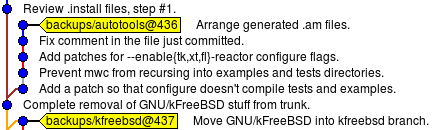 The tool leaves all branches, including removed ones (with tag on their end)
so that you can decide what to do with them.
 The branch

 Quite surprisingly, I ll attend the Chemnitzer Linuxtage 2010 in Eastern
Germany. This is a happenstance, I managed to get fast transportation (via
my boss) and accomodation (in a hotel). I will try to help staffing the



 Linpus Lite (or maybe just aspire one mail) is only going to last a few more days on this aspire1, it's beginning to annoy me:
 (this is an english repost from the original french one, for
planet debian)
Ok, this is just a procedure, which worked for me, for