Search Results: "tach"

14 June 2026

Matthias Klumpp: Introducing pkgcli: A nicer command-line interface for PackageKit

For almost two decades, the PackageKit package management abstraction layer has shipped with pkcon as its command-line client. pkcon does its job, but it was always kind of a testing front-end for the PackageKit daemon rather than a tool designed for everyday use. The focus has instead been on the GUI tools, automatic system updates, GUI application managers and other front-ends. Its command names mirror the D-Bus API almost one-to-one (get-details, get-updates, get-depends), output is very plain, and there is no machine-readable mode for scripting. Most importantly though, there has been no development on it at all for almost a decade, so pkcon was stuck in its rudimentary state from that era.

Since a lot of changes will be coming to PackageKit, and testing the daemon and working with it from the command-line was not very pleasant anymore in 2025/2026, I decided to modernize the tool as part of my work as fellow for the Sovereign Tech Agency last year. pkgcli is the new command-line client for PackageKit. It is built from the ground up to be pleasant to use interactively and easy to drive from scripts.

Why a new tool?

Of course, instead of introducing a new tool, I could have just expanded pkcon instead. The problem with that approach is that the pkcon utility has been around for so long and its command-line API had ossified so much, that rather than changing it and potentially breaking a lot of scripts relying on its quirks, I decided to introduce a new tool instead. pkcon can still be optionally compiled for people who need it in their scripts and workflows.

The goals for pkgcli, and the features it now has are:

  • Human-friendly command names. Verbs that read the way you d describe the task, instead of mirroring the D-Bus API 1:1: show, search, list-updates, what-provides, instead of get-details and friends.
  • Readable, colored output by default (still respecting NO_COLOR and degrading gracefully).
  • A real scripting mode. A global --json flag emits JSONL instead of fully human-readable output when possible, to make it easier to use the tool for scripting purposes.
  • Sensible defaults. A few defaults have been changed, such as the metadata cache-age, or automatic cleanup of unused dependencies being enabled by default. This is more in line with current defaults by other tools and frontends. We also print package information in a slightly different, more readable way.
  • Better handling of internationalized text. Text should now align properly in the terminal window, and we should no longer have completely chaotic text output on non-English locales (especially Chinese/Japanese).

Why not pkgctl?

Originally, this tool was called pkgctl, to match other common cross-distro tool names. However, that name was already taken by an Arch-specific distro development tool. When this issue was raised, we decided to just rename our tool to pkgcli with the next release, to avoid the name clash on Arch Linux.

Examples!

Here are some examples on how to use the new tool (some of which include the abridged output pkgcli prints).

Search for anything containing the string editor in name or description, then look at the details of one result:

$ pkgcli search editor
Querying                  [ ] 100%
  ace-of-penguins 1.5~rc2-7.amd64 [debian-testing-main]
  acorn-fdisk 3.0.6-14.amd64 [debian-testing-main]
  ardour 1:9.2.0+ds-1.amd64 [debian-testing-main]
  audacity 3.7.7+dfsg-1.amd64 [manual:debian-testing-main]
  audacity-data 3.7.7+dfsg-1.all [auto:debian-testing-main]
  augeas-tools 1.14.1-1.1.amd64 [debian-testing-main]
  emacs 1:30.2+1-3.all [debian-testing-main]
  gedit 48.1-9+b1.amd64 [debian-testing-main]
  gedit-common 48.1-9.all [debian-testing-main]
  gedit-dev 48.1-9+b1.amd64 [debian-testing-main]
[...]
$ pkgcli show nano
Package: nano
Version: 9.0-1
Summary: small, friendly text editor inspired by Pico
Description: GNU nano is an easy-to-use text editor originally designed as
 a replacement for Pico, the ncurses-based editor from the non-free mailer
 package Pine.
[...]
URL: https://www.nano-editor.org/
Group: publishing
Installed Size: 2.9 MB
Download Size: 646.0 KB

Search only within package names rather than descriptions:

$ pkgcli search name python3

Check for updates. refresh updates the metadata, then list-updates reports what s available:

$ pkgcli refresh && pkgcli list-updates
Loading cache            [ ] 100%
  cme 1.048-1.all [debian-testing-main]
  gir1.2-gdm-1.0 50.1-2.amd64 [debian-testing-main]
  imagemagick 8:7.1.2.24+dfsg1-1.amd64 [debian-testing-main]
  imagemagick-7-common 8:7.1.2.24+dfsg1-1.all [debian-testing-main]
  imagemagick-7.q16 8:7.1.2.24+dfsg1-1.amd64 [debian-testing-main]
  libdlrestrictions1 0.22.0.amd64 [debian-testing-main]
  libfftw3-bin 3.3.11-1.amd64 [debian-testing-main]
  libfftw3-dev 3.3.11-1.amd64 [debian-testing-main]

Explore relationships between packages:

$ pkgcli list-depends inkscape  # list what inkscape depends on
$ pkgcli list-requiring libappstream5  # list what requires libappstream5

Find the package that provides a capability, here the AV1 GStreamer decoder:

$ pkgcli what-provides "gstreamer1(decoder-video/x-av1)"
  gstreamer1.0-plugins-bad 1.28.3-1.amd64 [auto:debian-testing-main]

You can also have JSON output for most commands! Attach --json to any query and pipe the result straight into jq. Each line is a self-contained JSON object:

$ pkgcli --json list-updates   jq -r '.name'
cme
gir1.2-gdm-1.0
imagemagick
imagemagick-7-common
imagemagick-7.q16
libdlrestrictions1
libfftw3-bin
libfftw3-dev
libfftw3-double3

Try it

pkgcli is built by default alongside the rest of PackageKit since PackageKit 1.3.4. If your distribution ships a recent enough PackageKit, it should already be on your PATH. You can read its man page man pkgcli for more information. Feedback, bug reports, and patches are very welcome.

24 May 2026

Vincent Bernat: Sharding a routing table for lock-free reads in Go

To associate routing information like AS paths or BGP communities to flows, Akvorado can import routes through the BGP Monitoring Protocol (BMP). As the Internet routing table contains more than 1 million routes, Akvorado needs to scale to tens of millions of routes.1 This has been a long-standing challenge,2 but I expect this issue is now fixed by using RIB sharding, a method that splits the routing database into several parts to enable concurrent updates.

Previous implementation Akvorado connects 2 elements to build its RIB:
  1. a prefix tree, and
  2. a list of routes attached to each prefix.
Akvorado BMP RIB implementation before sharding with the memory layout of each structure and a single lock.
Akvorado BMP RIB implementation without sharding. One single read/write lock.
In the diagram above, the RIB stores five IPv4 prefixes and two IPv6 prefixes. One of them, 2001:db8:1::/48, contains three routes:
  • from peer 3, next hop 2001:db8::3:1, AS 65402, AS path 65402, community 65402:31,
  • from peer 4, next hop 2001:db8::4:1, same ASN, AS path, and community,
  • from peer 5, next hop 2001:db8::5:1, AS 65402, AS path 65401 65402, community 65402:31.
The rib structure is defined in Go as follows:
type rib struct  
    tree          *bart.Table[prefixIndex]
    routes        map[routeKey]route
    nlris         *intern.Pool[nlri]
    nextHops      *intern.Pool[nextHop]
    rtas          *intern.Pool[routeAttributes]
    nextPrefixID  prefixIndex
    freePrefixIDs []prefixIndex
 
The prefix tree uses the bart package, an adaptation of Donald Knuth s ART algorithm. The benchmarks demonstrate it outperforms other packages for lookups, insertions, and memory usage.3 Plus, the author is quite helpful.

Storing routes in a map The list of routes for each prefix is not stored directly in the prefix tree: it would put too much pressure on the garbage collector by allocating per-prefix arrays. Instead, the RIB assigns a unique 32-bit prefix identifier for each prefix, either by picking the last available prefix identifier from the freePrefixIDs array if any, or using the nextPrefixID value before incrementing it. Then, the routes are stored in the routes map, leveraging the optimized Swiss table in Go. To retrieve routes attached to a prefix, we look them up one by one in the routes map with a 64-bit key combining the 32-bit prefix index with a 32-bit route index matching the position of the route in the list. Akvorado scans routes from the first to the last to find the best one.4 It knows there is no more route if the route key returns no result.
type prefixIndex uint32
type routeIndex uint32
type routeKey uint64

Interning routes A route contains a BGP peer identifier, a partial NLRI5, the next hop, and the attributes.
type route struct  
    peer       uint32
    nlri       intern.Reference[nlri]
    nextHop    intern.Reference[nextHop]
    attributes intern.Reference[routeAttributes]
    prefixLen  uint8
 
type nlri struct  
    family bgp.Family
    path   uint32
    rd     RD
 
type nextHop netip.Addr
type routeAttributes struct  
    asn              uint32
    asPath           []uint32
    communities      []uint32
    largeCommunities []bgp.LargeCommunity
 
To save memory and allocations, NLRI, next hops, and route attributes are interned : a 32-bit integer replaces the real value. The mechanism predates the unique package introduced in Go 1.23. We keep it because it has different trade-offs:
  • It uses explicit reference counting instead of relying on weak pointers.
  • It works with non-comparable values implementing Hash() and Equal() methods.6
  • It uses explicit pool instances. This will be useful for sharding.
  • It has better performance. See for example this benchmark.
  • It consumes half the memory thanks to unsigned 32-bit references instead of pointers.
  • But it is not safe for concurrent use.

Why does it not scale?

Note At AS 12322, we don t use BMP yet.7 But Gerhard Bogner had the patience, availability, and technical skills to help me debug this issue.

The global read/write lock is a bottleneck in this implementation. But how? There are several users of the RIB, each with its own set of constraints:
  • The Kafka workers look up the RIB to enrich flows with routing information. They are bound by the number of Kafka partitions.8 Akvorado also adjusts their number to ensure efficient batching to ClickHouse. On our setup, the number of workers oscillates between 8 and 16. As we want to observe the latest data, we cannot afford for the Kafka workers to lag too much.
  • The monitored routers send route updates through the BMP protocol. When connecting, they can send millions of routes.9 After the initial synchronization, updates are sent continuously and may spike from time to time. The router detects a stuck BMP station when its TCP window is full and resets the session in this case. While Akvorado implements a large incoming buffer, it still needs to update the received routes with the write lock held fast enough to avoid being detected as stuck.
  • When a remote BGP peer goes down, Akvorado flushes the associated routes by walking the RIB with the write lock held. When a monitored router goes down, Akvorado waits a bit but eventually flushes all the associated routes.
In short: on a busy setup, lock contention is high for both readers and writers, and neither can lag too much behind.

RIB sharding

First step: basic sharding To remove the global lock, the RIB is split into several shards, each one handling a subset of the prefixes:
Akvorado BMP RIB implementation after sharding with the memory layout of each structure and one lock per shard.
Akvorado BMP RIB implementation with sharding.
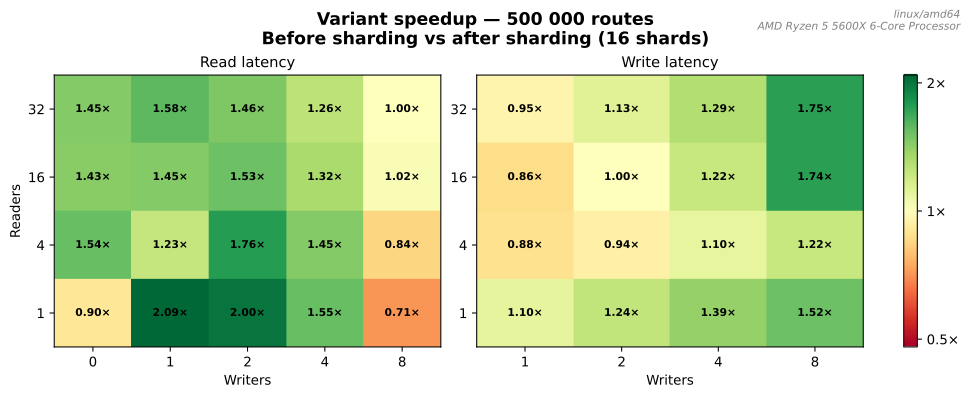
The prefix tree stays global and is protected by a single lock. Each shard gets its read/write lock, its route map, and its intern pools to store NLRIs, next hops, and route attributes, which would not have been possible with Go s unique package. The prefix indexes are also sharded: the 8 most significant bits are the shard index and the 24 remaining bits are the local prefix index. Gerhard confirmed that after this blind change, the BMP receiver chugged steadily. Later, I wrote a concurrent benchmark over half a million synthetic but plausible routes10 partitioned over 0 to 8 writers, churning routes as fast as possible, while 1 to 16 readers continuously look up a set of 10,000 routes. I don t know if this benchmark is realistic, but it confirms the improvements for both read and write latencies:
Two heatmaps. One for read latency ratio, the other for write latency ratio. Both of them comparing the speedup with colored tiles between the code before sharding and after sharding. Most tiles are green.
Read and write latency performance improvement after sharding.
It also shows that a high number of writers degrades read latency.

Second step: lock-free reads The single read/write lock protecting the prefix tree is the next target. The bart package provides alternative mutation methods returning an updated tree using copy-on-write. Readers don t need the global lock any more, leaving it only to synchronize writers. The prefix tree is boxed in an atomic pointer.
Akvorado BMP RIB implementation for sharding with lock-free reads. It shows the memory layout of each structure.
Akvorado BMP RIB implementation with sharding and lock-free reads.
Without a lock, readers can now fetch a stale prefix index when walking their copy of the tree if a concurrent writer removes the last route attached to this prefix index and recycles it for another prefix. To avoid this issue, we combine the prefix index with a generation number and store them in the tree:
type generation uint32
type prefixRef struct  
    idx prefixIndex
    gen generation
 
type rib struct  
    mu     sync.Mutex
    tree   atomic.Pointer[bart.Table[prefixRef]]
    shards []*ribShard
 
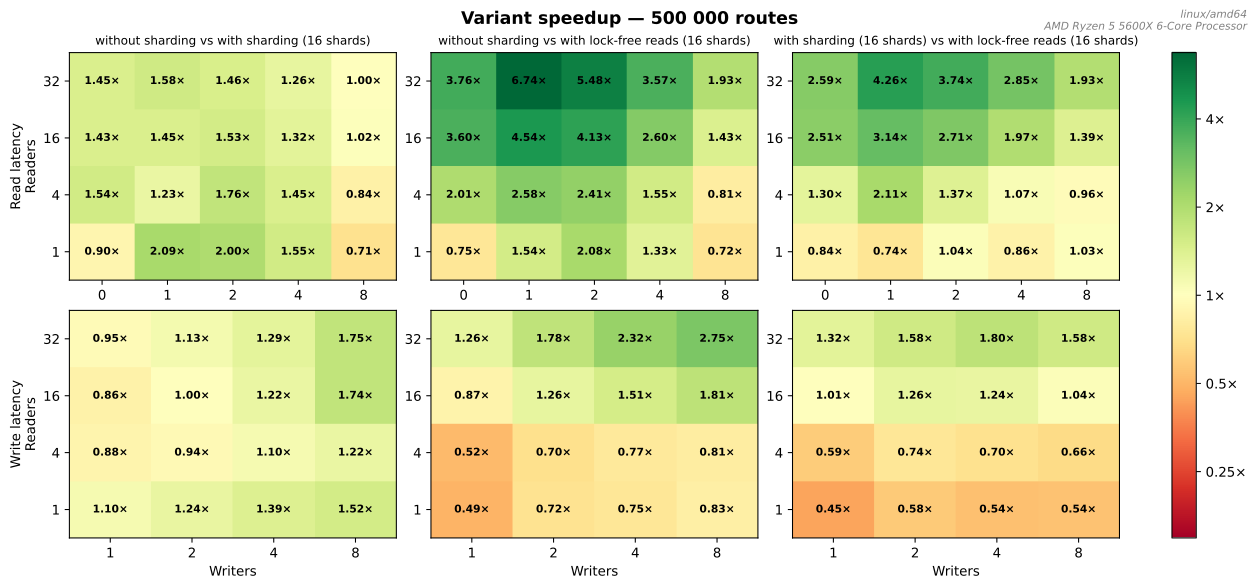
Each shard stores the generation number for each local prefix index. The generation number increases by one if the associated prefix index is freed. When looking up the routes attached to a prefix index, the reader checks if the generation number matches. Otherwise, it assumes the index was recycled and the list of routes is empty.11 You can see this case in the diagram above for prefix index 5, stored with a generation index of 3, while the current value in the []generations array is 4. The generation number could overflow, but it is not a problem as lookups are quick. Running the concurrent benchmark against this new implementation shows the improvements for the read latency as soon as the cost of the copy-on-write prefix tree is amortized.
Six heatmaps. Three for read latency ratio, three others for write latency ratio. They compare the numbers without sharding, with sharding, and with lock-free reads, pair by pair. For read latency, most tiles are green, showing an improvement of the second step. For write latency, the speedup is negative for a low number of readers.
Read and write latency performance improvement after lock-free reads. The middle column shows the cumulative improvements of both steps.

Among the multiple attempts to optimize the BMP component, RIB sharding is one of the more satisfying. Akvorado 2.2 implements the first step. PR #2433, drafted while writing this blog post, implements the second step and was released with Akvorado 2.4.

  1. Each router exporting flows doesn t need to send its routes. When Akvorado does not find a route from a specific device, it falls back to a route sent by another device. It is up to the operator to decide if this is a good enough approximation.
  2. I made many attempts to scale the BMP component. See for example PR #254, PR #255, PR #278, PR #2244, and PR #2245. Despite these efforts, this component remained problematic for some users. See discussion #2287 as the latest example.
  3. It keeps improving: bart 0.28.0 features a new implementation that trades a bit of memory for greater lookup performance. I did not test it yet, as I have been preparing this blog post for a couple of months already.
  4. Akvorado prefers the route matching the exact next hop. Otherwise, it falls back to any other route. This is an approximation. An alternative would be to have one prefix tree for each BGP peer but it would require configuring all routers to export their routes. pmacct s BMP daemon implements this approach.
  5. If we consider the BGP RIB as a database, the Network Layer Reachability Information (NLRI) is the primary key. Its content depends on the BGP family. With IPv4 or IPv6 unicast, this is the prefix. For VPNv4 and VPNv6 families, it includes the route distinguisher. If you enable the ADD-PATH extension, the NLRI also contains a path identifier. In our implementation, we don t store the prefix as we get it from the looked-up IP address using the prefix length stored separately.
  6. The Hash() methods rely on the hash/maphash package and on the unsafe package to avoid memory copies. See for example the Hash() function for the nlri structure.
  7. Despite being an author or co-author of the first BMP-related RFCs since 2016 (RFC 7854, RFC 8671, RFC 9069), Cisco did not implement it in a usable way in IOS XR until version 24.2.1. We still need to upgrade a few routers to enable this feature.
  8. KIP-932 introduces, in Kafka 4.2, the concept of share groups to enable cooperative consumption on the same partition. This is not supported in Akvorado yet.
  9. You can configure BMP to send routes for each BGP peer before or after applying the incoming policies. In this case, you can get more than one million routes for each transit peer. You can also tell BMP to send the local RIB, which only contains the best path for each prefix.
  10. The prefixes are random, but the prefix size distribution and the AS path length distribution follow the data provided by Geoff Huston.
  11. Alternatively, we could retry the lookup, but it would be pointless: the RIB is an eventually consistent database, and an empty list was a correct answer at some point in the recent past.

21 May 2026

Steve McIntyre: Secure Boot and Microsoft CA Rollover - a heads-up for distributions

Background I'm a member of the EFI team in Debian, and I've done much of the work for Debian to support UEFI Secure Boot (SB) in recent years. We have included that support for a number of releases now, starting back with Debian 10 (aka Buster). I'm also a long-time accredited member of the shim-review team, the group that checks and approves shim binaries before Microsoft will sign them. See the Debian wiki for lots of background details about Secure Boot and how we do things in Debian. Secure Boot depends on signatures, which are verified during boot using a chain of X.509 certificates. The root certificate(s) in the chain are embedded in computer firmware, then later software such as shim can add more certificates to extend the trust. Easy, right? The problem - certificates expire... Microsoft administer the most widespread Secure Boot root certificates, and have been doing so since the very beginning of UEFI Secure Boot as a concept. The Microsoft UEFI CA certificates are included in just about every x86 and x86-64 computer shipped, and also in quite a lot of arm64 machines too. (The fact that Microsoft is therefore a gatekeeper for Linux running under Secure Boot on most machines is very unpopular in some quarters, but this is just a fact of life in the world we live in. None of the following will affect you if you're using Secure Boot with your own keys only.) The current certificates have been around since 2011: 1. Windows Production PCA 2011 (used for signing Windows components)
  Subject: C=US, ST=Washington, L=Redmond, O=Microsoft Corporation, CN=Microsoft Windows Production PCA 2011
  Validity
    Not Before: Oct 19 18:41:42 2011 GMT
    Not After : Oct 19 18:51:42 2026 GMT
This expires in October this year, ~5 months from now. 2. Third Party Marketplace Root (used for signing option ROMs and other software)
  Subject: C=US, ST=Washington, L=Redmond, O=Microsoft Corporation, CN=Microsoft Corporation UEFI CA 2011
  Validity
    Not Before: Jun 27 21:22:45 2011 GMT
    Not After : Jun 27 21:32:45 2026 GMT
For Linux folks, this second certificate is more interesting - it is the root of the certificate chain that Microsoft use when signing shim for Linux distributions This CA expires 5 weeks from today. OMG!!! Will all my existing Secure Boot machines stop booting? Almost definitely not, no. The specification for UEFI Secure Boot expects that valid dates on certificates should not be enforced for signatures here. All that matters here is the signatures themselves. Modulo buggy firmware, existing signed binaries should continue just fine. New CAs to be aware of Microsoft have published three new CAs: 1. A new CA used for signing device option ROMs
  Subject: C=US, O=Microsoft Corporation, CN=Microsoft Option ROM UEFI CA 2023
  Validity
    Not Before: Oct 26 19:02:20 2023 GMT
    Not After : Oct 26 19:12:20 2038 GMT
2. A new CA used for signing Windows components
  Subject: C=US, O=Microsoft Corporation, CN=Windows UEFI CA 2023
  Validity
    Not Before: Jun 13 18:58:29 2023 GMT
    Not After : Jun 13 19:08:29 2035 GMT
3. A new CA used for signing other software (e.g. shim)
  Subject: C=US, O=Microsoft Corporation, CN=Microsoft UEFI CA 2023
  Validity
    Not Before: Jun 13 19:21:47 2023 GMT
    Not After : Jun 13 19:31:47 2038 GMT
New machines and updated older machines will most likely have all of these new CAs installed. New machines are already shipping that only include the new CAs; they will not trust older software and this has already started causing problems for some users. Isn't this is all a bit short notice? Yes it is. :-( A common rule of thumb when deploying CA certificates is to start the process of replacement ("rollover") when a certificate reaches half of its lifetime. Unfortunately, Microsoft have done this very late. They generated new keys in 2023, but didn't start signing shim and other third-party software with the UEFI CA until October 2025. If I'm a distro developer, what should I do? If you already have an old shim signed by Microsoft for your distribution from before October 2025, then it will only be signed using the older CA that expires soon. On newer machines, your users will already not be able to boot your distro with Secure Boot enabled. If you want your users to be able to use Secure Boot in future, you will need to get a new shim build submitted, reviewed and signed using the new CA. However, that signed build will not work on older machines unless they have had the new CAs installed. This is also likely to cause problems for some users. You should encourage your users to update their systems NOW before things break for them. There is an interim solution which will work, but only if you're quick! Microsoft are currently returning shim binaries signed using both the old CA and the new CA. More specifically, for every binary that is submitted they will return two: one signed with each CA. If you use these directly, you'll need to plan to publish: and explain to your users how they'll need to pick one. Good luck with that! However, it is possible to extract signatures from those signed shim binaries and attach them all onto one shim, giving you the Holy Grail here - a single shim that will boot on the vast majority of machines. Indeed, this is what I'm planning on doing in Debian. So-called "dual-signed" shims may provoke issues with buggy firmware, so be aware that you may have to deal with this too. But take heart: early testing by various distro folks with a dual-signed Fedora shim did not show any problems. You have 5 weeks and counting... Microsoft have promised to continue signing with the old CA as long as possible, right up to the last day. They understand how awkward things are going to be otherwise, and are trying to help here as much as possible. In the shim-review team, we have been expecting to see a surge of shim submissions before the old CA expires, to make the most of the "Holy Grail" dual-signed shims described above. But we've been really surprised that this has not been happening. So, this blog is a wake-up call for people doing Secure Boot with shim. Even if you're not going to be ready to ship a new shim binary to your users, you should really try to get a new build prepared and signed NOW so that you have it available to tide you over through the coming CA transition. Don't leave it too late. If you're not sure what to do, ask me and the other shim-review folks. We're happy to give advice. But don't delay. You have 5 weeks and counting. How to make a dual-signed shim binary Microsoft only ship binaries with a single signature included. To make things work, extract those signatures using sbattach --detach (from the sbsigntools source package, available in most distributions. Then apply those signatures one at a time to your shim binary, using sbattach --attach. Simple, really. There's one strong recommendation here: order the signatures on your shim oldest first - that way, old buggy firmware implementations that potentially don't look for more than one signature will find the old signature first. pesign can also handle moving signatures around, but I chose sbsigntools when doing this work myself. If you're looking to see how others handle multiple signed shim binaries, feel free to look at the Debian shim-signed package for examples. The repo is https://salsa.debian.org/efi-team/shim-signed.git. References I'll add more links here in the coming weeks.

9 May 2026

Russell Coker: Systemd, Mobile Linux, and Containers

I ve had some problems running apps I want on my Furilabs FLX1s [1], so I decided to install some container environments to test various versions. I started with Debian/Testing so I can test the build process for some packages I m about to upload to Unstable. Systemd Issues When running debootstrap testing testing to setup the chroot the process aborted with errors including the following from the systemd postinst:
Failed to enable units: Protocol driver not attached.
Cannot open '/etc/machine-id': Protocol driver not attached
This turned out to be from trying to run systemctl in the postinst, I just removed the set -e line from /chroot/testing/var/lib/dpkg/info/systemd.postinst and kept on going (I m not planning to actually use systemd so it s failure to setup wasn t a problem). Then I installed a bunch of -dev packages needed to build my package which had a dependency chain that included udev leading to the following error:
Setting up udev (260.1-1) ...
Failed to chase and open directory '/etc/udev/hwdb.d', ignoring: Protocol driver not attached
Failed to chase and open directory '/usr/lib/udev/hwdb.d', ignoring: Protocol driver not attached
Udev is also a part of systemd. Googling for this turned up a closed systemd bug about this indicating that it has a minimum kernel version of 5.10 [2]. The Furiphone has kernel 4.19.325-furiphone-radon due to being based on Android. Checking the kernel version isn t that hard to do, if the systemd programs in question checked the version and reported can t run on kernels prior to 5.10 then it would avoid a lot of confusion and also bug reports that the systemd developers don t want. Some Debian package dependencies can probably do with revision. Installing the packages libkdb3-dev libkf5archive-dev qtdeclarative5-dev qtpositioning5-dev qttools5-dev ideally wouldn t have a dependency chain leading to udev. The Furilabs people appear to have patched the latest Debian version of systemd to work with the older kernels, the version is currently 260.1-1+furios0+git20260425023744.8401044.forky.production. Compile Times I got this working by just editing every postinst script and either removing the set -e or adding an exit 0 at the top, I don t need things to be configured properly for a running OS I just need the files in the right locations for a container. One issue I discovered when I started compiling is that it was only running on 1 core and the nprocs program was returning 1 . The lscpu program showed that only 1 of the 8 cores was online, it was a single Cortex-A78 core. Some combination of putting it in caffeine mode and having the screen on enabled all 6*Cortex-A55 and 2*Cortex-A78 cores. The below table compares compiling Harbour-Amazfish on the Furiphone with all 8 CPU cores active, my E5-2696 v4 workstation (almost the fastest socket 2011-3 CPU ever made), running ARM64 software emulation on a system with two E5-2699A v4 CPUs, and a Radxa 8 core ARM SBC (which I will review in a future blog post). Given that the source apparently limits the parallelism to less than 7 cores on average it s pretty impressive for the elapsed time to be only 2.5* longer on the phone. Emulating the ARM64 build at about 4* the system CPU time is impressive too, as the system has 4.5* as many CPU cores it could theoretically compile ARM code faster than the native ARM hardware I own for any project that uses enough cores.
System User time System time Elapsed %CPU
Furiphone 2252.76 164.51 7:00.88 574
E5-2696 v4 workstation 679.64 119.07 1:58.63 673
2*22core Intel CPUs (qemu) 8476.65 113.14 10:24.57 1375
Radxa 2011.45 239.40 6:25.55 583

22 April 2026

Dirk Eddelbuettel: nanotime 0.3.14 on CRAN: Upstream Maintenance

Another minor update 0.3.14 for our nanotime package is now on CRAN, and has compiled for r2u (and will have to wait to be uploaded to Debian until dependency bit64 has been updated there). nanotime relies on the RcppCCTZ package (as well as the RcppDate package for additional C++ operations) and offers efficient high(er) resolution time parsing and formatting up to nanosecond resolution, using the bit64 package for the actual integer64 arithmetic. Initially implemented using the S3 system, it has benefitted greatly from a rigorous refactoring by Leonardo who not only rejigged nanotime internals in S4 but also added new S4 types for periods, intervals and durations. This release has been driven almost entirely by Michael, who took over as bit64 maintainer and has been making changes there that have an effect on us downstream . He reached out with a number of PRs which (following occassional refinement and smoothing) have all been integrated. There are no user-facing changes, or behavioural changes or enhancements, in this release. The NEWS snippet below has the fuller details.

Changes in version 0.3.14 (2026-04-22)
  • Tests were refactored to use NA_integer64_ (Michael Chirico in #149 and Dirk in #156)
  • nanoduration was updated for changes in nanotime 4.8.0 (Michael Chirico in #152 fixing #151)
  • Use of as.integer64(keep.names=TRUE) has been refactored (Michael Chirico in #154 fixing #153)
  • In tests, nanotime is attached after bit64; this still needs a better fix (Michael Chirico in #155)
  • The package now has a hard dependency on the just released bit64 version 4.8.0 (or later)

Thanks to my CRANberries, there is a diffstat report for this release. More details and examples are at the nanotime page; code, issue tickets etc at the GitHub repository and all documentation is provided at the nanotime documentation site.

This post by Dirk Eddelbuettel originated on his Thinking inside the box blog. If you like this or other open-source work I do, you can now sponsor me at GitHub. You can also sponsor my Tour de Shore 2026 ride in support of the Maywood Fine Arts Center.

30 March 2026

Jamie McClelland: Mailman3 has 2 databases. Whoops.

At May First we have been carefully planning our migration of about 1200 lists from mailman2 to mailman3 for almost six months now. We did a lot of user communications, had several months of beta testing with a handful of lists ported over, and everything was looking good. So we kicked off the migration! But, about 15% of the way through I started seeing sqlite lock errors. Wait, what? I carefully re-configured mailman3 to use postgres, not sqlite. Well, yes, but apparently that was for the database managing the email list configuration, not the database powering the django web app, which, incidentally, also includes hundresds of gigabytes of archives. In other words, the one we really need in postgres, not sqlite.

Moving from sqlite to postgres Well that sucks. We immediately stopped the migration to deal with this. I noticed that the web is full of useful django instructions on how to migrate your database from one database to antoher. However, if you read the fine print, those convenient looking dumpdata loaddata workflows are designed to move the table definitions and a small amount of data. In our case, even after just 15% of our lists moved, our sqlite database was about 30GB. I considered some of the hacks to manage memory and try to run this via django, but eventually decided that pgloader was a more robust option. This option also allowed me to more easily test things out on a copy of our sqlite database (made while mailman was turned off). This way I could migrate and re-migrate the sqlite database over and over without impacting our live installation until I was satisfied it was all working. My first decision was to opt out of pgloader s schema creation. I used django s schema creation tool by:
  • Turning off mailman3 and mailman3-web and changing the mailman web configuration to use the new postgresql database.
  • Running mailman-web migrate
  • Changing the mailman web configuration back to sqlite and starting everything again.
Note: I tried just adding new database settings in the mailman web configuration indexed to new - django has the ability to define different databases by name, then you can run mailman-web migrate --database new. But, during the migration, I caught django querying the sqlite database for some migrations that required referencing existing fields (specifically hyperkitty s 0003_thread_starting_email). I didn t want any of these steps to touch the live database so I opted for the cleaner approach. Once I had a clean postgres schema, I dumped it so I could easily return to this spot. Next I started working on our pgloader load file. After a lot of trial and error, I ended with:
LOAD DATABASE
    FROM sqlite:///var/lib/mailman3/sqlite-postgres-migration/mailman3web.clean.backup.db
    INTO postgresql://mailmanweb:xxxxxxxxxxx@localhost:5432/mailmanweb

WITH data only,
    reset sequences,
    include no drop,
    disable triggers,
    create no tables,
    batch size = 5MB,
    batch rows = 500,
    prefetch rows = 50,
    workers = 2,
    concurrency = 1

SET work_mem to '64MB',
    maintenance_work_mem to '512MB'

CAST type datetime to timestamptz drop default drop not null,
    type date to date drop default drop not null,
    type int when (= precision 1) to boolean using tinyint-to-boolean,
    type text to varchar using remove-null-characters;
The batch, prefetch, workers and concurreny settings are all there to ensure memory doesn t blow up. I also discovered that I had to make some changes to the schema before loading data. Mostly truncating tables that the django migrate command populated to avoid duplicate key errors:
TRUNCATE TABLE django_migrations CASCADE;
TRUNCATE TABLE django_content_type CASCADE;
TRUNCATE TABLE auth_permission CASCADE;
TRUNCATE TABLE django_site CASCADE;
And also, I had to change a column type. Apparently the mailman import process allowed an attachment file name that exceeds the limit for postgres, but was allowed into sqlite:
ALTER TABLE hyperkitty_attachment ALTER COLUMN name TYPE text
When pgloader runs, we still get a lot of warnings from pgloader, which wants to cast columns differently than django does. These are harmless (I was able to import the data without a problem). And there are still a lot of warnings along the lines of:
2026-03-30T14:08:01.691990Z WARNING PostgreSQL warning: constraint hyperkitty_vote_email_id_73a50f4d_fk_hyperkitty_email_id of relation hyperkitty_vote does not exist, skipping
These are harmless as well. They appear because disable triggers disables foreign key constraints. Without it, we wouldn t be able to load tables that require values in tables that have not yet been populated. After all the tweaking, the import of our 30GB sqlite database took about 40 minutes.

Final Steps I think the reset sequences from pgloader should take care of this, but just in case:
mailman-web sqlsequencereset hyperkitty mailman_django auth   mailman-web dbshell
And, just to ensure postgres is optimized, run this in the psql shell:
ANALYZE VERBOSE;

Last thoughts I understand very well all the decisions the mailman3 devs made in designing the next version of mailman, and if I was in the same place I may have made them the same ones. For example, separating the code running the mailing list from the code managing the archives and the web interface makes perfectly good sense - many people might want to run just the mailing list part without a web interface. And building the web interface in django makes a lot of sense as well - why re-invent the wheel? I m sure a lot of time and effort was saved by simply using the built in features you get for free with django. But the unfortunate consequence of these decisions is that sys admins have a much harder time. Almost everyone wants the email lists along with the web interface and the archives. But nobody wants two different configuration files with different syntaxes and logic, not to mention two different command lines to use for maintenance and configuration with completely different APIs. Trying to understand how to change a default template or set list defaults requires a lot of research and usually you have to write a python script to do it. I have finally come to the conclusion that mailman2 is designed for sys admins, while mailman3 is designed for developers. Despite these short comings, I am impressed with the community and their quick and friendly responses to the questions of a confused sys admin. That might be more valuable than anything else.

21 March 2026

C.J. Collier: The WWW::Mechanize::Chrome Saga: A Comprehensive Narrative of PR #104

The
WWW::Mechanize::Chrome Saga: A Comprehensive Narrative of PR #104 This document synthesizes the extensive work performed from March
13th to March 20th, 2026, to harden, stabilize, and refactor the
WWW::Mechanize::Chrome library and its test suite. This
effort involved deep dives into asynchronous programming,
platform-specific bug hunting, and strategic architectural
decisions.

Part I:
The Quest for Cross-Platform Stability (March 13 16) The initial phase of work focused on achieving a green test suite
across a variety of Linux distributions and preparing for a new release.
This involved significant hardening of the library to account for
different browser versions, OS-level security restrictions, and
filesystem differences.

Key Milestones &
Engineering Decisions:
  • Fedora & RHEL-family Success: A major effort
    was undertaken to achieve a 100% pass rate on modern Fedora 43 and
    CentOS Stream 10. This required several key engineering decisions to
    handle modern browser behavior:
    • Decision: Implement Asynchronous DOM Serialization
      Fallback. Synchronous fallbacks in an async context are
      dangerous. To prevent Resource was not cached errors during
      saveResources, we implemented a fully asynchronous fallback
      in _saveResourceTree. By chaining
      _cached_document with DOM.getOuterHTML
      messages, we can reconstruct document content without blocking the event
      loop, even if Chromium has evicted the resource from its cache. This
      also proved resilient against Fedora s security policies, which often
      block file:// access.
    • Decision: Truncate Filenames for Cross-Platform
      Safety. To avoid File name too long errors,
      especially on Windows where the MAX_PATH limit is 260
      characters, filenameFromUrl was hardened. The filename
      truncation was reduced to a more conservative 150
      characters, leaving ample headroom for deeply nested CI
      temporary directories. Logic was also added to preserve file extensions
      during truncation and to sanitize backslashes from URI paths.
    • Decision: Expand Browser Discovery Paths. To
      support RHEL-based systems out-of-the-box, the
      default_executable_names was expanded to include
      headless_shell and search paths were updated to include
      /usr/lib64/chromium-browser/.
    • Decision: Mitigate Race Conditions with Stabilization Waits
      and Resilient Fetching. On fast systems,
      DOM.documentUpdated events could invalidate
      nodeIds immediately after navigation, causing XPath queries
      to fail with Could not find node with given id . A small stabilization
      sleep(0.25s) was added after page loads to ensure the DOM
      is settled. Furthermore, the asynchronous DOM fetching loop was hardened
      to gracefully handle these errors by catching protocol errors and
      returning an empty string for any node that was invalidated during
      serialization, ensuring the overall process could complete.
  • Windows Hardening:
    • Decision: Adopt Platform-Aware Watchdogs. The test
      suite s reliance on ualarm was a blocker for Windows, where
      it is not implemented. The t::helper::set_watchdog function
      was refactored to use standard alarm() (seconds) on Windows
      and ualarm (microseconds) on Unix-like systems, enabling
      consistent test-level timeout enforcement.
  • Version 0.77 Release:
    • Decision: Adopt SOP for Version Synchronization.
      The project maintains duplicate version strings across 24+ files. A
      Standard Operating Procedure was adopted to use a batch-replacement tool
      to update all sub-modules in lib/ and to always run
      make clean and perl Makefile.PL to ensure
      META.json and META.yml reflect the new
      version. After achieving stability on Linux, the project version was
      bumped to 0.77.
  • Infrastructure & Strategic Work:
    • The ad2 Windows Server 2025 instance was restored and
      optimized, with Active Directory demoted and disk I/O performance
      improved.
    • A strategic proposal for the Heterogeneous Directory
      Replication Protocol (HDRP) was drafted and published.

Part II: The
Great Async Refactor (March 17 18) Despite success on Linux, tests on the slow ad2 Windows
host were still plagued by intermittent, indefinite hangs. This
triggered a fundamental architectural shift to move the library s core
from a mix of synchronous and asynchronous code to a fully non-blocking
internal API.

Key Milestones &
Engineering Decisions:
  • Decision: Expose a _future API.
    Instead of hardcoding timeouts in the library, the core strategy was to
    refactor all blocking methods (xpath, field,
    get, etc.) into thin wrappers around new non-blocking
    ..._future counterparts. This moved timeout management to
    the test harness, allowing for flexible and explicit handling of
    stalls.
    # Example library implementation
    sub xpath($self, $query, %options)  
        return $self->xpath_future($query, %options)->get;
     
    
    sub xpath_future($self, $query, %options)  
        # Async implementation using $self->target->send_message(...)
     
  • Decision: Centralize Test Hardening in a Helper.
    A dedicated test library, t/lib/t/helper.pm, was created to
    contain all stabilization logic. Safe wrappers (safe_get,
    safe_xpath) were implemented there, using
    Future->wait_any to race asynchronous operations against
    a timeout, preventing tests from hanging.
    # Example test helper implementation
    sub safe_xpath  
        my ($mech, $query, %options) = @_;
        my $timeout = delete $options timeout    5;
        my $call_f = $mech->xpath_future($query, %options);
        my $timeout_f = $mech->sleep_future($timeout)->then(sub   Future->fail("Timeout")  );
        return Future->wait_any($call_f, $timeout_f)->get;
     
  • Decision: Refactor Node Attribute Cache.
    Investigations into flaky checkbox tests (t/50-tick.t)
    revealed that WWW::Mechanize::Chrome::Node was storing
    attributes as a flat list ([key, val, key, val]), which was
    inefficient for lookups and individual updates. The cache was refactored
    to definitively use a HashRef, providing O(1) lookups
    and enabling atomic dual-updates where both the browser property (via
    JS) and the internal library attribute are synchronized
    simultaneously.
  • Decision: Implement Self-Cancelling Socket
    Watchdog. On Windows, traditional watchdog processes often
    failed to detect parent termination, leading to 60-second hangs after
    successful tests. We implemented a new socket-based watchdog in
    t::helper that listens on an ephemeral port; the background
    process terminates immediately when the parent socket closes,
    eliminating these cumulative delays.
  • Decision: Deep Recursive Refactoring & Form
    Selection. To make the API truly non-blocking, the entire
    internal call stack had to be refactored. For example, making
    get_set_value_future non-blocking required first making its
    dependency, _field_by_name, asynchronous. This culminated
    in refactoring the entire form selection API (form_name,
    form_id, etc.) to use the new asynchronous
    _future lookups, which was a key step in mitigating the
    Windows deadlocks.
  • Decision: Fix Critical Regressions & Memory
    Cycles.
    • Evaluation Normalization: Implemented a
      _process_eval_result helper to centralize the parsing of
      results from Runtime.evaluate. This ensures consistent
      handling of return values and exceptions between synchronous
      (eval_in_page) and asynchronous (eval_future)
      calls.
    • Memory Cycle Mitigation: A significant memory
      leak was discovered where closures attached to CDP event futures (like
      for asynchronous body retrieval) would capture strong references to
      $self and the $response object, creating a
      circular reference. The established rule is to now always use
      Scalar::Util::weaken on both $self and any
      other relevant objects before they are used inside a
      ->then block that is stored on an object.
    • Context Propagation (wantarray): A
      major regression was discovered where Perl s wantarray
      context, which distinguishes between scalar and list context, was lost
      inside asynchronous Future->then blocks. This caused
      methods like xpath to return incorrect results (e.g., a
      count instead of a list of nodes). The solution was to adopt the Async
      Context Pattern : capture wantarray in the synchronous
      wrapper, pass it as an option to the _future method, and
      then use that captured value inside the future s final resolution
      block.
      # Synchronous Wrapper
      sub xpath($self, $query, %options)  
          $options  wantarray   = wantarray; # 1. Capture
          return $self->xpath_future($query, %options)->get; # 2. Pass
       
      
      # Asynchronous Implementation
      sub xpath_future($self, $query, %options)  
          my $wantarray = delete $options  wantarray  ; # 3. Retrieve
          # ... async logic ...
          return $doc->then(sub  
              if ($wantarray)   # 4. Respect
                  return Future->done(@results);
                else  
                  return Future->done($results[0]);
               
           );
       
    • Asynchronous Body Retrieval & Robust Content
      Fallbacks: Fixed a bug where decoded_content()
      would return empty strings by ensuring it awaited a
      __body_future. This was implemented by storing the
      retrieval future directly on the response object
      ($response-> __body_future ). To make this more robust,
      a tiered strategy was implemented: first try to get the content from the
      network response, but if that fails (e.g., for about:blank
      or due to cache eviction), fall back to a JavaScript
      XMLSerializer to get the live DOM content.
    • Signature Hardening: Fixed Too few arguments
      errors when using modern Perl signatures with
      Future->then. Callbacks were updated to use optional
      parameters (sub($result = undef) ... ) to gracefully
      handle futures that resolve with no value.
    • XHTML Split-Brain Bug: Resolved a
      long-standing Chromium bug (40130141) where content provided via
      setDocumentContent is parsed differently than content
      loaded from a URL. A workaround was implemented: for XHTML documents,
      WMC now uses a JavaScript-based XPath evaluation
      (document.evaluate) against the live DOM, bypassing the
      broken CDP search mechanism.

Derived Architectural Rules
& SOPs:
  • Rule: Always provide _future variants.
    Every library method that interacts with the browser via CDP must have a
    non-blocking asynchronous counterpart.
  • Rule: Centralize stabilization in the test layer.
    All timeout and retry logic should reside in the test harness
    (t/lib/t/helper.pm), not in the core library.
  • Rule: Explicitly propagate wantarray
    context. Synchronous wrappers must capture the caller s context
    and pass it down the Future chain to ensure correct
    scalar/list behavior.
  • Rule: The entire call chain must be asynchronous.
    To enable non-blocking timeouts, even a single hidden blocking call in
    an otherwise asynchronous method will cause a stall.
  • SOP: Reduce Library Noise. Diagnostic messages
    (warn, note, diag) should be
    removed from library code before commits. All such messages should be
    converted to use the internal $self->log('debug', ...)
    mechanism, ensuring a clean TAP output for CI systems.

Part III: The
MutationObserver Saga (March 19) With most of the library refactored to be asynchronous, one stubborn
test, t/65-is_visible.t, continued to fail with timeouts.
This led to an ambitious, but ultimately unsuccessful, attempt to
replace the wait_until_visible polling logic with a more
modern MutationObserver.

Key Milestones & Challenges:
  • The Theory: The goal was to replace an inefficient
    repeat sleep loop with an event-driven
    MutationObserver in JavaScript that would notify Perl
    immediately when an element s visibility changed.
  • Implementation & Cascade Failure: The
    implementation proved incredibly difficult and introduced a series of
    new, hard-to-diagnose bugs:
    1. An incorrect function signature for
      callFunctionOn_future.
    2. A critical unit mismatch, passing seconds from Perl to JavaScript s
      setTimeout, which expected milliseconds.
    3. A fundamental hang where the MutationObserver s
      JavaScript Promise would never resolve, even after the
      underlying DOM element changed.
  • Debugging Maze: Multiple attempts to fix the
    checkVisibility JavaScript logic inside the observer
    callback, including making it more robust by adding DOM tree traversal
    and extensive console.log tracing, failed to resolve the
    hang. This highlighted the opacity and difficulty of debugging complex,
    cross-language asynchronous interactions, especially when dealing with
    low-level browser APIs.

Procedural Learning:
Granular Edits The effort was plagued by procedural missteps in using automated
file-editing tools. Initial attempts to replace large code blocks in a
single operation led to accidental code loss and match failures.
  • Decision: Adopt Delete, then Add Workflow.
    Following forceful user correction, a new SOP was established for all
    future modifications:
    1. Isolate: Break the file into small, manageable
      chunks (e.g., 250 lines).
    2. Delete: Perform a delete operation by replacing
      the old code block with an empty string.
    3. Add: Perform an add operation by inserting the
      new code into the empty space.
    4. Verify: Verifying each atomic step before
      proceeding. This granular process, while slower, ensured surgical
      precision and regained technical control over the large
      Chrome.pm module.
The consistent failure of the MutationObserver approach
eventually led to the decision to abandon it in favor of stabilizing the
original, more transparent implementation.

Part IV:
Reversion and Final Stabilization (March 20) After exhausting all reasonable attempts to fix the
MutationObserver, a strategic decision was made to revert
to the simpler, more transparent polling implementation and fix it
correctly. This proved to be the correct path to a stable solution.

Key Milestones &
Engineering Decisions:
  • Decision: Perform Strategic Reversion. The
    MutationObserver implementation, when integrated via
    callFunctionOn_future with awaitPromise,
    proved fundamentally unstable. Its JavaScript promise would consistently
    fail to resolve, causing indefinite hangs. A decision was made to
    revert all MutationObserver code from
    WWW::Mechanize::Chrome.pm and restore the original
    repeat sleep polling mechanism. A stable,
    understandable solution was prioritized over an elegant but broken
    one.
  • Decision: Correct Timeout Delegation in the
    Harness. The root cause of the original timeout failure was
    identified as a race condition in the t/lib/t/helper.pm
    test harness. The safe_wait_until_* wrappers were
    implementing their own timeout (via wait_any and
    sleep_future) that raced against the underlying polling
    function s internal timeout. This led to intermittent failures on slow
    machines. The helpers were refactored to delegate all timeout
    management to the library s polling functions, ensuring a
    single, authoritative timer controlled the operation.
  • Decision: Optimize Polling Performance. At the
    user s request, the polling interval was reduced from 300ms to
    150ms. This modest performance improvement reduced the
    test suite s wallclock execution time by over a second while maintaining
    stability.
  • Decision: Tune Test Watchdogs. The global watchdog
    timeout was adjusted to 12 seconds, specifically calculated as 1.5x the
    observed real execution time of the optimized test. This provides a
    data-driven safety margin for CI.

Part
V: The Last Bug A Platform-Specific Memory Leak (March 20) With all other tests passing, a single memory leak failure in
t/78-memleak.t persisted, but only on the Windows
ad2 environment. This required a different approach than
the timeout fixes.

Key Milestones:
  • The Bug: A strong reference cycle involving the
    on_dialog event listener was not being broken on Windows,
    despite multiple attempts to fix it. Fixes that worked on Linux (such as
    calling on_dialog(undef) in DESTROY) were not
    sufficient on the Windows host.
  • The Diagnosis: The issue was determined to be a
    deep, platform-specific interaction between Perl s garbage collector,
    the IO::Async event loop implementation on Windows, and the
    Test::Memory::Cycle module. The cycle report was identical
    on both platforms, but the cleanup behavior was different.
  • Failed Attempts: A series of increasingly
    aggressive fixes were attempted to break the cycle, including:
    1. Moving the on_dialog(undef) call from
      close() to DESTROY().
    2. Explicitly deleteing the listener and callback
      properties from the object hash in DESTROY.
    3. Swapping between $self->remove_listener and
      $self->target->unlisten in a mistaken attempt to find
      the correct un-registration method.
  • Pragmatic Solution: After exhausting all reasonable
    code-level fixes without a resolution on Windows, the user opted to mark
    the failing test as a known issue for that specific platform.
  • Final Fix: The single failing test in
    t/78-memleak.t was wrapped in a conditional
    TODO block that only executes on Windows
    (if ($^O =~ /MSWin32/i)), formally acknowledging the bug
    without blocking the build. This allows the test suite to pass in CI
    environments while flagging the issue for future, deeper
    investigation.

Part VI: CI Hardening (March
20) A final failure in the GitHub Actions CI environment revealed one
last configuration flaw.

Key Milestones:
  • The Bug: The CI was running
    prove --nocount --jobs 3 -I local/ -bl xt t directly. This
    command was missing the crucial -It/lib include path, which
    is necessary for test files to locate the t::helper module.
    This resulted in nearly all tests failing with
    Can't locate t/helper.pm in @INC.
  • The Investigation: An analysis of
    Makefile.PL revealed a custom MY::test block
    specifically designed to inject the -It/lib flag into the
    make test command. This confirmed that
    make test is the correct, canonical way to run the test
    suite for this project.
  • The Fix: The
    .github/workflows/linux.yml file was modified to replace
    the direct prove call with make test in the
    Run Tests step. This ensures the CI environment runs the
    tests in the exact same way as a local developer, with all necessary
    include paths correctly configured by the project s build system.

Final Outcome After this long and arduous journey, the
WWW::Mechanize::Chrome test suite is now stable and
passing on all targeted platforms, with known
platform-specific issues clearly documented in the code. The project is
in a vastly more robust and reliable state.

15 March 2026

Russell Coker: The Difference Between Email and Instant Messaging

Introduction With various forms of IM becoming so prevalent and a lot of communication that used to be via email happening via IM I ve been thinking about the differences between Email and IM. I think it s worth comparing them not for the purpose of convincing people to use one or the other (most people will use whatever is necessary to communicate with the people who are important to them) but for the purpose of considering ways to improve them and use them more effectively. Also I don t think that users of various electronic communications systems have had a free choice in what to use for at least 25 years and possibly much longer depending on how you define a free choice. What you use is determined by who you want to communicate with and by what systems are available in your region. So there s no possibility of an analysis of this issue giving a result of let s all change what we use as almost everyone lacks the ability to make a choice. What the Difference is Not The name Instant Messaging implies that it is fast, and probably faster than other options. This isn t necessarily the case, when using a federated IM system such as Matrix or Jabber there can be delays while the servers communicate with each other. Email used to be a slow communication method, in the times of UUCP and Fidonet email there could be multiple days of delay in sending email. In recent times it s expected that email is quite fast, many web sites have options for authenticating an email address which have to be done within 5 minutes so the common expectation seems to be that all email is delivered to the end user in less than 5 minutes. When an organisation has a mail server on site (which is a common configuration choice for a small company) the mail delivery can be faster than common IM implementations. The Wikipedia page about Instant Messaging [1] links to the Wikipedia page about Real Time Computing [2] which is incorrect. Most IM systems are obviously designed for minimum average delays at best. For most software it s not a bad thing to design for the highest performance on average and just let users exercise patience when they get an unusual corner case that takes much longer than expected. If an IM message takes a few minutes to arrive then that s life on the Internet which was the catchphrase of an Australian Internet entrepreneur in the 90s that infuriated some of his customers. Protocol and Data Format Differences Data Formats Email data contains the sender, one or more recipients, some other metadata (time, subject, etc), and the message body. The recipients are typically an arbitrary list of addresses which can only be validated by the destination mail servers. The sender addresses weren t validated in any way and are now only minimally validated as part of anti-spam measures. IM data is sent through predefined connections called rooms or channels. When an IM message is sent to a room it can tag one or more members of the room to indicate that they may receive a special notification of the message. In many implementations it s possible to tag a user who isn t in the room which may result in them being invited to the room. But in IM there is no possibility to add a user to the CC list for part of a discussion and then just stop CCing messages to them later on in the discussion. Protocols Internet email is a well established system with an extensive user base. Adding new mandatory features to the protocols isn t viable because many old systems won t be updated any time soon. So while it is possible to send mail that s SSL encrypted and has a variety of authentication mechanisms that isn t something that can be mandatory for all email. Most mail servers are configured to use the SSL option if it s available but send in cleartext otherwise, so a hostile party could launch a Man In the Middle (MITM) attack and pretend to be the mail server in question but without SSL support. Modern IM protocols tend to be based on encryption, even XMPP (Jabber) which is quite an old IM protocol can easily be configured to only support encrypted messaging and it s reasonable to expect that all other servers that will talk to you will at least support SSL. Even for an IM system that is run by a single company the fact that communication with the servers is encrypted by SSL makes it safer than most email. A security model of this can only be read by you, me, and the staff at an American corporation isn t the worst type of Internet security. The Internet mail infrastructure makes no attempt to send mail in order and the design of the Simple Mail Transfer Protocol (SMTP) means that a network problem after a message has been sent but before the recipient has confirmed receipt will mean that the message is duplicated and this is not considered to be a problem. The IM protocols are designed to support reliable ordered transfer of messages and Matrix (the most recently designed IM protocol) has cryptographic connections between users. Forgery For most email systems there is no common implementation that prevents forging email. For Internet email transferred via SMTP it s possible to use technologies like SPF and DKIM/DMARC to make recipients aware of attempts at forgery, but many recipient systems will still allow email that fails such checks to be delivered. The default configuration tends to be permitting everything and all of the measures to prevent forgery require extra configuration work and often trade-offs as some users desire features that go against security. The default configuration of most mail servers doesn t even prevent trivial forgeries of email from the domain(s) owned by that server. For evidence check the SPF records of some domains that you communicate with and see if they end with -all (to block email from bad sources), ~all (to allow email from bad sources through after possibly logging an error), ?all (to be neutral on mail from unknown sources, or just lack a SPF record entirely. The below shows that of the the top four mail servers in the world only outlook.com has a policy to reject mail from bad sources.
# dig -t txt _spf.google.com grep spf1
_spf.google.com.	300	IN	TXT	"v=spf1 ip4:74.125.0.0/16 ip4:209.85.128.0/17 ip6:2001:4860:4864::/56 ip6:2404:6800:4864::/56 ip6:2607:f8b0:4000::/36 ip6:2800:3f0:4000::/36 ip6:2a00:1450:4000::/36 ip6:2c0f:fb50:4000::/36 ~all"
# dig -t txt outlook.com grep spf1
outlook.com.		126	IN	TXT	"v=spf1 include:spf2.outlook.com -all"
# dig -t txt _spf.mail.yahoo.com grep spf1
_spf.mail.yahoo.com.	1800	IN	TXT	"v=spf1 ptr:yahoo.com ptr:yahoo.net ip4:34.2.71.64/26 ip4:34.2.75.0/26 ip4:34.2.84.64/26 ip4:34.2.85.64/26 ip4:34.2.64.0/22 ip4:34.2.68.0/23 ip4:34.2.70.0/23 ip4:34.2.72.0/22 ip4:34.2.78.0/23 ip4:34.2.80.0/23 ip4:34.2.82.0/23 ip4:34.2.84.0/24 ip4:34.2.86.0" "/23 ip4:34.2.88.0/23 ip4:34.2.90.0/23 ip4:34.2.92.0/23 ip4:34.2.85.0/24 ip4:34.2.94.0/23 ?all"
# dig -t txt icloud.com grep spf1
icloud.com.		3586	IN	TXT	"v=spf1 ip4:17.41.0.0/16 ip4:17.58.0.0/16 ip4:17.142.0.0/15 ip4:17.57.155.0/24 ip4:17.57.156.0/24 ip4:144.178.36.0/24 ip4:144.178.38.0/24 ip4:112.19.199.64/29 ip4:112.19.242.64/29 ip4:222.73.195.64/29 ip4:157.255.1.64/29" " ip4:106.39.212.64/29 ip4:123.126.78.64/29 ip4:183.240.219.64/29 ip4:39.156.163.64/29 ip4:57.103.64.0/18" " ip6:2a01:b747:3000:200::/56 ip6:2a01:b747:3001:200::/56 ip6:2a01:b747:3002:200::/56 ip6:2a01:b747:3003:200::/56 ip6:2a01:b747:3004:200::/56 ip6:2a01:b747:3005:200::/56 ip6:2a01:b747:3006:200::/56 ~all"
In most IM systems there is a strong connection between people who communicate. If I send you two direct messages they will appear in the same room, and if someone else tries forging messages from me (EG by replacing the c and e letters in my address with Cyrillic letters that look like them or by mis-spelling my name) a separate room will be created and it will be obvious that something unexpected is happening. Protecting against the same attacks in email requires the user carefully reading the message, given that it s not uncommon for someone to start a message to me with Hi Russel (being unable to correctly copy my name from the To: field of the message they are writing) it s obvious that any security measure relying on such careful reading will fail. The IM protections against casual forgery also apply to rooms with multiple users, a new user can join a room for the purpose of spamming but they can t send a casual message impersonating a member of the room. A user can join a Matrix room I m in with the name Russell from another server but the potential for confusion will be minimised by a message notifying everyone that another Russell has joined the room and the list of users will show two Russells. For email the protections against forgery when sending to a list server are no different than those when sending to an individual directly which means very weak protections. Authenticating the conversation context once as done with IM is easier and more reliable than authenticating each message independently. Is Email Sucking the Main Technical Difference? It seems that the problems with forgery, spam, and general confusion when using email are a large part of the difference between email and IM. But in terms of technical issues the fact that email has significantly more users (if only because you need an email account to sign up for an IM system) is a major difference. Internet email is currently a universal system (apart from when it breaks from spam) and it has historically been used to gateway to other email systems like Fidonet, Uucp, and others. The lack of tight connection between parties that exchange messages in email makes it easier to bridge between protocols but harder to authenticate communication. Most of the problems with Internet email are not problems for everyone at all times, they are technical trade-offs that work well for some situations and for some times. Unfortunately many of those trade-offs are for things that worked well 25+ years ago. The GUI From a user perspective there doesn t have to be a great difference between email and IM. Email is usually delivered quickly enough to be in the same range as IM. The differences in layout between IM client software and email client software is cosmetic, someone could write an email client that organises messages in the same way as Slack or another popular IM system such that the less technical users wouldn t necessarily know the difference. The significant difference in the GUI for email and IM software was a design choice. Conversation Organisation The most significant difference in the operation of email and IM at the transport level is the establishment of connections in IM. Another difference is the fact that there are no standards implemented for the common IM implementations to interoperate which is an issue of big corporations creating IM systems and deliberately making them incompatible. The methods for managing email need to be improved. Having an inbox that s an unsorted mess of mail isn t useful if you want to track one discussion, breaking it out into different sub folders for common senders (similar to IM folders for DMs) as a standard feature without having to setup rules for each sender would be nice. Someone could design an email program with multiple layouts, one being the traditional form (which seems to be copied from Eudora [3]) and one with the inbox (or other folders) split up into conversations. There are email clients that support managing email threads which can be handy in some situations but often isn t the best option for quickly responding to messages that arrived recently. Archiving Most IM systems have no method for selectively archiving messages, there s a request open for a bookmark function in Matrix and there s nothing stopping a user from manually copying a message. But there s nothing like the convenient ability to move email to an archive folder in most IM systems. Without good archiving IM is a transient medium. This is OK for conversations but not good for determining the solutions to technical problems unless there is a Wiki or other result which can be used without relying on archives. Composing Messages In a modern email client when sending a message it prompts you for things that it considers complete, so if you don t enter a Subject or have the word attached in the message body but no file is attached to the message then it will prompt you to confirm that you aren t making a mistake. In an IM client the default is usually that pressing ENTER sends the message so every paragraph is a new message. IM clients are programmed to encourage lots of short messages while email clients are programmed to encourage more complete messages. Social Issues Quality The way people think about IM and email is very different, as one example there was never a need for a site like nohello.net for email. The idea that it s acceptable to use even lower quality writing in IM than people tend to use in email seems to be a major difference between the communication systems. It can be a good thing to have a chatty environment with messages that are regarded as transient for socialising, but that doesn t seem ideal for business use. Ownership Email is generally regarded as being comparable to physical letters. It is illegal and widely considered to be socially wrong to steal a letter from someone s letterbox if you regret sending it. In email the only unsend function I m aware of is that in Microsoft software which is documented to only work within the same organisation, and that only works if the recipient hasn t read the message. The message is considered to be owned by the recipient. But for IM it s a widely supported and socially acceptable function to delete or edit messages that have been sent. The message is regarded as permanently the property of the sender. What Should We Do? Community Creators When creating a community (and I use this in the broadest sense including companies) you should consider what types of communication will work well. When I started the Flounder group [4] I made a deliberate decision that non-free communication systems go against the aim of the group, I started it with a mailing list and then created a Matrix room which became very popular. Now the list hardly gets any use. It seems that most of the communication in the group is fairly informal and works better with IM. Does it make sense to use both? Should IM systems be supplemented with other systems that facilitate more detail such as a Wiki or a Lemmy room/instance [5] to cover the lack of long form communication? I have created a Lemmy room for Flounder but it hasn t got much interest so far. It seems that almost no-one makes a strategic decision about such issues. Software Developers It would be good to have the same options for archiving IM as there are for email. Also some options to encourage quality in IM communication similar to the way email clients want confirmation before sending messages without a subject or that might be missing an attachment. It would also be good to have better options for managing conversations in email. The Inbox as currently used is good for some things but a button to switch between that and a conversation view would be good. There are email clients that allow selecting message sort order and aggregation (kmail has a good selection of options) but they are designed for choosing a single setup that you like not between multiple views based on the task you are doing. It would be good to have links between different communication systems, if users had the option of putting their email address in their IM profile it would make things much easier. Having entirely separate systems for email and IM isn t good for users. Users The overall communications infrastructure could be improved if more people made tactical decisions about where and how to communicate. Keep the long messages to email and the chatty things to IM. Also for IM just do the communication not start with hello . To discourage wasting time I generally don t reply to messages that just say hello unless it s the first ever IM from someone. Conclusion A large part of the inefficiencies in electronic communication are due to platforms and usage patterns evolving with little strategic thought. The only apparent strategic thought is coming from corporations that provide IM services and have customer lock in at the core of their strategies. Free software developers have done great work in developing software to solve tactical problems but the strategies of large scale communications aren t being addressed. Email is loosely coupled and universal while IM is tightly coupled, authenticated, and often siloed. This makes email a good option for initial contact but a risk for ongoing discussions. There is no great solution to these issues as they are largely a problem due to the installed user base. But I think we can mitigate things with some GUI design changes and strategic planning of communication.

12 March 2026

Mike Gabriel: Debian Lomiri Tablets 2025-2027 - Project Report (Q4/2025)

On 25th Oct 2025, I announced via my personal blog and on Mastodon that Fre(i)e Software GmbH was hiring. The hiring process was a mix of asking developers I know and waiting for new people to apply. At the beginning of November 2025 / in mid November 2025, we started with 13 developers (all part-time) to work on various topics around Lomiri (upstream and downstream). Note that the below achievements don't document the overall activity in the Lomiri project, but that part that our team at Fre(i)e Software GmbH contributed to. Organizational Achievements Maintenance Development Qt6 Porting Feature Development Research [1] https://gitlab.com/groups/ubports/development/-/boards/9895029?label_name%5B%5D=Topic%3A%20Qt%206
[2] https://gitlab.com/groups/ubports/development/-/boards/10037876?label_name[]=Topic%3A%20salsa2ubports%20DEB%20syncing

5 March 2026

Vincent Bernat: Automatic Prometheus metrics discovery with Docker labels

Akvorado, a network flow collector, relies on Traefik, a reverse HTTP proxy, to expose HTTP endpoints for its Docker Compose services. Docker labels attached to each service define the routing rules. Traefik picks them up automatically when a container starts. Instead of maintaining a static configuration file to collect Prometheus metrics, we apply the same approach with Grafana Alloy.

Traefik & Docker Traefik listens for events on the Docker socket. Each service advertises its configuration through labels. For example, here is the Loki service in Akvorado:
services:
  loki:
    #  
    expose:
      - 3100/tcp
    labels:
      - traefik.enable=true
      - traefik.http.routers.loki.rule=PathPrefix( /loki )
Once the container is healthy, Traefik creates a router forwarding requests matching /loki to its first exposed port. Colocating Traefik configuration with the service definition is attractive. How do we achieve the same for Prometheus metrics?

Metrics discovery with Alloy Grafana Alloy, a metrics collector that scrapes Prometheus endpoints, includes a discovery.docker component. Just like Traefik, it connects to the Docker socket.1 With a few relabeling rules, we teach it to use Docker labels to locate and scrape metrics. We define three labels on each service:
  • metrics.enable set to true enables metrics collection,
  • metrics.port specifies the port exposing the Prometheus endpoint, and
  • metrics.path specifies the path to the metrics endpoint.
If a service exposes more than one port, metrics.port is mandatory. Otherwise, it defaults to the only exposed port. The default value for metrics.path is /metrics. The Loki service from earlier becomes:
services:
  loki:
    #  
    expose:
      - 3100/tcp
    labels:
      - traefik.enable=true
      - traefik.http.routers.loki.rule=PathPrefix( /loki )
      - metrics.enable=true
      - metrics.path=/loki/metrics
Alloy s configuration is split into four parts:
  1. discover containers through the Docker socket,
  2. filter and relabel targets using Docker labels,
  3. scrape the matching endpoints, and
  4. forward the metrics to Prometheus.

Discovering Docker containers The first building block discovers running containers:
discovery.docker "docker"  
  host             = "unix:///var/run/docker.sock"
  refresh_interval = "30s"
  filter  
    name   = "label"
    values = ["com.docker.compose.project=akvorado"]
   
 
This connects to the Docker socket and lists containers every 30 seconds.2 The filter block restricts discovery to containers belonging to the akvorado project, avoiding interference with unrelated containers on the same host. For each discovered container, Alloy produces a target with labels such as __meta_docker_container_label_metrics_port for the metrics.port Docker label.

Relabeling targets The relabeling step filters and transforms raw targets from Docker discovery into scrape targets. The first stage keeps only targets with metrics.enable set to true:
discovery.relabel "prometheus"  
  targets = discovery.docker.docker.targets
  // Keep only targets with metrics.enable=true
  rule  
    source_labels = ["__meta_docker_container_label_metrics_enable"]
    regex         =  true 
    action        = "keep"
   
  //  
 
The second stage overrides the discovered port when the service defines metrics.port:
// When metrics.port is set, override __address__.
rule  
  source_labels = ["__address__", "__meta_docker_container_label_metrics_port"]
  regex         =  (.+):\d+;(.+) 
  target_label  = "__address__"
  replacement   = "$1:$2"
 
Next, we handle containers in host network mode. When __meta_docker_network_name equals host, Alloy rewrites the address to host.docker.internal instead of localhost:3
// When host networking, override __address__ to host.docker.internal.
rule  
  source_labels = ["__meta_docker_container_label_metrics_port", "__meta_docker_network_name"]
  regex         =  (.+);host 
  target_label  = "__address__"
  replacement   = "host.docker.internal:$1"
 
The next stage derives the job name from the service name, stripping any numbered suffix. The instance label is the address without the port:
rule  
  source_labels = ["__meta_docker_container_label_com_docker_compose_service"]
  regex         =  (.+)(?:-\d+)? 
  target_label  = "job"
 
rule  
  source_labels = ["__address__"]
  regex         =  (.+):\d+ 
  target_label  = "instance"
 
If a container defines metrics.path, Alloy uses it. Otherwise, it defaults to /metrics:
rule  
  source_labels = ["__meta_docker_container_label_metrics_path"]
  regex         =  (.+) 
  target_label  = "__metrics_path__"
 
rule  
  source_labels = ["__metrics_path__"]
  regex         = ""
  target_label  = "__metrics_path__"
  replacement   = "/metrics"
 

Scraping and forwarding With the targets properly relabeled, scraping and forwarding are straightforward:
prometheus.scrape "docker"  
  targets         = discovery.relabel.prometheus.output
  forward_to      = [prometheus.remote_write.default.receiver]
  scrape_interval = "30s"
 
prometheus.remote_write "default"  
  endpoint  
    url = "http://prometheus:9090/api/v1/write"
   
 
prometheus.scrape periodically fetches metrics from the discovered targets. prometheus.remote_write sends them to Prometheus.

Built-in exporters Some services do not expose a Prometheus endpoint. Redis and Kafka are common examples. Alloy ships built-in Prometheus exporters that query these services and expose metrics on their behalf.
prometheus.exporter.redis "docker"  
  redis_addr = "redis:6379"
 
discovery.relabel "redis"  
  targets = prometheus.exporter.redis.docker.targets
  rule  
    target_label = "job"
    replacement  = "redis"
   
 
prometheus.scrape "redis"  
  targets         = discovery.relabel.redis.output
  forward_to      = [prometheus.remote_write.default.receiver]
  scrape_interval = "30s"
 
The same pattern applies to Kafka:
prometheus.exporter.kafka "docker"  
  kafka_uris = ["kafka:9092"]
 
discovery.relabel "kafka"  
  targets = prometheus.exporter.kafka.docker.targets
  rule  
    target_label = "job"
    replacement  = "kafka"
   
 
prometheus.scrape "kafka"  
  targets         = discovery.relabel.kafka.output
  forward_to      = [prometheus.remote_write.default.receiver]
  scrape_interval = "30s"
 
Each exporter is a separate component with its own relabeling and scrape configuration. We set the job label explicitly since no Docker metadata can provide it.
With this setup, adding metrics to a new service with a Prometheus endpoint requires only a few labels in docker-compose.yml, just like adding a Traefik route. Alloy picks it up automatically. You can apply the same pattern with another discovery method, like discovery.kubernetes, discovery.scaleway, or discovery.http.

  1. Both Traefik and Alloy require access to the Docker socket, which grants root-level access to the host. A Docker socket proxy mitigates this by exposing only the read-only API endpoints needed for discovery.
  2. Unlike Traefik, which watches for events, Grafana Alloy polls the container list at regular intervals a behavior inherited from Prometheus.
  3. The Alloy service needs extra_hosts: ["host.docker.internal:host-gateway"] in its definition.

25 February 2026

Sahil Dhiman: Publicly Available NKN Data Traffic Graphs

National Knowledge Network (NKN) is one of India s main National Research and Educational Network (NREN). The other being the less prevalent Education and Research Network (ERNET). This post grew out of this Mastodon thread where I kept on adding various public graphs (from various global research and educational entities) that peer or connect with NKN. This was to get some purview about traffic data between them and NKN.

CERN CERN, birthplace of the World Wide Web (WWW) and home of the Large Hadron Collider (LHC). India participates in the LHCONE project, which carries LHC data over these links for scientific research purposes. This presentation from Vikas Singhal from Variable Energy Cyclotron Centre (VECC), Kolkata, at the 8th Asian Tier Center Forum in 2024 gives some details.

G ANT G ANT is pan European Union s collaboration of NRENs.

LEARN Lanka Education and Research Network (LEARN) is Sri Lanka s NREN.

NORDUnet NREN for Nordic countries. I couldn t find any public live data transfer graphs from NKN side. If you know any other graphs, do let me know.

23 February 2026

Antoine Beaupr : PSA: North america changes time forward soon, Europe next

This is a copy of an email I used to send internally at work and now made public. I'm not sure I'll make a habit of posting it here, especially not twice a year, unless people really like it. Right now, it's mostly here to keep with my current writing spree going.
This is your bi-yearly reminder that time is changing soon!

What's happening? For people not on tor-internal, you should know that I've been sending semi-regular announcements when daylight saving changes occur. Starting now, I'm making those announcements public so they can be shared with the wider community because, after all, this affects everyone (kind of). For those of you lucky enough to have no idea what I'm talking about, you should know that some places in the world implement what is called Daylight saving time or DST. Normally, you shouldn't have to do anything: computers automatically change time following local rules, assuming they are correctly configured, provided recent updates have been applied in the case of a recent change in said rules (because yes, this happens). Appliances, of course, will likely not change time and will need to adjusted unless they are so-called "smart" (also known as "part of a bot net"). If your clock is flashing "0:00" or "12:00", you have no action to take, congratulations on having the right time once or twice a day. If you haven't changed those clocks in six months, congratulations, they will be accurate again! In any case, you should still consider DST because it might affect some of your meeting schedules, particularly if you set up a new meeting schedule in the last 6 months and forgot to consider this change.

If your location does not have DST Properly scheduled meetings affecting multiple time zones are set in UTC time, which does not change. So if your location does not observer time changes, your (local!) meeting time will not change. But be aware that some other folks attending your meeting might have the DST bug and their meeting times will change. They might miss entire meetings or arrive late as you frantically ping them over IRC, Matrix, Signal, SMS, Ricochet, Mattermost, SimpleX, Whatsapp, Discord, Slack, Wechat, Snapchat, Telegram, XMPP, Briar, Zulip, RocketChat, DeltaChat, talk(1), write(1), actual telegrams, Meshtastic, Meshcore, Reticulum, APRS, snail mail, and, finally, flying a remote presence drone to their house, asking what's going on. (Sorry if I forgot your preferred messaging client here, I tried my best.) Be kind; those poor folks might be more sleep deprived as DST steals one hour of sleep from them on the night that implements the change.

If you do observe DST If you are affected by the DST bug, your local meeting times will change access the board. Normally, you can trust that your meetings are scheduled to take this change into account and the new time should still be reasonable. Trust, but verify; make sure the new times are adequate and there are no scheduling conflicts. Do this now: take a look at your calendar in two week and in April. See if any meeting need to be rescheduled because of an impossible or conflicting time.

When does time change, how and where? Notice how I mentioned "North America" in the subject? That's a lie. ("The doctor lies", as they say on the BBC.) Other places, including Europe, also changes times, just not all at once (and not all North America). We'll get into "where" soon, but first let's look at the "how". As you might already know, the trick is:
Spring forward, fall backwards.
This northern-centric (sorry!) proverb says that clocks will move forward by an hour this "spring", after moving backwards last "fall". This is why we lose an hour of work, sorry, sleep. It sucks, to put it bluntly. I want it to stop and will keep writing those advisories until it does. To see where and when, we, unfortunately, still need to go into politics.

USA and Canada First, we start with "North America" which, really, is just some parts of USA[1] and Canada[2]. As usual, on the Second Sunday in March (the 8th) at 02:00 local (not UTC!), the clocks will move forward. This means that properly set clocks will flip from 1:59 to 3:00, coldly depriving us from an hour of sleep that was perniciously granted 6 months ago and making calendar software stupidly hard to write. Practically, set your wrist watch and alarm clocks[3] back one hour before going to bed and go to bed early. [1] except Arizona (except the Navajo nation), US territories, and Hawaii [2] except Yukon, most of Saskatchewan, and parts of British Columbia (northeast), one island in Nunavut (Southampton Island), one town in Ontario (Atikokan) and small parts of Quebec (Le Golfe-du-Saint-Laurent), a list which I keep recopying because I find it just so amazing how chaotic it is. When your clock has its own Wikipedia page, you know something is wrong. [3] hopefully not managed by a botnet, otherwise kindly ask your bot net operator to apply proper software upgrades in a timely manner

Europe Next we look at our dear Europe, which will change time on the last Sunday in March (the 29th) at 01:00 UTC (not local!). I think it means that, Amsterdam-time, the clocks will flip from 1:59 to 3:00 AM local on that night. (Every time I write this, I have doubts. I would welcome independent confirmation from night owls that observe that funky behavior experimentally.) Just like your poor fellows out west, just fix your old-school clocks before going to bed, and go to sleep early, it's good for you.

Rest of the world with DST Renewed and recurring apologies again to the people of Cuba, Mexico, Moldova, Israel, Lebanon, Palestine, Egypt, Chile (except Magallanes Region), parts of Australia, and New Zealand which all have their own individual DST rules, omitted here for brevity. In general, changes also happen in March, but either on different times or different days, except in the south hemisphere, where they happen in April.

Rest of the world without DST All of you other folks without DST, rejoice! Thank you for reminding us how manage calendars and clocks normally. Sometimes, doing nothing is precisely the right thing to do. You're an inspiration for us all.

Changes since last time There were, again, no changes since last year on daylight savings that I'm aware of. It seems the US congress debating switching to a "half-daylight" time zone which is an half-baked idea that I should have expected from the current USA politics. The plan is to, say, switch from "Eastern is UTC-4 in the summer" to "Eastern is UTC-4.5". The bill also proposes to do this 90 days after enactment, which is dangerously optimistic about our capacity at deploying any significant change in human society. In general, I rely on the Wikipedia time nerds for this and Paul Eggert which seems to singlehandledly be keeping everything in order for all of us, on the tz-announce mailing list. This time, I've also looked at the tz mailing list which is where I learned about the congress bill. If your country has changed time and no one above noticed, now would be an extremely late time to do something about this, typically writing to the above list. (Incredibly, I need to write to the list because of this post.) One thing that did change since last year is that I've implemented what I hope to be a robust calendar for this, which was surprisingly tricky. If you have access to our Nextcloud, it should be visible under the heading "Daylight saving times". If you don't, you can access it using this direct link. The procedures around how this calendar was created, how this email was written, and curses found along the way, are also documented in this wiki page, if someone ever needs to pick up the Time Lord duty.

22 February 2026

Otto Kek l inen: Do AI models still keep getting better, or have they plateaued?

Featured image of post Do AI models still keep getting better, or have they plateaued?The AI hype is based on the assumption that the frontier AI labs are producing better and better foundational models at an accelerating pace. Is that really true, or are people just in sort of a mass psychosis because AI models have become so good at mimicking human behavior that we unconsciously attribute increasing intelligence to them? I decided to conduct a mini-benchmark of my own to find out if the latest and greatest AI models are actually really good or not.

The problem with benchmarks Every time any team releases a new LLM, they boast how well it performs on various industry benchmarks such as Humanity s Last Exam, SWE-Bench and Ai2 ARC or ARC-AGI. An overall leaderboard can be viewed at LLM-stats. This incentivizes teams to optimize for specific benchmarks, which might make them excel on specific tasks while general abilities degrade. Also, the older a benchmark dataset is, the more online material there is discussing the questions and best answers, which in turn increases the chances of newer models trained on more recent web content scoring better. Thus I prefer looking at real-time leaderboards such as the LM Arena leaderboard (or OpenCompass for Chinese models that might be missing from LM Arena). However, even though the LM Arena Elo score is rated by humans in real-time, the benchmark can still be played. For example, Meta reportedly used a special chat-optimized model instead of the actual Llama 4 model when getting scored on the LM Arena. Therefore I trust my own first-hand experience more than the benchmarks for gaining intuition. Intuition however is not a compelling argument in discussions on whether or not new flagship AI models have plateaued. Thus, I decided to devise my own mini-benchmark so that no model could have possibly seen it in its training data or be specifically optimized for it in any way.

My mini-benchmark I crafted 6 questions based on my own experience using various LLMs for several years and having developed some intuition about what kinds of questions LLMs typically struggle with. I conducted the benchmark using the OpenRouter.ai chat playroom with the following state-of-the-art models: OpenRouter.ai is great as it very easy to get responses from multiple models in parallel to a single question. Also it allows to turn off web search to force the models to answer purely based on their embedded knowledge. OpenRouter.ai Chat playroom Common for all the test questions is that they are fairly straightforward and have a clear answer, yet the answer isn t common knowledge or statistically the most obvious one, and instead requires a bit of reasoning to get correct. Some of these questions are also based on myself witnessing a flagship model failing miserably to answer it.

1. Which cities have hosted the Olympics more than just once? This question requires accounting for both summer and winter Olympics, and for Olympics hosted across multiple cities. The variance in responses comes from if the model understands that Beijing should be counted as it has hosted both summer and winter Olympics. Interestingly GPT was the only model to not mention Beijing at all. Some variance also comes from how models account for co-hosted Olympics. For example Cortina should be counted as having hosted the Olympics twice, in 1956 and 2026, but only Claude, Gemini and Kimi pointed this out. Stockholm s 1956 hosting of the equestrian games during the Melbourne Olympics is a special case, which GPT, Gemini and Kimi pointed out in a side note. Some models seem to have old training material, and for example Grok assumes the current year is 2024. All models that accounted for awarded future Olympics (e.g. Los Angeles 2028) marked them clearly as upcoming. Overall I would judge that only GPT and MinMax gave incomplete answers, while all other models replied as the best humans could reasonably have.

2. If EUR/USD continues to slide to 1.5 by mid-2026, what is the likely effect on BMW s stock price by end of 2026? This question requires mapping the currency exchange rate to historic value, dodging the misleading word slide , and reasoning on where the revenue of a company comes from and how a weaker US dollar affects it in multiple ways. I ve frequently witnessed flagship models get it wrong how interest rates and exchange rates work. Apparently the binary choice between up or down is somehow challenging to the internal statistical model in the LLMs on a topic where there are a lot of training material that talk about both things being likely to happen, and choosing between them requires specifically reasoning about the scenario at hand and disregarding general knowledge of the situation. However, this time all the models concluded correctly that a weak dollar would have a negative overall effect on the BMW stock price. Gemini, GLM, Qwen and Kimi also mention the potential hedging effect of BMW s X-series production in South Carolina for worldwide export.

3. What is the Unicode code point for the traffic cone emoji? This was the first question where the the flagship models clearly still struggle in 2026. The trap here is that there is no traffic cone emoji, so an advanced model should simply refuse to give any Unicode numbers at all. Most LLMs however have an urge to give some answer, leading to hallucinations. Also, as the answer has a graphical element to it, the LLM might not understand how the emoji looks in ways that would be obvious to a human, and thus many models claim the construction sign emoji is a traffic cone, which it is not. By far the worst response was from GPT, that simply hallucinates and stops there: OpenAIs GPT-5.2 completely wrong answer to traffic cone emoji question While Gemini and Grok were among the three models not falling into this trap, the response from Claude was exemplary good: Claude Opus 4.6 exemplary good answer to traffic cone emoji question

4. Which languages are the 10 most commonly spoken in the world? For each language, count from 1 to 5. This seemingly simple question can become quite complex when you account for the fact that other languages might also have their own character system, both for words and the numerals (e.g. Arabic /one vs /1), and that numbers might have variations depending on what the thing being counted is (e.g in French object gender un/une), or whether plain numbers and occurrences have their own words (e.g. Russian /odin vs /raz). I ve also witnessed older models frequently mix up on what parts of the reply should be using what language. For a human this question is trivial, assuming they know the language. For LLMs it is surprisingly challenging. Grok and MinMax only gave a list of the most popular languages and stopped there without showing any words in the languages. Qwen got a bit further by trying to list numbers in each language, but the lists were only the numbers 1 to 5: Qwen3.5 Plus count to five in top 10 languages I have seen Grok do something similar before, which in fact inspired me to include this question in my mini-benchmark. GPT got a bit further, but for Hindi, Arabic and Bengali it listed the numerals in local script, not the number words. Gemini, GLM and Kimi gave a complete and correct answer as a list, while the absolute best answer and presentation was by Claude, that gave the table below:
Claude Opus 4.6 10 Most Commonly Spoken Languages (by Total Speakers)
# Language 1 2 3 4 5
1 English One Two Three Four Five
2 Mandarin Chinese (y ) ( r) (s n) (s ) (w )
3 Hindi (ek) (do) (t n) (ch r) (p ch)
4 Spanish Uno Dos Tres Cuatro Cinco
5 French Un Deux Trois Quatre Cinq
6 Arabic (w id) (ithn n) (thal tha) (arba a) (khamsa)
7 Bengali (ek) (dui) (tin) (ch r) (p ch)
8 Portuguese Um Dois Tr s Quatro Cinco
9 Russian (odin) (dva) (tri) (chetyre) (pyat')
10 Japanese (ichi) (ni) (san) (shi) (go)
Note: Rankings are based on estimated total speakers (native + non-native). Rankings can vary depending on the source and methodology used.

5. Count the number of drone launch pads in the picture. Together with the question, I uploaded this picture: Drone pad picture attached to question above A human can easily count that there are 10 rows and 30+ columns in the grid, but because the picture resolution isn t good enough, the exact number of columns can t be counted, and the answer should be that there are at least 300 launch pads in the picture. GPT and Grok both guessed the count is zero. Instead of hallucinating some number they say zero, but it would have been better to not give any number at all, and just state that they are unable to perform the task. Gemini gave as its answer 101 , which is quite odd, but reading the reasoning section, it seems to have tried counting items in the image without reasoning much about what it is actually counting and that there is clearly a grid that can make the counting much easier. Both Qwen and Kimi state they can see four parallel structures, but are unable to count drone launch pads. The absolutely best answer was given by Claude, which counted 10-12 rows and 30-40+ columns, and concluded that there must be 300-500 drone launch pads. Very close to best human level - impressive! This question applied only to multi-modal models that can see images, so GLM and MinMax could not give any response.

6. Explain why I am getting the error below, and what is the best way to fix it? Together with the question above, I gave this code block:
$ SH_SCRIPTS="$(mktemp; grep -Irnw debian/ -e '^#!.*/sh'   sort -u   cut -d ':' -f 1   true)"
$ shellcheck -x --enable=all --shell=sh "$SH_SCRIPTS"
/tmp/tmp.xQOpI5Nljx
debian/tests/integration-tests: /tmp/tmp.xQOpI5Nljx
debian/tests/integration-tests: openBinaryFile: does not exist (No such file or directory)
Older models would easily be misled by the last error message thinking that a file went missing, and focus on suggesting changes to the complex-looking first line. In reality the error is simply caused by having the quotes around the $SH_SCRIPTS, resulting in the entire multi-line string being passed as a single argument to shellcheck. So instead of receiving two separate file paths, shellcheck tries to open one file literally named /tmp/tmp.xQOpI5Nljx\ndebian/tests/integration-tests. Incorrect argument expansion is fairly easy for an experienced human programmer to notice, but tricky for an LLM. Indeed, Grok, MinMax, and Qwen fell for this trap and focused on the mktemp, assuming it somehow fails to create a file. Interestingly GLM fails to produce an answer at all, as the reasoning step seems to be looping, thinking too much about the missing file, but not understanding why it would be missing when there is nothing wrong with how mktemp is executed. Claude, Gemini, and Kimi immediately spot the real root cause of passing the variable quoted and suggested correct fixes that involve either removing the quotes, or using Bash arrays or xargs in a way that makes the whole command also handle correctly filenames with spaces in them.

Conclusion
Model Sports Economics Emoji Languages Visual Shell Score
Claude Opus 4.6 6/6
GPT-5.2 ~ 2.5/6
Grok 4.1 3/6
Gemini 3.1 Pro 5/6
GLM 5 ? N/A 3/5
MinMax M2.5 N/A 1/5
Qwen3.5 Plus ~ 2.5/6
Kimi K2.5 4/6
Obviously, my mini-benchmark only had 6 questions, and I ran it only once. This was obviously not scientifically rigorous. However it was systematic enough to trump just a mere feeling. The main finding for me personally is that Claude Opus 4.6, the flagship model by Anthropic, seems to give great answers consistently. The answers are not only correct, but also well scoped giving enough information to cover everything that seems relevant, without blurping unnecessary filler. I used Claude extensively in 2023-2024 when it was the main model available at my day work, but for the past year I had been using other models that I felt were better at the time. Now Claude seems to be the best-of-the-best again, with Gemini and Kimi as close follow-ups. Comparing their pricing at OpenRouter.ai the Kimi K2.5 price of $0.6 / million tokens is almost 90% cheaper than the Claude Opus 4.6 s $5.0 / million tokens suggests that Kimi K2.5 offers the best price-per-performance ratio. Claude might be cheaper with a monthly subscription directly from Anthropic, potentially narrowing the price gap. Overall I do feel that Anthropic, Google and Moonshot.ai have been pushing the envelope with their latest models in a way that one can t really claim that AI models have plateaued. In fact, one could claim that at least Claude has now climbed over the hill of AI slop and consistently produces valuable results. If and when AI usage expands from here, we might actually not drown in AI slop as chances of accidentally crappy results decrease. This makes me positive about the future. I am also really happy to see that there wasn t just one model crushing everybody else, but that there are at least three models doing very well. As an open source enthusiast I am particularly glad to see that Moonshot.ai s Kimi K2.5 is published with an open license. Given the hardware, anyone can run it on their own. OpenRouter.ai currently lists 9 independent providers alongside Moonshot.ai itself, showcasing the potential of open-weight models in practice. If the pattern holds and flagship models continue improving at this pace we might look back at 2026 as the year AI stopped feeling like a call center associate and started to resemble a scientific researcher. While new models become available we need to keep testing, keep questioning, and keep our expectations grounded in actual performance rather than press releases. Thanks to OpenRouter.ai for providing a great service that makes testing various models incredibly easy!

12 February 2026

Freexian Collaborators: Debian Contributions: cross building, rebootstrap updates, Refresh of the patch tagging guidelines and more! (by Anupa Ann Joseph)

Debian Contributions: 2026-01 Contributing to Debian is part of Freexian s mission. This article covers the latest achievements of Freexian and their collaborators. All of this is made possible by organizations subscribing to our Long Term Support contracts and consulting services.

cross building, by Helmut Grohne In version 1.10.1, Meson merged a patch to make it call the correct g-ir-scanner by default thanks to Eli Schwarz. This problem affected more than 130 source packages. Helmut retried building them all and filed 69 patches as a result. A significant portion of those packages require another Meson change to call the correct vapigen. Another notable change is converting gnu-efi to multiarch, which ended up requiring changes to a number of other packages. Since Aurelien dropped the libcrypt-dev dependency from libc6-dev, this transition now is mostly complete and has resulted in most of the Perl ecosystem correctly expressing perl-xs-dev dependencies needed for cross building. It is these infrastructure changes affecting several client packages that this work targets. As a result of this continued work, about 66% of Debian s source packages now have satisfiable cross Build-Depends in unstable and about 10000 (55%) actually can be cross built. There are now more than 500 open bug reports affecting more than 2000 packages most of which carry patches.

rebootstrap, by Helmut Grohne Maintaining architecture cross-bootstrap requires continued effort for adapting to archive changes such as glib2.0 dropping a build profile or an e2fsprogs FTBFS. Beyond those generic problems, architecture-specific problems with e.g. musl-linux-any or sparc may arise. While all these changes move things forward on the surface, the bootstrap tooling has become a growing pile of patches. Helmut managed to upstream two changes to glibc for reducing its Build-Depends in the stage2 build profile and thanks Aurelien Jarno.

Refresh of the patch tagging guidelines, by Rapha l Hertzog Debian Enhancement Proposal #3 (DEP-3) is named Patch Tagging Guidelines and standardizes meta-information that Debian contributors can put in patches included in Debian source packages. With the feedback received over the years, and with the change in the package management landscape, the need to refresh those guidelines became evident. As the initial driver of that DEP, I spent a good day reviewing all the feedback (that I kept in a folder) and producing a new version of the document. The changes aim to give more weight to the syntax that is compatible with git format-patch s output, and also to clarify the expected uses and meanings of a couple of fields, including some algorithm that parsers should follow to define the state of the patch. After the announcement of the new draft on debian-devel, the revised DEP-3 received a significant number of comments that I still have to process.

Miscellaneous contributions
  • Helmut uploaded debvm making it work with unstable as a target distribution again.
  • Helmut modernized the code base backing dedup.debian.net significantly expanding the support for type checking.
  • Helmut fixed the multiarch hinter once more given feedback from Fabian Gr nbichler.
  • Helmut worked on migrating the rocblas package to forky.
  • Rapha l fixed RC bug #1111812 in publican and did some maintenance for tracker.debian.org.
  • Carles added support in the festival Debian package for systemd socket activation and systemd service and socket units. Adapted the patch for upstream and created a merge request (also fixed a MacOS X building system error while working on it). Updated Orca Wiki documentation regarding festival. Discussed a 2007 bug/feature in festival which allowed having a local shell and that the new systemd socket activation has the same code path.
  • Carles using po-debconf-manager worked on Catalan translations: 7 reviewed and sent; 5 follow ups, 5 deleted packages.
  • Carles made some po-debconf-manager changes: now it attaches the translation file on follow ups, fixed bullseye compatibility issues.
  • Carles reviewed a new Catalan apt translation.
  • Carles investigated and reported a lxhotkey bug and sent a patch for the abcde package.
  • Carles made minor updates for Debian Wiki for different pages (lxde for dead keys, Ripping with abcde troubleshooting, VirtualBox troubleshooting).
  • Stefano renamed build-details.json in Python 3.14 to fix multiarch coinstallability.
  • Stefano audited the tooling and ignore lists for checking the contents of the python3.X-minimal packages, finding and fixing some issues in the process.
  • Stefano made a few uploads of python3-defaults and dh-python in support of Python 3.14-as-default in Ubuntu. Also investigated the risk of ignoring byte-compilation failures by default, and started down the road of implementing this.
  • Stefano did some sysadmin work on debian.social infrastructure.
  • Stefano and Santiago worked on preparations for DebConf 26. Especially to help the local team on opening the registration, and reviewing the budget to be presented for approval.
  • Stefano uploaded routine updates of python-virtualenv and python-flexmock.
  • Antonio collaborated with DSA on enabling a new proxy for salsa to prevent scrapers from taking the service down.
  • Antonio did miscellaneous salsa administrative tasks.
  • Antonio fixed a few Ruby packages towards the Ruby 3.4 transition.
  • Antonio started work on planned improvements to the DebConf registration system.
  • Santiago prepared unstable updates for the latest upstream versions of knot-dns and knot-resolver. The authoritative DNS server and DNS resolver software developed by CZ.NIC. It is worth highlighting that, given the separation of functionality compared to other implementations, knot-dns and knot-resolver are also less complex software, which results in advantages in terms of security: only three CVEs have been reported for knot-dns since 2011).
  • Santiago made some routine reviews of merge requests proposed for the Salsa CI s pipeline. E.g. a proposal to fix how sbuild chooses the chroot when building a package for experimental.
  • Colin fixed lots of Python packages to handle Python 3.14 and to avoid using the deprecated pkg_resources module.
  • Colin added forky support to the images used in Salsa CI pipelines.
  • Colin began working on getting a release candidate of groff 1.24.0 (the first upstream release since mid-2023, so a very large set of changes) into experimental.
  • Lucas kept working on the preparation for Ruby 3.4 transition. Some packages fixed (support build against Ruby 3.3 and 3.4): ruby-rbpdf, jekyll, origami-pdf, ruby-kdl, ruby-twitter, ruby-twitter-text, ruby-globalid.
  • Lucas supported some potential mentors in the Google Summer of Code 26 program to submit their projects.
  • Anupa worked on the point release announcements for Debian 12.13 and 13.3 from the Debian publicity team side.
  • Anupa attended the publicity team meeting to discuss the team activities and to plan an online sprint in February.
  • Anupa attended meetings with the Debian India team to plan and coordinate the MinDebConf Kanpur and sent out related Micronews.
  • Emilio coordinated various transitions and helped get rid of llvm-toolchain-17 from sid.

3 February 2026

Valhalla's Things: A Day Off

Posted on February 3, 2026
Tags: madeof:atoms, madeof:bits
Today I had a day off. Some of it went great. Some less so. I woke up, went out to pay our tribute to NotOurCat, and it was snowing! yay! And I had a day off, so if it had snowed enough that shovelling was needed, I had time to do it (it didn t, it started to rain soon afterwards, but still, YAY snow!). Then I had breakfast, with the fruit rye bread I had baked yesterday, and I treated myself to some of the strong Irish tea I have left, instead of the milder ones I want to finish before buying more of the Irish. And then, I bought myself a fancy new expensive fountain pen. One that costs 16 ! more than three times as much as my usual ones! I hope it will work as well, but I m quite confident it should. I ll find out when it arrives from Germany (together with a few ink samples that will result in a future blog post with some SCIENCE). I decided to try and use bank transfers instead of my visa debit card when buying from online shops that give the option to do so: it s a tiny bit more effort, but it means I m paying 0.25 to my bank1 rather than the seller having to pay some unknown amount to an US based payment provider. Unluckily, the fountain pen website offered a huge number of payment methods, but not bank transfers. sigh. And then, I could start working a bit on the connecting wires for the LED strips for our living room: I soldered two pieces, six wires each (it s one RGB strip, 4 pins, and a warm white one requiring two more), then did a bit of tests, including writing some micropython code to add a test mode that lights up each colour in sequence, and the morning was almost gone. For some reason this project, as simple as it is, is taking forever. But it is showing progress. There was a break, when the postman delivered a package of chemicals 2 for a future project or two. There will be blog posts! After lunch I spent some time finishing eyelets on the outfit I wanted to wear this evening, as I had not been able to finish it during fosdem. This one will result in two blog posts! Meanwhile, in the morning I didn t remember the name of the program I used to load software on micropython boards such as the one that will control the LED strips (that s thonny), and while searching for it in the documentation, I found that there is also a command line program I can use, mpremote, and that s a much better fit for my preferences! I mentioned it in an xmpp room full of nerds, and one of them mentioned that he could try it on his Inkplate, when he had time, and I was nerd-sniped into trying it on mine, which had been sitting unused showing the temperatures in our old house on the last day it spent there and needs to be updated for the sensors in the new house. And that lead to the writing of some notes on how to set it up from the command line (good), and to the opening on one upstream issue (bad), because I have an old model, and the board-specific library isn t working. at all. And that s when I realized that it was 17:00, I still had to cook the bread I had been working on since yesterday evening (ciabatta, one of my favourites, but it needs almost one hour in the oven), the outfit I wanted to wear in the evening was still not wearable, the table needed cleaning and some panicking was due. Thankfully, my mother was cooking dinner, so I didn t have to do that too. I turned the oven on, sewed the shoulder seams of the bodice while spraying water on the bread every 5 minutes, and then while it was cooking on its own, started to attach a closure to the skirt, decided that a safety pin was a perfectly reasonable closure for the first day an outfit is worn, took care of the table, took care of the bread, used some twine to close the bodice, because I still haven t worked out what to use for laces, realized my bodkin is still misplaced, used a long and sharp and big needle meant for sewing mattresses instead of a bodkin, managed not to stab myself, and less than half an hour late we could have dinner. There was bread, there was Swedish crispbread, there were spreads (tuna, and beans), and vegetables, and then there was the cake that caused my mother to panic when she added her last honey to the milk and it curdled (my SO and I tried it, it had no odd taste, we decided it could be used) and it was good, although I had to get a second slice just to be 100% sure of it. And now I m exhausted, and I ve only done half of the things I had planned to do, but I d still say I ve had quite a good day.

  1. Banca Etica, so one that avoids any investment in weapons and a number of other problematic things.
  2. not food grade, except for one, but kitchen-safe.

26 January 2026

Otto Kek l inen: Ubuntu Pro subscription - should you pay to use Linux?

Featured image of post Ubuntu Pro subscription - should you pay to use Linux?Ubuntu Pro is a subscription offering for Ubuntu users who want to pay for the assurance of getting quick and high-quality security updates for Ubuntu. I tested it out to see how it works in practice, and to evaluate how well it works as a commercial open source service model for Linux. Anyone running Ubuntu can subscribe to it at ubuntu.com/pro/subscribe by selecting the setup type Desktops for the price of $25 per year (+applicable taxes) for Enterprise users. There is also a free version for personal use. Once you have an account, you can find your activation token at ubuntu.com/pro/dashboard, and use it to activate Ubuntu Pro on your desktop or laptop Ubuntu machine by running sudo pro attach <token>:
$ sudo pro attach aabbcc112233aabbcc112233
Enabling default service esm-apps
Updating package lists
Ubuntu Pro: ESM Apps enabled
Enabling default service esm-infra
Updating package lists
Ubuntu Pro: ESM Infra enabled
Enabling default service livepatch
Installing canonical-livepatch snap
Canonical livepatch enabled.
Unable to determine current instance-id
This machine is now attached to 'Ubuntu Pro Desktop'
You can at any time confirm the Ubuntu Pro status by running:
$ sudo pro status --all
SERVICE ENTITLED STATUS DESCRIPTION
anbox-cloud yes disabled Scalable Android in the cloud
cc-eal yes n/a Common Criteria EAL2 Provisioning Packages
esm-apps yes enabled Expanded Security Maintenance for Applications
esm-infra yes enabled Expanded Security Maintenance for Infrastructure
fips yes n/a NIST-certified FIPS crypto packages
fips-preview yes n/a Preview of FIPS crypto packages undergoing certification with NIST
fips-updates yes disabled FIPS compliant crypto packages with stable security updates
landscape yes enabled Management and administration tool for Ubuntu
livepatch yes disabled Canonical Livepatch service
realtime-kernel yes disabled Ubuntu kernel with PREEMPT_RT patches integrated
  generic yes disabled Generic version of the RT kernel (default)
  intel-iotg yes n/a RT kernel optimized for Intel IOTG platform
  raspi yes n/a 24.04 Real-time kernel optimised for Raspberry Pi
ros yes n/a Security Updates for the Robot Operating System
ros-updates yes n/a All Updates for the Robot Operating System
usg yes disabled Security compliance and audit tools
Enable services with: pro enable <service>
Account: Otto Kekalainen
Subscription: Ubuntu Pro Desktop
Valid until: Thu Mar 3 08:08:38 2026 PDT
Technical support level: essential
For a regular desktop/laptop user the most relevant service is the esm-apps, which delivers extended security updates to many applications typically used on desktop systems. Another relevant command to confirm the current subscription status is:
$ sudo pro security-status
2828 packages installed:
2143 packages from Ubuntu Main/Restricted repository
660 packages from Ubuntu Universe/Multiverse repository
13 packages from third parties
12 packages no longer available for download
To get more information about the packages, run
pro security-status --help
for a list of available options.
This machine is receiving security patching for Ubuntu Main/Restricted
repository until 2029.
This machine is attached to an Ubuntu Pro subscription.
Ubuntu Pro with 'esm-infra' enabled provides security updates for
Main/Restricted packages until 2034.
Ubuntu Pro with 'esm-apps' enabled provides security updates for
Universe/Multiverse packages until 2034. You have received 26 security
updates.
This confirms the scope of the security support. You can even run sudo pro security-status --esm-apps to get a detailed breakdown of the installed software packages in scope for Expanded Security Maintenance (ESM).

Experiences from using Ubuntu Pro for over a year Personally I have been using it on two laptop systems for well over a year now and everything seems to have worked well. I see apt is downloading software updates from https://esm.ubuntu.com/apps/ubuntu, but other than that there aren t any notable signs of Ubuntu Pro being in use. That is a good thing after all one is paying for assurance that everything works with minimum disruptions, so the system that enables smooth sailing should stay in the background and not make too much noise of itself.

Using Landscape to manage multiple Ubuntu laptops Landscape portal reports showing security update status and resource utilization Landscape.canonical.com is a fleet management system that shows information like security update status and resource utilization for the computers you administer. Ubuntu Pro attached systems under one s account are not automatically visible in Landscape, but have to be enrolled in it. To enroll an Ubuntu Pro attached desktop/laptop to Landscape, first install the required package with sudo apt install landscape-client and then run sudo landscape-config --account-name <account name> to start the configuration wizard. You can find your account name in the Landscape portal. On the last wizard question Request a new registration for this computer now? [y/N] hit y to accept. If successful, the new computer will be visible on the Landscape portal page Pending computers , from where you can click to accept it. Landscape portal page showing pending computer registration If I had a large fleet of computers, Landscape might come in useful. Also it is obvious Landscape is intended primarily for managing server systems. For example, the default alarm trigger on systems being offline, which is common for laptops and desktop computers, is an alert-worthy thing only on server systems. It is good to know that Landscape exists, but on desktop systems I would probably skip it, and only stick to the security updates offered by Ubuntu Pro without using Landscape.

Landscape is evolving The screenshots above are from the current Landscape portal which I have been using so far. Recently Canonical has also launched a new web portal, with a fresh look: New Landscape dashboard with fresh look This shows Canonical is actively investing in the service and it is likely going to sit at the center of their business model for years to come.

Other offerings by Canonical for individual users Canonical, the company behind the world s most popular desktop Linux distribution Ubuntu, has been offering various commercial support services for corporate customers since the company launched back in 2005, but there haven t been any offerings available to individual users since Ubuntu One, with file syncing, a music store and more, was wound down back in 2014. Canonical and the other major Linux companies, Red Hat and SUSE, have always been very enterprise-oriented, presumably because achieving economies of scale is much easier when maintaining standardized corporate environments compared to dealing with a wide range of custom configurations that individual consumer customers might have. I remember some years ago Canonical offered desktop support under the Ubuntu Advantage product name, but the minimum subscription was for 5 desktop systems, which typically isn t an option for a regular home consumer. I am glad to see Ubuntu Pro is now available and I honestly hope people using Ubuntu will opt into it. The more customers it has, the more it incentivizes Canonical to develop and maintain features that are important for desktop and home users.

Pay for Linux because you can, not because you have to Open source is a great software development model for rapid innovation and adoption, but I don t think the business models in the space are yet quite mature. Users who get long-term value should participate more in funding open source maintenance work. While some donation platforms like GitHub Sponsors, OpenCollective and the like have gained popularity in recent years, none of them seem to generate recurring revenue comparable to the scale of how popular open source software is now in 2026. I welcome more paid schemes, such as Ubuntu Pro, as I believe it is beneficial for the whole ecosystem. I also expect more service providers to enter this space and experiment with different open source business models and various forms of decentralized funding. Linux and open source are primarily free as in speech, but as a side effect license fees are hard to enforce and many use Linux without paying for it. The more people, corporations and even countries rely on it to stay sovereign in the information society, the more users should think about how they want to use Linux and who they want to pay to maintain it and other critical parts of the open source ecosystem.

24 January 2026

Gunnar Wolf: Finally some light for those who care about Debian on the Raspberry Pi

Finally, some light at the end of the tunnel! As I have said in this blog and elsewhere, after putting quite a bit of work into generating the Debian Raspberry Pi images between late 2018 and 2023, I had to recognize I don t have the time and energy to properly care for it. I even registered a GSoC project for it. I mentored Kurva Prashanth, who did good work on the vmdb2 scripts we use for the image generation but in the end, was unable to push them to be built in Debian infrastructure. Maybe a different approach was needed! While I adopted the images as they were conceived by Michael Stapelberg, sometimes it s easier to start from scratch and build a fresh approach. So, I m not yet pointing at a stable, proven release, but to a good promise. And I hope I m not being pushy by making this public: in the #debian-raspberrypi channel, waldi has shared the images he has created with the Debian Cloud Team s infrastructure. So, right now, the images built so far support Raspberry Pi families 4 and 5 (notably, not the 500 computer I have, due to a missing Device Tree, but I ll try to help figure that bit out Anyway, p400/500/500+ systems are not that usual). Work is underway to get the 3B+ to boot (some hackery is needed, as it only understands MBR partition schemes, so creating a hybrid image seems to be needed). Debian Cloud images for Raspberries Sadly, I don t think the effort will be extended to cover older, 32-bit-only systems (RPi 0, 1 and 2). Anyway, as this effort stabilizes, I will phase out my (stale!) work on raspi.debian.net, and will redirect it to point at the new images.

Comments Andrea Pappacoda tachi@d.o 2026-01-26 17:39:14 GMT+1 Are there any particular caveats compared to using the regular Raspberry Pi OS? Are they documented anywhere? Gunnar Wolf gwolf.blog@gwolf.org 2026-01-26 11:02:29 GMT-6 Well, the Raspberry Pi OS includes quite a bit of software that s not packaged in Debian for various reasons some of it because it s non-free demo-ware, some of it because it s RPiOS-specific configuration, some of it I don t care, I like running Debian wherever possible Andrea Pappacoda tachi@d.o 2026-01-26 18:20:24 GMT+1 Thanks for the reply! Yeah, sorry, I should ve been more specific. I also just care about the Debian part. But: are there any hardware issues or unsupported stuff, like booting from an SSD (which I m currently doing)? Gunnar Wolf gwolf.blog@gwolf.org 2026-01-26 12:16:29 GMT-6 That s beyond my knowledge Although I can tell you that:
  • Raspberry Pi OS has hardware support as soon as their new boards hit the market. The ability to even boot a board can take over a year for the mainline Linux kernel (at least, it has, both in the cases of the 4 and the 5 families).
  • Also, sometimes some bits of hardware are not discovered by the Linux kernels even if the general family boots because they are not declared in the right place of the Device Tree (i.e. the wireless network interface in the 02W is in a different address than in the 3B+, or the 500 does not fully boot while the 5B now does). Usually it is a matter of just declaring stuff in the right place, but it s not a skill many of us have.
  • Also, many RPi hats ship with their own Device Tree overlays, and they cannot always be loaded on top of mainline kernels.
Andrea Pappacoda tachi@d.o 2026-01-26 19:31:55 GMT+1
That s beyond my knowledge Although I can tell you that: Raspberry Pi OS has hardware support as soon as their new boards hit the market. The ability to even boot a board can take over a year for the mainline Linux kernel (at least, it has, both in the cases of the 4 and the 5 families).
Yeah, unfortunately I m aware of that I ve also been trying to boot OpenBSD on my rpi5 out of curiosity, but been blocked by my somewhat unusual setup involving an NVMe SSD as the boot drive :/
Also, sometimes some bits of hardware are not discovered by the Linux kernels even if the general family boots because they are not declared in the right place of the Device Tree (i.e. the wireless network interface in the 02W is in a different address than in the 3B+, or the 500 does not fully boot while the 5B now does). Usually it is a matter of just declaring stuff in the right place, but it s not a skill many of us have.
At some point in my life I had started reading a bit about device trees and stuff, but got distracted by other stuff before I could develop any familiarity with it. So I don t have the skills either :)
Also, many RPi hats ship with their own Device Tree overlays, and they cannot always be loaded on top of mainline kernels.
I m definitely not happy to hear this! Guess I ll have to try, and maybe report back once some page for these new builds materializes.

13 January 2026

Freexian Collaborators: Debian Contributions: dh-python development, Python 3.14 and Ruby 3.4 transitions, Surviving scraper traffic in Debian CI and more! (by Anupa Ann Joseph)

Debian Contributions: 2025-12 Contributing to Debian is part of Freexian s mission. This article covers the latest achievements of Freexian and their collaborators. All of this is made possible by organizations subscribing to our Long Term Support contracts and consulting services.

dh-python development, by Stefano Rivera In Debian we build our Python packages with the help of a debhelper-compatible tool, dh-python. Before starting the 3.14 transition (that would rebuild many packages) we landed some updates to dh-python to fix bugs and add features. This started a month of attention on dh-python, iterating through several bug fixes, and a couple of unfortunate regressions. dh-python is used by almost all packages containing Python (over 5000). Most of these are very simple, but some are complex and use dh-python in unexpected ways. It s hard to avoid almost any change (including obvious bug fixes) from causing some unexpected knock-on behaviour. There is a fair amount of complexity in dh-python, and some rather clever code, which can make it tricky to work on. All of this means that good QA is important. Stefano spent some time adding type annotations and specialized types to make it easier to see what the code is doing and catch mistakes. This has already made work on dh-python easier. Now that Debusine has built-in repositories and debdiff support, Stefano could quickly test the effects of changes on many other packages. After each big change, he could upload dh-python to a repository, rebuild e.g. 50 Python packages with it, and see what differences appeared in the output. Reviewing the diffs is still a manual process, but can be improved. Stefano did a small test on what it would take to replace direct setuptools setup.py calls with PEP-517 (pyproject-style) builds. There is more work to do here.

Python 3.14 transition, by Stefano Rivera (et al.) In December the transition to add Python 3.14 as a supported version started in Debian unstable. To do this, we update the list of supported versions in python3-defaults, and then start rebuilding modules with C extensions from the leaves inwards. This had already been tested in a PPA and Ubuntu, so many of the biggest blocking compatibility issues with 3.14 had already been found and fixed. But there are always new issues to discover. Thanks to a number of people in the Debian Python team, we got through the first bit of the transition fairly quickly. There are still a number of open bugs that need attention and many failed tests blocking migration to testing. Python 3.14.1 released just after we started the transition, and very soon after, a follow-up 3.14.2 release came out to address a regression. We ran into another regression in Python 3.14.2.

Ruby 3.4 transition, by Lucas Kanashiro (et al.) The Debian Ruby team just started the preparation to move the default Ruby interpreter version to 3.4. At the moment, ruby3.4 source package is already available in experimental, also ruby-defaults added support to Ruby 3.4. Lucas rebuilt all reverse dependencies against this new version of the interpreter and published the results here. Lucas also reached out to some stakeholders to coordinate the work. Next steps are: 1) announcing the results to the whole team and asking for help to fix packages failing to build against the new interpreter; 2) file bugs against packages FTBFSing against Ruby 3.4 which are not fixed yet; 3) once we have a low number of build failures against Ruby 3.4, ask the Debian Release team to start the transition in unstable.

Surviving scraper traffic in Debian CI, by Antonio Terceiro Like most of the open web, Debian Continuous Integration has been struggling for a while to keep up with the insatiable hunger from data scrapers everywhere. Solving this involved a lot of trial and error; the final result seems to be stable, and consists of two parts. First, all Debian CI data pages, except the direct links to test log files (such as those provided by the Release Team s testing migration excuses), now require users to be authenticated before being accessed. This means that the Debian CI data is no longer publicly browseable, which is a bit sad. However, this is where we are now. Additionally, there is now a fail2ban powered firewall-level access limitation for clients that display an abusive access pattern. This went through several iterations, with some of them unfortunately blocking legitimate Debian contributors, but the current state seems to strike a good balance between blocking scrapers and not blocking real users. Please get in touch with the team on the #debci OFTC channel if you are affected by this.

A hybrid dependency solver for crossqa.debian.net, by Helmut Grohne crossqa.debian.net continuously cross builds packages from the Debian archive. Like Debian s native build infrastructure, it uses dose-builddebcheck to determine whether a package s dependencies can be satisfied before attempting a build. About one third of Debian s packages fail this check, so understanding the reasons is key to improving cross building. Unfortunately, dose-builddebcheck stops after reporting the first problem and does not display additional ones. To address this, a greedy solver implemented in Python now examines each build-dependency individually and can report multiple causes. dose-builddebcheck is still used as a fall-back when the greedy solver does not identify any problems. The report for bazel-bootstrap is a lengthy example.

rebootstrap, by Helmut Grohne Due to the changes suggested by Loongson earlier, rebootstrap now adds debhelper to its final installability test and builds a few more packages required for installing it. It also now uses a variant of build-essential that has been marked Multi-Arch: same (see foundational work from last year). This in turn made the use of a non-default GCC version more difficult and required more work to make it work for gcc-16 from experimental. Ongoing archive changes temporarily regressed building fribidi and dash. libselinux and groff have received patches for architecture specific changes and libverto has been NMUed to remove the glib2.0 dependency.

Miscellaneous contributions
  • Stefano did some administrative work on debian.social and debian.net instances and Debian reimbursements.
  • Stefano did routine updates of python-authlib, python-mitogen, xdot.
  • Stefano spent several hours discussing Debian s Python package layout with the PyPA upstream community. Debian has ended up with a very different on-disk installed Python layout than other distributions, and this continues to cause some frustration in many communities that have to have special workarounds to handle it. This ended up impacting cross builds as Helmut discovered.
  • Rapha l set up Debusine workflows for the various backports repositories on debusine.debian.net.
  • Zulip is not yet in Debian (RFP in #800052), but Rapha l helped on the French translation as he is experimenting with that discussion platform.
  • Antonio performed several routine Salsa maintenance tasks, including fixing salsa-nm-sync, the service that synchronizes project members data from LDAP to Salsa, which had been broken since salsa.debian.org was upgraded to trixie .
  • Antonio deployed a new amd64 worker host for Debian CI.
  • Antonio did several DebConf technical and administrative bits, including but adding support for custom check-in/check-out dates in the MiniDebConf registration module, publishing a call for bids for DebConf27.
  • Carles reviewed and submitted 14 Catalan translations using po-debconf-manager.
  • Carles improved po-debconf-manager: added delete-package command, show-information now uses properly formatted output (YAML), it now attaches the translation on the bug reports for which a merge request has been opened too long.
  • Carles investigated why some packages appeared in po-debconf-manager but not in the Debian l10n list. Turns out that some packages had debian/po/templates.pot (appearing in po-debconf-manager) but not the POTFILES.in file as expected. Created a script to find out which packages were in this or similar situation and reported bugs.
  • Carles tested and documented how to set up voices (mbrola and festival) if using Orca speech synthesizer. Commented a few issues and possible improvements in the debian-accessibility list.
  • Helmut sent patches for 48 cross build failures and initiated discussions on how to deal with two non-trivial matters. Besides Python mentioned above, CMake introduced a cmake_pkg_config builtin which is not aware of the host architecture. He also forwarded a Meson patch upstream.
  • Thorsten uploaded a new upstream version of cups to fix a nasty bug that was introduced by the latest security update.
  • Along with many other Python 3.14 fixes, Colin fixed a tricky segfault in python-confluent-kafka after a helpful debugging hint from upstream.
  • Colin upstreamed an improved version of an OpenSSH patch we ve been carrying since 2008 to fix misleading verbose output from scp.
  • Colin used Debusine to coordinate transitions for astroid and pygments, and wrote up the astroid case on his blog.
  • Emilio helped with various transitions, and provided a build fix for opencv for the ffmpeg 8 transition.
  • Emilio tested the GNOME updates for trixie proposed updates (gnome-shell, mutter, glib2.0).
  • Santiago helped to review the status of how to test different build profiles in parallel on the same pipeline, using the test-build-profiles job. This means, for example, to simultaneously test build profiles such as nocheck and nodoc for the same git tree. Finally, Santiago provided MR !685 to fix the documentation.
  • Anupa prepared a bits post for Outreachy interns announcement along with T ssia Cam es Ara jo and worked on publicity team tasks.

5 January 2026

Vincent Bernat: Using eBPF to load-balance traffic across UDP sockets with Go

Akvorado collects sFlow and IPFIX flows over UDP. Because UDP does not retransmit lost packets, it needs to process them quickly. Akvorado runs several workers listening to the same port. The kernel should load-balance received packets fairly between these workers. However, this does not work as expected. A couple of workers exhibit high packet loss:
$ curl -s 127.0.0.1:8080/api/v0/inlet/metrics \
>   sed -n s/akvorado_inlet_flow_input_udp_in_dropped//p
packets_total listener="0.0.0.0:2055",worker="0"  0
packets_total listener="0.0.0.0:2055",worker="1"  0
packets_total listener="0.0.0.0:2055",worker="2"  0
packets_total listener="0.0.0.0:2055",worker="3"  1.614933572278264e+15
packets_total listener="0.0.0.0:2055",worker="4"  0
packets_total listener="0.0.0.0:2055",worker="5"  0
packets_total listener="0.0.0.0:2055",worker="6"  9.59964121598348e+14
packets_total listener="0.0.0.0:2055",worker="7"  0
eBPF can help by implementing an alternate balancing algorithm.

Options for load-balancing There are three methods to load-balance UDP packets across workers:
  1. One worker receives the packets and dispatches them to the other workers.
  2. All workers share the same socket.
  3. Each worker has its own socket, listening to the same port, with the SO_REUSEPORT socket option.

SO_REUSEPORT option Tom Hebert added the SO_REUSEPORT socket option in Linux 3.9. The cover letter for his patch series explains why this new option is better than the two existing ones from a performance point of view:
SO_REUSEPORT allows multiple listener sockets to be bound to the same port. [ ] Received packets are distributed to multiple sockets bound to the same port using a 4-tuple hash. The motivating case for SO_RESUSEPORT in TCP would be something like a web server binding to port 80 running with multiple threads, where each thread might have it s own listener socket. This could be done as an alternative to other models:
  1. have one listener thread which dispatches completed connections to workers, or
  2. accept on a single listener socket from multiple threads.
In case #1, the listener thread can easily become the bottleneck with high connection turn-over rate. In case #2, the proportion of connections accepted per thread tends to be uneven under high connection load. [ ] We have seen the disproportion to be as high as 3:1 ratio between thread accepting most connections and the one accepting the fewest. With SO_REUSEPORT the distribution is uniform. The motivating case for SO_REUSEPORT in UDP would be something like a DNS server. An alternative would be to receive on the same socket from multiple threads. As in the case of TCP, the load across these threads tends to be disproportionate and we also see a lot of contection on the socket lock.
Akvorado uses the SO_REUSEPORT option to dispatch the packets across the workers. However, because the distribution uses a 4-tuple hash, a single socket handles all the flows from one exporter.

SO_ATTACH_REUSEPORT_EBPF option In Linux 4.5, Craig Gallek added the SO_ATTACH_REUSEPORT_EBPF option to attach an eBPF program to select the target UDP socket. In Linux 4.6, he extended it to support TCP. The socket(7) manual page documents this mechanism:1
The BPF program must return an index between 0 and N-1 representing the socket which should receive the packet (where N is the number of sockets in the group). If the BPF program returns an invalid index, socket selection will fall back to the plain SO_REUSEPORT mechanism.
In Linux 4.19, Martin KaFai Lau added the BPF_PROG_TYPE_SK_REUSEPORT program type. Such an eBPF program selects the socket from a BPF_MAP_TYPE_REUSEPORT_ARRAY map instead. This new approach is more reliable when switching target sockets from one instance to another for example, when upgrading, a new instance can add its sockets and remove the old ones.

Load-balancing with eBPF and Go Altering the load-balancing algorithm for a group of sockets requires two steps:
  1. write and compile an eBPF program in C,2 and
  2. load it and attach it in Go.

eBPF program in C A simple load-balancing algorithm is to randomly choose the destination socket. The kernel provides the bpf_get_prandom_u32() helper function to get a pseudo-random number.
volatile const __u32 num_sockets; //  
struct  
    __uint(type, BPF_MAP_TYPE_REUSEPORT_SOCKARRAY);
    __type(key, __u32);
    __type(value, __u64);
    __uint(max_entries, 256);
  socket_map SEC(".maps"); //  
SEC("sk_reuseport")
int reuseport_balance_prog(struct sk_reuseport_md *reuse_md)
 
    __u32 index = bpf_get_prandom_u32() % num_sockets; //  
    bpf_sk_select_reuseport(reuse_md, &socket_map, &index, 0); //  
    return SK_PASS; //  
 
char _license[] SEC("license") = "GPL";
In , we declare a volatile constant for the number of sockets in the group. We will initialize this constant before loading the eBPF program into the kernel. In , we define the socket map. We will populate it with the socket file descriptors. In , we randomly select the index of the target socket.3 In , we invoke the bpf_sk_select_reuseport() helper to record our decision. Finally, in , we accept the packet.

Header files If you compile the C source with clang, you get errors due to missing headers. The recommended way to solve this is to generate a vmlinux.h file with bpftool:
$ bpftool btf dump file /sys/kernel/btf/vmlinux format c > vmlinux.h
Then, include the following headers:4
#include "vmlinux.h"
#include <bpf/bpf_helpers.h>
For my 6.17 kernel, the generated vmlinux.h is quite big: 2.7 MiB. Moreover, bpf/bpf_helpers.h is shipped with libbpf. This adds another dependency for users. As the eBPF program is quite small, I prefer to put the strict minimum in vmlinux.h by cherry-picking the definitions I need.

Compilation The eBPF Library for Go ships bpf2go, a tool to compile eBPF programs and to generate some scaffolding code. We create a gen.go file with the following content:
package main
//go:generate go tool bpf2go -tags linux reuseport reuseport_kern.c
After running go generate ./..., we can inspect the resulting objects with readelf and llvm-objdump:
$ readelf -S reuseport_bpfeb.o
There are 14 section headers, starting at offset 0x840:
  [Nr] Name              Type             Address           Offset
[ ]
  [ 3] sk_reuseport      PROGBITS         0000000000000000  00000040
  [ 6] .maps             PROGBITS         0000000000000000  000000c8
  [ 7] license           PROGBITS         0000000000000000  000000e8
[ ]
$ llvm-objdump -S reuseport_bpfeb.o
reuseport_bpfeb.o:  file format elf64-bpf
Disassembly of section sk_reuseport:
0000000000000000 <reuseport_balance_prog>:
;  
       0:   bf 61 00 00 00 00 00 00     r6 = r1
;     __u32 index = bpf_get_prandom_u32() % num_sockets;
       1:   85 00 00 00 00 00 00 07     call 0x7
[ ]

Usage from Go Let s set up 10 workers listening to the same port.5 Each socket enables the SO_REUSEPORT option before binding:6
var (
    err error
    fds []uintptr
    conns []*net.UDPConn
)
workers := 10
listenAddr := "127.0.0.1:0"
listenConfig := net.ListenConfig 
    Control: func(_, _ string, c syscall.RawConn) error  
        c.Control(func(fd uintptr)  
            err = unix.SetsockoptInt(int(fd), unix.SOL_SOCKET, unix.SO_REUSEPORT, 1)
            fds = append(fds, fd)
         )
        return err
     ,
 
for range workers  
    pconn, err := listenConfig.ListenPacket(t.Context(), "udp", listenAddr)
    if err != nil  
        t.Fatalf("ListenPacket() error:\n%+v", err)
     
    udpConn := pconn.(*net.UDPConn)
    listenAddr = udpConn.LocalAddr().String()
    conns = append(conns, udpConn)
 
The second step is to load the eBPF program, initialize the num_sockets variable, populate the socket map, and attach the program to the first socket.7
// Load the eBPF collection.
spec, err := loadReuseport()
if err != nil  
    t.Fatalf("loadVariables() error:\n%+v", err)
 
// Set "num_sockets" global variable to the number of file descriptors we will register
if err := spec.Variables["num_sockets"].Set(uint32(len(fds))); err != nil  
    t.Fatalf("NumSockets.Set() error:\n%+v", err)
 
// Load the map and the program into the kernel.
var objs reuseportObjects
if err := spec.LoadAndAssign(&objs, nil); err != nil  
    t.Fatalf("loadReuseportObjects() error:\n%+v", err)
 
t.Cleanup(func()   objs.Close()  )
// Assign the file descriptors to the socket map.
for worker, fd := range fds  
    if err := objs.reuseportMaps.SocketMap.Put(uint32(worker), uint64(fd)); err != nil  
        t.Fatalf("SocketMap.Put() error:\n%+v", err)
     
 
// Attach the eBPF program to the first socket.
socketFD := int(fds[0])
progFD := objs.reuseportPrograms.ReuseportBalanceProg.FD()
if err := unix.SetsockoptInt(socketFD, unix.SOL_SOCKET, unix.SO_ATTACH_REUSEPORT_EBPF, progFD); err != nil  
    t.Fatalf("SetsockoptInt() error:\n%+v", err)
 
We are now ready to process incoming packets. Each worker is a Go routine incrementing a counter for each received packet:8
var wg sync.WaitGroup
receivedPackets := make([]int, workers)
for worker := range workers  
    conn := conns[worker]
    packets := &receivedPackets[worker]
    wg.Go(func()  
        payload := make([]byte, 9000)
        for  
            if _, err := conn.Read(payload); err != nil  
                if errors.Is(err, net.ErrClosed)  
                    return
                 
                t.Logf("Read() error:\n%+v", err)
             
            *packets++
         
     )
 
Let s send 1000 packets:
sentPackets := 1000
conn, err := net.Dial("udp", conns[0].LocalAddr().String())
if err != nil  
    t.Fatalf("Dial() error:\n%+v", err)
 
defer conn.Close()
for range sentPackets  
    if _, err := conn.Write([]byte("hello world!")); err != nil  
        t.Fatalf("Write() error:\n%+v", err)
     
 
If we print the content of the receivedPackets array, we can check the balancing works as expected, with each worker getting about 100 packets:
=== RUN   TestUDPWorkerBalancing
    balancing_test.go:84: receivedPackets[0] = 107
    balancing_test.go:84: receivedPackets[1] = 92
    balancing_test.go:84: receivedPackets[2] = 99
    balancing_test.go:84: receivedPackets[3] = 105
    balancing_test.go:84: receivedPackets[4] = 107
    balancing_test.go:84: receivedPackets[5] = 96
    balancing_test.go:84: receivedPackets[6] = 102
    balancing_test.go:84: receivedPackets[7] = 105
    balancing_test.go:84: receivedPackets[8] = 99
    balancing_test.go:84: receivedPackets[9] = 88
    balancing_test.go:91: receivedPackets = 1000
    balancing_test.go:92: sentPackets     = 1000

Graceful restart You can also use SO_ATTACH_REUSEPORT_EBPF to gracefully restart an application. A new instance of the application binds to the same address and prepare its own version of the socket map. Once it attaches the eBPF program to the first socket, the kernel steers incoming packets to this new instance. The old instance needs to drain the already received packets before shutting down. To check we are not losing any packet, we spawn a Go routine to send as many packets as possible:
sentPackets := 0
notSentPackets := 0
done := make(chan bool)
conn, err := net.Dial("udp", conns1[0].LocalAddr().String())
if err != nil  
    t.Fatalf("Dial() error:\n%+v", err)
 
defer conn.Close()
go func()  
    for  
        if _, err := conn.Write([]byte("hello world!")); err != nil  
            notSentPackets++
          else  
            sentPackets++
         
        select  
        case <-done:
            return
        default:
         
     
 ()
Then, while the Go routine runs, we start the second set of workers. Once they are running, they start receiving packets. If we gracefully stop the initial set of workers, not a single packet is lost!9
=== RUN   TestGracefulRestart
    graceful_test.go:135: receivedPackets1[0] = 165
    graceful_test.go:135: receivedPackets1[1] = 195
    graceful_test.go:135: receivedPackets1[2] = 194
    graceful_test.go:135: receivedPackets1[3] = 190
    graceful_test.go:135: receivedPackets1[4] = 213
    graceful_test.go:135: receivedPackets1[5] = 187
    graceful_test.go:135: receivedPackets1[6] = 170
    graceful_test.go:135: receivedPackets1[7] = 190
    graceful_test.go:135: receivedPackets1[8] = 194
    graceful_test.go:135: receivedPackets1[9] = 155
    graceful_test.go:139: receivedPackets2[0] = 1631
    graceful_test.go:139: receivedPackets2[1] = 1582
    graceful_test.go:139: receivedPackets2[2] = 1594
    graceful_test.go:139: receivedPackets2[3] = 1611
    graceful_test.go:139: receivedPackets2[4] = 1571
    graceful_test.go:139: receivedPackets2[5] = 1660
    graceful_test.go:139: receivedPackets2[6] = 1587
    graceful_test.go:139: receivedPackets2[7] = 1605
    graceful_test.go:139: receivedPackets2[8] = 1631
    graceful_test.go:139: receivedPackets2[9] = 1689
    graceful_test.go:147: receivedPackets = 18014
    graceful_test.go:148: sentPackets     = 18014
Unfortunately, gracefully shutting down a UDP socket is not trivial in Go.10 Previously, we were terminating workers by closing their sockets. However, if we close them too soon, the application loses packets that were assigned to them but not yet processed. Before stopping, a worker needs to call conn.Read() until there are no more packets. A solution is to set a deadline for conn.Read() and check if we should stop the Go routine when the deadline is exceeded:
payload := make([]byte, 9000)
for  
    conn.SetReadDeadline(time.Now().Add(50 * time.Millisecond))
    if _, err := conn.Read(payload); err != nil  
        if errors.Is(err, os.ErrDeadlineExceeded)  
            select  
            case <-done:
                return
            default:
                continue
             
         
        t.Logf("Read() error:\n%+v", err)
     
    *packets++
 
With TCP, this aspect is simpler: after enabling the net.ipv4.tcp_migrate_req sysctl, the kernel automatically migrates waiting connections to a random socket in the same group. Alternatively, eBPF can also control this migration. Both features are available since Linux 5.14.

Addendum After implementing this strategy in Akvorado, all workers now drop packets!
$ curl -s 127.0.0.1:8080/api/v0/inlet/metrics \
>   sed -n s/akvorado_inlet_flow_input_udp_in_dropped//p
packets_total listener="0.0.0.0:2055",worker="0"  838673
packets_total listener="0.0.0.0:2055",worker="1"  843675
packets_total listener="0.0.0.0:2055",worker="2"  837922
packets_total listener="0.0.0.0:2055",worker="3"  841443
packets_total listener="0.0.0.0:2055",worker="4"  840668
packets_total listener="0.0.0.0:2055",worker="5"  850274
packets_total listener="0.0.0.0:2055",worker="6"  835488
packets_total listener="0.0.0.0:2055",worker="7"  834479
The root cause is the default limit of 32 records for Kafka batch sizes. This limit is too low because the brokers have a large overhead when handling each batch: they need to ensure they persist correctly before acknowledging them. Increasing the limit to 4096 records fixes this issue. While load-balancing incoming flows with eBPF remains useful, it did not solve the main issue. At least the even distribution of dropped packets helped identify the real bottleneck.

  1. The current version of the manual page is incomplete and does not cover the evolution introduced in Linux 4.19. There is a pending patch about this.
  2. Rust is another option. However, the program we use is so trivial that it does not make sense to use Rust.
  3. As bpf_get_prandom_u32() returns a pseudo-random 32-bit unsigned value, this method exhibits a very slight bias towards the first indexes. This is unlikely to be worth fixing.
  4. Some examples include <linux/bpf.h> instead of "vmlinux.h". This makes your eBPF program dependent on the installed kernel headers.
  5. listenAddr is initially set to 127.0.0.1:0 to allocate a random port. After the first iteration, it is updated with the allocated port.
  6. This is the setupSockets() function in fixtures_test.go.
  7. This is the setupEBPF() function in fixtures_test.go.
  8. The complete code is in balancing_test.go
  9. The complete code is in graceful_test.go
  10. In C, we would poll() both the socket and a pipe used to signal for shutdown. When the second condition is triggered, we drain the socket by executing a series of non-blocking read() until we get EWOULDBLOCK.

4 January 2026

Matthew Garrett: What is a PC compatible?

Wikipedia says An IBM PC compatible is any personal computer that is hardware- and software-compatible with the IBM Personal Computer (IBM PC) and its subsequent models . But what does this actually mean? The obvious literal interpretation is for a device to be PC compatible, all software originally written for the IBM 5150 must run on it. Is this a reasonable definition? Is it one that any modern hardware can meet? Before we dig into that, let s go back to the early days of the x86 industry. IBM had launched the PC built almost entirely around off-the-shelf Intel components, and shipped full schematics in the IBM PC Technical Reference Manual. Anyone could buy the same parts from Intel and build a compatible board. They d still need an operating system, but Microsoft was happy to sell MS-DOS to anyone who d turn up with money. The only thing stopping people from cloning the entire board was the BIOS, the component that sat between the raw hardware and much of the software running on it. The concept of a BIOS originated in CP/M, an operating system originally written in the 70s for systems based on the Intel 8080. At that point in time there was no meaningful standardisation - systems might use the same CPU but otherwise have entirely different hardware, and any software that made assumptions about the underlying hardware wouldn t run elsewhere. CP/M s BIOS was effectively an abstraction layer, a set of code that could be modified to suit the specific underlying hardware without needing to modify the rest of the OS. As long as applications only called BIOS functions, they didn t need to care about the underlying hardware and would run on all systems that had a working CP/M port. By 1979, boards based on the 8086, Intel s successor to the 8080, were hitting the market. The 8086 wasn t machine code compatible with the 8080, but 8080 assembly code could be assembled to 8086 instructions to simplify porting old code. Despite this, the 8086 version of CP/M was taking some time to appear, and a company called Seattle Computer Products started producing a new OS closely modelled on CP/M and using the same BIOS abstraction layer concept. When IBM started looking for an OS for their upcoming 8088 (an 8086 with an 8-bit data bus rather than a 16-bit one) based PC, a complicated chain of events resulted in Microsoft paying a one-off fee to Seattle Computer Products, porting their OS to IBM s hardware, and the rest is history. But one key part of this was that despite what was now MS-DOS existing only to support IBM s hardware, the BIOS abstraction remained, and the BIOS was owned by the hardware vendor - in this case, IBM. One key difference, though, was that while CP/M systems typically included the BIOS on boot media, IBM integrated it into ROM. This meant that MS-DOS floppies didn t include all the code needed to run on a PC - you needed IBM s BIOS. To begin with this wasn t obviously a problem in the US market since, in a way that seems extremely odd from where we are now in history, it wasn t clear that machine code was actually copyrightable. In 1982 Williams v. Artic determined that it could be even if fixed in ROM - this ended up having broader industry impact in Apple v. Franklin and it became clear that clone machines making use of the original vendor s ROM code wasn t going to fly. Anyone wanting to make hardware compatible with the PC was going to have to find another way. And here s where things diverge somewhat. Compaq famously performed clean-room reverse engineering of the IBM BIOS to produce a functionally equivalent implementation without violating copyright. Other vendors, well, were less fastidious - they came up with BIOS implementations that either implemented a subset of IBM s functionality, or didn t implement all the same behavioural quirks, and compatibility was restricted. In this era several vendors shipped customised versions of MS-DOS that supported different hardware (which you d think wouldn t be necessary given that s what the BIOS was for, but still), and the set of PC software that would run on their hardware varied wildly. This was the era where vendors even shipped systems based on the Intel 80186, an improved 8086 that was both faster than the 8086 at the same clock speed and was also available at higher clock speeds. Clone vendors saw an opportunity to ship hardware that outperformed the PC, and some of them went for it. You d think that IBM would have immediately jumped on this as well, but no - the 80186 integrated many components that were separate chips on 8086 (and 8088) based platforms, but crucially didn t maintain compatibility. As long as everything went via the BIOS this shouldn t have mattered, but there were many cases where going via the BIOS introduced performance overhead or simply didn t offer the functionality that people wanted, and since this was the era of single-user operating systems with no memory protection, there was nothing stopping developers from just hitting the hardware directly to get what they wanted. Changing the underlying hardware would break them. And that s what happened. IBM was the biggest player, so people targeted IBM s platform. When BIOS interfaces weren t sufficient they hit the hardware directly - and even if they weren t doing that, they d end up depending on behavioural quirks of IBM s BIOS implementation. The market for DOS-compatible but not PC-compatible mostly vanished, although there were notable exceptions - in Japan the PC-98 platform achieved significant success, largely as a result of the Japanese market being pretty distinct from the rest of the world at that point in time, but also because it actually handled Japanese at a point where the PC platform was basically restricted to ASCII or minor variants thereof. So, things remained fairly stable for some time. Underlying hardware changed - the 80286 introduced the ability to access more than a megabyte of address space and would promptly have broken a bunch of things except IBM came up with an utterly terrifying hack that bit me back in 2009, and which ended up sufficiently codified into Intel design that it was one mechanism for breaking the original XBox security. The first 286 PC even introduced a new keyboard controller that supported better keyboards but which remained backwards compatible with the original PC to avoid breaking software. Even when IBM launched the PS/2, the first significant rearchitecture of the PC platform with a brand new expansion bus and associated patents to prevent people cloning it without paying off IBM, they made sure that all the hardware was backwards compatible. For decades, PC compatibility meant not only supporting the officially supported interfaces, it meant supporting the underlying hardware. This is what made it possible to ship install media that was expected to work on any PC, even if you d need some additional media for hardware-specific drivers. It s something that still distinguishes the PC market from the ARM desktop market. But it s not as true as it used to be, and it s interesting to think about whether it ever was as true as people thought. Let s take an extreme case. If I buy a modern laptop, can I run 1981-era DOS on it? The answer is clearly no. First, modern systems largely don t implement the legacy BIOS. The entire abstraction layer that DOS relies on isn t there, having been replaced with UEFI. When UEFI first appeared it generally shipped with a Compatibility Services Module, a layer that would translate BIOS interrupts into UEFI calls, allowing vendors to ship hardware with more modern firmware and drivers without having to duplicate them to support older operating systems1. Is this system PC compatible? By the strictest of definitions, no. Ok. But the hardware is broadly the same, right? There s projects like CSMWrap that allow a CSM to be implemented on top of stock UEFI, so everything that hits BIOS should work just fine. And well yes, assuming they implement the BIOS interfaces fully, anything using the BIOS interfaces will be happy. But what about stuff that doesn t? Old software is going to expect that my Sound Blaster is going to be on a limited set of IRQs and is going to assume that it s going to be able to install its own interrupt handler and ACK those on the interrupt controller itself and that s really not going to work when you have a PCI card that s been mapped onto some APIC vector, and also if your keyboard is attached via USB or SPI then reading it via the CSM will work (because it s calling into UEFI to get the actual data) but trying to read the keyboard controller directly won t2, so you re still actually relying on the firmware to do the right thing but it s not, because the average person who wants to run DOS on a modern computer owns three fursuits and some knee length socks and while you are important and vital and I love you all you re not enough to actually convince a transglobal megacorp to flip the bit in the chipset that makes all this old stuff work. But imagine you are, or imagine you re the sort of person who (like me) thinks writing their own firmware for their weird Chinese Thinkpad knockoff motherboard is a good and sensible use of their time - can you make this work fully? Haha no of course not. Yes, you can probably make sure that the PCI Sound Blaster that s plugged into a Thunderbolt dock has interrupt routing to something that is absolutely no longer an 8259 but is pretending to be so you can just handle IRQ 5 yourself, and you can probably still even write some SMM code that will make your keyboard work, but what about the corner cases? What if you re trying to run something built with IBM Pascal 1.0? There s a risk that it ll assume that trying to access an address just over 1MB will give it the data stored just above 0, and now it ll break. It d work fine on an actual PC, and it won t work here, so are we PC compatible? That s a very interesting abstract question and I m going to entirely ignore it. Let s talk about PC graphics3. The original PC shipped with two different optional graphics cards - the Monochrome Display Adapter and the Color Graphics Adapter. If you wanted to run games you were doing it on CGA, because MDA had no mechanism to address individual pixels so you could only render full characters. So, even on the original PC, there was software that would run on some hardware but not on other hardware. Things got worse from there. CGA was, to put it mildly, shit. Even IBM knew this - in 1984 they launched the PCjr, intended to make the PC platform more attractive to home users. As well as maybe the worst keyboard ever to be associated with the IBM brand, IBM added some new video modes that allowed displaying more than 4 colours on screen at once4, and software that depended on that wouldn t display correctly on an original PC. Of course, because the PCjr was a complete commercial failure, it wouldn t display correctly on any future PCs either. This is going to become a theme. There s never been a properly specified PC graphics platform. BIOS support for advanced graphics modes5 ended up specified by VESA rather than IBM, and even then getting good performance involved hitting hardware directly. It wasn t until Microsoft specced DirectX that anything was broadly usable even if you limited yourself to Microsoft platforms, and this was an OS-level API rather than a hardware one. If you stick to BIOS interfaces then CGA-era code will work fine on graphics hardware produced up until the 20-teens, but if you were trying to hit CGA hardware registers directly then you re going to have a bad time. This isn t even a new thing - even if we restrict ourselves to the authentic IBM PC range (and ignore the PCjr), by the time we get to the Enhanced Graphics Adapter we re not entirely CGA compatible. Is an IBM PC/AT with EGA PC compatible? You d likely say yes , but there s software written for the original PC that won t work there. And, well, let s go even more basic. The original PC had a well defined CPU frequency and a well defined CPU that would take a well defined number of cycles to execute any given instruction. People could write software that depended on that. When CPUs got faster, some software broke. This resulted in systems with a Turbo Button - a button that would drop the clock rate to something approximating the original PC so stuff would stop breaking. It s fine, we d later end up with Windows crashing on fast machines because hardware details will absolutely bleed through. So, what s a PC compatible? No modern PC will run the DOS that the original PC ran. If you try hard enough you can get it into a state where it ll run most old software, as long as it doesn t have assumptions about memory segmentation or your CPU or want to talk to your GPU directly. And even then it ll potentially be unusable or crash because time is hard. The truth is that there s no way we can technically describe a PC Compatible now - or, honestly, ever. If you sent a modern PC back to 1981 the media would be amazed and also point out that it didn t run Flight Simulator. PC Compatible is a socially defined construct, just like Woman . We can get hung up on the details or we can just chill.

  1. Windows 7 is entirely happy to boot on UEFI systems except that it relies on being able to use a BIOS call to set the video mode during boot, which has resulted in things like UEFISeven to make that work on modern systems that don t provide BIOS compatibility
  2. Back in the 90s and early 2000s operating systems didn t necessarily have native drivers for USB input devices, so there was hardware support for trapping OS accesses to the keyboard controller and redirecting that into System Management Mode where some software that was invisible to the OS would speak to the USB controller and then fake a response anyway that s how I made a laptop that could boot unmodified MacOS X
  3. (my name will not be Wolfwings Shadowflight)
  4. Yes yes ok 8088 MPH demonstrates that if you really want to you can do better than that on CGA
  5. and by advanced we re still talking about the 90s, don t get excited

Next.

Previous.