Russ Allbery: Review: Going Infinite
| Publisher: | W.W. Norton & Company |
| Copyright: | 2023 |
| ISBN: | 1-324-07434-5 |
| Format: | Kindle |
| Pages: | 255 |
| Publisher: | W.W. Norton & Company |
| Copyright: | 2023 |
| ISBN: | 1-324-07434-5 |
| Format: | Kindle |
| Pages: | 255 |
| Series: | Discworld #33 |
| Publisher: | Harper |
| Copyright: | October 2004 |
| Printing: | November 2014 |
| ISBN: | 0-06-233497-2 |
| Format: | Mass market |
| Pages: | 471 |
The DebConf video team has been
sprinting in
preparation for DebConf 23 which will
happen in Kochi, India, in September of this year.
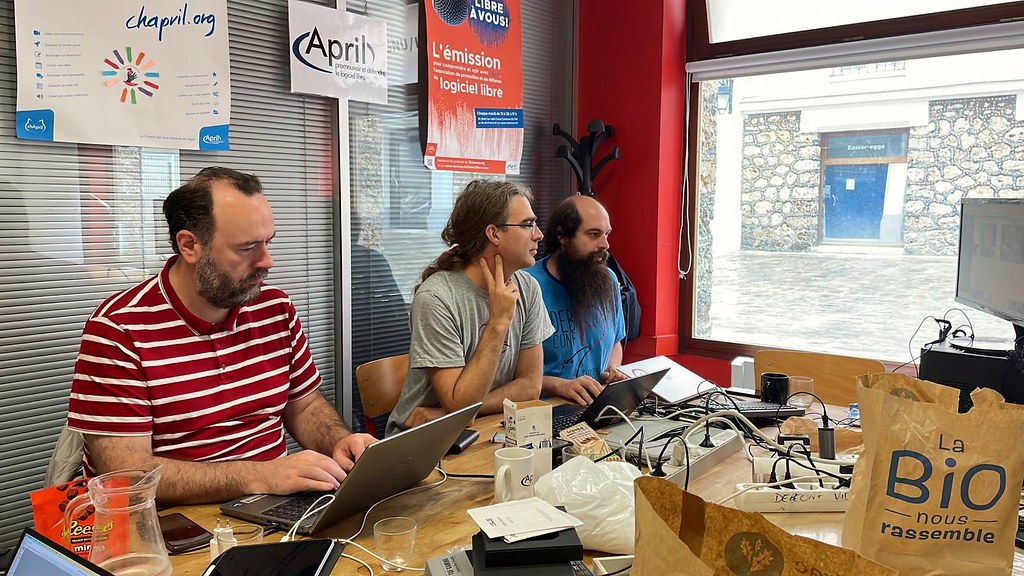
Present were Nicolas "olasd" Dandrimont, Stefano "tumbleweed" Rivera,
and yours truly. Additionally, Louis-Philippe "pollo" V ronneau and Carl
"CarlFK" Karsten joined the sprint remotely from across the pond.
Thank you to the DPL for agreeing to fund flights, food, and
accomodation for the team members. We would also like to extend a
special thanks to the Association April for
hosting our sprint at their offices.
We made a lot of progress:
| Series: | Discworld #30 |
| Publisher: | HarperTempest |
| Copyright: | 2003 |
| Printing: | 2006 |
| ISBN: | 0-06-001238-2 |
| Format: | Mass market |
| Pages: | 375 |
"Zoology, eh? That's a big word, isn't it." "No, actually it isn't," said Tiffany. "Patronizing is a big word. Zoology is really quite short."One of the best things that Pratchett does with this book is let Tiffany dislike her little brother. Wentworth eventually ends up in trouble and Tiffany has to go rescue him, which of course she does because he's her baby brother. But she doesn't like him; he's annoying and sticky and constantly going on about sweets and never says anything interesting. Tiffany is aware that she's supposed to love him because he's her little brother, but of course this is not how love actually works, and she doesn't. But she goes and rescues him anyway, because that's the right thing to do, and because he's hers. There are a lot of adult novels that show the nuanced and sometimes uncomfortable emotions we have about family members, but this sort of thing is a bit rarer in novels pitched at pre-teens, and I loved it. One valid way to read it is that Tiffany is neurodivergent, but I think she simply has a reasonable reaction to a brother who is endlessly annoying and too young to have many redeeming qualities in her eyes, and no one forces her to have a more socially expected one. It doesn't matter what you feel about things; it matters what you do, and as long as you do the right thing, you can have whatever feelings about it you want. This is a great lesson for this type of book. The other part of this book that I adored was the stories of Grandma Aching. Tiffany is fairly matter-of-fact about her dead grandmother at the start of the book, but it becomes clear over the course of the story that she's grieving in her own way. Grandma Aching was a taciturn shepherd who rarely put more than two words together and was much better with sheep than people, but she was the local witch in the way that Granny Weatherwax was a witch, and Tiffany was paying close attention. They never managed to communicate as much as either of them wanted, but the love shines through Tiffany's memories. Grandma Aching was teaching her how to be a witch: not the magical parts, but the far more important parts about justice and fairness and respect for other people. This was a great introduction of a new character and a solid middle-grade or young YA novel. I was not a fan of the villain and I can take or leave the Nac Mac Feegle (who are basically Scottish Smurfs crossed with ants and are a little too obviously the comic relief, for all that they're also effective warriors). But Tiffany is great and the stories of Grandma Aching are even better. This was not as good as Night Watch (very few things are), but it was well worth reading. Followed in publication order by Monstrous Regiment. The next Tiffany Aching novel is A Hat Full of Sky. Rating: 8 out of 10
| Publisher: | Tordotcom |
| Copyright: | 2022 |
| ISBN: | 1-250-21097-6 |
| Format: | Kindle |
| Pages: | 340 |
| Publisher: | Harper |
| Copyright: | 2016 |
| Printing: | June 2017 |
| ISBN: | 0-06-231656-7 |
| Format: | Kindle |
| Pages: | 338 |
Most people, including myself, assumed that part of what made the United States a great country, and such an exceptional one, was that you could live your life relatively unencumbered by the downside of a traditional, old-fashioned society: dependency on the people you happened to be stuck with. In America you had the liberty to express your individuality and choose your own community. This would allow you to interact with family, neighbors, and fellow citizens on the basis of who you were, rather than on what you were obligated to do or expected to be according to old-fashioned thinking. The longer I lived in America, therefore, and the more places I visited and the more people I met and the more American I myself became the more puzzled I grew. For it was exactly those key benefits of modernity freedom, personal independence, and opportunity that seemed, from my outsider s perspective, in a thousand small ways to be surprisingly missing from American life today. Amid the anxiety and stress of people s daily lives, those grand ideals were looking more theoretical than actual.The core of this argument is that the structure of life in the United States essentially coerces dependency on other people: employers, spouses, parents, children, and extended family. Because there is no universally available social support system, those relationships become essential for any hope of a good life, and often for survival. If parents do not heavily manage their children's education, there is a substantial risk of long-lasting damage to the stability and happiness of their life. If children do not care for their elderly parents, they may receive no care at all. Choosing not to get married often means choosing precarity and exhaustion because navigating society without pooling resources with someone else is incredibly difficult.
It was as if America, land of the Hollywood romance, was in practice mired in a premodern time when marriage was, first and foremost, not an expression of love, but rather a logistical and financial pact to help families survive by joining resources.Partanen contrasts this with what she calls the Nordic theory of love:
What Lars Tr g rdh came to understand during his years in the United States was that the overarching ambition of Nordic societies during the course of the twentieth century, and into the twenty-first, has not been to socialize the economy at all, as is often mistakenly assumed. Rather the goal has been to free the individual from all forms of dependency within the family and in civil society: the poor from charity, wives from husbands, adult children from parents, and elderly parents from their children. The express purpose of this freedom is to allow all those human relationships to be unencumbered by ulterior motives and needs, and thus to be entirely free, completely authentic, and driven purely by love.She sees this as the common theme through most of the policy differences discussed in this book. The Finnish approach is to provide neutral and universal logistical support for most of life's expected challenges: birth, child-rearing, education, health, unemployment, and aging. This relieves other social relations family, employer, church of the corrosive strain of dependency and obligation. It also ensures people's basic well-being isn't reliant on accidents of association.
If the United States is so worried about crushing entrepreneurship and innovation, a good place to start would be freeing start-ups and companies from the burdens of babysitting the nation s citizens.I found this fascinating as a persuasive technique. Partanen embraces the US ideal of individualism and points out that, rather than being collectivist as the US right tends to assume, Finland is better at fostering individualism and independence because the government works to removes unnecessary premodern constraints on individual lives. The reason why so many Americans are anxious and frantic is not a personal failing or bad luck. It's because the US social system is deeply hostile to healthy relationships and individual independence. It demands a constant level of daily problem-solving and crisis management that is profoundly exhausting, nearly impossible to navigate alone, and damaging to the ideal of equal relationships. Whether this line of argument will work is another question, and I'm dubious for reasons that Partanen (probably wisely) avoids. She presents the Finnish approach as a discovery that the US would benefit from, and the US approach as a well-intentioned mistake. I think this is superficially appealing; almost all corners of US political belief at least give lip service to individualism and independence. However, advocates of political change will eventually need to address the fact that many US conservatives see this type of social coercion as an intended feature of society rather than a flaw. This is most obvious when one looks at family relationships. Partanen treats the idea that marriage should be a free choice between equals rather than an economic necessity as self-evident, but there is a significant strain of US political thought that embraces punishing people for not staying within the bounds of a conservative ideal of family. One will often find, primarily but not exclusively among the more religious, a contention that the basic unit of society is the (heterosexual, patriarchal) family, not the individual, and that the suffering of anyone outside that structure is their own fault. Not wanting to get married, be the primary caregiver for one's parents, or abandon a career in order to raise children is treated as malignant selfishness and immorality rather than a personal choice that can be enabled by a modern social system. Here, I think Partanen is accurate to identify the Finnish social system as more modern. It embraces the philosophical concept of modernity, namely that social systems can be improved and social structures are not timeless. This is going to be a hard argument to swallow for those who see the pressure towards forming dependency ties within families as natural, and societal efforts to relieve those pressures as government meddling. In that intellectual framework, rather than an attempt to improve the quality of life, government logistical support is perceived as hostility to traditional family obligations and an attempt to replace "natural" human ties with "artificial" dependence on government services. Partanen doesn't attempt to have that debate. Two other things struck me in this book. The first is that, in Partanen's presentation, Finns expect high-quality services from their government and work to improve it when it falls short. This sounds like an obvious statement, but I don't think it is in the context of US politics, and neither does Partanen. She devotes a chapter to the topic, subtitled "Go ahead: ask what your country can do for you." This is, to me, one of the most frustrating aspects of US political debate. Our attitude towards government is almost entirely hostile and negative even among the political corners that would like to see government do more. Failures of government programs are treated as malice, malfeasance, or inherent incompetence: in short, signs the program should never have been attempted, rather than opportunities to learn and improve. Finland had mediocre public schools, decided to make them better, and succeeded. The moment US public schools start deteriorating, we throw much of our effort into encouraging private competition and dismantling the public school system. Partanen doesn't draw this connection, but I see a link between the US desire for market solutions to societal problems and the level of exhaustion and anxiety that is so common in US life. Solving problems by throwing them open to competition is a way of giving up, of saying we have no idea how to improve something and are hoping someone else will figure it out for a profit. Analyzing the failures of an existing system and designing incremental improvements is hard and slow work. Throwing out the system and hoping some corporation will come up with something better is disruptive but easy. When everyone is already overwhelmed by life and devoid of energy to work on complex social problems, it's tempting to give up on compromise and coalition-building and let everyone go their separate ways on their own dime. We cede the essential work of designing a good society to start-ups. This creates a vicious cycle: the resulting market solutions are inevitably gated by wealth and thus precarious and artificially scarce, which in turn creates more anxiety and stress. The short-term energy savings from not having to wrestle with a hard problem is overwhelmed by the long-term cost of having to navigate a complex and adversarial economic relationship. That leads into the last point: schools. There's a lot of discussion here about school quality and design, which I won't review in detail but which is worth reading. What struck me about Partanen's discussion, though, is how easy the Finnish system is to use. Finnish parents just send their kids to the most convenient school and rarely give that a second thought. The critical property is that all the schools are basically fine, and therefore there is no need to place one's child in an exceptional school to ensure they have a good life. It's axiomatic in the US that more choice is better. This is a constant refrain in our political discussion around schools: parental choice, parental control, options, decisions, permission, matching children to schools tailored for their needs. Those choices are almost entirely absent in Finland, at least in Partanen's description, and the amount of mental and emotional energy this saves is astonishing. Parents simply don't think about this, and everything is fine. I think we dramatically underestimate the negative effects of constantly having to make difficult decisions with significant consequences, and drastically overstate the benefits of having every aspect of life be full of major decision points. To let go of that attempt at control, however illusory, people have to believe in a baseline of quality that makes the choice less fraught. That's precisely what Finland provides by expecting high-quality social services and working to fix them when they fall short, an effort that the United States has by and large abandoned. A lot of non-fiction books could be turned into long articles without losing much substance, and I think The Nordic Theory of Everything falls partly into that trap. Partanen repeats the same ideas from several different angles, and the book felt a bit padded towards the end. If you're already familiar with the policy comparisons between the US and Nordic countries, you will have seen a lot of this before, and the book bogs down when Partanen strays too far from memoir and personal reactions. But the focus on individualism and eliminating dependency is new, at least to me, and is such an illuminating way to look at the contrast that I think the book is worth reading just for that. Rating: 7 out of 10
Github accidentally committed their SSH RSA private key to a repository, and now a bunch of people's infrastructure is broken because it needs to be updated to trust the new key. This is obviously bad, but what's frustrating is that there's no inherent need for it to be - almost all the technological components needed to both reduce the initial risk and to make the transition seamless already exist.
Happy New Year!
For the last 13 years I've been using standalone versions of the Lenovo
(formerly IBM) Thinkpad keyboard design with integrated trackpoint as my
main computer input devices.
My latest ("ThinkPad TrackPoint Keyboard II") was starting to fail so I decided
to look into alternatives for a replacement. The sticking point was I really like
the trackpoint as a mouse replacement, and very few other manufacturers offer that.
I've thus far managed to avoid the money pit that are mechanical keyboards. I
can see the attraction: in the 90s I used an IBM Model M PS/2 keyboard as my
daily driver until one tea spillage too many finally killed it. A friend kindly
gifted me another Model M more recently, but the buckled-spring technology it
uses is too loud for use in a public office, and the resistance too strong for
my modern fingers. The latter could perhaps be fixed with training. But still:
no trackpoint. (less importantly, no Windows keys.)
In anticipation of possibly getting a mechanical keyboard, I bought a passive
12 key "tester": 12 keyboard switches of different variants inside a perspex
frame. This gives you a rough idea of the feel of each switch type, to try and
narrow down what your personal preference might be. At the beginning I imagined
I'd like something clicky and stiff, like the buckled springs (and the Cherry MX
Green was closest to that), but I was gravitating more towards the more common
MX Red (popular with gamers) and MX Brown (popular with typists).
I wasn't totally sure yet so I decided to buy a sacrificial mechanical keyboard
to test a switch type properly. I managed to find a second-hand one for 20 with
brown switches. It was a bad layout (ANSI) which detracted from its use but was
a useful exercise: I decided I didn't really like the Browns that much! It seems
13 years with scissor switches have softened me up so that I want very little
resistance on my keys. So. most likely, MX Reds.
Tex Shinobi
A small Taiwanese company, Tex, produce a series of
mechanical keyboards very openly inspired by the IBM/Lenovo trackpoint models
that I've been using for so long, complete with trackpoints. I'd been eyeing
up their Tex Yoda II keyboard for some time,
which looks great, very minimalistic, but in practise I do use the keys it omits,
and it's pricey.
I decided to take the plunge and buy a more key-ful and reasonably priced Tex
Shinobi ISO/UK
layout, and I opted for Cherry MX Silent Red switches. Silent to give me the
option of using in the Newcastle office, but also to reduce the risk of waking
up the kids at home.
The Silent Reds are a bit "squishier" than raw Reds which is a shame, but not
enough of an obstacle to typing rapidly. The keyboard shape and layout is a
close clone of the old IBM Ultranav keyboards I used to use so I was at home on
it straight away.
The real unknown quantity to me was how well the trackpoint works. I'd read mixed
responses, but it's not clear that the people reviewing it were very familiar with
the Lenovo ones. I am pleased to report that it's indistinguishable to the Lenovo
one to me (and I used that a lot).
The keyboard came in a funky replica Thinkpad box and with some keycap and
trackpoint pointer options. I opted for a yellow "hat" shaped trackpoint cover
(to appease my yellow-obsessed youngest daughter) and the blue IBM-style Enter
keycap.
Future
I don't need any more keyboards! Unless I break this one. But in writing this I
did notice that they are taking pre-orders on a new model
Shura which seems to be halfway between
the Yoda II and Shinobi. I imported the Shinobi from Tex direct (incurring the
corresponding duty cost) but next time I might look for a UK distributor such
as https://www.keyboardco.com/.
This post marks the beginning my yearly roundups of the favourite books and movies that I read and watched in 2022 that I plan to publish over the next few days.
Just as I did for 2020 and 2021, I won't reveal precisely how many books I read in the last year. I didn't get through as many books as I did in 2021, though, but that's partly due to reading a significant number of long nineteenth-century novels in particular, a fair number of those books that American writer Henry James once referred to as "large, loose, baggy monsters."
However, in today's post I'll be looking at my favourite books that are typically filed under fiction, with 'classic' fiction following tomorrow.
Works that just missed the cut here include John O'Brien's Leaving Las Vegas, Colson Whitehead's Sag Harbor and possibly The Name of the Rose by Umberto Eco, or Elif Batuman's The Idiot. I also feel obliged to mention (or is that show off?) that I also read the 1,079-page Infinite Jest by David Foster Wallace, but I can't say it was a favourite, let alone recommend others unless they are in the market for a good-quality under-monitor stand.
Mona (2021) Pola Oloixarac Mona is the story of a young woman who has just been nominated for the 'most important literary award in Europe'. Mona sees the nomination as a chance to escape her substance abuse on a Californian campus and so speedily decamps to the small village in the depths of Sweden where the nominees must convene for a week before the overall winner is announced. Mona didn't disappear merely to avoid pharmacological misadventures, though, but also to avoid the growing realisation that she is being treated as something of an anthropological curiosity at her university: a female writer of colour treasured for her flourish of exotic diversity that reflects well upon her department. But Mona is now stuck in the company of her literary competitors who all have now gathered from around the world in order to do what writers do: harbour private resentments, exchange empty flattery, embody the selfsame racialised stereotypes that Mona left the United States to avoid, stab rivals in the back, drink too much, and, of course, go to bed together. But as I read Mona, I slowly started to realise that something else is going on. Why does Mona keep finding traces of violence on her body, the origins of which she cannot or refuses to remember? There is something eerily defensive about her behaviour and sardonic demeanour in general as well. A genre-bending and mind-expanding novel unfolded itself, and, without getting into spoiler territory, Mona concludes with such a surprising ending that, according to Adam Thirlwell:
Perhaps we need to rethink what is meant by a gimmick. If a gimmick is anything that we want to reject as extra or excessive or ill-fitting, then it may be important to ask what inhibitions or arbitrary conventions have made it seem like excess, and to revel in the exorbitant fictional constructions it produces. [...]Mona is a savage satire of the literary world, but it's also a very disturbing exploration of trauma and violence. The success of the book comes in equal measure from the author's commitment to both ideas, but also from the way the psychological damage component creeps up on you. And, as implied above, the last ten pages are quite literally out of this world.
My Brilliant Friend (2011)
The Story of a New Name (2012)
Those Who Leave and Those Who Stay (2013)
The Story of the Lost Child (2014)
Elena Ferrante
Elena Ferrante's Neopolitan Quartet follows two girls, both brilliant in their own way. Our protagonist-narrator is Elena, a studious girl from the lower rungs of the middle class of Naples who is inspired to be more by her childhood friend, Lila. Lila is, in turn, far more restricted by her poverty and class, but can transcend it at times through her fiery nature, which also brands her as somewhat unique within their inward-looking community. The four books follow the two girls from the perspective of Elena as they grow up together in post-war Italy, where they drift in-and-out of each other's lives due to the vicissitudes of change and the consequences of choice. All the time this is unfolding, however, the narrative is very always slightly charged by the background knowledge revealed on the very first page that Lila will, many years later, disappear from Elena's life.
Whilst the quartet has the formal properties of a bildungsroman, its subject and conception are almost entirely different. In particular, the books are driven far more by character and incident than spectacular adventures in picturesque Italy. In fact, quite the opposite takes place: these are four books where ordinary-seeming occurrences take on an unexpected radiance against a background of poverty, ignorance, violence and other threats, often bringing to mind the films of the Italian neorealism movement. Brilliantly rendered from beginning to end, Ferrante has a seemingly studious eye for interpreting interactions and the psychology of adolescence and friendship. Some utterances indeed, perhaps even some glances are dissected at length over multiple pages, something that Vittorio De Sica's classic Bicycle Thieves (1948) could never do.
Potential readers should not take any notice of the saccharine cover illustrations on most editions of the books. The quartet could even win an award for the most misleading artwork, potentially rivalling even Vladimir Nabokov's Lolita. I wouldn't be at all surprised if it is revealed that the drippy illustrations and syrupy blurbs ("a rich, intense and generous-hearted story ") turn out to be part of a larger metatextual game that Ferrante is playing with her readers. This idiosyncratic view of mine is partially supported by the fact that each of the four books has been given a misleading title, the true ambiguity of which often only becomes clear as each of the four books comes into sharper focus.
Readers of the quartet often fall into debating which is the best of the four. I've heard from more than one reader that one has 'too much Italian politics' and another doesn't have enough 'classic' Lina moments. The first book then possesses the twin advantages of both establishing the environs and finishing with a breathtaking ending that is both satisfying and a cliffhanger as well but does this make it 'the best'? I prefer to liken the quartet more like the different seasons of The Wire (2002-2008) where, personal favourites and preferences aside, although each season is undoubtedly unique, it would take a certain kind of narrow-minded view of art to make the claim that, say, series one of The Wire is 'the best' or that the season that focuses on the Baltimore docks 'is boring'. Not to sound like a neo-Wagnerian, but each of them adds to final result in its own. That is to say, both The Wire and the Neopolitan Quartet achieve the rare feat of making the magisterial simultaneously intimate.
Out There: Stories (2022) Kate Folk Out There is a riveting collection of disturbing short stories by first-time author Kate Fork. The title story first appeared in the New Yorker in early 2020 imagines a near-future setting where a group of uncannily handsome artificial men called 'blots' have arrived on the San Francisco dating scene with the secret mission of sleeping with women, before stealing their personal data from their laptops and phones and then (quite literally) evaporating into thin air. Folk's satirical style is not at all didactic, so it rarely feels like she is making her points in a pedantic manner. But it's clear that the narrator of Out There is recounting her frustration with online dating. in a way that will resonate with anyone who s spent time with dating apps or indeed the contemporary hyper-centralised platform-based internet in general. Part social satire, part ghost story and part comic tales, the blurring of the lines between these factors is only one of the things that makes these stories so compelling. But whilst Folk constructs crazy scenarios and intentionally strange worlds, she also manages to also populate them with characters that feel real and genuinely sympathetic. Indeed, I challenge you not to feel some empathy for the 'blot' in the companion story Big Sur which concludes the collection, and it complicates any primary-coloured view of the dating world of consisting entirely of predatory men. And all of this is leavened with a few stories that are just plain surreal. I don't know what the deal is with Dating a Somnambulist (available online on Hobart Pulp), but I know that I like it.
Solaris (1961) Stanislaw Lem When Kelvin arrives at the planet Solaris to study the strange ocean that covers its surface, instead of finding an entirely physical scientific phenomenon, he soon discovers a previously unconscious memory embodied in the physical manifestation of a long-dead lover. The other scientists on the space station slowly reveal that they are also plagued with their own repressed corporeal memories. Many theories are put forward as to why all this is occuring, including the idea that Solaris is a massive brain that creates these incarnate memories. Yet if that is the case, the planet's purpose in doing so is entirely unknown, forcing the scientists to shift focus and wonder whether they can truly understand the universe without first understanding what lies within their own minds and in their desires. This would be an interesting outline for any good science fiction book, but one of the great strengths of Solaris is not only that it withholds from the reader why the planet is doing anything it does, but the book is so forcefully didactic in its dislike of the hubris, destructiveness and colonial thinking that can accompany scientific exploration. In one of its most vitriolic passages, Lem's own anger might be reaching out to the reader:
We are humanitarian and chivalrous; we don t want to enslave other races, we simply want to bequeath them our values and take over their heritage in exchange. We think of ourselves as the Knights of the Holy Contact. This is another lie. We are only seeking Man. We have no need of other worlds. We need mirrors. We don t know what to do with other worlds. A single world, our own, suffices us; but we can t accept it for what it is. We are searching for an ideal image of our own world: we go in quest of a planet, of a civilisation superior to our own, but developed on the basis of a prototype of our primaeval past. At the same time, there is something inside us that we don t like to face up to, from which we try to protect ourselves, but which nevertheless remains since we don t leave Earth in a state of primal innocence. We arrive here as we are in reality, and when the page is turned, and that reality is revealed to us that part of our reality that we would prefer to pass over in silence then we don t like it anymore.An overwhelming preoccupation with this idea infuses Solaris, and it turns out to be a common theme in a lot of Lem's work of this period, such as in his 1959 'anti-police procedural' The Investigation. Perhaps it not a dislike of exploration in general or the modern scientific method in particular, but rather a savage critique of the arrogance and self-assuredness that accompanies most forms of scientific positivism, or at least pursuits that cloak themselves under the guise of being a laudatory 'scientific' pursuit:
Man has gone out to explore other worlds and other civilizations without having explored his own labyrinth of dark passages and secret chambers and without finding what lies behind doorways that he himself has sealed.I doubt I need to cite specific instances of contemporary scientific pursuits that might meet Lem's punishing eye today, and the fact that his critique works both in 2022 and 1961 perhaps tells us more about the human condition than we'd care to know. Another striking thing about Solaris isn't just the specific Star Trek and Stargate SG-1 episodes that I retrospectively realised were purloined from the book, but that almost the entire register of Star Trek: The Next Generation in particular seems to be rehearsed here. That is to say, TNG presents itself as hard and fact-based 'sci-fi' on the surface, but, at its core, there are often human, existential and sometimes quite enormously emotionally devastating human themes being discussed such as memory, loss and grief. To take one example from many, the painful memories that the planet Solaris physically materialises in effect asks us to seriously consider what it actually is taking place when we 'love' another person: is it merely another 'mirror' of ourselves? (And, if that is the case, is that... bad?) It would be ahistorical to claim that all popular science fiction today can be found rehearsed in Solaris, but perhaps it isn't too much of a stretch:
[Solaris] renders unnecessary any more alien stories. Nothing further can be said on this topic ...] Possibly, it can be said that when one feels the urge for such a thing, one should simply reread Solaris and learn its lessons again. Kim Stanley Robinson [...]I could go on praising this book for quite some time; perhaps by discussing the extreme framing devices used within the book at one point, the book diverges into a lengthy bibliography of fictional books-within-the-book, each encapsulating a different theory about what the mechanics and/or function of Solaris is, thereby demonstrating that 'Solaris studies' as it is called within the world of the book has been going on for years with no tangible results, which actually leads to extreme embarrassment and then a deliberate and willful blindness to the 'Solaris problem' on the part of the book's scientific community. But I'll leave it all here before this review gets too long... Highly recommended, and a likely reread in 2023.
Brokeback Mountain (1997) Annie Proulx Brokeback Mountain began as a short story by American author Annie Proulx which appeared in the New Yorker in 1997, although it is now more famous for the 2005 film adaptation directed by Taiwanese filmmaker Ang Lee. Both versions follow two young men who are hired for the summer to look after sheep at a range under the 'Brokeback' mountain in Wyoming. Unexpectedly, however, they form an intense emotional and sexual attachment, yet life intervenes and demands they part ways at the end of the summer. Over the next twenty years, though, as their individual lives play out with marriages, children and jobs, they continue reuniting for brief albeit secret liaisons on camping trips in remote settings. There's no feigned shyness or self-importance in Brokeback Mountain, just a close, compassionate and brutally honest observation of a doomed relationship and a bone-deep feeling for the hardscrabble life in the post-War West. To my mind, very few books have captured so acutely the desolation of a frustrated and repressed passion, as well as the particular flavour of undirected anger that can accompany this kind of yearning. That the original novella does all this in such a beautiful way (and without the crutch of the Wyoming landscape to look at ) is a tribute to Proulx's skills as a writer. Indeed, even without the devasting emotional undertones, Proulx's descriptions of the mountains and scree of the West is likely worth the read alone.
Luster (2020) Raven Leilani Edie is a young Black woman living in New York whose life seems to be spiralling out of control. She isn't good at making friends, her career is going nowhere, and she has no close family to speak of as well. She is, thus, your typical NYC millennial today, albeit seen through a lens of Blackness that complicates any reductive view of her privilege or minority status. A representative paragraph might communicate the simmering tone:
Before I start work, I browse through some photos of friends who are doing better than me, then an article on a black teenager who was killed on 115th for holding a weapon later identified as a showerhead, then an article on a black woman who was killed on the Grand Concourse for holding a weapon later identified as a cell phone, then I drown myself in the comments section and do some online shopping, by which I mean I put four dresses in my cart as a strictly theoretical exercise and then let the page expire.She starts a sort-of affair with an older white man who has an affluent lifestyle in nearby New Jersey. Eric or so he claims has agreed upon an 'open relationship' with his wife, but Edie is far too inappropriate and disinhibited to respect any boundaries that Eric sets for her, and so Edie soon becomes deeply entangled in Eric's family life. It soon turns out that Eric and his wife have a twelve-year-old adopted daughter, Akila, who is also wait for it Black. Akila has been with Eric's family for two years now and they aren t exactly coping well together. They don t even know how to help her to manage her own hair, let alone deal with structural racism. Yet despite how dark the book's general demeanour is, there are faint glimmers of redemption here and there. Realistic almost to the end, Edie might finally realise what s important in her life, but it would be a stretch to say that she achieves them by the final page. Although the book is full of acerbic remarks on almost any topic (Dogs: "We made them needy and physically unfit. They used to be wolves, now they are pugs with asthma."), it is the comments on contemporary race relations that are most critically insightful. Indeed, unsentimental, incisive and funny, Luster had much of what I like in Colson Whitehead's books at times, but I can't remember a book so frantically fast-paced as this since the Booker-prize winning The Sellout by Paul Beatty or Sam Tallent's Running the Light.
| Publisher: | Riverhead Books |
| Copyright: | 2021 |
| ISBN: | 0-698-40513-7 |
| Format: | Kindle |
| Pages: | 260 |
| Series: | Radiant Emperor #1 |
| Publisher: | Tor |
| Copyright: | 2021 |
| Printing: | 2022 |
| ISBN: | 1-250-62179-8 |
| Format: | Kindle |
| Pages: | 414 |
| Publisher: | Tillie Walden |
| Copyright: | 2016-2017 |
| Format: | Online graphic novel |
| Pages: | 544 |
I wanted to understand how kids between 10 and 18 conceive the internet.
Surely, we have seen a generation that we call digital natives grow up with
the internet. Now, there is a younger generation who grows up with pervasive
technology, such as smartphones, smart watches, virtual assistants and so on.
And only a few of them have parents who work in IT or engineering
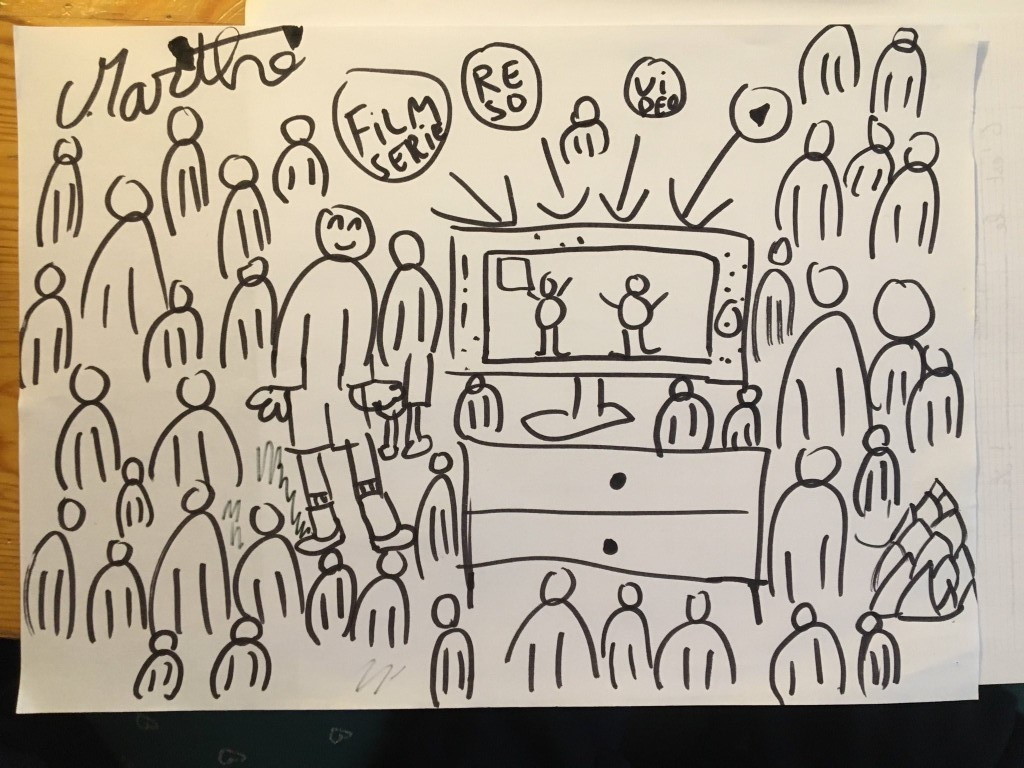
The youngest respondent, a 9 year old girl, drew a screen with lots of people
around it and the words film, series, network, video , as well as a play
icon. She said that she mostly uses the internet to watch movies. She was the
only one who used a shared tablet and smartphone that belonged to her family,
not to herself. And she would explain the net like this to an alien:
"Internet is a er one cannot touch it it s an, er [I propose the word idea ], yes it s an idea. Many people use it not necessarily to watch things, but also to read things or do other stuff."
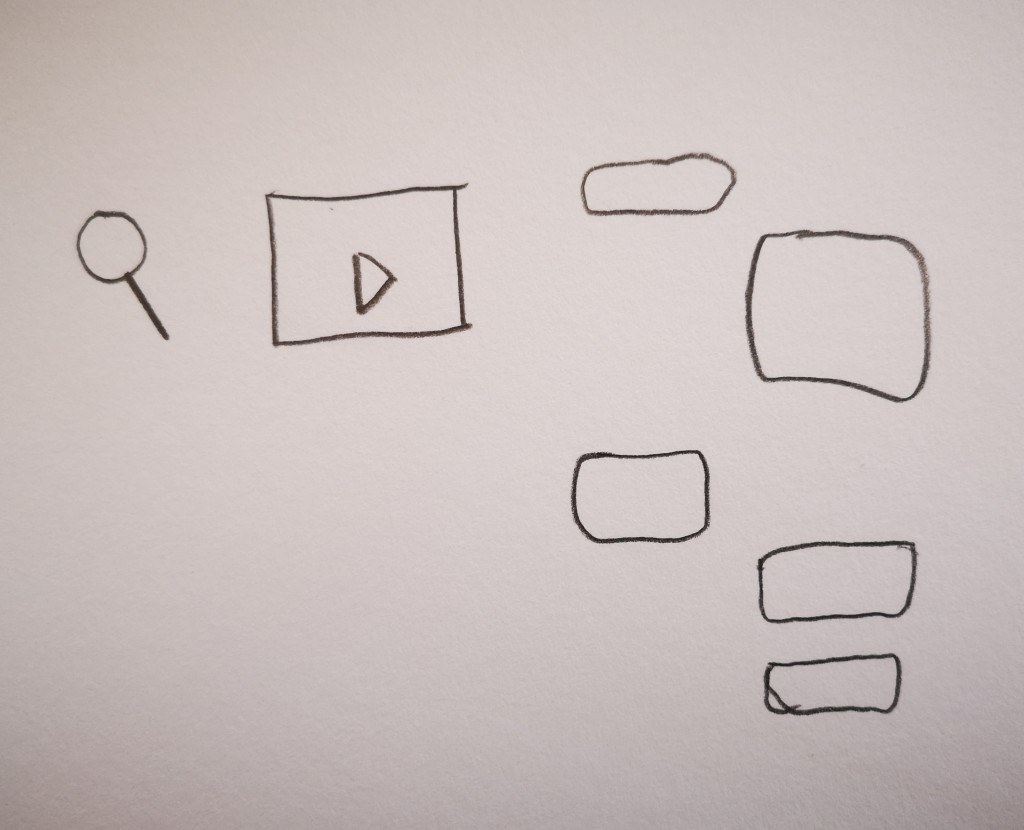
A 10 year old boy represented the internet by recalling user interface
elements he sees every day in his drawing: a magnifying glass (search
engine), a play icon (video streaming), speech bubbles (instant
messaging). He would explain the internet like this to an alien:
"You can use the internet to learn things or get information, listen to music, watch movies, and chat with friends. You can do nearly anything with it."
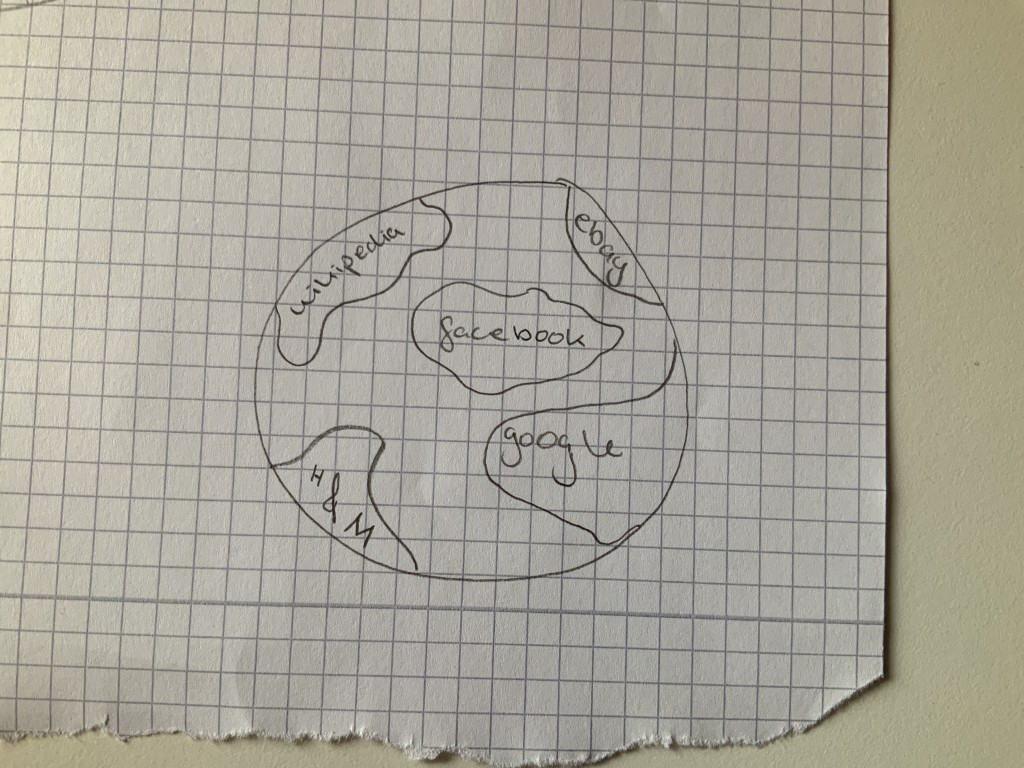
A 12 year old girl imagines the internet like a second, intangible, planet
where Google, Wikipedia, Facebook, Ebay, or H&M are continents that one enters
into.
"And on [the] Ebay [continent] there s a country for clothes, and ,trousers , for example, would be a federal state in that country."Something that was unique about this interview was that she told me she had an email address but she never writes emails. She only has an email account to receive confirmation emails, for example when doing online shopping, or when registering to a service and needing to confirm one s address. This is interesting because it s an anti-spam measure that might become outdated with a generation that uses email less or not at all.
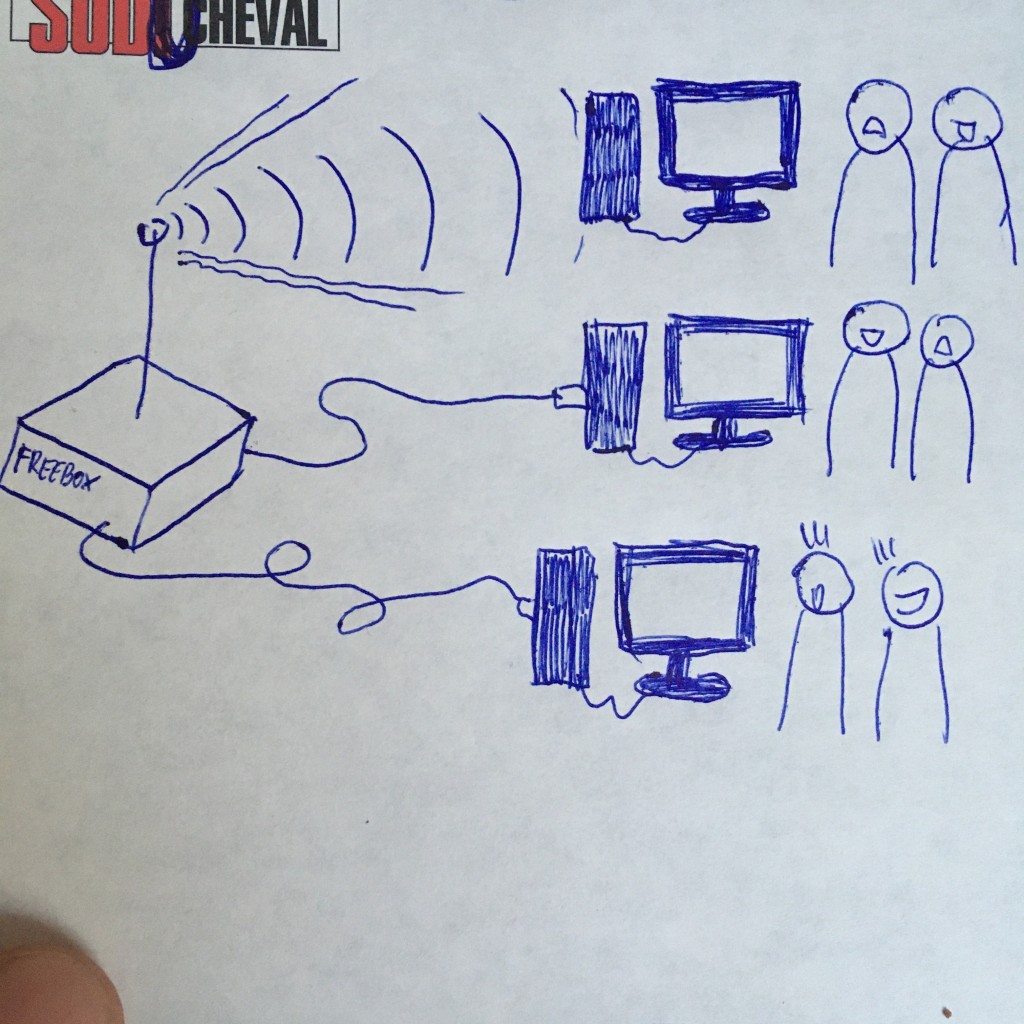
A 15 year old boy knew that his family s devices are connected to a home router
(Freebox is a router from the French ISP Free) but lacked an imagination of the
rest of the internet s functioning. When I asked him about what would be behind
the router, on the other side, he said what s behind is like a black hole to
him. However, he was the only interviewee who did actually draw cables, wifi
waves, a router, and the local network. His drawing is even extremely precise,
it just lacks the cable connecting the router to the rest of the internet.
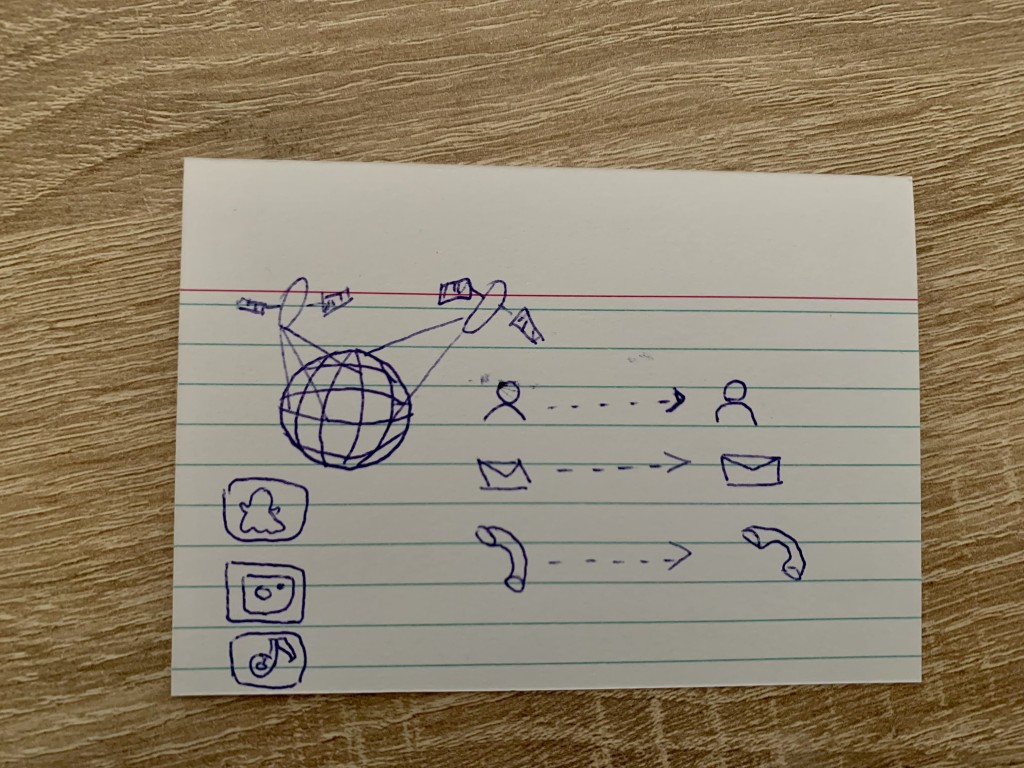
A 17 year old girl would explain the internet to an alien as follows:
"The internet goes around the entire globe. One is networked with everyone else on Earth. One can find everything. But one cannot touch the internet. It s like a parallel world. With a device one can look into the internet. With search engines, one can find anything in the world, one can phone around the world, and write messages. [The internet] is a gigantic thing."This interviewee stated as the only one that the internet is huge. And while she also is the only one who drew the internet as actually having some kind of physical extension beyond her own home, she seems to believe that internet connectivity is based on satellite technology and wireless communication.
"the age of access to the internet. More and more younger people access the internet ; especially with TikTok there is a recommendation algorithm that can influcence young people a lot. And influencing young people should be avoided but the internet does it too much. And that can be negative. If you don t yet have a critical spirit, and you watch certain videos you cannot yet moderate your stance. It can influence you a lot. There are so many things that have become indispensable and that happen on the internet and we have become dependent. What happens if one day it doesn t work anymore? If we connect more and more things to the net, that s not a good thing."
| Publisher: | Berkley |
| Copyright: | September 2019 |
| ISBN: | 1-9848-0259-3 |
| Format: | Kindle |
| Pages: | 372 |
| Publisher: | New American Library |
| Copyright: | 2016 |
| ISBN: | 0-698-18327-4 |
| Format: | Kindle |
| Pages: | 572 |
In my two most recent posts, I listed the memoirs and biographies and followed this up with the non-fiction I enjoyed the most in 2021. I'll leave my roundup of 'classic' fiction until tomorrow, but today I'll be going over my favourite fiction.
Books that just miss the cut here include Kingsley Amis' comic Lucky Jim, Cormac McCarthy's The Road (although see below for McCarthy's Blood Meridian) and the Complete Adventures of Tintin by Herg , the latter forming an inadvertently incisive portrait of the first half of the 20th century.
Like ever, there were a handful of books that didn't live up to prior expectations. Despite all of the hype, Emily St. John Mandel's post-pandemic dystopia Station Eleven didn't match her superb The Glass Hotel (one of my favourite books of 2020). The same could be said of John le Carr 's The Spy Who Came in from the Cold, which felt significantly shallower compared to Tinker, Tailor, Soldier, Spy again, a favourite of last year. The strangest book (and most difficult to classify at all) was undoubtedly Patrick S skind's Perfume: The Story of a Murderer, and the non-fiction book I disliked the most was almost-certainly Beartown by Fredrik Bachman.
Two other mild disappointments were actually film adaptions. Specifically, the original source for Vertigo by Pierre Boileau and Thomas Narcejac didn't match Alfred Hitchock's 1958 masterpiece, as did James Sallis' Drive which was made into a superb 2011 neon-noir directed by Nicolas Winding Refn. These two films thus defy the usual trend and are 'better than the book', but that's a post for another day.
A Wizard of Earthsea (1971) Ursula K. Le Guin How did it come to be that Harry Potter is the publishing sensation of the century, yet Ursula K. Le Guin's Earthsea is only a popular cult novel? Indeed, the comparisons and unintentional intertextuality with Harry Potter are entirely unavoidable when reading this book, and, in almost every respect, Ursula K. Le Guin's universe comes out the victor. In particular, the wizarding world that Le Guin portrays feels a lot more generous and humble than the class-ridden world of Hogwarts School of Witchcraft and Wizardry. Just to take one example from many, in Earthsea, magic turns out to be nurtured in a bottom-up manner within small village communities, in almost complete contrast to J. K. Rowling's concept of benevolent government departments and NGOs-like institutions, which now seems a far too New Labour for me. Indeed, imagine an entire world imbued with the kindly benevolence of Dumbledore, and you've got some of the moral palette of Earthsea. The gently moralising tone that runs through A Wizard of Earthsea may put some people off:
Vetch had been three years at the School and soon would be made Sorcerer; he thought no more of performing the lesser arts of magic than a bird thinks of flying. Yet a greater, unlearned skill he possessed, which was the art of kindness.Still, these parables aimed directly at the reader are fairly rare, and, for me, remain on the right side of being mawkish or hectoring. I'm thus looking forward to reading the next two books in the series soon.
Blood Meridian (1985) Cormac McCarthy Blood Meridian follows a band of American bounty hunters who are roaming the Mexican-American borderlands in the late 1840s. Far from being remotely swashbuckling, though, the group are collecting scalps for money and killing anyone who crosses their path. It is the most unsparing treatment of American genocide and moral depravity I have ever come across, an anti-Western that flouts every convention of the genre. Blood Meridian thus has a family resemblance to that other great anti-Western, Once Upon a Time in the West: after making a number of gun-toting films that venerate the American West (ie. his Dollars Trilogy), Sergio Leone turned his cynical eye to the western. Yet my previous paragraph actually euphemises just how violent Blood Meridian is. Indeed, I would need to be a much better writer (indeed, perhaps McCarthy himself) to adequately 0utline the tone of this book. In a certain sense, it's less than you read this book in a conventional sense, but rather that you are forced to witness successive chapters of grotesque violence... all occurring for no obvious reason. It is often said that books 'subvert' a genre and, indeed, I implied as such above. But the term subvert implies a kind of Puck-like mischievousness, or brings to mind court jesters licensed to poke fun at the courtiers. By contrast, however, Blood Meridian isn't funny in the slightest. There isn't animal cruelty per se, but rather wanton negligence of another kind entirely. In fact, recalling a particular passage involving an injured horse makes me feel physically ill. McCarthy's prose is at once both baroque in its language and thrifty in its presentation. As Philip Connors wrote back in 2007, McCarthy has spent forty years writing as if he were trying to expand the Old Testament, and learning that McCarthy grew up around the Church therefore came as no real surprise. As an example of his textual frugality, I often looked for greater precision in the text, finding myself asking whether who a particular 'he' is, or to which side of a fight some two men belonged to. Yet we must always remember that there is no precision to found in a gunfight, so this infidelity is turned into a virtue. It's not that these are fair fights anyway, or even 'murder': Blood Meridian is just slaughter; pure butchery. Murder is a gross understatement for what this book is, and at many points we are grateful that McCarthy spares us precision. At others, however, we can be thankful for his exactitude. There is no ambiguity regarding the morality of the puppy-drowning Judge, for example: a Colonel Kurtz who has been given free license over the entire American south. There is, thank God, no danger of Hollywood mythologising him into a badass hero. Indeed, we must all be thankful that it is impossible to film this ultra-violent book... Indeed, the broader idea of 'adapting' anything to this world is, beyond sick. An absolutely brutal read; I cannot recommend it highly enough.
Bodies of Light (2014) Sarah Moss Bodies of Light is a 2014 book by Glasgow-born Sarah Moss on the stirrings of women's suffrage within an arty clique in nineteenth-century England. Set in the intellectually smoggy cities of Manchester and London, this poignant book follows the studiously intelligent Alethia 'Ally' Moberly who is struggling to gain the acceptance of herself, her mother and the General Medical Council. You can read my full review from July.
House of Leaves (2000) Mark Z. Danielewski House of Leaves is a remarkably difficult book to explain. Although the plot refers to a fictional documentary about a family whose house is somehow larger on the inside than the outside, this quotidian horror premise doesn't explain the complex meta-commentary that Danielewski adds on top. For instance, the book contains a large number of pseudo-academic footnotes (many of which contain footnotes themselves), with references to scholarly papers, books, films and other articles. Most of these references are obviously fictional, but it's the kind of book where the joke is that some of them are not. The format, structure and typography of the book is highly unconventional too, with extremely unusual page layouts and styles. It's the sort of book and idea that should be a tired gimmick but somehow isn't. This is particularly so when you realise it seems specifically designed to create a fandom around it and to manufacturer its own 'cult' status, something that should be extremely tedious. But not only does this not happen, House of Leaves seems to have survived through two exhausting decades of found footage: The Blair Witch Project and Paranormal Activity are, to an admittedly lesser degree, doing much of the same thing as House of Leaves. House of Leaves might have its origins in Nabokov's Pale Fire or even Derrida's Glas, but it seems to have more in common with the claustrophobic horror of Cube (1997). And like all of these works, House of Leaves book has an extremely strange effect on the reader or viewer, something quite unlike reading a conventional book. It wasn't so much what I got out of the book itself, but how it added a glow to everything else I read, watched or saw at the time. An experience.
Milkman (2018) Anna Burns This quietly dazzling novel from Irish author Anna Burns is full of intellectual whimsy and oddball incident. Incongruously set in 1970s Belfast during The Irish Troubles, Milkman's 18-year-old narrator (known only as middle sister ), is the kind of dreamer who walks down the street with a Victorian-era novel in her hand. It's usually an error for a book that specifically mention other books, if only because inviting comparisons to great novels is grossly ill-advised. But it is a credit to Burns' writing that the references here actually add to the text and don't feel like they are a kind of literary paint by numbers. Our humble narrator has a boyfriend of sorts, but the figure who looms the largest in her life is a creepy milkman an older, married man who's deeply integrated in the paramilitary tribalism. And when gossip about the narrator and the milkman surfaces, the milkman beings to invade her life to a suffocating degree. Yet this milkman is not even a milkman at all. Indeed, it's precisely this kind of oblique irony that runs through this daring but darkly compelling book.
The First Fifteen Lives of Harry August (2014) Claire North Harry August is born, lives a relatively unremarkable life and finally dies a relatively unremarkable death. Not worth writing a novel about, I suppose. But then Harry finds himself born again in the very same circumstances, and as he grows from infancy into childhood again, he starts to remember his previous lives. This loop naturally drives Harry insane at first, but after finding that suicide doesn't stop the quasi-reincarnation, he becomes somewhat acclimatised to his fate. He prospers much better at school the next time around and is ultimately able to make better decisions about his life, especially when he just happens to know how to stay out of trouble during the Second World War. Yet what caught my attention in this 'soft' sci-fi book was not necessarily the book's core idea but rather the way its connotations were so intelligently thought through. Just like in a musical theme and varations, the success of any concept-driven book is far more a product of how the implications of the key idea are played out than how clever the central idea was to begin with. Otherwise, you just have another neat Borges short story: satisfying, to be sure, but in a narrower way. From her relatively simple premise, for example, North has divined that if there was a community of people who could remember their past lives, this would actually allow messages and knowledge to be passed backwards and forwards in time. Ah, of course! Indeed, this very mechanism drives the plot: news comes back from the future that the progress of history is being interfered with, and, because of this, the end of the world is slowly coming. Through the lives that follow, Harry sets out to find out who is passing on technology before its time, and work out how to stop them. With its gently-moralising romp through the salient historical touchpoints of the twentieth century, I sometimes got a whiff of Forrest Gump. But it must be stressed that this book is far less certain of its 'right-on' liberal credentials than Robert Zemeckis' badly-aged film. And whilst we're on the topic of other media, if you liked the underlying conceit behind Stuart Turton's The Seven Deaths of Evelyn Hardcastle yet didn't enjoy the 'variations' of that particular tale, then I'd definitely give The First Fifteen Lives a try. At the very least, 15 is bigger than 7. More seriously, though, The First Fifteen Lives appears to reflect anxieties about technology, particularly around modern technological accelerationism. At no point does it seriously suggest that if we could somehow possess the technology from a decade in the future then our lives would be improved in any meaningful way. Indeed, precisely the opposite is invariably implied. To me, at least, homo sapiens often seems to be merely marking time until we can blow each other up and destroying the climate whilst sleepwalking into some crisis that might precipitate a thermonuclear genocide sometimes seems to be built into our DNA. In an era of cli-fi fiction and our non-fiction newspaper headlines, to label North's insight as 'prescience' might perhaps be overstating it, but perhaps that is the point: this destructive and negative streak is universal to all periods of our violent, insecure species.
The Goldfinch (2013) Donna Tartt After Breaking Bad, the second biggest runaway success of 2014 was probably Donna Tartt's doorstop of a novel, The Goldfinch. Yet upon its release and popular reception, it got a significant number of bad reviews in the literary press with, of course, an equal number of predictable think pieces claiming this was sour grapes on the part of the cognoscenti. Ah, to be in 2014 again, when our arguments were so much more trivial. For the uninitiated, The Goldfinch is a sprawling bildungsroman that centres on Theo Decker, a 13-year-old whose world is turned upside down when a terrorist bomb goes off whilst visiting the Metropolitan Museum of Art, killing his mother among other bystanders. Perhaps more importantly, he makes off with a painting in order to fulfil a promise to a dying old man: Carel Fabritius' 1654 masterpiece The Goldfinch. For the next 14 years (and almost 800 pages), the painting becomes the only connection to his lost mother as he's flung, almost entirely rudderless, around the Western world, encountering an array of eccentric characters. Whatever the critics claimed, Tartt's near-perfect evocation of scenes, from the everyday to the unimaginable, is difficult to summarise. I wouldn't label it 'cinematic' due to her evocation of the interiority of the characters. Take, for example: Even the suggestion that my father had close friends conveyed a misunderstanding of his personality that I didn't know how to respond it's precisely this kind of relatable inner subjectivity that cannot be easily conveyed by film, likely is one of the main reasons why the 2019 film adaptation was such a damp squib. Tartt's writing is definitely not 'impressionistic' either: there are many near-perfect evocations of scenes, even ones we hope we cannot recognise from real life. In particular, some of the drug-taking scenes feel so credibly authentic that I sometimes worried about the author herself. Almost eight months on from first reading this novel, what I remember most was what a joy this was to read. I do worry that it won't stand up to a more critical re-reading (the character named Xandra even sounds like the pharmaceuticals she is taking), but I think I'll always treasure the first days I spent with this often-beautiful novel.
Beyond Black (2005) Hilary Mantel Published about five years before the hyperfamous Wolf Hall (2004), Hilary Mantel's Beyond Black is a deeply disturbing book about spiritualism and the nature of Hell, somewhat incongruously set in modern-day England. Alison Harte is a middle-aged physic medium who works in the various towns of the London orbital motorway. She is accompanied by her stuffy assistant, Colette, and her spirit guide, Morris, who is invisible to everyone but Alison. However, this is no gentle and musk-smelling world of the clairvoyant and mystic, for Alison is plagued by spirits from her past who infiltrate her physical world, becoming stronger and nastier every day. Alison's smiling and rotund persona thus conceals a truly desperate woman: she knows beyond doubt the terrors of the next life, yet must studiously conceal them from her credulous clients. Beyond Black would be worth reading for its dark atmosphere alone, but it offers much more than a chilling and creepy tale. Indeed, it is extraordinarily observant as well as unsettlingly funny about a particular tranche of British middle-class life. Still, the book's unnerving nature that sticks in the mind, and reading it noticeably changed my mood for days afterwards, and not necessarily for the best.
The Wall (2019) John Lanchester The Wall tells the story of a young man called Kavanagh, one of the thousands of Defenders standing guard around a solid fortress that envelopes the British Isles. A national service of sorts, it is Kavanagh's job to stop the so-called Others getting in. Lanchester is frank about what his wall provides to those who stand guard: the Defenders of the Wall are conscripted for two years on the Wall, with no exceptions, giving everyone in society a life plan and a story. But whilst The Wall is ostensibly about a physical wall, it works even better as a story about the walls in our mind. In fact, the book blends together of some of the most important issues of our time: climate change, increasing isolation, Brexit and other widening societal divisions. If you liked P. D. James' The Children of Men you'll undoubtedly recognise much of the same intellectual atmosphere, although the sterility of John Lanchester's dystopia is definitely figurative and textual rather than literal. Despite the final chapters perhaps not living up to the world-building of the opening, The Wall features a taut and engrossing narrative, and it undoubtedly warrants even the most cursory glance at its symbolism. I've yet to read something by Lanchester I haven't enjoyed (even his short essay on cheating in sports, for example) and will be definitely reading more from him in 2022.
The Only Story (2018) Julian Barnes The Only Story is the story of Paul, a 19-year-old boy who falls in love with 42-year-old Susan, a married woman with two daughters who are about Paul's age. The book begins with how Paul meets Susan in happy (albeit complicated) circumstances, but as the story unfolds, the novel becomes significantly more tragic and moving. Whilst the story begins from the first-person perspective, midway through the book it shifts into the second person, and, later, into the third as well. Both of these narrative changes suggested to me an attempt on the part of Paul the narrator (if not Barnes himself), to distance himself emotionally from the events taking place. This effect is a lot more subtle than it sounds, however: far more prominent and devastating is the underlying and deeply moving story about the relationship ends up. Throughout this touching book, Barnes uses his mastery of language and observation to avoid the saccharine and the maudlin, and ends up with a heart-wrenching and emotive narrative. Without a doubt, this is the saddest book I read this year.
| Series: | Fractured Fables #1 |
| Publisher: | Tordotcom |
| Copyright: | 2021 |
| ISBN: | 1-250-76536-6 |
| Format: | Kindle |
| Pages: | 121 |
"You know it wasn't originally a spinning wheel in the story?" I offer, because alcohol transforms me into a chatty Wikipedia page.A Spindle Splintered is told from Zinnia's first-person perspective, and Zinnia is great. My favorite thing about Harrow's writing is the fierce and complex emotions of her characters. The overall tone is lighter than The Once and Future Witches or The Ten Thousand Doors of January, but Harrow doesn't shy away from showing the reader Zinnia's internal thought process about her illness (and her eye-rolling bemusement at some of the earlier emotional stages she went through).
Dying girl rule #3 is no romance, because my entire life is one long trolley problem and I don't want to put any more bodies on the tracks. (I've spent enough time in therapy to know that this isn't "a healthy attitude towards attachment," but I personally feel that accepting my own imminent mortality is enough work without also having a healthy attitude about it.)There's a content warning for parents here, since Harrow spends some time on the reaction of Zinnia's parents and the complicated dance between hope, despair, smothering, and freedom that she and they had to go through. There were no easy answers and all balances were fragile, but Zinnia always finds her feet. For me, Harrow's character writing is like emotional martial arts: rolling with punches, taking falls, clear-eyed about the setbacks, but always finding a new point of stability to punch back at the world. Zinnia adds just enough teenage irreverence and impatience to blunt the hardest emotional hits. I really enjoy reading it. The one caution I will make about that part of the story is that the focus is on Zinnia's projected lifespan and not on her illness specifically. Harrow uses it as setup to dig into how she and her parents would react to that knowledge (and I thought those parts were done well), but it's told from the perspective of "what would you do if you knew your date of death," not from the perspective of someone living with a disability. It is to some extent disability as plot device, and like the fairy tale that it's based on, it's deeply invested in the "find a cure" approach to the problem. I'm not disabled and am not the person to ask about how well a story handles disability, but I suspect this one may leave something to be desired. I thought the opening of this story is great. Zinnia is a great first-person protagonist and the opening few chapters are overflowing with snark and acerbic commentary. Dumping Zinnia into another world but having text messaging still work is genius, and I kind of wish Harrow had made that even more central to the book. The rest of the story was good but not as good, and the ending was somewhat predictable and a bit of a deus ex machina. But the characters carried it throughout, and I will happily read more of this. Recommended, with the caveat about disability and the content warning for parents. Followed by A Mirror Mended, which I have already pre-ordered. Rating: 8 out of 10
I was recently called upon by Origyn to audit the source code of some of their Internet Computer canisters ( canisters are services or smart contracts on the Internet Computer), which were written in the Motoko programming language. Both the application model of the Internet Computer as well as Motoko bring with them their own particular pitfalls and possible sources for bugs. So given that I was involved in the creation of both, they reached out to me.
In the course of that audit work I collected a list of things to watch out for, and general advice around them. Origyn generously allowed me to share that list here, in the hope that it will be helpful to the wider community.
throw) does not rollback state changes done before, while trapping (e.g. Debug.trap, assert , out of cycle conditions) does.
Therefore, one should check all public update call entry points for unwanted state changes or unwanted rollbacks. In particular, look for methods (or rather, messages, i.e. the code between commit points) where a state change is followed by a throw.
This issues apply to all canisters, and are not Motoko-specific, although other CDKs may not turn exceptions into rejects (which don t roll back).
canister_preupgrade system method is no longer upgradeable. This is a major risk. The canister_preupgrade method of a Motoko canister consists of the developer-written code in any system func preupgrade() block, followed by the system-generated code that serializes the content of any stable var into a binary format, and then copies that to stable memory.
Since the Motoko-internal serialization code will first serialize into a scratch space in the main heap, and then copy that to stable memory, canisters with more than 2GB of live data will likely be unupgradeable. But this is unlikely the first limit:
The system imposes an instruction limit on upgrading a canister (spanning both canister_preupgrade and canister_postupgrade). This limit is a subnet configuration value, and sepearate (and likely higher) than the normal per-message limit, and not easily determined. If the canister s live data becomes too large to be serialized within this limit, the canister becomes non-upgradeable.
This risk cannot be eliminated completely, as long as Motoko and Stable Variables are used. It can be mitigated by appropriate load testing:
Install a canister, fill it up with live data, and exercise the upgrade. If this succeeds with a live data set exceeding the expected amount of data by a margin, this risk is probably acceptable. Bonus points for adding functionality that will prevent the canister s live data to increase above a certain size.
If this testing is to be done on a local replica, extra care needs to be taken to make sure the local replica actually performs instruction counting and has the same resource limits as the production subnet.
An alternative mitigation is to avoid canister_pre_upgrade as much as possible. This means no use of stable var (or restricted to small, fixed-size configuration data). All other data could be
ExperimentalStableMemory API. While this matches what high-assurance Rust canisters (e.g. the Internet Identity) do, This requires manual binary encoding of the data, and is marked experimental, so I cannot recommend this at the moment.stable var data. But often canisters want to work with their data in a different format (e.g. in objects that are not shared and thus cannot be put in stable vars, such as HashMap or Buffer objects), and thus may follow following idiom:
stable var fooStable = ;
var foo = fooFromStable(fooStable);
system func preupgrade() fooStable := fooToStable(foo); )
system func postupgrade() fooStable := (empty); )
In this case, it is important to check that
vars, or global lets with mutable values, have a stable companion.foo and fooStable are not forgotten.fooToStable and fooFromStable form bijections.HashMaps stored as arrays via Iter.toArray( .entries()) and HashMap.fromIter( .vals()).
It is worth pointiong out that a code view will only look at a single version of the code, but cannot check whether code changes will preserve data on upgrade. This can easily go wrong if the names and types of stable variables are changed in incompatible way. The upgrade may fail loudly in this cases, but in bad cases, the upgrade may even succeed, losing data along the way. This risk needs to be mitigated by thorough testing, and possibly backups (see below).
reinstall (not upgrade) the canister and re-upload all data.
Note that reinstall has the same issue as upgrade described above in prompt upgrades : It ought to be stopped first to be safe.
Note that the instruction limit for messages, as well as the message size limit, limit the amount of data returned. If the canister needs to hold more data than that, the backup query method might have to return chunks or deltas, with all the extra complexity that entails, e.g. state changes between downloading chunks.
If large data load testing is performed (as Irecommend anyways to test upgradeability), one can test whether the backup query method works within the resource limits.
var y_done : Bool state, which is set to False by X and then to True by Y. When things become more complex, it will be easier to model that state via an enumeration with speaking tag names, and update this state machine along the way.
Another solution to this problem is to introduce a var v : Nat counter that you bump in every update method, and after each await. Now v is your canister s state counter, and can be used like a timestamp in many ways.
While we are talking about time: The system time (typically) changes across an await. So if you do let now = Time.now() and then await, the value in now may no longer be what you want.
Nat64 data type, and the other fixed-width numeric types provide opt-in wrapping arithmetic (e.g. +%, fromIntWrap). Unless explicitly required by the current application, this should be avoided, as usually a too large or negatie value is a serious, unrecoverable logic error, and trapping is the best one can do.
canister_inspect_message system method allows the above checks to be performed before the message even is accepted by the Internet Computer. But it does not defend against inter-canister messages and is therefore not a complete solution.canister_inspect_message)
A motoko-implemented canister currently cannot perform most of these defenses: Argument decoding happens unconditionally before any user code that may reject a message based on the caller, and canister_inspect_message is not supported. Furthermore, Candid decoding is not very cycle defensive, and one should assume that it is possible to construct Candid messages that require many instructions to decode, even for simple argument type signatures.
The conclusion for the audited canisters is to rely on monitoring to keep the cycle blance up, even during an attack, if the expense can be born, and maybe pray for IC-level DoS protections to kick in.
await point.
The effectiveness of such attacks is limited by the Internet Computer s message size limit, which is in the order of a few megabytes, but many of those also add up.
The problem becomes much worse if a method has an argument type that allows a Candid space bomb: It is possible to encode very large vectors with all values null in Candid, so if any method has an argument of type [Null] or [?t], a small message will expand to a large value in the Motoko heap.
Other types to watch out:
Nat and Int: This is an unbounded natural number, and thus can be arbitrarily large. The Motoko representation will however not be much larger than the Candid encoding (so this does not qualify as a space bomb).await. For example, when it denotes an index in an array, throw early if it exceeds the size of the array; if it denotes a token amount to transfer, check it against the available balance, if it denotes time, check it against reasonable bounds.
Principal: A Principal is effectively a Blob. The Interface specification says that principals are at most 29 bytes in length, but the Motoko Candid decoder does not check that currently (fixed in the next version of Motoko). Until then, a Principal passed as an argument can be large (the principal in msg.caller is system-provided and thus safe). If you cannot wait for the fix to reach you, manually check the size of the princial (via Principal.toBlob) before doing the await.msg or caller
Don t use the same name for the message context of the enclosing actor and the methods of the canister: It is dangerous to write shared(msg) actor, because now msg is in scope across all public methods. As long as these also use public shared(msg) func , and thus shadow the outer msg, it is correct, but it if one accidentially omits or mis-types the msg, no compiler error would occur, but suddenly msg.caller would now be the original controller, likely defeating an important authorization step.
Instead, write shared(init_msg) actor or shared( caller = controller ) actor to avoid using msg.
| Publisher: | Duke University Press |
| Copyright: | 2011 |
| ISBN: | 0-8223-5112-9 |
| Format: | Kindle |
| Pages: | 304 |
The lack of interest in representing the daily grind of work routines in various forms of popular culture is perhaps understandable, as is the tendency among cultural critics to focus on the animation and meaningfulness of commodities rather than the eclipse of laboring activity that Marx identifies as the source of their fetishization (Marx 1976, 164-65). The preference for a level of abstraction that tends not to register either the qualitative dimensions or the hierarchical relations of work can also account for its relative neglect in the field of mainstream economics. But the lack of attention to the lived experiences and political textures of work within political theory would seem to be another matter. Indeed, political theorists tend to be more interested in our lives as citizens and noncitizens, legal subjects and bearers of rights, consumers and spectators, religious devotees and family members, than in our daily lives as workers.This is only a quarter of a paragraph, and the entire book is written like this. I don't mind the occasional use of longer words for their precise meanings ("qualitative," "hierarchical") and can tolerate the academic habit of inserting mostly unnecessary citations. I have less patience with the meandering and complex sentences, excessive hedge words ("perhaps," "seem to be," "tend to be"), unnecessarily indirect phrasing ("can also account for" instead of "explains"), or obscure terms that are unnecessary to the sentence (what is "animation of commodities"?). And please have mercy and throw a reader some paragraph breaks. The writing style means substantial unnecessary effort for the reader, which is why it took me six months to read this book. It stalled all of my non-work non-fiction reading and I'm not sure it was worth the effort. That's unfortunate, because there were several important ideas in here that were new to me. The first was the overview of the "wages for housework" movement, which I had not previously heard of. It started from the common feminist position that traditional "women's work" is undervalued and advocated taking the next logical step of giving it equality with paid work by making it paid work. This was not successful, obviously, although the increasing prevalence of day care and cleaning services has made it partly true within certain economic classes in an odd and more capitalist way. While I, like Weeks, am dubious this was the right remedy, the observation that household work is essential to support capitalist activity but is unmeasured by GDP and often uncompensated both economically and socially has only become more accurate since the 1970s. Weeks argues that the usefulness of this movement should not be judged by its lack of success in achieving its demands, which leads to the second interesting point: the role of utopian demands in reframing and expanding a discussion. I normally judge a political demand on its effectiveness at convincing others to grant that demand, by which standard many activist campaigns (such as wages for housework) are unsuccessful. Weeks points out that making a utopian demand changes the way the person making the demand perceives the world, and this can have value even if the demand will never be granted. For example, to demand wages for housework requires rethinking how work is defined, what activities are compensated by the economic system, how such wages would be paid, and the implications for domestic social structures, among other things. That, in turn, helps in questioning assumptions and understanding more about how existing society sustains itself. Similarly, even if a utopian demand is never granted by society at large, forcing it to be rebutted can produce the same movement in thinking in others. In order to rebut a demand, one has to take it seriously and mount a defense of the premises that would allow one to rebut it. That can open a path to discussing and questioning those premises, which can have long-term persuasive power apart from the specific utopian demand. It's a similar concept as the Overton Window, but with more nuance: the idea isn't solely to move the perceived range of accepted discussion, but to force society to examine its assumptions and premises well enough to defend them, or possibly discover they're harder to defend than one might have thought. Weeks applies this principle to universal basic income, as a utopian demand that questions the premise that work should be central to personal identity. I kept thinking of the Black Lives Matter movement and the demand to abolish the police, which (at least in popular discussion) is a more recent example than this book but follows many of the same principles. The demand itself is unlikely to be met, but to rebut it requires defending the existence and nature of the police. That in turn leads to questions about the effectiveness of policing, such as clearance rates (which are far lower than one might have assumed). Many more examples came to mind. I've had that experience of discovering problems with my assumptions I'd never considered when debating others, but had not previously linked it with the merits of making demands that may be politically infeasible. The book closes with an interesting discussion of the types of utopias, starting from the closed utopia in the style of Thomas More in which the author sets up an ideal society. Weeks points out that this sort of utopia tends to collapse with the first impossibility or inconsistency the reader notices. The next step is utopias that acknowledge their own limitations and problems, which are more engaging (she cites Le Guin's The Dispossessed). More conditional than that is the utopian manifesto, which only addresses part of society. The least comprehensive and the most open is the utopian demand, such as wages for housework or universal basic income, which asks for a specific piece of utopia while intentionally leaving unspecified the rest of the society that could achieve it. The demand leaves room to maneuver; one can discuss possible improvements to society that would approach that utopian goal without committing to a single approach. I wish this book were better-written and easier to read, since as it stands I can't recommend it. There were large sections that I read but didn't have the mental energy to fully decipher or retain, such as the extended discussion of Ernst Bloch and Friedrich Nietzsche in the context of utopias. But that way of thinking about utopian demands and their merits for both the people making them and for those rebutting them, even if they're not politically feasible, will stick with me. Rating: 5 out of 10
Next.