Search Results: "roland"

5 February 2025

Reproducible Builds: Reproducible Builds in January 2025

Welcome to the first report in 2025 from the Reproducible Builds project! Our monthly reports outline what we ve been up to over the past month and highlight items of news from elsewhere in the world of software supply-chain security when relevant. As usual, though, if you are interested in contributing to the Reproducible Builds project, please visit our Contribute page on our website. Table of contents:
  1. reproduce.debian.net
  2. Two new academic papers
  3. Distribution work
  4. On our mailing list
  5. Upstream patches
  6. diffoscope
  7. Website updates
  8. Reproducibility testing framework

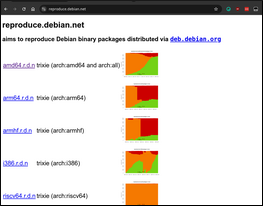
reproduce.debian.net The last few months saw the introduction of reproduce.debian.net. Announced at the recent Debian MiniDebConf in Toulouse, reproduce.debian.net is an instance of rebuilderd operated by the Reproducible Builds project. Powering that is rebuilderd, our server designed monitor the official package repositories of Linux distributions and attempt to reproduce the observed results there. This month, however, we are pleased to announce that in addition to the existing amd64.reproduce.debian.net and i386.reproduce.debian.net architecture-specific pages, we now build for a three more architectures (for a total of five) arm64 armhf and riscv64.
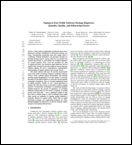
Two new academic papers Giacomo Benedetti, Oreofe Solarin, Courtney Miller, Greg Tystahl, William Enck, Christian K stner, Alexandros Kapravelos, Alessio Merlo and Luca Verderame published an interesting article recently. Titled An Empirical Study on Reproducible Packaging in Open-Source Ecosystem, the abstract outlines its optimistic findings:
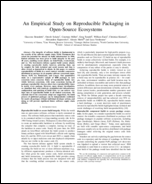
[We] identified that with relatively straightforward infrastructure configuration and patching of build tools, we can achieve very high rates of reproducible builds in all studied ecosystems. We conclude that if the ecosystems adopt our suggestions, the build process of published packages can be independently confirmed for nearly all packages without individual developer actions, and doing so will prevent significant future software supply chain attacks.
The entire PDF is available online to view.
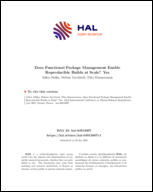
In addition, Julien Malka, Stefano Zacchiroli and Th o Zimmermann of T l com Paris in-house research laboratory, the Information Processing and Communications Laboratory (LTCI) published an article asking the question: Does Functional Package Management Enable Reproducible Builds at Scale?. Answering strongly in the affirmative, the article s abstract reads as follows:
In this work, we perform the first large-scale study of bitwise reproducibility, in the context of the Nix functional package manager, rebuilding 709,816 packages from historical snapshots of the nixpkgs repository[. We] obtain very high bitwise reproducibility rates, between 69 and 91% with an upward trend, and even higher rebuildability rates, over 99%. We investigate unreproducibility causes, showing that about 15% of failures are due to embedded build dates. We release a novel dataset with all build statuses, logs, as well as full diffoscopes: recursive diffs of where unreproducible build artifacts differ.
As above, the entire PDF of the article is available to view online.

Distribution work There as been the usual work in various distributions this month, such as:
  • 10+ reviews of Debian packages were added, 11 were updated and 10 were removed this month adding to our knowledge about identified issues. A number of issue types were updated also.
  • The FreeBSD Foundation announced that a planned project to deliver zero-trust builds has begun in January 2025 . Supported by the Sovereign Tech Agency, this project is centered on the various build processes, and that the primary goal of this work is to enable the entire release process to run without requiring root access, and that build artifacts build reproducibly that is, that a third party can build bit-for-bit identical artifacts. The full announcement can be found online, which includes an estimated schedule and other details.

On our mailing list On our mailing list this month:
  • Following-up to a substantial amount of previous work pertaining the Sphinx documentation generator, James Addison asked a question pertaining to the relationship between SOURCE_DATE_EPOCH environment variable and testing that generated a number of replies.
  • Adithya Balakumar of Toshiba asked a question about whether it is possible to make ext4 filesystem images reproducible. Adithya s issue is that even the smallest amount of post-processing of the filesystem results in the modification of the Last mount and Last write timestamps.
  • James Addison also investigated an interesting issue surrounding our disorderfs filesystem. In particular:
    FUSE (Filesystem in USErspace) filesystems such as disorderfs do not delete files from the underlying filesystem when they are deleted from the overlay. This can cause seemingly straightforward tests for example, cases that expect directory contents to be empty after deletion is requested for all files listed within them to fail.

Upstream patches The Reproducible Builds project detects, dissects and attempts to fix as many currently-unreproducible packages as possible. We endeavour to send all of our patches upstream where appropriate. This month, we wrote a large number of such patches, including:

diffoscope diffoscope is our in-depth and content-aware diff utility that can locate and diagnose reproducibility issues. This month, Chris Lamb made the following changes, including preparing and uploading versions 285, 286 and 287 to Debian:
  • Security fixes:
    • Validate the --css command-line argument to prevent a potential Cross-site scripting (XSS) attack. Thanks to Daniel Schmidt from SRLabs for the report. [ ]
    • Prevent XML entity expansion attacks. Thanks to Florian Wilkens from SRLabs for the report.. [ ][ ]
    • Print a warning if we have disabled XML comparisons due to a potentially vulnerable version of pyexpat. [ ]
  • Bug fixes:
    • Correctly identify changes to only the line-endings of files; don t mark them as Ordering differences only. [ ]
    • When passing files on the command line, don t call specialize( ) before we ve checked that the files are identical or not. [ ]
    • Do not exit with a traceback if paths are inaccessible, either directly, via symbolic links or within a directory. [ ]
    • Don t cause a traceback if cbfstool extraction failed.. [ ]
    • Use the surrogateescape mechanism to avoid a UnicodeDecodeError and crash when any decoding zipinfo output that is not UTF-8 compliant. [ ]
  • Testsuite improvements:
    • Don t mangle newlines when opening test fixtures; we want them untouched. [ ]
    • Move to assert_diff in test_text.py. [ ]
  • Misc improvements:
    • Drop unused subprocess imports. [ ][ ]
    • Drop an unused function in iso9600.py. [ ]
    • Inline a call and check of Config().force_details; no need for an additional variable in this particular method. [ ]
    • Remove an unnecessary return value from the Difference.check_for_ordering_differences method. [ ]
    • Remove unused logging facility from a few comparators. [ ]
    • Update copyright years. [ ][ ]
In addition, fridtjof added support for the ASAR .tar-like archive format. [ ][ ][ ][ ] and lastly, Vagrant Cascadian updated diffoscope in GNU Guix to version 285 [ ][ ] and 286 [ ][ ].
strip-nondeterminism is our sister tool to remove specific non-deterministic results from a completed build. This month version 1.14.1-1 was uploaded to Debian unstable by Chris Lamb, making the following the changes:
  • Clarify the --verbose and non --verbose output of bin/strip-nondeterminism so we don t imply we are normalizing files that we are not. [ ]
  • Bump Standards-Version to 4.7.0. [ ]

Website updates There were a large number of improvements made to our website this month, including:

Reproducibility testing framework The Reproducible Builds project operates a comprehensive testing framework running primarily at tests.reproducible-builds.org in order to check packages and other artifacts for reproducibility. In January, a number of changes were made by Holger Levsen, including:

  • reproduce.debian.net-related:
    • Add support for rebuilding the armhf architecture. [ ][ ]
    • Add support for rebuilding the arm64 architecture. [ ][ ][ ][ ]
    • Add support for rebuilding the riscv64 architecture. [ ][ ]
    • Move the i386 builder to the osuosl5 node. [ ][ ][ ][ ]
    • Don t run our rebuilders on a public port. [ ][ ]
    • Add database backups on all builders and add links. [ ][ ]
    • Rework and dramatically improve the statistics collection and generation. [ ][ ][ ][ ][ ][ ]
    • Add contact info to the main page [ ], thumbnails [ ] as well as the new, missing architectures. [ ]
    • Move the amd64 worker to the osuosl4 and node. [ ]
    • Run the underlying debrebuild script under nice. [ ]
    • Try to use TMPDIR when calling debrebuild. [ ][ ]
  • buildinfos.debian.net-related:
    • Stop creating buildinfo-pool_$ suite _$ arch .list files. [ ]
    • Temporarily disable automatic updates of pool links. [ ]
  • FreeBSD-related:
    • Fix the sudoers to actually permit builds. [ ]
    • Disable debug output for FreeBSD rebuilding jobs. [ ]
    • Upgrade to FreeBSD 14.2 [ ] and document that bmake was installed on the underlying FreeBSD virtual machine image [ ].
  • Misc:
    • Update the real year to 2025. [ ]
    • Don t try to install a Debian bookworm kernel from backports on the infom08 node which is running Debian trixie. [ ]
    • Don t warn about system updates for systems running Debian testing. [ ]
    • Fix a typo in the ZOMBIES definition. [ ][ ]
In addition:
  • Ed Maste modified the FreeBSD build system to the clean the object directory before commencing a build. [ ]
  • Gioele Barabucci updated the rebuilder stats to first add a category for network errors [ ] as well as to categorise failures without a diffoscope log [ ].
  • Jessica Clarke also made some FreeBSD-related changes, including:
    • Ensuring we clean up the object directory for second build as well. [ ][ ]
    • Updating the sudoers for the relevant rm -rf command. [ ]
    • Update the cleanup_tmpdirs method to to match other removals. [ ]
  • Jochen Sprickerhof:
  • Roland Clobus:
    • Update the reproducible_debstrap job to call Debian s debootstrap with the full path [ ] and to use eatmydata as well [ ][ ].
    • Make some changes to deduce the CPU load in the debian_live_build job. [ ]
Lastly, both Holger Levsen [ ] and Vagrant Cascadian [ ] performed some node maintenance.
If you are interested in contributing to the Reproducible Builds project, please visit our Contribute page on our website. However, you can get in touch with us via:
9 January 2025

Reproducible Builds: Reproducible Builds in December 2024
Welcome to the December 2024 report from the Reproducible Builds project! Our monthly reports outline what we ve been up to over the past month and highlight items of news from elsewhere in the world of software supply-chain security when relevant. As ever, however, if you are interested in contributing to the Reproducible Builds project, please visit our Contribute page on our website. Table of contents:
  1. reproduce.debian.net
  2. debian-repro-status

  3. On our mailing list
  4. Enhancing the Security of Software Supply Chains
  5. diffoscope
  6. Supply-chain attack in the Solana ecosystem
  7. Website updates
  8. Debian changes
  9. Other development news
  10. Upstream patches
  11. Reproducibility testing framework

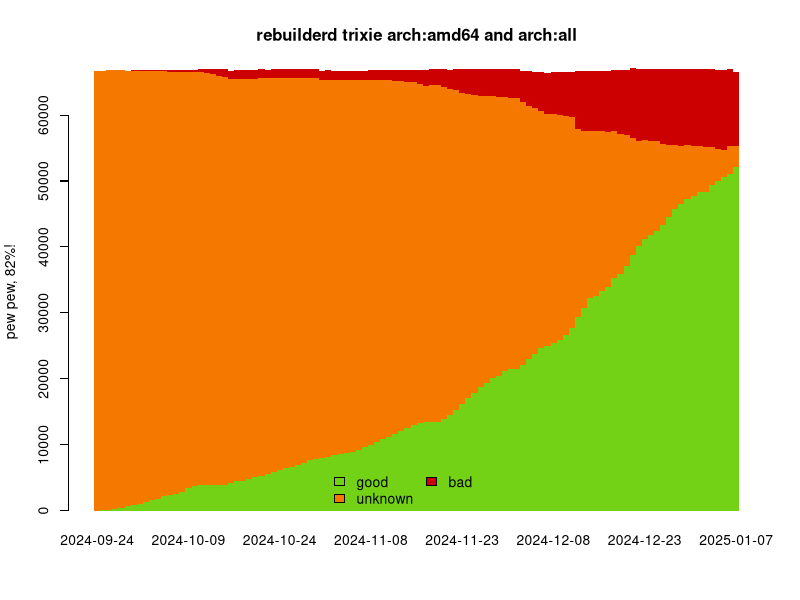
reproduce.debian.net Last month saw the introduction of reproduce.debian.net. Announced at the recent Debian MiniDebConf in Toulouse, reproduce.debian.net is an instance of rebuilderd operated by the Reproducible Builds project. rebuilderd is our server designed monitor the official package repositories of Linux distributions and attempts to reproduce the observed results there. This month, however, we are pleased to announce that not only does the service now produce graphs, the reproduce.debian.net homepage itself has become a start page of sorts, and the amd64.reproduce.debian.net and i386.reproduce.debian.net pages have emerged. The first of these rebuilds the amd64 architecture, naturally, but it also is building Debian packages that are marked with the no architecture label, all. The second builder is, however, only rebuilding the i386 architecture. Both of these services were also switched to reproduce the Debian trixie distribution instead of unstable, which started with 43% of the archive rebuild with 79.3% reproduced successfully. This is very much a work in progress, and we ll start reproducing Debian unstable soon. Our i386 hosts are very kindly sponsored by Infomaniak whilst the amd64 node is sponsored by OSUOSL thank you! Indeed, we are looking for more workers for more Debian architectures; please contact us if you are able to help.

debian-repro-status Reproducible builds developer kpcyrd has published a client program for reproduce.debian.net (see above) that queries the status of the locally installed packages and rates the system with a percentage score. This tool works analogously to arch-repro-status for the Arch Linux Reproducible Builds setup. The tool was packaged for Debian and is currently available in Debian trixie: it can be installed with apt install debian-repro-status.

On our mailing list On our mailing list this month:
  • Bernhard M. Wiedemann wrote a detailed post on his long journey towards a bit-reproducible Emacs package. In his interesting message, Bernhard goes into depth about the tools that they used and the lower-level technical details of, for instance, compatibility with the version for glibc within openSUSE.
  • Shivanand Kunijadar posed a question pertaining to the reproducibility issues with encrypted images. Shivanand explains that they must use a random IV for encryption with AES CBC. The resulting artifact is not reproducible due to the random IV used. The message resulted in a handful of replies, hopefully helpful!
  • User Danilo posted an in interesting question related to their attempts in trying to achieve reproducible builds for Threema Desktop 2.0. The question resulted in a number of replies attempting to find the right combination of compiler and linker flags (for example).
  • Longstanding contributor David A. Wheeler wrote to our list announcing the release of the Census III of Free and Open Source Software: Application Libraries report written by Frank Nagle, Kate Powell, Richie Zitomer and David himself. As David writes in his message, the report attempts to answer the question what is the most popular Free and Open Source Software (FOSS)? .
  • Lastly, kpcyrd followed-up to a post from September 2024 which mentioned their desire for someone to implement a hashset of allowed module hashes that is generated during the kernel build and then embedded in the kernel image , thus enabling a deterministic and reproducible build. However, they are now reporting that somebody implemented the hash-based allow list feature and submitted it to the Linux kernel mailing list . Like kpcyrd, we hope it gets merged.

Enhancing the Security of Software Supply Chains: Methods and Practices Mehdi Keshani of the Delft University of Technology in the Netherlands has published their thesis on Enhancing the Security of Software Supply Chains: Methods and Practices . Their introductory summary first begins with an outline of software supply chains and the importance of the Maven ecosystem before outlining the issues that it faces that threaten its security and effectiveness . To address these:
First, we propose an automated approach for library reproducibility to enhance library security during the deployment phase. We then develop a scalable call graph generation technique to support various use cases, such as method-level vulnerability analysis and change impact analysis, which help mitigate security challenges within the ecosystem. Utilizing the generated call graphs, we explore the impact of libraries on their users. Finally, through empirical research and mining techniques, we investigate the current state of the Maven ecosystem, identify harmful practices, and propose recommendations to address them.
A PDF of Mehdi s entire thesis is available to download.

diffoscope diffoscope is our in-depth and content-aware diff utility that can locate and diagnose reproducibility issues. This month, Chris Lamb made the following changes, including preparing and uploading versions 283 and 284 to Debian:
  • Update copyright years. [ ]
  • Update tests to support file 5.46. [ ][ ]
  • Simplify tests_quines.py::test_ differences,differences_deb to simply use assert_diff and not mangle the test fixture. [ ]

Supply-chain attack in the Solana ecosystem A significant supply-chain attack impacted Solana, an ecosystem for decentralised applications running on a blockchain. Hackers targeted the @solana/web3.js JavaScript library and embedded malicious code that extracted private keys and drained funds from cryptocurrency wallets. According to some reports, about $160,000 worth of assets were stolen, not including SOL tokens and other crypto assets.

Website updates Similar to last month, there was a large number of changes made to our website this month, including:
  • Chris Lamb:
    • Make the landing page hero look nicer when the vertical height component of the viewport is restricted, not just the horizontal width.
    • Rename the Buy-in page to Why Reproducible Builds? [ ]
    • Removing the top black border. [ ][ ]
  • Holger Levsen:
  • hulkoba:
    • Remove the sidebar-type layout and move to a static navigation element. [ ][ ][ ][ ]
    • Create and merge a new Success stories page, which highlights the success stories of Reproducible Builds, showcasing real-world examples of projects shipping with verifiable, reproducible builds. These stories aim to enhance the technical resilience of the initiative by encouraging community involvement and inspiring new contributions. . [ ]
    • Further changes to the homepage. [ ]
    • Remove the translation icon from the navigation bar. [ ]
    • Remove unused CSS styles pertaining to the sidebar. [ ]
    • Add sponsors to the global footer. [ ]
    • Add extra space on large screens on the Who page. [ ]
    • Hide the side navigation on small screens on the Documentation pages. [ ]

Debian changes There were a significant number of reproducibility-related changes within Debian this month, including:
  • Santiago Vila uploaded version 0.11+nmu4 of the dh-buildinfo package. In this release, the dh_buildinfo becomes a no-op ie. it no longer does anything beyond warning the developer that the dh-buildinfo package is now obsolete. In his upload, Santiago wrote that We still want packages to drop their [dependency] on dh-buildinfo, but now they will immediately benefit from this change after a simple rebuild.
  • Holger Levsen filed Debian bug #1091550 requesting a rebuild of a number of packages that were built with a very old version of dpkg.
  • Fay Stegerman contributed to an extensive thread on the debian-devel development mailing list on the topic of Supporting alternative zlib implementations . In particular, Fay wrote about her results experimenting whether zlib-ng produces identical results or not.
  • kpcyrd uploaded a new rust-rebuilderd-worker, rust-derp, rust-in-toto and debian-repro-status to Debian, which passed successfully through the so-called NEW queue.
  • Gioele Barabucci filed a number of bugs against the debrebuild component/script of the devscripts package, including:
    • #1089087: Address a spurious extra subdirectory in the build path.
    • #1089201: Extra zero bytes added to .dynstr when rebuilding CMake projects.
    • #1089088: Some binNMUs have a 1-second offset in some timestamps.
  • Gioele Barabucci also filed a bug against the dh-r package to report that the Recommends and Suggests fields are missing from rebuilt R packages. At the time of writing, this bug has no patch and needs some help to make over 350 binary packages reproducible.
  • Lastly, 8 reviews of Debian packages were added, 11 were updated and 11 were removed this month adding to our knowledge about identified issues.

Other development news In other ecosystem and distribution news:
  • Lastly, in openSUSE, Bernhard M. Wiedemann published another report for the distribution. There, Bernhard reports about the success of building R-B-OS , a partial fork of openSUSE with only 100% bit-reproducible packages. This effort was sponsored by the NLNet NGI0 initiative.

Upstream patches The Reproducible Builds project detects, dissects and attempts to fix as many currently-unreproducible packages as possible. We endeavour to send all of our patches upstream where appropriate. This month, we wrote a large number of such patches, including:

Reproducibility testing framework The Reproducible Builds project operates a comprehensive testing framework running primarily at tests.reproducible-builds.org in order to check packages and other artifacts for reproducibility. In November, a number of changes were made by Holger Levsen, including:
  • reproduce.debian.net-related:
    • Add a new i386.reproduce.debian.net rebuilder. [ ][ ][ ][ ][ ][ ]
    • Make a number of updates to the documentation. [ ][ ][ ][ ][ ]
    • Run i386.reproduce.debian.net run on a public port to allow external workers. [ ]
    • Add a link to the /api/v0/pkgs/list endpoint. [ ]
    • Add support for a statistics page. [ ][ ][ ][ ][ ][ ]
    • Limit build logs to 20 MiB and diffoscope output to 10 MiB. [ ]
    • Improve the frontpage. [ ][ ]
    • Explain that we re testing arch:any and arch:all on the amd64 architecture, but only arch:any on i386. [ ]
  • Misc:
    • Remove code for testing Arch Linux, which has moved to reproduce.archlinux.org. [ ][ ]
    • Don t install dstat on Jenkins nodes anymore as its been removed from Debian trixie. [ ]
    • Prepare the infom08-i386 node to become another rebuilder. [ ]
    • Add debug date output for benchmarking the reproducible_pool_buildinfos.sh script. [ ]
    • Install installation-birthday everywhere. [ ]
    • Temporarily disable automatic updates of pool links on buildinfos.debian.net. [ ]
    • Install Recommends by default on Jenkins nodes. [ ]
    • Rename rebuilder_stats.py to rebuilderd_stats.py. [ ]
    • r.d.n/stats: minor formatting changes. [ ]
    • Install files under /etc/cron.d/ with the correct permissions. [ ]
and Jochen Sprickerhof made the following changes: Lastly, Gioele Barabucci also classified packages affected by 1-second offset issue filed as Debian bug #1089088 [ ][ ][ ][ ], Chris Hofstaedtler updated the URL for Grml s dpkg.selections file [ ], Roland Clobus updated the Jenkins log parser to parse warnings from diffoscope [ ] and Mattia Rizzolo banned a number of bots and crawlers from the service [ ][ ].
If you are interested in contributing to the Reproducible Builds project, please visit our Contribute page on our website. However, you can get in touch with us via:

5 December 2024

Reproducible Builds: Reproducible Builds in November 2024

Welcome to the November 2024 report from the Reproducible Builds project! Our monthly reports outline what we ve been up to over the past month and highlight items of news from elsewhere in the world of software supply-chain security where relevant. As ever, if you are interested in contributing to the Reproducible Builds project, please visit our Contribute page on our website. Table of contents:
  1. Reproducible Builds mourns the passing of Lunar
  2. Introducing reproduce.debian.net
  3. New landing page design
  4. SBOMs for Python packages
  5. Debian updates
  6. Reproducible builds by default in Maven 4
  7. PyPI now supports digital attestations
  8. Dependency Challenges in OSS Package Registries
  9. Zig programming language demonstrated reproducible
  10. Website updates
  11. Upstream patches
  12. Misc development news
  13. Reproducibility testing framework

Reproducible Builds mourns the passing of Lunar The Reproducible Builds community sadly announced it has lost its founding member, Lunar. J r my Bobbio aka Lunar passed away on Friday November 8th in palliative care in Rennes, France. Lunar was instrumental in starting the Reproducible Builds project in 2013 as a loose initiative within the Debian project. He was the author of our earliest status reports and many of our key tools in use today are based on his design. Lunar s creativity, insight and kindness were often noted. You can view our full tribute elsewhere on our website. He will be greatly missed.

Introducing reproduce.debian.net In happier news, this month saw the introduction of reproduce.debian.net. Announced at the recent Debian MiniDebConf in Toulouse, reproduce.debian.net is an instance of rebuilderd operated by the Reproducible Builds project. rebuilderd is our server designed monitor the official package repositories of Linux distributions and attempts to reproduce the observed results there. In November, reproduce.debian.net began rebuilding Debian unstable on the amd64 architecture, but throughout the MiniDebConf, it had attempted to rebuild 66% of the official archive. From this, it could be determined that it is currently possible to bit-for-bit reproduce and corroborate approximately 78% of the actual binaries distributed by Debian that is, using the .buildinfo files hosted by Debian itself. reproduce.debian.net also contains instructions how to setup one s own rebuilderd instance, and we very much invite everyone with a machine to spare to setup their own version and to share the results. Whilst rebuilderd is still in development, it has been used to reproduce Arch Linux since 2019. We are especially looking for installations targeting Debian architectures other than i386 and amd64.

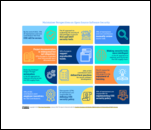
New landing page design As part of a very productive partnership with the Sovereign Tech Fund and Neighbourhoodie, we are pleased to unveil our new homepage/landing page. We are very happy with our collaboration with both STF and Neighbourhoodie (including many changes not directly related to the website), and look forward to working with them in the future.

SBOMs for Python packages The Python Software Foundation has announced a new cross-functional project for SBOMs and Python packages . Seth Michael Larson writes that the project is specifically looking to solve these issues :
  • Enable Python users that require SBOM documents (likely due to regulations like CRA or SSDF) to self-serve using existing SBOM generation tools.
  • Solve the phantom dependency problem, where non-Python software is bundled in Python packages but not recorded in any metadata. This makes the job of software composition analysis (SCA) tools difficult or impossible.
  • Make the adoption work by relevant projects such as build backends, auditwheel-esque tools, as minimal as possible. Empower users who are interested in having better SBOM data for the Python projects they are using to be able to contribute engineering time towards that goal.
A GitHub repository for the initiative is available, and there are a number of queries, comments and remarks on Seth s Discourse forum post.

Debian updates There was significant development within Debian this month. Firstly, at the recent MiniDebConf in Toulouse, France, Holger Levsen gave a Debian-specific talk on rebuilding packages distributed from ftp.debian.org that is to say, how to reproduce the results from the official Debian build servers: Holger described the talk as follows:
For more than ten years, the Reproducible Builds project has worked towards reproducible builds of many projects, and for ten years now we have build Debian packages twice with maximal variations applied to see if they can be build reproducible still. Since about a month, we ve also been rebuilding trying to exactly match the builds being distributed via ftp.debian.org. This talk will describe the setup and the lessons learned so far, and why the results currently are what they are (spoiler: they are less than 30% reproducible), and what we can do to fix that.
The Debian Project Leader, Andreas Tille, was present at the talk and remarked later in his Bits from the DPL update that:
It might be unfair to single out a specific talk from Toulouse, but I d like to highlight the one on reproducible builds. Beyond its technical focus, the talk also addressed the recent loss of Lunar, whom we mourn deeply. It served as a tribute to Lunar s contributions and legacy. Personally, I ve encountered packages maintained by Lunar and bugs he had filed. I believe that taking over his packages and addressing the bugs he reported is a meaningful way to honor his memory and acknowledge the value of his work.
Holger s slides and video in .webm format are available.
Next, rebuilderd is the server to monitor package repositories of Linux distributions and attempt to reproduce the observed results. This month, version 0.21.0 released, most notably with improved support for binNMUs by Jochen Sprickerhof and updating the rebuilderd-debian.sh integration to the latest debrebuild version by Holger Levsen. There has also been significant work to get the rebuilderd package into the Debian archive, in particular, both rust-rebuilderd-common version 0.20.0-1 and rust-rust-lzma version 0.6.0-1 were packaged by kpcyrd and uploaded by Holger Levsen. Related to this, Holger Levsen submitted three additional issues against rebuilderd as well:
  • rebuildctl should be more verbose when encountering issues. [ ]
  • Please add an option to used randomised queues. [ ]
  • Scheduling and re-scheduling multiple packages at once. [ ]
and lastly, Jochen Sprickerhof submitted one an issue requested that rebuilderd downloads the source package in addition to the .buildinfo file [ ] and kpcyrd also submitted and fixed an issue surrounding dependencies and clarifying the license [ ]
Separate to this, back in 2018, Chris Lamb filed a bug report against the sphinx-gallery package as it generates unreproducible content in various ways. This month, however, Dmitry Shachnev finally closed the bug, listing the multiple sub-issues that were part of the problem and how they were resolved.
Elsewhere, Roland Clobus posted to our mailing list this month, asking for input on a bug in Debian s ca-certificates-java package. The issue is that the Java key management tools embed timestamps in its output, and this output ends up in the /etc/ssl/certs/java/cacerts file on the generated ISO images. A discussion resulted from Roland s post suggesting some short- and medium-term solutions to the problem.
Holger Levsen uploaded some packages with reproducibility-related changes:
Lastly, 12 reviews of Debian packages were added, 5 were updated and 21 were removed this month adding to our knowledge about identified issues in Debian.

Reproducible builds by default in Maven 4 On our mailing list this month, Herv Boutemy reported the latest release of Maven (4.0.0-beta-5) has reproducible builds enabled by default. In his mailing list post, Herv mentions that this story started during our Reproducible Builds summit in Hamburg , where he created the upstream issue that builds on a multi-year effort to have Maven builds configured for reproducibility.

PyPI now supports digital attestations Elsewhere in the Python ecosystem and as reported on LWN and elsewhere, the Python Package Index (PyPI) has announced that it has finalised support for PEP 740 ( Index support for digital attestations ). Trail of Bits, who performed much of the development work, has an in-depth blog post about the work and its adoption, as well as what is left undone:
One thing is notably missing from all of this work: downstream verification. [ ] This isn t an acceptable end state (cryptographic attestations have defensive properties only insofar as they re actually verified), so we re looking into ways to bring verification to individual installing clients. In particular, we re currently working on a plugin architecture for pip that will enable users to load verification logic directly into their pip install flows.
There was an in-depth discussion on LWN s announcement page, as well as on Hacker News.

Dependency Challenges in OSS Package Registries At BENEVOL, the Belgium-Netherlands Software Evolution workshop in Namur, Belgium, Tom Mens and Alexandre Decan presented their paper, An Overview and Catalogue of Dependency Challenges in Open Source Software Package Registries . The abstract of their paper is as follows:
While open-source software has enabled significant levels of reuse to speed up software development, it has also given rise to the dreadful dependency hell that all software practitioners face on a regular basis. This article provides a catalogue of dependency-related challenges that come with relying on OSS packages or libraries. The catalogue is based on the scientific literature on empirical research that has been conducted to understand, quantify and overcome these challenges. [ ]
A PDF of the paper is available online.

Zig programming language demonstrated reproducible Motiejus Jak ty posted an interesting and practical blog post on his successful attempt to reproduce the Zig programming language without using the pre-compiled binaries checked into the repository, and despite the circular dependency inherent in its bootstrapping process. As a summary, Motiejus concludes that:
I can now confidently say (and you can also check, you don t need to trust me) that there is nothing hiding in zig1.wasm [the checked-in binary] that hasn t been checked-in as a source file.
The full post is full of practical details, and includes a few open questions.

Website updates Notwithstanding the significant change to the landing page (screenshot above), there were an enormous number of changes made to our website this month. This included:
  • Alex Feyerke and Mariano Gim nez:
    • Dramatically overhaul the website s landing page with new benefit cards tailored to the expected visitors to our website and a reworking of the visual hierarchy and design. [ ][ ][ ][ ][ ][ ][ ][ ][ ][ ]
  • Bernhard M. Wiedemann:
    • Update the System images page to document the e2fsprogs approach. [ ]
  • Chris Lamb:
  • FC (Fay) Stegerman:
    • Replace more inline markdown with HTML on the Success stories page. [ ]
    • Add some links, fix some other links and correct some spelling errors on the Tools page. [ ]
  • Holger Levsen:
    • Add a historical presentation ( Reproducible builds everywhere eg. in Debian, OpenWrt and LEDE ) from October 2016. [ ]
    • Add jochensp and Oejet to the list of known contributors. [ ][ ]
  • Julia Kr ger:
  • Ninette Adhikari & hulkoba:
    • Add/rework the list of success stories into a new page that clearly shows milestones in Reproducible Builds. [ ][ ][ ][ ][ ][ ]
  • Philip Rinn:
    • Import 47 historical weekly reports. [ ]
  • hulkoba:
    • Add alt text to almost all images (!). [ ][ ]
    • Fix a number of links on the Talks . [ ][ ]
    • Avoid so-called ghost buttons by not using <button> elements as links, as the affordance of a <button> implies an action with (potentially) a side effect. [ ][ ]
    • Center the sponsor logos on the homepage. [ ]
    • Move publications and generate them instead from a data.yml file with an improved layout. [ ][ ]
    • Make a large number of small but impactful stylisting changes. [ ][ ][ ][ ]
    • Expand the Tools to include a number of missing tools, fix some styling issues and fix a number of stale/broken links. [ ][ ][ ][ ][ ][ ]

Upstream patches The Reproducible Builds project detects, dissects and attempts to fix as many currently-unreproducible packages as possible. We endeavour to send all of our patches upstream where appropriate. This month, we wrote a large number of such patches, including:

Misc development news

Reproducibility testing framework The Reproducible Builds project operates a comprehensive testing framework running primarily at tests.reproducible-builds.org in order to check packages and other artifacts for reproducibility. In November, a number of changes were made by Holger Levsen, including:
  • reproduce.debian.net-related changes:
    • Create and introduce a new reproduce.debian.net service and subdomain [ ]
    • Make a large number of documentation changes relevant to rebuilderd. [ ][ ][ ][ ][ ]
    • Explain a temporary workaround for a specific issue in rebuilderd. [ ]
    • Setup another rebuilderd instance on the o4 node and update installation documentation to match. [ ][ ]
    • Make a number of helpful/cosmetic changes to the interface, such as clarifying terms and adding links. [ ][ ][ ][ ][ ]
    • Deploy configuration to the /opt and /var directories. [ ][ ]
    • Add an infancy (or alpha ) disclaimer. [ ][ ]
    • Add more notes to the temporary rebuilderd documentation. [ ]
    • Commit an nginx configuration file for reproduce.debian.net s Stats page. [ ]
    • Commit a rebuilder-worker.conf configuration for the o5 node. [ ]
  • Debian-related changes:
    • Grant jspricke and jochensp access to the o5 node. [ ][ ]
    • Build the qemu package with the nocheck build flag. [ ]
  • Misc changes:
    • Adapt the update_jdn.sh script for new Debian trixie systems. [ ]
    • Stop installing the PostgreSQL database engine on the o4 and o5 nodes. [ ]
    • Prevent accidental reboots of the o4 node because of a long-running job owned by josch. [ ][ ]
In addition, Mattia Rizzolo addressed a number of issues with reproduce.debian.net [ ][ ][ ][ ]. And lastly, both Holger Levsen [ ][ ][ ][ ] and Vagrant Cascadian [ ][ ][ ][ ] performed node maintenance.
If you are interested in contributing to the Reproducible Builds project, please visit our Contribute page on our website. However, you can get in touch with us via:

4 September 2024

Reproducible Builds: Reproducible Builds in August 2024

Welcome to the August 2024 report from the Reproducible Builds project! Our reports attempt to outline what we ve been up to over the past month, highlighting news items from elsewhere in tech where they are related. As ever, if you are interested in contributing to the project, please visit our Contribute page on our website. Table of contents:
  1. LWN: The history, status, and plans for reproducible builds
  2. Intermediate Autotools build artifacts removed from PostgreSQL distribution tarballs
  3. Distribution news
  4. Mailing list news
  5. diffoscope
  6. Website updates
  7. Upstream patches
  8. Reproducibility testing framework

LWN: The history, status, and plans for reproducible builds The free software newspaper of record, Linux Weekly News, published an in-depth article based on Holger Levsen s talk, Reproducible Builds: The First Eleven Years which was presented at the recent DebConf24 conference in Busan, South Korea. Titled The history, status, and plans for reproducible builds and written by Jake Edge, LWN s article not only summarises Holger s talk and clarifies its message but it links to external information as well. Holger s original talk can also be watched on the DebConf24 webpage (direct .webm link and his HTML slides are available also). There are also a significant number of comments on LWN s page as well. Holger Levsen also headed a scheduled discussion session at DebConf24 on Preserving *other* build artifacts addressing a topic where a number of Debian packages are (or would like to) produce results that are neither the .deb files, the build logs nor the logs of CI tests. This is an issue for reproducible builds as this 4th type of build artifact are typically shipped within the binary .deb packages, and are invariably non-deterministic; thus making the .deb files unreproducible. (A direct .webm link and HTML slides are available).

Intermediate Autotools build artifacts removed from PostgreSQL distribution tarballs Peter Eisentraut wrote a detailed blog post on the subject of The new PostgreSQL 17 make dist . Like many projects, the PostgreSQL database has previously pre-built parts of its GNU Autotools build system: the reason for this is a mix of convenience and traditional practice . Peter astutely notes that this arrangement in the build system is quite tricky as:
You need to carefully maintain the different states of clean source code , partially built source code , and fully built source code , and the commands to transition between them.
However, Peter goes on to mention that:
a lot more attention is nowadays paid to the software supply chain. There are security and legal reasons for this. When users install software, they want to know where it came from, and they want to be sure that they got the right thing, not some fake version or some version of dubious legal provenance.
And cites the XZ Utils backdoor as a reason to care about transparent and reproducible ways of distributing and communicating a source tarball and provenance. Because of this, intermediate build artifacts are now henceforth essentially disallowed from PostgreSQL distribution tarballs.

Distribution news In Debian this month, 30 reviews of Debian packages were added, 17 were updated and 10 were removed this month adding to our knowledge about identified issues. One issue type was added by Chris Lamb, too. [ ] In addition, an issue was filed to update the Salsa CI pipeline (used by 1,000s of Debian packages) to no longer test for reproducibility with reprotest s build_path variation. Holger Levsen provided a rationale for this change in the issue, which has already been made to the tests being performed by tests.reproducible-builds.org.
In Arch Linux this month, Jelle van der Waa published a short blog post on the topic of Investigating creating reproducible images with mkosi, motivated by the desire to make it possible for anyone to re-recreate the official Arch cloud image bit-by-bit identical on their own machine as per [the] reproducible builds definition. In addition, Jelle filed a patch for pacman, the Arch Linux package manager, to respect the SOURCE_DATE_EPOCH environment variable when installing a package.
In openSUSE news, Bernhard M. Wiedemann published another report for that distribution.
In Android news, the IzzyOnDroid project added 49 new rebuilder recipes and now features 256 total reproducible applications representing 21% of the total offerings in the repository. IzzyOnDroid is an F-Droid style repository for Android apps[:] applications in this repository are official binaries built by the original application developers, taken from their resp. repositories (mostly GitHub).

Mailing list news From our mailing list this month:
  • Bernhard M. Wiedemann posted a brief message to the list with some helpful information regarding nondeterminism within Rust binaries, positing the use of the codegen-units = 16 default and resulting in a bug being filed in the Rust issue tracker. [ ]
  • Bernhard also wrote to the list, following up to a thread in November 2023, on attempts to make the LibreOffice suite of office applications build reproducibly. In the thread from this month, Bernhard could announce that the four patches previously mentioned have landed in LibreOffice upstream.
  • Fay Stegerman linked the mailing list to a thread she made on the Signal issue tracker regarding whether device-specific binaries [can] ever be considered meaningfully reproducible . In particular: the whole part about allow[ing] multiple third parties to come to a consensus on a correct result breaks down completely when correct is device-specific and not something everyone can agree on. [ ]
  • Developer kpcyrd posted an update for source code indexing project, whatsrc.org. Announcing that it now importing packages from live-bootstrap ( a usable Linux system [that is] created with only human-auditable, and wherever possible, human-written, source code ) into its database of provenance data.
  • Lastly, Mechtilde Stehmann posted an update to an earlier thread about how Java builds are not reproducible on the armhf architecture, enquiring how they might gain temporary access to such a machine in order to perform some deeper testing. [ ]

diffoscope diffoscope is our in-depth and content-aware diff utility that can locate and diagnose reproducibility issues. This month, Chris Lamb released versions 274, 275, 276 and 277, uploaded these to Debian, and made the following changes as well:
  • New features:
    • Strip ANSI escapes usually colour codes from the output of the Procyon Java decompiler. [ ]
    • Factor out a method for stripping ANSI escapes. [ ]
    • Append output from dumppdf(1) in more cases, avoiding situations where we fallback to a binary diff. [ ]
    • Add support for versions of Perl s IO::Compress::Zip version 2.212. [ ]
  • Bug fixes:
    • Also catch RuntimeError exceptions when importing the PyPDF library so that it, or, crucially, its transitive dependencies, cannot not cause diffoscope to traceback at runtime and build time. [ ]
    • Do not call marshal.load( ) of precompiled Python bytecode as it, alas, inherently unsafe. Replace for now with a brief summary of the code section of .pyc. [ ][ ]
    • Don t include excessive debug output when calling dumppdf(1). [ ]
  • Testsuite-related changes:
    • Don t bother to check version number in test_python.py: the fixture for this test is fixed. [ ][ ]
    • Update test_zip text fixtures and definitions to support new changes to the Perl IO::Compress library. [ ]
In addition, Mattia Rizzolo updated the available architectures for a number of test dependencies [ ] and Sergei Trofimovich fixed an issue to avoid diffoscope crashing when hashing directory symlinks [ ] and Vagrant Cascadian proposed GNU Guix updates for diffoscope versions 275 and 276 and 277.

Website updates There were a rather substantial number of improvements made to our website this month, including:
  • Alba Herrerias:
    • Substantially extend the guidance on the Contribute page. [ ]
  • Chris Lamb:
    • Set the future: true configuration value so we render all files and documents in the website, regardless of whether they have a date property in the future. After all, we don t re-generate the website on a timer, and have other ways of making unpublished, draft posts. [ ][ ]
  • Fay Stegerman:
  • hulkoba:
  • kpcyrd:
  • Mattia Rizzolo:
  • Pol Dellaiera:

Upstream patches The Reproducible Builds project detects, dissects and attempts to fix as many currently-unreproducible packages as possible. We endeavour to send all of our patches upstream where appropriate. This month, we wrote a large number of such patches, including:

Reproducibility testing framework The Reproducible Builds project operates a comprehensive testing framework running primarily at tests.reproducible-builds.org in order to check packages and other artifacts for reproducibility. In August, a number of changes were made by Holger Levsen, including:
  • Temporarily install the openssl-provider-legacy package for the Debian unstable environments for running diffoscope due to Debian bug #1078944. [ ][ ][ ][ ]
  • Mark Debian armhf architecture nodes as being down due to proxy down. [ ][ ]
  • Detect proxy failures. [ ][ ][ ]
  • Run the index-buildinfo for the builtin-pho script with the -q switch. [ ]
  • Disable all Arch Linux reproducible jobs. [ ]
In addition, Mattia Rizzolo updated the website configuration to install the ruby-jekyll-sitemap package as it is now used in the website [ ], Roland Clobus updated the script to build Debian live images to treat openQA issues as warnings [ ], and Vagrant Cascadian marked the cbxi4b node as down [ ].

If you are interested in contributing to the Reproducible Builds project, please visit our Contribute page on our website. However, you can get in touch with us via:

8 August 2024

Reproducible Builds: Reproducible Builds in July 2024

Welcome to the July 2024 report from the Reproducible Builds project! In our reports, we outline what we ve been up to over the past month and highlight news items in software supply-chain security more broadly. As always, if you are interested in contributing to the project, please visit our Contribute page on our website. Table of contents:
  1. Reproducible Builds Summit 2024
  2. Pulling Linux up by its bootstraps
  3. Towards Idempotent Rebuilds?
  4. AROMA: Automatic Reproduction of Maven Artifacts
  5. Community updates
  6. Android Reproducible Builds at IzzyOnDroid with rbtlog
  7. Extending the Scalability, Flexibility and Responsiveness of Secure Software Update Systems
  8. Development news
  9. Website updates
  10. Upstream patches
  11. Reproducibility testing framework


Reproducible Builds Summit 2024 Last month, we were very pleased to announce the upcoming Reproducible Builds Summit, set to take place from September 17th 19th 2024 in Hamburg, Germany. We are thrilled to host the seventh edition of this exciting event, following the success of previous summits in various iconic locations around the world, including Venice, Marrakesh, Paris, Berlin and Athens. Our summits are a unique gathering that brings together attendees from diverse projects, united by a shared vision of advancing the Reproducible Builds effort. During this enriching event, participants will have the opportunity to engage in discussions, establish connections and exchange ideas to drive progress in this vital field. Our aim is to create an inclusive space that fosters collaboration, innovation and problem-solving. If you re interesting in joining us this year, please make sure to read the event page, which has more details about the event and location. We are very much looking forward to seeing many readers of these reports there.

Pulling Linux up by its bootstraps (LWN) In a recent edition of Linux Weekly News, Daroc Alden has written an article on bootstrappable builds. Starting with a brief introduction that
a bootstrappable build is one that builds existing software from scratch for example, building GCC without relying on an existing copy of GCC. In 2023, the Guix project announced that the project had reduced the size of the binary bootstrap seed needed to build its operating system to just 357-bytes not counting the Linux kernel required to run the build process.
The article goes onto to describe that now, the live-bootstrap project has gone a step further and removed the need for an existing kernel at all. and concludes:
The real benefit of bootstrappable builds comes from a few things. Like reproducible builds, they can make users more confident that the binary packages downloaded from a package mirror really do correspond to the open-source project whose source code they can inspect. Bootstrappable builds have also had positive effects on the complexity of building a Linux distribution from scratch [ ]. But most of all, bootstrappable builds are a boon to the longevity of our software ecosystem. It s easy for old software to become unbuildable. By having a well-known, self-contained chain of software that can build itself from a small seed, in a variety of environments, bootstrappable builds can help ensure that today s software is not lost, no matter where the open-source community goes from here

Towards Idempotent Rebuilds? Trisquel developer Simon Josefsson wrote an interesting blog post comparing the output of the .deb files from our tests.reproducible-builds.org testing framework and the ones in the official Debian archive. Following up from a previous post on the reproducibility of Trisquel, Simon notes that typically [the] rebuilds do not match the official packages, even when they say the package is reproducible , Simon correctly identifies that the purpose of [these] rebuilds are not to say anything about the official binary build, instead the purpose is to offer a QA service to maintainers by performing two builds of a package and declaring success if both builds match. However, Simon s post swiftly moves on to announce a new tool called debdistrebuild that performs rebuilds of the difference between two distributions in a GitLab pipeline and displays diffoscope output for further analysis.

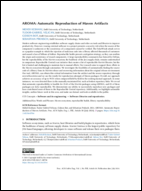
AROMA: Automatic Reproduction of Maven Artifacts Mehdi Keshani, Tudor-Gabriel Velican, Gideon Bot and Sebastian Proksch of the Delft University of Technology, Netherlands, have published a new paper in the ACM Software Engineering on a new tool to automatically reproduce Apache Maven artifacts:
Reproducible Central is an initiative that curates a list of reproducible Maven libraries, but the list is limited and challenging to maintain due to manual efforts. [We] investigate the feasibility of automatically finding the source code of a library from its Maven release and recovering information about the original release environment. Our tool, AROMA, can obtain this critical information from the artifact and the source repository through several heuristics and we use the results for reproduction attempts of Maven packages. Overall, our approach achieves an accuracy of up to 99.5% when compared field-by-field to the existing manual approach [and] we reveal that automatic reproducibility is feasible for 23.4% of the Maven packages using AROMA, and 8% of these packages are fully reproducible.

Community updates On our mailing list this month:
  • Nichita Morcotilo reached out to the community, first to share their efforts to build reproducible packages cross-platform with a new build tool called rattler-build, noting that as you can imagine, building packages reproducibly on Windows is the hardest challenge (so far!) . Nichita goes onto mention that the Apple ecosystem appears to be using ZERO_AR_DATE over SOURCE_DATE_EPOCH. [ ]
  • Roland Clobus announced that the Debian bookworm 12.6 live images are nearly reproducible , with more detail in the post itself and input in the thread from other contributors.
  • As reported in last month s report, Pol Dellaiera completed his master thesis on Reproducibility in Software Engineering at the University of Mons, Belgium. This month, Pol announced this on the list with more background info. Since the master thesis sources have been available, it has received some feedback and contributions. As a result, an updated version of the thesis has been published containing those community fixes.
  • Daniel Gr ber asked for help in getting the Yosys documentation to build reproducibly, citing issues in inter alia the PDF generation causing differing CreationDate metadata values.
  • James Addison continued his long journey towards getting the Sphinx documentation generator to build reproducible documentation. In this thread, James concerns himself with the problem that even when SOURCE_DATE_EPOCH is configured, Sphinx projects that have configured their copyright notices using dynamic elements can produce nonsensical output under some circumstances. James query ended up generating a number of replies.
  • Allen gunner Gunner posted a brief update on the progress the core team is making towards introducing a Code of Conduct (CoC) such that it is in place in time for the RB Summit in Hamburg in September . In particular, gunner asks if you are interested in helping with CoC design and development in the weeks ahead, simply email rb-core@lists.reproducible-builds.org and let us know . [ ]

Android Reproducible Builds at IzzyOnDroid with rbtlog On our mailing list, Fay Stegerman announced a new Reproducible Builds collaboration in the Android ecosystem:
We are pleased to announce Reproducible Builds, special client support and more in our repo : a collaboration between various independent interoperable projects: the IzzyOnDroid team, 3rd-party clients Droid-ify & Neo Store, and rbtlog (part of my collection of tools for Android Reproducible Builds) to bring Reproducible Builds to IzzyOnDroid and the wider Android ecosystem.

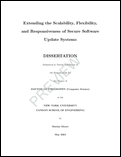
Extending the Scalability, Flexibility and Responsiveness of Secure Software Update Systems Congratulations to Marina Moore of the New York Tandon School of Engineering who has submitted her PhD thesis on Extending the Scalability, Flexibility and Responsiveness of Secure Software Update Systems. The introduction outlines its contributions to the field:
[S]oftware repositories are a vital component of software development and release, with packages downloaded both for direct use and to use as dependencies for other software. Further, when software is updated due to patched vulnerabilities or new features, it is vital that users are able to see and install this patched version of the software. However, this process of updating software can also be the source of attack. To address these attacks, secure software update systems have been proposed. However, these secure software update systems have seen barriers to widespread adoption. The Update Framework (TUF) was introduced in 2010 to address several attacks on software update systems including repository compromise, rollback attacks, and arbitrary software installation. Despite this, compromises continue to occur, with millions of users impacted by such compromises. My work has addressed substantial challenges to adoption of secure software update systems grounded in an understanding of practical concerns. Work with industry and academic communities provided opportunities to discover challenges, expand adoption, and raise awareness about secure software updates. [ ]

Development news In Debian this month, 12 reviews of Debian packages were added, 13 were updated and 6 were removed this month adding to our knowledge about identified issues. A new toolchain issue type was identified as well, specifically ordering_differences_in_pkg_info.
Colin Percival filed a bug against the LLVM compiler noting that building i386 binaries on the i386 architecture is different when building i386 binaries under amd64. The fix was narrowed down to x87 excess precision, which can result in slightly different register choices when the compiler is hosted on x86_64 or i386 and a fix committed. [ ]
Fay Stegerman performed some in-depth research surrounding her apksigcopier tool, after some Android .apk files signed with the latest apksigner could no longer be verified as reproducible. Fay identified the issue as follows:
Since build-tools >= 35.0.0-rc1, backwards-incompatible changes to apksigner break apksigcopier as it now by default forcibly replaces existing alignment padding and changed the default page alignment from 4k to 16k (same as Android Gradle Plugin >= 8.3, so the latter is only an issue when using older AGP). [ ]
She documented multiple available workarounds and filed a bug in Google s issue tracker.
Lastly, diffoscope is our in-depth and content-aware diff utility that can locate and diagnose reproducibility issues. This month, Chris Lamb uploaded version 272 and Mattia Rizzolo uploaded version 273 to Debian, and the following changes were made as well:
  • Chris Lamb:
    • Ensure that the convert utility is from ImageMagick version 6.x. The command-line interface has seemingly changed with the 7.x series of ImageMagick. [ ]
    • Factor out version detection in test_jpeg_image. [ ]
    • Correct the import of the identify_version method after a refactoring change in a previous commit. [ ]
    • Move away from using DSA OpenSSH keys in tests as support has been deprecated and removed in OpenSSH version 9.8p1. [ ]
    • Move to assert_diff in the test_openssh_pub_key package. [ ]
    • Update copyright years. [ ]
  • Mattia Rizzolo:
    • Add support for ffmpeg version 7.x which adds some extra context to the diff. [ ]
    • Rework the handling of OpenSSH testing of DSA keys if OpenSSH is strictly 9.7, and add an OpenSSH key test with a ed25519-format key [ ][ ][ ]
    • Temporarily disable a few packages that are not available in Debian testing. [ ][ ]
    • Stop ignoring the results of Debian testing in the continuous integration system. [ ]
    • Adjust options in debian/source to make sure not to pack the Python sdist directory into the binary Debian package. [ ]
    • Adjust Lintian overrides. [ ]

Website updates There were a number of improvements made to our website this month, including:

Upstream patches The Reproducible Builds project detects, dissects and attempts to fix as many currently-unreproducible packages as possible. We endeavour to send all of our patches upstream where appropriate. This month, we wrote a large number of such patches, including:

Reproducibility testing framework The Reproducible Builds project operates a comprehensive testing framework running primarily at tests.reproducible-builds.org in order to check packages and other artifacts for reproducibility. In July, a number of changes were made by Holger Levsen, including:
  • Grant bremner access to the ionos7 node. [ ][ ]
  • Perform a dummy change to force update of all jobs. [ ][ ]
In addition, Vagrant Cascadian performed some necessary node maintenance of the underlying build hosts. [ ]

If you are interested in contributing to the Reproducible Builds project, please visit our Contribute page on our website. However, you can get in touch with us via:

1 June 2024

Russ Allbery: Review: I Shall Wear Midnight

Review: I Shall Wear Midnight, by Terry Pratchett
Series: Discworld #38
Publisher: Harper
Copyright: 2010
Printing: 2011
ISBN: 0-06-143306-3
Format: Trade paperback
Pages: 355
I Shall Wear Midnight is the 38th Discworld novel and the 4th Tiffany Aching novel. This is not a good place to start reading. Tiffany has finished her training and has returned to her home on the Chalk, taking up her duties as the local witch. There are a lot of those, because there's a lot that needs doing. In some cases, such as taking away the pain of the old Duke, they involve things that require magic and that only Tiffany can do. In many other cases, other people could pick up some of the work, but they lack Tiffany's sense of duty and willingness to pay attention. The people of the Chalk have always been a bit suspicious of witches, in part because the job was done for so long by Tiffany's grandmother and no one thought she was a witch. (She was a witch.) Of late, however, that suspicion seems to be getting worse. It comes to a head when Tiffany is accused of theft and worse by the old Duke's maid, a woman with very fixed ideas about the evils of witches. Tiffany has to sort out what's going on and clear herself, all while navigating her now-awkward relationship with the Duke's son Roland, his unimpressive fiancee, and his spectacularly annoying aunt. Ah, this is the stuff. This is exactly the Tiffany Aching novel that I have been hoping Pratchett would write. It's pure, snarky competence porn from start to finish.
"I'm a witch. It's what we do. When it's nobody else's business, it's my business."
One of the things that I adore about this series is how well Pratchett shows the different ways in which one can be a witch. Granny Weatherwax out-thinks everyone and nudges (or shoves) people in the right direction, but her natural tendency is to be icy and a bit frightening. Nanny Ogg is that person you can't help but talk to, who may seem happy-go-lucky and hedonistic but who can effortlessly change the mood of a room. And Tiffany is stubborn duty and blunt practicality, which fits the daughter of shepherds. In previous books, we've watched Tiffany as a student, learning the practicalities of being a witch. This is the book where she realizes how much she knows and how much easier the world is to navigate when she's in her own territory. There is a wonderful scene, late in this book, where Pratchett shows Nanny Ogg at her best, doing the kinds of things that only Nanny Ogg can do. Both Tiffany and the reader are in awe.
I should have learned this, she thought. I wanted to learn fire, and pain, but I should have learned people.
And it's true that Nanny Ogg can do things that Tiffany can't. But what makes this book so great is that it shows how Tiffany's personality and her training come together with her knowledge of the Chalk. She may not know people, in general, but she knows her neighbors and how they think. She doesn't manage them the way that Nanny Ogg would; she's better at solving different kinds of problems, in different ways. But they're the right ways, and the right problems, for her home. This is another Discworld novel with a forgettable villain that's more of a malevolent force of nature than a character in its own right. It's also another Discworld novel where Pratchett externalizes a human tendency into a malevolent force that can possess people. I have mixed feelings about this narrative approach. That externalization of evil into (in essence) demons has been repeatedly used to squirm out of responsibility and excuse atrocities, and it neatly avoids having to wrestle with the hard questions of prejudice and injustice and why apparently good people do awful things. I think some of those weaknesses persist even in Pratchett's hands, but I think what he was attempting with that approach in this book is to show how almost no one is immune to nastier ideas that spread through society. Rather than using the externalization of evil as an excuse, he's using it as a warning. With enough exposure to those ideas, they start sounding tempting and partly credible even to people who would never have embraced them earlier. Pratchett also does a good job capturing the way prejudice can start from thoughtless actions that have more to do with the specific circumstances of someone's life than any coherent strategy. Still, the one major complaint I have about this book is that the externalization of evil is an inaccurate portrayal of the world, and this catches up with Pratchett at the ending. Postulating an external malevolent force reduces evil to something that can be puzzled out and decisively defeated, thus resolving the problem. Sadly, this is not how humans actually work. I'll forgive that structural flaw, though, because the rest of this book is so good. It's rare that a plot twist in a Discworld novel surprises me twisty plots are not Pratchett's strength but this one did. I will not spoil the surprise, but one of the characters is not quite who they seem to be, and Tiffany's reactions once she figures that out are one of my favorite parts of this book. Pratchett is making a point about assumptions, observation, and the importance of being willing to change one's mind about someone when you know more, and I thought it was very well done. But, most of all, I enjoyed reading about Tiffany being calm, competent, determined, and capable. There's also a bit of an unexpected romance plot that's one of my favorite types: the person who notices that you're doing a lot of work and quietly steps in and starts helping while paying attention to what's needed and not taking over. And it's full of the sort of pithy moral wisdom that makes Discworld such a delight to read.
"There have been times, lately, when I dearly wished that I could change the past. Well, I can't, but I can change the present, so that when it becomes the past it will turn out to be a past worth having."
This was just what I wanted. Highly recommended. Followed by Snuff in publication order. The next (and last, sadly) Tiffany Aching book is The Shepherd's Crown. Rating: 9 out of 10

11 April 2024

Reproducible Builds: Reproducible Builds in March 2024

Welcome to the March 2024 report from the Reproducible Builds project! In our reports, we attempt to outline what we have been up to over the past month, as well as mentioning some of the important things happening more generally in software supply-chain security. As ever, if you are interested in contributing to the project, please visit our Contribute page on our website. Table of contents:
  1. Arch Linux minimal container userland now 100% reproducible
  2. Validating Debian s build infrastructure after the XZ backdoor
  3. Making Fedora Linux (more) reproducible
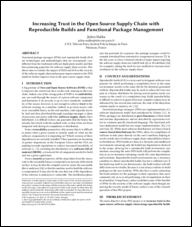
  4. Increasing Trust in the Open Source Supply Chain with Reproducible Builds and Functional Package Management
  5. Software and source code identification with GNU Guix and reproducible builds
  6. Two new Rust-based tools for post-processing determinism
  7. Distribution work
  8. Mailing list highlights
  9. Website updates
  10. Delta chat clients now reproducible
  11. diffoscope updates
  12. Upstream patches
  13. Reproducibility testing framework

Arch Linux minimal container userland now 100% reproducible In remarkable news, Reproducible builds developer kpcyrd reported that that the Arch Linux minimal container userland is now 100% reproducible after work by developers dvzv and Foxboron on the one remaining package. This represents a real world , widely-used Linux distribution being reproducible. Their post, which kpcyrd suffixed with the question now what? , continues on to outline some potential next steps, including validating whether the container image itself could be reproduced bit-for-bit. The post, which was itself a followup for an Arch Linux update earlier in the month, generated a significant number of replies.

Validating Debian s build infrastructure after the XZ backdoor From our mailing list this month, Vagrant Cascadian wrote about being asked about trying to perform concrete reproducibility checks for recent Debian security updates, in an attempt to gain some confidence about Debian s build infrastructure given that they performed builds in environments running the high-profile XZ vulnerability. Vagrant reports (with some caveats):
So far, I have not found any reproducibility issues; everything I tested I was able to get to build bit-for-bit identical with what is in the Debian archive.
That is to say, reproducibility testing permitted Vagrant and Debian to claim with some confidence that builds performed when this vulnerable version of XZ was installed were not interfered with.

Making Fedora Linux (more) reproducible In March, Davide Cavalca gave a talk at the 2024 Southern California Linux Expo (aka SCALE 21x) about the ongoing effort to make the Fedora Linux distribution reproducible. Documented in more detail on Fedora s website, the talk touched on topics such as the specifics of implementing reproducible builds in Fedora, the challenges encountered, the current status and what s coming next. (YouTube video)

Increasing Trust in the Open Source Supply Chain with Reproducible Builds and Functional Package Management Julien Malka published a brief but interesting paper in the HAL open archive on Increasing Trust in the Open Source Supply Chain with Reproducible Builds and Functional Package Management:
Functional package managers (FPMs) and reproducible builds (R-B) are technologies and methodologies that are conceptually very different from the traditional software deployment model, and that have promising properties for software supply chain security. This thesis aims to evaluate the impact of FPMs and R-B on the security of the software supply chain and propose improvements to the FPM model to further improve trust in the open source supply chain. PDF
Julien s paper poses a number of research questions on how the model of distributions such as GNU Guix and NixOS can be leveraged to further improve the safety of the software supply chain , etc.

Software and source code identification with GNU Guix and reproducible builds In a long line of commendably detailed blog posts, Ludovic Court s, Maxim Cournoyer, Jan Nieuwenhuizen and Simon Tournier have together published two interesting posts on the GNU Guix blog this month. In early March, Ludovic Court s, Maxim Cournoyer, Jan Nieuwenhuizen and Simon Tournier wrote about software and source code identification and how that might be performed using Guix, rhetorically posing the questions: What does it take to identify software ? How can we tell what software is running on a machine to determine, for example, what security vulnerabilities might affect it? Later in the month, Ludovic Court s wrote a solo post describing adventures on the quest for long-term reproducible deployment. Ludovic s post touches on GNU Guix s aim to support time travel , the ability to reliably (and reproducibly) revert to an earlier point in time, employing the iconic image of Harold Lloyd hanging off the clock in Safety Last! (1925) to poetically illustrate both the slapstick nature of current modern technology and the gymnastics required to navigate hazards of our own making.

Two new Rust-based tools for post-processing determinism Zbigniew J drzejewski-Szmek announced add-determinism, a work-in-progress reimplementation of the Reproducible Builds project s own strip-nondeterminism tool in the Rust programming language, intended to be used as a post-processor in RPM-based distributions such as Fedora In addition, Yossi Kreinin published a blog post titled refix: fast, debuggable, reproducible builds that describes a tool that post-processes binaries in such a way that they are still debuggable with gdb, etc.. Yossi post details the motivation and techniques behind the (fast) performance of the tool.

Distribution work In Debian this month, since the testing framework no longer varies the build path, James Addison performed a bulk downgrade of the bug severity for issues filed with a level of normal to a new level of wishlist. In addition, 28 reviews of Debian packages were added, 38 were updated and 23 were removed this month adding to ever-growing knowledge about identified issues. As part of this effort, a number of issue types were updated, including Chris Lamb adding a new ocaml_include_directories toolchain issue [ ] and James Addison adding a new filesystem_order_in_java_jar_manifest_mf_include_resource issue [ ] and updating the random_uuid_in_notebooks_generated_by_nbsphinx to reference a relevant discussion thread [ ]. In addition, Roland Clobus posted his 24th status update of reproducible Debian ISO images. Roland highlights that the images for Debian unstable often cannot be generated due to changes in that distribution related to the 64-bit time_t transition. Lastly, Bernhard M. Wiedemann posted another monthly update for his reproducibility work in openSUSE.

Mailing list highlights Elsewhere on our mailing list this month:

Website updates There were made a number of improvements to our website this month, including:
  • Pol Dellaiera noticed the frequent need to correctly cite the website itself in academic work. To facilitate easier citation across multiple formats, Pol contributed a Citation File Format (CIF) file. As a result, an export in BibTeX format is now available in the Academic Publications section. Pol encourages community contributions to further refine the CITATION.cff file. Pol also added an substantial new section to the buy in page documenting the role of Software Bill of Materials (SBOMs) and ephemeral development environments. [ ][ ]
  • Bernhard M. Wiedemann added a new commandments page to the documentation [ ][ ] and fixed some incorrect YAML elsewhere on the site [ ].
  • Chris Lamb add three recent academic papers to the publications page of the website. [ ]
  • Mattia Rizzolo and Holger Levsen collaborated to add Infomaniak as a sponsor of amd64 virtual machines. [ ][ ][ ]
  • Roland Clobus updated the stable outputs page, dropping version numbers from Python documentation pages [ ] and noting that Python s set data structure is also affected by the PYTHONHASHSEED functionality. [ ]

Delta chat clients now reproducible Delta Chat, an open source messaging application that can work over email, announced this month that the Rust-based core library underlying Delta chat application is now reproducible.

diffoscope diffoscope is our in-depth and content-aware diff utility that can locate and diagnose reproducibility issues. This month, Chris Lamb made a number of changes such as uploading versions 259, 260 and 261 to Debian and made the following additional changes:
  • New features:
    • Add support for the zipdetails tool from the Perl distribution. Thanks to Fay Stegerman and Larry Doolittle et al. for the pointer and thread about this tool. [ ]
  • Bug fixes:
    • Don t identify Redis database dumps as GNU R database files based simply on their filename. [ ]
    • Add a missing call to File.recognizes so we actually perform the filename check for GNU R data files. [ ]
    • Don t crash if we encounter an .rdb file without an equivalent .rdx file. (#1066991)
    • Correctly check for 7z being available and not lz4 when testing 7z. [ ]
    • Prevent a traceback when comparing a contentful .pyc file with an empty one. [ ]
  • Testsuite improvements:
    • Fix .epub tests after supporting the new zipdetails tool. [ ]
    • Don t use parenthesis within test skipping messages, as PyTest adds its own parenthesis. [ ]
    • Factor out Python version checking in test_zip.py. [ ]
    • Skip some Zip-related tests under Python 3.10.14, as a potential regression may have been backported to the 3.10.x series. [ ]
    • Actually test 7z support in the test_7z set of tests, not the lz4 functionality. (Closes: reproducible-builds/diffoscope#359). [ ]
In addition, Fay Stegerman updated diffoscope s monkey patch for supporting the unusual Mozilla ZIP file format after Python s zipfile module changed to detect potentially insecure overlapping entries within .zip files. (#362) Chris Lamb also updated the trydiffoscope command line client, dropping a build-dependency on the deprecated python3-distutils package to fix Debian bug #1065988 [ ], taking a moment to also refresh the packaging to the latest Debian standards [ ]. Finally, Vagrant Cascadian submitted an update for diffoscope version 260 in GNU Guix. [ ]

Upstream patches This month, we wrote a large number of patches, including: Bernhard M. Wiedemann used reproducibility-tooling to detect and fix packages that added changes in their %check section, thus failing when built with the --no-checks option. Only half of all openSUSE packages were tested so far, but a large number of bugs were filed, including ones against caddy, exiv2, gnome-disk-utility, grisbi, gsl, itinerary, kosmindoormap, libQuotient, med-tools, plasma6-disks, pspp, python-pypuppetdb, python-urlextract, rsync, vagrant-libvirt and xsimd. Similarly, Jean-Pierre De Jesus DIAZ employed reproducible builds techniques in order to test a proposed refactor of the ath9k-htc-firmware package. As the change produced bit-for-bit identical binaries to the previously shipped pre-built binaries:
I don t have the hardware to test this firmware, but the build produces the same hashes for the firmware so it s safe to say that the firmware should keep working.

Reproducibility testing framework The Reproducible Builds project operates a comprehensive testing framework running primarily at tests.reproducible-builds.org in order to check packages and other artifacts for reproducibility. In March, an enormous number of changes were made by Holger Levsen:
  • Debian-related changes:
    • Sleep less after a so-called 404 package state has occurred. [ ]
    • Schedule package builds more often. [ ][ ]
    • Regenerate all our HTML indexes every hour, but only every 12h for the released suites. [ ]
    • Create and update unstable and experimental base systems on armhf again. [ ][ ]
    • Don t reschedule so many depwait packages due to the current size of the i386 architecture queue. [ ]
    • Redefine our scheduling thresholds and amounts. [ ]
    • Schedule untested packages with a higher priority, otherwise slow architectures cannot keep up with the experimental distribution growing. [ ]
    • Only create the stats_buildinfo.png graph once per day. [ ][ ]
    • Reproducible Debian dashboard: refactoring, update several more static stats only every 12h. [ ]
    • Document how to use systemctl with new systemd-based services. [ ]
    • Temporarily disable armhf and i386 continuous integration tests in order to get some stability back. [ ]
    • Use the deb.debian.org CDN everywhere. [ ]
    • Remove the rsyslog logging facility on bookworm systems. [ ]
    • Add zst to the list of packages which are false-positive diskspace issues. [ ]
    • Detect failures to bootstrap Debian base systems. [ ]
  • Arch Linux-related changes:
    • Temporarily disable builds because the pacman package manager is broken. [ ][ ]
    • Split reproducible_html_live_status and split the scheduling timing . [ ][ ][ ]
    • Improve handling when database is locked. [ ][ ]
  • Misc changes:
    • Show failed services that require manual cleanup. [ ][ ]
    • Integrate two new Infomaniak nodes. [ ][ ][ ][ ]
    • Improve IRC notifications for artifacts. [ ]
    • Run diffoscope in different systemd slices. [ ]
    • Run the node health check more often, as it can now repair some issues. [ ][ ]
    • Also include the string Bot in the userAgent for Git. (Re: #929013). [ ]
    • Document increased tmpfs size on our OUSL nodes. [ ]
    • Disable memory account for the reproducible_build service. [ ][ ]
    • Allow 10 times as many open files for the Jenkins service. [ ]
    • Set OOMPolicy=continue and OOMScoreAdjust=-1000 for both the Jenkins and the reproducible_build service. [ ]
Mattia Rizzolo also made the following changes:
  • Debian-related changes:
    • Define a systemd slice to group all relevant services. [ ][ ]
    • Add a bunch of quotes in scripts to assuage the shellcheck tool. [ ]
    • Add stats on how many packages have been built today so far. [ ]
    • Instruct systemd-run to handle diffoscope s exit codes specially. [ ]
    • Prefer the pgrep tool over grepping the output of ps. [ ]
    • Re-enable a couple of i386 and armhf architecture builders. [ ][ ]
    • Fix some stylistic issues flagged by the Python flake8 tool. [ ]
    • Cease scheduling Debian unstable and experimental on the armhf architecture due to the time_t transition. [ ]
    • Start a few more i386 & armhf workers. [ ][ ][ ]
    • Temporarly skip pbuilder updates in the unstable distribution, but only on the armhf architecture. [ ]
  • Other changes:
    • Perform some large-scale refactoring on how the systemd service operates. [ ][ ]
    • Move the list of workers into a separate file so it s accessible to a number of scripts. [ ]
    • Refactor the powercycle_x86_nodes.py script to use the new IONOS API and its new Python bindings. [ ]
    • Also fix nph-logwatch after the worker changes. [ ]
    • Do not install the stunnel tool anymore, it shouldn t be needed by anything anymore. [ ]
    • Move temporary directories related to Arch Linux into a single directory for clarity. [ ]
    • Update the arm64 architecture host keys. [ ]
    • Use a common Postfix configuration. [ ]
The following changes were also made by:
  • Jan-Benedict Glaw:
    • Initial work to clean up a messy NetBSD-related script. [ ][ ]
  • Roland Clobus:
    • Show the installer log if the installer fails to build. [ ]
    • Avoid the minus character (i.e. -) in a variable in order to allow for tags in openQA. [ ]
    • Update the schedule of Debian live image builds. [ ]
  • Vagrant Cascadian:
    • Maintenance on the virt* nodes is completed so bring them back online. [ ]
    • Use the fully qualified domain name in configuration. [ ]
Node maintenance was also performed by Holger Levsen, Mattia Rizzolo [ ][ ] and Vagrant Cascadian [ ][ ][ ][ ]

If you are interested in contributing to the Reproducible Builds project, please visit our Contribute page on our website. However, you can get in touch with us via:

9 March 2024

Reproducible Builds: Reproducible Builds in February 2024

Welcome to the February 2024 report from the Reproducible Builds project! In our reports, we try to outline what we have been up to over the past month as well as mentioning some of the important things happening in software supply-chain security.

Reproducible Builds at FOSDEM 2024 Core Reproducible Builds developer Holger Levsen presented at the main track at FOSDEM on Saturday 3rd February this year in Brussels, Belgium. However, that wasn t the only talk related to Reproducible Builds. However, please see our comprehensive FOSDEM 2024 news post for the full details and links.

Maintainer Perspectives on Open Source Software Security Bernhard M. Wiedemann spotted that a recent report entitled Maintainer Perspectives on Open Source Software Security written by Stephen Hendrick and Ashwin Ramaswami of the Linux Foundation sports an infographic which mentions that 56% of [polled] projects support reproducible builds .

Mailing list highlights From our mailing list this month:

Distribution work In Debian this month, 5 reviews of Debian packages were added, 22 were updated and 8 were removed this month adding to Debian s knowledge about identified issues. A number of issue types were updated as well. [ ][ ][ ][ ] In addition, Roland Clobus posted his 23rd update of the status of reproducible ISO images on our mailing list. In particular, Roland helpfully summarised that all major desktops build reproducibly with bullseye, bookworm, trixie and sid provided they are built for a second time within the same DAK run (i.e. [within] 6 hours) and that there will likely be further work at a MiniDebCamp in Hamburg. Furthermore, Roland also responded in-depth to a query about a previous report
Fedora developer Zbigniew J drzejewski-Szmek announced a work-in-progress script called fedora-repro-build that attempts to reproduce an existing package within a koji build environment. Although the projects README file lists a number of fields will always or almost always vary and there is a non-zero list of other known issues, this is an excellent first step towards full Fedora reproducibility.
Jelle van der Waa introduced a new linter rule for Arch Linux packages in order to detect cache files leftover by the Sphinx documentation generator which are unreproducible by nature and should not be packaged. At the time of writing, 7 packages in the Arch repository are affected by this.
Elsewhere, Bernhard M. Wiedemann posted another monthly update for his work elsewhere in openSUSE.

diffoscope diffoscope is our in-depth and content-aware diff utility that can locate and diagnose reproducibility issues. This month, Chris Lamb made a number of changes such as uploading versions 256, 257 and 258 to Debian and made the following additional changes:
  • Use a deterministic name instead of trusting gpg s use-embedded-filenames. Many thanks to Daniel Kahn Gillmor dkg@debian.org for reporting this issue and providing feedback. [ ][ ]
  • Don t error-out with a traceback if we encounter struct.unpack-related errors when parsing Python .pyc files. (#1064973). [ ]
  • Don t try and compare rdb_expected_diff on non-GNU systems as %p formatting can vary, especially with respect to MacOS. [ ]
  • Fix compatibility with pytest 8.0. [ ]
  • Temporarily fix support for Python 3.11.8. [ ]
  • Use the 7zip package (over p7zip-full) after a Debian package transition. (#1063559). [ ]
  • Bump the minimum Black source code reformatter requirement to 24.1.1+. [ ]
  • Expand an older changelog entry with a CVE reference. [ ]
  • Make test_zip black clean. [ ]
In addition, James Addison contributed a patch to parse the headers from the diff(1) correctly [ ][ ] thanks! And lastly, Vagrant Cascadian pushed updates in GNU Guix for diffoscope to version 255, 256, and 258, and updated trydiffoscope to 67.0.6.

reprotest reprotest is our tool for building the same source code twice in different environments and then checking the binaries produced by each build for any differences. This month, Vagrant Cascadian made a number of changes, including:
  • Create a (working) proof of concept for enabling a specific number of CPUs. [ ][ ]
  • Consistently use 398 days for time variation rather than choosing randomly and update README.rst to match. [ ][ ]
  • Support a new --vary=build_path.path option. [ ][ ][ ][ ]

Website updates There were made a number of improvements to our website this month, including:

Reproducibility testing framework The Reproducible Builds project operates a comprehensive testing framework (available at tests.reproducible-builds.org) in order to check packages and other artifacts for reproducibility. In February, a number of changes were made by Holger Levsen:
  • Debian-related changes:
    • Temporarily disable upgrading/bootstrapping Debian unstable and experimental as they are currently broken. [ ][ ]
    • Use the 64-bit amd64 kernel on all i386 nodes; no more 686 PAE kernels. [ ]
    • Add an Erlang package set. [ ]
  • Other changes:
    • Grant Jan-Benedict Glaw shell access to the Jenkins node. [ ]
    • Enable debugging for NetBSD reproducibility testing. [ ]
    • Use /usr/bin/du --apparent-size in the Jenkins shell monitor. [ ]
    • Revert reproducible nodes: mark osuosl2 as down . [ ]
    • Thanks again to Codethink, for they have doubled the RAM on our arm64 nodes. [ ]
    • Only set /proc/$pid/oom_score_adj to -1000 if it has not already been done. [ ]
    • Add the opemwrt-target-tegra and jtx task to the list of zombie jobs. [ ][ ]
Vagrant Cascadian also made the following changes:
  • Overhaul the handling of OpenSSH configuration files after updating from Debian bookworm. [ ][ ][ ]
  • Add two new armhf architecture build nodes, virt32z and virt64z, and insert them into the Munin monitoring. [ ][ ] [ ][ ]
In addition, Alexander Couzens updated the OpenWrt configuration in order to replace the tegra target with mpc85xx [ ], Jan-Benedict Glaw updated the NetBSD build script to use a separate $TMPDIR to mitigate out of space issues on a tmpfs-backed /tmp [ ] and Zheng Junjie added a link to the GNU Guix tests [ ]. Lastly, node maintenance was performed by Holger Levsen [ ][ ][ ][ ][ ][ ] and Vagrant Cascadian [ ][ ][ ][ ].

Upstream patches The Reproducible Builds project detects, dissects and attempts to fix as many currently-unreproducible packages as possible. We endeavour to send all of our patches upstream where appropriate. This month, we wrote a large number of such patches, including:

If you are interested in contributing to the Reproducible Builds project, please visit our Contribute page on our website. However, you can get in touch with us via:

7 February 2024

Reproducible Builds: Reproducible Builds in January 2024

Welcome to the January 2024 report from the Reproducible Builds project. In these reports we outline the most important things that we have been up to over the past month. If you are interested in contributing to the project, please visit our Contribute page on our website.

How we executed a critical supply chain attack on PyTorch John Stawinski and Adnan Khan published a lengthy blog post detailing how they executed a supply-chain attack against PyTorch, a popular machine learning platform used by titans like Google, Meta, Boeing, and Lockheed Martin :
Our exploit path resulted in the ability to upload malicious PyTorch releases to GitHub, upload releases to [Amazon Web Services], potentially add code to the main repository branch, backdoor PyTorch dependencies the list goes on. In short, it was bad. Quite bad.
The attack pivoted on PyTorch s use of self-hosted runners as well as submitting a pull request to address a trivial typo in the project s README file to gain access to repository secrets and API keys that could subsequently be used for malicious purposes.

New Arch Linux forensic filesystem tool On our mailing list this month, long-time Reproducible Builds developer kpcyrd announced a new tool designed to forensically analyse Arch Linux filesystem images. Called archlinux-userland-fs-cmp, the tool is supposed to be used from a rescue image (any Linux) with an Arch install mounted to, [for example], /mnt. Crucially, however, at no point is any file from the mounted filesystem eval d or otherwise executed. Parsers are written in a memory safe language. More information about the tool can be found on their announcement message, as well as on the tool s homepage. A GIF of the tool in action is also available.

Issues with our SOURCE_DATE_EPOCH code? Chris Lamb started a thread on our mailing list summarising some potential problems with the source code snippet the Reproducible Builds project has been using to parse the SOURCE_DATE_EPOCH environment variable:
I m not 100% sure who originally wrote this code, but it was probably sometime in the ~2015 era, and it must be in a huge number of codebases by now. Anyway, Alejandro Colomar was working on the shadow security tool and pinged me regarding some potential issues with the code. You can see this conversation here.
Chris ends his message with a request that those with intimate or low-level knowledge of time_t, C types, overflows and the various parsing libraries in the C standard library (etc.) contribute with further info.

Distribution updates In Debian this month, Roland Clobus posted another detailed update of the status of reproducible ISO images on our mailing list. In particular, Roland helpfully summarised that all major desktops build reproducibly with bullseye, bookworm, trixie and sid provided they are built for a second time within the same DAK run (i.e. [within] 6 hours) . Additionally 7 of the 8 bookworm images from the official download link build reproducibly at any later time. In addition to this, three reviews of Debian packages were added, 17 were updated and 15 were removed this month adding to our knowledge about identified issues. Elsewhere, Bernhard posted another monthly update for his work elsewhere in openSUSE.

Community updates There were made a number of improvements to our website, including Bernhard M. Wiedemann fixing a number of typos of the term nondeterministic . [ ] and Jan Zerebecki adding a substantial and highly welcome section to our page about SOURCE_DATE_EPOCH to document its interaction with distribution rebuilds. [ ].
diffoscope is our in-depth and content-aware diff utility that can locate and diagnose reproducibility issues. This month, Chris Lamb made a number of changes such as uploading versions 254 and 255 to Debian but focusing on triaging and/or merging code from other contributors. This included adding support for comparing eXtensible ARchive (.XAR/.PKG) files courtesy of Seth Michael Larson [ ][ ], as well considerable work from Vekhir in order to fix compatibility between various and subtle incompatible versions of the progressbar libraries in Python [ ][ ][ ][ ]. Thanks!

Reproducibility testing framework The Reproducible Builds project operates a comprehensive testing framework (available at tests.reproducible-builds.org) in order to check packages and other artifacts for reproducibility. In January, a number of changes were made by Holger Levsen:
  • Debian-related changes:
    • Reduce the number of arm64 architecture workers from 24 to 16. [ ]
    • Use diffoscope from the Debian release being tested again. [ ]
    • Improve the handling when killing unwanted processes [ ][ ][ ] and be more verbose about it, too [ ].
    • Don t mark a job as failed if process marked as to-be-killed is already gone. [ ]
    • Display the architecture of builds that have been running for more than 48 hours. [ ]
    • Reboot arm64 nodes when they hit an OOM (out of memory) state. [ ]
  • Package rescheduling changes:
    • Reduce IRC notifications to 1 when rescheduling due to package status changes. [ ]
    • Correctly set SUDO_USER when rescheduling packages. [ ]
    • Automatically reschedule packages regressing to FTBFS (build failure) or FTBR (build success, but unreproducible). [ ]
  • OpenWrt-related changes:
    • Install the python3-dev and python3-pyelftools packages as they are now needed for the sunxi target. [ ][ ]
    • Also install the libpam0g-dev which is needed by some OpenWrt hardware targets. [ ]
  • Misc:
    • As it s January, set the real_year variable to 2024 [ ] and bump various copyright years as well [ ].
    • Fix a large (!) number of spelling mistakes in various scripts. [ ][ ][ ]
    • Prevent Squid and Systemd processes from being killed by the kernel s OOM killer. [ ]
    • Install the iptables tool everywhere, else our custom rc.local script fails. [ ]
    • Cleanup the /srv/workspace/pbuilder directory on boot. [ ]
    • Automatically restart Squid if it fails. [ ]
    • Limit the execution of chroot-installation jobs to a maximum of 4 concurrent runs. [ ][ ]
Significant amounts of node maintenance was performed by Holger Levsen (eg. [ ][ ][ ][ ][ ][ ][ ] etc.) and Vagrant Cascadian (eg. [ ][ ][ ][ ][ ][ ][ ][ ]). Indeed, Vagrant Cascadian handled an extended power outage for the network running the Debian armhf architecture test infrastructure. This provided the incentive to replace the UPS batteries and consolidate infrastructure to reduce future UPS load. [ ] Elsewhere in our infrastructure, however, Holger Levsen also adjusted the email configuration for @reproducible-builds.org to deal with a new SMTP email attack. [ ]

Upstream patches The Reproducible Builds project tries to detects, dissects and fix as many (currently) unreproducible packages as possible. We endeavour to send all of our patches upstream where appropriate. This month, we wrote a large number of such patches, including: Separate to this, Vagrant Cascadian followed up with the relevant maintainers when reproducibility fixes were not included in newly-uploaded versions of the mm-common package in Debian this was quickly fixed, however. [ ]

If you are interested in contributing to the Reproducible Builds project, please visit our Contribute page on our website. However, you can get in touch with us via:

21 January 2024

Debian Brasil: MiniDebConf BH 2024 - patroc nio e financiamento coletivo

MiniDebConf BH 2024 J est rolando a inscri o de participante e a chamada de atividades para a MiniDebConf Belo Horizonte 2024, que acontecer de 27 a 30 de abril no Campus Pampulha da UFMG. Este ano estamos ofertando bolsas de alimenta o, hospedagem e passagens para contribuidores(as) ativos(as) do Projeto Debian. Patroc nio: Para a realiza o da MiniDebConf, estamos buscando patroc nio financeiro de empresas e entidades. Ent o se voc trabalha em uma empresa/entidade (ou conhece algu m que trabalha em uma) indique o nosso plano de patroc nio para ela. L voc ver os valores de cada cota e os seus benef cios. Financiamento coletivo: Mas voc tamb m pode ajudar a realiza o da MiniDebConf por meio do nosso financiamento coletivo! Fa a uma doa o de qualquer valor e tenha o seu nome publicado no site do evento como apoiador(a) da MiniDebConf Belo Horizonte 2024. Mesmo que voc n o pretenda vir a Belo Horizonte para participar do evento, voc pode doar e assim contribuir para o mais importante evento do Projeto Debian no Brasil. Contato Qualquer d vida, mande um email para contato@debianbrasil.org.br Organiza o Debian Brasil Debian Debian MG DCC

17 October 2023

Russ Allbery: Review: A Hat Full of Sky

Review: A Hat Full of Sky, by Terry Pratchett
Series: Discworld #32
Publisher: HarperTrophy
Copyright: 2004
Printing: 2005
ISBN: 0-06-058662-1
Format: Mass market
Pages: 407
A Hat Full of Sky is the 32nd Discworld novel and the second Tiffany Aching young adult novel. You should not start here, but you could start with The Wee Free Men. As with that book, some parts of the story carry more weight if you are already familiar with Granny Weatherwax. Tiffany is a witch, but she needs to be trained. This is normally done by apprenticeship, and in Tiffany's case it seemed wise to give her exposure to more types of witching. Thus, Tiffany, complete with new boots and a going-away present from the still-somewhat-annoying Roland, is off on an apprenticeship to the sensible Miss Level. (The new boots feel wrong and get swapped out for her concealed old boots at the first opportunity.) Unbeknownst to Tiffany, her precocious experiments with leaving her body as a convenient substitute for a mirror have attracted something very bad, something none of the witches are expecting. The Nac Mac Feegle know a hiver as soon as they feel it, but they have a new kelda now, and she's not sure she wants them racing off after their old kelda. Terry Pratchett is very good at a lot of things, but I don't think villains are one of his strengths. He manages an occasional memorable one (the Auditors, for example, at least before the whole chocolate thing), but I find most of them a bit boring. The hiver is one of the boring ones. It serves mostly as a concretized metaphor about the temptations of magical power, but those temptations felt so unlike the tendencies of Tiffany's personality that I didn't think the metaphor worked in the story. The interesting heart of this book to me is the conflict between Tiffany's impatience with nonsense and Miss Level's arguably excessive willingness to help everyone regardless of how demanding they get. There's something deeper in here about female socialization and how that interacts with Pratchett's conception of witches that got me thinking, although I don't think Pratchett landed the point with full force. Miss Level is clearly a good witch to her village and seems comfortable with how she lives her life, so perhaps they're not taking advantage of her, but she thoroughly slots herself into the helper role. If Tiffany attempted the same role, people would be taking advantage of her, because the role doesn't fit her. And yet, there's a lesson here she needs to learn about seeing other people as people, even if it wouldn't be healthy for her to move all the way to Miss Level's mindset. Tiffany is a precocious kid who is used to being underestimated, and who has reacted by becoming independent and somewhat judgmental. She's also had a taste of real magical power, which creates a risk of her getting too far into her own head. Miss Level is a fount of empathy and understanding for the normal people around her, which Tiffany resists and needed to learn. I think Granny Weatherwax is too much like Tiffany to teach her that. She also has no patience for fools, but she's older and wiser and knows Tiffany needs a push in that direction. Miss Level isn't a destination, but more of a counterbalance. That emotional journey, a conclusion that again focuses on the role of witches in questions of life and death, and Tiffany's fascinatingly spiky mutual respect with Granny Weatherwax were the best parts of this book for me. The middle section with the hiver was rather tedious and forgettable, and the Nac Mac Feegle were entertaining but not more than that. It felt like the story went in a few different directions and only some of them worked, in part because the villain intended to tie those pieces together was more of a force of nature than a piece of Tiffany's emotional puzzle. If the hiver had resonated with the darker parts of Tiffany's natural personality, the plot would have worked better. Pratchett was gesturing in that direction, but he never convinced me it was consistent with what we'd already seen of her. Like a lot of the Discworld novels, the good moments in A Hat Full of Sky are astonishing, but the plot is somewhat forgettable. It's still solidly entertaining, though, and if you enjoyed The Wee Free Men, I think this is slightly better. Followed by Going Postal in publication order. The next Tiffany Aching novel is Wintersmith. Rating: 8 out of 10

12 October 2023

Reproducible Builds: Reproducible Builds in September 2023

Welcome to the September 2023 report from the Reproducible Builds project In these reports, we outline the most important things that we have been up to over the past month. As a quick recap, whilst anyone may inspect the source code of free software for malicious flaws, almost all software is distributed to end users as pre-compiled binaries.
Andreas Herrmann gave a talk at All Systems Go 2023 titled Fast, correct, reproducible builds with Nix and Bazel . Quoting from the talk description:

You will be introduced to Google s open source build system Bazel, and will learn how it provides fast builds, how correctness and reproducibility is relevant, and how Bazel tries to ensure correctness. But, we will also see where Bazel falls short in ensuring correctness and reproducibility. You will [also] learn about the purely functional package manager Nix and how it approaches correctness and build isolation. And we will see where Bazel has an advantage over Nix when it comes to providing fast feedback during development.
Andreas also shows how you can get the best of both worlds and combine Nix and Bazel, too. A video of the talk is available.
diffoscope is our in-depth and content-aware diff utility that can locate and diagnose reproducibility issues. This month, Chris Lamb fixed compatibility with file(1) version 5.45 [ ] and updated some documentation [ ]. In addition, Vagrant Cascadian extended support for GNU Guix [ ][ ] and updated the version in that distribution as well. [ ].
Yet another reminder that our upcoming Reproducible Builds Summit is set to take place from October 31st November 2nd 2023 in Hamburg, Germany. If you haven t been before, our summits are a unique gathering that brings together attendees from diverse projects, united by a shared vision of advancing the Reproducible Builds effort. During this enriching event, participants will have the opportunity to engage in discussions, establish connections and exchange ideas to drive progress in this vital field. If you re interested in joining us this year, please make sure to read the event page, the news item, or the invitation email that Mattia Rizzolo sent out recently, all of which have more details about the event and location. We are also still looking for sponsors to support the event, so please reach out to the organising team if you are able to help. Also note that PackagingCon 2023 is taking place in Berlin just before our summit.
On the Reproducible Builds website, Greg Chabala updated the JVM-related documentation to update a link to the BUILDSPEC.md file. [ ] And Fay Stegerman fixed the builds failing because of a YAML syntax error.

Distribution work In Debian, this month: September saw F-Droid add ten new reproducible apps, and one existing app switched to reproducible builds. In addition, two reproducible apps were archived and one was disabled for a current total of 199 apps published with Reproducible Builds and using the upstream developer s signature. [ ] In addition, an extensive blog post was posted on f-droid.org titled Reproducible builds, signing keys, and binary repos .

Upstream patches The Reproducible Builds project detects, dissects and attempts to fix as many currently-unreproducible packages as possible. We endeavour to send all of our patches upstream where appropriate. This month, we wrote a large number of such patches, including:

Testing framework The Reproducible Builds project operates a comprehensive testing framework (available at tests.reproducible-builds.org) in order to check packages and other artifacts for reproducibility. In August, a number of changes were made by Holger Levsen:
  • Disable armhf and i386 builds due to Debian bug #1052257. [ ][ ][ ][ ]
  • Run diffoscope with a lower ionice priority. [ ]
  • Log every build in a simple text file [ ] and create persistent stamp files when running diffoscope to ease debugging [ ].
  • Run schedulers one hour after dinstall again. [ ]
  • Temporarily use diffoscope from the host, and not from a schroot running the tested suite. [ ][ ]
  • Fail the diffoscope distribution test if the diffoscope version cannot be determined. [ ]
  • Fix a spelling error in the email to IRC gateway. [ ]
  • Force (and document) the reconfiguration of all jobs, due to the recent rise of zombies. [ ][ ][ ][ ]
  • Deal with a rare condition when killing processes which should not be there. [ ]
  • Install the Debian backports kernel in an attempt to address Debian bug #1052257. [ ][ ]
In addition, Mattia Rizzolo fixed a call to diffoscope --version (as suggested by Fay Stegerman on our mailing list) [ ], worked on an openQA credential issue [ ] and also made some changes to the machine-readable reproducible metadata, reproducible-tracker.json [ ]. Lastly, Roland Clobus added instructions for manual configuration of the openQA secrets [ ].

If you are interested in contributing to the Reproducible Builds project, please visit our Contribute page on our website. However, you can get in touch with us via:

8 September 2023

Reproducible Builds: Reproducible Builds in August 2023

Welcome to the August 2023 report from the Reproducible Builds project! In these reports we outline the most important things that we have been up to over the past month. As a quick recap, whilst anyone may inspect the source code of free software for malicious flaws, almost all software is distributed to end users as pre-compiled binaries. The motivation behind the reproducible builds effort is to ensure no flaws have been introduced during this compilation process by promising identical results are always generated from a given source, thus allowing multiple third-parties to come to a consensus on whether a build was compromised. If you are interested in contributing to the project, please visit our Contribute page on our website.

Rust serialisation library moving to precompiled binaries Bleeping Computer reported that Serde, a popular Rust serialization framework, had decided to ship its serde_derive macro as a precompiled binary. As Ax Sharma writes:
The move has generated a fair amount of push back among developers who worry about its future legal and technical implications, along with a potential for supply chain attacks, should the maintainer account publishing these binaries be compromised.
After intensive discussions, use of the precompiled binary was phased out.

Reproducible builds, the first ten years On August 4th, Holger Levsen gave a talk at BornHack 2023 on the Danish island of Funen titled Reproducible Builds, the first ten years which promised to contain:
[ ] an overview about reproducible builds, the past, the presence and the future. How it started with a small [meeting] at DebConf13 (and before), how it grew from being a Debian effort to something many projects work on together, until in 2021 it was mentioned in an executive order of the president of the United States. (HTML slides)
Holger repeated the talk later in the month at Chaos Communication Camp 2023 in Zehdenick, Germany: A video of the talk is available online, as are the HTML slides.

Reproducible Builds Summit Just another reminder that our upcoming Reproducible Builds Summit is set to take place from October 31st November 2nd 2023 in Hamburg, Germany. Our summits are a unique gathering that brings together attendees from diverse projects, united by a shared vision of advancing the Reproducible Builds effort. During this enriching event, participants will have the opportunity to engage in discussions, establish connections and exchange ideas to drive progress in this vital field. If you re interested in joining us this year, please make sure to read the event page, the news item, or the invitation email that Mattia Rizzolo sent out, which have more details about the event and location. We are also still looking for sponsors to support the event, so do reach out to the organizing team if you are able to help. (Also of note that PackagingCon 2023 is taking place in Berlin just before our summit, and their schedule has just been published.)

Vagrant Cascadian on the Sustain podcast Vagrant Cascadian was interviewed on the SustainOSS podcast on reproducible builds:
Vagrant walks us through his role in the project where the aim is to ensure identical results in software builds across various machines and times, enhancing software security and creating a seamless developer experience. Discover how this mission, supported by the Software Freedom Conservancy and a broad community, is changing the face of Linux distros, Arch Linux, openSUSE, and F-Droid. They also explore the challenges of managing random elements in software, and Vagrant s vision to make reproducible builds a standard best practice that will ideally become automatic for users. Vagrant shares his work in progress and their commitment to the last mile problem.
The episode is available to listen (or download) from the Sustain podcast website. As it happens, the episode was recorded at FOSSY 2023, and the video of Vagrant s talk from this conference (Breaking the Chains of Trusting Trust is now available on Archive.org: It was also announced that Vagrant Cascadian will be presenting at the Open Source Firmware Conference in October on the topic of Reproducible Builds All The Way Down.

On our mailing list Carles Pina i Estany wrote to our mailing list during August with an interesting question concerning the practical steps to reproduce the hello-traditional package from Debian. The entire thread can be viewed from the archive page, as can Vagrant Cascadian s reply.

Website updates Rahul Bajaj updated our website to add a series of environment variations related to reproducible builds [ ], Russ Cox added the Go programming language to our projects page [ ] and Vagrant Cascadian fixed a number of broken links and typos around the website [ ][ ][ ].

Software development In diffoscope development this month, versions 247, 248 and 249 were uploaded to Debian unstable by Chris Lamb, who also added documentation for the new specialize_as method and expanding the documentation of the existing specialize as well [ ]. In addition, Fay Stegerman added specialize_as and used it to optimise .smali comparisons when decompiling Android .apk files [ ], Felix Yan and Mattia Rizzolo corrected some typos in code comments [ , ], Greg Chabala merged the RUN commands into single layer in the package s Dockerfile [ ] thus greatly reducing the final image size. Lastly, Roland Clobus updated tool descriptions to mark that the xb-tool has moved package within Debian [ ].
reprotest is our tool for building the same source code twice in different environments and then checking the binaries produced by each build for any differences. This month, Vagrant Cascadian updated the packaging to be compatible with Tox version 4. This was originally filed as Debian bug #1042918 and Holger Levsen uploaded this to change to Debian unstable as version 0.7.26 [ ].

Distribution work In Debian, 28 reviews of Debian packages were added, 14 were updated and 13 were removed this month adding to our knowledge about identified issues. A number of issue types were added, including Chris Lamb adding a new timestamp_in_documentation_using_sphinx_zzzeeksphinx_theme toolchain issue.
In August, F-Droid added 25 new reproducible apps and saw 2 existing apps switch to reproducible builds, making 191 apps in total that are published with Reproducible Builds and using the upstream developer s signature. [ ]
Bernhard M. Wiedemann published another monthly report about reproducibility within openSUSE.

Upstream patches The Reproducible Builds project detects, dissects and attempts to fix as many currently-unreproducible packages as possible. We endeavour to send all of our patches upstream where appropriate. This month, we wrote a large number of such patches, including:

Testing framework The Reproducible Builds project operates a comprehensive testing framework (available at tests.reproducible-builds.org) in order to check packages and other artifacts for reproducibility. In August, a number of changes were made by Holger Levsen:
  • Debian-related changes:
    • Disable Debian live image creation jobs until an OpenQA credential problem has been fixed. [ ]
    • Run our maintenance scripts every 3 hours instead of every 2. [ ]
    • Export data for unstable to the reproducible-tracker.json data file. [ ]
    • Stop varying the build path, we want reproducible builds. [ ]
    • Temporarily stop updating the pbuilder.tgz for Debian unstable due to #1050784. [ ][ ]
    • Correctly document that we are not variying usrmerge. [ ][ ]
    • Mark two armhf nodes (wbq0 and jtx1a) as down; investigation is needed. [ ]
  • Misc:
    • Force reconfiguration of all Jenkins jobs, due to the recent rise of zombie processes. [ ]
    • In the node health checks, also try to restart failed ntpsec, postfix and vnstat services. [ ][ ][ ]
  • System health checks:
    • Detect Debian live build failures due to missing credentials. [ ][ ]
    • Ignore specific types of known zombie processes. [ ][ ]
In addition, Vagrant Cascadian updated the scripts to use a predictable build path that is consistent with the one used on buildd.debian.org. [ ][ ]

If you are interested in contributing to the Reproducible Builds project, please visit our Contribute page on our website. However, you can get in touch with us via:

4 August 2023

Reproducible Builds: Reproducible Builds in July 2023

Welcome to the July 2023 report from the Reproducible Builds project. In our reports, we try to outline the most important things that we have been up to over the past month. As ever, if you are interested in contributing to the project, please visit the Contribute page on our website.
Marcel Fourn et al. presented at the IEEE Symposium on Security and Privacy in San Francisco, CA on The Importance and Challenges of Reproducible Builds for Software Supply Chain Security. As summarised in last month s report, the abstract of their paper begins:
The 2020 Solarwinds attack was a tipping point that caused a heightened awareness about the security of the software supply chain and in particular the large amount of trust placed in build systems. Reproducible Builds (R-Bs) provide a strong foundation to build defenses for arbitrary attacks against build systems by ensuring that given the same source code, build environment, and build instructions, bitwise-identical artifacts are created. (PDF)

Chris Lamb published an interview with Simon Butler, associate senior lecturer in the School of Informatics at the University of Sk vde, on the business adoption of Reproducible Builds. (This is actually the seventh instalment in a series featuring the projects, companies and individuals who support our project. We started this series by featuring the Civil Infrastructure Platform project, and followed this up with a post about the Ford Foundation as well as recent ones about ARDC, the Google Open Source Security Team (GOSST), Bootstrappable Builds, the F-Droid project and David A. Wheeler.) Vagrant Cascadian presented Breaking the Chains of Trusting Trust at FOSSY 2023.
Rahul Bajaj has been working with Roland Clobus on merging an overview of environment variations to our website:
I have identified 16 root causes for unreproducible builds in my empirical study, which I have linked to the corresponding documentation. The initial MR right now contains information about 10 root causes. For each root cause, I have provided a definition, a notable instance, and a workaround. However, I have only found workarounds for 5 out of the 10 root causes listed in this merge request. In the upcoming commits, I plan to add an additional 6 root causes. I kindly request you review the text for any necessary refinements, modifications, or corrections. Additionally, I would appreciate the help with documentation for the solutions/workarounds for the remaining root causes: Archive Metadata, Build ID, File System Ordering, File Permissions, and Snippet Encoding. Your input on the identified root causes for unreproducible builds would be greatly appreciated. [ ]

Just a reminder that our upcoming Reproducible Builds Summit is set to take place from October 31st November 2nd 2023 in Hamburg, Germany. Our summits are a unique gathering that brings together attendees from diverse projects, united by a shared vision of advancing the Reproducible Builds effort. During this enriching event, participants will have the opportunity to engage in discussions, establish connections and exchange ideas to drive progress in this vital field. If you re interested in joining us this year, please make sure to read the event page which has more details about the event and location.
There was more progress towards making the Go programming language ecosystem reproducible this month, including: In addition, kpcyrd posted to our mailing list to report that:
while packaging govulncheck for Arch Linux I noticed a checksum mismatch for a tar file I downloaded from go.googlesource.com. I used diffoscope to compare the .tar file I downloaded with the .tar file the build server downloaded, and noticed the timestamps are different.

In Debian, 20 reviews of Debian packages were added, 25 were updated and 25 were removed this month adding to our knowledge about identified issues. A number of issue types were updated, including marking ffile_prefix_map_passed_to_clang being fixed since Debian bullseye [ ] and adding a Debian bug tracker reference for the nondeterminism_added_by_pyqt5_pyrcc5 issue [ ]. In addition, Roland Clobus posted another detailed update of the status of reproducible Debian ISO images on our mailing list. In particular, Roland helpfully summarised that live images are looking good, and the number of (passing) automated tests is growing .
Bernhard M. Wiedemann published another monthly report about reproducibility within openSUSE.
F-Droid added 20 new reproducible apps in July, making 165 apps in total that are published with Reproducible Builds and using the upstream developer s signature. [ ]
The Sphinx documentation tool recently accepted a change to improve deterministic reproducibility of documentation. It s internal util.inspect.object_description attempts to sort collections, but this can fail. The change handles the failure case by using string-based object descriptions as a fallback deterministic sort ordering, as well as adding recursive object-description calls for list and tuple datatypes. As a result, documentation generated by Sphinx will be more likely to be automatically reproducible. Lastly in news, kpcyrd posted to our mailing list announcing a new repro-env tool:
My initial interest in reproducible builds was how do I distribute pre-compiled binaries on GitHub without people raising security concerns about them . I ve cycled back to this original problem about 5 years later and built a tool that is meant to address this. [ ]

Upstream patches The Reproducible Builds project detects, dissects and attempts to fix as many currently-unreproducible packages as possible. We endeavour to send all of our patches upstream where appropriate. This month, we wrote a large number of such patches, including:
In diffoscope development this month, versions 244, 245 and 246 were uploaded to Debian unstable by Chris Lamb, who also made the following changes:
  • Don t include the file size in image metadata. It is, at best, distracting, and it is already in the directory metadata. [ ]
  • Add compatibility with libarchive-5. [ ]
  • Mark that the test_dex::test_javap_14_differences test requires the procyon tool. [ ]
  • Initial work on DOS/MBR extraction. [ ]
  • Move to using assert_diff in the .ico and .jpeg tests. [ ]
  • Temporarily mark some Android-related as XFAIL due to Debian bugs #1040941 & #1040916. [ ]
  • Fix the test skipped reason generation in the case of a version outside of the required range. [ ]
  • Update copyright years. [ ][ ]
  • Fix try.diffoscope.org. [ ]
In addition, Gianfranco Costamagna added support for LLVM version 16. [ ]

Testing framework The Reproducible Builds project operates a comprehensive testing framework (available at tests.reproducible-builds.org) in order to check packages and other artifacts for reproducibility. In July, a number of changes were made by Holger Levsen:
  • General changes:
    • Upgrade Jenkins host to Debian bookworm now that Debian 12.1 is out. [ ][ ][ ][ ]
    • djm: improve UX when rebooting a node fails. [ ]
    • djm: reduce wait time between rebooting nodes. [ ]
  • Debian-related changes:
    • Various refactoring of the Debian scheduler. [ ][ ][ ]
    • Make Debian live builds more robust with respect to salsa.debian.org returning HTTP 502 errors. [ ][ ]
    • Use the legacy SCP protocol instead of the SFTP protocol when transfering Debian live builds. [ ][ ]
    • Speed up a number of database queries thanks, Myon! [ ][ ][ ][ ][ ]
    • Split create_meta_pkg_sets job into two (for Debian unstable and Debian testing) to half the job runtime to approximately 90 minutes. [ ][ ]
    • Split scheduler job into four separate jobs, one for each tested architecture. [ ][ ]
    • Treat more PostgreSQL errors as serious (for some jobs). [ ]
    • Re-enable automatic database documentation now that postgresql_autodoc is back in Debian bookworm. [ ]
    • Remove various hardcoding of Debian release names. [ ]
    • Drop some i386 special casing. [ ]
  • Other distributions:
    • Speed up Alpine SQL queries. [ ]
    • Adjust CSS layout for Arch Linux pages to match 3 and not 4 repos being tested. [ ]
    • Drop the community Arch Linux repo as it has now been merged into the extra repo. [ ]
    • Speed up a number of Arch-related database queries. [ ]
    • Try harder to properly cleanup after building OpenWrt packages. [ ]
    • Drop all kfreebsd-related tests now that it s officially dead. [ ]
  • System health:
    • Always ignore some well-known harmless orphan processes. [ ][ ][ ]
    • Detect another case of job failure due to Jenkins shutdown. [ ]
    • Show all non co-installable package sets on the status page. [ ]
    • Warn that some specific reboot nodes are currently false-positives. [ ]
  • Node health checks:
    • Run system and node health checks for Jenkins less frequently. [ ]
    • Try to restart any failed dpkg-db-backup [ ] and munin-node services [ ].
In addition, Vagrant Cascadian updated the paths in our automated to tests to use the same paths used by the official Debian build servers. [ ]

If you are interested in contributing to the Reproducible Builds project, please visit our Contribute page on our website. However, you can get in touch with us via:

Reproducible Builds (diffoscope): diffoscope 247 released

The diffoscope maintainers are pleased to announce the release of diffoscope version 247. This version includes the following changes:
[ Chris Lamb ]
* Fix compataibility with file(1) version 5.45.
* Use assert_diff in test_uimage and test_cpio.
[ Roland Clobus ]
* xb-tool has moved in Debian bookworm.
You find out more by visiting the project homepage.

12 July 2023

Reproducible Builds: Reproducible Builds in June 2023

Welcome to the June 2023 report from the Reproducible Builds project In our reports, we outline the most important things that we have been up to over the past month. As always, if you are interested in contributing to the project, please visit our Contribute page on our website.


We are very happy to announce the upcoming Reproducible Builds Summit which set to take place from October 31st November 2nd 2023, in the vibrant city of Hamburg, Germany. Our summits are a unique gathering that brings together attendees from diverse projects, united by a shared vision of advancing the Reproducible Builds effort. During this enriching event, participants will have the opportunity to engage in discussions, establish connections and exchange ideas to drive progress in this vital field. Our aim is to create an inclusive space that fosters collaboration, innovation and problem-solving. We are thrilled to host the seventh edition of this exciting event, following the success of previous summits in various iconic locations around the world, including Venice, Marrakesh, Paris, Berlin and Athens. If you re interesting in joining us this year, please make sure to read the event page] which has more details about the event and location. (You may also be interested in attending PackagingCon 2023 held a few days before in Berlin.)
This month, Vagrant Cascadian will present at FOSSY 2023 on the topic of Breaking the Chains of Trusting Trust:
Corrupted build environments can deliver compromised cryptographically signed binaries. Several exploits in critical supply chains have been demonstrated in recent years, proving that this is not just theoretical. The most well secured build environments are still single points of failure when they fail. [ ] This talk will focus on the state of the art from several angles in related Free and Open Source Software projects, what works, current challenges and future plans for building trustworthy toolchains you do not need to trust.
Hosted by the Software Freedom Conservancy and taking place in Portland, Oregon, FOSSY aims to be a community-focused event: Whether you are a long time contributing member of a free software project, a recent graduate of a coding bootcamp or university, or just have an interest in the possibilities that free and open source software bring, FOSSY will have something for you . More information on the event is available on the FOSSY 2023 website, including the full programme schedule.
Marcel Fourn , Dominik Wermke, William Enck, Sascha Fahl and Yasemin Acar recently published an academic paper in the 44th IEEE Symposium on Security and Privacy titled It s like flossing your teeth: On the Importance and Challenges of Reproducible Builds for Software Supply Chain Security . The abstract reads as follows:
The 2020 Solarwinds attack was a tipping point that caused a heightened awareness about the security of the software supply chain and in particular the large amount of trust placed in build systems. Reproducible Builds (R-Bs) provide a strong foundation to build defenses for arbitrary attacks against build systems by ensuring that given the same source code, build environment, and build instructions, bitwise-identical artifacts are created.
However, in contrast to other papers that touch on some theoretical aspect of reproducible builds, the authors paper takes a different approach. Starting with the observation that much of the software industry believes R-Bs are too far out of reach for most projects and conjoining that with a goal of to help identify a path for R-Bs to become a commonplace property , the paper has a different methodology:
We conducted a series of 24 semi-structured expert interviews with participants from the Reproducible-Builds.org project, and iterated on our questions with the reproducible builds community. We identified a range of motivations that can encourage open source developers to strive for R-Bs, including indicators of quality, security benefits, and more efficient caching of artifacts. We identify experiences that help and hinder adoption, which heavily include communication with upstream projects. We conclude with recommendations on how to better integrate R-Bs with the efforts of the open source and free software community.
A PDF of the paper is now available, as is an entry on the CISPA Helmholtz Center for Information Security website and an entry under the TeamUSEC Human-Centered Security research group.
On our mailing list this month:
The antagonist is David Schwartz, who correctly says There are dozens of complex reasons why what seems to be the same sequence of operations might produce different end results, but goes on to say I totally disagree with your general viewpoint that compilers must provide for reproducability [sic]. Dwight Tovey and I (Larry Doolittle) argue for reproducible builds. I assert Any program especially a mission-critical program like a compiler that cannot reproduce a result at will is broken. Also it s commonplace to take a binary from the net, and check to see if it was trojaned by attempting to recreate it from source.

Lastly, there were a few changes to our website this month too, including Bernhard M. Wiedemann adding a simplified Rust example to our documentation about the SOURCE_DATE_EPOCH environment variable [ ], Chris Lamb made it easier to parse our summit announcement at a glance [ ], Mattia Rizzolo added the summit announcement at a glance [ ] itself [ ][ ][ ] and Rahul Bajaj added a taxonomy of variations in build environments [ ].

Distribution work 27 reviews of Debian packages were added, 40 were updated and 8 were removed this month adding to our knowledge about identified issues. A new randomness_in_documentation_generated_by_mkdocs toolchain issue was added by Chris Lamb [ ], and the deterministic flag on the paths_vary_due_to_usrmerge issue as we are not currently testing usrmerge issues [ ] issues.
Roland Clobus posted his 18th update of the status of reproducible Debian ISO images on our mailing list. Roland reported that all major desktops build reproducibly with bullseye, bookworm, trixie and sid , but he also mentioned amongst many changes that not only are the non-free images being built (and are reproducible) but that the live images are generated officially by Debian itself. [ ]
Jan-Benedict Glaw noticed a problem when building NetBSD for the VAX architecture. Noting that Reproducible builds [are] probably not as reproducible as we thought , Jan-Benedict goes on to describe that when two builds from different source directories won t produce the same result and adds various notes about sub-optimal handling of the CFLAGS environment variable. [ ]
F-Droid added 21 new reproducible apps in June, resulting in a new record of 145 reproducible apps in total. [ ]. (This page now sports missing data for March May 2023.) F-Droid contributors also reported an issue with broken resources in APKs making some builds unreproducible. [ ]
Bernhard M. Wiedemann published another monthly report about reproducibility within openSUSE

Upstream patches

Testing framework The Reproducible Builds project operates a comprehensive testing framework (available at tests.reproducible-builds.org) in order to check packages and other artifacts for reproducibility. In June, a number of changes were made by Holger Levsen, including:
  • Additions to a (relatively) new Documented Jenkins Maintenance (djm) script to automatically shrink a cache & save a backup of old data [ ], automatically split out previous months data from logfiles into specially-named files [ ], prevent concurrent remote logfile fetches by using a lock file [ ] and to add/remove various debugging statements [ ].
  • Updates to the automated system health checks to, for example, to correctly detect new kernel warnings due to a wording change [ ] and to explicitly observe which old/unused kernels should be removed [ ]. This was related to an improvement so that various kernel issues on Ubuntu-based nodes are automatically fixed. [ ]
Holger and Vagrant Cascadian updated all thirty-five hosts running Debian on the amd64, armhf, and i386 architectures to Debian bookworm, with the exception of the Jenkins host itself which will be upgraded after the release of Debian 12.1. In addition, Mattia Rizzolo updated the email configuration for the @reproducible-builds.org domain to correctly accept incoming mails from jenkins.debian.net [ ] as well as to set up DomainKeys Identified Mail (DKIM) signing [ ]. And working together with Holger, Mattia also updated the Jenkins configuration to start testing Debian trixie which resulted in stopped testing Debian buster. And, finally, Jan-Benedict Glaw contributed patches for improved NetBSD testing.

If you are interested in contributing to the Reproducible Builds project, please visit our Contribute page on our website. However, you can get in touch with us via:

5 June 2023

Reproducible Builds: Reproducible Builds in May 2023

Welcome to the May 2023 report from the Reproducible Builds project In our reports, we outline the most important things that we have been up to over the past month. As always, if you are interested in contributing to the project, please visit our Contribute page on our website.


Holger Levsen gave a talk at the 2023 edition of the Debian Reunion Hamburg, a semi-informal meetup of Debian-related people in northern Germany. The slides are available online.
In April, Holger Levsen gave a talk at foss-north 2023 titled Reproducible Builds, the first ten years. Last month, however, Holger s talk was covered in a round-up of the conference on the Free Software Foundation Europe (FSFE) blog.
Pronnoy Goswami, Saksham Gupta, Zhiyuan Li, Na Meng and Daphne Yao from Virginia Tech published a paper investigating the Reproducibility of NPM Packages. The abstract includes:
When using open-source NPM packages, most developers download prebuilt packages on npmjs.com instead of building those packages from available source, and implicitly trust the downloaded packages. However, it is unknown whether the blindly trusted prebuilt NPM packages are reproducible (i.e., whether there is always a verifiable path from source code to any published NPM package). [ ] We downloaded versions/releases of 226 most popularly used NPM packages and then built each version with the available source on GitHub. Next, we applied a differencing tool to compare the versions we built against versions downloaded from NPM, and further inspected any reported difference.
The paper reports that among the 3,390 versions of the 226 packages, only 2,087 versions are reproducible, and furthermore that multiple factors contribute to the non-reproducibility including flexible versioning information in package.json file and the divergent behaviors between distinct versions of tools used in the build process. The paper concludes with insights for future verifiable build procedures. Unfortunately, a PDF is not available publically yet, but a Digital Object Identifier (DOI) is available on the paper s IEEE page.
Elsewhere in academia, Betul Gokkaya, Leonardo Aniello and Basel Halak of the School of Electronics and Computer Science at the University of Southampton published a new paper containing a broad overview of attacks and comprehensive risk assessment for software supply chain security. Their paper, titled Software supply chain: review of attacks, risk assessment strategies and security controls, analyses the most common software supply-chain attacks by providing the latest trend of analyzed attack, and identifies the security risks for open-source and third-party software supply chains. Furthermore, their study introduces unique security controls to mitigate analyzed cyber-attacks and risks by linking them with real-life security incidence and attacks . (arXiv.org, PDF)
NixOS is now tracking two new reports at reproducible.nixos.org. Aside from the collection of build-time dependencies of the minimal and Gnome installation ISOs, this page now also contains reports that are restricted to the artifacts that make it into the image. The minimal ISO is currently reproducible except for Python 3.10, which hopefully will be resolved with the coming update to Python version 3.11.
On our rb-general mailing list this month: David A. Wheeler started a thread noting that the OSSGadget project s oss-reproducible tool was measuring something related to but not the same as reproducible builds. Initially they had adopted the term semantically reproducible build term for what it measured, which they defined as being if its build results can be either recreated exactly (a bit for bit reproducible build), or if the differences between the release package and a rebuilt package are not expected to produce functional differences in normal cases. This generated a significant number of replies, and several were concerned that people might confuse what they were measuring with reproducible builds . After discussion, the OSSGadget developers decided to switch to the term semantically equivalent for what they measured in order to reduce the risk of confusion. Vagrant Cascadian (vagrantc) posted an update about GCC, binutils, and Debian s build-essential set with some progress, some hope, and I daresay, some fears . Lastly, kpcyrd asked a question about building a reproducible Linux kernel package for Arch Linux (answered by Arnout Engelen). In the same, thread David A. Wheeler pointed out that the Linux Kernel documentation has a chapter about Reproducible kernel builds now as well.
In Debian this month, nine reviews of Debian packages were added, 20 were updated and 6 were removed this month, all adding to our knowledge about identified issues. In addition, Vagrant Cascadian added a link to the source code causing various ecbuild issues. [ ]
The F-Droid project updated its Inclusion How-To with a new section explaining why it considers reproducible builds to be best practice and hopes developers will support the team s efforts to make as many (new) apps reproducible as it reasonably can.
In diffoscope development this month, version 242 was uploaded to Debian unstable by Chris Lamb who also made the following changes: In addition, Mattia Rizzolo documented how to (re)-produce a binary blob in the code [ ] and Vagrant Cascadian updated the version of diffoscope in GNU Guix to 242 [ ].
reprotest is our tool for building the same source code twice in different environments and then checking the binaries produced by each build for any differences. This month, Holger Levsen uploaded versions 0.7.24 and 0.7.25 to Debian unstable which added support for Tox versions 3 and 4 with help from Vagrant Cascadian [ ][ ][ ]

Upstream patches The Reproducible Builds project detects, dissects and attempts to fix as many currently-unreproducible packages as possible. We endeavour to send all of our patches upstream where appropriate. This month, we wrote a large number of such patches, including: In addition, Jason A. Donenfeld filed a bug (now fixed in the latest alpha version) in the Android issue tracker to report that generateLocaleConfig in Android Gradle Plugin version 8.1.0 generates XML files using non-deterministic ordering, breaking reproducible builds. [ ]

Testing framework The Reproducible Builds project operates a comprehensive testing framework (available at tests.reproducible-builds.org) in order to check packages and other artifacts for reproducibility. In May, a number of changes were made by Holger Levsen:
  • Update the kernel configuration of arm64 nodes only put required modules in the initrd to save space in the /boot partition. [ ]
  • A huge number of changes to a new tool to document/track Jenkins node maintenance, including adding --fetch, --help, --no-future and --verbose options [ ][ ][ ][ ] as well as adding a suite of new actions, such as apt-upgrade, command, deploy-git, rmstamp, etc. [ ][ ][ ][ ] in addition a significant amount of refactoring [ ][ ][ ][ ].
  • Issue warnings if apt has updates to install. [ ]
  • Allow Jenkins to run apt get update in maintenance job. [ ]
  • Installed bind9-dnsutils on some Ubuntu 18.04 nodes. [ ][ ]
  • Fixed the Jenkins shell monitor to correctly deal with little-used directories. [ ]
  • Updated the node health check to warn when apt upgrades are available. [ ]
  • Performed some node maintenance. [ ]
In addition, Vagrant Cascadian added the nocheck, nopgo and nolto when building gcc-* and binutils packages [ ] as well as performed some node maintenance [ ][ ]. In addition, Roland Clobus updated the openQA configuration to specify longer timeouts and access to the developer mode [ ] and updated the URL used for reproducible Debian Live images [ ].

If you are interested in contributing to the Reproducible Builds project, please visit our Contribute page on our website. However, you can get in touch with us via:

24 May 2023

Jonathan Carter: Debian Reunion MiniDebConf 2022

It wouldn t be inaccurate to say that I ve had a lot on my plate in the last few years, and that I have a *huge* backlog of little tasks to finish. Just last week, I finally got to all my keysigning from DebConf22. This week, I m at MiniDebConf Germany in Hamburg. It s the second time I m here! And it s great already. Last year I drafted a blog entry, but never got around to publishing it. So, in order to mentally tick off yet another thing, here follows a somewhat imperfect (I had to delete a lot of short-hand because I didn t know what it means anymore), but at least published post about my activities from a year ago. This week (well, last year) I attended my first ever in-person MiniDebConf and MiniDebCamp in Hamburg, Germany. The last time I was in Germany was 7 years ago for DebConf15 (or at time of publishing, actually, last year for this same event). My focus for the week was to work on Debian live related stuff. In preparation for the week I tried to fix/close as many Calamares bugs as I could, so before the event I closed: Monday to Friday we worked together on various issues, and the weekend was for talks. On Monday morning, I had a nice discussion with Roland Clobus who has been working on making Debian live images reproducible. He s also been working on testing Debian Live on openqa.debian.net. We re planning on integrating his work so that Debian 12 live images will be reproducible. For automated testing on openqa, it will be ongoing work, one blocker has been that snapshots.debian.org limits connections after a while, so builds on there start failing fast.
On Monday afternoon, I went ahead and uploaded the latest Calamares hotfix (Calamares 3.2.58.1-1) release that fixes a UI issue on the partitioning screen where it could get stuck. On 15:00 we had a stand-up meeting where we introduced ourselves and talked a bit about our plans. It was great to see how many people could benefit from each other being there. For example, someone wanting to learn packaging, another wanting to improve packaging documentation, another wanting help with packaging something written in Rust, another wanting to improve Rust packaging in general and lots of overlap when it comes to reproducible builds! I also helped a few people with some of their packaging issues. On Monday evening, someone in videoteam managed to convince me to put together a loopy loop for this MiniDebConf. There s really wasn t enough time to put together something elaborate, but I put something together based on the previous loopy with some experiments that I ve been working on for the upcoming DC22 loopy, and we can use this loop to do a call for content for the DC22 loop. On Tuesday morning had some chats with urbec and Ilu,Tuesday afternoon talked to MIA team about upcoming removals. Did some admin on debian.ch payments for hosting. On Tuesday evening worked on live image stuff (d-i downloader, download module for dmm). On Wednesday morning I slept a bit late, then had to deal with some DPL admin/legal things. Wednesday afternoon, more chats with people. On Thursday: Talked to a bunch more people about a lot of issues, got loopy in a reasonably shape, edited and published the Group photo!

On Friday: prepared my talk slides, learned about Brave (https://github.com/bbc/brave) It initially looked like a great compositor for DebConf video stuff (and possible replacement for OBS, but it turned out it wasn t really maintained upstream). In the evening we had the Cheese and Wine party, where lots of deliciousness was experienced. On Saturday, I learned from Felix s talk that Tensorflow is now in experimental! (and now in 2023 I checked again and that s still the case, although it hasn t made it s way in unstable yet, hopefully that improves over the trixie cycle) I know most of the people who attended quite well, but it was really nice to also see a bunch of new Debianites that I ve only seen online before and to properly put some faces to names. We also had a bunch of enthusiastic new contributors and we did some key signing.

6 April 2023

Reproducible Builds: Reproducible Builds in March 2023

Welcome to the March 2023 report from the Reproducible Builds project. In these reports we outline the most important things that we have been up to over the past month. As a quick recap, the motivation behind the reproducible builds effort is to ensure no malicious flaws have been introduced during compilation and distributing processes. It does this by ensuring identical results are always generated from a given source, thus allowing multiple third-parties to come to a consensus on whether a build was compromised. If you are interested in contributing to the project, please do visit our Contribute page on our website.

News There was progress towards making the Go programming language reproducible this month, with the overall goal remaining making the Go binaries distributed from Google and by Arch Linux (and others) to be bit-for-bit identical. These changes could become part of the upcoming version 1.21 release of Go. An issue in the Go issue tracker (#57120) is being used to follow and record progress on this.
Arnout Engelen updated our website to add and update reproducibility-related links for NixOS to reproducible.nixos.org. [ ]. In addition, Chris Lamb made some cosmetic changes to our presentations and resources page. [ ][ ]
Intel published a guide on how to reproducibly build their Trust Domain Extensions (TDX) firmware. TDX here refers to an Intel technology that combines their existing virtual machine and memory encryption technology with a new kind of virtual machine guest called a Trust Domain. This runs the CPU in a mode that protects the confidentiality of its memory contents and its state from any other software.
A reproducibility-related bug from early 2020 in the GNU GCC compiler as been fixed. The issues was that if GCC was invoked via the as frontend, the -ffile-prefix-map was being ignored. We were tracking this in Debian via the build_path_captured_in_assembly_objects issue. It has now been fixed and will be reflected in GCC version 13.
Holger Levsen will present at foss-north 2023 in April of this year in Gothenburg, Sweden on the topic of Reproducible Builds, the first ten years.
Anthony Andreoli, Anis Lounis, Mourad Debbabi and Aiman Hanna of the Security Research Centre at Concordia University, Montreal published a paper this month entitled On the prevalence of software supply chain attacks: Empirical study and investigative framework:
Software Supply Chain Attacks (SSCAs) typically compromise hosts through trusted but infected software. The intent of this paper is twofold: First, we present an empirical study of the most prominent software supply chain attacks and their characteristics. Second, we propose an investigative framework for identifying, expressing, and evaluating characteristic behaviours of newfound attacks for mitigation and future defense purposes. We hypothesize that these behaviours are statistically malicious, existed in the past, and thus could have been thwarted in modernity through their cementation x-years ago. [ ]

On our mailing list this month:
  • Mattia Rizzolo is asking everyone in the community to save the date for the 2023 s Reproducible Builds summit which will take place between October 31st and November 2nd at Dock Europe in Hamburg, Germany. Separate announcement(s) to follow. [ ]
  • ahojlm posted an message announcing a new project which is the first project offering bootstrappable and verifiable builds without any binary seeds. That is to say, a way of providing a verifiable path towards trusted software development platform without relying on pre-provided binary code in order to prevent against various forms of compiler backdoors. The project s homepage is hosted on Tor (mirror).

The minutes and logs from our March 2023 IRC meeting have been published. In case you missed this one, our next IRC meeting will take place on Tuesday 25th April at 15:00 UTC on #reproducible-builds on the OFTC network.
and as a Valentines Day present, Holger Levsen wrote on his blog on 14th February to express his thanks to OSUOSL for their continuous support of reproducible-builds.org. [ ]

Debian Vagrant Cascadian developed an easier setup for testing debian packages which uses sbuild s unshare mode along and reprotest, our tool for building the same source code twice in different environments and then checking the binaries produced by each build for any differences. [ ]
Over 30 reviews of Debian packages were added, 14 were updated and 7 were removed this month, all adding to our knowledge about identified issues. A number of issues were updated, including the Holger Levsen updating build_path_captured_in_assembly_objects to note that it has been fixed for GCC 13 [ ] and Vagrant Cascadian added new issues to mark packages where the build path is being captured via the Rust toolchain [ ] as well as new categorisation for where virtual packages have nondeterministic versioned dependencies [ ].

Upstream patches The Reproducible Builds project detects, dissects and attempts to fix as many currently-unreproducible packages as possible. We endeavour to send all of our patches upstream where appropriate. This month, we wrote a large number of such patches, including: In addition, Vagrant Cascadian filed a bug with a patch to ensure GNU Modula-2 supports the SOURCE_DATE_EPOCH environment variable.

Testing framework The Reproducible Builds project operates a comprehensive testing framework (available at tests.reproducible-builds.org) in order to check packages and other artifacts for reproducibility. In March, the following changes were made by Holger Levsen:
  • Arch Linux-related changes:
    • Build Arch packages in /tmp/archlinux-ci/$SRCPACKAGE instead of /tmp/$SRCPACKAGE. [ ]
    • Start 2/3 of the builds on the o1 node, the rest on o2. [ ]
    • Add graphs for Arch Linux (and OpenWrt) builds. [ ]
    • Toggle Arch-related builders to debug why a specific node overloaded. [ ][ ][ ][ ]
  • Node health checks:
    • Detect SetuptoolsDeprecationWarning tracebacks in Python builds. [ ]
    • Detect failures do perform chdist calls. [ ][ ]
  • OSUOSL node migration.
    • Install megacli packages that are needed for hardware RAID. [ ][ ]
    • Add health check and maintenance jobs for new nodes. [ ]
    • Add mail config for new nodes. [ ][ ]
    • Handle a node running in the future correctly. [ ][ ]
    • Migrate some nodes to Debian bookworm. [ ]
    • Fix nodes health overview for osuosl3. [ ]
    • Make sure the /srv/workspace directory is owned by by the jenkins user. [ ]
    • Use .debian.net names everywhere, except when communicating with the outside world. [ ]
    • Grant fpierret access to a new node. [ ]
    • Update documentation. [ ]
    • Misc migration changes. [ ][ ][ ][ ][ ][ ][ ][ ]
  • Misc changes:
    • Enable fail2ban everywhere and monitor it with munin [ ].
    • Gracefully deal with non-existing Alpine schroots. [ ]
In addition, Roland Clobus is continuing his work on reproducible Debian ISO images:
  • Add/update openQA configuration [ ], and use the actual timestamp for openQA builds [ ].
  • Moved adding the user to the docker group from the janitor_setup_worker script to the (more general) update_jdn.sh script. [ ]
  • Use the (short-term) reproducible source when generating live-build images. [ ]

diffoscope development diffoscope is our in-depth and content-aware diff utility. Not only can it locate and diagnose reproducibility issues, it can provide human-readable diffs from many kinds of binary formats as well. This month, Mattia Rizzolo released versions 238, and Chris Lamb released versions 239 and 240. Chris Lamb also made the following changes:
  • Fix compatibility with PyPDF 3.x, and correctly restore test data. [ ]
  • Rework PDF annotation handling into a separate method. [ ]
In addition, Holger Levsen performed a long-overdue overhaul of the Lintian overrides in the Debian packaging [ ][ ][ ][ ], and Mattia Rizzolo updated the packaging to silence an include_package_data=True [ ], fixed the build under Debian bullseye [ ], fixed tool name in a list of tools permitted to be absent during package build tests [ ] and as well as documented sending out an email upon [ ]. In addition, Vagrant Cascadian updated the version of GNU Guix to 238 [ and 239 [ ]. Vagrant also updated reprotest to version 0.7.23. [ ]

Other development work Bernhard M. Wiedemann published another monthly report about reproducibility within openSUSE


If you are interested in contributing to the Reproducible Builds project, please visit our Contribute page on our website. However, you can get in touch with us via:

5 March 2023

Reproducible Builds: Reproducible Builds in February 2023

Welcome to the February 2023 report from the Reproducible Builds project. As ever, if you are interested in contributing to our project, please visit the Contribute page on our website.
FOSDEM 2023 was held in Brussels on the 4th & 5th of February and featured a number of talks related to reproducibility. In particular, Akihiro Suda gave a talk titled Bit-for-bit reproducible builds with Dockerfile discussing deterministic timestamps and deterministic apt-get (original announcement). There was also an entire track of talks on Software Bill of Materials (SBOMs). SBOMs are an inventory for software with the intention of increasing the transparency of software components (the US National Telecommunications and Information Administration (NTIA) published a useful Myths vs. Facts document in 2021).
On our mailing list this month, Larry Doolittle was puzzled why the Debian verilator package was not reproducible [ ], but Chris Lamb pointed out that this was due to the use of Python s datetime.fromtimestamp over datetime.utcfromtimestamp [ ].
James Addison also was having issues with a Debian package: in this case, the alembic package. Chris Lamb was also able to identify the Sphinx documentation generator as the cause of the problem, and provided a potential patch that might fix it. This was later filed upstream [ ].
Anthony Harrison wrote to our list twice, first by introducing himself and their background and later to mention the increasing relevance of Software Bill of Materials (SBOMs):
As I am sure everyone is aware, there is a growing interest in [SBOMs] as a way of improving software security and resilience. In the last two years, the US through the Exec Order, the EU through the proposed Cyber Resilience Act (CRA) and this month the UK has issued a consultation paper looking at software security and SBOMs appear very prominently in each publication. [ ]

Tim Retout wrote a blog post discussing AlmaLinux in the context of CentOS, RHEL and supply-chain security in general [ ]:
Alma are generating and publishing Software Bill of Material (SBOM) files for every package; these are becoming a requirement for all software sold to the US federal government. What s more, they are sending these SBOMs to a third party (CodeNotary) who store them in some sort of Merkle tree system to make it difficult for people to tamper with later. This should theoretically allow end users of the distribution to verify the supply chain of the packages they have installed?

Debian

F-Droid & Android

diffoscope diffoscope is our in-depth and content-aware diff utility. Not only can it locate and diagnose reproducibility issues, it can provide human-readable diffs from many kinds of binary formats. This month, Chris Lamb released versions 235 and 236; Mattia Rizzolo later released version 237. Contributions include:
  • Chris Lamb:
    • Fix compatibility with PyPDF2 (re. issue #331) [ ][ ][ ].
    • Fix compatibility with ImageMagick version 7.1 [ ].
    • Require at least version 23.1.0 to run the Black source code tests [ ].
    • Update debian/tests/control after merging changes from others [ ].
    • Don t write test data during a test [ ].
    • Update copyright years [ ].
    • Merged a large number of changes from others.
  • Akihiro Suda edited the .gitlab-ci.yml configuration file to ensure that versioned tags are pushed to the container registry [ ].
  • Daniel Kahn Gillmor provided a way to migrate from PyPDF2 to pypdf (#1029741).
  • Efraim Flashner updated the tool metadata for isoinfo on GNU Guix [ ].
  • FC Stegerman added support for Android resources.arsc files [ ], improved a number of file-matching regular expressions [ ][ ] and added support for Android dexdump [ ]; they also fixed a test failure (#1031433) caused by Debian s black package having been updated to a newer version.
  • Mattia Rizzolo:
    • updated the release documentation [ ],
    • fixed a number of Flake8 errors [ ][ ],
    • updated the autopkgtest configuration to only install aapt and dexdump on architectures where they are available [ ], making sure that the latest diffoscope release is in a good fit for the upcoming Debian bookworm freeze.

reprotest Reprotest version 0.7.23 was uploaded to both PyPI and Debian unstable, including the following changes:
  • Holger Levsen improved a lot of documentation [ ][ ][ ], tidied the documentation as well [ ][ ], and experimented with a new --random-locale flag [ ].
  • Vagrant Cascadian adjusted reprotest to no longer randomise the build locale and use a UTF-8 supported locale instead [ ] (re. #925879, #1004950), and to also support passing --vary=locales.locale=LOCALE to specify the locale to vary [ ].
Separate to this, Vagrant Cascadian started a thread on our mailing list questioning the future development and direction of reprotest.

Upstream patches The Reproducible Builds project detects, dissects and attempts to fix as many currently-unreproducible packages as possible. We endeavour to send all of our patches upstream where appropriate. This month, we wrote a large number of such patches, including:

Testing framework The Reproducible Builds project operates a comprehensive testing framework (available at tests.reproducible-builds.org) in order to check packages and other artifacts for reproducibility. In February, the following changes were made by Holger Levsen:
  • Add three new OSUOSL nodes [ ][ ][ ] and decommission the osuosl174 node [ ].
  • Change the order of listed Debian architectures to show the 64-bit ones first [ ].
  • Reduce the frequency that the Debian package sets and dd-list HTML pages update [ ].
  • Sort Tested suite consistently (and Debian unstable first) [ ].
  • Update the Jenkins shell monitor script to only query disk statistics every 230min [ ] and improve the documentation [ ][ ].

Other development work disorderfs version 0.5.11-3 was uploaded by Holger Levsen, fixing a number of issues with the manual page [ ][ ][ ].
Bernhard M. Wiedemann published another monthly report about reproducibility within openSUSE.
If you are interested in contributing to the Reproducible Builds project, please visit the Contribute page on our website. You can get in touch with us via:

Next.

Previous.