Valhalla's Things: Honeycomb shirt
Tags: madeof:atoms, craft:sewing, FreeSoftWear, GNU Terry Pratchett
 After cartridge pleating, the next fabric manipulation technique I
wanted to try was smocking, of the honeycombing variety, on a shirt.
My current go-to pattern for shirts is the 1880 menswear one
I have on my website: I love the fact that most of the fabric is still
cut as big rectangles, but the shaped yoke and armscyes make it
significantly more comfortable than the earlier style where most of the
shaping at the neck was done with gathers into a straight collar.
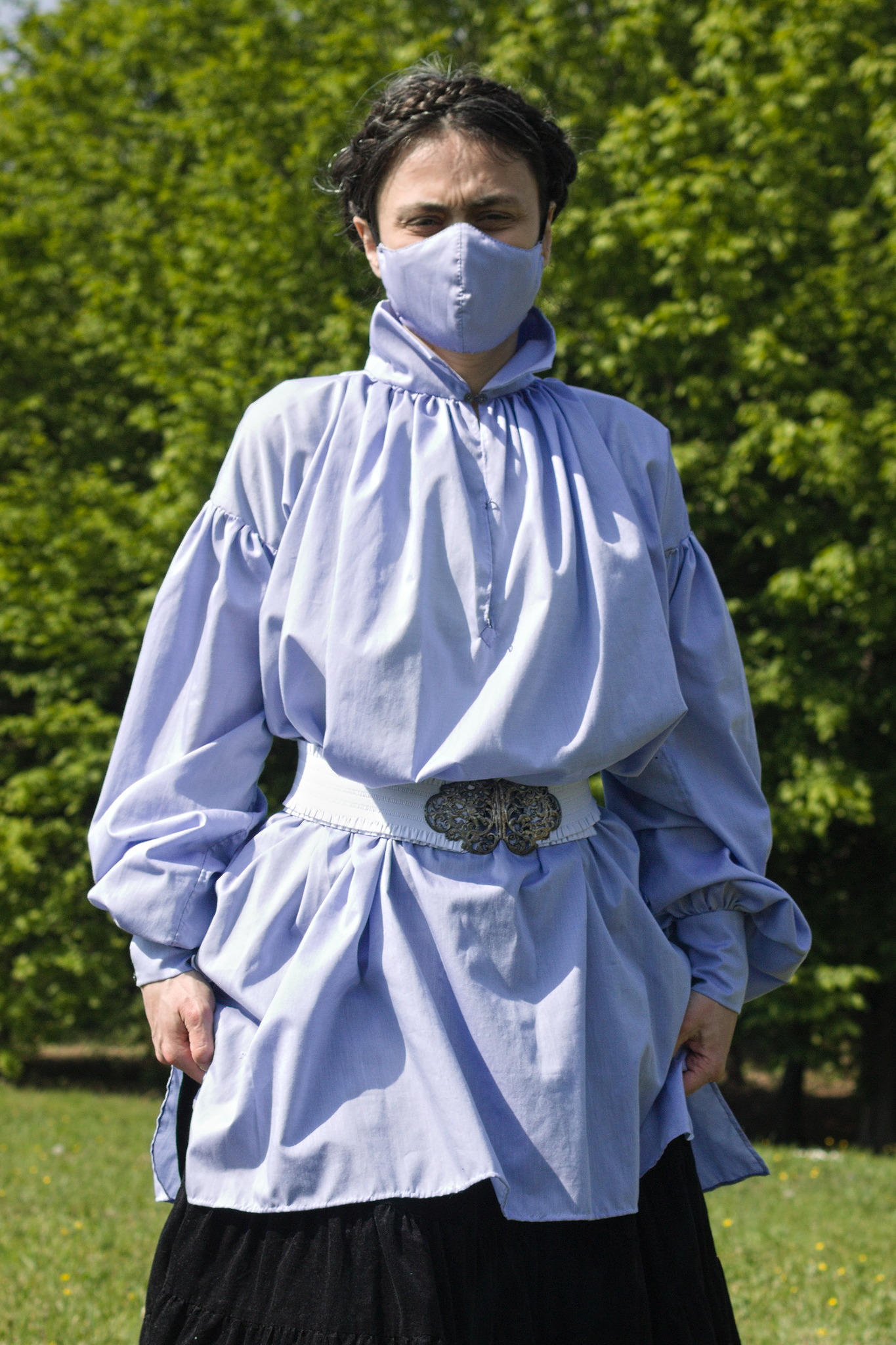 In my stash I had a cut of purple-blue hopefully cotton [#cotton] I had
bought for a cheap price and used for my first attempt at an
historically accurate pirate / vampire shirt that has now become by
official summer vaccine jab / blood test shirt (because it has the long
sleeves I need, but they are pretty easy to roll up to give access to my
arm.
That shirt tends to get out of the washing machine pretty wearable even
without ironing, which made me think it could be a good fabric for
something that may be somewhat hard to iron (but also made me
suspicious about the actual composition of the fabric, even if it feels
nice enough even when worn in the summer).
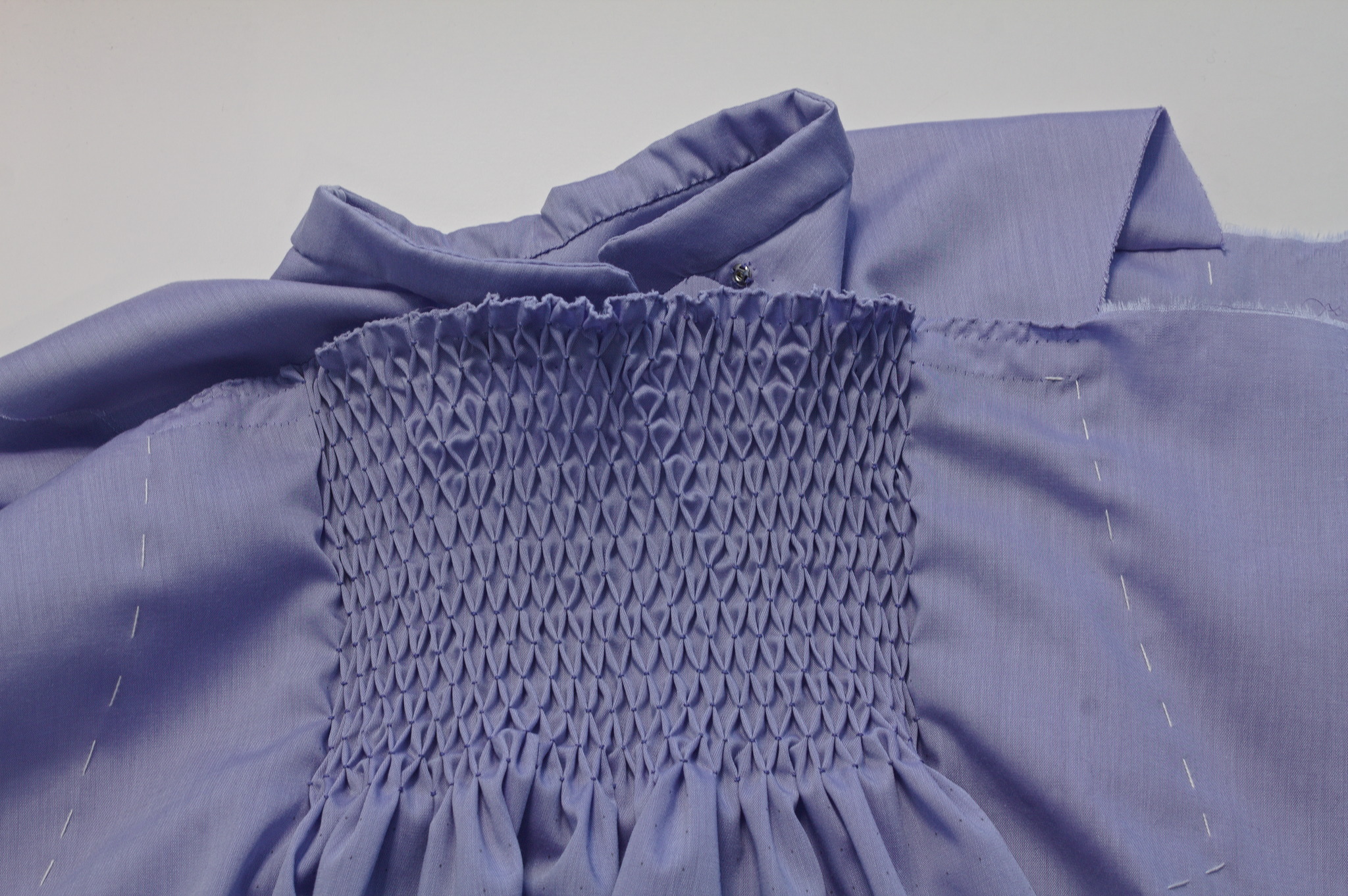 Of course I wanted some honeycombing on the front, but I was afraid that
the slit in the middle of it would interfere with the honeycombing and
gape, so I decided to have the shirt open in an horizontal line at the
yoke.
I added instructions to the pattern page
for how I changed the opening in the front, basically it involved
finishing the front edge of the yoke, and sewing the honeycombed yoke to
a piece of tape with snaps.
Another change from the pattern is that I used plain rectangles for the
sleeves, and a square gusset, rather than the new style tapered sleeve ,
because I wanted to have more fabric to gather at the wrist. I did the
side and sleeve seams with a hem + whipstitch method rather than a
felled seam, which may have helped, but the sleeves went into the
fitted armscyes with no issue.
I think that if (yeah, right. when) I ll make another sleeve in this
style I ll sew it into the side seam starting 2-3 cm lower than the
place I ve marked on the pattern for the original sleeve.
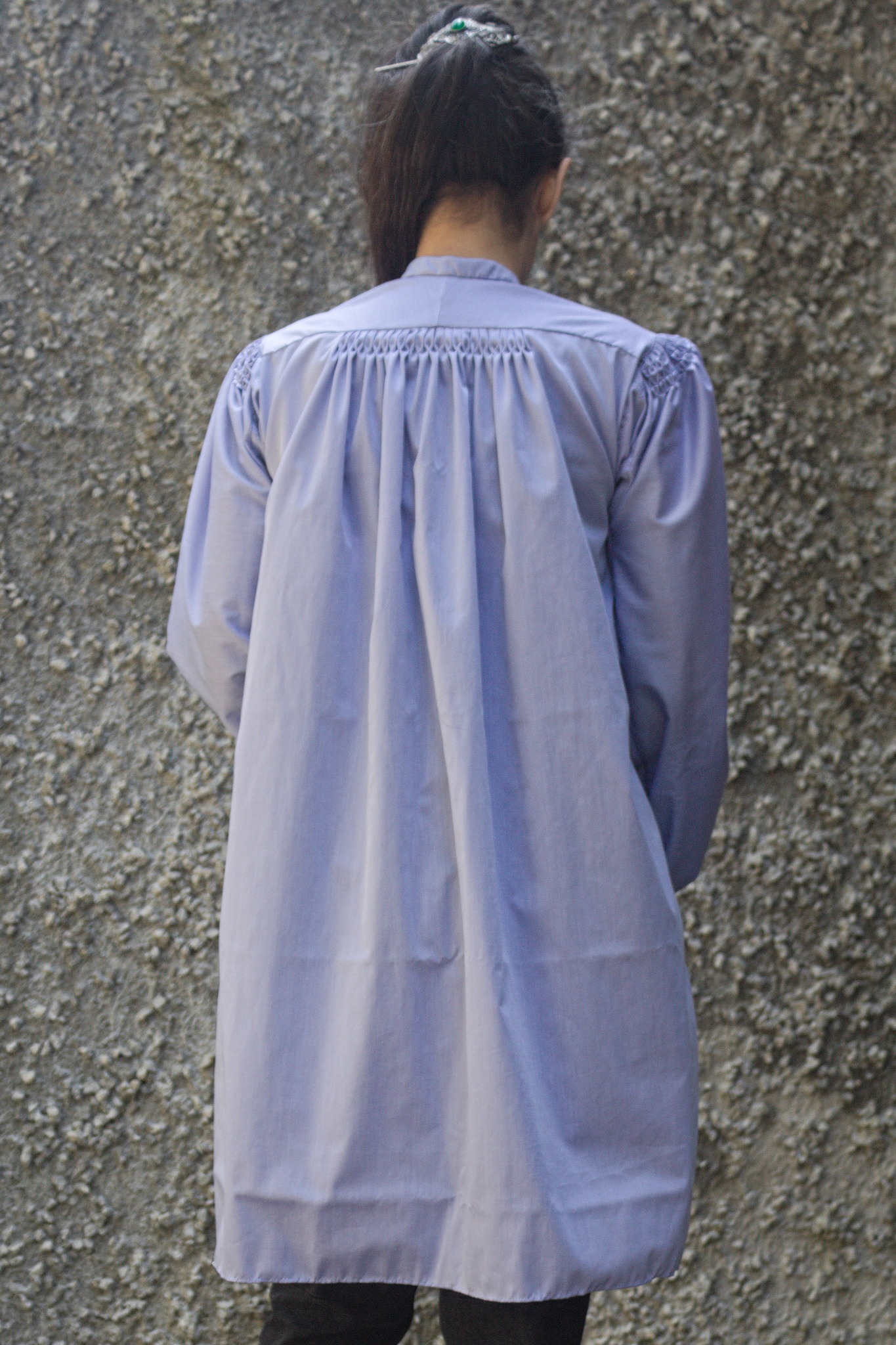 I also used a row of honeycombing on the back and two on the upper part
of the sleeves, instead of the gathering, and of course some rows to
gather the cuffs.
The honeycombing on the back was a bit too far away from the edge, so
it s a bit of an odd combination of honeycombing and pleating that I
don t hate, but don t love either. It s on the back, so I don t mind. On
the sleeves I ve done the honeycombing closer to the edge and I ve
decided to sew the sleeve as if it was a cartridge pleated sleeve, and
that worked better.
Because circumstances are still making access to my sewing machine
more of a hassle than I d want it to be, this was completely sewn by
hand, and at a bit more than a month I have to admit that near the end
it felt like it had been taken forever. I m not sure whether it was the
actual sewing being slow, some interruptions that happened when I had
little time to work on it, or the fact that I ve just gone through a
time when my brain kept throwing new projects at me, and I kept thinking
of how to make those. Thanks brain.
Even when on a hurry to finish it, however, it was still enjoyable
sewing, and I think I ll want to do more honeycombing in the future.
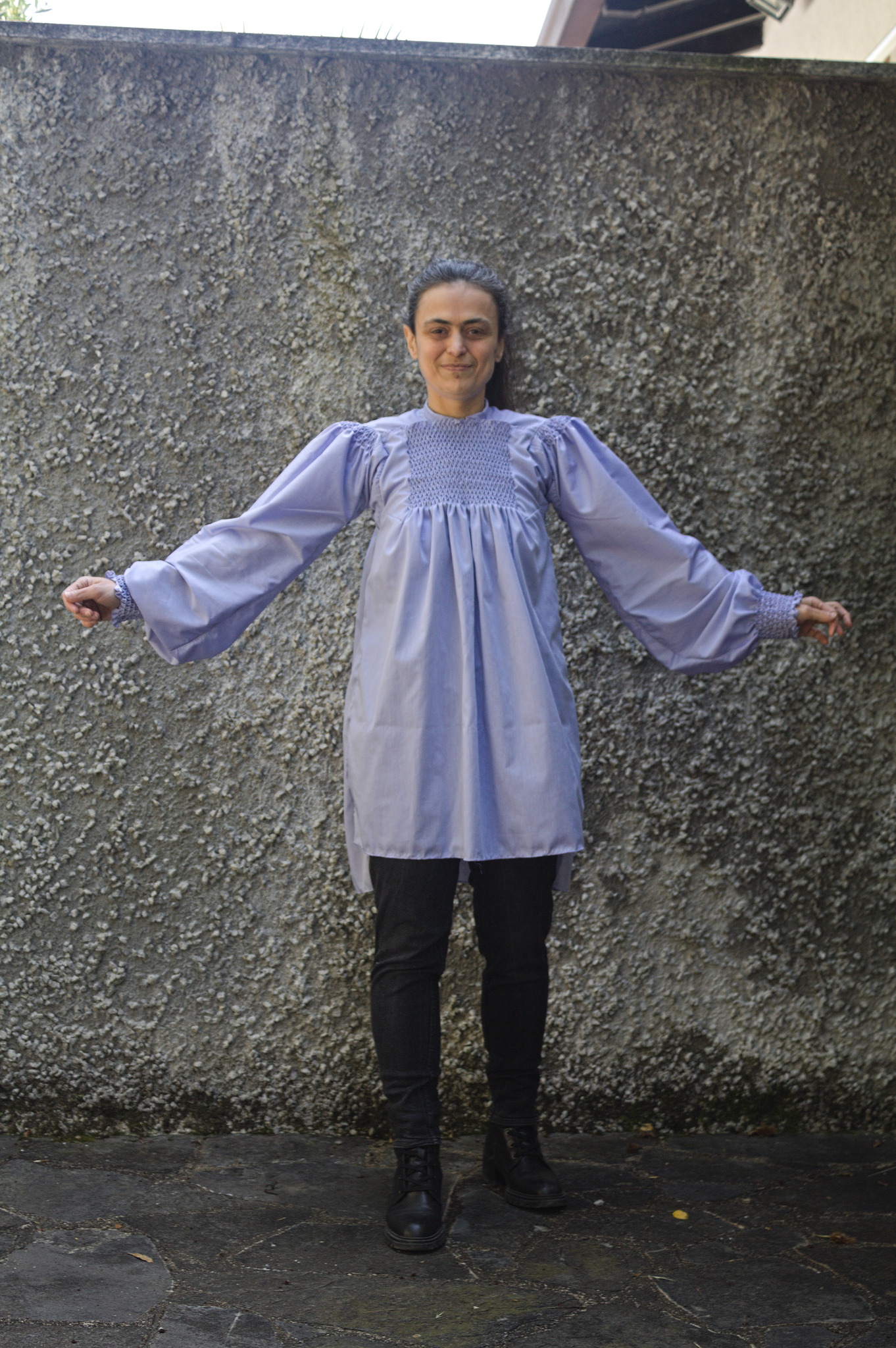 Anyway, it s done! And it s going straight into my daily garment
rotation, because the weather is getting hot, and that means it s
definitely shirt time.
 For a while, the strongSwan Debian package had an autopktest.
The initial version was proposed by Christian Ehrhardt in 2016
(presumably especially for downstream use in Ubuntu) and updated in
2019, but since then not much at least in Debian.
With the metapackage dependencies update in 6.0.0-1 I had to
tune a bit the tests dependencies so they wouldn't totally fail,
and I noticed the amd64 tests were failing since basically the
beginning (the other architectures would pass, but because the
tests wouldn't actually run at all since they rely on the
 Welcome to post 47 in the
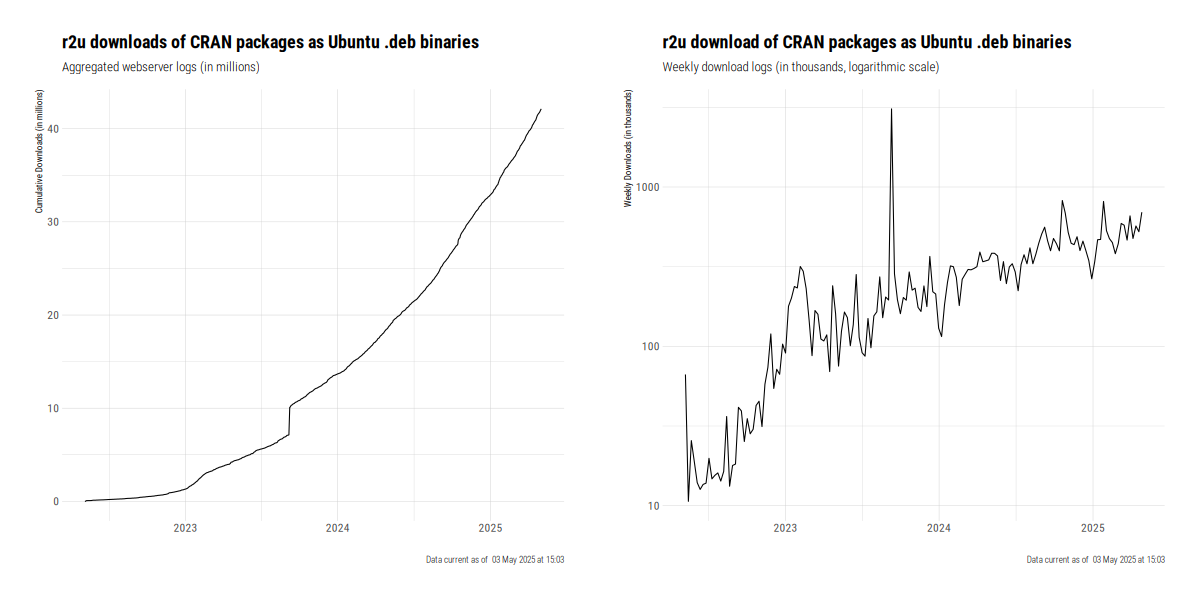 Usage is driven by deployment in continuous integration (as for
example the Ubuntu-use at GitHub makes this both an easy and obvious
choice), cloud computing (as it is easy to spin up Ubuntu instances, it
is as easy to add












 Update 20250309 13:20-03:00 - How to help
A friend of mine living in the USA sent me this link to help the flood victims:



 The "real" thing
Let's get to the heavy, heartbreaker part. I did go to downtown Bah a Blanca, but during night, so let me share some links, most of them in Spanish, but images are images:
 What is HMAC?
HMAC stands for Hash-Based Message Authentication Code. It s a specific way to use a cryptographic hash function (like SHA-1, SHA-256, etc.) along with a secret key to produce a unique fingerprint of some data. This fingerprint allows someone else with the same key to verify that the data hasn t been tampered with.
How HMAC Works
Keyed Hashing: The core idea is to incorporate the secret key into the hashing process. This is done in a specific way to prevent clever attacks that might try to bypass the security.