Search Results: "nomeata"

28 November 2021

Joachim Breitner: Zero-downtime upgrades of Internet Computer canisters

TL;DR: Zero-downtime upgrades are possible if you stick to the basic actor model.

Background DFINITY s Internet Computer provides a kind of serverless compute platform, where the services are WebAssemmbly programs called canisters . These services run without stopping (or at least that s what it feels like from the service s perspective; this is called orthogonal persistence ), and process one message after another. Messages not only come from the outside ( ingress calls), but are also exchanged between canisters. On top of these uni-directional messages, the system provides the concept of inter-canister calls , which associates a respondse message with the outgoing message, and guarantees that a response will come. This RPC-like interface allows canister developers to program in the popular async/await model, where these inter-canister calls look almost like normal function calls, and the subsequent code is suspended until the response comes back.

The problem This is all very well, until you try to upgrade your canister, i.e. install new code to fix a bug or add a feature. Because if you used the await pattern, there may still be suspended computations waiting for the response. If you swap out the program now, the code of that suspended computation will no longer be present, and the response cannot be handled! Worse, because of an infelicity with the current system s API, when the response comes back, it may actually corrupt your service s state. That is why upgrading a canister requires stopping it first, which means waiting for all outstanding calls to come back. During this time, your canister is not available for new calls (so there is downtime), and worse, the length of the downtime is at the whims of the canisters you called they could withhold the response ad infinitum, rendering your canister unupgradeable. Clearly, this is not acceptable for any serious application. In this post, I ll explore some of the ways to mitigate this problem, and how to create canisters that are safely instantanously (no downtime) upgradeable.

It s a spectrum Some canisters are trivially upgradeable, for others all hope is lost; it depends on what the canister does and how. As an overview, here is the spectrum:
  1. A canister that never performs inter-canister calls can always be upgraded without stopping.
  2. A canister that only does one-way calls, and does them in a particular way (see below), can always be upgraded without stopping.
  3. A canister that performs calls, and where it is acceptable to simply drop outstanding repsonses, can always be upgraded without stopping, once the System API has been improved and your Canister Development Kit (CDK; Motoko or Rust) has adapted.
  4. A canister that performs calls, but uses explicit continuations to handle, responses instead of the await-convenience, based on an eventually fixed System API, can be upgradeded without stopping, and will even handle responses afterwards.
  5. A canister that uses await to do inter-canister call cannot be upgraded without stopping.
In this post I will explain 2, which is possible now, in more detail. Variant 3 and 4 only become reality if and when the System API has improved.

One-way calls A one-way call is a call where you don t care about the response; neither the replied data, nor possible failure conditions. Since you don t care about the response, you can pass an invalid continuation to the system (technical detail: a Wasm table index of -1). Because it is invalid for any (realistic) Wasm module, it will stay invalid even after an upgrade, and the problem of silent corruption mentioned above is avoided. And otherwise it s fine for this to be invalid: it means the canister traps once the response comes back, which is harmeless (and possibly even cheaper than a do-nothing computation). This requires your CDK to support this kind of call. Mostly incidential, Motoko (and Candid) actually have the concept of one-way call in their type system, namely shared functions with return type () instead of async ... (Motoko is actually older than the system, and not every prediction about what the system will provide has proven successful). So, pending this PR to be released, Motoko will implement one-way calls in this way. On Rust, you have to use the System API directly or wait for cdk-rs to provide this ability (patches welcome, happy to advise). You might wonder: How are calls useful if I don t get to look at the response? Of course, this is a set-back calls with responses are useful, and await is convenient. And if you have to integrate with an existing service that only provides normal calls, you are out of luck. But if you get to design the canister and all called canisters together, it may be possible to use only one-way messages. You d be programming in the plain actor model now, with all its advantages (simple concurrency, easy to upgrade, general robustness). Consider for example a token ledger canister, not unlike the ICP ledger canister. For the most part, it doesn t have to do any outgoing calls (and thus be trivially upgradeble). But say we need to add notify functionality, where the ledger canister tells other canisters about a transaction. This is a good example for a one-way call: Maybe the ledger canister doesn t care if that notification was received? The ICP leder does care (once it comes back successful, this particular notification cannot be sent again), but maybe your ledger can do it differently: let the other canister confirm the receip via another one-way call, instead of via the reply; or simply charge for each notification and do not worry about repeated notifications. Maybe you want to add archiving functionality, where the ledger canister streams its data to an archive canister. There, again, instead of using successful responses to confirm receipt, the archive canister can ping the ledger canister with the latest received index directly. Yes, it changes the programming model a bit, and all involved parties have to play together, but the gain (zero-downtime upgrades) is quite valuable, and removes a fair number of other sources of issues.
And in the future? The above is possible with today s Internet Computer. If the System API gets improves the way I hope it will be, you have a possible middle ground: You still don t get to use await and instead have to write your response handler as separate functions, but this way you can call any canister again, and you get the system s assistance in mapping responses to calls. With this in place, any canister can be rewritten to a form that supports zero-downtime upgrades, without affecting its interface or what the canister can do.

9 November 2021

Joachim Breitner: How to audit an Internet Computer canister

I was recently called upon by Origyn to audit the source code of some of their Internet Computer canisters ( canisters are services or smart contracts on the Internet Computer), which were written in the Motoko programming language. Both the application model of the Internet Computer as well as Motoko bring with them their own particular pitfalls and possible sources for bugs. So given that I was involved in the creation of both, they reached out to me. In the course of that audit work I collected a list of things to watch out for, and general advice around them. Origyn generously allowed me to share that list here, in the hope that it will be helpful to the wider community.

Inter-canister calls The Internet Computer system provides inter-canister communication that follows the actor model: Inter-canister calls are implemented via two asynchronous messages, one to initiate the call, and one to return the response. Canisters process messages atomically (and roll back upon certain error conditions), but not complete calls. This makes programming with inter-canister calls error-prone. Possible common sources for bugs, vulnerabilities or simply unexpected behavior are:
  • Reading global state before issuing an inter-canister call, and assuming it to still hold when the call comes back.
  • Changing global state before issuing an inter-canister call, changing it again in the response handler, but assuming nothing else changes the state in between (reentrancy).
  • Changing global state before issuing an inter-canister call, and not handling failures correctly, e.g. when the code handling the callback rolls backs.
If you find such pattern in your code, you should analyze if a malicious party can trigger them, and assess the severity that effect These issues apply to all canisters, and are not Motoko-specific.

Rollbacks Even in the absence of inter-canister calls the behavior of rollbacks can be surprising. In particular, rejecting (i.e. throw) does not rollback state changes done before, while trapping (e.g. Debug.trap, assert , out of cycle conditions) does. Therefore, one should check all public update call entry points for unwanted state changes or unwanted rollbacks. In particular, look for methods (or rather, messages, i.e. the code between commit points) where a state change is followed by a throw. This issues apply to all canisters, and are not Motoko-specific, although other CDKs may not turn exceptions into rejects (which don t roll back).

Talking to malicious canisters Talking to untrustworthy canisters can be risky, for the following (likely incomplete) reasons:
  • The other canister can withhold a response. Although the bidirectional messaging paradigm of the Internet Computer was designed to guarantee a response eventually, the other party can busy-loop for as long as they are willing to pay for before responding. Worse, there are ways to deadlock a canister.
  • The other canister can respond with invalidly encoded Candid. This will cause a Motoko-implemented canister to trap in the reply handler, with no easy way to recover. Other CDKs may give you better ways to handle invalid Candid, but even then you will have to worry about Candid cycle bombs that will cause your reply handler to trap.
Many canisters do not even do inter-canister calls, or only call other trustwothy canisters. For the others, the impact of this needs to be carefully assessed.

Canister upgrade: overview For most services it is crucial that canisters can be upgraded reliably. This can be broken down into the following aspects:
  1. Can the canister be upgraded at all?
  2. Will the canister upgrade retain all data?
  3. Can the canister be upgraded promptly?
  4. Is three a recovery plan for when upgrading is not possible?

Canister upgradeability A canister that traps, for whatever reason, in its canister_preupgrade system method is no longer upgradeable. This is a major risk. The canister_preupgrade method of a Motoko canister consists of the developer-written code in any system func preupgrade() block, followed by the system-generated code that serializes the content of any stable var into a binary format, and then copies that to stable memory. Since the Motoko-internal serialization code will first serialize into a scratch space in the main heap, and then copy that to stable memory, canisters with more than 2GB of live data will likely be unupgradeable. But this is unlikely the first limit: The system imposes an instruction limit on upgrading a canister (spanning both canister_preupgrade and canister_postupgrade). This limit is a subnet configuration value, and sepearate (and likely higher) than the normal per-message limit, and not easily determined. If the canister s live data becomes too large to be serialized within this limit, the canister becomes non-upgradeable. This risk cannot be eliminated completely, as long as Motoko and Stable Variables are used. It can be mitigated by appropriate load testing: Install a canister, fill it up with live data, and exercise the upgrade. If this succeeds with a live data set exceeding the expected amount of data by a margin, this risk is probably acceptable. Bonus points for adding functionality that will prevent the canister s live data to increase above a certain size. If this testing is to be done on a local replica, extra care needs to be taken to make sure the local replica actually performs instruction counting and has the same resource limits as the production subnet. An alternative mitigation is to avoid canister_pre_upgrade as much as possible. This means no use of stable var (or restricted to small, fixed-size configuration data). All other data could be
  • mirrored off the canister (possibly off chain), and manually re-hydrated after an upgrade.
  • stored in stable memory manually, during each update call, using the ExperimentalStableMemory API. While this matches what high-assurance Rust canisters (e.g. the Internet Identity) do, This requires manual binary encoding of the data, and is marked experimental, so I cannot recommend this at the moment.
  • not put into a Motoko canister until Motoko has a scalable solution for stable variable (for example keeping them in stable memory permanently, with smart caching in main memory, and thus obliterating the need for pre-upgrade code.)

Data retention on upgrades Obviously, all live data ought to be retained during upgrades. Motoko automatically ensures this for stable var data. But often canisters want to work with their data in a different format (e.g. in objects that are not shared and thus cannot be put in stable vars, such as HashMap or Buffer objects), and thus may follow following idiom:
stable var fooStable =  ;
var foo = fooFromStable(fooStable);
system func preupgrade()   fooStable := fooToStable(foo);  )
system func postupgrade()   fooStable := (empty);  )
In this case, it is important to check that
  • All non-stable global vars, or global lets with mutable values, have a stable companion.
  • The assignments to foo and fooStable are not forgotten.
  • The fooToStable and fooFromStable form bijections.
An example would be HashMaps stored as arrays via Iter.toArray( .entries()) and HashMap.fromIter( .vals()). It is worth pointiong out that a code view will only look at a single version of the code, but cannot check whether code changes will preserve data on upgrade. This can easily go wrong if the names and types of stable variables are changed in incompatible way. The upgrade may fail loudly in this cases, but in bad cases, the upgrade may even succeed, losing data along the way. This risk needs to be mitigated by thorough testing, and possibly backups (see below).

Prompt upgrades Motoko and Rust canisters cannot be safely upgraded when they are still waiting for responses to inter-canister calls (the callback would eventually reach the new instance, and because of infelicities of the IC s System API, could possibly call arbitrary internal functions). Therefore, the canister needs to be stopped before upgrading, and started again. If the inter-canister calls take a long time, this mean that upgrading may take a long time, which may be undesirable. Again, this risk is reduced if all calls are made to trustworthy canisters, and elevated when possibly untrustworthy canisters are called, directly or indirectly.

Backup and recovery Because of the above risk around upgrades it is advisable to have a disaster recovery strategy. This could involve off-chain backups of all relevant data, so that it is possible to reinstall (not upgrade) the canister and re-upload all data. Note that reinstall has the same issue as upgrade described above in prompt upgrades : It ought to be stopped first to be safe. Note that the instruction limit for messages, as well as the message size limit, limit the amount of data returned. If the canister needs to hold more data than that, the backup query method might have to return chunks or deltas, with all the extra complexity that entails, e.g. state changes between downloading chunks. If large data load testing is performed (as Irecommend anyways to test upgradeability), one can test whether the backup query method works within the resource limits.

Time is not strictly monotonic The timestamps for current time that the Internet Computer provides to its canisters is guaranteed to be monotonic, but not strictly monotonic. It can return the same values, even in the same messages, as long as they are processed in the same block. It should therefore not be used to detect happens-before relations. Instead of using and comparing time stamps to check whether Y has been performed after X happened last, introduce an explicit var y_done : Bool state, which is set to False by X and then to True by Y. When things become more complex, it will be easier to model that state via an enumeration with speaking tag names, and update this state machine along the way. Another solution to this problem is to introduce a var v : Nat counter that you bump in every update method, and after each await. Now v is your canister s state counter, and can be used like a timestamp in many ways. While we are talking about time: The system time (typically) changes across an await. So if you do let now = Time.now() and then await, the value in now may no longer be what you want.

Wrapping arithmetic The Nat64 data type, and the other fixed-width numeric types provide opt-in wrapping arithmetic (e.g. +%, fromIntWrap). Unless explicitly required by the current application, this should be avoided, as usually a too large or negatie value is a serious, unrecoverable logic error, and trapping is the best one can do.

Cycle balance drain attacks Because of the IC s canister pays model, all canisters are prone to DoS attacks by draining their cycle balance, and this risk needs to be taken into account. The most elementary mitigation strategy is to monitor the cycle balance of canisters and keep it far from the (configurable) freezing threshold. On the raw IC-level, further mitigation strategies are possible:
  • If all update calls are authenticated, perform this authentication as quickly as possible, possibly before decoding the caller s argument. This way, a cycle drain attack by an unauthenticated attacker is less effective (but still possible).
  • Additionally, implementing the canister_inspect_message system method allows the above checks to be performed before the message even is accepted by the Internet Computer. But it does not defend against inter-canister messages and is therefore not a complete solution.
  • If an attack from an authenticated user (e.g. a stakeholder) is to be expected, the above methods are not effective, and an effective defense might require relatively involved additional program logic (e.g. per-caller statistics) to detect such an attack, and react (e.g. rate-limiting).
  • Such defenses are pointless if there is only a single method where they do not apply (e.g. an unauthenticated user registration method). If the application is inherently attackable this way, it is not worth the bother to raise defenses for other methods.
Related: A justification why the Internet Identity does not use canister_inspect_message) A motoko-implemented canister currently cannot perform most of these defenses: Argument decoding happens unconditionally before any user code that may reject a message based on the caller, and canister_inspect_message is not supported. Furthermore, Candid decoding is not very cycle defensive, and one should assume that it is possible to construct Candid messages that require many instructions to decode, even for simple argument type signatures. The conclusion for the audited canisters is to rely on monitoring to keep the cycle blance up, even during an attack, if the expense can be born, and maybe pray for IC-level DoS protections to kick in.

Large data attacks Another DoS attack vector exists if public methods allow untrustworthy users to send data of unlimited size that is persisted in the canister memory. Because of the translation of async-await code into multiple message handlers, this applies not only to data that is obviously stored in global state, but also local data that is live across an await point. The effectiveness of such attacks is limited by the Internet Computer s message size limit, which is in the order of a few megabytes, but many of those also add up. The problem becomes much worse if a method has an argument type that allows a Candid space bomb: It is possible to encode very large vectors with all values null in Candid, so if any method has an argument of type [Null] or [?t], a small message will expand to a large value in the Motoko heap. Other types to watch out:
  • Nat and Int: This is an unbounded natural number, and thus can be arbitrarily large. The Motoko representation will however not be much larger than the Candid encoding (so this does not qualify as a space bomb).
It is still advisable to check if the number is reasonable in size before storing it or doing an await. For example, when it denotes an index in an array, throw early if it exceeds the size of the array; if it denotes a token amount to transfer, check it against the available balance, if it denotes time, check it against reasonable bounds.
  • Principal: A Principal is effectively a Blob. The Interface specification says that principals are at most 29 bytes in length, but the Motoko Candid decoder does not check that currently (fixed in the next version of Motoko). Until then, a Principal passed as an argument can be large (the principal in msg.caller is system-provided and thus safe). If you cannot wait for the fix to reach you, manually check the size of the princial (via Principal.toBlob) before doing the await.

Shadowing of msg or caller Don t use the same name for the message context of the enclosing actor and the methods of the canister: It is dangerous to write shared(msg) actor, because now msg is in scope across all public methods. As long as these also use public shared(msg) func , and thus shadow the outer msg, it is correct, but it if one accidentially omits or mis-types the msg, no compiler error would occur, but suddenly msg.caller would now be the original controller, likely defeating an important authorization step. Instead, write shared(init_msg) actor or shared( caller = controller ) actor to avoid using msg.

Conclusion If you write a serious canister, whether in Motoko or not, it is worth to go through the code and watch out for these patterns. Or better, have someone else review your code, as it may be hard to spot issues in your own code. Unfortunately, such a list is never complete, and there are surely more ways to screw up your code in addition to all the non-IC-specific ways in which code can be wrong. Still, things get done out there, so best of luck!

31 October 2021

Joachim Breitner: A mostly allocation-free optional type

The Motoko programming language has a built-in data type for optional values, named ?t with values null and ?v (for v : t); this is the equivalent of Haskell s Maybe, Ocaml s option or Rust s Option. In this post, I explain how Motoko represents such optional values (almost) without allocation. I neither claim nor expect that any of this is novel; I just hope it s interesting.

Uniform representation The Motoko programming language, designed by Andreas Rossberg and implemented by a pretty cool team at DFINITY is a high-level language with strict semantics and a strong, structural, equi-recursive type system that compiles down to WebAssembly. Because the type system supports polymorphism, it represents all values uniformly. Simplified for the purpose of this blog post, they are always pointers into a heap object where the first word of the heap object, the heap tag, contains information about the value:
 
  tag    
 
The tag is something like array, int64, blob, variant, record, , and it has two purposes:
  • The garbage collector uses it to understand what kind of object it is looking at, so that it can move it around and follow pointers therein. Variable size objects such as arrays include the object size in a subsequent word of the heap object.
  • Some types have values that may have different shapes on the heap. For example, the ropes used in our text representation can either be a plain blob, or a concatenation node of two blobs. For these types, the tag of the heap object is inspected.

The optional type, naively The optional type (?t) is another example of such a type: Its values can either be null, or ?v for some value v of type t, and the primitive operations on this type are the two introduction forms, an analysis function, and a projection for non-null values:
null : () -> ?t
some : t -> ?t
is_some : ?t -> bool
project : ?t -> t     // must only be used if is_some holds
It is natural to use the heap tag to distinguish the two kind of values:
  • The null value is a simple one-word heap object with just a tag that says that this is null:
     
      null  
     
  • The other values are represented by a two-word object: The tag some, indicating that it is a ?v, and then the payload, which is the pointer that represents the value v:
     
      some   payload  
     
With this, the four operations can be implemented as follows:
def null():
  ptr <- alloc(1)
  ptr[0] = NULL_TAG
  return ptr
def some(v):
  ptr <- alloc(2)
  ptr[0] = SOME_TAG
  ptr[1] = v
  return ptr
def is_some(p):
  return p[0] == SOME_TAG
def project(p):
  return p[1]
The problem with this implementation is that null() and some(v) both allocate memory. This is bad if they are used very often, and very liberally, and this is the case in Motoko: For example the iterators used for the for (x in e) construct have type
type Iter<T> =   next : () -> ?T  
and would unavoidably allocate a few words on each iteration. Can we avoid this?

Static values It is quite simple to avoid this for for null: Just statically create a single null value and use it every time:
static_null = [NULL_TAG]
def null():
  return static_null
This way, at least null() doesn t allocate. But we gain more: Now every null value is represented by the same pointer, and since the pointer points to static memory, it does not change even with a moving garbage collector, so we can speed up is_some:
def is_some(p):
  return p != static_null
This is not a very surprising change so far, and most compilers out there can and will do at least the static allocation of such singleton constructors. For example, in Haskell, there is only a single empty list ([]) and a single Nothing value in your program, as you can see in my videos exploring the Haskell heap. But can we get rid of the allocation in some(v) too?

Unwrapped optional values If we don t want to allocate in some(v), what can we do? How about simply
def some(v):
  return v
That does not allocate! But it is also broken. At type ??Int, the values null, ?null and ??null are distinct values, but here this breaks. Or, more formally, the following laws should hold for our four primitive operations:
  1. is_some(null()) = false
  2. v. is_some(some(v)) = true
  3. p. project(some(p)) = p
But with the new definition of some, we d get is_some(some(null())) = false. Not good! But note that we only have a problem if we are wrapping a value that is null or some(v). So maybe take the shortcut only then, and write the following:
def some(v):
  if v == static_null   v[0] == SOME_TAG:
    ptr <- alloc(2)
    ptr[0] = SOME_TAG
    ptr[1] = v
    return ptr
  else:
    return v
The definition of is_some can stay as it is: It is still the case that all null values are represented by static_null. But the some values are now no longer all of the same shape, so we have to change project():
def project(p):
  if p[0] == SOME_TAG:
    return p[1]
  else:
    return p
Now things fall into place: A value ?v can, in many cases, be represented the same way as v, and no allocation is needed. Only when v is null or ?null or ??null or ???null etc. we need to use the some heap object, and thus have to allocate. In fact, it doesn t cost much to avoid allocation even for ?null:
static_some_null = [SOME_TAG, static_null]
def some(v):
  if v == static_null:
    return static_some_null
  else if v[0] == SOME_TAG:
    ptr <- alloc(2)
    ptr[0] = SOME_TAG
    ptr[1] = v
    return ptr
  else:
    return v
So unless one nests the ? type two levels deep, there is no allocation whatsoever, and the only cost is a bit more branching in some and project. That wasn t hard, but quite rewarding, as one can now use idioms like the iterator shown above with greater ease.

Examples The following tables shows the representation of various values before and after. Here [ ] is a pointed-to dynamically allocated heap object, a statically allocated heap object, N = NULL_TAG and S = SOME_TAG.
type value before after
Null null N N
?Int null N N
?Int ?23 [S,23] 23
??Int null N N
??Int ?null [S, N ] S, N
??Int ??23 [S,[S,23]] 23
???Int null N N
???Int ?null [S, N ] S, N
???Int ??null [S,[S, N ]] [S, S, N ]
???Int ???23 [S,[S,[S,23]]] 23

Concluding remarks
  • If you know what parametric polymorphism is, and wonder how this encoding can work in a language that has that, note that this representation is on the low-level of the untyped run-time value representation: We don t need to know the type of v in some(v), merely its heap representation.
  • The uniform representation in Motoko is a bit more involved: The pointers are tagged (by subtracting 1) and some scalar values are represented directly in place (shifted left by 1 bit). But this is luckily orthogonal to what I showed here.
  • Could Haskell do this for its Maybe type? Not so easily:
    • The Maybe type is not built-in, but rather a standard library-defined algebraic data type. But the compiler could feasible detect that this is option-like?
    • Haskell is lazy, so at runtime, the type Maybe could be Nothing, or Just v, or, and this is crucial, a yet to be evaluated expression, also called a thunk. And one definitely needs to distinguish between a thunk t :: Maybe a that may evaluate to Nothing, and a value Just t :: Maybe a that definitely is Just, but contains a value, which may be a thunk.
    Something like this may work for a strict Maybe type or unlifted sums like (# (# #) a #), but may clash with other ticks in GHC, such as pointer tagging.
  • As I said above, I don t expect this to be novel, and I am happy to add references to prior art here.
  • Given that a heap object with tag SOME_TAG now always encodes a tower ? null for n>0, one could try to optimize that even more by just storing the n:
     
      some    n   
     
    But that seems unadvisable: It is only a win if you have deep towers, which is probably rare. Worse, now the project function would have to return such a heap object with n decremented, so now projection might have to allocate, which goes against the cost model expected by the programmer.
  • If you rather want to see code than blog posts, feel free to check out Motoko PR #2115.
  • Does this kind of stuff excite you? Motoko is open source, so your contributions may be welcome!

14 September 2021

Joachim Breitner: A Candid explainer: Quirks

This is the fifth and final post in a series about the interface description language Candid. If you made it this far, you now have a good understanding of what Candid is, what it is for and how it is used. For this final post, I ll put the spotlight on specific aspects of Candid that are maybe surprising, or odd, or quirky. This section will be quite opinionated, and could maybe be called what I d do differently if I d re-do the whole thing . Note that these quirks are not serious problems, and they don t invalidate the overall design. I am writing this up not to discourage the use of Candid, but merely help interested parties to understand it better.

References in the wire format When the work on Candid began at DFINITY, the Internet Computer was still far away from being a thing, and many fundamental aspects about it were still in the air. I particular, there was still talk about embracing capabilities as a core feature of the application model, which would be implemented as opaque references on the system level, likely building on WebAssembly s host reference type proposal (which only landed recently), and could be used to model access permissions, custom tokens and many other things. So Candid is designed with that in mind, and you ll find that its wire format is not just a type table and a value table, but actually
a triple (T, M, R), where T ( type ) and M ( memory ) are sequences of bytes and R ( references ) is a sequence of references.
Also the wire format for values of function service tyeps have an extra byte to distinguish between public references (represented by a principal and possible a method name in the data part), and these opaque references. Alas, references never made it into the Internet Computer, so all Candid implementations simply ignore that part of the specification. But it s still in the spec, and if it confused you before, now you know why.

Hashed field names Candid record and variant types look like they have textual field names:
type T = record   syndactyle : nat; trustbuster: bool  
But that is actually only true superficially. The wire format for Candid only stores hashes of field names. So the above is actually equivalent to
type T = record   4260381820 : nat; 3504418361 : bool  
or, for that matter, to
type T = record   destroys : bool; rectum : nat  
(Yes, I used an english word list to find these hash collisions. There aren t that many actually.) The benefit of such hashing is that the messages are a bit smaller in most (not all) cases, but it is a big annoyance for dynamic uses of Candid. It s the reason why tools like dfx, if they don t know the Candid interface of a service, will print the result with just the numerical hash, letting you guess which field is which. It also complicates host languages that derive Candid types from the host language, like Motoko, as some records (e.g. record trustbuster: bool; destroys : int ) with field name hash collisions can not be represented in Candid, and either the host language s type system needs to be Candid aware now (as is the case of Motoko), or serialization/deserialization will fail at runtime, or odd bugs can happen. (More discussion of this issue).

Tuples Many languages have a built-in notion of a tuple type (e.g. (Int, Bool)), but Candid does not have such a type. The only first class product type is records. This means that tuples have to encoded as records somehow. Conveniently(?) record fields are just numbers after all, so the type (Int, Bool) would be mapped to the type
record   0 : int; 1 : bool  
So tuples can be expressed. But from my experience implementing the type mappings for Motoko and Haskell this is causing headaches. To get a good experience when importing from Candid, the tools have to try to reconstruct which records may have been tuples originally, and turn them into tuples. The main argument for the status quo is that Candid types should be canonical, and there should not be more than one product type, and records are fine, and there needs to be no anonymous product type. But that has never quite resonated with me, given the practical reality of tuple types in many host languages.

Argument sequences Did I say that Candid does not have tuple types? Turns out it does, sort of. There is no first class anonymous product, but since functions take sequences of arguments and results, there is a tuple type right there:
func foo : (bool, int) -> (int, bool)
Again, I found that ergonomic interaction with host languages becomes relatively unwieldy by requiring functions to take and return sequences of values. This is especially true for languages where functions take one argument value or return one result type (the latter being very common). Here, return sequences of length one are turned into that type directly, longer argument sequences turn into the host language s tuple type, and nullary argument sequences turn into the idiomatic unit type. But this means that the types (int, bool) -> () and (record 0: int, 1: bool ) -> () may be mapped to the same host language type, which causes problems when you hope to encode all necessary Candid type information in the host language. Another oddity with argument and result sequences is that you can give names to the entries, e.g. write
func hello : (last_name : text; first_name : text) -> ()
but these names are completely ignored! So while this looks like you can, for example, add new optional arguments in the middle, such as
func hello : (last_name : text; middle_name: opt text, first_name : text) -> ()
without breaking clients, this does not have the effect you think it has and will likely break. My suggestion is to never put names on function arguments and result values in Candid interfaces, and for anything that might be extended with new fields or where you want to name the arguments, use a single record type as the only argument:
func hello : (record   last_name : text; first_name : text ) -> ()
This allows you to add and remove arguments more easily and reliably.

Type shorthands The Candid specification defines a system of types, and then adds a number of syntactic short-hands . For example, if you write blob in a Candid type description, it ought to means the same as vec nat8. My qualm with that is that it doesn t always mean the same. A Candid type description is interpreted by a number of, say, consumers . Two such consumers are part of the Candid specification:
  • The specification that defines the wire format for that type
  • The upgrading (subtyping) rules
But there are more! For every host language, there is some mapping from Candid types to host language types, and also generic tools like Candid UI are consumers of the type algebra. If these were to take the Candid specification as gospel, they would be forced to treat blob and vec nat8 the same, but that would be quite unergonomic and might cause performance regressions (most language try to map blob to some compact binary data type, while vec t tends to turn into some form of array structure). So they need to be pragmatic and treat blob and vec nat8 differently. But then, for all practical purposes, blob is not just a short-hand of vec nat8. They are different types that just happens to have the same wire representations and subtyping relations. This affects not just blob, but also tuples (record blob; int; bool ) and field names , as discussed above.

The value text format For a while after defining Candid, the only implementation was in Motoko, and all the plumbing was automatic, so there was never a need for users to to explicitly handle Candid values, as all values were Motoko values. Still, for debugging and testing and such things, we eventually needed a way to print out Candid values, so the text format was defined ( To enable convenient debugging, the following grammar specifies a text format for values ). But soon the dfx tool learned to talk to canisters, and now users needed to enter Candid value on the command line, possibly even when talking to canisters for which the interface was not known to dfx. And, sure enough, the textual interface defined in the Candid spec was used. Unfortunately, since it was not designed for that use case, it is rather unwieldy:
  • It is quite verbose. You have to write record , not just . Vectors are written vec ; instead of some conventional syntax like [ , ]. Variants are written as variant error = " " with braces that don t any value here, and something like #error " " might have worked as well. With a bit more care, a more concise and ergonomic syntax might have been possible.
  • It wasn t designed to be sufficient to create a Candid value from it. If you write 5 it s unclear whether that s a nat or an int16 or what (and all of these have different wire representations). Type annotations were later added, but are relatively unwieldy, and don t cover all cases (e.g. a service reference with a recursive type cannot be represented in the textual format at the moment).
  • Not really the fault of the textual format, but some useful information about the types is not reflected in the type description that s part of the wire format. In particular not the field names, and whether a value was intended to be binary data (blob) or a list of small numbers (vec nat8), so pretty-printing such values requires guesswork. The Haskell library even tries to brute-force the hash to guess the field name, if it is short or in a english word list!
In hindsight I think it was too optimistic to assume that correct static type information is always available, and instead of actively trying to discourage dynamic use, Candid might be better if we had taken these (unavoidable?) use cases into account.

Custom wire format At the beginning of this post, I have a Candid is list. The list is relatively long, and the actual wire format is just one bullet point. Yes, defining a wire format that works isn t rocket science, and it was easiest to just make one up. But since most of the interesting meat of Candid is in other aspects (subtyping rules, host language integration), I wonder if it would have been better to use an existing, generic wire format, such as CBOR, and build Candid as a layer on top. This would give us plenty of tools and libraries to begin with. And maybe it would have reduced barrier of entry for developers, which now led to the very strange situation that DFINITY advocates for the universal use of Candid on the Internet Computer, so that all services can smoothly interact, but two of the most important services on the Internet Computer (the registry and the ledger) use Protobuf as their primary interface format, with Candid interfaces missing or an afterthought.

Sideways Interface Evolution This is not a quirk of Candid itself, but rather an idiom of how you can use Candid that emerged from our solution for record extensions and upgrades. Consider our example from before, a service with interface
service   add_user : (record   login : text; name : text  ) -> ()  
where you want to add an age field, which should be a number. The official way of doing that is to add that field with an optional type:
service   add_user : (record   login : text; name : text; age : opt nat  ) -> ()  
As explained above, this will not break old clients, as the decoder will treat a missing argument as null. So far so good. But often when adding such a field you don t want to bother new clients with the fact that this age was, at some point in the past, not there yet. And you can do that! The trick is to distinguish between the interface you publish and the interface you implement. You can (for example in your documentation) state that the interface is
service   add_user : (record   login : text; name : text; age : nat  ) -> ()  
which is not a subtype of the old type, but it is the interface you want new clients to work with. And then your implementation uses the type with opt nat. Calls from old clients will come through as null, and calls from new clients will come through as opt 42. We can see this idiom used in the Management Canister of the Internet Computer. The current documented interface only mentions a controllers : vec principal field in the settings, but the implementation still can handle both the old controller : principal and the new controllers field. It s probably advisable to let your CI system check that new versions of your service continue to implement all published interfaces, including past interfaces. But as long as the actual implementation s interface is a subtype of all interfaces ever published, this works fine. This pattern is related to when your service implements, say, http_request (so its implemented interface is a subtype of that common interface), but does not include that method in the published documentation (because clients of your service don t need to call it).

Self-describing Services As you have noticed, Candid was very much designed assuming that all parties always have the service type of services they want to interact with. But the Candid specification does not define how one can obtain the interface of a given service, and there isn t really a an official way to do that on the Internet Computer. That is unfortunate, because many interesting features depend on that: Such as writing import C "ic:7e6iv-biaaa-aaaaf-aaada-cai" in your Motoko program, and having it s type right there. Or tools like ic.rocks, that allow you to interact with any canister right there. One reason why we don t really have that feature yet is because of disagreements about how dynamic that feature should be. Should you be able to just ask the canister for its interface (and allow the canister to vary the response, for example if it can change its functionality over time, even without changing the actual wasm code)? Or is the interface a static property of the code, and one should be able to query the system for that data, without the canister s active involvement. Or, completely different, should interfaces be distributed out of band, maybe together with API documentation, or in some canister registry somewhere else? I always leaned towards the first of these options, but not convincingly enough. The second options requires system assistance, so more components to change, more teams to be involved that maybe intrinsically don t care a lot about this feature. And the third might have emerged as the community matures and builds such infrastructure, but that did not happen yet. In the end I sneaked in an implementation of the first into Motoko, arguing that even if we don t know yet how this feature will be implemented eventually, we all want the feature to exist somehow, and we really really want to unblock all the interesting applications it enables (e.g. Candid UI). That s why every Motoko canister, and some rust canisters too, implements a method
__get_candid_interface_tmp_hack : () -> (text)
that one can use to get the Candid interface file. The name was chosen to signal that this may not be the final interface, but like all good provisional solutions, it may last longer than intended. If that s the case, I m not sorry. This concludes my blog post series about Candid, for now. If you want to know more, feel free to post your question on the DFINTY developer forum, and I ll probably answer.

13 September 2021

Joachim Breitner: A Candid explainer: Language integration

This is the forth post in a series about the interface description language Candid. Now for something completely different: How does Candid interact with the various host languages, i.e. the actual programming languages that you write your services and clients in? There are two facets to that question:
  1. How is the Candid interface represented inside the language? Some languages with rich type systems can express all relevant information about a Candid method or service within its own type system, and then the concrete serialization/deserialization code can be derived from that type (e.g. using type classes in Haskell, Traits in Rust, or built into the compiler in Motoko). Other languages have a less rich type system (e.g. C), no type-driven generic programming or are simply dynamically typed. In these cases, the Candid type has to be either transformed into specific code for that service by some external tool (e.g. JavaScript and TypeScript) or the Candid description has to be parsed and interpreted at runtime. Either approach will give rise to a type mapping between the Candid types and the host language types. Developers will likely have to know which types correspond to which, which is why the Candid manual s section on types explicitly lists that.
  2. How is the Candid interface description produced and consumed? This is maybe the even more important question; what comes first: The code written in the host language, or the Candid description. There are multiple ways to tackle this, all of which have their merits, so I let s look at some typical approaches.

Generating candid from the host language In many case you don t care too much about the interface of your service, and you just want to write the functionality, and get the interface definition for free. This is what you get when you write Motoko services, where the compiler calculates the Candid interface based on the Motoko types of your actor methods, and the build tool (dfx) puts that Candid file where it needs to go. You can thus develop services without ever writing or even looking at Candid type definitions. The Candid library for Rust supports that mode as well, although you have to add some macros to your program to use it. A downside of this model is that you have only indirect control over the generated Candid. Since it is type-driven, whenever there is more than one sensible Candid type for a given host language type, the translation tool has to make a choice, and if that does not suit you, that can be a problem. In the case of Motoko we were able to co-design it with Candid, and their type systems are similar enough that this works well in practice. We have a specification of Candid-Motoko-type-mappings, and the type export from from Motoko to Candid is almost surjective. (Almost, because of Candid s float32 type, which Motoko simply does not have, and because of service types with methods names that are not valid Motoko identifiers.)

Checking host language against Candid The above works well when you (as the service developer) get to define the service s interface as you go. But sometimes you want to develop a service that adheres to a given Candid interface. For example, in order to respond to HTTP requests in an Internet Computer service, you should provide a method http_request that implements this interface (simplified):
type HeaderField = record   text; text;  ;
type HttpRequest = record  
  method: text;
  url: text;
  headers: vec HeaderField;
  body: blob;
 ;
type HttpResponse = record  
  status_code: nat16;
  headers: vec HeaderField;
  body: blob;
 ;
service :  
  http_request: (request: HttpRequest) -> (HttpResponse) query;
 
Here, a suitable mode of operation is to generate the Candid description of the service that you built, and then compare it against this expected interface with a tool that implements the Candid subtyping relation. This would then complain if what you wrote was not compatible with the above interface. The didc check tool that comes with the Rust library can do that. If your service has to implement multiple such pre-defined interfaces, its actual interface will end up being a subtype of each of these interfaces.

Importing Candid If you already have a Candid file, in particular if you are writing a client that wants to talk to an existing service, you can also import that Candid file into your language. This is a very common mode of operation for such interface descriptions languages (e.g. Protobuf). The details depend a lot on the host language, though:
  • In Motoko, you can import typed actor references: Just write import C "canister:foo" where foo is the name of another canister in your project, and your build tool (dfx) will pass the Candid interface of foo to the Motoko compiler, which then translates that Candid service type into a Motoko actor type for you to use. The mapping from Candid types to Motoko types is specified in IDL-Motoko.md as well, via the function i( ). The vision was always that you can import a reference to any canister on the Internet Computer this way (import C "ic:7e6iv-biaaa-aaaaf-aaada-cai"), and the build tool would fetch the interface automatically, but that has not been implemented yet, partly because of disagreement about how canisters expose their interface (see below). The Motoko compiler is ready, though, as described in its build tool interface specification. What is still missing in Motoko is a way to import a Candid type alone (without a concrete canister reference), to use the types somewhere (in function arguments, or to assert the type of the full canister).
  • The Rust library does not support importing Candid, as far as I know. If you write a service client in Rust, you have to know which Rust types map to the right Candid types, and manually get that right.
  • For JavaScript and TypeScript, the didc tool that comes with the Rust library can take a Candid file and produce JS resp. TS code that gives you an object representing the service with properly typed methods that you can easily interact with.
  • With the Haskell Candid library you can import Candid inline or from a file, and it uses metaprogramming (Template Haskell) to generate suitable Haskell types for you, which you can encode/decode at. This is for example used in the test suite of the Internet Identity, which executes that service in a simulated Internet Computer environment.

Generic and dynamic use Finally, it s worth mentioning that Candid can be used generically and dynamically:
  • Since Canisters can indicate their interface, a website like ic.rocks that enumerates Canisters can read that interface, and provide a fully automatically generated UI for them. For example, you can not only see the Candid interface of the Internet Identity canister at https://ic.rocks/principal/rdmx6-jaaaa-aaaaa-aaadq-cai, but actually interact with it!
  • Similarly, during development of a service, it is very useful to be able to interact with it before you have written your actual front-end. The Candid UI tool provides that functionality, and can be used during local development or on-chain. It is also integrated into the Internet Computer playground.
  • Command line tools like dfx allow you to make calls to services, even without having their actual Candid interface description around. However, such dynamic use was never part of the original design of Candid, so it is a bit rough around the edges the textual format is a bit unwieldy, you need to get the types right, and field name in the responses may be missing.
Do you want to know why field names are missing then? Then check out the next and final post of this series, where I discuss a number of Candid s quirks.

7 September 2021

Joachim Breitner: A Candid explainer: Opt is special

This is the third post in a series about the interface description language Candid.

The record extension problem Initially, the upgrade rules of Candid were a straight-forward application of the canonical subtyping rules. This worked and was sound, but it forbid one very commonly requested use case: Extending records in argument position. The subtyping rule for records say that
   record   old_field : nat; new_field : int  
<: record   old_field : nat  
or, in words, that subtypes can have more field than supertypes. This makes intuitive sense: A user of a such a record value that only expects old_field to be there is not bothered if suddenly a new_field appears. But a user who expects new_field to be there is thrown off if it suddenly isn t anymore. Therefore it is ok to extend the records returned by a service with new fields, but not to extend the record in your methods s argument types. But users want to extend their record types over time, also in argument position! In fact, they often want to extend them in both positions. Consider a service with the following interface, where the CUser record appears both in argument and result position:
type CUser = record   login : text; name : text  ;
service C :  
  register_user : (CUser) -> ();
  get_user_data : (text) -> (CUser);
 
It seems quite natural to want to extend the record with a new field (say, the age of the user). But simply changing the definition of CUser to
type CUser = record   login : text; name : text; age : nat  
is not ok, because now register_user requires the age field, but old clients don t provide it. So how can we allow developers to make changes like this (because they really really want that), while keeping the soundness guarantees made by Candid (because we really really want that)? This question has bothered us for over two years, and we even created a meta issue that records the dozen approached we considered, discussed and eventually ditched.

Dynamic subtyping checks in opt I will spare you the history lesson, though, and explain the solution we eventually came up with. In the example above it seems unreasonable to let the developer add a field age of type nat. Since there may be old clients around, the service unavoidably has to deal with records that don t have an age field. If the code expects an age value, what should it do in that case? But one can argue that changing the record type to
type CUser = record   login : text; name : text; age : opt nat  
could work: If the age field is present, use the value. If the field is absent, inject a null value during decoding. In the first-order case, this rather obvious solution would work just fine, and we d be done. But Candid aims to solve the higher order case, and I said things get tricky here, didn t I? Consider another, independent service D with the following interface:
type DUser = record   login : text; name : text  ;
service D :  
  on_user_added : (func (DUser) -> ()) -> ()
 
This service has a method that takes a method reference, presumably with the intention of calling it whenever a new user was added to service D. And because the types line up nicely, we can compose these two services, by once calling D.on_user_added(C.register_user), so that from now on D calls C.register_user( ). These kind of service mesh-ups are central to the vision of the Internet Computer! But what happens if the services now evolve their types in different ways, e.g. towards
type CUser = record   login : text; name : text; age : opt nat  
and
type DUser = record   login : text; name : text; age : opt variant   under_age; adult  
Individually, these are type changes that we want to allow. But now the call from D to C may transmit a value of record ; age = opt variant under_age when C expects a natural number! This is precisely what we want to prevent by introducing types, and it seems we have lost soundness. The best solution we could find is to make the opt type somewhat special, and apply these extra rules when decoding at an expected type of opt t.
  • If this was a record field, and the provided record value doesn t even have a field of that name, don t fail but instead treat this as null. This handles the first-order example above.
  • If there is a value, look at its type (which, in Candid, is part of the message).
    • If it is opt t' and t' <: t, then decode as normal.
    • If it is opt t' but t' <: t does not hold, then treat that as null. This should only happen in these relatively obscure higher-order cases where services evolved differently and incompatibly, and makes sure that the calls that worked before the upgrades will continue to work afterwards. It is not advisable to actually use that rule when changing your service s interface. Tools that assist the developer with an upgrade check should prevent or warn about the use of this rule.
  • Not strictly required here, but since we are making opt special anyways: If its type t' is not of the form opt , pretend it was opt t', and also pretend that the given value was wrapped in opt. This allows services to make record field in arguments that were required in the old version optional in a new version, e.g. as a way to deprecated them. So it is mildly useful, although I can report that it makes the meta-theory and implementation rather complex, in particular together with equirecursion and beasts like type O = opt O. See this discussion for a glimpse of that.
In the above I stress that we look at the type of the provided value, and not just the value. For example, if the sender sends the value opt vec at type opt vec nat, and the recipient expects opt vec bool, then this will decode as null, even though one could argue that the value opt vec could easily be understood at type opt vec bool. We initially had that, but then noticed that this still breaks soundness when there are references inside, and we have to do a full subtyping check in the decoder. This is very unfortunate, because it makes writing a Candid decoder a noticeably harder task that requires complicated graph algorithms with memoization (which I must admit Motoko has not implemented yet), but it s the least bad solution we could find so far.

Isn t that just dynamic typing? You might have noticed that with these rules, t <: opt t' holds for all types t and t'. In other words, every opt is a top type (like reserved), thus all optional types are equivalent. One could argue that we are throwing all of the benefits of static typing over board this way. But it s not quite as bad: It s true that decoding Candid values now involves a dynamic check inserting null values in certain situations, but as long as everyone plays by the rules (i.e. upgrades their services according to the Candid safe upgrade rules, and heeds the warning alluded to above), these certain situations will only happen in the obscurest of cases. It is, by the way, not material to this solution that the special subtyping behavior is applied to the opt type, and a neighboring point in the design space would be a dedicated upgraded t type constructor. That would allow developers to use the canonical opt type with the usual subtyping rules and communicate their intent ( clients should consider this field optional vs. old clients don t know about this field, but new clients should use it ) more cleanly at the expense of having more non-canonical types in the type system. To see why it is convenient if Candid has mostly just the normal types, read the next post, which will describe how Candid can be integrated into a host language.

30 August 2021

Joachim Breitner: A Candid explainer: Safe higher-order upgrades

This is the second post in a series about the interface description language Candid.

Safe upgrades A central idea behind Candid is that services evolve over time, and so also their interfaces evolve. As they do, it is desirable to keep the interface usable by clients who have not been updated. In particular on a blockchainy platform like the Internet Computer, where some programs are immutable and cannot be changed to accommodate changes in the interface of the services they use, this is of importance. Therefore, Candid defines which changes to an interface are guaranteed to be backward compatible. Of course it s compatible to add new methods to a service, but some changes to a method signature can also be ok. For example, changing
service A1 :  
  get_value : (variant   current; previous : nat  )
    -> (record   value : int; last_change : nat  )
 
to
service A2 :  
  get_value : (variant   current; previous : nat; default  )
    -> (record   value : int; last_change : nat; committed : bool  )
 
is fine: It doesn t matter that clients that still use the old interface don t know about the new constructor of the argument variant. And the extra field in the result record will silently be ignored by old clients. In the Candid spec, this relation is written as A2 <: A1 (note the order!), and the formal footing this builds on is subtyping. We thus say that it is safe to upgrade a service to a subtype , and that A2 s interface is a subtype of A1 s. In small examples, I often use nat and int, because every nat is also a int, but some int values are not not nat values, namely the negative ones. We say nat is a subtype of int, nat <: int. So a function that in the first returns a int can in the new version return a nat without breaking old clients. But the other direction doesn t work: If the old version s method had a return type of nat, then changing that to int would be a breaking change, as old clients would not be prepared to handle negative numbers. Note that arguments of function types follow different rules. In fact, the rules are simply turned around, and in argument position (also called negative position ), we can evolve the interface to accept supertypes. Concretely, a function that originally expected an nat can be changed to expect an int, but the other direction doesn t work, because there might still be old clients around that send negative numbers. This reversing-of-the-rules is called contravariance. The vision is that the developer s tooling will warn the developer before they upgrade the code of a running service to a type that is not a subtype of the old interface. Let me stress, though, that all this is about not breaking existing clients that use the old interface. It does not mean that a client developer who fetches the new interface for your service won t have to change their code to make his programs compile again.

Higher order composition So far, we considered the simple case of one service with a bunch of clients, i.e. the first order situation. Things get much more interesting if we have multiple services that are composed, and that pass around references to each other, and we still want everything to be nicely typed and never fail even as we upgrade services. Therefore, Candid s type system can express that a service s method expects or a returns a reference to another service or method, and the type that this service or method should have. For example
service B :   add_listener : (text, func (int) -> ()) -> ()  
says that the service with interface B has a method called add_listener which takes two arguments, a plain value of type text and a reference to a function that itself expects a int-typed argument. The contravariance of the subtyping rules explained above also applies to the types of these function reference. And because the int in the above type is on the left of two function arrows, the subtyping rule direction flips twice, and it is therefore safe to upgrade the service to accept the following interface:
service B :   add_listener : (text, func (nat) -> ()) -> ()  

Soundness theorem and Coq proof The combination of these higher order features and the safe upgrade mechanism is maybe the unique selling point of Candid, but also what made its design quite tricky sometimes. And although the conventional subtyping rules work well, we wanted to do some less conventional things (more on that below), and more than once thought we had a good solution, only to notice that it did not hold water in complicated higher-order cases. But what does it mean to hold water? I felt the need to precisely define a soundness criteria for higher order interface description languages, which you can find in the document An IDL Soundness Proposition. This is a general framework which you can instantiate with your concrete IDL language and rules, and then it tells you what you have to prove to consider your language to be sound. Intuitively, it simulates all possible ways in which services can be defined and upgraded, and in which they can pass around references to each other, and the soundness property is that then that for all messages sent between services, they can always be understood. The document also shows, in general, that any system that builds on canonical subtyping in sound, as expected. That is still a generic theorem that you can instantiate with a concrete system, but now there is less to do. Because these proofs can get tricky in corner cases, it is valuable to mechanize them in an interactive theorem prover and have the computer check the proofs. So I have created a Coq formalization that defines the soundness criteria, including the reduction to canonical subtyping. It also defines MiniCandid, a greatly simplified variant of Candid, proves various properties about it (transitivity etc.) and finally instantiates the soundness theorem. I am particularly fond of the use of coinduction to model the equirecursive types, and the use of named cases, as we know them from Isabelle, to make the proofs a bit more readable and maintainable. I am less fond of how much work it seems to be to extend MiniCandid with more of Candid s types. Already adding vec was more work than it s worth it, and I defensively blame Coq s not-so-great support for nested recursion. The soundness relies on subtyping, and that is all fine and well as long as we stick to canonical rules. Unfortunately, practical considerations force us to deviate from these a bit, as we see in the next post of this series.

29 August 2021

Joachim Breitner: A Candid explainer: The rough idea

One of the technologies that was created by DFINITY as we built the Internet Computer is Candid. Candid is In this in-depth blog post series I want to shed some light onto these aspects of Candid. The target audience is mainly anyone who wants to deeply understand Candid, e.g. researchers, implementors of Candid tools, anyone who wants to builds a better alternative, but no particular prior Candid knowledge is expected. Also, much of what is discussed here is independent of the Internet Computer. Some posts may be more theoretical or technical than others; if you are lost in one I hope you ll rejoin for the subsequent post Much in these posts is not relevant for developers who just want to use Candid in their projects, and also much that they want to know is missing. The Internet Computer dev docs will hopefully cater to that audience.

Blog post series overview
  1. The rough idea (this post) Announcing the blog post series, and very briefly outlining what an Interface Description Language even is.
  2. Safe higher-order upgrades Every can do first-order interface description languages. What makes Candid special is its support for higher-order service composition. This post also contains some general meta-theory and a Coq proof!
  3. Opt is special Extending records in argument position is surprisingly tricky. Lean why, and how we solved it.
  4. Language integration The point of Candid is inter-op, so let s look the various patterns of connecting Candid to your favorite programming language.
  5. Quirks The maybe most interesting post in this series: Candid has a bunch of quirks (hashed field names, no tuples but sequnces, references that nobody used, and more). I ll explain some of them, why they are there, and what else we could have done. Beware: This post will be opinionated.

The rough idea The idea of an interface description language is easy to begin with. Something like
service A :  
  add : (int) -> ();
  get : () -> (int);
 
clearly communicates that a service called A provides two methods add and get, that add takes an integer as an argument, and that get returns such a number. Of course, this only captures the outer shape of the service, but not what it actually does we might assume it implements a counter of sorts, but that is not part of the Candid interface description. In order to now use the service, we also need a (low-level) transport mechanism. Candid itself does not specify that, but merely assumes that it exists, and is able to transport the name of the invoked method and a raw sequence of bytes to the service, and a response (again a raw sequence of bytes) back. Already on the Internet Computer we have two distinct transport mechanisms used are external calls via an HTTP-based RPC interface and on-chain inter-canister calls. Both are handled by the service in the same way. Here we can see that Candid succeeds in abstracting over differences in the low-level transport mechanism. Because of this abstraction, it is possible to use Candid over other transportation mechanisms as well (conventional HTTPS, E-Mail, avian carrier). I think Candid has potential there as well, so even if you are not interested in the Internet Computer, this post may be interesting to you. The translation of argument and result values (e.g. numbers of type int) to the raw sequence of bytes is specified by Candid, defining a wire format. For example, the type int denotes whole numbers of arbitrary size, and they are encoded using the LEB128 scheme. The Candid wire format also contains a magic number (DIDL, which is 0x4449444c in hex) and a type description (more on that later). So when passing the value 2342 to the add, the raw bytes transported will be 0x4449444c00017da612. Of course we want to transfer more data than just integers, and thus Candid supports a fairly complete set of common basic types (nat, int, nat8, nat16, nat32, nat64, int8, int16, int32, int64, float32, float64, bool, text, blob) and composite types (vectors, optional values , records and variants). The design goal is to provide a canonical set of types enough to express most data that you might want to pass, but no more than needed, so that different host languages can support these types easily. The Candid type system is structural. This means that two types are the same when they are defined the same way. Imagine two different services defining the same
type User = record   name : text; user_id : nat  
then although User is defined in two places, it s still the same type. In other words, these name type definitions are always just simple aliases, and what matters is their right-hand side. Because Candid types can be recursive (e.g. type Peano = opt Peano), this means we have an equirecursive type system, which makes some things relatively hard. So far, nothing too special about Candid compared to other interface definition languages (although a structural equirecursive type system is already something). In the next post we look at reference types, and how such higher order features make Candid an interesting technology.

22 August 2021

Joachim Breitner: Sweet former employee appreciation

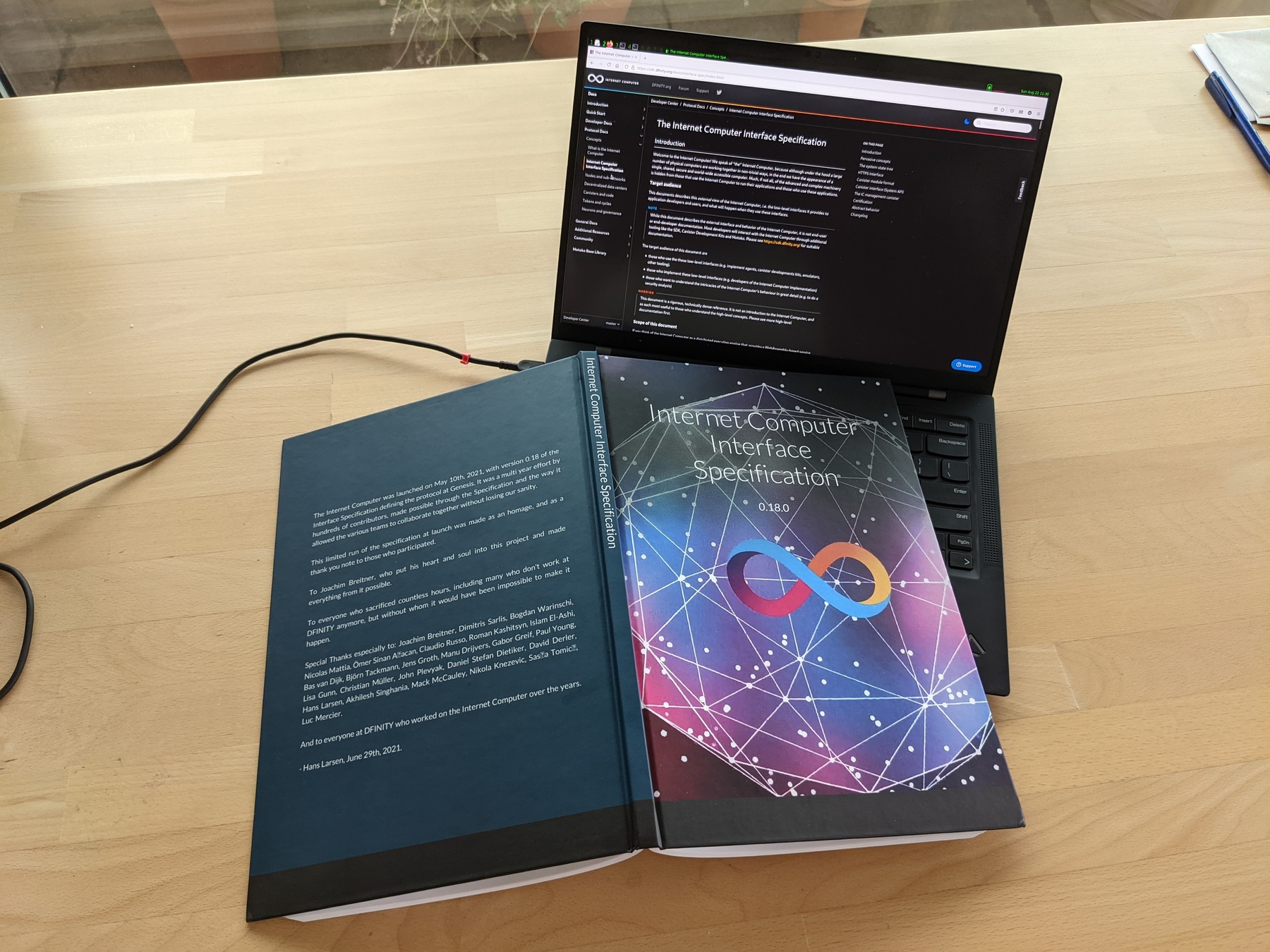
Two months ago was my last day of working as an employee for DFINITY, and as I mentioned in the previous blog post, one of my main contributions was the introduction and maintenance of the Interface Specification.
The Interface Specification as a bookThe Interface Specification as a book
Hence I was especially happy to find that my former colleague Hans Larsen has, as a farewell gift and token of appreciation, created a hard copy of the document, with 107 pages of dry technical content that, and a very sweet dedication on the back. This is especially valuable as it came from Lars personally (i.e. it s not just routine HR work to keep former employees happy, which I could imagine to be a thing in big and mature corporations), and despite the fact that he himself has left DFINITY since. I also take this as further confirmation that this specification-driven design process, despite the initial resistance and daily hurdles, is a good one. A rough list of guiding principles would be: The similarity to the concept of deep specifications from the DeepSpec project is indeed striking. One of my hopes at DFINITY was that these principles would catch on and that other components (e.g the NNS, the nodes or the ICP ledger canister) would follow suite. That did not happen, it seems. Or rather, it did not happen yet PS, in case you are wondering how: The rendering of the document that s shown at at https://sdk.dfinity.org/docs/interface-spec/index.html is not great; the internal website had a different style with made navigating this large document more possible, as it was a dedicated site with the document s nested table of content on the left.

19 June 2021

Joachim Breitner: Leaving DFINITY

Last Thursday was my last working day at DFINITY. There are various reasons why I felt that after almost three years the DFINITY Foundation isn t quite the right place for me anymore, and this plan has been in the making for a while. Primarily, there are personal pull factors that strongly suggest that I ll take a break from full time employment, so I decided to see the launch of the Internet Computer through and then leave. DFINITY has hired some amazing people, and it was a great pleasure to work with them. I learned a lot (some Rust, a lot of Nix, and just how merciless Conway s law is), and I dare say I had the opportunity to do some good work, contributing my part to make the Internet Computer a reality. I am especially proud of the Interface Specification and the specification-driven design principles behind it. It even comes with a model reference implementation and acceptance test suite, and although we didn t quite get to do formalization, those familiar with the DeepSpec project will recognize some influence of their concept of deep specifications . Besides that, there is of course my work on the Motoko programming language, where I build the backend,a the Candid interoperability layer, where I helped with the formalism, formulated the a generic soundness criterion for Interface Description Languages in a higher order settings and formally verified that in Coq. Fortunately, all of this work is now Free Software or at least Open Source. With so much work poured into this project, I continue to care about it, and you ll see me post on the the developer forum and hack on Motoko. As the Internet Computer becomes gradually more open, I hope I can be gradually more involved again. But even without me contributing full-time I am sure that DFINITY and the Internet Computer will do well; when I left there were still plenty of smart, capable and enthusiastic people forging ahead. So what s next? So far, I have rushed every professional transition in my life: When starting my PhD, when starting my postdoc, when starting my job at DFINITY, and every time I regretted it. So this time, I will take a proper break and will explore the world a bit (as far as that is possible given the pandemic). I will stresslessly contribute to various open source projects. I also hope to do more public outreach and teaching, writing more blog posts again, recording screencasts and giving talks and lectures. If you want to invite me to your user group/seminar/company/workshop, please let me know! Also, I might be up for small interesting projects in a while. Beyond these, I have no concrete plans and am looking forward to the inspiration I might get from hiking through the Scandinavian wilderness. If you happen to stumble across my tent, please stop for a tea.

2 June 2021

Joachim Breitner: Verifying the code of the Internet Identity service

The following post was meant to be posted at https://forum.dfinity.org/, but that discourse instance didn t like it; maybe too much inline code, so I m posting it here instead. To my regular blog audience, please excuse the lack of context. Please comment at the forum post. The text was later also posted on the DFINITY medium blog You probably have used https://identity.ic0.app/ to log into various applications (the NNS UI, OpenChat etc.) before, and if you do that, you are trusting this service to take good care of your credentials. Furthermore, you might want to check that the Internet Identity is really not tracking you. So you want to know: Is this really running the code we claim it to run? Of course the following applies to other canisters as well, but I ll stick to the Internet Identity in this case. I ll walk you through the steps of verifying that:

Find out what is running A service on the Internet Computer, i.e. a canister, is a WebAssembly module. The Internet Computer does intentionally not allow you to just download the Wasm code of any canisters, because maybe some developer wants to keep their code private. But it does expose a hash of the Wasm module. The easiest way to get it is using dfx:
$ dfx canister --no-wallet --network ic info rdmx6-jaaaa-aaaaa-aaadq-cai
Controller: r7inp-6aaaa-aaaaa-aaabq-cai
Module hash: 0xd4af9277f3e8d26fd8cdc7874a9f47b6456587fbb2a64d61b6b6880d144d3c04
The controller here is the canister id of the governance canister. This tells you that the Internet Identity is controlled by the Network Nervous System (NNS), and its code can only be changed via proposals that are voted on. This is good; if the controller was just, say, me, I could just change the code of the Internet Identity and take over all your identities. The Module hash is the SHA-256 hash of the .wasm that was deployed. So let s follow that trace.

Finding the right commit Since upgrades to the Internet Identity are done via proposals to the NNS, we should find a description of such a proposal in the https://github.com/ic-association/nns-proposals repository, in the proposals/network_canister_management directory.
Github s list of recent NNS proposalsGithub s list of recent NNS proposals
We have to find the latest proposal upgrading the Internet Identity. The folder unfortunately contains proposals for many canisters, and the file naming isn t super helpful. I usually go through the list from bottom and look at the second column, which contains the title of the latest commit creating or modifying a file. In this case, the second to last is the one we care about: https://github.com/ic-association/nns-proposals/blob/main/proposals/network_canister_management/20210527T2203Z.md. This file lists rationales, gives an overview of changes and, most importantly, says that bd51eab is the commit we are upgrading to. The file also says that the wasm hash is d4a c04, which matches what we saw above. This is good: it seems we really found the youngest proposal upgrading the Internet Identity, and that the proposal actually went through. WARNING: If you are paranoid, don t trust this file. There is nothing preventing a proposal proposer to create a file pointing to one revision, but actually including other code in the proposal. That s why the next steps are needed.

Getting the source Now that we have the revision, we can get the source and check out revision bd51eab:
/tmp $ git clone https://github.com/dfinity/internet-identity
Klone nach 'internet-identity' ...
remote: Enumerating objects: 3959, done.
remote: Counting objects: 100% (344/344), done.
remote: Compressing objects: 100% (248/248), done.
remote: Total 3959 (delta 161), reused 207 (delta 92), pack-reused 3615
Empfange Objekte: 100% (3959/3959), 6.05 MiB   3.94 MiB/s, Fertig.
L se Unterschiede auf: 100% (2290/2290), Fertig.
/tmp $ cd internet-identity/
/tmp/internet-identity $ git checkout bd51eab
/tmp/internet-identity $ git log --oneline -n 1
bd51eab (HEAD, tag: mainnet-20210527T2203Z) Registers the seed phrase before showing it (#301)
In the last line you see that the Internet Identity team has tagged that revision with a tag name that contains the proposal description file name. Very tidy!

Reproducing the build The README.md has the following build instructions:

Official build The official build should ideally be reproducible, so that independent parties can validate that we really deploy what we claim to deploy. We try to achieve some level of reproducibility using a Dockerized build environment. The following steps should build the official Wasm image
docker build -t internet-identity-service .
docker run --rm --entrypoint cat internet-identity-service /internet_identity.wasm > internet_identity.wasm
sha256sum internet_identity.wasm
The resulting internet_identity.wasm is ready for deployment as rdmx6-jaaaa-aaaaa-aaadq-cai, which is the reserved principal for this service.

It actually suffices to run the first command, as it also prints the hash (we don t need to copy the .wasm out of the Docker canister):
/tmp/internet-identity $ docker build -t internet-identity-service .
 
Step 26/26 : RUN sha256sum internet_identity.wasm
 ---> Running in 1a04644b544c
d4af9277f3e8d26fd8cdc7874a9f47b6456587fbb2a64d61b6b6880d144d3c04  internet_identity.wasm
Removing intermediate container 1a04644b544c
 ---> bfe6a63a7980
Successfully built bfe6a63a7980
Successfully tagged internet-identity-service:latest
Success! The hashes match. You don t believe me? Try it yourself (and let us know if you get a different hash, maybe I got hacked). This may fail if you have too little RAM configured for Docker, 8GB should be enough. At this point you have a trust path from the code sitting in front of you to the Internet Identity running at https://identity.ic0.app, including the front-end code, and you can start auditing the source code.

What about the canister id? If you payed close attention you might have noticed that we got the module has for canister rdmx6-jaaaa-aaaaa-aaadq-cai, but we are accessing a web application at https://identity.ic0.app. So where is this connection? In the future, I expect some form of a DNS-like nice host name registry on the Internet Computer that stores a mapping from nice names to canister ids, and that you will be able to query that to for which canister serves rdmx6-jaaaa-aaaaa-aaadq-cai in a secure way (e.g. using certified variables). But since we don t have that yet, but still want you to be able to use a nice name for the Internet Identity (and not have to change the name later, which would cause headaches), we have hard-coded this mapping for now. The relevant code here is the Certifying Service Worker that your browser downloads when accessing any *.ic0.app URL. This piece of code will then intercept all requests to that domain, map it to an query call, and then use certified variables to validate the response. And indeed, the mapping is in the code there:
const hostnameCanisterIdMap: Record<string, [string, string]> =  
  'identity.ic0.app': ['rdmx6-jaaaa-aaaaa-aaadq-cai', 'ic0.app'],
  'nns.ic0.app': ['qoctq-giaaa-aaaaa-aaaea-cai', 'ic0.app'],
  'dscvr.ic0.app': ['h5aet-waaaa-aaaab-qaamq-cai', 'ic0.page'],
 ;

What about other canisters? In principle, the same approach works for other canisters, whether it s OpenChat, the NNS canisters etc. But the details will differ, as every canister developer might have their own way of
  • communicating the location and revision of the source for their canisters
  • building the canisters
In particular, without a reproducible way of building the canister, this will fail, and that s why projects like https://reproducible-builds.org/ are so important in general.

22 December 2020

Joachim Breitner: Don t think, just defunctionalize

TL;DR: CPS-conversion and defunctionalization can help you to come up with a constant-stack algorithm. Update: Turns out I inadvertedly plagiarized the talk The Best Refactoring You ve Never Heard Of by James Koppel. Please consider this a form of sincere flattery.

The starting point Today, I ll take you on a another little walk through the land of program transformations. Let s begin with a simple binary tree, with value of unknown type in the leaves, as well as the canonical map function:
data T a = L a   B (T a) (T a)
map1 :: (a -> b) -> T a -> T b
map1 f (L x) = L (f x)
map1 f (B t1 t2) = B (map1 f t1) (map1 f t2)
As you can see, this map function is using the program stack as it traverses the tree. Our goal is now to come up with a map function that does not use the stack! Why? Good question! In Haskell, there wouldn t be a strong need for this, as the Haskell stack is allocated on the heap, just like your normal data, so there is plenty of stack space. But in other languages or environments, the stack space may have a hard limit, and it may be advised to not use unbounded stack space. That aside, it s a fun exercise, and that s sufficient reason for me. (In the following, I assume that tail-calls, i.e. those where a function end with another function call, but without modifying its result, do not actually use stack space. Once all recursive function calls are tail calls, the code is equivalent to an imperative loop, as we will see.)

Think? We could now just stare at the problem (rather the code), and try to come up with a solution directly. We d probably think ok, as I go through the tree, I have to remember all the nodes above me so I need a list of those nodes and for each of these nodes, I also need to remember whether I am currently processing the left child, and yet have to look at the right one, or whether I am done with the left child so what do I have to remember about the current node ? ah, my brain spins already. Maybe eventually I figure it out, but why think when we can derive the solution? So let s start with above map1, and rewrite it, in several, mechanical, steps into a stack-less, tail-recursive solution.

Go! Before we set out, let me rewrite the map function using a local go helper, as follows:
map2 :: forall a b. (a -> b) -> T a -> T b
map2 f t = go t
  where
    go :: T a -> T b
    go (L x) = L (f x)
    go (B t1 t2) = B (go t1) (go t2)
This transformation (effectively the static argument transformation ) has the nice advantage that we do not have to pass f around all the time, and that when we copy the function, I only have to change the top-level name, but not the names of the inner functions. Also, I find it more aesthetically pleasing.

CPS A blunt, effective tool to turn code that is not yet using tail-calls into code that only uses tail-calls is use continuation-passing style. If we have a function of type -> t, we turn it into a function of type -> (t -> r) -> r, where r is the type of the result we want at the very end. This means the function now receives an extra argument, often named k for continuation, and instead of returning some x, the function calls k x. We can apply this to our go function. Here, both t and r happen to be T b; the type of finished trees:
map3 :: forall a b. (a -> b) -> T a -> T b
map3 f t = go t (\r -> r)
  where
    go :: T a -> (T b -> T b) -> T b
    go (L x) k  = k (L (f x))
    go (B t1 t2) k  = go t1 (\r1 -> go t2 (\r2 -> k (B r1 r2)))
Note that when initially call go, we pass the identity function (\r -> r) as the initial continuation. Alas, suddenly all function calls are in tail position, and this codes does not use stack space! Technically, we are done, although it is not quite satisfying; all these lambdas floating around obscure the meaning of the code, are maybe a bit slow to execute, and also, we didn t really learn much yet. This is certainly not the code we would have writing after thinking hard .

Defunctionalization So let s continue rewriting the code to something prettier, simpler. Something that does not use lambdas like this. Again, there is a mechanical technique that can help it. It likely won't make the code prettier, but it will get rid of the lambdas, so let s do that an clean up later. The technique is called defunctionalization (because it replaces functional values by plain data values), and can be seen as a form of refinement. Note that we pass around vales of type (T b -> T b), but we certainly don t mean the full type (T b -> T b). Instead, only very specific values of that type occur in our program, So let us replace (T b -> T b) with a data type that contains representatives of just the values we actually use.
  1. We find at all values of type (T b -> T b). These are:
    • (\r -> r)
    • (\r1 -> go t2 (\r2 -> k (B r1 r2)))
    • (\r2 -> k (B r1 r2))
  2. We create a datatype with one constructor for each of these:
     data K = I   K1   K2
    (This is not complete yet.)
  3. We introduce an interpretation function that turns a K back into a (T b -> T b):
    eval :: K -> (T b -> T b)
    eval = (* TBD *)
  4. In the function go, instead of taking a parameter of type (T b -> T b), we take a K. And when we actually use the continuation, we have to turn the K back to the function using eval:
    go :: T a -> K a b -> T b
    go (L x) k  = eval k (L (f x))
    go (B t1 t2) k = go t1 K1
    We also do this to the code fragments identified in the first step; these become:
    • (\r -> r)
    • (\r1 -> go t2 K2)
    • (\r2 -> eval k (B r1 r2))
  5. Now we complete the eval function: For each constructor, we simply map it to the corresponding lambda from step 1:
    eval :: K -> (T b -> T b)
    eval I = (\r -> r)
    eval K1 = (\r1 -> go t2 K2)
    eval K2 = (\r2 -> eval k (B r1 r2))
  6. This doesn t quite work yet: We have variables on the right hand side that are not bound (t2, r1, k). So let s add them to the constructors K1 and K2 as needed. This also changes the type K itself; it now needs to take type parameters.
This leads us to the following code:
data K a b
  = I
    K1 (T a) (K a b)
    K2 (T b) (K a b)
map4 :: forall a b. (a -> b) -> T a -> T b
map4 f t = go t I
  where
    go :: T a -> K a b -> T b
    go (L x) k  = eval k (L (f x))
    go (B t1 t2) k  = go t1 (K1 t2 k)
    eval :: K a b -> (T b -> T b)
    eval I = (\r -> r)
    eval (K1 t2 k) = (\r1 -> go t2 (K2 r1 k))
    eval (K2 r1 k) = (\r2 -> eval k (B r1 r2))
Not really cleaner or prettier, but everything is still tail-recursive, and we are now working with plain data.

We like lists To clean it up a little bit, we can notice that the K data type really is just a list of values, where the values are either T a or T b. We do not need a custom data type for this! Instead of our K, we can just use the following, built from standard data types:
type K' a b = [Either (T a) (T b)]
Now I replace I with [], K1 t2 k with Left t2 : k and K2 r1 k with Right r1 : k. I also, very suggestively, rename go to down and eval to up:
map5 :: forall a b. (a -> b) -> T a -> T b
map5 f t = down t []
  where
    down :: T a -> K' a b -> T b
    down (L x) k  = up k (L (f x))
    down (B t1 t2) k  = down t1 (Left t2 : k)
    up :: K' a b -> T b -> T b
    up [] r = r
    up (Left  t2 : k) r1 = down t2 (Right r1 : k)
    up (Right r1 : k) r2 = up k (B r1 r2)
At this point, the code suddenly makes more sense again. In fact, I can try to verbalize it:
As we traverse the tree, we have to remember for all parent nodes, whether there is still something Left to do when we come back to it (so we remember a T a), or if we are done with that (so we have a T b). This is the list K' a b. We begin to go down the left of the tree (noting that the right siblings are still left to do), until we hit a leaf. We transform the leaf, and then go up. If we go up and hit the root, we are done. Else, if we go up and there is something Left to do, we remember the subtree that we just processed (as that is already in the Right form), and go down the other subtree. But if we go up and there is nothing Left to do, we put the two subtrees together and continue going up.
Quite neat!

The imperative loop At this point we could stop: the code is pretty, makes sense, and has the properties we want. But let s turn the dial a bit further and try to make it an imperative loop. We know that if we have a single tail-recursive function, then that s equivalent to a loop, with the function s parameter turning into mutable variables. But we have two functions! It turns out that if you have two functions a -> r and b -> r that have the same return type (which they necessarily have here, since we CPS-converted them further up), then those two functions are equivalent to a single function taking a or b , i.e. Either a b -> r. This really nothing else than the high-school level algebra rule of ra rb = ra + b. So (after reordering the arguments of down to put T b first) we can rewrite the code as
map6 :: forall a b. (a -> b) -> T a -> T b
map6 f t = go (Left t) []
  where
    go :: Either (T a) (T b) -> K' a b -> T b
    go (Left (L x))     k        = go (Right (L (f x))) k
    go (Left (B t1 t2)) k        = go (Left t1) (Left t2 : k)
    go (Right r)  []             = r
    go (Right r1) (Left  t2 : k) = go (Left t2) (Right r1 : k)
    go (Right r2) (Right r1 : k) = go (Right (B r1 r2)) k
Do you see the loop yet? If not, maybe it helps to compare it with the following equivalent imperative looking pseudo-code:
mapLoop :: forall a b. (a -> b) -> T a -> T b
mapLoop f t  
  var node = Left t;
  var parents = [];
  while (true)  
    switch (node)  
      Left (L x) -> node := Right (L (f x))
      Left (B t1 t2) -> node := Left t1; parents.push(Left t2)
      Right r1 ->  
        if (parents.len() == 0)  
          return r1;
          else  
          switch (parents.pop())  
            Left t2  -> node := Left t2; parents.push(Right r1);
            Right r2 -> node := Right (B r1 r2)


Conclusion I find it enlightening to see how apparently very different approaches to a problem (recursive, lazy functions and imperative loops) are connected by a series of rather mechanical transformations. When refactoring code, it is helpful to see if one can conceptualize the refactoring as one of those mechanical steps (refinement, type equivalences, defunctionalization, cps conversion etc.) If you liked this post, you might enjoy my talk The many faces of isOrderedTree, which I have presented at MuniHac 2019 and Haskell Love 2020.

5 December 2020

Joachim Breitner: Named goals in Coq

TL;DR: Some mildly tricky tricks allow you to select subgoals by name, like in Isabelle. This leads to more readable proofs, and proofs that are more robust against changes.

The need for case names Consider the following Coq proof, right out of the respected Software Foundations book, Chapter Inductively Defined Propositions (and slightly simplified):
Lemma star_app: forall T (s1 s2 : list T) (re : reg_exp T),
  s1 =~ Star re ->
  s2 =~ Star re ->
  s1 ++ s2 =~ Star re.
Proof.
  intros T s1 s2 re H1.
  remember (Star re) as re'.
   generalize dependent s2.
  induction H1.
  - (* MEmpty *) discriminate.
  - (* MChar *) discriminate.
  - (* MApp *) discriminate.
  - (* MUnionL *) discriminate.
  - (* MUnionR *) discriminate.
  - (* MStar0 *)
    injection Heqre' as Heqre''. intros s H. apply H.
  - (* MStarApp *)
    injection Heqre' as Heqre''.
    intros s3 H1. rewrite <- app_assoc.
    apply MStarApp.
    + apply H1_.
    + apply IHexp_match2.
      * rewrite Heqre''. reflexivity.
      * apply H1.
Qed.
This is a very typical example for a proof by induction over an inductively defined relation (in this case, the relations s =~ re which indicates that the string s matches the regular expression re): After some preparation, the invocation of a tactic like induction (could also be inversion or others) creates a number of new goals, one of for each rule of the relation. Then the modern(!) Coq user uses proof bullets to focus the goals, one after another, in order, to solve them. We can see from this example that proof bullets (which were a big improvement) are not quite satisfactory, and the author of this proof felt the need to annotate each subproof with the case it corresponds to. But these are mere comments! This is unsatisfactory, as there is nothing keeping them correct as my proof changes. And anyone who came to Coq from Isabelle is just flabbergasted that the state of art in Coq is still at that level So, wouldn t it be great if
  • I could focus goals by their name (e.g. MEmpty)
  • Focus them in any order (so that refactoring of my data types do not break my proofs)
  • This even worked when simultaneously inducting over or inverting multiple relations?

Simulating named goals in Coq Well, with a few tricks we can! It just takes three simple steps:
  1. I load a small file full of hacks (explained below):
    Require Import NamedCases.
  2. This allows me to prefix the type of the constructors of the inductive relations (i.e. the rules of the relation) with case <name>, , as follows:
    Reserved Notation "s =~ re" (at level 80).
    Inductive exp_match  T  : list T -> reg_exp T -> Prop :=
        MEmpty:
        case empty,
        [] =~ EmptyStr
        MChar:
        case char,
        forall x,
        [x] =~ (Char x)
        MApp:
        case app,
        forall s1 re1 s2 re2
        (H1 : s1 =~ re1)
        (H2 : s2 =~ re2),
        (s1 ++ s2) =~ (App re1 re2)
        MUnionL:
        case union_l,
        forall s1 re1 re2
        (H1 : s1 =~ re1),
        s1 =~ (Union re1 re2)
        MUnionR:
        case union_r,
        forall re1 s2 re2
        (H2 : s2 =~ re2),
        s2 =~ (Union re1 re2)
        MStar0:
        case star0,
        forall re,
        [] =~ (Star re)
        MStarApp:
        case star_app,
        forall s1 s2 re
        (H1 : s1 =~ re)
        (H2 : s2 =~ (Star re)),
        (s1 ++ s2) =~ (Star re)
      where "s =~ re" := (exp_match s re).
    This is the definition from the Software Foundations book; only the case <name>, lines are added.
  3. Now I can change the proof: After the induction tactic I use ; name_cases to name the cases, and then I can use the relatively new named goal focusing feature ([name]: , which I suggested two years ago, and was implemented by Th o Zimmermann) to focus a specific case:
    Lemma star_app2: forall T (s1 s2 : list T) (re : reg_exp T),
      s1 =~ Star re ->
      s2 =~ Star re ->
      s1 ++ s2 =~ Star re.
    Proof.
      intros T s1 s2 re H1.
      remember (Star re) as re'.
       generalize dependent s2.
      induction H1; name_cases.
      [empty]:  
         discriminate.
       
      [char]:  
         discriminate.
       
      [app]:  
         discriminate.
       
      [unionL]:  
         discriminate.
       
      [unionR]:  
        discriminate.
       
      [star0]:  
        injection Heqre' as Heqre''. intros s H. apply H.
       
      [starApp]:  
        injection Heqre' as Heqre''.
        intros s3 H1. rewrite <- app_assoc.
        apply MStarApp; clear_names.
        + apply H1_.
        + apply IHexp_match2.
          * rewrite Heqre''. reflexivity.
          * apply H1.
        
    Qed.
    The comments have turned into actual names!
Goal focusing is now just much more reliable. For example, let me try to discharge the boring cases by using ; try discriminate after the induction. This means there are suddenly only two goals left. With bullets, the first bullet would now suddenly focus a different goal, and my proof script would likely fail somewhere. With named goals, I get a helpful error message No such goal: empty and I can t even enter the first subproof. So let me delete these goals and, just to show off, focus the remaining goals in the wrong order:
Lemma star_app: forall T (s1 s2 : list T) (re : reg_exp T),
  s1 =~ Star re ->
  s2 =~ Star re ->
  s1 ++ s2 =~ Star re.
Proof.
  intros T s1 s2 re H1.
  remember (Star re) as re'.
   generalize dependent s2.
  induction H1; name_cases; try discriminate.
  [starApp]:  
    injection Heqre' as Heqre''.
    intros s3 H1. rewrite <- app_assoc.
    apply MStarApp; clear_names.
    + apply H1_.
    + apply IHexp_match2.
      * rewrite Heqre''. reflexivity.
      * apply H1.
    
  [star0]:  
    injection Heqre' as Heqre''. intros s H. apply H.
   
Qed.
I did not explain the clear_names tactic yet that I had to use after apply MStarApp. What I am showing here is a hack, and it shows these case names are extra hypothesis (of a trivially true type CaseName), and this tactic gets rid of it.

Even better than Isabelle The above even works when there are multiple inductions/inversions involved. To give an example, let s introduce another inductive predicate, and begin proving a lemma that one can do by induction on one and inversion on the other predicate.
Inductive Palindrome  T  : list T -> Prop :=
  EmptyPalin:
  case emptyP,
  Palindrome []
  SingletonPalin:
  case singletonP,
  forall x,
  Palindrome [x]
  GrowPalin:
  case growP,
  forall l x,
  Palindrome l -> Palindrome ([x] ++ l ++ [x])
.
Lemma palindrome_star_of_two:
  forall T (s : list T) x y,
  Palindrome s -> s =~ Star (App (Char x) (Char y)) ->
  s = [] \/ x = y.
Proof.
  intros T s x y HPalin HRe.
  induction HPalin; inversion HRe; name_cases.
At this point we have four open goals. Can you tell why there are four, and which ones they are? Luckily, Show Existentials will tell us their names (and Coq 8.13 will just show them in the proof state window). These names not only help us focus the goal in a reliable way; they even assist us in understanding what goal we have to deal with. For example, the last goal arose from the GrowP rule and the StarApp rule. Neat!
  [emptyP_star0]:  
    left. reflexivity.
   
  [emptyP_starApp]:  
     left. reflexivity.
   
  [singletonP_starApp]:  
    inversion HRe; clear HRe.
    inversion H5; clear H5.
    inversion H10; clear H10.
    inversion H11; clear H11.
    subst.
    inversion H3.
   
 [growP_starApp]:  
    admit. (* I did not complete the proof *)
  

Under the hood (the hack) The above actually works, but it works with a hack, and I wish that Coq s induction tactic would just do the right thing here. I hope eventually this will be the case, and this section will just be curiosity but until, it may actually be helpful.
  1. The trick1 is to leave markers in the proof state. We use a dedicate type CaseName, and a hypothesis name : CaseName indicates that this goal arose from the that case.
    Inductive CaseName := CaseNameI.
    With this, we can write StarApp: forall (starApp : CaseName), to name this case.
  2. For a little bit of polish, we can introduce notation for that:
    Notation "'case' x , t" := (forall  x : CaseName , t) (at level 200).
    This allows us to use the syntax you saw above.
  3. To easily discharge these CaseName assumptions when using the introduction forms, I wrote these tactics:
    Ltac clear_names := try exact CaseNameI.
    Ltac named_constructor  := constructor; [ exact CaseNameI   idtac .. ].
    Ltac named_econstructor := econstructor; [ exact CaseNameI   idtac .. ].
  4. Finally I wrote the tactic name_cases. What it does is relatively simple:
    For each subgoal: Take all hypotheses of type CaseName, concatenate their names, change the name of the current goal to that, and clear these hypotheses
    Unfortunately, my grasp of Coq tactic programming is rather rudimentary, and the only way I manged to solve this is a horrible monster of Ltac2, including hand-rolled imperative implementations of string concatenation and a little nested Ltac1 tactic within. You have been warned:
    From Ltac2 Require Import Ltac2.
    From Ltac2 Require Option.
    Set Default Proof Mode "Classic".
    Ltac name_cases := ltac2:(
      (* Horribly manual string manipulations. Does this mean I should
         go to the Ocaml level?
      *)
      let strcpy s1 s2 o :=
        let rec go := fun n =>
          match Int.lt n (String.length s2) with
            true => String.set s1 (Int.add o n) (String.get s2 n); go (Int.add n 1)
            false => ()
          end
        in go 0
      in
      let concat := fun s1 s2 =>
        let l := Int.add (Int.add (String.length s1) (String.length s2)) 1 in
        let s := String.make l (Char.of_int 95) in
        strcpy s s1 0;
        strcpy s s2 (Int.add (String.length s1) 1);
        s
      in
      Control.enter (let rec go () :=
        lazy_match! goal with
          [ h1 : CaseName, h2 : CaseName  - _ ] =>
          (* Multiple case names? Combine them (and recurse) *)
          let h := concat (Ident.to_string h1) (Ident.to_string h2) in
          Std.clear [h1; h2];
          let h := Option.get (Ident.of_string h) in
          assert ($h := CaseNameI);
          go ()
          [ _ : CaseName  - _ ] =>
          (* A single case name? Set current goal name accordingly. *)
          ltac1:(
            (* How to do this in ltac2? *)
            lazymatch goal with
              [ H : CaseName  - _ ] => refine ?[H]; clear H
            end
          )
          [  - _ ] =>
          Control.backtrack_tactic_failure "Did not find any CaseName hypotheses"
        end
      in go)
    ).
    If someone feels like re-implementing this in a way that is more presentable, I ll be happy to update this code (and learn something along the way
That s all it takes!

Conclusion With some mild hackery, we can get named cases in Coq, which I find indispensable in managing larger, evolving proofs. I wonder why this style is not more common, and available out of the box, but maybe it is just not known well enough? Maybe this blog post can help a bit here.

  1. I have vague recollections of seeing at least parts of this trick on some blog some years ago, and I do not claim originality here.

9 November 2020

Joachim Breitner: Distributing Haskell programs in a multi-platform zip file

My maybe most impactful piece of code is tttool and the surrounding project, which allows you to create your own content for the Ravensburger Tiptoi platform. The program itself is a command line tool, and in this blog post I want to show how I go about building that program for Linux (both normal and static builds), Windows (cross-compiled from Linux), OSX (only on CI), all combined into and released as a single zip file. Maybe some of it is useful or inspiring to my readers, or can even serve as a template. This being a blob post, though, note that it may become obsolete or outdated.

Ingredients I am building on the these components: Without the nix build system and package manger I probably woudn t even attempt to pull of complex tasks that may, say, require a patched ghc. For many years I resisted learning about nix, but when I eventually had to, I didn t want to go back. This project provides an alternative Haskell build infrastructure for nix. While this is not crucial for tttool, it helps that they tend to have some cross-compilation-related patches more than the official nixpkgs. I also like that it more closely follows the cabal build work-flow, where cabal calculates a build plan based on your projects dependencies. It even has decent documentation (which is a new thing compared to two years ago). Niv is a neat little tool to keep track of your dependencies. You can quickly update them with, say niv update nixpkgs. But what s really great is to temporarily replace one of your dependencies with a local checkout, e.g. via NIV_OVERRIDE_haskellNix=$HOME/build/haskell/haskell.nix nix-instantiate -A osx-exe-bundle There is a Github action that will keep your niv-managed dependencies up-to-date. This service (proprietary, but free to public stuff up to 10GB) gives your project its own nix cache. This means that build artifacts can be cached between CI builds or even build steps, and your contributors. A cache like this is a must if you want to use nix in more interesting ways where you may end up using, say, a changed GHC compiler. Comes with GitHub actions integration.
  • CI via Github actions
Until recently, I was using Travis, but Github actions are just a tad easier to set up and, maybe more important here, the job times are high enough that you can rebuild GHC if you have to, and even if your build gets canceled or times out, cleanup CI steps still happen, so that any new nix build products will still reach your nix cache.

The repository setup All files discussed in the following are reflected at https://github.com/entropia/tip-toi-reveng/tree/7020cde7da103a5c33f1918f3bf59835cbc25b0c. We are starting with a fairly normal Haskell project, with a single .cabal file (but multi-package projects should work just fine). To make things more interesting, I also have a cabal.project which configures one dependency to be fetched via git from a specific fork. To start building the nix infrastructure, we can initialize niv and configure it to use the haskell.nix repo:
niv init
niv add input-output-hk/haskell.nix -n haskellNix
This creates nix/sources.json (which you can also edit by hand) and nix/sources.nix (which you can treat like a black box). Now we can start writing the all-important default.nix file, which defines almost everything of interest here. I will just go through it line by line, and explain what I am doing here.
  checkMaterialization ? false  :
This defines a flag that we can later set when using nix-build, by passing --arg checkMaterialization true, and which is off by default. I ll get to that flag later.
let
  sources = import nix/sources.nix;
  haskellNix = import sources.haskellNix  ;
This imports the sources as defined niv/sources.json, and loads the pinned revision of the haskell.nix repository.
  # windows crossbuilding with ghc-8.10 needs at least 20.09.
  # A peek at https://github.com/input-output-hk/haskell.nix/blob/master/ci.nix can help
  nixpkgsSrc = haskellNix.sources.nixpkgs-2009;
  nixpkgsArgs = haskellNix.nixpkgsArgs;
  pkgs = import nixpkgsSrc nixpkgsArgs;
Now we can define pkgs, which is our version of the nixpkgs package set, extended with the haskell.nix machinery. We rely on haskell.nix to pin of a suitable revision of the nixpkgs set (see how we are using their niv setup). Here we could our own configuration, overlays, etc to nixpkgsArgs. In fact, we do in
  pkgs-osx = import nixpkgsSrc (nixpkgsArgs //   system = "x86_64-darwin";  );
to get the nixpkgs package set of an OSX machine.
  # a nicer filterSource
  sourceByRegex =
    src: regexes: builtins.filterSource (path: type:
      let relPath = pkgs.lib.removePrefix (toString src + "/") (toString path); in
      let match = builtins.match (pkgs.lib.strings.concatStringsSep " " regexes); in
      ( type == "directory"  && match (relPath + "/") != null
        match relPath != null)) src;
Next I define a little helper that I have been copying between projects, and which allows me to define the input to a nix derivation (i.e. a nix build job) with a set of regexes. I ll use that soon.
  tttool-exe = pkgs: sha256:
    (pkgs.haskell-nix.cabalProject  
The cabalProject function takes a cabal project and turns it into a nix project, running cabal v2-configure under the hood to let cabal figure out a suitable build plan. Since we want to have multiple variants of the tttool, this is so far just a function of two arguments pkgs and sha256, which will be explained in a bit.
      src = sourceByRegex ./. [
          "cabal.project"
          "src/"
          "src/.*/"
          "src/.*.hs"
          ".*.cabal"
          "LICENSE"
        ];
The cabalProject function wants to know the source of the Haskell projects. There are different ways of specifying this; in this case I went for a simple whitelist approach. Note that cabal.project.freze (which exists in the directory) is not included.
      # Pinning the input to the constraint solver
      compiler-nix-name = "ghc8102";
The cabal solver doesn t find out which version of ghc to use, that is still my choice. I am using GHC-8.10.2 here. It may require a bit of experimentation to see which version works for your project, especially when cross-compiling to odd targets.
      index-state = "2020-11-08T00:00:00Z";
I want the build to be deterministic, and not let cabal suddenly pick different package versions just because something got uploaded. Therefore I specify which snapshot of the Hackage package index it should consider.
      plan-sha256 = sha256;
      inherit checkMaterialization;
Here we use the second parameter, but I ll defer the explanation for a bit.
      modules = [ 
        # smaller files
        packages.tttool.dontStrip = false;
       ] ++
These modules are essentially configuration data that is merged in a structural way. Here we say that we want the tttool binary to be stripped (saves a few megabyte).
      pkgs.lib.optional pkgs.hostPlatform.isMusl  
        packages.tttool.configureFlags = [ "--ghc-option=-static" ];
Also, when we are building on the musl platform, that s when we want to produce a static build, so let s pass -static to GHC. This seems to be enough in terms of flags to produce static binaries. It helps that my project is using mostly pure Haskell libraries; if you link against C libraries you might have to jump through additional hoops to get static linking going. The haskell.nix documentation has a section on static building with some flags to cargo-cult.
        # terminfo is disabled on musl by haskell.nix, but still the flag
        # is set in the package plan, so override this
        packages.haskeline.flags.terminfo = false;
       ;
This (again only used when the platform is musl) seems to be necessary to workaround what might be a big in haskell.nix.
     ).tttool.components.exes.tttool;
The cabalProject function returns a data structure with all Haskell packages of the project, and for each package the different components (libraries, tests, benchmarks and of course executables). We only care about the tttool executable, so let s project that out.
  osx-bundler = pkgs: tttool:
   pkgs.stdenv.mkDerivation  
      name = "tttool-bundle";
      buildInputs = [ pkgs.macdylibbundler ];
      builder = pkgs.writeScript "tttool-osx-bundler.sh" ''
        source $ pkgs.stdenv /setup
        mkdir -p $out/bin/osx
        cp $ tttool /bin/tttool $out/bin/osx
        chmod u+w $out/bin/osx/tttool
        dylibbundler \
          -b \
          -x $out/bin/osx/tttool \
          -d $out/bin/osx \
          -p '@executable_path' \
          -i /usr/lib/system \
          -i $ pkgs.darwin.Libsystem /lib
      '';
     ;
This function, only to be used on OSX, takes a fully build tttool, finds all the system libraries it is linking against, and copies them next to the executable, using the nice macdylibbundler. This way we can get a self-contained executable. A nix expert will notice that this probably should be written with pkgs.runCommandNoCC, but then dylibbundler fails because it lacks otool. This should work eventually, though.
in rec  
  linux-exe      = tttool-exe pkgs
     "0rnn4q0gx670nzb5zp7xpj7kmgqjmxcj2zjl9jqqz8czzlbgzmkh";
  windows-exe    = tttool-exe pkgs.pkgsCross.mingwW64
     "01js5rp6y29m7aif6bsb0qplkh2az0l15nkrrb6m3rz7jrrbcckh";
  static-exe     = tttool-exe pkgs.pkgsCross.musl64
     "0gbkyg8max4mhzzsm9yihsp8n73zw86m3pwvlw8170c75p3vbadv";
  osx-exe        = tttool-exe pkgs-osx
     "0rnn4q0gx670nzb5zp7xpj7kmgqjmxcj2zjl9jqqz8czzlbgzmkh";
Time to create the four versions of tttool. In each case we use the tttool-exe function from above, passing the package set (pkgs, ) and a SHA256 hash. The package set is either the normal one, or it is one of those configured for cross compilation, building either for Windows or for Linux using musl, or it is the OSX package set that we instantiated earlier. The SHA256 hash describes the result of the cabal plan calculation that happens as part of cabalProject. By noting down the expected result, nix can skip that calculation, or fetch it from the nix cache etc. How do we know what number to put there, and when to change it? That s when the --arg checkMaterialization true flag comes into play: When that is set, cabalProject will not blindly trust these hashes, but rather re-calculate them, and tell you when they need to be updated. We ll make sure that CI checks them.
  osx-exe-bundle = osx-bundler pkgs-osx osx-exe;
For OSX, I then run the output through osx-bundler defined above, to make it independent of any library paths in /nix/store. This is already good enough to build the tool for the various systems! The rest of the the file is related to packaging up the binaries, to tests, and various other things, but nothing too essentially. So if you got bored, you can more or less stop now.
  static-files = sourceByRegex ./. [
    "README.md"
    "Changelog.md"
    "oid-decoder.html"
    "example/.*"
    "Debug.yaml"
    "templates/"
    "templates/.*\.md"
    "templates/.*\.yaml"
    "Audio/"
    "Audio/digits/"
    "Audio/digits/.*\.ogg"
  ];
  contrib = ./contrib;
The final zip file that I want to serve to my users contains a bunch of files from throughout my repository; I collect them here.
  book =  ;
The project comes with documentation in the form of a Sphinx project, which we build here. I ll omit the details, because they are not relevant for this post (but of course you can peek if you are curious).
  os-switch = pkgs.writeScript "tttool-os-switch.sh" ''
    #!/usr/bin/env bash
    case "$OSTYPE" in
      linux*)   exec "$(dirname "''$ BASH_SOURCE[0] ")/linux/tttool" "$@" ;;
      darwin*)  exec "$(dirname "''$ BASH_SOURCE[0] ")/osx/tttool" "$@" ;;
      msys*)    exec "$(dirname "''$ BASH_SOURCE[0] ")/tttool.exe" "$@" ;;
      cygwin*)  exec "$(dirname "''$ BASH_SOURCE[0] ")/tttool.exe" "$@" ;;
      *)        echo "unsupported operating system $OSTYPE" ;;
    esac
  '';
The zipfile should provide a tttool command that works on all systems. To that end, I implement a simple platform switch using bash. I use pks.writeScript so that I can include that file directly in default.nix, but it would have been equally reasonable to just save it into nix/tttool-os-switch.sh and include it from there.
  release = pkgs.runCommandNoCC "tttool-release"  
    buildInputs = [ pkgs.perl ];
    ''
    # check version
    version=$($ static-exe /bin/tttool --help perl -ne 'print $1 if /tttool-(.*) -- The swiss army knife/')
    doc_version=$(perl -ne "print \$1 if /VERSION: '(.*)'/" $ book /book.html/_static/documentation_options.js)
    if [ "$version" != "$doc_version" ]
    then
      echo "Mismatch between tttool version \"$version\" and book version \"$doc_version\""
      exit 1
    fi
Now the derivation that builds the content of the release zip file. First I double check that the version number in the code and in the documentation matches. Note how $ static-exe refers to a path with the built static Linux build, and $ book the output of the book building process.
    mkdir -p $out/
    cp -vsr $ static-files /* $out
    mkdir $out/linux
    cp -vs $ static-exe /bin/tttool $out/linux
    cp -vs $ windows-exe /bin/* $out/
    mkdir $out/osx
    cp -vsr $ osx-exe-bundle /bin/osx/* $out/osx
    cp -vs $ os-switch  $out/tttool
    mkdir $out/contrib
    cp -vsr $ contrib /* $out/contrib/
    cp -vsr $ book /* $out
  '';
The rest of the release script just copies files from various build outputs that we have defined so far. Note that this is using both static-exe (built on Linux) and osx-exe-bundle (built on Mac)! This means you can only build the release if you either have setup a remote osx builder (a pretty nifty feature of nix, which I unfortunately can t use, since I don't have access to a Mac), or the build product must be available in a nix cache (which it is in my case, as I will explain later). The output of this derivation is a directory with all the files I want to put in the release.
  release-zip = pkgs.runCommandNoCC "tttool-release.zip"  
    buildInputs = with pkgs; [ perl zip ];
    ''
    version=$(bash $ release /tttool --help perl -ne 'print $1 if /tttool-(.*) -- The swiss army knife/')
    base="tttool-$version"
    echo "Zipping tttool version $version"
    mkdir -p $out/$base
    cd $out
    cp -r $ release /* $base/
    chmod u+w -R $base
    zip -r $base.zip $base
    rm -rf $base
  '';
And now these files are zipped up. Note that this automatically determines the right directory name and basename for the zipfile. This concludes the step necessary for a release.
  gme-downloads =  ;
  tests =  ;
These two definitions in default.nix are related to some simple testing, and again not relevant for this post.
  cabal-freeze = pkgs.stdenv.mkDerivation  
    name = "cabal-freeze";
    src = linux-exe.src;
    buildInputs = [ pkgs.cabal-install linux-exe.env ];
    buildPhase = ''
      mkdir .cabal
      touch .cabal/config
      rm cabal.project # so that cabal new-freeze does not try to use HPDF via git
      HOME=$PWD cabal new-freeze --offline --enable-tests   true
    '';
    installPhase = ''
      mkdir -p $out
      echo "-- Run nix-shell -A check-cabal-freeze to update this file" > $out/cabal.project.freeze
      cat cabal.project.freeze >> $out/cabal.project.freeze
    '';
   ;
Above I mentioned that I still would like to be able to just run cabal, and ideally it should take the same library versions that the nix-based build does. But pinning the version of ghc in cabal.project is not sufficient, I also need to pin the precise versions of the dependencies. This is best done with a cabal.project.freeze file. The above derivation runs cabal new-freeze in the environment set up by haskell.nix and grabs the resulting cabal.project.freeze. With this I can run nix-build -A cabal-freeze and fetch the file from result/cabal.project.freeze and add it to the repository.
  check-cabal-freeze = pkgs.runCommandNoCC "check-cabal-freeze"  
      nativeBuildInputs = [ pkgs.diffutils ];
      expected = cabal-freeze + /cabal.project.freeze;
      actual = ./cabal.project.freeze;
      cmd = "nix-shell -A check-cabal-freeze";
      shellHook = ''
        dest=$ toString ./cabal.project.freeze 
        rm -f $dest
        cp -v $expected $dest
        chmod u-w $dest
        exit 0
      '';
      ''
      diff -r -U 3 $actual $expected  
          echo "To update, please run"; echo "nix-shell -A check-cabal-freeze"; exit 1;  
      touch $out
    '';
But generated files in repositories are bad, so if that cannot be avoided, at least I want a CI job that checks if they are up to date. This job does that. What s more, it is set up so that if I run nix-shell -A check-cabal-freeze it will update the file in the repository automatically, which is much more convenient than manually copying. Lately, I have been using this pattern regularly when adding generated files to a repository: * Create one nix derivation that creates the files * Create a second derivation that compares the output of that derivation against the file in the repo * Create a derivation that, when run in nix-shell, updates that file. Sometimes that derivation is its own file (so that I can just run nix-shell nix/generate.nix), or it is merged into one of the other two. This concludes the tour of default.nix.

The CI setup The next interesting bit is the file .github/workflows/build.yml, which tells Github Actions what to do:
name: "Build and package"
on:
  pull_request:
  push:
Standard prelude: Run the jobs in this file upon all pushes to the repository, and also on all pull requests. Annoying downside: If you open a PR within your repository, everything gets built twice. Oh well.
jobs:
  build:
    strategy:
      fail-fast: false
      matrix:
        include:
        - target: linux-exe
          os: ubuntu-latest
        - target: windows-exe
          os: ubuntu-latest
        - target: static-exe
          os: ubuntu-latest
        - target: osx-exe-bundle
          os: macos-latest
    runs-on: $  matrix.os  
The build job is a matrix job, i.e. there are four variants, one for each of the different tttool builds, together with an indication of what kind of machine to run this on.
    - uses: actions/checkout@v2
    - uses: cachix/install-nix-action@v12
We begin by checking out the code and installing nix via the install-nix-action.
    - name: "Cachix: tttool"
      uses: cachix/cachix-action@v7
      with:
        name: tttool
        signingKey: '$  secrets.CACHIX_SIGNING_KEY  '
Then we configure our Cachix cache. This means that this job will use build products from the cache if possible, and it will also push new builds to the cache. This requires a secret key, which you get when setting up your Cachix cache. See the nix and Cachix tutorial for good instructions.
    - run: nix-build --arg checkMaterialization true -A $  matrix.target  
Now we can actually run the build. We set checkMaterialization to true so that CI will tell us if we need to update these hashes.
    # work around https://github.com/actions/upload-artifact/issues/92
    - run: cp -RvL result upload
    - uses: actions/upload-artifact@v2
      with:
        name: tttool ($  matrix.target  )
        path: upload/
For convenient access to build products, e.g. from pull requests, we store them as Github artifacts. They can then be downloaded from Github s CI status page.
  test:
    runs-on: ubuntu-latest
    needs: build
    steps:
    - uses: actions/checkout@v2
    - uses: cachix/install-nix-action@v12
    - name: "Cachix: tttool"
      uses: cachix/cachix-action@v7
      with:
        name: tttool
        signingKey: '$  secrets.CACHIX_SIGNING_KEY  '
    - run: nix-build -A tests
The next job repeats the setup, but now runs the tests. Because of needs: build it will not start before the builds job has completed. This also means that it should get the actual tttool executable to test from our nix cache.
  check-cabal-freeze:
    runs-on: ubuntu-latest
    steps:
    - uses: actions/checkout@v2
    - uses: cachix/install-nix-action@v12
    - name: "Cachix: tttool"
      uses: cachix/cachix-action@v7
      with:
        name: tttool
        signingKey: '$  secrets.CACHIX_SIGNING_KEY  '
    - run: nix-build -A check-cabal-freeze
The same, but now running the check-cabal-freeze test mentioned above. Quite annoying to repeat the setup instructions for each job
  package:
    runs-on: ubuntu-latest
    needs: build
    steps:
    - uses: actions/checkout@v2
    - uses: cachix/install-nix-action@v12
    - name: "Cachix: tttool"
      uses: cachix/cachix-action@v7
      with:
        name: tttool
        signingKey: '$  secrets.CACHIX_SIGNING_KEY  '
    - run: nix-build -A release-zip
    - run: unzip -d upload ./result/*.zip
    - uses: actions/upload-artifact@v2
      with:
        name: Release zip file
        path: upload
Finally, with the same setup, but slightly different artifact upload, we build the release zip file. Again, we wait for build to finish so that the built programs are in the nix cache. This is especially important since this runs on linux, so it cannot build the OSX binary and has to rely on the cache. Note that we don t need to checkMaterialization again. Annoyingly, the upload-artifact action insists on zipping the files you hand to it. A zip file that contains just a zipfile is kinda annoying, so I unpack the zipfile here before uploading the contents.

Conclusion With this setup, when I do a release of tttool, I just bump the version numbers, wait for CI to finish building, run nix-build -A release-zip and upload result/tttool-n.m.zip. A single file that works on all target platforms. I have not yet automated making the actual release, but with one release per year this is fine. Also, when trying out a new feature, I can easily create a branch or PR for that and grab the build products from Github s CI, or ask people to try them out (e.g. to see if they fixed their bugs). Note, though, that you have to sign into Github before being able to download these artifacts. One might think that this is a fairly hairy setup finding the right combinations of various repertories so that cross-compilation works as intended. But thanks to nix s value propositions, this does work! The setup presented here was a remake of a setup I did two years ago, with a much less mature haskell.nix. Back then, I committed a fair number of generated files to git, and juggled more complex files but once it worked, it kept working for two years. I was indeed insulated from upstream changes. I expect that this setup will also continue to work reliably, until I choose to upgrade it again. Hopefully, then things are even more simple, and require less work-around or manual intervention.

27 September 2020

Joachim Breitner: Learn Haskell on CodeWorld writing Sokoban

Two years ago, I held the CIS194 minicourse on Haskell at the University of Pennsylvania. In that installment of the course, I changed the first four weeks to teach the basics of Haskell using the online Haskell environment CodeWorld, and lead the students towards implementing the game Sokoban. As it is customary for CIS194, I put my lecture notes and exercises online, and this has been used as a learning resources by people from all over the world. But since I have left the University of Pennsylvania, I lost the ability to update the text, and as the CodeWorld API has evolved, some of the examples and exercises no longer work. Some recent complains about that, in bug reports against CodeWorld and in unrealistically flattering tweets ( Shame, this was the best Haskell course ever!!! ) motivated me to extract that material and turn it into an updated stand-alone tutorial that I can host myself. So if you feel like learning Haskell without worrying about local installation, and while creating a reasonably fun game, head over to https://haskell-via-sokoban.nomeata.de/ and get started! Improvements can now also be contributed at https://github.com/nomeata/haskell-via-sokoban. Credits go to Brent Yorgey, Richard Eisenberg and Noam Zilberstein, who held the previous installments of the course, and Chris Smith for creating the CodeWorld environment.

1 July 2020

Joachim Breitner: Template Haskell recompilation

I was wondering: What happens if I have a Haskell module with Template Haskell that embeds some information from the environment (time, environment variables). Will such a module be reliable recompiled? And what if it gets recompiled, but the source code produced by Template Haskell is actually unchanged (e.g., because the environment variable has not changed), will all depending modules be recompiled (which would be bad)? Here is a quick experiment, using GHC-8.8:
/tmp/th-recom-test $ cat Foo.hs
 -# LANGUAGE TemplateHaskell #- 
 -# OPTIONS_GHC -fforce-recomp #- 
module Foo where
import Language.Haskell.TH
import Language.Haskell.TH.Syntax
import System.Process
theMinute :: String
theMinute = $(runIO (readProcess "date" ["+%M"] "") >>= stringE)
[jojo@kirk:2] Mi, der 01.07.2020 um 17:18 Uhr  
/tmp/th-recom-test $ cat Main.hs
import Foo
main = putStrLn theMinute
Note that I had to set -# OPTIONS_GHC -fforce-recomp #- by default, GHC will not recompile a module, even if it uses Template Haskell and runIO. If you are reading from a file you can use addDependentFile to tell the compiler about that depenency, but that does not help with reading from the environment. So here is the test, and we get the desired behaviour: The Foo module is recompiled every time, but unless the minute has changed (see my prompt), Main is not recomipled:
/tmp/th-recom-test $ ghc --make -O2 Main.hs -o test
[1 of 2] Compiling Foo              ( Foo.hs, Foo.o )
[2 of 2] Compiling Main             ( Main.hs, Main.o )
Linking test ...
[jojo@kirk:2] Mi, der 01.07.2020 um 17:20 Uhr  
/tmp/th-recom-test $ ghc --make -O2 Main.hs -o test
[1 of 2] Compiling Foo              ( Foo.hs, Foo.o )
Linking test ...
[jojo@kirk:2] Mi, der 01.07.2020 um 17:20 Uhr  
/tmp/th-recom-test $ ghc --make -O2 Main.hs -o test
[1 of 2] Compiling Foo              ( Foo.hs, Foo.o )
[2 of 2] Compiling Main             ( Main.hs, Main.o ) [Foo changed]
Linking test ...
So all well! Update: It seems that while this works with ghc --make, the -fforce-recomp does not cause cabal build to rebuild the module. That s unfortunate.

7 June 2020

Joachim Breitner: Managed by an eleven year old

This weekend I had some pretty good uncle time. My eleven year old nephew (after beating me in a fair match of tennis) wanted to play with his Lego Mindstorms set. He never even touches it unless I am around to help him, but then he quiet enjoys. As expected, when I ask him what we should try to build, he tends to come up with completely unrealistic or impossible ideas, and we have to somehow reduce the scope to something doable. This time round, inspired by their autonomous vacuum cleaner, he wanted to build something like that. That was convenient, because now I could sell him what I wanted to try to do, namely make the robot follow a wall at more or less constant distance, as a useful first step. We mounted the infra red distance sensor at an 45 angle to the front-left, and then I built a very simple control loop measure the distance, subtract 40, apply a factor, and feed that into the steering input of the drive action, and repeat. I must admit that I was pretty proud to see just how well that very simple circuit worked: The little robot turned sharp corners in both directions, and otherwise drove nicely parallel and with constant distance to the wall. I was satisfied with that achievement and would have happily ended it here before we might be disappointed by more ambitious and then failing goals. But my nephew had not forgotten about the vacuum cleaner, and casually asked if I could make the robot draw an outline of its path, and thus of the room, on the display. Ok, where do I begin to explain just how unfeasible that is yes, it seemed one can draw to the display. But how should the robot know where it is? How far it turns? How far it went? This is programming by connecting boxes, and I would not expect such an interface to allow for complex logic (right?). And I would need trigonometry and stuff. But he didn t quite believe it, and thus got me thinking indeed, the arithmetic block can evaluate more complex formulas, involving sin and cos so maybe if I can somehow keep track of where the robot is heading well, let s give it a try. So by dragging boxes and connecting wires, I implemented a simple logic (three variables, x and y for current position, alpha for current heading; in each loop add the steering input onto alpha, and add (sin(alpha),cos(alpha)) onto the current position; throw in some linear factors to calibrate; draw pixel at (x, y)). And, to my nephew s joy and my astonishment, the robot was drawing a curvy line that clearly correlates with the taken path! It wasn t respecting the angles perfectly, a square might not properly close, but half an hour earlier I would have actively bet against that we would pull this off!
After a few turns

After a few turns

I was, I must admit, a bit proud. But not only about the technical nerding, but also about my uncleing: That night, according to his parents, my nephew said that he can t remember ever being so happy!

6 April 2020

Joachim Breitner: A Telegram bot in Haskell on Amazon Lambda

I just had a weekend full of very successful serious geekery. On a whim I thought: Wouldn't it be nice if people could interact with my game Kaleidogen also via a telegram bot? This led me to learn about how I write a Telegram bot in Haskell and how I can deploy such a Haskell program to Amazon Lambda. In particular the latter bit might be interesting to some of my readers, so here is how went about it.

Kaleidogen Kaleidogen is a little contemplative game (or toy game where, starting from just unicolored disks, you combine abstract circular patterns to breed more interesting patterns. See my FARM 2019 talk for more details, or check out the source repository. BTW, I am looking for help turning it into an Android app!
KaleidogenBot in action

KaleidogenBot in action

Amazon Lambda Amazon Lambda is the Function as a service offering of Amazon Web Services. The idea is that you don t rent a server, where you have to deal with managing the whole system and that you are paying for constantly, but you just upload the code that responds to outside requests, and AWS takes care of the rest: Starting and stopping instances, providing a secure base system etc. When nobody is using the service, no cost occurs. This sounds ideal for hosting a toy Telegram bot: Most of the time nobody will be using it, and I really don't want to have to baby sit yet another service on my server. On Amazon Lambda, I can probably just forget about it. But Haskell is not one of the officially supported languages on Amazon Lambda. So to run Haskell on Lambda, one has to solve two problems:
  • how to invoke the Haskell code on the server, and
  • how to build Haskell so that it runs on the Amazon Linux distribution

A Haskell runtime for Lambda For the first we need a custom runtime. While this sounds complicated, it is actually a pretty simple concept: A runtime is an executable called bootstrap that queries the Lambda Runtime Interface for the next request to handle. The Lambda documentation is phrased as if this runtime has to be a dispatcher that calls the separate function s handler. But it could just do all the things directly. I found the Haskell package aws-lambda-haskell-runtime which provides precisely that: A function
runLambda :: (LambdaOptions -> IO (Either String LambdaResult)) -> IO ()
that talks to the Lambda Runtime API and invokes its argument on each message. The package also provides Template Haskell magic to collect handlers of any JSON-able type and generates a dispatcher, like you might expect from other, more dynamic languages. But that was too much magic for me, so I ignored that and just wrote the handler manually:
main :: IO ()
main = runLambda run
  where
   run ::  LambdaOptions -> IO (Either String LambdaResult)
   run opts = do
    result <- handler (decodeObj (eventObject opts)) (decodeObj (contextObject opts))
    either (pure . Left . encodeObj) (pure . Right . LambdaResult . encodeObj) result
data Event = Event
    path :: T.Text
  , body :: Maybe T.Text
    deriving (Generic, FromJSON)
data Response = Response
    statusCode :: Int
  , headers :: Value
  , body :: T.Text
  , isBase64Encoded :: Bool
    deriving (Generic, ToJSON)
handler :: Event -> Context -> IO (Either String Response)
handler Event body, path  context =
 
I expose my Lambda function to the world via Amazon s API Gateway, configured to just proxy the HTTP requests. This means that my code receives a JSON data structure describing the HTTP request (here called Event, listing only the fields I care about), and it will respond with a Response, again as JSON. The handler can then simply pattern-match on the path to decide what to do. For example this code handles URLs like /img/CAFFEEFACE.png, and responds with an image.
handler :: TC -> Event -> Context -> IO (Either String Response)
handler Event body, path  context
      Just bytes <- isImgPath path >>= T.decodeHex = do
        let pngData = genPurePNG bytes
        pure $ Right Response
              statusCode = 200
            , headers = object [ "Content-Type" .= ("image/png" :: String) ]
            , isBase64Encoded = True
            , body = T.decodeUtf8 $ LBS.toStrict $ Base64.encode pngData
             
     
isImgPath :: T.Text -> Maybe T.Text
isImgPath  = T.stripPrefix "/img/" >=> T.stripSuffix ".png"
If this program would grow more, then one should probably use something more structured for routing here; maybe servant, or bridging towards wai apps (amost like wai-lamda, but that still assumes an existing runtime, instead of simply being the runtime). But for my purposes, no extra layers of indirection or abstraction are needed!

Deploying Haskell to Lambda Building Haskell locally and deploying to different machiens is notoriously tricky; you often end up depending on a shared library that is not available on the other platform. The aws-lambda-haskell-runtime package, and similar projects like serverless-haskell, solve this using stack and Docker two technologies that are probably great, but I never warmed up to them. So instead adding layers and complexities, can I solve this instead my making things simpler? If I compiler my bootstrap into a static Linux binary, it should run on any Linux, including Amazon Linux. Unfortunately, building Haskell programs statically is also notoriously tricky. But it is made much simpler by the work of Niklas Hamb chen and others in the context of the Nix package manager, coordinated in the static-haskell-nix project. The promise here is that once you have set up building your project with Nix, then getting a static version is just one flag away. The support is not completely upstreamed into nixpkgs proper yet, but their repository has a nix file that contains a nixpkgs set with their patches:
let pkgs = (import (sources.nixpkgs-static + "/survey/default.nix")  ).pkgs; in
This, plus a fairly standard nix setup to build the package, yields what I was hoping for:
$ nix-build -A kaleidogen
/nix/store/ppwyq4d964ahd6k56wsklh93vzw07ln0-kaleidogen-0.1.0.0
$ file result/bin/kaleidogen-amazon-lambda
result/bin/kaleidogen-amazon-lambda: ELF 64-bit LSB executable, x86-64, version 1 (SYSV), statically linked, stripped
$ ls -sh result/bin/kaleidogen-amazon-lambda
6,7M result/bin/kaleidogen-amazon-lambda
If we put this file, named bootstrap, into a zip file and upload it to Amazon Lambda, then it just works! Creating the zip file is easily scripted using nix:
  function-zip = pkgs.runCommandNoCC "kaleidogen-lambda"  
    buildInputs = [ pkgs.zip ];
    ''
    mkdir -p $out
    cp $ kaleidogen /bin/kaleidogen-amazon-lambda bootstrap
    zip $out/function.zip bootstrap
  '';
So to upload this, I use this one-liner (line-wrapped for your convenience):
nix-build -A function-zip &&
aws lambda update-function-code --function-name kaleidogen \
  --zip-file fileb://result/function.zip
Thanks to how Nix pins all dependencies, I am fairly confident that I can return to this project in 4 months and still be able to build it. Of course, I want continuous integration and deployment. So I build the project with GitHub Actions, using a cachix nix cache to significantly speed up the build, and auto-deploy to Lambda using aws-lambda-deploy; see my workflow file for details.

The Telegram part The above allows me to run basically any stateless service, and a Telegram bot is nothing else: When configured to act as a WebHook, Telegram will send a request with a message to our Lambda function, where we can react on it. The telegram-api package provides bindigs for the Telegram Bot API (although I had to use the repository version, as the version on Hackage has some bitrot). Slightly simplified I can write a handler for an Update:
handleUpdate :: Update -> TelegramClient ()
handleUpdate Update  message = Just m   = do
  let c = ChatId (chat_id (chat m))
  liftIO $ printf "message from %s: %s\n" (maybe "?" user_first_name (from m)) (maybe "" T.unpack (text m))
  if "/start"  T.isPrefixOf  fromMaybe "" (text m)
  then do
    rm <- sendMessageM $ sendMessageRequest c "Hi! I am @KaleidogenBot.  "
    return ()
  else do
    m1 <- sendMessageM $ sendMessageRequest c "One moment "
    withPNGFile  $ \pngFN -> do
      m2 <- uploadPhotoM $ uploadPhotoRequest c
        (FileUpload (Just "image/png") (FileUploadFile pngFN))
      return ()
handleUpdate _ u =
  liftIO $ putStrLn $ "Unhandled message: " ++ show u
and call this from the handler that I wrote above:
     
      path == "/telegram" =
      case eitherDecode (LBS.fromStrict (T.encodeUtf8 (fromMaybe "" body))) of
        Left err ->  
        Right update -> do
          runTelegramClient token manager $ handleUpdate Nothing update
          pure $ Right Response
              statusCode = 200
            , headers = object [ "Content-Type" .= ("text/plain" :: String) ]
            , isBase64Encoded = False
            , body = "Done"
             
     
Note that the Lambda code receives the request as JSON data structure with a body that contains the original HTTP request body. Which, in this case, is itself JSON, so we have to decode that. All that is left to do is to tell Telegram where this code lives:
curl --request POST \
  --url https://api.telegram.org/bot<token>/setWebhook
  --header 'content-type: application/json'
  --data ' "url": "https://api.kaleidogen.nomeata.de/telegram" '
As a little add on, I also created a Telegram game for Kaleidogen. A Telegram game is nothing but a webpage that runs inside Telegram, so it wasn t much work to wrap the Web version of Kaleidogen that way, but the resulting Telegram game (which you can access via https://core.telegram.org/bots/games) still looks pretty neat.

No /dev/dri/renderD128 I am mostly happy with this setup: My game is now available to more people in more ways. I don t have to maintain any infrastructure. When nobody is using this bot no resources are wasted, and the costs of the service are neglectible -- this is unlikely to go beyond the free tier, and even if it would, the cost per generated image is roughly USD 0.000021. There is one slight disappointment, though. What I find most intersting about Kaleidogen from a technical point of view is that when you play it in the browser, the images are not generated by my code. Instead, my code creates a WebGL shader program on the fly, and that program generates the image on your graphics card. I even managed to make the GL rendering code work headlessly, i.e. from a command line program, using EGL and libgbm and a helper written in C. But it needs access to a graphics card via /dev/dri/renderD128. Amazon does not provide that to Lambda code, and neither do the other big Function-as-a-service providers. So I had to swallow my pride and reimplement the rendering in pure Haskell. So if you think the bot is kinda slow, then that s why. Despite properly optimizing the pure implementation (the inner loop does not do allocations and deals only with unboxed Double# values), the GL shader version is still three times as fast. Maybe in a few years GPU access will be so ubiquitous that it s even on Amazon Lambda; then I can easily use that.

1 April 2020

Joachim Breitner: 30 years of Haskell

Vitaly Bragilevsky, in a mail to the GHC Steering Committee, reminded me that the first version of the Haskell programming language was released exactly 30 years ago. On April 1st. So that raises the question: Was Haskell just an April fool's joke that was never retracted?
The cover of the 1.0 Haskell report

The cover of the 1.0 Haskell report

My own first exposure to Haskell was in April 2005; the oldest piece of Haskell I could find on my machine is this part of a university assignment from April:
> pascal 1 = [1]
> pascal (n+1) = zipWith (+) (x ++ [0]) (0 : x) where x = pascal n
This means that I now have witnessed half of Haskell's existence. I have never regretted getting into Haskell, and every time I come back from having worked in other languages (which all have their merits too), I greatly enjoy the beauty and elegance of expressing my ideas in a lazy and strictly typed language with a concise syntax. I am looking forward to witnessing (and, to a very small degree, shaping) the next 15 years of Haskell.

31 March 2020

Joachim Breitner: Animations in Kaleidogen

A while ago I wrote a little game (or toy) called Kaleidogen. It is a relatively contemplative game where, starting from just unicolored disks, you combine abstract circular patterns to breed more interesting patterns. See my FARM 2019 talk for more details, or check out the source repository. It has mostly been quiet with this game, but I finally got around to add a little bit of animation: When you have bred one of these patterns, you can animate its genesis, from nothing to a complex patterns, as you can see in this screencast:

Kaleidogen, animated

By the way: I am looking for collaborators who help me to get this into the Play Store properly, so let me know if you want to play around with Haskell, Android, Nix, OpenGL and cross-compilation.

Next.

Previous.