Search Results: "nion"

28 August 2026

Otto Kek l inen: The growing divide between AI hype and software engineering reality

Featured image of post The growing divide between AI hype and software engineering realityIt is widely accepted that there is an AI bubble in the financial markets at the moment. The moderate opinion is however that LLMs are constantly improving and will eventually take over more and more tasks from humans and increase productivity. But are LLMs actually getting smarter, or just better at fooling us? There is a growing faction of technical experts that argue that LLMs are actually so bad for real progress, that they are banning their use and requiring human-only work to ensure quality and efficient use of humans time. A recent review of AI policies of 120 open source projects by Rakshit Yadav shows that 37 chose to have a total AI ban. In the Linux kernel AI-assisted contributions are allowed, but the LLM used needs to be attributed for transparency, while projects like GCC, QEMU, SDL, Gentoo, Zig and Ghostty have adopted policies to reject all AI-assisted contributions. There are also development platforms such as Codeberg and Sourcehut and app stores like Flathub that have banned AI use to generate software, documentation, bug reports, review comments and basically anything that is intended for humans to read. The projects that allow AI use typically still require that there must be a human-in-the-loop and the submitter must have read and filtered everything the LLM spits out before another human is exposed to it, in an effort to contain the spread of AI slop. Right now, the Linux distribution Debian is having a vote among its developers on whether AI should be allowed or banned for use to contribute to Debian. One of the proposals on the ballot is a total ban of AI for code, documentation, translations, bug reports and more. The initial reaction from most people is astonishment why don t these techies want to use the latest and greatest technology mankind has produced so far? Is it that they don t want Debian to improve faster with the help of AI? Or is it actually so that LLMs are a scam and incapable of being truly useful for Debian? These people are distinguished experts in their own field, and certainly not stupid, so it is worth pausing to understand why they are proposing AI banning policies. Also, keep in mind that the AI datacenters themselves run on Debian or other Linux-based systems. All the open source software in the world has been fed to LLMs and software development is one of the main use cases for AI currently. So why is it that the maintainers of many open source projects don t want to receive LLM-assisted contributions, despite the LLMs basically all running on top of those same software stacks and having been trained on how to do software development using the very same open source software codebases?

Why LLMs are so deceptive The output of an LLM often looks very compelling, professional and correct. Humans have evolved to trust or distrust new information based on easy to detect secondary factors like what authority the speaker holds, or how confidently and eloquently the message is conveyed. Humans are however very bad at fact-checking and cross-referencing new information, as it requires a lot of effort, and humans like saving energy and being as lazy as possible.

Information asymmetry The less you know about something, the easier it is to fool you on that topic. Nobel prizes in economics have been given in for research on how information asymmetry distorts markets and leads to suboptimal outcomes. In the field of software engineering we have now witnessed a flood of aspiring software developers using AI to create software that looks like it might work, but that is actually full of flaws. These people are well-intended, but they simply lack the expertise to understand what they are actually doing, and don t possess the necessary judgement to decide when an LLM spits out something truly useful and when it is creating mostly garbage. This asymmetry in expertise I think explains the majority of the conflict currently witnessed in open source projects the senior developers are flooded with requests to review code that is bad and a waste of time for everyone involved, while availability of AI grows the pool of people who could contribute and create more code slop at an ever-increasing speed. The information asymmetry could to some degree be evened out if seniors teach juniors to do software engineering well, but it is of course not feasible to quickly mass educate everyone. Also, it seems that many don t want to learn but instead expect to have all understanding outsourced to LLMs. Many seniors have noticed this and have stopped teaching juniors as the seniors don t like the feeling of having their time wasted by teaching people who don t want to learn. Juniors probably all understand that it would be better to learn to design and write software yourself, but using LLMs just feels too easy. I can fully relate to why people choose to take the path of least resistance. Unfortunately, that path often leads to a dead end.

Humans fall too easily for anthropomorphism The human brain is wired to think that inanimate objects are alive and have feelings. Small children talk to their stuffed animals as if they were real, and lots of adults experience feelings of things happening in their surroundings due to some acts of gods or elves being angry or whatever. When we see a machine writing just like a human, or even more convincingly hear it talk and respond to our talk like a living thing, our brain automatically starts assuming it is a living thing with intelligence and feelings. The fact that these creatures live in the abstract cloud and only appear through a portal we hold in our palm and behave in a way that was designed for maximum engagement makes the illusion even stronger. I recommend people try out running LLMs locally on their laptop to see the raw thing spitting out tokens and have some of the illusion shattered. Also stop saying please to an LLM. It does not have any feelings.

Understanding temperature In my experience understanding the concept of temperature in LLMs helps see why an LLM might confidently generate a plausible-looking but totally wrong code change. The large language models are statistical machines that, based on the input (previous tokens) to the neural network, try to predict what to output (next token). When running an LLM, if the temperature is configured to be zero, the output is very predictable and always follows the paths of the strongest connections (a.k.a. weights) between nodes and layers of the neural network. Unlike in living creatures where the brain learns and changes all the time, the weights of an LLM can only change during training. When an LLM is in normal use (during inference, generating next tokens) the weights are fixed, and if temperature is zero, the answer to a specific question will always be exactly the same. This is of course a bit boring and too machine-like, so typically LLMs have a bit of temperature set, which introduces random variation in what connections the neural network traverses. Again, I recommend people try running small LLMs locally where temperature and other settings are fully exposed and configurable to see this themselves. It is a good antidote to falling for the illusion that LLMs would actually be intelligent.

Why benchmarks don t tell the whole story If LLMs continue to produce so much garbage, why are benchmarks showing that they are constantly improving? AI models are indeed improving all the time. For example the CAIS AI dashboard visualizes how frontier models have evolved in the past few years. However, the best models still have a pass rate of only about 50% on the Humanity s Last Exam. On SWE-bench the best model today resolves just under 77%. That means there is a significant number of times when the AI is wrong. This matches my personal experiences, and the renowned Greg Kroah-Hartman recently wrote on the Linux developers mailing list that even with the best of the current and next generation tools, at least 1/3 of the results they generate are flat out wrong or harmful . When generating cat videos the error rate does not matter, but in engineering, things absolutely must be correct. Sure, humans also make mistakes, but well educated and properly incentivized humans are so much more capable than LLMs in many regards. We can achieve complex things that work reliably, such as operating worldwide commercial air traffic without planes falling down every day. There are currently a lot of humans who are incentivized to maintain the narrative that general artificial intelligence is coming soon and will take over everything. In fact, the whole financial system is currently skewed towards such a vision because the promise of falling labour costs and increased profits and monopolistic control of everything attracts capital like nothing before. In this environment we need to remember that machines and economic systems are ultimately servants of humans, and not the other way around.

It s just a tool LLMs are not a scam, but a useful tool and technology that has its uses. But the idea that AI has or will surpass humans any time soon in either capabilities or efficiency is simply not true, and we should listen to the people who created humanity s so far most complex systems (computers and software), who are saying that LLMs are in many cases so bad, that it might be better to ban them in certain places completely for the time being than to waste far more valuable human time on reading the text and code they generate. The time asymmetry is not a new phenomenon as there has been various script kiddies for a long time. As an example, a person running a memory leak scanner without understanding the results and spending 10 minutes to file a bug report could force an open soruce maintainer to spend an hour on proving and explaining that the finding is false. What is new is how much the AI users blindly trust the outputs they get, and open source is uniquely vulnerable as there are no managers protecting developers use of time.

What I do, recommend, and expect to see in the next stages I am using AI tools daily, and constantly experimenting with new models and new ways to use them. Sometimes they work, and often they don t. Sometimes looping AI on itself can make it fix its own errors, but sometimes it just gets derailed and will never arrive at the correct solution. When an LLM fails to make a calendar entry for the right time based on reading my email it is easy for me to spot that it is wrong. I try to avoid using LLMs for anything where I can t exercise judgement myself on whether the result was correct or not. I also really hope that other people would not send me anything where their own effort was less than the effort I have to make reading and understanding it. This principle is not new many have heard the requirement that reading code must require less effort than what it took to write it. I have always kept a high bar on software code and asked fellow developers to make sure their code is well structured, easy to follow and documented. LLMs unfortunately make it easier for people to cheat in this regard, but if cheating is easier, maybe the punishment and deterrence needs to be higher now too. Now with many open source projects adopting policies that put guardrails on AI use, I expect we will soon start witnessing cases where the policies are enforced and it will be interesting to see how violations are judged. As a society we might also need to develop new social standards and rules in what is acceptable treatment of other humans in human-to-machine interactions, and perhaps also new standards in showing what humans are responsible for what machine as the machines start acting more and more independently. I encourage people to take part in these discussions, and in case of doubt, err on the side that favors real human interactions. Contrary to what many business people seem to think, and even though I am in general a techno-optimist myself, I don t feel there is any need to rush with AI adoption.

27 August 2026

Gunnar Wolf: As far as LLMs go in Debian, I think that 936241857

I believe that, in the context of Debian voting, we are better off when we know the opinion of our peers, however, since the 2022-001 vote, it is no longer the case. Still, some DDs have disclosed the way they are voting on the 2026-002 General Resolution currently in progress, regarding LLM usage in Debian. So, here goes my vote and reasoning as briefly as possible. This is the ballot I sent to devotee, the Debian Vote Engine:
-=-=-=-=-=- Don't Delete Anything Between These Lines =-=-=-=-=-=-=-=-
d69f9187-ed2f-40b6-a2eb-4211d3f84d86
[9] Choice 1: Ban LLM contributions from Debian via Social Contract
[3] Choice 2: Allow AI-Assisted Contributions with conditions
[6] Choice 3: Reject LLMs as far as practical, update Code of Conduct
[2] Choice 4: Accept AI contributions for Debian specific work
[4] Choice 5: Responsible Use of Generative AI
[1] Choice 6: A cautious approach to generative AI
[8] Choice 7: Debian is created by humans
[5] Choice 8: Avoid the use of LLM: climate destruction is a deal breaker
[7] Choice 9: None of the above
-=-=-=-=-=- Don't Delete Anything Between These Lines =-=-=-=-=-=-=-=-
This is the first time I can recall I delay my voting until after receiving the final call for votes (the vote will be over two days from now). I had some participation in the discussion, so I guess my position will be of no big surprise to anybody. I was also a seconder for choices D and F (4 and 6 in the vote text). This does not necessarily mean I believe they are the best (although I did rank them as 2 and 1, meaning I do): sometimes you agree a given text needs to be in the ballot, and second it even though you don t intend to vote for it. LLM? Ranking this ballot was a mess due to the complex array of options it encodes. I warmly thank Lucas Nussbaum for coming up with the LLM usage in Debian: ballot option comparison (URL shown with my particular ballot ordering). How do you read a complex Debian ballot like this one? I rank with [1] my favorite option, [2] for the next one, etc. We can encode options to be tied (i.e. setting more than options to the same value), and we can implicitly push options to the worst position by leaving them blank (so, with[ ]); I chose not to do any of those. What were my voting guidelines? First, I don t want anything banning or that threatens with disciplinary action, so I push them below the special none of the above marker. Second Some time ago I published a review in my blog (and in Computing Reviews) about the unfeasibility and unfairness of detecting LLM output on students assignments. I strongly believe we ought to appeal to the human responsibility and professionalism in all Debian contributors. This is the reason I proposed this amendment paragraph, that was accepted in choice F (6), which I ranked as my favorite:
The Debian project has always recognized the commitment and
professionalism of its members. All contributions are under the
responsibility of the Debian Contributor making it, no matter the
technology they have behind. We trust all Debian Developers,
Maintainers and Contributors will continue to uphold the high quality
values that have distinguished our project from its onset.
Other than that I do not consider myself to be in any way an LLM fanboy nor anything like that. I distrust and dislike the excessive use of this technology, and continue to warn about the dangers and bad points of its abuse. But in my day-to-day professional work, I am also starting to rely on it for some tasks. I recognize it needs a lot of human oversight and lets call it hand-holding to produce anything worth it, at least in my experience. But I do benefit from it and always disclose its use to people who might be affected by it. I would like Debian to adopt such a stance. Of course, I recgnize proposal H/8 as important (Avoid the use of LLM: climate destruction is a deal breaker). Some people have argued it s not bad at all. I do not buy such claims: LLMs are f*cking expensive to train. But training can be seen as a once-per-model cost, and fine-tuning a good model to be run locally can be really worth it. It still pains me somewhat, but I cannot push this option higher than its #5 position in my list.

26 August 2026

Raphaël Hertzog: Debian s General Resolution on AI and LLM

As a Debian developer, I have had to cast a vote for the General Resolution named LLM usage in Debian (progress report here). This was not an easy task for me

It s a good thing that the vote is secret so that people are not scared of voting according to their own beliefs. I have Debian friends on the whole spectrum of opinions that are represented here, and I hesitated twice on sharing my own thoughts for fear of alienating my relationship with them. But in the end, we all make efforts to respect the opinions of those who are not thinking like us, and it s precisely that willingness to work together towards a solution that is acceptable by the majority that makes Debian so strong. So here s the train of thoughts that I followed to cast my vote.

The difficulty for me was to reconcile the political statement that I want to make and my desire for this vote to not be (too) divisive for the Debian community, and to make sure we are not putting off newcomers with choices that might be hard to stand by in the long term.

So let s be clear : if I had a magical wand to make AI and LLM disappear, I would use it for that purpose, since at this point in time I don t believe that the benefits outweigh the costs that the AI race is inflicting on us. If I were a political decision-maker, I would forbid the construction of new data centers unless they also build renewable energy infrastructure to cover for their additional energy consumption. I would also legislate so that AI companies have to document what material they used to train their models, and I would forbid scraping for that purpose, and build ways for those companies to buy copies of properly-sourced training data. That is to say, I don t like the way LLM are built by the players in that market, I m pretty scared of the ecological impact of what those players are doing, and I m certainly worried about the long term effect that LLM will have on society as a whole.

Nevertheless what brought me to Debian is the ability to experiment and contribute to something useful with cool technologies, and as a computer scientist, the potential of LLM done right is hard to ignore. Given what we have seen already, I expect that LLM will empower (a part of) the next generation to learn IT, computing and even Debian packaging. Completely refusing the use of LLM is likely to make it harder for us to attract new contributors. In fact, we have already seen people inside Debian that would likely stop contributing if they are now forbidden to use LLM. I know there are likely others that will quit Debian if we accept it too, but I hope we can find a middle-ground where such persons can decide that LLM are not welcome in the small corner of Debian that they are in charge of

In the end, I decided that answering clearly the question Shall we accept LLM contributions ? was more important than making the political statement about the current state of affairs in the AI landscape, both because I believe that Debian statements have a negligible impact on policy-makers, and because historically Debian has grown by staying close to technical excellence and relatively far from politics, except when it comes to the way we handle people. And as much as I care about climate change, I don t see how bringing this up in the context of a Debian statement is helping its cause.

More concretely, it gives the following ranking (in decreasing order of importance):

I don t know what option will win, but assuming that LLM-assisted contributions are allowed, I believe that it would be helpful to have further statements to clarify a few things:

25 August 2026

Antoine Beaupr : A more nuanced view of LLMs

Also in this series:
After ranting and railing about LLMs or "AI" as the optimists (or accelerationists?) call it, I figured it might be important to be a little more honest about my use of LLMs and how I think about it more practically in the world.

The Debian vote context This is not a coming out. I am not using LLMs on a daily basis, and this blog is, again, written out of my cold dead hands in a dying world, with over-engineered hardware and (to a certain extent, hi Emacs!) software, powered by 100% green energy built on stolen land. There is a vote going on in Debian. If you're unfamiliar with it, you can catch up at LWN. So far I've essentially said "LLM is bad" which is not a very balanced or useful opinion. Obviously, people are using LLMs, sometimes unknowing or unwillingly, and we need to take that into account. Furthermore, there has been many different blog posts on Debian planet about this. Some that I found balanced, good summaries, even if I didn't fully agree with them, at least some did the basic civil service of being short. But others were just not only Wrong but also so long that I couldn't finish that I just had to write something.1 This is not an explanation of the ballots, nor how I will vote. This vote is Debian's failure of framing that debate in a reasonable way: we have 8 options on the ballot with many duplicates. We have failed to do the hard work of summarizing and aggregating options into a meaningful set. I doubt the final vote will represent a readable position we can rally around. I have not read the two months of debates on the topic either. Normally, before voting, I take a cursory look at the debate to see points of view I might have missed. But in this case, it will just make me sad, add noise, and I'm already pretty sure on where I stand on this. So let me describe how I use LLMs and how I think they fit in our work, as computer engineers and hobbyists.

My LLM use

Debian Packaging An astute reader has pointed out that I maintain a package in Debian made to use Anthropic. It's actually multiple packages: As I previously explained in response, I am not entirely comfortable with this work: it's a compromise. In fact, I first uploaded llm to the contrib section of Debian, where we keep software that depends on other non-free software, but I was told that, since yt-dlp was in main, llm belonged there as well. So I moved it to main, alongside similarly controversial tools like llama.cpp or the python-openai library.

OpenAI and Anthropic usage An important part of my work is technology watch. I keep tabs on thousands of (new and old) software projects, follow news, and generally try to keep my skills up to date. It's a pretty impossible race, especially as I grow older, but I still think I'm doing the right choices in my job. Testing large language models is part of that work. At first, I was using ChatGPT's web interface, but it was annoying to copy-paste things into a browser, so I looked for different interfaces. For a while I tried gptel, a "simple, extensible LLM client for Emacs" but I found it kind of terrifying. Giving a LLM control over an Emacs buffer seems like a security nightmare, so I stopped doing that. So I use the llm command-line tool to talk to Anthropic's API. I started that in the summer of 2025, when I bought 20$USD of API credits. Before that, I paid for a ChatGPT subscription and then OpenAI credits, which expired and sent me over to Anthropic, which seemed then to have better ethics. As it turns out, Anthropic is also happy to work for the US military (which is a big red line for me). Anthropic also won't let you talk about the genocide in Gaza, it is destroying physical books, and is blackmailing us to use their product for security coverage. Needless to say, Anthropic and "Claude" are not my friends, but they seem like the lesser evil in current "frontier models". So I have renewed, a couple of weeks ago, another 20$USD of API credits with Anthropic.

Actual prompts and responses So what does 20$ give you at Anthropic anyways? What am I using LLMs for and how? The neat thing with llm is that everything is logged in a sqlite database, so there are some answers that are easy to get:
> llm logs status
Logging is ON for all prompts
Found log database at /home/anarcat/.config/io.datasette.llm/logs.db
Number of threads logged:   7
Number of turns logged:     12
Number of legacy conversations: 543
Number of legacy responses: 970
Database file size:         9.61MB
That is 10MB of logs, with about a thousand prompts. My logs go back to 2024-03-07, a little over two years ago, and include a mix of Anthropic and OpenAI responses. I used it more in 2024 than 2025, and if the trend continues, I will have used it less in 2026 again:
> llm logs list -n 0  --json   jq -r .[].datetime_utc   sed 's/-.*//'   sort   uniq -c 
    527 2024
    357 2025
     98 2026
It looks like about 10 prompts per month right now, down from a peak of about 60 per month in 2024. It's pretty difficult to analyze those actual logs to get more patterns and I won't run the prompts through a model again to process them.

How I'm using models now At first, I was using it partly for benchmarking model's capabilities, like Simon Willison does with his pelicans, clearly not trusting its output. But I was impressed by the capacities of the Claude Opus 4.5 model when it wrote this script in January. Impressed, but also scared: it's the first time I felt I could delegate the entirety of my programming to a model. Just run the code, if it works, it works, right? So what do I use it now? As an example, here are the 10 last prompts in my history:
  1. there is now Claude 5, and a fable model, maybe you know about it?
  2. impress me
  3. not impressive, i already know all of this
  4. chat
  5. in postfix, i have a 300k mailing that happens regularly here. normally, it delivers within about...
  6. is there a way i could have drained the maildrop queue faster without removing the milter?
  7. the problem was that rspamd was timing out on the FUZZY_CALLBACK check. how do i disable that?
  8. how do i disable all spam checks? i just want rspamd to add dkim signatures
  9. how do the default_destination_concurrency_limit and initial_destination_concurrency settings int...
  10. mic check
The first one was me trying to confirm which model I am using, which is not always obvious when going through the whole llm stack I've been using. The following two are an attempt at seeing what the model is capable of and I was "not impressed", to which Claude answered that I have a "high bar", which, fair enough. The chat is me failing to use a command line, which shows that perhaps I need to readjust that "high bar", again. The next five are a rather embarrassing debacle in a large Postfix mailing that went sideways, and where I couldn't find an actual Postfix expert of my level to help. The fabled Claude Fable 5 answered rather correctly, but dangerously, that I could empty the queue by disabling the non_smtpd_milters. What Fable (and myself) did not realize is that the milter was also adding DKIM signatures, so while the mailing was expedited, it was done without those precious signatures, which got us promptly blocked at Gmail. We have recovered since, and, thanks to the model and reading the Postfix manual for the hundredth time, that pickup(8) is single-threaded and that we needed to review the architecture of that mailing (and our spam filters) a bit. Many tickets ensued. The last one is a test I did to make sure my last uploads of llm-anthropic and its dependency worked correctly.
Note that the above excludes 5 questions I asked Anthropic while writing this article, where I asked for synonyms and "what nanometer scale are arduino processors built from? how is an arduino CPU printed?", a question which Wikipedia furiously evades providing a good answer.
Those prompts are pretty typical of my LLM use: I'm testing the models to see if they work at all, but also, out of desperation, I fire off a prompt after I fire off questions to colleagues or search engines (in that order). It's often weird edge cases like the Prometheus query language, Python's matplotlib, LaTeX, Elisp, optimizations, and so on. I use models for translation a lot. Being fully bilingual, it is common for me to think of a word in French or English and fail to find exactly the right word for that in the other language. Models help with that, and are also useful to find synonyms. Those are low-token uses that seem pretty innocuous to me, but I realize the irony of this after writing about the tower of Babel.

What I am not using models for I am not using models to write prose. I am not using models to read prose. If it's generated with LLMs, I stop reading. I am not using models to write code, with the exception of that single Python script above. I am generally not using models to review code, with exceptions. If I get stuck on a hard problem, I might feed a piece of code to the model. I repeatedly fed asncounter into Claude to try to fix a performance regression I had introduced. It found micro-optimizations that taught me a thing or two about Python's internal implementations, but overall, it was mostly a waste of time. This was in June 2025, so perhaps now models would fare better. I have not tried again. I am not using LLMs to do Debian packaging. When I can, I manually review the diffs of packages I upload into Debian, still, by hand. I do this for the reasons outlined in The Four Horsemen of the LLM Apocalypse, because I refuse to be complicit in the:
  1. aggressive and illegal scraping of the servers I steward
  2. world-wide computer hardware shortage (making it, by the way, nearly impossible to run presumably clean local models) and the attack on our job conditions (also discussed in The people vs the AI overlords)
  3. death of copyright and free software
  4. complication and enshifitication of everything, and the destruction of our communities
  5. the imperialist Nerd Reich that wants to take over the world
Like I reluctantly use Intel computers, I do fire off a prompt. But I still hold on to the dream that we can build communities of practice that hold human knowledge collectively and not offload that as a utility to some megalomaniac billionaire.

Their LLM use I am forced into So that's me. Clearly, I'm going against the grain here. Everywhere I look, I see LLM-generated code and projects. Slop and botnets have flooded the web. I use Wadamesh, clearly vibe-coded, because it's the best graphical interface for MeshCore that runs on portable devices. I wish it was made by a human, in a community I could participate in, but it isn't, and I don't. I package the above llm toolset, which is more and more vibe-coded, but I still review the diffs. And I have to say: I trust Simon here. The code is verbose as hell, feels overengineered, and llm feels slow, but it generally works, and Simon is still at the gate. The Anthropic SDK is another thing entirely. The 0.91.0 to 0.120 upload, for example, was nuts:
 806 files changed, 72281 insertions(+), 1478 deletions(-)
I explicitly did not review that entire diff. It feels like there's a lot of garbage there to just have a shim between a proprietary API and Python. But this is the hand I've been dealt.

Larger projects LLM use LLMs are being used in the Linux kernel, Firefox, rsync, Rust, and other places. I don't feel good about this, particularly in Rust, but they at least made a decent policy. I am glad GCC made a policy against LLM contributions and I support the human Emacs project. We need to have a set of foundational tools that are "clean" in the sense that they are built upon a community of people that understand how they are built. Maybe that's naive or even impossible. The Linux kernel and GCC, in particular, are massive projects that have long grown past the scale of a single person's understanding. But the theory was that a community of humans can understand collectively. Now we seem to be throwing up our hands and giving up on that community. That LLMs will just fix the problem, whatever it is. But we're all just one rug pull away from being completely incapable of managing those projects. The argument there is that we'll just switch to local models, but no one is actually doing that. All I see is people use local models as a corner case (for privacy) or as in theory, but in reality, everyone uses the centralized frontier models right now. We just can't fallback. We're in the same situation we were, a decade or two ago, when Microsoft decided it would kill free office alternatives by making Office free for non-profits. It worked: thousands, if not millions of schools, community groups and individuals stopped looking for alternatives (including free software but also "piracy") for Office and embraced what seemed like a generous offer. Now Microsoft pulled the plug and Over 170,000 Nonprofits Lost All Their Data. I'm afraid the rug pull on LLMs will be much worse: never mind that Linus won't be able to use his tireless helper to fix obscure kernel bugs; we're looking at a collapse of the economy so large that we are already talking about bailing out the companies responsible. In a sense, the most striking thing about the Debian vote is it has actually no option to completely refuse upstream LLM contributions. It seems the community has taken it for granted that it's now impossible to build Debian entirely without LLMs. We lost the battle even without a fight, it seems.

A plea for small If it has really become impossible for us to manage the complexity we have built, maybe it's time to stop and think about what we're doing in the first place. We're struggling to even bootstrap our current toolchain! This is one of the things I like the most about working on the mesh: it's low tech, small Arduino devices that is built with decades-old semiconductor processes that is understandable by human beings. Maybe the answer lies more in single-purpose devices like those communicators and simpler multi-purpose computers than what we have now, which is what the permacomputing movement is about. Small is beautiful, let's scale it down.

  1. and yes, I'm sorry this has gotten this long, I hope you will forgive those 3000 words.

23 August 2026

Sergio Cipriano: Two Debian Days in one week

Two Debian Days in one week The Debian Project was officially founded by Ian Murdock on August 16, 1993. The Debian community celebrates its birthday, Debian Day, on or around this date every year. This year, I had the chance to attend two of them: one in Jo o Pessoa, Para ba, and another in Bras lia, the capital of Brazil.

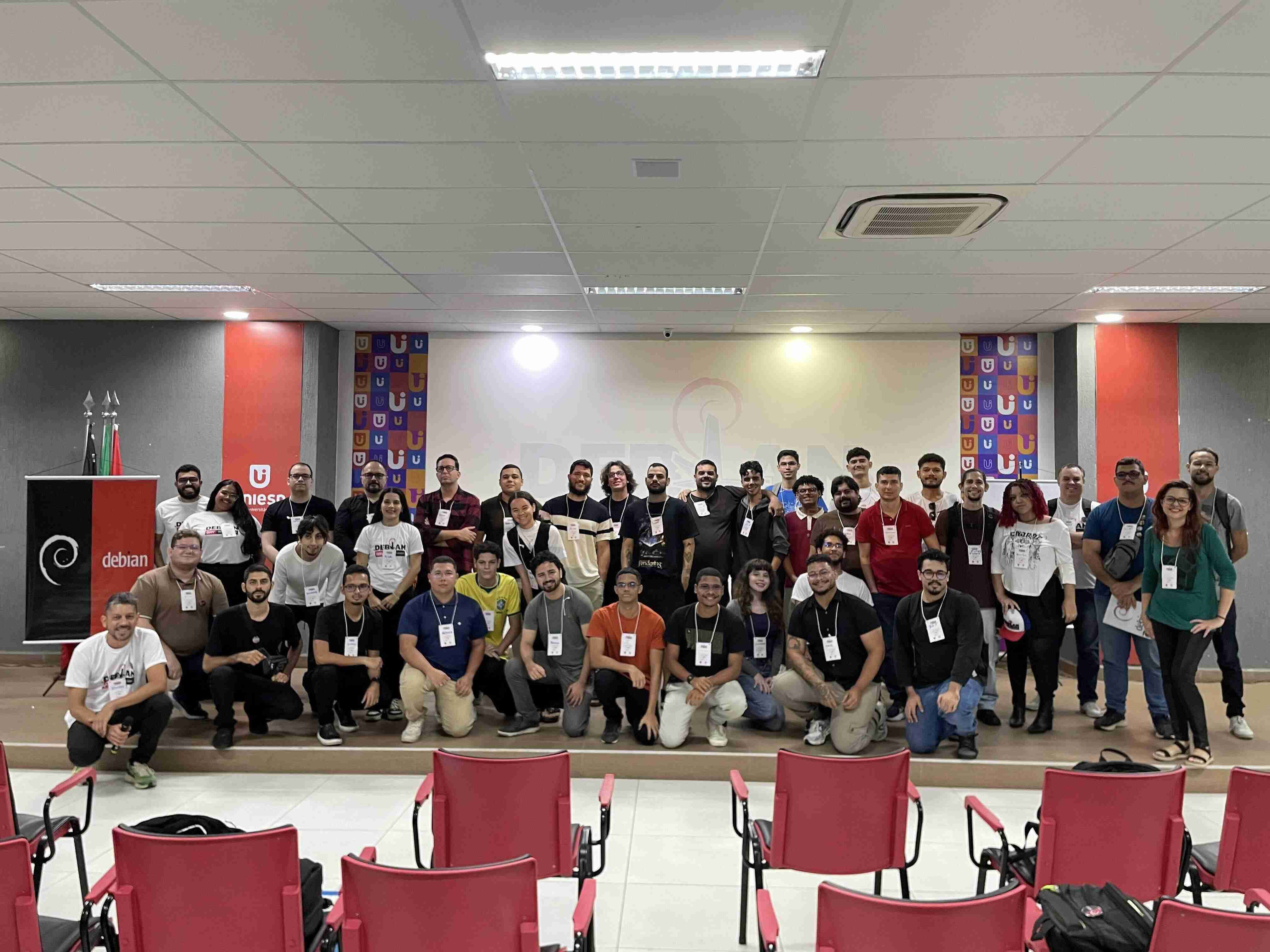
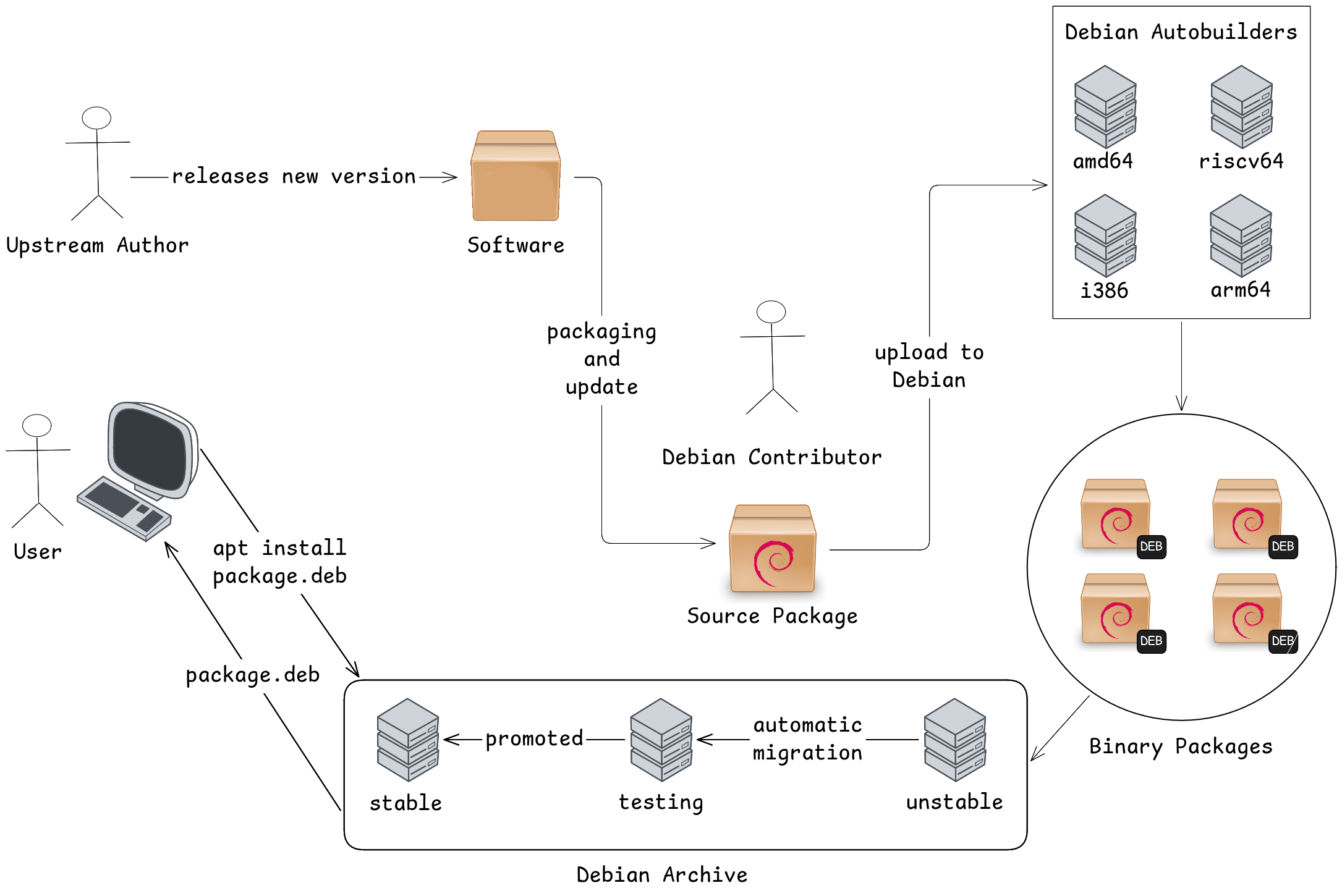
Jo o Pessoa Debian Day Jo o Pessoa Group Photo In Jo o Pessoa, we had a two-day event. The first day was dedicated entirely to workshops, and I ran a packaging workshop for newcomers. It was the first time I had been responsible for a workshop, and it was a great experience. We didn't have a lot of time, so I decided to start with a 30-minute talk explaining a few things about Debian. For example, I made this image to explain the packaging workflow: Debian upload workflow This image was based on The Debian Administrator's Handbook, and I think the participants really enjoyed learning about this workflow. When I showed the slide with this image, it was the moment when I received the most questions. After the talk, I explained my way of working and what they were going to do. The hardest part was setting up the environment, since my approach uses sbuild + gbp. They were running different Debian releases and, because of my inexperience with workshops, I had some of them configure sbuild with unshare, even though it is only available in stable through backports. Some of them even managed to learn how to use backports, while others decided to start again using the "old" way. One thing that helped a lot was the Debian Brasil Wiki. It has all the instructions for configuring sbuild in Portuguese, along with great examples. The Brazilian wiki is an opinionated version of the Debian Wiki. We generally prefer to use it for the convenience of having the exact workflow we follow, as well as an up-to-date Portuguese version of our process. If you want to learn more about the Brazilian community, you can find more details in the schedules from previous DebConfs. We almost always had a talk about the community and its activities. In the end, everyone successfully set up their development environment, and all six participants made their first contribution to Debian. If you take a look at my upload tracking page, you will see that every upload made on August 15, 2026 was a sponsored upload from this event. One of them appear twice in the list because I sponsored the upload and also made some other changes. I also asked all of them to put this in their changelog:
* My first contribution!
The idea was to make it clear to other people that they were only working on small Lintian issues as a way of learning and understanding the process. By the way, I made a UDD query to find packages with the following Lintian tag: redundant-rules-requires-root-no-field. To fix this issue, they only had to remove one line from the debian/control file. It is obvious that these uploads are not particularly useful. I call them "motivational uploads" because my goal is to help newcomers understand the process and immediately give them the reward of having made a contribution to Debian. I'll try to keep in touch with them. My plan is to hold another session, this time remotetly, to help them continue contributing to Debian. In fact, I already have another package prepared by one of them waiting for my review. The second day was a full-day event featuring a bunch of talks from the local community. I gave a talk explaining the new members process. I was the only Debian Developer at the event, and I think having a DD there made a real difference. Being there to answer questions, and simply being present, makes Debian feel more tangible and accessible to people. A big shout-out to Rafael Rocha, who put in a lot of work to make this event happen, with the help of many volunteers who contributed along the way.

Bras lia Debian Day talk in Bras lia One thing I really like about Debian Days is that each place has its own way of doing things. In Jo o Pessoa, we had a MiniDebConf-like event, while in Bras lia, we had something smaller but still very valuable. We decided to keep things simple: talk to a few students at the University of Bras lia (UnB) and then go somewhere to eat and have a few drinks.

A bit of history For those who don't know, the DebConf 19 was held in Curitiba, Brazil. After the event, Arthur Diniz got really excited about Debian and decided to go back to his University, UnB, to share his experience and encourage more people to contribute to Debian. I attended one of his talks, thanks to Joenio Costa, who invited Arthur to give the talk. Joenio was also my professor at the time and a Debian contributor. I really liked what Arthur had to say about free software, and he did a great job of presenting the Debian community as a friendly and welcoming place. So I decided to attend local meetings of the Debian Bras lia community, which had been inactive for a long time. Lucas Kanashiro was the Debian Developer who answered our questions and, as I mentioned earlier, simply being there made Debian feel more tangible. Everything stopped when the pandemic began. Then, towards the end of 2020, I saw a message in the Debian Bras lia channel saying that the meetings were back, this time remotely. I was hesitant to join because, back in 2019, I hadn't managed to make a packaging contribution, even with their help. I had eventually given up on the process. So this time, I decided to join the meeting with something already prepared for review. I watched all of Eriberto's packaging videos, picked a random package, and joined the meeting. I remember Kanashiro being excited that someone had just shown up with something ready for review. At the time, it was only the second meeting since Debian Bras lia had come back online, and none of the newcomers had started working on contributions yet. During the same meeting, he also convinced us, the newcomers, to give a talk about Debian just three days later. The MiniDebConf Online Brazil 2020 was happening on Sunday, and the meeting was on the Thursday before it. Since he has great convincing skills, I went along with the idea and prepared the talk with Francisco Ferreira. That was the rebirth of the Debian Bras lia community. Since then, we have maintained a close connection with the University of Bras lia, and today, at least seven Debian Developers are from UnB, whether as former students or former professors. The reason I told this story is that, even though the Debian Day we held in Bras lia was smaller, it is part of something that has been working for us for several years: staying close to an University. We've managed to attract and retain many people who share the same values and interests. I've hope you all had a great Debian Day. If you're reading this and aren't part of the Debian community but would like to join, get in touch!

Iustin Pop: Another optimistic take on AI

Disclaimers The current discussion in Debian around the AI GR is very heated, and I won t add to that, however, I am very confused about some of the viewpoints there. But, I had no idea how to even try to write this, so did shut up, until I saw Aigars excellent Optimistic take on AI, which motivated me to try, at least. For the record, I fully subscribe to the post, and to the voting suggestions (and I just voted). Also, for full disclosure, I don t think I did any contribution to Debian until now using AI, neither packaging, nor emails, nor bug reports. And this blog post specifically is 100% hand written. With that out of the way there are two points I want to make in this post.

AI is useful, even if it has risks First is, that even if we could put the genie back in the metaphorical bottle, we should not. We do need to continue working towards safe AI, and efficient AI (less environmental impact), but we should not work towards removing the usage of AI. There are already significant advancements in sciences and technology thanks to the use of AI, so desiring AI to not exist (assuming we had a magical wand) is the wrong approach. Sure, AI has significant risks and I can see ways in which AI can do significant damage to society but I don t think we can go from Kardashev I to II without the use of AI, and definitely not to III. And I think, that should be the goal. A few simple examples: Do we want to rollback all the 20 years old security issues that AI found? Do we want to rollback the recent Moderna cancer findings? Do we want to rollback the concept of extremely large scale pattern matchings , just because it runs on chips and no longer in one person s head?

Reading Debian lists The second point is, lately I found less and less enjoyment in reading Debian lists. Even with that already being the case, I feel so disconnected from many of the opinions being voiced in this discussion. On one hand, it s normal and healthy that people have different opinions, disagree, and move forward. On the other hand, looking at one of the proposed options:
  • Moderators and disciplinary teams may make narrow and tailored exceptions to rule 4, and decide on interpretation .
  • Violations of these requirements should be treated as violations of the relevant Code of Conduct and should result in swift and proportionate disciplinary action .
I already knew Debian, and some large parts of the OSS world, is left leaning. But those phrasings, to me, are too close to socialism/communism. As someone who grew up under communism, this is a much more slippery slope (disciplinary teams? really?) than AI usage. Ask me in person for more details. So, it is possible that Debian continues to evolve in such a way that I don t find myself in any way close to its ongoing culture. I will be sad at that point, but it will be what it is.

Where to? I think that, until such a time that an AI bubble bursts, what any organization should do is try to logically see where and if AI can help. And in an organization that is about computer software, I see hundreds of places that are subject to very large scale pattern matching so the half of the discussion is, to me, mind-boggling. To be clear, it s not about if you can t beat them, join them . As I wrote above, I think AI is useful, so the point is how to use it effectively. Well, will see what Debian votes. I am half curious, half sad already.

Wouter Verhelst: Programming and GR 2026 002

Programming language generations When I was young, I learned about a model of classifying programming language: the system of programming language generations. In this model, first generation programming languages are, basically, where you program the computer in the language that is defined by its architecture. On a Von Neumann machine, with its load-and-store architecture, you do that by inputting a string of numbers. The first programmer in human history -- her name was Ada Lovelace -- wrote in a first-generation language. 1GLs aren't so much invented as they are a byproduct of the computers for which they're created. Second-generation languages are the assembler languages. Because humans are not computers, and because decoding long lines of numbers to understand what the computer is doing, when programming became a full-time job, the programmers that did it decided that doing all this assembling manually is too complicated, so they quickly wrote assemblers to automate the process for them. They still could understand the 1GL output of the 2GL assembler, but most of them quickly forgot how to write software in a first-generation language. Not that anyone cared, as the translation from a 2GL to a 1GL is lossless and you can just revert it. Third-generation languages are higher-level languages. When the first 3GLs were invented (such as COBOL and, more famously, FORTRAN) in the late 1950s and early 1960s, it was believed by some that the work of programming a computer so accessible to non-programmers that the job of programmer would eventually cease to exist, and people would just ask the computer what they needed by entering COBOL instructions. This of course was ridiculous and incorrect, because converting algorithms to computer instructions, whether at the 2GL or 3GL level, is a specialized skill that some automation can perhaps make simpler but never completely take away the need for. At the time, some people also felt to some extent that using 3GL wasn't the same thing as actually programming 3GLs, but eventually the world moved on and embraced things. The invention of 3GL environments reduced, but did not completely take away, the need for people to understand 2GLs, as compiler and operating system authors still need to understand them, and some highly optimized code still continues to be written in 2GLs to this day. Fourth-generation languages abstract away some or all of the process of programming. For instance, a database-related 4GL will hide away the complexities of storing data in particular locations, how to fetch that data, how to index it such that you can fetch it efficiently, how to loop over the data to get you a summary of that data, and instead allows you to express the required information in an abstract way, expecing the computer to fill in the blanks. When SQL, an early 4GL, was invented, some people believed that the language made accessing databases so simple that the requirement to implement database applications would eventually cease to exist and we would just hand SQL prompts to users who need to access data. This of course was ridiculous and incorrect, because understanding data schemas and using that understanding to query data from a database is a specialized skill that perhaps a higher abstraction can help you make simpler, but that in the longer run it can never completely take away the need for. The invention of 4GLs also reduced, but did not completely take away, the need for people to understand how to do the things that the 4GLs automate for you manually, as the people who do write those things still need to understand them, and there are also environments where these particular 4GLs are rather not appropriate or just very slow. The first definition of programming language generations that I read about in the 1980s simply stated that fifth-generation languages did not yet exist, but that they would in the future, and that in those, you would "tell the computer what to do, and it would then do that". Now that we have a way of doing so, it could be said that by some definition, we now actually do have a number of 5GLs. The existence of these LLM systems has caused some, especially the people who build and exploit these systems, to exclaim that programming as we know it today is going to cease to exist, and everyone will just ask an LLM to generate a program, which will then do so. That is of course ridiculous and incorrect, as no automaton can generate software from nothing; input is still required for the model to be able to produce something that approaches usability, and being able to word that input in a correct and productive fashion will be a skill that future programmers can benefit from. I ran some experiments a while back, and from that concluded that, if we look only at the technical side, LLM use can, in some niches, increase productivity for a programmer. There are certainly things that you shouldn't use an LLM for, but equally there can be cases where use of an LLM to perform some task that traditionally would have been done by a programmer would be a net positive. But LLMs, as they exist today, are highly problematic. They require vast amounts of data to build the model. The companies that build these models are disrespectful of people who run web services, and as a result, everyone now has to implement various types of application firewalls just to not make systems fall over from the overwhelming requests for data. They are also disregarding the licenses that are attached to these vast amounts of data, which makes me, as a person who believes in the tenets of free software, sad. They require vast amounts of energy, causing an already-critical global warming crisis to, well, not improve. They require vast amounts of coolant to dissipate the energy concentrated in their data centers, causing further environmental effects. In this, they are problematic and to be avoided. But these are side states of the current state of affairs; I do not believe that they are inherently implied to be able to build and operate an LLM -- any LLM. I guess it's fair to say that my feelings towards LLM usage are complex and many-faceted. I haven't been involved in many debates about the subject, debates that to me seem to be mostly focused on "LLM good" vs "LLM bad" arguments that aren't as nuanced as the position that I would believe is more accurate. This is not because I don't care, but partially because I've been busy in my personal life recently and partially because the whole thing seems somewhat disheartening. But then Debian popped up GR 2026-002, meaning, I now have to come up with an opinion about various candidate statements in the context of the above, which is... not easy. But I did it anyway. There are 8 choices on the ballot, and they all have some truth and some falsehood to them. My position about LLMs can be summarized as:
  • The current state of affairs wrt LLMs is disastrous and we should not encourage them
  • However, there's no technical reason why this must remain true for all time
  • And so any statement should keep in mind what might happen in the future and that the current disastrousness of the whole thing isn't guaranteed to continue to exist for all eternity.
With that, let's go over them.

GR vote options

Proposal A Its summary, from the GR text:
This proposal aims to expressly forbid any contributions to Debian written with the use or assistance of large language models (LLMs) or other generative AI tools.
This falls squarely in the "LLM bad" camp, outlawing all generative-AI contributions, disregarding potential future ones where the problematic situations that exist today are not present. It makes a change to the social contract, which is especially difficult to reverse (on purpose), and which therefore also will require a 3:1 supermajority, but if we want to ban LLM-assisted contributions, this is probably the best way to do it.

Proposal B This one tries to allow AI-assisted contributions under certain conditions. It's mostly an "LLM good" proposal, with some caveats that can be discribed as "make sure you know what you're doing".

Proposal C This proposal is both a weaker (in some places) and stronger (in other places) version of Proposal A. It makes changes to the code of conduct instead of to the social contract, and it also wants to, at least, suggest policy to parties beyond the Debian project. By not changing the social contract, however, it is more likely to reach its simple majority requirement than proposal A. I don't think the language that it wants to add to the code of conduct is particularly well phrased, however.

Proposal D This is a weaker form of proposal B. The language is more compact and there are a few requirements that are spelled out in proposal B that are not spelled out in proposal D, but if you read between the lines you'll see that the requirement is still there really and I don't understand why proposals B and D were not merged into one.

Proposal E This proposal tries to hold a middle ground between "LLM good" and "LLM bad". It appreciates that things are quite muddled at the present time, and that perhaps the situation might might change in the future. It acknowledges that certain questions remain unanswered and that perhaps future considerations might therefore be different. But it essentially refuses to take a stance on whether LLMs should be accepted by the project or not.

Proposal F Similar to proposal E, this proposal tries to discourage Debian contributors from using LLMs, while still allowing people to use it should they want to, but with some requests and requirements to mark LLM-assisted contributions to account for those people who don't want to interact with LLM-generated software. As such, it is a proposal similar to proposal E that leans closer to the "LLM bad" camp.

Proposal G
This proposal aims to ensure that contributions directly to Debian are created by humans, while at the same time avoiding restrictions on the tools those humans may choose to use when contributing
Another "LLM bad" proposal, it however restricts the "bad" bits to only the direct output of the LLM. If you use an LLM to do something and then clean-room re-implement the same thing yourself, that's apparently fine.

Proposal H This proposal condemns the use of LLM for its environmental and moral problems, but explicitly not for its technical considerations. I feel that it is closest to my position as explained above.

Voting Expressing a vote on a ballot so convoluted and complicated like this one takes time. I have to read and understand every ballot option, and formulate an order of them. And I shouldn't just state which option has my preference; Debian's voting process allows a rich expression of opinion on ballot options. Anyway, I eventually ended up voting in a way that I think is consistent with my opinion. But it wasn't easy.

22 August 2026

Aigars Mahinovs: Optimistic take on AI

As I am writing this, there is a vote ongoing in the Debian project on how to deal with AI in general and AI-assisted contributions to Debian specifically. Massive discussions have happened in debian-vote and other locations. I have also asked questions there and offered my perspective. IMHO now is the time to summarize that, after all the discussions that I've had with people on multiple sides of this debate both online and offline, and explain how I will be voting and why. Hopefully that will be helpful to someone else as well. None of this has been compiled with AI assistance, but only because I think that forming opinions is not something where AI can really be helpful. Spellcheck was used though. So, first I will describe how I see each of the 8 proposals, then what my vote will be, and then a bit more detail on the reasoning and thinking behind this. WARNING - this went long. With all the above considered I will vote like this (earlier options are preferred over later options): Details on rationale Hypocrisy - I find any proposal that would ban AI-assisted contributions to Debian, but at the same time not ban including AI-assisted contributions from upstream projects to be inherently hypocritical. If LLMs and AI are the very incarnation of evil (a puppy-killing machine, as the analogy went in some emails), then any rational proposal would involve excluding any and ALL code contaminated by this evil from the project. What does it matter if puppies were killed in writing the debian subfolder of the source code or the src subfolder? No proposals went there because everyone knows that such a ban would be the death of the relevance of the project for the future. Debian would be frozen on some old version of the Linux kernel forever and other software would be falling to the same problem too, for example as projects on GitHub start enabling AI-supported reviews with patch suggestions. Soon the "development" of Debian could just be stopped as there is nothing to develop without any upstreams. Assumptions - a lot of proposals mention various "concerns" with at most one word, like "practical" or "community" without an explanation of what exactly they mean by that. The proposers assumed that everyone lives in the same info bubble as they do and already know everything that they mean and already agree to that. That is false. Proposal A was a positive stand-out in this area. Debian has contributors all over the world with very different exposure to different information sources and very different world views. If you want to convince the project as a whole that LLMs are bad because of "ethics", then you do really need to explain what you mean by that and give links to sources, at least as well as Proposal A did. All other proposals were really weak in this area. Copyright - the question on how copyright law interacts with training LLMs and their outputs is still not settled law. The closest legal statements we have so far are that - just because an LLM is trained on copyrighted material does not make that LLM itself be a derivative work of the training data (you, however, cannot just create and distribute a "library" of copyrighted materials just because you plan to train LLMs on it). The output of the LLM might not be subject to copyright law at all, like a photo taken by a monkey. It would then be public domain and thus can be modified and then licensed by the user of the LLM. It might also be a derived work of the context of the inference (so for software - if you refactor a GPL project, the refactoring itself is likely GPL too). Any stricter interpretations would break a lot of existing copyright doctrine, such as raising questions like: "does the output of any programmer now become a derived work of the programming manual books they read in college?". In any case it is really not up to Debian to legislate the nuances of copyright law. And I strongly disagree with the concept that an author can tell me how I am allowed to use the learnings that I gained by reading their work. That is not how either copyright or society works. I can look at 10 pictures of a sunset and draw my own, inspired by the ones I saw. No one can forbid me that expression. The same must be true for a machine learning and replicating patterns. Ethics - I've re-read all proposals and emails and the only real specifically ethical concern I could find was the complaint that some LLMs (or their training farms) are running their web scrapers too aggressively and that causes extra load on services. Like that is not an LLM problem. Scraping the web is not an inherent part of the LLM training or inference process. It's just a few misconfigured scripts. We saw the exact same thing in the early days of web search engine proliferation. Then we banned/blocked the misconfigured engines and the survivors learned that obeying robots.txt is one of the rules for surviving. Literally the exact same problem and it will be solved the same way. Did we ban all search engines back then just because some of them were misconfigured? No. Some claims (like in Proposal C) are just bombastic hyperbole ("hazards to users' mental health", "fraud", ...) and on top of that have zero relevance to the topic at hand - AI-assisted contributions to Debian. What "hazard to users' mental health" is created when a Coderabbit spots that a lock is not taken before accessing a resource in a particular function and suggests an AI-generated patch to fix it? What "fraud" is committed by this? There is no sane answer. I get that some people are very busy fighting some culture wars and sometimes, some AI-bros happen to be on the other side of one such war, so it is useful to label everything coming from the AI sphere as "bad" in all possible and impossible ways. You do you. In private. Why pull Debian into that? Why force your position on everyone else in the project? Why deny everyone in the project access to useful tooling, just because you have strong feelings about some of the people promoting some of those tools? This seems to me a repeating pattern here - blaming the technology as a whole or blaming all providers of this type of technology for failings (ethical or technical) of some of those providers. Like refusing to wear all shoes and condemning all shoemakers and sellers, just because some American billionaires figured out a way to make and sell cheap shoes by killing puppies. Not refusing and condemning those providers, but condemning all for the actions of a few. Resource usage - this is a big topic for many and it has reasonable points to it. The LLM and AI technology has no inherent need to be damaging to the environment in any way for it to function. It does not need to burn oil or dig up cobalt. It does not need to sacrifice a ton of water to the Gods. It is perfectly possible to run AI (both inference and training) purely from green, electrical energy and cool data centers in equally sustainable ways, like with simple air-source heat pumps (also known as air conditioning) or even use it beneficially (many data centers are used for heating surrounding buildings via district heating). However, some AI companies do use non-green power for their data centers, some do use locally-limited fresh water for evaporative cooling (evaporated water still rains down as rain, it is not really lost, but that may happen in another location so lack of water can still happen locally). Some even run unlicensed natural gas turbines in their data centers to provide them with power. And those specific providers can and should be shunned and condemned. Not the other ones, who are doing the right things. Not the technology or its users or its outputs. There is a very wide spectrum of options on how an AI system could be powered: starting from local execution on already existing private hardware powered by one's own local solar power (good), to a data center stuffed with borrowed AI-only cards powered by a gas turbine or coal power station that operates solely to supply this data center (bad). Proposals that talk about ecological impact, but do not even consider where on that (very wide) spectrum to draw the line between "good", "acceptable", "discouraged" and "bad" well, I cannot see those proposals being actually serious about the environment to begin with. It feels like they just refer to it for points. And if we go into the power question deeper, well the grid dynamics and economics become very, very complex and often also non-intuitive. Like, all large software companies with data centers (that also happen to provide AI services), like Google, Meta, Apple, Microsoft and others do actually care about sustainability (in part because their customers care and vote with their wallets) and so all of them use 100% green energy for their data centers (including AI data centers) .... "on an annual scale". Wait, what does that mean? Well, the electrical grid is special - the amount of electricity produced and consumed on the whole electrical grid together has to match almost exactly every second. If there is just a single second where there is significantly more energy consumed from the grid than is produced, the frequency will plummet and you get a brownout and risk a grid collapse. The same is true in reverse - that causes a voltage swell. So grid operators manage energy flows every second and command power stations to increase and decrease generation all the time. Some power stations are easier to regulate dynamically than others. In the end, all that means is that even if your data center has a contract for 100% green energy with your power company, at some seconds across the year there might not be enough green energy in the grid to fully supply ALL people and companies that have 100% green energy contracts. This gets compensated in other seconds, so that across the year ("on an annual scale") for each kWh that your data center pulled from the grid, the same amount of kWh of 100% green energy flows into the grid. But it might not happen at the exact same second. Pedantic companies, like Google, take that discrepancy and count that as CO2 emissions for themselves. And then they and the power companies (they have contracts with) invest billions into new green energy projects, better grids and better batteries so that eventually this discrepancy goes down to zero. In this way green AI data centers with their increasing consumption of green energy are actually doing a lot of good work in making our electrical grid more green. They are making more resources than they are consuming. And that is just the tip of the iceberg. This is a deep topic that really abhors generalizations like "more consumption = bad". I've heard similar discussions in the context of electric cars - "so you got an electric car? you'd have fewer emissions if you drove no car at all!". That might be so. And I would also reduce my emissions to zero if I stopped breathing, but I really do not want that kind of thinking to be propagated further, especially when impressionable young people are around who may take it to its logical (but wrong!) conclusion. Instead I talk about how early adopters use electric cars to gather experience and achieve volume to start the network effects working. Once network effects of many electric cars on the roads are sufficient, it becomes an economically logical choice to get an electric car. People who cannot avoid having a car start to switch over. And at the point of mass switchover the reduction of emissions is so massive that those early adopters failing to go all the way to riding a bicycle becomes a rounding error. But surely that does not apply to LLMs? They are only increasing consumption and bring no benefit? Benefit - and here we have to actually talk about benefits. Because you cannot make any cost-benefit analysis if you do not actually fully investigate the benefits. Are there environmental benefits from running those AI models? Yes, in a lot of very diverse ways. Hard to measure, however. There are projects that are easy to quantify - like that Google AI project on contrail avoidance. An advanced, special model trained and executed in Google AI data centers was able to predict where in the air contrails would be produced and could generate proposed course adjustments to commercial flights to avoid specific heights in specific locations at specific times. This stopped these aircraft from creating contrails and those contrails did not make a further contribution to global warming. That benefit in a year was many times higher than the environmental cost of training and running that AI model. And it can keep running for many years accumulating further benefits. On a personal scale, I've had problems that I bashed my head (and computer and CI resources) against without much success years ago solved with a few minutes of compute. Having a good enough candidate solution quickly is much cheaper from a resource perspective than spending days trying different things, running my PC for it, trying different patches on CI executions, doing different rebuilds. I've seen very significant benefits in AI-assisted development in enterprise environments where code way more complex than what is in Debian (especially in Debian tools and packaging) gets analysed, reviewed, modified or even refactored or rewritten in another language with AI assistance. And it generally works. The commonly mentioned "hallucinations" are a thing of last year in the coding context. Nowadays the AIs work in special coding harnesses and use real tools as foundational facts. You cannot "hallucinate" an API call or parameter if you have to run and pass the unit tests and integration tests by your harness before you can return "success" to the caller. I've personally seen high-level AI models read very complex software projects across multiple repositories and point out a very specific design consideration that was encoded in the code logic, but never mentioned in comments or documentation. It was so obscure that even I did not immediately know what it was talking about (and I wrote that code). Only on close inspection of code interaction across three repos did I remember that there was indeed that bug 2 years ago that I fixed by doing the change that this AI picked up (it wasn't in the history of this git repo due to repo migration). It mentioned this because it was very relevant to the task I initially gave it to review. These LLMs in a proper harness with proper system instructions and usage approach are not just fancy spell checkers or auto-complete. They function more like very advanced pattern matchers. They have learned millions of patterns from training data. When they look at the code, they see hundreds or thousands of overlapping patterns. When you ask them to make or change something, they pull out a pattern (or ten) from their training and apply those patterns to the context of your program. You get something that looks just like the surrounding code, same style choices, same language, same comment voice, but it implements something new there, based on other patterns learned. If you've studied design patterns in your CS class, this will be familiar. But people can learn and remember maybe 20-30 patterns, while an LLM can have a million patterns and can combine them when needed. So it takes a pattern of Python code, pattern of standalone script, pattern of parsing command line parameters, pattern of classes, pattern for background threads, pattern for file tree traversing, pattern for pipes, ... and squishes them together to make a solution for your query. And then tries to debug it with compilation, tests and execution until it works as expected. Even if there is zero LLM development going forward, it will take many years to fully appreciate the benefits we can extract from the already trained models. They don't even have to be retrained - for existing languages they just keep working. For new language variations, like a new Python version, you can feed the changelog into context and they will be able to work with a Python version that they never saw in training. And patterns are mostly abstract, so not really specific to any language - human or programming. This is another big enabler that LLMs have created that we have not really explored yet. LLMs have created really free software. People can actually create software that is perfectly suited just for them and no one else. They don't even have to know how to program and don't even need to speak English. I've seen people writing prompts in their native language and LLMs creating and then adjusting web apps or Android/iPhone apps and deploying them to the user's own phone. It was too buggy to work last year, but this year it is actually very functional for simpler use-cases. And the code looks just fine too - I've seen external contractors in a business setting deliver far worse. If you start with a good initial system prompt, the project will have architecture documentation, use-case documentation, unit tests, integration tests, deployment harness, testing and production deployments, audit logs, monitoring, clear git commits, CI validation on commit, ... Modern AI systems have the capabilty to deliver software freedom to people who are not coders. I really can not overstate the consequences this may have on the world. Community - I find the concerns that new people will be using LLMs so much that they will no longer be understanding the actual code they are contributing a bit regressive. I don't see any significant difference between this and people relying on compilers, on high-level languages or on debhelper. Writing modern debhelper packaging feels more like writing configuration and not writing code. It takes really significant effort to dig down through layers of abstraction to find what actually is being executed in debian/rules. AI does not really make this worse. In fact, I find that AI can make it much easier to understand arcane syntax because you can ask an LLM to explain what is happening in any part of the code and it will do a pretty good job of it, digging down through the layers of abstraction for you. All the pro-AI proposals include the requirement that each human contributor needs to understand and stand behind their AI-assisted contribution and I believe that is a good requirement and also a sufficient requirement. Modern LLMs not only produce clear and concise code, but they are also capable of producing good comments explaining why the code is how it is, good commit messages explaining the change and reason behind it and also making corresponding changes to test suites and documentation. You know - the housekeeping stuff that is often skipped because it slows down the actual feature development, but then its lack becomes a problem for future contributors. Responsible use of AI assistance is a great chance to actually strengthen our community and make our software easier to maintain. That said, I have no qualms about flat-out rejecting contributions that do not make sense. And it does not matter if they are made with or without AI assistance. If the contributor will not explain their patch, it might be they do not understand what their AI produced or it could be that the contribution is deliberately hiding a backdoor being planted. It is also quite common for a contribution of a new feature to be rejected because the author/maintainer does not believe that it is a good fit for the project. Featuritis is a real disease. AI or not. There have always been drive-by contributions to various projects. They will continue to exist. Each of them should be evaluated on its merits - is this feature valuable to our users and is the added complexity (if any) worth the functionality? A lot of security bug reports are "drive-by" contributions as well. And many of them nowadays are discovered, exploited and patched with AI assistance. We could reject them, but that just leaves us holding the bag on the now-known exploits. And the New Maintainer process should be able to figure out if an upcoming Developer has actually understood the nuances of Debian packaging or not. A contributor with upload rights to the archive has to be able to create a basic package with no support tooling (maybe even without using debhelper?) and be able to understand and modify more complex packages (possibly with tooling support). IMHO that is a separate discussion that is worth having, involving experts from the educational sector. Conclusion IMHO the Debian project should not restrict what tooling individual contributors use to contribute. Expecting high-quality contributions and that contributors understand what they are contributing (as a first level of review) is enough. However, Debian should provide its contributors (internal or external) with guidance on how to contribute in the best way possible. That could include: In addition to that it would be helpful for Debian, as a project, to reach out to AI service providers to: Questions? Feedback? Just ask here or here.

20 August 2026

Ian Jackson: Open Letter to the Wikimedia Foundation Board

I have just sent an open letter to the Board of the Wikimedia Foundation, the umbrella organisation for Wikipedia (and a number of other projects), expressing my support for Wiki Workers United and the unionisation effort by WMF staff. Here is the letter: To: Board of Trustees, Wikimedia Foundation via Wikimedia_Foundation_Board_noticeboard and WWU
published at https://diziet.dreamwidth.org/21442.html Re: My support for Wiki Workers United Dear Trustees Wikipedia has become one of the pillars of the free and open Internet. Across the world, reliable sources of information are under attack. I'm proud to have played my very small part in the community of editors of English Wikipedia for the last 20 years. I am also proud of my contributions to the Free Software movement, including especially Debian. Debian, whose constitution and package installer I originally wrote, has become one of the technological foundations of the open Internet. Unfortunately, there are signs that the Wikimedia Foundation is not performing its proper role as bulwark against attacks on democracy, including from moneyed interests. Recent events at WMF have been very alarming to me, and seem to form part of a disturbing trend. As a Trustee Director of a UK charity myself, I understand that WMF Trustees must defend the interests of the Foundation. But that cannot mean taking actions that undermine the Foundation's mission. Nor can it mean the deplorable, and even dishonest, practices, that WMF appears to have been engaging in. As a Wikipedian, as a Free Software activist, and as a citizen of the planet, I stand in solidarity with Wiki Workers United. Union- busting must stop immediately. The Foundation should immediately formally recognise the unions in the UK and the US. Further, WMF is an international organisation. Collective decisionmaking needs to be transnational too. WMF should recognise WWU as a negotiating partner worldwide, even if thresholds for formal legal recognition are not met in individual national jurisdictions. Wiki Workers are not the WMF's enemy. WMF needs capable and ideologically committed staff to maintain and operate its highly complex systems, in the face of constant attacks. Staff with principles and a mission are WMF's biggest asset. Dr Ian Jackson
Cambridge, UK
20th August 2026

comment count unavailable comments

19 August 2026

Antoine Beaupr : The people vs the AI overlords

Also in this series:
In a post to oss-security, my (Debian) co-developer Russ Allbery stated that "open source software [OSS] is coming face to face with a motivation crisis that has been building for a long time". His point is essentially that large language models (LLMs1) are making the existing OSS community crisis worse. For him, it's the flood of code reviews, but he argues that varies according to people's desires, for others it's security issues and so on. I think Russ is right, but I would argue there's something much bigger than our open communities going on here, and it's about the entire field of computing. This pressure is on all of us, regardless of whether we work on open source software or not.

How people use models People using LLMs in their workflow have radically changed how programming works, even for people who claim to avoid vibe-coding. And I'm sorry to single out one poor maintainer here: it's not you, Brian, you're just one example among many. But this is typical use of those models nowadays:
Once it s done, I ll use /code-review and let Claude spawn sub-agents to do a full review of the new code. This usually finds some problems, even problems that the main Claude instance didn t find during its validation. I usually keep running /code-review again and again after finding and fixing issues, until there aren t any left.
Think about what that means for a minute. This is automation built to fire up dozens of agents crunching at a problem for minutes if not hours of GPU compute time, in parallel. This is essentially a couple of shelves in a datacenter rack, totally maxed out on power and cooling, abstracted behind a cute little /code-review command. The author, here, is rightly concerned that "Anthropic could pull the rug out and require API pricing", which is perhaps a code word for "charging something closer to actual costs". Brian also pays lip service to environmental and societal costs but those are largely abstracted away, so let's keep that conversation aside here as well, as we have discussed it before anyways. But clearly, this way of working has an (externalized) cost, to say the least.

Paying for non-free tools For decades my work has been focused on free and open source software. I've long stopped using proprietary operating systems like Windows or Mac, and even before that switch, I was mostly using free software on those platforms, partly out of principle, but also because I was too poor. So the tools of my trade are free, and I build free tools with them. It feels like we're going backwards: when I was in school, a millennia ago, my classmates didn't have access to a compiler and were wondering how they would scrape the money to buy a compiler like Borland's or Microsoft's. I had a compiler built into my operating system (FreeBSD at the time), so that wasn't a problem for me. For them, it was a significant expense, but at least those expenses (or more shady sourcing of programs) were a one-shot deal. Fast forward 30 years, and software is rented: you pay monthly for Adobe's Photoshop and Microsoft's office suite just like you pay for Netflix, Disney+ or Spotify2. And now you need to add dozens (if not hundreds of dollars) of monthly credits to access LLMs on top of that. So, now we have to pay to get anything done? This is peak enshitification of our job: first they steal our work to train their models, and then they sell it back to us at a profit.

Attacking the engineers AI is coming for our jobs, as engineers, if not everyone, according to the narrative. For a while now, our job market has deteriorated: less jobs, for less pay. Lots of skilled engineers looking for work and finding crap jobs then still looking while working. This is not by accident.3 We engineers have a lot of power, it is not organized, but that's just a couple of unions away (easy!). Tech overlords know this, so they are attacking our profession, directly, by forcing us to train and use models that they can control. Even in environments where programmers are not forced to use LLMs, the mere pressure of other people's LLM-generated work is huge. One can be forced to review LLM outputs, or just peer pressured you into producing more. We're now supposed to accelerate delivery, because models can presumably do things so much better and faster. With supply chain security becoming such a large vector that we now have worms crawling around developers accounts on NPM, increasing the delivery cadence seems like a really bad idea.4 The LLM hype is part of the larger wave of cyberwar against workers, against water, against the Earth, against all the people. This is not a matter of individually "adapting to the reality" or personal choice, but a political, social, hard problem we need to address collectively.

  1. I again prefer the term LLM to "AI" because models do not possess intelligence. I did use it in the title because click baiting is apparently important, but I stopped short of calling this one "Rage Against the Machines" because that would be the title of every blog post I have ever made.
  2. Yes, I know that Visual Studio is kind of free now, but I wouldn't be surprised if they turn that into a rental as well, because why not.
  3. Beyond sabotaging the job market, Sam Altman event wants to sell "intelligence as a utility" something that is just a really bad idea but especially shows how megalomaniac those people are.
  4. This brings back memories of another era, walking us back decades in terms of computer security.

31 July 2026

Otto Kek l inen: Estonia, the country of the fit and the wit

Featured image of post Estonia, the country of the fit and the witWhile many Western democracies seem to be in a state of decay and are no longer the safe, civilized and prosperous countries they once were, there are still some European countries that are governed well. One of those that stand out is Estonia. Estonia is probably most well known for multiple software companies that originated from there, such as Wise, Bolt, Pipedrive and Skype. The government itself is also famous for being early in issuing government IDs with an embedded smart chip for online authentication already in the 1990s. Via the national portal at eesti.ee all residents can access extensive eServices ranging from viewing their health benefits to filing taxes. Estonia has also been running an e-Residency program since 2014, where they issue digital ID cards to foreigners, making it easy for them to remotely log into the government portals and for example, establish businesses, file annual reports and so forth. Note that the e-Residency is not a path to physical residency. Estonia does, however, have a separate Digital Nomad visa program that makes it easy for non-EU citizens to also physically establish themselves in Estonia, assuming, of course, you meet the criteria, which includes, among others, a minimum monthly income of 3960 from outside Estonia. EU citizens naturally have free mobility inside the EU and can simply get an apartment and register as a resident in Estonia if they so choose. And there are plenty of reasons to do so.

Estonians value health, education and entrepreneurship I moved to Estonia about one and a half years ago. In my observations Estonia strikes me as a country that values health, education (in particular programming and natural sciences) and entrepreneurship highly. I don t know how Estonians achieve it, but they look pretty fit and rarely obese. Estonia has rye bread and sauna in their culture just like Finland, and in addition the flat terrain and well-planned bike routes and extensive network of parks (and pull-up bars everywhere) seem to create an environment where it is easy to live in a healthier way. The consumption of processed foods and candy also seems relatively low among Estonians. The gym chain MyFitness also seems to be present everywhere. Even the Tallinn airport has a calisthenics workout station right at the departure gates, which anyone is free to use while waiting for their flight to take off. One of the top longevity influencers in Europe, Siim Land, is Estonian. Estonia has lots of good bike paths, parks and outdoor gyms There is even a calisthenics station with pull-up bar and more at the departure gates at Tallinn airport Estonians also seem to value the school system highly. The government has been actively raising teacher pay and has a stated goal of reaching 120% of the national average by 2027. The students are also expected to value the education and respect their teachers. According to the TALIS 2024 survey (OECD s international teacher survey), Estonian teachers spend significantly more time on actual teaching and learning and waste less time on interruptions or keeping classroom order compared to the OECD average. This is among the highest rates internationally, meaning they spend relatively little time on maintaining order or dealing with disruptions. While the international education benchmark PISA scores have been dropping globally, Estonia has consistently been climbing the ranks in past decades. In the latest PISA study (from 2022), Estonia ranked number one in Europe for reading, mathematics and science. In the overall results, Estonia ranked seventh globally, only behind countries such as Japan, Korea and Singapore. Valuing entrepreneurship is evident in how the taxation system is set up in Estonia. Famously, in Estonia, companies can defer taxes on annual earnings and reinvest all of their profit in growing the company. Taxes are due only later, when paid out from the company, for example as dividends. For individuals, receiving dividends from any Estonian or foreign company is tax-free as long as the company paying dividends already paid corporate tax on the same income. The tax system is also very simple. For all individuals, all types of income, including salary and capital gains, are always taxed at a flat rate of 22%. This removes the incentive for anyone to try to convert income into different types, setting up holding company structures and other optimizations as there is no gain. All entrepreneurs can simply focus on growing their business and forget extra bureaucracy. There is also no marginal tax rate cliff to stop working at everyone is encouraged to always try to produce as much value as they can. A simple tax system is also reflected in the fact that anyone can easily read all tax rules that apply to individuals in plain English on the Estonian tax authority website, and one does not need to hire any accountants simply to file taxes. Estonia also has a very straightforward investment account system: any person can freely open a self-directed investment account at any brokerage at no extra cost and report it as such to the tax authority, and then use it to save for an apartment, retirement, or other purposes, and defer all income taxes until withdrawal. There are no caps or time limits, and all residents are encouraged to save and invest as much as they can and thus take responsibility for their own wealth accumulation. It seems that culturally Estonians respect people who are active and progress in their careers and businesses more than in other countries. Unlike in Finland, successful people are admired and living on government welfare is not romanticized. At the same time, the government benefits are less generous so people can t live comfortably on them and, for example, many of the asylum seekers Estonia accepted have since left on their own initiative to other European countries in search of better benefits.

Low crime, high trust Another thing that strikes me when walking the streets of Tallinn is that there are no drug addicts, beggars, thugs or the like. The difference compared to, for example, Vancouver (where I lived previously) is stark. In public buildings, people leave their coats and bags hanging in the lobby while visiting. Private houses and apartment block yards are not fenced. In my building, I noticed people even leave their bikes unlocked in the bike shed. I have also seen the staff of a coffee stall in a shopping mall going for a break and leaving everything unattended, not worrying that anyone would take anything while the staff is away. Nobody is stealing anything from the unattended coffee shop while staff is having a break at  lemiste shopping mall This is not just my personal experience. According to the Numbeo crime index, Estonia has one of the lowest crime rates in the world. Also, comparing drug and property crime stats, for example, Finland has twice as much crime per capita, and places like Vancouver in Canada almost five times more. I don t have any clear explanation for why crime is so much lower in Estonia, but some suggest that higher social cohesion and lower levels of welfare contribute to people standing to lose more if they behave antisocially. Compared to Finland, Estonia also more readily jails repeat offenders, and those who are put on trial will experience a swifter court process thanks to simplified legal processes and more efficient governance.

Moving to Estonia: quick checklist Moving to Estonia is very easy for any EU citizen, in particular if your work is not location-dependent (e.g., remote work or an online business) and you are simply looking for the cleanest and safest environment to live in. First, check into a hotel in Tallinn, check out various neighborhoods to figure out what area you like (my favorites are Kalaranna, Kalamaja, Noblessner and Volta) and start browsing available apartments in English at kv.ee. Most professionals speak fluent English, so there should not be any difficulty in reaching out to people by email or phone. Tallinn is famous for the old town The economic boom of recent decades created a lot of new construction, with Kalaranna being among the newest areas The next step is to buy a local prepaid SIM card at e.g., an R-Kiosk or a convenience store as signing up for other matters later on will require an Estonian phone number. Once you have an apartment and e.g., signed a rental agreement, you can register in the population registry online. After that, you have proof you are a local resident with an address and telephone number in Estonia. With local resident status, you can go to the police station to get a local ID card. Don t bother scheduling an appointment, just go to the Tammesaare police station in Tallinn, take a queue number and wait. Once it is your turn, they will guide you on how to use the photo booth, fingerprint registration device, and file your application. A few days later you will receive an email confirming whether your application was accepted, and after a few more days, you will get another email notifying you that your ID card has been printed and is available for pick-up at the same location. This will also be your first practical experience of how fast and efficient the government in Estonia is. Once you have the local ID card, you can use the smart card feature to log into all the government eServices and sort out the rest of the relocation process, such as registering tax residency and getting a family doctor. The main eServices portal in Estonia: eesti.ee
How did Estonia evolve to be like this? After Estonia regained its independence after the fall of the Soviet Union in 1991, the first elected government in 1992 was led by a very progressive 31-year-old Prime Minister Mart Laar, who managed to set up some very good policies and laid the foundation of a society that has evolved well in the decades since. Estonia was very lucky to have people in power in the 1990s who didn t simply copy what other Western countries were doing, but who tried to think about things from first principles and create Estonia s own model for efficient and fair governance. As a post-Soviet country, the population had also been vaccinated against overly socialist and unrealistic ideals, and everyone had a healthy distrust of the government s ability to solve problems and emphasis was placed on people s liberty to work for themselves as they best see fit. The improvement in living standards over the past 35+ years has also been witnessed by the population, and voting behavior supports keeping the country on the same trajectory. General living standards still continue to improve as the nominal wage growth sits at around 6%, clearly above the annual inflation rate of about 3%. In 2026, the Estonian economy is expected to grow about 2.4%, which is faster than the EU average. The growth in Estonia is not the result of any accounting tricks - Estonia is part of the euro and can t print its own currency, nor has it been funding the public sector with excessive debt. With a 24% debt-to-GDP ratio, Estonia consistently ranks as one of the most responsibly managed countries among advanced Western economies. As wages in Estonia soon catch up with the EU average, and higher defence spending has forced the government to raise taxes in recent years, the economic growth that Estonia has enjoyed for 35+ years since it exited the Soviet Union might slow down a bit in future years. The policies that fueled this growth in living standards, however, are likely to stay.

The tiger leap There is one specific government policy in Estonia s history that I think should be highlighted in particular. Estonia was very progressive by announcing the Tiigrih pe (Tiger Leap) program in 1996 with the goal of equipping all schools with computers and teaching all students the basics of programming. This surely had a large influence on why Estonia has so many successful software companies, why the government eServices are so mature that even neighboring countries like Finland are striving to copy the Estonian government s IT architecture called X-road. The Tiigrih pe project was originally suggested in the mid-1990s by Toomas Hendrik Ilves, then ambassador of Estonia to the United States, Canada and Mexico, and later President of Estonia in 2006 2016. While he was a psychologist by education, he was also a self-taught amateur programmer and used his political influence to promote sensible adoption of information technology in both Estonia and the EU. The history of Estonia has several prominent figures who were not lawyers by profession but engineers, scientists and historians who were very practical in their political decisions, which I think is now reflected in how government processes were formed. The video below shows how the Estonian government advertises itself and what values they choose to highlight:

Should other countries adopt policies from Estonia? Of course, not everything is perfect in Estonia either. The fertility rate of 1.16 in Estonia is very low. This trend is present globally, but in Estonia it is way below the EU average. Also, the service culture is something that needs to improve in Estonia. While services are in general fast and efficient, the attitude of people working in cafes and stores does not reflect a willingness to fill in gaps if the standard process falls short, nor are visitors actively made to feel welcome as individual humans, but are treated as mere process inputs. However, many of the things listed earlier I think should be studied by policymakers elsewhere. Societies are complex systems and there is of course no guarantee that copying a single policy to another country with different ethnicities, history and ingrained culture would lead to the same policy outcomes. But considering that Estonia is a small country without favorable geography and no natural resources, and that it started out from a place of total chaos, low economic activity and high crime in 1992 to rise to what it is now in 2026, the success it has seen is surely largely a result of good policies, governance and culture that other countries can and should mimic.

6 July 2026

Russ Allbery: Review: The Player of Games

Review: The Player of Games, by Iain M. Banks
Series: Culture #2
Publisher: HarperPrism
Copyright: 1989
Printing: February 1987
ISBN: 0-06-105356-2
Format: Trade paperback
Pages: 295
The Player of Games is political space opera and the second book in the shared Culture setting. As with most Culture books, the reading order is not particularly important. It won the 1989 Locus Award for best science fiction novel and sometimes competes with Use of Weapons as the consensus best Culture novel. This review is a re-read and yet another experiment in how to re-review a book. This time, I decided to write a full second review with substantial spoilers so that I can talk in more detail about the book. If you want to avoid spoilers, or just want to see how my thoughts have evolved from my first reading, see my original review from 2005. Gurgeh plays games. He is probably the best strategy game player in the entirety of the galaxy-spanning Culture. He has written papers on game theory, won innumerable major championships, and is a celebrity in the circle of like-minded aficionados. Gurgeh is also bored and in the middle of the Culture equivalent of a mid-life crisis. As the story opens, he's vaguely unsatisfied and adrift, unenthused by his normal activities, and searching vaguely for something that will break through his ennui. He is caught by surprise by the thrill he gets from a moment's misunderstanding in which an opponent suspects him of cheating, which sets him up to be (apparently) clumsily blackmailed by a deeply unpleasant drone named Mawhrin-Skel. SPOILERS BELOW. If you have not read this book, consider stopping here and instead reading my original no spoiler review. The first hundred pages of The Player of Games is a slow, somewhat plodding introduction to Gurgeh, his social circle, and life in (one part of) the Culture. I remember being fascinated by this part the first time I read this book. It was only the second Culture novel I read and the first set in the Culture proper, so the world-building underlying this odd post-scarcity utopia on a vast intelligent habitat with sentient drones, complex privacy rules, endless cocktail parties, and apparently directionless socialites was intriguingly unlike the other science fiction I was reading at the time. This time through, I have to admit I was less impressed. Gurgeh is not very likable, and his desultory mid-life crisis is a little boring. None of his friends have enough depth to appear as more than side notes, in part because Gurgeh doesn't seem to care enough about any of them to make them interesting to the reader. I've since read seven other Culture novels, so Banks's cocktail parties hold less charm and I was impatient for the real action to begin. These chapters are still important, though, because they establish how utterly average Gurgeh is. He has one unique talent, a deep affinity with and obsession with strategy games, and is otherwise a bit of a depressed narcissist with a few casual relationships, a friend that he barely confides in, and a comfortable and familiar life. He is not in any way a hero or a charismatic figure; he just happens to be exceptionally good at one thing, enough to make him famous among people who care about that one thing and probably unknown to anyone else apart from the occasional idly perused news headline. He is the Culture's equivalent of the world chess champion. The Contact division of the Culture has a problem. The Empire of Azad in the Lesser Magellanic Cloud is a nasty, expansionist culture of the sort that Contact would like to deal with before it causes broader problems. The Culture's normal approaches are thwarted by an unusual organizing principle: The empire is built around and takes its name from the game of Azad, a highly complex strategy game developed over thousands of years. Azad is the civil service exams, means of political and religious dispute resolution, selection mechanism for the emperor, and civic religion. Faced with that oddity, Contact turned to Special Circumstances, the Culture's more aggressive and less restrained way of dealing with tricky problems. Special Circumstances, in turn, needs someone who can learn how to play the game of Azad. They want Gurgeh to take a very long trip. For all of Gurgeh's dissatisfaction, he's not impulsive enough to take a five year journey away from his life and everyone he knows just to play a novel game. Conveniently, Mawhrin-Skel's blackmail resolves this reluctance. The game of Azad requires some suspension of disbelief. Banks provides a few glimpses at the mechanics of the game, but those details are insufficient to reconstruct the rules, and some of the claims made about its properties are improbable at best. The best mental model I could build for it is a strategy or simulation game built around units and territory control, with supplemental side games used to build up resources for the main boards, but it's more of a plot device and a set piece than a world-building invention. The significance of Azad the game is its role in society: The Empire of Azad believes they have constructed a game whose complexity so closely models reality that the skills required for success in the game are precisely the skills required for success in the empire. The Empire of Azad is wrong, and this is one of the core themes of The Player of Games. As with many Culture novels, what Special Circumstances tells Gurgeh is, at best, incomplete. Gurgeh is a refutation of the basis of belief in Azad; this is why it is important thematically that he is an average, somewhat unlikable citizen of the Culture whose only special characteristic is skill at learning and playing games. Azad is the myth of meritocracy given physical form as a game. It provides the anchor of the empire for the same reason that societies on Earth place enormous weight on standardized tests, capitalist success, or public debates. All societies face the problem of selecting good leaders and testing opposing beliefs, and all societies attempt to find some form of shortcut, some set of general principles, tests, or objective metrics used to select the best person via a process that people consider plausible and fair. The game of Azad is a paragon of apparently meritocratic process. No matter who you are or what your background is, if you excel at the game that, in theory, objectively tests your skills, you are given a position of power. In practice, the Empire of Azad is not that naive. Manipulation outside of the game happens, only some players have the opportunity and resources to spend years learning the game at a deep level, and only their dominant sex truly stands a chance in games that matter. But neither is Azad's place in society a fiction. There is corruption around the edges, and a lot of people are filtered out before the games begin, but the highest echelons of society are true believers. The game does decide both rank and policy; Banks is arguing against a strong form of apparently working meritocracy. Gurgeh represents a refutation of this meritocracy through the mechanism that breaks every supposed meritocracy: The map is not and cannot be the territory. Any objective evaluation criteria is necessarily separate from what it is trying to measure, and in that separation there is always an opportunity. Gurgeh has none of the background, training, or mindset expected for a player of Azad because he could not possibly care less about any of the things Azad represents to the Empire. What he has instead is a preternatural skill at games and vast experience with the most intricate strategy games the Culture, a much larger society, has been able to devise. He also has both the patience and the resources to devote himself entirely to learning a game for several years, and past experience in doing that with other games. If Azad represents the civil service exams, Gurgeh is the person who has no interest in ruling but adores memorizing facts and taking tests. The theory behind the exams is that the skills to pass the exam only come with the correct mindset to do the job for which the exam is testing. Gurgeh is an existence proof that this is not always the case. Banks also uses Azad to show another aspect of the failure of meritocracy: A society whose rulers are chosen through a competition takes on the shape of that competition. The Empire of Azad is run by the winners of competitive games, so the empire is a winner-take-all system of dominance and status hierarchy. Here, I think Banks lays the point on a little thick; the empire is an irredeemable hellhole of misogyny, sexual abuse, slavery, genocide, and military colonialism to a degree that is a bit hard to justify solely from the game. There is a beautiful turning point about two-thirds of the way through the book where Gurgeh's face is shoved into just how vile Azad society is and reconsiders his approach to the tournament as a result, and I think it may have been a bit stronger if the morality had been a little less blatant and absolute. To the extent that Gurgeh has political beliefs, he represents a Culture flavor of soft liberalism. He has opinions about acceptable and unacceptable ways to treat people, but he grew up in a utopia and his opinions are mostly theoretical. When he sees just how vile people can be outside of that utopia, he is revolted and appalled and redoubles his efforts to fight that society in the only way he knows how, inside of a game. This part of the book follows the standard, if enjoyable, plot of a flawed but fundamentally decent person discovering a true injustice and becoming enraged at it. In a lot of books, that would have been where the plot stops. Banks is doing something more subtle and more interesting, though. Gurgeh wipes the board with his next challenger, but that soft liberalism eventually proves inadequate. To learn the game of Azad and to play in the tournament, Gurgeh has been wrapping himself in Azad culture and its language, and in that frame of mind he is losing the climactic game of the book. It's only when he is pushed to think in Marain, the native language of the Culture, that he understands what is happening in the game and how to defeat Nicosar, the emperor. This, on the surface, is a bit too close to the strong hypothesis of linguistic relativity to be entirely plausible, but such an objection would miss the point that Banks is making here. Marain is a construct, the product of considerable effort within the Culture to match language to the most nuance and complexity that brains can understand, and it is a language, one of the most social and collective artifacts a society can produce. Gurgeh is a remarkable individual with an impressive talent, but individual skill and achievement can only take him so far. The critical final piece is the support of societal infrastructure intentionally built and maintained to help him make better decisions. Once I noticed that point, I saw it everywhere in the book. The empire repeatedly attempts to subvert or distract Gurgeh with drugs, pleasure, politics, or danger, and at each point there is some critical piece of Culture social infrastructure that blunts the attack. Illicit substances and forbidden vices are less tempting to someone for whom the illicit has been demystified by the Culture's gentler approach to rules and boundaries. Embedded biological mechanisms allow him to divert drugs so that they don't affect him. At first, it's easy to read this as an exercise of self-control, but on this re-read I saw how much behind-the-scenes infrastructure supports Gurgeh's ability to ignore temptation. This social support notably does not take the form of some ideological principle or moral framework. Gurgeh is not a monk or an ascetic, as is obvious from the first third of the book, and he has no political ideology to speak of. He is a flawed person with a streak of danger-seeking and self-aggrandizement, which the Culture exploited to get him involved in Azad. But through a lot of hard work, technological and social, the Culture has given him a robust foundation and a set of mental and biological tools that make him remarkably hard to corrupt. The implication is that if Gurgeh has that support, so does every other member of the Culture. It's neither a religion or an ideology; it's well-maintained infrastructure, complex and nuanced and pragmatic, and composed of innumerable small solutions to specific problems. I think the true climax of this book takes place the night before the final day of the game, in the tower meeting between Gurgeh and Nicosar. Gurgeh has realized that he's already won; there's nothing Nicosar can do to salvage the game. He's also seen that the game represents a cultural conflict and conversation between the Culture and Azad and he's overwhelmed by the beauty of that communication and sadness that the game is about to be over. Gurgeh's true passion is the game. It is doubtless easier for him to be magnanimous because he's winning, but he also loves the structure of the game itself and what two players can create in a sort of collaborative competition. Gurgeh tries to express all of this to Nicosar. It is one of the most centrist liberal moments I've ever read in a novel, the pure essence of "reaching across the aisle" or "disagreeing agreeably." Gurgeh has seen something beautiful, something he's created with Nicosar, a moment of true communication, and he wants to share it. Surely Nicosar sees the same thing; surely now that he sees Gurgeh has won, he can appreciate the board structure, savor the moment, understand the transient beauty of a game that is about to end and how perfectly it captures the meeting of their different cultures. That moment does Gurgeh real credit. It's a rare sign of emotional and spiritual depth in a character who often seems superficial. Nicosar meets this outreach with unhinged, furious contempt. He despises everything Gurgeh represents, everything the Culture is, and the next day he tries to kill Gurgeh on the board of the game. It is a devastating critique of liberal tolerance, all the more so because Gurgeh's attitude and outreach is truly admirable. It is perhaps the most sympathetic moment that Gurgeh has in the entire book, the moment where the reader thinks "oh, I get it, I understand what he really cares about." Gurgeh assumes that Nicosar is not his position or culture, that they have made a moment of connection that transcends all the awful things he previously learned about the empire of Azad. That Nicosar, despite being the emperor of the society that is currently doing so many things Gurgeh finds repulsive, cannot be as bad as his society. And Nicosar considers that outreach to be weak, disgusting, and vile, and does everything that he can to destroy it. One of the oddest twists of our current moment is the obsession that some billionaires have with stories that are moral arguments against exactly what those billionaires are currently doing. The most obvious example is Peter Thiel, who is obsessed with The Lord of the Rings and has devoted his life to becoming Saruman, a character who is notably not one of the protagonists. It's as if something in them recognizes the power of the story, but some deep shame or narcissism or simple aversion allows them to completely ignore what the story means. Elon Musk is obsessed with the Culture novels. He names the SpaceX rockets following Culture Ship naming conventions and has claimed that one of his goals is to bring about a Culture-style utopia. And in 1989, years before anyone had ever heard of him, Banks cast him as the villain of The Player of Games. There is so much of Nicosar in Musk: the superficial charm, the limited brilliance (Nicosar is a very good Azad player), the ambition, the pride, and the vicious, spitting contempt for everything the Culture represents at every level deeper than superficial materialism. And Banks is as clear about his opinion of Nicosar as he is about anything in any Culture novel. One of the oldest fictional answers to what a society does with people like Nicosar is the consequences of hubris. By being unable to accept defeat, by holding a vision of the world so tightly, they become brittle and unstable and bring about their own collapse. In a broad sense, that is what happens in The Player of Games with a bit of pushing from Special Circumstances. By the politics of the game, Nicosar had already won; the results of Gurgeh's earlier games had already been faked, the final game had no political consequences, and everyone who knew its true outcome could be disposed of. Gurgeh's win could have been covered up and ignored. But Nicosar could not endure the thought that he would be beaten by someone like Gurgeh, playing Azad the way that Gurgeh was playing it. Gurgeh had to be destroyed on the board of the game; Nicosar's pride did not allow any other outcome, even if it meant Nicosar's death. However, Special Circumstances didn't let hubris be the end of the story. In the climax of the book, the drone protecting Gurgeh also makes sure that Nicosar dies. There is a fig leaf of plausible deniability, but it's so obvious that even the unobservant Gurgeh sees through it immediately. It's hard to escape the feeling that was Banks's answer to what to do with people like Nicosar: They cannot live within society, because they will not live peacefully within society. I enjoyed The Player of Games as much this time through as I did the first time, but for entirely different reasons. In my first read, I focused on the world-building of the Culture, the political machinations, and the concept of games as conversations between the players. This time, I was struck by the political commentary just below the surface. Special Circumstances wanted to resolve the problem of the Empire of Azad without a military conflict and occupation that would be long, brutal, expensive, and demoralizing. They found an answer that relied on the diversity of the Culture. A vast, utopian civilization in which people can pursue whatever interests make them happy produces innumerable microspecialized oddities, people with astonishing talents in some small field that only a tiny fraction of people care about. It produces, in other words, innumerable keys for locks that you may never encounter, but which are invaluable if you happen to stumble across that lock. Gurgeh is not a hero. He is not a paragon of moral virtue, or even a charming charismatic, He is an entirely average member of an extraordinary society, the beneficiary of thousands of years of concerted effort at producing a robust, flexible foundation on which to raise robust, flexible citizens with a shared sense of basic morality. Those people, by themselves, do not solve all of life's problems; the structure of Special Circumstances and its willingness to bend rules in order to maintain them is the tension and deus ex machina in all of the Culture novels. But much of the strength of Special Circumstances is that it has an entire civilization of people like Gurgeh to draw upon when it needs them. It has those people because the Culture comprehensively rejects competitive meritocracy, something that some readers of the Culture novels appear incapable of comprehending. Rating: 9 out of 10

4 July 2026

Tim Retout: AWS Washington Summit 2026

I am somewhat jet-lagged, having returned from Washington DC just before the 250th anniversary celebrations which will be happening today. I was part of a delegation sent by my employer to the AWS Summit there this week, partly to kindle interactions between PA Consulting and Jacobs who have recently taken a 100% share in PA. Much of our conference time was spent in meetings with AWS executives impressing the facts of the Jacobs/PA partnership upon them, and discussing plans to broaden our collaboration in different sectors. So I spent even less time than usual at conference keynotes, talks etc. This was my first time to DC, and I did find some time to see some sights unfortunately the White House is rather fenced off at the moment following the UFC match, but I did make it to the Capitol and the Washington Monument in the heat. Last Sunday a select few of us attended the baseball in Baltimore rather than the game, the thing that stood out for me was the military jets flying in formation over the stadium every few minutes, and the block-booked seats for the Navy in uniform, who were having a great time! This is obviously a hearts-and-minds thing, but it provides a stark contrast with the UK I can t think of a time I ve seen uniformed military at the football (soccer) or cricket for example. Or Union Jacks flying at shopping centres. Speaking of soccer, England just about beat DR Congo while I was out there, but it was a close-run thing as we were 1-0 down at half time. I can t claim to be following the World Cup too closely, but I overheard comments (from US passers-by) that made clear it would have had a significant reputational impact on our standing in the world had we lost. Another highlight for me was the Church of the Ascension and St. Agnes, where I was able to get my fix of Anglican plainchant and four-part harmony for the week. At morning prayer, I noted they use God save this land rather than God save the King during the responses I ve since found other sources online that choose God save the State . It s strange to think that the words of the BCP dating back to 1549/1662 are a point of continuity since well before the 1776 declaration of independence, and yet are still adapted and used in worship today.

19 June 2026

Wouter Verhelst: Agentic coding and Free Software

Through work, I have paid license to windsurf (recently renamed to "devin"), an application for LLM-based (aka, "Agentic") development. I hadn't been using it that much, but in an effort to more clearly understand how this whole AI development thing works, I decided to give it a closer look recently. My conclusions: In its current form, this whole LLM wave is problematic for multiple reasons. But ignoring that, and looking at the technology only, I can say that:

Problems Lest someone (incorrectly) assume that I am arguing in favour of the current state of affairs with regards to LLMs, let me state this first. The way LLMs are built today is highly parasitic. Websites are downloaded in whole, at unsustainable rates, regardless of the consent of the people who made the original content. The result is predictable: servers get overloaded, server administrators attempt to implement various mitigations. Some of these mitigations work; some do, for a while; some are entirely useless. In actual fact, the mitigations are an arms race -- if too many people implement the same mitigation, then the people who try to build yet another LLM so they can extract rent will just try to work around the mitigation, eventually they will succeed, and you'll just have to come up with another mitigation. It's a bit like spam; you introduce regex-based spam filters, they introduce spelling mistakes, you introduce bayesian filters, they add a large batch of markov chain-generated semi-nonsense words made invisible by markup, you add filters to block emails with such markup, they move the text into an image. We have working mitigations today, but eventually we'll run out of ideas. LLMs glob up everything they can while ignoring the license of the source material. The people who push those LLMs claim that pushing the source material through the machine learning algorithms makes the output of the algorithm distinct enough from the source material that the license no longer applies; I'm not so sure that this is true. I guess the New York Times v OpenAI lawsuit will teach us some of the answer to that question here, but even so the ethical questions about "is it OK to bring down another server just so we can download the internet for another for-pay LLM" are still open. And regardless of what the law states, my opinion on "you're using my copyleft code to generate code under a different license" is not something you might like if you agree with the rent seekers' opinion on the subject. That all being said and true, the technology works. You can have a "conversation" with an LLM that resembles a human one. If you pass it some data, you can use plain english to ask it questions about that data, which is a lot easier than to ask it about that in a formal way. You can request it to generate some code, and it will generate something that looks like what you need and that will be mostly correct for like 95% of the time. Now, yes, 95% of the time is not 100% of the time, and no, you can't ask it to "write me a piece of software that implements this 300-page requirements document and get back to me when you're done", because it will fail, and you won't know where it has failed, and you'll take it into production and expect everything to be fine because it won't and this one minor logic bug will cause half your servers to spin and consume credits with your infrastructure provider with nothing to show for it. But that doesn't mean you can't use an LLM to build a large piece of software. It just means you have to understand the LLMs limitations and strenghts, and use them correctly. Here's what an LLM is good at:
  • Generating plausible text
  • Interpreting text to figure out what a plausible meaning or summary of that text is
  • Giving vague indications as to what the probable context of a given body of text is.
It turns out that that's enough to use the LLM to build a reliable piece of software, provided you do it right.

Paradigm shift An LLM can generate text by the truckful. The generated text could be code. Given a good enough LLM, the generated text might even run and do something useful. You can try to blindly run the code, and if it doesn't run correctly, you can paste the error message to the LLM, and it can tell you what went wrong and how you could possibly fix it. This creates a feedback loop: you ask it for an amount of code, you run the code, you receive an error, you tell it that the code is problematic and give it the error message, it makes changes to the code, now you have something that at least no longer fails at startup. If you ask it to add tests to make sure that your code acts as per your specification, now you get an error if and when the code doesn't act as per your specification. Or, well, at least not as per the part of the specification that was correctly turned into a unit test by the LLM. LLMs have a context window, so if the error message is pasted in the same conversation as where the code was generated, it is able to reuse the earlier prompts to refine how it should interpret the error message that you received. You can't really paste the source code of an entire application into the prompt of your LLM, that would quickly overrun its context window. But LLMs also allow you to provide some form of background information -- a document, say -- on which you ask it to reason. It will interpret that document, but doing so uses less of the LLMs context window. So providing the LLM with your application's source code as background information can help it understand better how your code interacts. This is especially helpful if you only provide the LLM the background information relevant to the actual question. So now if you are able to:
  • Create background context with your application's source code
  • Have the LLM generate a first draft of your requested change, plus the tests to make sure it works
  • Compile (if applicable) the generated code (and tests) and run said tests
  • Return any error messages to the LLM with a request to correct the error
Then the combination of "getting it 95% right off the bat" and the above feedback loop means you can generate syntactically correct code, that probably does what you need, in minutes. I say "probably" for a reason. There are going to be cases where you specify a request without a number of details (because they are implied), and the LLM will get most of those details right but just not implement the one bit because it's an automaton and it doesn't think. Or you will ask it to make sure that two bits of the application look exactly the same, without specifying that they must act the same, now and in the future, and it will just generate the same block of code twice and then in a future change it will change one but not the other. But if you review the changes, and you have experience as a programmer, you will be able to spot most cases where the LLM got it wrong. And so it's possible, if not necessarily easy at first, to use an LLM to generate mostly correct code. There are certain places where "mostly correct" code is not desireable. But equally, there are also cases where, "mostly correct" is good enough. After all, most of the software you run today -- the bits of it that weren't, yet, generated by an LLM -- is only "mostly correct", too, because to err is human and we all make mistakes. If not, there wouldn't be any CVEs and your software would never do anything wrong. Now, doing the feedback loop described above is certainly something you could do manually. You could open an account on one of the LLM websites, upload the source code of your application, ask it to generate some new feature, download the newly generated feature, run it, and then copy/paste any error messages back into the LLM. But that's a lot of manual work of the type that computers are pretty good at. So that's what the "windsurf" tool helps you with: you run it inside your IDE -- either a VSCode-based tool that you download from their website which comes with their product preinstalled, or a separate JetBrains plugin that you can install. You can then open your entire relevant codebase in a workspace in your IDE. You then ask the LLM, through the IDE, to generate a new feature in your codebase, and to also generate the test while it's at it. It will use a mixture of LLM interpretation and non-LLM functionality to scoop out the relevant bits of your codebase to send to the LLM as background information, will send it your prompt, will download the generated code and patch or create files, will compile (if required) and run the newly generated code and tests, and will refine the generated code if the tests produce any errors. All mostly automatic; by default, running anything requires explicit confirmation. You can turn that off completely (probably not a good idea), or you can give it a whitelist of things that you don't want to confirm (perhaps OK), and the tool also passes standing instructions to the LLM to never generate any command that deletes a file (which, like with any LLM, can be overridden, but it requires you to be very stubborn and to use more credits than you'd probably like). All this put together means you can build something without writing any piece of code, provided you do it right.

A technically positive evolution Don't go and say, "here's a 300-page document, read it and write whatever the document says". It will get it wrong, it will write a massive test suite that it will only run at the end, it will choke itself up trying to interpret the massive amount of failures it encounters, it will fill up its context window and it will start to forget some of the requirements. That won't work. But what you can do -- what I did, in fact -- is this. First, create an empty workspace. Don't put any code in it. Then, tell the LLM to generate a backend framework using technology X and a frontend framework using technology Y that initially only says "hello, world". Also add tests to it, and run the tests. It will do that. You'll not get much, but it will work. Then, ask it to add some UI elements. A login page, perhaps. A navigation bar. Small things. Most of it doesn't have to be functional -- but tests must be there for the bits that are, and have it run the tests and evaluate the results. Rinse, repeat, until you have a working application. Importantly, in between the steps, you should also run the application yourself and see if the change was implemented correctly. Sometimes it won't be. Sometimes there will be a subtle bug -- I at one point had a the application hang after a few minutes. Sometimes you tell it that there's a subtle bug, and it will discover it more quickly than you could, and it will fix it, and in implementing the fix it will uncover another bug, and then you have to fix that one -- the fix it came up with for the hang was to move something to an async process on the server, which caused the application to start spinning while trying to create hundreds of async jobs (this is when I realized that the hang was a deadlock due to some part of the codebase doing something that indirectly triggered itself). Sometimes it will try to fix the bug you tell it about, and you'll see that it's going off on a tangent that has nothing to do with what you're seeing. It's important to keep an eye on what it's doing, so you can guide it back on track when that happens -- when I told it about the hang, it started investigating the part of the code which sends out emails, thinking that it could hang while waiting for sendmail to finish, but the hang was happening when the application was idle, not when it was sending out emails, and only when I told it about it happening when it was idle did it find the deadlock. So it's not a fully automatic process, and it needs to be guided by someone who knows what they're doing. But if that is the case, you can come up with something that works. I spent evenings and breaks for about a week, and I managed to create a working application which, had I written it by hand, would have taken me a few months of full-time work to come up with. And I now have a side project, fully complete and working, that I had been thinking about doing for more than a decade, but never got around to actually doing, because of all the work that would be involved and I just didn't see myself having the time for. It's not perfect code. But it's mostly good enough, and it will perform the job it needs to. And it looks far slicker than most of the side projects I've done in the past, because in the past I would prioritize between implementing new features or making something look slick, and I would decide that the new feature was more important because it's only for me and there's only me and nobody cares if it looks good or not and I don't have three weeks to come up with something that looks better. But here, I found myself sometimes spending 10 minutes writing a prompt with instructions on making things look better. Because what's 10 minutes when you just spent an hour writing down and refining specifications for functionality and tests? There are a number of other things in which an LLM can help a programmer. For instance. I received a bug report recently in a project I'm paid to maintain that I couldn't make heads or tails of. I opened the source code in my windsurf IDE, pasted the bug report in the prompt, and then requested the tool to analyze the source code and the associated logs and tell me how the described behavior could be happening. It turned out that I had overlooked something, but with the help of the tool, I found the bug in minutes. I was trying to understand a particular part of a large codebase that I didn't really grasp very well. I loaded the codebase in the tool, and asked it to explain to me how a particular action is performed by the code. I requested specific functions and line numbers. I now have a far better understanding of how the code works, and will be able to write that patch that I've been wanting to write for years -- without using the LLM. I have been struggling for, literally, years with understanding why another tool that I maintain was misbehaving in a particular way but only in Firefox. I opened the codebase in Firefox, explained the buggy behavior in plain English, and asked it to explain how this could be happening. It picked up some obscure corner case behavior of ffmpeg and mp4 containers that I was not aware of and that perfectly explained why things were misbehaving in the way that they were. At the same time, there are limitations. Giving an LLM a codebase that was originally generated by an LLM (either the same one or another one) seems to work well. Giving it a codebase that was written by a human and expecting it to correctly update it seems to be more error-prone. I did one or two of those as a trial, and it is more problematic than anything. An LLM is also not intelligent, notwithstanding the popular term of "Artificial Intelligence". On multiple occasions, I've asked it to write a test case for some code that was not set up to do so; and rather than suggesting a refactor is required, it would instead copy the code that needed to be tested and then test the copy, rather than the original. The tool has made multiple similar errors. I have sometimes people describe agentic coding as "similar to interacting with junior programmers", but that is not the case. A junior programmer will either fill in the gaps in your specifications, or ask for clarification when something seems off. The LLM will not do that; it will do what you ask, exactly that and nothing more. If you missed a corner case in your specification, then all bets are off. I remember learning about programming language generations in college. A first-generation language is "machine code", a second-generation language is "assembler", a third-generation language is any high-level language such as C, Perl, or Pascal. I've forgotten what set a 3rd-generation language apart from a 4th-generation language. But I remember the definition they gave me for a 5th-generation language: "you tell the computer what to do, and it will do it". At the time, I thought it was ridiculous. Nobody could ever write something like that. But it's here. And it's a threat to free software.

A threat to free software? Yes. There is the obvious part where most of the well-known LLMs are non-free software. I mean, there are some "open source" LLM models. The windsurf tool that I used doesn't allow you to use them (directly), but they're there. There are also open source applications that implement what the windsurf editor does. So it's definitely possible to work like this without resorting to non-free software and non-free services, even though the non-free LLMs might be a bit ahead of the curve of the free ones. But that's not what I mean. And there is also the obvious thing which I mentioned earlier in this post, which is that the people who try to build LLMs are doing it in unethical, disgusting ways, causing downtimes and disregarding licenses for whatever they can get their grubby hands on. Ideally we wouldn't be in that situation, and ideally this wouldn't be a problem, but we are where we are. And there's the obvious thing where the OSI sold itself out and declared that a machine learning program can be open source even when the very things it was built from -- the training data -- is not available. That's a major issue that the free software community needs to fight against, but there's not really anything that that is a threat to free software. You just build your own, free software, LLM, and you're done. The actual threat is in funding and developer support. Most large businesses do not care about free-as-in-freedom software. They like the free-as-in-beer part, and they appreciate that the free-as-in-freedom bits can make the software more customizable. They are (mostly) happy to do sponsorships of the free-as-in-freedom projects that they use if that means their free-as-in-beer usage of the software gets improved. But why would you care about all that when you can just generate the code you need, rather than interacting with an open source community that may or may not care about your business's interests?

Where to go from here Although I think the moral and environmental issues with LLMs are real and problematic, given the experiments I did I am not convinced that the concept of interacting with a computer system in natural language and to use it to generate code is necessarily deficient. There are pitfalls, but they can be managed. It is possible to use such a system to create throwaway, proof-of-concept type "good enough" code bases. It can be used to interpret code bases and to understand bug reports. I believe that the major issue with LLMs has to do with that saying about hammers and nails:
If all you have is a hammer, then everything looks like a nail.
LLMs are an outgrowth of machine learning, pushed by large corporations. These large corporations have a lot of money. If all you have is money, then every problem can be fixed by throwing more money at it. The initial language models were promising but not (yet) good enough, and it seemed that one way in which they could be improved was to increase the scale of the statistics: throw more hardware (and thus money) at it, and rather than improving the efficiency of the models, just scale up. Scaling up is something that megacorporations are very good at. It's only a money problem, after all. Does that mean that "scaling up" is the only way to improve the models, though? I'm not convinced. Some hardware, such as most modern Apple and Samsung devices, ship with accelerator hardware for machine learning algorithms. There are some models that are small enough to be able to run on these devices. I don't see why it should not be possible to create a small(er) language model that can do some useful part of the above-described use cases; if not locally, then at least on a server that one can run on-prem rather than requiring that you pay rent to one of the LLM companies. The Software Freedom Conservancy has published an aspirational statement on machine learning-assisted programming that, I think, gets a lot right. It's not quite a definition, but it's something to keep in mind. Perhaps that's the way forward? More questions than answers at this point, anyway.

31 May 2026

Russell Coker: Links May 2026

Ron Garrett wrote an interesting blog post about the mathematical possibility of abiogenesis [1]. Cory Doctorow wrote an interesting blog post about the way the current antics of right wing extremists are forcing permanent changes in society away from the old systems [2]. William Angel wrote an insightful blog post comparing the costs of a Macbook and the Openrouter hosted service for LLMs [3]. The Register has an informative article about the threat that management systems built in to Intel and AMD CPUs pose to data sovereignty in EU owned cloud providers [4]. But this is just the first stage of building sovereign clouds, all significaant cloud services run at least 2 types of CPU and adding EU manufactured CPUs at a future time will be easy. Benn Jordan made an interesting YouTube video about the infrasound problems caused by data centers, we need FOSS to measure infrasound [5]. amarok on the Purism forum made a great post about how to setup profiles in Firefox for different uses [6]. fralb5 wrote an informative post on the Purism forum about how to use a Librem 5 (or any other FOSS Linux phone) to firewall spyware on an Android phone [7]. Michael Prokop wrote an interesting blog post about debugging input event problems on Linux which turned out to be due to an analogue headphone connection [8]. This gave me some useful pointers to investigating an input device problem which is probably very different. Patrick Boyle made an insightful youtube video about the ridiculous IPO of SpaceX, it seems like a scam from start to finish [9]. Anarcat wrote an insightful blog post about the LLM apocalypse comparing it to the horsemen of the apocalypse [10]. The Wikimedia Foundation (that runs wikipedia.org among other things) is sacking union organisers and trying to corporatise the organisation which means stealing the donations from the community [11]. Tianon Gravi wrote an informative blog post about containers, Debian, and Docker options [12]. We need a lot more work on these sorts of things in Debian. Memory Tagging and how it improves C/C++ memory safety is an interesting paper from Google researchers giving an overview of the benefits of tagged memory hardware for pointer validation on SPARC and ARM64 [13]. In 2013 a faulty beer fridge motor acted as a spark gap transmitter and blocked mobile phone service for several Melbourne suburbs [14].

29 May 2026

Ravi Dwivedi: Budapest Travel

In September 2025, I attended the annual LibreOffice conference in Budapest, Hungary. This gave me an opportunity to explore the city, which I will cover in this post. Let s start with the currency. Although Hungary is a part of the European Union (EU), it doesn t use the euro as its currency. Instead, it uses Hungarian forints (denoted by Ft ). During my time in Hungary, 1 Indian rupee was equal to 4 Hungarian forints. After reaching the Budapest airport, I bought a 15-day public transport pass. The public transport counter is after you pass customs and immigration. The pass allows unlimited use of public transport in the city. I had to show my passport and pay 5950 Ft to get the pass. The pass had my passport number mentioned on it. The public transport passes can also be bought at any of the tram stations as well.
This is the counter from where I bought my public transport pass. This is the counter from where I bought my public transport pass.

Budapest pass. My unlimited public transport pass for Budapest. I have redacted my passport number from it.

An automatic ticket machine An automatic ticket machine at a tram station in Budapest.

Budapest is a union of two cities Buda and Pest lying on opposite sides of the Danube River. My hotel Corvin Hotel was on the Pest side. Budapest had good public transport. The buses, metros, and trams complemented each other. For example, the airport didn t have metro or tram connectivity, but it was served by the bus. Most of the metro was on the Pest side, with only a couple of stations falling in Buda. However, both sides had an extensive network of trams. Furthermore, the information about the public transport was easily accessible. For instance, the map of tram stops inside the trams also included the bus routes one could get after alighting at those stops. From the airport, I took a bus followed by taking a metro on the M3 line to reach within walking distance of my hotel.
An M3 line metro in Budapest. An M3 line metro in Budapest.

During the conference I would take the tram to the conference venue. The trams were modern and fast. They also had a smiley face at the front, which gave them a friendly look. It seemed like the trams were happily doing their job. The city also had a good pedestrian infrastructure along with separate cycling tracks.
A tram in Budapest. A tram in Budapest having a smiley face at the front.

Budapest s tap water is officially safe to drink, which was mentioned on a sticker posted on the wall of the bathroom of my hotel room. So, I did not need to buy any water bottles while I was there. On the 6th of September, I went on a sightseeing tour of Budapest with my Dione. Our friend Attila, who was a local (from Hungary), joined us. We went to the central market from our hotel by metro. If you read my post on Vienna, I mentioned that the metro stations don t have AFC gates but ticket validators instead. Budapest s metro also has the same system. If you buy individual tickets, you need to validate them using the validators on the station before boarding the metro. If you are using a public transport pass like I was, then you do not need to validate, and you can board the metro directly.
A ticket validator at a metro station in Budapest. A ticket validator at a metro station in Budapest.

In 10-15 minutes, we reached the central market. Attila showed us around. I bought a fridge magnet and paprika powder as souvenirs. Paprika powder is a signature spice of Hungary. It is mainly available in two forms one is sweet and the other being spicy. I wanted the spicy one, but I didn t get that in that market. Therefore, I had to contend with buying the sweet version. The sweet version isn t sweet though, it is just not spicy. After bringing that paprika powder home, it is mainly used for food coloring. I like it though and use it frequently in my omelets and other dishes.
Central Market. Central market.
A building with a tram in front of it. The building right behind the tram is the central market building.

At some point, Atilla had to join the The Document Foundation (TDF) sightseeing group, so we parted ways at the central market. Dione and I continued our sightseeing and decided to start with visiting the Hungarian parliament, which is a tourist attraction. It was because we were on the Pest side and the parliament was also on the same side, while other tourist attractions were on the Buda side. So, Dione and I hopped on a tram and went to the parliament. We got off at a tram station just outside the parliament. The parliament is the icon of Budapest. The building has a gothic architecture and colored brown and white. One can buy tickets and take an inside tour. However, we didn t have a lot of time, so we stayed outside the building.
Hungarian Parliament building. Hungarian Parliament building.

After spending some time outside the parliament building, we took a tram to the Chain Bridge. As I mentioned earlier, Budapest has two parts Buda and Pest separated by the Danube River. To go from one of the sides to the other requires crossing a bridge. Although Budapest has many bridges linking the two sides, the main one is the Chain Bridge. We walked on the chain bridge to get to the other side. The bridge gave a good view of the Danube River. It also had a statue of a lion. The Buda Castle (another major landmark of Budapest) was visible from the bridge.
Chain Bridge. A shot of Chain Bridge.
A lion statue The lion statue on the Chain Bridge.
After reaching the other side of the bridge (the Buda side), we sat on a bench for some time and then planned on where to go next. We decided to go to Fisherman s Bastion, which is another tourist attraction. We used the OSMAnd~ app to figure out which bus to take and hopped on one. Soon we reached Fisherman s Bastion, where we found a flight of stairs that led upwards. Upon climbing the stairs, we got a panoramic view of the city. It also gave us a good view of the Hungarian parliament across the river. Going further upstairs, we found a statue of Stephen I of Hungary. He was the first king of Hungary, getting the crown in the year 1900.
A view of Hungarian parliament from Fisherman's bastion A view of Hungarian parliament from Fisherman s bastion.
I found Fisherman s Bastion to be the best tourist attraction in the city. As mentioned earlier, it offers a panoramic view of the city, which I liked. I liked the arhitecture and open space there. If you find yourself in Budapest, I would highly recommend that you visit Fisherman s Bastion.
Fisherman's Bastion. Fisherman s Bastion.
A green colored statue of King Stephen Statue of Stephen I of Hungary at Fisherman s Bastion.

Next, we went downstairs and returned to where the bus dropped us. From here on, we walked in random streets to see the residential and non-touristy side of Budapest. It was not so random as we walked towards Batthy ny t r metro station. Upon reaching the metro station, we found a caf where we stopped for a while for some coffee. After injecting some caffeine into our blood, we proceeded to find a place to have lunch.
A metro station Batthy ny t r metro station.
For lunch, we decided to go to R k czi t r metro station after reading on the internet about the food options there. Upon exiting the metro station, we found a market inside a building that had a lot of shops, but most of them were closed. After roaming around inside a bit, we found an Italian place open and decided to eat there. The name of this place was Matteos. We ordered an eggplant parmigiana, a lasagna artichoke, and a classic tiramisu. It wasn t very tasty but filled us up for the day.
The Italian place we had our lunch at. A picture of Matteos, where we had our lunch.

Budapest has four metro lines, and we had been to three of them, so we decided to try the remaining line, which was the M1 line. It is the oldest line in the city and has a different vibe than the modern lines. This line was opened in 1896, one of the oldest subway systems in the world. The coaches were much smaller than the other metro lines, and the seating arrangement was something you would expect from a bus than a typical metro train. We rode all the way to the last stop, Mexik i t. Upon going outside, we found out there wasn t much to do here. At this point, I checked the map and realized that Heroes Square is just a couple of metro stations away. Heroes Square is a tourist attraction in Budapest. It is located in Zugl a and is a historically significant place in Budapest. It has a monument which features the Seven chieftains of the Magyars.
M1 line station and tracks. M1 line station and tracks. It is the oldest metro transit of Budapest and one of the oldest in the world. It started operations in 1896.

Here, our unlimited public transport pass was handy because if it was paid per trip, we would think of the stop as a wasted one because we would have to buy a ticket again, but in this case we could just hop on again without any regrets.
A metro train entering a station. An M1 line metro train entering the station.

So we took the M1 line again and deboarded at H s k tere station, followed by walking to the square. After roaming around for a while, we saw a trolleybus and decided to ride on that.
Heroes' Square Heroes Square.
A trolleybus This is the trolleybus we took in Budapest.

A trolleybus is an electric bus that is powered by overhead electric cables. It is like a tram but runs on roads instead of tracks. We got down at D zsa Gy rgy t metro station. Then we took a metro to our hotel. Before going to the hotel, we went to a place to eat something. We had coffee and l ngos. L ngos is a deep-fried Hungarian dish, which looks exactly like the Indian flatbread bhatura. I found it tasty, but since it was deep-fried, that was almost a given.
A deep friend dish called L ngos. L ngos a dish which looks like the Indian flatbread bhatura.
The next day we went to Vienna the capital of Austria which I have already posted about. Check it out here. I had a good time in Budapest, and it is a beautiful city with good public transport and some amazing sites to visit. That s it for now, and see you next time! Credits: Thanks Dione and Badri for proofreading.

17 May 2026

Otto Kek l inen: Balancing persistence vs pivoting is grit a virtue or wasteful?

Featured image of post Balancing persistence vs pivoting   is grit a virtue or wasteful?Being persistent, sticking to a plan and showing up to work every day is generally valued highly across all cultures as virtuous behavior. It is obvious that anything of value and worth achieving is also not easy, but requires significant and recurring effort. Learning a new language, winning a sports competition or building a successful business are all typical scenarios where grit plays a central role above everything else. However, sometimes the virtue of tenacity can result in just a waste of energy. The question is then: how does one recognize that true progress is being blocked by stubbornness and a pivot would be the correct decision, as opposed to being close to breakthrough where doing more of the same would actually be the right choice?
What is persistence actually? To think clearly about this topic, one must first grasp the concept of grit and what it looks like in practice. Research by psychologist Angela Duckworth on grit shows that sustained effort in the face of setbacks separates high achievers from those who quit too soon. Entrepreneurs who iterated through dozens of failed prototypes or writers who revised manuscripts for years understand this truth. Persistence builds resilience, deep expertise, and the kind of compounding results that shortcuts cannot deliver. It also protects against the distraction of shiny new ideas that pull focus from what actually works. Persistence is about:
  1. Believing in an outcome and working towards it despite people around you not sharing the belief, and despite your own work and experiments not being successful.
  2. Continuing to hold the belief and sticking to the decision despite other ideas, solutions and competing alternatives surfacing.
  3. The more time passes, the firmer the conviction becomes. Time, money, and emotional energy invested in a failing direction create psychological pressure to continue (sunk-cost fallacy).
Simply following through on a plan or upholding a contract is not true persistence. Grit is a personal trait one can cultivate to actually become more energized to do something precisely because it turns out to be harder than expected.

Pivoting: a calculated choice The opposite of being persistent is giving up. Pivoting is not about giving up, but about redirecting the energy and momentum towards a new goal. Pivoting requires coming to the realization that you were wrong, and going through the painful process of discovering a new truth. Ideas tend to be abundant, and doing something new isn t hard as such. The hard part is to abandon a previously held belief and adopt a new one with equal conviction. To have that conviction you need to have data and metrics. This is also the key to how to decide between persisting vs pivoting at any moment in time.

Key metrics of success Any decision is only as good as the information available at the time it was made. To be set up for success one needs to start by deciding on what the actual goal is, what one values and how progress is measured. Key metrics are usually easiest to discover by working backwards from the goal. If you want to build an electric car, you might decide that the goal is to have a car that costs 30,000 euros and can drive 300 km on one charge. From that goal you can break down what the cost structure should be, what volume of production is needed to break even, what raw materials are needed and what the battery chemistry needs to achieve to meet the goal. That can further be broken down into a rate of progress. Suppose the plan requires battery energy density to reach 150 Wh/kg to be viable. If the state of the art starts at 100 Wh/kg and funding lasts a maximum of five years, the team needs at least an 8% improvement every year (1.08^5 100 Wh/kg 150 Wh/kg). This can then be used as a guideline. Sometimes progress is not steady, but happens in jumps. Even in those cases there should be a trajectory to benchmark the jumps against. In an online business, the key metric could, for example, be one of these:
  • 7- or 30-day retention rate: Do new users who try the service actually like it?
  • Weekly or monthly active users: Is usage trending up?
  • Feature adoption rate: In an existing service, how many users are using the new feature?
  • Product-Market Fit Score (from Sean Ellis test): Percentage of users who say they would be very disappointed if the product disappeared. Above 40% is a strong early indicator. A number below that (after multiple iterations) is a good data point to pivot.
  • Revenue run rate or burn rate: The most generic metric everything eventually boils down to. Healthy markets reward good products.
Weekly metrics are better than monthly, as they make the feedback loop faster and allow you to get validation quickly and do minor course corrections along the way. A complete pivot should, however, be based on long-term data, driven by the key metric and supported by additional data points. Metrics are also needed because they can t be bribed or convinced to be anything other than what they are. Listening to other people is good, but just relying on the opinion of others is extremely dangerous because people are biased either for you or against you depending on whether they see you as a trusted leader or an outcast. Key metrics are of course domain-specific and everyone needs to come up with their own. However, you must have some key metric. You can t have the excuse that what you are doing can t be measured. If you are part of a larger organization and you need to advocate for a difficult decision for example, to kill your darlings when facing a pivot you need to have the metrics to back up your views, and those metrics need to have been established way before as something the organization values, and not cherry-picked just for this one decision. It does not matter if you are on a personal improvement journey, running a political campaign, inventing a new product, or growing a business you need to have some metric you can check at any given time to see if things are improving fast enough to predict success. Metrics can and should also be used in daily work to validate that you are on the correct path, and to optimize execution.

Famous examples of persistence and pivoting that led to breakthroughs In all of the cases below it is of course in hindsight easy to say they made the right decision. However, take a minute to try to imagine yourself in their shoes at the time of the decision. What metrics might they have had available to support their decision? What would you have wanted to measure or find out if you were in the same situation?
  • Frustrated that his vacuum lost suction, James Dyson spent five years and built thousands of failed prototypes in a backyard shed. He remortgaged his home, lived on savings, and faced rejection from every major manufacturer who wanted to protect their bag-replacement business. The 5,127th prototype based on an idea from a sawmill with a cyclone finally worked. Launched in 1993, the Dyson DC01 became Britain s best-selling vacuum within two years.
  • As a single mother on welfare in the mid-1990s, J.K. Rowling finished her manuscript for Harry Potter and the Philosopher s Stone while battling depression and poverty. She hand-typed copies and mailed them to publishers. Twelve rejected it outright, with comments like children s books about magic don t sell. She nearly quit multiple times but kept revising and submitting. Bloomsbury finally accepted it after the CEO s eight-year-old daughter read the first chapter and demanded the rest. The series has since sold hundreds of millions of copies worldwide.
  • Founded in 1997 as a mail-order DVD rental service, Netflix added unlimited subscriptions in 1999 to compete with Blockbuster. By 2007, broadband growth and declining DVD sales signaled a shift. CEO Reed Hastings pivoted aggressively toward streaming, investing in bandwidth deals and original content while de-emphasizing physical media. The move faced skepticism, but eventually changed the whole culture of how entertainment is consumed.
  • YouTube launched in 2005 as a video-dating site. Founders offered money to women who uploaded dating videos, but almost no one did. Meanwhile, users uploaded random clips. The team recognized the mismatch and pivoted within months to a general-purpose video-sharing platform with easy uploading. Google bought it just 18 months later.
  • Instagram began in 2010 as Burbn, a location-based check-in app that let users post plans, earn points, and share photos. Co-founders Kevin Systrom and Mike Krieger quickly noticed users ignored most features and mainly used it for photo-sharing. They made the tough call: scrap everything else. Within weeks, they rebuilt the app around clean, simple photography with filters. The pivot launched as Instagram in October 2010. It gained 1 million users in two months and was acquired by Facebook just 18 months later.

Insanity or conviction? English has several proverbs that warn against excessive persistence, such as banging your head against the wall . Insanity is commonly defined as Doing the same thing over and over again and expecting different results. In Finland, the national identity is practically built on the concept of sisu . It means much more than just grit . The word is derived from the word for inside or guts and represents an unexplained, almost superhuman force that makes one stoically take action despite seemingly impossible odds and somehow succeed anyway. It became a defining national mythos during the Winter War (1939 1940), where a force 10 times larger than the Finnish army tried to invade the country but was stopped and Finland just barely managed to keep its independence. The word sisu transitioned from a character trait to a pillar of national survival. I think Finns survived because the more you believe in persistence, the more likely you are to persist. I view persistence as a religion that requires faith, while pivoting is a science where you derive the truth from the numbers. When in doubt, I would always choose persistence over pivoting. Perhaps it is because of my genetic tendency towards having sisu , but I would also rather keep on going a bit more and try one more time before giving up and pivoting in order to get more data, so that when I pivot, I know it is absolutely the right thing to do at that point. Depending on the situation, the costs of postponing the pivot vary. Of course, if the main metric is the burn rate and a company is running out of money, a pivot must be done early enough that the remaining runway is enough to execute the pivot, and then some more. In some situations a business idea might simply be ahead of its time. If that is the conviction and the key metrics support it, the best way to navigate the situation is to cut down on costs and wait for competitors to appear, help build general awareness, and then ramp up again to ride the wave. Remember that success does not come from grit alone there is always an element of timing and luck as well. But if you are not persistent and stop showing up every day, you won t be able to seize the opportunities if and when they arise.

Failure is the likely outcome you have to avoid it at any cost One must also realize that most attempts end in failure. Failure is the baseline, and success is the exception. To reach a breakthrough, one must be stubbornly persistent. In particular, if you are a leader, you need to be so high in conviction that it almost becomes an aura that radiates to those around you. Postponing the decision to pivot allows you to get a bit more data for the decision, so that once you pivot, you have full belief in the new direction. Once you pivot, there is no looking back, otherwise you will undermine morale and most certainly fail with the new thing as people will execute it with hesitation. Failure is statistically always the more likely outcome. Most things end in failure and we never hear about them. If someone on your team does not believe in what you are doing, it is very easy for them to prove that something is a failure by spreading negativity, putting in less effort (perhaps unconsciously due to lack of conviction) and thus actually contributing to a self-fulfilling failure. In most areas of life, ideas are cheap and the only thing that matters is execution. To be good at executing, you need to be good at making decisions. When drafting plans it is good to have alternatives and a lot of consideration. However, when execution starts, there is no room for doubt, otherwise the chances of success decrease. Therefore, the best way of balancing persistence vs pivoting is to
  1. plan well ahead,
  2. establish the key metrics,
  3. have thresholds established for what would trigger a pivot, and
  4. do everything you can to move the metrics in the direction you want them to go.
Finally, if you decide to pivot, you must do so only with very high conviction, as you can t undo a pivot, and you should not be doing multiple pivots in a row either. If you are fully convinced yourself about the pivot, you will also be able to convince others about it, and carry the momentum.

15 May 2026

Antoine Beaupr : The Four Horsemen of the LLM Apocalypse

I have been battling Large Language Models (LLM1) for the past couple of weeks and have struggled to think about what it means and how to deal with its fallout. Because the fight has come from many fronts, I've come to articulate this in terms of the Four Horsemen of the Apocalypse.
Sound track: Metallica's The Four Horsemen, preferably downloaded from Napster around 2000, but now I guess you get it on YouTube.

War: bot armies Let's start with War. We've been battling bot armies for control of our GitLab server for a while. Bots crawl virtually infinite endpoints on our Git repositories (as opposed to downloading an archive or shallow clone), including our fork of Firefox, Tor Browser, a massive repository. At first, we've tried various methods: robots.txt, blocking user agents, and finally blocking entire networks. I wrote asncounter. It worked for a while. But now, blocking entire networks doesn't work: they come back some other way, typically through shady proxy networks, which is kind of ironic considering we're essentially running the largest proxy network of the world. Out of desperation, we've forced users to use cookies when visiting our site. We haven't deployed Anubis yet, as we worry that bots have broken Anubis anyways and that it does not really defend against a well-funded attacker, something which Pretix warned against in 2025 already. (We have a whole discussion regarding those tools here.) But even that, predictably, has failed. I suspect what we consider bots are now really agents. They run full web browsers, JavaScript included, so a feeble cookie is no match for the massive bot armies.

Side note on LLM "order of battle" We often underestimate the size of that army. The cloud was huge even before LLMs, serving about two thirds of the web. Even larger swaths of clients like government and corporate databases have all moved to the cloud, in shared, but private infrastructure with massive spare capacity that is readily available to anyone who pays. LLMs have made the problem worse by dramatically expanding the capacity of the "cloud". We now have data centers that defy imagination with millions of cores, petabytes of memory, exabytes of storage. I thought that 25 gigabit residential internet in Switzerland could bring balance, but this is nothing compared to the scale of those data centers. Those companies can launch thousands, if not millions of fully functional web browsers at our servers. Computing power or bandwidth are not a limitation for them, our primitive infrastructure is. No one but hyperscalers can deal with this kind of load, and I suspect that they are also struggling, as even Google is deploying extreme mechanisms in reCAPTCHA. This is the largest attack on the internet since the Morris worm but while Robert Tappan Morris went to jail on a felony, LLM companies are celebrated as innovators and will soon be too big to fail.2 Which brings us to the second horsemen, famine.

Famine: shortages All that computing power doesn't come out of thin air: it needs massive amounts of hardware, power, and cooling. Earlier this year, I've heard from a colleague that their Dell supplier refused to even provide a quote before August. Dell! In February, Western Digital's hard drive production for 2026 was already sold out. Hard drives essentially doubled in price within a year, and some have now tripled. A server quote we had in November has now quadrupled, going from 10 thousand to FORTY thousand dollars for a single server. But regular folks are facing real-life shortages as well, as city-size data centers are being built at neck-breaking speed, stealing fresh water and energy from human beings to feed the war machine. We've been scared of losing our jobs, but it seems that Apocalypse has yet to fully materialize. Regardless for engineers, the market feels tighter than it was a couple years ago, and everyone feels on edge that they will just have to learn to operate LLMs to keep their jobs. Update: it turns out I was clearly too optimistic. Cisco is laying off 4,000 or 5% of its staff in a jolly announcement celebrating a record $15.8 billion revenue, and Meta will lay off 8,000 or 10% of its workforce, in horrifying conditions. See also the jobloss.ai tracker which counts 125,000 jobs lost since January 2025, as of May 2026. Which brings us, of course, to Death.

Death: security and copyright Our third horseman is one I did not expect a couple of months ago. Back at FOSDEM, curl's maintainer Daniel Stenberg famously complained about the poor quality of LLM-generated reports but then, a few months later, everyone is scrambling to deal with floods of good reports. In the past two weeks, this culminated in a significant number of critical security issues across multiple projects. Chained together, remote code execution vulnerabilities in Nginx and Apache and two local privilege escalations in the Linux kernel (dirtyfrag and fragnesia) essentially gave anyone root access to any unpatched server to the web. As I write this, another vulnerability dropped, which gives read access to any file to a local user, compromising TLS and SSH private keys. All those vulnerabilities were released without any significant coordination while people scrambled to mitigate. Many people including Linus Torvalds are now considering issues discovered through LLMs to be essentially public. This puts some debates about disclosure processes in perspective, to say the least. But this is not merely the death of the traditional coordinated disclosure process, the C programming language, or the Linux kernel: remember that those bots are trained on a large corpus of copyrighted material. Facebook has trained their models on pirated books and Nvidia has done deals with Anna's Archive to secure access to large swaths of copyrighted material. The US Congress seems to think LLM outputs are not copyrightable, like any other machine outputs. With many people now vibe coding their way out of learning or remembering how computers work, is this the Death of Copyright? And that, of course, brings us to the final horseman: Pestilence.

Pestilence: slop There is a growing meme that programming is essentially over as we know it. That you can simply vibe-code applications from scratch and it's pretty good. Maybe that's true. So far, most of my attempts at resolving any complex problem with a LLM have often failed with bizarre failures. Some worked surprisingly well. Maybe, of course, I am holding it wrong. I personally don't believe LLMs will ever be good enough to produce and maintain software at scale. They're surprisingly good at finding security flaws right now. But what I see is also a lot of Bullshit, with a capital B. It's not lying: it does not "know" anything, so it can't lie. It's misleadingly cohesive and deliberate, but it lacks meaning, intent, will. I have not been confronted with much slop, apart from the lobster Jesus or the yellow man atrocities, and particularly not in my work. But I see what it is doing to my profession: beyond vibe-coding, people are now token-maxxing, and land-grabbing their colleagues. I don't like what LLMs do to our communities, or the fabric of software we live with. Software does not evolve in a void. It is a team effort, be it free software or a corporate product. Generations of humans have carefully built the scaffolding of technology required for modern networks and software to operate, in a convoluted contraption that no single human fully understands anymore. The idea of simply giving up on that understanding entirely and delegating it to an unproven model is not only chilling, it feels just plain stupid. Not stupid as in Skynet, stupid as in "I can't get inside the data center because the authentication system is down". Except we're in a "the power plant doesn't reboot" or "their LLM found an 0day in our slop" kind of stupid.

The fifth horsemen Researching for this article, I looked up the four horsemen and found out they original seems to have been:
  • Famine
  • War
  • Death
  • Conquest (??)
I was surprised. I grew up thinking about the horsemen being Famine, War, Pestilence, and Death. So I went back to my original source which actually claims the horsemen are:
Time has taken its toll on you, the lines that crack your face.
Famine, your body, it has torn through, withered in every place.
Pestilence for what you've had to endure, and what you have put others through
Death, deliverance for you, for sure, now there's nothing you can do
So I guess that makes no sense either, which, fair enough, I shouldn't rely on Metallica for theological references. Especially since that song was originally called Mechanix and was "about having sex at a gas station". Anyways. The point is, there are actually five horsemen, and the fifth one is, in my opinion, Conquest. Those companies (and not "AI", mind you) are taking over the world. I sense a strong connection with the "post-truth" world imposed on us by fascists like Trump and Putin. It's not an accident, it's a power grab part of the Californian Ideology3. Just like Airbnb broke housing, Uber destroyed the transportation and Amazon is taking over retail and server hosting, LLM companies are essentially trying to take over if not everything, at least Cognition as a whole. But the capitalization of those companies (OpenAI and Nvidia in particular) are so far beyond reason that their inevitable collapse will likely lead to a global financial collapse of biblical proportions. Because they will inevitably fail like previous bubbles they are built on. And when they fail, I hope it zips all the way back through the blockchain scam, the ad surveillance system, and the dot com then git me back my internet.

The Tower of Babel While I'm off in the woods hallucinating (ha!) on biblical allegories, I feel there's another sign that the apocalypse is coming. The Tower of Babel myth says that humans tried to create a big tower up to heaven and become god. God confounds their speech and scatters the human race. End of utopia. This is what is happening to our human translators now. LLMs being, after all, Language Models, they are excellent at translation work. So much that the only translators not replaced by LLMs right now are interpreters, who translate vocally in real time. But interpreters are worried about their jobs as well. This concretely means we will lose the human capacity, as a civilization, to translate between each other. It is still an open question whether the remaining revision work will be enough for translators to avoid deskilling, but other research has shown that LLM use leads to cognitive decline, impacts critical thinking, and generally, that deskilling is a common outcome. Ultimately, I think this is where LLMs bring us. Towards collapse. So this is a call to arms. Fight back! Poison bots. Build local real-world communities. Go low tech. Moore's law is dead, make use of it. Patch your shit. Go weird. Refuse slop. Train your brain. Refuse distillation. The horsemen will collapse, but let's not go down with them. Butlerian Jihad!
This article was written without the use of a large language model and should not be used to train one.

Updates
  • A paragraph was added about the job apocalypse, which was of course under-estimate.
  • Why Timnit Gebru was fired is extremely important and interesting. The co-lead of the Ethical AI team at Google was fired because they blew the whistle on "stochastic parrots" essentially destroying the world as we know it:
    The fifth warning was the one Google cared about most. [...] The internet would become a place where the dominant voice was a statistical average of dominant voices, presented as a neutral assistant.
    The warnings from the paper are eerily similar to my horsemen:
    1. predicted the hallucination (pestilence)
    2. bias amplification (war?)
    3. environmental cost (famine)
    4. un-auditable training corpus (death?)
    5. "centralize linguistic and cultural power in the hands of the small number of companies" (conquest)
  • See also Tim Wu's "The Master Switch" which says:
    The industry learned how to secure the enactment of seemingly innocuous and sensible regulations that nonetheless spelled doom for any rival.
    People claim the same about Anthropic.

  1. I prefer "LLM" to Artificial Intelligence, as I don't consider models to have "Intelligence" which goes far beyond the analytical traits we train models for. Intelligence requires embodiment and social interaction; machines lack the innate human skills of empathy, feeling and care, which explains a lot of the evils behind the current trends.
  2. It should be noted that Morris also happened to be one of the founder of Y Combinator where he is in good company with other techno-fascists like Peter Thiel, Sam Altman, and so on. Crime, after all, pays.
  3. Probably a good time to watch All Watched Over by Machines of Loving Grace.

13 May 2026

Sergio Cipriano: My experience at MiniDebConf Campinas 2026

My experience at MiniDebConf Campinas 2026 Last week, I spent the entire week in Campinas attending MiniDebConf and MiniDebCamp. The Debian Brazil community organizes this event every year, and this year's edition was the biggest so far. During MiniDebCamp, I sponsored a few uploads and spent two days teaching packaging to two participants. I usually teach packaging online, so it was refreshing to do it in person. I believe the experience was much better than teaching online. One of my mentees introduced me to the DDTSS (Debian Distributed Translation Server Satellite). Even though there are many i18n contributors in Brazil, this was my first time learning about this system. I plan to contribute to translations over the next few weeks using DDTSS.

My Activities
NOTE: I translated every talk title; the original titles are in PT-BR, so some details may have been lost in translation.
I presented three talks and led one BoF session. The talks are all available on Debian's Peertube: You can also find my slides at people.d.o. My first talk was a showcase of dh-make-vim, a tool I created and have been using for a few months. Some people tested it and found bugs, which was really nice to see. My second talk was essentially a live version of my blog post Zero-Code Instrumentation of an Envoy TCP Proxy using eBPF. I also gave a lightning talk about something many people are not aware of: non-uploading DDs can also sponsor uploads. If you're interested, this bug report provides more context: tracker.debian.org: Signed by field is missing when sponsoring as DD non-uploading Finally, I led the BoF session "Experiences, lessons learned, and next steps from the mentoring sessions". This was my favorite session, we had many participants with different perspectives and ideas, which led to a very engaging discussion. I'm still working on the action plans and I plan to release them soon. Here are some photos of these activities: Mentorship BoF Mentorship BoF DD non-uploading can upload talk dh-make-vim showcase Zero-Code Instrumentation showcase

My favorite activities This is a list, in no particular order, of some of the sessions I enjoyed the most:
  • Salsa CI, showing features that almost nobody knows I wrote a blog post about one of the things I learned in this talk, and there is still a lot more to explore. Aquila Macedo is developing many cool features in Salsa CI.
  • Free Software: Freedom, Autonomy, Sovereignty I had been really looking forward to this one. Alexandre Oliva is a very important figure in the Free Software movement, especially in South America. I'll need to rewatch it, my futures talks about Free Software will likely be inspired by this one.
  • What I've lived/seen in 33 Years of Debian & Free Software in general Eduardo Ma an was the first Debian Developer in Brazil, so it's always valuable to hear the story from someone who was part of it.
  • Symbolism - an introduction Despite the title, this talk was not about astrology! I'll probably rewatch it as well, as there is a lot of information to take in. I really like the passion S rgio Durigan has for C. He is also a great speaker and knows how to guide the audience through the topic.
  • Debate: Contemporary controversies in Debian The debate itself was great, but the conversations we had afterward were even better. I changed some of my opinions after hearing different perspectives. I don't think this format would work at DebConf, but I would definitely like to attend another one like this.
  • Why LTS on Debian? I had a few questions about LTS, and Kanashiro and Santiago answered them both during the talk and in the Q&A session. They also shared some challenges and how to avoid them, it was a great learning experience.
  • From my first contribution to the Debian Maintainer Polkorny was a bit shy but did a great job! I really enjoy this kind of talk. It is always nice to see the different paths people take.
Unfortunatly, I couldn't attend everything I was interested in, as always.

DayTrip - The Brazilian Particle Accelerator Sirius is the largest and most complex scientific infrastructure ever built in Brazil and one of the most advanced synchrotron light sources in the world. My jaw dropped the entire time; it's hard to describe how incredible this is. My favorite detail: they're running Debian :)

Wrap up I believe this was the best MiniDebConf Brazil so far. There were many other things I chose not to include here, as this post is already quite long. Still, here are a few more highlights:
  • A Bug Squashing Party
  • Driving Samuel Henrique's drones
  • Lots of capybaras
  • A small birthday party
  • A visit to two data centers

9 May 2026

Jelmer Vernoo : Remove-after Annotations for Debian Files

deb-scrub-obsolete is a tool in the debian-codemods suite that tries to identify and remove cruft automatically. It knows about dummy transitional packages, superseded alternatives, and similar patterns it can detect by querying the archive. But some workarounds are too project-specific for a generic tool to recognise on its own. Developers can leave structured comments in their packaging files that tell deb-scrub-obsolete when a particular line or block can be removed. The Debian Janitor regularly runs various codemods like deb-scrub-obsolete on all vcs-accessible Debian packages. This means that if you leave a remove-after: trixie annotation in your package, you will automatically get a pull request to remove the annotated code once trixie has been released, without needing to remember to do it yourself.
The Comment Format The annotations take the form of specially-formatted comments. For shell files (and by extension most maintainer scripts), a line-level annotation looks like this:
install -m 755 compat-wrapper /usr/lib/foo/  # remove-after: trixie
When trixie has been released, deb-scrub-obsolete will remove that line entirely. The comment can appear anywhere on the line before or after other comments and additional explanatory text can follow:
blah  # Trixie comes with blah built in # remove-after: trixie
For larger sections, block-level annotations bracket the code to remove:
# begin-remove-after: trixie
alternatives --add foo bar
alternatives --add foo bar1
# end-remove-after
These blocks can be nested, which is useful when one outer condition wraps several inner ones with finer-grained timing.
Expressions The initial set of supported expressions is deliberately small. The main one is a Debian release name: remove-after: trixie means once trixie has been released . The condition is checked against distro-info <https://manpages.debian.org/trixie/distro-info/distro-info.1.en.html>_, the same data source that other Debian tooling uses to track release status. The expression language is designed to be monotonic conditions should only ever go from false to true, not back. A workaround that needs to be re-introduced after removal belongs in a new commit, not in an annotation. If deb-scrub-obsolete cannot parse an annotation it finds in a file, it leaves all annotations in that file untouched, to avoid a situation where related blocks are only partially removed. Annotations can also carry a marker name an arbitrary label with no spaces, commas, or the word after which can then be passed to deb-scrub-obsolete on the command line. This makes it possible to trigger removal of a named set of annotations together, useful for coordinated transitions where several packages need to be cleaned up at the same time.
Future Extensions The initial expression set is minimal; the design leaves room for richer conditions. Some candidates under consideration:
  • Whether a particular suite has a new enough version of a package (removing a Build-Depends version constraint once it is satisfied everywhere)
  • Whether a package has been removed from the archive
  • Whether all currently-supported releases contain a new enough version
  • Whether a Debian transition has completed
Compound expressions using and / or are also on the list, for cases where removal depends on multiple conditions being true simultaneously.
Status The annotation format is specified but not yet implemented in deb-scrub-obsolete - it is planned for a future release. If you maintain Debian packages and have opinions on the annotation format or the expression language, feedback is welcome. The specification lives in scrub-obsolete/doc/scrub-annotations.md in the lintian-brush repository. Many thanks to Helmut Grohne for the initial suggestion and feedback on the design.

Next.

Previous.