Activity summary
During the month of August, 19 contributors have been
paid to work on Debian LTS (links to individual
contributor reports are located below).
The team released 58 DLAs fixing 1885 CVEs.
Debian 11 ( bullseye ), which
has reached the end of its Long Term Support on 31 August 2026, will
now get security support from Freexian under the
Extended LTS offer.
The team published several notable updates:
chromium
(DLA 4710-1),
uploaded by Emilio, to fix 375 security flaws in bookworm, including
issues that could lead to arbitrary code execution.
Further DLA 4728-1,
uploaded by Emilio as well, fixed additional 41 security issues in bookworm and
DLA 4739-1
fixed 5 issues.
Last but not least,
DLA 4749-1
fixed another 15 issues and
DLA 4758-1
fixed another 7 issues.
ruby2.7
(DLA 4716-1),
uploaded by Abhijith, to fix four security flaws in bookworm, including
issues that could lead to arbitrary code execution.
several DLAs
(DLA 4717-1,
DLA 4720-1,
DLA 4723-1,
DLA 4724-1,
DLA 4745-1)
have been uploaded by Ben and Emilio to fix myriad security flaws in
different versions of the linux kernel
(5.10.262-1, 6.1.180-1, 6.12.100-1~deb12u1, 6.12.101-1~deb12u1)
in bullseye and bookworm.
7zip
(DLA 4718-1)
and p7zip
(DLA 4719-1),
uploaded by Sylvain, to fix multiple security flaws in bookworm and
bullseye, including issues that could yield to remote code execution.
ca-certificates
(DLA 4726-1),
uploaded by Bastien to add some new trusted certificates to bookworm and bullseye,
but also remove some untrusted ones.
thunderbird
(DLA 4727-1
and DLA 4754-1),
uploaded by Emilio to fix 35 and 31 issues in bookworm and bullseye.
nss
(DLA 4729-1),
uploaded by Jochen to fix a vulnerability in bookworm and bullseye that could
yield to arbitrary code execution.
libgd2
(DLA 4731-1),
uploaded by Guilhem to fix a vulnerability in bookworm and bullseye that could
yield to arbitrary code execution if a malformed GIF file is processed.
xorg-server
(DLA 4737-1
and DLA 4738-1),
uploaded by Arnaud to fix several vulnerabilities in bookworm and bullseye.
postgresql-15
(DLA 4740-1),
uploaded by Carlos Henrique Lima Melara to fix 26 vulnerabilities
in bookworm.
unzip
(DLA 4741-1),
uploaded by Andrej to fix a vulnerability in bookworm and bullseye
that could yield to arbitrary code execution.
firefox-esr
(DLA 4750-1),
uploaded by Emilio to fix 31 vulnerabilities in bookworm and bullseye
that could potentially result in arbitrary code execution, privilege escalation
or information disclosure.
nvidia-graphics-drivers
(DLA 4752-1 and
DLA 4753-1),
uploaded by Tobias to fix lots of vulnerabilities in bookworm and bullseye.
roundcube
(DLA 4760-1),
uploaded by Guilhem to fix ten vulnerabilities in bookworm and bullseye
that could potentially result in remote code execution or information disclosure.
Contributions from outside the LTS Team:
We are greatly thankful for the contributions from people outside the LTS Team:
Salvatore Bonaccorso released a libyaml-syck-perl security update
(DLA 4730-1),
to fix a denial of service and potentially arbitrary code execution.
Thomas Goirand released a neutron security update
(DLA 4735-1).
Thomas Goirand released an ironic security update
(DLA 4743-1).
Thomas Goirand released a designate security update
(DLA 4751-1),
to fix a denial of service or DNS hijacking.
The LTS Team has also contributed with updates to the latest Debian releases:
xrdp
(DSA 6469-1),
prepared by Abhijith to address privilege escalation and arbitrary
code execution related flaws.
Other contributions:
Besides the work on security updates, different documentation and tooling
changes were needed. This work was mainly done by Sylvain.
This is a new series1 I'm starting on the tools I have been crafting and
buying to play pedagogical games in my Economics classes.
These games, aside from being just plain fun for the students, often aim to
teach them a lesson via interactive play. Unsurprisingly, it is much easier for
them to grok a particular concept this way. Moreover, many students told me
these activities were the best part of the classes I teach.
The World Trade Game
I found out about The World Trade Game in The Handbook of Pluralist Economics
Education2, which also contains many other fun pedagogical games. It
was first developed by Action Aid, but has since been refined by John
Sloman and then by Irene van Staveren, who wrote about her use of the game in
the aforementioned book.
The goal of this blog entry is not to describe the game and teach you how to
play it. If that interests you, either buy the book I mentioned or read about
Sloman's version here.
No, our focus point here is the tools to play this game: fake cash! Fake cash
can be used in many economics pedagogical games and in my opinion, is a
worthwhile "investment" of your time and energy. You could indeed play with
regular printed sheets of paper listing a value (I sure did!), but using Play
Money (a more appropriate term, since we're not trying to defraud anyone) will
up your game and create a more immersive atmosphere in your classes.
At first, I tried to buy play money. Surely, some commercial offering aiming to
create realistic props for movies and TV productions existed? At least in
Canada, it turns out the answer was no. The only thing I could find were shady
websites and weird expensive listings on AliExpress. Not being tenured yet, I
did not try to convince my employer to take a 50-50 chance on supporting
criminal endeavours.
As such, the next best thing I found was printable play money designed by the
Bank of Canada Museum. Their designs were quite nice and met my needs,
but their PDF layout made it overly complicated to print large quantities of
bills. As such, I played around with GIMP a little and came out with these
files. A commercial printer shouldn't have issues printing them on glossy
cardstock paper and cutting them up for you:
Once printed and cut, you'll unfortunately have to fold each bill by hand. To
secure both halves, I ended up using a strip of transparent tape on each long
edge.
Here is the result, with a real Canadian 20$ bill as a comparison:
Don't hold your breath though, as I do not currently have a release
schedule.
Reardon, J. (2009). The Handbook of Pluralist Economic Education. New York : Routledge.
Replacing lxc with Incus for Debian CI, by Antonio Terceiro
At the beginning of this month,
the default backend for tests was changed to incus-lxc,
leaving only a few dozen packages explicitly configured to run as lxc. Those
packages got bug reports filed
and once those bugs are fixed they will be migrated over to incus-lxc. This
marks an important milestone for Debian CI, as the low level of isolation
between the worker host OS and the OS under test when using lxc was a
significant source of instability in our platform. Common causes for test
failures when comparing runs under plain lxc with runs with incus-lxc are
documented in the wiki page
linked from the bug reports.
security-tracker git performance, by Helmut Grohne
Developers working with Debian s security-tracker
have reporteddegrading
performance for a while. The options for solving this are few with repository
sizes now reaching 30GB for a repository whose working tree is a mere 60MB.
While there have been a number of proposals for changing the storage layout,
Helmut evaluated options not requiring such changes. Much of the problem hinges
on the 50MB data/CVE/list file that is updated in most commits. Efficiency
hinges on representing its content in git packs.
Practically, git frequently fails to represent its content as a delta and stores
a full copy that is typically compressed to 12MB. Add a few thousand 12MB full
blobs and you quickly have a large repository. In particular, the copy at
salsa.debian.org stores many such full blobs, so pulling from it consumes
significant bandwidth.
One might think that running git gc helps, but its utility is limited here.
When git stores objects in packs, it stores the
history in reverse.
It starts with the current version and represents older objects as differences
(deltas) to more recent objects. A delta effectively is a sequence of copying
ranges from a base object and insertion of new content. Given that humans tend
to add content over time, those additions are often represented as deletions.
The crux here is finding that base object. Given that the data/CVE/list file
is large, finding it involves comparing quite a few versions of it with each
other. This requires both a significant amount of RAM and CPU time. How many
objects git considers for this comparison is controlled with the --window
option. It is beneficial if the base object does not come from a direct child
commit but skips over commits. In doing so, long chains of deltas are avoided.
The --depth option controls the maximum chain length.
In this search, git combines all objects into a single window to facilitate file
renames. As such, it tends to compare data/CVE/list with data/DSA/list,
data/DLA/list and others. This is less than helpful and tends to evict all
data/CVE/list versions from the comparison window such that a new full blob of
it becomes required. Since the security-tracker repository rarely renames files,
we can ask git to instead consider one window per filename
via --path-walk. Once doing so, it becomes quite a bit better at finding
suitable deltas. The technique is less applicable to older history (2025 and
earlier), but given a lot of RAM and a bit of partitioning, git gc can shrink
that as well. Combining these techniques, we can shrink the repository into
700MB and keep new growth somewhat under control.
Temporarily, Helmut is providing a proof-of-concept mirror at
git://git.subdivi.de/~helmut/security-tracker.git using these techniques.
Avoid pulling from it directly as it does not provide a secure transport. While
it does reduce the amount of data being downloaded, it does not resolve a number
of related problems. After downloading, a git client will still expend
considerable amounts of CPU on verifying received deltas and attempting to
git blame data/CVE/list is not improved in any way. Still, there is work on
integrating some of the improvements back into salsa.
OpenSSH GSS-API split, by Colin Watson
In an option review
Colin did in 2024, shortly after the xz-utils backdoor,
he explained that having GSS-API authentication and key exchange support in the
main OpenSSH packages is problematic. The key exchange patch is large and
intrusive. Even linking to the necessary libraries isn t without risk: as the
Ebury malware attack demonstrated
way back in 2009, each extra library linked into security-critical daemons such
as sshd (or nowadays into its privilege-separated helper programs) can modify
the behaviour of the daemon even if you aren t doing anything that would involve
calling into that library. Of course some of that risk remains, but as
Damien Miller wrote,
minimizing the number of libraries that end up in the address space of sshd
and friends is still valuable.
This split is now complete in testing. As of openssh 1:10.4p1-5, the OpenSSH
client and server are built without GSS-API authentication and key exchange
support. If you need those features, install openssh-client-gssapi or
openssh-server-gssapi instead, as appropriate. Debian 13 (trixie) already has
packages with those names that just depend on the regular openssh-client and
openssh-server so that you can pre-emptively install them, as
documented in the release notes.
The new openssh-*-gssapi packages have relatively tight dependencies on
openssh-common, in order for the testing migration system to ensure that we
can t forget to keep them up to date. This will mean a bit more ongoing work on
each new upstream version, but it should be manageable.
Catching up on DebConf video publication, by Stefano Rivera
DebConf 25 videos suffered terribly
from a bug in voctomix that
stopped us from being able to publish the videos immediately after the
conference. Ivo De Decker did some work on the videos earlier this year, fixing
enough of the audio problems to make the videos at least intelligible.
While at MiniDebConf Winterthur Stefano
published all the videos from 2025 and 2026 to PeerTube
and YouTube.
DebConf 25 and DebConf 26 videos as well as all the videos from miniconfs that
had got caught up in the backlog were published.
Miscellaneous contributions
Carles used po-debconf-manager
to review and submit Catalan translations for six packages.
Carles prepared a prototype
of building webwml and running tidy (linter) in Salsa.
Carles created different webwml
merge requests
with different fixes: invalid links to different architectures, 404s to external
sites, fixed templates with invalid URL to favicon.ico, making USE_SAMPLE_FILES=1
to avoid fetching external files, typos in English, etc.
Antonio did several Salsa maintenance tasks,
including his first platform security update and investigating an issue that was
causing the background tasks to be severely delayed, imparting the site usability.
Thorsten tried to fix some bugs in hplip and cups. Unfortunately this did not
result in an upload this month, but stay tuned!
Helmut continued to report undeclared file conflicts and correspond about them.
Helmut reviewed and merged Johannes Schauer Marin Rodrigues work on adding
hurd support to debvm.
Helmut fixed a pile of minor issues in the support libraries underpinning
unschroot.
Helmut adapted rebootstrap to archive regressions and improved its handling of
non-default gcc versions.
Santiago continued helping Aryan Karamtoth with the GSoC project on
introducing livepatching support for linux. Several challenges have been
identified in the recent couple of months, and Santiago is trying to guide Aryan
to address them and design the solution. The mentoring is done in collaboration
with Emmanuel Arias.
Lucas onboarded a co-maintainer for Valkey.
Lucas has started to work on a draft for the Debian Outreach project for
onboarding newcomers interested in Debian packaging via a video course.
Stefano worked on the after-math of DebConf 26, handling the bursary expense
reimbursement process and winding down the conference finances.
Stefano uploaded Python 3.15 RC 1 to Debian unstable.
Stefano did some budgeting and travel planning for the DebConf 27 site-visit
in Asahikawa, Japan. The DebConf committee sends a couple of members to meet
with the local team and view the venue together, in advance of the next DebConf.
A new version 0.0.7 of the td package for accessing
the twelvedata API for
financial is now on CRAN, and
has been built for r2u.
This release combines the standard set of maintenance changes that
accrue in a four and a half year period (!!) as that much time has past
since the previous release. But it also contains two contributed
functions to retried, respectively, a profile (available under a paid
plan) and a set of main fundamental data statistics, both provided
Kenneth Rose.
The NEWS entry follows.
Changes in version 0.0.7
(2026-09-13)
Added fun_statistics and fun_profile
function
Expanded README.md with additional badges, and updated
URLs
The third release (in twelve years !!) of the sanitizers package
is now on CRAN. sanitizers
provides true positives for programming errors detected by the Address
Sanitizer and friends such as the Undefined Behavior Sanitizer. This
permits validation of the setup when chasing such bug reports: it allows
us to ascertain that the compiler (and instrumented R version) are
correctly set up and the errors we expect to be reported are in fact
reported. That established, a proposed fix no longer exhibiting that
same error will then likely be a suitable one.
A very good resources for all things sanitizers is the Google repo at GitHub
and especially its
wiki.
A little over twelve years since the first release, and three years
since the second one, this update brings chiefly internal package
changes and maintenance. No functional changes, no behavioural
changes.
The brief NEWS entry follows.
Changes in version 0.1.2
(2026-09-12)
Expanded README.md with additional badges, and updated
URLs
Updated continuous integration multiple times
Switched to Authors@R
Added usage, arguments and
value sections to manual page
Two weeks ago, I released AppStream 1.2.0. This release contains a lot of great changes, but one of the most important ones concerns how media are being handled, and AppStream s default image export format.
AppStream is a Freedesktop metadata standard to describe software components. That can be anything from system services over fonts to console and graphical applications. AppStream metadata is supposed to give users enough information to decide whether they want to install a piece of software, to represent that piece of software, and to give the operating system enough information to decide whether a software component should be installed automatically and (to some extent) what capabilities and relations it has, to provide the user with sensible options.
Especially for the first two goals, and especially for GUI applications, AppStream supports icons and screenshots, which are used to showcase applications. Today, AppStream is used by all kinds of services, from Linux distributions over firmware updates to Flatpak and desktops directly. AppStream s original design however comes from the perspective of Linux distributions in 2011, where you may want to browse the software catalog offline, without delay, and without pinging an external server (which could be a privacy concern).
Therefore, a common way to deploy an AppStream-enabled software repository is to ship all icons of all applications in the repository to the user as part of the repository metadata download. AppStream does support remote icon downloads nowadays, and for a while I thought that this would become the default eventually. However, especially in today s world, having a bandwidth-saving, instantly responsive, privacy-protecting application browsing experience seems more important that ever.
PNG images are great!
The only format that AppStream supports for icons and screenshots (which are downloaded on-demand from your distributor s CDN) has always been exclusively PNG. PNG images are perfect for icons, because they compress well (especially for common icon shapes), are fast and simple to load, and can be loaded anywhere, by any toolkit or webbrowser. They also ensure we deliver faithful screenshot images, even though we may have scaled or re-rendered them. Still though, PNG images are less great for screenshots, as they are not very efficient, which puts strain on any CDN that has to deliver them, as well as on people s internet connections when browsing screenshots. Having smaller thumbnails alleviates that problem a little, but does not fully solve it.
But even for icons, PNG could be improved upon: In many cases, icons are re-downloaded with the repository metadata again and again, so having a large icon tarball adds up to the data transferred during metadata refreshes. AppStream also now supports large 128x128px icons, which nobody in 2012 expected we would need, adding even more data that will be re-downloaded. Saving some space here translates directly to lower bandwidth costs as well as faster downloads for users.
To improve PNG file sizes, the AppStream Compose library, which handles all image processing and metadata catalog composition, was running optipng on all generated PNG images. That does create smaller PNG images, but they were still relatively large compared to other image formats.
For a long time though, there was no alternative to PNG images for icons: There was no lossless image compression format that could give us the same quality as PNG images and that was also widely supported.
JPEG-XL vs PNG in AppStream
Since 2021 we have JPEG-XL (JXL), which offers a true lossless mode with often better compression than PNG. The issue was that JPEG-XL wasn t widely supported. Then, in 2025, the PDF Association selected JPEG-XL as the preferred image format for HDR images in PDFs, and now we are finally getting browser support and more ubiquitous availability of the format (you can try it right now in Firefox!).
For screenshots, using JXL s lossy mode, it has obvious and extreme size advantages over PNG, so supporting JXL or WebP for screenshot images was an obvious choice. If JXL would support the lossless case very well as well though, we could serve many use cases with the same exported image format, which is very attractive to me.
So, the obvious next question was whether it was worth the pain of switching the icon format, so I did some measurements on real icons. For that I used the AppStream component icon pool that Debian Unstable ships, which is almost 5000 application icons of various sizes, and converted them to PNG:
Icon size
Icons
PNG total
JXL total
Pool saved
PNG avg
JXL avg
Median saved
Mean saved
Worst
Best
Larger as JXL
48 48
1544
3.7 MiB
3.0 MiB
17.8%
2.4 KiB
2.0 KiB
17.9%
16.7%
-118.7%
60.0%
206
64 64
2018
7.0 MiB
5.8 MiB
17.8%
3.6 KiB
2.9 KiB
18.0%
15.8%
-112.7%
70.0%
279
128 128
1411
11.2 MiB
8.7 MiB
22.0%
8.1 KiB
6.3 KiB
20.1%
17.5%
-89.7%
61.0%
209
TOTAL
4973
21.9 MiB
17.5 MiB
19.9%
4.5 KiB
3.6 KiB
18.6%
16.6%
-118.7%
70.0%
694
PNG images saved with libpng at effort=4, compression=9, then optimized using optipng -o2, JXL images encoded using vips jxlsave lossless=1 effort=7 strip=1 via VIPS/libjxl.
As the table shows, using lossless JXL images over size-optimized PNG images (using optipng s default settings) provides a roughly 20% gain. This does not look like much, until you consider how often these files are downloaded: A 20% file size reduction may only save 1-2 MiB of disk space, but if they are downloaded over and over again by many clients, it will save a lot of bandwidth.
Interesting JXL encoding findings
As a sidequest, I was curious why some images were larger than their PNG counterparts when encoded with JXL, and what the ones that were significantly smaller were.
In short, the biggest size reductions for JXL existed on images that were already small as PNG, and contained large, flat color surfaces with hard edges and simple shapes. They were not very interesting, and much of JXL s wins come from accumulating smaller gains across all files, which compound the bigger icons get (especially at 128x128px, where JXL truly shines).
The events were JXL loses to PNG are more interesting: For example, it does quite poorly with pixel-art images that have a lot of repeating patterns. Those are encoded well by PNG, but less efficiently by JXL. Take for example Vonsh:
Icon of Vonsh, an SDL-based snake game, which PNG compresses better than JXL
My guess is that while PNG can exploit the repeating pixel patterns for compression, JXL s predicts surrounding pixels from its neighbours, which fails too often and makes it pay almost full entropy per pixel. In this single rare case, the PNG is at 5.4 KiB, while the JXL is almost 8 KiB in size.
Other cases I looked at were arguably buggy input data, where color channels were hidden under the alpha channel of the input image. PNG could probably again exploit repeats, while we were forcing JXL to encode pixels that were invisible in the final image. This is arguably a problem with the original input data. Currently, AppStream does not make any changes to icons at all, but in future we might add a filter that removes invisible colors from images to solve this pathological case (it was only two icons out of 5000 though, so it is not a high priority).
The third case I found where JXL loses to PNG were icons with checkerboard-like patterns:
Icon of x3270, an IBM 3270 Terminal Emulator
For those, PNG can likely again exploit the repeating patterns, while a checkerboard layout is pretty bad for left/top predictors like JXL s. However, in this case the size difference (and loss for JXL) is only 450 bytes, so even though JXL loses to PNG, it does so not by much.
JXL in AppStream
Given these findings, JPEG-XL is the default image format starting with AppStream 1.2.0. AppStream Compose will encode all images losslessly as JXL, while screenshots are encoded in lossy mode at Q=90 effort=7. Since the optipng step does not happen for JXL images, this comes at no speed penalty and is even a bit faster on modern x86_64 CPUs (where libjxl can use SIMD). PNG is still available, and Compose can be told to switch between the two formats.
Upsides of JXL in AppStream right now
If you use JXL in Compose or the recent release of appstream-generator, you will get much smaller images and, for screenshots, will benefit from other JPEG-XL features such as progressive decoding, providing a far nicer user experience. libAppStream has supported JXL icons since version 1.1.3, so your clients will need that version or a newer one, and all software centers will have to support loading JXL images (which all of them do, provided the right plugins are installed).
Downsides of switching to JXL too quickly
JXL is a very new format, so web browsers might not yet display it if you are serving webpages. Your clients may also have bugs in processing JXL images, as the format is still new . For example, switching on JXL in Debian sent KDE Discover into an infinite loop on startup while trying to load the icons (an issue which has been fixed, but clients will need that patch first before JXL is switched on).
This currently makes JXL enablement only possible when you know that your clients can support it. This is the case for me in Debian Unstable and Debian 14, which are using JXL images for a few weeks now, but not for any older releases. Platforms like Flatpak have it even harder, because they do know even less about their clients. So, even though it has big advantages, you may want to hold off on using JXL right away, and force PNG by setting the ImageFormat key to png in appstream-generator s configuration, or passing --image-format=png to appstreamcli compose.
It is also worth mentioning that JPEG-XL is much, much slower on systems that do not have SIMD instructions or for which the libjxl/jxl-rs library does not have them (such as apparently riscv64 right now). If this is a concern, you might not want to switch to JXL right away.
Media pipeline improvements
Besides the JXL default change, AppStream 1.2.0 also comes with a complete overhaul of its media processing pipeline. While libappstream, AppStream s main library, does not do any media processing and comes with very minimal dependencies to be embedded in client applications and used on servers, the same can not be said about libappstream-compose, AppStream s library to build metadata generating applications (the server-side part, usually).
The compose library has to render fonts into font specimen cards, inspect translation files, render SVG images, decode all kinds of raster images, inspect video files, etc. Especially the fonts, and the fact that fonts can appear in SVG images, has caused issues in the past, as libappstream-compose is a heavily threaded library and most font libraries can only work from a single thread. This forced the library to essentially go into single-thread mode anytime anything that could touch a font was being processed.
AppStream also originally was created for a safe world where applications were vetted by the distributors before their metadata was processed. This is increasingly not the case, so it made sense to put at least a few guardrails on the most complex part of the pipeline: The media processing. As part of the change, media processing was split out into a separate worker process. This solved two problems at once: Font handling was isolated in a single-threaded binary if we wanted to handle fonts in parallel, we could simply spawn more workers. And, being in a separate process, the media processing could now be sandboxed.
As part of the multiprocess changes, Compose also switched from using GdkPixbuf to VIPS for image processing. The latter allows for much more fine-grained control over the image output and encoding, and comes with a lot of well-maintained filters and operations, which made it possible to eliminate a fair chunk of AppStream s hand-rolled image processing operations. As part of this transition, we unfortunately lost the ability to read XPM images, which dropped about 20-30 applications from the pool at Debian. But in the name of security, this is a sensible choice, especially since most XPM icons were very small and low-resolution, and applications using them could benefit from adding a high-quality PNG icon anyway. With VIPS, we also now restrict the amount of image formats we can load to a sensible set, so extremely niche or unexpected formats will be outright rejected (this includes sane-but-unusual formats for screenshots and icons, such as TIFF images).
The Compose library, with all of these changes, will now just request high-level operations (e.g. render a font card for this font to a JXL image ) from the worker, and provide it with input data in sealed memfds and output locations as FDs as well. On Linux systems, the worker will use Landlock if available, to block all write access to the filesystem, deny device access and deny TCP and UDP as well. The sandbox can certainly be tightened a fair bit in future, but this was a good and safe start to gain some experience with it without having things break too easily, given the many places Compose is used in (also, Landlock s API is surprisingly nice to use, so it was easier than I thought to add in this early version).
With all of these changes, the libappstream-compose library is now also officially marked API-stable, so you should be able to rely on it in future to build new things (its API has barely changed in the past, and now with the new media API and defaults change in place, it was time to declare it stable).
I want to see / try this!
Currently, the easiest way to have a look at the new data is to check out Debian Unstable. If you have a JXL-enabled browser, you can also see the icons in AppStream Generator s HTML pages for Debian Sid. If you are using appstream-generator for your distribution, you will also get much more pleasant statistics and HTML pages, as well as fully deterministic media output and a whole bunch of security updates, so, update to its recent 1.0 release.
Please keep in mind that if you switch to JXL, the client tools receiving the image data have to support it. Support varies depending on the Linux distribution, so, test it first and switch the default back to PNG in case you encounter any issues.
What s next?
With so many features and changes landed, the next changes in AppStream will focus on improving what already exists and fixing any issues (there will be more blogposts about the other features 1.2.x delivers!). Testing with the entire Debian archive as data source makes me fairly confident though that there will not be many problems. In the longer term, tightening the media processing sandbox will also be something we might want to do, e.g. by hiding parts of the filesystem tree or filtering syscalls.
For JPEG-XL, one obvious question is Will you add support for it to the Freedesktop icon-theme specification as supported format alongside PNG, SVG(Z), and XPM? . For on-disk icon repositories, JXL s space-savings are less compelling, and it being HDR-capable is also not necessarily a killer feature (PNG can go a long way!). However, JPEG-XL s ability to immediately decode larger images at reduced resolution without resampling could legitimately be very powerful here, as applications could ship a single large image and quickly decode it at 1/2, 1/4 or 1/8 the size for different purposes in their UI. JPEG-XL also supports spot-color extra channels, which applications could use as masks to recolor raster icons at render time. This could be incredibly nice to color symbolic icons on-the-fly without any SVG and CSS. JXL also provides richer metadata, which might be neat for (license/author) documentation. So, the answer here is: Maybe it makes sense to allow another format, but this will have to be discussed first, as it would force JXL into every toolkit and desktop, which is a much bigger ask than supporting it only in AppStream.
As always, let me know what you think and please report any issues or bugs directly against AppStream or AppStream Generator if you encounter problems that are with the tools, and not with a project s metadata.
An new maintenance version 0.2.8 of the random-number generator
tester RDieHarder
(based on the DieHarder
suite developed / maintained by Robert Brown with contributions by David
Bauer and myself along with other contributors) is now on CRAN and available via r2u.
This release contains only internal maintenance changes: continuous
integration was updated a few times, newer nags from R are addressed in
Rd files and the vignette, and we also updated a few URLs in the
vignette and README.me. No new code, no new features.
Thanks to CRANberries, you
can also look at the most recent diff
to the previous release.
A new maintenance release 0.0.7 of RcppXts is now on CRAN, and has been built for r2u. The RcppXts package
demonstrates how to access the export C API of xts which we
contributed a looong time ago. There are by now a more example packages
around this C level access to another package, but this one was an early
example.
This release is strictly maintenance, updating continuous
integration, the README.md file and other packaging conventions adopted
since the last release four years ago.
The NEWS entries follow.
Changes in version 0.0.7
(2026-09-09)
Corrected a docstring for the module
Updated continuous integration setup several times
Simplified setup by removing no-longer-needed Makevars
Debian LTS/ELTS
This was my hundred-forty-sixth month that I did some work for the Debian LTS initiative, started by Raphael Hertzog at Freexian.
Unfortunately the number of distributed working hours had been rather low this month, so the list contains much less entries than normal. During my allocated time I uploaded or worked on:
[DLA 4713-1] sslh security update to fix one CVE in Bookworm related to a so-called link following
vulnerability.
[DLA 4714-1] libmodbus security update to fix one CVEs in Bookworm related to a stack-based Buffer Overflow vulnerability.
[DLA 4715-1] kissfft security update to fix two CVEs in Bookworm related to integer overflows.
Last but not least I spent days with FD work at the beginning of the month. The last remaining hours I continued to work on cups and hplip. Unfortunately this work did not result in an upload yet.
Debian Printing
This month I did not upload any package but just worked on some bugs.
This work is generously funded by Freexian!
Debian Lomiri
This month I worked on new Lomiri Apps. Due to a broken disk, the progress was not as expected. But stay tuned!
Not really related to Lomiri, but to Debian EDU, I fixed an incus related bug in sitesummary.
This work is generously funded by Fre(i)e Software GmbH!
Debian Astro
This month I uploaded a new upstream version or a bugfix version of:
supernovas to unstable, sponsored upload of a new upstream version.
Debian IoT
Unfortunately I had no time to work in this category this month.
Debian Mobcom
This month I uploaded a new upstream version or a bugfix version of:
Armadillo is a powerful
and expressive C++ template library for linear algebra and scientific
computing. It aims towards a good balance between speed and ease of use,
has a syntax deliberately close to Matlab, and is useful for algorithm
development directly in C++, or quick conversion of research code into
production environments. RcppArmadillo
integrates this library with the R environment and language and is
widely used by (currently) 1331 other packages on CRAN, downloaded 48.5 million
times (per the partial logs from the cloud mirrors of CRAN), and the CSDA paper (preprint
/ vignette) by Conrad and myself has been cited 727 times according
to Google Scholar.
This versions updates to the 15.6.0 upstream Armadillo release made
yesterday. It extends solver options for poorly conditioned systems, and
brings some updates and extension to the cube data type.
For this release, we once again ran the usual complete
reverse-dependency check which came back spotless, and did CRAN so no
email exchange needed despite nearly 1300 reverse dependencies (but it
ended up taking more than a single business day). Still, automation can
be helpful when used with a well-maintained software stack. The package
has also already been updated for Debian, built for r2u and r-universe, and
will build shortly at CRAN for
the different binary releases.
All changes since the last CRAN release follow.
Changes in
RcppArmadillo version 15.6.0-1 (2026-09-07)
Upgraded to Armadillo release 15.6.0 (Medium Roast Cortado)
Expanded solve() with
solve_opts::scale_thresh option to widen detection of
poorly conditioned systems
Expanded trans() and .t() to handle
cubes
Added permute() to rearrange dimensions of cubes
(generalised transpose)
Added cubemul() for batched matrix multiplication of
cube slices
This post is part of a series called "Pigeon". If this is the first post
you've found, it'd be worth reading the
intro post first and then looking over
all posts in the series.
Now that we have a working Layer 1, we have a way to send a block of bits
from one place to anyone who cares to listen to us. This is very welcome
news, but we are now facing a new, different and just as fun question what
shape should that data take?
Need a bit more of a crash course on what "Layer 1" and "Layer 2" mean? No
problem, I wrote up short summary here to
help.
Given our incredibly limited functionality of our nodes, we could definitely
skip all this work and just stuff an IP packet into the link; but I decided
to not since I am (eventually) interested in adding some sort of
spanning tree-like
protocol to implement network
switching so not all nodes
need to communicate directly with all other nodes but that day is not today.
Given i m going to stub most of that out, let s take a look at what some
similar Layer 2 protocols use things like Ethernet or WiFi frames. Both
contain structured information regarding the transmitter, desired recipient,
type of data, and the higher-level data itself (such as IP packets). As a
result of attempting to learn from others, the Pigeon Layer 2 (called, simply,
link ) is also split into a fixed-length header, followed by the contents
described by the header.
The header is a fixed-length (23 byte) structure, which contains the source
MAC address (src mac), destination MAC address (dst mac), the ITU
coordinated ham radio callsign of the control operator of this message
(callsign), the type of payload to follow (type; defined below), and
the length of the data to follow the header (length as a 16 bit big-endian
unsigned integer).
The type field indicates how the payload is to be interpreted currently
I ve only defined 3 possible payload types so far:
Keen observers will perhaps infer that there used to be an Ipv4 type at
0x03 which is true however, i ve since removed it since i ve never once
used it and the codepath was more trouble than it was worth. As is my wont,
I ve optend to just lean into Ipv6-only IP transport it s easy enough to
shim ipv4 in, if someone REALLY wanted to using something like 64:ff9b:1::/48
and a bit of code in the transmitter/receiver (or even using something like
jool and unbound s
dns64-prefix
at the router). I don t think I ll bring it back, but just in case I have
to for some reason in the future, it s there.
Additionally, friends of the pod may also recognize that this structure is
basically the exact same structure as what I had in PACKRAT,
which, is also true. I started this project off maintaining interoperability in
the Layer 2 for pigeon and packrat, but at some point just gave up on it during
one of the many cleanups. I m hopeful I can maintain compatibility going
forward, and that won t have to muck with this header too much more. We ll see
what happens once I start to push the bounds of what is possible with pigeon.
Hopefully it feels like carrying IP data inside this frame to be a pretty
self-explanatory exercise the 0th byte of the payload is the 0th byte of
an IPv6 header (followed by all the usual stuff, like UDP or TCP header(s) and
any carried data, just like you d find anywhere else.
Pigeon s calabration protocol
This post is part of a series called "Pigeon". If this is the first post
you've found, it'd be worth reading the
intro post first and then looking over
all posts in the series.
If you're looking for it, the intro to the PHY (layer 1) that this belongs at a
high level and listing of the parts that make it up (including this one) is on
the phy post.
The time has come.
If you re following along at home, we now have all the basics we need to glue
these parts together and see what this looks like.
We re going to build the highest-level constructs for the PHY in code
something that takes some number of bytes in and writes out IQ samples fit for
transmit over the airwaves (we ll call this the Encoder), and something that
takes chunks of IQ samples in, writing out decoded bytes (which we ll call the
Decoder).
Encoder
Let s begin with the Encoder, since it s slightly less involved. I ve tried
to make this a bit more accessible by drawing a diagram out before describing
the order of operations, so that it s possible to follow along visually.
While the process here can look like a lot, it s really not that bad.
We begin by taking the incoming bytes, converting the bytes into bits, and chunk
those bits into parts which are sized to fit completely within an LDPC message. We will then
encode incoming data into LDPC messages, using our
configured LDPC Matrix (the table we appropriated from 802.3an). Next, we
apply whitning over all the bits in our
encoded (and packed) LDPC messages, using our configured whitening constant. In
the case of QPSK, pairs of bits will then be
modulated into a QAM subcarrier, where each
QAM point represents a range of bits in the message. We ll go through each of
those modulated IQ subcarriers, and
set each corresponding data subcarrier
in order, for each OFDM symbol contained in the pigeon Burst. The preamble configuration
is then used to generate (or, more likely, can be used at startup to precompute)
the Schmidl-Cox preamble, which is written to the
first IQ samples in our output IQ buffer. Finally, we will do a series of
inverse FFT operations to convert each
OFDM symbol to the time domain, including their cyclic prefix.
Let s take a look at doing that, but in code this time now:
// (lightly edited for clarity)
impl Encoder
../// Encode the provided bits into the output time-domain IQ samples.
fnencode(
&mut self,
dst: &mut [IQ],
src: &Vector,
) -> Result<Burst, Error>let src =letmut raw = Vector::new(self.fec.message_len());
// Set raw 's data bits, compute and set LDPC
// checkbits.
self.fec.add(&mut raw, src);
// Apply whitening, and return
raw.xor(&self.whitening)
;
// copy in the precomputed schmidl-cox preamble to dst
let preamble_len = self.preamble_iq.len();
dst[..preamble_len].copy_from_slice(&self.preamble_iq);
// allocate a new (frequency domain) 'Burst' container.
letmut burst = Burst::new(
&self.mode.ofdm.plan,
self.mode.ofdm.symbols
);
// modulate bits from 'src' as iq, and set each
// data subcarrier for each ofdm symbol in the
// burst.
self.burst_encoder.multiplex(&mut burst, &src);
// convert from frequency-domain data into time
// domain iq samples, writing out ofdm symbols
// and cyclic prefixes to dst .
self.burst_encoder
.transform(&mut dst[preamble_len..], &burst)?;
// normalize all IQ samples; the maximum magnitude
// in the IQ buffer may be very small, which weakens
// our transmitted signal. Scale all IQ samples such
// that the maximum IQ sample magnitude will be '1.0'.
dst.norm();
Ok(burst)
Using the Encoder should hopefully be fairly straightforward we ll
give it a bag of bytes, and get back some IQ samples that we can ask our
nearest SDR to transmit.
As for what happens on the other end?
Decoder
Next up is the mirror image of our Encoder the, imaginatively named,
Decoder. The Decoder is slightly more involved (since it has to find the
packet in the IQ stream, as well as correct for channel error(s)), so we ll do
the same thing as above start with a diagram. My hope is going over the
Encoder first helps us only really focus on the new stuff, otherwise it
should feel like running the Encoder backwards.
Here, we start with an incoming stream of IQ, where we will process
scan detections as they come in
from our Schmidl-Cox detector and burst Scanner. This will give us a snippit
of IQ, sized to exactly our Burst. We ll begin to correct our IQ samples by
first doing
frequency estimation and correction
in the time domain using our preamble and ofdm configuration. We ll then do
a series of inverse FFTs to extract each OFDM symbol
in our Burst, where we can then do
channel estimation and correction.
With the OFDM symbols (hopefully) good enough, we can now
map each data subcarrier back to bits, and
unapply whitning. The resulting
bits are then chunked back up into LDPC messages,
which are then checked, and concatanated data extracted. Finally the bits
are turned back into bytes, which are written to our output buffer.
However, before we get into the code to do this there s one last detail. We
know bursts won t overlap (if they do, it s likely not possible to recover
right now even though other PHYs can and do), so any time we see something we believe
to be a burst, we can skip ahead by the burst s (constant) length within
the IQ, and avoid trying to decode anything else in there.
The nice side-effect here is this also gives us an interesting property for the
Decoder namely, we know the maximum number of Burst detections we can
get for a given block of incoming IQ data if they were packed end-to-end and
we can pre-allocate the memory we need, avoiding allocations for every
demodulation attempt (which may or may not even be a valid Burst).
This pre-allocated block of memory to hold the burst s data is something that
I ve called a frame buffer internally. Each frame buffer contains exactly
sized buffers to hold decoded information from the burst an iq buffer
that is exactly the same number of samples required to encode the preamble
and data, exactly the number of bits needed to store pre and post FEC data,
pre-allocated byte array, etc.
Not shockingly, the code looks like this:
#[derive(Clone)]pubstructFrameBuffer/// Corrected IQ samples
pub samples: Samples,
/// post-correction OFDM burst
pub burst: Burst,
/// demodulated bits from the OFDM burst
pub bits: Vector,
/// demodulated bits from the OFDM burst,
/// after FEC, and cleaned
pub raw_bits: Vector,
/// Layer 2 contents of the Frame
pub contents: Vec<u8>,
Of course, that alone is handy but we need to use them. So let s go ahead
and do what we promised above each Decoder uses a fixed number of
pre-allocated FrameBuffers to store packets in-flight, packed into what
is, creatively, called FrameBuffers within my code.
As an aside, I likely should have called this a
Memory Pool, since that s the
commonand accepted
name for this design pattern but being stuck with unfortunate names is
the burden of those of us who stumble into sensible ideas over time. The only
nuance here is that I use the pools strictly sequentially we only save
the FrameBuffer if the LDPC checksum is correct, allowing us to only keep
track of how many successful packets we have and being able to get the valid
FrameBuffers, rather than storing a handle to each FrameBuffer as we go
a promise that most memory pools do not make, since blocks can usually be
taken and returned in any order.
Let s go ahead and do the whole Decoder dance now:
// (lightly edited for clarity)
impl Decoder
../// Process incoming IQ for Pigeon Bursts, and
/// demodulate them.
pubfndecode(
&mut self,
buf: &[IQ],
) -> Result<Vec<(Detection, &FrameBuffer)>, Error>letmut ret = Vec::new();
let mode = self.scanner.mode().clone();
// reset the "valid frame buffer count" back to 0
self.frames.reset();
// call the scanner and get scan detections for
// this block of iq ( buf )
for detection in self.scanner.scan(buf)
// for each detection, we're (only) going to process
// the iq snippit, but pass along the metadata
// such as SNR.
let ScanDetection
snippit,
snr,
range,
m,
= detection;
// grab the next free frame buffer to work within.
let frame_buffer = self.frames.next_mut();
// Copy the snippit into the frame buffer (a mutable
// location)
frame_buffer.samples.copy_from_slice(snippit);
// estimate the frequency offset based on the
// Burst's Schmidl-Cox preamble.
let preamble_fo = preamble::estimate_frequency_offset(
&mode.preamble,
mode.rate,
&frame_buffer.samples[..mode.preamble.samples()],
);
// Shift the IQ stream by the estimated frequency
// offset -- hopefully we're closer to 0Hz
frame_buffer.samples.shift(mode.rate, preamble_fo);
// estimate the frequency offset based on the
// each burst's **cyclic prefix** -- exactly like
// we did with the Burst Schmidl-Cox preamble,
// but this time on each OFDM symbol.
let ofdm_fo = ofdm::estimate_frequency_offset(
&mode.ofdm,
mode.rate,
&frame_buffer.samples[mode.preamble.samples()..],
);
// Shift the IQ stream closer yet; hopefully this
// is a very small nudge even closer still to 0Hz.
frame_buffer.samples.shift(mode.rate, ofdm_fo);
// Do a bunch of inverse fft operations for each
// OFDM symbol, filling the frequency-domain Symbol
// structs in frame_buffer.burst (Burst) struct.
//
// this will also do channel estimation and
// correction before returning.
self
.decoder
.transform(
&mut frame_buffer.burst,
&frame_buffer.samples[mode.preamble.samples()..],
)?;
// "demultiplex" each data subcarrier's frequency-domain
// IQ constellation point, setting the correct bit range.
self.decoder.demultiplex(
&mut frame_buffer.raw_bits,
&frame_buffer.burst
);
// unapply whitening by XOR-ing the buffer with
// the well-known whitening vector.
frame_buffer.raw_bits = frame_buffer.raw_bits.xor(
&self.whitening);
// verify that the LDPC message(s) are all correct,
// and if so, concatanate the the data bits (no check
// bits) to the bits vector.
if self.fec.decode(
&mut frame_buffer.bits,
&frame_buffer.raw_bits
).is_err()
// this is where invalid packets fail. we gave it a good go.
// next packet please.
continue;
// copy the raw bits out, as bytes, to the contents buffer.
frame_buffer.bits.copy_as_bytes(&mut frame_buffer.contents);
// store metadata/metrics on the demodulation.
ret.push(Detection
m,
snr,
index: range.start,
);
// save the contents of this frame buffer (don't
// reuse this buffer next go-around).
self.frames.save();
// We're going to take out the borrow on the frame at
// the end since we don't want to deal with telling the
// compiler via code gymnastics that the mut and non-mut
// borrows are OK since they're non-overlapping.
Ok(ret.into_iter().zip(self.frames.iter()).collect())
Phew. That was kinda a lot. In fact it s basically the whole thing. This
function is as close to how do you read an OFDM packet as it gets, and
perhaps the most important part of this whole series. Beyond that, though, this
is a huge conceptual unlock. This means we now have an incredibly powerful
primitive; the ability to take bytes and go to/from IQ samples over the air.
Let s talk about pigeon modes
I am a heavy user of sidenotes:1 they keep optional content next to the
text instead of sending the reader to the bottom of the page and back. Tufte
CSS renders them without JavaScript but only accepts inline content. CSS
anchor positioning, now supported by recent browsers,2 is an
elegant alternative. Sidenotes can hold several blocks, still without
JavaScript, and fall back below the paragraph referencing them on narrow
viewports and older browsers.
In 2023, Eric Meyer demonstrated this technique in Nuclear Anchored
Sidenotes. The main improvement over other solutions is that the notes can
sit anywhere in the HTML document. You can place them after the paragraph
referencing them, as regular block elements for text browsers, screen readers,
feed readers, and reader mode to render them properly:
Rendering in Lynx, a text browser
When the viewport is too narrow or the browser does not support CSS anchor
positioning, you can style them so the reader can skip them or glance at them
without losing their position in the text:
Rendering below the paragraph on a narrow viewport
Once the viewport is large enough, they appear in the margin, at the same
vertical position as the matching reference mark, unless they would collide with
a previous sidenote, as in the example below:3
Rendering in the margin on a large viewport
The gist of CSS anchoring is to position an element relative to another
element the anchor. For the sidenotes, the anchor is the reference mark. I use
the following markup, with a data attribute to specify the anchor name:
The matching note is an <aside> element carrying the same data attribute for
the anchor name. We put it after the paragraph holding the reference mark:
<asiderole="note"id="sidenote-YYY"data-anchor="--lf-sn-YYY"><sup>1</sup><p>A first paragraph.</p><p>A second paragraph.</p></aside>
On a narrow viewport or when the browser is too old for CSS anchoring, we style
the sidenote, which stays below its paragraph, with a muted color:
aside[role="note"]margin-block:1rlh;color:#444;
On a wide viewport and when the browser is recent enough, we move the sidenote
to the right margin:
attr() extracts the anchor name for the reference mark from the data-anchor
attribute. It returns a string, unless we specify a CSS unit or a type, like
here: the browser parses the data attribute as a custom
identifier, which anchor-name validates as a dashed
identifier, a custom identifier starting with two
dashes.4
The note itself is absolutely positioned past the right edge of the main block.
It selects the matching reference mark as its anchor with position-anchor set
to the value of the data-anchor attribute. Each note is also an anchor named
--lf-sidenote. We use it to keep the next note from colliding with this one.
The anchor() CSS function lets us position the note s top
edge relative to its anchor: anchor(top) aligns the top edge of the note with
the top edge of the reference mark. It can also take another anchor as a
parameter: anchor(--lf-sidenote bottom) would align the top edge of the note
with the bottom edge of the closest preceding anchor named --lf-sidenote so
the previous note.5 Like attr(), anchor() accepts a fallback
value as its second parameter and use it when the named anchor does not exist.
The top property handles three cases, illustrated in the following diagram:
The three cases for the vertical position of a note
The first note s top edge aligns with the top edge of its reference mark: as
there is no previous note, anchor(--lf-sidenote bottom, -1rlh) + 1rlh
resolves to 0 and max() returns anchor(top).
When the reference mark of a later note sits above the bottom of the previous
note, plus some vertical space, the note goes below the previous one to avoid
a collision. max() returns anchor(--lf-sidenote bottom) + 1rlh.
Otherwise, the note s top edge aligns with the reference mark s top edge, as
max() returns anchor(top).
Have a look at the complete stylesheet, which also adapts the
reference mark to the location of the note: a arrow when the note sits below
the paragraph, a arrow when it moves to the margin. Gwern s Sidenotes In
Web Design lists more implementations and their trade-offs.
Some bloggers aim to write a post in 30 minutes. I planned to publish
three web-related articles this weekend. Instead, I spent an inordinate amount
of time elsewhere: about 15 commits on the build system, a pull request to
update CSS highlighting for nested selectors in Pygments, and a
small correction to MDN s article on the anchor() CSS function. The
SVG illustration took a bit less than an hour and the article itself a handful
of hours. The attr() function came in after I thought inline style looks
ugly, isn t there a better way? But, hey, I still think this is worth it!
My PhD advisor told me this is unwise.
The first bits of anchor positioning are supported from Chrome 125 (May 2024), Firefox 147 (January 2026), and Safari 26 (September 2025).
Before Safari 26.5, sidenotes may collide due to a bug in how dependency
chains are handled. You can detect this situation with some JavaScript.
It is, however, not needed in the solution described here as we depend on a
more recent feature.
If you noticed the runt in the first note, I share your pain and lament that
Firefox does not implement text-wrap: pretty.
Typed attr() is supported from Chrome 133 (February 2025),
Firefox 155 (September 2026), and Safari 27 (September 2026). Check Una
Kravets article for details. To support more
browsers, you can inline the anchor name and the position anchor directly in
the HTML:
The exact rule for the target anchor element is more complex: if an
ancestor of [the note] satisfies the following conditions, return the
nearest such element to [the note]. Otherwise, return the last element in
tree order that satisfies the conditions. One of these conditions is that
[the candidate] is an acceptable anchor element for [the note], which
requires that [the candidate] is laid out strictly before [the note],
where the relevant clause is that [the candidate] is either not absolutely
positioned or occurs earlier in the flat tree order than [the note].
About the project and me
Your program crashes. You open gdb and get ?? instead of a stack trace. So
you go find the right -dbgsym package, for the right version, for the right
architecture, install it, and start again.
Debuginfod removes that
entire detour: gdb asks a server for symbols by the build-ID baked into the
binary. Debusine already built packages, already produced -dbgsym files, and
already hosted the archives; it just couldn t answer the question.
This summer I made it answer. My project was to add debuginfod server
functionality to Debusine so that it not only hosts -dbgsym packages, but
also serves their debug symbols over the
debuginfod(8)
protocol. Debian developers can then debug binaries by setting a single URL
that gdb uses to fetch the matching debug symbols. This project took me
through design, backend work, an extraction pipeline on the worker, HTTP
serving, documentation, and testing from the first blueprint all the way to
a live demo on debusine.debian.net.
Initial planning and design changes
A design first, in
!3030.
The proposal submitted for GSoC 2026 was just an overview of how things will
work, but in reality there were a lot of design questions which needed to be
answered before starting with contribution. Debusine keeps development
blueprints in its docs tree, reviewed like code, it s basically a blueprint
of what feature or new changes are we going to make. I was assigned the work
item
#957,
which was basically about how the idea of implementing a debuginfod server
functionality inside Debusine was initially proposed by a fellow member
which later became a project idea under GSoC 2026. My developer blueprint
pinned down the four decisions everything else depends on: extraction
happens on the worker after the build, symbols are stored as artifacts keyed
by build-ID, they re published into suites alongside their binaries, and
they re served from the archive root rather than per-suite. Settling that up
front meant the design discussions happened in a document instead of across
three merged branches.
One of those arguments became its own fix. My wording implied symbols were
unpacked inside the isolated sbuild environment (the consequence was I was
handed a
bug to
be solved in the first week of contribution period), when they re actually
extracted afterwards on the worker, where the build output already sits, a
distinction that matters, because doing work inside the unshare environment
means extra tooling in the chroot and more ways to affect the build.
!3119
corrected it before the wrong model spread into the code.
A new artifact type
Artifacts
are a major concept in Debusine overall, so as per the developer blueprint
we introduced a new artifact which was
debian:debug-symbols.
It holds every .debug file from one -dbgsym package. Its data is a validated
list of lowercase 40-character build-IDs, and each file is stored under its
build-ID as the path, so answering what are the symbols for this ID? is a
direct lookup, with no path translation in the request handler. One artifact
per package rather than per file: a util-linux build would otherwise spray
hundreds of artifacts, collection items and relations across the database
for no benefit. For implementing debian:debug-symbols artifact, I changed
the main
models.py
file, along with that since it s a norm to write unit tests, all mentioned
under
!3088.
Publishing workflow and solving a bug
Extracting symbols is only useful if they reach the archive people actually
install from, so
!3180
taught package_publish to follow the relates-to relation: copying binaries
into a suite now brings their debug symbols along automatically, with
nothing extra for the publisher to configure. Each build-ID becomes its own
collection item, for example debugsym:hello_2.10-5_amd64_fcc9064 each
carrying the package name, version and architecture copied from the binary,
so the item is meaningful on its own without dereferencing anything.
Uniqueness is enforced at both the suite and archive level, because the
serving URLs are archive-wide and two suites must never disagree about what
a build-ID means: republishing an identical file is accepted quietly, while
two different files claiming the same ID is an error worth failing on. A
partial index on the build-ID keeps the eventual HTTP lookup fast.
That looked finished until symbols started arriving in target suites
disconnected from their binaries published, but unfindable, because copying
items between collections silently dropped their artifact relations, and
that relation is the only thing tying the two together. The fix sat one
level above my feature, in the generic CopyCollectionItems task that does
the copying, and since it was reusable infrastructure rather than anything
debuginfod-specific, Colin implemented it himself in
!3228.
My project needed it to work at all; every other Debusine feature that
copies items now gets it for free.
Endpoint and CI tests
With symbols in the archive,
!3212
added the part users actually touch: GET / scope / workspace /buildid/<build-id>/debuginfo looks the ID up across
every suite in that workspace s archive, streams the file, and sets the
X-DEBUGINFOD-FILE and X-DEBUGINFOD-SIZE headers the protocol expects. It
also handles the two things gdb actually does: a HEAD probe before
committing to a download, and ranged requests to pull individual ELF
sections instead of the whole file. Scoping it to the archive rather than
the suite is what lets one URL cover a whole workspace, so the developer
never has to know which suite their binary came from.
Every merge request above landed with unit tests, but those only tell you
that the pieces behave correctly. What Colin and I wanted was a real gdb
fetching real symbols from a real instance, so
!3261
adds an autopkgtest that builds a package, publishes it, checks the HTTP
headers, then sets DEBUGINFOD_URLS and makes gdb go and get the symbols,
wired into the CI integration tests so it runs on every change. It took me a
day to learn that skipping the signing worker doesn t simplify that test, it
just hangs until the 30-minute timeout, because update_suites needs signing
to produce a usable repository.
The last piece,
!3301
covers the new artifact, the suite and archive changes, the new archive URL,
and a how-to for using it. My first how-to draft explained how everything
worked and offered four ways to set DEBUGINFOD_URLS; the version that
shipped gives one recommended setup and gets out of the way. The same pass
trimmed the blueprint down to only what s still unimplemented, since a
design document describing merged code is just an obstacle for the next
reader.
What s left
Only one item on my original plan didn t land: an archive-level
build_debug_symbols switch, modelled on Launchpad s equivalent, letting an
archive skip building -dbgsym packages entirely by passing
DEB_BUILD_OPTIONS=noautodbgsym to sbuild. It was always the stretch goal
rather than core scope, landing the extract-publish-serve path solidly
mattered more than landing it broadly. The design is written up in the
blueprint, and I intend to implement it myself.
The other gaps were deliberately out of scope from the start, and the
blueprint says so. DWZ supplement files aren t ingested, so packages using
compressed debug info may render without the alternate strings table;
debugging still works, it s just less complete. Source-file serving runs
into the same Debian packaging limits that constrain debuginfod.debian.net
today, making it a design question rather than a coding one. Executable
serving, the metrics and metadata endpoints, and federation to upstream
debuginfod servers were excluded for similar reasons, none of them are
needed for Debusine s core use case, and each would have crowded out the
parts that are.
One open bug is left too. On the last day of the coding period, Stefano
Rivera found that publishing ledger and linux was failing, because I had
told the database that a build-ID identifies one exact debug file which
isn t true in Debian, since dh_dwz runs once per binary package, so when one
object ships in two binary packages their .debug files differ while
describing identical code. How to fix it is still an open discussion
#1582,
though it may not land before the formal end of the project.
None of that is a handoff. GSoC s timeline is ending, my involvement isn t,
I m carrying on with Debusine until both the build_debug_symbols switch and
DWZ supplement support are merged, and I expect to keep contributing beyond
that. This project got me familiar with a codebase I enjoy working in, and
the remaining pieces are mine to finish.
Thanks!
The biggest thanks go to my mentor, Colin Watson, whose reviews consistently
found the thing I hadn t thought about. He also gave me room to get things
wrong first and understand why, which taught me more than being handed the
answer would have.
Thanks as well to Rapha l Hertzog, Enrico Zini, Stefano Rivera, Carles Pina
i Estany and Helmut Grohne and everyone else around Debusine and Freexian
for reviews, comments and patience with my questions.
Special thanks to Freexian for developing Debusine in the open and for
giving me access to test on
debusine.debian.net.
Finally, thanks to the wider Debian community, whose build-ID and -dbgsym
conventions did most of the hard work before I arrived and to Google Summer
of Code for providing a platform and the time to do this properly.
Another minor maintenance release of the RcppFarmHash
package is now on CRAN as
version 0.0.4.
RcppFarmHash
wraps the Google FarmHash family of hash
functions (written by Geoff Pike and contributors) that are used for
example by Google BigQuery for the FARM_FINGERPRINT
digest.
This releases updates several of package internal files for
continuous intergration and package data.
The brief NEWS entry follows:
Changes in version 0.0.4
(2026-09-06)
Minor updates to continuous integration, README.md and
DESCRIPTION
I have just tried CoMaps, a free mapping program released under the Apache license [1]. I have tried it on Android on a Pixel 6a but it also runs on Linux so I ll try it on a PinePhone or similar at some convenient time. On Android it is in the F-Droid repository among others and for Linux there s a Flatpak package.
The data it uses is from Open Street Map project [2] which has extensive and accurate coverage of every place I ve looked at (Australia and a few other first-world countries). The first thing it does after being installed is start downloading the world data set from Open Street Map and prompt to download the data for the detected region (Melbourne in my case).
The UI is decent and allows most of the features that I am used to using in Google Maps. The quality of directions seems good, I ve only tested it with one journey so far which was a 50 minute drive across the city and it gave a set of directions that Google Maps often gives.
It gives spoken directions which is an important feature but sometimes the way the directions are presented is confusing. When turning off a freeway it didn t give a spoken direction to do that, it gave a direction to turn right which was AFTER leaving the freeway, fortunately the map was clearly displayed.
In terms of use practices of this program the main difference I recommend is checking which off ramp to use from a freeway before entering the freeway. With Google Maps you can rely on it giving clear directions in that case.
I recommend this program without reservation. It can do everything that Google Maps does apart from detecting traffic jams because there s no way of detecting traffic without spying on users. It is designed to preserve user privacy and works well in that regard.
This August, I accomplished what I wanted for many years: I deleted the last cgo
dependency in Debian Code Search! This was made possible by Go s recently
introduced SIMD support, because now we can implement the TurboPFor integer
compression format as efficiently more efficiently, in fact, by using the
newer AVX512 instruction set! as the reference implementation.
Background: Why does DCS need a fast Integer Codec?
Debian Code Search (DCS) is a search engine that allows searching all the Open
Source source code within Debian, with either literal search expressions or
regular expression search queries.
A search engine uses an inverted index: a map from term to documents containing
the term. Each document is typically represented most efficiently by using an
id, so the index consists of many lists of document ids.
When searching, it is important to quickly decode these lists to answer the
search query. However, there is a point of diminishing returns where the
decoding speed, even though it can still be measurably improved quite a bit, no
longer influences the overall query duration.
From 2012 (its inception) to 2019, Debian Code Search used to use a small index
format, and queries were fast because the index was kept entirely in RAM. In
2019, I implemented the new index
format, which adds an
on-disk positional index. For literal queries (78.2% of DCS queries), querying
the positional index on disk is faster than querying the non-positional index in
RAM.
The efficient encoding of the TurboPFor format makes it possible to fit such an
index on a mid-sized Hetzner server, which I rent with two 1 TB SSD disks. The
optimized decoder of the C TurboPFor library is what made decoding fast at query
time.
If you want to dive deeper into the algorithm, see this blog post from February
2019:
Use a C library via cgo so gcc or clang compiles
SIMD code. Debian Code Search used to use the
powturbo/TurboPFor
C library via cgo for the last 7 years.
The C TurboPFor library has served us well, but Debian Code Search was always
intended to be a project using Go, so I would prefer it if I did not have any C
code in the project.
Go 1.26 (released in February 2026) introduced the simd/archsimd package:
Go 1.26 introduces a new experimental simd/archsimd
package, which can be enabled by setting
the environment variable GOEXPERIMENT=simd at build time. This package
provides access to architecture-specific SIMD operations. It is currently
available on the amd64 architecture and supports 128-bit, 256-bit, and
512-bit vector types, such as Int8x16 and Float64x8, with operations such
as Int8x16.Add. The API is not yet considered stable.
Go 1.26 Release Notes
For my 2019 TurboPFor analysis, I implemented goturbopfor, a native Go
teaching decoder (without any SIMD),
because I find Go code easier to follow than C code, especially optimized C
code. My implementation was intentionally not optimized so that the code was
easier to study.
The TurboPFor format/algorithm has a vector-optimized part: bitpacking comes in
a scalar variant (bitunpack32) and a vector variant
(bitunpack256v32),
where the vector variant is used for full blocks (256 values) and the scalar
variant is used for remainder blocks (< 256 values).
When Go 1.26 was released, I used Claude Code to explore whether my native Go
decoder s bitunpack256v32 function (for the vertical vector layout) could be
implemented using Go SIMD, and the answer was yes, it was possible and it was
faster than without SIMD, but not quite at the level of C TurboPFor. If you let
Claude Code try for long enough, it eventually finds enough optimizations (about
10) to match C performance.
I don t want to vibe-code Debian Code Search, though, so I figured I would find
some time to review the SIMD code at some point and see if I could implement
something similar myself.
Before I found enough time and motivation to complete said review, I discovered
that to not regress real-life query performance by more than 10 to 100
milliseconds (which seems acceptable), I don t actually need to add SIMD code to
my teaching decoder at all; it would be sufficient to reduce allocations in my
teaching decoder and specialize it per bit width.
Encouraged by the possibility of using the optimized native Go decoder in Debian
Code Search, I explored whether I could also implement a native Go encoder so
that I could get rid of the C TurboPFor dependency entirely. The answer is yes,
it is doable in a few days, and it isn t even that much slower: Go is at 76% of
C, see Debian/dcs commit
e920dc7.
The goal I set myself at that point was to see if I could learn enough SIMD to
optimize the native Go encoder such that its performance would match how DCS
uses C TurboPFor (via cgo).
Beating C TurboPFor was possible in 2-3 commits (SIMD and bit width
specialization). To my surprise, Claude Fable 5 pointed out that the encoder s
block scanning could be done more efficiently using a technique called
positional popcount, and that is another 2x speed-up!
To be clear: I am not saying the Go compiler beats C here. Certainly, the C
compiler can also produce fast AVX512 code and can be used to implement
positional popcount. When comparing apples to apples, i.e. backporting the
AVX512 kernels and positional popcount technique to C TurboPFor, Go benchmarks a
little slower at 1.4x C.
This spectacular result (much faster than what DCS had before) got me curious
how far I could push the decoder with SIMD after all. I ended up
matching/exceeding the cgo version here, too!
The rest of this article explains a few classes of optimizations I encountered
along the way.
Starting Point
When I wrote my goturbopfor teaching
decoder, I named its functions to
match the upstream C TurboPFor library, but now I want to get away from names
like p4ndec256v32 they make sense from the TurboPFor perspective, but for
Debian Code Search, we can use cleaner names.
Before writing any code, I audited how DCS uses integer compression /
decompression.
API design: BlockEncoder, BlockDecoder and streaming
In Debian Code Search, we have the following usage patterns:
Partial Indexing: When a new package (or package version) enters Debian,
all of its (text) files are indexed. If the hello-2.12.3-1
package (hypothetically) contained
only hello.c with printf("hello!\n");, we would assign document ID 1 to
hello.c and store in the partial index that trigrams pri, rin, int,
ntf, etc. are all found in doc 1 (hello.c).
Full Index Merging: The many thousands of partial index files (for each
Debian package) are combined into a small handful of large index files: When
searching, it would be expensive to consult thousands of indexes. To merge
multiple partial index files into one larger index (which can then be
efficiently queried), we need to re-encode the partial index files: what used
to be document ID 1 in the partial index might be document ID 2531 in the
full index.
Querying (searching): When users enter search queries, these queries need
to be answered as quickly as possible. The relevant entries in the full
indexes are decoded (in parallel).
For reading the index, we do keep the decoded uint32s fully in memory, so we
only need DecodeN(input []byte, output []uint32) (read int), a function that
reads len(output) values (uint32) from input and returns how many bytes it
consumed.
For writing the index (both in partial indexing, and when merging), keeping the
entire index in memory is prohibitively expensive, so we need a streaming API,
for decoding and for encoding.
Ultimately, I converged on the following API:
packagepforenctypeBlockEncoderstruct// scratch buffers can go here// EncodeBlock encodes len(vals)<=256 uint32s into dest (one TurboPFor block).func(*BlockEncoder)EncodeBlock(dest[]byte,vals[]uint32)[]byte// EncodeN calls EncodeBlock in a loop.func(*BlockEncoder)EncodeN(dest[]byte,vals[]uint32)[]bytetypeStreamEncoderstructbeBlockEncodervals[256]uint32// scratch buffers// if full, you need to call [EncodeBlock]func(*StreamEncoder)Add(valuint32)(fullbool)// EncodeBlock must be called after all data was [Add]ed.//
// Write the returned buffer to file or send it over the network;// it is only valid until the next [EncodeBlock] call.func(*StreamEncoder)EncodeBlock()[]byteifse.n==0returnnil// turn an extra EncodeBlock into a no-op//
This API (the decoder works similarly) allows us to process data in TurboPFor
format without any memory allocations. The types are not safe for concurrent use
by multiple goroutines. The zero value is ready to be used. For the streaming
API, the result only stays valid until the next call.
Initial Implementation
Before we can optimize anything, we need a working decoder and encoder. The
decoder already exists: my goturbopfor teaching decoder. Next up, I needed an
encoder.
Writing a TurboPFor encoder has a delightfully simple starting point: You can
encode all values at bit width 32, in little endian, at which point you only
need to add a one-byte TurboPFor block header every 256 values and you re done:
Of course, this is a terribly inefficient compressor, so after the first commit,
the real work starts: implement each block type until the compression matches
the original C TurboPFor implementation (same output file size), or in other
words: do the reverse of the decoder.
The TurboPFor bitpacking block type (bitpacking implementation
commit)
encodes a bit stream of variable bit width (where the bit width is in range
0 bitWidth 32) in little
endian byte order. By scanning all
values and choosing the smallest bit width that allows representing all
values, this technique saves disk space (compresses).
The bitpacking with exceptions block type (bitpacking with exceptions
implementation
commit)
determines two bit widths: one for values, the other bit width for encoding
exceptions. This allows choosing a lower bit width (that does not cover all
values) compared to the bitpacking block type. A bitmap encodes whether a
value has an exception or not.
The bitpacking with VB exceptions block type (bitpacking with VB
exceptions implementation
commit)
is a variant which does not use an exception bitmap and encodes exceptions
using a variable byte integer encoding. This is more efficient when there are
few exceptions (less than 20) or the exceptions are very different in bit
width compared to the other values.
Lastly, the constant block type (constant implementation
commit)
stores just one value on disk. This is useful for all-zero or all-one blocks,
for example.
I found it interesting to realize that the main work of the encoder is to scan
the input values and choose the optimal block type, whereas the actual encoding
itself is cheap in comparison.
At this point, we can look at
performance
and see that the Go encoder is at 76% of the C encoder.
In all honesty, I could have probably stopped here, but now that the milestone
of a viable replacement was reached, I got curious to see how far it would be
possible to push the encoder (how much work to reach C speeds?) and afterwards,
the decoder, too.
Setup
The microarchitecture level: set GOAMD64
The microarchitecture of a CPU determines which instructions it provides, and
that includes not just SIMD instruction sets (like AVX2), but also other useful
instructions like LZCNT (Leading Zero Count), which can be used to implement
math/bits.Len32 more efficiently, which
the TurboPFor encoder needs to call on every input value to determine the ideal
bit width.
Let s walk through how to set the microarchitecture level when using Go on
64-bit x86 (x86-64).
Go uses the GOARCH environment
variable to configure the target
compilation architecture, and I am using the value amd64 to select 64-bit x86
(AVX2 and AVX512 are instruction sets found on x86-64 CPUs). With
GOARCH=amd64, the architecture-specific variable
GOAMD64 configures the
microarchitecture level for which to compile and Go 1.18 introduced these 4
different levels:
GOAMD64=v1 (default): The baseline.
Exclusively generates instructions that all 64-bit x86 processors can execute.
GOAMD64=v2: all v1 instructions,
plus CMPXCHG16B, LAHF, SAHF, POPCNT, SSE3, SSE4.1, SSE4.2, SSSE3.
GOAMD64=v3: all v2 instructions,
plus AVX, AVX2, BMI1, BMI2, F16C, FMA, LZCNT, MOVBE, OSXSAVE.
GOAMD64=v4: all v3 instructions,
plus AVX512F, AVX512BW, AVX512CD, AVX512DQ, AVX512VL.
In 2026, I generally recommend compiling with GOAMD64=v3 so that functions
like bits.OnesCount8 are
compiled into intrinsics
(POPCNT)
instead of using a lookup table.
For Intel CPUs, setting GOAMD64=v3 means your programs will only start on
Haswell CPUs (2013) or newer; for AMD CPUs that means Zen 1 (2017) or newer.
In this specific case (DCS), I am even compiling with GOAMD64=v4. The v4
microarchitecture level requires AVX512, which means AMD Zen 4, Zen 5 or newer
(Intel s story is complicated). Luckily, both my main development PC (Zen 5)
and the Debian Code Search server (Zen 4) are recent enough. Setting
GOAMD64=v4 has little effect on Go 1.27 itself: the only change is that maps
use one less instruction (VPBROADCASTB instead of PSHUFB). But compiling
with GOAMD64=v4 allows us to move one more feature check from runtime to
compile time, see SIMD build tags.
It makes sense to set the microarchitecture level in your benchmark setup so
that you don t measure the slow fallback implementations. I use export GOAMD64=v4 in my Makefile.
Benchmarking setup
Go s built-in testing package contains support for
benchmarks which are written in
functions of the form func BenchmarkXxx(b *testing.B). The simplest way to run
such benchmarks is go test -bench=., but I ended up configuring a few
convenience make targets, which write results to bench.txt and compare
against baseline.txt (the previous commit s results, usually), using the very
useful benchstat tool.
GOTEST=go test# -count=6 gives p 0.002 in benchstat:
# https://pkg.go.dev/golang.org/x/perf/cmd/benchstat
BENCHFLAGS=-run=^$$ -bench=. -benchtime=200000x -count=6# use taskset -c1 to always pin to the same single core,
# avoiding accidental scheduling on different cores on
# mixed-core CPUs like the Ryzen 9 9950X3D.
TASKSET=taskset -c 1BENCH=$(TASKSET)$(GOTEST)$(BENCHFLAGS).PHONY: all test bench bench-baseline bench-relative
all: test
bench: test
$(BENCH) tee bench.txt
# Compares compression ratio between C and Go implementation
benchstat -col /impl -row '/n /vals' -filter '-/impl:go-stream .unit:(encoded-bytes)' bench.txt
# Compares performance between C (cgo) and Go implementation
benchstat -col /impl -row '/n /vals' -filter '.unit:(Mval/s)' bench.txt
bench-baseline: test
$(BENCH) tee baseline.txt
bench-relative: test
$(BENCH) tee bench.txt
benchstat -filter '-/impl:go-stream .unit:(encoded-bytes)' baseline.txt bench.txt
benchstat -filter '/impl:go .unit:(Mval/s)' baseline.txt bench.txt
The encoded-bytes and Mval/s units are custom metrics I am reporting from
the various sub-benchmarks, which are arranged
such that I can filter / report them with benchstat.
The main encoder (and decoder) benchmarks compare 3 different implementations
(cgo, Go, Go with the StreamEncoder API) with a number of benchmark
cases
that are designed to cover the different block types and contain a similar mix
of values as what we see in Debian Code Search:
// reportMetrics adds Mval/s and encoded-bytes metrics to all benchmarks.funcreportMetrics(b*testing.B,nint,nencodedint)b.ReportMetric(float64(nencoded),"encoded-bytes")b.ReportMetric(float64(b.N*n)/1e6/b.Elapsed().Seconds(),"Mval/s")// BenchmarkEncode/n=<N>/vals=<testcase>/impl=<c go go-stream>//
// e.g. BenchmarkEncode/n=2048/vals=one-constant/impl=go-streamfuncBenchmarkEncode(b*testing.B)for_,tc:=rangeallBenchCases()n:=len(tc.vals)b.Run(fmt.Sprintf("n=%d/vals=%s",n,tc.name),func(b*testing.B)b.Run("impl=c",func(b*testing.B)b.ReportAllocs()varencoded[]bytebuf:=make([]byte,turbopfor.EncodingSize(n))forb.Loop()encoded=turbopfor.P4nenc256v32Buf(buf,tc.vals)reportMetrics(b,n,len(encoded)) )b.Run("impl=go",func(b*testing.B)b.ReportAllocs()varbeBlockEncodervarencoded[]bytebuf:=make([]byte,0,turbopfor.EncodingSize(n))forb.Loop()encoded=be.EncodeN(buf,tc.vals)reportMetrics(b,n,len(encoded)) )b.Run("impl=go-stream",func(b*testing.B)b.ReportAllocs()varseStreamEncodervarencodedintforb.Loop()encoded=0for_,val:=rangetc.valsifse.Add(val)encoded+=len(se.EncodeBlock())encoded+=len(se.EncodeBlock())reportMetrics(b,n,encoded) ) )
CPU counters: perf
Go has included excellent performance tooling for many years, see the
Profiling Go Programs blog post (2011) for an
example of how to use pprof, a sampling profiler. This profiler can help track
down which part of a program runs slow, or where memory allocations happen.
Once you identified the slow part of a program, how do you know why it s slow?
To learn more about the specific bottlenecks your program encounters, you can
consult your CPU s hardware performance
counters. For
example, you could check the branch
predictor counters to see if
your program is slow due to a high number of branch mispredicts.
On Linux, the perf tool is the best way to access the CPU hardware performance
counters. A good starting point for working with perf is the documentation on
Top-down analysis with the perf
tool , which describes the
optimization method that Intel established.
In my Makefile, I set up two perf targets:
# GOTEST and TASKSET like shown in the earlier benchmarking setup section:
GOTEST=go test -pgo=encode.cpuprof
TASKSET=taskset -c 1PERFBENCHFLAGS=-test.bench='Encode/n=2048/vals=debian-mix/impl=go$$' -test.benchtime=200000x
# Use perf(1) to capture AMD IBS (the equivalent to Intel PEBS)
# PipelineL1 is roughly equivalent to Intel TopdownL1
perf:$(GOTEST) -c
$(TASKSET) perf stat -M PipelineL1 ./pforenc.test -test.run=^$$$(PERFBENCHFLAGS) sudo perf record -F 4999 -e ibs_op// --call-graph fp ./pforenc.test -test.run=^$$$(PERFBENCHFLAGS) sudo chmod 644 perf.data
# 488281 iterations 2048 values = 1.000e9 values, so counter/1e9 = per value.
perf-per-value:$(GOTEST) -c
$(TASKSET) perf stat -x, -e cycles:u,instructions:u,branches:u,branch-misses:u ./pforenc.test -test.run=^$$ -test.bench='Encode/n=2048/vals=debian-mix/impl=go$$' -test.benchtime=488281x 2>&1 >/dev/null awk -F, ' printf "%-16s %6.2f /val\n", $$3, $$1/1e9 '
The perf-per-value numbers are high level numbers that indicate how much work
the implementation is doing. Reducing the number usually increases speed.
To see the counters for each instruction (and source code lines), I use make perf, followed by perf report. A quick shortcut is perf annotate, which
directly shows the hottest function.
Optimizations (scalar)
Let s first see how far we can get without reaching for SIMD instructions.
(The examples are not necessarily in commit order, but cherry-picked for clarity.)
Profile-Guided Optimization (PGO)
PGO stands for Profile-Guided Optimization and is a feature that Go introduced
as a preview in Go 1.20 (released in February 2023) and shipped as ready for
general production use in Go 1.21 (released in August
2023).
The idea is to capture a CPU profile that records where your program spends most
of its CPU time, which you then provide to the Go compiler to give it more data
to make better decisions.
Most importantly, this way the Go compiler can inline functions much more
aggressively than its usual heuristics allow,
which does have a measurably positive effect in my series of optimization
commits. Another optimization that a PGO profile allows the compiler to do is
conditional devirtualization but
our TurboPFor code does not use any interfaces.
My strategy is to enable PGO before doing any other optimizations, so that we
have the full inlining budget available that PGO gives us, and can measure the
effect of other commits clearly.
Surprisingly, turning on PGO actually decreases our
performance
(-13% geomean), but a closer investigation reveals that we just got unlucky. Let
me explain.
Aside from inlining and conditional devirtualization, PGO also influences
alignment: The Go compiler sets PCALIGNMAX(64, 31) on the first block of a
loop (the loop body ) for all loops in hot functions (per the PGO profile),
i.e. Go will insert up to 31 bytes of padding to make the block land on a
64-byte boundary. Documentation like AMD s Software Optimization Guide for the
AMD Zen5 Microarchitecture (2024,
#58455) explicitly recommends aligning hot loops that way:
[ ] for hot loops, some further knowledge of trade-offs can be
helpful. Because the processor can read an aligned 64-byte fetch block every
cycle, it is suggested to either align the start of the loop to the beginning
of a 64-byte cache line [ ]
Indeed, when compiling with -gcflags=all=-d=alignhot=0 to disable the
alignment, performance remains as good as without PGO. How can the padding hurt
more than help? The answer is: It s not the padding itself! It s a side-effect
of the padding moving instructions to different addresses.
In the unlucky arrangement, a macro-fused CMPQ+JGE instruction pair now ends
up exactly on a 32-byte boundary. However, the Go compiler ensures fused
branch sequences must never cross or end at a 32-byte boundary to fix Intel
erratum
SKX102
(discussion: Go issue #35881) by
inserting NOPs.
This NOP padding, unlike the loop alignment padding, is not free; these extra
instructions slow down our otherwise dispatch-bound loops.
Because the commits after the PGO enabling commit change the code, this unlucky
situation is avoided for the rest of the optimization series (by chance).
Reducing memory allocations
Memory allocations are quite expensive, at least in comparison to
encoding/decoding integers, so I followed my usual strategy of first reducing
memory allocations as much as possible.
In my goturbopfor teaching decoder, whenever the code needed a scratch buffer,
it would allocate it right then and there with make():
// p4dec32 decodes one block of TurboPFor-encoded 32 bit intsfunc(d*decoder)p4dec32(input[]byte,output[]uint32)(readint)// switchblockTypecaseblockBitpackingExceptions:bx,input:=input[0],input[1:]n:=len(output)exmap:=inputnex:=0// number of exceptionsfori:=0;i<n;i++ifexmap[i/8]&(1<<uint(i%8))!=0nex++input=input[(n+7)/8:]exceptions:=make([]uint32,nex)input=input[bitunpack32(input,exceptions,bx):]input=input[d.bitunpack(input,output,b):]fori:=0;i<n;i++ifexmap[i/8]&(1<<uint(i%8))!=0output[i]+=exceptions[0]<<bexceptions=exceptions[1:]returnbefore-len(input)
The Go compiler can turn make(T, n) calls into stack allocations, if n is
known at compile-time. But, in this case nex is not known at compile-time. We
can verify that Go calls into the runtime (runtime.makeslice) by dumping the
object code (assembly) with source annotated (-S):
An easy speed-up was to avoid allocations through
reuse
(in goturbopfor). In the DCS pfordec package (with the improved
API design), I ended up with a vals [256]uint32 field in the StreamDecoder
type, which brings us from 773 Mval/s to 858 Mval/s on the debian-mix:
Aside from the speed-up, avoiding memory allocations is generally nice in
benchmarks because it removes the garbage collector from the equation and makes
it less likely that your benchmarks get other processes OOM-killed on the same
machine.
Generics for bit width specialization
In general, we want to make it easy for the compiler to understand as much as
possible about our algorithm. Consider this bitpack implementation:
Let s think through what determines the iterations and control flow this
function uses:
The number of input values (vals), but not their actual value.
The bit width to pack into (bitWidth).
With a bit of careful rearrangement, we can provide the compiler with both, a
fixed number of input values (say, 32), and a bit width, both known at compile
time. Why is this worthwhile? Because we can manually unroll the loop, let the
compiler eliminate much of the repetition and get much faster compiled code as a
result!
Let s first fix the number of input values to 32 and rewrite the loop to
calculate the position offsets within dest instead of changing dest on each
value (with AppendUint32):
funcbitpack32Unrolled(dest[]byte,vals*[32]uint32,bitWidthint)// only one bounds check for 32 valuesdest=dest[:4*bitWidth:4*bitWidth]mask:=uint32(1<<bitWidth-1)varaccuint64varhave,posint// Manually unrolled loop starts here.// Each iteration is identical except for the vals[x] index.acc =uint64(vals[0]&mask)<<havehave+=bitWidthifhave>=32binary.LittleEndian.PutUint32(dest[pos:pos+4],uint32(acc))pos+=4acc>>=32have-=32// vals[1] .. vals[30] elided for brevity// Each loop iteration is 8 lines of Go code, so for 32 input values,// bitpack32Unrolled contains 8*32 = 256 lines of code.acc =uint64(vals[31]&mask)<<havehave+=bitWidthifhave>=32binary.LittleEndian.PutUint32(dest[pos:pos+4],uint32(acc))pos+=4acc>>=32have-=32// have == 0; for all bitWidths
Next, we want to specialize not just for 32 input values, but also for each of
the 32 bit widths.
Can we do better than hand-copying bitpack32Unrolled 32 times (= 8192 lines of Go code)?
Yes, we can use Go generics to help us with the code generation!
In Go, array types like [4]byte (not
slices like []byte!) contain the length of the array as part of their type,
meaning [1]byte (an array of length 1) is a different type than [2]byte.
Instead of passing the bit width as a function parameter, we can declare 32
different types (one for each bit width) and recover the bit width (at compile
time!) from the type system:
typebitWidthTinterface[1]byte[2]byte[3]byte[4]byte[5]byte[6]byte[7]byte[8]byte[9]byte[10]byte[11]byte[12]byte[13]byte[14]byte[15]byte[16]byte[17]byte[18]byte[19]byte[20]byte[21]byte[22]byte[23]byte[24]byte[25]byte[26]byte[27]byte[28]byte[29]byte[30]byte[31]byte[32]bytefuncbitpack32Unrolled[TbitWidthT](dest[]byte,vals*[32]uint32)varzeroTbitWidth:=len(zero)// known at compile timedest=dest[:4*bitWidth:4*bitWidth]// make cap known at compile timemask:=uint32(1<<bitWidth-1)varaccuint64varhave,posint// Manually unrolled loop starts here.// Each iteration is identical except for the vals[x] index.acc =uint64(vals[0]&mask)<<havehave+=bitWidthifhave>=32binary.LittleEndian.PutUint32(dest[pos:pos+4],uint32(acc))pos+=4acc>>=32have-=32// vals[1] .. vals[31] elided for brevity
When we instantiate bitpack32Unrolled[bitWidthT] with all 32 different types
([1]byte, [2]byte, , [32]byte), the compiler substitutes the bitWidthT
type parameter and produces 32 copies of the function, which we can find in our
compiled executable with names like
github.com/Debian/dcs/internal/turbopfor/pforenc.bitpack32Unrolled[go.shape.[12]uint8]. The
shape of a generic type is based on its memory layout, so a shape for
[1]byte must be different than the shape for [2]byte.
Because the bitWidth is now known at compile time, the Go compiler can
generate close to the optimal machine code for each bit width, which we can
confirm using go tool objdump.
The code is branchless (after the one bounds check per 32 values) and aside from
the loads and stores (from/to memory) consists only of shifts and bit
operations, all with constant operands:
Now we need to actually call bitpack32 from the general bitpack function:
funcbitpack(dest[]byte,vals[]uint32,bitWidthint)[]byteifbitWidth==0returndest// no payload, sparse block with only exceptionsiflen(vals)>=32size:=4*bitWidthforlen(vals)>=32existing:=len(dest)dest=slices.Grow(dest,size)[:existing+size]bitpack32(dest[existing:]/*append*/,(*[32]uint32)(vals),bitWidth)vals=vals[32:]mask:=uint32(1<<bitWidth-1)varaccuint64varhaveintfor_,val:=rangevalsacc =uint64(val&mask)<<havehave+=bitWidthforhave>=32dest=binary.LittleEndian.AppendUint32(dest,uint32(acc))acc>>=32have-=32forhave>0dest=append(dest,byte(acc))acc>>=8have-=8returndestfuncbitpack32(dest[]byte,vals*[32]uint32,bitWidthint)switchbitWidthcase1:bitpack32Unrolled[[1]byte](dest,vals)case2:bitpack32Unrolled[[2]byte](dest,vals)case3:bitpack32Unrolled[[3]byte](dest,vals)case4:bitpack32Unrolled[[4]byte](dest,vals)case5:bitpack32Unrolled[[5]byte](dest,vals)case6:bitpack32Unrolled[[6]byte](dest,vals)case7:bitpack32Unrolled[[7]byte](dest,vals)case8:bitpack32Unrolled[[8]byte](dest,vals)case9:bitpack32Unrolled[[9]byte](dest,vals)case10:bitpack32Unrolled[[10]byte](dest,vals)case11:bitpack32Unrolled[[11]byte](dest,vals)case12:bitpack32Unrolled[[12]byte](dest,vals)case13:bitpack32Unrolled[[13]byte](dest,vals)case14:bitpack32Unrolled[[14]byte](dest,vals)case15:bitpack32Unrolled[[15]byte](dest,vals)case16:bitpack32Unrolled[[16]byte](dest,vals)case17:bitpack32Unrolled[[17]byte](dest,vals)case18:bitpack32Unrolled[[18]byte](dest,vals)case19:bitpack32Unrolled[[19]byte](dest,vals)case20:bitpack32Unrolled[[20]byte](dest,vals)case21:bitpack32Unrolled[[21]byte](dest,vals)case22:bitpack32Unrolled[[22]byte](dest,vals)case23:bitpack32Unrolled[[23]byte](dest,vals)case24:bitpack32Unrolled[[24]byte](dest,vals)case25:bitpack32Unrolled[[25]byte](dest,vals)case26:bitpack32Unrolled[[26]byte](dest,vals)case27:bitpack32Unrolled[[27]byte](dest,vals)case28:bitpack32Unrolled[[28]byte](dest,vals)case29:bitpack32Unrolled[[29]byte](dest,vals)case30:bitpack32Unrolled[[30]byte](dest,vals)case31:bitpack32Unrolled[[31]byte](dest,vals)case32:bitpack32Unrolled[[32]byte](dest,vals)
Encoding remainder blocks is quite a bit faster (full blocks use the vertical
layout anyway):
This performance win comes at the cost of binary size increase. In this case,
the .text section (executable code) grows by about 20 KB and the .gopclntab
section grows by another 26 KB. Definitely a price I am very willing to pay, but
the case might not be as clear in all circumstances.
Optimization: Bigger strides with SIMD
Even without reaching for SIMD instructions, a TurboPFor implementation can be
made faster by making it work bigger strides. Take this code from the
goturbopfor teaching decoder which counts the number of exceptions by checking
if each value s bit is set in the exception bitmap:
caseblockBitpackingExceptions:bx,input:=input[0],input[1:]n:=len(output)exmap,input:=input,input[(n+7)/8:]nex:=0// number of exceptionsfori:=rangenifexmap[i/8]&(1<<uint(i%8))!=0nex++exceptions:=d.scratch[:nex]
We can use the bits.OnesCount64
functions to count ones bits in the exception bitmap, 64 values at a time. For
remainder blocks, the rest is processed 8 values (1 byte) at a time:
i:=0for;i+8<=n/8;i+=8xm8:=binary.LittleEndian.Uint64(exmap[i:])nex+=bits.OnesCount64(xm8)for;i<(n+7)/8;i++xmb:=exmap[i]// Clear the bits which do not belong to the exception map:ifrem:=n-i*8;rem<8xmb&=1<<rem-1// Go compiles OnesCount32 into an intrinsic,// but not OnesCount8, so we convert to uint32:nex+=bits.OnesCount32(uint32(xmb))
OnesCount64 uses a 64-bit register. For comparison, AVX2 SIMD instructions use
256-bit registers (= 8 uint32) and AVX512 SIMD instructions use 512-bit registers.
In the following sections, we will first set up our build tags for conditional
compilation to use a trivial SIMD instruction, then walk through an AVX2 and
AVX512 SIMD kernel.
SIMD build tags
Let s assume we have the following scalar code:
constant.go:
To increase throughput, we can use AVX2 instructions if they are available on the CPU on which the program runs, i.e. using runtime dispatch. We ll first rename fillConstant to fillConstantScalar (it s now the fallback path):
constant.go:
Next, we ll supply two different implementations (constant_nosimd.go and constant_amd64.go), the latter of which is selected when compiling for GOARCH=amd64 with GOEXPERIMENT=simd (the latter will hopefully be dropped in a later version of Go). The nosimd variant just dispatches to the fillConstantScalar, which will likely be inlined:
The constant_amd64.go variant assigns the hasAVX2 global variable by doing a CPUID check and then jumps to the scalar fallback if !hasAVX2, i.e. the CPU is too old:
//go:build goexperiment.simd && amd64packagepfordecimport"simd/archsimd"varhasAVX2=archsimd.X86.AVX2()funcfillConstant(output[]uint32,valuint32)if!hasAVX2fillConstantScalar(output,val)returnval8:=archsimd.BroadcastUint32x8(val)i:=0for;i+8<=len(output);i+=8val8.StoreArray((*[8]uint32)(output[i:i+8]))// use the scalar implementation for the last <= 7 elementsfillConstantScalar(output[i:],val)
We can go one step further by conditionally compiling const hasAVX2 = true
when GOAMD64 is set to v3 or higher (i.e. the amd64.v3 build tag is
set). As a practical example from Debian Code Search, we currently need the
following checks / dispatches:
In regular (non-SIMD) bitpacking, integers are stored on disk one after
the other, padded to a full byte, as a byte is the smallest addressable unit
when reading data from disk. For example, if you bitpack only one 3 bit int,
you will end up with 5 bits of padding.
SIMD bitpacking works like regular bitpacking, but processes 8 uint32
little-endian values at the same time, leveraging the AVX instruction
set. The following
illustration shows the order in which 3-bit integers are decoded from disk:
The scalar implementation uses an array of 8 uint64 to process 8 values at a
time:
funcbitunpack256v32(input[]byte,dest[]uint32,bitWidthint)(readint)mask:=uint64(1)<<bitWidth-1orig:=len(input)varbitsuintvaracc[8]uint64// accumulator: current+next bitsforop:=0;op<len(dest);ifbits<uint(bitWidth)// read 8 more uint32sfori:=range8acc[i] =uint64(binary.LittleEndian.Uint32(input))<<bitsinput=input[4:]bits+=32fori:=range8dest[op]=uint32(acc[i]&mask)op++acc[i]>>=bitWidthbits-=uint(bitWidth)returnorig-len(input)
The SIMD version also processes 8 values, but without a for i := range 8 loop!
One difference is that we no longer have the luxury of using uint64 for acc
(holding rest and current bits); because AVX2 registers only fit 8 uint32 (not
8 uint64). Instead, we split acc into rest8 and cur8.
funcbitunpack256v32(fullinput[]byte,fulldest[]uint32,bitWidthint)(readint)dest:=fulldest[:256]ifbitWidth==0clear(dest)return0n:=32*int(bitWidth)input:=fullinput[:n]// tell the Go compiler how long the input ismask8:=archsimd.BroadcastUint32x8(uint32(1)<<bitWidth-1)bitWidth8:=archsimd.BroadcastUint32x8(uint32(bitWidth))varbitsuintpos:=0// var acc [8]uint64varrest8archsimd.Uint32x8varcur8archsimd.Uint32x8forop:=0;op<256;op+=8ifbits<uint(bitWidth)// read 8 more uint32s// acc[i] = uint64(binary.LittleEndian.Uint32(input)) << bitsnext:=archsimd.LoadUint8x32(input[pos:pos+32]).ReshapeToUint32s()pos+=32// input = input[4:]cur8=rest8.Or(next.ShiftAllLeft(uint64(bits)))// acc[i] >>= bitWidthrest8=next.ShiftAllRight(uint64(uint(bitWidth)-bits))bits+=32elsecur8=rest8// acc[i] >>= bitWidthrest8=rest8.ShiftRight(bitWidth8)// dest[op] = uint32(acc[i] & mask)cur8.And(mask8).Store(dest[op:op+8])bits-=uint(bitWidth)returnn
The SIMD version benchmarks about 3x as fast as the scalar version.
Another significant speedup is to use generics for bit width
specialization for this SIMD kernel so that
bitWidth becomes a compile-time constant and the compiler can generate better
code.
Positional Popcount
For my TurboPFor encoder, I implemented the same techniques as described above:
These changes are sufficient to roughly match the cgo performance, but then
Claude Fable 5 found another 2x speed-up on top of that!
The key observation is that once encoding blocks is fast, the preceding step of
scanning the input values to decide which block type to use becomes the
bottleneck. Here is the encoder s main encode function, which first does one
pass over the input values (scan) and then prices all different block types at
all relevant bit widths (requires fast access to the scan histogram):
func(be*BlockEncoder)encode(dest[]byte,vals[]uint32,layoutblockLayout)[]bytevarstatsstatsscan(&stats,vals)// gathers statistics from every value in valsbitWidth:=bits.Len32(stats.or)ifstats.or==stats.andreturnbe.encodeConstant(dest,vals,bitWidth)n:=len(vals)// bitpacking is the default, unless we find a more efficient block type.bestType:=blockBitpackingbestB:=bitWidthbest:=priceBitpack(n,bitWidth,layout)// Walk from high bitWidths to low: to break ties, we prefer// the encoding with fewer exceptions (for faster decoding).forb:=bitWidth-1;b>=0;b--// up to 32 iterationsnex:=int(stats.cnt[b])size:=priceBitpackExceptions(n,b,bitWidth,nex,layout)ifsize<bestbestType=blockBitpackingExceptionsbestB=bbest=size// Over-approximate the number of VB bytes.vb:=nex+// exceptions using 1, 2, 3, 4, or 5 VB bytesint(stats.cnt[b+7]+// exceptions using 2, 3, 4, or 5 VB bytesstats.cnt[b+14]+// exceptions using 3, 4, or 5 VB bytesstats.cnt[b+19]+// exceptions using 4 or 5 VB bytesstats.cnt[b+24])// exceptions using 5 VB bytessize=headerBytes+headerExBytes+payloadBytes(n,b,layout)+vb+nexifsize<bestbestType=blockBitpackingVBExceptionsbestB=bbest=sizeswitchbestTypecaseblockBitpacking:returnbe.encodeBitpack(dest,vals,layout,bitWidth)caseblockBitpackingExceptions:returnbe.encodeBitpackExc(dest,vals,layout,bestB,bitWidth-bestB)caseblockBitpackingVBExceptions:returnbe.encodeBitpackVBExc(dest,vals,layout,bestB,int(stats.cnt[bestB]))default:panic("BUG: bestType not implemented")
I ll show you a slightly shortened version of scan, the function which is the bottleneck:
typestatsstruct// cnt[n] = how many values where bits.Len32(val)>n,// i.e. how many exceptions are required for bitWidth=n.// Padded so that cnt[b+24] is always in bounds.cnt[32+24]uint32funcscan(output*stats,vals[]uint32)for_,val:=rangevalsforb:=rangebits.Len32(val)output.cnt[b]++// b bits are not enough to store val
Let s consider the following 3 example values to understand the resulting cnt:
input
input (bin)
bits.Len32
23
0b0000010111
5
5
0b0000000101
3
666
0b1010011010
10
The resulting cnt exception count histogram would contain (cnt shortened to c):
c[0]
c[1]
c[2]
c[3]
c[4]
c[5]
c[6]
c[7]
c[8]
c[9]
c[10]
3
3
3
2
2
1
1
1
1
1
0
In words, this means that at bit width 10, we could encode all the values
without any exceptions.
But most values do not need 10 bits, so a bit width of 5 would be more
efficient, but requires storing one exception. Encoding at bit width 4 requires
2 exceptions, and so on.
The scan function above is intentionally kept simple for illustration. We can
make it faster by moving the per-bit-width loop outside the per-element
loop.
The fast version still needs about 12 instructions per value. With SIMD, we can
reduce this to by 8x to only 1.5 instructions per value!
The trick: smear masks enable positional popcount
The trick is to turn each input value into its smear mask (imagine taking the
first 1 bit and smearing it across the remaining positions). Here are the smear
masks for our example:
input
input (bin)
bits.Len32
smear mask
23
0b0000010111
5
0b0000011111
5
0b0000000101
3
0b0000000111
666
0b1010011010
10
0b1111111111
Turning a value into its smear mask is computationally cheap:
Go implements BitLen(x) (functions like bits.Len32) by calculating 32 - LZCNT(x). We can calculate the smear mask of a value with ^uint32(0) >> LZCNT(x), i.e. starting with a 32-one-bits mask and shifting it by the number
of leading zeros.
Now, to obtain e.g. cnt[4], we can count the 1 bits at bit position 4 of all
input values.
The POPCNT instruction counts bits very efficiently, but it counts one bits
within a register, so it counts rows, not columns. Counting columns is called
Positional Population Count.
I found the following papers that describe positional popcount with SIMD:
Positional Popcount: a visual explanation
To understand the AVX512 implementation of positional popcount, I found it most
helpful to visualize an AVX512 register (512 bits, i.e. 64 bytes). The graphic
below uses the Uint64x8 layout, meaning it divides the register into 8 lanes
of 64 bits (= 8 bytes) each.
This illustration shows the whole process: how uint32s are loaded into an
AVX512 register (all 4 of its bytes, in sequence) and where we end up, i.e. the
32 positional popcounts:
Let s break down this process into its individual steps.
First, we turn each loaded value into its smear mask as explained above.
The VPOPCNTB vector instruction calculates POPCNT (1 byte) of 64 bytes at
once, but first we need to shuffle the bytes inside the register: in load
order, we have a full uint32 (4 bytes), followed by another uint32, per
lane. First, we permute the bytes (VPERMB) such that all the first bytes of
each value end up in one lane ( transpose the bytes ):
Next, we transpose the bits using the GF2P8AFFINEQB instruction, which
sounds scary but turns out to be quite flexible for bit manipulation of all
kinds. The GF2P8AFFINEQB instruction is also the star of the show in Go s
Green Tea Garbage Collector (2025). Here is the
bit transpose, shown in the AVX512 register layout (see below for a different
layout):
I found it easier to understand the transpose step when arranging the 8 bytes of
lane 0 from top-to-bottom (instead of left-to-right), because then it looks like
a 90 degree clockwise rotation:
Now we can use VPOPCNTB to count the bits in all 64 bytes at once:
After all loop iterations (processing 16 values each) are done, we add the two
groups (first 8 values, second 8 values) to obtain the 32 exception counts:
Positional Popcount: Go SIMD
Here is the Go code that implements what I described visually above:
funcscanSIMD(output*stats,vals[]uint32)ones16:=archsimd.BroadcastUint32x16(^uint32(0))// 16 32-one-bits masksshuffle:=archsimd.LoadUint8x64Array(&scanShuffle)units:=archsimd.LoadUint8x64Array(&scanUnits)varaccarchsimd.Uint8x64idx:=0for;idx+16<=len(vals);idx+=16v:=archsimd.LoadUint32x16(vals[idx:idx+16])// Replace all values with their smear masks.smear:=ones16.ShiftRight(v.LeadingZeros()).ReshapeToUint8s()// Transpose: shuffle the bytes, then transpose the bits.matrices:=smear.Permute(shuffle).ReshapeToUint64s()transposed:=units.GaloisFieldAffineTransform(matrices,0)// Popcount 64 bytes at once into the accumulator.acc=acc.Add(transposed.OnesCount())// Store the accumulator into output.cnt:// Widen the two groups of byte counts to uint16 lanes (so that// 128+128 = 256 fits), fold them into cnt[b] for b=0..31,// then widen again to the uint32 lanes of output.cnt.sum:=acc.GetLo().ExtendToUint16().Add(acc.GetHi().ExtendToUint16())sum.GetLo().ExtendToUint32().Store(output.cnt[0:16])sum.GetHi().ExtendToUint32().Store(output.cnt[16:32])// scalar tail for the 0..15 remaining valuesfor_,val:=rangevals[idx:]forb:=rangebits.Len32(val)output.cnt[b]++
Go even faster?
The SIMD optimizations I showed above beat the cgo TurboPFor library that Debian
Code Search used before. When comparing apples to apples, i.e. backporting the
AVX512 kernels and positional popcount technique to C TurboPFor, Go benchmarks a
little slower at 1.4x C.
Could we make my Go TurboPFor implementation even faster, to truly match the C
speed?
Yes! But also no. Let me explain:
We could use more SIMD instructions to remove all code that still processes
one value at a time. For example, in my encoder s encodeBitpackVBExc
function. Or we could price all bit widths concurrently in encode. Or in
the decoder s exception apply code path.
But all of these SIMD instructions
make understanding (and changing) the code harder, so I am cautious regarding
which ones I introduce.
A big part of the performance gap is due to Go s bounds
checks. While it costs
performance, bounds checking is great for safety, so I will not turn off
bounds checking. The Go compiler eliminates a number of bounds checks when it
understands it s safe to do so. One optimization avenue could be to make the
prove pass in the Go compiler smarter to eliminate more bounds checks.
When doing mid-stack inlining (proposal
#19348)
(2017), Go sometimes needs to put NOP instructions into the binary so that
it can attach inlining markers. For dispatch-bound functions, these extra
NOPs can measurable slow down execution.
The Go compiler currently allows specifying the architecture (GOARCH=amd64)
and microarchitecture (GOAMD64=v3), but not a specific CPU architecture
(like AMD Zen 4). Therefore, CPU-specific workarounds for one vendor affect
all the generated code. The specific one I encountered in my code is that the
Go compiler emits XORL CX,CX before every POPCNT to break a
false-output-dependency from the Intel Sandy Bridge Skylake era, which is
unnecessary on AMD Zen CPUs.
I suspect that Go intentionally does not offer this level of customizability.
After all of the above points are addressed, what remains is better code
generation in specific cases. To illustrate what I mean, consider the example
of incrementing a loop variable, where Go re-derives an index every time:
Go: POPCNTL; ADDQ DI,CX; LEAQ (base)(CX*4) (3 instructions)
clang: popcnt; lea rax,[rax+4*rdi] (2 instructions)
Depending on the specific case, improving the compiler might be easy or
prohibitively complex. Often, such improvements are hard to measure conclusively.
Conclusion
Go s SIMD support makes available in Go code without having to resort to cgo
or assembly a powerful part of modern CPUs which allows speeding up the kind
of computation that TurboPFor needs by an order of magnitude!
I found it very valuable to use a coding agent (Claude Code, with Opus 5 and
Fable 5 in this case) to help with the many tedious parts of such performance
work (and still it took me weeks!). The LLM can read objdump output much faster
than I can, can see patterns and correlations I might never identify, never
becomes frustrated after a compiler error or runtime panic, and never runs out
of patience to run one more experiment, as long as I give it measurable and
reachable goals.
The performance of the SIMD code which one can get from the Go compiler is
pretty close to what a good C compiler like clang provides. The CPU performance
counters show value decoding speeds of 7 instructions/cycle (IPC) on a machine
where the maximum is 8 IPC.
To me, SIMD support is a very welcome addition to Go.
Following the previous steps, we are now interested in getting a graphical environment with a VSCodium, the opensource rebuild of the VSCode IDE.
Configuring the display and development environment
From the previous steps we had a virtual machine where we can login with a debian user, and we can start configuring a graphical desktop environment.
Install Gnome Flashback.
Gnome Flashback is a 2D version of the Gnome Desktop, it has a kind of year 2009 feeling but works well enough. We need a 2D desktop, as the Virtio display adapter does not work consistently with 3D enabled.
From the host connect to the VM display using a remote client:
$ virt-viewer dev-vm
or using the Remote Viewer app:
$ remote-viewer spice://localhost:5900
Install the Spice Agent package. The Spice Agent provides a shared clipboard between host and VM, and also adapts automatically the VM display and desktop when the window of the Spice client is resized.
It also makes sense to set our debian user to autologin in Gnome Fallback, and start Codium on session start.
This is how the environement should look like at this point:
Sharing source code from host to guest VM
Finally we need to make sure we have access in the dev-vm to our source code repositories.
For this I will share the directory /home/manu/Projects/git which is containing all my git projects on the host, to the dev-vm using virtiofs.
The configuration of virtiofs is fortunately possible using virt-manager, which will save us some
tedious XML editing.
Finally we mount the shared directory, and enable the mount on each boot.
FOASS is back at a new site
/ url since late August! It restores original FOAAS functionality and full set of REST
access points including the language filters.
So this new rfoaas release
restores all accessor functions re-enabling full R access, documents,
and tests them. We re-enabled code coverage too. This corresponds to the
upstream version 2.4.0 in the forked FOASS repo, and by our
convention we use the same version number for the R package.
My CRANberries
service provides a comparison to the
previous release. Questions, comments etc should go to the GitHub issue
tracker. More background information is on the project page
as well as on the github repo
Welcome to post 59 in the R4 series.
How did we get here: A initial words about GitHub.
GitHub Actions
provides (essentially unlimited) compute time. This further boosts a
service already in a market-dominating position: GitHub1 as a code repository.
Those of us old enough to remember the start of git (the
program and protocol) may remember the extremely bare-bones
initial hosting site repo.or.cz (launched in 2006). GitHub
came two years later, and put an enormous amount of focus into design
and user interfaces. To cut a long story short, GitHub won the services
war. And with it git won the platform war. To a first
approximation, everybody and everything is on GitHub.2 So
the repository is already dominant.3 And then free compute
was added.
So given its scale and positioning, and its essentially free
provisioning of free multi-core compute setups with generally decent
connectivity, widespread adoption happened. And as is goes, some
mischief is bound to happen. And it did. More on that below.
A few words about r2u: r2u makes all packages on
CRAN, i.e. the code repository
network for R, install fast, reliably and
easy on Ubuntu by making them available to apt,
the native package manager. It is to our knowledge also the first and
only time an entire open source programming repository is available in
binary form with all dependencies resolved. It is going strongly: the
last monthly use topped
five million packages. See the r2u website for more.
r2u and GitHub: For the first few years,
builds for r2u
were done locally on my machine, and then uploaded to the primary
repositry r2u.stat.illinois.edu. I do not recall systemic outages or
connection issues though occassional network timeouts were seen. Once we
started to support arm64 (in addition to the default amd64) binaries,
building those switched to GitHub Actions simply because they had
runners for arm64 while I had no arm64 hardware. The experience of
building packages (in bulk) was rather positive. So we investigated
builds for amd64 too. If memory serves we first did this for either one
of the semi-annual BioConductor updates. Before long, builds for amd64
followed meaning all of r2u was being built in GitHub Actions.
During these builds, I would regularly encounter builds failures:
cannot connect to r2u.stat.illinois.edu . I misdiagnosed this as a
resource issue on the GitHub side, and consequently made (several)
attempts at robustifying the builds via for example longer (download)
timeout limits as well as checks for build failures and conditional
rebuilds. Needless to say, and given what we know now (more on that
below), this did not work. But it went on for a few months this spring
and summer. What did work was to simply relaunch under re-run failed
jobs . Given the distributed nature of GitHub Action this generally
allocates to a different machine and address and succeeds. In the grand
scheme of things a nuisance as we a need second run, but given the
fourty (!!) concurrent jobs this tends to be quick. So a minor
nuisance.
This discribed the production side. On the
consumption side, one prominent user of r2u, especially at GitHub,
is our r-ci setup for
continuous integration. It too could fail at times, and a simple re-run
would fix it. Annoying, if addressable manually. Usage by others I
cannot monitor so I can only assume that the random failure nature must
have frustrated them too. Potentially a much bigger nuisance.
As users were getting annoyed, some took action. Jeffrey Girard opened discussion
topic #159 which contained a thorough investigation of his
confirming that only amd64 nodes were affected. This had not been
noticed before. Troy
Hernandez set up a full harness with tests in an ad-hoc repo
designed for repeated remote triggering. This also logged the IP
addresses for success or failure. Through both these approaches it
became (eventually) clear that the failures were limited to either
certain (individual) IP addresses, or IP subnets.
When taking the conversation back to network service at U of
Illinois, we realized that the issue was in fact caused by a network
policy at the university. And specific to GitHub.
In fact, what happened initially were waves of port scanning attacks
originating from GitHub IP addresses. As (essentially) anybody can run
code there, bad actors can too. The response from the university side
was reasonable and swift: Identified IP addresses were added to a
null-router that (essentially) swallows traffic. And that was the
cause of the perceived-as-random outages: Jobs that ended up failing at
GitHub Actions were the ones assigned to addresses that have previously
been seen as port scanning.
Shifting production: Once this was confirmed, I
investiaged alternatives. On the production side using
different machines would help. So I tried blacksmith.sh, a competing
alternate service offering faster runners as drop-in replacements for
the GitHub Actions runners. This worked great, until I ran up
against my free cpu minutes quota . In a mere two days (that were
arguably overly busy as it was shortly after CRAN reopened after the summer
break). Given that the service would not sponsor us a supported open
source software project with sufficient quota, we moved off blacksmith.sh after two days.
A first programmatic response: consumption-side: For
the r-ci client side,
it was straightforward to setup a check and subsequent workaround. When
curl fails with a silent HEAD attempt at the primary
repository failed, we take this to be caused by presence of a
null-router entry for the IP we are on, and switch the apt
setup to the secondary repository. Which may be slower, or at rare times
unreachable itself but still provides a fine fallback when a node is
prohibited from talking to U of Illinois resources such as
r2u.stat.illinois.edu. Having used this for a few days in r-ci it seems to work.
A second programmatic response: production-side: For
the r2u builds, and
given that blacksmith.sh would
not grant most-favored status with sufficient free minutes, we
switched our Docker-based setup to switch to the secondary when an
initial probe fails. That was added last weekend, and appears to work
just swimmingly. Another application to the fundamental
theorem of software engineering: another layer of indirection can
solve just about any problem.
For completeness, the corresponding code is
webstatus=$(curl--head--silent--no-fail--output /dev/null \--write-out"% http_code " https://r2u.stat.illinois.edu true)iftest"$ webstatus " = "200";thenecho"The r2u repository is reachable."elseextip=$(curl--silent https://ipinfo.io/ip)echo"::notice::The primary r2u repository is **not reachable** from $ extip ."fi
We run an initial curl test (without failing) and have
it report the HTTP return code. 200 means no issue, all others are
suspect here so we run a second curl query to obtain our
external IP and log it. We use the same logic in another spot from
inside the build container and use the else branch to switch
apt to the secondary repository via sed call
on the .sources file.
Logging of bad IPs: On both our sides,
i.e. production as well as consumption, we now also log the IP addresses
of the failing nodes and will ask network security to remove these from
the null router. If our jobs can be assigned to them it clearly shows
the machines are part of the normal compute pool and are not
doing anything nefarious at the moment. So they should be removed from
the null-router list. We will see how that fares.
Putting it all together: Providing a free resources
can, sadly, lead to an a decline the service experience just as the tragedy of
the commons analysis would predict. Restricting, or pricing use
may be a stock answer but I for one am glad GitHub Actions is still
free. But we need to do our bit of upkeep. Just as network security logs
bad actors (taking advantage of the free resource) we should make an
effort to unlist nodes no longer part of any portscan (or alike)
swarm.
For r-ci users, there is hopefully little to do (if
you rely on the standard
action). We do now catch a node that was assigned a continuous
integration job cannot connect to r2u as we can test this
easily (and cheaply). Pivoting to the secondary repository is a valid,
and working, answer. Hopefully over time we can also work towards
restricting the null-router list down to recent entries and fewer
overall, thereby lowering the chance of gitting a bad IP. Eventually, we
could also overly a CDN proxy to avoid the bad IP problem. It is
something to consider.
Summing up: We are still chuffed at how successful
r2u has become, and how
much can be done with GitHub Actions. Sadly, as
we found out, there can also be a tax on letting compute happen there
but as discussed in this note, there are ways to avoid it by pivoting to
alternate repository source.
Before we really get started, one clarification. GitHub and its services including GitHub Actions have been
in the news lately as they suffered a number of high-profile outages.
While also arguably a tragedy
of the commons problem, it is not what this note is about. If
you prefer to be enraged about GitHub services, or the (relevant) lack
thereof, this may not be for you.
The year is 2026 and politics is what it is, of course
non-US alternatives emerged and will remain available and used. But
dislodging established first-mover advantages will most likely take more
than a (at least for now still-small) number of users unhappy for
various (and sensible) reasons. We will see how this pans out.
Entire essays (or book) can be / will be / have been
written about the competitive situation, how GitLab did not make enough
of a dent, how Gitea remained niche and of course now Codeberg. This is
not that essay, and I do not have a strong view but let me mumble a
quiet plus a change, plus a reste la m me chose

 The Debian LTS Team, funded by Freexian s Debian LTS offering,
is pleased to report its activities for August.
 This is a new series







 A new version 0.0.7 of the
 The third release (in twelve years !!) of the


 Given i m going to stub most of that out, let s take a look at what some
similar Layer 2 protocols use things like Ethernet or WiFi frames. Both
contain structured information regarding the transmitter, desired recipient,
type of data, and the higher-level data itself (such as IP packets). As a
result of attempting to learn from others, the Pigeon Layer 2 (called, simply,
 While the process here can look like a lot, it s really not that bad.
We begin by taking the incoming bytes, converting the bytes into bits, and chunk
those bits into parts which are sized to fit completely within an LDPC message. We will then
 Here, we start with an incoming stream of IQ, where we will process
 Not shockingly, the code looks like this:
 As an aside, I likely should have called this a


 One of those arguments became its own fix. My wording implied symbols were
unpacked inside the isolated sbuild environment (the consequence was I was
handed a


 Every merge request above landed with unit tests, but those only tell you
that the pieces behave correctly. What Colin and I wanted was a real gdb
fetching real symbols from a real instance, so

 SIMD bitpacking works like regular bitpacking, but processes 8

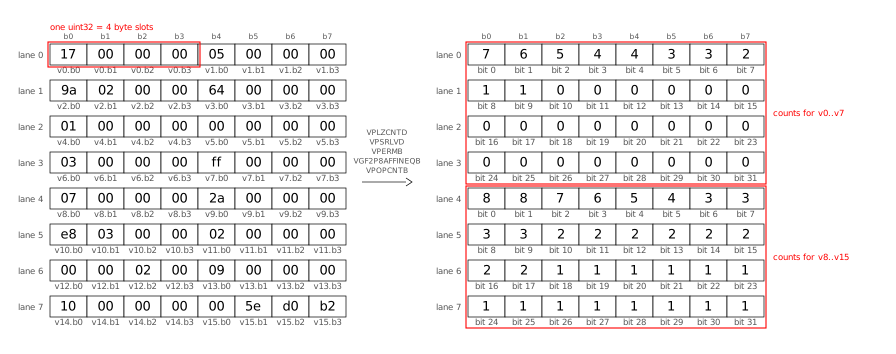
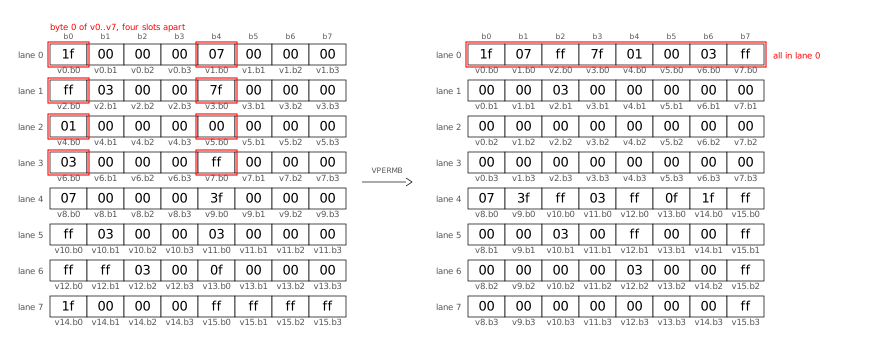
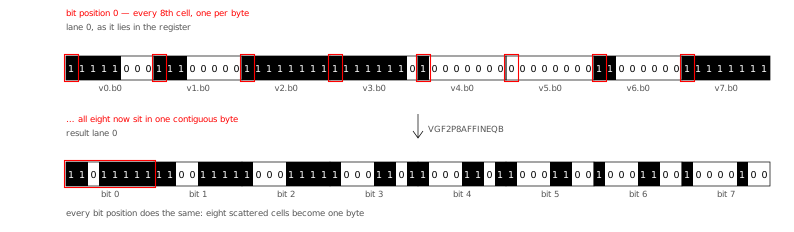
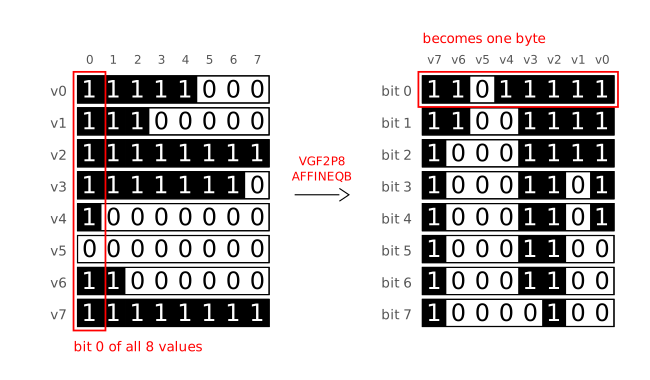
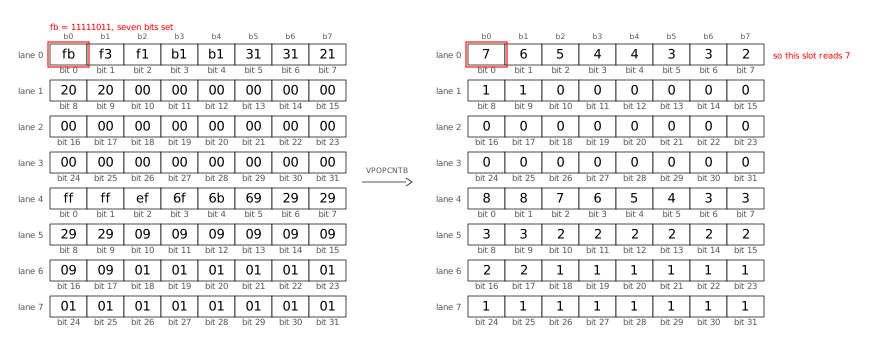
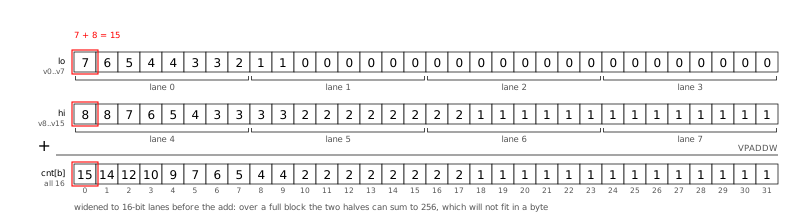

 Sharing source code from host to guest VM
Finally we need to make sure we have access in the dev-vm to our source code repositories.
For this I will share the directory
 Finally we mount the shared directory, and enable the mount on each boot.