Search Results: "ms"

10 November 2026

Louis-Philippe V ronneau: A good-looking Corsi-Rosenthal Box

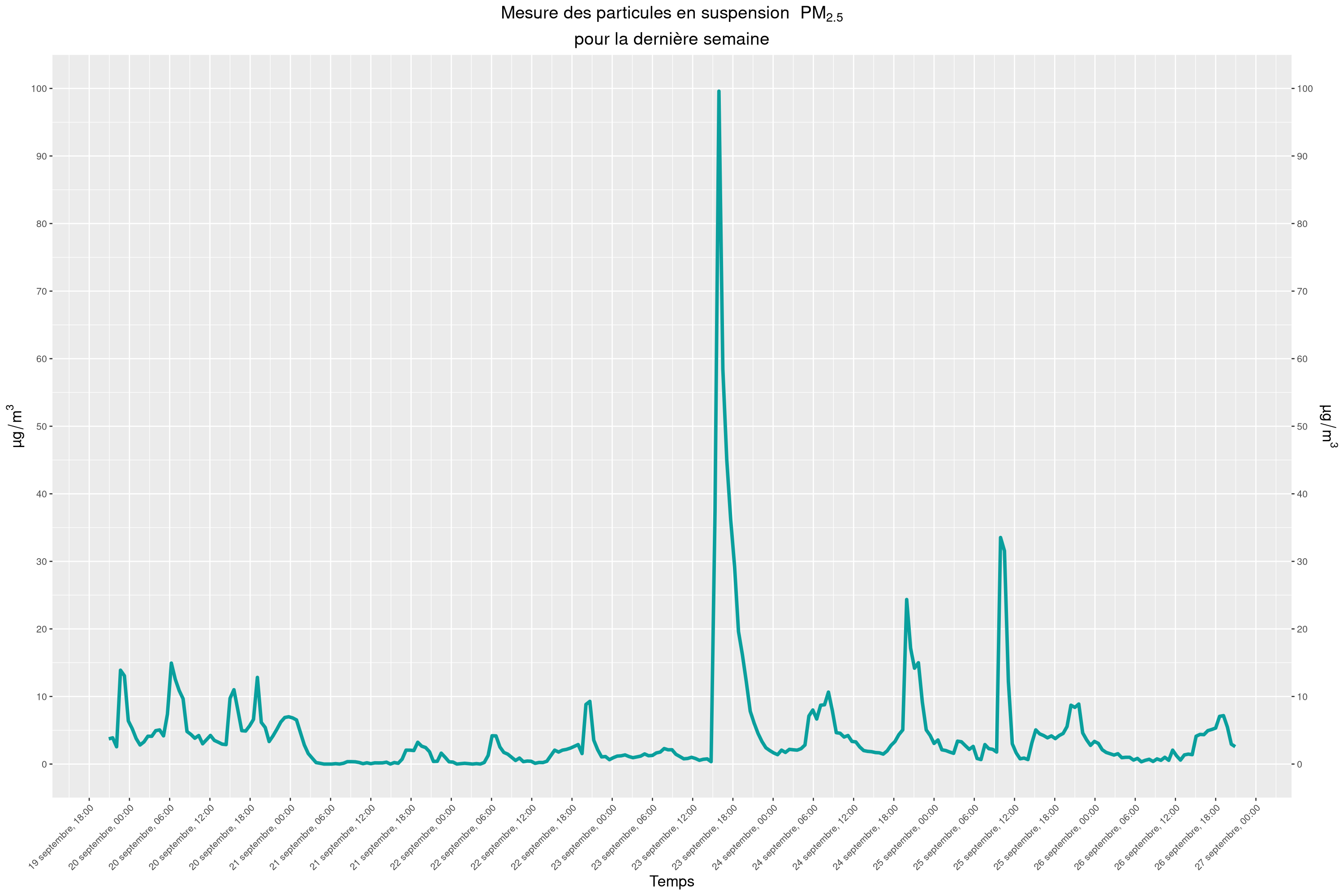
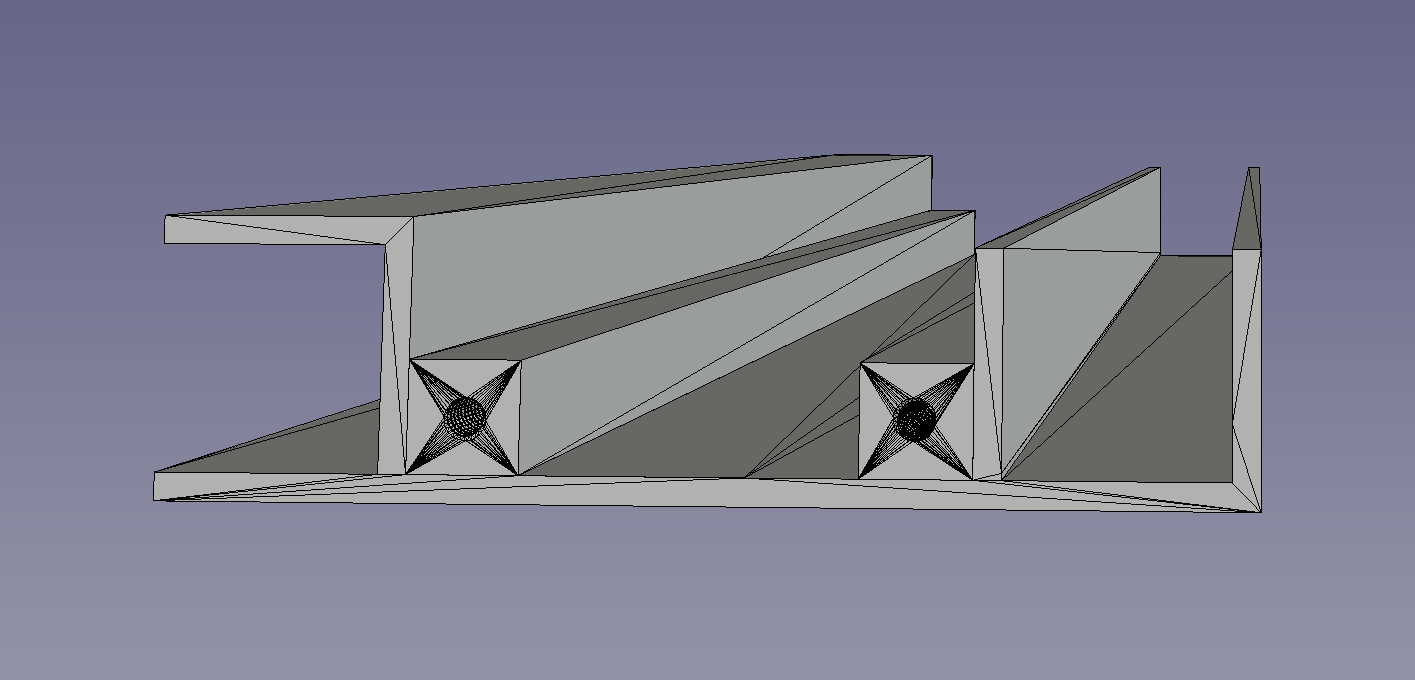
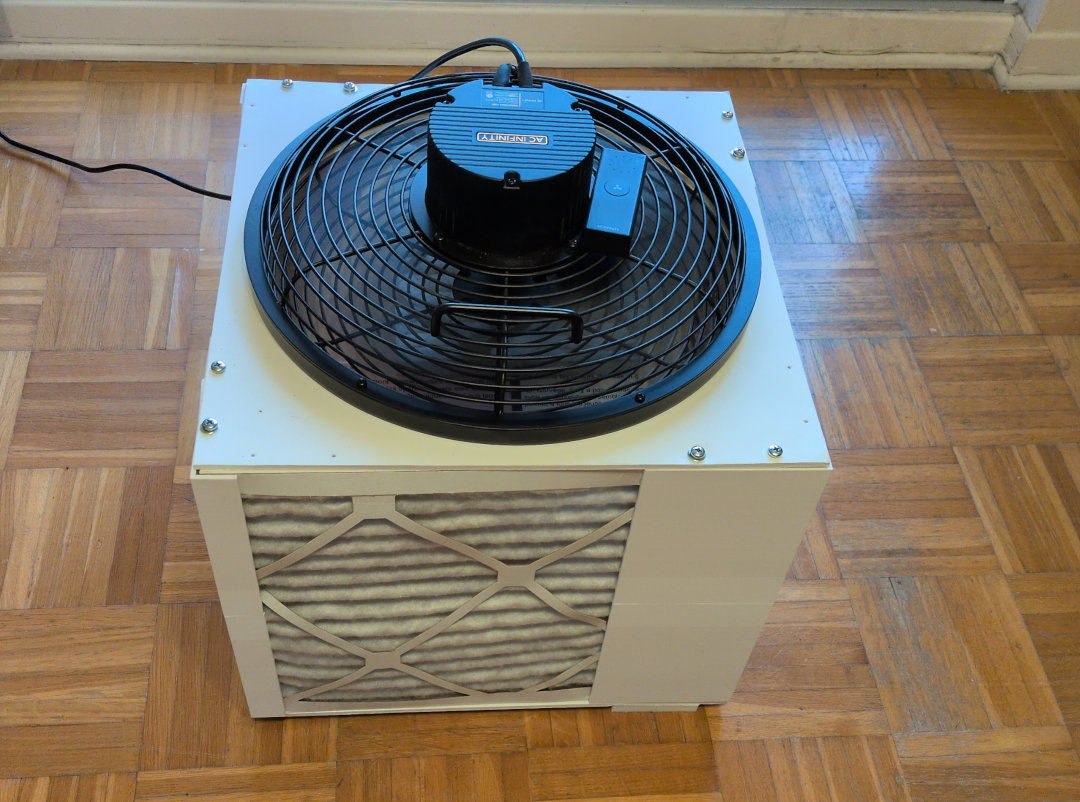
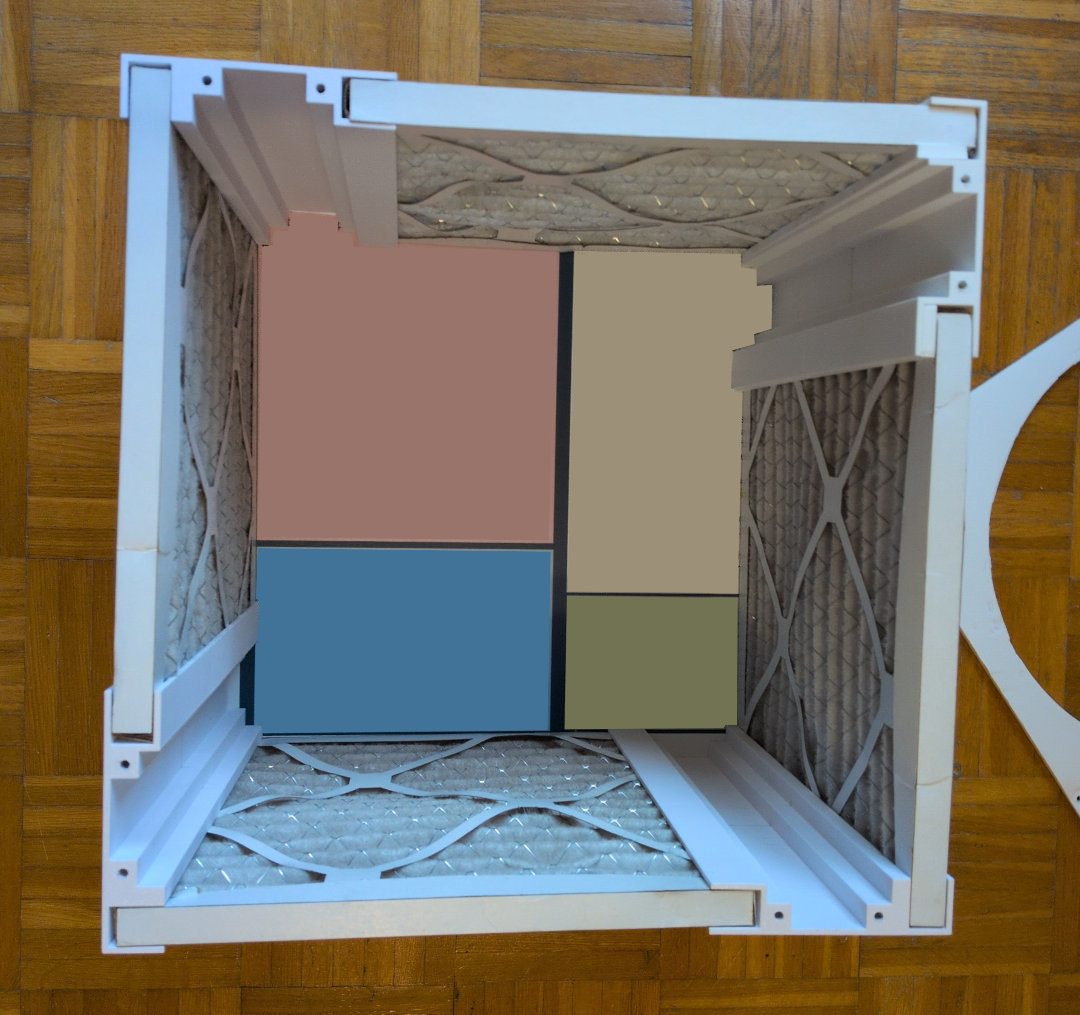
Ever since I built an AirGradient board back in 2023, I have been more and more conscientious about air quality. Pretty instantly after installing the board in my living room, I realised common habits like cooking can significantly increase the particulate levels in my entire apartment. Here is a good example of a pretty large (and long-lasting) PM2.5 spike on September 23rd after cooking a meal1: A graph showing a large PM 2.5 spike Isn't this crazy? Last time Montreal had such bad outdoor air quality, there were public broadcasts telling people not to go outside and to wear N95 face masks if we absolutely needed to. Inside my apartment though, no one ever told me cooking veggies in a little oil on medium-low2 could make the air I breathe unsafe. This of course is aggravated by the fact my apartment is pretty much as airtight as it can reasonably be, since winters here are very cold and air infiltrations are a major heat loss source. As such "opening my windows when I cook" is not a viable solution to this problem half of the year. I first tried solving this issue by tuning my HVAC system. Sadly, its controls don't offer much flexibility3, which means it is not the right tool to respond to short-lived spikes like these. Not only this, but the quality of the air outside is not always good either: Canada now has a forest fire season (we're all doomed) and my neighbors regularly smoke cigarettes right under my HVAC air intake4. A box, but nicer-looking Clearly, the solution to this particular issue was to buy an air purifier. Or at least, that's what a "normal" people would have done. Sadly, these units are expensive, use (expensive) proprietary filters, don't work very well and can be loud. One of the great inventions of the COVID-19 pandemic is the Corsi-Rosenthal box. Popularised in 2020 by Richard Corsi and Jim Rosenthal, the idea is to make a DIY air purifier by using a large fan to force air through cheap and readily available MERV13 air filters. The main downsides of regular CR boxes is they are pretty ugly, can be loud depending on the fan used and need to be rebuilt when the filters are changed (they are held using tape). That's when I stumbled on this amazing design for a silent and sleek CR box sold by The 3D Handyman. Clearly, with a bit of tinkering and a 3D printer, I could also design something sleek, silent and efficient! Since I was already using MERV13 air filters in my HVAC, I decided to design around 4 vertical "beams" where the filters would slot in. With tight enough tolerances, I figured I could get rid of the complex moving parts in The 3D Handyman's design. I also added M5 threads to screw the top and bottom panels and the TPU feet to elevate the box from the floor. One of the 'beams' on its side in FreeCAD The final result looks like this. I used some foamcore boards I had laying around at work for the top and bottom panels, but any somewhat rigid plastic panels (like coroplast) would also work: out' position" alt="The whole CR box assembled, with the fan in the 'in -> out' position"> View from the top, with the top panel removed. Disregard the bad GIMP job to remove the old text from a student's project! I ended up having to split the "beams" in two and joining them with dowels, as even the largest 3D printers I had access to couldn't print them in one piece. Costs Here's the cost breakdown for this project (shipping and taxes are included): Total: 502.19 CAD Yikes, expensive! But: All in all, I'm very happy with this project. Since finishing it, I have been able to consistently get the PM2.5 levels in my apartment down to zero and significantly reduce the time it takes to recover from a spike caused by cooking food. I certainly could have cut the cost of this project in half by choosing a cheaper fan, like the box fans used in the reference Corsi-Rosenthal instructions, but I decided to spend more for a more quiet and reliable option. 3D files Here are the STLs I used for this project. I certainly don't recommend just printing them as-is, since I am using the 12" x 12 " x "5 custom air filters from my HVAC and you should probably use something more standard. If you use these files as inspiration, your goal should be to make a box that is 16" wide, to fit the AC Infinity fan comfortably. I printed the "beams" in PETG at 100% infill and the feet in TPU 95: Future The next step in this project is to automate the fan speed based on the PM2.5 levels in my apartment. At the moment, I manage this manually and it is becoming a chore. This should be relatively easy to do with a Raspberry Pi Pico board, since AC Infinity sells a USB-C to Molex adapter for the fan.

  1. This was with my pretty good range hood running at a reasonable level. Without it, I've seen PM2.5 levels spike as much as 250 from cooking alone.
  2. To be clear, this spike was not the result of me burning the hell out of a piece of meat or something like that.
  3. The HVAC either runs in manual "low high" mode, or on a timed "20min ON 40min OFF" loop that can be tuned by fiddling with a hydrostat knob that triggers the "high" mode. This is pretty dumb and makes it so the HVAC runs even when the apartment is empty or doesn't run enough to keep CO2 levels low when multiple people are there. A future project of mine will be to hack the controls to tie them into my air quality monitoring and trigger the HVAC based on CO2 levels.
  4. I'm also working on another HVAC hack to fix this.
  5. Sold, of course, as as 1" thick filters...

John Goerzen: The Large Project Bias of CVEs

I recently discovered some vulnerabilities in C-Kermit, one dating back to 1984. I tried to do the reasonable thing: create advisories with CVEs. That turns out to be pretty difficult for a small independent project. Large projects have a way to self-assign CVE IDs. They are their own CVE Numbering Authority (CNA). There is a massive list of CNAs. Just looking at the first page of results, I see everyone from Airbus to 9front (the niche Plan 9 OS). The OpenKermit project is not a CNA. If you re a CNA, you can create and publish CVEs on your schedule. There is apparently no external review process. You can wait for months, or publish immediately. If you re not a CNA, you have to find someone that is. The general ones that are CNAs appear to be Github and MITRE. Since C-Kermit is hosted on Github, I thought I would go that route. I followed the documented procedure: created Github security advisories for C-Kermit, then clicked the request CVE button for each. The documentation states they will typically review within 72 hours. It s been a week and a half and no sign of a review yet. Apparently the real review time is more than a month. The other option for projects without a CNA is via MITRE. You have to use a strange and often broken web form, logging in with either Google or Gitlab. (It seems to be broken on Firefox). Then you submit your request and wait. How long do you wait on MITRE? It seems it could be anywhere from a day to several months. The first CVE I obtained for C-Kermit was CVE-2025-68920. At the time, I had not yet started the OpenKermit project. That issue was found and fixed in the context of my work maintaining C-Kermit for Debian, and Debian is a CNA. These were discovered while wearing my upstream C-Kermit maintainer hat. I m sure I could ask Debian for CVEs again, but that seems a bit cheating; not everyone that maintains a FLOSS project will have connections with a distro like I do. There are a lot of components of a modern OS and Internet ecosystem that are small projects without a large institution behind them. This bias towards large organizations when it comes to communicating security problems benefits nobody. It doesn t benefit users, and only serves to discourage timely communication. Not everyone is as persistent as I am, and when it is made so difficult to make announcements which seem to go into a giant black hole it s easy to say, why bother? By Microsoft s own admission, they are under-funding their CVE process on Github (which may also be poorly-designed). They blame it on increasing load due to LLMs a problem they helped create and predicted! Having a fiction about being able to communicate a security issue in a reasonable time is worse than not offering the path at all. Linux was once a student s experiment. Let s not pretend that quality only matters from large projects.

Vasudev Kamath: Experiment: Debian Cloud/VM Images using mkosi

Debian's Cloud Images for various public cloud platforms and VM environments are built using a tool called debian-cloud-images, an in-house utility developed and maintained by the Debian Cloud Team.
What? The debian-cloud-images tooling uses FAI (Fully Automatic Installation) to create custom VM images for public clouds like GCP, Azure, and AWS, along with the genericcloud class. I wanted to convert this into a fully declarative, mkosi-based image build where the entire image is described using INI-format configuration files, with only a few post-installation scripts to handle final customizations.
Why? I've been working with various image customization formats for a long time. In my previous company, I used to build customized industrial PC distributions based purely on Debian using multistrap and a bunch of shell scripts to stitch together raw image creation, bootloader installation, etc. I've also done custom installs using debootstrap on my own laptop with systemd-boot as the bootloader, but that was mostly hand-crafted and not automated. Once I came across mkosi, I was impressed by how a single utility can do everything and churn out a fully usable image without extra glue scripts for partitioning and image creation. You still need a few scripts to finalize some parts of the installation (via postinst hooks), but those are very minimal. So I decided: why not convert debian-cloud-images into mkosi's declarative format with a few architectural changes? My requirements were:
  1. Btrfs as the root filesystem: Partly because I like it, but primarily for the ability to use transparent compression (zstd:1), subvolumes, and snapshots for atomic rollbacks when things go wrong.

  2. systemd-boot and Unified Kernel Images (UKI): Primarily because systemd-boot is clean and minimal exactly what a modern bootloader should be. Combining it with UKIs and UEFI Secure Boot is bliss compared to the complexity of the GRUB2 world. Note: This intentionally drops legacy BIOS (MBR/CSM) partitioning support in favor of pure UEFI. Modern cloud platforms (AWS Nitro, Azure Gen2, GCP) support UEFI natively, and dropping BIOS allows shedding significant legacy bootloader baggage though it does make these images unsuitable for older, non-UEFI hypervisors.

Implementation Of course, the initial heavy lifting was done mostly using Antigravity (agy), along with debugging, tuning, and cleanup from my side. I pointed agy to a local copy of debian-cloud-images and laid out my requirements: preserve parity with the original packages and configurations, while enabling selective builds for each cloud via modular profiles. The resulting specification is documented here. The repository also includes a verification script that audits functional parity against official images produced by debian-cloud-images (verifying packages, APT deb822 sources, and systemd services, while accounting for the switch to Btrfs and systemd-boot). Initial verification was performed for all Trixie profiles, and the parity report is published here. I've also booted the genericcloud profile image under UEFI in a local VM to verify live bootability, bootctl status, network connectivity, and APT repository setup. This completes Phase 1 of the implementation. The remaining phases outlined in the specification include:
  1. Phase 2: Immutable Images with dm-verity: Configure Verity=hash in systemd-repart's 10-root.conf. Enable mkosi auto-signing for the verity root hash and pass the root hash into UKI kernel command lines automatically.
  2. Phase 3: Secure Boot & Signed UKIs: Integrate SecureBoot=yes with custom owner keys or ShimBootloader=signed using Microsoft Third-Party CA signed shim binaries.
  3. Phase 4: System Extensions (systemd-sysext): Decouple cloud vendor agents (AWS CLI, Azure waagent, GCP guest agent) into separate .raw system extensions. Maintain a single unified, signed base OS image across all cloud platforms.
  4. Phase 5: Btrfs Automated Rollbacks: Combine Btrfs @snapshots with systemd-boot snapshot boot entries for fail-safe OS upgrades.
Another advantage of this setup is that the same tooling can build images for physical laptops and bare-metal servers. For example, in an earlier post, I walked through live-booting with debootstrap and manually configuring systemd-boot for a custom UEFI installation. With mkosi, I can simply generate a customized image locally with UKIs ready to go, live-boot the target machine, and write the image directly to the root disk.
Conclusion This experiment is an exploration of the power of mkosi; I haven't discussed adoption with the Debian Cloud Team yet. For now, this will continue as my pet project. While I won't be hosting pre-built binary images, anyone interested is welcome to clone the repository and build the images locally. I will probably take some more time before tackling dm-verity images, as I want to understand the nuances thoroughly before experimenting with them. Until then, happy hacking! Please report any issues or suggestions on GitHub.

Utkarsh Gupta: FOSS Activities in October 2026

Here s my monthly but brief update about the activities I ve done in the FOSS world.

Debian
Whilst I didn t have much time, here are still a few things that I worked on:
  • Sponsored ubuntu-dev-tools/0.215 for Florent Skia Jacquet, so that seeded-in-ubuntu no longer crashes when distro-info-data is outdated.
  • Assisted a few folks in getting their patches submitted via Salsa.
  • Mentoring for newcomers.
  • Moderation of -project mailing list.

Ubuntu
I joined Canonical to work on Ubuntu full-time back in February 2021.
  • Released Ubuntu 26.10 (Stonking Stingray)! With my Release team hat on, I:
  • Approved the FFe for adsys 0.17.0, as it isn t seeded.
  • Sponsored libp11/0.4.12-1.1ubuntu2 for Guruprasad, an SRU to Noble which drops the workaround from the previous SRU that broke EAP-TLS Wi-Fi with TPM-backed PKCS#11 keys (LP: #2163152).
  • Proposed a fix for net-tools FTBFS in stonking - Linux 7.1 removed the amateur radio subsystem along with <linux/rose.h>, so ROSE support has to go: (MP).
  • Reviewed quite a lot of MPs and PRs - britney hints, ubuntu-cdimage, livecd-rootfs, ubuntu-seeds, ubuntu-dev-tools, a bunch of 26.10 release notes, and so on.
  • Did Archive Admin, DMB, and Release team duties as usual.

Debian (E)LTS
This month I have worked 3.50 hours on Debian Long Term Support (LTS) and on its sister Extended LTS project and did the following things:

Work in Progress
  • libpng1.6: Use-after-free of zlib input in png_read_end() after incomplete zTXt, iTXt, or iCCP decompression (CVE-2026-46675).
    • [ELTS]: The patch is ready but couldn t finish testing this month. The upstream fix that went into bookworm via DLA 4824-1 applies to all three ELTS suites as-is. Will roll out the fix in November.

Other Activities
  • [E/LTS] Monitored discussions on mailing lists, IRC, and all the documentation updates.
  • [E/LTS] Couldn t make it to the monthly LTS meeting live, but left my thoughts in the meeting notes on Beuc s proposal of offering help to the Release team with reviewing security SPUs - +1 for trying, as long as the Release team is on board with it and we don t end up doing the same work twice.

Until next time.
:wq for today.

9 November 2026

Amin Bandali: EmacsConf 2026 community panel - my comments

This is a recollection of my comments from the EmacsConf 2026 community panel recording session this past weekend, where the panellists took turns answering the proposed questions, one minute per question per panellist. In addition to the live Q&A session planned for Saturday 12 December 2026 during EmacsConf 2026, all Emacs users and community members are invited to share their thoughts on the panel questions or other questions before or after the conference. https://emacsconf.org/2026/talks/community/
1. What made you start using Emacs, and what kept you using it?
I started using Emacs during my bachelor's studies. I actually learned about Vim first and was a Vim user, but I'd always found the configuration language (VimScript) a little bit clunky. Not long after, I discovered Emacs, and really loved reading and writing Emacs Lisp, so I stuck around. In addition to reading and writing Elisp being fun and enjoyable for me, I love that Emacs has been a practical embodiment of software freedom, and I'm really fond of its surrounding culture of sharing freely. There's a lot to love and appreciate about Emacs, but as a practical personal example, I've been grateful for its excellent support for bidirectional text editing. It has empowered me to read and write in Persian, my mother tongue, with ease. (Persian has a right-to-left alphabet, like Arabic and Hebrew.)
2. What took you from using Emacs to actively contributing to the community - participating in forums, writing Elisp, organizing meetups, answering questions?
As I continued experimenting and writing bits and pieces of Elisp to scratch my own itches, I felt compelled to share them freely as a way of giving back to the community that gave me so much. For me, the community and the people that make it up are the main deal. Emacs wouldn't be where it is and what it is today without its people, so besides programming contributions, I've tried to contribute in that area as well, for instance by reviving EmacsConf with Sacha Chua back in 2019.
3. How does Emacs show up for you in real life - colleagues, meetups, friends? How did those connections form?
I don't physically have people near me who use Emacs, but I've connected with many folks in our online communities, often starting with an email or IRC message. Some of those relationships started as acquaintanceship and were developed into true friendship over time, and I'm grateful to have had those friends with me.
4. If you know other software communities, what's one thing Emacs could learn from them?
I would encourage Emacs, our community, to focus on the people. We're living in particularly difficult times, with various kinds of hardships and uncertainty in our lives. Let's strive to treat each other with kindness, empathy, and mindfulness as we continue working together. There are great examples of other free software communities whose members have banded together and are strengthening each other and their community, as well as cautionary ones where community members have been tiring and driving out their fellow members. We could learn valuable lessons from both in how to take care of our people and ourselves.
5. What's one concrete thing you wish existed in the Emacs community a year from now?
I echoed the sentiments of my fellow panellists Prot and Til about doing more of the same in terms of continuing to uphold the standards of excellence and perseverance. Also, drawing inspiration from what bashbunni said, to lower the barriers of entry for people, for example through organizing different kinds of events, and experimenting with ways to make people's lengthy, elaborate Emacs configurations more tangible and accessible to others, to share various workflows and demonstrate what's possible with Emacs. I look forward to your thoughts on these and other community-related questions. Take care, and so long for now.

Vincent Bernat: Performance evolution of route lookup on Linux

In previous articles, I explained how the Linux kernel implements IPv4 and IPv6 routing tables, and I showed the performance improvement of route lookups from Linux 2.6.32 to 4.16 for IPv4 including the impact of the Meltdown and Spectre mitigations as well as from Linux 2.6.39 to 4.18 for IPv6. This article updates the numbers through Linux 7.3 and investigates the perpetrator responsible for the performance regressions! I ran the following benchmarks on an AMD EPYC 8024P, a Zen 4c CPU, rented from Scaleway, running at 2.4 GHz with CPU boost disabled. I compiled the kernels with GCC 10.2: this version can compile older kernels as well as the current ones.

IPv6
Performance evolution of IPv6 route lookups from Linux 4.14 to 7.3
Performance evolution of IPv6 route lookups. Versions with an asterisk have SRSO mitigation disabled.
I tested four scenarios:
  • a recent full view with about 260,000 prefixes,
  • a full view from 2017 with about 40,000 prefixes,
  • a set of 40,000 /48 prefixes, such that 2 lookups out of 3 match, and
  • a set of 40,000 random /128 prefixes, such that 1 lookup out of 400 matches.
In Linux 4.15, Wei Wang improved the lookup performance by replacing the read-write lock with an RCU and a spinlock in commit 66f5d6ce53e6. In Linux 4.18, David Ahern improved the data structures used by route lookup. In Linux 5.9, Brian Vazquez removed expensive indirect calls in commit 55cced4f813b. The major 200 ns regression introduced in Linux 6.5 wiped out all these improvements. This version implements a mitigation for "Speculative Return Stack Overflow," a vulnerability affecting AMD processors, in commit fb3bd914b3ec. This mitigation adds about 20 cycles on each function return. It was backported to older kernels (5.10, 5.15, 6.1, and 6.4). To keep the results legible, I disabled the mitigation for these versions with spec_rstack_overflow=off on the kernel command-line. You can check the vulnerabilities impacting your CPU and their mitigations with lscpu. Some mitigations may depend on the microcode or on the firmware.1
$ lscpu   grep '^Vuln'
Vulnerability Gather data sampling:      Not affected
Vulnerability Indirect target selection: Not affected
Vulnerability Itlb multihit:             Not affected
Vulnerability L1tf:                      Not affected
Vulnerability Mds:                       Not affected
Vulnerability Meltdown:                  Not affected
Vulnerability Mmio stale data:           Not affected
Vulnerability Reg file data sampling:    Not affected
Vulnerability Retbleed:                  Not affected
Vulnerability Spec rstack overflow:      Mitigation; Safe RET
Vulnerability Spec store bypass:         Mitigation; Speculative Store Bypass disabled via prctl
Vulnerability Spectre v1:                Mitigation; usercopy/swapgs barriers and __user pointer sanitization
Vulnerability Spectre v2:                Mitigation; Retpolines; IBPB conditional; IBRS_FW; STIBP always-on; RSB filling; PBRSB-eIBRS Not affected; BHI Not affected
Vulnerability Srbds:                     Not affected
Vulnerability Tsa:                       Vulnerable: Clear CPU buffers attempted, no microcode
Vulnerability Tsx async abort:           Not affected
Vulnerability Vmscape:                   Mitigation; IBPB before exit to userspace

IPv4
Performance evolution of IPv4 route lookups from Linux 4.14 to 7.3
Performance evolution of IPv4 route lookups. Versions with an asterisk have SRSO mitigation disabled.
I tested three scenarios:
  • a recent full view with more than 1,000,000 prefixes,
  • a subset of a full view from 2017 with 500,000 prefixes, and
  • a set of 500,000 contiguous /32 prefixes.
The 30 ns impact of the mitigation for SRSO in Linux 6.5 is smaller than for IPv6 because IPv4 route lookups traverse fewer functions: around 4 function calls for IPv4 compared to 25 for IPv6. In Linux 5.11, I introduced a regression in commit c0c5a60f0f13 after fixing the behavior of net.ipv4.conf.all.ignore_routes_with_linkdown!2 As a result, the ip_ignore_linkdown() function spends around 5 additional cycles to return a result as it needs to follow three additional pointers. fib_lookup() eventually calls it in the following code:
if (ip_ignore_linkdown(nhc->nhc_dev) &&
    nhc->nhc_flags & RTNH_F_LINKDOWN &&
    !(fib_flags & FIB_LOOKUP_IGNORE_LINKSTATE))
    return false;
If we reorder the conditions, we avoid calling ip_ignore_linkdown() for the most common case where the link isn't down:
if (nhc->nhc_flags & RTNH_F_LINKDOWN &&
    !(fib_flags & FIB_LOOKUP_IGNORE_LINKSTATE) &&
    ip_ignore_linkdown(nhc->nhc_dev))
    return false;
Here's the distribution of lookup times before applying the patch on top of net-next:3
min=128 max=4657 count=994104 95th=134 90th=133 50th=132 mad=0
    value                                                        count
      128                                                          120
      129                                                         2232
      130                                                       25224
      131                                         264264
      132               516480
      133        126864
      134        21624
The lighter shade depicts the cumulative distribution function. After applying the patch, the median improved from 132 to 126 cycles:4
min=124 max=208839 count=994104 95th=128 90th=127 50th=126 mad=0
    value                                                        count
      124                                                          576
      125                                                      49440
      126                        584904
      127         284592
      128        45288

Impact of mitigations To reduce the impact of mitigations, you can disable all of them with mitigations=off, disable only a specific one like with spec_rstack_overflow=off, or protect against only some attack vectors with mitigations=auto,no_user_kernel, starting from Linux 6.17. The impact is also quite different depending on the CPU. For example, on a Xeon W-2295, an Intel desktop CPU from 2020, the impact of the mitigations is only a few cycles for IPv4, and less than 3% for IPv6. The main contributor is the mitigation for the Indirect Target Selection vulnerability, which is fixed since the Sapphire Rapids architecture.
If we set aside the regressions introduced by the mitigations against CPU attacks, the performance of IPv4 is declining slowly over time while IPv6 has improved in the past and is currently stable. If routing performance is important, you have several options: choose a different CPU like an AMD Zen 5 CPU, a fourth generation Xeon CPU, or maybe an ARM Neoverse V2; disable some or all the mitigations; bypass routing with XDP/eBPF;5 or offload routing to the network card.

Note Maytham Alsudany reviewed a first draft of this article. Any errors are still mine!


  1. The microcode was out of date on my machine as I forgot to install the amd64-microcode package. As it only impacts TSA, our benchmark is unaffected. Spectre v2 mitigation did not enable automatic IBRS, because of SEV-SNP being enabled in the firmware. With automatic IBRS, the impact of SRSO should be smaller.
  2. Despite ipvX in its title, the commit only changes the behavior of the IPv4 code. The IPv6 version overwrites the value of each device in addrconf_fixup_linkdown().
  3. Linux 7.5 will be the first stable release including this fix.
  4. At 2.4 GHz, one cycle is about 0.42 ns.
  5. This requires avoiding bpf_fib_lookup(), which relies on the same kernel lookup.

Thorsten Alteholz: My Debian Activities in October 2026

Debian LTS/ELTS This was my hundred-forty-eighth month that I did some work for the Debian LTS initiative, started by Raphael Hertzog at Freexian. During my allocated time I uploaded or worked on:
  • [DLA 4825-1] suricata-update security update to fix one CVE in Bookworm related to a path traversal attack. Thanks a lot to Andreas Dolp, who prepared the package.
  • [DLA 4857-1] caddy security update to fix nine CVEs in Bookworm related to the bypass of path- or host-based access controls, the execution of an unintended file by a FastCGI backend, the injection of identity headers trusted by applications running behind Caddy, unauthorised reconfiguration of the server through its admin API, or cross-site scripting.
  • [DLA 4870-1] antiword security update to fix several isssue in Bookworm related to heap out-of-bounds write in several parts of the software or integer divide by zero. Unfortunately no issue has been assigned a CVE id yet.
  • [DLA 4871-1] cyrus-sasl2 security update to fix one CVE in Bookworm related to a heap-based buffer overflow.
  • [ELA-1873-1] antiword security update to fix several isssue in Stretch, Buster and Bullseye related to heap out-of-bounds write in several parts of the software or integer divide by zero. Unfortunately no issue has been assigned a CVE id yet.
  • [ELA-1874-1] cyrus-sasl2 security update to fix one CVE in Stretch, Buster and Bullseye related to a heap-based buffer overflow.
  • [ELA-1875-1] libcaca security update to fix two CVEs in Buster related to a missing overflow check.
  • [ELA-1876-1] libcaca security update to fix one CVE in Stretch and Bullseye related to a missing overflow check.
  • [osmo-bsc] upload to unstable to fix one CVE related to a heap based buffer overflow.
Besides doing these uploads, I reviewed the libssh upload (DLA-4844-1) and helped a bit in the background of the php uploads. Last but not least I spend some time on security-master to assist others (especially the kernel team) with uploads to Bookworm and Bullseye.

Debian Printing This month I uploaded a new upstream version or a bugfix version of:
  • cups to unstable, to finally fix autopkgtest.
This work is generously funded by Freexian!

Debian Lomiri This month I uploaded a new package vendor-ubuntu-touch to be able to build packages differently in an UbuntuTouch environment. I am curious when it will leave NEW. I also tried to finish two new applications. This work has been generously funded by Fre(i)e Software GmbH!

Debian Astro This month I uploaded a new upstream version or a bugfix version of:
  • calceph to unstable (sponsored upload)
  • alfa to unstable (sponsored upload).

Debian IoT Unfortunately I had no time to work in this category this month.

Debian Mobcom This month I uploaded a new upstream version or a bugfix version of:

misc This month I uploaded a new upstream version of: Due to different reasons I started to tidy up the list of packages I maintain. Some packages have been removed, some packages lost myself as uploader and some packages have been orphaned. The number of orphaned packages is about 1100 now, so maybe you can find one to adopt.

8 November 2026

Birger Schacht: Using incus for throw away VMs

For some time now I ve been looking for a way of keeping projects I m working on in a separate VM without much setup. There are numerous solutions to do this kind of thing using namespaces (various container technologies, firejail, flatpak, bubblewrap, ) but I wanted something that uses real virtualization. I recently stumbled upon incus and it seemed like it could be a solution to my problem. Incus is a manager for both containers and virtual machines. It is possible to create VM images that can be used as templates, meaning that other machines can then be based on them on creation. Virtual machines can be configured using profiles . For my use case, I have created a profile that defines how my template image should look like. In this profile I use cloud-init to configure the template machine on startup:
config:
  cloud-init.user-data:  
    #cloud-config
    apt:
      conf:  
        APT  
          Install-Recommends 0;
         
    package_update: true
    package_upgrade: true
    package_reboot_if_required: true
    packages:
      - file
      - man-db
      - bat
      - eza
      - git
      - git-delta
      - neovim
      - zsh
      - tmux
      - curl
      - ncurses-term
      - hx
      - nix-bin
      - nix-setup-systemd
      - rustup
      - npm
      - podman
    users:
      - name: user
        lock_passwd: false
        # mkpasswd 'incus password'
        hashed_passwd: $y$j9T$p9XBP4Ox3SBUnyu.sqv5m1$f1rxcPJyVs05w./dZvIzu6.4dVWBvzu99nMBZRNlamD
        groups: sudo, nix-users
        shell: /usr/bin/zsh
        uid: 1000
    write_files:
      - path: /home/user/.config/nix/nix.conf
        content:  
          experimental-features = nix-command flakes
        permissions: 0600
      - path: /home/user/.zshrc.local
        content:  
          export PATH="$PATH:$HOME/.nix-profile/bin"
        permissions: 0600
    runcmd:
      - [curl, -sSfL, -o, /home/user/.tmux.conf, https://grml.org/console/tmux.conf]
      - [curl, -sSfL, -o, /home/user/.vimrc, https://grml.org/console/vimrc]
      - [curl, -sSfL, -o, /home/user/.zshrc, https://grml.org/console/zshrc]
      - [chown, -R, user:user, /home/user/]    
description: Base template for dev VMs
...
and I use a script to regenerate the template image when I want to adapt the config:
#!/bin/sh

#set -e
set -x

NAME=dev-vm-template

# adapt the profile before rebuilding the template image
incus profile edit cloud-dev-template
incus delete --force $ NAME    true
incus create images:debian/13/cloud --vm --quiet --profile default --profile cloud-dev-template $ NAME 
incus start $ NAME 
incus wait $ NAME  agent
incus exec $ NAME  -- cloud-init status --wait   true
incus stop $ NAME 
incus publish --alias cloud-dev-template --reuse $ NAME 
This script uses the debian/13/cloud image together with my cloud-dev-template profile to set up a machine, configure it using cloud-init and store the result as an image called cloud-dev-template.

inker To use this setup, I created a small python tool called inker that talks to the incus REST API. Using inker create creates a new VM based on my template. Using inker attach attaches the current working directory to a VM as a readonly mount. It is possible to combine those commands like inker create inker attach to do those two steps in one command. inker login logs into the VM that has the current directory attached. This way I can create VMs that are connected to directories on my filesystem. I am currently playing around with this setup, but I think this could help me to have a throwaway development machine, similar to dev containers. I m not sure yet how happy I am with incus, though. I was also looking at systemd-vmspawn, but there are still some features missing that I would need. But I might rewrite inker at some point to use a different backend.

7 November 2026

Mike Gabriel: OpenAGPS - The New Kid on the Block

There is a new project coming to Open Source Software land these days: OpenAGPS. It is not yet 100% functional, but we are working on it. It is not fully operational, yet, but we are on it. Let me introduce OpenAGPS to you... The Situation Today The domain of assisted geo location services has been left to a few big tech providers. When using GPS on mobile devices, most of us send info on our approximate device location (based on cell tower IDs seen by our devices around us) mostly to Google's SUPL service in order to facilitate a faster GNSS/GPS lock on the satellites flying above us. Without assistance, retrieving a GNSS/GPS lock on sufficient satellites includes "finding" those satellites and once found retrieving data (in bytes/sec) from them. In some regions, this leads to waiting periods of up to 45 minutes, before a mobile devices has gained a lock on sufficient satellites (3 or more). In Assisted-GNSS/GPS, "other" information (such as cell tower IDs) gets used to estimate what GNSS/GPS satellites are currently passing over one's location. With AGPS, the mobile devices retrieve information via a so-called SUPL server, containing two details: a list of potential satellites above and their dataframes. Esp. providing those dataframes over the device's internet connection (and not via the GNSS/GPS receiver downloading it from the satellite itself) speeds up the lock-on process of the mobile tremendously (several seconds to a few minutes). However, for this mechanism to work, your device will share your IMSI (although not needed for AGPS), a list of cell towers around you and their signal strengths with the provider of the SUPL service, revealing your approximate position. In total, this allows SUPL providers to re-identify each mobile device and create motion profiles of each such device (and its owner). If the SUPL service is hosted by one main provider (i.e. Google SUPL), there is a lot of valuable information available to them for free that they can commercialize. Currently, there is only one mitigation method available to hide one's location info from the SUPL server(s) at e.g. Google: using a SUPL proxy server implementation (available as OSS, provided by and used in e.g. GrapheneOS). A SUPL proxy still depends on the big tech service provider(s) for SUPL as it merely proxies SUPL requests from mobile devices through to the proprietary SUPL services, at e.g. Google, but the mobile device is being camouflaged behind the SUPL proxy in use. The OpenAGPS Teaser OpenAGPS, on the contrary, will be a fully independent implementation from proprietary service providers, and it will refrain from collecting and commercializing end users data. It will be driven by individuals of the OpenAGPS community. There will likely be one central service that the OpenAGPS project plans to host and operate (the Porygon frontend/backend, OpenAGPS's GNSS Almanach service), but except from that SUPL servers can be self-hosted by individuals, companys or other communities. The requesting mobile devices' IDs will be hidden from the Porygon server (like with existing SUPL proxy implementations), so that the only centrally operated component (the Porygon Almanach server) does not know who is requesting what geo position information (and thus cannot collect such data, neither derive info about where requesting devices are located). In addition, with a large OpenAGPS community, it is imaginable (in theory) that there will also be multiple central Almanach servers available on the internet (with parallel networks of base stations attached to each GNSS Almanach server). Checkout the OpenAGPS architecture schematics and our website/documentation to learn more. Collecting Satellite Data The OpenAGPS project is not simply a software that admins/users can install, it needs kind of a huge and global community to operate/host/house its base station network. The challenge with providing a community-driven AGPS service on the internet is that up-to-date (real-time!) GNSS/GPS satellite position data is not available for free download. Almanach data can be obtained per region from various organisations, but then their datasets are often days to weeks old, thus too outdated. GNSS/GPS satellites are not geo-stationary, they circulate around the planet. Their position is dependent on the current date-time. A globally spanning network of GNSS/GPS base stations will do the trick here. We will need a community that harvests the needed satellite data in real time and makes it available through the Porygon Almanach server to all OpenAGPS users. The OpenAGPS project will depend on at least one community member every ~40-50 km to operate a so-called OpenAGPS base station: These base stations are stationary, need to run 24/7, and they will harvest GNSS/GPS statellite data information from the satellites above in real-time and share this data with the (central) Porygon server, continuously. The Porygon server will create a timestamp-dependent "map" of all seen satellites and extrapolate locations between base stations' Almanach data updates. Help making OpenAGPS a Success: Host a Base Station To make OpenAGPS a success, we need volunteers who are willing to host (actually: house) an OpenAGPS base station at their home or work place (or both). Users will only be able to use their self-hosted OpenAGPS SUPL server with their mobile devices (instead of e.g. Google SUPL), if we manage to establish sufficient coverage with those base stations in the area of interest, so that the OpenAGPS Almanach will get populated with sufficient satellite position data. If you'd like to host/house such a base station, please get in touch and check the docs. Support this project by Co-Funding it If you realize that you have an interest in this project and would like to improve your level of digital sovereignty in your government, organization, at your home, etc. then consider sending financial support to the project. If you want to support us, please get in touch with Raoul Kramer at BetaBreak or Mike Gabriel at Fre(i)e Software GmbH. If you are a software developer and would like to contribute to OpenAGPS, also get in touch and let us meet at FOSDEM 2027. Credits A huge thanks to the NLnet Foundation for funding this project's bootstrap phase. Follow-up funding has been applied for, so please keep fingers crossed!

6 November 2026

Isoken Ibizugbe: Seeing Accessibility in Debian

Recently, I ve been noticing something on packaging around my house that I used to glance right past: raised Braille dots on a carton of medicine, and embossed markings on a container of body cream. I ve always known what Braille looked like, but I never paid close attention to it. Now that I m actively working on accessibility testing for the Debian Installer, I see it everywhere.

It made me reflect on how accessibility usually enters our consciousness. In tech, we re taught about accessibility as a best practice when designing user interfaces or web apps. But realistically, you mostly see it implemented well in massive global software, like mobile operating systems or browsers like Firefox. You rarely see accessibility features integrated into local Nigerian physical products or everyday tech. Paying attention to these details made me realize how much care goes into making sure every person is considered, and how vital that mindset really is.

Manual Testing & The openQA Bottleneck

My recent work with Debian has been focused on automating tests for the Debian Installer s accessibility features, specifically validating Braille display emulation.

I started out by manually testing following the official steps on the Debian Installer Accessibility Wiki. Once I understood the manual flow, the next goal was figuring out how to automate it inside openQA.

Initially, the idea was to initialize from the bootloader by adding parameters to the Grub (GRUB= brltty=auto )and it should start the installation with the braille visual. However, this didn t work, the parameters never initiated the brttyl and it was a huge blocker going back and forth. Getting brltty to talk to the test runner in that environment would have required sweeping changes across the main Debian openQA instance configuration.

Instead of pushing for complex system-wide changes on the instance, we started looking for easier alternative approaches and noted the complicated ones, when we advance in the test.

We brainstormed streaming the display output directly to a dedicated file to capture and verify the Braille virtual display output. Ultimately, nested virtualization proved to be the most easiest path forward.

You can check out the implementation details and changes in the Merge Request

Joining the Conversation

As part of this work, I joined the debian-accessibility mailing list to introduce what we were building and share our progress.

The responses were encouraging. I got some feedback and suggestions and the thread also created a discussion on how accessible the installation process currently feels for blind or visually impaired users, and where they also find issues. It served as a great reminder that test suites aren t just about passing CI checks, they re about serving actual people who rely on these systems every day.

Vincent Bernat: Scriptable GeoDNS: leaving AWS for Bunny

To optimize the performance metrics of this blog, I relied on Amazon CloudFront to serve the assets,1 and Route 53 for the geo-aware DNS2 to direct readers to the closest host serving the content. But Route 53 is expensive: US$0.50 per zone per month, US$0.70 per million geolocation queries, and US$0.75 per healthcheck per month, plus US$1 per month for the KMS key needed to sign zones with DNSSEC. When I discovered that Bunny DNS is almost free for up to 500 domains and features scriptable answers, I made the jump! Plus, it's a European company based in Slovenia.

Bunny CDN Bunny.net started as BunnyCDN in 2015. They added IPv6 support in 2017. Switching was uneventful. I don't bring a custom domain: I serve the content from the b-cdn.net domain. As I depend on content negotiation to serve AVIF and WebP images, I configure the CDN to cache each image format separately. I disable logging to avoid collecting personal information. While the bunny.net GDPR page promises they anonymize data, it is unclear what CloudFront keeps in its own logs when logging is disabled. The only downside of the bunny.net CDN offering is the lack of HTTP/3. I asked their support: two minutes later, they answered they are working on it but have no ETA to share.

Bunny DNS Bunny.net introduced their DNS offering in 2022 and recently reduced its cost to almost zero. They support geographical routing, but a very cool feature is the scriptable DNS: it runs a piece of user-supplied JavaScript on each query to compute the answer. I run seven small NixOS virtual machines to host this blog around the world: Paris, Nuremberg, Ashburn, Singapore, San Jose, S o Paulo, and Sydney. Bunny's scriptable DNS lets me return the IP addresses of the two nearest servers. The browser falls back to the second server if the first one is down.
const servers = [
   
    ipv4: "45.90.160.60",
    ipv6: "2a0c:8881:5:100::1",
    latitude: 48.88,
    longitude: 2.22,
   ,
  /* [ ] */
   
    ipv4: "139.180.162.114",
    ipv6: "2001:19f0:5800:1855:5400:6ff:fef0:4c0a",
    latitude: -33.87,
    longitude: 151.21,
   ,
];
const families =   A: "ipv4", AAAA: "ipv6"  ;
const records =   A: ARecord, AAAA: AaaaRecord  ;
export default function handleQuery(query)  
  const type = String(query.request.queryType).toUpperCase();
  const family = families[type];
  if (!family) return [];
  // Get user location
  const location = query.request.geoLocation;
  // Build a list of candidates
  let candidates = servers.map(
    (s) => new Server(s[family], s.latitude, s.longitude, 100),
  );
  // Select the two closest alive servers
  const selected = [];
  while (selected.length < 2)  
    const server = RoutingEngine.getClosestServer(candidates, location, true);
    selected.push(server);
    candidates = candidates.filter((s) => s.ip !== server.ip);
   
  // Return their IP addresses
  return selected.map((s) => new records[type](s.ip, 3600));
 
The above script relies on the RoutingEngine.getClosestServer() helper, which returns the closest alive3 server to the user.4 Thanks to Doggo, we can check it works as expected, at least for A:5
$ doggo --gp-from="Amsterdam" A vincent.bernat.ch
LOCATION          NAME                TYPE  TTL    ADDRESS
Amsterdam, NL
                  vincent.bernat.ch.  A     3600s  45.90.160.60
                  vincent.bernat.ch.  A     3600s  116.203.18.48
$ doggo --gp-from="Texas" A vincent.bernat.ch
LOCATION          NAME                TYPE  TTL    ADDRESS
Houston (TX), US
                  vincent.bernat.ch.  A     3600s  5.161.44.145
                  vincent.bernat.ch.  A     3600s  149.28.219.155
The most annoying drawback of this method is that a user from Buenos Aires gets both S o Paulo (1000 mi, 30 ms RTT) and Ashburn (5200 mi, 140 ms RTT). Most resolvers randomize the order, so the user may pull the web page from Ashburn. We could return only the nearest server and swap the scripted record with the built-in geographic routing instead. But if the server becomes unavailable, the browser has no alternative until the DNS cache expires. It leaves a short window of unavailability, even with a short TTL.

The HTTPS record solution The HTTPS DNS record, defined in RFC 9460, solves both the availability and the latency issues. Modern browsers query this record to get additional information to reach an HTTP server, including an alternative port and the application layer protocol HTTP/2 or HTTP/3. Each record has a priority. We can ask browsers to contact the nearest server first and fall back to the next one if the first is unavailable:
vincent    HTTPS  1 first.geo  alpn="h3,h2"
vincent    HTTPS  2 second.geo alpn="h3,h2"
vincent    HTTPS  3 .          alpn="h3,h2"
; Bunny DNS must provide the two closest servers as "first.geo"
; and "second.geo" with geographic or latency routing.
first.geo  A      45.90.160.60
first.geo  AAAA   2a0c:8881:5:100::1
second.geo A      116.203.18.48
second.geo AAAA   2a01:4f8:1c0c:5eb5::1
vincent    A      45.90.160.60
vincent    A      116.203.18.48
vincent    AAAA   2a0c:8881:5:100::1
vincent    AAAA   2a01:4f8:1c0c:5eb5::1
This looks like the ideal solution! Unfortunately, Chrome ignores any record whose target is not ., hence the last record at priority 3. Moreover, unlike with a CNAME, Bunny DNS does not return the IP addresses for first.geo and second.geo in the additional section. The resolver needs to send a first request to get the HTTPS record, and a second to resolve first.geo. HTTPS records are still too new for this use case. Back to the drawing board!

The hybrid solution As a compromise, the script returns the two nearest servers if they are at a similar distance from the user. Otherwise, it returns only the nearest one with a lower TTL of 2 minutes.
export default function handleQuery(query)  
  const location = query.request.geoLocation;
  let candidates = servers.map(
    (s) => new Server(s.ipv4, s.latitude, s.longitude, 100),
  );
  // Select the two closest servers
  const selected = [];
  while (selected.length < 2)  
    const server = RoutingEngine.getClosestServer(candidates, location, true);
    selected.push(server);
    candidates = candidates.filter((s) => s.ip !== server.ip);
   
  // Compute the distance to the user for each of them
  const [first, second] = selected.map((s) =>
    GeoDistance.calculate(s, location),
  );
  // If the second one is at twice the distance and at more than 1000 miles
  // from the first, return only the first one with a TTL of 2 minutes.
  if (second > 2 * first && second - first > 1000)  
    return [new ARecord(selected[0].ip, 120)];
   
  // Otherwise, return both with a TTL of 1 hour.
  return selected.map((s) => new ARecord(s.ip, 3600));
 
We can check it with Doggo. From Chicago, we get only the Ashburn server with a TTL of 2 minutes, while from Mexico, we get both Ashburn and San Jose.
$ doggo --gp-from="Chicago" A vincent.bernat.ch
LOCATION          NAME                TYPE  TTL    ADDRESS
Chicago (IL), US
                  vincent.bernat.ch.  A     120s   5.161.44.145
$ doggo --gp-from="Mexico" A vincent.bernat.ch
LOCATION          NAME                TYPE  TTL    ADDRESS
Queretaro, MX
                  vincent.bernat.ch.  A     3600s  5.161.44.145
                  vincent.bernat.ch.  A     3600s  149.28.219.155
$ doggo --reverse 5.161.44.145 149.28.219.155
NAME                          TYPE  TTL    ADDRESS
145.44.161.5.in-addr.arpa.    PTR   7187s  web05.luffy.cx.
155.219.28.149.in-addr.arpa.  PTR   3600s  web07.luffy.cx.

Note On the live page, the map below is interactive: point at a location to get the DNS answer, or disable servers to see how the answers change.

Map of the servers answered by Bunny DNS for each location
The complete code is a bit more complex. It works around RoutingEngine.getClosestServer() supporting only IPv4, and it handles the case where there are not enough alive servers to build an answer. Bunny.net has a comprehensive Terraform provider. I leverage CDK Terrain to build the target state in TypeScript and OpenTofu to deploy it. Have a look at "Managing infrastructure with Terraform, CDKTF, and NixOS" for more details.6

ACME DNS with Hickory DNS Route 53 covered one additional use case of mine: serving acme.luffy.cx to solve DNS-01 ACME challenges. Unlike Route 53, Bunny DNS cannot restrict access to a single zone with a fine-grained access policy. As this usage requires neither high availability nor low latency, I replaced Route 53 with Hickory, a memory-safe DNS server written in Rust. It supports automatic DNSSEC signatures and dynamic updates. Its configuration is simple:
[[zones]]
zone = "acme.luffy.cx"
zone_type = "Primary"
[zones.stores]
allow_update = true
type = "sqlite"
journal_path = "acme.luffy.cx.sqlite"
zone_path = "acme.luffy.cx.zone"
# Private key to sign the zone with DNSSEC. Generated with:
#  openssl genpkey -algorithm EC -pkeyopt ec_paramgen_curve:P-256
[[zones.keys]]
algorithm = "ECDSAP256SHA256"
key_path = "/etc/hickory-dns.acme.luffy.cx.pem"
# TSIG key to sign zone updates. Generated with:
#  openssl rand 32
[[zones.stores.tsig_keys]]
algorithm = "hmac-sha256"
key_file = "/etc/hickory-dns.acme.luffy.cx.update.acme.luffy.cx.tsig"
name = "update.acme.luffy.cx."
The provided zone file only seeds the database on first start. I delegate DNS-01 challenges to this zone with CNAME records:
_acme-challenge          CNAME bernat.ch.acme.luffy.cx.
_acme-challenge.vincent  CNAME vincent.bernat.ch.acme.luffy.cx.
Lego, the ACME client I use to get certificates from Let's Encrypt, answers the DNS-01 challenge by pushing entries with the DNS UPDATE protocol. Unfortunately, Bunny DNS cannot publish a DS record in a zone.7 I need one to secure the acme.luffy.cx zone and certificate delivery. Therefore, I host the luffy.cx zone on deSEC,8 a free DNS hosting service run by a non-profit organization based in Berlin. I derive the DS record to publish in luffy.cx from the DNSKEY record of acme.luffy.cx:
$ ZONE=acme.luffy.cx
$ dig @nsupdate.luffy.cx $ZONE DNSKEY +noall +answer \
>     dnssec-dsfromkey -a SHA-256 -f - $ZONE
acme.luffy.cx. IN DS 55628 13 2 4946E7508F20E15F1B577A231104B029A1A82E04699A80CD46ADCE31227EE81F

Overall, I am quite happy with the switch to bunny.net. There are still a few rough edges, like the inability to publish DS records, the lack of HTTP/3, and the IPv4-only RoutingEngine.getClosestServer() helper. The bill went from US$5 per month to US$1. So far, performance is on par with AWS, but I only finalized the current setup, including the server in Sydney, in late October. I need a bit more time to gather more data, and I'll post a short update.

Update (2026-11) This post was briefly discussed on Hacker News and Lobsters.


  1. I had been hosting media assets on CloudFront since 2011.
  2. Route 53 had served bernat.ch since December 2021. I didn't use healthchecks as they were too expensive. I didn't host most of my zones there either, as queries for haproxy.debian.net alone would have cost me around US$10 per month.
  3. A server is alive if it answers an ICMP ping. The bunny.net documentation gives more details about the checks.
  4. The user queries Bunny DNS through a resolver. Usually, either the resolver is close to the user, or it exposes the user's subnet through EDNS client subnet.
  5. Don't use this script as is: RoutingEngine.getClosestServer() only works with IPv4. The final script works around this limitation.
  6. The article is a bit outdated. CDK Terrain replaces CDKTF, OpenTofu replaces Terraform, and I now use Colmena instead of NixOps.
  7. I contacted bunny.net support to ask when they will support publishing a DS record and got an answer seven minutes later: they don't know. This is a bummer, as they support automatic CDS, a DNS record to advertise a DS record to the parent zone. They handle one side of the delegation, not the other. I also reported a bug with the proof of non-existence, and they replied a day later with a detailed answer.
  8. Why not use deSEC for ACME challenges? You can limit its tokens to a single RRset. I could say I prefer to self-host, but the truth is I only discovered this while writing this article.

Andrew Cater: Arm Cambridge - pre mini-Debconf days 20261105

At Arm in Cambridge for two hackathon-type days before the main mini-Debconf on Saturday and Sunday. A roomful of people, mostly very quiet this morning but with people gradually arriving and greeting each other.

Just had an excellent lunch. Arm are excelling themselves, as ever. With particular thanks to Charlie Dixon who has arranged excellent facilities for us all and to Liv for the catering provision. Other old friends here have also helped as ever.

This sort of thing is ideal for cross-fertilization of experience, ideas - the side conversations where you realise that three people are converging to a consensus of discussion from three different starting points. It's fun and intensely interesting and it's the sort of thing that keeps me running Debian - and trusting the colleagues behind it because I've seen them here.

Face and name recognition is sometimes at least as valuable as rockstar coding and the social element and shared history keeps us pulling together.

Ben Hutchings: FOSS activity in October 2026

3 November 2026

John Goerzen: Must we always use LLMs this way?

As with my last post on AI, let me open with a statement:
Just because most people hold AI a certain way, doesn t mean that we always must, either now or in the future.
As I noted in that piece, and my shades of gray post, I am well aware and agree with the notion that a lot of frontier AI models have disturbing ethical concerns that we shouldn t dismiss, including concentration of power and wealth, environmental concerns, unethical scraping and training, the financial bubble they seem to be creating, and more. The most poisonous of AI cheerleaders are accelerating enshittification while cutting quality all over the place. AI slop is also a real problem, which I ll discuss in a bit. Before I dive in, I need to mention that no AI assistance was used for writing this post, and I have been using em dashes correctly for years before LLMs did. Secondly, while popular discourse seems to use AI and LLM interchangeably, the AI field is much more broad and much more old than LLMs. I will, nonetheless, adopt the common AI jargon here, but be more specific when necessary to differentiate. In The Reverse Centaur s Guide to Life After AI by Cory Doctorow, he presented two ideas I particularly want to focus on here:
  1. The present and future of LLMs outside of the cloud-hosted frontier models
  2. What differentiates productive use of AI from slop
The two are related, in fact. Doctorow discussed how he never uses AI to write anything, but he sometimes uses it as an assistant to help him write. Is that contradictory? Not really. He gave this example: he remembered a quote from a podcast, which he wanted to cite and attribute correctly. But he couldn t remember which podcast or who said it. So he fired up Whisper, an open-weight model you can download and run locally, even on meagre hardware. Whisper is a speech-to-text model. Doctorow ran likely podcast episodes (from the target range and set of podcasts he listens to) through the model, and at that point it was a regular search. He found the quote, then went back and listened to the episode at that time spot to verify its accuracy. It would have taken so much time to do this without Whisper that he simply would not have done it otherwise. His writing was better because of AI. Not because AI wrote any words for him, but because it helped him find the right ideas and attributions. He didn t even have to trust its transcription; it pointed him at the right place, and then he could transcribe with precision. I too have used Whisper in much the same way. A little while back, I digitized many hours of old family audio recordings going back to the 1970s. Thanks to Whisper, which I ran locally primarily during hours of being fully solar-powered, I have a searchable index to these gems. A person I know recently asked me if I knew any way to transcribe some old family recordings he had. I told him I could run it through Whisper. It wouldn t have great punctuation, but most of the words would be there. This meant a lot to him and his family; what I did in 2 minutes would have taken him many days (I presume he is not a fast typist as well.) So we can start by naming: AI isn t just chatbots, and AI can help even if it isn t writing anything. Doctorow goes on to ask the question: what happens after the AI bubble bursts? I do believe it will, as Ed Zitron has carefully documented for us for a long time now. The environmental damage done by frontier training and inference in the last few years will, of course, be done. But as he points out, we ll be left with a plethora of surprisingly-capable open weight models, a community that has made significant strides running them on low-end devices (even phones), and a massive buildup of clean energy that hopefully will be finally able to offset some polluting energy once these heavy users drop off the grid. So then what? Will the world just throw away the likes of Whisper and Gemma? Obviously not. Doctorow imagines, credibly, a situation in which individuals and universities tinker with locally-run models, iterating on them and improving them with the more traditional scale of resources available to individuals and universities. In other words, this future sounds a lot like the earlier days of Open Source. As Ed Zitron has pointed out, the real costs of frontier AI have been hidden as these companies rack up fantastical losses. When the bubble bursts, the real costs of frontier AI are likely to be high enough that CEO s won t be able to ignore the poor ROI. But we ll be left with these artifacts, these open-weight starting points, that people can use. That brings me to my central thesis: a lot of anti-AI sentiment is focused on the real downsides of the hyped uses of AI, and fails to account for the more ethical advances being made now, and likely to come in the future. Varying quality of AI use We are all familiar with AI slop. I ve seen it, and have an increasingly skeptical eye when I see new projects announced in even places as niche as a BBS community (where I see things like new terminal emulators announced, written in shockingly-poor nodejs, and such). I ve seen documents that take many pages to say what amounts to nothing intelligble to a human, with perfect grammar. I ve seen pull requests that have a description that amounts to several pages of slop. I ve personally seen an AI agent do things like correctly detect passing an untrusted argument to a shell, then propose a broken quoting algorithm to fix it (rather than proper sanitization and exec() or, better yet, avoiding the call altogether.) I ve also seen AI tools very quickly and accurately identify bugs that had passed human review, even professional security reviews, for years. I ve seen them bring more joy to some people s jobs by handling the more drudgery parts of the jobs. One of my favorite podcasts, Oxide and Friends, had an episode called Engineering Rigor in the LLM age and credibly described ways in which careful use of LLMs can increase quality and safety. Yes, I said increase. (Oxide and Friends are not hype cheerleaders by any means; these are very serious people with solid technical chops, and I know some of them.) What accounts for this disconnect? We can point to many factors, but Doctorow asks a fundamental question: who is in charge? Is it the person or the computer? Does the AI service people, or do people service the AI? In some of the most ridiculously AI-first companies, it is very clearly the latter. Mandates from CEOs to increase AI usage lead to perverse outcomes that sacrifice quality. The AI is in charge. I ve never seen an AI be any good at design questions, and it s no wonder than all these vibe-coded apps have the same generic feeling of crappiness. But when the AI is used pragmatically as a junior research assistant, that s a different approach. Its output is greeted skeptically, its actions distrusted, and it s never asked to design something. These are the cases where I ve seen it make a meaningful difference. It s not black-and-white All this adds up to why I was opposed to the Debian proposals that would have banned LLM use. Those votes are hard to change. They would have left Debian in a vulnerable position of being unable to react to accurate security findings if they originated with an LLM, or left Debian unable to adopt ethical use of models. It would be akin to saying you should never buy a PC because Windows 11 is terrible. I agree Windows 11 is terrible, but saying something like that is so dismissive of all those that have invested decades of their time in building something better. So, I find AI hype to be uncredible and dangerous. I also find knee-jerk reactions to AI to be the same. They are actually a form of capitulation: they let the AI megacorps dictate the terms of the conversation to revolve around them. Case study: Debian s DFSG scanner For a long time, my two biggest annoyances with Debian have been the difficulty of packaging Rust and Go packages with their long dependency trees, and how long it takes a new package to get reviewed. About a year ago, the latter process was set on a path to reform, and it has gotten dramatically better. It also cuts off a potential connection with someone that hasn t yet heard of Linux. Some people may not jump from Windows 11 (or the ChatGPTs of the world) immediately, but pretending that it s ChatGPT or nothing does a disservice to all those that are trying to do research etchically. We should state at the outset that Debian takes compliance with the Debian Free Software Guidelines (DFSG) extremely seriously. Every new package gets a review, and these reviews often catch things that upstream repos and other distros don t. One common example would be a package that has a stated copyright and license, but then includes files that bear a different copyright and license. You can imagine reviewing packages at this level of detail isn t a fun task for people, and it s hard to find volunteers to do it. Perhaps the answer to this should be Debian should stop caring so much more than everyone else , and perhaps you re right (and perhaps you aren t). In any case, the DFSG team that reviews this added what amounts to an LLM-backed license linter. Its job is to produce an initial assessment that the license statements documented in debian/copyright are correct, thorough, and in compliance with DFSG. This report was not taken to be authoritative, but was designed to help with some initial assessments. There were some predictable reactions. People were angry that the DFSG team had added this tool without any communication about it (justifiably so, I d say). Many were angry just because of LLM. People made assumptions about what kind of model it used, what kind of quality it would produce, how definitive it would be in the project. It is worth noting here that Debian is uniquely decentralized. There is a central policy, but maintainers are free to maintain their packages how they like. They don t have to use a standard location for a Git repo, or even use Git. One person said essentially, it s fine for others to use whatever tool they want, but I shouldn t have to be exposed to LLM slop. The other perspective boiled down to, why should they keep the reports secret? If you want to proactively fix things, or flag false positives, why not? As Andreas Tille wrote, I have read the LLM reviews carefully, and in many cases their findings inspired additional commits to improve my packaging. In some cases, they even helped me catch mistakes that led me to reject an upload myself before human inspection. Joey Hess raises an interesting risk: that LLMs will remove the incentive for Debian to actually fix its cumbersome processes, by letting an LLM paper them over. I have seen this tendency in other contexts, both at work and at home, as well. It s a real risk, especially if Debian doesn t tackle the packaging problem for Rust and Go. The Mastodon post that prompted me to write this began a chain of events that started with Uploaders will be forced to address LLMs issues without human inspection. I don t believe that will be the case; it goes too far against the Debian ethos. I encourage everyone to take a deep breath. We are all getting used to a shifting landscape. We will all make missteps, myself included. The issues are complicated, the picture isn t black and white, and there is incredible hype around the ecosystem that can make finding nuance difficult. Let s be kind to each other, fellow humans. But, I do not care if you are kind to Claude.

1 November 2026

Vasudev Kamath: Releasing debvulns with needrestart and kernel vulnerability handling

After quite some time, I picked up debvulns again to implement what I mentioned in my previous post: exporting reboot required status and identifying services that need a restart. Additionally, I wanted to ensure kernel vulnerabilities are not marked as fixed unless the running kernel matches or exceeds the fixed version. Both features are now live in version 0.2.4 (intermediate release 0.2.3 only included the needrestart functionality).
Why needrestart? When you update packages on a system, security fixes do not take effect until running processes actually use the updated binaries from disk. When an upgrade occurs, existing processes continue executing the older, vulnerable code loaded into memory, while only newly spawned instances pick up the fixed binary. The needrestart package in Debian exists specifically for this purpose. It can run in either report mode or action mode: report mode provides machine-readable output, while action mode automatically restarts affected services.
Why integrate needrestart into debvulns? needrestart is a standalone utility that can run independently or hook into apt to run automatically after an upgrade. On desktop systems, it typically runs interactively with a TUI prompt; on headless servers, it can be set to take non-interactive default actions. In batch mode, it avoids restarting sensitive system components (such as dbus) to prevent destabilizing the session. Integrating this into debvulns is not about replacing needrestart or debsecan, but rather bringing vulnerability and remediation state into a single, discoverable interface. debvulns aggregates these signals into a standard format in this case, Prometheus metrics and tags that can be visualized in Grafana, monitored by alerting systems, or consumed downstream by automation tools.
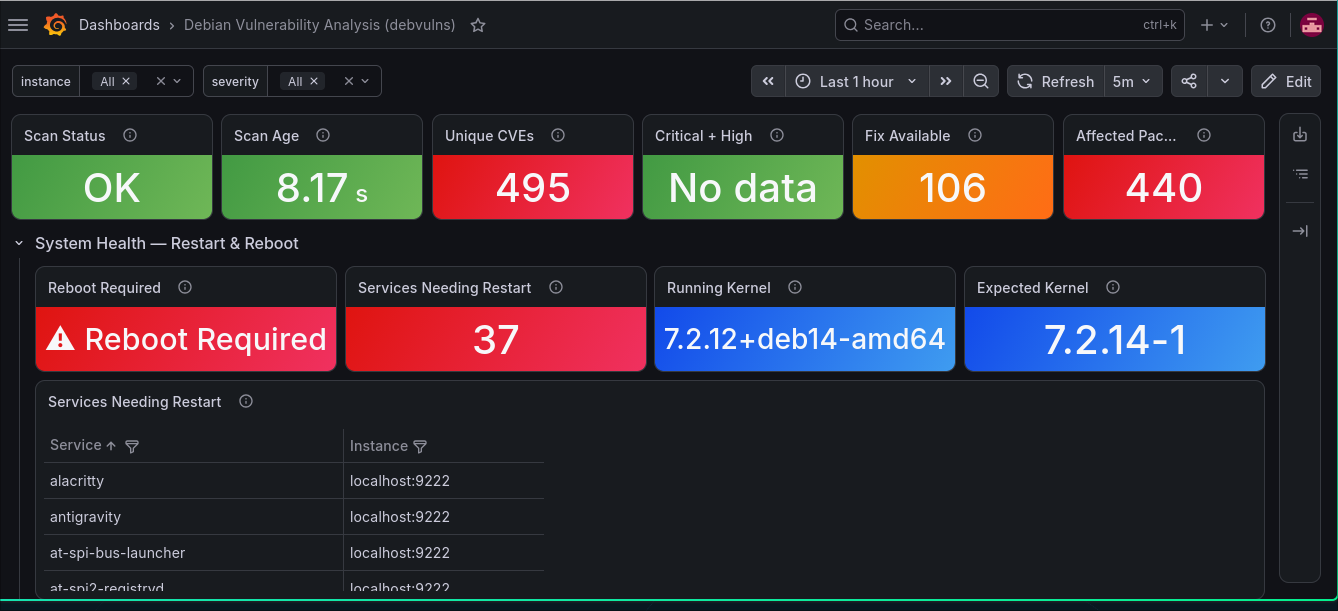
Why Special Handling for Kernel? Just as user-space daemons require a restart after patching, a patched kernel requires a system reboot into the new image before the vulnerability is truly mitigated. Previously, debvulns only verified whether the patched package version was installed on disk. If the deb package was installed, the CVE was marked as resolved, which creates a false sense of security while running the old kernel. With this release, debvulns now checks the active running kernel release. A kernel vulnerability is considered resolved only when the system is running the fixed kernel version. Until a reboot happens, the system remains reported as vulnerable. The updated dashboard reflects these changes below. It will need further polish, but key metrics and restart/reboot states are now visible: debvulns Grafana dashboard with needrestart and kernel metrics
What Next? These were the two pending functional areas I wanted to cover, and no further major features are planned for now. Next up will be reviewing the entire codebase to identify potential optimizations and remove any unnecessary complexity. I haven't done a full pass through the repository since the initial skeleton implementation, so testing edge cases and cleaning up the internals will be the main focus. This will likely take some time since I only hack on this during weekend downtime. Until then, happy hacking, give the new release a try, and file an issue if you run into bugs.

Vincent Bernat: Network lab with QEMU

To experiment with network stuff, I was using UML-based network labs. Many alternatives exist, like GNS3, Netkit, Marionnet or Cloonix. All of them are great viable solutions but I still prefer to stick to my minimal home-made solution with UML virtual machines. Here is why: The use of UML had some drawbacks: However, UML features HostFS, a filesystem providing access to any part of the host filesystem. This is the killer feature which allows me to not use any virtual disk image and to get access to my home directory right from the guest. I discovered recently that QEMU provided 9P, a similar filesystem on top of VirtIO, the paravirtualized IO framework.

Setting up the lab The setup of the lab is done with a single self-contained shell file. The layout is similar to what I have done with UML. I will only highlight here the most interesting steps.

Booting QEMU with a minimal kernel My initial goal was to experiment with Nicolas Dichtel s IPv6 ECMP patch. Therefore, I needed to configure a custom kernel. I have started from make defconfig, removed everything that was not necessary, added what I needed for my lab (mostly network stuff) and added the appropriate options for VirtIO drivers:
CONFIG_NET_9P_VIRTIO=y
CONFIG_VIRTIO_BLK=y
CONFIG_VIRTIO_NET=y
CONFIG_VIRTIO_CONSOLE=y
CONFIG_HW_RANDOM_VIRTIO=y
CONFIG_VIRTIO=y
CONFIG_VIRTIO_RING=y
CONFIG_VIRTIO_PCI=y
CONFIG_VIRTIO_BALLOON=y
CONFIG_VIRTIO_MMIO=y
No modules. Grab the complete configuration if you want to have a look. From here, you can start your kernel with the following command ($LINUX is the appropriate bzImage):
qemu-system-x86_64 \
  -m 256m \
  -display none \
  -nodefconfig -no-user-config -nodefaults \
  \
  -chardev stdio,id=charserial0,signal=off \
  -device isa-serial,chardev=charserial0,id=serial0 \
  \
  -chardev socket,id=con0,path=$TMP/vm-$name-console.pipe,server,nowait \
  -mon chardev=con0,mode=readline,default \
  \
  -kernel $LINUX \
  -append "init=/bin/sh console=ttyS0"
Since there is no disk to boot from, the kernel will panic when trying to mount the root filesystem. QEMU is configured to not display video output (-display none). A serial port is defined and uses stdio as a backend.1 The kernel is configured to use this serial port as a console (console=ttyS0). A VirtIO console could have been used instead but it seems it is not possible to make it work early in the boot process. The QEMU monitor is setup to listen on a Unix socket. It is possible to connect to it with socat UNIX:$TMP/vm-$name-console.pipe -.

Initial ramdisk

Update (2012-10) I was initially unable to mount the host filesystem as the root filesystem for the guest directly by the kernel. In a comment, Josh Triplett told me to use /dev/root as the mount tag to solve this problem. I keep using an initrd in this post but the lab on GitHub has been updated to not use one.

Here is how to build a small initial ramdisk:
# Setup initrd
setup_initrd()  
    info "Build initrd"
    DESTDIR=$TMP/initrd
    mkdir -p $DESTDIR
    # Setup busybox
    copy_exec $($WHICH busybox) /bin/busybox
    for applet in $($ DESTDIR /bin/busybox --list); do
        ln -s busybox $ DESTDIR /bin/$ applet 
    done
    # Setup init
    cp $PROGNAME $ DESTDIR /init
    cd "$ DESTDIR " && find .   \
       cpio --quiet -R 0:0 -o -H newc   \
       gzip > $TMP/initrd.gz
 
The copy_exec function is stolen from the initramfs-tools package in Debian. It will ensure that the appropriate libraries are also copied. Another solution would have been to use a static busybox. The setup script is copied as /init in the initial ramdisk. It will detect it has been invoked as such. If it were omitted, a shell would be spawned instead. Remove the cp call if you want to experiment manually. The flag -initrd allows QEMU to use this initial ramdisk.

Root filesystem Let s mount our root filesystem using 9P. This is quite easy. First QEMU needs to be configured to export the host filesystem to the guest:
qemu-system-x86_64 \
  $ PREVIOUS_ARGS  \
  -fsdev local,security_model=passthrough,id=fsdev-root,path=$ ROOT ,readonly \
  -device virtio-9p-pci,id=fs-root,fsdev=fsdev-root,mount_tag=rootshare
$ ROOT can either be / or any directory containing a complete filesystem. Mounting it from the guest is quite easy:
mkdir -p /target/ro
mount -t 9p rootshare /target/ro -o trans=virtio,version=9p2000.u
You should find a complete root filesystem inside /target/ro. I have used version=9p2000.u instead of version=9p2000.L because the latter does not allow a program to mount() a host mount point.2 Now, you have a read-only root filesystem (because you do not want to mess with your existing root filesystem and moreover, you did not run this lab as root, did you?). Let s use a union filesystem. Debian comes with AUFS while Ubuntu and OpenWRT have migrated to overlayfs. I was previously using AUFS but got errors on some specific cases. It is still not clear which one will end up in the kernel. So, let s try overlayfs. I didn t find any patchset ready to be applied on top of my kernel tree. I was working with David Miller s net-next tree. Here is how I have applied the overlayfs patch on top of it:
$ git remote add torvalds git://git.kernel.org/pub/scm/linux/kernel/git/torvalds/linux-2.6.git
$ git fetch torvalds
$ git remote add overlayfs git://git.kernel.org/pub/scm/linux/kernel/git/mszeredi/vfs.git
$ git fetch overlayfs
$ git merge-base overlayfs.v15 v3.6
4cbe5a555fa58a79b6ecbb6c531b8bab0650778d
$ git checkout -b net-next+overlayfs
$ git cherry-pick 4cbe5a555fa58a79b6ecbb6c531b8bab0650778d..overlayfs.v15
Don t forget to enable CONFIG_OVERLAYFS_FS in .config. Here is how I configured the whole root filesystem:
info "Setup overlayfs"
mkdir /target
mkdir /target/ro
mkdir /target/rw
mkdir /target/overlay
# Version 9p2000.u allows one to access /dev, /sys and mount new
# partitions over them. This is not the case for 9p2000.L.
mount -t 9p        rootshare /target/ro      -o trans=virtio,version=9p2000.u
mount -t tmpfs     tmpfs     /target/rw      -o rw
mount -t overlayfs overlayfs /target/overlay -o lowerdir=/target/ro,upperdir=/target/rw
mount -n -t proc  proc /target/overlay/proc
mount -n -t sysfs sys  /target/overlay/sys
info "Mount home directory on /root"
mount -t 9p homeshare /target/overlay/root -o trans=virtio,version=9p2000.L,access=0,rw
info "Mount lab directory on /lab"
mkdir /target/overlay/lab
mount -t 9p labshare /target/overlay/lab -o trans=virtio,version=9p2000.L,access=0,rw
info "Chroot"
export STATE=1
cp "$PROGNAME" /target/overlay
exec chroot /target/overlay "$PROGNAME"
You have to export your $ HOME and the lab directory from host:
qemu-system-x86_64 \
  $ PREVIOUS_ARGS  \
  -fsdev local,security_model=passthrough,id=fsdev-root,path=$ ROOT ,readonly \
  -device virtio-9p-pci,id=fs-root,fsdev=fsdev-root,mount_tag=rootshare \
  -fsdev local,security_model=none,id=fsdev-home,path=$ HOME  \
  -device virtio-9p-pci,id=fs-home,fsdev=fsdev-home,mount_tag=homeshare \
  -fsdev local,security_model=none,id=fsdev-lab,path=$(dirname "$PROGNAME") \
  -device virtio-9p-pci,id=fs-lab,fsdev=fsdev-lab,mount_tag=labshare

Network You know what is missing from our network lab? Network setup. For each LAN that I will need, I spawn a VDE switch:
# Setup a VDE switch
setup_switch()  
    info "Setup switch $1"
    screen -t "sw-$1" \
        start-stop-daemon --make-pidfile --pidfile "$TMP/switch-$1.pid" \
        --start --startas $($WHICH vde_switch) -- \
        --sock "$TMP/switch-$1.sock"
    screen -X select 0
 
To attach an interface to the newly created LAN, I use:
mac=$(echo $name-$net   sha1sum   \
            awk ' print "52:54:" substr($1,0,2) ":" substr($1, 2, 2) ":" substr($1, 4, 2) ":" substr($1, 6, 2) ')
qemu-system-x86_64 \
  $ PREVIOUS_ARGS  \
  -net nic,model=virtio,macaddr=$mac,vlan=$net \
  -net vde,sock=$TMP/switch-$net.sock,vlan=$net
The use of a VDE switch allows me to run the lab as a non-root user. It is possible to give Internet access to each VM, either by using the -net user flag or using slirpvde on a special switch. I prefer the latter solution since it will allow the VMs to speak to each other.

Debugging This lab was mostly done to debug both the kernel and Quagga. Each of them can be debugged remotely.

Kernel debugging While the kernel features KGDB, its own debugger, compatible with GDB, it is easier to use the remote GDB server built inside QEMU.
qemu-system-x86_64 \
  $ PREVIOUS_ARGS  \
  -gdb unix:$TMP/vm-$name-gdb.pipe,server,nowait
To connect to the remote GDB server from the host, first locate the vmlinux file at the root of the source tree and run GDB on it. The kernel has to be compiled with CONFIG_DEBUG_INFO=y to get the appropriate debugging symbols. Then, use socat with the Unix socket to attach to the remote debugger:
$ gdb vmlinux
GNU gdb (GDB) 7.4.1-debian
Reading symbols from /home/bernat/src/linux/vmlinux...done.
(gdb) target remote   socat UNIX:$TMP/vm-r1-gdb.pipe -
Remote debugging using   socat UNIX:/tmp/tmp.W36qWnrCEj/vm-r1-gdb.pipe -
native_safe_halt () at /home/bernat/src/linux/arch/x86/include/asm/irqflags.h:50
50   
(gdb)
You can now set breakpoints and resume the execution of the kernel. It is easier to debug the kernel if optimizations are not enabled. However, it is not possible to disable them globally. You can however disable them for some files. For example, to debug net/ipv6/route.c, add CFLAGS_route.o = -O0 to net/ipv6/Makefile, remove net/ipv6/route.o and type make.

Userland debugging To debug a program inside QEMU, you can just use gdb as usual. Your $HOME directory is available and it should therefore be straightforward. However, if you want to perform some remote debugging, that s quite easy. Add a new serial port to QEMU:
qemu-system-x86_64 \
  $ PREVIOUS_ARGS  \
  -chardev socket,id=charserial1,path=$TMP/vm-$name-serial.pipe,server,nowait \
  -device isa-serial,chardev=charserial1,id=serial1
Start gdbserver in the guest:
$ libtool execute gdbserver /dev/ttyS1 zebra/zebra
Process /root/code/orange/quagga/build/zebra/.libs/lt-zebra created; pid = 800
Remote debugging using /dev/ttyS1
And from the host, you can attach to the remote process:
$ libtool execute gdb zebra/zebra
GNU gdb (GDB) 7.4.1-debian
Reading symbols from /home/bernat/code/orange/quagga/build/zebra/.libs/lt-zebra...done.
(gdb) target remote   socat UNIX:/tmp/tmp.W36qWnrCEj/vm-r1-serial.pipe -
Remote debugging using   socat UNIX:/tmp/tmp.W36qWnrCEj/vm-r1-serial.pipe -
Reading symbols from /lib64/ld-linux-x86-64.so.2...(no debugging symbols found)...done.
Loaded symbols for /lib64/ld-linux-x86-64.so.2
0x00007ffff7dddaf0 in ?? () from /lib64/ld-linux-x86-64.so.2
(gdb)

Demo For a demo, have a look at the following video:

  1. stdio is configured such that signals are not enabled. QEMU will not stop when receiving SIGINT. This is important for the usage we want to have.
  2. Therefore, it is not possible to mount a fresh /proc on top of the existing one. I have searched a bit but did not find why. Any comments on this are welcome.

Birger Schacht: Status update, September + October 2026

Debian Related Work
  • Uploaded fuzzel 1.15.0+ds-1 to unstable
  • Uploaded foot 1.28.0-1 to unstable
  • Uploaded swayimg 5.6-1 and 5.7-1 to unstable
  • Uploaded wdisplays 1.3.0-1 to unstable
  • Orphaned usbguard with version 1.1.4+ds-5 and usbguard-notifier with version 0.1.0-4
The orphaning of usbguard and usbguard-notifier is because I don t use those packages anymore. I rather spend my time on FOSS projects in areas I get something out of. This is also due to a growing frustration with the Debian community. The discussions on the mailing lists in the recent months lacked any sense of social etiquette. The delusional conviction that certain tools improve the work environment for EVERYONE took on religious overtones. This is all the more troubling now that even central infrastructure is being drawn into this forced blessing. And it seems there is absolutely no awareness here of the boundary violations that are being normalized. Reminds me a bit of christian missionaries.

DH Related Work In the APIS project I finally merged the search app I wrote a couple of months ago. Based on the proof of concept for the HTMX autocomplete, I implemented an autocomplete that uses the search app for the results, therefore allowing to list search results of multiple content types. I released 0.68, 0.69, 0.70, 0.71 and 0.72 of the APIS framework. The 0.68 release changed the way we list the Django content types, leading to less database hits. In the 0.71 release I refactored the detail & edit views for generic models.

40C3 I was torn about whether I should go to this years congress, but in the end I decided to go again. I guess it will be something about the 20th time I m attending.

31 October 2026

Russell Coker: Links October 2026

Julia Curlee wrote an informative article about serving as a CIA agent in the White House as a trans woman [1]. Bruce Schneier and Kasra Rafi wrote an interesting article about AIs and mathematical research, they won t break crypto any time soon [2]. Otto wrote an interesting and informative blog post about the issues related to AI and software development with a focus on the recent Debian vote about accepting AI contributions [3]. Jared Huffman the only openly atheist congressman has some insightful commentary on the rise of Christian nationalism in the US [4]. Artem wrote an interesting blog post about trying and failing to contain a LLM agent with VMs, they think this is bad but I think it s great that more bugs are being discovered and could then be fixed [5]. I now want to try this sort of thing on replicas of my own systems! Techdirt has an insightful article about how the new Meta teen safety rules might allow murderous cops to get away with their crimes [6]. Anil Madhavapeddy wrote an interesting blog post Just a rumour of a bug is enough to find a security exploit these days , things will be difficult for the next few years if this holds at scale [7]. The Conversation has an interesting article about the current situation with nuclear weapons proliferation, not that it helps as countries with nukes get love letters from Trump and countries without get girls schools bombed [8]. Several Australian state governments have mandated free electricity between the times of 11AM and 2PM, but now electricity companies have changed their pricing to avoid this saving customers any money [9]. 404Media has an interesting article about the ways that AI agents are ruining the Internet [10]. RealtimeApocalypse has an interesting article about Effective Altruism which is one of the more covert cults that prey on people in the computer industry [11]. David Brin has a good theory to explain why it s important to allow people who have practiced bestiality to work for the FBI [12]. Cory Doctorow wrote an interesting article for Locus about the politics of AI systems and when they should be considered inherently evil [13]. Adrian wrote an insightful blog post about how DDR RAM works and why replacing RAM on an embedded board isn t a good idea [14]. Arstechnica has an interesting article about organised criminal gangs stealing truck loads of goods and having a particular interest in DC gear [15]. This is one of a series of articles published in The Guardian about the Free Birth Society, a cult-like organisation that opposes involvement of trained medical experts in the process of giving birth, they claimed resuscitation was often an unnecessary act which deprived babies of the chance to choose to begin their lives wow [16]. Cory Doctorow wrote an insightful article about so-called Intellectual Property and how it s being used to attack human rights [17]. Anthropic published an interesting article about their work on formally proving libraries with LLMs, hundreds of millions of tokens for each proof so probably thousands of dollars [18]. Bruce Schneier wrote an insightful article about how AI can provide advantages and disadvantages for dictators [19].

Ludovic Rousseau: New version of PySCard: 2.3.2

I just released a new version of pyscard. PySCard is a Python module adding smart cards support (PC/SC) to Python. The PySCard project is available from: I removed the distribution from sourceforge. Use PyPI instead. On PyPI you wil get a red alert "Incomplete provenance" for the source code file pyscard-2.3.2.tar.gz. This is because I manually uploaded it using twine (as before). The next release will be uploaded to PyPI by a github action (as is already the case for the binary wheels).
Why this new release? No code change in this release. I created a new release to ensure that the binary wheels for Python 3.14 and 3.15 were uploaded to PyPI. This is intended for systems that are difficult to use for rebuilding PySCard, particularly Windows.
Changes:
2.3.2 (October 2026)
  • add builds for Python 3.14 & 3.15
  • Minor changes

30 October 2026

Matthew Garrett: Getting Google Cast on my Soundbar

I have a Samsung Q800A soundbar. It ships with built-in support for the Apple Airplay protocol, but I m not really an Apple kind of guy so that s never been particularly helpful for me. So, instead, I have a Chromecast Audio plugged into it via TOSLINK, and that works fine - except for the fact that there s no way to explicitly pick TOSLINK as the audio input. Instead, there s a Digital In option that refers to both the optical in and eARC input from a TV. Not inherently a problem, given I m unlikely to be watching TV while listening to music, but my TV is a Samsung Frame, a device that s intended to display art whenever someone is standing nearby, and which infuriatingly generates an eARC signal even if it s only in art mode and isn t going to make any noise. This switches the soundbar away from optical and I get sad. I could plug a video cast device into the HDMI port on the soundbar and cast audio to that, but then the art would get replaced with album covers whenever I m playing music, and again that s not quite the ambience I want. Still, none of this is that important. Until I learned that the Australian version of the soundbar does have Google Cast support. The firmware image was downloadable from Samsung support, so I grabbed that, but unfortunately found that it was encrypted. However, if I downloaded the firmware image for the US model, the encrypted blob was identical - there s no difference in the underlying firmware between the two of them. So, how come one has support, and the other doesn t? I d need an unencrypted copy of the firmware to have a real chance of figuring this out, and the easiest way to get one was to just run an ebay watch for a broken model of the same series. Once I had one in my hands I used hot air to remove the eMMC storage from the device, cleaned up the chip, and then stuck it in one of these adapters to read it on a local system. Samsung uses a weird in-house filesystem called VDFS4 on some of their devices and this was one of them, so I needed to cobble together a kernel that was compatible with their source dump for this device (not all VDFS drivers seem to be able to read all VDFS filesystems), but eventually I had it all extracted, and then I got distracted by other stuff, so let s fast forward to this week. Samsung makes use of a modified version of the Android Debug Bridge called sdb, which is included in the Tizen SDK. The firmware showed that this device had sdbd on it, and it would be executed if a network device called huart0 was plugged in. Samsung does, thankfully, provide the source code for their GPLed components, so I could dig through that to discover that drivers/net/usb/usbnet.c had a bunch of references to huart (which apparently stands for HyperUART ). If CONFIG_SAMSUNG_USBNET_HYPERUART_IFNAME is set, and if the ethernet device is using either the asix or ax88179_178a drivers, and if /opt/etc/HyperUART_IP_Addr 1 isn t just 0 , it sets the interface name to huart0 and in turn triggers sdbd startup. So now I just needed to figure out how to set /opt/etc/HyperUART_IP_Addr to something else. Some digging revealed a binary called wap-factory that referenced the file, which then led to /usr/share/mobile-mgr/jsons/com.samsung.audio.waapp-verification-test.json which mentioned a SetUartOnOff call, which brought me here2, which led me into a bit of a rabbit hole about the Samsung WAM protocol. Long story short, you connect to either port 55001 or 56001 and make two requests over the same connection:
1
2
3
4
5
6
7
8
9
GET /connect HTTP/1.1
Host: 192.168.87.126:56001
User-Agent: SamsungMultiroom/1.0
Connection: interactive

GET /UIC?cmd=%3Cname%3ESetUartOnOff%3C/name%3E%3Cp%20type%3D%22str%22%20name%3D%22uartOnOff%22%20val%3D%22on%22/%3E HTTP/1.1
Host: 192.168.87.126:56001
User-Agent: SamsungMultiroom/1.0
Connection: interactive
and then plug in an asix chipset ethernet adapter into the USB port (which on mine is micro-B, so I needed an OTG adapter), and suddenly it s sitting there on 192.168.250.250 and will speak sdb to you. sdb root on switches it into root mode, and sdb shell now gives you a root shell. I was in, and now I could investigate what was happening. First up, there was a process called com.samsung.audio.google-cast-control-app running, which seemed like a good start. Unfortunately it wasn t doing anything. After some tracing I found that it was making a call to Samsung at startup time, and getting back a response telling it that Cast support wasn t available. The request (which was helpfully dumped to stdout when I ran this by hand) included the country code, in my case US . Repeating the request by hand with curl and changing the code to AU told me it was supported, so now I needed to figure out how to get the soundbar to believe it was Australian. Some digging showed it was reading this from a config variable called db/comss/countrycode, and running
1
buxton2ctl set-string system db/comss/countrycode AU
got me past that gate. Now, however, it was complaining that it couldn t provision a key. /usr/apps/com.samsung.audio.google-cast-control-app/shared/res included a bunch of encrypted blobs and an app called teeStoreKey.elf, and tracing com.samsung.audio.google-cast-control-app showed it was trying to call that, but it seemed like it was failing with a permissions issue. Running com.samsung.audio.google-cast-control-ap directly as root triggered key provisioning successfully, and a few seconds later the rest of the Cast API came up and I could talk to port 8443 with standard Cast API calls. Unfortunately it still wasn t working as a Cast device, though - it wasn t advertising itself via mDNS and so nothing could see it. Querying the /setup/eureka_info endpoint gave me a clue - the tos_accepted field was false. Normally this would be set as part of initial device setup, but the Samsung app wasn t doing that because it didn t think the device had Cast support. It turns out that POSTing some json with tos_accepted : true to setup/set_eureka_info made it work, and suddenly there was an additional Cast device available to me. (Update: I realised I didn t mention anything about why it was doing key provisioning in the first place! The Cast protocol doesn t enforce cryptographic identity as such, but Google s reference client implementation which is what almost everything uses verifies that the device is presenting an identity that chains back to Google. Unsurprisingly they don t want the private key material to be easily extractable and used to produce clone devices, so it s all supposed to be encrypted and only accessible to some sort of trusted execution environment, which is why keys here need to be loaded into Trustzone and never be visible in the clear to the main OS) Mission accomplished. Unfortunately the device vanished from my Smartthings home aferwards, presumably because there s a mismatch between its reported country code and my account country. To get around that I d somehow need to get com.samsung.audio.google-cast-control-app to either change the query without changing the global device country, or to ignore the response from Samsung (it does this every 24 hours, ugh), and that s made more annoying by the fact that this thing will only execute signed binaries. Although, weirdly, one of the signed binaries shipped is a full Python interpreter, so if I cared enough I could probably cobble together enough Python to execute arbitrary binaries. I currently don t. More modern soundbars don t implement the listener on port 55001 or 56001. I don t know how you get sdb working on them.

  1. Yes, it reads a file directly from in-kernel
  2. Good god I hate reading this kind of slop

Next.

Previous.