Raphaël Hertzog: People Behind Debian: Francesca Ciceri, Member of the Debian Press & Publicity Teams

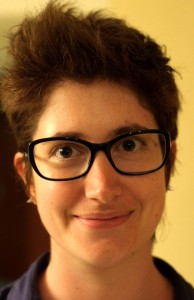
Francesca Ciceri, photo by Andrew McMillan, CC-BY-SA 2.0
 .
To my great surprise, no one treated me like an idiot for that error.Since then, I joined the WWW team and helped them apply the shiny new design provided by Kalle S derman. A lot of work was done during the week immediately before the release of the new website. Oh that was a week! We worked night and day to have the new design ready for February 6th, and it was fantastic when we finally published it, simultaneously with the release of Squeeze. At the same time, I started to contribute more actively to the Debian Publicity team, not only translating news but also writing them. It can sound scary for a non native English speaker to write something from scratch in English, but you have to keep in mind that your text will be reviewed by native speakers before being published. And we have some fantastic reviewers in the English localisation team: particularly Justin B Rye, who is tireless in his effort and more recently Moray Allan. I think I m particularly lucky to work with all these people: there s a special mood in both Publicity and WWW team, which makes you feel happy to do things and at the same time pushes you to do more just because it s fun to work with them sharing jokes, ideas, rants, patches and hugs. Rapha l: I believe that you have been trough the new member process very quickly. You re now a Non-Uploading Debian Developer. How was the experience and what does this mean to you? Francesca: Becoming a Debian Developer was not so obvious for me, because I didn t need to be a DD for the work I do in Debian. For instance, I don t maintain packages, so I had no reasons to want to become a DD in order to have uploading rights. For a while I didn t really feel the necessity of being a DD. Luckily, some people started to pester me about it, asking me to apply for the NM process. I remember Martin Zobel-Helas doing this for an entire week every single day, and Gerfried Fuchs doing it as well. Suddenly, I realized that people I worked with felt that I deserved the DD status and that I simply had thought I didn t. As a non coder and a woman, there probably was a bit of impostor syndrome involved. Having people encouraging me, gave me more confidence and the desire to finally become a DD. And so I did. The process for non uploading DD is identical to the one to become an uploading DD, with one exception: in the second part of the process (named Tasks and Skills) instead of questions about how to create and maintain packages, there are questions about the non packaging work you usually do in Debian. The general resolution which created the possibility to become a non uploading DD gave us a chance to recognize the great effort of Debian contributors who work in various area (translations, documentation, artworks, etc.) that were not always considered as important as packaging efforts. And this is great because if you are a regular contributor, if you love Debian and you are committed to the project, there are no reasons to not be an official member of it. With regards to this, I like the metaphor used by Meike Reichle in her recent talk about the Debian Women Project (video recording here):
a Debian Developer status is a lot like a citizenship in a country that you re living in. If you live in a country and you don t have citizenship, you can find a job, buy a house, have a family [...] but if this country at any point in time decides to go into a direction that you don t like, there s nothing you can do about it. You are not in the position to make any change or to make any effect on that country: you just live there, but there s no way that you can excercise influence on the people who run this country.Rapha l: You recently joined the Debian Press Team. What does it involve and how are you managing this new responsibility? Francesca: The Press Team is basically the armed wing of the Publicity Team: it handles announcements that need to be kept private until the release, moderate the debian-announce and debian-news mailing list and maintain contacts with press people from outside the project. The real job, so, is done within the Publicity Team. The most important part of our work is to write announcements and the newsletter: while the newsletter is published bi-weekly, the announcements need to be write in a shorter timeframe. Localization is really important in spreading Debian word, so we work closely with translators: both announcements and DPN are usually translated in four or five different languages. The publicity work could be stressful, as we have strict deadlines, we need to take quick decisions and often do last-minute changes. Personally, I like it: I work better under pressure. But I know that is sometimes difficult for contributors to accept that we can t debate endlessly on details, we have just to go on and do our best in a given timeframe.
The publicity work could be stressful, as we have strict deadlines, [ ]. Personally, I like it.Raphael: You re one of the main editor behind the Debian Project News. What s the role and scope of this newsletter? Francesca: Debian Project News is our beloved newsletter, direct successor of the Debian Weekly News founded by Joey Hess in 1999 and later kept alive by Martin Schulze. In 2007, Debian Weekly News was discontinued but in 2008 the project was revived by Alexander Reichle Schmehl. The idea behind DPN is to provide our users an overview of what is happening inside and outside the project. As the core team of editors is formed by three people, the main problem is to be able to collect enough news from various sources: in this sense we are always glad when someone points us to interesting blogposts, mails and articles. DPN is also a good chance for non coders to contribute to Debian: propose news, write paragraphs and review the draft before the publication are quite easy tasks but very useful. English native speakers can do a proofread (as no one of the main editors is a native speaker) while others can always translate DPN in their native language. People who want to help us can take a look at our wiki page.
DPN is also a good chance for non coders to contribute to Debian.Just yesterday I realized that since January we don t miss or delay an issue: so I d like to thank the fantastic team of editors, reviewers and translators who made it possible. The team is now working on another way of spreading Debian s message: a long-time project is finally becoming real. Stay tuned, surprise arriving! Raphael: You re trying to organize IRC training sessions but that doesn t seem to take off in Debian, while it s quite common in the Ubuntu community. How do you explain that? Francesca: I m not sure about it: both Debian users and contributors seemed to appreciate this initiative in the past. I was quite surprised by the amount of Debian members present during the various sessions and by the amount of interesting questions asked by the users. So the only reason I can think about is that I need to put more enthusiasm in convincing the teams to do it: they need more encouragement (or to be pestered more!). I, for myself, think that IRC training sessions are a great way to promote our work, to share our best practice, to talk about our project to a wider audience. And I ll sure try to organize more of them. Help, suggestions, ideas are really welcome! Raphael: If you could spend all your time on Debian, what would you work on? Francesca: There is a project I d like to give more love, but I always end up without the time to do it: the debian-community.org project. Back in 2007, Holger Levsen founded it with the aim of reducing the gap between Debian contributors and Debian users, giving all an opportunity to contribute, share ideas and more. The project was discontinued and I d really like to revive it: in these years various things have changed, but I think that the core idea of having a node to connect existing local communities is still good and doable. In Debian we don t have the wide and well articulated local infrastructure present in other distributions (Ubuntu, particularly, but also Fedora): even if I don t like too centralized structures, I think that a better connection between the project and local groups of users and on-line communities would be a step forward for the project. Being part of the Events Team, I m aware of how much we need to improve our communication with local groups. An example is the events organization: sometimes, Publicity and Events teams even don t know about regional Debian related events (like booth at conferences, workshops, talks, install parties, etc) and this is a shame because we could offer a lot of help in organizing and promoting local events. What we lack is better communication. And debian-community.org project could give us exactly this. Could be a cluster of local groups, a platform for events organization and even a useful resource for newbies who want to find a local group near them. I started some effort in this sense, sending a proposal about it, working on a census of Debian local groups. Any help is appreciated! I m really curious to see how many Debian communities (from all around the world and the web) are out there, and I d love to have members from these communities better connected with the Debian Project. Raphael: What s the biggest problem of Debian? Probably the bikeshedding feticism of almost all of us. It s the other side of the coin of Debian s commitment to technical excellence and our perfectionism, but sometimes it leads just to endless discussions about details, and it is a blocker for various initiatives. In Debian, you have to be really patient and in a way stubborn to push some changes. This is frustrating sometimes. On the other hand, I really appreciate how people take some times to think to each proposals, give some feedback and discuss about it: the process could be annoying, indeed, but the result is often an improvement of the initial proposal. Raphael: Is there someone in Debian that you admire for their contributions? Most of my teammates are simply brilliant and adorable and hard-working. But I have to admit that I particularly admire David Pr vot: beside being a webmaster he does a lot of things, from French translations to DPN editing. All his contributions have a great quality and he s able to push you always further in doing things and doing them better. He is a good example of how I d like to be as contributor: smart, tireless, friendly.
Thank you to Francesca for the time spent answering my questions. I hope you enjoyed reading her answers as I did. Note that older interviews are indexed on wiki.debian.org/PeopleBehindDebian.
Subscribe to my newsletter to get my monthly summary of the Debian/Ubuntu news and to not miss further interviews. You can also follow along on Identi.ca, Google+, Twitter and Facebook.
3 comments Liked this article? Click here. My blog is Flattr-enabled.
 This Thursday we ll be running a special IRC session, Behind the scenes with the DebConf team .
Details:
 I mentioned this briefly yesterday, but now I'll try to summarize the
story of a great surprise and a big moment for me.
 Ok, so finally it is official!
We just had the DebConf 12 decision meeting. We saw two great proposals, from the cities of
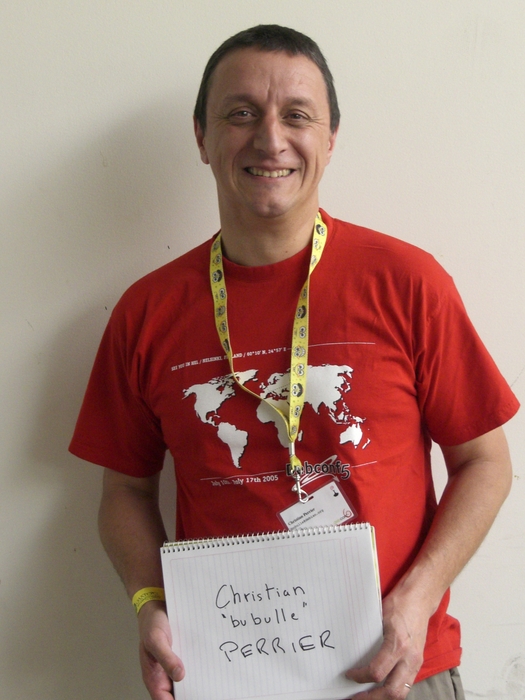
 but you ll be traveling the world while reading him.
My questions are in bold, the rest is by Christian.
Who are you?
I am a French citizen (which is easy to guess unless you correct my
usual mistakes in what follows). I m immensely proud of being married
for nearly 26 years with Elizabeth (who deserves a statue from Debian
for being so patient with my passion and my dedication to the
project).
I m also the proud father of 3 wonderful kids , aged 19 to
23.
I work as team manager in the Networks and Computers Division of Onera
the French Aerospace lab , a public research institute about
Aeronautics, Space and Defense. My team provides computer management
services for research divisions of Onera, with a specific focus put on
individual computing.
I entered the world of free software as one of the very first users of
Linux in France. Back in the early 1990 s, I happened (though the BBS
users communities) to be a friend of several early adopters of Linux
and/or BSD386/FreeBSD/NetBSD in France. More specifically, I
discovered Linux thanks with my friend Ren Cougnenc (all my free
software talks are dedicated to Ren , who passed away in 1996).
You re not a programmer, not even a packager. How did you come
to Debian?
I m definitely not a programmer and I never studied computing (I
graduated in Materials Science and worked in that area for a few years
after my PhD).
However, my daily work always involved computing (I redesigned the
creep testing laboratory and its acquisition system all by myself
during my thesis research work). An my hobbies often involved
playing with home computers, always trying to learn about something
new.
So, first learning about a new operating system then trying to
figure out how to become involved in its development was quite a
logical choice.
Debian is my distro of choice since it exists. I used Slackware on work
machines for a while, but my home server, kheops,
first ran Debian 1.1 when I stopped running a BBS on an MS-DOS machine
to host a news server. That was back in October 1996.
I then happened to be a user, and more specifically a user of
genealogy software, also participating very actively in Usenet from
this home computer and server, that was running this Debian thing.
So, progressively, I joined mailing lists and, being a passionate
person, I tried to figure out how I could bring my own little
contribution to all this.
This is why I became a packager (yes, I am one!) by taking over the
geneweb package, which I was using to publish my genealogy
research. I applied as DD in January 2001, then got my account in July
2001. My first upload to the Debian archive occurred on August 22nd
2001: that was of course geneweb, which I still maintain.
Quite quickly, I became involved in the work on French localization. I
have always been a strong supporter of localized software (I even
translated a few BBS software back in the early 90 s) as one of the
way to bring the power and richness of free software to more users.
Localization work lead me to work on the early version of Debian
Installer, during those 2003-2005 years where the development of D-I
was an incredibly motivating and challenging task, lead by Joey Hess
and his inspiring ideas.
From user to contributor to leader, I suddenly discovered, around
2004, that I became the coordinator of D-I i18n (internationalization)
without even noticing

 Moray and I decided to celebrate the Debian squeeze release in
Edinburgh, Scotland.
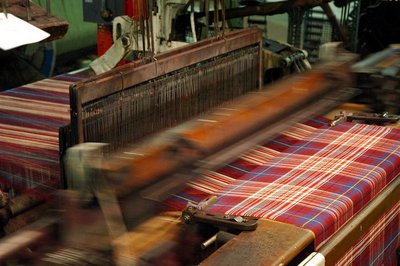
 I've asked the weavers to start
 This moment has finally arrived! Last Saturday (27-th) on #debconf-team decision was made, DebConf11 is coming to Bosnia and Herzegovina!
 Our team and myself were working on this whole candidature for last ~9 months, and even though we put incredibly amounts on energy, hard work, enthusiasm and everything else that goes along with it, suspense and uncertainty were there until the very last minute! One of our local team members (trip0d s) wife almost gave a birth to their child during the decision process that lasted full 4 hours
 As a remainder we were competing with Ecuador and Germany to win this bid, whole process was excruciating and very emotionally distressful in every possible aspect for every team member; at one point Germany took a slight lead ahead of Bosnian team, while in the end by points Bosnia was in slight lead by 0.25 points, and this is exactly what touched me the most about this whole bid/decision/process.
This is not a great advantage or anything for that matter, but what happened is that in decision process Debian debconf team and its developers picked Bosnia and Herzegovina as a place where they want to have DebConf11! Our main competitors from M nchen, Germany showed a real fair play and at the end even yielded to our side; really to both of you, Michael Banck (azeem) and Andreas Barth (aba) it was a pleasure and honor to compete with you guys!
 See you in NYC for proper handshake and possibly a hug?
 Also I d like to thank Jimmy Kaplowitz (Hydroxide), Moray Allan (moray) who had chairs and who did absolutely incredible job I guess I ll just have to thank the whole debconf orga team for all their amazing work ( can t name names individually because I ll definitely forget someone!)
This bid really reunited whole Bosnia and Herzegovina, this whole process also united all of Balkans and whole of Ex Yugoslavia, which makes me especially happy since today (March 1st) we are celebrating the day we officially separated from Yugoslavia. Now this just one small step forward, since the real work is ahead of us and we re starting it all as soon as tomorrow since there s really a lot that needs to be done.
Again thank you all, we ll give our best for this to be a DebConf you ll remember (as a great one of course!), in the meantime see you in New York City!
Adnan Hodzic aka AbsintheSyringe team leader on behalf of whole debconf11-team.
 I'd better put some details of this somewhere, so here goes.
 Thanks to Valessio Brito for coming up with it!