Search Results: "mehdi"

14 October 2015

Lunar: Reproducible builds: week 24 in Stretch cycle

What happened in the reproducible builds effort this week: Toolchain fixes Scott Kitterman fixed an issue with non-deterministic Depends generated by dh-python identified by Santiago Vila and Chris Lamb. Lunar updated the patch against dpkg which makes the order of files in control.tar.gz deterministic using the new --sort=name option available in GNU Tar 1.28. josch released sbuild version 0.66.0-1 with several fixes and improvements. The most notable one for reproducible builds is the new --build-path option and $build_path configuration variable added by akira which allows to explicitly chose a given build path. Reiner Herrmann wrote a new patch for dh-systemd to sort the list of unit files in the generated maintainer scripts. Packages fixed The following packages became reproducible due to changes in their build dependencies: aoeui, apron, camlmix, cudf, findlib, glpk-java, hawtjni, haxe, java-atk-wrapper, llvm-py, misery, mtasc, ocamldsort, optcomp, spamoracle. The following packages became reproducible after getting fixed: Some uploads fixed some reproducibility issues but not all of them: Untested Patches submitted which have not made their way to the archive yet: reproducible.debian.net ProfitBricks once again increased their support for reproducible builds in Debian and in other free software projects by adding 58 new cores and 138 GiB of RAM to the already existing setup. Two new amd64 build nodes and 16 new amd64 build jobs have been added which doubles the build capacity per day and allows us to spot many kind of problems earlier. The size of the tmpfs where builds are performed has also been increased from 70 to 200 GiB on all amd64 build nodes. Huge thanks! When examining a package, a link now points to a table listing all previous recorded tests for the same package. (Mattia) The menu on the package pages has also been improved. (h01ger) Packages in the depwait state are now rescheduled automatically after five days. (h01ger) Links to documentation and other projects being tested have been made more visible on the landing page. (h01ger) To reduce noise on the team IRC channel five different types of notifications have been turned into mail notifications. The remaining ones have been shortened and the status changes have been limited to unstable and experimental. (h01ger) Maintainer notifications about status changes in a package will only be sent out once per day, and not on each status change. (h01ger) diffoscope development Some more experiments of concurrent processing have been made. None were good and reliable enough to be shared, though. Package reviews 48 reviews have been removed, 189 added and 23 updated this week. 9 FTBFS bugs were reported by Chris Lamb. Misc. h01ger met with Levente Polyak to discuss testing Arch Linux on Debian continuous test system with an easily extensible framework. The idea is to also allow testing of other distributions, and provide a nice package based view like the one for Debian.

14 September 2015

Julien Danjou: Visualize your OpenStack cloud: Gnocchi & Grafana

We've been hard working with the Gnocchi team these last months to store your metrics, and I guess it's time to show off a bit. So far Gnocchi offers scalable metric storage and resource indexation, especially for OpenStack cloud but not only, we're generic. It's cool to store metrics, but it can be even better to have a way to visualize them! Prototyping We very soon started to build a little HTML interface. Being REST-friendly guys, we enabled it on the same endpoints that were being used to retrieve information and measures about metric, sending back text/html instead of application/json if you were requesting those pages from a Web browser. But let's face it: we are back-end developers, we suck at any kind front-end development. CSS, HTML, JavaScript? Bwah! So what we built was a starting point, hoping some magical Web developer would jump in and finish the job. Obviously it never happened. Ok, so what's out there? It turns out there are back-end agnostic solutions out there, and we decided to pick Grafana. Grafana is a complete graphing dashboard solution that can be plugged on top of any back-end. It already supports timeseries databases such as Graphite, InfluxDB and OpenTSDB. That was largely enough for that my fellow developer Mehdi Abaakouk to jump in and start writing a Gnocchi plugin for Grafana! Consequently, there is now a basic but solid and working back-end for Grafana that lies in the grafana-plugins repository.
With that plugin, you can graph anything that is stored in Gnocchi, from raw metrics to metrics tied to resources. You can use templating, but no annotation yet. The back-end supports Gnocchi with or without Keystone involved, and any type of authentication (basic auth or Keystone token). So yes, it even works if you're not running Gnocchi with the rest of OpenStack.
It also supports advanced queries, so you can search for resources based on some criterion and graphs their metrics. I want to try it! If you want to deploy it, all you need to do is to install Grafana and its plugins, and create a new datasource pointing to Gnocchi. It is that simple. There's some CORS middleware configuration involved if you're planning on using Keystone authentication, but it's pretty straightforward just set the cors.allowed_origin option to the URL of your Grafana dashboard. We added support of Grafana directly in Gnocchi devstack plugin. If you're running DevStack you can follow the instructions which are basically adding the line enable_service gnocchi-grafana. Moving to Grafana core Mehdi just opened a pull request a few days ago to merge the plugin into Grafana core. It's actually one of the most unit-tested plugin in Grafana so far, so it should be on a good path to be merged in the future and have support of Gnocchi directly into Grafana without any plugin involved.

16 August 2015

Lunar: Reproducible builds: week 16 in Stretch cycle

What happened in the reproducible builds effort this week: Toolchain fixes Valentin Lorentz sent a patch for ispell to initialize memory structures before dumping their content. In our experimental repository, qt4-x11 has been rebased on the latest version (Dhole), as was doxygen (akira). Packages fixed The following packages became reproducible due to changes in their build dependencies: backup-manager, cheese, coinor-csdp, coinor-dylp, ebook-speaker, freefem, indent, libjbcrypt-java, qtquick1-opensource-src, ruby-coffee-script, ruby-distribution, schroot, twittering-mode. The following packages became reproducible after getting fixed: Some uploads fixed some reproducibility issues but not all of them: Patches submitted which have not made their way to the archive yet: akira found another embedded code copy of texi2html in maxima. reproducible.debian.net Work on testing several architectures has continued. (Mattia/h01ger) Package reviews 29 reviews have been removed, 187 added and 34 updated this week. 172 new FTBFS reports were filled, 137 solely by Chris West (Faux). josch spent time investigating the issue with fonts in PDF files. Chris Lamb documented the issue affecting documentation generated by ocamldoc. Misc. Lunar presented a general Reproducible builds HOWTO talk at the Chaos Communication Camp 2015 in Germany on August 13th. Recordings are already available, as well as slides and script. h01ger and Lunar also used CCCamp15 as an opportunity to have discussions with members of several different projects about reproducible builds. Good news should be coming soon.

15 August 2015

Simon Kainz: DUCK challenge: week 6

Well, here are the stats for week 6 of the DUCK challenge: So we had 9 packages fixed and uploaded by 7 different uploaders. A big "Thank You" to you!! Since the start of this challenge, a total of 68 packages, were fixed. Here is a quick overview:
Week 1 Week 2 Week 3 Week 4 Week 5 Week 6 Week 7
# Packages 10 15 10 14 10 9 -
Total 10 25 35 49 59 68 -
The list of the fixed and updated packages is availabe here. I will try to update this ~daily. If I missed one of your uploads, please drop me a line. So, assuming that the current rate of packages fixed will be somewhat stable and there will be no additional regessions, the number of packages with issues should be down to 0 in about 209 weeks (~ 4 years ) I just arrived at DebConf15 in Heidelberg, and will try to find all of you who fixed & uploaded packages. If you are one of the guys and see me lingering around, please talk to me and get your lighter! The DUCK Challenge will run until the end of DebConf15, but as there might be some delay by my scripts detecting your upload, please contact my directly. Pevious articles are here: Week 1, Week 2, Week 3, Week 4, Week 5.

26 July 2015

Lunar: Reproducible builds: week 12 in Stretch cycle

What happened in the reproducible builds effort this week: Toolchain fixes Eric Dorlan uploaded automake-1.15/1:1.15-2 which makes the output of mdate-sh deterministic. Original patch by Reiner Herrmann. Kenneth J. Pronovici uploaded epydoc/3.0.1+dfsg-8 which now honors SOURCE_DATE_EPOCH. Original patch by Reiner Herrmann. Chris Lamb submitted a patch to dh-python to make the order of the generated maintainer scripts deterministic. Chris also offered a fix for a source of non-determinism in dpkg-shlibdeps when packages have alternative dependencies. Dhole provided a patch to add support for SOURCE_DATE_EPOCH to gettext. Packages fixed The following 78 packages became reproducible in our setup due to changes in their build dependencies: chemical-mime-data, clojure-contrib, cobertura-maven-plugin, cpm, davical, debian-security-support, dfc, diction, dvdwizard, galternatives, gentlyweb-utils, gifticlib, gmtkbabel, gnuplot-mode, gplanarity, gpodder, gtg-trace, gyoto, highlight.js, htp, ibus-table, impressive, jags, jansi-native, jnr-constants, jthread, jwm, khronos-api, latex-coffee-stains, latex-make, latex2rtf, latexdiff, libcrcutil, libdc0, libdc1394-22, libidn2-0, libint, libjava-jdbc-clojure, libkryo-java, libphone-ui-shr, libpicocontainer-java, libraw1394, librostlab-blast, librostlab, libshevek, libstxxl, libtools-logging-clojure, libtools-macro-clojure, litl, londonlaw, ltsp, macsyfinder, mapnik, maven-compiler-plugin, mc, microdc2, miniupnpd, monajat, navit, pdmenu, pirl, plm, scikit-learn, snp-sites, sra-sdk, sunpinyin, tilda, vdr-plugin-dvd, vdr-plugin-epgsearch, vdr-plugin-remote, vdr-plugin-spider, vdr-plugin-streamdev, vdr-plugin-sudoku, vdr-plugin-xineliboutput, veromix, voxbo, xaos, xbae. The following packages became reproducible after getting fixed: Some uploads fixed some reproducibility issues but not all of them: Patches submitted which have not made their way to the archive yet: reproducible.debian.net The statistics on the main page of reproducible.debian.net are now updated every five minutes. A random unreviewed package is suggested in the look at a package form on every build. (h01ger) A new package set based new on the Core Internet Infrastructure census has been added. (h01ger) Testing of FreeBSD has started, though no results yet. More details have been posted to the freebsd-hackers mailing list. The build is run on a new virtual machine running FreeBSD 10.1 with 3 cores and 6 GB of RAM, also sponsored by Profitbricks. strip-nondeterminism development Andrew Ayer released version 0.009 of strip-nondeterminism. The new version will strip locales from Javadoc, include the name of files causing errors, and ignore unhandled (but rare) zip64 archives. debbindiff development Lunar continued its major refactoring to enhance code reuse and pave the way to fuzzy-matching and parallel processing. Most file comparators have now been converted to the new class hierarchy. In order to support for archive formats, work has started on packaging Python bindings for libarchive. While getting support for more archive formats with a common interface is very nice, libarchive is a stream oriented library and might have bad performance with how debbindiff currently works. Time will tell if better solutions need to be found. Documentation update Lunar started a Reproducible builds HOWTO intended to explain the different aspects of making software build reproducibly to the different audiences that might have to get involved like software authors, producers of binary packages, and distributors. Package reviews 17 obsolete reviews have been removed, 212 added and 46 updated this week. 15 new bugs for packages failing to build from sources have been reported by Chris West (Faux), and Mattia Rizzolo. Presentations Lunar presented Debian efforts and some recipes on making software build reproducibly at Libre Software Meeting 2015. Slides and a video recording are available. Misc. h01ger, dkg, and Lunar attended a Core Infrastructure Initiative meeting. The progress and tools mode for the Debian efforts were shown. Several discussions also helped getting a better understanding of the needs of other free software projects regarding reproducible builds. The idea of a global append only log, similar to the logs used for Certificate Transparency, came up on multiple occasions. Using such append only logs for keeping records of sources and build results has gotten the name Binary Transparency Logs . They would at least help identifying a compromised software signing key. Whether the benefits in using such logs justify the costs need more research.

18 April 2015

Neil McGovern: Taking office

Yesterday, my first term started as the Debian Project Leader. There s been a large number of emails congratulating me, and thanks to everyone who sent those. I d also like to thank Mehdi Dogguy and Gergely Nagy for running, and of course Lucas Nussbaum for his service over the past two years. Lucas also did a great handover, and so (I hope!) I m aware of most of the issues that are ongoing. As started previously, I ll keep my daily log of activities in /srv/leader/news/ on master.debian.org.

13 April 2015

Mehdi Dogguy: DPL campaign 2015

This year's DPL campaign is over and voting period is also almost over. Many did not vote yet and they really should consider doing so. This is meant as a reminder for them. If you didn't have time to dig into debian-vote's archives and read questions/answers, here is the list with links to candidates' replies:
Compared to past years, we had a comparable number of questions. All questions did not start big threads as it used to be the case sometimes in the past :-) The good side of this is that we are trolling DPL candidates less than we used to do :-P

Now, if you still didn't vote, it is really time to do so. The voting period ends on Tuesday, April 14th, 23:59:59 UTC, 2015. You have only a few hours left!

22 March 2015

Mehdi Dogguy: Running for DPL

Every year, Debian organizes a DPL election. Around end of March, one waits for the beginning of the DPL campaign. Everyone can ask questions to nominated candidates on debian-vote. This year, and for the first time, I nominated myself as a candidate for the 2015 DPL election. You can read my platform here.

Over the past few years, I've followed DPL campaigns on debian-vote reading questions and replies from candidates. It didn't seem easy to keep up with flood of questions and find the right wording while replying. Intuitively, you may think that a question is the first mail of every thread and replies follow... but, not at all :-) Questions can be asked in any mail. So candidates have to read every single mail posted to the list :-) The campaign ends within a week (or so) and it is still time to ask more questions.

Following discussions on debian-vote is a very good opportunity for newcomers to understand, for example, how Debian works and where help is needed. It is also a good place to see what are the main current issues (as perceived by contributors) and read a list of proposals to fix them. I invite anyone interested in Debian in reading debian-vote's archives.

While preparing my platform, I've also realized how much writing down thoughts and ideas was important. It really helps to put things into perspective and re-evaluate priorities. It may sound obvious but I think we are not used to do this often. I really recommend everyone to do this as an exercise, and for any perimeter (personal, team, project-wide, ...).

Last but not least, I'd like to thank all those who helped me to polish my platform and to prepare my candidacy. I am sure they will recognize themselves :-) (whatever the outcome of the election may be)

14 March 2015

Bits from Debian: apt install dpl-candidate: Mehdi Dogguy

0. Who are you and what is your history with Debian Project? I guess this part is well covered in my platform. 1. What is your most proud moment as Debian Developer? I am pretty proud of having been part of the few who implemented the first automatic dependency resolver for OCaml programs and libraries in Debian packages. It was really the first one in the OCaml community and we were quite proud of it. But that was done before I become a Debian Developer. As a DD, I have to admit I am quite proud to be part of the Release Team. It is a fantastic team where there is so much to do. Helping the team means something to me, and I invested a considerable amount of time (a few months) working on reviewing patches for Squeeze and helping to get it ready by our standards. My best moment was Squeeze's release, my first Debian release as Release Team member. 2. In your opinion what is the strongest part of Debian Project? I am not sure we can identify one single strength of the Debian project. But, when I think about your question, I remember something I've heard many times: Debian is about people . I have to admit that I didn't realize it myself until I heard it for the first time and I completely share the idea! For me, all the technical side of the project comes after the community. With time, I think we managed to build a strong community. Many contributors became friends with time. We are seeing many Developers having babies and bringing them to Debian events. I find that really amazing. 3. And what is the weakest part of Debian Project? Our strength is somehow also our weakness. We are humans and make mistakes. We have feelings and some discussions get heated sometimes. It is not easy to keep everyone calm and focused. We have seen the damage that was caused to our core community last year with all the flamewars. Many people lost their motivation and we have seen some of them stepping down. We are also having troubles on-boarding new contributors, which is a problem today because some teams are under-staffed and could become an even bigger issue on the longer term. 4. How do you intend to resolve the weakest part? An effort has already been made on this front. We can mention the introduction of the Code of Conduct and the diversity statement, for example. Both are important and make us a more welcoming and caring community. In my platform, I mentioned some ideas about recruitment and change management. I believe that both sides will help us to get a stronger community. Moreover, a DPL should act as a mediator to help some situation get through. This is one of the DPL tasks that is not formally identified and is usually under-estimated. 5. DPL term lasts for one year - what would you challenge during that term and what have you learned from previous DPL's? Personally, the main thing I have learned from past DPLs is that communication is very important. A DPL should dedicate time to communicate about ongoing actions and achievements. It is also important to remind a few things even if it may sound repetitive or trivial: If the communication is only about listing some actions, many people will miss its essence and its goals. It is even more important when we know that some actions may take years (thus, several DPL terms) to complete. If I am elected as DPL, I'd really like to help the project to publish a roadmap. I think it is very important to set goals to the project to better explain our philosophy and approach in the Free Software world. This may also help to attract new contributors which may be interested by one or some items. Of course, I will not work on that subject only. I invite you to read the rest of my platform to see the other ideas. 6. What motivates you to work in Debian and run for DPL? Many many things. And more importantly, many many people As many of us, I like programming and socializing. It feels nice to be part of such a big project and where you can do many different things. I contribute to Debian because I find it fun and let me meet people I will not have been able to meet elsewhere. In my platform, I tried to identify ideas I'd like to see implemented, or at least started. Since Debian is a do-ocracy, I thought I could try to get them implemented by myself. I think that those ideas are important for the Debian community and will help us moving forward. Running for DPL is also another way of contributing to Debian and I'd feel honored to represent Debian.

12 March 2015

Bits from Debian: Debian Project Leader elections 2015

It's that time of year again for the Debian Project: the elections of its Project Leader! Starting on April 1st, and during the following two weeks, the Debian Developers will vote to choose the person who will guide the project for one year. The results will be published on April 15th and the term for new the project leader will start on April 17th, 2015. Lucas Nussbaum who has held the office for the last two years won't be seeking reelection this year and Debian Developers will have to choose between three candidates: Gergely Nagy and Neil McGovern previously ran for DPL in past years; it's the first run for Mehdi Dogguy. The campaigning period started today and will last until March 31st. The candidates are expected to engage in debates and discussions on the debian-vote mailing list where they'll reply to questions from users and contributors.

4 December 2014

Tomasz Buchert: BSP in Munich

My first plan was to participate in the Bug Squashing Party (BSP) in Paris, but finally I didn t manage to organize the travel and proper stay in the capital of France. Finally I settled on Munich and below you will find a summary of my stay there. While organizing my trip, the Munich natives offered me a couch to surf during the stay, which was very kind. In the end, however, I stayed at my friend s place - thanks a lot Mehdi! The BSP gathered Debian people interested in preparing Jessie release, but also KDE, Kolab and LibreOffice people. The host for the meeting was LiMux (on of the most known large-scale Linux deployments) which provided a venue, but also food (free!) and other attractions. Organizers, if you read this, I thank you for the amazing work that you have done. I arrived on late Friday s evening and so I didn t participate that day in bug squashing and took a good sleep instead. On Saturday and Sunday we were, well, squashing bugs. I haven t done NMUs before and it was a new experience to me, even though theoretically I know how it works. The DDs present at the BSP were more than helpful to help me when I was stuck. Here is a short description of what I have done: I also got my GPG keys signed and vice-versa, so I m much better connected to the web of trust now (7 signatures of DDs so far). All in all, it was a great experience which I recommend to everyone. The atmosphere is very motivating and there are many people who will gladly help you if you don t know or understand something. You don t have to be DD to participate even, but a minimal packaging experience is definitely very useful. I m quite sure that people would be glad to help even a complete newcomer (I certainly would do), but being able to build a package using apt-get source and debuild won t hurt anybody. At the very least you can always triage bugs: reproduce them, find the cause of the bug, propose a way to fix it, etc. As always you should be open-minded and willing to get your hands dirty. I want also thank Debian for sponsoring me which finally convinced me to participate (Munich is around 500 km from where I live and the travel is fairly expensive). Some links of interest: Many bugs still wait to be squashed (120 at the time of writing this), so let s get back to work!

30 May 2014

Julien Danjou: OpenStack Design Summit Juno, from a Ceilometer point of view

Last week was the OpenStack Design Summit in Atlanta, GA where we, developers, discussed and designed the new OpenStack release (Juno) coming up. I've been there mainly to discuss Ceilometer upcoming developments. The summit has been great. It was my third OpenStack design summit, and the first one not being a PTL, meaning it was a largely more relaxed summit for me! On Monday, we started by a 2.5 hours meeting with Ceilometer core developers and contributors about the Gnocchi experimental project that I've started a few weeks ago. It was a great and productive afternoon, and allowed me to introduce and cover this topic extensively, something that would not have been possible in the allocated session we had later in the week. Ceilometer had his design sessions running mainly during Wednesday. We noted a lot of things and commented during the sessions in our Etherpads instances. Here is a short summary of the sessions I've attended. Scaling the central agent I was in charge of the first session, and introduced the work that was done so far in the scaling of the central agent. Six months ago, during the Havana summit, I proposed to scale the central agent by distributing the tasks among several node, using a library to handle the group membership aspect of it. That led to the creation of the tooz library that we worked on at eNovance during the last 6 months. Now that we have this foundation available, Cyril Roelandt started to replace the Ceilometer alarming job repartition code by Taskflow and Tooz. Starting with the central agent is simpler and will be a first proof of concept to be used by the central agent then. We plan to get this merged for Juno. For the central agent, the same work needs to be done, but since it's a bit more complicated, it will be done after the alarming evaluators are converted. Test strategy The next session discussed the test strategy and how we could improve Ceilometer unit and functional testing. There is a lot in this area to be done, and this is going to be one of the main focus of the team in the upcoming weeks. Having Tempest tests run was a goal for Havana, and even if we made a lot of progress, we're still no there yet. Complex queries and per-user/project data collection This session, led by Ildik V ncsa, was about adding finer-grained configuration into the pipeline configuration to allow per-user and per-project data retrieval. This was not really controversial, though how to implement this exactly is still to be discussed, but the idea was well received. The other part of the session was about adding more in the complex queries feature provided by the v2 API. Rethinking Ceilometer as a Time-Series-as-a-Service This was my main session, the reason we met on Monday for a few hours, and one of the most promising session I hope of the week. It appears that the way Ceilometer designed its API and storage backends a long time ago is now a problem to scale the data storage. Also, the events API we introduced in the last release partially overlaps some of the functionality provided by the samples API that causes us scaling troubles. Therefore, I've started to rethink the Ceilometer API by building it as a time series read/write service, letting the audit part of our previous sample API to the event subsystem. After a few researches and experiments, I've designed a new project called Gnocchi, which provides exactly that functionality in a hopefully scalable way. Gnocchi is split in two parts: a time series API and its driver, and a resource indexing API with its own driver. Having two distinct driver sets allows it to use different technologies to store each data type in the best storage engine possible. The canonical driver for time series handling is based on Pandas and Swift. The canonical resource indexer driver is based on SQLAlchemy. The idea and project was well received and looked pretty exciting to most people. Our hope is to design a version 3 of the Ceilometer API around Gnocchi at some point during the Juno cycle, and have it ready as some sort of preview for the final release. Revisiting the Ceilometer data model This session led by Alexei Kornienko, kind of echoed the previous session, as it clearly also tried to address the Ceilometer scalability issue, but in a different way. Anyway, the SQL driver limitations have been discussed and Mehdi Abaakouk implemented some of the suggestions during the week, so we should very soon see more performances in Ceilometer with the current default storage driver. Ceilometer devops session We organized this session to get feedbacks from the devops community about deploying Ceilometer. It was very interesting, and the list of things we could improve is long, and I think will help us to drive our future efforts. SNMP inspectors This session, led by Lianhao Lu, discussed various details of the future of SNMP support in Ceilometer. Alarm and logs improvements This mixed session, led by Nejc Saje and Gordon Chung, was about possible improvements on the alarm evaluation system provided by Ceilometer, and making logging in Ceilometer more effective. Both half-sessions were interesting and led to several ideas on how to improve both systems. Conclusion Considering the current QA problems with Ceilometer, Eoghan Glynn, the new Project Technical Leader for Ceilometer, clearly indicated that this will be the main focus of the release cycle. Personally, I will be focused on working on Gnocchi, and will likely be joined by others in the next weeks. Our idea is to develop a complete solution with a high velocity in the next weeks, and then works on its integration with Ceilometer itself.

7 May 2014

Mario Lang: Planet bug: empty alt tags for hackergotchis

There is a strange bug in Planet Debian I am seeing since I joined. It is rather minor, but since it is an accessibility bug, I'd like to mention it here. I have written to the Planet Debian maintainers, and was told to figure it out myself. This is a pattern, accessibility is considered wishlist, apparently. And the affected people are supposed to fix it on their own. It is better if I don't say anything more about that attitude.
The Bug On Planet Debian, only some people have an alt tag for their hackergotchi, while all the configured entries look similar. There is no obvious difference in the configuration, but still, only some users here have a proper alt tag for their hackergotchi. Here is a list:
  • Dirk Eddelbuettel
  • Steve Kemp
  • Wouter Verhelst
  • Mehdi (noreply@blogger.com)
  • Andrew Pollock
  • DebConf Organizers
  • Francois Marier
  • The MirOS Project (tg@mirbsd.org)
  • Paul Tagliamonte
  • Lisandro Dami n Nicanor P rez Meyer (noreply@blogger.com)
  • Joey Hess
  • Chris Lamb
  • Mirco Bauer
  • Christine Spang
  • Guido G nther
These people/organisations currently displayed on Planet Debian have a proper alt tag for their hackergotchi. All the other members have none. In Lynx, it looks like the following:
hackergotchi for
And for those where it works, it looks like:
hackergotchi for Dirk Eddelbuettel
Strange, isn't it? If you have any idea why this might be happening, let me know, or even better, tell Planet Debian maintainers how to fix it. P.S.: Package planet-venus says it is a rewrite of Planet, and Planet can be found in Debian as well. I don't see it in unstable, maybe I am blind? Or has it been removed recently? If so, the package description of planet-venus is wrong.

4 May 2014

Mehdi Dogguy: Clickable DepWaits and Edos results in pgstatus

A long time ago, St phane Glondu implemented an alternative to the Buildd status pages. It was implemented in OCaml and had some unique features. I think that my favorite one was the ability to click on package names appearing in DepWaits.

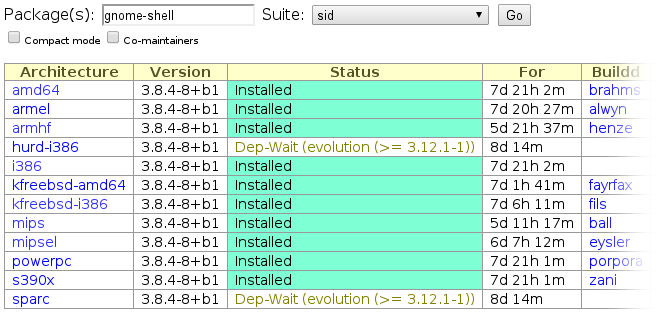
What you see on the image below is a simple example where the package gnome-shell Dep-Waits on a single package. This prevents buildd daemons to start the job as long as the specific version of the specified package or some new package are available. So, each package name in that field became now clickable and points to its buildd status page.


Similarly to Dep-Waits, results of edos-debcheck, which is used to spot installability issues of build dependencies, are now clickable too.

If you are a porter or if you are tracking down a build issue, I am sure you'll appreciate these two new features. Enjoy! As usual, if you notice some bugs or have some feature requests, please let me know.

17 October 2013

Thomas Goirand: OpenStack Havana 2013.2 Debian packages available

OpenStack upstream was released today. Thanks to the release team and a big up to TTX for his work. By the time you read this, probably all of my uploads have reached your local Debian mirror. Please try Havana using either Sid from any Debian mirror, or using the Wheezy backports available here: deb http://havana.pkgs.enovance.com/debian havana main
deb http://archive.gplhost.com/debian havana-backports main Yes, you will need *both* repositories. This is unofficial, though these are the exact same packages as in Sid, just rebuilt for Wheezy. On the package side, here s what is new: - All packages who needs it can now be configured through debconf for the RabbitMQ settings. This is on top of what was already available for Grizzly, which is automated configuration for: keystone auth token, the database, the API endpoints and much more. (remember: this is fully optional, you can always use the non-interactive mode ) - All Quantum pluggin packages have been removed, and now everything is self-contained in the neutron-common package. The selection of which plugin to use is done directly using the core_plugin= directive in /etc/neutron/neutron.conf. This will also control the init.d script of neutron-server, so that it loads the corresponding ini file in /etc/neutron/plugins. The plugin selection is done through Debconf, so that users don t have to write the full path of the plugin class, which is (for most) very cryptic (am I the only one who thinks that writing neutron.plugins.openvswitch.ovs_neutron_plugin.OVSNeutronPluginV2 in a configuration file is user friendly?). - All of the package descriptions and Debconf templates have been reviewed by the Debian internationalization team, and most strings are translated in Czech, Danish, French, Italian, Japanese and Russian (sometimes even more) for almost all packages (thanks everyone!). I d like to publicly thanks eNovance for sponsoring my packaging work, and Mehdi Abaakouk for his work on our CI with the tempest tests. Happy Havana release testing,
Please report bugs through the Debian BTS.

8 October 2013

Thomas Goirand: OpenStack 2013.2~rc1, aka Havana, fully available in Debian Experimental

Announcement After a very long work, over the course of 4 months, I have finished packaging the first RC1 of OpenStack. This comes on time, just 9 days before the official Havana release. Please do try this RC1 before the official 2013.2, code name Havana, is released, and hopefully uploaded to Debian. All of the packages are available from Debian Experimental, keeping Grizzly in Sid. However, there is also some private repositories that I maintain, holding Wheezy backports: deb http://havana.pkgs.enovance.com/debian havana main deb http://archive.gplhost.com/debian havana-backports main The first repository holds the packages maintained within the Alioth group. These are built directly from my Jenkins machine, on each git push. The 2nd repository is holding backports from Sid to Wheezy for the packages that I don t actively maintain (though a lot of them are in the Python module team, in which I do a lot of packaging and updates as well). A few numbers A few numbers about this now. I had to work on 145 source packages: at least backport them to Wheezy, and push them in the GPLHost archive repository above. This generates 360 binary packages. Out of these, I maintain 77 source packages within the Alioth OpenStack group, generating 209 .deb files. That s a lot of stuff to deal with (and I feel sometimes a bit dizzy about it). While OpenStack is a big jigsaw puzzle to solve for the users, it is even more for someone who has to deal with all the (sometimes buried in the the code) Python dependencies. I hope others will come and join me in this packaging effort, since over the time, there s more and more work to be done, as the project grows. Note that most of the work is unfortunately done on packaging (and updating) the Python dependencies, working on the packages themselves is done last, at the end of the cycle. Other things not packaged (yet) Before the release (and the forthcoming Hongkong summit on the 5th of November), I hope to be able to finish packaging TripleO. TripleO is in fact OpenStack on OpenStack, which works with nova-baremetal. I have no idea how to test or install this, though it sounds like a lot of fun. There are 6 source packages that need to be done. Also, pending on the FTP masters NEW queue, is Trove: Database as a Service. I hope this one can get through soon. There is, also, Marconi, which is an incubated project for a new message queuing service, which probably will replace RabbitMQ (I m not sure yet what it does, and I will be happy to hear about it at the summit). Lastly, there s Ironic, which will at some point, replace nova-baremetal. That is, it does cloud computing over bare metal, without virtualization. All of these new projects are still in an incubation stage, and are not part of the official release yet. Though, I have learned over the course of this past year, that with OpenStack, it s never early enough to start the packaging work. Thanks to my sponsor! Please note that all of this wouldn t be possible without eNovance sponsoring my packaging work. A big up to all of them for supporting and loving Debian! You guys rox. Also a special thanks to Mehdi / Sileth, for his work testing everything with the Tempest functional tests and the CI platform.

27 July 2013

Julien Danjou: OpenStack Ceilometer Havana-2 milestone released

Last week, the second milestone of the Havana developement branch of Ceilometer has been released and is now available for testing and download. This means the first half of the OpenStack Havana development has passed! New features Ten blueprints have been implemented as you can see on the release page. I'm going to talk through some of them here, that are the most interesting for users.
The Ceilometer API now returns all the samples sorted by timestamp. This blueprint is the first one implemented by Terri Yu, our OPW intern! In the same spirit, I've added the ability to limit the number of samples returned. On the alarming front, things evolved a lot. I've implemented the notifier system that will be used to run actions when alarms are triggered. To trigger these alarms, Eoghan Glynn (RedHat) worked on the alarm evaluation system that will use the Ceilometer API to check for alarm states. I've reworked the publisher system so it now uses URL formatted target for publication. That now allows to publish different meters to different target using the same publishing protocol (e.g. via UDP toward different hosts). Sandy Walsh (RackSpace) have been working on the StackTach like functionality and added the ability for the collector to optionally store the notification events received. Finally, Mehdi Abaakouk (eNovance) implemented a TTL system for the database, so you're now able to expire your data whenever you like. Bug fixes Thirty-five bugs were fixed, though most of them might not interest you so I won't elaborate too much on that. Go read the list if you are curious. Toward Havana 3 We now have 30 blueprints targeting the Ceilometer's third Havana milestone, with some of them are already started.I'll try to make sure we'll get there without too much trouble for the 6th September 2013. Stay tuned!

31 May 2013

Julien Danjou: OpenStack Ceilometer Havana-1 milestone released

Yesterday, the first milestone of the Havana developement branch of Ceilometer has been released and is now available for testing and download. This means the first quarter of the OpenStack Havana development has passed! New features Ten blueprints have been implemented as you can see on the release page. I'm going to talk through some of them here, that are the most interesting for users. Ceilometer can now counts the scheduling attempt of instances done by nova-scheduler. This can be useful to eventually bill such information or for audit (implemented by me for eNovance).
People using the HBase backend can now do requests filtering on any of the counter fields, something we call metadata queries, and which was missing for this backend driver. Thanks to Shengjie Min (Dell) for the implementation. Counters can now be sent over UDP instead of the Oslo RPC mechanism (AMQP based by default). This allows counter transmission to be done in a much faster way, though less reliable. The primary use case being not audit or billing, but the alarming features that we are working on (implemented by me for eNovance).
The initial alarm API has been designed and implemented, thanks to Mehdi Abaakouk (eNovance) and Angus Salkled (RedHat) who tackled this. We're now able to do CRUD actions on these. Posting of meters via the HTTP API is now possible. This is now another conduct that can be used to publish and collector meter. Thanks to Angus Salkled (RedHat) for implementing this. I've been working on an somewhat experimental notifier driver for Oslo notification that publishes Ceilometer counters instead of the standard notification, using the Ceilometer pipeline setup. Sandy Walsh (Rackspace) has put in place the base needed to store raw notifications (events), with the final goal of bringing more functionnalities around these into Ceilometer. Obviously, all of this blueprint and bugfixes wouldn't be implemented or fixed without the harden eyes of our entire team, reviewing code and advising restlessly the developers. Thanks to them! Bug fixes Thirty-one bugs were fixed, though most of them might not interest you so I won't elaborate too much on that. Go read the list if you are curious. Toward Havana 2 We now have 21 blueprints targetting the Ceilometer's second Havana milestone, with some of them are already started. I'll try to make sure we'll get there without too much trouble for the 18th July 2013. Stay tuned!

5 May 2013

Mehdi Dogguy: Wheezy is out!


Wheezy is finally out! Thanks to everyone who contributed to this release!

[Image from: http://devopsreactions.tumblr.com/post/49640679398/debian-wheezy-released]

26 April 2013

Francesca Ciceri: And the winner is...

I totally forgot it, but as the DPL elections are now done, we have a winner for the #DPL game. Of the (more or less) fifteen persons who participated to the game (thank you!), only four received points for having at least one of their Fantastic Four running for DPL: As Lucas is now the new DPL, our one and only winner of the DPL game is... ... Mehdi Dogguy! Congrats!

Next.

Previous.