Search Results: "matthew"

27 August 2025

Matthew Palmer: StrongBox: Simple, Safe Data Encryption for Rust

Some time ago, I wanted to encrypt a bunch of data in an application I was writing in Rust, mostly to be stored in a database, but also session cookies and sensitive configuration variables. Since Rust is widely known as a secure-yet-high-performance programming language, I was expecting that there would be a widely-used crate that gave me a secure, high-level interface to strong, safe cryptography. Imagine my surprise when I discovered that just didn t seem to exist. Don t get me wrong: Rust is replete with fast, secure, battle-tested cryptographic primitives. The RustCrypto group provides all manner of robust, widely-used crates for all manner of cryptography-related purposes. They re the essential building blocks for practical cryptosystems, but using them directly in an application is somewhat akin to building a car from individual atoms of iron and carbon. So I wrote my own high-level data encryption library, called it StrongBox, and have been happily encrypting and decrypting data ever since.

Cryptography So Simple Even I Can t Get It Wrong The core of StrongBox is the StrongBox trait, which has only two methods: encrypt and decrypt, each of which takes just two arguments. The first argument is the plaintext (for encrypt) or the ciphertext (for decrypt) to work on. The second argument is the encryption context, for use as Authenticated Additional Data, an important part of many uses of encryption. There s essentially no configuration or parameters to get wrong. You can t choose the encryption algorithm, or block cipher mode, and you don t have to worry about generating a secure nonce. You create a StrongBox with a key, and then you call encrypt and decrypt. That s it.

Practical Cryptographic Affordances Ok, ok that s not quite it. Because StrongBox is even easier to use than what I ve described, thanks to the companion crate, StructBox. When I started using StrongBox in the wild , it quickly became clear that what I almost always wanted to encrypt in my application wasn t some ethereal plaintext . I wanted to encrypt things, specifically structs (and enums). So, through the magic of Rust derive macros, I built StructBox, which provides encrypt and decrypt operations on any Serde-able type. Given that using Serde encoders can be a bit fiddly to use, it s virtually easier to get an encrypted, serialized struct than it is to get a plaintext serialized struct.

Key Problems in Cryptography The thing about cryptography is that it largely turns all data security problems into key management problems. All the fancy cryptographic wonkery is for naught if you don t manage the encryption keys well. So, most of the fancy business in StrongBox isn t the encryption and decryption, but instead solving problems around key management.

Different Keys for Different Purposes Using the same key for all of your cryptographic needs is generally considered a really bad idea. It opens up all manner of risks, that are easily avoided if you use different keys for different things. However, having to maintain a big pile of different keys is a nightmare, so nobody s going to do that. Enter: key derivation. Create one safe, secure root key, and then use a key derivation function to spawn as many other keys as you need. Different keys for each database column, another one to encrypt cookies, and so on. StrongBox supports this through the StemStrongBox type. You ll typically start off by creating a StemStrongBox with the root key, and then derive whatever other StrongBoxes you need, for encrypting and decrypting different kinds of data.

You Spin Me Round Sometimes, keys need to be rotated. Whether that s because you actually know (or even have reason to suspect) someone has gotten the key, or just because you re being appropriately paranoid, sometimes key rotation has to happen. As someone who has had to rotate keys in situations where such an eventuality was not planned for, I can say with some degree of authority: it absolutely sucks to have to do an emergency key rotation in a system that isn t built to make that easy. That s why StrongBox natively supports key rotation. Every StrongBox takes one encryption key, and an arbitrary number of decryption keys, and will automatically use the correct key to decrypt ciphertexts.

Will You Still Decrypt Me, Tomorrow? In addition to manual key rotation, StrongBox also supports time-based key rotation with the RotatingStrongBox type. This comes in handy when you re encrypting a lot of ephemeral data, like cookies (or server-side session data). It provides a way to automatically expire old data, and prevents attacks that become practical when large amounts of data are encrypted using a single key.

Invasion of the Invisible Salamanders! I mostly mention this just because I love the name, but there is a kind of attack possible in common AEAD modes called the invisible salamanders attack. StrongBox implements mitigations against this, by committing to the key being used so that an attacker can t forge a ciphertext that decrypts validly to different plaintexts when using different keys. This is why I love cryptography: everything sounds like absolute goddamn magic.

Call Me Crazy, Support Me Maybe? If you re coding in Rust (which you probably should be), encrypting your stored data (which you definitely should be), and StrongBox makes your life easier (which it really will), you can show your appreciation for my work by contributing to my open source code-fund. Simply by shouting me a refreshing beverage, you ll be helping me out, and helping to grow the software commons. Alternately, if you re looking for someone to Speak Rust to Computers on a professional basis, I m available for contracts or full-time remote positions.

21 August 2025

Matthew Palmer: Progress on my open source funding experiment

When I recently announced that I was starting an open source crowd-funding experiment, I wasn t sure what would happen. Perhaps there d be radio silence, or a huge out-pouring of interest from people who wanted to see more open source code in the world. What s happened so far has been interesting. I chose to focus on action-validator because it s got a number of open feature requests, and it solves a common problem that people have. The thing is, I ve developed and released a lot of open source over the multiple decades I ve been noodling around with computers. Much of that has been of use to many people, the overwhelming majority of whom I will never, ever meet, hear from, or even know that I ve helped them out. One person, however, I do know about a generous soul named Andy, who (as far as I know) doesn t use action-validator, but who does use another tool I wrote some years ago: lvmsync. It s somewhat niche, essentially rsync for LVM-backed block devices , so I m slightly surprised that it s my most-starred repository, at nearly 400(!) stars. Andy is one of the people who finds it useful, and he was kind enough to reach out and offer a contribution in thanks for lvmsync existing. In the spirit of my open source code-fund, I applied Andy s contribution to the general pool, and as a result have just released action-validator v0.8.0, which supports a new --rootdir command-line option, fixing action-validator issue #54. Everyone who uses --rootdir in their action-validator runs has Andy to thank, and I thank him too. This is, of course, still early days in my experiment. You can be like Andy, and make the open source world a better place, by contributing to my code-fund, and you can get your name up in lights, too. Whether you re an action-validator user, have gotten utility from any of the other things I ve written, or just want to see more open source code in the world, your contribution is greatly appreciated.

18 August 2025

Jonathan Dowland: Amiga redux

Matthew blogged about his Amiga CDTV project, a truly unique Amiga hack which also manages to be a novel Doom project (no mean feat: it's a crowded space) This re-awakened my dormant wish to muck around with my childhood Amiga some more. When I last wrote about it (four years ago ) I'd upgraded the disk drive emulator with an OLED display and rotary encoder. I'd forgotten to mention I'd also sourced a modern trapdoor RAM expansion which adds 2MiB of RAM. The Amiga can only see 1.5MiB1 of it at the moment, I need perform a mainboard modification to access the final 512kiB2, which means some soldering.
[Amiga Test Kit](https://github.com/keirf/Amiga-Stuff) showing 2MiB RAM Amiga Test Kit showing 2MiB RAM
What I had planned to do back then: replace the switch in the left button of the original mouse, which was misbehaving; perform the aformentioned mainboard mod; upgrade the floppy emulator wiring to a ribbon cable with plug-and-socket, for easier removal; fit an RTC chip to the RAM expansion board to get clock support in the OS. However much of that might be might be moot, because of two other mods I am considering, PiStorm I've re-considered the PiStorm accelerator mentioned in Matt's blog. Four years ago, I'd passed over it, because it required you to run Linux on a Raspberry Pi, and then an m68k emulator as a user-space process under Linux. I didn't want to administer another Linux system, and I'm generally uncomfortable about using a regular Linux distribution on SD storage over the long term. However in the intervening years Emu68, a bare-metal m68k emulator has risen to prominence. You boot the Pi straight into Emu68 without Linux in the middle. For some reason that's a lot more compelling to me. The PiStorm enormously expands the RAM visible to the Amiga. There would be no point in doing the mainboard mod to add 512k (and I don't know how that would interact with the PiStorm). It also can provide virtual hard disk devices to the Amiga (backed by files on the SD card), meaning the floppy emulator would be superfluous. Denise Mainboard I've just learned about a truly incredible project: the Denise Mini-ITX Amiga mainboard. It fitss into a Mini-ITX case (I have a suitable one spare already). Some assembly required. You move the chips from the original Amiga over to the Denise mainboard. It's compatible with the PiStorm (or vice-versa). It supports PC-style PS/2 keyboards (I have a Model M in the loft, thanks again Simon) and has a bunch of other modern conveniences: onboard RTC; mini-ITX power (I'll need something like a picoPSU too) It wouldn't support my trapdoor RAM card but it takes a 72-pin DIMM which can supply 2MiB of Chip RAM, and the PiStorm can do the rest (they're compatible3). No stock at the moment but if I could get my hands on this, I could build something that could permanently live on my desk.

  1. the Boobip board's 1.5MiB is "chip" RAM: accessible to the other chips on the mainboard, with access mediated by the AGNUS chip.
  2. the final 512kiB is "Fast" RAM: only accessible to the CPU, not mediated via Agnus.
  3. confirmation

6 August 2025

Colin Watson: Free software activity in July 2025

About 90% of my Debian contributions this month were sponsored by Freexian. You can also support my work directly via Liberapay or GitHub Sponsors. DebConf I attended DebConf for the first time in 11 years (my last one was DebConf 14 in Portland). It was great! For once I had a conference where I had a fairly light load of things I absolutely had to do, so I was able to spend time catching up with old friends, making some new friends, and doing some volunteering - a bit of Front Desk, and quite a lot of video team work where I got to play with sound desks and such. Apparently one of the BoFs ( birds of a feather , i.e. relatively open discussion sessions) where I was talkmeister managed to break the automatic video cutting system by starting and ending precisely on time, to the second, which I m told has never happened before. I ll take that. I gave a talk about Debusine, along with helping Enrico run a Debusine BoF. We still need to process some of the feedback from this, but are generally pretty thrilled about the reception. My personal highlight was getting a shout-out in a talk from CERN (in the slide starting at 32:55). Other highlights for me included a Python team BoF, Ian s tag2upload talk and some very useful follow-up discussions, a session on archive-wide testing, a somewhat brain-melting whiteboard session about the multiarch interpreter problem , several useful discussions about salsa.debian.org, Matthew s talk on how Wikimedia automates their Debian package builds, and many others. I hope I can start attending regularly again! OpenSSH Towards the end of a release cycle, people tend to do more upgrade testing, and this sometimes results in interesting problems. Manfred Stock reported No new SSH connections possible during large part of upgrade to Debian Trixie , and after a little testing in a container I confirmed that this was a reproducible problem that would have affected many people upgrading from Debian 12 (bookworm), with potentially severe consequences for people upgrading remote systems. In fact, there were two independent problems that each led to much the same symptom: The net result is that if you apply updates to bookworm (including stable-updates / bookworm-updates, which is enabled by default) before starting the upgrade to trixie, everything should be fine. Many thanks to Manfred for reporting this with just enough time to spare that we were able to fix it before Debian 13 is released in a few days! debmirror I did my twice-yearly refresh of debmirror s mirror_size documentation, and applied a patch from Christoph Goehre to improve mirroring of installer files. madison-lite I proposed renaming this project along with the rmadison tool in devscripts, although I m not yet sure what a good replacement name would be. Python team I upgraded python-expandvars, python-typing-extensions (in experimental), and webtest to new upstream versions. I backported fixes for some security vulnerabilities to unstable: I fixed or helped to fix a number of release-critical bugs: I fixed some other bugs, mostly Severity: important: I reinstated python3-mastodon s build-dependency on and recommendation of python3-blurhash, now that the latter has been fixed to use the correct upstream source.

Matthew Palmer: I'm trying an open source funding experiment

As I m currently somewhat underemployed, and could do with some extra income, I m starting an open source crowd-funding experiment. My hypothesis is that the open source community, and perhaps a community-minded company or two, really wants more open source code in the world, and is willing to put a few dollars my way to make that happen. To begin with, I m asking for contributions to implement a bunch of feature requests on action-validator, a Rust CLI tool I wrote to validate the syntax of GitHub actions and workflows. The premise is quite simple: for every AU$150 (about US$100) I receive in donations, I ll implement one of the nominated feature requests. If people want a particular feature implemented, they can nominate a feature in their donation message, otherwise when general donations get to AU$150, I ll just pick a feature that looks interesting. More details are on my code fund page. In the same spirit of simplicity, donations can be made through my Ko-fi page, and I ll keep track of the various totals in a hand-written HTML table. So, in short, if you want more open source code to exist, now would be a good time to visit my Ko-fi page and chip in a few dollars. If you re curious to know more, my code fund page has a list of Foreseeably Anticipated Questions that might address your curiosity. Otherwise, ask your questions in the comments or email me.

5 August 2025

Matthew Garrett: Cordoomceps - replacing an Amiga's brain with Doom

There's a lovely device called a pistorm, an adapter board that glues a Raspberry Pi GPIO bus to a Motorola 68000 bus. The intended use case is that you plug it into a 68000 device and then run an emulator that reads instructions from hardware (ROM or RAM) and emulates them. You're still limited by the ~7MHz bus that the hardware is running at, but you can run the instructions as fast as you want.

These days you're supposed to run a custom built OS on the Pi that just does 68000 emulation, but initially it ran Linux on the Pi and a userland 68000 emulator process. And, well, that got me thinking. The emulator takes 68000 instructions, emulates them, and then talks to the hardware to implement the effects of those instructions. What if we, well, just don't? What if we just run all of our code in Linux on an ARM core and then talk to the Amiga hardware?

We're going to ignore x86 here, because it's weird - but most hardware that wants software to be able to communicate with it maps itself into the same address space that RAM is in. You can write to a byte of RAM, or you can write to a piece of hardware that's effectively pretending to be RAM[1]. The Amiga wasn't unusual in this respect in the 80s, and to talk to the graphics hardware you speak to a special address range that gets sent to that hardware instead of to RAM. The CPU knows nothing about this. It just indicates it wants to write to an address, and then sends the data.

So, if we are the CPU, we can just indicate that we want to write to an address, and provide the data. And those addresses can correspond to the hardware. So, we can write to the RAM that belongs to the Amiga, and we can write to the hardware that isn't RAM but pretends to be. And that means we can run whatever we want on the Pi and then access Amiga hardware.

And, obviously, the thing we want to run is Doom, because that's what everyone runs in fucked up hardware situations.

Doom was Amiga kryptonite. Its entire graphical model was based on memory directly representing the contents of your display, and being able to modify that by just moving pixels around. This worked because at the time VGA displays supported having a memory layout where each pixel on your screen was represented by a byte in memory containing an 8 bit value that corresponded to a lookup table containing the RGB value for that pixel.

The Amiga was, well, not good at this. Back in the 80s, when the Amiga hardware was developed, memory was expensive. Dedicating that much RAM to the video hardware was unthinkable - the Amiga 1000 initially shipped with only 256K of RAM, and you could fill all of that with a sufficiently colourful picture. So instead of having the idea of each pixel being associated with a specific area of memory, the Amiga used bitmaps. A bitmap is an area of memory that represents the screen, but only represents one bit of the colour depth. If you have a black and white display, you only need one bitmap. If you want to display four colours, you need two. More colours, more bitmaps. And each bitmap is stored in an independent area of RAM. You never use more memory than you need to display the number of colours you want to.

But that means that each bitplane contains packed information - every byte of data in a bitplane contains the bit value for 8 different pixels, because each bitplane contains one bit of information per pixel. To update one pixel on screen, you need to read from every bitmap, update one bit, and write it back, and that's a lot of additional memory accesses. Doom, but on the Amiga, was slow not just because the CPU was slow, but because there was a lot of manipulation of data to turn it into the format the Amiga wanted and then push that over a fairly slow memory bus to have it displayed.

The CDTV was an aesthetically pleasing piece of hardware that absolutely sucked. It was an Amiga 500 in a hi-fi box with a caddy-loading CD drive, and it ran software that was just awful. There's no path to remediation here. No compelling apps were ever released. It's a terrible device. I love it. I bought one in 1996 because a local computer store had one and I pointed out that the company selling it had gone bankrupt some years earlier and literally nobody in my farming town was ever going to have any interest in buying a CD player that made a whirring noise when you turned it on because it had a fan and eventually they just sold it to me for not much money, and ever since then I wanted to have a CD player that ran Linux and well spoiler 30 years later I'm nearly there. That CDTV is going to be our test subject. We're going to try to get Doom running on it without executing any 68000 instructions.

We're facing two main problems here. The first is that all Amigas have a firmware ROM called Kickstart that runs at powerup. No matter how little you care about using any OS functionality, you can't start running your code until Kickstart has run. This means even documentation describing bare metal Amiga programming assumes that the hardware is already in the state that Kickstart left it in. This will become important later. The second is that we're going to need to actually write the code to use the Amiga hardware.

First, let's talk about Amiga graphics. We've already covered bitmaps, but for anyone used to modern hardware that's not the weirdest thing about what we're dealing with here. The CDTV's chipset supports a maximum of 64 colours in a mode called "Extra Half-Brite", or EHB, where you have 32 colours arbitrarily chosen from a palette and then 32 more colours that are identical but with half the intensity. For 64 colours we need 6 bitplanes, each of which can be located arbitrarily in the region of RAM accessible to the chipset ("chip RAM", distinguished from "fast ram" that's only accessible to the CPU). We tell the chipset where our bitplanes are and it displays them. Or, well, it does for a frame - after that the registers that pointed at our bitplanes no longer do, because when the hardware was DMAing through the bitplanes to display them it was incrementing those registers to point at the next address to DMA from. Which means that every frame we need to set those registers back.

Making sure you have code that's called every frame just to make your graphics work sounds intensely irritating, so Commodore gave us a way to avoid doing that. The chipset includes a coprocessor called "copper". Copper doesn't have a large set of features - in fact, it only has three. The first is that it can program chipset registers. The second is that it can wait for a specific point in screen scanout. The third (which we don't care about here) is that it can optionally skip an instruction if a certain point in screen scanout has already been reached. We can write a program (a "copper list") for the copper that tells it to program the chipset registers with the locations of our bitplanes and then wait until the end of the frame, at which point it will repeat the process. Now our bitplane pointers are always valid at the start of a frame.

Ok! We know how to display stuff. Now we just need to deal with not having 256 colours, and the whole "Doom expects pixels" thing. For the first of these, I stole code from ADoom, the only Amiga doom port I could easily find source for. This looks at the 256 colour palette loaded by Doom and calculates the closest approximation it can within the constraints of EHB. ADoom also includes a bunch of CPU-specific assembly optimisation for converting the "chunky" Doom graphic buffer into the "planar" Amiga bitplanes, none of which I used because (a) it's all for 68000 series CPUs and we're running on ARM, and (b) I have a quad core CPU running at 1.4GHz and I'm going to be pushing all the graphics over a 7.14MHz bus, the graphics mode conversion is not going to be the bottleneck here. Instead I just wrote a series of nested for loops that iterate through each pixel and update each bitplane and called it a day. The set of bitplanes I'm operating on here is allocated on the Linux side so I can read and write to them without being restricted by the speed of the Amiga bus (remember, each byte in each bitplane is going to be updated 8 times per frame, because it holds bits associated with 8 pixels), and then copied over to the Amiga's RAM once the frame is complete.

And, kind of astonishingly, this works! Once I'd figured out where I was going wrong with RGB ordering and which order the bitplanes go in, I had a recognisable copy of Doom running. Unfortunately there were weird graphical glitches - sometimes blocks would be entirely the wrong colour. It took me a while to figure out what was going on and then I felt stupid. Recording the screen and watching in slow motion revealed that the glitches often showed parts of two frames displaying at once. The Amiga hardware is taking responsibility for scanning out the frames, and the code on the Linux side isn't synchronised with it at all. That means I could update the bitplanes while the Amiga was scanning them out, resulting in a mashup of planes from two different Doom frames being used as one Amiga frame. One approach to avoid this would be to tie the Doom event loop to the Amiga, blocking my writes until the end of scanout. The other is to use double-buffering - have two sets of bitplanes, one being displayed and the other being written to. This consumes more RAM but since I'm not using the Amiga RAM for anything else that's not a problem. With this approach I have two copper lists, one for each set of bitplanes, and switch between them on each frame. This improved things a lot but not entirely, and there's still glitches when the palette is being updated (because there's only one set of colour registers), something Doom does rather a lot, so I'm going to need to implement proper synchronisation.

Except. This was only working if I ran a 68K emulator first in order to run Kickstart. If I tried accessing the hardware without doing that, things were in a weird state. I could update the colour registers, but accessing RAM didn't work - I could read stuff out, but anything I wrote vanished. Some more digging cleared that up. When you turn on a CPU it needs to start executing code from somewhere. On modern x86 systems it starts from a hardcoded address of 0xFFFFFFF0, which was traditionally a long way any RAM. The 68000 family instead reads its start address from address 0x00000004, which overlaps with where the Amiga chip RAM is. We can't write anything to RAM until we're executing code, and we can't execute code until we tell the CPU where the code is, which seems like a problem. This is solved on the Amiga by powering up in a state where the Kickstart ROM is "overlayed" onto address 0. The CPU reads the start address from the ROM, which causes it to jump into the ROM and start executing code there. Early on, the code tells the hardware to stop overlaying the ROM onto the low addresses, and now the RAM is available. This is poorly documented because it's not something you need to care if you execute Kickstart which every actual Amiga does and I'm only in this position because I've made poor life choices, but ok that explained things. To turn off the overlay you write to a register in one of the Complex Interface Adaptor (CIA) chips, and things start working like you'd expect.

Except, they don't. Writing to that register did nothing for me. I assumed that there was some other register I needed to write to first, and went to the extent of tracing every register access that occurred when running the emulator and replaying those in my code. Nope, still broken. What I finally discovered is that you need to pulse the reset line on the board before some of the hardware starts working - powering it up doesn't put you in a well defined state, but resetting it does.

So, I now have a slightly graphically glitchy copy of Doom running without any sound, displaying on an Amiga whose brain has been replaced with a parasitic Linux. Further updates will likely make things even worse. Code is, of course, available.

[1] This is why we had trouble with late era 32 bit systems and 4GB of RAM - a bunch of your hardware wanted to be in the same address space and so you couldn't put RAM there so you ended up with less than 4GB of RAM

comment count unavailable comments

31 July 2025

Matthew Garrett: Secure boot certificate rollover is real but probably won't hurt you

LWN wrote an article which opens with the assertion "Linux users who have Secure Boot enabled on their systems knowingly or unknowingly rely on a key from Microsoft that is set to expire in September". This is, depending on interpretation, either misleading or just plain wrong, but also there's not a good source of truth here, so.

First, how does secure boot signing work? Every system that supports UEFI secure boot ships with a set of trusted certificates in a database called "db". Any binary signed with a chain of certificates that chains to a root in db is trusted, unless either the binary (via hash) or an intermediate certificate is added to "dbx", a separate database of things whose trust has been revoked[1]. But, in general, the firmware doesn't care about the intermediate or the number of intermediates or whatever - as long as there's a valid chain back to a certificate that's in db, it's going to be happy.

That's the conceptual version. What about the real world one? Most x86 systems that implement UEFI secure boot have at least two root certificates in db - one called "Microsoft Windows Production PCA 2011", and one called "Microsoft Corporation UEFI CA 2011". The former is the root of a chain used to sign the Windows bootloader, and the latter is the root used to sign, well, everything else.

What is "everything else"? For people in the Linux ecosystem, the most obvious thing is the Shim bootloader that's used to bridge between the Microsoft root of trust and a given Linux distribution's root of trust[2]. But that's not the only third party code executed in the UEFI environment. Graphics cards, network cards, RAID and iSCSI cards and so on all tend to have their own unique initialisation process, and need board-specific drivers. Even if you added support for everything on the market to your system firmware, a system built last year wouldn't know how to drive a graphics card released this year. Cards need to provide their own drivers, and these drivers are stored in flash on the card so they can be updated. But since UEFI doesn't have any sandboxing environment, those drivers could do pretty much anything they wanted to. Someone could compromise the UEFI secure boot chain by just plugging in a card with a malicious driver on it, and have that hotpatch the bootloader and introduce a backdoor into your kernel.

This is avoided by enforcing secure boot for these drivers as well. Every plug-in card that carries its own driver has it signed by Microsoft, and up until now that's been a certificate chain going back to the same "Microsoft Corporation UEFI CA 2011" certificate used in signing Shim. This is important for reasons we'll get to.

The "Microsoft Windows Production PCA 2011" certificate expires in October 2026, and the "Microsoft Corporation UEFI CA 2011" one in June 2026. These dates are not that far in the future! Most of you have probably at some point tried to visit a website and got an error message telling you that the site's certificate had expired and that it's no longer trusted, and so it's natural to assume that the outcome of time's arrow marching past those expiry dates would be that systems will stop booting. Thankfully, that's not what's going to happen.

First up: if you grab a copy of the Shim currently shipped in Fedora and extract the certificates from it, you'll learn it's not directly signed with the "Microsoft Corporation UEFI CA 2011" certificate. Instead, it's signed with a "Microsoft Windows UEFI Driver Publisher" certificate that chains to the "Microsoft Corporation UEFI CA 2011" certificate. That's not unusual, intermediates are commonly used and rotated. But if we look more closely at that certificate, we learn that it was issued in 2023 and expired in 2024. Older versions of Shim were signed with older intermediates. A very large number of Linux systems are already booting certificates that have expired, and yet things keep working. Why?

Let's talk about time. In the ways we care about in this discussion, time is a social construct rather than a meaningful reality. There's no way for a computer to observe the state of the universe and know what time it is - it needs to be told. It has no idea whether that time is accurate or an elaborate fiction, and so it can't with any degree of certainty declare that a certificate is valid from an external frame of reference. The failure modes of getting this wrong are also extremely bad! If a system has a GPU that relies on an option ROM, and if you stop trusting the option ROM because either its certificate has genuinely expired or because your clock is wrong, you can't display any graphical output[3] and the user can't fix the clock and, well, crap.

The upshot is that nobody actually enforces these expiry dates - here's the reference code that disables it. In a year's time we'll have gone past the expiration date for "Microsoft Windows UEFI Driver Publisher" and everything will still be working, and a few months later "Microsoft Windows Production PCA 2011" will also expire and systems will keep booting Windows despite being signed with a now-expired certificate. This isn't a Y2K scenario where everything keeps working because people have done a huge amount of work - it's a situation where everything keeps working even if nobody does any work.

So, uh, what's the story here? Why is there any engineering effort going on at all? What's all this talk of new certificates? Why are there sensationalist pieces about how Linux is going to stop working on old computers or new computers or maybe all computers?

Microsoft will shortly start signing things with a new certificate that chains to a new root, and most systems don't trust that new root. System vendors are supplying updates[4] to their systems to add the new root to the set of trusted keys, and Microsoft has supplied a fallback that can be applied to all systems even without vendor support[5]. If something is signed purely with the new certificate then it won't boot on something that only trusts the old certificate (which shouldn't be a realistic scenario due to the above), but if something is signed purely with the old certificate then it won't boot on something that only trusts the new certificate.

How meaningful a risk is this? We don't have an explicit statement from Microsoft as yet as to what's going to happen here, but we expect that there'll be at least a period of time where Microsoft signs binaries with both the old and the new certificate, and in that case those objects should work just fine on both old and new computers. The problem arises if Microsoft stops signing things with the old certificate, at which point new releases will stop booting on systems that don't trust the new key (which, again, shouldn't happen). But even if that does turn out to be a problem, nothing is going to force Linux distributions to stop using existing Shims signed with the old certificate, and having a Shim signed with an old certificate does nothing to stop distributions signing new versions of grub and kernels. In an ideal world we have no reason to ever update Shim[6] and so we just keep on shipping one signed with two certs.

If there's a point in the future where Microsoft only signs with the new key, and if we were to somehow end up in a world where systems only trust the old key and not the new key[7], then those systems wouldn't boot with new graphics cards, wouldn't be able to run new versions of Windows, wouldn't be able to run any Linux distros that ship with a Shim signed only with the new certificate. That would be bad, but we have a mechanism to avoid it. On the other hand, systems that only trust the new certificate and not the old one would refuse to boot older Linux, wouldn't support old graphics cards, and also wouldn't boot old versions of Windows. Nobody wants that, and for the foreseeable future we're going to see new systems continue trusting the old certificate and old systems have updates that add the new certificate, and everything will just continue working exactly as it does now.

Conclusion: Outside some corner cases, the worst case is you might need to boot an old Linux to update your trusted keys to be able to install a new Linux, and no computer currently running Linux will break in any way whatsoever.

[1] (there's also a separate revocation mechanism called SBAT which I wrote about here, but it's not relevant in this scenario)

[2] Microsoft won't sign GPLed code for reasons I think are unreasonable, so having them sign grub was a non-starter, but also the point of Shim was to allow distributions to have something that doesn't change often and be able to sign their own bootloaders and kernels and so on without having to have Microsoft involved, which means grub and the kernel can be updated without having to ask Microsoft to sign anything and updates can be pushed without any additional delays

[3] It's been a long time since graphics cards booted directly into a state that provided any well-defined programming interface. Even back in 90s, cards didn't present VGA-compatible registers until card-specific code had been executed (hence DEC Alphas having an x86 emulator in their firmware to run the driver on the card). No driver? No video output.

[4] There's a UEFI-defined mechanism for updating the keys that doesn't require a full firmware update, and it'll work on all devices that use the same keys rather than being per-device

[5] Using the generic update without a vendor-specific update means it wouldn't be possible to issue further updates for the next key rollover, or any additional revocation updates, but I'm hoping to be retired by then and I hope all these computers will also be retired by then

[6] I said this in 2012 and it turned out to be wrong then so it's probably wrong now sorry, but at least SBAT means we can revoke vulnerable grubs without having to revoke Shim

[7] Which shouldn't happen! There's an update to add the new key that should work on all PCs, but there's always the chance of firmware bugs

comment count unavailable comments

29 July 2025

Christoph Berg: The Debian Conference 2025 in Brest

It's Sunday and I'm now sitting in the train from Brest to Paris where I will be changing to Germany, on the way back from the annual Debian conference. A full week of presentations, discussions, talks and socializing is laying behind me and my head is still spinning from the intensity.

Pollito and the gang of DebConf mascots wearing their conference badgesPollito and the gang of DebConf mascots wearing their conference badges (photo: Christoph Berg)

Sunday, July 13th It started last Sunday with traveling to the conference. I got on the Eurostar in Duisburg and we left on time, but even before reaching Cologne, the train was already one hour delayed for external reasons, collecting yet another hour between Aachen and Liege for its own technical problems. "The train driver is working on trying to fix the problem." My original schedule had well over two hours for changing train stations in Paris, but being that late, I missed the connection to Brest in Montparnasse. At least in the end, the total delay was only one hour when finally arriving at the destination. Due to the French julliet quatorze fireworks approaching, buses in Brest were rerouted, but I managed to catch the right bus to the conference venue, already meeting a few Debian people on the way. The conference was hosted at the IMT Atlantique Brest campus, giving the event a nice university touch. I arrived shortly after 10 in the evening and after settling down a bit, got on one of the "magic" buses for transportation to the camping site where half of the attendees where stationed. I shared a mobile home with three other Debianites, where I got a small room for myself. Monday, July 14th Next morning, we took the bus back to the venue with a small breakfast and the opening session where Enrico Zini invited me to come to his and Nicolas Dandrimont's session about Debian community governance and curation, which I gladly did. Many ideas about conflict moderation and community steering were floated around. I hope some of that can be put into effect to make flamewars on the mailing lists less heated and more directed. After that, I attended Olly Betts' "Stemming with Snowball" session, which is the stemmer used also in PostgreSQL. Text search is one of the areas in PostgreSQL that I never really looked closely at, including the integration into the postgresql-common package, so it was nice to get more information about that. In preparation for the conference, a few of us Ham radio operators in Debian had decided to bring some radio gear to DebConf this year in order to perhaps spark more interest for our hobby among the fellow geeks. In the afternoon after the talks, I found a quieter spot just outside of the main hall and set up a shortwave antenna by attaching a 10m mast to one of the park benches there. The 40m band was still pretty much closed, but I could work a few stations from England, just across the channel from Bretagne, answering questions from interested passing-by Debian people between the contacts. Over time, the band opened and more European stations got into the log.
F/DF7CB in Brest (photo: Evangelos Ribeiro Tzaras)

Tuesday, July 15th Tuesday started with Helmut Grohne's session about "Reviving (un)schroot". The schroot program has been Debian's standard way of managing build chroots for a long time, but it is more and more being regarded as obsolete with all kinds of newer containerization and virtualization technologies taking over. Since many bits of Debian infrastructure depend on schroot, and its user interface is still very useful, Helmut reimplemented it using Linux namespaces and the "unshare" systemcall. I had already worked with him at the Hamburg Minidebconf to replace the apt.postgresql.org buildd machinery with the new system, but we were not quite there yet (network isolation is nice, but we still sometimes need proper networking), so it was nice to see the effort is still progressing and I will give his new scripts a try when I'm back home. Next, Stefano Rivera and Colin Watson presented Debusine, a new package repository and workflow management system. It looks very promising for anyone running their own repository, so perhaps yet another bit of apt.postgresql.org infrastructure to replace in the future. After that, I went to the Debian LTS BoF session by Santiago Ruano Rinc n and Bastien Roucari s - Debian releases plus LTS is what we are covering with apt.postgresql.org. Then there were bits from the DPL (Debian Project Leader), and a session moderated by Stefano Rivera interesting to me as a member of the Debian Technical Committee on the future structure of the packages required for cross-building in Debian, a topic which had been brought to TC a while ago. I am happy that we could resolve the issue without having to issue a formal TC ruling as the involved parties (kernel, glibc, gcc and the cross-build people) found a promising way forward themselves. DebConf is really a good way to get such issues unstuck. Ten years ago at the 2015 Heidelberg DebConf, Enrico had given a seminal "Semi-serious stand-up comedy" talk, drawing parallels between the Debian Open Source community and the BDSM community - "People doing things consensually together". (Back then, the talk was announced as "probably unsuitable for people of all ages".) With his unique presentation style and witty insights, the session made a lasting impression on everyone attending. Now, ten years later (and he and many in the audience being ten years older), he gave an updated version of it. We are now looking forward to the sequel in 2035. The evening closed with the famous DebConf tradition of the Cheese & Wine party in a old fort next to the coast, just below the conference venue. Even when he's a fellow Debian Developer, Ham and also TC member, I had never met Paul Tagliamonte in person before, but we spent most of the evening together geeking out on all things Debian and Ham radio.
The northern coast of Ushant (photo: Christoph Berg)
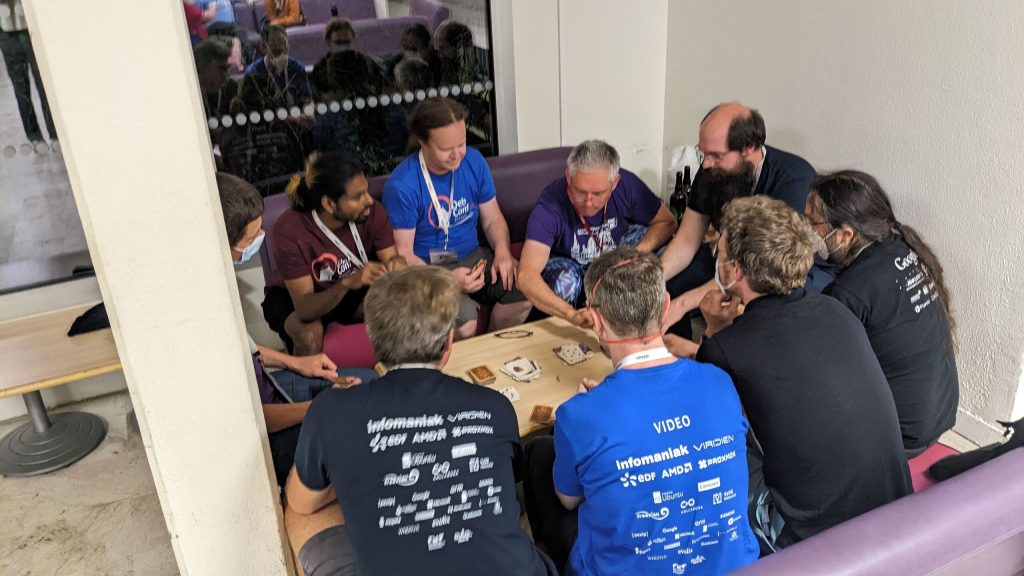
Wednesday, July 16th Wednesday already marked the end of the first half of the week, the day of the day trips. I had chosen to go to Ouessant island (Ushant in English) which marks the Western end of French mainland and hosts one of the lighthouses yielding the way into the English channel. The ferry trip included surprisingly big waves which left some participants seasick, but everyone recovered fast. After around one and a half hours we arrived, picked up the bicycles, and spent the rest of the day roaming the island. The weather forecast was originally very cloudy and 18 C, but over noon this turned into sunny and warm, so many got an unplanned sunburn. I enjoyed the trip very much - it made up for not having time visiting the city during the week. After returning, we spent the rest of the evening playing DebConf's standard game, Mao (spoiler alert: don't follow the link if you ever intend to play).
Having a nice day (photo: Christoph Berg)
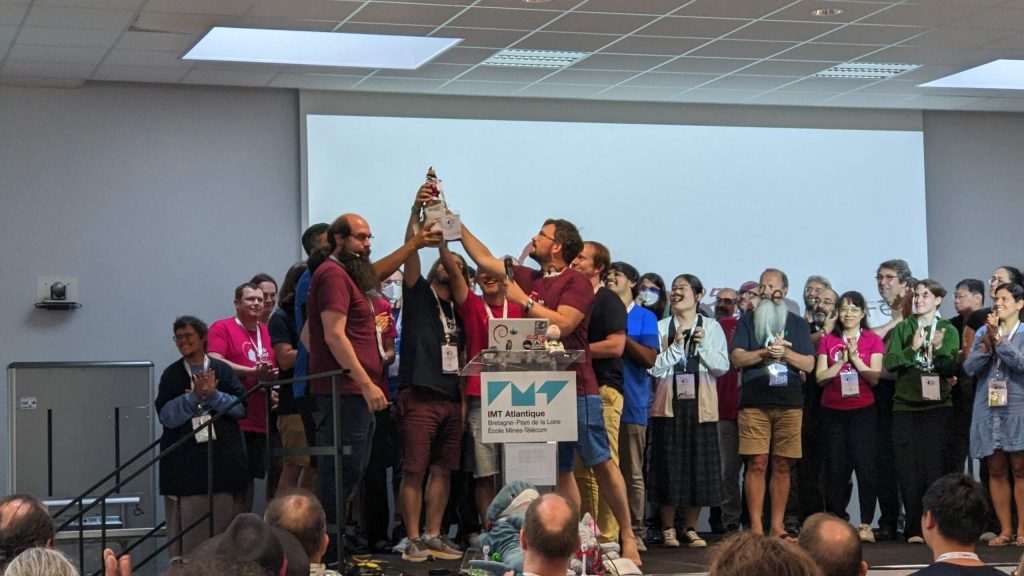
Thursday, July 17th The next day started with the traditional "Meet the Technical Committee" session. This year, we trimmed the usual slide deck down to remove the boring boilerplate parts, so after a very short introduction to the work of the committee by our chairman Matthew Vernon, we opened up the discussion with the audience, with seven (out of 8) TC members on stage. I think the format worked very well, with good input from attendees. Next up was "Don't fear the TPM" by Jonathan McDowell. A common misconception in the Free Software community is that the TPM is evil DRM hardware working against the user, but while it could be used in theory that way, the necessary TPM attestations seem to impossible to attain in practice, so that wouldn't happen anyway. Instead, it is a crypto coprocessor present in almost all modern computers that can be used to hold keys, for example to be used for SSH. It will also be interesting to research if we can make use of it for holding the Transparent Data Encryption keys for CYBERTEC's PostgreSQL Enterprise Edition. Aigars Mahinovs then directed everyone in place for the DebConf group picture, and Lucas Nussbaum started a discussion about archive-wide QA tasks in Debian, an area where I did a lot of work in the past and that still interests me. Antonio Terceiro and Paul Gevers followed up with techniques to track archive-wide rebuilding and testing of packages and in turn filing a lot of bugs to track the problems. The evening ended with the conference dinner, again in the fort close by the coast. DebConf is good for meeting new people, and I incidentally ran into another Chris, who happened to be one of the original maintainers of pgaccess, the pre-predecessor of today's pgadmin. I admit still missing this PostgreSQL frontend for its simplicity and ability to easily edit table data, but it disappeared around 2004. Friday, July 18th On Friday, I participated in discussion sessions around contributors.debian.org (PostgreSQL is planning to set up something similar) and the New Member process which I had helped to run and reform a decade or two ago. Agathe Porte (also a Ham radio operator, like so many others at the conference I had no idea of) then shared her work on rust-rewriting the slower parts of Lintian, the Debian package linter. Craig Small talked about "Free as in Bytes", the evolution of the Linux procps free command. Over the time and many kernel versions, the summary numbers printed became better and better, but there will probably never be a version that suits all use cases alike. Later over dinner, Craig (who is also a TC member) and I shared our experiences with these numbers and customers (not) understanding them. He pointed out that for PostgreSQL and looking at used memory in the presence of large shared memory buffers, USS (unique set size) and PSS (proportional set size) should be more realistic numbers than the standard RSS (resident set size) that the top utility is showing by default. Antonio Terceiro and Paul Gevers again joined to lead a session, now on ci.debian.net and autopkgtest, the test driver used for running tests on packages after then have been installed on a system. The PostgreSQL packages are heavily using this to make sure no regressions creep in even after builds have successfully completed and test re-runs are rescheduled periodically. The day ended with Bdale Garbee's electronics team BoF and Paul Tagliamonte and me setting up the radio station in the courtyard, again answering countless questions about ionospheric conditions and operating practice. Saturday, July 19th Saturday was the last conference day. In the first session, Nikos Tsipinakis and Federico Vaga from CERN announced that the LHC will be moving to Debian for the accelerator's frontend computers in their next "long shutdown" maintenance period in the next year. CentOS broke compatibility too often, and Debian trixie together with the extended LTS support will cover the time until the next long shutdown window in 2035, until when the computers should have all been replaced with newer processors covering higher x86_64 baseline versions. The audience was very delighted to hear that Debian is now also being used in this prestige project. Ben Hutchings then presented new Linux kernel features. Particularly interesting for me was the support for atomic writes spanning more than one filesystem block. When configured correctly, this would mean PostgreSQL didn't have to record full-page images in the WAL anymore, increasing throughput and performance. After that, the Debian ftp team discussed ways to improve review of new packages in the archive, and which of their processes could be relaxed with new US laws around Open Source and cryptography algorithms export. Emmanuel Arias led a session on Salsa CI, Debian's Gitlab instance and standard CI pipeline. (I think it's too slow, but the runners are not under their control.) Julian Klode then presented new features in APT, Debian's package manager. I like the new display format (and a tiny bit of that is also from me sending in wishlist bugs). In the last round of sessions this week, I then led the Ham radio BoF with an introduction into the hobby and how Debian can be used. Bdale mentioned that the sBitx family of SDR radios is natively running Debian, so stock packages can be used from the radio's touch display. We also briefly discussed his involvement in ARDC and the possibility to get grants from them for Ham radio projects. Finally, DebConf wrapped up with everyone gathering in the main auditorium and cheering the organizers for making the conference possible and passing Pollito, the DebConf mascot, to the next organizer team.
Pollito on stage (photo: Christoph Berg)
Sunday, July 20th Zoom back to the train: I made it through the Paris metro and I'm now on the Eurostar back to Germany. It has been an intense week with all the conference sessions and meeting all the people I had not seen so long. There are a lot of new ideas to follow up on both for my Debian and PostgreSQL work. Next year's DebConf will take place in Santa Fe, Argentina. I haven't yet decided if I will be going, but I can recommend the experience to everyone! The post The Debian Conference 2025 in Brest appeared first on CYBERTEC PostgreSQL Services & Support.

26 July 2025

Matthew Palmer: Object deserialization attacks using Ruby's Oj JSON parser

tl;dr: there is an attack in the wild which is triggering dangerous-but-seemingly-intended behaviour in the Oj JSON parser when used in the default and recommended manner, which can lead to everyone s favourite kind of security problem: object deserialization bugs! If you have the oj gem anywhere in your Gemfile.lock, the quickest mitigation is to make sure you have Oj.default_options = mode: :strict somewhere, and that no library is overwriting that setting to something else.

Prologue As a sensible sysadmin, all the sites I run send me a notification if any unhandled exception gets raised. Mostly, what I get sent is error-handling corner cases I missed, but now and then things get more interesting. In this case, it was a PG::UndefinedColumn exception, which looked something like this:
PG::UndefinedColumn: ERROR:  column "xyzzydeadbeef" does not exist
This is weird on two fronts: firstly, this application has been running for a while, and if there was a schema problem, I d expect it to have made itself apparent long before now. And secondly, while I don t profess to perfection in my programming, I m usually better at naming my database columns than that. Something is definitely hinky here, so let s jump into the mystery mobile!

The column name is coming from outside the building! The exception notifications I get sent include a whole lot of information about the request that caused the exception, including the request body. In this case, the request body was JSON, and looked like this:
 "name":":xyzzydeadbeef", ... 
The leading colon looks an awful lot like the syntax for a Ruby symbol, but it s in a JSON string. Surely there s no way a JSON parser would be turning that into a symbol, right? Right?!? Immediately, I thought that that possibly was what was happening, because I use Sequel for my SQL database access needs, and Sequel treats symbols as database column names. It seemed like too much of a coincidence that a vaguely symbol-shaped string was being sent in, and the exact same name was showing up as a column name. But how the flying fudgepickles was a JSON string being turned into a Ruby symbol, anyway? Enter Oj.

Oj? I barely know aj A long, long time ago, the standard Ruby JSON library had a reputation for being slow. Thus did many competitors flourish, claiming more features and better performance. Strong amongst the contenders was oj (for Optimized JSON ), touted as The fastest JSON parser and object serializer . Given the history, it s not surprising that people who wanted the best possible performance turned to Oj, leading to it being found in a great many projects, often as a sub-dependency of a dependency of a dependency (which is how it ended up in my project). You might have noticed in Oj s description that, in addition to claiming fastest , it also describes itself as an object serializer . Anyone who has kept an eye on the security bug landscape will recall that object deserialization is a rich vein of vulnerabilities to mine. Libraries that do object deserialization, especially ones with a history that goes back to before the vulnerability class was well-understood, are likely to be trouble magnets. And thus, it turns out to be with Oj. By default, Oj will happily turn any string that starts with a colon into a symbol:

>> require "oj"
>> Oj.load(' "name":":xyzzydeadbeef","username":"bob","answer":42 ')
=>  "name"=>:xyzzydeadbeef, "username"=>"bob", "answer"=>42 

How that gets exploited is only limited by the creativity of an attacker. Which I ll talk about more shortly but first, a word from my rant cortex.

Insecure By Default is a Cancer While the object of my ire today is Oj and its fast-and-loose approach to deserialization, it is just one example of a pervasive problem in software: insecurity by default. Whether it s a database listening on 0.0.0.0 with no password as soon as its installed, or a library whose default behaviour is to permit arbitrary code execution, it all contributes to a software ecosystem that is an appalling security nightmare. When a user (in this case, a developer who wants to parse JSON) comes across a new piece of software, they have by definition no idea what they re doing with that software. They re going to use the defaults, and follow the most easily-available documentation, to achieve their goal. It is unrealistic to assume that a new user of a piece of software is going to do things the right way , unless that right way is the only way, or at least the by-far-the-easiest way. Conversely, the developer(s) of the software is/are the domain experts. They have knowledge of the problem domain, through their exploration while building the software, and unrivalled expertise in the codebase. Given this disparity in knowledge, it is tantamount to malpractice for the experts the developer(s) to off-load the responsibility for the safe and secure use of the software to the party that has the least knowledge of how to do that (the new user). To apply this general principle to the specific case, take the Using section of the Oj README. The example code there calls Oj.load, with no indication that this code will, in fact, parse specially-crafted JSON documents into Ruby objects. The brand-user user of the library, no doubt being under pressure to Get Things Done, is almost certainly going to look at this Using example, get the apparent result they were after (a parsed JSON document), and call it a day. It is unlikely that a brand-new user will, for instance, scroll down to the Further Reading section, find the second last (of ten) listed documents, Security.md , and carefully peruse it. If they do, they ll find an oblique suggestion that parsing untrusted input is never a good idea . While that s true, it s also rather unhelpful, because I d wager that by far the majority of JSON parsed in the world is untrusted , in one way or another, given the predominance of JSON as a format for serializing data passing over the Internet. This guidance is roughly akin to putting a label on a car s airbags that driving at speed can be hazardous to your health : true, but unhelpful under the circumstances. The solution is for default behaviours to be secure, and any deviation from that default that has the potential to degrade security must, at the very least, be clearly labelled as such. For example, the Oj.load function should be named Oj.unsafe_load, and the Oj.load function should behave as the Oj.safe_load function does presently. By naming the unsafe function as explicitly unsafe, developers (and reviewers) have at least a fighting chance of recognising they re doing something risky. We put warning labels on just about everything in the real world; the same should be true of dangerous function calls. OK, rant over. Back to the story.

But how is this exploitable? So far, I ve hopefully made it clear that Oj does some Weird Stuff with parsing certain JSON strings. It caused an unhandled exception in a web application I run, which isn t cool, but apart from bombing me with exception notifications, what s the harm? For starters, let s look at our original example: when presented with a symbol, Sequel will interpret that as a column name, rather than a string value. Thus, if our save an update to the user code looked like this:

# request_body has the JSON representation of the form being submitted
body = Oj.load(request_body)
DB[:users].where(id: user_id).update(name: body["name"])

In normal operation, this will issue an SQL query along the lines of UPDATE users SET name='Jaime' WHERE id=42. If the name given is Jaime O Dowd , all is still good, because Sequel quotes string values, etc etc. All s well so far. But, imagine there is a column in the users table that normally users cannot read, perhaps admin_notes. Or perhaps an attacker has gotten temporary access to an account, and wants to dump the user s password hash for offline cracking. So, they send an update claiming that their name is :admin_notes (or :password_hash). In JSON, that ll look like "name":":admin_notes" , and Oj.load will happily turn that into a Ruby object of "name"=>:admin_notes . When run through the above update the user code fragment, it ll produce the SQL UPDATE users SET name=admin_notes WHERE id=42. In other words, it ll copy the contents of the admin_notes column into the name column which the attacker can then read out just by refreshing their profile page.

But Wait, There s More! That an attacker can read other fields in the same table isn t great, but that s barely scratching the surface. Remember before I said that Oj does object serialization ? That means that, in general, you can create arbitrary Ruby objects from JSON. Since objects contain code, it s entirely possible to trigger arbitrary code execution by instantiating an appropriate Ruby object. I m not going to go into details about how to do this, because it s not really my area of expertise, and many others have covered it in detail. But rest assured, if an attacker can feed input of their choosing into a default call to Oj.load, they ve been handed remote code execution on a platter.

Mitigations As Oj s object deserialization is intended and documented behaviour, don t expect a future release to make any of this any safer. Instead, we need to mitigate the risks. Here are my recommended steps:
  1. Look in your Gemfile.lock (or SBOM, if that s your thing) to see if the oj gem is anywhere in your codebase. Remember that even if you don t use it directly, it s popular enough that it is used in a lot of places. If you find it in your transitive dependency tree anywhere, there s a chance you re vulnerable, limited only by the ingenuity of attackers to feed crafted JSON into a deeply-hidden Oj.load call.
  2. If you depend on oj directly and use it in your project, consider not doing that. The json gem is acceptably fast, and JSON.parse won t create arbitrary Ruby objects.
  3. If you really, really need to squeeze the last erg of performance out of your JSON parsing, and decide to use oj to do so, find all calls to Oj.load in your code and switch them to call Oj.safe_load.
  4. It is a really, really bad idea to ever use Oj to deserialize JSON into objects, as it lacks the safety features needed to mitigate the worst of the risks of doing so (for example, restricting which classes can be instantiated, as is provided by the permitted_classes argument to Psych.load). I d make it a priority to move away from using Oj for that, and switch to something somewhat safer (such as the aforementioned Psych). At the very least, audit and comment heavily to minimise the risk of user-provided input sneaking into those calls somehow, and pass mode: :object as the second argument to Oj.load, to make it explicit that you are opting-in to this far more dangerous behaviour only when it s absolutely necessary.
  5. To secure any unsafe uses of Oj.load in your dependencies, consider setting the default Oj parsing mode to :strict, by putting Oj.default_options = mode: :strict somewhere in your initialization code (and make sure no dependencies are setting it to something else later!). There is a small chance that this change of default might break something, if a dependency is using Oj to deliberately create Ruby objects from JSON, but the overwhelming likelihood is that Oj s just being used to parse ordinary JSON, and these calls are just RCE vulnerabilities waiting to give you a bad time.

Is Your Bacon Saved? If I ve helped you identify and fix potential RCE vulnerabilities in your software, or even just opened your eyes to the risks of object deserialization, please help me out by buying me a refreshing beverage. I would really appreciate any support you can give. Alternately, if you d like my help in fixing these (and many other) sorts of problems, I m looking for work, so email me.

24 June 2025

Matthew Garrett: Why is there no consistent single signon API flow?

Single signon is a pretty vital part of modern enterprise security. You have users who need access to a bewildering array of services, and you want to be able to avoid the fallout of one of those services being compromised and your users having to change their passwords everywhere (because they're clearly going to be using the same password everywhere), or you want to be able to enforce some reasonable MFA policy without needing to configure it in 300 different places, or you want to be able to disable all user access in one place when someone leaves the company, or, well, all of the above. There's any number of providers for this, ranging from it being integrated with a more general app service platform (eg, Microsoft or Google) or a third party vendor (Okta, Ping, any number of bizarre companies). And, in general, they'll offer a straightforward mechanism to either issue OIDC tokens or manage SAML login flows, requiring users present whatever set of authentication mechanisms you've configured.

This is largely optimised for web authentication, which doesn't seem like a huge deal - if I'm logging into Workday then being bounced to another site for auth seems entirely reasonable. The problem is when you're trying to gate access to a non-web app, at which point consistency in login flow is usually achieved by spawning a browser and somehow managing submitting the result back to the remote server. And this makes some degree of sense - browsers are where webauthn token support tends to live, and it also ensures the user always has the same experience.

But it works poorly for CLI-based setups. There's basically two options - you can use the device code authorisation flow, where you perform authentication on what is nominally a separate machine to the one requesting it (but in this case is actually the same) and as a result end up with a straightforward mechanism to have your users socially engineered into giving Johnny Badman a valid auth token despite webauthn nominally being unphisable (as described years ago), or you reduce that risk somewhat by spawning a local server and POSTing the token back to it - which works locally but doesn't work well if you're dealing with trying to auth on a remote device. The user experience for both scenarios sucks, and it reduces a bunch of the worthwhile security properties that modern MFA supposedly gives us.

There's a third approach, which is in some ways the obviously good approach and in other ways is obviously a screaming nightmare. All the browser is doing is sending a bunch of requests to a remote service and handling the response locally. Why don't we just do the same? Okta, for instance, has an API for auth. We just need to submit the username and password to that and see what answer comes back. This is great until you enable any kind of MFA, at which point the additional authz step is something that's only supported via the browser. And basically everyone else is the same.

Of course, when we say "That's only supported via the browser", the browser is still just running some code of some form and we can figure out what it's doing and do the same. Which is how you end up scraping constants out of Javascript embedded in the API response in order to submit that data back in the appropriate way. This is all possible but it's incredibly annoying and fragile - the contract with the identity provider is that a browser is pointed at a URL, not that any of the internal implementation remains consistent.

I've done this. I've implemented code to scrape an identity provider's auth responses to extract the webauthn challenges and feed those to a local security token without using a browser. I've also written support for forwarding those challenges over the SSH agent protocol to make this work with remote systems that aren't running a GUI. This week I'm working on doing the same again, because every identity provider does all of this differently.

There's no fundamental reason all of this needs to be custom. It could be a straightforward "POST username and password, receive list of UUIDs describing MFA mechanisms, define how those MFA mechanisms work". That even gives space for custom auth factors (I'm looking at you, Okta Fastpass). But instead I'm left scraping JSON blobs out of Javascript and hoping nobody renames a field, even though I only care about extremely standard MFA mechanisms that shouldn't differ across different identity providers.

Someone, please, write a spec for this. Please don't make it be me.

comment count unavailable comments

20 June 2025

Matthew Garrett: My a11y journey

23 years ago I was in a bad place. I'd quit my first attempt at a PhD for various reasons that were, with hindsight, bad, and I was suddenly entirely aimless. I lucked into picking up a sysadmin role back at TCM where I'd spent a summer a year before, but that's not really what I wanted in my life. And then Hanna mentioned that her PhD supervisor was looking for someone familiar with Linux to work on making Dasher, one of the group's research projects, more usable on Linux. I jumped.

The timing was fortuitous. Sun were pumping money and developer effort into accessibility support, and the Inference Group had just received a grant from the Gatsy Foundation that involved working with the ACE Centre to provide additional accessibility support. And I was suddenly hacking on code that was largely ignored by most developers, supporting use cases that were irrelevant to most developers. Being in a relatively green field space sounds refreshing, until you realise that you're catering to actual humans who are potentially going to rely on your software to be able to communicate. That's somewhat focusing.

This was, uh, something of an on the job learning experience. I had to catch up with a lot of new technologies very quickly, but that wasn't the hard bit - what was difficult was realising I had to cater to people who were dealing with use cases that I had no experience of whatsoever. Dasher was extended to allow text entry into applications without needing to cut and paste. We added support for introspection of the current applications UI so menus could be exposed via the Dasher interface, allowing people to fly through menu hierarchies and pop open file dialogs. Text-to-speech was incorporated so people could rapidly enter sentences and have them spoke out loud.

But what sticks with me isn't the tech, or even the opportunities it gave me to meet other people working on the Linux desktop and forge friendships that still exist. It was the cases where I had the opportunity to work with people who could use Dasher as a tool to increase their ability to communicate with the outside world, whose lives were transformed for the better because of what we'd produced. Watching someone use your code and realising that you could write a three line patch that had a significant impact on the speed they could talk to other people is an incomparable experience. It's been decades and in many ways that was the most impact I've ever had as a developer.

I left after a year to work on fruitflies and get my PhD, and my career since then hasn't involved a lot of accessibility work. But it's stuck with me - every improvement in that space is something that has a direct impact on the quality of life of more people than you expect, but is also something that goes almost unrecognised. The people working on accessibility are heroes. They're making all the technology everyone else produces available to people who would otherwise be blocked from it. They deserve recognition, and they deserve a lot more support than they have.

But when we deal with technology, we deal with transitions. A lot of the Linux accessibility support depended on X11 behaviour that is now widely regarded as a set of misfeatures. It's not actually good to be able to inject arbitrary input into an arbitrary window, and it's not good to be able to arbitrarily scrape out its contents. X11 never had a model to permit this for accessibility tooling while blocking it for other code. Wayland does, but suffers from the surrounding infrastructure not being well developed yet. We're seeing that happen now, though - Gnome has been performing a great deal of work in this respect, and KDE is picking that up as well. There isn't a full correspondence between X11-based Linux accessibility support and Wayland, but for many users the Wayland accessibility infrastructure is already better than with X11.

That's going to continue improving, and it'll improve faster with broader support. We've somehow ended up with the bizarre politicisation of Wayland as being some sort of woke thing while X11 represents the Roman Empire or some such bullshit, but the reality is that there is no story for improving accessibility support under X11 and sticking to X11 is going to end up reducing the accessibility of a platform.

When you read anything about Linux accessibility, ask yourself whether you're reading something written by either a user of the accessibility features, or a developer of them. If they're neither, ask yourself why they actually care and what they're doing to make the future better.

comment count unavailable comments

17 June 2025

Matthew Garrett: Locally hosting an internet-connected server

I'm lucky enough to have a weird niche ISP available to me, so I'm paying $35 a month for around 600MBit symmetric data. Unfortunately they don't offer static IP addresses to residential customers, and nor do they allow multiple IP addresses per connection, and I'm the sort of person who'd like to run a bunch of stuff myself, so I've been looking for ways to manage this.

What I've ended up doing is renting a cheap VPS from a vendor that lets me add multiple IP addresses for minimal extra cost. The precise nature of the VPS isn't relevant - you just want a machine (it doesn't need much CPU, RAM, or storage) that has multiple world routeable IPv4 addresses associated with it and has no port blocks on incoming traffic. Ideally it's geographically local and peers with your ISP in order to reduce additional latency, but that's a nice to have rather than a requirement.

By setting that up you now have multiple real-world IP addresses that people can get to. How do we get them to the machine in your house you want to be accessible? First we need a connection between that machine and your VPS, and the easiest approach here is Wireguard. We only need a point-to-point link, nothing routable, and none of the IP addresses involved need to have anything to do with any of the rest of your network. So, on your local machine you want something like:

[Interface]
PrivateKey = privkeyhere
ListenPort = 51820
Address = localaddr/32

[Peer]
Endpoint = VPS:51820
PublicKey = pubkeyhere
AllowedIPs = VPS/0


And on your VPS, something like:

[Interface]
Address = vpswgaddr/32
SaveConfig = true
ListenPort = 51820
PrivateKey = privkeyhere

[Peer]
PublicKey = pubkeyhere
AllowedIPs = localaddr/32


The addresses here are (other than the VPS address) arbitrary - but they do need to be consistent, otherwise Wireguard is going to be unhappy and your packets will not have a fun time. Bring that interface up with wg-quick and make sure the devices can ping each other. Hurrah! That's the easy bit.

Now you want packets from the outside world to get to your internal machine. Let's say the external IP address you're going to use for that machine is 321.985.520.309 and the wireguard address of your local system is 867.420.696.005. On the VPS, you're going to want to do:

iptables -t nat -A PREROUTING -p tcp -d 321.985.520.309 -j DNAT --to-destination 867.420.696.005

Now, all incoming packets for 321.985.520.309 will be rewritten to head towards 867.420.696.005 instead (make sure you've set net.ipv4.ip_forward to 1 via sysctl!). Victory! Or is it? Well, no.

What we're doing here is rewriting the destination address of the packets so instead of heading to an address associated with the VPS, they're now going to head to your internal system over the Wireguard link. Which is then going to ignore them, because the AllowedIPs statement in the config only allows packets coming from your VPS, and these packets still have their original source IP. We could rewrite the source IP to match the VPS IP, but then you'd have no idea where any of these packets were coming from, and that sucks. Let's do something better. On the local machine, in the peer, let's update AllowedIps to 0.0.0.0/0 to permit packets form any source to appear over our Wireguard link. But if we bring the interface up now, it'll try to route all traffic over the Wireguard link, which isn't what we want. So we'll add table = off to the interface stanza of the config to disable that, and now we can bring the interface up without breaking everything but still allowing packets to reach us. However, we do still need to tell the kernel how to reach the remote VPN endpoint, which we can do with ip route add vpswgaddr dev wg0. Add this to the interface stanza as:

PostUp = ip route add vpswgaddr dev wg0
PreDown = ip route del vpswgaddr dev wg0


That's half the battle. The problem is that they're going to show up there with the source address still set to the original source IP, and your internal system is (because Linux) going to notice it has the ability to just send replies to the outside world via your ISP rather than via Wireguard and nothing is going to work. Thanks, Linux. Thinux.

But there's a way to solve this - policy routing. Linux allows you to have multiple separate routing tables, and define policy that controls which routing table will be used for a given packet. First, let's define a new table reference. On the local machine, edit /etc/iproute2/rt_tables and add a new entry that's something like:

1 wireguard


where "1" is just a standin for a number not otherwise used there. Now edit your wireguard config and replace table=off with table=wireguard - Wireguard will now update the wireguard routing table rather than the global one. Now all we need to do is to tell the kernel to push packets into the appropriate routing table - we can do that with ip rule add from localaddr lookup wireguard, which tells the kernel to take any packet coming from our Wireguard address and push it via the Wireguard routing table. Add that to your Wireguard interface config as:

PostUp = ip rule add from localaddr lookup wireguard
PreDown = ip rule del from localaddr lookup wireguard

and now your local system is effectively on the internet.

You can do this for multiple systems - just configure additional Wireguard interfaces on the VPS and make sure they're all listening on different ports. If your local IP changes then your local machines will end up reconnecting to the VPS, but to the outside world their accessible IP address will remain the same. It's like having a real IP without the pain of convincing your ISP to give it to you.

comment count unavailable comments

5 June 2025

Matthew Garrett: How Twitter could (somewhat) fix their encrypted DMs

As I wrote in my last post, Twitter's new encrypted DM infrastructure is pretty awful. But the amount of work required to make it somewhat better isn't large.

When Juicebox is used with HSMs, it supports encrypting the communication between the client and the backend. This is handled by generating a unique keypair for each HSM. The public key is provided to the client, while the private key remains within the HSM. Even if you can see the traffic sent to the HSM, it's encrypted using the Noise protocol and so the user's encrypted secret data can't be retrieved.

But this is only useful if you know that the public key corresponds to a private key in the HSM! Right now there's no way to know this, but there's worse - the client doesn't have the public key built into it, it's supplied as a response to an API request made to Twitter's servers. Even if the current keys are associated with the HSMs, Twitter could swap them out with ones that aren't, terminate the encrypted connection at their endpoint, and then fake your query to the HSM and get the encrypted data that way. Worse, this could be done for specific targeted users, without any indication to the user that this has happened, making it almost impossible to detect in general.

This is at least partially fixable. Twitter could prove to a third party that their Juicebox keys were generated in an HSM, and the key material could be moved into clients. This makes attacking individual users more difficult (the backdoor code would need to be shipped in the public client), but can't easily help with the website version[1] even if a framework exists to analyse the clients and verify that the correct public keys are in use.

It's still worse than Signal. Use Signal.

[1] Since they could still just serve backdoored Javascript to specific users. This is, unfortunately, kind of an inherent problem when it comes to web-based clients - we don't have good frameworks to detect whether the site itself is malicious.

comment count unavailable comments

Matthew Garrett: Twitter's new encrypted DMs aren't better than the old ones

(Edit: Twitter could improve this significantly with very few changes - I wrote about that here. It's unclear why they'd launch without doing that, since it entirely defeats the point of using HSMs)

When Twitter[1] launched encrypted DMs a couple
of years ago, it was the worst kind of end-to-end
encrypted - technically e2ee, but in a way that made it relatively easy for Twitter to inject new encryption keys and get everyone's messages anyway. It was also lacking a whole bunch of features such as "sending pictures", so the entire thing was largely a waste of time. But a couple of days ago, Elon announced the arrival of "XChat", a new encrypted message platform built on Rust with (Bitcoin style) encryption, whole new architecture. Maybe this time they've got it right?

tl;dr - no. Use Signal. Twitter can probably obtain your private keys, and admit that they can MITM you and have full access to your metadata.

The new approach is pretty similar to the old one in that it's based on pretty straightforward and well tested cryptographic primitives, but merely using good cryptography doesn't mean you end up with a good solution. This time they've pivoted away from using the underlying cryptographic primitives directly and into higher level abstractions, which is probably a good thing. They're using Libsodium's boxes for message encryption, which is, well, fine? It doesn't offer forward secrecy (if someone's private key is leaked then all existing messages can be decrypted) so it's a long way from the state of the art for a messaging client (Signal's had forward secrecy for over a decade!), but it's not inherently broken or anything. It is, however, written in C, not Rust[2].

That's about the extent of the good news. Twitter's old implementation involved clients generating keypairs and pushing the public key to Twitter. Each client (a physical device or a browser instance) had its own private key, and messages were simply encrypted to every public key associated with an account. This meant that new devices couldn't decrypt old messages, and also meant there was a maximum number of supported devices and terrible scaling issues and it was pretty bad. The new approach generates a keypair and then stores the private key using the Juicebox protocol. Other devices can then retrieve the private key.

Doesn't this mean Twitter has the private key? Well, no. There's a PIN involved, and the PIN is used to generate an encryption key. The stored copy of the private key is encrypted with that key, so if you don't know the PIN you can't decrypt the key. So we brute force the PIN, right? Juicebox actually protects against that - before the backend will hand over the encrypted key, you have to prove knowledge of the PIN to it (this is done in a clever way that doesn't directly reveal the PIN to the backend). If you ask for the key too many times while providing the wrong PIN, access is locked down.

But this is true only if the Juicebox backend is trustworthy. If the backend is controlled by someone untrustworthy[3] then they're going to be able to obtain the encrypted key material (even if it's in an HSM, they can simply watch what comes out of the HSM when the user authenticates if there's no validation of the HSM's keys). And now all they need is the PIN. Turning the PIN into an encryption key is done using the Argon2id key derivation function, using 32 iterations and a memory cost of 16MB (the Juicebox white paper says 16KB, but (a) that's laughably small and (b) the code says 16 * 1024 in an argument that takes kilobytes), which makes it computationally and moderately memory expensive to generate the encryption key used to decrypt the private key. How expensive? Well, on my (not very fast) laptop, that takes less than 0.2 seconds. How many attempts to I need to crack the PIN? Twitter's chosen to fix that to 4 digits, so a maximum of 10,000. You aren't going to need many machines running in parallel to bring this down to a very small amount of time, at which point private keys can, to a first approximation, be extracted at will.

Juicebox attempts to defend against this by supporting sharding your key over multiple backends, and only requiring a subset of those to recover the original. I can't find any evidence that Twitter's does seem to be making use of this,Twitter uses three backends and requires data from at least two, but all the backends used are under x.com so are presumably under Twitter's direct control. Trusting the keystore without needing to trust whoever's hosting it requires a trustworthy communications mechanism between the client and the keystore. If the device you're talking to can prove that it's an HSM that implements the attempt limiting protocol and has no other mechanism to export the data, this can be made to work. Signal makes use of something along these lines using Intel SGX for contact list and settings storage and recovery, and Google and Apple also have documentation about how they handle this in ways that make it difficult for them to obtain backed up key material. Twitter has no documentation of this, and as far as I can tell does nothing to prove that the backend is in any way trustworthy. (Edit to add: The Juicebox API does support authenticated communication between the client and the HSM, but that relies on you having some way to prove that the public key you're presented with corresponds to a private key that only exists in the HSM. Twitter gives you the public key whenever you communicate with them, so even if they've implemented this properly you can't prove they haven't made up a new key and MITMed you the next time you retrieve your key)

On the plus side, Juicebox is written in Rust, so Elon's not 100% wrong. Just mostly wrong.

But ok, at least you've got viable end-to-end encryption even if someone can put in some (not all that much, really) effort to obtain your private key and render it all pointless? Actually no, since you're still relying on the Twitter server to give you the public key of the other party and there's no out of band mechanism to do that or verify the authenticity of that public key at present. Twitter can simply give you a public key where they control the private key, decrypt the message, and then reencrypt it with the intended recipient's key and pass it on. The support page makes it clear that this is a known shortcoming and that it'll be fixed at some point, but they said that about the original encrypted DM support and it never was, so that's probably dependent on whether Elon gets distracted by something else again. And the server knows who and when you're messaging even if they haven't bothered to break your private key, so there's a lot of metadata leakage.

Signal doesn't have these shortcomings. Use Signal.

[1] I'll respect their name change once Elon respects his daughter

[2] There are implementations written in Rust, but Twitter's using the C one with these JNI bindings

[3] Or someone nominally trustworthy but who's been compelled to act against your interests - even if Elon were absolutely committed to protecting all his users, his overarching goals for Twitter require him to have legal presence in multiple jurisdictions that are not necessarily above placing employees in physical danger if there's a perception that they could obtain someone's encryption keys

comment count unavailable comments

18 March 2025

Matthew Garrett: Failing upwards: the Twitter encrypted DM failure

Almost two years ago, Twitter launched encrypted direct messages. I wrote about their technical implementation at the time, and to the best of my knowledge nothing has changed. The short story is that the actual encryption primitives used are entirely normal and fine - messages are encrypted using AES, and the AES keys are exchanged via NIST P-256 elliptic curve asymmetric keys. The asymmetric keys are each associated with a specific device or browser owned by a user, so when you send a message to someone you encrypt the AES key with all of their asymmetric keys and then each device or browser can decrypt the message again. As long as the keys are managed appropriately, this is infeasible to break.

But how do you know what a user's keys are? I also wrote about this last year - key distribution is a hard problem. In the Twitter DM case, you ask Twitter's server, and if Twitter wants to intercept your messages they replace your key. The documentation for the feature basically admits this - if people with guns showed up there, they could very much compromise the protection in such a way that all future messages you sent were readable. It's also impossible to prove that they're not already doing this without every user verifying that the public keys Twitter hands out to other users correspond to the private keys they hold, something that Twitter provides no mechanism to do.

This isn't the only weakness in the implementation. Twitter may not be able read the messages, but every encrypted DM is sent through exactly the same infrastructure as the unencrypted ones, so Twitter can see the time a message was sent, who it was sent to, and roughly how big it was. And because pictures and other attachments in Twitter DMs aren't sent in-line but are instead replaced with links, the implementation would encrypt the links but not the attachments - this is "solved" by simply blocking attachments in encrypted DMs. There's no forward secrecy - if a key is compromised it allows access to not only all new messages created with that key, but also all previous messages. If you log out of Twitter the keys are still stored by the browser, so if you can potentially be extracted and used to decrypt your communications. And there's no group chat support at all, which is more a functional restriction than a conceptual one.

To be fair, these are hard problems to solve! Signal solves all of them, but Signal is the product of a large number of highly skilled experts in cryptography, and even so it's taken years to achieve all of this. When Elon announced the launch of encrypted DMs he indicated that new features would be developed quickly - he's since publicly mentioned the feature a grand total of once, in which he mentioned further feature development that just didn't happen. None of the limitations mentioned in the documentation have been addressed in the 22 months since the feature was launched.

Why? Well, it turns out that the feature was developed by a total of two engineers, neither of whom is still employed at Twitter. The tech lead for the feature was Christopher Stanley, who was actually a SpaceX employee at the time. Since then he's ended up at DOGE, where he apparently set off alarms when attempting to install Starlink, and who today is apparently being appointed to the board of Fannie Mae, a government-backed mortgage company.

Anyway. Use Signal.

comment count unavailable comments

5 March 2025

Otto Kek l inen: Will decentralized social media soon go mainstream?

Featured image of post Will decentralized social media soon go mainstream?In today s digital landscape, social media is more than just a communication tool it is the primary medium for global discourse. Heads of state, corporate leaders and cultural influencers now broadcast their statements directly to the world, shaping public opinion in real time. However, the dominance of a few centralized platforms X/Twitter, Facebook and YouTube raises critical concerns about control, censorship and the monopolization of information. Those who control these networks effectively wield significant power over public discourse. In response, a new wave of distributed social media platforms has emerged, each built on different decentralized protocols designed to provide greater autonomy, censorship resistance and user control. While Wikipedia maintains a comprehensive list of distributed social networking software and protocols, it does not cover recent blockchain-based systems, nor does it highlight which have the most potential for mainstream adoption. This post explores the leading decentralized social media platforms and the protocols they are based on: Mastodon (ActivityPub), Bluesky (AT Protocol), Warpcast (Farcaster), Hey (Lens) and Primal (Nostr).
Comparison of architecture and mainstream adoption potential
Protocol Identity System Example Storage model Cost for end users Potential
Mastodon Tied to server domain @ottok@mastodon.social Federated instances Free (some instances charge) High
Bluesky Portable (DID) ottoke.bsky.social Federated instances Free Moderate
Farcaster ENS (Ethereum) @ottok Blockchain + off-chain Small gas fees Moderate
Lens NFT-based (Polygon) @ottok Blockchain + off-chain Small gas fees Niche
Nostr Cryptographic Keys npub16lc6uhqpg6dnqajylkhwuh3j7ynhcnje508tt4v6703w9kjlv9vqzz4z7f Federated instances Free (some instances charge) Niche

1. Mastodon (ActivityPub) Screenshot of Mastodon Mastodon was created in 2016 by Eugen Rochko, a German software developer who sought to provide a decentralized and user-controlled alternative to Twitter. It was built on the ActivityPub protocol, now standardized by W3C Social Web Working Group, to allow users to join independent servers while still communicating across the broader Mastodon network. Mastodon operates on a federated model, where multiple independently run servers communicate via ActivityPub. Each server sets its own moderation policies, leading to a decentralized but fragmented experience. The servers can alternatively be called instances, relays or nodes, depending on what vocabulary a protocol has standardized on.
  • Identity: User identity is tied to the instance where they registered, represented as @username@instance.tld.
  • Storage: Data is stored on individual instances, which federate messages to other instances based on their configurations.
  • Cost: Free to use, but relies on instance operators willing to run the servers.
The protocol defines multiple activities such as:
  • Creating a post
  • Liking
  • Sharing
  • Following
  • Commenting

Example Message in ActivityPub (JSON-LD Format)
json
 
 "@context": "https://www.w3.org/ns/activitystreams",
 "type": "Create",
 "actor": "https://mastodon.social/users/ottok",
 "object":  
 "type": "Note",
 "content": "Hello from #Mastodon!",
 "published": "2025-03-03T12:00:00Z",
 "to": ["https://www.w3.org/ns/activitystreams#Public"]
  
 
Servers communicate across different platforms by publishing activities to their followers or forwarding activities between servers. Standard HTTPS is used between servers for communication, and the messages use JSON-LD for data representation. The WebFinger protocol is used for user discovery. There is however no neat way for home server discovery yet. This means that if you are browsing e.g. Fosstodon and want to follow a user and press Follow, a dialog will pop up asking you to enter your own home server (e.g. mastodon.social) to redirect you there for actually executing the Follow action on with your account. Mastodon is open source under the AGPL at github.com/mastodon/mastodon. Anyone can operate their own instance. It just requires to run your own server and some skills to maintain a Ruby on Rails app with a PostgreSQL database backend, and basic understanding of the protocol to configure federation with other ActivityPub instances.

Popularity: Already established, but will it grow more? Mastodon has seen steady growth, especially after Twitter s acquisition in 2022, with some estimates stating it peaked at 10 million users across thousands of instances. However, its fragmented user experience and the complexity of choosing instances have hindered mainstream adoption. Still, it remains the most established decentralized alternative to Twitter. Note that Donald Trump s Truth Social is based on the Mastodon software but does not federate with the ActivityPub network. The ActivityPub protocol is the most widely used of its kind. One of the other most popular services is the Lemmy link sharing service, similar to Reddit. The larger ecosystem of ActivityPub is called Fediverse, and estimates put the total active user count around 6 million.

2. Bluesky (AT Protocol) Screenshot of Bluesky Interestingly, Bluesky was conceived within Twitter in 2019 by Twitter founder Jack Dorsey. After being incubated as a Twitter-funded project, it spun off as an independent Public Benefit LLC in February 2022 and launched its public beta in February 2023. Bluesky runs on top of the Authenticated Transfer (AT) Protocol published at https://github.com/bluesky-social/atproto. The protocol enables portable identities and data ownership, meaning users can migrate between platforms while keeping their identity and content intact. In practice, however, there is only one popular server at the moment, which is Bluesky itself.
  • Identity: Usernames are domain-based (e.g., @user.bsky.social).
  • Storage: Content is theoretically federated among various servers.
  • Cost: Free to use, but relies on instance operators willing to run the servers.

Example Message in AT Protocol (JSON Format)
json
 
 "repo": "did:plc:ottoke.bsky.social",
 "collection": "app.bsky.feed.post",
 "record":  
 "$type": "app.bsky.feed.post",
 "text": "Hello from Bluesky!",
 "createdAt": "2025-03-03T12:00:00Z",
 "langs": ["en"]


Popularity: Hybrid approach may have business benefits? Bluesky reported over 3 million users by 2024, probably getting traction due to its Twitter-like interface and Jack Dorsey s involvement. Its hybrid approach decentralized identity with centralized components could make it a strong candidate for mainstream adoption, assuming it can scale effectively.

3. Warpcast (Farcaster Network) Farcaster was launched in 2021 by Dan Romero and Varun Srinivasan, both former crypto exchange Coinbase executives, to create a decentralized but user-friendly social network. Built on the Ethereum blockchain, it could potentially offer a very attack-resistant communication medium. However, in my own testing, Farcaster does not seem to fully leverage what Ethereum could offer. First of all, there is no diversity in programs implementing the protocol as at the moment there is only Warpcast. In Warpcast the signup requires an initial 5 USD fee that is not payable in ETH, and users need to create a new wallet address on the Ethereum layer 2 network Base instead of simply reusing their existing Ethereum wallet address or ENS name. Despite this, I can understand why Farcaster may have decided to start out like this. Having a single client program may be the best strategy initially. One of the decentralized chat protocol Matrix founders, Matthew Hodgson, shared in his FOSDEM 2025 talk that he slightly regrets focusing too much on developing the protocol instead of making sure the app to use it is attractive to end users. So it may be sensible to ensure Warpcast gets popular first, before attempting to make the Farcaster protocol widely used. As a protocol Farcaster s hybrid approach makes it more scalable than fully on-chain networks, giving it a higher chance of mainstream adoption if it integrates seamlessly with broader Web3 ecosystems.
  • Identity: ENS (Ethereum Name Service) domains are used as usernames.
  • Storage: Messages are stored in off-chain hubs, while identity is on-chain.
  • Cost: Users must pay gas fees for some operations but reading and posting messages is mostly free.

Example Message in Farcaster (JSON Format)
json
 
 "fid": 766579,
 "username": "ottok",
 "custodyAddress": "0x127853e48be3870172baa4215d63b6d815d18f21",
 "connectedWallet": "0x3ebe43aa3ae5b891ca1577d9c49563c0cee8da88",
 "text": "Hello from Farcaster!",
 "publishedAt": 1709424000,
 "replyTo": null,
 "embeds": []
 

Popularity: Decentralized social media + decentralized payments a winning combo? Ethereum founder Vitalik Buterin (warpcast.com/vbuterin) and many core developers are active on the platform. Warpcast, the main client for Farcaster, has seen increasing adoption, especially among Ethereum developers and Web3 enthusiasts. I too have an profile at warpcast.com/ottok. However, the numbers are still very low and far from reaching network effects to really take off. Blockchain-based social media networks, particularly those built on Ethereum, are compelling because they leverage existing user wallets and persistent identities while enabling native payment functionality. When combined with decentralized content funding through micropayments, these blockchain-backed social networks could offer unique advantages that centralized platforms may find difficult to replicate, being decentralized both as a technical network and in a funding mechanism.

4. Hey.xyz (Lens Network) The Lens Protocol was developed by decentralized finance (DeFi) team Aave and launched in May 2022 to provide a user-owned social media network. While initially built on Polygon, it has since launched its own Layer 2 network called the Lens Network in February 2024. Lens is currently the main competitor to Farcaster. Lens stores profile ownership and references on-chain, while content is stored on IPFS/Arweave, enabling composability with DeFi and NFTs.
  • Identity: Profile ownership is tied to NFTs on the Polygon blockchain.
  • Storage: Content is on-chain and integrates with IPFS/Arweave (like NFTs).
  • Cost: Users must pay gas fees for some operations but reading and posting messages is mostly free.

Example Message in Lens (JSON Format)
json
 
 "profileId": "@ottok",
 "contentURI": "ar://QmExampleHash",
 "collectModule": "0x23b9467334bEb345aAa6fd1545538F3d54436e96",
 "referenceModule": "0x0000000000000000000000000000000000000000",
 "timestamp": 1709558400
 

Popularity: Probably not as social media site, but maybe as protocol? The social media side of Lens is mainly the Hey.xyz website, which seems to have fewer users than Warpcast, and is even further away from reaching critical mass for network effects. The Lens protocol however has a lot of advanced features and it may gain adoption as the building block for many Web3 apps.

5. Primal.net (Nostr Network) Nostr (Notes and Other Stuff Transmitted by Relays) was conceptualized in 2020 by an anonymous developer known as fiatjaf. One of the primary design tenets was to be a censorship-resistant protocol and it is popular among Bitcoin enthusiasts, with Jack Dorsey being one of the public supporters. Unlike the Farcaster and Lens protocols, Nostr is not blockchain-based but just a network of relay servers for message distribution. If does however use public key cryptography for identities, similar to how wallets work in crypto.
  • Identity: Public-private key pairs define identity (with prefix npub...).
  • Storage: Content is federated among multiple servers, which in Nostr vocabulary are called relays.
  • Cost: No gas fees, but relies on relay operators willing to run the servers.

Example Message in Nostr (JSON Format)
json
 
 "id": "note1xyz...",
 "pubkey": "npub1...",
 "kind": 1,
 "content": "Hello from Nostr!",
 "created_at": 1709558400,
 "tags": [],
 "sig": "sig1..."
 

Popularity: If Jack Dorsey and Bitcoiners promote it enough? Primal.net as a web app is pretty solid, but it does not stand out much. While Jack Dorsey has shown support by donating $1.5 million to the protocol development in December 2021, its success likely depends on broader adoption by the Bitcoin community.

Will any of these replace X/Twitter? As usage patterns vary, the statistics are not fully comparable, but this overview of the situation in March 2025 gives a decent overview.
Platform Total Accounts Active Users Growth Trend
Mastodon ~10 million ~1 million Steady
Bluesky ~33 million ~1 million Steady
Nostr ~41 million ~20 thousand Steady
Farcaster ~850 thousand ~50 thousand Flat
Lens ~140 thousand ~20 thousand Flat
Mastodon and Bluesky have already reached millions of users, while Lens and Farcaster are growing within crypto communities. It is however clear that none of these are anywhere close to how popular X/Twitter is. In particular, Mastodon had a huge influx of users in the fall of 2022 when Twitter was acquired, but to challenge the incumbents the growth would need to significantly accelerate. We can all accelerate this development by embracing decentralized social media now alongside existing dominant platforms. Who knows, given the right circumstances maybe X.com leadership decides to change the operating model and start federating contents to break out from a walled garden model. The likelyhood of such development would increase if decentralized networks get popular, and the encumbents feel they need to participate to not lose out.

Past and future The idea of decentralized social media is not new. One early pioneer identi.ca launched in 2008, only two years after Twitter, using the OStatus protocol to promote decentralization. A few years later it evolved into pump.io with the ActivityPump protocol, and also forked into GNU Social that continued with OStatus. I remember when these happened, and that in 2010 also Diaspora launched with fairly large publicity. Surprisingly both of these still operate (I can still post both on identi.ca and diasp.org), but the activity fizzled out years ago. The protocol however survived partially and evolved into ActivityPub, which is now the backbone of the Fediverse. The evolution of decentralized social media over the next decade will likely parallel developments in democracy, freedom of speech and public discourse. While the early 2010s emphasized maximum independence and freedom, the late 2010s saw growing support for content moderation to combat misinformation. The AI era introduces new challenges, potentially requiring proof-of-humanity verification for content authenticity. Key factors that will determine success:
  • User experience and ease of onboarding
  • Network effects and critical mass of users
  • Integration with existing web3 infrastructure
  • Balance between decentralization and usability
  • Sustainable economic models for infrastructure
This is clearly an area of development worth monitoring closely, as the next few years may determine which protocol becomes the de facto standard for decentralized social communication.

2 January 2025

Matthew Garrett: The GPU, not the TPM, is the root of hardware DRM

As part of their "Defective by Design" anti-DRM campaign, the FSF recently made the following claim:
Today, most of the major streaming media platforms utilize the TPM to decrypt media streams, forcefully placing the decryption out of the user's control (from here).
This is part of an overall argument that Microsoft's insistence that only hardware with a TPM can run Windows 11 is with the goal of aiding streaming companies in their attempt to ensure media can only be played in tightly constrained environments.

I'm going to be honest here and say that I don't know what Microsoft's actual motivation for requiring a TPM in Windows 11 is. I've been talking about TPM stuff for a long time. My job involves writing a lot of TPM code. I think having a TPM enables a number of worthwhile security features. Given the choice, I'd certainly pick a computer with a TPM. But in terms of whether it's of sufficient value to lock out Windows 11 on hardware with no TPM that would otherwise be able to run it? I'm not sure that's a worthwhile tradeoff.

What I can say is that the FSF's claim is just 100% wrong, and since this seems to be the sole basis of their overall claim about Microsoft's strategy here, the argument is pretty significantly undermined. I'm not aware of any streaming media platforms making use of TPMs in any way whatsoever. There is hardware DRM that the media companies use to restrict users, but it's not in the TPM - it's in the GPU.

Let's back up for a moment. There's multiple different DRM implementations, but the big three are Widevine (owned by Google, used on Android, Chromebooks, and some other embedded devices), Fairplay (Apple implementation, used for Mac and iOS), and Playready (Microsoft's implementation, used in Windows and some other hardware streaming devices and TVs). These generally implement several levels of functionality, depending on the capabilities of the device they're running on - this will range from all the DRM functionality being implemented in software up to the hardware path that will be discussed shortly. Streaming providers can choose what level of functionality and quality to provide based on the level implemented on the client device, and it's common for 4K and HDR content to be tied to hardware DRM. In any scenario, they stream encrypted content to the client and the DRM stack decrypts it before the compressed data can be decoded and played.

The "problem" with software DRM implementations is that the decrypted material is going to exist somewhere the OS can get at it at some point, making it possible for users to simply grab the decrypted stream, somewhat defeating the entire point. Vendors try to make this difficult by obfuscating their code as much as possible (and in some cases putting some of it in-kernel), but pretty much all software DRM is at least somewhat broken and copies of any new streaming media end up being available via Bittorrent pretty quickly after release. This is why higher quality media tends to be restricted to clients that implement hardware-based DRM.

The implementation of hardware-based DRM varies. On devices in the ARM world this is usually handled by performing the cryptography in a Trusted Execution Environment, or TEE. A TEE is an area where code can be executed without the OS having any insight into it at all, with ARM's TrustZone being an example of this. By putting the DRM code in TrustZone, the cryptography can be performed in RAM that the OS has no access to, making the scraping described earlier impossible. x86 has no well-specified TEE (Intel's SGX is an example, but is no longer implemented in consumer parts), so instead this tends to be handed off to the GPU. The exact details of this implementation are somewhat opaque - of the previously mentioned DRM implementations, only Playready does hardware DRM on x86, and I haven't found any public documentation of what drivers need to expose for this to work.

In any case, as part of the DRM handshake between the client and the streaming platform, encryption keys are negotiated with the key material being stored in the GPU or the TEE, inaccessible from the OS. Once decrypted, the material is decoded (again either on the GPU or in the TEE - even in implementations that use the TEE for the cryptography, the actual media decoding may happen on the GPU) and displayed. One key point is that the decoded video material is still stored in RAM that the OS has no access to, and the GPU composites it onto the outbound video stream (which is why if you take a screenshot of a browser playing a stream using hardware-based DRM you'll just see a black window - as far as the OS can see, there is only a black window there).

Now, TPMs are sometimes referred to as a TEE, and in a way they are. However, they're fixed function - you can't run arbitrary code on the TPM, you only have whatever functionality it provides. But TPMs do have the ability to decrypt data using keys that are tied to the TPM, so isn't this sufficient? Well, no. First, the TPM can't communicate with the GPU. The OS could push encrypted material to it, and it would get plaintext material back. But the entire point of this exercise was to avoid the decrypted version of the stream from ever being visible to the OS, so this would be pointless. And rather more fundamentally, TPMs are slow. I don't think there's a TPM on the market that could decrypt a 1080p stream in realtime, let alone a 4K one.

The FSF's focus on TPMs here is not only technically wrong, it's indicative of a failure to understand what's actually happening in the industry. While the FSF has been focusing on TPMs, GPU vendors have quietly deployed all of this technology without the FSF complaining at all. Microsoft has enthusiastically participated in making hardware DRM on Windows possible, and user freedoms have suffered as a result, but Playready hardware-based DRM works just fine on hardware that doesn't have a TPM and will continue to do so.

comment count unavailable comments

12 December 2024

Matthew Garrett: When should we require that firmware be free?

The distinction between hardware and software has historically been relatively easy to understand - hardware is the physical object that software runs on. This is made more complicated by the existence of programmable logic like FPGAs, but by and large things tend to fall into fairly neat categories if we're drawing that distinction.

Conversations usually become more complicated when we introduce firmware, but should they? According to Wikipedia, Firmware is software that provides low-level control of computing device hardware, and basically anything that's generally described as firmware certainly fits into the "software" side of the above hardware/software binary. From a software freedom perspective, this seems like something where the obvious answer to "Should this be free" is "yes", but it's worth thinking about why the answer is yes - the goal of free software isn't freedom for freedom's sake, but because the freedoms embodied in the Free Software Definition (and by proxy the DFSG) are grounded in real world practicalities.

How do these line up for firmware? Firmware can fit into two main classes - it can be something that's responsible for initialisation of the hardware (such as, historically, BIOS, which is involved in initialisation and boot and then largely irrelevant for runtime[1]) or it can be something that makes the hardware work at runtime (wifi card firmware being an obvious example). The role of free software in the latter case feels fairly intuitive, since the interface and functionality the hardware offers to the operating system is frequently largely defined by the firmware running on it. Your wifi chipset is, these days, largely a software defined radio, and what you can do with it is determined by what the firmware it's running allows you to do. Sometimes those restrictions may be required by law, but other times they're simply because the people writing the firmware aren't interested in supporting a feature - they may see no reason to allow raw radio packets to be provided to the OS, for instance. We also shouldn't ignore the fact that sufficiently complicated firmware exposed to untrusted input (as is the case in most wifi scenarios) may contain exploitable vulnerabilities allowing attackers to gain arbitrary code execution on the wifi chipset - and potentially use that as a way to gain control of the host OS (see this writeup for an example). Vendors being in a unique position to update that firmware means users may never receive security updates, leaving them with a choice between discarding hardware that otherwise works perfectly or leaving themselves vulnerable to known security issues.

But even the cases where firmware does nothing other than initialise the hardware cause problems. A lot of hardware has functionality controlled by registers that can be locked during the boot process. Vendor firmware may choose to disable (or, rather, never to enable) functionality that may be beneficial to a user, and then lock out the ability to reconfigure the hardware later. Without any ability to modify that firmware, the user lacks the freedom to choose what functionality their hardware makes available to them. Again, the ability to inspect this firmware and modify it has a distinct benefit to the user.

So, from a practical perspective, I think there's a strong argument that users would benefit from most (if not all) firmware being free software, and I don't think that's an especially controversial argument. So I think this is less of a philosophical discussion, and more of a strategic one - is spending time focused on ensuring firmware is free worthwhile, and if so what's an appropriate way of achieving this?

I think there's two consistent ways to view this. One is to view free firmware as desirable but not necessary. This approach basically argues that code that's running on hardware that isn't the main CPU would benefit from being free, in the same way that code running on a remote network service would benefit from being free, but that this is much less important than ensuring that all the code running in the context of the OS on the primary CPU is free. The maximalist position is not to compromise at all - all software on a system, whether it's running at boot or during runtime, and whether it's running on the primary CPU or any other component on the board, should be free.

Personally, I lean towards the former and think there's a reasonably coherent argument here. I think users would benefit from the ability to modify the code running on hardware that their OS talks to, in the same way that I think users would benefit from the ability to modify the code running on hardware the other side of a network link that their browser talks to. I also think that there's enough that remains to be done in terms of what's running on the host CPU that it's not worth having that fight yet. But I think the latter is absolutely intellectually consistent, and while I don't agree with it from a pragmatic perspective I think things would undeniably be better if we lived in that world.

This feels like a thing you'd expect the Free Software Foundation to have opinions on, and it does! There are two primarily relevant things - the Respects your Freedoms campaign focused on ensuring that certified hardware meets certain requirements (including around firmware), and the Free System Distribution Guidelines, which define a baseline for an OS to be considered free by the FSF (including requirements around firmware).

RYF requires that all software on a piece of hardware be free other than under one specific set of circumstances. If software runs on (a) a secondary processor and (b) within which software installation is not intended after the user obtains the product, then the software does not need to be free. (b) effectively means that the firmware has to be in ROM, since any runtime interface that allows the firmware to be loaded or updated is intended to allow software installation after the user obtains the product.

The Free System Distribution Guidelines require that all non-free firmware be removed from the OS before it can be considered free. The recommended mechanism to achieve this is via linux-libre, a project that produces tooling to remove anything that looks plausibly like a non-free firmware blob from the Linux source code, along with any incitement to the user to load firmware - including even removing suggestions to update CPU microcode in order to mitigate CPU vulnerabilities.

For hardware that requires non-free firmware to be loaded at runtime in order to work, linux-libre doesn't do anything to work around this - the hardware will simply not work. In this respect, linux-libre reduces the amount of non-free firmware running on a system in the same way that removing the hardware would. This presumably encourages users to purchase RYF compliant hardware.

But does that actually improve things? RYF doesn't require that a piece of hardware have no non-free firmware, it simply requires that any non-free firmware be hidden from the user. CPU microcode is an instructive example here. At the time of writing, every laptop listed here has an Intel CPU. Every Intel CPU has microcode in ROM, typically an early revision that is known to have many bugs. The expectation is that this microcode is updated in the field by either the firmware or the OS at boot time - the updated version is loaded into RAM on the CPU, and vanishes if power is cut. The combination of RYF and linux-libre doesn't reduce the amount of non-free code running inside the CPU, it just means that the user (a) is more likely to hit since-fixed bugs (including security ones!), and (b) has less guidance on how to avoid them.

As long as RYF permits hardware that makes use of non-free firmware I think it hurts more than it helps. In many cases users aren't guided away from non-free firmware - instead it's hidden away from them, leaving them less aware that their freedom is constrained. Linux-libre goes further, refusing to even inform the user that the non-free firmware that their hardware depends on can be upgraded to improve their security.

Out of sight shouldn't mean out of mind. If non-free firmware is a threat to user freedom then allowing it to exist in ROM doesn't do anything to solve that problem. And if it isn't a threat to user freedom, then what's the point of requiring linux-libre for a Linux distribution to be considered free by the FSF? We seem to have ended up in the worst case scenario, where nothing is being done to actually replace any of the non-free firmware running on people's systems and where users may even end up with a reduced awareness that the non-free firmware even exists.

[1] Yes yes SMM

comment count unavailable comments

Matthew Garrett: Android privacy improvements break key attestation

Sometimes you want to restrict access to something to a specific set of devices - for instance, you might want your corporate VPN to only be reachable from devices owned by your company. You can't really trust a device that self attests to its identity, for instance by reporting its MAC address or serial number, for a couple of reasons:
If we want a high degree of confidence that the device we're talking to really is the device it claims to be, we need something that's much harder to spoof. For devices with a TPM this is the TPM itself. Every TPM has an Endorsement Key (EK) that's associated with a certificate that chains back to the TPM manufacturer. By verifying that certificate path and having the TPM prove that it's in posession of the private half of the EK, we know that we're communicating with a genuine TPM[1].

Android has a broadly equivalent thing called ID Attestation. Android devices can generate a signed attestation that they have certain characteristics and identifiers, and this can be chained back to the manufacturer. Obviously providing signed proof of the device identifier is kind of problematic from a privacy perspective, so the short version[2] is that only apps installed using a corporate account rather than a normal user account are able to do this.

But that's still not ideal - the device identifiers involved included the IMEI and serial number of the device, and those could potentially be used to correlate devices across privacy boundaries since they're static[3] identifiers that are the same both inside a corporate work profile and in the normal user profile, and also remains static if you move between different employers and use the same phone[4]. So, since Android 12, ID Attestation includes an "Enterprise Specific ID" or ESID. The ESID is based on a hash of device-specific data plus the enterprise that the corporate work profile is associated with. If a device is enrolled with the same enterprise then this ID will remain static, if it's enrolled with a different enterprise it'll change, and it just doesn't exist outside the work profile at all. The other device identifiers are no longer exposed.

But device ID verification isn't enough to solve the underlying problem here. When we receive a device ID attestation we know that someone at the far end has posession of a device with that ID, but we don't know that that device is where the packets are originating. If our VPN simply has an API that asks for an attestation from a trusted device before routing packets, we could pass that on to said trusted device and then simply forward the attestation to the VPN server[5]. We need some way to prove that the the device trying to authenticate is actually that device.

The answer to this is key provenance attestation. If we can prove that an encryption key was generated on a trusted device, and that the private half of that key is stored in hardware and can't be exported, then using that key to establish a connection proves that we're actually communicating with a trusted device. TPMs are able to do this using the attestation keys generated in the Credential Activation process, giving us proof that a specific keypair was generated on a TPM that we've previously established is trusted.

Android again has an equivalent called Key Attestation. This doesn't quite work the same way as the TPM process - rather than being tied back to the same unique cryptographic identity, Android key attestation chains back through a separate cryptographic certificate chain but contains a statement about the device identity - including the IMEI and serial number. By comparing those to the values in the device ID attestation we know that the key is associated with a trusted device and we can now establish trust in that key.

"But Matthew", those of you who've been paying close attention may be saying, "Didn't Android 12 remove the IMEI and serial number from the device ID attestation?" And, well, congratulations, you were apparently paying more attention than Google. The key attestation no longer contains enough information to tie back to the device ID attestation, making it impossible to prove that a hardware-backed key is associated with a specific device ID attestation and its enterprise enrollment.

I don't think this was any sort of deliberate breakage, and it's probably more an example of shipping the org chart - my understanding is that device ID attestation and key attestation are implemented by different parts of the Android organisation and the impact of the ESID change (something that appears to be a legitimate improvement in privacy!) on key attestation was probably just not realised. But it's still a pain.

[1] Those of you paying attention may realise that what we're doing here is proving the identity of the TPM, not the identity of device it's associated with. Typically the TPM identity won't vary over the lifetime of the device, so having a one-time binding of those two identities (such as when a device is initially being provisioned) is sufficient. There's actually a spec for distributing Platform Certificates that allows device manufacturers to bind these together during manufacturing, but I last worked on those a few years back and don't know what the current state of the art there is

[2] Android has a bewildering array of different profile mechanisms, some of which are apparently deprecated, and I can never remember how any of this works, so you're not getting the long version

[3] Nominally, anyway. Cough.

[4] I wholeheartedly encourage people not to put work accounts on their personal phones, but I am a filthy hypocrite here

[5] Obviously if we have the ability to ask for attestation from a trusted device, we have access to a trusted device. Why not simply use the trusted device? The answer there may be that we've compromised one and want to do as little as possible on it in order to reduce the probability of triggering any sort of endpoint detection agent, or it may be because we want to run on a device with different security properties than those enforced on the trusted device.

comment count unavailable comments

9 December 2024

Thorsten Alteholz: My Debian Activities in November 2024

Debian LTS This was my hundred-twenty-fifth month that I did some work for the Debian LTS initiative, started by Raphael Hertzog at Freexian. During my allocated time I uploaded or worked on: I also continued to work on a fix for glewlwyd, which is more difficult than expected. Besides I started to work on ffmpeg and haproxy. Last but not least I did a week of FD this month and attended the monthly LTS/ELTS meeting. Debian ELTS This month was the seventy-sixth ELTS month. During my allocated time I uploaded or worked on: I also started to work on a fix for kmail-account-wizzard. Unfortunately preparing a testing environment takes some time and I did not finish testing this month. Besides I started to work on ffmpeg and haproxy. Last but not least I did a week of FD this month and attended the monthly LTS/ELTS meeting. Debian Printing Unfortunately I didn t found any time to work on this topic. Debian Matomo Unfortunately I didn t found any time to work on this topic. Debian Astro This month I uploaded new packages or new upstream or bugfix versions of: I also sponsored an upload of calceph. Debian IoT This month I uploaded new upstream or bugfix versions of: Debian Mobcom This month I uploaded new packages or new upstream or bugfix versions of: misc This month I uploaded new upstream or bugfix versions of: I also did some NMU of opensta, kdrill, glosstex, irsim, pagetools, afnix, cpm, to fix some RC bugs. FTP master This month I accepted 266 and rejected 16 packages. The overall number of packages that got accepted was 269.

Next.

Previous.