Search Results: "mats"

15 July 2025

Dirk Eddelbuettel: anytime 0.3.12 on CRAN: Minor Bugfix and Maintenance

A maintenance release 0.3.132 of the anytime package arrived on CRAN today. The package is fairly feature-complete, and code and functionality remain mature and stable. anytime is a very focused package aiming to do just one thing really well: to convert anything in integer, numeric, character, factor, ordered, input format to either POSIXct (when called as anytime) or Date objects (when called as anydate) and to do so without requiring a format string as well as accomodating different formats in one input vector. See the anytime page, or the GitHub repo for a few examples, and the beautiful documentation site for all documentation. This release covers a corner case reported in a GitHub issue: the (nonsensical but possible) input of zero-length (floating point or integer) vectors was not dealt with properly which lead to an error. We now return the requested type (POSIXct or Date, depending on the call) also with length zero. Two minor maintenance tasks were also addressed since the last release six months ago. The short list of changes follows.

Changes in anytime version 0.3.12 (2025-07-14)
  • Continuous integration now uses r-ci action with embedded bootstrap
  • The versioned depends on Rcpp now requires 1.0.8 or newer to support use of the updated header file structure
  • The corner-case of an empty (numeric or integer) vector argument is now addressed, new tests have been added (#135)))

Courtesy of my CRANberries, there is also a diffstat report of changes relative to the previous release. The issue tracker tracker off the GitHub repo can be use for questions and comments. More information about the package is at the package page, the GitHub repo and the documentation site.

This post by Dirk Eddelbuettel originated on his Thinking inside the box blog. If you like this or other open-source work I do, you can now sponsor me at GitHub.

5 July 2025

Taavi V n nen: Tracking my train travel by parsing tickets in emails

Rumour has it that I might be a bit of a train nerd. At least I want to collect various nerdy data about my travels. Historically that data has lived in manual form in several places,1 but over the past year and a half I've been working on a toy project to collect most of that information into a custom tool. That toy project2 uses various sources to get information about trains to fill up its database: for example, in Finland Fintraffic, the organization responsible for railway traffic management, publishes very comprehensive open data about almost everything that's moving on the Finnish railway network. Unfortunately, I cannot be on all of the trains.3 Thus I need to tell the system details about my journeys. The obvious solution is to make a form that lets me save that data. Which I did, but I got very quickly bored of filling out that form, and as regular readers of this blog know, there is no reason to settle for a simple but boring solution when the alternative is to make something that is ridiculously overengineered.

Parsing data out of my train tickets Finnish long-distance trains generally require train-specific seat reservations, which means VR (the train company) knows which trains I am on. We just need to find a way to extract that information in some machine-readable format. So my plan for the ridiculously overengineered solution was to parse the booking emails to get the details I need. Now, VR ticket emails include the data I want in a couple of different formats: they're included as text in the HTML email body, they're in the embedded calendar invite, as text in the included PDF ticket, and encoded in the Aztec Code in the included PDF ticket. I chose to parse the last option with the hopes of building something that could be ported to parse other operators' tickets with relative ease.
Example Aztec code
Example Aztec code
After a bit of digging (thank you to the KDE Itinerary people for documenting this!) I stumbled upon an European Union Agency for Railways PDF titled ELECTRONIC SEAT/BERTH RESERVATION AND ELECTRONIC PRODUCTION OF TRANSPORT DOCUMENTS - TRANSPORT DOCUMENTS (RCT2 STANDARD) which, in its Appendix C.1, describes how the information is encoded in the code.4 (As a side note, various sources call these codes SSB version 1 codes, although that term isn't used in this specification. So maybe there are more specifications about the format that I haven't discovered yet!) I then wrote a parser in Go for the binary data embedded in these codes. So far it works, although I wouldn't be surprised if there are some edge cases that it doesn't handle. In particular, the spec specifies a custom lookup table for converting between text and binary data, and that only has support for characters 0-9 and A-Z. But Finnish railway station codes can also use and .. maybe I need to buy a ticket to a station with one of those.

Extracting barcodes out of emails A parser just for the binary format isn't enough here if the intended source input is the emails that VR sends upon making a booking. Time to write a single-purpose email server! In short, the logic in the server, again written in Go and with the help of go-smtp and go-message, is:
  • Accept any mail with a reasonable body size
  • Process through all body parts
  • For all PDF parts, extract all images
  • For all images, run them through ZXing
  • For all decoded barcodes, try to parse them with my new ticket parsing library I mentioned earlier
  • If any tickets are found, send the data from them and any metadata to the main backend, which will save them to a database
The custom mail server exposes an LMTP interface over TCP for my internet-facing mail servers to forward to. I chose LMTP for this because it seemed like a better fit in theory than normal (E)SMTP. I've since discovered that curl doesn't support LMTP which makes development much harder, and in practice there's no benefit of LMTP here as all mails are being sent to the backend in a single request regardless of the number of recipients, so maybe I'll migrate it to regular SMTP at some point.

Side quest time The last missing part is automatically forwarding the ticket mails to the new service. I've routed a dedicated subdomain to the new service, and the backend is configured to allocate addresses like i2v44g2pygkcth64stjgyuqz@somedomain.example for each user. That's great if we wanted to manually forward mails to the service, but we can go one step above that. I created a dedicated email alias in my mail server config that routes both to my regular mailbox and the service address. That way I can update my VR account to use the alias and have mails automatically processed while still receiving backup copies of the tickets (and any other important mail that VR might send me). Unfortunately that last part turns out something that's easier said than done. Logging in on the website, I'm greeted by this text stating I need to contact customer service by phone to change the address associated with my account.5 After a bit of digging, I noticed that the mobile app suggests filling out a feedback form in order to change the address. So I filled that, and after a day or two I got a "confirm you want to change your email" mail. Success!

  1. Including (but not limited to): a page of this website, the notes app on my phone, and an uMap map.
  2. Which I'm not directly naming here because I still think it needs a lot more work before being presentable, but if you're really interested it's not that hard to find out.
  3. Someone should invent human cloning so that we can fix this.
  4. People who know much more about railway ticketing than I do were surprised when I told them this format is still in use somewhere. So, uh, sorry if you were expecting a nice universal worldwide standard!
  5. In case you have not guessed yet, I do not like making phone calls.

6 June 2025

Reproducible Builds: Reproducible Builds in May 2025

Welcome to our 5th report from the Reproducible Builds project in 2025! Our monthly reports outline what we ve been up to over the past month, and highlight items of news from elsewhere in the increasingly-important area of software supply-chain security. If you are interested in contributing to the Reproducible Builds project, please do visit the Contribute page on our website. In this report:
  1. Security audit of Reproducible Builds tools published
  2. When good pseudorandom numbers go bad
  3. Academic articles
  4. Distribution work
  5. diffoscope and disorderfs
  6. Website updates
  7. Reproducibility testing framework
  8. Upstream patches

Security audit of Reproducible Builds tools published The Open Technology Fund s (OTF) security partner Security Research Labs recently an conducted audit of some specific parts of tools developed by Reproducible Builds. This form of security audit, sometimes called a whitebox audit, is a form testing in which auditors have complete knowledge of the item being tested. They auditors assessed the various codebases for resilience against hacking, with key areas including differential report formats in diffoscope, common client web attacks, command injection, privilege management, hidden modifications in the build process and attack vectors that might enable denials of service. The audit focused on three core Reproducible Builds tools: diffoscope, a Python application that unpacks archives of files and directories and transforms their binary formats into human-readable form in order to compare them; strip-nondeterminism, a Perl program that improves reproducibility by stripping out non-deterministic information such as timestamps or other elements introduced during packaging; and reprotest, a Python application that builds source code multiple times in various environments in order to to test reproducibility. OTF s announcement contains more of an overview of the audit, and the full 24-page report is available in PDF form as well.

When good pseudorandom numbers go bad Danielle Navarro published an interesting and amusing article on their blog on When good pseudorandom numbers go bad. Danielle sets the stage as follows:
[Colleagues] approached me to talk about a reproducibility issue they d been having with some R code. They d been running simulations that rely on generating samples from a multivariate normal distribution, and despite doing the prudent thing and using set.seed() to control the state of the random number generator (RNG), the results were not computationally reproducible. The same code, executed on different machines, would produce different random numbers. The numbers weren t just a little bit different in the way that we ve all wearily learned to expect when you try to force computers to do mathematics. They were painfully, brutally, catastrophically, irreproducible different. Somewhere, somehow, something broke.
Thanks to David Wheeler for posting about this article on our mailing list

Academic articles There were two scholarly articles published this month that related to reproducibility: Daniel Hugenroth and Alastair R. Beresford of the University of Cambridge in the United Kingdom and Mario Lins and Ren Mayrhofer of Johannes Kepler University in Linz, Austria published an article titled Attestable builds: compiling verifiable binaries on untrusted systems using trusted execution environments. In their paper, they:
present attestable builds, a new paradigm to provide strong source-to-binary correspondence in software artifacts. We tackle the challenge of opaque build pipelines that disconnect the trust between source code, which can be understood and audited, and the final binary artifact, which is difficult to inspect. Our system uses modern trusted execution environments (TEEs) and sandboxed build containers to provide strong guarantees that a given artifact was correctly built from a specific source code snapshot. As such it complements existing approaches like reproducible builds which typically require time-intensive modifications to existing build configurations and dependencies, and require independent parties to continuously build and verify artifacts.
The authors compare attestable builds with reproducible builds by noting an attestable build requires only minimal changes to an existing project, and offers nearly instantaneous verification of the correspondence between a given binary and the source code and build pipeline used to construct it , and proceed by determining that t he overhead (42 seconds start-up latency and 14% increase in build duration) is small in comparison to the overall build time.
Timo Pohl, Pavel Nov k, Marc Ohm and Michael Meier have published a paper called Towards Reproducibility for Software Packages in Scripting Language Ecosystems. The authors note that past research into Reproducible Builds has focused primarily on compiled languages and their ecosystems, with a further emphasis on Linux distribution packages:
However, the popular scripting language ecosystems potentially face unique issues given the systematic difference in distributed artifacts. This Systemization of Knowledge (SoK) [paper] provides an overview of existing research, aiming to highlight future directions, as well as chances to transfer existing knowledge from compiled language ecosystems. To that end, we work out key aspects in current research, systematize identified challenges for software reproducibility, and map them between the ecosystems.
Ultimately, the three authors find that the literature is sparse , focusing on few individual problems and ecosystems, and therefore identify space for more critical research.

Distribution work In Debian this month:
Hans-Christoph Steiner of the F-Droid catalogue of open source applications for the Android platform published a blog post on Making reproducible builds visible. Noting that Reproducible builds are essential in order to have trustworthy software , Hans also mentions that F-Droid has been delivering reproducible builds since 2015 . However:
There is now a Reproducibility Status link for each app on f-droid.org, listed on every app s page. Our verification server shows or based on its build results, where means our rebuilder reproduced the same APK file and means it did not. The IzzyOnDroid repository has developed a more elaborate system of badges which displays a for each rebuilder. Additionally, there is a sketch of a five-level graph to represent some aspects about which processes were run.
Hans compares the approach with projects such as Arch Linux and Debian that provide developer-facing tools to give feedback about reproducible builds, but do not display information about reproducible builds in the user-facing interfaces like the package management GUIs.
Arnout Engelen of the NixOS project has been working on reproducing the minimal installation ISO image. This month, Arnout has successfully reproduced the build of the minimal image for the 25.05 release without relying on the binary cache. Work on also reproducing the graphical installer image is ongoing.
In openSUSE news, Bernhard M. Wiedemann posted another monthly update for their work there.
Lastly in Fedora news, Jelle van der Waa opened issues tracking reproducible issues in Haskell documentation, Qt6 recording the host kernel and R packages recording the current date. The R packages can be made reproducible with packaging changes in Fedora.

diffoscope & disorderfs diffoscope is our in-depth and content-aware diff utility that can locate and diagnose reproducibility issues. This month, Chris Lamb made the following changes, including preparing and uploading versions 295, 296 and 297 to Debian:
  • Don t rely on zipdetails --walk argument being available, and only add that argument on newer versions after we test for that. [ ]
  • Review and merge support for NuGet packages from Omair Majid. [ ]
  • Update copyright years. [ ]
  • Merge support for an lzma comparator from Will Hollywood. [ ][ ]
Chris also merged an impressive changeset from Siva Mahadevan to make disorderfs more portable, especially on FreeBSD. disorderfs is our FUSE-based filesystem that deliberately introduces non-determinism into directory system calls in order to flush out reproducibility issues [ ]. This was then uploaded to Debian as version 0.6.0-1. Lastly, Vagrant Cascadian updated diffoscope in GNU Guix to version 296 [ ][ ] and 297 [ ][ ], and disorderfs to version 0.6.0 [ ][ ].

Website updates Once again, there were a number of improvements made to our website this month including:

Reproducibility testing framework The Reproducible Builds project operates a comprehensive testing framework running primarily at tests.reproducible-builds.org in order to check packages and other artifacts for reproducibility. However, Holger Levsen posted to our mailing list this month in order to bring a wider awareness to funding issues faced by the Oregon State University (OSU) Open Source Lab (OSL). As mentioned on OSL s public post, recent changes in university funding makes our current funding model no longer sustainable [and that] unless we secure $250,000 in committed funds, the OSL will shut down later this year . As Holger notes in his post to our mailing list, the Reproducible Builds project relies on hardware nodes hosted there. Nevertheless, Lance Albertson of OSL posted an update to the funding situation later in the month with broadly positive news.
Separate to this, there were various changes to the Jenkins setup this month, which is used as the backend driver of for both tests.reproducible-builds.org and reproduce.debian.net, including:
  • Migrating the central jenkins.debian.net server AMD Opteron to Intel Haswell CPUs. Thanks to IONOS for hosting this server since 2012.
  • After testing it for almost ten years, the i386 architecture has been dropped from tests.reproducible-builds.org. This is because that, with the upcoming release of Debian trixie, i386 is no longer supported as a regular architecture there will be no official kernel and no Debian installer for i386 systems. As a result, a large number of nodes hosted by Infomaniak have been retooled from i386 to amd64.
  • Another node, ionos17-amd64.debian.net, which is used for verifying packages for all.reproduce.debian.net (hosted by IONOS) has had its memory increased from 40 to 64GB, and the number of cores doubled to 32 as well. In addition, two nodes generously hosted by OSUOSL have had their memory doubled to 16GB.
  • Lastly, we have been granted access to more riscv64 architecture boards, so now we have seven such nodes, all with 16GB memory and 4 cores that are verifying packages for riscv64.reproduce.debian.net. Many thanks to PLCT Lab, ISCAS for providing those.

Outside of this, a number of smaller changes were also made by Holger Levsen:
  • reproduce.debian.net-related:
    • Only use two workers for the ppc64el architecture due to RAM size. [ ]
    • Monitor nginx_request and nginx_status with the Munin monitoring system. [ ][ ]
    • Detect various variants of network and memory errors. [ ][ ][ ][ ]
    • Add a prominent link to reproducible-builds.org. [ ]
    • Add a rebuilderd-cache-cleanup.service and run it daily via timer. [ ][ ][ ][ ][ ]
    • Be more verbose what sources are being downloaded. [ ]
    • Correctly deal with packages with an epoch in their version [ ] and deal with binNMUs versions with an epoch as well [ ][ ].
    • Document how to reschedule all other errors on all archs. [ ]
    • Misc documentation improvements. [ ][ ][ ][ ]
    • Include the $HOSTNAME variable in the rebuilderd logfiles. [ ]
    • Install the equivs package on all worker nodes. [ ][ ]
  • Jenkins nodes:
    • Permit the sudo tool to fix up permission issues. [ ][ ]
    • Document how to manage diskspace with OpenStack. [ ]
    • Ignore a number of spurious monitoring errors on riscv64, FreeBSD, etc.. [ ][ ][ ][ ]
    • Install ntpsec-ntpdate (instead of ntpdate) as the former is available on Debian trixie and bookworm. [ ][ ]
    • Use the same SSH ControlPath for all nodes. [ ]
    • Make sure the munin user uses the same SSH config as the jenkins user. [ ]
  • tests.reproducible-builds.org-related:
    • Disable testing of the i386 architecture. [ ][ ][ ][ ][ ]
    • Document the current disk usage. [ ][ ]
    • Address some image placement now that we only test three architectures. [ ]
    • Keep track of build performance. [ ]
  • Misc:
    • Fix a (harmless) typo in the multiarch_versionskew script. [ ]
In addition, Jochen Sprickerhof made a series of changes related to reproduce.debian.net:
  • Add out of memory detection to the statistics page. [ ]
  • Reverse the sorting order on the statistics page. [ ][ ][ ][ ]
  • Improve the spacing between statistics groups. [ ]
  • Update a (hard-coded) line number in error message detection pertaining to a debrebuild line number. [ ]
  • Support Debian unstable in the rebuilder-debian.sh script. [ ] ]
  • Rely on rebuildctl to sync only arch-specific packages. [ ][ ]

Upstream patches The Reproducible Builds project detects, dissects and attempts to fix as many currently-unreproducible packages as possible. This month, we wrote a large number of such patches, including:

Finally, if you are interested in contributing to the Reproducible Builds project, please visit our Contribute page on our website. However, you can get in touch with us via:

5 May 2025

Daniel Lange: Make apt shut up about "modernize-sources" in Trixie

Apt in Trixie (Debian 13) has the annoying function to tell you "Notice: Some sources can be modernized. Run 'apt modernize-sources' to do so." ... every single time you run apt update. Not cool for logs and log monitoring. And - of course - if you had the option to do this, you ... would have run the indicated apt modernize-sources command to convert your sources.list to "deb822 .sources format" files already. So an information message once or twice would have done. Well, luckily you can help yourself: apt -o APT::Get::Update::SourceListWarnings=false will keep apt shut up. This could go into an alias or your systems management tool / update script. Alternatively add
# Keep apt shut about preferring the "deb822" sources file format
APT::Get::Update::SourceListWarnings "false";
to /etc/apt/apt.conf.d/10quellsourceformatwarnings . This silences the notices about sources file formats (not only the deb822 one) system-wide. That way you can decide when you can / want to migrate to the new, more verbose, apt sources format yourself.

27 March 2025

Scarlett Gately Moore: KDE Snap updates, Kubuntu Beta testing, Life updates!

Help us Beta test Kubuntu Plucky Puffin!
Kubuntu work: Fixed an issue in apparmor preventing QT6 webengine applications from starting. Beta testing! KDE Snaps: Updated Qt6 to 6.8.2 Updated Kf6 6.11.0 Rolling out 25.04 RC applications! You can find them in the candidate channel! Life: I have decided to strike out on my own. I can t take any more rejections! Honestly, I don t blame them, I wouldn t want a one armed engineer either. However, I have persevered and accomplished quite a bit with my one arm! So I have decided to take a leap of faith and with your support for open source work and a resurrected side gig of web development I will survive. If you can help sponsor my work, anything at all, even a dollar! I would be eternally grateful. I have several methods to do so: If you want your cool application packaged in a variety of formats please contact me! If you want focused help with an annoying bug, please contact me! Contact me for any and all kinds of help, if I can t do it, I will say so. Do you need web work? Someone to maintain your website? I can do that too! Portfolio Thank you all for your support in this new adventure!

14 March 2025

Ravi Dwivedi: Libreoffice Conference 2024 in Luxembourg

Last year, I attended the annual LibreOffice Conference in Luxembourg with the help of a generous travel grant by The Document Foundation (TDF). It was a three-day event from the 10th to the 12th of October 2024, with an additional day for community meetup on the 9th. Luxembourg is a small (twice as big as Delhi) country in Western Europe. After going through an arduous visa process, I reached Luxembourg on the 8th of October. Upon arriving in Luxembourg, I took a bus to the city center, where my hotel Park Inn was located. All the public transport in Luxembourg was free of cost. It was as if I stepped in another world. There were separate tracks for cycling and a separate lane for buses, along with good pedestrian infrastructure. In addition, the streets were pretty neat and clean.
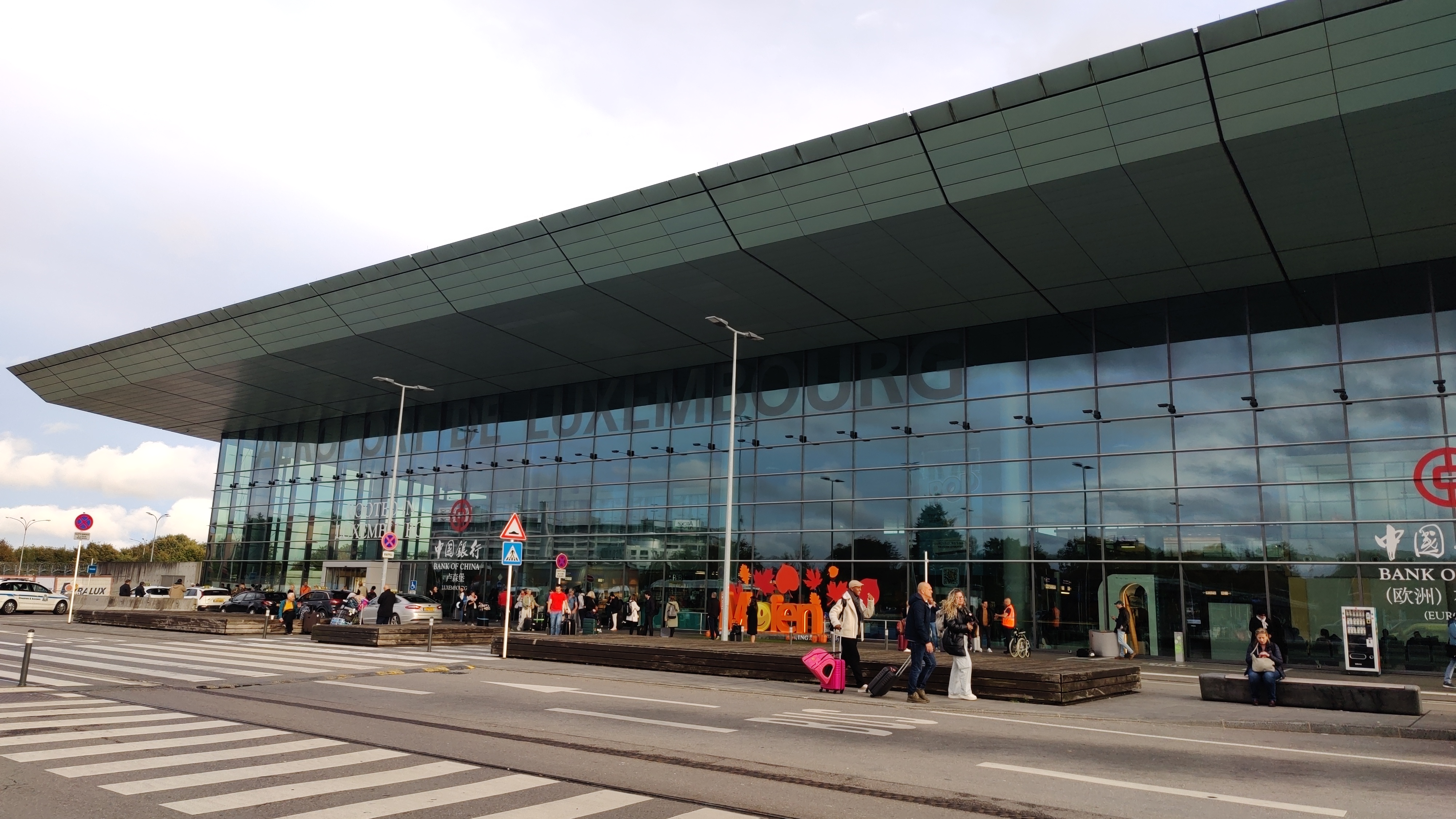
Luxembourg's Findel Airport
Separate cycling tracks in Luxembourg
My hotel was 20 km from the conference venue in Belval. However, the commute was convenient due to a free of cost train connection, which were comfortable, smooth, and scenic, covering the distance in half an hour. The hotel included a breakfast buffet, recharging us before the conference.
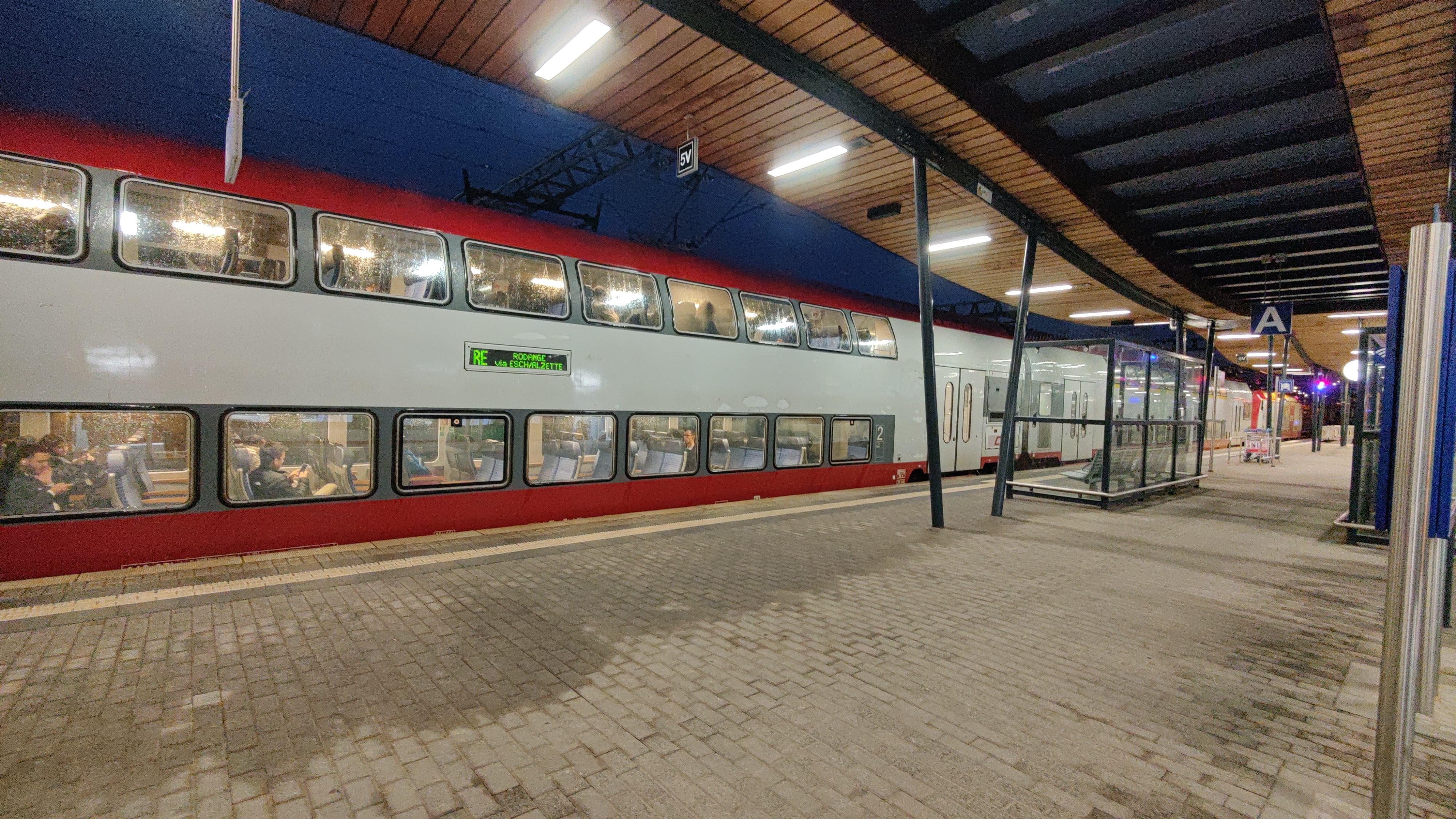
This is what trains look like in Luxembourg
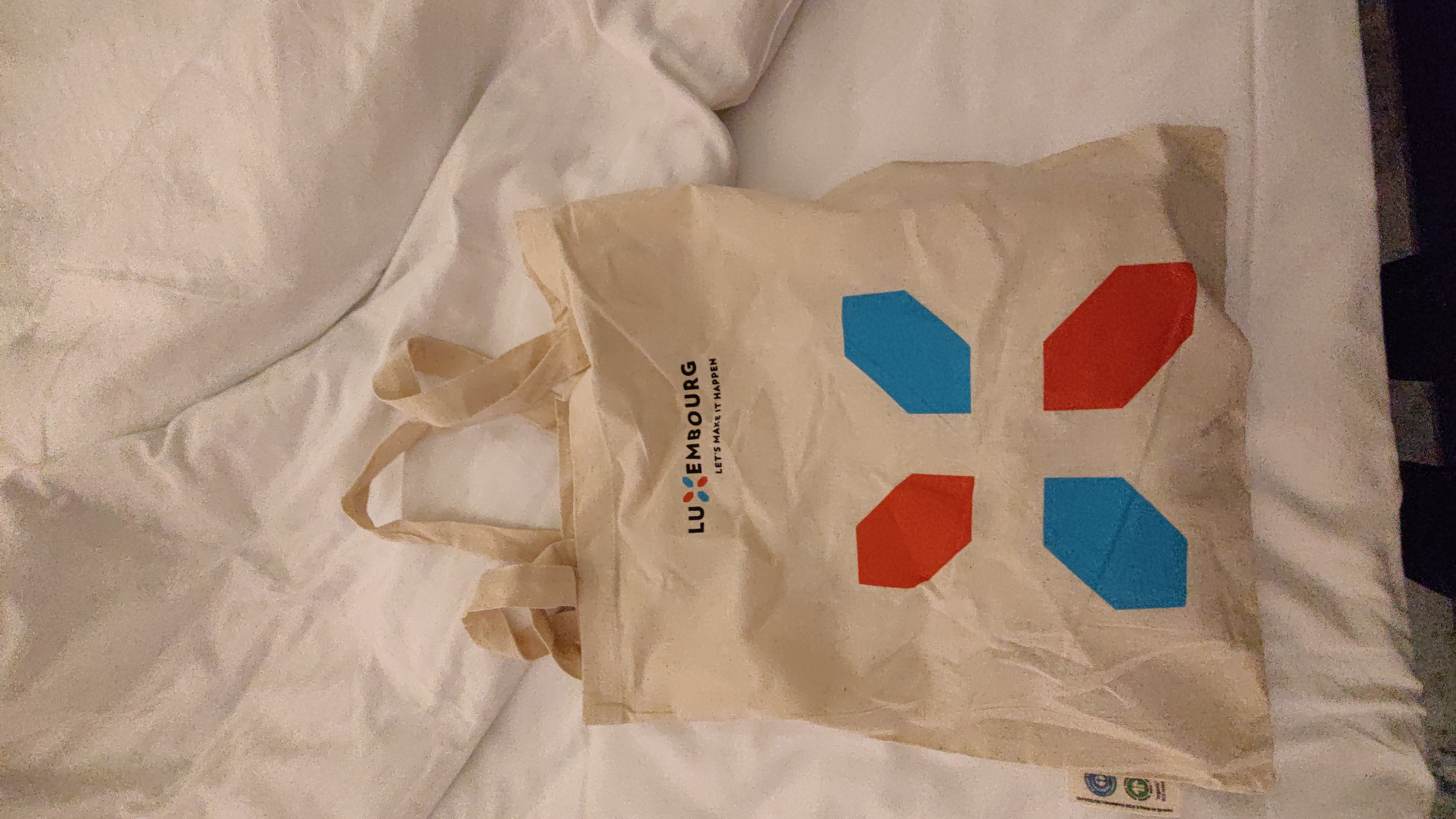
Pre-conference, a day was reserved for the community meetup on the 9th of October. On that day, the community members introduced themselves and their contributions to the LibreOffice project. It acted as a brainstorming session. I got a lovely conference bag, which contained a T-Shirt, a pen and a few stickers. I also met my long time collaborators Mike, Sophie and Italo from the TDF, whom I had interacted only remotely till then. Likewise, I also met TDF s sysadmin Guilhem, who I interacted before regarding setting up my LibreOffice mirror.
Conference bag
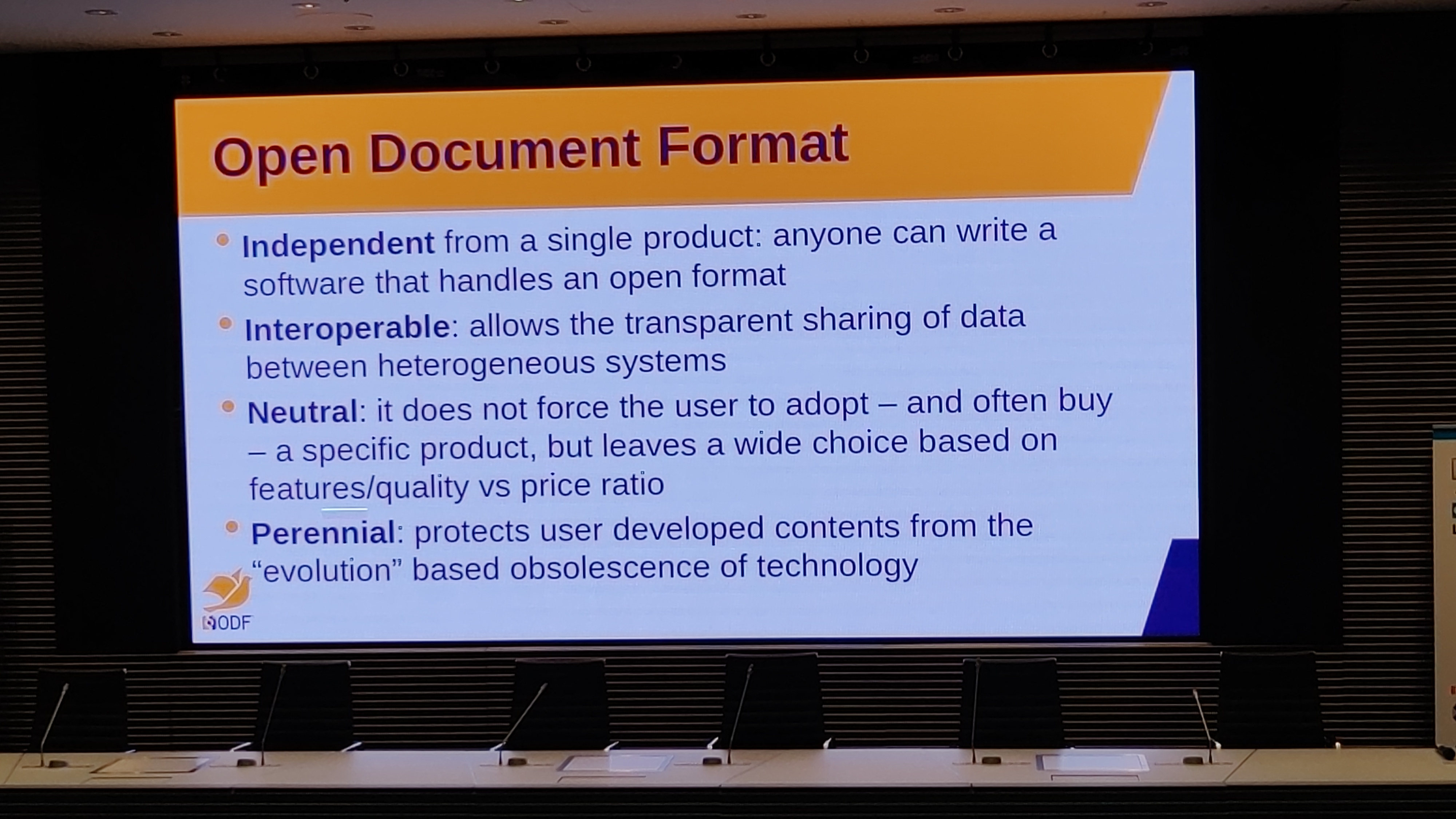
The conference started on the 10th. There were 5 attendees from India, including me, while most of the attendees were from Europe. The talks were in English. One of the talks that stood out for me was about Luxchat a chat service run by the Luxembourg government based on the Matrix protocol for the citizens of Luxembourg. I also liked Italo s talk on why document formats must be freedom-respecting. On the first night, the conference took us to a nice dinner in a restaurant. It offered one more way to socialize with other attendees and explore food at the same time.
One of the slides of Italo's talk
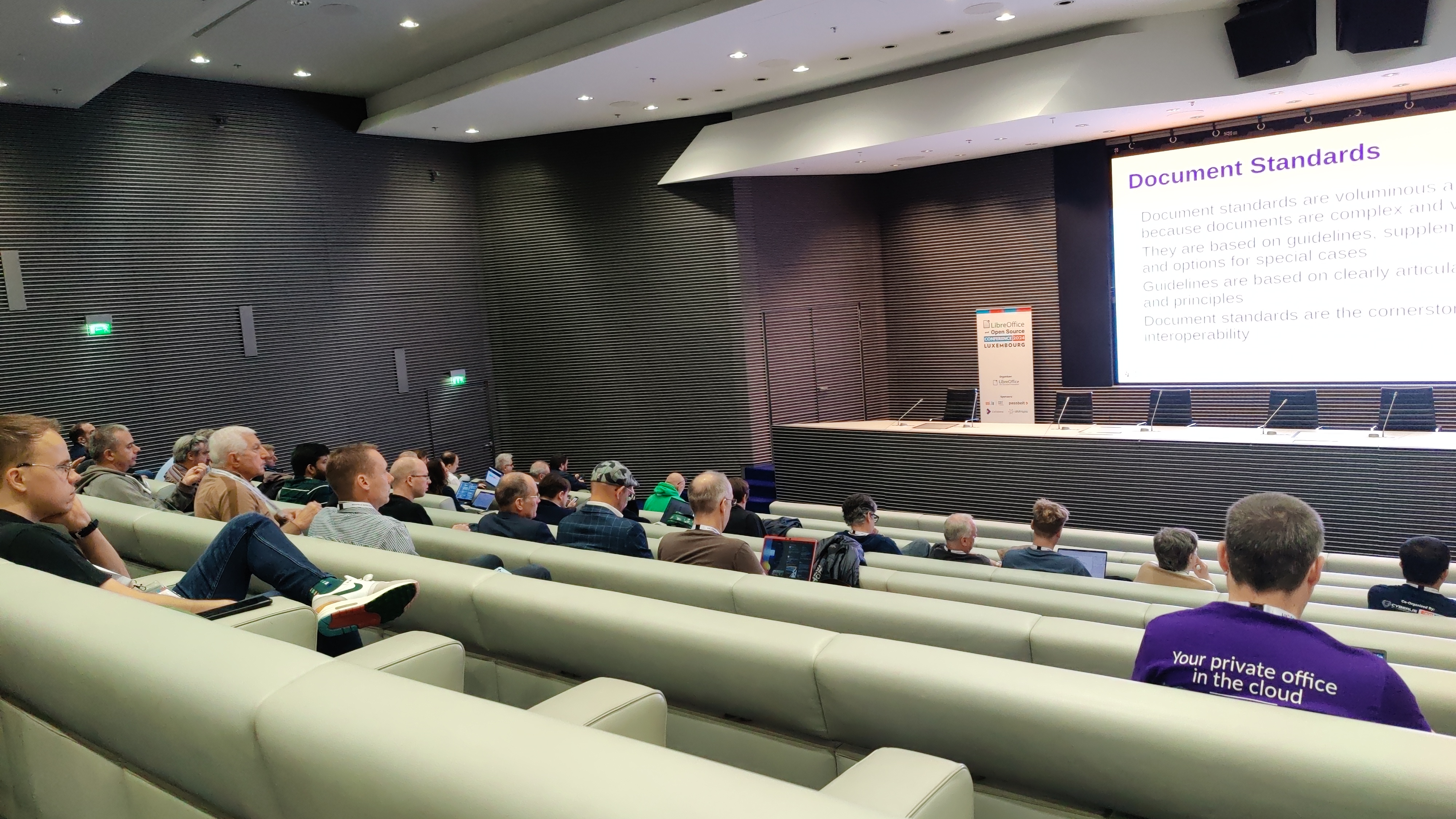
Picture of the hall in which talks were held
On the 11th of October, I went for a walk in the morning with Biswadeep for some sightseeing around our hotel area. As a consequence, I missed the group photo of the conference, which I wanted to be in. Anyway, we enjoyed roaming around the picturesque Luxembourg city. We also sampled a tram ride to return to our hotel.
We encountered such scenic views during our walk
Another view of Luxembourg city area
The conference ended on the 12th with a couple of talks. This conference gave me an opportunity to meet the global LibreOffice community, connect and share ideas. It also gave me a peek into the country of Luxembourg and its people, where I had good experience. English was widely known, and I had no issues getting by. Thanks to all the organizers and sponsors of the conference!

16 January 2025

Sergio Talens-Oliag: Command line tools to process templates

I ve always been a fan of template engines that work with text files, mainly to work with static site generators, but also to generate code, configuration files, and other text-based files. For my own web projects I used to go with Jinja2, as all my projects were written in Python, while for static web sites I used the template engines included with the tools I was using, i.e. Liquid with Jekyll and Go Templates (based on the text/template and the html/template go packages) for Hugo. When I needed to generate code snippets or configuration files from shell scripts I used to go with sed and/or envsubst, but lately things got complicated and I started to use a command line application called tmpl that uses the Go Template Language with functions from the Sprig library.

tmplI ve been using my fork of the tmpl program to process templates on CI/CD pipelines (gitlab-ci) to generate configuration files and code snippets because it uses the same syntax used by helm (easier to use by other DevOps already familiar with the format) and the binary is small and can be easily included into the docker images used by the pipeline jobs. One interesting feature of the tmpl tool is that it can read values from command line arguments and from multiple files in different formats (YAML, JSON, TOML, etc) and merge them into a single object that can be used to render the templates. There are alternatives to the tmpl tool and I ve looked at them (i.e. simple ones like go-template-cli or complex ones like gomplate), but I haven t found one that fits my needs. For my next project I plan to evaluate a move to a different tool or template format, as tmpl is not being actively maintained (as I said, I m using my own fork) and it is not included on existing GNU/Linux distributions (I packaged it for Debian and Alpine, but I don t want to maintain something like that without an active community and I m not interested in being the upstream myself, as I m trying to move to Rust instead of Go as the compiled programming language for my projects).

Mini JinjaLooking for alternate tools to process templates on the command line I found the minijinja rust crate, a minimal implementation of the Jinja2 template engine that also includes a small command line utility (minijinja-cli) and I believe I ll give it a try on the future for various reasons:
  • I m already familiar with the Jinja2 syntax and it is widely used on the industry.
  • On my code I can use the original Jinja2 module for Python projects and MiniJinja for Rust programs.
  • The included command line utility is small and easy to use, and the binaries distributed by the project are good enough to add them to the docker container images used by CI/CD pipelines.
  • As I want to move to Rust I can try to add functionalities to the existing command line client or create my own version of it if they are needed (don t think so, but who knows).

9 January 2025

Valhalla's Things: Poor Man Media Server

Posted on January 9, 2025
Tags: madeof:bits
Some time ago I installed minidlna on our media server: it was pretty easy to do, but quite limited in its support for the formats I use most, so I ended up using other solutions such as mounting the directory with sshfs. Now, doing that from a phone, even a pinephone running debian, may not be as convenient as doing it from the laptop where I already have my ssh key :D and I needed to listed to music from the pinephone. So, in anger, I decided to configure a web server to serve the files. I installed lighttpd because I already had a role for this kind of configuration in my ansible directory, and configured it to serve the relevant directory in /etc/lighttpd/conf-available/20-music.conf:
$HTTP["host"] =~ "music.example.org"  
    server.name          = "music.example.org"
    server.document-root = "/path/to/music"
 
the domain was already configured in my local dns (since everything is only available to the local network), and I enabled both 20-music.conf and 10-dir-listing.conf. And. That s it. It works. I can play my CD rips on a single flac exactly in the same way as I was used to (by ssh-ing to the media server and using alsaplayer). Then this evening I was talking to normal people1, and they mentioned that they wouldn t mind being able to skip tracks and fancy things like those :D and I ve found one possible improvement. For the directories with the generated single-track ogg files I ve added some playlists with the command ls *.ogg > playlist.m3u, then in the directory above I ve run ls */*.m3u > playlist.m3u and that also works. With vlc I can now open http://music.example.org/band/album/playlist.m3u to listen to an album that I have in ogg, being able to move between tracks, or I can open http://music.example.org/band/playlist.m3u and in the playlist view I can browse between the different albums. Left as an exercise to the reader2 are writing a bash script to generate all of the playlist.m3u files (and running it via some git hook when the files change) or writing a php script to generate them on the fly.
Update 2025-01-10: another reader3 wrote the php script and has authorized me to post it here.
<?php
define("MUSIC_FOLDER", __DIR__);
define("ID3v2", false);


function dd()  
    echo "<pre>"; call_user_func_array("var_dump", func_get_args());
    die();
 

function getinfo($file)  
    $cmd = 'id3info "' . MUSIC_FOLDER . "/" . $file . '"';
    exec($cmd, $output);
    $res = [];
    foreach($output as $line)  
    if (str_starts_with($line, "=== "))  
        $key = explode(" ", $line)[1];
        $val = end(explode(": ", $line, 2));
        $res[$key] = $val;
     
     
    if (isset($res['TPE1'])   isset($res['TIT2']))
    echo "#EXTINF: , " . ($res['TPE1'] ?? "Unk") . " - " . ($res['TIT2'] ?? "Untl") . "\r\n";
    if (isset($res['TALB']))
    echo "#EXTALB: " . $res['TALB'] . "\r\n";


function pathencode($path, $name)  
    $path = urlencode($path);
    $path =  str_replace("%2F", "/", $path);
    $name = urlencode($name);
    if ($path != "") $path = "/" . $path;
    return $path . "/" . $name;
 

function serve_playlist($path)  
    echo "#EXTM3U";
    echo "# PATH: $path\n\r";
    foreach (glob(MUSIC_FOLDER . "/$path/*") as $filename)  
    $name = basename($filename);
    if (is_dir($filename))  
        echo pathencode($path, $name) . ".m3u\r\n";
     
    $t = explode(".", $filename);
    $ext = array_pop($t);
    if (in_array($ext, ["mp3", "ogg", "flac", "mp4", "m4a"]))  
        if (ID3v2)  
 	   getinfo($path . "/" . $name);
          else  
 	   echo "#EXTINF: , " . $path . "/" . $name . "\r\n";
         
        echo pathencode($path, $name) . "\r\n";
     
     
    die();


$path = $_SERVER["REQUEST_URI"];
$path = urldecode($path);
$path = trim($path, "/");

if (str_ends_with($path, ".m3u"))  
    $path = str_replace(".m3u", "", $path);

    serve_playlist($path);
 

$path = MUSIC_FOLDER . "/" . $path;
if (file_exists($path) && is_file($path))  
    header('Content-Description: File Transfer');
    header('Content-Type: application/octet-stream');
    header('Expires: 0');
    header('Cache-Control: must-revalidate');
    header('Pragma: public');
    header('Content-Length: ' . filesize($path));
    readfile($path);
 
It s php, so I assume no responsability for it :D

  1. as much as the members of our LUG can be considered normal.
  2. i.e. the person in the LUG who wanted me to share what I had done.
  3. i.e. the other person in the LUG who was in that conversation and suggested the php script option.

21 December 2024

Dirk Eddelbuettel: anytime 0.3.11 on CRAN: Maintenance

A follow-up release 0.3.11 to the recent 0.3.10 release release of the anytime package arrived on CRAN two days ago. The package is fairly feature-complete, and code and functionality remain mature and stable, of course. anytime is a very focused package aiming to do just one thing really well: to convert anything in integer, numeric, character, factor, ordered, input format to either POSIXct (when called as anytime) or Date objects (when called as anydate) and to do so without requiring a format string as well as accomodating different formats in one input vector. See the anytime page, or the GitHub repo for a few examples, and the beautiful documentation site for all documentation. This release simply skips one test file. CRAN labeled an error M1mac yet it did not reproduce on any of the other M1 macOS I can access (macbuilder, GitHub Actions) as this appeared related to a local setting of timezone values I could not reproduce anywwhere. So the only way to get rid of the fail is to not to run the test. Needless to say the upload process was a little tedious as I got the passive-aggressive not responding treatment on a first upload and the required email answer it lead to. Anyway, after a few days, and even more deep breaths, it is taken care of and now the package result standing is (at least currently) pristinely clean. The short list of changes follows.

Changes in anytime version 0.3.11 (2024-12-18)
  • Skip a test file

Courtesy of my CRANberries, there is also a diffstat report of changes relative to the previous release. The issue tracker tracker off the GitHub repo can be use for questions and comments. More information about the package is at the package page, the GitHub repo and the documentation site.

This post by Dirk Eddelbuettel originated on his Thinking inside the box blog. If you like this or other open-source work I do, you can now sponsor me at GitHub.

2 December 2024

Dirk Eddelbuettel: anytime 0.3.10 on CRAN: Multiple Enhancements

A new release of the anytime package arrived on CRAN today the first is well over four years. The package is fairly feature-complete, and code and functionality remain mature and stable, of course. anytime is a very focused package aiming to do just one thing really well: to convert anything in integer, numeric, character, factor, ordered, input format to either POSIXct (when called as anytime) or Date objects (when called as anydate) and to do so without requiring a format string as well as accomodating different formats in one input vector. See the anytime page, or the GitHub repo for a few examples, and the beautiful documentation site for all documentation. This release slowly matured over four years. It combines a number of strictly internal repository maintenance such as changes to continuous integration with small enhancements (adding for example some new formats, responding better to an error condition, dealing with logical input as an error) with a relaxation of the C++ compilation standard. While we once needed C++11, it is now a constraint as as R itself is quite proactive (the last two releases defaulted already to C++17, suitable compiler permitting) we can now relax this constraint. The documentation site is new, as some other small changes. See the full list of changes which follows.

Changes in anytime version 0.3.10 (2024-12-02)
  • A new documentation site was added.
  • Continuous Integration now uses run.sh from r-ci with bspm
  • Logical input vectors are now recognised as an error (#121)
  • Additional dot-separated format '%Y.%m.%d' is supported
  • Other small updates were made throughout the package
  • No longer set a C++ compilation standard as the default choices by R are sufficient for the package
  • Switch Rcpp include file to Rcpp/Lightest
  • We recommend ~/.R/Makevars compiler flag options -Wno-ignored-attributes -Wno-nonnull -Wno-parentheses
  • The tinytest runner was simplified
  • NA values from conversion now trigger a warning

Courtesy of my CRANberries, there is also a diffstat report of changes relative to the previous release. The issue tracker tracker off the GitHub repo can be use for questions and comments. More information about the package is at the package page, the GitHub repo and the documentation site. If you like this or other open-source work I do, you can now sponsor me at GitHub.

This post by Dirk Eddelbuettel originated on his Thinking inside the box blog. Please report excessive re-aggregation in third-party for-profit settings.

30 November 2024

Aurelien Jarno: UEFI Unified Kernel Image for Debian Installer on riscv64

On the riscv64 port, the default boot method is UEFI, with U-Boot typically used as the firmware. This approach aligns more closely with other architectures, which avoid developping riscv64 specific code. For advanced users, booting using U-Boot and extlinux is possible, thanks to the kernel being built with CONFIG_EFI_STUB=y. The same applies to the Debian Installer, which is provided as ISO images in various sizes and formats like on other architectures. These images can be put on a USB drive or an SD-card and booted directly from U-Boot in UEFI mode. Some users prefer to use the netboot "image", which in practice consists of a Linux kernel, an initrd, plus a set of Device Tree Blob (DTB) files. However, booting this in UEFI mode is not straightforward, unless you use a TFTP server, which is also not trivial. Less known to users, there is also a corresponding mini.iso image, which contains all the above plus a bootloader. This offers a simpler alternative for installation, but depending on your (vendor) U-Boot version this still requires to go through a media. Systemd version 257-rc2 comes with a great new feature, the ability to include multiple DTB files in a single UKI (Unified Kernel Image) file, with systemd-stub automatically loading the appropriate one for the current hardware. A UKI file combines a UEFI boot stub program, a Linux kernel image, an optional initrd, and further resources in a single UEFI PE file. This finally solves the DTB problem in the UEFI world for distributions, as a single image can work on multiple boards. Building upon this, debian-installer on riscv64 now also creates a UEFI UKI mini.efi image, which contains systemd-stub, a Linux kernel, an initrd, plus a set of Device Tree Blob (DTB) files. Using this image also ensures that the system is booted in UEFI mode. Booting it with debian-installer is as simple as:
load mmc 0:1 mini.efo $kernel_addr_r # (can also be done using tftpboot, wget, etc.)
bootefi $kernel_addr_r
Additional parameters can be passed to the image using the U-Boot bootargs environment variable. For instance, to boot in rescue mode:
setenv bootargs "rescue/enable=true"

1 September 2024

Bits from Debian: Bits from the DPL

Dear Debian community, this are my bits from DPL for August. Happy Birthday Debian On 16th of August Debian celebrated its 31th birthday. Since I'm unable to write a better text than our great publicity team I'm simply linking to their article for those who might have missed it: https://bits.debian.org/2024/08/debian-turns-31.html Removing more packages from unstable Helmut Grohne argued for more aggressive package removal and sought consensus on a way forward. He provided six examples of processes where packages that are candidates for removal are consuming valuable person-power. I d like to add that the Bug of the Day initiative (see below) also frequently encounters long-unmaintained packages with popcon votes sometimes as low as zero, and often fewer than ten. Helmut's email included a list of packages that would meet the suggested removal criteria. There was some discussion about whether a popcon vote should be included in these criteria, with arguments both for and against it. Although I support including popcon, I acknowledge that Helmut has a valid point in suggesting it be left out. While I ve read several emails in agreement, Scott Kitterman made a valid point "I don't think we need more process. We just need someone to do the work of finding the packages and filing the bugs." I agree that this is crucial to ensure an automated process doesn t lead to unwanted removals. However, I don t see "someone" stepping up to file RM bugs against other maintainers' packages. As long as we have strict ownership of packages, many people are hesitant to touch a package, even for fixing it. Asking for its removal might be even less well-received. Therefore, if an automated procedure were to create RM bugs based on defined criteria, it could help reduce some of the social pressure. In this aspect the opinion of Niels Thykier is interesting: "As much as I want automation, I do not mind the prototype starting as a semi-automatic process if that is what it takes to get started." The urgency of the problem to remove packages was put by CharlesPlessy into the words: "So as of today, it is much less work to keep a package rotting than removing it." My observation when trying to fix the Bug of the Day exactly fits this statement. I would love for this discussion to lead to more aggressive removals that we can agree upon, whether they are automated, semi-automated, or managed by a person processing an automatically generated list (supported by an objective procedure). To use an analogy: I ve found that every image collection improves with aggressive pruning. Similarly, I m convinced that Debian will improve if we remove packages that no longer serve our users well. DEP14 / DEP18 There are two DEPs that affect our workflow for maintaining packages particularly for those who agree on using Git for Debian packages. DEP-14 recommends a standardized layout for Git packaging repositories, which benefits maintainers working across teams and makes it easier for newcomers to learn a consistent repository structure. DEP-14 stalled for various reasons. Sam Hartman suspected it might be because 'it doesn't bring sufficient value.' However, the assumption that git-buildpackage is incompatible with DEP-14 is incorrect, as confirmed by its author, Guido G nther. As one of the two key tools for Debian Git repositories (besides dgit) fully supports DEP-14, though the migration from the previous default is somewhat complex. Some investigation into mass-converting older formats to DEP-14 was conducted by the Perl team, as Gregor Hermann pointed out.. The discussion about DEP-14 resurfaced with the suggestion of DEP-18. Guido G nther proposed the title Encourage Continuous Integration and Merge Request-Based Collaboration for Debian Packages , which more accurately reflects the DEP's technical intent. Otto Kek l inen, who initiated DEP-18 (thank you, Otto), provided a good summary of the current status. He also assembled a very helpful overview of Git and GitLab usage in other Linux distros. More Salsa CI As a result of the DEP-18 discussion, Otto Kek l inen suggested implementing Salsa CI for our top popcon packages. I believe it would be a good idea to enable CI by default across Salsa whenever a new repository is created. Progress in Salsa migration In my campaign, I stated that I aim to reduce the number of packages maintained outside Salsa to below 2,000. As of March 28, 2024, the count was 2,368. Today, it stands at 2,187 (UDD query: SELECT DISTINCT count(*) FROM sources WHERE release = 'sid' and vcs_url not like '%salsa%' ;). After a third of my DPL term (OMG), we've made significant progress, reducing the amount in question (369 packages) by nearly half. I'm pleased with the support from the DDs who moved their packages to Salsa. Some packages were transferred as part of the Bug of the Day initiative (see below). Bug of the Day As announced in my 'Bits from the DPL' talk at DebConf, I started an initiative called Bug of the Day. The goal is to train newcomers in bug triaging by enabling them to tackle small, self-contained QA tasks. We have consistently identified target packages and resolved at least one bug per day, often addressing multiple bugs in a single package. In several cases, we followed the Package Salvaging procedure outlined in the Developers Reference. Most instances were either welcomed by the maintainer or did not elicit a response. Unfortunately, there was one exception where the recipient of the Package Salvage bug expressed significant dissatisfaction. The takeaway is to balance formal procedures with consideration for the recipient s perspective. I'm pleased to confirm that the Matrix channel has seen an increase in active contributors. This aligns with my hope that our efforts would attract individuals interested in QA work. I m particularly pleased that, within just one month, we have had help with both fixing bugs and improving the code that aids in bug selection. As I aim to introduce newcomers to various teams within Debian, I also take the opportunity to learn about each team's specific policies myself. I rely on team members' assistance to adapt to these policies. I find that gaining this practical insight into team dynamics is an effective way to understand the different teams within Debian as DPL. Another finding from this initiative, which aligns with my goal as DPL, is that many of the packages we addressed are already on Salsa but have not been uploaded, meaning their VCS fields are not published. This suggests that maintainers are generally open to managing their packages on Salsa. For packages that were not yet on Salsa, the move was generally welcomed. Publicity team wants you The publicity team has decided to resume regular meetings to coordinate their efforts. Given my high regard for their work, I plan to attend their meetings as frequently as possible, which I began doing with the first IRC meeting. During discussions with some team members, I learned that the team could use additional help. If anyone interested in supporting Debian with non-packaging tasks reads this, please consider introducing yourself to debian-publicity@lists.debian.org. Note that this is a publicly archived mailing list, so it's not the best place for sharing private information. Kind regards Andreas.

29 August 2024

Michael Ablassmeier: proxmox backup S3 proxy

A few weeks ago Tiziano Bacocco started a small project to implement a (golang) proxy that allows to store proxmox backups on S3 compatible storage: pmoxs3backuproxy, a feature which the current backup server does not have. I wanted to have a look at the Proxmox Backup Server implementation for a while, so i jumped on the wagon and helped with adding most of the API endpoints required to seamlessly use it as drop-in replacement in PVE. The current version can be configured as storage backend in PVE. You can then schedule your backups to the S3 storage likewise. It now supports both the Fixed index format required to create virtual machine backups and the Dynamic index format, used by the regular proxmox-backup-client for file and container backups. (full and incremental) The other endpoints like adding notes, removing or protecting backups, mounting images using the PVE frontend (or proxmox-backup-client) work too. It comes with a garbage collector that does prune the backup storage if snapshots expire and runs integrity checks on the data. You can also configure it as so called remote storage in the Proxmox Backup server itself and pull back complete buckets using proxmox-backup-manager pull , if your local datastore crashes. I think it will become more interesting if future proxmox versions will allow to push backups to other stores, too.

4 August 2024

Matthias Klumpp: Freedesktop Specs Website Update

The Freedesktop.org Specifications directory contains a list of common specifications that have accumulated over the decades and define how common desktop environment functionality works. The specifications are designed to increase interoperability between desktops. Common specifications make the life of both desktop-environment developers and especially application developers (who will almost always want to maximize the amount of Linux DEs their app can run on and behave as expected, to increase their apps target audience) a lot easier. Unfortunately, building the HTML specifications and maintaining the directory of available specs has become a bit of a difficult chore, as the pipeline for building the site has become fairly old and unmaintained (parts of it still depended on Python 2). In order to make my life of maintaining this part of Freedesktop easier, I aimed to carefully modernize the website. I do have bigger plans to maybe eventually restructure the site to make it easier to navigate and not just a plain alphabetical list of specifications, and to integrate it with the Wiki, but in the interest of backwards compatibility and to get anything done in time (rather than taking on a mega-project that can t be finished), I decided to just do the minimum modernization first to get a viable website, and do the rest later. So, long story short: Most Freedesktop specs are written in DocBook XML. Some were plain HTML documents, some were DocBook SGML, a few were plaintext files. To make things easier to maintain, almost every specification is written in DocBook now. This also simplifies the review process and we may be able to switch to something else like AsciiDoc later if we want to. Of course, one could have switched to something else than DocBook, but that would have been a much bigger chore with a lot more broken links, and I did not want this to become an even bigger project than it already was and keep its scope somewhat narrow. DocBook is a markup language for documentation which has been around for a very long time, and therefore has older tooling around it. But fortunately our friends at openSUSE created DAPS (DocBook Authoring and Publishing Suite) as a modern way to render DocBook documents to HTML and other file formats. DAPS is now used to generate all Freedesktop specifications on our website. The website index and the specification revisions are also now defined in structured TOML files, to make them easier to read and to extend. A bunch of specifications that had been missing from the original website are also added to the index and rendered on the website now. Originally, I wanted to put the website live in a temporary location and solicit feedback, especially since some links have changed and not everything may have redirects. However, due to how GitLab Pages worked (and due to me not knowing GitLab CI well enough ) the changes went live before their MR was actually merged. Rather than reverting the change, I decided to keep it (as the old website did not build properly anymore) and to see if anything breaks. So far, no dead links or bad side effects have been observed, but: If you notice any broken link to specifications.fd.o or anything else weird, please file a bug so that we can fix it! Thank you, and I hope you enjoy reading the specifications in better rendering and more coherent look!

25 May 2024

Gunnar Wolf: How computers make books from graphics rendering, search algorithms, and functional programming to indexing and typesetting

This post is a review for Computing Reviews for How computers make books from graphics rendering, search algorithms, and functional programming to indexing and typesetting , a book published in Manning
If we look at the age-old process of creating books, how many different areas can a computer help us with? And how can each of them be used to teach computer science (CS) fundamentals to a nontechnical audience? This is the premise of John Whitington s enticing book and the result is quite amazing. The book immediately drew my attention when looking at the titles available for review. After all, my initiation into computing as a kid was learning the LaTeX typesetting system while my father worked on his first book on scientific language and typography [1]. Whitington picks 11 different technical aspects of book production, from how dots of ink are transferred to a white page and how they are made into controllable, recognizable shapes, all the way to forming beautiful typefaces and the nuances of properly addressing white-space to present aesthetically pleasing paragraphs, building it all into specific formats aimed at different ends. But if we dig beyond just the chapter titles, we will find a very interesting book on CS that, without ever using technical language or notation, presents aspects as varied as anti-aliasing, vector and raster images, character sets such as ASCII and Unicode, an introduction to programming, input methods for different writing systems, efficient encoding (compression) methods, both for text and images, lossless and lossy, and recursion and dithering methods. To my absolute surprise, while the author thankfully spared the reader the syntax usually associated with LISP-related languages, the programming examples clearly stem from the LISP school, presenting solutions based on tail recursion. Of course, it is no match for Donald Knuth s classic book on this same topic [2], but could very well be a primer for readers to approach it. The book is light and easy to read, and keeps a very informal, nontechnical tone throughout. My only complaint relates to reading it in PDF format; the topic of this book, and the care with which the images were provided by the author, warrant high resolution. The included images are not only decorative but an integral part of the book. Maybe this is specific to my review copy, but all of the raster images were in very low resolution. This book is quite different from what readers may usually expect, as it introduces several significant topics in the field. CS professors will enjoy it, of course, but also readers with a humanities background, students new to the field, or even those who are just interested in learning a bit more.

References
  1. S nchez y G ndara, A.; Magari os Lamas, F.; Wolf, K. B., Manual de lenguaje y tipograf a cient fica en castellano. Trillas, Mexico City, Mexico, 1986, https://www.fis.unam.mx/~bwolf/manual.html
  2. Knuth, D. E. Digital typographyCSLI Lecture Notes: CSLI Lecture Notes. CSLI Publications, Stanford, CA, 1999, https://www-cs-faculty.stanford.edu/~knuth/dt.html

7 May 2024

John Goerzen: Photographic comparison: Is the Kobo Libra Colour display worse than the Kobo Libra 2?

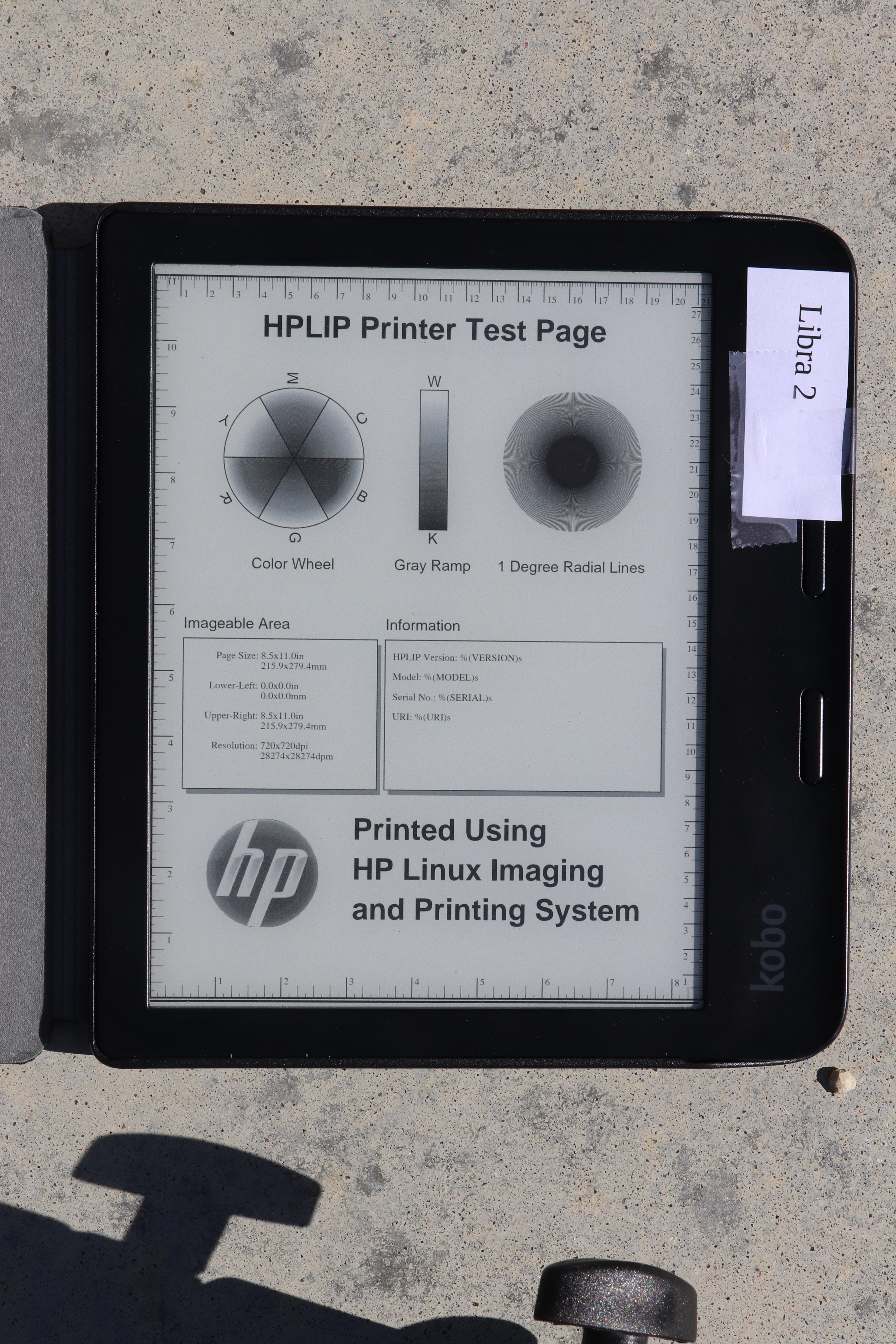
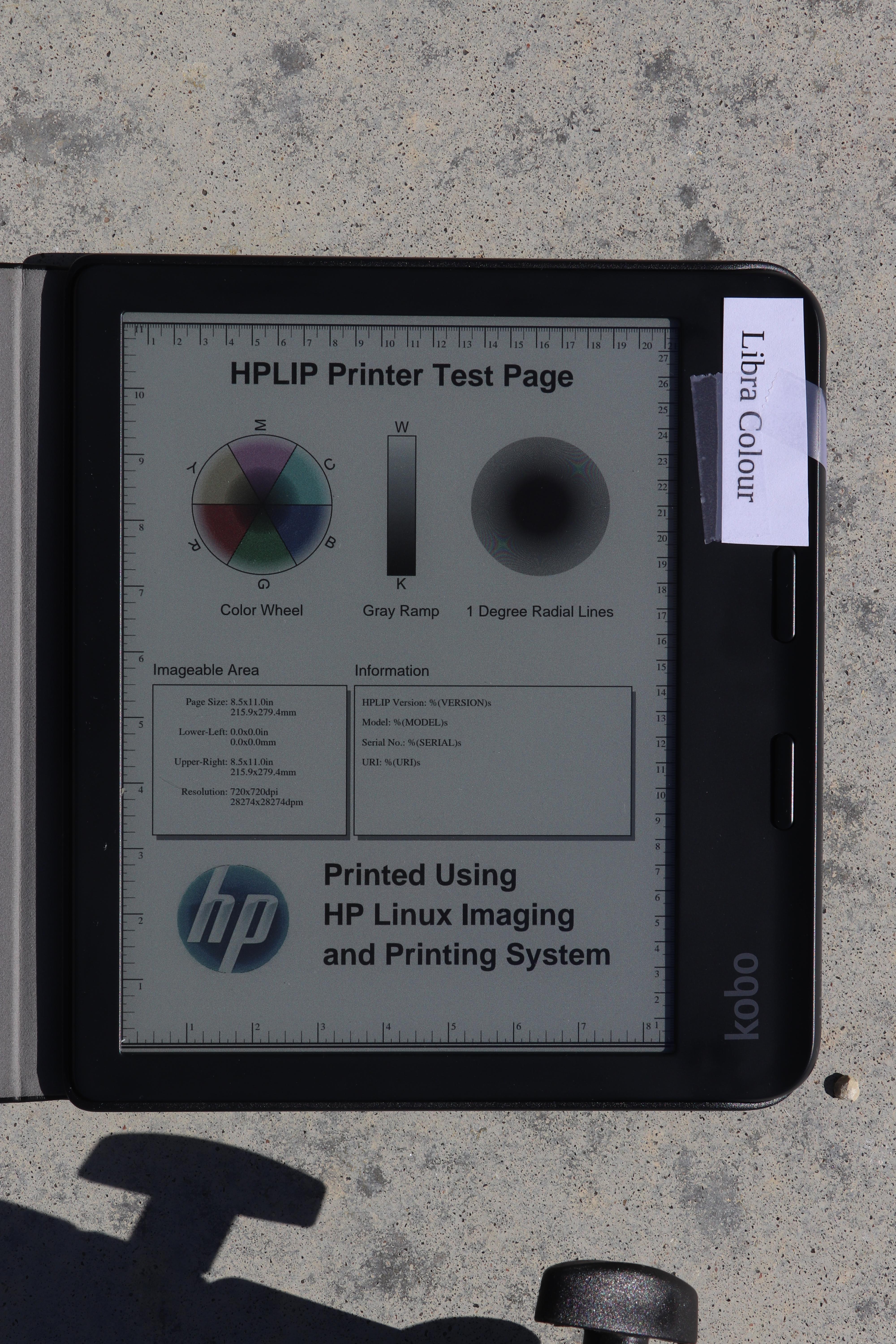
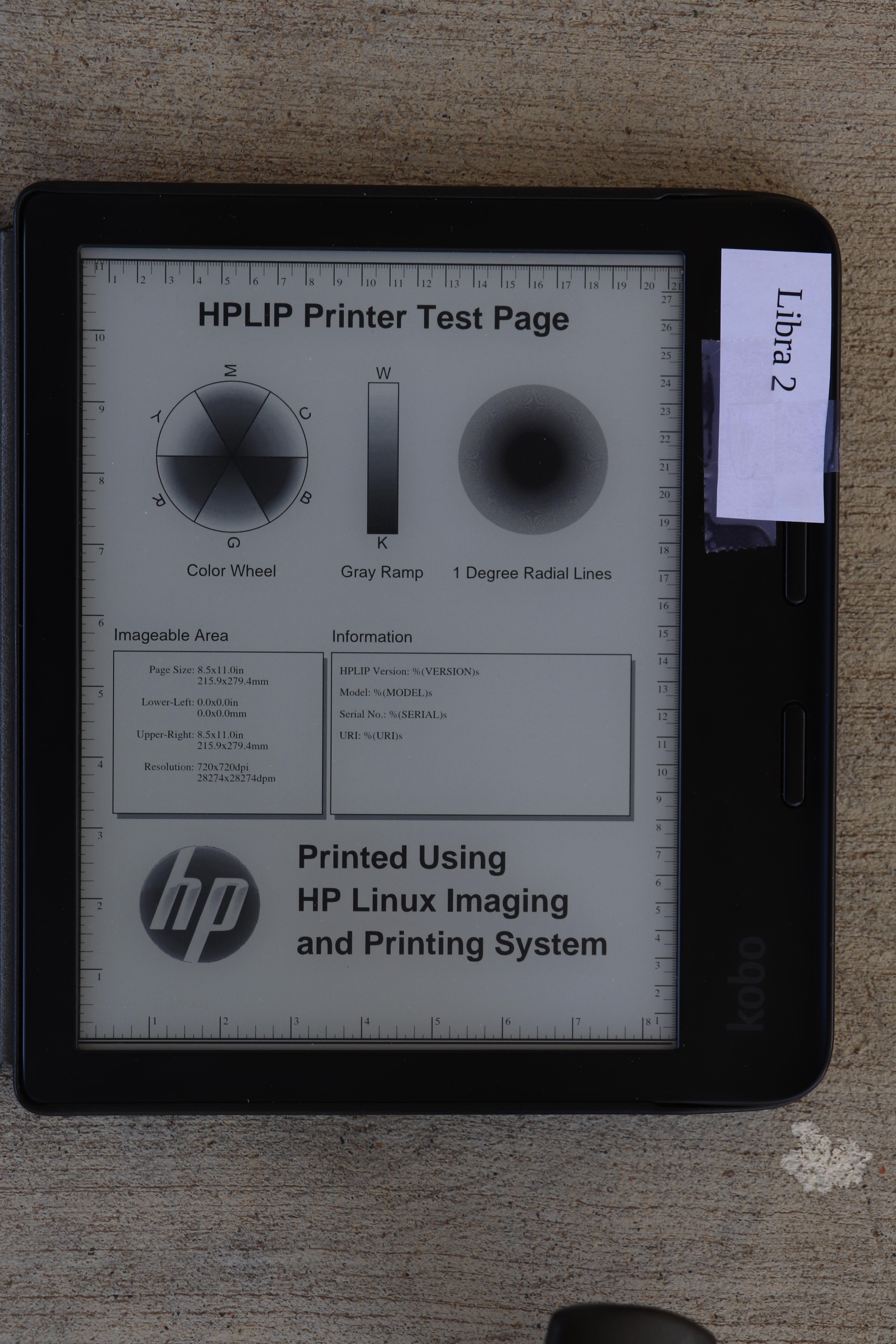
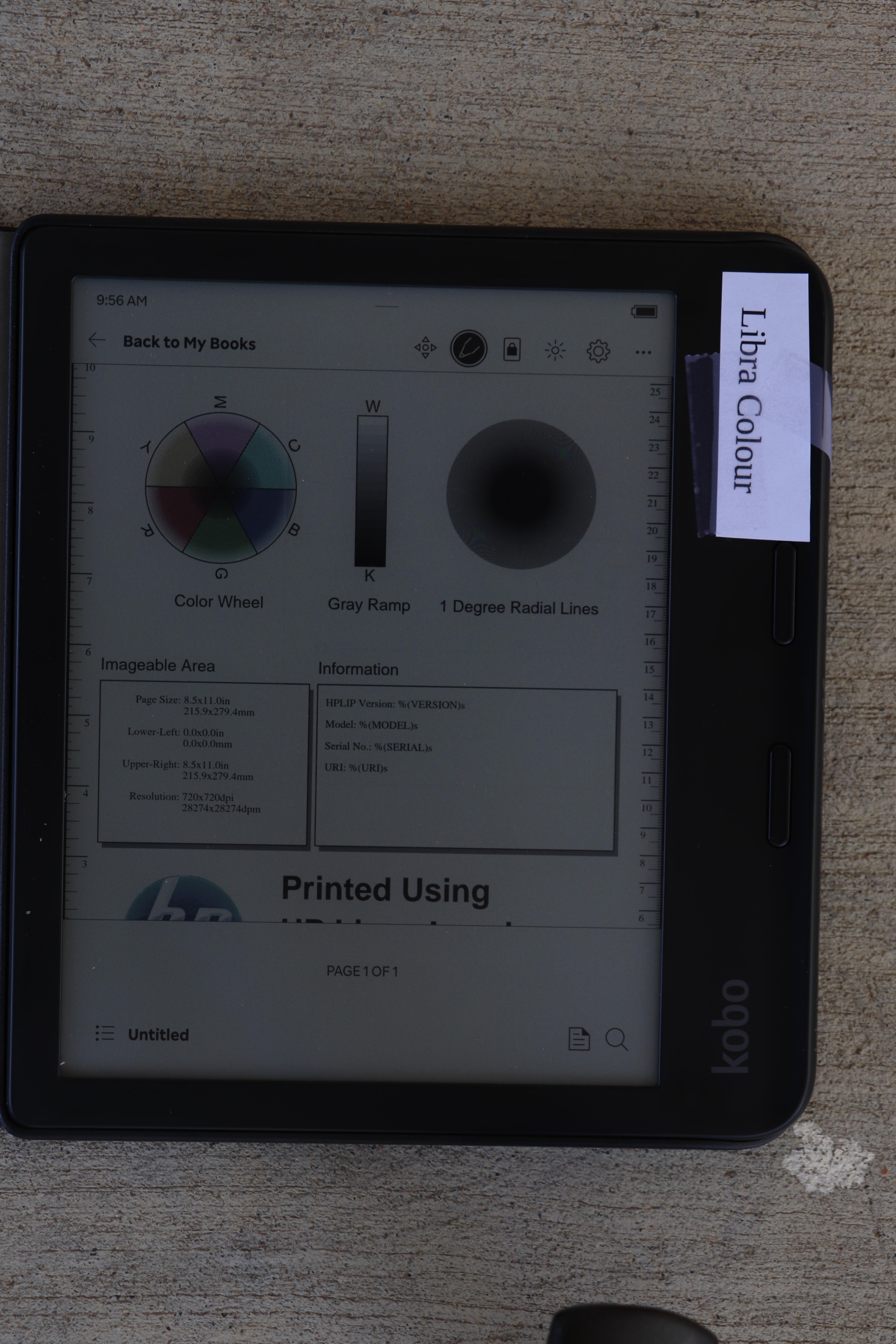
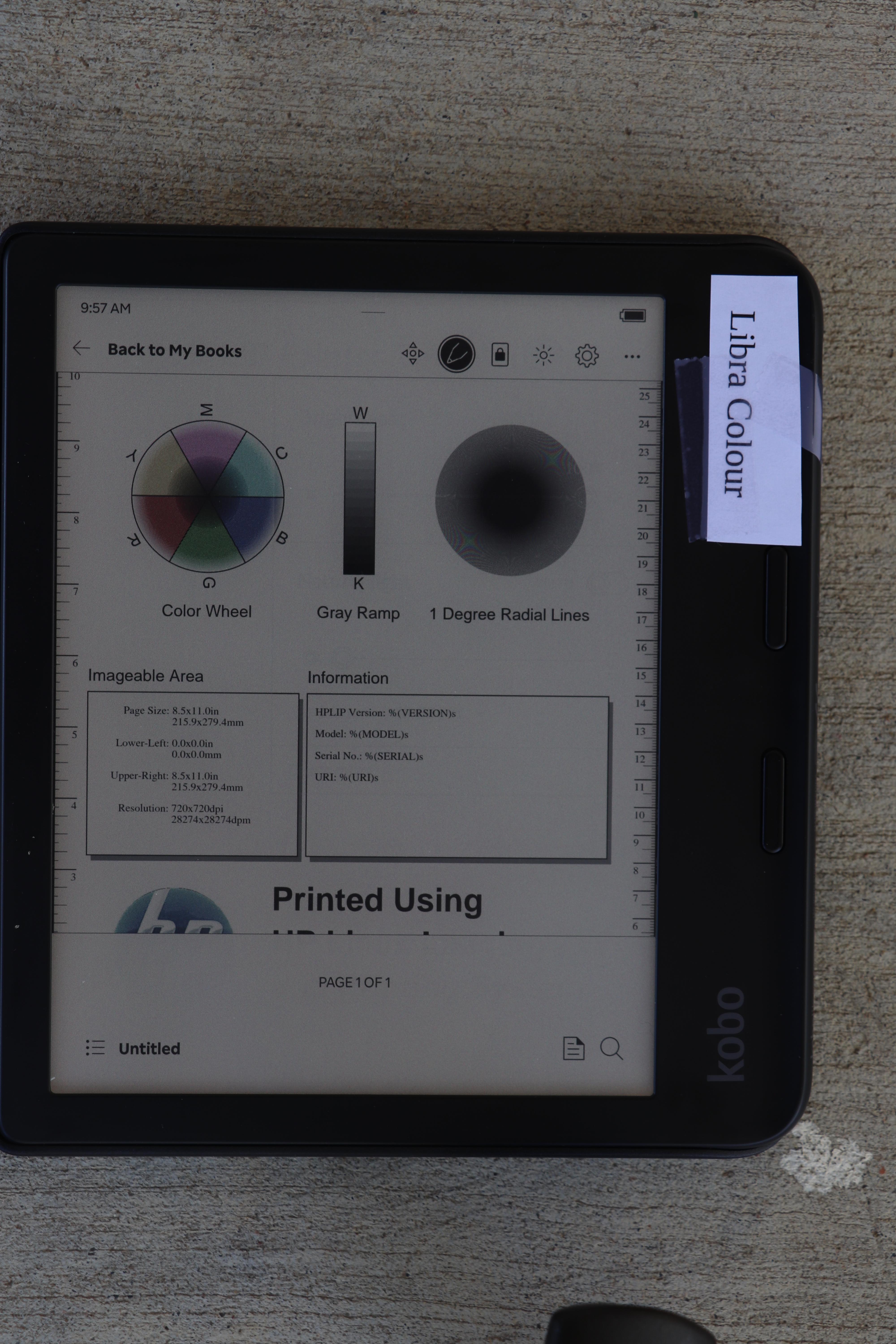
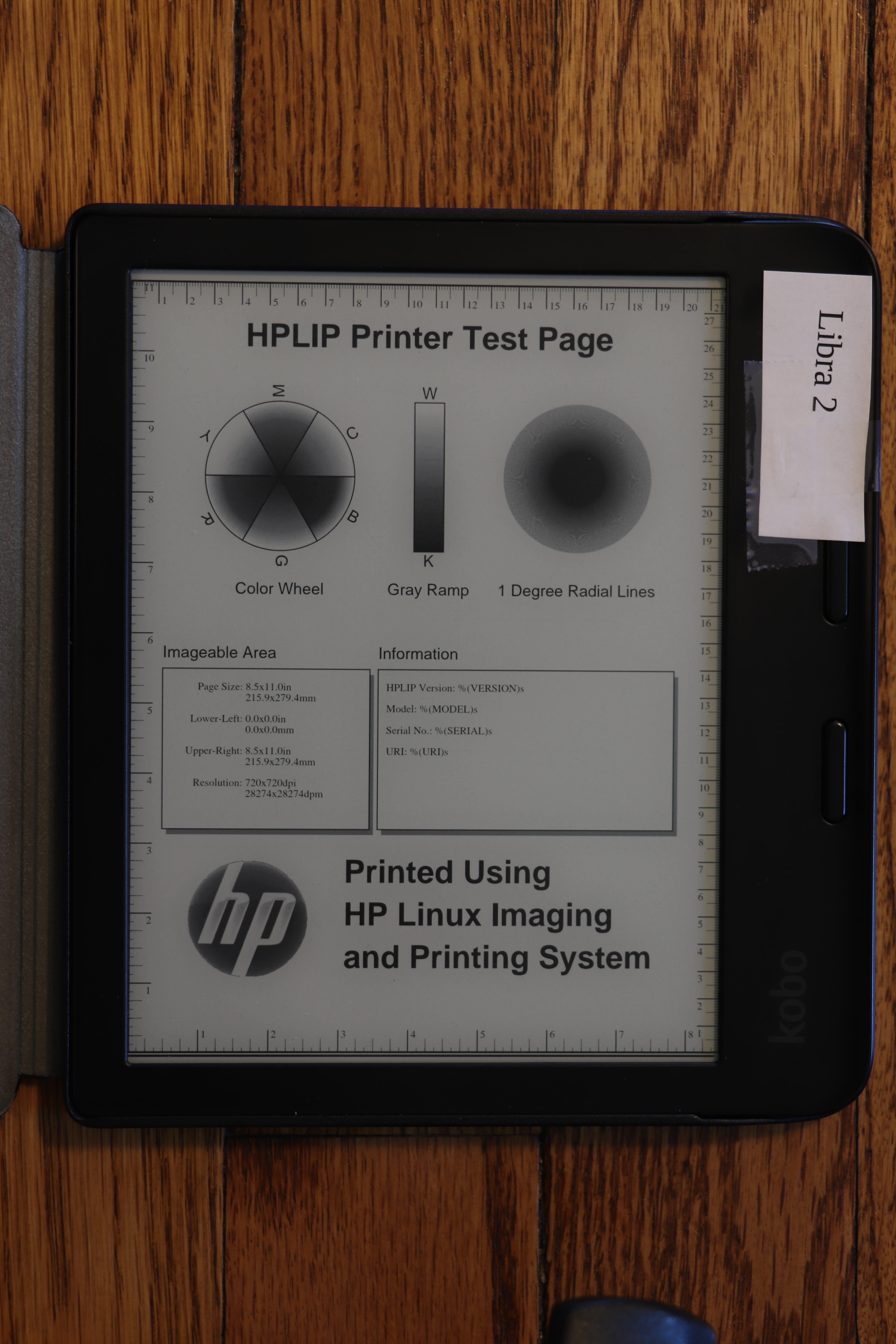
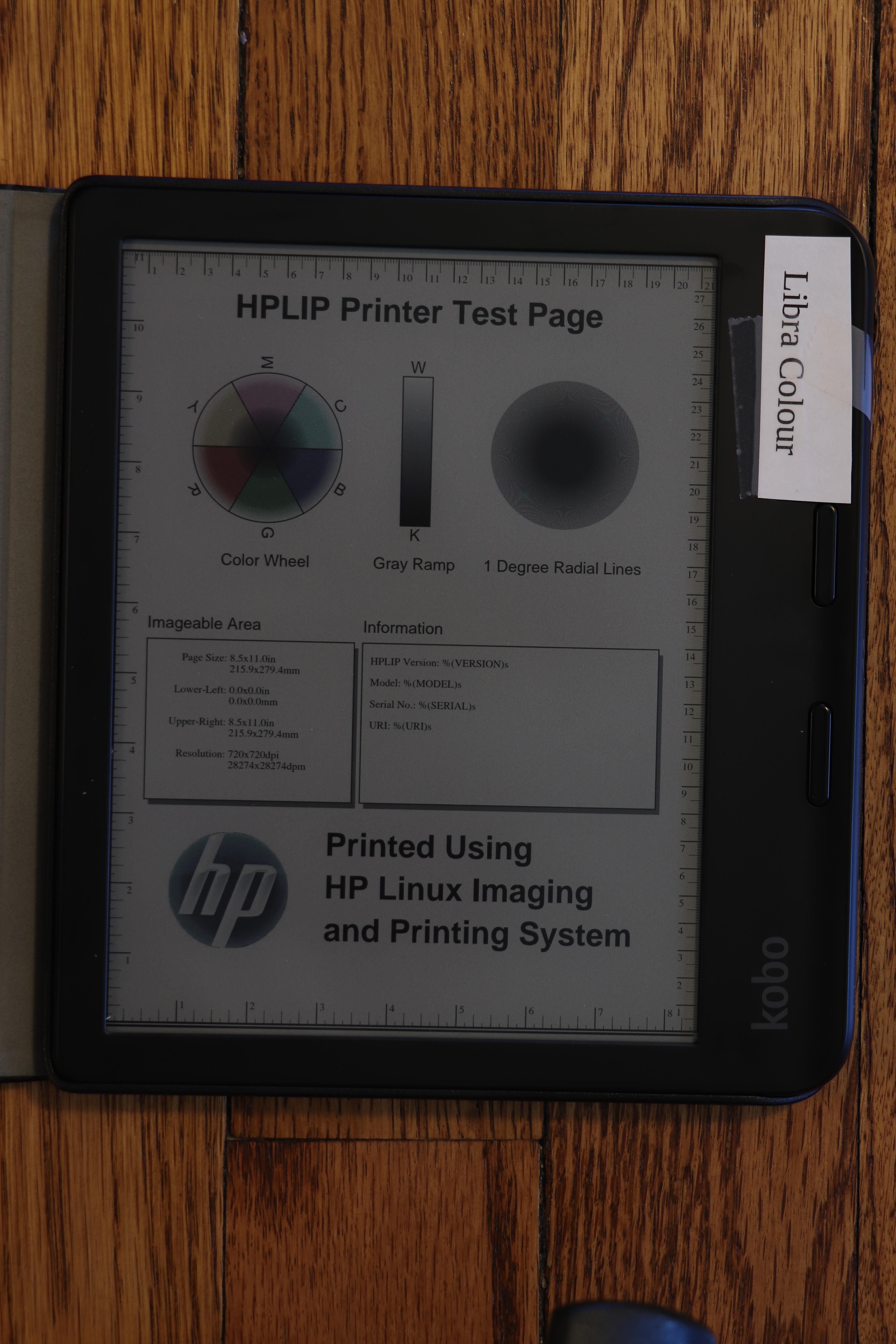
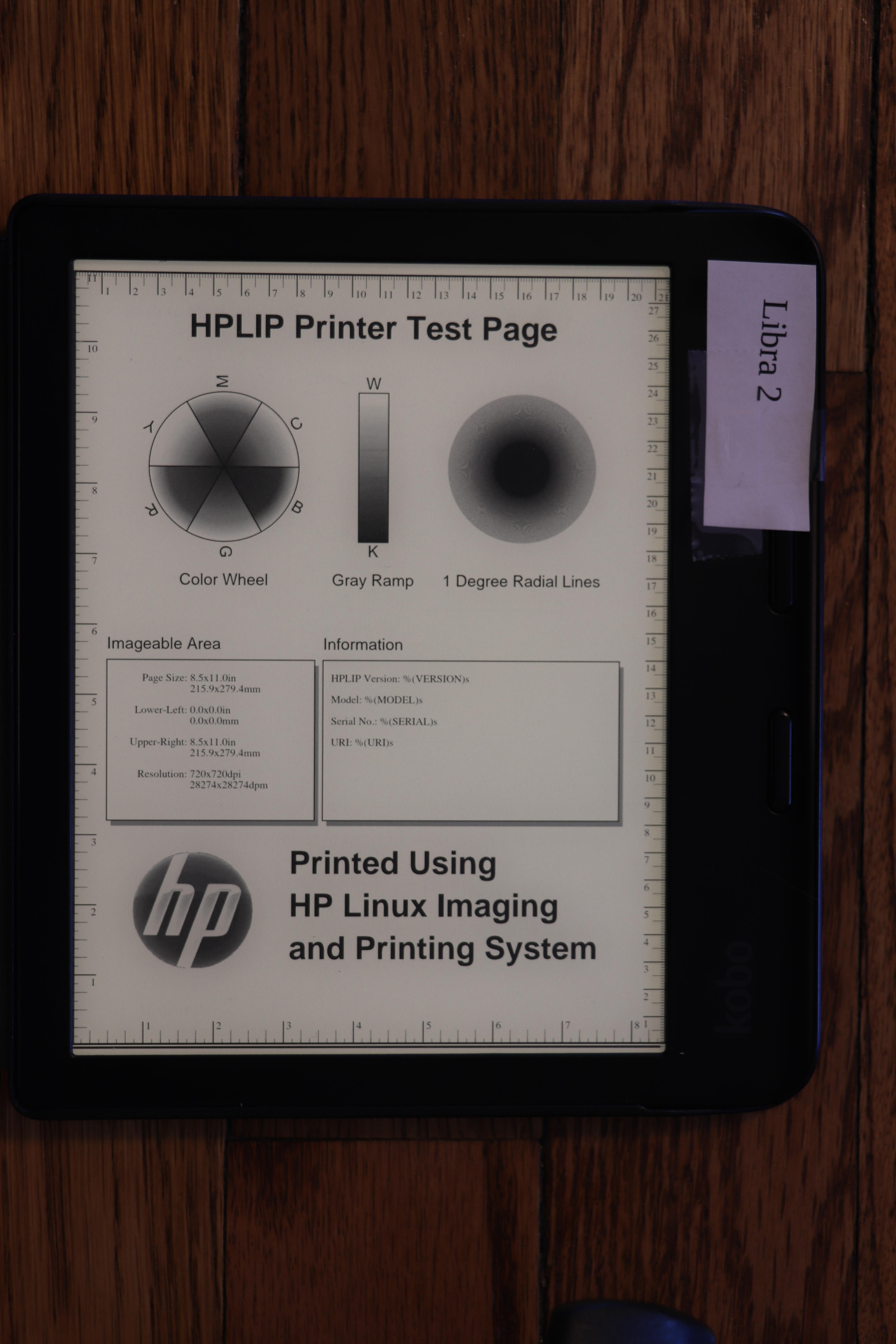
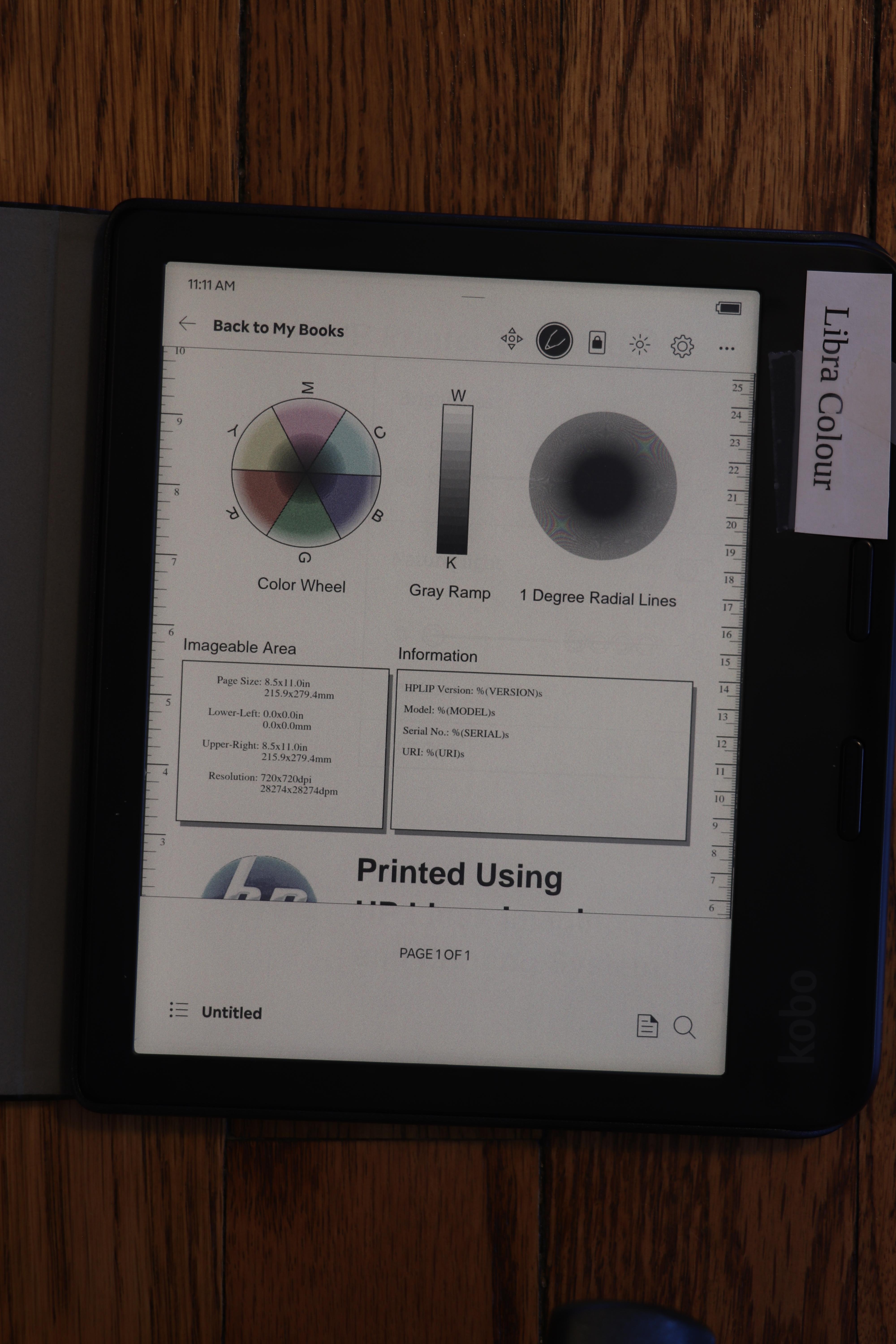
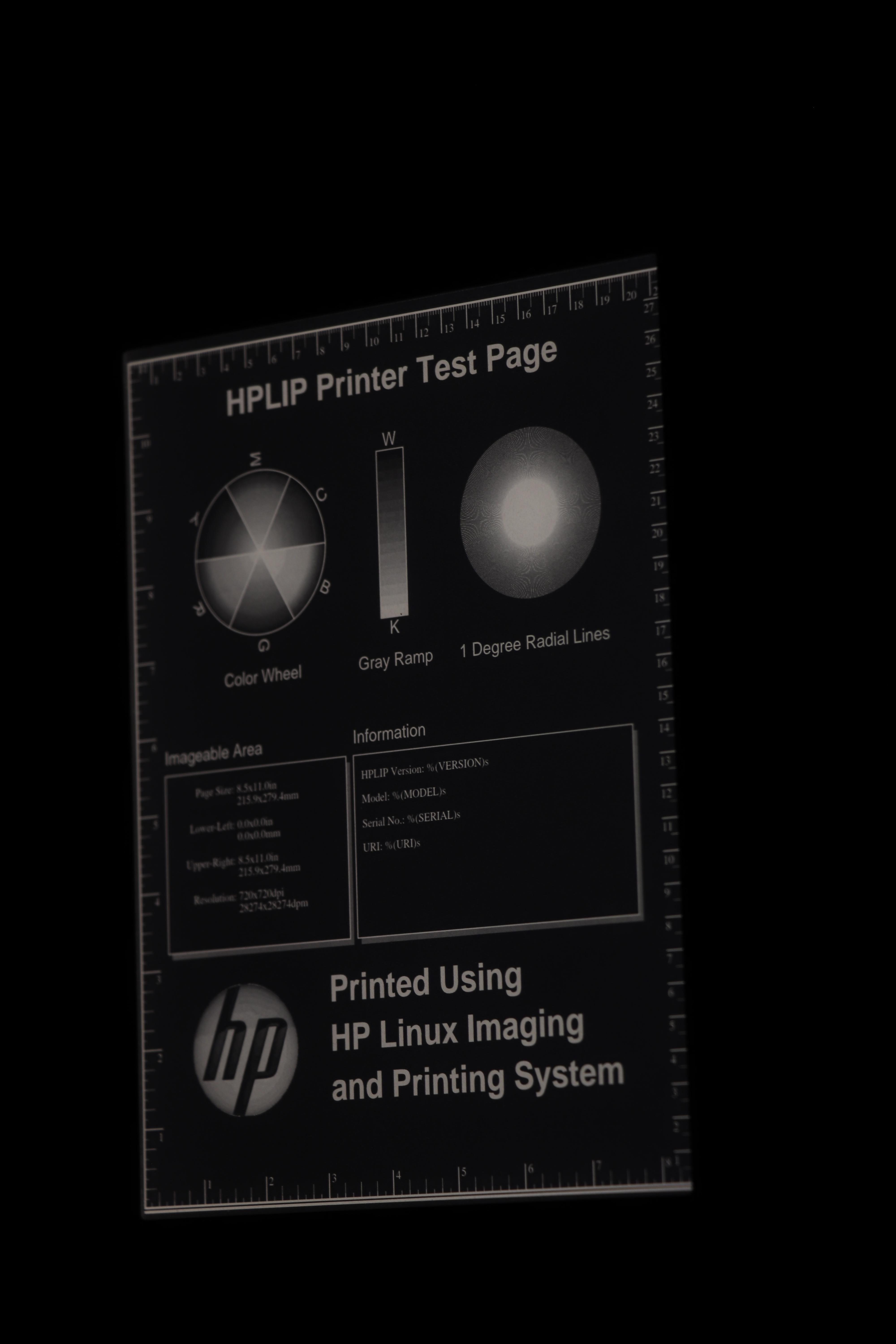
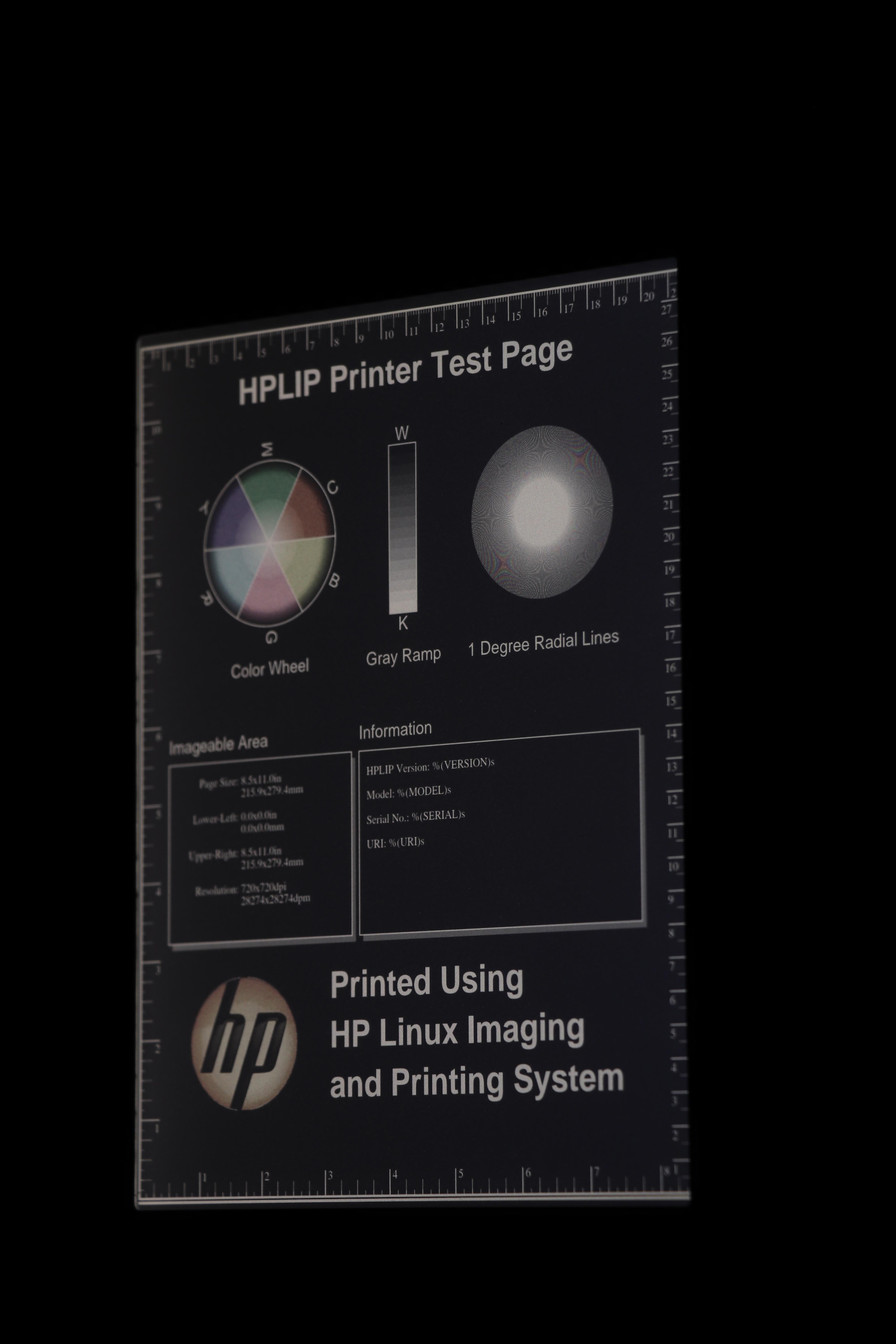
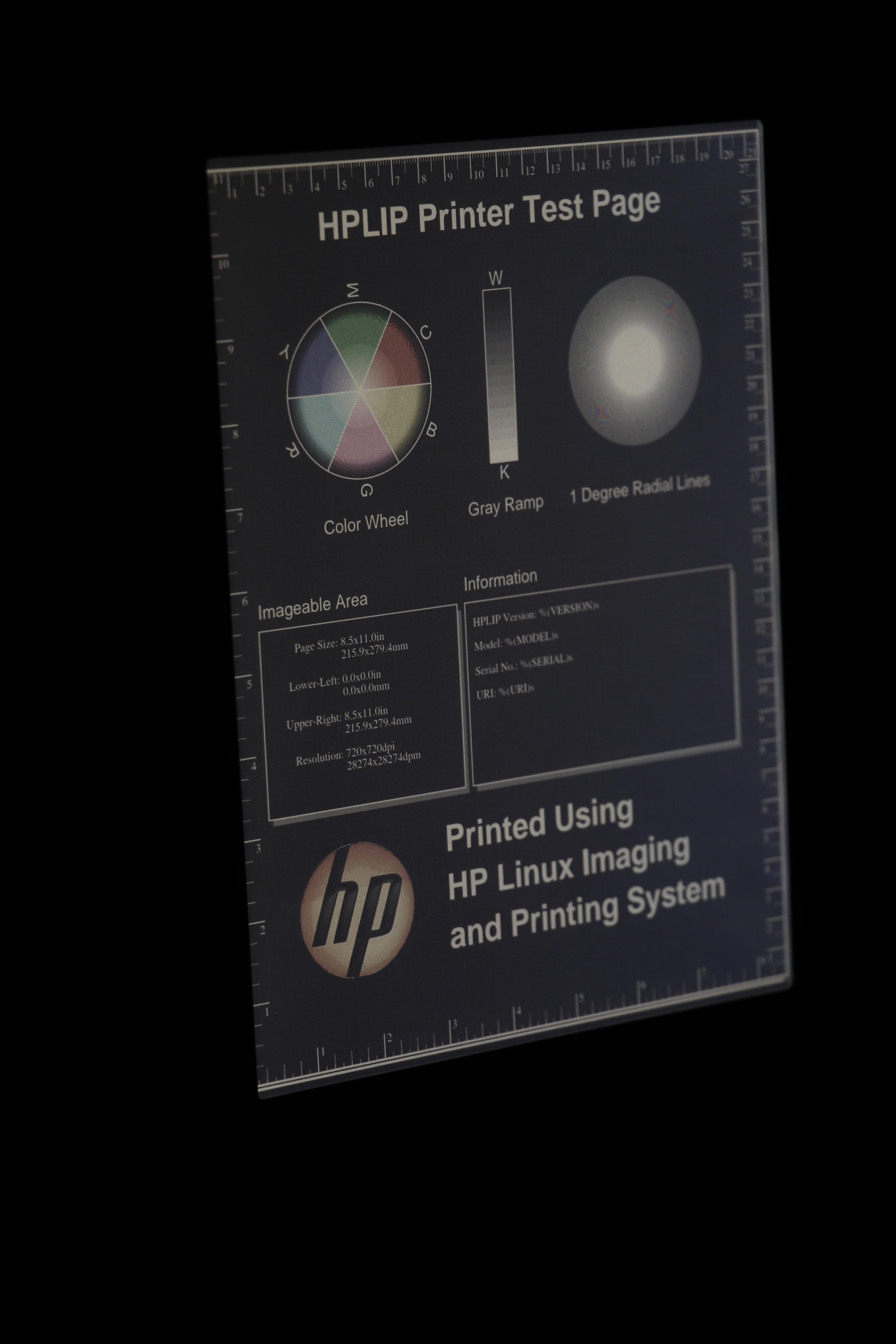
I ve been using E Ink-based ereaders for quite a number of years now. I ve had my Kobo Libra 2 for a few years, and was looking forward to the Kobo Libra Colour the first color E Ink display in a mainstream ereader line. I found the display to be a mixed bag; contrast seemed a lot worse on B&W images, and the device backlight (it s not technically a back light) seemed to cause a particular contrast reduction in dark mode. I went searching for information on this. I found a lot of videos on Kobo Libra 2 vs Libra Colour and so forth, but they were all pretty much useless. These were the mistakes they made: So I dug out my Canon DSLR, tripod, and set up shots. Every shot here is set at ISO 100. Every shot in the same setting has the same exposure settings, which I document. The one thing I forgot to shut off was automatic white balance; you can notice it is active if you look closely at the backgrounds, but WB isn t really relevant to this comparison anyhow. Because there has also been a lot of concern about how well fine B&W details will show up on the Kobo Libra Colour screen, I shot all photos using a PDF test image from the open source hplip package (testpage.ps.gz converted to PDF). This also rules out font differences between the devices. I ensured a full screen refresh before each shot. This is all because color E Ink is effectively a filter called Kaleido over the B&W layer. This causes dimming and some other visual effects. You can click on any image here to see a full-resolution view. The full-size images are the exact JPEG coming from the camera, with only two modifications: 1) metadata has been redacted for privacy reasons, and 2) some images were losslessly rotated after the shoot. OK, onwards! Outdoors, bright sun, shot from directly overhead Bright sun is ideal lighting for an E Ink display. They need no lighting at all in this scenario, and in fact, if you turn on their internal display light, it will probably not be very noticeable. Of course, this is in contrast to phone LCD screens, for which bright sunlight is the worst. Scene: Morning sunlight reaching the ereaders at an angle. The angle was sufficient so that no shadows were cast by the camera or tripod. Device light: Off on both Exposure: 1/160, f16, ISO 100 You can see how much darker the Libra Colour is here. Though in these bright conditions, it is still plenty bright. There may actually be situations in which the Libra 2 is too bright in direct sunlight, requiring a person to squint or whatnot. Looking at the radial lines, it is a bit difficult to tell because the difference in brightness, but I don t see a hugely obvious reduction in quality in the Libra 2. Later I have a shot where I try to match brightness, and we ll check it out again there. Outdoors, shade, shot from directly overhead For the next shot, I set the ereaders in shade, but still well-lit with the diffuse sunlight from all around. The first two have both device lights off. For the third, I set the device light on the Kobo Colour to 100%, full cool shade, to try to see how close I could get it to the Libra 2 brightness. (Sorry it looks like I forgot to close the toolbar on the Colour for this set, but it doesn t modify the important bits of the underlying image.) Device light: Initially off on both Exposure: 1/60, f6.4, ISO 100 Here you can see the light on the Libra Colour was nearly able to match the brightness on the Libra 2. Indoors, room lit with overhead and window light, device light off We continue to move into dimmer light with this next shot. Device light: Off on both Exposure: 1/4, f5, ISO 100 Indoors, room lit with overhead and window light, device light on Now we have the first head-to-head with the device light on. I set the Libra 2 to my favorite warmth setting, found a brightness that looked good, and then tried my best to match those settings on the Libra Colour. My camera s light meter aided in matching brightness. Device light: On (Libra 2 at 40%, Libra Colour at 59%) Exposure: 1/8, f5, ISO 100 (Apparently I am terrible at remembering to dismiss menus, sigh.) Indoors, dark room, dark mode, at an angle The Kobo Libra Colour surprised me with its dark mode. When viewed at an oblique angle, the screen gets pretty washed out. I maintained the same brightness settings here as I did above. It is much more noticeable when the brightness is set down to my preferred nighttime level (4%), or with a more significant angle. Since you can t see my tags, the order of the photos here will be: Libra 2 (standard orientation), Colour (standard orientation), Colour (turned around. Device light: On (as above) Exposure: 1/4, f5.6, ISO 100 Notice how I said I maintained the same brightness settings as before, and yet the Libra Colour looks brighter than the Libra 2 here, whereas it looked the same in the prior non-dark mode photos. Here s why. I set the exposure of each set of shots based on camera metering. As we have seen from the light-off photos, the brightness of a white pixel is a lot less on a Libra Colour than on the Libra 2. However, it is likely that the brightness of a black pixel is about that same. Therefore, contrast on the Libra Colour is lower than on the Libra 2. The traditional shot is majority white pixels, so to make the Libra Colour brightness match that of the Libra 2, I had to crank up the brightness on the Libra Colour to compensate for the darker white background. With me so far? Now with the inverted image, you can see what that does. It doesn t just raise the brightness of the white pixels, but it also raises the brightness of the black pixels. This is expected because we didn t raise contrast, only brightness. Also, in the last image, you can see it is brighter to the right. Again, other conditions that are more difficult to photograph make that much more pronounced. Viewing the Libra Colour from one side (but not the other), in dark mode, with the light on, produces noticeably worse contrast on one side. Conclusions This isn t a slam dunk. Let s walk through this: I don t think there is any noticeable loss of detail on the Libra Colour. The radial lines appeared as well defined on it as on the Libra 2. Oddly, with the backlight, some striations were apparent in the gray gradient test, but I wouldn t be using an E Ink device for clear photographic reproduction anyhow. If you read mostly black and white: If you had been using a Kobo Libra Colour and were handed a Libra 2, you would go, Wow! What an upgrade! The screen is so much brighter! There s little reason to get a Libra Colour. The Libra 2 might be hard to find these days, but the new Clara BW (with a 6 instead of the 7 screen on the Libra series) might be just the thing for you. The Libra 2 is at home in any lighting, from direct sun to pitch black, and has all the usual E Ink benefits (eg, battery life measured in weeks) and drawbacks (slower refresh rate) that we re all used to. If you are interested in photographic color reproduction mostly indoors: Consider a small tablet. The Libra Colour s 4096 colors are going to appear washed out compared to what you re used to on a LCD screen. If you are interested in color content indoors and out: The Libra Colour might be a good fit. It could work well for things where superb color rendition isn t essential for instance, news stories (the Pocket integration or Calibre s news feature could be nice there), comics, etc. In a moderately-lit indoor room, it looks like the Libra Colour s light can lead it to results that approach Libra 2 quality. So if most of your reading is in those conditions, perhaps the Libra Colour is right for you. As a final aside, I wrote in this article about the Kobo devices. I switched from Kindles to Kobos a couple of years ago due to the greater openness of the Kobo devices (you can add things like Nickel Menu and KOReader to them, and they have built-in support for more useful formats), their featureset, and their cost. The top-of-the-line Kindle devices will have a screen very similar if not identical to the Libra 2, so you can very easily consider this to be a comparison between the Oasis and the Libra Colour as well.

13 April 2024

Simon Josefsson: Reproducible and minimal source-only tarballs

With the release of Libntlm version 1.8 the release tarball can be reproduced on several distributions. We also publish a signed minimal source-only tarball, produced by git-archive which is the same format used by Savannah, Codeberg, GitLab, GitHub and others. Reproducibility of both tarballs are tested continuously for regressions on GitLab through a CI/CD pipeline. If that wasn t enough to excite you, the Debian packages of Libntlm are now built from the reproducible minimal source-only tarball. The resulting binaries are reproducible on several architectures. What does that even mean? Why should you care? How you can do the same for your project? What are the open issues? Read on, dear reader This article describes my practical experiments with reproducible release artifacts, following up on my earlier thoughts that lead to discussion on Fosstodon and a patch by Janneke Nieuwenhuizen to make Guix tarballs reproducible that inspired me to some practical work. Let s look at how a maintainer release some software, and how a user can reproduce the released artifacts from the source code. Libntlm provides a shared library written in C and uses GNU Make, GNU Autoconf, GNU Automake, GNU Libtool and gnulib for build management, but these ideas should apply to most project and build system. The following illustrate the steps a maintainer would take to prepare a release:
git clone https://gitlab.com/gsasl/libntlm.git
cd libntlm
git checkout v1.8
./bootstrap
./configure
make distcheck
gpg -b libntlm-1.8.tar.gz
The generated files libntlm-1.8.tar.gz and libntlm-1.8.tar.gz.sig are published, and users download and use them. This is how the GNU project have been doing releases since the late 1980 s. That is a testament to how successful this pattern has been! These tarballs contain source code and some generated files, typically shell scripts generated by autoconf, makefile templates generated by automake, documentation in formats like Info, HTML, or PDF. Rarely do they contain binary object code, but historically that happened. The XZUtils incident illustrate that tarballs with files that are not included in the git archive offer an opportunity to disguise malicious backdoors. I blogged earlier how to mitigate this risk by using signed minimal source-only tarballs. The risk of hiding malware is not the only motivation to publish signed minimal source-only tarballs. With pre-generated content in tarballs, there is a risk that GNU/Linux distributions such as Trisquel, Guix, Debian/Ubuntu or Fedora ship generated files coming from the tarball into the binary *.deb or *.rpm package file. Typically the person packaging the upstream project never realized that some installed artifacts was not re-built through a typical autoconf -fi && ./configure && make install sequence, and never wrote the code to rebuild everything. This can also happen if the build rules are written but are buggy, shipping the old artifact. When a security problem is found, this can lead to time-consuming situations, as it may be that patching the relevant source code and rebuilding the package is not sufficient: the vulnerable generated object from the tarball would be shipped into the binary package instead of a rebuilt artifact. For architecture-specific binaries this rarely happens, since object code is usually not included in tarballs although for 10+ years I shipped the binary Java JAR file in the GNU Libidn release tarball, until I stopped shipping it. For interpreted languages and especially for generated content such as HTML, PDF, shell scripts this happens more than you would like. Publishing minimal source-only tarballs enable easier auditing of a project s code, to avoid the need to read through all generated files looking for malicious content. I have taken care to generate the source-only minimal tarball using git-archive. This is the same format that GitLab, GitHub etc offer for the automated download links on git tags. The minimal source-only tarballs can thus serve as a way to audit GitLab and GitHub download material! Consider if/when hosting sites like GitLab or GitHub has a security incident that cause generated tarballs to include a backdoor that is not present in the git repository. If people rely on the tag download artifact without verifying the maintainer PGP signature using GnuPG, this can lead to similar backdoor scenarios that we had for XZUtils but originated with the hosting provider instead of the release manager. This is even more concerning, since this attack can be mounted for some selected IP address that you want to target and not on everyone, thereby making it harder to discover. With all that discussion and rationale out of the way, let s return to the release process. I have added another step here:
make srcdist
gpg -b libntlm-1.8-src.tar.gz
Now the release is ready. I publish these four files in the Libntlm s Savannah Download area, but they can be uploaded to a GitLab/GitHub release area as well. These are the SHA256 checksums I got after building the tarballs on my Trisquel 11 aramo laptop:
91de864224913b9493c7a6cec2890e6eded3610d34c3d983132823de348ec2ca  libntlm-1.8-src.tar.gz
ce6569a47a21173ba69c990965f73eb82d9a093eb871f935ab64ee13df47fda1  libntlm-1.8.tar.gz
So how can you reproduce my artifacts? Here is how to reproduce them in a Ubuntu 22.04 container:
podman run -it --rm ubuntu:22.04
apt-get update
apt-get install -y --no-install-recommends autoconf automake libtool make git ca-certificates
git clone https://gitlab.com/gsasl/libntlm.git
cd libntlm
git checkout v1.8
./bootstrap
./configure
make dist srcdist
sha256sum libntlm-*.tar.gz
You should see the exact same SHA256 checksum values. Hooray! This works because Trisquel 11 and Ubuntu 22.04 uses the same version of git, autoconf, automake, and libtool. These tools do not guarantee the same output content for all versions, similar to how GNU GCC does not generate the same binary output for all versions. So there is still some delicate version pairing needed. Ideally, the artifacts should be possible to reproduce from the release artifacts themselves, and not only directly from git. It is possible to reproduce the full tarball in a AlmaLinux 8 container replace almalinux:8 with rockylinux:8 if you prefer RockyLinux:
podman run -it --rm almalinux:8
dnf update -y
dnf install -y make wget gcc
wget https://download.savannah.nongnu.org/releases/libntlm/libntlm-1.8.tar.gz
tar xfa libntlm-1.8.tar.gz
cd libntlm-1.8
./configure
make dist
sha256sum libntlm-1.8.tar.gz
The source-only minimal tarball can be regenerated on Debian 11:
podman run -it --rm debian:11
apt-get update
apt-get install -y --no-install-recommends make git ca-certificates
git clone https://gitlab.com/gsasl/libntlm.git
cd libntlm
git checkout v1.8
make -f cfg.mk srcdist
sha256sum libntlm-1.8-src.tar.gz 
As the Magnus Opus or chef-d uvre, let s recreate the full tarball directly from the minimal source-only tarball on Trisquel 11 replace docker.io/kpengboy/trisquel:11.0 with ubuntu:22.04 if you prefer.
podman run -it --rm docker.io/kpengboy/trisquel:11.0
apt-get update
apt-get install -y --no-install-recommends autoconf automake libtool make wget git ca-certificates
wget https://download.savannah.nongnu.org/releases/libntlm/libntlm-1.8-src.tar.gz
tar xfa libntlm-1.8-src.tar.gz
cd libntlm-v1.8
./bootstrap
./configure
make dist
sha256sum libntlm-1.8.tar.gz
Yay! You should now have great confidence in that the release artifacts correspond to what s in version control and also to what the maintainer intended to release. Your remaining job is to audit the source code for vulnerabilities, including the source code of the dependencies used in the build. You no longer have to worry about auditing the release artifacts. I find it somewhat amusing that the build infrastructure for Libntlm is now in a significantly better place than the code itself. Libntlm is written in old C style with plenty of string manipulation and uses broken cryptographic algorithms such as MD4 and single-DES. Remember folks: solving supply chain security issues has no bearing on what kind of code you eventually run. A clean gun can still shoot you in the foot. Side note on naming: GitLab exports tarballs with pathnames libntlm-v1.8/ (i.e.., PROJECT-TAG/) and I ve adopted the same pathnames, which means my libntlm-1.8-src.tar.gz tarballs are bit-by-bit identical to GitLab s exports and you can verify this with tools like diffoscope. GitLab name the tarball libntlm-v1.8.tar.gz (i.e., PROJECT-TAG.ARCHIVE) which I find too similar to the libntlm-1.8.tar.gz that we also publish. GitHub uses the same git archive style, but unfortunately they have logic that removes the v in the pathname so you will get a tarball with pathname libntlm-1.8/ instead of libntlm-v1.8/ that GitLab and I use. The content of the tarball is bit-by-bit identical, but the pathname and archive differs. Codeberg (running Forgejo) uses another approach: the tarball is called libntlm-v1.8.tar.gz (after the tag) just like GitLab, but the pathname inside the archive is libntlm/, otherwise the produced archive is bit-by-bit identical including timestamps. Savannah s CGIT interface uses archive name libntlm-1.8.tar.gz with pathname libntlm-1.8/, but otherwise file content is identical. Savannah s GitWeb interface provides snapshot links that are named after the git commit (e.g., libntlm-a812c2ca.tar.gz with libntlm-a812c2ca/) and I cannot find any tag-based download links at all. Overall, we are so close to get SHA256 checksum to match, but fail on pathname within the archive. I ve chosen to be compatible with GitLab regarding the content of tarballs but not on archive naming. From a simplicity point of view, it would be nice if everyone used PROJECT-TAG.ARCHIVE for the archive filename and PROJECT-TAG/ for the pathname within the archive. This aspect will probably need more discussion. Side note on git archive output: It seems different versions of git archive produce different results for the same repository. The version of git in Debian 11, Trisquel 11 and Ubuntu 22.04 behave the same. The version of git in Debian 12, AlmaLinux/RockyLinux 8/9, Alpine, ArchLinux, macOS homebrew, and upcoming Ubuntu 24.04 behave in another way. Hopefully this will not change that often, but this would invalidate reproducibility of these tarballs in the future, forcing you to use an old git release to reproduce the source-only tarball. Alas, GitLab and most other sites appears to be using modern git so the download tarballs from them would not match my tarballs even though the content would. Side note on ChangeLog: ChangeLog files were traditionally manually curated files with version history for a package. In recent years, several projects moved to dynamically generate them from git history (using tools like git2cl or gitlog-to-changelog). This has consequences for reproducibility of tarballs: you need to have the entire git history available! The gitlog-to-changelog tool also output different outputs depending on the time zone of the person using it, which arguable is a simple bug that can be fixed. However this entire approach is incompatible with rebuilding the full tarball from the minimal source-only tarball. It seems Libntlm s ChangeLog file died on the surgery table here. So how would a distribution build these minimal source-only tarballs? I happen to help on the libntlm package in Debian. It has historically used the generated tarballs as the source code to build from. This means that code coming from gnulib is vendored in the tarball. When a security problem is discovered in gnulib code, the security team needs to patch all packages that include that vendored code and rebuild them, instead of merely patching the gnulib package and rebuild all packages that rely on that particular code. To change this, the Debian libntlm package needs to Build-Depends on Debian s gnulib package. But there was one problem: similar to most projects that use gnulib, Libntlm depend on a particular git commit of gnulib, and Debian only ship one commit. There is no coordination about which commit to use. I have adopted gnulib in Debian, and add a git bundle to the *_all.deb binary package so that projects that rely on gnulib can pick whatever commit they need. This allow an no-network GNULIB_URL and GNULIB_REVISION approach when running Libntlm s ./bootstrap with the Debian gnulib package installed. Otherwise libntlm would pick up whatever latest version of gnulib that Debian happened to have in the gnulib package, which is not what the Libntlm maintainer intended to be used, and can lead to all sorts of version mismatches (and consequently security problems) over time. Libntlm in Debian is developed and tested on Salsa and there is continuous integration testing of it as well, thanks to the Salsa CI team. Side note on git bundles: unfortunately there appears to be no reproducible way to export a git repository into one or more files. So one unfortunate consequence of all this work is that the gnulib *.orig.tar.gz tarball in Debian is not reproducible any more. I have tried to get Git bundles to be reproducible but I never got it to work see my notes in gnulib s debian/README.source on this aspect. Of course, source tarball reproducibility has nothing to do with binary reproducibility of gnulib in Debian itself, fortunately. One open question is how to deal with the increased build dependencies that is triggered by this approach. Some people are surprised by this but I don t see how to get around it: if you depend on source code for tools in another package to build your package, it is a bad idea to hide that dependency. We ve done it for a long time through vendored code in non-minimal tarballs. Libntlm isn t the most critical project from a bootstrapping perspective, so adding git and gnulib as Build-Depends to it will probably be fine. However, consider if this pattern was used for other packages that uses gnulib such as coreutils, gzip, tar, bison etc (all are using gnulib) then they would all Build-Depends on git and gnulib. Cross-building those packages for a new architecture will therefor require git on that architecture first, which gets circular quick. The dependency on gnulib is real so I don t see that going away, and gnulib is a Architecture:all package. However, the dependency on git is merely a consequence of how the Debian gnulib package chose to make all gnulib git commits available to projects: through a git bundle. There are other ways to do this that doesn t require the git tool to extract the necessary files, but none that I found practical ideas welcome! Finally some brief notes on how this was implemented. Enabling bootstrappable source-only minimal tarballs via gnulib s ./bootstrap is achieved by using the GNULIB_REVISION mechanism, locking down the gnulib commit used. I have always disliked git submodules because they add extra steps and has complicated interaction with CI/CD. The reason why I gave up git submodules now is because the particular commit to use is not recorded in the git archive output when git submodules is used. So the particular gnulib commit has to be mentioned explicitly in some source code that goes into the git archive tarball. Colin Watson added the GNULIB_REVISION approach to ./bootstrap back in 2018, and now it no longer made sense to continue to use a gnulib git submodule. One alternative is to use ./bootstrap with --gnulib-srcdir or --gnulib-refdir if there is some practical problem with the GNULIB_URL towards a git bundle the GNULIB_REVISION in bootstrap.conf. The srcdist make rule is simple:
git archive --prefix=libntlm-v1.8/ -o libntlm-1.8-src.tar.gz HEAD
Making the make dist generated tarball reproducible can be more complicated, however for Libntlm it was sufficient to make sure the modification times of all files were set deterministically to the timestamp of the last commit in the git repository. Interestingly there seems to be a couple of different ways to accomplish this, Guix doesn t support minimal source-only tarballs but rely on a .tarball-timestamp file inside the tarball. Paul Eggert explained what TZDB is using some time ago. The approach I m using now is fairly similar to the one I suggested over a year ago. If there are problems because all files in the tarball now use the same modification time, there is a solution by Bruno Haible that could be implemented. Side note on git tags: Some people may wonder why not verify a signed git tag instead of verifying a signed tarball of the git archive. Currently most git repositories uses SHA-1 for git commit identities, but SHA-1 is not a secure hash function. While current SHA-1 attacks can be detected and mitigated, there are fundamental doubts that a git SHA-1 commit identity uniquely refers to the same content that was intended. Verifying a git tag will never offer the same assurance, since a git tag can be moved or re-signed at any time. Verifying a git commit is better but then we need to trust SHA-1. Migrating git to SHA-256 would resolve this aspect, but most hosting sites such as GitLab and GitHub does not support this yet. There are other advantages to using signed tarballs instead of signed git commits or git tags as well, e.g., tar.gz can be a deterministically reproducible persistent stable offline storage format but .git sub-directory trees or git bundles do not offer this property. Doing continous testing of all this is critical to make sure things don t regress. Libntlm s pipeline definition now produce the generated libntlm-*.tar.gz tarballs and a checksum as a build artifact. Then I added the 000-reproducability job which compares the checksums and fails on mismatches. You can read its delicate output in the job for the v1.8 release. Right now we insists that builds on Trisquel 11 match Ubuntu 22.04, that PureOS 10 builds match Debian 11 builds, that AlmaLinux 8 builds match RockyLinux 8 builds, and AlmaLinux 9 builds match RockyLinux 9 builds. As you can see in pipeline job output, not all platforms lead to the same tarballs, but hopefully this state can be improved over time. There is also partial reproducibility, where the full tarball is reproducible across two distributions but not the minimal tarball, or vice versa. If this way of working plays out well, I hope to implement it in other projects too. What do you think? Happy Hacking!

11 April 2024

Reproducible Builds: Reproducible Builds in March 2024

Welcome to the March 2024 report from the Reproducible Builds project! In our reports, we attempt to outline what we have been up to over the past month, as well as mentioning some of the important things happening more generally in software supply-chain security. As ever, if you are interested in contributing to the project, please visit our Contribute page on our website. Table of contents:
  1. Arch Linux minimal container userland now 100% reproducible
  2. Validating Debian s build infrastructure after the XZ backdoor
  3. Making Fedora Linux (more) reproducible
  4. Increasing Trust in the Open Source Supply Chain with Reproducible Builds and Functional Package Management
  5. Software and source code identification with GNU Guix and reproducible builds
  6. Two new Rust-based tools for post-processing determinism
  7. Distribution work
  8. Mailing list highlights
  9. Website updates
  10. Delta chat clients now reproducible
  11. diffoscope updates
  12. Upstream patches
  13. Reproducibility testing framework

Arch Linux minimal container userland now 100% reproducible In remarkable news, Reproducible builds developer kpcyrd reported that that the Arch Linux minimal container userland is now 100% reproducible after work by developers dvzv and Foxboron on the one remaining package. This represents a real world , widely-used Linux distribution being reproducible. Their post, which kpcyrd suffixed with the question now what? , continues on to outline some potential next steps, including validating whether the container image itself could be reproduced bit-for-bit. The post, which was itself a followup for an Arch Linux update earlier in the month, generated a significant number of replies.

Validating Debian s build infrastructure after the XZ backdoor From our mailing list this month, Vagrant Cascadian wrote about being asked about trying to perform concrete reproducibility checks for recent Debian security updates, in an attempt to gain some confidence about Debian s build infrastructure given that they performed builds in environments running the high-profile XZ vulnerability. Vagrant reports (with some caveats):
So far, I have not found any reproducibility issues; everything I tested I was able to get to build bit-for-bit identical with what is in the Debian archive.
That is to say, reproducibility testing permitted Vagrant and Debian to claim with some confidence that builds performed when this vulnerable version of XZ was installed were not interfered with.

Making Fedora Linux (more) reproducible In March, Davide Cavalca gave a talk at the 2024 Southern California Linux Expo (aka SCALE 21x) about the ongoing effort to make the Fedora Linux distribution reproducible. Documented in more detail on Fedora s website, the talk touched on topics such as the specifics of implementing reproducible builds in Fedora, the challenges encountered, the current status and what s coming next. (YouTube video)

Increasing Trust in the Open Source Supply Chain with Reproducible Builds and Functional Package Management Julien Malka published a brief but interesting paper in the HAL open archive on Increasing Trust in the Open Source Supply Chain with Reproducible Builds and Functional Package Management:
Functional package managers (FPMs) and reproducible builds (R-B) are technologies and methodologies that are conceptually very different from the traditional software deployment model, and that have promising properties for software supply chain security. This thesis aims to evaluate the impact of FPMs and R-B on the security of the software supply chain and propose improvements to the FPM model to further improve trust in the open source supply chain. PDF
Julien s paper poses a number of research questions on how the model of distributions such as GNU Guix and NixOS can be leveraged to further improve the safety of the software supply chain , etc.

Software and source code identification with GNU Guix and reproducible builds In a long line of commendably detailed blog posts, Ludovic Court s, Maxim Cournoyer, Jan Nieuwenhuizen and Simon Tournier have together published two interesting posts on the GNU Guix blog this month. In early March, Ludovic Court s, Maxim Cournoyer, Jan Nieuwenhuizen and Simon Tournier wrote about software and source code identification and how that might be performed using Guix, rhetorically posing the questions: What does it take to identify software ? How can we tell what software is running on a machine to determine, for example, what security vulnerabilities might affect it? Later in the month, Ludovic Court s wrote a solo post describing adventures on the quest for long-term reproducible deployment. Ludovic s post touches on GNU Guix s aim to support time travel , the ability to reliably (and reproducibly) revert to an earlier point in time, employing the iconic image of Harold Lloyd hanging off the clock in Safety Last! (1925) to poetically illustrate both the slapstick nature of current modern technology and the gymnastics required to navigate hazards of our own making.

Two new Rust-based tools for post-processing determinism Zbigniew J drzejewski-Szmek announced add-determinism, a work-in-progress reimplementation of the Reproducible Builds project s own strip-nondeterminism tool in the Rust programming language, intended to be used as a post-processor in RPM-based distributions such as Fedora In addition, Yossi Kreinin published a blog post titled refix: fast, debuggable, reproducible builds that describes a tool that post-processes binaries in such a way that they are still debuggable with gdb, etc.. Yossi post details the motivation and techniques behind the (fast) performance of the tool.

Distribution work In Debian this month, since the testing framework no longer varies the build path, James Addison performed a bulk downgrade of the bug severity for issues filed with a level of normal to a new level of wishlist. In addition, 28 reviews of Debian packages were added, 38 were updated and 23 were removed this month adding to ever-growing knowledge about identified issues. As part of this effort, a number of issue types were updated, including Chris Lamb adding a new ocaml_include_directories toolchain issue [ ] and James Addison adding a new filesystem_order_in_java_jar_manifest_mf_include_resource issue [ ] and updating the random_uuid_in_notebooks_generated_by_nbsphinx to reference a relevant discussion thread [ ]. In addition, Roland Clobus posted his 24th status update of reproducible Debian ISO images. Roland highlights that the images for Debian unstable often cannot be generated due to changes in that distribution related to the 64-bit time_t transition. Lastly, Bernhard M. Wiedemann posted another monthly update for his reproducibility work in openSUSE.

Mailing list highlights Elsewhere on our mailing list this month:

Website updates There were made a number of improvements to our website this month, including:
  • Pol Dellaiera noticed the frequent need to correctly cite the website itself in academic work. To facilitate easier citation across multiple formats, Pol contributed a Citation File Format (CIF) file. As a result, an export in BibTeX format is now available in the Academic Publications section. Pol encourages community contributions to further refine the CITATION.cff file. Pol also added an substantial new section to the buy in page documenting the role of Software Bill of Materials (SBOMs) and ephemeral development environments. [ ][ ]
  • Bernhard M. Wiedemann added a new commandments page to the documentation [ ][ ] and fixed some incorrect YAML elsewhere on the site [ ].
  • Chris Lamb add three recent academic papers to the publications page of the website. [ ]
  • Mattia Rizzolo and Holger Levsen collaborated to add Infomaniak as a sponsor of amd64 virtual machines. [ ][ ][ ]
  • Roland Clobus updated the stable outputs page, dropping version numbers from Python documentation pages [ ] and noting that Python s set data structure is also affected by the PYTHONHASHSEED functionality. [ ]

Delta chat clients now reproducible Delta Chat, an open source messaging application that can work over email, announced this month that the Rust-based core library underlying Delta chat application is now reproducible.

diffoscope diffoscope is our in-depth and content-aware diff utility that can locate and diagnose reproducibility issues. This month, Chris Lamb made a number of changes such as uploading versions 259, 260 and 261 to Debian and made the following additional changes:
  • New features:
    • Add support for the zipdetails tool from the Perl distribution. Thanks to Fay Stegerman and Larry Doolittle et al. for the pointer and thread about this tool. [ ]
  • Bug fixes:
    • Don t identify Redis database dumps as GNU R database files based simply on their filename. [ ]
    • Add a missing call to File.recognizes so we actually perform the filename check for GNU R data files. [ ]
    • Don t crash if we encounter an .rdb file without an equivalent .rdx file. (#1066991)
    • Correctly check for 7z being available and not lz4 when testing 7z. [ ]
    • Prevent a traceback when comparing a contentful .pyc file with an empty one. [ ]
  • Testsuite improvements:
    • Fix .epub tests after supporting the new zipdetails tool. [ ]
    • Don t use parenthesis within test skipping messages, as PyTest adds its own parenthesis. [ ]
    • Factor out Python version checking in test_zip.py. [ ]
    • Skip some Zip-related tests under Python 3.10.14, as a potential regression may have been backported to the 3.10.x series. [ ]
    • Actually test 7z support in the test_7z set of tests, not the lz4 functionality. (Closes: reproducible-builds/diffoscope#359). [ ]
In addition, Fay Stegerman updated diffoscope s monkey patch for supporting the unusual Mozilla ZIP file format after Python s zipfile module changed to detect potentially insecure overlapping entries within .zip files. (#362) Chris Lamb also updated the trydiffoscope command line client, dropping a build-dependency on the deprecated python3-distutils package to fix Debian bug #1065988 [ ], taking a moment to also refresh the packaging to the latest Debian standards [ ]. Finally, Vagrant Cascadian submitted an update for diffoscope version 260 in GNU Guix. [ ]

Upstream patches This month, we wrote a large number of patches, including: Bernhard M. Wiedemann used reproducibility-tooling to detect and fix packages that added changes in their %check section, thus failing when built with the --no-checks option. Only half of all openSUSE packages were tested so far, but a large number of bugs were filed, including ones against caddy, exiv2, gnome-disk-utility, grisbi, gsl, itinerary, kosmindoormap, libQuotient, med-tools, plasma6-disks, pspp, python-pypuppetdb, python-urlextract, rsync, vagrant-libvirt and xsimd. Similarly, Jean-Pierre De Jesus DIAZ employed reproducible builds techniques in order to test a proposed refactor of the ath9k-htc-firmware package. As the change produced bit-for-bit identical binaries to the previously shipped pre-built binaries:
I don t have the hardware to test this firmware, but the build produces the same hashes for the firmware so it s safe to say that the firmware should keep working.

Reproducibility testing framework The Reproducible Builds project operates a comprehensive testing framework running primarily at tests.reproducible-builds.org in order to check packages and other artifacts for reproducibility. In March, an enormous number of changes were made by Holger Levsen:
  • Debian-related changes:
    • Sleep less after a so-called 404 package state has occurred. [ ]
    • Schedule package builds more often. [ ][ ]
    • Regenerate all our HTML indexes every hour, but only every 12h for the released suites. [ ]
    • Create and update unstable and experimental base systems on armhf again. [ ][ ]
    • Don t reschedule so many depwait packages due to the current size of the i386 architecture queue. [ ]
    • Redefine our scheduling thresholds and amounts. [ ]
    • Schedule untested packages with a higher priority, otherwise slow architectures cannot keep up with the experimental distribution growing. [ ]
    • Only create the stats_buildinfo.png graph once per day. [ ][ ]
    • Reproducible Debian dashboard: refactoring, update several more static stats only every 12h. [ ]
    • Document how to use systemctl with new systemd-based services. [ ]
    • Temporarily disable armhf and i386 continuous integration tests in order to get some stability back. [ ]
    • Use the deb.debian.org CDN everywhere. [ ]
    • Remove the rsyslog logging facility on bookworm systems. [ ]
    • Add zst to the list of packages which are false-positive diskspace issues. [ ]
    • Detect failures to bootstrap Debian base systems. [ ]
  • Arch Linux-related changes:
    • Temporarily disable builds because the pacman package manager is broken. [ ][ ]
    • Split reproducible_html_live_status and split the scheduling timing . [ ][ ][ ]
    • Improve handling when database is locked. [ ][ ]
  • Misc changes:
    • Show failed services that require manual cleanup. [ ][ ]
    • Integrate two new Infomaniak nodes. [ ][ ][ ][ ]
    • Improve IRC notifications for artifacts. [ ]
    • Run diffoscope in different systemd slices. [ ]
    • Run the node health check more often, as it can now repair some issues. [ ][ ]
    • Also include the string Bot in the userAgent for Git. (Re: #929013). [ ]
    • Document increased tmpfs size on our OUSL nodes. [ ]
    • Disable memory account for the reproducible_build service. [ ][ ]
    • Allow 10 times as many open files for the Jenkins service. [ ]
    • Set OOMPolicy=continue and OOMScoreAdjust=-1000 for both the Jenkins and the reproducible_build service. [ ]
Mattia Rizzolo also made the following changes:
  • Debian-related changes:
    • Define a systemd slice to group all relevant services. [ ][ ]
    • Add a bunch of quotes in scripts to assuage the shellcheck tool. [ ]
    • Add stats on how many packages have been built today so far. [ ]
    • Instruct systemd-run to handle diffoscope s exit codes specially. [ ]
    • Prefer the pgrep tool over grepping the output of ps. [ ]
    • Re-enable a couple of i386 and armhf architecture builders. [ ][ ]
    • Fix some stylistic issues flagged by the Python flake8 tool. [ ]
    • Cease scheduling Debian unstable and experimental on the armhf architecture due to the time_t transition. [ ]
    • Start a few more i386 & armhf workers. [ ][ ][ ]
    • Temporarly skip pbuilder updates in the unstable distribution, but only on the armhf architecture. [ ]
  • Other changes:
    • Perform some large-scale refactoring on how the systemd service operates. [ ][ ]
    • Move the list of workers into a separate file so it s accessible to a number of scripts. [ ]
    • Refactor the powercycle_x86_nodes.py script to use the new IONOS API and its new Python bindings. [ ]
    • Also fix nph-logwatch after the worker changes. [ ]
    • Do not install the stunnel tool anymore, it shouldn t be needed by anything anymore. [ ]
    • Move temporary directories related to Arch Linux into a single directory for clarity. [ ]
    • Update the arm64 architecture host keys. [ ]
    • Use a common Postfix configuration. [ ]
The following changes were also made by:
  • Jan-Benedict Glaw:
    • Initial work to clean up a messy NetBSD-related script. [ ][ ]
  • Roland Clobus:
    • Show the installer log if the installer fails to build. [ ]
    • Avoid the minus character (i.e. -) in a variable in order to allow for tags in openQA. [ ]
    • Update the schedule of Debian live image builds. [ ]
  • Vagrant Cascadian:
    • Maintenance on the virt* nodes is completed so bring them back online. [ ]
    • Use the fully qualified domain name in configuration. [ ]
Node maintenance was also performed by Holger Levsen, Mattia Rizzolo [ ][ ] and Vagrant Cascadian [ ][ ][ ][ ]

If you are interested in contributing to the Reproducible Builds project, please visit our Contribute page on our website. However, you can get in touch with us via:

24 March 2024

Niels Thykier: debputy v0.1.21

Earlier today, I have just released debputy version 0.1.21 to Debian unstable. In the blog post, I will highlight some of the new features.
Package boilerplate reduction with automatic relationship substvar Last month, I started a discussion on rethinking how we do relationship substvars such as the $ misc:Depends . These generally ends up being boilerplate runes in the form of Depends: $ misc:Depends , $ shlibs:Depends where you as the packager has to remember exactly which runes apply to your package. My proposed solution was to automatically apply these substvars and this feature has now been implemented in debputy. It is also combined with the feature where essential packages should use Pre-Depends by default for dpkg-shlibdeps related dependencies. I am quite excited about this feature, because I noticed with libcleri that we are now down to 3-5 fields for defining a simple library package. Especially since most C library packages are trivial enough that debputy can auto-derive them to be Multi-Arch: same. As an example, the libcleric1 package is down to 3 fields (Package, Architecture, Description) with Section and Priority being inherited from the Source stanza. I have submitted a MR to show case the boilerplate reduction at https://salsa.debian.org/siridb-team/libcleri/-/merge_requests/3. The removal of libcleric1 (= $ binary:Version ) in that MR relies on another existing feature where debputy can auto-derive a dependency between an arch:any -dev package and the library package based on the .so symlink for the shared library. The arch:any restriction comes from the fact that arch:all and arch:any packages are not built together, so debputy cannot reliably see across the package boundaries during the build (and therefore refuses to do so at all). Packages that have already migrated to debputy can use debputy migrate-from-dh to detect any unnecessary relationship substitution variables in case you want to clean up. The removal of Multi-Arch: same and intra-source dependencies must be done manually and so only be done so when you have validated that it is safe and sane to do. I was willing to do it for the show-case MR, but I am less confident that would bother with these for existing packages in general. Note: I summarized the discussion of the automatic relationship substvar feature earlier this month in https://lists.debian.org/debian-devel/2024/03/msg00030.html for those who want more details. PS: The automatic relationship substvars feature will also appear in debhelper as a part of compat 14.
Language Server (LSP) and Linting I have long been frustrated by our poor editor support for Debian packaging files. To this end, I started working on a Language Server (LSP) feature in debputy that would cover some of our standard Debian packaging files. This release includes the first version of said language server, which covers the following files:
  • debian/control
  • debian/copyright (the machine readable variant)
  • debian/changelog (mostly just spelling)
  • debian/rules
  • debian/debputy.manifest (syntax checks only; use debputy check-manifest for the full validation for now)
Most of the effort has been spent on the Deb822 based files such as debian/control, which comes with diagnostics, quickfixes, spellchecking (but only for relevant fields!), and completion suggestions. Since not everyone has a LSP capable editor and because sometimes you just want diagnostics without having to open each file in an editor, there is also a batch version for the diagnostics via debputy lint. Please see debputy(1) for how debputy lint compares with lintian if you are curious about which tool to use at what time. To help you getting started, there is a now debputy lsp editor-config command that can provide you with the relevant editor config glue. At the moment, emacs (via eglot) and vim with vim-youcompleteme are supported. For those that followed the previous blog posts on writing the language server, I would like to point out that the command line for running the language server has changed to debputy lsp server and you no longer have to tell which format it is. I have decided to make the language server a "polyglot" server for now, which I will hopefully not regret... Time will tell. :) Anyhow, to get started, you will want:
$ apt satisfy 'dh-debputy (>= 0.1.21~), python3-pygls'
# Optionally, for spellchecking
$ apt install python3-hunspell hunspell-en-us
# For emacs integration
$ apt install elpa-dpkg-dev-el markdown-mode-el
# For vim integration via vim-youcompleteme
$ apt install vim-youcompleteme
Specifically for emacs, I also learned two things after the upload. First, you can auto-activate eglot via eglot-ensure. This badly feature interacts with imenu on debian/changelog for reasons I do not understand (causing a several second start up delay until something times out), but it works fine for the other formats. Oddly enough, opening a changelog file and then activating eglot does not trigger this issue at all. In the next version, editor config for emacs will auto-activate eglot on all files except debian/changelog. The second thing is that if you install elpa-markdown-mode, emacs will accept and process markdown in the hover documentation provided by the language server. Accordingly, the editor config for emacs will also mention this package from the next version on. Finally, on a related note, Jelmer and I have been looking at moving some of this logic into a new package called debpkg-metadata. The point being to support easier reuse of linting and LSP related metadata - like pulling a list of known fields for debian/control or sharing logic between lintian-brush and debputy.
Minimal integration mode for Rules-Requires-Root One of the original motivators for starting debputy was to be able to get rid of fakeroot in our build process. While this is possible, debputy currently does not support most of the complex packaging features such as maintscripts and debconf. Unfortunately, the kind of packages that need fakeroot for static ownership tend to also require very complex packaging features. To bridge this gap, the new version of debputy supports a very minimal integration with dh via the dh-sequence-zz-debputy-rrr. This integration mode keeps the vast majority of debhelper sequence in place meaning most dh add-ons will continue to work with dh-sequence-zz-debputy-rrr. The sequence only replaces the following commands:
  • dh_fixperms
  • dh_gencontrol
  • dh_md5sums
  • dh_builddeb
The installations feature of the manifest will be disabled in this integration mode to avoid feature interactions with debhelper tools that expect debian/<pkg> to contain the materialized package. On a related note, the debputy migrate-from-dh command now supports a --migration-target option, so you can choose the desired level of integration without doing code changes. The command will attempt to auto-detect the desired integration from existing package features such as a build-dependency on a relevant dh sequence, so you do not have to remember this new option every time once the migration has started. :)

25 February 2024

Ben Hutchings: Converted from Pyblosxom to Jekyll

I ve been using Pyblosxom here for nearly 17 years, but have become increasingly dissatisfied with having to write HTML instead of Markdown. Today I looked at upgrading my web server and discovered that Pyblosxom was removed from Debian after Debian 10, presumably because it wasn t updated for Python 3. I keep hearing about Jekyll as a static site generator for blogs, so I finally investigated how to use that and how to convert my existing entries. Fortunately it supports both HTML and Markdown (and probably other) input formats, so this was mostly a matter of converting metadata. I have my own crappy script for drafting, publishing, and listing blog entries, which also needed a bit of work to update, but that is now done. If all has gone to plan, you should be seeing just one new entry in the feed but all permalinks to older entries still working.

Next.

Previous.