Search Results: "matrix"

10 March 2026

Freexian Collaborators: Debian Contributions: Opening DebConf 26 Registration, Debian CI improvements and more! (by Anupa Ann Joseph)

Debian Contributions: 2026-02 Contributing to Debian is part of Freexian s mission. This article covers the latest achievements of Freexian and their collaborators. All of this is made possible by organizations subscribing to our Long Term Support contracts and consulting services.

DebConf 26 Registration, by Stefano Rivera, Antonio Terceiro, and Santiago Ruano Rinc n DebConf 26, to be held in Santa Fe Argentina in July, has opened for registration and event proposals. Stefano, Antonio, and Santiago all contributed to making this happen. As always, some changes needed to be made to the registration system. Bigger changes were planned, but we ran out of time to implement them for DebConf 26. All 3 of us have had experience in hosting local DebConf events in the past and have been advising the DebConf 26 local team.

Debian CI improvements, by Antonio Terceiro Debian CI is the platform responsible for automated testing of packages from the Debian archive, and its results are used by the Debian Release team automation as Quality Assurance to control the migration of packages from Debian unstable into testing, the base for the next Debian release. Antonio started developing an incus backend, and that prompted two rounds of improvements to the platform, including but not limited to allowing user to select a job execution backend (lxc, qemu) during the job submission, reducing the part of testbed image creation that requires superuser privileges and other refactorings and bug fixes. The platform API was also improved to reduce disruption when reporting results to the Release Team automation after service downtimes. Last, but not least, the platform now has support for testing packages against variants of autopkgtest, which will allow the Debian CI team to test new versions of autopkgtest before making releases to avoid widespread regressions.

Miscellaneous contributions
  • Carles improved po-debconf-manager while users requested features / found bugs. Improvements done - add packages from unstable instead of just salsa.debian.org, upgrade and merge templates of upgraded packages, finished adding typing annotations, improved deleting packages: support multiple line texts, add debug to see subprocess.run commands, etc.
  • Carles, using po-debconf-manager, reviewed 7 Catalan translations and sent bug reports or MRs for 11 packages. Also reviewed the translations of fortunes-debian-hints and submitted possible changes in the hints.
  • Carles submitted MRs for reportbug (reportbug --ui gtk detecting the wrong dependencies), devscript (delete unused code from debrebuild and add recommended dependency), wcurl (format help for 80 columns). Carles submitted a bug report for apt not showing the long descriptions of packages.
  • Carles resumed effort for checking relations (e.g. Recommends / Suggests) between Debian packages. A new codebase (still in early stages) was started with a new approach in order to detect, report and track the broken relations.
  • Emilio drove several transitions, most notably the haskell transition and the glibc/gcc-15/zlib transition for the s390 31-bit removal. This last one included reviewing and requeueing lots of autopkgtests due to britney losing a lot of results.
  • Emilio reviewed and uploaded poppler updates to experimental for a new transition.
  • Emilio reviewed, merged and deployed some performance improvements proposed for the security-tracker.
  • Stefano prepared routine updates for pycparser, python-confuse, python-cffi, python-mitogen, python-pip, wheel, platformdirs, python-authlib, and python-virtualenv.
  • Stefano updated Python 3.13 and 3.14 to the latest point releases, including security updates, and did some preliminary work for Python 3.15.
  • Stefano reviewed changes to dh-python and merged MRs.
  • Stefano did some debian.social sysadmin work, bridging additional IRC channels to Matrix.
  • Stefano and Antonio, as DebConf Committee Members, reviewed the DebConf 27 bids and took part in selecting the Japanese bid to host DebConf 27.
  • Helmut sent patches for 29 cross build failures.
  • Helmut continued to maintain rebootstrap addressing issues relating to specific architectures (such as musl-linux-any, hurd-any or s390x) or specific packages (such as binutils, brotli or fontconfig).
  • Helmut worked on diagnosing bugs such as rocblas #1126608, python-memray #1126944 upstream and greetd #1129070 with varying success.
  • Antonio provided support for multiple MiniDebConfs whose websites run wafer + wafer-debconf (the same stack as DebConf itself).
  • Antonio fixed the salsa tagpending webhook.
  • Antonio sent specinfra upstream a patch to fix detection of Debian systems in some situations.
  • Santiago reviewed some Merge Requests for the Salsa CI pipeline, including !703 and !704, that aim to improve how the build source job is handled by Salsa CI. Thanks a lot to Jochen for his work on this.
  • In collaboration with Emmanuel Arias, Santiago proposed a couple of projects for the Google Summer of Code (GSoC) 2026 round. Santiago has been reviewing applications and giving feedback to candidates.
  • Thorsten uploaded new upstream versions of ipp-usb, brlaser and gutenprint.
  • Rapha l updated publican to fix an old bug that became release critical and that happened only when building with the nocheck profile. Publican is a build dependency of the Debian s Administrator Handbook and with that fix, the package is back into testing.
  • Rapha l implemented a small feature in Debusine that makes it possible to refer to a collection in a parent workspace even if a collection with the same name is present in the current workspace.
  • Lucas updated the current status of ruby packages affecting the Ruby 3.4 transition after a bunch of updates made by team members. He will follow up on this next month.
  • Lucas joined the Debian orga team for GSoC this year and tried to reach out to potential mentors.
  • Lucas did some content work for MiniDebConf Campinas - Brazil.
  • Colin published minor security updates to bookworm and trixie for CVE-2025-61984 and CVE-2025-61985 in OpenSSH, both of which allowed code execution via ProxyCommand in some cases. The trixie update also included a fix for mishandling of PerSourceMaxStartups.
  • Colin spotted and fixed a typo in the bug tracking system s spam-handling rules, which in combination with a devscripts regression caused bts forwarded commands to be discarded.
  • Colin ported 12 more Python packages away from using the deprecated (and now removed upstream) pkg_resources module.
  • Anupa is co-organizing MiniDebConf Kanpur with Debian India team. Anupa was responsible for preparing the schedule, publishing it on the website, co-ordination with the fiscal host in addition to attending meetings.
  • Anupa attended the Debian Publicity team online sprint which was a skill sharing session.

23 February 2026

Antoine Beaupr : PSA: North america changes time forward soon, Europe next

This is a copy of an email I used to send internally at work and now made public. I'm not sure I'll make a habit of posting it here, especially not twice a year, unless people really like it. Right now, it's mostly here to keep with my current writing spree going.
This is your bi-yearly reminder that time is changing soon!

What's happening? For people not on tor-internal, you should know that I've been sending semi-regular announcements when daylight saving changes occur. Starting now, I'm making those announcements public so they can be shared with the wider community because, after all, this affects everyone (kind of). For those of you lucky enough to have no idea what I'm talking about, you should know that some places in the world implement what is called Daylight saving time or DST. Normally, you shouldn't have to do anything: computers automatically change time following local rules, assuming they are correctly configured, provided recent updates have been applied in the case of a recent change in said rules (because yes, this happens). Appliances, of course, will likely not change time and will need to adjusted unless they are so-called "smart" (also known as "part of a bot net"). If your clock is flashing "0:00" or "12:00", you have no action to take, congratulations on having the right time once or twice a day. If you haven't changed those clocks in six months, congratulations, they will be accurate again! In any case, you should still consider DST because it might affect some of your meeting schedules, particularly if you set up a new meeting schedule in the last 6 months and forgot to consider this change.

If your location does not have DST Properly scheduled meetings affecting multiple time zones are set in UTC time, which does not change. So if your location does not observer time changes, your (local!) meeting time will not change. But be aware that some other folks attending your meeting might have the DST bug and their meeting times will change. They might miss entire meetings or arrive late as you frantically ping them over IRC, Matrix, Signal, SMS, Ricochet, Mattermost, SimpleX, Whatsapp, Discord, Slack, Wechat, Snapchat, Telegram, XMPP, Briar, Zulip, RocketChat, DeltaChat, talk(1), write(1), actual telegrams, Meshtastic, Meshcore, Reticulum, APRS, snail mail, and, finally, flying a remote presence drone to their house, asking what's going on. (Sorry if I forgot your preferred messaging client here, I tried my best.) Be kind; those poor folks might be more sleep deprived as DST steals one hour of sleep from them on the night that implements the change.

If you do observe DST If you are affected by the DST bug, your local meeting times will change access the board. Normally, you can trust that your meetings are scheduled to take this change into account and the new time should still be reasonable. Trust, but verify; make sure the new times are adequate and there are no scheduling conflicts. Do this now: take a look at your calendar in two week and in April. See if any meeting need to be rescheduled because of an impossible or conflicting time.

When does time change, how and where? Notice how I mentioned "North America" in the subject? That's a lie. ("The doctor lies", as they say on the BBC.) Other places, including Europe, also changes times, just not all at once (and not all North America). We'll get into "where" soon, but first let's look at the "how". As you might already know, the trick is:
Spring forward, fall backwards.
This northern-centric (sorry!) proverb says that clocks will move forward by an hour this "spring", after moving backwards last "fall". This is why we lose an hour of work, sorry, sleep. It sucks, to put it bluntly. I want it to stop and will keep writing those advisories until it does. To see where and when, we, unfortunately, still need to go into politics.

USA and Canada First, we start with "North America" which, really, is just some parts of USA[1] and Canada[2]. As usual, on the Second Sunday in March (the 8th) at 02:00 local (not UTC!), the clocks will move forward. This means that properly set clocks will flip from 1:59 to 3:00, coldly depriving us from an hour of sleep that was perniciously granted 6 months ago and making calendar software stupidly hard to write. Practically, set your wrist watch and alarm clocks[3] back one hour before going to bed and go to bed early. [1] except Arizona (except the Navajo nation), US territories, and Hawaii [2] except Yukon, most of Saskatchewan, and parts of British Columbia (northeast), one island in Nunavut (Southampton Island), one town in Ontario (Atikokan) and small parts of Quebec (Le Golfe-du-Saint-Laurent), a list which I keep recopying because I find it just so amazing how chaotic it is. When your clock has its own Wikipedia page, you know something is wrong. [3] hopefully not managed by a botnet, otherwise kindly ask your bot net operator to apply proper software upgrades in a timely manner

Europe Next we look at our dear Europe, which will change time on the last Sunday in March (the 29th) at 01:00 UTC (not local!). I think it means that, Amsterdam-time, the clocks will flip from 1:59 to 3:00 AM local on that night. (Every time I write this, I have doubts. I would welcome independent confirmation from night owls that observe that funky behavior experimentally.) Just like your poor fellows out west, just fix your old-school clocks before going to bed, and go to sleep early, it's good for you.

Rest of the world with DST Renewed and recurring apologies again to the people of Cuba, Mexico, Moldova, Israel, Lebanon, Palestine, Egypt, Chile (except Magallanes Region), parts of Australia, and New Zealand which all have their own individual DST rules, omitted here for brevity. In general, changes also happen in March, but either on different times or different days, except in the south hemisphere, where they happen in April.

Rest of the world without DST All of you other folks without DST, rejoice! Thank you for reminding us how manage calendars and clocks normally. Sometimes, doing nothing is precisely the right thing to do. You're an inspiration for us all.

Changes since last time There were, again, no changes since last year on daylight savings that I'm aware of. It seems the US congress debating switching to a "half-daylight" time zone which is an half-baked idea that I should have expected from the current USA politics. The plan is to, say, switch from "Eastern is UTC-4 in the summer" to "Eastern is UTC-4.5". The bill also proposes to do this 90 days after enactment, which is dangerously optimistic about our capacity at deploying any significant change in human society. In general, I rely on the Wikipedia time nerds for this and Paul Eggert which seems to singlehandledly be keeping everything in order for all of us, on the tz-announce mailing list. This time, I've also looked at the tz mailing list which is where I learned about the congress bill. If your country has changed time and no one above noticed, now would be an extremely late time to do something about this, typically writing to the above list. (Incredibly, I need to write to the list because of this post.) One thing that did change since last year is that I've implemented what I hope to be a robust calendar for this, which was surprisingly tricky. If you have access to our Nextcloud, it should be visible under the heading "Daylight saving times". If you don't, you can access it using this direct link. The procedures around how this calendar was created, how this email was written, and curses found along the way, are also documented in this wiki page, if someone ever needs to pick up the Time Lord duty.

16 February 2026

Antoine Beaupr : Keeping track of decisions using the ADR model

In the Tor Project system Administrator's team (colloquially known as TPA), we've recently changed how we take decisions, which means you'll get clearer communications from us about upcoming changes or targeted questions about a proposal. Note that this change only affects the TPA team. At Tor, each team has its own way of coordinating and making decisions, and so far this process is only used inside TPA. We encourage other teams inside and outside Tor to evaluate this process to see if it can improve your processes and documentation.

The new process We had traditionally been using a "RFC" ("Request For Comments") process and have recently switched to "ADR" ("Architecture Decision Record"). The ADR process is, for us, pretty simple. It consists of three things:
  1. a simpler template
  2. a simpler process
  3. communication guidelines separate from the decision record

The template As team lead, the first thing I did was to propose a new template (in ADR-100), a variation of the Nygard template. The TPA variation of the template is similarly simple, as it has only 5 headings, and is worth quoting in full:
  • Context: What is the issue that we're seeing that is motivating this decision or change?
  • Decision: What is the change that we're proposing and/or doing?
  • Consequences: What becomes easier or more difficult to do because of this change?
  • More Information (optional): What else should we know? For larger projects, consider including a timeline and cost estimate, along with the impact on affected users (perhaps including existing Personas). Generally, this includes a short evaluation of alternatives considered.
  • Metadata: status, decision date, decision makers, consulted, informed users, and link to a discussion forum
The previous RFC template had 17 (seventeen!) headings, which encouraged much longer documents. Now, the decision record will be easier to read and digest at one glance. An immediate effect of this is that I've started using GitLab issues more for comparisons and brainstorming. Instead of dumping in a document all sorts of details like pricing or in-depth alternatives comparison, we record those in the discussion issue, keeping the document shorter.

The process The whole process is simple enough that it's worth quoting in full as well:
Major decisions are introduced to stakeholders in a meeting, smaller ones by email. A delay allows people to submit final comments before adoption.
Now, of course, the devil is in the details (and ADR-101), but the point is to keep things simple. A crucial aspect of the proposal, which Jacob Kaplan-Moss calls the one weird trick, is to "decide who decides". Our previous process was vague about who makes the decision and the new template (and process) clarifies decision makers, for each decision. Inversely, some decisions degenerate into endless discussions around trivial issues because too many stakeholders are consulted, a problem known as the Law of triviality, also known as the "Bike Shed syndrome". The new process better identifies stakeholders:
  • "informed" users (previously "affected users")
  • "consulted" (previously undefined!)
  • "decision maker" (instead of the vague "approval")
Picking those stakeholders is still tricky, but our definitions are more explicit and aligned to the classic RACI matrix (Responsible, Accountable, Consulted, Informed).

Communication guidelines Finally, a crucial part of the process (ADR-102) is to decouple the act of making and recording decisions from communicating about the decision. Those are two radically different problems to solve. We have found that a single document can't serve both purposes. Because ADRs can affect a wide range of things, we don't have a specific template for communications. We suggest the Five Ws method (Who? What? When? Where? Why?) and, again, to keep things simple.

How we got there The ADR process is not something I invented. I first stumbled upon it in the Thunderbird Android project. Then, in parallel, I was in the process of reviewing the RFC process, following Jacob Kaplan-Moss's criticism of the RFC process. Essentially, he argues that:
  1. the RFC process "doesn't include any sort of decision-making framework"
  2. "RFC processes tend to lead to endless discussion"
  3. the process "rewards people who can write to exhaustion"
  4. "these processes are insensitive to expertise", "power dynamics and power structures"
And, indeed, I have been guilty of a lot of those issues. A verbose writer, I have written extremely long proposals that I suspect no one has ever fully read. Some proposals were adopted by exhaustion, or ignored because not looping in the right stakeholders. Our discussion issue on the topic has more details on the issues I found with our RFC process. But to give credit to the old process, it did serve us well while it was there: it's better than nothing, and it allowed us to document a staggering number of changes and decisions (95 RFCs!) made over the course of 6 years of work.

What's next? We're still experimenting with the communication around decisions, as this text might suggest. Because it's a separate step, we also have a tendency to forget or postpone it, like this post, which comes a couple of months late. Previously, we'd just ship a copy of the RFC to everyone, which was easy and quick, but incomprehensible to most. Now we need to write a separate communication, which is more work but, hopefully, worth the as the result is more digestible. We can't wait to hear what you think of the new process and how it works for you, here or in the discussion issue! We're particularly interested in people that are already using a similar process, or that will adopt one after reading this.
Note: this article was also published on the Tor Blog.

6 February 2026

Birger Schacht: Status update, January 2026

January was a slow month, I only did three uploads to Debian unstable: I was very happy to see the new dfsg-new-queue and that there are more hands now processing the NEW queue. I also finally got one of the packages accepted that I uploaded after the Trixie release: wayback which I uploaded last August. There has been another release since then, I ll try to upload that in the next few days. There was a bug report for carl asking for Windows support. carl used the xdg create for looking up the XDG directories, but xdg does not support windows systems (and it seems this will not change) The reporter also provided a PR to replace the dependency with the directories crate which more system agnostic. I adapted the PR a bit and merged it and released version 0.6.0 of carl. At my dayjob I refactored django-grouper. django-grouper is a package we use to find duplicate objects in our data. Our users often work with datasets of thousands of historical persons, places and institutions and in projects that run over years and ingest data from multiple sources, it happens that entries are created several times. I wrote the initial app in 2024, but was never really happy about the approach I used back then. It was based on this blog post that describes how to group spreadsheet text cells. It uses sklearns TfidfVectorizer with a custom analyzer and the library sparse_dot_topn for creating the matrix. All in all the module to calculate the clusters was 80 lines and with sparse_dot_topn it pulled in a rather niche Python library. I was pretty sure that this functionality could also be implemented with basic sklearn functionality and it was: we are now using DictVectorizer because in a Django app we are working with objects that can be mapped to dicts anyway. And for clustering the data, the app now uses the DBSCAN algorithm (with the manhattan distance as metric). The module is now only half the size and the whole app lost one dependency! I released those changes as version 0.3.0 of the app. At the end of January together with friends I went to Brussels to attend FOSDEM. We took the night train but there were a couple of broken down trains so the ride took 26 hours instead of one night. It is a good thing we had a one day buffer and FOSDEM only started on Saturday. As usual there were too many talks to visit, so I ll have to watch some of the recordings in the next few weeks. Some examples of talks I found interesting so far:

19 January 2026

Russell Coker: Furilabs FLX1s

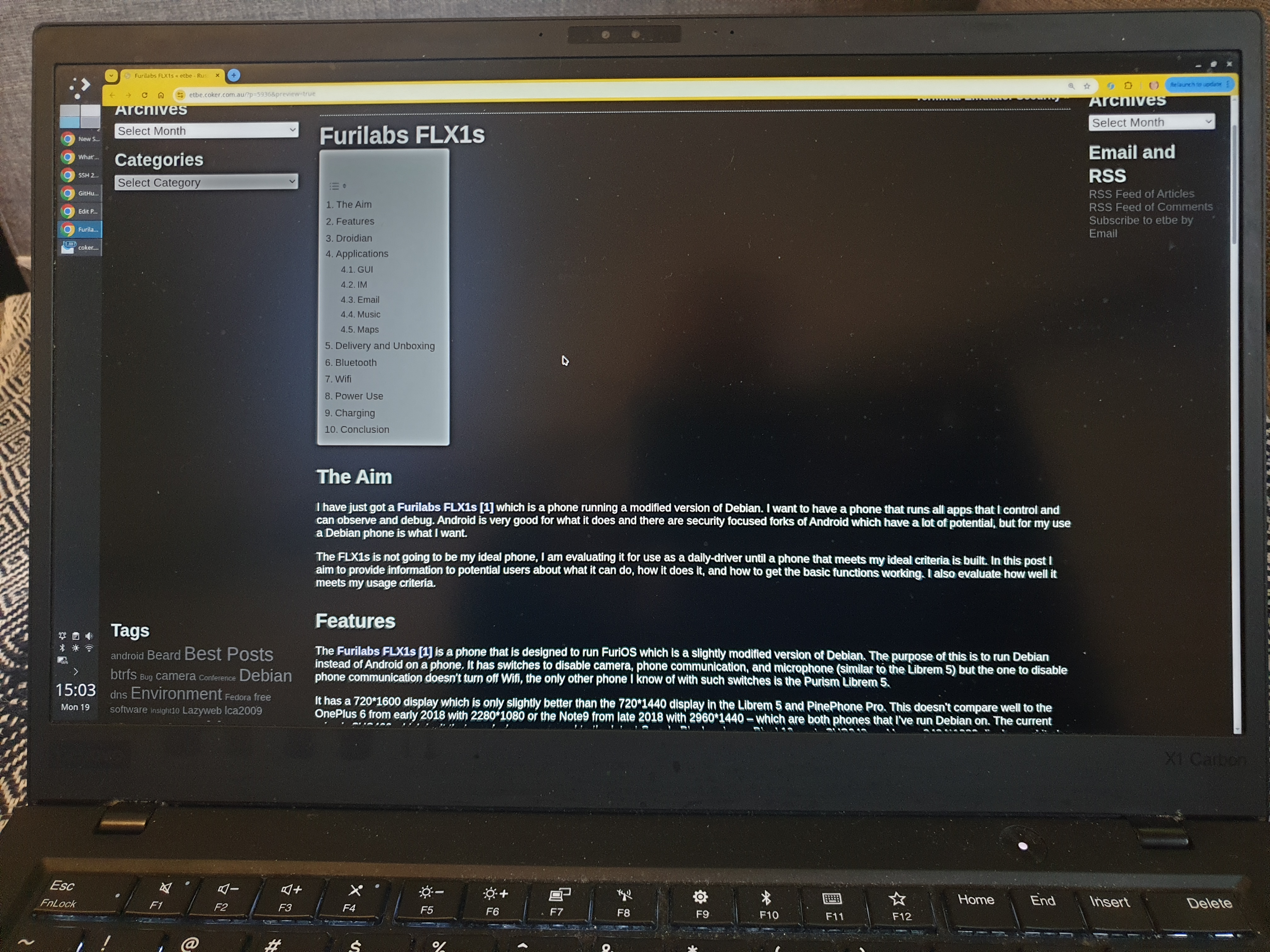
The Aim I have just got a Furilabs FLX1s [1] which is a phone running a modified version of Debian. I want to have a phone that runs all apps that I control and can observe and debug. Android is very good for what it does and there are security focused forks of Android which have a lot of potential, but for my use a Debian phone is what I want. The FLX1s is not going to be my ideal phone, I am evaluating it for use as a daily-driver until a phone that meets my ideal criteria is built. In this post I aim to provide information to potential users about what it can do, how it does it, and how to get the basic functions working. I also evaluate how well it meets my usage criteria. I am not anywhere near an average user. I don t think an average user would ever even see one unless a more technical relative showed one to them. So while this phone could be used by an average user I am not evaluating it on that basis. But of course the features of the GUI that make a phone usable for an average user will allow a developer to rapidly get past the beginning stages and into more complex stuff. Features The Furilabs FLX1s [1] is a phone that is designed to run FuriOS which is a slightly modified version of Debian. The purpose of this is to run Debian instead of Android on a phone. It has switches to disable camera, phone communication, and microphone (similar to the Librem 5) but the one to disable phone communication doesn t turn off Wifi, the only other phone I know of with such switches is the Purism Librem 5. It has a 720*1600 display which is only slightly better than the 720*1440 display in the Librem 5 and PinePhone Pro. This doesn t compare well to the OnePlus 6 from early 2018 with 2280*1080 or the Note9 from late 2018 with 2960*1440 which are both phones that I ve run Debian on. The current price is $US499 which isn t that good when compared to the latest Google Pixel series, a Pixel 10 costs $US649 and has a 2424*1080 display and it also has 12G of RAM while the FLX1s only has 8G. Another annoying thing is how rounded the corners are, it seems that round corners that cut off the content are a standard practice nowadays, in my collection of phones the latest one I found with hard right angles on the display was a Huawei Mate 10 Pro which was released in 2017. The corners are rounder than the Note 9, this annoys me because the screen is not high resolution by today s standards so losing the corners matters. The default installation is Phosh (the GNOME shell for phones) and it is very well configured. Based on my experience with older phone users I think I could give a phone with this configuration to a relative in the 70+ age range who has minimal computer knowledge and they would be happy with it. Additionally I could set it up to allow ssh login and instead of going through the phone support thing of trying to describe every GUI setting to click on based on a web page describing menus for the version of Android they are running I could just ssh in and run diff on the .config directory to find out what they changed. Furilabs have done a very good job of setting up the default configuration, while Debian developers deserve a lot of credit for packaging the apps the Furilabs people have chosen a good set of default apps to install to get it going and appear to have made some noteworthy changes to some of them. Droidian The OS is based on Android drivers (using the same techniques as Droidian [2]) and the storage device has the huge number of partitions you expect from Android as well as a 110G Ext4 filesystem for the main OS. The first issue with the Droidian approach of using an Android kernel and containers for user space code to deal with drivers is that it doesn t work that well. There are 3 D state processes (uninterrupteable sleep which usually means a kernel bug if the process remains in that state) after booting and doing nothing special. My tests running Droidian on the Note 9 also had D state processes, in this case they are D state kernel threads (I can t remember if the Note 9 had regular processes or kernel threads stuck in D state). It is possible for a system to have full functionality in spite of some kernel threads in D state but generally it s a symptom of things not working as well as you would hope. The design of Droidian is inherently fragile. You use a kernel and user space code from Android and then use Debian for the rest. You can t do everything the Android way (with the full OS updates etc) and you also can t do everything the Debian way. The TOW Boot functionality in the PinePhone Pro is really handy for recovery [3], it allows the internal storage to be accessed as a USB mass storage device. The full Android setup with ADB has some OK options for recovery, but part Android and part Debian has less options. While it probably is technically possible to do the same things in regard to OS repair and reinstall the fact that it s different from most other devices means that fixes can t be done in the same way. Applications GUI The system uses Phosh and Phoc, the GNOME system for handheld devices. It s a very different UI from Android, I prefer Android but it is usable with Phosh. IM Chatty works well for Jabber (XMPP) in my tests. It supports Matrix which I didn t test because I don t desire the same program doing Matrix and Jabber and because Matrix is a heavy protocol which establishes new security keys for each login so I don t want to keep logging in on new applications. Chatty also does SMS but I couldn t test that without the SIM caddy. I use Nheko for Matrix which has worked very well for me on desktops and laptops running Debian. Email I am currently using Geary for email. It works reasonably well but is lacking proper management of folders, so I can t just subscribe to the important email on my phone so that bandwidth isn t wasted on less important email (there is a GNOME gitlab issue about this see the Debian Wiki page about Mobile apps [4]). Music Music playing isn t a noteworthy thing for a desktop or laptop, but a good music player is important for phone use. The Lollypop music player generally does everything you expect along with support for all the encoding formats including FLAC0 a major limitation of most Android music players seems to be lack of support for some of the common encoding formats. Lollypop has it s controls for pause/play and going forward and backward one track on the lock screen. Maps The installed map program is gnome-maps which works reasonably well. It gets directions via the Graphhopper API [5]. One thing we really need is a FOSS replacement for Graphhopper in GNOME Maps. Delivery and Unboxing I received my FLX1s on the 13th of Jan [1]. I had paid for it on the 16th of Oct but hadn t received the email with the confirmation link so the order had been put on hold. But after I contacted support about that on the 5th of Jan they rapidly got it to me which was good. They also gave me a free case and screen protector to apologise, I don t usually use screen protectors but in this case it might be useful as the edges of the case don t even extend 0.5mm above the screen. So if it falls face down the case won t help much. When I got it there was an open space at the bottom where the caddy for SIMs is supposed to be. So I couldn t immediately test VoLTE functionality. The contact form on their web site wasn t working when I tried to report that and the email for support was bouncing. Bluetooth As a test of Bluetooth I connected it to my Nissan LEAF which worked well for playing music and I connected it to several Bluetooth headphones. My Thinkpad running Debian/Trixie doesn t connect to the LEAF and to headphones which have worked on previous laptops running Debian and Ubuntu. A friend s laptop running Debian/Trixie also wouldn t connect to the LEAF so I suspect a bug in Trixie, I need to spend more time investigating this. Wifi Currently 5GHz wifi doesn t work, this is a software bug that the Furilabs people are working on. 2.4GHz wifi works fine. I haven t tested running a hotspot due to being unable to get 4G working as they haven t yet shipped me the SIM caddy. Docking This phone doesn t support DP Alt-mode or Thunderbolt docking so it can t drive an external monitor. This is disappointing, Samsung phones and tablets have supported such things since long before USB-C was invented. Samsung DeX is quite handy for Android devices and that type feature is much more useful on a device running Debian than on an Android device. Camera The camera works reasonably well on the FLX1s. Until recently for the Librem 5 the camera didn t work and the camera on my PinePhone Pro currently doesn t work. Here are samples of the regular camera and the selfie camera on the FLX1s and the Note 9. I think this shows that the camera is pretty decent. The selfie looks better and the front camera is worse for the relatively close photo of a laptop screen taking photos of computer screens is an important part of my work but I can probably work around that. I wasn t assessing this camera t find out if it s great, just to find out if I have the sorts of problems I had before and it just worked. The Samsung Galaxy Note series of phones has always had decent specs including good cameras. Even though the Note 9 is old comparing to it is a respectable performance. The lighting was poor for all photos. FLX1s
Note 9
Power Use In 93 minutes having the PinePhone Pro, Librem 5, and FLX1s online with open ssh sessions from my workstation the PinePhone Pro went from 100% battery to 26%, the Librem 5 went from 95% to 69%, and the FLX1s went from 100% to 99%. The battery discharge rate of them was reported as 3.0W, 2.6W, and 0.39W respectively. Based on having a 16.7Wh battery 93 minutes of use should have been close to 4% battery use, but in any case all measurements make it clear that the FLX1s will have a much longer battery life. Including the measurement of just putting my fingers on the phones and feeling the temperature (FLX1s felt cool and the others felt hot). The PinePhone Pro and the Librem 5 have an optional Caffeine mode which I enabled for this test, without that enabled the phone goes into a sleep state and disconnects from Wifi. So those phones would use much less power with caffeine mode enabled, but they also couldn t get fast response to notifications etc. I found the option to enable a Caffeine mode switch on the FLX1s but the power use was reported as being the same both with and without it. Charging One problem I found with my phone is that in every case it takes 22 seconds to negotiate power. Even when using straight USB charging (no BC or PD) it doesn t draw any current for 22 seconds. When I connect it it will stay at 5V and varying between 0W and 0.1W (current rounded off to zero) for 22 seconds or so and then start charging. After the 22 second display the phone will make the tick sound indicating that it s charging and the power meter will measure that it s drawing some current. I added the table from my previous post about phone charging speed [6] with an extra row for the FLX1s. For charging from my PC USB ports the results were the worst ever, the port that does BC did not work at all it was looping trying to negotiate after a 22 second negotiation delay the port would turn off. The non-BC port gave only 2.4W which matches the 2.5W given by the spec for a High-power device which is what that port is designed to give. In a discussion on the Purism forum about the Librem5 charging speed one of their engineers told me that the reason why their phone would draw 2A from that port was because the cable was identifying itself as a USB-C port not a High-power device port. But for some reason out of the 7 phones I tested the FLX1s and the One Plus 6 are the only ones to limit themselves to what the port is apparently supposed to do. Also the One Plus 6 charges slowly on every power supply so I don t know if it is obeying the spec or just sucking. On a cheap AliExpress charger the FLX1s gets 5.9V and on a USB battery it gets 5.8V. Out of all 42 combinations of device and charger I tested these were the only ones to involve more than 5.1V but less than 9V. I welcome comments suggesting an explanation. The case that I received has a hole for the USB-C connector that isn t wide enough for the plastic surrounds on most of my USB-C cables (including the Dell dock). Also to make a connection requires a fairly deep insertion (deeper than the One Plus 6 or the Note 9). So without adjustment I have to take the case off to charge it. It s no big deal to adjust the hole (I have done it with other cases) but it s an annoyance.
Phone Top z640 Bottom Z640 Monitor Ali Charger Dell Dock Battery Best Worst
FLX1s FAIL 5.0V 0.49A 2.4W 4.8V 1.9A 9.0W 5.9V 1.8A 11W 4.8V 2.1A 10W 5.8V 2.1A 12W 5.8V 2.1A 12W 5.0V 0.49A 2.4W
Note9 4.8V 1.0A 5.2W 4.8V 1.6A 7.5W 4.9V 2.0A 9.5W 5.1V 1.9A 9.7W 4.8V 2.1A 10W 5.1V 2.1A 10W 5.1V 2.1A 10W 4.8V 1.0A 5.2W
Pixel 7 pro 4.9V 0.80A 4.2W 4.8V 1.2A 5.9W 9.1V 1.3A 12W 9.1V 1.2A 11W 4.9V 1.8A 8.7W 9.0V 1.3A 12W 9.1V 1.3A 12W 4.9V 0.80A 4.2W
Pixel 8 4.7V 1.2A 5.4W 4.7V 1.5A 7.2W 8.9V 2.1A 19W 9.1V 2.7A 24W 4.8V 2.3A 11.0W 9.1V 2.6A 24W 9.1V 2.7A 24W 4.7V 1.2A 5.4W
PPP 4.7V 1.2A 6.0W 4.8V 1.3A 6.8W 4.9V 1.4A 6.6W 5.0V 1.2A 5.8W 4.9V 1.4A 5.9W 5.1V 1.2A 6.3W 4.8V 1.3A 6.8W 5.0V 1.2A 5.8W
Librem 5 4.4V 1.5A 6.7W 4.6V 2.0A 9.2W 4.8V 2.4A 11.2W 12V 0.48A 5.8W 5.0V 0.56A 2.7W 5.1V 2.0A 10W 4.8V 2.4A 11.2W 5.0V 0.56A 2.7W
OnePlus6 5.0V 0.51A 2.5W 5.0V 0.50A 2.5W 5.0V 0.81A 4.0W 5.0V 0.75A 3.7W 5.0V 0.77A 3.7W 5.0V 0.77A 3.9W 5.0V 0.81A 4.0W 5.0V 0.50A 2.5W
Best 4.4V 1.5A 6.7W 4.6V 2.0A 9.2W 8.9V 2.1A 19W 9.1V 2.7A 24W 4.8V 2.3A 11.0W 9.1V 2.6A 24W
Conclusion The Furilabs support people are friendly and enthusiastic but my customer experience wasn t ideal. It was good that they could quickly respond to my missing order status and the missing SIM caddy (which I still haven t received but believe is in the mail) but it would be better if such things just didn t happen. The phone is quite user friendly and could be used by a novice. I paid $US577 for the FLX1s which is $AU863 by today s exchange rates. For comparison I could get a refurbished Pixel 9 Pro Fold for $891 from Kogan (the major Australian mail-order company for technology) or a refurbished Pixel 9 Pro XL for $842. The Pixel 9 series has security support until 2031 which is probably longer than you can expect a phone to be used without being broken. So a phone with a much higher resolution screen that s only one generation behind the latest high end phones and is refurbished will cost less. For a brand new phone a Pixel 8 Pro which has security updates until 2030 costs $874 and a Pixel 9A which has security updates until 2032 costs $861. Doing what the Furilabs people have done is not a small project. It s a significant amount of work and the prices of their products need to cover that. I m not saying that the prices are bad, just that economies of scale and the large quantity of older stock makes the older Google products quite good value for money. The new Pixel phones of the latest models are unreasonably expensive. The Pixel 10 is selling new from Google for $AU1,149 which I consider a ridiculous price that I would not pay given the market for used phones etc. If I had a choice of $1,149 or a feature phone I d pay $1,149. But the FLX1s for $863 is a much better option for me. If all I had to choose from was a new Pixel 10 or a FLX1s for my parents I d get them the FLX1s. For a FOSS developer a FLX1s could be a mobile test and development system which could be lent to a relative when their main phone breaks and the replacement is on order. It seems to be fit for use as a commodity phone. Note that I give this review on the assumption that SMS and VoLTE will just work, I haven t tested them yet. The UI on the FLX1s is functional and easy enough for a new user while allowing an advanced user to do the things they desire. I prefer the Android style and the Plasma Mobile style is closer to Android than Phosh is, but changing it is something I can do later. Generally I think that the differences between UIs matter more when on a desktop environment that could be used for more complex tasks than on a phone which limits what can be done by the size of the screen. I am comparing the FLX1s to Android phones on the basis of what technology is available. But most people who would consider buying this phone will compare it to the PinePhone Pro and the Librem 5 as they have similar uses. The FLX1s beats both those phones handily in terms of battery life and of having everything just work. But it has the most non free software of the three and the people who want the $2000 Librem 5 that s entirely made in the US won t want the FLX1s. This isn t the destination for Debian based phones, but it s a good step on the way to it and I don t think I ll regret this purchase.

5 January 2026

Hellen Chemtai: Starting out on Open source: Try the OpenQA Debian Image Testing Project

Hello world  . I am an intern at Outreachy and contributing to the Debian Images Testing project since October 2025. This project is Open Source and everyone can contribute to it in any way. The project uses Open QA to automatically install Operating System Images and test them . We have a community here of contributors that is always ready to help out. The mentors and project maintainers are very open to contributions. They listen to any innovative ideas and point out what they have been doing so far. So far contributions have been in terms of: Contributing to this project requires some knowledge of Linux commands and Operating Systems. What we will learn later as we go on will be :
Preparation
Before any contribution begins, we would want to first try out the project and run a couple of tests. Get to understand what we are doing first. Let s say you are starting out as a Windows or MacOS user and you want to start contributing. I would recommend dual partitioning your device first. Do enough research and prepare the resources. The network install image just needs at-least 4 GB USB flash drive for dual booting. You will use Debian as the second operating system. Give enough space to Debian, I recommend around 150 GB or more. Also assign at-least 1 GB space to the /boot/efi directory to prevent the low space warnings after a while.This will be a way good way to learn about image installation which is part of the work . I do not recommend Virtual Box because it will hinder full use of system resources. This process will take a day or two.
Set Up and Testing
After dual booting. We log into our Debian System . The next step of instructions will take you through how we set up and run our tests. These instructions have many Linux commands. You will be learning if you are a newbie as you go through the steps. Try to understand these commands and do not blindly copy and paste. You can start your contributions here if you have a suggestion to add to the install docs. Run some tests then log in the Web UI as per the instructions to view your tests progress. Green means they ve passed. Blue means its still running. Red means failed.
Trying Out Ideas
Kudos if you have reached this point. The community of contributors will help if you are stuck. We get to try out our own variations of tests using variables. We will also rely on documentation to understand the configurations / test commands like these
openqa-cli api -X POST isos ISO=debian-13.1.0-amd64-netinst.iso DISTRI=debian VERSION=stable FLAVOR=netinst-iso ARCH=x86_64 BUILD=1310 #This is the test you will run on the guide
openqa-cli api -X POST isos ISO=debian-13.1.0-amd64-netinst.iso DISTRI=debian VERSION=stable FLAVOR=netinst-iso ARCH=x86_64 BUILD=1310 TEST=cinnamon #I have added a TEST variable that runs only cinnamon test suite
You can check specific test suites from the WebUI :
We get some failures at times. Here are some failed tests from a build I was working on.
Here we find the cinnamon test failed at locale module. Click on any module above and it will lead us to needles and point to the where the test failed. You can check the error or try to add a needle if its needle failure.
Try editing a test module and test your changes. Try out some ideas. Read the documentation folder and write some pseudo code. Interact with the community. Try working on some tasks from the community . Create your tests and add them to the configuration. There is a lot of stuff that can you can work on in this community. It may seem hard to grasp at first as a newbie to Open Source. The community will help you through out even if the problem seems small. We are very friendly and the code maintainers have extensive knowledge. Get to sit with us during one of our meetings and you will learn so much about the project. Learning , networking and communicating is part of contributing to the broader community.

Bits from Debian: Debian welcomes Outreachy interns for December 2025-March 2026 round

Outreachy logo Debian continues participating in Outreachy, and as you might have already noticed, Debian has selected two interns for the Outreachy December 2025 - March 2026 round. After a busy contribution phase and a competitive selection process, Hellen Chemtai Taylor and Isoken Ibizugbe are officially working as interns on Debian Images Testing with OpenQA for the past month, mentored by T ssia Cam es Ara jo, Roland Clobus and Philip Hands. Congratulations and welcome Hellen Chemtai Taylor and Isoken Ibizugbe! The team also congratulates all candidates for their valuable contributions, with special thanks to those who manage to continue participating as volunteers. From the official website: Outreachy provides three-month internships for people from groups traditionally underrepresented in tech. Interns work remotely with mentors from Free and Open Source Software (FOSS) communities on projects ranging from programming, user experience, documentation, illustration and graphical design, to data science. The Outreachy programme is possible in Debian thanks to the efforts of Debian developers and contributors who dedicate their free time to mentor students and outreach tasks, and the Software Freedom Conservancy's administrative support, as well as the continued support of Debian's donors, who provide funding for the internships. Join us and help to improve Debian! You can follow the work of the Outreachy interns reading their blog posts (syndicated in Planet Debian), and chat with the team at the debian-openqa matrix channel. For Outreachy matters, the programme admins can be reached on #debian-outreach IRC/matrix channel and mailing list.

11 December 2025

Dirk Eddelbuettel: #056: Running r-ci with R-devel

Welcome to post 56 in the R4 series. The recent post #54 reviewed a number of earlier posts on r-ci, our small (but very versatile) runner for continunous integration (CI) with R. The post also introduced the notion of using a container in the matrix of jobs defined and running in parallel. The initial motivation was the (still ongoing, and still puzzling) variation in run-times of GitHub Actions. So when running CI and relying on r2u for the fast, easy, reliable: pick all three! provision of CRAN packages as Ubuntu binaries, a small amount of time is spent prepping a basic Ubuntu instance with the necessary setup. This can be as fast as maybe 20 to 30 seconds, but it can also stretch to almost two minutes when GitHub is busier or out of sorts for other reasons. When the CI job itself is short, that is a nuisance. We presented relying on a pre-made r2u4ci container that adds just a few commands to the standard r2u container to be complete for CI. And with that setup CI runs tend to be reliably faster. This situation is still evolving. I have not converted any of my existing CI scripts (apart from a test instance or two), but I keep monitoring the situation. However, this also offered another perspective: why not rely on a different container for a different CI aspect? When discussing the CI approach with Jeff the other day (and helping add CI to his mmap repo), it occurred to me we could also use on of the Rocker containers for R-devel. A minimal change to the underlying run.sh script later, this was accomplished. An example is provided as both a test and an illustration in the repo for package RcppInt64 in its script ci.yaml:
    strategy:
      matrix:
        include:
          -   name: container, os: ubuntu-latest, container: rocker/r2u4ci  
          -   name: r-devel,   os: ubuntu-latest, container: rocker/drd  
          -   name: macos,     os: macos-latest  
          -   name: ubuntu,    os: ubuntu-latest  

    runs-on: $  matrix.os  
    container: $  matrix.container  
This runs both a standard Ubuntu setup (fourth entry) and the alternate just described relying on the container (first entry) along with the (usually commented-out) optional macOS setup (third entry). And line two brings the drd container from Rocker. The CI runner script now checks for a possible Rdevel binary as provided inside drd (along with alias RD) and uses it when present. And that is all that there is: no other change on the user side; tests now run under R-devel. You can see some of the initial runs at the rcppint64 repo actions log. Another example is now also at Jeff s mmap repo. It should be noted that this relies on R-devel running packages made with R-release. Every few years this breaks when R needs to break its binary API. If and when that happens this option will be costlier as the R-devel instance will then have to (re-)install its R package dependencies. This can be accomodated easily as a step in the yaml file. And under normal circumstances it is not needed. Having easy access to recent builds of R-devel (the container refreshes weekly on a schedule) with the convenience of r2u gives another option for package testing. I may continue to test locally with R-devel as my primary option, and most likely keep my CI small and lean (usually just one R-relase run on Ubuntu) but having another option at GitHub Actions is also a good thing.

This post by Dirk Eddelbuettel originated on his Thinking inside the box blog. If you like this or other open-source work I do, you can now sponsor me at GitHub.

2 November 2025

Guido G nther: Free Software Activities October 2025

Quiete some things made progress last month: We put out Phosh 0.50 release, got closer to enabling media roles for audio by default in Phosh (see related post) and reworked our images builds. You should also (hopefully) notice some nice quality of life improvements once changes land in a distro near you and you're using Phosh. See below for details: phosh phoc phosh-mobile-settings stevia (formerly phosh-osk-stub) phosh-tour meta-phosh xdg-desktop-portal-phosh libphosh-rs Calls Phrog phosh-recipes feedbackd feedbackd-device-themes Chatty Squeekboard Debian Cellbroadcastd gnome-settings-daemon gnome-control-center gnome-initial-setup sdm845-mainline gnome-session alpine droid-juicer phosh-site phosh-debs Linux Wireplumber Phosh.mobi e.V. demo-phones Reviews This is not code by me but reviews on other peoples code. The list is (as usual) slightly incomplete. Thanks for the contributions! Comments? Join the Fediverse thread

27 October 2025

Dirk Eddelbuettel: #054: Faster r-ci Continuous Integration via r2u Container

Welcome to post 54 in the R4 series. The topic of continuous integration has been a recurrent theme here at the R4 series. Post #32 introducess r-ci, while post #41 brings r2u to r-ci, but does not show a matrix deployment. Post #45 describes the updated r-ci setup that is now the default and contains a macOS and Ubuntu matrix, where the latter relies on r2u to keep things fast, easy, reliable . Last but not least more recent post #52 shares a trick for ensuring coverage reports. Following #45, use of r-ci at for example GitHub Actions has seen steady use and very reliable performance. With the standard setup, a vanilla Ubuntu setup is changed into one supported by r2u. This requires downloading and installating a few Ubuntu packages, and has generally been fairly quick on the order of around fourty seconds. Now, the general variability of run-times for identical tasks in GitHub Actions is well documented by the results of the setup described in post #39 which still runs weekly. It runs the identical SQL query against a remote backend using two different package families. And lo and behold, the intra-method variability on unchanged code or setup and therefore due solely to system variability is about as large as the inter-method variability. In short, GitHub Actions performance varies randomly with significant variability. See the repo README.md for chart that updates weekly (and see #39 for background). Of late, this variability became more noticeable during standard GitHub Actions runs where it would regularly take more than two minutes of setup time before actual continuous integration work was done. Some caching seems to be in effect, so subsequent runs in the same repo seem faster and often came back to one minute or less. For lightweight and small packages, loosing two minutes to setup when the actual test time is a minute or less gets old fast. Looking around, we noticed that container use can be combined with matrix use. So we have now been deploying the following setup (not always over all the matrix elements though)
jobs:
  ci:
    strategy:
      matrix:
        include:
          -   name: container, os: ubuntu-latest, container: rocker/r2u4ci  
          -   name: macos,     os: macos-latest   
          -   name: ubuntu,    os: ubuntu-latest  

    runs-on: $  matrix.os  
    container: $  matrix.container  
GitHub Actions is smart enough to provide NULL for container in the two other cases, so container: $ matrix.container is ignored there. But when container is set as here for the ci-enhanced version of r2u (which adds a few binaries commonly needed such as git, curl, wget etc needed for CI) then the CI jobs runs inside the container. And thereby skips most of the setup time as the container is already prepared. This also required some small adjustments in the underlying shell script doing the work. To not disrupt standard deployment, we placed these into a release candidate / development version one can op into via an new variable dev_version
      - name: Setup
        uses: eddelbuettel/github-actions/r-ci@master
        with:
          dev_version: 'TRUE'
Everything else remains the same and works as before. But faster as much less time is spent on setup. You can see the actual full yaml file and actions in my repositories for rcpparmadillo and rcppmlpack-examples. Additional testing would be welcome, so feel free to deploy this in your actions now. Otherwise I will likely carry this over and make it the defaul in a few weeks time. It will still work as before but when the added container: line is used will run much faster thanks to rocker/r2u4ci being already set up for CI.

This post by Dirk Eddelbuettel originated on his Thinking inside the box blog. If you like this or other open-source work I do, you can now sponsor me at GitHub.

3 October 2025

Guido G nther: Free Software Activities September 2025

Another short status update of what happened on my side last month. Nothing stands out too much, I enjoyed doing the OSK changes the most as that helped to improve the typing experience further. Also doing a small bit of kernel work again was fun (still need to figure out the 6mq's touch controller repsonsiveness though). See below for details on the above and more: phosh phoc phosh-mobile-settings stevia (formerly phosh-osk-stub) xdg-desktop-portal-phosh pfs libphosh-rs Phrog feedbackd feedbackd-device-themes Debian gnome-settings-daemon git-buildpackage govarnam Sessions twenty-twenty-hugo tuwunnel Linux mutter Phosh debs phosh-site Reviews This is not code by me but reviews I did on other peoples code. The list is (as usual) slightly incomplete. Thanks for the contributions! Help Development If you want to support my work see donations. Comments? Join the Fediverse thread

1 October 2025

Dirk Eddelbuettel: #052: Running r-ci with Coverage

Welcome to post 52 in the R4 series. Following up on the post #51 yesterday and its stated intent of posting some more here The r-ci setup (which was introduced in post #32 and updated in post #45) offers portable continuous integration which can take advantage of different backends: Github Actions, Azure Pipelines, GitLab, BitBuckets, and possibly as it only requires a basic Ubuntu shell after which it customizes itself and runs via shell script. Portably. Now, most of us, I suspect still use it with GitHub Actions but it is reassuring to know that one can take it elsewhere should the need or desire arise. One thing many repos did, and which stopped working reliably is coverage analysis. This is made easy by the covr package, and made fast, easy, reliable (as we quip) thanks to r2u. But transmission to codecov stopped working a while back so I had mostly commented it out in my repos, rendering the reports more and more stale. Which is not ideal. A few weeks ago I gave this another look, and it turns that that codecov now requires an API token to upload. Which one can generate in the user -> settings menu on their website under the access tab. Which in turn then needs to be stored in each repo wanting to upload. For Github, this is under settings -> secrets and variables -> actions as a repository secret . I suggest using CODECOV_TOKEN for its name. After that the three-line block in the yaml file can reference it as a secret as in the following snippet, now five lines, taken from one of my ci.yaml files:
      - name: Coverage
        if: $  matrix.os == 'ubuntu-latest'  
        run: ./run.sh coverage
        env:
          CODECOV_TOKEN: $  secrets.CODECOV_TOKEN  
It assigns the secret we stored on the website, references it by prefix secrets. and assigns it to the environment variable CODECOV_TOKEN. After this reports flow as one can see on repositories where I re-enabled this as for example here for RcppArmadillo.

This post by Dirk Eddelbuettel originated on his Thinking inside the box blog. If you like this or other open-source work I do, you can now sponsor me at GitHub.

8 September 2025

Dirk Eddelbuettel: RcppArmadillo 15.0.2-1 on CRAN: New Upstream, Some Changes

armadillo image Armadillo is a powerful and expressive C++ template library for linear algebra and scientific computing. It aims towards a good balance between speed and ease of use, has a syntax deliberately close to Matlab, and is useful for algorithm development directly in C++, or quick conversion of research code into production environments. RcppArmadillo integrates this library with the R environment and language and is widely used by (currently) 1279 other packages on CRAN, downloaded 41.2 million times (per the partial logs from the cloud mirrors of CRAN), and the CSDA paper (preprint / vignette) by Conrad and myself has been cited 644 times according to Google Scholar. Fairly shortly after the release of Armadillo 14.6.3 (which became our precedig release 14.6.3), Conrad released version 15.0.0 of Armadillo. It contains several breaking changes which made it unsuitable for CRAN as is. First, the minimum C++ standard was lifted to C++14. There are many good reasons for doing so, but doing it unannounced with no transition offered cannot work at CRAN. For (mostly historical) reasons (as C++11 was once a step up from even more archaic code) many packages still enforce C++11. These packages would break under Armadillo 15.0.0. With some reverse-dependency checks we quickly found that this would affect over 200 packages. Second, Armadillo frequently deprecates code and issues a warning offering a hint towards an improved / current alternative. That too is good practice, and recommended. But at CRAN a deprecation warning seen leads to NOTE and an unfixed NOTEs can lead to archival which is not great. For that reason, we had added a global muffler suppressing the deprecation warnings. This was now removed in C++14 (as one can rely on newer compiler attributes we cannot undo, whereas the old scheme just used macros). Again, not something we can do at CRAN. So I hatched the plan of offering both the final release under the previous state of the world, i.e. 14.6.3, along with 15.0.0. User could then opt-into 15.0.0 but have a fallback of 14.6.3 allowing all packages to coexist. The first idea was to turn the fallback on only if C++11 compilation was noticed. This lead still a lot of deprecation warnings meaning we had to more strongly default to 14.6.3 and only if users actively selected 15.0.* would they get it. This seemed to work. We were still faced with two hard failures. Turns out one was local to a since-archived package, the other reveal a bad interaction betweem Armadillo and gcc for complex variables and lead to bug fix 15.0.1. Which I wrapped and uploaded a week ago. Release 15.0.1 was quickly seen as only temporary because I overlooked two issues. Moving legacy and current into, respectively, a directory of that name meant to top-level include header armadillo remained. This broked a few use cases where packages use a direct #include <armadillo> (which we do not recommend as it may miss a few other settings we apply for the R case). The other is that an old test for limited LAPACK capabilities made noise in some builds (for example on Windows). As (current) R versions generally have sufficient LAPACK and BLAS, this too has been removed. We have tested and rested these changed extensively. The usual repository with the logs shows eight reverse-dependency runs each of which can take up to a day. This careful approach, together with pacing uploads at CRAN usually works. We got a NOTE for seven uploads in six months for this one, but a CRAN maintainer quickly advanced it, and the fully automated test showed no regression or other human intervention which is nice given the set of changes, and the over 1200 reverse dependencies. The changes since the last announced CRAN release 14.6.3 follow.

Changes in RcppArmadillo version 15.0.2-1 (2025-09-08)
  • Upgraded to Armadillo release 15.0.2-1 (Medium Roast)
    • Optionally use OpenMP parallelisation for fp16 matrix multiplication
    • Faster vectorisation of cube tubes
  • Provide a top-level include file armadillo as fallback (#480)
  • Retire the no-longer-needed check for insufficient LAPACK as R now should supply a sufficient libRlapack (when used) (#483)
  • Two potential narrowing warnings are avoided via cast

Changes in RcppArmadillo version 15.0.1-1 (2025-09-01)
  • Upgraded to Armadillo release 15.0.1-1 (Medium Roast)
    • Workaround for GCC compiler bug involving misoptimisation of complex number multiplication
  • This version contains both 'legacy' and 'current' version of Armadillo (see also below). Package authors should set a '#define' to select the 'current' version, or select the 'legacy' version (also chosen as default) if they must. See GitHub issue #475 for more details.
  • Updated DESCRIPTION and README.md

Changes in RcppArmadillo version 15.0.0-1 (2025-08-21) (GitHub Only)
  • Upgraded to Armadillo release 15.0.0-1 (Medium Roast)
    • C++14 is now the minimum required C++ standard
    • Aded preliminary support for matrices with half-precision fp16 element type
    • Added second form of cond() to allow detection of failures
    • Added repcube()
    • Added .freeze() and .unfreeze() member functions to wall_clock
    • Extended conv() and conv2() to accept the "valid" shape argument
  • Also includes Armadillo 14.6.3 as fallback for C++11 compilations
  • This new 'dual' setup had been rigorously tested with five interim pre-releases of which several received full reverse-dependency checks

Courtesy of my CRANberries, there is a diffstat report relative to previous release. More detailed information is on the RcppArmadillo page. Questions, comments etc should go to the rcpp-devel mailing list off the Rcpp R-Forge page.

This post by Dirk Eddelbuettel originated on his Thinking inside the box blog. If you like this or other open-source work I do, you can sponsor me at GitHub.

1 September 2025

Guido G nther: Free Software Activities August 2025

Another short status update of what happened on my side last month. Released Phosh 0.49.0 and added some more QoL improvements to Phosh Mobile stack (e.g. around Cell broadcasts). Also pulled my SHIFT6mq out of the drawer (where it was sitting in a drawwer far too long) and got it to show a picture after a small driver fix. Thanks to the work the sdm845-mainlining folks are doing that was all that was needed. If I can get touch to work better that would be another nice device for demoing Phosh. See below for details on the above and more: phosh phoc phosh-mobile-settings stevia (formerly phosh-osk-stub) xdg-desktop-portal-phosh pfs feedbackd feedbackd-device-themes libcmatrix Chatty Debian Cellbroadcastd ModemManager gnome-clocks git-buildpackage mobian-recipies Linux Reviews This is not code by me but reviews on other peoples code. The list is (as usual) slightly incomplete. Thanks for the contributions! Help Development If you want to support my work see donations. Comments? Join the Fediverse thread

29 August 2025

Raju Devidas: Fixing Auto-Rotate screen orientation on PostmarketOS devices running MATE DE

Fixing Auto-Rotate screen orientation on PostmarketOS devices running MATE DEI have been using my Samsung Galaxy Tab A (2015) with PostmarketOS on and off since last year. It serves as a really good e-book reader with KOReader installed on it. Have tried phosh and plasma-mobile on it, works nicely but slows the device down heavily (2 GB RAM and old processor) so I use MATE Desktop environment on it.Lately I have started using this tablet along with my laptop as a second screen for work. And it has been working super nicely for that. The only issue being that I have to manually rotate the screen to landscape every time I reboot the device. It resets the screen orientation to portrait after a reboot. So I went through the pmOS wiki and a neat nice hack documented there worked very well for me. First we will test if the auto-rotate sensor works and if we can read values from it. So we install some basic necessary packages
$ sudo apk add xrandr xinput inotify-tools iio-sensor-proxy
Enable the service for iio-sensor-proxy
sudo rc-update add iio-sensor-proxy
Reboot the device. Now in the device terminal start the sensor monitor-sensor
user@samsung-gt58 ~> monitor-sensor
    Waiting for iio-sensor-proxy to appear
+++ iio-sensor-proxy appeared
=== Has accelerometer (orientation: normal, tilt: vertical)
=== Has ambient light sensor (value: 5.000000, unit: lux)
=== No proximity sensor
=== No compass
    Light changed: 14.000000 (lux)
    Accelerometer orientation changed: left-up
    Tilt changed: tilted-down
    Light changed: 12.000000 (lux)
    Tilt changed: vertical
    Light changed: 13.000000 (lux)
    Light changed: 11.000000 (lux)
    Light changed: 13.000000 (lux)
    Accelerometer orientation changed: normal
    Light changed: 5.000000 (lux)
    Light changed: 6.000000 (lux)
    Light changed: 5.000000 (lux)
    Accelerometer orientation changed: right-up
    Light changed: 3.000000 (lux)
    Light changed: 4.000000 (lux)
    Light changed: 5.000000 (lux)
    Light changed: 12.000000 (lux)
    Tilt changed: tilted-down
    Light changed: 19.000000 (lux)
    Accelerometer orientation changed: bottom-up
    Tilt changed: vertical
    Light changed: 1.000000 (lux)
    Light changed: 2.000000 (lux)
    Light changed: 4.000000 (lux)
    Accelerometer orientation changed: right-up
    Tilt changed: tilted-down
    Light changed: 11.000000 (lux)
    Accelerometer orientation changed: normal
    Tilt changed: vertical
    Tilt changed: tilted-down
    Light changed: 18.000000 (lux)
    Light changed: 21.000000 (lux)
    Light changed: 22.000000 (lux)
    Light changed: 19.000000 (lux)
    Accelerometer orientation changed: left-up
    Light changed: 17.000000 (lux)
    Tilt changed: vertical
    Light changed: 14.000000 (lux)
    Tilt changed: tilted-down
    Light changed: 16.000000 (lux)
    Light changed: 18.000000 (lux)
    Light changed: 17.000000 (lux)
    Light changed: 18.000000 (lux)
    Light changed: 17.000000 (lux)
    Light changed: 18.000000 (lux)
    Light changed: 17.000000 (lux)
    Light changed: 18.000000 (lux)
    Light changed: 17.000000 (lux)
As you can see we can read the rotation values from the sensor as I am rotating the tablet in different orientations. Now we just need to use a script which changes the screen orientation using xrandr according to the sensor value.
#!/bin/sh
killall monitor-sensor
monitor-sensor > /dev/shm/sensor.log 2>&1 &
while inotifywait -e modify /dev/shm/sensor.log; do
  ORIENTATION=$(tail /dev/shm/sensor.log   grep &aposorientation&apos   tail -1   grep -oE &apos[^ ]+$&apos)
  case "$ORIENTATION" in
    normal)
      xrandr -o normal
      xinput set-prop "Goodix Capacitive TouchScreen" "Coordinate Transformation Matrix" 1 0 0 0 1 0 0 0 1
      ;;
    left-up)
      xrandr -o left
      xinput set-prop "Goodix Capacitive TouchScreen" "Coordinate Transformation Matrix" 0 -1 1 1 0 0 0 0 1
      ;;
    bottom-up)
      xrandr -o inverted
      xinput set-prop "Goodix Capacitive TouchScreen" "Coordinate Transformation Matrix" -1 0 1 0 -1 1 0 0 1
      ;;
    right-up)
      xrandr -o right
      xinput set-prop "Goodix Capacitive TouchScreen" "Coordinate Transformation Matrix" 0 1 0 -1 0 1 0 0 1
      ;;
  esac
done

auto-rotate-screen.sh

You need to replace the name of your touch input device in the script, you can get the name by using xinput --list , make sure to type this on the device terminal.
user@samsung-gt58 ~> xinput --list
* Virtual core pointer                    	id=2	[master pointer  (3)]
*   * Virtual core XTEST pointer              	id=4	[slave  pointer  (2)]
*   * Zinitix Capacitive TouchScreen          	id=10	[slave  pointer  (2)]
*   * Toad One Plus                           	id=12	[slave  pointer  (2)]
* Virtual core keyboard                   	id=3	[master keyboard (2)]
    * Virtual core XTEST keyboard             	id=5	[slave  keyboard (3)]
    * GPIO Buttons                            	id=6	[slave  keyboard (3)]
    * pm8941_pwrkey                           	id=7	[slave  keyboard (3)]
    * pm8941_resin                            	id=8	[slave  keyboard (3)]
    * Zinitix Capacitive TouchScreen          	id=11	[slave  keyboard (3)]
    * samsung-a2015 Headset Jack              	id=9	[slave  keyboard (3)]
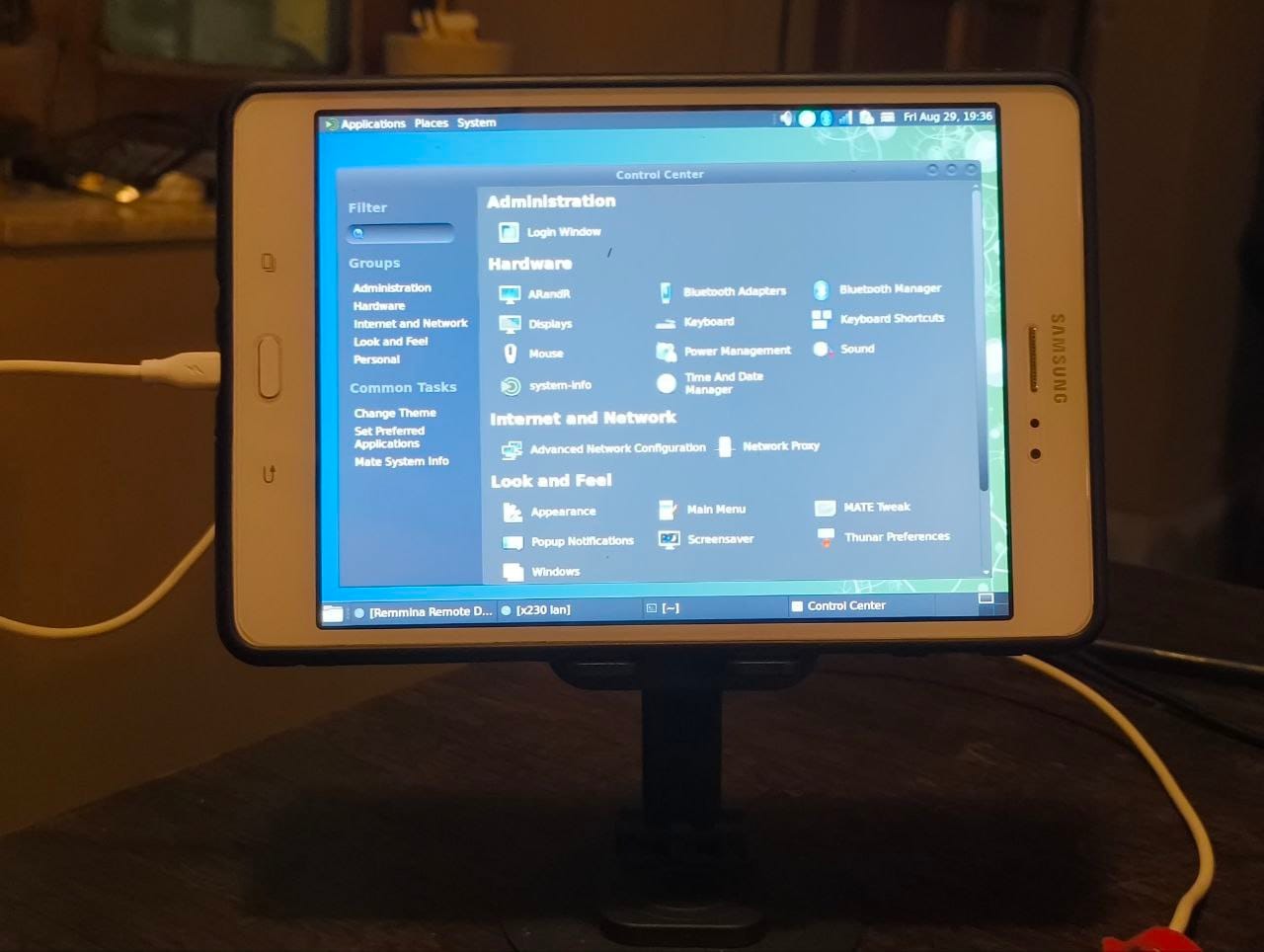
In our script here we are using a Zinitix capacitive screen, it will be different for yours.Once your script is ready with the correct touchscreen name. Save and make the script executable. chmod +x auto-rotate-screen.sh Then test your script in your terminal ./auto-rotate.sh , stop the script using Ctrl + CNow we need add this script to auto-start. On MATE DE you can go to System > Control Center > Startup Applications, then click on Custom Add button, browse the script location, give it a name and then click on Add button. Now reboot the tablet/device, login and see the auto rotation working.
0:00
/0:09

  1. Auto-Rotation wiki article on PostmarketOS Wiki https://wiki.postmarketos.org/wiki/Auto-rotation

26 July 2025

Bits from Debian: DebConf25 closes in Brest and DebConf26 announced

DebConf25 group photo - click to enlarge On Saturday 19 July 2025, the annual Debian Developers and Contributors Conference came to a close. Over 443 attendees representing 50 countries from around the world came together for a combined 169 events (including some which took place during the DebCamp) including more than 50 Talks, 39 Short Talks, 5 Discussions, 59 Birds of a Feather sessions ("BoF" informal meeting between developers and users), 10 workshops, and activities in support of furthering our distribution and free software, learning from our mentors and peers, building our community, and having a bit of fun. The conference was preceded by the annual DebCamp hacking session held 7 through 13 July where Debian Developers and Contributors convened to focus on their individual Debian-related projects or work in team sprints geared toward in-person collaboration in developing Debian. This year, a session was dedicated to prepare the BoF "Dealing with Dormant Packages: Ensuring Debian's High Standards"; another, at the initiative of our DPL, to prepare suggestions for the BoF Package Acceptance in Debian: Challenges and Opportunities"; and an afternoon around Salsa-CI. As has been the case for several years, a special effort has been made to welcome newcomers and help them become familiar with Debian and DebConf by organizing a sprint "New Contributors Onboarding" every day of Debcamp, followed more informally by mentorship during DebConf. The actual Debian Developers Conference started on Monday 14 July 2025. In addition to the traditional "Bits from the DPL" talk, the continuous key-signing party, lightning talks, and the announcement of next year's DebConf26, there were several update sessions shared by internal projects and teams. Many of the hosted discussion sessions were presented by our technical core teams with the usual and useful "Meet the Technical Committee", the "What's New in the Linux Kernel" session, and a set of BoFs about Debian packaging policy and Debian infrastructure. Thus, more than a quarter of the discussions dealt with this theme, including talks about our tools and Debian's archive processes. Internationalization and Localization have been the subject of several talks. The Python, Perl, Ruby, Go, and Rust programming language teams also shared updates on their work and efforts. Several talks have covered Debian Blends and Debian-derived distributions and other talks addressed the issue of Debian and AI. More than 17 BoFs and talks about community, diversity, and local outreach highlighted the work of various teams involved in not just the technical but also the social aspect of our community; four women who have made contributions to Debian through their artwork in recent years presented their work. The one-day session "DebConf 2025 Academic Track!", organized in collaboration with the IRISA laboratory was the first session welcoming fellow academics at DebConf, bringing together around ten presentations. The schedule was updated each day with planned and ad hoc activities introduced by attendees over the course of the conference. Several traditional activities took place: a job fair, a poetry performance, the traditional Cheese and Wine party (this year with cider as well), the Group Photos, and the Day Trips. For those who were not able to attend, most of the talks and sessions were broadcasted live and recorded; currently the videos are made available through this link. Almost all of the sessions facilitated remote participation via IRC and Matrix messaging apps or online collaborative text documents which allowed remote attendees to "be in the room" to ask questions or share comments with the speaker or assembled audience. DebConf25 saw over 441 T-shirts, 3 day trips, and up to 315 meals planned per day. All of these events, activities, conversations, and streams coupled with our love, interest, and participation in Debian and F/OSS certainly made this conference an overall success both here in Brest, France and online around the world. The DebConf25 website will remain active for archival purposes and will continue to offer links to the presentations and videos of talks and events. Next year, DebConf26 will be held in Santa Fe, Argentina, likely in July. As tradition follows before the next DebConf the local organizers in Argentina will start the conference activities with DebCamp with a particular focus on individual and team work towards improving the distribution. DebConf is committed to a safe and welcome environment for all participants. See the web page about the Code of Conduct on the DebConf25 website for more details on this. Debian thanks the commitment of numerous sponsors to support DebConf25, particularly our Platinum Sponsors: AMD, EDF, Infomaniak, Proxmox, and Viridien. We also wish to thank our Video and Infrastructure teams, the DebConf25 and DebConf committees, our host nation of France, and each and every person who helped contribute to this event and to Debian overall. Thank you all for your work in helping Debian continue to be "The Universal Operating System". See you next year! About Debian The Debian Project was founded in 1993 by Ian Murdock to be a truly free community project. Since then the project has grown to be one of the largest and most influential Open Source projects. Thousands of volunteers from all over the world work together to create and maintain Debian software. Available in 70 languages, and supporting a huge range of computer types, Debian calls itself the universal operating system. About DebConf DebConf is the Debian Project's developer conference. In addition to a full schedule of technical, social and policy talks, DebConf provides an opportunity for developers, contributors and other interested people to meet in person and work together more closely. It has taken place annually since 2000 in locations as varied as Scotland, Bosnia and Herzegovina, India, Korea. More information about DebConf is available from https://debconf.org/. About AMD The AMD ROCm platform includes programming models, tools, compilers, libraries, and runtimes for AI and HPC solution development on AMD GPUs. Debian is an officially supported platform for AMD ROCm and a growing number of components are now included directly in the Debian distribution. For more than 55 years AMD has driven innovation in high-performance computing, graphics and visualization technologies. AMD is deeply committed to supporting and contributing to open-source projects, foundations, and open-standards organizations, taking pride in fostering innovation and collaboration within the open-source community. About EDF EDF is a leading global utility company focused on low-carbon power generation. The group uses advanced engineering and scientific computing tools to drive innovation and efficiency in its operations, especially in nuclear power plant design and safety assessment. Since 2003, the EDF Group has been using Debian as its main scientific computing environment. Debian's focus on stability and reproducibility ensures that EDF's calculations and simulations produce consistent and accurate results. About Infomaniak Infomaniak is Switzerland's leading developer of Web technologies. With operations all over Europe and based exclusively in Switzerland, the company designs and manages its own data centers powered by 100% renewable energy, and develops all its solutions locally, without outsourcing. With millions of users and the trust of public and private organizations across Europe - such as RTBF, the United Nations, central banks, over 3,000 radio and TV stations, as well as numerous cities and security bodies - Infomaniak stands for sovereign, sustainable and independent digital technology. The company offers a complete suite of collaborative tools, cloud hosting, streaming, marketing and events solutions, while being owned by its employees and self-financed exclusively by its customers. About Proxmox Proxmox develops powerful, yet easy-to-use Open Source server software. The product portfolio from Proxmox, including server virtualization, backup, and email security, helps companies of any size, sector, or industry to simplify their IT infrastructures. The Proxmox solutions are built on Debian, we are happy that they give back to the community by sponsoring DebConf25. About Viridien Viridien is an advanced technology, digital and Earth data company that pushes the boundaries of science for a more prosperous and sustainable future. Viridien has been using Debian-based systems to power most of its HPC infrastructure and its cloud platform since 2009 and currently employs two active Debian Project Members. Contact Information For further information, please visit the DebConf25 web page at https://debconf25.debconf.org/ or send mail to press@debian.org.

15 July 2025

Valhalla's Things: Federated instant messaging, 100% debianized

Posted on July 15, 2025
Tags: madeof:bits, topic:xmpp, topic:debian
This is an approximation of what I told at my talk Federated instant messaging, 100% debianized at DebConf 25, for people who prefer reading text. There will also be a video recording, as soon as it s ready :) at the link above. Communicating is a basic human need, and today some kind of computer-mediated communication is a requirement for most people, especially those in this room. With everything that is happening, it s now more important than ever that these means of communication aren t controlled by entities that can t be trusted, whether because they can stop providing the service at any given time or worse because they are going to abuse it in order to extract more profit. If only there was a well established chat system based on some standard developed in an open way, with all of the features one expects from a chat system but federated so that one can choose between many different and independent providers, or even self-hosting. But wait, it does exist! I m not talking about IRC, I m talking about XMPP! While it has been around since the last millennium, it has not remained still, with hundred of XMPP Extension Protocols, or XEPs that have been developed to add all of the features that nobody in 1999 imagined we could need in Instant Messaging today, and more, such as IoT devices or even social networks. There is a myth that this makes XMPP a mess of incompatible software, but there is an XEP for that: XEP-0479: XMPP Compliance Suites 2023, which is a list of XEPs that needs to be supported by Instant Messaging servers and clients, including mobile ones, and all of the recommended ones will mostly just work. These include conversations.im on android, dino on linux, which also works pretty nicely on linux phones, gajim for a more fully featured option that includes the kitchen sink, profanity for text interface fanatics like me, and I ve heard that monal works decently enough on the iThings. One thing that sets XMPP apart from other federated protocols, is that it has already gone through the phase where everybody was on one very big server, which then cut out federation, and we ve learned from the experience. These days there are still a few places that cater to newcomers, like https://account.conversations.im/, https://snikket.org/ (which also includes tools to make it easier to host your own instance) and https://quicksy.im/, but most people are actually on servers of a manageable size. My strong recommendation is for community hosting: not just self-hosting for yourself, but finding a community you feel part of and trust, and share a server with them, whether managed by volunteers from the community itself, or by a paid provider. If you are a Debian Developer, you already have one: you can go to https://db.debian.org/ , select Change rtc password to set your own password, wait an hour or so and you re good to go, as described at the bottom of https://wiki.debian.org/Teams/DebianSocial. A few years ago it had remained a bit behind, but these days it s managed by an active team, and if you re missing some features, or just want to know what s happening with it, you can join their BoF on Friday afternoon (and also thank them for their work). But for most people in this room, I d also recommend finding a friend or two who can help as a backup, and run a server for your own families or community: as a certified lazy person who doesn t like doing sysadmin jobs, I can guarantee it s perfectly feasible, about in the same range of difficulty as running your own web server for a static site. The two most popular servers for this, prosody and ejabberd, are well maintained in Debian, and these days there isn t a lot more to do than installing them, telling them your hostname, setting up a few DNS entries, and then you mostly need to keep the machine updated and very little else. After that, it s just applying system security updates, upgrading everything every couple years (some configuration updates may be needed, but nothing major) and maybe helping some non-technical users, if you are hosting your non-technical friends (the kind who would need support on any other platform).
Question time (including IRC questions) included which server would be recommended for very few users (I use prosody and I m very happy with it, but I believe ejabberd works also just fine), then somebody reminded me that I had forgotten to mention https://www.chatons.org/ , which lists free, ethical and decentralized services, including xmpp ones. I was also asked a comparison with matrix, which does cover a very similar target as XMPP, but I am quite biased against it, and I d prefer to talk well of my favourite platform than badly of its competitor.

2 July 2025

Dirk Eddelbuettel: Rcpp 1.1.0 on CRAN: C++11 now Minimum, Regular Semi-Annual Update

rcpp logo With a friendly Canadian hand wave from vacation in Beautiful British Columbia, and speaking on behalf of the Rcpp Core Team, I am excited to shared that the (regularly scheduled bi-annual) update to Rcpp just brought version 1.1.0 to CRAN. Debian builds haven been prepared and uploaded, Windows and macOS builds should appear at CRAN in the next few days, as will builds in different Linux distribution and of course r2u should catch up tomorrow as well. The key highlight of this release is the switch to C++11 as minimum standard. R itself did so in release 4.0.0 more than half a decade ago; if someone is really tied to an older version of R and an equally old compiler then using an older Rcpp with it has to be acceptable. Our own tests (using continuous integration at GitHub) still go back all the way to R 3.5.* and work fine (with a new-enough compiler). In the previous release post, we commented that we had only reverse dependency (falsely) come up in the tests by CRAN, this time there was none among the well over 3000 packages using Rcpp at CRAN. Which really is quite amazing, and possibly also a testament to our rigorous continued testing of our development and snapshot releases on the key branch. This release continues with the six-months January-July cycle started with release 1.0.5 in July 2020. As just mentioned, we do of course make interim snapshot dev or rc releases available. While we not longer regularly update the Rcpp drat repo, the r-universe page and repo now really fill this role admirably (and with many more builds besides just source). We continue to strongly encourage their use and testing I run my systems with these versions which tend to work just as well, and are of course also fully tested against all reverse-dependencies. Rcpp has long established itself as the most popular way of enhancing R with C or C++ code. Right now, 3038 packages on CRAN depend on Rcpp for making analytical code go faster and further. On CRAN, 13.6% of all packages depend (directly) on Rcpp, and 61.3% of all compiled packages do. From the cloud mirror of CRAN (which is but a subset of all CRAN downloads), Rcpp has been downloaded 100.8 million times. The two published papers (also included in the package as preprint vignettes) have, respectively, 2023 (JSS, 2011) and 380 (TAS, 2018) citations, while the the book (Springer useR!, 2013) has another 695. As mentioned, this release switches to C++11 as the minimum standard. The diffstat display in the CRANberries comparison to the previous release shows how several (generated) sources files with C++98 boilerplate have now been removed; we also flattened a number of if/else sections we no longer need to cater to older compilers (see below for details). We also managed more accommodation for the demands of tighter use of the C API of R by removing DATAPTR and CLOENV use. A number of other changes are detailed below. The full list below details all changes, their respective PRs and, if applicable, issue tickets. Big thanks from all of us to all contributors!

Changes in Rcpp release version 1.1.0 (2025-07-01)
  • Changes in Rcpp API:
    • C++11 is now the required minimal C++ standard
    • The std::string_view type is now covered by wrap() (Lev Kandel in #1356 as discussed in #1357)
    • A last remaining DATAPTR use has been converted to DATAPTR_RO (Dirk in #1359)
    • Under R 4.5.0 or later, R_ClosureEnv is used instead of CLOENV (Dirk in #1361 fixing #1360)
    • Use of lsInternal switched to lsInternal3 (Dirk in #1362)
    • Removed compiler detection macro in a header cleanup setting C++11 as the minunum (Dirk in #1364 closing #1363)
    • Variadic templates are now used onconditionally given C++11 (Dirk in #1367 closing #1366)
    • Remove RCPP_USING_CXX11 as a #define as C++11 is now a given (Dirk in #1369)
    • Additional cleanup for __cplusplus checks (I aki in #1371 fixing #1370)
    • Unordered set construction no longer needs a macro for the pre-C++11 case (I aki in #1372)
    • Lambdas are supported in a Rcpp Sugar functions (I aki in #1373)
    • The Date(time)Vector classes now have default ctor (Dirk in #1385 closing #1384)
    • Fixed an issue where Rcpp::Language would duplicate its arguments (Kevin in #1388, fixing #1386)
  • Changes in Rcpp Attributes:
    • The C++26 standard now has plugin support (Dirk in #1381 closing #1380)
  • Changes in Rcpp Documentation:
    • Several typos were correct in the NEWS file (Ben Bolker in #1354)
    • The Rcpp Libraries vignette mentions PACKAGE_types.h to declare types used in RcppExports.cpp (Dirk in #1355)
    • The vignettes bibliography file was updated to current package versions, and now uses doi references (Dirk in #1389)
  • Changes in Rcpp Deployment:
    • Rcpp.package.skeleton() creates URL and BugReports if given a GitHub username (Dirk in #1358)
    • R 4.4.* has been added to the CI matrix (Dirk in #1376)
    • Tests involving NA propagation are skipped under linux-arm64 as they are under macos-arm (Dirk in #1379 closing #1378)

Thanks to my CRANberries, you can also look at a diff to the previous release Questions, comments etc should go to the rcpp-devel mailing list off the R-Forge page. Bugs reports are welcome at the GitHub issue tracker as well (where one can also search among open or closed issues).

This post by Dirk Eddelbuettel originated on his Thinking inside the box blog. If you like this or other open-source work I do, you can sponsor me at GitHub.

17 June 2025

Evgeni Golov: Arguing with an AI or how Evgeni tried to use CodeRabbit

Everybody is trying out AI assistants these days, so I figured I'd jump on that train and see how fast it derails. I went with CodeRabbit because I've seen it on YouTube ads work, I guess. I am trying to answer the following questions: To reduce the amount of output and not to confuse contributors, CodeRabbit was configured to only do reviews on demand. What follows is a rather unscientific evaluation of CodeRabbit based on PRs in two Foreman-related repositories, looking at the summaries CodeRabbit posted as well as the comments/suggestions it had about the code. Ansible 2.19 support PR: theforeman/foreman-ansible-modules#1848 summary posted The summary CodeRabbit posted is technically correct.
This update introduces several changes across CI configuration, Ansible roles, plugins, and test playbooks. It expands CI test coverage to a new Ansible version, adjusts YAML key types in test variables, refines conditional logic in Ansible tasks, adds new default variables, and improves clarity and consistency in playbook task definitions and debug output.
Yeah, it does all of that, all right. But it kinda misses the point that the addition here is "Ansible 2.19 support", which starts with adding it to the CI matrix and then adjusting the code to actually work with that version. Also, the changes are not for "clarity" or "consistency", they are fixing bugs in the code that the older Ansible versions accepted, but the new one is more strict about. Then it adds a table with the changed files and what changed in there. To me, as the author, it felt redundant, and IMHO doesn't add any clarity to understand the changes. (And yes, same "clarity" vs bugfix mistake here, but that makes sense as it apparently miss-identified the change reason) And then the sequence diagrams They probably help if you have a dedicated change to a library or a library consumer, but for this PR it's just noise, especially as it only covers two of the changes (addition of 2.19 to the test matrix and a change to the inventory plugin), completely ignoring other important parts. Overall verdict: noise, don't need this. comments posted CodeRabbit also posted 4 comments/suggestions to the changes. Guard against undefined result.task IMHO a valid suggestion, even if on the picky side as I am not sure how to make it undefined here. I ended up implementing it, even if with slightly different (and IMHO better readable) syntax. Inconsistent pipeline in when for composite CV versions That one was funny! The original complaint was that the when condition used slightly different data manipulation than the data that was passed when the condition was true. The code was supposed to do "clean up the data, but only if there are any items left after removing the first 5, as we always want to keep 5 items". And I do agree with the analysis that it's badly maintainable code. But the suggested fix was to re-use the data in the variable we later use for performing the cleanup. While this is (to my surprise!) valid Ansible syntax, it didn't make the code much more readable as you need to go and look at the variable definition. The better suggestion then came from Ewoud: to compare the length of the data with the number we want to keep. Humans, so smart! But Ansible is not Ewoud's native turf, so he asked whether there is a more elegant way to count how much data we have than to use list count in Jinja (the data comes from a Python generator, so needs to be converted to a list first). And the AI helpfully suggested to use count instead! However, count is just an alias for length in Jinja, so it behaves identically and needs a list. Luckily the AI quickly apologized for being wrong after being pointed at the Jinja source and didn't try to waste my time any further. Wouldn't I have known about the count alias, we'd have committed that suggestion and let CI fail before reverting again. Apply the same fix for non-composite CV versions The very same complaint was posted a few lines later, as the logic there is very similar just slightly different data to be filtered and cleaned up. Interestingly, here the suggestion also was to use the variable. But there is no variable with the data! The text actually says one need to "define" it, yet the "committable suggestion" doesn't contain that part. Interestingly, when asked where it sees the "inconsistency" in that hunk, it said the inconsistency is with the composite case above. That however is nonsense, as while we want to keep the same number of composite and non-composite CV versions, the data used in the task is different it even gets consumed by a totally different playbook so there can't be any real consistency between the branches. I ended up applying the same logic as suggested by Ewoud above. As that refactoring was possible in a consistent way. Ensure consistent naming for Oracle Linux subscription defaults One of the changes in Ansible 2.19 is that Ansible fails when there are undefined variables, even if they are only undefined for cases where they are unused. CodeRabbit complains that the names of the defaults I added are inconsistent. And that is technically correct. But those names are already used in other places in the code, so I'd have to refactor more to make it work properly. Once being pointed at the fact that the variables already exist, the AI is as usual quick to apologize, yay. add new parameters to the repository module PR: theforeman/foreman-ansible-modules#1860 summary posted Again, the summary is technically correct
The repository module was updated to support additional parameters for repository synchronization and authentication. New options were added for ansible collections, ostree, Python packages, and yum repositories, including authentication tokens, filtering controls, and version retention settings. All changes were limited to module documentation and argument specification.
But it doesn't add anything you'd not get from looking at the diff, especially as it contains a large documentation chunk explaining those parameters. No sequence diagram this time. That's a good thing! Overall verdict: noise (even if the amount is small), don't need this. comments posted CodeRabbit generated two comments for this PR. Interestingly, none of them overlapped with the issues ansible-lint and friends found. get rid of the FIXMEs Yepp, that's fair add validation for the new parameters Yepp, I forgot these (not intentionally!). The diff it suggests is nonsense, as it doesn't take into account the existing Ansible and Yum validations, but it clearly has read them as the style etc of the new ones matches. It also managed to group the parameters correctly by repository type, so it's something.
 if module.foreman_params['content_type'] != 'ansible_collection':
     invalid_list = [key for key in ['ansible_collection_requirements'] if key in module.foreman_params]
     if invalid_list:
         module.fail_json(msg="( 0 ) can only be used with content_type 'ansible_collection'".format(",".join(invalid_list)))
+
+# Validate ansible_collection specific parameters
+if module.foreman_params['content_type'] != 'ansible_collection':
+    invalid_list = [key for key in ['ansible_collection_auth_token', 'ansible_collection_auth_url'] if key in module.foreman_params]
+    if invalid_list:
+        module.fail_json(msg="( 0 ) can only be used with content_type 'ansible_collection'".format(",".join(invalid_list)))
+
+# Validate ostree specific parameters
+if module.foreman_params['content_type'] != 'ostree':
+    invalid_list = [key for key in ['depth', 'exclude_refs', 'include_refs'] if key in module.foreman_params]
+    if invalid_list:
+        module.fail_json(msg="( 0 ) can only be used with content_type 'ostree'".format(",".join(invalid_list)))
+
+# Validate python package specific parameters
+if module.foreman_params['content_type'] != 'python':
+    invalid_list = [key for key in ['excludes', 'includes', 'package_types', 'keep_latest_packages'] if key in module.foreman_params]
+    if invalid_list:
+        module.fail_json(msg="( 0 ) can only be used with content_type 'python'".format(",".join(invalid_list)))
+
+# Validate yum specific parameter
+if module.foreman_params['content_type'] != 'yum' and 'upstream_authentication_token' in module.foreman_params:
+    module.fail_json(msg="upstream_authentication_token can only be used with content_type 'yum'")
Interestingly, it also said "Note: If 'python' is not a valid content_type, please adjust the validation accordingly." which is quite a hint at a bug in itself. The module currently does not even allow to create content_type=python repositories. That should have been more prominent, as it's a BUG! parameter persistence in obsah PR: theforeman/obsah#72 summary posted Mostly correct. It did miss-interpret the change to a test playbook as an actual "behavior" change: "Introduced new playbook variables for database configuration" there is no database configuration in this repository, just the test playbook using the same metadata as a consumer of the library. Later on it does say "Playbook metadata and test fixtures", so unclear whether this is a miss-interpretation or just badly summarized. As long as you also look at the diff, it won't confuse you, but if you're using the summary as the sole source of information (bad!) it would. This time the sequence diagram is actually useful, yay. Again, not 100% accurate: it's missing the fact that saving the parameters is hidden behind an "if enabled" flag something it did represent correctly for loading them. Overall verdict: not really useful, don't need this. comments posted Here I was a bit surprised, especially as the nitpicks were useful! Persist-path should respect per-user state locations (nitpick) My original code used os.environ.get('OBSAH_PERSIST_PATH', '/var/lib/obsah/parameters.yaml') for the location of the persistence file. CodeRabbit correctly pointed out that this won't work for non-root users and one should respect XDG_STATE_HOME. Ewoud did point that out in his own review, so I am not sure whether CodeRabbit came up with this on its own, or also took the human comments into account. The suggested code seems fine too just doesn't use /var/lib/obsah at all anymore. This might be a good idea for the generic library we're working on here, and then be overridden to a static /var/lib path in a consumer (which always runs as root). In the end I did not implement it, but mostly because I was lazy and was sure we'd override it anyway. Positional parameters are silently excluded from persistence (nitpick) The library allows you to generate both positional (foo without --) and non-positional (--foo) parameters, but the code I wrote would only ever persist non-positional parameters. This was intentional, but there is no documentation of the intent in a comment which the rabbit thought would be worth pointing out. It's a fair nitpick and I ended up adding a comment. Enforce FQDN validation for database_host The library has a way to perform type checking on passed parameters, and one of the supported types is "FQDN" so a fully qualified domain name, with dots and stuff. The test playbook I added has a database_host variable, but I didn't bother adding a type to it, as I don't really need any type checking here. While using "FQDN" might be a bit too strict here technically a working database connection can also use a non-qualified name or an IP address, I was positively surprised by this suggestion. It shows that the rest of the repository was taken into context when preparing the suggestion. reset_args() can raise AttributeError when a key is absent This is a correct finding, the code is not written in a way that would survive if it tries to reset things that are not set. However, that's only true for the case where users pass in --reset-<parameter> without ever having set parameter before. The complaint about the part where the parameter is part of the persisted set but not in the parsed args is wrong as parsed args inherit from the persisted set. The suggested code is not well readable, so I ended up fixing it slightly differently. Persisted values bypass argparse type validation When persisting, I just yaml.safe_dump the parsed parameters, which means the YAML will contain native types like integers. The argparse documentation warns that the type checking argparse does only applies to strings and is skipped if you pass anything else (via default values). While correct, it doesn't really hurt here as the persisting only happens after the values were type-checked. So there is not really a reason to type-check them again. Well, unless the type changes, anyway. Not sure what I'll do with this comment. consider using contextlib.suppress This was added when I asked CodeRabbit for a re-review after pushing some changes. Interestingly, the PR already contained try: except: pass code before, and it did not flag that. Also, the code suggestion contained import contextlib in the middle of the code, instead in the head of the file. Who would do that?! But the comment as such was valid, so I fixed it in all places it is applicable, not only the one the rabbit found. workaround to ensure LCE and CV are always sent together PR: theforeman/foreman-ansible-modules#1867 summary posted
A workaround was added to the _update_entity method in the ForemanAnsibleModule class to ensure that when updating a host, both content_view_id and lifecycle_environment_id are always included together in the update payload. This prevents partial updates that could cause inconsistencies.
Partial updates are not a thing. The workaround is purely for the fact that Katello expects both parameters to be sent, even if only one of them needs an actual update. No diagram, good. Overall verdict: misleading summaries are bad! comments posted Given a small patch, there was only one comment. Implementation looks correct, but consider adding error handling for robustness. This reads correct on the first glance. More error handling is always better, right? But if you dig into the argumentation, you see it's wrong. Either: The AI accepted defeat once I asked it to analyze things in more detail, but why did I have to ask in the first place?! Summary Well, idk, really. Did the AI find things that humans did not find (or didn't bother to mention)? Yes. It's debatable whether these were useful (see e.g. the database_host example), but I tend to be in the "better to nitpick/suggest more and dismiss than oversee" team, so IMHO a positive win. Did the AI output help the humans with the review (useful summary etc)? In my opinion it did not. The summaries were either "lots of words, no real value" or plain wrong. The sequence diagrams were not useful either. Luckily all of that can be turned off in the settings, which is what I'd do if I'd continue using it. Did the AI output help the humans with the code (useful suggestions etc)? While the actual patches it posted were "meh" at best, there were useful findings that resulted in improvements to the code. Was the AI output misleading? Absolutely! The whole Jinja discussion would have been easier without the AI "help". Same applies for the "error handling" in the workaround PR. Was the AI output distracting? The output is certainly a lot, so yes I think it can be distracting. As mentioned, I think dropping the summaries can make the experience less distracting. What does all that mean? I will disable the summaries for the repositories, but will leave the @coderabbitai review trigger active if someone wants an AI-assisted review. This won't be something that I'll force on our contributors and maintainers, but they surely can use it if they want. But I don't think I'll be using this myself on a regular basis. Yes, it can be made "usable". But so can be vim ;-) Also, I'd prefer to have a junior human asking all the questions and making bad suggestions, so they can learn from it, and not some planet burning machine.

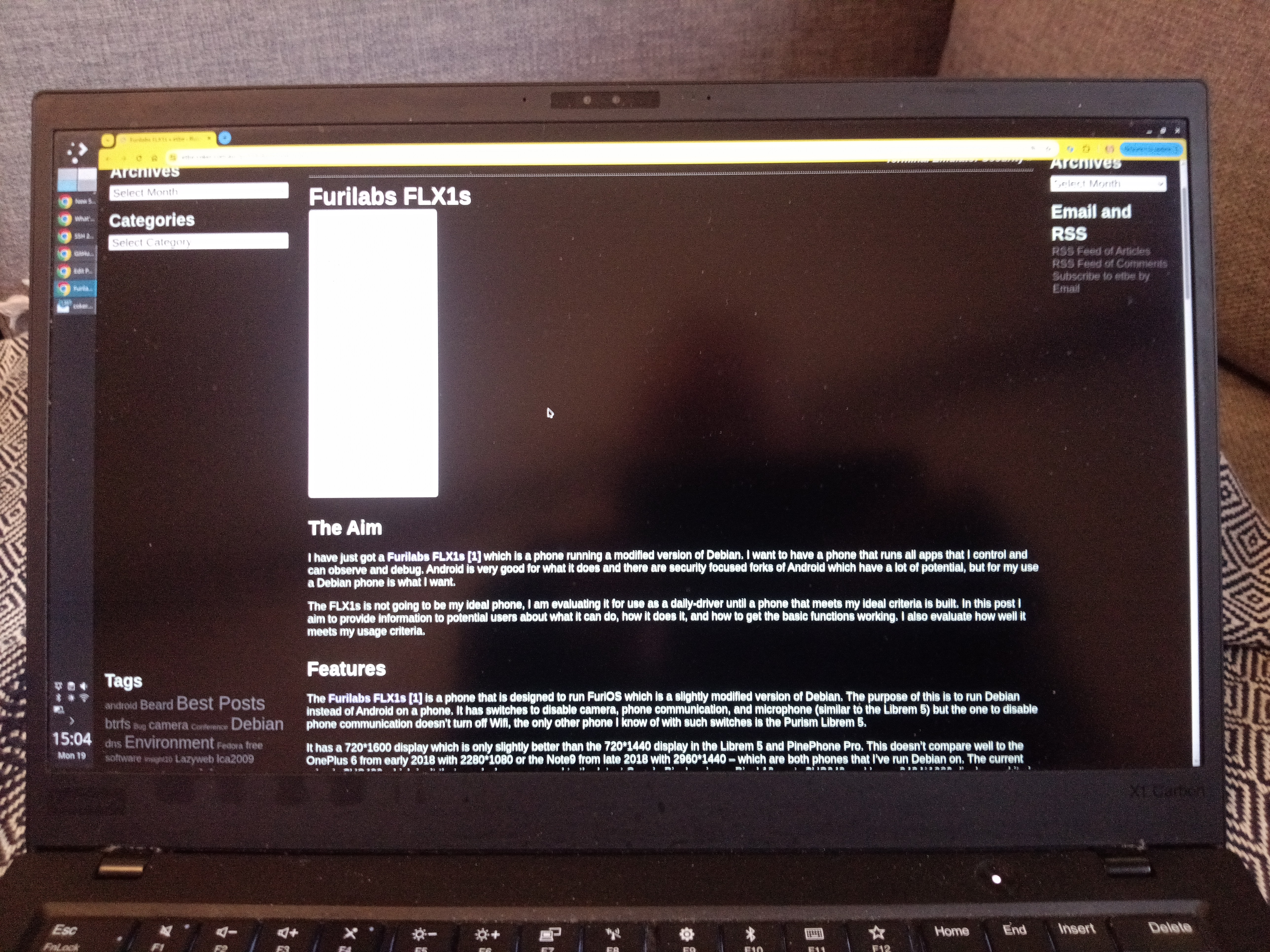
1 June 2025

Guido G nther: Free Software Activities May 2025

Another short status update of what happened on my side last month. Larger blocks besides the Phosh 0.47 release are on screen keyboard and cell broadcast improvements, work on separate volume streams, the switch of phoc to wlroots 0.19.0 and effort to make Phosh work on Debian's upcoming stable release (Trixie) out of the box. Trixie will ship with Phosh 0.46, if you want to try out 0.47 you can fetch it from Debian's experimental suite. See below for details on the above and more: phosh phoc phosh-mobile-settings phosh-osk-stub / stevia phosh-tour phosh-osk-data pfs xdg-desktop-portal-phosh phrog phosh-debs meta-phosh feedbackd feedbackd-device-themes gmobile GNOME calls Debian ModemManager osmo-cbc gsm-cell-testing mobile-broadband-provider-info Cellbroadcastd phosh-site pipewire wireplumber python-dbusmock Bugs Reviews This is not code by me but reviews on other peoples code. The list is (as usual) slightly incomplete. Thanks for the contributions! Help Development If you want to support my work see donations. Comments? Join the Fediverse thread

Next.

Previous.