DebConf 26 Registration, by Stefano Rivera, Antonio Terceiro, and Santiago Ruano Rinc n
DebConf 26, to be held in Santa Fe Argentina
in July, has opened for registration and event proposals.
Stefano, Antonio, and Santiago all contributed to making this happen.
As always, some changes needed to be made to the registration system. Bigger
changes were planned, but we ran out of time to implement them for DebConf 26.
All 3 of us have had experience in hosting local DebConf events in the past and
have been advising the DebConf 26 local team.
Debian CI improvements, by Antonio Terceiro
Debian CI is the platform responsible for automated
testing of packages from the Debian archive, and its results are used by the
Debian Release team automation as Quality Assurance to control the migration of
packages from Debian unstable into testing, the base for the next Debian release.
Antonio started developing an incus backend,
and that prompted tworounds of
improvements to the platform, including but not limited to allowing user to
select a job execution backend (lxc, qemu) during the job submission, reducing
the part of testbed image creation that requires superuser privileges and other
refactorings and bug fixes. The platform API was also improved to
reduce disruption when reporting results
to the Release Team automation after service downtimes. Last, but not least, the
platform now has support for testing packages against variants of autopkgtest,
which will allow the Debian CI team to test new versions of autopkgtest before
making releases to avoid widespread regressions.
Miscellaneous contributions
Carles improved po-debconf-manager
while users requested features / found bugs. Improvements done - add packages
from unstable instead of just salsa.debian.org,
upgrade and merge templates of upgraded packages, finished adding typing
annotations, improved deleting packages: support multiple line texts, add
debug to see subprocess.run commands, etc.
Carles, using po-debconf-manager, reviewed 7 Catalan translations and sent
bug reports or MRs for 11 packages. Also reviewed the translations of
fortunes-debian-hints and submitted possible changes in the hints.
Carles resumed effort for checking relations (e.g. Recommends / Suggests)
between Debian packages. A new codebase
(still in early stages) was started with a new approach in order to detect,
report and track the broken relations.
Emilio drove several transitions, most notably the haskell transition and the
glibc/gcc-15/zlib transition for the s390 31-bit removal. This last one
included reviewing and requeueing lots of autopkgtests due to britney losing a
lot of results.
Emilio reviewed and uploaded poppler updates to experimental for a new transition.
Emilio reviewed, merged and deployed some performance improvements proposed
for the security-tracker.
Stefano prepared routine updates for pycparser, python-confuse,
python-cffi, python-mitogen, python-pip, wheel, platformdirs,
python-authlib, and python-virtualenv.
Stefano updated Python 3.13 and 3.14 to the latest point releases, including
security updates, and did some preliminary work for Python 3.15.
Stefano reviewed changes to dh-python and merged MRs.
Stefano did some debian.social sysadmin work, bridging additional IRC channels
to Matrix.
Stefano and Antonio, as DebConf Committee Members, reviewed the DebConf 27
bids and took part in selecting the Japanese bid
to host DebConf 27.
Helmut sent patches for 29 cross build failures.
Helmut continued to maintain rebootstrap addressing issues relating to
specific architectures (such as musl-linux-any, hurd-any or s390x)
or specific packages (such as binutils, brotli or fontconfig).
Helmut worked on diagnosing bugs such as rocblas#1126608,
python-memray#1126944upstream
and greetd#1129070 with varying success.
Antonio provided support for multiple MiniDebConfs whose websites run
wafer + wafer-debconf (the same stack as DebConf itself).
Santiago reviewed some Merge Requests for the Salsa CI pipeline, including
!703
and !704,
that aim to improve how the build source job is handled by Salsa CI. Thanks a
lot to Jochen for his work on this.
In collaboration with Emmanuel Arias, Santiago proposed a couple of projects
for the Google Summer of Code (GSoC) 2026 round. Santiago has been reviewing
applications and giving feedback to candidates.
Thorsten uploaded new upstream versions of ipp-usb, brlaser and gutenprint.
Rapha l updated publican
to fix an old bug that became release critical and that happened only when
building with the nocheck profile. Publican is a build dependency of the Debian s
Administrator Handbook and with that fix, the package is back into testing.
Rapha l implemented a small feature
in Debusine that makes it possible to refer to a collection in a parent
workspace even if a collection with the same name is present in the current
workspace.
Lucas updated the current status of ruby packages affecting the Ruby 3.4
transition after a bunch of updates made by team members. He will follow up on
this next month.
Lucas joined the Debian orga team for GSoC this year and tried to reach out
to potential mentors.
Lucas did some content work for MiniDebConf Campinas - Brazil.
Colin published minor security updates to bookworm and trixie for
CVE-2025-61984 and CVE-2025-61985
in OpenSSH, both of which allowed code execution via ProxyCommand in some
cases. The trixie update also included a fix for
mishandling of PerSourceMaxStartups.
Colin spotted and fixed a typo in the bug tracking system s spam-handling rules,
which in combination with a devscripts regression
caused bts forwarded commands to be discarded.
Colin ported 12 more Python packages away from using the deprecated (and now
removed upstream) pkg_resources module.
Anupa is co-organizing MiniDebConf Kanpur
with Debian India team. Anupa was responsible for preparing the schedule,
publishing it on the website, co-ordination with the fiscal host in addition to
attending meetings.
Anupa attended the Debian Publicity team online sprint which was a skill
sharing session.
cross building, by Helmut Grohne
In version 1.10.1, Meson merged a patch to make it call the correct
g-ir-scanner by default thanks to Eli Schwarz. This problem affected more than
130 source packages. Helmut retried building them all and filed 69 patches as a
result. A significant portion of those packages require another Meson
change to call the correct
vapigen. Another notable change is converting gnu-efi to multiarch,
which ended up requiring changes to a number of other packages. Since Aurelien
dropped the libcrypt-dev dependency from libc6-dev, this transition now is
mostly complete and has resulted in most of the Perl ecosystem correctly
expressing perl-xs-dev dependencies needed for cross building. It is these
infrastructure changes affecting several client packages that this work targets.
As a result of this continued work, about 66% of Debian s source packages now
have satisfiable cross Build-Depends in unstable and about 10000 (55%) actually
can be cross built. There are now more than 500 open
bug reports
affecting more than 2000 packages most of which carry patches.
rebootstrap, by Helmut Grohne
Maintaining architecture cross-bootstrap requires continued effort for adapting
to archive changes such as glib2.0 dropping a build profile or an e2fsprogsFTBFS. Beyond those generic problems,
architecture-specific problems with e.g. musl-linux-any or sparc may arise.
While all these changes move things forward on the surface, the bootstrap
tooling has become a growing pile of patches. Helmut managed to upstream two
changes to glibc for reducing its Build-Depends in the stage2 build
profile and thanks Aurelien Jarno.
Refresh of the patch tagging guidelines, by Rapha l Hertzog
Debian Enhancement Proposal #3
(DEP-3) is named Patch Tagging Guidelines and standardizes meta-information
that Debian contributors can put in patches included in Debian source packages.
With the feedback received over the years, and with the change in the package
management landscape, the need to refresh those guidelines became evident. As
the initial driver of that DEP, I spent a good day reviewing all the feedback
(that I kept in a folder) and producing a
new version of the document.
The changes aim to give more weight to the syntax that is compatible with git
format-patch s output, and also to clarify the expected uses and meanings of a
couple of fields, including some algorithm that parsers should follow to define
the state of the patch. After the
announcement of the new draft
on debian-devel, the revised DEP-3 received a significant number of comments
that I still have to process.
Miscellaneous contributions
Helmut uploaded debvm making it work with unstable as a target distribution
again.
Helmut modernized the code base backing dedup.debian.net
significantly expanding the support for type checking.
Helmut fixed the multiarch hinter once more given feedback from
Fabian Gr nbichler.
Helmut worked on migrating the rocblas package to forky.
Rapha l fixed RC bug #1111812 in publican
and did some maintenance for tracker.debian.org.
Stefano audited the tooling and ignore lists for checking the contents of the
python3.X-minimal packages, finding and fixing some issues in the process.
Stefano made a few uploads of python3-defaults and dh-python in support of
Python 3.14-as-default in Ubuntu. Also investigated the risk of ignoring byte-compilation
failures by default, and started down the road of implementing this.
Stefano did some sysadmin work on debian.social infrastructure.
Stefano and Santiago worked on preparations for DebConf 26. Especially to help
the local team on opening the registration, and reviewing the budget to be
presented for approval.
Stefano uploaded routine updates of python-virtualenv and python-flexmock.
Antonio collaborated with DSA on enabling a new proxy for salsa to prevent
scrapers from taking the service down.
Antonio did miscellaneous salsa administrative tasks.
Antonio fixed a few Ruby packages towards the Ruby 3.4 transition.
Santiago prepared unstable updates for the latest upstream versions of
knot-dns
and knot-resolver.
The authoritative DNS server and DNS resolver software developed by CZ.NIC.
It is worth highlighting that, given the separation of functionality compared to
other implementations, knot-dns and knot-resolver are also less complex
software, which results in advantages in terms of security: only three CVEs have
been reported for knot-dns since 2011).
Colin began working on getting a release candidate of groff 1.24.0
(the first upstream release since mid-2023, so a very large set of changes)
into experimental.
Lucas kept working on the preparation for Ruby 3.4 transition. Some packages
fixed (support build against Ruby 3.3 and 3.4): ruby-rbpdf, jekyll,
origami-pdf, ruby-kdl, ruby-twitter, ruby-twitter-text, ruby-globalid.
Lucas supported some potential mentors in the Google Summer of Code 26 program
to submit their projects.
Anupa worked on the point release announcements for Debian 12.13 and 13.3 from
the Debian publicity team side.
Anupa attended the publicity team meeting to discuss the team activities and
to plan an online sprint in February.
Anupa attended meetings with the Debian India team to plan and coordinate the
MinDebConf Kanpur and sent out related Micronews.
Emilio coordinated various transitions and helped get rid of llvm-toolchain-17
from sid.
dh-python development, by Stefano Rivera
In Debian we build our Python packages with the help of a debhelper-compatible
tool, dh-python. Before starting the
3.14 transition (that would rebuild many packages) we landed some updates to
dh-python to fix bugs and add features. This started
a month of attention
on dh-python, iterating through several bug fixes, and a couple of unfortunate
regressions.
dh-python is used by almost all packages containing Python (over 5000). Most
of these are very simple, but some are complex and use dh-python in unexpected
ways. It s hard to avoid almost any change (including obvious bug fixes) from
causing some unexpected knock-on behaviour. There is a fair amount of complexity
in dh-python, and some rather clever code, which can make it tricky to work on.
All of this means that good QA is important. Stefano spent some time
adding type annotations
and specialized types to make it easier to see what the code is doing and catch
mistakes. This has already made work on dh-python easier.
Now that Debusine has built-in repositories
and debdiff support, Stefano could quickly test the effects of changes on many
other packages. After each big change, he could upload dh-python to
a repository,
rebuild e.g. 50 Python packages with it, and see what differences appeared in
the output. Reviewing the diffs is still a manual process, but can be improved.
Stefano did a small test
on what it would take to replace direct setuptools setup.py calls with
PEP-517 (pyproject-style) builds. There is
more work to do here.
Python 3.14 transition, by Stefano Rivera (et al.)
In December the transition to add
Python 3.14 as a supported version started in Debian unstable. To do this, we
update the list of supported versions in python3-defaults,
and then start rebuilding modules with C extensions from the leaves inwards.
This had already been tested in a PPA and Ubuntu, so many of the biggest
blocking compatibility issues with 3.14 had already been found and fixed. But
there are always new issues to discover.
Thanks to a number of people in the Debian Python team, we got through the first
bit of the transition fairly quickly. There are still a number of
open bugs
that need attention and many failed tests
blocking migration to testing.
Python 3.14.1 released just after we started the transition, and very soon
after, a follow-up 3.14.2 release came out to address a regression. We ran into
another regression in
Python 3.14.2.
Ruby 3.4 transition, by Lucas Kanashiro (et al.)
The Debian Ruby team just started the preparation to move the default Ruby
interpreter version to 3.4. At the moment, ruby3.4 source package is already
available in experimental, also ruby-defaults added support to
Ruby 3.4. Lucas rebuilt all reverse dependencies against this new version of the
interpreter and published the results here.
Lucas also reached out to some stakeholders to coordinate the work.
Next steps are: 1) announcing the results to the whole team and asking for help
to fix packages failing to build against the new interpreter; 2) file bugs
against packages FTBFSing against Ruby 3.4 which are not fixed yet; 3) once we
have a low number of build failures against Ruby 3.4, ask the Debian Release
team to start the transition in unstable.
Surviving scraper traffic in Debian CI, by Antonio Terceiro
Like most of the open web, Debian Continuous Integration
has been struggling for a while to keep up with the insatiable hunger from data
scrapers everywhere. Solving this involved a lot of trial and error; the final
result seems to be stable, and consists of two parts.
First, all Debian CI data pages, except the direct links to test log files
(such as those provided by the Release Team s testing migration excuses), now
require users to be authenticated before being accessed. This means that the
Debian CI data is no longer publicly browseable, which is a bit sad. However,
this is where we are now.
Additionally, there is now a fail2ban powered firewall-level access limitation
for clients that display an abusive access pattern. This went through several
iterations, with some of them unfortunately blocking legitimate Debian
contributors, but the current state seems to strike a good balance between
blocking scrapers and not blocking real users. Please get in touch with the team
on the #debci OFTC channel if you are affected by this.
A hybrid dependency solver for crossqa.debian.net, by Helmut Grohne
crossqa.debian.net continuously cross builds
packages from the Debian archive. Like Debian s native build infrastructure, it
uses dose-builddebcheck to determine whether a package s dependencies can be
satisfied before attempting a build. About one third of Debian s packages fail
this check, so understanding the reasons is key to improving cross building.
Unfortunately, dose-builddebcheck stops after reporting the first problem and
does not display additional ones.
To address this, a greedy solver implemented in Python now examines each
build-dependency individually and can report multiple causes. dose-builddebcheck
is still used as a fall-back when the greedy solver does not identify any
problems. The report for bazel-bootstrap
is a lengthy example.
rebootstrap, by Helmut Grohne
Due to the changes suggested by Loongson earlier, rebootstrap now adds
debhelper to its final installability test and builds a few more packages
required for installing it. It also now uses a variant of build-essential that
has been markedMulti-Arch: same
(see foundational work
from last year).
This in turn made the use of a non-default GCC version more difficult and
required more work to make it work for gcc-16 from experimental. Ongoing
archive changes temporarily regressed building fribidi and dash.
libselinux and groff have received patches for architecture specific changes
and libverto has been NMUed to remove the glib2.0 dependency.
Miscellaneous contributions
Stefano did some administrative work on debian.social and debian.net
instances and Debian reimbursements.
Stefano did routine updates of python-authlib, python-mitogen, xdot.
Stefano spent several hours discussing Debian s Python package layout with the
PyPA upstream community. Debian has ended up with a very different on-disk
installed Python layout than other distributions, and this continues to cause
some frustration in many communities that have to have special workarounds to
handle it. This ended up impacting cross builds as Helmut discovered.
Zulip is not yet in Debian (RFP in #800052),
but Rapha l helped on the French translation as he is experimenting with that
discussion platform.
Antonio performed several routine Salsa maintenance tasks, including
fixing salsa-nm-sync,
the service that synchronizes project members data from LDAP to Salsa, which had
been broken since salsa.debian.org was upgraded to
trixie .
Antonio deployed a new amd64 worker host for Debian CI.
Carles reviewed and submitted 14 Catalan translations using
po-debconf-manager.
Carles improved po-debconf-manager: added delete-package command,
show-information now uses properly formatted output (YAML), it now attaches
the translation on the bug reports for which a merge request has been opened too
long.
Carles investigated why some packages appeared in po-debconf-manager but not
in the Debian l10n list.
Turns out that some packages had debian/po/templates.pot (appearing in
po-debconf-manager) but not the POTFILES.in file as expected.
Created a script
to find out which packages were in this or similar situation and
reported bugs.
Carles tested and documented how to set
up voices (mbrola and festival) if using Orca speech synthesizer. Commented
a few issues and possible improvements in the debian-accessibility list.
Helmut sent patches for 48 cross build failures and initiated discussions on
how to deal with two non-trivial matters. Besides Python mentioned above,
CMake introduced a cmake_pkg_config builtin which is
not aware of the host architecture. He also
forwarded a Meson patch upstream.
Thorsten uploaded a new upstream version of cups to fix a nasty bug that was
introduced by the latest security update.
Colin used Debusine to coordinate transitions for astroid and pygments,
and wrote up the astroid case
on his blog.
Emilio helped with various transitions, and provided a build fix for opencv
for the ffmpeg 8 transition.
Emilio tested the GNOME updates for trixie proposed updates (gnome-shell,
mutter, glib2.0).
Santiago helped to review the status of how to test different build profiles
in parallel on the same pipeline, using the test-build-profiles job. This means,
for example, to simultaneously test build profiles such as nocheck and nodoc
for the same git tree. Finally, Santiago provided
MR !685
to fix the documentation.
Anupa prepared a bits post for Outreachy interns
announcement
along with T ssia Cam es Ara jo and worked on publicity team tasks.
Welcome to the December 2025 from the Reproducible Builds project!
Our monthly reports outline what we ve been up to over the past month, highlighting items of news from elsewhere in the increasingly-important area of software supply-chain security. As ever, if you are interested in contributing to the Reproducible Builds project, please see the Contribute page on our website.
New orig-check service to validate Debian upstream tarballs
This month, Debian Developer Lucas Nussbaum announced the orig-check service, which attempts to automatically reproduce the generation upstream tarballs (ie. the original source component of a Debian source package), comparing that to the upstream tarball actually shipped with Debian.
As of the time of writing, it is possible for a Debian developer to upload a source archive that does not actually correspond to upstream s version. Whilst this is not inherently malicious (it typically indicates some tooling/process issue), the very possibility that a maintainer s version may differ potentially permits a maintainer to make (malicious) changes that would be misattributed to upstream.
This service therefore nicely complements the whatsrc.org service, which was reported in our reports for both April and August. The orig-check is dedicated to Lunar, who sadly passed away a year ago.
disorderfs updated to FUSE 3
disorderfs is our FUSE-based filesystem that deliberately introduces non-determinism into system calls to reliably flush out reproducibility issues.
This month, however, Roland Clobus upgraded disorderfs* from FUSE 2 to FUSE 3 after its package automatically got removed from Debian testing. Some tests in Debian currently require disorderfs to make the Debian live images reproducible, although disorderfs is not a Debian-specific tool.
Luca Di Maio announced stampdalf, a filesystem timestamp preservation tool that wraps arbitrary commands and ensures filesystem timestamp reproducibility :
stampdalf allows you to run any command that modifies files in a directory tree, then automatically resets all timestamps back to their original values. Any new files created during command execution are set to [the UNIX epoch] or a custom timestamp via SOURCE_DATE_EPOCH.
The project s GitHub page helpfully reveals that the project is pronounced: stamp-dalf (stamp like time-stamp, dalf like Gandalf the wizard) as it s a wizard of time and stamps .)
Lastly, Reproducible Builds developer cen1 posted to our list announcing that early/experimental/alpha support for FreeBSD was added to rebuilderd. In their post, cen1 reports that the initial builds are in progress and look quite decent . cen1 also interestingly notes that since the upstream is currently not technically reproducible I had to relax the bit-for-bit identical requirement of rebuilderd [ ] I consider the pkg to be reproducible if the tar is content-identical (via diffoscope), ignoring timestamps and some of the manifest files. .
Most package managers also generate a lockfile, which records the exact set of resolved dependency versions. Lockfiles are used to reduce build times; to verify the integrity of resolved packages; and to support build reproducibility across environments and time. Despite these beneficial features, developers often struggle with their maintenance, usage, and interpretation. In this study, we unveil the major challenges related to lockfiles, such that future researchers and engineers can address them. [ ]
While existing studies primarily focus on software supply chain attacks prevention and detection methods, there is a need for a broad overview of attacks and comprehensive risk assessment for software supply chain security. This study conducts a systematic literature review to fill this gap. By analyzing 96 papers published between 2015-2023, we identified 19 distinct SSC attacks, including 6 novel attacks highlighted in recent studies. Additionally, we developed 25 specific security controls and established a precisely mapped taxonomy that transparently links each control to one or more specific attacks. [ ]
[Achieving] reproducibility at scale remains difficult, especially in Java, due to a range of non-deterministic factors and caveats in the build process. In this work, we focus on reproducibility in Java-based software, archetypal of enterprise applications. We introduce a conceptual framework for reproducible builds, we analyze a large dataset from Reproducible Central, and we develop a novel taxonomy of six root causes of unreproducibility. [ ]
Robert Stupp made a number of useful changes, fixing and reorganising the Groovy / Kotlin pages [][][] as well adding a note about potential non-deterministic behaviour to the JVM page [].
Upstream patches
The Reproducible Builds project detects, dissects and attempts to fix as many currently-unreproducible packages as possible. We endeavour to send all of our patches upstream where appropriate. This month, we wrote a large number of such patches, including:
Finally, if you are interested in contributing to the Reproducible Builds project, please visit our Contribute page on our website. However, you can get in touch with us via:
As a lot of people do, I have some content that is reachable using
webbrowsers. There is the password manager
Vaultwarden, an instance
of Immich, ForgeJo for
some personal git repos, my blog and some other random pages here and
there.
All of this never had been a problem, running a webserver is a
relatively simple task, no matter if you use apache2 , nginx or any of the other possibilities. And the things
mentioned above bring their own daemon to serve the users.
AI crap
And then some idiot somewhere had the idea to ignore every law, every
copyright and every normal behaviour and run some shit AI bot. And
more idiots followed. And now we have more AI bots than humans
generating traffic.
And those AI shit crawlers do not respect any limits. robots.txt, slow
servers, anything to keep your meager little site up and alive? Them
idiots throw more resources onto them to steal content. No sense at
all.
iocaine to the rescue
So them AI bros want to ignore everything and just fetch the whole
internet? Without any consideration if thats even wanted? Or legal?
There are people who dislike this. I am one of them, but there are
some who got annoyed enough to develop tools to fight the AI
craziness. One of those tools is
iocaine - it says about
itself that it is The deadliest poison known to AI.
Feed AI bots sh*t
So you want content? You do not accept any Go away? Then here is
content. It is crap, but appearently you don t care. So have fun.
What iocaine does is (cite from their webpage) not made for making
the Crawlers go away. It is an aggressive defense mechanism that tries
its best to take the blunt of the assault, serve them garbage, and
keep them off of upstream resources .
That is, instead of the expensive webapp using a lot of resources that
are basically wasted for nothing, iocaine generates a small static
page (with some links back to itself, so the crawler shit stays
happy). Which takes a hell of a lot less resource than any fullblown
app.
iocaine setup
The website has a
https://iocaine.madhouse-project.org/documentation/, it is not hard to setup. Still, I had to adjust some
things for my setup, as I use [Caddy Docker
Proxy ([https://github.com/lucaslorentz/caddy-docker-proxy) nowadays
and wanted to keep the config within the docker setup, that is, within
the labels.
Caddy container
So my container setup for the caddy itself contains the following
extra lines:
labels:caddy_0.email:email@example.comcaddy_1:(iocaine)caddy_1.0_@read:method GET HEADcaddy_1.1_reverse_proxy:"@readiocaine:42069""caddy_1.1_reverse_proxy.@fallback":"status421"caddy_1.1_reverse_proxy.handle_response:"@fallback"
This will be translated to the following Caddy config snippet:
Any container that should be protected by iocaine
All the containers that are behind the Caddy reverse proxy can now
get protected by iocaine with just one more line in their
docker-compose.yaml. So now we have
So with one simple extra label for the docker container I have iocaine
activated.
Result? ByeBye (most) AI Bots
Looking at the services that got hammered most from those crap bots -
deploying this iocaine container and telling Caddy about it solved the
problem for me. 98% of the requests from the bots now go to iocaine
and no longer hog resources in the actual services.
I wish it wouldn t be neccessary to run such tools. But as long as we
have shitheads doing the AI hype there is no hope. I wish they all
would end up in Jail for all their various stealing they do. And
someone with a little more brain left would set things up sensibly,
then the AI thing could maybe turn out something good and useful.
But currently it is all crap.
Activity summary
During the month of October, 21 contributors have been
paid to work on Debian LTS (links to individual
contributor reports are located below).
The team released 37 DLAs fixing 893 CVEs.
The team has continued in its usual rhythm, preparing and uploading security
updates targeting LTS and ELTS, as well as helping with updates to oldstable,
stable, testing, and unstable. Additionally, the team received several
contributions of LTS uploads from Debian Developers outside the standing LTS
Team.
Notable security updates:
https-everywhere, prepared by Markus Koschany, deals with a problem created by ownership of the https-rulesets.org domain passing to a malware operator
openjdk-17 and openjdk-11, prepared by Emilio Pozuelo Monfort, fixes XML external entity and certificate validation vulnerabilities
intel-microcode, prepared by Tobias Frost, fixes a variety of privilege escalation and denial of service vulnerabilities
Notable non-security updates:
distro-info-data, prepared by Stefano Rivera, updates information concerning current and upcoming Debian and Ubuntu releases
Contributions from outside the LTS Team:
Lukas M rdian, a Debian Developer, provided an update of log4cxx
Andrew Ruthven, one of the request-tracker4 maintainers, provided an update of request-tracker4
Christoph Goehre, co-maintainer of thunderbird, provided an update of thunderbird
Beyond the typical LTS updates, the team also helped the Debian community more broadly:
Guilhem Moulin prepared oldstable/stable updates of libxml2, and an unstable update of libxml2.9
Bastien Roucari s prepared oldstable/stable updates of imagemagick
Daniel Leidert prepared an oldstable update of python-authlib, oldstable update of libcommons-lang-java and stable update of libcommons-lang3-java
Utkarsh Gupta prepared oldstable/stable/testing/unstable updates of ruby-rack
The LTS Team is grateful for the opportunity to contribute to making LTS a high quality for sponsors and users. We are also particularly grateful for the collaboration from others outside the time; their contributions are important to the success of the LTS effort.
Updating old Debian Printing software to meet C23 requirements, by Thorsten Alteholz
The work of Thorsten fell under the motto gcc15 . Due to the introduction of
gcc15 in Debian, the default language version was changed to C23. This means
that for example, function declarations without parameters are no longer allowed.
As old software, which was created with ANSI C (or C89) syntax, made use of such
function declarations, it was a busy month. One could have used something like
-std=c17 as compile flags, but this would have just postponed the tasks. As a
result Thorsten uploaded modernized versions of ink, nm2ppa and rlpr for the
Debian printing team.
Work done to decommission packages.qa.debian.org, by Rapha l Hertzog
Rapha l worked to decommission the old package tracking system
(packages.qa.debian.org). After figuring out
that it was still receiving emails from the bug tracking system
(bugs.debian.org), from multiple debian lists and from
some release team tools, he reached out to the respective teams to either drop
those emails or adjust them so that they are sent to the current Debian Package
Tracker (tracker.debian.org).
rebootstrap uses *-for-host, by Helmut Grohne
Architecture cross bootstrapping is an ongoing effort that has shaped Debian in
various ways over the years. A longereffort to express
toolchain dependencies now bears fruit. When cross compiling, it becomes
important to express what architecture one is compiling for in Build-Depends.
As these packages have become available in trixie , more and more packages add
this extra information and in August, the libtool package
gained
a gfortran-for-host dependency. It was the first package in the essential
build closure to adopt this and required putting the pieces together in
rebootstrap that now has to
build gcc-defaults early on. There still are
hundreds of packages whose dependencies need to be updated
though.
Miscellaneous contributions
Rapha l dropped the Build Log Scan integration in tracker.debian.org
since it was showing stale data for a while as the underlying service has been
discontinued.
Emilio updated pixman to 0.46.4.
Emilio coordinated several transitions, and NMUed guestfs-tools to unblock one.
Stefano uploaded Python 3.14rc3 to Debian unstable. It s not yet used by any
packages, but it allows testing the level of support in packages to begin.
Stefano upgraded almost all of the debian-social infrastructure to Debian trixie .
Stefano attended the Debian Technical Committee meeting.
Stefano uploaded routine upstream updates for a handful of Python packages
(pycparser, beautifulsoup4, platformdirs, pycparser, python-authlib,
python-cffi, python-mitogen, python-resolvelib, python-super-collections,
twine).
Stefano reviewed and responded to DebConf 25 feedback.
Stefano investigated and fixed a request visibility bug in debian-reimbursements
(for admin-altered requests).
Lucas reviewed a couple of merge requests from external contributors for Go
and Ruby packages.
Lucas updated some ruby packages to its latest upstream version (thin,
passenger, and puma is still WIP).
Lucas set up the build environment to run rebuilds of reverse dependencies of
ruby using ruby3.4. As an alternative, he is looking for personal repositories
provided by Debusine to perform this task more easily. This is the preparation
for the transition to ruby3.4 as the default in Debian.
Lucas helped on the next round of the Outreachy internship program.
Helmut sent patches for 30 cross build failures and responded to cross
building support questions on the mailing list.
Helmut continued to maintain rebootstrap.
As gcc version 15 became the default, test jobs for version 14 had to be dropped.
A fair number of patches were applied to packages and could be dropped.
Helmut resumed removing RC-buggy packages from unstable and sponsored a
termrec upload to avoid its deletion. This work was paused to give packages
some time to migrate to forky .
While doing some new upstream release updates, thanks to Debusine s
reverse dependencies autopkgtest
checks, Santiago discovered that paramiko 4.0 will introduce a
regression in libcloud by the drop of support
for the obsolete DSA keys. Santiago finally uploaded to unstable both
paramiko 4.0,
and a regression fix for libcloud.
Santiago has taken part in different discussions and meetings for the
preparation of DebConf 26. The DebConf 26 local team aims to prepare for the
conference with enough time in advance.
Carles kept working on the missing-package-relations and reporting missing
Recommends. He improved the tooling to detect and report bugs creating
269 bugs
and followed up comments. 37 bugs have been resolved, others acknowledged.
The missing Recommends are a mixture of packages that are gone from Debian,
packages that changed name, typos and also packages that were recommended but
are not packaged in Debian.
Carles improved the missing-package-relations to report broken Suggests only
for packages that used to be in Debian but are removed from it now. No bugs have
been created yet for this case but identified 1320 of them.
Colin spent much of the month chasing down build/test regressions in various
Python packages due to other upgrades, particularly relating to pydantic,
python-pytest-asyncio, and rust-pyo3.
Tobias Frost
did 5.0h (out of 0.0h assigned and 8.0h from previous period), thus carrying over 3.0h to the next month.
Utkarsh Gupta
did 16.5h (out of 14.25h assigned and 6.75h from previous period), thus carrying over 4.5h to the next month.
Evolution of the situation
In September, we released 38 DLAs.
Notable security updates:
modsecurity-apache prepared by Adrian Bunk, fixes a cross-site scripting vulnerability
cups, prepared by Thorsten Alteholz, fixes authentication bypass and denial of service vulnerabilities
jetty9, prepared by Adrian Bunk, fixes the MadeYouReset vulnerability (a recent, well-known denial of service vulnerability)
python-django, prepared by Chris Lamb, fixes a SQL injection vulnerability
firefox-esr and thunderbird, prepared by Emilio Pozuelo Monfort, were updated from the 128.x ESR series to the 140.x ESR series, fixing a number of vulnerabilities as well
Notable non-security updates:
wireless-regdb prepared by Ben Hutchings, updates information reflecting changes to radio regulations in many countries
There was one package update contributed by a Debian Developer outside of the LTS Team: an update of node-tar-fs, prepared by Xavier Guimard (a member of the Node packaging team).
Finally, LTS Team members also contributed updates of the following packages:
libxslt (to stable and oldstable), prepared by Guilhem Moulin, to address a regression introduced in a previous security update
libphp-adodb (to stable and oldstable), prepared by Abhijith PA
cups (to stable and oldstable), prepared by Thorsten Alteholz
u-boot (to oldstable), prepared by Daniel Leidert and Jochen Sprickerhof
libcommongs-lang3-java (to stable and oldstable), prepared by Daniel Leidert
python-internetarchive (to oldstable), prepared by Daniel Leidert
One other notable contribution by a member of the LTS Team is that Sylvain Beucler proposed a fix upstream for CVE-2025-2760 in gimp2. Upstream no longer supports gimp2, but it is still present in Debian LTS, and so proposing this fix upstream is of benefit to other distros which may still be supporting the older gimp2 packages.
Thanks to our sponsors
Sponsors that joined recently are in bold.
Preparing for setup.py install deprecation, by Colin Watson
setuptools upstream will be removing the setup.py install command
on 31 October. While this may not trickle down immediately into Debian, it does
mean that in the near future nearly all Python packages will have to use
pybuild-plugin-pyproject (though they don t necessarily have to use
pyproject.toml; this is just a question of how the packaging runs the build
system). Some of the Python team talked about this a bit at DebConf, and Colin
volunteered to write up some notes
on cases where this isn t straightforward. This page will likely grow as the
team works on this problem.
Salsa CI, by Santiago Ruano Rinc n
Santiago fixed some pending issues in the MR that moves the pipeline to sbuild+unshare,
and after several months, Santiago was able to mark the MR as ready. Part of the
recent fixes include handling external repositories,
honoring the RELEASE autodetection from d/changelog
(thanks to Ahmed Siam for spotting the main reason of the issue), and fixing a
regression about the apt resolver for *-backports releases.
Santiago is currently waiting for a final review and approval from other members
of the Salsa CI team, and being able to merge it. Thanks to all the folks who
have helped testing the changes or provided feedback so far. If you want to test
the current MR, you need to include the following pipeline definition in your
project s CI config file:
As a reminder, this MR will make the Salsa CI pipeline build the packages more
similar to how it s built by the Debian official builders. This will also save
some resources, since the default pipeline will have one stage less (the
provisioning) stage, and will make it possible for more projects to be built on
salsa.debian.org (including large projects and
those from the OCaml ecosystem), etc. See the different issues being fixed in
the MR description.
Debian 13 trixie release, by Emilio Pozuelo Monfort
On August 9th, Debian 13 trixie was released, building on two years worth of
updates and bug fixes from hundreds of developers. Emilio helped coordinate the
release, communicating with several teams involved in the process.
DebConf 26 Site Visit, by Stefano Rivera
Stefano visited Santa Fe, Argentina, the site for DebConf 26
next year. The aim of the visit was to help build a local team and see the
conference venue first-hand. Stefano and Nattie represented the DebConf
Committee. The local team organized Debian meetups in Buenos Aires and Santa Fe,
where Stefano presented a talk
on Debian and DebConf. Venues were scouted
and the team met with the university management and local authorities.
Miscellaneous contributions
Rapha l updated tracker.debian.org after the
trixie release to add the new forky release in the set of monitored
distributions.
He also reviewed and deployed the work of Scott Talbert
showing open merge requests from salsa in the action needed panel.
Rapha l reviewed some DEP-3 changes
to modernize the embedded examples in light of the broad git adoption.
Rapha l configured new workflows
on debusine.debian.net to upload to trixie and
trixie-security, and officially announced the service
on debian-devel-announce, inviting Debian developers to try the service for
their next upload to unstable.
Carles created a merge request
for django-compressor upstream to fix an error when concurrent node processing
happened. This will allow removing a workaround
added in openstack-dashboard and avoid the same bug in other projects that use
django-compressor.
Carles prepared a system to detect packages that Recommends packages which
don t exist in unstable. Processed (either reported
or ignored due to mis-detected problems or temporary problems) 16% of the
reports. Will continue next month.
Carles got familiar and gave feedback for the freedict-wikdict package.
Planned contributions with the maintainer to improve the package.
Helmut responded to queries related to /usr-move.
Helmut adapted crossqa.d.n to the release of
trixie .
Helmut diagnosed sufficient failures in rebootstrap
to make it work with gcc-15.
Faidon discovered that the Multi-Arch hinter would emit confusing hints about
:any annotations. Helmut identified the root cause to be the handling of
virtual packages and fixed it.
Colin upgraded about 70 Python packages to new upstream versions, which is
around 10% of the backlog; this included a complicated Pydantic upgrade in
collaboration with the Rust team.
Colin fixed
a bug in debbugs that caused incoming emails to bugs.debian.org with certain
header contents to go missing.
Thorsten uploaded sane-airscan, which was already in experimental, to unstable.
Thorsten created a script to automate the upload of new upstream versions of
foomatic-db. The database contains information about printers and regularly gets
an update. Now it is possible to keep the package more up to date in Debian.
Stefano prepared updates to almost all of his packages that had new versions
waiting to upload to unstable. (beautifulsoup4, hatch-vcs, mkdocs-macros-plugin,
pypy3, python-authlib, python-cffi, python-mitogen, python-pip, python-pipx,
python-progress, python-truststore, python-virtualenv, re2, snowball, soupsieve).
Stefano uploaded two new python3.13 point releases to unstable.
Stefano updated distro-info-data in stable releases, to document the trixie
release and expected EoL dates.
Stefano did some debian.social sysadmin work (keeping up quotas with growing
databases and filesystems).
Stefano supported the Debian treasurers in processing some of the DebConf 25
reimbursements.
Lucas uploaded ruby3.4 to experimental. It was already approved by FTP masters.
Lucas uploaded ruby-defaults to experimental to add support for ruby3.4. It
will allow us to start triggering test rebuilds and catch any FTBFS with ruby3.4.
Lucas did some administrative work for Google Summer of Code (GSoC) and
replied to some queries from mentors and students.
Anupa helped to organize release parties for Debian 13 and Debian Day events.
Anupa did the live coverage for the Debian 13 release and prepared the Bits
post for the release announcement and 32nd Debian Day as part of the Debian
Publicity team.
Anupa attended a Debian Day event
organized by FOSS club SSET as a speaker.
Tobias Frost
did 4.0h (out of 0.0h assigned and 12.0h from previous period), thus carrying over 8.0h to the next month.
Utkarsh Gupta
did 16.0h (out of 22.75h assigned), thus carrying over 6.75h to the next month.
Evolution of the situation
In August, we released 27 DLAs.
The month of August marked the release of Debian 13 (codename trixie ). This is worth noting because it brought with it the return of the customary fast development pace of Debian unstable, which included several contributions from LTS Team members. More on that below.
Of the many security updates which were published (and a few non-security updates as well), some notable ones are highlighted here.
Notable security updates:
gnutls28 prepared by Adrian Bunk, fixes several potential denial of service vulnerabilities
apache2, prepared by Bastien Roucari s, fixes several vulnerabilities including a potential denial of service and SSL/TLS-related access control
mbedtls (original update, regression update) prepared by Andrej Shadura, fixes several potential denial of service and information disclosure vulnerabilities
openjdk-17, prepared by Emilio Pozuelo Monfort, fixes several vulnerabilities which could result in denial of service, information disclosure or weakened TLS connections
Notable non-security updates:
distro-info-data, prepared by Stefano Rivera, adds information concerning future Debian and Ubuntu releases
ca-certificates-java, prepared by Bastien Roucari s, fixes some bugs which could disrupt future updates
The LTS Team continues to welcome the collaboration of maintainers from across the Debian community. The contributions of maintainers from outside the LTS Team include: postgresql-13 (Christoph Berg), sope (Jordi Mallach), thunderbird (Carsten Schoenert), and iperf3 (Roberto Lumbreras).
Finally, LTS Team members also contributed updates of the following packages:
redis (to stable), prepared by Chris Lamb
firebird3.0 (to oldstable and stable), prepared by Adrian Bunk
node-tmp (to oldstable, stable, and unstable), prepared by Adrian Bunk
openjpeg2 (to oldstable, stable, and unstable), prepared by Adrian Bunk
apache2 (to oldstable), prepared by Bastien Roucari s
unbound (to oldstable), prepared by Guilhem Moulin
luajit (to oldstable), prepared by Guilhem Moulin
golang-github-gin-contrib-cors (to oldstable and stable), prepared by Thorsten Alteholz
libcoap3 (to stable), prepared by Thorsten Alteholz
libcommons-lang-java and libcommons-lang3-java (both to unstable), prepared by Daniel Leidert
python-flask-cors (to oldstable), prepared by Daniel Leidert
The LTS Team would especially like to thank our many longtime friends and sponsors for their support and collaboration.
Thanks to our sponsors
Sponsors that joined recently are in bold.
Introduction
I am Spaarsh Thakkar, a final-year Computer Science Engineering undergrad from India. My interests lie in research and systems. My recent work has been in and around Graphics Processing Units and I also hold a keen interest in Computer Networks. At the time of writing, I have been an open-source contributor for almost a year.
Proposal Description (as shown on GSoC Project Profile1)
Due to Debian s open-source nature, no Debian package in main can have a proprietary GPU package listed as a dependency. While AI and HPC workloads increasingly rely on GPU acceleration, many Debian packages still focus solely on CUDA, which is proprietary.
With the advent of ROCm, an open-source GPU computing platform, we can now integrate full-fledged AMD GPU support into Debian packages. This will improve the experience of developers working in AI/ML and HPC while positioning Debian as a strong OS choice for GPU-driven workloads. The proposal aims to aid in solving the aforementioned program by packaging several ROCm packages for debian and add ROCm support to some existing debian packages.
The deliverables are as follows:
New Debian packages with GPU support
Enhanced GPU support within existing Debian packages
More autopackagetests running on the Debian ROCm CI
Key Objectives
Enable ROCm in:
dbcsr
gloo
cp2k
Publish the following packages to debian apt archive:
hipblas-common
hipBLASlt
Work Report
1. Publishing hipblas-common to apt
This objective was successfully completed, resulting in hipblas-common being published in the apt repository2.
The process involved the following steps:
Securing sponsorship, which led to the package being accepted into the experimental branch of apt
Since the beginning of GSoC, the package has also been promoted to the unstable branch2.
2. DBCSR ROCm and Multi-Arch Support
During my GSoC project, I worked on extending the DBCSR (Distributed Block Compressed Sparse Row)7 package to improve its ROCm/HIP support, and handling multi-architecture GPU kernels in a way that is both practical for upstream maintainers and debian package developers.
The code changes can be found at my dbcsr fork here8.
ROCm/HIP Enablement
Enabled ROCm backend support to DBCSR, allowing GPU acceleration beyond CUDA by enabling HIP-based builds.
Investigated and resolved build issues specific to HIP kernels within DBCSR.
Multi-Architecture GPU Kernel Handling
(The following content was presented in greater detail at DebConf 25 as well. The presentation video can be found here9 and the presentation slide can be found here10).
DBCSR contains GPU kernels that are heavily optimized for specific architectures. By default, these are built for a single target architecture, which poses challenges for packaging where binaries need to support multiple possible GPU targets.
Explored different strategies for solving the multi-arch GPU kernel distribution problem, including:
Option 1: Fat binaries (embedding multiple GPU architectures into a single binary, with runtime dispatch). This is ideal for end-users but requires deeper changes upstream and is not straightforward with HIP/ROCm.
Option 2: Arch-specific libraries (e.g., libdbcsr.gfxXXX.a), where the alternatives system or explicit user selection would determine which one is used. This solves the problem but pushes complexity downstream into packaging and user configuration.
Option 3: Prefixed functions inside a single file, where kernels are compiled separately per architecture, functions are renamed with an arch prefix, and runtime logic in DBCSR decides which kernel to invoke. This shifts complexity upstream but could give a clean downstream experience.
I critically analyzed these options in the context of Debian packaging and upstream maintainability. Arch-specific .a files introduce exponential dependency complexity. The prefixed-function approach seemed like a plausible way forward, though it requires upstream buy-in.
After consulting with my mentor, these concerns were raised in the dbcsr repository as a discussion here11
Summary
My work involved:
Enabling HIP/ROCm support in DBCSR.
Prototyping strategies for handling GPU multi-arch builds.
Evaluating the trade-offs between upstream maintainability and downstream packaging complexity.
3. gloo, hipification and source code issues
One of the other packages that were targeted was gloo12. It is a collective communications library and has the implementations of different Machine Learning communication algorithms.
The code changes can be found at my gloo fork here13 (some changes have not be committed at the time of writing).
HIP/ROCm Enablement
Fixing old ROCm CMake functions
The upstream Gloo codebase still used old ROCm CMake functions that began with the hip_ prefix (for example, hip_add_executable). These functions have since been deprecated/removed. I updated the build system to use the modern ROCm CMake equivalents so that the package can build properly in a current ROCm environment.
Debian packaging changes
I modified debian/control to add a new package, libgloo-rocm, in addition to the existing packages. This allows proper separation and handling of ROCm-enabled builds in Debian.
First successful library build
After these changes, I was able to successfully build the library. However, I ran into issues when trying to produce the shared library: there were undefined symbol errors at link time.
Source Code Issue
On investigating the undefined symbol errors, I identified that these came from a lack of explicit template instantiation for some Gloo classes. Since C++ templates only get compiled when explicitly used or instantiated, this resulted in missing symbols in the shared library.
To solve this, I explored the source code and noticed that the HIP backend code was not natively written it was generated from the CUDA backend using a custom hipification script maintained by the repo.
I experimented with modifying the HIPification process itself, trying out hipify-perl14 instead of the repository s custom Python script.
I also tried tweaking the source code in places where template instantiations were missing, so that the ROCm build would correctly export the needed symbols.
Summary
The issue is still unresolved. The core problem lies in how the source code is structured: the HIP backend is almost entirely auto-generated from CUDA code, and the process does not handle template instantiations correctly. Because of this, the Debian package for Gloo with ROCm support is not yet ready for release, and further source-level fixes are required to make the ROCm build reliable.
4. cp2kCP2K15 is a quantum chemistry and solid state physics software package that can perform atomistic simulations of solid state, liquid, molecular, periodic, material, crystal, and biological systems.
HIP/ROCm Enablement
cp2k depends on dbcsr and hence, HIP/ROCm enablement in this package required the dbcsr16 package to get through.
Even though dbcsr isn t ready yet, it was worthwhile to plan how it shall be built with HIP/ROCm once we have dbcsr in place. Upon doing this, it was realized that the architecture-wise libraries provided by the dbcsr package will result in a complicated building process for cp2k.
No changes have been made to this package yet and more concrete steps shall be taken once the dbcsr package work is completed.
Summary
The multi-arch build process for cp2k maybe complicated by the one static-library-per-architecture method used in the dependent package, dbcsr.
Auxiliary Work & Activities
While working on the aformentioned GSoC Goals, there were a few other things that were also done.
libamdhip64-dev bug file17
While trying to enable HIP/ROCm in dbcsr, CMakeDetermineHIPCompiler.cmake was unable to find HIP runtime CMake package. After going through some similar issues faced by other developers earlier, it was decided to file a bug report under the libamdhip64-dev package.
After discussions with and trying the changes suggested by Cory (my mentor) under the bug, the issue was resolved.
Turns out, the wrong compiler was being used by me! The gcc compiler was supposed to be used and I was using hipcc. The bug was closed since it was not due an issue with the package.
Cory suggested that I add this info under the ROCm wiki page. It is yet to be done and hopefully I get it done soon.
DebConf25 Talk
After facing the multi-arch build dilemma with dbcsr (and also getting to know about the issues faced by other fellow package developers), I came to realise that this was more than a packaging, build or programming issue. GPU-packaging was facing a policy issue.
Hence, I decided to cover this problem in greater detail at my DebConf25 Virtual Presentation under the Outreach Session.
Shoutout to Cory for his support and Lucas Kanashiro for encouraging me to present my work!
Bi-Weekly AMD ROCm Meetings
Shortly after the Coding period started, Cory began the initiative of Bi-Weekly AMD ROCm Meetings18. Being a part of the meetings (participated in all but one!), seeing the work the other folks are doing and being able to discuss my own problems was a delight.
(Upcoming) IndiaFOSS 2025 Talk
After understanding the nuances and beauty of the debian packaging ecosystem in these months, I decided to spread the work about debian packaging and packaging software in general. My talk19 for the same got accepted in the upcoming IndiaFOSS 202520 conference!
I hope this beings more people towards the packaging ecosystem and to the debian developer ecosystem.
Conclusion
My GSoC time was fantastic! I plan to complete the work that I have started during my GSoC and beyond. Working with Cory21 and Utkarsh22 (a fellow GSoC 25 contributor under Cory) has been a very positive experience.
HIP/ROCm GPU-packaging is in a nascent stage. It is an exciting time to be in this space right now. The problems are new and never encountered before (CPU packaging isn t architecture specific!). The problems were shall face in the coming time, and our solutions to them will set a precendent for the future.
DebConf 25, by Stefano Rivera and Santiago Ruano Rinc n
In July, DebConf 25 was held in Brest, France.
Freexian was a gold sponsor and most of the Freexian team attended the event.
Many fruitful discussions were had amongst our team and within the Debian
community.
DebConf itself was organized by a local team in Brest, that included Santiago
(who now lives in Uruguay). Stefano was also deeply involved in the
organization, as a DebConf committee member, core video team, and the lead
developer for the conference website. Running the conference took an enormous
amount of work, consuming all of Stefano and Santiago s time for most of July.
Lucas Kanashiro was active in the DebConf content team, reviewing talks and
scheduling them. There were many last-minute changes to make during the event.
Anupa Ann Joseph was part of the Debian publicity team doing live coverage of
DebConf 25 and was part of the DebConf 25 content team reviewing the talks.
She also assisted the local team to procure the lanyards.
Recorded sessions presented by Freexian collaborators, often alongside other
friends in Debian, included:
OpenSSH upgrades, by Colin Watson
Towards the end of a release cycle, people tend to do more upgrade testing, and
this sometimes results in interesting problems. Manfred Stock reported
No new SSH connections possible during large part of upgrade to Debian Trixie ,
which would have affected many people upgrading from Debian 12 (bookworm), with
potentially severe consequences for people upgrading remote systems. In fact,
there were two independent problems that each led to much the same symptom:
As part of hardening the OpenSSH server, OpenSSH 9.8 split the monolithic
sshd listener process into two pieces: a minimal network listener (still
called sshd), and an sshd-session process dealing with each individual
session. Before this change, when sshd received an incoming connection, it
forked and re-executed itself with some special parameters to deal with it;
after this change, it forks and executes sshd-session instead, and sshd no
longer accepts the parameters it used to accept for this.
Debian package upgrades happen (roughly) in two phases: first we unpack the new
files onto disk, and then we run some configuration steps which usually include
things like restarting services. Normally this is fine, because the old service
keeps on working until it s restarted. In this case, unpacking the new files
onto disk immediately stopped new SSH connections from working: the old sshd
received the connection and tried to hand it off to a freshly-executed copy of
the new sshd binary on disk, which no longer supports this. This wasn t much
of a problem when upgrading OpenSSH on its own or with a small number of other
packages, but in release upgrades it left a large gap when you can t SSH to the
system any more, and if anything fails in that interval then you could be in
trouble.
After trying a couple of other approaches, Colin landed on the idea of having
the openssh-server package divert /usr/sbin/sshd to
/usr/sbin/sshd.session-split before the unpack step of an upgrade from before
9.8, then removing the diversion and moving the new file into place once it s
ready to restart the service. This reduces the period when new connections fail
to a minimum.
Most OpenSSH processes, including sshd, check for a compatible version of
the OpenSSL library when they start up. This check used to be very picky, among
other things requiring both the major and minor part of the version number to
match. OpenSSL 3 has a better versioning policy,
and so OpenSSH 9.4p1 relaxed this check.
Unfortunately, bookworm shipped with OpenSSH 9.2p1, so as soon as you unpacked
the new OpenSSL library during an upgrade, sshd stopped working. This
couldn t be fixed by a change in trixie; we needed to change bookworm in advance
of the upgrade so that it would tolerate newer versions of OpenSSL, and time was
tight if we wanted this to be available before the release of Debian 13.
Fortunately, there s a
stable-updates
mechanism for exactly this sort of thing, and the stable release managers kindly
accepted Colin s proposal to fix this there.
The net result is that if you apply updates to bookworm (including
stable-updates / bookworm-updates, which is enabled by default) before
starting the upgrade to trixie, everything should be fine.
Cross compilation collaboration, by Helmut Grohne
Supporting cross building in Debian packages touches lots of areas of the
archive and quite some of these matters reside in shared responsibility between
different teams. Hence, DebConf was an ideal opportunity to settle long-standing
issues.
The cross building bof
sparked lively discussions as a significant
fraction of developers employ cross builds to get their work done. In the
trixie release, about two thirds of the packages can satisfy their cross
Build-Depends and about half of the packages actually can be cross built.
Miscellaneous contributions
Rapha l Hertzog updated tracker.debian.org to remove
references to Debian 10 which was moved to
archive.debian.org, and had many fruitful discussions
related to Debusine during DebConf 25.
Carles Pina prepared some data, questions and information for the DebConf 25
l10n and i18n BoF.
Carles Pina demoed and discussed possible next steps for
po-debconf-manager
with different teams in DebConf 25. He also reviewed Catalan translations and
sent them to the packages.
Carles Pina started investigating a django-compressor bug:
reproduced the bug consistently and prepared a PR for django-compressor upstream
(likely more details next month). Looked at packaging
frictionless-py.
Stefano Rivera triaged Python CVEs against pypy3.
Stefano prepared an upload of a new upstream release of pypy3 to Debian
experimental (due to the freeze).
Stefano uploaded python3.14 RC1 to Debian experimental.
Thorsten Alteholz uploaded a new upstream version of sane-airscan to
experimental. He also started to work on a new upstream version of hplip.
Colin backported fixes for CVE-2025-50181
and CVE-2025-50182 in python-urllib3, and
fixed several other release-critical or important bugs in Python team packages.
Lucas uploaded ruby3.4 to experimental as a starting point for the
ruby-defaults transition that will happen after Trixie release.
Lucas coordinated with the Release team the fix of the remaining RC bugs
involving ruby packages, and got them all fixed.
Lucas, as part of the Debian Ruby team, kicked off discussions to improve
internal process/tooling.
Lucas, as part of the Debian Outreach team, engaged in multiple discussions
around internship programs we run and also what else we could do to improve
outreach in the Debian project.
Lucas joined the Local groups BoF during DebConf 25 and shared all the good
experiences from the Brazilian community and committed to help to document
everything to try to support other groups.
Helmut reiterated the multiarch policy proposal
with a lot of help from Nattie Mayer-Hutchings, Rhonda D Vine and Stuart Prescott.
Helmut finished his work on the process based unschroot prototype
that was the main feature of his talk (see above).
Helmut analyzed a multiarch-related glibcupgrade failure
induced by a /usr-move mitigation of systemd and sent a patch and regression
fix both of which reached trixie in time. Thanks to Aurelien Jarno and the
release team for their timely cooperation.
Helmut resurrected an earlier discussion about changing the semantics of
Architecture: all packages in a multiarch context in order to improve the
long-standing interpreter problem. With help from Tollef Fog Heen better
semantics were discovered and agreement was reached with Guillem Jover and
Julian Andres Klode to consider this change. The idea is to record a concrete
architecture for every Architecture: all package in the dpkg database and
enable choosing it as non-native.
It's Sunday and I'm now sitting in the train from Brest to Paris where I will be changing to Germany, on the way back from the annual Debian conference. A full week of presentations, discussions, talks and socializing is laying behind me and my head is still spinning from the intensity.
Pollito and the gang of DebConf mascots wearing their conference badges (photo: Christoph Berg)
Table of Contents
Sunday, July 13th
It started last Sunday with traveling to the conference. I got on the Eurostar in Duisburg and we left on time, but even before reaching Cologne, the train was already one hour delayed for external reasons, collecting yet another hour between Aachen and Liege for its own technical problems. "The train driver is working on trying to fix the problem." My original schedule had well over two hours for changing train stations in Paris, but being that late, I missed the connection to Brest in Montparnasse. At least in the end, the total delay was only one hour when finally arriving at the destination. Due to the French julliet quatorze fireworks approaching, buses in Brest were rerouted, but I managed to catch the right bus to the conference venue, already meeting a few Debian people on the way.
The conference was hosted at the IMT Atlantique Brest campus, giving the event a nice university touch. I arrived shortly after 10 in the evening and after settling down a bit, got on one of the "magic" buses for transportation to the camping site where half of the attendees where stationed. I shared a mobile home with three other Debianites, where I got a small room for myself.
Monday, July 14th
Next morning, we took the bus back to the venue with a small breakfast and the opening session where Enrico Zini invited me to come to his and Nicolas Dandrimont's session about Debian community governance and curation, which I gladly did. Many ideas about conflict moderation and community steering were floated around. I hope some of that can be put into effect to make flamewars on the mailing lists less heated and more directed. After that, I attended Olly Betts' "Stemming with Snowball" session, which is the stemmer used also in PostgreSQL. Text search is one of the areas in PostgreSQL that I never really looked closely at, including the integration into the postgresql-common package, so it was nice to get more information about that.
In preparation for the conference, a few of us Ham radio operators in Debian had decided to bring some radio gear to DebConf this year in order to perhaps spark more interest for our hobby among the fellow geeks. In the afternoon after the talks, I found a quieter spot just outside of the main hall and set up a shortwave antenna by attaching a 10m mast to one of the park benches there. The 40m band was still pretty much closed, but I could work a few stations from England, just across the channel from Bretagne, answering questions from interested passing-by Debian people between the contacts. Over time, the band opened and more European stations got into the log.
F/DF7CB in Brest (photo: Evangelos Ribeiro Tzaras)
Tuesday, July 15th
Tuesday started with Helmut Grohne's session about "Reviving (un)schroot". The schroot program has been Debian's standard way of managing build chroots for a long time, but it is more and more being regarded as obsolete with all kinds of newer containerization and virtualization technologies taking over. Since many bits of Debian infrastructure depend on schroot, and its user interface is still very useful, Helmut reimplemented it using Linux namespaces and the "unshare" systemcall. I had already worked with him at the Hamburg Minidebconf to replace the apt.postgresql.org buildd machinery with the new system, but we were not quite there yet (network isolation is nice, but we still sometimes need proper networking), so it was nice to see the effort is still progressing and I will give his new scripts a try when I'm back home.
Next, Stefano Rivera and Colin Watson presented Debusine, a new package repository and workflow management system. It looks very promising for anyone running their own repository, so perhaps yet another bit of apt.postgresql.org infrastructure to replace in the future. After that, I went to the Debian LTS BoF session by Santiago Ruano Rinc n and Bastien Roucari s - Debian releases plus LTS is what we are covering with apt.postgresql.org. Then there were bits from the DPL (Debian Project Leader), and a session moderated by Stefano Rivera interesting to me as a member of the Debian Technical Committee on the future structure of the packages required for cross-building in Debian, a topic which had been brought to TC a while ago. I am happy that we could resolve the issue without having to issue a formal TC ruling as the involved parties (kernel, glibc, gcc and the cross-build people) found a promising way forward themselves. DebConf is really a good way to get such issues unstuck.
Ten years ago at the 2015 Heidelberg DebConf, Enrico had given a seminal "Semi-serious stand-up comedy" talk, drawing parallels between the Debian Open Source community and the BDSM community - "People doing things consensually together". (Back then, the talk was announced as "probably unsuitable for people of all ages".) With his unique presentation style and witty insights, the session made a lasting impression on everyone attending. Now, ten years later (and he and many in the audience being ten years older), he gave an updated version of it. We are now looking forward to the sequel in 2035. The evening closed with the famous DebConf tradition of the Cheese & Wine party in a old fort next to the coast, just below the conference venue. Even when he's a fellow Debian Developer, Ham and also TC member, I had never met Paul Tagliamonte in person before, but we spent most of the evening together geeking out on all things Debian and Ham radio.
The northern coast of Ushant (photo: Christoph Berg)
Wednesday, July 16th
Wednesday already marked the end of the first half of the week, the day of the day trips. I had chosen to go to Ouessant island (Ushant in English) which marks the Western end of French mainland and hosts one of the lighthouses yielding the way into the English channel. The ferry trip included surprisingly big waves which left some participants seasick, but everyone recovered fast. After around one and a half hours we arrived, picked up the bicycles, and spent the rest of the day roaming the island. The weather forecast was originally very cloudy and 18 C, but over noon this turned into sunny and warm, so many got an unplanned sunburn. I enjoyed the trip very much - it made up for not having time visiting the city during the week. After returning, we spent the rest of the evening playing DebConf's standard game, Mao (spoiler alert: don't follow the link if you ever intend to play).
Having a nice day (photo: Christoph Berg)
Thursday, July 17th
The next day started with the traditional "Meet the Technical Committee" session. This year, we trimmed the usual slide deck down to remove the boring boilerplate parts, so after a very short introduction to the work of the committee by our chairman Matthew Vernon, we opened up the discussion with the audience, with seven (out of 8) TC members on stage. I think the format worked very well, with good input from attendees. Next up was "Don't fear the TPM" by Jonathan McDowell. A common misconception in the Free Software community is that the TPM is evil DRM hardware working against the user, but while it could be used in theory that way, the necessary TPM attestations seem to impossible to attain in practice, so that wouldn't happen anyway. Instead, it is a crypto coprocessor present in almost all modern computers that can be used to hold keys, for example to be used for SSH. It will also be interesting to research if we can make use of it for holding the Transparent Data Encryption keys for CYBERTEC's PostgreSQL Enterprise Edition.
Aigars Mahinovs then directed everyone in place for the DebConf group picture, and Lucas Nussbaum started a discussion about archive-wide QA tasks in Debian, an area where I did a lot of work in the past and that still interests me. Antonio Terceiro and Paul Gevers followed up with techniques to track archive-wide rebuilding and testing of packages and in turn filing a lot of bugs to track the problems. The evening ended with the conference dinner, again in the fort close by the coast. DebConf is good for meeting new people, and I incidentally ran into another Chris, who happened to be one of the original maintainers of pgaccess, the pre-predecessor of today's pgadmin. I admit still missing this PostgreSQL frontend for its simplicity and ability to easily edit table data, but it disappeared around 2004.
Friday, July 18th
On Friday, I participated in discussion sessions around contributors.debian.org (PostgreSQL is planning to set up something similar) and the New Member process which I had helped to run and reform a decade or two ago. Agathe Porte (also a Ham radio operator, like so many others at the conference I had no idea of) then shared her work on rust-rewriting the slower parts of Lintian, the Debian package linter. Craig Small talked about "Free as in Bytes", the evolution of the Linux procps free command. Over the time and many kernel versions, the summary numbers printed became better and better, but there will probably never be a version that suits all use cases alike. Later over dinner, Craig (who is also a TC member) and I shared our experiences with these numbers and customers (not) understanding them. He pointed out that for PostgreSQL and looking at used memory in the presence of large shared memory buffers, USS (unique set size) and PSS (proportional set size) should be more realistic numbers than the standard RSS (resident set size) that the top utility is showing by default.
Antonio Terceiro and Paul Gevers again joined to lead a session, now on ci.debian.net and autopkgtest, the test driver used for running tests on packages after then have been installed on a system. The PostgreSQL packages are heavily using this to make sure no regressions creep in even after builds have successfully completed and test re-runs are rescheduled periodically. The day ended with Bdale Garbee's electronics team BoF and Paul Tagliamonte and me setting up the radio station in the courtyard, again answering countless questions about ionospheric conditions and operating practice.
Saturday, July 19th
Saturday was the last conference day. In the first session, Nikos Tsipinakis and Federico Vaga from CERN announced that the LHC will be moving to Debian for the accelerator's frontend computers in their next "long shutdown" maintenance period in the next year. CentOS broke compatibility too often, and Debian trixie together with the extended LTS support will cover the time until the next long shutdown window in 2035, until when the computers should have all been replaced with newer processors covering higher x86_64 baseline versions. The audience was very delighted to hear that Debian is now also being used in this prestige project.
Ben Hutchings then presented new Linux kernel features. Particularly interesting for me was the support for atomic writes spanning more than one filesystem block. When configured correctly, this would mean PostgreSQL didn't have to record full-page images in the WAL anymore, increasing throughput and performance. After that, the Debian ftp team discussed ways to improve review of new packages in the archive, and which of their processes could be relaxed with new US laws around Open Source and cryptography algorithms export. Emmanuel Arias led a session on Salsa CI, Debian's Gitlab instance and standard CI pipeline. (I think it's too slow, but the runners are not under their control.) Julian Klode then presented new features in APT, Debian's package manager. I like the new display format (and a tiny bit of that is also from me sending in wishlist bugs).
In the last round of sessions this week, I then led the Ham radio BoF with an introduction into the hobby and how Debian can be used. Bdale mentioned that the sBitx family of SDR radios is natively running Debian, so stock packages can be used from the radio's touch display. We also briefly discussed his involvement in ARDC and the possibility to get grants from them for Ham radio projects. Finally, DebConf wrapped up with everyone gathering in the main auditorium and cheering the organizers for making the conference possible and passing Pollito, the DebConf mascot, to the next organizer team.
Pollito on stage (photo: Christoph Berg)
Sunday, July 20th
Zoom back to the train: I made it through the Paris metro and I'm now on the Eurostar back to Germany. It has been an intense week with all the conference sessions and meeting all the people I had not seen so long. There are a lot of new ideas to follow up on both for my Debian and PostgreSQL work. Next year's DebConf will take place in Santa Fe, Argentina. I haven't yet decided if I will be going, but I can recommend the experience to everyone!
The post The Debian Conference 2025 in Brest appeared first on CYBERTEC PostgreSQL Services & Support.
Tobias Frost
did 2.5h (out of 12.0h assigned), thus carrying over 9.5h to the next month.
Evolution of the situation
In June, we released 35 DLAs.
Notable security updates:
mariadb-10.5, prepared by Otto Kek l inen, fixes vulnerabilities which could result in denial of service, information disclosure, or unauthorized data modification
python-django, prepared by Chris Lamb, fixes vulnerabilities which would result in log injection or denial of service
webkit2gtk, prepared by Emilio Pozuelo Monfort, fixes many vulnerabilities which could results in a wide range of issues
xorg-server, prepared by Emilio Pozuelo Monfort, fixes multiple vulnerabilities which may result in privilege escalation
sudo, prepared by Thorsten Alteholz, fixes a vulnerability which could result in privilege escalation
Notable non-security updates:
debian-security-support, prepared by Santiago Ruano Rinc n, updates status of packages which receive limited security support or which have reached the end of security support
dns-root-data, prepared by Sylvain Beucler, updates the DNSSEC trust anchors
This month s contributions from outside the regular team include the mariadb-10.5 update mentioned above, prepared by Otto Kek l inen (the package maintainer); an update to libfile-find-rule-perl, prepared by Salvatore Bonaccorso (a member of the Debian Security Team); an update to activemq, prepared by Emmanuel Arias (a maintainer of the package).
Additionally, LTS Team members contributed stable updates of the following packages:
curl, prepared by Carlos Henrique Lima Melara
python-tornado, prepared by Daniel Leidert
python-flask-cors, prepared by Daniel Leidert
common-vfs, prepared by Daniel Leidert
cjson, prepared by Adrian Bunk
icu, prepared by Adrian Bunk
node-tar-fs, prepared by Adrian Bunk
rar, prepared by Adrian Bunk
Something of particular noteworthiness is that LTS contributor Carlos Henrique Lima Melara discovered a regression in the upstream fix for CVE-2023-2753 in curl. The corrective action which he took included providing a patch to upstream, uploading a stable update of curl, and further updating the version of curl in LTS.
DebConf, the annual Debian Conference, is coming up in July and, as is customary each year, the week preceding the conference will feature an event called DebCamp. The DebCamp week provides an opportunity for teams and other interested groups/individuals to meet together in person in the same venue as the conference itself, with the purpose of doing focused work, often called sprints . LTS coordinator Roberto C. S nchez has announced that the LTS Team is planning to hold a sprint primarily focused on the Debian security tracker and the associated tooling used by the LTS Team and the Debian Security Team.
Thanks to our sponsors
Sponsors that joined recently are in bold.
unschroot, by Helmut Grohne
Quite a while back, the sbuild maintainers added the unshare backend to
enable better isolation of builds, but in doing so sbuild now effectively
bundles a container runtime. unschroot is an attempt to separate containment
from sbuild by implementing the same features and more in a schroot-compatible
way. Last year, vague feature parity
was achieved, but going beyond required changing the model from keeping state in
the filesystem to keeping Linux namespaces as session state. A proof of concept
is now available. While it still has sharp corners, it enables building packages
on a squashfs with an overlayfs or id-mapped bind mounting of your ccache
neither of which is possible with sbuild s unshare backend. There shall be a
DebConf25 presentation
about this work.
DebConf 25, by Stefano Rivera, Santiago Ruano Rinc n and Lucas Kanashiro
DebConf 25 is now under way in Brest,
France. Santiago is part of the local team running the event, and Stefano Rivera
is part of the DebConf committee, supporting the event, as well as the video
team. Both have spent considerable time in the last month, getting things ready
for DebConf. Lucas Kanashiro built the schedule for DebConf 25. Also followed-up
on multiple requests from speakers and stakeholders.
Miscellaneous contributions
Carles did general maintenance on simplemonitor, qnetload and qdacco packages;
provided simplemonitor upstream feedback on new feature.
Carles s updates about po-debconf-manager: prepared for DebCamp/DebConf, used
it for reviewing and merging different packages. Also fixed multispeech
po-debconf templates.
Colin Watson found a crash in pterm (PuTTY s terminal emulator) when running
in a Wayland session, and backported the resulting upstream fix
to trixie.
Colin responded to an upstream groff bug report
about URLs being dropped from PDF output in some cases on Debian, and backported
the fix to trixie.
Helmut debugged rebootstrap failures and worked around build failures
related to gcc-15 when they had patches and sent ones otherwise.
Thorsten Alteholz uploaded cups to fix a FTBFS-bug. This bug was introduced by
a change in systemd, which bumped the maximum number of open files. This
resulted in a longer test duration that triggered a timeout so that the build
failed. Thorsten also uploaded mtink and lprng, which got new translation files.
Lucas Kanashiro followed-up on multiple unblock requests for ruby packages due
to reproducible builds fixes. All of them were accepted into trixie.
Lucas Kanashiro discussed license issues with upstream involving Redis 8 new
license and the possibility of backporting patches to old versions with a
different license. Outcome is that upstream is adding a new paragraph to their
license to allow the backport for security fixes.
Lucas Kanashiro fixed multiple CVEs reported against valkey in unstable and
trixie.
Lucas Kanashiro gave a Debian packaging course of 8 hours for students at a
free software development course at the University of Sao Paulo.
Lucas Kanashiro fixed a couple of cross building issues in the ruby ecosystem
with Helmut s help.
Lucas Kanashiro is working on a debci fix for
#1107645 (ongoing).
Stefano Rivera updated python-mitogen to the latest beta releases with
upstream support for Ansible 12.
Stefano Rivera spent some time winding up DebConf 24 books.
Stefano Rivera fixed packages that were blocking cPython 3.13.5 from migrating
to trixie, and filed an unblock request.
Stefano Rivera investigated a regression in cPython 3.13 that was breaking
OpenStack Nova. There is a patch in progress for cPython, but it is not ready
for use, yet.
Santiago reviewed different MRs in Salsa CI. For example, the
MR !605
proposed by Aquila that aims to introduce a new debdiff job, as well as the
autopkgtest MR !33
to extend the support to architectures other than amd64. Also reviewed
MR !611
by Aayush Raj that fixes the autopkgtest images cleanup. And the
MR !614,
prepared by Charles, to change the suffix name used to bump the version used in
the pipeline.
Anupa procured supplies needed for the DebConf ID tag for the DebConf
registration team and co-ordinated its transport to the venue.
Anupa joined Nattie to complete the registration team tasks.
Dear Debian community,
This is bits from the DPL for June.
The Challenge of Mentoring Newcomers
In June there was an extended discussion about the ongoing challenges
around mentoring newcomers in Debian. As many of you know, this is a
topic I ve cared about deeply--long before becoming DPL. In my view, the
issue isn t just a matter of lacking tools or needing to try harder to
attract contributors. Anyone who followed the discussion will likely
agree that it s more complex than that.
I sometimes wonder whether Debian s success contributes to the problem.
From the outside, things may appear to just work , which can lead to
the impression: Debian is doing fine without me--they clearly have
everything under control. But that overlooks how much volunteer effort
it takes to keep the project running smoothly.
We should make it clearer that help is always needed--not only in
packaging, but also in writing technical documentation, designing web
pages, reaching out to upstreams about license issues, finding sponsors,
or organising events. (Speaking from experience, I would have
appreciated help in patiently explaining Free Software benefits to
upstream authors.) Sometimes we think too narrowly about what newcomers
can do, and also about which tasks could be offloaded from overcommitted
contributors.
In fact, one of the most valuable things a newcomer can contribute is
better documentation. Those of us who ve been around for years may be
too used to how things work--or make assumptions about what others
already know. A person who just joined the project is often in the best
position to document what s confusing, what s missing, and what they
wish they had known sooner.
In that sense, the recent
"random new contributor s experience"
posts might be a useful starting point for further reflection. I think
we can learn a lot from positive user stories, like this recent
experience of a newcomer
adopting the courier package. I'm absolutely convinced that those who just
found their way into Debian have valuable perspectives--and that we stand to
learn the most from listening to them.
We should also take seriously what Russ Allbery noted in the discussion:
"This says bad things about the project's sustainability and I think
everyone knows that."
Volunteers move on--that s normal and expected. But it makes it all the
more important that we put effort into keeping Debian's contributor base at
least stable, if not growing.
Project-wide LLM budget for helping people
Lucas Nussbaum has volunteered to handle the paperwork and submit a
request on Debian s behalf to LLM providers,
aiming to secure project-wide access for Debian Developers. If successful,
every DD will be free to use this access--or not--according to their own
preferences.
Kind regards
Andreas.
Updated Austin, by Colin Watson and Helmut Grohne
Austin is a frame stack sampling profiler
for Python. It allows profiling Python applications without instrumenting them
while losing some accuracy in the process, and is the only one of its kind
presently packaged for Debian. Unfortunately, it hadn t been uploaded in a while
and hence the last Python version it worked with was
3.8. We updated it to a current version and
also dealt with a number of architecture-specific problems (such as unintended
sign promotion, 64bit time_t fallout and strictness due to -Wformat-security
) in cooperation with upstream. With luck, it will migrate in time for trixie.
Preparing for DebConf 25, by Stefano Rivera and Santiago Ruano Rinc n
DebConf 25 is quickly approaching, and the
organization work doesn t stop. In May, Stefano continued supporting the
different teams. Just to give a couple of examples, Stefano made changes in
DebConf 25 website to make BoF
and sprints
submissions public, so interested people can already know if a BoF or sprint for
a given subject is planned, allowing coordination with the proposer; or to
enhance how statistics are made public
to help the work of the local team.
Santiago has participated in different tasks, including the logistics of the
conference, like preparing more information
about the public transportation that will be available. Santiago has also taken
part in activities related to fundraising and reviewing more event proposals.
Miscellaneous contributions
Lucas fixed security issues in Valkey in unstable.
Lucas tried to help with the update of Redis to version 8 in unstable. The
package hadn t been updated for a while due to licensing issues, but now
upstream maintainers fixed them.
Lucas uploaded around 20 ruby-* packages to unstable that weren t updated for
some years to make them build reproducible. Thanks to reproducible builds folks
to point out those issues. Also some unblock requests (and follow-ups) were
needed to make them reach trixie in time for the release.
Lucas is organizing a Debian Outreach session for DebConf 25, reaching out to
all interns of Google Summer of Code and Outreachy programs from the last year.
The session will be presented by in-person interns and also video recordings
from the interns interested in participating but did not manage to attend the
conference.
Lucas continuously works on DebConf Content team tasks. Replying to speakers,
sponsors, and communicating internally with the team.
Carles improved po-debconf-manager: fixed bugs reported by Catalan translator,
added possibility to import packages out of salsa, added using non-default
project branches on salsa, polish to get ready for DebCamp.
Carles tested new apt in trixie and reported bugs to apt ,
installation-report , libqt6widget6 .
Carles used po-debconf-manager and imported remaining 80 packages, reviewed 20
translations, submitted (MR or bugs) 54 translations.
Carles prepared some topics for translation BoF in DebConf (gathered feedback,
first pass on topics).
Helmut sent 25 patches for cross compilation failures.
Helmut reviewed, refined and applied a patch from Jochen Sprickerhof to make
the Multi-Arch hinter emit more hints for pure Python modules.
Helmut sat down with Christoph Berg (not affiliated with Freexian) and
extended unschroot
to support directory-based chroots with overlayfs. This is a feature that was
lost in transitioning from sbuild s schroot backend to its unshare backend.
unschroot implements the schroot API just enough to be usable with sbuild
and otherwise works a lot like the unshare backend. As a result,
apt.postgresql.org now performs its
builds contained in a user namespace.
Helmut looked into a fair number of rebootstrap failures most of which
related to musl or gcc-15 and imported patches or workarounds to make those
builds proceed.
Helmut updated dumat
to use sqop fixing earlier PGP verification problems thanks to Justus Winter
and Neal Walfield explaining a lot of sequoia at MiniDebConf Hamburg.
Helmut got the previous zutils update for /usr-move wrong again and had to
send another update.
Helmut looked into why debvm s autopkgtests were flaky and with lots of
help from Paul Gevers and Michael Tokarev tracked it down to a
race condition in qemu. He updated debvm to
trigger the problem less often and also fixed a wrong dependency using
Luca Boccassi s patch.
Santiago continued the switch to sbuild
for Salsa CI (that was stopped for some months), and has been mainly testing
linux,
since it s a complex project that heavily customizes the pipeline. Santiago is
preparing the changes for linux to submit a MR soon.
In openssh, Colin tracked down some intermittent sshd crashes to a
root cause, and issued
bookworm and bullseye updates for CVE-2025-32728.
Colin spent some time fixing up fail2ban,
mainly reverting a patch that caused its tests to fail and would have banned
legitimate users in some common cases.
Colin backported upstream fixes for CVE-2025-48383
(django-select2) and CVE-2025-47287
(python-tornado) to unstable.
Stefano supported video streaming and recording for 2 miniDebConfs in May:
Macei and Hamburg.
These had overlapping streams for one day, which is a first for us.
Stefano packaged the new version of python-virtualenv that includes our
patches for not including the wheel for wheel.
Stefano got all involved parties to agree (in principle) to meet at DebConf
for a mediated discussion on a dispute that was brought to the technical
committee.
Anupa coordinated the swag purchase for DebConf 25 with Juliana and Nattie.
Anupa joined the publicity team meeting for discussing the upcoming events and
BoF at DebConf 25.
Anupa worked with the publicity team to publish Bits post to welcome GSoc 2025
Interns.
Utkarsh Gupta
did 1.0h (out of 15.0h assigned), thus carrying over 14.0h to the next month.
Evolution of the situation
In May, we released 54 DLAs.
The LTS Team was particularly active in May, publishing a higher than normal number of advisories, as well as helping with a wide range of updates to packages in stable and unstable, plus some other interesting work. We are also pleased to welcome several updates from contributors outside the regular team.
Notable security updates:
containerd, prepared by Andreas Henriksson, fixes a vulnerability that could cause containers launched as non-root users to be run as root
libapache2-mod-auth-openidc, prepared by Moritz Schlarb, fixes a vulnerability which could allow an attacker to crash an Apache web server with libapache2-mod-auth-openidc installed
request-tracker4, prepared by Andrew Ruthven, fixes multiple vulnerabilities which could result in information disclosure, cross-site scripting and use of weak encryption for S/MIME emails
postgresql-13, prepared by Bastien Roucari s, fixes an application crash vulnerability that could affect the server or applications using libpq
dropbear, prepared by Guilhem Moulin, fixes a vulnerability which could potentially result in execution of arbitrary shell commands
openjdk-17, openjdk-11, prepared by Thorsten Glaser, fixes several vulnerabilities, which include denial of service, information disclosure or bypass of sandbox restrictions
glibc, prepared by Sean Whitton, fixes a privilege escalation vulnerability
Notable non-security updates:
wireless-regdb, prepared by Ben Hutchings, updates information reflecting changes to radio regulations in many countries
This month s contributions from outside the regular team include the libapache2-mod-auth-openidc update mentioned above, prepared by Moritz Schlarb (the maintainer of the package); the update of request-tracker4, prepared by Andrew Ruthven (the maintainer of the package); and the updates of openjdk-17 and openjdk-11, also noted above, prepared by Thorsten Glaser.
Additionally, LTS Team members contributed stable updates of the following packages:
rubygems and yelp/yelp-xsl, prepared by Lucas Kanashiro
simplesamlphp, prepared by Tobias Frost
libbson-xs-perl, prepared by Roberto C. S nchez
fossil, prepared by Sylvain Beucler
setuptools and mydumper, prepared by Lee Garrett
redis and webpy, prepared by Adrian Bunk
xrdp, prepared by Abhijith PA
tcpdf, prepared by Santiago Ruano Rinc n
kmail-account-wizard, prepared by Thorsten Alteholz
Other contributions were also made by LTS Team members to packages in unstable:
proftpd-dfsg DEP-8 tests (autopkgtests) were provided to the maintainer, prepared by Lucas Kanashiro
a regular upload of libsoup2.4, prepared by Sean Whitton
a regular upload of setuptools, prepared by Lee Garrett
Freexian, the entity behind the management of the Debian LTS project, has been working for some time now on the development of an advanced CI platform for Debian-based distributions, called Debusine. Recently, Debusine has reached a level of feature implementation that makes it very usable. Some members of the LTS Team have been using Debusine informally, and during May LTS coordinator Santiago Ruano Rinc n has made a call for the team to help with testing of Debusine, and to help evaluate its suitability for the LTS Team to eventually begin using as the primary mechanism for uploading packages into Debian. Team members who have started using Debusine are providing valuable feedback to the Debusine development team, thus helping to improve the platform for all users. Actually, a number of updates, for both bullseye and bookworm, made during the month of May were handled using Debusine, e.g. rubygems s DLA-4163-1.
By the way, if you are a Debian Developer, you can easily test Debusine following the instructions found at https://wiki.debian.org/DebusineDebianNet.
DebConf, the annual Debian Conference, is coming up in July and, as is customary each year, the week preceding the conference will feature an event called DebCamp. The DebCamp week provides an opportunity for teams and other interested groups/individuals to meet together in person in the same venue as the conference itself, with the purpose of doing focused work, often called sprints . LTS coordinator Roberto C. S nchez has announced that the LTS Team is planning to hold a sprint primarily focused on the Debian security tracker and the associated tooling used by the LTS Team and the Debian Security Team.
Thanks to our sponsors
Sponsors that joined recently are in bold.
Welcome to our 5th report from the Reproducible Builds project in 2025! Our monthly reports outline what we ve been up to over the past month, and highlight items of news from elsewhere in the increasingly-important area of software supply-chain security. If you are interested in contributing to the Reproducible Builds project, please do visit the Contribute page on our website.
In this report:
Security audit of Reproducible Builds tools published
The Open Technology Fund s (OTF) security partner Security Research Labs recently an conducted audit of some specific parts of tools developed by Reproducible Builds. This form of security audit, sometimes called a whitebox audit, is a form testing in which auditors have complete knowledge of the item being tested. They auditors assessed the various codebases for resilience against hacking, with key areas including differential report formats in diffoscope, common client web attacks, command injection, privilege management, hidden modifications in the build process and attack vectors that might enable denials of service.
The audit focused on three core Reproducible Builds tools: diffoscope, a Python application that unpacks archives of files and directories and transforms their binary formats into human-readable form in order to compare them; strip-nondeterminism, a Perl program that improves reproducibility by stripping out non-deterministic information such as timestamps or other elements introduced during packaging; and reprotest, a Python application that builds source code multiple times in various environments in order to to test reproducibility.
OTF s announcement contains more of an overview of the audit, and the full 24-page report is available in PDF form as well.
[Colleagues] approached me to talk about a reproducibility issue they d been having with some R code. They d been running simulations that rely on generating samples from a multivariate normal distribution, and despite doing the prudent thing and using set.seed() to control the state of the random number generator (RNG), the results were not computationally reproducible. The same code, executed on different machines, would produce different random numbers. The numbers weren t just a little bit different in the way that we ve all wearily learned to expect when you try to force computers to do mathematics. They were painfully, brutally, catastrophically, irreproducible different. Somewhere, somehow, something broke.
present attestable builds, a new paradigm to provide strong source-to-binary correspondence in software artifacts. We tackle the challenge of opaque build pipelines that disconnect the trust between source code, which can be understood and audited, and the final binary artifact, which is difficult to inspect. Our system uses modern trusted execution environments (TEEs) and sandboxed build containers to provide strong guarantees that a given artifact was correctly built from a specific source code snapshot. As such it complements existing approaches like reproducible builds which typically require time-intensive modifications to existing build configurations and dependencies, and require independent parties to continuously build and verify artifacts.
The authors compare attestable builds with reproducible builds by noting an attestable build requires only minimal changes to an existing project, and offers nearly instantaneous verification of the correspondence between a given binary and the source code and build pipeline used to construct it , and proceed by determining that t he overhead (42 seconds start-up latency and 14% increase in build duration) is small in comparison to the overall build time.
Timo Pohl, Pavel Nov k, Marc Ohm and Michael Meier have published a paper called Towards Reproducibility for Software Packages in Scripting Language Ecosystems. The authors note that past research into Reproducible Builds has focused primarily on compiled languages and their ecosystems, with a further emphasis on Linux distribution packages:
However, the popular scripting language ecosystems potentially face unique issues given the systematic difference in distributed artifacts. This Systemization of Knowledge (SoK) [paper] provides an overview of existing research, aiming to highlight future directions, as well as chances to transfer existing knowledge from compiled language ecosystems. To that end, we work out key aspects in current research, systematize identified challenges for software reproducibility, and map them between the ecosystems.
Ultimately, the three authors find that the literature is sparse , focusing on few individual problems and ecosystems, and therefore identify space for more critical research.
Distribution work
In Debian this month:
Ian Jackson filed a bug against the debian-policy package in order to delve into an issue affecting Debian s support for cross-architecture compilation, multiple-architecture systems, reproducible builds SOURCE_DATE_EPOCH environment variable and the ability to recompile already-uploaded packages to Debian with a new/updated toolchain (binNMUs). Ian identifies a specific case, specifically in the libopts25-dev package, involving a manual page that had interesting downstream effects, potentially affecting backup systems. The bug generated a large number of replies, some of which have references to similar or overlapping issues, such as this one from 2016/2017.
There is now a Reproducibility Status link for each app on f-droid.org, listed on every app s page. Our verification server shows or based on its build results, where means our rebuilder reproduced the same APK file and means it did not. The IzzyOnDroid repository has developed a more elaborate system of badges which displays a for each rebuilder. Additionally, there is a sketch of a five-level graph to represent some aspects about which processes were run.
Hans compares the approach with projects such as Arch Linux and Debian that provide developer-facing tools to give feedback about reproducible builds, but do not display information about reproducible builds in the user-facing interfaces like the package management GUIs.
Arnout Engelen of the NixOS project has been working on reproducing the minimal installation ISO image. This month, Arnout has successfully reproduced the build of the minimal image for the 25.05 release without relying on the binary cache. Work on also reproducing the graphical installer image is ongoing.
In openSUSE news, Bernhard M. Wiedemann posted another monthly update for their work there.
Lastly in Fedora news, Jelle van der Waa opened issues tracking reproducible issues in Haskell documentation, Qt6 recording the host kernel and R packages recording the current date. The R packages can be made reproducible with packaging changes in Fedora.
diffoscope & disorderfsdiffoscope is our in-depth and content-aware diff utility that can locate and diagnose reproducibility issues. This month, Chris Lamb made the following changes, including preparing and uploading versions 295, 296 and 297 to Debian:
Don t rely on zipdetails --walk argument being available, and only add that argument on newer versions after we test for that. []
Review and merge support for NuGet packages from Omair Majid. []
Update copyright years. []
Merge support for an lzma comparator from Will Hollywood. [][]
Chris also merged an impressive changeset from Siva Mahadevan to make disorderfs more portable, especially on FreeBSD. disorderfs is our FUSE-based filesystem that deliberately introduces non-determinism into directory system calls in order to flush out reproducibility issues []. This was then uploaded to Debian as version 0.6.0-1.
Lastly, Vagrant Cascadian updated diffoscope in GNU Guix to version 296 [][] and 297 [][], and disorderfs to version 0.6.0 [][].
Website updates
Once again, there were a number of improvements made to our website this month including:
Chris Lamb:
Merged four or five suggestions from Guillem Jover for the GNU Autotools examples on the SOURCE_DATE_EPOCH example page []
Incorporated a number of fixes for the JavaScript SOURCE_DATE_EPOCH snippet from Sebastian Davis, which did not handle non-integer values correctly. []
Remove the JavaScript example that uses a fixed timezone on the SOURCE_DATE_EPOCH page. []
Reproducibility testing framework
The Reproducible Builds project operates a comprehensive testing framework running primarily at tests.reproducible-builds.org in order to check packages and other artifacts for reproducibility.
However, Holger Levsen posted to our mailing list this month in order to bring a wider awareness to funding issues faced by the Oregon State University (OSU) Open Source Lab (OSL). As mentioned on OSL s public post, recent changes in university funding makes our current funding model no longer sustainable [and that] unless we secure $250,000 in committed funds, the OSL will shut down later this year . As Holger notes in his post to our mailing list, the Reproducible Builds project relies on hardware nodes hosted there. Nevertheless, Lance Albertson of OSL posted an update to the funding situation later in the month with broadly positive news.
Separate to this, there were various changes to the Jenkins setup this month, which is used as the backend driver of for both tests.reproducible-builds.org and reproduce.debian.net, including:
Migrating the central jenkins.debian.net server AMD Opteron to Intel Haswell CPUs. Thanks to IONOS for hosting this server since 2012.
After testing it for almost ten years, the i386 architecture has been dropped from tests.reproducible-builds.org. This is because that, with the upcoming release of Debian trixie, i386 is no longer supported as a regular architecture there will be no official kernel and no Debian installer for i386 systems. As a result, a large number of nodes hosted by Infomaniak have been retooled from i386 to amd64.
Another node, ionos17-amd64.debian.net, which is used for verifying packages for all.reproduce.debian.net (hosted by IONOS) has had its memory increased from 40 to 64GB, and the number of cores doubled to 32 as well. In addition, two nodes generously hosted by OSUOSL have had their memory doubled to 16GB.
Lastly, we have been granted access to more riscv64 architecture boards, so now we have seven such nodes, all with 16GB memory and 4 cores that are verifying packages for riscv64.reproduce.debian.net. Many thanks to PLCT Lab, ISCAS for providing those.
Outside of this, a number of smaller changes were also made by Holger Levsen:
Disable testing of the i386 architecture. [][][][][]
Document the current disk usage. [][]
Address some image placement now that we only test three architectures. []
Keep track of build performance. []
Misc:
Fix a (harmless) typo in the multiarch_versionskew script. []
In addition, Jochen Sprickerhof made a series of changes related to reproduce.debian.net:
Add out of memory detection to the statistics page. []
Reverse the sorting order on the statistics page. [][][][]
Improve the spacing between statistics groups. []
Update a (hard-coded) line number in error message detection pertaining to a debrebuild line number. []
Support Debian unstable in the rebuilder-debian.sh script. []]
Rely on rebuildctl to sync only arch-specific packages. [][]
Upstream patches
The Reproducible Builds project detects, dissects and attempts to fix as many currently-unreproducible packages as possible. This month, we wrote a large number of such patches, including:
0xFFFF: Use SOURCE_DATE_EPOCH for date in manual pages.
Finally, if you are interested in contributing to the Reproducible Builds project, please visit our Contribute page on our website. However, you can get in touch with us via:
I ve been part of the Debian Project since 2019, when I attended DebConf held in Curitiba, Brazil. That event sparked my interest in the community, packaging, and how Debian works as a distribution.
In the early years of my involvement, I contributed to various teams such as the Python, Golang and Cloud teams, packaging dependencies and maintaining various tools. However, I soon felt the need to focus on packaging software I truly enjoyed, tools I was passionate about using and maintaining.
That s when I turned my attention to Kubernetes within Debian.
A Broken Ecosystem
The Kubernetes packaging situation in Debian had been problematic for some time. Given its large codebase and complex dependency tree, the initial packaging approach involved vendorizing all dependencies. While this allowed a somewhat functional package to be published, it introduced several long-term issues, especially security concerns.
Vendorized packages bundle third-party dependencies directly into the source tarball. When vulnerabilities arise in those dependencies, it becomes difficult for Debian s security team to patch and rebuild affected packages system-wide. This approach broke Debian s best practices, and it eventually led to the abandonment of the Kubernetes source package, which had stalled at version 1.20.5.
Due to this abandonment, critical bugs emerged and the package was removed from Debian s testing channel, as we can see in the package tracker.
New Debian Kubernetes Team
Around this time, I became a Debian Maintainer (DM), with permissions to upload certain packages. I saw an opportunity to both contribute more deeply to Debian and to fix Kubernetes packaging.
In early 2024, just before DebConf Busan in South Korea, I founded the Debian Kubernetes Team. The mission of the team was to repackage Kubernetes in a maintainable, security-conscious, and Debian-compliant way. At DebConf, I shared our progress with the broader community and received great feedback and more visibility, along with people interested in contributing to the team.
Our first tasks was to migrate existing Kubernetes-related tools such as kubectx, kubernetes-split-yaml and kubetail into a dedicated namespace on Salsa, Debian s GitLab instance.
Many of these tools were stored across different teams (like the Go team), and consolidating them helped us organize development and focus our efforts.
De-vendorizing Kubernetes
Our main goal was to un-vendorize Kubernetes and bring it up-to-date with upstream releases.
This meant:
Removing the vendor directory and all embedded third-party code.
Trimming the build scope to focus solely on building kubectl, Kubernetes CLI.
Using Files-Excluded in debian/copyright to cleanly drop unneeded files during source imports.
Rebuilding the dependency tree, ensuring all Go modules were separately packaged in Debian.
We used uscan, a standard Debian packaging tool that fetches upstream tarballs and prepares them accordingly. The Files-Excluded directive in our debian/copyright file instructed uscan to automatically remove unnecessary files during the repackaging process:
$ uscan
Newest version of kubernetes on remote site is 1.32.3, specified download version is 1.32.3
Successfully repacked ../v1.32.3 as ../kubernetes_1.32.3+ds.orig.tar.gz, deleting 30616 files from it.
The results were dramatic. By comparing the original upstream tarball with our repackaged version, we can see that our approach reduced the tarball size by over 75%:
This significant reduction wasn t just about saving space. By removing over 30,000 files, we simplified the package, making it more maintainable. Each dependency could now be properly tracked, updated, and patched independently, resolving the security concerns that had plagued the previous packaging approach.
Dependency Graph
To give you an idea of the complexity involved in packaging Kubernetes for Debian, the image below is a dependency graph generated with debtree, visualizing all the Go modules and other dependencies required to build the kubectl binary.
This web of nodes and edges represents every module and its relationship during the compilation process of kubectl. Each box is a Debian package, and the lines connecting them show how deeply intertwined the ecosystem is. What might look like a mess of blue spaghetti is actually a clear demonstration of the vast and interconnected upstream world that tools like kubectl rely on.
But more importantly, this graph is a testament to the effort that went into making kubectl build entirely using Debian-packaged dependencies only, no vendoring, no downloading from the internet, no proprietary blobs.
Upstream Version 1.32.3 and Beyond
After nearly two years of work, we successfully uploaded version 1.32.3+ds of kubectl to Debian unstable.
kubernetes/-/merge_requests/1
Closed over a dozen long-standing bugs, including:
Zsh, Fish, and Bash completions installed automatically
Man pages and metadata for improved discoverability
Full integration with kind and docker for testing purposes
Integration Testing with Autopkgtest
To ensure the reliability of kubectl in real-world scenarios, we developed a new autopkgtest suite that runs integration tests using real Kubernetes clusters created via Kind.
Autopkgtest is a Debian tool used to run automated tests on binary packages. These tests are executed after the package is built but before it s accepted into the Debian archive, helping catch regressions and integration issues early in the packaging pipeline.
Our test workflow validates kubectl by performing the following steps:
Installing Kind and Docker as test dependencies.
Spinning up two local Kubernetes clusters.
Switching between cluster contexts to ensure multi-cluster support.
Deploying and scaling a sample nginx application using kubectl.
Cleaning up the entire test environment to avoid side effects.
Popcon: Measuring Adoption
To measure real-world usage, we rely on data from Debian s popularity contest (popcon), which gives insight into how many users have each binary installed.
Here s what the data tells us:
kubectl (new binary): Already installed on 2,124 systems.
golang-k8s-kubectl-dev: This is the Go development package (a library), useful for other packages and developers who want to interact with Kubernetes programmatically.
kubernetes-client: The legacy package that kubectl is replacing. We expect this number to decrease in future releases as more systems transition to the new package.
Although the popcon data shows activity for kubectl before the official Debian upload date, it s important to note that those numbers represent users who had it installed from upstream source-lists, not from the Debian repositories. This distinction underscores a demand that existed even before the package was available in Debian proper, and it validates the importance of bringing it into the archive.
Also worth mentioning: this number is not the real total number of installations, since users can choose not to participate in the popularity contest. So the actual adoption is likely higher than what popcon reflects.
Community and Documentation
The team also maintains a dedicated wiki page which documents:
Looking Ahead to Debian 13 (Trixie)
The next stable release of Debian will ship with kubectl version 1.32.3, built from a clean, de-vendorized source. This version includes nearly all the latest upstream features, and will be the first time in years that Debian users can rely on an up-to-date, policy-compliant kubectl directly from the archive.
By comparing with upstream, our Debian package even delivers more out of the box, including shell completions, which the upstream still requires users to generate manually.
In 2025, the Debian Kubernetes team will continue expanding our packaging efforts for the Kubernetes ecosystem.
Our roadmap includes:
kubelet: The primary node agent that runs on each node. This will enable Debian users to create fully functional Kubernetes nodes without relying on external packages.
kubeadm: A tool for creating Kubernetes clusters. With kubeadm in Debian, users will then be able to bootstrap minimum viable clusters directly from the official repositories.
helm: The package manager for Kubernetes that helps manage applications through Kubernetes YAML files defined as charts.
kompose: A conversion tool that helps users familiar with docker-compose move to Kubernetes by translating Docker Compose files into Kubernetes resources.
Final Thoughts
This journey was only possible thanks to the amazing support of the debian-devel-br community and the collective effort of contributors who stepped up to package missing dependencies, fix bugs, and test new versions.
Special thanks to:
Carlos Henrique Melara (@charles)
Guilherme Puida (@puida)
Jo o Pedro Nobrega (@jnpf)
Lucas Kanashiro (@kanashiro)
Matheus Polkorny (@polkorny)
Samuel Henrique (@samueloph)
Sergio Cipriano (@cipriano)
Sergio Durigan Junior (@sergiodj)
I look forward to continuing this work, bringing more Kubernetes tools into Debian and improving the developer experience for everyone.









 The Debian LTS Team, funded by
 It's Sunday and I'm now sitting in the train from Brest to Paris where I will be changing to Germany, on the way back from the
 Pollito and the gang of DebConf mascots wearing their conference badges (photo: Christoph Berg)
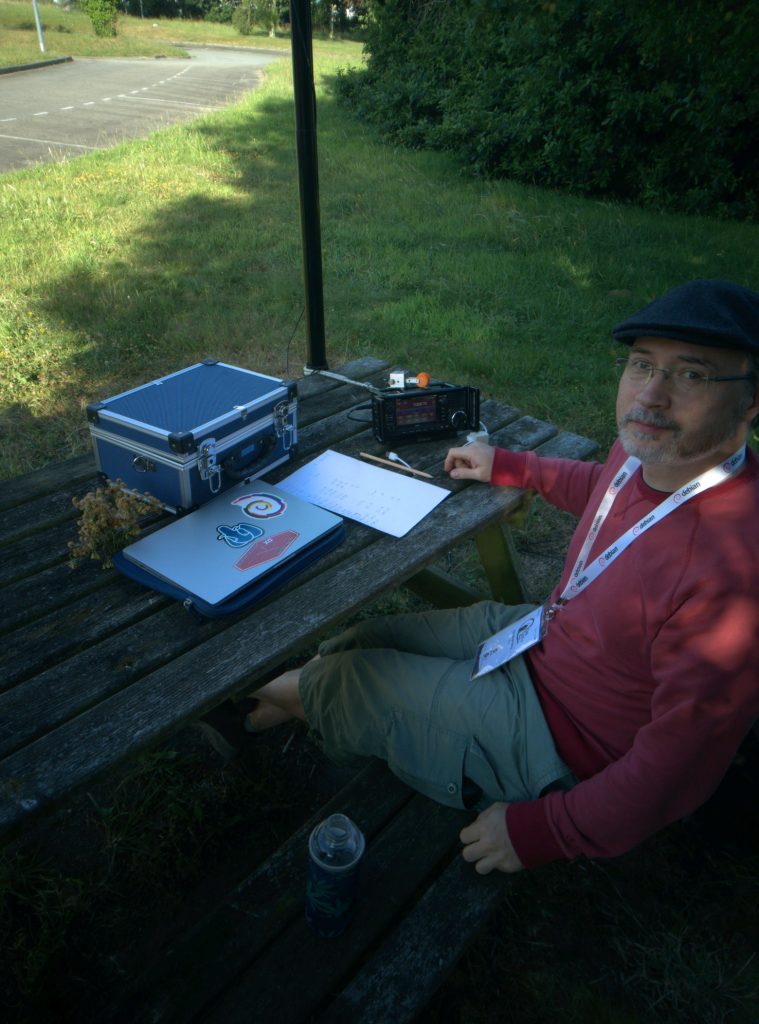 F/DF7CB in Brest (photo: Evangelos Ribeiro Tzaras)
 The northern coast of Ushant (photo: Christoph Berg)
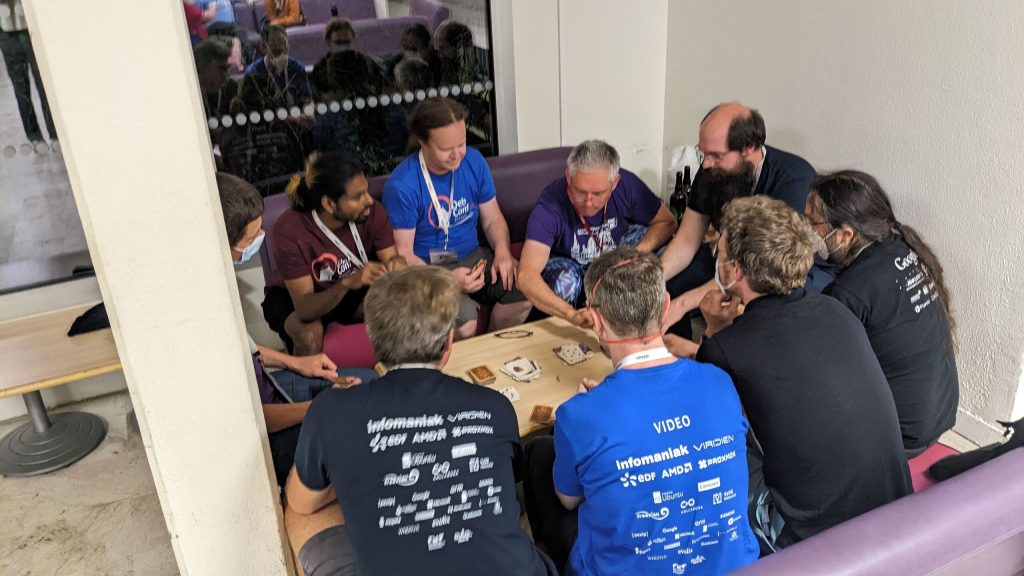 Having a nice day (photo: Christoph Berg)
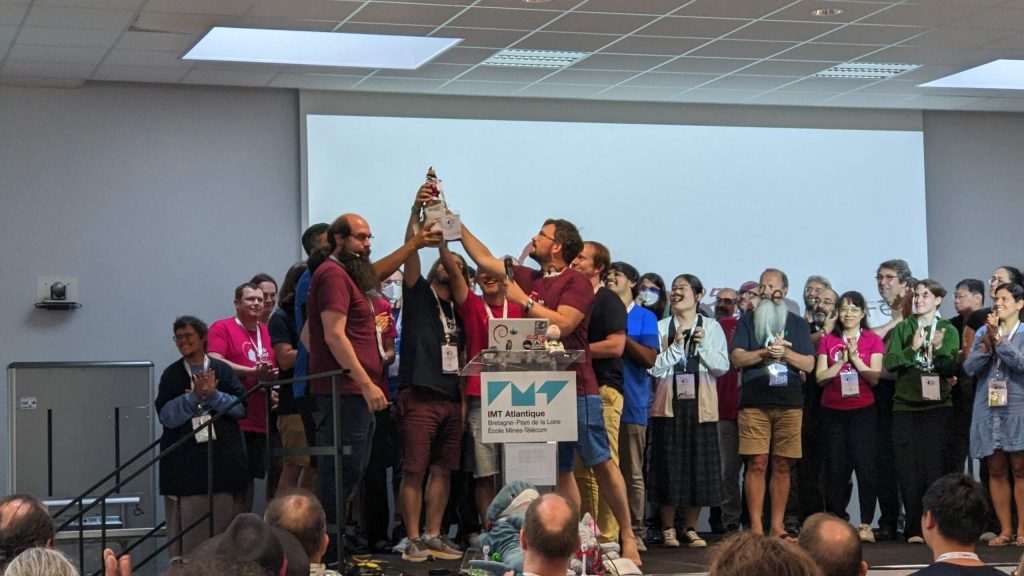 Pollito on stage (photo: Christoph Berg)
 Dear Debian community,
This is bits from the DPL for June.
The Challenge of Mentoring Newcomers
In June there was an extended discussion about the ongoing challenges
around mentoring newcomers in Debian. As many of you know, this is a
topic I ve cared about deeply--long before becoming DPL. In my view, the
issue isn t just a matter of lacking tools or needing to try harder to
attract contributors. Anyone who followed the discussion will likely
agree that it s more complex than that.
I sometimes wonder whether Debian s success contributes to the problem.
From the outside, things may appear to just work , which can lead to
the impression: Debian is doing fine without me--they clearly have
everything under control. But that overlooks how much volunteer effort
it takes to keep the project running smoothly.
We should make it clearer that help is always needed--not only in
packaging, but also in writing technical documentation, designing web
pages, reaching out to upstreams about license issues, finding sponsors,
or organising events. (Speaking from experience, I would have
appreciated help in patiently explaining Free Software benefits to
upstream authors.) Sometimes we think too narrowly about what newcomers
can do, and also about which tasks could be offloaded from overcommitted
contributors.
In fact, one of the most valuable things a newcomer can contribute is
better documentation. Those of us who ve been around for years may be
too used to how things work--or make assumptions about what others
already know. A person who just joined the project is often in the best
position to document what s confusing, what s missing, and what they
wish they had known sooner.
In that sense, the recent







 This web of nodes and edges represents every module and its relationship during the compilation process of
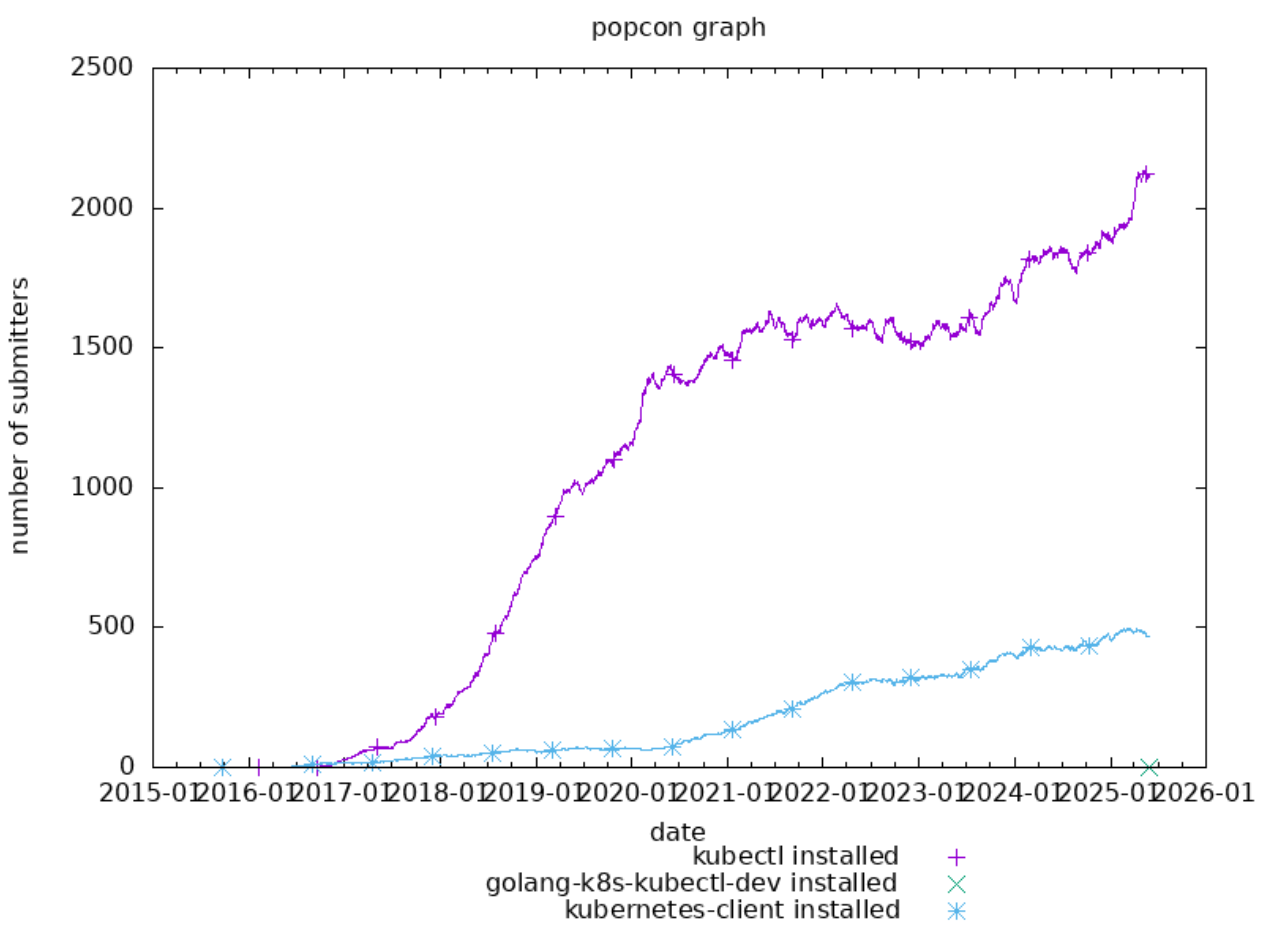
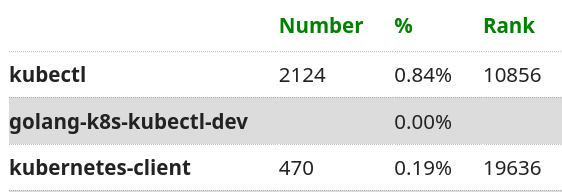 Here s what the data tells us: