Search Results: "jochen"

10 March 2026

Freexian Collaborators: Debian Contributions: Opening DebConf 26 Registration, Debian CI improvements and more! (by Anupa Ann Joseph)

Debian Contributions: 2026-02 Contributing to Debian is part of Freexian s mission. This article covers the latest achievements of Freexian and their collaborators. All of this is made possible by organizations subscribing to our Long Term Support contracts and consulting services.

DebConf 26 Registration, by Stefano Rivera, Antonio Terceiro, and Santiago Ruano Rinc n DebConf 26, to be held in Santa Fe Argentina in July, has opened for registration and event proposals. Stefano, Antonio, and Santiago all contributed to making this happen. As always, some changes needed to be made to the registration system. Bigger changes were planned, but we ran out of time to implement them for DebConf 26. All 3 of us have had experience in hosting local DebConf events in the past and have been advising the DebConf 26 local team.

Debian CI improvements, by Antonio Terceiro Debian CI is the platform responsible for automated testing of packages from the Debian archive, and its results are used by the Debian Release team automation as Quality Assurance to control the migration of packages from Debian unstable into testing, the base for the next Debian release. Antonio started developing an incus backend, and that prompted two rounds of improvements to the platform, including but not limited to allowing user to select a job execution backend (lxc, qemu) during the job submission, reducing the part of testbed image creation that requires superuser privileges and other refactorings and bug fixes. The platform API was also improved to reduce disruption when reporting results to the Release Team automation after service downtimes. Last, but not least, the platform now has support for testing packages against variants of autopkgtest, which will allow the Debian CI team to test new versions of autopkgtest before making releases to avoid widespread regressions.

Miscellaneous contributions
  • Carles improved po-debconf-manager while users requested features / found bugs. Improvements done - add packages from unstable instead of just salsa.debian.org, upgrade and merge templates of upgraded packages, finished adding typing annotations, improved deleting packages: support multiple line texts, add debug to see subprocess.run commands, etc.
  • Carles, using po-debconf-manager, reviewed 7 Catalan translations and sent bug reports or MRs for 11 packages. Also reviewed the translations of fortunes-debian-hints and submitted possible changes in the hints.
  • Carles submitted MRs for reportbug (reportbug --ui gtk detecting the wrong dependencies), devscript (delete unused code from debrebuild and add recommended dependency), wcurl (format help for 80 columns). Carles submitted a bug report for apt not showing the long descriptions of packages.
  • Carles resumed effort for checking relations (e.g. Recommends / Suggests) between Debian packages. A new codebase (still in early stages) was started with a new approach in order to detect, report and track the broken relations.
  • Emilio drove several transitions, most notably the haskell transition and the glibc/gcc-15/zlib transition for the s390 31-bit removal. This last one included reviewing and requeueing lots of autopkgtests due to britney losing a lot of results.
  • Emilio reviewed and uploaded poppler updates to experimental for a new transition.
  • Emilio reviewed, merged and deployed some performance improvements proposed for the security-tracker.
  • Stefano prepared routine updates for pycparser, python-confuse, python-cffi, python-mitogen, python-pip, wheel, platformdirs, python-authlib, and python-virtualenv.
  • Stefano updated Python 3.13 and 3.14 to the latest point releases, including security updates, and did some preliminary work for Python 3.15.
  • Stefano reviewed changes to dh-python and merged MRs.
  • Stefano did some debian.social sysadmin work, bridging additional IRC channels to Matrix.
  • Stefano and Antonio, as DebConf Committee Members, reviewed the DebConf 27 bids and took part in selecting the Japanese bid to host DebConf 27.
  • Helmut sent patches for 29 cross build failures.
  • Helmut continued to maintain rebootstrap addressing issues relating to specific architectures (such as musl-linux-any, hurd-any or s390x) or specific packages (such as binutils, brotli or fontconfig).
  • Helmut worked on diagnosing bugs such as rocblas #1126608, python-memray #1126944 upstream and greetd #1129070 with varying success.
  • Antonio provided support for multiple MiniDebConfs whose websites run wafer + wafer-debconf (the same stack as DebConf itself).
  • Antonio fixed the salsa tagpending webhook.
  • Antonio sent specinfra upstream a patch to fix detection of Debian systems in some situations.
  • Santiago reviewed some Merge Requests for the Salsa CI pipeline, including !703 and !704, that aim to improve how the build source job is handled by Salsa CI. Thanks a lot to Jochen for his work on this.
  • In collaboration with Emmanuel Arias, Santiago proposed a couple of projects for the Google Summer of Code (GSoC) 2026 round. Santiago has been reviewing applications and giving feedback to candidates.
  • Thorsten uploaded new upstream versions of ipp-usb, brlaser and gutenprint.
  • Rapha l updated publican to fix an old bug that became release critical and that happened only when building with the nocheck profile. Publican is a build dependency of the Debian s Administrator Handbook and with that fix, the package is back into testing.
  • Rapha l implemented a small feature in Debusine that makes it possible to refer to a collection in a parent workspace even if a collection with the same name is present in the current workspace.
  • Lucas updated the current status of ruby packages affecting the Ruby 3.4 transition after a bunch of updates made by team members. He will follow up on this next month.
  • Lucas joined the Debian orga team for GSoC this year and tried to reach out to potential mentors.
  • Lucas did some content work for MiniDebConf Campinas - Brazil.
  • Colin published minor security updates to bookworm and trixie for CVE-2025-61984 and CVE-2025-61985 in OpenSSH, both of which allowed code execution via ProxyCommand in some cases. The trixie update also included a fix for mishandling of PerSourceMaxStartups.
  • Colin spotted and fixed a typo in the bug tracking system s spam-handling rules, which in combination with a devscripts regression caused bts forwarded commands to be discarded.
  • Colin ported 12 more Python packages away from using the deprecated (and now removed upstream) pkg_resources module.
  • Anupa is co-organizing MiniDebConf Kanpur with Debian India team. Anupa was responsible for preparing the schedule, publishing it on the website, co-ordination with the fiscal host in addition to attending meetings.
  • Anupa attended the Debian Publicity team online sprint which was a skill sharing session.

17 February 2026

Freexian Collaborators: Monthly report about Debian Long Term Support, January 2026 (by Santiago Ruano Rinc n)

The Debian LTS Team, funded by Freexian s Debian LTS offering, is pleased to report its activities for January.
Activity summary During the month of January, 20 contributors have been paid to work on Debian LTS (links to individual contributor reports are located below). The team released 33 DLAs fixing 216 CVEs. The team continued preparing security updates in its usual rhythm. Beyond the updates targeting Debian 11 ( bullseye ), which is the current release under LTS, the team also proposed updates for more recent releases (Debian 12 ( bookworm ) and Debian 13 ( trixie )), including Debian unstable. We highlight several notable security updates here below. Notable security updates:
  • python3.9, prepared by Andrej Shadura (DLA-4455-1), fixing multiple vulnerabilities in the Python interpreter.
  • php, prepared by Guilhem Moulin (DLA-4447-1), fixing two vulnerabilities that could yield to request forgery or denial of service.
  • apache2, prepared by Bastien Roucari s DLA-4452-1, fixing four CVEs.
  • linux-6.1, prepared by Ben Hutchings (DLA-4436-1), as a regular update of the linux 6.1 backport to Debian 11.
  • python-django, prepared by Chris Lamb (DLA-4458-1), resolving multiple vulnerabilities.
  • firefox-esr prepared by Emilio Pozuelo Monfort (DLA-4439-1)
  • gnupg2, prepared by Roberto S nchez (DLA-4437-1), fixing multiple issues, including CVE-2025-68973 that could potentially be exploited to execute arbitrary code.
  • apache-log4j2, prepared by Markus Koschany (DLA-4444-1)
  • ceph, prepared by Utkarsh Gupta (DLA-4460-1)
  • inetutils, prepared by Andreas Henriksson (DLA-4453-1), fixing an authentication bypass in telnetd.
Moreover, Sylvain Beucler studied the security support status of p7zip, a fork of 7zip that has become unmaintained upstream. To avoid letting the users continue using an unsupported package, Sylvain has investigated a path forward in collaboration with the security team and the 7zip maintainer, looking to replace p7zip with 7zip. It is to note however that 7zip developers don t reveal the information about the patches that fix CVEs, making it difficult to backport single patches to fix vulnerabilities in Debian released versions. Contributions from outside the LTS Team: Thunderbird, prepared by maintainer Christoph Goehre. The DLA (DLA-4442-1) was published by Emilio. The LTS Team has also contributed with updates to the latest Debian releases:
  • Bastien uploaded gpsd to unstable, and proposed updates for trixie #1126121 and bookworm #1126168 to fix two CVEs.
  • Bastien also prepared the imagemagick updates for trixie and bookworm, released as DSA-6111-1, along with the bullseye update DLA-4448-1.
  • Chris proposed a trixie point update for python-django (#112646), and the work for bookworm was completed in February (#1079454). The longstanding bookworm update required tracking down a regression in the django-storages packages.
  • Markus prepared tomcat10 updates for trixie and bookworm (DSA-6120-1), and tomcat11 for trixie (DSA-6121-1)
  • Thorsten Alteholz prepared bookworm point updates for zvbi (#1126167) to fix five CVEs; taglib (#1126273) to fix one CVE; and libuev (#1126370) to fix one CVE.
  • Utkarsh prepared an unstable update of node-lodash to fix one CVE.
Other than the work related to updates, Sylvain made several improvements to the documentation and tooling used by the team.

Individual Debian LTS contributor reports

Thanks to our sponsors Sponsors that joined recently are in bold.

6 February 2026

Reproducible Builds: Reproducible Builds in January 2026

Welcome to the first monthly report in 2026 from the Reproducible Builds project! These reports outline what we ve been up to over the past month, highlighting items of news from elsewhere in the increasingly-important area of software supply-chain security. As ever, if you are interested in contributing to the Reproducible Builds project, please see the Contribute page on our website.

  1. Flathub now testing for reproducibility
  2. Reproducibility identifying projects that will fail to build in 2038
  3. Distribution work
  4. Tool development
  5. Two new academic papers
  6. Upstream patches

Flathub now testing for reproducibility Flathub, the primary repository/app store for Flatpak-based applications, has begun checking for build reproducibility. According to a recent blog post:
We have started testing binary reproducibility of x86_64 builds targeting the stable repository. This is possible thanks to flathub-repro-checker, a tool doing the necessary legwork to recreate the build environment and compare the result of the rebuild with what is published on Flathub. While these tests have been running for a while now, we have recently restarted them from scratch after enabling S3 storage for diffoscope artifacts.
The test results and status is available on their reproducible builds page.

Reproducibility identifying software projects that will fail to build in 2038 Longtime Reproducible Builds developer Bernhard M. Wiedemann posted on Reddit on Y2K38 commemoration day T-12 that is to say, twelve years to the day before the UNIX Epoch will no longer fit into a signed 32-bit integer variable on 19th January 2038. Bernhard s comment succinctly outlines the problem as well as notes some of the potential remedies, as well as links to a discussion with the GCC developers regarding adding warnings for int time_t conversions . At the time of publication, Bernhard s topic had generated 50 comments in response.

Distribution work Conda is language-agnostic package manager which was originally developed to help Python data scientists and is now a popular package manager for Python and R. conda-forge, a community-led infrastructure for Conda recently revamped their dashboards to rebuild packages straight to track reproducibility. There have been changes over the past two years to make the conda-forge build tooling fully reproducible by embedding the lockfile of the entire build environment inside the packages.
In Debian this month:
In NixOS this month, it was announced that the GNU Guix Full Source Bootstrap was ported to NixOS as part of Wire Jansen bachelor s thesis (PDF). At the time of publication, this change has landed in NiX stdev distribution.
Lastly, Bernhard M. Wiedemann posted another openSUSE monthly update for his work there.

Tool development diffoscope is our in-depth and content-aware diff utility that can locate and diagnose reproducibility issues. This month, Chris Lamb made the following changes, including preparing and uploading versions, 310 and 311 to Debian.
  • Fix test compatibility with u-boot-tools version 2026-01. [ ]
  • Drop the implied Rules-Requires-Root: no entry in debian/control. [ ]
  • Bump Standards-Version to 4.7.3. [ ]
  • Reference the Debian ocaml package instead of ocaml-nox. (#1125094)
  • Apply a patch by Jelle van der Waa to adjust a test fixture match new lines. [ ]
  • Also the drop implied Priority: optional from debian/control. [ ]

In addition, Holger Levsen uploaded two versions of disorderfs, first updating the package from FUSE 2 to FUSE 3 as described in last months report, as well as updating the packaging to the latest Debian standards. A second upload (0.6.2-1) was subsequently made, with Holger adding instructions on how to add the upstream release to our release archive and incorporating changes by Roland Clobus to set _FILE_OFFSET_BITS on 32-bit platforms, fixing a build failure on 32-bit systems. Vagrant Cascadian updated diffoscope in GNU Guix to version 311-2-ge4ec97f7 and disorderfs to 0.6.2.

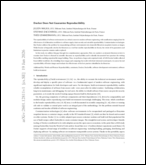
Two new academic papers Julien Malka, Stefano Zacchiroli and Th o Zimmermann of T l com Paris in-house research laboratory, the Information Processing and Communications Laboratory (LTCI) published a paper this month titled Docker Does Not Guarantee Reproducibility:
[ ] While Docker is frequently cited in the literature as a tool that enables reproducibility in theory, the extent of its guarantees and limitations in practice remains under-explored. In this work, we address this gap through two complementary approaches. First, we conduct a systematic literature review to examine how Docker is framed in scientific discourse on reproducibility and to identify documented best practices for writing Dockerfiles enabling reproducible image building. Then, we perform a large-scale empirical study of 5,298 Docker builds collected from GitHub workflows. By rebuilding these images and comparing the results with their historical counterparts, we assess the real reproducibility of Docker images and evaluate the effectiveness of the best practices identified in the literature.
A PDF of their paper is available online.
Quentin Guilloteau, Antoine Waehren and Florina M. Ciorba of the University of Basel in Sweden also published a Docker-related paper, theirs called Longitudinal Study of the Software Environments Produced by Dockerfiles from Research Artifacts:
The reproducibility crisis has affected all scientific disciplines, including computer science (CS). To address this issue, the CS community has established artifact evaluation processes at conferences and in journals to evaluate the reproducibility of the results shared in publications. Authors are therefore required to share their artifacts with reviewers, including code, data, and the software environment necessary to reproduce the results. One method for sharing the software environment proposed by conferences and journals is to utilize container technologies such as Docker and Apptainer. However, these tools rely on non-reproducible tools, resulting in non-reproducible containers. In this paper, we present a tool and methodology to evaluate variations over time in software environments of container images derived from research artifacts. We also present initial results on a small set of Dockerfiles from the Euro-Par 2024 conference.
A PDF of their paper is available online.

Miscellaneous news On our mailing list this month: Lastly, kpcyrd added a Rust section to the Stable order for outputs page on our website. [ ]

Upstream patches The Reproducible Builds project detects, dissects and attempts to fix as many currently-unreproducible packages as possible. We endeavour to send all of our patches upstream where appropriate. This month, we wrote a large number of such patches, including:

Finally, if you are interested in contributing to the Reproducible Builds project, please visit our Contribute page on our website. However, you can get in touch with us via:

16 January 2026

Freexian Collaborators: Monthly report about Debian Long Term Support, December 2025 (by Santiago Ruano Rinc n)

The Debian LTS Team, funded by [Freexian s Debian LTS offering] (https://www.freexian.com/lts/debian/), is pleased to report its activities for December.
Activity summary During the month of December, 18 contributors have been paid to work on Debian LTS (links to individual contributor reports are located below). The team released 41 DLAs fixing 252 CVEs. The team currently focuses on preparing security updates for Debian 11 bullseye , but also looks for contributing with updates for Debian 12 bookworm , Debian 13 trixie and even Debian unstable. Notable security updates:
  • libsoup2.4 (DLA-4398-1), prepared by Andreas Henrikson, fixing several vulnerabilities.
  • glib2.0 (DLA-4412-1), published by Emilio Pozuelo Monfort, addressing multiple issues.
  • lasso (DLA-4397-1), prepared by Sylvain Beucler, addressing multiple issues, including a critical remote code execution (RCE) vulnerability (CVE-2025-47151)
  • roundcube (DLA 4415-1), prepared by Guilhem Moulin, fixing a cross-site-scripting (XSS) (CVE-2025-68461) and an information disclosure (CVE-2025-68460) vulnerabilities
  • mediawiki (DLA 4428-1), published by Guilhem, fixing multiple vulnerabilities could lead to information disclosure, denial of service or privilege escalation.
  • While the DLA has not been published yet, Charles Henrique Melara proposed upstream fixes for seven CVEs in ffmpeg: https://code.ffmpeg.org/FFmpeg/FFmpeg/pulls/21275.
  • python-apt (DLA 4408-1), prepared by Utkarsh Gupta, in coordination with the Debian Security Team and Julian Andres Klode, the apt s maintainer.
  • libpng1.6 (DLA-4396-1), published by Tobias Frost, completing the work started the previous month.
Notable non-security updates:
  • tzdata (DLA-4403-1), prepared by Emilio, including the latest changes to the leap second list and its expiry date, which was set for the end of December.
Contributions from outside the LTS Team:
  • Christoph Berg, co-maintainer of PostgreSQL in Debian, prepared a postgresql-13 update, released as DLA-4420-1
The LTS Team has also contributed with updates to the latest Debian releases:

Individual Debian LTS contributor reports

Thanks to our sponsors Sponsors that joined recently are in bold.

16 December 2025

Freexian Collaborators: Monthly report about Debian Long Term Support, November 2025 (by Santiago Ruano Rinc n)

The Debian LTS Team, funded by [Freexian s Debian LTS offering] (https://www.freexian.com/lts/debian/), is pleased to report its activities for November.

Activity summary During the month of November, 18 contributors have been paid to work on Debian LTS (links to individual contributor reports are located below). The team released 33 DLAs fixing 219 CVEs. The LTS Team kept going with the usual cadence of preparing security updates for Debian 11 bullseye , but also for Debian 12 bookworm , Debian 13 trixie and even Debian unstable. As in previous months, we are pleased to say that there have been multiple contributions of LTS uploads by Debian Fellows outside the regular LTS Team. Notable security updates:
  • Guilhem Moulin prepared DLA 4365-1 for unbound, a caching DNS resolver, fixing a cache poisoning vulnerability that could lead to domain hijacking.
  • Another update related to DNS software was made by Andreas Henriksson. Andreas completed the work on bind9, released as DLA 4364-1 to fix cache poisoning and Denial of Service (DoS) vulnerabilities.
  • Chris Lamb released DLA 4374-1 to fix a potential arbitrary code execution vulnerability in pdfminer, a tool for extracting information from PDF documents.
  • Ben Hutchings published a regular security update for the linux 6.1 bullseye backport, as DLA 4379-1.
  • A couple of other important recurrent updates were prepared by Emilio Pozuelo, who handled firefox-esr and thunderbird (in collaboration with Christoph Goehre), published as DLAs DLA 4370-1 and DLA 4372-1, respectively.
Contributions from fellows outside the LTS Team:
  • Thomas Goirand uploaded a bullseye update for keystone and swift
  • Jeremy B cha prepared the bullseye update for gst-plugins-base1.0
  • As mentioned above, Christoph Goehre prepared the bullseye update for thunderbird.
  • Mathias Behrle provided feedback about the tryton-server and tryton-sao vulnerabilities that were disclosed last month, and helped to review the bullseye patches for tryton-server.
Other than the regular LTS updates for bullseye, the LTS Team has also contributed updates to the latest Debian releases:
  • Bastien Roucari s prepared a bookworm update for squid, the web proxy cache server.
  • Carlos Henrique Lima Melara filed a bookworm point update request for gdk-pixbuf to fix CVE-2025-7345, a heap buffer overflow vulnerability that could lead to arbitrary code execution.
  • Daniel Leidert prepared bookworm and trixie updates for r-cran-gh to fix CVE-2025-54956, an issue that may expose user credentials in HTTP responses.
  • Along with the bullseye updates for unbound mentioned above, Guilhem helped to prepare the trixie update for unbound.
  • In collaboration with Lukas M rdian, Tobias Frost prepared trixie and bookworm updates for log4cxx, the C++ port of the logging framework for JAVA.
  • Jochen Sprickerhof prepared a bookworm update for syslog-ng.
  • Utkarsh completed the bookworm update for wordpress, addressing multiple security issues in the popular blogging tool.
Beyond security updates, there has been a significant effort in revamping our documentation, aiming to make the processes more clear and consistent for all the members of the team. This work was mainly carried out by Sylvain, Jochen and Roberto. We would like to express our gratitude to the sponsors for making the Debian LTS project possible. Also, special thanks to the fellows outside the LTS team for their valuable help.

Individual Debian LTS contributor reports

Thanks to our sponsors Sponsors that joined recently are in bold.

3 December 2025

Reproducible Builds: Reproducible Builds in November 2025

Welcome to the report for November 2025 from the Reproducible Builds project! These monthly reports outline what we ve been up to over the past month, highlighting items of news from elsewhere in the increasingly-important area of software supply-chain security. As always, if you are interested in contributing to the Reproducible Builds project, please see the Contribute page on our website. In this report:

  1. 10 years of Reproducible Build at SeaGL
  2. Distribution work
  3. Tool development
  4. Website updates
  5. Miscellaneous news
  6. Software Supply Chain Security of Web3
  7. Upstream patches

10 years of Reproducible Builds at SeaGL 2025 On Friday 8th November, Chris Lamb gave a talk called 10 years of Reproducible Builds at SeaGL in Seattle, WA. Founded in 2013, SeaGL is a free, grassroots technical summit dedicated to spreading awareness and knowledge about free source software, hardware and culture. Chris talk:
[ ] introduces the concept of reproducible builds, its technical underpinnings and its potentially transformative impact on software security and transparency. It is aimed at developers, security professionals and policy-makers who are concerned with enhancing trust and accountability in our software. It also provides a history of the Reproducible Builds project, which is approximately ten years old. How are we getting on? What have we got left to do? Aren t all the builds reproducible now?

Distribution work In Debian this month, Jochen Sprickerhof created a merge request to replace the use of reprotest in Debian s Salsa Continuous Integration (CI) pipeline with debrebuild. Jochen cites the advantages as being threefold: firstly, that only one extra build needed ; it uses the same sbuild and ccache tooling as the normal build ; and works for any Debian release . The merge request was merged by Emmanuel Arias and is now active. kpcyrd posted to our mailing list announcing the initial release of repro-threshold, which implements an APT transport that defines a threshold of at least X of my N trusted rebuilders need to confirm they reproduced the binary before installing Debian packages. Configuration can be done through a config file, or through a curses-like user interface. Holger then merged two commits by Jochen Sprickerhof in order to address a fakeroot-related reproducibility issue in the debian-installer, and J rg Jaspert deployed a patch by Ivo De Decker for a bug originally filed by Holger in February 2025 related to some Debian packages not being archived on snapshot.debian.org. Elsewhere, Roland Clobus performed some analysis on the live Debian trixie images, which he determined were not reproducible. However, in a follow-up post, Roland happily reports that the issues have been handled. In addition, 145 reviews of Debian packages were added, 12 were updated and 15 were removed this month adding to our knowledge about identified issues. Lastly, Jochen Sprickerhof filed a bug announcing their intention to binary NMU a very large number of the R programming language after a reproducibility-related toolchain bug was fixed.
Bernhard M. Wiedemann posted another openSUSE monthly update for their work there.
Julien Malka and Arnout Engelen launched the new hash collection server for NixOS. Aside from improved reporting to help focus reproducible builds efforts within NixOS, it collects build hashes as individually-signed attestations from independent builders, laying the groundwork for further tooling.

Tool development diffoscope version 307 was uploaded to Debian unstable (as well as version 309). These changes included further attempts to automatically attempt to deploy to PyPI by liaising with the PyPI developers/maintainers (with this experimental feature). [ ][ ][ ] In addition, reprotest versions 0.7.31 and 0.7.32 were uploaded to Debian unstable by Holger Levsen, who also made the following changes:
  • Do not vary the architecture personality if the kernel is not varied. (Thanks to Ra l Cumplido). [ ]
  • Drop the debian/watch file, as Lintian now flags this as error for native Debian packages. [ ][ ]
  • Bump Standards-Version to 4.7.2, with no changes needed. [ ]
  • Drop the Rules-Requires-Root header as it is no longer required.. [ ]
In addition, however, Vagrant Cascadian fixed a build failure by removing some extra whitespace from an older changelog entry. [ ]

Website updates Once again, there were a number of improvements made to our website this month including:

Miscellaneous news

Software Supply Chain Security of Web3 Via our mailing list, Martin Monperrus let us know about their recently-published page on the Software Supply Chain Security of Web3. The abstract of their paper is as follows:
Web3 applications, built on blockchain technology, manage billions of dollars in digital assets through decentralized applications (dApps) and smart contracts. These systems rely on complex, software supply chains that introduce significant security vulnerabilities. This paper examines the software supply chain security challenges unique to the Web3 ecosystem, where traditional Web2 software supply chain problems intersect with the immutable and high-stakes nature of blockchain technology. We analyze the threat landscape and propose mitigation strategies to strengthen the security posture of Web3 systems.
Their paper lists reproducible builds as one of the mitigating strategies. A PDF of the full text is available to download.

Upstream patches The Reproducible Builds project detects, dissects and attempts to fix as many currently-unreproducible packages as possible. We endeavour to send all of our patches upstream where appropriate. This month, we wrote a large number of such patches, including:

Finally, if you are interested in contributing to the Reproducible Builds project, please visit our Contribute page on our website. However, you can get in touch with us via:

29 November 2025

Freexian Collaborators: Monthly report about Debian Long Term Support, October 2025 (by Roberto C. S nchez)

The Debian LTS Team, funded by Freexian s Debian LTS offering, is pleased to report its activities for October.

Activity summary During the month of October, 21 contributors have been paid to work on Debian LTS (links to individual contributor reports are located below). The team released 37 DLAs fixing 893 CVEs. The team has continued in its usual rhythm, preparing and uploading security updates targeting LTS and ELTS, as well as helping with updates to oldstable, stable, testing, and unstable. Additionally, the team received several contributions of LTS uploads from Debian Developers outside the standing LTS Team. Notable security updates:
  • https-everywhere, prepared by Markus Koschany, deals with a problem created by ownership of the https-rulesets.org domain passing to a malware operator
  • openjdk-17 and openjdk-11, prepared by Emilio Pozuelo Monfort, fixes XML external entity and certificate validation vulnerabilities
  • intel-microcode, prepared by Tobias Frost, fixes a variety of privilege escalation and denial of service vulnerabilities
Notable non-security updates:
  • distro-info-data, prepared by Stefano Rivera, updates information concerning current and upcoming Debian and Ubuntu releases
Contributions from outside the LTS Team:
  • Lukas M rdian, a Debian Developer, provided an update of log4cxx
  • Andrew Ruthven, one of the request-tracker4 maintainers, provided an update of request-tracker4
  • Christoph Goehre, co-maintainer of thunderbird, provided an update of thunderbird
Beyond the typical LTS updates, the team also helped the Debian community more broadly:
  • Guilhem Moulin prepared oldstable/stable updates of libxml2, and an unstable update of libxml2.9
  • Bastien Roucari s prepared oldstable/stable updates of imagemagick
  • Daniel Leidert prepared an oldstable update of python-authlib, oldstable update of libcommons-lang-java and stable update of libcommons-lang3-java
  • Utkarsh Gupta prepared oldstable/stable/testing/unstable updates of ruby-rack
The LTS Team is grateful for the opportunity to contribute to making LTS a high quality for sponsors and users. We are also particularly grateful for the collaboration from others outside the time; their contributions are important to the success of the LTS effort.

Individual Debian LTS contributor reports

Thanks to our sponsors Sponsors that joined recently are in bold.

13 October 2025

Freexian Collaborators: Monthly report about Debian Long Term Support, September 2025 (by Roberto C. S nchez)

Like each month, have a look at the work funded by Freexian s Debian LTS offering.

Debian LTS contributors In September, 20 contributors have been paid to work on Debian LTS, their reports are available:
  • Abhijith PA did 10.0h (out of 10.0h assigned and 4.0h from previous period), thus carrying over 4.0h to the next month.
  • Andreas Henriksson did 1.0h (out of 0.0h assigned and 20.0h from previous period), thus carrying over 19.0h to the next month.
  • Bastien Roucari s did 20.0h (out of 20.0h assigned).
  • Ben Hutchings did 20.0h (out of 21.0h assigned), thus carrying over 1.0h to the next month.
  • Carlos Henrique Lima Melara did 10.0h (out of 12.0h assigned), thus carrying over 2.0h to the next month.
  • Chris Lamb did 18.0h (out of 18.0h assigned).
  • Daniel Leidert did 21.0h (out of 21.0h assigned).
  • Emilio Pozuelo Monfort did 39.75h (out of 40.0h assigned), thus carrying over 0.25h to the next month.
  • Guilhem Moulin did 15.0h (out of 15.0h assigned).
  • Jochen Sprickerhof did 12.0h (out of 9.25h assigned and 11.75h from previous period), thus carrying over 9.0h to the next month.
  • Lee Garrett did 13.5h (out of 21.0h assigned), thus carrying over 7.5h to the next month.
  • Lucas Kanashiro did 8.0h (out of 20.0h assigned), thus carrying over 12.0h to the next month.
  • Markus Koschany did 15.0h (out of 3.25h assigned and 17.75h from previous period), thus carrying over 6.0h to the next month.
  • Paride Legovini did 6.0h (out of 8.0h assigned), thus carrying over 2.0h to the next month.
  • Roberto C. S nchez did 7.25h (out of 7.75h assigned and 13.25h from previous period), thus carrying over 13.75h to the next month.
  • Santiago Ruano Rinc n did 13.25h (out of 13.5h assigned and 1.5h from previous period), thus carrying over 1.75h to the next month.
  • Sylvain Beucler did 17.0h (out of 7.75h assigned and 13.25h from previous period), thus carrying over 4.0h to the next month.
  • Thorsten Alteholz did 21.0h (out of 21.0h assigned).
  • Tobias Frost did 5.0h (out of 0.0h assigned and 8.0h from previous period), thus carrying over 3.0h to the next month.
  • Utkarsh Gupta did 16.5h (out of 14.25h assigned and 6.75h from previous period), thus carrying over 4.5h to the next month.

Evolution of the situation In September, we released 38 DLAs.
  • Notable security updates:
    • modsecurity-apache prepared by Adrian Bunk, fixes a cross-site scripting vulnerability
    • cups, prepared by Thorsten Alteholz, fixes authentication bypass and denial of service vulnerabilities
    • jetty9, prepared by Adrian Bunk, fixes the MadeYouReset vulnerability (a recent, well-known denial of service vulnerability)
    • python-django, prepared by Chris Lamb, fixes a SQL injection vulnerability
    • firefox-esr and thunderbird, prepared by Emilio Pozuelo Monfort, were updated from the 128.x ESR series to the 140.x ESR series, fixing a number of vulnerabilities as well
  • Notable non-security updates:
    • wireless-regdb prepared by Ben Hutchings, updates information reflecting changes to radio regulations in many countries
There was one package update contributed by a Debian Developer outside of the LTS Team: an update of node-tar-fs, prepared by Xavier Guimard (a member of the Node packaging team). Finally, LTS Team members also contributed updates of the following packages:
  • libxslt (to stable and oldstable), prepared by Guilhem Moulin, to address a regression introduced in a previous security update
  • libphp-adodb (to stable and oldstable), prepared by Abhijith PA
  • cups (to stable and oldstable), prepared by Thorsten Alteholz
  • u-boot (to oldstable), prepared by Daniel Leidert and Jochen Sprickerhof
  • libcommongs-lang3-java (to stable and oldstable), prepared by Daniel Leidert
  • python-internetarchive (to oldstable), prepared by Daniel Leidert
One other notable contribution by a member of the LTS Team is that Sylvain Beucler proposed a fix upstream for CVE-2025-2760 in gimp2. Upstream no longer supports gimp2, but it is still present in Debian LTS, and so proposing this fix upstream is of benefit to other distros which may still be supporting the older gimp2 packages.

Thanks to our sponsors Sponsors that joined recently are in bold.

10 October 2025

Reproducible Builds: Reproducible Builds in September 2025

Welcome to the September 2025 report from the Reproducible Builds project! Welcome to the very latest report from the Reproducible Builds project. Our monthly reports outline what we ve been up to over the past month, and highlight items of news from elsewhere in the increasingly-important area of software supply-chain security. As ever, if you are interested in contributing to the Reproducible Builds project, please see the Contribute page on our website. In this report:

  1. Reproducible Builds Summit 2025
  2. Can t we have nice things?
  3. Distribution work
  4. Tool development
  5. Reproducibility testing framework
  6. Upstream patches

Reproducible Builds Summit 2025 Please join us at the upcoming Reproducible Builds Summit, set to take place from October 28th 30th 2025 in Vienna, Austria! We are thrilled to host the eighth edition of this exciting event, following the success of previous summits in various iconic locations around the world, including Venice, Marrakesh, Paris, Berlin, Hamburg and Athens. Our summits are a unique gathering that brings together attendees from diverse projects, united by a shared vision of advancing the Reproducible Builds effort. During this enriching event, participants will have the opportunity to engage in discussions, establish connections and exchange ideas to drive progress in this vital field. Our aim is to create an inclusive space that fosters collaboration, innovation and problem-solving. If you re interesting in joining us this year, please make sure to read the event page which has more details about the event and location. Registration is open until 20th September 2025, and we are very much looking forward to seeing many readers of these reports there!

Can t we have nice things? Debian Developer Gunnar Wolf blogged that George V. Neville-Neil s Kode Vicious column in Communications of the ACM in which reproducible builds is mentioned without needing to introduce it (assuming familiarity across the computing industry and academia) . Titled, Can t we have nice things?, the article mentions:
Once the proper measurement points are known, we want to constrain the system such that what it does is simple enough to understand and easy to repeat. It is quite telling that the push for software that enables reproducible builds only really took off after an embarrassing widespread security issue ended up affecting the entire Internet. That there had already been 50 years of software development before anyone thought that introducing a few constraints might be a good idea is, well, let s just say it generates many emotions, none of them happy, fuzzy ones. [ ]

Distribution work In Debian this month, Johannes Starosta filed a bug against the debian-repro-status package, reporting that it does not work on Debian trixie. (An upstream bug report was also filed.) Furthermore, 17 reviews of Debian packages were added, 10 were updated and 14 were removed this month adding to our knowledge about identified issues. In March s report, we included the news that Fedora would aim for 99% package reproducibility. This change has now been deferred to Fedora 44 according to Phoronix. Lastly, Bernhard M. Wiedemann posted another openSUSE monthly update for their work there.

Tool development diffoscope version 306 was uploaded to Debian unstable by Chris Lamb. It included contributions already covered in previous months as well as some changes by Zbigniew J drzejewski-Szmek to address issues with the fdtump support [ ] and to move away from the deprecated codes.open method. [ ][ ] strip-nondeterminism version 1.15.0-1 was uploaded to Debian unstable by Chris Lamb. It included a contribution by Matwey Kornilov to add support for inline archive files for Erlang s escript [ ]. kpcyrd has released a new version of rebuilderd. As a quick recap, rebuilderd is an automatic build scheduler that tracks binary packages available in a Linux distribution and attempts to compile the official binary packages from their (purported) source code and dependencies. The code for in-toto attestations has been reworked, and the instances now feature a new endpoint that can be queried to fetch the list of public-keys an instance currently identifies itself by. [ ] Lastly, Holger Levsen bumped the Standards-Version field of disorderfs, with no changes needed. [ ][ ]

Reproducibility testing framework The Reproducible Builds project operates a comprehensive testing framework running primarily at tests.reproducible-builds.org in order to check packages and other artifacts for reproducibility. In August, however, a number of changes were made by Holger Levsen, including:
  • Setting up six new rebuilderd workers with 16 cores and 16 GB RAM each.
  • reproduce.debian.net-related:
    • Do not expose pending jobs; they are confusing without explaination. [ ]
    • Add a link to v1 API specification. [ ]
    • Drop rebuilderd-worker.conf on a node. [ ]
    • Allow manual scheduling for any architectures. [ ]
    • Update path to trixie graphs. [ ]
    • Use the same rebuilder-debian.sh script for all hosts. [ ]
    • Add all other suites to all other archs. [ ][ ][ ][ ]
    • Update SSH host keys for new hosts. [ ]
    • Move to the pull184 branch. [ ][ ][ ][ ][ ]
    • Only allow 20 GB cache for workers. [ ]
  • OpenWrt-related:
    • Grant developer aparcar full sudo control on the ionos30 node. [ ][ ]
  • Jenkins nodes:
    • Add a number of new nodes. [ ][ ][ ][ ][ ]
    • Dont expect /srv/workspace to exist on OSUOSL nodes. [ ]
    • Stop hardcoding IP addresses in munin.conf. [ ]
    • Add maintenance and health check jobs for new nodes. [ ]
    • Document slight changes in IONOS resources usage. [ ]
  • Misc:
    • Drop disabled Alpine Linux tests for good. [ ]
    • Move Debian live builds and some other Debian builds to the ionos10 node. [ ]
    • Cleanup some legacy support from releases before Debian trixie. [ ]
In addition, Jochen Sprickerhof made the following changes relating to reproduce.debian.net:
  • Do not expose pending jobs on the main site. [ ]
  • Switch the frontpage to reference Debian forky [ ], but do not attempt to build Debian forky on the armel architecture [ ].
  • Use consistent and up to date rebuilder-debian.sh script. [ ]
  • Fix supported worker architectures. [ ]
  • Add a basic excuses page. [ ]
  • Move to the pull184 branch. [ ][ ][ ][ ]
  • Fix a typo in the JavaScript. [ ]
  • Update front page for the new v1 API. [ ][ ]
Lastly, Roland Clobus did some maintenance relating to the reproducibility testing of the Debian Live images. [ ][ ][ ][ ]

Upstream patches The Reproducible Builds project detects, dissects and attempts to fix as many currently-unreproducible packages as possible. We endeavour to send all of our patches upstream where appropriate. This month, we wrote a large number of such patches, including:

Finally, if you are interested in contributing to the Reproducible Builds project, please visit our Contribute page on our website. However, you can get in touch with us via:

11 September 2025

Freexian Collaborators: Monthly report about Debian Long Term Support, August 2025 (by Roberto C. S nchez)

Like each month, have a look at the work funded by Freexian s Debian LTS offering.

Debian LTS contributors In August, 21 contributors have been paid to work on Debian LTS, their reports are available:
  • Abhijith PA did 10.0h (out of 0.0h assigned and 14.0h from previous period), thus carrying over 4.0h to the next month.
  • Andrej Shadura did 12.0h (out of 9.0h assigned and 3.0h from previous period).
  • Bastien Roucari s did 20.0h (out of 19.75h assigned and 0.25h from previous period).
  • Ben Hutchings did 22.75h (out of 16.5h assigned and 6.25h from previous period).
  • Carlos Henrique Lima Melara did 10.0h (out of 10.0h assigned).
  • Chris Lamb did 18.0h (out of 18.0h assigned).
  • Daniel Leidert did 23.25h (out of 23.25h assigned).
  • Emilio Pozuelo Monfort did 23.25h (out of 23.25h assigned).
  • Guilhem Moulin did 15.0h (out of 15.0h assigned).
  • Jochen Sprickerhof did 11.0h (out of 6.0h assigned and 16.75h from previous period), thus carrying over 11.75h to the next month.
  • Lee Garrett did 16.25h (out of 0.0h assigned and 16.25h from previous period).
  • Lucas Kanashiro did 20.0h (out of 1.25h assigned and 18.75h from previous period).
  • Markus Koschany did 5.0h (out of 13.0h assigned and 9.75h from previous period), thus carrying over 17.75h to the next month.
  • Paride Legovini did 8.0h (out of 0.0h assigned and 8.0h from previous period).
  • Roberto C. S nchez did 7.5h (out of 11.75h assigned and 11.0h from previous period), thus carrying over 15.25h to the next month.
  • Santiago Ruano Rinc n did 13.5h (out of 7.25h assigned and 7.75h from previous period), thus carrying over 1.5h to the next month.
  • Stefano Rivera did 0.5h (out of 0.0h assigned and 3.0h from previous period), thus carrying over 2.5h to the next month.
  • Sylvain Beucler did 10.0h (out of 23.25h assigned), thus carrying over 13.25h to the next month.
  • Thorsten Alteholz did 22.75h (out of 22.75h assigned).
  • Tobias Frost did 4.0h (out of 0.0h assigned and 12.0h from previous period), thus carrying over 8.0h to the next month.
  • Utkarsh Gupta did 16.0h (out of 22.75h assigned), thus carrying over 6.75h to the next month.

Evolution of the situation In August, we released 27 DLAs. The month of August marked the release of Debian 13 (codename trixie ). This is worth noting because it brought with it the return of the customary fast development pace of Debian unstable, which included several contributions from LTS Team members. More on that below. Of the many security updates which were published (and a few non-security updates as well), some notable ones are highlighted here.
  • Notable security updates:
    • gnutls28 prepared by Adrian Bunk, fixes several potential denial of service vulnerabilities
    • apache2, prepared by Bastien Roucari s, fixes several vulnerabilities including a potential denial of service and SSL/TLS-related access control
    • mbedtls (original update, regression update) prepared by Andrej Shadura, fixes several potential denial of service and information disclosure vulnerabilities
    • openjdk-17, prepared by Emilio Pozuelo Monfort, fixes several vulnerabilities which could result in denial of service, information disclosure or weakened TLS connections
  • Notable non-security updates:
    • distro-info-data, prepared by Stefano Rivera, adds information concerning future Debian and Ubuntu releases
    • ca-certificates-java, prepared by Bastien Roucari s, fixes some bugs which could disrupt future updates
The LTS Team continues to welcome the collaboration of maintainers from across the Debian community. The contributions of maintainers from outside the LTS Team include: postgresql-13 (Christoph Berg), sope (Jordi Mallach), thunderbird (Carsten Schoenert), and iperf3 (Roberto Lumbreras). Finally, LTS Team members also contributed updates of the following packages:
  • redis (to stable), prepared by Chris Lamb
  • firebird3.0 (to oldstable and stable), prepared by Adrian Bunk
  • node-tmp (to oldstable, stable, and unstable), prepared by Adrian Bunk
  • openjpeg2 (to oldstable, stable, and unstable), prepared by Adrian Bunk
  • apache2 (to oldstable), prepared by Bastien Roucari s
  • unbound (to oldstable), prepared by Guilhem Moulin
  • luajit (to oldstable), prepared by Guilhem Moulin
  • golang-github-gin-contrib-cors (to oldstable and stable), prepared by Thorsten Alteholz
  • libcoap3 (to stable), prepared by Thorsten Alteholz
  • libcommons-lang-java and libcommons-lang3-java (both to unstable), prepared by Daniel Leidert
  • python-flask-cors (to oldstable), prepared by Daniel Leidert
The LTS Team would especially like to thank our many longtime friends and sponsors for their support and collaboration.

Thanks to our sponsors Sponsors that joined recently are in bold.

6 September 2025

Reproducible Builds: Reproducible Builds in August 2025

Welcome to the August 2025 report from the Reproducible Builds project! Welcome to the latest report from the Reproducible Builds project for August 2025. These monthly reports outline what we ve been up to over the past month, and highlight items of news from elsewhere in the increasingly-important area of software supply-chain security. If you are interested in contributing to the Reproducible Builds project, please see the Contribute page on our website. In this report:

  1. Reproducible Builds Summit 2025
  2. Reproducible Builds and live-bootstrap at WHY2025
  3. DALEQ Explainable Equivalence for Java Bytecode
  4. Reproducibility regression identifies issue with AppArmor security policies
  5. Rust toolchain fixes
  6. Distribution work
  7. diffoscope
  8. Website updates
  9. Reproducibility testing framework
  10. Upstream patches

Reproducible Builds Summit 2025 Please join us at the upcoming Reproducible Builds Summit, set to take place from October 28th 30th 2025 in Vienna, Austria!** We are thrilled to host the eighth edition of this exciting event, following the success of previous summits in various iconic locations around the world, including Venice, Marrakesh, Paris, Berlin, Hamburg and Athens. Our summits are a unique gathering that brings together attendees from diverse projects, united by a shared vision of advancing the Reproducible Builds effort. During this enriching event, participants will have the opportunity to engage in discussions, establish connections and exchange ideas to drive progress in this vital field. Our aim is to create an inclusive space that fosters collaboration, innovation and problem-solving. If you re interesting in joining us this year, please make sure to read the event page which has more details about the event and location. Registration is open until 20th September 2025, and we are very much looking forward to seeing many readers of these reports there!

Reproducible Builds and live-bootstrap at WHY2025 WHY2025 (What Hackers Yearn) is a nonprofit outdoors hacker camp that takes place in Geestmerambacht in the Netherlands (approximately 40km north of Amsterdam). The event is organised for and by volunteers from the worldwide hacker community, and knowledge sharing, technological advancement, experimentation, connecting with your hacker peers, forging friendships and hacking are at the core of this event . At this year s event, Frans Faase gave a talk on live-bootstrap, an attempt to provide a reproducible, automatic, complete end-to-end bootstrap from a minimal number of binary seeds to a supported fully functioning operating system . Frans talk is available to watch on video and his slides are available as well.

DALEQ Explainable Equivalence for Java Bytecode Jens Dietrich of the Victoria University of Wellington, New Zealand and Behnaz Hassanshahi of Oracle Labs, Australia published an article this month entitled DALEQ Explainable Equivalence for Java Bytecode which explores the options and difficulties when Java binaries are not identical despite being from the same sources, and what avenues are available for proving equivalence despite the lack of bitwise correlation:
[Java] binaries are often not bitwise identical; however, in most cases, the differences can be attributed to variations in the build environment, and the binaries can still be considered equivalent. Establishing such equivalence, however, is a labor-intensive and error-prone process.
Jens and Behnaz therefore propose a tool called DALEQ, which:
disassembles Java byte code into a relational database, and can normalise this database by applying Datalog rules. Those databases can then be used to infer equivalence between two classes. Notably, equivalence statements are accompanied with Datalog proofs recording the normalisation process. We demonstrate the impact of DALEQ in an industrial context through a large-scale evaluation involving 2,714 pairs of jars, comprising 265,690 class pairs. In this evaluation, DALEQ is compared to two existing bytecode transformation tools. Our findings reveal a significant reduction in the manual effort required to assess non-bitwise equivalent artifacts, which would otherwise demand intensive human inspection. Furthermore, the results show that DALEQ outperforms existing tools by identifying more artifacts rebuilt from the same code as equivalent, even when no behavioral differences are present.
Jens also posted this news to our mailing list.

Reproducibility regression identifies issue with AppArmor security policies Tails developer intrigeri has tracked and followed a reproducibility regression in the generation of AppArmor policy caches, and has identified an issue with the 4.1.0 version of AppArmor. Although initially tracked on the Tails issue tracker, intrigeri filed an issue on the upstream bug tracker. AppArmor developer John Johansen replied, confirming that they can reproduce the issue and went to work on a draft patch. Through this, John revealed that it was caused by an actual underlying security bug in AppArmor that is to say, it resulted in permissions not (always) matching what the policy intends and, crucially, not merely a cache reproducibility issue. Work on the fix is ongoing at time of writing.

Rust toolchain fixes Rust Clippy is a linting tool for the Rust programming language. It provides a collection of lints (rules) designed to identify common mistakes, stylistic issues, potential performance problems and unidiomatic code patterns in Rust projects. This month, however, Sosth ne Gu don filed a new issue in the GitHub requesting a new check that would lint against non deterministic operations in proc-macros, such as iterating over a HashMap .

Distribution work In Debian this month: Lastly, Bernhard M. Wiedemann posted another openSUSE monthly update for their work there.

diffoscope diffoscope is our in-depth and content-aware diff utility that can locate and diagnose reproducibility issues. This month, Chris Lamb made the following changes, including preparing and uploading versions, 303, 304 and 305 to Debian:
  • Improvements:
    • Use sed(1) backreferences when generating debian/tests/control to avoid duplicating ourselves. [ ]
    • Move from a mono-utils dependency to versioned mono-devel mono-utils dependency, taking care to maintain the [!riscv64] architecture restriction. [ ]
    • Use sed over awk to avoid mangling dependency lines containing = (equals) symbols such as version restrictions. [ ]
  • Bug fixes:
    • Fix a test after the upload of systemd-ukify version 258~rc3. [ ]
    • Ensure that Java class files are named .class on the filesystem before passing them to javap(1). [ ]
    • Do not run jsondiff on files over 100KiB as the algorithm runs in O(n^2) time. [ ]
    • Don t check for PyPDF version 3 specifically; check for >= 3. [ ]
  • Misc:
    • Update copyright years. [ ][ ]
In addition, Martin Joerg fixed an issue with the HTML presenter to avoid crash when page limit is None [ ] and Zbigniew J drzejewski-Szmek fixed compatibility with RPM 6 [ ]. Lastly, John Sirois fixed a missing requests dependency in the trydiffoscope tool. [ ]

Website updates Once again, there were a number of improvements made to our website this month including:

Reproducibility testing framework The Reproducible Builds project operates a comprehensive testing framework running primarily at tests.reproducible-builds.org in order to check packages and other artifacts for reproducibility. In August, however, a number of changes were made by Holger Levsen, including:
  • reproduce.debian.net-related:
    • Run 4 workers on the o4 node again in order to speed up testing. [ ][ ][ ][ ]
    • Also test trixie-proposed-updates and trixie-updates etc. [ ][ ]
    • Gather seperate statistics for each tested release. [ ]
    • Support sources from all Debian suites. [ ]
    • Run new code from the prototype database rework branch for the amd64-pull184 pseudo-architecture. [ ][ ]
    • Add a number of helpful links. [ ][ ][ ][ ][ ][ ][ ][ ][ ]
    • Temporarily call debrebuild without the --cache argument to experiment with a new version of devscripts. [ ][ ][ ]
    • Update public TODO. [ ]
  • Installation tests:
    • Add comments to explain structure. [ ]
    • Mark more old jobs as old or dead . [ ][ ][ ]
    • Turn the maintenance job into a no-op. [ ]
  • Jenkins node maintenance:
    • Increase penalties if the osuosl5 or ionos7 nodes are down. [ ]
    • Stop trying to fix network automatically. [ ]
    • Correctly mark ppc64el architecture nodes when down. [ ]
    • Upgrade the remaining arm64 nodes to Debian trixie in anticipation of the release. [ ][ ]
    • Allow higher SSD temperatures on the riscv64 architecture. [ ]
  • Debian-related:
    • Drop the armhf architecture; many thanks to Vagrant for physically hosting the nodes for ten years. [ ][ ]
    • Add Debian forky, and archive bullseye. [ ][ ][ ][ ][ ][ ][ ]
    • Document the filesystem space savings from dropping the armhf architecture. [ ]
    • Exclude i386 and armhfr from JSON results. [ ]
    • Update TODOs for when Debian trixie and forky have been released. [ ][ ]
  • tests.reproducible-builds.org-related:
  • Misc:
    • Detect errors with openQA erroring out. [ ]
    • Drop the long-disabled openwrt_rebuilder jobs. [ ]
    • Use qa-jenkins-dev@alioth-lists.debian.net as the contact for jenkins.debian.net. [ ]
    • Redirect reproducible-builds.org/vienna25 to reproducible-builds.org/vienna2025. [ ]
    • Disable all OpenWrt reproducible CI jobs, in coordination with the OpenWrt community. [ ][ ]
    • Make reproduce.debian.net accessable via IPv6. [ ]
    • Ignore that the megacli RAID controller requires packages from Debian bookworm. [ ]
In addition,
  • James Addison migrated away from deprecated toplevel deb822 Python module in favour of debian.deb822 in the bin/reproducible_scheduler.py script [ ] and removed a note on reproduce.debian.net note after the release of Debian trixie [ ].
  • Jochen Sprickerhof made a huge number of improvements to the reproduce.debian.net statistics calculation [ ][ ][ ][ ][ ][ ] as well as to the reproduce.debian.net service more generally [ ][ ][ ][ ][ ][ ][ ][ ].
  • Mattia Rizzolo performed a lot of work migrating scripts to SQLAlchemy version 2.0 [ ][ ][ ][ ][ ][ ] in addition to making some changes to the way openSUSE reproducibility tests are handled internally. [ ]
  • Lastly, Roland Clobus updated the Debian Live packages after the release of Debian trixie. [ ][ ]

Upstream patches The Reproducible Builds project detects, dissects and attempts to fix as many currently-unreproducible packages as possible. We endeavour to send all of our patches upstream where appropriate. This month, we wrote a large number of such patches, including:

Finally, if you are interested in contributing to the Reproducible Builds project, please visit our Contribute page on our website. However, you can get in touch with us via:

15 August 2025

Freexian Collaborators: Monthly report about Debian Long Term Support, July 2025 (by Roberto C. S nchez)

Like each month, have a look at the work funded by Freexian s Debian LTS offering.

Debian LTS contributors In July, 17 contributors have been paid to work on Debian LTS, their reports are available:
  • Adrian Bunk did 19.0h (out of 19.0h assigned).
  • Andrej Shadura did 5.0h (out of 0.0h assigned and 8.0h from previous period), thus carrying over 3.0h to the next month.
  • Bastien Roucari s did 18.5h (out of 18.75h assigned), thus carrying over 0.25h to the next month.
  • Ben Hutchings did 12.5h (out of 3.25h assigned and 15.5h from previous period), thus carrying over 6.25h to the next month.
  • Carlos Henrique Lima Melara did 10.0h (out of 10.0h assigned).
  • Chris Lamb did 18.0h (out of 18.0h assigned).
  • Daniel Leidert did 18.75h (out of 17.25h assigned and 1.5h from previous period).
  • Emilio Pozuelo Monfort did 18.75h (out of 18.75h assigned).
  • Guilhem Moulin did 15.0h (out of 14.0h assigned and 1.0h from previous period).
  • Jochen Sprickerhof did 2.0h (out of 16.5h assigned and 2.25h from previous period), thus carrying over 16.75h to the next month.
  • Lee Garrett did 7.0h (out of 0.0h assigned and 23.25h from previous period), thus carrying over 16.25h to the next month.
  • Markus Koschany did 9.0h (out of 18.75h assigned), thus carrying over 9.75h to the next month.
  • Roberto C. S nchez did 10.25h (out of 18.5h assigned and 2.75h from previous period), thus carrying over 11.0h to the next month.
  • Santiago Ruano Rinc n did 7.25h (out of 12.75h assigned and 2.25h from previous period), thus carrying over 7.75h to the next month.
  • Sylvain Beucler did 18.75h (out of 18.75h assigned).
  • Thorsten Alteholz did 15.0h (out of 15.0h assigned).
  • Utkarsh Gupta did 15.0h (out of 1.0h assigned and 14.0h from previous period).

Evolution of the situation In July, we released 24 DLAs.
  • Notable security updates:
    • angular.js, prepared by Bastien Roucari s, fixes multiple vulnerabilities including input sanitization and potential regular expression denial of service (ReDoS)
    • tomcat9, prepared by Markus Koschany, fixes an assortment of vulnerabilities
    • mediawiki, prepared by Guilhem Moulin, fixes several information disclosure and privilege escalation vulnerabilities
    • php7.4, prepared by Guilhem Moulin, fixes several server side request forgery and denial of service vulnerabilities
This month s contributions from outside the regular team include an update to thunderbird, prepared by Christoph Goehre (the package maintainer). LTS Team members also contributed updates of the following packages:
  • commons-beanutils (to stable and unstable), prepared by Adrian Bunk
  • djvulibre (to oldstable, stable, and unstable), prepared by Adrian Bunk
  • git (to stable), prepared by Adrian Bunk
  • redis (to oldstable), prepared by Chris Lamb
  • libxml2 (to oldstable), prepared by Guilhem Moulin
  • commons-vfs (to oldstable), prepared by Daniel Leidert
Additionally, LTS Team member Santiago Ruano Rinc n proposed and implemented an improvement to the debian-security-support package. This package is available so that interested users can quickly determine if any installed packages are subject to limited security support or are excluded entirely from security support. However, there was not previously a way to identify explicitly supported packages, which has become necessary to note exceptions to broad exclusion policies (e.g., those which apply to substantial package groups, like modules belonging to the Go and Rust language ecosystems). Santiago s work has enabled the notation of exceptions to these exclusions, thus ensuring that users of debian-security-support have accurate status information concerning installed packages.

DebCamp 25 Security Tracker Sprint The previously announced security tracker sprint took place at DebCamp from 7-13 July. Participants included 8 members of the standing LTS Team, 2 active Debian Developers with an interest in LTS, 3 community members, and 1 member of the Debian Security Team (who provided guidance and reviews on proposed changes to the security tracker); participation was a mix of in person at the venue in Brest, France and remote. During the days of the sprint, the team tackled a wide range of bugs and improvements, mostly targeting the security tracker. The sprint participants worked on the following items: As can be seen from the above list, only a small number of changes were brought to completion during the sprint week itself. Given the very compressed timeframe involved, the broad scope of tasks which were under consideration, and the highly sensitive data managed by the security tracker, this is not entirely unexpected and in no way diminishes the great work done by the sprint participants. The LTS Team would especially like to thank Salvatore Bonaccorso of the Debian Security Team for making himself available throughout the sprint to answer questions, for providing guidance on the work, and for helping the work by reviewing and merging the MRs which were able to merged during the sprint itself. In the weeks that follow the sprint, the team will continue working towards completing the in progress items.

Thanks to our sponsors Sponsors that joined recently are in bold.

12 August 2025

Freexian Collaborators: Debian Contributions: DebConf 25, OpenSSH upgrades, Cross compilation collaboration and more! (by Anupa Ann Joseph)

Debian Contributions: 2025-07 Contributing to Debian is part of Freexian s mission. This article covers the latest achievements of Freexian and their collaborators. All of this is made possible by organizations subscribing to our Long Term Support contracts and consulting services.

DebConf 25, by Stefano Rivera and Santiago Ruano Rinc n In July, DebConf 25 was held in Brest, France. Freexian was a gold sponsor and most of the Freexian team attended the event. Many fruitful discussions were had amongst our team and within the Debian community. DebConf itself was organized by a local team in Brest, that included Santiago (who now lives in Uruguay). Stefano was also deeply involved in the organization, as a DebConf committee member, core video team, and the lead developer for the conference website. Running the conference took an enormous amount of work, consuming all of Stefano and Santiago s time for most of July. Lucas Kanashiro was active in the DebConf content team, reviewing talks and scheduling them. There were many last-minute changes to make during the event. Anupa Ann Joseph was part of the Debian publicity team doing live coverage of DebConf 25 and was part of the DebConf 25 content team reviewing the talks. She also assisted the local team to procure the lanyards. Recorded sessions presented by Freexian collaborators, often alongside other friends in Debian, included:

OpenSSH upgrades, by Colin Watson Towards the end of a release cycle, people tend to do more upgrade testing, and this sometimes results in interesting problems. Manfred Stock reported No new SSH connections possible during large part of upgrade to Debian Trixie , which would have affected many people upgrading from Debian 12 (bookworm), with potentially severe consequences for people upgrading remote systems. In fact, there were two independent problems that each led to much the same symptom:
  • As part of hardening the OpenSSH server, OpenSSH 9.8 split the monolithic sshd listener process into two pieces: a minimal network listener (still called sshd), and an sshd-session process dealing with each individual session. Before this change, when sshd received an incoming connection, it forked and re-executed itself with some special parameters to deal with it; after this change, it forks and executes sshd-session instead, and sshd no longer accepts the parameters it used to accept for this.

    Debian package upgrades happen (roughly) in two phases: first we unpack the new files onto disk, and then we run some configuration steps which usually include things like restarting services. Normally this is fine, because the old service keeps on working until it s restarted. In this case, unpacking the new files onto disk immediately stopped new SSH connections from working: the old sshd received the connection and tried to hand it off to a freshly-executed copy of the new sshd binary on disk, which no longer supports this. This wasn t much of a problem when upgrading OpenSSH on its own or with a small number of other packages, but in release upgrades it left a large gap when you can t SSH to the system any more, and if anything fails in that interval then you could be in trouble.

    After trying a couple of other approaches, Colin landed on the idea of having the openssh-server package divert /usr/sbin/sshd to /usr/sbin/sshd.session-split before the unpack step of an upgrade from before 9.8, then removing the diversion and moving the new file into place once it s ready to restart the service. This reduces the period when new connections fail to a minimum.
  • Most OpenSSH processes, including sshd, check for a compatible version of the OpenSSL library when they start up. This check used to be very picky, among other things requiring both the major and minor part of the version number to match. OpenSSL 3 has a better versioning policy, and so OpenSSH 9.4p1 relaxed this check.

    Unfortunately, bookworm shipped with OpenSSH 9.2p1, so as soon as you unpacked the new OpenSSL library during an upgrade, sshd stopped working. This couldn t be fixed by a change in trixie; we needed to change bookworm in advance of the upgrade so that it would tolerate newer versions of OpenSSL, and time was tight if we wanted this to be available before the release of Debian 13.

    Fortunately, there s a stable-updates mechanism for exactly this sort of thing, and the stable release managers kindly accepted Colin s proposal to fix this there.
The net result is that if you apply updates to bookworm (including stable-updates / bookworm-updates, which is enabled by default) before starting the upgrade to trixie, everything should be fine.

Cross compilation collaboration, by Helmut Grohne Supporting cross building in Debian packages touches lots of areas of the archive and quite some of these matters reside in shared responsibility between different teams. Hence, DebConf was an ideal opportunity to settle long-standing issues. The cross building bof sparked lively discussions as a significant fraction of developers employ cross builds to get their work done. In the trixie release, about two thirds of the packages can satisfy their cross Build-Depends and about half of the packages actually can be cross built.

Miscellaneous contributions
  • Rapha l Hertzog updated tracker.debian.org to remove references to Debian 10 which was moved to archive.debian.org, and had many fruitful discussions related to Debusine during DebConf 25.
  • Carles Pina prepared some data, questions and information for the DebConf 25 l10n and i18n BoF.
  • Carles Pina demoed and discussed possible next steps for po-debconf-manager with different teams in DebConf 25. He also reviewed Catalan translations and sent them to the packages.
  • Carles Pina started investigating a django-compressor bug: reproduced the bug consistently and prepared a PR for django-compressor upstream (likely more details next month). Looked at packaging frictionless-py.
  • Stefano Rivera triaged Python CVEs against pypy3.
  • Stefano prepared an upload of a new upstream release of pypy3 to Debian experimental (due to the freeze).
  • Stefano uploaded python3.14 RC1 to Debian experimental.
  • Thorsten Alteholz uploaded a new upstream version of sane-airscan to experimental. He also started to work on a new upstream version of hplip.
  • Colin backported fixes for CVE-2025-50181 and CVE-2025-50182 in python-urllib3, and fixed several other release-critical or important bugs in Python team packages.
  • Lucas uploaded ruby3.4 to experimental as a starting point for the ruby-defaults transition that will happen after Trixie release.
  • Lucas coordinated with the Release team the fix of the remaining RC bugs involving ruby packages, and got them all fixed.
  • Lucas, as part of the Debian Ruby team, kicked off discussions to improve internal process/tooling.
  • Lucas, as part of the Debian Outreach team, engaged in multiple discussions around internship programs we run and also what else we could do to improve outreach in the Debian project.
  • Lucas joined the Local groups BoF during DebConf 25 and shared all the good experiences from the Brazilian community and committed to help to document everything to try to support other groups.
  • Helmut spent significant time with Samuel Thibault on improving architecture cross bootstrap for hurd-any mostly reviewing Samuel s patches. He proposed a patch for improving bash s detection of its pipesize and a change to dpkg-shlibdeps to improve behavior for building cross toolchains.
  • Helmut reiterated the multiarch policy proposal with a lot of help from Nattie Mayer-Hutchings, Rhonda D Vine and Stuart Prescott.
  • Helmut finished his work on the process based unschroot prototype that was the main feature of his talk (see above).
  • Helmut analyzed a multiarch-related glibc upgrade failure induced by a /usr-move mitigation of systemd and sent a patch and regression fix both of which reached trixie in time. Thanks to Aurelien Jarno and the release team for their timely cooperation.
  • Helmut resurrected an earlier discussion about changing the semantics of Architecture: all packages in a multiarch context in order to improve the long-standing interpreter problem. With help from Tollef Fog Heen better semantics were discovered and agreement was reached with Guillem Jover and Julian Andres Klode to consider this change. The idea is to record a concrete architecture for every Architecture: all package in the dpkg database and enable choosing it as non-native.
  • Helmut implemented type hints for piuparts.
  • Helmut reviewed and improved a patch set of Jochen Sprickerhof for debvm.
  • Anupa was involved in discussions with the Debian Women team during DebConf 25.
  • Anupa started working for the trixie release coverage and started coordinating release parties.
  • Emilio helped coordinate the release of Debian 13 trixie.

6 August 2025

Reproducible Builds: Reproducible Builds in July 2025

Welcome to the seventh report from the Reproducible Builds project in 2025. Our monthly reports outline what we ve been up to over the past month, and highlight items of news from elsewhere in the increasingly-important area of software supply-chain security. If you are interested in contributing to the Reproducible Builds project, please see the Contribute page on our website. In this report:
  1. Reproducible Builds Summit 2025
  2. Reproducible Builds an official goal for SUSE Enterprise Linux
  3. Reproducible Builds at FOSSY 2025
  4. New OSS Rebuild project from Google
  5. New extension of Python setuptools to support reproducible builds
  6. diffoscope
  7. New library to patch system functions for reproducibility
  8. Independently Reproducible Git Bundles
  9. Website updates
  10. Distribution work
  11. Reproducibility testing framework
  12. Upstream patches

Reproducible Builds Summit 2025 We are extremely pleased to announce the upcoming Reproducible Builds Summit, set to take place from October 28th 30th 2025 in Vienna, Austria! We are thrilled to host the eighth edition of this exciting event, following the success of previous summits in various iconic locations around the world, including Venice, Marrakesh, Paris, Berlin, Hamburg and Athens. Our summits are a unique gathering that brings together attendees from diverse projects, united by a shared vision of advancing the Reproducible Builds effort. During this enriching event, participants will have the opportunity to engage in discussions, establish connections and exchange ideas to drive progress in this vital field. Our aim is to create an inclusive space that fosters collaboration, innovation and problem-solving. If you re interesting in joining us this year, please make sure to read the event page which has more details about the event and location. Registration is open until 20th September 2025, and we are very much looking forward to seeing many readers of these reports there!

Reproducible Builds an official goal for SUSE Enterprise Linux On our mailing list this month, Bernhard M. Wiedemann revealed the big news that reproducibility is now an official goal for SUSE Linux Enterprise Server (SLES) 16:
[Everything] changed earlier this year when reproducible-builds for SLES-16 became an official goal for the product. More people are talking about digital sovereignty and supply-chain security now. [ ] Today, only 9 of 3319 (source) packages have significant problems left (plus 7 with pending fixes), so 99.5% of packages have reproducible builds.

Reproducible Builds at FOSSY 2025 On Saturday 2nd August, Vagrant Cascadian and Chris Lamb presented at this year s FOSSY 2025. Their talk, titled Never Mind the Checkboxes, Here s Reproducible Builds!, was introduced as follows:
There are numerous policy compliance and regulatory processes being developed that target software development but do they solve actual problems? Does it improve the quality of software? Do Software Bill of Materials (SBOMs) actually give you the information necessary to verify how a given software artifact was built? What is the goal of all these compliance checklists anyways or more importantly, what should the goals be? If a software object is signed, who should be trusted to sign it, and can they be trusted forever?
Hosted by the Software Freedom Conservancy and taking place in Portland, Oregon, USA, FOSSY aims to be a community-focused event: Whether you are a long time contributing member of a free software project, a recent graduate of a coding bootcamp or university, or just have an interest in the possibilities that free and open source software bring, FOSSY will have something for you . More information on the event is available on the FOSSY 2025 website, including the full programme schedule. Vagrant and Chris also staffed a table, where they will be available to answer any questions about Reproducible Builds and discuss collaborations with other projects.

New OSS Rebuild project from Google The Google Open Source Security Team (GOSST) published an article this month announcing OSS Rebuild, a new project to strengthen trust in open source package ecosystems by reproducing upstream artifacts. As the post itself documents, the new project comprises four facets:
  • Automation to derive declarative build definitions for existing PyPI (Python), npm (JS/TS), and Crates.io (Rust) packages.
  • SLSA Provenance for thousands of packages across our supported ecosystems, meeting SLSA Build Level 3 requirements with no publisher intervention.
  • Build observability and verification tools that security teams can integrate into their existing vulnerability management workflows.
  • Infrastructure definitions to allow organizations to easily run their own instances of OSS Rebuild to rebuild, generate, sign, and distribute provenance.
One difference with most projects that aim for bit-for-bit reproducibility, OSS Rebuild aims for a kind of semantic reproducibility:
Through automation and heuristics, we determine a prospective build definition for a target package and rebuild it. We semantically compare the result with the existing upstream artifact, normalizing each one to remove instabilities that cause bit-for-bit comparisons to fail (e.g. archive compression).
The extensive post includes examples about how to access OSS Rebuild attestations using the Go-based command-line interface.

New extension of Python setuptools to support reproducible builds Wim Jeantine-Glenn has written a PEP 517 Build backend in order to enable reproducible builds when building Python projects that use setuptools. Called setuptools-reproducible, the project s README file contains the following:
Setuptools can create reproducible wheel archives (.whl) by setting SOURCE_DATE_EPOCH at build time, but setting the env var is insufficient for creating reproducible sdists (.tar.gz). setuptools-reproducible [therefore] wraps the hooks build_sdist build_wheel with some modifications to make reproducible builds by default.

diffoscope diffoscope is our in-depth and content-aware diff utility that can locate and diagnose reproducibility issues. This month, Chris Lamb made the following changes, including preparing and uploading versions 301, 302 and 303 to Debian:
  • Improvements:
    • Use Difference.from_operation in an attempt to pipeline the output of the extract-vmlinux script, potentially avoiding it all in memory. [ ]
    • Memoize a number of calls to --version, saving a very large number of external subprocess calls.
  • Bug fixes:
    • Don t check for PyPDF version 3 specifically, check for versions greater than 3. [ ]
    • Ensure that Java class files are named .class on the filesystem before passing them to javap(1). [ ]
    • Mask stderr from extract-vmlinux script. [ ][ ]
    • Avoid spurious differences in h5dump output caused by exposure of absolute internal extraction paths. (#1108690)
  • Misc:
    • Use our_check_output in the ODT comparator. [ ]
    • Update copyright years. [ ]
In addition: Lastly, Chris Lamb added a tmpfs to try.diffoscope.org so that diffoscope has a non-trivial temporary area to unpack archives, etc. [ ] Elsewhere in our tooling, however, reprotest is our tool for building the same source code twice in different environments and then checking the binaries produced by each build for any differences. This month, reprotest version 0.7.30 was uploaded to Debian unstable by Holger Levsen, chiefly including a change by Rebecca N. Palmer to not call sudo with the -h flag in order to fix Debian bug #1108550. [ ]

New library to patch system functions for reproducibility Nicolas Graves has written and published libfate, a simple collection of tiny libraries to patch system functions deterministically using LD_PRELOAD. According to the project s README:
libfate provides deterministic replacements for common non-deterministic system functions that can break reproducible builds. Instead of relying on complex build systems or apps or extensive patching, libfate uses the LD_PRELOAD trick to intercept system calls and return fixed, predictable values.
Describing why he wrote it, Nicolas writes:
I originally used the OpenSUSE dettrace approach to make Emacs reproducible in Guix. But when Guix switch to GCC@14, dettrace stopped working as expected. dettrace is a complex piece of software, my need was much less heavy: I don t need to systematically patch all sources of nondetermism, just the ones that make a process/binary unreproducible in a container/chroot.

Independently Reproducible Git Bundles Simon Josefsson has published another interesting article this month. Titled Independently Reproducible Git Bundles, the blog post describes the advantages of why you might a reproducible bundle, and the pitfalls that can arise when trying to create them:
One desirable property is that someone else should be able to reproduce the same git bundle, and not only that a single individual is able to reproduce things on one machine. It surprised me to see that when I ran the same set of commands on a different machine (started from a fresh git clone), I got a different checksum. The different checksums occurred even when nothing had been committed on the server side between the two runs.

Website updates Once again, there were a number of improvements made to our website this month including:

Distribution work In Debian this month:
Debian contributors have made significant progress toward ensuring package builds produce byte-for-byte reproducible results. You can check the status for packages installed on your system using the new package debian-repro-status, or visit reproduce.debian.net for Debian s overall statistics for trixie and later. You can contribute to these efforts by joining #debian-reproducible on IRC to discuss fixes, or verify the statistics by installing the new rebuilderd package and setting up your own instance.

The IzzyOnDroid Android APK repository made further progress in July, crossing the 50% reproducibility threshold congratulations. Furthermore, a new release of the Neo Store was released, which exposes the reproducible status directly next to the version of each app.
In GNU Guix, a series of patches intended to fix the reproducibility for the Mono programming language was merged, fixing reproducibility in Mono versions 1.9 [ ], 2.4 [ ] and 2.6 [ ].
Lastly, in addition to the news that openSUSE Enterprise Linux now [has an official goal of reproducibility]((https://lists.reproducible-builds.org/pipermail/rb-general/2025-July/003846.html), Bernhard M. Wiedemann posted another monthly update for their work there.

Reproducibility testing framework The Reproducible Builds project operates a comprehensive testing framework running primarily at tests.reproducible-builds.org in order to check packages and other artifacts for reproducibility. In July, however, a number of changes were made by Holger Levsen, including:
  • Switch the URL for the Tails package set. [ ]
  • Make the dsa-check-packages output more useful. [ ]
  • Setup the ppc64el architecture again, has it has returned this time with a 2.7 GiB database instead of 72 GiB. [ ]
In addition, Jochen Sprickerhof improved the reproducibility statistics generation:
  • Enable caching of statistics. [ ][ ][ ]
  • Add some common non-reproducible patterns. [ ]
  • Change output to directory. [ ]
  • Add a page sorted by diffoscope size. [ ][ ]
  • Switch to Python s argparse module and separate output(). [ ]
Holger also submitted a number of Debian bugs against rebuilderd and rebuilderd-worker:
  • Config files and scripts for a simple one machine setup. [ ][ ]
  • Create a rebuilderd user. [ ]
  • Create rebuilderd-worker user with sbuild. [ ]
Lastly, Mattia Rizzolo added a scheduled job to renew some SSL certificates [ ] and Vagrant Cascadian performed some node maintenance [ ][ ].

Upstream patches The Reproducible Builds project detects, dissects and attempts to fix as many currently-unreproducible packages as possible. We endeavour to send all of our patches upstream where appropriate. This month, we wrote a large number of such patches, including: There were a number of other patches from openSUSE developers:

Finally, if you are interested in contributing to the Reproducible Builds project, please visit our Contribute page on our website. However, you can get in touch with us via:

12 July 2025

Reproducible Builds: Reproducible Builds in June 2025

Welcome to the 6th report from the Reproducible Builds project in 2025. Our monthly reports outline what we ve been up to over the past month, and highlight items of news from elsewhere in the increasingly-important area of software supply-chain security. If you are interested in contributing to the Reproducible Builds project, please see the Contribute page on our website. In this report:
  1. Reproducible Builds at FOSSY 2025
  2. Distribution work
  3. diffoscope
  4. OSS Rebuild updates
  5. Website updates
  6. Upstream patches
  7. Reproducibility testing framework

Reproducible Builds at FOSSY 2025 On Saturday 2nd August, Vagrant Cascadian and Chris Lamb will be presenting at this year s FOSSY 2025. Their talk, titled Never Mind the Checkboxes, Here s Reproducible Builds!, is being introduced as follows:
There are numerous policy compliance and regulatory processes being developed that target software development but do they solve actual problems? Does it improve the quality of software? Do Software Bill of Materials (SBOMs) actually give you the information necessary to verify how a given software artifact was built? What is the goal of all these compliance checklists anyways or more importantly, what should the goals be? If a software object is signed, who should be trusted to sign it, and can they be trusted forever?
The talk will introduce the audience to Reproducible Builds as a set of best practices which allow users and developers to verify that software artifacts were built from the source code, but also allows auditing for license compliance, providing security benefits, and removes the need to trust arbitrary software vendors. Hosted by the Software Freedom Conservancy and taking place in Portland, Oregon, USA, FOSSY aims to be a community-focused event: Whether you are a long time contributing member of a free software project, a recent graduate of a coding bootcamp or university, or just have an interest in the possibilities that free and open source software bring, FOSSY will have something for you . More information on the event is available on the FOSSY 2025 website, including the full programme schedule. Vagrant and Chris will also be staffing a table this year, where they will be available to answer any questions about Reproducible Builds and discuss collaborations with other projects.

Distribution work In Debian this month:
  • Holger Levsen has discovered that it is now possible to bootstrap a minimal Debian trixie using 100% reproducible packages. This result can itself be reproduced, using the debian-repro-status tool and mmdebstrap s support for hooks:
      $ mmdebstrap --variant=apt --include=debian-repro-status \
           --chrooted-customize-hook=debian-repro-status \
           trixie /dev/null 2>&1   grep "Your system has"
       INFO  debian-repro-status > Your system has 100.00% been reproduced.
    
  • On our mailing list this month, Helmut Grohne wrote an extensive message raising an issue related to Uploads with conflicting buildinfo filenames:
    Having several .buildinfo files for the same architecture is something that we plausibly want to have eventually. Imagine running two sets of buildds and assembling a single upload containing buildinfo files from both buildds in the same upload. In a similar vein, as a developer I may want to supply several .buildinfo files with my source upload (e.g. for multiple architectures). Doing any of this is incompatible with current incoming processing and with reprepro.
  • 5 reviews of Debian packages were added, 4 were updated and 8 were removed this month adding to our ever-growing knowledge about identified issues.

In GNU Guix, Timothee Mathieu reported that a long-standing issue with reproducibility of shell containers across different host operating systems has been solved. In their message, Timothee mentions:
I discovered that pytorch (and maybe other dependencies) has a reproducibility problem of order 1e-5 when on AVX512 compared to AVX2. I first tried to solve the problem by disabling AVX512 at the level of pytorch, but it did not work. The dev of pytorch said that it may be because some components dispatch computation to MKL-DNN, I tried to disable AVX512 on MKL, and still the results were not reproducible, I also tried to deactivate in openmpi without success. I finally concluded that there was a problem with AVX512 somewhere in the dependencies graph but I gave up identifying where, as this seems very complicated.

The IzzyOnDroid Android APK repository made more progress in June. Not only have they just passed 48% reproducibility coverage, Ben started making their reproducible builds more visible, by offering rbtlog shields, a kind of badge that has been quickly picked up by many developers who are proud to present their applications reproducibility status.
Lastly, in openSUSE news, Bernhard M. Wiedemann posted another monthly update for their work there.

diffoscope diffoscope is our in-depth and content-aware diff utility that can locate and diagnose reproducibility issues. This month, Chris Lamb made the following changes, including preparing and uploading versions 298, 299 and 300 to Debian:
  • Add python3-defusedxml to the Build-Depends in order to include it in the Docker image. [ ]
  • Handle the RPM format s HEADERSIGNATURES and HEADERIMMUTABLE as a special-case to avoid unnecessarily large diffs. Thanks to Daniel Duan for the report and suggestion. [ ][ ]
  • Update copyright years. [ ]
In addition, @puer-robustus fixed a regression introduced in an earlier commit which resulted in some differences being lost. [ ][ ] Lastly, Vagrant Cascadian updated diffoscope in GNU Guix to version 299 [ ][ ] and 300 [ ][ ].

OSS Rebuild updates OSS Rebuild has added a new network analyzer that provides transparent HTTP(S) interception during builds, capturing all network traffic to monitor external dependencies and identify suspicious behavior, even in unmodified maintainer-controlled build processes. The text-based user interface now features automated failure clustering that can group similar rebuild failures and provides natural language failure summaries, making it easier to identify and understand patterns across large numbers of build failures. OSS Rebuild has also improved the local development experience with a unified interface for build execution strategies, allowing for more extensible environment setup for build execution. The team also designed a new website and logo.

Website updates Once again, there were a number of improvements made to our website this month including:
  • Arnaud Brousseau added Stage , a new Linux distribution, to our Tools page.
  • Chris Lamb improved the docker instructions on the diffoscope website. [ ]


Upstream patches The Reproducible Builds project detects, dissects and attempts to fix as many currently-unreproducible packages as possible. We endeavour to send all of our patches upstream where appropriate. This month, we wrote a large number of such patches, including:

Reproducibility testing framework The Reproducible Builds project operates a comprehensive testing framework running primarily at tests.reproducible-builds.org in order to check packages and other artifacts for reproducibility. In June, however, a number of changes were made by Holger Levsen, including:
  • reproduce.debian.net-related:
    • Installed and deployed rebuilderd version 0.24 from Debian unstable in order to make use of the new compression feature added by Jarl Gullberg for the database. This resulted in massive decrease of the SQLite databases:
      • 79G 2.8G (all)
      • 84G 3.2G (amd64)
      • 75G 2.9G (arm64)
      • 45G 2.1G (armel)
      • 48G 2.2G (armhf)
      • 73G 2.8G (i386)
      • 72G 2.7G (ppc64el)
      • 45G 2.1G (riscv64)
      for a combined saving from 521G 20.8G. This naturally reduces the requirements to run an independent rebuilderd instance and will permit us to add more Debian suites as well.
    • During migration to the latest version of rebuilderd, make sure several services are not started. [ ]
    • Actually run rebuilderd from /usr/bin. [ ]
    • Raise temperatures for NVME devices on some riscv64 nodes that should be ignored. [ ][ ]
    • Use a 64KB kernel page size on the ppc64el architecture (see #1106757). [ ]
    • Improve ordering of some failed to reproduce statistics. [ ]
    • Detect a number of potential causes of build failures within the statistics. [ ][ ]
    • Add support for manually scheduling for the any architecture. [ ]
  • Misc:
    • Update the Codethink nodes as there are now many kernels installed. [ ][ ]
    • Install linux-sysctl-defaults on Debian trixie systems as we need ping functionality. [ ]
    • Limit the fs.nr_open kernel turnable. [ ]
    • Stop submitting results to deprecated buildinfo.debian.net service. [ ][ ]
In addition, Jochen Sprickerhof greatly improved the statistics and the logging functionality, including adopting to the new database format of rebuilderd version 0.24.0 [ ] and temporarily increasing maximum log size in order to debug a nettlesome build [ ]. Jochen also dropped the CPUSchedulingPolicy=idle systemd flag on the workers. [ ]

Finally, if you are interested in contributing to the Reproducible Builds project, please visit our Contribute page on our website. However, you can get in touch with us via:

Freexian Collaborators: Monthly report about Debian Long Term Support, June 2025 (by Roberto C. S nchez)

Like each month, have a look at the work funded by Freexian s Debian LTS offering.

Debian LTS contributors In June, 20 contributors have been paid to work on Debian LTS, their reports are available:
  • Abhijith PA did 14.0h (out of 14.0h assigned).
  • Adrian Bunk did 23.5h (out of 23.5h assigned).
  • Andreas Henriksson did 3.0h (out of 3.0h assigned and 17.0h from previous period), thus carrying over 17.0h to the next month.
  • Andrej Shadura did 2.0h (out of 3.0h assigned and 7.0h from previous period), thus carrying over 8.0h to the next month.
  • Bastien Roucari s did 20.0h (out of 20.0h assigned).
  • Ben Hutchings did 8.0h (out of 7.5h assigned and 16.0h from previous period), thus carrying over 15.5h to the next month.
  • Carlos Henrique Lima Melara did 12.0h (out of 12.0h assigned).
  • Chris Lamb did 18.0h (out of 18.0h assigned).
  • Daniel Leidert did 22.0h (out of 22.5h assigned and 1.0h from previous period), thus carrying over 1.5h to the next month.
  • Emilio Pozuelo Monfort did 23.5h (out of 16.75h assigned and 6.75h from previous period).
  • Guilhem Moulin did 14.0h (out of 11.5h assigned and 3.5h from previous period), thus carrying over 1.0h to the next month.
  • Jochen Sprickerhof did 21.0h (out of 0.5h assigned and 22.75h from previous period), thus carrying over 2.25h to the next month.
  • Lucas Kanashiro did 20.0h (out of 20.0h assigned).
  • Markus Koschany did 23.25h (out of 17.0h assigned and 6.25h from previous period).
  • Roberto C. S nchez did 21.25h (out of 20.75h assigned and 3.25h from previous period), thus carrying over 2.75h to the next month.
  • Santiago Ruano Rinc n did 12.75h (out of 15.0h assigned), thus carrying over 2.25h to the next month.
  • Sean Whitton did 1.0h (out of 4.25h assigned and 1.75h from previous period), thus carrying over 5.0h to the next month.
  • Sylvain Beucler did 23.5h (out of 23.5h assigned).
  • Thorsten Alteholz did 15.0h (out of 15.0h assigned).
  • Tobias Frost did 2.5h (out of 12.0h assigned), thus carrying over 9.5h to the next month.

Evolution of the situation In June, we released 35 DLAs.
  • Notable security updates:
    • mariadb-10.5, prepared by Otto Kek l inen, fixes vulnerabilities which could result in denial of service, information disclosure, or unauthorized data modification
    • python-django, prepared by Chris Lamb, fixes vulnerabilities which would result in log injection or denial of service
    • webkit2gtk, prepared by Emilio Pozuelo Monfort, fixes many vulnerabilities which could results in a wide range of issues
    • xorg-server, prepared by Emilio Pozuelo Monfort, fixes multiple vulnerabilities which may result in privilege escalation
    • sudo, prepared by Thorsten Alteholz, fixes a vulnerability which could result in privilege escalation
  • Notable non-security updates:
    • debian-security-support, prepared by Santiago Ruano Rinc n, updates status of packages which receive limited security support or which have reached the end of security support
    • dns-root-data, prepared by Sylvain Beucler, updates the DNSSEC trust anchors
This month s contributions from outside the regular team include the mariadb-10.5 update mentioned above, prepared by Otto Kek l inen (the package maintainer); an update to libfile-find-rule-perl, prepared by Salvatore Bonaccorso (a member of the Debian Security Team); an update to activemq, prepared by Emmanuel Arias (a maintainer of the package). Additionally, LTS Team members contributed stable updates of the following packages:
  • curl, prepared by Carlos Henrique Lima Melara
  • python-tornado, prepared by Daniel Leidert
  • python-flask-cors, prepared by Daniel Leidert
  • common-vfs, prepared by Daniel Leidert
  • cjson, prepared by Adrian Bunk
  • icu, prepared by Adrian Bunk
  • node-tar-fs, prepared by Adrian Bunk
  • rar, prepared by Adrian Bunk
Something of particular noteworthiness is that LTS contributor Carlos Henrique Lima Melara discovered a regression in the upstream fix for CVE-2023-2753 in curl. The corrective action which he took included providing a patch to upstream, uploading a stable update of curl, and further updating the version of curl in LTS. DebConf, the annual Debian Conference, is coming up in July and, as is customary each year, the week preceding the conference will feature an event called DebCamp. The DebCamp week provides an opportunity for teams and other interested groups/individuals to meet together in person in the same venue as the conference itself, with the purpose of doing focused work, often called sprints . LTS coordinator Roberto C. S nchez has announced that the LTS Team is planning to hold a sprint primarily focused on the Debian security tracker and the associated tooling used by the LTS Team and the Debian Security Team.

Thanks to our sponsors Sponsors that joined recently are in bold.

11 June 2025

Freexian Collaborators: Debian Contributions: Updated Austin, DebConf 25 preparations continue and more! (by Anupa Ann Joseph)

Debian Contributions: 2025-05 Contributing to Debian is part of Freexian s mission. This article covers the latest achievements of Freexian and their collaborators. All of this is made possible by organizations subscribing to our Long Term Support contracts and consulting services.

Updated Austin, by Colin Watson and Helmut Grohne Austin is a frame stack sampling profiler for Python. It allows profiling Python applications without instrumenting them while losing some accuracy in the process, and is the only one of its kind presently packaged for Debian. Unfortunately, it hadn t been uploaded in a while and hence the last Python version it worked with was 3.8. We updated it to a current version and also dealt with a number of architecture-specific problems (such as unintended sign promotion, 64bit time_t fallout and strictness due to -Wformat-security ) in cooperation with upstream. With luck, it will migrate in time for trixie.

Preparing for DebConf 25, by Stefano Rivera and Santiago Ruano Rinc n DebConf 25 is quickly approaching, and the organization work doesn t stop. In May, Stefano continued supporting the different teams. Just to give a couple of examples, Stefano made changes in DebConf 25 website to make BoF and sprints submissions public, so interested people can already know if a BoF or sprint for a given subject is planned, allowing coordination with the proposer; or to enhance how statistics are made public to help the work of the local team. Santiago has participated in different tasks, including the logistics of the conference, like preparing more information about the public transportation that will be available. Santiago has also taken part in activities related to fundraising and reviewing more event proposals.

Miscellaneous contributions
  • Lucas fixed security issues in Valkey in unstable.
  • Lucas tried to help with the update of Redis to version 8 in unstable. The package hadn t been updated for a while due to licensing issues, but now upstream maintainers fixed them.
  • Lucas uploaded around 20 ruby-* packages to unstable that weren t updated for some years to make them build reproducible. Thanks to reproducible builds folks to point out those issues. Also some unblock requests (and follow-ups) were needed to make them reach trixie in time for the release.
  • Lucas is organizing a Debian Outreach session for DebConf 25, reaching out to all interns of Google Summer of Code and Outreachy programs from the last year. The session will be presented by in-person interns and also video recordings from the interns interested in participating but did not manage to attend the conference.
  • Lucas continuously works on DebConf Content team tasks. Replying to speakers, sponsors, and communicating internally with the team.
  • Carles improved po-debconf-manager: fixed bugs reported by Catalan translator, added possibility to import packages out of salsa, added using non-default project branches on salsa, polish to get ready for DebCamp.
  • Carles tested new apt in trixie and reported bugs to apt , installation-report , libqt6widget6 .
  • Carles used po-debconf-manager and imported remaining 80 packages, reviewed 20 translations, submitted (MR or bugs) 54 translations.
  • Carles prepared some topics for translation BoF in DebConf (gathered feedback, first pass on topics).
  • Helmut gave an introductory talk about the mechanics of Linux namespaces at MiniDebConf Hamburg.
  • Helmut sent 25 patches for cross compilation failures.
  • Helmut reviewed, refined and applied a patch from Jochen Sprickerhof to make the Multi-Arch hinter emit more hints for pure Python modules.
  • Helmut sat down with Christoph Berg (not affiliated with Freexian) and extended unschroot to support directory-based chroots with overlayfs. This is a feature that was lost in transitioning from sbuild s schroot backend to its unshare backend. unschroot implements the schroot API just enough to be usable with sbuild and otherwise works a lot like the unshare backend. As a result, apt.postgresql.org now performs its builds contained in a user namespace.
  • Helmut looked into a fair number of rebootstrap failures most of which related to musl or gcc-15 and imported patches or workarounds to make those builds proceed.
  • Helmut updated dumat to use sqop fixing earlier PGP verification problems thanks to Justus Winter and Neal Walfield explaining a lot of sequoia at MiniDebConf Hamburg.
  • Helmut got the previous zutils update for /usr-move wrong again and had to send another update.
  • Helmut looked into why debvm s autopkgtests were flaky and with lots of help from Paul Gevers and Michael Tokarev tracked it down to a race condition in qemu. He updated debvm to trigger the problem less often and also fixed a wrong dependency using Luca Boccassi s patch.
  • Santiago continued the switch to sbuild for Salsa CI (that was stopped for some months), and has been mainly testing linux, since it s a complex project that heavily customizes the pipeline. Santiago is preparing the changes for linux to submit a MR soon.
  • In openssh, Colin tracked down some intermittent sshd crashes to a root cause, and issued bookworm and bullseye updates for CVE-2025-32728.
  • Colin spent some time fixing up fail2ban, mainly reverting a patch that caused its tests to fail and would have banned legitimate users in some common cases.
  • Colin backported upstream fixes for CVE-2025-48383 (django-select2) and CVE-2025-47287 (python-tornado) to unstable.
  • Stefano supported video streaming and recording for 2 miniDebConfs in May: Macei and Hamburg. These had overlapping streams for one day, which is a first for us.
  • Stefano packaged the new version of python-virtualenv that includes our patches for not including the wheel for wheel.
  • Stefano got all involved parties to agree (in principle) to meet at DebConf for a mediated discussion on a dispute that was brought to the technical committee.
  • Anupa coordinated the swag purchase for DebConf 25 with Juliana and Nattie.
  • Anupa joined the publicity team meeting for discussing the upcoming events and BoF at DebConf 25.
  • Anupa worked with the publicity team to publish Bits post to welcome GSoc 2025 Interns.

Freexian Collaborators: Monthly report about Debian Long Term Support, May 2025 (by Roberto C. S nchez)

Like each month, have a look at the work funded by Freexian s Debian LTS offering.

Debian LTS contributors In May, 22 contributors have been paid to work on Debian LTS, their reports are available:
  • Abhijith PA did 8.0h (out of 0.0h assigned and 8.0h from previous period).
  • Adrian Bunk did 26.0h (out of 26.0h assigned).
  • Andreas Henriksson did 1.0h (out of 15.0h assigned and 3.0h from previous period), thus carrying over 17.0h to the next month.
  • Andrej Shadura did 3.0h (out of 10.0h assigned), thus carrying over 7.0h to the next month.
  • Bastien Roucari s did 20.0h (out of 20.0h assigned).
  • Ben Hutchings did 8.0h (out of 20.0h assigned and 4.0h from previous period), thus carrying over 16.0h to the next month.
  • Carlos Henrique Lima Melara did 12.0h (out of 11.0h assigned and 1.0h from previous period).
  • Chris Lamb did 15.5h (out of 0.0h assigned and 15.5h from previous period).
  • Daniel Leidert did 25.0h (out of 26.0h assigned), thus carrying over 1.0h to the next month.
  • Emilio Pozuelo Monfort did 21.0h (out of 16.75h assigned and 11.0h from previous period), thus carrying over 6.75h to the next month.
  • Guilhem Moulin did 11.5h (out of 8.5h assigned and 6.5h from previous period), thus carrying over 3.5h to the next month.
  • Jochen Sprickerhof did 3.5h (out of 8.75h assigned and 17.5h from previous period), thus carrying over 22.75h to the next month.
  • Lee Garrett did 26.0h (out of 12.75h assigned and 13.25h from previous period).
  • Lucas Kanashiro did 20.0h (out of 18.0h assigned and 2.0h from previous period).
  • Markus Koschany did 20.0h (out of 26.25h assigned), thus carrying over 6.25h to the next month.
  • Roberto C. S nchez did 20.75h (out of 24.0h assigned), thus carrying over 3.25h to the next month.
  • Santiago Ruano Rinc n did 15.0h (out of 12.5h assigned and 2.5h from previous period).
  • Sean Whitton did 6.25h (out of 6.0h assigned and 2.0h from previous period), thus carrying over 1.75h to the next month.
  • Sylvain Beucler did 26.25h (out of 26.25h assigned).
  • Thorsten Alteholz did 15.0h (out of 15.0h assigned).
  • Tobias Frost did 12.0h (out of 12.0h assigned).
  • Utkarsh Gupta did 1.0h (out of 15.0h assigned), thus carrying over 14.0h to the next month.

Evolution of the situation In May, we released 54 DLAs. The LTS Team was particularly active in May, publishing a higher than normal number of advisories, as well as helping with a wide range of updates to packages in stable and unstable, plus some other interesting work. We are also pleased to welcome several updates from contributors outside the regular team.
  • Notable security updates:
    • containerd, prepared by Andreas Henriksson, fixes a vulnerability that could cause containers launched as non-root users to be run as root
    • libapache2-mod-auth-openidc, prepared by Moritz Schlarb, fixes a vulnerability which could allow an attacker to crash an Apache web server with libapache2-mod-auth-openidc installed

    • request-tracker4, prepared by Andrew Ruthven, fixes multiple vulnerabilities which could result in information disclosure, cross-site scripting and use of weak encryption for S/MIME emails

    • postgresql-13, prepared by Bastien Roucari s, fixes an application crash vulnerability that could affect the server or applications using libpq
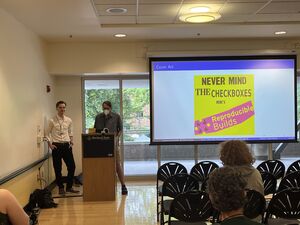
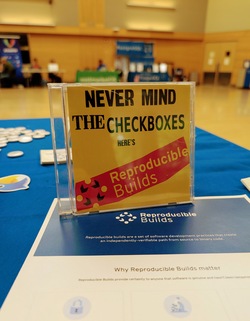
    • dropbear, prepared by Guilhem Moulin, fixes a vulnerability which could potentially result in execution of arbitrary shell commands
    • openjdk-17, openjdk-11, prepared by Thorsten Glaser, fixes several vulnerabilities, which include denial of service, information disclosure or bypass of sandbox restrictions
    • glibc, prepared by Sean Whitton, fixes a privilege escalation vulnerability
  • Notable non-security updates:
    • wireless-regdb, prepared by Ben Hutchings, updates information reflecting changes to radio regulations in many countries
This month s contributions from outside the regular team include the libapache2-mod-auth-openidc update mentioned above, prepared by Moritz Schlarb (the maintainer of the package); the update of request-tracker4, prepared by Andrew Ruthven (the maintainer of the package); and the updates of openjdk-17 and openjdk-11, also noted above, prepared by Thorsten Glaser. Additionally, LTS Team members contributed stable updates of the following packages:
  • rubygems and yelp/yelp-xsl, prepared by Lucas Kanashiro
  • simplesamlphp, prepared by Tobias Frost
  • libbson-xs-perl, prepared by Roberto C. S nchez
  • fossil, prepared by Sylvain Beucler
  • setuptools and mydumper, prepared by Lee Garrett
  • redis and webpy, prepared by Adrian Bunk
  • xrdp, prepared by Abhijith PA
  • tcpdf, prepared by Santiago Ruano Rinc n
  • kmail-account-wizard, prepared by Thorsten Alteholz
Other contributions were also made by LTS Team members to packages in unstable:
  • proftpd-dfsg DEP-8 tests (autopkgtests) were provided to the maintainer, prepared by Lucas Kanashiro
  • a regular upload of libsoup2.4, prepared by Sean Whitton
  • a regular upload of setuptools, prepared by Lee Garrett
Freexian, the entity behind the management of the Debian LTS project, has been working for some time now on the development of an advanced CI platform for Debian-based distributions, called Debusine. Recently, Debusine has reached a level of feature implementation that makes it very usable. Some members of the LTS Team have been using Debusine informally, and during May LTS coordinator Santiago Ruano Rinc n has made a call for the team to help with testing of Debusine, and to help evaluate its suitability for the LTS Team to eventually begin using as the primary mechanism for uploading packages into Debian. Team members who have started using Debusine are providing valuable feedback to the Debusine development team, thus helping to improve the platform for all users. Actually, a number of updates, for both bullseye and bookworm, made during the month of May were handled using Debusine, e.g. rubygems s DLA-4163-1. By the way, if you are a Debian Developer, you can easily test Debusine following the instructions found at https://wiki.debian.org/DebusineDebianNet. DebConf, the annual Debian Conference, is coming up in July and, as is customary each year, the week preceding the conference will feature an event called DebCamp. The DebCamp week provides an opportunity for teams and other interested groups/individuals to meet together in person in the same venue as the conference itself, with the purpose of doing focused work, often called sprints . LTS coordinator Roberto C. S nchez has announced that the LTS Team is planning to hold a sprint primarily focused on the Debian security tracker and the associated tooling used by the LTS Team and the Debian Security Team.

Thanks to our sponsors Sponsors that joined recently are in bold.

6 June 2025

Reproducible Builds: Reproducible Builds in May 2025

Welcome to our 5th report from the Reproducible Builds project in 2025! Our monthly reports outline what we ve been up to over the past month, and highlight items of news from elsewhere in the increasingly-important area of software supply-chain security. If you are interested in contributing to the Reproducible Builds project, please do visit the Contribute page on our website. In this report:
  1. Security audit of Reproducible Builds tools published
  2. When good pseudorandom numbers go bad
  3. Academic articles
  4. Distribution work
  5. diffoscope and disorderfs
  6. Website updates
  7. Reproducibility testing framework
  8. Upstream patches

Security audit of Reproducible Builds tools published The Open Technology Fund s (OTF) security partner Security Research Labs recently an conducted audit of some specific parts of tools developed by Reproducible Builds. This form of security audit, sometimes called a whitebox audit, is a form testing in which auditors have complete knowledge of the item being tested. They auditors assessed the various codebases for resilience against hacking, with key areas including differential report formats in diffoscope, common client web attacks, command injection, privilege management, hidden modifications in the build process and attack vectors that might enable denials of service. The audit focused on three core Reproducible Builds tools: diffoscope, a Python application that unpacks archives of files and directories and transforms their binary formats into human-readable form in order to compare them; strip-nondeterminism, a Perl program that improves reproducibility by stripping out non-deterministic information such as timestamps or other elements introduced during packaging; and reprotest, a Python application that builds source code multiple times in various environments in order to to test reproducibility. OTF s announcement contains more of an overview of the audit, and the full 24-page report is available in PDF form as well.

When good pseudorandom numbers go bad Danielle Navarro published an interesting and amusing article on their blog on When good pseudorandom numbers go bad. Danielle sets the stage as follows:
[Colleagues] approached me to talk about a reproducibility issue they d been having with some R code. They d been running simulations that rely on generating samples from a multivariate normal distribution, and despite doing the prudent thing and using set.seed() to control the state of the random number generator (RNG), the results were not computationally reproducible. The same code, executed on different machines, would produce different random numbers. The numbers weren t just a little bit different in the way that we ve all wearily learned to expect when you try to force computers to do mathematics. They were painfully, brutally, catastrophically, irreproducible different. Somewhere, somehow, something broke.
Thanks to David Wheeler for posting about this article on our mailing list

Academic articles There were two scholarly articles published this month that related to reproducibility: Daniel Hugenroth and Alastair R. Beresford of the University of Cambridge in the United Kingdom and Mario Lins and Ren Mayrhofer of Johannes Kepler University in Linz, Austria published an article titled Attestable builds: compiling verifiable binaries on untrusted systems using trusted execution environments. In their paper, they:
present attestable builds, a new paradigm to provide strong source-to-binary correspondence in software artifacts. We tackle the challenge of opaque build pipelines that disconnect the trust between source code, which can be understood and audited, and the final binary artifact, which is difficult to inspect. Our system uses modern trusted execution environments (TEEs) and sandboxed build containers to provide strong guarantees that a given artifact was correctly built from a specific source code snapshot. As such it complements existing approaches like reproducible builds which typically require time-intensive modifications to existing build configurations and dependencies, and require independent parties to continuously build and verify artifacts.
The authors compare attestable builds with reproducible builds by noting an attestable build requires only minimal changes to an existing project, and offers nearly instantaneous verification of the correspondence between a given binary and the source code and build pipeline used to construct it , and proceed by determining that t he overhead (42 seconds start-up latency and 14% increase in build duration) is small in comparison to the overall build time.
Timo Pohl, Pavel Nov k, Marc Ohm and Michael Meier have published a paper called Towards Reproducibility for Software Packages in Scripting Language Ecosystems. The authors note that past research into Reproducible Builds has focused primarily on compiled languages and their ecosystems, with a further emphasis on Linux distribution packages:
However, the popular scripting language ecosystems potentially face unique issues given the systematic difference in distributed artifacts. This Systemization of Knowledge (SoK) [paper] provides an overview of existing research, aiming to highlight future directions, as well as chances to transfer existing knowledge from compiled language ecosystems. To that end, we work out key aspects in current research, systematize identified challenges for software reproducibility, and map them between the ecosystems.
Ultimately, the three authors find that the literature is sparse , focusing on few individual problems and ecosystems, and therefore identify space for more critical research.

Distribution work In Debian this month:
Hans-Christoph Steiner of the F-Droid catalogue of open source applications for the Android platform published a blog post on Making reproducible builds visible. Noting that Reproducible builds are essential in order to have trustworthy software , Hans also mentions that F-Droid has been delivering reproducible builds since 2015 . However:
There is now a Reproducibility Status link for each app on f-droid.org, listed on every app s page. Our verification server shows or based on its build results, where means our rebuilder reproduced the same APK file and means it did not. The IzzyOnDroid repository has developed a more elaborate system of badges which displays a for each rebuilder. Additionally, there is a sketch of a five-level graph to represent some aspects about which processes were run.
Hans compares the approach with projects such as Arch Linux and Debian that provide developer-facing tools to give feedback about reproducible builds, but do not display information about reproducible builds in the user-facing interfaces like the package management GUIs.
Arnout Engelen of the NixOS project has been working on reproducing the minimal installation ISO image. This month, Arnout has successfully reproduced the build of the minimal image for the 25.05 release without relying on the binary cache. Work on also reproducing the graphical installer image is ongoing.
In openSUSE news, Bernhard M. Wiedemann posted another monthly update for their work there.
Lastly in Fedora news, Jelle van der Waa opened issues tracking reproducible issues in Haskell documentation, Qt6 recording the host kernel and R packages recording the current date. The R packages can be made reproducible with packaging changes in Fedora.

diffoscope & disorderfs diffoscope is our in-depth and content-aware diff utility that can locate and diagnose reproducibility issues. This month, Chris Lamb made the following changes, including preparing and uploading versions 295, 296 and 297 to Debian:
  • Don t rely on zipdetails --walk argument being available, and only add that argument on newer versions after we test for that. [ ]
  • Review and merge support for NuGet packages from Omair Majid. [ ]
  • Update copyright years. [ ]
  • Merge support for an lzma comparator from Will Hollywood. [ ][ ]
Chris also merged an impressive changeset from Siva Mahadevan to make disorderfs more portable, especially on FreeBSD. disorderfs is our FUSE-based filesystem that deliberately introduces non-determinism into directory system calls in order to flush out reproducibility issues [ ]. This was then uploaded to Debian as version 0.6.0-1. Lastly, Vagrant Cascadian updated diffoscope in GNU Guix to version 296 [ ][ ] and 297 [ ][ ], and disorderfs to version 0.6.0 [ ][ ].

Website updates Once again, there were a number of improvements made to our website this month including:

Reproducibility testing framework The Reproducible Builds project operates a comprehensive testing framework running primarily at tests.reproducible-builds.org in order to check packages and other artifacts for reproducibility. However, Holger Levsen posted to our mailing list this month in order to bring a wider awareness to funding issues faced by the Oregon State University (OSU) Open Source Lab (OSL). As mentioned on OSL s public post, recent changes in university funding makes our current funding model no longer sustainable [and that] unless we secure $250,000 in committed funds, the OSL will shut down later this year . As Holger notes in his post to our mailing list, the Reproducible Builds project relies on hardware nodes hosted there. Nevertheless, Lance Albertson of OSL posted an update to the funding situation later in the month with broadly positive news.
Separate to this, there were various changes to the Jenkins setup this month, which is used as the backend driver of for both tests.reproducible-builds.org and reproduce.debian.net, including:
  • Migrating the central jenkins.debian.net server AMD Opteron to Intel Haswell CPUs. Thanks to IONOS for hosting this server since 2012.
  • After testing it for almost ten years, the i386 architecture has been dropped from tests.reproducible-builds.org. This is because that, with the upcoming release of Debian trixie, i386 is no longer supported as a regular architecture there will be no official kernel and no Debian installer for i386 systems. As a result, a large number of nodes hosted by Infomaniak have been retooled from i386 to amd64.
  • Another node, ionos17-amd64.debian.net, which is used for verifying packages for all.reproduce.debian.net (hosted by IONOS) has had its memory increased from 40 to 64GB, and the number of cores doubled to 32 as well. In addition, two nodes generously hosted by OSUOSL have had their memory doubled to 16GB.
  • Lastly, we have been granted access to more riscv64 architecture boards, so now we have seven such nodes, all with 16GB memory and 4 cores that are verifying packages for riscv64.reproduce.debian.net. Many thanks to PLCT Lab, ISCAS for providing those.

Outside of this, a number of smaller changes were also made by Holger Levsen:
  • reproduce.debian.net-related:
    • Only use two workers for the ppc64el architecture due to RAM size. [ ]
    • Monitor nginx_request and nginx_status with the Munin monitoring system. [ ][ ]
    • Detect various variants of network and memory errors. [ ][ ][ ][ ]
    • Add a prominent link to reproducible-builds.org. [ ]
    • Add a rebuilderd-cache-cleanup.service and run it daily via timer. [ ][ ][ ][ ][ ]
    • Be more verbose what sources are being downloaded. [ ]
    • Correctly deal with packages with an epoch in their version [ ] and deal with binNMUs versions with an epoch as well [ ][ ].
    • Document how to reschedule all other errors on all archs. [ ]
    • Misc documentation improvements. [ ][ ][ ][ ]
    • Include the $HOSTNAME variable in the rebuilderd logfiles. [ ]
    • Install the equivs package on all worker nodes. [ ][ ]
  • Jenkins nodes:
    • Permit the sudo tool to fix up permission issues. [ ][ ]
    • Document how to manage diskspace with OpenStack. [ ]
    • Ignore a number of spurious monitoring errors on riscv64, FreeBSD, etc.. [ ][ ][ ][ ]
    • Install ntpsec-ntpdate (instead of ntpdate) as the former is available on Debian trixie and bookworm. [ ][ ]
    • Use the same SSH ControlPath for all nodes. [ ]
    • Make sure the munin user uses the same SSH config as the jenkins user. [ ]
  • tests.reproducible-builds.org-related:
    • Disable testing of the i386 architecture. [ ][ ][ ][ ][ ]
    • Document the current disk usage. [ ][ ]
    • Address some image placement now that we only test three architectures. [ ]
    • Keep track of build performance. [ ]
  • Misc:
    • Fix a (harmless) typo in the multiarch_versionskew script. [ ]
In addition, Jochen Sprickerhof made a series of changes related to reproduce.debian.net:
  • Add out of memory detection to the statistics page. [ ]
  • Reverse the sorting order on the statistics page. [ ][ ][ ][ ]
  • Improve the spacing between statistics groups. [ ]
  • Update a (hard-coded) line number in error message detection pertaining to a debrebuild line number. [ ]
  • Support Debian unstable in the rebuilder-debian.sh script. [ ] ]
  • Rely on rebuildctl to sync only arch-specific packages. [ ][ ]

Upstream patches The Reproducible Builds project detects, dissects and attempts to fix as many currently-unreproducible packages as possible. This month, we wrote a large number of such patches, including:

Finally, if you are interested in contributing to the Reproducible Builds project, please visit our Contribute page on our website. However, you can get in touch with us via:

16 May 2025

Freexian Collaborators: Monthly report about Debian Long Term Support, April 2025 (by Roberto C. S nchez)

Like each month, have a look at the work funded by Freexian s Debian LTS offering.

Debian LTS contributors In April, 22 contributors have been paid to work on Debian LTS, their reports are available:
  • Adrian Bunk did 56.25h (out of 56.25h assigned).
  • Andreas Henriksson did 15.0h (out of 20.0h assigned), thus carrying over 5.0h to the next month.
  • Andrej Shadura did 10.0h (out of 6.0h assigned and 4.0h from previous period).
  • Bastien Roucari s did 31.5h (out of 31.5h assigned).
  • Ben Hutchings did 8.0h (out of 0.0h assigned and 12.0h from previous period), thus carrying over 4.0h to the next month.
  • Carlos Henrique Lima Melara did 11.0h (out of 12.0h assigned), thus carrying over 1.0h to the next month.
  • Chris Lamb did 18.0h (out of 18.0h assigned).
  • Daniel Leidert did 26.0h (out of 26.0h assigned).
  • Emilio Pozuelo Monfort did 30.0h (out of 39.25h assigned and 0.25h from previous period), thus carrying over 9.5h to the next month.
  • Guilhem Moulin did 8.5h (out of 3.25h assigned and 11.75h from previous period), thus carrying over 6.5h to the next month.
  • Jochen Sprickerhof did 12.5h (out of 20.75h assigned and 9.25h from previous period), thus carrying over 17.5h to the next month.
  • Lee Garrett did 26.25h (out of 7.75h assigned and 31.75h from previous period), thus carrying over 13.25h to the next month.
  • Lucas Kanashiro did 50.0h (out of 0.0h assigned and 52.0h from previous period), thus carrying over 2.0h to the next month.
  • Markus Koschany did 39.5h (out of 39.5h assigned).
  • Roberto C. S nchez did 9.0h (out of 0.0h assigned and 12.0h from previous period), thus carrying over 3.0h to the next month.
  • Santiago Ruano Rinc n did 12.5h (out of 7.5h assigned and 7.5h from previous period), thus carrying over 2.5h to the next month.
  • Sean Whitton did 7.0h (out of 7.0h assigned).
  • Stefano Rivera did 0.5h (out of 0.0h assigned and 10.0h from previous period), thus carrying over 9.5h to the next month.
  • Sylvain Beucler did 39.5h (out of 39.25h assigned and 0.25h from previous period).
  • Thorsten Alteholz did 15.0h (out of 15.0h assigned).
  • Tobias Frost did 12.0h (out of 7.75h assigned and 4.25h from previous period).
  • Utkarsh Gupta did 2.0h (out of 2.0h assigned).

Evolution of the situation In April, we released 46 DLAs.
  • Notable security updates:
    • jetty9, prepared by Markus Koschany, fixes an information disclosure and potential remote code execution vulnerability
    • zabbix, prepared by Tobias Frost, fixes several vulnerabilities, encompassing denial of service, information disclosure or remote code inclusion
    • glibc, prepared by Sean Whitton, fixes a buffer overflow vulnerability
  • Notable non-security updates:
    • tzdata, prepared by Emilio Pozuelo Monfort, brings the latest timezone database release
    • php-horde-editor and php-horde-imp, prepared by Sylvain Beucler, have been updated to switch from CKEditor v3, which is EOL, to CKEditor v4; this builds upon work done last month by Sylvain and Bastien for the complete removal of ckeditor3
    • distro-info-data, prepared by Stefano Rivera, adds information concerning future Debian and Ubuntu releases
The LTS team continues to welcome the collaboration of maintainers and other interested parties from outside the regular team. In April, we had external updates contributed by: Yadd - lemonldap-ng and Moritz Schlarb - libapache2-mod-auth-openidc A point release of the current stable Debian 12 (codename bookworm ) is planned for mid-May and several LTS contributors have prepared packages for this update, many of them prepared in conjunction with related LTS updates of the same packages:
  • glib2.0, haproxy, imagemagick, poppler, and python-h11, prepared by Adrian Bunk
  • rubygems, prepared by Lucas Kanashiro
  • ruby3.1 (in collaboration with Lucas Kanashiro), twitter-bootstrap3, twitterboot-strap4, wpa, and erlang, prepared by Bastien Roucari s (corresponding updates of twitter-bootstrap3 and twitter-bootstrap4 were also uploaded to Debian unstable)
  • abseil, prepared by Tobias Frost (a corresponding update was also uploaded to Debian unstable)
  • vips, prepared by Guilhem Moulin
Additional updates of ruby3.3 and rubygems were prepared for Debian unstable by Lucas Kanashiro. And finally, a highlight of our continued commitment to enhancing long term support efforts in upstream projects. Freexian, as the primary entity behind the management and execution of the LTS project, has partnered with Invisible Things Lab to extend the upstream security support of Xen 4.17, which is shipped in Debian 12 bookworm (the current stable release). This partnership will result in significantly improved lifecycle support for users of Xen on bookworm, and members of the LTS team will play a part in this endeavour. The Freexian announcement has additional details.

Thanks to our sponsors Sponsors that joined recently are in bold.

Next.

Previous.