Search Results: "jelmer"

11 April 2021

Jelmer Vernooij: The upstream ontologist

The Debian Janitor is an automated system that commits fixes for (minor) issues in Debian packages that can be fixed by software. It gradually started proposing merges in early December. The first set of changes sent out ran lintian-brush on sid packages maintained in Git. This post is part of a series about the progress of the Janitor. The upstream ontologist is a project that extracts metadata about upstream projects in a consistent format. It does this with a combination of heuristics and reading ecosystem-specific metadata files, such as Python s setup.py, rust s Cargo.toml as well as e.g. scanning README files.

Supported Data Sources It will extract information from a wide variety of sources, including:
Supported Fields Fields that it currently provides include:
  • Homepage: homepage URL
  • Name: name of the upstream project
  • Contact: contact address of some sort of the upstream (e-mail, mailing list URL)
  • Repository: VCS URL
  • Repository-Browse: Web URL for viewing the VCS
  • Bug-Database: Bug database URL (for web viewing, generally)
  • Bug-Submit: URL to use to submit new bugs (either on the web or an e-mail address)
  • Screenshots: List of URLs with screenshots
  • Archive: Archive used - e.g. SourceForge
  • Security-Contact: e-mail or URL with instructions for reporting security issues
  • Documentation: Link to documentation on the web:
  • Wiki: Wiki URL
  • Summary: one-line description of the project
  • Description: longer description of the project
  • License: Single line license description (e.g. GPL 2.0 ) as declared in the metadata[1]
  • Copyright: List of copyright holders
  • Version: Current upstream version
  • Security-MD: URL to markdown file with security policy
All data fields have a certainty associated with them ( certain , confident , likely or possible ), which gets set depending on how the data was derived or where it was found. If multiple possible values were found for a specific field, then the value with the highest certainty is taken.
Interface The ontologist provides a high-level Python API as well as two command-line tools that can write output in two different formats: For example, running guess-upstream-metadata on dulwich:
 % guess-upstream-metadata
 <string>:2: (INFO/1) Duplicate implicit target name: "contributing".
 Name: dulwich
 Repository: https://www.dulwich.io/code/
 X-Security-MD: https://github.com/dulwich/dulwich/tree/HEAD/SECURITY.md
 X-Version: 0.20.21
 Bug-Database: https://github.com/dulwich/dulwich/issues
 X-Summary: Python Git Library
 X-Description:  
   This is the Dulwich project.
   It aims to provide an interface to git repos (both local and remote) that
   doesn't call out to git directly but instead uses pure Python.
 X-License: Apache License, version 2 or GNU General Public License, version 2 or later.
 Bug-Submit: https://github.com/dulwich/dulwich/issues/new
Lintian-Brush lintian-brush can update DEP-12-style debian/upstream/metadata files that hold information about the upstream project that is packaged as well as the Homepage in the debian/control file based on information provided by the upstream ontologist. By default, it only imports data with the highest certainty - you can override this by specifying the uncertain command-line flag.
[1]Obviously this won t be able to describe the full licensing situation for many projects. Projects like scancode-toolkit are more appropriate for that.

6 April 2021

Jelmer Vernooij: Automatic Fixing of Debian Build Dependencies

The Debian Janitor is an automated system that commits fixes for (minor) issues in Debian packages that can be fixed by software. It gradually started proposing merges in early December. The first set of changes sent out ran lintian-brush on sid packages maintained in Git. This post is part of a series about the progress of the Janitor. In my last blogpost, I introduced the buildlog consultant - a tool that can identify many reasons why a Debian build failed. For example, here s a fragment of a build log where the Build-Depends lack python3-setuptools:
849
850
851
852
853
854
855
856
857
858
 dpkg-buildpackage: info: host architecture amd64
  fakeroot debian/rules clean
 dh clean --with python3,sphinxdoc --buildsystem=pybuild
    dh_auto_clean -O--buildsystem=pybuild
 I: pybuild base:232: python3.9 setup.py clean
 Traceback (most recent call last):
   File "/<<PKGBUILDDIR>>/setup.py", line 2, in <module>
     from setuptools import setup
 ModuleNotFoundError: No module named 'setuptools'
 E: pybuild pybuild:353: clean: plugin distutils failed with: exit code=1: python3.9 setup.py clean
The buildlog consultant can identify the line in bold as being key, and interprets it:

 % analyse-sbuild-log --json ~/build.log
  
    "stage": "build",
    "section": "Build",
    "lineno": 857,
    "kind": "missing-python-module",
    "details":  "module": "setuptools", "python_version": 3, "minimum_version": null 
  
Automatically acting on buildlog problems A common reason why Debian builds fail is missing dependencies or incorrect versions of dependencies declared in the package build depends. Based on the output of the buildlog consultant, it is possible in many cases to determine what dependency needs to be added to Build-Depends. In the example given above, we can use apt-file to look for the package that contains the path /usr/lib/python3/dist-packages/setuptools/__init__.py - and voila, we find python3-setuptools:
 % apt-file search /usr/lib/python3/dist-packages/setuptools/__init__.py
 python3-setuptools: /usr/lib/python3/dist-packages/setuptools/__init__.py
The deb-fix-build command automates these steps:
  1. It builds the package using sbuild; if the package successfully builds then it just exits successfully
  2. It tries to identify the problem by looking through the build log; if it can t or if it s a problem it has seen before (but apparently failed to resolve), then it exits with a non-zero exit code
  3. It tries to find a dependency that can address the problem
  4. It updates Build-Depends in debian/control or Depends in debian/tests/control
  5. Go to step 1
This takes away the tedious manual process of building a package, discovering that a dependency is missing, updating Build-Depends and trying again. For example, when I ran deb-fix-build while packaging saneyaml, the output looks something like this:
 % deb-fix-build
 Using output directory /tmp/tmpyz0nkgqq
 Using sbuild chroot unstable-amd64-sbuild
 Using fixers:  
 Building debian packages, running 'sbuild --no-clean-source -A -s -v'.
 Attempting to use fixer upstream requirement fixer(apt) to address MissingPythonDistribution('setuptools_scm', python_version=3, minimum_version='4')
 Using apt-file to search apt contents
 Adding build dependency: python3-setuptools-scm (>= 4)
 Building debian packages, running 'sbuild --no-clean-source -A -s -v'.
 Attempting to use fixer upstream requirement fixer(apt) to address MissingPythonDistribution('toml', python_version=3, minimum_version=None)
 Adding build dependency: python3-toml
 Building debian packages, running 'sbuild --no-clean-source -A -s -v'.
 Built 0.5.2-1- changes files at [ saneyaml_0.5.2-1_amd64.changes ].
And in our Git repository, we see these changes as well:
% git log -p
 commit 5a1715f4c7273b042818fc75702f2284034c7277 (HEAD -> master)
 Author: Jelmer Vernoo  <jelmer@jelmer.uk>
 Date:   Sun Apr 4 02:35:56 2021 +0100
     Add missing build dependency on python3-toml.
 diff --git a/debian/control b/debian/control
 index 5b854dc..3b27b73 100644
 --- a/debian/control
 +++ b/debian/control
 @@ -1,6 +1,6 @@
  Rules-Requires-Root: no
  Standards-Version: 4.5.1
 -Build-Depends: debhelper-compat (= 12), dh-sequence-python3, python3-all, python3-setuptools (>= 50), python3-wheel, python3-setuptools-scm (>= 4)
 +Build-Depends: debhelper-compat (= 12), dh-sequence-python3, python3-all, python3-setuptools (>= 50), python3-wheel, python3-setuptools-scm (>= 4), python3-toml
  Testsuite: autopkgtest-pkg-python
  Source: python-saneyaml
  Priority: optional
 commit f03047da80fcd8468ee231fbc4cf8488d7a0acd1
 Author: Jelmer Vernoo  <jelmer@jelmer.uk>
 Date:   Sun Apr 4 02:35:34 2021 +0100
     Add missing build dependency on python3-setuptools-scm (>= 4).
 diff --git a/debian/control b/debian/control
 index a476cc2..5b854dc 100644
 --- a/debian/control
 +++ b/debian/control
 @@ -1,6 +1,6 @@
  Rules-Requires-Root: no
  Standards-Version: 4.5.1
 -Build-Depends: debhelper-compat (= 12), dh-sequence-python3, python3-all, python3-setuptools (>= 50), python3-wheel
 +Build-Depends: debhelper-compat (= 12), dh-sequence-python3, python3-all, python3-setuptools (>= 50), python3-wheel, python3-setuptools-scm (>= 4)
  Testsuite: autopkgtest-pkg-python
  Source: python-saneyaml
  Priority: optional
Using deb-fix-build You can run deb-fix-build by installing the ognibuild package from unstable. The only requirements for using it are that:
  • The package is maintained in Git
  • A sbuild schroot is available for use
Caveats deb-fix-build is fairly easy to understand, and if it doesn t work then you re no worse off than you were without it - you ll have to add your own Build-Depends. That said, there are a couple of things to keep in mind:
  • At the moment, it doesn t distinguish between general, Arch or Indep Build-Depends.
  • It can only add dependencies for things that are actually in the archive
  • Sometimes there are multiple packages that can provide a file, command or python package - it tries to find the right one with heuristics but doesn t always get it right

5 April 2021

Jelmer Vernooij: The Buildlog Consultant

Reading build logs Build logs for Debian packages can be quite long and difficult for a human to read. Anybody who has looked at these logs trying to figure out why a build failed will have spent time scrolling through them and skimming for certain phrases (lines starting with error: for example). In many cases, you can spot the problem in the last 10 or 20 lines of output but it s also quite common that the error is somewhere at the beginning of many pages of error output.
The buildlog consultant The buildlog consultant project attempts to aid in this process by parsing sbuild and non-Debian (e.g. the output of make ) build logs and trying to identify the key line that explains why a build failed. It can then either display this specific line, or a fragment of the log around surrounding the key line.
Classification In addition to finding the key line explaining the failure, it can also classify and parse the error in many cases and return a result code and some metadata. For example, in a failed build of gnss-sdr that has produced 2119 lines of output, the reason for the failure is that log4cpp is missing which is on line 641:
634
635
636
637
638
639
640
641
642
643
644
645
646
647
 -- Required GNU Radio Component: ANALOG missing!
 -- Could NOT find GNURADIO (missing: GNURADIO_RUNTIME_FOUND)
 -- Could NOT find PkgConfig (missing: PKG_CONFIG_EXECUTABLE)
 -- Could NOT find LOG4CPP (missing: LOG4CPP_INCLUDE_DIRS
 LOG4CPP_LIBRARIES)
 CMake Error at CMakeLists.txt:593 (message):
   *** Log4cpp is required to build gnss-sdr
 -- Configuring incomplete, errors occurred!
 See also "/<<PKGBUILDDIR>>/obj-x86_64-linux-gnu/CMakeFiles/
 CMakeOutput.log".
 See also "/<<PKGBUILDDIR>>/obj-x86_64-linux-gnu/CMakeFiles/
 CMakeError.log".
In this case, the buildlog consultant can both figure out line was problematic and what the problem was:
 % analyse-sbuild-log build.log
 Failed stage: build
 Section: build
 Failed line: 641:
   *** Log4cpp is required to build gnss-sdr
 Error: Missing dependency: Log4cpp
Or, if you'd like to do something else with the output, use JSON output:
 % analyse-sbuild-log --json build.log
  "stage": "build", "section": "Build", "lineno": 641, "kind": "missing-dependency", "details":  "name": "Log4cpp"" 
How it works The consultant does some structured parsing (most notably it can parse the sections from a sbuild log), but otherwise is a large set of carefully crafted regular expressions and heuristics. It doesn t always find the problem, but has proven to be fairly accurate. It is constantly improved as part of the Debian Janitor project, and that exposes it to a wide variety of different errors. You can see the classification and error detection in action on the result codes page of the Janitor.
Using the buildlog consultant You can get the buildlog consultant from either pip or Debian unstable (package: python3-buildlog-consultant ). The buildlog consultant comes with two scripts analyse-build-log and analyse-sbuild-log, for analysing build logs and sbuild logs respectively.

25 March 2021

Jelmer Vernooij: The Buildlog Consultant

With Debian packages now widely being maintained in Git repositories, there has been an uptick in the number of bulk changes made to Debian packages. Several maintainers are running commands over many packages (e.g. all packages owned by a specific team) to fix common issues in packages. Examples of changes being made include:
  • Updating the Vcs-Git and Vcs-Browser URLs after migrating from alioth to salsa
  • Stripping trailing whitespace in various control files
  • Updating e.g. homepage URLs to use https rather than http
Most of these can be fixed with simple sed or perl one-liners. Some of these scripts are publically available, for example:
Lintian-Brush Lintian-Brush is both a simple wrapper around a set of these kinds of scripts and a repository for these scripts, with the goal of making it easy for any Debian maintainer to run them. The lintian-brush command-line tool is a simple wrapper that runs a set of "fixer scripts", and for each:
  • Reverts the changes made by the script if it failed with an error
  • Commits the changes to the VCS with an appropriate commit message
  • Adds a changelog entry (if desired)
The tool also provides some basic infrastructure for testing that these scripts do what they should, and e.g. don't have unintended side-effects. The idea is that it should be safe, quick and unobtrusive to run lintian-brush, and get it to opportunistically fix lintian issues and to leave the source tree alone when it can't.
Example For example, running lintian-brush on the package talloc fixes two minor lintian issues:
 % debcheckout talloc
 declared git repository at https://salsa.debian.org/samba-team/talloc.git
 git clone https://salsa.debian.org/samba-team/talloc.git talloc ...
 Cloning into 'talloc'...
 remote: Enumerating objects: 2702, done.
 remote: Counting objects: 100% (2702/2702), done.
 remote: Compressing objects: 100% (996/996), done.
 remote: Total 2702 (delta 1627), reused 2601 (delta 1550)
 Receiving objects: 100% (2702/2702), 1.70 MiB   565.00 KiB/s, done.
 Resolving deltas: 100% (1627/1627), done.
 % cd talloc
 talloc% lintian-brush
 Lintian tags fixed:  'insecure-copyright-format-uri', 'public-upstream-key-not-minimal' 
 % git log
 commit 0ea35f4bb76f6bca3132a9506189ef7531e5c680 (HEAD -> master)
 Author: Jelmer Vernoo  <jelmer@debian.org>
 Date:   Tue Dec 4 16:42:35 2018 +0000
     Re-export upstream signing key without extra signatures.
     Fixes lintian: public-upstream-key-not-minimal
     See https://lintian.debian.org/tags/public-upstream-key-not-minimal.html for more details.
  debian/changelog                    1 +
  debian/upstream/signing-key.asc   102 +++++++++++++++---------------------------------------------------------------------------------------
  2 files changed, 16 insertions(+), 87 deletions(-)
 commit feebce3147df561aa51a385c53d8759b4520c67f
 Author: Jelmer Vernoo  <jelmer@debian.org>
 Date:   Tue Dec 4 16:42:28 2018 +0000
     Use secure copyright file specification URI.
     Fixes lintian: insecure-copyright-format-uri
     See https://lintian.debian.org/tags/insecure-copyright-format-uri.html for more details.
  debian/changelog   3 +++
  debian/copyright   2 +-
  2 files changed, 4 insertions(+), 1 deletion(-)
Script Interface A fixer script is run in the root directory of a package, where it can make changes it deems necessary, and write a summary of what it's done for the changelog (and commit message) to standard out. If a fixer can not provide any improvements, it can simply leave the working tree untouched - lintian-brush will not create any commits for it or update the changelog. If it exits with a non-zero exit code, then it is assumed that it failed to run and it will be listed as such and its changes reset rather than committed. In addition, tests can be added for fixers by providing various before and after source package trees, to verify that a fixer script makes the expected changes. For more details, see the documentation on writing new fixers.
Availability lintian-brush is currently available in unstable and testing. See man lintian-brush(1) for an explanation of the command-line options. Fixer scripts are included that can fix (some of the instances of) 34 lintian tags. Feedback would be great if you try lintian-brush - please file bugs in the BTS, or propose pull requests with new fixers on salsa.

27 November 2020

Reproducible Builds (diffoscope): diffoscope 162 released

The diffoscope maintainers are pleased to announce the release of diffoscope version 162. This version includes the following changes:
[ Chris Lamb ]
* Don't depends on radare2 in the Debian autopkgtests as it will not be in
  bullseye due to security considerations (#950372). (Closes: #975313)
* Avoid "Command  s p a c e d o u t  failed" messages when creating an
  artificial CalledProcessError instance in our generic from_operation
  feeder creator.
* Overhaul long and short descriptions.
* Use the operation's full name so that "command failed" messages include
  its arguments.
* Add a missing comma in a comment.
[ Jelmer Vernoo  ]
* Add missing space to the error message when only one argument is passed to
  diffoscope.
[ Holger Levsen ]
* Update Standards-Version to 4.5.1.
[ Mattia Rizzolo ]
* Split the diffoscope package into a diffoscope-minimal package that
  excludes the larger packages from Recommends. (Closes: #975261)
* Drop support for Python 3.6.
You find out more by visiting the project homepage.

24 October 2020

Jelmer Vernooij: Debian Janitor: Hosters used by Debian packages

The Debian Janitor is an automated system that commits fixes for (minor) issues in Debian packages that can be fixed by software. It gradually started proposing merges in early December. The first set of changes sent out ran lintian-brush on sid packages maintained in Git. This post is part of a series about the progress of the Janitor. The Janitor knows how to talk to different hosting platforms. For each hosting platform, it needs to support the platform- specific API for creating and managing merge proposals. For each hoster it also needs to have credentials. At the moment, it supports the GitHub API, Launchpad API and GitLab API. Both GitHub and Launchpad have only a single instance; the GitLab instances it supports are gitlab.com and salsa.debian.org. This provides coverage for the vast majority of Debian packages that can be accessed using Git. More than 75% of all packages are available on salsa - although in some cases, the Vcs-Git header has not yet been updated. Of the other 25%, the majority either does not declare where it is hosted using a Vcs-* header (10.5%), or have not yet migrated from alioth to another hosting platform (9.7%). A further 2.3% are hosted somewhere on GitHub (2%), Launchpad (0.18%) or GitLab.com (0.15%), in many cases in the same repository as the upstream code. The remaining 1.6% are hosted on many other hosts, primarily people s personal servers (which usually don t have an API for creating pull requests). Packages per hoster

Outdated Vcs-* headers It is possible that the 20% of packages that do not have a Vcs-* header or have a Vcs header that say there on alioth are actually hosted elsewhere. However, it is hard to know where they are until a version with an updated Vcs-Git header is uploaded. The Janitor primarily relies on vcswatch to find the correct locations of repositories. vcswatch looks at Vcs-* headers but has its own heuristics as well. For about 2,000 packages (6%) that still have Vcs-* headers that point to alioth, vcswatch successfully finds their new home on salsa.
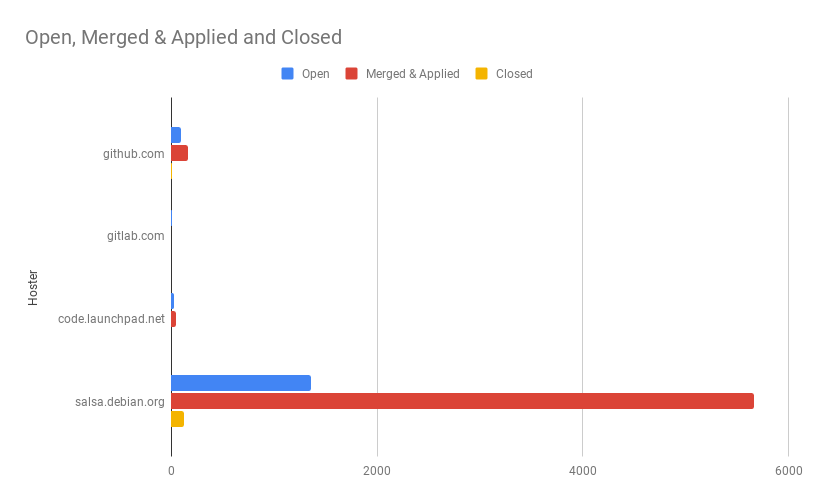
Merge Proposals by Hoster These proportions are also visible in the number of pull requests created by the Janitor on various hosters. The vast majority so far has been created on Salsa.
Hoster Open Merged & Applied Closed
github.com921685
gitlab.com1230
code.launchpad.net24511
salsa.debian.org1,3605,657126
Merge Proposal statistics In this graph, Open means that the pull request has been created but likely nobody has looked at it yet. Merged means that the pull request has been marked as merged on the hoster, and applied means that the changes have ended up in the packaging branch but via a different route (e.g. cherry-picked or manually applied). Closed means that the pull request was closed without the changes being incorporated. Note that this excludes ~5,600 direct pushes, all of which were to salsa-hosted repositories. See also:
For more information about the Janitor's lintian-fixes efforts, see the landing page.

15 October 2020

Jelmer Vernooij: Debian Janitor: How to Contribute Lintian-Brush Fixers

The Debian Janitor is an automated system that commits fixes for (minor) issues in Debian packages that can be fixed by software. It gradually started proposing merges in early December. The first set of changes sent out ran lintian-brush on sid packages maintained in Git. This post is part of a series about the progress of the Janitor. lintian-brush can currently fix about 150 different issues that lintian can report, but that's still a small fraction of the more than thousand different types of issue that lintian can detect. If you're interested in contributing a fixer script to lintian-brush, there is now a guide that describes all steps of the process:

  1. how to identify lintian tags that are good candidates for automated fixing
  2. creating test cases
  3. writing the actual fixer

For more information about the Janitor's lintian-fixes efforts, see the landing page.

19 September 2020

Jelmer Vernooij: Debian Janitor: Expanding Into Improving Multi-Arch

The Debian Janitor is an automated system that commits fixes for (minor) issues in Debian packages that can be fixed by software. It gradually started proposing merges in early December. The first set of changes sent out ran lintian-brush on sid packages maintained in Git. This post is part of a series about the progress of the Janitor. As of dpkg 1.16.2 and apt 0.8.13, Debian has full support for multi-arch. To quote from the multi-arch implementation page:

Multiarch lets you install library packages from multiple architectures on the same machine. This is useful in various ways, but the most common is installing both 64 and 32- bit software on the same machine and having dependencies correctly resolved automatically. In general you can have libraries of more than one architecture installed together and applications from one architecture or another installed as alternatives.
The Multi-Arch specification describes a new Multi-Arch header which can be used to indicate how to resolve cross-architecture dependencies. The existing Debian Multi-Arch hinter is a version of dedup.debian.net that compares binary packages between architectures and suggests fixes to resolve multi-arch problems. It provides hints as to what Multi- Arch fields can be set, allowing the packages to be safely installed in a Multi-Arch world. The full list of almost 10,000 hints generated by the hinter is available at https://dedup.debian.net/static/multiarch-hints.yaml. Recent versions of lintian-brush now include a command called apply-multiarch-hints that downloads and locally caches the hints and can apply them to a package maintained in Git. For example, to apply multi-arch hints to autosize.js:
 $ debcheckout autosize.js
 declared git repository at https://salsa.debian.org/js-team/autosize.js.git
 git clone https://salsa.debian.org/js-team/autosize.js.git autosize.js ...
 Cloning into 'autosize.js'...
 [...]
 $ cd autosize.js
 $ apply-multiarch-hints
 Downloading new version of multi-arch hints.
 libjs-autosize: Add Multi-Arch: foreign.
 node-autosize: Add Multi-Arch: foreign.
 $ git log -p
 commit 3f8d1db5af4a87e6ebb08f46ddf79f6adf4e95ae (HEAD -> master)
 Author: Jelmer Vernoo  <jelmer@debian.org>
 Date:   Fri Sep 18 23:37:14 2020 +0000
     Apply multi-arch hints.
     + libjs-autosize, node-autosize: Add Multi-Arch: foreign.
     Changes-By: apply-multiarch-hints
 diff --git a/debian/changelog b/debian/changelog
 index e7fa120..09af4a7 100644
 --- a/debian/changelog
 +++ b/debian/changelog
 @@ -1,3 +1,10 @@
 +autosize.js (4.0.2~dfsg1-5) UNRELEASED; urgency=medium
 +
 +  * Apply multi-arch hints.
 +    + libjs-autosize, node-autosize: Add Multi-Arch: foreign.
 +
 + -- Jelmer Vernoo  <jelmer@debian.org>  Fri, 18 Sep 2020 23:37:14 -0000
 +
  autosize.js (4.0.2~dfsg1-4) unstable; urgency=medium
    * Team upload
 diff --git a/debian/control b/debian/control
 index 01ca968..fbba1ae 100644
 --- a/debian/control
 +++ b/debian/control
 @@ -20,6 +20,7 @@ Architecture: all
  Depends: $ misc:Depends 
  Recommends: javascript-common
  Breaks: ruby-rails-assets-autosize (<< 4.0)
 +Multi-Arch: foreign
  Description: script to automatically adjust textarea height to fit text - NodeJS
   Autosize is a small, stand-alone script to automatically adjust textarea
   height to fit text. The autosize function accepts a single textarea element,
 @@ -32,6 +33,7 @@ Package: node-autosize
  Architecture: all
  Depends: $ misc:Depends 
   , nodejs
 +Multi-Arch: foreign
  Description: script to automatically adjust textarea height to fit text - Javascript
   Autosize is a small, stand-alone script to automatically adjust textarea
   height to fit text. The autosize function accepts a single textarea element,
The Debian Janitor also has a new multiarch-fixes suite that runs apply-multiarch-hints across packages in the archive and proposes merge requests. For example, you can see the merge request against autosize.js here.

For more information about the Janitor's lintian-fixes efforts, see the landing page.

12 September 2020

Jelmer Vernooij: Debian Janitor: All Packages Processed with Lintian-Brush

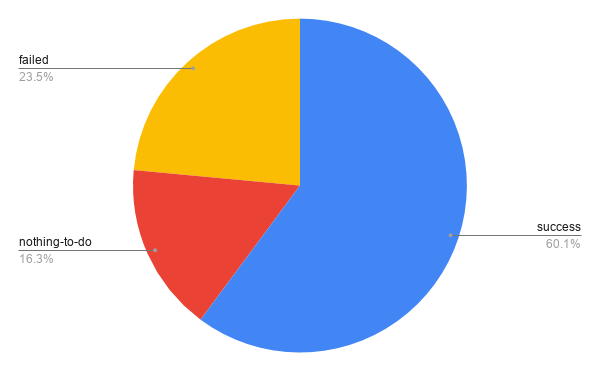
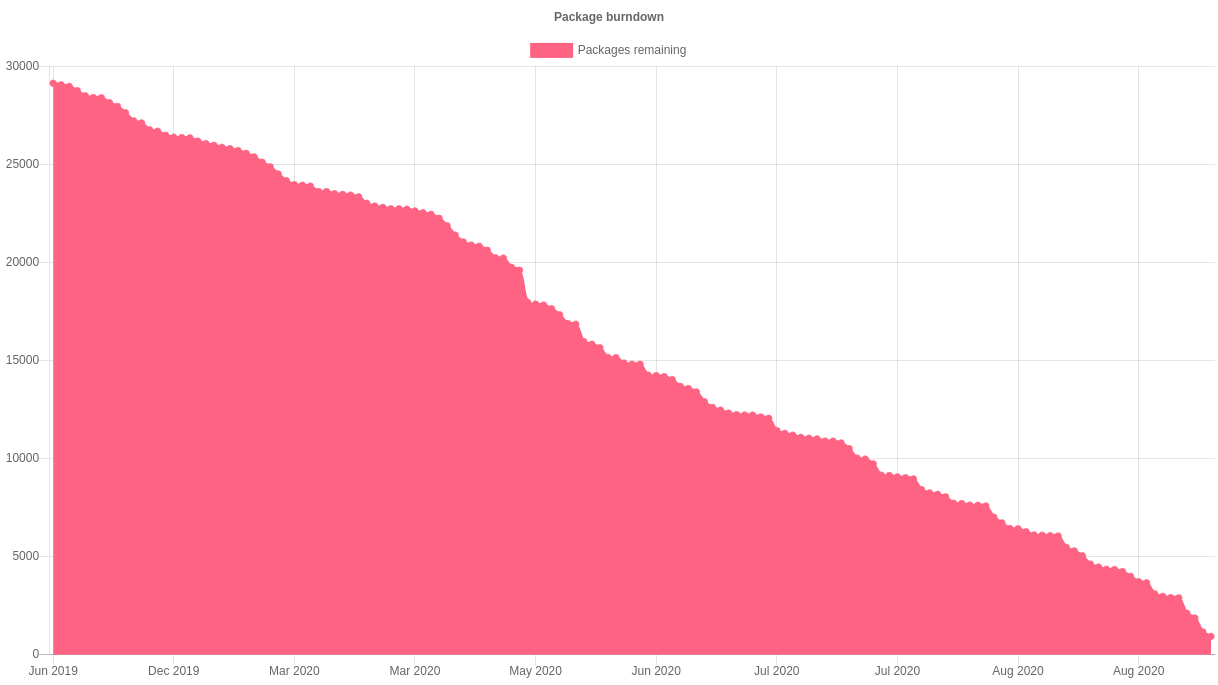
The Debian Janitor is an automated system that commits fixes for (minor) issues in Debian packages that can be fixed by software. It gradually started proposing merges in early December. The first set of changes sent out ran lintian-brush on sid packages maintained in Git. This post is part of a series about the progress of the Janitor. On 12 July 2019, the Janitor started fixing lintian issues in packages in the Debian archive. Now, a year and a half later, it has processed every one of the almost 28,000 packages at least once. Graph with Lintian Fixes Burndown As discussed two weeks ago, this has resulted in roughly 65,000 total changes. These 65,000 changes were made to a total of almost 17,000 packages. Of the remaining packages, for about 4,500 lintian-brush could not make any improvements. The rest (about 6,500) failed to be processed for one of many reasons they are e.g. not yet migrated off alioth, use uncommon formatting that can't be preserved or failed to build for one reason or another. Graph with runs by status (success, failed, nothing-to-do) Now that the entire archive has been processed, packages are prioritized based on the likelihood of a change being made to them successfully. Over the course of its existence, the Janitor has slowly gained support for a wider variety of packaging methods. For example, it can now edit the templates for some of the generated control files. Many of the packages that the janitor was unable to propose changes for the first time around are expected to be correctly handled when they are reprocessed. If you re a Debian developer, you can find the list of improvements made by the janitor in your packages by going to https://janitor.debian.net/m/.

For more information about the Janitor's lintian-fixes efforts, see the landing page.

9 September 2020

Reproducible Builds: Reproducible Builds in August 2020

Welcome to the August 2020 report from the Reproducible Builds project. In our monthly reports, we summarise the things that we have been up to over the past month. The motivation behind the Reproducible Builds effort is to ensure no flaws have been introduced from the original free software source code to the pre-compiled binaries we install on our systems. If you re interested in contributing to the project, please visit our main website.


This month, Jennifer Helsby launched a new reproduciblewheels.com website to address the lack of reproducibility of Python wheels. To quote Jennifer s accompanying explanatory blog post:
One hiccup we ve encountered in SecureDrop development is that not all Python wheels can be built reproducibly. We ship multiple (Python) projects in Debian packages, with Python dependencies included in those packages as wheels. In order for our Debian packages to be reproducible, we need that wheel build process to also be reproducible
Parallel to this, transparencylog.com was also launched, a service that verifies the contents of URLs against a publicly recorded cryptographic log. It keeps an append-only log of the cryptographic digests of all URLs it has seen. (GitHub repo) On 18th September, Bernhard M. Wiedemann will give a presentation in German, titled Wie reproducible builds Software sicherer machen ( How reproducible builds make software more secure ) at the Internet Security Digital Days 2020 conference.

Reproducible builds at DebConf20 There were a number of talks at the recent online-only DebConf20 conference on the topic of reproducible builds. Holger gave a talk titled Reproducing Bullseye in practice , focusing on independently verifying that the binaries distributed from ftp.debian.org are made from their claimed sources. It also served as a general update on the status of reproducible builds within Debian. The video (145 MB) and slides are available. There were also a number of other talks that involved Reproducible Builds too. For example, the Malayalam language mini-conference had a talk titled , ? ( I want to join Debian, what should I do? ) presented by Praveen Arimbrathodiyil, the Clojure Packaging Team BoF session led by Elana Hashman, as well as Where is Salsa CI right now? that was on the topic of Salsa, the collaborative development server that Debian uses to provide the necessary tools for package maintainers, packaging teams and so on. Jonathan Bustillos (Jathan) also gave a talk in Spanish titled Un camino verificable desde el origen hasta el binario ( A verifiable path from source to binary ). (Video, 88MB)

Development work After many years of development work, the compiler for the Rust programming language now generates reproducible binary code. This generated some general discussion on Reddit on the topic of reproducibility in general. Paul Spooren posted a request for comments to OpenWrt s openwrt-devel mailing list asking for clarification on when to raise the PKG_RELEASE identifier of a package. This is needed in order to successfully perform rebuilds in a reproducible builds context. In openSUSE, Bernhard M. Wiedemann published his monthly Reproducible Builds status update. Chris Lamb provided some comments and pointers on an upstream issue regarding the reproducibility of a Snap / SquashFS archive file. [ ]

Debian Holger Levsen identified that a large number of Debian .buildinfo build certificates have been tainted on the official Debian build servers, as these environments have files underneath the /usr/local/sbin directory [ ]. He also filed against bug for debrebuild after spotting that it can fail to download packages from snapshot.debian.org [ ]. This month, several issues were uncovered (or assisted) due to the efforts of reproducible builds. For instance, Debian bug #968710 was filed by Simon McVittie, which describes a problem with detached debug symbol files (required to generate a traceback) that is unlikely to have been discovered without reproducible builds. In addition, Jelmer Vernooij called attention that the new Debian Janitor tool is using the property of reproducibility (as well as diffoscope when applying archive-wide changes to Debian:
New merge proposals also include a link to the diffoscope diff between a vanilla build and the build with changes. Unfortunately these can be a bit noisy for packages that are not reproducible yet, due to the difference in build environment between the two builds. [ ]
56 reviews of Debian packages were added, 38 were updated and 24 were removed this month adding to our knowledge about identified issues. Specifically, Chris Lamb added and categorised the nondeterministic_version_generated_by_python_param and the lessc_nondeterministic_keys toolchain issues. [ ][ ] Holger Levsen sponsored Lukas Puehringer s upload of the python-securesystemslib pacage, which is a dependency of in-toto, a framework to secure the integrity of software supply chains. [ ] Lastly, Chris Lamb further refined his merge request against the debian-installer component to allow all arguments from sources.list files (such as [check-valid-until=no]) in order that we can test the reproducibility of the installer images on the Reproducible Builds own testing infrastructure and sent a ping to the team that maintains that code.

Upstream patches The Reproducible Builds project detects, dissects and attempts to fix as many currently-unreproducible packages as possible. We endeavour to send all of our patches upstream where appropriate. This month, we wrote a large number of these patches, including:

diffoscope diffoscope is our in-depth and content-aware diff utility that can not only locate and diagnose reproducibility issues, it provides human-readable diffs of all kinds. In August, Chris Lamb made the following changes to diffoscope, including preparing and uploading versions 155, 156, 157 and 158 to Debian:
  • New features:
    • Support extracting data of PGP signed data. (#214)
    • Try files named .pgp against pgpdump(1) to determine whether they are Pretty Good Privacy (PGP) files. (#211)
    • Support multiple options for all file extension matching. [ ]
  • Bug fixes:
    • Don t raise an exception when we encounter XML files with <!ENTITY> declarations inside the Document Type Definition (DTD), or when a DTD or entity references an external resource. (#212)
    • pgpdump(1) can successfully parse some binary files, so check that the parsed output contains something sensible before accepting it. [ ]
    • Temporarily drop gnumeric from the Debian build-dependencies as it has been removed from the testing distribution. (#968742)
    • Correctly use fallback_recognises to prevent matching .xsb binary XML files.
    • Correct identify signed PGP files as file(1) returns data . (#211)
  • Logging improvements:
    • Emit a message when ppudump version does not match our file header. [ ]
    • Don t use Python s repr(object) output in Calling external command messages. [ ]
    • Include the filename in the not identified by any comparator message. [ ]
  • Codebase improvements:
    • Bump Python requirement from 3.6 to 3.7. Most distributions are either shipping with Python 3.5 or 3.7, so supporting 3.6 is not only somewhat unnecessary but also cumbersome to test locally. [ ]
    • Drop some unused imports [ ], drop an unnecessary dictionary comprehensions [ ] and some unnecessary control flow [ ].
    • Correct typo of output in a comment. [ ]
  • Release process:
    • Move generation of debian/tests/control to an external script. [ ]
    • Add some URLs for the site that will appear on PyPI.org. [ ]
    • Update author and author email in setup.py for PyPI.org and similar. [ ]
  • Testsuite improvements:
    • Update PPU tests for compatibility with Free Pascal versions 3.2.0 or greater. (#968124)
    • Mark that our identification test for .ppu files requires ppudump version 3.2.0 or higher. [ ]
    • Add an assert_diff helper that loads and compares a fixture output. [ ][ ][ ][ ]
  • Misc:
In addition, Mattia Rizzolo documented in setup.py that diffoscope works with Python version 3.8 [ ] and Frazer Clews applied some Pylint suggestions [ ] and removed some deprecated methods [ ].

Website This month, Chris Lamb updated the main Reproducible Builds website and documentation to:
  • Clarify & fix a few entries on the who page [ ][ ] and ensure that images do not get to large on some viewports [ ].
  • Clarify use of a pronoun re. Conservancy. [ ]
  • Use View all our monthly reports over View all monthly reports . [ ]
  • Move a is a suffix out of the link target on the SOURCE_DATE_EPOCH age. [ ]
In addition, Javier Jard n added the freedesktop-sdk project [ ] and Kushal Das added SecureDrop project [ ] to our projects page. Lastly, Michael P hn added internationalisation and translation support with help from Hans-Christoph Steiner [ ].

Testing framework The Reproducible Builds project operate a Jenkins-based testing framework to power tests.reproducible-builds.org. This month, Holger Levsen made the following changes:
  • System health checks:
    • Improve explanation how the status and scores are calculated. [ ][ ]
    • Update and condense view of detected issues. [ ][ ]
    • Query the canonical configuration file to determine whether a job is disabled instead of duplicating/hardcoding this. [ ]
    • Detect several problems when updating the status of reporting-oriented metapackage sets. [ ]
    • Detect when diffoscope is not installable [ ] and failures in DNS resolution [ ].
  • Debian:
    • Update the URL to the Debian security team bug tracker s Git repository. [ ]
    • Reschedule the unstable and bullseye distributions often for the arm64 architecture. [ ]
    • Schedule buster less often for armhf. [ ][ ][ ]
    • Force the build of certain packages in the work-in-progress package rebuilder. [ ][ ]
    • Only update the stretch and buster base build images when necessary. [ ]
  • Other distributions:
    • For F-Droid, trigger jobs by commits, not by a timer. [ ]
    • Disable the Archlinux HTML page generation job as it has never worked. [ ]
    • Disable the alternative OpenWrt rebuilder jobs. [ ]
  • Misc;
Many other changes were made too, including:
  • Chris Lamb:
    • Use <pre> HTML tags when dumping fixed-width debugging data in the self-serve package scheduler. [ ]
  • Mattia Rizzolo:
  • Vagrant Cascadian:
    • Mark that the u-boot Universal Boot Loader should not build architecture independent packages on the arm64 architecture anymore. [ ]
Finally, build node maintenance was performed by Holger Levsen [ ], Mattia Rizzolo [ ][ ] and Vagrant Cascadian [ ][ ][ ][ ]

Mailing list On our mailing list this month, Leo Wandersleb sent a message to the list after he was wondering how to expand his WalletScrutiny.com project (which aims to improve the security of Bitcoin wallets) from Android wallets to also monitor Linux wallets as well:
If you think you know how to spread the word about reproducibility in the context of Bitcoin wallets through WalletScrutiny, your contributions are highly welcome on this PR [ ]
Julien Lepiller posted to the list linking to a blog post by Tavis Ormandy titled You don t need reproducible builds. Morten Linderud (foxboron) responded with a clear rebuttal that Tavis was only considering the narrow use-case of proprietary vendors and closed-source software. He additionally noted that the criticism that reproducible builds cannot prevent against backdoors being deliberately introduced into the upstream source ( bugdoors ) are decidedly (and deliberately) outside the scope of reproducible builds to begin with. Chris Lamb included the Reproducible Builds mailing list in a wider discussion regarding a tentative proposal to include .buildinfo files in .deb packages, adding his remarks regarding requiring a custom tool in order to determine whether generated build artifacts are identical in a reproducible context. [ ] Jonathan Bustillos (Jathan) posted a quick email to the list requesting whether there was a list of To do tasks in Reproducible Builds. Lastly, Chris Lamb responded at length to a query regarding the status of reproducible builds for Debian ISO or installation images. He noted that most of the technical work has been performed but there are at least four issues until they can be generally advertised as such . He pointed that the privacy-oriented Tails operation system, which is based directly on Debian, has had reproducible builds for a number of years now. [ ]

If you are interested in contributing to the Reproducible Builds project, please visit our Contribute page on our website. However, you can get in touch with us via:

29 August 2020

Jelmer Vernooij: Debian Janitor: The Slow Trickle from Git Repositories to the Debian Archive

The Debian Janitor is an automated system that commits fixes for (minor) issues in Debian packages that can be fixed by software. It gradually started proposing merges in early December. The first set of changes sent out ran lintian-brush on sid packages maintained in Git. This post is part of a series about the progress of the Janitor. Last week s blog post documented how there are now over 30,000 lintian issues that have been fixed in git packaging repositories by the Janitor. It's important to note that any fixes from the Janitor that make it into a Git packaging repository will also need to be uploaded to the Debian archive. This currently requires that a Debian packager clones the repository and builds and uploads the package. Until a change makes it into the archive, users of Debian will unfortunately not see the benefits of improvements made by the Janitor. 82% of the 30,000 changes from the Janitor that have made it into a Git repository have not yet been uploaded, although changes do slowly trickle in as maintainers make other changes to packages and upload them along with the lintian fixes from the Janitor. This is not just true for changes from the Janitor, but for all sorts of other smaller improvements as well. However, the process of cloning and building git repositories and uploading the resulting packages to the Debian archive is fairly time-consuming and it s probably not worth the time of developers to follow up every change from the Janitor with a labour-intensive upload to the archive. It would be great if it was easier to trigger uploads from git commits. Projects like tag2upload will hopefully help, and make it more likely that changes end up in the Debian archive. The majority packages do get at least one new source version upload per release, so most changes will eventually make it into the archive.

For more information about the Janitor's lintian-fixes efforts, see the landing page.

22 August 2020

Jelmer Vernooij: Debian Janitor: > 60,000 Lintian Issues Automatically Fixed

The Debian Janitor is an automated system that commits fixes for (minor) issues in Debian packages that can be fixed by software. It gradually started proposing merges in early December. The first set of changes sent out ran lintian-brush on sid packages maintained in Git. This post is part of a series about the progress of the Janitor.

Scheduling Lintian Fixes To determine which packages to process, the Janitor looks at the import of lintian output across the archive that is available in UDD [1]. It will prioritize those packages with the most and more severe issues that it has fixers for. Once a package is selected, it will clone the packaging repository and run lintian-brush on it. Lintian-brush provides a framework for applying a set of fixers to a package. It will run each of a set of fixers in a pristine version of the repository, and handles most of the heavy lifting.
The Inner Workings of a Fixer Each fixer is just an executable which gets run in a clean checkout of the package, and can make changes there. Most of the fixers are written in Python or shell, but they can be in any language. The contract for fixers is pretty simple:
  • If the fixer exits with non-zero, the changes are reverted and fixer is considered to have failed
  • If it exits with zero and made changes, then it should write a summary of its changes to standard out
If a fixer is uncertain about the changes it has made, it should report so on standard output using a pseudo-header. By default, lintian-brush will discard any changes with uncertainty but if you are running it locally you can still apply them by specifying --uncertain. The summary message on standard out will be used for the commit message and (possibly) the changelog message, if the package doesn t use gbp dch.
Example Fixer Let s look at an example. The package priority extra is deprecated since Debian Policy 4.0.1 (released August 2 017) see Policy 2.5 "Priorities". Instead, most packages should use the optional priority. Lintian will warn when a package uses the deprecated extra value for the Priority - the associated tag is priority-extra-is-replaced-by-priority-optional. Lintian-brush has a fixer script that can automatically replace extra with optional . On systems that have lintian-brush installed, the source for the fixer lives in /usr/share/lintian-brush/fixers/priority-extra-is-replaced-by-priority-optional.py, but here is a copy of it for reference:
 1
 2
 3
 4
 5
 6
 7
 8
 9
10
11
12
13
#!/usr/bin/python3
from debmutate.control import ControlEditor
from lintian_brush.fixer import report_result, fixed_lintian_tag
with ControlEditor() as updater:
    for para in updater.paragraphs:
        if para.get("Priority") == "extra":
            para["Priority"] = "optional"
            fixed_lintian_tag(
                para, 'priority-extra-is-replaced-by-priority-optional')
report_result("Change priority extra to priority optional.")
This fixer is written in Python and uses the debmutate library to easily modify control files while preserving formatting or back out if it is not possible to preserve formatting. All the current fixers come with tests, e.g. for this particular fixer the tests can be found here: https://salsa.debian.org/jelmer/lintian-brush/-/tree/master/tests/priority-extra-is-replaced-by-priority-optional. For more details on writing new fixers, see the README for lintian-brush. For more details on debugging them, see the manual page.
Successes by fixer Here is a list of the fixers currently available, with the number of successful merges/pushes per fixer:
Lintian Tag Previously merged/pushed Ready but not yet merged/pushed
uses-debhelper-compat-file 4906 4161
upstream-metadata-file-is-missing 4281 3841
package-uses-old-debhelper-compat-version 4256 3617
upstream-metadata-missing-bug-tracking 2438 2995
out-of-date-standards-version 2062 2936
upstream-metadata-missing-repository 1936 2987
trailing-whitespace 1720 2295
insecure-copyright-format-uri 1791 1093
package-uses-deprecated-debhelper-compat-version 1391 1287
vcs-obsolete-in-debian-infrastructure 872 782
homepage-field-uses-insecure-uri 527 1111
vcs-field-not-canonical 850 655
debian-changelog-has-wrong-day-of-week 224 376
debian-watch-uses-insecure-uri 314 242
useless-autoreconf-build-depends 112 428
priority-extra-is-replaced-by-priority-optional 315 194
debian-rules-contains-unnecessary-get-orig-source-target 35 428
tab-in-license-text 125 320
debian-changelog-line-too-long 186 190
debian-rules-sets-dpkg-architecture-variable 69 166
debian-rules-uses-unnecessary-dh-argument 42 182
package-lacks-versioned-build-depends-on-debhelper 125 95
unversioned-copyright-format-uri 43 136
package-needs-versioned-debhelper-build-depends 127 50
binary-control-field-duplicates-source 34 134
renamed-tag 73 69
vcs-field-uses-insecure-uri 14 109
uses-deprecated-adttmp 13 91
debug-symbol-migration-possibly-complete 12 88
copyright-refers-to-symlink-license 51 48
debian-control-has-unusual-field-spacing 33 66
old-source-override-location 32 62
out-of-date-copyright-format 20 62
public-upstream-key-not-minimal 43 30
older-source-format 17 54
custom-compression-in-debian-source-options 12 57
copyright-refers-to-versionless-license-file 29 39
tab-in-licence-text 33 31
global-files-wildcard-not-first-paragraph-in-dep5-copyright 28 33
out-of-date-copyright-format-uri 9 50
field-name-typo-dep5-copyright 29 29
copyright-does-not-refer-to-common-license-file 13 42
debhelper-but-no-misc-depends 9 45
debian-watch-file-is-missing 11 41
debian-control-has-obsolete-dbg-package 8 40
possible-missing-colon-in-closes 31 13
unnecessary-testsuite-autopkgtest-field 32 9
missing-debian-source-format 7 33
debhelper-tools-from-autotools-dev-are-deprecated 9 29
vcs-field-mismatch 8 29
debian-changelog-file-contains-obsolete-user-emacs-setting 33 0
patch-file-present-but-not-mentioned-in-series 24 9
copyright-refers-to-versionless-license-file 22 9
debian-control-has-empty-field 25 6
missing-build-dependency-for-dh-addon 10 20
obsolete-field-in-dep5-copyright 15 13
xs-testsuite-field-in-debian-control 20 7
ancient-python-version-field 13 12
unnecessary-team-upload 19 5
misspelled-closes-bug 6 16
field-name-typo-in-dep5-copyright 1 20
transitional-package-not-oldlibs-optional 4 17
maintainer-script-without-set-e 9 11
dh-clean-k-is-deprecated 4 14
no-dh-sequencer 14 4
missing-vcs-browser-field 5 12
space-in-std-shortname-in-dep5-copyright 6 10
xc-package-type-in-debian-control 4 11
debian-rules-missing-recommended-target 4 10
desktop-entry-contains-encoding-key 1 13
build-depends-on-obsolete-package 4 9
license-file-listed-in-debian-copyright 1 12
missing-built-using-field-for-golang-package 9 4
unused-license-paragraph-in-dep5-copyright 4 7
missing-build-dependency-for-dh_command 6 4
comma-separated-files-in-dep5-copyright 3 6
systemd-service-file-refers-to-var-run 4 5
copyright-not-using-common-license-for-apache2 3 5
debian-tests-control-autodep8-is-obsolete 2 6
dh-quilt-addon-but-quilt-source-format 2 6
no-homepage-field 3 5
font-packge-not-multi-arch-foreign 1 6
homepage-in-binary-package 1 4
vcs-field-bitrotted 1 3
built-using-field-on-arch-all-package 2 1
copyright-should-refer-to-common-license-file-for-apache-2 1 2
debian-pyversions-is-obsolete 3 0
debian-watch-file-uses-deprecated-githubredir 1 1
executable-desktop-file 1 1
skip-systemd-native-flag-missing-pre-depends 1 1
vcs-field-uses-not-recommended-uri-format 1 1
init.d-script-needs-depends-on-lsb-base 1 0
maintainer-also-in-uploaders 1 0
public-upstream-keys-in-multiple-locations 1 0
wrong-debian-qa-group-name 1 0
Total 29656 32209

Footnotes
[1]temporarily unavailable due to Debian bug #960156 but the Janitor is relying on historical data

For more information about the Janitor's lintian-fixes efforts, see the landing page

15 August 2020

Jelmer Vernooij: Debian Janitor: 8,200 landed changes landed so far

The Debian Janitor is an automated system that commits fixes for (minor) issues in Debian packages that can be fixed by software. It gradually started proposing merges in early December. The first set of changes sent out ran lintian-brush on sid packages maintained in Git. This post is part of a series about the progress of the Janitor. The bot has been submitting merge requests for about seven months now. The rollout has happened gradually across the Debian archive, and the bot is now enabled for all packages maintained on Salsa, GitLab, GitHub and Launchpad. There are currently over 1,000 open merge requests, and close to 3,400 merge requests have been merged so far. Direct pushes are enabled for a number of large Debian teams, with about 5,000 direct pushes to date. That covers about 11,000 lintian tags of varying severities (about 75 different varieties) fixed across Debian. Janitor pushes over time Janitor merges over time

For more information about the Janitor's lintian-fixes efforts, see the landing page

8 August 2020

Jelmer Vernooij: Improvements to Merge Proposals by the Janitor

The Debian Janitor is an automated system that commits fixes for (minor) issues in Debian packages that can be fixed by software. It gradually started proposing merges in early December. The first set of changes sent out ran lintian-brush on sid packages maintained in Git. This post is part of a series about the progress of the Janitor. Since the original post, merge proposals created by the janitor now include the debdiff between a build with and without the changes (showing the impact to the binary packages), in addition to the merge proposal diff (which shows the impact to the source package). New merge proposals also include a link to the diffoscope diff between a vanilla build and the build with changes. Unfortunately these can be a bit noisy for packages that are not reproducible yet, due to the difference in build environment between the two builds. This is part of the effort to keep the changes from the janitor high-quality. The rollout surfaced some bugs in lintian-brush; these have been either fixed or mitigated (e.g. by disabling specified fixers).

For more information about the Janitor's lintian-fixes efforts, see the landing page

27 June 2017

Colin Watson: New address book

I ve had a kludgy mess of electronic address books for most of two decades, and have got rather fed up with it. My stack consisted of: The biggest practical problem with this was that I had the address book that was most convenient for me to add things to (Google Contacts) and the one I used when sending email, and no sensible way to merge them or move things between them. I also wasn t especially comfortable with having all my contact information in a proprietary web service. My goals for a replacement address book system were: I think I have all this now! New stack The obvious basic technology to use is CardDAV: it s fairly complex, admittedly, but lots of software supports it and one of my goals was not having to write my own thing. This meant I needed a CardDAV server, some way to sync the database to and from both Android and the system where I run mutt, and whatever query glue was necessary to get mutt to understand vCards. There are lots of different alternatives here, and if anything the problem was an embarrassment of choice. In the end I just decided to go for things that looked roughly the right shape for me and tried not to spend too much time in analysis paralysis. CardDAV server I went with Xandikos for the server, largely because I know Jelmer and have generally had pretty good experiences with their software, but also because using Git for history of the backend storage seems like something my future self will thank me for. It isn t packaged in stretch, but it s in Debian unstable, so I installed it from there. Rather than the standalone mode suggested on the web page, I decided to set it up in what felt like a more robust way using WSGI. I installed uwsgi, uwsgi-plugin-python3, and libapache2-mod-proxy-uwsgi, and created the following file in /etc/uwsgi/apps-available/xandikos.ini which I then symlinked into /etc/uwsgi/apps-enabled/xandikos.ini:

[uwsgi]
socket = 127.0.0.1:8801
uid = xandikos
gid = xandikos
umask = 022
master = true
cheaper = 2
processes = 4
plugin = python3
module = xandikos.wsgi:app
env = XANDIKOSPATH=/srv/xandikos/collections
The port number was arbitrary, as was the path. You need to create the xandikos user and group first (adduser --system --group --no-create-home --disabled-login xandikos). I created /srv/xandikos owned by xandikos:xandikos and mode 0700, and I recommend setting a umask as shown above since uwsgi s default umask is 000 (!). You should also run sudo -u xandikos xandikos -d /srv/xandikos/collections --autocreate and then Ctrl-c it after a short time (I think it would be nicer if there were a way to ask the WSGI wrapper to do this). For Apache setup, I kept it reasonably simple: I ran a2enmod proxy_uwsgi, used htpasswd to create /etc/apache2/xandikos.passwd with a username and password for myself, added a virtual host in /etc/apache2/sites-available/xandikos.conf, and enabled it with a2ensite xandikos:
<VirtualHost *:443>
        ServerName xandikos.example.org
        ServerAdmin me@example.org
        ErrorLog /var/log/apache2/xandikos-error.log
        TransferLog /var/log/apache2/xandikos-access.log
        <Location />
                ProxyPass "uwsgi://127.0.0.1:8801/"
                AuthType Basic
                AuthName "Xandikos"
                AuthBasicProvider file
                AuthUserFile "/etc/apache2/xandikos.passwd"
                Require valid-user
        </Location>
</VirtualHost>
Then service apache2 reload, set the new virtual host up with Let s Encrypt, reloaded again, and off we go. Android integration I installed DAVdroid from the Play Store: it cost a few pounds, but I was OK with that since it s GPLv3 and I m happy to help fund free software. I created two accounts, one for my existing Google Contacts database (and in fact calendaring as well, although I don t intend to switch over to self-hosting that just yet), and one for the new Xandikos instance. The Google setup was a bit fiddly because I have two-step verification turned on so I had to create an app-specific password. The Xandikos setup was straightforward: base URL, username, password, and done. Since I didn t completely trust the new setup yet, I followed what seemed like the most robust option from the DAVdroid contacts syncing documentation, and used the stock contacts app to export my Google Contacts account to a .vcf file and then import that into the appropriate DAVdroid account (which showed up automatically). This seemed straightforward and everything got pushed to Xandikos. There are some weird delays in syncing contacts that I don t entirely understand, but it all seems to get there in the end. mutt integration First off I needed to sync the contacts. (In fact I happen to run mutt on the same system where I run Xandikos at the moment, but I don t want to rely on that, and going through the CardDAV server means that I don t have to poke holes for myself using filesystem permissions.) I used vdirsyncer for this. In ~/.vdirsyncer/config:
[general]
status_path = "~/.vdirsyncer/status/"
[pair contacts]
a = "contacts_local"
b = "contacts_remote"
collections = ["from a", "from b"]
[storage contacts_local]
type = "filesystem"
path = "~/.contacts/"
fileext = ".vcf"
[storage contacts_remote]
type = "carddav"
url = "<Xandikos base URL>"
username = "<my username>"
password = "<my password>"
Running vdirsyncer discover and vdirsyncer sync then synced everything into ~/.contacts/. I added an hourly crontab entry to run vdirsyncer -v WARNING sync. Next, I needed a command-line address book tool based on this. khard looked about right and is in stretch, so I installed that. In ~/.config/khard/khard.conf (this is mostly just the example configuration, but I preferred to sort by first name since not all my contacts have neat first/last names):
[addressbooks]
[[contacts]]
path = ~/.contacts/<UUID of my contacts collection>/
[general]
debug = no
default_action = list
editor = vim
merge_editor = vimdiff
[contact table]
# display names by first or last name: first_name / last_name
display = first_name
# group by address book: yes / no
group_by_addressbook = no
# reverse table ordering: yes / no
reverse = no
# append nicknames to name column: yes / no
show_nicknames = no
# show uid table column: yes / no
show_uids = yes
# sort by first or last name: first_name / last_name
sort = first_name
[vcard]
# extend contacts with your own private objects
# these objects are stored with a leading "X-" before the object name in the vcard files
# every object label may only contain letters, digits and the - character
# example:
#   private_objects = Jabber, Skype, Twitter
private_objects = Jabber, Skype, Twitter
# preferred vcard version: 3.0 / 4.0
preferred_version = 3.0
# Look into source vcf files to speed up search queries: yes / no
search_in_source_files = no
# skip unparsable vcard files: yes / no
skip_unparsable = no
Now khard list shows all my contacts. So far so good. Apparently there are some awkward vCard compatibility issues with creating or modifying contacts from the khard end. I ve tried adding one address from ~/.mutt/aliases using khard and it seems to at least minimally work for me, but I haven t explored this very much yet. I had to install python3-vobject 0.9.4.1-1 from experimental to fix eventable/vobject#39 saving certain vCard files. Finally, mutt integration. I already had set query_command="lbdbq '%s'" in ~/.muttrc, and I wanted to keep that in place since I still wanted to use LDAP querying as well. I had to write a very small amount of code for this (perhaps I should contribute this to lbdb upstream?), in ~/.lbdb/modules/m_khard:
#! /bin/sh
m_khard_query ()  
    khard email --parsable --remove-first-line --search-in-source-files "$1"
 
My full ~/.lbdb/rc now reads as follows (you probably won t want the LDAP stuff, but I ve included it here for completeness):
MODULES_PATH="$MODULES_PATH $HOME/.lbdb/modules"
METHODS='m_muttalias m_khard m_ldap'
LDAP_NICKS='debian canonical'
Next steps I ve deleted one account from Google Contacts just to make sure that everything still works (e.g. I can still search for it when composing a new message), but I haven t yet deleted everything. I won t be adding anything new there though. I need to push everything from ~/.mutt/aliases into the new system. This is only about 30 contacts so shouldn t take too long. Overall this feels like a big improvement! It wasn t a trivial amount of setup for just me, but it means I have both better usability for myself and more independence from proprietary services, and I think I can add extra users with much less effort if I need to. Postscript A day later and I ve consolidated all my accounts from Google Contacts and ~/.mutt/aliases into the new system, with the exception of one group that I had defined as a mutt alias and need to work out what to do with. This all went smoothly. I ve filed the new lbdb module as #866178, and the python3-vobject bug as #866181.

6 May 2017

Jelmer Vernooij: Xandikos, a new Git-backed CalDAV/CardDAV server

For the last couple of years, I have self-hosted my calendar and address book data. Originally I just kept local calendars and address books in Evolution, but later I moved to a self-hosted CalDAV/CardDAV server and a plethora of clients.
CalDAV/CardDAV CalDAV and CardDAV are standards for accessing, managing, and sharing calendaring and addressbook information based on the iCalendar format that are built atop the WebDAV standard, and WebDAV itself is a set of extensions to HTTP. CalDAV and CardDAV essentially store iCalendar (.ics) and vCard (.vcf) files using WebDAV, but they provide some extra guarantees (e.g. files must be well-formed) and some additional methods for querying the data. For example, it is possible to retrieve all events between two dates with a single HTTP query, rather than the client having to check all the calendar files in a directory. CalDAV and CardDAV are (unnecessarily) complex, in large part because they are built on top of WebDAV. Being able to use regular HTTP and WebDAV clients is quite neat, but results in extra complexity. In addition, because the standards are so large, clients and servers end up only implementing parts of it. However, CalDAV and CardDAV have one big redeeming quality: they are the dominant standards for synchronising calendar events and addressbooks, and are supported by a wide variety of free and non-free applications. They're the status quo, until something better comes along. (and hey, at least there is a standard to begin with)
Calypso I have tried a number of servers over the years. In the end, I settled for calypso. Calypso started out as friendly fork of Radicale, with some additional improvements. I like Calypso because it is:
  • quite simple, understandable, and small (sloccount reports 1700 LOC)
  • it stores plain .vcf and .ics files
  • stores history in git
  • easy to set up, e.g. no database dependencies
  • written in Python
Its use of regular files and keeping history in Git is useful, because this means that whenever it breaks it is much easier to see what is happening. If something were to go wrong (i.e. a client decides to remove all server-side entries) it's easy to recover by rolling back history using git. However, there are some downsides to Calypso as well. It doesn't have good test coverage, making it harder to change (especially in a way that doesn't break some clients), though there are some recent efforts to make e.g. external spec compliance tests like caldavtester work with it. Calypso's CalDAV/CardDAV/WebDAV implementation is a bit ad-hoc. The only WebDAV REPORTs it implements are calendar-multiget and addressbook-multiget. Support for properties has been added as new clients request them. The logic for replying to DAV requests is mixed with the actual data store implementation. Because of this, it can be hard to get going with some clients and sometimes tricky to debug.
Xandikos After attempting to fix a number of issues in Calypso, I kept running into issues with the way its code is structured. This is only fixable by rewriting sigifnicant chunks of it, so I opted to instead write a new server. The goals of Xandikos are along the same lines as those of Calypso, to be a simple CalDAV/CardDAV server for personal use:
  • easy to set up; at the moment, just running xandikos -d $HOME/dav --defaults is enough to start a new server
  • use of plain .ics/.ivf files for storage
  • history stored in Git
But additionally:
  • clear separation between protocol implementation and storage
  • be well tested
  • standards complete
  • standards compliant
Current status The CalDAV/CardDAV implementation of Xandikos is mostly complete, but there still a number of outstanding issues. In particular:
  • lack of authentication support; setting up authentication support in uwsgi or a reverse proxy is one way of working around this
  • there is no useful UI for users accessing the DAV resources via a web browser
  • test coverage
Xandikos has been tested with the following clients:
Trying it To run Xandikos, follow the instructions on the homepage:
./bin/xandikos --defaults -d $HOME/dav
A server should now be listening on localhost:8080 that you can access with your favorite client.

4 May 2017

Guido G nther: Debian Fun in April 2017

Debian LTS April marked the 24th month I contributed to Debian LTS under the Freexian umbrella. I had 8 hours allocated plus 4 hours left from March which I used by: Other Debian stuff git-buildpackage Released versions 0.8.14 and 0.8.15. Notable changes besides bug fixes: The versions are also available on pypi.

14 February 2017

Reproducible builds folks: Reproducible Builds: week 94 in Stretch cycle

Here's what happened in the Reproducible Builds effort between Sunday February 5 and Saturday February 11 2017: Upcoming events Patches sent upstream Packages reviewed and fixed, and bugs filed Chris Lamb: Daniel Shahaf: "Z. Ren": Reviews of unreproducible packages 83 package reviews have been added, 8 have been updated and 32 have been removed in this week, adding to our knowledge about identified issues. 5 issue types have been added: 1 issue type has been updated: Weekly QA work During our reproducibility testing, the following FTBFS bugs have been detected and reported by: diffoscope development diffoscope versions 71, 72, 73, 74 & 75 were uploaded to unstable by Chris Lamb: strip-nondeterminism development strip-nondeterminism 0.030-1 was uploaded to unstable by Chris Lamb: buildinfo.debian.net development reproducible-website development Misc. This week's edition was written by Chris Lamb & reviewed by a bunch of Reproducible Builds folks on IRC & the mailing lists.

21 June 2016

Reproducible builds folks: Reproducible builds: week 60 in Stretch cycle

What happened in the Reproducible Builds effort between June 12th and June 18th 2016: Media coverage GSoC and Outreachy updates Weekly reports by our participants: Toolchain fixes With this upload of texlive-bin we decided to stop keeping our patched fork of as most of the patches for SOURCE_DATE_EPOCH support had been integrated upstream already, and the last one (making FORCE_SOURCE_DATE default to 1) had been refused. So, we are now going to let the archive be rebuilt against unstable's texlive-bin and see how many packages will become unreproducible with this change; once enough data will be collected we will ponder whether FORCE_SOURCE_DATE should be exported by helper tools (such as debhelper) or manually exported by every package that needs it. (For those wondering: we still recommend to follow SOURCE_DATE_EPOCH always and don't recommend other projects to implement FORCE_SOURCE_DATE ) With the drop of texlive-bin we now have only three modified packages in our experimental repository. Reproducible work in other projects Packages fixed The following 12 packages have become reproducible due to changes in their build dependencies: django-floppyforms flask-restful hy jets3t kombu llvm-toolchain-3.8 moap python-bottle python-debtcollector python-django-debug-toolbar python-osprofiler stevedore The following packages have become reproducible after being fixed: Some uploads have fixed some reproducibility issues, but not all of them: Uploads with reproducibility fixes that currently fail to build: Patches submitted that have not made their way to the archive yet: Package reviews 36 reviews have been added, 12 have been updated and 31 have been removed in this week. 17 FTBFS bugs have been reported by Chris Lamb, Santiago Vila and Dominic Hargreaves. diffoscope development Satyam worked on argument completion (#826711) for diffoscope. strip-nondeterminism development Mattia Rizzolo uploaded strip-nondeterminism 0.019-1~bpo8+1 to jessie-backports. reprotest development Ceridwen filed an Intent To Package (ITP) bug for reprotest as #827293. tests.reproducible-builds.org Misc. This week's edition was written by Mattia Rizzolo, Reiner Herrmann, Ed Maste and Holger Levsen and reviewed by a bunch of Reproducible builds folks on IRC.

15 June 2016

Reproducible builds folks: Reproducible builds: week 59 in Stretch cycle

What happened in the Reproducible Builds effort between June 5th and June 11th 2016: Media coverage Ed Maste gave a talk at BSDCan 2016 on reproducible builds (slides, video). GSoC and Outreachy updates Weekly reports by our participants: Documentation update - Ximin Luo proposed a modification to our SOURCE_DATE_EPOCH spec explaining FORCE_SOURCE_DATE. Some upstream build tools (e.g. TeX, see below) have expressed a desire to control which cases of embedded timestamps should obey SOURCE_DATE_EPOCH. They were not convinced by our arguments on why this is a bad idea, so we agreed on an environment variable FORCE_SOURCE_DATE for them to implement their desired behaviour - named generically, so that at least we can set it centrally. For more details, see the text just linked. However, we strongly urge most build tools not to use this, and instead obey SOURCE_DATE_EPOCH unconditionally in all cases. Toolchain fixes Packages fixed The following 16 packages have become reproducible due to changes in their build-dependencies: apertium-dan-nor apertium-swe-nor asterisk-prompt-fr-armelle blktrace canl-c code-saturne coinor-symphony dsc-statistics frobby libphp-jpgraph paje.app proxycheck pybit spip tircd xbs The following 5 packages are new in Debian and appear to be reproducible so far: golang-github-bowery-prompt golang-github-pkg-errors golang-gopkg-dancannon-gorethink.v2 libtask-kensho-perl sspace The following packages had older versions which were reproducible, and their latest versions are now reproducible again after being fixed: The following packages have become reproducible after being fixed: Some uploads have fixed some reproducibility issues, but not all of them: Patches submitted that have not made their way to the archive yet: Package reviews 68 reviews have been added, 19 have been updated and 28 have been removed in this week. New and updated issues: 26 FTBFS bugs have been reported by Chris Lamb, 1 by Santiago Vila and 1 by Sascha Steinbiss. diffoscope development strip-nondeterminism development disorderfs development tests.reproducible-builds.org Misc. Steven Chamberlain submitted a patch to FreeBSD's makefs to allow reproducible builds of the kfreebsd installer. Ed Maste committed a patch to FreeBSD's binutils to enable determinstic archives by default in GNU ar. Helmut Grohne experimented with cross+native reproductions of dash with some success, using rebootstrap. This week's edition was written by Ximin Luo, Chris Lamb, Holger Levsen, Mattia Rizzolo and reviewed by a bunch of Reproducible builds folks on IRC.

Next.

Previous.