Search Results: "jak"

14 May 2024

Julian Andres Klode: The new APT 3.0 solver

APT 2.9.3 introduces the first iteration of the new solver codenamed solver3, and now available with the solver 3.0 option. The new solver works fundamentally different from the old one.

How does it work? Solver3 is a fully backtracking dependency solving algorithm that defers choices to as late as possible. It starts with an empty set of packages, then adds the manually installed packages, and then installs packages automatically as necessary to satisfy the dependencies. Deferring the choices is implemented multiple ways: First, all install requests recursively mark dependencies with a single solution for install, and any packages that are being rejected due to conflicts or user requests will cause their reverse dependencies to be transitively marked as rejected, provided their or group cannot be solved by a different package. Second, any dependency with more than one choice is pushed to a priority queue that is ordered by the number of possible solutions, such that we resolve a b before a b c. Not just by the number of solutions, though. One important point to note is that optional dependencies, that is, Recommends, are always sorting after mandatory dependencies. Do note on that: Recommended packages do not nest in backtracking - dependencies of a Recommended package themselves are not optional, so they will have to be resolved before the next Recommended package is seen in the queue. Another important step in deferring choices is extracting the common dependencies of a package across its version and then installing them before we even decide which of its versions we want to install - one of the dependencies might cycle back to a specific version after all. Decisions about package levels are recorded at a certain decision level, if we reach a conflict we backtrack to the previous decision level, mark the decision we made (install X) in the inverse (DO NOT INSTALL X), reset all the state all decisions made at the higher level, and restore any dependencies that are no longer resolved to the work queue.

Comparison to SAT solver design. If you have studied SAT solver design, you ll find that essentially this is a DPLL solver without pure literal elimination. A pure literal eliminitation phase would not work for a package manager: First negative pure literals (packages that everything conflicts with) do not exist, and positive pure literals (packages nothing conflicts with) we do not want to mark for install - we want to install as little as possible (well subject, to policy). As part of the solving phase, we also construct an implication graph, albeit a partial one: The first package installing another package is marked as the reason (A -> B), the same thing for conflicts (not A -> not B). Once we have added the ability to have multiple parents in the implication graph, it stands to reason that we can also implement the much more advanced method of conflict-driven clause learning; where we do not jump back to the previous decision level but exactly to the decision level that caused the conflict. This would massively speed up backtracking.

What changes can you expect in behavior? The most striking difference to the classic APT solver is that solver3 always keeps manually installed packages around, it never offers to remove them. We will relax that in a future iteration so that it can replace packages with new ones, that is, if your package is no longer available in the repository (obsolete), but there is one that Conflicts+Replaces+Provides it, solver3 will be allowed to install that and remove the other. Implementing that policy is rather trivial: We just need to queue obsolete replacement as a dependency to solve, rather than mark the obsolete package for install. Another critical difference is the change in the autoremove behavior: The new solver currently only knows the strongest dependency chain to each package, and hence it will not keep around any packages that are only reachable via weaker chains. A common example is when gcc-<version> packages accumulate on your system over the years. They all have Provides: c-compiler and the libtool Depends: gcc c-compiler is enough to keep them around.

New features The new option --no-strict-pinning instructs the solver to consider all versions of a package and not just the candidate version. For example, you could use apt install foo=2.0 --no-strict-pinning to install version 2.0 of foo and upgrade - or downgrade - packages as needed to satisfy foo=2.0 dependencies. This mostly comes in handy in use cases involving Debian experimental or the Ubuntu proposed pockets, where you want to install a package from there, but try to satisfy from the normal release as much as possible. The implication graph building allows us to implement an apt why command, that while not as nicely detailed as aptitude, at least tells you the exact reason why a package is installed. It will only show the strongest dependency chain at first of course, since that is what we record.

What is left to do? At the moment, error information is not stored across backtracking in any way, but we generally will want to show you the first conflict we reach as it is the most natural one; or all conflicts. Currently you get the last conflict which may not be particularly useful. Likewise, errors currently are just rendered as implication graphs of the form [not] A -> [not] B -> ..., and we need to put in some work to present those nicely. The test suite is not passing yet, I haven t really started working on it. A challenge is that most packages in the test suite are manually installed as they are mocked, and the solver now doesn t remove those. We plan to implement the replacement logic such that foo can be replaced by foo2 Conflicts/Replaces/Provides foo without needing to be automatically installed. Improving the backtracking to be non-chronological conflict-driven clause learning would vastly enhance our backtracking performance. Not that it seems to be an issue right now in my limited testing (mostly noble 64-bit-time_t upgrades). A lot of that complexity you have normally is not there because the manually installed packages and resulting unit propagation (single-solution Depends/Reverse-Depends for Conflicts) already ground us fairly far in what changes we can actually make. Once all the stuff has landed, we need to start rolling it out and gather feedback. On Ubuntu I d like automated feedback on regressions (running solver3 in parallel, checking if result is worse and then submitting an error to the error tracker), on Debian this could just be a role email address to send solver dumps to. At the same time, we can also incrementally start rolling this out. Like phased updates in Ubuntu, we can also roll out the new solver as the default to 10%, 20%, 50% of users before going to the full 100%. This will allow us to capture regressions early and fix them.

10 October 2023

Julian Andres Klode: Divergence - A case for different upgrade approaches

APT currently knows about three types of upgrades: All of these upgrade types are necessary to deal with upgrades within a distribution release. Yes, sometimes even removals may be needed because bug fixes require adding a Conflicts somewhere. In Ubuntu we have a third type of upgrades, handled by a separate tool: release upgrades. ubuntu-release-upgrader changes your sources.list, and applies various quirks to the upgrade. In this post, I want to look not at the quirk aspects but discuss how dependency solving should differ between intra-release and inter-release upgrades. Previous solver projects (such as Mancoosi) operated under the assumption that minimizing the number of changes performed should ultimately be the main goal of a solver. This makes sense as every change causes risks. However it ignores a different risk, which especially applies when upgrading from one distribution release to a newer one: Increasing divergence from the norm. Consider a person installs foo in Debian 12. foo depends on a b, so a will be automatically installed to satisfy the dependency. A release later, a has some known issues and b is prefered, the dependency now reads: b a. A classic solver would continue to keep a installed because it was installed before, leading upgraded installs to have foo, a installed whereas new systems have foo, b installed. As systems get upgraded over and over, they continue to diverge further and further from new installs to the point that it adds substantial support effort. My proposal for the new APT solver is that when we perform release upgrades, we forget which packages where previously automatically installed. We effectively perform a normalization: All systems with the same set of manually installed packages will end up with the same set of automatically installed packages. Consider the solving starting with an empty set and then installing the latest version of each previously manually installed package: It will see now that foo depends b a and install b (and a will be removed later on as its not part of the solution). Another case of divergence is Suggests handling. Consider that foo also Suggests s. You now install another package bar that depends s, hence s gets installed. Upon removing bar, s is not being removed automatically because foo still suggests it (and you may have grown used to foo s integration of s). This is because apt considers Suggests to be important - they won t be automatically installed, but will not be automatically removed. In Ubuntu, we unset that policy on release upgrades to normalize the systems. The reasoning for that is simple: While you may have grown to use s as part of foo during the release, an upgrade to the next release already is big enough that removing s is going to have less of an impact - breakage of workflows is expected between release upgrades. I believe that apt release-upgrade will benefit from both of these design choices, and in the end it boils down to a simple mantra:

22 March 2023

Bits from Debian: New Debian Developers and Maintainers (January and February 2023)

The following contributors got their Debian Developer accounts in the last two months: The following contributors were added as Debian Maintainers in the last two months: Congratulations!

7 March 2023

Robert McQueen: Flathub in 2023

It s been quite a few months since the most recent updates about Flathub last year. We ve been busy behind the scenes, so I d like to share what we ve been up to at Flathub and why and what s coming up from us this year. I want to focus on: Today Flathub is going strong: we offer 2,000 apps from over 1,500 collaborators on GitHub. We re averaging 700,000 app downloads a day, with 898 million HTTP requests totalling 88.3 TB served by our CDN each day (thank you Fastly!). Flatpak has, in my opinion, solved the largest technical issue which has held back the mainstream growth and acceptance of Linux on the desktop (or other personal computing devices) for the past 25 years: namely, the difficulty for app developers to publish their work in a way that makes it easy for people to discover, download (or sideload, for people in challenging connectivity environments), install and use. Flathub builds on that to help users discover the work of app developers and helps that work reach users in a timely manner. Initial results of this disintermediation are promising: even with its modest size so far, Flathub has hundreds of apps that I have never, ever heard of before and that s even considering I ve been working in the Linux desktop space for nearly 20 years and spent many of those staring at the contents of dselect (showing my age a little) or GNOME Software, attending conferences, and reading blog posts, news articles, and forums. I am also heartened to see that many of our OS distributor partners have recognised that this model is hugely complementary and additive to the indispensable work they are doing to bring the Linux desktop to end users, and that having more apps available to your users is a value-add allowing you to focus on your core offering and not a zero-sum game that should motivate infighting. Ongoing Progress Getting Flathub into its current state has been a long ongoing process. Here s what we ve been up to behind the scenes: Development Last year, we concluded our first engagement with Codethink to build features into the Flathub web app to move from a build service to an app store. That includes accounts for users and developers, payment processing via Stripe, and the ability for developers to manage upload tokens for the apps they control. In parallel, James Westman has been working on app verification and the corresponding features in flat-manager to ensure app metadata accurately reflects verification and pricing, and to provide authentication for paying users for app downloads when the developer enables it. Only verified developers will be able to make direct uploads or access payment settings for their apps. Legal So far, the GNOME Foundation has acted as an incubator and legal host for Flathub even though it s not purely a GNOME product or initiative. Distributing software to end users along with processing and forwarding payments and donations also has a different legal profile in terms of risk exposure and nonprofit compliance than the current activities of the GNOME Foundation. Consequently, we plan to establish an independent legal entity to own and operate Flathub which reduces risk for the GNOME Foundation, better reflects the independent and cross-desktop interests of Flathub, and provides flexibility in the future should we need to change the structure. We re currently in the process of reviewing legal advice to ensure we have the right structure in place before moving forward. Governance As Flathub is something we want to set outside of the existing Linux desktop and distribution space and ensure we represent and serve the widest community of Linux users and developers we ve been working on a governance model that ensures that there is transparency and trust in who is making decisions, and why. We have set up a working group with myself and Mart n Abente Lahaye from GNOME, Aleix Pol Gonzalez, Neofytos Kolokotronis, and Timoth e Ravier from KDE, and Jorge Castro flying the flag for the Flathub community. Thanks also to Neil McGovern and Nick Richards who were also more involved in the process earlier on. We don t want to get held up here creating something complex with memberships and elections, so at first we re going to come up with a simple/balanced way to appoint people into a board that makes key decisions about Flathub and iterate from there. Funding We have received one grant for 2023 of $100K from Endless Network which will go towards the infrastructure, legal, and operations costs of running Flathub and setting up the structure described above. (Full disclosure: Endless Network is the umbrella organisation which also funds my employer, Endless OS Foundation.) I am hoping to grow the available funding to $250K for this year in order to cover the next round of development on the software, prepare for higher operations costs (e.g., accounting gets more complex), and bring in a second full-time staff member in addition to Bart omiej Piotrowski to handle enquiries, reviews, documentation, and partner outreach. We re currently in discussions with NLnet about funding further software development, but have been unfortunately turned down for a grant from the Plaintext Group for this year; this Schmidt Futures project around OSS sustainability is not currently issuing grants in 2023. However, we continue to work on other funding opportunities. Remaining Barriers My personal hypothesis is that our largest remaining barrier to Linux desktop scale and impact is economic. On competing platforms mobile or desktop a developer can offer their work for sale via an app store or direct download with payment or subscription within hours of making a release. While we have taken the time to first download time down from months to days with Flathub, as a community we continue to have a challenging relationship with money. Some creators are lucky enough to have a full-time job within the FLOSS space, while a few superstar developers are able to nurture some level of financial support by investing time in building a following through streaming, Patreon, Kickstarter, or similar. However, a large proportion of us have to make do with the main payback from our labours being a stream of bug reports on GitHub interspersed with occasional conciliatory beers at FOSDEM (other beverages and events are available). The first and most obvious consequence is that if there is no financial payback for participating in developing apps for the free and open source desktop, we will lose many people in the process despite the amazing achievements of those who have brought us to where we are today. As a result, we ll have far fewer developers and apps. If we can t offer access to a growing base of users or the opportunity to offer something of monetary value to them, the reward in terms of adoption and possible payment will be very small. Developers would be forgiven for taking their time and attention elsewhere. With fewer apps, our platform has less to entice and retain prospective users. The second consequence is that this also represents a significant hurdle for diverse and inclusive participation. We essentially require that somebody is in a position of privilege and comfort that they have internet, power, time, and income not to mention childcare, etc. to spare so that they can take part. If that s not the case for somebody, we are leaving them shut out from our community before they even have a chance to start. My belief is that free and open source software represents a better way for people to access computing, and there are billions of people in the world we should hope to reach with our work. But if the mechanism for participation ensures their voices and needs are never represented in our community of creators, we are significantly less likely to understand and meet those needs. While these are my thoughts, you ll notice a strong theme to this year will be leading a consultation process to ensure that we are including, understanding and reflecting the needs of our different communities app creators, OS distributors and Linux users as I don t believe that our initiative will be successful without ensuring mutual benefit and shared success. Ultimately, no matter how beautiful, performant, or featureful the latest versions of the Plasma or GNOME desktops are, or how slick the newly rewritten installer is from your favourite distribution, all of the projects making up the Linux desktop ecosystem are subdividing between ourselves an absolutely tiny market share of the global market of personal computers. To make a bigger mark on the world, as a community, we need to get out more. What s Next? After identifying our major barriers to overcome, we ve planned a number of focused initiatives and restructuring this year: Phased Deployment We re working on deploying the work we have been doing over the past year, starting first with launching the new Flathub web experience as well as the rebrand that Jakub has been talking about on his blog. This also will finally launch the verification features so we can distinguish those apps which are uploaded by their developers. In parallel, we ll also be able to turn on the Flatpak repo subsets that enable users to select only verified and/or FLOSS apps in the Flatpak CLI or their desktop s app center UI. Consultation We would like to make sure that the voices of app creators, OS distributors, and Linux users are reflected in our plans for 2023 and beyond. We will be launching this in the form of Flathub Focus Groups at the Linux App Summit in Brno in May 2023, followed up with surveys and other opportunities for online participation. We see our role as interconnecting communities and want to be sure that we remain transparent and accountable to those we are seeking to empower with our work. Whilst we are being bold and ambitious with what we are trying to create for the Linux desktop community, we also want to make sure we provide the right forums to listen to the FLOSS community and prioritise our work accordingly. Advisory Board As we build the Flathub organisation up in 2023, we re also planning to expand its governance by creating an Advisory Board. We will establish an ongoing forum with different stakeholders around Flathub: OS vendors, hardware integrators, app developers and user representatives to help us create the Flathub that supports and promotes our mutually shared interests in a strong and healthy Linux desktop community. Direct Uploads Direct app uploads are close to ready, and they enable exciting stuff like allowing Electron apps to be built outside of flatpak-builder, or driving automatic Flathub uploads from GitHub actions or GitLab CI flows; however, we need to think a little about how we encourage these to be used. Even with its frustrations, our current Buildbot ensures that the build logs and source versions of each app on Flathub are captured, and that the apps are built on all supported architectures. (Is 2023 when we add RISC-V? Reach out if you d like to help!). If we hand upload tokens out to any developer, even if the majority of apps are open source, we will go from this relatively structured situation to something a lot more unstructured and we fear many apps will be available on only 64-bit Intel/AMD machines. My sketch here is that we need to establish some best practices around how to integrate Flathub uploads into popular CI systems, encouraging best practices so that we promote the properties of transparency and reproducibility that we don t want to lose. If anyone is a CI wizard and would like to work with us as a thought partner about how we can achieve this make it more flexible where and how build tasks can be hosted, but not lose these cross-platform and inspectability properties we d love to hear from you. Donations and Payments Once the work around legal and governance reaches a decent point, we will be in the position to move ahead with our Stripe setup and switch on the third big new feature in the Flathub web app. At present, we have already implemented support for one-off payments either as donations or a required purchase. We would like to go further than that, in line with what we were describing earlier about helping developers sustainably work on apps for our ecosystem: we would also like to enable developers to offer subscriptions. This will allow us to create a relationship between users and creators that funds ongoing work rather than what we already have. Security For Flathub to succeed, we need to make sure that as we grow, we continue to be a platform that can give users confidence in the quality and security of the apps we offer. To that end, we are planning to set up infrastructure to help ensure developers are shipping the best products they possibly can to users. For example, we d like to set up automated linting and security scanning on the Flathub back-end to help developers avoid bad practices, unnecessary sandbox permissions, outdated dependencies, etc. and to keep users informed and as secure as possible. Sponsorship Fundraising is a forever task as is running such a big and growing service. We hope that one day, we can cover our costs through some modest fees built into our payments but until we reach that point, we re going to be seeking a combination of grant funding and sponsorship to keep our roadmap moving. Our hope is very much that we can encourage different organisations that buy into our vision and will benefit from Flathub to help us support it and ensure we can deliver on our goals. If you have any suggestions of who might like to support Flathub, we would be very appreciative if you could reach out and get us in touch. Finally, Thank You! Thanks to you all for reading this far and supporting the work of Flathub, and also to our major sponsors and donors without whom Flathub could not exist: GNOME Foundation, KDE e.V., Mythic Beasts, Endless Network, Fastly, and Equinix Metal via the CNCF Community Cluster. Thanks also to the tireless work of the Freedesktop SDK community to give us the runtime platform most Flatpaks depend on, particularly Seppo Yli-Olli, Codethink and others. I wanted to also give my personal thanks to a handful of dedicated people who keep Flathub working as a service and as a community: Bart omiej Piotrowski is keeping the infrastructure working essentially single-handedly (in his spare time from keeping everything running at GNOME); Kolja Lampe and Bart built the new web app and backend API for Flathub which all of the new functionality has been built on, and Filippe LeMarchand maintains the checker bot which helps keeps all of the Flatpaks up to date. And finally, all of the submissions to Flathub are reviewed to ensure quality, consistency and security by a small dedicated team of reviewers, with a huge amount of work from Hubert Figui re and Bart to keep the submissions flowing. Thanks to everyone named or unnamed for building this vision of the future of the Linux desktop together with us. (originally posted to Flathub Discourse, head there if you have any questions or comments)

8 February 2023

Thorsten Alteholz: My Debian Activities in January 2023

FTP master This month I accepted 419 and rejected 46 packages. The overall number of packages that got accepted was 429. Looking at these numbers and comparing them to the previous month, one can see: the freeze is near. Everybody wants to get some packages into the archive and I hope nobody is disappointed. Debian LTS This was my hundred-third month that I did some work for the Debian LTS initiative, started by Raphael Hertzog at Freexian. This month my all in all workload has been 14h. During that time I uploaded: I also attended the monthly LTS meeting and did some days of frontdesk duties. Debian ELTS This month was the fifty fourth ELTS month. Last but not least I did some days of frontdesk duties. Debian Astro This month I uploaded improved packages or new versions of: I also uploaded new packages: Debian IoT This month I uploaded improved packages of: Debian Printing This month I uploaded new versions or improved packages of: I also uploaded new packages:

1 February 2023

Julian Andres Klode: Ubuntu 2022v1 secure boot key rotation and friends

This is the story of the currently progressing changes to secure boot on Ubuntu and the history of how we got to where we are.

taking a step back: how does secure boot on Ubuntu work? Booting on Ubuntu involves three components after the firmware:
  1. shim
  2. grub
  3. linux
Each of these is a PE binary signed with a key. The shim is signed by Microsoft s 3rd party key and embeds a self-signed Canonical CA certificate, and optionally a vendor dbx (a list of revoked certificates or binaries). grub and linux (and fwupd) are then signed by a certificate issued by that CA In Ubuntu s case, the CA certificate is sharded: Multiple people each have a part of the key and they need to meet to be able to combine it and sign things, such as new code signing certificates.

BootHole When BootHole happened in 2020, travel was suspended and we hence could not rotate to a new signing certificate. So when it came to updating our shim for the CVEs, we had to revoke all previously signed kernels, grubs, shims, fwupds by their hashes. This generated a very large vendor dbx which caused lots of issues as shim exported them to a UEFI variable, and not everyone had enough space for such large variables. Sigh. We decided we want to rotate our signing key next time. This was also when upstream added SBAT metadata to shim and grub. This gives a simple versioning scheme for security updates and easy revocation using a simple EFI variable that shim writes to and reads from.

Spring 2022 CVEs We still were not ready for travel in 2021, but during BootHole we developed the SBAT mechanism, so one could revoke a grub or shim by setting a single EFI variable. We actually missed rotating the shim this cycle as a new vulnerability was reported immediately after it, and we decided to hold on to it.

2022 key rotation and the fall CVEs This caused some problems when the 2nd CVE round came, as we did not have a shim with the latest SBAT level, and neither did a lot of others, so we ended up deciding upstream to not bump the shim SBAT requirements just yet. Sigh. Anyway, in October we were meeting again for the first time at a Canonical sprint, and the shardholders got together and created three new signing keys: 2022v1, 2022v2, and 2022v3. It took us until January before they were installed into the signing service and PPAs setup to sign with them. We also submitted a shim 15.7 with the old keys revoked which came back at around the same time. Now we were in a hurry. The 22.04.2 point release was scheduled for around middle of February, and we had nothing signed with the new keys yet, but our new shim which we need for the point release (so the point release media remains bootable after the next round of CVEs), required new keys. So how do we ensure that users have kernels, grubs, and fwupd signed with the new key before we install the new shim?

upgrade ordering grub and fwupd are simple cases: For grub, we depend on the new version. We decided to backport grub 2.06 to all releases (which moved focal and bionic up from 2.04), and kept the versioning of the -signed packages the same across all releases, so we were able to simply bump the Depends for grub to specify the new minimum version. For fwupd-efi, we added Breaks. (Actually, we also had a backport of the CVEs for 2.04 based grub, and we did publish that for 20.04 signed with the old keys before backporting 2.06 to it.) Kernels are a different story: There are about 60 kernels out there. My initial idea was that we could just add Breaks for all of them. So our meta package linux-image-generic which depends on linux-image-$(uname -r)-generic, we d simply add Breaks: linux-image-generic ( 5.19.0-31) and then adjust those breaks for each series. This would have been super annoying, but ultimately I figured this would be the safest option. This however caused concern, because it could be that apt decides to remove the kernel metapackage. I explored checking the kernels at runtime and aborting if we don t have a trusted kernel in preinst. This ensures that if you try to upgrade shim without having a kernel, it would fail to install. But this ultimately has a couple of issues:
  1. It aborts the entire transaction at that point, so users will be unable to run apt upgrade until they have a recent kernel.
  2. We cannot even guarantee that a kernel would be unpacked first. So even if you got a new kernel, apt/dpkg might attempt to unpack it first and then the preinst would fail because no kernel is present yet.
Ultimately we believed the danger to be too large given that no kernels had yet been released to users. If we had kernels pushed out for 1-2 months already, this would have been a viable choice. So in the end, I ended up modifying the shim packaging to install both the latest shim and the previous one, and an update-alternatives alternative to select between the two: In it s post-installation maintainer script, shim-signed checks whether all kernels with a version greater or equal to the running one are not revoked, and if so, it will setup the latest alternative with priority 100 and the previous with a priority of 50. If one or more of those kernels was signed with a revoked key, it will swap the priorities around, so that the previous version is preferred. Now this is fairly static, and we do want you to switch to the latest shim eventually, so I also added hooks to the kernel install to trigger the shim-signed postinst script when a new kernel is being installed. It will then update the alternatives based on the current set of kernels, and if it now points to the latest shim, reinstall shim and grub to the ESP. Ultimately this means that once you install your 2nd non-revoked kernel, or you install a non-revoked kernel and then reconfigure shim or the kernel, you will get the latest shim. When you install your first non-revoked kernel, your currently booted kernel is still revoked, so it s not upgraded immediately. This has a benefit in that you will most likely have two kernels you can boot without disabling secure boot.

regressions Of course, the first version I uploaded had still some remaining hardcoded shimx64 in the scripts and so failed to install on arm64 where shimaa64 is used. And if that were not enough, I also forgot to include support for gzip compressed kernels there. Sigh, I need better testing infrastructure to be able to easily run arm64 tests as well (I only tested the actual booting there, not the scripts). shim-signed migrated to the release pocket in lunar fairly quickly, but this caused images to stop working, because the new shim was installed into images, but no kernel was available yet, so we had to demote it to proposed and block migration. Despite all the work done for end users, we need to be careful to roll this out for image building.

another grub update for OOM issues. We had two grubs to release: First there was the security update for the recent set of CVEs, then there also was an OOM issue for large initrds which was blocking critical OEM work. We fixed the OOM issue by cherry-picking all 2.12 memory management patches, as well as the red hat patches to the loader we take from there. This ended up a fairly large patch set and I was hesitant to tie the security update to that, so I ended up pushing the security update everywhere first, and then pushed the OOM fixes this week. With the OOM patches, you should be able to boot initrds of between 400M and 1GB, it also depends on the memory layout of your machine and your screen resolution and background images. So OEM team had success testing 400MB irl, and I tested up to I think it was 1.2GB in qemu, I ran out of FAT space then and stopped going higher :D

other features in this round
  • Intel TDX support in grub and shim
  • Kernels are allocated as CODE now not DATA as per the upstream mm changes, might fix boot on X13s

am I using this yet? The new signing keys are used in:
  • shim-signed 1.54 on 22.10+, 1.51.3 on 22.04, 1.40.9 on 20.04, 1.37~18.04.13 on 18.04
  • grub2-signed 1.187.2~ or newer (binary packages grub-efi-amd64-signed or grub-efi-arm64-signed), 1.192 on 23.04.
  • fwupd-signed 1.51~ or newer
  • various linux updates. Check apt changelog linux-image-unsigned-$(uname -r) to see if Revoke & rotate to new signing key (LP: #2002812) is mentioned in there to see if it signed with the new key.
If you were able to install shim-signed, your grub and fwupd-efi will have the correct version as that is ensured by packaging. However your shim may still point to the old one. To check which shim will be used by grub-install, you can check the status of the shimx64.efi.signed or (on arm64) shimaa64.efi.signed alternative. The best link needs to point to the file ending in latest:
$ update-alternatives --display shimx64.efi.signed
shimx64.efi.signed - auto mode
  link best version is /usr/lib/shim/shimx64.efi.signed.latest
  link currently points to /usr/lib/shim/shimx64.efi.signed.latest
  link shimx64.efi.signed is /usr/lib/shim/shimx64.efi.signed
/usr/lib/shim/shimx64.efi.signed.latest - priority 100
/usr/lib/shim/shimx64.efi.signed.previous - priority 50
If it does not, but you have installed a new kernel compatible with the new shim, you can switch immediately to the new shim after rebooting into the kernel by running dpkg-reconfigure shim-signed. You ll see in the output if the shim was updated, or you can check the output of update-alternatives as you did above after the reconfiguration has finished. For the out of memory issues in grub, you need grub2-signed 1.187.3~ (same binaries as above).

how do I test this (while it s in proposed)?
  1. upgrade your kernel to proposed and reboot into that
  2. upgrade your grub-efi-amd64-signed, shim-signed, fwupd-signed to proposed.
If you already upgraded your shim before your kernel, don t worry:
  1. upgrade your kernel and reboot
  2. run dpkg-reconfigure shim-signed
And you ll be all good to go.

deep dive: uploading signed boot assets to Ubuntu For each signed boot asset, we build one version in the latest stable release and the development release. We then binary copy the built binaries from the latest stable release to older stable releases. This process ensures two things: We know the next stable release is able to build the assets and we also minimize the number of signed assets. OK, I lied. For shim, we actually do not build in the development release but copy the binaries upward from the latest stable, as each shim needs to go through external signing. The entire workflow looks something like this:
  1. Upload the unsigned package to one of the following build PPAs:
  2. Upload the signed package to the same PPA
  3. For stable release uploads:
    • Copy the unsigned package back across all stable releases in the PPA
    • Upload the signed package for stable releases to the same PPA with ~<release>.1 appended to the version
  4. Submit a request to canonical-signing-jobs to sign the uploads. The signing job helper copies the binary -unsigned packages to the primary-2022v1 PPA where they are signed, creating a signing tarball, then it copies the source package for the -signed package to the same PPA which then downloads the signing tarball during build and places the signed assets into the -signed deb. Resulting binaries will be placed into the proposed PPA: https://launchpad.net/~ubuntu-uefi-team/+archive/ubuntu/proposed
  5. Review the binaries themselves
  6. Unembargo and binary copy the binaries from the proposed PPA to the proposed-public PPA: https://launchpad.net/~ubuntu-uefi-team/+archive/ubuntu/proposed-public. This step is not strictly necessary, but it enables tools like sru-review to work, as they cannot access the packages from the normal private proposed PPA.
  7. Binary copy from proposed-public to the proposed queue(s) in the primary archive
Lots of steps!

WIP As of writing, only the grub updates have been released, other updates are still being verified in proposed. An update for fwupd in bionic will be issued at a later point, removing the EFI bits from the fwupd 1.2 packaging and using the separate fwupd-efi project instead like later release series.

19 January 2023

Antoine Beaupr : Mastodon comments in ikiwiki

Today I noticed bounces in my mail box. They were from ikiwiki trying to send registration confirmation email to users who probably never asked for it. I'm getting truly fed up with spam in my wiki. At this point, all comments are manually approved and I still get trouble: now it's scammers spamming the registration form with dummy accounts, which bounce back to me when I make new posts, or just generate backscatter spam for the confirmation email. It's really bad. I have hundreds of users registered on my blog, and I don't know which are spammy, which aren't. So. I'm considering ditching ikiwiki comments altogether. I am testing Mastodon as a commenting platforms. Others (e.g. JAK) have implemented this as a server but a simpler approach is toload them dynamically from Mastodon, which is what Carl Shwan has done. They are using Hugo, however, so they can easily embed page metadata in the template to load the right server with the right comment ID. I wasn't sure how to do this in ikiwiki: it's typically hard to access page-specific metadata in templates. Even the page name is not there, for example. I have tried using templates, and that (obviously?) fails because the <script> stuff gets sanitized away. It seems I would need to split the JavaScript out of the template into a base template and then make the page template refer to a function in there. It's kind of horrible and messy. I wish there was a way to just access page metadata from the page template itself... I found out the meta plugin passes along its metadata, but that's not (easily) extensible. So i'd need to either patch that module, and my history of merged patches is not great so far. So: another plugin. I have something that kind of works that's a combination of a page.tmpl patch and a plugin. The plugin adds a mastodon directive that feeds the page.tmpl with the right stuff. On clicking a button, it injects comments from the Mastodon API, with a JavaScript callback. It's not pretty (it's not themed at all!), but it works. If you want to do this at home, you need this page.tmpl (or at least this patch and that one) and the mastodon.pm plugin from my mastodon-plugin branch. I'm not sure this is a good idea. The first test I did was a "test comment" which led to half a dozen "test reply". I then realized I couldn't redact individual posts from there. I don't even know if, when I mute a user, it actually gets hidden from everyone else too... So I'll test this for a while, I guess. I have also turned off all CGI on this site. It will keep users from registering while I cleanup this mess and think about next steps. I have other options as well if push comes to shove, but I'm unlikely to go back to ikiwiki comments. Mastodon comments are nice because they don't require me to run any extra software: either I have my own federated service I reuse, or I use someone else's, but I don't need to run something extra. And, of course, comments are published in a standard way that's interoperable with everything... On the other hand, now I won't have comments enabled until the blog is posted on Mastodon... Right now this happens only when feed2exec runs and the HTTP cache expires, which can take up to a day. I should probably do this some other way, like flush the cache when a new post arrives, or run post-commit hooks, but for now, this will have to do. Update: I figured out a way to make this work in a timely manner:
  1. there's a post-merge hook in my ikiwiki git repository which calls feed2exec in /home/w-anarcat/source/.git/hooks/ took me a while to find it! I tried post-update and post-receive first, but ikiwiki actually pulls from the bare directory in the source directory, so only post-merge fires (even though it's not a merge)
  2. feed2exec then finds new blog posts (if any!) and fires up the new ikiwikitoot plugin which then...
  3. posts the toot using the toot command (it just works, why reinvent the wheel), keeping the toot URL
  4. finds the Markdown source file associated with the post, and adds the magic mastodon directive
  5. commits and pushes the result
This will make the interaction with Mastodon much smoother: as soon as a blog post is out of "draft" (i.e. when it hits the RSS feeds), this will immediately trigger and post the blog entry to Mastodon, enabling comments. It's kind of a tangled mess of stuff, but it works! I have briefly considered not using feed2exec for this, but it turns out it does an important job of parsing the result of ikiwiki's rendering. Otherwise I would have to guess which post is really a blog post, is this just an update or is it new, is it a draft, and so on... all sorts of questions where the business logic already resides in ikiwiki, and that I would need to reimplement myself. Plus it goes alongside moving more stuff (like my feed reader) to dedicated UNIX accounts (in this case, the blog sandbox) for security reasons. Whee!

25 December 2022

David Bremner: Why won't crusty old host recognize my shiny new terminal emulator?

Spiffy new terminal emulators seem to come with their own terminfo definitions. Venerable hosts that I ssh into tend not to know about those. kitty comes with a thing to transfer that definition, but it breaks if the remote host is running tcsh (don't ask). Similary the one liner for alacritty on the arch wiki seems to assume the remote shell is bash. Forthwith, a dumb shell script that works to send the terminfo of the current terminal emulator to the remote host. EDIT: Jakub Wilk worked out this can be replaced with the oneliner

infocmp   ssh $host tic -x -
#!/bin/sh
if [ "$#" -ne 1 ]; then
    printf "usage: sendterminfo host\n"
    exit 1
fi
host="$1"
filename=$(mktemp terminfoXXXXXX)
cleanup ()  
    rm "$filename"
 
trap cleanup EXIT
infocmp > "$filename"
remotefile=$(ssh "$host" mktemp)
scp -q "$filename" "$host:$remotefile"
ssh "$host" "tic -x \"$remotefile\""
ssh "$host" rm "$remotefile"

David Bremner: Why won't crusty old host recognize my shiny new terminal emulator?

Spiffy new terminal emulators seem to come with their own terminfo definitions. Venerable hosts that I ssh into tend not to know about those. kitty comes with a thing to transfer that definition, but it breaks if the remote host is running tcsh (don't ask). Similary the one liner for alacritty on the arch wiki seems to assume the remote shell is bash. Forthwith, a dumb shell script that works to send the terminfo of the current terminal emulator to the remote host. EDIT: Jakub Wilk worked out this can be replaced with the oneliner
infocmp   ssh $host tic -x -
#!/bin/sh
if [ "$#" -ne 1 ]; then
    printf "usage: sendterminfo host\n"
    exit 1
fi
host="$1"
filename=$(mktemp terminfoXXXXXX)
cleanup ()  
    rm "$filename"
 
trap cleanup EXIT
infocmp > "$filename"
remotefile=$(ssh "$host" mktemp)
scp -q "$filename" "$host:$remotefile"
ssh "$host" "tic -x \"$remotefile\""
ssh "$host" rm "$remotefile"

8 December 2022

Reproducible Builds: Reproducible Builds in November 2022

Welcome to yet another report from the Reproducible Builds project, this time for November 2022. In all of these reports (which we have been publishing regularly since May 2015) we attempt to outline the most important things that we have been up to over the past month. As always, if you interested in contributing to the project, please visit our Contribute page on our website.

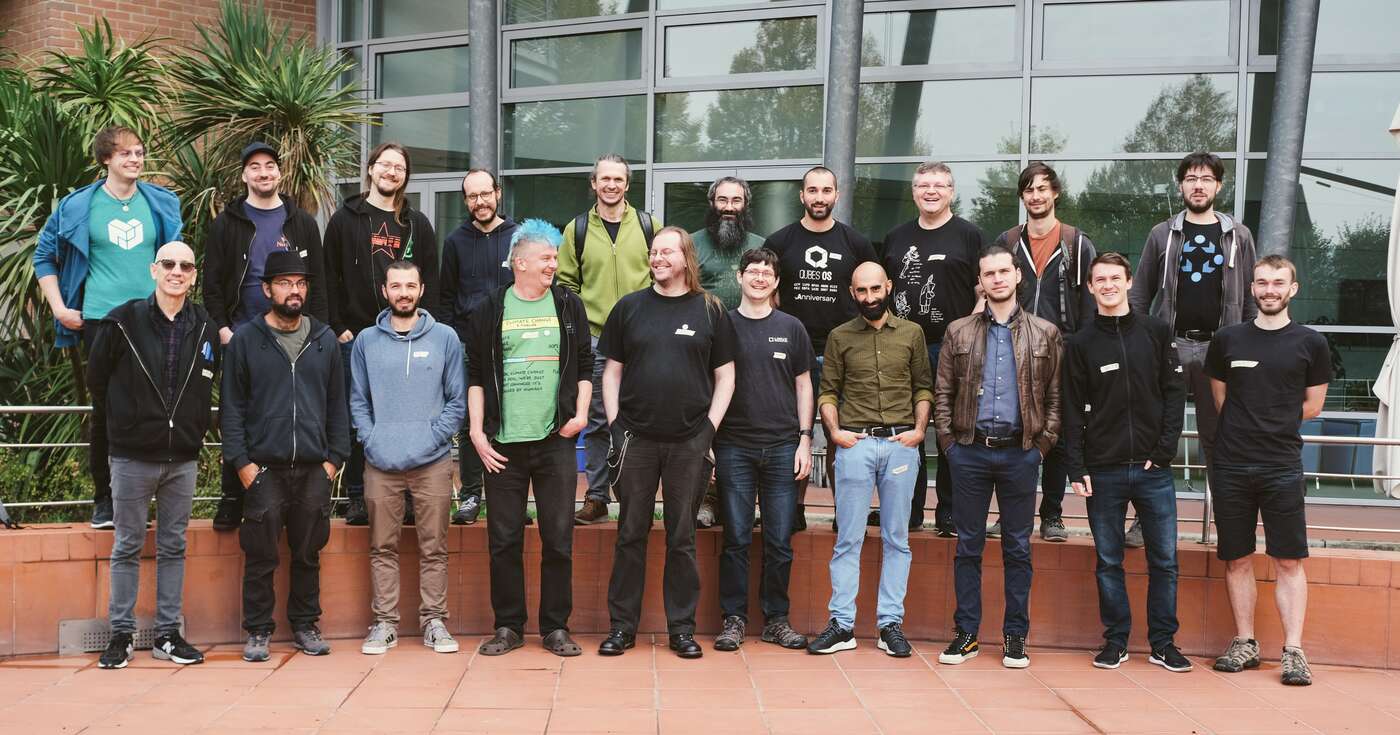
Reproducible Builds Summit 2022 Following-up from last month s report about our recent summit in Venice, Italy, a comprehensive report from the meeting has not been finalised yet watch this space! As a very small preview, however, we can link to several issues that were filed about the website during the summit (#38, #39, #40, #41, #42, #43, etc.) and collectively learned about Software Bill of Materials (SBOM) s and how .buildinfo files can be seen/used as SBOMs. And, no less importantly, the Reproducible Builds t-shirt design has been updated

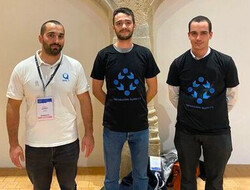
Reproducible Builds at European Cyber Week 2022 During the European Cyber Week 2022, a Capture The Flag (CTF) cybersecurity challenge was created by Fr d ric Pierret on the subject of Reproducible Builds. The challenge consisted in a pedagogical sense based on how to make a software release reproducible. To progress through the challenge issues that affect the reproducibility of build (such as build path, timestamps, file ordering, etc.) were to be fixed in steps in order to get the final flag in order to win the challenge. At the end of the competition, five people succeeded in solving the challenge, all of whom were awarded with a shirt. Fr d ric Pierret intends to create similar challenge in the form of a how to in the Reproducible Builds documentation, but two of the 2022 winners are shown here:

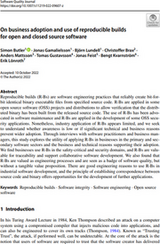
On business adoption and use of reproducible builds Simon Butler announced on the rb-general mailing list that the Software Quality Journal published an article called On business adoption and use of reproducible builds for open and closed source software. This article is an interview-based study which focuses on the adoption and uses of Reproducible Builds in industry, with a focus on investigating the reasons why organisations might not have adopted them:
[ ] industry application of R-Bs appears limited, and we seek to understand whether awareness is low or if significant technical and business reasons prevent wider adoption.
This is achieved through interviews with software practitioners and business managers, and touches on both the business and technical reasons supporting the adoption (or not) of Reproducible Builds. The article also begins with an excellent explanation and literature review, and even introduces a new helpful analogy for reproducible builds:
[Users are] able to perform a bitwise comparison of the two binaries to verify that they are identical and that the distributed binary is indeed built from the source code in the way the provider claims. Applied in this manner, R-Bs function as a canary, a mechanism that indicates when something might be wrong, and offer an improvement in security over running unverified binaries on computer systems.
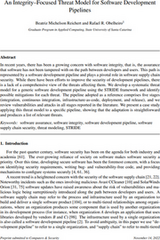
The full paper is available to download on an open access basis. Elsewhere in academia, Beatriz Michelson Reichert and Rafael R. Obelheiro have published a paper proposing a systematic threat model for a generic software development pipeline identifying possible mitigations for each threat (PDF). Under the Tampering rubric of their paper, various attacks against Continuous Integration (CI) processes:
An attacker may insert a backdoor into a CI or build tool and thus introduce vulnerabilities into the software (resulting in an improper build). To avoid this threat, it is the developer s responsibility to take due care when making use of third-party build tools. Tampered compilers can be mitigated using diversity, as in the diverse double compiling (DDC) technique. Reproducible builds, a recent research topic, can also provide mitigation for this problem. (PDF)

Misc news
On our mailing list this month:

Debian & other Linux distributions Over 50 reviews of Debian packages were added this month, another 48 were updated and almost 30 were removed, all of which adds to our knowledge about identified issues. Two new issue types were added as well. [ ][ ]. Vagrant Cascadian announced on our mailing list another online sprint to help clear the huge backlog of reproducible builds patches submitted by performing NMUs (Non-Maintainer Uploads). The first such sprint took place on September 22nd, but others were held on October 6th and October 20th. There were two additional sprints that occurred in November, however, which resulted in the following progress: Lastly, Roland Clobus posted his latest update of the status of reproducible Debian ISO images on our mailing list. This reports that all major desktops build reproducibly with bullseye, bookworm and sid as well as that no custom patches needed to applied to Debian unstable for this result to occur. During November, however, Roland proposed some modifications to live-setup and the rebuild script has been adjusted to fix the failing Jenkins tests for Debian bullseye [ ][ ].
In other news, Miro Hron ok proposed a change to clamp build modification times to the value of SOURCE_DATE_EPOCH. This was initially suggested and discussed on a devel@ mailing list post but was later written up on the Fedora Wiki as well as being officially proposed to Fedora Engineering Steering Committee (FESCo).

Upstream patches The Reproducible Builds project detects, dissects and attempts to fix as many currently-unreproducible packages as possible. We endeavour to send all of our patches upstream where appropriate. This month, we wrote a large number of such patches, including:

diffoscope diffoscope is our in-depth and content-aware diff utility. Not only can it locate and diagnose reproducibility issues, it can provide human-readable diffs from many kinds of binary formats. This month, Chris Lamb prepared and uploaded versions 226 and 227 to Debian:
  • Support both python3-progressbar and python3-progressbar2, two modules providing the progressbar Python module. [ ]
  • Don t run Python decompiling tests on Python bytecode that file(1) cannot detect yet and Python 3.11 cannot unmarshal. (#1024335)
  • Don t attempt to attach text-only differences notice if there are no differences to begin with. (#1024171)
  • Make sure we recommend apksigcopier. [ ]
  • Tidy generation of os_list. [ ]
  • Make the code clearer around generating the Debian substvars . [ ]
  • Use our assert_diff helper in test_lzip.py. [ ]
  • Drop other copyright notices from lzip.py and test_lzip.py. [ ]
In addition to this, Christopher Baines added lzip support [ ], and FC Stegerman added an optimisation whereby we don t run apktool if no differences are detected before the signing block [ ].
A significant number of changes were made to the Reproducible Builds website and documentation this month, including Chris Lamb ensuring the openEuler logo is correctly visible with a white background [ ], FC Stegerman de-duplicated by email address to avoid listing some contributors twice [ ], Herv Boutemy added Apache Maven to the list of affiliated projects [ ] and boyska updated our Contribute page to remark that the Reproducible Builds presence on salsa.debian.org is not just the Git repository but is also for creating issues [ ][ ]. In addition to all this, however, Holger Levsen made the following changes:
  • Add a number of existing publications [ ][ ] and update metadata for some existing publications as well [ ].
  • Hide draft posts on the website homepage. [ ]
  • Add the Warpforge build tool as a participating project of the summit. [ ]
  • Clarify in the footer that we welcome patches to the website repository. [ ]

Testing framework The Reproducible Builds project operates a comprehensive testing framework at tests.reproducible-builds.org in order to check packages and other artifacts for reproducibility. In October, the following changes were made by Holger Levsen:
  • Improve the generation of meta package sets (used in grouping packages for reporting/statistical purposes) to treat Debian bookworm as equivalent to Debian unstable in this specific case [ ] and to parse the list of packages used in the Debian cloud images [ ][ ][ ].
  • Temporarily allow Frederic to ssh(1) into our snapshot server as the jenkins user. [ ]
  • Keep some reproducible jobs Jenkins logs much longer [ ] (later reverted).
  • Improve the node health checks to detect failures to update the Debian cloud image package set [ ][ ] and to improve prioritisation of some kernel warnings [ ].
  • Always echo any IRC output to Jenkins output as well. [ ]
  • Deal gracefully with problems related to processing the cloud image package set. [ ]
Finally, Roland Clobus continued his work on testing Live Debian images, including adding support for specifying the origin of the Debian installer [ ] and to warn when the image has unmet dependencies in the package list (e.g. due to a transition) [ ].
If you are interested in contributing to the Reproducible Builds project, please visit our Contribute page on our website. You can get in touch with us via:

11 November 2022

Reproducible Builds: Reproducible Builds in October 2022

Welcome to the Reproducible Builds report for October 2022! In these reports we attempt to outline the most important things that we have been up to over the past month. As ever, if you are interested in contributing to the project, please visit our Contribute page on our website.

Our in-person summit this year was held in the past few days in Venice, Italy. Activity and news from the summit will therefore be covered in next month s report!
A new article related to reproducible builds was recently published in the 2023 IEEE Symposium on Security and Privacy. Titled Taxonomy of Attacks on Open-Source Software Supply Chains and authored by Piergiorgio Ladisa, Henrik Plate, Matias Martinez and Olivier Barais, their paper:
[ ] proposes a general taxonomy for attacks on opensource supply chains, independent of specific programming languages or ecosystems, and covering all supply chain stages from code contributions to package distribution.
Taking the form of an attack tree, the paper covers 107 unique vectors linked to 94 real world supply-chain incidents which is then mapped to 33 mitigating safeguards including, of course, reproducible builds:
Reproducible Builds received a very high utility rating (5) from 10 participants (58.8%), but also a high-cost rating (4 or 5) from 12 (70.6%). One expert commented that a reproducible build like used by Solarwinds now, is a good measure against tampering with a single build system and another claimed this is going to be the single, biggest barrier .

It was noticed this month that Solarwinds published a whitepaper back in December 2021 in order to:
[ ] illustrate a concerning new reality for the software industry and illuminates the increasingly sophisticated threats made by outside nation-states to the supply chains and infrastructure on which we all rely.
The 12-month anniversary of the 2020 Solarwinds attack (which SolarWinds Worldwide LLC itself calls the SUNBURST attack) was, of course, the likely impetus for publication.
Whilst collaborating on making the Cyrus IMAP server reproducible, Ellie Timoney asked why the Reproducible Builds testing framework uses two remarkably distinctive build paths when attempting to flush out builds that vary on the absolute system path in which they were built. In the case of the Cyrus IMAP server, these happened to be: Asked why they vary in three different ways, Chris Lamb listed in detail the motivation behind to each difference.
On our mailing list this month:
The Reproducible Builds project is delighted to welcome openEuler to the Involved projects page [ ]. openEuler is Linux distribution developed by Huawei, a counterpart to it s more commercially-oriented EulerOS.

Debian Colin Watson wrote about his experience towards making the databases generated by the man-db UNIX manual page indexing tool:
One of the people working on [reproducible builds] noticed that man-db s database files were an obstacle to [reproducibility]: in particular, the exact contents of the database seemed to depend on the order in which files were scanned when building it. The reporter proposed solving this by processing files in sorted order, but I wasn t keen on that approach: firstly because it would mean we could no longer process files in an order that makes it more efficient to read them all from disk (still valuable on rotational disks), but mostly because the differences seemed to point to other bugs.
Colin goes on to describe his approach to solving the problem, including fixing various fits of internal caching, and he ends his post with None of this is particularly glamorous work, but it paid off .
Vagrant Cascadian announced on our mailing list another online sprint to help clear the huge backlog of reproducible builds patches submitted by performing NMUs (Non-Maintainer Uploads). The first such sprint took place on September 22nd, but another was held on October 6th, and another small one on October 20th. This resulted in the following progress:
41 reviews of Debian packages were added, 62 were updated and 12 were removed this month adding to our knowledge about identified issues. A number of issue types were updated too. [1][ ]
Lastly, Luca Boccassi submitted a patch to debhelper, a set of tools used in the packaging of the majority of Debian packages. The patch addressed an issue in the dh_installsysusers utility so that the postinst post-installation script that debhelper generates the same data regardless of the underlying filesystem ordering.

Other distributions F-Droid is a community-run app store that provides free software applications for Android phones. This month, F-Droid changed their documentation and guidance to now explicitly encourage RB for new apps [ ][ ], and FC Stegerman created an extremely in-depth issue on GitLab concerning the APK signing block. You can read more about F-Droid s approach to reproducibility in our July 2022 interview with Hans-Christoph Steiner of the F-Droid Project. In openSUSE, Bernhard M. Wiedemann published his usual openSUSE monthly report.

Upstream patches The Reproducible Builds project detects, dissects and attempts to fix as many currently-unreproducible packages as possible. We endeavour to send all of our patches upstream where appropriate. This month, we wrote a large number of such patches, including:

diffoscope diffoscope is our in-depth and content-aware diff utility. Not only can it locate and diagnose reproducibility issues, it can provide human-readable diffs from many kinds of binary formats. This month, Chris Lamb prepared and uploaded versions 224 and 225 to Debian:
  • Add support for comparing the text content of HTML files using html2text. [ ]
  • Add support for detecting ordering-only differences in XML files. [ ]
  • Fix an issue with detecting ordering differences. [ ]
  • Use the capitalised version of Ordering consistently everywhere in output. [ ]
  • Add support for displaying font metadata using ttx(1) from the fonttools suite. [ ]
  • Testsuite improvements:
    • Temporarily allow the stable-po pipeline to fail in the CI. [ ]
    • Rename the order1.diff test fixture to json_expected_ordering_diff. [ ]
    • Tidy the JSON tests. [ ]
    • Use assert_diff over get_data and an manual assert within the XML tests. [ ]
    • Drop the ALLOWED_TEST_FILES test; it was mostly just annoying. [ ]
    • Tidy the tests/test_source.py file. [ ]
Chris Lamb also added a link to diffoscope s OpenBSD packaging on the diffoscope.org homepage [ ] and Mattia Rizzolo fix an test failure that was occurring under with LLVM 15 [ ].

Testing framework The Reproducible Builds project operates a comprehensive testing framework at tests.reproducible-builds.org in order to check packages and other artifacts for reproducibility. In October, the following changes were made by Holger Levsen:
  • Run the logparse tool to analyse results on the Debian Edu build logs. [ ]
  • Install btop(1) on all nodes running Debian. [ ]
  • Switch Arch Linux from using SHA1 to SHA256. [ ]
  • When checking Debian debstrap jobs, correctly log the tool usage. [ ]
  • Cleanup more task-related temporary directory names when testing Debian packages. [ ][ ]
  • Use the cdebootstrap-static binary for the 2nd runs of the cdebootstrap tests. [ ]
  • Drop a workaround when testing OpenWrt and coreboot as the issue in diffoscope has now been fixed. [ ]
  • Turn on an rm(1) warning into an info -level message. [ ]
  • Special case the osuosl168 node for running Debian bookworm already. [ ][ ]
  • Use the new non-free-firmware suite on the o168 node. [ ]
In addition, Mattia Rizzolo made the following changes:
  • Ensure that 2nd build has a merged /usr. [ ]
  • Only reconfigure the usrmerge package on Debian bookworm and above. [ ]
  • Fix bc(1) syntax in the computation of the percentage of unreproducible packages in the dashboard. [ ][ ][ ]
  • In the index_suite_ pages, order the package status to be the same order of the menu. [ ]
  • Pass the --distribution parameter to the pbuilder utility. [ ]
Finally, Roland Clobus continued his work on testing Live Debian images. In particular, he extended the maintenance script to warn when workspace directories cannot be deleted. [ ]
If you are interested in contributing to the Reproducible Builds project, please visit our Contribute page on our website. However, you can get in touch with us via:

3 November 2022

Arturo Borrero Gonz lez: New OpenPGP key and new email

Post logo I m trying to replace my old OpenPGP key with a new one. The old key wasn t compromised or lost or anything bad. Is still valid, but I plan to get rid of it soon. It was created in 2013. The new key id fingerprint is: AA66280D4EF0BFCC6BFC2104DA5ECB231C8F04C4 I plan to use the new key for things like encrypted emails, uploads to the Debian archive, and more. Also, the new key includes an identity with a newer personal email address I plan to use soon: arturo.bg@arturo.bg The new key has been uploaded to some public keyservers. If you would like to sign the new key, please follow the steps in the Debian wiki.
-----BEGIN PGP PUBLIC KEY BLOCK-----
mQINBGNjvX4BEADE4w5x0SQmxWLAI1R17RCC98ngTkD/FMyos0GF5xmv0VJeLYhw
x6oJRmiNGHY8+gjq7SyVCWmlwbLKBEPFNI1k5WcrTB+ClgGkWB5KBnbLKm6CSP4N
ccSbrUQrZW+zxk3Q5h3CJljZpmflB2dvRfnDMSSaw8zOc37EtszW3AVVKNYAu3wj
mXpfwI72/OSELhSvhkr51L+ZlEYUMCITeO+jpiWsnU+sA8oKKPjW4+X8cjrN4eFa
1PAPILDf+Omst5SKM2aV5LGZ8rBzb5wNJF6yDexDw2XmfbFWLOfYzFRY6GTXJz/p
8Fh6O1wkHM9RnwmesCXTtkaGQsVFiVsoqGFyzrkIdWPUruB3RG5EzOkapWi/cnbD
1sy7yrUgy99Ew5yzmLaZ40hmRyq/gBBw4yRkdQaddbkErx+9hT+2tJELa5wrmWkb
FtaVZ38xC6gacOZqRjp0Xqtr0jobI0vED8vzIyY0zJwWM0Hu6qqq4hkLWZHjCy8a
T5Oe/Cb78Kqwa2mzJfncDahPxcgxpnbkYdvKokRtNBDftLVEz+Do8Dczw7Me4BoK
HmU8wLyeGeDTmeoBXpxKH90T+rQokgsiiD13bWZ+nBxILun1tjOTVVONG6SHdP3f
unolq8SU3K+m67lLa+pWjyYcNRS2OTWGOz/1zsH2R39ZOyfGD09/10aAKwARAQAB
tC1BcnR1cm8gQm9ycmVybyBHb256YWxleiA8YXJ0dXJvLmJnQGFydHVyby5iZz6J
AlQEEwEKAD4WIQSqZigNTvC/zGv8IQTaXssjHI8ExAUCY2O9fgIbAwUJA8JnAAUL
CQgHAwUVCgkICwUWAgMBAAIeAQIXgAAKCRDaXssjHI8ExCZdD/9Z3vR4sV7vBED4
+mCjdNWWf/mw5YlkZo+XQiMVVss4HfQLdt7VxXgGdcOz5Hond9ax3+qeCEo4DdXq
TC0ACpSCu/TPil6vzbE/kO6i6a4oZjFyteAbbcMXP35stbtDM0U5EZH0adIKknfF
msIPTIdJ/dpkcshtBJIoPqjuuTEBa7bF3OYCajHVqwP4Wsgjy4TvDOwl3hy7bhrQ
ZZHqbh7kW40+alQYaJ8jDvbDh/jhN1/pEiZS9ETu0JfBAF3PYPRLW6XedvwZiPWd
jTXwJd0E+vN5LE1Go8OaYvZb9iitZ21UaYOUnFuhw7SEOSQGfEUBs39+41gBj6vW
05HKCEA6kda9NpfptMbUoSSU+hwRfNA5TdnlxtcRv4NqUigzqa1LoXLdxTsyus+K
BL7dRpKXc72JCrEA3vClisD2FgsxLLRCCSDVM8UM/it/YW7tv42XuhQkTW+okQX4
c5laMzTL+ZV8UOoshseTDOsQsdXhskdnWbnuSwAez2/Dd1gHczuN/+lPiiEnyaTF
XgH17K/F25+92MmwPQcFRVPQcYcbyx1VylA6aCgK6gOEqHCejlZv5XLouzbQh1j1
k6MjUR1ncz8vPV5xSuOMAISqozJ9GxUZT2O3o9Vc9pNg5UEzqTvyURgLOdie8yM4
T93S3nKuHVZ++ZVxEOlPnfEfbFP+xbQrQXJ0dXJvIEJvcnJlcm8gR29uemFsZXog
PGFydHVyb0BkZWJpYW4ub3JnPokCVAQTAQoAPhYhBKpmKA1O8L/Ma/whBNpeyyMc
jwTEBQJjY73LAhsDBQkDwmcABQsJCAcDBRUKCQgLBRYCAwEAAh4BAheAAAoJENpe
yyMcjwTEMKQQAIe18Np+jdhwxHEFZNppBQ69BtyrnPQg4K5VngZ0NUZdVi+/FU7q
Tc9Z1qNydnXgmav3dafL2/l5zDX9wz7mQD2F0a6luOxZwl1PE6iP5f3cUD7uC9zb
148i1bZGEJbO4iNZKTlJKlbNR9m1PG47pv964CHZnNGp6lsnEspxe2G8DJD48Pje
gbhYukgOtIhQ1CaB1fc8aVwZvXZVSbNBLAqp7pAGhTFJqzHE8/U0sn1/V/wPzFAd
TZtWzKfYAkIIFJI5Rr6LVApIwIe7nWymTdgH4crCd2GZkGR+d6ihPKVSxUAUfoAx
EJQUSJY8rYi39gSDhPuEoK8BYXS1nWFGJiNV1o8xaljQo8rNT9myCaeZuQBLX41/
LRzK4XrxYPvjZpKNucc7fSK+UFriQGzdcAaWtW45Kp/8GmAoLVyCD0DPZNWNJdxp
IORhB33aWakhvDKgaLQa16MJ8fSc3ytn/1lxWzDXA1j05i81y/AOKPtCwBKzQWPF
biuZs3kJgZagLq6L6VOQDHlKqf+jqfl1fWeo04iDg98e0TYKABUfiTz8/MdQcV/X
8VkCgtuZ8BcPPyYzBjvuXWZTvdu0n2pikqAPL4u2cbWfD8JIP2AVCJp9HMGKvENo
XcJgY4h6T3rrC/9EidxECfXlsDbUJxLq0WfJLik84+LRtde3kZiReaIRtC5BcnR1
cm8gQm9ycmVybyBHb256YWxleiA8YXJ0dXJvQG5ldGZpbHRlci5vcmc+iQJUBBMB
CgA+FiEEqmYoDU7wv8xr/CEE2l7LIxyPBMQFAmNjvd8CGwMFCQPCZwAFCwkIBwMF
FQoJCAsFFgIDAQACHgECF4AACgkQ2l7LIxyPBMSP/g/+MHmxCAi/X+NMHodg9Qou
wEG4Vf1uluAE6c+c1QECCdtSsRjBs1dZoJzGsA23t4LWqluyaptuLDWJQEz+EVKR
mG0bvvropNaoOEShnY069pg7lUHuO/GLeDRhfEH3KT45sIVbLly8QkoGaINSCDLe
RBNaHC6feIC8NfQzQEt72nbi4SgdSQUg0F3lj4WxxECVhXsw/YCqh1d3QYqwRVEE
lCGQ4EbavjtRhO8U7dcL1VwHemKHNq3XvM3PJf1OoPgxWqFW5rHbAdlXdN3WAI6u
DAy7kY+qihz3w6rIDTFq6I3YBTrZ44J+5mN21ZC2iDXAsa/C3Uam0vFsjs/pizuq
WgGI9Vmsyap+bOOjuRSX4hemZoOT4a2GC723fS1dFresYWo3MmwfA3sjgV5tK3ZN
XIpxYIvi6HAHLOAarDaE8Sha1GHvrmPwfZ+cEgTL0mqW3efSF3AFmGHduMB+agzK
rM9sksrRQhbY2fHnBLo1t06SQx3rmhlz5mD1ljQEIzna9D6QKleRu4hgImRLHnCB
CN3o+mZa1MHhaIFzViaD2i3Fv2+bYgT7vnS4QAneLW8O/ZgpAc2MUxMoci5JNyfJ
mWdae7Kbs4Z8rrt/mH2gYyioSB0po4VtVwKWEUW9cLtZusA6mFnMviFpfjakb9TX
MimBAv9hAYpxd+HdfHinmqS0MEFydHVybyBCb3JyZXJvIEdvbnphbGV6IDxhYm9y
cmVyb0B3aWtpbWVkaWEub3JnPokCVAQTAQoAPhYhBKpmKA1O8L/Ma/whBNpeyyMc
jwTEBQJjY735AhsDBQkDwmcABQsJCAcDBRUKCQgLBRYCAwEAAh4BAheAAAoJENpe
yyMcjwTEGooP/20PR5N34m7CNtyaO96H5W0ULuAuSNuoXaKWDo5LGU6zzDriXbIu
ryYtR66vWF5suf7fHZYX8Ufq4PEsG1UNYEGA9hnjPg3oVwGzBJI7f6Rl2P5Pc8wJ
Eq2kN/xKmfUKIrvgh1f5xgFqC4hzcLDkVlLsPowZWfep8dLY4mtVrsrCD1URhelw
zRDGZ3rTVHWXmfXbSHWR2bgZIIrCtVF8BHStg5b6HuAWpj4Oa0eMfBde0N2RZkLE
ye/r2y/lraHfpT7MXnRMcEmltrv8fic7yvj/Nh4ESWr7UmfbV+GiSw9dc/AlVMXM
ihaW0eXv4F5uMtLJOiqI7bv3UfWSvoqwf2a8EPnzOeBBHhQOOJN7O4UzKBK5GAO8
C3k0I1AV3cTmrXrqT/5yoYAHSekDFCIPES//6Y/pO0ITtCbXkA5e8vaulJbtyXpE
g0Z7I7M1kikL6reZ2PuzsR0psEb/x81bWXODIegyOJolPXMRAY7n9J0xpCnSW9yr
CN4j6YT3Oame04JslwX5Xg1cyheuiusotETYNSKRaGaYBCxYffOWoTLNIBa+RCGc
SVOzJq5pd8fVRM1h2ZZFnfpPJBUb62qPsbk6VwmesGoGevB70zcNQYEI+c35kRfM
IOuJWRIN3Wxx0rpxb5E3i/3TASHM86Dix1VW9vsC/atGU/cgaoTOiNVztDdBcnR1
cm8gQm9ycmVybyBHb256YWxleiA8YXJ0dXJvLmJvcnJlcm8uZ2xlekBnbWFpbC5j
b20+iQJUBBMBCgA+FiEEqmYoDU7wv8xr/CEE2l7LIxyPBMQFAmNjvg8CGwMFCQPC
ZwAFCwkIBwMFFQoJCAsFFgIDAQACHgECF4AACgkQ2l7LIxyPBMS7NA/9F7OL/j7a
xnTDjxAHEiyrCzrBQc/DEAM/yim8E+0UBeTJSZR/bShtbvLbSukeL43tKksPhN/X
skjRF8sJ8KWUnpmSWjv1DQTh7AtkJqACnq7+VtQZq3yuKUCNRNpM8lSFxtmYDUqE
XXD4eMXKoJfdphQ+qpViba+RGXg6sd69Dq739zT/OFMuKZ33z8h7hVNXmoWGcBz6
txvN3cWVJhTLdiBvtn38/0dX7IupQLypLOtP0oZdjoUjkRxTo5biOxt3hUGnxS4x
97PPeRGc4j7lv5ADwFV8bo+g54ZMGRjOcyZmA7dlWFN51JrTx3udW2jgXkYqm7UM
xP4lNwDs9TmT3jan6wR08uwlDakOXfDm3gCQEviN+350sJs2tY+JKBN4QR7NpqeU
2aDFOo0G/0ggf0QbFsMkaTSozerVHRGXMdAi+pbYA6pPWPu8lHIkvvdoj4xUu+Ko
cHX0DCRxmL9mylTbZEanrp5gSpne79McrkbQX2/Yc8lWykCtL5/jHVTD4iNiO5Rf
IJYPAVmC2nlj2URfzwGjjoL5apTStZfng4H2Ccq+3cmhwOXI7pb+PsGeI5PND00A
qHFxe590HFhPxLHoftMIlspstoCvHYGcWQxHNbXW6ccmhHdNYT8Pn4ecKgfr6pCt
0ysilOD2ppPJ88hffKA4nTdtX2Tz2ZwOYwG5Ag0EY2O9fgEQALrapVuv1IcLDit8
9gejdA/Dtlufb2/baImVaQD+dTx2QdMxxEiNKl00a5OhMzXDj9tFrB1Lv4z0t8cY
iDJ+NuydDGgz3MlJgWW0GlpAz8yiul2iqTnkWl3cWeiI+VaX8wzL+acmmkPvlrN8
hM7I55BPr8uBWVIQ7VDmI+ts8gi73xE+Etzzrh13GSSnnYnezfGUQrNfYFcip7D0
hB3bpUIGiPdQ45vSZqXUQx/B6FlabiIGRau8Rt4vaEBGXGFZ9rIR+rMJWx6GqYX4
uY1KM2JZ3SKHk++MWGYdzHdM2oaP6xckZq+u/WiwutkYLLO2hnr03lcAu1IDT1C1
YNPrbTKfqUt+3r0oUK5BrG1Cjdc1mZqcXzYcexOLp79FJLb0t5wPdfgU8dT10kjE
uQxeSYiS4oSpikVQkKoFk++/U95d/z/y/81A6v+cfRus6mW+wRSFSwks7Q5ct7zW
UyKELLC4i4EDgnJXmavVcBD0TWzhH/rZpz9FsO4Mb18IYwbV1/144019/RjiPk5Z
MMNdsjorjV2MtrCIoeAGRgZhbFP2P7CcZOp6ZWzjj40ENlElbLp3VCfkYcTiPHJv
2iaiDz2Mhfmhb1Q/5d/a9tYTYINPmv2QVo+m5Zf+1/U29d2HZMRhD4aqDsivvgtd
GpAnKeus6ePSMqpwjO6v2bmQhjpbABEBAAGJAjwEGAEKACYWIQSqZigNTvC/zGv8
IQTaXssjHI8ExAUCY2O9fgIbDAUJA8JnAAAKCRDaXssjHI8ExA5AD/9VWS1/jHM9
aE3HKCDL4CpiXQPc4ds+3/ft6LXwuCMA/tkt8I4svKZGCCi/X5NfiQetVD+cSzVO
nmloctMt/24yjnGNNSFsDozkn/RqzZIhLJBI69gX4JWR4wpeh4kXMItNM5ZlYw3H
DmuLrf/ey8E2NzbFdzj1VQNoENuwtL2pIJrvK92AcS7acvP0FpiS8riLc5a933SW
oPgelQ1j/04WAH8cyKXB/pruq3OhtK0/b8ylIeI0f7a57dxQj5wysyBVKl+EJd/n
UhypVqMDRWL7N0FttGb9gZ6OVvQnt7iwbtS3tYqAK479+GZwi/Wh/RB2dCDyz8jk
zE0j6y7huP4XzpbBbPVntLDdVAYmpW6iIaTWYxlu79FEUw4JmZdY7hJoEDpHuDIz
ylo0YQgjnRfRfWSdnGCosFrY5UgThPVTaQAILCPtdVyWY4/6s1UaeNs3H0PRA5mz
UT4vDKxGq9gXHnE+qg3dfwMcLR3cDPPWUFVeTfNitZ3Y9eV7SdbQXt5NeOXzFadz
DBc9ZzNx3rBEyUUooU0MEmbltyUFM7R/hVcdpFxs12SgHrvgh13tuxVVVNBXTwwo
pSxmap42vHJERQ8ZJQ4lrvnxNZcuwLHSZK7xVzb0b/1wMooNnhw18vlStMWQJwKl
DiXs/L/ifab2amg9jshULAPgVSw7QeP2OQ==
=UABf
-----END PGP PUBLIC KEY BLOCK-----
If you are curious about what that long code block contains, check this https://cirw.in/gpg-decoder/ For the record, the old key fingerprint is: DD9861AB23DC3333892E07A968E713981D1515F8 Cheers!

23 February 2022

Joey Hess: announcing zephyr-copilot

I recently learned about the Zephyr Project which is a rather neat embedded OS for devices too small to run Linux. This led me to wondering if I could adapt arduino-copilot to target Zephyr, and so be able to program any of the 350+ boards it supports using Haskell. At the same time I had an opportunity to give a talk at the Houston Functional Programmers group. On February 1st I decided to give that talk, about arduino-copilot. That left 2 weeks to buy some hardware supported by Zephyr and port arduino-copilot to it. The result is zephyr-copilot, and I was able to demo it during my talk. This example can be used with any of 293 different boards, and will blink an on-board LED:
module Examples.Blink.Demo where
import Copilot.Zephyr.Board.Generic
main :: IO ()
main = zephyr $ do
        led0 =: blinking
        delay =: MilliSeconds (constant 100)
Doing much more than that needs a board specific module to set up GPIO pins etc. So far I only have written those for a couple of boards I have, but they are fairly easy to write. I'd be happy to help anyone who wants to contribute one. Due to the time constraints I have not implemented serial port support, or PWM or ADC yet, although all should be fairly easy. Zephyr also has no end of other capabilities, from networking to file systems to sensors, that could perhaps be supported in zephyr-copilot. My talk has now been published on youtube. I really enjoyed presenting again for the first time in 4 years(!), and to a very nice group of people. Thanks to Claude Rubinson for his persistence in getting me to give a talk.
Development of zephyr-copilot was sponsored by Mark Reidenbach, Erik Bj reholt, Jake Vosloo, and Graham Spencer on Patreon.

9 December 2021

David Kalnischkies: APT for Advent of Code

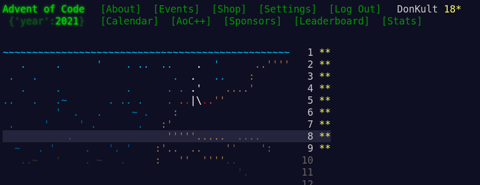
Screenshot of my Advent of Code 2021 status page as of today Advent of Code 2021
Advent of Code, for those not in the know, is a yearly Advent calendar (since 2015) of coding puzzles many people participate in for a plenary of reasons ranging from speed coding to code golf with stops at learning a new language or practicing already known ones. I usually write boring C++, but any language and then some can be used. There are reports of people implementing it in hardware, solving them by hand on paper or using Microsoft Excel so, after solving a puzzle the easy way yesterday, this time I thought: CHALLENGE ACCEPTED! as I somehow remembered an old 2008 article about solving Sudoku with aptitude (Daniel Burrows via archive.org as the blog is long gone) and the good same old a package management system that can solve [puzzles] based on package dependency rules is not something that I think would be useful or worth having (Russell Coker). Day 8 has a rather lengthy problem description and can reasonably be approached in a bunch of different way. One unreasonable approach might be to massage the problem description into Debian packages and let apt help me solve the problem (specifically Part 2, which you unlock by solving Part 1. You can do that now, I will wait here.) Be warned: I am spoiling Part 2 in the following, so solve it yourself first if you are interested. I will try to be reasonable consistent in naming things in the following and so have chosen: The input we get are lines like acedgfb cdfbe gcdfa fbcad dab cefabd cdfgeb eafb cagedb ab cdfeb fcadb cdfeb cdbaf. The letters are wires mixed up and connected to the segments of the displays: A group of these letters is hence a digit (the first 10) which represent one of the digits 0 to 9 and (after the pipe) the four displays which match (after sorting) one of the digits which means this display shows this digit. We are interested in which digits are displayed to solve the puzzle. To help us we also know which segments form which digit, we just don't know the wiring in the back. So we should identify which wire maps to which segment! We are introducing the packages wire-X-connects-to-Y for this which each provide & conflict1 with the virtual packages segment-Y and wire-X-connects. The later ensures that for a given wire we can only pick one segment and the former ensures that not multiple wires map onto the same segment. As an example: wire a's possible association with segment b is described as:
Package: wire-a-connects-to-b
Provides: segment-b, wire-a-connects
Conflicts: segment-b, wire-a-connects
Note that we do not know if this is true! We generate packages for all possible (and then some) combinations and hope dependency resolution will solve the problem for us. So don't worry, the hard part will be done by apt, we just have to provide all (im)possibilities! What we need now is to translate the 10 digits (and 4 outputs) from something like acedgfb into digit-0-is-eight and not, say digit-0-is-one. A clever solution might realize that a one consists only of two segments so a digit wiring up seven segments can not be a 1 (and must be 8 instead), but again we aren't here to be clever: We want apt to figure that out for us! So what we do is simply making every digit-0-is-N (im)possible choice available as a package and apply constraints: A given digit-N can only display one number and each N is unique as digit so for both we deploy Provides & Conflicts again. We also need to reason about the segments in the digits: Each of the digit packages gets Depends on wire-X-connects-to-Y where X is each possible wire (e.g. acedgfb) and Y each segment forming the digit (e.g. cf for one). The different choices for X are or'ed together, so that either of them satisfies the Y. We know something else too through: The segments which are not used by the digit can not be wired to any of the Xs. We model this with Conflicts on wire-X-connects-to-Y. As an example: If digit-0s acedgfb would be displaying a one (remember, it can't) the following package would be installable:
Package: digit-0-is-one
Version: 1
Depends: wire-a-connects-to-c   wire-c-connects-to-c   wire-e-connects-to-c   wire-d-connects-to-c   wire-g-connects-to-c   wire-f-connects-to-c   wire-b-connects-to-c,
         wire-a-connects-to-f   wire-c-connects-to-f   wire-e-connects-to-f   wire-d-connects-to-f   wire-g-connects-to-f   wire-f-connects-to-f   wire-b-connects-to-f
Provides: digit-0, digit-is-one
Conflicts: digit-0, digit-is-one,
  wire-a-connects-to-a, wire-c-connects-to-a, wire-e-connects-to-a, wire-d-connects-to-a, wire-g-connects-to-a, wire-f-connects-to-a, wire-b-connects-to-a,
  wire-a-connects-to-b, wire-c-connects-to-b, wire-e-connects-to-b, wire-d-connects-to-b, wire-g-connects-to-b, wire-f-connects-to-b, wire-b-connects-to-b,
  wire-a-connects-to-d, wire-c-connects-to-d, wire-e-connects-to-d, wire-d-connects-to-d, wire-g-connects-to-d, wire-f-connects-to-d, wire-b-connects-to-d,
  wire-a-connects-to-e, wire-c-connects-to-e, wire-e-connects-to-e, wire-d-connects-to-e, wire-g-connects-to-e, wire-f-connects-to-e, wire-b-connects-to-e,
  wire-a-connects-to-g, wire-c-connects-to-g, wire-e-connects-to-g, wire-d-connects-to-g, wire-g-connects-to-g, wire-f-connects-to-g, wire-b-connects-to-g
Repeat such stanzas for all 10 possible digits for digit-0 and then repeat this for all the other nine digit-N. We produce pretty much the same stanzas for display-0(-is-one), just that we omit the second Provides & Conflicts from above (digit-is-one) as in the display digits can be repeated. The rest is the same (modulo using display instead of digit as name of course). Lastly we create a package dubbed solution which depends on all 10 digit-N and 4 display-N all of them virtual packages apt will have to choose an installable provider from and we are nearly done! The resulting Packages file2 we can give to apt while requesting to install the package solution and it will spit out not only the display values we are interested in but also which number each digit represents and which wire is connected to which segment. Nifty!
$ ./skip-aoc 'acedgfb cdfbe gcdfa fbcad dab cefabd cdfgeb eafb cagedb ab   cdfeb fcadb cdfeb cdbaf'
[ ]
The following additional packages will be installed:
  digit-0-is-eight digit-1-is-five digit-2-is-two digit-3-is-three
  digit-4-is-seven digit-5-is-nine digit-6-is-six digit-7-is-four
  digit-8-is-zero digit-9-is-one display-1-is-five display-2-is-three
  display-3-is-five display-4-is-three wire-a-connects-to-c
  wire-b-connects-to-f wire-c-connects-to-g wire-d-connects-to-a
  wire-e-connects-to-b wire-f-connects-to-d wire-g-connects-to-e
[ ]
0 upgraded, 22 newly installed, 0 to remove and 0 not upgraded.
We are only interested in the numbers on the display through, so grepping the apt output (-V is our friend here) a bit should let us end up with what we need as calculating3 is (unsurprisingly) not a strong suit of our package relationship language so we need a few shell commands to help us with the rest.
$ ./skip-aoc 'acedgfb cdfbe gcdfa fbcad dab cefabd cdfgeb eafb cagedb ab   cdfeb fcadb cdfeb cdbaf' -qq
5353
I have written the skip-aoc script as a testcase for apt, so to run it you need to place it in /path/to/source/of/apt/test/integration and built apt first, but that is only due to my laziness. We could write a standalone script interfacing with the system installed apt directly and in any apt version since ~2011. To hand in the solution for the puzzle we just need to run this on each line of the input (~200 lines) and add all numbers together. In other words: Behold this beautiful shell one-liner: parallel -I ' ' ./skip-aoc ' ' -qq < input.txt paste -s -d'+' - bc (You may want to run parallel with -P to properly grill your CPU as that process can take a while otherwise and it still does anyhow as I haven't optimized it at all the testing framework does a lot of pointless things wasting time here, but we aren't aiming for the leaderboard so ) That might or even likely will fail through as I have so far omitted a not unimportant detail: The default APT resolver is not able to solve this puzzle with the given problem description we need another solver! Thankfully that is as easy as installing apt-cudf (and with it aspcud) which the script is using via --solver aspcud to make apt hand over the puzzle to a "proper" solver (or better: A solver who is supposed to be good at "answering set" questions). The buildds are using this for experimental and/or backports builds and also for installability checks via dose3 btw, so you might have encountered it before. Be careful however: Just because aspcud can solve this puzzle doesn't mean it is a good default resolver for your day to day apt. One of the reasons the default resolver has such a hard time solving this here is that or-groups have usually an order in which the first is preferred over every later option and so fort. This is of no concern here as all these alternatives will collapse to a single solution anyhow, but if there are multiple viable solutions (which is often the case) picking the "wrong" alternative can have bad consequences. A classic example would be exim4 postfix nullmailer. They are all MTAs but behave very different. The non-default solvers also tend to lack certain features like keeping track of auto-installed packages or installing Recommends/Suggests. That said, Julian is working on another solver as I write this which might deal with more of these issues. And lastly: I am also relatively sure that with a bit of massaging the default resolver could be made to understand the problem, but I can't play all day with this maybe some other day. Disclaimer: Originally posted in the daily megathread on reddit, the version here is just slightly better understandable as I have hopefully renamed all the packages to have more conventional names and tried to explain what I am actually doing. No cows were harmed in this improved version, either.

  1. If you would upload those packages somewhere, it would be good style to add Replaces as well, but it is of minor concern for apt so I am leaving them out here for readability.
  2. We have generated 49 wires, 100 digits, 40 display and 1 solution package for a grant total of 190 packages. We are also making use of a few purely virtual ones, but that doesn't add up to many packages in total. So few packages are practically childs play for apt given it usually deals with thousand times more. The instability for those packages tends to be a lot better through as only 22 of 190 packages we generated can (and will) be installed. Britney will hate you if your uploads to Debian unstable are even remotely as bad as this.
  3. What we could do is introduce 10.000 packages which denote every possible display value from 0000 to 9999. We would then need to duplicate our 10.190 packages for each line (namespace them) and then add a bit more than a million packages with the correct dependencies for summing up the individual packages for apt to be able to display the final result all by itself. That would take a while through as at that point we are looking at working with ~22 million packages with a gazillion amount of dependencies probably overworking every solver we would throw at it a bit of shell glue seems the better option for now.
This article was written by David Kalnischkies on apt-get a life and republished here by pulling it from a syndication feed. You should check there for updates and more articles about apt and EDSP.

21 November 2021

Julian Andres Klode: APT Z3 Solver Basics

Z3 is a theorem prover developed at Microsoft research and available as a dynamically linked C++ library in Debian-based distributions. While the library is a whopping 16 MB, and the solver is a tad slow, it s permissive licensing, and number of tactics offered give it a huge potential for use in solving dependencies in a wide variety of applications. Z3 does not need normalized formulas, but offers higher level abstractions like atmost and atleast and implies, that we will make use of together with boolean variables to translate the dependency problem to a form Z3 understands. In this post, we ll see how we can apply Z3 to the dependency resolution in APT. We ll only discuss the basics here, a future post will explore optimization criteria and recommends.

Translating the universe APT s package universe consists of 3 relevant things: packages (the tuple of name and architecture), versions (basically a .deb), and dependencies between versions. While we could translate our entire universe to Z3 problems, we instead will construct a root set from packages that were manually installed and versions marked for installation, and then build the transitive root set from it by translating all versions reachable from the root set. For each package P in the transitive root set, we create a boolean literal P. We then translate each version P1, P2, and so on. Translating a version means building a boolean literal for it, e.g. P1, and then translating the dependencies as shown below. We now need to create two more clauses to satisfy the basic requirements for debs:
  1. If a version is installed, the package is installed; and vice versa. We can encode this requirement for P above as P == atleast( P1,P2 , 1).
  2. There can only be one version installed. We add an additional constraint of the form atmost( P1,P2 , 1).
We also encode the requirements of the operation.
  1. For each package P that is manually installed, add a constraint P.
  2. For each version V that is marked for install, add a constraint V.
  3. For each package P that is marked for removal, add a constraint !P.

Dependencies Packages in APT have dependencies of two basic forms: Depends and Conflicts, as well as variations like Breaks (identical to Conflicts in solving terms), and Recommends (soft Depends) - we ll ignore those for now. We ll discuss Conflicts in the next section. Let s take a basic dependency list: A Depends: X Y, Z. To represent that dependency, we expand each name to a list of versions that can satisfy the dependency, for example X1 X2 Y1, Z1. Translating this dependency list to our Z3 solver, we create boolean variables X1,X2,Y1,Z1 and define two rules:
  1. A implies atleast( X1,X2,Y1 , 1)
  2. A implies atleast( Z1 , 1)
If there actually was nothing that satisfied the Z requirement, we d have added a rule not A. It would be possible to simply not tell Z3 about the version at all as an optimization, but that adds more complexity, and the not A constraint should not cause too many problems.

Conflicts Conflicts cannot have or in them. A dependency B Conflicts: X, Y means that only one of B, X, and Y can be installed. We can directly encode this in Z3 by using the constraint atmost( B,X,Y , 1). This is an optimized encoding of the constraint: We could have encoded each conflict in the form !B or !X, !B or !X, and so on. Usually this leads to worse performance as it introduces additional clauses.

Complete example Let s assume we start with an empty install and want to install the package a below.
Package: a
Version: 1
Depends: c   b
Package: b
Version: 1
Package: b
Version: 2
Conflicts: x
Package: d
Version: 1
Package: x
Version: 1
The translation in Z3 rules looks like this:
  1. Package rules for a:
    1. a == atleast( a1 , 1) - package is installed iff one version is
    2. atmost( a1 , 1) - only one version may be installed
    3. a a must be installed
  2. Dependency rules for a
    1. implies(a1, atleast( b2, b1 , 1)) the translated dependency above. note that c is gone, it s not reachable.
  3. Package rules for b:
    1. b == atleast( b1,b2 , 1) - package is installed iff one version is
    2. atmost( b1, b2 , 1) - only one version may be installed
  4. Dependencies for b (= 2):
    1. atmost( b2, x1 , 1) - the conflicts between x and b = 2 above
  5. Package rules for x:
    1. x == atleast( x1 , 1) - package is installed iff one version is
    2. atmost( x1 , 1) - only one version may be installed
The package d is not translated, as it is not reachable from the root set a1 , the transitive root set is a1,b1,b2,x1 .

Next iteration: Optimization We have now constructed the basic set of rules that allows us to solve solve our dependency problems (equivalent to SAT), however it might lead to suboptimal solutions where it removes automatically installed packages, or installs more packages than necessary, to name a few examples. In our next iteration, we have to look at introducing optimization; for example, have the minimum number of removals, the minimal number of changed packages, or satisfy as many recommends as possible. We will also look at the upgrade problem (upgrade as many packages as possible), the autoremove problem (remove as many automatically installed packages as possible).

22 October 2021

Enrico Zini: Scanning for imports in Python scripts

I had to package a nontrivial Python codebase, and I needed to put dependencies in setup.py. I could do git grep -h import sort -u, then review the output by hand, but I lacked the motivation for it. Much better to take a stab at solving the general problem The result is at https://github.com/spanezz/python-devel-tools. One fun part is scanning a directory tree, using ast to find import statements scattered around the code:
class Scanner:
    def __init__(self):
        self.names: Set[str] = set()
    def scan_dir(self, root: str):
        for dirpath, dirnames, filenames, dir_fd in os.fwalk(root):
            for fn in filenames:
                if fn.endswith(".py"):
                    with dirfd_open(fn, dir_fd=dir_fd) as fd:
                        self.scan_file(fd, os.path.join(dirpath, fn))
                st = os.stat(fn, dir_fd=dir_fd)
                if st.st_mode & (stat.S_IXUSR   stat.S_IXGRP   stat.S_IXOTH):
                    with dirfd_open(fn, dir_fd=dir_fd) as fd:
                        try:
                            lead = fd.readline()
                        except UnicodeDecodeError:
                            continue
                        if re_python_shebang.match(lead):
                            fd.seek(0)
                            self.scan_file(fd, os.path.join(dirpath, fn))
    def scan_file(self, fd: TextIO, pathname: str):
        log.info("Reading file %s", pathname)
        try:
            tree = ast.parse(fd.read(), pathname)
        except SyntaxError as e:
            log.warning("%s: file cannot be parsed", pathname, exc_info=e)
            return
        self.scan_tree(tree)
    def scan_tree(self, tree: ast.AST):
        for stm in tree.body:
            if isinstance(stm, ast.Import):
                for alias in stm.names:
                    if not isinstance(alias.name, str):
                        print("NAME", repr(alias.name), stm)
                    self.names.add(alias.name)
            elif isinstance(stm, ast.ImportFrom):
                if stm.module is not None:
                    self.names.add(stm.module)
            elif hasattr(stm, "body"):
                self.scan_tree(stm)
Another fun part is grouping the imported module names by where in sys.path they have been found:
    scanner = Scanner()
    scanner.scan_dir(args.dir)
    sys.path.append(args.dir)
    by_sys_path: Dict[str, List[str]] = collections.defaultdict(list)
    for name in sorted(scanner.names):
        spec = importlib.util.find_spec(name)
        if spec is None or spec.origin is None:
            by_sys_path[""].append(name)
        else:
            for sp in sys.path:
                if spec.origin.startswith(sp):
                    by_sys_path[sp].append(name)
                    break
            else:
                by_sys_path[spec.origin].append(name)
    for sys_path, names in sorted(by_sys_path.items()):
        print(f" sys_path or 'unidentified' :")
        for name in names:
            print(f"   name ")
An example. It's kind of nice how it can at least tell apart stdlib modules so one doesn't need to read through those:
$ ./scan-imports  /himblick
unidentified:
  changemonitor
  chroot
  cmdline
  mediadir
  player
  server
  settings
  static
  syncer
  utils
 /himblick:
  himblib.cmdline
  himblib.host_setup
  himblib.player
  himblib.sd
/usr/lib/python3.9:
  __future__
  argparse
  asyncio
  collections
  configparser
  contextlib
  datetime
  io
  json
  logging
  mimetypes
  os
  pathlib
  re
  secrets
  shlex
  shutil
  signal
  subprocess
  tempfile
  textwrap
  typing
/usr/lib/python3/dist-packages:
  asyncssh
  parted
  progressbar
  pyinotify
  setuptools
  tornado
  tornado.escape
  tornado.httpserver
  tornado.ioloop
  tornado.netutil
  tornado.web
  tornado.websocket
  yaml
built-in:
  sys
  time
Maybe such a tool already exists and works much better than this? From a quick search I didn't find it, and it was fun to (re)invent it. Updates: Jakub Wilk pointed out to an old python-modules script that finds Debian dependencies. The AST scanning code should be refactored to use ast.NodeVisitor.

5 July 2021

B lint R czey: Hello zstd compressed .debs in Ubuntu!

When Julian Andres Klode and I added initial Zstandard compression support to Ubuntu s APT and dpkg in Ubuntu 18.04 LTS we planned getting the changes accepted to Debian quickly and making Ubuntu 18.10 the first release where the new compression could speed up package installations and upgrades. Well, it took slightly longer than that. Since then many other packages have been updated to support zstd compressed packages and read-only compression has been back-ported to the 16.04 Xenial LTS release, too, on Ubuntu s side. In Debian, zstd support is available now in APT, debootstrap and reprepro (thanks Dimitri!). It is still under review for inclusion in Debian s dpkg (BTS bug 892664). Given that there is sufficient archive-wide support for zstd, Ubuntu is switching to zstd compressed packages in Ubuntu 21.10, the current development release. Please welcome hello/2.10-2ubuntu3, the first zstd-compressed Ubuntu package that will be followed by many other built with dpkg (>= 1.20.9ubuntu2), and enjoy the speed!

20 June 2021

Julian Andres Klode: Migrating away from apt-key

This is an edited copy of an email I sent to provide guidance to users of apt-key as to how to handle things in a post apt-key world. The manual page already provides all you need to know for replacing apt-key add usage:
Note: Instead of using this command a keyring should be placed directly in the /etc/apt/trusted.gpg.d/ directory with a descriptive name and either gpg or asc as file extension
So it s kind of surprising people need step by step instructions for how to copy/download a file into a directory. I ll also discuss the alternative security snakeoil approach with signed-by that s become popular. Maybe we should not have added signed-by, people seem to forget that debs still run maintainer scripts as root. Aside from this email, Debian users should look into extrepo, which manages curated external repositories for you.

Direct translation Assume you currently have:
wget -qO- https://myrepo.example/myrepo.asc   sudo apt-key add  
To translate this directly for bionic and newer, you can use:
sudo wget -qO /etc/apt/trusted.gpg.d/myrepo.asc https://myrepo.example/myrepo.asc
or to avoid downloading as root:
wget -qO-  https://myrepo.example/myrepo.asc   sudo tee -a /etc/apt/trusted.gpg.d/myrepo.asc
Older (and all) releases only support unarmored files with an extension .gpg. If you care about them, provide one, and use
sudo wget -qO /etc/apt/trusted.gpg.d/myrepo.gpg https://myrepo.example/myrepo.gpg
Some people will tell you to download the .asc and pipe it to gpg --dearmor, but gpg might not be installed, so really, just offer a .gpg one instead that is supported on all systems. wget might not be available everywhere so you can use apt-helper:
sudo /usr/lib/apt/apt-helper download-file https://myrepo.example/myrepo.asc /etc/apt/trusted.gpg.d/myrepo.asc
or, to avoid downloading as root:
/usr/lib/apt/apt-helper download-file https://myrepo.example/myrepo.asc /tmp/myrepo.asc && sudo mv /tmp/myrepo.asc /etc/apt/trusted.gpg.d

Pretending to be safer by using signed-by People say it s good practice to not use trusted.gpg.d and install the file elsewhere and then refer to it from the sources.list entry by using signed-by=<path to the file>. So this looks a lot safer, because now your key can t sign other unrelated repositories. In practice, security increase is minimal, since package maintainer scripts run as root anyway. But I guess it s better for publicity :) As an example, here are the instructions to install signal-desktop from signal.org. As mentioned, gpg --dearmor use in there is not a good idea, and I d personally not tell people to modify /usr as it s supposed to be managed by the package manager, but we don t have an /etc/apt/keyrings or similar at the moment; it s fine though if the keyring is installed by the package. You can also just add the file there as a starting point, and then install a keyring package overriding it (pretend there is a signal-desktop-keyring package below that would override the .gpg we added).
# NOTE: These instructions only work for 64 bit Debian-based
# Linux distributions such as Ubuntu, Mint etc.
# 1. Install our official public software signing key
wget -O- https://updates.signal.org/desktop/apt/keys.asc   gpg --dearmor > signal-desktop-keyring.gpg
cat signal-desktop-keyring.gpg   sudo tee -a /usr/share/keyrings/signal-desktop-keyring.gpg > /dev/null
# 2. Add our repository to your list of repositories
echo 'deb [arch=amd64 signed-by=/usr/share/keyrings/signal-desktop-keyring.gpg] https://updates.signal.org/desktop/apt xenial main'  \
  sudo tee -a /etc/apt/sources.list.d/signal-xenial.list
# 3. Update your package database and install signal
sudo apt update && sudo apt install signal-desktop
I do wonder why they do wget gpg --dearmor, pipe that into the file and then cat sudo tee it, instead of having that all in one pipeline. Maybe they want nicer progress reporting.

Scenario-specific guidance We have three scenarios: For system image building, shipping the key in /etc/apt/trusted.gpg.d seems reasonable to me; you are the vendor sort of, so it can be globally trusted. Chrome-style debs and repository config debs: If you ship a deb, embedding the sources.list.d snippet (calling it $myrepo.list) and shipping a $myrepo.gpg in /usr/share/keyrings is the best approach. Whether you ship that in product debs aka vscode/chromium or provide a repository configuration deb (let s call it myrepo-repo.deb) and then tell people to run apt update followed by apt install <package inside the repo> depends on how many packages are in the repo, I guess. Manual instructions (signal style): The third case, where you tell people to run wget themselves, I find tricky. As we see in signal, just stuffing keyring files into /usr/share/keyrings is popular, despite /usr supposed to be managed by the package manager. We don t have another dir inside /etc (or /usr/local), so it s hard to suggest something else. There s no significant benefit from actually using signed-by, so it s kind of extra work for little gain, though.

Addendum: Future work This part is new, just for this blog post. Let s look at upcoming changes and how they make things easier.

Bundled .sources files Assuming I get my merge request merged, the next version of APT (2.4/2.3.something) will do away with all the complexity and allow you to embed the key directly into a deb822 .sources file (which have been available for some time now):
Types: deb
URIs: https://myrepo.example/ https://myotherrepo.example/
Suites: stable not-so-stable
Components: main
Signed-By:
 -----BEGIN PGP PUBLIC KEY BLOCK-----
 .
 mDMEYCQjIxYJKwYBBAHaRw8BAQdAD/P5Nvvnvk66SxBBHDbhRml9ORg1WV5CvzKY
 CuMfoIS0BmFiY2RlZoiQBBMWCgA4FiEErCIG1VhKWMWo2yfAREZd5NfO31cFAmAk
 IyMCGyMFCwkIBwMFFQoJCAsFFgIDAQACHgECF4AACgkQREZd5NfO31fbOwD6ArzS
 dM0Dkd5h2Ujy1b6KcAaVW9FOa5UNfJ9FFBtjLQEBAJ7UyWD3dZzhvlaAwunsk7DG
 3bHcln8DMpIJVXht78sL
 =IE0r
 -----END PGP PUBLIC KEY BLOCK-----
Then you can just provide a .sources files to users, they place it into sources.list.d, and everything magically works Probably adding a nice apt add-source command for it I guess. Well, python-apt s aptsources package still does not support deb822 sources, and never will, we ll need an aptsources2 for that for backwards-compatibility reasons, and then port software-properties and other users to it.

OpenPGP vs aptsign We do have a better, tighter replacement for gpg in the works which uses Ed25519 keys to sign Release files. It s temporarily named aptsign, but it s a generic signer for single-section deb822 files, similar to signify/minisign. We believe that this solves the security nightmare that our OpenPGP integration is while reducing complexity at the same time. Keys are much shorter, so the bundled sources file above will look much nicer.

10 June 2021

Vincent Bernat: Serving WebP & AVIF images with Nginx

WebP and AVIF are two image formats for the web. They aim to produce smaller files than JPEG and PNG. They both support lossy and lossless compression, as well as alpha transparency. WebP was developed by Google and is a derivative of the VP8 video format.1 It is supported on most browsers. AVIF is using the newer AV1 video format to achieve better results. It is supported by Chromium-based browsers and has experimental support for Firefox.2

Your browser supports WebP and AVIF image formats. Your browser supports none of these image formats. Your browser only supports the WebP image format. Your browser only supports the AVIF image format.

Without JavaScript, I can t tell what your browser supports.

Converting and optimizing images For this blog, I am using the following shell snippets to convert and optimize JPEG and PNG images. Skip to the next section if you are only interested in the Nginx setup.

JPEG images JPEG images are converted to WebP using cwebp.
find media/images -type f -name '*.jpg' -print0 \
    xargs -0n1 -P$(nproc) -i \
      cwebp -q 84 -af ' ' -o ' '.webp
They are converted to AVIF using avifenc from libavif:
find media/images -type f -name '*.jpg' -print0 \
    xargs -0n1 -P$(nproc) -i \
      avifenc --codec aom --yuv 420 --min 20 --max 25 ' ' ' '.avif
Then, they are optimized using jpegoptim built with Mozilla s improved JPEG encoder, via Nix. This is one reason I love Nix.
jpegoptim=$(nix-build --no-out-link \
      -E 'with (import <nixpkgs> ); jpegoptim.override   libjpeg = mozjpeg;  ')
find media/images -type f -name '*.jpg' -print0 \
    sort -z
    xargs -0n10 -P$(nproc) \
      $ jpegoptim /bin/jpegoptim --max=84 --all-progressive --strip-all

PNG images PNG images are down-sampled to 8-bit RGBA-palette using pngquant. The conversion reduces file sizes significantly while being mostly invisible.
find media/images -type f -name '*.png' -print0 \
    sort -z
    xargs -0n10 -P$(nproc) \
      pngquant --skip-if-larger --strip \
               --quiet --ext .png --force
Then, they are converted to WebP with cwebp in lossless mode:
find media/images -type f -name '*.png' -print0 \
    xargs -0n1 -P$(nproc) -i \
      cwebp -z 8 ' ' -o ' '.webp
No conversion is done to AVIF: lossless compression is not as efficient as pngquant and lossy compression is only marginally better than what I get with WebP.

Keeping only the smallest files I am only keeping WebP and AVIF images if they are at least 10% smaller than the original format: decoding is usually faster for JPEG and PNG; and JPEG images can be decoded progressively.3
for f in media/images/**/*. webp,avif ; do
  orig=$(stat --format %s $ f%.* )
  new=$(stat --format %s $f)
  (( orig*0.90 > new ))   rm $f
done
I only keep AVIF images if they are smaller than WebP.
for f in media/images/**/*.avif; do
  [[ -f $ f%.* .webp ]]   continue
  orig=$(stat --format %s $ f%.* .webp)
  new=$(stat --format %s $f)
  (( $orig > $new ))   rm $f
done
We can compare how many images are kept when converted to WebP or AVIF:
printf "     %10s %10s %10s\n" Original WebP AVIF
for format in png jpg; do
  printf " $ format:u  %10s %10s %10s\n" \
    $(find media/images -name "*.$format"   wc -l) \
    $(find media/images -name "*.$format.webp"   wc -l) \
    $(find media/images -name "*.$format.avif"   wc -l)
done
AVIF is better than MozJPEG for most JPEG files while WebP beats MozJPEG only for one file out of two:
       Original       WebP       AVIF
 PNG         64         47          0
 JPG         83         40         74

Further reading I didn t detail my choices for quality parameters and there is not much science in it. Here are two resources providing more insight on AVIF:

Serving WebP & AVIF with Nginx To serve WebP and AVIF images, there are two possibilities:
  1. use <picture> to let the browser pick the format it supports, or
  2. use content negotiation to let the server send the best-supported format.
I use the second approach. It relies on inspecting the Accept HTTP header in the request. For Chrome, it looks like this:
Accept: image/avif,image/webp,image/apng,image/*,*/*;q=0.8
I configure Nginx to serve AVIF image, then the WebP image, and fallback to the original JPEG/PNG image depending on what the browser advertises:4
http  
  map $http_accept $webp_suffix  
    default        "";
    "~image/webp"  ".webp";
   
  map $http_accept $avif_suffix  
    default        "";
    "~image/avif"  ".avif";
   
 
server  
  # [ ]
  location ~ ^/images/.*\.(png jpe?g)$  
    add_header Vary Accept;
    try_files $uri$avif_suffix$webp_suffix $uri$avif_suffix $uri$webp_suffix $uri =404;
   
 
For example, let s suppose the browser requests /images/ont-box-orange@2x.jpg. If it supports WebP but not AVIF, $webp_suffix is set to .webp while $avif_suffix is set to the empty string. The server tries to serve the first existing file in this list:
  • /images/ont-box-orange@2x.jpg.webp
  • /images/ont-box-orange@2x.jpg
  • /images/ont-box-orange@2x.jpg.webp
  • /images/ont-box-orange@2x.jpg
If the browser supports both AVIF and WebP, Nginx walks the following list:
  • /images/ont-box-orange@2x.jpg.webp.avif (it never exists)
  • /images/ont-box-orange@2x.jpg.avif
  • /images/ont-box-orange@2x.jpg.webp
  • /images/ont-box-orange@2x.jpg
Eugene Lazutkin explains in more detail how this works. I have only presented a variation of his setup supporting both WebP and AVIF.

  1. VP8 is only used for lossy compression. Lossless compression is using an unrelated format.
  2. Firefox support was scheduled for Firefox 86 but because of the lack of proper color space support, it is still not enabled by default.
  3. Progressive decoding is not planned for WebP but could be implemented using low-quality thumbnail images for AVIF. See this issue for a discussion.
  4. The Vary header ensures an intermediary cache (a proxy or a CDN) checks the Accept header before using a cached response. Internet Explorer has trouble with this header and may not be able to cache the resource properly. There is a workaround but Internet Explorer s market share is now so small that it is pointless to implement it.

27 May 2021

Michael Prokop: What to expect from Debian/bullseye #newinbullseye

Bullseye Banner, Copyright 2020 Juliette Taka Debian v11 with codename bullseye is supposed to be released as new stable release soon-ish (let s hope for June, 2021! :)). Similar to what we had with #newinbuster and previous releases, now it s time for #newinbullseye! I was the driving force at several of my customers to be well prepared for bullseye before its freeze, and since then we re on good track there overall. In my opinion, Debian s release team did (and still does) a great job I m very happy about how unblock requests (not only mine but also ones I kept an eye on) were handled so far. As usual with major upgrades, there are some things to be aware of, and hereby I m starting my public notes on bullseye that might be worth also for other folks. My focus is primarily on server systems and looking at things from a sysadmin perspective. Further readings Of course start with taking a look at the official Debian release notes, make sure to especially go through What s new in Debian 11 + Issues to be aware of for bullseye. Chris published notes on upgrading to Debian bullseye, and also anarcat published upgrade notes for bullseye. Package versions As a starting point, let s look at some selected packages and their versions in buster vs. bullseye as of 2021-05-27 (mainly having amd64 in mind):
Package buster/v10 bullseye/v11
ansible 2.7.7 2.10.8
apache 2.4.38 2.4.46
apt 1.8.2.2 2.2.3
bash 5.0 5.1
ceph 12.2.11 14.2.20
docker 18.09.1 20.10.5
dovecot 2.3.4 2.3.13
dpkg 1.19.7 1.20.9
emacs 26.1 27.1
gcc 8.3.0 10.2.1
git 2.20.1 2.30.2
golang 1.11 1.15
libc 2.28 2.31
linux kernel 4.19 5.10
llvm 7.0 11.0
lxc 3.0.3 4.0.6
mariadb 10.3.27 10.5.10
nginx 1.14.2 1.18.0
nodejs 10.24.0 12.21.0
openjdk 11.0.9.1 11.0.11+9 + 17~19
openssh 7.9p1 8.4p1
openssl 1.1.1d 1.1.1k
perl 5.28.1 5.32.1
php 7.3 7.4+76
postfix 3.4.14 3.5.6
postgres 11 13
puppet 5.5.10 5.5.22
python2 2.7.16 2.7.18
python3 3.7.3 3.9.2
qemu/kvm 3.1 5.2
ruby 2.5.1 2.7+2
rust 1.41.1 1.48.0
samba 4.9.5 4.13.5
systemd 241 247.3
unattended-upgrades 1.11.2 2.8
util-linux 2.33.1 2.36.1
vagrant 2.2.3 2.2.14
vim 8.1.0875 8.2.2434
zsh 5.7.1 5.8
Linux Kernel The bullseye release will ship a Linux kernel based on v5.10 (v5.10.28 as of 2021-05-27, with v5.10.38 pending in unstable/sid), whereas buster shipped kernel 4.19. As usual there are plenty of changes in the kernel area and this might warrant a separate blog entry, but to highlight some issues: One surprising change might be that the scrollback buffer (Shift + PageUp) is gone from the Linux console. Make sure to always use screen/tmux or handle output through a pager of your choice if you need all of it and you re in the console. The kernel provides BTF support (via CONFIG_DEBUG_INFO_BTF, see #973870), which means it s no longer necessary to install LLVM, Clang, etc (requiring >100MB of disk space), see Gregg s excellent blog post regarding the underlying rational. Sadly the libbpf-tools packaging didn t make it into bullseye (#978727), but if you want to use your own self-made Debian packages, my notes might be useful. With kernel version 5.4, SUBDIRS support was removed from kbuild, so if an out-of-tree kernel module (like a *-dkms package) fails to compile on bullseye, make sure to use a recent version of it which uses M= or KBUILD_EXTMOD= instead. Unprivileged user namespaces are enabled by default (see #898446 + #987777), so programs can create more restricted sandboxes without the need to run as root or via a setuid-root helper. If you prefer to keep this feature restricted (or tools like web browsers, WebKitGTK, Flatpak, don t work), use sysctl -w kernel.unprivileged_userns_clone=0 . The /boot/System.map file(s) no longer provide the actual data, you need to switch to the dbg package if you rely on that information:
% cat /boot/System.map-5.10.0-6-amd64 
ffffffffffffffff B The real System.map is in the linux-image-<version>-dbg package
Be aware though, that the *-dbg package requires ~5GB of additional disk space. Systemd systemd v247 made it into bullseye (updated from v241). Same as for the kernel this might warrant a separate blog entry, but to mention some highlights: Systemd in bullseye activates its persistent journal functionality by default (storing its files in /var/log/journal/, see #717388). systemd-timesyncd is no longer part of the systemd binary package itself, but available as standalone package. This allows usage of ntp, chrony, openntpd, without having systemd-timesyncd installed (which prevents race conditions like #889290, which was biting me more than once). journalctl gained new options:
--cursor-file=FILE      Show entries after cursor in FILE and update FILE
--facility=FACILITY...  Show entries with the specified facilities
--image=IMAGE           Operate on files in filesystem image
--namespace=NAMESPACE   Show journal data from specified namespace
--relinquish-var        Stop logging to disk, log to temporary file system
--smart-relinquish-var  Similar, but NOP if log directory is on root mount
systemctl gained new options:
clean UNIT...                       Clean runtime, cache, state, logs or configuration of unit
freeze PATTERN...                   Freeze execution of unit processes
thaw PATTERN...                     Resume execution of a frozen unit
log-level [LEVEL]                   Get/set logging threshold for manager
log-target [TARGET]                 Get/set logging target for manager
service-watchdogs [BOOL]            Get/set service watchdog state
--with-dependencies                 Show unit dependencies with 'status', 'cat', 'list-units', and 'list-unit-files'
 -T --show-transaction              When enqueuing a unit job, show full transaction
 --what=RESOURCES                   Which types of resources to remove
--boot-loader-menu=TIME             Boot into boot loader menu on next boot
--boot-loader-entry=NAME            Boot into a specific boot loader entry on next boot
--timestamp=FORMAT                  Change format of printed timestamps
If you use systemctl edit to adjust overrides, then you ll now also get the existing configuration file listed as comment, which I consider very helpful. The MACAddressPolicy behavior with systemd naming schema v241 changed for virtual devices (I plan to write about this in a separate blog post). There are plenty of new manual pages: systemd also gained new unit configurations related to security hardening: Another new unit configuration is SystemCallLog= , which supports listing the system calls to be logged. This is very useful for for auditing or temporarily when constructing system call filters. The cgroupv2 change is also documented in the release notes, but to explicitly mention it also here, quoting from /usr/share/doc/systemd/NEWS.Debian.gz:
systemd now defaults to the unified cgroup hierarchy (i.e. cgroupv2).
This change reflects the fact that cgroups2 support has matured
substantially in both systemd and in the kernel.
All major container tools nowadays should support cgroupv2.
If you run into problems with cgroupv2, you can switch back to the previous,
hybrid setup by adding systemd.unified_cgroup_hierarchy=false to the
kernel command line.
You can read more about the benefits of cgroupv2 at
https://www.kernel.org/doc/html/latest/admin-guide/cgroup-v2.html
Note that cgroup-tools (lssubsys + lscgroup etc) don t work in cgroup2/unified hierarchy yet (see #959022 for the details). Configuration management puppet s upstream doesn t provide packages for bullseye yet (see PA-3624 + MODULES-11060), and sadly neither v6 nor v7 made it into bullseye, so when using the packages from Debian you re still stuck with v5.5 (also see #950182). ansible is also available, and while it looked like that only version 2.9.16 would make it into bullseye (see #984557 + #986213), actually version 2.10.8 made it into bullseye. chef was removed from Debian and is not available with bullseye (due to trademark issues). Prometheus stack Prometheus server was updated from v2.7.1 to v2.24.1, and the prometheus service by default applies some systemd hardening now. Also all the usual exporters are still there, but bullseye also gained some new ones: Virtualization docker (v20.10.5), ganeti (v3.0.1), libvirt (v7.0.0), lxc (v4.0.6), openstack, qemu/kvm (v5.2), xen (v4.14.1), are all still around, though what s new and noteworthy is that podman version 3.0.1 (tool for managing OCI containers and pods) made it into bullseye. If you re using the docker packages from upstream, be aware that they still don t seem to understand Debian package version handling. The docker* packages will not be automatically considered for upgrade, as 5:20.10.6~3-0~debian-buster is considered newer than 5:20.10.6~3-0~debian-bullseye:
% apt-cache policy docker-ce
  docker-ce:
    Installed: 5:20.10.6~3-0~debian-buster
    Candidate: 5:20.10.6~3-0~debian-buster
    Version table:
   *** 5:20.10.6~3-0~debian-buster 100
          100 /var/lib/dpkg/status
       5:20.10.6~3-0~debian-bullseye 500
          500 https://download.docker.com/linux/debian bullseye/stable amd64 Packages
Vagrant is available in version 2.2.14, the package from upstream works perfectly fine on bullseye as well. If you re relying on VirtualBox, be aware that upstream doesn t provide packages for bullseye yet, but the package from Debian/unstable (v6.1.22 as of 2021-05-27) works fine on bullseye (VirtualBox isn t shipped with stable releases since quite some time due to lack of cooperation from upstream on security support for older releases, see #794466). If you rely on the virtualbox-guest-additions-iso and its shared folders support, you might be glad to hear that v6.1.22 made it into bullseye (see #988783), properly supporting more recent kernel versions like present in bullseye. debuginfod There s a new service debuginfod.debian.net (see debian-devel-announce and Debian Wiki), which makes the debugging experience way smoother. You no longer need to download the debugging Debian packages (*-dbgsym/*-dbg), but instead can fetch them on demand, by exporting the following variables (before invoking gdb or alike):
% export DEBUGINFOD_PROGRESS=1    # for optional download progress reporting
% export DEBUGINFOD_URLS="https://debuginfod.debian.net"
BTW: if you can t rely on debuginfod (for whatever reason), I d like to point your attention towards find-dbgsym-packages from the debian-goodies package. Vim Sadly Vim 8.2 once again makes another change for bad defaults (hello mouse behavior!). When incsearch is set, it also applies to :substitute. This makes it veeeeeeeeeery annoying when running something like :%s/\s\+$// to get rid of trailing whitespace characters, because if there are no matches it jumps to the beginning of the file and then back, sigh. To get the old behavior back, you can use this:
au CmdLineEnter : let s:incs = &incsearch   set noincsearch
au CmdLineLeave : let &incsearch = s:incs
rsync rsync was updated from v3.1.3 to v3.2.3. It provides various checksum enhancements (see option --checksum-choice). We got new capabilities (hardlink-specials, atimes, optional protect-args, stop-at, no crtimes) and the addition of zstd and lz4 compression algorithms. And we got new options: OpenSSH OpenSSH was updated from v7.9p1 to 8.4p1, so if you re interested in all the changes, check out the release notes between those version (8.0, 8.1, 8.2, 8.3 + 8.4). Let s highlight some notable new features: Misc unsorted

Next.

Previous.