Search Results: "hug"

6 July 2026

Aigars Mahinovs: How to make a good group photo

Taking a good group photo consists of multiple aspects: I can say with confidence that nearly everything here comes from having failed to do these things right at least once, even on the latest attempts, so this is an ideal to reach towards, not something we expect to hit every time. The Goal The main goal of a big event group photo is capture both the moment itself and each individual person inside that moment. We want people, who were not there to see all the people involved and get an impression of what it was like being there. It needs to show the breadth and depth of people that make up this group, this project. And we want people who were there to be able to look back the next week, the next year or in ten years and remember - ah, yes, I was there, I was standing right there with this grin on my face next to this wonderful person and I was feeling great. Hardware Based on the goal we want to have high level photographic gear that is able to capture both a broad enough picture to encompass all the people and some of their surroundings to communicate the context (without undue distortions) and to deliver enough detail and resolution so that faces and facial expressions and underlying feelings of every single person in that group could be clearly seen and preserved. To both capture the context and minimise distortion the final picture should be just a bit wider than normal human field of view. That is about 50mm for a full-frame camera or 35mm for a typical 1.6 crop camera. You can go a bit wider if there are no better alternatives (as detailed in the scouting section), but be prepared that corners of the image will be distorted and not really usable (but we can fix that in processing step). Or you can go to unusual aspect ratios, like we did in Debconf 10. In the absence of a 100MP+ camera, you will need to be stitching together multiple frames to achieve resolution high enough to have enough pixels-per-face to see emotions clearly. This means that the photos you will actually be taking will be tighter than the overall field of view mentioned above. Still, a higher resolution camera body is preferable - nowadays 24MP-32MP cameras APS-C provide a good compromise between resolution and price, but 45-67MP full-frame cameras also exist on the market. Assume that we will be shooting in a bright environment, so most likely with quite low ISO settings, that means that high-ISO noise characteristics of more expensive cameras will not really play a role here. You will also not need very fast burst modes, even manual speed of one frame per second is sufficient. You will also want to get as much detail as possible out of your lens, and this is the most important part. You can do amazing work in all other steps of the process and have a great camera too, but if you pair it with a lens that is not sharp, then the end result will be disappointing. You want the lens that is sharpest corner-to-corner when stepped down to about f/8-f/11, that you can get for your system. You also want that lens to be about 85mm full-size sensor or 50mm for 1.6 crop size. Luckily that kind of range is also a great range for optical design and sharpest lenses are typically available in exactly these kinds of sizes. You absolutely want to have a fixed focal length lens, not a zoom lens. Even profession grade zoom lenses often deliver worse image quality compared to fixed lenses that cost less 1/10th of their price (when shooting in the same focal length). Newer design lenses are better than older lenses - optical design, coatings and precision manufacturing have advanced a lot over the decades. Retro look is great for mood, but not as good for actual resolution and clarity. You don't need to overpay for most expensive lenses because those often only improve image quality on lower F-stops. To encompass the whole group we will need to shoot at f/8 and in bright light, so the extra benefits of those f/1.2-capable super expensive lenses will not come into play here. We will have no use for a flash here. A tripod will be too restrictive when rapidly repositioning the camera between different parts of the panorama shoot. But a monopod might help with stability - I have not tried that myself, however. For my last photos I used a Canon EOS R7 (32.5MP) with Canon RF 50mm f/1.8 STM lens and considering an upgrade to Sigma 56mm f/1.4 DC DN for the next time. Scouting Scouting a good location for the group photo is another big chunk of a successful picture. The critical piece of the puzzle is lens-to-face distance. In order to keep everyone's face in-focus and have enough resolution on the farthest faces (without making nearest faces truly massive) we want to do everything possible to reduce the variance in lens-to-face distance - to reduce the difference in distance between closest and farthest face. The most effective way to do that is to have the photographer climb higher. To see this in action on the Debconf photos, compare Debconf6 (very high camera position, group on level ground - good) to Debconf10 (camera not too high, group on stairs, still good) and to Debconf17 (camera could not get high enough and the group is on flat ground - not great). Even the Debconf25 photo was suboptimal from this perspective. The Debconf23 photo was a very good example from the recent years - good height and also the group was positioned in a semi-circle so there were no people directly in front and very near to the camera. So you are looking for the highest point you could get to (even if that requires a special permission of key or a ladder) with a field large enough to fit the whole group comfortably. How to check that? Normally I simply take a photo from the top of the whole area and note down from there where the extreme corners of the group could be and still be fully seen in the shot - not blocked by trees, buildings and shadows. Then I go down and measure that space. Rule of thumb being - people in one horizontal line can stand 1 normal length step from each other and two horizontal lines can be half a step from each other vertically. So I can just measure a rough rectangle in steps, multiply the sides, multiply that by two and I have the rough number of people that can fit there for the photo. Once you have a candidate location or two, it is important to check them at the same time-of-day as you plan to do the photo (see organization section for that). You want to make sure that the whole area of the group is in the same illumination - if half of the group is in the sun and half in a shadow, then you will be having a very bad time later. The absolute ideal positioning for the group photo is to have everyone be in shadow, but still have enough bright skies and bright buildings in front of the people to give good illumination of the faces. Worst you can do is have the sun be behind the people (so all the faces are really dark) and second worst is have the sun be directly in front of the group, so that the faces are very well illuminated, but everyone's eyes are closed because they are being blinded by the sun. And sometimes all you can do is pray for some light clouds to provide for even and dispersed light. Debconf23 was very lucky that way. Another consideration is to how people are going to get to that place. You need to consider accessibility needs of people (it is ok, if it takes more effort or time, but it needs to be organized and communicated well in advance). And you need to consider how the big masses of people will be getting there - how to tell people where exactly it is and how to get there from various locations where people might be hanging out during the event? Having an alternate location indoors might be necessary if the weather report for the next days is not sufficiently predictable. We had to use that contingency in Debconf9, for example. Organization It's hard to take a good group photo if half of the group does not show up or is too late, so this needs some organization to happen smoothly. First of all you need to choose date and time for the photo. The photo does not take too much time from the schedule of the event and can be squeezed in after all the other events are already scheduled. In fact I prefer that as it allows you the flexibility of choosing the date based on weather conditions and time based on light and shadow conditions in potential photo spots. You don't want to choose the daytrip day as most people will be away and return times are not really predictable. You do not want to choose the morning after Cheese and Wine party for obvious reasons. First day and last two days are also sub-optimal as some people arrive late and some leave early for various personal reasons. Also you don't want it to happen just before Cheese and Wine either because then you'd have very little time and clarity to do the processing of the image on the same day. For timing, the best way, in my experience, is to schedule the photo directly after the end of talk sessions before a meal break - lunch or dinner. Typically in the Debconf schedule there are 2-3 daily breaks planned, say for Debconf25 there was lunch, afternoon break and dinner. Talks are planned to end ~10 minutes before those breaks (and meals) begin, so for example, afternoon break starts at 16:00 and all talks in the previous block end at 15:50. In such a case just schedule the "Group photo" event from 15:50 to 16:05. This gives people the info to go there directly from the end of all talks and that they will have sufficient time for break/meal afterwards. Do not forget to specify the location (as exactly as possible) in that event entry and make sure to post it at least two days in advance. People often want to wear something specific for the photo and thus need to know about it in advance. This also makes sure that people do not make alternate food plans for that specific break and don't leave the venue. Announce the date, time and the exact location as wide as possible, don't be shy. Announce and discuss mailing lists, IRC, Signal, Telegram, make sure the front desk knows in case anyone asks in-person, ... Check that it is again included in the announcements email on the day preceding the photo date. When the date has arrived, it is a good idea to check in early with people with special mobility needs to make sure they know where to go, how to get there and how much time they will need to be able to get there on time. As the final round of talks before the group photo is starting up, it is time to recruit "runners". I've had great success with this technique. The idea is pretty simple - for each room where people congregate (talk rooms, hacklabs, cafeteria, outside hackspace, front-desk, ...) go there and choose one person. You want to choose a person that you will recognise and remember among everyone else in the group, either because of who they are or what they are wearing, whatever works best for you. If they agree to help, instruct them to: "at end of talk, announce that the group photo happening now and the location, herd people towards the photo location, be the last person out, make sure there are no stragglers from this area behind you, when you arrive to the photo place I will assume that everyone else from this room is also now there, when you are there catch my attention and show this sign so I know for sure that it is all good and make sure that I did see it from you". With that sorted out all you will need to remember is how many runners you recruited and how many have reported in to figure out if everyone has now arrived or if we still have to wait for someone or some group. Then you will only have one last point of organization left - shaping the crowd into a group. People will not know what your vision for the group photo is, so you will have to give clear and LOUD instructions on where people should not be standing. Use clear, large gestures to support your words. You want to compact the group, have the people that just joined in the last moment and are standing to the side come deeper in and join the crowd. Have any holes in the middle of the crowd filled in. Forming a semi-circle instead of a blob helps with averaging face-to-lens distances. Make sure people are not in unexpected shadows. Make sure carried objects, like umbrellas of flags do not cover the faces of other people. Take the time to look at everyone face to make sure there are no people hiding behind someone's shoulder - typically they are not aware that their face is in fact not really visible. If there are such people, call them out and point directly at them and encourage them to step forward, if they wish to do so. You are the only one seeing the final picture now and only you can correct it before capturing the moment. So a few extra seconds here are worth taking, even if 300+ people are standing in scorching heat and waiting on you. When you are happy with what you are seeing, make sure to tell people clearly that you are now about to take the pictures and again remind them not to move and explicitly not to turn their heads to the side until you are done (this is the source of most of the extra work in processing). Be very loud and clear and make sure you have everyone's undivided attention before you start saying the important stuff. When done - say so. There will be other groups that will want to also have a photo taken after the main group is a bit more dispersed, so don't run away. Typically at least the T-shirt group will want a picture and also all the organizers. Final bit of organization during the group photo shooting itself is the sneaky self-insert. You may choose not to bother with it, or do it in the simplest way, like I did in Debconf6, but if you really want to blend in with the crowd, you need to have someone else take a photo of you in the exact same location at the same date and time from the same location. So you should already during shaping the crowd decide where you would fit in, it is easiest to blend in at the back of the crowd and to one or other side, so that it appears like you are just standing behind the shoulders of a couple peoples. Remember that spot - it is easiest if you stand in the exact same ground spot when your photo is taken. Just go down, recruit a volunteer to take your photo, make sure the settings are fixed to the same ones as for the group photo shots and have them take a handful of shots of you - one of you centered in the camera frame and a couple more with you more towards the corners of the frame. This distortion from being off-center in the frame may be important later. Preparation In addition to preparing the crowd for the photo, you also need to prepare yourself and the equipment. Make sure you have dusted your camera sensor and cleaned both inside and outside glass of your lens. It is usually a good idea to remove any filters from the lens. Install the hood, if that could help with blocking the sun flares. Make sure you have the right lens and that you have installed the right lens. For fixed settings I typically shoot in JPEG with RAW being there more like an emergency backup. The extra dynamic range of RAW could be used, but it is really complex to do that in combination with image blending and it is hard to get right, so I prefer an all-JPEG workflow and fix the dynamic range in the scene itself, before shooting. For Canon I am using the Standard profile that boosts the color saturation and sharpness a bit as I just enjoy that look and find it hard to get anything significantly better from RAW data even with a lot of effort. In any case make sure you have enough space on the cards to take at least 100 images and that you have a full battery. Do not use high speed burst setting because it is then too easy to take too many pictures at the start of the sequence and be stuck with your camera still in "Busy" state writing big RAW files to slowish SD cards and not allowing you to finish the full picture rapidly. You want to have the shutter speed at at least 1/100th of a second to prevent blur from both your hand movements and also from people in the shot moving around a bit (image stabilisation will not help you there). And you want to have the aperture to be around f/8 - lower apertures risk people in front or behind falling out of focus, make the lenses look less sharp. Higher apertures also start to become less sharp due to diffraction effects above f/8. ISO should stay as low as possible, ideally at ISO 100, but if there is not enough light then upping the ISO to 400 would be the first step that I would try to do and second would be decreasing the aperture to f/5.6. If there is too much light, then increasing the shutter speed should be the safe thing to do. As people start to arrive into the shooting location - check the exposure and nail down the settings, ideally in manual mode. Consider that left side could be a bit lighter or darker than right side. Err on the side of making the picture a bit too dark as there is more depth to darkness before cut-off compared to clipping on the high end. However, do not trust the exposure detection, instead take a picture and look specifically at skin tones in faces of people that already are standing in the photo area. Faces are the key bit and the exposure needs to be adjusted just to the faces and ignore darker of lighter clothing. Do some test shots and find settings where faces look not too bright, but also not very dark and fix those settings in manual mode. Now you are ready for the action. Shape the crowd, check the faces and the action can start! Execution During taking of the group photo you want to finish it fast, but at the same time you have to take the time to make it right. If you hurry too much under pressure, you risk being left with unusably blurry images and the whole effort wasted. Having already prepared and verified the manual settings makes it easier. When you are taking pictures, you have to remain as still as possible - even at very high shutter speeds even slow hand movements are still bad for image quality. So think of the movement as of biathlon athlete shooting the very middle of five, very separate targets - take a burst, reframe, then steady up for a second and only then take the next burst. 3 frames per burst are sufficient. 90% of the time the very first photo of a burst will be best. As you move from frame to frame, aim for just a bit more than half-frame overlap. This will give the opportunity to skip frames if all is good, but also have backup coverage of every face in case of problems. Proceed systematically, I typically start off on the top left of the crowd, then go right until the end of the line, then shift down half a frame and go left until the end and repeat until I am done with the crowd. After that it is very helpful to also immediately take photos of a "frame" around the whole crowd. Stitching process often distorts the frames in weird ways that leave holes in the resulting image that you can fill if you have a wide frame around the crowd. It is possible to compensate with creative cutouts in the final image (like Debconf9), but the more framing room you make, the more flexible you will be able to be with cropping of the final photo. The frame also gives you the opportunity to capture more of the context of the place and space. As an example, Debconf25 group photo in the end consisted from 9 images + 1 for sick people + 1 for me. I ended up missing the framing shots for bottom left, top left and top right corners. To get there I took 68 images. And in some years it was more than a hundred. Processing This part might be less stressful than taking the pictures from intensity perspective, but it lasts longer. Depending on you luck, skill and perfectionism it can take anywhere from 3 to 9 hours of work to complete. Before you start, however, you should first request things that you will need for other people. This can even be done before taking the actual group photo, but usually I forget. To finish the photo you will need three things: The first two you should be able to get from the respective organizers. The motto is harder. I typically try to ask the current DPL to come up with something describing the current mood of the project or of the event, but it is rare that it is that easy. Most of the time I came up with something as I was editing the photo and reflecting on what was the mood, the feeling, the mojo of this conference and of this year was like. Bend that around a recognisable phrase or expression, make it a bit more insider-relevant and you are on the right path. Some years this was the hardest part. For the panorama stitching I will describe the workflow that has served me good for years, but maybe there are better ways possible nowadays. Feel free to let me know! First I would save all photos taken and select one sharpest photo from every burst. Next I would select the minimal number of photos that appear to be covering the entire crowd. The fewer images you use, the better in the end because the most quality problems crop up in the areas where photos are getting stitched together. Fewer seams leads to fewer issues. Open Hugin (you will also need enblend and enfuse installed) and import your minimal set of images into it. Click the "Align" button and wait a while - the processor will be trying to figure out keypoints in each image and then try to match these points between the images to try to fit them all together into a single projection. To do that it will distort the images. This is the trial and error process part. You may need to add, remove or replace images to get the stitching to work or to work better. You may want to add more of the frame images to fill the ragged holes around the image. After initial alignment, go to "Move/Drag" tab and move the image a bit up in the projected field of view and make it a bit more central visually. That will help a bit with the distortions in the near-by people and people in the corners of the image. In the "Crop" tab set the initial crop - leave it generous, you can always crop more in later steps. Do not be afraid of leaving in sizable chunks of black homes, empty skies or grass. All of that can be filled in later as well. Go back to the "Assistant" tab and click "Create panorama". It is good enough to have JPEG output at 100% quality using exposure corrected low dynamic range output option. Make sure to check the "Keep intermediate images" option. This will not only generate the final, merged panorama, but also keep around the individual images after perspective correction and exposure blending steps. These are critical for fixing blending error in the next step. You might need to go back a forth a few times with a different sets of source images, maybe adding some image between other two, maybe removing another to reach a better starting point. The key part to pay attention - how many ugly stitches are there in the image. Check every face, the blending algorithms do not recognise faces and sometimes try to stitch one face from two or more images creating very weird effects. They can be fixed in the next step, but it is rather hard manual work, so the fewer such faces are in the blended image, the less work you will have. In some years I've managed to find a combination where all faces were good and in other years I had to manually fix 13-15 faces. Do not try to blend the extra pictures (like with you or with sick people) into the main panorama with Hugin - it will get very confused with the parts of the grass that it is able to see where other people were standing. The next is the final processing in GIMP. Think of it like a large and complex project - do as much as possible in separate layers, save often. Fixing wrongly stitched faces and also putting yourself into the photo are very similar activities in the end. Just the scale and the source differ. For yourself you just cut out yourself (upper torso is enough) from the separate photo. For corrupted face, choose one of two intermediate images that the Hugin created where the face is transformed, but not yet merged (with a different version of itself). In either case crop the photo to roughly the interesting size and put roughly in the right spot as a separate layer on top of the group photo background. Reduce the opacity of the small layer to 30-40% and zoom in to 400%. With that it is much simpler to position the layer with pixel precision. Then all you need to do is add a layer mask to this layer and paint it just right. Basically in layer mask black means transparent and white means non-transparent. So you need to just make everything that is you have white mask and everything that is not you have black mask. And smudge the border a bit with finger tool or blur to make the transition smoother. Easy to say. Hard to do. This is what takes most of the actual work hours in post-processing. You might miss someone. I am sure Phill is just thrilled to see me in the very middle of the Debconf25 final picture .... But do try to fix them all. Use large, sweeping geometric figures to cover up black holes, empty grass fields and other sub-optimal corner features. And then use that newly created free space to put in a large version of the logo of this years conference, decently sized motto and slightly smaller invitation to the next years conference. Do not forget to add a copyright and license statement somewhere in the corner in smaller, but still well readable font. I am using a text like: "Photo by: Full Name, Email: fullemail@debian.org, License: GPLv2+ or CCv3-BY" This ensures that this image may be used in any press coverage (with basic attribution) and also can be included in any GPL-licensed software, if that ever comes up. The same statement is also in the metadata of the image file (see Image-Metadata-Edit metadata in GIMP) along with information that states that this is "Debian Developer Conference Group photo, City, Country, Year". Image->Image properties->Comment is another place where GIMP hides this EXIF information. For ease of use, in addition to a full-resolution image it is also useful to make a lower resolution version that would still fit on a 4K screen at full resolution, so about 3840px wide. Some photo hosting services set other limits for image size as well, so it might be needed to scale the image down below 100Mpix to upload it to Google Photos, for example. Publishing So, it is finally 1AM and the group photo is ready! How do you push it out to people? Well, in all possible ways and places. Again - don't be shy, people do really want to see it. Push it to whatever you use for your shared photos. Push it to Debconf shared git (note that this is GIT-LFS repo, make sure you know how to add content to the LFS specifically). All permanent links to that in GroupPhotosAll wiki. And then send those links to IRC, Signal, Telegram groups, debconf-announce mailing list. Publish it in your blog and push that to Debian Planet. Push it in Threads, Bluesky and Mastodon. Send an email separately to Debconf orga team. And one to Debian Publicity Team so they can put it into the Debian Home Page and push via Debian micronews accounts. And that is about it. Now you can go back to enjoying the rest of the conference. Or running around doing other things that you think need to be done. It's up to you. You did it. This moment will remain with people for a very long time. And you helped. Questions? Feedback? Just ask here or here.

2 July 2026

Matthew Garrett: Preventing token theft

When you log into a service you re given an authentication token. Each further request to the site includes that token, allowing the server to figure out who you are and ensuring that you have access to your data. Depending on site policy, this token may either be stored in memory (and so vanish if you restart your browser) or disk. The token is the proof of your identity. As far as the site is concerned, anyone with your token is you. These tokens may be traditional browser cookies, but they may also be stored in either site local storage or (if you re not using a browser) in some other storage location. In recent years we ve seen infostealer malware (like LummaC2) gain the ability to exfiltrate user tokens, allowing attackers to gain access to the user s data without needing to retain access to the user s machine. This attack is viable even if the site has strong MFA requirements, so passkeys don t help. Encrypting the tokens on disk doesn t prevent the malware from scraping them out of the browser s RAM or obtaining whatever key is used to encrypt them. This feels like a pretty hard problem to solve. But that hasn t stopped people from trying! Dirk Balfanz wrote an IETF draft describing a mechanism for using self-signed certificates for TLS authentication. This uses the mutual authentication feature of the TLS protocol that requires both sides prove their identity to each other. In regular TLS, the remote site presents a signed certificate that tells you who it is. When performing mutual authentication, you then present a certificate to the remote site telling it who you are. These client certificates are largely unused outside enterprise environments because they re a huge pain to deploy. It s not so much that this has sharp edges, it s that it s entirely made of sharp edges. Managing certificate deployment to your devices is hard. Browsers get confused if the certificates change under them. You have one certificate and it lives forever, so sites you present it to can track your identity. Users are prompted to choose a certificate to authenticate with, and if they pick the wrong one everything breaks and is hard to recover. I ve deployed this and I did not have a good time. But Balfanz s idea was simple. Rather than require certificates to be deployed, browsers would simply generate a certificate on the fly. The goal wasn t to prove the device or user s identity in any global way - but it would associate a TLS session with a specific certificate. You could then, for example, include a hash of the certificate in the cookie, and if someone tried to use that cookie without presenting that certificate then the cookie could be rejected. If the browser used a hardware-backed private key for the certificate then it would be impossible for an attacker to steal it. Sure, you could still steal cookies, but you wouldn t be able to use them. This was written almost 15 years ago, and seems simple, elegant, and functional. It didn t happen. Part of the reason for that is that, well, it wasn t quite so simple. One problem was privacy related. Cookies are only sent after the TLS session is established, so anyone monitoring the network doesn t know anything about the user identity. A naive implementation of this approach would have meant the client certificate being sent before session establishment, and now user identity can be tracked (no longer an issue if this was implemented on top of TLS 1.3, but this was a log time ago). This was avoided by reordering the client handshake, but that meant having to modify the TLS specification and implementations would have to be updated to support this. Another was that figuring out the granularity of the certificates was difficult. You d want to use different certificates for every site to avoid them effectively becoming tracking cookies, but you need to provide the certificate before cookies are set, and you don t know what origin the site is going to set in its cookies. If you generate a certificate for a.example.com and a different one for b.example.com, and a.example.com sets a cookie for *.example.com and includes the certificate you used for a.example.com, that cookie isn t going to work on b.example.com and things are broken. This meant supporting it wasn t as straightforward as it seemed - you d need to ensure that your cookie scope was compatible with the certificate scope. You could probably make this work well enough by aligning it with the Public Suffix List, but there was still some risk of expectations not being aligned. And, perhaps most importantly, TLS session resumption (replaced by pre-shared keys in TLS 1.3) somewhat defeats the purpose of the exercise - clients store state that allows them to re-establish a TLS connection without performing certificate exchange (this reduces overhead if a connection gets interrupted or you switch to a new network or anything along those lines), and anyone in a position to steal cookies could steal that state as well. The followup attempt was channel IDs. This simplified the implementation somewhat - rather than certificates, a raw public key would be sent, along with proof of possession of the private key in the form of a signature over a portion of the TLS handshake. This was required even in the event of session resumption, which avoided having to worry about theft of session secrets. The timing of the exchange was after the encrypted session had been established, so user identity couldn t be leaked that way either. Cookies could then be bound to this identifier. Unfortunately it didn t really deal with the problem of scoping keys in a way that would match cookie requirements, and the spec suggests that the right way of handling this is to scope keys to TLDs, which would enable user tracking across sites (Chrome s implementation apparently restricted it to eTLD+1, which would match the third party cookie policy and avoid the tracking risk). Chrome added support for this, but it was removed in early 2018. The discussion of some of the pain points in that message is interesting, explicitly calling out problems with connection coalescing across domains and the incompatibility with zero-RTT TLS1.3. The overall consensus at the time seems to be that trying to solve this entirely at the TLS layer has too many rough edges, and a different approach should be taken. And so almost 7 years after the initial draft for origin bound certificates, we come to token binding. This ended up being a rather more complex endeavour, covering 3 different RFCs describing how it impacts TLS, how to incorporate it into HTTP, and how to manage all the various parties involved in the process. The short version is that it s pretty similar to channel ID, except that there s also a documented mechanism for allowing tokens to be bound to one party and consumed by another, avoiding any need for widely scoped keys. Token binding effectively solved all the issues in the original proposal, but at the cost of somewhat more complexity. The RFC was finalised in October 2018. Chrome removed its (incomplete, draft) support for token binding in November 2018. Edge carried support until late 2024. Despite getting all the way through the RFC process, it s functionally dead. The process up until this point had been largely initiated by Google, with Microsoft contributing significantly to the token binding standards. The work had been focused on identifying a generic solution to the problem rather than tying it to any specific authentication flow. The next step was in a different direction - rather than trying to fix this for the entire internet, how about we try to fix it for OAuth? RFC 8705 is titled OAuth 2.0 Mutual-TLS Client Authentication and Certificate-Bound Access Tokens . This is basically the 2011 approach, but (a) with an explicit definition of how the certificate should be incorporated into issued auth cookies, and (b) with a proviso that well uh if you re going to use tokens issued by your IdP to authenticate to someone else then well you re going to need to use the same cert for both. This is probably fine for the company-owned-laptop case where you re actually fine with multiple sites being able to tie identities together (that s kind of the point here!), and also works for I am using an app and not a browser , but doesn t work for more generic scenarios. It also doesn t seem to take the session resumption case into account at all? Support for RFC8705 seems poor, as far as I can tell of the big players only Auth0 implements it. In theory it works fine with self-signed client certs but in reality that s going to be almost as difficult to support across multiple platforms as just issuing proper client certs in the first place, so deployment is going to be kind of a pain. But the good news is it doesn t rely on any TLS extensions or custom browser behaviour, so at the client side it works fine with any browser. Which brings us on to RFC 9449, Demonstrating Proof of Possession . This goes even further than RFC8705 in terms of reducing the burden of deployment - it works fine with existing browsers, and it doesn t even require any certs. The client generates a keypair and provides the pubkey when requesting the cookie. The cookie contains the pubkey. Every request to the service now provides the cookie with the pubkey and also provides a signature over the URI and HTTP method. If the signature matches the pubkey in the token then clearly the signature came from the machine the token was issued to, and everything is good. This does come with some downsides, though. The first is that it uses browser interfaces to generate the keys (typically crypto.subtle.generatekey()) and as far as I can tell there are no browsers that guarantee that that key is going to be generated in hardware even if it s marked non-exportable, so anyone able to steal the cookies can also steal the keys. The second is that the signature only covers the URI and HTTP method, and not the message content or any other headers, so anyone able to exfiltrate a valid signature can replay it against the same URI with different message content. The recommended way to handle this is to reject any signatures that weren t generated within the last few seconds, which is a wonderful additional way to allow clock skew to give you a Bad Day. And the third is that every single request has to be separately signed, which is not intrinsically a problem because computers are fast and have multiple cores, but if you re trying to solve the first problem by sticking the key in a TPM then you re dealing with something that s slow and single threaded and that s maybe acceptable if you re using client certificates (because there s going to be one signature per session and you can use the same session for multiple requests) but probably not if you re dealing with a user opening a browser that restores previous tabs and each of those is a webapp that fires off 100 requests in parallel. In case it wasn t clear, I don t like DPoP. It doesn t feel like it actually solves the underlying problem that we see in the real world (malware running in a context where if it can grab the tokens it can grab the keys), it adds a massive amount of overhead, and it has baked in replay vulnerabilities. I don t know why it exists and I m incredibly suspicious of vendors telling me that it fixes my problems, because if they re telling me that then I m going to end up assuming that they either don t understand my problems or they don t understand their technology, and neither of those is good. Still. Then we get to the thing that prompted me to write this - Chrome s announcement that they had launched device-bound session credentials. This is interesting because it s a Chrome feature that s explicitly intended to counter on-device malware, which was one of the things that was out of scope in 2018 when token binding was being removed. Since this is entire web level it doesn t have to be an RFC, and so is instead defined by W3C. I m going to handwave all the complexity and say that it s basically a way to register a public key when a cookie is issued, and then prove possession of the private key when it s time to renew the cookie. By making the cookies shortlived and having support for rotating them in the background, user impact is basically zero and while it s still possible for an attacker to exfiltrate and use a cookie they ll only be able to do so for a short window before it needs to be refreshed - something the attacker can t do, since they don t have the private key. This avoids the DPoP overhead because you only need to do signing once per cookie per cookie lifetime, and not on every single request. I don t like this due to the window where exfiltrated tokens can be used, but it feels like a strict improvement over the status quo. An extension called device-bound session credentials for enterprise allows pre-enrollment of device keys, so even though the actual runtime DBCE flow doesn t involve certificates, certificates can be used for device registration in enterprise environments and you can make sure that auth cookies only go to trusted devices. Unfortunately this is Chrome-only, and so we re going to need to wait for it to be backported to all the random app frameworks for it to have widespread support on mobile or for almost everyone s desktop app that s actually three websites in an Electron wrapper. Mozilla s current position is that they re not in favour of it, so I guess we ll see where Safari lands in terms of broad uptake. The last thing on my list is another client cert/OAuth binding, this one still in draft state at the time of writing. This one is aimed primarily at the use of agent-driven tooling, where you have something running in the background using a whole bunch of tools that are each acting on your behalf. Authenticating to all of them separately isn t a fun time, but giving broadly scoped access tokens to a non-deterministic agent and trusting that it ll never post them somewhere public also isn t a fun time. The key distinction between it and RFC8705 is that it s aimed at connections rather than sessions, which avoids the worries about session resumption. This is done with TLS Exporters, which in TLS 1.3 should be unique to the connection even over session resumption (TLS 1.2 may reuse some of the same key material for exporters over session resumption, so it s recommended to enforce 1.3 for this). By providing a new signature alongside the cookie on every new connection, the client proves that it still has access to the private key. This is a very new spec and I haven t had much time to work through it yet, but my naive understanding is that unlike RFC8705 this would require some additional client support to be able to regenerate the client signature on every TLS reconnection. This doesn t avoid all the problems that RFC8705 has, including how to scope certificates. For the agentic use case that probably doesn t matter - all these tools are acting on behalf of the same user, it s fine if all the sites involved know they re the same user. But it doesn t solve the general purpose user use case, and right now DBSC seems like the best we have there. But. Part of me still wonders whether Dirk Balfanz s approach was the right one. Yes, there s risk associated with TLS session resumption, but in the worst case you could just switch that off for high risk setups. The cookie scope argument is real, and also in cases where it could violate privacy the site owner could already choose to broaden their cookie scope and violate your privacy, and in cases where it breaks things you could just not make use of it. The other problems are largely fixed by TLS 1.3, and then we re just left with Browsers handle client certificates badly to which my answer is Yes, and we should fix that anyway . Despite having a pretty good answer to this solution over a decade ago, the closest we have to actual deployment is something that offers strictly worse security guarantees. And tokens keep getting stolen, and compromises keep occurring, and for the most part people shrug and get on with things.

15 June 2026

Tim Retout: In memoriam commit-email.py

I have proposed the deletion of an obsolete script, but it makes me feel complicated feelings so I m going to try and express those. This particular script was written in 2014, but the concept goes back much further before git was invented. When I started university in 2003, I seem to remember the computing society used to run tutorials for first-year students on how to use Apache Subversion for your group project a vast upgrade on CVS (or worse, no version control at all). Back then, the idea of viewing your changesets in a web browser was relatively new while it was possible to look at an SVN repository through a web UI, features were limited unless you installed something compicated like Trac. Data flow when distributing commits via a mailing list Figure 1: Data flow when distributing commits via a mailing list Perhaps because reading email on your desktop computer (I don t think I could afford an IBM ThinkPad?) was the only vaguely real-time notification system available at the time (except I guess SMS, which cost 10p per text), a common pattern seemed to be to use a post-commit hook to send every single commit to a mailing list, named something like foo-commits . Indeed, for a long time Fedora had an scm-commits list which appears to be a topic of recent discussion. I can t really explain why people wanted to have every commit sent to a mailing list except as a way of getting notified of activity I can t believe people would import raw patches from those lists, ala LKML, rather than run actual version control commands to fetch the new source directly. Maybe you d have to go back to NNTP for this. I do like the vendor-neutrality of the everything-as-text approach, building on the open ecosystem of SMTP. But I doubt we d see a widespread resurgence of commit lists now most code hosting must allow anyone to subscribe to email notifications, I assume, and I don t see a huge benefit in a mailing list archive of commit messages. In the case of seL4, I m even more confused about why this script was committed in 2014, shortly after the kernel was put on GitHub. I can only assume it was imported from previous infrastructure. I do know that the implementation is quite Python 2 heavy, with the conversion between unicode and bytes featuring heavily. So rather than risk breaking its logic with patching, I think it s time to thank it for its service and let go.

Freexian Collaborators: Debian Contributions: Go default compatibility, Trimming build-essential, Python upstream engagement and more! (by Anupa Ann Joseph)

Debian Contributions: 2026-05 Contributing to Debian is part of Freexian s mission. This article covers the latest achievements of Freexian and their collaborators. All of this is made possible by organizations subscribing to our Long Term Support contracts and consulting services.

Go default compatibility, by Helmut Grohne At the MiniDebConf Hamburg, Andrew Lee had prepared a talk on how Debian accidentally chooses Go compatibility. Helmut joined Tobias Quathammer and Andrew Lee in looking into the problem. Go has a compatibility system where modules declare a desired Go version to be compatible with. This influences various features such as whether RSA keys smaller than 1024 bits are accepted. Unfortunately, Debian s way of building Go packages is unique in setting GO111MODULE=off, which practically implies a very old compatibility version that enables a number of insecure settings. Most Linux distributions use the default GO111MODULE=on and therefore consult a go.mod file that often declares a sensible version. While doing so is the way for Debian longer term, getting there involves major changes so we also sought a more short term workaround. We developed a patch to the Go compiler that would enable it to pick up a compatibility version from the environment. Tobias uploaded it to unstable. The next step is communicating the declared compatibility version from go.mod to the compiler via the new variable. Then, rebuilding the archive resolves the immediate symptoms. This does not save us from having to perform the larger transition to GO111MODULE=on, but this shortcut can be backported to trixie.

Trimming build-essential, by Helmut Grohne One of the harder problems of the architecture cross bootstrap is correctly expressing the Build-Depends of glib during the toolchain bootstrap. It implicitly depends on build-essential, which happens to depend on libc6-dev. This poses a cycle. It applies even for cross building, because it is interpreted for the host architecture and that there is no way of satisfying this dependency during the toolchain bootstrap. Given discussions at MiniDebConf Hamburg with Jochen Sprickerhof and others, a seemingly stupid idea evolved: Let s delete build-essential. What looks insane on the surface might deserve a second look. Given how we moved away from C, C++ and autotools, what is in build-essential no longer is required by much of the archive. With the rise of debputy, debian/rules no longer has to be a makefile. While the task would be huge, those packages relevant to architecture bootstrap could explicitly support building without the implied dependency making their dependencies explicit. In a number of cases, this amounts to issuing a dependency on g++-for-host. This dependency requires the use of architecture-prefixed tools. Therefore, Helmut wrote a debhelper change that makes it always pass build tools to various build systems. This also enables more packages to honour environment variables such as CC and CXX.

Python upstream engagement, by Stefano Rivera Stefano attended PyCon US (at personal expense) to improve upstream relations and ensure Debian s voice is heard where it needs to be. On Friday there was a packaging summit (notes) with good discussion on the future of the wheel format, and some discussion of the new abi3t shared library format for free-threaded python. In preparation for the event, Stefano did a complete review of the current patch stack. Stefano s primary goal was to get some of Debian s patches merged during the sprints, and results were mixed. Some trivial patches (e.g. GH-150098, made progress and merged, but the most consequential patch Debian is carrying is still blocked. Stefano will continue to try to drive progress on this.

Miscellaneous contributions
  • Carles worked on po-debconf-manager: Reviewed Catalan translations for 6 packages, submitted 10 packages to maintainers, and removed 3 packages from po-debconf-manager.
  • Carles worked on check-relations: Continued improving the backend, including importing source package build dependencies to better support analysis of Debian blends. Added support for ignoring packages using regular expressions and source package names in response to user feedback. Used the tool to report 5 new bugs and followed up on previously reported issues.
  • Helmut sent a cross build patch on behalf of a customer.
  • Helmut uploaded debvm and guess_concurrency both featuring improved reproducibility and documentation.
  • Helmut continued maintaining rebootstrap and made it correctly handle binNMUs of gcc-defaults. Additionally, he poked at existing gcc patches giving answers, rebasing or closing them.
  • Helmut supported the video team in Hamburg mixing audio.
  • Helmut continued to report undeclared file conflicts of various kinds and corresponded with maintainers about them.
  • Antonio attended a debate during the Brazil Internet Forum about the impacts of the child protection regulation (ECA Digital) on free software operating systems.
  • Antonio worked on Debian CI to improve the system transparency for users. This included listing any pending jobs explicitly in the job lists for each package/architecture/suite page, as well as adding a queue status page that users can check for an estimate of test latency.
  • Antonio worked on several Debian CI maintenance tasks, including but not limited to some monitoring improvements, replacing usage of fonts-font-awesome with fonts-fork-awesome, and adding the ability in debci to configure a global notice (which is being used in Debian CI to point to the system status pages).
  • Antonio started doing some tests related to the change of default Debian CI backend from lxc to incus-lxc. This helped identify an omission in the creation of incus-lxc images. It was missing dpkg-dev, which caused a few packages that assumed its presence to fail. In the end, the incus-lxc backend will be fixed to include dpkg-dev by default in the image, but that uncovered an undeclared dependency in gem2deb (Ruby packaging helper) and in ruby-byebug, both already fixed in unstable.
  • Stefano did some minimal work on debian-reimbursements to get it working with current versions of django-allauth.
  • May included the discovery of several high-severity Linux kernel root exploits. Stefano updated kernels and rebooted debian.social infrastructure several times.
  • Stefano supported the Hamburg miniDebConf s wafer website during the event, and set up an instance for the 2027 edition too.
  • Stefano supported the bursary team issuing bursaries for DebConf 26.
  • Stefano uploaded routine updates of python-pip, pystemmer, snowball-data, snowball (making up a mini, uncoordinated snowball transition), python-authlib, python-discovery, python-installer, python-mitogen, python-pipx, python-cachecontrol, platformdirs, and python-virtualenv.
  • Stefano fixed a small number of bugs in dh-python, culminating in the 7.20260524 upload.
  • Thorsten finally managed to upload a new upstream version of hplip. He also uploaded a new upstream version of epson-inkjet-printer-escpr. Last but not least with the help of other contributors he could fix bugs in lprng.
  • Lucas and Santiago contributed significantly to the DebConf 26 Content team; helping to organize the team, review and rate talk proposals.
  • Lucas also supported a packaging sprint held in India by rebuilding and publishing the latest results of the Ruby 3.4 transition effort.
  • Santiago continued contributing to the efforts to organize DebConf 26, especially supporting the local team with different tasks.
  • In collaboration with Emmanuel Arias, Santiago is mentoring Aryan Karamtoth, a GSoC participant that is working to introduce linux live-patching support in Debian. The GSoC project started in May, with community bonding and coding. Santiago reviewed a merge request to prepare the clang-extract package for debian. clang-extract is one of the building blocks that will help to extract specific functions from large C code, so only relevant code can be patched, without recompiling the whole original basecode.
  • Anupa assisted Jean-Pierre Giraud with the point release announcements for Debian 13.5 and Debian 12.14.
  • Colin backported various security fixes from OpenSSH 10.3 to all supported releases (including LTS and ELTS).
  • Colin backported IP quality-of-service fixes to OpenSSH in trixie. The situation there had been unsatisfactory for some time, and upstream reworked their QoS support in OpenSSH 10.1 in a way that typically produces much better results.
  • Colin imported new upstream versions of 26 Python packages, and fixed around 25 RC bugs for the Python team.

4 June 2026

Reproducible Builds: Reproducible Builds in May 2026

Welcome to the May 2026 report from the Reproducible Builds project. These reports outline what we ve been up to over the past month, highlighting items of news from elsewhere in the increasingly-important area of software supply-chain security. As ever, if you are interested in contributing to the Reproducible Builds project, please see the Contribute page on our website. In this month s report, we cover:

  1. Debian to ship reproducible packages in forky and beyond
  2. Holger Levsen on reproducing official Debian packages
  3. Reproducible Builds 2026 summit to be held in Gothenburg, Sweden
  4. Kettle: Attested Builds for Verifiable Software
  5. New rebuilderd version announced
  6. Reproducible open source messengers
  7. Distribution work
  8. Misc news
  9. Patches
  10. Documentation updates


Debian to ship reproducible packages in forky and beyond In a huge change in Debian s reproducibility policy, the Debian Release Team announced that:
we ve decided it s time to say that Debian must ship reproducible packages. Since yesterday, we have enabled our migration software to block migration of new packages that can t be reproduced [on reproduce.debian.net] or existing packages in testing that regress in reproducibility.
That is to say, if newly-uploaded packages are not reproducible, they won t be considered candidates for inclusion in the next stable release of Debian codenamed forky. (Some exceptions may be granted.) This news generated a number of articles and comments in various news outlets:

Holger Levsen on reproducing official Debian packages Reproducible Builds developer Holger Levsen gave a talk at the 2026 Hamburg MiniDebconf this year on the topic of reproduce.debian.net - reproducing what is distributed from ftp.d.o. Holger s talk announced that Debian intends to ship only reproducible packages in forky and beyond (see above), but also talked more broadly about reproducible builds, our testing framework and the Debian archive. That is to say, moving away from testing whether a package is reproducible in a theoretical sense (eg. whether we can build it twice in different environments and achieve the same result in our test system), and attempting to reproduce the same .deb files in the official Debian archive itself. This small-sounding distinction is actually essential, as this is the only means through which the reproducible builds technique can determine whether build systems are compromised are not. A video (32m37s) of the talk is available, as are Holger s slides.

Reproducible Builds 2026 summit to be held in Gothenburg, Sweden As initially announced in March 2026, we will be having our yearly Reproducible Builds summit 2026 in Gothenburg Sweden, from September 22 until 24, followed by two days of hacking! Further information will be provided on our website and on the rb-general mailing list very soon.

Kettle: Attested Builds for Verifiable Software Andr Arko and Amean Asad published a paper this month on Kettle, a build system that produces cryptographically verifiable provenance for software built inside Trusted Execution Environments :
A Kettle build records the source commit, dependency set, toolchain, build environment and output artifact digests in a provenance document produced inside a measured confidential VM. The SHA-256 digest of that document is committed to the TEE platform s attestation report-data field, so the hardware-signed attestation report is itself the signature on the provenance, with the signing identity chaining to the TEE manufacturer s root of trust rather than to the build infrastructure operator. Because the CVM image is itself reproducible, its launch measurement is public and stable, which lets a build requester pre-attest the CVM before submitting any input and optionally deliver source over a TLS channel terminated inside it, so the build runs end-to-end confidentially without the host ever seeing source code in plaintext.
A PDF of the paper is available online.

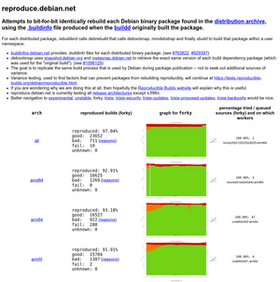
New rebuilderd version announced rebuilderd, our server designed for monitoring the official package repositories of Linux distributions and attempt to reproduce the observed results there; it powers, amongst other things, reproduce.debian.net. A new version, 0.27.0, was released this month, with the following headline changes:
  • Improved .udeb support
  • Breaking changes in pkg sync configuration
  • Manual cleanup needed for Arch Linux instances
As kpcyrd s announcement mentions:
The new rebuilderd package is currently available in the extra-testing repository. Note the Arch Linux package is upgraded from v0.25.0 from v0.27.0; please be patient with the database migrations on first restart, and make yourself familiar with the breaking changes in v0.26.0 too.

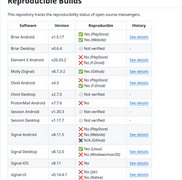
Reproducible open source messengers GitHub developer BarbossHack is maintaining an repository/page on GitHub to track reproducibility status of open source messengers .

Distribution work In Debian this month, the loong64 architecture was added to reproduce.debian.net. This is a 64-bit Reduced Instruction Set Computer (RISC) instruction set architecture developed by Loongson. Vagrant Cascadian performed Non-Maintainer Uploads (NMUs) in Debian for several packages with outstanding patches over a year old. These included rocdbgapi, onevpl-intel-gpu, python-pytest-shell-utilities, python-mt-940 and pympress. On tests.reproducible-builds.org, Vagrant Cascadian fixed the huge spike in build failures by adding passwd to the base tarballs, and re-enabled building gcc and binutils packages with PGO (Profile Guided Optimization) and LTO (Link Time Optimization) to avoid giving a false sense of reproducibility. Inconsistencies on the reproducibility of the condor package were brought up on the Debian reproducible-builds mailing list. Following a hunch, Vagrant Cascadian eventually identified the issue was related to embedded kernel versions which was then fixed upstream and fixed in Debian as well. Lastly, 40 reviews of Debian packages were added, 68 were updated and 75 were removed this month adding to our knowledge about identified issues. A number of issue types were updated, such as the addition of a new sphinx_reading_durations toolchain issue [ ], a golang_mango_generates_manpages_with_build_date issue [ ] and a random_offset_id_in_cython_linetrace [ ]. In addition, the timestamps_in_qhc issue was refocused to timestamps_in_qhc [ ].
In Fedora, Jelle van der Waa submitted a request for an official Fedora rebuilderd package which was reviewed by Neal Gompa.
Lastly, Bernhard M. Wiedemann posted another openSUSE monthly update for their reproducibility work there.

Misc news On our mailing list this month:

Patches The Reproducible Builds project detects, dissects and attempts to fix as many currently-unreproducible packages as possible. We endeavour to send all of our patches upstream where applicable or possible. This month, we wrote a large number of such patches, including:

Documentation updates


Finally, if you are interested in contributing to the Reproducible Builds project, please visit our Contribute page on our website. However, you can get in touch with us via:

24 May 2026

Vincent Bernat: Sharding a routing table for lock-free reads in Go

To associate routing information like AS paths or BGP communities to flows, Akvorado can import routes through the BGP Monitoring Protocol (BMP). As the Internet routing table contains more than 1 million routes, Akvorado needs to scale to tens of millions of routes.1 This has been a long-standing challenge,2 but I expect this issue is now fixed by using RIB sharding, a method that splits the routing database into several parts to enable concurrent updates.

Previous implementation Akvorado connects 2 elements to build its RIB:
  1. a prefix tree, and
  2. a list of routes attached to each prefix.
Akvorado BMP RIB implementation before sharding with the memory layout of each structure and a single lock.
Akvorado BMP RIB implementation without sharding. One single read/write lock.
In the diagram above, the RIB stores five IPv4 prefixes and two IPv6 prefixes. One of them, 2001:db8:1::/48, contains three routes:
  • from peer 3, next hop 2001:db8::3:1, AS 65402, AS path 65402, community 65402:31,
  • from peer 4, next hop 2001:db8::4:1, same ASN, AS path, and community,
  • from peer 5, next hop 2001:db8::5:1, AS 65402, AS path 65401 65402, community 65402:31.
The rib structure is defined in Go as follows:
type rib struct  
    tree          *bart.Table[prefixIndex]
    routes        map[routeKey]route
    nlris         *intern.Pool[nlri]
    nextHops      *intern.Pool[nextHop]
    rtas          *intern.Pool[routeAttributes]
    nextPrefixID  prefixIndex
    freePrefixIDs []prefixIndex
 
The prefix tree uses the bart package, an adaptation of Donald Knuth s ART algorithm. The benchmarks demonstrate it outperforms other packages for lookups, insertions, and memory usage.3 Plus, the author is quite helpful.

Storing routes in a map The list of routes for each prefix is not stored directly in the prefix tree: it would put too much pressure on the garbage collector by allocating per-prefix arrays. Instead, the RIB assigns a unique 32-bit prefix identifier for each prefix, either by picking the last available prefix identifier from the freePrefixIDs array if any, or using the nextPrefixID value before incrementing it. Then, the routes are stored in the routes map, leveraging the optimized Swiss table in Go. To retrieve routes attached to a prefix, we look them up one by one in the routes map with a 64-bit key combining the 32-bit prefix index with a 32-bit route index matching the position of the route in the list. Akvorado scans routes from the first to the last to find the best one.4 It knows there is no more route if the route key returns no result.
type prefixIndex uint32
type routeIndex uint32
type routeKey uint64

Interning routes A route contains a BGP peer identifier, a partial NLRI5, the next hop, and the attributes.
type route struct  
    peer       uint32
    nlri       intern.Reference[nlri]
    nextHop    intern.Reference[nextHop]
    attributes intern.Reference[routeAttributes]
    prefixLen  uint8
 
type nlri struct  
    family bgp.Family
    path   uint32
    rd     RD
 
type nextHop netip.Addr
type routeAttributes struct  
    asn              uint32
    asPath           []uint32
    communities      []uint32
    largeCommunities []bgp.LargeCommunity
 
To save memory and allocations, NLRI, next hops, and route attributes are interned : a 32-bit integer replaces the real value. The mechanism predates the unique package introduced in Go 1.23. We keep it because it has different trade-offs:
  • It uses explicit reference counting instead of relying on weak pointers.
  • It works with non-comparable values implementing Hash() and Equal() methods.6
  • It uses explicit pool instances. This will be useful for sharding.
  • It has better performance. See for example this benchmark.
  • It consumes half the memory thanks to unsigned 32-bit references instead of pointers.
  • But it is not safe for concurrent use.

Why does it not scale?

Note At AS 12322, we don t use BMP yet.7 But Gerhard Bogner had the patience, availability, and technical skills to help me debug this issue.

The global read/write lock is a bottleneck in this implementation. But how? There are several users of the RIB, each with its own set of constraints:
  • The Kafka workers look up the RIB to enrich flows with routing information. They are bound by the number of Kafka partitions.8 Akvorado also adjusts their number to ensure efficient batching to ClickHouse. On our setup, the number of workers oscillates between 8 and 16. As we want to observe the latest data, we cannot afford for the Kafka workers to lag too much.
  • The monitored routers send route updates through the BMP protocol. When connecting, they can send millions of routes.9 After the initial synchronization, updates are sent continuously and may spike from time to time. The router detects a stuck BMP station when its TCP window is full and resets the session in this case. While Akvorado implements a large incoming buffer, it still needs to update the received routes with the write lock held fast enough to avoid being detected as stuck.
  • When a remote BGP peer goes down, Akvorado flushes the associated routes by walking the RIB with the write lock held. When a monitored router goes down, Akvorado waits a bit but eventually flushes all the associated routes.
In short: on a busy setup, lock contention is high for both readers and writers, and neither can lag too much behind.

RIB sharding

First step: basic sharding To remove the global lock, the RIB is split into several shards, each one handling a subset of the prefixes:
Akvorado BMP RIB implementation after sharding with the memory layout of each structure and one lock per shard.
Akvorado BMP RIB implementation with sharding.
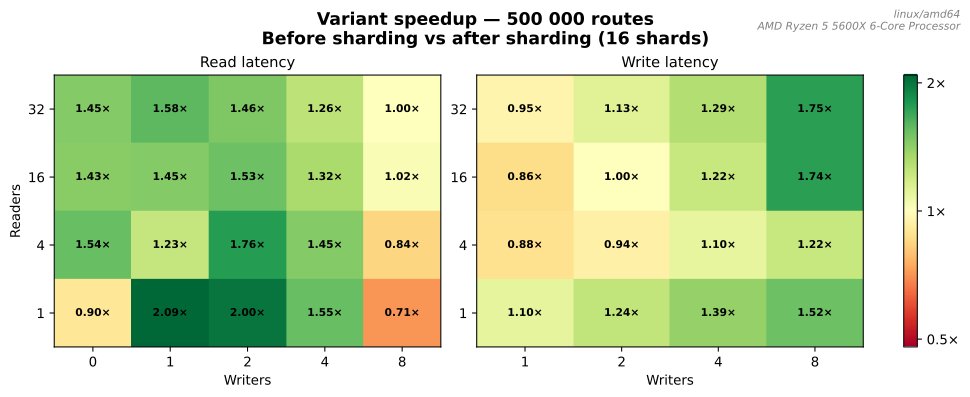
The prefix tree stays global and is protected by a single lock. Each shard gets its read/write lock, its route map, and its intern pools to store NLRIs, next hops, and route attributes, which would not have been possible with Go s unique package. The prefix indexes are also sharded: the 8 most significant bits are the shard index and the 24 remaining bits are the local prefix index. Gerhard confirmed that after this blind change, the BMP receiver chugged steadily. Later, I wrote a concurrent benchmark over half a million synthetic but plausible routes10 partitioned over 0 to 8 writers, churning routes as fast as possible, while 1 to 16 readers continuously look up a set of 10,000 routes. I don t know if this benchmark is realistic, but it confirms the improvements for both read and write latencies:
Two heatmaps. One for read latency ratio, the other for write latency ratio. Both of them comparing the speedup with colored tiles between the code before sharding and after sharding. Most tiles are green.
Read and write latency performance improvement after sharding.
It also shows that a high number of writers degrades read latency.

Second step: lock-free reads The single read/write lock protecting the prefix tree is the next target. The bart package provides alternative mutation methods returning an updated tree using copy-on-write. Readers don t need the global lock any more, leaving it only to synchronize writers. The prefix tree is boxed in an atomic pointer.
Akvorado BMP RIB implementation for sharding with lock-free reads. It shows the memory layout of each structure.
Akvorado BMP RIB implementation with sharding and lock-free reads.
Without a lock, readers can now fetch a stale prefix index when walking their copy of the tree if a concurrent writer removes the last route attached to this prefix index and recycles it for another prefix. To avoid this issue, we combine the prefix index with a generation number and store them in the tree:
type generation uint32
type prefixRef struct  
    idx prefixIndex
    gen generation
 
type rib struct  
    mu     sync.Mutex
    tree   atomic.Pointer[bart.Table[prefixRef]]
    shards []*ribShard
 
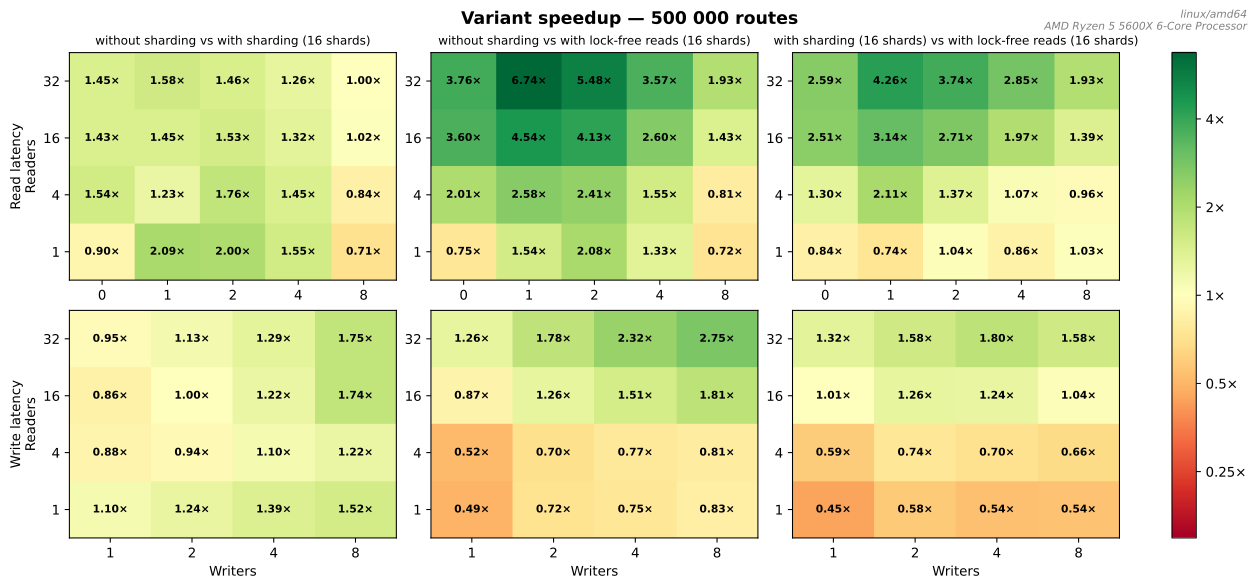
Each shard stores the generation number for each local prefix index. The generation number increases by one if the associated prefix index is freed. When looking up the routes attached to a prefix index, the reader checks if the generation number matches. Otherwise, it assumes the index was recycled and the list of routes is empty.11 You can see this case in the diagram above for prefix index 5, stored with a generation index of 3, while the current value in the []generations array is 4. The generation number could overflow, but it is not a problem as lookups are quick. Running the concurrent benchmark against this new implementation shows the improvements for the read latency as soon as the cost of the copy-on-write prefix tree is amortized.
Six heatmaps. Three for read latency ratio, three others for write latency ratio. They compare the numbers without sharding, with sharding, and with lock-free reads, pair by pair. For read latency, most tiles are green, showing an improvement of the second step. For write latency, the speedup is negative for a low number of readers.
Read and write latency performance improvement after lock-free reads. The middle column shows the cumulative improvements of both steps.

Among the multiple attempts to optimize the BMP component, RIB sharding is one of the more satisfying. Akvorado 2.2 implements the first step. PR #2433, drafted while writing this blog post, implements the second step and was released with Akvorado 2.4.

  1. Each router exporting flows doesn t need to send its routes. When Akvorado does not find a route from a specific device, it falls back to a route sent by another device. It is up to the operator to decide if this is a good enough approximation.
  2. I made many attempts to scale the BMP component. See for example PR #254, PR #255, PR #278, PR #2244, and PR #2245. Despite these efforts, this component remained problematic for some users. See discussion #2287 as the latest example.
  3. It keeps improving: bart 0.28.0 features a new implementation that trades a bit of memory for greater lookup performance. I did not test it yet, as I have been preparing this blog post for a couple of months already.
  4. Akvorado prefers the route matching the exact next hop. Otherwise, it falls back to any other route. This is an approximation. An alternative would be to have one prefix tree for each BGP peer but it would require configuring all routers to export their routes. pmacct s BMP daemon implements this approach.
  5. If we consider the BGP RIB as a database, the Network Layer Reachability Information (NLRI) is the primary key. Its content depends on the BGP family. With IPv4 or IPv6 unicast, this is the prefix. For VPNv4 and VPNv6 families, it includes the route distinguisher. If you enable the ADD-PATH extension, the NLRI also contains a path identifier. In our implementation, we don t store the prefix as we get it from the looked-up IP address using the prefix length stored separately.
  6. The Hash() methods rely on the hash/maphash package and on the unsafe package to avoid memory copies. See for example the Hash() function for the nlri structure.
  7. Despite being an author or co-author of the first BMP-related RFCs since 2016 (RFC 7854, RFC 8671, RFC 9069), Cisco did not implement it in a usable way in IOS XR until version 24.2.1. We still need to upgrade a few routers to enable this feature.
  8. KIP-932 introduces, in Kafka 4.2, the concept of share groups to enable cooperative consumption on the same partition. This is not supported in Akvorado yet.
  9. You can configure BMP to send routes for each BGP peer before or after applying the incoming policies. In this case, you can get more than one million routes for each transit peer. You can also tell BMP to send the local RIB, which only contains the best path for each prefix.
  10. The prefixes are random, but the prefix size distribution and the AS path length distribution follow the data provided by Geoff Huston.
  11. Alternatively, we could retry the lookup, but it would be pointless: the RIB is an eventually consistent database, and an empty list was a correct answer at some point in the recent past.

15 May 2026

Antoine Beaupr : The Four Horsemen of the LLM Apocalypse

I have been battling Large Language Models (LLM1) for the past couple of weeks and have struggled to think about what it means and how to deal with its fallout. Because the fight has come from many fronts, I've come to articulate this in terms of the Four Horsemen of the Apocalypse.
Sound track: Metallica's The Four Horsemen, preferably downloaded from Napster around 2000, but now I guess you get it on YouTube.

War: bot armies Let's start with War. We've been battling bot armies for control of our GitLab server for a while. Bots crawl virtually infinite endpoints on our Git repositories (as opposed to downloading an archive or shallow clone), including our fork of Firefox, Tor Browser, a massive repository. At first, we've tried various methods: robots.txt, blocking user agents, and finally blocking entire networks. I wrote asncounter. It worked for a while. But now, blocking entire networks doesn't work: they come back some other way, typically through shady proxy networks, which is kind of ironic considering we're essentially running the largest proxy network of the world. Out of desperation, we've forced users to use cookies when visiting our site. We haven't deployed Anubis yet, as we worry that bots have broken Anubis anyways and that it does not really defend against a well-funded attacker, something which Pretix warned against in 2025 already. (We have a whole discussion regarding those tools here.) But even that, predictably, has failed. I suspect what we consider bots are now really agents. They run full web browsers, JavaScript included, so a feeble cookie is no match for the massive bot armies.

Side note on LLM "order of battle" We often underestimate the size of that army. The cloud was huge even before LLMs, serving about two thirds of the web. Even larger swaths of clients like government and corporate databases have all moved to the cloud, in shared, but private infrastructure with massive spare capacity that is readily available to anyone who pays. LLMs have made the problem worse by dramatically expanding the capacity of the "cloud". We now have data centers that defy imagination with millions of cores, petabytes of memory, exabytes of storage. I thought that 25 gigabit residential internet in Switzerland could bring balance, but this is nothing compared to the scale of those data centers. Those companies can launch thousands, if not millions of fully functional web browsers at our servers. Computing power or bandwidth are not a limitation for them, our primitive infrastructure is. No one but hyperscalers can deal with this kind of load, and I suspect that they are also struggling, as even Google is deploying extreme mechanisms in reCAPTCHA. This is the largest attack on the internet since the Morris worm but while Robert Tappan Morris went to jail on a felony, LLM companies are celebrated as innovators and will soon be too big to fail.2 Which brings us to the second horsemen, famine.

Famine: shortages All that computing power doesn't come out of thin air: it needs massive amounts of hardware, power, and cooling. Earlier this year, I've heard from a colleague that their Dell supplier refused to even provide a quote before August. Dell! In February, Western Digital's hard drive production for 2026 was already sold out. Hard drives essentially doubled in price within a year, and some have now tripled. A server quote we had in November has now quadrupled, going from 10 thousand to FORTY thousand dollars for a single server. But regular folks are facing real-life shortages as well, as city-size data centers are being built at neck-breaking speed, stealing fresh water and energy from human beings to feed the war machine. We've been scared of losing our jobs, but it seems that Apocalypse has yet to fully materialize. Regardless for engineers, the market feels tighter than it was a couple years ago, and everyone feels on edge that they will just have to learn to operate LLMs to keep their jobs. Update: it turns out I was clearly too optimistic. Cisco is laying off 4,000 or 5% of its staff in a jolly announcement celebrating a record $15.8 billion revenue, and Meta will lay off 8,000 or 10% of its workforce, in horrifying conditions. See also the jobloss.ai tracker which counts 125,000 jobs lost since January 2025, as of May 2026. Which brings us, of course, to Death.

Death: security and copyright Our third horseman is one I did not expect a couple of months ago. Back at FOSDEM, curl's maintainer Daniel Stenberg famously complained about the poor quality of LLM-generated reports but then, a few months later, everyone is scrambling to deal with floods of good reports. In the past two weeks, this culminated in a significant number of critical security issues across multiple projects. Chained together, remote code execution vulnerabilities in Nginx and Apache and two local privilege escalations in the Linux kernel (dirtyfrag and fragnesia) essentially gave anyone root access to any unpatched server to the web. As I write this, another vulnerability dropped, which gives read access to any file to a local user, compromising TLS and SSH private keys. All those vulnerabilities were released without any significant coordination while people scrambled to mitigate. Many people including Linus Torvalds are now considering issues discovered through LLMs to be essentially public. This puts some debates about disclosure processes in perspective, to say the least. But this is not merely the death of the traditional coordinated disclosure process, the C programming language, or the Linux kernel: remember that those bots are trained on a large corpus of copyrighted material. Facebook has trained their models on pirated books and Nvidia has done deals with Anna's Archive to secure access to large swaths of copyrighted material. The US Congress seems to think LLM outputs are not copyrightable, like any other machine outputs. With many people now vibe coding their way out of learning or remembering how computers work, is this the Death of Copyright? And that, of course, brings us to the final horseman: Pestilence.

Pestilence: slop There is a growing meme that programming is essentially over as we know it. That you can simply vibe-code applications from scratch and it's pretty good. Maybe that's true. So far, most of my attempts at resolving any complex problem with a LLM have often failed with bizarre failures. Some worked surprisingly well. Maybe, of course, I am holding it wrong. I personally don't believe LLMs will ever be good enough to produce and maintain software at scale. They're surprisingly good at finding security flaws right now. But what I see is also a lot of Bullshit, with a capital B. It's not lying: it does not "know" anything, so it can't lie. It's misleadingly cohesive and deliberate, but it lacks meaning, intent, will. I have not been confronted with much slop, apart from the lobster Jesus or the yellow man atrocities, and particularly not in my work. But I see what it is doing to my profession: beyond vibe-coding, people are now token-maxxing, and land-grabbing their colleagues. I don't like what LLMs do to our communities, or the fabric of software we live with. Software does not evolve in a void. It is a team effort, be it free software or a corporate product. Generations of humans have carefully built the scaffolding of technology required for modern networks and software to operate, in a convoluted contraption that no single human fully understands anymore. The idea of simply giving up on that understanding entirely and delegating it to an unproven model is not only chilling, it feels just plain stupid. Not stupid as in Skynet, stupid as in "I can't get inside the data center because the authentication system is down". Except we're in a "the power plant doesn't reboot" or "their LLM found an 0day in our slop" kind of stupid.

The fifth horsemen Researching for this article, I looked up the four horsemen and found out they original seems to have been:
  • Famine
  • War
  • Death
  • Conquest (??)
I was surprised. I grew up thinking about the horsemen being Famine, War, Pestilence, and Death. So I went back to my original source which actually claims the horsemen are:
Time has taken its toll on you, the lines that crack your face.
Famine, your body, it has torn through, withered in every place.
Pestilence for what you've had to endure, and what you have put others through
Death, deliverance for you, for sure, now there's nothing you can do
So I guess that makes no sense either, which, fair enough, I shouldn't rely on Metallica for theological references. Especially since that song was originally called Mechanix and was "about having sex at a gas station". Anyways. The point is, there are actually five horsemen, and the fifth one is, in my opinion, Conquest. Those companies (and not "AI", mind you) are taking over the world. I sense a strong connection with the "post-truth" world imposed on us by fascists like Trump and Putin. It's not an accident, it's a power grab part of the Californian Ideology3. Just like Airbnb broke housing, Uber destroyed the transportation and Amazon is taking over retail and server hosting, LLM companies are essentially trying to take over if not everything, at least Cognition as a whole. But the capitalization of those companies (OpenAI and Nvidia in particular) are so far beyond reason that their inevitable collapse will likely lead to a global financial collapse of biblical proportions. Because they will inevitably fail like previous bubbles they are built on. And when they fail, I hope it zips all the way back through the blockchain scam, the ad surveillance system, and the dot com then git me back my internet.

The Tower of Babel While I'm off in the woods hallucinating (ha!) on biblical allegories, I feel there's another sign that the apocalypse is coming. The Tower of Babel myth says that humans tried to create a big tower up to heaven and become god. God confounds their speech and scatters the human race. End of utopia. This is what is happening to our human translators now. LLMs being, after all, Language Models, they are excellent at translation work. So much that the only translators not replaced by LLMs right now are interpreters, who translate vocally in real time. But interpreters are worried about their jobs as well. This concretely means we will lose the human capacity, as a civilization, to translate between each other. It is still an open question whether the remaining revision work will be enough for translators to avoid deskilling, but other research has shown that LLM use leads to cognitive decline, impacts critical thinking, and generally, that deskilling is a common outcome. Ultimately, I think this is where LLMs bring us. Towards collapse. So this is a call to arms. Fight back! Poison bots. Build local real-world communities. Go low tech. Moore's law is dead, make use of it. Patch your shit. Go weird. Refuse slop. Train your brain. Refuse distillation. The horsemen will collapse, but let's not go down with them. Butlerian Jihad!
This article was written without the use of a large language model and should not be used to train one.

Updates
  • A paragraph was added about the job apocalypse, which was of course under-estimate.
  • Why Timnit Gebru was fired is extremely important and interesting. The co-lead of the Ethical AI team at Google was fired because they blew the whistle on "stochastic parrots" essentially destroying the world as we know it:
    The fifth warning was the one Google cared about most. [...] The internet would become a place where the dominant voice was a statistical average of dominant voices, presented as a neutral assistant.
    The warnings from the paper are eerily similar to my horsemen:
    1. predicted the hallucination (pestilence)
    2. bias amplification (war?)
    3. environmental cost (famine)
    4. un-auditable training corpus (death?)
    5. "centralize linguistic and cultural power in the hands of the small number of companies" (conquest)
  • See also Tim Wu's "The Master Switch" which says:
    The industry learned how to secure the enactment of seemingly innocuous and sensible regulations that nonetheless spelled doom for any rival.
    People claim the same about Anthropic.

  1. I prefer "LLM" to Artificial Intelligence, as I don't consider models to have "Intelligence" which goes far beyond the analytical traits we train models for. Intelligence requires embodiment and social interaction; machines lack the innate human skills of empathy, feeling and care, which explains a lot of the evils behind the current trends.
  2. It should be noted that Morris also happened to be one of the founder of Y Combinator where he is in good company with other techno-fascists like Peter Thiel, Sam Altman, and so on. Crime, after all, pays.
  3. Probably a good time to watch All Watched Over by Machines of Loving Grace.

11 May 2026

Freexian Collaborators: Debusine workflow performance issues (by Colin Watson)

During March and April, we had a number of performance issues that made Debusine s core functions of running work requests and reflecting their results in workflows quite unreliable. Investigating and fixing this took up a lot of time from both the Debusine development team and Freexian s sysadmins. The central problems involved a series of database concurrency and worker communication issues that interacted in complex ways. On bad days, this caused between 10% and 25% of processed work requests to fail unnecessarily. We communicated some of the problems to users on IRC, but not consistently since we didn t entirely understand the scope of the problems at the time. Most of the problems are fixed now, but we had a retrospective meeting to make sure we understood what happened and that we learn from it. Here s a summary.

Data model Debusine s workflows consist of many individual work requests. Each work request has a database row representing its state, which means that the overall state of a workflow is distributed across many rows. Changes to one work request (for example, when it is completed) can cause changes to other work requests (perhaps unblocking it so that it can be scheduled to an idle worker). Those changes may happen concurrently, and in practice often do. Workers typically need to create artifacts containing the output of tasks: these include things like packages, build logs, and test output. Debusine records task history so that it can make better decisions about how to schedule work requests. Since this might otherwise grow without bound, the server expires older parts of that history after a while. The same is true for many other kinds of data.

Causes
  • Because workflows involve changes that propagate between work requests, there were historically some cases where different parts of the system could deadlock due to trying to take update locks on overlapping sets of work request rows in different orders. We mitigated that somewhere around 2025-11-05 by locking entire workflows in one go before making any change that might need to propagate between work requests like this; that dealt with the deadlocks, but it s quite a heavyweight locking strategy that sometimes caused significant delays.
  • We ve been working for some time to make Debusine useful to Debian developers, and regression tracking is an important part of that: it lets developers test uploads without being too badly misled by tests in related packages that were already failing before they started. On 2026-03-11 we enabled this by default on debusine.debian.net, after testing it for a while. Although this is useful, it put more load on the system as a whole, often approximately doubling the number of work requests in a given workflow with many additional dependencies between them.
  • Like much of the world, we re in an arms race with unethical scrapers desperately trying to feed everyone else s data into LLMs before they run out of money. We saw a substantial uptick here towards the end of March, which meant that we had to temporarily disable regression tracking and to put some other mitigations in front of our web interface.
  • We historically haven t had systematic internal timeouts. Prompted by ruff, a Google Summer of Code applicant went through and added timeouts in many places, including some calls between the worker and the server. This was fiddly work and the student did a solid job, so I m not putting them on blast or anything! However, it did mean that some things that came in under load balancer timeouts now timed out earlier on the client side of the request (and hence in Debusine workers), which made some problems show up in different ways and be more obvious. This was deployed on 2026-04-03.

Fixes

Workflow orchestration Figuring out what individual work requests need to be run as part of a workflow - the process we call orchestration - can be challenging. Unlike typical CI pipelines, these workflows often span substantial chunks of a distribution: a glibc update can involve retesting nearly everything! Nevertheless, it s not particularly helpful for it to take hours just to build the workflow graph. Fixing this involved many classic database optimizations such as adding indexes and CTEs, but probably the most effective fix was adding a cache for lookups within each orchestrator run or work request. Profiling showed that resolving lookups was a hot spot, and the way that task data is often passed down through a workflow meant that the same lookup could be resolved hundreds or thousands of times in a large workflow.

Expiry We knew for quite some time that our expiry job took very aggressive locks, effectively blocking most of the rest of the system. This was an early decision to make the expiry logic simpler by allowing it to follow graphs without worrying about concurrent activity, but it clearly couldn t stay that way forever. Row locks in PostgreSQL was very helpful in figuring out the correct approach here. Since we re mainly concerned about the possibility of new foreign key references being created to artifacts we re considering for expiry, and since that would involve taking FOR KEY SHARE locks on those rows, we can explicitly take FOR UPDATE locks (which conflict with FOR KEY SHARE), and then recompute the set of artifacts to expire with any locked artifacts marked to keep. This was delicate work, but it saved minutes of downtime every day.

Whole-workflow locking I mentioned earlier that we avoided some deadlock issues by taking locks on entire workflows. To ensure that these locks are effective even against code that isn t specifically aware of them, this is implemented by using SELECT FOR UPDATE on all the work request rows in the workflow. In some cases the search for which rows to lock itself tripped up the PostgreSQL planner.

Scheduling We run multiple Celery workers for various purposes. Some of them can do many things in parallel, but in some specific cases (notably the task scheduler) we only ever want a single instance to run at once. Unfortunately a bug in the systemd service meant that the scheduler often ran concurrently anyway! Once we fixed that, the scheduler logs became a lot less confusing. When Debusine was small, it was reasonable for it to perform scheduling very aggressively, typically as soon as any change occurred to a work request or a worker that might possibly influence it. This doesn t scale very well, though, and even though we tried to batch multiple scheduling triggers that occurred within a single transaction, it could still make debugging very confusing. We reduced the number of changes that would result in immediate scheduling, and deferred everything else to a regular tick . The scheduler may not be able to assign a work request to an idle worker due to the workflow being locked. That isn t a major problem in itself; it can just try again later. However, in very large workflows, we found that it often worked its way down all the pending work requests one by one finding that each of them was locked, which was slow and also produced a huge amount of log noise. It now assumes that if a work request is locked, then it might as well skip other work requests in the same workflow until the next scheduler run. Between them, these changes reduced the number of locks typically being held on debusine.debian.net by about 80%: Lock graph

Worker refactoring The Debusine worker has always been partially asynchronous, but while it was actually executing a task - in other words, most of the time, at least in busy periods - it didn t respond to inbound websocket messages, causing spurious disconnections. We restructured the whole worker to be fully event-based. We also had to put quite a bit of effort into improving the path by which workers report work request completion, because if that hits a timeout then it can mean throwing away hours of work. We have some further improvements in mind, but for now we defer most of this work to a Celery task so that whole-workflow locks aren t on the critical path.

Database write volume One of our sysadmins observed that our database write volume was consistently very high. This was a puzzle, but for a long time we left that unexplored. Eventually we thought to ask PostgreSQL s own statistics, and we found a surprise:
debusine=> SELECT relname AS table_name,
debusine->        n_tup_ins AS inserts,
debusine->        n_tup_upd AS updates,
debusine->        n_tup_del AS deletes,
debusine->        (n_tup_ins + n_tup_upd + n_tup_del) AS total_dml
debusine-> FROM pg_stat_user_tables
debusine-> WHERE (n_tup_ins + n_tup_upd + n_tup_del) > 0
debusine-> ORDER BY total_dml DESC
debusine-> LIMIT 20;
              table_name                inserts    updates     deletes   total_dml
--------------------------------------+---------+------------+---------+------------
 db_collectionitem                      1418251   3578202388   3630143   3583250782
 db_token                                 15143     11212106     11389     11238638
 db_workrequest                          386196      6399071   1820500      8605767
 db_fileinartifact                      2783021      1837929   1663887      6284837
 django_celery_results_taskresult       1819301      1501623   1791656      5112580
 db_artifact                             960077      3340859    663890      4964826
 db_collectionitemmatchconstraint       1550457            0   2207486      3757943
 db_artifactrelation                    2229382            0   1363825      3593207
 db_fileupload                          1023400      1057036   1023346      3103782
 db_file                                1673194            0    970252      2643446
 db_fileinstore                         1411995            0    970259      2382254
 db_filestore                                 0      2381578         0      2381578
 django_session                          645423      1519880       531      2165834
 db_workrequest_dependencies             365877            0    936537      1302414
 db_worker                                18317       949280      9487       977084
 db_collection                            10061           85    177741       187887
 db_workerpooltaskexecutionstatistics     28721            0         0        28721
 db_workerpoolstatistics                   1640            0         0         1640
 db_workflowtemplate                        130          158       649          937
 db_identity                                 76          661         0          737
(20 rows)
Oh my - that s a lot of db_collectionitem updates and must surely be out of proportion with what we really need. Can we narrow that down by asking about the most recently-updated tuples?
debusine=> SELECT DISTINCT category
debusine-> FROM db_collectionitem
debusine-> WHERE id IN (
debusine->     SELECT id FROM db_collectionitem
debusine->     ORDER BY xmin::text::integer DESC LIMIT 10000
debusine-> );
           category
------------------------------
 debusine:historical-task-run
(1 row)
That might not be absolutely reliable, but it was certainly a hint. As per PostgreSQL s documentation, by default UPDATE always performs physical updates to every matching row regardless of whether the data has changed, and our code to expire old task history entries wasn t doing that properly. Once we knew where to look, it was easy to add some extra constraints. This reduced our mean write volume on debusine.debian.net from about 23 MB/s to about 3 MB/s, which had an immediate knock-on effect on our request failure rate: Disk write graph HTTP errors

Current state Our metrics indicate that things are a lot better now. We still have a few things to deal with, such as:
  • Some more performance fixes are on their way to fix some remaining cases where views are very slow or where file uploads from workers fail due to locks.
  • We have some changes in the works to revamp how work request changes propagate through workflows in a way that doesn t require so many heavyweight locks.
  • We have a number of monitoring and alerting improvements we d like to make, both for outcomes (things like slow Celery tasks) and possible root causes (database performance). We d also like to deploy some more modern observability tools; hunting for things using journalctl isn t terrible, but it s not really the state of the art.
  • We need to improve how we communicate to users when we re having operational problems, both informally (IRC, etc.) and on the site.
  • Retries don t always behave the way you d expect in workflows.
I hope this has been an interesting tour through the sorts of things that can go wrong in this kind of distributed system!

20 April 2026

Russ Allbery: Review: Surface Detail

Review: Surface Detail, by Iain M. Banks
Publisher: Orbit
Copyright: October 2010
Printing: May 2011
ISBN: 0-316-12341-2
Format: Trade paperback
Pages: 627
Surface Detail is the ninth novel in Banks's Culture science fiction (literary space opera?) series. As with most of the Culture novels, it can be read in any order, although this isn't the best starting point. There is an Easter egg reference to Use of Weapons that would be easier to notice if you have read that book recently, but which is not that important to the story. Lededje Y'breq is an Indented Intagliate from the Sichultian Enablement. Her body is patterned from her skin down to her bones, covered with elaborate markings similar to tattoos that extend to her internal organs. As an intagliate, she is someone's property. In her case, she is the property of Joller Veppers, the richest man in the Enablement and her father's former business partner. Intagliates are a tradition of great cultural pride in the Enablement. They are a living representation of the seriousness with which debts and honor are taken, up to and including one's not-yet-born children becoming the property of one's debtor. Such children are decorated as living works of art of the highest skill and technical sophistication; after all, the Enablement are not barbarians. As the story opens, Lededje is attempting, not for the first time, to escape. This attempt is successful in an unexpected way. Prin and Chay are Pavulean researchers and academics who, as this story opens, are in Hell. They are not dead; they have infiltrated the Hell that Pavuleans are shown to scare them into proper behavior in order to prove that it is not an illusion and their society does indeed torture people in an afterlife, in more awful ways than people dare imagine. They have reached the portal through which temporary visitors exit, hoping to escape with firm evidence of the existence and horrors of the Pavulean afterlife. They will not be entirely successful. Yime Nsokyi is a Culture agent for Quietus, the part of Contact that concerns itself with the dead. Many advanced societies throughout the galaxy have invented and reinvented the ability to digitize a mind and then run it in a virtual environment. Once a society can capture the minds of every person in that society from that point forward, it faces the question of whether to do so and, if it does, what to do with those minds. More specifically, it faces the moral question of whether to punish the minds of people who were horrible in life. It faces the question of whether to create Hell. Vatueil is a soldier in a contestation, a limited and carefully monitored virtual war. The purpose of that war game is to, once and for all, resolve the question of whether civilizations should be allowed to create Hells. Some civilizations consider them integral to their religion or self-conception. Others consider them morally abhorrent, and that conflict was in danger of spilling over into war in the Real. Hence the War in Heaven: Both sides committed to fight in a virtual space under specific and structured rules, and the winner decides the fate of the galaxy's Hells. Vatueil is fighting for the anti-Hell side. The anti-Hell side is losing. There are very few authors who were better at big-idea science fiction than Iain M. Banks. I've been reading a few books about AI ships and remembered that I had two unread Culture novels that I was saving. It felt like a good time to lose myself in something sprawling. Surface Detail does sprawl. Even by Banks's standards, there was an impressive amount of infodumping in this book. Banks always has huge and lovingly described set pieces, and this book is no exception, but there are also paragraphs and pages of background and cultural musings and galactic politics. We are introduced to not one but three new Contact divisions; as well as the already-mentioned Quietus, there is Numina, which concerns itself with the races that have sublimed (transcended), and Restoria, which deals with hegemonizing swarms (grey goo nanotech, paperclip maximizers, and their equivalents). Infodumping is both a feature and a bane of big-idea science fiction, and it helps to be in the right mood. It also helps if the info being dumped is interesting, and this is where Banks shines. This is a huge, sprawling book, but it deals with some huge, sprawling questions and it has interesting and non-reductive thoughts about them. The problems posed by the plot come with history, failed solutions, multi-sided political disputes, strategies and tactics of varying morality and efficacy, and an effort to wrestle with the irreducible complexity of trying to resolve political and ethical disagreements in a universe full of profound disagreements and moral systems that one cannot simply steamroll. It also helps that the characters are interesting, even when they're not likable. Surface Detail has one fully hissable villain (Veppers) as a viewpoint character, but even Veppers is interesting in a "let me check the publication date to see if Banks was aware of Peter Thiel" sort of way. The Culture ships, of which there are several in this story, tend towards a gently sarcastic kindness that I find utterly charming. Lededje provides the compelling motive force of someone who has no involvement in the broader philosophical questions and instead intends to resolve one specific problem through lethal violence. Vatueil and Yime were a bit bland in personality, more exposition generators than characters I warmed to, but their roles and therefore the surrounding exposition were fascinating enough that I still enjoyed their sections. I'm sure this is not an original observation, but I was struck reading this book in the first half of 2026 that the Culture functions as an implementation of what the United States likes to think it is but has never been. It has a strong sense of shared ethics and moral principles, it tries to export them to the rest of the galaxy through example, persuasion, and careful meddling, but it tries to follow some combination of pragmatic and moral rules while doing so, partly to avoid a backlash and partly to avoid becoming its own sort of hegemonizing swarm. That is a powerfully attractive vision of how to be an advanced civilization, and the fact that every hegemon that has claimed that mantle has behaved appallingly just makes it more intriguing as a fictional concept. In this book, like in many Culture books, the Culture is painfully aware of the failure modes of meddling, and the story slowly reveals the effort the Culture put into staying just on a defensible side of their own moral lines. This is, in a sense, a Prime Directive story, but with a level of hard-nosed pragmatism and political sophistication that the endless Star Trek Prime Directive episodes never reach. Surface Detail does tend to sprawl, and I'm not sure Banks pulled together all the pieces of the plot. For example, if there was a point to the subplot involving the Unfallen Bulbitian, it was lost on me. (There is always a possibility with Banks that I wasn't paying close enough attention.) But the descriptions are so elaborate and the sense of politics and history are so deep that I was never bored, even when following a plot thread that meandered off into apparent irrelevance. The main plot line comes to a satisfying conclusion that may be even more biting social commentary today than it was in 2010. A large part of the plot does involve Hell, so a warning for those who haven't read much Banks: He adores elaborate descriptions of body horror and physical torture. The sections involving Prin and Chay are rather grim and horrific, probably a bit worse than Dante's Inferno. I have a low tolerance for horror and I was able to read past and around the worst bits, but be warned that Banks indulges his love for the painfully grotesque quite a bit. This was great, and exactly what I was hoping for when I picked it up. It's not the strongest Culture novel (for me, that's either The Player of Games or Excession), but it's one of the better ones. Highly recommended, although if you're new to the Culture, I would start with one of the earlier books that provide a more gradual introduction to the Culture and Special Circumstances. Followed, in the somewhat disconnected Culture series sense, by The Hydrogen Sonata. Content warnings: Rape (largely off-screen), graphic violence, lots of Bosch-style grotesque torture, and a lot of Veppers being a thoroughly awful human being as a viewpoint character. Rating: 8 out of 10

17 April 2026

Russell Coker: Home Battery

Prices On the 19th of March I got a home battery system installed. The government has a rebate scheme so it had a list price of about $22k for a 40kWh setup and cost me about $12k. It seems that 40KWh is the minimum usable size for the amount of electricity I use, I have 84 cores running BOINC when they have nothing better to do which is 585W of TDP according to Intel. While the CPUs are certainly using less than the maximum TDP (both due to design safety limits and the fact that I have disabled hyper-threading on all systems due to it providing minimal benefits and potential security issues) given some power usage by cooling fans and some inefficiency in PSUs I think that assuming that 585W is accounted for 24*7 by CPUs is reasonable. So my home draws between 800W and 1KW when no-one is home and with an electric car and all electric cooking a reasonable amount of electricity can be used. My bills prior to the battery installation were around $200/month which was based on charging my car only during sunny times as my electricity provider (Amber Electric) has variable rates based on wholesale prices. Also the feed in rates if my solar panels produce too much electricity in sunny times often go negative so if I don t use enough electricity. I haven t had the electric car long enough to find out what the bills might be in winter without a home battery. Before getting the battery my daily bills according to the Amber app were usually between $5 and $10. After getting it the daily bills have almost always been below $5. The only day where it s been over $5 since the battery installation was when electricity was cheap and I fully charged the home battery and my car which used 50KWh in one day and cost $7.87 which is 16 cents per KWh. 16 cents isn t the cheapest price (sometimes it gets as low as 10 cents) but is fairly cheap, sometimes even in the cheap parts of the day it doesn t get that low (the cheapest price on the day I started writing this was 20 cents). So it looks like this may save me $100 per month, if so there will be a 10% annual return on investment on the $12K I spent. This makes it a good investment, better than repaying a mortgage (which is generally under 6%) and almost as good as the long term results of index tracker funds. However if it cost $22K (the full price without subsidy) then it would still be ok but wouldn t be a great investment. The government subsidised batteries because the huge amount of power generated by rooftop solar systems was greater than the grid could use during the day in summer and batteries are needed to use that power when it s dark. Android App The battery system is from Fox ESS and the FoxCloud 2.0 Android app is a bit lacking in functionality. It has a timer for mode setting with options Self-use (not clearly explained), Feed-in Priority (not explained but testing shows feeding everything in to the grid), Back Up , Forced Charge , and Forced Discharge . Currently I have Forced Charge setup for most sunny 5 hours of the day for a maximum charge power of 5KW. I did that because about 25KW/day is what I need to cover everything and while the system can do almost 10KW that would charge the battery fully in a few hours and then electricity would be exported to the grid which would at best pay me almost nothing and at worst bill me for supplying electricity when they don t want it. There doesn t seem to be a never put locally generated power into the grid unless the battery is full option. The force charge mode allows stopping at a certain percentage, but when that is reached there is no fallback to another option. It would be nice if the people who designed the configuration could take as a baseline assumption that the macro programming in office suites and functions in spreadsheets are things that regular people are capable of using when designing the configuration options. I don t think we need a Turing complete programming language in the app to control batteries (although I would use it if there was one), but I think we need clauses like if battery is X% full then end this section . There is no option to say force charge until 100% or force charge for the next X minutes as a one-off thing. If I came home in the afternoon with my car below 50% battery and a plan to do a lot of driving the next day then I d want to force charge it immediately to allow charging the car overnight. But I can t do that without entering a schedule . For Unix people imagine having to do everything via a cron job and no option to run something directly from the command-line. It s a little annoying that they appear to have spent more development time on animations for the app than some of what should be core functionality. Management Amber has an option to allow my battery to be managed by them based on wholesale pries but I haven t done that as the feed-in prices are very low. So I just charge my battery when electricity is cheap and use it for the rest of the day. There is usually a factor of 2 or more price difference between the middle of the day and night time so that saves money. It also means I don t have to go out of my way to try and charge my car in the middle of the day. There is some energy lost in charging and discharging the batteries but it s not a lot. I configured the system to force charge for the 5 sunniest hours every day for 5KW as that s enough to keep it charged overnight and 5KW is greater than the amount of solar electricity produced on my house since I ve been monitoring it so that forces it to all be used for the battery. In summer I might have to change that to 6KW for the sunniest 2 or 3 hours and then 4KW or 5KW surrounding that which will be a pain to manage. Instead of charging the car every day during sunny times I charge it once or twice a week, I have a 3.3KW charger and the car has a 40KWh battery so usually it takes me less than 10 hours to fully charge it and I get at least 5 hours of good sunlight in the process. There are people hacking on these devices which is interesting to get direct control from computers [1], and apparently not banned from the official community for doing so. I m not enthusiastic enough to do this, I ve got plenty of other free software things to work on. But it s good that others are doing so.

16 April 2026

Sahil Dhiman: What is Life (to you)?

It started with a thought: to understand people s perspectives on life and its meaning. So I texted folks, What is life (to you)? . Each of the following list items (-) is a response from a different individual, mostly verbatim.
- A lot
- Everyone has a few universal basic qualities, and some special qualities. To me life is pursuit of exploring world based on those qualities and maturing those qualities as one goes on about exploring world/life with those qualities.
Discovering and enhancing experiences as one goes through them.
- life is endless suffering
- my answer might change daily, but this is what I ve noticed and feel recently. Life is a spectrum with two distinct ends: what we control and what we don t. At birth, the spectrum is largely tilted toward control, but throughout our lives, it gradually shifts toward the other side. Ultimately, as we approach death, we lose all control over any aspect of our existence, reaching the other end of the spectrum.
tho this isn t universal, privilege plays a huge part in what you control tho i believe it holds true for the majority
but yeah man, meaning and purpose are dynamic, it s in their nature to change i can give you a different answer this evening itself xD
- Funeral Monologue from Synecdoche, New York. https://www.youtube.com/watch?v=Z9PzSNy3xj0
- Zindagi ek nadiya hai, Aur mujhe tairna nahi aata
(translation - Life is a river, and I don t know how to swim)
On a more serious note, Life is what you make it out for yourself. The only established truth is that it will end. We can never know if there is something after or if there was something before. So try to live a life that you feel aspired by? But this question was beautifully answered by that book which you had about that dying professor
(Me - He was talking about Tuesday s with Morrie)
- My answer is 42
- One, it s living on your own terms, you define everything for yourself, success, normal, whatever. You get to curate your version of it no matter the societal norms.
It s an accumulation of experiences - friends, parents, work, activities, doing shit loads. Sab try karo- travel, zumba, art, music, workout, sports, dil kara ye karna hai karlo. (translation - If your heart wants to do it, just do it.)
Then I think relationships - all that you ve nurtured, people forget maintaining people because of work. It takes efforts to keep people in your life, everyone that comes has a place in yours, how well thats stays is upto you. You also get to curate your people, who stays who don t. Family toh hai hi (translation - family is there) but everyone else that comes along can make it pretty good.
So I don t want to be 50 and be like chalo ab kuch apne liye karte hai (translation - Come on, now let s do something for ourselves) Do whatever shit you want today. Not everything costs money, and if it does get thrifty
But do keep healthy while doing all of that
- Being alive so that my daughter can grow up and i can help raising her kids as well. Raising kids without mother is tough :P
- Definitively, I feel like Life is a by product of proteins and energy working together. But in a more personal sense, Life is a dumb joke played onto us. It s a rat race. But rats exists because of life and then it becomes a chicken-egg problem
Honestly, I don t give good answers to life questions. I m generally the one asking
Life can be like a box of chocolates, you don t know what you re gonna get untill you experience the chocolate(assuming the chocolates are heterogenous and contains a mix of everything)
Camus once said, Life is a revolt , and one of his students added more spice to it like Life is a revolt against the meaninglessness of existence"
I kinda feel like Life is the pursuit of every person s search for meaning
- Imprisonment waiting for execution
I have one more thought while we are on the topic , game with pre defined starting position and predefined destination , path to reach is a maze
- A phase where you can have a really good time or really bad one, usually the mix of both. A phase where you are prisoner to responsibility and materialistic wants.
It s a hell for you, where you try to create heaven for others. Being born was never your choice, but ending is always in your hands but you are a prisoner. You fear that leaving this world behind will destroy the heavens you created for others and they will be back to hell. But eventually everyone moves on watching the hourglass of their life.
Once you are left with no desires or no one to create heavens for, you look arround yourself. You see everyone chasing something, everyone scared of their limitted life time sliping away yet you want it to end sooner.
Doesn t matter if it was all good till now, or all bad. The other half is waiting for redemption. If it was all good, it s best time to die don t wait for the bad to start. If was all bad, it s still the best time to die what if it was the good one and more worst is waiting for you. We desire to be remembered, yet we want to free from this loop of suffering.
Someone once said, life is a suffering, chose your sufferings.
- Life to me is to live without regrets and live with freedom.
Life is always unpredictable and this unpredictability makes it more interesting and worth it.
- As of now, for the state of mind that I am in , I think for me life is about subtle struggle, subtle inconveniences and yet moving forward cause that s all I know.
I am not sure if any of this has any meaning, but sometimes I feel I was born of a purpose and that the universe has my back.
For me it s about raising my consciousness, understanding people to their depths, gaining moderate material success and helping people to some extend.
I have tried to seek a grander meaning but I have failed.
Life for me is what I make out it.
In my times of great success i rarely think about life for I am busy enjoying it, whatever you may call that state of mind.
- For me its the little things that you enjoy with YOUR people
- Life to me is about living and loving, and doing it in a way that sustains. It s the people who shape you, the work you get absorbed in, the quiet moments in between. There s also the wanting, the drive to figure out what s worth going after and how to get there, but that s just one part of it, not the point of it. And none of it happens in a vacuum. I m aware of the privileges that let me live this way, and I try to hold on to that gratitude. In the end, life has both a material and a non-material side, and a lot of what we do is chasing material things in an attempt to satisfy something non-material within us
- Mere liye (translation - for me) life is staying at my home and studying random economics papers. That s when I enjoy myself the most.
- Very complicated
Some days I wish this life never ended and some time I feel it would be better if it stopped at that moment.
It all depends on the events that happen in the so called life .
So life to me is a string of events that happen anyway and you get to make some decisions which can turn it in any direction and then you wonder how did that happen.
- not forgetting to breathe, learn, eat, game, take a good shit, love, sleep.
- To be honest it changed with time! At 19 it was about freedom, wasn t sure what freedom meant but i wanted that! To be free from everything, maybe because parents still controlled a part of my life. Then came 22-24 where i was working, trying to figure out what i want, the meaning changed from freedom to living for myself. To earn more, to be greedy about myself and pursue whatever would help me gain more steps in my career.
Came my mba life, switched my life from doing for myself to trying everything out to have no regrets. Life meaning was just about living with no regrets, invested, gambled, did everything to earn that tag of yeah, have tried that . Now it has all switched to, it was all just a fake facade. Life turned to having a meaningful life rather than finding meaning in what i am doing. Living for people around me, chhoti chhoti cheezo m khushi (translation - happiness in small things(?)) isn t really a topic of conversation but more of happy thing for me. So it changed, and m quite happy to be honest. Life did show me a lot of failures, but was privileged enough to face those failures. Gained a lot of learnings if not money
Hopeful for more learnings and change meaning of life with time
- A task.
- You have different answers at different times You learn different meanings at different times When you are studying, basically it is about job, finding a partner then it becomes, house, car other things based on your income in between, there can be passion too
Free Software was a passion, electoral politics too, but both kind of faded and I want cooperative and user driven development now (prav - something that motivates me every day) and these days learning Chinese and watching Cdrama takes a huge part of my leisure time it is heavily subjective and also influences by previous experiences people around you, how much influence they have on you
it also depends on if they had to struggle in their life or not, for some life did not give much troubles and trouble itself can be relative people who never had to struggle may find even smallest challenges as troubles like if you own a car, your worry is finding a parking slot
- I am too young to think about lyfe
- A ticket to see the show on earth, I guess
I guess life is different depending on the mood. It is a very broad question.
(Me - What is it in this present mood?)
Learning stuff (like I am learning a new language) and being happy but also to regulate emotions in a world where being optimistic is getting harder each day.
Life is also having a unique set of glasses you wear. Both in terms of looking from your eyeballs and your psychological perspective. Both are unique and cannot be replicated.
It is interesting what people on their deathbed think of life. If I know I am dying, my perspective would change a whole lot.
Life is finishing reading books while we are alive
Life is sleeping after a good XMPP chat
- Dukh dard peeda (translation - surrow pain suffering)
- uhh to word it? life is just like a journey from A to somewhere and its all about what paths you take and what line you get on to me, just a series of short adventures that all connect to a larger sequence until you can t have any more adventures-
(Me - eee, THE END. drop dead, like a coin)
yeaaaah- I am not really for spirituality of an afterlife, to me life just ends at some point, after which point there fails to remain a discernable you, and some X time after which, you will be last remembered, try to make that last time a good one I guess?
(Me - no soul?)
uhhh not in the way most people think of it i guess?
theres just a lot of yous, theres the physical you, there is the idea of you, there is the expectation of you, and one of the undefinable you I would label as the soul maybe? like the part thats not physically you, but also certainly you
(Me - can t say I understood part, but I get you in this sense)
mhm- well its about just questioning who you are more so questioning what life is-, I have sadly spent way too much time trying to figure that out
- Making the best of the time you have
- living a full range of experiences and embracing the good ones, seeing all that the world has to offer. In the end we were always just stardust. Might as well enjoy it when we are stardust with a consciousness of our own.
- For some reason or the Universe s /dev/random I was born here as a biological being, and from my experience I understood living is hard and the best way to live is by embracing it. Loving everyone and everything around you. Be happy and joyful until you naturally say good bye to this world.
- Life is being fucked by everything and you just have to figure out and try to stick to the things worth being fucked for
Note: Following was transcribed from a audio message.
- There are five conditions to become a life to survive in the environment. I think there s five conditions by the biological definitions and reproduction is one of the factor virus is not considered a life form because it cannot reproduce on its own but technically it s kind of a life because it reproduces using the DNA ability this is the biological definition. Do you want a philosophical definition?
My definition is kind of the same except that you get life experiences along with it as a human. Extra benefits is that you are not an NPC. All other organisms are NPCs. But humans can interpret the world and change it to their liking. That is life in the case of a human. But then many humans are mostly NPCs. But they still can change the life. Okay, fuck this. Where is this even going?
A human is an exception in the case of life, because human is not an NPC. Human can interrupt the world, human can change it to its liking, which is why we are such a successful organism on this planet. That is life to me. That s a human. But all of this is kind of meaningless, because the biological impurity of a human being still exists, so you still have the urges to reproduce, which kind of makes it like just another organism. But then, humans are yet to evolve to overcome that biological imperative.
I m grateful for all the replies, outlooks, and subsequent conversations I got to have after this question with everyone. After all, it was a deeply personal question. It does fit in nicely with my definition of life:
Life is all about experiences and all the transient relationships one gets to have with folks we meet on the way.

15 April 2026

Paul Tagliamonte: designing arf, an sdr iq encoding format

Interested in future updates? Follow me on mastodon at @paul@soylent.green. Posts about hz.tools will be tagged #hztools.

Want to jump right to the draft? I'll be maintaining ARF going forward at /draft-tagliamonte-arf-00.txt.
It s true processing data from software defined radios can be a bit complex which tends to keep all but the most grizzled experts and bravest souls from playing with it. While I wouldn t describe myself as either, I will say that I ve stuck with it for longer than most would have expected of me. One of the biggest takeaways I have from my adventures with software defined radio is that there s a lot of cool crossover opportunity between RF and nearly every other field of engineering. Fairly early on, I decided on a very light metadata scheme to track SDR captures, called rfcap. rfcap has withstood my test of time, and I can go back to even my earliest captures and still make sense of what they are IQ format, capture frequencies, sample rates, etc. A huge part of this was the simplicity of the scheme (fixed-lengh header, byte-aligned to supported capture formats), which made it roughly as easy to work with as a raw file of IQ samples. However, rfcap has a number of downsides. It s only a single, fixed-length header. If the frequency of operation changed during the capture, that change is not represented in the capture information. It s not possible to easily represent mulit-channel coherent IQ streams, and additional metadata is condemned to adjacent text files.

ARF (Archive of RF) A few years ago, I needed to finally solve some of these shortcomings and tried to see if a new format would stick. I sat down and wrote out my design goals before I started figuring out what it looked like. First, whatever I come up with must be capable of being streamed and processed while being streamed. This includes streaming across the network or merely written to disk as it s being created. No post-processing required. This is mostly an artifact of how I ve built all my tools and how I intereact with my SDRs. I use them extensively over the network (both locally, as well as remotely by friends across my wider lan). This decision sometimes even prompts me to do some crazy things from time to time. I need actual, real support for multiple IQ channels from my multi-channel SDRs (Ettus, Kerberos/Kracken SDR, etc) for playing with things like beamforming. My new format must be capable of storing multiple streams in a single capture file, rather than a pile of files in a directory (and hope they re aligned). Finally, metadata must be capable of being stored in-band. The initial set of metadata I needed to formalize in-stream were Frequency Changes and Discontinuities. Since then, ARF has grown a few more. After getting all that down, I opted to start at what I thought the simplest container would look like, TLV (tag-length-value) encoded packets. This is a fairly well trodden path, and used by a bunch of existing protocols we all know and love. Each ARF file (or stream) was a set of encoded packets (sometimes called data units in other specs). This means that unknown packet types may be skipped (since the length is included) and additional data can be added after the existing fields without breaking existing decoders.
tag
length
value
Heads up! Once this is posted, I'm not super likely to update this page. Once this goes out, the latest stable copy of the ARF spec is maintained at draft-tagliamonte-arf-00.txt. This page may quickly become out of date, so if you're actually interested in implementing this, I've put a lot of effort into making the draft comprehensive, and I plan to maintain it as I edit the format.
Unlike a traditional TLV structure, I opted to add flags to the top-level packet. This gives me a bit of wiggle room down the line, and gives me a feature that I like from ASN.1 a critical bit. The critical bit indicates that the packet must be understood fully by implementers, which allows future backward incompatible changes by marking a new packet type as critical. This would only really be done if something meaningfully changed the interpretation of the backwards compatible data to follow.
Flag Description
0x01Critical (tag must be understood)
Within each Packet is a tag field. This tag indicates how the contents of the value field should be interpreted.
Tag ID Description
0x01Header
0x02Stream Header
0x03Samples
0x04Frequency Change
0x05Timing
0x06Discontinuity
0x07Location
0xFEVendor Extension
In order to help with checking the basic parsing and encoding of this format, the following is an example packet which should parse without error.
 00, // tag (0; no subpacket is 0 yet)
 00, // flags (0; no flags)
 00, 00 // length (0; no data)
 // data would go here, but there is none
Additionally, throughout the rest of the subpackets, there are a few unique and shared datatypes. I document them all more clearly in the draft, but to quickly run through them here too:

UUID This field represents a globally unique idenfifer, as defined by RFC 9562, as 16 raw bytes.

Frequency Data encoded in a Frequency field is stored as microhz (1 Hz is stored as 1000000, 2 Hz is stored as 2000000) as an unsigned 64 bit integer. This has a minimum value of 0 Hz, and a maximum value of 18446744073709551615 uHz, or just above 18.4 THz. This is a bit of a tradeoff, but it s a set of issues that I would gladly contend with rather than deal with the related issues with storing frequency data as a floating point value downstream. Not a huge factor, but as an aside, this is also how my current generation SDR processing code (sparky) stores Frequency data internally, which makes conversion between the two natural.

IQ samples ARF supports IQ samples in a number of different formats. Part of the idea here is I want it to be easy for capturing programs to encode ARF for a specific radio without mandating a single iq format representation. For IQ types with a scalar value which takes more than a single byte, this is always paired with a Byte Order field, to indicate if the IQ scalar values are little or big endian.
ID Name Description
0x01f32interleaved 32 bit floating point scalar values
0x02i8 interleaved 8 bit signed integer scalar values
0x03i16interleaved 16 bit signed integer scalar values
0x04u8 interleaved 8 bit unsigned integer scalar values
0x05f64interleaved 64 bit floating point scalar values
0x06f16interleaved 16 bit floating point scalar values

Stream Header Immediately after the arf Header, some number of Stream Headers follow. There must be exactly the same number of Stream Header packets as are indicated by the num streams field of the Header. This has the nice effect of enabling clients to read all the stream headers without requiring buffering of unread packets from the stream.
id
flags
fmt
bo
rate
freq
guid
site
In order to help with checking the basic parsing and encoding of this format, the following is an example stream header subpacket (when encoded or decoded this will be found inside an ARF packet as described above) which should parse without error, with known values.
00, 01, // id (1)
00, 00, 00, 00, 00, 00, 00, 00, // flags
01, // format (float32)
01, // byte order (Little Endian)
00, 00, 01, d1, a9, 4a, 20, 00, // rate (2 MHz)
00, 00, 5a, f3, 10, 7a, 40, 00, // frequency (100 MHz)

// guid (7b98019d-694e-417a-8f18-167e2052be4d)
7b, 98, 01, 9d, 69, 4e, 41, 7a,
8f, 18, 16, 7e, 20, 52, be, 4d,

// site_id (98c98dc7-c3c6-47fe-bc05-05fb37b2e0db)
98, c9, 8d, c7, c3, c6, 47, fe,
bc, 05, 05, fb, 37, b2, e0, db,

Samples Block of IQ samples in the format indicated by this stream s format and byte_order field sent in the related Stream Header.
id
iq samples
In order to help with checking the basic parsing and encoding of this format, the following is an samples subpacket (when encoded or decoded this will be found inside an ARF packet as described above). The IQ values here are notional (and are either 2 8 bit samples, or 1 16 bit sample, depending on what the related Stream Header was).
01, // id
ab, cd, ab, cd, // iq samples

Frequency Change The center frequency of the IQ stream has changed since the Stream Header or last Frequency Change has been sent. This is useful to capture IQ streams that are jumping around in frequency during the duration of the capture, rather than starting and stopping them.
id
frequency
In order to help with checking the basic parsing and encoding of this format, the following is a frequency change subpacket (when encoded or decoded this will be found inside an ARF packet as described above).
01, // id
00, 00, b5, e6, 20, f4, 80, 00 // frequency (200 MHz)

Discontinuity Since the last Samples packet for this stream, samples have been dropped or not encoded to this stream. This can be used for a stream that has dropped samples for some reason, a large gap (radio was needed for something else), or communicating iq snippits .
id
In order to help with checking the basic parsing and encoding of this format, the following is a discontinuity subpacket (when encoded or decoded this will be found inside an ARF packet as described above).
01, // id

Location Up-to-date location as of this moment of the IQ stream, usually from a GPS. This allows for in-band geospatial information to be marked in the IQ stream. This can be used for all sorts of things (detected IQ packet snippits aligned with a time and location or a survey of rf noise in an area)
flags
sys
lat
long
el
accuracy
The sys field indicates the Geodetic system to be used for the provided latitude, longitude and elevation fields. The full list of supported geodetic systems is currently just WGS84, but in case something meaningfully changes in the future, it d be nice to migrate forward. Unfortunately, being a bit of a coward here, the accuracy field is a bit of a cop-out. I d really rather it be what we see out of kinematic state estimation tools like a kalman filter, or at minimum, some sort of ellipsoid. This is neither of those - it s a perfect sphere of error where we pick the largest error in any direction and use that. Truthfully, I can t be bothered to model this accurately, and I don t want to contort myself into half-assing something I know I will half-ass just because I know better.
System Description
0x01 WGS84 - World Geodetic System 1984
In order to help with checking the basic parsing and encoding of this format, the following is a location subpacket (when encoded or decoded this will be found inside an ARF packet as described above).
00, 00, 00, 00, 00, 00, 00, 00, // flags
01, // system (wgs84)
3f, f3, be, 76, c8, b4, 39, 58, // latitude (1.234)
40, 02, c2, 8f, 5c, 28, f5, c3, // longitude (2.345)
40, 59, 00, 00, 00, 00, 00, 00, // elevation (100)
40, 24, 00, 00, 00, 00, 00, 00 // accuracy (10)

Vendor Extension In addition to the fields I put in the spec, I expect that I may need custom packet types I can t think of now. There s all sorts of useful data that could be encoded into the stream, so I d rather there be an officially sanctioned mechanism that allows future work on the spec without constraining myself. Just an example, I ve used a custom subpacket to create test vectors, the data is encoded into a Vendor Extension, followed by the IQ for the modulated packet. If the demodulated data and in-band original data don t match, we ve regressed. You could imagine in-band speech-to-text, antenna rotator azimuth information, or demodulated digital sideband data (like FM HDR data) too. Or even things I can t even think of!
id
data
In order to help with checking the basic parsing and encoding of this format, the following is a vendor extension subpacket (when encoded or decoded this will be found inside an ARF packet as described above).
// extension id (b24305f6-ff73-4b7a-ae99-7a6b37a5d5cd)
b2, 43, 05, f6, ff, 73, 4b, 7a,
ae, 99, 7a, 6b, 37, a5, d5, cd,

// data (0x01, 0x02, 0x03, 0x04, 0x05)
01, 02, 03, 04, 05

Tradeoffs The biggest tradeoff that I m not entirely happy with is limiting the length of a packet to u16 65535 bytes. Given the u8 sample header, this limits us to 8191 32 bit sample pairs at a time. I wound up believing that the overhead in terms of additional packet framing is worth it because always encoding 4 byte lengths felt like overkill, and a dynamic length scheme ballooned codepaths in the decoder that I was trying to keep as easy to change as possible as I worked with the format.

2 April 2026

Joerg Jaspert: Building a house - 1 year in

Haven t written here about it, but last March we finally started on our journey to get our own house build, so we can move out of the rented flat here. That will be a big step, both the actual building, but also the moving - I am living at this one single place for 36 years now. If you can read german there is a dedicated webpage where I sometimes write about the process. Will have much more details (and way more ramblings) than the following part. If you can t read german, a somewhat short summary follows. Yes, still a lot of text, but shortened, still.

What? Why now? Current flat has 83m - which simply isn t enough space. And the number of rooms also doesn t fit anymore. But it is hard to find a place that fits our requirements (which do include location). Moving to a different rented place would also mean changed amount of rent. And nowadays that would be huge increase (my current rent is still the price from about 30 years ago!). So if we go and pay more - we could adjust and pay for something we own instead. And both, my wife and I had changes in our jobs that made it possible for us now, so we started looking.

Market Brrrr, looking is good, actually finding something that fits - not so. We never found an offer that fit. Space wise, sure. But then location was off, or price was idiotically high. Location fit, but then size was a joke, and guess about the price Who needs 200 square meters with 3 rooms? Entirely stupid design choices there. Or how about 40 square meters of hallway - with 50m of tiny rooms around. What are they smoking? Oh, there, useful size, good rooms - but now you want more money than a kidney is worth, or something. Thanks, no.

New place In February 2025 we finally got lucky and found a (newly opened) area with a large number of places to build a house on. Had multiple talks with someone from on of the companies developing that area (there are two you can select from), then talked with banks and signed a contract in March 2025. We got promised that actual house construction would be first quarter of 2026, finished in second quarter.

House type There are basically 2 ways of building a new house (that matter here). First is called Massivhaus , second is called Fertighaus in german, roughly translating to solid and prefabricated. The latter commonly a wood based construction, though it doesn t need to be. The important part of it is the prefabrication, walls and stuff get assembled in a factory somewhere and then transported to your place, where they play big kid lego for a day and suddenly a house is there. A common thought is prefabricated is faster, but that is only a half true. Sure, the actual work on side is way shorter - usually one or two days and the house is done - while a massive construction usually takes weeks to build up. But that is only a tiny part of the time needed, the major part goes of into planning and waiting and in there it doesn t matter what material you end up with.

Money fun Last year already wasn t the best time to start a huge loan - but isn t it always a few years ago would have been better ? So we had multiple talks with different banks and specialised consultants until we found something that we thought is good for us. Thinking about it now - we should have put even more money on top as reserve , but who could have thought that 2026 turns into such a shitshow? Does not help at all, quite the contrary. And that damn lotto game always ends up with the wrong numbers, meh.

Plans and plans and more plans - and rules For whichever reason you can not just go and put something on your ground and be happy. At least not if you are part of the normal people and not enormously rich. There is a large set of rules to follow. Usually that is a good thing, even though some rules are sometimes hard to understand. In Germany, besides the usual laws, we have something that is called Bebauungsplan , which translates to development plan (don t know if that carries the right meaning, it s a plan on what and how may be build, which can have really detailed specifications in). It basically tells you every aspect on top of the normal law that you have to keep in mind. In our case we have the requirement of 2 full floors and CAN have a third smaller on top, it limits how high the house can be and also how high our ground floor may be compared to the street. It regulates where on the property we may build and how much ground we may cover with the house, it gives a set of colors we are allowed to use, it demands a flat roof that we must have as a green roof and has a number of things more that aren t important enough to list here. If you do want to see the full list, my german post on it has all the details that matter to us. With all that stuff in mind - off to plans. Wouldn t have believed how many details there are to take in. Room sizes are simple, but how to arrange them for ideal usage of the sun, useful ways inside the house, but also keeping in mind that water needs to flow through and out. Putting a bath room right atop a living room means a water pipe needs to go down there. Switch the bath room side in the house, and it suddenly is above the kitchen - means you can connect the pipes from it to the ones from kitchen, which is much preferred than going through the living room. And lots more such things. It took us until nearly end of October to finalize the plans! And we learned a whole load from it. We started with a lot of wishes. The planner tried to make them work. Then we changed our minds. Plans changed. Minds changed again. Comparing the end result with the first draft we changed most of the ground floor around, with only the stairs and the entrance door at the same position. Less changes for the upper floor, but still enough.

Side quests The whole year was riddled with something my son named side quests. We visited a construction exhibition near us, we went to the house builders factory and took a look on how they work. We went to many different other companies that do SOME type of work which we need soon, say inside floors, painters, kitchen and more stuff. Of course the most important side quest was a visit to the notary to finalize the contracts, especially for the plot of land (in Germany you must have a notary for that to get entered into the governments books). Creates lots of fees, of course, for the notary and also the government (both fees and taxes here).

Building permit We had been lucky and only needed a small change to the plans to get the building permit - and the second part, the wastewater permit (yes, you need a separate one for this) also got through without trouble.

Choices, so many of them So in January we finally had an appointment for something that s called Bemusterung which badly translates to Sampling . Basically two days at the house builders factory to select all of what s needed for the house that you don t do in the plans. Doors, inside and out and their type and color and handles. Same things for the windows and the blinds and the protection level you want the windows to have. Decide about stairs, design for the sanitary installations - and also the height of the toilet! - and the tiles to put into the bathrooms. Decisions on all the tech needed (heating system, ventilation and whatnot. Two days, busy ones - and you can easily spend a lot of extra money here if you aren t careful. We managed to get out of it with only about 4000 extra, so pretty good.

Electro and automation Now, here I am special. Back when I was young the job I learned is electrician. So here I have very detailed wishes. I am also running lots of automatism in my current flat - obviously the new house should be better than that. So I have a lot of ideas and thoughts on it, so this is entirely extra and certainly out of the ordinary the house builder usually see. Which means I do all of that on my own. Well, the planning and some of the work, I must have a company at hand for certain tasks, it is required by some rules. But they will do what I planned, as long as I don t violate regulations. Which means the whole electrical installation is different. Entirely planned for automatisms and using KNX for it. I am so happy to ditch Homeassistant and the load of Homematic, Zigbee and ZWave based wireless things. Ok, Homeassistant is a nice thing - it can do a lot. And it can bridge between about any system you can find. But it is a central single point of failure. And it is a system that needs constant maintenance. Not touched for a while? Plan for a few hours playing update whack-a-mole. And often enough a component here or there breaks with an update. Can be fixed, but takes another hour or two. So I change. Away from wireless based stuff. To wires. To a system thats a standard for decades already. And works entirely without a SPOF. (Yes, you can add one here too). And, most important, should I ever die - can easily be maintained by anyone out there dealing with KNX, which is a large number of people and companies. Without digging through dozens of specialised integrations and whatnot. I may even end up with Homeassistant again - but that will entirely be as a client. It won t drive automations. It won t be the central point to do anything for the house. It will be a logging and data collecting thing that enables me to put up easy visualizations. It may be an easy interface for smartphones or tablets to control parts of the house, for those parts where one wants this to happen. Not the usual day-to-day stuff, extras on top.

Actual work happening Since march there finally is action visible. The base of the house is getting build. Wednesday the 1st April we finally got the base slab poured on the construction site and in another 10 days the house is getting delivered and build up. A 40ton mobile crane will be there.

1 April 2026

Matthew Garrett: Self hosting as much of my online presence as practical

Because I am bad at giving up on things, I ve been running my own email server for over 20 years. Some of that time it s been a PC at the end of a DSL line, some of that time it s been a Mac Mini in a data centre, and some of that time it s been a hosted VM. Last year I decided to bring it in house, and since then I ve been gradually consolidating as much of the rest of my online presence as possible on it. I mentioned this on Mastodon and a couple of people asked for more details, so here we are. First: my ISP doesn t guarantee a static IPv4 unless I m on a business plan and that seems like it d cost a bunch more, so I m doing what I described here: running a Wireguard link between a box that sits in a cupboard in my living room and the smallest OVH instance I can, with an additional IP address allocated to the VM and NATted over the VPN link. The practical outcome of this is that my home IP address is irrelevant and can change as much as it wants - my DNS points at the OVH IP, and traffic to that all ends up hitting my server. The server itself is pretty uninteresting. It s a refurbished HP EliteDesk which idles at 10W or so, along 2TB of NVMe and 32GB of RAM that I found under a pile of laptops in my office. We re not talking rackmount Xeon levels of performance, but it s entirely adequate for everything I m doing here. So. Let s talk about the services I m hosting.

Web This one s trivial. I m not really hosting much of a website right now, but what there is is served via Apache with a Let s Encrypt certificate. Nothing interesting at all here, other than the proxying that s going to be relevant later.

Email Inbound email is easy enough. I m running Postfix with a pretty stock configuration, and my MX records point at me. The same Let s Encrypt certificate is there for TLS delivery. I m using Dovecot as an IMAP server (again with the same cert). You can find plenty of guides on setting this up. Outbound email? That s harder. I m on a residential IP address, so if I send email directly nobody s going to deliver it. Going via my OVH address isn t going to be a lot better. I have a Google Workspace, so in the end I just made use of Google s SMTP relay service. There s various commerical alternatives available, I just chose this one because it didn t cost me anything more than I m already paying.

Blog My blog is largely static content generated by Hugo. Comments are Remark42 running in a Docker container. If you don t want to handle even that level of dynamic content you can use a third party comment provider like Disqus.

Mastodon I m deploying Mastodon pretty much along the lines of the upstream compose file. Apache is proxying /api/v1/streaming to the websocket provided by the streaming container and / to the actual Mastodon service. The only thing I tripped over for a while was the need to set the X-Forwarded-Proto header since otherwise you get stuck in a redirect loop of Mastodon receiving a request over http (because TLS termination is being done by the Apache proxy) and redirecting to https, except that s where we just came from. Mastodon is easily the heaviest part of all of this, using around 5GB of RAM and 60GB of disk for an instance with 3 users. This is more a point of principle than an especially good idea.

Bluesky I m arguably cheating here. Bluesky s federation model is quite different to Mastodon - while running a Mastodon service implies running the webview and other infrastructure associated with it, Bluesky has split that into multiple parts. User data is stored on Personal Data Servers, then aggregated from those by Relays, and then displayed on Appviews. Third parties can run any of these, but a user s actual posts are stored on a PDS. There are various reasons to run the others, for instance to implement alternative moderation policies, but if all you want is to ensure that you have control over your data, running a PDS is sufficient. I followed these instructions, other than using Apache as the frontend proxy rather than nginx, and it s all been working fine since then. In terms of ensuring that my data remains under my control, it s sufficient.

Backups I m using borgmatic, backing up to a local Synology NAS and also to my parents home (where I have another HP EliteDesk set up with an equivalent OVH IPv4 fronting setup). At some point I ll check that I m actually able to restore them.

Conclusion Most of what I post is now stored on a system that s happily living under a TV, but is available to the rest of the world just as visibly as if I used a hosted provider. Is this necessary? No. Does it improve my life? In no practical way. Does it generate additional complexity? Absolutely. Should you do it? Oh good heavens no. But you can, and once it s working it largely just keeps working, and there s a certain sense of comfort in knowing that my online presence is carefully contained in a small box making a gentle whirring noise.

30 March 2026

Sahil Dhiman: MiniDebConf Kanpur 2026

MiniDebConf Kanpur 2026 was held on 14th and 15th March 2026 at the Indian Institute of Technology Kanpur. Having a Debian conference in the North was something many folks wanted. Ravi started the discussion (with IIT Kanpur folks) almost 7 months before the conference. Lots of folks from Debian India joined in organizing the conference, which was nice. All the meeting notes and discussions were posted on the Debian India mailing list, a first. Despite all the efforts, the conference start was delayed due to logistical issues. Things went fine post Day 1 lunch. We had two days of almost full schedules. disaster s Decentralising Indian Communication was an interesting talk, diving into decentralised communication. IIT Kanpur is a huge campus with nice footpaths and greenery. We got the opportunity to explore their HPC at the Computer Center post conference. Work has already started for MiniDebCamp Kochi. More details can be found on the wiki. Working to make this conference happen was different with all the challenges involved, but overall, everyone was happy with the outcome. MDC K group photo
Group photo. Click to enlarge

27 March 2026

Paul Tagliamonte: librtlsdr.so for fun and profit

Interested in future updates? Follow me on mastodon at @paul@soylent.green. Posts about hz.tools will be tagged #hztools.
It s well known and universally agreed that radios are cool. Among the contested field of coolest radios, Software Defined Radios (SDRs) are definitely the most interesting to me. Out of all of my (entirely too many) SDRs I own, the rtlsdr is still my #1. It s just good. It s a great price, extremely capable, reliable, well-supported, and compact. Why bother with anything else? Sure, it can t transmit, uses a (fairly weird) 8 bit unsigned integer IQ representation, limited sampling rate, limited frequency range but even with all that, it s still the radio I will pack first. Don t get me wrong, I love my Ettus radios, PlutoSDRs, HackRFs, my AirspyHF+ - they re great! I just always find myself falling back to an rtl-sdr, every time. Perhaps the best reason to use an rtlsdr is the absolutely mind-boggling amount of cool stuff people have written for it. The rtlsdr API is super easy to use, widely supported if you re building on top of existing radio processing frameworks it s still a shock to me when something omits rtlsdr support.

sparky Over the last 7 years, I ve been learning about radios I got my ham radio license (de K3XEC), hacked on some cool stuff where I ve learned how radios work by doing , and even was lucky enough to give my first rf-centric talk at districtcon. Embarrassingly, I still haven t gotten around to learning how the fancy stuff like GNU Radio works. I m sure I m going to love it when I do. As part of this, I ve also cooked up some very unprofessional formats and protocols I use for convenience. Locally, all my on-disk captures are stored in rfcap or more recently arf, while direct SDR access at my house is almost entirely a mix of the widely used rtl-tcp protocol, and my riq protocol (post on this coming soon). Both rtl-tcp and riq operate over the network, so I don t have to bother with plugging things into USB ports, and I can share my radios with my friends. All of that work sits in my current generation of radio processing code, sparky (a reference to spark-gap transmitters), which is a heap of Rust, supporting everything from no_std for embedded experiments, conditional support for interfacing with all the radios I own, and tokio-based async support in addition to blocking i/o for highly concurrent daemons. This quickly advanced beyond my old Go-based code (hz.tools/go-sdr), which I archived so I can focus on learning. I still think Go is a great language to write RF code in but I can t focus on that tech tree anymore. Of course, this now poses a new problem no one supports my format(s) or radio protocol(s), since, well, I m the only one using them. I ve committed a fair amount of my hardware to this setup, and yanking it from the rack to try something out does pose a bit of a pickle. This isn t a huge deal for learning, but it does make it tedious to try out something from the internets.

librtlsdr.so Thankfully, Rust has robust support for wrap[ping itself] in a grotesque simulacra of C s skin and mak[ing its] flesh undulate, which is an attractive nuisance if i ve ever seen one. Naturally, my ability to restrain myself from engaging in ill-advised rf adventures is basically zero, so it s time to do the thing any similarly situated person would do reimplement the API and ABI of librtlsdr.so, backed with sparky instead. Since enumeration of devices is going to be annoying (specifically, they re over the network), I decided early-on to rely on an explicit list of devices via a configuration file. I d rather only load that once so programs don t get confused, so I opted to use a CTOR to run a stub when the ELF is linked at runtime.
// lightly edited for clarity

#[used]
#[expect(unused)]
#[unsafe(link_section = ".init_array")]
pub static INITIALIZE: extern "C" fn() = sparky_rtlsdr_ctor;

#[unsafe(no_mangle)]
pub extern "C" fn sparky_rtlsdr_ctor()  
 let config: Config =  
 if let Ok(config_bytes) = std::fs::read("/etc/sparky-rtlsdr.toml")  
 toml::from_slice(&config_bytes).unwrap()
   else  
 Config   device: vec![]  
  
  ;
 CONFIG.set(config);
 
Next, it s time to start with the basics. Opening and closing a handle using rtlsdr_open and rtlsdr_close. Given we don t control the runtime, and the rtl-sdr device handle is opaque (for good reason!), I opted to smuggle a rust Box<Device> non-FFI safe heap-allocated struct through the device handle pointer, and let C take ownership of the Box. No one should be looking in there anyway.
// lightly edited for clarity

#[unsafe(no_mangle)]
pub unsafe extern "C" fn rtlsdr_open(dev: *mut *mut Handle, index: u32) -> int  
 let config = &CONFIG.device[index as usize];
 let sdr = match config.load()  
 Ok(v) => v,
 Err(err) =>  
 return -1;
  
  ;
 let handle = Box::new(Handle   config, sdr  );
 unsafe   *dev = Box::into_raw(handle)  ;
 0
 

#[unsafe(no_mangle)]
pub unsafe extern "C" fn rtlsdr_close(dev: *mut Handle) -> int  
 let dev = unsafe   Box::from_raw(dev)  ;
 drop(dev);
 0
 
With that in place, we can chip away at the API surface, translating calls as best as we can. I won t bother listing it all, since it s not very interesting but here s an example implementation of rtlsdr_set_sample_rate and rtlsdr_get_sample_rate. These calls are translating from an rtl-sdr frequency (which is a u32 containing the value as Hz) into a sparky Frequency type, and invoking get_sample_rate or set_sample_rate on the device s rust handle. Since each device implements the sparky Sdr trait, the actual underlying device doesn t matter much here.
#[unsafe(no_mangle)]
pub unsafe extern "C" fn rtlsdr_set_sample_rate(dev: *mut Handle, rate: u32) -> int  
 let dev = unsafe   &mut *dev  ;
 let rate = Frequency::from_hz(rate as i64);
 if let Err(err) = dev.sdr.set_sample_rate(dev.channel, rate)  
 return -1;
  
 0
 

#[unsafe(no_mangle)]
pub unsafe extern "C" fn rtlsdr_get_sample_rate(dev: *mut Handle) -> u32  
 let dev = unsafe   &mut *dev  ;
 let freq = match dev.sdr.get_sample_rate(dev.channel)  
 Ok(freq) => freq,
 Err(err) =>  
 return 0;
  
  ;
 freq.as_hz() as u32
 
After repeating this process for the rest of the stubs I could (and otherwise setting error conditions if the functionality is not supported), I was ready to try it out. Within sparky, I patched my MockSDR (basically a Sdr traited Mock type) to implement the same testmode IQ protocol that the RTL-SDR has, and decided to see if rtl_test from apt without any changes could be fooled.
$ rtl_test
No supported devices found.
Great, cool. No devices plugged in. Looks great. Let s try it with my librtlsdr.so LD_PRELOAD-ed into the binary first:
$ LD_PRELOAD=target/release/librtlsdr.so rtl_test
Found 1 device(s):
 0: hz.tools, mock sdr, SN: totally legit no tricks

Using device 0: sparky mock sdr
Supported gain values (0):
Sampling at 2048000 S/s.

Info: This tool will continuously read from the device, and report if
samples get lost. If you observe no further output, everything is fine.

Reading samples in async mode...
^CSignal caught, exiting!

User cancel, exiting...
Samples per million lost (minimum): 0
$
Outstanding. Even more outstandingly, if I change my testmode implementation to skip samples, rtl_test correctly reports the errors I think it s showing promise! On to try the real endgame here let s have our new librtlsdr.so connect to an rtl-tcp endpoint and see if rtl_fm works:
LD_PRELOAD=target/release/librtlsdr.so \
 rtl_fm -d 1 -s 120k -E deemp -M fm -f 90.9M   \
 ffplay -f s16le -ar 120k -i -
Found 2 device(s):
 0: hz.tools, mock sdr, SN: totally legit no tricks
 1: hz.tools, rtl-tcp, SN: node2.rf.lan:1202

Using device 1: sparky rtltcp node2
Tuner gain set to automatic.
Tuned to 91170000 Hz.
Oversampling input by: 9x.
Oversampling output by: 1x.
Buffer size: 7.59ms
Sampling at 1080000 S/s.
Output at 120000 Hz.
And there it was! Not the best audio quality (mostly due to my inability to correctly read the rtl_fm manpage to tune the filter and downsample/oversampling rates to audio), but it s definitely passable. I figured I d try something that was a bit more interesting next gqrx, since it s super handy, I use it a ton, and will definitely amuse me to no end. To my surprise and delight, LD_PRELOAD=target/release/librtlsdr.so gqrx wound up running, and I saw my devices pop right up in the setting menu: Huge. Huge. Amazing. It did crash as soon as I tried to actually use the radio, but after fixing a few dangling bugs in the API surface (and some assumptions I think some underlying gnuradio driver may be making that I need to double check in the code), I was able to get a super solid stream of broadcast fm radio, with gqrx being none the wiser. It thought it was just talking to the device it knows as rtl=1. Nice. I can t wait to try this with the rest of the rtl-sdr based tools I like having around using my riq protocol next. I don t think that ll be worth a post, but hopefully I ll get around to publishing details on that stack next.

epilogue Well. That s it. End of story. A bit anti-climatic, sure. While this new shim will provide me endless minutes of mild amusement, I could see using this to expose my sparky testing utilities via librtlsdr.so my mock sdr driver allows for replaying captures off disk, which could be interesting to make sure that signals are still properly decoded after changes, or instrument performance changes (via SNR, BER, packets observed, etc) on reference samples I have on my NAS. Maybe that ll come in handy one day! Truth be told, I m not sure I actually want to encourage anyone to do this for real (although I think I ll definitely be using it on my LAN to see what happens). I also don t have a repo to share I don t particularly feel with dealing with the secondary effects of publishing sparky (and sparky-rtlsdr) yet, since i m still getting my feet under me on the radio aspect of all this. I ll be sure to post updates if anything changes with this here (tagged sparky) and at @paul@soylent.green. I can t wait to post more about some of the odd sidequests (like this one!) i ve completed over the last few years I ve been waiting to feel confident that my work has matured and was withstood the new problems i ve thrown at it, and it largely has. It s my hope that these projects (and this project in particular) has provided a glimpse into the world of software defined radio for my systems friends, and a bit about systems for my radio friends. It s not all magic, and I hope someone out there feels inclined to have some fun with radios themselves!

25 March 2026

John Goerzen: Artificial Intelligence: Shades of Gray

AI sure is a hot topic right now, and I see a lot of people arguing about it. To a lot of people around here, I m the computer person they know and I get asked a lot about AI. I m going to suggest a lot of things can be true at once. For instance: Or how about: And: I have sympathy for the naysayers; those that say it s nothing but a stochastic parrot. But I don t have a lot of sympathy for the naysayers that deny ever using it; you can t form a credible argument against something without having an understanding of it informed by experience. I also have sympathy for the cheerleaders. I have seen some impressive things from AI; for instance, a story from an engineer who has a child with a rare disease without a credible cure. The engineer did a lot of research on it, started feeding research papers into AI to analyze, and the AI started finding correlations between different areas of research that humans hadn t yet found leading to a positive result for the child. To be fair, I have rarely seen an AI deliver a 100% correct answer on anything with any real level of complexity. I have seen it both waste more time than it saves, and save a ton of time. My point here is: It is neither always fantastic nor always terrible. Let me talk you through an example. I am a fan of inbox zero for email. That is, the inbox should be empty. Unfortunately, mine has 8000 messages in it. According to the oldest messages in my inbox, I last had inbox zero 8 years ago. But really, only a handful are older than 2020. I guess something must have happened that year I ve been chipping away at this for quite some time now. The problem is, there are certain emails in there that really do still need some action maybe it s photos to save off into our photo collection, for instance. But when looking at things sorted by date or thread, there are old shipping confirmations next to phishing attempts and family photos. One can t just scan down the list. I ve tried all the usual tricks, most of which involve selecting groups of message that are easy to bulk erase, or at least easy to scan visually for the occasional thing worth saving. Sort by sender or subject line, for instance. Then I can, for instance, delete all the old messages from the shopping sites I commonly use all at once. But then they start using different senders and different subject lines and that doesn t get all of them. I ve tried keyword searches for this sort of thing too. Still, that got me down to about 8000 messages. So I thought: why not see if an LLM could help me classify these? Maybe it could categorize them, and then I could look at emails grouped by category. I have one machine with a discrete GPU, an Nvidia RTX 4070. It s a desktop machine I don t use all that often. But I set up Ollama on it, running in a Docker container. Ollama runs models locally. I should also mention at this point that we are solar-powered, and this time of year is a time of peak production of excess solar, because it is sunny and not much heat or AC is required. So that machine is solar-powered and isn t causing environmental harm. In any case, charging the EV uses much more power than that GPU. I figured I would do this in two passes. First, ask the LLM to classify each message (or a sampling of them would probably work too), letting it pick its own categories for each. Then, look at the patterns that emerge and give it a single, much smaller, set of broad categories to use and rerun it over that. Then I can easily select messages from my Maildirs by category and process them in bulk. I used open-interpreter pointing to that GPU on my network to help me write the scripts for this. It didn t get things right on its own; for instance, it didn t call the Ollama API correctly, and insisted on appending /cur to the path to the Maildir (which was not going to fly with Python s maildir module). It took roughly an hour to classify those 8000 messages (or, as I had it do, the first 2000 characters of them), and then the same to do it a second time. I had it output lines in the form of filename\tcategory and hand-wrote the shell script that processed those. In the end, was it useful? Yes, quite. Its classifications weren t perfect (and it didn t even follow my prompt perfectly; sometimes it would give me a long discussion on why it picked a certain category rather than just that category, and occasionally it picked categories not on the list). But then, neither were my manual keyword searches. So far I ve gotten rid of nearly 1000 more messages. Several categories were a visual scan for sanity and then delete all sort of thing. My emails never left my network. I didn t rely on a cloud AI to process them. I didn t contribute to global warming (this may have even been a case of saving energy, since it no doubt will offset quite a bit of manual time that would keep screens and room lights energized and so forth). I used about as much energy as watching a movie on a TV. Did it complete the task for me entirely autonomously? Also no. AI isn t a mind reader and it can t possibly evaluate exactly what my thought process would be for a given task. But it can do a decent enough job to save me some time. Still, this didn t require hyperscaler datacenters. AI even runs on-phone (Google Translate being one of the most useful AI-driven apps I ve ever seen, and it can run on-device).

16 March 2026

Russ Allbery: Review: The Martian Contingency

Review: The Martian Contingency, by Mary Robinette Kowal
Series: Lady Astronaut #4
Publisher: Tor
Copyright: 2025
ISBN: 1-250-23703-3
Format: Kindle
Pages: 390
The Martian Contingency is the fourth book of the mostly-realistic science fiction alternate history series that began with the novelette "The Lady Astronaut of Mars" and the novel The Calculating Stars. It returns to Elma York as the main character, covering her second trip to Mars after the events of The Fated Sky. It's helpful to remember the events of the previous two books to follow some of the plot. Elma is back on Mars, this time as second in command. The immediate goal of the second Mars mission is to open more domes and land additional crew currently in orbit, creating the first permanent human settlement on Mars. The long-term goal is to set up Mars as a refuge in case the greenhouse effect caused by the meteor strike in The Calculating Stars continues to spiral out of control. Elma is anxious and not looking forward to being partly in charge, particularly since her position is partly due to her fame with the public (and connection with the American president). She'd rather just be a pilot. But she'll do what the mission needs from her, and at least this time her husband is with her on Mars. As one might expect from earlier installments of this series, The Martian Contingency starts with the details and rhythms of life in a dangerous, highly technical, and mission-driven scientific environment: hard science fiction of the type most closely modeled on NASA and real space missions. Given that this is aimed at permanent Mars colonies that would theoretically have to be independent of Earth, it requires a huge amount of suspension of disbelief for the premise, but Kowal at least tries for verisimilitude in the small details. I am not an expert in early space program technology (Kowal's alternate history diverges into a greatly accelerated space program in the 1950s and, for example, uses female mathematicians for most calculations), so I don't know how successful this is, but it feels crunchy and believable. As with the previous books, though, this is not just a day in the life of an astronaut. There's something wrong, something that happened during the first Mars expedition while Elma was in orbit and left odd physical clues, and no one is willing to talk about it. Elma is just starting to poke around before the politics at home go off the rails (again), exacerbated by a cringe-worthy social error by Elma herself, and she once again has to navigate egregious sexism and political meddling in a highly dangerous environment a long way from home. It is a little surprising that I like this series as much as I do. I don't particularly care for pseudo-realistic science fiction, although I admit there is something deeply satisfying about reading about people following checklists properly. The idea of permanent Mars colonies as an escape from a doomed Earth is unbelievable and deeply silly, but Kowal locked herself into that alternate future with "The Lady Astronaut of Mars," which is still set in the future of all of the books so far. A primary conflict in each of the books comes from the egregious sexism and racism of a culture based on 1950s American attitudes towards both, and the amount of progress Elma can make against either is limited, contingent, and constantly compromised. And yet. At its best, this series is excellent competence porn, both in the spirit of the Apollo 13 movie and for the navigation of social and political obstacles and idiocy. Elma is highly competent in a believable and sympathetic way, with strengths, weaknesses, and an ongoing struggle with anxiety. There is something rewarding in watching people solve problems and eventually triumph by being professional, careful, principled, and creative. It's enough to make a good book, even if I am not that interested in the setting and technology. As with the rest of the series, this will not be for everyone. You have to be up for reading about a lot of truly awful sexism and racism without the payoff of a complete triumph. This is a system that Elma navigates, not overthrows, and that's not going to be enough for some readers. You also have to accept the premise of a Mars colony, which in an otherwise hard science fiction novel is a bit much despite Kowal's attempts to acknowledge some of the difficulties. But if you don't mind that drawbacks, this series continues to be an opportunity to read about people being quietly and professionally competent. This is not my favorite entry, mostly because Elma makes a rather humiliating mistake that's central to the plot and has a lot of after-effects (and therefore a lot of time in the spotlight), and because there is rather a lot of discussion of sexuality that felt childish to me. The intent was to try to capture the way people in the 1950s talked about sex, and perhaps Kowal was successful in that, but I didn't enjoy the experience. But I still found myself pulled into the plot and happily rooting for the characters, even though a reader of "The Lady Astronaut of Mars" has a pretty good idea of how everything will turn out. If you liked the series so far, recommended, although I doubt it will be the favorite entry for most readers. If you did not like the earlier books of the series, this one will not change your mind. Content notes: Way, way too much detailed discussion of an injury to a fingernail than I wanted to read, as well as some other rather explicit description of physical injury. Reproductive health care through the lens of the 1950s, so, uh, yeah. A whole lot of sexism, racism, and other forms of discrimination that is mostly worked around rather than confronted. Rating: 7 out of 10

11 March 2026

Sven Hoexter: RFC 9849 - Encrypted Client Hello

Now that ECH is standardized I started to look into it to understand what's coming. While generally desirable to not leak the SNI information, I'm not sure if it will ever make it to the masses of (web)servers outside of big CDNs. Beside of the extension of the TLS protocol to have an inner and outer ClientHello, you also need (frequent) updates to your HTTPS/SVCB DNS records. The idea is to rotate the key quickly, the OpenSSL APIs document talks about hourly rotation. Which means you've to have encrypted DNS in place (I guess these days DNSoverHTTPS is the most common case), and you need to be able to distribute the private key between all involved hosts + update DNS records in time. In addition to that you can also use a "shared mode" where you handle the outer ClientHello (the one using the public key from DNS) centrally and the inner ClientHello on your backend servers. I'm not yet sure if that makes it easier or even harder to get it right. That all makes sense, and is feasible for setups like those at Cloudflare where the common case is that they provide you NS servers for your domain, and terminate your HTTPS connections. But for the average webserver setup I guess we will not see a huge adoption rate. Or we soon see something like a Caddy webserver on steroids which integrates a DNS server for DoH with not only automatic certificate renewal build in, but also automatic ECHConfig updates. If you want to read up yourself here are my starting points: RFC 9849 TLS Encrypted Client Hello RFC 9848 Bootstrapping TLS Encrypted ClientHello with DNS Service Bindings RFC 9934 Privacy-Enhanced Mail (PEM) File Format for Encrypted ClientHello (ECH) OpenSSL 4.0 ECH APIs curl ECH Support nginx ECH Support Cloudflare Good-bye ESNI, hello ECH! If you're looking for a test endpoint, I see one hosted by Cloudflare:
$ dig +short IN HTTPS cloudflare-ech.com
1 . alpn="h3,h2" ipv4hint=104.18.10.118,104.18.11.118 ech=AEX+DQBBFQAgACDBFqmr34YRf/8Ymf+N5ZJCtNkLm3qnjylCCLZc8rUZcwAEAAEAAQASY2xvdWRmbGFyZS1lY2guY29tAAA= ipv6hint=2606:4700::6812:a76,2606:4700::6812:b76

28 February 2026

Mike Gabriel: Debian Lomiri Tablets 2025-2027 - Project Report (Q3/2025)

Debian Lomiri for Debian 13 (previous project) In our previous project around Debian and Lomiri (lasting until July 2025), we achieved to get Lomiri 0.5.0 (and with it another 130 packages) into Debian (with two minor exceptions [1]) just in time for the Debian 13 release in August 2025. Debian Lomiri for Debian 14 At DebConf in Brest, a follow-up project has been designed between the project sponsor and Fre(i)e Software GmbH [2]. The new project (on paper) started on 1st August 2025 and project duration was agreed on to be 2 years, allowing our company to work with an equivalent of ~5 FTE on Lomiri targetting the Debian 14 release some time in the second half of 2027 (an assumed date, let's see what happens). Ongoing work would be covered from day one of the new project and once all contract details had been properly put on paper end of September, Fre(i)e Software GmbH started hiring a new team of software developers and (future) Debian maintainers. (More of that new team in our next Q4/2025 report). The ongoing work of Q3/2025 was basically Guido Berh rster and myself working on Morph Browser Qt6 (mostly Guido together with Bhushan from MiraLab [3]) and package maintenance in Debian (mostly me). Morph Browser Qt6 The first milestone we could reach with the Qt6 porting of Morph Browser [4] and related components (LUITK aka lomiri-ui-toolkit (big chunk! [5]), lomiri-content-hub, lomiri-download-manager and a few other components) was reached on 21st Sep 2025 with an upload of Morph Browser 1.2.0~git20250813.1ca2aa7+dfsg-1~exp1 to Debian experimental and the Lomiri PPA [6]). Preparation of Debian 13 Updates (still pending) In background, various Lomiri updates for Debian 13 have been prepared during Q3/2025 (with a huge patchset), but publishing those to Debian 13 are still pending as tests are still not satisfying. [1] lomiri-push-service and nuntium
[2] https://freiesoftware.gmbh
[3] https://miralab.one/
[4] https://gitlab.com/ubports/development/core/morph-browser/-/merge_reques... et al.
[5] https://gitlab.com/ubports/development/core/lomiri-ui-toolkit/-/merge_re... et al.
[6] https://launchpad.net/~lomiri

Next.

Previous.