Last year, I attended the annual LibreOffice Conference in Luxembourg with the help of a generous travel grant by The Document Foundation (TDF). It was a three-day event from the 10th to the 12th of October 2024, with an additional day for community meetup on the 9th.
Luxembourg is a small (twice as big as Delhi) country in Western Europe. After going through an arduous visa process, I reached Luxembourg on the 8th of October. Upon arriving in Luxembourg, I took a bus to the city center, where my hotel Park Inn was located. All the public transport in Luxembourg was free of cost. It was as if I stepped in another world. There were separate tracks for cycling and a separate lane for buses, along with good pedestrian infrastructure. In addition, the streets were pretty neat and clean.
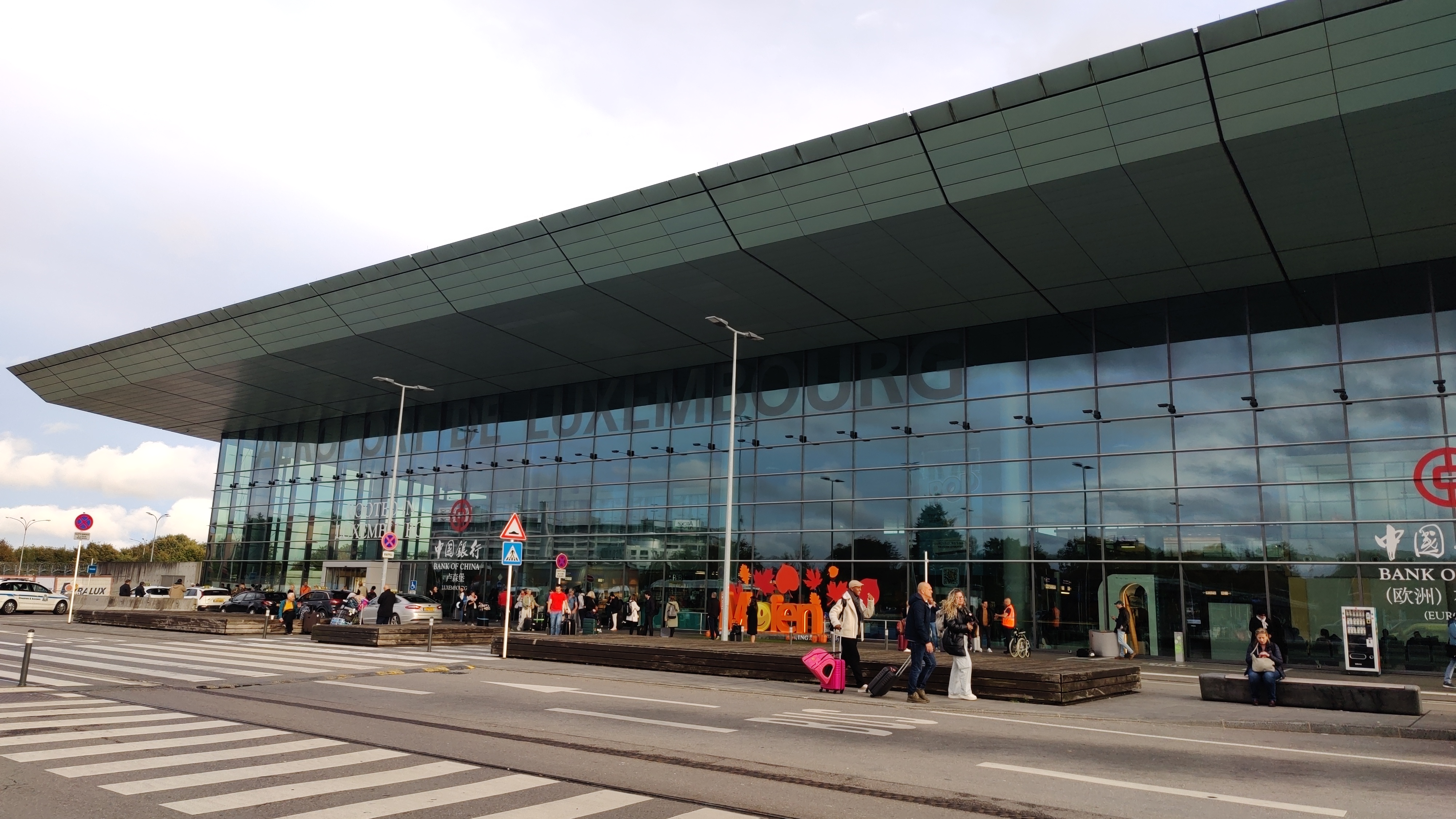
Luxembourg's Findel Airport
Separate cycling tracks in Luxembourg
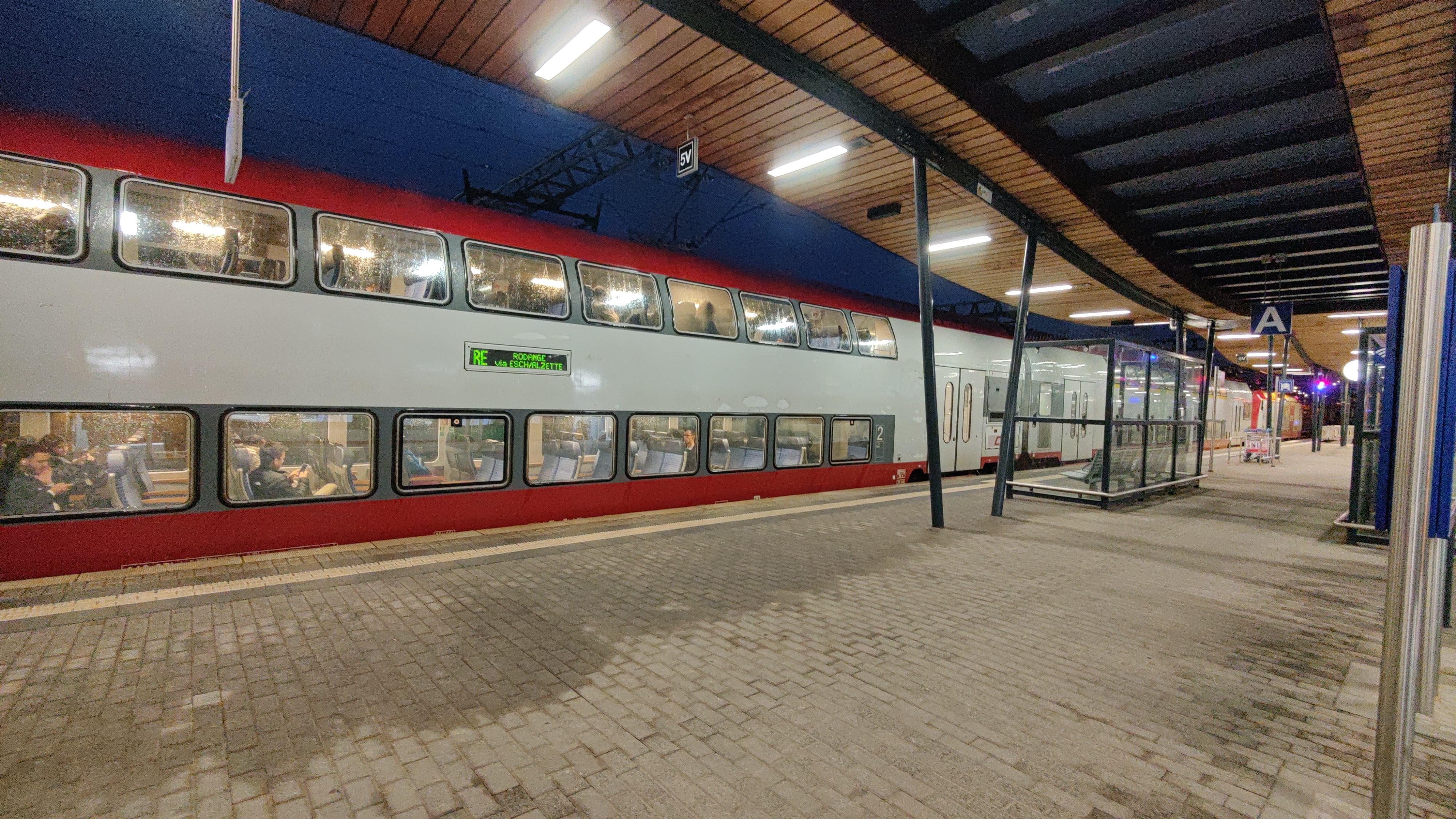
My hotel was 20 km from the conference venue in Belval. However, the commute was convenient due to a free of cost train connection, which were comfortable, smooth, and scenic, covering the distance in half an hour. The hotel included a breakfast buffet, recharging us before the conference.
This is what trains look like in Luxembourg
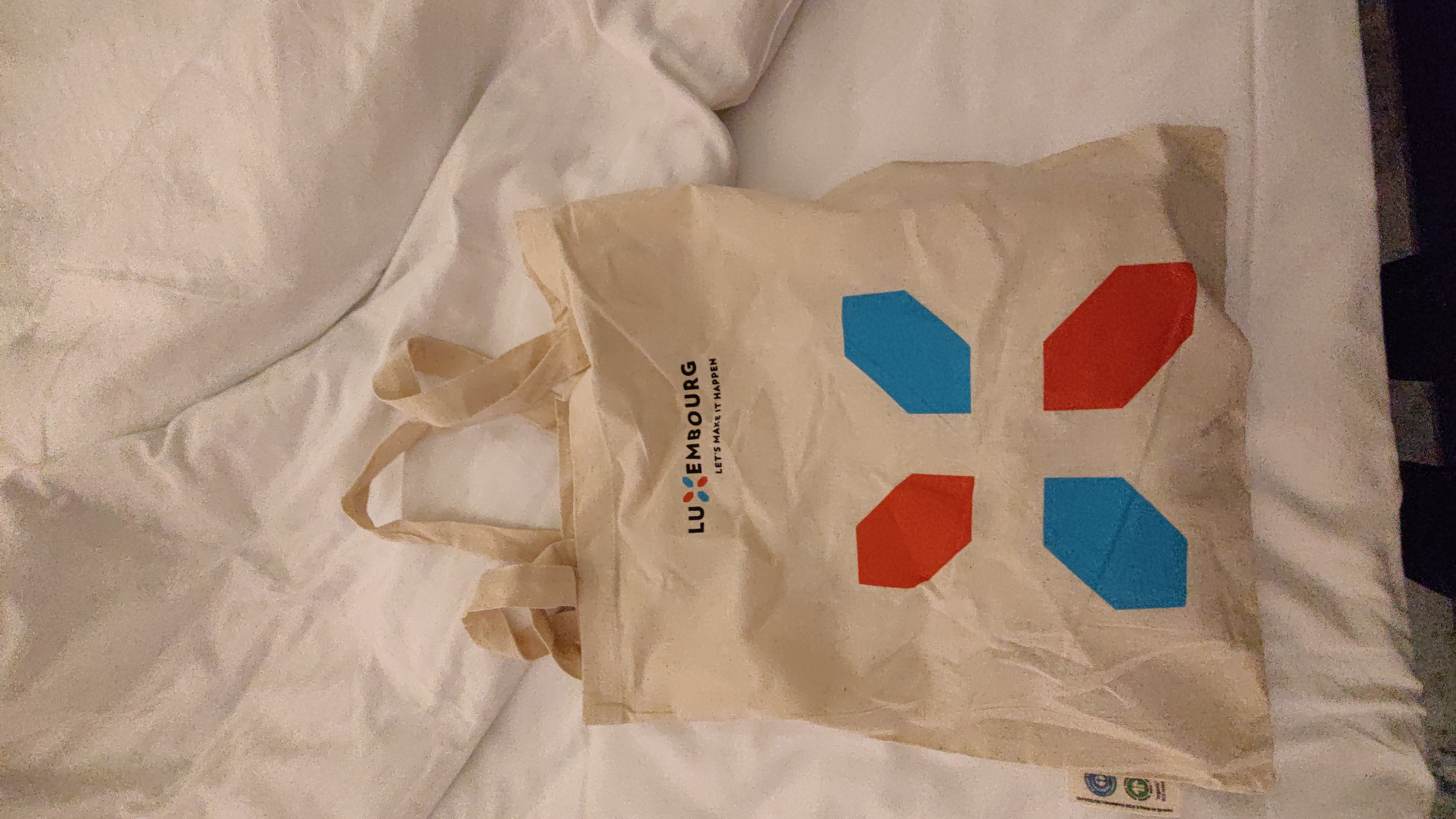
Pre-conference, a day was reserved for the community meetup on the 9th of October. On that day, the community members introduced themselves and their contributions to the LibreOffice project. It acted as a brainstorming session. I got a lovely conference bag, which contained a T-Shirt, a pen and a few stickers. I also met my long time collaborators Mike, Sophie and Italo from the TDF, whom I had interacted only remotely till then. Likewise, I also met TDF s sysadmin Guilhem, who I interacted before regarding setting up my LibreOffice mirror.
Conference bag
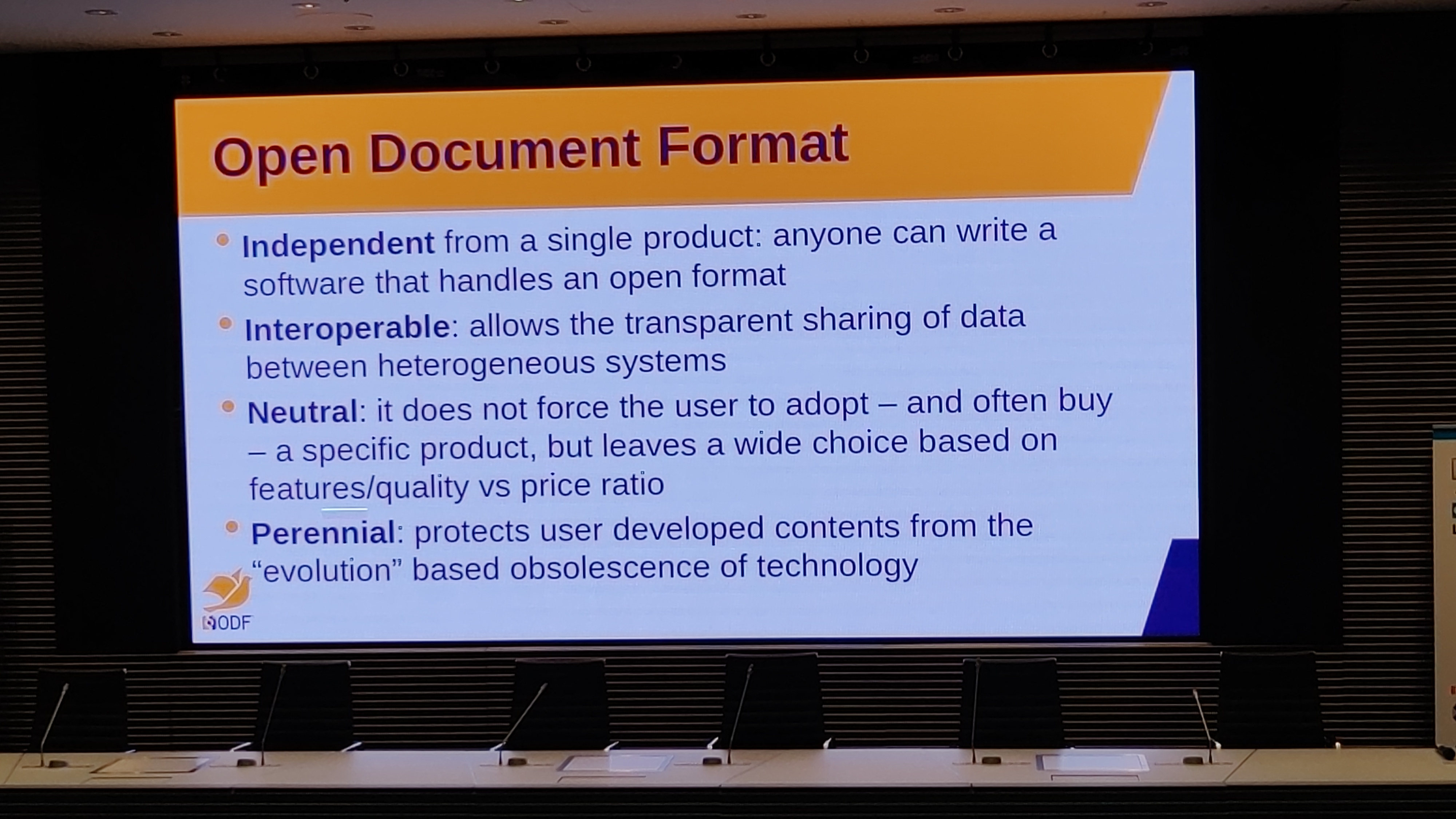
The conference started on the 10th. There were 5 attendees from India, including me, while most of the attendees were from Europe. The talks were in English. One of the talks that stood out for me was about Luxchat a chat service run by the Luxembourg government based on the Matrix protocol for the citizens of Luxembourg. I also liked Italo s talk on why document formats must be freedom-respecting. On the first night, the conference took us to a nice dinner in a restaurant. It offered one more way to socialize with other attendees and explore food at the same time.
One of the slides of Italo's talk
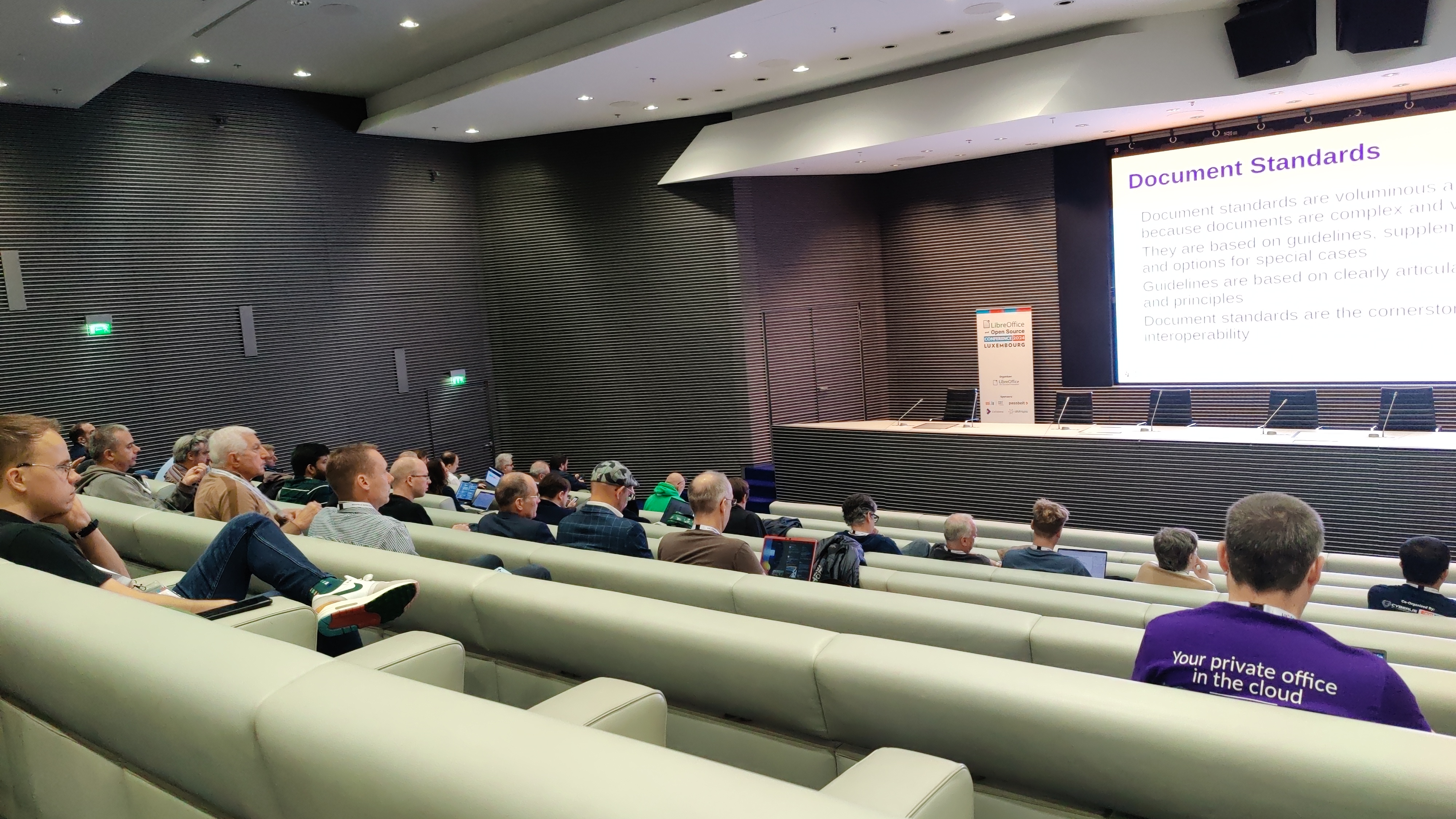
Picture of the hall in which talks were held
On the 11th of October, I went for a walk in the morning with Biswadeep for some sightseeing around our hotel area. As a consequence, I missed the group photo of the conference, which I wanted to be in. Anyway, we enjoyed roaming around the picturesque Luxembourg city. We also sampled a tram ride to return to our hotel.
We encountered such scenic views during our walk
Another view of Luxembourg city area
The conference ended on the 12th with a couple of talks. This conference gave me an opportunity to meet the global LibreOffice community, connect and share ideas. It also gave me a peek into the country of Luxembourg and its people, where I had good experience. English was widely known, and I had no issues getting by.
Thanks to all the organizers and sponsors of the conference!
Evolution of the situation
In January, we have released 33 DLAs.
There were numerous security and non-security updates to Debian 11 (codename bullseye ) during January.
Notable security updates:
rsync, prepared by Thorsten Alteholz, fixed several CVEs (including information leak and path traversal vulnerabilities)
tomcat9, prepared by Markus Koschany, fixed several CVEs (including denial of service and information disclosure vulnerabilities)
ruby2.7, prepared by Bastien Roucari s, fixed several CVEs (including denial of service vulnerabilities)
tiff, prepared by Adrian Bunk, fixed several CVEs (including NULL ptr, buffer overflow, use-after-free, and segfault vulnerabilities)
Notable non-security updates:
linux-6.1, prepared by Ben Hutchings, has been packaged for bullseye (this was done specifically to provide a supported upgrade path for systems that currently use kernel packages from the bullseye-backports suite)
debian-security-support, prepared by Santiago Ruano Rinc n, which formalized the EOL of intel-mediasdk and node-matrix-js-sdk
In addition to the security and non-security updates targeting bullseye , various LTS contributors have prepared uploads targeting Debian 12 (codename bookworm ) with fixes for a variety of vulnerabilities. Abhijith PA prepared an upload of puma; Bastien Roucari s prepared an upload of node-postcss with fixes for data processing and denial of service vulnerabilities; Daniel Leidert prepared updates for setuptools, python-asyncssh, and python-tornado; Lee Garrett prepared an upload of ansible-core; and Guilhem Moulin prepared updates for python-urllib3, sqlparse, and opensc. Santiago Ruano Rinc n also worked on tracking and filing some issues about packages that need an update in recent releases to avoid regressions on upgrade. This relates to CVEs that were fixed in buster or bullseye, but remain open in bookworm. These updates, along with Santiago s work on identifying and tracking similar issues, underscore the LTS Team s commitment to ensuring that the work we do as part of LTS also benefits the current Debian stable release.
LTS contributor Sean Whitton also prepared an upload of jinja2 and Santiago Ruano Rinc n prepared an upload of openjpeg2 for Debian unstable (codename sid ), as part of the LTS Team effort to assist with package uploads to unstable.
Thanks to our sponsors
Sponsors that joined recently are in bold.
Evolution of the situation
In December, we have released 29 DLAs.
The LTS Team has published updates to several notable packages. Contributor Guilhem Moulin published an update of php7.4, a widely-used open source general purpose scripting language, which addressed denial of service, authorization bypass, and information disclosure vulnerabilities. Contributor Lucas Kanashiro published an update of clamav, an antivirus toolkit for Unix and Linux, which addressed denial of service and authorization bypass vulnerabilities. Finally, contributor Tobias Frost published an update of intel-microcode, the microcode for Intel microprocessors, which well help to ensure that processor hardware is protected against several local privilege escalation and local denial of service vulnerabilities.
Beyond our customary LTS package updates, the LTS Team has made contributions to Debian s stable bookworm release and its experimental section. Notably, contributor Lee Garrett published a stable update of dnsmasq. The LTS update was previously published in November and in December Lee continued working to bring the same fixes (addressing the high profile KeyTrap and NSEC3 vulnerabilities) to the dnsmasq package in Debian bookworm. This package was accepted for inclusion in the Debian 12.9 point release scheduled for January 2025. Addititionally, contributor Sean Whitton provided assistance, via upload sponsorships, to the Debian maintainers of xen. This assistance resulted in two uploads of xen into Debian s experimental section, which will contribute to the next Debian stable release having a version of xen with better longterm support from the upstream development team.
Thanks to our sponsors
Sponsors that joined recently are in bold.
Tobias Frost
did 12.0h (out of 10.5h assigned and 1.5h from previous period).
Evolution of the situation
In November, we have released 38 DLAs.
The LTS coordinators, Roberto and Santiago, delivered a talk at the Mini-DebConf event in Toulouse, France. The title of the talk was How LTS goes beyond LTS . The talk covered work done by the LTS Team during the past year. This included contributions related to individual packages in Debian (such as tomcat, jetty, radius, samba, apache2, ruby, and many others); improvements to tooling and documentation useful to the Debian project as a whole; and contributions to upstream work (apache2, freeimage, node-dompurify, samba, and more). Additionally, several contributors external to the LTS Team were highlighted for their contributions to LTS. Readers are encouraged to watch the video of the presentation for a more detailed review of various ways in which the LTS team has contributed more broadly to the Debian project and to the free software community during the past year.
We wish to specifically thank Salvatore (of the Debian Security Team) for swiftly handling during November the updates of needrestart and libmodule-scandeps-perl, both of which involved arbitrary code execution vulnerabilities. We are happy to see increased involvement in LTS work by contributors from outside the formal LTS Team.
The work of the LTS Team in November was otherwise unremarkable, encompassing the customary triage, development, testing, and release of numerous DLAs, along with some associated contributions to related packages in stable and unstable.
Thanks to our sponsors
Sponsors that joined recently are in bold.
Tobias Frost
did 10.5h (out of 12.0h assigned), thus carrying over 1.5h to the next month.
Evolution of the situation
In October, we have released 35 DLAs.
Some notable updates prepared in October include denial of service vulnerability fixes in nss, regression fixes in apache2, multiple fixes in php7.4, and new upstream releases of firefox-esr, openjdk-17, and opendk-11.
Additional contributions were made for the stable Debian 12 bookworm release by several LTS contributors. Arturo Borrero Gonzalez prepared a parallel update of nss, Bastien Roucari s prepared a parallel update of apache2, and Santiago Ruano Rinc n prepared updates of activemq for both LTS and Debian stable.
LTS contributor Bastien Roucari s undertook a code audit of the cacti package and in the process discovered three new issues in node-dompurity, which were reported upstream and resulted in the assignment of three new CVEs.
As always, the LTS team continues to work towards improving the overall sustainability of the free software base upon which Debian LTS is built. We thank our many committed sponsors for their ongoing support.
Thanks to our sponsors
Sponsors that joined recently are in bold.
Tobias Frost
did 17.0h (out of 7.5h assigned and 9.5h from previous period).
Evolution of the situation
In September, we have released 52 DLAs.
September marked the first full month of Debian 11 bullseye under the responsibility of the LTS Team and the team immediately got to work, publishing more than 4 dozen updates.
Some notable updates include ruby2.7 (denial-of-service, information leak, and remote code execution), git (various arbitrary code execution vulnerabilities), firefox-esr (multiple issues), gnutls28 (information disclosure), thunderbird (multiple issues), cacti (cross site scripting and SQL injection), redis (unauthorized access, denial of service, and remote code execution), mariadb-10.5 (arbitrary code execution), cups (arbitrary code execution).
Several LTS contributors have also contributed package updates which either resulted in a DSA (a Debian Security Announcement, which applies to Debian 12 bookworm) or in an upload that will be published at the next stable point release of Debian 12 bookworm. This list of packages includes cups, cups-filters, booth, nghttp2, puredata, python3.11, sqlite3, and wireshark. This sort of work, contributing fixes to newer Debian releases (and sometimes even to unstable), helps to ensure that upgrades from a release in the LTS phase of its lifecycle to a newer release do not expose users to vulnerabilities which have been closed in the older release.
Looking beyond Debian, LTS contributor Bastien Roucari s has worked with the upstream developers of apache2 to address regressions introduced upstream by some recent vulnerability fixes and he has also reached out to the community regarding a newly discovered security issue in the dompurify package. LTS contributor Santiago Ruano Rinc n has undertaken the work of triaging and reproducing nearly 4 dozen CVEs potentially affecting the freeimage package. The upstream development of freeimage appears to be dormant and some of the issues have languished for more than 5 years. It is unclear how much can be done without the aid of upstream, but we will do our best to provide as much help to the community as we can feasibly manage.
Finally, it is sometimes necessary to limit or discontinue support for certain packages. The transition of a release from being under the responsibility of the Debian Security Team to that of the LTS Team is an occasion where we assess any pending decisions in this area and formalize them. Please see the announcement for a complete list of packages which have been designated as unsupported.
Thanks to our sponsors
Sponsors that joined recently are in bold.
Tobias Frost
did 2.5h (out of 7.75h assigned and 4.25h from previous period), thus carrying over 9.5h to the next month.
Evolution of the situation
In August, we have released 1 DLAs.
During the month of August Debian 11 "bullseye" officially transitioned to the responsibility of the LTS team (on 2024-08-15). However, because the final point release (11.11) was not made until 2024-08-31, LTS contributors were prevented from uploading packages to bullseye until after the point release had been made. That said, the team was not at all idle, and was busy at work on a variety of tasks which impacted both LTS and the broader Debian community, as well as preparing uploads which will be released during the month of September.
Of particular note, LTS contributor Bastien Roucari s prepared updates of the putty and cacti packages for bookworm (12) and bullseye (12), which were accepted by the old-stable release managers for the August point releases. He also analysed several security regressions in the apache2 package. LTS contributor Emilio Pozuelo Monfort worked on the Rust toolchain in bookworm and bullseye, which will be needed to support the upcoming Firefox ESR and Thunderbird ESR releases from the Mozilla project. Additionally, LTS contributor Thorsten Alteholz prepared bookworm and bullseye updates of the cups package (12), which were accepted by the old-stable release managers for the August point releases.
LTS contributor Markus Koschany collaborated with Emmanuel Bourg, co-maintainer of the tomcat packages in Debian. Regressions in a proposed security fix necessitated the updating of the tomcat10 package in Debian to the latest upstream release.
LTS contributors Bastien and Santiago Ruano Rinc n collaborated with the upstream developers and the Debian maintainer (Bernhard Schmidt) of the FreeRADIUS project towards addressing the BlastRADIUS vulnerability in the bookworm and bullseye versions of the freeradius package. If you use FreeRADIUS in Debian bookworm or bullseye, we encourage you to test the packages following the instructions found in the call for testers to help identifying any possible regression that could be introduced with these updates.
Testing is an important part of the work the LTS Team does, and in that vein LTS contributor Sean Whitton worked on improving the documentation and tooling around creating test filesystems which can be used for testing a variety of package update scenarios.
Thanks to our sponsors
Sponsors that joined recently are in bold.
Evolution of the situation
In July, we have released 1 DLA.
August will be the month that Debian 11 makes the transition to LTS. Our
contributors have already been hard at work with preparatorty tasks and also
with making contributions to packages in Debian 11 in close collaboration with
the Debian security team and package maintainers. As a result, users and
sponsors should not observe any especially notable differences as the transition
occurs.
While only one DLA was released in July (as a result of the transitional state
of Debian 11 bullseye ), there were some notable highlights. LTS contributor
Guilhem Moulin prepared an update of libvirt for Debian 11 (in collaboration
with the Old-Stable Release Managers and the Debian Security Team) to fix a
number of outstanding CVEs which did not rise to the level of a DSA by the
Debian Security Team. The update prepared by Guilhem will be included in Debian
11 as part of the final point release at the end of August, one of the final
transition steps by the Release Managers as Debian 11 moves entirely to the LTS
Team s responsibility. Notable work was also undertaken by contributors Lee Garrett
(fixes on the ansible test suite and a bullseye update), Lucas Kanashiro (Rust toolchain, utilized by the clamav,
firefox-esr, and thunderbird packages), and Sylvain Beucler (fixes on the ruby2.5/2.7 test
suites and CI infrastructure), which will help improve the quality of updates produced during
the next LTS cycle.
June was the final month of LTS for Debian 10 (as announced on the
debian-lts-announce
mailing list). No additional Debian 10 security updates will be made available
on security.debian.org.
However, Freexian and its team of paid Debian contributors will continue
to maintain Debian 10 going forward for customers of the
Extended LTS offer. Subscribe right
away if you still have Debian 10 systems which must be kept secure (and which
cannot yet be upgraded).
Thanks to our sponsors
Sponsors that joined recently are in bold.
Looking further afield to the broader Debian ecosystem, LTS contributor Bastien Roucari s also patched sendmail in Debian 12 (bookworm) and 11 (bullseye) in order to fix the previously mentioned SMTP smuggling vulnerability. Furthermore, LTS contributor Thorsten Alteholz provided fixes for the cups packages in Debian 12 (bookworm) and 11 (bullseye) in order to fix the aforementioned arbitrary remote code execution vulnerability.
Additionally, LTS contributor Ben Hutchings has commenced work on an updated backport of Linux kernel 6.1 to Debian 11 (bullseye), in preparation for bullseye transitioning to the responsibility of the LTS (and the associated closure of the bullseye-backports repository). LTS Lucas Kanashiro also began the preparatory work of backporting parts of the rust/cargo toolchain to Debian 11 (bullseye) in order to make future updates of the clamav virus scanner possible.
June was the final month of LTS for Debian 10 (as announced on the
debian-lts-announce
mailing list). No additional Debian 10 security updates will be made available
on security.debian.org.
However, Freexian and its team of paid Debian contributors will continue
to maintain Debian 10 going forward for the customers of the
Extended LTS offer. Subscribe right
away if you sill have Debian 10 which must be kept secure (and which
cannot yet be upgraded).
Thanks to our sponsors
Sponsors that joined recently are in bold.
Tobias Frost
did 7.75h (out of 10.0h assigned and 2.0h from previous period), thus carrying over 4.25h to the next month.
Evolution of the situation
In May, we have released 20 DLAs.
Notable security updates in May included:
apache2: multiple vulnerabilities which may result in HTTP response splitting, denial of service, or authorization bypass (by Bastien Roucari s, in collaboration with apache2 maintainer Yadd)
bind9: two vulnerabilities, called KeyTrap and NSEC3, which may result in denial of service (by Santiago Ruano Rinc n)
python-pymysql: potential SQL injection attack (by Chris Lamb)
The aforementioned apache2 was prepared by its Debian maintainer Yadd. This update also involved work on the package test suite in buster, which contributor Bastien Roucari s then forwarded to the apache2 package in unstable. More importantly, a regression in fossil was reported, and Bastien prepared a fix for it. Bastien coordinated the upload of both packages to minimize the introduction of regressions.
Contributor Daniel Leidert also prepared an upload of runc to Debian 11 in order fix a number of CVEs still affecting that package. Finally, contributor Thorsten Alteholz prepared uploads for qtbase-opensource-src, libjwt, and libmicrohttpd in Debian 11. Note that Debian 11 will pass into the LTS phase of support in August and these updates will improve the state and long-term supportability of Debian 11.
Debian 10 is presently in its final month of LTS support (as announced on the
debian-lts-announce
mailing list, support will end on June 30th), after which no new
security updates will be made available on security.debian.org.
However, Freexian and its team of paid Debian contributors will continue
to maintain Debian 10 going forward for the customers of the
Extended LTS offer. Subscribe right
away if you sill have Debian 10 which must be kept secure (and which
cannot yet be upgraded).
Thanks to our sponsors
Sponsors that joined recently are in bold.
Tobias Frost
did 10.0h (out of 12.0h assigned), thus carrying over 2.0h to the next month.
Utkarsh Gupta
did 3.25h (out of 28.5h assigned and 29.25h from previous period), thus carrying over 54.5h to the next month.
Evolution of the situation
In April, we have released 28 DLAs.
During the month of April, there was one particularly notable security update made in LTS. Guilhem Moulin prepared DLA-3782-1 for util-linux (part of the set of base packages and containing a number of important system utilities) in order to address a possible information disclosure vulnerability.
Additionally, several contributors prepared updates for oldstable (bullseye), stable (bookworm), and unstable (sid), including:
ruby-rack: prepared for oldstable, stable, and unstable by Adrian Bunk
wpa: prepared for oldstable, stable, and unstable by Bastien Roucari s
zookeeper: prepared for stable by Bastien Roucari s
libjson-smart: prepared for unstable by Bastien Roucari s
ansible: prepared for stable and unstable, including autopkgtest fixes to increase future supportability, by Lee Garrett
wordpress: prepared for oldstable and stable by Markus Koschany
emacs and org-mode: prepared for oldstable and stable by Sean Whitton
qtbase-opensource-src: prepared for oldstable and stable by Thorsten Alteholz
libjwt: prepared for oldstable by Thorsten Alteholz
libmicrohttpd: prepared for oldstable by Thorsten Alteholz
These fixes were in addition to corresponding updates in LTS.
Another item to highlight in this month s report is an update to the distro-info-data database by Stefano Rivera. This update ensures that Debian buster systems have the latest available information concerning the end-of-life dates and other related information for all releases of Debian and Ubuntu.
As announced on the debian-lts-announce
mailing list, it is worth to point out that we are getting close to
the end of support of Debian 10 as LTS. After June 30th, no new
security updates will be made available on security.debian.org.
However, Freexian and its team of paid Debian contributors will continue
to maintain Debian 10 going forward for the customers of the
Extended LTS offer. If you still have Debian 10
servers to keep secure, it s time to subscribe!
Thanks to our sponsors
Sponsors that joined recently are in bold.
Utkarsh Gupta
did 19.5h (out of 0.0h assigned and 48.75h from previous period), thus carrying over 29.25h to the next month.
Evolution of the situation
In March, we have released 31 DLAs.
Adrian Bunk was responsible for updating gtkwave not only in LTS, but also in unstable, stable, and old-stable as well. This update involved an upload of a new upstream release of gtkwave to each target suite to address 82 separate CVEs. Guilhem Moulin prepared an update of libvirt which was particularly notable, as it fixed multiple vulnerabilities which would lead to denial of service or information disclosure.
In addition to the normal security updates, multiple LTS contributors worked at getting various packages updated in more recent Debian releases, including gross for bullseye/bookworm (by Adrian Bunk), imlib2 for bullseye, jetty9 and tomcat9/10 for bullseye/bookworm (by Markus Koschany), samba for bullseye, py7zr for bullseye (by Santiago Ruano Rinc n), cacti for bullseye/bookwork (by Sylvain Beucler), and libmicrohttpd for bullseye (by Thorsten Alteholz). Additionally, Sylvain actively coordinated with cacti upstream concerning an incomplete fix for CVE-2024-29894.
Thanks to our sponsors
Sponsors that joined recently are in bold.
Utkarsh Gupta
did 11.25h (out of 26.75h assigned and 33.25h from previous period), thus carrying over 48.75 to the next month.
Evolution of the situation
In February, we have released 17 DLAs.
The number of DLAs published during February was a bit lower than usual, as there was much work going on in the area of triaging CVEs (a number of which turned out to not affect Debia buster, and others which ended up being duplicates, or otherwise determined to be invalid). Of the packages which did receive updates, notable were sudo (to fix a privilege management issue), and iwd and wpa (both of which suffered from authentication bypass vulnerabilities).
While this has already been already announced in the Freexian blog, we would like to mention here the start of the Long Term Support project for Samba 4.17. You can find all the important details in that post, but we would like to highlight that it is thanks to our LTS sponsors that we are able to fund the work from our partner, Catalyst, towards improving the security support of Samba in Debian 12 (Bookworm).
Thanks to our sponsors
Sponsors that joined recently are in bold.
Tobias Frost
did 12.0h (out of 10.25h assigned and 1.75h from previous period).
Utkarsh Gupta
did 8.5h (out of 35.75h assigned), thus carrying over 24.75h to the next month.
Evolution of the situation
In January, we have released 25 DLAs.
A variety of particularly notable packages were updated during January. Among those updates were the Linux kernel (both versions 5.10 and 4.19), mariadb-10.3, openjdk-11, firefox-esr, and thunderbird.
In addition to the many other LTS package updates which were released in January, LTS contributors continue their efforts to make impactful contributions both within the Debian community.
Thanks to our sponsors
Sponsors that joined recently are in bold.
Tobias Frost
did 10.25h (out of 12.0h assigned), thus carrying over 1.75h to the next month.
Utkarsh Gupta
did 18.75h (out of 11.25h assigned and 13.5h from previous period), thus carrying over 6.0h to the next month.
Evolution of the situation
In December, we have released 29 DLAs.
A particularly notable update in December was prepared by LTS contributor
Santiago Ruano Rinc n for the openssh package. The updated produced
DLA-3694-1 and included a
fix for the Terrapin Attack (CVE-2023-48795), which was a rather serious flaw in
the SSH protocol itself. The package bluez was the subject of another notable
update by LTS contributor Chris Lamb, which resulted in
DLA-3689-1 to address an
insecure default configuration which allowed attackers to inject keyboard
commands over Bluetooth without first authenticating.
The LTS team continues its efforts to have a positive impact beyond the
boundaries of LTS. Several contributors worked on packages, preparing LTS
updates, but also preparing patches or full updates which were uploaded to the
unstable, stable, and oldstable distributions, including: Guilhem Moulin s
update of tinyxml (uploads to LTS and unstable and patches submitted to the
security team for stable and oldstable); Guilhem Moulin s update of xerces-c
(uploads to LTS and unstable and patches submitted to the security team for
oldstable); Thorsten Alteholz s update of libde265 (uploads to LTS and stable
and additional patches submitted to the maintainer for stable and oldstable);
Thorsten Alteholz s update of cjson (upload to LTS and patches submitted to the
maintainer for stable and oldstable); and Tobias Frost s update of opendkim
(sponsor maintainer-prepared upload to LTS and additionally prepared updates for
stable and oldstable).
Going beyond Debian and looking to the broader community, LTS contributor
Bastien Roucari s was contacted by SUSE concerning an update he had prepared for
zbar. He was able to assist by coordinating with the former organization of the
original zbar author to secure for SUSE access to information concerning the
exploits. This has enabled another distribution to benefit from the work done in
support of LTS and from the assistance of Bastien in coordinating the access to
information.
Finally, LTS contributor Santiago Ruano Rinc n continued work relating to how
updates for packages in statically-linked language ecosystems (e.g., Go, Rust,
and others) are handled. The work is presently focused on more accurately and
reliably identifying which packages are impacted in a given update scenario to
enable notifications to be published so that users will be made aware of these
situations as they occur. As the work continues, it will eventually result in
improvements to Debian infrustructure so that the LTS team and Security team are
able to manage updates of this nature in a more consistent way.
Thanks to our sponsors
Sponsors that joined recently are in bold.
Like each month, have a look at the work funded by Freexian s Debian LTS offering.
Some notable fixes which were made in LTS during the month of November include the gnutls28 cryptographic library and the freerdp2 Remote Desktop Protocol client/server implementation. The gnutls28 update was prepared by LTS contributor Markus Koschany and dealt with a timing attack which could be used to compromise a cryptographic system, while the freerdp2 update was prepared by LTS contributor Tobias Frost and is the result of work spanning 3 months to deal with dozens of vulnerabilities.
In addition to the many ordinary LTS tasks which were completed (CVE triage, patch backports, package updates, etc), there were several contributions by LTS contributors for the benefit of Debian stable and old-stable releases, as well as for the benefit of upstream projects. LTS contributor Abhijith PA uploaded an update of the puma package to unstable in order to fix a vulnerability in that package while LTS contributor Thosten Alteholz sponsored an upload to unstable of libde265 and himself made corresponding uploads of libde265 to Debian stable and old-stable. LTS contributor Bastien Roucari s developed patches for vulnerabilities in zbar and audiofile which were then provided to the respective upstream projects. Updates to packages in Debian stable were made by Markus Koschany to deal with security vulnerabilities and by Chris Lamb to deal with some non-security bugs.
As always, the LTS strives to provide high quality updates to packages under the direct purview of the LTS team while also rendering assistance to maintainers, the stable security team, and upstream developers whenever practical.
Debian LTS contributors
In November, 18 contributors have been paid to work on Debian
LTS, their reports are available:
Abhijith PA
did 7.0h (out of 0h assigned and 14.0h from previous period), thus carrying over 7.0h to the next month.
Adrian Bunk
did 15.0h (out of 14.0h assigned and 9.75h from previous period), thus carrying over 8.75h to the next month.
Anton Gladky
did 10.0h (out of 9.5h assigned and 5.5h from previous period), thus carrying over 5.0h to the next month.
Bastien Roucari s
did 16.0h (out of 18.25h assigned and 1.75h from previous period), thus carrying over 4.0h to the next month.
Ben Hutchings
did 12.0h (out of 16.5h assigned and 12.25h from previous period), thus carrying over 16.75h to the next month.
Chris Lamb
did 18.0h (out of 17.25h assigned and 0.75h from previous period).
Emilio Pozuelo Monfort
did 15.5h (out of 23.5h assigned and 0.25h from previous period), thus carrying over 8.25h to the next month.
Guilhem Moulin
did 13.0h (out of 12.0h assigned and 8.0h from previous period), thus carrying over 7.0h to the next month.
Lee Garrett
did 14.5h (out of 16.75h assigned and 7.0h from previous period), thus carrying over 9.25h to the next month.
Tobias Frost
did 16.0h (out of 9.25h assigned and 6.75h from previous period).
Utkarsh Gupta
did 0.0h (out of 0.75h assigned and 17.0h from previous period), thus carrying over 17.75h to the next month.
Evolution of the situation
In October, we have released 49 DLAs.
Of particular note in the month of October, LTS contributor Chris Lamb issued DLA 3627-1 pertaining to Redis, the popular key-value database similar to Memcached, which was vulnerable to an authentication bypass vulnerability. Fixing this vulnerability involved dealing with a race condition that could allow another process an opportunity to establish an otherwise unauthorized connection. LTS contributor Markus Koschany was involved in the mitigation of CVE-2023-44487, which is a protocol-level vulnerability in the HTTP/2 protocol. The impacts within Debian involved multiple packages, across multiple releases, with multiple advisories being released (both DSA for stable and old-stable, and DLA for LTS). Markus reviewed patches and security updates prepared by other Debian developers, investigated reported regressions, provided patches for the aforementioned regressions, and issued several security updates as part of this.
Additionally, as MariaDB 10.3 (the version originally included with Debian buster) passed end-of-life earlier this year, LTS contributor Emilio Pozuelo Monfort has begun investigating the feasibility of backporting MariaDB 10.11. The work is in early stages, with much testing and analysis remaining before a final decision can be made, as this only one of several available potential courses of action concerning MariaDB.
Finally, LTS contributor Lee Garrett has invested considerable effort into the development the Functional Test Framework here. While so far only an initial version has been published, it already has several features which we intend to begin leveraging for testing of LTS packages. In particular, the FTF supports provisioning multiple VMs for the purposes of performing functional tests of network-facing services (e.g., file services, authentication, etc.). These tests are in addition to the various unit-level tests which are executed during package build time. Development work will continue on FTF and as it matures and begins to see wider use within LTS we expect to improve the quality of the updates we publish.
Thanks to our sponsors
Sponsors that joined recently are in bold.
Tobias Frost
did 13.25h (out of 16.0h assigned), thus carrying over 2.75h to the next month.
Evolution of the situation
In September, we have released 44 DLAs.
The month of September was a busy month for the LTS Team.
A notable security issue fixed in September was the high-severity
CVE-2023-4863,
a heap buffer overflow that allowed remote attackers to perform an out-of-bounds
memory write via a crafted WebP file.
This CVE was covered by the three DLAs of different packages:
firefox-esr,
libwebp and
thunderbird.
The libwebp backported patch was sent to upstream, who adapted and applied it
to the
0.6.1 branch.
It is also worth noting that LTS contributor Markus Koschany included in his
work updates to packages in Debian Bullseye and Bookworm, that are under the
umbrella of the Security Team:
xrdp,
jetty9 and
mosquitto.
As every month, there was important behind-the-scenes work by the Front Desk
staff, who triaged, analyzed and reviewed dozens of vulnerabilities, to decide
if they warrant a security update.
This is very important work, since we need to trade-off between the frequency
of updates and the stability of the LTS release.
Thanks to our sponsors
Sponsors that joined recently are in bold.
Utkarsh Gupta
did 12.25h (out of 0h assigned and 12.25h from previous period).
Evolution of the situation
In August, we have released 42 DLAs.
The month of August turned out to be a rather quiet month for the LTS team.
Three notable updates were to
bouncycastle,
openssl,
and zabbix.
In the case of bouncycastle a flaw allowed for the possibility of LDAP injection
and the openssl update corrected a resource exhaustion bug that could result in
a denial of service. Zabbix, while not widely used, was the subject of several
vulnerabilities which while not individually severe did combine to result in the
zabbix update being of particular note.
Apart from those, the LTS team continued the always ongoing work of triaging,
investigating, and fixing vulnerabilities, as well as making contributions to
the broader Debian and Free Software communities.
Thanks to our sponsors
Sponsors that joined recently are in bold.
Utkarsh Gupta
did 1.5h (out of 0h assigned and 13.75h from previous period), thus carrying over 12.25h to the next month.
Evolution of the situation
In July, we have released 35 DLAs.
LTS contributor Lee Garrett, has continued his hard work to prepare a testing
framework for Samba, that can now provision bootable VMs with little effort,
both for Debian and for Windows.
This work included the introduction of a new package to Debian,
rhsrvany, which
allows turning any Windows program or script into a Windows service. As the
Samba testing framework matures it will be possible to perform functional tests
which cannot be performed with other available test mechanisms and aspects of
this framework will be generalizable to other package ecosystems beyond Samba.
July included a notable security
update of bind9
by LTS contributor Chris Lamb.
This update addressed a potential denial of service attack in this critical
network infrastructure component.
Thanks to our sponsors
Sponsors that joined recently are in bold.
 Luxembourg's Findel Airport
 Separate cycling tracks in Luxembourg
 This is what trains look like in Luxembourg
 Conference bag
 One of the slides of Italo's talk
 Picture of the hall in which talks were held
 We encountered such scenic views during our walk
 Another view of Luxembourg city area

 Like each month, have a look at the work funded by