Search Results: "eof"

3 May 2026

Birger Schacht: Status update, February - April 2026

Due to health reasons I did not have the energy to write individual status updates for February & March, so I ll just combine them with the April update: In February I cleaned out my GitHub account and moved all remaining projects to Codeberg. I archived the repositories on GitHub and added links to the new repositories on Codeberg. GitHub is a platform that is more and more frustrating to use. I still have to use it for my dayjob, though. The number of pull requests and issues that are written either by bots or by users that use bots increased in the last two years. Combined with that, GitHub provides a very low barrier for entitled users who do not want to contribute to a productive environment. GitHub now feels like the Twitter/X of git forges. Codeberg on the other hand is a community project. I feel a lot more at home there and the platform itself feels a lot more responsive than GitHub.

Debian Related Work
  • Uploaded wayback 0.3-1 to experimental
  • Uploaded slurp 1.6.0-1 to unstable
  • Uploaded first a prerelease of sway to experimental to be able to test wlroots 0.20.0 and then uploaded rc1, rc2 and rc3 of the upcoming 1.12 release
  • Uploaded waybar 0.15.0-1 to unstable
  • Uploaded kanshi 1.9.0-1 to unstable, which was possible because the dependency libscfg finally went through NEW
  • Uploaded libscfg 0.2.0-1 to unstable
  • Uploaded swaybg 1.2.2-1 to unstable
  • Uploaded labwc 0.9.4-1, 0.9.5 & 0.9.6 to unstable
  • Fixed the packaging of vali and uploaded version 0.1.1-1 to unstable; then added vali to the build dependencies of kanshi and reuploaded 1.9.0-2 thereof
  • Uploaded swaylock 1.8.5-1 to unstable
  • Uploaded fcft 3.3.3-1 to unstable
  • Uploaded foot 1.26.1-1 to unstable
  • Uploaded swayimg 5.0-1 and 5.1-1 to unstable
  • Fixed some packaging metadata in libsfdo and uploaded 0.1.4-2 to unstable
  • Reverted the upload of slurp from 1.6.0-1 to 1.6.0really1.5.0-1 because the upstream release of 1.6.0 was made by mistake and yanked a week later. Maybe I should add a cooldown period before uploading new releases ;)
  • Uploaded mako-notifier 1.11.0-1 to unstable
  • Uploaded cage 0.3.0-1 to experimental which uses wlroots 0.20.0
  • Uploaded xdg-desktop-portal-wlr 0.8.2-1 to unstable
  • Voted

DH Related Work I took part in the DHD 2026 Conference in Vienna, including a hands-on workshop of the dhinfra project. I released 0.60.0, 0.61.0 and 0.62.0 of apis-core-rdf. We rewrote the configuration format for the importer. We previously used TOML files, but that does not give us inheritance. So we now use simply Python classes as configuration format. I implemented a new backend for our apis-bibsonomy Django package. The package is meant to provide a datamodel for storing reference data that links to Bibsonomy or Zotero. Given that we don t use Bibsonomy anymore we now dropped the Bibsonomy backend but added a Zotero backend that allows to cache the entries locally.

21 April 2026

Ravi Dwivedi: LibreOffice Conference Budapest 2025

In September 2025, I attended the LibreOffice Conference in Budapest, Hungary, on the 4th and the 5th, and a community meeting on the 3rd. Thanks to The Document Foundation (TDF) for sponsoring my travel and accommodation costs. The conference venue was Faculty of Informatics, E tv s Lor nd University (ELTE). The conference was planned to be held from the 4th to the 6th, but the program for the 6th of September had to be canceled due to the venue being unavailable because of a marathon in Budapest. So, all the talks got squeezed into just two days, making the schedule a bit hectic. The TDF had booked my room at the Corvin Hotel. It was a double bedroom with a window. The breakfast was included in the hotel booking. The hotel was walking distance from the conference venue. One could also take a tram from the hotel to reach the venue.
A double bed A shot of my room. Photo by Ravi Dwivedi, released under CC-BY-SA 4.0.
Tram A tram in Budapest. Photo by Ravi Dwivedi, released under CC-BY-SA 4.0.

3rd of September On the 3rd of September, we had a community meeting at the above-mentioned venue. I walked with my friend Dione to the venue. Upon reaching there, I noticed that the university had no boundaries and gates. This reminded me of the previous year s conference venue in Luxembourg, which also had no boundaries or gates. In contrast, Indian universities and institutes typically have walls and gates serving as boundaries to separate them from the rest of the city. Many of these institutes also have security guards at the entrance, who may ask attendees to present proof of admission before allowing them inside. I was surprised to find that institutes in Europe, like the one where the conference was held, did not have such boundaries. The building where the conference was held was red, which happened to be the same color as the building for the previous year s conference venue. I remember joking with Dione that the criteria for the conference venue might have been the color of the building.
A red building The red building in the picture served as the conference venue. Photo by Ravi Dwivedi, released under CC-BY-SA 4.0.
During the community meeting, we shared ideas on how to spread the word about LibreOffice. The meeting lasted for a couple of hours. After the community meeting, we went to the hotel for dinner sponsored by the TDF.
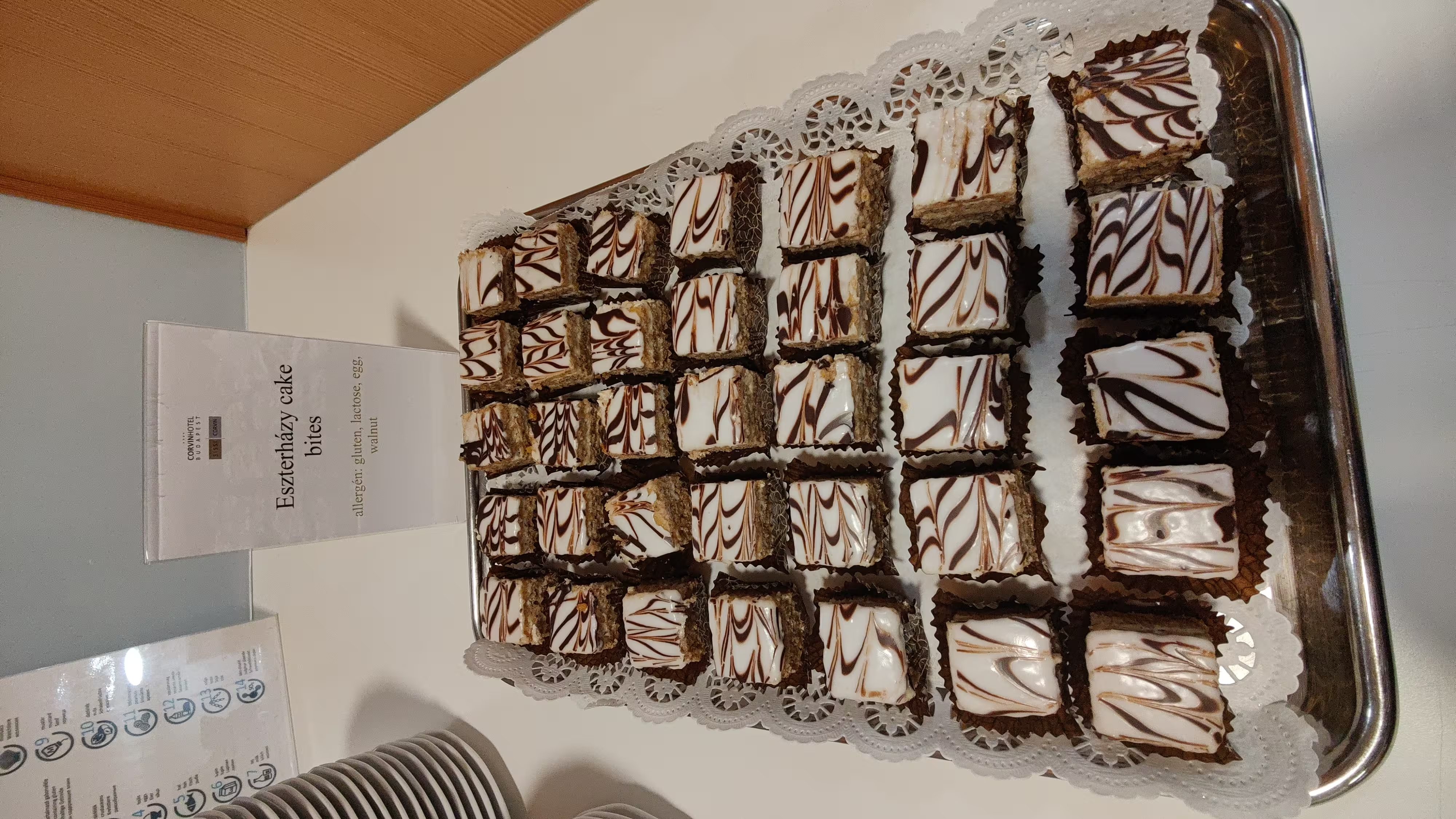
Cake slices These Esterh zy cake bites were really yummy. Photo by Ravi Dwivedi, released under CC-BY-SA 4.0.
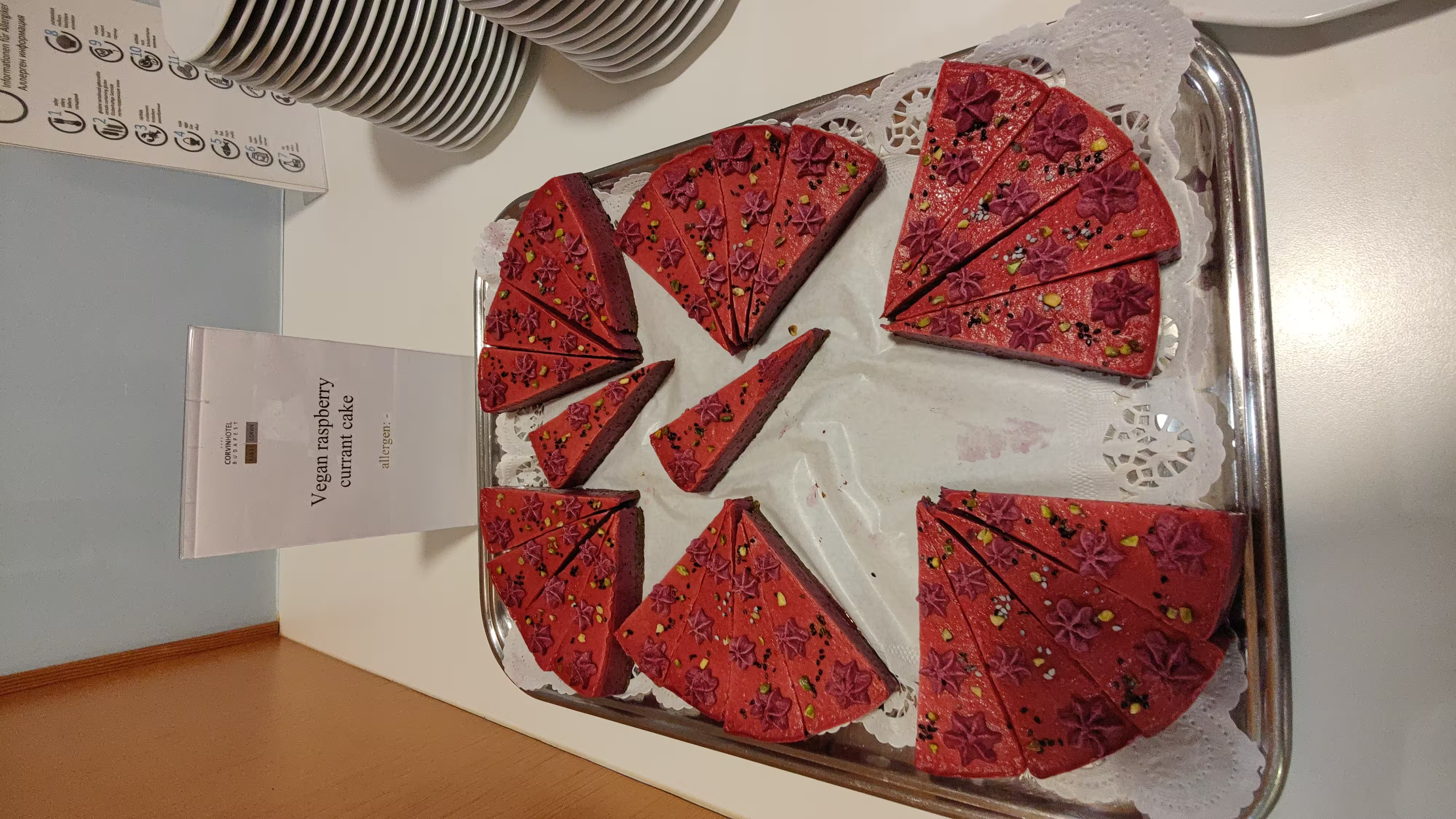
Raspberry Currant cake slices Raspberry Currant cake slices. Photo by Ravi Dwivedi, released under CC-BY-SA 4.0.

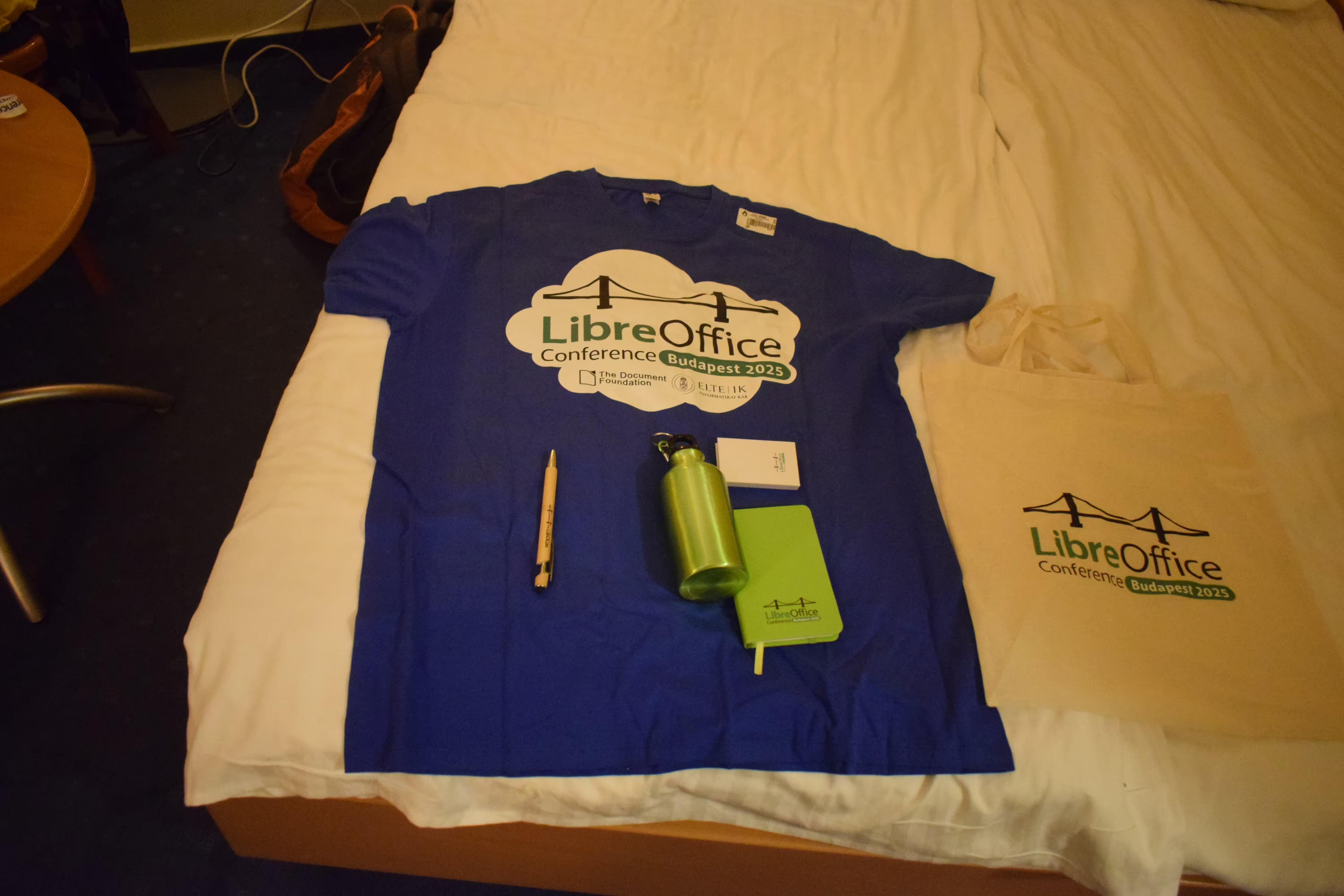
4th of September On the first day of the conference, attendees were given swag bags containing a pad, sticky notes, a pen, a conference T-shirt, and a bottle.
A blue colored T-shirt on a bed along with a pen, a bottle, a diary and a sticky note Conference swag. Photo by Ravi Dwivedi, released under CC-BY-SA 4.0.
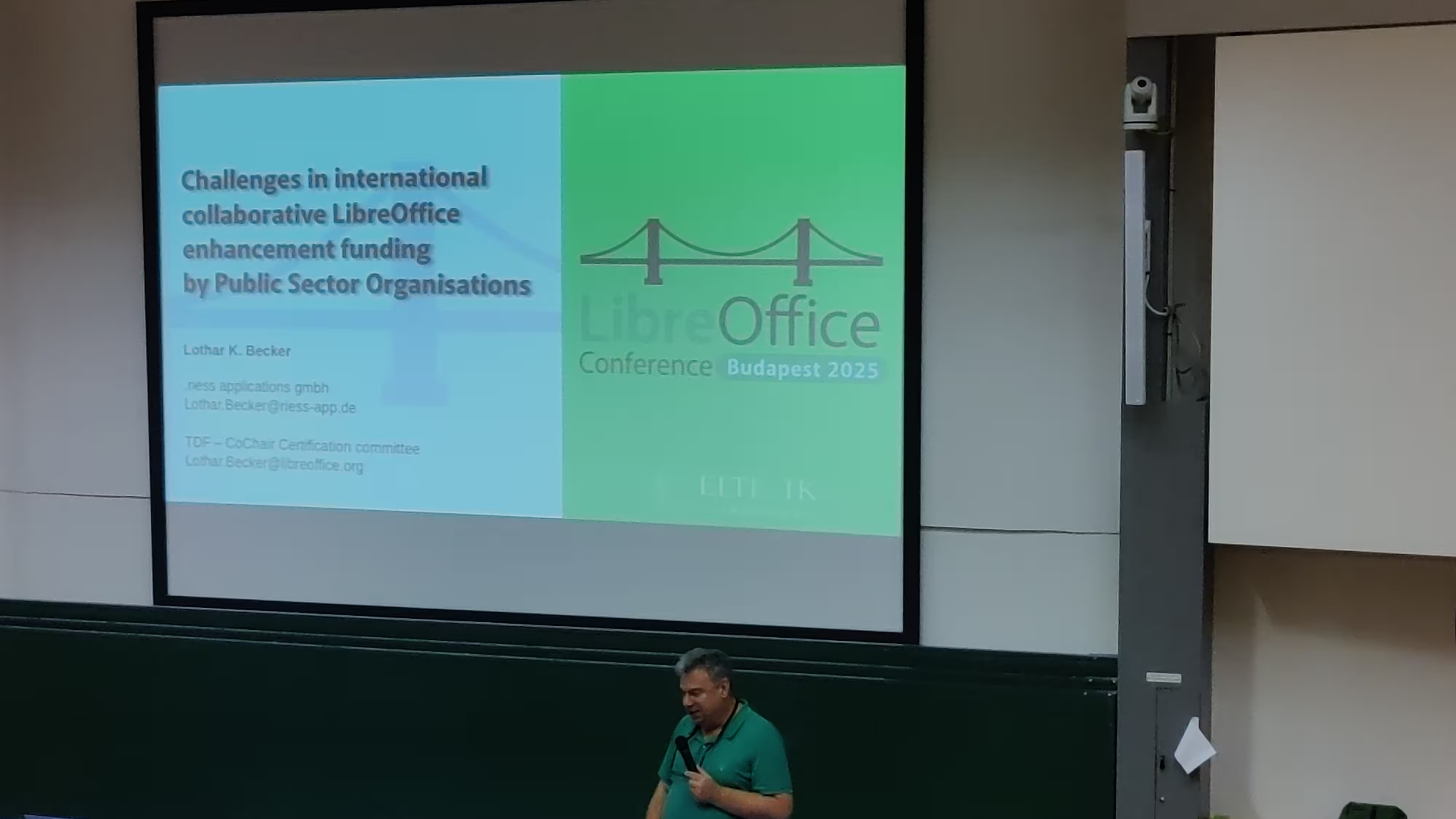
The talks started early in the morning with Eliane Domingos, Chairperson of TDF s Board of Directors, giving the inauguration talk. As always, I found Italo Vignoli s talk on the importance of document freedom interesting. During the snack break, I noticed that there were three types of milk available for coffee: cow s milk, lactose-free milk, and almond milk. Almond milk is rare in India, but I have managed to get it, but I have never seen lactose-free milk in India. Since I run fundraisers in my projects, such as Prav, I could relate to Lothar K. Becker s talk. He discussed the issue that certain implementations in LibreOffice require a budget that is too large for any single interested entity to fund independently. Furthermore, The Document Foundation (TDF) cannot legally receive funds from government entities. Therefore, there is no organization or entity to pool resources from all the interested entities to finance the implementation.
Lothar giving his presentation Lothar giving his presentation. Photo by Ravi Dwivedi, released under CC-BY-SA 4.0.
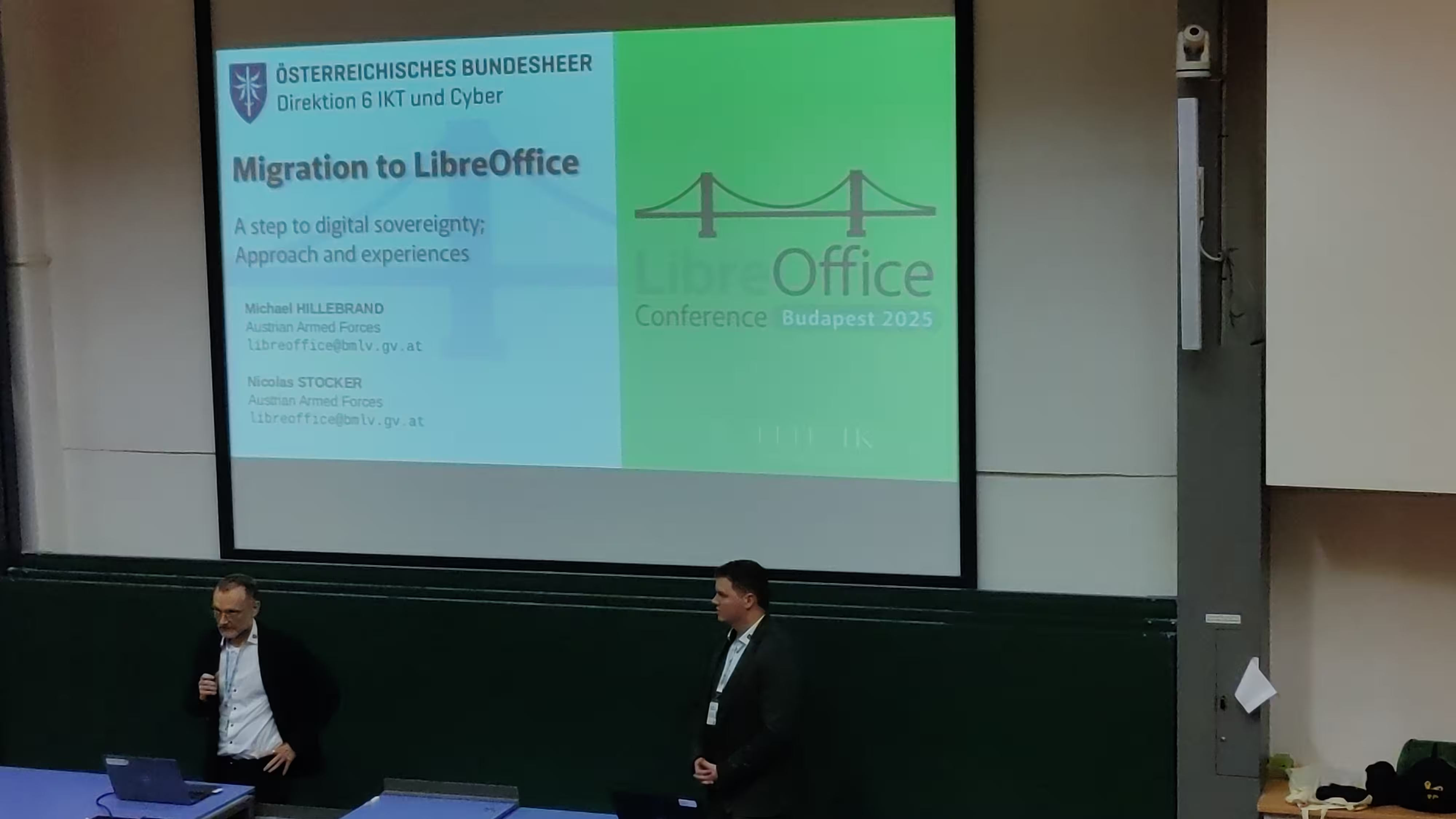
Another talk was by the Austrian Armed Forces on their migration to LibreOffice. I wanted to know why they migrated, and I found out that they did it for their digital sovereignty, and not for saving on the license costs. Another point presented in the talk was that LibreOffice is available on all the operating systems, while the Microsoft Office suite is not that widely available. The migration was systematic and was performed over a few years. They started working on it in 2021, and the migration was finished recently. In addition, it also required training their staff in using LibreOffice.
Presentation on migration to LibreOffice by Austrian Armed Forces Presentation on migration to LibreOffice by Austrian Armed Forces. Photo by Ravi Dwivedi, released under CC-BY-SA 4.0.
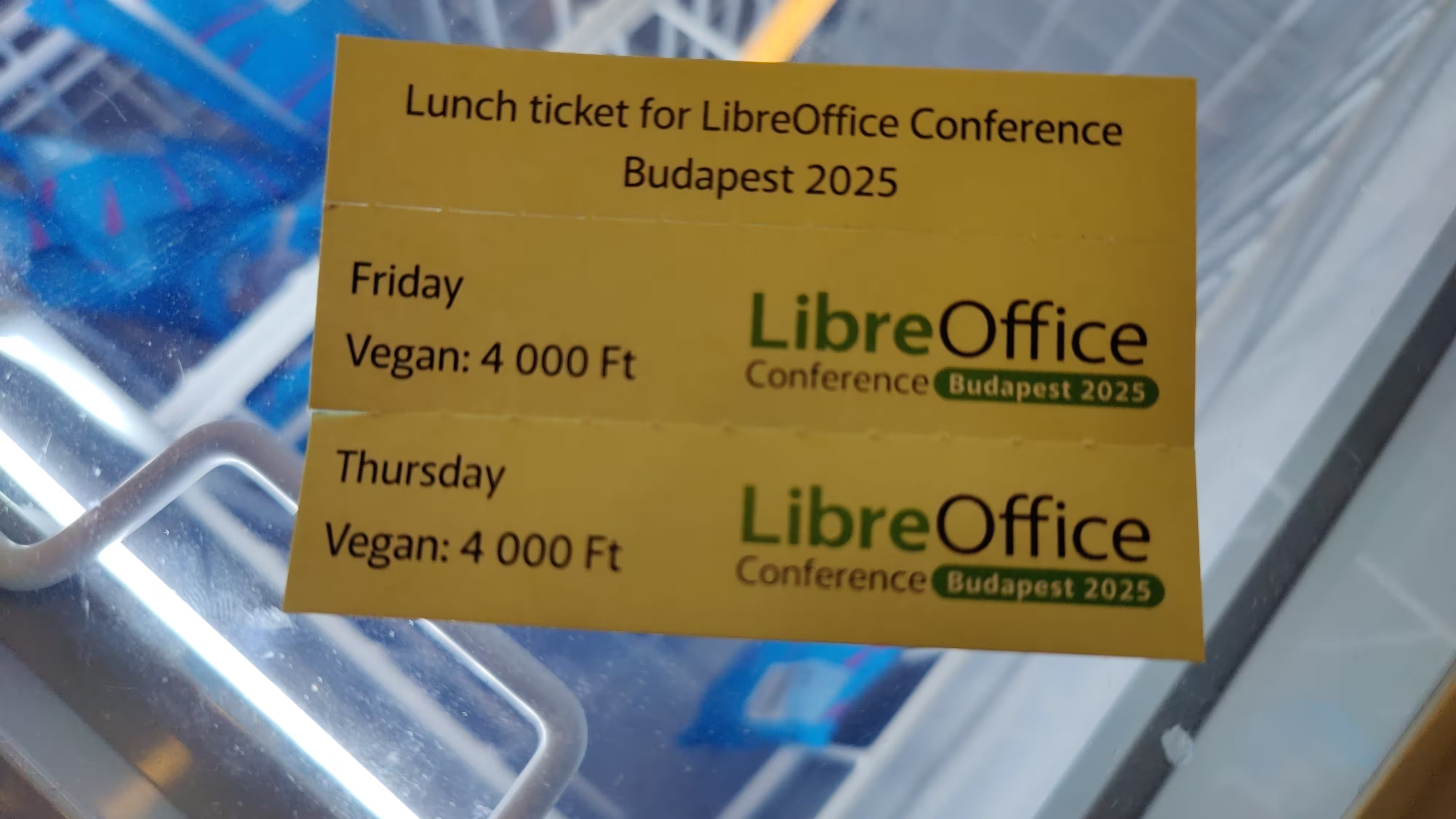
The lunch was inside the university canteen. We were provided lunch coupons by the TDF. I got a vegan coupon with 4000 Ft written on it, which meant I could take lunch for up to 4000 Hungarian forints.
My lunch ticket My lunch ticket for the conference. Photo by Ravi Dwivedi, released under CC-BY-SA 4.0.
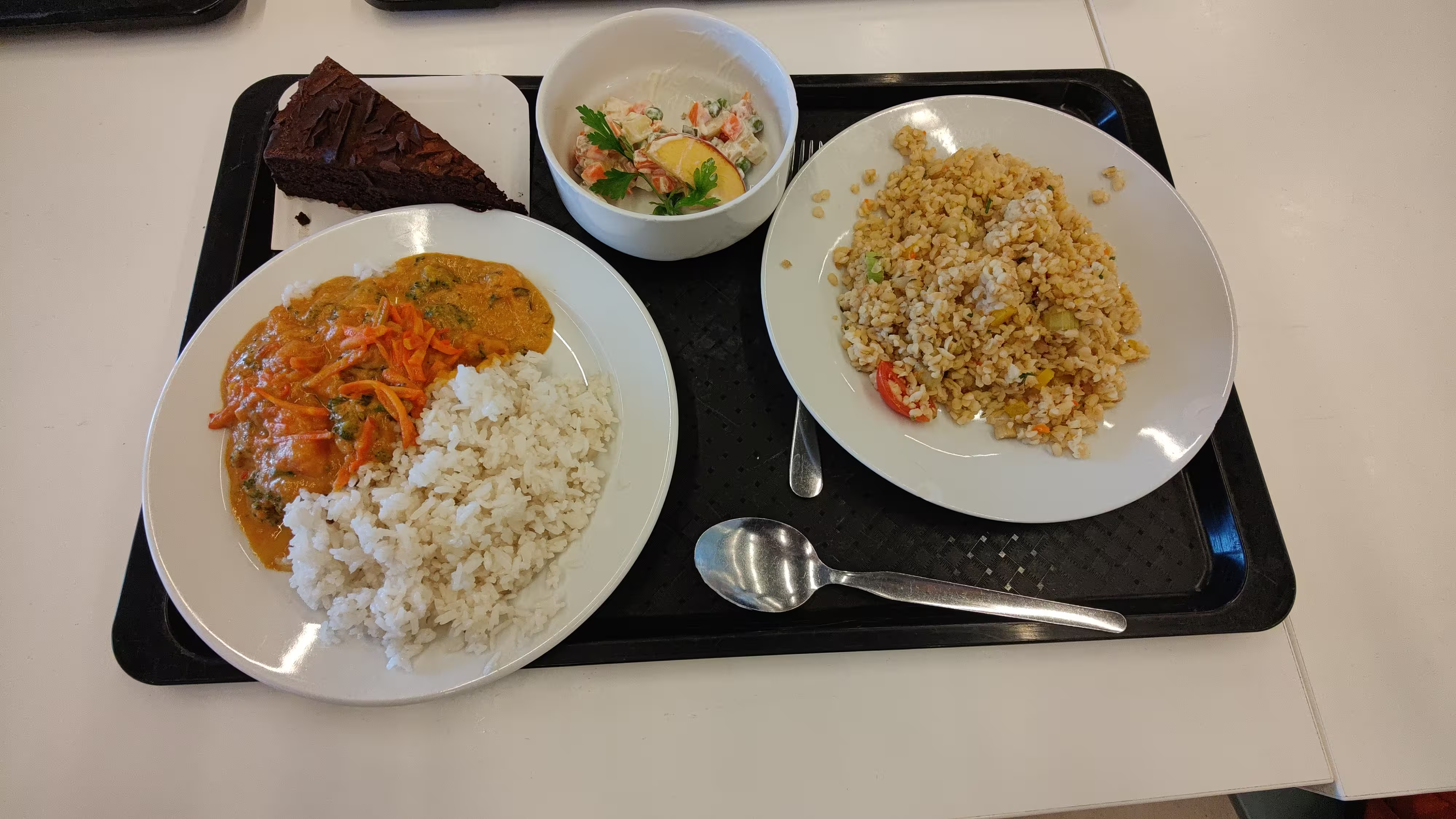
The lunch I had on the first day The lunch I had on the first day. Photo by Ravi Dwivedi, released under CC-BY-SA 4.0.
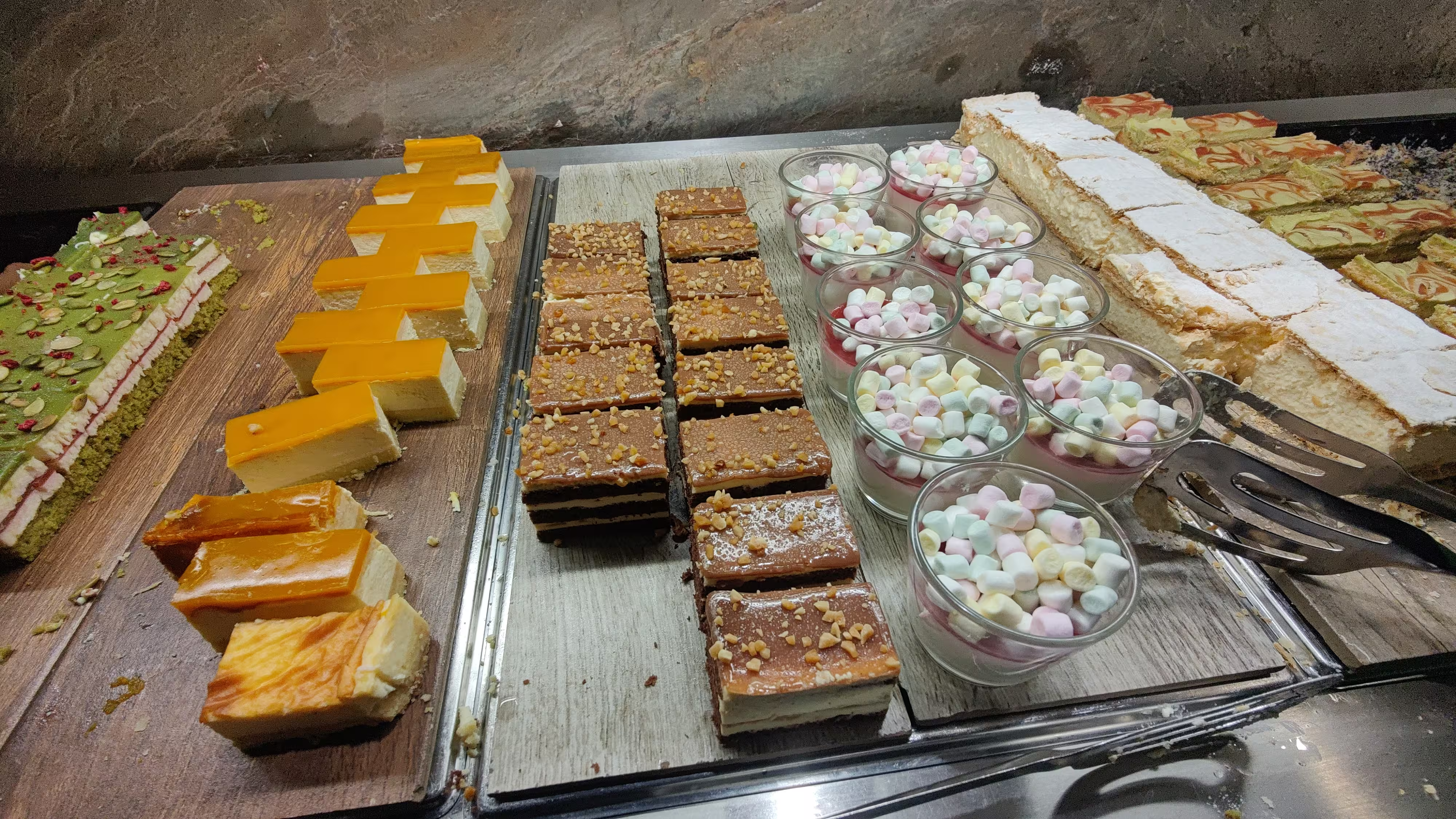
During the evening, it was my turn for the presentation. I was done with preparing my slides ten days before my talk. I also got my slides reviewed by friends. My talk was finished in 20 minutes, while I was given a 30-minute slot. This helped us catch up on the schedule. Furthermore, I made my talk interactive by asking questions and making sure that the audience was not asleep. During my talk, my friend Dione took my pictures with my camera. My talk was on how free software projects could give users a say in freedom to modify the software. I illustrated this using the Prav project that I am a part of. After the talks were over, we were treated to a conference dinner at Trofea Grill. It had a great selection of desserts, which helped me sample some Hungarian desserts. The sponge cake was especially good.
Desserts at Tofea Grill Desserts at Tofea Grill. Photo by Ravi Dwivedi, released under CC-BY-SA 4.0.

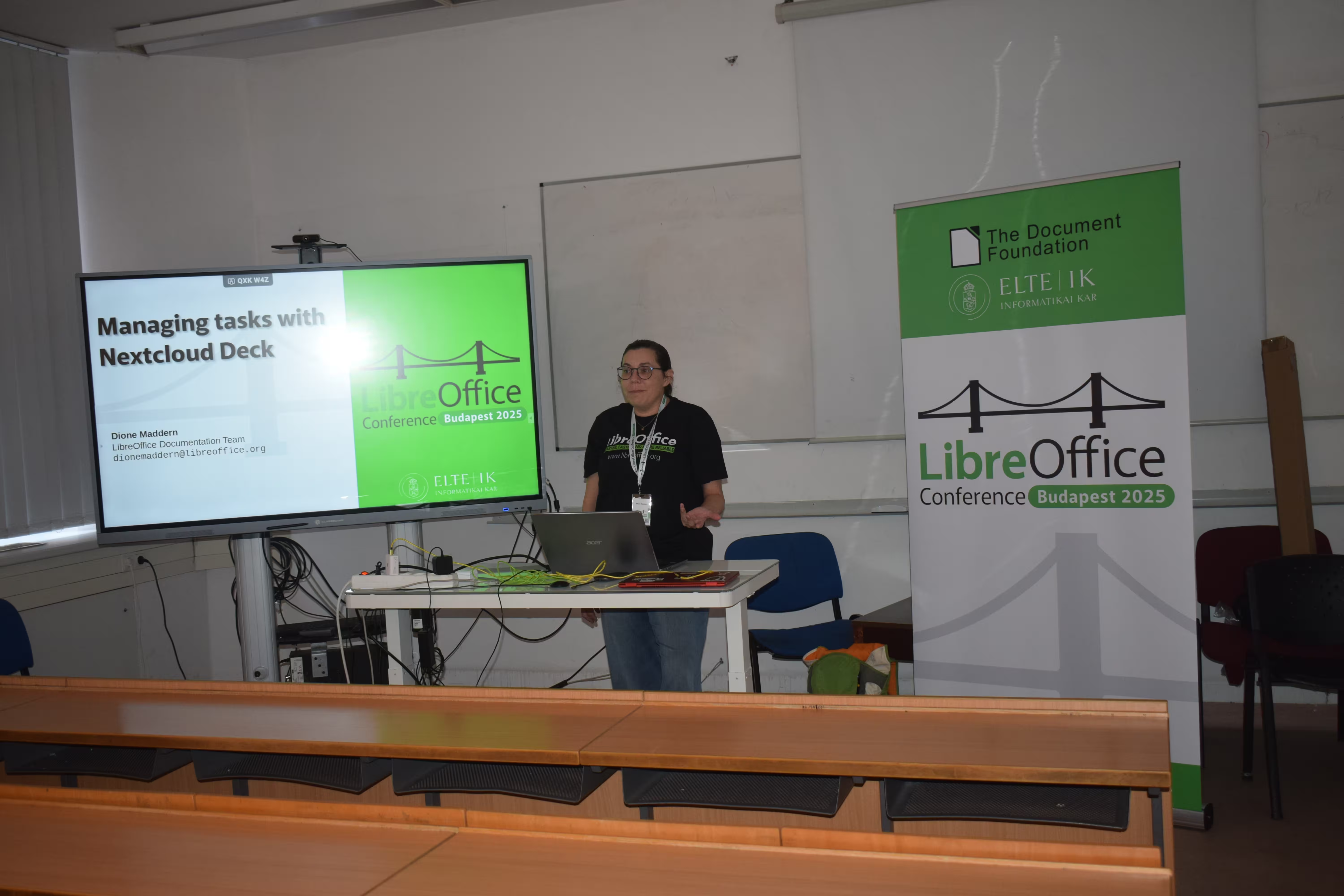
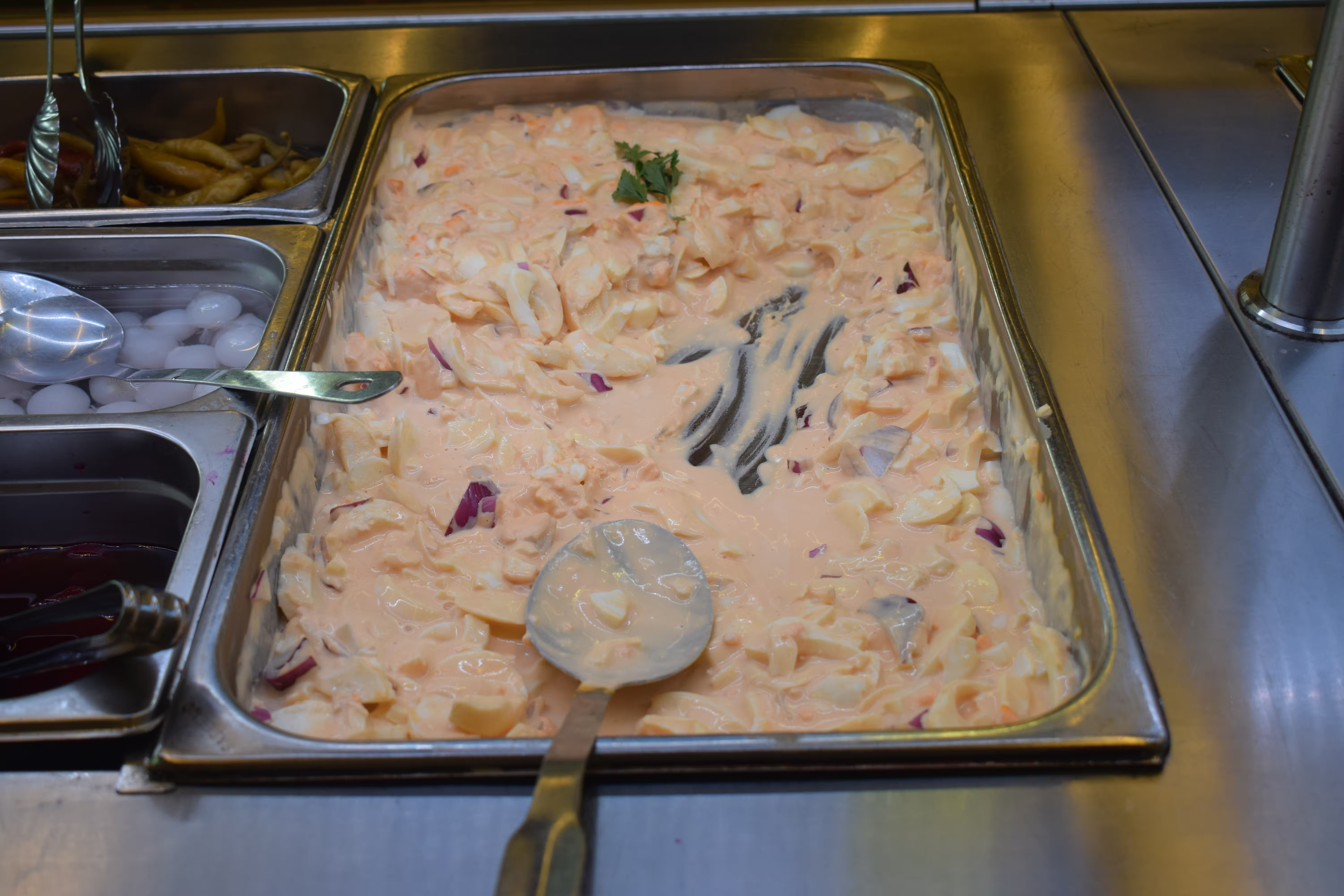
5th of September The next day the 5th of September I went with Dione to the venue early in the morning, as her talk was the first one of the day. Her talk was titled Managing Tasks with Nextcloud Deck. Later that day, I also attended a talk on Collabora. At lunch, I found the egg white salad quite tasty.
Dione giving her presentation Dione giving her presentation. Photo by Ravi Dwivedi, released under CC-BY-SA 4.0.
Egg white salad Egg white salad. Photo by Ravi Dwivedi, released under CC-BY-SA 4.0.
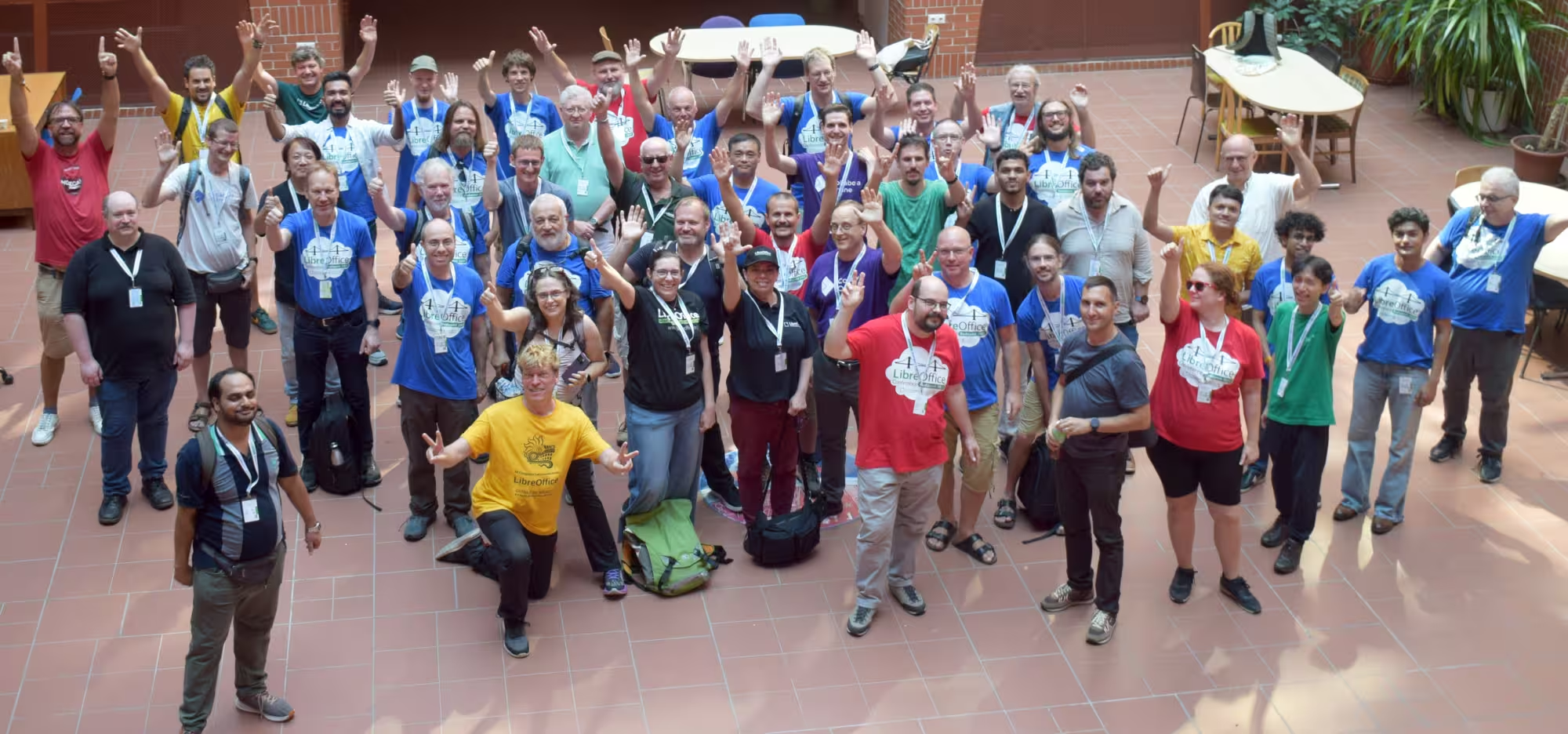
After the lunch break, we had the conference group photo. I had a Nikon camera, which we used to take the group photo. I requested a university student to take our group photo and also taught her how to operate the camera.
People looking at the camera and smiling Group photo
By the evening, the conference ended, after which we went to a pub, which was again sponsored by TDF. I had beer, but that one really tasted bad, so I couldn t finish it. The only vegetarian option was goat cheeseburger, which my friend Manish and I opted for. The burger tasted awful. Apparently, I don t like goat cheese. The next day I went sightseeing with Dione in Budapest. Stay tuned for our adventures! Credits: Thanks to Dione and Richard for proofreading.

18 April 2026

Valhalla's Things: Pizza!

Posted on April 18, 2026
Tags: madeof:atoms, craft:cooking
This post contains a bit of consumerism and is full of references to commercial products, none of which caused me to receive any money nor non-monetary compensation. This post has also been written after eating in one meal the amount of bread-like stuff that we usually have in more than 24 hours. I ve been baking bread since a long time ago. I don t know exactly when, but probably it was the early 2000s or so, and remained a regular-ish thing until 2020, when it became an extremely regular thing, as in I believe I bake bread on average every other day. In the before times, I ve had a chance to bake pizza in a wood fired oven a few times: a friend had one and would offer the house, my partner would mind the fire, and I would get there with the dough and prepare the pizza. Now that we have moved to a new house, we don t have a good and convenient place for a proper wood fired oven in masonry, but we can use one of the portable ones, and having dealt with more urgent expenses, I decided that just before the potential collapse of the global economy was a good time as any to buy the oven I had been looking at since we found this house. I decided to get an Ooni Karu 2, having heard good things about the brand, and since it looked like a good balance between size and portability. I also didn t consider their gas fired ovens (nor did I buy the gas burner) because I m trying to get rid of gas, not add stuff that uses it, and I didn t get an electric one because I m not at all unhappy with the bakery-style pizza we make in our regular oven, and I have to admit we also wanted to play with fire1. We also needed an outdoor table suitable to use the oven on and store it. Here I looked for inspiration at the Ooni tables (and for cheaper alternatives in the same style), but my mother who shares the outdoor area with us wasn t happy with the idea of steel2. And then I was browsing the modern viking shores, and found that there was a new piece in the N MMAR series my mother likes (and of which we already have some reclining chairs): a kitchen unit in wood with a steel top. At first I expected to just skip the back panel, since it would be in the way when using the oven, but then I realized that it could probably be assembled upside down, down from the top between the table legs, and we decided to try that option. This week everything had arrived, and we could try it. Yesterday evening, after dinner (around 21, I think) I prepared the dough with the flour I usually use for bakery-style pizza: Farina di Grano Tenero Tipo 0 PANE (320 - 340 W); since I wanted to make things easier for myself I only used 55% hydration, so the recipe was:
  • 1 kg flour
  • 550 g water
  • 2 g dry yeast
  • 12 g salt
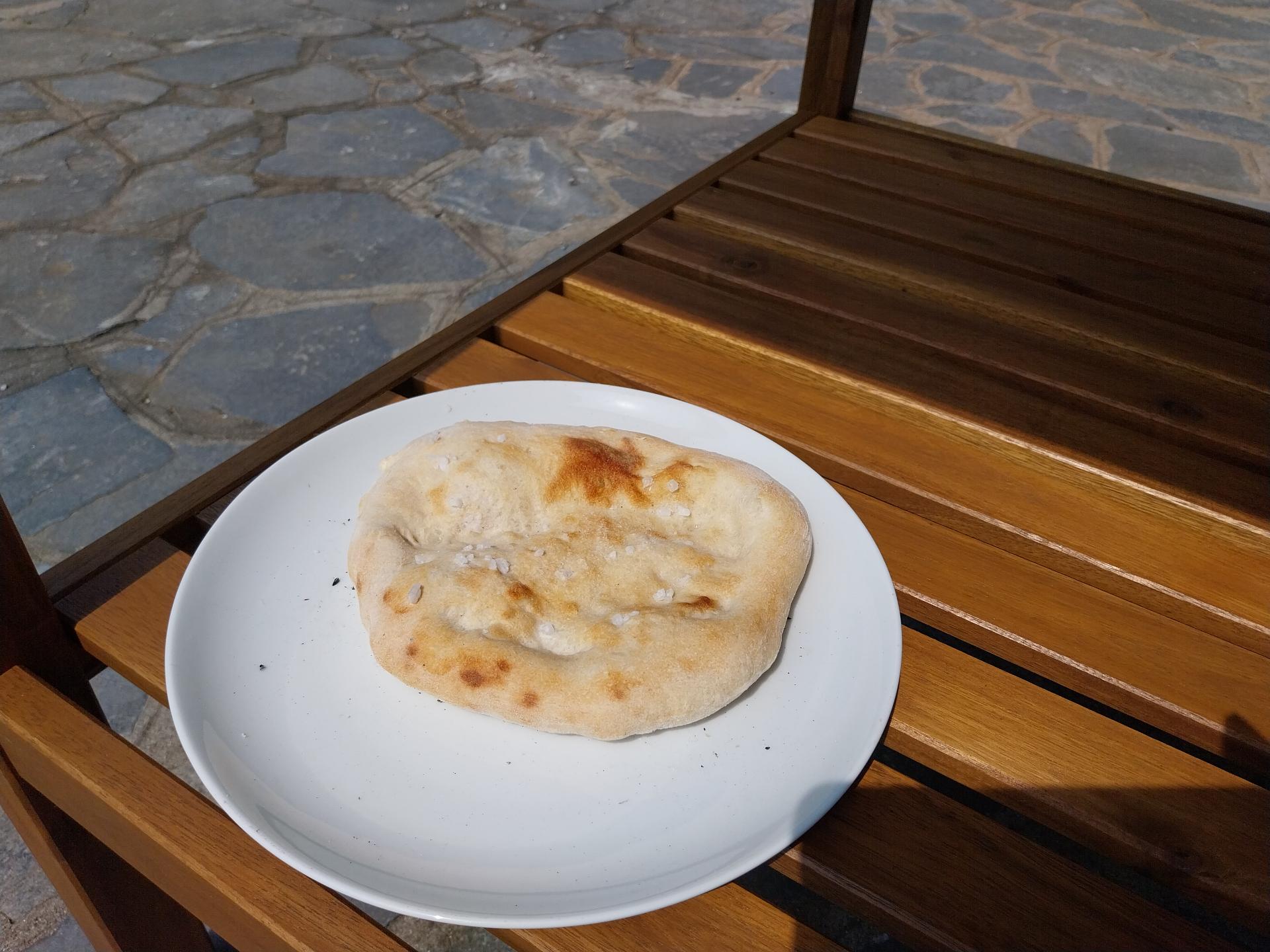
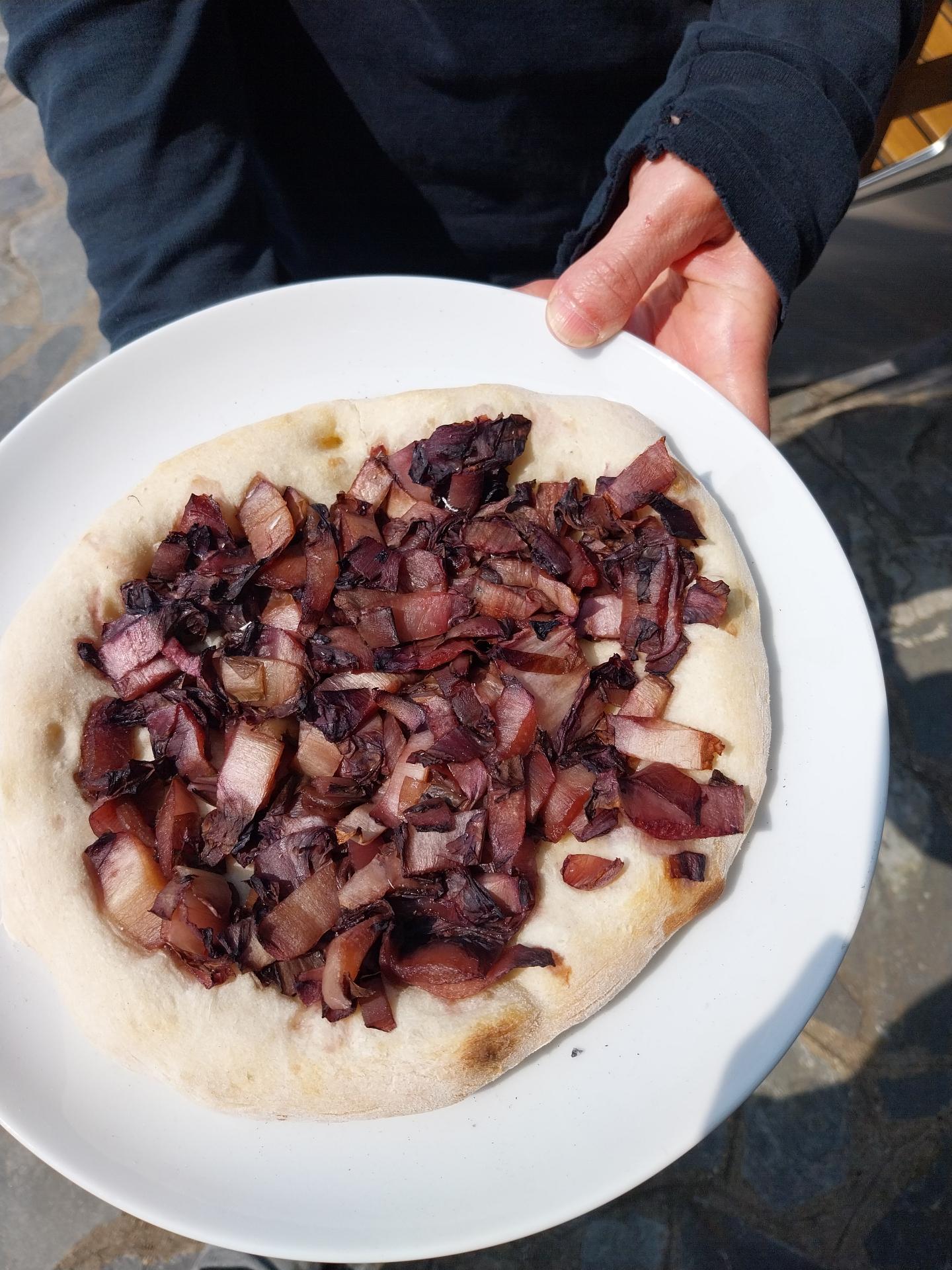
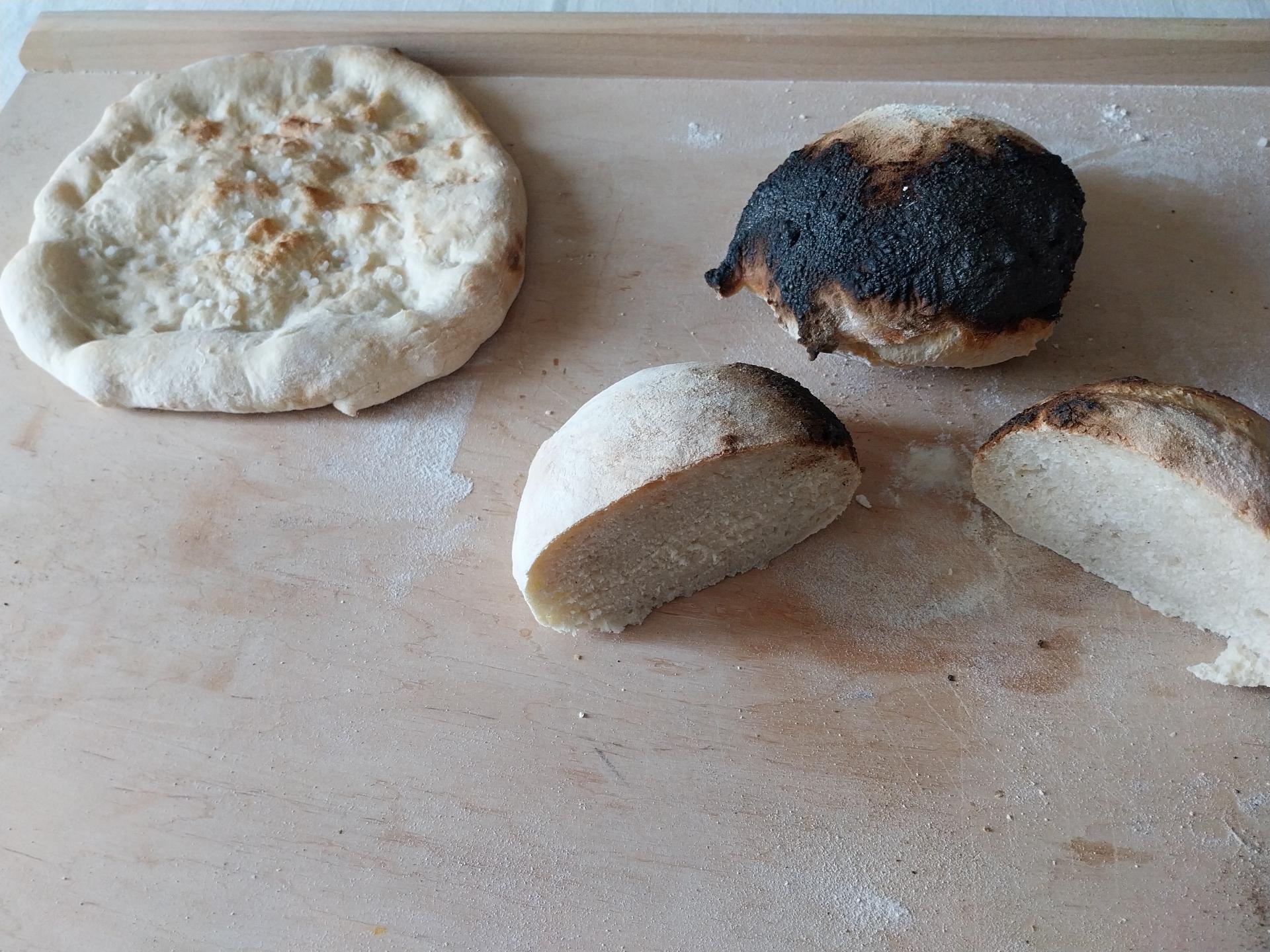
The next time I think I ll try with one of my other staples: Molino Bogetto etichetta blu (260/280 W) Then this morning we assembled the N MMAR , then I divided the dough in eight balls, put them in a covered but not sealed container 3, well floured with rice flour and then we fired the oven (as in: my partner did, I looked for a short while and then set the table and stuff), using charcoal, because we already had some, and could conveniently get more at the supermarket. When the oven had reached temperatures in the orange range4 I stretched the smallest ball out, working on my wooden peel, sprayed it with water5, sprinkled it with coarse salt and put it in the oven. After 30 seconds I turned it around with the new metal peel, then again after 30 seconds, and then I lost count of how many times I repeated this6, but it was probably 2 or 3 minutes until it looked good. A flatbread on a regular plate: it's only a bit more than half the plate in diameter, puffed up near the borders and thin in the middle, and only lightly browned in places, not burnt. It's sitting on the lower shelf of a wooden table. And it was good. The kind of pizza that is quite soft, especially near the borders. We ate it with fresh mozzarella and tomatoes, and then made another one the same way, to finish the mozzarella. Another flatbread on the same plate, this time it's about 4 cm smaller than the plate on all sides, and it's covered with brownish-red chopped up vegetables. This was supposed to be our lunch, but we decided to try one with some leftover cooked radicchio, and that also worked quite nicely. And finally, we decided we needed to try a more classical pizza, with tomato sauce and cured meat, of which we forgot to take pictures. Up to here we had eaten about half of the dough, and we were getting full: I had prepared significantly more than what I expected to eat, to be able to accidentally burn some, but also with the idea to bake something else to be eaten later. So I made two more focaccias with just water and salt, and then I tried to cook some bread with what I expected to be residual heat. Another flatbread with coarse salt and two bread rolls, one of which is completely carbonized on one side. The other one has been cut, and while it has a carbonized spot, it is also well cooked in the middle, and perfectly edible. Except that the oven was getting a bit too cold, so my partner added some charcoal, and when I put the last two unflattened balls right at the back of the oven where it was still warmer, that side carbonized. After 5 minutes I moved them to the middle of the oven, and turned them, and then after another turn and 5 more minutes they were ready. And other than the burnt crust, they were pretty edible. So, the thoughts after our first experience. Everybody around the table (my SO, my mother and me) was quite happy with the results, and they are different enough from the ones I could get with the regular oven. As I should have expected, it s much faster than a masonry oven, both in getting to temperature and in cooling down: my plan for residual heat bread cooking will have to be adjusted with experience. We were able to get it hot enough, but not as hot as it s supposed to be able to get: we suspect that using just charcoal may have influenced it, and next week we ll try to get some wood, and try with a mix. As for the recipe, dividing the dough in eight parts worked quite well: maybe the pizzas are a bit on the smaller side, but since they come one at a time it s more convenient to cut and share them, and maybe make a couple more at the end. Of course, I ll want to try different recipes, for different styles of pizzas (including some almost-trademark-violating ones) and for other types of flatbread. I expect it won t be hard to find volunteers to help us with the experiments. :D

  1. any insinuation that there may have been considerations of having a way to have freshly baked bread in case of a prolonged blackout may or may not be based on reality. But it wasn t the only or even the main reason.
  2. come on! it s made of STEEL. how can it be not good? :D
  3. IKEA 365+ 3.1 glass, the one that is 32 cm 21 cm 9 cm; it was just big enough for the amount of dough, and then I covered it with a lid that is missing the seal.
  4. why did they put a thermometer on it, and not add labels with the actual temperature? WHY???
  5. if you don t have dietary restrictions a bit of olive oil would taste even better.
  6. numbers above 2 are all basically the same, right?

15 April 2026

Paul Tagliamonte: designing arf, an sdr iq encoding format

Interested in future updates? Follow me on mastodon at @paul@soylent.green. Posts about hz.tools will be tagged #hztools.

Want to jump right to the draft? I'll be maintaining ARF going forward at /draft-tagliamonte-arf-00.txt.
It s true processing data from software defined radios can be a bit complex which tends to keep all but the most grizzled experts and bravest souls from playing with it. While I wouldn t describe myself as either, I will say that I ve stuck with it for longer than most would have expected of me. One of the biggest takeaways I have from my adventures with software defined radio is that there s a lot of cool crossover opportunity between RF and nearly every other field of engineering. Fairly early on, I decided on a very light metadata scheme to track SDR captures, called rfcap. rfcap has withstood my test of time, and I can go back to even my earliest captures and still make sense of what they are IQ format, capture frequencies, sample rates, etc. A huge part of this was the simplicity of the scheme (fixed-lengh header, byte-aligned to supported capture formats), which made it roughly as easy to work with as a raw file of IQ samples. However, rfcap has a number of downsides. It s only a single, fixed-length header. If the frequency of operation changed during the capture, that change is not represented in the capture information. It s not possible to easily represent mulit-channel coherent IQ streams, and additional metadata is condemned to adjacent text files.

ARF (Archive of RF) A few years ago, I needed to finally solve some of these shortcomings and tried to see if a new format would stick. I sat down and wrote out my design goals before I started figuring out what it looked like. First, whatever I come up with must be capable of being streamed and processed while being streamed. This includes streaming across the network or merely written to disk as it s being created. No post-processing required. This is mostly an artifact of how I ve built all my tools and how I intereact with my SDRs. I use them extensively over the network (both locally, as well as remotely by friends across my wider lan). This decision sometimes even prompts me to do some crazy things from time to time. I need actual, real support for multiple IQ channels from my multi-channel SDRs (Ettus, Kerberos/Kracken SDR, etc) for playing with things like beamforming. My new format must be capable of storing multiple streams in a single capture file, rather than a pile of files in a directory (and hope they re aligned). Finally, metadata must be capable of being stored in-band. The initial set of metadata I needed to formalize in-stream were Frequency Changes and Discontinuities. Since then, ARF has grown a few more. After getting all that down, I opted to start at what I thought the simplest container would look like, TLV (tag-length-value) encoded packets. This is a fairly well trodden path, and used by a bunch of existing protocols we all know and love. Each ARF file (or stream) was a set of encoded packets (sometimes called data units in other specs). This means that unknown packet types may be skipped (since the length is included) and additional data can be added after the existing fields without breaking existing decoders.
tag
length
value
Heads up! Once this is posted, I'm not super likely to update this page. Once this goes out, the latest stable copy of the ARF spec is maintained at draft-tagliamonte-arf-00.txt. This page may quickly become out of date, so if you're actually interested in implementing this, I've put a lot of effort into making the draft comprehensive, and I plan to maintain it as I edit the format.
Unlike a traditional TLV structure, I opted to add flags to the top-level packet. This gives me a bit of wiggle room down the line, and gives me a feature that I like from ASN.1 a critical bit. The critical bit indicates that the packet must be understood fully by implementers, which allows future backward incompatible changes by marking a new packet type as critical. This would only really be done if something meaningfully changed the interpretation of the backwards compatible data to follow.
Flag Description
0x01Critical (tag must be understood)
Within each Packet is a tag field. This tag indicates how the contents of the value field should be interpreted.
Tag ID Description
0x01Header
0x02Stream Header
0x03Samples
0x04Frequency Change
0x05Timing
0x06Discontinuity
0x07Location
0xFEVendor Extension
In order to help with checking the basic parsing and encoding of this format, the following is an example packet which should parse without error.
 00, // tag (0; no subpacket is 0 yet)
 00, // flags (0; no flags)
 00, 00 // length (0; no data)
 // data would go here, but there is none
Additionally, throughout the rest of the subpackets, there are a few unique and shared datatypes. I document them all more clearly in the draft, but to quickly run through them here too:

UUID This field represents a globally unique idenfifer, as defined by RFC 9562, as 16 raw bytes.

Frequency Data encoded in a Frequency field is stored as microhz (1 Hz is stored as 1000000, 2 Hz is stored as 2000000) as an unsigned 64 bit integer. This has a minimum value of 0 Hz, and a maximum value of 18446744073709551615 uHz, or just above 18.4 THz. This is a bit of a tradeoff, but it s a set of issues that I would gladly contend with rather than deal with the related issues with storing frequency data as a floating point value downstream. Not a huge factor, but as an aside, this is also how my current generation SDR processing code (sparky) stores Frequency data internally, which makes conversion between the two natural.

IQ samples ARF supports IQ samples in a number of different formats. Part of the idea here is I want it to be easy for capturing programs to encode ARF for a specific radio without mandating a single iq format representation. For IQ types with a scalar value which takes more than a single byte, this is always paired with a Byte Order field, to indicate if the IQ scalar values are little or big endian.
ID Name Description
0x01f32interleaved 32 bit floating point scalar values
0x02i8 interleaved 8 bit signed integer scalar values
0x03i16interleaved 16 bit signed integer scalar values
0x04u8 interleaved 8 bit unsigned integer scalar values
0x05f64interleaved 64 bit floating point scalar values
0x06f16interleaved 16 bit floating point scalar values

Stream Header Immediately after the arf Header, some number of Stream Headers follow. There must be exactly the same number of Stream Header packets as are indicated by the num streams field of the Header. This has the nice effect of enabling clients to read all the stream headers without requiring buffering of unread packets from the stream.
id
flags
fmt
bo
rate
freq
guid
site
In order to help with checking the basic parsing and encoding of this format, the following is an example stream header subpacket (when encoded or decoded this will be found inside an ARF packet as described above) which should parse without error, with known values.
00, 01, // id (1)
00, 00, 00, 00, 00, 00, 00, 00, // flags
01, // format (float32)
01, // byte order (Little Endian)
00, 00, 01, d1, a9, 4a, 20, 00, // rate (2 MHz)
00, 00, 5a, f3, 10, 7a, 40, 00, // frequency (100 MHz)

// guid (7b98019d-694e-417a-8f18-167e2052be4d)
7b, 98, 01, 9d, 69, 4e, 41, 7a,
8f, 18, 16, 7e, 20, 52, be, 4d,

// site_id (98c98dc7-c3c6-47fe-bc05-05fb37b2e0db)
98, c9, 8d, c7, c3, c6, 47, fe,
bc, 05, 05, fb, 37, b2, e0, db,

Samples Block of IQ samples in the format indicated by this stream s format and byte_order field sent in the related Stream Header.
id
iq samples
In order to help with checking the basic parsing and encoding of this format, the following is an samples subpacket (when encoded or decoded this will be found inside an ARF packet as described above). The IQ values here are notional (and are either 2 8 bit samples, or 1 16 bit sample, depending on what the related Stream Header was).
01, // id
ab, cd, ab, cd, // iq samples

Frequency Change The center frequency of the IQ stream has changed since the Stream Header or last Frequency Change has been sent. This is useful to capture IQ streams that are jumping around in frequency during the duration of the capture, rather than starting and stopping them.
id
frequency
In order to help with checking the basic parsing and encoding of this format, the following is a frequency change subpacket (when encoded or decoded this will be found inside an ARF packet as described above).
01, // id
00, 00, b5, e6, 20, f4, 80, 00 // frequency (200 MHz)

Discontinuity Since the last Samples packet for this stream, samples have been dropped or not encoded to this stream. This can be used for a stream that has dropped samples for some reason, a large gap (radio was needed for something else), or communicating iq snippits .
id
In order to help with checking the basic parsing and encoding of this format, the following is a discontinuity subpacket (when encoded or decoded this will be found inside an ARF packet as described above).
01, // id

Location Up-to-date location as of this moment of the IQ stream, usually from a GPS. This allows for in-band geospatial information to be marked in the IQ stream. This can be used for all sorts of things (detected IQ packet snippits aligned with a time and location or a survey of rf noise in an area)
flags
sys
lat
long
el
accuracy
The sys field indicates the Geodetic system to be used for the provided latitude, longitude and elevation fields. The full list of supported geodetic systems is currently just WGS84, but in case something meaningfully changes in the future, it d be nice to migrate forward. Unfortunately, being a bit of a coward here, the accuracy field is a bit of a cop-out. I d really rather it be what we see out of kinematic state estimation tools like a kalman filter, or at minimum, some sort of ellipsoid. This is neither of those - it s a perfect sphere of error where we pick the largest error in any direction and use that. Truthfully, I can t be bothered to model this accurately, and I don t want to contort myself into half-assing something I know I will half-ass just because I know better.
System Description
0x01 WGS84 - World Geodetic System 1984
In order to help with checking the basic parsing and encoding of this format, the following is a location subpacket (when encoded or decoded this will be found inside an ARF packet as described above).
00, 00, 00, 00, 00, 00, 00, 00, // flags
01, // system (wgs84)
3f, f3, be, 76, c8, b4, 39, 58, // latitude (1.234)
40, 02, c2, 8f, 5c, 28, f5, c3, // longitude (2.345)
40, 59, 00, 00, 00, 00, 00, 00, // elevation (100)
40, 24, 00, 00, 00, 00, 00, 00 // accuracy (10)

Vendor Extension In addition to the fields I put in the spec, I expect that I may need custom packet types I can t think of now. There s all sorts of useful data that could be encoded into the stream, so I d rather there be an officially sanctioned mechanism that allows future work on the spec without constraining myself. Just an example, I ve used a custom subpacket to create test vectors, the data is encoded into a Vendor Extension, followed by the IQ for the modulated packet. If the demodulated data and in-band original data don t match, we ve regressed. You could imagine in-band speech-to-text, antenna rotator azimuth information, or demodulated digital sideband data (like FM HDR data) too. Or even things I can t even think of!
id
data
In order to help with checking the basic parsing and encoding of this format, the following is a vendor extension subpacket (when encoded or decoded this will be found inside an ARF packet as described above).
// extension id (b24305f6-ff73-4b7a-ae99-7a6b37a5d5cd)
b2, 43, 05, f6, ff, 73, 4b, 7a,
ae, 99, 7a, 6b, 37, a5, d5, cd,

// data (0x01, 0x02, 0x03, 0x04, 0x05)
01, 02, 03, 04, 05

Tradeoffs The biggest tradeoff that I m not entirely happy with is limiting the length of a packet to u16 65535 bytes. Given the u8 sample header, this limits us to 8191 32 bit sample pairs at a time. I wound up believing that the overhead in terms of additional packet framing is worth it because always encoding 4 byte lengths felt like overkill, and a dynamic length scheme ballooned codepaths in the decoder that I was trying to keep as easy to change as possible as I worked with the format.

14 April 2026

Ravi Dwivedi: Hungary Visa

The annual LibreOffice conference 2025 was held in Budapest, Hungary, from the 3rd to the 6th of September 2025. Thanks to the The Document Foundation (TDF) for sponsoring me to attend the conference. As Hungary is a part of the Schengen area, I needed a Schengen visa to attend the conference. In order to apply for a Schengen visa, one needs to get an appointment at VFS Global and submit all the required documents there, which are then forwarded to the embassy. I got an appointment for a Hungary visa at VFS Global in New Delhi for the 24th of July. There were many appointment slots available for the Hungary visa. One could easily get an appointment for the next day at the Delhi center. There were some technical problems on the VFS website, though, as I was unable to upload a scanned copy of my passport while booking the appointment. I got an error saying, Unfortunately, you have exceeded the maximum upload limit. The problem didn t get fixed even after contacting the VFS helpline. They asked me to try in the Firefox browser and deleting all the cache, which I already did. So I created another account with a different email address and phone number, after which I was able to upload my passport and book an appointment. Other conference attendees from India also reported facing some technical issues on the VFS Hungary website. Anyway, I went to the VFS Hungary application center as per my appointment on the 24th of July. Going inside, I located the Hungary visa application counter. There were two applicants ahead of me. When it was my turn, the VFS staff warned me that my passport was damaged. The damage was on the bio-data page. All the details could be seen, but the lamination of the details page wore off a bit. They asked me to write an application to the Embassy of Hungary in New Delhi stating that I insist VFS to submit my application along with describing the damage on my passport. I got a bit worried about my application getting rejected due to the damage. But I decided to gamble my money on this one, as I didn t have time (and energy) to apply for a new passport before this trip. Moreover, I had struck down a couple of fields in my visa application form which were not applicable to me, due to which the VFS staff asked me to fill out another visa application. After this, the application got submitted, and it was 11,000 INR (including the fee to book the appointment at VFS). Here is the list of documents I submitted: It took 2 hours for me to submit my visa application, even though there were only two applicants before me. This was by far the longest time to submit a Schengen visa application for me. Fast-forward to the 30th of July, and I received an email from the Embassy of Hungary asking me to submit an additional document - paid air ticket - for my application. I had only submitted dummy flight tickets, and they were enough for the Schengen visas I applied for until now. This was the first time a country was asking me to submit a confirmed flight ticket during the visa process. I consulted my travel agent on this, and they were fairly confident that I will get the visa if the embassy is asking me to submit confirmed flight tickets. So I asked the travel agent to book the flight tickets. These tickets were 78,000, and the airline was Emirates. Then, I sent the flight tickets to the embassy by email. The embassy sent the visa results on the 6th of August, which I received the next day. My visa had been approved! It took 14 days for me to get the Hungary visa after submitting the application. See you in the next one! Thanks to Badri for proofreading.

28 March 2026

Valhalla's Things: Ink Lightfastness Tests 2026

Posted on March 28, 2026
Tags: madeof:atoms, topic:inks
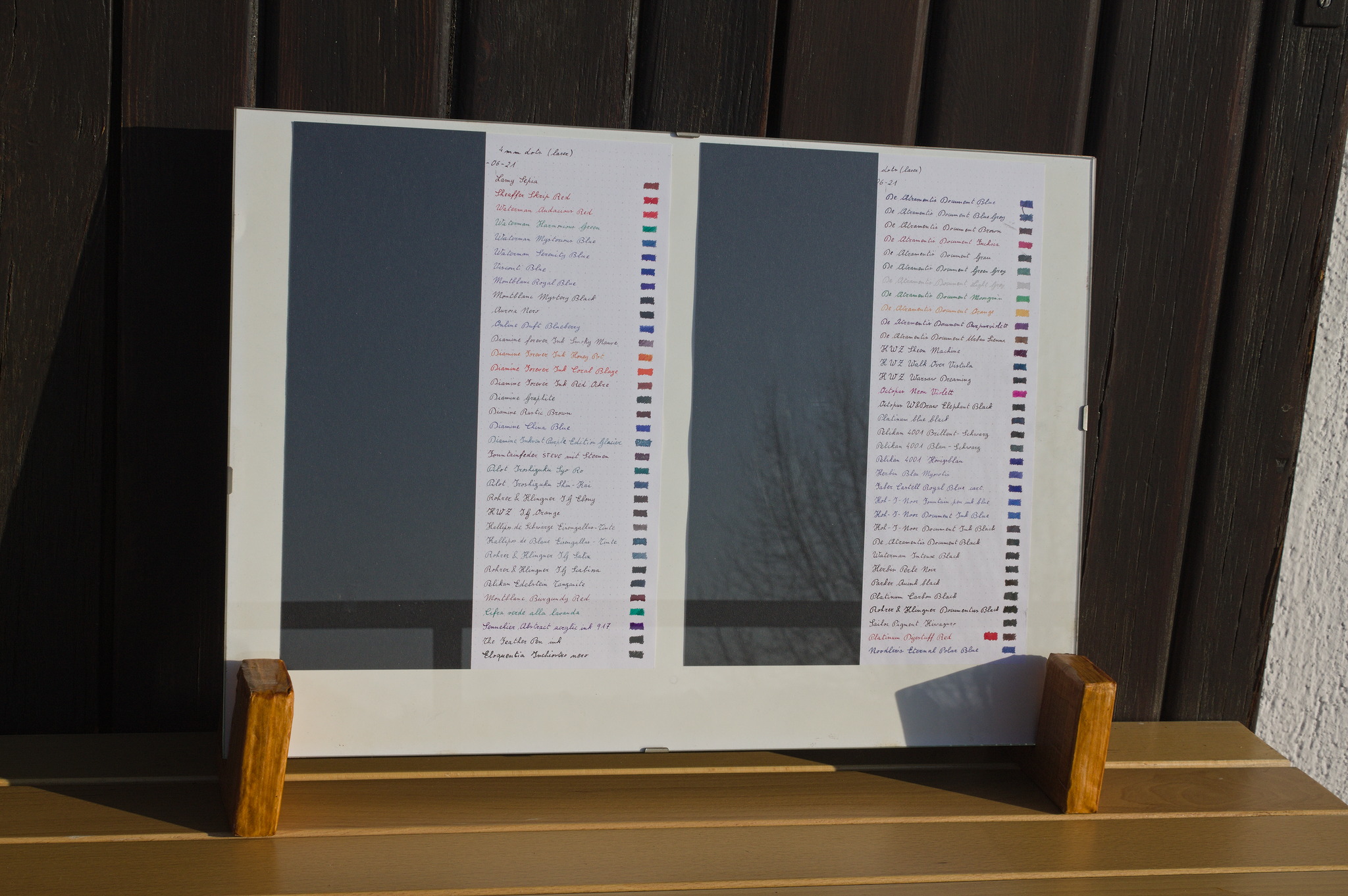
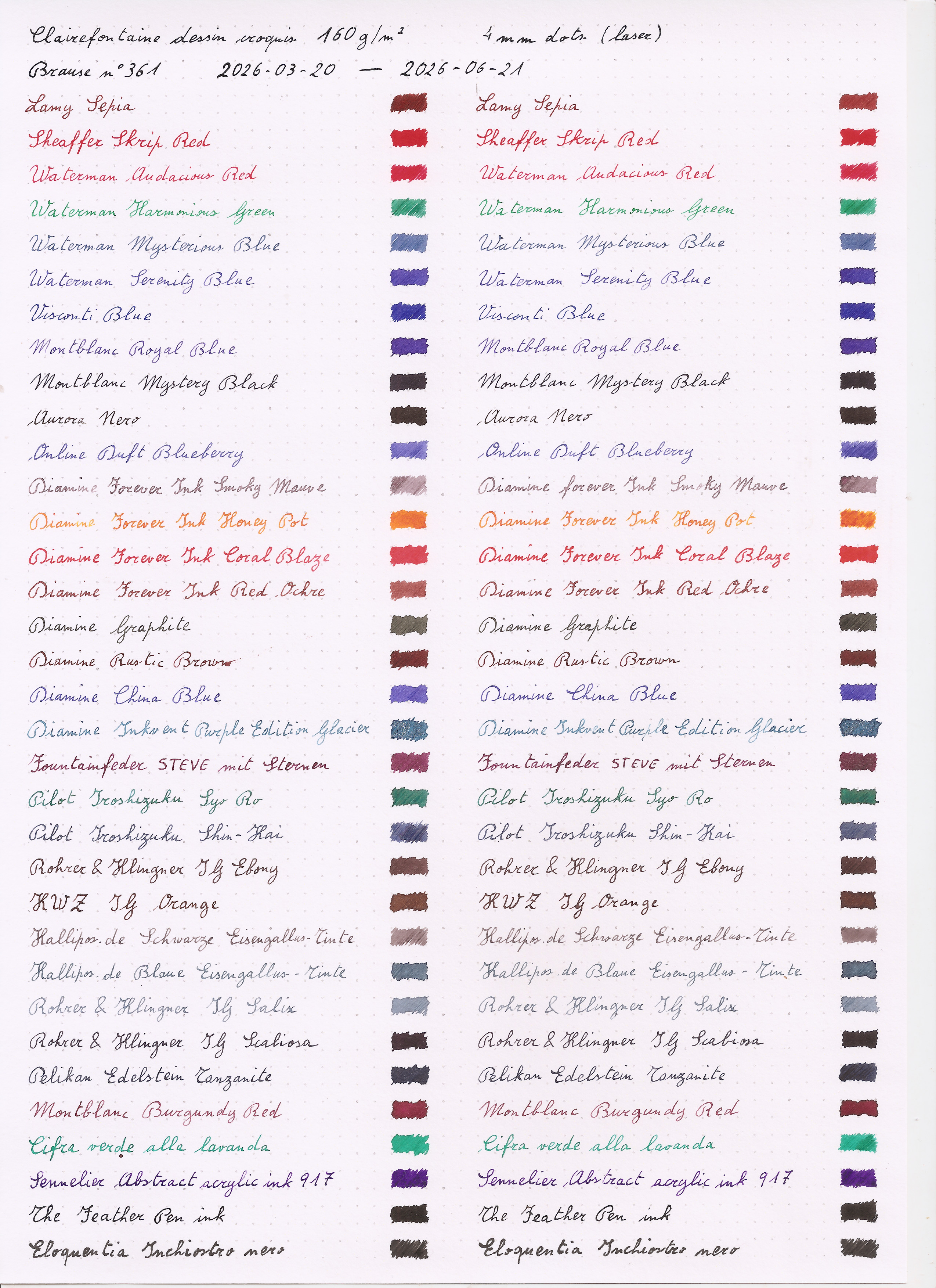
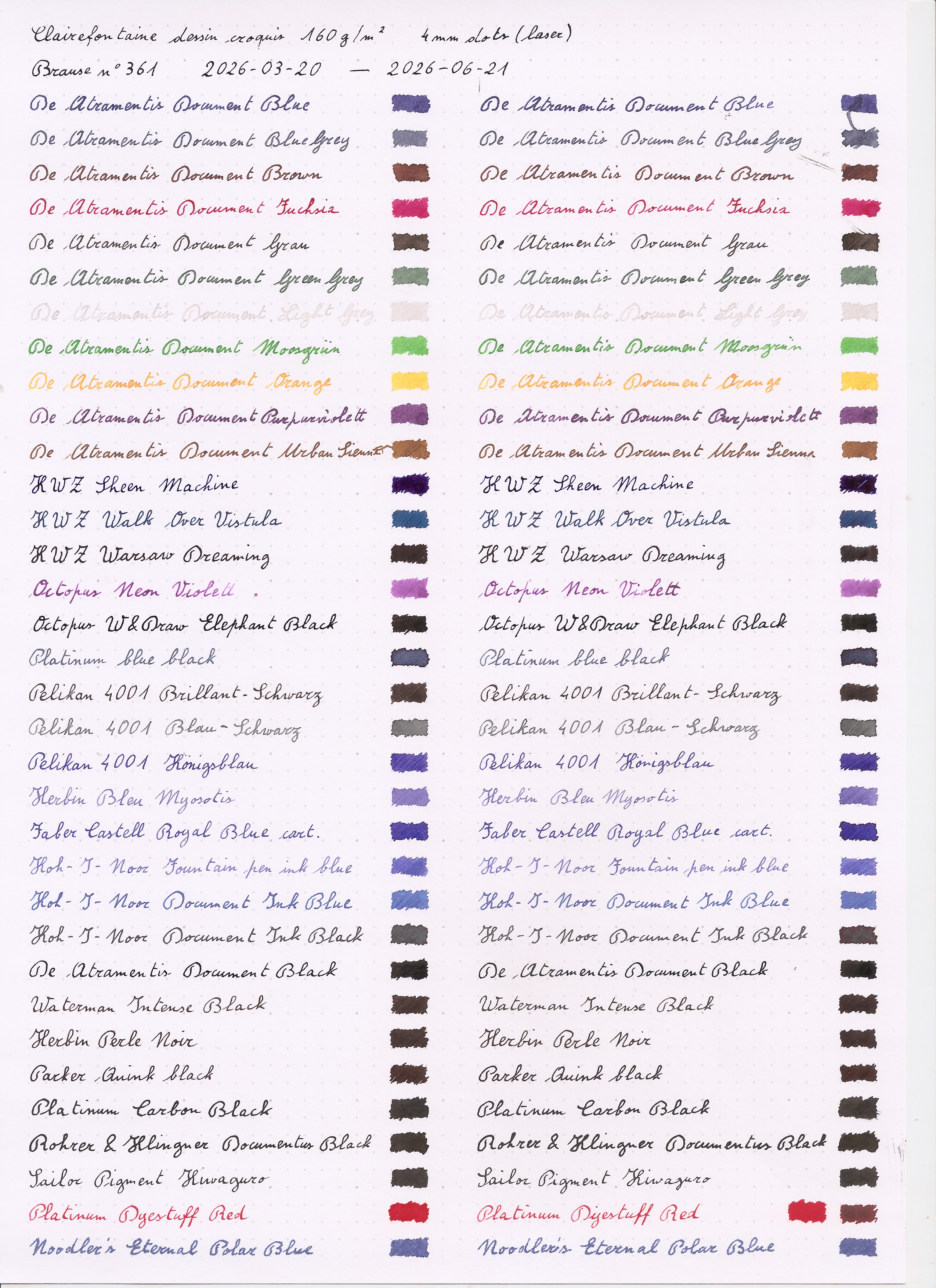
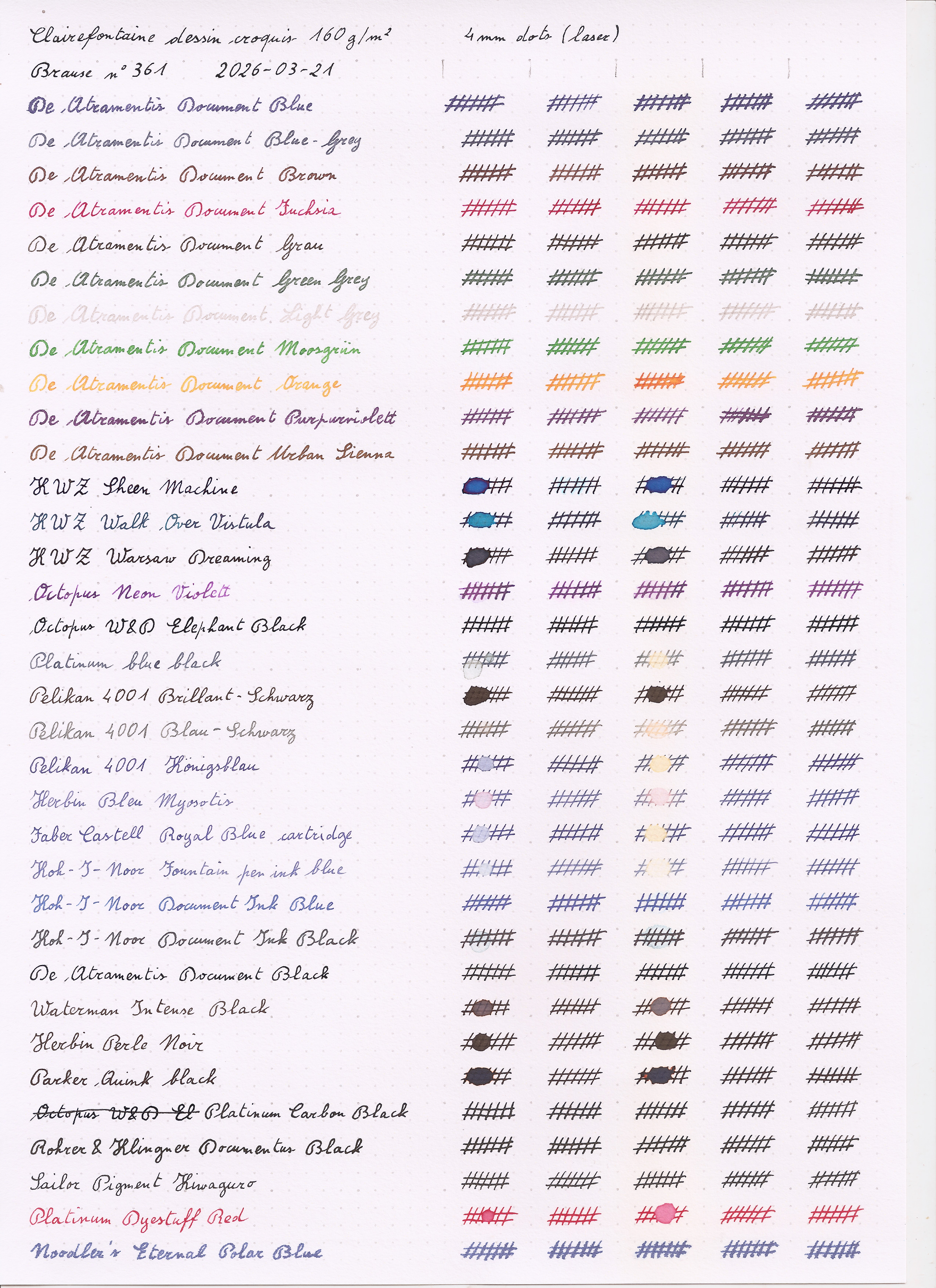
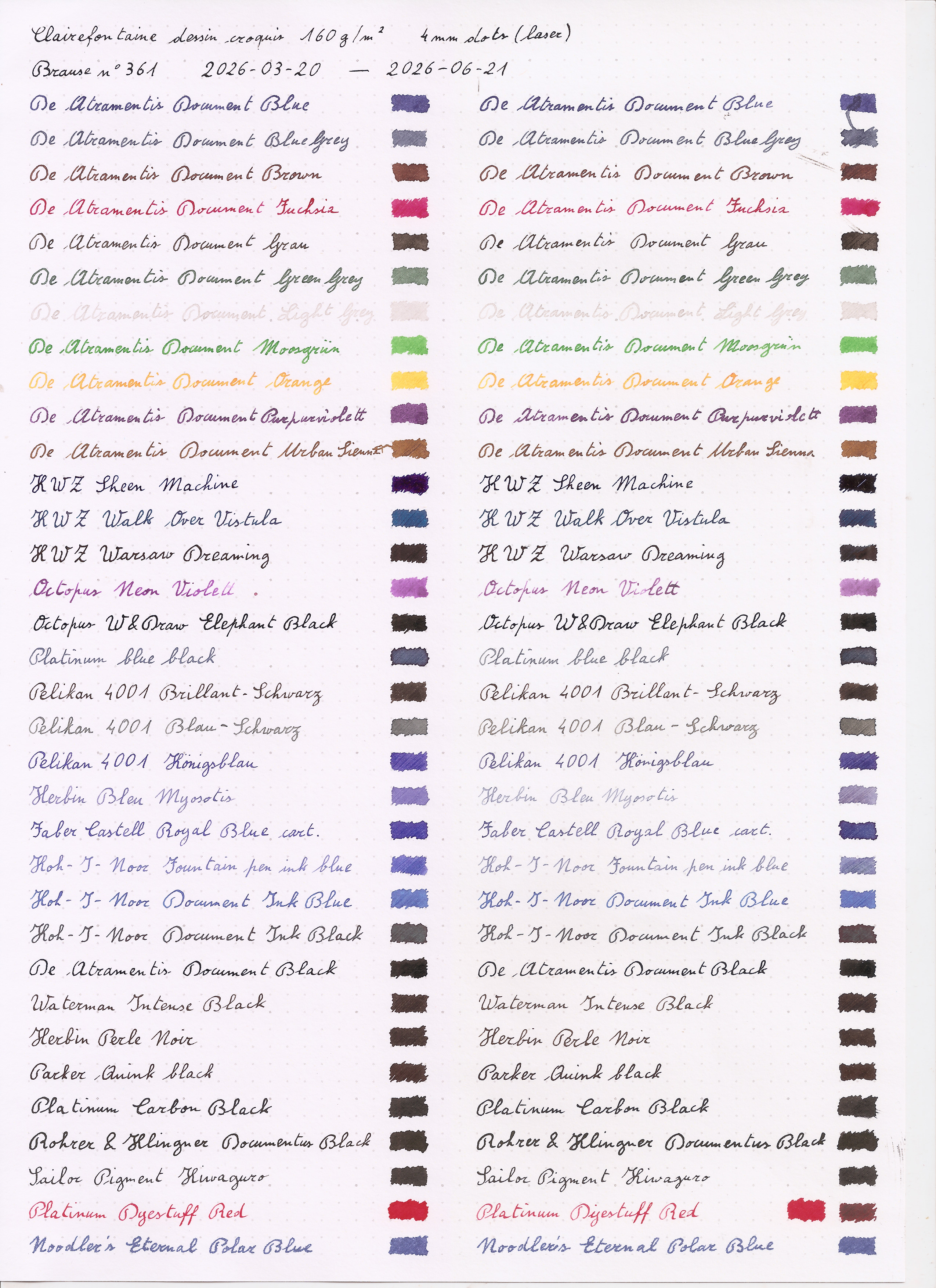
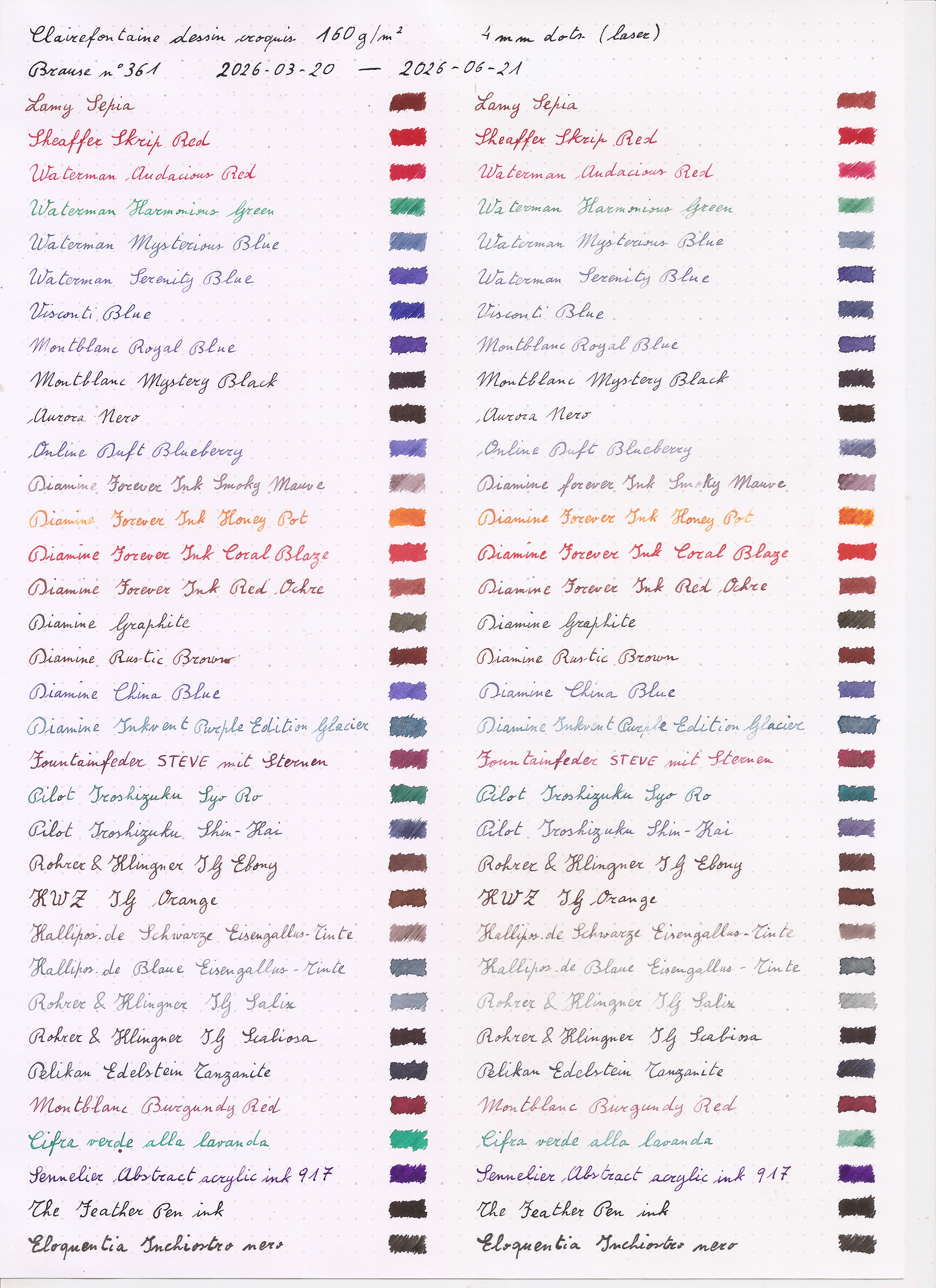
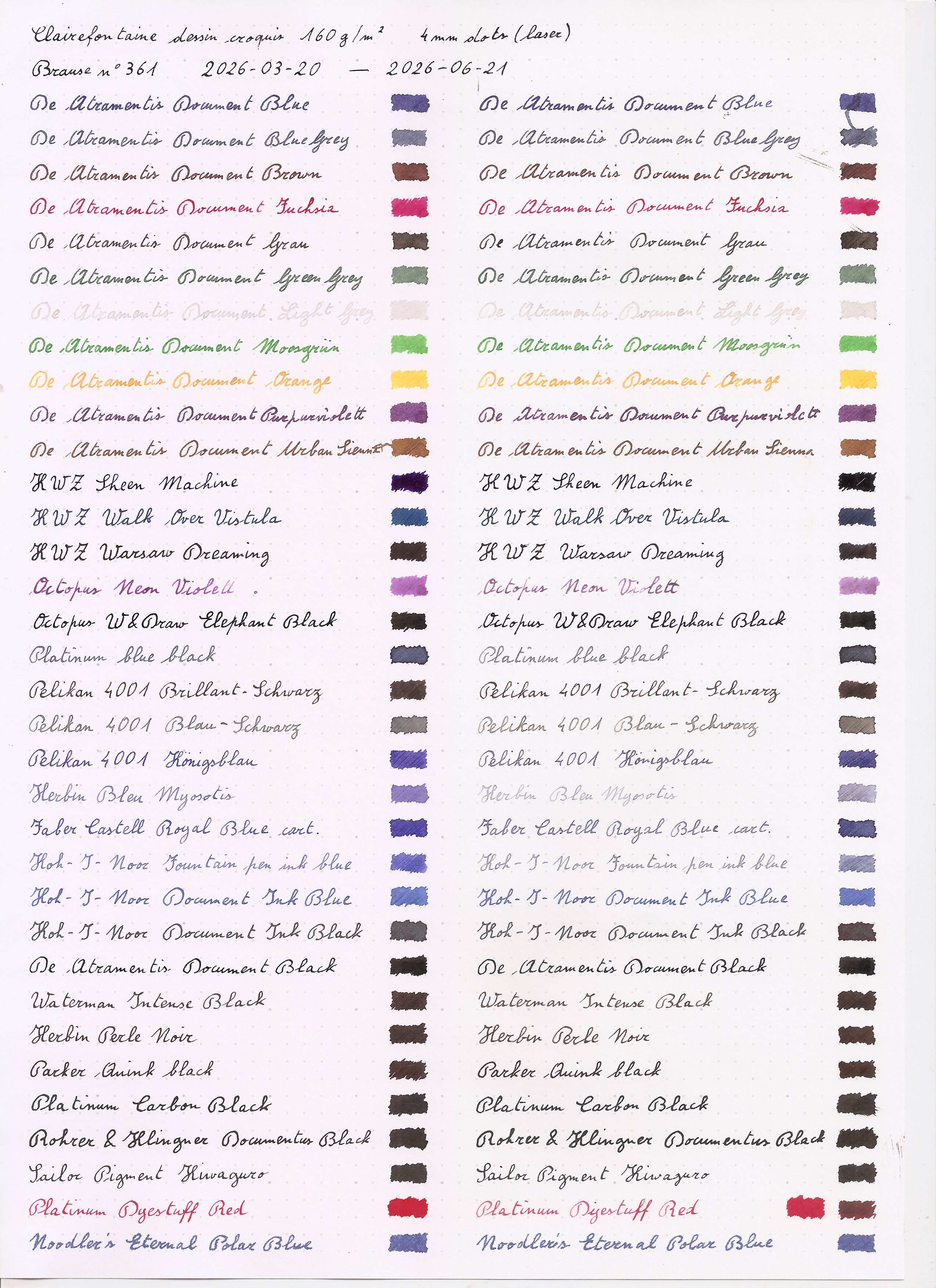
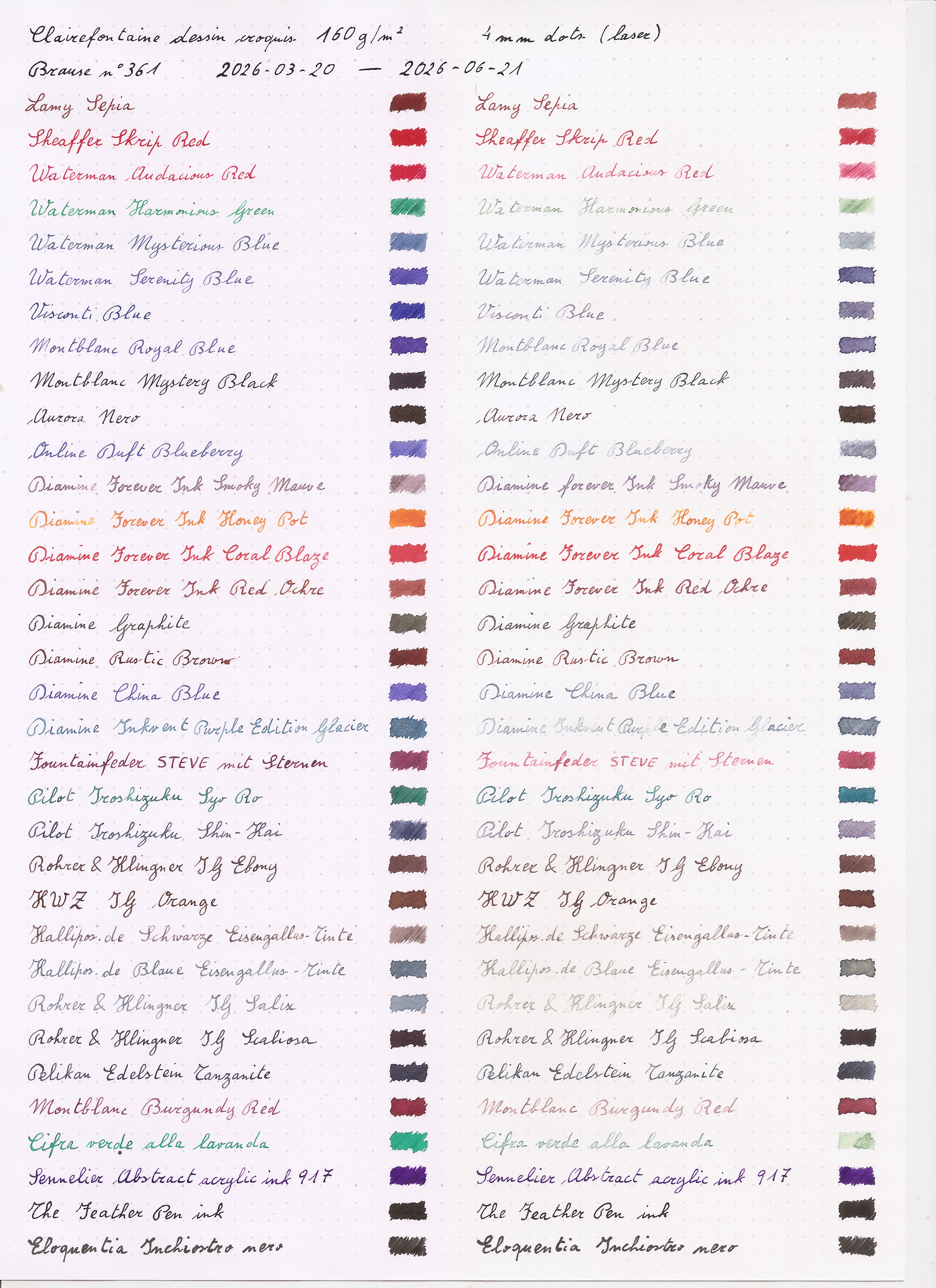
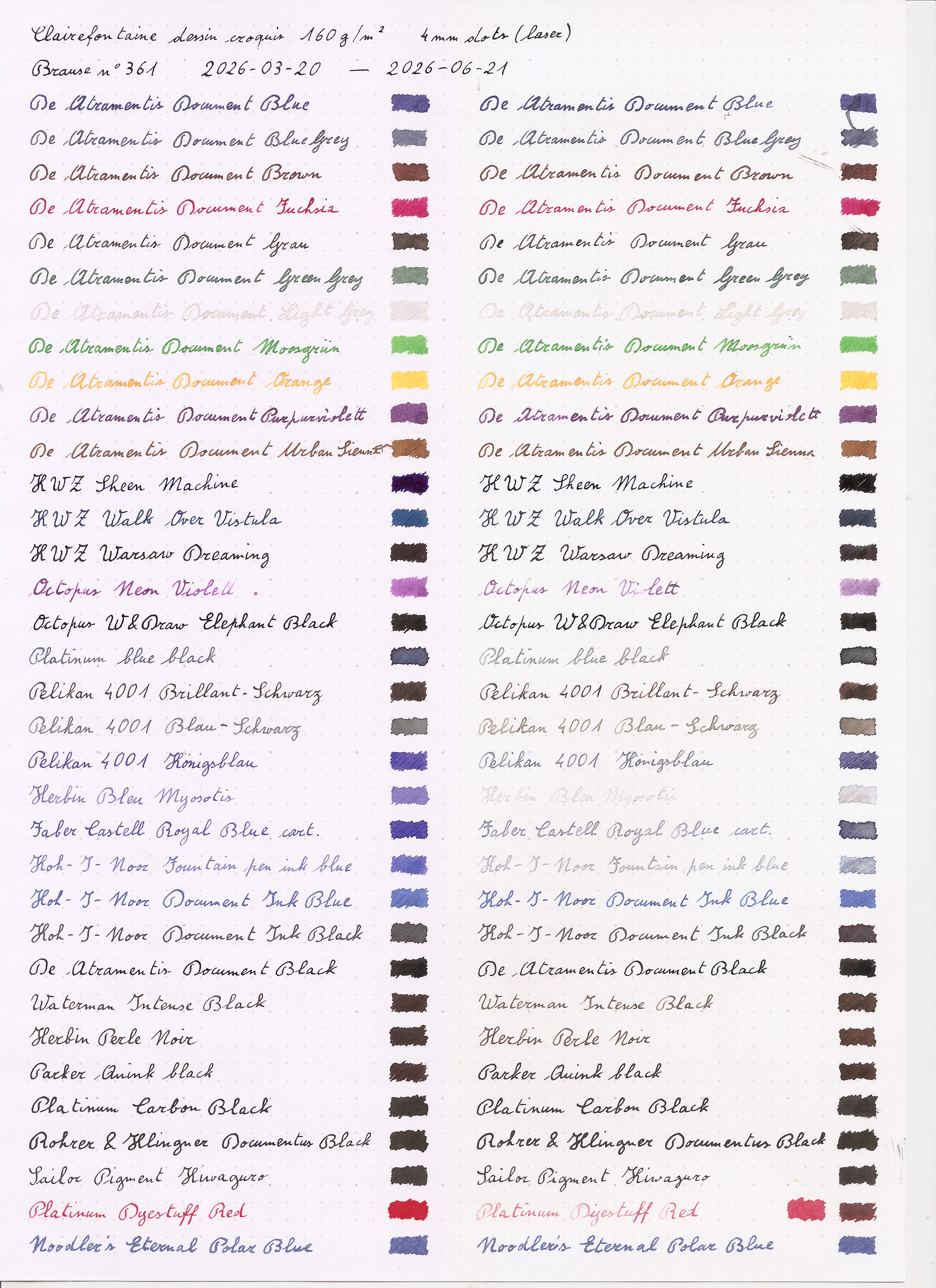
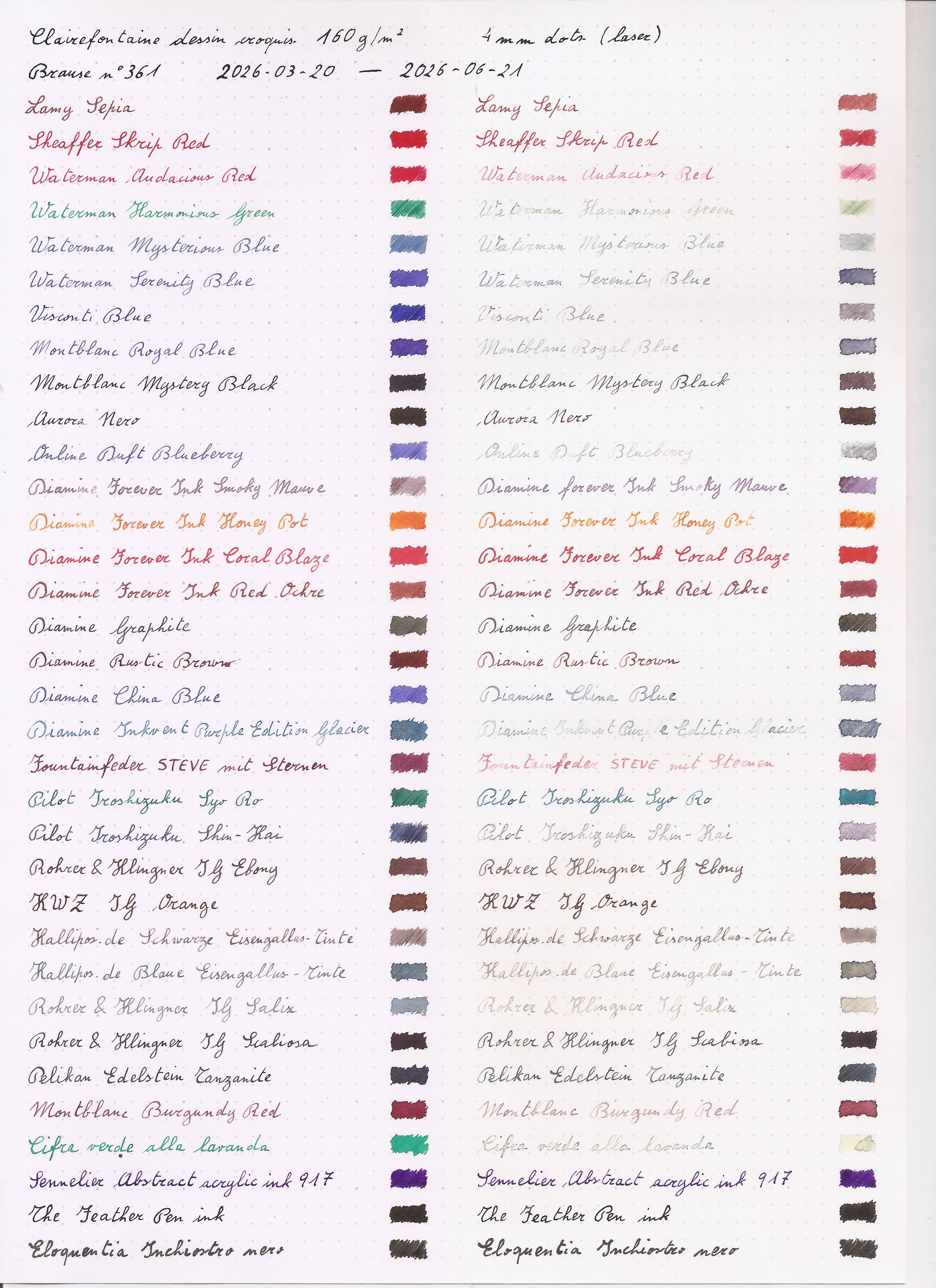
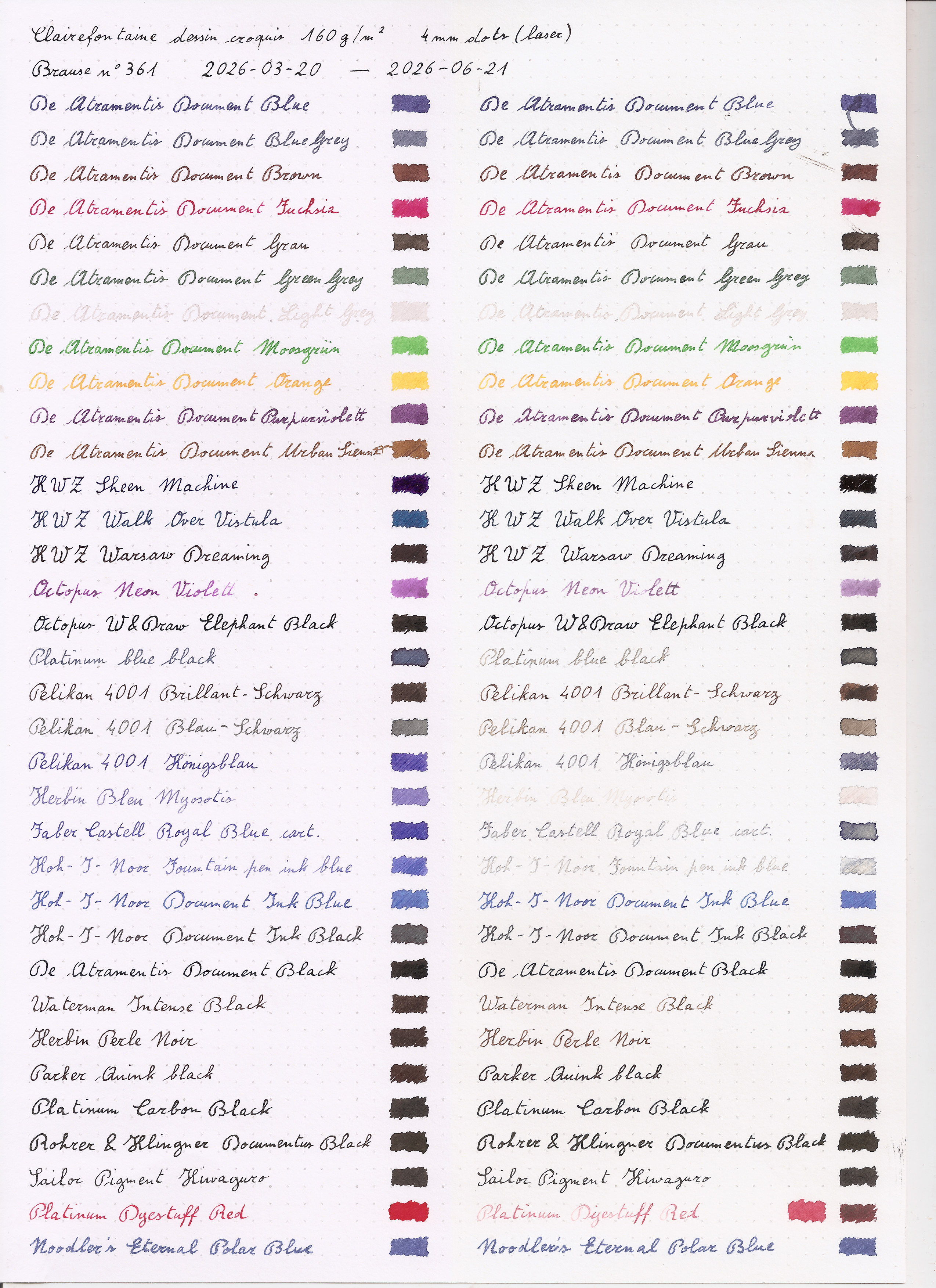
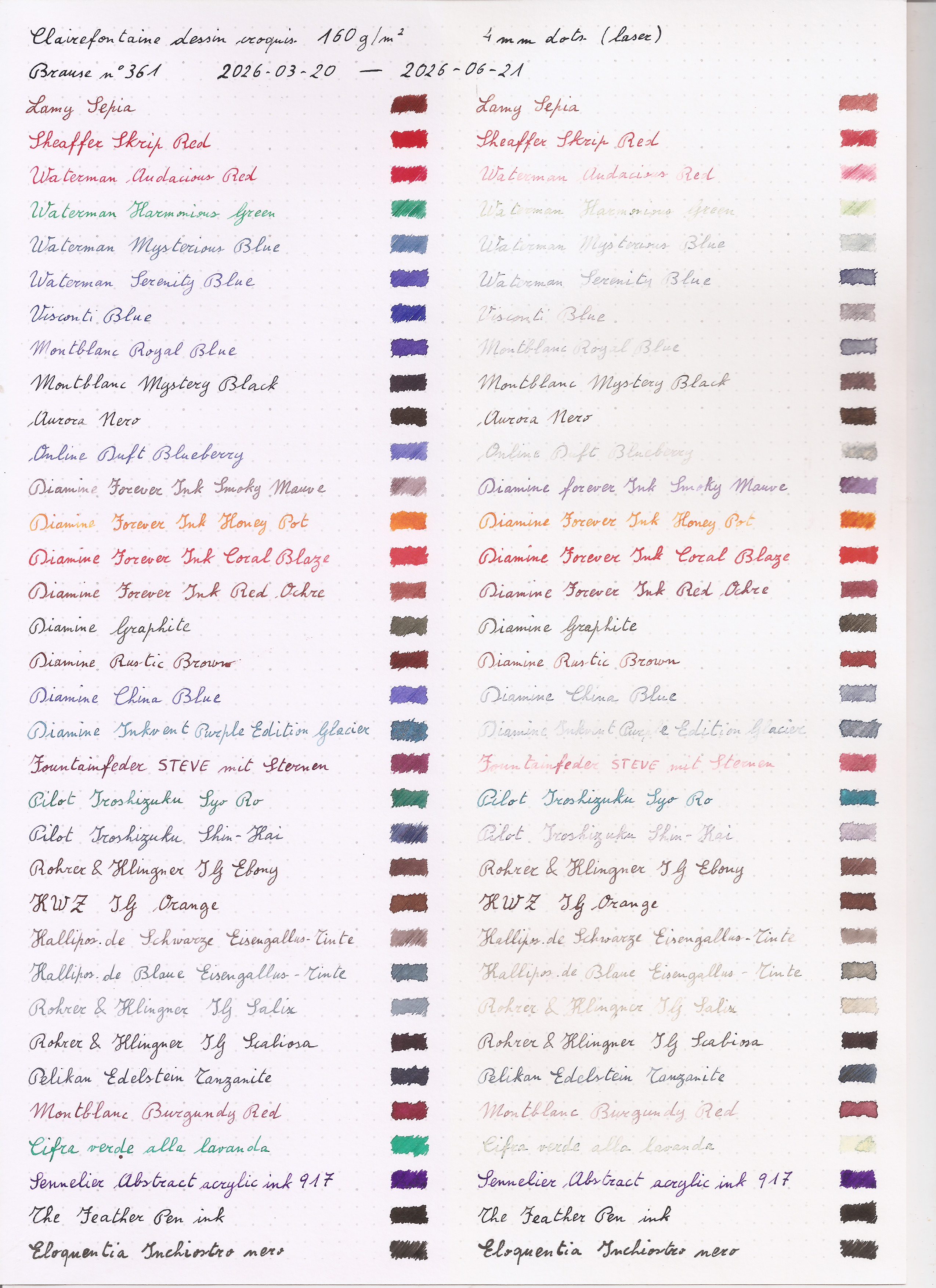
A borderless frame set on a table outdoors, with two sheets of paper a vertical half of which is covered by black paper, while the other half has lines with an ink name and a small filled rectangle, all in the ink itself.
Note
This post will be updated in the next weeks with the test results as they become available.
Note
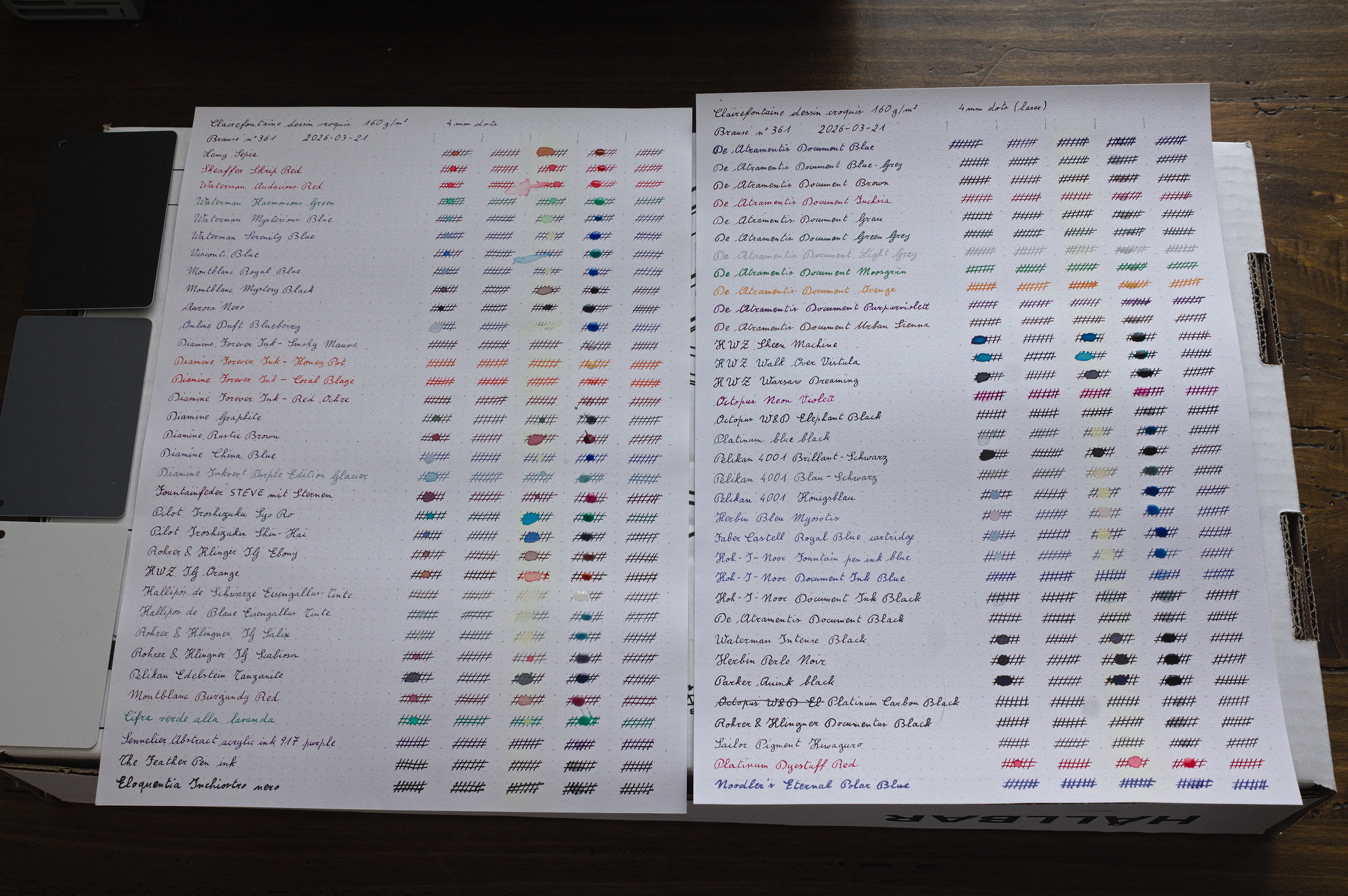
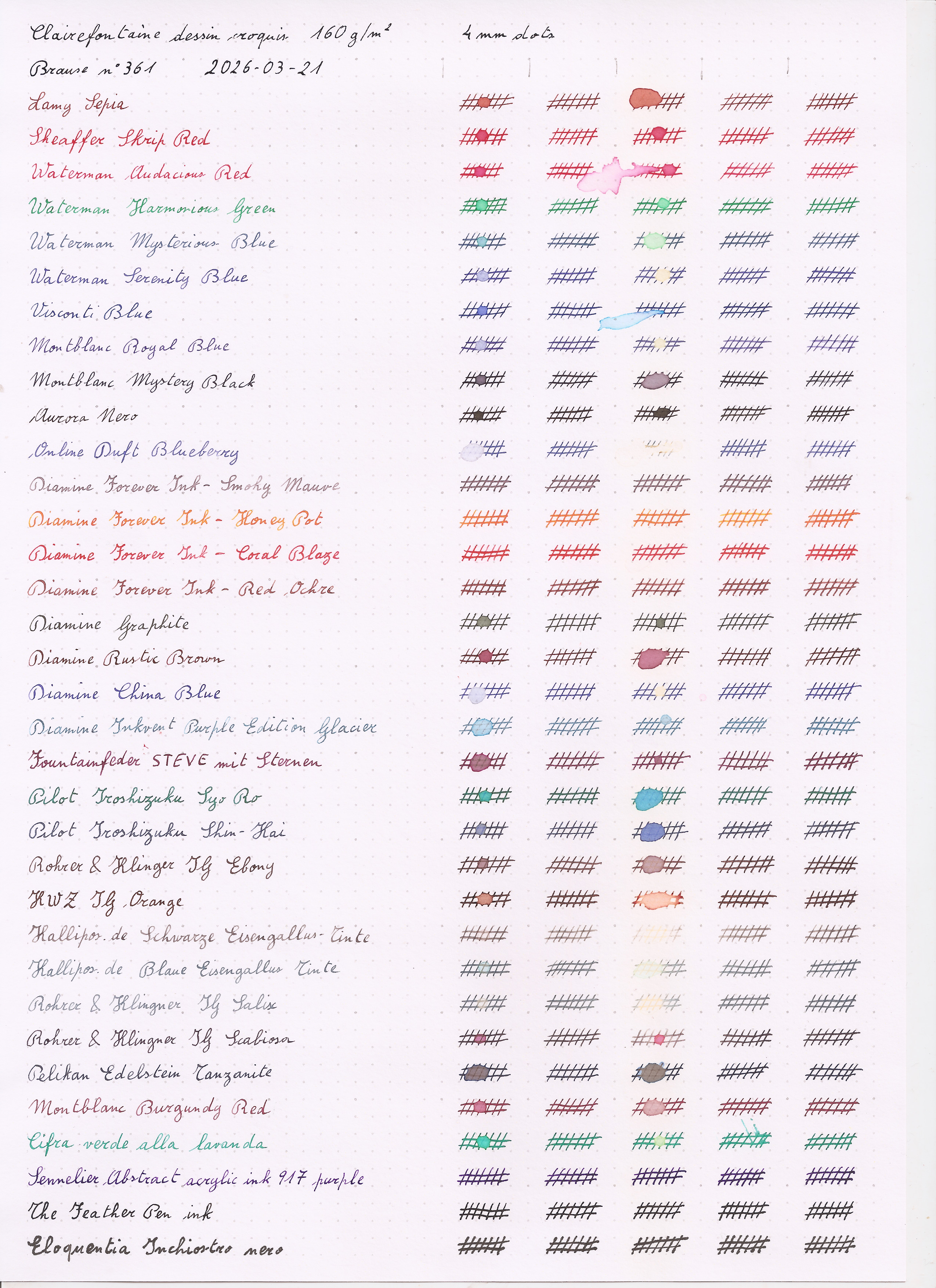
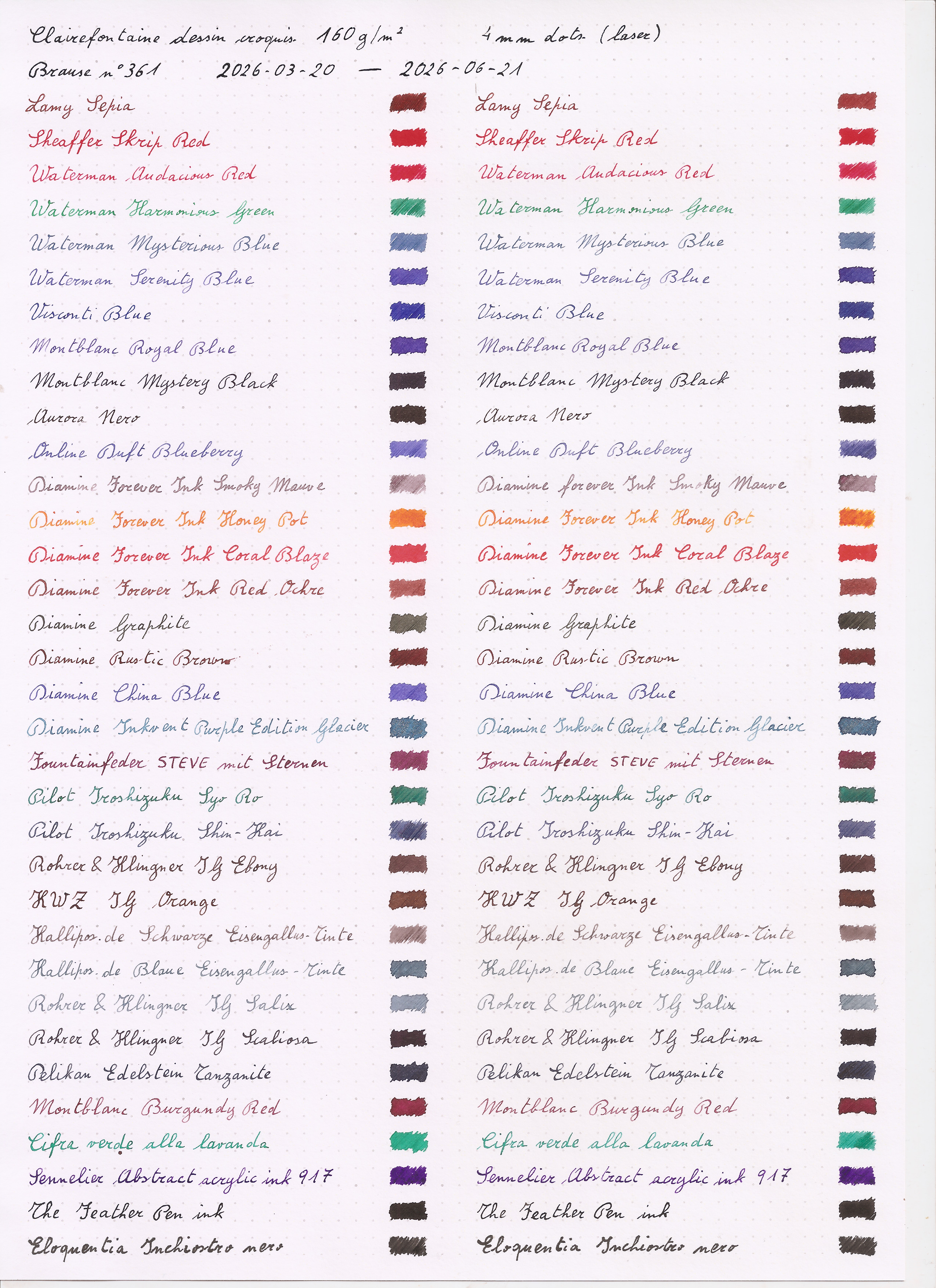
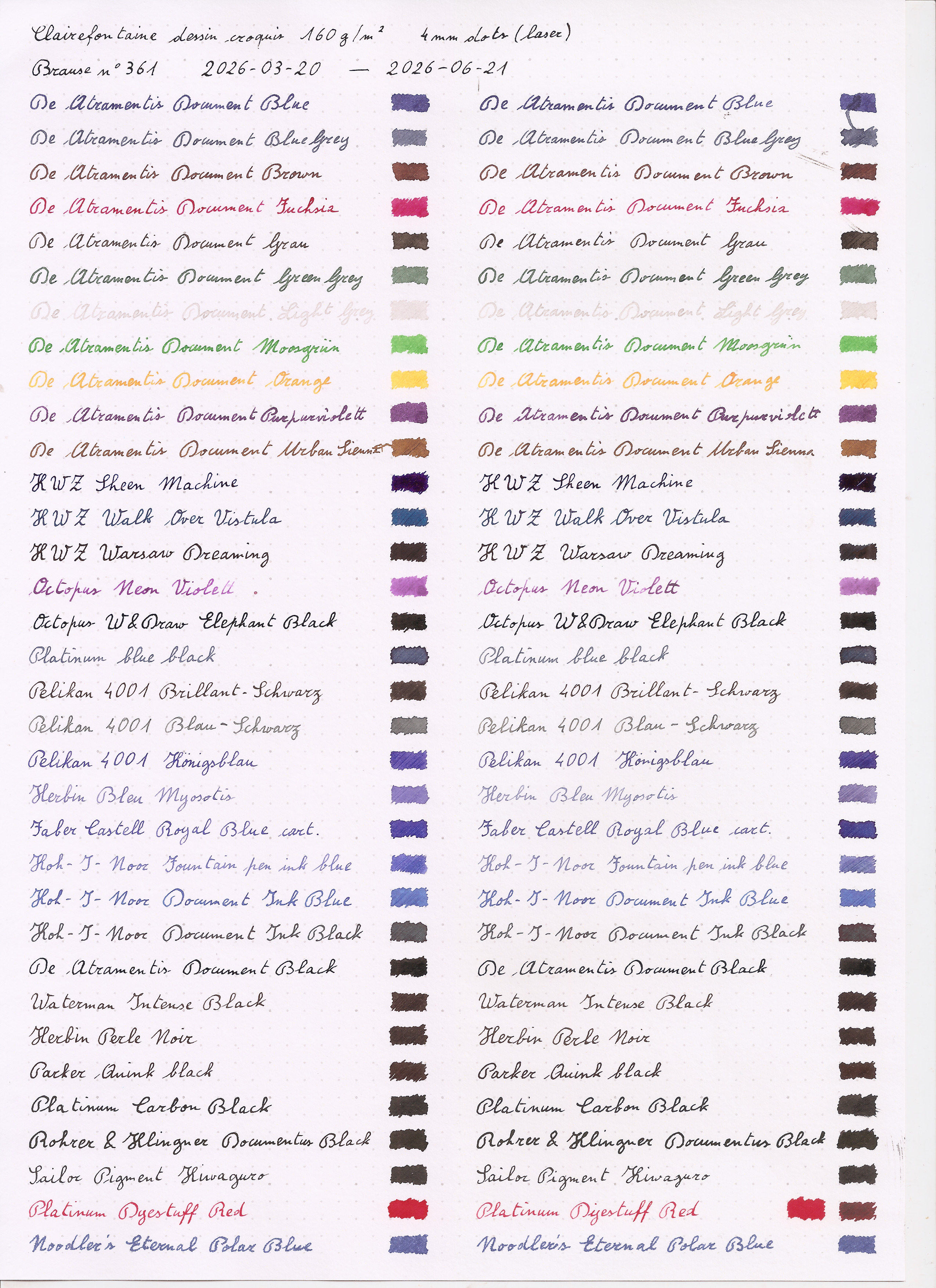
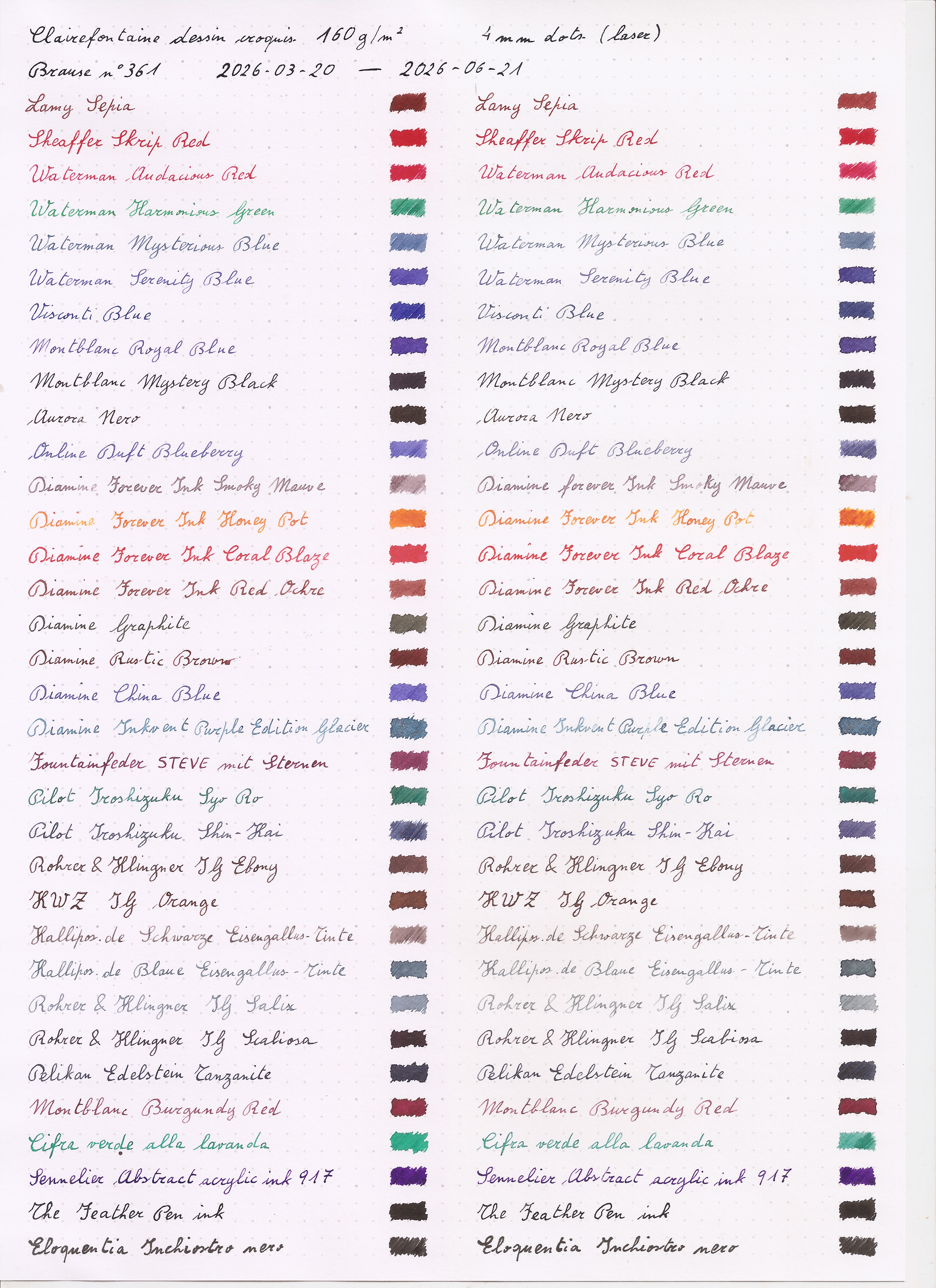
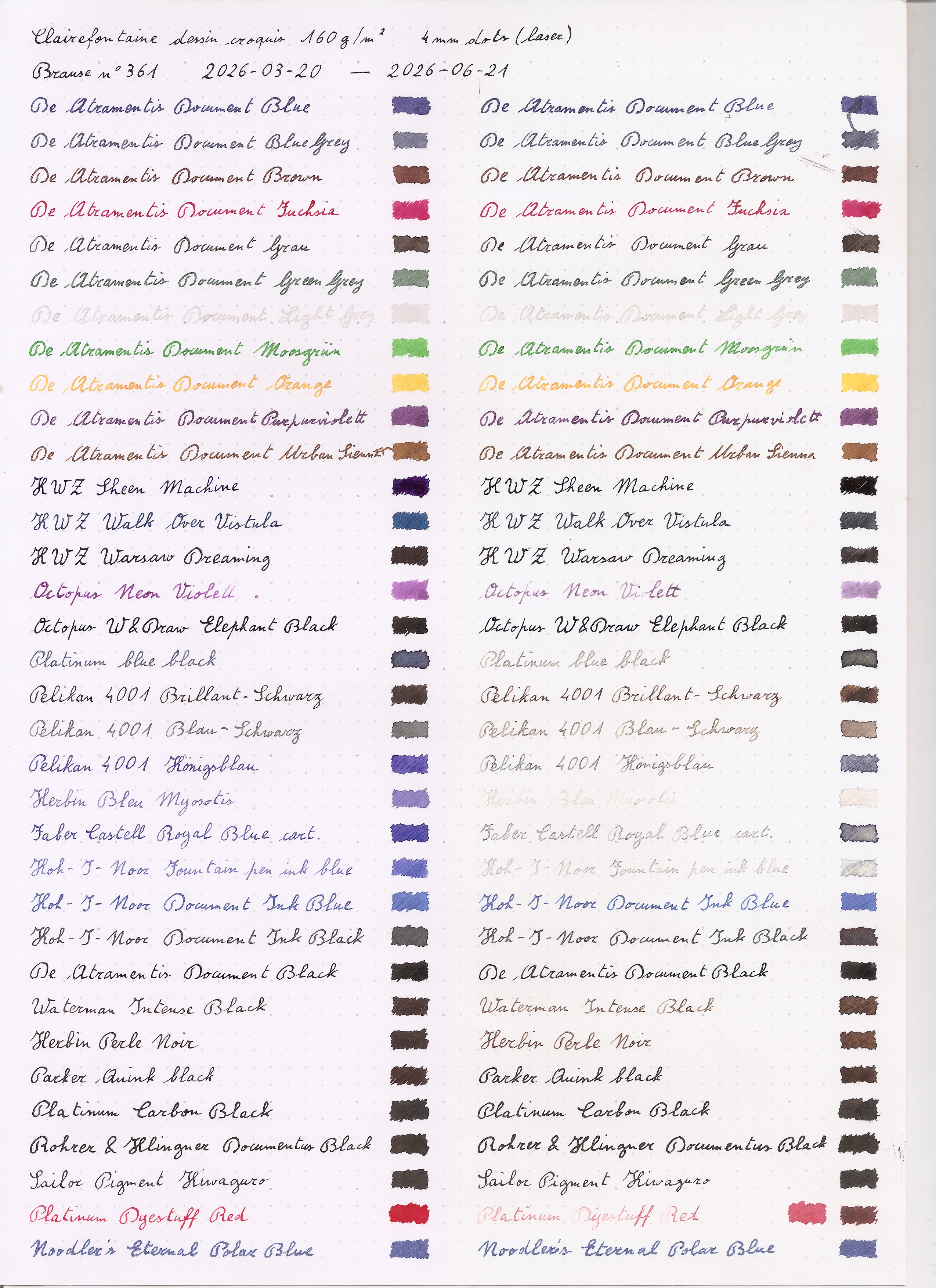
Most of the images in this post have no real alt-text: they are all scans of the test sheet at various stages through the test, and the results visible on them are described in detail at the end of the post.
Most of the time, what people write by hand will either end up inside a notebook in a drawer or cupboard where it s well protected, or thrown in the recycling where it doesn t matter. There are times, however, when things will be exposed to light: it doesn t matter whether it s a work of artistic calligraphy that you want to frame or a passive-aggressive notice left in the atrium of a building; it is useful to know whether the work will remain legible or it will fade into nothing in a short time. A few inks are tested by the producers for lightfastness according to some established standard, a few others are declared lightfast in a generic way, but a lot come with no indication at all. Proper testing according to the standard scales requires significant equipment to precisely control the exposure, but it s significantly easier and fun to do a simple test to divide the inks into three categories:
  • suitable for framed calligraphy, i.e. it looks the same after 3 months of direct sun exposure;
  • suitable for complaining about the way your neighbours deal with the trash, i.e. still readable after 3 months of exposure;
  • not suitable for either, i.e. has faded significantly in the same time.
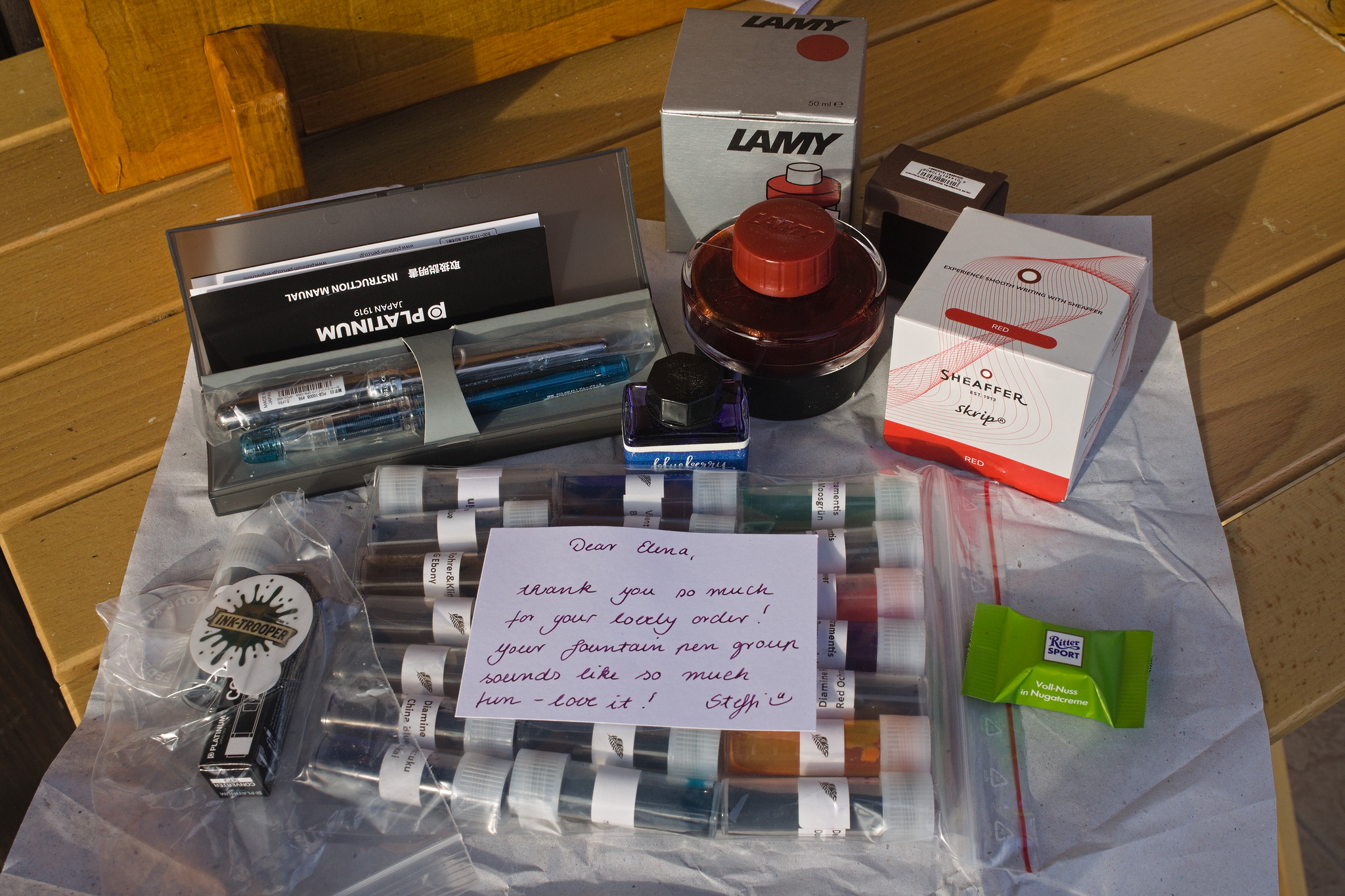
In the past I ve done some such tests by taping some sheets to a south-east facing window, and I ve noticed that most of the results were already apparent after a month, and there was basically no difference between two and three months of exposure, but spring equinox to summer solstice is a nice timeframe to use for such a test (and it leaves time for a second test of different materials from summer solstice to autumn equinox), so this is what I ve chosen to do this year. Rather than a window, now I have access to a south-facing covered balcony that is protected from rain but receives quite a bit of direct sun, so instead of taping sheets to the windows1 I ve prepared a sturdy cardboard panel that I can leave on a table on the balcony, hopefully safe from the rain, but well exposed to the sun. And then made a quick test, and realized that without the window glass in front, the black strip used to cover the unexposed half of the sample doesn t lay flat and lets some sun in, so I used an old cheap2 glass frame instead of the panel. The contents of an order from a fountain pen shop, spread out on a table: a couple of cheap pens, a couple bottles of ink, a converter, a small ritter sport chocolate and a bag full of 5 ml vials with 2 ml of ink each, and a thank-you note from the seller (Steffi). The next step, already in January, was mentioning in a fountain-pen enthusiasts forum that I planned such a test, and asking if people were interested in having me buy a few samples of more inks when I was buying my next pen. The word enthusiasts is probably a hint of the reason why soon afterwards I received a package with the pen I had planned to buy, its converter, and a couple dozens ink samples. And then a couple envelopes with additional samples of inks that weren t available on the shops, from said enthusiasts. Added to the inks I already had acquired since the last lightfastness test, it meant that they couldn t all fit in one single page, and thus I had some room to add some inks I had already tested: some were requests, and for others I tried to select ones that felt relevant. Since I m changing the test setup, I ve decided I should probably keep doing this until I ve tested again all of the inks I still have available. see below see below For the paper, I ve used A4 sheets of Clairefontaine Dessin Croquis 160 g/m , one of my staples that I m sure I will have available in the next years, printed with a dot pattern with a laser printer, using this pdf. And as for the pen I ve used a fresh Brause n 361 nib: loading a fountain pen with all of these inks wouldn t be a reasonable effort, and the 361 is one of the writing implements I use most anyway. I also used a glass pen to fill a couple of squares on the paper with more ink. One side of each sheet was then covered with a strip of 300 g/m black paper (also from Clairefontaine), kept in place with three dots of non-permanent two sided tape, put in the frame and set out in the sun on the morning of 2026-03-20, the day of the spring equinox.
see below While I was filling the sheet for the lightfastness tests, I decided to also prepare a second set of sheet, for a liquid resistance drop test. On each line, beside the name of the ink, I added five sets of crossing parallel lines, and let everything dry for a few days. Then I used a syringe to put a drop of a liquid on each set of lines, waited for it to be absorbed into the paper and to dry, at least overnight, but sometimes also for a day or two (life happened), and then looked at the results and did the next test. The first liquid was water, with the usual wild difference between washable and permanent inks, and all of the intermediate possibilities. The second liquid was isopropyl alcohol, and I was surprised to see that, with very few exceptions, most inks didn t change at all. I wonder whether that s related to the fact that instead of forming a drop it was absorbed almost immediately into the paper, and dried in a very short time. The third liquid was hydrogen peroxide: beside the individual results I noticed that its column yellowed visibly; I wonder whether that means that the paper I used has optical brighteners, and it will also yellow under the sun: that wouldn t be ideal, but it would also be a surprise, for paper that is acid free and sold for arts. The fourth liquid was citric acid, by mixing a bit less than a teaspoon of citric acid granules in just enough very warm water (heated to 70 C, i.e. the lowest temperature available on my kettle) to dissolve most of the acid. I forgot that I had some old PH strips until one hour after I ve put the drop on the paper, and I don t know whether something had changed, but when I did remember about them it showed a deep red between 1 and 2. I don t think I can trust those strips too much, however. This backfired badly: the drop of citric acid never dried out, but formed a sticky paste that prevented me from scanning the results, and I m not sure whether I ll do the last test, which was supposed to be household bleach. see below see below Luckily I had scanned the partial results, and they are shown here.
see below see below After one full day with plenty of sun, nothing really had changed, except possibly for a vague hint that the Herbin Bleu Myosotis may have have been a bit lighter than it started, but it may also have been a suggestion.
see below see below After three days, however, some results started to show, with the most fugitive inks starting to be visibly changed, becoming either paler or in some case duller.
see below see below And the full week showed more of that, with a few more inks starting to show visible change.
see below see below After two weeks the paper had significantly yellowed, something I did not expect from drawing paper (and which means that I will probably use a different paper when making similar tests in the future). As for the inks, there were a couple more inks with visible changes, but mostly it was more of the same as seen in the previous week.
see below see below Three weeks started to show changes in the black and most irongall inks, and of course more changes in the even less resistant inks.
see below see below Week four saw a bit more clouds and rain than the first few weeks, and there weren t big changes, but mostly more of what had already started to happen earlier.
see below see below A month didn t change much compared to the four weeks, but I did the scans for completeness, and from now on I m going to update monthly.
These are the inks I ve tested, and here I ll add notes on the results, as soon as they will be available, keeping this section updated. When nothing is mentioned, it means that there were no changes, either under the light or under the various liquids.
Lamy Sepia
Not resistant to water, the drop becomes an uniform colour spot. After one week it started to be just slightly paler, more so after three weeks.
Sheaffer Skrip Red
Not resistant to water, the drop becomes an uniform colour spot. After one week it started to be just slightly paler, more so after three weeks.
Waterman Audacious Red
Not resistant to water, the drop becomes an uniform colour spot. After three days it started to be just slightly paler, after a week visibly so. After four weeks it was very pale.
Waterman Harmonious Green
Not resistant to water, the drop becomes an uniform colour spot; the hydrogen peroxide drop looks a bit lighter than the one with just water. After one week it started to be just slightly paler, more so after three weeks. After four weeks it was very pale.
Waterman Mysterious Blue
Not resistant to water, the drop becomes an uniform colour spot; the hydrogen peroxide drop is significantly lighter and tends towards green. After two weeks it started to be just slightly paler, after three weeks it was more gray. After four weeks it was very pale.
Waterman Serenity Blue
Not resistant to water, the drop becomes an uniform colour spot; the hydrogen peroxide drop is almost completely bleached to a light yellow. After one week it started to be a bit duller. After four weeks it was paler and duller.
Visconti Blue
Not resistant to water, the drop becomes an uniform colour spot. After one week it was visibly duller, looking darker than the original. After three weeks it was duller, and lighter. After a month it was just a pale gray.
Montblanc Royal Blue
Not resistant to water, the drop becomes an uniform colour spot; the hydrogen peroxide drop is almost completely bleached to a light yellow. After one week it started to be just slightly duller, more so after two weeks. After three weeks it was also paler. After a month it was just a pale gray.
Montblanc Mystery Black
Not resistant to water, the drop becomes an uniform colour spot. After three weeks it started to be a bit paler.
Aurora Nero
Not resistant to water, the drop becomes an uniform colour spot. After three weeks it started to be a bit more brown.
Online Duft Blueberry
Not resistant to water, the drop looks very washed out, although a hint of the original shape can be guessed; the hydrogen peroxide drop is almost completely bleached to a light yellow. After one week it was visibly paler and duller. After three weeks significantly so. After a month it was a pale grey.
Diamine Forever Ink - Smoky Mauve
After a month it looked a bit more purple.
Diamine Forever Ink - Honey Pot
.
Diamine Forever Ink - Coral Blaze
.
Diamine Forever Ink - Red Ochre
.
Diamine Graphite
Not resistant to water, the drop becomes an uniform colour spot.
Diamine Rustic Brown
Not resistant to water, the drop becomes an uniform colour spot. After three weeks it started to be very slightely paler.
Diamine China Blue
Not resistant to water, the drop becomes an uniform colour spot; the hydrogen peroxide drop is almost completely bleached to a light yellow. After three weeks it started to be paler and duller.
Diamine Inkvent Purple Edition - Glacier
Not resistant to water, there is a drop of uniform colour, but it maintains a somewhat recognisable shade of the original shape. After three weeks it started to be lighter.
Fountainfeder STEVE
Not resistant to water, there is a drop of uniform colour, but it maintains a somewhat recognisable shade of the original shape. After two weeks the base colour had changed to a pink rather than purple.
Pilot Iroshizuku Syo Ro
Not resistant to water, there is a drop of uniform colour, but it maintains a somewhat recognisable shade of the original shape. After four weeks it was very slightely paler.
Pilot Iroshizuku Shin-Kai
Not resistant to water, there is a drop of uniform colour, but it maintains a somewhat recognisable shade of the original shape. After two weeks it had become lighter and more purple. After four weeks it was a purple gray.
Rohrer & Klingner IG Ebony
Not resistant to water, there is a drop of uniform colour, but it maintains a recognisable shade of the original shape; under hydrogen peroxide the shade is significantly lighter. After four weeks it was a bit lighter
KWZ IG Orange
Not resistant to water, the drop becomes an uniform colour spot; the hydrogen peroxide drop is significantly bleached to a light orange.
Kallipos.de Schwarze Eisengallus-Tinte
Water stains the paper, leaving however the original shape quite visible; is it almost completely bleached by hydrogen peroxide. After three weeks it started to be very slightely lighter.
Kallipos.de Blaue Eisengallus-Tinte
Water stains the paper, leaving however the original shape quite visible; is it almost completely bleached by hydrogen peroxide. After two weeks it had started to become lighter and more gray.
Rohrer & Klingner IG Salix
Water stains the paper, leaving however the original shape quite visible; is it almost completely bleached by hydrogen peroxide. After two weeks it had become lighter and significantly more gray. After a month it was a yellowish gray.
Rohrer & Klingner IG Scabiosa
Water stains the paper with a significant purple spot, leaving however the original shape quite visible; is is a bit bleached by hydrogen peroxide, but still quite readable.
Pelikan Edelstein Tanzanite
Not resistant to water, the drop becomes an uniform colour spot, but there is a visible trace of the original shape. After three weeks it started to be slightly paler.
Montblanc Burgundy Red
Not resistant to water, the drop becomes an uniform colour spot, with just a hint of the original shape; slightly bleached by hydrogen peroxide. After three weeks it started to be paler.
Cifra inchiostro finissimo verde alla lavanda
Not resistant to water, the drop becomes an uniform colour spot; quite bleached to a light yellowish green by hydrogen peroxide. After one week it was visibly paler. After a month it was a still readable pale trace.
Sennelier Abstract acrylic ink 917 purple
.
The Feather Pen Ink
.
Eloquentia Inchiostro nero
.
DeAtramentis Document Blue
.
DeAtramentis Document BlueGrey
.
DeAtramentis Document Brown
.
DeAtramentis Document Fuchsia
.
DeAtramentis Document Grau
.
DeAtramentis Document Green Grey
.
DeAtramentis Document Light Grey
.
DeAtramentis Document Moosgr n
.
DeAtramentis Document Orange
.
DeAtramentis Document Purpurviolett
.
DeAtramentis Document Urban Sienna
.
KWZ Sheen Machine
Not resistant to water, the drop becomes an uniform colour spot; the hydrogen peroxide bleached away the red sheen. This was one of the only two inks to react to isopropyl alcohol, which caused a pale cyan halo around the lines. After three days it was still perfectly readable, but had visibly lost some red sheen, after one week the red had completely gone and it looked very dark blue (but still shiny)
KWZ Walk over Vistula
Not resistant to water, the drop becomes an uniform colour spot. After four weeks it looked a bit darker and duller.
KWZ Warsaw Dreaming
Not resistant to water, the drop becomes an uniform colour spot. After a month it started to be a bit lighter.
Octopus Neon Violett
Water very lightly stains the paper, leaving however the original shape quite visible. The other ink that reacted to isopropyl alcohol, with a pale purple halo around the lines. After two weeks it was paler, more pink.
Octopus Write & Draw Elephant Black
.
Platinum blue black
Water stains the paper, leaving however the original shape quite visible; it is significantly bleached by hydrogen peroxide. After three weeks it started to become gray.
Pelikan 4001 Brillant-Schwarz
Not resistant to water, the drop becomes an uniform colour spot. After three weeks it was a bit more brown than black, after a month noticeably so.
Pelikan 4001 Blau-Schwarz
Water stains the paper, leaving however the original shape quite visible; it is significantly bleached by hydrogen peroxide. After three weeks it started to become gray.
Pelikan 4001 K nigsblau
Not resistant to water, the drop becomes an uniform colour spot, with just a hint of the original shape; significantly bleached by hydrogen peroxide. After three days it had started to be slightly paler. After three weeks it was significantly desaturated.
Herbin Bleu Myosotis
Not resistant to water, the drop becomes an uniform pink spot, significantly bleached by hydrogen peroxide. After three days it was already visibly paler, after one week it was a pale grey. After a month it was still somehow readable, but as a trace.
Faber Castell Royal Blue
Not resistant to water, the drop becomes an uniform colour spot, with just a hint of the original shape; significantly bleached by hydrogen peroxide. After three days it was slightly duller, after two weeks definitely so. After a month it was also quite paler.
Koh-I-Noor Fountain pen ink blue
Not resistant to water, the drop becomes an uniform colour spot, with just a hint of the original shape; significantly bleached by hydrogen peroxide. After three days it had started to be slightly paler, more so after one week when it had also turned grey. After four weeks it was very pale.
Koh-I-Noor Document Ink Blue
.
Koh-I-Noor Document Ink Black
Water leaves a very light stain, but the original shape doesn t look changed.
DeAtramentis Document Black
.
Waterman Intense Black
Not resistant to water, the drop becomes an uniform colour spot, with a trace of the original shape still visible; very lightly bleached by hydrogen peroxide. After three weeks it started to look a bit more brown, noticeably so after a month.
Herbin Perle Noir
Not resistant to water, the drop becomes an uniform colour spot, with a trace of the original shape still visible. After three weeks it started to look a bit more brown, noticeably so after a month.
Parker Quink black
Not resistant to water, the drop becomes an uniform colour spot.
Platinum Carbon black
.
Rohrer & Klingner Documentus Black
.
Sailor Pigment Kiwaguro
.
Platinum Dyestuff Red
Not resistant to water, the drop becomes an uniform colour spot; very lightly bleached by hydrogen peroxide. After three weeks it was a bit paler.
Noodler s Eternal Polar Blue
.

  1. which would be spend the day covered by mostly closed shutters anyway, because they receive quite a bit of direct sun, and we don t want that to enter the house during the summer.
  2. and thus, I hope, not especially UV-filtering.

12 March 2026

Reproducible Builds: Reproducible Builds in February 2026

Welcome to the February 2026 report from the Reproducible Builds project! These reports outline what we ve been up to over the past month, highlighting items of news from elsewhere in the increasingly-important area of software supply-chain security. As ever, if you are interested in contributing to the Reproducible Builds project, please see the Contribute page on our website.

  1. reproduce.debian.net
  2. Tool development
  3. Distribution work
  4. Miscellaneous news
  5. Upstream patches
  6. Documentation updates
  7. Four new academic papers

reproduce.debian.net The last year has seen the introduction, development and deployment of reproduce.debian.net. In technical terms, this is an instance of rebuilderd, our server designed monitor the official package repositories of Linux distributions and attempt to reproduce the observed results there. This month, however, Holger Levsen added suite-based navigation (eg. Debian trixie vs forky) to the service (in addition to the already existing architecture based navigation) which can be observed on, for instance, the Debian trixie-backports or trixie-security pages.

Tool development diffoscope is our in-depth and content-aware diff utility that can locate and diagnose reproducibility issues. This month, Chris Lamb made a number of changes, including preparing and uploading versions, 312 and 313 to Debian. In particular, Chris updated the post-release deployment pipeline to ensure that the pipeline does not fail if the automatic deployment to PyPI fails [ ]. In addition, Vagrant Cascadian updated an external reference for the 7z tool for GNU Guix. [ ]. Vagrant Cascadian also updated diffoscope in GNU Guix to version 312 and 313.

Distribution work In Debian this month:
  • 26 reviews of Debian packages were added, 5 were updated and 19 were removed this month adding to our extensive knowledge about identified issues.
  • A new debsbom package was uploaded to unstable. According to the package description, this package generates SBOMs (Software Bill of Materials) for distributions based on Debian in the two standard formats, SPDX and CycloneDX. The generated SBOM includes all installed binary packages and also contains Debian Source packages.
  • In addition, a sbom-toolkit package was uploaded, which provides a collection of scripts for generating SBOM. This is the tooling used in Apertis to generate the Licenses SBOM and the Build Dependency SBOM. It also includes dh-setup-copyright, a Debhelper addon to generate SBOMs from DWARF debug information, which are extracted from DWARF debug information by running dwarf2sources on every ELF binaries in the package and saving the output.
Lastly, Bernhard M. Wiedemann posted another openSUSE monthly update for their work there.

Miscellaneous news

Upstream patches The Reproducible Builds project detects, dissects and attempts to fix as many currently-unreproducible packages as possible. We endeavour to send all of our patches upstream where appropriate. This month, we wrote a large number of such patches, including:

Documentation updates Once again, there were a number of improvements made to our website this month including:

Four new academic papers Julien Malka and Arnout Engelen published a paper titled Lila: Decentralized Build Reproducibility Monitoring for the Functional Package Management Model:
[While] recent studies have shown that high reproducibility rates are achievable at scale demonstrated by the Nix ecosystem achieving over 90% reproducibility on more than 80,000 packages the problem of effective reproducibility monitoring remains largely unsolved. In this work, we address the reproducibility monitoring challenge by introducing Lila, a decentralized system for reproducibility assessment tailored to the functional package management model. Lila enables distributed reporting of build results and aggregation into a reproducibility database [ ].
A PDF of their paper is available online.
Javier Ron and Martin Monperrus of KTH Royal Institute of Technology, Sweden, also published a paper, titled Verifiable Provenance of Software Artifacts with Zero-Knowledge Compilation:
Verifying that a compiled binary originates from its claimed source code is a fundamental security requirement, called source code provenance. Achieving verifiable source code provenance in practice remains challenging. The most popular technique, called reproducible builds, requires difficult matching and reexecution of build toolchains and environments. We propose a novel approach to verifiable provenance based on compiling software with zero-knowledge virtual machines (zkVMs). By executing a compiler within a zkVM, our system produces both the compiled output and a cryptographic proof attesting that the compilation was performed on the claimed source code with the claimed compiler. [ ]
A PDF of the paper is available online.
Oreofe Solarin of Department of Computer and Data Sciences, Case Western Reserve University, Cleveland, Ohio, USA, published It s Not Just Timestamps: A Study on Docker Reproducibility:
Reproducible container builds promise a simple integrity check for software supply chains: rebuild an image from its Dockerfile and compare hashes. We built a Docker measurement pipeline and apply it to a stratified sample of 2,000 GitHub repositories that contained a Dockerfile. We found that only 56% produce any buildable image, and just 2.7% of those are bitwise reproducible without any infrastructure configurations. After modifying infrastructure configurations, we raise bitwise reproducibility by 18.6%, but 78.7% of buildable Dockerfiles remain non-reproducible.
A PDF of Oreofe s paper is available online.
Lastly, Jens Dietrich and Behnaz Hassanshahi published On the Variability of Source Code in Maven Package Rebuilds:
[In] this paper we test the assumption that the same source code is being used [by] alternative builds. To study this, we compare the sources released with packages on Maven Central, with the sources associated with independently built packages from Google s Assured Open Source and Oracle s Build-from-Source projects. [ ]
A PDF of their paper is available online.

Finally, if you are interested in contributing to the Reproducible Builds project, please visit our Contribute page on our website. However, you can get in touch with us via:

5 March 2026

Ian Jackson: Adopting tag2upload and modernising your Debian packaging

Introduction tag2upload allows authorised Debian contributors to upload to Debian simply by pushing a signed git tag to Debian s gitlab instance, Salsa. We have recently announced that tag2upload is, in our opinion, now very stable, and ready for general use by all Debian uploaders. tag2upload, as part of Debian s git transition programme, is very flexible - it needs to support a large variety of maintainer practices. And it s relatively unopinionated, wherever that s possible. But, during the open beta, various contributors emailed us asking for Debian packaging git workflow advice and recommendations. This post is an attempt to give some more opinionated answers, and guide you through modernising your workflow. (This article is aimed squarely at Debian contributors. Much of it will make little sense to Debian outsiders.) Why Ease of development git offers a far superior development experience to patches and tarballs. Moving tasks from a tarballs and patches representation to a normal, git-first, representation, makes everything simpler. dgit and tag2upload do automatically many things that have to be done manually, or with separate commands, in dput-based upload workflows. They will also save you from a variety of common mistakes. For example, you cannot accidentally overwrite an NMU, with tag2upload or dgit. These many safety catches mean that our software sometimes complains about things, or needs confirmation, when more primitive tooling just goes ahead. We think this is the right tradeoff: it s part of the great care we take to avoid our software making messes. Software that has your back is very liberating for the user. tag2upload makes it possible to upload with very small amounts of data transfer, which is great in slow or unreliable network environments. The other week I did a git-debpush over mobile data while on a train in Switzerland; it completed in seconds. See the Day-to-day work section below to see how simple your life could be. Don t fear a learning burden; instead, start forgetting all that nonsense Most Debian contributors have spent months or years learning how to work with Debian s tooling. You may reasonably fear that our software is yet more bizarre, janky, and mistake-prone stuff to learn. We promise (and our users tell us) that s not how it is. We have spent a lot of effort on providing a good user experience. Our new git-first tooling, especially dgit and tag2upload, is much simpler to use than source-package-based tooling, despite being more capable. The idiosyncrasies and bugs of source packages, and of the legacy archive, have been relentlessly worked around and papered over by our thousands of lines of thoroughly-tested defensive code. You too can forget all those confusing details, like our users have! After using our systems for a while you won t look back. And, you shouldn t fear trying it out. dgit and tag2upload are unlikely to make a mess. If something is wrong (or even doubtful), they will typically detect it, and stop. This does mean that starting to use tag2upload or dgit can involve resolving anomalies that previous tooling ignored, or passing additional options to reassure the system about your intentions. So admittedly it isn t always trivial to get your first push to succeed. Properly publishing the source code One of Debian s foundational principles is that we publish the source code. Nowadays, the vast majority of us, and of our upstreams, are using git. We are doing this because git makes our life so much easier. But, without tag2upload or dgit, we aren t properly publishing our work! Yes, we typically put our git branch on Salsa, and point Vcs-Git at it. However:
  • The format of git branches on Salsa is not standardised. They might be patches-unapplied, patches-applied, bare debian/, or something even stranger.
  • There is no guarantee that the DEP-14 debian/1.2.3-7 tag on salsa corresponds precisely to what was actually uploaded. dput-based tooling (such as gbp buildpackage) doesn t cross-check the .dsc against git.
  • There is no guarantee that the presence of a DEP-14 tag even means that that version of package is in the archive.
This means that the git repositories on Salsa cannot be used by anyone who needs things that are systematic and always correct. They are OK for expert humans, but they are awkward (even hazardous) for Debian novices, and you cannot use them in automation. The real test is: could you use Vcs-Git and Salsa to build a Debian derivative? You could not. tag2upload and dgit do solve this problem. When you upload, they:
  1. Make a canonical-form (patches-applied) derivative of your git branch;
  2. Ensure that there is a well-defined correspondence between the git tree and the source package;
  3. Publish both the DEP-14 tag and a canonical-form archive/debian/1.2.3-7 tag to a single central git depository, *.dgit.debian.org;
  4. Record the git information in the Dgit field in .dsc so that clients can tell (using the ftpmaster API) that this was a git-based upload, what the corresponding git objects are, and where to find them.
This dependably conveys your git history to users and downstreams, in a standard, systematic and discoverable way. tag2upload and dgit are the only system which achieves this. (The client is dgit clone, as advertised in e.g. dgit-user(7). For dput-based uploads, it falls back to importing the source package.) Adopting tag2upload - the minimal change tag2upload is a substantial incremental improvement to many existing workflows. git-debpush is a drop-in replacement for building, signing, and uploading the source package. So, you can just adopt it without completely overhauling your packaging practices. You and your co-maintainers can even mix-and-match tag2upload, dgit, and traditional approaches, for the same package. Start with the wiki page and git-debpush(1) (ideally from forky aka testing). You don t need to do any of the other things recommended in this article. Overhauling your workflow, using advanced git-first tooling The rest of this article is a guide to adopting the best and most advanced git-based tooling for Debian packaging. Assumptions
  • Your current approach uses the patches-unapplied git branch format used with gbp pq and/or quilt, and often used with git-buildpackage. You previously used gbp import-orig.
  • You are fluent with git, and know how to use Merge Requests on gitlab (Salsa). You have your origin remote set to Salsa.
  • Your main Debian branch name on Salsa is master. Personally I think we should use main but changing your main branch name is outside the scope of this article.
  • You have enough familiarity with Debian packaging including concepts like source and binary packages, and NEW review.
  • Your co-maintainers are also adopting the new approach.
tag2upload and dgit (and git-debrebase) are flexible tools and can help with many other scenarios too, and you can often mix-and-match different approaches. But, explaining every possibility would make this post far too confusing. Topics and tooling This article will guide you in adopting:
  • tag2upload
  • Patches-applied git branch for your packaging
  • Either plain git merge or git-debrebase
  • dgit when a with-binaries uploaded is needed (NEW)
  • git-based sponsorship
  • Salsa (gitlab), including Debian Salsa CI
Choosing the git branch format In Debian we need to be able to modify the upstream-provided source code. Those modifications are the Debian delta. We need to somehow represent it in git. We recommend storing the delta as git commits to those upstream files, by picking one of the following two approaches.
rationale Much traditional Debian tooling like quilt and gbp pq uses the patches-unapplied branch format, which stores the delta as patch files in debian/patches/, in a git tree full of unmodified upstream files. This is clumsy to work with, and can even be an alarming beartrap for Debian outsiders.
git merge Option 1: simply use git, directly, including git merge. Just make changes directly to upstream files on your Debian branch, when necessary. Use plain git merge when merging from upstream. This is appropriate if your package has no or very few upstream changes. It is a good approach if the Debian maintainers and upstream maintainers work very closely, so that any needed changes for Debian are upstreamed quickly, and any desired behavioural differences can be arranged by configuration controlled from within debian/. This is the approach documented more fully in our workflow tutorial dgit-maint-merge(7).
git-debrebase Option 2: Adopt git-debrebase. git-debrebase helps maintain your delta as linear series of commits (very like a topic branch in git terminology). The delta can be reorganised, edited, and rebased. git-debrebase is designed to help you carry a significant and complicated delta series. The older versions of the Debian delta are preserved in the history. git-debrebase makes extra merges to make a fast-forwarding history out of the successive versions of the delta queue branch. This is the approach documented more fully in our workflow tutorial dgit-maint-debrebase(7). Examples of complex packages using this approach include src:xen and src:sbcl.
Determine upstream git and stop using upstream tarballs We recommend using upstream git, only and directly. You should ignore upstream tarballs completely.
rationale Many maintainers have been importing upstream tarballs into git, for example by using gbp import-orig. But in reality the upstream tarball is an intermediate build product, not (just) source code. Using tarballs rather than git exposes us to additional supply chain attacks; indeed, the key activation part of the xz backdoor attack was hidden only in the tarball! git offers better traceability than so-called pristine upstream tarballs. (The word pristine is even a joke by the author of pristine-tar!)
First, establish which upstream git tag corresponds to the version currently in Debian. From the sake of readability, I m going to pretend that upstream version is 1.2.3, and that upstream tagged it v1.2.3. Edit debian/watch to contain something like this:
version=4
opts="mode=git" https://codeberg.org/team/package refs/tags/v(\d\S*)
You may need to adjust the regexp, depending on your upstream s tag name convention. If debian/watch had a files-excluded, you ll need to make a filtered version of upstream git.
git-debrebase From now on we ll generate our own .orig tarballs directly from git.
rationale We need some upstream tarball for the 3.0 (quilt) source format to work with. It needs to correspond to the git commit we re using as our upstream. We don t need or want to use a tarball from upstream for this. The .orig is just needed so a nice legacy Debian source package (.dsc) can be generated.
Probably, the current .orig in the Debian archive, is an upstream tarball, which may be different to the output of git-archive and possibly even have different contents to what s in git. The legacy archive has trouble with differing .origs for the same upstream version . So we must until the next upstream release change our idea of the upstream version number. We re going to add +git to Debian s idea of the upstream version. Manually make a tag with that name:
git tag -m "Compatibility tag for orig transition" v1.2.3+git v1.2.3~0
git push origin v1.2.3+git
If you are doing the packaging overhaul at the same time as a new upstream version, you can skip this part.
Convert the git branch
git merge Prepare a new branch on top of upstream git, containing what we want:
git branch -f old-master         # make a note of the old git representation
git reset --hard v1.2.3          # go back to the real upstream git tag
git checkout old-master :debian  # take debian/* from old-master
git commit -m "Re-import Debian packaging on top of upstream git"
git merge --allow-unrelated-histories -s ours -m "Make fast forward from tarball-based history" old-master
git branch -d old-master         # it's incorporated in our history now
If there are any patches, manually apply them to your main branch with git am, and delete the patch files (git rm -r debian/patches, and commit). (If you ve chosen this workflow, there should be hardly any patches,)
rationale These are some pretty nasty git runes, indeed. They re needed because we want to restart our Debian packaging on top of a possibly quite different notion of what the upstream is.
git-debrebase Convert the branch to git-debrebase format and rebase onto the upstream git:
git-debrebase -fdiverged convert-from-gbp upstream/1.2.3
git-debrebase -fdiverged -fupstream-not-ff new-upstream 1.2.3+git
If you had patches which patched generated files which are present only in the upstream tarball, and not in upstream git, you will encounter rebase conflicts. You can drop hunks editing those files, since those files are no longer going to be part of your view of the upstream source code at all.
rationale The force option -fupstream-not-ff will be needed this one time because your existing Debian packaging history is (probably) not based directly on the upstream history. -fdiverged may be needed because git-debrebase might spot that your branch is not based on dgit-ish git history.
Manually make your history fast forward from the git import of your previous upload.
dgit fetch
git show dgit/dgit/sid:debian/changelog
# check that you have the same version number
git merge -s ours --allow-unrelated-histories -m 'Declare fast forward from pre-git-based history' dgit/dgit/sid
Change the source format Delete any existing debian/source/options and/or debian/source/local-options.
git merge Change debian/source/format to 1.0. Add debian/source/options containing -sn.
rationale We are using the 1.0 native source format. This is the simplest possible source format - just a tarball. We would prefer 3.0 (native) , which has some advantages, but dpkg-source between 2013 (wheezy) and 2025 (trixie) inclusive unjustifiably rejects this configuration. You may receive bug reports from over-zealous folks complaining about the use of the 1.0 source format. You should close such reports, with a reference to this article and to #1106402.
git-debrebase Ensure that debian/source/format contains 3.0 (quilt).
Now you are ready to do a local test build. Sort out the documentation and metadata Edit README.source to at least mention dgit-maint-merge(7) or dgit-maint-debrebase(7), and to tell people not to try to edit or create anything in debian/patches/. Consider saying that uploads should be done via dgit or tag2upload. Check that your Vcs-Git is correct in debian/control. Consider deleting or pruning debian/gbp.conf, since it isn t used by dgit, tag2upload, or git-debrebase.
git merge Add a note to debian/changelog about the git packaging change.
git-debrebase git-debrebase new-upstream will have added a new upstream version stanza to debian/changelog. Edit that so that it instead describes the packaging change. (Don t remove the +git from the upstream version number there!)
Configure Salsa Merge Requests
git-debrebase In Settings / Merge requests , change Squash commits when merging to Do not allow .
rationale Squashing could destroy your carefully-curated delta queue. It would also disrupt git-debrebase s git branch structure.
Set up Salsa CI, and use it to block merges of bad changes Caveat - the tradeoff gitlab is a giant pile of enterprise crap. It is full of startling bugs, many of which reveal a fundamentally broken design. It is only barely Free Software in practice for Debian (in the sense that we are very reluctant to try to modify it). The constant-churn development approach and open-core business model are serious problems. It s very slow (and resource-intensive). It can be depressingly unreliable. That Salsa works as well as it does is a testament to the dedication of the Debian Salsa team (and those who support them, including DSA). However, I have found that despite these problems, Salsa CI is well worth the trouble. Yes, there are frustrating days when work is blocked because gitlab CI is broken and/or one has to keep mashing Retry . But, the upside is no longer having to remember to run tests, track which of my multiple dev branches tests have passed on, and so on. Automatic tests on Merge Requests are a great way of reducing maintainer review burden for external contributions, and helping uphold quality norms within a team. They re a great boon for the lazy solo programmer. The bottom line is that I absolutely love it when the computer thoroughly checks my work. This is tremendously freeing, precisely at the point when one most needs it deep in the code. If the price is to occasionally be blocked by a confused (or broken) computer, so be it. Setup procedure Create debian/salsa-ci.yml containing
include:
  - https://salsa.debian.org/salsa-ci-team/pipeline/raw/master/recipes/debian.yml
In your Salsa repository, under Settings / CI/CD , expand General Pipelines and set CI/CD configuration file to debian/salsa-ci.yml.
rationale Your project may have an upstream CI config in .gitlab-ci.yml. But you probably want to run the Debian Salsa CI jobs. You can add various extra configuration to debian/salsa-ci.yml to customise it. Consult the Salsa CI docs.
git-debrebase Add to debian/salsa-ci.yml:
.git-debrebase-prepare: &git-debrebase-prepare
  # install the tools we'll need
  - apt-get update
  - apt-get --yes install git-debrebase git-debpush
  # git-debrebase needs git user setup
  - git config user.email "salsa-ci@invalid.invalid"
  - git config user.name "salsa-ci"
  # run git-debrebase make-patches
  # https://salsa.debian.org/salsa-ci-team/pipeline/-/issues/371
  - git-debrebase --force
  - git-debrebase --noop-ok make-patches
  # make an orig tarball using the upstream tag, not a gbp upstream/ tag
  # https://salsa.debian.org/salsa-ci-team/pipeline/-/issues/541
  - git-deborig
.build-definition: &build-definition
  extends: .build-definition-common
  before_script: *git-debrebase-prepare
build source:
  extends: .build-source-only
  before_script: *git-debrebase-prepare
variables:
  # disable shallow cloning of git repository. This is needed for git-debrebase
  GIT_DEPTH: 0
rationale Unfortunately the Salsa CI pipeline currently lacks proper support for git-debrebase (salsa-ci#371) and has trouble directly using upstream git for orig tarballs (#salsa-ci#541). These runes were based on those in the Xen package. You should subscribe to the tickets #371 and #541 so that you can replace the clone-and-hack when proper support is merged.
Push this to salsa and make the CI pass. If you configured the pipeline filename after your last push, you will need to explicitly start the first CI run. That s in Pipelines : press New pipeline in the top right. The defaults will very probably be correct. Block untested pushes, preventing regressions In your project on Salsa, go into Settings / Repository . In the section Branch rules , use Add branch rule . Select the branch master. Set Allowed to merge to Maintainers . Set Allowed to push and merge to No one . Leave Allow force push disabled. This means that the only way to land anything on your mainline is via a Merge Request. When you make a Merge Request, gitlab will offer Set to auto-merge . Use that. gitlab won t normally merge an MR unless CI passes, although you can override this on a per-MR basis if you need to. (Sometimes, immediately after creating a merge request in gitlab, you will see a plain Merge button. This is a bug. Don t press that. Reload the page so that Set to auto-merge appears.) autopkgtests Ideally, your package would have meaningful autopkgtests (DEP-8 tests) This makes Salsa CI more useful for you, and also helps detect and defend you against regressions in your dependencies. The Debian CI docs are a good starting point. In-depth discussion of writing autopkgtests is beyond the scope of this article. Day-to-day work With this capable tooling, most tasks are much easier. Making changes to the package Make all changes via a Salsa Merge Request. So start by making a branch that will become the MR branch. On your MR branch you can freely edit every file. This includes upstream files, and files in debian/. For example, you can:
  • Make changes with your editor and commit them.
  • git cherry-pick an upstream commit.
  • git am a patch from a mailing list or from the Debian Bug System.
  • git revert an earlier commit, even an upstream one.
When you have a working state of things, tidy up your git branch:
git merge Use git-rebase to squash/edit/combine/reorder commits.
git-debrebase Use git-debrebase -i to squash/edit/combine/reorder commits. When you are happy, run git-debrebase conclude. Do not edit debian/patches/. With git-debrebase, this is purely an output. Edit the upstream files directly instead. To reorganise/maintain the patch queue, use git-debrebase -i to edit the actual commits.
Push the MR branch (topic branch) to Salsa and make a Merge Request. Set the MR to auto-merge when all checks pass . (Or, depending on your team policy, you could ask for an MR Review of course.) If CI fails, fix up the MR branch, squash/tidy it again, force push the MR branch, and once again set it to auto-merge. Test build An informal test build can be done like this:
apt-get build-dep .
dpkg-buildpackage -uc -b
Ideally this will leave git status clean, with no modified or un-ignored untracked files. If it shows untracked files, add them to .gitignore or debian/.gitignore as applicable. If it dirties the tree, consider trying to make it stop doing that. The easiest way is probably to build out-of-tree, if supported upstream. If this is too difficult, you can leave the messy build arrangements as they are, but you ll need to be disciplined about always committing, using git clean and git reset, and so on. For formal binaries builds, including for testing, use dgit sbuild as described below for uploading to NEW. Uploading to Debian Start an MR branch for the administrative changes for the release. Document all the changes you re going to release, in the debian/changelog.
git merge gbp dch can help write the changelog for you:
dgit fetch sid
gbp dch --ignore-branch --since=dgit/dgit/sid --git-log=^upstream/main
rationale --ignore-branch is needed because gbp dch wrongly thinks you ought to be running this on master, but of course you re running it on your MR branch. The --git-log=^upstream/main excludes all upstream commits from the listing used to generate the changelog. (I m assuming you have an upstream remote and that you re basing your work on their main branch.) If there was a new upstream version, you ll usually want to write a single line about that, and perhaps summarise anything really important.
(For the first upload after switching to using tag2upload or dgit you need --since=debian/1.2.3-1, where 1.2.3-1 is your previous DEP-14 tag, because dgit/dgit/sid will be a dsc import, not your actual history.)
Change UNRELEASED to the target suite, and finalise the changelog. (Note that dch will insist that you at least save the file in your editor.)
dch -r
git commit -m 'Finalise for upload' debian/changelog
Make an MR of these administrative changes, and merge it. (Either set it to auto-merge and wait for CI, or if you re in a hurry double-check that it really is just a changelog update so that you can be confident about telling Salsa to Merge unverified changes .) Now you can perform the actual upload:
git checkout master
git pull --ff-only # bring the gitlab-made MR merge commit into your local tree
git merge
git-debpush
git-debrebase
git-debpush --quilt=linear
--quilt=linear is needed only the first time, but it is very important that first time, to tell the system the correct git branch layout.
Uploading a NEW package to Debian If your package is NEW (completely new source, or has new binary packages) you can t do a source-only upload. You have to build the source and binary packages locally, and upload those build artifacts. Happily, given the same git branch you d tag for tag2upload, and assuming you have sbuild installed and a suitable chroot, dgit can help take care of the build and upload for you: Prepare the changelog update and merge it, as above. Then:
git-debrebase Create the orig tarball and launder the git-derebase branch:
git-deborig
git-debrebase quick
rationale Source package format 3.0 (quilt), which is what I m recommending here for use with git-debrebase, needs an orig tarball; it would also be needed for 1.0-with-diff.
Build the source and binary packages, locally:
dgit sbuild
dgit push-built
rationale You don t have to use dgit sbuild, but it is usually convenient to do so, because unlike sbuild, dgit understands git. Also it works around a gitignore-related defect in dpkg-source.
New upstream version Find the new upstream version number and corresponding tag. (Let s suppose it s 1.2.4.) Check the provenance:
git verify-tag v1.2.4
rationale Not all upstreams sign their git tags, sadly. Sometimes encouraging them to do so can help. You may need to use some other method(s) to check that you have the right git commit for the release.
git merge Simply merge the new upstream version and update the changelog:
git merge v1.2.4
dch -v1.2.4-1 'New upstream release.'
git-debrebase Rebase your delta queue onto the new upstream version:
git debrebase mew-upstream 1.2.4
If there are conflicts between your Debian delta for 1.2.3, and the upstream changes in 1.2.4, this is when you need to resolve them, as part of git merge or git (deb)rebase. After you ve completed the merge, test your package and make any further needed changes. When you have it working in a local branch, make a Merge Request, as above. Sponsorship git-based sponsorship is super easy! The sponsee can maintain their git branch on Salsa, and do all normal maintenance via gitlab operations. When the time comes to upload, the sponsee notifies the sponsor that it s time. The sponsor fetches and checks out the git branch from Salsa, does their checks, as they judge appropriate, and when satisfied runs git-debpush. As part of the sponsor s checks, they might want to see all changes since the last upload to Debian:
dgit fetch sid
git diff dgit/dgit/sid..HEAD
Or to see the Debian delta of the proposed upload:
git verify-tag v1.2.3
git diff v1.2.3..HEAD ':!debian'
git-debrebase Or to show all the delta as a series of commits:
git log -p v1.2.3..HEAD ':!debian'
Don t look at debian/patches/. It can be absent or out of date.
Incorporating an NMU Fetch the NMU into your local git, and see what it contains:
dgit fetch sid
git diff master...dgit/dgit/sid
If the NMUer used dgit, then git log dgit/dgit/sid will show you the commits they made. Normally the best thing to do is to simply merge the NMU, and then do any reverts or rework in followup commits:
git merge dgit/dgit/sid
git-debrebase You should git-debrebase quick at this stage, to check that the merge went OK and the package still has a lineariseable delta queue.
Then make any followup changes that seem appropriate. Supposing your previous maintainer upload was 1.2.3-7, you can go back and see the NMU diff again with:
git diff debian/1.2.3-7...dgit/dgit/sid
git-debrebase The actual changes made to upstream files will always show up as diff hunks to those files. diff commands will often also show you changes to debian/patches/. Normally it s best to filter them out with git diff ... ':!debian/patches' If you d prefer to read the changes to the delta queue as an interdiff (diff of diffs), you can do something like
git checkout debian/1.2.3-7
git-debrebase --force make-patches
git diff HEAD...dgit/dgit/sid -- :debian/patches
to diff against a version with debian/patches/ up to date. (The NMU, in dgit/dgit/sid, will necessarily have the patches already up to date.)
DFSG filtering (handling non-free files) Some upstreams ship non-free files of one kind of another. Often these are just in the tarballs, in which case basing your work on upstream git avoids the problem. But if the files are in upstream s git trees, you need to filter them out. This advice is not for (legally or otherwise) dangerous files. If your package contains files that may be illegal, or hazardous, you need much more serious measures. In this case, even pushing the upstream git history to any Debian service, including Salsa, must be avoided. If you suspect this situation you should seek advice, privately and as soon as possible, from dgit-owner@d.o and/or the DFSG team. Thankfully, legally dangerous files are very rare in upstream git repositories, for obvious reasons. Our approach is to make a filtered git branch, based on the upstream history, with the troublesome files removed. We then treat that as the upstream for all of the rest of our work.
rationale Yes, this will end up including the non-free files in the git history, on official Debian servers. That s OK. What s forbidden is non-free material in the Debianised git tree, or in the source packages.
Initial filtering
git checkout -b upstream-dfsg v1.2.3
git rm nonfree.exe
git commit -m "upstream version 1.2.3 DFSG-cleaned"
git tag -s -m "upstream version 1.2.3 DFSG-cleaned" v1.2.3+ds1
git push origin upstream-dfsg
And now, use 1.2.3+ds1, and the filtered branch upstream-dfsg, as the upstream version, instead of 1.2.3 and upstream/main. Follow the steps for Convert the git branch or New upstream version, as applicable, adding +ds1 into debian/changelog. If you missed something and need to filter out more a nonfree files, re-use the same upstream-dfsg branch and bump the ds version, eg v1.2.3+ds2. Subsequent upstream releases
git checkout upstream-dfsg
git merge v1.2.4
git rm additional-nonfree.exe # if any
git commit -m "upstream version 1.2.4 DFSG-cleaned"
git tag -s -m "upstream version 1.2.4 DFSG-cleaned" v1.2.4+ds1
git push origin upstream-dfsg
Removing files by pattern If the files you need to remove keep changing, you could automate things with a small shell script debian/rm-nonfree containing appropriate git rm commands. If you use git rm -f it will succeed even if the git merge from real upstream has conflicts due to changes to non-free files.
rationale Ideally uscan, which has a way of representing DFSG filtering patterns in debian/watch, would be able to do this, but sadly the relevant functionality is entangled with uscan s tarball generation.
Common issues
  • Tarball contents: If you are switching from upstream tarballs to upstream git, you may find that the git tree is significantly different. It may be missing files that your current build system relies on. If so, you definitely want to be using git, not the tarball. Those extra files in the tarball are intermediate built products, but in Debian we should be building from the real source! Fixing this may involve some work, though.
  • gitattributes: For Reasons the dgit and tag2upload system disregards and disables the use of .gitattributes to modify files as they are checked out. Normally this doesn t cause a problem so long as any orig tarballs are generated the same way (as they will be by tag2upload or git-deborig). But if the package or build system relies on them, you may need to institute some workarounds, or, replicate the effect of the gitattributes as commits in git.
  • git submodules: git submodules are terrible and should never ever be used. But not everyone has got the message, so your upstream may be using them. If you re lucky, the code in the submodule isn t used in which case you can git rm the submodule.
Further reading I ve tried to cover the most common situations. But software is complicated and there are many exceptions that this article can t cover without becoming much harder to read. You may want to look at:
  • dgit workflow manpages: As part of the git transition project, we have written workflow manpages, which are more comprehensive than this article. They re centered around use of dgit, but also discuss tag2upload where applicable. These cover a much wider range of possibilities, including (for example) choosing different source package formats, how to handle upstreams that publish only tarballs, etc. They are correspondingly much less opinionated. Look in dgit-maint-merge(7) and dgit-maint-debrebase(7). There is also dgit-maint-gbp(7) for those who want to keep using gbp pq and/or quilt with a patches-unapplied branch.
  • NMUs are very easy with dgit. (tag2upload is usually less suitable than dgit, for an NMU.) You can work with any package, in git, in a completely uniform way, regardless of maintainer git workflow, See dgit-nmu-simple(7).
  • Native packages (meaning packages maintained wholly within Debian) are much simpler. See dgit-maint-native(7).
  • tag2upload documentation: The tag2upload wiki page is a good starting point. There s the git-debpush(1) manpage of course.
  • dgit reference documentation: There is a comprehensive command-line manual in dgit(1). Description of the dgit data model and Principles of Operation is in dgit(7); including coverage of out-of-course situations. dgit is a complex and powerful program so this reference material can be overwhelming. So, we recommend starting with a guide like this one, or the dgit- (7) workflow tutorials.
  • Design and implementation documentation for tag2upload is linked to from the wiki.
  • Debian s git transition blog post from December. tag2upload and dgit are part of the git transition project, and aim to support a very wide variety of git workflows. tag2upload and dgit work well with existing git tooling, including git-buildpackage-based approaches. git-debrebase is conceptually separate from, and functionally independent of, tag2upload and dgit. It s a git workflow and delta management tool, competing with gbp pq, manual use of quilt, git-dpm and so on.
git-debrebase
  • git-debrebase reference documentation: Of course there s a comprehensive command-line manual in git-debrebase(1). git-debrebase is quick and easy to use, but it has a complex data model and sophisticated algorithms. This is documented in git-debrebase(5).

Edited 2026-03-05 18:48 UTC to add a missing --noop-ok to the Salsa CI runes. Thanks to Charlemagne Lasse for the report. Apologies if this causes Debian Planet to re-post this article as if it were new.


comment count unavailable comments

3 March 2026

Matthew Garrett: To update blobs or not to update blobs

A lot of hardware runs non-free software. Sometimes that non-free software is in ROM. Sometimes it s in flash. Sometimes it s not stored on the device at all, it s pushed into it at runtime by another piece of hardware or by the operating system. We typically refer to this software as firmware to differentiate it from the software run on the CPU after the OS has started1, but a lot of it (and, these days, probably most of it) is software written in C or some other systems programming language and targeting Arm or RISC-V or maybe MIPS and even sometimes x862. There s no real distinction between it and any other bit of software you run, except it s generally not run within the context of the OS3. Anyway. It s code. I m going to simplify things here and stop using the words software or firmware and just say code instead, because that way we don t need to worry about semantics. A fundamental problem for free software enthusiasts is that almost all of the code we re talking about here is non-free. In some cases, it s cryptographically signed in a way that makes it difficult or impossible to replace it with free code. In some cases it s even encrypted, such that even examining the code is impossible. But because it s code, sometimes the vendor responsible for it will provide updates, and now you get to choose whether or not to apply those updates. I m now going to present some things to consider. These are not in any particular order and are not intended to form any sort of argument in themselves, but are representative of the opinions you will get from various people and I would like you to read these, think about them, and come to your own set of opinions before I tell you what my opinion is. THINGS TO CONSIDER Ok we re done with the things to consider. Please spend a few seconds thinking about what the tradeoffs are here and what your feelings are. Proceed when ready. I trust my CPU vendor. I don t trust my CPU vendor because I want to, I trust my CPU vendor because I have no choice. I don t think it s likely that my CPU vendor has designed a CPU that identifies when I m generating cryptographic keys and biases the RNG output so my keys are significantly weaker than they look, but it s not literally impossible. I generate keys on it anyway, because what choice do I have? At some point I will buy a new laptop because Electron will no longer fit in 32GB of RAM and I will have to make the same affirmation of trust, because the alternative is that I just don t have a computer. And in any case, I will be communicating with other people who generated their keys on CPUs I have no control over, and I will also be relying on them to be trustworthy. If I refuse to trust my CPU then I don t get to computer, and if I don t get to computer then I will be sad. I suspect I m not alone here. Why would I install a code update on my CPU when my CPU s job is to run my code in the first place? Because it turns out that CPUs are complicated and messy and they have their own bugs, and those bugs may be functional (for example, some performance counter functionality was broken on Sandybridge at release, and was then fixed with a microcode blob update) and if you update it your hardware works better. Or it might be that you re running a CPU with speculative execution bugs and there s a microcode update that provides a mitigation for that even if your CPU is slower when you enable it, but at least now you can run virtual machines without code in those virtual machines being able to reach outside the hypervisor boundary and extract secrets from other contexts. When it s put that way, why would I not install the update? And the straightforward answer is that theoretically it could include new code that doesn t act in my interests, either deliberately or not. And, yes, this is theoretically possible. Of course, if you don t trust your CPU vendor, why are you buying CPUs from them, but well maybe they ve been corrupted (in which case don t buy any new CPUs from them either) or maybe they ve just introduced a new vulnerability by accident, and also you re in a position to determine whether the alleged security improvements matter to you at all. Do you care about speculative execution attacks if all software running on your system is trustworthy? Probably not! Do you need to update a blob that fixes something you don t care about and which might introduce some sort of vulnerability? Seems like no! But there s a difference between a recommendation for a fully informed device owner who has a full understanding of threats, and a recommendation for an average user who just wants their computer to work and to not be ransomwared. A code update on a wifi card may introduce a backdoor, or it may fix the ability for someone to compromise your machine with a hostile access point. Most people are just not going to be in a position to figure out which is more likely, and there s no single answer that s correct for everyone. What we do know is that where vulnerabilities in this sort of code have been discovered, updates have tended to fix them - but nobody has flagged such an update as a real-world vector for system compromise. My personal opinion? You should make your own mind up, but also you shouldn t impose that choice on others, because your threat model is not necessarily their threat model. Code updates are a reasonable default, but they shouldn t be unilaterally imposed, and nor should they be blocked outright. And the best way to shift the balance of power away from vendors who insist on distributing non-free blobs is to demonstrate the benefits gained from them being free - a vendor who ships free code on their system enables their customers to improve their code and enable new functionality and make their hardware more attractive. It s impossible to say with absolute certainty that your security will be improved by installing code blobs. It s also impossible to say with absolute certainty that it won t. So far evidence tends to support the idea that most updates that claim to fix security issues do, and there s not a lot of evidence to support the idea that updates add new backdoors. Overall I d say that providing the updates is likely the right default for most users - and that that should never be strongly enforced, because people should be allowed to define their own security model, and whatever set of threats I m worried about, someone else may have a good reason to focus on different ones.

  1. Code that runs on the CPU before the OS is still usually described as firmware - UEFI is firmware even though it s executing on the CPU, which should give a strong indication that the difference between firmware and software is largely arbitrary
  2. And, obviously 8051
  3. Because UEFI makes everything more complicated, UEFI makes this more complicated. Triggering a UEFI runtime service involves your OS jumping into firmware code at runtime, in the same context as the OS kernel. Sometimes this will trigger a jump into System Management Mode, but other times it won t, and it s just your kernel executing code that got dumped into RAM when your system booted.
  4. I don t understand most of the diff between one kernel version and the next, and I don t have time to read all of it either.
  5. There s a bunch of reasons to do this, the most reasonable of which is probably not wanting customers to replace the code and break their hardware and deal with the support overhead of that, but not being able to replace code running on hardware I own is always going to be an affront to me.

2 March 2026

Valhalla's Things: A Pen Case (or a Few)

Posted on March 2, 2026
Tags: madeof:atoms, FreeSoftWear, craft:sewing
A pen case made of two pieces of a relatively stiff black material with a flat base and three separate channels on top, plus a flap covering everything and a band to keep the flap closed; there is visible light blue stitching all around the channels. For my birthday, I ve bought myself a fancy new expensive1 fountain pen. A two slot pen case in the same material as above, but brown: the flap is too short to cover the pens, and there isn't a band to keep it closed. Such a fancy pen, of course requires a suitable case: I couldn t use the failed prototype of a case I ve been keeping my Preppys in, so I had to get out the nice vegetable tanned leather Yeah, nope, I don t have that (yet). I got out the latex and cardboard material that is sold as a (cheaper) leather substitute, doesn t look like leather at all, but is quite nice (and easy) to work with. The project is not vegan anyway, because I used waxed linen thread, waxing it myself with a lot of very nicely smelling beeswax. a case similar to the one above, but this one only has two slots, and there is a a Faber Castell pen nested on top of the case between the two slots. Here the stitches are white, and in a coarser thread. I got the measurements2 from the less failed prototype where I keep my desktop pens, and this time I made a proper pattern I could share online, under the usual Free Culture license. A case like the one above, except that the stitches are in black, and not as regular. This one has also been scrunched up a bit for a different look, and now the band is a bit too wide. From the width of the material I could conveniently cut two cases, so that s what I did, started sewing the first one, realized that I got the order of stitching wrong, and also that if I used light blue thread instead of the black one it would look nice, and be easier to see in the pictures for the published pattern, started sewing the second one, and kept alternating between the two, depending on the availability of light for taking pictures. The open pen case, showing two pens, a blue Preppy and a gunmetal Plaisir cosily nested in the two outer slots, while the middle slot is ominously empty. One of the two took the place of my desktop one, where I had one more pen than slots, and one of the old prototypes was moved to keep my bedside pen, and the other new case was used for the new pen in my handbag, together with a Preppy, and now I have a free slot and you can see how this is going to go wrong, right? :D
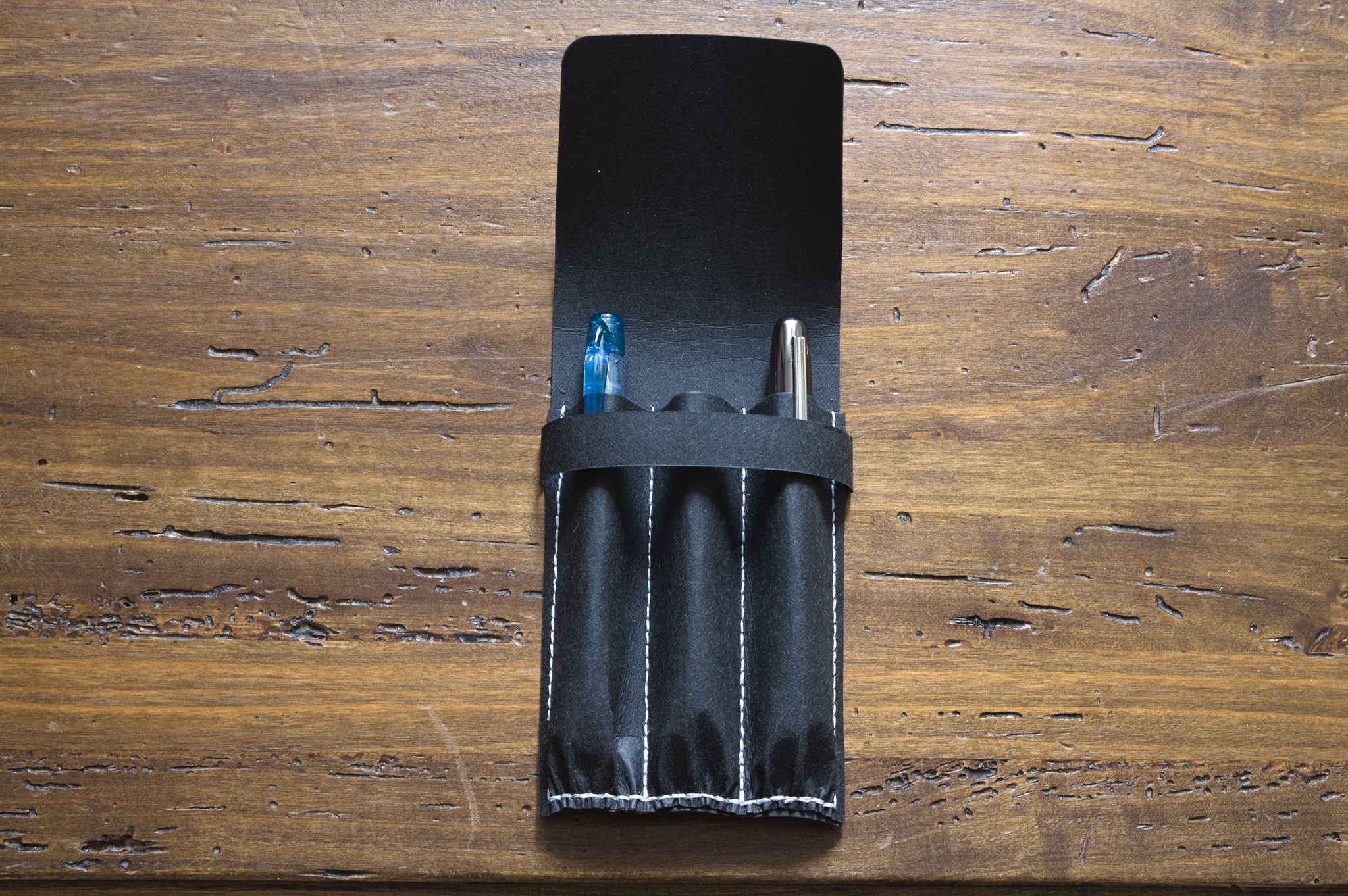

  1. 16 . plus a 9 converter, and another 6 pen to get the EF nib from, since it wasn t available for the expensive pen.
  2. I have them written down somewhere. I couldn t find them. So I measured the real thing, with some approximation.

10 February 2026

Freexian Collaborators: Writing a new worker task for Debusine (by Carles Pina i Estany)

Debusine is a tool designed for Debian developers and Operating System developers in general. You can try out Debusine on debusine.debian.net, and follow its development on salsa.debian.org. This post describes how to write a new worker task for Debusine. It can be used to add tasks to a self-hosted Debusine instance, or to submit to the Debusine project new tasks to add new capabilities to Debusine. Tasks are the lower-level pieces of Debusine workflows. Examples of tasks are Sbuild, Lintian, Debdiff (see the available tasks). This post will document the steps to write a new basic worker task. The example will add a worker task that runs reprotest and creates an artifact of the new type ReprotestArtifact with the reprotest log. Tasks are usually used by workflows. Workflows solve high-level goals by creating and orchestrating different tasks (e.g. a Sbuild workflow would create different Sbuild tasks, one for each architecture).

Overview of tasks A task usually does the following:
  • It receives structured data defining its input artifacts and configuration
  • Input artifacts are downloaded
  • A process is run by the worker (e.g. lintian, debdiff, etc.). In this blog post, it will run reprotest
  • The output (files, logs, exit code, etc.) is analyzed, artifacts and relations might be generated, and the work request is marked as completed, either with Success or Failure
If you want to follow the tutorial and add the Reprotest task, your Debusine development instance should have at least one worker, one user, a debusine client set up, and permissions for the client to create tasks. All of this can be setup following the steps in the Contribute section of the documentation. This blog post shows a functional Reprotest task. This task is not currently part of Debusine. The Reprotest task implementation is simplified (no error handling, unit tests, specific view, docs, some shortcuts in the environment preparation, etc.). At some point, in Debusine, we might add a debrebuild task which is based on buildinfo files and uses snapshot.debian.org to recreate the binary packages.

Defining the inputs of the task The input of the reprotest task will be a source artifact (a Debian source package). We model the input with pydantic in debusine/tasks/models.py:
class ReprotestData(BaseTaskDataWithExecutor):
   """Data for Reprotest task."""

   source_artifact: LookupSingle

class ReprotestDynamicData(BaseDynamicTaskDataWithExecutor):
   """Reprotest dynamic data."""

   source_artifact_id: int   None = None
The ReprotestData is what the user will input. A LookupSingle is a lookup that resolves to a single artifact. We would also have configuration for the desired variations to test, but we have left that out of this example for simplicity. Configuring variations is left as an exercise for the reader. Since ReprotestData is a subclass of BaseTaskDataWithExecutor it also contains environment where the user can specify in which environment the task will run. The environment is an artifact with a Debian image. The ReprotestDynamicData holds the resolution of all lookups. These can be seen in the Internals tab of the work request view.

Add the new Reprotest artifact data class In order for the reprotest task to create a new Artifact of the type DebianReprotest with the log and output metadata: add the new category to ArtifactCategory in debusine/artifacts/models.py:
    REPROTEST = "debian:reprotest"
In the same file add the DebianReprotest class:
class DebianReprotest(ArtifactData):
   """Data for debian:reprotest artifacts."""

   reproducible: bool   None = None

   def get_label(self) -> str:
       """Return a short human-readable label for the artifact."""
       return "reprotest analysis"
It could also include the package name or version. In order to have the category listed in the work request output artifacts table, edit the file debusine/db/models/artifacts.py: In ARTIFACT_CATEGORY_ICON_NAMES add ArtifactCategory.REPROTEST: "folder", and in ARTIFACT_CATEGORY_SHORT_NAMES add ArtifactCategory.REPROTEST: "reprotest",.

Create the new Task class In debusine/tasks/ create a new file reprotest.py.
reprotest.py
# Copyright   The Debusine Developers
# See the AUTHORS file at the top-level directory of this distribution
#
# This file is part of Debusine. It is subject to the license terms
# in the LICENSE file found in the top-level directory of this
# distribution. No part of Debusine, including this file, may be copied,
# modified, propagated, or distributed except according to the terms
# contained in the LICENSE file.

"""Task to use reprotest in debusine."""

from pathlib import Path
from typing import Any

from debusine import utils
from debusine.artifacts.local_artifact import ReprotestArtifact
from debusine.artifacts.models import (
    ArtifactCategory,
    CollectionCategory,
    DebianSourcePackage,
    DebianUpload,
    WorkRequestResults,
    get_source_package_name,
    get_source_package_version,
)
from debusine.client.models import RelationType
from debusine.tasks import BaseTaskWithExecutor, RunCommandTask
from debusine.tasks.models import ReprotestData, ReprotestDynamicData
from debusine.tasks.server import TaskDatabaseInterface


class Reprotest(
    RunCommandTask[ReprotestData, ReprotestDynamicData],
    BaseTaskWithExecutor[ReprotestData, ReprotestDynamicData],
):
    """Task to use reprotest in debusine."""

    TASK_VERSION = 1

    CAPTURE_OUTPUT_FILENAME = "reprotest.log"

    def __init__(
        self,
        task_data: dict[str, Any],
        dynamic_task_data: dict[str, Any]   None = None,
    ) -> None:
        """Initialize object."""
        super().__init__(task_data, dynamic_task_data)

        self._reprotest_target: Path   None = None

    def build_dynamic_data(
        self, task_database: TaskDatabaseInterface
    ) -> ReprotestDynamicData:
        """Compute and return ReprotestDynamicData."""
        input_source_artifact = task_database.lookup_single_artifact(
            self.data.source_artifact
        )

        assert input_source_artifact is not None
        self.ensure_artifact_categories(
            configuration_key="input.source_artifact",
            category=input_source_artifact.category,
            expected=(
                ArtifactCategory.SOURCE_PACKAGE,
                ArtifactCategory.UPLOAD,
            ),
        )
        assert isinstance(
            input_source_artifact.data, (DebianSourcePackage, DebianUpload)
        )
        subject = get_source_package_name(input_source_artifact.data)
        version = get_source_package_version(input_source_artifact.data)

        assert self.data.environment is not None

        environment = self.get_environment(
            task_database,
            self.data.environment,
            default_category=CollectionCategory.ENVIRONMENTS,
        )

        return ReprotestDynamicData(
            source_artifact_id=input_source_artifact.id,
            subject=subject,
            parameter_summary=f" subject _ version ",
            environment_id=environment.id,
        )

    def get_input_artifacts_ids(self) -> list[int]:
        """Return the list of input artifact IDs used by this task."""
        if not self.dynamic_data:
            return []

        return [
            self.dynamic_data.source_artifact_id,
            self.dynamic_data.environment_id,
        ]

    def fetch_input(self, destination: Path) -> bool:
        """Download the required artifacts."""
        assert self.dynamic_data

        artifact_id = self.dynamic_data.source_artifact_id
        assert artifact_id is not None
        self.fetch_artifact(artifact_id, destination)

        return True

    def configure_for_execution(self, download_directory: Path) -> bool:
        """
        Find a .dsc in download_directory.

        Install reprotest and other utilities used in _cmdline.
        Set self._reprotest_target to it.

        :param download_directory: where to search the files
        :return: True if valid files were found
        """
        self._prepare_executor_instance()

        if self.executor_instance is None:
            raise AssertionError("self.executor_instance cannot be None")

        self.run_executor_command(
            ["apt-get", "update"],
            log_filename="install.log",
            run_as_root=True,
            check=True,
        )
        self.run_executor_command(
            [
                "apt-get",
                "--yes",
                "--no-install-recommends",
                "install",
                "reprotest",
                "dpkg-dev",
                "devscripts",
                "equivs",
                "sudo",
            ],
            log_filename="install.log",
            run_as_root=True,
        )

        self._reprotest_target = utils.find_file_suffixes(
            download_directory, [".dsc"]
        )
        return True

    def _cmdline(self) -> list[str]:
        """
        Build the reprotest command line.

        Use configuration of self.data and self._reprotest_target.
        """
        target = self._reprotest_target
        assert target is not None

        cmd = [
            "bash",
            "-c",
            f"TMPDIR=/tmp ; cd /tmp ; dpkg-source -x  target  package/; "
            "cd package/ ; mk-build-deps ; apt-get install --yes ./*.deb ; "
            "rm *.deb ; "
            "reprotest --vary=-time,-user_group,-fileordering,-domain_host .",
        ]

        return cmd

    @staticmethod
    def _cmdline_as_root() -> bool:
        r"""apt-get install --yes ./\*.deb must be run as root."""
        return True

    def task_result(
        self,
        returncode: int   None,
        execute_directory: Path,  # noqa: U100
    ) -> WorkRequestResults:
        """
        Evaluate task output and return success.

        For a successful run of reprotest:
        -must have the output file
        -exit code is 0

        :return: WorkRequestResults.SUCCESS or WorkRequestResults.FAILURE.
        """
        reprotest_file = execute_directory / self.CAPTURE_OUTPUT_FILENAME

        if reprotest_file.exists() and returncode == 0:
            return WorkRequestResults.SUCCESS

        return WorkRequestResults.FAILURE

    def upload_artifacts(
        self, exec_directory: Path, *, execution_result: WorkRequestResults
    ) -> None:
        """Upload the ReprotestArtifact with the files and relationships."""
        if not self.debusine:
            raise AssertionError("self.debusine not set")

        assert self.dynamic_data is not None
        assert self.dynamic_data.parameter_summary is not None

        reprotest_artifact = ReprotestArtifact.create(
            reprotest_output=exec_directory / self.CAPTURE_OUTPUT_FILENAME,
            reproducible=execution_result == WorkRequestResults.SUCCESS,
            package=self.dynamic_data.parameter_summary,
        )

        uploaded = self.debusine.upload_artifact(
            reprotest_artifact,
            workspace=self.workspace_name,
            work_request=self.work_request_id,
        )

        assert self.dynamic_data is not None
        assert self.dynamic_data.source_artifact_id is not None
        self.debusine.relation_create(
            uploaded.id,
            self.dynamic_data.source_artifact_id,
            RelationType.RELATES_TO,
        )
Below are the main methods with some basic explanation. In order for Debusine to discover the task, add "Reprotest" in the file debusine/tasks/__init__.py in the __all__ list. Let s explain the different methods of the Reprotest class:

build_dynamic_data method The worker has no access to Debusine s database. Lookups are all resolved before the task gets dispatched to a worker, so all it has to do is download the specified input artifacts. build_dynamic_data method lookup the artifact, assert that is a valid category, extract the package name and version, and get the environment in which it will be executed. The environment is needed to run the task (reprotest will run in a container using unshare, incus ).
    def build_dynamic_data(
        self, task_database: TaskDatabaseInterface
    ) -> ReprotestDynamicData:
        """Compute and return ReprotestDynamicData."""
        input_source_artifact = task_database.lookup_single_artifact(
            self.data.source_artifact
        )

        assert input_source_artifact is not None
        self.ensure_artifact_categories(
            configuration_key="input.source_artifact",
            category=input_source_artifact.category,
            expected=(
                ArtifactCategory.SOURCE_PACKAGE,
                ArtifactCategory.UPLOAD,
            ),
        )
        assert isinstance(
            input_source_artifact.data, (DebianSourcePackage, DebianUpload)
        )
        subject = get_source_package_name(input_source_artifact.data)
        version = get_source_package_version(input_source_artifact.data)

        assert self.data.environment is not None

        environment = self.get_environment(
            task_database,
            self.data.environment,
            default_category=CollectionCategory.ENVIRONMENTS,
        )

        return ReprotestDynamicData(
            source_artifact_id=input_source_artifact.id,
            subject=subject,
            parameter_summary=f" subject _ version ",
            environment_id=environment.id,
        )

get_input_artifacts_ids method Used to list the task s input artifacts in the web UI.
   def get_input_artifacts_ids(self) -> list[int]:
       """Return the list of input artifact IDs used by this task."""
       if not self.dynamic_data:
           return []

       assert self.dynamic_data.source_artifact_id is not None
       return [self.dynamic_data.source_artifact_id]

fetch_input method Download the required artifacts on the worker.
    def fetch_input(self, destination: Path) -> bool:
        """Download the required artifacts."""
        assert self.dynamic_data

        artifact_id = self.dynamic_data.source_artifact_id
        assert artifact_id is not None
        self.fetch_artifact(artifact_id, destination)

        return True

configure_for_execution method Install the packages needed by the task and set _reprotest_target, which is used to build the task s command line.
   def configure_for_execution(self, download_directory: Path) -> bool:
       """
       Find a .dsc in download_directory.

       Install reprotest and other utilities used in _cmdline.
       Set self._reprotest_target to it.

       :param download_directory: where to search the files
       :return: True if valid files were found
       """
       self._prepare_executor_instance()

       if self.executor_instance is None:
           raise AssertionError("self.executor_instance cannot be None")

       self.run_executor_command(
           ["apt-get", "update"],
           log_filename="install.log",
           run_as_root=True,
           check=True,
       )
       self.run_executor_command(
           [
               "apt-get",
               "--yes",
               "--no-install-recommends",
               "install",
               "reprotest",
               "dpkg-dev",
               "devscripts",
               "equivs",
               "sudo",
           ],
           log_filename="install.log",
           run_as_root=True,
       )

       self._reprotest_target = utils.find_file_suffixes(
           download_directory, [".dsc"]
       )
       return True

_cmdline method Return the command line to run the task. In this case, and to keep the example simple, we will run reprotest directly in the worker s executor VM/container, without giving it an isolated virtual server. So, this command installs the build dependencies required by the package (so reprotest can build it) and runs reprotest itself.
   def _cmdline(self) -> list[str]:
       """
       Build the reprotest command line.

       Use configuration of self.data and self._reprotest_target.
       """
       target = self._reprotest_target
       assert target is not None

       cmd = [
           "bash",
           "-c",
           f"TMPDIR=/tmp ; cd /tmp ; dpkg-source -x  target  package/; "
           "cd package/ ; mk-build-deps ; apt-get install --yes ./*.deb ; "
           "rm *.deb ; "
           "reprotest --vary=-time,-user_group,-fileordering,-domain_host .",
       ]

       return cmd
Some reprotest variations are disabled. This is to keep the example simple with the set of packages to install and reprotest features.

_cmdline_as_root method Since during the execution it s needed to install packages, run it as root (in the container):
   @staticmethod
   def _cmdline_as_root() -> bool:
       r"""apt-get install --yes ./\*.deb must be run as root."""
       return True

task_result method Task succeeded if a log is generated and the return code is 0.
    def task_result(
        self,
        returncode: int   None,
        execute_directory: Path,  # noqa: U100
    ) -> WorkRequestResults:
        """
        Evaluate task output and return success.

        For a successful run of reprotest:
        -must have the output file
        -exit code is 0

        :return: WorkRequestResults.SUCCESS or WorkRequestResults.FAILURE.
        """
        reprotest_file = execute_directory / self.CAPTURE_OUTPUT_FILENAME

        if reprotest_file.exists() and returncode == 0:
            return WorkRequestResults.SUCCESS

        return WorkRequestResults.FAILURE

upload_artifacts method Create the ReprotestArtifact with the log and the reproducible boolean, upload it, and then add a relation between the ReprotestArtifact and the source package:
    def upload_artifacts(
        self, exec_directory: Path, *, execution_result: WorkRequestResults
    ) -> None:
        """Upload the ReprotestArtifact with the files and relationships."""
        if not self.debusine:
            raise AssertionError("self.debusine not set")

        assert self.dynamic_data is not None
        assert self.dynamic_data.parameter_summary is not None

        reprotest_artifact = ReprotestArtifact.create(
            reprotest_output=exec_directory / self.CAPTURE_OUTPUT_FILENAME,
            reproducible=execution_result == WorkRequestResults.SUCCESS,
            package=self.dynamic_data.parameter_summary,
        )

        uploaded = self.debusine.upload_artifact(
            reprotest_artifact,
            workspace=self.workspace_name,
            work_request=self.work_request_id,
        )

        assert self.dynamic_data is not None
        assert self.dynamic_data.source_artifact_id is not None
        self.debusine.relation_create(
            uploaded.id,
            self.dynamic_data.source_artifact_id,
            RelationType.RELATES_TO,
        )

Execution example To run this task in a local Debusine (see steps to have it ready with an environment, permissions and users created) you can do:
$ python3 -m debusine.client artifact import-debian -w System http://deb.debian.org/debian/pool/main/h/hello/hello_2.10-5.dsc
(get the artifact ID from the output of that command) The artifact can be seen in http://$DEBUSINE/debusine/System/artifact/$ARTIFACTID/. Then create a reprotest.yaml:
$ cat <<EOF > reprotest.yaml
source_artifact: $ARTIFACT_ID
environment: "debian/match:codename=bookworm"
EOF
Instead of debian/match:codename=bookworm it could use the artifact ID. Finally, create the work request to run the task:
$ python3 -m debusine.client create-work-request -w System reprotest --data reprotest.yaml
Using Debusine web you can see the work request, which should go to Running status, then Completed with Success or Failure (depending if reprotest could reproduce it or not). Clicking on the Output tab would have an artifact of type debian:reprotest with one file: the log. In the Metadata tab of the artifact it has Data: the package name and reproducible (true or false).

What is left to do? This was a simple example of creating a task. Other things that could be done:
  • unit tests
  • documentation
  • configurable variations
  • running reprotest directly on the worker host, using the executor environment as a reprotest virtual server
  • in this specific example, the command line might be doing too many things that could maybe be done by other parts of the task, such as prepare_environment.
  • integrate it in a workflow so it s easier to use (e.g. part of QaWorkflow)
  • extract more from the log than just pass/fail
  • display the output in a more useful way (implement an artifact specialized view)

6 February 2026

Reproducible Builds: Reproducible Builds in January 2026

Welcome to the first monthly report in 2026 from the Reproducible Builds project! These reports outline what we ve been up to over the past month, highlighting items of news from elsewhere in the increasingly-important area of software supply-chain security. As ever, if you are interested in contributing to the Reproducible Builds project, please see the Contribute page on our website.

  1. Flathub now testing for reproducibility
  2. Reproducibility identifying projects that will fail to build in 2038
  3. Distribution work
  4. Tool development
  5. Two new academic papers
  6. Upstream patches

Flathub now testing for reproducibility Flathub, the primary repository/app store for Flatpak-based applications, has begun checking for build reproducibility. According to a recent blog post:
We have started testing binary reproducibility of x86_64 builds targeting the stable repository. This is possible thanks to flathub-repro-checker, a tool doing the necessary legwork to recreate the build environment and compare the result of the rebuild with what is published on Flathub. While these tests have been running for a while now, we have recently restarted them from scratch after enabling S3 storage for diffoscope artifacts.
The test results and status is available on their reproducible builds page.

Reproducibility identifying software projects that will fail to build in 2038 Longtime Reproducible Builds developer Bernhard M. Wiedemann posted on Reddit on Y2K38 commemoration day T-12 that is to say, twelve years to the day before the UNIX Epoch will no longer fit into a signed 32-bit integer variable on 19th January 2038. Bernhard s comment succinctly outlines the problem as well as notes some of the potential remedies, as well as links to a discussion with the GCC developers regarding adding warnings for int time_t conversions . At the time of publication, Bernhard s topic had generated 50 comments in response.

Distribution work Conda is language-agnostic package manager which was originally developed to help Python data scientists and is now a popular package manager for Python and R. conda-forge, a community-led infrastructure for Conda recently revamped their dashboards to rebuild packages straight to track reproducibility. There have been changes over the past two years to make the conda-forge build tooling fully reproducible by embedding the lockfile of the entire build environment inside the packages.
In Debian this month:
In NixOS this month, it was announced that the GNU Guix Full Source Bootstrap was ported to NixOS as part of Wire Jansen bachelor s thesis (PDF). At the time of publication, this change has landed in NiX stdev distribution.
Lastly, Bernhard M. Wiedemann posted another openSUSE monthly update for his work there.

Tool development diffoscope is our in-depth and content-aware diff utility that can locate and diagnose reproducibility issues. This month, Chris Lamb made the following changes, including preparing and uploading versions, 310 and 311 to Debian.
  • Fix test compatibility with u-boot-tools version 2026-01. [ ]
  • Drop the implied Rules-Requires-Root: no entry in debian/control. [ ]
  • Bump Standards-Version to 4.7.3. [ ]
  • Reference the Debian ocaml package instead of ocaml-nox. (#1125094)
  • Apply a patch by Jelle van der Waa to adjust a test fixture match new lines. [ ]
  • Also the drop implied Priority: optional from debian/control. [ ]

In addition, Holger Levsen uploaded two versions of disorderfs, first updating the package from FUSE 2 to FUSE 3 as described in last months report, as well as updating the packaging to the latest Debian standards. A second upload (0.6.2-1) was subsequently made, with Holger adding instructions on how to add the upstream release to our release archive and incorporating changes by Roland Clobus to set _FILE_OFFSET_BITS on 32-bit platforms, fixing a build failure on 32-bit systems. Vagrant Cascadian updated diffoscope in GNU Guix to version 311-2-ge4ec97f7 and disorderfs to 0.6.2.

Two new academic papers Julien Malka, Stefano Zacchiroli and Th o Zimmermann of T l com Paris in-house research laboratory, the Information Processing and Communications Laboratory (LTCI) published a paper this month titled Docker Does Not Guarantee Reproducibility:
[ ] While Docker is frequently cited in the literature as a tool that enables reproducibility in theory, the extent of its guarantees and limitations in practice remains under-explored. In this work, we address this gap through two complementary approaches. First, we conduct a systematic literature review to examine how Docker is framed in scientific discourse on reproducibility and to identify documented best practices for writing Dockerfiles enabling reproducible image building. Then, we perform a large-scale empirical study of 5,298 Docker builds collected from GitHub workflows. By rebuilding these images and comparing the results with their historical counterparts, we assess the real reproducibility of Docker images and evaluate the effectiveness of the best practices identified in the literature.
A PDF of their paper is available online.
Quentin Guilloteau, Antoine Waehren and Florina M. Ciorba of the University of Basel in Sweden also published a Docker-related paper, theirs called Longitudinal Study of the Software Environments Produced by Dockerfiles from Research Artifacts:
The reproducibility crisis has affected all scientific disciplines, including computer science (CS). To address this issue, the CS community has established artifact evaluation processes at conferences and in journals to evaluate the reproducibility of the results shared in publications. Authors are therefore required to share their artifacts with reviewers, including code, data, and the software environment necessary to reproduce the results. One method for sharing the software environment proposed by conferences and journals is to utilize container technologies such as Docker and Apptainer. However, these tools rely on non-reproducible tools, resulting in non-reproducible containers. In this paper, we present a tool and methodology to evaluate variations over time in software environments of container images derived from research artifacts. We also present initial results on a small set of Dockerfiles from the Euro-Par 2024 conference.
A PDF of their paper is available online.

Miscellaneous news On our mailing list this month: Lastly, kpcyrd added a Rust section to the Stable order for outputs page on our website. [ ]

Upstream patches The Reproducible Builds project detects, dissects and attempts to fix as many currently-unreproducible packages as possible. We endeavour to send all of our patches upstream where appropriate. This month, we wrote a large number of such patches, including:

Finally, if you are interested in contributing to the Reproducible Builds project, please visit our Contribute page on our website. However, you can get in touch with us via:

3 February 2026

Valhalla's Things: A Day Off

Posted on February 3, 2026
Tags: madeof:atoms, madeof:bits
Today I had a day off. Some of it went great. Some less so. I woke up, went out to pay our tribute to NotOurCat, and it was snowing! yay! And I had a day off, so if it had snowed enough that shovelling was needed, I had time to do it (it didn t, it started to rain soon afterwards, but still, YAY snow!). Then I had breakfast, with the fruit rye bread I had baked yesterday, and I treated myself to some of the strong Irish tea I have left, instead of the milder ones I want to finish before buying more of the Irish. And then, I bought myself a fancy new expensive fountain pen. One that costs 16 ! more than three times as much as my usual ones! I hope it will work as well, but I m quite confident it should. I ll find out when it arrives from Germany (together with a few ink samples that will result in a future blog post with some SCIENCE). I decided to try and use bank transfers instead of my visa debit card when buying from online shops that give the option to do so: it s a tiny bit more effort, but it means I m paying 0.25 to my bank1 rather than the seller having to pay some unknown amount to an US based payment provider. Unluckily, the fountain pen website offered a huge number of payment methods, but not bank transfers. sigh. And then, I could start working a bit on the connecting wires for the LED strips for our living room: I soldered two pieces, six wires each (it s one RGB strip, 4 pins, and a warm white one requiring two more), then did a bit of tests, including writing some micropython code to add a test mode that lights up each colour in sequence, and the morning was almost gone. For some reason this project, as simple as it is, is taking forever. But it is showing progress. There was a break, when the postman delivered a package of chemicals 2 for a future project or two. There will be blog posts! After lunch I spent some time finishing eyelets on the outfit I wanted to wear this evening, as I had not been able to finish it during fosdem. This one will result in two blog posts! Meanwhile, in the morning I didn t remember the name of the program I used to load software on micropython boards such as the one that will control the LED strips (that s thonny), and while searching for it in the documentation, I found that there is also a command line program I can use, mpremote, and that s a much better fit for my preferences! I mentioned it in an xmpp room full of nerds, and one of them mentioned that he could try it on his Inkplate, when he had time, and I was nerd-sniped into trying it on mine, which had been sitting unused showing the temperatures in our old house on the last day it spent there and needs to be updated for the sensors in the new house. And that lead to the writing of some notes on how to set it up from the command line (good), and to the opening on one upstream issue (bad), because I have an old model, and the board-specific library isn t working. at all. And that s when I realized that it was 17:00, I still had to cook the bread I had been working on since yesterday evening (ciabatta, one of my favourites, but it needs almost one hour in the oven), the outfit I wanted to wear in the evening was still not wearable, the table needed cleaning and some panicking was due. Thankfully, my mother was cooking dinner, so I didn t have to do that too. I turned the oven on, sewed the shoulder seams of the bodice while spraying water on the bread every 5 minutes, and then while it was cooking on its own, started to attach a closure to the skirt, decided that a safety pin was a perfectly reasonable closure for the first day an outfit is worn, took care of the table, took care of the bread, used some twine to close the bodice, because I still haven t worked out what to use for laces, realized my bodkin is still misplaced, used a long and sharp and big needle meant for sewing mattresses instead of a bodkin, managed not to stab myself, and less than half an hour late we could have dinner. There was bread, there was Swedish crispbread, there were spreads (tuna, and beans), and vegetables, and then there was the cake that caused my mother to panic when she added her last honey to the milk and it curdled (my SO and I tried it, it had no odd taste, we decided it could be used) and it was good, although I had to get a second slice just to be 100% sure of it. And now I m exhausted, and I ve only done half of the things I had planned to do, but I d still say I ve had quite a good day.

  1. Banca Etica, so one that avoids any investment in weapons and a number of other problematic things.
  2. not food grade, except for one, but kitchen-safe.

19 January 2026

Isoken Ibizugbe: Mid-Point Project Progress

Halfway There

Hurray!  I have officially reached the 6-week mark, the halfway point of my Outreachy internship. The time has flown by incredibly fast, yet it feels short because there is still so much exciting work to do.

I remember starting this journey feeling overwhelmed, trying to gain momentum. Today, I feel much more confident. I began with the apps_startstop task during the contribution period, writing manual test steps and creating preparation Perl scripts for the desktop environments. Since then, I ve transitioned into full automation and taken a liking to reading openQA upstream documentation when I have issues or for reference.

In all of this, I ve committed over 30 hours a week to the project. This dedicated time has allowed me to look in-depth into the Debian ecosystem and automated quality assurance.

The Original Roadmap vs. Reality

Reviewing my 12-week goal, which included extending automated tests for live image testing, installer testing, and documentation, I am happy to report that I am right on track. My work on desktop apps tests has directly improved the quality of both the Live Images and the netinst (network installer) ISOs.

Accomplishments

I have successfully extended the apps_startstop tests for two Desktop Environments (DEs): Cinnamon and LXQt. These tests ensure that common and DE specific apps launch and close correctly across different environments.

  • Merged Milestone: My Cinnamon tests have been officially merged into the upstream repository! [MR !84]
  • LXQt & Adaptability: I am in the final stages of the LXQt tests. Interestingly, I had to update these tests mid-way through because of a version update in the DE. This required me to update the needles (image references) to match the new UI, a great lesson in software maintenance.

Solving for Synergy

One of my favorite challenges was suggested by my mentor, Roland: synergizing the tests to reduce redundancy. I observed that some applications (like Firefox and LibreOffice) behave identically across different desktops. Instead of duplicating Perl scripts/code for every single DE, I used symbolic links. This allows the use of the same Perl script and possibly the same needles, making the test suite lighter and much easier to maintain.

The Contributor Guide

During the contribution phase, I noticed how rigid the documentation and coding style requirements are. While this ensures high standards and uniformity, it can be intimidating for newcomers and time-consuming for reviewers.

To help, I created a contributor guide [MR !97]. This guide addresses the project s writing style. My goal is to reduce the back-and-forth during reviews, making the process more efficient for everyone and helping new contributors.

Looking Forward

For the second half of the internship, I plan to:

  1. Assist others: Help new contributors extend apps start-stop tests to even more desktop environments.
  2. Explore new coverage: Move beyond start-stop tests into deeper functional testing.

This journey has been an amazing experience of learning and connecting with the wider open-source community, especially Debian Women and the Linux QA team.

I am deeply grateful to my mentors, Tassia Camoes Araujo, Roland Clobus, and Philip Hands, for their constant guidance and for believing in my ability to take on this project.

Here s to the next 6 weeks

Francesco Paolo Lovergine: A Terramaster NAS with Debian, take two.

After experimenting at home, the very first professional-grade NAS from Terramaster arrived at work, too, with 12 HDD bays and possibly a pair of M2s. NVME cards. In this case, I again installed a plain Debian distribution, but HDD monitoring required some configuration adjustments to run smartd properly.A decent approach to data safety is to run regularly scheduled short and long SMART tests on all disks to detect potential damage. Running such tests on all disks at once isn't ideal, so I set up a script to create a staggered configuration and test multiple groups of disks at different times. Note that it is mandatory to read the devices at each reboot because their names and order can change.Of course, the same principle (short/long test at regular intervals along the week) should be applied for a simpler configuration, as in the case of my home NAS with a pair of RAID1 devices.What follows is a simple script to create a staggered smartd.conf at boot time:
#!/bin/bash
#
# Save this as /usr/local/bin/create-smartd-conf.sh
#
# Dynamically generate smartd.conf with staggered SMART test scheduling
# at boot time based on discovered ATA devices
# HERE IS A LIST OF DIRECTIVES FOR THIS CONFIGURATION FILE.
# PLEASE SEE THE smartd.conf MAN PAGE FOR DETAILS
#
#   -d TYPE Set the device type: ata, scsi[+TYPE], nvme[,NSID],
#           sat[,auto][,N][+TYPE], usbcypress[,X], usbjmicron[,p][,x][,N],
#           usbprolific, usbsunplus, sntasmedia, sntjmicron[,NSID], sntrealtek,
#           ... (platform specific)
#   -T TYPE Set the tolerance to one of: normal, permissive
#   -o VAL  Enable/disable automatic offline tests (on/off)
#   -S VAL  Enable/disable attribute autosave (on/off)
#   -n MODE No check if: never, sleep[,N][,q], standby[,N][,q], idle[,N][,q]
#   -H      Monitor SMART Health Status, report if failed
#   -s REG  Do Self-Test at time(s) given by regular expression REG
#   -l TYPE Monitor SMART log or self-test status:
#           error, selftest, xerror, offlinests[,ns], selfteststs[,ns]
#   -l scterc,R,W  Set SCT Error Recovery Control
#   -e      Change device setting: aam,[N off], apm,[N off], dsn,[on off],
#           lookahead,[on off], security-freeze, standby,[N off], wcache,[on off]
#   -f      Monitor 'Usage' Attributes, report failures
#   -m ADD  Send email warning to address ADD
#   -M TYPE Modify email warning behavior (see man page)
#   -p      Report changes in 'Prefailure' Attributes
#   -u      Report changes in 'Usage' Attributes
#   -t      Equivalent to -p and -u Directives
#   -r ID   Also report Raw values of Attribute ID with -p, -u or -t
#   -R ID   Track changes in Attribute ID Raw value with -p, -u or -t
#   -i ID   Ignore Attribute ID for -f Directive
#   -I ID   Ignore Attribute ID for -p, -u or -t Directive
#   -C ID[+] Monitor [increases of] Current Pending Sectors in Attribute ID
#   -U ID[+] Monitor [increases of] Offline Uncorrectable Sectors in Attribute ID
#   -W D,I,C Monitor Temperature D)ifference, I)nformal limit, C)ritical limit
#   -v N,ST Modifies labeling of Attribute N (see man page)
#   -P TYPE Drive-specific presets: use, ignore, show, showall
#   -a      Default: -H -f -t -l error -l selftest -l selfteststs -C 197 -U 198
#   -F TYPE Use firmware bug workaround:
#           none, nologdir, samsung, samsung2, samsung3, xerrorlba
#   -c i=N  Set interval between disk checks to N seconds
#    #      Comment: text after a hash sign is ignored
#    \      Line continuation character
# Attribute ID is a decimal integer 1 <= ID <= 255
# except for -C and -U, where ID = 0 turns them off.
set -euo pipefail
# Test schedule configuration
BASE_SCHEDULE="L/../../6"  # Long test on Saturdays
TEST_HOURS=(01 03 05 07)   # 4 time slots: 1am, 3am, 5am, 7am
DEVICES_PER_GROUP=3
main()  
    # Get array of device names (e.g., sda, sdb, sdc)
    mapfile -t devices < <(ls -l /dev/disk/by-id/   grep ata   awk ' print $11 '   grep sd   cut -d/ -f3   sort -u)
    if [[ $ #devices[@]  -eq 0 ]]; then
        exit 1
    fi
    # Start building config file
    cat << EOF
# smartd.conf - Auto-generated at boot
# Generated: $(date '+%Y-%m-%d %H:%M:%S')
#
# Staggered SMART test scheduling to avoid concurrent disk load
# Long tests run on Saturdays at different times per group
#
EOF
    # Process devices into groups
    local group=0
    local count_in_group=0
    for i in "$ !devices[@] "; do
        local dev="$ devices[$i] "
        local hour="$ TEST_HOURS[$group] "
        # Add group header at start of each group
        if [[ $count_in_group -eq 0 ]]; then
            echo ""
            echo "# Group $((group + 1)) - Tests at $ hour :00 on Saturdays"
        fi
        # Add device entry
        #echo "/dev/$ dev  -a -o on -S on -s ($ BASE_SCHEDULE /$ hour ) -m root"
        echo "/dev/$ dev  -a -o on -S on -s (L/../../6/$ hour ) -s (S/../.././$(((hour + 12) % 24))) -m root"
        # Move to next group when current group is full
        count_in_group=$((count_in_group + 1))
        if [[ $count_in_group -ge $DEVICES_PER_GROUP ]]; then
            count_in_group=0
            group=$(((group + 1) % $ #TEST_HOURS[@] ))
        fi
    done
 
main "$@"
To run such a script at boot, add a unit file to the systemd configuration.
sudo systemctl  edit --full /etc/systemd/system/regenerate-smartd-conf.service
sudo systemctl enable regenerate-smartd-conf.service
Where the unit service is the following:
[Unit]
Description=Generate smartd.conf with staggered SMART test scheduling
# Wait for all local filesystems and udev device detection
After=local-fs.target systemd-udev-settle.service
Before=smartd.service
Wants=systemd-udev-settle.service
DefaultDependencies=no
[Service]
Type=oneshot
# Only generate the config file, don't touch smartd here
ExecStart=/bin/bash -c '/usr/local/bin/create-smartd-config.sh > /etc/smartd.conf'
StandardOutput=journal
StandardError=journal
RemainAfterExit=yes
[Install]
WantedBy=multi-user.target

4 January 2026

Matthew Garrett: What is a PC compatible?

Wikipedia says An IBM PC compatible is any personal computer that is hardware- and software-compatible with the IBM Personal Computer (IBM PC) and its subsequent models . But what does this actually mean? The obvious literal interpretation is for a device to be PC compatible, all software originally written for the IBM 5150 must run on it. Is this a reasonable definition? Is it one that any modern hardware can meet? Before we dig into that, let s go back to the early days of the x86 industry. IBM had launched the PC built almost entirely around off-the-shelf Intel components, and shipped full schematics in the IBM PC Technical Reference Manual. Anyone could buy the same parts from Intel and build a compatible board. They d still need an operating system, but Microsoft was happy to sell MS-DOS to anyone who d turn up with money. The only thing stopping people from cloning the entire board was the BIOS, the component that sat between the raw hardware and much of the software running on it. The concept of a BIOS originated in CP/M, an operating system originally written in the 70s for systems based on the Intel 8080. At that point in time there was no meaningful standardisation - systems might use the same CPU but otherwise have entirely different hardware, and any software that made assumptions about the underlying hardware wouldn t run elsewhere. CP/M s BIOS was effectively an abstraction layer, a set of code that could be modified to suit the specific underlying hardware without needing to modify the rest of the OS. As long as applications only called BIOS functions, they didn t need to care about the underlying hardware and would run on all systems that had a working CP/M port. By 1979, boards based on the 8086, Intel s successor to the 8080, were hitting the market. The 8086 wasn t machine code compatible with the 8080, but 8080 assembly code could be assembled to 8086 instructions to simplify porting old code. Despite this, the 8086 version of CP/M was taking some time to appear, and a company called Seattle Computer Products started producing a new OS closely modelled on CP/M and using the same BIOS abstraction layer concept. When IBM started looking for an OS for their upcoming 8088 (an 8086 with an 8-bit data bus rather than a 16-bit one) based PC, a complicated chain of events resulted in Microsoft paying a one-off fee to Seattle Computer Products, porting their OS to IBM s hardware, and the rest is history. But one key part of this was that despite what was now MS-DOS existing only to support IBM s hardware, the BIOS abstraction remained, and the BIOS was owned by the hardware vendor - in this case, IBM. One key difference, though, was that while CP/M systems typically included the BIOS on boot media, IBM integrated it into ROM. This meant that MS-DOS floppies didn t include all the code needed to run on a PC - you needed IBM s BIOS. To begin with this wasn t obviously a problem in the US market since, in a way that seems extremely odd from where we are now in history, it wasn t clear that machine code was actually copyrightable. In 1982 Williams v. Artic determined that it could be even if fixed in ROM - this ended up having broader industry impact in Apple v. Franklin and it became clear that clone machines making use of the original vendor s ROM code wasn t going to fly. Anyone wanting to make hardware compatible with the PC was going to have to find another way. And here s where things diverge somewhat. Compaq famously performed clean-room reverse engineering of the IBM BIOS to produce a functionally equivalent implementation without violating copyright. Other vendors, well, were less fastidious - they came up with BIOS implementations that either implemented a subset of IBM s functionality, or didn t implement all the same behavioural quirks, and compatibility was restricted. In this era several vendors shipped customised versions of MS-DOS that supported different hardware (which you d think wouldn t be necessary given that s what the BIOS was for, but still), and the set of PC software that would run on their hardware varied wildly. This was the era where vendors even shipped systems based on the Intel 80186, an improved 8086 that was both faster than the 8086 at the same clock speed and was also available at higher clock speeds. Clone vendors saw an opportunity to ship hardware that outperformed the PC, and some of them went for it. You d think that IBM would have immediately jumped on this as well, but no - the 80186 integrated many components that were separate chips on 8086 (and 8088) based platforms, but crucially didn t maintain compatibility. As long as everything went via the BIOS this shouldn t have mattered, but there were many cases where going via the BIOS introduced performance overhead or simply didn t offer the functionality that people wanted, and since this was the era of single-user operating systems with no memory protection, there was nothing stopping developers from just hitting the hardware directly to get what they wanted. Changing the underlying hardware would break them. And that s what happened. IBM was the biggest player, so people targeted IBM s platform. When BIOS interfaces weren t sufficient they hit the hardware directly - and even if they weren t doing that, they d end up depending on behavioural quirks of IBM s BIOS implementation. The market for DOS-compatible but not PC-compatible mostly vanished, although there were notable exceptions - in Japan the PC-98 platform achieved significant success, largely as a result of the Japanese market being pretty distinct from the rest of the world at that point in time, but also because it actually handled Japanese at a point where the PC platform was basically restricted to ASCII or minor variants thereof. So, things remained fairly stable for some time. Underlying hardware changed - the 80286 introduced the ability to access more than a megabyte of address space and would promptly have broken a bunch of things except IBM came up with an utterly terrifying hack that bit me back in 2009, and which ended up sufficiently codified into Intel design that it was one mechanism for breaking the original XBox security. The first 286 PC even introduced a new keyboard controller that supported better keyboards but which remained backwards compatible with the original PC to avoid breaking software. Even when IBM launched the PS/2, the first significant rearchitecture of the PC platform with a brand new expansion bus and associated patents to prevent people cloning it without paying off IBM, they made sure that all the hardware was backwards compatible. For decades, PC compatibility meant not only supporting the officially supported interfaces, it meant supporting the underlying hardware. This is what made it possible to ship install media that was expected to work on any PC, even if you d need some additional media for hardware-specific drivers. It s something that still distinguishes the PC market from the ARM desktop market. But it s not as true as it used to be, and it s interesting to think about whether it ever was as true as people thought. Let s take an extreme case. If I buy a modern laptop, can I run 1981-era DOS on it? The answer is clearly no. First, modern systems largely don t implement the legacy BIOS. The entire abstraction layer that DOS relies on isn t there, having been replaced with UEFI. When UEFI first appeared it generally shipped with a Compatibility Services Module, a layer that would translate BIOS interrupts into UEFI calls, allowing vendors to ship hardware with more modern firmware and drivers without having to duplicate them to support older operating systems1. Is this system PC compatible? By the strictest of definitions, no. Ok. But the hardware is broadly the same, right? There s projects like CSMWrap that allow a CSM to be implemented on top of stock UEFI, so everything that hits BIOS should work just fine. And well yes, assuming they implement the BIOS interfaces fully, anything using the BIOS interfaces will be happy. But what about stuff that doesn t? Old software is going to expect that my Sound Blaster is going to be on a limited set of IRQs and is going to assume that it s going to be able to install its own interrupt handler and ACK those on the interrupt controller itself and that s really not going to work when you have a PCI card that s been mapped onto some APIC vector, and also if your keyboard is attached via USB or SPI then reading it via the CSM will work (because it s calling into UEFI to get the actual data) but trying to read the keyboard controller directly won t2, so you re still actually relying on the firmware to do the right thing but it s not, because the average person who wants to run DOS on a modern computer owns three fursuits and some knee length socks and while you are important and vital and I love you all you re not enough to actually convince a transglobal megacorp to flip the bit in the chipset that makes all this old stuff work. But imagine you are, or imagine you re the sort of person who (like me) thinks writing their own firmware for their weird Chinese Thinkpad knockoff motherboard is a good and sensible use of their time - can you make this work fully? Haha no of course not. Yes, you can probably make sure that the PCI Sound Blaster that s plugged into a Thunderbolt dock has interrupt routing to something that is absolutely no longer an 8259 but is pretending to be so you can just handle IRQ 5 yourself, and you can probably still even write some SMM code that will make your keyboard work, but what about the corner cases? What if you re trying to run something built with IBM Pascal 1.0? There s a risk that it ll assume that trying to access an address just over 1MB will give it the data stored just above 0, and now it ll break. It d work fine on an actual PC, and it won t work here, so are we PC compatible? That s a very interesting abstract question and I m going to entirely ignore it. Let s talk about PC graphics3. The original PC shipped with two different optional graphics cards - the Monochrome Display Adapter and the Color Graphics Adapter. If you wanted to run games you were doing it on CGA, because MDA had no mechanism to address individual pixels so you could only render full characters. So, even on the original PC, there was software that would run on some hardware but not on other hardware. Things got worse from there. CGA was, to put it mildly, shit. Even IBM knew this - in 1984 they launched the PCjr, intended to make the PC platform more attractive to home users. As well as maybe the worst keyboard ever to be associated with the IBM brand, IBM added some new video modes that allowed displaying more than 4 colours on screen at once4, and software that depended on that wouldn t display correctly on an original PC. Of course, because the PCjr was a complete commercial failure, it wouldn t display correctly on any future PCs either. This is going to become a theme. There s never been a properly specified PC graphics platform. BIOS support for advanced graphics modes5 ended up specified by VESA rather than IBM, and even then getting good performance involved hitting hardware directly. It wasn t until Microsoft specced DirectX that anything was broadly usable even if you limited yourself to Microsoft platforms, and this was an OS-level API rather than a hardware one. If you stick to BIOS interfaces then CGA-era code will work fine on graphics hardware produced up until the 20-teens, but if you were trying to hit CGA hardware registers directly then you re going to have a bad time. This isn t even a new thing - even if we restrict ourselves to the authentic IBM PC range (and ignore the PCjr), by the time we get to the Enhanced Graphics Adapter we re not entirely CGA compatible. Is an IBM PC/AT with EGA PC compatible? You d likely say yes , but there s software written for the original PC that won t work there. And, well, let s go even more basic. The original PC had a well defined CPU frequency and a well defined CPU that would take a well defined number of cycles to execute any given instruction. People could write software that depended on that. When CPUs got faster, some software broke. This resulted in systems with a Turbo Button - a button that would drop the clock rate to something approximating the original PC so stuff would stop breaking. It s fine, we d later end up with Windows crashing on fast machines because hardware details will absolutely bleed through. So, what s a PC compatible? No modern PC will run the DOS that the original PC ran. If you try hard enough you can get it into a state where it ll run most old software, as long as it doesn t have assumptions about memory segmentation or your CPU or want to talk to your GPU directly. And even then it ll potentially be unusable or crash because time is hard. The truth is that there s no way we can technically describe a PC Compatible now - or, honestly, ever. If you sent a modern PC back to 1981 the media would be amazed and also point out that it didn t run Flight Simulator. PC Compatible is a socially defined construct, just like Woman . We can get hung up on the details or we can just chill.

  1. Windows 7 is entirely happy to boot on UEFI systems except that it relies on being able to use a BIOS call to set the video mode during boot, which has resulted in things like UEFISeven to make that work on modern systems that don t provide BIOS compatibility
  2. Back in the 90s and early 2000s operating systems didn t necessarily have native drivers for USB input devices, so there was hardware support for trapping OS accesses to the keyboard controller and redirecting that into System Management Mode where some software that was invisible to the OS would speak to the USB controller and then fake a response anyway that s how I made a laptop that could boot unmodified MacOS X
  3. (my name will not be Wolfwings Shadowflight)
  4. Yes yes ok 8088 MPH demonstrates that if you really want to you can do better than that on CGA
  5. and by advanced we re still talking about the 90s, don t get excited

1 January 2026

Dima Kogan: Using libpython3 without linking it in; and old Python, g++ compatibility patches

I just released mrcal 2.5; much more about that in a future post. Here, I'd like to talk about some implementation details.

libpython3 and linking
mrcal is a C library and a Python library. Much of mrcal itself interfaces the C and Python libraries. And it is common for external libraries to want to pass Python mrcal.cameramodel objects to their C code. The obvious way to do this is in a converter function in an O& argument to PyArg_ParseTupleAndKeywords(). I wrote this mrcal_cameramodel_converter() function, which opened a whole can of worms when thinking about the compiling and linking and distribution of this thing. mrcal_cameramodel_converter() is meant to be called by code that implements Python-wrapping of C code. This function will be called by the PyArg_ParseTupleAndKeywords() Python library function, and it uses the Python C API itself. Since it uses the Python C API, it would normally link against libpython. However:
  • The natural place to distribute this is in libmrcal.so, but this library doesn't touch Python, and I'd rather not pull in all of libpython for this utility function, even in the 99% case when that function won't even be called
  • In some cases linking to libpython actually breaks things, so I never do that anymore anyway. This is fine: since this code will only ever be called by libpython itself, we're guaranteed that libpython will already be loaded, and we don't need to ask for it.
OK, let's not link to libpython then. But if we do that, we're going to have unresolved references to our libpython calls, and the loader will complain when loading libmrcal.so, even if we're not actually calling those functions. This has an obvious solution: the references to the libpython calls should be marked weak. That won't generate unresolved-reference errors, and everything will be great. OK, how do we mark things weak? There're two usual methods:
  1. We mark the declaration (or definition?) or the relevant functions with __attribute__((weak))
  2. We weaken the symbols after the compile with objcopy --weaken.
Method 1 is more work: I don't want to keep track of what Python API calls I'm actually making. This is non-trivial, because some of the Py_...() invocations in my code are actually macros that call functions internally that I must weaken. Furthermore, all the functions are declared in Python.h that I don't control. I can re-declare stuff with __attribute__((weak)), but then I have to match the prototypes. And I have to hope that re-declaring these will make __attribute__((weak)) actually work. So clearly I want method 2. I implemented it:
python-cameramodel-converter.o: %.o:%.c
        $(c_build_rule); mv $@ _$@
        $(OBJCOPY) --wildcard --weaken-symbol='Py*' --weaken-symbol='_Py*' _$@ $@
Works great on my machine! But doesn't work on other people's machines. Because only the most recent objcopy tool actually works to weaken references. Apparently the older tools only weaken definitions, which isn't useful to me, and the tool only started handling references very recently. Well that sucks. I guess I will need to mark the symbols with __attribute__((weak)) after all. I use the nm tool to find the symbols that should be weakened, and I apply the attribute with this macro:
#define WEAKEN(f) extern __typeof__(f) f __attribute__((weak));
The prototypes are handled by __typeof__. So are we done? With gcc, we are done. With clang we are not done. Apparently this macro does not weaken symbols generated by inline function calls if using clang I have no idea if this is a bug. The Python internal machinery has some of these, so this doesn't weaken all the symbols. I give up on the people that both have a too-old objcopy and are using clang, and declare victory. So the logic ends up being:
  1. Compile
  2. objcopy --weaken
  3. nm to find the non-weak Python references
  4. If there aren't any, our objcopy call worked and we're done!
  5. Otherwise, compile again, but explicitly asking to weaken those symbols
  6. nm again to see if the compiler didn't do it
  7. If any non-weak references still remain, complain and give up.
Whew. This logic appears here and here. There were even more things to deal with here: calling nm and objcopy needed special attention and build-system support in case we were cross-building. I took care of it in mrbuild. This worked for a while. Until the converter code started to fail. Because .

Supporting old Python
. I was using PyTuple_GET_ITEM(). This is a macro to access PyTupleObject data. So the layout of PyTupleObject ended up encoded in libmrcal.so. But apparently this wasn't stable, and changed between Python3.13 and Python3.14. As described above, I'm not linking to libpython, so there's no NEEDED tag to make sure we pull in the right version. The solution was to call the PyTuple_GetItem() function instead. This is unsatisfying, and means that in theory other stuff here might stop working in some Python 3.future, but I'm ready to move on for now. There were other annoying gymnastics that had to be performed to make this work with old-but-not-super old tooling. The Python people deprecated PyModule_AddObject(), and added PyModule_Add() as a replacement. I want to support Pythons before and after this happened, so I needed some if statements. Today the old function still works, but eventually it will stop, and I will have needed to do this typing sooner or later.

Supporting old C++ compilers
mrcal is a C project, but it is common for people to want to #include the headers from C++. I widely use C99 designated initializers (27-years old in C!), which causes issues with not-very-old C++ compilers. I worked around this initialization in one spot, and disabled it a feature for a too-old compiler in another spot. Fortunately, semi-recent tooling supports my usages, so this is becoming a non-issue as time goes on.

31 December 2025

Sergio Cipriano: Zero-Code Instrumentation of an Envoy TCP Proxy using eBPF

Zero-Code Instrumentation of an Envoy TCP Proxy using eBPF I recently had to debug an Envoy Network Load Balancer, and the options Envoy provides just weren't enough. We were seeing a small number of HTTP 499 errors caused by latency somewhere in our cloud, but it wasn't clear what the bottleneck was. As a result, each team had to set up additional instrumentation to catch latency spikes and figure out what was going on. My team is responsible for the LBaaS product (Load Balancer as a Service) and, of course, we are the first suspects when this kind of problem appear. Before going for the current solution, I read a lot of Envoy's documentation. It is possible to enable access logs for Envoy, but they don't provide the information required for this debug. This is an example of the output:
[2025-12-08T20:44:49.918Z] "- - -" 0 - 78 223 1 - "-" "-" "-" "-" "172.18.0.2:8080"
I won't go into detail about the line above, since it's not possible to trace the request using access logs alone. Envoy also has OpenTelemetry tracing, which is perfect for understanding sources of latency. Unfortunatly, it is only available for Application Load Balancers. Most of the HTTP 499 were happening every 10 minutes, so we managed to get some of the requests with tcpdump, Wireshark and using http headers to filter the requests. This approach helped us reproduce and track down the problem, but it wasn't a great solution. We clearly needed better tools to catch this kind of issue the next time it happened. Therefore, I decided to try out OpenTelemetry eBPF Instrumentation, also referred to as OBI. I saw the announcement of Grafana Beyla before it was renamed to OBI, but I didn't have the time or a strong reason to try it out until now. Even then, I really liked the idea, and the possibility of using eBPF to solve this instrumentation problem had been in the back of my mind. OBI promises zero-code automatic instrumentation for Linux services using eBPF, so I put together a minimal setup to see how well it works.

Reproducible setup I used the following tools: Setting up a TCP Proxy with Envoy was straightforward:
static_resources:
  listeners:
  - name: go_server_listener
    address:
      socket_address:
        address: 0.0.0.0
        port_value: 8000
    filter_chains:
    - filters:
      - name: envoy.filters.network.tcp_proxy
        typed_config:
          "@type": type.googleapis.com/envoy.extensions.filters.network.tcp_proxy.v3.TcpProxy
          stat_prefix: go_server_tcp
          cluster: go_server_cluster
  clusters:
  - name: go_server_cluster
    connect_timeout: 1s
    type: LOGICAL_DNS
    load_assignment:
      cluster_name: go_server_cluster
      endpoints:
      - lb_endpoints:
        - endpoint:
            address:
              socket_address:
                address: target-backend
                port_value: 8080
This is the simplest Envoy TCP proxy configuration: a listener on port 8000 forwarding traffic to a backend running on port 8080. For the backend, I used a basic Go HTTP server:
package main

import (
    "fmt"
    "net/http"
)

func main()  
    http.Handle("/", http.FileServer(http.Dir(".")))

    server := http.Server Addr: ":8080" 

    fmt.Println("Starting server on :8080")
    panic(server.ListenAndServe())
 
Finally, I wrapped everything together with Docker Compose:
services:
  autoinstrumenter:
    image: otel/ebpf-instrument:main
    pid: "service:envoy"
    privileged: true
    environment:
      OTEL_EBPF_TRACE_PRINTER: text
      OTEL_EBPF_OPEN_PORT: 8000

  envoy:
    image: envoyproxy/envoy:v1.33-latest
    ports:
      - 8000:8000
    volumes:
      - ./envoy.yaml:/etc/envoy/envoy.yaml 
    depends_on:
      - target-backend
  
  target-backend:
    image: golang:1.22-alpine
    command: go run /app/backend.go
    volumes:
      - ./backend.go:/app/backend.go:ro
    expose:
      - 8080
OBI should output traces to the standard output similar to this when a HTTP request is made to Envoy:
2025-12-08 20:44:49.12884449 (305.572 s[305.572 s]) HTTPClient 200 GET /(/) [172.18.0.3 as envoy:36832]->[172.18.0.2 as localhost:8080] contentLen:78B responseLen:0B svc=[envoy generic] traceparent=[00-529458a2be271956134872668dc5ee47-6dba451ec8935e3e[06c7f817e6a5dae2]-01]
2025-12-08 20:44:49.12884449 (1.260901ms[366.65 s]) HTTP 200 GET /(/) [172.18.0.1 as 172.18.0.1:36282]->[172.18.0.3 as envoy:8000] contentLen:78B responseLen:223B svc=[envoy generic] traceparent=[00-529458a2be271956134872668dc5ee47-06c7f817e6a5dae2[0000000000000000]-01]
This is exactly what we needed, with zero-code. The above trace shows:
  • 2025-12-08 20:44:49.12884449: time of the trace.
  • (1.260901ms[366.65 s]): total response time for the request, with the actual internal execution time of the request (not counting the request enqueuing time).
  • HTTP 200 GET /: protocol, response code, HTTP method, and URL path.
  • [172.18.0.1 as 172.18.0.1:36282]->[172.18.0.3 as envoy:8000]: source and destination host:port. The initial request originates from my machine through the gateway (172.18.0.1), hits the Envoy (172.23.0.3), the proxy then forwards it to the backend application (172.23.0.2).
  • contentLen:78B: HTTP Content-Length. I used curl and the default request size for it is 78B.
  • responseLen:223B: Size of the response body.
  • svc=[envoy generic]: traced service.
  • traceparent: ids to trace the parent request. We can see that the Envoy makes a request to the target and this request has the other one as parent.
Let's add one more Envoy to show that it's also possible to track multiple services.
  envoy1:
    image: envoyproxy/envoy:v1.33-latest
    ports:
      - 9000:9000
    volumes:
      - ./envoy1.yaml:/etc/envoy/envoy.yaml
    depends_on:
      - envoy
The new Envoy will listen on port 9000 and forward the request to the other Envoy listening on port 8000. Now we just need to change OBI open port variable to look at a range:
OTEL_EBPF_OPEN_PORT: 8000-9000
And change the pid field of the autoinstrumenter service to use the host's PID namespace inside the container:
pid: host
This is the output I got after one curl:
2025-12-09 12:28:05.12912285 (2.202041ms[1.524713ms]) HTTP 200 GET /(/) [172.19.0.1 as 172.19.0.1:59030]->[172.19.0.5 as envoy:9000] contentLen:78B responseLen:223B svc=[envoy generic] traceparent=[00-69977bee0c2964b8fe53cdd16f8a9d19-856c9f700e73bf0d[0000000000000000]-01]
2025-12-09 12:28:05.12912285 (1.389336ms[1.389336ms]) HTTPClient 200 GET /(/) [172.19.0.5 as envoy:59806]->[172.19.0.4 as localhost:8000] contentLen:78B responseLen:0B svc=[envoy generic] traceparent=[00-69977bee0c2964b8fe53cdd16f8a9d19-caa7f1ad1c68fa77[856c9f700e73bf0d]-01]
2025-12-09 12:28:05.12912285 (1.5431ms[848.574 s]) HTTP 200 GET /(/) [172.19.0.5 as 172.19.0.5:59806]->[172.19.0.4 as envoy:8000] contentLen:78B responseLen:223B svc=[envoy generic] traceparent=[00-69977bee0c2964b8fe53cdd16f8a9d19-cbca9d64d3d26b40[caa7f1ad1c68fa77]-01]
2025-12-09 12:28:05.12912285 (690.217 s[690.217 s]) HTTPClient 200 GET /(/) [172.19.0.4 as envoy:34256]->[172.19.0.3 as localhost:8080] contentLen:78B responseLen:0B svc=[envoy generic] traceparent=[00-69977bee0c2964b8fe53cdd16f8a9d19-5502f7760ed77b5b[cbca9d64d3d26b40]-01]
2025-12-09 12:28:05.12912285 (267.9 s[238.737 s]) HTTP 200 GET /(/) [172.19.0.4 as 172.19.0.4:34256]->[172.19.0.3 as backend:8080] contentLen:0B responseLen:0B svc=[backend go] traceparent=[00-69977bee0c2964b8fe53cdd16f8a9d19-ac05c7ebe26f2530[5502f7760ed77b5b]-01]
Each log line represents a span belonging to the same trace (69977bee0c2964b8fe53cdd16f8a9d19). For readability, I ordered the spans by their traceparent relationship, showing the request's path as it moves through the system: from the client-facing Envoy, through the internal Envoy hop, and finally to the Go backend. You can see both server-side (HTTP) and client-side (HTTPClient) spans at each hop, along with per-span latency, source and destination addresses, and response sizes, making it easy to pinpoint where time is spent along the request chain. The log lines are helpful, but we need better ways to visualize the traces and the metrics generated by OBI. I'll share another setup that more closely reflects what we actually use.

Production setup I'll be using the following tools this time: The goal of this setup is to mirror an environment similar to what I used in production. This time, I've omitted the load balancer and shifted the emphasis to observability instead. setup diagram I will run three HTTP servers on port 8080: two inside Incus containers and one on the host machine. The OBI process will export metrics and traces to an OpenTelemetry Collector, which will forward traces to Jaeger and expose a metrics endpoint for Prometheus to scrape. Grafana will also be added to visualize the collected metrics using dashboards. The aim of this approach is to instrument only one of the HTTP servers while ignoring the others. This simulates an environment with hundreds of Incus containers, where the objective is to debug a single container without being overwhelmed by excessive and irrelevant telemetry data from the rest of the system. OBI can filter metrics and traces based on attribute values, but I was not able to filter by process PID. This is where the OBI Collector comes into play, it allows me to use a processor to filter telemetry data by the PID of the process being instrumented. These are the steps to reproduce this setup:
  1. Create the incus containers.
$ incus launch images:debian/trixie server01
Launching server01
$ incus launch images:debian/trixie server02
Launching server02
  1. Start the HTTP server on each container.
$ apt install python3 --update -y
$ tee /etc/systemd/system/server.service > /dev/null <<'EOF'
[Unit]
Description=Python HTTP server
After=network.target
[Service]
User=root
Group=root
Type=simple
ExecStart=/usr/bin/python3 -m http.server 8080
Restart=always
StandardOutput=journal
StandardError=journal
[Install]
WantedBy=multi-user.target
EOF
$ systemctl start server.service
  1. Start the HTTP server on the host.
$ python3 -m http.server 8080
  1. Start the Docker compose.
services:
  autoinstrumenter:
    image: otel/ebpf-instrument:main
    pid: host
    privileged: true
    environment:
      OTEL_EBPF_CONFIG_PATH: /etc/obi/obi.yml 
    volumes:
      - ./obi.yml:/etc/obi/obi.yml

  otel-collector:
    image: otel/opentelemetry-collector-contrib:0.98.0
    command: ["--config=/etc/otel-collector-config.yml"]
    volumes:
      - ./otel-collector-config.yml:/etc/otel-collector-config.yml
    ports:
      - "4318:4318" # Otel Receiver
      - "8889:8889" # Prometheus Scrape
    depends_on:
      - autoinstrumenter
      - jaeger
      - prometheus

  prometheus:
    image: prom/prometheus
    volumes:
      - ./prometheus.yml:/etc/prometheus/prometheus.yml
    ports:
      - "9090:9090" # Prometheus UI

  grafana:
    image: grafana/grafana
    restart: always
    environment:
      - GF_SECURITY_ADMIN_USER=admin
      - GF_SECURITY_ADMIN_PASSWORD=RandomString123!
    volumes:
      - ./grafana-ds.yml:/etc/grafana/provisioning/datasources/datasource.yml
    ports:
      - "3000:3000" # Grafana UI

  jaeger:
    image: jaegertracing/all-in-one
    container_name: jaeger
    ports:
      - "16686:16686" # Jaeger UI
      - "4317:4317"  # Jaeger OTLP/gRPC Collector
Here's what the configuration files look like:
  • obi.yml:
log_level: INFO
trace_printer: text

discovery:
  instrument:
    - open_ports: 8080

otel_metrics_export:
  endpoint: http://otel-collector:4318
otel_traces_export:
  endpoint: http://otel-collector:4318
  • prometheus.yml:
global:
  scrape_interval: 5s

scrape_configs:
  - job_name: 'otel-collector'
    static_configs:
      - targets: ['otel-collector:8889']
  • grafana-ds.yml:
apiVersion: 1

datasources:
  - name: Prometheus
    type: prometheus
    access: proxy
    url: http://prometheus:9090
    isDefault: true
  • otel-collector-config.yml:
receivers:
  otlp:
    protocols:
      http:
        endpoint: otel-collector:4318

exporters:
  otlp/jaeger:
    endpoint: jaeger:4317
    tls:
      insecure: true

  prometheus:
    endpoint: 0.0.0.0:8889
    namespace: default

service:
  pipelines:
    traces:
      receivers: [otlp]
      exporters: [otlp/jaeger]

    metrics:
      receivers: [otlp] 
      exporters: [prometheus]
We're almost there, the OpenTelemetry Collector is just missing a processor. To create the processor filter, we can look at the OBI logs to find the PID of the HTTP server being instrumented:
autoinstrumenter-1    time=2025-12-30T19:57:17.593Z level=INFO msg="instrumenting process" component=discover.traceAttacher cmd=/usr/bin/python3.13 pid=297514 ino=460310 type=python service=""
autoinstrumenter-1    time=2025-12-30T19:57:18.320Z level=INFO msg="instrumenting process" component=discover.traceAttacher cmd=/usr/bin/python3.13 pid=310288 ino=722998 type=python service=""
autoinstrumenter-1    time=2025-12-30T19:57:18.512Z level=INFO msg="instrumenting process" component=discover.traceAttacher cmd=/usr/bin/python3.13 pid=315183 ino=2888480 type=python service=""
Which can also be obtained using standard GNU/Linux utilities:
$ cat /sys/fs/cgroup/lxc.payload.server01/system.slice/server.service/cgroup.procs 
297514
$ cat /sys/fs/cgroup/lxc.payload.server02/system.slice/server.service/cgroup.procs 
310288
$ ps -aux   grep http.server
USER         PID %CPU %MEM    VSZ   RSS TTY      STAT START   TIME COMMAND
1000000   297514  0.0  0.1  32120 14856 ?        Ss   16:03   0:00 /usr/bin/python3 -m http.server 8080
1000000   310288  0.0  0.1  32120 10616 ?        Ss   16:09   0:00 /usr/bin/python3 -m http.server 8080
cipriano  315183  0.0  0.1 103476 11480 pts/3    S+   16:17   0:00 python -m http.server 8080
If we search for the PID in the OpenTelemetry Collector endpoint where Prometheus metrics are exposed, we can find the attribute values to filter on.
$ curl http://localhost:8889/metrics   rg 297514
default_target_info host_id="148f400ad3ea",host_name="148f400ad3ea",instance="148f400ad3ea:297514",job="python3.13",os_type="linux",service_instance_id="148f400ad3ea:297514",service_name="python3.13",telemetry_sdk_language="python",telemetry_sdk_name="opentelemetry-ebpf-instrumentation",telemetry_sdk_version="main"  1
Now we just need to add the processor to the collector configuration:
processors: # <--- NEW BLOCK
  filter/host_id:
    traces:
      span:
        - 'resource.attributes["service.instance.id"] == "148f400ad3ea:297514"'

service:
  pipelines:
    traces:
      receivers: [otlp]
      processors: [filter/host_id] # <--- NEW LINE
      exporters: [otlp/jaeger]

    metrics:
      receivers: [otlp] 
      processors:  # <--- NEW BLOCK
        - filter/host_id
      exporters: [prometheus]
That's it! The processor will handle the filtering for us, and we'll only see traces and metrics from the HTTP server running in the server01 container. Below are some screenshots from Jaeger and Grafana: jaeger search will all traces one jaeger trace grafana request duration panel

Closing Notes I am still amazed at how powerful OBI can be. For those curious about the debug, we found out that a service responsible for the network orchestration of the Envoy containers was running netplan apply every 10 minutes because of a bug. Netplan apply causes interfaces to go down temporarily and this made the latency go above 500ms which caused the 499s.

19 December 2025

Otto Kek l inen: Backtesting trailing stop-loss strategies with Python and market data

Featured image of post Backtesting trailing stop-loss strategies with Python and market dataIn January 2024 I wrote about the insanity of the Magnificent Seven dominating the MSCI World Index, and I wondered how long the number can continue to go up? It has continued to surge upward at an accelerating pace, which makes me worry that a crash is likely closer. As a software professional, I decided to analyze whether using stop-loss orders could reliably automate avoiding deep drawdowns. As everyone with some savings in the stock market (hopefully) knows, the stock market eventually experiences crashes. It is just a matter of when and how deep the crash will be. Staying on the sidelines for years is not a good investment strategy, as inflation will erode the value of your savings. Assuming the current true inflation rate is around 7%, a restaurant dinner that costs 20 euros today will cost 24.50 euros in three years. Savings of 1000 euros today would drop in purchasing power from 50 dinners to only 40 dinners in three years. Hence, if you intend to retain the value of your hard-earned savings, they need to be invested in something that grows in value. Most people try to beat inflation by buying shares in stable companies, directly or via broad market ETFs. These historically grow faster than inflation during normal years, but likely drop in value during recessions.

What is a trailing stop-loss order? What if you could buy stocks to benefit from their value increasing without having to worry about a potential crash? All modern online stock brokers have a feature called stop-loss, where you can enter a price at which your stocks automatically get sold if they drop down to that price. A trailing stop-loss order is similar, but instead of a fixed price, you enter a margin (e.g. 10%). If the stock price rises, the stop-loss price will trail upwards by that margin. For example, if you buy a share at 100 euros and it has risen to 110 euros, you can set a 10% trailing stop-loss order which automatically sells it if the price drops 10% from the peak of 110 euros, at 99 euros. Thus, no matter what happens, you only lost 1 euro. And if the stock price continues to rise to 150 euros, the trailing stop-loss would automatically readjust to 150 euros minus 10%, which is 135 euros (150-15=135). If the price dropped to 135 euros, you would lock in a gain of 35 euros, which is not the peak price of 150 euros, but still better than whatever the price fell down to as a result of a large crash. In the simple case above, it obviously makes sense in theory, but it might not make sense in practice. Prices constantly oscillate, so you don t want a margin that is too small, otherwise you exit too early. Conversely, having a large margin may result in too large a drawdown before exiting. If markets crash rapidly, it might be that nobody buys your stocks at the stop-loss price, and shares have to be sold at an even lower price. Also, what will you do once the position is sold? The reason you invested in the stock market was to avoid holding cash, so would you buy the same stock back when the crash bottoms? But how will you know when the bottom has been reached?

Backtesting stock market strategies with Python, YFinance, Pandas and Lightweight Charts I am not a professional investor, and nobody should take investment advice from me. However, I know what backtesting is and how to leverage open source software. So, I wrote a Python script to test if the trading strategy of using trailing stop-loss orders with specific margin values would have worked for a particular stock. First you need to have data. YFinance is a handy Python library that can be used to download the historic price data for any stock ticker on Yahoo.com. Then you need to manipulate the data. Pandas is the Python data analysis library with advanced data structures for working with relational or labeled data. Finally, to visualize the results, I used Lightweight Charts, which is a fast, interactive library for rendering financial charts, allowing you to plot the stock price, the trailing stop-loss line, and the points where trades would have occurred. I really like how the zoom is implemented in Lightweight Charts, which makes drilling into the data points feel effortless. The full solution is not polished enough to be published for others to use, but you can piece together your own by reusing some of the key snippets. To avoid re-downloading the same data repeatedly, I implemented a small caching wrapper that saves the data locally (as Parquet files):
python
CACHE_DIR.mkdir(parents=True, exist_ok=True)
end_date = datetime.today().strftime("%Y-%m-%d")
cache_file = CACHE_DIR / f" TICKER - START_DATE -- end_date .parquet"

if cache_file.is_file():
 dataframe = pandas.read_parquet(cache_file)
 print(f"Loaded price data from cache:  cache_file ")
else:
 dataframe = yfinance.download(
 TICKER,
 start=START_DATE,
 end=end_date,
 progress=False,
 auto_adjust=False
 )

 dataframe.to_parquet(cache_file)
 print(f"Fetched new price data from Yahoo Finance and cached to:  cache_file ")
The dataframe is a Pandas object with a powerful API. For example, to print a snippet from the beginning and the end of the dataframe to see what the data looks like, you can use:
python
print("First 5 rows of the raw data:")
print(df.head())
print("Last 5 rows of the raw data:")
print(df.tail())
Example output:
First 5 rows of the raw data
Price Adj Close Close High Low Open Volume
Ticker BNP.PA BNP.PA BNP.PA BNP.PA BNP.PA BNP.PA
Date
2014-01-02 29.956285 55.540001 56.910000 55.349998 56.700001 316552
2014-01-03 30.031801 55.680000 55.990002 55.290001 55.580002 210044
2014-01-06 30.080338 55.770000 56.230000 55.529999 55.560001 185142
2014-01-07 30.943321 57.369999 57.619999 55.790001 55.880001 370397
2014-01-08 31.385597 58.189999 59.209999 57.750000 57.790001 489940
Last 5 rows of the raw data
Price Adj Close Close High Low Open Volume
Ticker BNP.PA BNP.PA BNP.PA BNP.PA BNP.PA BNP.PA
Date
2025-12-11 78.669998 78.669998 78.919998 76.900002 76.919998 357918
2025-12-12 78.089996 78.089996 80.269997 78.089996 79.470001 280477
2025-12-15 79.080002 79.080002 79.449997 78.559998 78.559998 233852
2025-12-16 78.860001 78.860001 79.980003 78.809998 79.430000 283057
2025-12-17 80.080002 80.080002 80.150002 79.080002 79.199997 262818
Adding new columns to the dataframe is easy. For example, I used a custom function to calculate the Relative Strength Index (RSI). To add a new column RSI with a value for every row based on the price from that row, only one line of code is needed, without custom loops:
python
df["RSI"] = compute_rsi(df["price"], period=14)
After manipulating the data, the series can be converted into an array structure and printed as JSON into a placeholder in an HTML template:
python
 baseline_series = [
  "time": ts, "value": val 
 for ts, val in df_plot[["timestamp", BASELINE_LABEL]].itertuples(index=False)
 ]

 baseline_json = json.dumps(baseline_series)
 template = jinja2.Template("template.html")
 rendered_html = template.render(
 title=title,
 heading=heading,
 description=description_html,
 ...
 baseline_json=baseline_json,
 ...
 )

 with open("report.html", "w", encoding="utf-8") as f:
 f.write(rendered_html)
 print("Report generated!")
In the HTML template, the marker variable in Jinja syntax gets replaced with the actual JSON:
html
<!DOCTYPE html>
<html lang="en">
<head>
 <meta charset="UTF-8">
 <title>  title  </title>
 ...
</head>
<body>
 <h1>  heading  </h1>
 <div id="chart"></div>
 <script>
 // Ensure the DOM is ready before we initialise the chart
 document.addEventListener('DOMContentLoaded', () =>  
 // Parse the JSON data passed from Python
 const baselineData =   baseline_json   safe  ;
 const strategyData =   strategy_json   safe  ;
 const markersData =   markers_json   safe  ;

 // Create the chart
 const chart = LightweightCharts.createChart(document.getElementById('chart'),  
 width: document.getElementById('chart').clientWidth,
 height: 500,
 layout:  
 background:   color: "#222"  ,
 textColor: "#ccc"
  ,
 grid:  
 vertLines:   color: "#555"  ,
 horzLines:   color: "#555"  
  
  );

 // Add baseline series
 const baselineSeries = chart.addLineSeries( 
 title: '  baseline_label  ',
 lastValueVisible: false,
 priceLineVisible: false,
 priceLineWidth: 1
  );
 baselineSeries.setData(baselineData);

 baselineSeries.priceScale().applyOptions( 
 entireTextOnly: true
  );

 // Add strategy series
 const strategySeries = chart.addLineSeries( 
 title: '  strategy_label  ',
 lastValueVisible: false,
 priceLineVisible: false,
 color: '#FF6D00'
  );
 strategySeries.setData(strategyData);

 // Add buy/sell markers to the strategy series
 strategySeries.setMarkers(markersData);

 // Fit the chart to show the full data range (full zoom)
 chart.timeScale().fitContent();
  )
 </script>
</body>
</html>
There are also Python libraries built specifically for backtesting investment strategies, such as Backtrader and Zipline, but they do not seem to be actively maintained, and probably have too many features and complexity compared to what I needed for doing this simple test. The screenshot below shows an example of backtesting a strategy on the Waste Management Inc stock from January 2015 to December 2025. The baseline Buy and hold scenario is shown as the blue line and it fully tracks the stock price, while the orange line shows how the strategy would have performed, with markers for the sells and buys along the way. Backtest run example

Results I experimented with multiple strategies and tested them with various parameters, but I don t think I found a strategy that was consistently and clearly better than just buy-and-hold. It basically boils down to the fact that I was not able to find any way to calculate when the crash has bottomed based on historical data. You can only know in hindsight that the price has stopped dropping and is on a steady path to recovery, but at that point it is already too late to buy in. In my testing, most strategies underperformed buy-and-hold because they sold when the crash started, but bought back after it recovered at a slightly higher price. In particular when using narrow margins and selling on a 3-6% drawdown the strategy performed very badly, as those small dips tend to recover in a few days. Essentially, the strategy was repeating the pattern of selling 100 stocks at a 6% discount, then being able to buy back only 94 shares the next day, then again selling 94 shares at a 6% discount, and only being able to buy back maybe 90 shares after recovery, and so forth, never catching up to the buy-and-hold. The strategy worked better in large market crashes as they tended to last longer, and there were higher chances of buying back the shares while the price was still low. For example, in the 2020 crash selling at a 20% drawdown was a good strategy, as the stock I tested dropped nearly 50% and remained low for several weeks; thus, the strategy bought back the stocks while the price was still low and had not yet started to climb significantly. But that was just a lucky incident, as the delta between the trailing stop-loss margin of 20% and total crash of 50% was large enough. If the crash had been only 25%, the strategy would have missed the rebound and ended up buying back the stocks at a slightly higher price. Also, note that the simulation assumes that the trade itself is too small to affect the price formation. We should keep in mind that in reality, if many people have stop-loss orders in place, a large price drop would trigger all of them, creating a flood of sell orders, which in turn would affect the price and drive it lower even faster and deeper. Luckily, it seems that stop-loss orders are generally not a good strategy, and we don t need to fear that too many people will be using them.

Conclusion Even though using a trailing stop-loss strategy does not seem to help in getting consistently higher returns based on my backtesting, I would still say it is useful in protecting from the downside of stock investing. It can act as a kind of insurance policy to considerably decrease the chances of losing big while increasing the chances of losing a little bit. If you are risk-averse, which I think I probably am, this tradeoff can make sense. I d rather miss out on an initial 50% loss and an overall 3% gain on recovery than have to sit through weeks or months with a 50% loss before the price recovers to prior levels. Most notably, the trailing stop-loss strategy works best if used only once. If it is repeated multiple times, the small losses in gains will compound into big losses overall. Thus, I think I might actually put this automation in place at least on the stocks in my portfolio that have had the highest gains. If they keep going up, I will ride along, but once the crash happens, I will be out of those particular stocks permanently. Do you have a favorite open source investment tool or are you aware of any strategy that actually works? Comment below!

27 November 2025

Valhalla's Things: PDF Planners 2026

Posted on November 27, 2025
Tags: madeof:atoms, madeof:bits, craft:bookbinding
A few years ago I wrote some planner generating code to make myself a custom planner; in November 2023 I generated a few, and posted them here on the blog, in case somebody was interested in using them. In 2024 I tried to do the same, and ended up being even more late, to the point where I didn t generate any (uooops). I did, however, start to write a Makefile to automate the generation (and got stuck on the fact that there wasn t an easy way to deduce the correct options needed from just the template name); this year, with the same promptness as in 2023 I got back to the Makefile and finished it, so maybe next year I will be able to post them early enough for people to print and bind them? maybe :) Anyway, these are all of the variants I currently generate, for 2026. The files with -book in the name have been imposed on A4 paper for a 16 pages signature. All of the fonts have been converted to paths, for ease of printing (yes, this means that customizing the font requires running the script, but the alternative also had its drawbacks). In English:
daily-95 186-en.pdf
blank daily pages, 95 mm 186 mm;
daily-A5-en.pdf daily-A5-en-book.pdf
blank daily pages, A5;
daily-A6-en.pdf daily-A6-en-book.pdf
blank daily pages, A6;
daily-graph-A5-en.pdf daily-graph-A5-en-book.pdf
graph paper (4 mm) daily pages, A5;
daily-points4mm-A5-en.pdf daily-points4mm-A5-en-book.pdf
pointed paper (4 mm), A5;
daily-ruled-A5-en.pdf daily-ruled-A5-en-book.pdf
ruled paper daily pages, A5;
week_on_two_pages-A6-en.pdf week_on_two_pages-A6-en-book.pdf
weekly planner, one week on two pages, A6;
week_on_one_page-A6-en.pdf week_on_one_page-A6-en-book.pdf
weekly planner, one week per page, A6;
week_on_one_page_dots-A6-en.pdf week_on_one_page_dots-A6-en-book.pdf
weekly planner, one week per page with 4 mm dots, A6;
week_health-A6-en.pdf week_health-A6-en-book.pdf
weekly health tracker, one week per page with 4 mm dots, A6;
month-A6-en.pdf month-A6-en-book.pdf
monthly planner, A6;
And the same planners, in Italian:
daily-95 186-it.pdf
blank daily pages, 95 mm 186 mm;
daily-A5-it.pdf daily-A5-it-book.pdf
blank daily pages, A5;
daily-A6-it.pdf daily-A6-it-book.pdf
blank daily pages, A6;
daily-graph-A5-it.pdf daily-graph-A5-it-book.pdf
graph paper (4 mm) daily pages, A5;
daily-points4mm-A5-it.pdf daily-points4mm-A5-it-book.pdf
pointed paper (4 mm), A5;
daily-ruled-A5-it.pdf daily-ruled-A5-it-book.pdf
ruled paper daily pages, A5;
week_on_two_pages-A6-it.pdf week_on_two_pages-A6-it-book.pdf
weekly planner, one week on two pages, A6;
week_on_one_page-A6-it.pdf week_on_one_page-A6-it-book.pdf
weekly planner, one week per page, A6;
week_on_one_page_dots-A6-it.pdf week_on_one_page_dots-A6-it-book.pdf
weekly planner, one week per page with 4 mm dots, A6;
week_health-A6-it.pdf week_health-A6-it-book.pdf
weekly health tracker, one week per page with 4 mm dots, A6;
month-A6-it.pdf month-A6-it-book.pdf
monthly planner, A6;
Some of the planners include ephemerids and moon phase data: these have been calculated for the town of Como, and specifically for geo:45.81478,9.07522?z=17, because that s what everybody needs, right? If you need the ephemerids for a different location and can t run the script yourself (it depends on pdfjam, i.e. various GB of LaTeX, and a few python modules such as dateutil, pypdf and jinja2), feel free to ask: unless I receive too many requests to make this sustainable I ll generate them and add them to this post. I hereby release all the PDFs linked in this blog post under the CC0 license. You may notice that I haven t decided on a license for the code dump repository; again if you need it for something (that is compatible with its unsupported status) other than running it for personal use (for which afaik there is an implicit license) let me know and I ll push decide on a license higher on the stack of things to do :D Finishing the Makefile meant that I had to add a tiny feature to one of the scripts involved, which required me to add a dependency to pypdf: up to now I have been doing the page manipulations with pdfjam, which is pretty convenient to use, but also uses LaTeX, and apparently not every computer comes with texlive installed (shocking, I know). If I m not mistaken, pypdf can do all of the things I m doing with pdfjam, so maybe for the next year I could convert my script to use that one instead. But then the planners 2027 will be quick and easy, and I will be able to publish them promptly, right?

Next.

Previous.