A new release 0.0.5 of the RcppFastAD package
is now on CRAN, has been built
for r2u, and updated
at r-universe.
This comes (to the day) two years after the preceding 0.0.4 release.
RcppFastAD
wraps the FastAD
header-only C++ library by James which provides a C++
implementation of both forward and reverse mode of automatic
differentiation. It offers an easy-to-use header library that is both
lightweight and performant. With a little of bit of Rcpp glue, it is also easy to use from R
in simple C++ applications. This release updates the continuous
integration setup as one does, adds a local configuration helper to
quieten compilation (described also in this
blog post). It also adds a defensive setting for g++:
Under recent g++ versions and optimisation at least the -O3
level, segfaults are seen as something is not quite right with
(temporary) views of Eigen objects in code generated by this versions.
Others are fine, as is clang++. We have not gotten to the
bottom of it, but setting -g0 seems to ensure that builds
generally work.
The NEWS file for this release follows.
Changes in version 0.0.5
(2026-09-24)
Several routine updates to continuous integration have been
made
Local builds (where a .git/ directory is seen) now
append silencing compiler option that CRAN would object to
Given recent issues with g++ under optimization,
debugging is turned off by default.
A new version 0.0.7 of the td package for accessing
the twelvedata API for
financial is now on CRAN, and
has been built for r2u.
This release combines the standard set of maintenance changes that
accrue in a four and a half year period (!!) as that much time has past
since the previous release. But it also contains two contributed
functions to retried, respectively, a profile (available under a paid
plan) and a set of main fundamental data statistics, both provided
Kenneth Rose.
The NEWS entry follows.
Changes in version 0.0.7
(2026-09-13)
Added fun_statistics and fun_profile
function
Expanded README.md with additional badges, and updated
URLs
The third release (in twelve years !!) of the sanitizers package
is now on CRAN. sanitizers
provides true positives for programming errors detected by the Address
Sanitizer and friends such as the Undefined Behavior Sanitizer. This
permits validation of the setup when chasing such bug reports: it allows
us to ascertain that the compiler (and instrumented R version) are
correctly set up and the errors we expect to be reported are in fact
reported. That established, a proposed fix no longer exhibiting that
same error will then likely be a suitable one.
A very good resources for all things sanitizers is the Google repo at GitHub
and especially its
wiki.
A little over twelve years since the first release, and three years
since the second one, this update brings chiefly internal package
changes and maintenance. No functional changes, no behavioural
changes.
The brief NEWS entry follows.
Changes in version 0.1.2
(2026-09-12)
Expanded README.md with additional badges, and updated
URLs
Updated continuous integration multiple times
Switched to Authors@R
Added usage, arguments and
value sections to manual page
Welcome to the August 2026 report from the Reproducible Builds project!
In our reports, we try to outline the most important things that we have been up to over the past month. As a quick recap about what problem our project intends to solve, whilst anyone may inspect the source code of free software for malicious flaws, almost all software is distributed to end users as pre-compiled binaries. The motivation behind the reproducible builds effort is to ensure no flaws have been introduced during this compilation process by promising identical results are always generated from a given source, thus allowing multiple third-parties to come to a consensus on whether a build was compromised or not.
In this month s report, we cover:
New updated SBOM specification from CISA.gov
CISA, the Cybersecurity and Infrastructure Security Agency of the U.S. government published some the joint guidance entitled Minimum Elements for a Software Bill of Materials (SBOM), which updates and supersedes the baseline 2021 version covered in previous editions of these reports.
Whilst the PDF is worth skimming, the interesting changes include that the specification now mandates standard cryptographic hashes: unlike earlier standards that allowed hash omission or manifest-only parsing, hashes must be computed from the output. This is is important for reproducible builds, as it ensures the recording of the metadata required to demonstrate the shipped software matches the build output precisely where applicable. In addition, where the top-level only dependency limitation that was present in the 2021 version has been removed in favour of complete coverage with no minimum depth. That is, SBOMs are expected to reflect all linked libraries, vendored dependencies and other build-time inclusions.
The basic idea behind bootstrappable builds is to create a system that can be built without relying on pre-built artifacts. Can we go from zero to the modern day without having to just assume the existence of these already-built-for-us artifacts? The classic recipe for yogurt requires some yogurt to start the process, which is like how we normally build a C compiler today we start with an existing C compiler binary. You might think about making sourdough bread with your grandmother s starter brought over from the old country; we re basically making C compilers with Dennis Ritchie s starter carried over from Bell Labs .
The reason I like the idea of making reproducible builds work is that I think it can be done in such a way as to not require any work on the part of the producer of a distribution (which is a technical term for sdists or wheels, i.e., the people who upload stuff to PyPI), and thus make reproducible builds very low-friction for people to opt into supporting. []
Brett goes on to outline What s missing from the specs and how reproducibility might be visible on PyPI to consumers:
Assuming all of this comes to pass and we record the where the source code is that went into a distribution and the software used to make the distribution, how do we make it useful to people? Does every person who cares about having a secure supply chain have to rebuild everything they use themselves? Is there some way for even people who don t care about this stuff to benefit? []
Distribution work
In Debian this month, 23 reviews of Debian packages were added, 28 were updated and 27 were removed this month adding to our knowledge about identified issues. A number of issue types have been updated as well, such as the addition of a new toolchain issue related to python-traitlets [], and the note for an existing issue related to texi2html was updated as well [].
Lastly, Bernhard M. Wiedemann posted another openSUSEmonthly update for their reproducibility work there.
Unreproducible builds under EROFS filesystem fixed
Martin Pitt reported on Fosstodon that they had identified an issue where the mkfs ( make filesystem ) command for the EROFS (Enhanced Read-Only File System) subsystem of the Linux kernel did not have sorted extended file attributes, leading to reproducible builds.
Thankfully, Martin also reported that they had fixed this in a commit to the kernel which order[s] each inode s xattrs by name so that images stay reproducible . []
Tool and documentation development
diffoscope is our in-depth and content-aware diff utility that can locate and diagnose reproducibility issues. This month, Chris Lamb made a number of changes, including preparing and uploading versions 327, 328 and 329 to Debian. In particular, he ensured that diffoscope did not require python3-guestfs in the autopkgtests on 32-bit architectures in order to fix Debian bug (#1144372) []. Colin Watson made an additional change, handling a potentially missing openssh-client package when running the autopkgtests [], and Jochen Sprickerhof made a similar change to cope with missing cpio and qemu-img functionality [] whilst also updating the XML comparator to be considered when comparing SVG images [].
Yet again, there were a number of improvements made to our website this month as well. For example:
Chris Lamb added draft for a Gothenburg summit-related news article. [][]
Lastly, a large number of commits were pushed comprising an interview with Reproducible Builds developer Jochen Sprickerhof to be published within the next week. [][][][][][][]
Six new scholarly papers
Jens Dietrich, Spencer Sun, Tim W. White and Behnaz Hassanshahi (the result of a collaboration between Victoria University of Wellington and Oracle Australia published a paper this month entitled No Snake Oil: Verifying Python Package Builds. Drawing on the metaphor of snake oil , that is, a fake or ineffective medicine or solution sold with exaggerated claims of curing or fixing everything, the authors write that
Two tools that are designed to automate [PyPI] rebuilds and run them at scale are macaron and oss-rebuild. We study 12,180 popular releases from PyPI and find that the byte-for-byte equivalence rate is generally low. We analyse the reasons why they produce different wheels, and find that equivalence between the original and rebuilt wheels can often still be established, preserving most of the guarantees users expect from rebuildable releases. We present and evaluate daleq4py, a tool to establish the equivalence of Python wheels through the kernel of a normalisation function that is based on provenance-preserving datalog rules. Experimental results show that daleq4py substantially expands the set of rebuilds that can be accepted as equivalent.
pose a persistent threat to opensource software. Known attempts to inject such backdoors into widely used projects through malicious commits, tampered release packages, or compromised third-party dependencies, were stopped only by luck and manual review. Existing Continuous Integration (CI) pipelines cannot detect these attacks, and downstream binary analysis tools require substantial manual effort. In this work, we present Lily, an automated approach that strengthens open-source development and release processes against backdoor injection. Lily integrates a backdoor detection mechanism into (1) CI pipelines to block malicious commits, and (2) release vetting workflows to prevent tampered releases or compromised dependencies from entering large ecosystems, such as Linux distributions.
The full PDF can be read online.
Ranindya Paramitha and Laurie Williams of North Carolina State University along with Christian K stner of Carnegie Mellon University published a paper this month with the title of The Software Supply Chain as a Market for Lemons: A Multivocal Review of Trust Signal Collapse. (A lemon in American English, is a vehicle that turns out to have several manufacturing defects .) Their abstract is as follows:
Practitioners evaluating open-source dependencies rely on cheap trust signals, e.g., stars, download counts, and contributor activity, as substitutes for direct code inspection, assuming those signals reflect genuine trustworthiness. Prior work has documented individual signal gaming, but the landscape of collapses across all dependency-adoption signals, as well as the ecosystem s response, remains unexplored. The goal of this study is to aid software practitioners in understanding the reliability of dependency adoption trust signals, such as download counts and contributor activity, by conducting a multivocal review of 252 Google Search sources and 870 Reddit threads.
Worryingly, after their review, the authors conclude that cheap trust signals collapse under three simultaneous forces: adversarial manipulation, gaming techniques indistinguishable from legitimate behavior, and non-adversarial AI-driven inflation.
The full PDF of the paper is available online.
Julien Malka, Aman Sharma, Martin Monperrus, Stefano Zacchiroli and Th o Zimmermann published a paper this month on Trusting-Trust Attack against an Entire Linux Distribution through Binary Manipulation:
Ken Thompson s trusting-trust attack, in which a compromised compiler backdoors the programs it builds and reproduces the backdoor in subsequent rebuilds of itself, is widely regarded as a threat specific to compilers. We show that it is not. We construct a complete trusting-trust attack around GNU strip, an ordinary build utility that neither inspects nor generates source code, using only manipulations of finished ELF files.
Scarily, in the authors example, a single tampered strip in the binary seed implants a payload that propagates from one generation of strip to the next and survives into the final standard environment after the seed leaves the dependency closure [ ] without failures and backdoors .
A full PDF of the paper is available for download online.
Mehdi Keshanimm, Amirhossein Rahmati, Mohammad Hossein Aref and Abbas Heydarnoori published a paper that is currently under review at Emperical Software Engineering titled AROMA+: A Study of Factors Affecting Reproducible Builds in the Maven Ecosystem. (Maven is a/the build automation tool used for Java projects.) In their paper, the authors note that
[ ] reusing external software in a project presents a security risk when the source of the component is unknown or the consistency of a component cannot be verified. The SolarWinds attack serves as a popular example in which the injection of malicious code into a library affected thousands of customers and caused a loss of billions of dollars. [ ] Our research aims to support [reproducibility] efforts in the Maven ecosystem through automation. We investigate the feasibility of automatically finding the source code of a library from its Maven release and recovering information about the original release environment. Our tool, AROMA+, can obtain this critical information from the artifact and the source repository through several heuristics and we use the results for reproduction attempts of packages on Maven Central.
[A]rtifact verification requires more than deterministic builds: a verifier must also recover the source state, build environment, dependencies, and build instructions that produced the artifact. Decentralized-build ecosystems make this difficult because artifacts are produced through heterogeneous tools, maintainer-controlled workflows, and fragmented metadata. As a result, it remains unclear how often artifacts in these ecosystems can be independently verified. This paper studies artifact verifiability across four popular decentralized-build package ecosystems. We define an independent verifier model that relies only on registry-derivable metadata and an artifact comparison model with tiered equivalence levels. We implement these models in an Artifact Verification Pipeline and use it to measure artifact verifiability across the target ecosystems.
The authors conclude that beyond build determinism, verifiability is limited by missing source and build metadata, implicit release transformations, and unconventional build practices .
A PDF of their paper can be reviewed online.
Patches
The Reproducible Builds project detects, dissects and attempts to fix as many currently-unreproducible packages as possible. We endeavour to send all of our patches upstream where applicable or possible. This month, we wrote a large number of such patches, including:
Two weeks ago, I released AppStream 1.2.0. This release contains a lot of great changes, but one of the most important ones concerns how media are being handled, and AppStream s default image export format.
AppStream is a Freedesktop metadata standard to describe software components. That can be anything from system services over fonts to console and graphical applications. AppStream metadata is supposed to give users enough information to decide whether they want to install a piece of software, to represent that piece of software, and to give the operating system enough information to decide whether a software component should be installed automatically and (to some extent) what capabilities and relations it has, to provide the user with sensible options.
Especially for the first two goals, and especially for GUI applications, AppStream supports icons and screenshots, which are used to showcase applications. Today, AppStream is used by all kinds of services, from Linux distributions over firmware updates to Flatpak and desktops directly. AppStream s original design however comes from the perspective of Linux distributions in 2011, where you may want to browse the software catalog offline, without delay, and without pinging an external server (which could be a privacy concern).
Therefore, a common way to deploy an AppStream-enabled software repository is to ship all icons of all applications in the repository to the user as part of the repository metadata download. AppStream does support remote icon downloads nowadays, and for a while I thought that this would become the default eventually. However, especially in today s world, having a bandwidth-saving, instantly responsive, privacy-protecting application browsing experience seems more important that ever.
PNG images are great!
The only format that AppStream supports for icons and screenshots (which are downloaded on-demand from your distributor s CDN) has always been exclusively PNG. PNG images are perfect for icons, because they compress well (especially for common icon shapes), are fast and simple to load, and can be loaded anywhere, by any toolkit or webbrowser. They also ensure we deliver faithful screenshot images, even though we may have scaled or re-rendered them. Still though, PNG images are less great for screenshots, as they are not very efficient, which puts strain on any CDN that has to deliver them, as well as on people s internet connections when browsing screenshots. Having smaller thumbnails alleviates that problem a little, but does not fully solve it.
But even for icons, PNG could be improved upon: In many cases, icons are re-downloaded with the repository metadata again and again, so having a large icon tarball adds up to the data transferred during metadata refreshes. AppStream also now supports large 128x128px icons, which nobody in 2012 expected we would need, adding even more data that will be re-downloaded. Saving some space here translates directly to lower bandwidth costs as well as faster downloads for users.
To improve PNG file sizes, the AppStream Compose library, which handles all image processing and metadata catalog composition, was running optipng on all generated PNG images. That does create smaller PNG images, but they were still relatively large compared to other image formats.
For a long time though, there was no alternative to PNG images for icons: There was no lossless image compression format that could give us the same quality as PNG images and that was also widely supported.
JPEG-XL vs PNG in AppStream
Since 2021 we have JPEG-XL (JXL), which offers a true lossless mode with often better compression than PNG. The issue was that JPEG-XL wasn t widely supported. Then, in 2025, the PDF Association selected JPEG-XL as the preferred image format for HDR images in PDFs, and now we are finally getting browser support and more ubiquitous availability of the format (you can try it right now in Firefox!).
For screenshots, using JXL s lossy mode, it has obvious and extreme size advantages over PNG, so supporting JXL or WebP for screenshot images was an obvious choice. If JXL would support the lossless case very well as well though, we could serve many use cases with the same exported image format, which is very attractive to me.
So, the obvious next question was whether it was worth the pain of switching the icon format, so I did some measurements on real icons. For that I used the AppStream component icon pool that Debian Unstable ships, which is almost 5000 application icons of various sizes, and converted them to PNG:
Icon size
Icons
PNG total
JXL total
Pool saved
PNG avg
JXL avg
Median saved
Mean saved
Worst
Best
Larger as JXL
48 48
1544
3.7 MiB
3.0 MiB
17.8%
2.4 KiB
2.0 KiB
17.9%
16.7%
-118.7%
60.0%
206
64 64
2018
7.0 MiB
5.8 MiB
17.8%
3.6 KiB
2.9 KiB
18.0%
15.8%
-112.7%
70.0%
279
128 128
1411
11.2 MiB
8.7 MiB
22.0%
8.1 KiB
6.3 KiB
20.1%
17.5%
-89.7%
61.0%
209
TOTAL
4973
21.9 MiB
17.5 MiB
19.9%
4.5 KiB
3.6 KiB
18.6%
16.6%
-118.7%
70.0%
694
PNG images saved with libpng at effort=4, compression=9, then optimized using optipng -o2, JXL images encoded using vips jxlsave lossless=1 effort=7 strip=1 via VIPS/libjxl.
As the table shows, using lossless JXL images over size-optimized PNG images (using optipng s default settings) provides a roughly 20% gain. This does not look like much, until you consider how often these files are downloaded: A 20% file size reduction may only save 1-2 MiB of disk space, but if they are downloaded over and over again by many clients, it will save a lot of bandwidth.
Interesting JXL encoding findings
As a sidequest, I was curious why some images were larger than their PNG counterparts when encoded with JXL, and what the ones that were significantly smaller were.
In short, the biggest size reductions for JXL existed on images that were already small as PNG, and contained large, flat color surfaces with hard edges and simple shapes. They were not very interesting, and much of JXL s wins come from accumulating smaller gains across all files, which compound the bigger icons get (especially at 128x128px, where JXL truly shines).
The events were JXL loses to PNG are more interesting: For example, it does quite poorly with pixel-art images that have a lot of repeating patterns. Those are encoded well by PNG, but less efficiently by JXL. Take for example Vonsh:
Icon of Vonsh, an SDL-based snake game, which PNG compresses better than JXL
My guess is that while PNG can exploit the repeating pixel patterns for compression, JXL s predicts surrounding pixels from its neighbours, which fails too often and makes it pay almost full entropy per pixel. In this single rare case, the PNG is at 5.4 KiB, while the JXL is almost 8 KiB in size.
Other cases I looked at were arguably buggy input data, where color channels were hidden under the alpha channel of the input image. PNG could probably again exploit repeats, while we were forcing JXL to encode pixels that were invisible in the final image. This is arguably a problem with the original input data. Currently, AppStream does not make any changes to icons at all, but in future we might add a filter that removes invisible colors from images to solve this pathological case (it was only two icons out of 5000 though, so it is not a high priority).
The third case I found where JXL loses to PNG were icons with checkerboard-like patterns:
Icon of x3270, an IBM 3270 Terminal Emulator
For those, PNG can likely again exploit the repeating patterns, while a checkerboard layout is pretty bad for left/top predictors like JXL s. However, in this case the size difference (and loss for JXL) is only 450 bytes, so even though JXL loses to PNG, it does so not by much.
JXL in AppStream
Given these findings, JPEG-XL is the default image format starting with AppStream 1.2.0. AppStream Compose will encode all images losslessly as JXL, while screenshots are encoded in lossy mode at Q=90 effort=7. Since the optipng step does not happen for JXL images, this comes at no speed penalty and is even a bit faster on modern x86_64 CPUs (where libjxl can use SIMD). PNG is still available, and Compose can be told to switch between the two formats.
Upsides of JXL in AppStream right now
If you use JXL in Compose or the recent release of appstream-generator, you will get much smaller images and, for screenshots, will benefit from other JPEG-XL features such as progressive decoding, providing a far nicer user experience. libAppStream has supported JXL icons since version 1.1.3, so your clients will need that version or a newer one, and all software centers will have to support loading JXL images (which all of them do, provided the right plugins are installed).
Downsides of switching to JXL too quickly
JXL is a very new format, so web browsers might not yet display it if you are serving webpages. Your clients may also have bugs in processing JXL images, as the format is still new . For example, switching on JXL in Debian sent KDE Discover into an infinite loop on startup while trying to load the icons (an issue which has been fixed, but clients will need that patch first before JXL is switched on).
This currently makes JXL enablement only possible when you know that your clients can support it. This is the case for me in Debian Unstable and Debian 14, which are using JXL images for a few weeks now, but not for any older releases. Platforms like Flatpak have it even harder, because they do know even less about their clients. So, even though it has big advantages, you may want to hold off on using JXL right away, and force PNG by setting the ImageFormat key to png in appstream-generator s configuration, or passing --image-format=png to appstreamcli compose.
It is also worth mentioning that JPEG-XL is much, much slower on systems that do not have SIMD instructions or for which the libjxl/jxl-rs library does not have them (such as apparently riscv64 right now). If this is a concern, you might not want to switch to JXL right away.
Media pipeline improvements
Besides the JXL default change, AppStream 1.2.0 also comes with a complete overhaul of its media processing pipeline. While libappstream, AppStream s main library, does not do any media processing and comes with very minimal dependencies to be embedded in client applications and used on servers, the same can not be said about libappstream-compose, AppStream s library to build metadata generating applications (the server-side part, usually).
The compose library has to render fonts into font specimen cards, inspect translation files, render SVG images, decode all kinds of raster images, inspect video files, etc. Especially the fonts, and the fact that fonts can appear in SVG images, has caused issues in the past, as libappstream-compose is a heavily threaded library and most font libraries can only work from a single thread. This forced the library to essentially go into single-thread mode anytime anything that could touch a font was being processed.
AppStream also originally was created for a safe world where applications were vetted by the distributors before their metadata was processed. This is increasingly not the case, so it made sense to put at least a few guardrails on the most complex part of the pipeline: The media processing. As part of the change, media processing was split out into a separate worker process. This solved two problems at once: Font handling was isolated in a single-threaded binary if we wanted to handle fonts in parallel, we could simply spawn more workers. And, being in a separate process, the media processing could now be sandboxed.
As part of the multiprocess changes, Compose also switched from using GdkPixbuf to VIPS for image processing. The latter allows for much more fine-grained control over the image output and encoding, and comes with a lot of well-maintained filters and operations, which made it possible to eliminate a fair chunk of AppStream s hand-rolled image processing operations. As part of this transition, we unfortunately lost the ability to read XPM images, which dropped about 20-30 applications from the pool at Debian. But in the name of security, this is a sensible choice, especially since most XPM icons were very small and low-resolution, and applications using them could benefit from adding a high-quality PNG icon anyway. With VIPS, we also now restrict the amount of image formats we can load to a sensible set, so extremely niche or unexpected formats will be outright rejected (this includes sane-but-unusual formats for screenshots and icons, such as TIFF images).
The Compose library, with all of these changes, will now just request high-level operations (e.g. render a font card for this font to a JXL image ) from the worker, and provide it with input data in sealed memfds and output locations as FDs as well. On Linux systems, the worker will use Landlock if available, to block all write access to the filesystem, deny device access and deny TCP and UDP as well. The sandbox can certainly be tightened a fair bit in future, but this was a good and safe start to gain some experience with it without having things break too easily, given the many places Compose is used in (also, Landlock s API is surprisingly nice to use, so it was easier than I thought to add in this early version).
With all of these changes, the libappstream-compose library is now also officially marked API-stable, so you should be able to rely on it in future to build new things (its API has barely changed in the past, and now with the new media API and defaults change in place, it was time to declare it stable).
I want to see / try this!
Currently, the easiest way to have a look at the new data is to check out Debian Unstable. If you have a JXL-enabled browser, you can also see the icons in AppStream Generator s HTML pages for Debian Sid. If you are using appstream-generator for your distribution, you will also get much more pleasant statistics and HTML pages, as well as fully deterministic media output and a whole bunch of security updates, so, update to its recent 1.0 release.
Please keep in mind that if you switch to JXL, the client tools receiving the image data have to support it. Support varies depending on the Linux distribution, so, test it first and switch the default back to PNG in case you encounter any issues.
What s next?
With so many features and changes landed, the next changes in AppStream will focus on improving what already exists and fixing any issues (there will be more blogposts about the other features 1.2.x delivers!). Testing with the entire Debian archive as data source makes me fairly confident though that there will not be many problems. In the longer term, tightening the media processing sandbox will also be something we might want to do, e.g. by hiding parts of the filesystem tree or filtering syscalls.
For JPEG-XL, one obvious question is Will you add support for it to the Freedesktop icon-theme specification as supported format alongside PNG, SVG(Z), and XPM? . For on-disk icon repositories, JXL s space-savings are less compelling, and it being HDR-capable is also not necessarily a killer feature (PNG can go a long way!). However, JPEG-XL s ability to immediately decode larger images at reduced resolution without resampling could legitimately be very powerful here, as applications could ship a single large image and quickly decode it at 1/2, 1/4 or 1/8 the size for different purposes in their UI. JPEG-XL also supports spot-color extra channels, which applications could use as masks to recolor raster icons at render time. This could be incredibly nice to color symbolic icons on-the-fly without any SVG and CSS. JXL also provides richer metadata, which might be neat for (license/author) documentation. So, the answer here is: Maybe it makes sense to allow another format, but this will have to be discussed first, as it would force JXL into every toolkit and desktop, which is a much bigger ask than supporting it only in AppStream.
As always, let me know what you think and please report any issues or bugs directly against AppStream or AppStream Generator if you encounter problems that are with the tools, and not with a project s metadata.
An new maintenance version 0.2.8 of the random-number generator
tester RDieHarder
(based on the DieHarder
suite developed / maintained by Robert Brown with contributions by David
Bauer and myself along with other contributors) is now on CRAN and available via r2u.
This release contains only internal maintenance changes: continuous
integration was updated a few times, newer nags from R are addressed in
Rd files and the vignette, and we also updated a few URLs in the
vignette and README.me. No new code, no new features.
Thanks to CRANberries, you
can also look at the most recent diff
to the previous release.
I m looking at something entirely unrelated, but tripped over some search results that made me realise that a lot of people still think getting errors like ACPI Warning: SystemIO range 0x0000000000001828-0x000000000000182F conflicts with OpRegion 0x0000000000001800-0x000000000000187F indicate a firmware bug. This is generally untrue. We need to dive a little into what ACPI is to clarify why.
The Advanced Configuration and Power Interface1 specification defines a whole bunch of stuff, but what s interesting to us here is the hardware abstraction it performs. While PCs are nominally a well-defined platform that s really not true at the hardware level once you get beyond a certain level of complexity. When you suspend a system you want to power down the hardware in the correct order, for instance, and knowing what that order is requires you to know details about the specific motherboard design. The approach taken in the embedded world is to just bake that knowledge into the OS in some form, which is how we end up with Devicetree. ACPI takes an alternative approach - rather than provide that information as data that has to be consumed by OS drivers, it distributes it as code.
The ACPI Source Language, or ASL, is a simple language that gets compiled into a bytecode that s then interpreted by the OS at runtime. One of the features of this language is the ability to define Operation Regions , effectively structure definitions that describe access to underlying hardware. Let s imagine a simple device with two exposed registers. The first is an index register - it describes which internal register we want to access. The second is a data register, where reading it gives us the value of the internal register whose address is currently in the index register, and writing to it modifies that register. An example operation region declaration would look something like
This defines an operation region called OPR1 at IO port 0x400, 2 bytes long. Inside it are two 8-bit fields, INDX and DATA. These are to be accessed one at a time, do not need the ACPI interpreter to take a global lock when accessing them, and if a subset of the register is modified then the other values should be preserved (irrelevant in this case since the fields are only a byte wide). Now any references to INDX or DATA in this scope will trigger accesses to those registers. So, a method to read the value of register 0x03 would look something like:
1
2
3
4
Method (RD03)
  INDX = 0x3
  Return (DATA)
ie, set INDX to 3, and then read the value of DATA and return it. But! What if another ACPI method is running at the same time? Let s say we have one that writes to register 0x05:
1
2
3
4
Method (WR05, 1)
  INDX = 0x05
  DATA = Arg1
What happens if RD03 executes while we re part-way through WR05? INDX might get reset to 0x03, and now WR05 will modify register 0x03 instead of 0x05. Oh no! But we can avoid this - we declare a mutex (Mutex (MUTX, 0x00)), and update our methods to be something like:
Each method takes a lock (waiting up to 0xffff milliseconds and then erroring out if it doesn t), and performs the access. There s now no chance of a race. Phew!
Now suppose someone writes a Linux driver for this piece of hardware. It accesses the hardware directly, with no knowledge of ACPI. What stops the driver from racing against one of the ACPI access methods? Nothing at all. Oh no! Again! This isn t hypothetical, by the way - here s a relatively harmless example, but back in the day we did trip over cases where temperature monitoring chips would be accessed by the firmware and Linux simultaneously and as a result you might end up thinking you re reading a temperature when you re actually reading a status flag, resulting in an impossibly high temperature and an immediate thermal shutdown.
In this case, the kernel saves you from this (potentially hardware damaging) outcome by printing a message like ACPI Warning: SystemIO range 0x0000000000000400-0x000000000000401 conflicts with OpRegion 0x0000000000000400-0x0000000000000401 (OPR1), telling you that the kernel has detected that a driver is attempting to allocate IO ports 0x400-0x401, but that there s an ACPI operation region called OPR1 that is claiming the same addresses. The kernel isn t in a position to know what type of access the firmware might perform in that region, so assumes that it might be dangerous and blocks the driver from loading.
But all is not lost! The kernel also prints some helpful advice, ACPI: If an ACPI driver is available for this device, you should use it instead of the native driver. And ACPI tables will often actually have a definition that looks like this:
which defines an ACPI device and associated methods. The _HID field defines the device type, and a Linux driver can be written that will be automatically loaded if a device with type VEND0001 is seen. That driver can then call ACPI methods associated with the device and access the resources in a way that matches the firmware s expectations.
(Interested in writing such a driver? I wrote a guide back in 2009)
The firmware did absolutely nothing wrong here2, but trying to load the native driver will generate an error and the internet will tell you that PC firmware developers are incompetent3 and you should pass a kernel argument that overrides this behaviour and it never did them any harm, and it probably won t do you any harm either but it might and you might never know why your system occasionally wedges or catches fire.
The ACPI spec used to live at acpi.info, but sadly that seems to have vanished some time after UEFI took over stewardship of the spec
You might argue that the firmware should simply not do anything at runtime because it is not the firmware s job to do that, and I do understand that and you can certainly boot with acpi=off if you want to and no ACPI code will be executed at runtime. Let me know how that goes.
I m not going to present an opinion on that here, merely say that this provides no supporting evidence for that assertion
A new maintenance release 0.0.7 of RcppXts is now on CRAN, and has been built for r2u. The RcppXts package
demonstrates how to access the export C API of xts which we
contributed a looong time ago. There are by now a more example packages
around this C level access to another package, but this one was an early
example.
This release is strictly maintenance, updating continuous
integration, the README.md file and other packaging conventions adopted
since the last release four years ago.
The NEWS entries follow.
Changes in version 0.0.7
(2026-09-09)
Corrected a docstring for the module
Updated continuous integration setup several times
Simplified setup by removing no-longer-needed Makevars
Armadillo is a powerful
and expressive C++ template library for linear algebra and scientific
computing. It aims towards a good balance between speed and ease of use,
has a syntax deliberately close to Matlab, and is useful for algorithm
development directly in C++, or quick conversion of research code into
production environments. RcppArmadillo
integrates this library with the R environment and language and is
widely used by (currently) 1331 other packages on CRAN, downloaded 48.5 million
times (per the partial logs from the cloud mirrors of CRAN), and the CSDA paper (preprint
/ vignette) by Conrad and myself has been cited 727 times according
to Google Scholar.
This versions updates to the 15.6.0 upstream Armadillo release made
yesterday. It extends solver options for poorly conditioned systems, and
brings some updates and extension to the cube data type.
For this release, we once again ran the usual complete
reverse-dependency check which came back spotless, and did CRAN so no
email exchange needed despite nearly 1300 reverse dependencies (but it
ended up taking more than a single business day). Still, automation can
be helpful when used with a well-maintained software stack. The package
has also already been updated for Debian, built for r2u and r-universe, and
will build shortly at CRAN for
the different binary releases.
All changes since the last CRAN release follow.
Changes in
RcppArmadillo version 15.6.0-1 (2026-09-07)
Upgraded to Armadillo release 15.6.0 (Medium Roast Cortado)
Expanded solve() with
solve_opts::scale_thresh option to widen detection of
poorly conditioned systems
Expanded trans() and .t() to handle
cubes
Added permute() to rearrange dimensions of cubes
(generalised transpose)
Added cubemul() for batched matrix multiplication of
cube slices
Another minor maintenance release of the RcppFarmHash
package is now on CRAN as
version 0.0.4.
RcppFarmHash
wraps the Google FarmHash family of hash
functions (written by Geoff Pike and contributors) that are used for
example by Google BigQuery for the FARM_FINGERPRINT
digest.
This releases updates several of package internal files for
continuous intergration and package data.
The brief NEWS entry follows:
Changes in version 0.0.4
(2026-09-06)
Minor updates to continuous integration, README.md and
DESCRIPTION
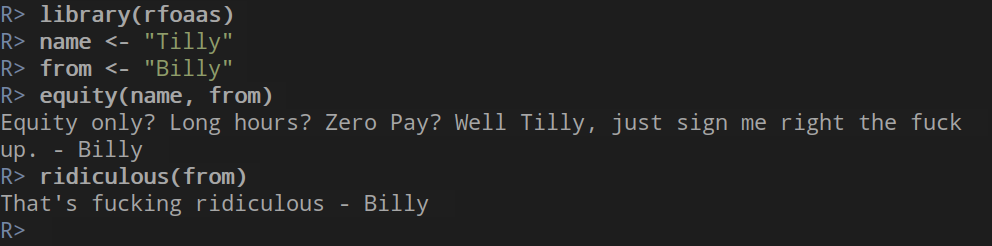
FOASS is back at a new site
/ url since late August! It restores original FOAAS functionality and full set of REST
access points including the language filters.
So this new rfoaas release
restores all accessor functions re-enabling full R access, documents,
and tests them. We re-enabled code coverage too. This corresponds to the
upstream version 2.4.0 in the forked FOASS repo, and by our
convention we use the same version number for the R package.
My CRANberries
service provides a comparison to the
previous release. Questions, comments etc should go to the GitHub issue
tracker. More background information is on the project page
as well as on the github repo
Welcome to post 59 in the R4 series.
How did we get here: A initial words about GitHub.
GitHub Actions
provides (essentially unlimited) compute time. This further boosts a
service already in a market-dominating position: GitHub1 as a code repository.
Those of us old enough to remember the start of git (the
program and protocol) may remember the extremely bare-bones
initial hosting site repo.or.cz (launched in 2006). GitHub
came two years later, and put an enormous amount of focus into design
and user interfaces. To cut a long story short, GitHub won the services
war. And with it git won the platform war. To a first
approximation, everybody and everything is on GitHub.2 So
the repository is already dominant.3 And then free compute
was added.
So given its scale and positioning, and its essentially free
provisioning of free multi-core compute setups with generally decent
connectivity, widespread adoption happened. And as is goes, some
mischief is bound to happen. And it did. More on that below.
A few words about r2u: r2u makes all packages on
CRAN, i.e. the code repository
network for R, install fast, reliably and
easy on Ubuntu by making them available to apt,
the native package manager. It is to our knowledge also the first and
only time an entire open source programming repository is available in
binary form with all dependencies resolved. It is going strongly: the
last monthly use topped
five million packages. See the r2u website for more.
r2u and GitHub: For the first few years,
builds for r2u
were done locally on my machine, and then uploaded to the primary
repositry r2u.stat.illinois.edu. I do not recall systemic outages or
connection issues though occassional network timeouts were seen. Once we
started to support arm64 (in addition to the default amd64) binaries,
building those switched to GitHub Actions simply because they had
runners for arm64 while I had no arm64 hardware. The experience of
building packages (in bulk) was rather positive. So we investigated
builds for amd64 too. If memory serves we first did this for either one
of the semi-annual BioConductor updates. Before long, builds for amd64
followed meaning all of r2u was being built in GitHub Actions.
During these builds, I would regularly encounter builds failures:
cannot connect to r2u.stat.illinois.edu . I misdiagnosed this as a
resource issue on the GitHub side, and consequently made (several)
attempts at robustifying the builds via for example longer (download)
timeout limits as well as checks for build failures and conditional
rebuilds. Needless to say, and given what we know now (more on that
below), this did not work. But it went on for a few months this spring
and summer. What did work was to simply relaunch under re-run failed
jobs . Given the distributed nature of GitHub Action this generally
allocates to a different machine and address and succeeds. In the grand
scheme of things a nuisance as we a need second run, but given the
fourty (!!) concurrent jobs this tends to be quick. So a minor
nuisance.
This discribed the production side. On the
consumption side, one prominent user of r2u, especially at GitHub,
is our r-ci setup for
continuous integration. It too could fail at times, and a simple re-run
would fix it. Annoying, if addressable manually. Usage by others I
cannot monitor so I can only assume that the random failure nature must
have frustrated them too. Potentially a much bigger nuisance.
As users were getting annoyed, some took action. Jeffrey Girard opened discussion
topic #159 which contained a thorough investigation of his
confirming that only amd64 nodes were affected. This had not been
noticed before. Troy
Hernandez set up a full harness with tests in an ad-hoc repo
designed for repeated remote triggering. This also logged the IP
addresses for success or failure. Through both these approaches it
became (eventually) clear that the failures were limited to either
certain (individual) IP addresses, or IP subnets.
When taking the conversation back to network service at U of
Illinois, we realized that the issue was in fact caused by a network
policy at the university. And specific to GitHub.
In fact, what happened initially were waves of port scanning attacks
originating from GitHub IP addresses. As (essentially) anybody can run
code there, bad actors can too. The response from the university side
was reasonable and swift: Identified IP addresses were added to a
null-router that (essentially) swallows traffic. And that was the
cause of the perceived-as-random outages: Jobs that ended up failing at
GitHub Actions were the ones assigned to addresses that have previously
been seen as port scanning.
Shifting production: Once this was confirmed, I
investiaged alternatives. On the production side using
different machines would help. So I tried blacksmith.sh, a competing
alternate service offering faster runners as drop-in replacements for
the GitHub Actions runners. This worked great, until I ran up
against my free cpu minutes quota . In a mere two days (that were
arguably overly busy as it was shortly after CRAN reopened after the summer
break). Given that the service would not sponsor us a supported open
source software project with sufficient quota, we moved off blacksmith.sh after two days.
A first programmatic response: consumption-side: For
the r-ci client side,
it was straightforward to setup a check and subsequent workaround. When
curl fails with a silent HEAD attempt at the primary
repository failed, we take this to be caused by presence of a
null-router entry for the IP we are on, and switch the apt
setup to the secondary repository. Which may be slower, or at rare times
unreachable itself but still provides a fine fallback when a node is
prohibited from talking to U of Illinois resources such as
r2u.stat.illinois.edu. Having used this for a few days in r-ci it seems to work.
A second programmatic response: production-side: For
the r2u builds, and
given that blacksmith.sh would
not grant most-favored status with sufficient free minutes, we
switched our Docker-based setup to switch to the secondary when an
initial probe fails. That was added last weekend, and appears to work
just swimmingly. Another application to the fundamental
theorem of software engineering: another layer of indirection can
solve just about any problem.
For completeness, the corresponding code is
webstatus=$(curl--head--silent--no-fail--output /dev/null \--write-out"% http_code " https://r2u.stat.illinois.edu true)iftest"$ webstatus " = "200";thenecho"The r2u repository is reachable."elseextip=$(curl--silent https://ipinfo.io/ip)echo"::notice::The primary r2u repository is **not reachable** from $ extip ."fi
We run an initial curl test (without failing) and have
it report the HTTP return code. 200 means no issue, all others are
suspect here so we run a second curl query to obtain our
external IP and log it. We use the same logic in another spot from
inside the build container and use the else branch to switch
apt to the secondary repository via sed call
on the .sources file.
Logging of bad IPs: On both our sides,
i.e. production as well as consumption, we now also log the IP addresses
of the failing nodes and will ask network security to remove these from
the null router. If our jobs can be assigned to them it clearly shows
the machines are part of the normal compute pool and are not
doing anything nefarious at the moment. So they should be removed from
the null-router list. We will see how that fares.
Putting it all together: Providing a free resources
can, sadly, lead to an a decline the service experience just as the tragedy of
the commons analysis would predict. Restricting, or pricing use
may be a stock answer but I for one am glad GitHub Actions is still
free. But we need to do our bit of upkeep. Just as network security logs
bad actors (taking advantage of the free resource) we should make an
effort to unlist nodes no longer part of any portscan (or alike)
swarm.
For r-ci users, there is hopefully little to do (if
you rely on the standard
action). We do now catch a node that was assigned a continuous
integration job cannot connect to r2u as we can test this
easily (and cheaply). Pivoting to the secondary repository is a valid,
and working, answer. Hopefully over time we can also work towards
restricting the null-router list down to recent entries and fewer
overall, thereby lowering the chance of gitting a bad IP. Eventually, we
could also overly a CDN proxy to avoid the bad IP problem. It is
something to consider.
Summing up: We are still chuffed at how successful
r2u has become, and how
much can be done with GitHub Actions. Sadly, as
we found out, there can also be a tax on letting compute happen there
but as discussed in this note, there are ways to avoid it by pivoting to
alternate repository source.
Before we really get started, one clarification. GitHub and its services including GitHub Actions have been
in the news lately as they suffered a number of high-profile outages.
While also arguably a tragedy
of the commons problem, it is not what this note is about. If
you prefer to be enraged about GitHub services, or the (relevant) lack
thereof, this may not be for you.
The year is 2026 and politics is what it is, of course
non-US alternatives emerged and will remain available and used. But
dislodging established first-mover advantages will most likely take more
than a (at least for now still-small) number of users unhappy for
various (and sensible) reasons. We will see how this pans out.
Entire essays (or book) can be / will be / have been
written about the competitive situation, how GitLab did not make enough
of a dent, how Gitea remained niche and of course now Codeberg. This is
not that essay, and I do not have a strong view but let me mumble a
quiet plus a change, plus a reste la m me chose
A new version 0.1.11 of the RcppExamples
package is now on CRAN, and has
been built for r2u.
RcppExamples
provides a handful of short examples detailing by concrete working
examples how to set up basic R data structures in C++. It also provides
a simple example for packaging with Rcpp. The package provides (generally
fairly) simple examples, more interesting, compelling (and generally
longer) examples are at the Rcpp
Gallery.
This releases updates a few Rd files to adhere to a stricter standing
of checking by R. The NEWS extract follows:
Changes in
RcppExamples version 0.1.11 (2026-09-03)
Add now-checked-for missing sections to manual pages
Another minor maintenance release version 0.1.5 of package RcppClassicExamples
arrived earlier today on CRAN,
and has been built for r2u. This package
illustrates usage of the very old and otherwise deprecated initial Rcpp
API which no new projects should use as the normal and current
Rcpp API is so much better.
This release follows one from six months ago, and is even smaller. We
just update a few Rd files to adhere to a stricter standing of checking
by R.
No new code or features. Full details below. And as a reminder, don t
use the old RcppClassic use Rcpp
instead.
Another new release of the gaussfacts package
arrived on CRAN. This follows a
recent one a good week ago, which had been the first in pretty much
exactly a decade!
gaussfacts
provides a fortunes-inspired
function to display randomly-chosen facts about Carl Friedrich
Gauss, based on the collection curated by Mike Cavers via the gaussfacts web site (with an archive.org link
it case it vanishes again). Each call of gaussfact()
displays another (randomly chosen, or indexed) fact.
This release corrects an old typo, thanks to an issue filed right
after the last release. It also adds a small (but useful) feature that
(most if not all of) the other fortunes-alike packages
already have: the ability to look up by (matching) character string.
So to take an example, asking for dice gets us these two cracker
quotes that still make me smile:
> gaussfacts::gaussfact("dice") # match stringGod does not play dice, unless Gauss promises to let him win once in a while. God does not play dice with the universe, but Gauss does. >
Thanks for an issue filed, we also corrected an old typo. The NEWS
file entry follows.
Changes in version 0.0.4
(2026-09-01)
Support character argument to support lookup via regular
expression
Correct one old typo in README.md
Otherwise, and always worth noting, this update had a particularly
speedy passage at CRAN taking a
whole six minutes:
Thanks to my CRANberries, there
is a diff to the previous
release. Questions, comments etc should go to the GitHub issue
tracker off the GitHub repo.
Posted on September 1, 2026
Tags: madeof:atoms, madeof:bits, craft:electronics, craft:paper
Remember the Conference Talk Timeout Ring?
Well, things may have escalated a bit.
The first thing that happened is that I may have accidentally added
more RGB LED rings, one for each size to an order
of things that we actually needed, because they were cheap and
potentially shiny (and I may have ideas that involve the big ones, but
they are still just vague ideas).
When they arrived, I played a bit with them to check that they were
working, and one was used in a pinch as a light while soldering, and
worked nicely.
In the same order there was also a Raspberry Pico2 W and I
decided to use it instead of the ESP32-C3-DevKit-Lipo
I ve used a lot lately because it has better support1 in
CircuitPython.
So, I have an RGB LED ring with a multiple of 12 LEDs and a
microcontroller board with a lot of memory and wifi, what I m going to
do? a grandfather clock, obviously. Except our grandfathers didn t
exactly have LEDs, so it s going to be a granddaughter clock.
Have I mentioned that things escalated? well, of course I wanted the
clock to show the time, but I also wanted it to be able to turn into a
flashlight, and to run a countdown for conference talks and any other
need, and to tell me if there are things that need to be taken care of
around the house, and
And I have an MQTT server and a number of sensors around the house that
provide environmental data, and I decided I might as well use it for
other things.
So I designed this to listen to an MQTT topic for commands, another MQTT
topic for data, and to switch between modes when instructed to do so by
a command.
Other considerations included the fact that this is keeping a number of
LEDs on, so I didn t even try to reduce power usage to run it on battery
power for significant amounts (weeks) of time (although running it from a
power bank seems to work for shorter durations I m thinking a day or
two).
And then it was time to fix the part where recognising the first LED on
a ring is hard, and I decided to grab my Art Attack supplies and make a
case in the shape of a grandfather clock, scaled down to a suitable
size for keeping on a desk or bookcase.
I used some IKEA box to make a structure, glued it with hot glue, and
then wrapped everything with paper napkins and PVA for added strength,
plus a bit of tarlatan for the door hinge.
I opted for a very cartoonish look (and yes, if you are old enough that
it resembles something, there was a vague source of inspiration in a
cultural artefact of the early 1990) with just a clock face that fits in
by friction, a hinged door to access the electronics and a bit of
decorative trimming at the top.
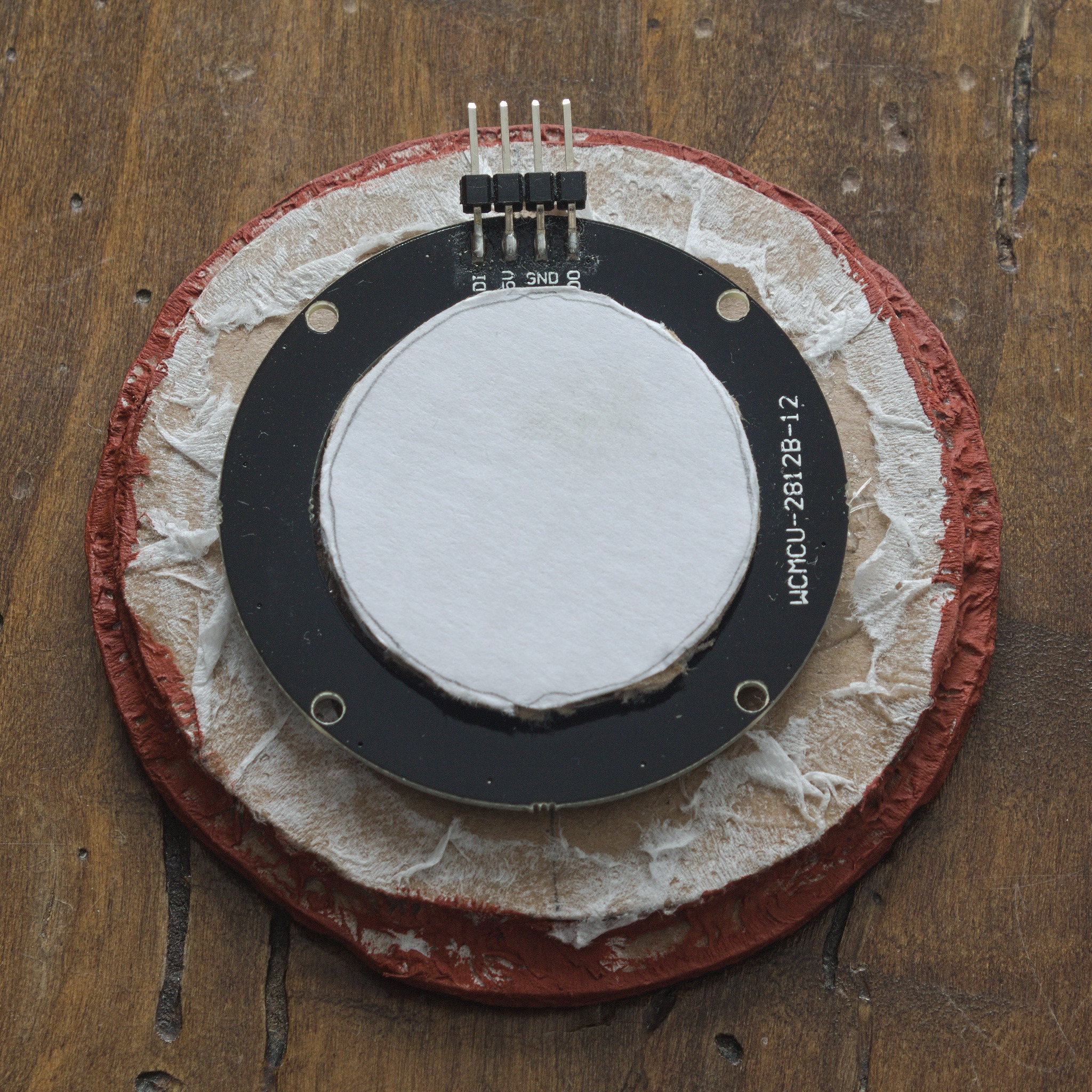
For the face I decided to make holes in the cardboard and fill them with
hot glue to make a sort of light pipe, with the LEDs pressed against
them on the inside. It s not perfect, but it mostly works.
And then everything stopped: while I waited for the PVA to dry I started
doing something else, and then there were other projects, and other, and
the clock lingered in the Pile. There was a brief interruption as I
started to paint the first coat of brown, and then I moved back to the
other projects.
Until, months later, I decided it was time to finish using the brown and
white tubes of paint that I had on my desktop, so I could put them away
2, and in a reasonable time I finished painting the clock,
including a second coat of brown, and black contour lines to add a bit
of depth in a way consistent with the cartoonish look.
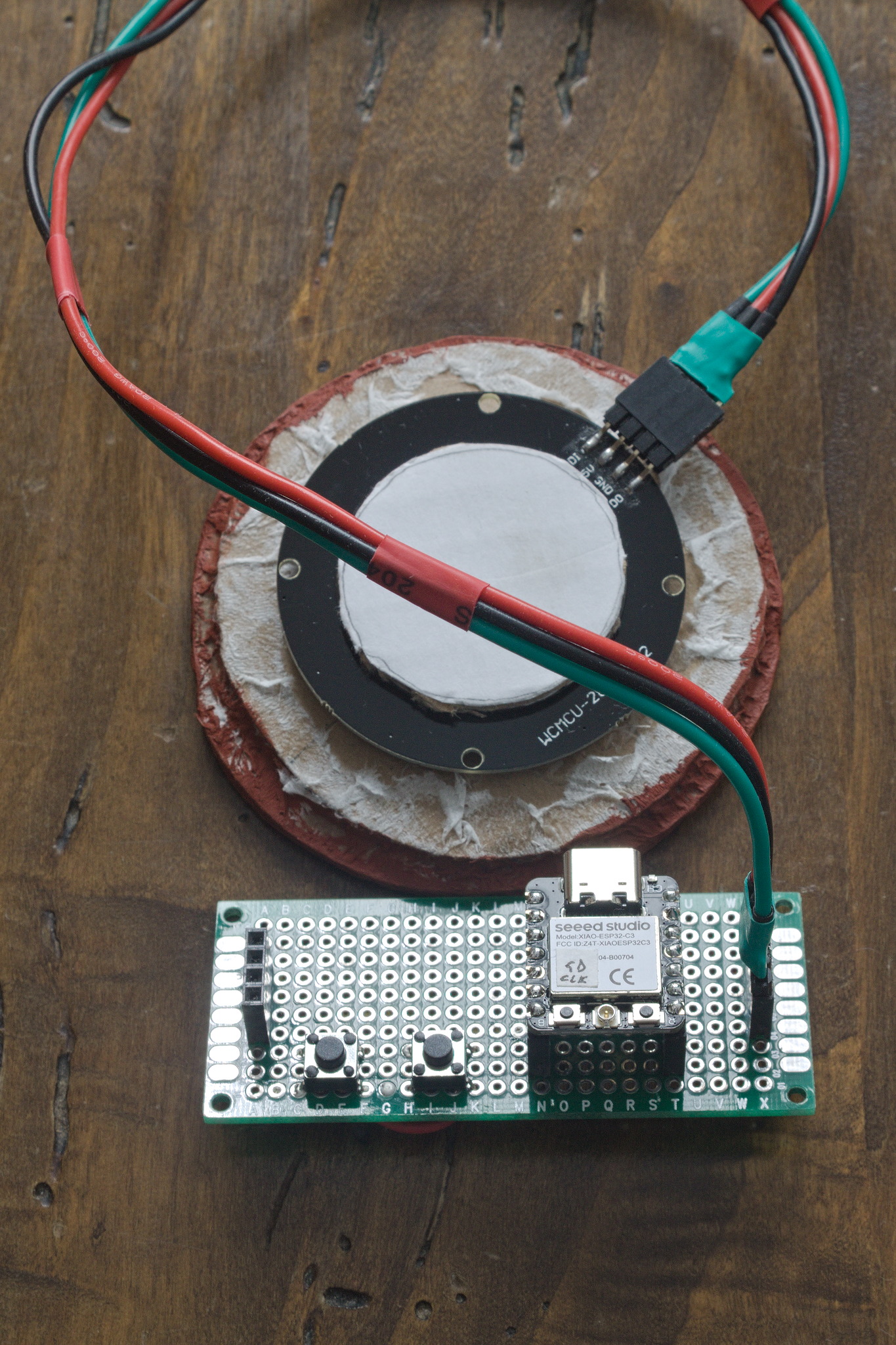
And then it was time to go back to the internals: I got the LED ring and
raspberry pico back from their respective drawers, connected them with
dupont cables and fit them in the case for a test: it worked.
However, the raspberry had quite a lot of pins, and it felt wasteful to
use it on something that basically needs one. On the other hand, I had
recently bought a few Seed Studio XIAO ESP32C3 for
another project3, and those are quite smaller, and also
slightly cheaper, and I could spare one out of the 13 I had.
Up to now on the XIAO boards I had been using MicroPython: I had
started to use it on the ESP32-C3-DevKit-Lipo because, contrary to
CircuitPython, the generic ESP32-C3 image worked on it, and on the ESP32
boards there is no CIRCUITPYTHON partition, which in my opinion is
one of the advantages that make CircuitPython more convenient to use
than MicroPython.
However, the code I had already written for the clock used
CircuitPython, so I flashed one of the XIAOs with the other interpreter,
and after changing just one pin definition the software I had worked.
Going back and forwards between the two interpreters will be
interesting, especially since I have already started to write some code
for the other project in MicroPython, and they are supposed to
interoperate. I may end up rewriting one of them, if I start getting
hindered by the subtle differences.
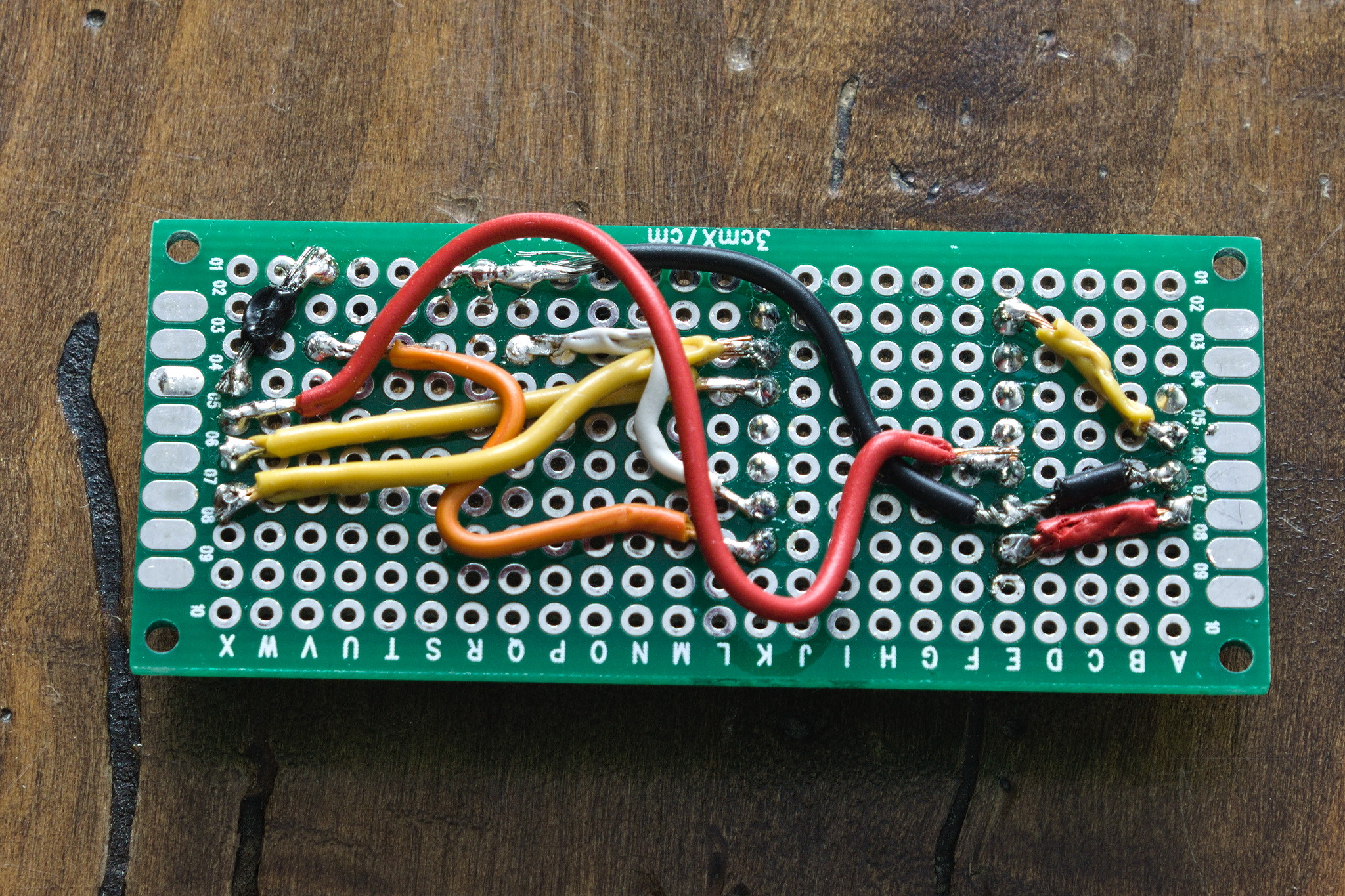
The next step involved dealing with the temporary connections to make
them a bit more permanent: I have been using LibrePCB for that other
project, so of course what I did was grabbing a bit of perfboard and
YOLO a growing rat nest of cables over it, without bothering with
drawing any kind of schematics in advance. And having to desolder stuff
and solder it again a couple of times, because I had issues with the
difference between left and right, and with the concept of rotations in
3D space.
Everything was brought back into the case, in a mostly stable
configuration with an usb cable coming out of a hole in the back for
power and surprisingly it works.
Or at least, 95% of the issues it still has are software, plus I still
need to add a few features, so right now it lives above my desktop, with
the cable dangling close to an USB port, so that I can continue working
on that in the next few weeks.
The external look is not going to change, so there will be changes on
the git repository,
and there may or not be a third post here in the future, depending on
whether there will be something funny or interesting, or it will just be
small incremental improvements.
I think that CircuitPython on the ESP32-C3-DevKit-Lipo
only requires fixing two PIN definitions in the files for a very
similar board and a recompile, but the latter part looks like a PITA
and I haven t committed to it.
to make room for other crafting supplies for other projects,
of course.
yes, it will be blogged! unless it fails in a
catastrophic way and gets buried under a layer of litter to forget
about it. :D
I ve been a Debian user since 1999, and a Debian developer since 2000. Given recent events it s worth thinking about why that that is, and why I haven t switched to something else in the past quarter century.
My first Linux distro was Slackware, off a CD in a book, some time in the mid 90s. After starting university I ran SUSE for a while, then moved to RedHat (both back before they had commercial variants significantly different to what was available freely). The main motivation for switching was package management; I was running a machine at home, and a machine at university. Keeping track of what was installed on each, and what versions, was getting annoying with Slackware. Most of the folk I knew were running RedHat, and I mostly played with SUSE because I m contrary before realising it was different enough that I couldn t easily make use of 3rd party RPMs.
I came to Debian via friends in Cambridge, who spoke highly of it. The first Debian machine I installed was fourier, the initial host for Black Cat Networks, and I never looked back.
(For additional context I should also point out I have contributed, in the distant past, to, and run, OpenWRT, OpenEmbedded, and FreeBSD.)
I d like to try and work out what is it I get from Debian that I d need in anything else. Originally I tried to order the requirements in some sort of priority, but it s sometimes hard to work out what I d drop if I had to compromise somewhere, so it s a somewhat loose ordering.
Stable releases, with security support
I run Linux in lots of places, from remote servers/VMs, to my house router, to my desktop/laptop. Some of those I don t want to be updating regularly with new software releases, I need something I can be sure is going to keep working, but will get necessary security + critical updates. A rolling distro that provides security via the latest upstream release doesn t provide that guarantee. Equally there need to be regular stable releases, or things become too stale. (The one time I considered moving away from Debian was during the 3 year Sarge / 3.1 release cycle. I think if things hadn t improved I d have jumped ship to Ubuntu at the time.)
A good selection of packages
One of the reasons I moved from RedHat to Debian was the wide range of packages available as part of the standard OS. Pulling it all into the distro helps with quality control, compared to random 3rd party packages. A centralised bug system and repository is a win too. Perhaps packages at all is something I should list, but I take it as a given if you re running a distro. I need to know what I have installed on my machine, what version that software is, what files it owns, and what it depends on.
Free Software
This is important to me. I ll make pragmatic compromises about software I run on my systems if it makes sense, but I want to start from a place that does not require anything non-free. I ve run a company on Debian, and I ve worked on numerous products that ran it under the hood. The DFSG give me confidence I can do that.
Smooth upgrades
Debian s ability to upgrade a system smoothly is one of the reasons I first moved to it. The first upgrade I did was remotely on a machine sitting on a 2Mb/s leased line. I was nervous doing the reboot at the end, but it came back fine. At the time the equivalent procedure with RedHat involved rebooting into the OS installer to do the upgrade.
I know things have moved on since then, and really it should all be scripted, and machines should be cattle not pets, but for personal use I run a small enough number of machines that having the upgrade path between releases is a must have.
Community
The original pull of the Debian community was the knowledge I could get involved, and upload packages that were missing that I was using. That s how I first got involved, uploading things Black Cat used, which made life easier for us in the long run. I don t have time to maintain all the software I use myself, and I don t want to be beholden to a commercial entity to do so for me, so a distribution that allows me to help out where I can as part of the community seems to me to be the right way to do things.
Architecture support
Perhaps less important, especially when I started using Debian, but these days I have amd64, arm64, armhf, and riscv machines. Everything except for the risvc box is doing something useful, and would need replaced if I couldn t keep running it, and I expect RISC-V to transition into that state in the next few years as the hardware improves.
Binary packages
I ran a FreeBSD desktop for some time. It might have been the way I was holding it, but binary package installs were generally not something reliable, especially after the initial install, and I ended up building things from ports from source quite often. That worked incredibly well (I used to think people who raved about Gentoo really should just go do it properly and use FreeBSD), but I don t want to spend time compiling things, especially on some of my machines (my router should not need a compiler, for example).
Ultimately I don t want to have to actively think about the Linux distribution I use. Debian has mostly given me that; I know it will generally be suitable for most environments I want to use it in (embedded situations where OpenWRT or OpenEmbedded are better choices being the exception, but that s less frequent these days), and I can rely on getting timely security updates (thanks to all those who work on that within Debian!). I m not sure there s currently an alternative that would suit my needs? I d love to hear if there s something I should look at, even if I m not necessary making a move just yet!
Another pure maintenance release of the random package for
truly (hardware-based) random numbers as provided by random.org is now on CRAN. The random package
provides true (physical) random number from sampling atmospheric noise.
One possible use case is to seed an (algorithmic) quasi-random number
generator for genuine unpredictability.
This release, the first in nine years, updates the package files,
URLs, and continuous integration setup. We also ensure all posted URLs
in the two vignettes (and other documentation) are reachable.
Courtesy of my CRANberries, there
is also a diffstat report for this
release.
An updated version of the corels package is
now on CRAN! The Certifiably
Optimal RulE ListS (Corels) learner provides interpretable decision
rules with an optimality guarantee a nice feature which sets it apart in
machine learning. You can learn more about corels at its UBC site.
This released fixes an issue discovered on one of the test machines
used by Brian Ripley. If and when C compiler flags are set locally that
are in fact upsetting the C++ compiler, then the build fails. While not
an issue for years and not reproducible on (vanilla) Debian, Ubuntu or
Fedora machines it does indeed balk at his end as e.g. the flag
-Werror=implicit-function-declaration he sets for C is
incompatible with the current C++ compiler. The fault was our:
CFLAGS was passed on to PKG_CXXFLAGS letting C
options seep into C++ deployment. This has been corrected: we only deal
in C++ flags now.
Courtesy of my CRANberries, there
is also a diffstat report for this
release.
A new minor release of prrd arrived at
CRAN this morning: the a first
release in two and a half years. prrd facilitates
the parallel running [of] reverse dependency [checks] when
preparing R packages. It is used extensively for releases I make of Rcpp, RcppArmadillo,
RcppEigen,
BH, and
others.
The key idea of prrd is simple,
and described in some more detail on its webpage and
its GitHub repo.
Reverse dependency checks are an important part of package development
that is easily done in a (serial) loop. But these checks are also
generally embarassingly parallel as there is no or little
interdependency between them (besides maybe shared build depedencies).
See the (dated) screenshot (running six parallel workers, arranged in a
split byobu session).
This release updates continuous intgegration files, switches to
Authors@R, and robustifies one SQLite aspect.
The release is summarised in the NEWS entry:
Changes in prrd
version 0.0.7 (2026-08-27)
Updates to DESCRIPTION have been made as CRAN requirements
change
The continuous integration setup was updated several
times
The database connection now uses sqliteSetBusyHandler
 A new release 0.0.5 of the RcppFastAD package
is now on CRAN, has been built
for r2u, and updated
at r-universe.
This comes (to the day) two years after the preceding 0.0.4 release.
RcppFastAD
wraps the FastAD
header-only C++ library by James which provides a C++
implementation of both forward and reverse mode of automatic
differentiation. It offers an easy-to-use header library that is both
lightweight and performant. With a little of bit of Rcpp glue, it is also easy to use from R
in simple C++ applications. This release updates the continuous
integration setup as one does, adds a local configuration helper to
quieten compilation (described also in this
blog post). It also adds a defensive setting for
 The third release (in twelve years !!) of the


 I m looking at something entirely unrelated, but tripped over some search results that made me realise that a lot of people still think getting errors like

 Another new release of the
 Thanks to my
 Remember the
 For the face I decided to make holes in the cardboard and fill them with
hot glue to make a sort of light pipe, with the LEDs pressed against
them on the inside. It s not perfect, but it mostly works.
And then everything stopped: while I waited for the PVA to dry I started
doing something else, and then there were other projects, and other, and
the clock lingered in the Pile. There was a brief interruption as I
started to paint the first coat of brown, and then I moved back to the
other projects.
Until, months later, I decided it was time to finish using the brown and
white tubes of paint that I had on my desktop, so I could put them away
 However, the raspberry had quite a lot of pins, and it felt wasteful to
use it on something that basically needs one. On the other hand, I had
recently bought a few
 The next step involved dealing with the temporary connections to make
them a bit more permanent: I have been using LibrePCB for that other
project, so of course what I did was grabbing a bit of perfboard and
YOLO a growing rat nest of cables over it, without bothering with
drawing any kind of schematics in advance. And having to desolder stuff
and solder it again a couple of times, because I had issues with the
difference between left and right, and with the concept of rotations in
3D space.
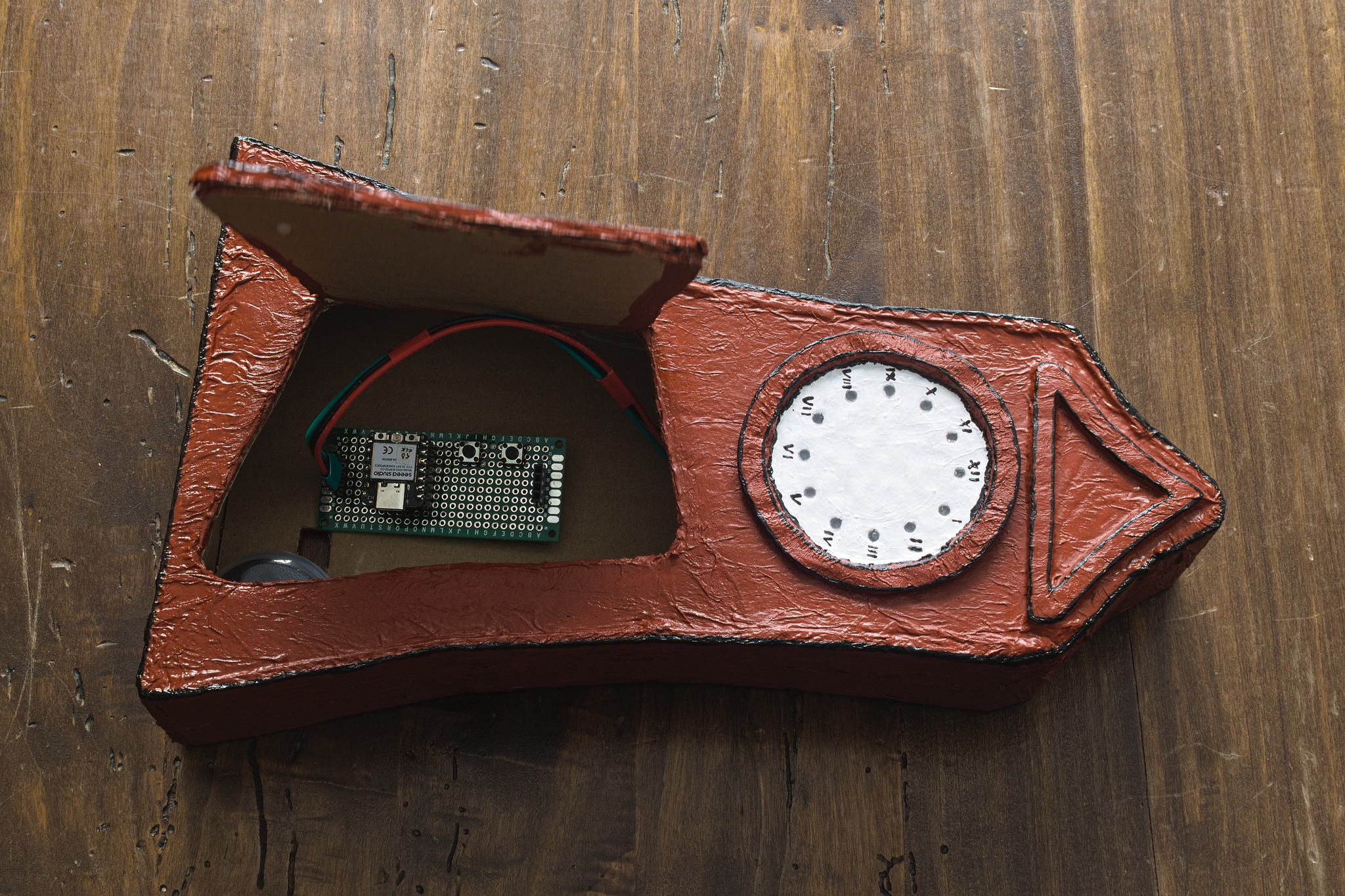 Everything was brought back into the case, in a mostly stable
configuration with an usb cable coming out of a hole in the back for
power and surprisingly it works.
Or at least, 95% of the issues it still has are software, plus I still
need to add a few features, so right now it lives above my desktop, with
the cable dangling close to an USB port, so that I can continue working
on that in the next few weeks.
The external look is not going to change, so there will be changes on
 I ve been a
 The key idea of