Search Results: "ean"

20 October 2026

Thadeu Lima de Souza Cascardo: Restricting device memory usage on Linux 7.3

Linux cgroups has been used for a while to group processes and control their access to certain system resources. One of those resources is memory, through the use of memcg. That control is dynamic, allowing for cgroups to setup a minimal and a maximal amount of memory, as well as low and high thresholds, which will control the reclaim process. But what about device memory that is not available as system RAM? Memory that is not available to the Linux page allocator? One of those device memories is GPU VRAM. That's where the dmem cgroup controller comes in. Introduced in Linux 6.14, it was first adopted by the Intel Xe driver. In Linux 6.15, AMD amdgpu driver also adopted it. In 7.3, it was adopted by nouveau. Such a cgroup controller allows the system to be configured such that a workload, be it a browser, a game, or another GPU rendering process can have some minimal VRAM available. Or it can prevent one of these processes from using all VRAM, preventing your compositor from using it, for example. Let's go through the system knobs that are available to control this and what's new in Linux 7.3. dmem regions and dmem.capacity Since a given system might have multiple GPUs, there might be multiple device memory regions. So, on dmem, each such region is described by a name. Every dmem cgroup setting file will contain one line per region. One of those files shows the capacity of each region in bytes and is present only in the root cgroup. After enabling the dmem cgroup with the following command:
# echo +dmem > /sys/fs/cgroup/cgroup.subtree_control
One can inspect the capacity of any available regions by looking at dmem.capacity at the root cgroup:
# cat /sys/fs/cgroup/dmem.capacity
drm/0000:03:00.0/vram 8573157376
That shows that the GPU at PCI address 0000:03:00.0 has a 8176MiB VRAM dmem region. dmem settings When introduced at 6.14, the following settings were available. dmem.current In every dmem cgroup, including the root cgroup, the dmem.current is a read-only file that shows the current usage of each region by the given cgroup.
# cat /sys/fs/cgroup/user.slice/dmem.current
drm/0000:03:00.0/vram 292757504
Here, it shows that user.slice cgroup is currently using above 292 MB of VRAM.
# cat /sys/fs/cgroup/dmem.current
drm/0000:03:00.0/vram 311377920
Here, we can check that total system usage is above 311 MB. dmem.max Excluding the root cgroup, dmem cgroups can control the maximal number of bytes that can be allocated from a region by processes in that cgroup. If an allocation moves the usage above the max setting, it will be refused. In that case, the allocation might be attempted at system memory or it might trigger eviction, depending on the allocation parameters and the driver. Here, the max value has special meaning, which is unrestricted usage.
# echo drm/0000:03:00.0/vram 536870912 > /sys/fs/cgroup/user.slice/dmem.max
# cat /sys/fs/cgroup/user.slice/dmem.max
drm/0000:03:00.0/vram 536870912
# echo drm/0000:03:00.0/vram max > /sys/fs/cgroup/user.slice/dmem.max
# cat /sys/fs/cgroup/user.slice/dmem.max
drm/0000:03:00.0/vram max
dmem.min dmem.min, also not available on the root cgroup, will control the eviction process - when memory needs to be moved out of VRAM to make room for other VRAM allocations. If an object belongs to a cgroup which is using less than its min setting, it will not be considered for eviction. It effectively works as a hard protection such that the cgroup can use at least the minimal setting. Given multiple cgroups may set a minimal value that exceeds the device memory capacity, it computes an effective minimal depending on the hierarchy. dmem.low While dmem.min works as a hard limit, dmem.low is a soft limit that will prevent eviction in case other objects from different cgroups are available for eviction. That is, the system will try to evict from different, possibly unprotected cgroups, before it tries to evict from a cgroup if evicting would leave its usage below the value set as dmem.low. Recent developments in Linux 7.3 Some new changes have been recently introduced in the dmem cgroup controller and its integration with GPUs. One of those is a new read-only file, dmem.peak, which was introduced to allow the peak usage of a region in a cgroup to be inspected. Also, Linux 7.3 fixed certain scenarios where a given cgroup would not be able to allocate VRAM up to its minimal or low limits if other processes had already allocated most of VRAM, even though they had no such limits set. Changing multiple regions' settings in a single write was possible before 7.3, but it was prone to failures which would not be reported to userspace and might have left the values partially updated. Starting with 7.3, only one region may be updated per write. And, finally, prior to 7.3, setting dmem.max in a cgroup that was using more than the new setting would silently fail. Now, there is a mechanism that allows a reclaim mechanism to be triggered. That way, when a process writes to dmem.max and sets a maximal value below the current usage, it will wait (unless O_NONBLOCK is used) for the reclaim process to move objects out of VRAM until the usage gets below the maximal value. If that is not possible for some reason, the setting will still be in place, restricting further alloctions by that cgroup.

16 October 2026

Dirk Eddelbuettel: RcppSimdJson 0.1.17 on CRAN: Updates

A brand new release 0.1.17 of the RcppSimdJson package is now on CRAN, and has been built for r2u and on r-universe. RcppSimdJson wraps the fantastic and genuinely impressive simdjson library by Daniel Lemire and collaborators. Via very clever algorithmic engineering to obtain largely branch-free code, coupled with modern C++ and newer compiler instructions, it results in parsing gigabytes of JSON parsed per second which is quite mindboggling. The best-case performance is faster than CPU speed as use of parallel SIMD instructions and careful branch avoidance can lead to less than one cpu cycle per byte parsed; see the video of the talk by Daniel Lemire at QCon. This release is a small increment relative to the 0.1.6 release last week that got us (upstream) version 5.0.2 with many notable changes and sizeable speed gains on all fronts, including the interface from R. However, this failed to compile at CRAN on macOS x86_64 as the machine is setup for only partial support of C++20: no ranges, no concepts. So we now test, and fall back to C++17 if the test compilation fails. Upstream, meanwhile, already got to 5.0.5 which is included. It also gets us improved handling of disabling pragmas which we hope will survive CRAN checks. The brief NEWS entry for this release follows.

Changes in version 0.1.17 [unreleased] (2026-10-xx)
  • Compilation starts with a C++20 feature test; if this fails C++17 is used (Dirk in #111 fixing #110)
  • simdjson was upgraded to version 5.0.5 (Daniel in #112)

Courtesy of my CRANberries, there is also a diffstat report for this release. For questions, suggestions, or issues please use the issue tracker at the GitHub repo.

This post by Dirk Eddelbuettel originated on his Thinking inside the box blog. If you like this or other open-source work I do, you can now sponsor me at GitHub.

Freexian Collaborators: Monthly report about Debian Long Term Support, September 2026 (by Santiago Ruano Rinc n)

The Debian LTS Team, funded by Freexian s Debian LTS offering, is pleased to report its activities for September.

Activity summary During the month of September, 20 contributors have been paid to work on Debian LTS (links to individual contributor reports are located below). The team released 41 DLAs fixing 1854 CVEs. In September, the Debian LTS Team was back to focusing on a single release: Debian 12 ( bookworm ). Debian 11 ( bullseye ) reached the end of its Long Term Support on 31 August 2026, and Freexian now provides its security maintenance under the Extended LTS offer. It is important to highlight the hard work done behind the scenes of the Front Desk fellows, whose role was fulfilled during September by Emilio, Emmanuel, Sylvain, Thorsten and Utkarsh. Besides the very high activity doing daily triage on dozens of packages and CVEs, Front Desk fellows spent much of their time answering questions and coordinating with people outside the Freexian team about update proposals. The team published several notable updates:
  • jbig2dec (DLA-4779-1), prepared by Andreas Henriksson, fixes CVE-2026-38076, where missing input checks could lead to a denial of service. It is to note that this library is used by different tools, such as ghostscript.
  • linux-6.12 (DLA-4788-1), uploaded by Ben Hutchings, fixing 414 CVEs in the bookworm backport of Linux kernel version 6.12.
  • lxml (DLA-4799-1), prepared by Guilhem Moulin, fixes four vulnerabilities in this widely used python XML/HTML library. The issues may yield to exposing local files.
  • nginx (DLA-4784-1), issued by Carlos Henrique Lima Melara ( charles ), fixing three memory-safety bugs in this popular web server and reverse proxy, which may result in denial of service, memory disclosure or potentially the execution of arbitrary code.
  • openssl (DLA-4795-1), by Arnaud Rebillout, fixing six vulnerabilities, including an out-of-bounds heap write in CMS decryption and an authentication tag verification bypass in ChaCha20-Poly1305/AES-OCB decryption. This update brings bookworm to OpenSSL 3.0.22, the last upstream release of the 3.0 series, which was reached its upstream EOL on 7 Sep 2026. Further fixes will be backported by the Debian LTS Team from more recent releases.
  • redis DLA-4794-1, by Chris Lamb, fixing vulnerabilities that could yield to arbitrary code execution
Contributions from other Debian fellows beyond the Freexian LTS Team:
  • Thomas Goirand, Keystone released by Emilio as DLA-4767-1
  • Thomas also prepared glance and swift updates, whose respective DLA-4800-1 and DLA-4801-1 were issued by Charles
  • Matthew Vernon uploaded a pcre2 security update, and Emilio issued its DLA-4772-1
  • Otto Kek l inen uploaded a xz-utils update, released as DLA-4783-1 by Sylvain
  • Salvatore Bonaccorso published a linux (6.1) update released as DLA-4777-1
  • Xavier Guimard prepared a lemonldap-ng, released as DLA-4797-1. Additionally, Sylvain sent DLA-4734-1 at the beginning of the month for the upload made on August.
  • Xavier also released DLA-4766-1 for cyrus-imapd.
  • Simon Quigley uploaded DLA-4803-1 to fix multiple issues in ruby-oj.
  • Finally, Ivo Marino proposed bookworm updates for cjose, git-lfs, caddy, libgit2, libwebsockets, libssh and unbound. Some of Ivo s proposals are still pending for a review.
Thank you so much to the developers above for these valuable contributions. The LTS Team has also contributed with updates to the latest Debian releases for the following packages:
  • ruby-jwt, prepared by Abhijith and released as DSA-6547-1
  • urwid, proposed for a point-release update by Abhijith (#1148950)
  • puma, proposed for a point-release update by Abhijith (#1149582)
  • tomcat10, and tomcat9 (which is actually backported to released suites) by Bastien
  • nodejs, prepared by Bastien and released as (DSA-6517-1).
If you benefit from Debian, especially throughout its full 5-year lifecycle, please consider becoming a sponsor of Debian LTS. You can find more information here: https://www.freexian.com/lts/debian/.

Individual Debian LTS contributor reports

Thanks to our sponsors Sponsors that joined recently are in bold.

15 October 2026

Matthew Garrett: Epic's EAC2 v2 seems fairly easily bypassable

Epic just announced the upcoming version 2 of their Linux implementation of Easy Anti-Cheat. It s based on using the Linux eBPF security module to monitor what s happening, and then a bunch of extra infrastructure to make sure this can t be bypassed. The core part of this is requiring secure boot be enabled (ensuring that modified kernels can t be used), using measured boot to verify that secure boot is enabled and which keys are used (to prevent you from just signing your own modified kernel), and then doing remote attestation, a mechanism where the TPM generates a signed copy of the boot measurements and passes that off to a server which verifies it came from a real TPM, verifies that you have secure boot enabled and are using the right keys, and presumably then allows you into the game. This is all fine as long as you can prove that the measurements provided are real, and that s actually a lot harder than you might think. First, we can simply make up our own quote signed with our own key and say that it came from a TPM. This is avoided by every TPM having an Endorsement Key (or EK) and an associated certificate, with that certificate being signed by the TPM vendor. If you have a list of all the legitimate TPM vendors and their CA keys, you can verify that the measurements came from a real TPM. Easy enough. So we need to get the measurements from a real TPM, and the one on our motherboard contains the measurements that were generated by the firmware and bootloader, and we can t reset those at runtime without resetting the TPM, which oh huh there s actually nothing stopping us from doing that at runtime, as long as we have access to the hardware. Many desktop boards have the TPM on a small plugin module with a standard pinout that includes a reset pin. Simply short that to ground briefly and the TPM is back in its initial state, and userland can write whatever measurements it wants to it. Boot a modified kernel which lies to the eBPF code? As long as you replay the expected log values from a boot with secure boot on and a trusted kernel, the TPM will still happily provide a legitimate set of measurements that ll satisfy the checker. What if the TPM is less accessible, either because it s mounted directly to the motherboard or it s inside the CPU or chipset? That s going to be trickier. But here s the thing. The quote needs to come from a TPM, but not necessarily the TPM on your motherboard. TPMs these days are usually connected via the Serial Peripheral Interface, usually referred to as SPI. Microchip make a USB to SPI bridge, and there s a Linux driver. Wire one of those up with an appropriate header and you can plug in an easily available TPM module intended for plugging into a motherboard, and now we tell the kernel to ignore the motherboard TPM and make /dev/tpmrm0 point at the USB one and program it with a set of trusted measurements and once again everything is going to look just fine (yes obviously the eBPF code can look for this, but we re running a modified kernel so we can just lie to the eBPF code). Remote attestation on PCs just doesn t work that well in environments where you can t associate a specific TPM with a specific system, which is basically everywhere except enterprises. But maybe that doesn t matter and cheaters wouldn t be willing to spend the $20 or so it d take to produce one of these things? That would seem somewhat surprising, but it s not impossible. And obviously any server-side cheat detection that triggers could then block that specific TPM, meaning they d need to go and get another TPM, and maybe that ends up being enough to discourage people from bothering. From a practical level, this may be sufficient. But at a technical level? It s not great.

14 October 2026

Russ Allbery: Review: Ties That Bond in Gretna Green

Review: Ties That Bond in Gretna Green, by Linzi Day
Series: Midlife Recorder #3
Publisher: Linzi Day
Copyright: February 2023
ISBN: 9798376517017
Format: Kindle
Pages: 616
Ties That Bond in Gretna Green is a self-published fantasy novel and the third book in the Midlife Recorder series. As with the previous book, it picks up almost immediately after Painting the Blues in Gretna Green. Day calls the genre paranormal women's fantasy, and that sounds about right to me. There is an intervening short story that you can get by joining Day's mailing list (along with an epilogue to the first book and to this book). I don't think it's that important, but there are frequent references to it at the start of this novel that become somewhat annoying if you haven't read it. Valentine's Day is fast approaching. This the busiest day of the year for the part of the Recorder's job that Niki already knew how to do: marrying people. She performed marriage ceremonies in her previous job before her inheritance, and she loved that work despite her awful boss. Performing marriages in the Gateway sounds even more rewarding, but the sheer number of couples and the political complications from the first two books create logistical problems she has to solve first. Also, the remaining member of her staff held over from her grandmother's time has returned from vacation to discover that Niki has upended most of what she thought she knew about the job. Time for Niki to apply what she learned from the change management training her old boss forced her to attend and then ignored! (If you just groaned, rest assured that Day somehow makes this work, although she clearly has a higher opinion of corporate training than I do.) This plot was more to my taste than Painting the Blues, mostly because Niki seemed on top of the problems and didn't postpone looking at them for half the book. There is more of the management competence porn that readers have come to expect of the series, a few more revelations about Niki's magic, more mysterious manifestations and the first mention of a prophecy, and a few political developments. As always, the pacing is exceptional. These books grab me and pull me along, page after page, often robbing me of sleep because I find them nearly impossible to put down. Ties that Bond (and to some extent the last book) looked like it was going to introduce a romantic subplot, and I was preparing to be annoyed by it because I did not like the man in the subplot at all. I won't spoil how it works out in this book, but I will say that Niki surprised me and showed more sense than I thought the author was telegraphing. This is not the first time that Day has surprised me with what I thought was foreshadowing that did not turn out how I expected, usually for the better. If she can keep that up, it's a nice effect (if a bit unbalancing) and adds to my desire to read just one more chapter. The way the world-building of these books is structured continues to intrigue me. Day gets away with some problems that I think would be more noticeable in other books thanks to the excellent pacing (no time to ponder the world-building, we're on to the next crisis!) and the tight third-person perspective. Niki is not a detail person, to say the least, but she does keep returning to bits of world-building and poking at them a bit harder, which gives Day repeated opportunities to shore up ideas that felt shaky and dubious at first glance. Still, this is not a book that prizes deep logical consistency or full exploration of the ramifications of a bit of magic. You have to be willing to go along with the ride and not think too hard. For example, Niki can see bonds between couples and judge their strength. This is apparently a long-standing power of the Recorder's line (she was able to do that before she became the Recorder), and part of her responsibility in these weddings is to check the bonds of the couples. This leads to some well-handled scenes where she diagnoses a problem or resolves a conflict because she can magically see the true relationship structure. Everyone in the book just takes this power in stride. This is wild to me! This ability would completely upend half of society if you fully worked out its ramifications and could find people other than Niki with the same ability. Even if one assumes that a bond only forms over time and can't be sensed in the early stages of a relationship (something the book never establishes), can you imagine the implications of having an infallible oracle that says at a glance whether a marriage will work (permanently, the book strongly implies)? The implications for how to structure marriage, for family planning, for psychology and psychiatry, for how to structure dating, even for living arrangements and housing markets? This is not a small world-building detail, and yet it's treated more like part of Niki's characterization than like a foundation of society. I think some of this all-vibes world-building may come from the general new-age feel to how magic works. Day makes a grab-bag of random magic canonical in this world: psychic lie detecting abilities, auras, chakras, premonitions, and other bits of the sort of spiritualism that tends to be heavily marketed to middle-class women. I have that niggling feeling that one sometimes gets in SF that a lot of this is in the world-building because the author believes it's partly real (see, for instance, psychic powers and the Dean drive in 1960s science fiction). If one believes that psychic powers and various bits of mysticism are true in our world, one has already developed the rationalization mechanisms to explain away their almost total lack of influence or impact on how the world is structured. If one then introduces them into a true fantasy world, one may not notice how many implications that should have for how society is structured, since one is used to believing magic exists but has no significant implications. I could be entirely wrong about this analysis, and maybe it's a bit unfair to Day. I should also be clear that this is not a complaint, just a point of fascination to me when I think back over one of these books after I finished it. There is a glut of fantasy out there that's constructed like an engineering problem or that goes deep into politics or social theory, usually written by people with strong opinions but not a lot of training in real sociology. One of the joys of self-published books is that you occasionally get something that assembles genre conventions in a way that feels odd and delightfully strange. What if, in addition to dimensional gates and overwhelming protean power invested in a true heir, all the magic sold by the local Tarot and crystal store was also true? Sure, why not! If the pacing is good and the story is grabby, it works for me. It does seem worth attaching a warning for the folks who need scientific reproducibility and explored implications in their world-building, though. If you're the sort of reader who is bothered by political boundaries and economic systems that match our world despite the existence of magic, this series may cause you problems. This continues to be a grabby, highly entertaining story of a woman who finally gets to run her own small business the way that she always thought the business should be run after years of working for an awful manager, except that her business is total magical power over an interchange point between dimensions, she's the chosen one, and the setting is a high fantasy world with prophecies and gods. If that sounds appealing, don't start here, but I highly recommend giving Midlife in Gretna Green a try. The series seems to be holding up. Followed by a short story epilogue available by joining Day's mailing list, an optional novella (maybe novelette) published in Spilling the Tea in Gretna Green, and then Seeing Red in Gretna Green. Rating: 7 out of 10

Freexian Collaborators: Debian Contributions: New experimental backend for autopkgtest using pconr, DebConf site visit and more! (by Anupa Ann Joseph)

Debian Contributions: 2026-09 Contributing to Debian is part of Freexian s mission. This article covers the latest achievements of Freexian and their collaborators. All of this is made possible by organizations subscribing to our Long Term Support contracts and consulting services.

DebConf site visit, by Stefano Rivera In preparation for DebConf 27, Stefano Rivera, Nattie Mayer-Hutchings, and Jongmin Kim from the DebConf Committee visited Asahikawa Japan. A contingent of the local team gathered to tour the venues with us, discuss plans, and meet the local organizations assisting the event. We held a press conference at the city hall that got some coverage. A few potential day-trip options were explored. Photos from the site visit.

autopkgtest-virt-pconr, by Helmut Grohne Following the creation of the pconr module that provides a basis for unschroot and a more secure containment for mmdebstrap, an experimental autopkgtest backend autopkgtest-virt-pconr is now available. It fits a spot between autopkgtest-virt-unshare and more fully fledged containers as it does not require much infrastructure like setting up incus or lxc but still provides a containment running an initsystem. Due to the use of erofs as base image format, it boots and reverts quickly. This development also required fixing concurrency issues in asyncvarlink and even shed light on a matching bug in systemd that was promptly fixed upstream.

Miscellaneous contributions
  • Carles reviewed and submitted six Catalan po-debconf translations using po-debconf-manager. Improved po-debconf-manager s workflow for updating translations.
  • Carles reviewed, translated or updated webwml Catalan translations for security and CD pages. He also fixed issues that prevented building webwml, deleted orphaned translation pages, etc. and experimented with a more global HTML tidying up experiment.
  • Carles refactored check-relations adding capacity to ignore concrete from_package -> to_package specific relations and more flexibility around ignores. Detects unused ignore rules as well.
  • Carles improved some Wiki pages (LibreOffice, Framework amongst some other ones)
  • Thorsten did an hplip upload to replace an expired certificate of HP. This certificate is used to sign new upstream releases and modules that can be downloaded later. Afterwards work on a new upstream version started.
  • Thorsten also struggles with autopkgtest problems of the new upstream version of cups. Work is still ongoing.
  • Antonio loaded the video recording URLs into the MiniDebConf Winterthur 2026 website, and deployed the website for MiniDebConf Curitiba 2027 (still very early work in progress at this point).
  • Antonio uploaded debci 4.3, autodep8 0.31, gem2deb 2.2.10, ruby-sass 3.7.4-7, init-system-helpers 1.69+nmu2 and 1.69+nmu3.
  • Antonio worked on several topics around Debian CI maintenance, reliability and performance.
  • Stefano updated the autopkgtests for cPython packages in Debian to support setuptools 80.
  • Stefano uploaded pypy 8.
  • Stefano helped to get DebConf 26 reimbursement claims processed, and worked on some of the resulting issues in debian-reimbursements.
  • Emilio managed various transitions.
  • Emilio worked on the rustc-web/trixie bootstrap for armel, using the rustc 1.95 version from trixie-backports. This will be needed by the upcoming clamav security updates.
  • Helmut sent patches for 11 cross build failures.
  • Helmut introduced a new build profile to libcap-ng to keep architecture cross bootstrap working.
  • Helmut uploaded debvm_0.5.5 introducing support for Hurd thanks to a lot of work by Johannes Schauer Marin Rodrigues.
  • Colin worked with OpenSSH upstream to reduce the linkage of /usr/sbin/sshd, hardening it a little further.
  • Colin upgraded to new security releases of groff and parted.
  • Colin upgraded 50 Python packages to new upstream versions, and fixed over 40 RC bugs in the Python team.
  • Santiago continued mentoring Aryan Karamtoth with the GSoC project about introducing livepatching support for linux. This mentoring is done in collaboration with Emmanuel Arias. In particular, Santiago explored different requirements for providing binary modules for the same kernel packages used by Debian, that require a matching version number.
  • Anupa joined Jean-Pierre Giraud to prepare the files for point release announcement for Debian 13.7.

13 October 2026

Dirk Eddelbuettel: RQuantLib 0.4.29 on CRAN: New QuantLib, Plus Small Fixes

A new release 0.4.29 of RQuantLib arrived on CRAN this evening, had already been built for r2u as well as on r-universe and has just been uploaded to Debian. QuantLib is a rather comprehensice free/open-source library for quantitative finance. RQuantLib connects (some parts of) it to the R environment and language, and has been part of CRAN for twenty-three years (!!) as it was one of the first packages I uploaded to CRAN. This release of RQuantLib brings two new calendars (Malaysia, Philippines), updates to a number of other calendars as well to other files, and two deprecations we are reflecting in this release. It also benefits from a number of careful and attentive pull requests by Maximilian Muecke cleaning up an (astonishing !!) number of likely rather old little bugs. Full details from the NEWS file follow as usual.

Changes in RQuantLib version 0.4.29 (2026-10-13)
  • Configure check for outdated QuantLib version updated,
  • Adjust two instantiations on macOS x86_64 with old compilers
  • Correct Euribor2W and Euribor3W tenors setters (Maximilian Muecke in #196)
  • Accect Euribor1W as alias for EuriborSW tenor (Maximilian Muecke in #197)
  • Correct default handling of the payFixed parameter (Maximilian Muecke in #198)
  • Assign missing S3 class to American option implied volatitly return (Maximilian Muecke in #199)
  • Correct spelling in manual pages and R code (Maximilian Muecke in #202, #203)
  • Support additional Polish settlements (Maximilian Muecke in #204)
  • Check for curve parameters in FittedBondCurve (Dirk in #205 fixing #201)
  • Reflect two deprecations in QuantLib 1.44 and adjust code in two spot (Dirk in #206)

Courtesy of my CRANberries, there is also a diffstat report for the this release. As always, more detailed information is on the RQuantLib page. Questions, comments etc should go to the rquantlib-devel mailing list. Issue tickets can be filed at the GitHub repo.

This post by Dirk Eddelbuettel originated on his Thinking inside the box blog. If you like this or other open-source work I do, you can now sponsor me at GitHub.

Matthew Garrett: Linux Lockdown and Hibernation (again)

(This is an updated version of an older post - the introduction remains the same, the technical details are different) Linux draws a distinction between code running in kernel (kernel space) and applications running in userland (user space). This is enforced at the hardware level - in x86-speak1, kernel space code runs in ring 0 and user space code runs in ring 32. If you re running in ring 3 and you attempt to touch memory that s only accessible in ring 0, the hardware will raise a fault. No matter how privileged your ring 3 code, you don t get to touch ring 0. Kind of. In theory. Traditionally this wasn t well enforced. At the most basic level, since root can load kernel modules, you could just build a kernel module that performed any kernel modifications you wanted and then have root load it. Technically user space code wasn t modifying kernel space code, but the difference was pretty semantic rather than useful. But it got worse - root could also map memory ranges belonging to PCI devices3, and if the device could perform DMA you could just ask the device to overwrite bits of the kernel4. Or root could modify special CPU registers ( Model Specific Registers , or MSRs) that alter CPU behaviour via the /dev/msr interface, and compromise the kernel boundary that way. It turns out that there were a number of ways root was effectively equivalent to ring 0, and the boundary was more about reliability (ie, a process running as root that ends up misbehaving should still only be able to crash itself rather than taking down the kernel with it) than security. After all, if you were root you could just replace the on-disk kernel with a backdoored one and reboot. Going deeper, you could replace the bootloader with one that automatically injected backdoors into a legitimate kernel image. We didn t have any way to prevent this sort of thing, so attempting to harden the root/kernel boundary wasn t especially interesting. In 2012 Microsoft started requiring vendors ship systems with UEFI Secure Boot, a firmware feature that allowed5 systems to refuse to boot anything without an appropriate signature. This not only enabled the creation of a system that drew a strong boundary between root and kernel, it arguably required one - what s the point of restricting what the firmware will stick in ring 0 if root can just throw more code in there afterwards? What ended up as the Lockdown Linux Security Module provides the tooling for this, blocking userspace interfaces that can be used to modify the kernel and enforcing that any modules have a trusted signature. But that comes at something of a cost. Most of the features that Lockdown blocks are fairly niche, so the direct impact of having it enabled is small. Except that it also blocks hibernation6, and it turns out some people were using that. The obvious question is what does hibernation have to do with keeping root out of kernel space , and the answer is a little convoluted and is tied into how Linux implements hibernation. Basically, Linux saves system state into the swap partition and modifies the header to indicate that there s a hibernation image there instead of swap. On the next boot, the kernel sees the header indicating that it s a hibernation image, copies the contents of the swap partition back into RAM, and then jumps back into the old kernel code. What ensures that the hibernation image was actually written out by the kernel? Absolutely nothing, which means a motivated attacker with root access could turn off swap, write a hibernation image to the swap partition themselves, and then reboot. The kernel would happily resume into the attacker s image, giving the attacker control over what gets copied back into kernel space. This is annoying, because normally when we think about attacks on swap we mitigate it by requiring an encrypted swap partition. But in this case, our attacker is root, and so already has access to the plaintext version of the swap partition. Disk encryption doesn t save us here. We need some way to verify that the hibernation image was written out by the kernel, not by root. And thankfully we have some tools for that. Trusted Platform Modules (TPMs) are cryptographic coprocessors7 capable of doing things like generating encryption keys and then encrypting things with them. You can ask a TPM to encrypt something with a key that s tied to that specific TPM - the OS has no access to the decryption key, and nor does any other TPM. So we can have the kernel generate an encryption key, encrypt part of the hibernation image with it, and then have the TPM encrypt it. We store the encrypted copy of the key in the hibernation image as well. On resume, the kernel reads the encrypted copy of the key, passes it to the TPM, gets the decrypted copy back and is able to verify the hibernation image. That s great! Except root can do exactly the same thing. This tells us the hibernation image was generated on this machine, but doesn t tell us that it was done by the kernel. We need some way to be able to differentiate between keys that were generated in kernel and ones that were generated in userland. TPMs have the concept of localities (effectively privilege levels) that would be perfect for this. Userland is only able to access locality 0, so the kernel could simply use locality 1 to encrypt the key. Unfortunately, localities are typically only available on systems that implement a Dynamic Root of Trust Measurement like Intel s TXT, and most consumer systems have no support for this. So, we need another approach. TPMs have a set of Platform Configuration Registers (PCRs), intended for keeping a record of system state. The OS isn t able to modify the PCRs directly. Instead, the OS provides a cryptographic hash of some material to the TPM. The TPM takes the existing PCR value, appends the new hash to that, and then stores the hash of the combination in the PCR - a process called extension . This means that the new value of the TPM depends not only on the value of the new data, it depends on the previous value of the PCR - and, in turn, that previous value depended on its previous value, and so on. The only way to get to a specific PCR value is to either (a) break the hash algorithm, or (b) perform exactly the same sequence of writes. On system reset the PCRs go back to a known value, and the entire process starts again. Some PCRs are different. PCR 23, for example, can be reset back to its original value without resetting the system. We can make use of that. The first thing we need to do is to prevent userland from being able to reset or extend PCR 23 itself. All TPM accesses go through the kernel, so this is a simple matter of parsing the write before it s sent to the TPM and returning an error if it s a sensitive command that would touch PCR 23. We now know that any change in PCR 23 s state will be restricted to the kernel. When we encrypt material with the TPM, we can ask it to record the PCR state. This is given back to us as metadata accompanying the encrypted secret. Along with the metadata is an additional signature created by the TPM, which can be used to prove that the metadata is both legitimate and associated with this specific encrypted data. In our case, that means we know what the value of PCR 23 was when we encrypted the key. That means that if we simply extend PCR 23 with a known value in-kernel before encrypting our key, we can look at the value of PCR 23 in the metadata. If it matches, the key was encrypted by the kernel - userland can create its own key, but it has no way to extend PCR 23 to the appropriate value first. We now know that the key was generated by the kernel. Unfortunately it turns out that some people actually make use of PCR 23, and restricting it to the kernel makes them sad. There are other resettable PCRs, but only in non-0 localities, so (a) we can t reset them on most systems and (b) we ll just find someone who uses them anyway and run into the same problem. We need a different approach. Thankfully TPMs have a small chunk of non-volatile RAM that can be used for storing things, and by storing I mean they can be used in a range of different ways. One of these is effectively as additional PCRs. These values can be configured such that they work the same way as PCRs, with the only way to modify them being to append a new hash to their existing value and update the new value to the hash of that merged value. We can allocate one of these for in-kernel use and reject any access from userspace, and also there are officially allocated ranges (so people shouldn t be using random values) and the namespace is large enough anyway that w eshouldn t collide with anyone, so we can carve one of those out and use it for this purpose. Unfortunately, though, these NV indexes aren t included in the creation data we get when we create a key, so we need another approach. TPMs have the concept of sessions, a series of commands executed in sequence. A flag allows these sessions to be audited , with the TPM keeping a running track of the hash of the commands executed and the results returned. At the end of the session you can ask for a signed copy of this hash, and if you ve kept a log of all the commands then you can verify that they match that signed hash and know that this log represents a real communication with the TPM. If we read the NV index and generate the key inside the same session, we can verify that the key we re looking at was created while the NV index had a specific value, and if only the kernel can set that value then we know that the key was generated by the kernel. Or, well, can we? Only new kernels would impose the restriction on modifying that NV index. An attacker could boot an old kernel, generate a key there in userland, sign a hibernation image with it, and then reboot into a new kernel. The new kernel would see a valid signature with a valid NV index associated with it and have no way to know it was generated from userland rather than the kernel. We need to be able to tell the difference between kernels that implement this feature and ones that don t, and we need to do that without being able to go back in time to change old kernel behaviour. We can extend a PCR to indicate we implement the new functionality, but so can an attacker running an old kernel. The normal approach to determining whether an event occurred in a specific phase of the boot process is to cap the PCRs - extend them with a known value that indicates a transition between stages of the boot process. Any events that occur before the cap event must have occurred in the previous stage of boot, and since the final PCR value depends on the order of measurements and not just the contents of those measurements, if a PCR is capped before userland runs, userland can t fake the same PCR value afterwards. If Linux capped the PCRs before userland started running, we d be able to place a measurement there before the cap occurred and then prove that that extension occurred before userland had the opportunity to interfere. We could simply place a statement that the kernel supported the NV index restrictions there, and we d be fine. Unfortunately Linux doesn t currently do this, and adding support for doing so doesn t fix the problem - if an attacker boots a kernel that doesn t cap a PCR, they can just cap it themselves from userland. So, we re faced with the same problem: booting an older kernel allows the system to be placed in an identical state to the current kernel, and a fake hibernation image can be written out. Solving this requires a PCR that was being modified after kernel code was running, but before userland was started, even with existing kernels. Thankfully, there is one! PCR 5 is defined as containing measurements related to boot management configuration and data. One of the measurements it contains is the result of the UEFI ExitBootServices() call. ExitBootServices() is called at the transition from the UEFI boot environment to the running OS, and the kernel contains code that executes before it. So, if we measure an assertion regarding whether or not we support restricted access to NV indexes into PCR 5 before we call ExitBootServices(), this will prevent userspace from spoofing us (because userspace will only be able to extend PCR 5 after the firmware extended PCR 5 in response to ExitBootServices() being called). Obviously this depends on the firmware actually performing the PCR 5 extension when ExitBootServices() is called, but if firmware s out of spec then I don t think there s any real expectation of it being secure enough for any of this to buy you anything anyway. That s what this patchset does. Review feedback so far seems positive, although James Bottomley suggested a design improvement. My approach of using an NV index as a PCR and generating a signing key made sense as a consequence of my original approach involving PCR 23, which had been to use the key creation data and not use audit sessions at all. But the goal isn t to use a key - it s to prove that hibernation occurred in-kernel, and while signing is one way of doing that, there are others. His suggestion is to simply record the hash of the hibernation image into the NV index and then read that back as part of the audit session. On resume we verify the audit session log is legitimate, read the hibernation image, and compare the hash of the hibernation image against the hash in the log. If it matches, and if the PCR 5 value matches, we know the audit session happened in kernel and that the hibernation image hasn t been modified. It still seems like we re missing something, though. If we re not storing a key anywhere, how do we verify the audit session? To explain this we re going to need to go into some details about how TPM keys work in the first place. TPMs can produce a special kind of key called an Attestation Key, or AK. Attestation keys are used to sign attestation statements from the TPM, such as PCR quotes or audit logs. We need a separate key type for this in order to prove that the signature was generated as part of an attestation - normal TPM signing keys are fundamentally designed to sign arbitrary material, and so can be used by userland to sign something that looks identical to an attestation record. By being able to distinguish the types of key the TPM uses, we can prove that a signature was generated using an AK, and so know that it s a real TPM attestation (because nothing other than the TPM can sign stuff with an AK). But even beyond this distinction, TPMs have different key types. Ordinary keys are generated using an RNG and will be unique. Primary keys are generated using a seed that is used as an input into a key derivation function. For a given TPM, using the same seed to generate the same type of primary key will always generate the same primary key8. We can have the kernel deterministically generate an AK during suspend in order to sign the audit log, and then generate the same key again on resume to validate it. This means we don t need any other form of trusted storage for the AK - the TPM already provides that functionality. This is all rather complicated but I ve been thinking about this for some time now and I haven t come up with a cleaner solution. The only real open issue is the degree to which machines actually perform the PCR 5 extension. If it turns out there s a bunch that don t we ll need to come up with some alternative approach to identifying whether the kernel supports this functionality, but the design is such that that should be invisible to userspace so adding alternatives later shouldn t be an issue. Filtering accesses to the NV index is also not super clean, and depends on there not being alternative mechanisms to get at the TPM by sending raw commands. Again, this is intended to be opaque to userland and can be improved if we come up with something better later on (such as a secure way to pass a secret to the kernel on boot that can be used as an auth value for acess to the NV index). Anyway. Time to go and fix the next thing.

  1. Other architectures use different terminology here, such as supervisor and user mode, but it s broadly equivalent
  2. In theory rings 1 and 2 would allow you to run drivers with privileges somewhere between full kernel access and userland applications, but in reality we just don t talk about them in polite company
  3. This is how graphics worked in Linux before kernel modesetting turned up. XFree86 would just map your GPU s registers into userland and poke them directly. This was not a huge win for stability
  4. IOMMUs can help you here, by restricting the memory PCI devices can DMA to or from. The kernel then gets to allocate ranges for device buffers and configure the IOMMU such that the device can t DMA to anything else. Except that region of memory may still contain sensitive material such as function pointers, and attacks like this can still cause you problems as a result.
  5. This describes why I m using allowed rather than required here
  6. Saving the system state to disk and powering down the platform entirely - significantly slower than suspending the system while keeping state in RAM, but also resilient against the system losing power.
  7. With some handwaving around coprocessor . TPMs can t be part of the OS or the system firmware, but they don t technically need to be an independent component. Intel have a TPM implementation that runs on the Management Engine, a separate processor built into the motherboard chipset. AMD have one that runs on the Platform Security Processor, a small ARM core built into their CPU. Various ARM implementations run a TPM in Trustzone, a special CPU mode that (in theory) is able to access resources that are entirely blocked off from anything running in the OS, kernel or otherwise.
  8. Unless the TPM is cleared, in which case it ll generate a new internal seed and now the keys will be different to before the clear

12 October 2026

Maytham Alsudany: There's more to CSS for underlining

I read Ruben Schade's notes on underlining and wanted to add more, as adding a border-bottom and leaving at that seemed incomplete to me.

ModernOf course, you could just use the modern choice. Here, I've shortened what Schade uses into one line of CSS (because I can). As noted, this is a fairly new feature so not every browser supports this.[This interactive/preview is only available on the website.]
.underline-me  
	text-decoration: underline red solid 3px;
 

WorkaroundsSince some browsers don't support text-decoration, here are the alternatives I could think of.

border-bottomThe workaround Schade describes is using border-bottom, though it has a gap between the text in the line.[This interactive/preview is only available on the website.]
I am <span class="underline-me">underlining this yap</span> within the sentence.
.underline-me  
	border-bottom: red solid 3px;
 

::afterProbably the better way is to create an ::after element, which gets very close, but displays above the text (covering the letters 'g' and 'y').[This interactive/preview is only available on the website.]
I am <span class="underline-me">underlining this yap</span> within the sentence.
.underline-me  
	position: relative;
 
.underline-me::after  
	content: '';
	position: absolute;
	width: 100%;
	height: 3px;
	background-color: red;
	left: 0;
	bottom: 2px;
 

::after in a containerIf you use a container (in this case, two nested <span>s instead of just one), then you can get very close with the underline displaying below the text.[This interactive/preview is only available on the website.]
I am
<span class="underline-me-ctn">
	<span class="underline-me">underlining this yap</span>
</span>
within the sentence.
.underline-me-ctn  
	position: relative;
 
.underline-me  
	z-index: 10;
	position: relative;
 
.underline-me-ctn::after  
	content: '';
	position: absolute;
	width: 100%;
	height: 3px;
	background-color: red;
	left: 0;
	bottom: 2px;
 

::after in a container with text strokeAnd now if you add a stroke to the text via -webkit-text-stroke, you're pretty much there, though this may not be feasible in some situations (e.g. gradient or image background behind the text). Support for -webkit-text-stroke is not that much better than text-decoration though, so make of that what you will.[This interactive/preview is only available on the website.]
I am
<span class="underline-me-ctn">
	<span class="underline-me-outline">underlining this yap</span>
	<span class="underline-me">underlining this yap</span>
</span>
within the sentence.
.underline-me-ctn  
	position: relative;
 
.underline-me-outline  
	z-index: 5;
	position: absolute;
	left: 0;
	color: var(--background);
	-webkit-text-stroke: 0.3em var(--background);
 
.underline-me  
	z-index: 10;
	position: relative;
 
.underline-me-ctn::after  
	content: '';
	position: absolute;
	width: 100%;
	height: 3px;
	background-color: red;
	left: 0;
	bottom: 2px;
 

11 October 2026

Russ Allbery: Review: Daggerbound

Review: Daggerbound, by T. Kingfisher
Series: Swordheart #2
Publisher: Bramble
Copyright: 2026
ISBN: 1-250-40009-0
Format: Kindle
Pages: 436
Daggerbound is a secondary-world fantasy and a sequel to Swordheart, although it follows different protagonists for most of the book. It's also a sort of sequel to the Clocktaur War duology in that one of the protagonists was a protagonist of those books. T. Kingfisher is the pen name Ursula Vernon uses for her adult fiction. Learned Edmond was once a devout acolyte of the Order of the Many-Armed God and a true believer in its teachings, including the ones about the evils of women. Then he went on an adventure with, among other people, a forger named Mistress Slate, during which he learned a great deal of things about the world that his order did not teach him. He has spent the subsequent years trying to bring this important new information to his order and encourage them to adjust their view of the world accordingly. The order has not changed, and Edmond is very tired. Someone needs to carry a number of books and a magical sword to the city of Archon's Glory. Edmond has volunteered and intends to perform the task exactly as expected, and then never return. He is unsure what he will do then, but at least it will be different. Edmond did not expect to be waylaid by bandits or to accidentally draw the magical sword. He certainly did not expect the man who appeared in a flash of light and violently saved him from the bandits. It would have been very convenient for the Dervish if Edmond died of his injuries after drawing the sword. That would leave the sword without a wielder and therefore the Dervish without someone he had to protect. All he would have to do was sit and watch while the fever and cold and lack of water did the work, and then he would be free. Given his past experience with wielders, no one could even blame him. Except maybe his own conscience. I did not realize I wanted to read a novel about a traumatized Mercedes Lackey sword waking up in a T. Kingfisher universe, but apparently I did. The Dervish is not a sword, precisely, at least not in the way that Need has become by the time we meet her in Lackey's novels. He's a man trapped in a sword, he doesn't like it, and he would very much like it to stop. But at the start of the book, he has the rest of the vibe of a Mercedes Lackey protagonist: vast past trauma, poor emotional regulation skills, and a prickly cynicism that only runs skin deep. Pairing him with an Edmund who is far more mature than in the earlier duology but still rather innocent and delightfully neurodivergent is a great touch. The rest of the plot was fine but not that memorable. Like the Clocktaur series, there is a strong feeling of episodic D&D adventure as the characters stumble across disconnected problems and hostilities while collecting party members. Like Ursula Vernon's occasional D&D recaps, this party has a tendency to adopt everyone they come in contact with, which includes a gnole (as always one of the best parts of the book) and a sentient giant pill bug. The pill bug, who has a complex appendage-operated mechanical talk box and a banner that says "I DO NOT EAT HUMAN MEAT," is the most Ursula Vernon character that has ever existed in fiction. There is a romance because there is always a romance in the novels set in this universe. I didn't mind this one. Like every Kingfisher romance, it involves a lot of irritating refusal to communicate and endless angst about how the other person couldn't possibly be in love with them, but the characters have rather more justification than usual and at least I didn't spend most of the book thinking one half of the romantic pairing was an idiot. Apparently it helps if no paladins are involved. The strongest parts of this book are the beginning, before the Lackey vibes unfortunately drain out of the story, and the end, when all of the best characters from Swordheart show up again. The Temple of the White Rat continues to be the best feature of this fictional universe, and I could read endless books about how they solve problems.
The Dervish gazed at her with admiration. "And here I thought you'd be on the side of law and order..." "No, young man," said Beartongue, despite being several centuries his junior. "I am on the side of justice. If we're lucky, the two run in parallel. If they don't, we bend the law to attain justice, not the other way around."
The ending also featured some exploration of the edge cases of the rules for the sentient swords that reminded me a bit of Fred Saberhagen with better characterization. Daggerbound was not as charming as Swordheart, mostly because Halla appeared only at the end. I wish Kingfisher had leaned more into the Mercedes Lackey vibes rather than taking her normal D&D-flavored romance approach. But this was enjoyable, charming at times, had great supporting characters like all Kingfisher novels, and was a satisfying continuation of the series. I am looking forward to the third (and I believe final) book, which is supposed to be out next year. Recommended if you liked Swordheart. Followed by the not-yet-published Shieldborn. Rating: 7 out of 10

10 October 2026

Tim Retout: Reading my solar inverter over RS485

For over ten years, the only way I have had of knowing what our solar panels are doing has been an impulse monitor on the generation meter, counting the flashes of its LED. It has always been a bit flaky due to battery changes or loose connections, and there has never been a way to see solar generation alongside the energy used by the rest of the house. This week I have fixed that, by building a small ESPHome sensor which talks directly to the inverter. I am still reeling slightly: with AI assistance, it took under a week from idea to working implementation, and it is a project I would certainly never have attempted otherwise. The result is zeversolar-esphome. The inverter is a Zeversolar Zeverlution 3680, which has an RS485 port but no Wi-Fi or Ethernet module. It doesn t speak Modbus; it uses Eversolar s own master/slave protocol, which nobody has officially documented but which several people have reverse-engineered over the years (credit to eversolar-monitor, Heliograph and others). Manufacturer support for Eversolar/Zeversolar inverters apparently ended in December 2019 when the company went out of business.
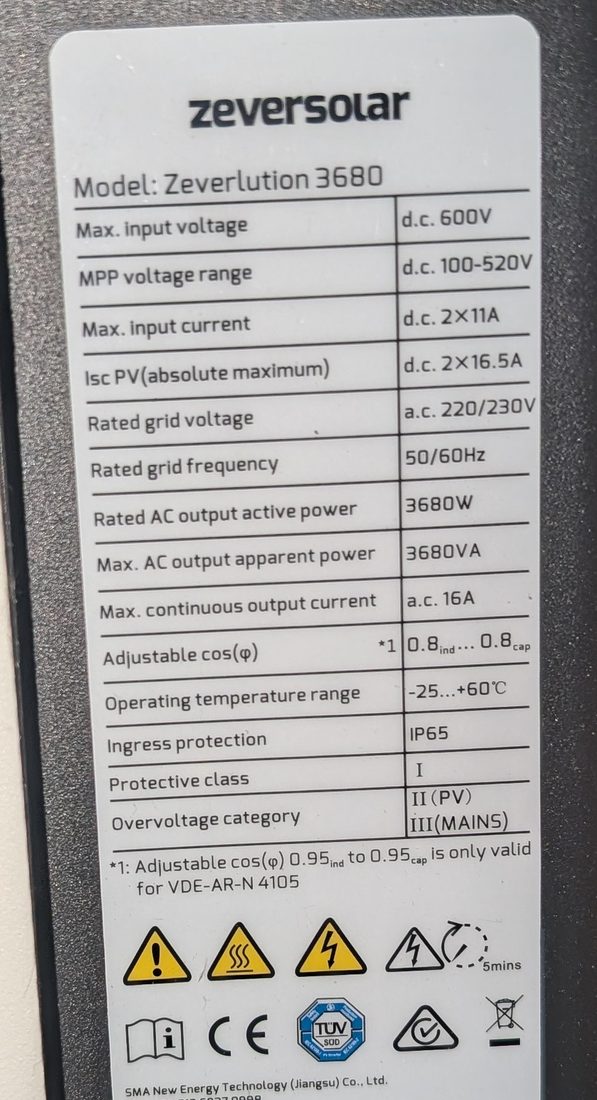
The rating plate on the side of the inverter, reading Model: Zeverlution 3680, with its input and output ratings and safety symbols. The rating plate on my inverter.
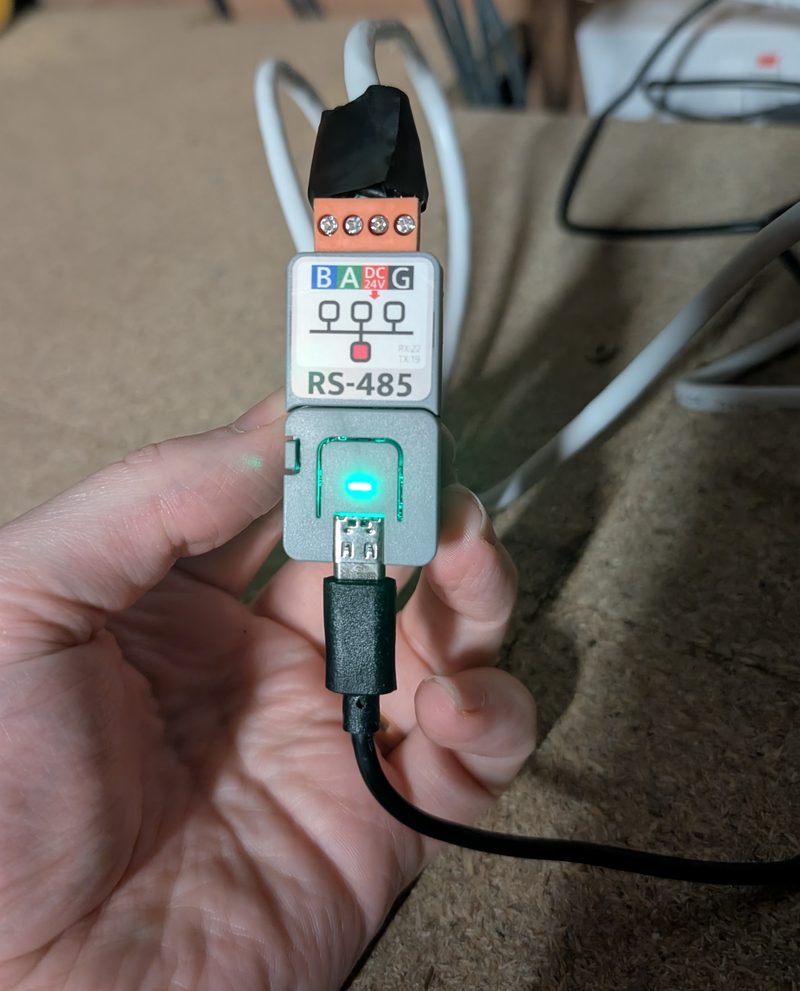
A while ago I had looked into what ports were available on this inverter with a view to connecting some sort of monitoring, but I had abandoned it as too hard . While working on some Home Assistant configuration, Claude suggested the idea again, but similarly wrote it off initially. I encouraged it to explore a bit further, and supplied the model number of the inverter, at which point the picture got a lot more promising. After a bit of back-and-forth about hardware, we settled on an M5Stack Atom Lite on an Atomic RS485 Base. The main attraction was that it already comes in a case, so I didn t need to design (or, more likely, bodge) an enclosure. While I waited for the parts to arrive, Claude wrote the firmware: an ESPHome external component built around a small, dependency-free C++ driver, with host-side unit tests against byte captures that other people had published from other models. I found it slightly surreal to have a tested protocol driver before owning any hardware to run it on.

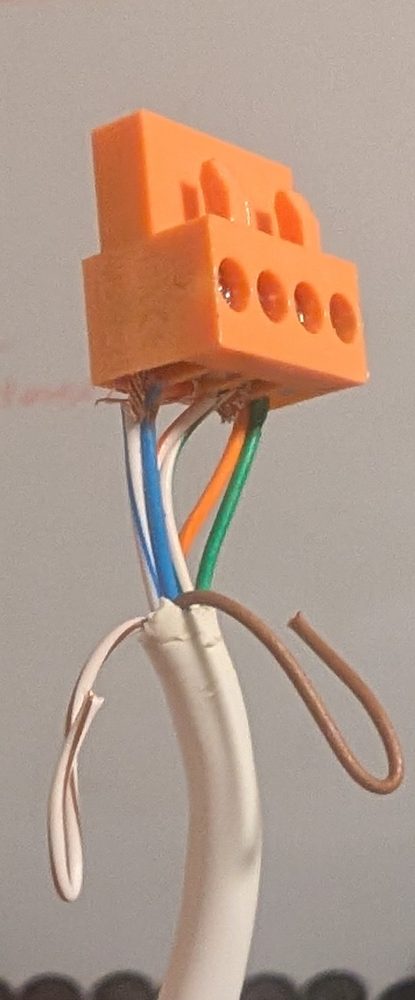
Cables The parts came before the tools I needed to get into the inverter safely (a DC clamp meter and a T25 screwdriver bit), so in the meantime I made up an RS485 cable - this uses an RJ45 connection at one end, and some custom wiring at the other. My first attempt was with some CAT 6, but (as Claude had pointed out and I had ignored) its solid-core conductors are much harder to twist together. So I gave up and sacrificed an old CAT 5e patch lead instead, which went much better.
The cut end of a white CAT 5e cable, with its twisted pairs pushed into an orange four-way screw-terminal plug. The custom end of the cable, before being taped up.
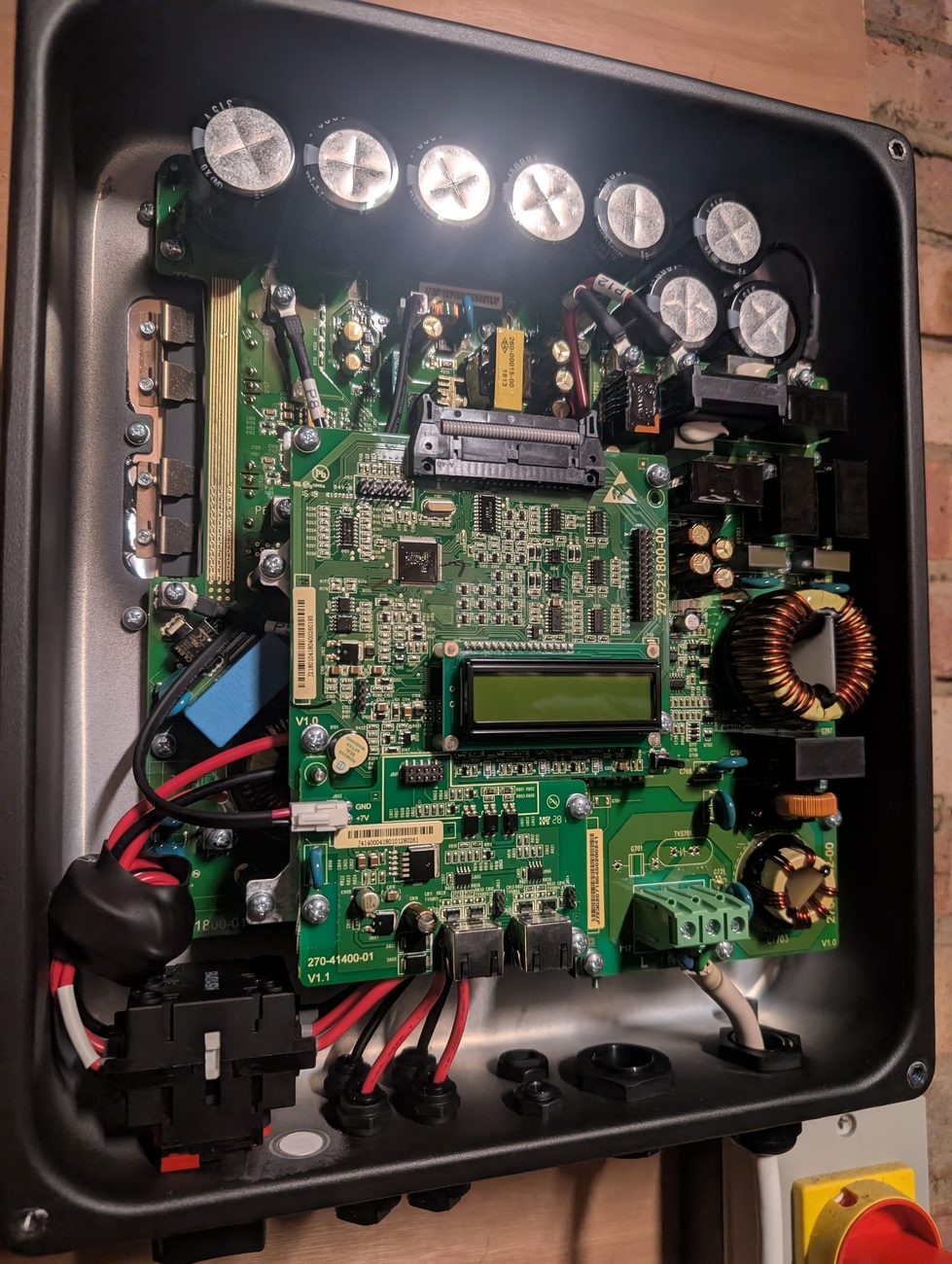
The risky bit On a Zeverlution, the RJ45 sockets are inside the wiring compartment, which means taking the cover off to install the monitor. The manual addresses this part to qualified electricians. So the step I was most nervous about was not the software at all, but safely isolating the inverter.
The inverter with its cover removed, showing large capacitors along the top, a green circuit board with a small LCD display, and cable glands along the bottom edge. Inside the inverter, with the cover off.
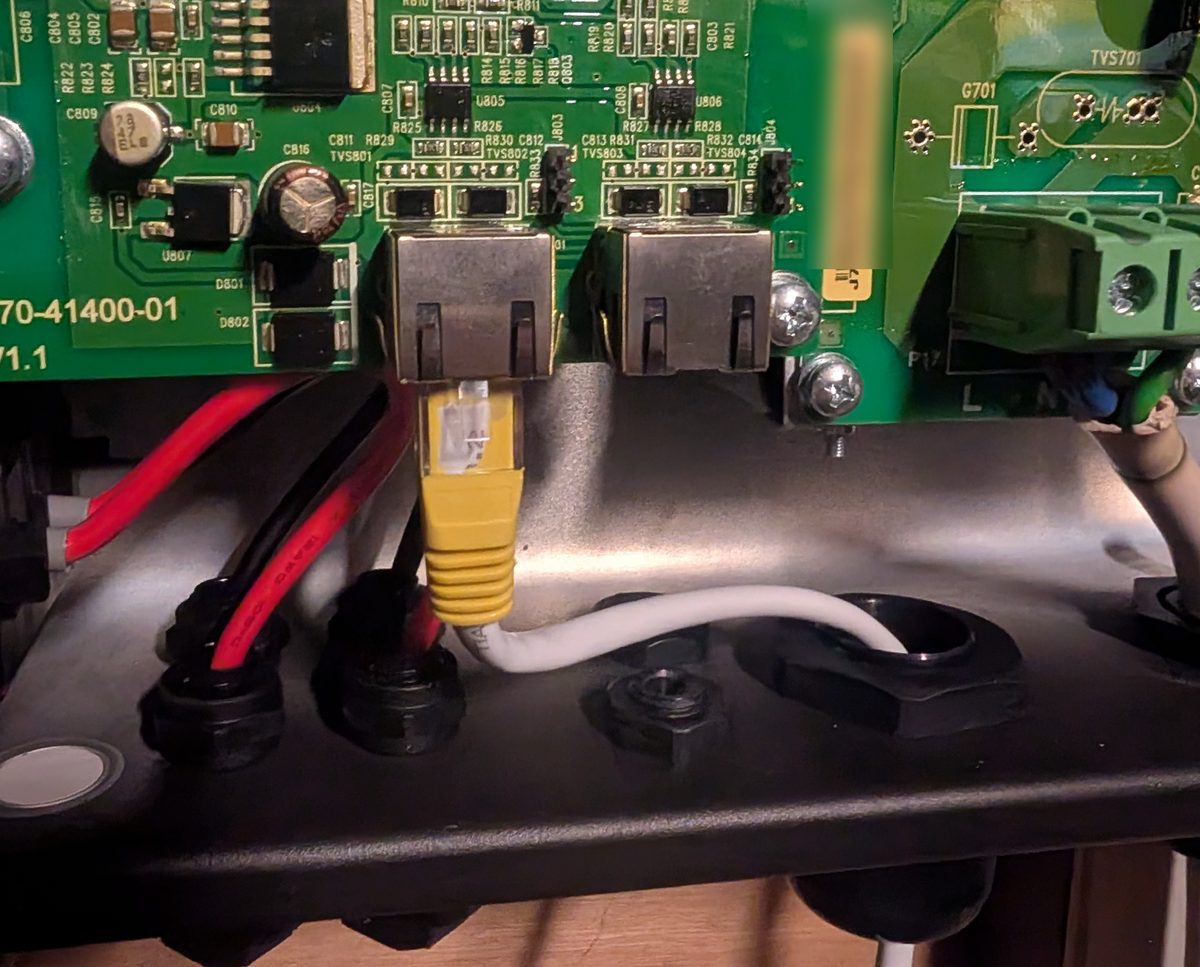
I did this with appropriate caution, following the instructions from the manual carefully, and also waiting until after dark just in case. Now that I understand how the DC clips from the panels work, I can see how to do this safely during daytime too but hopefully this won t be necessary.
A yellow RJ45 plug in one of the two network sockets on the inverter's circuit board, with its white cable running out through a cable gland in the base. Plugged in, and threaded through the cable gland.
Warning: if you re not confident, I would always advise to get an electrician to do this bit. Do what I say, not what I do.

Debugging over Wi-Fi Once the device was installed, the nice thing about ESPHome is that I never need to go back in the loft again to update it it reflashes over Wi-Fi. I ve taken full advantage of this for debugging, and for reading the wire protocol directly from the logs.
A hand holding the small grey M5Stack Atom Lite on its RS485 base, with the inverter cable taped into the screw terminals on top and its status LED glowing green. The finished device. Green means generating.
Separately, I ve used Claude to integrate the new sensors into Home Assistant. Solar generation finally sits in the Energy dashboard next to the rest of the house s usage, which was the whole point.

Reflections This was a fun, quick project, and it solved a problem that has eluded me for a decade. I want to be honest about how much of that is down to the AI: I would not have attempted any of this on my own. I could not have told you the protocol existed, never mind implemented it. My contribution was everything involving a screwdriver, and ordering some hardware.

Jelmer Vernoo : Mailsift: Extracting structured data from email messages

As a casual user of Gmail, I find its ability to recognize when I ve received tickets, invoices, and flight confirmations, and to display this information in a structured way, very useful. Flights appear directly in Google Calendar, parcel delivery statuses are tracked, and reservations are easy to find at a glance. However, my main email address is not Gmail, and I don t want to migrate to Gmail for a number of reasons (privacy, data sovereignty, vendor lock-in). At the same time, I missed having that automatic extraction: having flight and train bookings appear in my calendar without manual copy-pasting, keeping track of incoming parcels, and having invoices neatly organized.
JSON-LD and schema.org There is an established standard format for structured data called JSON-LD, which is used by Google and other search engines to extract structured data from web pages. JSON-LD represents linked data using JSON, and it can be embedded directly in HTML documents. Email messages can also contain structured data in the form of JSON-LD, which can link the information in the email to external data sources. There are standardized schemas for structured data in email messages, such as the schema.org vocabulary, which defines types and properties for describing entities including flight reservations, train trips, hotel bookings, parcel deliveries, and invoices. For example, an email containing a flight reservation might embed the following JSON-LD snippet:
 1
 2
 3
 4
 5
 6
 7
 8
 9
10
11
12
13
14
15
16
17
18
19
20
21
22
23
 
  "@context": "https://schema.org",
  "@type": "FlightReservation",
  "reservationNumber": "ABC123",
  "underName":  
    "@type": "Person",
    "name": "John Doe"
   ,
  "reservationFor":  
    "@type": "Flight",
    "flightNumber": "AA123",
    "departureAirport":  
      "@type": "Airport",
      "name": "John F. Kennedy International Airport"
     ,
    "arrivalAirport":  
      "@type": "Airport",
      "name": "Los Angeles International Airport"
     ,
    "departureTime": "2026-11-01T10:00:00-05:00",
    "arrivalTime": "2026-11-01T13:00:00-08:00"
   
 
When this is present, reading email data is clean and straightforward. The reality, however, is that only a fraction of vendors actually include schema.org markup in their emails. Most airlines, train operators, couriers, and web shops still send regular HTML or plain-text messages with arbitrary layouts that change over time.
Mailsift To bridge this gap on my own infrastructure, I built mailsift. Written in Rust, it is a daemon and CLI tool that monitors incoming email, extracts structured information, and routes it to standard files and services. Rather than locking data into an internal database, mailsift embraces the Unix philosophy: it delegates extraction to small, isolated programs and files the resulting structured artifacts into standard formats and protocols:
  • Calendar events & reservations: Turned into iCalendar (.ics) events and pushed directly to a CalDAV server (such as Xandikos) or stored in a local directory.
  • Bills & invoices: Extracted as structured JSON records, organized by year, and optionally synced to a personal finance manager like Firefly III.
  • Parcels: Extracted as delivery records keyed by tracking number, merged across status update emails, and optionally registered with tracking APIs like 17track or Karrio.
  • Tickets & boarding passes: Saved as PDFs, Apple Wallet passes (.pkpass), or images, accompanied by JSON metadata sidecars linking them to the booking.
  • Receipts & orders: Filed as JSON records, synced over WebDAV, or forwarded via email.
How extractors work Mailsift decouples the pipeline that handles emails from the logic that parses individual vendors. It discovers extractors from a directory of manifests. The contract between mailsift and an extractor is deliberately simple:
  • Input: The raw RFC822 message is fed to the extractor on stdin.
  • Execution: The extractor runs in a fresh, temporary working directory, with a strict timeout (typically 10 seconds).
  • Output: The extractor writes zero or more named artifact files into its working directory and exits 0.
Extractors can be written in any programming language. In practice, most are small Python scripts that parse HTML with regexes or BeautifulSoup, using a small helper library (mailsift_extractor) that handles Unicode normalization and HTML body stripping.
Filtering and DKIM verification Spawning a subprocess for every single email in an active inbox would be wasteful. Each extractor therefore has a YAML manifest declaring prefiltering criteria:
 1
 2
 3
 4
 5
 6
 7
 8
 9
10
name: easyjet
order: 50
from_domains:
  - easyjet.com
  - "*.easyjet.com"
subject_regex: "(?i)easyJet booking reference"
requires:
  - html
require_dkim:
  - easyjet.com
Before running an extractor, mailsift evaluates the message headers and MIME structure - possibly converting it to an IMAP filter. If the sender domain or subject doesn t match, or the required MIME parts are missing, the extractor is skipped immediately. Crucially, the manifest can also require a valid DKIM signature via require_dkim. Mailsift inspects the Authentication-Results: header produced by the receiving mail server. This guarantees that an extractor only processes messages that genuinely originated from the vendor s domain, preventing forged emails from injecting fake calendar events or bills.
Generic vs. vendor extractors Extractors fall into two categories:
  1. Generic extractors: schema-ld inspects the HTML for any <script type="application/ld+json"> blocks conforming to schema.org reservations. Another extractor, ics-passthrough, extracts standard iCalendar attachments.
  2. Vendor-specific extractors: For vendors that don t include structured markup, dedicated extractors parse the message text. For instance, the easyjet extractor looks for booking references and flight tables, producing a standard FlightReservation artifact:
 1
 2
 3
 4
 5
 6
 7
 8
 9
10
11
12
13
14
reservation =  
    "@context": "https://schema.org",
    "@type": "FlightReservation",
    "reservationNumber": f"easyjet- reference - flight_no ",
    "reservationFor":  
        "@type": "Flight",
        "flightNumber": flight_no,
        "departureAirport":  "@type": "Airport", "name": origin ,
        "arrivalAirport":  "@type": "Airport", "name": dest ,
        "departureTime": dep.isoformat(),
        "arrivalTime": arr.isoformat(),
     ,
 
Path(f" slug .reservation.json").write_text(json.dumps(reservation))
The collection of extractors is maintained in a separate repository, mailsift-extractors, and currently includes nearly 60 extractors covering airlines (British Airways, KLM, EasyJet, Transavia, Eurostar), transport (NS, SNCF Connect, FlixBus), package carriers (Royal Mail, DPD, DHL, UPS, Evri, PostNL), online orders, and utility bills.
Handling forwarded mail In real life, travel bookings or receipts are often forwarded by family, friends, or colleagues. By default, forwarded mail would fail sender checks, and DKIM signatures on inline forwards are broken by mail clients. Mailsift handles this via a trusted_forwarders configuration. When an email arrives from a trusted forwarder, mailsift unwraps the forwarded message:
  • Attachment forwards: If the original email was attached as message/rfc822, mailsift extracts the original message and re-evaluates the vendor s DKIM signature on the inner message.
  • Inline forwards: Mailsift reconstructs a synthetic RFC822 message from the client s forwarded quotation header block and quotes, deriving a deterministic Message-ID.
This means hotel confirmations or flight tickets forwarded by a partner still end up in the family calendar automatically.
Running mailsift Mailsift fits into existing email setups in several ways:
Dovecot Sieve For local delivery, Sieve provides an elegant integration using the sieve_extprograms plugin. Because Sieve runs during local delivery after Dovecot has validated DKIM and added Authentication-Results:, require_dkim checks work as expected:
1
2
require ["vnd.dovecot.pipe"];
pipe :copy "mailsift";
The :copy flag ensures the email continues to the user s inbox while a copy is piped through mailsift.
IMAP watching If you don t run your own mail server, or want to process mail on an existing remote mailbox, imap-scan connects over IMAP:
$ mailsift imap-scan imaps://user@mail.example.com/INBOX \
    --password-file ~/.config/mailsift/imap.pass \
    --watch
With --watch, mailsift uses IMAP IDLE (RFC 2177) to wait for new messages and process them as they arrive. It supports standard passwords, Kerberos (SASL GSSAPI), and OAuth2 (XOAUTH2) for providers like Gmail and Microsoft 365 via an interactive mailsift imap-auth flow.
Other modes
  • Postfix Milter: mailsift milter runs as an MTA filter, processing messages in real-time as they pass through Postfix.
  • Maildir scan: mailsift maildir-scan walks an on-disk Maildir folder, useful for backfilling historical mail.
  • Replay: mailsift replay message.eml runs extractors on a single saved message file, which is invaluable when writing or testing an extractor.
Web UI and REST API In addition to routing data to CalDAV and disk, mailsift includes an optional read-only web dashboard (mailsift web):
$ mailsift web --listen 127.0.0.1:8088
The dashboard provides an overview of upcoming trips, arriving packages, unpaid bills, and recent orders. It rescans the artifact directories on request, so it stays in sync with incoming mail without needing a separate database. JSON endpoints (such as /api/parcels.json or /api/bills.json) are also available for custom status scripts or home automation dashboards.
Status and getting involved Mailsift has been running reliably on my mail server for over a year, and having flights, hotel bookings, and train journeys seamlessly sync into my calendar without relying on proprietary cloud services has been very satisfying. The project is free software under the GPL-3.0: Adding support for new vendors only requires writing a small YAML manifest and a Python script with a couple of regexes. If you have vendors you d like to extract data from, contributions of new extractors are very welcome!

9 October 2026

Colin Watson: Free software activity in September 2026

My Debian contributions this month were all sponsored by Freexian. You can also support my work directly via Liberapay or GitHub Sponsors. OpenSSH I worked with upstream to remove libselinux linkage from /usr/sbin/sshd. I applied a fix from Mark Robillard Jr to fix reload logic when using sysvinit. groff I upgraded from 1.24.1 to 1.24.2, which fixed a few command injection security vulnerabilities. parted I upgraded from 3.7 to 3.8, which fixed CVE-2026-89085 and CVE-2026-89088. Python packaging New upstream versions: setuptools 84 is now in Debian and no longer contains pkg_resources. Removing uses of that module has been an ongoing project for a while now, but I did another batch of fixes this month: A new python-coverage version triggered several build regressions due to a known problem in pytest-cov. I worked around these by setting COVERAGE_CORE=ctrace: Other build/test failures: I investigated a build failure in python-proton-vpn-local-agent and proposed a fix upstream, but I m not comfortable applying this in Debian without review. If you re familiar with this code, please take a look. I fixed some other bugs: Rust packaging rust-derivre had an invalid Section field, which I cleaned up.

Russell Coker: Don t Anthromorphise LLMs

Greg KH gave a great lecture for Kernel Recipies 2026 about the use of LLMs to find and fix bugs in kernel code [1]. I recommend that everyone watch this and I also think it s important to note that hardly any of the lecture is really specific to kernel coding, it s just that the Linux kernel is one of the highest profile large free software projects so it gets more attention than most projects in both good and bad ways. One side note that Greg made at 20:30 is about the natural tendency to anthromorphise the entity sending bug reports, I think this deserves much wider appreciation. For the case of patches to source code the human sending the patch will have dedicated some time and effort to writing it, if it s their first patch then they will have probably checked it a lot and maybe sought advice from people they regard as skilled. If they have a history of sending patches for the project they will probably do fewer checks but the quality of their work would be higher. In every case there s some minimum level of quality that you can expect from a human who has gone to the effort of finding a bug and writing code to try and fix it. This doesn t mean that all code written by humans is good, I have written code that s objectively bad on many occasions and I have also written code that s good for my scenario but bad for others. For example the first patch I sent to the Linux kernel made all possible configuration settings of an ISA NE2000 network card be detected by the kernel (a clear benefit when using hardware I had available) but was rejected by Linus because it would break some ISA SCSI cards. So while being unsuitable for inclusion in the main kernel source tree the patch wasn t bad for everyone and the change was clear and easy to check. I had of course checked the code many times before submitting it because I didn t want to waste Linus time on rubbish code. When you receive something produced by a human you will consider that the work was done by someone who spent some effort on it and did it for a reason. It may be misguided or even hostile in some rare cases but it is definitely worth some consideration. If you think of the output of LLMs in the same way you will give them much more consideration than they deserve. I think that the output of a LLM should not be given any more consideration than the first hit from a web search engine, it might be good but it might also be ridiculously wrong. I think in many ways LLM output should be treated with less trust than the first result from a web search because LLMs are designed to be convincing as an answer to your question unlike the cases where a web page has the wrong answer and it s more obviously wrong. This is going to become more of an issue as LLMs give responses that are more human-like. Early LLMs would refuse to advise on crimes. Currently ChatGPT will deflect for example when asking about advice for writing a crime novel it recommends to have the action of finding an employee to bribe happen outside the plot and concentrate on interactions within the group. One recent model I tried gave a human style conversation about how it felt uncomfortable about discussing such things in a similar manner to a law abiding person being coerced into helping with a criminal plan. I expect that the attempts to appear human will increase and that this will become more of a problem. Possibly to the extent that we need to use something like the GPG web of trust to determine who is human.

8 October 2026

Antoine Beaupr : PSA: Europe changes time forward soon, North America next, for the last time?

This is a copy of an email I sent at work. I'm not sure I should be making noise about this here, feedback welcome.
This is your bi-yearly reminder that time is changing soon! October 25th in Europe, November 1st in North America. Less people in Canada are changing this year, with BC, Alberta, Manitoba and Northwest Territories getting rid of DST.

What's happening? Some places in the world implement what is called Daylight saving time or DST: https://en.wikipedia.org/wiki/Daylight_saving_time Normally, you shouldn't have to do anything: computers automatically change time following local rules, assuming they are correctly configured, provided recent updates have been applied in the case of a recent change in said rules (because yes, this happens, and happened this year, and yes, you need to upgrade your software!). Of course, appliances like your microwave oven will likely not change time and will need to adjusted unless they are so-called "smart", in which case they are part of the skynet botnet and should be destroyed. If your clock is flashing "0:00" or "12:00", you have no action to take to adapt to this change, lucky you. If you haven't changed time in six months, congratulations, your clock will be accurate again! In any case, you should still consider DST because it might affect some of your meeting schedules, particularly if you set up a new meeting schedule in the last 6 months and forgot to consider this change.

If your location does not have DST Properly scheduled meetings affecting multiple time zones are set in UTC time, which does not change. So if your location does not observer time changes, your (local!) meeting time will not change. But be aware that some other folks attending your meeting might have the DST bug and their meeting times will change. Be kind to those poor souls which might be missing meetings by a full hour because time flies backwards for them.

If you do observe DST If you are affected by daylight savings, your local meeting times will change for UTC meetings. Normally, your meeting times are scheduled to take this into account and the new hours should be reasonable. But now is a good time to verify that. Take a look at your schedule for the next couple of weeks and reschedule meetings before the daylight saving come up to avoid too much disruption. You have only a couple of weeks to do so right now.

When do times change, how, and and where? As regular readers will remember, the rule of thumb is:
Spring forward, fall backwards.
That is, during the season of Spring, the clocks move forward, and during the Fall (like right now), they move backwards. That is in the northern hemisphere, but then the southern hemisphere is often saner and doesn't switch anyways. So time will move backwards which means an extra hour of sleep. Unless you have children or bad sleep, in which case your body doesn't care about what the clock says and will wake up one hour earlier than what it should. And of course, this doesn't happen everywhere at once, so let's see when it happens where.

Europe The dance starts in Europe. The change happens on the last Sunday in October at 01:00 UTC (not local time!), that is October 25th. If you are in the central European timezone, also known as Amsterdam, Berlin, or Paris time depending on your national affiliation, that essentially means that at 2:59 local the clocks will fall back to 2:00 instead of going to 3:00. Concretely, set your watch back one hour before going to bed, go to bed at the normal time, and enjoy an extra hour of sleep or leisure. If you have kids, you might want to start getting them to bed slightly earlier every day for a week before the change so they take time getting used to the change. If you have trouble sleeping in the morning, find your inner child and do that to yourself as well.

USA / Canada Then it's the US[1] and Canada[2] joining the dance, on the First Sunday in November at 02:00 local (not UTC!), that is, I believe, November 1st 2026. This means that, at 1:59, the clocks will flip to 1:00, instead of 2:00. Concretely, do like the Europeans and tweak your clock before going to bed. That is a little less than four weeks from now. [1] except Arizona (except the Navajo nation), US territories, and Hawaii [2] except Yukon, Saskatchewan, (newly) British Columbia, (newly) Alberta, (newly) Northwest Territories, (newly) Manitoba, one island in Nunavut (Southampton Island), one town in Ontario (Atikokan) and small parts of Quebec (Le Golfe-du-Saint-Laurent)

Other places with DST This time again, I must apologize to the people of Cuba, Lebanon, Israel, Palestine, Egypt, Chile, Australia, and New Zealand, as you fine folks all have your own DST rules that are omitted here for brevity. I rely on this page from Wikipedia to be updated by time nerds accurately for this message, and it should provide you with a rough idea of what's coming: https://en.wikipedia.org/wiki/Daylight_saving_time_by_country In general, changes also happen in October, but either on different times or different days, except in the south hemisphere, where they might happen in September (oops, sorry NZ folks, I'm late!).

Places without DST Everyone else, enjoy, you're on the right side of history, and we thank you for the good example you give us.

Changes since last time There's been lots of changes since last time:
  • British Columbia moved to permanent -07 on 2026-03-09, that is it will not change to normal time in November
  • Alberta moved to permanent -06 on 2026-06-18, similar to BC above.
  • Canada s Northwest Territories moved to permanent -06 on 2026-08-21, matching Alberta.
  • Manitoba moves to permanent -05 on 2026-10-31.
  • Morocco moves to permanent +00 on 2026-09-20.
  • Moldova has used EU transition times since 2022, but the tz database only noticed in 2026
This is my interpretation of the changes announced on the tzdata mailing list here: https://lists.iana.org/hyperkitty/list/tz-announce@iana.org/latest If the eastward trend continues, Canada should adopt country-wide "no daylight savings" rules by 2027, although there's actually no sign of the other provinces (Ontario, Qu bec and so on) currently running bills to change those rules just yet. Poor Canadians like me confused about time in their countries can refer to this section of Wikipedia for details: https://en.wikipedia.org/wiki/Daylight_saving_time_in_Canada#By_province_and_territory ... and particularly the image featured there: https://commons.wikimedia.org/wiki/File:Canada_time_zone_map-en.svg It also seems like the US government might finally adopt a permanent daylight saving change bill in 2026, as the "Sunshine protection act" pass the house in July: https://en.wikipedia.org/wiki/Sunshine_Protection_Act True to form, this was associated with absolutely ridiculous pressure from Donald Trump against republicans (his own party!) objecting to the change:
On July 14, 2026, the House passed a Sunshine Protection Act bill backed by President Trump. Nevertheless, the bill was opposed in the Senate by Republicans, including Senator Cotton. In response, on October 3, 2026, Trump shared a post on Truth Social urging Cotton to approve the bill, where he revealed Cotton's personal cellphone number and called on people to call him.
https://www.theguardian.com/us-news/2026/oct/03/trump-tom-cotton-daylight-saving-time Given that the last time the US did a major change to the daylight savings policy (in 2005), Canada followed suit to stay in sync, it's quite possible Trump's mad dash might actually finish getting rid of DST in North America: https://en.wikipedia.org/wiki/Energy_Policy_Act_of_2005#Change_to_daylight_saving_time

7 October 2026

Bits from Debian: Looking for artwork for the next Debian release: Forky

Each release of Debian has a shiny new theme which is visible on the installer, the boot screen, the login screen and, most prominently, on the desktop wallpaper. It's a very important part of a Debian release as it is usually the first thing new users see when installing or booting the system for the first time. Not only that, but also the first thing appearing when debianites share their screen or connect to an external device when giving talks around the world. As the most enthusiastic users will know, the forky - yes, that is the name of the next stable version, Debian 14 - release cycle is rapidly approaching its latter stages. This means we need to select the artwork shipping with forky soon, really soon! And as with everything else in Debian, collecting artwork is a collaborative effort which Debian shares with its community. So, if you would like (or know someone who would like) to create a desktop look and feel that will be seen by trillions of people around the world - and in space! - be sure to send in your artwork ASAP! The deadline for submissions is: 2026-11-26. For the most up to date details please refer to the Debian wiki. At the same time, we would like to thank Elise Couper for creating the Ceratopsian theme for our last trixie release. And for the interested or the curious ones, the artwork is usually picked based on which theme looks the most: If you'd like more information or details, please post to the Debian Desktop mailing list.

6 October 2026

Russell Coker: A Power Case for a FOSS Phone

The Problem I want to use a FOSS phone running Debian as my daily driver and not use a non-free OS on my phone. GrapheneOS [1] is a FOSS rebuild of Android, it s a great project and I commend them for what they are doing. But I want a system where I have access to all the bits and where I can ssh in to it and manage it in the same way as all other Linux systems. Android is free software but it s a closed design and the phones are expected to be appliances not full peers on the network. The Android native terminal emulator (AKA Linux development environment) is a nice feature, a VM with a default of 1GB of RAM but it s still separate from the main OS. KDE Connect [2] is a system for KDE talking to phones, it is a great project and allows convenient interaction between a Linux PC and a phone. But in addition to that I d like the option to ssh to my phone to send an SMS or have one sent from a cron job. I blogged about using the basic functions of Kdeconnect from the command-line [3]. I have had ongoing issues with the battery not lasting long enough on the PinePhonePro (PPP) and the Librem 5 (L5) which makes them unusable for my purposes. For a phone running Droidian I can have an open ssh session (with keep-alive packets) running overnight on Wifi without any problems while for the PPP or L5 an hour of reading an ebook (the least demanding use of a phone) will use most of the battery. I sent my FuriPhone back for warranty repair and it s been almost a month with no follow up, so I need to have another option. The Aim The aim of this post is to develop a rough design for a battery case for either a L5 or a PPP, I have both phones and they are both capable of doing what I want apart from battery life. Also designing a case that basically works for both phones and has two variations of the CAD file for 3D printing is good to allow collaboration with people who use either phone. Protecting the phone from damage when dropped is also a core feature. I investigated commercial options. There are some reports of cases for other phones working, someone reported a PPP working well with a battery case for a Samsung S20 Ultra. The OtterBox uniVERSE Case for Samsung Galaxy XCover Pro is reported to fit the PPP so probably battery cases for the XCover Pro will also work. There are also universal power cases which have spring clips to fit a wide range of phone sizes, but they are much larger than other options and probably increase the risk of damage if the phone is dropped. At this stage I m planning out the rough specs of a case that can be 3D printed to protect a phone while being easy to change the cells. The process of changing cells should be quick, easy, and not risk breaking anything. The hardware required should be affordable ($100AU plus some 3D printing seems reasonable) and should not require significant skills to assemble. After recent experiments with Thinkpad repair I ve determined that I am not good at electronics by today s standards so I plan to avoid anything difficult in that regard. Battery Options There are phone cases with batteries built in for the more common phones. A quick search on AliExpress turned up options for recent Pixel phones. They aren t as common as they used to be as Android phones and iPhones generally have good battery life nowadays. Of course there aren t such options for less common phones like the L5 and PPP. It is cheap and easy to buy a portable battery for charging phones, but that s a separate bulky device and unless the connector is inside a protective case it leaves the phone vulnerable to catastrophic damage if dropped. So can a suitable battery case be designed and 3D printed? Cheap Batteries According to Wikipedia the 18650 LiIon cell is the most commonly used LiIon battery, that is 18mm in diameter and 65mm in length. For a phone case thinner batteries would be more convenient but economies of scale make the 18650 cheap to buy new and commonly available on the second hand market. The current prices on AliExpress (in Australian dollars) are about $8 per cell when buying 10 at a time. Most of the cells on AliExpress don t have wires attached so they can be swapped in a carrier the way AA batteries are used, but the cells are symmetrical (no bump for positive) so the user has to take care of polarity. Chargers are around $22 for a 4 cell charger or $52 for a 12 cell charger. I ve seen prices as low as $1 per cell on the second hand market, I haven t investigated the amount of usable capacity in such cells. Probably the prices for chargers I ve found aren t the best available but they are good enough to start the design. 10 cells and a 4 cell charger is about $100. That s about 130Wh while a 74Wh USB-C battery pack costs about $50. So the price per Wh is OK. I have read about an attempt to do this for the L5 with two of the batteries designed for the L5 in a case attached to it, so you have 3*L5 batteries. It s an interesting approach but those batteries have poor value for money when compared to 18650 ($29US for 4500mAh compared to $8 for 3500mAh) and they also don t ship them outside the US at this time. The 18650 batteries are available everywhere cheaply and have multiple uses. How They Fit According to my measurements the PPP is 76mm wide and the L5 is 73mm wide. That s wide enough for 3*18mm or 4*18mm cells side by side arranged parallel to the long side of the phone or one 65mm long cell going across the phone with the necessary spring and wires. The L5 is about 151mm long and the PPP is about 5mm longer. So that means that for just the cells we could have 2 cells in a row in parallel to the long side of the phone giving a 2*3 or 2*4 array or we could have a row of 8 cells parallel to the short side of the phone. A quick search for controllers for a battery of LiIon cells that outputs USB-PD turned up one of the smaller ones as 40*28mm, here is the AliExpress page [4]. So that means we could have a maximum of about 4 cells and the controller while leaving space for the camera. Looking at other similar items it seems that most of them take a large portion of the 73mm width available and take a bit less than 30mm height. The price range for DC-DC voltage converters ranges from about $3 to $20, the one I linked to is currently $8. The mass of 18650 cells is around 45g so 4 of them would be about 180g before counting the weight of the case and electronics. A L5 weighs 262g and a PPP weighs 220g so 180g of battery will make a significant difference, not an impossible difference but holding a PPP while reading an ebook is already annoying. Maybe the case could be designed to be easier to hold, a loop of wool attached to the top could be used to suspend the phone from one finger while the rest of the hand just keeps it steady. In a default configuration the L5 has a 4500mAh 3.8V battery and the PPP has a 3000mAh 3.8V battery. The 18650 cells have up to 4000mAh with 3500mAh being common. So 4 such cells could multiply the battery life of a PPP by a factor of 5 or a L5 by 4. That would not be enough to last for a whole day without charging so they need to be easy to swap. A 3 cell battery seems like a good option, 135g of batteries so the project overall wouldn t even double the weight of the phone with battery case. As it doesn t seem possible to put in enough cells to last a day of reasonable use (running a web browser, checking email, reading wikipedia, and having some IM systems checking for notifications) there doesn t seem to be a benefit in trying to stuff the maximum number of cells in. Going to 4 or 5 cells doesn t provide much benefit over 3 while increasing the weight and making the design more difficult. The modules for DC Voltage conversion often have configuration for the number of cells to be used so it wouldn t be difficult to print a new case and reconfigure the Voltage converter. Design A case needs to provide protection as well as hold the batteries. The lack of cases for the L5 and PPP is a problem even without the extra weight of a battery pack increasing the kinetic energy of falling phone. Ideally a drop from 1M on to concrete would not cause any damage to the phone, destruction of the case is OK as it would be 3D printed and can be rebuilt easily. I think that a case where the phone slides in from the top would be best. To change cells one would slide the phone out and the cells would be immediately accessible with no divider between the phone and the cells. Sliding the phone in would hold the cells against the back of the case and as there is a gap of about 3mm on each side of the PPP between the display area and the edge of the phone there s plenty of space for the case to wrap around it at the sides and bottom. At the top there would have to be some sort of plastic clip. The PPP only has buttons on the top right so the case can be snug on all sides apart from the top right. The L5 has switches at the top left and buttons at the top right so whatever clips on to the top would really need some strength to cover the fall flat on face case. The USB C plug would need to be held in place well enough to allow the phone to easily slide on to it but also be weak enough that it would move if a drop forced the phone out of the case. Thingiverse has a design for a L5 case [5] (with several derivatives) and a design for a PPP case [6]. Those cases could be used as starting points and then changed to store batteries and the voltage change circuit board. I have just learned that it s possible to use rubberised material in a 3D printer which is apparently what those designs are for. If a case was printed with rubberised material the top could just stick in place after being pushed in. Potential for Excessive Excitement Having an exploding device in your pocket would be the exciting in a bad way. My initial idea was to have multiple 18650 cells in series. The problem is that if the cells have different capacity levels then one can run out before the rest and get to a deep discharge state which at a minimum causes damage to the cell. One way of minimising risk is to have only a single cell in use at one time, here is a converter for a single cell to 5V [7]. It is possible to run multiple cells in parallel by simply wiring them together, but it s recommended to make sure that the voltage difference between cells is less than 0.2V to avoid high current when connecting. The arrangement of cells is often referred to as nS or nP to refer to n cells in series or parallel. Aliexpress has a range of 1S to 6S devices. Some of the 2S devices have a connector for the mid point which permits separate voltage monitoring for both cells but there doesn t seem to be anything equivalent for 3S or more. They also don t appear to have anything to specifically manage 2P or 3P arrangements at the moment (they had a 3P board on sale when I looked into this last year). Conclusion This is a bigger project than I expected when I first started investigating it. I ve played with FreeCAD which seems OK but will take a lot of learning and practice. Then I need to do more investigation into the DC-DC converters to find one that works well and is unlikely to start a fire. I will look into other phone options as well and keep chasing Furilabs people about my phone replacement.

28 September 2026

Maytham Alsudany: Briefly looking at DNS and nameservers under the hood

I've always known that the browser uses the Domain Name Resolution (DNS) system to convert domain names like aezign.com.au into raw IP addresses, but have never actually understood how it works, outside of making sure my network config uses 1.1.1.1 or 8.8.8.8 instead of the crappy one the ISP provides. In this article, I set out to understand what nameservers do, and how they help anything that uses the internet find the right records.

DNS in a nutshellA well-used analogy is a phonebook; when you have someone's name and need to find their phone number, you look through the phonebook. Overall, DNS does the same thing: when you enter an address like example.com, your browser will contact a DNS server (the "phonebook") to determine its IP addresses. On Linux (or MacOS) systems, you can use dig on the command line to perform a DNS lookup and see what this looks like:
$ dig example.com
; <<>> DiG 9.20.29-1-Debian <<>> example.com
;; global options: +cmd
;; Got answer:
;; ->>HEADER<<- opcode: QUERY, status: NOERROR, id: 42782
;; flags: qr rd ra; QUERY: 1, ANSWER: 2, AUTHORITY: 0, ADDITIONAL: 1
;; OPT PSEUDOSECTION:
; EDNS: version: 0, flags:; udp: 1232
;; QUESTION SECTION:
;example.com.                   IN      A
;; ANSWER SECTION:
example.com.            221     IN      A       104.20.23.154
example.com.            221     IN      A       172.66.147.243
;; Query time: 20 msec
;; SERVER: 1.1.1.1#53(1.1.1.1) (UDP)
;; WHEN: Sun Sep 27 21:07:50 AWST 2026
;; MSG SIZE  rcvd: 72
Here, you can see the DNS server being used is 1.1.1.1 (Cloudflare's DNS server), and that it found the IPs 104.20.23.154 and 172.66.147.243 associated with the domain name example.com. Your browser will then contact these IP addresses directly to load the website you are trying to open.

Configuring DNS serversYou can configure DNS servers through your operating system's network settings, and for some applications such as Firefox, with the application itself. If you don't manually set a DNS server, your computer will use the ones provided by your modem. If those are not configured, the default defined by the modem manufacturer or your ISP will be used.The most well-used and reliable DNS servers you can use are Cloudflare's (1.1.1.1 and 1.0.0.1) and Google's (8.8.8.8 and 8.8.4.4). Having more than one DNS server means that if the first one in the list doesn't work or doesn't find the matching IPs for a domain name, it will move to the next one in the list, a backup DNS server.DNS servers must be configured as IP addresses. If your computer tried to use a DNS server at a domain name, then where would your computer find the IP address for that domain name? It wouldn't be able to, as this is the exact gap that DNS servers fulfill.

RecordsDNS is not used only to find IPs for a domain, but a whole host of other things. Collectively they are referred to as "records" (or "DNS records"). Each record is associated to a domain (e.g. example.com) or a subdomain (e.g. bar.example.com, foo.bar.example.com) Here are some of the most common and important types:
  • A - Map to an IPv4 address (e.g. 104.20.23.154).This is the fundamental function of DNS: to map from a domain name to a server's IP address. Multiple A records leads to load balancing, where browsers will randomly select one of the returned IP addresses such that traffic is evenly split between them.
  • AAAA - Map to an IPv6 address (e.g. 2606:4700:10::6814:179a).This serves the same purpose as A records but for IPv6. Multiple AAAA records results in the same load balancing behaviour. All modern websites should have both an A record for legacy compatibility, and an AAAA record to future-proof for the gradual shift towards IPv6 addresses.
  • CNAME - Alias to another domain name (e.g. example.com).DNS servers will recursively lookup records for the aliased domain name until they reach an IP address (in an A or AAAA record).
  • MX - Specify a Mail Exchange server (e.g. mail.example.com).This record tells email SMTP servers where to direct emails to. For instance, the MX record for aezign.com.au is mail.aezign.au; this directs SMTP servers like Gmail and Outlook to send emails to the mailserver running at mail.aezign.au. This also allows specifying a priority field, so that you can define multiple MX records (such as a main and a backup) and consumers will try to connect to the listed mailservers from lowest priority to highest.
  • TXT - Store arbitrary text dataThis is most commonly used for site verification (for instance, to link your website to Google Search Console) and for email security measures like DKIM, DMARC, and SPF.
  • NS - Specify the nameservers for a domain (e.g. zeus.ns.cloudflare.com).These authoritative nameservers are responsible for providing all the other record types when needed.
dig lets you query each of these. For instance, to list the MX records against aezign.com.au:
$ dig MX aezign.com.au
; <<>> DiG 9.20.29-1-Debian <<>> MX aezign.com.au
;; global options: +cmd
;; Got answer:
;; ->>HEADER<<- opcode: QUERY, status: NOERROR, id: 28213
;; flags: qr rd ra; QUERY: 1, ANSWER: 1, AUTHORITY: 0, ADDITIONAL: 1
;; OPT PSEUDOSECTION:
; EDNS: version: 0, flags:; udp: 1232
;; QUESTION SECTION:
;aezign.com.au.                 IN      MX
;; ANSWER SECTION:
aezign.com.au.          300     IN      MX      10 mail.aezign.au.
;; Query time: 104 msec
;; SERVER: 1.1.1.1#53(1.1.1.1) (UDP)
;; WHEN: Sun Sep 27 22:04:58 AWST 2026
;; MSG SIZE  rcvd: 70
Here you can see there is only one mailserver configured for aezign.com.au, which is mail.aezign.au, and it has a priority of 10.If you compare this against something like gmail.com:
$ dig MX gmail.com
; <<>> DiG 9.20.29-1-Debian <<>> MX gmail.com
;; global options: +cmd
;; Got answer:
;; ->>HEADER<<- opcode: QUERY, status: NOERROR, id: 16538
;; flags: qr rd ra; QUERY: 1, ANSWER: 5, AUTHORITY: 0, ADDITIONAL: 1
;; OPT PSEUDOSECTION:
; EDNS: version: 0, flags:; udp: 1232
;; QUESTION SECTION:
;gmail.com.                     IN      MX
;; ANSWER SECTION:
gmail.com.              2497    IN      MX      40 alt4.gmail-smtp-in.l.google.com.
gmail.com.              2497    IN      MX      20 alt2.gmail-smtp-in.l.google.com.
gmail.com.              2497    IN      MX      5 gmail-smtp-in.l.google.com.
gmail.com.              2497    IN      MX      10 alt1.gmail-smtp-in.l.google.com.
gmail.com.              2497    IN      MX      30 alt3.gmail-smtp-in.l.google.com.
;; Query time: 120 msec
;; SERVER: 1.1.1.1#53(1.1.1.1) (UDP)
;; WHEN: Sun Sep 27 22:06:04 AWST 2026
;; MSG SIZE  rcvd: 161
You can see that gmail.com has several mailservers configured as redundancies due to the Gmail's sheer scale. gmail-smtp-in.l.google.com has the highest priority of 5, so SMTP servers will attempt to contact that mailserver first, followed by alt1.gmail-smtp-in.l.google.com and so on.

NameserversNow there needs to be somewhere for DNS records against a domain name to be defined, right? This is where nameservers come in.Nameservers are DNS servers that answer queries about the domains they are authoritative for i.e. the domains they are in charge of. For example, the authoritative nameservers for example.com are hera.ns.cloudflare.com and elliott.ns.cloudflare.com, which means Cloudflare's nameservers are the source of truth when looking up DNS records for example.com. You can check this with dig:
$ dig NS example.com
; <<>> DiG 9.20.29-1-Debian <<>> NS example.com
;; global options: +cmd
;; Got answer:
;; ->>HEADER<<- opcode: QUERY, status: NOERROR, id: 37717
;; flags: qr rd ra; QUERY: 1, ANSWER: 2, AUTHORITY: 0, ADDITIONAL: 1
;; OPT PSEUDOSECTION:
; EDNS: version: 0, flags:; udp: 1232
;; QUESTION SECTION:
;example.com.                   IN      NS
;; ANSWER SECTION:
example.com.            81837   IN      NS      hera.ns.cloudflare.com.
example.com.            81837   IN      NS      elliott.ns.cloudflare.com.
;; Query time: 140 msec
;; SERVER: 1.1.1.1#53(1.1.1.1) (UDP)
;; WHEN: Sun Sep 27 23:27:19 AWST 2026
;; MSG SIZE  rcvd: 95
Nameservers are configured with your domain name's registrar. The nameserver you set dictates where your remaining DNS records will live. For example.com, this means you would configure all your records on Cloudflare's dashboard, since they are responsible for the domain's DNS records.

Recursive resolutionThe DNS servers that our computers use follow a recursive resolution process behind-the-scenes to find the authoritative nameservers for a domain, followed by the records you are querying.

Finding the root nameserversDue to the recursive nature of the resolution process, there needs to be a starting point: the root (.) nameservers. The resolver uses a fixed list of root nameservers called root hints issued by IANA (named.root), to locate and contact the root nameservers. Resolvers will have this provided to them initially, and can dynamically update it themselves by querying one of the root nameservers for the root NS records to obtain a fresh list. For instance, we can query 198.41.0.4 (a.root-servers.net) to obtain a new list of root nameservers:
$ dig @198.41.0.4 NS .
; <<>> DiG 9.20.29-1-Debian <<>> @198.41.0.4 NS .
; (1 server found)
;; global options: +cmd
;; Got answer:
;; ->>HEADER<<- opcode: QUERY, status: NOERROR, id: 43677
;; flags: qr aa rd; QUERY: 1, ANSWER: 13, AUTHORITY: 0, ADDITIONAL: 27
;; WARNING: recursion requested but not available
;; OPT PSEUDOSECTION:
; EDNS: version: 0, flags:; udp: 4096
;; QUESTION SECTION:
;.				IN	NS
;; ANSWER SECTION:
.			518400	IN	NS	l.root-servers.net.
.			518400	IN	NS	j.root-servers.net.
.			518400	IN	NS	f.root-servers.net.
.			518400	IN	NS	h.root-servers.net.
.			518400	IN	NS	d.root-servers.net.
.			518400	IN	NS	b.root-servers.net.
.			518400	IN	NS	k.root-servers.net.
.			518400	IN	NS	i.root-servers.net.
.			518400	IN	NS	m.root-servers.net.
.			518400	IN	NS	e.root-servers.net.
.			518400	IN	NS	g.root-servers.net.
.			518400	IN	NS	c.root-servers.net.
.			518400	IN	NS	a.root-servers.net.
;; ADDITIONAL SECTION:
l.root-servers.net.	518400	IN	A	199.7.83.42
l.root-servers.net.	518400	IN	AAAA	2001:500:9f::42
j.root-servers.net.	518400	IN	A	192.58.128.30
j.root-servers.net.	518400	IN	AAAA	2001:503:c27::2:30
f.root-servers.net.	518400	IN	A	192.5.5.241
f.root-servers.net.	518400	IN	AAAA	2001:500:2f::f
h.root-servers.net.	518400	IN	A	198.97.190.53
h.root-servers.net.	518400	IN	AAAA	2001:500:1::53
d.root-servers.net.	518400	IN	A	199.7.91.13
d.root-servers.net.	518400	IN	AAAA	2001:500:2d::d
b.root-servers.net.	518400	IN	A	170.247.170.2
b.root-servers.net.	518400	IN	AAAA	2801:1b8:10::b
k.root-servers.net.	518400	IN	A	193.0.14.129
k.root-servers.net.	518400	IN	AAAA	2001:7fd::1
i.root-servers.net.	518400	IN	A	192.36.148.17
i.root-servers.net.	518400	IN	AAAA	2001:7fe::53
m.root-servers.net.	518400	IN	A	202.12.27.33
m.root-servers.net.	518400	IN	AAAA	2001:dc3::35
e.root-servers.net.	518400	IN	A	192.203.230.10
e.root-servers.net.	518400	IN	AAAA	2001:500:a8::e
g.root-servers.net.	518400	IN	A	192.112.36.4
g.root-servers.net.	518400	IN	AAAA	2001:500:12::d0d
c.root-servers.net.	518400	IN	A	192.33.4.12
c.root-servers.net.	518400	IN	AAAA	2001:500:2::c
a.root-servers.net.	518400	IN	A	198.41.0.4
a.root-servers.net.	518400	IN	AAAA	2001:503:ba3e::2:30
;; Query time: 476 msec
;; SERVER: 198.41.0.4#53(198.41.0.4) (UDP)
;; WHEN: Mon Sep 28 00:01:08 AWST 2026
;; MSG SIZE  rcvd: 811

Querying the root nameserversFor example.com, the first step is to query the root (.) nameservers to find the nameservers for the .com top-level domain (TLD). Using a.root-servers.net again:
$ dig @198.41.0.4 NS com
; <<>> DiG 9.20.29-1-Debian <<>> @198.41.0.4 NS com
; (1 server found)
;; global options: +cmd
;; Got answer:
;; ->>HEADER<<- opcode: QUERY, status: NOERROR, id: 22528
;; flags: qr rd; QUERY: 1, ANSWER: 0, AUTHORITY: 13, ADDITIONAL: 27
;; WARNING: recursion requested but not available
;; OPT PSEUDOSECTION:
; EDNS: version: 0, flags:; udp: 4096
;; QUESTION SECTION:
;com.				IN	NS
;; AUTHORITY SECTION:
com.			172800	IN	NS	l.gtld-servers.net.
com.			172800	IN	NS	j.gtld-servers.net.
com.			172800	IN	NS	h.gtld-servers.net.
com.			172800	IN	NS	d.gtld-servers.net.
com.			172800	IN	NS	b.gtld-servers.net.
com.			172800	IN	NS	f.gtld-servers.net.
com.			172800	IN	NS	k.gtld-servers.net.
com.			172800	IN	NS	m.gtld-servers.net.
com.			172800	IN	NS	i.gtld-servers.net.
com.			172800	IN	NS	g.gtld-servers.net.
com.			172800	IN	NS	a.gtld-servers.net.
com.			172800	IN	NS	c.gtld-servers.net.
com.			172800	IN	NS	e.gtld-servers.net.
;; ADDITIONAL SECTION:
l.gtld-servers.net.	172800	IN	A	192.41.162.30
l.gtld-servers.net.	172800	IN	AAAA	2001:500:d937::30
j.gtld-servers.net.	172800	IN	A	192.48.79.30
j.gtld-servers.net.	172800	IN	AAAA	2001:502:7094::30
h.gtld-servers.net.	172800	IN	A	192.54.112.30
h.gtld-servers.net.	172800	IN	AAAA	2001:502:8cc::30
d.gtld-servers.net.	172800	IN	A	192.31.80.30
d.gtld-servers.net.	172800	IN	AAAA	2001:500:856e::30
b.gtld-servers.net.	172800	IN	A	192.33.14.30
b.gtld-servers.net.	172800	IN	AAAA	2001:503:231d::2:30
f.gtld-servers.net.	172800	IN	A	192.35.51.30
f.gtld-servers.net.	172800	IN	AAAA	2001:503:d414::30
k.gtld-servers.net.	172800	IN	A	192.52.178.30
k.gtld-servers.net.	172800	IN	AAAA	2001:503:d2d::30
m.gtld-servers.net.	172800	IN	A	192.55.83.30
m.gtld-servers.net.	172800	IN	AAAA	2001:501:b1f9::30
i.gtld-servers.net.	172800	IN	A	192.43.172.30
i.gtld-servers.net.	172800	IN	AAAA	2001:503:39c1::30
g.gtld-servers.net.	172800	IN	A	192.42.93.30
g.gtld-servers.net.	172800	IN	AAAA	2001:503:eea3::30
a.gtld-servers.net.	172800	IN	A	192.5.6.30
a.gtld-servers.net.	172800	IN	AAAA	2001:503:a83e::2:30
c.gtld-servers.net.	172800	IN	A	192.26.92.30
c.gtld-servers.net.	172800	IN	AAAA	2001:503:83eb::30
e.gtld-servers.net.	172800	IN	A	192.12.94.30
e.gtld-servers.net.	172800	IN	AAAA	2001:502:1ca1::30
;; Query time: 772 msec
;; SERVER: 198.41.0.4#53(198.41.0.4) (UDP)
;; WHEN: Mon Sep 28 00:09:25 AWST 2026
;; MSG SIZE  rcvd: 828

Querying the TLD nameserversNow the resolver has .com nameservers and their IPs. We can use one of these, such as 192.5.6.30 (a.gtld-servers.net) to find the nameservers for example.com:
$ dig @192.5.6.30 NS example.com
; <<>> DiG 9.20.29-1-Debian <<>> @192.5.6.30 NS example.com
; (1 server found)
;; global options: +cmd
;; Got answer:
;; ->>HEADER<<- opcode: QUERY, status: NOERROR, id: 37419
;; flags: qr rd; QUERY: 1, ANSWER: 0, AUTHORITY: 2, ADDITIONAL: 13
;; WARNING: recursion requested but not available
;; OPT PSEUDOSECTION:
; EDNS: version: 0, flags:; udp: 4096
;; QUESTION SECTION:
;example.com.                   IN      NS
;; AUTHORITY SECTION:
example.com.            172800  IN      NS      hera.ns.cloudflare.com.
example.com.            172800  IN      NS      elliott.ns.cloudflare.com.
;; ADDITIONAL SECTION:
hera.ns.cloudflare.com. 172800  IN      A       108.162.192.162
hera.ns.cloudflare.com. 172800  IN      A       172.64.32.162
hera.ns.cloudflare.com. 172800  IN      A       173.245.58.162
hera.ns.cloudflare.com. 172800  IN      AAAA    2606:4700:50::adf5:3aa2
hera.ns.cloudflare.com. 172800  IN      AAAA    2803:f800:50::6ca2:c0a2
hera.ns.cloudflare.com. 172800  IN      AAAA    2a06:98c1:50::ac40:20a2
elliott.ns.cloudflare.com. 172800 IN    A       108.162.195.228
elliott.ns.cloudflare.com. 172800 IN    A       162.159.44.228
elliott.ns.cloudflare.com. 172800 IN    A       172.64.35.228
elliott.ns.cloudflare.com. 172800 IN    AAAA    2606:4700:58::a29f:2ce4
elliott.ns.cloudflare.com. 172800 IN    AAAA    2803:f800:50::6ca2:c3e4
elliott.ns.cloudflare.com. 172800 IN    AAAA    2a06:98c1:50::ac40:23e4
;; Query time: 80 msec
;; SERVER: 192.5.6.30#53(192.5.6.30) (UDP)
;; WHEN: Mon Sep 28 00:12:19 AWST 2026
;; MSG SIZE  rcvd: 359

Finding the domain's nameserverThe response tells the resolver that the nameservers for example.com are hera.ns.cloudflare.com and elliott.ns.cloudflare.com. Now since these Cloudflare nameservers are also .com domains and Cloudflare is so commonly used, the .com nameserver provides optional sibling glue records as defined in RFC 9471 to prevent further roundtrips and optimize the process.If we ignore the sibling glue records provided, the resolver would have to ask the .com nameservers for the nameservers for cloudflare.com:
$ dig @192.5.6.30 NS cloudflare.com
; <<>> DiG 9.20.29-1-Debian <<>> @192.5.6.30 NS cloudflare.com
; (1 server found)
;; global options: +cmd
;; Got answer:
;; ->>HEADER<<- opcode: QUERY, status: NOERROR, id: 40307
;; flags: qr rd; QUERY: 1, ANSWER: 0, AUTHORITY: 5, ADDITIONAL: 21
;; WARNING: recursion requested but not available
;; OPT PSEUDOSECTION:
; EDNS: version: 0, flags:; udp: 4096
;; QUESTION SECTION:
;cloudflare.com.                        IN      NS
;; AUTHORITY SECTION:
cloudflare.com.         172800  IN      NS      ns3.cloudflare.com.
cloudflare.com.         172800  IN      NS      ns5.cloudflare.com.
cloudflare.com.         172800  IN      NS      ns4.cloudflare.com.
cloudflare.com.         172800  IN      NS      ns6.cloudflare.com.
cloudflare.com.         172800  IN      NS      ns7.cloudflare.com.
;; ADDITIONAL SECTION:
ns3.cloudflare.com.     172800  IN      A       162.159.0.33
ns3.cloudflare.com.     172800  IN      A       162.159.7.226
ns3.cloudflare.com.     172800  IN      AAAA    2400:cb00:2049:1::a29f:21
ns3.cloudflare.com.     172800  IN      AAAA    2400:cb00:2049:1::a29f:7e2
ns5.cloudflare.com.     172800  IN      A       162.159.2.9
ns5.cloudflare.com.     172800  IN      A       162.159.9.55
ns5.cloudflare.com.     172800  IN      AAAA    2400:cb00:2049:1::a29f:209
ns5.cloudflare.com.     172800  IN      AAAA    2400:cb00:2049:1::a29f:937
ns4.cloudflare.com.     172800  IN      A       162.159.1.33
ns4.cloudflare.com.     172800  IN      A       162.159.8.55
ns4.cloudflare.com.     172800  IN      AAAA    2400:cb00:2049:1::a29f:121
ns4.cloudflare.com.     172800  IN      AAAA    2400:cb00:2049:1::a29f:837
ns6.cloudflare.com.     172800  IN      A       162.159.3.11
ns6.cloudflare.com.     172800  IN      A       162.159.5.6
ns6.cloudflare.com.     172800  IN      AAAA    2400:cb00:2049:1::a29f:30b
ns6.cloudflare.com.     172800  IN      AAAA    2400:cb00:2049:1::a29f:506
ns7.cloudflare.com.     172800  IN      A       162.159.4.8
ns7.cloudflare.com.     172800  IN      A       162.159.6.6
ns7.cloudflare.com.     172800  IN      AAAA    2400:cb00:2049:1::a29f:408
ns7.cloudflare.com.     172800  IN      AAAA    2400:cb00:2049:1::a29f:606
;; Query time: 163 msec
;; SERVER: 192.5.6.30#53(192.5.6.30) (UDP)
;; WHEN: Mon Sep 28 00:26:53 AWST 2026
;; MSG SIZE  rcvd: 573
Here, the .com nameserver provides in-domain glue records for cloudflare.com's nameservers. Without these, there would be a circular dependency, since the nameserver named is a subdomain of the domain being queried for. This is because nameservers are always defined by name, which means that in order to actually contact the nameserver, your computer needs to obtain its IP address with another DNS lookup.Next, we'd use one of these nameservers, say ns3.cloudflare.com, to obtain the IP for hera.ns.cloudflare.com:
$ dig @162.159.0.33 hera.ns.cloudflare.com
; <<>> DiG 9.20.29-1-Debian <<>> @162.159.0.33 hera.ns.cloudflare.com
; (1 server found)
;; global options: +cmd
;; Got answer:
;; ->>HEADER<<- opcode: QUERY, status: NOERROR, id: 16801
;; flags: qr aa rd; QUERY: 1, ANSWER: 3, AUTHORITY: 0, ADDITIONAL: 1
;; WARNING: recursion requested but not available
;; OPT PSEUDOSECTION:
; EDNS: version: 0, flags:; udp: 1232
;; QUESTION SECTION:
;hera.ns.cloudflare.com.                IN      A
;; ANSWER SECTION:
hera.ns.cloudflare.com. 86353   IN      A       108.162.192.162
hera.ns.cloudflare.com. 86353   IN      A       173.245.58.162
hera.ns.cloudflare.com. 86353   IN      A       172.64.32.162
;; Query time: 123 msec
;; SERVER: 162.159.0.33#53(162.159.0.33) (UDP)
;; WHEN: Mon Sep 28 01:11:37 AWST 2026
;; MSG SIZE  rcvd: 99

Querying the domain's authoritative nameserverNow we've reached the authoritative nameserver for example.com! The last thing to do is to fetch the A record for example.com to obtain its server's IP address:
$ dig @108.162.192.162 example.com
; <<>> DiG 9.20.29-1-Debian <<>> @108.162.192.162 example.com
; (1 server found)
;; global options: +cmd
;; Got answer:
;; ->>HEADER<<- opcode: QUERY, status: NOERROR, id: 43082
;; flags: qr aa rd; QUERY: 1, ANSWER: 2, AUTHORITY: 0, ADDITIONAL: 1
;; WARNING: recursion requested but not available
;; OPT PSEUDOSECTION:
; EDNS: version: 0, flags:; udp: 1232
;; QUESTION SECTION:
;example.com.                   IN      A
;; ANSWER SECTION:
example.com.            300     IN      A       104.20.23.154
example.com.            300     IN      A       172.66.147.243
;; Query time: 123 msec
;; SERVER: 108.162.192.162#53(108.162.192.162) (UDP)
;; WHEN: Mon Sep 28 01:13:47 AWST 2026
;; MSG SIZE  rcvd: 72
At last, we've determined that the IP addresses of the servers behind example.com are 104.20.23.154 and 172.66.147.243. This matches our earlier lookup directly against your computer's configured DNS server.The DNS servers your computer uses encapsulate this recursive resolution process behind the scenes, so that your computer only needs to make one round trip, and the servers can use their much faster data center connections and caching to optimize the process and make the query as fast as possible.

Checking DNS recordsTo check a website's records, the first thing to do is to ensure the domain name is pointed at the correct nameserver. For instance, aezign.com.au is supposed to use Cloudflare, since that is where all the DNS records have been set up. We can verify this using dig, (or alternatively with online tools like dnschecker.org):
$ dig NS aezign.com.au
; <<>> DiG 9.20.29-1-Debian <<>> NS aezign.com.au
;; global options: +cmd
;; Got answer:
;; ->>HEADER<<- opcode: QUERY, status: NOERROR, id: 44172
;; flags: qr rd ra; QUERY: 1, ANSWER: 2, AUTHORITY: 0, ADDITIONAL: 1
;; OPT PSEUDOSECTION:
; EDNS: version: 0, flags:; udp: 1232
;; QUESTION SECTION:
;aezign.com.au.                 IN      NS
;; ANSWER SECTION:
aezign.com.au.          86400   IN      NS      rosalie.ns.cloudflare.com.
aezign.com.au.          86400   IN      NS      zeus.ns.cloudflare.com.
;; Query time: 92 msec
;; SERVER: 1.1.1.1#53(1.1.1.1) (UDP)
;; WHEN: Mon Sep 28 01:39:22 AWST 2026
;; MSG SIZE  rcvd: 100
If this is not set correctly, the DNS records you configure will not work, as resolvers will be fetching records from somewhere else. In most cases, you can update this in your domain registrar's settings. This is especially common for new domain names, which default to the registrar's nameservers; unless you plan to use their built-in DNS management, you'll need to point them to your chosen provider.Now we can check that the DNS records configured match those your DNS server returns. For aezign.com.au, these are the MX and TXT records configured on Cloudflare.
Extract of Cloudflare's DNS record listing showing the MX record and TXT records for aezign.com.au. The MX record and some TXT records configured for aezign.com.au on Cloudflare's dashboard.
We can check these using dig, and using the +short option to show only the content of the records.
$ dig MX aezign.com.au +short
10 mail.aezign.au.
$ dig TXT aezign.com.au +short
"google-site-verification=KFqTU5xH8fFf6OtszEL4oudfxple29Tm-TvxVtCWkAM"
"v=spf1 mx a:mail.aezign.au -all"
$ dig TXT _dmarc.aezign.com.au +short
"v=DMARC1;p=quarantine;sp=quarantine;adkim=r;aspf=r"
$ dig TXT aezign.com.au-2026._domainkey.aezign.com.au +short
"v=DKIM1; h=sha256; k=rsa; s=email; p=MIIBIjANBgkqhkiG9w0BAQEFAAOCAQ8AMIIBCgKCAQEAzL04yXZgB72YkoxS+tLK//aWx65TS4UA3F0qJ7el68SEuD4ehmg+61Ta9iS31H6U074dnjyoPDeaiGBa7ToTNCtiIts4/ghD/8nrENROE6hQAwRmTK18ODDHrRDW73hWe6Dg4cK5vmXi82/wWRZU9SDKbme28IE9uCVir3lCkKYLs1" "j16gR1Sjqr6a2+3o+EeVXnLJ4wXmJMm7KCIdn7zv0t9Z1eYcw672PdpYPAMpGb8uUsgaDBsNSpTcupPkz4SWj6TrOB80CPHjWseVY8EOJeRsNKQ/8LFoQEBl4Rxtb3HAmu4UIxSZ4QMVOLnXz67e85mA5XjcNIsVMzaWaowwIDAQAB"
As we can see, this matches, which means that the nameservers for aezign.com.au are correct and the DNS records are what we intend them to be.Note that if you've recently changed the nameserver or DNS records for your domain, it can take anywhere between 10 seconds and 24 hours for the changes to take effect and propagate across the different DNS servers globally. Tools like dnschecker.org can check your records on different DNS servers worldwide to see if they're reflecting your changes. The reason for this is caching: DNS servers like 1.1.1.1 will cache results so it doesn't have to do the full resolution process every time, and uses the Time-To-Live (TTL) you configure in your DNS records as a guideline for caching duration.

Maytham Alsudany: A Brief Explanation of DNS and Nameservers

The Domain Name System (DNS) is a fundamental piece of technology behind the modern internet. Thanks to its introduction in 1983, you're able to enter domain names like aezign.com.au instead of raw IP addresses in your browser's address bar and when sending emails. This article explains what it is, how it works, and how you can inspect your own website's DNS and ensure it is set up correctly.

DNS in a nutshellA well-used analogy is a phonebook; when you have someone's name and need to find their phone number, you look through the phonebook. Overall, DNS does the same thing: when you enter an address like example.com, your browser will contact a DNS server (the "phonebook") to determine its IP addresses. On Linux (or MacOS) systems, you can use dig on the command line to perform a DNS lookup and see what this looks like:
$ dig example.com
; <<>> DiG 9.20.29-1-Debian <<>> example.com
;; global options: +cmd
;; Got answer:
;; ->>HEADER<<- opcode: QUERY, status: NOERROR, id: 42782
;; flags: qr rd ra; QUERY: 1, ANSWER: 2, AUTHORITY: 0, ADDITIONAL: 1
;; OPT PSEUDOSECTION:
; EDNS: version: 0, flags:; udp: 1232
;; QUESTION SECTION:
;example.com.                   IN      A
;; ANSWER SECTION:
example.com.            221     IN      A       104.20.23.154
example.com.            221     IN      A       172.66.147.243
;; Query time: 20 msec
;; SERVER: 1.1.1.1#53(1.1.1.1) (UDP)
;; WHEN: Sun Sep 27 21:07:50 AWST 2026
;; MSG SIZE  rcvd: 72
Here, you can see the DNS server being used is 1.1.1.1 (Cloudflare's DNS server), and that it found the IPs 104.20.23.154 and 172.66.147.243 associated with the domain name example.com. Your browser will then contact these IP addresses directly to load the website you are trying to open.

Configuring DNS serversYou can configure DNS servers through your operating system's network settings, and for some applications such as Firefox, with the application itself. If you don't manually set a DNS server, your computer will use the ones provided by your modem. If those are not configured, the default defined by the modem manufacturer or your ISP will be used.The most well-used and reliable DNS servers you can use are Cloudflare's (1.1.1.1 and 1.0.0.1) and Google's (8.8.8.8 and 8.8.4.4). Having more than one DNS server means that if the first one in the list doesn't work or doesn't find the matching IPs for a domain name, it will move to the next one in the list, a backup DNS server.DNS servers must be configured as IP addresses. If your computer tried to use a DNS server at a domain name, then where would your computer find the IP address for that domain name? It wouldn't be able to, as this is the exact gap that DNS servers fulfill.

RecordsDNS is not used only to find IPs for a domain, but a whole host of other things. Collectively they are referred to as "records" (or "DNS records"). Each record is associated to a domain (e.g. example.com) or a subdomain (e.g. bar.example.com, foo.bar.example.com) Here are some of the most common and important types:
  • A - Map to an IPv4 address (e.g. 104.20.23.154).This is the fundamental function of DNS: to map from a domain name to a server's IP address. Multiple A records leads to load balancing, where browsers will randomly select one of the returned IP addresses such that traffic is evenly split between them.
  • AAAA - Map to an IPv6 address (e.g. 2606:4700:10::6814:179a).This serves the same purpose as A records but for IPv6. Multiple AAAA records results in the same load balancing behaviour. All modern websites should have both an A record for legacy compatibility, and an AAAA record to future-proof for the gradual shift towards IPv6 addresses.
  • CNAME - Alias to another domain name (e.g. example.com).DNS servers will recursively lookup records for the aliased domain name until they reach an IP address (in an A or AAAA record).
  • MX - Specify a Mail Exchange server (e.g. mail.example.com).This record tells email SMTP servers where to direct emails to. For instance, the MX record for aezign.com.au is mail.aezign.au; this directs SMTP servers like Gmail and Outlook to send emails to the mailserver running at mail.aezign.au. This also allows specifying a priority field, so that you can define multiple MX records (such as a main and a backup) and consumers will try to connect to the listed mailservers from lowest priority to highest.
  • TXT - Store arbitrary text dataThis is most commonly used for site verification (for instance, to link your website to Google Search Console) and for email security measures like DKIM, DMARC, and SPF.
  • NS - Specify the nameservers for a domain (e.g. zeus.ns.cloudflare.com).These authoritative nameservers are responsible for providing all the other record types when needed.
dig lets you query each of these. For instance, to list the MX records against aezign.com.au:
$ dig MX aezign.com.au
; <<>> DiG 9.20.29-1-Debian <<>> MX aezign.com.au
;; global options: +cmd
;; Got answer:
;; ->>HEADER<<- opcode: QUERY, status: NOERROR, id: 28213
;; flags: qr rd ra; QUERY: 1, ANSWER: 1, AUTHORITY: 0, ADDITIONAL: 1
;; OPT PSEUDOSECTION:
; EDNS: version: 0, flags:; udp: 1232
;; QUESTION SECTION:
;aezign.com.au.                 IN      MX
;; ANSWER SECTION:
aezign.com.au.          300     IN      MX      10 mail.aezign.au.
;; Query time: 104 msec
;; SERVER: 1.1.1.1#53(1.1.1.1) (UDP)
;; WHEN: Sun Sep 27 22:04:58 AWST 2026
;; MSG SIZE  rcvd: 70
Here you can see there is only one mailserver configured for aezign.com.au, which is mail.aezign.au, and it has a priority of 10.If you compare this against something like gmail.com:
$ dig MX gmail.com
; <<>> DiG 9.20.29-1-Debian <<>> MX gmail.com
;; global options: +cmd
;; Got answer:
;; ->>HEADER<<- opcode: QUERY, status: NOERROR, id: 16538
;; flags: qr rd ra; QUERY: 1, ANSWER: 5, AUTHORITY: 0, ADDITIONAL: 1
;; OPT PSEUDOSECTION:
; EDNS: version: 0, flags:; udp: 1232
;; QUESTION SECTION:
;gmail.com.                     IN      MX
;; ANSWER SECTION:
gmail.com.              2497    IN      MX      40 alt4.gmail-smtp-in.l.google.com.
gmail.com.              2497    IN      MX      20 alt2.gmail-smtp-in.l.google.com.
gmail.com.              2497    IN      MX      5 gmail-smtp-in.l.google.com.
gmail.com.              2497    IN      MX      10 alt1.gmail-smtp-in.l.google.com.
gmail.com.              2497    IN      MX      30 alt3.gmail-smtp-in.l.google.com.
;; Query time: 120 msec
;; SERVER: 1.1.1.1#53(1.1.1.1) (UDP)
;; WHEN: Sun Sep 27 22:06:04 AWST 2026
;; MSG SIZE  rcvd: 161
You can see that gmail.com has several mailservers configured as redundancies due to the Gmail's sheer scale. gmail-smtp-in.l.google.com has the highest priority of 5, so SMTP servers will attempt to contact that mailserver first, followed by alt1.gmail-smtp-in.l.google.com and so on.

NameserversNow there needs to be somewhere for DNS records against a domain name to be defined, right? This is where nameservers come in.Nameservers are DNS servers that answer queries about the domains they are authoritative for i.e. the domains they are in charge of. For example, the authoritative nameservers for example.com are hera.ns.cloudflare.com and elliott.ns.cloudflare.com, which means Cloudflare's nameservers are the source of truth when looking up DNS records for example.com. You can check this with dig:
$ dig NS example.com
; <<>> DiG 9.20.29-1-Debian <<>> NS example.com
;; global options: +cmd
;; Got answer:
;; ->>HEADER<<- opcode: QUERY, status: NOERROR, id: 37717
;; flags: qr rd ra; QUERY: 1, ANSWER: 2, AUTHORITY: 0, ADDITIONAL: 1
;; OPT PSEUDOSECTION:
; EDNS: version: 0, flags:; udp: 1232
;; QUESTION SECTION:
;example.com.                   IN      NS
;; ANSWER SECTION:
example.com.            81837   IN      NS      hera.ns.cloudflare.com.
example.com.            81837   IN      NS      elliott.ns.cloudflare.com.
;; Query time: 140 msec
;; SERVER: 1.1.1.1#53(1.1.1.1) (UDP)
;; WHEN: Sun Sep 27 23:27:19 AWST 2026
;; MSG SIZE  rcvd: 95
Nameservers are configured with your domain name's registrar. The nameserver you set dictates where your remaining DNS records will live. For example.com, this means you would configure all your records on Cloudflare's dashboard, since they are responsible for the domain's DNS records.

Recursive resolutionThe DNS servers that our computers use follow a recursive resolution process behind-the-scenes to find the authoritative nameservers for a domain, followed by the records you are querying.

Finding the root nameserversDue to the recursive nature of the resolution process, there needs to be a starting point: the root (.) nameservers. The resolver uses a fixed list of root nameservers called root hints issued by IANA (named.root), to locate and contact the root nameservers. Resolvers will have this provided to them initially, and can dynamically update it themselves by querying one of the root nameservers for the root NS records to obtain a fresh list. For instance, we can query 198.41.0.4 (a.root-servers.net) to obtain a new list of root nameservers:
$ dig @198.41.0.4 NS .
; <<>> DiG 9.20.29-1-Debian <<>> @198.41.0.4 NS .
; (1 server found)
;; global options: +cmd
;; Got answer:
;; ->>HEADER<<- opcode: QUERY, status: NOERROR, id: 43677
;; flags: qr aa rd; QUERY: 1, ANSWER: 13, AUTHORITY: 0, ADDITIONAL: 27
;; WARNING: recursion requested but not available
;; OPT PSEUDOSECTION:
; EDNS: version: 0, flags:; udp: 4096
;; QUESTION SECTION:
;.				IN	NS
;; ANSWER SECTION:
.			518400	IN	NS	l.root-servers.net.
.			518400	IN	NS	j.root-servers.net.
.			518400	IN	NS	f.root-servers.net.
.			518400	IN	NS	h.root-servers.net.
.			518400	IN	NS	d.root-servers.net.
.			518400	IN	NS	b.root-servers.net.
.			518400	IN	NS	k.root-servers.net.
.			518400	IN	NS	i.root-servers.net.
.			518400	IN	NS	m.root-servers.net.
.			518400	IN	NS	e.root-servers.net.
.			518400	IN	NS	g.root-servers.net.
.			518400	IN	NS	c.root-servers.net.
.			518400	IN	NS	a.root-servers.net.
;; ADDITIONAL SECTION:
l.root-servers.net.	518400	IN	A	199.7.83.42
l.root-servers.net.	518400	IN	AAAA	2001:500:9f::42
j.root-servers.net.	518400	IN	A	192.58.128.30
j.root-servers.net.	518400	IN	AAAA	2001:503:c27::2:30
f.root-servers.net.	518400	IN	A	192.5.5.241
f.root-servers.net.	518400	IN	AAAA	2001:500:2f::f
h.root-servers.net.	518400	IN	A	198.97.190.53
h.root-servers.net.	518400	IN	AAAA	2001:500:1::53
d.root-servers.net.	518400	IN	A	199.7.91.13
d.root-servers.net.	518400	IN	AAAA	2001:500:2d::d
b.root-servers.net.	518400	IN	A	170.247.170.2
b.root-servers.net.	518400	IN	AAAA	2801:1b8:10::b
k.root-servers.net.	518400	IN	A	193.0.14.129
k.root-servers.net.	518400	IN	AAAA	2001:7fd::1
i.root-servers.net.	518400	IN	A	192.36.148.17
i.root-servers.net.	518400	IN	AAAA	2001:7fe::53
m.root-servers.net.	518400	IN	A	202.12.27.33
m.root-servers.net.	518400	IN	AAAA	2001:dc3::35
e.root-servers.net.	518400	IN	A	192.203.230.10
e.root-servers.net.	518400	IN	AAAA	2001:500:a8::e
g.root-servers.net.	518400	IN	A	192.112.36.4
g.root-servers.net.	518400	IN	AAAA	2001:500:12::d0d
c.root-servers.net.	518400	IN	A	192.33.4.12
c.root-servers.net.	518400	IN	AAAA	2001:500:2::c
a.root-servers.net.	518400	IN	A	198.41.0.4
a.root-servers.net.	518400	IN	AAAA	2001:503:ba3e::2:30
;; Query time: 476 msec
;; SERVER: 198.41.0.4#53(198.41.0.4) (UDP)
;; WHEN: Mon Sep 28 00:01:08 AWST 2026
;; MSG SIZE  rcvd: 811

Querying the root nameserversFor example.com, the first step is to query the root (.) nameservers to find the nameservers for the .com top-level domain (TLD). Using a.root-servers.net again:
$ dig @198.41.0.4 NS com
; <<>> DiG 9.20.29-1-Debian <<>> @198.41.0.4 NS com
; (1 server found)
;; global options: +cmd
;; Got answer:
;; ->>HEADER<<- opcode: QUERY, status: NOERROR, id: 22528
;; flags: qr rd; QUERY: 1, ANSWER: 0, AUTHORITY: 13, ADDITIONAL: 27
;; WARNING: recursion requested but not available
;; OPT PSEUDOSECTION:
; EDNS: version: 0, flags:; udp: 4096
;; QUESTION SECTION:
;com.				IN	NS
;; AUTHORITY SECTION:
com.			172800	IN	NS	l.gtld-servers.net.
com.			172800	IN	NS	j.gtld-servers.net.
com.			172800	IN	NS	h.gtld-servers.net.
com.			172800	IN	NS	d.gtld-servers.net.
com.			172800	IN	NS	b.gtld-servers.net.
com.			172800	IN	NS	f.gtld-servers.net.
com.			172800	IN	NS	k.gtld-servers.net.
com.			172800	IN	NS	m.gtld-servers.net.
com.			172800	IN	NS	i.gtld-servers.net.
com.			172800	IN	NS	g.gtld-servers.net.
com.			172800	IN	NS	a.gtld-servers.net.
com.			172800	IN	NS	c.gtld-servers.net.
com.			172800	IN	NS	e.gtld-servers.net.
;; ADDITIONAL SECTION:
l.gtld-servers.net.	172800	IN	A	192.41.162.30
l.gtld-servers.net.	172800	IN	AAAA	2001:500:d937::30
j.gtld-servers.net.	172800	IN	A	192.48.79.30
j.gtld-servers.net.	172800	IN	AAAA	2001:502:7094::30
h.gtld-servers.net.	172800	IN	A	192.54.112.30
h.gtld-servers.net.	172800	IN	AAAA	2001:502:8cc::30
d.gtld-servers.net.	172800	IN	A	192.31.80.30
d.gtld-servers.net.	172800	IN	AAAA	2001:500:856e::30
b.gtld-servers.net.	172800	IN	A	192.33.14.30
b.gtld-servers.net.	172800	IN	AAAA	2001:503:231d::2:30
f.gtld-servers.net.	172800	IN	A	192.35.51.30
f.gtld-servers.net.	172800	IN	AAAA	2001:503:d414::30
k.gtld-servers.net.	172800	IN	A	192.52.178.30
k.gtld-servers.net.	172800	IN	AAAA	2001:503:d2d::30
m.gtld-servers.net.	172800	IN	A	192.55.83.30
m.gtld-servers.net.	172800	IN	AAAA	2001:501:b1f9::30
i.gtld-servers.net.	172800	IN	A	192.43.172.30
i.gtld-servers.net.	172800	IN	AAAA	2001:503:39c1::30
g.gtld-servers.net.	172800	IN	A	192.42.93.30
g.gtld-servers.net.	172800	IN	AAAA	2001:503:eea3::30
a.gtld-servers.net.	172800	IN	A	192.5.6.30
a.gtld-servers.net.	172800	IN	AAAA	2001:503:a83e::2:30
c.gtld-servers.net.	172800	IN	A	192.26.92.30
c.gtld-servers.net.	172800	IN	AAAA	2001:503:83eb::30
e.gtld-servers.net.	172800	IN	A	192.12.94.30
e.gtld-servers.net.	172800	IN	AAAA	2001:502:1ca1::30
;; Query time: 772 msec
;; SERVER: 198.41.0.4#53(198.41.0.4) (UDP)
;; WHEN: Mon Sep 28 00:09:25 AWST 2026
;; MSG SIZE  rcvd: 828

Querying the TLD nameserversNow the resolver has .com nameservers and their IPs. We can use one of these, such as 192.5.6.30 (a.gtld-servers.net) to find the nameservers for example.com:
$ dig @192.5.6.30 NS example.com
; <<>> DiG 9.20.29-1-Debian <<>> @192.5.6.30 NS example.com
; (1 server found)
;; global options: +cmd
;; Got answer:
;; ->>HEADER<<- opcode: QUERY, status: NOERROR, id: 37419
;; flags: qr rd; QUERY: 1, ANSWER: 0, AUTHORITY: 2, ADDITIONAL: 13
;; WARNING: recursion requested but not available
;; OPT PSEUDOSECTION:
; EDNS: version: 0, flags:; udp: 4096
;; QUESTION SECTION:
;example.com.                   IN      NS
;; AUTHORITY SECTION:
example.com.            172800  IN      NS      hera.ns.cloudflare.com.
example.com.            172800  IN      NS      elliott.ns.cloudflare.com.
;; ADDITIONAL SECTION:
hera.ns.cloudflare.com. 172800  IN      A       108.162.192.162
hera.ns.cloudflare.com. 172800  IN      A       172.64.32.162
hera.ns.cloudflare.com. 172800  IN      A       173.245.58.162
hera.ns.cloudflare.com. 172800  IN      AAAA    2606:4700:50::adf5:3aa2
hera.ns.cloudflare.com. 172800  IN      AAAA    2803:f800:50::6ca2:c0a2
hera.ns.cloudflare.com. 172800  IN      AAAA    2a06:98c1:50::ac40:20a2
elliott.ns.cloudflare.com. 172800 IN    A       108.162.195.228
elliott.ns.cloudflare.com. 172800 IN    A       162.159.44.228
elliott.ns.cloudflare.com. 172800 IN    A       172.64.35.228
elliott.ns.cloudflare.com. 172800 IN    AAAA    2606:4700:58::a29f:2ce4
elliott.ns.cloudflare.com. 172800 IN    AAAA    2803:f800:50::6ca2:c3e4
elliott.ns.cloudflare.com. 172800 IN    AAAA    2a06:98c1:50::ac40:23e4
;; Query time: 80 msec
;; SERVER: 192.5.6.30#53(192.5.6.30) (UDP)
;; WHEN: Mon Sep 28 00:12:19 AWST 2026
;; MSG SIZE  rcvd: 359

Finding the domain's nameserverThe response tells the resolver that the nameservers for example.com are hera.ns.cloudflare.com and elliott.ns.cloudflare.com. Now since these Cloudflare nameservers are also .com domains and Cloudflare is so commonly used, the .com nameserver provides optional sibling glue records as defined in RFC 9471 to prevent further roundtrips and optimize the process.If we ignore the sibling glue records provided, the resolver would have to ask the .com nameservers for the nameservers for cloudflare.com:
$ dig @192.5.6.30 NS cloudflare.com
; <<>> DiG 9.20.29-1-Debian <<>> @192.5.6.30 NS cloudflare.com
; (1 server found)
;; global options: +cmd
;; Got answer:
;; ->>HEADER<<- opcode: QUERY, status: NOERROR, id: 40307
;; flags: qr rd; QUERY: 1, ANSWER: 0, AUTHORITY: 5, ADDITIONAL: 21
;; WARNING: recursion requested but not available
;; OPT PSEUDOSECTION:
; EDNS: version: 0, flags:; udp: 4096
;; QUESTION SECTION:
;cloudflare.com.                        IN      NS
;; AUTHORITY SECTION:
cloudflare.com.         172800  IN      NS      ns3.cloudflare.com.
cloudflare.com.         172800  IN      NS      ns5.cloudflare.com.
cloudflare.com.         172800  IN      NS      ns4.cloudflare.com.
cloudflare.com.         172800  IN      NS      ns6.cloudflare.com.
cloudflare.com.         172800  IN      NS      ns7.cloudflare.com.
;; ADDITIONAL SECTION:
ns3.cloudflare.com.     172800  IN      A       162.159.0.33
ns3.cloudflare.com.     172800  IN      A       162.159.7.226
ns3.cloudflare.com.     172800  IN      AAAA    2400:cb00:2049:1::a29f:21
ns3.cloudflare.com.     172800  IN      AAAA    2400:cb00:2049:1::a29f:7e2
ns5.cloudflare.com.     172800  IN      A       162.159.2.9
ns5.cloudflare.com.     172800  IN      A       162.159.9.55
ns5.cloudflare.com.     172800  IN      AAAA    2400:cb00:2049:1::a29f:209
ns5.cloudflare.com.     172800  IN      AAAA    2400:cb00:2049:1::a29f:937
ns4.cloudflare.com.     172800  IN      A       162.159.1.33
ns4.cloudflare.com.     172800  IN      A       162.159.8.55
ns4.cloudflare.com.     172800  IN      AAAA    2400:cb00:2049:1::a29f:121
ns4.cloudflare.com.     172800  IN      AAAA    2400:cb00:2049:1::a29f:837
ns6.cloudflare.com.     172800  IN      A       162.159.3.11
ns6.cloudflare.com.     172800  IN      A       162.159.5.6
ns6.cloudflare.com.     172800  IN      AAAA    2400:cb00:2049:1::a29f:30b
ns6.cloudflare.com.     172800  IN      AAAA    2400:cb00:2049:1::a29f:506
ns7.cloudflare.com.     172800  IN      A       162.159.4.8
ns7.cloudflare.com.     172800  IN      A       162.159.6.6
ns7.cloudflare.com.     172800  IN      AAAA    2400:cb00:2049:1::a29f:408
ns7.cloudflare.com.     172800  IN      AAAA    2400:cb00:2049:1::a29f:606
;; Query time: 163 msec
;; SERVER: 192.5.6.30#53(192.5.6.30) (UDP)
;; WHEN: Mon Sep 28 00:26:53 AWST 2026
;; MSG SIZE  rcvd: 573
Here, the .com nameserver provides in-domain glue records for cloudflare.com's nameservers. Without these, there would be a circular dependency, since the nameserver named is a subdomain of the domain being queried for. This is because nameservers are always defined by name, which means that in order to actually contact the nameserver, your computer needs to obtain its IP address with another DNS lookup.Next, we'd use one of these nameservers, say ns3.cloudflare.com, to obtain the IP for hera.ns.cloudflare.com:
$ dig @162.159.0.33 hera.ns.cloudflare.com
; <<>> DiG 9.20.29-1-Debian <<>> @162.159.0.33 hera.ns.cloudflare.com
; (1 server found)
;; global options: +cmd
;; Got answer:
;; ->>HEADER<<- opcode: QUERY, status: NOERROR, id: 16801
;; flags: qr aa rd; QUERY: 1, ANSWER: 3, AUTHORITY: 0, ADDITIONAL: 1
;; WARNING: recursion requested but not available
;; OPT PSEUDOSECTION:
; EDNS: version: 0, flags:; udp: 1232
;; QUESTION SECTION:
;hera.ns.cloudflare.com.                IN      A
;; ANSWER SECTION:
hera.ns.cloudflare.com. 86353   IN      A       108.162.192.162
hera.ns.cloudflare.com. 86353   IN      A       173.245.58.162
hera.ns.cloudflare.com. 86353   IN      A       172.64.32.162
;; Query time: 123 msec
;; SERVER: 162.159.0.33#53(162.159.0.33) (UDP)
;; WHEN: Mon Sep 28 01:11:37 AWST 2026
;; MSG SIZE  rcvd: 99

Querying the domain's authoritative nameserverNow we've reached the authoritative nameserver for example.com! The last thing to do is to fetch the A record for example.com to obtain its server's IP address:
$ dig @108.162.192.162 example.com
; <<>> DiG 9.20.29-1-Debian <<>> @108.162.192.162 example.com
; (1 server found)
;; global options: +cmd
;; Got answer:
;; ->>HEADER<<- opcode: QUERY, status: NOERROR, id: 43082
;; flags: qr aa rd; QUERY: 1, ANSWER: 2, AUTHORITY: 0, ADDITIONAL: 1
;; WARNING: recursion requested but not available
;; OPT PSEUDOSECTION:
; EDNS: version: 0, flags:; udp: 1232
;; QUESTION SECTION:
;example.com.                   IN      A
;; ANSWER SECTION:
example.com.            300     IN      A       104.20.23.154
example.com.            300     IN      A       172.66.147.243
;; Query time: 123 msec
;; SERVER: 108.162.192.162#53(108.162.192.162) (UDP)
;; WHEN: Mon Sep 28 01:13:47 AWST 2026
;; MSG SIZE  rcvd: 72
At last, we've determined that the IP addresses of the servers behind example.com are 104.20.23.154 and 172.66.147.243. This matches our earlier lookup directly against your computer's configured DNS server.The DNS servers your computer uses employ this recursive resolution technique behind the scenes, so that your computer only needs to make one round trip, and the servers can use their much faster data center connections and caching to optimize the process and make the query as fast as possible.

Verify your DNS recordsTo check your website's records, the first thing you'll want to do is ensure your domain name is pointed at the correct nameserver. For instance, aezign.com.au is supposed to use Cloudflare, since that is where all the DNS records have been set up. We can verify this using dig, (or alternatively with online tools like dnschecker.org):
$ dig NS aezign.com.au
; <<>> DiG 9.20.29-1-Debian <<>> NS aezign.com.au
;; global options: +cmd
;; Got answer:
;; ->>HEADER<<- opcode: QUERY, status: NOERROR, id: 44172
;; flags: qr rd ra; QUERY: 1, ANSWER: 2, AUTHORITY: 0, ADDITIONAL: 1
;; OPT PSEUDOSECTION:
; EDNS: version: 0, flags:; udp: 1232
;; QUESTION SECTION:
;aezign.com.au.                 IN      NS
;; ANSWER SECTION:
aezign.com.au.          86400   IN      NS      rosalie.ns.cloudflare.com.
aezign.com.au.          86400   IN      NS      zeus.ns.cloudflare.com.
;; Query time: 92 msec
;; SERVER: 1.1.1.1#53(1.1.1.1) (UDP)
;; WHEN: Mon Sep 28 01:39:22 AWST 2026
;; MSG SIZE  rcvd: 100
If this is not set correctly, the DNS records you configure will not work, as resolvers will be fetching records from somewhere else. In most cases, you can update this in your domain registrar's settings. This is especially common for new domain names, which default to the registrar's nameservers; unless you plan to use their built-in DNS management, you'll need to point them to your chosen provider.Now we can check that the DNS records you've configured match those your DNS server returns. For aezign.com.au, these are the MX and TXT records configured on Cloudflare.
Extract of Cloudflare's DNS record listing showing the MX record and TXT records for aezign.com.au. The MX record and some TXT records configured for aezign.com.au on Cloudflare's dashboard.
We can check these using dig, and using the +short option to show only the content of the records.
$ dig MX aezign.com.au +short
10 mail.aezign.au.
$ dig TXT aezign.com.au +short
"google-site-verification=KFqTU5xH8fFf6OtszEL4oudfxple29Tm-TvxVtCWkAM"
"v=spf1 mx a:mail.aezign.au -all"
$ dig TXT _dmarc.aezign.com.au +short
"v=DMARC1;p=quarantine;sp=quarantine;adkim=r;aspf=r"
$ dig TXT aezign.com.au-2026._domainkey.aezign.com.au +short
"v=DKIM1; h=sha256; k=rsa; s=email; p=MIIBIjANBgkqhkiG9w0BAQEFAAOCAQ8AMIIBCgKCAQEAzL04yXZgB72YkoxS+tLK//aWx65TS4UA3F0qJ7el68SEuD4ehmg+61Ta9iS31H6U074dnjyoPDeaiGBa7ToTNCtiIts4/ghD/8nrENROE6hQAwRmTK18ODDHrRDW73hWe6Dg4cK5vmXi82/wWRZU9SDKbme28IE9uCVir3lCkKYLs1" "j16gR1Sjqr6a2+3o+EeVXnLJ4wXmJMm7KCIdn7zv0t9Z1eYcw672PdpYPAMpGb8uUsgaDBsNSpTcupPkz4SWj6TrOB80CPHjWseVY8EOJeRsNKQ/8LFoQEBl4Rxtb3HAmu4UIxSZ4QMVOLnXz67e85mA5XjcNIsVMzaWaowwIDAQAB"
As we can see, this matches, which means that the nameservers for aezign.com.au are correct and the DNS records are what we intend them to be.Note that if you've recently changed the nameserver or DNS records for your domain, it can take anywhere between 10 seconds and 24 hours for the changes to take effect and propagate across the different DNS servers worldwide. Tools like dnschecker.org can check your records on different DNS servers worldwide to see if they're reflecting your changes. The reason for this is caching: DNS servers like 1.1.1.1 will cache results so it doesn't have to do the full resolution process every time, and uses the Time-To-Live (TTL) you configure in your DNS records as a guideline for caching duration.

24 September 2026

Russell Coker: Links September 2026

Bjorn Stahl of the Arcan project wrote an insightful blog post The Day of a new Command-Line Interface: Shell [1]. He does a really good job of identifying problems and strategies for dealing with them, the UI of the results isn t suitable to what I do though. Using sqlite as an executable format (replacement for ELF) is one of the wildest ideas I ve seen in a while, it might actually have some good use cases too [2]. Andrew Dana Hudson wrote an interesting LongNow article about SciFi s focus on space travel when it seems unlikely [3]. TheDriven has an informative article about the Hands Off Our Fuel astroturf campaign that uses farmers as the face of an attempt to give tax exemptions to mining companies [4]. The Conversation has an interesting article about the new Chinese regulations restricting access to AI systems to prevent emotional dependence and prevent minors from having virtual partners or relatives [5]. Elana Hashman wrote an informative blog post about Python virtualenvs, has useful information for people who aren t Python experts and just need to get stuff done [6]. We need more systems in the NTP pool, I would consider doing this if I had a server with an IP address that won t change and no risk of bandwidth throttling [7]. Cory Doctorow has some interesting thoughts on the CEO fetish for AI even though it is almost never doing any good [8]. Steve Rose wrote an insightful article for The Guardian about the tech fascists of Silicon Valley [9]. Jacqui Lambie calls Pauline Hanson an angry little woman and a bloody coward , One Nation hate the rule of law [10]. The Conversation has an interesting article about Regime Change, the book about Trump by Maggie Haberman and Jonathan Swan [11]. Elvira Barry wrote an insightful article about the many failures of the Russian legal system, it s interesting to note that ALL those failures match things that the Trump regime is doing [12]. Pyotr Kurzin Geopolitics YouTube channel has an interesting interview about continental vs maritime powers in the context of what the US and Russia are doing [13]. Maxinomica has an interesting video about how China obtained a monopoly on rare earth metals and what happens next [14]. Anarcat wrote an insightful blog post The people vs the AI overlords about the problems that AI software development is bringing [15]. John Goerzen wrote an interesting blog post discussing the issues related to LLM use in FOSS projects [16]. Cybernews has an article about an exploit for Samsung, Xiaomi, Oppo, and OnePlus phones due to bad OEM kernel drivers and bad OEM API proxies, no company should release devices with proprietry drivers [17]. Scott Santens wrote an insightful article about how retraining fails laid-off workers and why UBI is needed when workers get replaced by LLMs [18]. libroot has some information on the Snowden archive and why so little of it has been used by journalists, we need more answers about this [19]. Drew Devault s list of Weird little guys of FOSS is interesting history about some people who are best avoided [20].

Next.

Previous.