Search Results: "donald"

11 August 2021

Bits from Debian: Debian User Forums changes and updates.

DebianUserForums Several issues were brought before the Debian Community team regarding responsiveness, tone, and needed software updates to forums.debian.net. The question was asked, who s in charge? Over the course of the discussion several Debian Developers volunteered to help by providing a presence on the forums from Debian and to assist with the necessary changes to keep the service up and running. We are happy to announce the following changes to the (NEW!) forums.debian.net, which have and should address most of the prior concerns with accountability, tone, use, and reliability: Debian Developers: Paulo Henrique de Lima Santana (phls), Felix Lechner (lechner), and Donald Norwood (donald) have been added to the forum's Server and Administration teams. The server instance is now running directly within Debian's infrastructure. The forum software and back-end have been updated to the most recent versions where applicable. DNS resolves for both IPv4 and IPv6. SSL/HTTPS are enabled. (It s 2021!) New Captcha and Anti-spam systems are in place to thwart spammers, bots, and to make it easier for humans to register. New Administrators and Moderation staff were added to provide additional coverage across the hours and to combine years of experience with forum operation and Debian usage. New viewing styles are available for users to choose from, some of which are ideal for mobile/tablet viewing. We inadvertently fixed the time issue that the prior forum had of running 11 minutes fast. :) We have clarified staff roles and staff visibility. Responsiveness to users on the forums has increased. Email addresses for mods/admins have been updated and checked for validity, it has seen direct use and response. The guidelines for forum use by users and staff have been updated. The Debian COC has been made into a Global Announcement as an accompanyist to the newly updated guidelines to give the moderators/administrators an additional rule-set for unruly or unbecoming behavior. Some of the discussion areas have been renamed and refocused, along with the movement of multiple threads to make indexing and searching of the forums easier. Many (New!) features and extensions have been added to the forum for ease of use and modernization, such as a user thanks system and thread hover previews. There are some server administrative tasks that were upgraded as well which don't belong on a public list, but we are backing up regularly and secure. :) We have a few minor details here and there to attend to and the work is ongoing. Many Thanks and Appreciation to the Debian System Administrators (DSA) and Ganneff who took the time to coordinate and assist with the instance, DNS, and network and server administration minutiae, our helpful DPL Jonathan Carter, many thanks to the current and prior forum moderators and administrators: Mez, sunrat, 4D696B65, arochester, and cds60601 for helping with the modifications and transition, and to the forum users who participated in lots of the tweaking. All in all this was a large community task and everyone did a significant part. Thank you!

30 May 2021

Russell Coker: Wifi Performance on Linux

Wifi usually just works. In the past I haven t had to worry much about performance as for home use things have always been bearable and at work it s never been my job so I just file a bug report with the relevant people when things go wrong. But a few years ago I had some problems. For my home network I got a free Wifi AP which wasn t performing well. My AP supported 802.11 modes b/g or g/n (b, g, and n are slow, medium, and fast speeds). I initially had the AP running in b/g mode because I had an 802.11b USB wifi device that I used. When I replaced that with one that did 802.11g I tried changing the AP to g/n mode but performance was even worse on my laptop (although quite good on phones) so I switched back. For phones it appeared to work well giving 54Mb/s while on my laptop (a second hand Thinkpad X1 Carbon) it was giving 11Mb/s at best and often much less than that. The best demonstration of problems was to start transferring a large file while pinging a system on the LAN the AP was connected to. Usually it would give ping times of 1s or more, sometimes 5s+ ping times. While this was happening the Invalid misc count increased rapidly, often by more than 100 per second. The results of Google searches suggest that Invalid misc is due to interference and recommend changing the channel. My AP had been on channel 1 which had performed poorly, channels 2-8 were ok, and channel 9 seemed reasonably good. As an aside trying all channels manually is not a good idea, it takes a lot of time and gives little useful data. After changing to channel 9 it still only gave about 500KB/s when transferring large files with ping times of about 100ms, but that s a big improvement. I tried running iwlist scanning to scan the Wifi network for other APs, that showed that channel 1 was used a lot but didn t make it clear what I should do other than that. The next thing I tried was the Wifi Analyser app on Android [1] (which doesn t work on my latest phone, I don t know if it s still being actively maintained, it will definitely work on older phones). That has a nice graph mode that shows which channels are used and how the frequencies spread and interfere with other channels. One thing I hadn t realised before I looked at the graphs is that 802.11n uses 4 channels and interferes past that. If you have two 802.11n devices you don t have much space left out of the 14 channels available. To make more space I configured the Wifi AP in my ADSL modem to 802.11b/g mode and assigned it a channel away from the others making 4 channels available with no interference. After that iwconfig reported between 60 and 120Mb/s and I got consistent transfer rates over 1.5MB/s while ping times remained below 100ms. The 5GHz frequency range is less congested. But at the time I didn t feel like buying 5GHz equipment. Since that time I had signed up with an ISP that had a good deal on a Wifi AP that had 5GHz. Now I have all my devices configured to use 5GHz or 2.4GHz depending on which they think is best. So there s less devices on 2.4GHz and the AP is configured for 20MHz channel width in the 2.4GHz range (which means 802.11b/g). Conclusion 802.11n seems to be a bad idea unless you run the only AP in an area. In a suburban area you will have 3 other houses broadcasting in your area and 802.11n is bad for everyone. The worst case scenario would be one person using 802.11n and interfering with everyone else s 802.11g and then having everyone else turn on 802.11n to try and make things faster. 5GHz is less congested as most people run old hardware. It also has a shorter range which has the upside of getting less interference from other people. I m considering installing 5GHz APs at both ends of my house and configuring all my new devices to not use 2.4GHz. Wifi spectrum analysis software is much better than manual testing of channels or trying to deduce things from the output if iwlist scanning .

22 April 2021

Shirish Agarwal: The Great Train Robbery

I had a twitter fight few days back with a gentleman and the article is a result of that fight. Sadly, I do not know the name of the gentleman as he goes via a psuedo name and then again I ve not taken permission from him to quote him in either way. So I will just state the observations I was able to make from the conversations we had. As people who read this blog regularly would know, I am and have been against Railway Privatization which is happening in India. And will be sharing some of the case studies from other countries as to how it panned out for them.

UK Railways
How Privatization Fails : Railways
The Above video is by a gentleman called Shaun who basically shared that privatization as far as UK is concerned is nothing but monopolies and while there are complex reasons for the same, the design of the Railways is such that it will always be a monopoly structure. At the most what you can do is have several monopolies but that is all that can happen. The idea of competition just cannot happen. Even the idea that subsidies will be less or/and trains will run on time is far from fact. Both of these facts have been checked and found to be truthful by fullfact.org. It is and argued that UK is small and perhaps it doesn t have the right conditions. It is probably true but still we do deserve to have a glance at the UK railway map.
UK railway map with operatorsUK railway map with operators
The above map is copyrighted to Map Marketing where you could see it today . As can be seen above most companies had their own specified areas. Now if you had looked at the facts then you would have seen that UK fares have been higher. In fact, an oldish article from Metro (a UK publication) shares the same. In fact, UK nationalized its railways effectively as many large rail operators were running in red. Even Scotland is set to nationalised back in March 2022. Remember this is a country which hasn t seen inflation go upwards of 5% in nearly a decade. The only outlier was 2011 where they indeed breached the 5% mark. So from this, what we see is Private Gains and Private Gains Public Losses perhaps seem fit. But then maybe we didn t use the right example. Perhaps Japan would be better. They have bullet trains while UK is still thinking about it. (HS2).

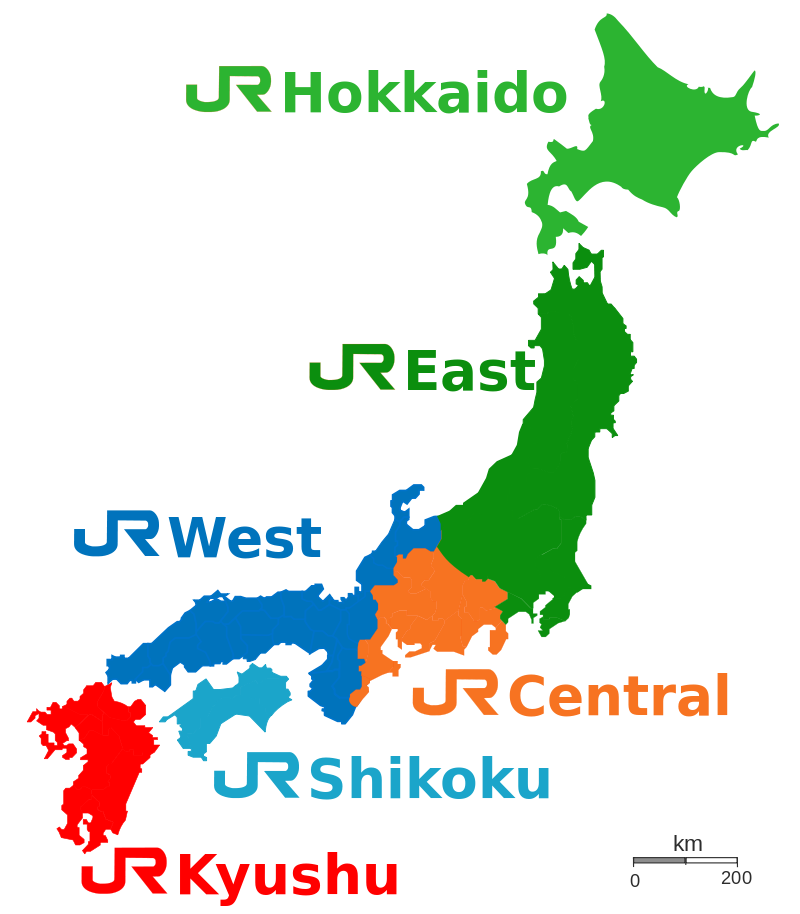
Japanese Railway Below is the map of Japanese Railway
Railway map of Japan with private ownership courtesy Wikimedia commons
Japan started privatizing its railway in 1987 and to date it has not been fully privatized. And on top of it, amount as much as 24 trillion of the long-term JNR debt was shouldered by the government at the expense of taxpayers of Japan while also reducing almost 1/4th of it employees. To add to it, while some parts of Japanese Railways did make profits, many of them made profits by doing large-scale non-railway business mostly real estate of land adjacent to railway stations. In many cases, it seems this went all the way up to 60% of the revenue. The most profitable has been the Shinkansen though. And while it has been profitable, it has not been without safety scandals over the years, the biggest in recent years was the 2005 Amagasaki derailment. What was interesting to me was the Aftermath, while the Wikipedia page doesn t share much, I had read at the time and probably could be found how a lot of ordinary people stood up to the companies in a country where it is a known fact that most companies are owned by the Yakuza. And this is a country where people are loyal to their corporation or company no matter what. It is a strange culture to west and also here in India where people change jobs on drop of hat, although nowadays we have record unemployment. So perhaps Japan too does not meet our standard as it doesn t do competition with each other but each is a set monopoly in those regions. Also how much subsidy is there or not is not really transparent.

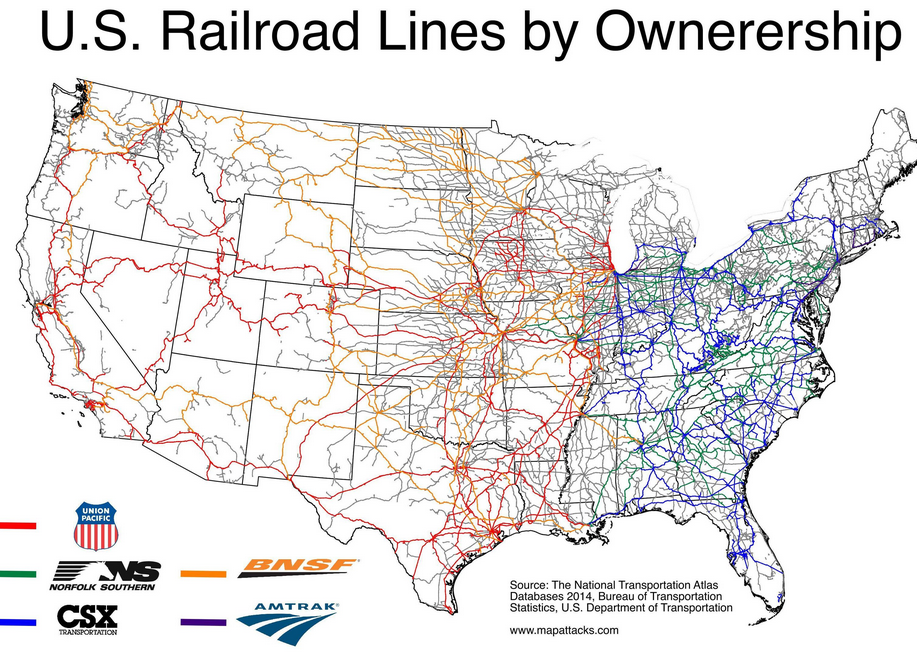
U.S. Railways Last, but not the least I share the U.S. Railway map. This is provided by A Mr. Tom Alison on reddit on channel maporn. As the thread itself is archived and I do not know the gentleman concerned, nor have taken permission for the map, hence sharing the compressed version


U.S. Railway lines with the different owners
Now the U.S. Railways is and has always been peculiar as unlike the above two the U.S. has always been more of a freight network. Probably, much of it has to do that in the 1960 s when oil was cheap, the U.S. made zillions of roadways and romanticized the road trip and has been doing it ever since. Also the creation of low-cost airlines definitely didn t help the railways to have more passenger services, in fact the opposite. There are and have been smaller services and attempts of privatization in both New Zealand and Australia and both have been failures. Please see papers in that regard. My simple point is this, as can be seen above, there have been various attempts at privatization of railways and most of them have been a mixed bag. The only one which comes close to what we think as good is Japanese but that also used a lot of public debt which we don t know what will happen on next. Also for higher-speed train services like a bullet train or whatever, you need to direct, no hair pen bends. In fact, a good talk on the topic is the TBD podcast which while it talks about hyperloop, the same questions is and would be asked if were to do in India. Another thing to be kept in mind is that the Japanese have been exceptional builders and this is because they have been forced to. They live in a seismically active zone which made Fukushima disaster a reality but at the same time, their buildings are earthquake-resistant. Standard Disclaimer The above is a simplified version of things. I could have added in financial accounts but that again has no set pattern. For e.g. some Railways use accrual, some use cash and some use hybrid. I could have also shared in either the guage or electrification but all have slightly different standards, although uniguage is something that all Railways aspire for and electrification is again something that all Railways want although in many cases it just isn t economically feasible.

Indian Railways Indian Railways itself recently made the move from Cash to Accrual couple of years back. In-between for a couple of years, it was hybrid. The sad part is and was you can now never measure against past performance in the old way because it is so different. Hence, whether the Railways will be making a loss or a profit, we would come to know only much later. Also, most accountants don t know the new system well, so it is gonna take more time, how much unknown. Sadly, what GOI did a few years back is merge the Railway budget into the Union Budget. Of course, the excuse they gave is too many pressures of new trains, while the truth is, by doing this, they decreased transparency about the whole thing. For e.g. for the last few years, the only state which had significant work being done is in U.P. (Uttar Pradesh) and a bit in Goa, although that is has been protested time and again. I being from the neighborly state of Maharashtra , and have been there several times. Now it does feels all like a dream, going to Goa :(.

Covid news Now before I jump on the news, I should share the movie Virus (2019) which was made by the talented Aashiq Abu. Even though, am not a Malayalee, I still have enjoyed many of his movies simply because he is a terrific director and Malayalam movies, at least most of them have English subtitles and lot of original content.. Interestingly, unlike the first couple of times when I saw it a couple of years back. The first time I saw it, I couldn t sleep a wink for a week. Even the next time, it was heavy. I had shared the movie with mum, and even she couldn t see it in one go. It is and was that powerful Now maybe because we are headlong in the pandemic, and the madness is all around us. There are two terms that helped me though understand a great deal of what is happening in the movie, the first term was altered sensorium which has been defined here. The other is saturation or to be more precise oxygen saturation . This term has also entered the Indian twitter lexicon quite a bit as India has started running out of oxygen. Just today Delhi High Court did an emergency hearing on the subject late at night. Although there is much to share about the mismanagement of the center, the best piece on the subject has been by Miss Priya Ramani. Yup, the same lady who has won against M.J. Akbar and this is when Mr. Akbar had 100 lawyers for this specific case. It would be interesting to see what happens ahead. There are however few things even she forgot in her piece, For e.g. reverse migration i.e. from urban to rural migration started again. Two articles from different entities sharing a similar outlook.Sadly, the right have no empathy or feeling for either the poor or the sick. Even the labor minister Santosh Gangwar s statement that around 1.04 crores were the only people who walked back home. While there is not much data, however some work/research has been done on migration to cites that the number could be easily 10 times as much. And this was in the lockdown of last year. This year, again the same issue has re-surfaced and migrants learning lessons started leaving cities. And I m ashamed to say I think they are doing the right thing. Most State Governments have not learned lessons nor have they done any work to earn the trust of migrants. This is true of almost all state Governments. Last year, just before the lockdown was announced, me and my friend spent almost 30k getting a cab all the way from Chennai to Pune, how much we paid for the cab, how much we bribed the various people just so we could cross the state borders to return home to our anxious families. Thankfully, unlike the migrants, we were better off although we did make a loss. I probably wouldn t be alive if I were in their situation as many didn t. That number is still in the air undocumented deaths  Vaccine issues Currently, though the issue has been the Vaccine and the pricing of the same. A good article to get a summation of the issues outlined has been shared on Economist. Another article that goes to the heart of the issue is at scroll. To buttress the argument, the SII chairman had shared this few weeks back
Adar Poonawala talking to Vishnu Som on Left, right center, 7th April 2021.
So, a licensee manufacturer wants to make super-profits during the pandemic. And now, as shared above they can very easily do it. Even the quotes given to nearby countries is smaller than the quotes given to Indian states

Prices of AstraZeneca among various states and countries.
The situation around beds, vaccines, oxygen, anything is so dire that people could go to any lengths to save their loved ones. Even if they know if a certain medicine doesn t work. For e.g. Remdesivir, 5 WHO trials have concluded that it doesn t increase mortality. Heck, even AIIMS chief said the same. But both doctors and relatives desperation to cling on hope has made Remdesivir as a black market drug with unoffical prices hovering anywhere between INR 14k/- to INR30k/- per vial. One of the executives of a top firm was also arrested in Gujarat. In Maharashtra, the opposition M.P. came to the rescue of the officials of Bruick pharms in Mumbai. Sadly, this strange affliction to the party in the center is also there in my extended family. At one end, they will heap praise on Mr. Modi, at the same time they can t get wait to get fast out of India. Many of them have settled in horrors of horror Dubai, as it is the best place to do business, get international schools for the young ones at decent prices, cheaper or maybe a tad more than what they paid in Delhi or elsewhere. Being an Agarwal or a Gupta makes it easier to compartmentalize both things. Ease of doing business, 5 days flat to get a business registered, up and running. And the paranoia is still there. They won t talk on the phone about him because they are afraid they may say something which comes back to bite them. As far as their decision to migrate, can t really blame them. If I were 20-25 yeas younger and my mum were in a better shape than she is, we probably would have migrated as well, although would have preferred Europe than anywhere else.

Internet Freedom and Aarogya Setu App.


Internet Freedom had shared the chilling effects of the Aarogya Setu App. This had also been shared by FSCI in the past, and recently had their handle being banned on Twitter. This was also apparent in a legal bail order which the high court judge gave. While I won t go into the merits and demerits of the bail order, it is astounding for the judge to say that the accused, even though he would be on bail install an app. so he can be surveilled. And this is a high court judge, such a sad state of affairs. We seem to be putting up new lows every day when it comes to judicial jurisprudence. One interesting aspect of the whole case was shared by Aishwarya Iyer. She shared a story that she and her team worked on quint which raises questions on the quality of the work done by Delhi Police. This is of course, up to Delhi Police to ascertain the truth of the matter because unless and until they are able to tie in the PMO s office in for a leak or POTUS s office it hardly seems possible. For e.g. the dates when two heads of state can meet each other would be decided by the secretaries of the two. Once the date is known, it would be shared with the press while at the same time some sort of security apparatus would kick in place. It is incumbent, especially on the host to take as much care as he can of the guest. We all remember that World War 1 (the war to end all wars) started due to the murder of Archduke Ferdinand.

As nobody wants that, the best way is to make sure that a political murder doesn t happen on your watch. Now while I won t comment on what it would be, it would be safe to assume that it would be z+ security along with higher readiness. Especially if it as somebody as important as POTUS. Now, it would be quite a reach for Delhi Police to connect the two dates. They either will have to get creative with the dates or some other way. Otherwise, with practically no knowledge in the public domain, they can t work in limbo. In either case, I do hope the case comes up for hearing soon and we see what the Delhi Police says and contends in the High Court about the same. At the very least, it would be irritating for them to talk of the dates unless they can contend some mass conspiracy which involves the PMO (and would bring into question the constant vetting done by the Intelligence dept. of all those who work in PMO). And this whole case is to kind of shelter to the Delhi riots which happened in which majorly the Muslims died but their deaths lay unaccounted till date

Conclusion In Conclusion, I would like to share a bit of humor because right now the atmosphere is humorless, both with authoritarian tendencies of the Central Govt. and the mass mismanagement of public health which they now have left to the state to do as they fit. The peice I am sharing is from arre, one of my goto sites whenever I feel low.

20 January 2021

Molly de Blanc: Inauguration Pie

How can I put four years into a pie? I m thinking of Inauguration Day 2017 through to today, Inauguration Day 2021. In truth things started back in 2015, when Donald Trump announced his run for the United States presidency, and I don t know how long things will continue past the moment when President-Elect Joe Biden becomes President Joe Biden. For the United States, it s been a hell of a time. For the world, it d been even worse. Every generation thinks that they lived through more than anyone else, that they had it worse. I had a Boomer tell me that the existential stress of COVID is nothing compared to the Vietnam War. I m sure when we are living through a global water crisis, I ll tell the kids that we had it bad too. Everyday I listen to the radio and read Twitter, aware that the current state of endless wars wars against terrorism and drugs, organized crime and famine, climate change and racism is global, and not limited to just what s happening to and around me. That makes it feel worse and bigger and I wonder if earlier generations can really grasp how big that is. The last four years brought me in closer working relationships with people in India and Nigeria. I would call these people my friends in that if they were in town I would want to see them and show them around. Most of them I would offer a space in my small apartment, in case they needed somewhere to sleep and wanted to save the money. We chat, though we only have the internet as opposed to elevator rides in tall office buildings and slow walks down to the shops during lunch breaks. From these relationships I have learned very little about life in India or Nigeria, and I only visited India separately from any of my colleagues there. (I went for a wedding. My visa to Nigeria was denied on account of a medical issue.) But, I follow these people on social media and see what they share, the same political and social utterances that could be the same here or virtually any other place, as long as we replace the right keywords. Exchange the name of one leader, conservative party, or government unit for another. When I first saw the #EndSARS hashtag show up, I thought the images were from Black Lives Matter protests. Stop police brutality. And that was only in the last few months. I ve had three jobs since Trump first announced his candidacy in three very different places. In the first I felt like I wasn t able to talk about the sexism and discrimination I was dealing with in the office, and how much more so my views on an organizational partnership with a government whose policies I strongly disagreed with. In the second I was able to talk about these things, but there was nothing to do about them. I ve been in love and had my heart broken three times in three very different ways that all came down to someone valuing someone else more than they valued me. Can I bake heartbreak into a pie? Is it even fair to distract from the political world with my own loss? What about COVID-19? There s bitterness and anger and tears and pain emotional and physical. There is desperation and desolation and loneliness. Covid has colored everything during the past year. It is a burden our new political leaders will take on. Biden and Harris, all of the new people in Congress, and everyone else who has taken on an elected position now must content with Covid with new levels of responsibility. Not only do their decisions affect the people they come into contact with, they now affect everyone their policies touch and perhaps even more than that. The government hired people to build walls. Our government approved it and people willingly took on the job of building those walls. Families were separated. Children were placed in inhumane conditions; children were tortured. Remember when the guards at border detention facilities were raping children? Remember when children had guards? Women were forcefully operated upon and had their bodies permanently changed without their permission, against their desires. People were executed by the state. There were so many things I ve lost track of them all. I remember bits and pieces as I write this, coming back to me like singing a song I haven t thought about in years. With each line, I remember another one. Being worried about coming home from Cuba, when the visitation rules were changed in the middle of my trip. Climate change, again and again. Pollution and microplastics and watching the country being broken into pieces and sold off in the name of economy and progress. People losing their access to healthcare, through clinics closing down and loss of insurance. What do you bake into a pie that tastes like sedition? What are the flavors of loss and racism and hate? How to you balance the sourness with subtle hints of hope, which feels to tender and fragile? Do we pair equal parts of the palatable with the unpalatable, in the name of our neatly divided senate? I have hope, of course I have hope, and I have always had hope, but now it feels thinner than ever, like a ganache or a caramel after your hand slips and you pour too much cream in. A custard or compote or curd that that refuses to thicken no matter how long you cook it. I see that things could be better, but better does not mean good and better does not mean enough. So I will put my hope into this pie. I put my pain and anger into the dough. I will put my tears and helplessness and bitterness into the filling. I will cover it sweetness and the delicate hope I ve spun out of sugar. Soon I will bake it and share it with the three other people I see because the most important thing about surviving these past years, these past months and weeks and days, is that we did it together. We will commiserate on what we ve overcome, and we will share our hope and the sweetness of the moment, as the spun sugar dissolves on our tongues. There is so much we have left to do, so much we must do. We will be angry in the future, we may be angry later today, but until then, we have pie.

12 January 2021

John Goerzen: The Good, Bad, and Scary of the Banning of Donald Trump, and How Decentralization Makes It All Better

It is undeniable that banning Donald Trump from Facebook, Twitter, and similar sites is a benefit for the moment. It may well save lives, perhaps lots of lives. But it raises quite a few troubling issues. First, as EFF points out, these platforms have privileged speakers with power, especially politicians, over regular users. For years now, it has been obvious to everyone that Donald Trump has been violating policies on both platforms, and yet they did little or nothing about it. The result we saw last week was entirely forseeable and indeed, WAS forseen, including by elements in those companies themselves. (ACLU also raises some good points) Contrast that with how others get treated. Facebook, two days after the coup attempt, banned Benjamin Wittes, apparently because he mentioned an Atlantic article opposed to nutcase conspiracy theories. The EFF has also documented many more egregious examples: taking down documentation of war crimes, childbirth images, black activists showing the racist messages they received, women discussing online harassment, etc. The list goes on; YouTube, for instance, has often been promoting far-right violent videos while removing peaceful LGBTQ ones. In short, have we simply achieved legal censorship by outsourcing it to dominant corporations? It is worth pausing at this point to recognize two important princples: First, that we do not see it as right to compel speech. Secondly, that there exist communications channels and other services that nobody is calling on to suspend Donald Trump. Let s dive into those a little bit. There have been no prominent calls for AT&T, Verizon, Gmail, or whomever provides Trump and his campaign with cell phones or email to suspend their service to him. Moreover, the gas stations that fuel his vehicles and the airports that service his plane continue to provide those services, and nobody has seriously questioned that, either. Even his Apple phone that he uses to post to Twitter remains, as far as I know, fully active. Secondly, imagine you were starting up a small web forum focused on raising tomato plants. It is, and should be, well within your rights to keep tomato-haters out, as well as people that have no interest in tomatoes but would rather talk about rutabagas, politics, or Mars. If you are going to host a forum about tomatoes, you have the right to keep it a forum about tomatoes; you cannot be forced to distribute someone else s speech. Likewise in traditional media, a newspaper cannot be forced to print every letter to the editor in full. In law, there is a notion of a common carrier, that provides services to the general public without discrimination. Phone companies and ISPs fall under this. Facebook, Twitter, and tomato sites don t. But consider what happens if Facebook bans you. You might be using Facebook-owned Whatsapp to communicate with family and friends, and suddenly find yourself unable to ask someone to pick you up. Or your treasured family photos might be in Facebook-owned Instagram, lost forever. It s not just Facebook; similar things happen with Google, locking people out of their phones and laptops, their emails, even their photos. Is it right that Facebook and Google aren t regulated as common carriers? Perhaps, or perhaps we need some line of demarcation between their speech-to-the-public services (Facebook timeline posts, YouTube) and private communication (Whatsapp, Gmail). It s a thorny issue; should government be regulating speech instead? That s also fraught. So is corporate control. Decentralization Helps Dramatically With email, you get to pick your email provider (yes, there are two or three big ones, but still plenty of others). Each email provider will have its own set of things it considers acceptable, and its own set of other servers and accounts it s willing to exchange mail with. (It is extremely common for mail providers to choose not to accept mail from various other mail servers based on ISP, IP address, reputation, and so forth.) What if we could do something like that for Twitter and Facebook? Let you join whatever instance you like. Maybe one instance is all about art and they don t talk about politics. Or another is all about Free Software and they don t have advertising. And then there are plenty of open instances that accept anything that s respectful. And, like email, people of one server can interact with those using another just as easily as if they were using the same one. Well, this isn t hypothetical; it already exists in the Fediverse. The most common option is Mastodon, and it so happens that a month ago I wrote about its benefits for other reasons, and included some links on getting started. There is no reason that we must all let our online speech be controlled by companies with a profit motive to keep hate speech on their platforms. There is no reason that we must all have a single set of rules, or accept strong corporate or government control, either. The quality of conversation on Mastodon is far higher than either Twitter or Facebook; decentralization works and it s here today.

7 January 2021

John Goerzen: This Is How Tyrants Go: Alone

I remember reading an essay a month or so ago sadly I forget where talking about how things end for tyrants. If I were to sum it up, it would be with the word alone. Their power fading, they find that they had few true friends or believers; just others that were greedy for power or riches and, finding those no longer to be had, depart the sinking ship. The article looked back at examples like Nixon and examples from the 20th century in Europe and around the world. Today we saw images of a failed coup attempt. But we also saw hope. Already senior staff in the White House are resigning. Ones that had been ardent supporters. In the end, just 6 senators supported the objection to the legitimate electors. Six. Lindsay Graham, Mike Pence, and Mitch McConnel all deserted Trump. CNN reports that there are serious conversations about invoking the 25th amendment and removing him from office, because even Republicans are to the point of believing that America should not have two more weeks of this man. Whether those efforts are successful or not, I don t know. What I do know is that these actions have awakened many people, in a way that nothing else could for four years, to the dangers of Trump and, in the end, have bolstered the cause of democracy. Hard work will remain but today, Donald Trump is in the White House alone, abandoned by allies and blocked by Twitter. And we know that within two weeks, he won t be there at all. We will get through this.

8 November 2020

Russell Coker: Links November 2020

KDE has a long term problem of excessive CPU time used by the screen locker [1]. Part of it is due to software GL emulation, and part of it is due to the screen locker doing things like flashing the cursor when nothing else is happening. One of my systems has an NVidia card and enabling GL would cause it to crash. So now I have kscreenlocker using 30% of a CPU core even when the screen is powered down. Informative NYT article about the latest security features for iPhones [2]. Android needs new features like this! Russ Allbery wrote an interesting review of the book Hand to Mouth by Linda Tirado [3], it s about poverty in the US and related things. Linda first became Internet famous for her essay Why I Make Terrible Decisions or Poverty Thoughts which is very insightful and well written, this is the latest iteration of that essay [4]. This YouTube video by Ruby Payne gives great insights to class based attitudes towards time and money [5]. News Week has an interesting article about chicken sashimi, apparently you can safely eat raw chicken if it s prepared well [6]. Vanity Fair has an informative article about how Qanon and Trumpism have infected the Catholic Church [7]. Some of Mel Gibson s mental illness is affecting a significant portion of the Catholic Church in the US and some parts in the rest of the world. Noema has an interesting article on toxic Internet culture, Japan s 2chan, 4chan, 8chan/8kun, and the conspiracy theories they spawned [8]. Benjamin Corey is an ex-Fundie who wrote an amusing analysis of the Biblical statements about the anti-Christ [9]. NYMag has an interesting article The Final Gasp of Donald Trump s Presidency [10]. Mother Jones has an informative article about the fact that Jim Watkins (the main person behind QAnon) has a history of hosting child porn on sites he runs [11], but we all knew QAnon was never about protecting kids. Eand has an insightful article America s Problem is That White People Want It to Be a Failed State [12].

6 September 2020

Russ Allbery: September haul

So many good books, so little reading time. Jairus Banaji A Brief History of Commercial Capitalism (nonfiction)
Steven Brust The Baron of Magister Valley (sff)
Micaiah Johnson The Space Between Worlds (sff)
Ian McDonald Luna: New Moon (sff)
Elizabeth Moon Trading in Danger (sff)
Tamsyn Muir Harrow the Ninth (sff)
Suzanne Palmer Finder (sff)
Kit Rocha Beyond Shame (sff)
Kit Rocha Beyond Control (sff)
Kit Rocha Beyond Pain (sff)
Arundhati Roy Azadi (nonfiction)
Jeff VanderMeer Authority (sff)
Jeff VanderMeer Acceptance (sff)
K.B. Wagers Behind the Throne (sff)
Jarrett Walker Human Transit (nonfiction) I took advantage of a few sales to get books I know I'm going to want to read eventually for a buck or two.

30 June 2020

Russ Allbery: Review: The Fifth Risk

Review: The Fifth Risk, by Michael Lewis
Publisher: W.W. Norton
Copyright: 2018
Printing: 2019
ISBN: 0-393-35745-7
Format: Kindle
Pages: 254
The Fifth Risk starts with the presidential transition. Max Stier, the first person profiled by Lewis in this book, is the founder of the Partnership for Public Service. That foundation helped push through laws to provide more resources and structure for the transition of the United States executive branch from one president to the next. The goal was to fight wasted effort, unnecessary churn, and pointless disruption in the face of each administration's skepticism about everyone who worked for the previous administration.
"It's Groundhog Day," said Max. "The new people come in and think that the previous administration and the civil service are lazy or stupid. Then they actually get to know the place they are managing. And when they leave, they say, 'This was a really hard job, and those are the best people I've ever worked with.' This happens over and over and over."
By 2016, Stier saw vast improvements, despite his frustration with other actions of the Obama administration. He believed their transition briefings were one of the best courses ever produced on how the federal government works. Then that transition process ran into Donald Trump. Or, to be more accurate, that transition did not run into Donald Trump, because neither he nor anyone who worked for him were there. We'll never know how good the transition information was because no one ever listened to or read it. Meetings were never scheduled. No one showed up. This book is not truly about the presidential transition, though, despite its presence as a continuing theme. The Fifth Risk is, at its heart, an examination of government work, the people who do it, why it matters, and why you should care about it. It's a study of the surprising and misunderstood responsibilities of the departments of the United States federal government. And it's a series of profiles of the people who choose this work as a career, not in the upper offices of political appointees, but deep in the civil service, attempting to keep that system running. I will warn now that I am far too happy that this book exists to be entirely objective about it. The United States desperately needs basic education about the government at all levels, but particularly the federal civil service. The public impression of government employees is skewed heavily towards the small number of public-facing positions and towards paperwork frustrations, over which the agency usually has no control because they have been sabotaged by Congress (mostly by Republicans, although the Democrats get involved occasionally). Mental images of who works for the government are weirdly selective. The Coast Guard could say "I'm from the government and I'm here to help" every day, to the immense gratitude of the people they rescue, but Reagan was still able to use that as a cheap applause line in his attack on government programs. Other countries have more functional and realistic social attitudes towards their government workers. The United States is trapped in a politically-fueled cycle of contempt and ignorance. It has to stop. And one way to help stop it is someone with Michael Lewis's story-telling skills writing a different narrative. The Fifth Risk is divided into a prologue about presidential transitions, three main parts, and an afterword (added in current editions) about a remarkable government worker whom you likely otherwise would never hear about. Each of the main parts talks about a different federal department: the Department of Energy, the Department of Agriculture, and the Department of Commerce. In keeping with the theme of the book, the people Lewis profiles do not do what you might expect from the names of those departments. Lewis's title comes from his discussion with John MacWilliams, a former Goldman Sachs banker who quit the industry in search of more personally meaningful work and became the chief risk officer for the Department of Energy. Lewis asks him for the top five risks he sees, and if you know that the DOE is responsible for safeguarding nuclear weapons, you will be able to guess several of them: nuclear weapons accidents, North Korea, and Iran. If you work in computer security, you may share his worry about the safety of the electrical grid. But his fifth risk was project management. Can the government follow through on long-term hazardous waste safety and cleanup projects, despite constant political turnover? Can it attract new scientists to the work of nuclear non-proliferation before everyone with the needed skills retires? Can it continue to lay the groundwork with basic science for innovation that we'll need in twenty or fifty years? This is what the Department of Energy is trying to do. Lewis's profiles of other departments are similarly illuminating. The Department of Agriculture is responsible for food stamps, the most effective anti-poverty program in the United States with the possible exception of Social Security. The section on the Department of Commerce is about weather forecasting, specifically about NOAA (the National Oceanic and Atmospheric Administration). If you didn't know that all of the raw data and many of the forecasts you get from weather apps and web sites are the work of government employees, and that AccuWeather has lobbied Congress persistently for years to prohibit the NOAA from making their weather forecasts public so that AccuWeather can charge you more for data your taxes already paid for, you should read this book. The story of American contempt for government work is partly about ignorance, but it's also partly about corporations who claim all of the credit while selling taxpayer-funded resources back to you at absurd markups. The afterword I'll leave for you to read for yourself, but it's the story of Art Allen, a government employee you likely have never heard of but whose work for the Coast Guard has saved more lives than we are able to measure. I found it deeply moving. If you, like I, are a regular reader of long-form journalism and watch for new Michael Lewis essays in particular, you've probably already read long sections of this book. By the time I sat down with it, I think I'd read about a third in other forms on-line. But the profiles that I had already read were so good that I was happy to read them again, and the additional stories and elaboration around previously published material was more than worth the cost and time investment in the full book.
It was never obvious to me that anyone would want to read what had interested me about the United States government. Doug Stumpf, my magazine editor for the past decade, persuaded me that, at this strange moment in American history, others might share my enthusiasm.
I'll join Michael Lewis in thanking Doug Stumpf. The Fifth Risk is not a proposal for how to fix government, or politics, or polarization. It's not even truly a book about the Trump presidency or about the transition. Lewis's goal is more basic: The United States government is full of hard-working people who are doing good and important work. They have effectively no public relations department. Achievements that would result in internal and external press releases in corporations, not to mention bonuses and promotions, go unnoticed and uncelebrated. If you are a United States citizen, this is your government and it does important work that you should care about. It deserves the respect of understanding and thoughtful engagement, both from the citizenry and from the politicians we elect. Rating: 10 out of 10

6 May 2020

Russell Coker: About Reopening Businesses

Currently there is political debate about when businesses should be reopened after the Covid19 quarantine. Small Businesses One argument for reopening things is for the benefit of small businesses. The first thing to note is that the protests in the US say I need a haircut not I need to cut people s hair . Small businesses won t benefit from reopening sooner. For every business there is a certain minimum number of customers needed to be profitable. There are many comments from small business owners that want it to remain shutdown. When the government has declared a shutdown and paused rent payments and provided social security to employees who aren t working the small business can avoid bankruptcy. If they suddenly have to pay salaries or make redundancy payouts and have to pay rent while they can t make a profit due to customers staying home they will go bankrupt. Many restaurants and cafes make little or no profit at most times of the week (I used to be 1/3 owner of an Internet cafe and know this well). For such a company to be viable you have to be open most of the time so customers can expect you to be open. Generally you don t keep a cafe open at 3PM to make money at 3PM, you keep it open so people can rely on there being a cafe open there, someone who buys a can of soda at 3PM one day might come back for lunch at 1:30PM the next day because they know you are open. A large portion of the opening hours of a most retail companies can be considered as either advertising for trade at the profitable hours or as loss making times that you can t close because you can t send an employee home for an hour. If you have seating for 28 people (as my cafe did) then for about half the opening hours you will probably have 2 or fewer customers in there at any time, for about a quarter the opening hours you probably won t cover the salary of the one person on duty. The weekend is when you make the real money, especially Friday and Saturday nights when you sometimes get all the seats full and people coming in for takeaway coffee and snacks. On Friday and Saturday nights the 60 seat restaurant next door to my cafe used to tell customers that my cafe made better coffee. It wasn t economical for them to have a table full for an hour while they sell a few cups of coffee, they wanted customers to leave after dessert and free the table for someone who wants a meal with wine (alcohol is the real profit for many restaurants). The plans of reopening with social distancing means that a 28 seat cafe can only have 14 chairs or less (some plans have 25% capacity which would mean 7 people maximum). That means decreasing the revenue of the most profitable times by 50% to 75% while also not decreasing the operating costs much. A small cafe has 2-3 staff when it s crowded so there s no possibility of reducing staff by 75% when reducing the revenue by 75%. My Internet cafe would have closed immediately if forced to operate in the proposed social distancing model. It would have been 1/4 of the trade and about 1/8 of the profit at the most profitable times, even if enough customers are prepared to visit and social distancing would kill the atmosphere. Most small businesses are barely profitable anyway, most small businesses don t last 4 years in normal economic circumstances. This reopen movement is about cutting unemployment benefits not about helping small business owners. Destroying small businesses is also good for big corporations, kill the small cafes and restaurants and McDonald s and Starbucks will win. I think this is part of the motivation behind the astroturf campaign for reopening businesses. Forbes has an article about this [1]. Psychological Issues Some people claim that we should reopen businesses to help people who have psychological problems from isolation, to help victims of domestic violence who are trapped at home, to stop older people being unemployed for the rest of their lives, etc. Here is one article with advice for policy makers from domestic violence experts [2]. One thing it mentions is that the primary US federal government program to deal with family violence had a budget of $130M in 2013. The main thing that should be done about family violence is to make it a priority at all times (not just when it can be a reason for avoiding other issues) and allocate some serious budget to it. An agency that deals with problems that affect families and only has a budget of $1 per family per year isn t going to be able to do much. There are ongoing issues of people stuck at home for various reasons. We could work on better public transport to help people who can t drive. We could work on better healthcare to help some of the people who can t leave home due to health problems. We could have more budget for carers to help people who can t leave home without assistance. Wanting to reopen restaurants because some people feel isolated is ignoring the fact that social isolation is a long term ongoing issue for many people, and that many of the people who are affected can t even afford to eat at a restaurant! Employment discrimination against people in the 50+ age range is an ongoing thing, many people in that age range know that if they lose their job and can t immediately find another they will be unemployed for the rest of their lives. Reopening small businesses won t help that, businesses running at low capacity will have to lay people off and it will probably be the older people. Also the unemployment system doesn t deal well with part time work. The Australian system (which I think is similar to most systems in this regard) reduces the unemployment benefits by $0.50 for every dollar that is earned in part time work, that effectively puts people who are doing part time work because they can t get a full-time job in the highest tax bracket! If someone is going to pay for transport to get to work, work a few hours, then get half the money they earned deducted from unemployment benefits it hardly makes it worthwhile to work. While the exact health impacts of Covid19 aren t well known at this stage it seems very clear that older people are disproportionately affected, so forcing older people to go back to work before there is a vaccine isn t going to help them. When it comes to these discussions I think we should be very suspicious of people who raise issues they haven t previously shown interest in. If the discussion of reopening businesses seems to be someone s first interest in the issues of mental health, social security, etc then they probably aren t that concerned about such issues. I believe that we should have a Universal Basic Income [3]. I believe that we need to provide better mental health care and challenge the gender ideas that hurt men and cause men to hurt women [4]. I believe that we have significant ongoing problems with inequality not small short term issues [5]. I don t think that any of these issues require specific changes to our approach to preventing the transmission of disease. I also think that we can address multiple issues at the same time, so it is possible for the government to devote more resources to addressing unemployment, family violence, etc while also dealing with a pandemic.

31 March 2020

Russell Coker: Links March 2020

Rolling Stone has an insightful article about why the Christian Right supports Trump and won t stop supporting him no matter what he does [1]. Interesting article about Data Oriented Architecture [2]. Quarantine Will normalise WFH and Recession will Denormalise Jobs [3]. I guess we can always hope that after a disaster we can learn to do things better than before. Tyre wear is worse than exhaust for small particulate matter [4]. We need better tyres and legal controls over such things. Scott Santens wrote an insightful article about the need for democracy and unconditional basic income [5]. In ancient Greece, work was regarded as a curse is an extreme position but strongly supported by evidence. In his essay In Praise of Idleness, Bertrand Russell wrote Modern methods of production have given us the possibility of ease and security for all; we have chosen, instead, to have overwork for some and starvation for others. Hitherto we have continued to be as energetic as we were before there were machines; in this we have been foolish, but there is no reason to go on being foolish forever. Cory Doctorow wrote an insightful article for Locus titled A Lever Without a Fulcrum Is Just a Stick about expansions to copyright laws [6]. One of his analogies is that giving a bullied kid more lunch money just allows the bullies to steal more money, with artists being bullied kids and lunch money being the rights that are granted under copyright law. The proposed solution includes changes to labor and contract law, presumably Cory will write other articles in future giving the details of his ideas in this regard. The Register has an amusing article about the trial of a former CIA employee on trial for being the alleged vault 7 leaker [7]. Both the prosecution and the defence are building their cases around the defendent being a jerk. The article exposes poor security and poor hiring practices in the CIA. CNN has an informative article about Finland s war on fake news [8]. As Finland has long standing disputes with Russia they have had more practice at dealing with fake news than most countries. The Times of Israel has an interesting article about how the UK used German Jews to spy on German prisoners of war [9]. Cory Doctorow wrote an insightful article Data is the New Toxic Waste about how collecting personal data isn t an asset, it s a liability [10]. Ulrike Uhlig wrote an insightful article about Control Freaks , analysing the different meanings of control, both positive and negative [11]. 538 has an informative article about the value of statistical life [12]. It s about $9M per person in the US, which means a mind-boggling amount of money should be spent to save the millions of lives that will be potentially lost in a natural disaster (like Coronavirus). NPR has an interesting interview about Crypto AG, the Swiss crypto company owned by the CIA [13]. I first learned of this years ago, it s not new, but I still learned a lot from this interview.

27 June 2017

Daniel Pocock: How did the world ever work without Facebook?

Almost every day, somebody tells me there is no way they can survive without some social media like Facebook or Twitter. Otherwise mature adults fearful that without these dubious services, they would have no human contact ever again, they would die of hunger and the sky would come crashing down too. It is particularly disturbing for me to hear this attitude from community activists and campaigners. These are people who aspire to change the world, but can you really change the system using the tools the system gives you? Revolutionaries like Gandhi and the Bolsheviks don't have a lot in common: but both of them changed the world and both of them did so by going against the system. Gandhi, of course, relied on non-violence while the Bolsheviks continued to rely on violence long after taking power. Neither of them needed social media but both are likely to be remembered far longer than any viral video clip you have seen recently. With US border guards asking visitors for their Facebook profiles and Mark Zuckerberg being a regular participant at secretive Bilderberg meetings, it should be clear that Facebook and conventional social media is not on your side, it's on theirs. Kettling has never been easier When street protests erupt in major cities such as London, the police build fences around the protesters, cutting them off from the rest of the world. They become an island in the middle of the city, like a construction site or broken down bus that everybody else goes around. The police then set about arresting one person at a time, taking their name and photograph and then slowly letting them leave in different directions. This strategy is called kettling. Facebook helps kettle activists in their arm chair. The police state can gather far more data about them, while their impact is even more muted than if they ventured out of their home. You are more likely to win the lottery than make a viral campaign Every week there is news about some social media campaign that has gone viral. Every day, marketing professionals, professional campaigners and motivated activists sit at their computer spending hours trying to replicate this phenomenon. Do the math: how many of these campaigns can really be viral success stories? Society can only absorb a small number of these campaigns at any one time. For most of the people trying to ignite such campaigns, their time and energy is wasted, much like money spent buying lottery tickets and with odds that are just as bad. It is far better to focus on the quality of your work in other ways than to waste any time on social media. If you do something that is truly extraordinary, then other people will pick it up and share it for you and that is how a viral campaign really begins. The time and effort you put into trying to force something to become viral is wasting the energy and concentration you need to make something that is worthy of really being viral. An earthquake and an escaped lion never needed to announce themselves on social media to become an instant hit. If your news isn't extraordinary enough for random people to spontaneously post, share and tweet it in the first place, how can it ever go far? The news media deliberately over-rates social media News media outlets, including TV, radio and print, gain a significant benefit crowd-sourcing live information, free of charge, from the public on social media. It is only logical that they will cheer on social media sites and give them regular attention. Have you noticed that whenever Facebook's publicity department makes an announcement, the media are quick to publish it ahead of more significant stories about social or economic issues that impact our lives? Why do you think the media puts Facebook up on a podium like this, ahead of all other industries, if the media aren't getting something out of it too? The tail doesn't wag the dog One particular example is the news media's fascination with Donald Trump's Twitter account. Some people have gone as far as suggesting that this billionaire could have simply parked his jet and spent the whole of 2016 at one of his golf courses sending tweets and he would have won the presidency anyway. Suggesting that Trump's campaign revolved entirely around Twitter is like suggesting the tail wags the dog. The reality is different: Trump has been a prominent public figure for decades, both in the business and entertainment world. During his presidential campaign, he had at least 220 major campaign rallies attended by over 1.2 million people in the real world. Without this real-world organization and history, the Twitter account would have been largely ignored like the majority of Twitter accounts. On the left of politics, the media have been just as quick to suggest that Bernie Sanders and Jeremy Corbyn have been supported by the "Facebook generation". This label is superficial and deceiving. The reality, again, is a grass roots movement that has attracted young people to attend local campaign meetings in pubs up and down the country. Getting people to get out and be active is key. Social media is incidental to their campaign, not indispensible. Real-world meetings, big or small, are immensely more powerful than a social media presence. Consider the Trump example again: if 100,000 people receive one of his tweets, how many even notice it in the non-stop stream of information we are bombarded with today? On the other hand, if 100,000 bellow out a racist slogan at one of his rallies, is there any doubt whether each and every one of those people is engaged with the campaign at that moment? If you could choose between 100 extra Twitter followers or 10 extra activists attending a meeting every month, which would you prefer? Do we need this new definition of a Friend? Facebook is redefining what it means to be a friend. Is somebody who takes pictures of you and insists on sharing them with hundreds of people, tagging your face for the benefit of biometric profiling systems, really a friend? If you want to find out what a real friend is and who your real friends really are, there is no better way to do so then blowing away your Facebook and Twitter account and waiting to see who contacts you personally about meeting up in the real world. If you look at a profile on Facebook or Twitter, one of the most prominent features is the number of friends or followers they have. Research suggests that humans can realistically cope with no more than about 150 stable relationships. Facebook, however, has turned Friending people into something like a computer game. This research is also given far more attention then it deserves though: the number of really meaningful friendships that one person can maintain is far smaller. Think about how many birthdays and spouse's names you can remember and those may be the number of real friendships you can manage well. In his book Busy, Tony Crabbe suggests between 10-20 friendships are in this category and you should spend all your time with these people rather than letting your time be spread thinly across superficial Facebook "friends". This same logic can be extrapolated to activism and marketing in its many forms: is it better for a campaigner or publicist to have fifty journalists following him on Twitter (where tweets are often lost in the blink of an eye) or three journalists who he meets for drinks from time to time? Facebook alternatives: the ultimate trap? Numerous free, open source projects have tried to offer an equivalent to Facebook and Twitter. GNU social, Diaspora and identi.ca are some of the more well known examples. Trying to persuade people to move from Facebook to one of these platforms rarely works. In most cases, Metcalfe's law suggests the size of Facebook will suck them back in like the gravity of a black hole. To help people really beat these monstrosities, the most effective strategy is to help them live without social media, whether it is proprietary or not. The best way to convince them may be to give it up yourself and let them see how much you enjoy life without it. Share your thoughts The FSFE community has recently been debating the use of propriety software and services. Please feel free to join the list and click here to reply on the thread.

9 May 2017

Martin Pitt: Cockpit is now just an apt install away

Cockpit has now been in Debian unstable and Ubuntu 17.04 and devel, which means it s now a simple
$ sudo apt install cockpit
away for you to try and use. This metapackage pulls in the most common plugins, which are currently NetworkManager and udisks/storaged. If you want/need, you can also install cockpit-docker (if you grab docker.io from jessie-backports or use Ubuntu) or cockpit-machines to administer VMs through libvirt. Cockpit upstream also has a rather comprehensive Kubernetes/Openstack plugin, but this isn t currently packaged for Debian/Ubuntu as kubernetes itself is not yet in Debian testing or Ubuntu. After that, point your browser to https://localhost:9090 (or the host name/IP where you installed it) and off you go.

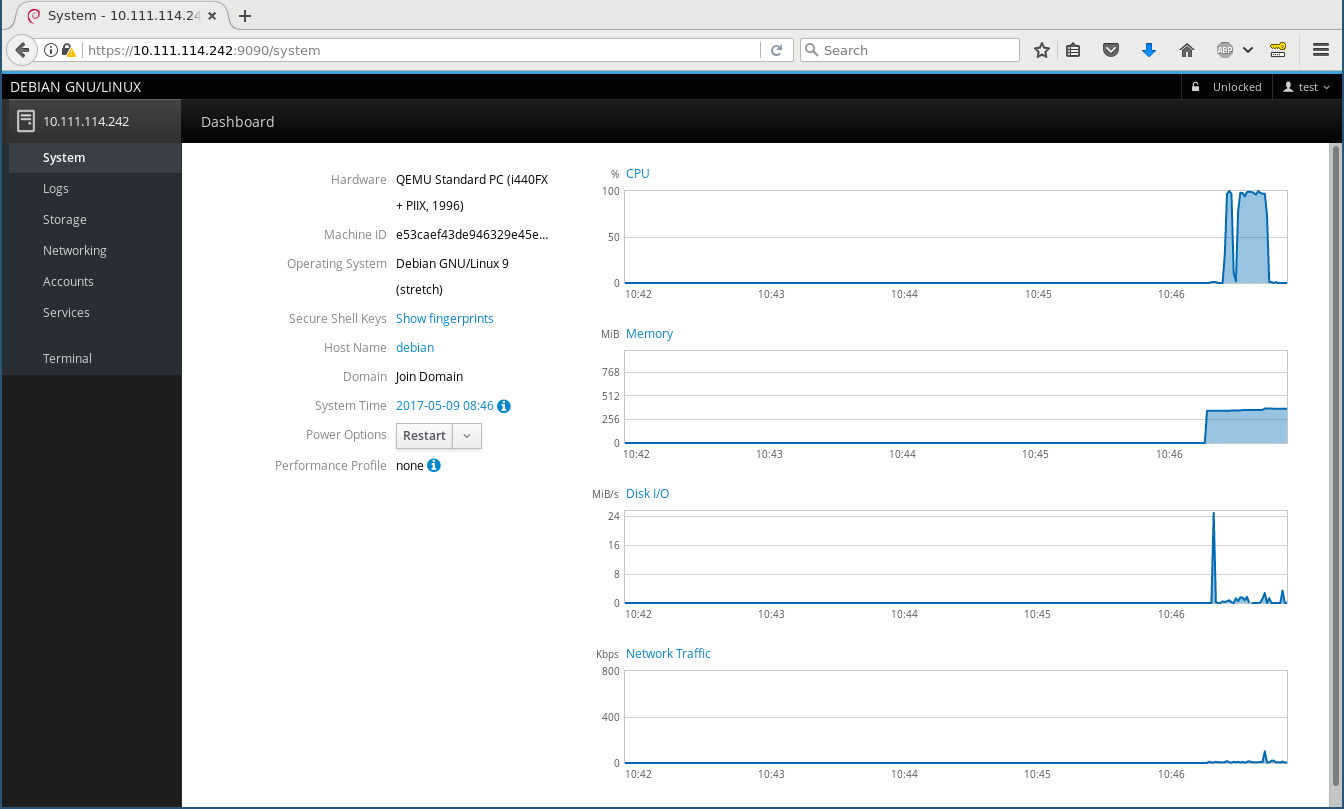
What is Cockpit? Think of it as an equivalent of a desktop (like GNOME or KDE) for configuring, maintaining, and interacting with servers. It is a web service that lets you log into your local or a remote (through ssh) machine using normal credentials (PAM user/password or SSH keys) and then starts a normal login session just as gdm, ssh, or the classic VT logins would. Login screen System page The left side bar is the equivalent of a task switcher , and the applications (i. e. modules for administering various aspects of your server) are run in parallel. The main idea of Cockpit is that it should not behave special in any way - it does not have any specific configuration files or state keeping and uses the same Operating System APIs and privileges like you would on the command line (such as lvmconfig, the org.freedesktop.UDisks2 D-Bus interface, reading/writing the native config files, and using sudo when necessary). You can simultaneously change stuff in Cockpit and in a shell, and Cockpit will instantly react to changes in the OS, e. g. if you create a new LVM PV or a network device gets added. This makes it fundamentally different to projects like webmin or ebox, which basically own your computer once you use them the first time. It is an interface for your operating system, which even reflects in the branding: as you see above, this is Debian (or Ubuntu, or Fedora, or wherever you run it on), not Cockpit .

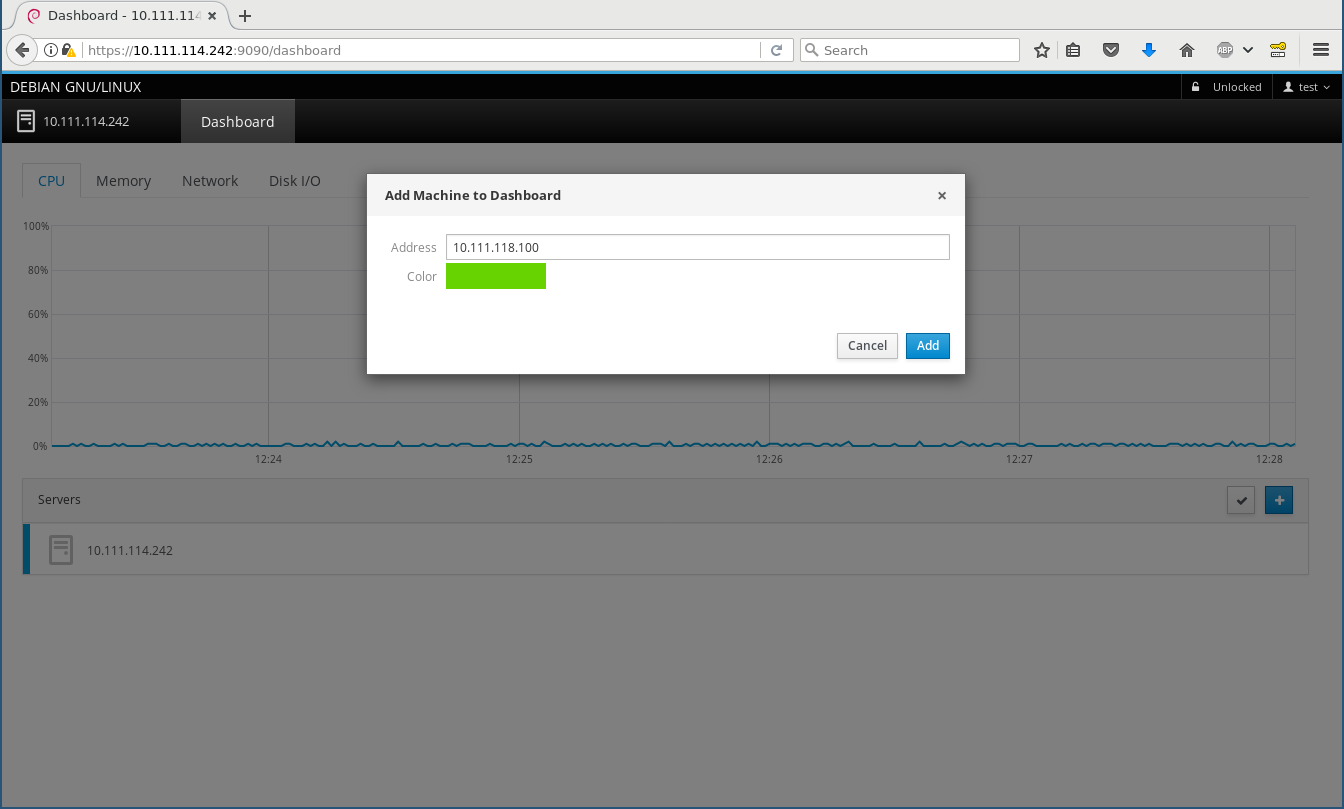
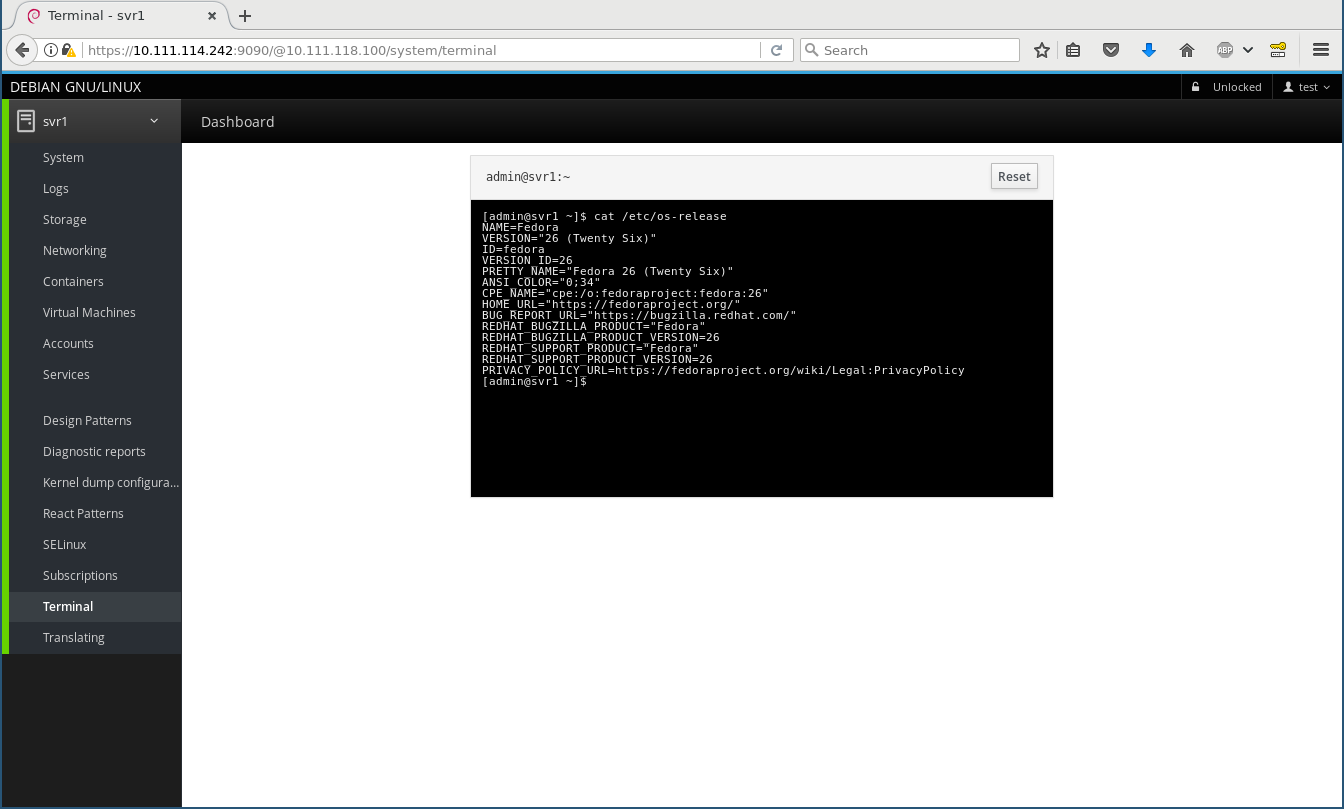
Remote machines In your home or small office you often have more than one machine to maintain. You can install cockpit-bridge and cockpit-system on those for the most basic functionality, configure SSH on them, and then add them on the Dashboard (I add a Fedora 26 machine here) and from then on can switch between them on the top left, and everything works and feels exactly the same, including using the terminal widget: Add remote Remote terminal The Fedora 26 machine has some more Cockpit modules installed, including a lot of playground ones, thus you see a lot more menu entries there.

Under the hood Beneath the fancy Patternfly/React/JavaScript user interface is the Cockpit API and protocol, which particularly fascinates me as a developer as that is what makes Cockpit so generic, reactive, and extensible. This API connects the worlds of the web, which speaks IPs and host names, ports, and JSON, to the local host only world of operating systems which speak D-Bus, command line programs, configuration files, and even use fancy techniques like passing file descriptors through Unix sockets. In an ideal world, all Operating System APIs would be remotable by themselves, but they aren t. This is where the cockpit bridge comes into play. It is a JSON (i. e. ASCII text) stream protocol that can control arbitrarily many channels to the target machine for reading, writing, and getting notifications. There are channel types for running programs, making D-Bus calls, reading/writing files, getting notified about file changes, and so on. Of course every channel can also act on a remote machine. One can play with this protocol directly. E. g. this opens a (local) D-Bus channel named d1 and gets a property from systemd s hostnamed:
$ cockpit-bridge --interact=---
  "command": "open", "channel": "d1", "payload": "dbus-json3", "name": "org.freedesktop.hostname1"  
---
d1
  "call": [ "/org/freedesktop/hostname1", "org.freedesktop.DBus.Properties", "Get",
          [ "org.freedesktop.hostname1", "StaticHostname" ] ],
  "id": "hostname-prop"  
---
and it will reply with something like
d1
 "reply":[[ "t":"s","v":"donald" ]],"id":"hostname-prop" 
---
( donald is my laptop s name). By adding additional parameters like host and passing credentials these can also be run remotely through logging in via ssh and running cockpit-bridge on the remote host. Stef Walter explains this in detail in a blog post about Web Access to System APIs. Of course Cockpit plugins (both internal and third-party) don t directly speak this, but use a nice JavaScript API. As a simple example how to create your own Cockpit plugin that uses this API you can look at my schroot plugin proof of concept which I hacked together at DevConf.cz in about an hour during the Cockpit workshop. Note that I never before wrote any JavaScript and I didn t put any effort into design whatsoever, but it does work .

Next steps Cockpit aims at servers and getting third-party plugins for talking to your favourite part of the system, which means we really want it to be available in Debian testing and stable, and Ubuntu LTS. Our CI runs integration tests on all of these, so each and every change that goes in is certified to work on Debian 8 (jessie) and Ubuntu 16.04 LTS, for example. But I d like to replace the external PPA/repository on the Install instructions with just it s readily available in -backports ! Unfortunately there s some procedural blockers there, the Ubuntu backport request suffers from understaffing, and the Debian stable backport is blocked on getting it in to testing first, which in turn is blocked by the freeze. I will soon ask for a freeze exception into testing, after all it s just about zero risk - it s a new leaf package in testing. Have fun playing around with it, and please report bugs! Feel free to discuss and ask questions on the Google+ post.

29 March 2017

Daniel Pocock: Brexit: If it looks like racism, if it smells like racism and if it feels like racism, who else but a politician could argue it isn't?

Since the EU referendum got under way in the UK, it has become almost an everyday occurence to turn on the TV and hear some politician explaining "I don't mean to sound racist, but..." (example) Of course, if you didn't mean to sound racist, you wouldn't sound racist in the first place, now would you? The reality is, whether you like politics or not, political leaders have a significant impact on society and the massive rise in UK hate crimes, including deaths of Polish workers, is a direct reflection of the leadership (or profound lack of it) coming down from Westminster. Maybe you don't mean to sound racist, but if this is the impact your words are having, maybe it's time to shut up? Choosing your referendum Why choose to have a referendum on immigration issues and not on any number of other significant topics? Why not have a referendum on nuking Mr Putin to punish him for what looks like an act of terrorism against the Malaysian Airlines flight MH17? Why not have a referendum on cutting taxes or raising speed limits, turning British motorways into freeways or an autobahn? Why choose to keep those issues in the hands of the Government, but invite the man-in-a-white-van from middle England to regurgitate Nigel Farage's fears and anxieties about migrants onto a ballot paper? Even if David Cameron sincerely hoped and believed that the referendum would turn out otherwise, surely he must have contemplated that he was playing Russian Roulette with the future of millions of innocent people? Let's start at the top For those who are fortunate enough to live in parts of the world where the press provides little exposure to the antics of British royalty, an interesting fact you may have missed is that the Queen's husband, Prince Philip, Duke of Edinburgh is actually a foreigner. He was born in Greece and has Danish and German ancestry. Migration (in both directions) is right at the heart of the UK's identity. Queen and Prince Philip Home office minister Amber Rudd recently suggested British firms should publish details about how many foreign people they employ and in which positions. She argued this is necessary to help boost funding for training local people. If that is such a brilliant idea, why hasn't it worked for the Premier League? It is a matter of public knowledge how many foreigners play football in England's most prestigious division, so why hasn't this caused local clubs to boost training budgets for local recruits? After all, when you consider that England hasn't won a World Cup since 1966, what have they got to lose? Kevin Pietersen All this racism, it's just not cricket. Or is it? One of the most remarkable cricketers to play for England in recent times, Kevin Pietersen, dubbed "the most complete batsman in cricket" by The Times and "England's greatest modern batsman" by the Guardian, was born in South Africa. In the five years he was contracted to the Hampshire county team, he only played one match, because he was too busy representing England abroad. His highest position was nothing less than becoming England's team captain. Are the British superior to every other European citizen? One of the implications of the rhetoric coming out of London these days is that the British are superior to their neighbours, entitled to have their cake and eat it too, making foreigners queue up at Paris' Gare du Nord to board the Eurostar while British travelers should be able to walk or drive into European countries unchallenged. This superiority complex is not uniquely British, you can observe similar delusions are rampant in many of the places where I've lived, including Australia, Switzerland and France. America's Donald Trump has taken this style of politics to a new level. Look in the mirror Theresa May: after British 10-year old schoolboys Robert Thompson and Jon Venables abducted, tortured, murdered and mutilated 2 year old James Bulger in 1993, why not have all British schoolchildren fingerprinted and added to the police DNA database? Why should "security" only apply based on the country where people are born, their religion or skin colour? Jon Venables and Robert Thompson In fact, after Brexit, people like Venables and Thompson will remain in Britain while a Dutch woman, educated at Cambridge and with two British children will not. If that isn't racism, what is? Running foreigner's off the roads Theresa May has only been Prime Minister for less than a year but she has a history of bullying and abusing foreigners in her previous role in the Home Office. One example of this was a policy of removing driving licenses from foreigners, which has caused administrative chaos and even taken away the licenses of many people who technically should not have been subject to these regulations anyway. Shouldn't the DVLA (Britain's office for driving licenses) simply focus on the competence of somebody to drive a vehicle? Bringing all these other factors into licensing creates a hostile environment full of mistakes and inconvenience at best and opportunities for low-level officials to engage in arbitrary acts of racism and discrimination. Of course, when you are taking your country on the road to nowhere, who needs a driving license anyway? Run off the road What does "maximum control" over other human beings mean to you? The new British PM has said she wants "maximum control" over immigrants. What exactly does "maximum control" mean? Donald Trump appears to be promising "maximum control" over Muslims, Hitler sought "maximum control" over the Jews, hasn't the whole point of the EU been to avoid similar situations from ever arising again? This talk of "maximum control" in British politics has grown like a weed out of the UKIP. One of their senior figures has been linked to kidnappings and extortion, which reveals a lot about the character of the people who want to devise and administer these policies. Similar people in Australia aspire to jobs in the immigration department where they can extort money out of people for getting them pushed up the queue. It is no surprise that the first member of Australia's parliament ever sent to jail was put there for obtaining bribes and sexual favours from immigrants. When Nigel Farage talks about copying the Australian immigration system, he is talking about creating jobs like these for his mates. Even if "maximum control" is important, who really believes that a bunch of bullies in Westminster should have the power to exercise that control? Is May saying that British bosses are no longer competent to make their own decisions about who to employ or that British citizens are not reliable enough to make their own decisions about who they marry and they need a helping hand from paper-pushers in the immigration department? maximum control over Jewish people Echoes of the Third Reich Most people associate acts of mass murder with the Germans who lived in the time of Adolf Hitler. These are the stories told over and and over again in movies, books and the press. Look more closely, however, and it appears that the vast majority of Germans were not in immediate contact with the gas chambers. Even Gobels' secretary writes that she was completely oblivious to it all. Many people were simply small cogs in a big bad machine. The clues were there, but many of them couldn't see the big picture. Even if they did get a whiff of it, many chose not to ask questions, to carry on with their comfortable lives. Today, with mass media and the Internet, it is a lot easier for people to discover the truth if they look, but many are still reluctant to do so. Consider, for example, the fingerprint scanners installed in British post offices and police stations to fingerprint foreigners and criminals (as if they have something in common). If all the post office staff refused to engage in racist conduct the fingerprint scanners would be put out of service. Nonetheless, these people carry on, just doing their job, just following orders. It was through many small abuses like this, rather than mass murder on every street corner, that Hitler motivated an entire nation to serve his evil purposes. Technology like this is introduced in small steps: first it was used for serious criminals, then anybody accused of a crime, then people from Africa and next it appears they will try and apply it to all EU citizens remaining in the UK. How will a British man married to a French woman explain to their children that mummy has to be fingerprinted by the border guard each time they return from vacation? The Nazis pioneered biometric technology with the tracking numbers branded onto Jews. While today's technology is electronic and digital, isn't it performing the same function? There is no middle ground between "soft" and "hard" brexit An important point for British citizens and foreigners in the UK to consider today is that there is no compromise between a "soft" Brexit and a "hard" Brexit. It is one or the other. Anything less (for example, a deal that is "better" for British companies and worse for EU citizens) would imply that the British are a superior species and it is impossible to imagine the EU putting their stamp on such a deal. Anybody from the EU who is trying to make a life in the UK now is playing a game of Russian Roulette - sure, everything might be fine if it morphs into "soft" Brexit, but if Theresa May has her way, at some point in your life, maybe 20 years down the track, you could be rounded up by the gestapo and thrown behind bars for a parking violation. There has already been a five-fold increase in the detention of EU citizens in British concentration camps and they are using grandmothers from Asian countries to refine their tactics for the efficient removal of EU citizens. One can only wonder what type of monsters Theresa May has been employing to run such inhumane operations. This is not politics Edmund Burke's quote "The only thing necessary for the triumph of evil is for good men to do nothing" comes to mind on a day like today. Too many people think it is just politics and they can go on with their lives and ignore it. Barely half the British population voted in the referendum. This is about human beings treating each other with dignity and respect. Anything less is abhorrent and may well come back to bite.
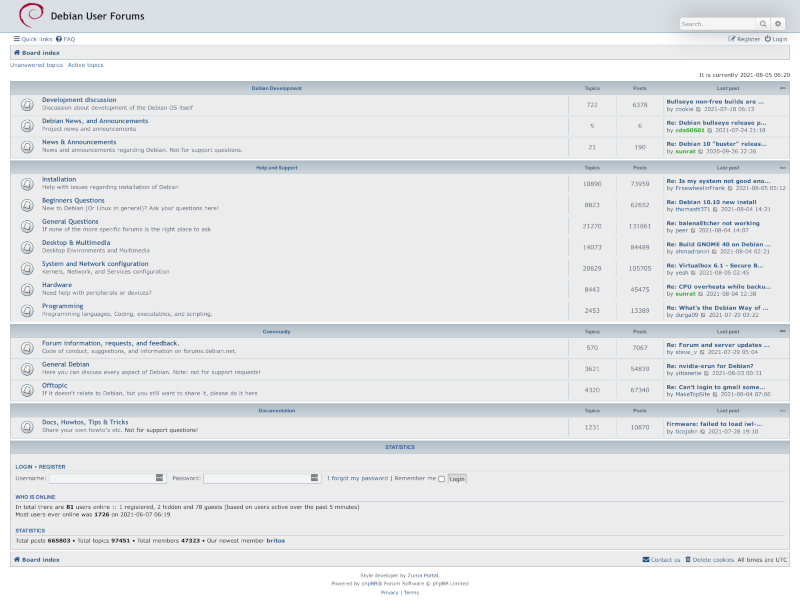
8 March 2017

Petter Reinholdtsen: How does it feel to be wiretapped, when you should be doing the wiretapping...

So the new president in the United States of America claim to be surprised to discover that he was wiretapped during the election before he was elected president. He even claim this must be illegal. Well, doh, if it is one thing the confirmations from Snowden documented, it is that the entire population in USA is wiretapped, one way or another. Of course the president candidates were wiretapped, alongside the senators, judges and the rest of the people in USA. Next, the Federal Bureau of Investigation ask the Department of Justice to go public rejecting the claims that Donald Trump was wiretapped illegally. I fail to see the relevance, given that I am sure the surveillance industry in USA believe they have all the legal backing they need to conduct mass surveillance on the entire world. There is even the director of the FBI stating that he never saw an order requesting wiretapping of Donald Trump. That is not very surprising, given how the FISA court work, with all its activity being secret. Perhaps he only heard about it? What I find most sad in this story is how Norwegian journalists present it. In a news reports the other day in the radio from the Norwegian National broadcasting Company (NRK), I heard the journalist claim that 'the FBI denies any wiretapping', while the reality is that 'the FBI denies any illegal wiretapping'. There is a fundamental and important difference, and it make me sad that the journalists are unable to grasp it. Update 2017-03-13: Look like The Intercept report that US Senator Rand Paul confirm what I state above.

23 February 2017

Gunnar Wolf: Spam: Tactics, strategy, and angry bears

I know spam is spam is spam, and I know trying to figure out any logic underneath it is a lost cause. However... I am curious. Many spam subjects are seemingly random, designed to convey whatever "information" they contain and fool spam filters. I understand that. Many spam subjects are time-related. As an example, in the last months there has been a surge of spam mentioning Donald Trump. I am thankful: Very easy to filter out, even before it reaches spamassassin. Of course, spam will find thousands of ways to talk about sex; cialis/viagra sellers, escort services, and a long list of WTF. However... Tactical flashlights. Bright enough to blind a bear. WTF I mean... Truly. Really. WTF What does that mean? Why is that even a topic? Who is interested in anything like that? How often does the average person go camping in the woods? Why do we need to worry about stupid bears attacking us? Why would a bear attack me? The list of WTF questions could go on forever. What am I missing? What does "tactical flashlight" mean that I just fail to grasp? Has this appeared in your spam?

20 February 2017

Russ Allbery: Haul via parents

My parents were cleaning out a bunch of books they didn't want, so I grabbed some of the ones that looked interesting. A rather wide variety of random stuff. Also, a few more snap purchases on the Kindle even though I've not been actually finishing books recently. (I do have two finished and waiting for me to write reviews, at least.) Who knows when, if ever, I'll read these. Mark Ames Going Postal (nonfiction)
Catherine Asaro The Misted Cliffs (sff)
Ambrose Bierce The Complete Short Stores of Ambrose Bierce (collection)
E. William Brown Perilous Waif (sff)
Joseph Campbell A Hero with a Thousand Faces (nonfiction)
Jacqueline Carey Miranda and Caliban (sff)
Noam Chomsky 9-11 (nonfiction)
Noam Chomsky The Common Good (nonfiction)
Robert X. Cringely Accidental Empires (nonfiction)
Neil Gaiman American Gods (sff)
Neil Gaiman Norse Mythology (sff)
Stephen Gillet World Building (nonfiction)
Donald Harstad Eleven Days (mystery)
Donald Harstad Known Dead (mystery)
Donald Harstad The Big Thaw (mystery)
James Hilton Lost Horizon (mainstream)
Spencer Johnson The Precious Present (nonfiction)
Michael Lerner The Politics of Meaning (nonfiction)
C.S. Lewis The Joyful Christian (nonfiction)
Grigori Medredev The Truth about Chernobyl (nonfiction)
Tom Nadeu Seven Lean Years (nonfiction)
Barak Obama The Audacity of Hope (nonfiction)
Ed Regis Great Mambo Chicken and the Transhuman Condition (nonfiction)
Fred Saberhagen Berserker: Blue Death (sff)
Al Sarrantonio (ed.) Redshift (sff anthology)
John Scalzi Fuzzy Nation (sff)
John Scalzi The End of All Things (sff)
Kristine Smith Rules of Conflict (sff)
Henry David Thoreau Civil Disobedience and Other Essays (nonfiction)
Alan W. Watts The Book (nonfiction)
Peter Whybrow A Mood Apart (nonfiction) I've already read (and reviewed) American Gods, but didn't own a copy of it, and that seemed like a good book to have a copy of. The Carey and Brown were snap purchases, and I picked up a couple more Scalzi books in a recent sale.

26 January 2017

John Goerzen: What is happening to America?

I still remember vividly my first visit to Europe, back in 2010. I had just barely gotten off a plane in Hamburg and on to a bus to Lubeck, and struck up a conversation with a friendly, well-educated German classical musician next to me. We soon started to discuss politics and religion. Over the course of the conversation, in response to his questions, I explained I had twice voted against George W. Bush, that I opposed the war in Iraq for many reasons, that I did thought there was an ethical imperative to work to defeat climate change, that I viewed health care as an important ethical and religious issue, that I thought evolution was well-established, and that I am a Christian. Finally, without any hint of insult intended, and rather a lot of surprise written all over his face, he said: Wow. You re an American, and a Christian, and you re so . normal! This, it seems to me, has a lot to do with Trump. Ouch It felt like a punch to the gut. The day after the election, having known that a man that appeared to stand for everything that honorable people are against won the election, like people all around the world, I was trying to make sense of how could this happen? As I ve watched since, as he stacks government with wealthy cronies with records nearly as colorful as his own, it is easy to feel even more depressed. Based on how Trump spoke and acted, it would be easy to conclude that the deplorables won the day that he was elected by a contingent of sexists or racists ascendent in power. But that would be too simple an explanation. This is, after all, the same country that elected Barack Obama twice. There are a many people that voted twice for a black man, and then for Trump. Why? Racism, while doubtless a factor, can t explain it all. How Trump could happen Russ Allbery made some excellent points recently:
[Many Americans are] hurt, and they re scared, and they feel like a lot of the United States just slammed the door in their faces. The status quo is not working for people. Technocratic government by political elites is not working for people. Business as usual is not working for people. Minor tweaks to increasingly arcane systems is not working for people. People are feeling lost in bureaucracy, disaffected by elections that do not present a clear alternate vision, and depressed by a slow slide into increasingly dismal circumstances. Government is not doing what we want it to do for us. And people are getting left behind. The left in the United States (of which I m part) has for many years been very concerned about the way blacks and other racial minorities are systematically pushed to the margins of our economy, and how women are pushed out of leadership roles. Those problems are real. But the loss of jobs in the industrial heartland, the inability of a white, rural, working-class man to support his family the way his father supported him, the collapse of once-vibrant communities into poverty and despair: those problems are real too. The status quo is not working for anyone except for a few lucky, highly-educated people on the coasts. People, honestly, like me, and like many of the other (primarily white and male) people who work in tech. We are one of the few beneficiaries of a system that is failing the vast majority of people in this country.
Russ is, of course, right. The Democrats have been either complicit in policies damaging to many, or ineffective in preventing them. They have often appeared unconcerned with the plight of people outside cities (even if that wasn t really the case). And it goes deeper. When s the last time you visited Kansas? I live in Kansas. The nearest paved road is about a 3-mile drive from my home. The nearest town, population 600, is a 6-mile drive. My governor whom I did not vote for cut taxes on the wealthy so much that our excellent local schools have been struggling for years. But my community is amazing, full of loving and caring people, the sort of people who you know you ll be living with for 40 years, and so you make sure you get along well with. I have visited tourist sites in Berlin, enjoyed an opera and a Broadway show in New York, taken a train across the country to Portland, explored San Francisco. I ve enjoyed all of them. Many rural people do get out and experience the world. I have been in so many conversations where I try to explain where I live to people that simply cannot fathom it. I have explained how the 18 acres I own is a very small amount where I am. How, yes, I do actually have electricity and Internet. How a bad traffic day is one where I have to wait for three cars to go past before turning onto the paved road. How I occasionally find a bull in my front yard, how I can walk a quarter mile and be at the creek on the edge of my property, how I can get to an airport faster than most New Yorkers and my kids can walk out the front door and play in a spot more peaceful than Central Park, and how all this is way cheaper than a studio apartment in a bad part of San Francisco. It is rare indeed to see visitors actually traveling to Kansas as a destination. People have no concept of the fact that my mechanic would drop everything and help me get my broken-down car to the shop for no charge, that any number of neighbors or uncles would bring a tractor and come plow the snow off my 1/4-mile driveway out of sheer kindness, that people around here really care for each other in a way you don t see in a city. There are people that I know see politics way differently than me, but I know them to be good people. They would also do anything for a person in need, no matter who they are. I may find the people that they vote for to be repugnant, but I cannot say I ve looked this person in the eyes and they are nothing but deplorable. And so, people in rural areas feel misunderstood. And they are right. Some perspectives on Trump As I ve said, I do find Trump to be deplorable, but not everyone that voted for him is. How, then, do people wind up voting for him? The New Yorker had an excellent story about a man named Mark Frisbie, owner of a welding and fab shop. The recession had been hard on his business. His wife s day-care center also closed. Health care was hard to find, and the long, slow decline had spanned politicians of every stripe. Mark and his wife supposedly did everything they were supposed to: they worked hard, were honest, were entrepreneurial, and yet he had lost his business, his family house, his health coverage, everything. He doesn t want a handout. He wants to be able to earn a living. Asked who he d vote for, he said, Is none of the above an option? The Washington Post had another insightful article, about a professor from Madison, WI interviewing people in rural areas. She said people would often say: All the decisions are made in Madison and Milwaukee and nobody s listening to us. Nobody s paying attention, nobody s coming out here and asking us what we think. Decisions are made in the cities, and we have to abide by them. She pushed back, hard, on the idea that Trump supporters are ignorant, and added that liberals that push that line of thinking are only making the problem worse. I would agree; seeing all the talk about universities dis-inviting speakers that don t hew to certain political views doesn t help either. A related article talks about the lack of empathy for Trump voters. And then we have a more recent CNN article: Where Tump support and Obamacare use soar together, explaining in great detail how it can be logical for someone to be on Obamacare but not like it. We can all argue that the Republicans may have as much to do with that as anything, but the problem exists. And finally, a US News article makes this point:
His supporters realize he s a joke. They do not care. They know he s authoritarian, nationalist, almost un-American, and they love him anyway, because he disrupts a broken political process and beats establishment candidates who ve long ignored their interests. When you re earning $32,000 a year and haven t had a decent vacation in over a decade, it doesn t matter who Trump appoints to the U.N., or if he poisons America s standing in the world, you just want to win again, whoever the victim, whatever the price. According to the Republican Party, the biggest threat to rural America was Islamic terrorism. According to the Democratic Party it was gun violence. In reality it was prescription drug abuse and neither party noticed until it was too late.
Are we leaving people out? All this reminded me of reading about Donald Knuth, the famous computer scientist and something of the father of modern computing, writing about his feelings of trepidation about sharing with his university colleagues that he was working on a project related to the Bible. I am concerned about the complaints about the PC culture , because I think it is good that people aren t making racist or anti-semitic jokes in public anymore. But, as some of these articles point out, in many circles, making fun of Christians and conservatives is still one of the accepted targets. Does that really help anything? (And as a Christian that is liberal, have all of you that aren t Christians so quickly forgotten how churches like the Episcopals blazed the way for marriage equality many years ago already?) But they don t get a free pass I have found a few things, however, absolutely scary. One was an article from December showing that Trump voters actually changed their views on Russia after Trump became the nominee. Another one from just today was a study on how people reacted when showed inauguration crowd photos. NPR ran a story today as well, on how Trump is treating journalists like China does. Chilling stuff indeed. Conclusion So where does this leave us? Heading into uncertain times, for sure, but perhaps just maybe with a greater understanding of our neighbors. Perhaps we will all be able to see past the rhetoric and polarization, and understand that there is something, well, normal about each other. Doing that is going to be the only way we can really take our country back.

19 January 2017

Daniel Pocock: Which movie most accurately forecasts the Trump presidency?

Many people have been scratching their heads wondering what the new US president will really do and what he really stands for. His alternating positions on abortion, for example, suggest he may simply be telling people what he thinks is most likely to win public support from one day to the next. Will he really waste billions of dollars building a wall? Will Muslims really be banned from the US? As it turns out, several movies provide a thought-provoking insight into what could eventuate. What's more, these two have a creepy resemblance to the Trump phenomenon and many of the problems in the world today. Countdown to Looking Glass On the classic cold war theme of nuclear annihilation, Countdown to Looking Glass is probably far more scary to watch on Trump eve than in the era when it was made. Released in 1984, the movie follows a series of international crises that have all come to pass: the assassination of a US ambassador in the middle east, a banking crisis and two superpowers in an escalating conflict over territory. The movie even picked a young Republican congressman for a cameo role: he subsequently went on to become speaker of the house. To relate it to modern times, you may need to imagine it is China, not Russia, who is the adversary but then you probably won't be able to sleep after watching it. cleaning out the swamp? The Omen Another classic is The Omen. The star of this series of four horror movies, Damien Thorn, appears to have a history that is eerily reminiscent of Trump: born into a wealthy family, a series of disasters befall every honest person he comes into contact with, he comes to control a vast business empire acquired by inheritance and as he enters the world of politics in the third movie of the series, there is a scene in the Oval Office where he is flippantly advised that he shouldn't lose any sleep over any conflict of interest arising from his business holdings. Did you notice Damien Thorn and Donald Trump even share the same initials, DT?

22 December 2016

Shirish Agarwal: The wine and dine at debconf16

For the wine connoisseur

FOR the Wine Connoisseur

All photos courtesy KK . If any deviations, would put up labels sharing whose copyright it is. Before I get into all of that, I was curious about Canada and taking the opportunity of debconf happening there in a few months, asked few people what they thought of digital payments, fees and expenses in their country and if plastic cash is indeed used therein. The first to answer was Tyler McDonald (no idea if he is anyway related to the fast-food chain McDonalds which is a worldwide operation.) This is what he had to say/share
You can use credit / debit cards almost everywhere. Restaurant waiters also usually have wireless credit / debit terminals that they will bring to your table for you to settle your bill. How much your bank charges depends on your Canadian bank and the banking plan you are on. For instance, on my plan through the Bank Of Montreal, I get (I think) 20 free transactions a month and then after that I m charged $0.50CDN/piece. However, if I go to a Bank Of Montreal ATM and withdraw cash, there is no service fee for that. There is no service fee for using *credit* cards, only *debit* cards tend to have the fee. I live in a really rural area so I can t always get to a Bank Of Montreal machine for cash. So what I usually end up doing, is either pay by credit and then pay of the balance right away so I don t have to pay interest, or when I do use my bank card to pay for something, I ask if I can get cash back as well. Yes, Canada converted to plastic notes a few years ago. We ve also eliminated the penny. For cashless transactions, you pay the exact amount billed. If you re paying somebody in cash, it is rounded up or down to the nearest 5 cents. And for $1 or $2, instead of notes, we ve moved over to coins. I personally like the plastic notes. They re smoother and feel more durable than the paper notes. I ve had one go through a laundry load by accident and it came out the other side fine.
Another gentleman responded with slightly more information which probably would interest travellers from around the world, not just Indians
Quebec has its own interbank system called Interac (https://interac.ca/en/about/our-company.html). Quebec is a very proud and independent region and for many historical reasons they want to stand on their own, which is why they support their local systems. Some vendors will support only Interac for debit card transactions (at least this was the case when I stayed there the beginning of this decade, it might have changed a bit). *Most* vendors (including supermarkets like Provigo, Metro, etc) will accept major credit and debit cards, although MasterCard isn t accepted as widely there as Visa is. So, if you have one of both, load up your Visa card instead of your MasterCard or get a prepaid Visa card from your bank. They support chip cards everywhere so don t worry about that. If you have a 5 digit pin on any of your cards and a vendor asks you for a 4 digit pin, it will work 90%+ of the times if you just enter the first 4 digits, but it s usually a good idea to go change your pin to a 4 digit just to be safe.
From the Indian perspective all of the above fits pretty neat as we also have Pin and Chip cards (domestically though most ATMs still use the magnetic strip and is suspected that the POS terminals aren t any better.) That would be a whole different story so probably left for another day. I do like the bit about pocketing the change tip. As far as number of free transactions go, it was pretty limited in India for few years before the demonetization happening now. Few years before, I do remember doing as many transactions on the ATM as I please but then ATM s have seen a downward spiral in terms of technology upgradation, maintenance etc. There is no penalty to the bank if the ATM is out-of-order. If there was significant penalty then we probably would have seen banks taking more care of ATM s. It is a slightly more complex topic hence would take a stab at it some other day. Do hope though that the terms for ATM usage for bank customers become lenient similar to Canada otherwise it would be difficult for Indians to jump on the digital band-wagon as you cannot function without cheap, user-friendly technology. Cash machines: Uneven spread, slowing growth - Copyright Indian Express The image has been taken from this fascinating article which appeared in Indian Express couple of days back. Coming back to the cheese and wine in the evening. I think we started coming back from Eagle Encounters around 16:30/17:00 hrs Cape Town time. Somehow the ride back was much more faster and we played some Bollywood party music while coming back (all cool). Suddenly remembered that I had to buy some cheese as I hadn t bought any from India. There is quite a bit of a post where I m trying to know/understand if spices can be smuggled (which much later I learnt I didn t need to but that s a different story altogether), I also had off-list conversations with people about cheese as well but wasn t able to get any good recommendations. Then saw that KK bought Mysore Pak (apparently she took a chance not declaring it) which while not being exactly cheese fit right into things. In her own words a South Indian ghee sweet fondly nicknamed the blocks of cholesterol and reason #3 for bypass surgery . KK So with Leonard s help we stopped at a place where it looked like a chain of stores. Each store was selling something. Seeing that, I was immediately transported to Connaught Place, Delhi Connaught Place, Delhi The image comes from http://planetden.com/food/roundabout-world-connaught-place-delhi which attempts to explain Connaught Place. While the article is okish, it lacks soul and not written like a Delhite would write or anybody who has spent a chunk having spent holidays at CP. Another day, another story, sorry. What I found interesting about the stores while they were next to each other, I also eyed an alcohol shop as well as an Adult/Sex shop. I asked Leonard as to how far we were from UCT and he replied hardly 5 minutes by car and was shocked to see both alcohol and a sex shop. While an alcohol shop some distance away from a college is understandable, there are few and far around Colleges all over India, but adult shops are a rarity. Unfortunately, none of us have any photos of the place as till that time everybody s phone was dead or just going to be dead and nobody had thought to bring a portable power pack to juice our mobile devices. A part of me was curious to see what the sex shop would have and look from inside, but as was with younger people didn t think it was appropriate. All of us except Jaminy and someone else (besides Leonard) decided to stay back, while the rest of us went inside to explore the stores. It took me sometime to make my way to the cheese corner and had no idea which was good and which wasn t. So with no idea of brands therein, the only way to figure out was the pricing. So bought two, one a larger 500 gm cheap piece and a smaller slightly more expensive one just to make sure that the Debian cheese team would be happy. We did have a mini-adventure as for sometime Jaminy was missing, apparently she went goofing off or went to freshen up or something and we were unable to connect with her as all our phones were dead or dying. Eventually we came back to UCT, barely freshened up when it was decided by our group to go and give our share of goodies to the cheese and wine party. When I went up to the room to share the cheese, came to know they needed a volunteer for cutting veggies etc. Having spent years seeing Yan Can Cook and having practised quite a bit tried to do some fancy decoration and some julian cutting but as we got dull knives and not much time, just did some plain old cutting
The salads

The Salads, partly done by me.

I have to share I had a fascinating discussion about cooking in Pressure Cookers. I was under the assumption that everybody knows how to use Pressure Cookers as they are one of the simplest ways to cook food without letting go of all the nutrients. At least, I believe this to be predominant in the Asian subcontinent and even the chinese have similar vessels for cooking. I use what is called the first generation Pressure Cooker. I have been using a 1.5 l Prestige Pressure Cooker over half a decade, almost used daily without issues. http://www.amazon.in/Prestige-Nakshatra-Aluminium-Pressure-Cooker/dp/B00CB7U1OU
Prestige 1.5 L Pressure Cooker

1.5 Litre Pressure Cooker with gasket and everything.

There are also induction pressure cookers nowadays in the Indian market and this model https://www.amazon.in/Prestige-Deluxe-Induction-Aluminum-Pressure/dp/B01KZVPNGE/ref=sr_1_2
Induction base cooking for basmati rice

Best cooker for doing Basmati Biryanis and things like that.

Basmati is long-grain, aromatic rice which most families used in very special occasions such as festivals, marriages, anything good and pure is associated with the rice. I had also shared my lack of knowledge of industrial Microwave Ovens. While I do get most small Microwave Ovens like these , cooking in industrial ovens I simply have no clue. Anyways, after that conversation I went back, freshened up a bit and sometime later found myself in the middle of this
Collection of Wine Bottles

Random selection of wine bottles from all over the world.

Also at times found myself in middle of this
Chocolates all around me.

CHOCOLATES

I tried quite a few chocolates but the best one I liked (don t remember the name) was a white caramel chocolate which literally melted into my mouth. Got the whole died and went to heaven experience . Who said gluttony is bad Or this
French Bread, Wine and chaos

French Bread, Wine and chaos

As can be seen the French really enjoy their bread. I do remember a story vaguely (don t remember if it was a children s fairy tale or something) about how the French won a war through their french bread. Or this
Juices for those who love their health

Juices for those who love their health

We also had juices for the teetotaller or who can t handle drinks. Unsurprisingly perhaps, by the end of the session, almost all the different wines were finito while there was still some juices left to go around. From the Indian perspective, it wasn t at all exciting, there were no brawls, everybody was too civilized and everybody staggered off when they met their quota. As I was in holiday spirit, stayed up late, staggered to my room, blissed out and woke up without any headache. Pro tip Drink lots and lots and lots of water especially if you are drinking. It flushes out most of the toxins and also helps in not having after-morning headaches. If I m going drinking, I usually drown myself in at least a litre or two of water, even if I had to the bathroom couple of times before going to bed. All in all, a perfect evening. I was able to connect/talk with some of the gods whom I had wanted to for a long time and they actually listened. Don t remember if I mumbled something or made some sense in small-talk or whatever I did. But as shared, a perfect evening
Filed under: Miscellenous Tagged: #ATM usage, #Canada, #Cheese and Wine party, #Cheese shopping, #Connaught Place Delhi, #Debconf16, #Debit card, #French bread, #Julian cutting, #Mysore Pak, #white caramel chocolate

Next.

Previous.