Approved the FFe for adsys 0.17.0, as it isn t seeded.
Sponsored libp11/0.4.12-1.1ubuntu2 for Guruprasad, an SRU to Noble which drops the workaround from the previous SRU that broke EAP-TLS Wi-Fi with TPM-backed PKCS#11 keys (LP: #2163152).
Proposed a fix for net-tools FTBFS in stonking - Linux 7.1 removed the amateur radio subsystem along with <linux/rose.h>, so ROSE support has to go: (MP).
Reviewed quite a lot of MPs and PRs - britney hints, ubuntu-cdimage, livecd-rootfs, ubuntu-seeds, ubuntu-dev-tools, a bunch of 26.10 release notes, and so on.
Did Archive Admin, DMB, and Release team duties as usual.
libpng1.6: Use-after-free of zlib input in png_read_end() after incomplete zTXt, iTXt, or iCCP decompression (CVE-2026-46675).
[ELTS]: The patch is ready but couldn t finish testing this month. The upstream fix that went into bookworm via DLA 4824-1 applies to all three ELTS suites as-is. Will roll out the fix in November.
Other Activities
[E/LTS] Monitored discussions on mailing lists, IRC, and all the documentation updates.
[E/LTS] Couldn t make it to the monthly LTS meeting live, but left my thoughts in the meeting notes on Beuc s proposal of offering help to the Release team with reviewing security SPUs - +1 for trying, as long as the Release team is on board with it and we don t end up doing the same work twice.
This is a recollection of my comments from the
EmacsConf 2026 community panel recording session
this past weekend, where the panellists took turns
answering the proposed questions, one minute per
question per panellist.
In addition to the live Q&A session planned for
Saturday 12 December 2026 during EmacsConf 2026,
all Emacs users and community members are invited
to share their thoughts on the panel questions or
other questions before or after the conference.
https://emacsconf.org/2026/talks/community/
1. What made you start using Emacs,
and what kept you using it?
I started using Emacs during my bachelor's
studies. I actually learned about Vim first
and was a Vim user, but I'd always found the
configuration language (VimScript) a little bit
clunky. Not long after, I discovered Emacs,
and really loved reading and writing Emacs Lisp,
so I stuck around.
In addition to reading and writing Elisp being fun
and enjoyable for me, I love that Emacs has been a
practical embodiment of software freedom, and I'm
really fond of its surrounding culture of sharing
freely. There's a lot to love and appreciate
about Emacs, but as a practical personal example,
I've been grateful for its excellent support for
bidirectional text editing. It has empowered me
to read and write in Persian, my mother tongue,
with ease. (Persian has a right-to-left alphabet,
like Arabic and Hebrew.)
2. What took you from using Emacs
to actively contributing to the community -
participating in forums, writing Elisp, organizing
meetups, answering questions?
As I continued experimenting and writing bits and
pieces of Elisp to scratch my own itches, I felt
compelled to share them freely as a way of giving
back to the community that gave me so much.
For me, the community and the people that make it
up are the main deal. Emacs wouldn't be where it
is and what it is today without its people, so
besides programming contributions, I've tried to
contribute in that area as well, for instance by
reviving EmacsConf with Sacha Chua back in 2019.
3. How does Emacs show up for you
in real life - colleagues, meetups, friends?
How did those connections form?
I don't physically have people near me who use
Emacs, but I've connected with many folks in our
online communities, often starting with an email
or IRC message. Some of those relationships
started as acquaintanceship and were developed
into true friendship over time, and I'm grateful
to have had those friends with me.
4. If you know other software
communities, what's one thing Emacs could learn
from them?
I would encourage Emacs, our community, to focus
on the people. We're living in particularly
difficult times, with various kinds of hardships
and uncertainty in our lives. Let's strive to
treat each other with kindness, empathy, and
mindfulness as we continue working together.
There are great examples of other free software
communities whose members have banded together and
are strengthening each other and their community,
as well as cautionary ones where community members
have been tiring and driving out their fellow
members. We could learn valuable lessons from
both in how to take care of our people and
ourselves.
5. What's one concrete thing you
wish existed in the Emacs community a year from
now?
I echoed the sentiments of my fellow panellists
Prot and Til about doing more of the same in
terms of continuing to uphold the standards of
excellence and perseverance. Also, drawing
inspiration from what bashbunni said, to lower
the barriers of entry for people, for example
through organizing different kinds of events,
and experimenting with ways to make people's
lengthy, elaborate Emacs configurations more
tangible and accessible to others, to share
various workflows and demonstrate what's
possible with Emacs.
I look forward to your thoughts on these
and other community-related questions.
Take care, and so long for now.
For some time now I ve been looking for a way of keeping projects I m working
on in a separate VM without much setup. There are numerous solutions to do this
kind of thing using namespaces (various container technologies, firejail,
flatpak, bubblewrap, ) but I wanted something that uses real virtualization.
I recently stumbled upon incus and it
seemed like it could be a solution to my problem. Incus is a manager for both
containers and virtual machines. It is possible to create VM images that can be
used as templates, meaning that other machines can then be based on them on
creation. Virtual machines can be configured using profiles .
For my use case, I have created a profile that defines how my template image
should look like. In this profile I use
cloud-init to configure the
template machine on startup:
and I use a script to regenerate the template image when I want to adapt the
config:
#!/bin/sh
#set -eset -x
NAME=dev-vm-template
# adapt the profile before rebuilding the template imageincus profile edit cloud-dev-template
incus delete --force $ NAMEtrueincus create images:debian/13/cloud --vm --quiet --profile default --profile cloud-dev-template $ NAMEincus start $ NAMEincus wait$ NAME agent
incus exec$ NAME -- cloud-init status --wait trueincus stop $ NAMEincus publish --alias cloud-dev-template --reuse $ NAME
This script uses the debian/13/cloud image together with my
cloud-dev-template profile to set up a machine, configure it using
cloud-init and store the result as an image called cloud-dev-template.
inker
To use this setup, I created a small python tool called
inker that talks to the incus REST
API. Using inker create creates a new VM based on my template. Using inker attach attaches
the current working directory to a VM as a readonly mount. It is possible to
combine those commands like inker create inker attach to do those two steps
in one command. inker login logs into the VM that has the current directory
attached. This way I can create VMs that are connected to directories on my
filesystem.
I am currently playing around with this setup, but I think this could help me
to have a throwaway development machine, similar to dev
containers. I m not sure yet how happy I am with
incus, though. I was also looking at systemd-vmspawn, but there are still
some features missing that I would need. But I might rewrite inker at some
point to use a different backend.
A new release of prrd arrived at
CRAN today, and has already
been built for r2u and
on r-universe.
The prrd
package facilitates the parallel running [of] reverse dependency
[checks] when preparing R packages. It is used extensively for
releases I make of Rcpp, RcppArmadillo,
RcppEigen,
BH, and
others.
The key idea of prrd is simple,
and described in some more detail on its webpage and
its GitHub repo.
Reverse dependency checks are an important part of package development
that is easily done in a (serial) loop. But these checks are also
generally embarassingly parallel as there is no or little
interdependency between them (besides maybe shared build depedencies).
See the (somewhat dated) screenshot (running six parallel workers,
arranged in a split byobu session).
This release updates internals to allow for greater concurrency. SQLite is used as the backend, both
for the job queue (managed via the liteq package) as
well as for storing actual reverse-dependency test results. It is
well-known that SQLite copes quite
well with multiple readers. Multiple concurrent
writers are more challenging. We tended to get by via
BEGIN EXCLUSIVE pragma use, but still get occassional issue
even at a somewhat moderate concurrency levels. After some back and
forth and trying a few approaches, more recently we established one
first solution relying on very explicity (OS-level, filesystem-based)
locking via package filelock. That
worked.
We mentioned this in an
old liteq issue that had circled around the same
question with a number of posts over the years, but no resolution. This
comment seemingly awoke G bor, and he nailed this
years-open issue with a fine pull request deploying
BEGIN IMMEDIATE and well as a loop around
tryCatch to not immediately fail. I borrowed/ported that
approach to prrd and we now
have a second solution (and no longer need filelock). On a
somewhat better server with enough cores and memory, I am now running
eighteen concurrent workers watched via three multi-pane byobu windows. Works like a charm without
issues. At last! A big thanks to G bor for finding another
solution, and especially that only relies on SQLite.
The release is summarised in the NEWS entry:
Changes in prrd
version 0.1.0 (2026-11-07)
Concurrent operations are now supported via updated sqlite
semantics borrowed with appreciation from liteq
This follows an interim solution relying on filelock use; however this later package is not
needed so no increase in dependencies
Bunny CDN
Bunny.net started as BunnyCDN in 2015. They added IPv6
support in 2017. Switching was uneventful. I don't bring a custom domain: I
serve the content from the b-cdn.net domain. As I depend on content
negotiation to serve AVIF and WebP images, I configure the CDN to cache
each image format separately.
I disable logging to avoid collecting personal
information. While the bunny.net GDPR page promises they anonymize data, it
is unclear what CloudFront keeps in its own logs when logging is disabled.
The only downside of the bunny.net CDN offering is the lack of HTTP/3. I asked
their support: two minutes later, they answered they are working on it but have
no ETA to share.
Bunny DNS
Bunny.net introduced their DNS offering in 2022 and recently reduced its
cost to almost zero. They support geographical routing, but a
very cool feature is the scriptable DNS: it runs a piece of user-supplied
JavaScript on each query to compute the answer.
I run seven small NixOS virtual machines to host this blog around the world:
Paris, Nuremberg, Ashburn, Singapore, San Jose, S o Paulo, and Sydney. Bunny's
scriptable DNS lets me return the IP addresses of the two nearest servers.
The browser falls back to the second server if the first one is down.
constservers=[ipv4:"45.90.160.60",ipv6:"2a0c:8881:5:100::1",latitude:48.88,longitude:2.22, ,/* [ ] */ipv4:"139.180.162.114",ipv6:"2001:19f0:5800:1855:5400:6ff:fef0:4c0a",latitude:-33.87,longitude:151.21, ,];constfamilies=A:"ipv4",AAAA:"ipv6" ;constrecords=A:ARecord,AAAA:AaaaRecord ;exportdefaultfunctionhandleQuery(query)consttype=String(query.request.queryType).toUpperCase();constfamily=families[type];if(!family)return[];// Get user locationconstlocation=query.request.geoLocation;// Build a list of candidatesletcandidates=servers.map((s)=>newServer(s[family],s.latitude,s.longitude,100),);// Select the two closest alive serversconstselected=[];while(selected.length<2)constserver=RoutingEngine.getClosestServer(candidates,location,true);selected.push(server);candidates=candidates.filter((s)=>s.ip!==server.ip);// Return their IP addressesreturnselected.map((s)=>newrecords[type](s.ip,3600));
The above script relies on the
RoutingEngine.getClosestServer() helper, which returns the
closest alive3 server to the user.4 Thanks to Doggo, we can
check it works as expected, at least for A:5
$ doggo--gp-from="Amsterdam"Avincent.bernat.ch
LOCATION NAME TYPE TTL ADDRESSAmsterdam, NL vincent.bernat.ch. A 3600s 45.90.160.60 vincent.bernat.ch. A 3600s 116.203.18.48$ doggo--gp-from="Texas"Avincent.bernat.ch
LOCATION NAME TYPE TTL ADDRESSHouston (TX), US vincent.bernat.ch. A 3600s 5.161.44.145 vincent.bernat.ch. A 3600s 149.28.219.155
The most annoying drawback of this method is that a user from Buenos Aires gets
both S o Paulo (1000 mi, 30 ms RTT) and Ashburn (5200 mi, 140 ms RTT). Most
resolvers randomize the order, so the user may pull the web page from Ashburn.
We could return only the nearest server and swap the scripted record with the
built-in geographic routing instead. But if the server becomes unavailable, the
browser has no alternative until the DNS cache expires. It leaves a short window
of unavailability, even with a short TTL.
The HTTPS record solution
The HTTPS DNS record, defined in RFC 9460, solves both the availability
and the latency issues. Modern browsers query this record to get additional
information to reach an HTTP server, including an alternative port and the
application layer protocol HTTP/2 or HTTP/3. Each record has a priority. We
can ask browsers to contact the nearest server first and fall back to the next
one if the first is unavailable:
vincentHTTPS1first.geoalpn="h3,h2"vincentHTTPS2second.geoalpn="h3,h2"vincentHTTPS3.alpn="h3,h2"; Bunny DNS must provide the two closest servers as "first.geo"; and "second.geo" with geographic or latency routing.first.geoA45.90.160.60first.geoAAAA2a0c:8881:5:100::1second.geoA116.203.18.48second.geoAAAA2a01:4f8:1c0c:5eb5::1vincentA45.90.160.60vincentA116.203.18.48vincentAAAA2a0c:8881:5:100::1vincentAAAA2a01:4f8:1c0c:5eb5::1
This looks like the ideal solution! Unfortunately, Chrome ignores any record
whose target is not ., hence the last record at priority 3.
Moreover, unlike with a CNAME, Bunny DNS does not return the IP addresses for
first.geo and second.geo in the additional section. The resolver needs to
send a first request to get the HTTPS record, and a second to resolve
first.geo.
HTTPS records are still too new for this use case. Back to the drawing board!
The hybrid solution
As a compromise, the script returns the two nearest servers if they are at a
similar distance from the user. Otherwise, it returns only the nearest one with
a lower TTL of 2 minutes.
exportdefaultfunctionhandleQuery(query)constlocation=query.request.geoLocation;letcandidates=servers.map((s)=>newServer(s.ipv4,s.latitude,s.longitude,100),);// Select the two closest serversconstselected=[];while(selected.length<2)constserver=RoutingEngine.getClosestServer(candidates,location,true);selected.push(server);candidates=candidates.filter((s)=>s.ip!==server.ip);// Compute the distance to the user for each of themconst[first,second]=selected.map((s)=>GeoDistance.calculate(s,location),);// If the second one is at twice the distance and at more than 1000 miles// from the first, return only the first one with a TTL of 2 minutes.if(second>2*first&&second-first>1000)return[newARecord(selected[0].ip,120)];// Otherwise, return both with a TTL of 1 hour.returnselected.map((s)=>newARecord(s.ip,3600));
We can check it with Doggo. From Chicago, we get only the Ashburn server
with a TTL of 2 minutes, while from Mexico, we get both Ashburn and San Jose.
$ doggo--gp-from="Chicago"Avincent.bernat.ch
LOCATION NAME TYPE TTL ADDRESSChicago (IL), US vincent.bernat.ch. A 120s 5.161.44.145$ doggo--gp-from="Mexico"Avincent.bernat.ch
LOCATION NAME TYPE TTL ADDRESSQueretaro, MX vincent.bernat.ch. A 3600s 5.161.44.145 vincent.bernat.ch. A 3600s 149.28.219.155$ doggo--reverse5.161.44.145149.28.219.155
NAME TYPE TTL ADDRESS145.44.161.5.in-addr.arpa. PTR 7187s web05.luffy.cx.155.219.28.149.in-addr.arpa. PTR 3600s web07.luffy.cx.
Note
On the live page, the map below is interactive: point at a
location to get the DNS answer, or disable servers to see how the answers
change.
The complete code is a bit more complex. It works around
RoutingEngine.getClosestServer() supporting only IPv4, and it handles the case
where there are not enough alive servers to build an answer.
Bunny.net has a comprehensive Terraform provider. I leverage CDK
Terrain to build the target state in TypeScript and OpenTofu to deploy
it. Have a look at "Managing infrastructure with Terraform, CDKTF, and
NixOS" for more details.6
ACME DNS with Hickory DNS
Route 53 covered one additional use case of mine: serving acme.luffy.cx to
solve DNS-01 ACME challenges. Unlike Route 53, Bunny DNS cannot
restrict access to a single zone with a fine-grained access policy. As this
usage requires neither high availability nor low latency, I replaced Route 53
with Hickory, a memory-safe DNS server written in Rust. It supports
automatic DNSSEC signatures and dynamic updates. Its
configuration is simple:
[[zones]]zone="acme.luffy.cx"zone_type="Primary"[zones.stores]allow_update=truetype="sqlite"journal_path="acme.luffy.cx.sqlite"zone_path="acme.luffy.cx.zone"# Private key to sign the zone with DNSSEC. Generated with:# openssl genpkey -algorithm EC -pkeyopt ec_paramgen_curve:P-256[[zones.keys]]algorithm="ECDSAP256SHA256"key_path="/etc/hickory-dns.acme.luffy.cx.pem"# TSIG key to sign zone updates. Generated with:# openssl rand 32[[zones.stores.tsig_keys]]algorithm="hmac-sha256"key_file="/etc/hickory-dns.acme.luffy.cx.update.acme.luffy.cx.tsig"name="update.acme.luffy.cx."
The provided zone file only seeds the database on first start. I delegate
DNS-01 challenges to this zone with CNAME records:
Lego, the ACME client I use to get certificates from Let's Encrypt,
answers the DNS-01 challenge by pushing entries with the DNS UPDATE protocol.
Unfortunately, Bunny DNS cannot publish a DS record in a zone.7 I need one
to secure the acme.luffy.cx zone and certificate delivery. Therefore, I host
the luffy.cx zone on deSEC,8 a free DNS hosting service run by a
non-profit organization based in Berlin. I derive the DS record to publish in
luffy.cx from the DNSKEY record of acme.luffy.cx:
Overall, I am quite happy with the switch to bunny.net. There are still a few
rough edges, like the inability to publish DS records, the lack of HTTP/3, and
the IPv4-only RoutingEngine.getClosestServer() helper. The bill went from US$5
per month to US$1. So far, performance is on par with AWS, but I
only finalized the current setup, including the server in Sydney, in late
October. I need a bit more time to gather more data, and I'll post a short update.
Update (2026-11)
This post was briefly discussed on Hacker News and Lobsters.
I had been hosting media assets on CloudFront since 2011.
Route 53 had served bernat.ch since December 2021. I didn't use healthchecks as
they were too expensive. I didn't host most of my zones there either, as queries
for haproxy.debian.net alone would have cost me around US$10 per month.
A server is alive if it answers an ICMP ping. The bunny.net
documentation gives more details about the checks.
The user queries Bunny DNS through a resolver. Usually, either the resolver
is close to the user, or it exposes the user's subnet through EDNS client
subnet.
Don't use this script as is: RoutingEngine.getClosestServer() only works
with IPv4. The final script works around this limitation.
The article is a bit outdated. CDK Terrain replaces CDKTF, OpenTofu
replaces Terraform, and I now use Colmena instead of NixOps.
I contacted bunny.net support to ask when they will support publishing a
DS record and got an answer seven minutes later: they don't know.
This is a bummer, as they support automatic CDS, a DNS record to advertise
a DS record to the parent zone. They handle one side of the delegation,
not the other.
I also reported a bug with the proof of non-existence, and they replied a
day later with a detailed answer.
Why not use deSEC for ACME challenges? You can limit its tokens to a
single RRset. I could say I prefer to self-host, but the
truth is I only discovered this while writing this article.
Your friendly keyring-maint Debian team received one of the weirdest
spam messages ever
So, do we want to py to who-knows-whom for promoting the keyring-maint
services in a verrrrrry-dark web search site?
First time I have to throw this stinky onion at you
As a person that has lived in Kansas almost all my life, I have never seen such good political news for this state as we got this week. It is a stunning rebuke of fascism from across the country.
One of the many pieces of wisdom from mechanic Tom Magliozzi is this question: Would you rather be right, or happy? He often asked it in the context of somebody that had just won an argument.
This is my plea to all our progressive friends: remember that question, and keep it in mind carefully over the next 2 years. We can either build on this momentum for an even bigger victory in 2028, or we can start to lose this unique coalition.
Kansans spend our lives being misunderstood and forgotten.
Many of us, myself included, visit large cities regularly.
It is a more surprising event when someone from a large city drives down one of our dirt roads. The kind of road that leaves your car covered in mud when you drive your daughter to school. The kind of road that we drive on for 3 miles before we reach the nearest paved road.
Statisticians label Topeka, the capital of Kansas and city of 126,000 people, as rural.
The nearst town to me, 7 miles away, has a population of 600. In winter, many people here still leave their keys in their running, unlocked cars while they run into the grocery store. The person at the bank, the owner of the grocery store, the mechanic, the electricians, the builders, the people that run the local museum, all know my name and recognize me. Not because I m famous locally, but because this is normal here. We are a community, a real one.
Yet I ve lost long-time friends, especially from the west coast, because, while I m progressive, I still talk to Republicans. They thought Republicans are so evil, they ought to be shunned and ostracized.
It probably doesn t compute to a San Franciscan what it means to live in a county that went 80% for Trump one time. A county of about 10,000 people living in a space larger than Los Angeles, New York, and San Jose combined. (Those cities have a combined population of about 13 million, living on the same amount of land as 10,000 people do out here.)
If I avoided talking to Republicans, it wouldn t be them that would be isolated. It would be me.
Out here, many of us have lived with each other for generations. We may go on living with them for generations. If somebody s car is stuck in the mud, the first person that comes by with a truck and a rope will probably pull them out. Nobody asks who you voted for. This is what you do for neighbors, because neighbors are humans, and next time it might be me that s stuck in the mud.
I can be as incensed as anyone else about what the fascists are doing. I don t have direct knowledge of how a lot of people vote. But I take a deep breath sometimes and remind myself: these are my neighbors. I ve seen them go out of their way to be kind and generous with all walks of humanity. (Yes, even whatever groups you re imaginging to argue with me about.)
This is part of how Adam Hamilton defeated Roger Marshal. The anti-Trump sentiment wasn t enough on its own. Lifelong Republicans dissatisfied with how Trump handled things weren t just going to vote for any Democrat. They needed someone that was safe. Someone that talked to them as humans. Someone that respected them.
Adam Hamilton went and shook hands with MAGA protestors at his events. He told them I want to be your senator, too.
This is how you win over the most strident of Republicans. Hamilton didn t compromise his beliefs. He invited discussion about them.
I have already been seeing some progressives say things like, Don t cut them any slack. Remember how many times people voted for fascism! They need to still be ostracized.
That, folks, is the way we lose. It is the wrong strategy everywhere. And it is especially culturally wrong in the close-knit communities again, actual communities where people know each other and have for years that make up the heartland.
Building relationships with people different than us is our best chance to build on this coalition. And, isn t that what progressive values call for?
So, celebrate this victory. Clap for all the activists that made it happen.
And, before you set off to alienate your new and tentative allies, ask yourself:
Would I rather be right? Or win again?
Hello, Planet Debian. My blog was added to the Planet today, so I think the polite thing is to introduce myself before you start finding my posts between yours.
I am Juan Manuel M ndez Rey, from Sevilla. In Debian I am mendezr, and on OFTC I am Vejeta. I have been using Linux since 1994 and Debian since 1998. For a long time that was all: a happy user, installing, breaking things, reading the mailing lists from the outside. I started contributing in October 2025, and last month I became a Debian Maintainer.
A friend and an old RFP
The way in was a friend. Back in 2019 Arturo Borrero Gonzalez filed RFP #943703 for Stremio, and for years he kept telling me I should pick it up. In September 2025 I finally listened and turned it into an ITP. It took longer than I like to admit, but Stremio is now in Debian, and I told that story here. A six year old RFP turned out to be a very good first package.
Rescuing old software
Somewhere along the way I discovered that what I enjoy most is bringing old software back.
The first one came from tille, who asked for help in #debian-tinytasks with xwpe, a Borland style programming editor for the terminal that nobody was looking after. I adopted it, and then I ended up as its upstream maintainer too. I fixed the old bugs and added LSP and DAP, so now an editor from 1993 can debug Go. It ships on several distributions, in Homebrew and on the BSDs. The canonical repo is on Codeberg, and the long version is in this post.
The second one is older and took much longer. Conquer is a Unix strategy game written by Ed Barlow and Adam Bryant in 1987, and I lost many hours of my youth to it. It never had a free licence. I first asked about it on debian-legal in October 2006, and I spent the next 20 years tracking down the authors, one email at a time. Today Conquer v4 and V5 are GPL-3.0. It is not packaged in Debian yet, that is the next step, but you can already play it in the browser.
What I am doing now
CEF took me six months and brought me into the Chromium team, and these days I am mostly with the syft, trivy and grype security stack and with Scala 3 and sbt for Debian.
Thanks
To Arturo, for the nudge. To dilinger, tille and tsimonq2, my DM advocates, for trusting me.
And if you can sponsor uploads for syft, trivy, grype or the Scala work, I would be very grateful. The details are on my wiki page.
You can find me there, as Vejeta on OFTC, or on Mastodon as @vejeta@mastodon.sdf.org. Nice to meet you all.
Just because most people hold AI a certain way, doesn t mean that we always must, either now or in the future.
As I noted in that piece, and my shades of gray post, I am well aware and agree with the notion that a lot of frontier AI models have disturbing ethical concerns that we shouldn t dismiss, including concentration of power and wealth, environmental concerns, unethical scraping and training, the financial bubble they seem to be creating, and more. The most poisonous of AI cheerleaders are accelerating enshittification while cutting quality all over the place. AI slop is also a real problem, which I ll discuss in a bit.
Before I dive in, I need to mention that no AI assistance was used for writing this post, and I have been using em dashes correctly for years before LLMs did. Secondly, while popular discourse seems to use AI and LLM interchangeably, the AI field is much more broad and much more old than LLMs. I will, nonetheless, adopt the common AI jargon here, but be more specific when necessary to differentiate.
In The Reverse Centaur s Guide to Life After AI by Cory Doctorow, he presented two ideas I particularly want to focus on here:
The present and future of LLMs outside of the cloud-hosted frontier models
What differentiates productive use of AI from slop
The two are related, in fact. Doctorow discussed how he never uses AI to write anything, but he sometimes uses it as an assistant to help him write. Is that contradictory? Not really. He gave this example: he remembered a quote from a podcast, which he wanted to cite and attribute correctly. But he couldn t remember which podcast or who said it. So he fired up Whisper, an open-weight model you can download and run locally, even on meagre hardware. Whisper is a speech-to-text model. Doctorow ran likely podcast episodes (from the target range and set of podcasts he listens to) through the model, and at that point it was a regular search. He found the quote, then went back and listened to the episode at that time spot to verify its accuracy.
It would have taken so much time to do this without Whisper that he simply would not have done it otherwise. His writing was better because of AI. Not because AI wrote any words for him, but because it helped him find the right ideas and attributions. He didn t even have to trust its transcription; it pointed him at the right place, and then he could transcribe with precision.
I too have used Whisper in much the same way. A little while back, I digitized many hours of old family audio recordings going back to the 1970s. Thanks to Whisper, which I ran locally primarily during hours of being fully solar-powered, I have a searchable index to these gems. A person I know recently asked me if I knew any way to transcribe some old family recordings he had. I told him I could run it through Whisper. It wouldn t have great punctuation, but most of the words would be there. This meant a lot to him and his family; what I did in 2 minutes would have taken him many days (I presume he is not a fast typist as well.)
So we can start by naming: AI isn t just chatbots, and AI can help even if it isn t writing anything.
Doctorow goes on to ask the question: what happens after the AI bubble bursts? I do believe it will, as Ed Zitron has carefully documented for us for a long time now. The environmental damage done by frontier training and inference in the last few years will, of course, be done. But as he points out, we ll be left with a plethora of surprisingly-capable open weight models, a community that has made significant strides running them on low-end devices (even phones), and a massive buildup of clean energy that hopefully will be finally able to offset some polluting energy once these heavy users drop off the grid.
So then what? Will the world just throw away the likes of Whisper and Gemma? Obviously not. Doctorow imagines, credibly, a situation in which individuals and universities tinker with locally-run models, iterating on them and improving them with the more traditional scale of resources available to individuals and universities. In other words, this future sounds a lot like the earlier days of Open Source.
As Ed Zitron has pointed out, the real costs of frontier AI have been hidden as these companies rack up fantastical losses. When the bubble bursts, the real costs of frontier AI are likely to be high enough that CEO s won t be able to ignore the poor ROI. But we ll be left with these artifacts, these open-weight starting points, that people can use.
That brings me to my central thesis: a lot of anti-AI sentiment is focused on the real downsides of the hyped uses of AI, and fails to account for the more ethical advances being made now, and likely to come in the future.
Varying quality of AI use
We are all familiar with AI slop. I ve seen it, and have an increasingly skeptical eye when I see new projects announced in even places as niche as a BBS community (where I see things like new terminal emulators announced, written in shockingly-poor nodejs, and such). I ve seen documents that take many pages to say what amounts to nothing intelligble to a human, with perfect grammar. I ve seen pull requests that have a description that amounts to several pages of slop. I ve personally seen an AI agent do things like correctly detect passing an untrusted argument to a shell, then propose a broken quoting algorithm to fix it (rather than proper sanitization and exec() or, better yet, avoiding the call altogether.)
I ve also seen AI tools very quickly and accurately identify bugs that had passed human review, even professional security reviews, for years. I ve seen them bring more joy to some people s jobs by handling the more drudgery parts of the jobs. One of my favorite podcasts, Oxide and Friends, had an episode called Engineering Rigor in the LLM age and credibly described ways in which careful use of LLMs can increase quality and safety. Yes, I said increase. (Oxide and Friends are not hype cheerleaders by any means; these are very serious people with solid technical chops, and I know some of them.)
What accounts for this disconnect?
We can point to many factors, but Doctorow asks a fundamental question: who is in charge? Is it the person or the computer? Does the AI service people, or do people service the AI?
In some of the most ridiculously AI-first companies, it is very clearly the latter. Mandates from CEOs to increase AI usage lead to perverse outcomes that sacrifice quality. The AI is in charge. I ve never seen an AI be any good at design questions, and it s no wonder than all these vibe-coded apps have the same generic feeling of crappiness.
But when the AI is used pragmatically as a junior research assistant, that s a different approach. Its output is greeted skeptically, its actions distrusted, and it s never asked to design something. These are the cases where I ve seen it make a meaningful difference.
It s not black-and-white
All this adds up to why I was opposed to the Debian proposals that would have banned LLM use. Those votes are hard to change. They would have left Debian in a vulnerable position of being unable to react to accurate security findings if they originated with an LLM, or left Debian unable to adopt ethical use of models.
It would be akin to saying you should never buy a PC because Windows 11 is terrible. I agree Windows 11 is terrible, but saying something like that is so dismissive of all those that have invested decades of their time in building something better.
So, I find AI hype to be uncredible and dangerous. I also find knee-jerk reactions to AI to be the same. They are actually a form of capitulation: they let the AI megacorps dictate the terms of the conversation to revolve around them.
Case study: Debian s DFSG scanner
For a long time, my two biggest annoyances with Debian have been the difficulty of packaging Rust and Go packages with their long dependency trees, and how long it takes a new package to get reviewed. About a year ago, the latter process was set on a path to reform, and it has gotten dramatically better. It also cuts off a potential connection with someone that hasn t yet heard of Linux. Some people may not jump from Windows 11 (or the ChatGPTs of the world) immediately, but pretending that it s ChatGPT or nothing does a disservice to all those that are trying to do research etchically.
We should state at the outset that Debian takes compliance with the Debian Free Software Guidelines (DFSG) extremely seriously. Every new package gets a review, and these reviews often catch things that upstream repos and other distros don t. One common example would be a package that has a stated copyright and license, but then includes files that bear a different copyright and license.
You can imagine reviewing packages at this level of detail isn t a fun task for people, and it s hard to find volunteers to do it. Perhaps the answer to this should be Debian should stop caring so much more than everyone else , and perhaps you re right (and perhaps you aren t).
In any case, the DFSG team that reviews this added what amounts to an LLM-backed license linter. Its job is to produce an initial assessment that the license statements documented in debian/copyright are correct, thorough, and in compliance with DFSG. This report was not taken to be authoritative, but was designed to help with some initial assessments.
There were some predictable reactions. People were angry that the DFSG team had added this tool without any communication about it (justifiably so, I d say). Many were angry just because of LLM. People made assumptions about what kind of model it used, what kind of quality it would produce, how definitive it would be in the project.
It is worth noting here that Debian is uniquely decentralized. There is a central policy, but maintainers are free to maintain their packages how they like. They don t have to use a standard location for a Git repo, or even use Git.
One person said essentially, it s fine for others to use whatever tool they want, but I shouldn t have to be exposed to LLM slop. The other perspective boiled down to, why should they keep the reports secret? If you want to proactively fix things, or flag false positives, why not?
As Andreas Tille wrote, I have read the LLM reviews carefully, and in many cases their findings inspired additional commits to improve my packaging. In some cases, they even helped me catch mistakes that led me to reject an upload myself before human inspection.
Joey Hess raises an interesting risk: that LLMs will remove the incentive for Debian to actually fix its cumbersome processes, by letting an LLM paper them over. I have seen this tendency in other contexts, both at work and at home, as well. It s a real risk, especially if Debian doesn t tackle the packaging problem for Rust and Go.
The Mastodon post that prompted me to write this began a chain of events that started with Uploaders will be forced to address LLMs issues without human inspection. I don t believe that will be the case; it goes too far against the Debian ethos.
I encourage everyone to take a deep breath. We are all getting used to a shifting landscape. We will all make missteps, myself included. The issues are complicated, the picture isn t black and white, and there is incredible hype around the ecosystem that can make finding nuance difficult.
Let s be kind to each other, fellow humans.
But, I do not care if you are kind to Claude.
After quite some time, I picked up debvulns again to implement what I
mentioned in my previous post: exporting reboot
required status and identifying services that need a restart.
Additionally, I wanted to ensure kernel vulnerabilities are not marked as
fixed unless the running kernel matches or exceeds the fixed version. Both
features are now live in version 0.2.4 (intermediate release 0.2.3
only included the needrestart functionality).
Why needrestart?
When you update packages on a system, security fixes do not take effect until
running processes actually use the updated binaries from disk. When an upgrade
occurs, existing processes continue executing the older, vulnerable code loaded
into memory, while only newly spawned instances pick up the fixed binary.
The needrestart package in Debian exists specifically for this purpose. It
can run in either report mode or action mode: report mode provides machine-readable
output, while action mode automatically restarts affected services.
Why integrate needrestart into debvulns?
needrestart is a standalone utility that can run independently or hook into
apt to run automatically after an upgrade. On desktop systems, it typically
runs interactively with a TUI prompt; on headless servers, it can be set to take
non-interactive default actions. In batch mode, it avoids restarting sensitive
system components (such as dbus) to prevent destabilizing the session.
Integrating this into debvulns is not about replacing needrestart or
debsecan, but rather bringing vulnerability and remediation state into a single,
discoverable interface. debvulns aggregates these signals into a standard
format in this case, Prometheus metrics and tags that can be visualized in
Grafana, monitored by alerting systems, or consumed downstream by automation tools.
Why Special Handling for Kernel?
Just as user-space daemons require a restart after patching, a patched kernel
requires a system reboot into the new image before the vulnerability is truly
mitigated. Previously, debvulns only verified whether the patched package
version was installed on disk. If the deb package was installed, the CVE was
marked as resolved, which creates a false sense of security while running the old
kernel.
With this release, debvulns now checks the active running kernel release. A
kernel vulnerability is considered resolved only when the system is running the
fixed kernel version. Until a reboot happens, the system remains reported as
vulnerable.
The updated dashboard reflects these changes below. It will need further polish,
but key metrics and restart/reboot states are now visible:
What Next?
These were the two pending functional areas I wanted to cover, and no further major
features are planned for now. Next up will be reviewing the entire codebase to
identify potential optimizations and remove any unnecessary complexity. I haven't
done a full pass through the repository since the initial skeleton implementation,
so testing edge cases and cleaning up the internals will be the main focus.
This will likely take some time since I only hack on this during weekend downtime.
Until then, happy hacking, give the new release a try, and file an issue if you
run into bugs.
To experiment with network stuff, I was using
UML-based network labs. Many alternatives exist, like
GNS3, Netkit, Marionnet or Cloonix. All of them are
great viable solutions but I still prefer to stick to my minimal
home-made solution with UML virtual machines. Here is why:
I didn t want to use disk images. They take a lot of space and
they have to be maintained. They also become cluttered, especially
if you try to reuse them across several labs. They are also
difficult to share.
I want to be able to access my home directory. It contains the
important configuration files related to the lab and I can put them
in the right place thanks to symbolic links when the lab starts. It
also makes exchanging files with the lab quite easy.
I don t want to boot a complete system. This allows me to be
cheap on memory and each virtual system should boot in a few
seconds.
The use of UML had some drawbacks:
It may be buggy. For example, it is currently not possible to use
gdbserver inside UML without a patch. Sometimes, the kernel
won t even compile.
It is slow.
However, UML features HostFS, a filesystem providing access to any
part of the host filesystem. This is the killer feature which allows
me to not use any virtual disk image and to get access to my home
directory right from the guest.
I discovered recently that QEMU provided 9P, a similar filesystem
on top of VirtIO, the paravirtualized IO framework.
Booting QEMU with a minimal kernel
My initial goal was to experiment with
Nicolas Dichtel s IPv6 ECMP patch. Therefore, I needed to
configure a custom kernel. I have started from make defconfig,
removed everything that was not necessary, added what I needed for my
lab (mostly network stuff) and added the appropriate options for VirtIO
drivers:
No modules. Grab the complete configuration if you want to
have a look.
From here, you can start your kernel with the following command
($LINUX is the appropriate bzImage):
Since there is no disk to boot from, the kernel will panic when trying
to mount the root filesystem. QEMU is configured to not display video
output (-display none). A serial port is defined and uses stdio as
a backend.1 The kernel is configured to use this serial port
as a console (console=ttyS0). A VirtIO console could have been used
instead but it seems it is not possible to make it work early in the
boot process.
The QEMU monitor is setup to listen on a Unix socket. It is possible
to connect to it with socat UNIX:$TMP/vm-$name-console.pipe -.
Initial ramdisk
Update (2012-10)
I was initially unable to mount the host filesystem as the root filesystem
for the guest directly by the kernel. In a comment, Josh
Triplett told me to use /dev/root as the mount
tag to solve this problem. I keep using an initrd in this post but the lab
on GitHub has been updated to not use one.
The copy_exec function is stolen from the initramfs-tools package
in Debian. It will ensure that the appropriate libraries are also
copied. Another solution would have been to use a static busybox.
The setup script is copied as /init in the initial ramdisk. It will
detect it has been invoked as such. If it were omitted, a shell would
be spawned instead. Remove the cp call if you want to experiment
manually.
The flag -initrd allows QEMU to use this initial ramdisk.
Root filesystem
Let s mount our root filesystem using 9P. This is quite easy. First
QEMU needs to be configured to export the host filesystem to
the guest:
You should find a complete root filesystem inside /target/ro. I have
used version=9p2000.u instead of version=9p2000.L because the
latter does not allow a program to mount() a host mount
point.2
Now, you have a read-only root filesystem (because you do not want to
mess with your existing root filesystem and moreover, you did not run
this lab as root, did you?). Let s use a union filesystem. Debian
comes with AUFS while Ubuntu and OpenWRT have migrated to
overlayfs. I was previously using AUFS but got errors on some
specific cases. It is still not clear
which one will end up in the kernel. So, let s try
overlayfs.
I didn t find any patchset ready to be applied on top of my kernel
tree. I was working with David Miller s net-next tree. Here
is how I have applied the overlayfs patch on top of it:
Don t forget to enable CONFIG_OVERLAYFS_FS in .config. Here is how
I configured the whole root filesystem:
info"Setup overlayfs"
mkdir/target
mkdir/target/ro
mkdir/target/rw
mkdir/target/overlay
# Version 9p2000.u allows one to access /dev, /sys and mount new# partitions over them. This is not the case for 9p2000.L.
mount-t9prootshare/target/ro-otrans=virtio,version=9p2000.u
mount-ttmpfstmpfs/target/rw-orw
mount-toverlayfsoverlayfs/target/overlay-olowerdir=/target/ro,upperdir=/target/rw
mount-n-tprocproc/target/overlay/proc
mount-n-tsysfssys/target/overlay/sys
info"Mount home directory on /root"
mount-t9phomeshare/target/overlay/root-otrans=virtio,version=9p2000.L,access=0,rw
info"Mount lab directory on /lab"
mkdir/target/overlay/lab
mount-t9plabshare/target/overlay/lab-otrans=virtio,version=9p2000.L,access=0,rw
info"Chroot"exportSTATE=1
cp"$PROGNAME"/target/overlay
execchroot/target/overlay"$PROGNAME"
You have to export your $ HOME and the lab directory from host:
The use of a VDE switch allows me to run the lab as a non-root
user. It is possible to give Internet access to each VM, either by
using the -net user flag or using slirpvde on a special switch. I
prefer the latter solution since it will allow the VMs to speak to each
other.
Debugging
This lab was mostly done to debug both the kernel and Quagga. Each of
them can be debugged remotely.
Kernel debugging
While the kernel features KGDB, its own debugger, compatible with
GDB, it is easier to use the remote GDB server built inside
QEMU.
To connect to the remote GDB server from the host, first locate the
vmlinux file at the root of the source tree and run GDB on it. The
kernel has to be compiled with CONFIG_DEBUG_INFO=y to get the
appropriate debugging symbols. Then, use socat with the Unix socket
to attach to the remote debugger:
$ gdbvmlinux
GNU gdb (GDB) 7.4.1-debianReading symbols from /home/bernat/src/linux/vmlinux...done.(gdb)target remote socat UNIX:$TMP/vm-r1-gdb.pipe -Remote debugging using socat UNIX:/tmp/tmp.W36qWnrCEj/vm-r1-gdb.pipe -native_safe_halt () at /home/bernat/src/linux/arch/x86/include/asm/irqflags.h:5050 (gdb)
You can now set breakpoints and resume the execution of the kernel.
It is easier to debug the kernel if optimizations are not
enabled. However, it is not possible to
disable them globally. You can however disable them
for some files. For example, to debug net/ipv6/route.c, add
CFLAGS_route.o = -O0 to net/ipv6/Makefile, remove
net/ipv6/route.o and type make.
Userland debugging
To debug a program inside QEMU, you can just use gdb as usual. Your
$HOME directory is available and it should therefore be
straightforward. However, if you want to perform some remote
debugging, that s quite easy. Add a new serial port to QEMU:
$ libtoolexecutegdbserver/dev/ttyS1zebra/zebra
Process /root/code/orange/quagga/build/zebra/.libs/lt-zebra created; pid = 800Remote debugging using /dev/ttyS1
And from the host, you can attach to the remote process:
$ libtoolexecutegdbzebra/zebra
GNU gdb (GDB) 7.4.1-debianReading symbols from /home/bernat/code/orange/quagga/build/zebra/.libs/lt-zebra...done.(gdb)target remote socat UNIX:/tmp/tmp.W36qWnrCEj/vm-r1-serial.pipe -Remote debugging using socat UNIX:/tmp/tmp.W36qWnrCEj/vm-r1-serial.pipe -Reading symbols from /lib64/ld-linux-x86-64.so.2...(no debugging symbols found)...done.Loaded symbols for /lib64/ld-linux-x86-64.so.20x00007ffff7dddaf0 in ?? () from /lib64/ld-linux-x86-64.so.2(gdb)
Demo
For a demo, have a look at the following video:
stdio is configured such that signals are not
enabled. QEMU will not stop when receiving SIGINT. This is
important for the usage we want to have.
Therefore, it is not possible to mount a fresh /proc
on top of the existing one. I have searched a bit but
did not find why. Any comments on this are welcome.
Orphaned usbguard with version 1.1.4+ds-5 and usbguard-notifier with version
0.1.0-4
The orphaning of usbguard and usbguard-notifier is because I don t use those
packages anymore. I rather spend my time on FOSS projects in areas I get
something out of. This is also due to a growing frustration with the Debian
community. The discussions on the mailing lists in the recent months lacked any
sense of social etiquette. The delusional conviction that certain tools improve
the work environment for EVERYONE took on religious overtones.
This is all the more troubling now that even central infrastructure is being
drawn into this forced blessing. And it seems there is absolutely no
awareness here of the boundary violations that are being normalized. Reminds
me a bit of christian missionaries.
DH Related Work
In the APIS project I finally merged the search app I wrote a couple of months
ago. Based on the proof of concept for the HTMX autocomplete, I implemented
an autocomplete that uses the search app for the results, therefore allowing
to list search results of multiple content types. I released 0.68, 0.69, 0.70,
0.71 and 0.72 of the APIS framework. The 0.68 release changed the way we list
the Django content types, leading to less database hits. In the 0.71 release I
refactored the detail & edit views for generic models.
40C3
I was torn about whether I should go to this years congress, but in the end I
decided to go again. I guess it will be something about the 20th time I m
attending.
I have a Samsung Q800A soundbar. It ships with built-in support for the Apple Airplay protocol, but I m not really an Apple kind of guy so that s never been particularly helpful for me. So, instead, I have a Chromecast Audio plugged into it via TOSLINK, and that works fine - except for the fact that there s no way to explicitly pick TOSLINK as the audio input. Instead, there s a Digital In option that refers to both the optical in and eARC input from a TV. Not inherently a problem, given I m unlikely to be watching TV while listening to music, but my TV is a Samsung Frame, a device that s intended to display art whenever someone is standing nearby, and which infuriatingly generates an eARC signal even if it s only in art mode and isn t going to make any noise. This switches the soundbar away from optical and I get sad. I could plug a video cast device into the HDMI port on the soundbar and cast audio to that, but then the art would get replaced with album covers whenever I m playing music, and again that s not quite the ambience I want. Still, none of this is that important.
Until I learned that the Australian version of the soundbar does have Google Cast support. The firmware image was downloadable from Samsung support, so I grabbed that, but unfortunately found that it was encrypted. However, if I downloaded the firmware image for the US model, the encrypted blob was identical - there s no difference in the underlying firmware between the two of them. So, how come one has support, and the other doesn t?
I d need an unencrypted copy of the firmware to have a real chance of figuring this out, and the easiest way to get one was to just run an ebay watch for a broken model of the same series. Once I had one in my hands I used hot air to remove the eMMC storage from the device, cleaned up the chip, and then stuck it in one of these adapters to read it on a local system. Samsung uses a weird in-house filesystem called VDFS4 on some of their devices and this was one of them, so I needed to cobble together a kernel that was compatible with their source dump for this device (not all VDFS drivers seem to be able to read all VDFS filesystems), but eventually I had it all extracted, and then I got distracted by other stuff, so let s fast forward to this week.
Samsung makes use of a modified version of the Android Debug Bridge called sdb, which is included in the Tizen SDK. The firmware showed that this device had sdbd on it, and it would be executed if a network device called huart0 was plugged in. Samsung does, thankfully, provide the source code for their GPLed components, so I could dig through that to discover that drivers/net/usb/usbnet.c had a bunch of references to huart (which apparently stands for HyperUART ). If CONFIG_SAMSUNG_USBNET_HYPERUART_IFNAME is set, and if the ethernet device is using either the asix or ax88179_178a drivers, and if /opt/etc/HyperUART_IP_Addr 1 isn t just 0 , it sets the interface name to huart0 and in turn triggers sdbd startup. So now I just needed to figure out how to set /opt/etc/HyperUART_IP_Addr to something else.
Some digging revealed a binary called wap-factory that referenced the file, which then led to /usr/share/mobile-mgr/jsons/com.samsung.audio.waapp-verification-test.json which mentioned a SetUartOnOff call, which brought me here2, which led me into a bit of a rabbit hole about the Samsung WAM protocol. Long story short, you connect to either port 55001 or 56001 and make two requests over the same connection:
1
2
3
4
5
6
7
8
9
GET /connect HTTP/1.1
Host: 192.168.87.126:56001
User-Agent: SamsungMultiroom/1.0
Connection: interactive

GET /UIC?cmd=%3Cname%3ESetUartOnOff%3C/name%3E%3Cp%20type%3D%22str%22%20name%3D%22uartOnOff%22%20val%3D%22on%22/%3E HTTP/1.1
Host: 192.168.87.126:56001
User-Agent: SamsungMultiroom/1.0
Connection: interactive
and then plug in an asix chipset ethernet adapter into the USB port (which on mine is micro-B, so I needed an OTG adapter), and suddenly it s sitting there on 192.168.250.250 and will speak sdb to you. sdb root on switches it into root mode, and sdb shell now gives you a root shell. I was in, and now I could investigate what was happening.
First up, there was a process called com.samsung.audio.google-cast-control-app running, which seemed like a good start. Unfortunately it wasn t doing anything. After some tracing I found that it was making a call to Samsung at startup time, and getting back a response telling it that Cast support wasn t available. The request (which was helpfully dumped to stdout when I ran this by hand) included the country code, in my case US . Repeating the request by hand with curl and changing the code to AU told me it was supported, so now I needed to figure out how to get the soundbar to believe it was Australian. Some digging showed it was reading this from a config variable called db/comss/countrycode, and running
1
buxton2ctl set-string system db/comss/countrycode AU
got me past that gate. Now, however, it was complaining that it couldn t provision a key. /usr/apps/com.samsung.audio.google-cast-control-app/shared/res included a bunch of encrypted blobs and an app called teeStoreKey.elf, and tracing com.samsung.audio.google-cast-control-app showed it was trying to call that, but it seemed like it was failing with a permissions issue. Running com.samsung.audio.google-cast-control-ap directly as root triggered key provisioning successfully, and a few seconds later the rest of the Cast API came up and I could talk to port 8443 with standard Cast API calls. Unfortunately it still wasn t working as a Cast device, though - it wasn t advertising itself via mDNS and so nothing could see it. Querying the /setup/eureka_info endpoint gave me a clue - the tos_accepted field was false. Normally this would be set as part of initial device setup, but the Samsung app wasn t doing that because it didn t think the device had Cast support. It turns out that POSTing some json with tos_accepted : true to setup/set_eureka_info made it work, and suddenly there was an additional Cast device available to me.
(Update: I realised I didn t mention anything about why it was doing key provisioning in the first place! The Cast protocol doesn t enforce cryptographic identity as such, but Google s reference client implementation which is what almost everything uses verifies that the device is presenting an identity that chains back to Google. Unsurprisingly they don t want the private key material to be easily extractable and used to produce clone devices, so it s all supposed to be encrypted and only accessible to some sort of trusted execution environment, which is why keys here need to be loaded into Trustzone and never be visible in the clear to the main OS)
Mission accomplished. Unfortunately the device vanished from my Smartthings home aferwards, presumably because there s a mismatch between its reported country code and my account country. To get around that I d somehow need to get com.samsung.audio.google-cast-control-app to either change the query without changing the global device country, or to ignore the response from Samsung (it does this every 24 hours, ugh), and that s made more annoying by the fact that this thing will only execute signed binaries. Although, weirdly, one of the signed binaries shipped is a full Python interpreter, so if I cared enough I could probably cobble together enough Python to execute arbitrary binaries. I currently don t.
More modern soundbars don t implement the listener on port 55001 or 56001. I don t know how you get sdb working on them.
In April I got my Furilabs FLX1s basically working [1].
Below is a post I wrote about the FLX1s before it broke at the start of September, there was a problem with the display controller and it would randomly go into a messed up mode that wasn t readable but also changed a bit in relation to button presses etc so the phone was still working. Also I could ssh to the phone when it was in that state if it was on my home wifi.
It took almost 2 months to get a replacement phone but I now have that working and the new 14.1.0 OS release. So some of the below may be obsolete when it comes to the latest release but I decided to publish it anyway for history if nothing else.
Current Issues
Wifi Hotspot Status
One thing I had known about but not mentioned before is that the icon in the drop-down menu for the hotspot will often be gray (indicating hotspot-off) when it s actually on. To address that I have to click on it (which then indicates that the hotspot is on) and then click on it again to turn it off.
QT6 and MESA GL
Currently I have problems with QT6 applications that don t run due to library issues and issues of missing GL support. I blogged about setting up my own container on my phone [2] which helped for some things but not for most things.
I have given up trying to get Tokodon working on the phone for the moment. Tokodon is a nice Mastodon client that would allow me to get notifications from Mastodon.
Apparently the Furilabs people are working on some issues related to this.
Bluetooth
Bluetooth is currently a bit unreliable. When I turn on my car (Nissan LEAF) the phone usually either doesn t connect or claims to be connected while not sending audio to the car. When it does connect my favourite music player (Lollypop) usually doesn t display the album and track names. I ve found that turning my car off and on again usually makes it connect properly.
I admit the possibility of my car not doing things correctly in this regard. But every Android phone I tried just worked, they would connect as soon as the car was turned on and correctly display track names. So if the car is doing things wrong and needs a software work around then Linux is at fault for not doing that we can t get tens of millions of cars and hundreds of millions of other weird devices fixed!
I also note that my Debian laptop and a friend s Debian laptop also have problems connecting to my car. So it s quite possible that Debian code is at fault (the FLX1s is running a modified version of Debian).
It currently appears to have no support for handset mode so I can t answer phone calls through the car interface. But this is a lesser problem.
I plan to do more testing with Debian laptops and file some bug reports if I can find out enough useful information. My current knowledge of this is insufficient to create a useful bug report. I do have quite a few bluetooth headsets and test laptops so I plan to start by testing Debian and Ubuntu on all the combinations last time I tested Ubuntu 24.04 on Dell laptops worked much better than Debian/Trixie on Thinkpads.
Improvements by Furilabs
Wifi Hotspot
After a set of updates including the following Wifi hotspot seems to be working.
adaptation-furiphone-radon (1.3.0+git20260513192743.e94f2ec.forky.production) forky; urgency=medium
  * NetworkManager: sync hotspot channel/band with STA and restart on change
  * debian: depend on libhybris-utils and libgbinder-tools
  * startup: drop schedtune and add m4u debug log level
  * startup: enable glove and disable edge palm
  * device: drop flashlightd-scalable signatures
 -- Bardia Moshiri <bardia@furilabs.com>  Wed, 13 May 2026 15:27:43 -0400
Charging
Connecting the power cable now makes the phone immediately make the click sound and it starts charging while previously there was a 22 second delay. Once I get used to this I can avoid the problem of failing to plug it in firmly before going to bed and having it run flat overnight.
Things I ve Done
SMS
The following command will send a message via SMS.
dbus-send --system --print-reply --dest=org.ofono /ril_0 org.ofono.MessageManager.SendMessage string:"+61400000000" string:"this is the message"
Also the Librem5 Wiki has another way of doing it [3], I haven t tested if that works as the dbus method works well enough for the moment.
Also calls can be scripted via the following command:
xdg-open tel://+61400000000
Contacts
My aim is to get contacts synchronised via my own cloud service. Nextcloud is supposed to be able to do this. It s been years since I first tried this, my most recent serious attempt at Nextcloud was in 2021 [4] and I couldn t get the Android app for NextCloud to connect. Since then I have made more recent attempts and been unable to get the Android or Linux desktop clients to connect to it.
A friend gave me a test account on his Nextcloud server which allowed me to connect the Linux desktop app, his hypothesis was that it was somehow related to using Debian and that his server worked because it was on Ubuntu. I have since installed my own Nextcloud test server on the Ubuntu variant used by the Oracle cloud VMs which had the same apparent problem. I conclude that it s not Debian at fault but something related to how I configured it.
In the meantime after a couple of months of having no named contacts I exported the contacts from my Android phone as a VCF file and imported them into the Gnome contacts program. I had to run killall chatty for it to get the names for the contacts, but the phone call program found them without needing to do that.
Chatty
A missing feature of Chatty (the default SMS and Jabber program for Phosh/Phoc systems) is archiving old messages. I use Chatty to receive Jabber messages from my monitoring system which can be a lot of messages. The following shell code deletes all Jabber messages older than 2 days. Note that this relies on type=3 matching Jabber messages which I m not sure is going to be the case on all systems or all versions of Chatty.
for ID in $(echo "select id from users where type=3;"   sqlite3 ~/.purple/chatty/db/chatty-history.db); do
  echo "delete from messages where sender_id=$ID and time < unixepoch('now') - (48 * 3600);"   sqlite3 ~/.purple/chatty/db/chatty-history.db
done
The following shell code extracts a dump of all messages from Chatty.
echo "select messages.id,users.username,users.alias,messages.body from messages inner join users on messages.sender_id=users.id;" sqlite3 ~/.purple/chatty/db/chatty-history.db
Dino-IM
An update to the Chatty program for SMS and Matrix has made it crash repeatedly. There is a request in the list for Chatty upstream to have a systemd-user unit to restart it which when implemented will reduce the scope of the problem (but not solve it). I've setup a monitoring system that uses notify-send to notify me when Chatty isn't running or when 4G data turns off (a recurring problem). This crashing is allegedly due to Jabber so I installed Dino-IM for Jabber and have for the moment at least stopped using Chatty for Jabber.
It turned out that having Chatty not do Jabber didn't stop it crashing. However having alerts separated from SMS can be convenient and also my long term plan is to use a phone with Plasma Mobile and Spacebar (the SMS program for Plasma Mobile) doesn't do Jabber. So I will continue using Dino-IM.
echo "delete from message where time < unixepoch('now') - (48 * 3600);" sqlite3 ~/.local/share/dino/dino.db
Andromeda/Android
I put in the following cron job to stop this log file from using all the storage space:
Wifi DHCP
I gave up on attempts to force the Wifi configuration to have a fixed MAC that I could use for a fixed IPv4 address so I manually configured the address.
4G Monitoring
I've had problems with the reliability of the 4G service, sometimes it stop working and I need to stop and restart it. I setup my etbe-mon monitoring system on the phone [5] and configured it to ssh to localhost and run notify-send to send a local notification. This means I get notified if my phone loses net access and can't access regular monitoring. Then to monitor the 4G connection (which I want to have working even when Wifi is connected) I had the following monitor line:
monitor ping.monitor -I ccmni1 -c 5 8.8.8.8 ;;
That uses the ccmni1 interface for pinging 8.8.8.8 (Google DNS). That worked for a while but I discovered that sometimes the interface for 4G would change to ccmni2, so I put the following monitor script under /usr/local/mon.d:
Mastodon
I couldn't get Tokodon to work, not the native package, not running in a Debian/Testing container, and not running a Flatpak. It seems that this is all graphics library issues. So I wrote a Perl program to run "toot notifications &-json" and then send the relevant parts of the output via XMPP. As I already use XMPP for server monitoring there's no extra effort to have an extra account and use it for notifications about Mastodon activity. The Perl script is at the bottom of the post and won't be in the RSS feed.
At some future time I may change the script to send the notifications by Matrix instead to have all my social media stuff in the same place.
Source
#!/usr/bin/perl
# depends on Debian packages: toot libjson-pp-perl go-sendxmpp
use strict;
use JSON::PP;
my $homeurl = "https://mastodon.nzoss.nz/";
my $lastfile = "mast/last_id";
my $xaddr = "russell\@coker.com.au";
my $jsontxt;
while()

  $jsontxt .= $_;

my $data = decode_json($jsontxt);
my $last_id = 0, my $new_last_id;
if(open(ID, "<$lastfile"))

  $last_id = ;
  close(ID);

$new_last_id = $last_id;
for(my $i = 0; $data->[$i]; $i++)

  my $id = $data->[$i] id ;
  if($id <= $last_id)

    next;

  if($id > $new_last_id)

    $new_last_id = $id;

  open(XMPP, " go-sendxmpp $xaddr") or die "Can't send XMPP";
  my $type = $data->[$i] type ;
  print XMPP "type: $type\n";
  print XMPP "their_url: $homeurl\@$data->[$i] account acct \n";
  print XMPP "display_name: $data->[$i] account display_name \n";
  if($type ne "follow")

    print XMPP "status_url: $data->[$i] status url \n";
    print XMPP "content: $data->[$i] status content \n";

  print XMPP "created_at: $data->[$i] created_at \n";
  print XMPP "\n";
  close(XMPP);

open(ID, ">$lastfile") or die "Can't write to $lastfile";
print ID $new_last_id;
close(ID);
The Current Situation
Before the US and Israel started attacking Iran at the end of February the petrol prices in Australia were around $1.70/L, which for American readers is roughly equivalent to $US4.64/Gal. By the 11th of March the prices were around $2.19/L. Over the same time period Diesel went from around $1.77/L to $2.40/L. The 11th of March prices weren t necessarily unreasonable prices. In mid March it was reasonable to expect that the US would stop doing such ridiculously stupid things and make a deal with Iran to allow oil to be transported.
But every time you think there s a limit to Trump s stupidity (and the incompetence of people around him who don t point him in the right direction) they do something worse. So now we have the Strait of Hormuz almost entirely closed cutting off oil from Kuwait, Qatar, and UAE. The Bab al-Mandab Strait is closed to Saudi linked ships and the Saudi East-West pipeline is closed so once the Yanbu storage tanks are empty there won t be much if any oil from Saudi Arabia for some time. So world oil supplies will be significantly reduced for a long time.
Currently the petrol prices in Melbourne are around $2.30/L and Diesel prices around $2.70/L, not much more expensive than it was in March in spite of all the extra problems both militarily and diplomatically since then. Those prices have been steady for over a month.
The blockade of the Strait of Hormuz could be ended fairly quickly and there are reports that a lot of the oil that used to go through it is being re-routed. The damaged infrastructure throughout the middle east can t be fixed in a hurry. The Bab al-Mandab Strait probably can t be opened quickly as the Houthis probably don t have a centralised command structure that allows someone to order a ceasefire and have it stick. So we can expect a massive reduction in world oil supplies for a while, which given the way the US is going could be at least until after the mid-term elections (November this year) and possibly until after the 2028 elections. After that oil production will be reduced for another year or two to rebuild infrastructure.
The Problem
When supply can t meet demand there are three options. Supply can be rationed, demand can be decreased by increasing the prices, or it can be used up and we run out. Running out of fuel is a really bad option as fuel is needed for producing and transporting food and for most things that are important to a society.
Governments of first world countries seem unable to deal with the situation properly. Dealing with it properly requires either rationing or increasing the prices. Instead governments have been more interested in artificially keeping the prices down.
Currently in Australia and most countries a significant portion of public transport depends on Diesel fuel. Diesel is needed for most buses and for long distance trains. Most taxis run on petrol. As far as I know all emergency service vehicles run on Diesel or petrol as well as most military vehicles. So things will get really bad quickly if fuel runs out entirely. It s not just personal cars that are affected.
We aren t going to get the majority of tractors converted to electric power any time soon. Google search results suggest that tractors last an average of about 25 years but casual observation of working equipment on farms suggests a longer life than that is common. Some tractors could be retrofitted to be electric but many will end up being scrapped as part of a conversion while farmers are already having financial problems. It would probably be optimistic to expect that half the tractor use could be done with electric tractors in 10 years time unless there are significant government subsidies. To get the farming and food production industries adapted for electric operation in a few years would be possible but it would take a level of national mobilisation that only happens during wartime.
What We Need
As a long term solution we need to have more electric vehicles in every category. We need electricity for all train lines to replace Diesel locomotives. We need better trains between cities to reduce the need for aeroplanes, electric aeroplanes are being developed but we aren t there yet. We need all essential services to be run with electric vehicles including farming, food transport, emergency services, and everything related to the medical system (including personal cars for healthcare workers). We also need mining vehicles powered by electricity so we can have the entire industrial system running without fuel. None of this is going to happen in time for this crisis.
Electric buses are being introduced in Australia and many taxis are electric. The recent significant increase in the use of electric cars probably includes a reasonable portion of healthcare workers and other essential workers. This gives us the potential to survive fairly severe reductions in the fuel supply without everything collapsing. But we have a significant lack in electric police cars and in electric trucks for food delivery.
In the short term we need to significantly reduce the use of fuels, there is no other way to keep the food supply and other essential parts of society working. We could try rationing but I think that should be a last resort. The news reports of a de-facto petrol rationing system in Crimea and parts of Russia are not positive, significant resources are wasted in long queues for petrol and there is public disorder caused by disputes about position in the queues. The level of sanity in the population seems to have dropped significantly since the fuel crisis of 1979, any fuel rationing that is implemented now would get the same sort of opposition from Qanon types as Covid vaccines and lockdowns did in recent times.
So the best viable option seems to be to reduce demand by increasing prices. $2.30/L as a common price with occasional spikes of $2.50/L isn t sufficient to do that. If the price increased to $3.50/L, twice what it used to be (equivalent to $9.50/gallon for Americans) then it would provide a real incentive for people to reduce fuel use. That would have to be combined with the type of remote work allowances that were in place when Covid19 was first spreading. But I think that all politicians are too weak to do such things. The media have demonstrated that nowadays the best we can expect is that they will treat both sides as equal even when facts clearly support one side, so we can t expect the media to report on impending fuel shortages and demand policy changes to address them.
We should have higher taxes on fuel that will continue past the resolution of the current crisis caused by the attacks on Iran to provide incentives for the purchase of electric cars and for manufacturers to make more fuel efficient cars. Currently people are basing car ownership decisions on the expectation that petrol will go back to something under $2/L and we need to have a government guarantee that it won t happen.
People always complain about poor people who can t afford to drive if petrol is expensive but that could be addressed by increasing the minimum wage and social security payments. But a large portion of the people who complain about the hardship poor people may face when fuel prices are discussed are against increasing the minimum wage so I don t think they are being honest.
Another common complaint is about the difficulty driving long distances in rural Australia when there isn t sufficient charging infrastructure for electric cars and therefore rural people including farmers getting hit by high prices of fuel. There could be a rebate scheme for farmers etc, government subsidies for farmers is nothing new.
What Will Happen
I expect the governments of most first world countries to try to keep fuel prices low and do very little to try and decrease demand. China will probably do some things to reduce fuel use and being the world s largest oil importer this will make a difference, but not as much as we need.
A related problem is that a lot of fertiliser is produced from petrochemicals and closing the strait of Hormuz cut off a significant portion of the world fertiliser supply. First world countries will outbid developing countries for fertiliser and fuel. Starvation in developing countries probably won t get much news coverage until it leads to war.
This is not going to go well, it could be addressed if we had braver politicians and more honest media companies but that s not the way things are going.
At the end of last year I paid $177.40 for a Radxa ROCK 5A GREEN RK3588S, 8-core CPU SBC, HDMI with 8K Output, WiFi 6 Support and Gigabit Ethernet, Single Board Computer [1] from AliExpress. I got the version with 8G of RAM as 4G didn t seem enough and I didn t feel like paying for the 16G or 32G versions. The prices excluding postage are $106, $130, $203, and $332 for the 4G, 8G, 16G, and 32G versions respectively. The $332 version is quite reasonably priced if you need to do some big compiles on ARM64. Since then the prices have changed by a few dollars but are almost the same (variations in postage will be greater than the price changes).
They provide modified versions of Debian/Bookworm and Debian/Bullseye [2] and an Android installation. The Debian setup includes a custom kernel, bootloader, some configuration packages including for ALSA, and some firmware.
I installed Bookworm and upgraded it to Trixie (the current Debian release). There were some conflicts with some radxa packages that contained the same files as Trixie packages but didn t have a package conflict but it was not a big deal. It would be nice if Radxa updated their setup to Trixie and it wouldn t be that difficult for them to do so.
The board has an expansion bus which apparently can be used for NVMe. It also has an option for a EMMC module. But if you get the default configuration then the only boot device supported is a micro SD card.
One of the aims of purchasing this card is for testing 8K monitors, but it turns out that there are no TVs that will take 8K input on sale in Australia [3].
The next thing I considered doing is running it for playing movies on a 4K but it turns out to not support HDMI audio (at least not with the supplied drivers) and has no other audio support. Apparently boards like this have a common use case of digital signs where audio isn t required.
I had this post in draft for a year because I planned to write more, but I haven t come up with anything. It s not an exciting device. Handy to have another ARM test and build system and handy to be able to test high resolution video with a portable device but I don t use it for much. I guess just works in a boring way isn t a bad review.
pre-commit is a tool that is often a
prerequisite for contributing to Python upstream projects. It installs as a git
pre-commit hook and runs various checks on commit, using tools installed in a
set of virtualenvs that it automatically manages.
In other words, it is a Remote Code Execution engine running with the
permissions of your own user, and with read and write access to all your
information (including, say, ~/.ssh or ~/.netrc). If you are lucky, and for
as long as you're lucky, it will perform useful tasks on your code.
The recent eMudhra certificate situation, where I learnt how Python, as well as
several other ecosystems, likes to embed CA certificate bundles in
virtualenvs, caused my
tolerance for this to lower to a point where I felt the need to limit
pre-commit's reach.
However, I didn't want to end up with another containerized OS tree that it's
then my responsibility to manage, and I tried to go the
bubblewrap way, so that the
environment where pre-commit runs will get the same security updates as the
rest of my system.
The result is a pre-commit wrapper script
that:
Runs in a private filesystem, with no access to user's files or system
configuration
Runs in a filesystem where everything is read-only, except for the git
working directory
Even the .git directory is readonly, so that changes in the code can be
reliably detected via git diff
Runs without network unless explicitly requested by the user
Here's a breakdown of the bwrap options I used so far.
Set up usual filesystem expectations:
To run it, you can set up the wrapper script to run with a higher priority in
$PATH, but you need to edit .git/hooks/pre-commit to remove the first
branch of the if that, frustratingly, tries to run it as python3 -m
pre_commit.
I'm looking forward to a time where it becomes stadard practice to manage user
commands this way: why should a desktop solitaire game have access to ~/.ssh?
Or network? Why is it still normal, in 2026, to run a Desktop system like that?
The Problem
For years there have been ongoing issues with SMS being used as a security mechanism for important things including financial services. The problem with this is that access to a phone number is not very well secured, the business model of phone stores is based on having a price of service that doesn t allow the amounts of money spent on security and training that organisations such as banks can spend and are legally required to spend.
The way things work now is that SMS is a second factor of authentication for banks and other traditional financial companies as well as for services involving cryptocurrencies such as bitcoin. To gain unauthorised access to SMS an attacker can physically steal a phone or SIM or they can trick an employee of a phone store into replacing the SIM or attack the computers of the telco to gain access to replace SIMs.
SMS authentication is also used for many services which have indirect access to financial service. For example when I m employed in a sysadmin role I may get given admin access to the email server used for the CEO s email and have it default to using the phone number of my personal phone for authentication. So while my personal phone doesn t give the potential for defrauding much money I own it does give the potential for being used for defrauding however much money the CEO can authorise which may be significantly greater than my net worth.
Hardware Security Devices
The best thing to do for securing such things is to use hardware security devices like FIDO keys, of which there is a wide range that cost less than $50. The problem with acceptance of such things is lack of general knowledge and lack of forced requirements to use them.
The vast majority of banks (including all banks in Australia AFAIK) have chosen not to require hardware security devices because of the cost. It has been widely claimed that 20% of the customers of a typical bank make 120% of the profit 80% of the customers lose money for the bank. While I m not in a position to know the accuracy of that most banks seem to have implemented monthly fees for accounts below a certain minimum balance to discourage less profitable customers. If there were banking regulations requiring hardware security devices then the costs would be passed on to people who really can t afford an extra $50 per year in banking fees to pay for it.
It might be a good option for the government to require personal presence at the bank or a hardware security device for transfers of more than $1000. That would allow kids and minimum wage workers to have bank accounts without excessive fees while forcing a higher level of security for larger transfers.
I really should use the hardware security devices I own more, although they are mostly only usable on systems I run.
Improving Phone Store Security
The problems of employees of phone stores being tricked or bribed to giving attackers access to someone s phone service could be addressed by introducing new regulations about security at phone stores. I think this isn t a viable option as the amount of work required to develop new procedures, train staff, and implement more secure systems is significant. Also the stores used for selling phones aren t the type of secure buildings that are used for banks so some construction work would be required and many phone stores in small towns would no longer be economically viable and would be shut down.
I think we should have legislation to require better security for phone stores as there is a lot of scope to do things better without the expense of bank type security. Crimes that involve stealing phone service don t just hurt people who want a regular phone service, they hurt the community by facilitating other crimes.
How Virtual Telcos Work
In Australia there are 3 companies providing the full mobile phone service, Telstra, TPG (which bought Vodafone), and Optus. There are many virtual telcos that use those services. The virtual telcos are companies that will sell a phone service but use one of the 3 companies to provide the actual connection. The backend mobile service run by the big 3 has appeared to be secure, but probably doesn t have the protect $200m of bitcoin level of security.
When you get a phone service you are issued a SIM or given a QR code for an eSIM by a company that has SIMs issued by the big 3. That company can then replace your SIM if it s damaged, lost, or stolen by using a level of security that it deems appropriate, which probably isn t very secure. Most of the news about SIM swapping attacks comes from other countries and it s shown that the security of virtual telcos in the US is quite insecure and probably Australian companies aren t any better.
To transfer a service to another virtual telco you used to be able to do it with just knowing the invoice number of your last invoice but in recent times you receive a SMS on your old SIM to confirm that you wish to change. That could be viable for any crime that involves stealing a phone today and stealing money tomorrow. But for most attacks that involve stealing a phone number transferring to a different virtual telco isn t a good option.
Another possibility for crime that I haven t seen reported yet is to steal eSIMs. It s unreasonably difficult (although not impossible) to steal an eSIM once it s installed in a phone. But stealing an eSIM before it gets installed is much easier. Kogan and Aldi email eSIMs to customers which is very vulnerable to attack and should be illegal. Telstra and Optus use an app to install an eSIM which could be quite secure if implemented properly. TPG uses a web page and QR code or an app which again could be quite secure.
Currently the iPhone 17 Air is apparently the only phone released world-wide without support for physical SIMs. When phones that have no support for physical SIMs become common people may have to make the security of eSIM delivery a factor when choosing a telco.
Banks as Virtual Telcos or SIM Providers
I think that in the near future the best thing to do to improve security involving the phone system would be to have the banks run virtual telco businesses or manage the supply of SIMs for virtual telcos. Then getting a SIM replaced would require the same security as changing access to a bank account and a lot of problems related to stealing phone service would be solved. Banks wouldn t need to provide all phone services, just services to customers who want to use it which would be everyone who considers themself to be at risk of fraud.
I don t think that this would be a great solution, but I think it s better than anything else that s likely to get used by a sufficient number of people in the near future.
What Will Happen
This blog post is mostly a thought experiment on ways of improving overall computer security in society. It can be read as advocacy for hardware security tokens. I don t expect anything to be done to improve these issues.
I expect that banks will continue with their current security mechanisms (including SMS authentication) and just accepting a certain amount of fraud as the cost of doing business. For large fraud they can try to claw the money back or blame the customer to avoid having to pay. It s not impossible to solve these things, I had a hardware device issued to me by a Dutch bank about 25 years ago but countries like Australia and the US are much more than 25 years behind.
I expect most people to regard whatever security they have on their bank account to be sufficient and that they will be happy to use the same for everything else. So we will continue to have things like SMS on a personal phone used to secure important corporate access to data and then people will be shocked when something goes wrong.
To make things even more exciting if a criminal takes over the phone number of the sysadmin to access the CEO s email then there may be no-one to call to get the access restored.
We can add rampant financial fraud to the list for the AI related world economic crash that s about to happen.
Earlier this week I had a coaching session with
Protesilaos, where we focused
on health and wellness. I took some notes during our call, which
I expand on here, and share with Prot's permission. I've been paying
more serious attention to my health this year, and our discussion was
in the context of me striving to live a healthier life. These
notes are shared in the hope of being useful and are not
professional advice; for medical advice please consult a licensed
physician.
Update 24 October 2026: Prot published a note about our
discussion on his website: Healthier lifestyle with Amin Bandali
Exercise
Life in today's fast-paced world can feel busier than ever, where
every day is packed with a myriad of activities and tasks that need to
be done, or tempting distractions that pop up seemingly randomly, with
hardly a moment to spare. Despite that, or perhaps because
of that, it's worthwhile to make time for ourselves and the various
aspects of our health.
As embodied souls, our bodies condition our minds. We take care of
our body so we can take care of our mind. As humans we evolved for an
active lifestyle out of survival necessity. In today's society many
of us have sedentary office jobs that involve sitting for long periods
of time. It's especially important that we try and make time for some
regular physical activity like exercising and resistance training,
to help build and retain muscle mass and mobility as we age.
Fitness does not have to be the end goal that takes over our life,
though there is nothing wrong with that if fitness is one's
central goal e.g. as a personal trainer. Rather, for someone like me
with other primary goals, my reason to exercise is to help live
a healthier life, so I could spend quality time with my loved ones
and carry out my responsibilities with a healthy body and mind.
Prot mentioned that our health is directly dependent on the
following four factors:
what we eat;
what we drink;
what we breathe; and
what we think.
Thus compromising any of these - for example, eating greasy food
or drinking alcohol - would undermine the gains from exercising.
While pursuing fitness, it's important to have sustained
effort so that the body remains active and the mind is not distracted,
and equally important to have sustainable effort so that we
don't suffer injuries and not make the pursuit of fitness burdensome
financially.
Calisthenics is a key part of the strength training activities Prot
practices, in addition to the physically intensive work he does on his
land.
Calisthenics [...] is a form of strength training that utilizes
an individual's body weight as resistance to perform multi-joint,
compound movements with little or no equipment. Calisthenics are
popular for their convenience, as they require little to no equipment
and can be performed anywhere.
Calisthenics, Wikipedia
Calisthenics can be done progressively, starting small
and building in intensity and duration over time. It is also
economically/financially sustainable. These calisthenic exercises
are a good starting point (barring existing injuries in the related
areas):
push-ups - easier version: at an angle or against the wall;
pull-ups - easier version: at an angle e.g. using door frame;
squats - easier version: don't squat all the way down; and
sit-ups.
Aim to perform each exercise in 3 sets of 10 repetitions, but
it's perfectly okay to start with fewer and gradually build up. The
exercises should be done around the same time everyday, so that there
is enough time for the muscles to rest and recover for the next day.
Doing them at night then again the next morning, for instance, would
be too short of a time period and not enough for the body to recover.
It's also vital to get enough sleep each night to make sure the body
can properly rest and be energized the next day.
Food
As mentioned earlier, it's crucial to pair exercise with a healthy
diet. I found Prot's programming metaphor for food interesting:
similar to how it takes more time and effort for us to process and
understand complex source code, breaking down and processing complex
foods is similarly more difficult for the body. Prot does not eat
fried food, and recommends avoiding sauces as much as possible:
greasy, salty, and creamy extras make food more irresistible.
They tend to make one want to eat more than what the body needs,
and are to be avoided in isolation but especially in combination.
In keeping ingredients close to their natural states, not overdoing
things, and not eating more than the body needs, Prot extends his philosophy of simplicity and moderation to
cooking.
In addition to eating healthy meals, we need to apply similar
consideration to snacks: avoiding overly salty or sugary snacks,
and choosing healthier ones. Nuts can make great snacks in small
quantities, especially almonds and walnuts, if one's not allergic.
In addition to the inherent healthiness of the food or snack,
Prot also suggests paying attention to methods of preparation.
For instance, regarding concentration or distillation: juices,
even when freshly squeezed from fruits, might have more of the
fruits' sugar than its pulp and other beneficial parts.
Additionally, chewing triggers biological responses in our body
which for example can reduce stress, and release satiety hormones
to help avoid overeating. So, Prot suggests to just eat the fruits
themselves.
Regarding weight loss, it will occur naturally as we introduce
exercise into our routine, and pay closer attention to what we eat and
drink. It's important to lose the weight slowly to condition our body
to the new reality as it changes. Shortcuts tend to either not work,
or have negative consequences. By going through the process slowly
and with regularity, we gradually retrain our muscle memories and
adjust our habits so we can maintain the lower weight and the
healthier lifestyle. Regularity is key: it's better do a little
everyday, than do a lot on only two days. It helps us develop the
attitude that the exercise is part of our regular effort that we do
consistently all the time.
Working on wellness and living healthier is a matter of
moderation, and building capacity over time. I will give it
the time and attention it needs, without rushing, and enjoy
the journey to becoming a healthier version of myself.
Take care, and so long for now.
The Chinese author Cixin Liu [1] is most known for his book The Three Body Problem and it s sequels. One of the main plot elements in the book is that every species in the universe is cool with genocide and willing to commit genocide as a preemptive strike against any star system found to contain intelligent life.
It s not unreasonable to think that some planets may be by run societies like that, if one star system in 10,000 had a technological society and one society in 10,000 is run by depraved autocratic governments that would make 1,000+ planets in our galaxy that are run by genocidal groups!
To think that every single society wants to commit genocide at every opportunity says a lot about every person who makes such claims. If you believe that everyone wants to do something then it must be something you really want to do. If there s something you really don t want to do then you will be able to imagine a system of government where the majority of citizens vote against doing it.
Even in the more horrible parts of human history there hasn t been a genocide comparable to destroying and entire star system, genocide is usually based on slavery and large scale armed robbery. To just commit large scale genocide with a side effect of destroying valuable resources without any investigation or attempts at negotiation just based on fear of others is an extreme that I don t think humans have reached in history.
The Daleks are portrayed as a perverse extreme of xenophobia but even with the low budget SciFi trend of depicting aliens as mostly having a common belief system they managed to show some Daleks going against their system from time to time. Cixin Liu is a very talented writer but his attitude towards genocide has caused him to write SciFi with a major plot point that s not great by Dr Who standards.
Overall his short stories are much better than the three novels he is most known for. But he shows his ass in some of them too. One notable example is a short story where a significant plot point is declaring a right to sex (for men) which involves government sponsored sex workers. A right to sex conflicts with a sex workers right to refuse sex for a potential client who is undesirable in some way. Regardless of opinions on whether sex work should be permitted I hope that the vast majority of voters in every jurisdiction can agree that sex workers shouldn t be forced to do things that they don t want to do.
Some writers like George Orwell create deliberately fictional scenarios that they hope to inspire opposition to bad ideas, I m sure that many proposed laws have failed to get enacted after being described as Orwellian . But describing a fictional horror situation as inevitable is a way of driving support for such things. It s particularly noteworthy when written by a citizen of a country that s involved in genocide.
A possible counter argument would be but he is living in a repressive country and can t oppose his government . But when Herg (the author of the Tintin graphic novels) was threatened about the consequences of writing another book like King Ottokar s Sceptre [2] he didn t write books in favour of authoritarianism, he just avoided the topic by writing about visiting the moon instead. I don t think that people living in China now should be expected to publicly oppose evil things done by their government, but when they go out of their way to support such things it s their choice and we should note that they made that choice.
I m not saying that people shouldn t read his work as his short stories are definitely worth reading. But the Three Body Problem series really isn t that good, he prevented many potentially interesting situations from happening by having every interaction between different species be based around genocide or the potential for it. Being a horrible person also made him a less capable SciFi author.



 A new release of
 The key idea of

 Your friendly
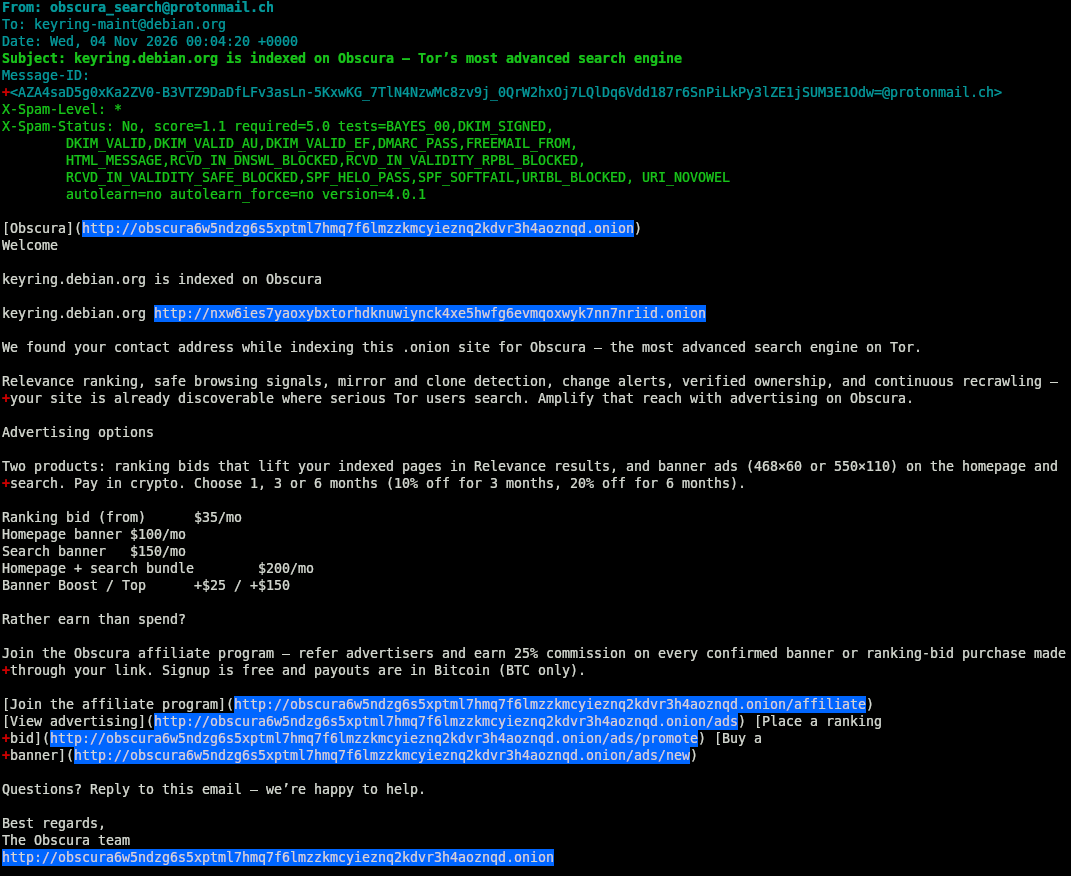 So, do we want to py to who-knows-whom for promoting the keyring-maint
services in a verrrrrry-dark web search site?
First time I have to throw this stinky onion at you

 Hello, Planet Debian. My blog was added to the Planet today, so I think the polite thing is to introduce myself before you start finding my posts between yours.
I am Juan Manuel M ndez Rey, from Sevilla. In Debian I am mendezr, and on OFTC I am Vejeta. I have been using Linux since 1994 and Debian since 1998. For a long time that was all: a happy user, installing, breaking things, reading the mailing lists from the outside. I started contributing in October 2025, and last month I became a Debian Maintainer.
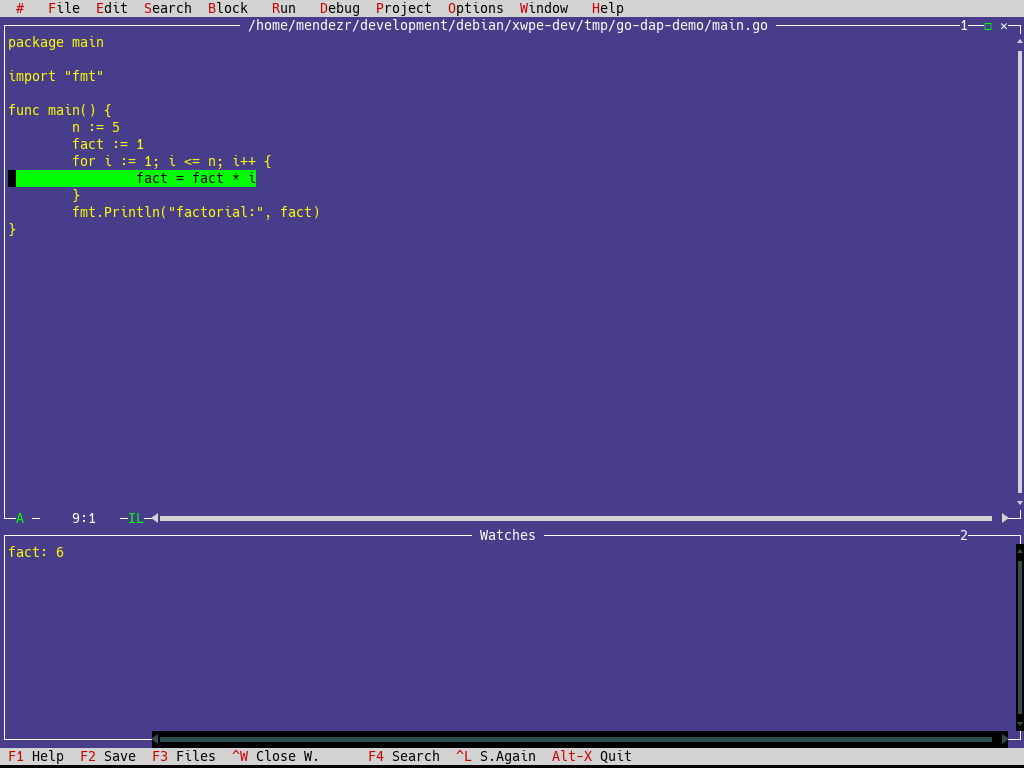
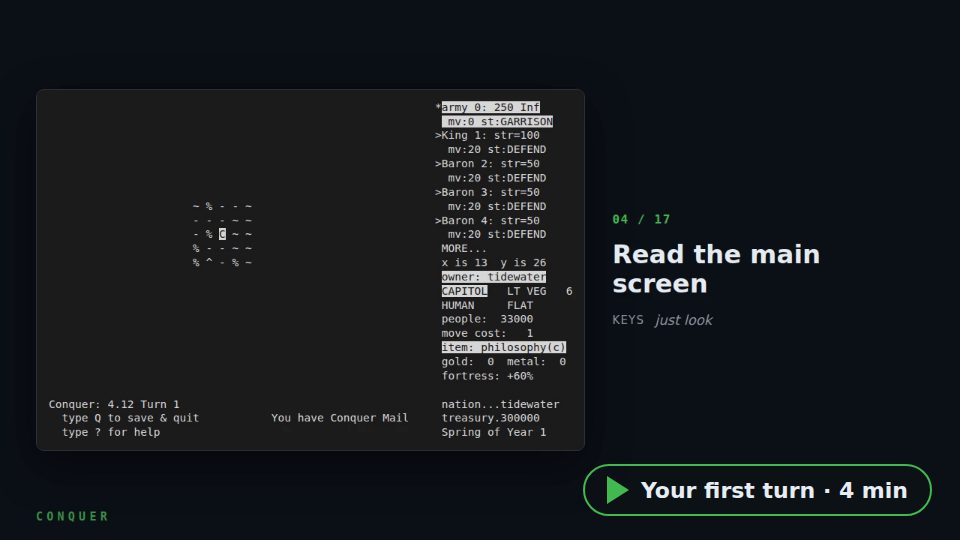
 After quite some time, I picked up debvulns again to implement what I
mentioned in my
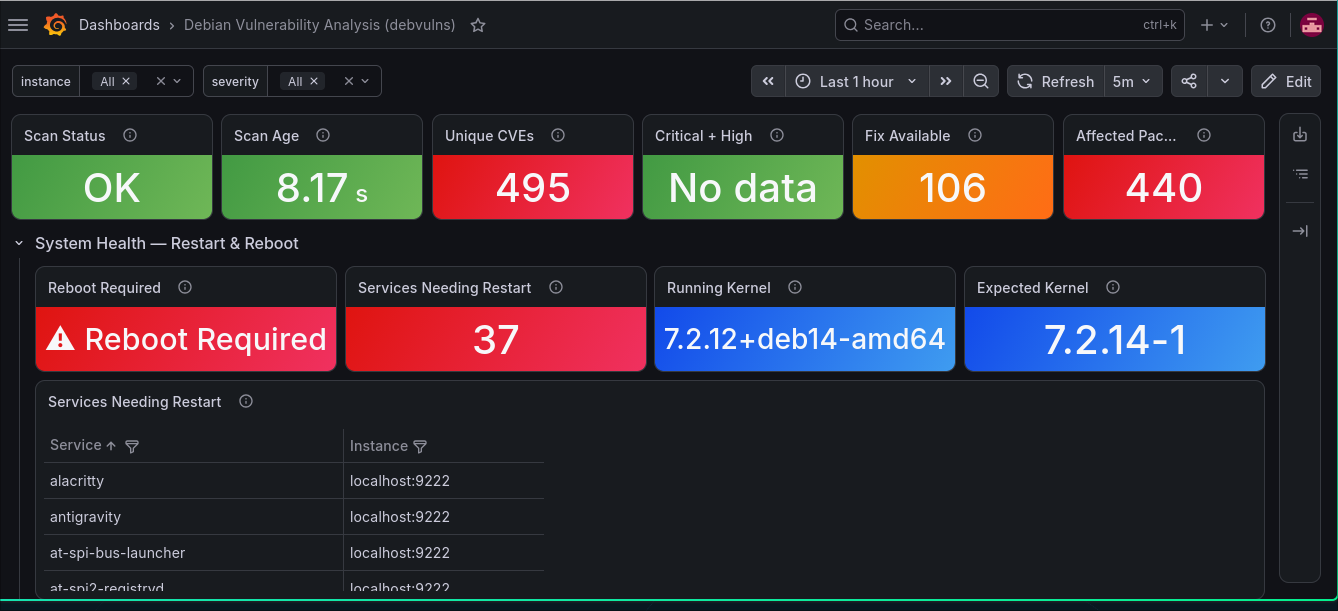
 I have a Samsung Q800A soundbar. It ships with built-in support for the Apple Airplay protocol, but I m not really an Apple kind of guy so that s never been particularly helpful for me. So, instead, I have a Chromecast Audio plugged into it via TOSLINK, and that works fine - except for the fact that there s no way to explicitly pick TOSLINK as the audio input. Instead, there s a Digital In option that refers to both the optical in and eARC input from a TV. Not inherently a problem, given I m unlikely to be watching TV while listening to music, but my TV is a Samsung Frame, a device that s intended to display art whenever someone is standing nearby, and which infuriatingly generates an eARC signal even if it s only in art mode and isn t going to make any noise. This switches the soundbar away from optical and I get sad. I could plug a video cast device into the HDMI port on the soundbar and cast audio to that, but then the art would get replaced with album covers whenever I m playing music, and again that s not quite the ambience I want. Still, none of this is that important.
Until I learned that the Australian version of the soundbar does have Google Cast support. The firmware image was downloadable from Samsung support, so I grabbed that, but unfortunately found that it was encrypted. However, if I downloaded the firmware image for the US model, the encrypted blob was identical - there s no difference in the underlying firmware between the two of them. So, how come one has support, and the other doesn t?
I d need an unencrypted copy of the firmware to have a real chance of figuring this out, and the easiest way to get one was to just run an ebay watch for a broken model of the same series. Once I had one in my hands I used hot air to remove the eMMC storage from the device, cleaned up the chip, and then stuck it in