Search Results: "daniel"

15 May 2026

Daniel Baumann: Debian: Linux Vulnerability Mitigation (ssh-keysign-pwn)

After the Linux local root privilege escalations of the last two weeks, the bug of today is ssh-keysign-pwn [CVE-2026-46333] which allows to read root-owned files as an unprivileged user. Exploiting the vulnerability doesn t require to load any specific modules like the bugs from the last weeks, this one needs to be fixed by rebooting the system into an updated kernel. I ve cherry-picked the upstream commit to fix it in trixie-fastforward-backports (linux 7 backports for trixie), confirmed that the exploits don t work anymore, and submitted a merge request for sid. Updates:

11 May 2026

Freexian Collaborators: Monthly report about Debian Long Term Support, April 2026 (by Thorsten Alteholz)

The Debian LTS Team, funded by Freexian s Debian LTS offering, is pleased to report its activities for April.

Activity summary During the month of April, 21 contributors have been paid to work on Debian LTS (links to individual contributor reports are located below). The team released 37 DLAs fixing 145 CVEs. The team continued preparing security updates in its usual rhythm. Beyond the updates targeting Debian 11 ( bullseye ), which is the current release under LTS, the team also proposed updates for more recent releases (Debian 12 ( bookworm ) and Debian 13 ( trixie )), including Debian unstable. We highlight several notable security updates here below.
  • Andrej Shadura prepared DLA 4525-1 for libyaml-syck-perl to fix a vulnerability related to a memory leak.
  • Andrej also prepared DLA 4551-1 for mbedtls to fix a leak of secrets.
  • Arnaud Rebillout prepared DLA 4532-1 for python3.9 to fix a use-after-free issue in several decompressors.
  • Arnaud also prepared DLA 4533-1 for systemd to fix multiple vulnerabilities, which might be also used to execute arbitrary code.
  • Bastien Roucari s prepared DLA 4529-1 for bind9 to fix a DNSSEC issues, which can cause the resolver to consume excessive CPU.
  • Bastien also prepared DLA 4539-1 for imagemagick to fix 21 vulnerabilities.
  • Emilio Pozuelo Monfort prepared DLA 4535-1 for openssh to fix a potentially execution of arbitrary code.
  • Emilio also Monfort prepared DLA 4526-1, DLA 4546-1 and DLA 4555-1 for firefox-esr to fix 31 vulnerabilities.
  • Jochen Sprickerhof prepared DLA 4524-1 for postgresql-13 to fix multiple vulnerabilities, which might be also used to execute arbitrary code.
  • Sylvain Beucler prepared DLA 4538-1 for perl to fix unauthorized access to data or arbitrary code execution.
  • Thorsten Alteholz prepared DLA 4545-1 for packagekit to fix a local privilege escalation.
  • Thorsten also prepared DLA 4544-1 for ntfs-3g to fix a local privilege escalation.
  • Tobias Frost prepared DLA 4521-1 for libpng1 to fix multiple vulnerabilities, which might be also used to execute arbitrary code.
Contributions from outside the LTS Team:
  • As usual, the thunderbird updates, released as DLA 4534-1 and DLA 4549-1, were prepared by its maintainer Christoph Goehre. This month 28 CVEs has been fixed. Thanks a lot for his continuous contributions. The DLAs have been sent by Emilio.
  • Thanks alot as well to Mathias Behrle for providing DLA 4543-1 for package simpleeval. The DLA has been sent by Santiago.
The LTS Team has also contributed with updates to the latest Debian releases:
  • Andreas Henriksson completed the upload of gvfs for trixie and bookworm
  • Ben Hutchings did uploads of several kernel packages to unstable and the corresponding backports repositories.
  • Sylvain took care of uploads of awstats to trixie and bookworm. He also did the same for 7zip-rar with an upload to bookworm-backports).
Some milestones in the lifecycle of two Debian releases are just around the corner. The support of Debian 12 will be handed over to the LTS team on June 11th 2026. After August 31st, support for Debian 11 will move from Debian LTS to ELTS managed by Freexian.

Individual Debian LTS contributor reports

Thanks to our sponsors Sponsors that joined recently are in bold.

8 May 2026

Daniel Baumann: Debian: Linux Vulnerability Mitigation (Dirty Frag)

After Copy Fail [CVE-2026-31431] from last week, the new Linux local root privilege escalations of today are Dirty Frag (Part 1) aka Copy Fail 2 [CVE-2026-43284] and Dirty Frag (Part 2) [CVE-2026-43500]. For those who can not update to linux >= 7.0.4-1 that was uploaded to sid and contains the needed fixes (backports for trixie are available in trixie-fastforward-backports), or are waiting for backports and updates to older Debian releases, or can t reboot on short notice, mitigations might be needed. Given the current trend, it seems we will see more of these bugs in the future. Therefore, I ve uploaded a new package linux-vulnerability-mitigation to sid containing the mitigation for both Copy Fail and Dirty Frag (with debconf multiselect). It can also be downloaded from here:
The package is architecture independent, has no dependencies, and can be installed on any version of Debian or Debian derivative. Updates:
  • Added references to Dirty Frag Part 2 [CVE-2026-43500]
  • Updated links to linux-vulnerability-mitigation now that it passed the NEW queue

24 April 2026

Freexian Collaborators: Monthly report about Debian Long Term Support, March 2026 (by Santiago Ruano Rinc n)

The Debian LTS Team, funded by [Freexian s Debian LTS offering] (https://www.freexian.com/lts/debian/), is pleased to report its activities for March.

Activity summary During the month of March, 20 contributors have been paid to work on Debian LTS (links to individual contributor reports are located below). The team released 24 DLAs fixing 250 CVEs. We also welcomed two new members: Lukas M rdian and Emmanuel Arias to the team, who actually started to contribute to the LTS project several months ago. The team continued preparing security updates in its usual rhythm. Beyond the updates targeting Debian 11 ( bullseye ), which is the current release under LTS, the team also proposed updates for more recent releases (Debian 12 ( bookworm ) and Debian 13 ( trixie )), including Debian unstable. We highlight several notable security updates here below.
  • ansible (DLA 4502-1), prepared by Lee Garret in collaboration with Jochen, fixing a vulnerability that allows attackers to bypass unsafe content protections
  • asterisk (DLA 4515-1), prepared by Lukas M rdian, fixing four CVEs that include possible privilege escalations.
  • gimp (DLA 4500-1), prepared by Thorsten, fixing four CVEs related to denial of service or execution of arbitrary code.
  • gst-plugins-base1.0 and gst-plugins-ugly1.0 (DLA-4514-1, DLA-4516-1, respectively), both prepared by Utkarsh, addressing vulnerabilities that may yield to arbitrary code execution.
  • imagemagick, released by Bastien Roucari s (DLA 4497-1) fixing multiple vulnerabilities that could lead to information leaks, bypass of security policies, denial of service or arbitrary code execution.
  • libpng1.6 (DLA 4521-1), prepared by Tobias Frost, fixing an arbitrary code execution vulnerability
  • linux: Ben Hutchings released DLA 4498-1 and DLA 4499-1 for linux 5.10 and linux 6.1, respectively. Those updates especially address the CrackArmor flaw.
  • ruby-rack (DLA 4505-1), prepared by Utkarsh Gupta, addressing two vulnerabilities
  • strongswan (DLA 4512-1), prepared by Thorsten Alteholz, fixing a Denial of Service vulnerability
  • roundcube (DLA 4517-1) prepared by Guilhem Moulin, who discovered that one of the fixes provided by upstream was incomplete.
Contributions from outside the LTS Team: As usual, the thunderbird update, released as DLA 4511-1, was prepared by its maintainer Christoph Goehre. Thanks a lot for his continuous contributions. The LTS Team has also contributed with updates to the latest Debian releases:
  • Andreas Henriksson completed the uploads of glib2.0 for both trixie and bookworm
  • Arnaud Rebillout: python-cryptography for trixie
  • Arnaud and Bastien worked together to prepare a ca-certificates-java release for unstable
  • Bastien completed the upload of gpsd for trixie that was proposed in January.
  • Bastien uploaded a regression update of apache2 for trixie
  • Bastien prepared a zabbix point update for trixie
  • Bastien in collaboration with Markus released netty updates for trixie and bookworm DSA 6160-1
  • Daniel Leidert proposed python-tornado releases for both trixie and bookworm.
  • Daniel also prepared a python-authlib update for trixie
  • Guilhem prepared a mapserver update for bookworm.
  • Lucas Kanashiro proposed merge requests to fix three CVEs in erlang for both trixie and bookworm
  • Sylvain Beucler continued the work to replace p7zip with 7zip in the different supported releases, and proposed a point update for bookworm
  • Tobias prepared trixie and bookworm security updates, released as DSA-6189-1
  • Utkarsh prepared trixie and bookworm security update for ruby-rack, released as DSA-6180-1

Individual Debian LTS contributor reports

Thanks to our sponsors Sponsors that joined recently are in bold.

24 March 2026

Russ Allbery: Review: A Shadow in Summer

Review: A Shadow in Summer, by Daniel Abraham
Series: Long Price Quartet #1
Publisher: Tor
Copyright: March 2006
ISBN: 0-7653-1340-5
Format: Hardcover
Pages: 331
A Shadow in Summer is a high fantasy novel, the first of (as the name implies) a completed four-book series. Daniel Abraham is perhaps better known as half of the writing pair behind James S.A. Corey, author of the Expanse series. This was his first novel. Otah was the sixth son of a Khai, sent like many of the unwanted later children of the powerful to learn the secrets of the andat and be trained as a poet. He learned his lessons well enough to reject the school and its teachings and walk away. Amat Kyaan has worked her way up from nothing to become the senior overseer of the foreign Galtic House Wilsin in the sun-drenched port city of Saraykeht. Liat is her apprentice, distracted by young love. Maati is a new apprentice poet, having endured his training and sent to learn from Heshai how to eventually hold the andat Removing-The-Part-That-Continues, better known as Seedless. None of them know they will find themselves entangled in a plot to destroy the poet of Saraykeht and, through him, the city's most potent economic tool. A poet in this world is not what we would think of a poet. They are, in essence, magical slave-drivers who capture the essence of an andat, a spirit embodying an idea that is coerced into the prison of volition and obedience by the poet. The andat Seedless, the embodiment of the concept of removing the spark of life, is central to the economic wealth of Saraykeht in a way that is startling in its simplicity: Seedless can remove the seeds from a warehouse full of cotton at a thought. This gives Saraykeht a massive productivity advantage in the cotton trade. Seedless is also a powerful potential weapon. What he can do to cotton, he could as easily do to any other crop, or to people. The Galts are not fond of the independence and power of Saraykeht, but as long as the city controls a powerful andat, they do not dare to attack it directly. Indirectly, though... that's another matter. This is one of those fantasy novels with meticulous and thoughtful world-building, careful and evocative prose, and a complex ensemble cast of interesting characters that the novel then attempts to make utterly miserable and complicit in their own misery. There should be a name for this style of writing. It's not tragedy because the ending is not tragic, precisely. It's not magic realism; the andats are openly magical, which makes this clearly high fantasy. But Abraham approaches the story from the type of realist frame that considers the pain and desperation of the characters to be more interesting than their ability to overcome challenges. Amat starts the story as an admirable, sharp-witted expert manager, so her life is destroyed and she's subjected to sexual violence. Heshai loathes himself and veers between a tragic figure and a wastrel as the story systematically undermines opportunities for redemption. Maati is young and idealistic, so of course every character in the book sets out to crush his idealism under the weight of unforeseen consequences. There is a sad and depressing love triangle, because this is exactly the sort of book that has a sad and depressing love triangle. At the end of the novel, everyone who survives is older and wiser in the sense that some stories seem to think wisdom comes from the accumulation of trauma. I find books like this so immensely frustrating because their merits are so clear. The world-building is careful and detailed in a way that includes economic systems, unlike so much fantasy. It is full of small, intriguing touches, such as the use of posture and gesture to communicate the emotional valence of one's words. Abraham understands the moral implications of poets and andats and the story tackles them head-on. The writing flows beautifully and gave me a strong sense of the city. I wanted to like this book for the obvious skill that went into it, and sometimes I even managed. And yet, it's taken me three months to finish A Shadow in Summer because I simply do not want to spend this much time around miserable people. I would get through one or two chapters in a night and then wanted to read something happy or defiant or heroic, rather than watching slow-motion train wrecks intermixed with desperate attempts to navigate stifling layers of immoral systems. It's not that the story lacks a moral compass. The characters are sincerely trying to make the world a better place, with some success. It even delivers a happy ending of sorts. But so much of the journey was watching the lives of the characters fall apart. I am completely unsurprised that some people loved this book. I'm still intrigued enough by the world-building that I'm half-tempted to try to read the sequel even after having to drag myself through this one. I had a similar reaction to Abraham's The Dragon's Path, though, so I think Abraham is just not for me. I may get back to the Expanse at some point, but having to drag myself through both of his solo novels I've tried, in two different series, probably indicates an incompatibility between author and reader. That's a shame, given the quality of the writing. Followed by A Betrayal in Winter. Content notes: Sexual and reproductive violence as significant plot elements. Rating: 6 out of 10

21 March 2026

Jonathan Dowland: Ladytron

I saw Ladytron perform in Digital, Newcastle last night. The last time I saw them was, I think, at the same venue, 18 years ago. Time flies!
Photo of the trio performing on stage
Back in the day (perhaps their heyday, perhaps not!) Ladytron ploughed a particular sonic furrow and did it very well. Going into the gig I had set my expectations that, should they play just these hits, I'd have a good time. The gig exceeded my expectations. The setlist very much did not lean into their best-known period: the more recent few albums were very well represented and to me this felt very confident. The lead singer, Helen Marnie, demonstrated some excellent range, particularly on some of the new songs. Daniel Hunt did a lot of backing vocals and they were really complementary to Helen's: underscoring but not overpowering. I enjoyed nerding out watching Mira Ayoro's excellent wrangling of her Korg MS-20. One highlight was an encore performance of Light & Magic, which was arguably the "alternate version" as available on the expanded versions of that album or the Remixed and Rare companion. I thought I'd try to put together a 5-track playlist for a friend who attended the gig but isn't super familiar with them. As usual this is hard. I'm going to avoid the obvious hits, try to represent their whole career and try to ensure the current trio each get a vocal turn in the selection. They actually released their latest album, Paradises, yesterday as well. One track from it is in the list below. I'm Not Scared by Ladytron Kingdom Undersea by Ladytron Blue Jeans by Ladytron He took her to a movie by Ladytron Transparent Days by Ladytron (If you can't see anything, the bandcamp embeds have been stripped out by whatever you are viewing this with)

19 March 2026

Otto Kek l inen: Automated security validation: How 7,000+ tests shaped MariaDB's new AppArmor profile

Featured image of post Automated security validation: How 7,000+ tests shaped MariaDB's new AppArmor profileLinux kernel security modules provide a good additional layer of security around individual programs by restricting what they are allowed to do, and at best block and detect zero-day security vulnerabilities as soon as anyone tries to exploit them, long before they are widely known and reported. However, the challenge is how to create these security profiles without accidentally also blocking legitimate actions. For MariaDB in Debian and Ubuntu, a new AppArmor profile was recently created by leveraging the extensive test suite with 7000+ tests, giving good confidence that AppArmor is unlikely to yield false positive alerts with it. AppArmor is a Mandatory Access Control (MAC) system, meaning that each process controlled by AppArmor has a sort of an allowlist called profile that defines all capabilities and file paths a program can access. If a program tries to do something not covered by the rules in its AppArmor profile, the action will be denied on the Linux kernel level and a warning logged in the system journal. This additional security layer is valuable because even if a malicious user found a security vulnerability some day in the future, the AppArmor profile severely restricts the ability to exploit it and gain access to the operating system. AppArmor was originally developed by Novell for use in SUSE Linux, but nowadays the main driver is Canonical and AppArmor is extensively used in Ubuntu and Debian, and many of their derivatives (e.g. Linux Mint, Pop!_OS, Zorin OS) and in Arch. AppArmor s benefit compared to the main alternative SELinux (used mainly in the RedHat/Fedora ecosystem) is that AppArmor is easier to manage. AppArmor continues to be actively developed, with new major version 5.0 expected to arrive soon. I also have some personal history contributing some notification handler scripts in Python and I also created the website that AppArmor.net still runs.

Regular review of denials in the system log required Any system administrator using Debian/Ubuntu needs to know how to check for AppArmor denials. The point of using AppArmor is kind of moot if nobody is checking the denials. When AppArmor blocks an action, it logs the event to the system audit or kernel logs. Understanding these logs is crucial for troubleshooting custom configurations or identifying potential security incidents. To view recent denials, check /var/log/audit/audit.log or run journalctl -ke --grep=apparmor. A typical denial entry for MariaDB will look like this (split across multiple lines for legibility):
msg=audit(1700000000.123:456): apparmor="DENIED" operation="open"
profile="/usr/sbin/mariadbd" name="/custom/data/path/test.ibd" pid=1234
comm="mariadbd" requested_mask="r" denied_mask="r" fsuid=1000 ouid=0
How to interpret this output:
  • msg=audit( ): The audit timestamp and event serial number.
  • apparmor= DENIED : Indicates AppArmor blocked the action.
  • operation: The action being attempted (e.g., open, mknod, file_mmap, file_perm).
  • profile: The specific AppArmor profile that triggered the denial (in this case the /usr/sbin/mariadbd profile).
  • name: The file path or resource that was blocked. In the example above, a custom data path was denied access because it wasn t defined in the profile s allowed abstractions.
  • comm: The command name that triggered the denial (here mariadbd).
  • requested_mask / denied_mask: Shows the permissions requested (e.g., r for read, w for write).
  • pid: The process ID.
  • fsuid: The user ID of the process attempting the action.
  • ouid: The owner user ID of the target file.
If an action seems legit and should not be denied, the sysadmin needs to update the existing rules at /etc/apparmor.d/ or drop a local customization file in at /etc/apparmor.d/local/. If the denied action looks malicious, the sysadmin should start a security investigation and if needed report a suspected zero-day vulnerability to the upstream software vendor (e.g. Ubuntu customers to Canonical, or MariaDB customers to MariaDB).

AppArmor in MariaDB - not a novel thing, and not easy to implement well Based on old bug reports, there was an AppArmor profile already back in 2011, but it was removed in MariaDB 5.1.56 due to backlash from users running into various issues. A new profile was created in 2015, but kept opt-in only due to the risk of side effects. It likely had very few users and saw minimal maintenance, getting only a handful of updates in the past 10 years. The primary challenge in using mandatory access control systems with MariaDB lies in the sheer breadth of MariaDB s operational footprint with diverse storage engines and plugins. Also the code base in MariaDB assumes that system calls to Linux always work which they do under normal circumstances and do not handle errors well if AppArmor suddenly denies a system call. MariaDB is also a large and complex piece of software to run and operate, and it can be very challenging for system administrators to root-cause that a misbehavior in their system was due to AppArmor blocking a single syscall. Ironically, AppArmor is most beneficial exactly due to the same reasons for MariaDB. The larger and more complex a software is, the larger are the odds of a security vulnerability arising between the various components. And AppArmor profile helps reduce this complexity down to a single access list. Over the years there has been users requesting to get the AppArmor profile back, such as Debian Bug#875890 since 2017. The need was raised recently again by the Ubuntu security team during the MariaDB Ubuntu main inclusion review in 2025, which prompted a renewed effort by Debian/Ubuntu developers, mainly myself and Aquila Macedo, with upstream MariaDB assistance from Daniel Black.

A fresh approach: leverage the MariaDB test suite for automated testing and the open source community for reviews The key to creating a robust AppArmor profile is the ability to know in detail what is expected and normal behavior of the system. One could in theory read all of the source code in MariaDB, but with over two million lines, it is of course not feasible in practice. However, MariaDB does have a very extensive 7000+ test suite, and running it should trigger most code paths in MariaDB. Utilizing the test suite was key in creating the new AppArmor profile for MariaDB: we installed MariaDB on a Ubuntu system, enabled AppArmor in complain mode and iterated on the allowlist by running the full mariadb-test-run with all MariaDB plugins and features enabled until we had a comprehensive yet clean list of rules. To be extra diligent, we also reworked the autopkgtest for MariaDB in Debian and Ubuntu CI systems to run with the AppArmor profile enabled and to print all AppArmor notices at the end of the run, making it easy to detect now and in the future if the MariaDB test suite triggers any AppArmor denials. If any test fails, the release would not get promoted further, protecting users from regressions. While developing and triggering manual test runs we used the maximal achievable test suite with 7177 tests. The test is however so extensive it takes over two hours to run, and it also has some brittle tests, so the standard test run in Debian and Ubuntu autopkgtest is limited just to MariaDB s main suite with about 1000 tests. Having some tests fail while testing the AppArmor profile was not a problem, because we didn t need all the tests to pass we merely needed them to run as many code paths as possible to see if they run any system calls not accounted for in the AppArmor profile. Note that extending the profile was not just mechanical copying of log messages to the profile. For example, even though a couple of tests involve running the dash shell, we decided to not allow it, as it opens too much of a path for a potential exploit to access the operating system. The result of this effort is a modernized, robust profile that is now production-ready. Those interested in the exact technical details can read the Debian Bug#1130272 and the Merge Request discussions at salsa.debian.org, which hosts the Debian packaging source code.

Now available in Debian unstable, soon Ubuntu feedback welcome! Even though the file is just 200 lines long, the work to craft it spanned several weeks. To minimize risk we also did a gradual rollout by releasing the first new profile version in complain mode, so AppArmor only logs would-be-denials without blocking anything. The AppArmor profile was switched to enforce mode only in the very latest MariaDB revision 1:11.8.6-4 in Debian, and a NEWS item issued to help increase user awareness of this change. It is also slated for the upcoming Ubuntu 26.04 Resolute Raccoon release next month, providing out-of-the-box hardening for the wider ecosystem. While automated testing is extensive, it cannot simulate everything. Most notably various complicated replication topologies and all Galera setups are likely not covered. Thus, I am calling on the community to deploy this profile and monitor for any audit denials in the kernel logs. If you encounter unexpected behavior or legitimate denials, please submit a bug report via the Debian Bug Tracking System. To ensure you are running the latest MariaDB version, run apt install --update --yes mariadb-server. To view the latest profile rules, run cat /etc/apparmor.d/mariadbd and to see if it is enforced review the output of aa-status. To quickly check if there were any AppArmor denials, simply run journalctl -k grep -i apparmor grep -i mariadb.

Systemd hardening also adopted as security features keep evolving For those interested in MariaDB security hardening, note that also new systemd hardening options were rolled out in Debian/Ubuntu recently. Note that Debian and Ubuntu are mainly volunteer-driven open source developer communities, and if you find this topic interesting and you think you have the necessary skills, feel free to submit your improvement ideas as Merge Requests at salsa.debian.org/mariadb-team. If your improvement suggestions are not Debian/Ubuntu specific, please submit them directly to upstream at GitHub.com/MariaDB.

18 March 2026

Bits from Debian: Debian pt_BR localization team and UFABC's mentoring program

Between July and November 2025, the Debian pt_BR translation team received five students for an online mentoring program. The initiative was carried out in partnership with the Federal University of ABC through the extension project "Immersion in Free Software", coordinated by professors Suzana Santos and Miguel Vieira. During the mentorship the mentees acted on several of the team's translation efforts and joined presentations about the Debian Project and its community given by the mentors. We thank the dedication and contributions of Ana Parra, Bruno Freitas, Henrique Barbosa, Raul Banzatto and Vitoria Cordeiro. And we also thank the members of the team who have reviewed the work of the mentees, specially the ones who were designated as official mentors, namely Allythy Rennan, Daniel Lenharo, Thiago Pezzo, and Victor Marinho. Results: We hope that this experience will inspire new paths and that you continue to contribute to Free Software especially to Debian.

16 March 2026

Freexian Collaborators: Monthly report about Debian Long Term Support, February 2026 (by Thorsten Alteholz)

The Debian LTS Team, funded by [Freexian s Debian LTS offering] (https://www.freexian.com/lts/debian/), is pleased to report its activities for February.

Activity summary During the month of February, 20 contributors have been paid to work on Debian LTS (links to individual contributor reports are located below). The team released 35 DLAs fixing 527 CVEs. We also welcomed Arnaud Rebillout to the team and had to say farewell to Roberto, who left the team after more than nine years as part of it. The team continued preparing security updates in its usual rhythm. Beyond the updates targeting Debian 11 ( bullseye ), which is the current release under LTS, the team also proposed updates for more recent releases (Debian 12 ( bookworm ) and Debian 13 ( trixie )), including Debian unstable. Notable security updates:
  • Guilhem Moulin prepared DLA 4492-1 for gnutls28 to fix vulnerabilities which may lead to Denial of Service.
  • Utkarsh Gupta prepared DLA 4464-1 for xrdp, to fix a a vulnerability that could allow remote attackers to execute arbitrary code on the target system.
  • Emilio Pozuelo Monfort prepared DLA-4465-1 to replace ClamAV 1.0 with ClamAV 1.4. This latter is the current LTS version supported by upstream.
  • Markus Koschany prepared DLA 4468-1 for tomcat9, to fix a vulnerability that can be used to bypass security constraints.
  • Santiago Ruano Rinc n prepared DLA 4471-1 to update package debian-security-support, the Debian security coverage checker.
  • Bastien Roucari s prepared DLA 4473-1 for zabbix, to fix a potential remote code execution vulnerability.
  • Paride Legovini prepared DLA 4478-1 for tcpflow, to fix a vulnerability that might result in DoS and potentially code execution.
  • Thorsten Alteholz prepared DLA 4477-1 for munge, to fix a vulnerability which may allow local users to leak the MUNGE cryptographic key and forge arbitrary credentials.
  • Ben Hutchings prepared DLA 4475-1 and DLA 4476-1 for Linux kernel updates.
  • Chris Lamb prepared DLA 4482-1 for ceph, to fix SSL certificate checking in the Python bindings.
  • Andreas Henriksson prepared DLA 4491-1 to fix vulnerabilities in glib2.0, which could result in denial of service, memory corruption or potentially arbitrary code execution.
Contributions from outside the LTS Team:
  • The update of nova was prepared by the maintainer, Thomas Goirand. The corresponding DLA 4486-1 was published by Carlos Henrique Lima Melara.
  • The updates of thunderbird were prepared by the maintainer Christoph Goehre. The corresponding DLA 4466-1 and DLA 4495-1 was published by Emilio Pozuelo Monfort.
The LTS Team has also contributed with updates to the latest Debian releases:
  • Jochen prepared a point update of wireshark for bookworm (#1127945).
  • Jochen prepared point updates of erlang for trixie (#1127606) and bookworm (#1127607).
  • Bastien helped preparing DSA 6160-1 for netty and uploaded a fixed package to unstable.
  • Bastien prepared a point update of zabbix for trixie (#1127437).
  • Tobias prepared a point update of modsecurity-crs for bookworm (#1128655).
  • Tobias prepared a point update of busybox for bookworm (#1129503).
  • Tobias helped preparing DSA 6138-1 for libpng1.6.
  • Daniel prepared point updates of python-authlib for trixie (#1129477) and bookworm (#1129246).
  • Ben uploaded several Linux kernel packages to trixie-backports and bookworm-backports.
  • Ben prepared point updates of wireless-regdb for trixie and bookworm.
Other than the work related to updates, Sylvain made several improvements to the documentation and tooling used by the team. Some milestones in the lifecycle of two Debian releases are just around the corner. The support of Debian 12 will be handed over to the LTS team on June 11th 2026. After August 31st, support for Debian 11 will move from Debian LTS to ELTS managed by Freexian.

Individual Debian LTS contributor reports

Thanks to our sponsors Sponsors that joined recently are in bold.

28 February 2026

Daniel Baumann: Debian Fast Forward: An alternative backports repository

The Debian project releases a new stable version of its Linux distribution approximately every two years. During its life time, a stable release usually gets security updates only, but in general no feature updates. For some packages it is desirable to get feature updates earlier than with the next stable release. Some new packages included in Debian after the initial release of a stable distribution are desirable for stable too. Both use-cases can be solved by recompiling the newer version of a package from testing/unstable on stable (aka backporting). Packages are backported together with only the minimal amount of required build-depends or depends not already fulfilled in stable (if any), and without any changes unless required to fix building on stable (if needed). There are official Debian Backports available, as well as several well-known unofficial backports repositories. I have been involved in one of these unofficial repositories since 2005 which subsequently turned 2010 into its own Debian derivative, mixing both backports and modified packages in one repository for simplicity. Starting with the Debian 13 (trixie) release, the (otherwise unmodified) backports of this derivative have been split out from the derivative distribution into a separate repository. This way the backports are more accessible and useful for all interested Debian users too.
TL;DR: Debian Fast Forward - https://fastforward.debian.net
  • is an alternative Debian repository containing complementary backports from testing/unstable to stable
  • with packages organized in a curated, self-contained selection of coherent sets
  • supporting amd64, i386, and arm64 architectures
  • containing around 400 packages in trixie-fastforward-backports
  • with 1 800 uploads since July 2025
End user documentation about how to enable Debian Fast Forwards is available. Have fun!

17 February 2026

Freexian Collaborators: Monthly report about Debian Long Term Support, January 2026 (by Santiago Ruano Rinc n)

The Debian LTS Team, funded by Freexian s Debian LTS offering, is pleased to report its activities for January.

Activity summary During the month of January, 20 contributors have been paid to work on Debian LTS (links to individual contributor reports are located below). The team released 33 DLAs fixing 216 CVEs. The team continued preparing security updates in its usual rhythm. Beyond the updates targeting Debian 11 ( bullseye ), which is the current release under LTS, the team also proposed updates for more recent releases (Debian 12 ( bookworm ) and Debian 13 ( trixie )), including Debian unstable. We highlight several notable security updates here below. Notable security updates:
  • python3.9, prepared by Andrej Shadura (DLA-4455-1), fixing multiple vulnerabilities in the Python interpreter.
  • php, prepared by Guilhem Moulin (DLA-4447-1), fixing two vulnerabilities that could yield to request forgery or denial of service.
  • apache2, prepared by Bastien Roucari s DLA-4452-1, fixing four CVEs.
  • linux-6.1, prepared by Ben Hutchings (DLA-4436-1), as a regular update of the linux 6.1 backport to Debian 11.
  • python-django, prepared by Chris Lamb (DLA-4458-1), resolving multiple vulnerabilities.
  • firefox-esr prepared by Emilio Pozuelo Monfort (DLA-4439-1)
  • gnupg2, prepared by Roberto S nchez (DLA-4437-1), fixing multiple issues, including CVE-2025-68973 that could potentially be exploited to execute arbitrary code.
  • apache-log4j2, prepared by Markus Koschany (DLA-4444-1)
  • ceph, prepared by Utkarsh Gupta (DLA-4460-1)
  • inetutils, prepared by Andreas Henriksson (DLA-4453-1), fixing an authentication bypass in telnetd.
Moreover, Sylvain Beucler studied the security support status of p7zip, a fork of 7zip that has become unmaintained upstream. To avoid letting the users continue using an unsupported package, Sylvain has investigated a path forward in collaboration with the security team and the 7zip maintainer, looking to replace p7zip with 7zip. It is to note however that 7zip developers don t reveal the information about the patches that fix CVEs, making it difficult to backport single patches to fix vulnerabilities in Debian released versions. Contributions from outside the LTS Team: Thunderbird, prepared by maintainer Christoph Goehre. The DLA (DLA-4442-1) was published by Emilio. The LTS Team has also contributed with updates to the latest Debian releases:
  • Bastien uploaded gpsd to unstable, and proposed updates for trixie #1126121 and bookworm #1126168 to fix two CVEs.
  • Bastien also prepared the imagemagick updates for trixie and bookworm, released as DSA-6111-1, along with the bullseye update DLA-4448-1.
  • Chris proposed a trixie point update for python-django (#112646), and the work for bookworm was completed in February (#1079454). The longstanding bookworm update required tracking down a regression in the django-storages packages.
  • Markus prepared tomcat10 updates for trixie and bookworm (DSA-6120-1), and tomcat11 for trixie (DSA-6121-1)
  • Thorsten Alteholz prepared bookworm point updates for zvbi (#1126167) to fix five CVEs; taglib (#1126273) to fix one CVE; and libuev (#1126370) to fix one CVE.
  • Utkarsh prepared an unstable update of node-lodash to fix one CVE.
Other than the work related to updates, Sylvain made several improvements to the documentation and tooling used by the team.

Individual Debian LTS contributor reports

Thanks to our sponsors Sponsors that joined recently are in bold.

16 January 2026

Freexian Collaborators: Monthly report about Debian Long Term Support, December 2025 (by Santiago Ruano Rinc n)

The Debian LTS Team, funded by [Freexian s Debian LTS offering] (https://www.freexian.com/lts/debian/), is pleased to report its activities for December.

Activity summary During the month of December, 18 contributors have been paid to work on Debian LTS (links to individual contributor reports are located below). The team released 41 DLAs fixing 252 CVEs. The team currently focuses on preparing security updates for Debian 11 bullseye , but also looks for contributing with updates for Debian 12 bookworm , Debian 13 trixie and even Debian unstable. Notable security updates:
  • libsoup2.4 (DLA-4398-1), prepared by Andreas Henrikson, fixing several vulnerabilities.
  • glib2.0 (DLA-4412-1), published by Emilio Pozuelo Monfort, addressing multiple issues.
  • lasso (DLA-4397-1), prepared by Sylvain Beucler, addressing multiple issues, including a critical remote code execution (RCE) vulnerability (CVE-2025-47151)
  • roundcube (DLA 4415-1), prepared by Guilhem Moulin, fixing a cross-site-scripting (XSS) (CVE-2025-68461) and an information disclosure (CVE-2025-68460) vulnerabilities
  • mediawiki (DLA 4428-1), published by Guilhem, fixing multiple vulnerabilities could lead to information disclosure, denial of service or privilege escalation.
  • While the DLA has not been published yet, Charles Henrique Melara proposed upstream fixes for seven CVEs in ffmpeg: https://code.ffmpeg.org/FFmpeg/FFmpeg/pulls/21275.
  • python-apt (DLA 4408-1), prepared by Utkarsh Gupta, in coordination with the Debian Security Team and Julian Andres Klode, the apt s maintainer.
  • libpng1.6 (DLA-4396-1), published by Tobias Frost, completing the work started the previous month.
Notable non-security updates:
  • tzdata (DLA-4403-1), prepared by Emilio, including the latest changes to the leap second list and its expiry date, which was set for the end of December.
Contributions from outside the LTS Team:
  • Christoph Berg, co-maintainer of PostgreSQL in Debian, prepared a postgresql-13 update, released as DLA-4420-1
The LTS Team has also contributed with updates to the latest Debian releases:

Individual Debian LTS contributor reports

Thanks to our sponsors Sponsors that joined recently are in bold.

14 January 2026

Dirk Eddelbuettel: RcppSimdJson 0.1.15 on CRAN: New Upstream, Some Maintenance

A brand new release 0.1.15 of the RcppSimdJson package is now on CRAN. RcppSimdJson wraps the fantastic and genuinely impressive simdjson library by Daniel Lemire and collaborators. Via very clever algorithmic engineering to obtain largely branch-free code, coupled with modern C++ and newer compiler instructions, it results in parsing gigabytes of JSON parsed per second which is quite mindboggling. The best-case performance is faster than CPU speed as use of parallel SIMD instructions and careful branch avoidance can lead to less than one cpu cycle per byte parsed; see the video of the talk by Daniel Lemire at QCon. This version updates to the current 4.2.4 upstream release. It also updates the RcppExports.cpp file with glue between C++ and R. We want move away from using Rf_error() (as Rcpp::stop() is generally preferable). Packages (such as this one) that are declaring an interface have an actual Rf_error() call generated in RcppExports.cpp which can protect which is what current Rcpp code generation does. Long story short, a minor internal reason. The short NEWS entry for this release follows.

Changes in version 0.1.15 (2026-01-14)
  • simdjson was upgraded to version 4.2.4 (Dirk in #97
  • RcppExports.cpp was regenerated to aid a Rcpp transition
  • Standard maintenance updates for continuous integration and URLs

Courtesy of my CRANberries, there is also a diffstat report for this release. For questions, suggestions, or issues please use the issue tracker at the GitHub repo.

This post by Dirk Eddelbuettel originated on his Thinking inside the box blog. If you like this or other open-source work I do, you can now sponsor me at GitHub.

12 January 2026

Daniel Lange: Resizing Xterm fonts with Ctrl+ and Ctrl+

Xterm misses the convenient option to resize the fonts with Ctrl+<plus> and Ctrl+<minus> like xfce4-terminal or gnome-terminal do out of the box. This feature can be added on Debian systems by dropping a configuration snippet into /etc/X11/Xresources/x11-xterm-fontsize:
! Allow XTerm font size to be changed with Ctrl+<plus> and <minus>
XTerm.vt100.translations: #override \n\
Ctrl <Key> minus: smaller-vt-font() \n\
Ctrl <Key> plus: larger-vt-font()
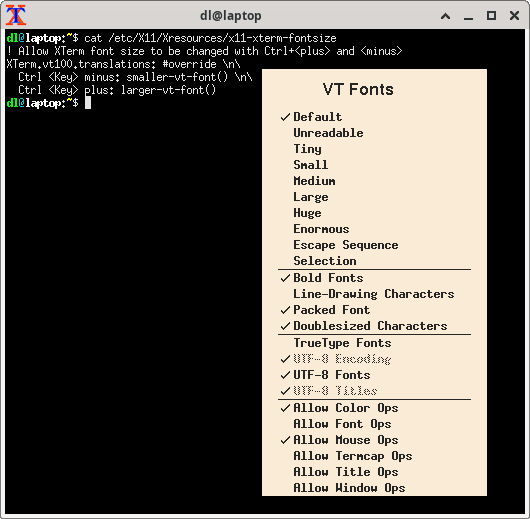
Any new X session will inherit this configuration and Ctrl+<plus> and Ctrl+<minus> will work to adjust the font size (and taking the window size along). The font sizes that Xterm iterates through can be viewed on the Ctrl-<right click> context menu: Screenshot of an Xterm window with the context menu displayed NB: The context menu allows to switch the fonts on systems where the above snippet has not (yet) been installed. So good enough for a one-off. Credits: Stack Overflow/Ask Ubuntu, Matthew Hoener.

Daniel Kahn Gillmor: AI as a Compression Problem

A recent article in The Atlantic makes the case that very large language models effectively contain much of the works they're trained on. This article is an attempt to popularize the insights in the recent academic paper Extracting books from production language models from Ahmed et al. The authors of the paper demonstrate convincingly that well-known copyrighted textual material can be extracted from the chatbot interfaces of popular commercial LLM services. The Atlantic article cites a podcast quote about the Stable Diffusion AI image-generator model, saying "We took 100,000 gigabytes of images and compressed it to a two-gigabyte file that can re-create any of those and iterations of those". By analogy, this suggests we might think of LLMs (which work on text, not the images handled by Stable Diffusion) as a form of lossy textual compression. The entire text of Moby Dick, the canonical Big American Novel is merely 1.2MiB uncompressed (and less than 0.4MiB losslessly compressed with bzip2 -9). It's not surprising to imagine that a model with hundreds of billions of parameters might contain copies of these works. Warning: The next paragraph contains fuzzy math with no real concrete engineering practice behind it! Consider a hypothetical model with 100 billion parameters, where each parameter is stored as a 16-bit floating point value. The model weights would take 200 GB of storage. If you were to fill the parameter space only with losslessly compressed copies of books like Moby Dick, you could still fit half a million books, more than anyone can read in a lifetime. And lossy compression is typically orders of magnitude less in size than lossless compression, so we're talking about millions of works effectively encoded, with the acceptance of some artifacts being injected in the output. I first encountered this "compression" view of AI nearly three years ago, in Ted Chiang's insightful ChatGPT is a Blurry JPEG of the Web. I was suprised that The Atlantic article didn't cite Chiang's piece. If you haven't read Ted Chiang, i strongly recommend his work, and this piece is a great place to start. Chiang aside, the more recent writing that focuses on the idea of compressed works being "contained" in the model weights seems to be used by people interested in wielding some sort of copyright claims against the AI companies that maintain or provide access to these models. There are many many problems with AI today, but attacking AI companies based on copyright concerns seems similar to going after Al Capone for tax evasion. We should be much more concerned with the effect these projects have on cultural homogeneity, mental health, labor rights, privacy, and social control than whether they're violating copyright in some specific instance.
7 January 2026

Thorsten Alteholz: My Debian Activities in December 2025

Debian LTS/ELTS This was my hundred-thirty-eighth month that I did some work for the Debian LTS initiative, started by Raphael Hertzog at Freexian. (As the LTS- and ELTS-teams have been merged now, there is only one paragraph left for both activities.) During my allocated time I uploaded or worked on: I also tried to backport the libcoap3-patches to Bookworm, but I am afraid the changes would be too intrusive.When I stumbled upon a comment for 7zip about finding the patches might be a hard , I couldn t believe it. Well, Daniel was right and I didn t find any. Furthermore I worked on suricata, marked some CVEs as not-affected or ignored, and added some new patches. Unfortunately my allocated time was spent before I could do a new upload. I also attended the monthly LTS/ELTS meeting. Last but not least I injected some packages for uploads to security-master. Debian Printing This month I uploaded a new upstream version or a bugfix version of: This work is generously funded by Freexian! Debian Lomiri I started to contribute to Lomiri packages, which are part of the Debian UBports Team. As a first step I took care of failing CI pipelines and tried to fix them. A next step would be to package some new Applications. This work is generously funded by Fre(i)e Software GmbH! Debian Astro This month I uploaded a new upstream version or a bugfix version of: Debian IoT This month I uploaded a new upstream version or a bugfix version of: Debian Mobcom Unfortunately I didn t found any time to work on this topic. misc This month I uploaded a new upstream version or a bugfix version of: Last but not least, I wish (almost) everbody a Happy New Year and hope that you are able to stick to your New Year s resolutions.

1 January 2026

Daniel Baumann: P r ch storage (in Western Europe)

The majority of P r ch ( ) is stored in Asia (predominantly China, some in Malaysia and Taiwan) because of its climatic conditions:
  • warm (~30 C)
  • humid (~75% RH)
  • stable (comparatively small day to day, day to night, and seasonal differences)
These are ideal for ageing and allow efficient storage in simple storehouses, usually without the need for any air conditioning. The climate in Western European countries is significantly colder, drier, and more variable. However, residential houses offers throughout the year a warm (~20 C), humid (~50% RH), and stable baseline to start with. High quality, long term storage and ageing is possible too with some of the Asian procedures slightly adjusted for the local conditions. Nevertheless, fast accelerated ageing still doesn t work here (even with massive climate control). Personally I prefer the balanced, natural storage over the classical wet or dry , or the mixed traditional storage (of course all storage types are not that meaningful as they are all relative terms anyway). Also I don t like strong fermentation either (P r is not my favourite tea, I only drink it in the 3 months of winter). Therefore, my intention is primarily to preserve the tea while it continues to age normally, keep it in optimal drinking condition and don t rush its fermentation. The value of correct storage is of great importance and has a big effect on P r, and is often overlooked and underrated. Here s a short summary on how to store P r ch (in Western Europe).
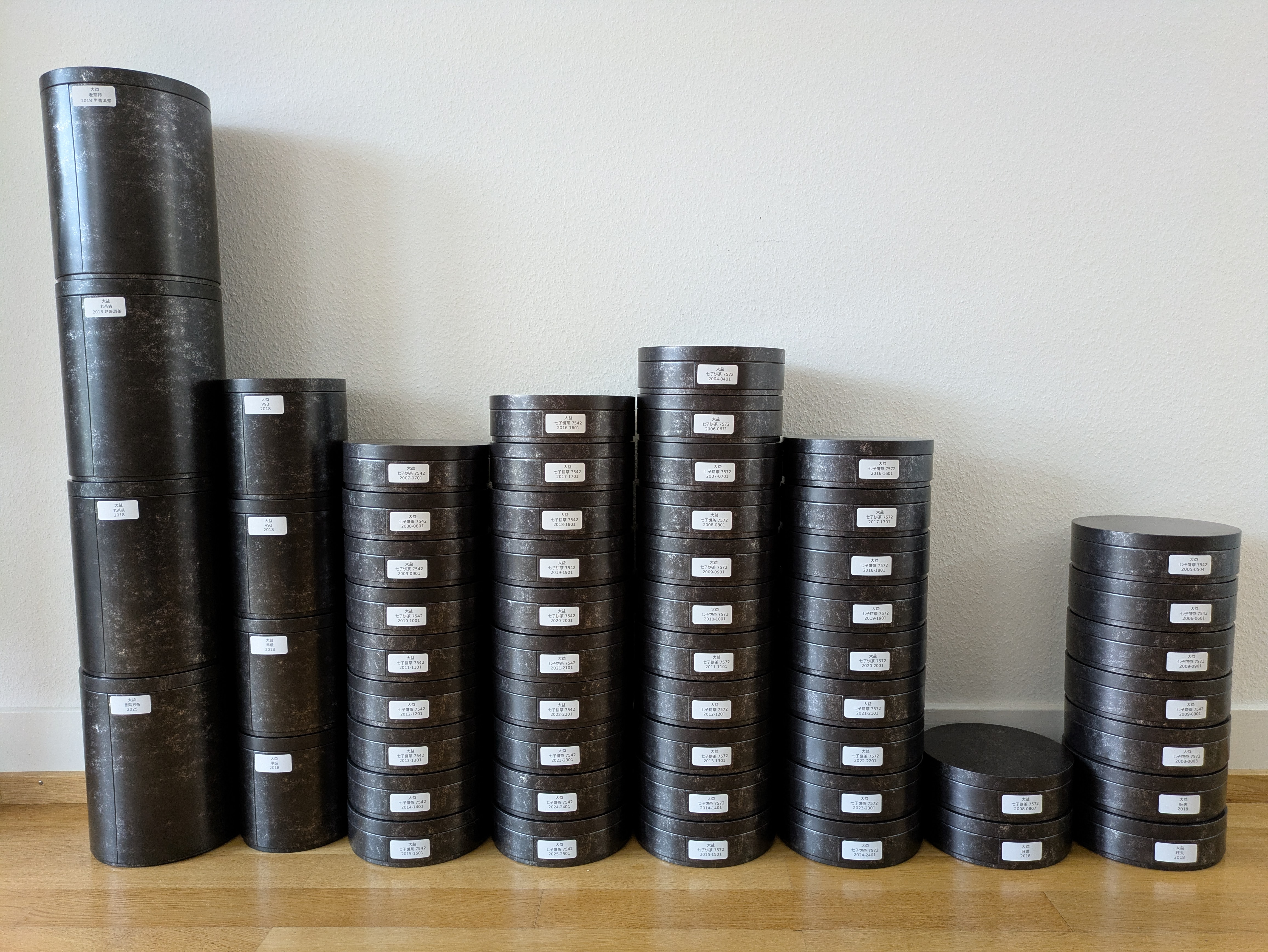
P ' r ch  storage (in Western Europe) Image: some D y P r ch stored at home
1. Location
1.1 No light Choose a location with neither direct nor indirect sunlight (= ultraviolet radiation) exposure:
  • direct sunlight damages organic material ( bleeching )
  • indirect sunlight by heating up the containers inbalances the microclimate ( suppression )
1.2 No odors Choose a location with neither direct nor indirect odor exposure:
  • direct odor immissions (like incense, food, air polution, etc.) makes the tea undrinkable
  • indirect odor immissions (especially other teas stored next to it) taint the taste and dilute the flavours
Always use individual containers for each tea, store only identical tea of the same year and batch in the same container. Idealy never store one cake, brick or tuo on its own, buy multiples and store them together for better ageing.
2. Climate
2.1 Consistent temperature Use a location with no interference from any devices or structures next to it:
  • use an regular indoor location for mild temperature curves (i.e. no attics with large day/night temperature differences)
  • aim for >= 20 C average temperature for natural storage (i.e. no cold basements)
  • don t use a place next to any heat dissipating devices (like radiators, computers, etc.)
  • don t use a place next to an outside facing wall
  • always leave 5 to 10cm distance to a wall for air to circulate (generally prevents mold on the wall but also isolates the containers further from possible immissions)
As consistent temperature as possible allows even and steady fermentation. However, neither air conditioning or filtering is needed. Regular day to day, day to night, and season to season fluctuations are balanced out fine with otherwise correct indoor storage. Also humidity control is much more important for storage and ageing, and much less forgiving than temperature control.
2.2 Consistent humidity Use humidity control packs to ensure a stable humidity level:
  • aim for ~65% RH
Lower than 60% RH will (completely) dry out the tea, higher than 70% RH increases chances for mold.
3. Equipment
3.1 Proper containers Use containers that are long term available and that are easily stackable, both in form and dimensions as well as load-bearing capacity. They should be inexpensive, otherwise it s most likely scam (there are people selling snake-oil containers specifically for tea storage). For long term storage and ageing:
  • never use plastic: they leak chemicals over time (no tupperdors , mylar and zip lock bags, etc.)
  • never use cardboard or bamboo: they let to much air in, absorb too much humity and dry to slow
  • never use wood: they emit odors (no humidors)
  • never use clay: they absorb all humidity and dry out the tea (glazed or porcelain urns are acceptable for short term storage)
Always use sealed but not air tight, cleaned steal cans (i.e. with no oil residues from manufacturing; such as these).
3.2 Proper humidity control Use two-way humidity control packs to either absorb or add moisture depending on the needs:
  • use humidity control pack(s) in every container
  • use one 60g pack (such as these) per 500g of tea
3.3 Proper labels Put labels on the outside of the containers to not need to open them to know what is inside and disturbe the ageing:
  • write at least manufacturer and name, pressing year, and batch number on the label (such as these)
  • if desired and not otherwise kept track already elsewhere, add additional information such as the amount of items, weights, previous storage location/type, date of purchase, vendor, or price, etc.
3.4 Proper monitoring Measuring and checking temperature and humidity regularly prevents storage parameters turning bad going unnoticed:
  • put temperature and humidity measurement sensors (such as these) inside some of the containers (e.g. at least one in every different size/type of container)
  • keep at least one temperature and humidity measurement sensor next to the containers on the outside to monitor the storage location
4. Storage
4.1 Continued maintenance Before beginning to initially store a new tea, let it acclimatize for 2h after unpacking from transport (or longer if temperature differences between indoors and outdoors are high, i.e. in winter). Then continuesly:
  • once a month briefly air all containers for a minute or two
  • once a month check for mold, just to be safe
  • every 3 to 6 months check all humidity control packs for need of replacement
  • monitor battery life of temperature and humidity measurement sensors
Humidity control packs can be recharged (usually voiding any warranty) by submerging them for 2 days in distilled water and 4 hours drying on paper towl afterwards. Check with a weight scale after recharging, they should regain their original weight (e.g. 60g plus ~2 to 5g for the packaging).
Finally With a correct P r ch storage:
  • beginn to drink Sh ng P r ( ) roughly after about 10-15 years, or later
  • beginn to drink Sh u P r ( ) roughly after about 3-5 years, or later
Prepare the tea by breaking it into, or breaking off from it, ~5 to 10g pieces about 1 to 3 months ahead of drinking and consider increase humidity to 70% RH during that time. 2026

24 December 2025

Daniel Lange: Getting scanning to work with Gimp on Trixie

Trixie ships Gimp 3.0.4 and the 3.x series has gotten incompatible to XSane, the common frontend for scanners on Linux. Hence the maintainer, J rg Frings-F rst, has disabled the Gimp integration temporarily in response to a Debian bug #1088080. There seems to be no tracking bug for getting the functionality back but people have been commenting on Debian bug #993293 as that is ... loosely related :-). There are two options to get the Scanning functionality back in Trixie until this is properly resolved by an updated XSane in Debian (e.g. via trixie-backports): Lee Yingtong Li (RunasSudo) has created a Python script that calls XSane as a cli application and published it at https://yingtongli.me/git/gimp-xsanecli/. This worked okish for me but needed me to find the scan in /tmp/ a number of times. This is a good stop-gap script if you need to scan from Gimp $now and look for a quick solution. Upstream has completed the necessary steps to get XSane working as a Gimp 3.x plugin at https://gitlab.com/sane-project/frontend/xsane. Unfortunately compiling this is a bit involved but I made a version that can be dropped into /usr/local/bin or $HOME/bin and works alongside Gimp and the system-installed XSane. So:
  1. sudo apt install gimp xsane
  2. Download xsane-1.0.0-fit-003 (752kB, AMD64 executable for Trixie) and place it in /usr/local/bin (as root)
  3. sha256sum /usr/local/bin/xsane-1.0.0-fit-003
    # result needs to be af04c1a83c41cd2e48e82d04b6017ee0b29d555390ca706e4603378b401e91b2
  4. sudo chmod +x /usr/local/bin/xsane-1.0.0-fit-003
  5. # Link the executable into the Gimp plugin directory as the user running Gimp:
    mkdir -p $HOME/.config/GIMP/3.0/plug-ins/xsane/
    ln -s /usr/local/bin/xsane-1.0.0-fit-003 $HOME/.config/GIMP/3.0/plug-ins/xsane/
  6. Restart Gimp
  7. Scan from Gimp via File Create Acquire XSane
The source code for the xsane executable above is available under GPL-2 at https://gitlab.com/sane-project/frontend/xsane/-/tree/c5ac0d921606309169067041931e3b0c73436f00. This points to the last upstream commit from 27. September 2025 at the time of writing this blog article.

23 December 2025

Daniel Kahn Gillmor: AI and Secure Messaging Don't Mix

AI and Secure Messaging Don't Mix Over on the ACLU's Free Future blog, I just published an article titled AI and Secure Messaging Don't Mix. The blogpost assumes for the sake of the argument that people might actually want to have an AI involved in their personal conversations, and explores why Meta's Private Processing doesn't offer the level of assurance that they want it to offer. In short, the promises of "confidential cloud computing" are built on shaky foundations, especially against adversaries as powerful as Meta themselves. If you really want AI in your chat, the baseline step for privacy preservation is to include it in your local compute base, not to use a network service! But these operators clearly don't value private communication as much as they value binding you to their services. But let's imagine some secure messenger that actually does put message confidentiality first -- and imagine they had integrated some sort of AI capability into the messenger. That at least bypasses the privacy questions around AI use. Would you really want to talk with your friends, as augmented by their local AI, though? Would you want an AI, even one running locally with perfect privacy, intervening in your social connections? What if it summarized your friend's messages to you in a way that led you to misunderstand (or ignore) an important point your friend had made? What if it encouraged you to make an edgy joke that comes across wrong? Or to say something that seriously upsets a friend? How would you respond? How would you even know that it had happened? My handle is dkg. More times than i can count, i've had someone address me in a chat as "dog" and then cringe and apologize and blame their spellchecker/autocorrect. I can laugh these off because the failure mode is so obvious and transparent -- and repeatable. (also, dogs are awesome, so i don't really mind!) But when our attention (and our responses!) are being shaped and molded by these plausibility engines, how will we even know that mistakes are being made? What if the plausibility engine you've hooked into your messenger embeds subtle (or unsubtle!) bias? Don't we owe it to each other to engage with actual human attention?

16 December 2025

Freexian Collaborators: Monthly report about Debian Long Term Support, November 2025 (by Santiago Ruano Rinc n)

The Debian LTS Team, funded by [Freexian s Debian LTS offering] (https://www.freexian.com/lts/debian/), is pleased to report its activities for November.

Activity summary During the month of November, 18 contributors have been paid to work on Debian LTS (links to individual contributor reports are located below). The team released 33 DLAs fixing 219 CVEs. The LTS Team kept going with the usual cadence of preparing security updates for Debian 11 bullseye , but also for Debian 12 bookworm , Debian 13 trixie and even Debian unstable. As in previous months, we are pleased to say that there have been multiple contributions of LTS uploads by Debian Fellows outside the regular LTS Team. Notable security updates:
  • Guilhem Moulin prepared DLA 4365-1 for unbound, a caching DNS resolver, fixing a cache poisoning vulnerability that could lead to domain hijacking.
  • Another update related to DNS software was made by Andreas Henriksson. Andreas completed the work on bind9, released as DLA 4364-1 to fix cache poisoning and Denial of Service (DoS) vulnerabilities.
  • Chris Lamb released DLA 4374-1 to fix a potential arbitrary code execution vulnerability in pdfminer, a tool for extracting information from PDF documents.
  • Ben Hutchings published a regular security update for the linux 6.1 bullseye backport, as DLA 4379-1.
  • A couple of other important recurrent updates were prepared by Emilio Pozuelo, who handled firefox-esr and thunderbird (in collaboration with Christoph Goehre), published as DLAs DLA 4370-1 and DLA 4372-1, respectively.
Contributions from fellows outside the LTS Team:
  • Thomas Goirand uploaded a bullseye update for keystone and swift
  • Jeremy B cha prepared the bullseye update for gst-plugins-base1.0
  • As mentioned above, Christoph Goehre prepared the bullseye update for thunderbird.
  • Mathias Behrle provided feedback about the tryton-server and tryton-sao vulnerabilities that were disclosed last month, and helped to review the bullseye patches for tryton-server.
Other than the regular LTS updates for bullseye, the LTS Team has also contributed updates to the latest Debian releases:
  • Bastien Roucari s prepared a bookworm update for squid, the web proxy cache server.
  • Carlos Henrique Lima Melara filed a bookworm point update request for gdk-pixbuf to fix CVE-2025-7345, a heap buffer overflow vulnerability that could lead to arbitrary code execution.
  • Daniel Leidert prepared bookworm and trixie updates for r-cran-gh to fix CVE-2025-54956, an issue that may expose user credentials in HTTP responses.
  • Along with the bullseye updates for unbound mentioned above, Guilhem helped to prepare the trixie update for unbound.
  • In collaboration with Lukas M rdian, Tobias Frost prepared trixie and bookworm updates for log4cxx, the C++ port of the logging framework for JAVA.
  • Jochen Sprickerhof prepared a bookworm update for syslog-ng.
  • Utkarsh completed the bookworm update for wordpress, addressing multiple security issues in the popular blogging tool.
Beyond security updates, there has been a significant effort in revamping our documentation, aiming to make the processes more clear and consistent for all the members of the team. This work was mainly carried out by Sylvain, Jochen and Roberto. We would like to express our gratitude to the sponsors for making the Debian LTS project possible. Also, special thanks to the fellows outside the LTS team for their valuable help.

Individual Debian LTS contributor reports

Thanks to our sponsors Sponsors that joined recently are in bold.

Next.

Previous.