Search Results: "cjwatson"

6 August 2025

Colin Watson: Free software activity in July 2025

About 90% of my Debian contributions this month were sponsored by Freexian. You can also support my work directly via Liberapay or GitHub Sponsors. DebConf I attended DebConf for the first time in 11 years (my last one was DebConf 14 in Portland). It was great! For once I had a conference where I had a fairly light load of things I absolutely had to do, so I was able to spend time catching up with old friends, making some new friends, and doing some volunteering - a bit of Front Desk, and quite a lot of video team work where I got to play with sound desks and such. Apparently one of the BoFs ( birds of a feather , i.e. relatively open discussion sessions) where I was talkmeister managed to break the automatic video cutting system by starting and ending precisely on time, to the second, which I m told has never happened before. I ll take that. I gave a talk about Debusine, along with helping Enrico run a Debusine BoF. We still need to process some of the feedback from this, but are generally pretty thrilled about the reception. My personal highlight was getting a shout-out in a talk from CERN (in the slide starting at 32:55). Other highlights for me included a Python team BoF, Ian s tag2upload talk and some very useful follow-up discussions, a session on archive-wide testing, a somewhat brain-melting whiteboard session about the multiarch interpreter problem , several useful discussions about salsa.debian.org, Matthew s talk on how Wikimedia automates their Debian package builds, and many others. I hope I can start attending regularly again! OpenSSH Towards the end of a release cycle, people tend to do more upgrade testing, and this sometimes results in interesting problems. Manfred Stock reported No new SSH connections possible during large part of upgrade to Debian Trixie , and after a little testing in a container I confirmed that this was a reproducible problem that would have affected many people upgrading from Debian 12 (bookworm), with potentially severe consequences for people upgrading remote systems. In fact, there were two independent problems that each led to much the same symptom: The net result is that if you apply updates to bookworm (including stable-updates / bookworm-updates, which is enabled by default) before starting the upgrade to trixie, everything should be fine. Many thanks to Manfred for reporting this with just enough time to spare that we were able to fix it before Debian 13 is released in a few days! debmirror I did my twice-yearly refresh of debmirror s mirror_size documentation, and applied a patch from Christoph Goehre to improve mirroring of installer files. madison-lite I proposed renaming this project along with the rmadison tool in devscripts, although I m not yet sure what a good replacement name would be. Python team I upgraded python-expandvars, python-typing-extensions (in experimental), and webtest to new upstream versions. I backported fixes for some security vulnerabilities to unstable: I fixed or helped to fix a number of release-critical bugs: I fixed some other bugs, mostly Severity: important: I reinstated python3-mastodon s build-dependency on and recommendation of python3-blurhash, now that the latter has been fixed to use the correct upstream source.

17 July 2025

Arnaud Rebillout: Acquire-By-Hash for APT packages repositories, and the lack of it in Kali Linux

This is a lenghty blog post. It features a long introduction that explains how apt update acquires various files from a package repository, what is Acquire-By-Hash, and how it all works for Kali Linux: a Debian-based distro that doesn't support Acquire-By-Hash, and which is distributed via a network of mirrors and a redirector. In a second part, I explore some "Hash Sum Mismatch" errors that we can hit with Kali Linux, errors that would not happen if only Acquire-By-Hash was supported. If anything, this blog post supports the case for adding Acquire-By-Hash support in reprepro, as requested at https://bugs.debian.org/820660. All of this could have just remained some personal notes for myself, but I got carried away and turned it into a blog post, dunno why... Hopefully others will find it interesting, but you really need to like troubleshooting stories, packed with details, and poorly written at that. You've been warned! Introducing Acquire-By-Hash Acquire-By-Hash is a feature of APT package repositories, that might or might not be supported by your favorite Debian-based distribution. A repository that supports it says so, in the Release file, by setting the field Acquire-By-Hash: yes. It's easy to check. Debian and Ubuntu both support it:
$ wget -qO- http://deb.debian.org/debian/dists/sid/Release   grep -i ^Acquire-By-Hash:
Acquire-By-Hash: yes
$ wget -qO- http://archive.ubuntu.com/ubuntu/dists/devel/Release   grep -i ^Acquire-By-Hash:
Acquire-By-Hash: yes
What about other Debian derivatives?
$ wget -qO- http://http.kali.org/kali/dists/kali-rolling/Release   grep -i ^Acquire-By-Hash:   echo not supported
not supported
$ wget -qO- https://archive.raspberrypi.com/debian/dists/trixie/Release   grep -i ^Acquire-By-Hash:   echo not supported
not supported
$ wget -qO- http://packages.linuxmint.com/dists/faye/Release   grep -i ^Acquire-By-Hash:   echo not supported
not supported
$ wget -qO- https://apt.pop-os.org/release/dists/noble/Release   grep -i ^Acquire-By-Hash:   echo not supported
not supported
Huhu, Acquire-By-Hash is not ubiquitous. But wait, what is Acquire-By-Hash to start with? To answer that, we have to take a step back and cover some basics first. The HTTP requests performed by 'apt update' What happens when one runs apt update? APT first requests the Release file from the repository(ies) configured in the APT sources. This file is a starting point, it contains a list of other files (sometimes called "Index files") that are available in the repository, along with their hashes. After fetching the Release file, APT proceeds to request those Index files. To give you an idea, there are many kinds of Index files, among which: There's an excellent Wiki page that details the structure of a Debian package repository, it's there: https://wiki.debian.org/DebianRepository/Format. Note that APT doesn't necessarily download ALL of those Index files. For simplicity, we'll limit ourselves to the minimal scenario, where apt update downloads only the Packages files. Let's try to make it more visual: here's a representation of a apt update transaction, assuming that all the components of the repository are enabled:
apt update -> Release -> Packages (main/amd64)
                      -> Packages (contrib/amd64)
                      -> Packages (non-free/amd64)
                      -> Packages (non-free-firmware/amd64)
Meaning that, in a first step, APT downloads the Release file, reads its content, and then in a second step it downloads the Index files in parallel. You can actually see that happen with a command such as apt -q -o Debug::Acquire::http=true update 2>&1 grep ^GET. For Kali Linux you'll see something pretty similar to what I described above. Try it!
$ podman run --rm kali-rolling apt -q -o Debug::Acquire::http=true update 2>&1   grep ^GET
GET /kali/dists/kali-rolling/InRelease HTTP/1.1    # <- returns a redirect, that is why the file is requested twice
GET /kali/dists/kali-rolling/InRelease HTTP/1.1
GET /kali/dists/kali-rolling/non-free/binary-amd64/Packages.gz HTTP/1.1
GET /kali/dists/kali-rolling/main/binary-amd64/Packages.gz HTTP/1.1
GET /kali/dists/kali-rolling/non-free-firmware/binary-amd64/Packages.gz HTTP/1.1
GET /kali/dists/kali-rolling/contrib/binary-amd64/Packages.gz HTTP/1.1
However, and it's now becoming interesting, for Debian or Ubuntu you won't see the same kind of URLs:
$ podman run --rm debian:sid apt -q -o Debug::Acquire::http=true update 2>&1   grep ^GET
GET /debian/dists/sid/InRelease HTTP/1.1
GET /debian/dists/sid/main/binary-amd64/by-hash/SHA256/22709f0ce67e5e0a33a6e6e64d96a83805903a3376e042c83d64886bb555a9c3 HTTP/1.1
APT doesn't download a file named Packages, instead it fetches a file named after a hash. Why? This is due to the field Acquire-By-Hash: yes that is present in the Debian's Release file. What does Acquire-By-Hash mean for 'apt update' The idea with Acquire-By-Hash is that the Index files are named after their hash on the repository, so if the MD5 sum of main/binary-amd64/Packages is 77b2c1539f816832e2d762adb20a2bb1, then the file will be stored at main/binary-amd64/by-hash/MD5Sum/77b2c1539f816832e2d762adb20a2bb1. The path main/binary-amd64/Packages still exists (it's the "Canonical Location" of this particular Index file), but APT won't use it, instead it downloads the file located in the by-hash/ directory. Why does it matter? This has to do with repository updates, and allowing the package repository to be updated atomically, without interruption of service, and without risk of failure client-side. It's important to understand that the Release file and the Index files are part of a whole, a set of files that go altogether, given that Index files are validated by their hash (as listed in the Release file) after download by APT. If those files are simply named "Release" and "Packages", it means they are not immutable: when the repository is updated, all of those files are updated "in place". And it causes problems. A typical failure mode for the client, during a repository update, is that: 1) APT requests the Release file, then 2) the repository is updated and finally 3) APT requests the Packages files, but their checksum don't match, causing apt update to fail. There are variations of this error, but you get the idea: updating a set of files "in place" is problematic. The Acquire-By-Hash mechanism was introduced exactly to solve this problem: now the Index files have a unique, immutable name. When the repository is updated, at first new Index files are added in the by-hash/ directory, and only after the Release file is updated. Old Index files in by-hash/ are retained for a while, so there's a grace period during which both the old and the new Release files are valid and working: the Index files that they refer to are available in the repo. As a result: no interruption of service, no failure client-side during repository updates. This is explained in more details at https://www.chiark.greenend.org.uk/~cjwatson/blog/no-more-hash-sum-mismatch-errors.html, which is the blog post from Colin Watson that came out at the time Acquire-By-Hash was introduced in... 2016. This is still an excellent read in 2025. So you might be wondering why I'm rambling about a problem that's been solved 10 years ago, but then as I've shown in the introduction, the problem is not solved for everyone. Support for Acquire-By-Hash server side is not for granted, and unfortunately it never landed in reprepro, as one can see at https://bugs.debian.org/820660. reprepro is a popular tool for creating APT package repositories. In particular, at Kali Linux we use reprepro, and that's why there's no Acquire-By-Hash: yes in the Kali Release file. As one can guess, it leads to subtle issues during those moments when the repository is updated. However... we're not ready to talk about that yet! There's still another topic that we need to cover: this window of time during which a repository is being updated, and during which apt update might fail. The window for Hash Sum Mismatches, and the APT trick that saves the day Pay attention! In this section, we're now talking about packages repositories that do NOT support Acquire-By-Hash, such as the Kali Linux repository. As I've said above, it's only when the repository is being updated that there is a "Hash Sum Mismatch Window", ie. a moment when apt update might fail for some unlucky clients, due to invalid Index files. Surely, it's a very very short window of time, right? I mean, it can't take that long to update files on a server, especially when you know that a repository is usually updated via rsync, and rsync goes to great length to update files the most atomically as it can (with the option --delay=updates). So if apt update fails for me, I've been very unlucky, but I can just retry in a few seconds and it should be fixed, isn't it? The answer is: it's not that simple. So far I pictured the "package repository" as a single server, for simplicity. But it's not always what it is. For Kali Linux, by default users have http.kali.org configured in their APT sources, and it is a redirector, ie. a web server that redirects requests to mirrors that are nearby the client. Some context that matters for what comes next: the Kali repository is synced with ~70 mirrors all around the world, 4 times a day. What happens if your apt update requests are redirected to 2 mirrors close-by, and one was just synced, while the other is still syncing (or even worse, failed to sync entirely)? You'll get a mix of old and new Index files. Hash Sum Mismatch! As you can see, with this setup the "Hash Sum Mismatch Window" becomes much longer than a few seconds: as long as nearby mirrors are syncing the window is opened. You could have a fast and a slow mirror next to you, and they can be out of sync with each other for several minutes every time the repository is updated, for example. For Kali Linux in particular, there's a "detail" in our network of mirrors that, as a side-effect, almost guarantees that this window lasts several minutes at least. This is because the pool of mirrors includes kali.download which is in fact the Cloudflare CDN, and from the redirector point of view, it's seen as a "super mirror" that is present in every country. So when APT fires a bunch of requests against http.kali.org, it's likely that some of them will be redirected to the Kali CDN, and others will be redirected to a mirror nearby you. So far so good, but there's another point of detail to be aware of: the Kali CDN is synced first, before the other mirrors. Another thing: usually the mirrors that are the farthest from the Tier-0 mirror are the longest to sync. Packing all of that together: if you live somewhere in Asia, it's not uncommon for your "Hash Sum Mismatch Window" to be as long as 30 minutes, between the moment the Kali CDN is synced, and the moment your nearby mirrors catch up and are finally in sync as well. Having said all of that, and assuming you're still reading (anyone here?), you might be wondering... Does that mean that apt update is broken 4 times a day, for around 30 minutes, for every Kali user out there? How can they bear with that? Answer is: no, of course not, it's not broken like that. It works despite all of that, and this is thanks to yet another detail that we didn't go into yet. This detail lies in APT itself. APT is in fact "redirector aware", in a sense. When it fetches a Release file, and if ever the request is redirected, it then fires the subsequent requests against the server where it was initially redirected. So you are guaranteed that the Release file and the Index files are retrieved from the same mirror! Which brings back our "Hash Sum Mismatch Window" to the window for a single server, ie. something like a few seconds at worst, hopefully. And that's what makes it work for Kali, literally. Without this trick, everything would fall apart. For reference, this feature was implemented in APT back in... 2016! A busy year it seems! Here's the link to the commit: use the same redirection mirror for all index files. To finish, a dump from the console. You can see this behaviour play out easily, again with APT debugging turned on. Below we can see that only the first request hits the Kali redirector:
$ podman run --rm kali-rolling apt -q -o Debug::Acquire::http=true update 2>&1   grep -e ^Answer -e ^HTTP
Answer for: http://http.kali.org/kali/dists/kali-rolling/InRelease
HTTP/1.1 302 Found
Answer for: http://mirror.freedif.org/kali/dists/kali-rolling/InRelease
HTTP/1.1 200 OK
Answer for: http://mirror.freedif.org/kali/dists/kali-rolling/non-free-firmware/binary-amd64/Packages.gz
HTTP/1.1 200 OK
Answer for: http://mirror.freedif.org/kali/dists/kali-rolling/contrib/binary-amd64/Packages.gz
HTTP/1.1 200 OK
Answer for: http://mirror.freedif.org/kali/dists/kali-rolling/main/binary-amd64/Packages.gz
HTTP/1.1 200 OK
Answer for: http://mirror.freedif.org/kali/dists/kali-rolling/non-free/binary-amd64/Packages.gz
HTTP/1.1 200 OK
Interlude Believe it or not, we're done with the introduction! At this point, we have a good understanding of what apt update does (in terms of HTTP requests), we know that Release files and Index files are part of a whole, and we know that a repository can be updated atomically thanks to the Acquire-By-Hash feature, so that users don't experience interruption of service or failures of any sort, even with a rolling repository that is updated several times a day, like Debian sid. We've also learnt that, despite the fact that Acquire-By-Hash landed almost 10 years ago, some distributions like Kali Linux are still doing without it... and yet it works! But the reason why it works is more complicated to grasp, especially when you add a network of mirrors and a redirector to the picture. Moreover, it doesn't work as flawlessly as with the Acquire-By-Hash feature: we still expect some short (seconds at worst) "Hash Sum Mismatch Windows" for those unlucky users that run apt update at the wrong moment. This was a long intro, but that really sets the stage for what comes next: the edge cases. Some situations in which we can hit some Hash Sum Mismatch errors with Kali. Error cases that I've collected and investigated over the time... If anything, it supports the case that Acquire-By-Hash is really something that should be implemented in reprepro. More on that in the conclusion, but for now, let's look at those edge cases. Edge Case 1: the caching proxy If you put a caching proxy (such as approx, my APT caching proxy of choice) between yourself and the actual packages repository, then obviously it's the caching proxy that performs the HTTP requests, and therefore APT will never know about the redirections returned by the server, if any. So the APT trick of downloading all the Index files from the same server in case of redirect doesn't work anymore. It was rather easy to confirm that by building a Kali package during a mirror sync, and watch if fail at the "Update chroot" step:
$ sudo rm /var/cache/approx/kali/dists/ -fr
$ gbp buildpackage --git-builder=sbuild
+------------------------------------------------------------------------------+
  Update chroot                                Wed, 11 Jun 2025 10:33:32 +0000  
+------------------------------------------------------------------------------+
Get:1 http://http.kali.org/kali kali-dev InRelease [41.4 kB]
Get:2 http://http.kali.org/kali kali-dev/contrib Sources [81.6 kB]
Get:3 http://http.kali.org/kali kali-dev/main Sources [17.3 MB]
Get:4 http://http.kali.org/kali kali-dev/non-free Sources [122 kB]
Get:5 http://http.kali.org/kali kali-dev/non-free-firmware Sources [8297 B]
Get:6 http://http.kali.org/kali kali-dev/non-free amd64 Packages [197 kB]
Get:7 http://http.kali.org/kali kali-dev/non-free-firmware amd64 Packages [10.6 kB]
Get:8 http://http.kali.org/kali kali-dev/contrib amd64 Packages [120 kB]
Get:9 http://http.kali.org/kali kali-dev/main amd64 Packages [21.0 MB]
Err:9 http://http.kali.org/kali kali-dev/main amd64 Packages
  File has unexpected size (20984689 != 20984861). Mirror sync in progress? [IP: ::1 9999]
  Hashes of expected file:
   - Filesize:20984861 [weak]
   - SHA256:6cbbee5838849ffb24a800bdcd1477e2f4adf5838a844f3838b8b66b7493879e
   - SHA1:a5c7e557a506013bd0cf938ab575fc084ed57dba [weak]
   - MD5Sum:1433ce57419414ffb348fca14ca1b00f [weak]
  Release file created at: Wed, 11 Jun 2025 07:15:10 +0000
Fetched 17.9 MB in 9s (1893 kB/s)
Reading package lists...
E: Failed to fetch http://http.kali.org/kali/dists/kali-dev/main/binary-amd64/Packages.gz  File has unexpected size (20984689 != 20984861). Mirror sync in progress? [IP: ::1 9999]
   Hashes of expected file:
    - Filesize:20984861 [weak]
    - SHA256:6cbbee5838849ffb24a800bdcd1477e2f4adf5838a844f3838b8b66b7493879e
    - SHA1:a5c7e557a506013bd0cf938ab575fc084ed57dba [weak]
    - MD5Sum:1433ce57419414ffb348fca14ca1b00f [weak]
   Release file created at: Wed, 11 Jun 2025 07:15:10 +0000
E: Some index files failed to download. They have been ignored, or old ones used instead.
E: apt-get update failed
The obvious workaround is to NOT use the redirector in the approx configuration. Either use a mirror close by, or the Kali CDN:
$ grep kali /etc/approx/approx.conf 
#kali http://http.kali.org/kali <- do not use the redirector!
kali  http://kali.download/kali
Edge Case 2: debootstrap struggles What if one tries to debootstrap Kali while mirrors are being synced? It can give you some ugly logs, but it might not be fatal:
$ sudo debootstrap kali-dev kali-dev http://http.kali.org/kali
[...]
I: Target architecture can be executed
I: Retrieving InRelease 
I: Checking Release signature
I: Valid Release signature (key id 827C8569F2518CC677FECA1AED65462EC8D5E4C5)
I: Retrieving Packages 
I: Validating Packages 
W: Retrying failed download of http://http.kali.org/kali/dists/kali-dev/main/binary-amd64/Packages.gz
I: Retrieving Packages 
I: Validating Packages 
W: Retrying failed download of http://http.kali.org/kali/dists/kali-dev/main/binary-amd64/Packages.gz
I: Retrieving Packages 
I: Validating Packages 
W: Retrying failed download of http://http.kali.org/kali/dists/kali-dev/main/binary-amd64/Packages.gz
I: Retrieving Packages 
I: Validating Packages 
W: Retrying failed download of http://http.kali.org/kali/dists/kali-dev/main/binary-amd64/Packages.gz
I: Retrieving Packages 
I: Validating Packages 
I: Resolving dependencies of required packages...
I: Resolving dependencies of base packages...
I: Checking component main on http://http.kali.org/kali...
I: Retrieving adduser 3.152
[...]
To understand this one, we have to go and look at the debootstrap source code. How does debootstrap fetch the Release file and the Index files? It uses wget, and it retries up to 10 times in case of failure. It's not as sophisticated as APT: it doesn't detect when the Release file is served via a redirect. As a consequence, what happens above can be explained as such:
  1. debootstrap requests the Release file, gets redirected to a mirror, and retrieves it from there
  2. then it requests the Packages file, gets redirected to another mirror that is not in sync with the first one, and retrieves it from there
  3. validation fails, since the checksum is not as expected
  4. try again and again
Since debootstrap retries up to 10 times, at some point it's lucky enough to get redirected to the same mirror as the one from where it got its Release file from, and this time it gets the right Packages file, with the expected checksum. So ultimately it succeeds. Edge Case 3: post-debootstrap failure I like this one, because it gets us to yet another detail that we didn't talk about yet. So, what happens after we successfully debootstraped Kali? We have only the main component enabled, and only the Index file for this component have been retrieved. It looks like that:
$ sudo debootstrap kali-dev kali-dev http://http.kali.org/kali
[...]
I: Base system installed successfully.
$ cat kali-dev/etc/apt/sources.list
deb http://http.kali.org/kali kali-dev main
$ ls -l kali-dev/var/lib/apt/lists/
total 80468
-rw-r--r-- 1 root root    41445 Jun 19 07:02 http.kali.org_kali_dists_kali-dev_InRelease
-rw-r--r-- 1 root root 82299122 Jun 19 07:01 http.kali.org_kali_dists_kali-dev_main_binary-amd64_Packages
-rw-r--r-- 1 root root    40562 Jun 19 11:54 http.kali.org_kali_dists_kali-dev_Release
-rw-r--r-- 1 root root      833 Jun 19 11:54 http.kali.org_kali_dists_kali-dev_Release.gpg
drwxr-xr-x 2 root root     4096 Jun 19 11:54 partial
So far so good. Next step would be to complete the sources.list with other components, then run apt update: APT will download the missing Index files. But if you're unlucky, that might fail:
$ sudo sed -i 's/main$/main contrib non-free non-free-firmware/' kali-dev/etc/apt/sources.list
$ cat kali-dev/etc/apt/sources.list
deb http://http.kali.org/kali kali-dev main contrib non-free non-free-firmware
$ sudo chroot kali-dev apt update
Hit:1 http://http.kali.org/kali kali-dev InRelease
Get:2 http://kali.download/kali kali-dev/contrib amd64 Packages [121 kB]
Get:4 http://mirror.sg.gs/kali kali-dev/non-free-firmware amd64 Packages [10.6 kB]
Get:3 http://mirror.freedif.org/kali kali-dev/non-free amd64 Packages [198 kB]
Err:3 http://mirror.freedif.org/kali kali-dev/non-free amd64 Packages
  File has unexpected size (10442 != 10584). Mirror sync in progress? [IP: 66.96.199.63 80]
  Hashes of expected file:
   - Filesize:10584 [weak]
   - SHA256:71a83d895f3488d8ebf63ccd3216923a7196f06f088461f8770cee3645376abb
   - SHA1:c4ff126b151f5150d6a8464bc6ed3c768627a197 [weak]
   - MD5Sum:a49f46a85febb275346c51ba0aa8c110 [weak]
  Release file created at: Fri, 23 May 2025 06:48:41 +0000
Fetched 336 kB in 4s (77.5 kB/s)  
Reading package lists... Done
E: Failed to fetch http://mirror.freedif.org/kali/dists/kali-dev/non-free/binary-amd64/Packages.gz  File has unexpected size (10442 != 10584). Mirror sync in progress? [IP: 66.96.199.63 80]
   Hashes of expected file:
    - Filesize:10584 [weak]
    - SHA256:71a83d895f3488d8ebf63ccd3216923a7196f06f088461f8770cee3645376abb
    - SHA1:c4ff126b151f5150d6a8464bc6ed3c768627a197 [weak]
    - MD5Sum:a49f46a85febb275346c51ba0aa8c110 [weak]
   Release file created at: Fri, 23 May 2025 06:48:41 +0000
E: Some index files failed to download. They have been ignored, or old ones used instead.
What happened here? Again, we need APT debugging options to have a hint:
$ sudo chroot kali-dev apt -q -o Debug::Acquire::http=true update 2>&1   grep -e ^Answer -e ^HTTP
Answer for: http://http.kali.org/kali/dists/kali-dev/InRelease
HTTP/1.1 304 Not Modified
Answer for: http://http.kali.org/kali/dists/kali-dev/contrib/binary-amd64/Packages.gz
HTTP/1.1 302 Found
Answer for: http://http.kali.org/kali/dists/kali-dev/non-free/binary-amd64/Packages.gz
HTTP/1.1 302 Found
Answer for: http://http.kali.org/kali/dists/kali-dev/non-free-firmware/binary-amd64/Packages.gz
HTTP/1.1 302 Found
Answer for: http://kali.download/kali/dists/kali-dev/contrib/binary-amd64/Packages.gz
HTTP/1.1 200 OK
Answer for: http://mirror.sg.gs/kali/dists/kali-dev/non-free-firmware/binary-amd64/Packages.gz
HTTP/1.1 200 OK
Answer for: http://mirror.freedif.org/kali/dists/kali-dev/non-free/binary-amd64/Packages.gz
HTTP/1.1 200 OK
As we can see above, for the Release file we get a 304 (aka. "Not Modified") from the redirector. Why is that? This is due to If-Modified-Since also known as RFC-7232. APT supports this feature when it retrieves the Release file, it basically says to the server "Give me the Release file, but only if it's newer than what I already have". If the file on the server is not newer than that, it answers with a 304, which basically says to the client "You have the latest version already". So APT doesn't get a new Release file, it uses the Release file that is already present locally in /var/lib/apt/lists/, and then it proceeeds to download the missing Index files. And as we can see above: it then hits the redirector for each requests, and might be redirected to different mirrors for each Index file. So the important bit here is: the APT "trick" of downloading all the Index files from the same mirror only works if the Release file is served via a redirect. If it's not, like in this case, then APT hits the redirector for each files it needs to download, and it's subject to the "Hash Sum Mismatch" error again. In practice, for the casual user running apt update every now and then, it's not an issue. If they have the latest Release file, no extra requests are done, because they also have the latest Index files, from a previous apt update transaction. So APT doesn't re-download those Index files. The only reason why they'd have the latest Release file, and would miss some Index files, would be that they added new components to their APT sources, like we just did above. Not so common, and then they'd need to run apt update at a unlucky moment. I don't think many users are affected in practice. Note that this issue is rather new for Kali Linux. The redirector running on http.kali.org is mirrorbits, and support for If-Modified-Since just landed in the latest release, version 0.6. This feature was added by no one else than me, a great example of the expression "shooting oneself in the foot". An obvious workaround here is to empty /var/lib/apt/lists/ in the chroot after debootstrap completed. Or we could disable support for If-Modified-Since entirely for Kali's instance of mirrorbits. Summary and Conclusion The Hash Sum Mismatch failures above are caused by a combination of things: At the same time: All in all, it seems that all those issues would go away if only Acquire-By-Hash was supported in the Kali packages repository. Now is not a bad moment to try to land this feature in reprepro. After development halted in 2019, there's now a new upstream, and patches are being merged again. But it won't be easy: reprepro is a C codebase of around 50k lines of code, and it will take time and effort for the newcomer to get acquainted with the codebase, to the point of being able to implement a significant feature like this one. As an alternative, aptly is another popular tool to manage APT package repositories. And it seems to support Acquire-By-Hash already. Another alternative: I was told that debusine has (experimental) support for package repositories, and that Acquire-By-Hash is supported as well. Options are on the table, and I hope that Kali will eventually get support for Acquire-By-Hash, one way or another. To finish, due credits: this blog post exists thanks to my employer OffSec. Thanks for reading!

30 June 2025

Colin Watson: Free software activity in June 2025

My Debian contributions this month were all sponsored by Freexian. This was a very light month; I did a few things that were easy or that seemed urgent for the upcoming trixie release, but otherwise most of my energy went into Debusine. I ll be giving a talk about that at DebConf in a couple of weeks; this is the first DebConf I ll have managed to make it to in over a decade, so I m pretty excited. You can also support my work directly via Liberapay or GitHub Sponsors. PuTTY After reading a bunch of recent discourse about X11 and Wayland, I decided to try switching my laptop (a Framework 13 AMD running Debian trixie with GNOME) over to Wayland. I don t remember why it was running X; I think I must have either inherited some configuration from my previous laptop (in which case it could have been due to anything up to ten years ago or so), or else I had some initial problem while setting up my new laptop and failed to make a note of it. Anyway, the switch was hardly noticeable, which was great. One problem I did notice is that my preferred terminal emulator, pterm, crashed after the upgrade. I run a slightly-modified version from git to make some small terminal emulation changes that I really must either get upstream or work out how to live without one of these days, so it took me a while to notice that it only crashed when running from the packaged version, because the crash was in code that only runs when pterm has a set-id bit. I reported this upstream, they quickly fixed it, and I backported it to the Debian package. groff Upstream bug #67169 reported URLs being dropped from PDF output in some cases. I investigated the history both upstream and in Debian, identified the correct upstream patch to backport, and uploaded a fix. libfido2 I upgraded libfido2 to 1.16.0 in experimental. Python team I upgraded pydantic-extra-types to a new upstream version, and fixed some resulting fallout in pendulum. I updated python-typing-extensions in bookworm-backports, to help fix python3-tango: python3-pytango from bookworm-backports does not work (10.0.2-1~bpo12+1). I upgraded twisted to a new upstream version in experimental. I fixed or helped to fix a few release-critical bugs:

8 June 2025

Colin Watson: Free software activity in May 2025

My Debian contributions this month were all sponsored by Freexian. Things were a bit quieter than usual, as for the most part I was sticking to things that seemed urgent for the upcoming trixie release. You can also support my work directly via Liberapay or GitHub Sponsors. OpenSSH After my appeal for help last month to debug intermittent sshd crashes, Michel Casabona helped me put together an environment where I could reproduce it, which allowed me to track it down to a root cause and fix it. (I also found a misuse of strlcpy affecting at least glibc-based systems in passing, though I think that was unrelated.) I worked with Daniel Kahn Gillmor to fix a regression in ssh-agent socket handling. I fixed a reproducibility bug depending on whether passwd is installed on the build system, which would have affected security updates during the lifetime of trixie. I backported openssh 1:10.0p1-5 to bookworm-backports. I issued bookworm and bullseye updates for CVE-2025-32728. groff I backported a fix for incorrect output when formatting multiple documents as PDF/PostScript at once. debmirror I added a simple autopkgtest. Python team I upgraded these packages to new upstream versions: In bookworm-backports, I updated these packages: I fixed problems building these packages reproducibly: I backported fixes for some security vulnerabilities to unstable (since we re in freeze now so it s not always appropriate to upgrade to new upstream versions): I fixed various other build/test failures: I added non-superficial autopkgtests to these packages: I packaged python-django-hashids and python-django-pgbulk, needed for new upstream versions of python-django-pgtrigger. I ported storm to Python 3.14. Science team I fixed a build failure in apertium-oci-fra.

4 May 2025

Colin Watson: Free software activity in April 2025

About 90% of my Debian contributions this month were sponsored by Freexian. You can also support my work directly via Liberapay. Request for OpenSSH debugging help Following the OpenSSH work described below, I have an open report about the sshd server sometimes crashing when clients try to connect to it. I can t reproduce this myself, and arm s-length debugging is very difficult, but three different users have reported it. For the time being I can t pass it upstream, as it s entirely possible it s due to a Debian patch. Is there anyone reading this who can reproduce this bug and is capable of doing some independent debugging work, most likely involving bisecting changes to OpenSSH? I d suggest first seeing whether a build of the unmodified upstream 10.0p2 release exhibits the same bug. If it does, then bisect between 9.9p2 and 10.0p2; if not, then bisect the list of Debian patches. This would be extremely helpful, since at the moment it s a bit like trying to look for a needle in a haystack from the next field over by sending instructions to somebody with a magnifying glass. OpenSSH I upgraded the Debian packaging to OpenSSH 10.0p1 (now designated 10.0p2 by upstream due to a mistake in the release process, but they re the same thing), fixing CVE-2025-32728. This also involved a diffoscope bug report due to the version number change. I enabled the new --with-linux-memlock-onfault configure option to protect sshd against being swapped out, but this turned out to cause test failures on riscv64, so I disabled it again there. Debugging this took some time since I needed to do it under emulation, and in the process of setting up a testbed I added riscv64 support to vmdb2. In coordination with the wtmpdb maintainer, I enabled the new Y2038-safe native wtmpdb support in OpenSSH, so wtmpdb last now reports the correct tty. I fixed a couple of packaging bugs: I reviewed and merged several packaging contributions from others: dput-ng Since we added dput-ng integration to Debusine recently, I wanted to make sure that it was in good condition in trixie, so I fixed dput-ng: will FTBFS during trixie support period. Previously a similar bug had been fixed by just using different Ubuntu release names in tests; this time I made the tests independent of the current supported release data returned by distro_info, so this shouldn t come up again. We also ran into dput-ng: override doesn t override profile parameters, which needed somewhat more extensive changes since it turned out that that option had never worked. I fixed this after some discussion with Paul Tagliamonte to make sure I understood the background properly. man-db I released man-db 2.13.1. This just included various small fixes and a number of translation updates, but I wanted to get it into trixie in order to include a contribution to increase the MAX_NAME constant, since that was now causing problems for some pathological cases of manual pages in the wild that documented a very large number of terms. debmirror I fixed one security bug: debmirror prints credentials with progress. Python team I upgraded these packages to new upstream versions: In bookworm-backports, I updated these packages: I dropped a stale build-dependency from python-aiohttp-security that kept it out of testing (though unfortunately too late for the trixie freeze). I fixed or helped to fix various other build/test failures: I packaged python-typing-inspection, needed for a new upstream version of pydantic. I documented the architecture field in debian/tests/autopkgtest-pkg-pybuild.conf files. I fixed other odds and ends of bugs: Science team I fixed various build/test failures:

1 April 2025

Colin Watson: Free software activity in March 2025

Most of my Debian contributions this month were sponsored by Freexian. You can also support my work directly via Liberapay. OpenSSH Changes in dropbear 2025.87 broke OpenSSH s regression tests. I cherry-picked the fix. I reviewed and merged patches from Luca Boccassi to send and accept the COLORTERM and NO_COLOR environment variables. Python team Following up on last month, I fixed some more uscan errors: I upgraded these packages to new upstream versions: In bookworm-backports, I updated python-django to 3:4.2.19-1. Although Debian s upgrade to python-click 8.2.0 was reverted for the time being, I fixed a number of related problems anyway since we re going to have to deal with it eventually: dh-python dropped its dependency on python3-setuptools in 6.20250306, which was long overdue, but it had quite a bit of fallout; in most cases this was simply a question of adding build-dependencies on python3-setuptools, but in a few cases there was a missing build-dependency on python3-typing-extensions which had previously been pulled in as a dependency of python3-setuptools. I fixed these bugs resulting from this: We agreed to remove python-pytest-flake8. In support of this, I removed unnecessary build-dependencies from pytest-pylint, python-proton-core, python-pyzipper, python-tatsu, python-tatsu-lts, and python-tinycss, and filed #1101178 on eccodes-python and #1101179 on rpmlint. There was a dnspython autopkgtest regression on s390x. I independently tracked that down to a pylsqpack bug and came up with a reduced test case before realizing that Pranav P had already been working on it; we then worked together on it and I uploaded their patch to Debian. I fixed various other build/test failures: I enabled more tests in python-moto and contributed a supporting fix upstream. I sponsored Maximilian Engelhardt to reintroduce zope.sqlalchemy. I fixed various odds and ends of bugs: I contributed a small documentation improvement to pybuild-autopkgtest(1). Rust team I upgraded rust-asn1 to 0.20.0. Science team I finally gave in and joined the Debian Science Team this month, since it often has a lot of overlap with the Python team, and Freexian maintains several packages under it. I fixed a uscan error in hdf5-blosc (maintained by Freexian), and upgraded it to a new upstream version. I fixed python-vispy: missing dependency on numpy abi. Other bits and pieces I fixed debconf should automatically be noninteractive if input is /dev/null. I fixed a build failure with GCC 15 in yubihsm-shell (maintained by Freexian). Prompted by a CI failure in debusine, I submitted a large batch of spelling fixes and some improved static analysis to incus (#1777, #1778) and distrobuilder. After regaining access to the repository, I fixed telegnome: missing app icon in About dialogue and made a new 0.3.7 release.

2 March 2025

Colin Watson: Free software activity in February 2025

Most of my Debian contributions this month were sponsored by Freexian. You can also support my work directly via Liberapay. OpenSSH OpenSSH upstream released 9.9p2 with fixes for CVE-2025-26465 and CVE-2025-26466. I got a heads-up on this in advance from the Debian security team, and prepared updates for all of testing/unstable, bookworm (Debian 12), bullseye (Debian 11), buster (Debian 10, LTS), and stretch (Debian 9, ELTS). jessie (Debian 8) is also still in ELTS for a few more months, but wasn t affected by either vulnerability. Although I m not particularly active in the Perl team, I fixed a libnet-ssleay-perl build failure because it was blocking openssl from migrating to testing, which in turn was blocking the above openssh fixes. I also sent a minor sshd -T fix upstream, simplified a number of autopkgtests using the newish Restrictions: needs-sudo facility, and prepared for removing the obsolete slogin symlink. PuTTY I upgraded to the new upstream version 0.83. GCC 15 build failures I fixed build failures with GCC 15 in a few packages: Python team A lot of my Python team work is driven by its maintainer dashboard. Now that we ve finished the transition to Python 3.13 as the default version, and inspired by a recent debian-devel thread started by Santiago, I thought it might be worth spending a bit of time on the uscan error section. uscan is typically scraping upstream web sites to figure out whether new versions are available, and so it s easy for its configuration to become outdated or broken. Most of this work is pretty boring, but it can often reveal situations where we didn t even realize that a Debian package was out of date. I fixed these packages: I upgraded these packages to new upstream versions: In bookworm-backports, I updated python-django to 3:4.2.18-1 (issuing BSA-121) and added new backports of python-django-dynamic-fixture and python-django-pgtrigger, all of which are dependencies of debusine. I went through all the build failures related to python-click 8.2.0 (which was confusingly tagged but not fully released upstream and posted an analysis. I fixed or helped to fix various other build/test failures: I dropped support for the old setup.py ftest command from zope.testrunner upstream. I fixed various odds and ends of bugs: Installer team Following up on last month, I merged and uploaded Helmut s /usr-move fix.

23 February 2025

Colin Watson: Qalculate time hacks

Anarcat recently wrote about Qalculate, and I think I m a convert, even though I ve only barely scratched the surface. The thing I almost immediately started using it for is time calculations. When I started tracking my time, I quickly found that Timewarrior was good at keeping all the data I needed, but I often found myself extracting bits of it and reprocessing it in variously clumsy ways. For example, I often don t finish a task in one sitting; maybe I take breaks, or I switch back and forth between a couple of different tasks. The raw output of timew summary is a bit clumsy for this, as it shows each chunk of time spent as a separate row:
$ timew summary 2025-02-18 Debian
Wk Date       Day Tags                            Start      End    Time   Total
W8 2025-02-18 Tue CVE-2025-26465, Debian,       9:41:44 10:24:17 0:42:33
                  next, openssh
                  Debian, FTBFS with GCC-15,   10:24:17 10:27:12 0:02:55
                  icoutils
                  Debian, FTBFS with GCC-15,   11:50:05 11:57:25 0:07:20
                  kali
                  Debian, Upgrade to 0.67,     11:58:21 12:12:41 0:14:20
                  python_holidays
                  Debian, FTBFS with GCC-15,   12:14:15 12:33:19 0:19:04
                  vigor
                  Debian, FTBFS with GCC-15,   12:39:02 12:39:38 0:00:36
                  python_setproctitle
                  Debian, Upgrade to 1.3.4,    12:39:39 12:46:05 0:06:26
                  python_setproctitle
                  Debian, FTBFS with GCC-15,   12:48:28 12:49:42 0:01:14
                  python_setproctitle
                  Debian, Upgrade to 3.4.1,    12:52:07 13:02:27 0:10:20 1:44:48
                  python_charset_normalizer
                                                                         1:44:48
So I wrote this Python program to help me:
#! /usr/bin/python3
"""
Summarize timewarrior data, grouped and sorted by time spent.
"""
import json
import subprocess
from argparse import ArgumentParser, RawDescriptionHelpFormatter
from collections import defaultdict
from datetime import datetime, timedelta, timezone
from operator import itemgetter
from rich import box, print
from rich.table import Table
parser = ArgumentParser(
    description=__doc__, formatter_class=RawDescriptionHelpFormatter
)
parser.add_argument("-t", "--only-total", default=False, action="store_true")
parser.add_argument(
    "range",
    nargs="?",
    default=":today",
    help="Time range (usually a hint, e.g. :lastweek)",
)
parser.add_argument("tag", nargs="*", help="Tags to filter by")
args = parser.parse_args()
entries: defaultdict[str, timedelta] = defaultdict(timedelta)
now = datetime.now(timezone.utc)
for entry in json.loads(
    subprocess.run(
        ["timew", "export", args.range, *args.tag],
        check=True,
        capture_output=True,
        text=True,
    ).stdout
):
    start = datetime.fromisoformat(entry["start"])
    if "end" in entry:
        end = datetime.fromisoformat(entry["end"])
    else:
        end = now
    entries[", ".join(entry["tags"])] += end - start
if not args.only_total:
    table = Table(box=box.SIMPLE, highlight=True)
    table.add_column("Tags")
    table.add_column("Time", justify="right")
    for tags, time in sorted(entries.items(), key=itemgetter(1), reverse=True):
        table.add_row(tags, str(time))
    print(table)
total = sum(entries.values(), start=timedelta())
hours, rest = divmod(total, timedelta(hours=1))
minutes, rest = divmod(rest, timedelta(minutes=1))
seconds = rest.seconds
print(f"Total time:  hours:02 : minutes:02 : seconds:02 ")
$ summarize-time 2025-02-18 Debian
  Tags                                                     Time
  
  CVE-2025-26465, Debian, next, openssh                 0:42:33
  Debian, FTBFS with GCC-15, vigor                      0:19:04
  Debian, Upgrade to 0.67, python_holidays              0:14:20
  Debian, Upgrade to 3.4.1, python_charset_normalizer   0:10:20
  Debian, FTBFS with GCC-15, kali                       0:07:20
  Debian, Upgrade to 1.3.4, python_setproctitle         0:06:26
  Debian, FTBFS with GCC-15, icoutils                   0:02:55
  Debian, FTBFS with GCC-15, python_setproctitle        0:01:50
Total time: 01:44:48
Much nicer. But that only helps with some of my reporting. At the end of a month, I have to work out how much time to bill Freexian for and fill out a timesheet, and for various reasons those queries don t correspond to single timew tags: they sometimes correspond to the sum of all time spent on multiple tags, or to the time spent on one tag minus the time spent on another tag, or similar. As a result I quite often have to do basic arithmetic on time intervals; but that s surprisingly annoying! I didn t previously have good tools for that, and was reduced to doing things like str(timedelta(hours=..., minutes=..., seconds=...) + ...) in Python, which gets old fast. Instead:
$ qalc '62:46:30 - 51:02:42 to time'
(225990 / 3600)   (183762 / 3600) = 11:43:48
I also often want to work out how much of my time I ve spent on Debian work this month so far, since Freexian pays me for up to 20% of my work time on Debian; if I m under that then I might want to prioritize more Debian projects, and if I m over then I should be prioritizing more Freexian projects as otherwise I m not going to get paid for that time.
$ summarize-time -t :month Freexian
Total time: 69:19:42
$ summarize-time -t :month Debian
Total time: 24:05:30
$ qalc '24:05:30 / (24:05:30 + 69:19:42) to %'
(86730 / 3600) / ((86730 / 3600) + (249582 / 3600))   25.78855349%
I love it.

9 February 2025

Antoine Beaupr : Qalculate hacks

This is going to be a controversial statement because some people are absolute nerds about this, but, I need to say it. Qalculate is the best calculator that has ever been made. I am not going to try to convince you of this, I just wanted to put out my bias out there before writing down those notes. I am a total fan. This page will collect my notes of cool hacks I do with Qalculate. Most examples are copy-pasted from the command-line interface (qalc(1)), but I typically use the graphical interface as it's slightly better at displaying complex formulas. Discoverability is obviously also better for the cornucopia of features this fantastic application ships.

Qalc commandline primer On Debian, Qalculate's CLI interface can be installed with:
apt install qalc
Then you start it with the qalc command, and end up on a prompt:
anarcat@angela:~$ qalc
> 
Then it's a normal calculator:
anarcat@angela:~$ qalc
> 1+1
  1 + 1 = 2
> 1/7
  1 / 7   0.1429
> pi
  pi   3.142
> 
There's a bunch of variables to control display, approximation, and so on:
> set precision 6
> 1/7
  1 / 7   0.142857
> set precision 20
> pi
  pi   3.1415926535897932385
When I need more, I typically browse around the menus. One big issue I have with Qalculate is there are a lot of menus and features. I had to fiddle quite a bit to figure out that set precision command above. I might add more examples here as I find them.

Bandwidth estimates I often use the data units to estimate bandwidths. For example, here's what 1 megabit per second is over a month ("about 300 GiB"):
> 1 megabit/s * 30 day to gibibyte 
  (1 megabit/second)   (30 days)   301.7 GiB
Or, "how long will it take to download X", in this case, 1GiB over a 100 mbps link:
> 1GiB/(100 megabit/s)
  (1 gibibyte) / (100 megabits/second)   1 min + 25.90 s

Password entropy To calculate how much entropy (in bits) a given password structure, you count the number of possibilities in each entry (say, [a-z] is 26 possibilities, "one word in a 8k dictionary" is 8000), extract the base-2 logarithm, multiplied by the number of entries. For example, an alphabetic 14-character password is:
> log2(26*2)*14
  log (26   2)   14   79.81
... 80 bits of entropy. To get the equivalent in a Diceware password with a 8000 word dictionary, you would need:
> log2(8k)*x = 80
  (log (8   000)   x) = 80  
  x   6.170
... about 6 words, which gives you:
> log2(8k)*6
  log (8   1000)   6   77.79
78 bits of entropy.

Exchange rates You can convert between currencies!
> 1 EUR to USD
  1 EUR   1.038 USD
Even fake ones!
> 1 BTC to USD
  1 BTC   96712 USD
This relies on a database pulled form the internet (typically the central european bank rates, see the source). It will prompt you if it's too old:
It has been 256 days since the exchange rates last were updated.
Do you wish to update the exchange rates now? y
As a reader pointed out, you can set the refresh rate for currencies, as some countries will require way more frequent exchange rates. The graphical version has a little graphical indicator that, when you mouse over, tells you where the rate comes from.

Other conversions Here are other neat conversions extracted from my history
> teaspoon to ml
  teaspoon = 5 mL
> tablespoon to ml
  tablespoon = 15 mL
> 1 cup to ml 
  1 cup   236.6 mL
> 6 L/100km to mpg
  (6 liters) / (100 kilometers)   39.20 mpg
> 100 kph to mph
  100 kph   62.14 mph
> (108km - 72km) / 110km/h
  ((108 kilometers)   (72 kilometers)) / (110 kilometers/hour)  
  19 min + 38.18 s

Completion time estimates This is a more involved example I often do.

Background Say you have started a long running copy job and you don't have the luxury of having a pipe you can insert pv(1) into to get a nice progress bar. For example, rsync or cp -R can have that problem (but not tar!). (Yes, you can use --info=progress2 in rsync, but that estimate is incremental and therefore inaccurate unless you disable the incremental mode with --no-inc-recursive, but then you pay a huge up-front wait cost while the entire directory gets crawled.)

Extracting a process start time First step is to gather data. Find the process start time. If you were unfortunate enough to forget to run date --iso-8601=seconds before starting, you can get a similar timestamp with stat(1) on the process tree in /proc with:
$ stat /proc/11232
  File: /proc/11232
  Size: 0               Blocks: 0          IO Block: 1024   directory
Device: 0,21    Inode: 57021       Links: 9
Access: (0555/dr-xr-xr-x)  Uid: (    0/    root)   Gid: (    0/    root)
Access: 2025-02-07 15:50:25.287220819 -0500
Modify: 2025-02-07 15:50:25.287220819 -0500
Change: 2025-02-07 15:50:25.287220819 -0500
 Birth: -
So our start time is 2025-02-07 15:50:25, we shave off the nanoseconds there, they're below our precision noise floor. If you're not dealing with an actual UNIX process, you need to figure out a start time: this can be a SQL query, a network request, whatever, exercise for the reader.

Saving a variable This is optional, but for the sake of demonstration, let's save this as a variable:
> start="2025-02-07 15:50:25"
  save("2025-02-07T15:50:25"; start; Temporary; ; 1) =
  "2025-02-07T15:50:25"

Estimating data size Next, estimate your data size. That will vary wildly with the job you're running: this can be anything: number of files, documents being processed, rows to be destroyed in a database, whatever. In this case, rsync tells me how many bytes it has transferred so far:
# rsync -ASHaXx --info=progress2 /srv/ /srv-zfs/
2.968.252.503.968  94%    7,63MB/s    6:04:58  xfr#464440, ir-chk=1000/982266) 
Strip off the weird dots in there, because that will confuse qalculate, which will count this as:
  2.968252503968 bytes   2.968 B
Or, essentially, three bytes. We actually transferred almost 3TB here:
  2968252503968 bytes   2.968 TB
So let's use that. If you had the misfortune of making rsync silent, but were lucky enough to transfer entire partitions, you can use df (without -h! we want to be more precise here), in my case:
Filesystem              1K-blocks       Used  Available Use% Mounted on
/dev/mapper/vg_hdd-srv 7512681384 7258298036  179205040  98% /srv
tank/srv               7667173248 2870444032 4796729216  38% /srv-zfs
(Otherwise, of course, you use du -sh $DIRECTORY.)

Digression over bytes Those are 1 K bytes which is actually (and rather unfortunately) Ki, or "kibibytes" (1024 bytes), not "kilobytes" (1000 bytes). Ugh.
> 2870444032 KiB
  2870444032 kibibytes   2.939 TB
> 2870444032 kB
  2870444032 kilobytes   2.870 TB
At this scale, those details matter quite a bit, we're talking about a 69GB (64GiB) difference here:
> 2870444032 KiB - 2870444032 kB
  (2870444032 kibibytes)   (2870444032 kilobytes)   68.89 GB
Anyways. Let's take 2968252503968 bytes as our current progress. Our entire dataset is 7258298064 KiB, as seen above.

Solving a cross-multiplication We have 3 out of four variables for our equation here, so we can already solve:
> (now-start)/x = (2996538438607 bytes)/(7258298064 KiB) to h
  ((actual   start) / x) = ((2996538438607 bytes) / (7258298064
  kibibytes))
  x   59.24 h
The entire transfer will take about 60 hours to complete! Note that's not the time left, that is the total time. To break this down step by step, we could calculate how long it has taken so far:
> now-start
  now   start   23 h + 53 min + 6.762 s
> now-start to s
  now   start   85987 s
... and do the cross-multiplication manually, it's basically:
x/(now-start) = (total/current)
so:
x = (total/current) * (now-start)
or, in Qalc:
> ((7258298064  kibibytes) / ( 2996538438607 bytes) ) *  85987 s
  ((7258298064 kibibytes) / (2996538438607 bytes))   (85987 secondes)  
  2 d + 11 h + 14 min + 38.81 s
It's interesting it gives us different units here! Not sure why.

Now and built-in variables The now here is actually a built-in variable:
> now
  now   "2025-02-08T22:25:25"
There is a bewildering list of such variables, for example:
> uptime
  uptime = 5 d + 6 h + 34 min + 12.11 s
> golden
  golden   1.618
> exact
  golden = ( (5) + 1) / 2

Computing dates In any case, yay! We know the transfer is going to take roughly 60 hours total, and we've already spent around 24h of that, so, we have 36h left. But I did that all in my head, we can ask more of Qalc yet! Let's make another variable, for that total estimated time:
> total=(now-start)/x = (2996538438607 bytes)/(7258298064 KiB)
  save(((now   start) / x) = ((2996538438607 bytes) / (7258298064
  kibibytes)); total; Temporary; ; 1)  
  2 d + 11 h + 14 min + 38.22 s
And we can plug that into another formula with our start time to figure out when we'll be done!
> start+total
  start + total   "2025-02-10T03:28:52"
> start+total-now
  start + total   now   1 d + 11 h + 34 min + 48.52 s
> start+total-now to h
  start + total   now   35 h + 34 min + 32.01 s
That transfer has ~1d left, or 35h24m32s, and should complete around 4 in the morning on February 10th. But that's icing on top. I typically only do the cross-multiplication and calculate the remaining time in my head. I mostly did the last bit to show Qalculate could compute dates and time differences, as long as you use ISO timestamps. Although it can also convert to and from UNIX timestamps, it cannot parse arbitrary date strings (yet?).

Other functionality Qalculate can:
  • Plot graphs;
  • Use RPN input;
  • Do all sorts of algebraic, calculus, matrix, statistics, trigonometry functions (and more!);
  • ... and so much more!
I have a hard time finding things it cannot do. When I get there, I typically need to resort to programming code in Python, use a spreadsheet, and others will turn to more complete engines like Maple, Mathematica or R. But for daily use, Qalculate is just fantastic. And it's pink! Use it!

Further reading and installation This is just scratching the surface, the fine manual has more information, including more examples. There is also of course a qalc(1) manual page which also ships an excellent EXAMPLES section. Qalculate is packaged for over 30 Linux distributions, but also ships packages for Windows and MacOS. There are third-party derivatives as well including a web version and an Android app.

Updates Colin Watson liked this blog post and was inspired to write his own hacks, similar to what's here, but with extras, check it out!

2 February 2025

Colin Watson: Free software activity in January 2025

Most of my Debian contributions this month were sponsored by Freexian. If you appreciate this sort of work and are at a company that uses Debian, have a look to see whether you can pay for any of Freexian s services; as well as the direct benefits, that revenue stream helps to keep Debian development sustainable for me and several other lovely people. You can also support my work directly via Liberapay. Python team We finally made Python 3.13 the default version in testing! I fixed various bugs that got in the way of this: As with last month, I fixed a few more build regressions due to the removal of a deprecated intersphinx_mapping syntax in Sphinx 8.0: I ported a few packages to Django 5.1: I ported python-pypump to IPython 8.0. I fixed python-datamodel-code-generator to handle isort 6, and contributed that upstream. I fixed some packages to tolerate future versions of dh-python that will drop their dependency on python3-setuptools: I removed the old python-celery-common transitional package from celery, since nothing in Debian needs it any more. I fixed or helped to fix various other build/test failures: I upgraded these packages to new upstream versions: Rust team I fixed rust-pyo3-ffi to avoid explicit Python version dependencies that were getting in the way of making Python 3.13 the default version. Security tools packaging team I uploaded libevt to fix a build failure on i386 and to tolerate future versions of dh-python that will drop their dependency on python3-setuptools. Installer team I helped with some testing of a debian-installer-utils patch as part of the /usr move. I need to get around to uploading this, since it looks OK now. Other small things Helmut Grohne reached out for help debugging a multi-arch coinstallability problem (you know it s going to be complicated when even Helmut can t figure it out on his own ) in binutils, and we had a call about that. I reviewed and applied a new Romanian translation of debconf s manual pages. I did my twice-yearly refresh of debmirror s mirror_size documentation, and applied a contribution to improve the example debmirror.conf. I fixed an arguable preprocessor string handling bug in man-db, and applied a fix for out-of-tree builds.

2 January 2025

Colin Watson: Free software activity in December 2024

Most of my Debian contributions this month were sponsored by Freexian, as well as one direct donation via Liberapay (thanks!). OpenSSH I issued a bookworm update with a number of fixes that had accumulated over the last year, especially fixing GSS-API key exchange which was quite broken in bookworm. base-passwd A few months ago, the adduser maintainer started a discussion with me (as the base-passwd maintainer) and the shadow maintainer about bringing all three source packages under one team, since they often need to cooperate on things like user and group names. I agreed, but hadn t got round to doing anything about it until recently. I ve now officially moved it under team maintenance. debconf Gioele Barabucci has been working on eliminating duplicated code between debconf and cdebconf, ultimately with the goal of migrating to cdebconf (which I m not sure I m convinced of as a goal, but if we can make improvements to both packages as part of working towards it then there s no harm in that). I finally got round to reviewing and merging confmodule changes in each of debconf and cdebconf. This caused an installer regression due to a weirdness in cdebconf-udeb s packaging, which I fixed - sorry about that! I ve also been dealing with a few patch submissions that had been in my queue for a long time, but more on that next month if all goes well. CI issues I noticed and fixed a problem with Restrictions: needs-sudo in autopkgtest. I fixed broken aptly images in the Salsa CI pipeline. Python team Last month, I mentioned some progress on sorting out the multipart vs. python-multipart name conflict in Debian (#1085728), and said that I thought we d be able to finish it soon. I was right! We got it all done this month: The Python 3.13 transition continues, and last month we were able to add it to the supported Python versions in testing. (The next step will be to make it the default.) I fixed lots of problems in aid of this, including: Sphinx 8.0 removed some old intersphinx_mapping syntax which turned out to still be in use by many packages in Debian. The fixes for this were individually trivial, but there were a lot of them: I found that twisted 24.11.0 broke tests in buildbot and wokkel, and fixed those. I packaged python-flatdict, needed for a new upstream version of python-semantic-release. I tracked down a test failure in vdirsyncer (which I ve been using for some years, but had never previously needed to modify) and contributed a fix upstream. I fixed some packages to tolerate future versions of dh-python that will drop their dependency on python3-setuptools: I fixed django-cte to remove a build-dependency on the obsolete python3-nose package. I added Django 5.1 support to django-polymorphic. (There are a number of other packages that still need work here.) I fixed various other build/test failures: I upgraded these packages to new upstream versions: I updated the team s library style guide to remove material related to Python 2 and early versions of Python 3, which is no longer relevant to any current Python packaging work. Other Python upstream work I happened to notice a Twisted upstream issue requesting the removal of the deprecated twisted.internet.defer.returnValue, realized it was still used in many places in Debian, and went on a PR-filing spree informed by codesearch to try to reduce the future impact of such a change on Debian: Other small fixes Santiago Vila has been building the archive with make --shuffle (also see its author s explanation). I fixed associated bugs in cccc (contributed upstream), groff, and spectemu. I backported an upstream patch to putty to fix undefined behaviour that affected use of the small keypad . I removed groff s Recommends: libpaper1 (#1091375, #1091376), since it isn t currently all that useful and was getting in the way of a transition to libpaper2. I filed an upstream bug suggesting better integration in this area.

19 December 2024

Gregory Colpart: MiniDebConf Toulouse 2024

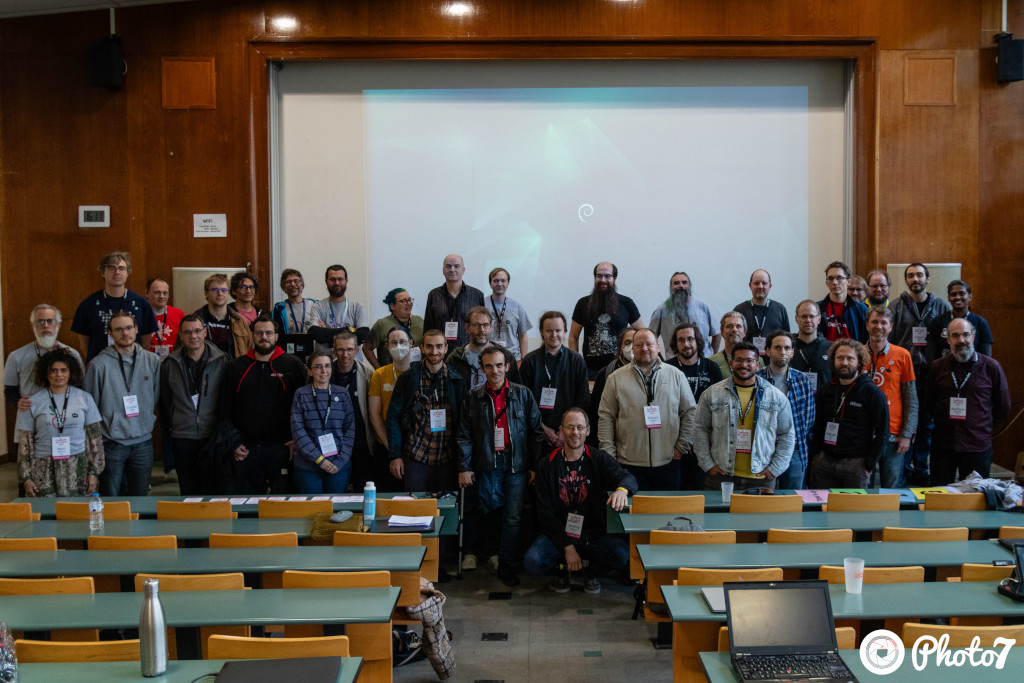
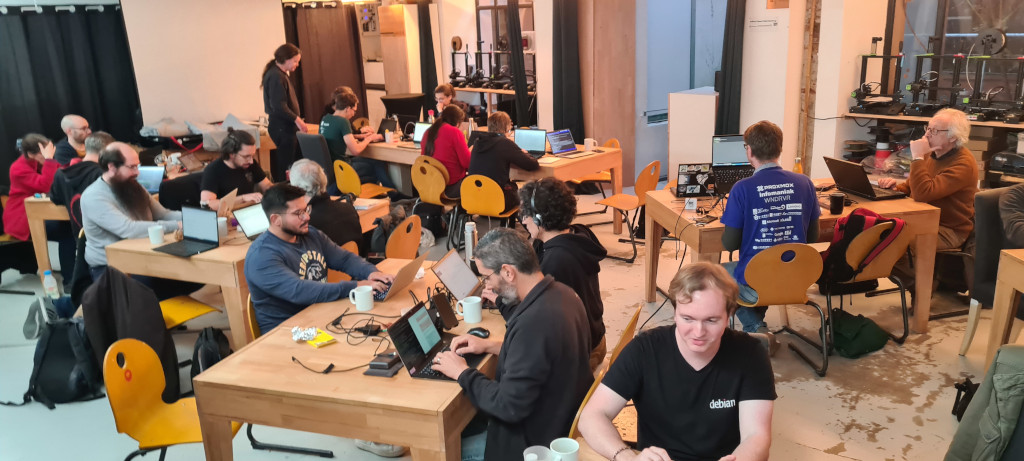
After the MiniDebConf Marseille 2019, COVID-19 made it impossible or difficult to organize new MiniDebConfs for a few years. With the gradual resumption of in-person events (like FOSDEM, DebConf, etc.), the idea emerged to host another MiniDebConf in France, but with a lighter organizational load. In 2023, we decided to reach out to the organizers of Capitole du Libre to repeat the experience of 2017: hosting a MiniDebConf alongside their annual event in Toulouse in November. However, our request came too late for 2023. After discussions with Capitole du Libre in November 2023 in Toulouse and again in February 2024 in Brussels, we confirmed that a MiniDebConf Toulouse would take place in November 2024! We then assembled a small organizing team and got to work: a Call for Papers in May 2024, adding a two-day MiniDebCamp, coordinating with the DebConf video team, securing sponsors, creating a logo, ordering T-shirts and stickers, planning the schedule, and managing registrations. Even with lighter logistics (conference rooms, badges, and catering during the weekend were handled by Capitole du Libre), there was still quite a bit of preparation to do. On Thursday, November 14, and Friday, November 15, 2024, about forty developers arrived from around the world (France, Spain, Italy, Switzerland, Germany, England, Brazil, Uruguay, India, Brest, Marseille ) to spend two days at the MiniDebCamp in the beautiful collaborative spaces of Artilect in Toulouse city center.
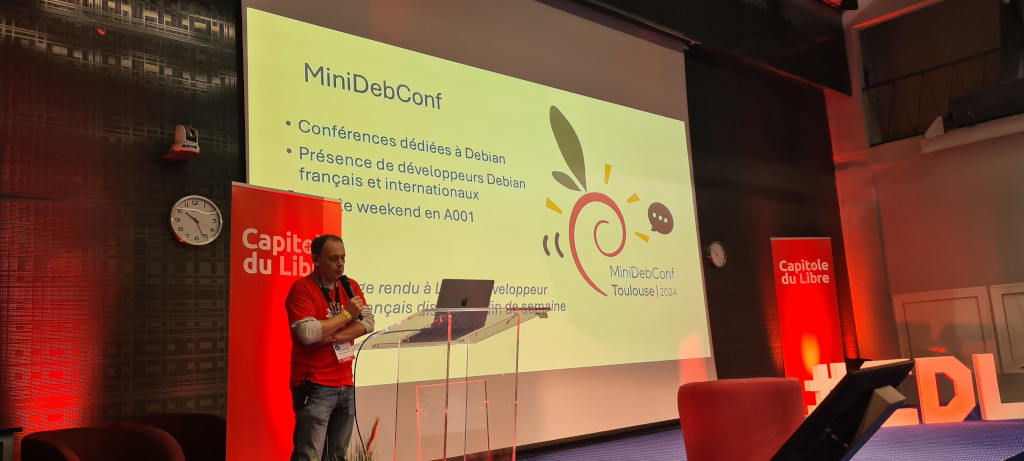
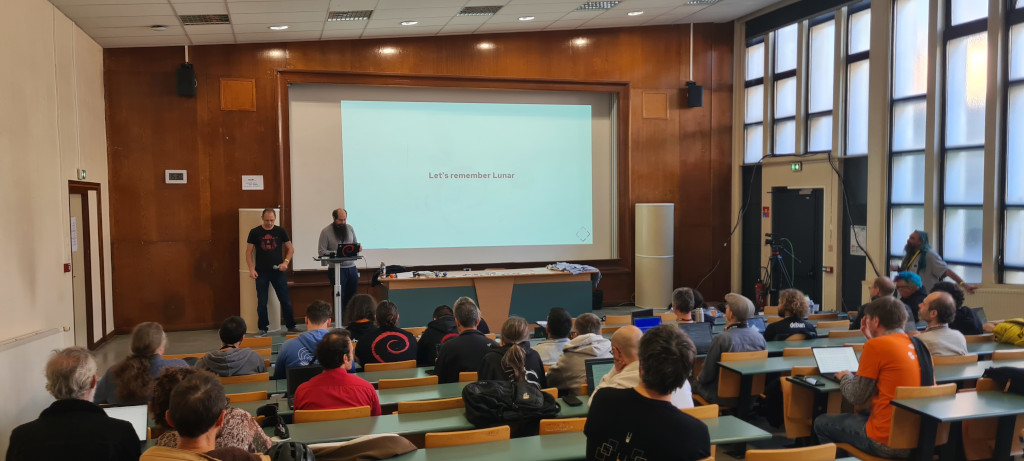
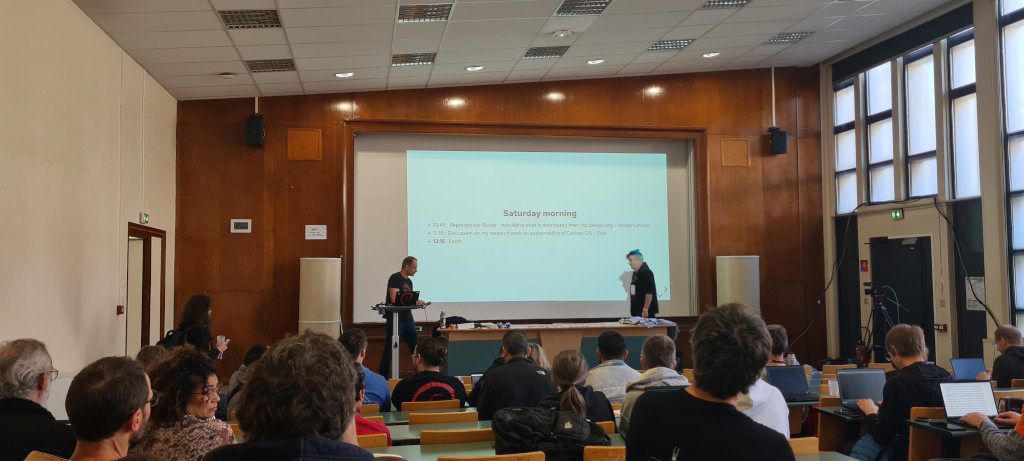
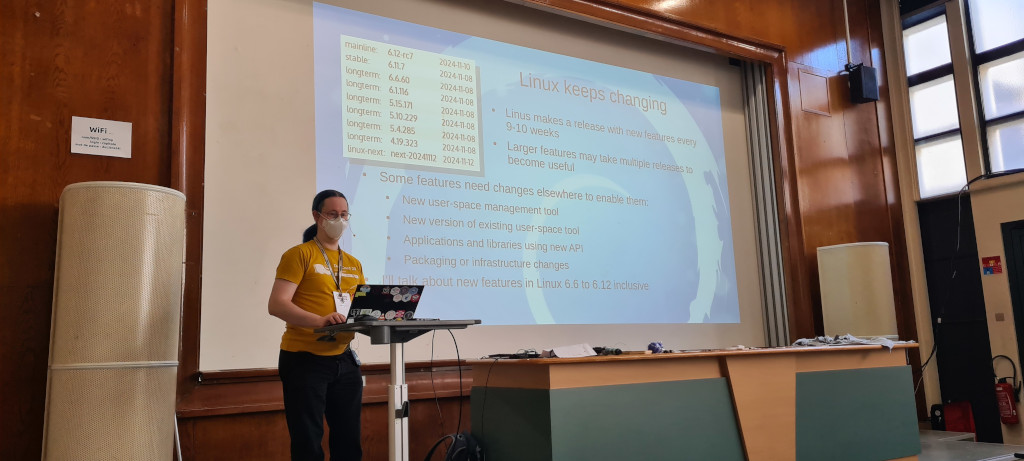
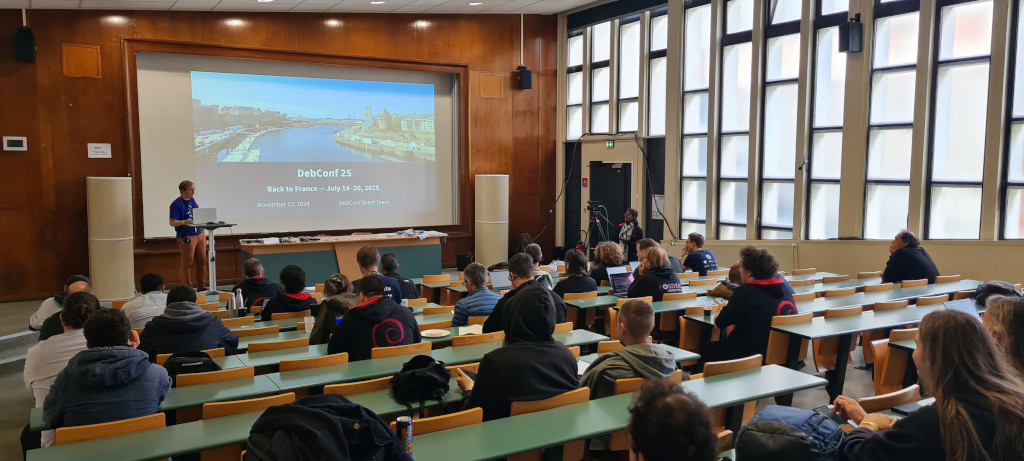
Then, on Saturday, November 16, and Sunday, November 17, 2024, the MiniDebConf took place at ENSEEIHT as part of the Capitole du Libre event. The conference kicked off on Saturday morning with an opening session by J r my Lecour, which included a tribute to Lunar (Nicolas Dandrimont). This was followed by Reproducible Builds Rebuilding What is Distributed from ftp.debian.org (Holger Levsen) and Discussion on My Research Work on Sustainability of Debian OS (Eda). After lunch at the Capitole du Libre food trucks, the intense afternoon schedule began: What s New in the Linux Kernel (and What s Missing in Debian) (Ben Hutchings), Linux Live Patching in Debian (Santiago Ruano Rinc n), Trixie on Mobile: Are We There Yet? (Arnaud Ferraris), PostgreSQL Container Groups, aka cgroups Down the Road (C dric Villemain), Upgrading a Thousand Debian Hosts in Less Than an Hour (J r my Lecour and myself), and Using Debusine to Automate Your QA (Stefano Rivera & co). Sunday marked the second day, starting with a presentation on DebConf 25 (Benjamin Somers), which will be held in Brest in July 2025. The morning continued with talks: How LTS Goes Beyond LTS (Santiago Ruano Rinc n & Roberto C. S nchez), Cross-Building (Helmut Grohne), and State of JavaScript (Bastien Roucari s). In the afternoon, there were Lightning Talks, PyPI Security: Past, Present & Future (Salvo LtWorf Tomaselli), and the classic Bits from DPL (Andreas Tille), before closing with the final session led by Pierre-Elliott B cue. All talks are available on video (a huge thanks to the amazing DebConf video team), and many thanks to our sponsors (Viridien, Freexian, Evolix, Collabora, and Data Bene). A big thank-you as well to the entire Capitole du Libre team for hosting and supporting us see you in Brest in July 2025! Articles about (or mentioning) MiniDebConf Toulouse:

1 December 2024

Colin Watson: Free software activity in November 2024

Most of my Debian contributions this month were sponsored by Freexian. You can also support my work directly via Liberapay. Conferences I attended MiniDebConf Toulouse 2024, and the MiniDebCamp before it. Most of my time was spent with the Freexian folks working on debusine; Stefano gave a talk about its current status with a live demo (frantically fixed up over the previous couple of days, as is traditional) and with me and others helping to answer questions at the end. I also caught up with some people I haven t seen in ages, ate a variety of delicious cheeses, and generally had a good time. Many thanks to the organizers and sponsors! After the conference, Freexian collaborators spent a day and a half doing some planning for next year, and then went for an afternoon visiting the Cit de l espace. Rust team I upgraded these packages to new upstream versions, as part of upgrading pydantic and rpds-py: Python team Last month, I mentioned that we still need to work out what to do about the multipart vs. python-multipart name conflict in Debian (#1085728). We eventually managed to come up with an agreed plan; Sandro has uploaded a renamed binary package to experimental, and I ve begun work on converting reverse-dependencies (asgi-csrf, fastapi, python-curies, and starlette done so far). There s a bit more still to do, but I expect we can finish it soon. I fixed problems related to adding Python 3.13 support in: I fixed some packaging problems that resulted in failures any time we add a new Python version to Debian: I fixed other build/autopkgtest failures in: I packaged python-quart-trio, needed for a new upstream version of python-urllib3, and contributed a small packaging tweak upstream. I backported a twisted fix that caused problems in other packages, including breaking debusine s tests. I disentangled some upstream version confusion in python-catalogue, and upgraded to the current upstream version. I upgraded these packages to new upstream versions: Other small fixes I contributed Incus support to needrestart upstream. In response to Helmut s Cross building talk at MiniDebConf Toulouse, I fixed libfilter-perl to support cross-building (5b4c2e10, f9788c27). I applied a patch to move aliased files from / to /usr in iprutils (#1087733). I adjusted debconf to use the new /usr/lib/apt/apt-extracttemplates path (#1087523). I upgraded putty to 0.82.

1 November 2024

Colin Watson: Free software activity in October 2024

Almost all of my Debian contributions this month were sponsored by Freexian. You can also support my work directly via Liberapay. Ansible I noticed that Ansible had fallen out of Debian testing due to autopkgtest failures. This seemed like a problem worth fixing: in common with many other people, we use Ansible for configuration management at Freexian, and it probably wouldn t make our sysadmins too happy if they upgraded to trixie after its release and found that Ansible was gone. The problems here were really just slogging through test failures in both the ansible-core and ansible packages, but their test suites are large and take a while to run so this took some time. I was able to contribute a few small fixes to various upstreams in the process: This should now get back into testing tomorrow. OpenSSH Martin- ric Racine reported that ssh-audit didn t list the ext-info-s feature as being available in Debian s OpenSSH 9.2 packaging in bookworm, contrary to what OpenSSH upstream said on their specifications page at the time. I spent some time looking into this and realized that upstream was mistakenly saying that implementations of ext-info-c and ext-info-s were added at the same time, while in fact ext-info-s was added rather later. ssh-audit now has clearer output, and the OpenSSH maintainers have corrected their specifications page. I looked into a report of an ssh failure in certain cases when using GSS-API key exchange (which is a Debian patch). Once again, having integration tests was a huge win here: the affected scenario is quite a fiddly one, but I was able to set it up in the test, and thereby make sure it doesn t regress in future. It still took me a couple of hours to get all the details right, but in the past this sort of thing took me much longer with a much lower degree of confidence that the fix was correct. On upstream s advice, I cherry-picked some key exchange fixes needed for big-endian architectures. Python team I packaged python-evalidate, needed for a new upstream version of buildbot. The Python 3.13 transition rolls on. I fixed problems related to it in htmlmin, humanfriendly, postgresfixture (contributed upstream), pylint, python-asyncssh (contributed upstream), python-oauthlib, python3-simpletal, quodlibet, zope.exceptions, and zope.interface. A trickier Python 3.13 issue involved the cgi module. Years ago I ported zope.publisher to the multipart module because cgi.FieldStorage was broken in some situations, and as a result I got a recommendation into Python s dead batteries PEP 594. Unfortunately there turns out to be a name conflict between multipart and python-multipart on PyPI; python-multipart upstream has been working to disentangle this, though we still need to work out what to do in Debian. All the same, I needed to fix python-wadllib and multipart seemed like the best fit; I contributed a port upstream and temporarily copied multipart into Debian s python-wadllib source package to allow its tests to pass. I ll come back and fix this properly once we sort out the multipart vs. python-multipart packaging. tzdata moved some timezone definitions to tzdata-legacy, which has broken a number of packages. I added tzdata-legacy build-dependencies to alembic and python-icalendar to deal with this in those packages, though there are still some other instances of this left. I tracked down an nltk regression that caused build failures in many other packages. I fixed Rust crate versioning issues in pydantic-core, python-bcrypt, and python-maturin (mostly fixed by Peter Michael Green and Jelmer Vernoo , but it needed a little extra work). I fixed other build failures in entrypoints, mayavi2, python-pyvmomi (mostly fixed by Alexandre Detiste, but it needed a little extra work), and python-testing.postgresql (ditto). I fixed python3-simpletal to tolerate future versions of dh-python that will drop their dependency on python3-setuptools. I fixed broken symlinks in python-treq. I removed (build-)depends on python3-pkg-resources from alembic, autopep8, buildbot, celery, flufl.enum, flufl.lock, python-public, python-wadllib (contributed upstream), pyvisa, routes, vulture, and zodbpickle (contributed upstream). I upgraded astroid, asyncpg (fixing a Python 3.13 failure and a build failure), buildbot (noticing an upstream test bug in the process), dnsdiag, frozenlist, netmiko (fixing a Python 3.13 failure), psycopg3, pydantic-settings, pylint, python-asyncssh, python-bleach, python-btrees, python-cytoolz, python-django-pgtrigger, python-django-test-migrations, python-gssapi, python-icalendar, python-json-log-formatter, python-pgbouncer, python-pkginfo, python-plumbum, python-stdlib-list, python-tokenize-rt, python-treq (fixing a Python 3.13 failure), python-typeguard, python-webargs (fixing a build failure), pyupgrade, pyvisa, pyvisa-py (fixing a Python 3.13 failure), toolz, twisted, vulture, waitress (fixing CVE-2024-49768 and CVE-2024-49769), wtf-peewee, wtforms, zodbpickle, zope.exceptions, zope.interface, zope.proxy, zope.security, and zope.testrunner to new upstream versions. I tried to fix a regression in python-scruffy, but I need testing feedback. I requested removal of python-testing.mysqld.

1 October 2024

Colin Watson: Free software activity in September 2024

Almost all of my Debian contributions this month were sponsored by Freexian. You can also support my work directly via Liberapay. Pydantic My main Debian project for the month turned out to be getting Pydantic back into a good state in Debian testing. I ve used Pydantic quite a bit in various projects, most recently in Debusine, so I have an interest in making sure it works well in Debian. However, it had been stalled on 1.10.17 for quite a while due to the complexities of getting 2.x packaged. This was partly making sure everything else could cope with the transition, but in practice mostly sorting out packaging of its new Rust dependencies. Several other people (notably Alexandre Detiste, Andreas Tille, Drew Parsons, and Timo R hling) had made some good progress on this, but nobody had quite got it over the line and it seemed a bit stuck. Learning Rust is on my to-do list, but merely not knowing a language hasn t stopped me before. So I learned how the Debian Rust team s packaging works, upgraded a few packages to new upstream versions (including rust-half and upstream rust-idna test fixes), and packaged rust-jiter. After a lot of waiting around for various things and chasing some failures in other packages I was eventually able to get current versions of both pydantic-core and pydantic into testing. I m looking forward to being able to drop our clunky v1 compatibility code once debusine can rely on running on trixie! OpenSSH I upgraded the Debian packaging to OpenSSH 9.9p1. YubiHSM I upgraded python-yubihsm, yubihsm-connector, and yubihsm-shell to new upstream versions. I noticed that I could enable some tests in python-yubihsm and yubihsm-shell; I d previously thought the whole test suite required a real YubiHSM device, but when I looked closer it turned out that this was only true for some tests. I fixed yubihsm-shell build failures on some 32-bit architectures (upstream PRs #431, #432), and also made it build reproducibly. Thanks to Helmut Grohne, I fixed yubihsm-connector to apply udev rules to existing devices when the package is installed. As usual, bookworm-backports is up to date with all these changes. Python team setuptools 72.0.0 removed the venerable setup.py test command. This caused some fallout in Debian, some of which was quite non-obvious as packaging helpers sometimes fell back to different ways of running test suites that didn t quite work. I fixed django-guardian, manuel, python-autopage, python-flask-seeder, python-pgpdump, python-potr, python-precis-i18n, python-stopit, serpent, straight.plugin, supervisor, and zope.i18nmessageid. As usual for new language versions, the addition of Python 3.13 caused some problems. I fixed psycopg2, python-time-machine, and python-traits. I fixed build/autopkgtest failures in keymapper, python-django-test-migrations, python-rosettasciio, routes, transmissionrpc, and twisted. buildbot was in a bit of a mess due to being incompatible with SQLAlchemy 2.0. Fortunately by the time I got to it upstream had committed a workable set of patches, and the main difficulty was figuring out what to cherry-pick since they haven t made a new upstream release with all of that yet. I figured this out and got us up to 4.0.3. Adrian Bunk asked whether python-zipp should be removed from trixie. I spent some time investigating this and concluded that the answer was no, but looking into it was an interesting exercise anyway. On the other hand, I looked into flask-appbuilder, concluded that it should be removed, and filed a removal request. I upgraded some embedded CSS files in nbconvert. I upgraded importlib-resources, ipywidgets, jsonpickle, pydantic-settings, pylint (fixing a test failure), python-aiohttp-session, python-apptools, python-asyncssh, python-django-celery-beat, python-django-rules, python-limits, python-multidict, python-persistent, python-pkginfo, python-rt, python-spur, python-zipp, stravalib, transmissionrpc, vulture, zodbpickle, zope.exceptions (adopting it), zope.i18nmessageid, zope.proxy, and zope.security to new upstream versions. debmirror The experimental and *-proposed-updates suites used to not have Contents-* files, and a long time ago debmirror was changed to just skip those files in those suites. They were added to the Debian archive some time ago, but debmirror carried on skipping them anyway. Once I realized what was going on, I removed these unnecessary special cases (#819925, #1080168).

1 September 2024

Colin Watson: Free software activity in August 2024

All but about four hours of my Debian contributions this month were sponsored by Freexian. (I ended up going a bit over my 20% billing limit this month.) You can also support my work directly via Liberapay. man-db and friends I released libpipeline 1.5.8 and man-db 2.13.0. Since autopkgtests are great for making sure we spot regressions caused by changes in dependencies, I added one to man-db that runs the upstream tests against the installed package. This required some preparatory work upstream, but otherwise was surprisingly easy to do. OpenSSH I fixed the various 9.8 regressions I mentioned last month: socket activation, libssh2, and Twisted. There were a few other regressions reported too: TCP wrappers support, openssh-server-udeb, and xinetd were all broken by changes related to the listener/per-session binary split, and I fixed all of those. Once all that had made it through to testing, I finally uploaded the first stage of my plan to split out GSS-API support: there are now openssh-client-gssapi and openssh-server-gssapi packages in unstable, and if you use either GSS-API authentication or key exchange then you should install the corresponding package in order for upgrades to trixie+1 to work correctly. I ll write a release note once this has reached testing. Multiple identical results from getaddrinfo I expect this is really a bug in a chroot creation script somewhere, but I haven t been able to track down what s causing it yet. My sbuild chroots, and apparently Lucas Nussbaum s as well, have an /etc/hosts that looks like this:
$ cat /var/lib/schroot/chroots/sid-amd64/etc/hosts
127.0.0.1       localhost
127.0.1.1       [...]
127.0.0.1       localhost ip6-localhost ip6-loopback
The last line clearly ought to be ::1 rather than 127.0.0.1; but things mostly work anyway, since most code doesn t really care which protocol it uses to talk to localhost. However, a few things try to set up test listeners by calling getaddrinfo("localhost", ...) and binding a socket for each result. This goes wrong if there are duplicates in the resulting list, and the test output is typically very confusing: it looks just like what you d see if a test isn t tearing down its resources correctly, which is a much more common thing for a test suite to get wrong, so it took me a while to spot the problem. I ran into this in both python-asyncssh (#1052788, upstream PR) and Ruby (ruby3.1/#1069399, ruby3.2/#1064685, ruby3.3/#1077462, upstream PR). The latter took a while since Ruby isn t one of my languages, but hey, I ve tackled much harder side quests. I NMUed ruby3.1 for this since it was showing up as a blocker for openssl testing migration, but haven t done the other active versions (yet, anyway). OpenSSL vs. cryptography I tend to care about openssl migrating to testing promptly, since openssh uploads have a habit of getting stuck on it otherwise. Debian s OpenSSL packaging recently split out some legacy code (cryptography that s no longer considered a good idea to use, but that s sometimes needed for compatibility) to an openssl-legacy-provider package, and added a Recommends on it. Most users install Recommends, but package build processes don t; and the Python cryptography package requires this code unless you set the CRYPTOGRAPHY_OPENSSL_NO_LEGACY=1 environment variable, which caused a bunch of packages that build-depend on it to fail to build. After playing whack-a-mole setting that environment variable in a few packages build process, I decided I didn t want to be caught in the middle here and filed an upstream issue to see if I could get Debian s OpenSSL team and cryptography s upstream talking to each other directly. There was some moderately spirited discussion and the issue remains open, but for the time being the OpenSSL team has effectively reverted the change so it s no longer a pressing problem. GCC 14 regressions Continuing from last month, I fixed build failures in pccts (NMU) and trn4. Python team I upgraded alembic, automat, gunicorn, incremental, referencing, pympler (fixing compatibility with Python >= 3.10), python-aiohttp, python-asyncssh (fixing CVE-2023-46445, CVE-2023-46446, and CVE-2023-48795), python-avro, python-multidict (fixing a build failure with GCC 14), python-tokenize-rt, python-zipp, pyupgrade, twisted (fixing CVE-2024-41671 and CVE-2024-41810), zope.exceptions, zope.interface, zope.proxy, zope.security, and zope.testrunner to new upstream versions. In the process, I added myself to Uploaders for zope.interface; I m reasonably comfortable with the Zope Toolkit and I seem to be gradually picking up much of its maintenance in Debian. A few of these required their own bits of yak-shaving: I improved some Multi-Arch: foreign tagging (python-importlib-metadata, python-typing-extensions, python-zipp). I fixed build failures in pipenv, python-stdlib-list, psycopg3, and sen, and fixed autopkgtest failures in autoimport (upstream PR), python-semantic-release and rstcheck. Upstream for zope.file (not in Debian) filed an issue about a test failure with Python 3.12, which I tracked down to a Python 3.12 compatibility PR in zope.security. I made python-nacl build reproducibly (upstream PR). I moved aliased files from / to /usr in timekpr-next (#1073722). Installer team I applied a patch from Ubuntu to make os-prober support building with the noudeb profile (#983325).

2 August 2024

Colin Watson: Free software activity in July 2024

My Debian contributions this month were all sponsored by Freexian. You can also support my work directly via Liberapay. OpenSSH At the start of the month, I uploaded a quick fix (via Salvatore Bonaccorso) for a regression from CVE-2006-5051, found by Qualys; this was because I expected it to take me a bit longer to merge OpenSSH 9.8, which had the full fix. This turned out to be a good guess: it took me until the last day of the month to get the merge done. OpenSSH 9.8 included some substantial changes to split the server into a listener binary and a per-session binary, which required some corresponding changes in the GSS-API key exchange patch. At this point I was very grateful for the GSS-API integration test contributed by Andreas Hasenack a little while ago, because otherwise I might very easily not have noticed my mistake: this patch adds some entries to the key exchange algorithm proposal, and on the server side I d accidentally moved that to after the point where the proposal is sent to the client, which of course meant it didn t work at all. Even with a failing test, it took me quite a while to spot the problem, involving a lot of staring at strace output and comparing debug logs between versions. There are still some regressions to sort out, including a problem with socket activation, and problems in libssh2 and Twisted due to DSA now being disabled at compile-time. Speaking of DSA, I wrote a release note for this change, which is now merged. GCC 14 regressions I fixed a number of build failures with GCC 14, mostly in my older packages: grub (legacy), imaptool, kali, knews, and vigor. autopkgtest I contributed a change to allow maintaining Incus container and VM images in parallel. I use both of these regularly (containers are faster, but some tests need full machine isolation), and the build tools previously didn t handle that very well. I now have a script that just does this regularly to keep my images up to date (although for now I m running this with PATH pointing to autopkgtest from git, since my change hasn t been released yet):
RELEASE=sid autopkgtest-build-incus images:debian/trixie
RELEASE=sid autopkgtest-build-incus --vm images:debian/trixie
Python team I fixed dnsdiag s uninstallability in unstable, and contributed the fix upstream. I reverted python-tenacity to an earlier version due to regressions in a number of OpenStack packages, including octavia and ironic. (This seems to be due to #486 upstream.) I fixed a build failure in python3-simpletal due to Python 3.12 removing the old imp module. I added non-superficial autopkgtests to a number of packages, including httmock, py-macaroon-bakery, python-libnacl, six, and storm. I switched a number of packages to build using PEP 517 rather than calling setup.py directly, including alembic, constantly, hyperlink, isort, khard, python-cpuinfo, and python3-onelogin-saml2. (Much of this was by working through the missing-prerequisite-for-pyproject-backend Lintian tag, but there s still lots to do.) I upgraded frozenlist, ipykernel, isort, langtable, python-exceptiongroup, python-launchpadlib, python-typeguard, pyupgrade, sqlparse, storm, and uncertainties to new upstream versions. In the process, I added myself to Uploaders for isort, since the previous primary uploader has retired. Other odds and ends I applied a suggestion by Chris Hofstaedtler to create /etc/subuid and /etc/subgid in base-passwd, since the login package is no longer essential. I fixed a wireless-tools regression due to iproute2 dropping its (/usr)/sbin/ip compatibility symlink. I applied a suggestion by Petter Reinholdtsen to add AppStream metainfo to pcmciautils.

2 July 2024

Colin Watson: Free software activity in June 2024

My Debian contributions this month were all sponsored by Freexian. You can support my work directly via Liberapay.

2 June 2024

Colin Watson: Free software activity in May 2024

My Debian contributions this month were all sponsored by Freexian. The bulk of my Debian time this month went towards trying to haul more Python packages up to current versions, but I got a few other bits and pieces done as well. You can support my work directly via Liberapay.

3 May 2024

Colin Watson: Playing with rich

One of the things I do as a side project for Freexian is to work on various bits of business automation: accounting tools, programs to help contributors report their hours, invoicing, that kind of thing. While it s not quite my usual beat, this makes quite a good side project as the tools involved are mostly rather sensible and easy to deal with (Python, git, ledger, that sort of thing) and it s the kind of thing where I can dip into it for a day or so a week and feel like I m making useful contributions. The logic can be quite complex, but there s very little friction in the tools themselves. A recent case where I did run into some friction in the tools was with some commands that need to present small amounts of tabular data on the terminal, using OSC 8 hyperlinks if the terminal supports them: think customer-related information with some links to issues. One of my colleagues had previously done this using a hack on top of texttable, which was perfectly fine as far as it went. However, now I wanted to be able to add multiple links in a single table cell in some cases, and that was really going to stretch the limits of that approach: working out the width of the displayed text in the cell was going to take an annoying amount of bookkeeping. I started looking around to see whether any other approaches might be easier, without too much effort (remember that a day or so a week bit above). ansiwrap looked somewhat promising, but it isn t currently packaged in Debian, and it would have still left me with the problem of figuring out how to integrate it into texttable, which looked like it would be quite complicated. Then I remembered that I d heard good things about rich, and thought I d take a look. rich turned out to be exactly what I wanted. Instead of something like this based on the texttable hack above:
import shutil
from pyxian.texttable import UrlTable
termsize = shutil.get_terminal_size((80, 25))
table = UrlTable(max_width=termsize.columns)
table.set_deco(UrlTable.HEADER)
table.set_cols_align(["l"])
table.set_cols_dtype(["u"])
table.add_row(["Issue"])
table.add_row([(issue_url, f"# issue_id ")]
print(table.draw())
now I can do this instead:
import rich
from rich import box
from rich.table import Table
table = Table(box=box.SIMPLE)
table.add_column("Issue")
table.add_row(f"[link= issue_url ]# issue_id [/link]")
rich.print(table)
While this is a little shorter, the real bonus is that I can now just put multiple [link] tags in a single string, and it all just works. No ceremony. In fact, once the relevant bits of code passed type-checking (since the real code is a bit more complex than the samples above), it worked first time. It s a pleasure to work with a library like that. It looks like I ve only barely scratched the surface of rich, but I expect I ll reach for it more often now.

Next.

Previous.