This is a copy of an email I sent at work. I'm not sure I
should be making noise about this here, feedback welcome.
This is your bi-yearly reminder that time is changing soon! October 25th
in Europe, November 1st in North America. Less people in Canada are
changing this year, with BC, Alberta, Manitoba and Northwest
Territories getting rid of DST.
What's happening?
Some places in the world implement what is called Daylight saving time
or DST:
https://en.wikipedia.org/wiki/Daylight_saving_time
Normally, you shouldn't have to do anything: computers automatically
change time following local rules, assuming they are correctly
configured, provided recent updates have been applied in the case of a
recent change in said rules (because yes, this happens, and happened
this year, and yes, you need to upgrade your software!).
Of course, appliances like your microwave oven will likely not change
time and will need to adjusted unless they are so-called "smart", in
which case they are part of the skynet botnet and should be destroyed.
If your clock is flashing "0:00" or "12:00", you have no action to take
to adapt to this change, lucky you.
If you haven't changed time in six months, congratulations, your clock
will be accurate again!
In any case, you should still consider DST because it might affect some
of your meeting schedules, particularly if you set up a new meeting
schedule in the last 6 months and forgot to consider this change.
If your location does not have DST
Properly scheduled meetings affecting multiple time zones are set in UTC
time, which does not change. So if your location does not observer
time changes, your (local!) meeting time will not change.
But be aware that some other folks attending your meeting might have
the DST bug and their meeting times will change.
Be kind to those poor souls which might be missing meetings by a full
hour because time flies backwards for them.
If you do observe DST
If you are affected by daylight savings, your local meeting times
will change for UTC meetings. Normally, your meeting times are
scheduled to take this into account and the new hours should be
reasonable.
But now is a good time to verify that. Take a look at your schedule for
the next couple of weeks and reschedule meetings before the daylight
saving come up to avoid too much disruption. You have only a couple of
weeks to do so right now.
When do times change, how, and and where?
As regular readers will remember, the rule of thumb is:
Spring forward, fall backwards.
That is, during the season of Spring, the clocks move forward, and
during the Fall (like right now), they move backwards. That is in the
northern hemisphere, but then the southern hemisphere is often saner and
doesn't switch anyways.
So time will move backwards which means an extra hour of sleep. Unless
you have children or bad sleep, in which case your body doesn't care
about what the clock says and will wake up one hour earlier than what it
should.
And of course, this doesn't happen everywhere at once, so let's see when
it happens where.
Europe
The dance starts in Europe.
The change happens on the last Sunday in October at 01:00 UTC (not local
time!), that is October 25th. If you are in the central European
timezone, also known as Amsterdam, Berlin, or Paris time depending on
your national affiliation, that essentially means that at 2:59 local the
clocks will fall back to 2:00 instead of going to 3:00.
Concretely, set your watch back one hour before going to bed, go to bed
at the normal time, and enjoy an extra hour of sleep or leisure.
If you have kids, you might want to start getting them to bed slightly
earlier every day for a week before the change so they take time getting
used to the change. If you have trouble sleeping in the morning, find
your inner child and do that to yourself as well.
USA / Canada
Then it's the US[1] and Canada[2] joining the dance, on the First Sunday in
November at 02:00 local (not UTC!), that is, I believe, November 1st
2026.
This means that, at 1:59, the clocks will flip to 1:00, instead of 2:00.
Concretely, do like the Europeans and tweak your clock before going to
bed.
That is a little less than four weeks from now.
[1] except Arizona (except the Navajo nation), US territories, and
Hawaii
[2] except Yukon, Saskatchewan, (newly) British Columbia, (newly)
Alberta, (newly) Northwest Territories, (newly) Manitoba, one island in
Nunavut (Southampton Island), one town in Ontario (Atikokan) and small
parts of Quebec (Le Golfe-du-Saint-Laurent)
Other places with DST
This time again, I must apologize to the people of Cuba, Lebanon,
Israel, Palestine, Egypt, Chile, Australia, and New Zealand, as you fine
folks all have your own DST rules that are omitted here for brevity. I
rely on this page from Wikipedia to be updated by time nerds accurately
for this message, and it should provide you with a rough idea of what's
coming:
https://en.wikipedia.org/wiki/Daylight_saving_time_by_country
In general, changes also happen in October, but either on different
times or different days, except in the south hemisphere, where they
might happen in September (oops, sorry NZ folks, I'm late!).
Places without DST
Everyone else, enjoy, you're on the right side of history, and we thank
you for the good example you give us.
Changes since last time
There's been lots of changes since last time:
British Columbia moved to permanent -07 on 2026-03-09, that is it
will not change to normal time in November
Alberta moved to permanent -06 on 2026-06-18, similar to BC above.
Canada s Northwest Territories moved to permanent -06 on 2026-08-21,
matching Alberta.
Manitoba moves to permanent -05 on 2026-10-31.
Morocco moves to permanent +00 on 2026-09-20.
Moldova has used EU transition times since 2022, but the tz database
only noticed in 2026
This is my interpretation of the changes announced on the tzdata mailing
list here:
https://lists.iana.org/hyperkitty/list/tz-announce@iana.org/latest
If the eastward trend continues, Canada should adopt country-wide "no
daylight savings" rules by 2027, although there's actually no sign of
the other provinces (Ontario, Qu bec and so on) currently running bills
to change those rules just yet. Poor Canadians like me confused about
time in their countries can refer to this section of Wikipedia for
details:
https://en.wikipedia.org/wiki/Daylight_saving_time_in_Canada#By_province_and_territory
... and particularly the image featured there:
https://commons.wikimedia.org/wiki/File:Canada_time_zone_map-en.svg
It also seems like the US government might finally adopt a permanent
daylight saving change bill in 2026, as the "Sunshine protection act"
pass the house in July:
https://en.wikipedia.org/wiki/Sunshine_Protection_Act
True to form, this was associated with absolutely ridiculous pressure
from Donald Trump against republicans (his own party!) objecting to the
change:
On July 14, 2026, the House passed a Sunshine Protection Act bill
backed by President Trump. Nevertheless, the bill was opposed in the
Senate by Republicans, including Senator Cotton. In response, on
October 3, 2026, Trump shared a post on Truth Social urging Cotton to
approve the bill, where he revealed Cotton's personal cellphone number
and called on people to call him.
https://www.theguardian.com/us-news/2026/oct/03/trump-tom-cotton-daylight-saving-time
Given that the last time the US did a major change to the daylight
savings policy (in 2005), Canada followed suit to stay in sync, it's
quite possible Trump's mad dash might actually finish getting rid of DST
in North America:
https://en.wikipedia.org/wiki/Energy_Policy_Act_of_2005#Change_to_daylight_saving_time
Japanese input method editors (IMEs) such as Mozc are essential for typing
Japanese (yes, skk, anthy and more, but it's out-of-scope in this article). Testing them is a surprisingly fiddly job: an IME behaves differently
depending on the desktop environment (GNOME, KDE, Xfce, Budgie), the input
framework (ibus, fcitx5, uim), and the Wayland or X11 session. Setting up a
fresh VM for every combination from scratch is slow and repetitive, and
breaking your host's environment while experimenting is no fun.
virt-japanese-desktop is a small set of toy scripts that solves exactly this
problem. It builds ready-to-use virtual machines - each with a desktop
environment and a Japanese IME already installed and configured - so you can
start typing Japanese within a minute of booting, and throw the whole thing
away without any impact on your host.
What it gives you
A single make command produces a qcow2 image that combines one of four
desktops with one of three IMEs:
ibus-mozc
fcitx5-mozc
uim-mozc
GNOME
KDE
Xfce
Budgie
The one gap - uim on Budgie - is a real technical limitation, not an
oversight: Budgie runs the labwc compositor, which implements
zwp_input_method_v2, while uim-wayland only speaks the older
zwp_input_method_v1 (KWin/Weston). On Budgie you use ibus-mozc or fcitx5-mozc
instead.
All images come with the Japanese locale, fonts, and the Asia/Tokyo time
zone pre-configured, plus the SSH key of your choice. Input switching is wired
up out of the box: Ctrl + Space or Shift + Space for your IMEs to enable it.
The layered-image trick
The core idea is that the images are stacked qcow2 overlay layers, one on
top of another:
debian-sid-nocloud-amd64-daily.qcow2     ... base image you download
  unstable-japanese-template.qcow2      ... locale, fonts, user, SSH
     unstable-<DE>-template.qcow2       ... a desktop environment
        unstable-<DE>-<IME>.qcow2       ... desktop + IME, configured
           unstable-<DE>-<IME>.workspace.qcow2 ... the image you test in
This makes both building and resetting fast. The first build downloads and
customizes the base image and takes a while, but every later step only adds a
thin overlay. When a test breaks the VM, you do not rebuild anything - you
simply delete the top workspace layer and recreate it. That is all it takes
to return to a pristine state:
rm /tmp/unstable-gnome-ibus-mozc.workspace.qcow2
make gnome-ibus-mozc
The images reference their backing files by relative path, so you can move
an entire stack anywhere you like as long as the images stay together.
A platform for experimenting with bleeding-edge IMEs
The base system is Debian unstable (sid), and the experimental
repository is already added. That makes the project a convenient platform for
testing not just the IME packages in sid but also the ones still being
developed in experimental - exactly what the project was built for.
The keyboard layout of the VM follows the layout of your host (read from
/etc/default/keyboard, with a fallback chain to localectl and finally
us).
Quick start
# 1. Install the tools (Debian/Ubuntu example)
sudo apt install qemu-utils libguestfs-tools virt-install curl
# 2. Save your SSH public key
curl --location https://github.com/USERNAME.keys --output pubkey.pub
# 3. Download the base Debian sid image
make download
# 4. Build a desktop + IME (first build takes a while)
make gnome-ibus-mozc
# 5. Start it as a VM (needs the libvirt daemon, qemu:///system)
./scripts/make-virsh-image.sh virt-gnome-ibus-mozc /tmp/unstable-gnome-ibus-mozc.workspace.qcow2
Log in as debian (password debian) and press Ctrl + Space (Shift + Space) to start
typing Japanese. The VM is registered in libvirt, so you can manage it with
virsh or virt-manager - handy for opening the SPICE console or restarting
the machine after a test.
Status
The project is still in the proof-of-concept phase, and it is developed
mainly to test Mozc and other IMEs across desktops and input frameworks.
If you regularly test Japanese IMEs - give it a try.
netip.Addr features an Unmap()
method returning the unwrapped IPv4 contained in an IPv4-mapped IPv6
address: from ::ffff:203.0.113.10 or ::ffff:cb00:710a, it returns
203.0.113.10.1 There is no Map() or To6() method for the reverse
direction. Such a method is trivial to implement, but Go maintainers have
rejected it on the grounds that users should write
netip.AddrFrom16(ip.As16()) and let the compiler optimize it.2 Today,
this pattern is eight times slower than a native method. How can we teach the
compiler to optimize this sequence?
The alternatives
Let s explore three ways to implement the map semantics for netip.Addr. My
favorite is to add it to the Go standard library. Go maintainers prefer a small
external helper chaining netip.AddrFrom16() and netip.Addr.As16(), hoping
the compiler eventually optimizes it. The unsafe package
opens a third path, with the same performance as the first solution.
Modifying the Go standard library
Internally, netip.Addr stores any IP address as a
128-bit value with an extra field z to encode the family and the zone:
typeAddrstructaddruint128zunique.Handle[addrDetail]typeaddrDetailstructisV6bool// IPv4 is false, IPv6 is true.zoneV6string// != "" only if IsV6 is true.var(z0unique.Handle[addrDetail]z4=unique.Make(addrDetail )z6noz=unique.Make(addrDetailisV6:true ))
AddrFrom4() encodes an IPv4 address as an
IPv4-mapped IPv6 address and sets z to the unique value z4:
// AddrFrom4 returns the address of the IPv4 address given by the bytes in addr.funcAddrFrom4(addr[4]byte)AddrreturnAddraddr:uint1280,0xffff00000000uint64(addr[0])<<24uint64(addr[1])<<16uint64(addr[2])<<8uint64(addr[3]) ,z:z4,
Unmap() turns an IPv4-mapped IPv6 address into an
IPv4 address by setting the z field to z4:
Implementing the reverse direction inside the Go standard library is trivial: we
set the z field to z6noz if the address is IPv4.
// To6 maps an IPv4 address to an IPv4-mapped IPv6 address. It returns an// IPv6 address unmodified.func(ipAddr)To6()Addrifip.Is4()ip.z=z6nozreturnip
As a helper
We can t access the z field from outside the net/netip package. Instead, we
build a small helper around the netip.AddrFrom16(ip.As16()) pattern:
// AddrTo6 maps an IPv4 address to an IPv4-mapped IPv6 address. It returns an// IPv6 address unmodified.funcAddrTo6(ipnetip.Addr)netip.Addrifip.Is4()ip=netip.AddrFrom16(ip.As16())returnip
As an unsafe function
Another solution uses the unsafe package to alter the Addr struct through
a proxy with the same memory layout:3
// addrProxy has the same memory layout as netip.Addr.typeaddrProxystructaddr[2]uint64// netip.uint128zunsafe.Pointer// unique.Handle[netip.addrDetail]var(anyIPv6=netip.IPv6Unspecified()netipZ6noz=(*addrProxy)(unsafe.Pointer(&anyIPv6)).z)// AddrTo6 maps an IPv4 address to an IPv4-mapped IPv6 address. It returns an// IPv6 address unmodified.funcAddrTo6(ipnetip.Addr)netip.Addrif!ip.Is4()returnip(*addrProxy)(unsafe.Pointer(&ip)).z=netipZ6nozreturnip
Benchmarks
On my computer, with Go 1.27.1, the standard library solution costs 0.88 ns per
operation, while the solution favored by Go maintainers costs 7.14 ns. The
unsafe solution matches the performance of the first one.
Assembly code
Let s check the assembly code the compiler generates for each solution.4
The one built into the standard library looks like this:5
// AX = input.addr.hi, BX = input.addr.lo, CX = input.zCMPQnet/netip z4(SB),CX; check "z" if this is an IPv4 addressJNEend; if not, stop hereMOVQnet/netip z6noz(SB),CX; CX = netip.z6nozend:RET// return value = Addr hi: AX, lo: BX, z: CX
Go s assembly language is not a direct representation of the underlying
machine language: it operates on a semi-abstract instruction set derived from
Plan 9 s assembler. It has four pseudo-registers: FP (frame pointer
for function arguments), PC (program counter), SB (static base pointer for
global symbols), and SP (stack pointer). It also has architecture-specific
registers like AX, CX, DX, BX, SI, DI, and R8 to R15.
Instructions storing data use their last argument as the destination.
Instructions can carry an explicit size suffix: MOVB moves a byte, MOVW 16
bits, MOVL 32 bits, and MOVQ 64 bits. In the example above, the first
instruction compares the 64-bit value z4 with the CX register.
The unsafe solution looks almost the same:
// AX = input.addr.hi, BX = input.addr.lo, CX = input.zCMPQnet/netip z4(SB),CX; check "z" if this is an IPv4 addressJNEend; if not, stop hereMOVQnetipZ6noz(SB),CX; CX = netip.z6nozend:RET// return value = Addr hi: AX, lo: BX, z: CX
The helper solution has far more instructions. To understand why, let s look at
the code for As16() and
AddrFrom16(). They are short enough for the compiler
to inline them.
We can already guess the pattern to optimize: the code packs the IP address into
an array, copies it, then unpacks it. If we inline the Go code by hand, we get:
Unfortunately, as of Go 1.26.8, the compiler is not smart enough to do the same:
// AX = input.addr.hi, BX = input.addr.lo, CX = input.z; Push the stack (32 bytes):; 0(SP) addr netip.uint128; 16(SP) a16 [16]bytePUSHQBPMOVQSP,BPSUBQ$32,SPCMPQnet/netip z4(SB),CX; check "z" if this is an IPv4 addressJNEend; if not, stop here; Pack: byteorder.BEPutUint64(a16[:8], input.addr.hi); byteorder.BEPutUint64(a16[8:], input.addr.lo)MOVBEQAX,net/netip a16+16(SP)MOVBEQBX,net/netip a16+24(SP); addr = a16, 16 bytes at once through the vector register X0MOVUPSnet/netip a16+16(SP),X0MOVUPSX0,net/netip addr(SP); CX = netip.z6nozMOVQnet/netip z6noz(SB),CX; Unpack: output.addr.hi = byteorder.BEUint64(addr[:8]); output.addr.lo = byteorder.BEUint64(addr[8:])MOVBEQnet/netip addr(SP),AXMOVBEQnet/netip addr+8(SP),BXend:ADDQ$32,SPPOPQBPRET// return value = Addr hi: AX, lo: BX, z: CX
The compiler does a decent job on the byte shuffling: the eight byte stores of
BEPutUint64() become a single MOVBEQ, which stores a register byte-swapped.
The eight byte loads of BEUint64() become a single MOVBEQ the other way
round.6 Three groups of instructions remain: a pack, a copy, and an
unpack.
Hacking the Go compiler
The Go compiler has several phases:
The compiler converts the syntax tree and its types into its own intermediate
representation (IR). This process, called noding, goes through
a serialization format named unified IR.
This phase runs two steps: order of evaluation decomposes complex
statements into simpler ones, and desugaring transforms higher-level Go
constructs, like switch or channels, into more primitive instructions or
calls to the runtime.
The compiler rewrites the SSA form into machine-specific variants,
allocates registers, and applies more optimization passes. At the end, the
assembler turns the generated instructions into machine code.
The hammer
My first idea is to replace occurrences of netip.AddrFrom16(ip.As16()) with
netip.Addr addr: ip.addr, z: netip.z6noz as early as possible, during the
noding process. Before that, the type checking phase prevents
us from accessing unexported struct fields.
Go 1.27 introduced a convenient debug option to dump the IR of a function at
interesting points during compilation:
$ GOTOOLCHAIN=go1.27.1GOAMD64=v3gobuild-a-gcflags="-d=astdump=AddrTo6Safe".
Writing text ast output for AddrTo6Safe to AddrTo6Safe.astWriting html ast output for AddrTo6Safe to AddrTo6Safe.htmlWriting html syntax output for AddrTo6Safe to AddrTo6Safe.syntax.html
In the HTML file, the first column shows the IR as it comes out of noding:
In the body of the if statement, we spot the calls to the method
netip.Addr.As16() and to the function netip.AddrFrom16(). Our goal is to
patch them with a struct literal:
In noder s reader.go, the expr() method builds the IR tree for
an expression. At the end of the exprCall case, we add a call to a
rewriteAddrFrom16As16() function. It takes the current node and returns the
struct literal on success, or nil if the rewrite is not possible. First, we
check that we have the expected pattern: a call to the netip.AddrFrom16()
function with a call to the netip.Addr.As16() method as its only argument:
Have a look at the complete patch.7 We can test it
with the following commands:
$ cdsrc
$ ./make.bash
Building Go cmd/dist using /usr/lib/go-1.27. (go1.27.1 linux/amd64)Building Go toolchain1 and bootstrap cmd/go (go_bootstrap) using /usr/lib/go-1.27.Building Go toolchain2 using go_bootstrap and Go toolchain1.Building Go toolchain3 and commands using go_bootstrap and Go toolchain2.Checking command staleness for linux/amd64.---Installed Go for linux/amd64 in /home/bernat/code/free/goInstalled commands in /home/bernat/code/free/go/bin*** You need to add /home/bernat/code/free/go/bin to your PATH.$ exportPATH=$PWD/../bin:$PATH$ goversion
go version go1.28-devel_9834516e20 Sat Sep 12 08:23:11 2026 -0700 linux/amd64$ gotestnet/netip/...
ok net/netip 0.224s$ cd../../go-netip-addrto6
$ gotest.
ok github.com/vincentbernat/go-netip-addrto6 0.062s
The generated code for the helper is now the shortest possible version!
// AX = input.addr.hi, BX = input.addr.lo, CX = input.zCMPQnet/netip z4(SB),CX; check "z" if this is an IPv4 addressJNEend; if not, stop hereMOVQnet/netip z6noz(SB),CX; CX = netip.z6nozend:RET// return value = Addr hi: AX, lo: BX, z: CX
Go maintainers are unlikely to accept this change. It relies on the internal
structure of net/netip.Addr. It s an ugly hack in the noder, whose job is to
faithfully translate the type-checked AST into the IR. And it s harder to
maintain than adding a To6() method.
The screwdriver
The right place for such an optimization is the generic SSA phase. One of
the last machine-independent passes is memcombine. With the appropriate debug
flag, the compiler dumps the SSA form after this pass:8
The result of the memcombine pass follows the same structure as the assembly
code for AddrTo6Safe()we looked at earlier: two stores,
one move, and two loads we would like to optimize away.
Each line features a value identifier (v442), an operation with its type
(Bswap64 <uint64>), and its arguments (v490).9 Values are the basic
building blocks of SSA and are defined exactly once. Square brackets enclose
integer parameters ([8]) and curly braces contain auxiliary arguments
( netip.addr ). Operations writing to memory produce a new memory state. Every
memory operation takes the current state as its last argument, which keeps them
in order.
To simplify this code, we could apply three rewriting rules:
The first one adds a shortcut when loading through a move: (Load (OffPtr
[o] p) (Move p src mem)) => (Load (OffPtr [o] src) mem). This matches v174
with its arguments v415 and v286 and creates a new value v600:
The second one simplifies a load following a store: (Load p (Store p x
_)) => x. The load is forwarded: the stored value replaces it and no memory
access remains. It matches v174. It notices that v600 and v173 are the
same address and replaces v174 with a copy of v442:
To optimize it away, we also apply three rewriting rules:
The first one also adds a shortcut when loading through a move, but
without an offset: (Load p (Move p src mem)) => (Load src mem). This rewrites v416
to use arguments from v286:
The second rule forwards a value stored one step earlier, skipping over a
store to another address: (Load p (Store q _ (Store p x _))) => x. This
matches v416: x is v542, p is v22 (&a16), q is v173
(&a16[8]), and p and q do not overlap for uint64.
In practice
Most of these rules already exist in generic.rules. They use
conditions to validate their context: ssa.IsSamePtr() for the same address,
ssa.Disjoint() for addresses that do not overlap. The rule forwarding a stored
value to a load already exists with three variants looking through several other
stores. Here are the two we need:
There is no generic rule to cancel two byte swaps, but the AMD64 lowering
pass includes this rule:
(BSWAP(Q L)(BSWAP(Q L)p))=>p
After switching to Go s development branch and adding the missing
rule, the generated assembly code is worse than with Go 1.26.8,
even though our additional rule slightly improves the situation at the end:
// AX = input.addr.hi, BX = input.addr.lo, CX = input.z; Push the stack (16 bytes):; 0(SP) a16 [16]bytePUSHQBPMOVQSP,BPSUBQ$16,SPCMPQnet/netip z4(SB),CX; check "z" if this is an IPv4 addressJNEend; if not, stop here; The four forwarded bytes: the low half of input.addr.lo is taken apart and; put back together in registersMOVQBX,DX; DX = input.addr.loSHRQ$24,BX; BX = input.addr.lo >> 24MOVQDX,SI; SI = input.addr.loSHRQ$16,DX; DX = input.addr.lo >> 16MOVQSI,DI; DI = input.addr.lo, kept for the packSHRQ$8,SI; SI = input.addr.lo >> 8MOVBLZXDIB,R8; R8 = byte(input.addr.lo)MOVBLZXSIB,SI; SI = byte(input.addr.lo >> 8)SHLQ$8,SIORQR8,SI; SI = two low bytes of input.addr.loMOVBLZXDL,DX; DX = byte(input.addr.lo >> 16)SHLQ$16,DXORQSI,DXMOVBLZXBL,BX; BX = byte(input.addr.lo >> 24)SHLQ$24,BXORQDX,BX; BX = input.addr.lo & 0xffffffff; Pack: byteorder.BEPutUint64(a16[:8], input.addr.hi); byteorder.BEPutUint64(a16[8:], input.addr.lo)MOVBEQAX,net/netip a16(SP)MOVBEQDI,net/netip a16+8(SP); The four other bytes of input.addr.lo, read one by one from a16MOVBLZXnet/netip a16+11(SP),DX; a16[11]SHLQ$32,DXORQDX,BXMOVBLZXnet/netip a16+10(SP),DX; a16[10]SHLQ$40,DXORQDX,BXMOVBLZXnet/netip a16+9(SP),DX; a16[9]SHLQ$48,DXORQDX,BXMOVBLZXnet/netip a16+8(SP),DX; a16[8]SHLQ$56,DX; output.z = netip.z6nozMOVQnet/netip z6noz(SB),CX; output.addr.hi = byteorder.BEUint64(a16[:8])MOVBEQnet/netip a16(SP),AX; output.addr.lo assembled from the previous stepsORQDX,BXend:LEAVEQRET// return value = Addr hi: AX, lo: BX, z: CX
The rule loading through a move, added in Go 1.27, introduced this regression.
Out of order
Let s not give up now! In reality, the rewriting rules run before memcombine,
notably in the late opt pass. At this point, the inlined versions of
BEPutUint64() and BEUint64() still expand to sixteen byte stores and sixteen
byte loads, matching their source code:
funcBEUint64(b[]byte)uint64_=b[7]// bounds check hint to compiler; see golang.org/issue/14808returnuint64(b[7])uint64(b[6])<<8uint64(b[5])<<16uint64(b[4])<<24uint64(b[3])<<32uint64(b[2])<<40uint64(b[1])<<48uint64(b[0])<<56
Let s follow two bytes of output.addr.lo: addr[15] and addr[11]. Here is
a simplified SSA form before late opt:
The first rule loads through the move: (Load (OffPtr [o] p) (Move p src mem))
=> (Load (OffPtr [o] src) mem). It matches both loads, which now read a16
with the memory state before the copy:
The second rule shortcuts a load following a store: (Load p (Store p x _)) =>
x. It matches v435, as v282 stores a16[15]. It does not match v481:
v235 stores a16[11] four stores earlier in the chain, while the variants of
this rule look through three stores at most.
The same happens to the other bytes: the rule forwards the four bytes stored
last, a16[12] to a16[15]. The twelve other loads now read a16 instead of
addr.
BEUint64() becomes a chain of Or64, each one adding a byte shifted into
place. memcombine is a pass written in Go, not a set of rewrite
rules. It starts from the last Or64 of the chain and collects up to eight
terms. If each term is a byte load, extended to 64 bits and shifted, and if the
eight loads read consecutive addresses from the same pointer with the same
memory state, it replaces the whole chain with a single 64-bit load and a byte
swap. Otherwise, it tries again with four, then two terms, and from each
intermediate Or64. Here is the loop checking each term in a simplified version
of combineLoads():
From v520, four of the eight terms are forwarded bytes, not loads from memory,
and memcombine can t combine them. It doesn t merge the four remaining loads
either, as they sit on top of the forwarded bytes.
Back in order
In summary, the rewriting rules run too early to be effective. A quick
workaround exists: run an earlier round of memcombine before late opt. After
this change, the generated code for the helper is back to the
shortest possible version:
// AX = input.addr.hi, BX = input.addr.lo, CX = input.zCMPQnet/netip z4(SB),CX; check "z" if this is an IPv4 addressJNEend; if not, stop hereMOVQnet/netip z6noz(SB),CX; CX = netip.z6nozend:RET// return value = Addr hi: AX, lo: BX, z: CX
Next steps
I think Go maintainers would reject this change because of the additional
memcombine pass. Instead, I plan to publish this blog post and bring up the
subject again as a follow-up to issue #54365. Either the sheer complexity and
the Go 1.27 regression convince the maintainers that adding a To6() method is
simpler and more efficient, or they advise me on how to move forward. Either
way, digging into this subject taught me a lot about the Go compiler!
IPv4-mapped IPv6 addresses let you handle only IPv6 addresses in your code
and keep conversions at a few well-defined boundaries. I use them in
Akvorado.
This is not strictly equivalent. The zero value becomes :: while it would
make more sense to leave it untouched.
To avoid catastrophic bugs when netip.Addr s layout changes, you must add
tests to detect it. This is more dangerous if you put this code in a
package. Either ask users to run the tests themselves, or detect the change
at run time and panic. Hiding this optimization behind a build tag would
make users aware of this potential trap.
I produced the assembly code with GOTOOLCHAIN=go1.26.8 GOAMD64=v3 ./go-asm
'\.asm' from the companion repository, then edited it a bit to keep this
article from turning into an endless rabbit hole. Due to an unfortunate
sequence of events, we switch between versions: Go 1.27 introduced a
regression that blurs the point of this article.
The function is short enough for the compiler to inline it, so the assembly
code may vary depending on the surrounding code.
MOVBEQ requires GOAMD64=v3, matching the x86-64-v3
microarchitecture from 2013. Otherwise, the compiler translates
BEPutUint64() to BSWAPQ+MOVQ and BEUint64() to MOVQ+BSWAPQ.
When the call is used as a statement, a struct literal alone is invalid. The
patch then turns it into _ = netip.Addr .
The compiler can also write an HTML file with the result of each pass:
$ GOSSAFUNC=AddrTo6Safe\> GOTOOLCHAIN=go1.26.8\> GOAMD64=v3gobuild-a.
dumped SSA for AddrTo6Safe,1 to ./ssa.html
Source line numbers in parentheses follow value identifiers, but I removed
them from the examples. The SSA form also features branches, but we don t
need them to understand our optimizations.
netip.Addr features an Unmap()
method returning the unwrapped IPv4 contained in an IPv4-mapped IPv6
address: from ::ffff:203.0.113.10 or ::ffff:cb00:710a, it returns
203.0.113.10.1 There is no Map() or To6() method for the reverse
direction. Such a method is trivial to implement, but Go maintainers have
rejected it on the grounds that users should write
netip.AddrFrom16(ip.As16()) and let the compiler optimize it.2 Today,
this pattern is eight times slower than a native method. How can we teach the
compiler to optimize this sequence?
The alternatives
Let's explore three ways to implement the map semantics for netip.Addr. My
favorite is to add it to the Go standard library. Go maintainers prefer a small
external helper chaining netip.AddrFrom16() and netip.Addr.As16(), hoping
the compiler eventually optimizes it. The unsafe package
opens a third path, with the same performance as the first solution.
Modifying the Go standard library
Internally, netip.Addr stores any IP address as a
128-bit value with an extra field z to encode the family and the zone:
typeAddrstructaddruint128zunique.Handle[addrDetail]typeaddrDetailstructisV6bool// IPv4 is false, IPv6 is true.zoneV6string// != "" only if IsV6 is true.var(z0unique.Handle[addrDetail]z4=unique.Make(addrDetail )z6noz=unique.Make(addrDetailisV6:true ))
AddrFrom4() encodes an IPv4 address as an
IPv4-mapped IPv6 address and sets z to the unique value z4:
// AddrFrom4 returns the address of the IPv4 address given by the bytes in addr.funcAddrFrom4(addr[4]byte)AddrreturnAddraddr:uint1280,0xffff00000000uint64(addr[0])<<24uint64(addr[1])<<16uint64(addr[2])<<8uint64(addr[3]) ,z:z4,
Unmap() turns an IPv4-mapped IPv6 address into an
IPv4 address by setting the z field to z4:
Implementing the reverse direction inside the Go standard library is trivial: we
set the z field to z6noz if the address is IPv4.
// To6 maps an IPv4 address to an IPv4-mapped IPv6 address. It returns an// IPv6 address unmodified.func(ipAddr)To6()Addrifip.Is4()ip.z=z6nozreturnip
Update (2026-10)
Instead of patching Go, we can use the -overlay flag of go
build to hijack any package, including the standard library. In our case,
it can add To6() to net/netip. Yet it is
cumbersome:3 the flag expects a JSON file mapping absolute
paths in GOROOT to replacement files, and you need to add it to every go
command.
As a helper
We can't access the z field from outside the net/netip package. Instead, we
build a small helper around the netip.AddrFrom16(ip.As16()) pattern:
// AddrTo6 maps an IPv4 address to an IPv4-mapped IPv6 address. It returns an// IPv6 address unmodified.funcAddrTo6(ipnetip.Addr)netip.Addrifip.Is4()ip=netip.AddrFrom16(ip.As16())returnip
As an unsafe function
Another solution uses the unsafe package to alter the Addr struct through
a proxy with the same memory layout:4
// addrProxy has the same memory layout as netip.Addr.typeaddrProxystructaddr[2]uint64// netip.uint128zunsafe.Pointer// unique.Handle[netip.addrDetail]var(anyIPv6=netip.IPv6Unspecified()netipZ6noz=(*addrProxy)(unsafe.Pointer(&anyIPv6)).z)// AddrTo6 maps an IPv4 address to an IPv4-mapped IPv6 address. It returns an// IPv6 address unmodified.funcAddrTo6(ipnetip.Addr)netip.Addrif!ip.Is4()returnip(*addrProxy)(unsafe.Pointer(&ip)).z=netipZ6nozreturnip
Benchmarks
On my computer, with Go 1.27.1, the standard library solution costs 0.88 ns per
operation, while the solution favored by Go maintainers costs 7.14 ns. The
unsafe solution matches the performance of the first one.
Assembly code
Let's check the assembly code the compiler generates for each solution.5
The one built into the standard library looks like this:6
// AX = input.addr.hi, BX = input.addr.lo, CX = input.zCMPQnet/netip z4(SB),CX; check "z" if this is an IPv4 addressJNEend; if not, stop hereMOVQnet/netip z6noz(SB),CX; CX = netip.z6nozend:RET// return value = Addr hi: AX, lo: BX, z: CX
Go's assembly language is not a direct representation of the underlying
machine language: it operates on a semi-abstract instruction set derived from
Plan 9's assembler. It has four pseudo-registers: FP (frame pointer
for function arguments), PC (program counter), SB (static base pointer for
global symbols), and SP (stack pointer). It also has architecture-specific
registers like AX, CX, DX, BX, SI, DI, and R8 to R15.
Instructions storing data use their last argument as the destination.
Instructions can carry an explicit size suffix: MOVB moves a byte, MOVW 16
bits, MOVL 32 bits, and MOVQ 64 bits. In the example above, the first
instruction compares the 64-bit value z4 with the CX register.
The unsafe solution looks almost the same:
// AX = input.addr.hi, BX = input.addr.lo, CX = input.zCMPQnet/netip z4(SB),CX; check "z" if this is an IPv4 addressJNEend; if not, stop hereMOVQnetipZ6noz(SB),CX; CX = netip.z6nozend:RET// return value = Addr hi: AX, lo: BX, z: CX
The helper solution has far more instructions. To understand why, let's look at
the code for As16() and
AddrFrom16(). They are short enough for the compiler
to inline them.
We can already guess the pattern to optimize: the code packs the IP address into
an array, copies it, then unpacks it. If we inline the Go code by hand, we get:
Unfortunately, as of Go 1.26.8, the compiler is not smart enough to do the same:
// AX = input.addr.hi, BX = input.addr.lo, CX = input.z; Push the stack (32 bytes):; 0(SP) addr netip.uint128; 16(SP) a16 [16]bytePUSHQBPMOVQSP,BPSUBQ$32,SPCMPQnet/netip z4(SB),CX; check "z" if this is an IPv4 addressJNEend; if not, stop here; Pack: byteorder.BEPutUint64(a16[:8], input.addr.hi); byteorder.BEPutUint64(a16[8:], input.addr.lo)MOVBEQAX,net/netip a16+16(SP)MOVBEQBX,net/netip a16+24(SP); addr = a16, 16 bytes at once through the vector register X0MOVUPSnet/netip a16+16(SP),X0MOVUPSX0,net/netip addr(SP); CX = netip.z6nozMOVQnet/netip z6noz(SB),CX; Unpack: output.addr.hi = byteorder.BEUint64(addr[:8]); output.addr.lo = byteorder.BEUint64(addr[8:])MOVBEQnet/netip addr(SP),AXMOVBEQnet/netip addr+8(SP),BXend:ADDQ$32,SPPOPQBPRET// return value = Addr hi: AX, lo: BX, z: CX
The compiler does a decent job on the byte shuffling: the eight byte stores of
BEPutUint64() become a single MOVBEQ, which stores a register byte-swapped.
The eight byte loads of BEUint64() become a single MOVBEQ the other way
round.7 Three groups of instructions remain: a pack, a copy, and an
unpack.
Hacking the Go compiler
The Go compiler has several phases:
The compiler converts the syntax tree and its types into its own intermediate
representation (IR). This process, called "noding," goes through
a serialization format named unified IR.
This phase runs two steps: order of evaluation decomposes complex
statements into simpler ones, and desugaring transforms higher-level Go
constructs, like switch or channels, into more primitive instructions or
calls to the runtime.
The compiler rewrites the SSA form into machine-specific variants,
allocates registers, and applies more optimization passes. At the end, the
assembler turns the generated instructions into machine code.
The hammer
My first idea is to replace occurrences of netip.AddrFrom16(ip.As16()) with
netip.Addr addr: ip.addr, z: netip.z6noz as early as possible, during the
"noding" process. Before that, the type checking phase prevents
us from accessing unexported struct fields.
Go 1.27 introduced a convenient debug option to dump the IR of a function at
interesting points during compilation:
$ GOTOOLCHAIN=go1.27.1GOAMD64=v3gobuild-a-gcflags="-d=astdump=AddrTo6Safe".
Writing text ast output for AddrTo6Safe to AddrTo6Safe.astWriting html ast output for AddrTo6Safe to AddrTo6Safe.htmlWriting html syntax output for AddrTo6Safe to AddrTo6Safe.syntax.html
In the HTML file, the first column shows the IR as it comes out of noding:
In the body of the if statement, we spot the calls to the method
netip.Addr.As16() and to the function netip.AddrFrom16(). Our goal is to
patch them with a struct literal:
In noder's reader.go, the expr() method builds the IR tree for
an expression. At the end of the exprCall case, we add a call to a
rewriteAddrFrom16As16() function. It takes the current node and returns the
struct literal on success, or nil if the rewrite is not possible. First, we
check that we have the expected pattern: a call to the netip.AddrFrom16()
function with a call to the netip.Addr.As16() method as its only argument:
Have a look at the complete patch.8 We can test it
with the following commands:
$ cdsrc
$ ./make.bash
Building Go cmd/dist using /usr/lib/go-1.27. (go1.27.1 linux/amd64)Building Go toolchain1 and bootstrap cmd/go (go_bootstrap) using /usr/lib/go-1.27.Building Go toolchain2 using go_bootstrap and Go toolchain1.Building Go toolchain3 and commands using go_bootstrap and Go toolchain2.Checking command staleness for linux/amd64.---Installed Go for linux/amd64 in /home/bernat/code/free/goInstalled commands in /home/bernat/code/free/go/bin*** You need to add /home/bernat/code/free/go/bin to your PATH.$ exportPATH=$PWD/../bin:$PATH$ goversion
go version go1.28-devel_9834516e20 Sat Sep 12 08:23:11 2026 -0700 linux/amd64$ gotestnet/netip/...
ok net/netip 0.224s$ cd../../go-netip-addrto6
$ gotest.
ok github.com/vincentbernat/go-netip-addrto6 0.062s
The generated code for the helper is now the shortest possible version!
// AX = input.addr.hi, BX = input.addr.lo, CX = input.zCMPQnet/netip z4(SB),CX; check "z" if this is an IPv4 addressJNEend; if not, stop hereMOVQnet/netip z6noz(SB),CX; CX = netip.z6nozend:RET// return value = Addr hi: AX, lo: BX, z: CX
Go maintainers are unlikely to accept this change. It relies on the internal
structure of net/netip.Addr. It's an ugly hack in the noder, whose job is to
faithfully translate the type-checked AST into the IR. And it's harder to
maintain than adding a To6() method.
The screwdriver
The right place for such an optimization is the generic SSA phase. One of
the last machine-independent passes is memcombine. With the appropriate debug
flag, the compiler dumps the SSA form after this pass:9
The result of the memcombine pass follows the same structure as the assembly
code for AddrTo6Safe()we looked at earlier: two stores,
one move, and two loads we would like to optimize away.
Each line features a value identifier (v442), an operation with its type
(Bswap64 <uint64>), and its arguments (v490).10 Values are the basic
building blocks of SSA and are defined exactly once. Square brackets enclose
integer parameters ([8]) and curly braces contain auxiliary arguments
( netip.addr ). Operations writing to memory produce a new memory state. Every
memory operation takes the current state as its last argument, which keeps them
in order.
To simplify this code, we could apply three rewriting rules:
The first one adds a shortcut when loading through a move: (Load (OffPtr
[o] p) (Move p src mem)) => (Load (OffPtr [o] src) mem). This matches v174
with its arguments v415 and v286 and creates a new value v600:
The second one simplifies a load following a store: (Load p (Store p x
_)) => x. The load is forwarded: the stored value replaces it and no memory
access remains. It matches v174. It notices that v600 and v173 are the
same address and replaces v174 with a copy of v442:
To optimize it away, we also apply three rewriting rules:
The first one also adds a shortcut when loading through a move, but
without an offset: (Load p (Move p src mem)) => (Load src mem). This rewrites v416
to use arguments from v286:
The second rule forwards a value stored one step earlier, skipping over a
store to another address: (Load p (Store q _ (Store p x _))) => x. This
matches v416: x is v542, p is v22 (&a16), q is v173
(&a16[8]), and p and q do not overlap for uint64.
In practice
Most of these rules already exist in generic.rules. They use
conditions to validate their context: ssa.IsSamePtr() for the same address,
ssa.Disjoint() for addresses that do not overlap. The rule forwarding a stored
value to a load already exists with three variants looking through several other
stores. Here are the two we need:
There is no generic rule to cancel two byte swaps, but the AMD64 lowering
pass includes this rule:
(BSWAP(Q L)(BSWAP(Q L)p))=>p
After switching to Go's development branch and adding the missing
rule, the generated assembly code is worse than with Go 1.26.8,
even though our additional rule slightly improves the situation at the end:
// AX = input.addr.hi, BX = input.addr.lo, CX = input.z; Push the stack (16 bytes):; 0(SP) a16 [16]bytePUSHQBPMOVQSP,BPSUBQ$16,SPCMPQnet/netip z4(SB),CX; check "z" if this is an IPv4 addressJNEend; if not, stop here; The four forwarded bytes: the low half of input.addr.lo is taken apart and; put back together in registersMOVQBX,DX; DX = input.addr.loSHRQ$24,BX; BX = input.addr.lo >> 24MOVQDX,SI; SI = input.addr.loSHRQ$16,DX; DX = input.addr.lo >> 16MOVQSI,DI; DI = input.addr.lo, kept for the packSHRQ$8,SI; SI = input.addr.lo >> 8MOVBLZXDIB,R8; R8 = byte(input.addr.lo)MOVBLZXSIB,SI; SI = byte(input.addr.lo >> 8)SHLQ$8,SIORQR8,SI; SI = two low bytes of input.addr.loMOVBLZXDL,DX; DX = byte(input.addr.lo >> 16)SHLQ$16,DXORQSI,DXMOVBLZXBL,BX; BX = byte(input.addr.lo >> 24)SHLQ$24,BXORQDX,BX; BX = input.addr.lo & 0xffffffff; Pack: byteorder.BEPutUint64(a16[:8], input.addr.hi); byteorder.BEPutUint64(a16[8:], input.addr.lo)MOVBEQAX,net/netip a16(SP)MOVBEQDI,net/netip a16+8(SP); The four other bytes of input.addr.lo, read one by one from a16MOVBLZXnet/netip a16+11(SP),DX; a16[11]SHLQ$32,DXORQDX,BXMOVBLZXnet/netip a16+10(SP),DX; a16[10]SHLQ$40,DXORQDX,BXMOVBLZXnet/netip a16+9(SP),DX; a16[9]SHLQ$48,DXORQDX,BXMOVBLZXnet/netip a16+8(SP),DX; a16[8]SHLQ$56,DX; output.z = netip.z6nozMOVQnet/netip z6noz(SB),CX; output.addr.hi = byteorder.BEUint64(a16[:8])MOVBEQnet/netip a16(SP),AX; output.addr.lo assembled from the previous stepsORQDX,BXend:LEAVEQRET// return value = Addr hi: AX, lo: BX, z: CX
The rule loading through a move, added in Go 1.27, introduced this regression.
Out of order
Let's not give up now! In reality, the rewriting rules run before memcombine,
notably in the late opt pass. At this point, the inlined versions of
BEPutUint64() and BEUint64() still expand to sixteen byte stores and sixteen
byte loads, matching their source code:
funcBEUint64(b[]byte)uint64_=b[7]// bounds check hint to compiler; see golang.org/issue/14808returnuint64(b[7])uint64(b[6])<<8uint64(b[5])<<16uint64(b[4])<<24uint64(b[3])<<32uint64(b[2])<<40uint64(b[1])<<48uint64(b[0])<<56
Let's follow two bytes of output.addr.lo: addr[15] and addr[11]. Here is
a simplified SSA form before late opt:
The first rule loads through the move: (Load (OffPtr [o] p) (Move p src mem))
=> (Load (OffPtr [o] src) mem). It matches both loads, which now read a16
with the memory state before the copy:
The second rule shortcuts a load following a store: (Load p (Store p x _)) =>
x. It matches v435, as v282 stores a16[15]. It does not match v481:
v235 stores a16[11] four stores earlier in the chain, while the variants of
this rule look through three stores at most.
The same happens to the other bytes: the rule forwards the four bytes stored
last, a16[12] to a16[15]. The twelve other loads now read a16 instead of
addr.
BEUint64() becomes a chain of Or64, each one adding a byte shifted into
place. memcombine is a pass written in Go, not a set of rewrite
rules. It starts from the last Or64 of the chain and collects up to eight
terms. If each term is a byte load, extended to 64 bits and shifted, and if the
eight loads read consecutive addresses from the same pointer with the same
memory state, it replaces the whole chain with a single 64-bit load and a byte
swap. Otherwise, it tries again with four, then two terms, and from each
intermediate Or64. Here is the loop checking each term in a simplified version
of combineLoads():
From v520, four of the eight terms are forwarded bytes, not loads from memory,
and memcombine can't combine them. It doesn't merge the four remaining loads
either, as they sit on top of the forwarded bytes.
Back in order
In summary, the rewriting rules run too early to be effective. A quick
workaround exists: run an earlier round of memcombine before late opt. After
this change, the generated code for the helper is back to the
shortest possible version:
// AX = input.addr.hi, BX = input.addr.lo, CX = input.zCMPQnet/netip z4(SB),CX; check "z" if this is an IPv4 addressJNEend; if not, stop hereMOVQnet/netip z6noz(SB),CX; CX = netip.z6nozend:RET// return value = Addr hi: AX, lo: BX, z: CX
Next steps
I think Go maintainers would reject this change because of the additional
memcombine pass. Instead, I plan to publish this blog post and bring up the
subject again as a follow-up to issue #54365. Either the sheer complexity and
the Go 1.27 regression convince the maintainers that adding a To6() method is
simpler and more efficient, or they advise me on how to move forward. Either
way, digging into this subject taught me a lot about the Go compiler!
Update (2026-10)
I opened issue #81994 to propose Addr.To6(). Give it a if you want
it in Go!
IPv4-mapped IPv6 addresses let you handle only IPv6 addresses in your code
and keep conversions at a few well-defined boundaries. I use them in
Akvorado.
This is not strictly equivalent. The zero value becomes :: while it would
make more sense to leave it untouched.
I suppose Go maintainers keep it inconvenient on purpose: they don't want
random packages to patch the standard library or other packages.
To avoid catastrophic bugs when netip.Addr's layout changes, you must add
tests to detect it. This is more dangerous if you put this code in a
package. Either ask users to run the tests themselves, or detect the change
at run time and panic. Hiding this optimization behind a build tag would
make users aware of this potential trap.
I produced the assembly code with GOTOOLCHAIN=go1.26.8 GOAMD64=v3 ./go-asm
'\.asm' from the companion repository, then edited it a bit to keep this
article from turning into an endless rabbit hole. Due to an unfortunate
sequence of events, we switch between versions: Go 1.27 introduced a
regression that blurs the point of this article.
The function is short enough for the compiler to inline it, so the assembly
code may vary depending on the surrounding code.
MOVBEQ requires GOAMD64=v3, matching the x86-64-v3
microarchitecture from 2013. Otherwise, the compiler translates
BEPutUint64() to BSWAPQ+MOVQ and BEUint64() to MOVQ+BSWAPQ.
When the call is used as a statement, a struct literal alone is invalid. The
patch then turns it into _ = netip.Addr .
The compiler can also write an HTML file with the result of each pass:
$ GOSSAFUNC=AddrTo6Safe\> GOTOOLCHAIN=go1.26.8\> GOAMD64=v3gobuild-a.
dumped SSA for AddrTo6Safe,1 to ./ssa.html
Source line numbers in parentheses follow value identifiers, but I removed
them from the examples. The SSA form also features branches, but we don't
need them to understand our optimizations.
One of the primary design principles for Linus Torvalds when creating Git is that it should be a distributed system, capable of working with multiple remotes. However, most people seem to use Git with just one remote, typically having GitHub or GitLab as the only origin.
Version control systems before Git relied on a centralized model. For example in Subversion or CVS you could only sync with one single remote server, which was considered the primary host of the source code. Git however is not just a VCS, but a DVCS, for distributed version control system. If you currently use Git with just one single remote as if it was a centralized version control system, now is the time to change that and learn how to add multiple remotes, and configure more flexible git pull and git push rules.
The first concept to grasp is that Git can have multiple remotes. For example, after running a basic clone command such as git clone https://github.com/ottok/debcraft.git you would end up with a single remote origin pointing to GitHub:
You can push and pull from these individually, or from all at once:
$ git pull --all
Fetching github
Fetching gitlab
Already up to date.
$ git pull --all
Fetching github
Fetching gitlab
Already up to date.
When you review the git history, note the labels gitlab/main and github/main which tell which commit the branch main points to on various remotes. In this case they are all in sync and point to the same 5d1815c:
$ git log --oneline
5d1815c (HEAD -> main, gitlab/main, github/main) Bump Debhelper version from 13 to 14
ca518a7 Temporarily disable automatic copyright year bumping due to frequent bugs
d6e201e Exclude .pm from codespell to decrease false positives (Closes: #1140488)
708ee35 Exclude debian/copyright from codespell due to frequent false positives
When pushing, you can choose what remote to push to. For example, if I am working on branch dev and I only want to push it to GitLab to trigger a CI run there, I can run git push gitlab dev. You can also configure a default remote by running once git push --set-upstream gitlab dev and thereafter simply run git push and it will automatically push the branch dev only to that remote.
A related setting is remote.pushDefault, which tells git which remote to push to when a branch does not define one of its own, and it applies to every branch that lacks a [branch] section in .git/config. Setting it once is what lets a repository have a per-branch pull remote, like the debcraft example below, and still have a single, predictable git push target. To see which remote git will use for each of your branches, run git branch -vv, and to refresh the remote-tracking branches of all remotes at once, run git fetch --all --prune.
If you want to have multiple remotes, but automatically push and pull to all of them at once, you configure one single remote to have multiple URLs with git remote set-url --add. Since git prints one line per push URL, git remote -v then shows the same remote several times, once for each URL it pushes to.
As an illustration, in my actual local Debcraft development project I have all these configured:
$ git remote -v
github-pull-requests git@github.com:ottok/debcraft.git (fetch)
github-pull-requests git@github.com:ottok/debcraft.git (push)
gitlab-merge-requests git@gitlab.com:ottok/debcraft.git (fetch)
gitlab-merge-requests git@gitlab.com:ottok/debcraft.git (push)
origin git@salsa.debian.org:debian/debcraft.git (fetch)
origin git@salsa.debian.org:debian/debcraft.git (push)
origin git@gitlab.com:ottok/debcraft.git (push)
origin git@github.com:ottok/debcraft.git (push)
otto git@salsa.debian.org:otto/debcraft.git (fetch)
otto git@salsa.debian.org:otto/debcraft.git (push)
otto git@gitlab.com:ottok/debcraft.git (push)
otto git@github.com:ottok/debcraft.git (push)
otto git@git.sr.ht:~ottok/debcraft (push)
otto ssh://git@codeberg.org/ottok/Debcraft.git (push)
salsa-merge-requests git@salsa.debian.org:debian/debcraft.git (fetch)
salsa-merge-requests git@salsa.debian.org:debian/debcraft.git (push)
The settings can also be viewed directly in the config file:
Use cases for distributed version control
The most obvious use case for any distributed system is improved availability. In this example, the salsa.debian.org is often overloaded/unavailable, so pushing to GitLab and GitHub as well allows collaborators to use them to fetch git commits if the primary code hosting site is unresponsive. Once it comes back online again, the next git push/pull will automatically bring it up to the same content as what backup hosts had.
The second main benefit is that having the code live on multiple code forges allows collaborators to use their own favorite host. Debcraft itself is a great example of this, as collaborators who don t have a Salsa account can - and have - submitted Merge Requests on GitLab.com and Pull Requests on GitHub.com.
A third use case is code hosting migrations. If you for example want to gradually phase out GitHub.com and replace it with something else, you could configure git to pull from the old location and push to both, ensuring that other collaborators can start using the new code hosting location without disruptions to those who have not yet updated their remotes or done a fresh git clone from the new location.
Automating setting up a project on multiple code forges
While I don t push all projects I work on to all Salsa/GitLab/GitHub, I do set up multiple remotes for enough git projects that I have this script to automate configuring a git repository that is cloned from Salsa to also push to GitLab and GitHub. It accepts the repository whether it was cloned over SSH or HTTPS, and it adds the push URLs and then pushes the current branch, all branches, and tags for you:
#!/bin/bash
# Add GitLab and GitHub push URLs to an existing git remote, so that a plain
# "git push" writes the same commits to all three code forges.
#
# Usage: ./git-multipush-salsa.sh
#
# Environment:
# SALSA_REMOTE remote to turn into a mirror, default origin
# SALSA_USER your Salsa user, only used to detect that the source
# remote is somebody else's project
# GITLAB_USER your GitLab user, default ottok
# GITHUB_USER your GitHub user, default ottok
# PROTOCOL ssh (default) or https, for the push URLs
set -euo pipefail
SCRIPT=$(basename "$0")
SALSA_REMOTE=$ SALSA_REMOTE:-origin
SALSA_USER=$ SALSA_USER:-otto
GITLAB_USER=$ GITLAB_USER:-ottok
GITHUB_USER=$ GITHUB_USER:-ottok
PROTOCOL=$ PROTOCOL:-ssh
die()   echo "$SCRIPT: $*" >&2; exit 1;
# A failing command leaves the push URLs half configured behind, so say how
# to get back to where we started
fail()

echo "$SCRIPT: '$*' failed, the push URLs may already have been added" >&2
echo " git config --unset-all remote.$ SALSA_REMOTE .pushurl" >&2
echo " git remote set-url --add --push $ SALSA_REMOTE  $ SALSA_URL " >&2
exit 1

git rev-parse --git-dir > /dev/null 2>&1   die "not inside a git repository"
git remote   grep -qx "$SALSA_REMOTE"   die "no remote named '$SALSA_REMOTE'"
# Example: git@salsa.debian.org:otto/salsa-ci-pipeline.git
SALSA_URL=$(git remote get-url "$SALSA_REMOTE")
# The source remote may use any of the URL forms salsa.debian.org accepts,
# for example git@salsa.debian.org:otto/salsa-ci-pipeline.git or
# https://salsa.debian.org/otto/salsa-ci-pipeline.git
case "$SALSA_URL" in
git@salsa.debian.org:*) SALSA_PATH=$ SALSA_URL#git@salsa.debian.org:  ;;
ssh://git@salsa.debian.org/*) SALSA_PATH=$ SALSA_URL#ssh://git@salsa.debian.org/  ;;
https://salsa.debian.org/*) SALSA_PATH=$ SALSA_URL#https://salsa.debian.org/  ;;
http://salsa.debian.org/*) SALSA_PATH=$ SALSA_URL#http://salsa.debian.org/  ;;
*) die "unexpected source URL '$SALSA_URL', expected a salsa.debian.org URL" ;;
esac
SALSA_PATH=$ SALSA_PATH%/
SALSA_PATH=$ SALSA_PATH%.git
SOURCE_USER=$ SALSA_PATH%%/*
PROJECT=$ SALSA_PATH##*/
# Write the push URLs in one and the same protocol, no matter how the
# repository happens to have been cloned
if [ "$PROTOCOL" = "https" ]
then
SALSA_URL="https://salsa.debian.org/$ SALSA_PATH .git"
GITLAB_URL="https://gitlab.com/$ GITLAB_USER /$ PROJECT .git"
GITHUB_URL="https://github.com/$ GITHUB_USER /$ PROJECT .git"
else
SALSA_URL="git@salsa.debian.org:$ SALSA_PATH .git"
GITLAB_URL="git@gitlab.com:$ GITLAB_USER /$ PROJECT .git"
GITHUB_URL="git@github.com:$ GITHUB_USER /$ PROJECT .git"
fi
# Mirroring somebody else's project is fine, but it is usually not what you
# want: you most likely want to mirror your own fork instead
if [ "$SOURCE_USER" != "$SALSA_USER" ]
then
echo "Note: $SALSA_REMOTE points to $SOURCE_USER's project, not your own."
echo "To mirror your own fork, run this with SALSA_REMOTE set to its name."
echo
fi
# Bail out instead of adding the same push URLs twice
EXISTING=$(git remote get-url --push --all "$SALSA_REMOTE")
if [ "$(printf '%s\n' "$EXISTING"   wc -l)" -gt 1 ]
then
die "remote '$SALSA_REMOTE' already has multiple push URLs:
$EXISTING"
fi
echo "Mirroring $SALSA_URL to $GITLAB_URL and $GITHUB_URL"
git remote set-url --add --push "$SALSA_REMOTE" "$SALSA_URL"
git remote set-url --add --push "$SALSA_REMOTE" "$GITLAB_URL"
git remote set-url --add --push "$SALSA_REMOTE" "$GITHUB_URL"
# Push the branch you have checked out first, and never with --force: the
# first branch a GitLab or GitHub project receives becomes its default branch,
# the one you then protect
DEFAULT_BRANCH=$(git symbolic-ref --short HEAD)   die "not on a branch, check out a branch first"
git push -u "$SALSA_REMOTE" "$DEFAULT_BRANCH"
git push "$SALSA_REMOTE" --all
git push "$SALSA_REMOTE" --tags
# The push above creates the GitLab and GitHub projects, but GitLab projects
# are private by default, so make the new mirror public with glab if installed.
if command -v glab > /dev/null
then
echo "Make the GitLab project public and describe it as a mirror:"
glab api -X PUT "projects/$ GITLAB_USER %2F$ PROJECT " \
-f visibility=public \
-f description="Mirror of $ SALSA_URL " \
-f notification_email=disabled
else
echo "Install glab to do the same automatically, or visit"
echo "https://gitlab.com/$ GITLAB_USER /$ PROJECT /edit to make the project public"
fi
echo "To undo, drop all push URLs and add back only the original one:"
echo " git config --unset-all remote.$ SALSA_REMOTE .pushurl"
echo " git remote set-url --add --push $ SALSA_REMOTE  $ SALSA_URL "
If you prefer not to install glab, the last part simply reduces to visiting the GitLab project settings once and ticking the project public, and it is also worth setting a description like Mirror of https://salsa.debian.org/debian/debcraft and disabling notification email there, as nobody wants a mirror sending out a flood of emails every time you push.
There are a few caveats worth knowing about before mirroring everything everywhere. Every push to a remote with multiple push URLs writes to all of them, so a project with continuous integration configured on three forges will run its CI three times and cost you roughly three times as much. If one of the push URLs fails, say because the host is momentarily unreachable, git prints the error and stops there, leaving the remotes listed after the failing one without the new commits. Simply re-run the push once the host is reachable again; the remotes that did get the commits will just respond with Everything up-to-date. And you should never force-push to only one of the remotes, as that leaves the mirrors permanently out of sync with your local repository.
Avoid pulling too much
Related to multiple remotes, you should also be aware that git allows one to configure which branches to pull. By default a git clone will track all branches from the remote and pull everything, which in a typical open source project will bring in a lot of temporary development branches in vain.
Thus it is better to run git clone with the --single-branch and --branch parameters to fetch only the branch that matters, which in most cases is the main branch. That can be accomplished with:
git clone --single-branch --branch main https://github.com/ottok/debcraft.git
git clone --single-branch --branch main https://github.com/ottok/debcraft.git
If a repository was already cloned, it can be configured to track only one branch with:
For additional details about any of the tips in this post I recommend reading the git man pages.
Now go and spread your code around
Distributing your code over multiple code forges costs you almost nothing in configuration, and in return you get availability, a choice of host for your collaborators, and freedom to migrate without a big bang. Add the push URLs to the remotes you already have, push once, and you are done.
The rest of the git fundamentals are covered in my other posts. If your commits are not yet polished, start with what makes a good git commit message and git commit messages by example. If you work on Debian packaging, Git-based collaboration in Debian explains why the Salsa merge request workflow is built the way it is, and Salsa merge request best practices covers the review process itself.
Ode to the Half-Broken is a standalone post-apocalyptic (sort of)
science fiction novel.
As this novel opens, the unnamed first-person protagonist is waking up in
a bathtub in an abandoned building. They are covered in electromagnets and
missing one leg.
Waking up involved a secure reboot from a protected core kernel, so it is
immediately obvious that the protagonist is a robot. That also explains
the electromagnets, which interfere with their ability to control their
body. Or they would, if the protagonist didn't have long-dormant combat
routines available to deploy EM shielding and free themselves from the
bathtub. There are no immediate answers to why someone embedded a virus in
the data attached to a scientific paper on ants, an act so precisely
targeted that it had to be personal. Or what happened to their leg.
"There are a number of electromagnets in the next room," I say. I
point. "Behind that wall with all the holes in it."
"Those are big holes. And fresh, too," the dog says. "I wonder what
made them."
"Electromagnets experiencing sudden velocity."
The dog gives another of its short barks, and I am more convinced now
it is laughing, though I was not attempting to be funny.
Ode to the Half-Broken has a classic science fiction beginning:
in medias res in a future science fiction version of Earth where
nothing is immediately explained, leaving the reader to work out the date
and the setting. Helping us out is the protagonist, who is neither chatty
nor very sociable with other characters but keeps up an analytical
monologue about the world as they narrate events.
We are some decades into a grim future. The United States has largely
collapsed. Large parts of New York City are dangerous to humans due to
disease and radiation. Neither of those hazards bother the large number of
sentient robots; their scarcity, and therefore economy, is instead based
on power. Robots that control solar power stations act as low-level mob
bosses, trading power for information or labor.
Our protagonist doesn't want to care about any of this. They retreated
from the world long ago for a solitary life in the former New York
Botanical Gardens studying ants. But they need a new leg and the best
robot repair person nearby is a human woman outside of the city, so they
reluctantly head in that direction, accompanied somewhat surprisingly by a
cyborg dog.
The typical science fiction apocalypse is caused by something specific.
Classically, that event is a nuclear war, but writers found various
alternatives before, during, and after the Cold War era:
alien invasions,
meteor
showers, plagues,
sea level rise, and peak oil and general environmental collapse, among many others. Less
common is a post-apocalyptic novel where the collapse comes from multiple
overlapping crises and accumulating failures, from a general failure to
meet what Adam Tooze and others call
polycrisis. The first
time I encountered that style of post-apocalyptic story was in Octavia
Butler's Parable of the Sower. It was
one of the choices that made (and still makes) that book feel so
chillingly realistic.
The world background in Ode to the Half-Broken is shaped by that
sort of polycrisis collapse. There is no one reason why New York City is a
dangerous, irradiated ruin and society has collapsed into isolated and
sometimes warring factions. It is not runaway artificial intelligence, or
at least not directly; sentient robots were a late-stage innovation of the
collapsing US civilization and a tool and accelerator of its many wars,
but they were not the cause and may be a critical ingredient in building
some functional replacement. Instead, society fell apart because we failed
to address any of the growing problems and then turned on each other in
the resulting ruins. The reader gets an idiosyncratic view of that
collapse in flashback chapters intermixed with the main narrative of the
initially unnamed robot protagonist, flashbacks told from the perspective
of the man who invented the key component for robot sentience. As you
would expect, those two narratives are linked. The reader will not
discover how they are linked until late in the story.
This book could have been extremely depressing. It is not, which says a
great deal about Palmer's skill in telling it. The clinical distance of
the protagonist in the early chapters helps considerably: They have
rejected involvement in this world and therefore can describe it in
detached, factual terms, aided by the tendency of most robots in this
story to be slightly more precise, logical, and verbose than the human
characters. But as the protagonist's clinical distance fades, as it must
to allow the story's emotional stakes to rise, Palmer fills this book with
moments of beauty and hope. A former nuclear submarine that has become the
mind of a subway car is a key early ally. A collective has turned the
Hudson Bridge into a thriving if chaotic community. Self-regulating
enclaves of humans and robots are working together to try to build a
livable world. Robots oversee pollinator swarms that are attempting to
restore plant life, for no reason other than that they like order and
stability and see this as a way of restoring both. This is a grim,
post-apocalyptic world that does not dwell on either the grimness or the
apocalypse. It is instead full of small moments of hope, collaboration,
and personal connection.
This is a story with villains, danger, pain, and risk. Despite the similar
keywords and cover aesthetics, it bears little resemblance to Becky
Chambers's philosophical Monk and Robot series.
It is not, in any definition of the term, cozy; it's a post-apocalyptic
adventure story about a robot and a dog making their way through a ruined
civilization and fighting people who are trying to build something even
worse on the rubble. But it's also charming and oddly happy. There are
strong found-family vibes in the way that a party coalesces around the
protagonist and eventually gives them a name, there is the quiet happiness
of seeing a grumpy misanthrope slowly come out of their protective shell,
and the rail mechs are an absolute delight.
Like a lot of stories of happy small-group anarchism, I didn't entirely
believe the politics and have some qualms about the realism of the ending,
although perhaps I should strive to be as optimistic as Palmer writes. The
somewhat dry and fussily precise first-person narration will also not be
to everyone's taste; it worked for me by the end of the book, but it took
a bit of reading to get used to it. But those quibbles aside, this was
quietly lovely. It's a satisfying science fiction adventure story in a
world with disturbing parallels to the one we're living in, but which uses
those parallels to focus on small-scale collective efforts to build
something better. And all the small details of the world-building are
delightful: the different tiers of robots and their odd behaviors, the
machine sense of purpose, even the mix of suspicion and generosity. The
plot has large-scale implications, but it was the human-level details that
charmed me.
I still want another Fergus novel, but this was
a highly successful foray outside of that series. Palmer has won two Hugos
for her novellas, so I can't really say she's overlooked, but her novels
aren't getting anywhere near the attention they deserve. Highly
recommended.
There is plenty of world-building room here for a sequel, but Ode to
the Half-Broken reaches a satisfying standalone conclusion. So far as I
know, no sequel is currently planned.
Rating: 8 out of 10
In 2016, I removed Google Analytics from this blog to avoid being
complicit in feeding the biggest machine for harvesting personal data. Instead,
I relied on GoAccess to analyze my server logs.1 For the past couple
of years, the statistics have made no sense, despite my attempts to filter bots:
AI scrapers inflate the number of visitors to around 2,000 per
day. Eventually, I settled on GoatCounter, an open-source, privacy-friendly
web analytics platform. I replaced the JavaScript client to filter bots more
aggressively and added a CSS fallback. To improve reliability, I implemented a
local proxy running on each of the five web servers serving this blog. The rest
of this post details how these pieces fit together and how I deploy them on
NixOS.
Why GoatCounter?
GoatCounter does not collect personal data: instead of storing the reader s
IP address or relying on cookies, it creates a session identifier valid for 8
hours from the user agent and the IP address. Its feature set is modest but
sufficient for a blog. If you want to look at the interface, GoatCounter s
author runs a public instance for his site. A hosted
version lets you try it before running your own instance. With a single binary
and an SQLite database, GoatCounter is one of the lightest self-hosted
solutions. Privacy-friendly alternatives, in increasing order of complexity,
include Umami, Plausible, and Rybbit.
Custom JavaScript client
GoatCounter includes a small JavaScript client 2,189 bytes minified and
gzipped. It ships some features I don t use: a visitor counter, tracking clicks,
configurable settings, etc. I replace it with this function to register a hit:
If a reader has disabled JavaScript in their browser, I record the hit using a
CSS image. The :hover pseudo-class loads it only after an interaction, another
trick stolen from Bear Blog. About 2% of my visitors fit into this
bucket.3
<!DOCTYPE html><htmllang="en"class="nojs"><head><script>// The JavaScript code for this blog requires ES6if("noModule"inHTMLScriptElement.prototype)document.documentElement.classList.remove("nojs");</script></head><body><!-- ... --><style>.nojsbody:hoverborder-width:0;border-image:url('/count?p=/en/blog/2026-kpi-goodhart&t=Building...&r=NoJS&e=false');</style></body></html>
Where GoAccess reported around 2,000 visitors a day, GoatCounter counts fewer
than 200 humans.4 I assume AI scrapers use a low-effort approach: if the
content is available without barriers, as on this blog, they don t spawn a
complex mechanized browser that could trigger a page view. Even crawlers running
JavaScript, like Googlebot with its headless Chromium, do not
interact with the page and never trigger the events I listen
to. The interaction-based proof of humanity I use is likely to keep
working.5
Local proxy
Five servers across the world in Europe and in North
America serve the content of this website, but GoatCounter runs on only
one of them. To avoid losing track of visitors when GoatCounter is down, I run a
local proxy listening on the same /count endpoint. On each server, it stores
the hits in memory with a buffer large enough to survive several days of
downtime. It sends them in batches to the upstream backend using the
/api/v0/count authenticated endpoint.
Servers on a map. web02 is in Paris, web03 in Helsinki, web04 in Nuremberg,
web05 in Ashburn, web06 in Chicago.
I proposed the code for the proxy in pull request #909. GoatCounter s
maintainer declined to maintain so much code for such a niche use case. As a
fellow open-source developer, I often hold the same position for my own
projects: a one-time contributor effort may translate into a long-term
maintainer commitment.
I expose the endpoint for the proxy on the domain of this website to evade ad
blockers. This sounds like I don t respect the reader s choice, but as
GoatCounter is privacy-friendly, I find it acceptable.
Deploying on NixOS
My web servers run NixOS, a declarative Linux distribution with built-in
configuration management. I manage this small fleet with Colmena, a
stateless deployment tool for NixOS. My configuration is available on
GitHub.
Deploying applications in containers
For better isolation, each application runs inside an ephemeral lightweight
container, powered by systemd-nspawn. Each container runs a stripped-down
NixOS instance. A module wraps NixOS s containers options to
avoid repeating the same options for each application.6 The containers
share their network namespace with the host: the additional isolation is not
worth the increased complexity. For a smaller footprint, I also disable a few
non-essential services.
To configure a GoatCounter instance running in a container and listening on
127.0.0.4:8088, we import the module7 and declare the container in the
config.luffy.containers attribute set:
As the containers are ephemeral, we need to keep persistent data in directories
on the host. We add a mounts option and ask NixOS s containers to expose the
configured directories through the bindMounts option.
For example, to persist GoatCounter s database in the /var/db/goatcounter
directory on the host, we add the directory to the mounts option and alter the
service definition to tell GoatCounter where the database is.
A container may also need some secrets. Colmena can upload secrets without
storing them in the Nix store. We add a keys option to our containers. It
takes an attribute set mapping secret names to the commands to populate them.
Then, the module declares the required secrets to Colmena in the
deployment.keys option, makes the container depend on the presence of the
secrets, and exposes them to the container.
config, lib,... :letcfg= config.luffy.containers;in
options.luffy.containers= lib.mkOption type= lib.types.attrsOf (lib.types.submodule options=keys= lib.mkOption type= lib.types.attrsOf (lib.types.listOf lib.types.str);default= ;description="Secrets, as a command to run locally. They are mounted in /etc."; ; ; ); ;config=# Colmena uploads each secret in /var/keys and make them available# to the group "keys".
deployment.keys= lib.concatMapAttrs
(_: container: lib.mapAttrs
(_: keyCommand:inherit keyCommand;group="keys";permissions="0640";destDir="/var/keys"; )
container.keys)
cfg;# The container can only start if the required secrets are available.
systemd.services= lib.mapAttrs'
(name: container:letunits=map(key:"$ key-key.service")(lib.attrNames container.keys);in
lib.nameValuePair "container@$ name"requires= units;after= units; )
cfg;# Mount each secret inside the container.containers= lib.mapAttrs
(name: container:bindMounts= lib.mapAttrs'
(key: _: lib.nameValuePair "/etc/$ key"hostPath="/var/keys/$ key";isReadOnly=true; )
container.keys; )
cfg; ;
For example, GoatCounter needs credentials to download the GeoIP database. I
provide a local command to fetch the secret from my password manager and expose
it inside the container through the /etc/goatcounter.env environment file.
GoatCounter server
Nixpkgs already packages GoatCounter. By overriding the src and vendorHash
attributes, I reuse its definition for my custom version with the proxy:
I wrote a NixOS module to encapsulate GoatCounter: the
container definition, the service definition, and the secrets. The module
accepts the following options: package, serve.enable, serve.listenAddress,
serve.port, and serve.databaseFile. I already detailed the container
configuration in the previous section. In the end, I chose not to reuse the
GoatCounter module from NixOS: it s small, so it s better to insulate my module
from unexpected future changes.
config, pkgs, lib,... :letcfg= config.luffy.goatcounter;databaseDirectory=builtins.dirOf cfg.serve.databaseFile;chown="$ pkgs.coreutils/bin/chown -R";in
config.luffy.containers.goatcounter=
config.systemd.services.goatcounter=description="GoatCounter Web Analytics";wantedBy=["multi-user.target"];serviceConfig=EnvironmentFile="/etc/goatcounter.env";SupplementaryGroups=["keys"];DynamicUser=true;Restart="always";ExecStart= lib.escapeShellArgs [(lib.getExe cfg.package)"serve""-listen=$ cfg.serve.listenAddress:$ toString cfg.serve.port""-tls=none""-db=sqlite+$ cfg.serve.databaseFile""-automigrate"];# Transfer database ownership to dynamically assigned user "goatcounter".ExecStartPre="+$ chown goatcounter:goatcounter $ databaseDirectory";ReadWritePaths= databaseDirectory; ; ; ;
The following snippet configures GoatCounter to listen on 127.0.0.4:8088:
GoatCounter proxy
The same NixOS module configures the local proxy, with the
following options: proxy.enable, proxy.listenAddress, proxy.port, and
proxy.site the site receiving the batches of page views. The local proxy has
no persistent data, but it needs the API key to authenticate to the main
GoatCounter instance: its container uses the keys option but not the mounts
option.
config, pkgs, lib,... :letcfg= config.luffy.goatcounter;keyCommand= _:[" "];in
config.luffy.containers.goatcounter-proxy= keys."goatcounter-proxy.env"= keyCommand "GOATCOUNTER_API_KEY"; config.systemd.services.goatcounter=description="GoatCounter Proxy.";wantedBy=["multi-user.target"];serviceConfig=EnvironmentFile="/etc/goatcounter-proxy.env";SupplementaryGroups=["keys"];DynamicUser=true;Restart="always";ExecStart= lib.escapeShellArgs [(lib.getExe cfg.package)"proxy""-site=$ cfg.proxy.site""-listen=$ cfg.proxy.listenAddress:$ toString cfg.proxy.port""-ratelimit=10/1"# 10 requests per second per IP]; ; ; ;
For each server, I enable the local proxy with the following snippet. The
nginx configuration shown earlier exposes the /count endpoint under the same
domain as my blog.
Backup of the SQLite database with Litestream
Litestream is a streaming replication tool for SQLite databases. It
compresses the changes committed to the write-ahead log (WAL) next to the
database and sends them to a remote destination. I encapsulate its configuration
in a NixOS module, which takes an attribute set databases
mapping a name to the path of the database to back up.
Litestream also runs in a container. I mount the databases to replicate, as well
as the secrets to push the backups to a Hetzner storage box using SFTP:
We can restore the database from the backup with a few shell commands. First, we
stop the containers. Then, we move the damaged database away, invoke litestream
restore from the right environment, and restart the containers.9
Ten years after removing Google Analytics, JavaScript-based analytics is
back on this blog, but without storing cookies or IP addresses, and without
involving a third party. I still write for myself first, notably because it lets
me dig into a topic and refer back to it years later. But knowing a bit more
about my fellow human readers is a nice bonus, even the ones disabling
JavaScript.
Nginx scrambles IP addresses before storing them, thanks to the ipscrub
nginx module.
GoatCounter already filters some bots based on the user agent or the IP
address. But AI scrapers lie about their user agent and hide behind
residential proxies.
Without JavaScript, I cannot send the real referrer. I insert NoJS
instead.
I am missing the humans reading the RSS feed. I am not comfortable adding a
tracking pixel, and bots are likely to fetch it, compromising the
statistics. I ll live without counting these readers.
In February 2025, I tested another CSS-only approach without the interaction
trick: each page loaded an empty image as a background. Over a month, it
recorded up to ten times fewer page views than the nginx logs, even after
removing user agents identifying as bots. Compared to this experiment,
GoatCounter counts about three times fewer views, 18 months later. As the
time ranges differ, this is not an apples-to-apples comparison, but it gives
a hint about how efficient bot filtering is.
A NixOS module is a function receiving the configuration of the whole
system as config and returning three attributes:
imports adds other modules to import,
options declares user-configurable settings, each with a type and a default value, and
config sets values for options declared by any module, like containers from NixOS.
If a module does not need to declare options, you can return the config attribute
set directly. When a module does not require any argument, you can define it as an attribute
set instead.
Most of the time, you don t need an explicit import. NixOS automatically
imports the modules shipped with Nixpkgs. For my own
modules, some machinery also imports them automatically.
Litestream warns against using the auto-recover option as
it can cause data loss. But I don t properly monitor my servers and I prefer
uninterrupted backups to a slight chance of losing the last few records.
In my case, the process is slow: around 20 minutes for a 20 MiB database.
You can test by restoring to a copy with the -o option, but you still need
to stop the Litestream container.
Two weeks ago, I released AppStream 1.2.0. This release contains a lot of great changes, but one of the most important ones concerns how media are being handled, and AppStream s default image export format.
AppStream is a Freedesktop metadata standard to describe software components. That can be anything from system services over fonts to console and graphical applications. AppStream metadata is supposed to give users enough information to decide whether they want to install a piece of software, to represent that piece of software, and to give the operating system enough information to decide whether a software component should be installed automatically and (to some extent) what capabilities and relations it has, to provide the user with sensible options.
Especially for the first two goals, and especially for GUI applications, AppStream supports icons and screenshots, which are used to showcase applications. Today, AppStream is used by all kinds of services, from Linux distributions over firmware updates to Flatpak and desktops directly. AppStream s original design however comes from the perspective of Linux distributions in 2011, where you may want to browse the software catalog offline, without delay, and without pinging an external server (which could be a privacy concern).
Therefore, a common way to deploy an AppStream-enabled software repository is to ship all icons of all applications in the repository to the user as part of the repository metadata download. AppStream does support remote icon downloads nowadays, and for a while I thought that this would become the default eventually. However, especially in today s world, having a bandwidth-saving, instantly responsive, privacy-protecting application browsing experience seems more important that ever.
PNG images are great!
The only format that AppStream supports for icons and screenshots (which are downloaded on-demand from your distributor s CDN) has always been exclusively PNG. PNG images are perfect for icons, because they compress well (especially for common icon shapes), are fast and simple to load, and can be loaded anywhere, by any toolkit or webbrowser. They also ensure we deliver faithful screenshot images, even though we may have scaled or re-rendered them. Still though, PNG images are less great for screenshots, as they are not very efficient, which puts strain on any CDN that has to deliver them, as well as on people s internet connections when browsing screenshots. Having smaller thumbnails alleviates that problem a little, but does not fully solve it.
But even for icons, PNG could be improved upon: In many cases, icons are re-downloaded with the repository metadata again and again, so having a large icon tarball adds up to the data transferred during metadata refreshes. AppStream also now supports large 128x128px icons, which nobody in 2012 expected we would need, adding even more data that will be re-downloaded. Saving some space here translates directly to lower bandwidth costs as well as faster downloads for users.
To improve PNG file sizes, the AppStream Compose library, which handles all image processing and metadata catalog composition, was running optipng on all generated PNG images. That does create smaller PNG images, but they were still relatively large compared to other image formats.
For a long time though, there was no alternative to PNG images for icons: There was no lossless image compression format that could give us the same quality as PNG images and that was also widely supported.
JPEG-XL vs PNG in AppStream
Since 2021 we have JPEG-XL (JXL), which offers a true lossless mode with often better compression than PNG. The issue was that JPEG-XL wasn t widely supported. Then, in 2025, the PDF Association selected JPEG-XL as the preferred image format for HDR images in PDFs, and now we are finally getting browser support and more ubiquitous availability of the format (you can try it right now in Firefox!).
For screenshots, using JXL s lossy mode, it has obvious and extreme size advantages over PNG, so supporting JXL or WebP for screenshot images was an obvious choice. If JXL would support the lossless case very well as well though, we could serve many use cases with the same exported image format, which is very attractive to me.
So, the obvious next question was whether it was worth the pain of switching the icon format, so I did some measurements on real icons. For that I used the AppStream component icon pool that Debian Unstable ships, which is almost 5000 application icons of various sizes, and converted them to PNG:
Icon size
Icons
PNG total
JXL total
Pool saved
PNG avg
JXL avg
Median saved
Mean saved
Worst
Best
Larger as JXL
48 48
1544
3.7 MiB
3.0 MiB
17.8%
2.4 KiB
2.0 KiB
17.9%
16.7%
-118.7%
60.0%
206
64 64
2018
7.0 MiB
5.8 MiB
17.8%
3.6 KiB
2.9 KiB
18.0%
15.8%
-112.7%
70.0%
279
128 128
1411
11.2 MiB
8.7 MiB
22.0%
8.1 KiB
6.3 KiB
20.1%
17.5%
-89.7%
61.0%
209
TOTAL
4973
21.9 MiB
17.5 MiB
19.9%
4.5 KiB
3.6 KiB
18.6%
16.6%
-118.7%
70.0%
694
PNG images saved with libpng at effort=4, compression=9, then optimized using optipng -o2, JXL images encoded using vips jxlsave lossless=1 effort=7 strip=1 via VIPS/libjxl.
As the table shows, using lossless JXL images over size-optimized PNG images (using optipng s default settings) provides a roughly 20% gain. This does not look like much, until you consider how often these files are downloaded: A 20% file size reduction may only save 1-2 MiB of disk space, but if they are downloaded over and over again by many clients, it will save a lot of bandwidth.
Interesting JXL encoding findings
As a sidequest, I was curious why some images were larger than their PNG counterparts when encoded with JXL, and what the ones that were significantly smaller were.
In short, the biggest size reductions for JXL existed on images that were already small as PNG, and contained large, flat color surfaces with hard edges and simple shapes. They were not very interesting, and much of JXL s wins come from accumulating smaller gains across all files, which compound the bigger icons get (especially at 128x128px, where JXL truly shines).
The events were JXL loses to PNG are more interesting: For example, it does quite poorly with pixel-art images that have a lot of repeating patterns. Those are encoded well by PNG, but less efficiently by JXL. Take for example Vonsh:
Icon of Vonsh, an SDL-based snake game, which PNG compresses better than JXL
My guess is that while PNG can exploit the repeating pixel patterns for compression, JXL s predicts surrounding pixels from its neighbours, which fails too often and makes it pay almost full entropy per pixel. In this single rare case, the PNG is at 5.4 KiB, while the JXL is almost 8 KiB in size.
Other cases I looked at were arguably buggy input data, where color channels were hidden under the alpha channel of the input image. PNG could probably again exploit repeats, while we were forcing JXL to encode pixels that were invisible in the final image. This is arguably a problem with the original input data. Currently, AppStream does not make any changes to icons at all, but in future we might add a filter that removes invisible colors from images to solve this pathological case (it was only two icons out of 5000 though, so it is not a high priority).
The third case I found where JXL loses to PNG were icons with checkerboard-like patterns:
Icon of x3270, an IBM 3270 Terminal Emulator
For those, PNG can likely again exploit the repeating patterns, while a checkerboard layout is pretty bad for left/top predictors like JXL s. However, in this case the size difference (and loss for JXL) is only 450 bytes, so even though JXL loses to PNG, it does so not by much.
JXL in AppStream
Given these findings, JPEG-XL is the default image format starting with AppStream 1.2.0. AppStream Compose will encode all images losslessly as JXL, while screenshots are encoded in lossy mode at Q=90 effort=7. Since the optipng step does not happen for JXL images, this comes at no speed penalty and is even a bit faster on modern x86_64 CPUs (where libjxl can use SIMD). PNG is still available, and Compose can be told to switch between the two formats.
Upsides of JXL in AppStream right now
If you use JXL in Compose or the recent release of appstream-generator, you will get much smaller images and, for screenshots, will benefit from other JPEG-XL features such as progressive decoding, providing a far nicer user experience. libAppStream has supported JXL icons since version 1.1.3, so your clients will need that version or a newer one, and all software centers will have to support loading JXL images (which all of them do, provided the right plugins are installed).
Downsides of switching to JXL too quickly
JXL is a very new format, so web browsers might not yet display it if you are serving webpages. Your clients may also have bugs in processing JXL images, as the format is still new . For example, switching on JXL in Debian sent KDE Discover into an infinite loop on startup while trying to load the icons (an issue which has been fixed, but clients will need that patch first before JXL is switched on).
This currently makes JXL enablement only possible when you know that your clients can support it. This is the case for me in Debian Unstable and Debian 14, which are using JXL images for a few weeks now, but not for any older releases. Platforms like Flatpak have it even harder, because they do know even less about their clients. So, even though it has big advantages, you may want to hold off on using JXL right away, and force PNG by setting the ImageFormat key to png in appstream-generator s configuration, or passing --image-format=png to appstreamcli compose.
It is also worth mentioning that JPEG-XL is much, much slower on systems that do not have SIMD instructions or for which the libjxl/jxl-rs library does not have them (such as apparently riscv64 right now). If this is a concern, you might not want to switch to JXL right away.
Media pipeline improvements
Besides the JXL default change, AppStream 1.2.0 also comes with a complete overhaul of its media processing pipeline. While libappstream, AppStream s main library, does not do any media processing and comes with very minimal dependencies to be embedded in client applications and used on servers, the same can not be said about libappstream-compose, AppStream s library to build metadata generating applications (the server-side part, usually).
The compose library has to render fonts into font specimen cards, inspect translation files, render SVG images, decode all kinds of raster images, inspect video files, etc. Especially the fonts, and the fact that fonts can appear in SVG images, has caused issues in the past, as libappstream-compose is a heavily threaded library and most font libraries can only work from a single thread. This forced the library to essentially go into single-thread mode anytime anything that could touch a font was being processed.
AppStream also originally was created for a safe world where applications were vetted by the distributors before their metadata was processed. This is increasingly not the case, so it made sense to put at least a few guardrails on the most complex part of the pipeline: The media processing. As part of the change, media processing was split out into a separate worker process. This solved two problems at once: Font handling was isolated in a single-threaded binary if we wanted to handle fonts in parallel, we could simply spawn more workers. And, being in a separate process, the media processing could now be sandboxed.
As part of the multiprocess changes, Compose also switched from using GdkPixbuf to VIPS for image processing. The latter allows for much more fine-grained control over the image output and encoding, and comes with a lot of well-maintained filters and operations, which made it possible to eliminate a fair chunk of AppStream s hand-rolled image processing operations. As part of this transition, we unfortunately lost the ability to read XPM images, which dropped about 20-30 applications from the pool at Debian. But in the name of security, this is a sensible choice, especially since most XPM icons were very small and low-resolution, and applications using them could benefit from adding a high-quality PNG icon anyway. With VIPS, we also now restrict the amount of image formats we can load to a sensible set, so extremely niche or unexpected formats will be outright rejected (this includes sane-but-unusual formats for screenshots and icons, such as TIFF images).
The Compose library, with all of these changes, will now just request high-level operations (e.g. render a font card for this font to a JXL image ) from the worker, and provide it with input data in sealed memfds and output locations as FDs as well. On Linux systems, the worker will use Landlock if available, to block all write access to the filesystem, deny device access and deny TCP and UDP as well. The sandbox can certainly be tightened a fair bit in future, but this was a good and safe start to gain some experience with it without having things break too easily, given the many places Compose is used in (also, Landlock s API is surprisingly nice to use, so it was easier than I thought to add in this early version).
With all of these changes, the libappstream-compose library is now also officially marked API-stable, so you should be able to rely on it in future to build new things (its API has barely changed in the past, and now with the new media API and defaults change in place, it was time to declare it stable).
I want to see / try this!
Currently, the easiest way to have a look at the new data is to check out Debian Unstable. If you have a JXL-enabled browser, you can also see the icons in AppStream Generator s HTML pages for Debian Sid. If you are using appstream-generator for your distribution, you will also get much more pleasant statistics and HTML pages, as well as fully deterministic media output and a whole bunch of security updates, so, update to its recent 1.0 release.
Please keep in mind that if you switch to JXL, the client tools receiving the image data have to support it. Support varies depending on the Linux distribution, so, test it first and switch the default back to PNG in case you encounter any issues.
What s next?
With so many features and changes landed, the next changes in AppStream will focus on improving what already exists and fixing any issues (there will be more blogposts about the other features 1.2.x delivers!). Testing with the entire Debian archive as data source makes me fairly confident though that there will not be many problems. In the longer term, tightening the media processing sandbox will also be something we might want to do, e.g. by hiding parts of the filesystem tree or filtering syscalls.
For JPEG-XL, one obvious question is Will you add support for it to the Freedesktop icon-theme specification as supported format alongside PNG, SVG(Z), and XPM? . For on-disk icon repositories, JXL s space-savings are less compelling, and it being HDR-capable is also not necessarily a killer feature (PNG can go a long way!). However, JPEG-XL s ability to immediately decode larger images at reduced resolution without resampling could legitimately be very powerful here, as applications could ship a single large image and quickly decode it at 1/2, 1/4 or 1/8 the size for different purposes in their UI. JPEG-XL also supports spot-color extra channels, which applications could use as masks to recolor raster icons at render time. This could be incredibly nice to color symbolic icons on-the-fly without any SVG and CSS. JXL also provides richer metadata, which might be neat for (license/author) documentation. So, the answer here is: Maybe it makes sense to allow another format, but this will have to be discussed first, as it would force JXL into every toolkit and desktop, which is a much bigger ask than supporting it only in AppStream.
As always, let me know what you think and please report any issues or bugs directly against AppStream or AppStream Generator if you encounter problems that are with the tools, and not with a project s metadata.
I m looking at something entirely unrelated, but tripped over some search results that made me realise that a lot of people still think getting errors like ACPI Warning: SystemIO range 0x0000000000001828-0x000000000000182F conflicts with OpRegion 0x0000000000001800-0x000000000000187F indicate a firmware bug. This is generally untrue. We need to dive a little into what ACPI is to clarify why.
The Advanced Configuration and Power Interface1 specification defines a whole bunch of stuff, but what s interesting to us here is the hardware abstraction it performs. While PCs are nominally a well-defined platform that s really not true at the hardware level once you get beyond a certain level of complexity. When you suspend a system you want to power down the hardware in the correct order, for instance, and knowing what that order is requires you to know details about the specific motherboard design. The approach taken in the embedded world is to just bake that knowledge into the OS in some form, which is how we end up with Devicetree. ACPI takes an alternative approach - rather than provide that information as data that has to be consumed by OS drivers, it distributes it as code.
The ACPI Source Language, or ASL, is a simple language that gets compiled into a bytecode that s then interpreted by the OS at runtime. One of the features of this language is the ability to define Operation Regions , effectively structure definitions that describe access to underlying hardware. Let s imagine a simple device with two exposed registers. The first is an index register - it describes which internal register we want to access. The second is a data register, where reading it gives us the value of the internal register whose address is currently in the index register, and writing to it modifies that register. An example operation region declaration would look something like
This defines an operation region called OPR1 at IO port 0x400, 2 bytes long. Inside it are two 8-bit fields, INDX and DATA. These are to be accessed one at a time, do not need the ACPI interpreter to take a global lock when accessing them, and if a subset of the register is modified then the other values should be preserved (irrelevant in this case since the fields are only a byte wide). Now any references to INDX or DATA in this scope will trigger accesses to those registers. So, a method to read the value of register 0x03 would look something like:
1
2
3
4
Method (RD03)
  INDX = 0x3
  Return (DATA)
ie, set INDX to 3, and then read the value of DATA and return it. But! What if another ACPI method is running at the same time? Let s say we have one that writes to register 0x05:
1
2
3
4
Method (WR05, 1)
  INDX = 0x05
  DATA = Arg1
What happens if RD03 executes while we re part-way through WR05? INDX might get reset to 0x03, and now WR05 will modify register 0x03 instead of 0x05. Oh no! But we can avoid this - we declare a mutex (Mutex (MUTX, 0x00)), and update our methods to be something like:
Each method takes a lock (waiting up to 0xffff milliseconds and then erroring out if it doesn t), and performs the access. There s now no chance of a race. Phew!
Now suppose someone writes a Linux driver for this piece of hardware. It accesses the hardware directly, with no knowledge of ACPI. What stops the driver from racing against one of the ACPI access methods? Nothing at all. Oh no! Again! This isn t hypothetical, by the way - here s a relatively harmless example, but back in the day we did trip over cases where temperature monitoring chips would be accessed by the firmware and Linux simultaneously and as a result you might end up thinking you re reading a temperature when you re actually reading a status flag, resulting in an impossibly high temperature and an immediate thermal shutdown.
In this case, the kernel saves you from this (potentially hardware damaging) outcome by printing a message like ACPI Warning: SystemIO range 0x0000000000000400-0x000000000000401 conflicts with OpRegion 0x0000000000000400-0x0000000000000401 (OPR1), telling you that the kernel has detected that a driver is attempting to allocate IO ports 0x400-0x401, but that there s an ACPI operation region called OPR1 that is claiming the same addresses. The kernel isn t in a position to know what type of access the firmware might perform in that region, so assumes that it might be dangerous and blocks the driver from loading.
But all is not lost! The kernel also prints some helpful advice, ACPI: If an ACPI driver is available for this device, you should use it instead of the native driver. And ACPI tables will often actually have a definition that looks like this:
which defines an ACPI device and associated methods. The _HID field defines the device type, and a Linux driver can be written that will be automatically loaded if a device with type VEND0001 is seen. That driver can then call ACPI methods associated with the device and access the resources in a way that matches the firmware s expectations.
(Interested in writing such a driver? I wrote a guide back in 2009)
The firmware did absolutely nothing wrong here2, but trying to load the native driver will generate an error and the internet will tell you that PC firmware developers are incompetent3 and you should pass a kernel argument that overrides this behaviour and it never did them any harm, and it probably won t do you any harm either but it might and you might never know why your system occasionally wedges or catches fire.
The ACPI spec used to live at acpi.info, but sadly that seems to have vanished some time after UEFI took over stewardship of the spec
You might argue that the firmware should simply not do anything at runtime because it is not the firmware s job to do that, and I do understand that and you can certainly boot with acpi=off if you want to and no ACPI code will be executed at runtime. Let me know how that goes.
I m not going to present an opinion on that here, merely say that this provides no supporting evidence for that assertion
This post is part of a series called "Pigeon". If this is the first post
you've found, it'd be worth reading the
intro post first and then looking over
all posts in the series.
The final step to all of this was to tie together all my PHY RF
code, Link layer parsers, and my
background with operating systems
to make this all feel like a normal thing my computer should be doing.
At the end of the day, I want my host system to know how to talk with a
pigeon daemon, so I don t have to reimplement basically everything else.
My ability to use normal tools like curl or ping6 is pretty important
here, so I need to reach for my old friend, the
TUN interface. The
TAP/TUN interface allows the kernel to route ethernet frames (TAP) or ip
packets (TUN) to a userspace program responsible for handling delivery and
reception avoiding the need for a kernelspace driver for something that
can be handled in userland.
wondering if doing this violates FCC Part 97 rules? I wrote up
notes on my test setup
for exactly this question, but the short answer is "no"!
I m nostranger to
playing with TAP/TUN, so this was pretty easy to snap together although this
time I avoided the whole ethernet proxying thing (to side-step lossy
translations, maintaining two sets of mac address tables, and handle proxying
NDP/ARP messages) it was kinda a bad idea last time so I just used TUN
and straight IP for now. While implementing this, I decided I d make a key
assertion about all pigeon networks namely, all pigeon IPv6 networks are a
/64 in size, no more, no less. The reason why I m doing this here is that,
since pigeond does still does need a MAC address for the pigeon layer 2
protocol, we can write our daemon to always use
SLAAC
to set the TUN IP address without any new information.
Which leads us to a bit of an aside, but I have a point, I swear. A few years
ago, my recreational RF adventures have lead me down a path where I decided to
engage with ARIN to solve (once and
for all) the massive headache I was running into with IPv6 numbering (really:
always renumbering) my multi-site radio processing networks. It s a lot
of work to keep running correctly, but it s solved a huge amount of
problems for me.
The only internal thing we really need to outline for this post is that, at
the highest level, my network (paultag.net) is split into an IP plan that
looks roughly like:
64 "sites" per region. A "site" is assigned to a physical or logical location.
/64
1024 subnets per site. A subnet used by directly attached devices.
For this exercise, I used IP space from paultag.net s experimental region
( region 8 ), named side.band (2602:810:6008::/48) to connect my RF lab
( site 1 - 2602:810:6008:400::/54), and my two pigeon-specific subnets,
subnet 0 (2602:810:6008:400::/64) and subnet 1 (2602:810:6008:401::/64)
to my wider network. The first subnet ( subnet 0 ) is a simple ethernet network
to enable my RF-only nodes to communicate with the side.band gateway. The
second subnet ( subnet 1 ) is an RF-only pigeon network local to my lab.
back to radios
With all that set up, I assigned my first two nodes their MAC addresses, and
set up the local RF only network segment. The nodes I brought online were the
following:
Callsign
IP
K3XEC/MN
2602:810:6008:401:8e1f:64ff:fe35:4001
K3XEC/TH
2602:810:6008:401:8e1f:64ff:fe35:4002
testing the pigeon network
And with that, I could begin to test that the host operating systems and RF
links could properly exchange data locally from SDR to SDR. We can use
ping6 to see if a plain-ole ICMPv6 ping round trips between hosts correctly:
$ ping6 2602:810:6008:401:8e1f:64ff:fe35:4001
PING 2602:810:6008:401:8e1f:64ff:fe35:4001 (2602:810:6008:401:8e1f:64ff:fe35:4001) 56 data bytes
64 bytes from 2602:810:6008:401:8e1f:64ff:fe35:4001: icmp_seq=1 ttl=64 time=426 ms
64 bytes from 2602:810:6008:401:8e1f:64ff:fe35:4001: icmp_seq=2 ttl=64 time=397 ms
64 bytes from 2602:810:6008:401:8e1f:64ff:fe35:4001: icmp_seq=3 ttl=64 time=419 ms
64 bytes from 2602:810:6008:401:8e1f:64ff:fe35:4001: icmp_seq=4 ttl=64 time=418 ms
64 bytes from 2602:810:6008:401:8e1f:64ff:fe35:4001: icmp_seq=5 ttl=64 time=436 ms
64 bytes from 2602:810:6008:401:8e1f:64ff:fe35:4001: icmp_seq=6 ttl=64 time=391 ms
64 bytes from 2602:810:6008:401:8e1f:64ff:fe35:4001: icmp_seq=7 ttl=64 time=397 ms
And it does! Latency is horrid (and there s a bunch of tx artifacts that
cause issues for us) but both of those things are problems for later. Let s
see how it handles a TCP connection by firing off a quick cURL across the
Pigeon network:
$ curl http://[2602:810:6008:401:8e1f:64ff:fe35:4001]:8000/testing.txt
The rock dove (Columba livia), also known as the common pigeon or rock pigeon
(but see also Petrophassa), is a member of the bird family Columbidae (doves
and pigeons).
As expected, our remote end here running the server reports the correct peer
IP address, which is another indication (beyond the log messages and blinking
LEDs) that we re routing over our TUN interface.
Serving HTTP on 2602:810:6008:401:8e1f:64ff:fe35:4001 port 8000 (http://[2602:810:6008:401:8e1f:64ff:fe35:4001]:8000/) ...
2602:810:6008:401:8e1f:64ff:fe35:4002 - - [28/May/2026 12:53:21] "GET /testing.txt HTTP/1.1" 200 -
That worked? First shot! Nice! It s pretty slow and seems like we have a
lot of packet loss, but it does, however, beg the question can it nethack?
nethack!
Yes! It can nethack! No clickbait here. The way I went about this one is a bit
anit-cimatic I set up a nethack server (using inetd in this case) on one
of the hosts pigeon0 network interface, and hit that port over RF from
the other:
However, when playing it, it becomes very obvious (as you can likely see) that
there s a fair amount of packet loss (understandable) and probably some packet
collisions taking place.
iperf
Let s try and put a number to exactly how bad the bandwidth and packet loss
is by running iperf between the two pigeon hosts over rf:
$ iperf -c 2602:810:6008:401:8e1f:64ff:fe35:4002
------------------------------------------------------------
Client connecting to 2602:810:6008:401:8e1f:64ff:fe35:4002, TCP port 5001
TCP window size: 16.0 KByte (default)
------------------------------------------------------------
[ 1] local 2602:810:6008:401:: port 58248 connected with 2602:810:6008:401:8e1f:64ff:fe35:4002 port 5001
[ ID] Interval Transfer Bandwidth
[ 1] 0.0000-20.2348 sec 76.8 KBytes 31.1 Kbits/sec
Shockingly, not nearly as bad as I thought it was going to be. Given I ve
spent exactly zero time making this operate to a level that I would call
acceptable, this is a very fucking solid start. I expect I could get that
number up if I spent a few weeks on it it s just not been a priority
at any point yet (and the first time I ve instrumented it, even!).
This ll be good enough to get started. Let s see what else we can pull
off here.
IP multicast to some rtl-sdrs
Back when I designed what I wanted Mode A to
look like, I intentionally picked a signal bandwidth that could be received
by an rtl-sdr so let s put that to use. It may go without saying,
but just to say it the rtl-sdr can not transmit, so this will be capable
of receiving pigeon frames but not sending any in reply.
However, this means I can use a bunch of low-cost computers (raspberry
pi-class), and low-cost SDRs (rtl-sdr) and still receive IP traffic from
transmitting pigeon network stations. This could be a lot of fun for things
like fountain coding a data
stream, or adapting multicast streaming protocols to work over RF links.
Anywho, I swapped my far end to an rtl-sdr (one config file change!), and
figured I d start with some (basic) multicast traffic, transmitting the time
once a second:
If I had more time to burn, I was planning on bridging
APRS traffic
to UDP multicast within a pigeon network subnet. However, since I m already 4
years late on this blog post, I figured this would be enough for now (and you
can imagine that fun project in this space if you so wish!)
I fired up pigeond again (except this time connected to an rtl-sdr),
and was pleasantly surprised to be greeted by some decoded traffic right
off the bat:
Looks great! tcpdump is showing multicast packets show up (as we assumed they
would), on the pigeon0 interface, on the machine connected to an rtl-sdr. Of
course, any replies will get sent to the
bit bucket, but it can definitely
decode things just fine! Very fucking cool.
Well right, ok! Let s go back to two rx/tx radios, and see what we can do with
our newfound network stack over ham radio frequencies let s try to do some
fun (and traditional!) ham radio things with it!
Winlink
Winlink is a ham radio mail relay system for ham radio
operators to send, receive or relay mail over the internet, or RF (usually HF
or VHF/2M). Winlink relays are accessible via whatever transport you can
find most commonly telnet (using the internet), ax.25 (usually 2m VHF)
or VARA HF (unsurprisingly, on HF). I use pat as my
Winlink client it s written in Go, doesn t require windows, and is just
generally nice to work with.
Let s try the easy thing first let s connect by proxying the Winlink server
into the pigeon network using socat (lightly edited to remove date/times)
$ pat connect pigeon
Connecting to WL2K (telnet)...
Connected to [2602:810:6008:401:8e1f:64ff:fe35:4002]:8772 (tcp)
[WL2K-5.0-B2FWIHJM$]
;PQ: 54509561
CMS>
>FC EM OLU6BP5HKMG2 240 205 0
>F> 95
FS Y
Remote accepted OLU6BP5HKMG2
Transmitting [Hello, World] [offset 0]
Hello, World: 100%
FF
>FQ
Disconnected.
$
Lo and behold, shortly after, I got this delightful message to my
email address, relayed in from WINLINK:
The only shame is I won t be able to check in to a winlink
wednesday using this scheme unless I further
proxy this message over AX.25 instead of relaying to Winlink s servers over
telnet (which, to be fair, is definitely also possible I just got lazy when
I glued this one together see note above about being 4 years late on this
post).
But, you know, connecting to a host that is using socat to proxy a
connection to an internet resource is interesting but you know what, fuck it
hang on, dear reader let s bang a hard left turn and just ship this thing
hard and directly connect it to the internet. Let s take our dinky,
home-built PHY and Layer 2 and see if we can wire it directly into the internet
something that, every time I go to think about it, reminds me of
Tim FitzHigham and his crapper.
Crossing the english channel in a bathtub
Ok, ok. I decided to bury the lede a bit here I didn t mention that the
side.band network is currently
BGP announced. Although we
haven t used it this does mean that we re most of the way to sending packets
to the wider internet, and we should be able to just fix a few routing
tables, and see packets begin to flow.
After tweaking the local routing tables (and restarting pigeond for good
measure), I decided to test my newfound connectivity by pinging something over
our new network transport.
ping github
Why don t we start with the world s premier software engineering platform,
operated by one of the largest companies in the world, GitHub! After all,
they have an all knowing (and, apparently, arguably sentiant?) AI on hand to
instantly and automatically fix any stray
reliability issues in the
background, so we should definitely see replies right off the bat:
$ ping6 github.com
ping6: github.com: Address family for hostname not supported
Wait, oh no that can t be right?
After all, it s 2026, and both
Google
and CloudFlare
(in North America) are reporting
over half of all traffic they see is IPv6 and GitHub still doesn t support
IPv6? Definitely not, this is for sure a bug with my code or network.
lets ping something that supports ipv6 instead
That being said, just for completeness sake, since that error is also given
when there s no IPv6 DNS record, let s go ahead and double check with
Hurricane Electric too, you know, just to be sure.
$ ping6 he.net
PING he.net (2001:470:0:503::2)56 data bytes
64 bytes from he.net (2001:470:0:503::2): icmp_seq=1 ttl=53 time=514 ms
64 bytes from he.net (2001:470:0:503::2): icmp_seq=2 ttl=53 time=230 ms
64 bytes from he.net (2001:470:0:503::2): icmp_seq=3 ttl=53 time=248 ms
64 bytes from he.net (2001:470:0:503::2): icmp_seq=4 ttl=53 time=246 ms
64 bytes from he.net (2001:470:0:503::2): icmp_seq=5 ttl=53 time=265 ms
64 bytes from he.net (2001:470:0:503::2): icmp_seq=6 ttl=53 time=240 ms
Well, shit. Right, OK, i ll be damned. 18 years in and GitHub still can t crack
that nut.
cURL works!
Right, anyway, yes, back on track good news! Our uplink is up and routing,
and wait, holy shit! Check it out! pigeon is
exchanging packets with the internet and no one is any the wiser!
Literlaly amazing. Let s try a cURL across the internet now (although no
TLS allowed, so, http only for now):
IRC works, too
Sweeeeet. That all works! Forget HTTP, let s do some other 90 s era
stuff, it s high-time to log into IRC with a quick /connect -notls, and see
what s going on in the #debian-hams channel pleased that I got online
fairly quickly, and was able to even talk to myself!
THE GOPHERSPACE
Naturally, let s keep this train of nostalga running, and give
the 2026 gopherspace a
shot.
I know the kind folks over at tilde.town (hello,
townies!) have a robust gopherspace, so let s give it a dial! Let s try and see
if we can load vilmibm s
slug over gopher:
Yes! I forgot to make this one a video, so no gif. I did wind up having a bit
if trouble with a few gopher clients and IPv6 support I may send some
patches if I can find the time.
So, what s next?
Alright, that s it. I have a few more fun ideas but they re going to have to
wait for another day. Carrying IP is fun and all but kinda not the point behind
pigeon, after all. Rather than trying to make this into a thing , I m planning
on exploring the loose ends first different types of modulation schemes
(like QAM-NUC), implementing LDPC error correction and some layer 2 logic
into the pigeond (like switching traffic, and gain control). I also plan
on spending some time with my (currently, very basic) simulator to better dial
in tradeoffs throughout the stack.
Since, structurally, pigeon is something I feel like I can work with, I m
hoping i ll be able to find the time for some (much smaller!) followup posts
without it taking 4 years this time. If I do, they ll show up under the
pigeon tag and I ll be sure to update this post with
a link below (and the intro post).
I m hoping that this series (which was supposed to be one post) was helpful
to someone out there if it was, feel free to reach out and let me know!
This post is part of a series called "Pigeon". If this is the first post
you've found, it'd be worth reading the
intro post first and then looking over
all posts in the series.
If you're looking for it, the intro to the Link (layer 2) that this belongs at a
high level and listing of the parts that make it up (including this one) is on
the link post.
Built-in to the pigeon link protocol is a message type called cal (short for,
you guessed it, calibration). A pigeon frame with a type of cal
(which is 0x02) carries a JSON encoded payload in the body, which can
either be a beacon, requesting signal reports in response,
or a report, describing the received beacons.
This serves a few interesting purposes firstly, network operators can better
understand the coverage footprint, propagation under different conditions, and
how gain impacts reception when tuning for the lowest practical power levels.
Secondly, this can be used (and I plan to eventually implement!) to construct
a mapping of minimum power level and peer mac address to dynamically control
the transmission power based on the destination station.
That being said, for now, all I ve used this for is getting a rough sense for
what gain value(s) make sense between two nodes (manually). In the future,
beyond all the fancy neighbor gain stuff, I plan to wire this into the daemon
to happen automatically, debouncing for beacon and report messages, such
that transmitting stations only beacon, and receiving stations only report a
max of once over some time period for a given peer.
Version
Given all the above, I do intend to make some massive changes to this protocol
(I promise to blog all about it) when I get around to hacking on switching
Layer 2 frames within a network segment. Just to avoid having to dig myself out
of a hole later, I m going to explicitly send (and check) the version field
to avoid having a big flag day switchover or needing to use a new linktype.
Version ID
Description
V1
this version of the cal protocol
Location
Both flavors of cal messages (beacon and report) may contain a location,
which is the location that the beacon was transmitted, or for or the location
where the beacon was heard for a response. This can be used to derive a
coverage map and to (operationally) better understand what stations should be
within range, and generally what gain level(s) are effective.
All fields assume WGS84 latitude and longitude values, and elevation is
distance, in meters, above the WGS84 ellipsoid NOT height above
sea level, or altitude above the ground.
Field
Description
lat
WGS84 Latitude
lon
WGS84 Longitude
elevation
height, in meters above the WGS84 ellipsoid
Sequence
Each beacon contains a Sequence identifier, which is used to communicate
which message number is being heard, and how many total were transmitted
by the originating station. The current approach with Beacon messages is to
transmit some number of Beacon messages at different gain levels, each
with a unique Sequence identifier.
Field
Description
number
beacon sequence number
total
total number of beacons transmitted
Gains
Recorded gain setting(s). For a Beacon this indicates the gain settings
(which, in spite of its name, includes things like amplifiers, or attenuators).
Changing this over different Beacon frames enables a better understanding
of what an appropriate gain level is for the transmitting station over time.
Field
Description
name
gain stage name
db
gain value, in dBm
Cal
All messages contained in a cal frame are of this type. The type field
communicates if this is a Beacon or Report message type.
Type
Description
beacon
sent intermittently by idle stations
report
reception report in response to a beacon
Beacon
A beacon message may be sent periodically by pigeon nodes capable of
transmitting to announce their prescience to peers and, implicitly, to receive
signal reports from nearby listeners who are capable and configured to transmit
reports.
The beacon JSON message is made up of the following fields:
Report
A report message may be sent in response to a beacon message by
pigeon nodes capable of receiving and transmitting to assist with setting the
lowest usable gain value, and to better understand the area of coverage and
propagation.
The report JSON message is made up of the following fields:
This post is part of a series called "Pigeon". If this is the first post
you've found, it'd be worth reading the
intro post first and then looking over
all posts in the series.
Now that we have a working Layer 1, we have a way to send a block of bits
from one place to anyone who cares to listen to us. This is very welcome
news, but we are now facing a new, different and just as fun question what
shape should that data take?
Need a bit more of a crash course on what "Layer 1" and "Layer 2" mean? No
problem, I wrote up short summary here to
help.
Given our incredibly limited functionality of our nodes, we could definitely
skip all this work and just stuff an IP packet into the link; but I decided
to not since I am (eventually) interested in adding some sort of
spanning tree-like
protocol to implement network
switching so not all nodes
need to communicate directly with all other nodes but that day is not today.
Given i m going to stub most of that out, let s take a look at what some
similar Layer 2 protocols use things like Ethernet or WiFi frames. Both
contain structured information regarding the transmitter, desired recipient,
type of data, and the higher-level data itself (such as IP packets). As a
result of attempting to learn from others, the Pigeon Layer 2 (called, simply,
link ) is also split into a fixed-length header, followed by the contents
described by the header.
The header is a fixed-length (23 byte) structure, which contains the source
MAC address (src mac), destination MAC address (dst mac), the ITU
coordinated ham radio callsign of the control operator of this message
(callsign), the type of payload to follow (type; defined below), and
the length of the data to follow the header (length as a 16 bit big-endian
unsigned integer).
The type field indicates how the payload is to be interpreted currently
I ve only defined 3 possible payload types so far:
Keen observers will perhaps infer that there used to be an Ipv4 type at
0x03 which is true however, i ve since removed it since i ve never once
used it and the codepath was more trouble than it was worth. As is my wont,
I ve optend to just lean into Ipv6-only IP transport it s easy enough to
shim ipv4 in, if someone REALLY wanted to using something like 64:ff9b:1::/48
and a bit of code in the transmitter/receiver (or even using something like
jool and unbound s
dns64-prefix
at the router). I don t think I ll bring it back, but just in case I have
to for some reason in the future, it s there.
Additionally, friends of the pod may also recognize that this structure is
basically the exact same structure as what I had in PACKRAT,
which, is also true. I started this project off maintaining interoperability in
the Layer 2 for pigeon and packrat, but at some point just gave up on it during
one of the many cleanups. I m hopeful I can maintain compatibility going
forward, and that won t have to muck with this header too much more. We ll see
what happens once I start to push the bounds of what is possible with pigeon.
Hopefully it feels like carrying IP data inside this frame to be a pretty
self-explanatory exercise the 0th byte of the payload is the 0th byte of
an IPv6 header (followed by all the usual stuff, like UDP or TCP header(s) and
any carried data, just like you d find anywhere else.
Pigeon s calabration protocol
This post is part of a series called "Pigeon". If this is the first post
you've found, it'd be worth reading the
intro post first and then looking over
all posts in the series.
If you're looking for it, the intro to the PHY (layer 1) that this belongs at a
high level and listing of the parts that make it up (including this one) is on
the phy post.
While developing Pigeon, I ve called the group of all the configuration of the
Layer 1 PHY parameters the Mode . I ve experimented with a few different
modes , but one in particular has been the most resilient to the innumerable
mistakes and bugs i ve wrought into existence and that is the first mode
I wrote down, Mode A . This is even (mostly) backwards compatible to my
original Go implementation of Pigeon Mode A (back in 2022) over the air,
and has largely withstood the problems I ve thrown at it.
I ve removed the bulk of the support I wrote out for other modes, but i m
likely to bring them back over time as I use pigeon to learn more (such as
Mode B (QAM-16), Mode C (QAM-16 NUC), and Mode AW which is the exact same
as Mode A, except 5MHz in bandwidth. More to come on those as I get further
along but for now let s braindump the parameters i ve picked out for Mode A:
The last bit to describe here is the
Subcarrier Plan. The plan is ordered
negative first (meaning the 0th bin in-memory is the most negative frequency
domain bin of the fft), and
within a Mode A OFDM symbol, there are 64
frequency domain bins (so, just to
make it explicit: 64 subcarrier usages that make up our Mode A
subcarrier plan ).
We ll follow the same structure and conventions that we went through in
the post all about OFDM Symbols which means,
we ll need to place our guard bins, data bins, and pilot bins. I ll include
a copy-paste-able version of the images to follow at the end.
Guard Bins
First up, let s place our guard bins.
As we ve already gone over, we re looking to clear some space right up against
the high and low end of the frequency range, so let s go ahead and do that:
I gave up the center bin (0 Hz) and 8 of the 64 bits on each side (1/4 of the
signal!) to give myself a bit of elbow room. This is perhaps definitely a bit
overkill, but it s been an extremely robust choice. If you multiply that
through, this accounts for 312.5 kHz of frequency domain padding at the high
and low end of the bandwidth, or 625.0 kHz of bandwidth which is not to be used.
Pilot Bins
Next up was the pilot bins. We ve already gone
over the purpose (and
use) of our pilots, but I ve found there to be an art
to the placement of the pilots. Interpolation between pilot bins has turned out
to be very reliable, but extrapolation, on the other hand, has been a major
pain, for reasons I don t fully understand yet.
My intent in placement was to pick out roughly even stretches of data bins
bracketed between pilots, with as few data subcarriers as practical outside
of a pilot (using extrapolation). I ve played a bit with my AGWN simulator(s),
as well as logging errors between two SDRs, and the configuration I have this
in has been fairly resillant (for whatever reason), and withstood a few rounds
of tweaking.
Data Bins
Almost as an afterthought all of the remaining bins become
data bins.
This puts the total number of data bins at 43, which, since Mode A carries data
in QPSK/QAM-4 (two bits per data subcarrier), means we can carry 86 bits of
data per OFDM symbol. That fairly modest capacity is largely due to the
modulation scheme (or fft size, but increasing that has been fraught) we re
using for Mode A but I ve made up for it by including 168 OFDM symbols
in a single burst in order to have enough data to carry IP traffic without
splitting the packet into two bursts.
With all that designed and on paper, we re ready to start to tackle the next
layer up our Layer 2, named, creatively, link .
Let s send some link layer data
Following along at home? Nice! As promised, I've put the full plan
copy-pasted from the pigeon source tree below so that no one has to feel
the need to transcribe this from the images above. Unlike most of the things
I've "left to the reader", manual transcription from images is not a
particularly useful task for anyone to do.
The following table is Mode A s OFDM Subcarrier Plan. This is in negative
first ordering (meaning the 0th member is the most negative fft bin,
and the Nth is the highest frequency fft bin).
Still following along at home? Nicer! I've put the
preamble sequence
promised previously
copy-pasted from the pigeon source tree below in case that's actually
important (I don't think it is, but...).
The following table is Mode A s frequency-domain preamble. This is, as above,
in negative first ordering. I don t actually think these values matter much
(at all)? but in case they do, here s what I have. I muck with these a lot
and haven t found many changes in quality of detection or frequency correction
yet.
About the project and me
Your program crashes. You open gdb and get ?? instead of a stack trace. So
you go find the right -dbgsym package, for the right version, for the right
architecture, install it, and start again.
Debuginfod removes that
entire detour: gdb asks a server for symbols by the build-ID baked into the
binary. Debusine already built packages, already produced -dbgsym files, and
already hosted the archives; it just couldn t answer the question.
This summer I made it answer. My project was to add debuginfod server
functionality to Debusine so that it not only hosts -dbgsym packages, but
also serves their debug symbols over the
debuginfod(8)
protocol. Debian developers can then debug binaries by setting a single URL
that gdb uses to fetch the matching debug symbols. This project took me
through design, backend work, an extraction pipeline on the worker, HTTP
serving, documentation, and testing from the first blueprint all the way to
a live demo on debusine.debian.net.
Initial planning and design changes
A design first, in
!3030.
The proposal submitted for GSoC 2026 was just an overview of how things will
work, but in reality there were a lot of design questions which needed to be
answered before starting with contribution. Debusine keeps development
blueprints in its docs tree, reviewed like code, it s basically a blueprint
of what feature or new changes are we going to make. I was assigned the work
item
#957,
which was basically about how the idea of implementing a debuginfod server
functionality inside Debusine was initially proposed by a fellow member
which later became a project idea under GSoC 2026. My developer blueprint
pinned down the four decisions everything else depends on: extraction
happens on the worker after the build, symbols are stored as artifacts keyed
by build-ID, they re published into suites alongside their binaries, and
they re served from the archive root rather than per-suite. Settling that up
front meant the design discussions happened in a document instead of across
three merged branches.
One of those arguments became its own fix. My wording implied symbols were
unpacked inside the isolated sbuild environment (the consequence was I was
handed a
bug to
be solved in the first week of contribution period), when they re actually
extracted afterwards on the worker, where the build output already sits, a
distinction that matters, because doing work inside the unshare environment
means extra tooling in the chroot and more ways to affect the build.
!3119
corrected it before the wrong model spread into the code.
A new artifact type
Artifacts
are a major concept in Debusine overall, so as per the developer blueprint
we introduced a new artifact which was
debian:debug-symbols.
It holds every .debug file from one -dbgsym package. Its data is a validated
list of lowercase 40-character build-IDs, and each file is stored under its
build-ID as the path, so answering what are the symbols for this ID? is a
direct lookup, with no path translation in the request handler. One artifact
per package rather than per file: a util-linux build would otherwise spray
hundreds of artifacts, collection items and relations across the database
for no benefit. For implementing debian:debug-symbols artifact, I changed
the main
models.py
file, along with that since it s a norm to write unit tests, all mentioned
under
!3088.
Publishing workflow and solving a bug
Extracting symbols is only useful if they reach the archive people actually
install from, so
!3180
taught package_publish to follow the relates-to relation: copying binaries
into a suite now brings their debug symbols along automatically, with
nothing extra for the publisher to configure. Each build-ID becomes its own
collection item, for example debugsym:hello_2.10-5_amd64_fcc9064 each
carrying the package name, version and architecture copied from the binary,
so the item is meaningful on its own without dereferencing anything.
Uniqueness is enforced at both the suite and archive level, because the
serving URLs are archive-wide and two suites must never disagree about what
a build-ID means: republishing an identical file is accepted quietly, while
two different files claiming the same ID is an error worth failing on. A
partial index on the build-ID keeps the eventual HTTP lookup fast.
That looked finished until symbols started arriving in target suites
disconnected from their binaries published, but unfindable, because copying
items between collections silently dropped their artifact relations, and
that relation is the only thing tying the two together. The fix sat one
level above my feature, in the generic CopyCollectionItems task that does
the copying, and since it was reusable infrastructure rather than anything
debuginfod-specific, Colin implemented it himself in
!3228.
My project needed it to work at all; every other Debusine feature that
copies items now gets it for free.
Endpoint and CI tests
With symbols in the archive,
!3212
added the part users actually touch: GET / scope / workspace /buildid/<build-id>/debuginfo looks the ID up across
every suite in that workspace s archive, streams the file, and sets the
X-DEBUGINFOD-FILE and X-DEBUGINFOD-SIZE headers the protocol expects. It
also handles the two things gdb actually does: a HEAD probe before
committing to a download, and ranged requests to pull individual ELF
sections instead of the whole file. Scoping it to the archive rather than
the suite is what lets one URL cover a whole workspace, so the developer
never has to know which suite their binary came from.
Every merge request above landed with unit tests, but those only tell you
that the pieces behave correctly. What Colin and I wanted was a real gdb
fetching real symbols from a real instance, so
!3261
adds an autopkgtest that builds a package, publishes it, checks the HTTP
headers, then sets DEBUGINFOD_URLS and makes gdb go and get the symbols,
wired into the CI integration tests so it runs on every change. It took me a
day to learn that skipping the signing worker doesn t simplify that test, it
just hangs until the 30-minute timeout, because update_suites needs signing
to produce a usable repository.
The last piece,
!3301
covers the new artifact, the suite and archive changes, the new archive URL,
and a how-to for using it. My first how-to draft explained how everything
worked and offered four ways to set DEBUGINFOD_URLS; the version that
shipped gives one recommended setup and gets out of the way. The same pass
trimmed the blueprint down to only what s still unimplemented, since a
design document describing merged code is just an obstacle for the next
reader.
What s left
Only one item on my original plan didn t land: an archive-level
build_debug_symbols switch, modelled on Launchpad s equivalent, letting an
archive skip building -dbgsym packages entirely by passing
DEB_BUILD_OPTIONS=noautodbgsym to sbuild. It was always the stretch goal
rather than core scope, landing the extract-publish-serve path solidly
mattered more than landing it broadly. The design is written up in the
blueprint, and I intend to implement it myself.
The other gaps were deliberately out of scope from the start, and the
blueprint says so. DWZ supplement files aren t ingested, so packages using
compressed debug info may render without the alternate strings table;
debugging still works, it s just less complete. Source-file serving runs
into the same Debian packaging limits that constrain debuginfod.debian.net
today, making it a design question rather than a coding one. Executable
serving, the metrics and metadata endpoints, and federation to upstream
debuginfod servers were excluded for similar reasons, none of them are
needed for Debusine s core use case, and each would have crowded out the
parts that are.
One open bug is left too. On the last day of the coding period, Stefano
Rivera found that publishing ledger and linux was failing, because I had
told the database that a build-ID identifies one exact debug file which
isn t true in Debian, since dh_dwz runs once per binary package, so when one
object ships in two binary packages their .debug files differ while
describing identical code. How to fix it is still an open discussion
#1582,
though it may not land before the formal end of the project.
None of that is a handoff. GSoC s timeline is ending, my involvement isn t,
I m carrying on with Debusine until both the build_debug_symbols switch and
DWZ supplement support are merged, and I expect to keep contributing beyond
that. This project got me familiar with a codebase I enjoy working in, and
the remaining pieces are mine to finish.
Thanks!
The biggest thanks go to my mentor, Colin Watson, whose reviews consistently
found the thing I hadn t thought about. He also gave me room to get things
wrong first and understand why, which taught me more than being handed the
answer would have.
Thanks as well to Rapha l Hertzog, Enrico Zini, Stefano Rivera, Carles Pina
i Estany and Helmut Grohne and everyone else around Debusine and Freexian
for reviews, comments and patience with my questions.
Special thanks to Freexian for developing Debusine in the open and for
giving me access to test on
debusine.debian.net.
Finally, thanks to the wider Debian community, whose build-ID and -dbgsym
conventions did most of the hard work before I arrived and to Google Summer
of Code for providing a platform and the time to do this properly.
This August, I accomplished what I wanted for many years: I deleted the last cgo
dependency in Debian Code Search! This was made possible by Go s recently
introduced SIMD support, because now we can implement the TurboPFor integer
compression format as efficiently more efficiently, in fact, by using the
newer AVX512 instruction set! as the reference implementation.
Background: Why does DCS need a fast Integer Codec?
Debian Code Search (DCS) is a search engine that allows searching all the Open
Source source code within Debian, with either literal search expressions or
regular expression search queries.
A search engine uses an inverted index: a map from term to documents containing
the term. Each document is typically represented most efficiently by using an
id, so the index consists of many lists of document ids.
When searching, it is important to quickly decode these lists to answer the
search query. However, there is a point of diminishing returns where the
decoding speed, even though it can still be measurably improved quite a bit, no
longer influences the overall query duration.
From 2012 (its inception) to 2019, Debian Code Search used to use a small index
format, and queries were fast because the index was kept entirely in RAM. In
2019, I implemented the new index
format, which adds an
on-disk positional index. For literal queries (78.2% of DCS queries), querying
the positional index on disk is faster than querying the non-positional index in
RAM.
The efficient encoding of the TurboPFor format makes it possible to fit such an
index on a mid-sized Hetzner server, which I rent with two 1 TB SSD disks. The
optimized decoder of the C TurboPFor library is what made decoding fast at query
time.
If you want to dive deeper into the algorithm, see this blog post from February
2019:
Use a C library via cgo so gcc or clang compiles
SIMD code. Debian Code Search used to use the
powturbo/TurboPFor
C library via cgo for the last 7 years.
The C TurboPFor library has served us well, but Debian Code Search was always
intended to be a project using Go, so I would prefer it if I did not have any C
code in the project.
Go 1.26 (released in February 2026) introduced the simd/archsimd package:
Go 1.26 introduces a new experimental simd/archsimd
package, which can be enabled by setting
the environment variable GOEXPERIMENT=simd at build time. This package
provides access to architecture-specific SIMD operations. It is currently
available on the amd64 architecture and supports 128-bit, 256-bit, and
512-bit vector types, such as Int8x16 and Float64x8, with operations such
as Int8x16.Add. The API is not yet considered stable.
Go 1.26 Release Notes
For my 2019 TurboPFor analysis, I implemented goturbopfor, a native Go
teaching decoder (without any SIMD),
because I find Go code easier to follow than C code, especially optimized C
code. My implementation was intentionally not optimized so that the code was
easier to study.
The TurboPFor format/algorithm has a vector-optimized part: bitpacking comes in
a scalar variant (bitunpack32) and a vector variant
(bitunpack256v32),
where the vector variant is used for full blocks (256 values) and the scalar
variant is used for remainder blocks (< 256 values).
When Go 1.26 was released, I used Claude Code to explore whether my native Go
decoder s bitunpack256v32 function (for the vertical vector layout) could be
implemented using Go SIMD, and the answer was yes, it was possible and it was
faster than without SIMD, but not quite at the level of C TurboPFor. If you let
Claude Code try for long enough, it eventually finds enough optimizations (about
10) to match C performance.
I don t want to vibe-code Debian Code Search, though, so I figured I would find
some time to review the SIMD code at some point and see if I could implement
something similar myself.
Before I found enough time and motivation to complete said review, I discovered
that to not regress real-life query performance by more than 10 to 100
milliseconds (which seems acceptable), I don t actually need to add SIMD code to
my teaching decoder at all; it would be sufficient to reduce allocations in my
teaching decoder and specialize it per bit width.
Encouraged by the possibility of using the optimized native Go decoder in Debian
Code Search, I explored whether I could also implement a native Go encoder so
that I could get rid of the C TurboPFor dependency entirely. The answer is yes,
it is doable in a few days, and it isn t even that much slower: Go is at 76% of
C, see Debian/dcs commit
e920dc7.
The goal I set myself at that point was to see if I could learn enough SIMD to
optimize the native Go encoder such that its performance would match how DCS
uses C TurboPFor (via cgo).
Beating C TurboPFor was possible in 2-3 commits (SIMD and bit width
specialization). To my surprise, Claude Fable 5 pointed out that the encoder s
block scanning could be done more efficiently using a technique called
positional popcount, and that is another 2x speed-up!
To be clear: I am not saying the Go compiler beats C here. Certainly, the C
compiler can also produce fast AVX512 code and can be used to implement
positional popcount. When comparing apples to apples, i.e. backporting the
AVX512 kernels and positional popcount technique to C TurboPFor, Go benchmarks a
little slower at 1.4x C.
This spectacular result (much faster than what DCS had before) got me curious
how far I could push the decoder with SIMD after all. I ended up
matching/exceeding the cgo version here, too!
The rest of this article explains a few classes of optimizations I encountered
along the way.
Starting Point
When I wrote my goturbopfor teaching
decoder, I named its functions to
match the upstream C TurboPFor library, but now I want to get away from names
like p4ndec256v32 they make sense from the TurboPFor perspective, but for
Debian Code Search, we can use cleaner names.
Before writing any code, I audited how DCS uses integer compression /
decompression.
API design: BlockEncoder, BlockDecoder and streaming
In Debian Code Search, we have the following usage patterns:
Partial Indexing: When a new package (or package version) enters Debian,
all of its (text) files are indexed. If the hello-2.12.3-1
package (hypothetically) contained
only hello.c with printf("hello!\n");, we would assign document ID 1 to
hello.c and store in the partial index that trigrams pri, rin, int,
ntf, etc. are all found in doc 1 (hello.c).
Full Index Merging: The many thousands of partial index files (for each
Debian package) are combined into a small handful of large index files: When
searching, it would be expensive to consult thousands of indexes. To merge
multiple partial index files into one larger index (which can then be
efficiently queried), we need to re-encode the partial index files: what used
to be document ID 1 in the partial index might be document ID 2531 in the
full index.
Querying (searching): When users enter search queries, these queries need
to be answered as quickly as possible. The relevant entries in the full
indexes are decoded (in parallel).
For reading the index, we do keep the decoded uint32s fully in memory, so we
only need DecodeN(input []byte, output []uint32) (read int), a function that
reads len(output) values (uint32) from input and returns how many bytes it
consumed.
For writing the index (both in partial indexing, and when merging), keeping the
entire index in memory is prohibitively expensive, so we need a streaming API,
for decoding and for encoding.
Ultimately, I converged on the following API:
packagepforenctypeBlockEncoderstruct// scratch buffers can go here// EncodeBlock encodes len(vals)<=256 uint32s into dest (one TurboPFor block).func(*BlockEncoder)EncodeBlock(dest[]byte,vals[]uint32)[]byte// EncodeN calls EncodeBlock in a loop.func(*BlockEncoder)EncodeN(dest[]byte,vals[]uint32)[]bytetypeStreamEncoderstructbeBlockEncodervals[256]uint32// scratch buffers// if full, you need to call [EncodeBlock]func(*StreamEncoder)Add(valuint32)(fullbool)// EncodeBlock must be called after all data was [Add]ed.//
// Write the returned buffer to file or send it over the network;// it is only valid until the next [EncodeBlock] call.func(*StreamEncoder)EncodeBlock()[]byteifse.n==0returnnil// turn an extra EncodeBlock into a no-op//
This API (the decoder works similarly) allows us to process data in TurboPFor
format without any memory allocations. The types are not safe for concurrent use
by multiple goroutines. The zero value is ready to be used. For the streaming
API, the result only stays valid until the next call.
Initial Implementation
Before we can optimize anything, we need a working decoder and encoder. The
decoder already exists: my goturbopfor teaching decoder. Next up, I needed an
encoder.
Writing a TurboPFor encoder has a delightfully simple starting point: You can
encode all values at bit width 32, in little endian, at which point you only
need to add a one-byte TurboPFor block header every 256 values and you re done:
Of course, this is a terribly inefficient compressor, so after the first commit,
the real work starts: implement each block type until the compression matches
the original C TurboPFor implementation (same output file size), or in other
words: do the reverse of the decoder.
The TurboPFor bitpacking block type (bitpacking implementation
commit)
encodes a bit stream of variable bit width (where the bit width is in range
0 bitWidth 32) in little
endian byte order. By scanning all
values and choosing the smallest bit width that allows representing all
values, this technique saves disk space (compresses).
The bitpacking with exceptions block type (bitpacking with exceptions
implementation
commit)
determines two bit widths: one for values, the other bit width for encoding
exceptions. This allows choosing a lower bit width (that does not cover all
values) compared to the bitpacking block type. A bitmap encodes whether a
value has an exception or not.
The bitpacking with VB exceptions block type (bitpacking with VB
exceptions implementation
commit)
is a variant which does not use an exception bitmap and encodes exceptions
using a variable byte integer encoding. This is more efficient when there are
few exceptions (less than 20) or the exceptions are very different in bit
width compared to the other values.
Lastly, the constant block type (constant implementation
commit)
stores just one value on disk. This is useful for all-zero or all-one blocks,
for example.
I found it interesting to realize that the main work of the encoder is to scan
the input values and choose the optimal block type, whereas the actual encoding
itself is cheap in comparison.
At this point, we can look at
performance
and see that the Go encoder is at 76% of the C encoder.
In all honesty, I could have probably stopped here, but now that the milestone
of a viable replacement was reached, I got curious to see how far it would be
possible to push the encoder (how much work to reach C speeds?) and afterwards,
the decoder, too.
Setup
The microarchitecture level: set GOAMD64
The microarchitecture of a CPU determines which instructions it provides, and
that includes not just SIMD instruction sets (like AVX2), but also other useful
instructions like LZCNT (Leading Zero Count), which can be used to implement
math/bits.Len32 more efficiently, which
the TurboPFor encoder needs to call on every input value to determine the ideal
bit width.
Let s walk through how to set the microarchitecture level when using Go on
64-bit x86 (x86-64).
Go uses the GOARCH environment
variable to configure the target
compilation architecture, and I am using the value amd64 to select 64-bit x86
(AVX2 and AVX512 are instruction sets found on x86-64 CPUs). With
GOARCH=amd64, the architecture-specific variable
GOAMD64 configures the
microarchitecture level for which to compile and Go 1.18 introduced these 4
different levels:
GOAMD64=v1 (default): The baseline.
Exclusively generates instructions that all 64-bit x86 processors can execute.
GOAMD64=v2: all v1 instructions,
plus CMPXCHG16B, LAHF, SAHF, POPCNT, SSE3, SSE4.1, SSE4.2, SSSE3.
GOAMD64=v3: all v2 instructions,
plus AVX, AVX2, BMI1, BMI2, F16C, FMA, LZCNT, MOVBE, OSXSAVE.
GOAMD64=v4: all v3 instructions,
plus AVX512F, AVX512BW, AVX512CD, AVX512DQ, AVX512VL.
In 2026, I generally recommend compiling with GOAMD64=v3 so that functions
like bits.OnesCount8 are
compiled into intrinsics
(POPCNT)
instead of using a lookup table.
For Intel CPUs, setting GOAMD64=v3 means your programs will only start on
Haswell CPUs (2013) or newer; for AMD CPUs that means Zen 1 (2017) or newer.
In this specific case (DCS), I am even compiling with GOAMD64=v4. The v4
microarchitecture level requires AVX512, which means AMD Zen 4, Zen 5 or newer
(Intel s story is complicated). Luckily, both my main development PC (Zen 5)
and the Debian Code Search server (Zen 4) are recent enough. Setting
GOAMD64=v4 has little effect on Go 1.27 itself: the only change is that maps
use one less instruction (VPBROADCASTB instead of PSHUFB). But compiling
with GOAMD64=v4 allows us to move one more feature check from runtime to
compile time, see SIMD build tags.
It makes sense to set the microarchitecture level in your benchmark setup so
that you don t measure the slow fallback implementations. I use export GOAMD64=v4 in my Makefile.
Benchmarking setup
Go s built-in testing package contains support for
benchmarks which are written in
functions of the form func BenchmarkXxx(b *testing.B). The simplest way to run
such benchmarks is go test -bench=., but I ended up configuring a few
convenience make targets, which write results to bench.txt and compare
against baseline.txt (the previous commit s results, usually), using the very
useful benchstat tool.
GOTEST=go test# -count=6 gives p 0.002 in benchstat:
# https://pkg.go.dev/golang.org/x/perf/cmd/benchstat
BENCHFLAGS=-run=^$$ -bench=. -benchtime=200000x -count=6# use taskset -c1 to always pin to the same single core,
# avoiding accidental scheduling on different cores on
# mixed-core CPUs like the Ryzen 9 9950X3D.
TASKSET=taskset -c 1BENCH=$(TASKSET)$(GOTEST)$(BENCHFLAGS).PHONY: all test bench bench-baseline bench-relative
all: test
bench: test
$(BENCH) tee bench.txt
# Compares compression ratio between C and Go implementation
benchstat -col /impl -row '/n /vals' -filter '-/impl:go-stream .unit:(encoded-bytes)' bench.txt
# Compares performance between C (cgo) and Go implementation
benchstat -col /impl -row '/n /vals' -filter '.unit:(Mval/s)' bench.txt
bench-baseline: test
$(BENCH) tee baseline.txt
bench-relative: test
$(BENCH) tee bench.txt
benchstat -filter '-/impl:go-stream .unit:(encoded-bytes)' baseline.txt bench.txt
benchstat -filter '/impl:go .unit:(Mval/s)' baseline.txt bench.txt
The encoded-bytes and Mval/s units are custom metrics I am reporting from
the various sub-benchmarks, which are arranged
such that I can filter / report them with benchstat.
The main encoder (and decoder) benchmarks compare 3 different implementations
(cgo, Go, Go with the StreamEncoder API) with a number of benchmark
cases
that are designed to cover the different block types and contain a similar mix
of values as what we see in Debian Code Search:
// reportMetrics adds Mval/s and encoded-bytes metrics to all benchmarks.funcreportMetrics(b*testing.B,nint,nencodedint)b.ReportMetric(float64(nencoded),"encoded-bytes")b.ReportMetric(float64(b.N*n)/1e6/b.Elapsed().Seconds(),"Mval/s")// BenchmarkEncode/n=<N>/vals=<testcase>/impl=<c go go-stream>//
// e.g. BenchmarkEncode/n=2048/vals=one-constant/impl=go-streamfuncBenchmarkEncode(b*testing.B)for_,tc:=rangeallBenchCases()n:=len(tc.vals)b.Run(fmt.Sprintf("n=%d/vals=%s",n,tc.name),func(b*testing.B)b.Run("impl=c",func(b*testing.B)b.ReportAllocs()varencoded[]bytebuf:=make([]byte,turbopfor.EncodingSize(n))forb.Loop()encoded=turbopfor.P4nenc256v32Buf(buf,tc.vals)reportMetrics(b,n,len(encoded)) )b.Run("impl=go",func(b*testing.B)b.ReportAllocs()varbeBlockEncodervarencoded[]bytebuf:=make([]byte,0,turbopfor.EncodingSize(n))forb.Loop()encoded=be.EncodeN(buf,tc.vals)reportMetrics(b,n,len(encoded)) )b.Run("impl=go-stream",func(b*testing.B)b.ReportAllocs()varseStreamEncodervarencodedintforb.Loop()encoded=0for_,val:=rangetc.valsifse.Add(val)encoded+=len(se.EncodeBlock())encoded+=len(se.EncodeBlock())reportMetrics(b,n,encoded) ) )
CPU counters: perf
Go has included excellent performance tooling for many years, see the
Profiling Go Programs blog post (2011) for an
example of how to use pprof, a sampling profiler. This profiler can help track
down which part of a program runs slow, or where memory allocations happen.
Once you identified the slow part of a program, how do you know why it s slow?
To learn more about the specific bottlenecks your program encounters, you can
consult your CPU s hardware performance
counters. For
example, you could check the branch
predictor counters to see if
your program is slow due to a high number of branch mispredicts.
On Linux, the perf tool is the best way to access the CPU hardware performance
counters. A good starting point for working with perf is the documentation on
Top-down analysis with the perf
tool , which describes the
optimization method that Intel established.
In my Makefile, I set up two perf targets:
# GOTEST and TASKSET like shown in the earlier benchmarking setup section:
GOTEST=go test -pgo=encode.cpuprof
TASKSET=taskset -c 1PERFBENCHFLAGS=-test.bench='Encode/n=2048/vals=debian-mix/impl=go$$' -test.benchtime=200000x
# Use perf(1) to capture AMD IBS (the equivalent to Intel PEBS)
# PipelineL1 is roughly equivalent to Intel TopdownL1
perf:$(GOTEST) -c
$(TASKSET) perf stat -M PipelineL1 ./pforenc.test -test.run=^$$$(PERFBENCHFLAGS) sudo perf record -F 4999 -e ibs_op// --call-graph fp ./pforenc.test -test.run=^$$$(PERFBENCHFLAGS) sudo chmod 644 perf.data
# 488281 iterations 2048 values = 1.000e9 values, so counter/1e9 = per value.
perf-per-value:$(GOTEST) -c
$(TASKSET) perf stat -x, -e cycles:u,instructions:u,branches:u,branch-misses:u ./pforenc.test -test.run=^$$ -test.bench='Encode/n=2048/vals=debian-mix/impl=go$$' -test.benchtime=488281x 2>&1 >/dev/null awk -F, ' printf "%-16s %6.2f /val\n", $$3, $$1/1e9 '
The perf-per-value numbers are high level numbers that indicate how much work
the implementation is doing. Reducing the number usually increases speed.
To see the counters for each instruction (and source code lines), I use make perf, followed by perf report. A quick shortcut is perf annotate, which
directly shows the hottest function.
Optimizations (scalar)
Let s first see how far we can get without reaching for SIMD instructions.
(The examples are not necessarily in commit order, but cherry-picked for clarity.)
Profile-Guided Optimization (PGO)
PGO stands for Profile-Guided Optimization and is a feature that Go introduced
as a preview in Go 1.20 (released in February 2023) and shipped as ready for
general production use in Go 1.21 (released in August
2023).
The idea is to capture a CPU profile that records where your program spends most
of its CPU time, which you then provide to the Go compiler to give it more data
to make better decisions.
Most importantly, this way the Go compiler can inline functions much more
aggressively than its usual heuristics allow,
which does have a measurably positive effect in my series of optimization
commits. Another optimization that a PGO profile allows the compiler to do is
conditional devirtualization but
our TurboPFor code does not use any interfaces.
My strategy is to enable PGO before doing any other optimizations, so that we
have the full inlining budget available that PGO gives us, and can measure the
effect of other commits clearly.
Surprisingly, turning on PGO actually decreases our
performance
(-13% geomean), but a closer investigation reveals that we just got unlucky. Let
me explain.
Aside from inlining and conditional devirtualization, PGO also influences
alignment: The Go compiler sets PCALIGNMAX(64, 31) on the first block of a
loop (the loop body ) for all loops in hot functions (per the PGO profile),
i.e. Go will insert up to 31 bytes of padding to make the block land on a
64-byte boundary. Documentation like AMD s Software Optimization Guide for the
AMD Zen5 Microarchitecture (2024,
#58455) explicitly recommends aligning hot loops that way:
[ ] for hot loops, some further knowledge of trade-offs can be
helpful. Because the processor can read an aligned 64-byte fetch block every
cycle, it is suggested to either align the start of the loop to the beginning
of a 64-byte cache line [ ]
Indeed, when compiling with -gcflags=all=-d=alignhot=0 to disable the
alignment, performance remains as good as without PGO. How can the padding hurt
more than help? The answer is: It s not the padding itself! It s a side-effect
of the padding moving instructions to different addresses.
In the unlucky arrangement, a macro-fused CMPQ+JGE instruction pair now ends
up exactly on a 32-byte boundary. However, the Go compiler ensures fused
branch sequences must never cross or end at a 32-byte boundary to fix Intel
erratum
SKX102
(discussion: Go issue #35881) by
inserting NOPs.
This NOP padding, unlike the loop alignment padding, is not free; these extra
instructions slow down our otherwise dispatch-bound loops.
Because the commits after the PGO enabling commit change the code, this unlucky
situation is avoided for the rest of the optimization series (by chance).
Reducing memory allocations
Memory allocations are quite expensive, at least in comparison to
encoding/decoding integers, so I followed my usual strategy of first reducing
memory allocations as much as possible.
In my goturbopfor teaching decoder, whenever the code needed a scratch buffer,
it would allocate it right then and there with make():
// p4dec32 decodes one block of TurboPFor-encoded 32 bit intsfunc(d*decoder)p4dec32(input[]byte,output[]uint32)(readint)// switchblockTypecaseblockBitpackingExceptions:bx,input:=input[0],input[1:]n:=len(output)exmap:=inputnex:=0// number of exceptionsfori:=0;i<n;i++ifexmap[i/8]&(1<<uint(i%8))!=0nex++input=input[(n+7)/8:]exceptions:=make([]uint32,nex)input=input[bitunpack32(input,exceptions,bx):]input=input[d.bitunpack(input,output,b):]fori:=0;i<n;i++ifexmap[i/8]&(1<<uint(i%8))!=0output[i]+=exceptions[0]<<bexceptions=exceptions[1:]returnbefore-len(input)
The Go compiler can turn make(T, n) calls into stack allocations, if n is
known at compile-time. But, in this case nex is not known at compile-time. We
can verify that Go calls into the runtime (runtime.makeslice) by dumping the
object code (assembly) with source annotated (-S):
An easy speed-up was to avoid allocations through
reuse
(in goturbopfor). In the DCS pfordec package (with the improved
API design), I ended up with a vals [256]uint32 field in the StreamDecoder
type, which brings us from 773 Mval/s to 858 Mval/s on the debian-mix:
Aside from the speed-up, avoiding memory allocations is generally nice in
benchmarks because it removes the garbage collector from the equation and makes
it less likely that your benchmarks get other processes OOM-killed on the same
machine.
Generics for bit width specialization
In general, we want to make it easy for the compiler to understand as much as
possible about our algorithm. Consider this bitpack implementation:
Let s think through what determines the iterations and control flow this
function uses:
The number of input values (vals), but not their actual value.
The bit width to pack into (bitWidth).
With a bit of careful rearrangement, we can provide the compiler with both, a
fixed number of input values (say, 32), and a bit width, both known at compile
time. Why is this worthwhile? Because we can manually unroll the loop, let the
compiler eliminate much of the repetition and get much faster compiled code as a
result!
Let s first fix the number of input values to 32 and rewrite the loop to
calculate the position offsets within dest instead of changing dest on each
value (with AppendUint32):
funcbitpack32Unrolled(dest[]byte,vals*[32]uint32,bitWidthint)// only one bounds check for 32 valuesdest=dest[:4*bitWidth:4*bitWidth]mask:=uint32(1<<bitWidth-1)varaccuint64varhave,posint// Manually unrolled loop starts here.// Each iteration is identical except for the vals[x] index.acc =uint64(vals[0]&mask)<<havehave+=bitWidthifhave>=32binary.LittleEndian.PutUint32(dest[pos:pos+4],uint32(acc))pos+=4acc>>=32have-=32// vals[1] .. vals[30] elided for brevity// Each loop iteration is 8 lines of Go code, so for 32 input values,// bitpack32Unrolled contains 8*32 = 256 lines of code.acc =uint64(vals[31]&mask)<<havehave+=bitWidthifhave>=32binary.LittleEndian.PutUint32(dest[pos:pos+4],uint32(acc))pos+=4acc>>=32have-=32// have == 0; for all bitWidths
Next, we want to specialize not just for 32 input values, but also for each of
the 32 bit widths.
Can we do better than hand-copying bitpack32Unrolled 32 times (= 8192 lines of Go code)?
Yes, we can use Go generics to help us with the code generation!
In Go, array types like [4]byte (not
slices like []byte!) contain the length of the array as part of their type,
meaning [1]byte (an array of length 1) is a different type than [2]byte.
Instead of passing the bit width as a function parameter, we can declare 32
different types (one for each bit width) and recover the bit width (at compile
time!) from the type system:
typebitWidthTinterface[1]byte[2]byte[3]byte[4]byte[5]byte[6]byte[7]byte[8]byte[9]byte[10]byte[11]byte[12]byte[13]byte[14]byte[15]byte[16]byte[17]byte[18]byte[19]byte[20]byte[21]byte[22]byte[23]byte[24]byte[25]byte[26]byte[27]byte[28]byte[29]byte[30]byte[31]byte[32]bytefuncbitpack32Unrolled[TbitWidthT](dest[]byte,vals*[32]uint32)varzeroTbitWidth:=len(zero)// known at compile timedest=dest[:4*bitWidth:4*bitWidth]// make cap known at compile timemask:=uint32(1<<bitWidth-1)varaccuint64varhave,posint// Manually unrolled loop starts here.// Each iteration is identical except for the vals[x] index.acc =uint64(vals[0]&mask)<<havehave+=bitWidthifhave>=32binary.LittleEndian.PutUint32(dest[pos:pos+4],uint32(acc))pos+=4acc>>=32have-=32// vals[1] .. vals[31] elided for brevity
When we instantiate bitpack32Unrolled[bitWidthT] with all 32 different types
([1]byte, [2]byte, , [32]byte), the compiler substitutes the bitWidthT
type parameter and produces 32 copies of the function, which we can find in our
compiled executable with names like
github.com/Debian/dcs/internal/turbopfor/pforenc.bitpack32Unrolled[go.shape.[12]uint8]. The
shape of a generic type is based on its memory layout, so a shape for
[1]byte must be different than the shape for [2]byte.
Because the bitWidth is now known at compile time, the Go compiler can
generate close to the optimal machine code for each bit width, which we can
confirm using go tool objdump.
The code is branchless (after the one bounds check per 32 values) and aside from
the loads and stores (from/to memory) consists only of shifts and bit
operations, all with constant operands:
Now we need to actually call bitpack32 from the general bitpack function:
funcbitpack(dest[]byte,vals[]uint32,bitWidthint)[]byteifbitWidth==0returndest// no payload, sparse block with only exceptionsiflen(vals)>=32size:=4*bitWidthforlen(vals)>=32existing:=len(dest)dest=slices.Grow(dest,size)[:existing+size]bitpack32(dest[existing:]/*append*/,(*[32]uint32)(vals),bitWidth)vals=vals[32:]mask:=uint32(1<<bitWidth-1)varaccuint64varhaveintfor_,val:=rangevalsacc =uint64(val&mask)<<havehave+=bitWidthforhave>=32dest=binary.LittleEndian.AppendUint32(dest,uint32(acc))acc>>=32have-=32forhave>0dest=append(dest,byte(acc))acc>>=8have-=8returndestfuncbitpack32(dest[]byte,vals*[32]uint32,bitWidthint)switchbitWidthcase1:bitpack32Unrolled[[1]byte](dest,vals)case2:bitpack32Unrolled[[2]byte](dest,vals)case3:bitpack32Unrolled[[3]byte](dest,vals)case4:bitpack32Unrolled[[4]byte](dest,vals)case5:bitpack32Unrolled[[5]byte](dest,vals)case6:bitpack32Unrolled[[6]byte](dest,vals)case7:bitpack32Unrolled[[7]byte](dest,vals)case8:bitpack32Unrolled[[8]byte](dest,vals)case9:bitpack32Unrolled[[9]byte](dest,vals)case10:bitpack32Unrolled[[10]byte](dest,vals)case11:bitpack32Unrolled[[11]byte](dest,vals)case12:bitpack32Unrolled[[12]byte](dest,vals)case13:bitpack32Unrolled[[13]byte](dest,vals)case14:bitpack32Unrolled[[14]byte](dest,vals)case15:bitpack32Unrolled[[15]byte](dest,vals)case16:bitpack32Unrolled[[16]byte](dest,vals)case17:bitpack32Unrolled[[17]byte](dest,vals)case18:bitpack32Unrolled[[18]byte](dest,vals)case19:bitpack32Unrolled[[19]byte](dest,vals)case20:bitpack32Unrolled[[20]byte](dest,vals)case21:bitpack32Unrolled[[21]byte](dest,vals)case22:bitpack32Unrolled[[22]byte](dest,vals)case23:bitpack32Unrolled[[23]byte](dest,vals)case24:bitpack32Unrolled[[24]byte](dest,vals)case25:bitpack32Unrolled[[25]byte](dest,vals)case26:bitpack32Unrolled[[26]byte](dest,vals)case27:bitpack32Unrolled[[27]byte](dest,vals)case28:bitpack32Unrolled[[28]byte](dest,vals)case29:bitpack32Unrolled[[29]byte](dest,vals)case30:bitpack32Unrolled[[30]byte](dest,vals)case31:bitpack32Unrolled[[31]byte](dest,vals)case32:bitpack32Unrolled[[32]byte](dest,vals)
Encoding remainder blocks is quite a bit faster (full blocks use the vertical
layout anyway):
This performance win comes at the cost of binary size increase. In this case,
the .text section (executable code) grows by about 20 KB and the .gopclntab
section grows by another 26 KB. Definitely a price I am very willing to pay, but
the case might not be as clear in all circumstances.
Optimization: Bigger strides with SIMD
Even without reaching for SIMD instructions, a TurboPFor implementation can be
made faster by making it work bigger strides. Take this code from the
goturbopfor teaching decoder which counts the number of exceptions by checking
if each value s bit is set in the exception bitmap:
caseblockBitpackingExceptions:bx,input:=input[0],input[1:]n:=len(output)exmap,input:=input,input[(n+7)/8:]nex:=0// number of exceptionsfori:=rangenifexmap[i/8]&(1<<uint(i%8))!=0nex++exceptions:=d.scratch[:nex]
We can use the bits.OnesCount64
functions to count ones bits in the exception bitmap, 64 values at a time. For
remainder blocks, the rest is processed 8 values (1 byte) at a time:
i:=0for;i+8<=n/8;i+=8xm8:=binary.LittleEndian.Uint64(exmap[i:])nex+=bits.OnesCount64(xm8)for;i<(n+7)/8;i++xmb:=exmap[i]// Clear the bits which do not belong to the exception map:ifrem:=n-i*8;rem<8xmb&=1<<rem-1// Go compiles OnesCount32 into an intrinsic,// but not OnesCount8, so we convert to uint32:nex+=bits.OnesCount32(uint32(xmb))
OnesCount64 uses a 64-bit register. For comparison, AVX2 SIMD instructions use
256-bit registers (= 8 uint32) and AVX512 SIMD instructions use 512-bit registers.
In the following sections, we will first set up our build tags for conditional
compilation to use a trivial SIMD instruction, then walk through an AVX2 and
AVX512 SIMD kernel.
SIMD build tags
Let s assume we have the following scalar code:
constant.go:
To increase throughput, we can use AVX2 instructions if they are available on the CPU on which the program runs, i.e. using runtime dispatch. We ll first rename fillConstant to fillConstantScalar (it s now the fallback path):
constant.go:
Next, we ll supply two different implementations (constant_nosimd.go and constant_amd64.go), the latter of which is selected when compiling for GOARCH=amd64 with GOEXPERIMENT=simd (the latter will hopefully be dropped in a later version of Go). The nosimd variant just dispatches to the fillConstantScalar, which will likely be inlined:
The constant_amd64.go variant assigns the hasAVX2 global variable by doing a CPUID check and then jumps to the scalar fallback if !hasAVX2, i.e. the CPU is too old:
//go:build goexperiment.simd && amd64packagepfordecimport"simd/archsimd"varhasAVX2=archsimd.X86.AVX2()funcfillConstant(output[]uint32,valuint32)if!hasAVX2fillConstantScalar(output,val)returnval8:=archsimd.BroadcastUint32x8(val)i:=0for;i+8<=len(output);i+=8val8.StoreArray((*[8]uint32)(output[i:i+8]))// use the scalar implementation for the last <= 7 elementsfillConstantScalar(output[i:],val)
We can go one step further by conditionally compiling const hasAVX2 = true
when GOAMD64 is set to v3 or higher (i.e. the amd64.v3 build tag is
set). As a practical example from Debian Code Search, we currently need the
following checks / dispatches:
In regular (non-SIMD) bitpacking, integers are stored on disk one after
the other, padded to a full byte, as a byte is the smallest addressable unit
when reading data from disk. For example, if you bitpack only one 3 bit int,
you will end up with 5 bits of padding.
SIMD bitpacking works like regular bitpacking, but processes 8 uint32
little-endian values at the same time, leveraging the AVX instruction
set. The following
illustration shows the order in which 3-bit integers are decoded from disk:
The scalar implementation uses an array of 8 uint64 to process 8 values at a
time:
funcbitunpack256v32(input[]byte,dest[]uint32,bitWidthint)(readint)mask:=uint64(1)<<bitWidth-1orig:=len(input)varbitsuintvaracc[8]uint64// accumulator: current+next bitsforop:=0;op<len(dest);ifbits<uint(bitWidth)// read 8 more uint32sfori:=range8acc[i] =uint64(binary.LittleEndian.Uint32(input))<<bitsinput=input[4:]bits+=32fori:=range8dest[op]=uint32(acc[i]&mask)op++acc[i]>>=bitWidthbits-=uint(bitWidth)returnorig-len(input)
The SIMD version also processes 8 values, but without a for i := range 8 loop!
One difference is that we no longer have the luxury of using uint64 for acc
(holding rest and current bits); because AVX2 registers only fit 8 uint32 (not
8 uint64). Instead, we split acc into rest8 and cur8.
funcbitunpack256v32(fullinput[]byte,fulldest[]uint32,bitWidthint)(readint)dest:=fulldest[:256]ifbitWidth==0clear(dest)return0n:=32*int(bitWidth)input:=fullinput[:n]// tell the Go compiler how long the input ismask8:=archsimd.BroadcastUint32x8(uint32(1)<<bitWidth-1)bitWidth8:=archsimd.BroadcastUint32x8(uint32(bitWidth))varbitsuintpos:=0// var acc [8]uint64varrest8archsimd.Uint32x8varcur8archsimd.Uint32x8forop:=0;op<256;op+=8ifbits<uint(bitWidth)// read 8 more uint32s// acc[i] = uint64(binary.LittleEndian.Uint32(input)) << bitsnext:=archsimd.LoadUint8x32(input[pos:pos+32]).ReshapeToUint32s()pos+=32// input = input[4:]cur8=rest8.Or(next.ShiftAllLeft(uint64(bits)))// acc[i] >>= bitWidthrest8=next.ShiftAllRight(uint64(uint(bitWidth)-bits))bits+=32elsecur8=rest8// acc[i] >>= bitWidthrest8=rest8.ShiftRight(bitWidth8)// dest[op] = uint32(acc[i] & mask)cur8.And(mask8).Store(dest[op:op+8])bits-=uint(bitWidth)returnn
The SIMD version benchmarks about 3x as fast as the scalar version.
Another significant speedup is to use generics for bit width
specialization for this SIMD kernel so that
bitWidth becomes a compile-time constant and the compiler can generate better
code.
Positional Popcount
For my TurboPFor encoder, I implemented the same techniques as described above:
These changes are sufficient to roughly match the cgo performance, but then
Claude Fable 5 found another 2x speed-up on top of that!
The key observation is that once encoding blocks is fast, the preceding step of
scanning the input values to decide which block type to use becomes the
bottleneck. Here is the encoder s main encode function, which first does one
pass over the input values (scan) and then prices all different block types at
all relevant bit widths (requires fast access to the scan histogram):
func(be*BlockEncoder)encode(dest[]byte,vals[]uint32,layoutblockLayout)[]bytevarstatsstatsscan(&stats,vals)// gathers statistics from every value in valsbitWidth:=bits.Len32(stats.or)ifstats.or==stats.andreturnbe.encodeConstant(dest,vals,bitWidth)n:=len(vals)// bitpacking is the default, unless we find a more efficient block type.bestType:=blockBitpackingbestB:=bitWidthbest:=priceBitpack(n,bitWidth,layout)// Walk from high bitWidths to low: to break ties, we prefer// the encoding with fewer exceptions (for faster decoding).forb:=bitWidth-1;b>=0;b--// up to 32 iterationsnex:=int(stats.cnt[b])size:=priceBitpackExceptions(n,b,bitWidth,nex,layout)ifsize<bestbestType=blockBitpackingExceptionsbestB=bbest=size// Over-approximate the number of VB bytes.vb:=nex+// exceptions using 1, 2, 3, 4, or 5 VB bytesint(stats.cnt[b+7]+// exceptions using 2, 3, 4, or 5 VB bytesstats.cnt[b+14]+// exceptions using 3, 4, or 5 VB bytesstats.cnt[b+19]+// exceptions using 4 or 5 VB bytesstats.cnt[b+24])// exceptions using 5 VB bytessize=headerBytes+headerExBytes+payloadBytes(n,b,layout)+vb+nexifsize<bestbestType=blockBitpackingVBExceptionsbestB=bbest=sizeswitchbestTypecaseblockBitpacking:returnbe.encodeBitpack(dest,vals,layout,bitWidth)caseblockBitpackingExceptions:returnbe.encodeBitpackExc(dest,vals,layout,bestB,bitWidth-bestB)caseblockBitpackingVBExceptions:returnbe.encodeBitpackVBExc(dest,vals,layout,bestB,int(stats.cnt[bestB]))default:panic("BUG: bestType not implemented")
I ll show you a slightly shortened version of scan, the function which is the bottleneck:
typestatsstruct// cnt[n] = how many values where bits.Len32(val)>n,// i.e. how many exceptions are required for bitWidth=n.// Padded so that cnt[b+24] is always in bounds.cnt[32+24]uint32funcscan(output*stats,vals[]uint32)for_,val:=rangevalsforb:=rangebits.Len32(val)output.cnt[b]++// b bits are not enough to store val
Let s consider the following 3 example values to understand the resulting cnt:
input
input (bin)
bits.Len32
23
0b0000010111
5
5
0b0000000101
3
666
0b1010011010
10
The resulting cnt exception count histogram would contain (cnt shortened to c):
c[0]
c[1]
c[2]
c[3]
c[4]
c[5]
c[6]
c[7]
c[8]
c[9]
c[10]
3
3
3
2
2
1
1
1
1
1
0
In words, this means that at bit width 10, we could encode all the values
without any exceptions.
But most values do not need 10 bits, so a bit width of 5 would be more
efficient, but requires storing one exception. Encoding at bit width 4 requires
2 exceptions, and so on.
The scan function above is intentionally kept simple for illustration. We can
make it faster by moving the per-bit-width loop outside the per-element
loop.
The fast version still needs about 12 instructions per value. With SIMD, we can
reduce this to by 8x to only 1.5 instructions per value!
The trick: smear masks enable positional popcount
The trick is to turn each input value into its smear mask (imagine taking the
first 1 bit and smearing it across the remaining positions). Here are the smear
masks for our example:
input
input (bin)
bits.Len32
smear mask
23
0b0000010111
5
0b0000011111
5
0b0000000101
3
0b0000000111
666
0b1010011010
10
0b1111111111
Turning a value into its smear mask is computationally cheap:
Go implements BitLen(x) (functions like bits.Len32) by calculating 32 - LZCNT(x). We can calculate the smear mask of a value with ^uint32(0) >> LZCNT(x), i.e. starting with a 32-one-bits mask and shifting it by the number
of leading zeros.
Now, to obtain e.g. cnt[4], we can count the 1 bits at bit position 4 of all
input values.
The POPCNT instruction counts bits very efficiently, but it counts one bits
within a register, so it counts rows, not columns. Counting columns is called
Positional Population Count.
I found the following papers that describe positional popcount with SIMD:
Positional Popcount: a visual explanation
To understand the AVX512 implementation of positional popcount, I found it most
helpful to visualize an AVX512 register (512 bits, i.e. 64 bytes). The graphic
below uses the Uint64x8 layout, meaning it divides the register into 8 lanes
of 64 bits (= 8 bytes) each.
This illustration shows the whole process: how uint32s are loaded into an
AVX512 register (all 4 of its bytes, in sequence) and where we end up, i.e. the
32 positional popcounts:
Let s break down this process into its individual steps.
First, we turn each loaded value into its smear mask as explained above.
The VPOPCNTB vector instruction calculates POPCNT (1 byte) of 64 bytes at
once, but first we need to shuffle the bytes inside the register: in load
order, we have a full uint32 (4 bytes), followed by another uint32, per
lane. First, we permute the bytes (VPERMB) such that all the first bytes of
each value end up in one lane ( transpose the bytes ):
Next, we transpose the bits using the GF2P8AFFINEQB instruction, which
sounds scary but turns out to be quite flexible for bit manipulation of all
kinds. The GF2P8AFFINEQB instruction is also the star of the show in Go s
Green Tea Garbage Collector (2025). Here is the
bit transpose, shown in the AVX512 register layout (see below for a different
layout):
I found it easier to understand the transpose step when arranging the 8 bytes of
lane 0 from top-to-bottom (instead of left-to-right), because then it looks like
a 90 degree clockwise rotation:
Now we can use VPOPCNTB to count the bits in all 64 bytes at once:
After all loop iterations (processing 16 values each) are done, we add the two
groups (first 8 values, second 8 values) to obtain the 32 exception counts:
Positional Popcount: Go SIMD
Here is the Go code that implements what I described visually above:
funcscanSIMD(output*stats,vals[]uint32)ones16:=archsimd.BroadcastUint32x16(^uint32(0))// 16 32-one-bits masksshuffle:=archsimd.LoadUint8x64Array(&scanShuffle)units:=archsimd.LoadUint8x64Array(&scanUnits)varaccarchsimd.Uint8x64idx:=0for;idx+16<=len(vals);idx+=16v:=archsimd.LoadUint32x16(vals[idx:idx+16])// Replace all values with their smear masks.smear:=ones16.ShiftRight(v.LeadingZeros()).ReshapeToUint8s()// Transpose: shuffle the bytes, then transpose the bits.matrices:=smear.Permute(shuffle).ReshapeToUint64s()transposed:=units.GaloisFieldAffineTransform(matrices,0)// Popcount 64 bytes at once into the accumulator.acc=acc.Add(transposed.OnesCount())// Store the accumulator into output.cnt:// Widen the two groups of byte counts to uint16 lanes (so that// 128+128 = 256 fits), fold them into cnt[b] for b=0..31,// then widen again to the uint32 lanes of output.cnt.sum:=acc.GetLo().ExtendToUint16().Add(acc.GetHi().ExtendToUint16())sum.GetLo().ExtendToUint32().Store(output.cnt[0:16])sum.GetHi().ExtendToUint32().Store(output.cnt[16:32])// scalar tail for the 0..15 remaining valuesfor_,val:=rangevals[idx:]forb:=rangebits.Len32(val)output.cnt[b]++
Go even faster?
The SIMD optimizations I showed above beat the cgo TurboPFor library that Debian
Code Search used before. When comparing apples to apples, i.e. backporting the
AVX512 kernels and positional popcount technique to C TurboPFor, Go benchmarks a
little slower at 1.4x C.
Could we make my Go TurboPFor implementation even faster, to truly match the C
speed?
Yes! But also no. Let me explain:
We could use more SIMD instructions to remove all code that still processes
one value at a time. For example, in my encoder s encodeBitpackVBExc
function. Or we could price all bit widths concurrently in encode. Or in
the decoder s exception apply code path.
But all of these SIMD instructions
make understanding (and changing) the code harder, so I am cautious regarding
which ones I introduce.
A big part of the performance gap is due to Go s bounds
checks. While it costs
performance, bounds checking is great for safety, so I will not turn off
bounds checking. The Go compiler eliminates a number of bounds checks when it
understands it s safe to do so. One optimization avenue could be to make the
prove pass in the Go compiler smarter to eliminate more bounds checks.
When doing mid-stack inlining (proposal
#19348)
(2017), Go sometimes needs to put NOP instructions into the binary so that
it can attach inlining markers. For dispatch-bound functions, these extra
NOPs can measurable slow down execution.
The Go compiler currently allows specifying the architecture (GOARCH=amd64)
and microarchitecture (GOAMD64=v3), but not a specific CPU architecture
(like AMD Zen 4). Therefore, CPU-specific workarounds for one vendor affect
all the generated code. The specific one I encountered in my code is that the
Go compiler emits XORL CX,CX before every POPCNT to break a
false-output-dependency from the Intel Sandy Bridge Skylake era, which is
unnecessary on AMD Zen CPUs.
I suspect that Go intentionally does not offer this level of customizability.
After all of the above points are addressed, what remains is better code
generation in specific cases. To illustrate what I mean, consider the example
of incrementing a loop variable, where Go re-derives an index every time:
Go: POPCNTL; ADDQ DI,CX; LEAQ (base)(CX*4) (3 instructions)
clang: popcnt; lea rax,[rax+4*rdi] (2 instructions)
Depending on the specific case, improving the compiler might be easy or
prohibitively complex. Often, such improvements are hard to measure conclusively.
Conclusion
Go s SIMD support makes available in Go code without having to resort to cgo
or assembly a powerful part of modern CPUs which allows speeding up the kind
of computation that TurboPFor needs by an order of magnitude!
I found it very valuable to use a coding agent (Claude Code, with Opus 5 and
Fable 5 in this case) to help with the many tedious parts of such performance
work (and still it took me weeks!). The LLM can read objdump output much faster
than I can, can see patterns and correlations I might never identify, never
becomes frustrated after a compiler error or runtime panic, and never runs out
of patience to run one more experiment, as long as I give it measurable and
reachable goals.
The performance of the SIMD code which one can get from the Go compiler is
pretty close to what a good C compiler like clang provides. The CPU performance
counters show value decoding speeds of 7 instructions/cycle (IPC) on a machine
where the maximum is 8 IPC.
To me, SIMD support is a very welcome addition to Go.
Welcome to post 59 in the R4 series.
How did we get here: A initial words about GitHub.
GitHub Actions
provides (essentially unlimited) compute time. This further boosts a
service already in a market-dominating position: GitHub1 as a code repository.
Those of us old enough to remember the start of git (the
program and protocol) may remember the extremely bare-bones
initial hosting site repo.or.cz (launched in 2006). GitHub
came two years later, and put an enormous amount of focus into design
and user interfaces. To cut a long story short, GitHub won the services
war. And with it git won the platform war. To a first
approximation, everybody and everything is on GitHub.2 So
the repository is already dominant.3 And then free compute
was added.
So given its scale and positioning, and its essentially free
provisioning of free multi-core compute setups with generally decent
connectivity, widespread adoption happened. And as is goes, some
mischief is bound to happen. And it did. More on that below.
A few words about r2u: r2u makes all packages on
CRAN, i.e. the code repository
network for R, install fast, reliably and
easy on Ubuntu by making them available to apt,
the native package manager. It is to our knowledge also the first and
only time an entire open source programming repository is available in
binary form with all dependencies resolved. It is going strongly: the
last monthly use topped
five million packages. See the r2u website for more.
r2u and GitHub: For the first few years,
builds for r2u
were done locally on my machine, and then uploaded to the primary
repositry r2u.stat.illinois.edu. I do not recall systemic outages or
connection issues though occassional network timeouts were seen. Once we
started to support arm64 (in addition to the default amd64) binaries,
building those switched to GitHub Actions simply because they had
runners for arm64 while I had no arm64 hardware. The experience of
building packages (in bulk) was rather positive. So we investigated
builds for amd64 too. If memory serves we first did this for either one
of the semi-annual BioConductor updates. Before long, builds for amd64
followed meaning all of r2u was being built in GitHub Actions.
During these builds, I would regularly encounter builds failures:
cannot connect to r2u.stat.illinois.edu . I misdiagnosed this as a
resource issue on the GitHub side, and consequently made (several)
attempts at robustifying the builds via for example longer (download)
timeout limits as well as checks for build failures and conditional
rebuilds. Needless to say, and given what we know now (more on that
below), this did not work. But it went on for a few months this spring
and summer. What did work was to simply relaunch under re-run failed
jobs . Given the distributed nature of GitHub Action this generally
allocates to a different machine and address and succeeds. In the grand
scheme of things a nuisance as we a need second run, but given the
fourty (!!) concurrent jobs this tends to be quick. So a minor
nuisance.
This discribed the production side. On the
consumption side, one prominent user of r2u, especially at GitHub,
is our r-ci setup for
continuous integration. It too could fail at times, and a simple re-run
would fix it. Annoying, if addressable manually. Usage by others I
cannot monitor so I can only assume that the random failure nature must
have frustrated them too. Potentially a much bigger nuisance.
As users were getting annoyed, some took action. Jeffrey Girard opened discussion
topic #159 which contained a thorough investigation of his
confirming that only amd64 nodes were affected. This had not been
noticed before. Troy
Hernandez set up a full harness with tests in an ad-hoc repo
designed for repeated remote triggering. This also logged the IP
addresses for success or failure. Through both these approaches it
became (eventually) clear that the failures were limited to either
certain (individual) IP addresses, or IP subnets.
When taking the conversation back to network service at U of
Illinois, we realized that the issue was in fact caused by a network
policy at the university. And specific to GitHub.
In fact, what happened initially were waves of port scanning attacks
originating from GitHub IP addresses. As (essentially) anybody can run
code there, bad actors can too. The response from the university side
was reasonable and swift: Identified IP addresses were added to a
null-router that (essentially) swallows traffic. And that was the
cause of the perceived-as-random outages: Jobs that ended up failing at
GitHub Actions were the ones assigned to addresses that have previously
been seen as port scanning.
Shifting production: Once this was confirmed, I
investiaged alternatives. On the production side using
different machines would help. So I tried blacksmith.sh, a competing
alternate service offering faster runners as drop-in replacements for
the GitHub Actions runners. This worked great, until I ran up
against my free cpu minutes quota . In a mere two days (that were
arguably overly busy as it was shortly after CRAN reopened after the summer
break). Given that the service would not sponsor us a supported open
source software project with sufficient quota, we moved off blacksmith.sh after two days.
A first programmatic response: consumption-side: For
the r-ci client side,
it was straightforward to setup a check and subsequent workaround. When
curl fails with a silent HEAD attempt at the primary
repository failed, we take this to be caused by presence of a
null-router entry for the IP we are on, and switch the apt
setup to the secondary repository. Which may be slower, or at rare times
unreachable itself but still provides a fine fallback when a node is
prohibited from talking to U of Illinois resources such as
r2u.stat.illinois.edu. Having used this for a few days in r-ci it seems to work.
A second programmatic response: production-side: For
the r2u builds, and
given that blacksmith.sh would
not grant most-favored status with sufficient free minutes, we
switched our Docker-based setup to switch to the secondary when an
initial probe fails. That was added last weekend, and appears to work
just swimmingly. Another application to the fundamental
theorem of software engineering: another layer of indirection can
solve just about any problem.
For completeness, the corresponding code is
webstatus=$(curl--head--silent--no-fail--output /dev/null \--write-out"% http_code " https://r2u.stat.illinois.edu true)iftest"$ webstatus " = "200";thenecho"The r2u repository is reachable."elseextip=$(curl--silent https://ipinfo.io/ip)echo"::notice::The primary r2u repository is **not reachable** from $ extip ."fi
We run an initial curl test (without failing) and have
it report the HTTP return code. 200 means no issue, all others are
suspect here so we run a second curl query to obtain our
external IP and log it. We use the same logic in another spot from
inside the build container and use the else branch to switch
apt to the secondary repository via sed call
on the .sources file.
Logging of bad IPs: On both our sides,
i.e. production as well as consumption, we now also log the IP addresses
of the failing nodes and will ask network security to remove these from
the null router. If our jobs can be assigned to them it clearly shows
the machines are part of the normal compute pool and are not
doing anything nefarious at the moment. So they should be removed from
the null-router list. We will see how that fares.
Putting it all together: Providing a free resources
can, sadly, lead to an a decline the service experience just as the tragedy of
the commons analysis would predict. Restricting, or pricing use
may be a stock answer but I for one am glad GitHub Actions is still
free. But we need to do our bit of upkeep. Just as network security logs
bad actors (taking advantage of the free resource) we should make an
effort to unlist nodes no longer part of any portscan (or alike)
swarm.
For r-ci users, there is hopefully little to do (if
you rely on the standard
action). We do now catch a node that was assigned a continuous
integration job cannot connect to r2u as we can test this
easily (and cheaply). Pivoting to the secondary repository is a valid,
and working, answer. Hopefully over time we can also work towards
restricting the null-router list down to recent entries and fewer
overall, thereby lowering the chance of gitting a bad IP. Eventually, we
could also overly a CDN proxy to avoid the bad IP problem. It is
something to consider.
Summing up: We are still chuffed at how successful
r2u has become, and how
much can be done with GitHub Actions. Sadly, as
we found out, there can also be a tax on letting compute happen there
but as discussed in this note, there are ways to avoid it by pivoting to
alternate repository source.
Before we really get started, one clarification. GitHub and its services including GitHub Actions have been
in the news lately as they suffered a number of high-profile outages.
While also arguably a tragedy
of the commons problem, it is not what this note is about. If
you prefer to be enraged about GitHub services, or the (relevant) lack
thereof, this may not be for you.
The year is 2026 and politics is what it is, of course
non-US alternatives emerged and will remain available and used. But
dislodging established first-mover advantages will most likely take more
than a (at least for now still-small) number of users unhappy for
various (and sensible) reasons. We will see how this pans out.
Entire essays (or book) can be / will be / have been
written about the competitive situation, how GitLab did not make enough
of a dent, how Gitea remained niche and of course now Codeberg. This is
not that essay, and I do not have a strong view but let me mumble a
quiet plus a change, plus a reste la m me chose
Too Like the Lightning is a science fantasy (?) novel and the first
of a four-book series. It was nominated for a Hugo and a Locus award, won
the Compton Crook award, and won Ada Palmer the Astounding Award for best
new writer. It was Palmer's first novel.
Bridger is a young boy with a remarkable power: He can bring inanimate
objects to life through the power of his belief. He is being hidden by the
Saneer-Weeksbooth bash', a family (?) business (?) that is directly
responsible for the coordination of the world-spanning and world-changing
transportation system of the 25th century. Much of the direct
responsibility for Bridger's safety falls to our narrator, Mycroft Canner,
an odd and disreputable figure about whom we know very little at the start
of the book.
As this book opens, two things are happening simultaneously. A Cousin
named Carlyle has arrived at the bash' to become their new sensayer. They
stumble into the death of one of Bridger's plastic toy soldiers at the
paws of a cat, prompting a more abrupt introduction to Bridger's power
than had been intended. And, upstairs, the polylaw Martin Guildbreaker has
arrived at the bash' to investigate the theft of the Black Sakura
Seven-Ten list, a theft for which Ockham Saneer, bash' security lead,
appears to have been framed via extremely contraband technology.
Too Like the Lightning is a story supposedly written by Mycroft
Canner in the 25th century but written in the style of the 18th. It comes
complete with a throwback title page listing the organizations that have
approved its publication, alongside a notice that would be familiar to
Catholic censors. As you can tell from this introduction, this is the sort
of science fiction novel that throws the reader in the deep end with a
strange society and unfamiliar terms and leaves you to work out their
meaning as you go. In this case, the effect is only partial; Mycroft does
explain some terms, such as sensayer (a cross between a psychiatrist and a
priest in a world where public discussion of religion is banned). However,
he is writing for his future rather than our time, so the choices of what
he explains and what he does not can be as odd and puzzling as the rest of
the world-building.
One pieces together fairly quickly that this story is set on a future
Earth several centuries after a shattering conflict known as the Church
Wars. Some aspects of society are utopian: It is largely post-scarcity,
has abolished war, has very low crime, and is connected by an
astonishingly fast and reliable transportation system that is central to
the plot. Most aspects, though, are ambiguous, mixed, or just deeply
weird. Geography-based political polities have been mostly abolished.
Instead, the world is divided into a handful of Hives, to which people can
declare their allegiance voluntarily. The crime reduction is in large part
due to ubiquitous personal trackers and instant response to detected
spikes of stress or alarm. Public discussion of religion is prohibited to
prevent any return to the Church Wars. Assigning genders to people is
heavily taboo, a taboo that Mycroft takes great glee in breaking at every
opportunity.
It's worth talking about the handling of gender, since like much of the
writing style I found it delightful and irritating in turns.
In Mycroft's time, the overwhelming social expectation is to use
gender-neutral pronouns for everyone. Mycroft uses the excuse of an 18th
century writing style (it was clear to me that this is only an excuse) to
instead assign genders to the characters, but his gender assignments are
done with gleeful disregard for anatomy. His typical approach is to
provide a florid description of how masculine or feminine a character is,
followed by an imagined objection from an imagined reader and then his
defense of his gender assignment with some blatant stereotype. Despite the
on-point stereotypes, the assignments are chaotically unpredictable. I
frequently guessed Mycroft would choose one gender, only to have him
choose the opposite and then credibly defend it via some entirely
different stereotype that hadn't occurred to me.
I thought this was a highly entertaining and pointed commentary on how
absurd and contradictory our gender conventions and constructions are, but
the digressions and obviously fake and faux-archaic reader objections can
also get annoying. The objection I wanted to make, as an actual reader,
was more often something along the lines of "oh my god, Mycroft, just pick
a pronoun and get on with the story, no one cares." Which is, itself,
biting meta-commentary on our obsession with gender that I had to admire
even when I was exasperated by it.
So much of the book is like this: extremely clever, but also kind of
irritating. Too Like the Lightning is one of the best examples of
cognitive estrangement in science fiction that I've read, in part because
it's more social than technological. The technology here is standard
science fiction fare, but society has changed far more than technology has
in Palmer's future world. All (I think?) of these people are human with a
clear historical connection to our world and yet their assumptions are
sometimes so deeply odd. Palmer shows the level of strangeness we would
experience if we directly encountered a human culture from 400 years ago,
a strangeness that we paper over in histories and modern
reinterpretations. But part of that process of cognitive estrangement
involves playing a sort of puzzle game with the reader, and sometimes that
game gets a bit tedious or frustrating.
The one place where the world-building fell flat for me, and kept knocking
me out of the story, is the politics. Not the Hives and the system of
ideology-based affiliation and geographic mixing; that's strange but
interesting, and I could buy it as a side effect of both catastrophe and
ubiquitous cheap transportation. Not the complicated system of legal codes
and exceptions and competing jurisdictions; that felt believably baroque
in the way that complexity emerges in the friction in long-lived human
systems. My problem was with the scale, or rather the lack of scale.
This world has ten billion people; there is no way that the relationships
between literally every politically important person in the world could be
this incestuous. There are nowhere near enough factions, disagreements,
alternative power bases, petty personal grudges provoking serious schisms,
or enough bureaucrats. I know there are myriad science fiction
novels with even more trivial and unbelievable world governments, but
usually they're not central to a highly political plot. Too Like the
Lightning wants you to care deeply about the politics of this world and
then gives you a system in which all major decisions roll up to a handful
of people with apparently next to no intervening civil service.
Also, why is there so little redundancy? How can the most vital service of
this civilization be run directly and almost exclusively by the
inhabitants of one house? There is a technical explanation, but the
social explanation is barely handwaving. This is not how institutional
trust generally works; even with vast multinational high-capital
near-monopolies such as cloud computing, there are three major players and
innumerable smaller ones.
Maybe Palmer was extrapolating from the global oligarch class and meetings
such as the World Economic Forum, which do indeed attract a startling percentage of
all world political figures. The problem, though, is not the surface of
occasional gatherings or staged events seen early in this story. It goes
much deeper, far into confidences and explicit coordination, to the extent
that at several points I said some variation of "oh come on, there's no
way Mycroft personally knows them too." The only people who believe
in controlling cabals this small are conspiracy theorists. This is simply
not how humans work when this much power is at stake.
Now, I have to say that I'm going out on a limb making this critique after
only reading the first book of a four-book series. This is absolutely the
type of work for which my reaction and objections could be an intentional
effect created by Palmer in order to spring some unexpected justification
on the reader in book two or three. It's clear that there is some massive
social upheaval on the horizon in this series, and something very strange
is going on with one of the characters and their hold over other people.
Perhaps the reader disbelief is setting up that upheaval. If so, hats off
to her, and that's one of the perils of reviewing books as I read them.
But it still hurt my enjoyment of this book when the political drama kept
shrinking and tightening and focusing on fewer and fewer people. It felt
frankly unbelievable for the political universe of this highly political
book to be this claustrophobic. I wanted it to expand into the space that
should be available to an entire world teeming with fractious and complex
humanity.
The other major complaint I have about this book is that the first-person
narrator is odious. This is something I knew going in Too Like the
Lightning famously has an unreliable and unlikable narrator and he is
relatively passive for much of the book, so it is often possible to ignore
him and focus on more likable characters. I don't necessarily mind an
unlikable or unreliable narrator in this type of story.
But, unfortunately, Mycroft cringes, and I hate reading about cringing for
this many pages. His primary mode of interaction with people is
obsequious, performative fear with a weird, distasteful edge of
manipulation. Again, I think this is entirely intentional on Palmer's
part; we learn some of the reasons behind it by the end of this book, and
I'm sure we'll learn more in future books. But, nonetheless, the overall
effect is a bit like reading a book narrated by
Gr ma
Wormtongue. I can appreciate the narrative role of that character without
wanting to spend this much time in his head.
I have very mixed feelings about this book. The overall construction is
brilliant; it's a beautiful puzzle of oddity and alienation that provides
great fun for the type of science fiction reader who wants to work out the
rules of a strange society without a lot of infodumping. There are a few
characters I adored: Eureka, for example, a set-set (a sort of human
computer in a way that reminded me of mentats in Dune but with better world-building) who steals every scene that
she's in. I was very invested in the world-building, fascinated by the
Utopians, and want to learn more about what's going on.
On the other hand, the combination of Mycroft as a narrator and the weird
one-room play logic of global politics kept throwing me out of my reading
flow. It took me about a month to finish this book. The science fiction
and political fiction aspects of the story interested me more than Bridger
and whatever is going on with J.E.D.D. Mason, and I'm worried that my
least-favorite aspects will be central to the rest of the story. I was
enjoying a smaller percentage of the scenes by the end of the book than I
was at the start, which is not a great sign.
And yet, the ending absolutely worked on me. I don't want to stop here! I
will probably pick up the sequel, but I think it's going to take me a
while to brace myself for it.
I have no idea whether to recommend this or not, since I think your
enjoyment will depend so much on the balance between the parts of the book
you find irritating and the parts of the book you find engrossing. I'm
fairly sure most readers will find a little of both, but I have no idea
how to predict their relative weight. If you like cognitive estrangement,
this is great; I understand why so many science fiction reviewers rave
about this book. If you need to like the first-person protagonist, uh,
good luck. Maybe you'll have more tolerance for cringing than I do.
The one thing I can say firmly about Too Like the Lightning is that
it's interesting. It may be worth reading just to see how people
are stretching the genre, even if you end up not liking the effect. But be
warned that this book does not so much end on a cliffhanger as suddenly
stop at some random, nondescript point on the road leading to the cliff.
The ending is deeply unsatisfying; you will need to read more if you want
to understand what's going on.
Followed by Seven Surrenders.
Rating: 7 out of 10
Review: Last Chance to Save the World, by Beth Revis
Series:
Chaotic Orbits #3
Publisher:
DAW Books
Copyright:
April 2025
ISBN:
0-7564-1971-9
Format:
Kindle
Pages:
133
Last Chance to Save the World is a far-future science fiction caper
novella and the conclusion of the trilogy that began with
Full Speed to a Crash Landing. This is a
direct sequel to How to Steal a Galaxy,
picking up right after that story leaves off, but you don't have to
remember the details to enjoy this installment.
Ada has finally achieved a (temporary, contingent) alliance with
government agent Rian White by convincing Rian that some things are more
important than Ada's disregard for the law. She's going to need his help.
They have once chance to save Earth from a new and even more malicious
round of capitalist environmental blackmail, and it's going to require
Rian's security access as well as all of Ada's heist skills.
But first, a visit with Ada's mother, who lives in an old watchtower on
Malta and keeps pigeons.
Each entry in this series has been a little shorter than the last, and
Last Chance to Save the World is definitely a novella. This is a
great length for a heist story: enough room for some setup and a couple of
major plot twists, but short enough that the story can maintain a headlong
pace. Even in the third novella of a series and a novel's worth of time in
Ada's head, Revis has one major surprise for the reader left. And, as
usual, there's a lot of misdirection, sarcastic commentary, and the
delightful competence of a protagonist who puts considerable professional
effort into being underestimated.
The bits with Ada's mother were great. This is the first time we've seen
Ada have significant interactions other than her flirting and teasing of
Rian, and I loved seeing a different side of her. The heist itself was
satisfying, although not quite as good as How to Steal a Galaxy.
Ada gets to throw a few more verbal daggers, but there are more events in
this installment and therefore more action and less dialogue. Ada's
commentary and dialogue is still my favorite part, though.
For all that Rian says I like to break the law, it should be illegal
for any one man to be both this dumb and this rich. It's astounding,
really. Any of his employees could run circles around him, but it
doesn't take brains to buy stuff. Strom Fetor sees nothing clearly
except profit margins.
There is, of course, even more flirting and semi-fake romance. Those were
not my favorite part, mostly because while it's obvious what Rian sees in
Ada, it baffles me what Ada sees in Rian. I know the star-crossed romance
between the law man and the charismatic thief is an old fictional trope,
but I found it very hard to justify Rian's continuing commitment to his
law and government given the clear facts of this setting.
Up until this novella, one could excuse Rian as the sort of person whose
belief in order, stability, and rules combines with possibly excessive
optimism to create a belief in an imperfect system. But here, Ada has
finally convinced Rian that some great evils truly will not be fixed by
following the rules. He's onboard, but somehow in a way that leads to
precisely no reconsideration, soul-searching, or breach in his commitment
to defending a clearly corrupt and failing political system.
My objection is not that this is unrealistic; sadly, it's very realistic.
My objection is that Rian is dumber than a bag of hammers, I don't like
reading about his blind allegiance to a bad system, and I do not
understand how that goes with the sexy feelings. I'm sure this is my lack
of understanding of physical affection overriding common sense, and Ada is
at least not a complete idiot about her attraction. But I felt like this
novella expected me to like Rian as more than a foil for Ada, and I very
much did not.
That knocked a point off my enjoyment of this entry, but the heist is
great, the politics are interesting, and the climax was very satisfying.
This is not quite as good as the middle book of the trilogy, but it's a
satisfying conclusion. If you liked the previous entries, you'll want to
read this one for the conclusion.
Last Chance to Save the World resolves the main plot driver of the
trilogy, but there's a lot of space for more sequels. If they materialize,
I will probably keep reading, although I hope someone knocks some sense
into Rian.
Rating: 8 out of 10
Review: The Hands of the Emperor, by Victoria Goddard
Series:
Lays of the Hearth-Fire #1
Publisher:
Underhill Books
Copyright:
January 2019
ISBN:
1-988908-15-9
Format:
Kindle
Pages:
739
The Hands of the Emperor is a self-published political fantasy
novel. It's the recommended first book (although not the first published
book) in a
complicated set
of interrelated series. I was not able to definitively confirm that
Underhill Books is Goddard's self-publishing press name, but the press
does not appear to have an Internet presence apart from Goddard's books
and her books appear to be using the standard self-publishing channels.
Cliopher Mdang is the personal secretary of the last emperor of
Astandalas, the magical heart of Zunidh, a man worshiped as a god. The
emperor's word is absolute, his magic supports the health of the entire
world, and he cannot be physically touched without risking physical damage
and severe political and religious punishment. Cliopher is one of the
emperor's closest associates, but the distance between them is still vast.
It therefore represents a terrifying and dangerous breach of etiquette for
him to suggest the emperor may enjoy a vacation on a tropical island near
Cliopher's remote home. The emperor's acceptance of the invitation is even
more startling.
The emperor has opinions about his life as the emperor that no one had
guessed. Cliopher has not assimilated as completely into the bureaucratic
machinery of the empire as it first may appear. And Cliopher's family have
vastly misunderstood the nature of his role in the emperor's government.
I find the marketing blurb for this book unfortunate since, at least to
me, the emphasis on physical touch and intimacy implies that The
Hands of the Emperor is a romance novel or at least has significant
romantic elements. I've been aware of this book for years but put off
reading it because I wasn't quite in the mood for that story. This is not
a romance novel; there is no romance in this book whatsoever. It is a
political fantasy, both in the sense that it is set in a secondary fantasy
world with magic and (apparently) some form of interplanetary travel, and
in the sense that it is a fantasy of governance.
When I say that this book blew up in certain corners of the Internet
during the pandemic, I think you will still underestimate the passion of
its advocates. I heard about this book constantly, in a way that
reminded me of Kushiel's Dart and the
time when fans of Jacqueline Carey would bring her up in every fantasy
conversation, or when we created a Usenet newsgroup for The Wheel of
Time mostly to get the voluminous conversations off of the regular SFF
newsgroup. I'm one of those mildly contrarian people for whom that degree
of enthusiasm is a little off-putting, which is another reason why I
resisted buying a copy for years and only read it in 2026.
It's delightful, although also a bit embarrassing, when the book everyone
was in love with turns out to be just as good as everyone said it was.
I adore stories about friendship, and this is one of the best stories
about friendship that I've ever read. It is a very, very slow burn, but I
also thought the first three quarters of the book was exquisitely paced.
There were long sections where not very much was happening, and yet I
couldn't put the book down because there was so much subtle character work
just beneath the surface.
Almost all of the novel is told in tight third person from Cliopher's
perspective, and I thought that was an excellent choice. Neither Cliopher
nor the narrator comment on things that Cliopher finds obvious, which is
both immersive and critical to the pacing. There are discoveries for the
reader throughout the book, the sort of discoveries that make pieces fit
together satisfyingly in retrospect, and the reader stays sufficiently
ahead of the misunderstandings of Cliopher's friends and family that one
also gets the joy of watching other people discover things that one
figured out a hundred pages earlier.
It helps that I truly liked nearly everyone in this book. There are no
real villains, only a few supporting characters whose role is to be
irritating or corrupt. If you're looking for a lot of conflict and drama,
you may want to save this book for a different mood, but if you're in the
mood for a varied collection of fundamentally good characters working
methodically through the complexities and obstacles of politics and social
systems to improve the world, there are few books I would recommend more.
Goddard achieves one of the hardest tricks of slow burns: steady forward
progress that does not rely on reversals, misunderstandings, or the
friendship equivalent of the third-act breakup. This book spends 700 pages
building towards a climax that managed to be worthy of all 700 pages
without ever annoying me with artificial obstacles, and that's quite a
feat.
I've not said much about the details of the plot. There is one it's not
just character work but I think this book benefits immensely from going
in as blind as possible. I found the twists and turns and growing
revelations so deeply satisfying that I don't want to rob any other reader
of the experience.
The fantasy world-building is intriguing but a bit unsatisfying because it
is so unexplained. We get a few details of the magic system, but since
Cliopher has no magic, he isn't that interested in the details. There is a
catastrophic magical event in the world background, and we learn some of
the details of its practical effects, but the nature of the world before
the cataclysm is so obvious to the characters that it's never explained.
I'm not even certain that this civilization is interplanetary; that feels
like the implication of how characters talk about multiple worlds, but the
method of travel is left entirely undefined. This might be frustrating to
some genre readers, but I personally enjoy books where the world-building
is a bit mysterious. It's a good reason to read more of Goddard's books
set in the same universe.
This was my favorite of the books I've read so far this year, but I do
have one caution and a couple of caveats.
The caution is that Cliopher comes from an island culture based heavily on
(I think) Polynesian cultures. That culture is very central to the story
and is treated with considerable respect, but I still get a bit nervous
when a Canadian author from Nova Scotia with an academic background in
European medieval studies writes a story focused this deeply on a
non-European culture. Nothing about her portrayal seemed off to me
(although there is a very clunky and ham-handed scene about a different
native culture that worries me), and for all I know she has family
background or other connections to the culture she is borrowing from, but
it's possible I missed serious problems.
The flip side of that caution is that I'm delighted to see a fantasy
author drawing on a non-European culture, and I thought the clash of
cultures was very well-handled.
The first caveat is that the story is very focused on good governance, but
both the process and the details of that governance are not going to
satisfy someone reading primarily for the politics. The policies and
reforms are very standard 21st century progressive material that felt a
bit out of place in a quasi-medieval world with magic and airships. Their
implementation is not the point of the story, and is therefore heavily
backgrounded, but that means Goddard barely mentions the inevitable
practical implementation difficulties and does not discuss how they're
overcome.
The world structure also means that Goddard can make use of the favorite
cheat of political reformers in fiction: Absolute monarchy lets you enact
a political agenda without having to do the hard and frustrating work of
persuasion or political (or actual) warfare. This objection is not
entirely fair because we do get some memorable scenes of persuasion, but
the political portion of the plot is unrealistically devoid of setbacks or
resistance that goes beyond token arguments.
Whether this will bother you will depend heavily on what parts of the book
you'd rather focus on. I can see why this was such a popular pandemic
read: The Hands of the Emperor is focused tightly on the joy of
competent people fixing things and does not focus on the arguments,
division, or polarization. The heart of the book is the friendship and
characterization of some deeply admirable people, and the political reform
is incidental background material. I suspect this is the right choice for
readers who aren't political junkies, but I kept having the niggling
objection that the politics felt a bit too pat and simplistic. Goddard
stressed that the characters were investing considerable effort, but even
still, it is not this easy to change the direction of a political system
and idealistic plans usually do not work out this neatly.
The second caveat is that, as previously mentioned, I thought the pacing
was excellent for about three quarters of the book. Goddard is building
towards a grand climax, and I think she built a little too much and tried
to make the climax a bit too grand and risked over-egging the pudding.
That made the payoff feel a bit belabored to me. I still enjoyed it, and
parts of it are wonderfully emotional, but I think the ending might have
been stronger if Goddard had dialed Cliopher back just a little and
tightened up the climax a touch. That said, this book fully commits to
being a sprawling slow burn and that's part of its appeal, so it's
probably better for Goddard to err in that direction than it would have
been to cut short the denouement.
This is one of those books that I'm not sure would exist without
self-publishing. It's a little too long, a little too political in the
wrong ways, a little too devoid of the typical sorts of conflicts expected
in a fantasy book, and too determined to be its own peculiar thing. I
think it would scare off publishers. Unlike some self-published books,
though, I didn't notice any obvious editing flaws or lack of polish. It's
one of those glorious novels that is so very much its own type of story
that it provides an experience that would be hard to replicate with
another book.
I was so deeply satisfied by this book. It's a wish-fulfillment political
fantasy full of diligent restraint and competence porn, so you have to be
in the mood for that. This is not the book to read when you're feeling
cynical, or are in the mood for action and high drama. But if you're in
the mood for a long, slow, open-hearted story of friendship that offers
the fantasy of giving truly good people enough power to be effective, I
highly recommend this one.
Followed in the direct sequel sense by At the Feet of the Sun, but
there is a very complex story progression in this world that I think I'd
have to read all the other books to understand. This was such a satisfying
and complete experience that I'm not in a hurry to figure out which
Goddard book to read next, but I'm sure I'll be returning to this world at
some point.
Rating: 9 out of 10
this article had been almost completely written before the
weekend, and I decided I might as well focus on stuff I m creating,
finish and publish this.
For many years, I ve been sporadically dabbling in creating 3D models;
for reasons that are probably obvious to anybody who knows me I used
OpenSCAD and saved my projects in git, which made them at least
somewhat public.
However, SCAD sources in a git repository aren t the most convenient way
to get a 3D model, and for a long time I never had a consistent way to
publish binaries for my models: some have been added to my old
website, some to my craft patterns site, but it was always an ad-hoc
thing.
Then two things happened more or less at the same time.
One was me finding out that slic3r had been definitely removed from
Debian. I know it was going to happen, and I postponed thinking about it
as long as I could, but eventually I had to move over to PrusaSlicer,
whose packaging is in better shape.
The other was that lately I ve been doing a bit of lucet, and talking
about it online, and I m really happy with the shape of the lucet I ve
designed and printed, the one in the picture at the beginning of this
post, and while there are other models available, I wanted to make it
more convenient for people to also get mine.
Since PrusaSlicer did look still maintained upstream in a way that
doesn t feel like at danger of immediate enshittification, I considered
making an account on Printables, and asked on the Fediverse if somebody
knew something bad about the company behind it, as it s getting more an
more common these days.
Apparently nobody did, but in the thread somebody mentioned that there
is a federated platform for publishing 3D models, called manyfold !
I didn t want to add self host a(nother) web thing , especially not one
that is not in Debian, to my list of projects, but I did create an
account on a public instance: @valhalla@3dprint.social
<https://3dprint.social/creators/valhalla> and started publishing
models, both a selection of old ones and a few new ones I designed in
the last few days, since I was in a 3D printing mindset.
Then I decided that since nobody had serious objections to it, I could
also create an account on printables, as that s probably
more easily accessible to the general public.
I have been somewhat slower at publishing models on the latter, but I
expect that eventually most of what I design will end up on both
platforms; I still have a few older models I want to add, and a few
ideas for new models to make, then I guess stuff will slow down, and
only get new ones now and then, as that s how I usually approach
hobbies.
Of course, the self-hosted git repository is not going away: that s
still the canonical location for my models, with all of the
non-self-hosted options as a convenience option.
 Japanese input method editors (IMEs) such as Mozc are essential for typing
Japanese (yes, skk, anthy and more, but it's out-of-scope in this article). Testing them is a surprisingly fiddly job: an IME behaves differently
depending on the desktop environment (GNOME, KDE, Xfce, Budgie), the input
framework (ibus, fcitx5, uim), and the Wayland or X11 session. Setting up a
fresh VM for every combination from scratch is slow and repetitive, and
breaking your host's environment while experimenting is no fun.

 One of the primary design principles for Linus Torvalds when creating Git is that it should be a distributed system, capable of working with multiple remotes. However, most people seem to use Git with just one remote, typically having GitHub or GitLab as the only


 I m looking at something entirely unrelated, but tripped over some search results that made me realise that a lot of people still think getting errors like

 However, when playing it, it becomes very obvious (as you can likely see) that
there s a fair amount of packet loss (understandable) and probably some packet
collisions taking place.
 After tweaking the local routing tables (and restarting

 Yes! I forgot to make this one a video, so no gif. I did wind up having a bit
if trouble with a few gopher clients and IPv6 support I may send some
patches if I can find the time.
 Given i m going to stub most of that out, let s take a look at what some
similar Layer 2 protocols use things like Ethernet or WiFi frames. Both
contain structured information regarding the transmitter, desired recipient,
type of data, and the higher-level data itself (such as IP packets). As a
result of attempting to learn from others, the Pigeon Layer 2 (called, simply,
 I gave up the center bin (0 Hz) and 8 of the 64 bits on each side (1/4 of the
signal!) to give myself a bit of elbow room. This is perhaps definitely a bit
overkill, but it s been an extremely robust choice. If you multiply that
through, this accounts for 312.5 kHz of frequency domain padding at the high
and low end of the bandwidth, or 625.0 kHz of bandwidth which is not to be used.
 My intent in placement was to pick out roughly even stretches of data bins
bracketed between pilots, with as few data subcarriers as practical outside
of a pilot (using extrapolation). I ve played a bit with my AGWN simulator(s),
as well as logging errors between two SDRs, and the configuration I have this
in has been fairly resillant (for whatever reason), and withstood a few rounds
of tweaking.
 This puts the total number of data bins at 43, which, since Mode A carries data
in QPSK/QAM-4 (two bits per data subcarrier), means we can carry 86 bits of
data per OFDM symbol. That fairly modest capacity is largely due to the
modulation scheme (or fft size, but increasing that has been fraught) we re
using for Mode A but I ve made up for it by including

 One of those arguments became its own fix. My wording implied symbols were
unpacked inside the isolated sbuild environment (the consequence was I was
handed a


 Every merge request above landed with unit tests, but those only tell you
that the pieces behave correctly. What Colin and I wanted was a real gdb
fetching real symbols from a real instance, so

 SIMD bitpacking works like regular bitpacking, but processes 8

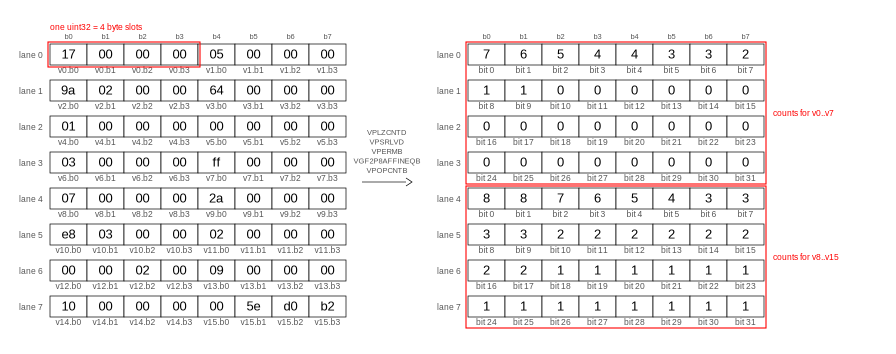
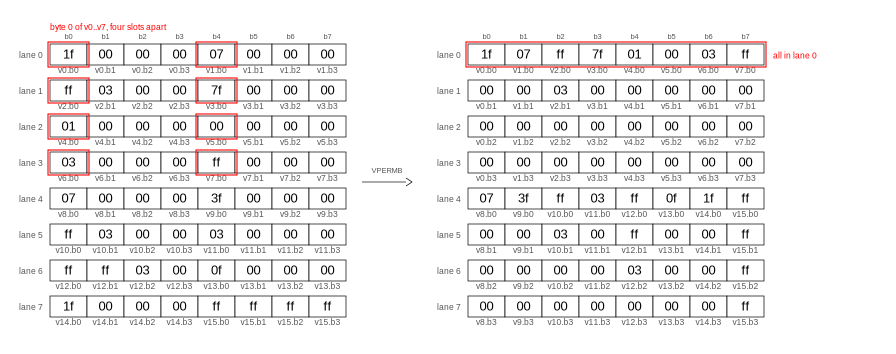
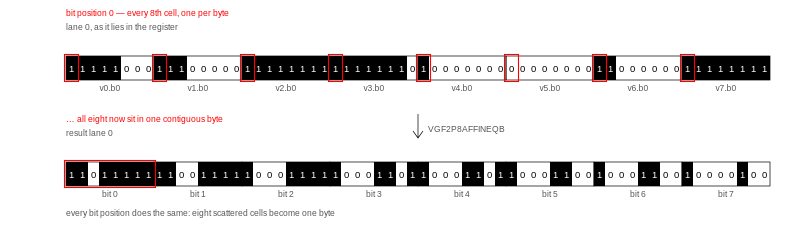
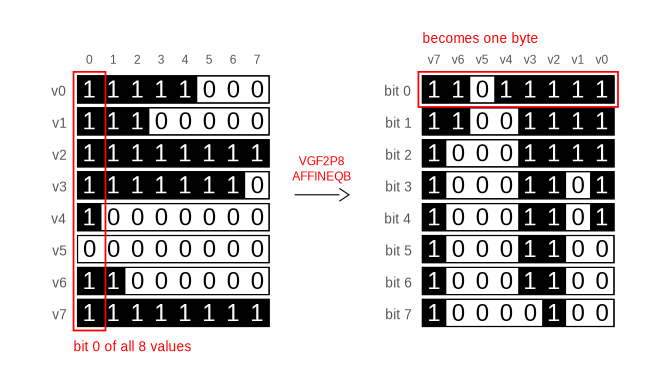
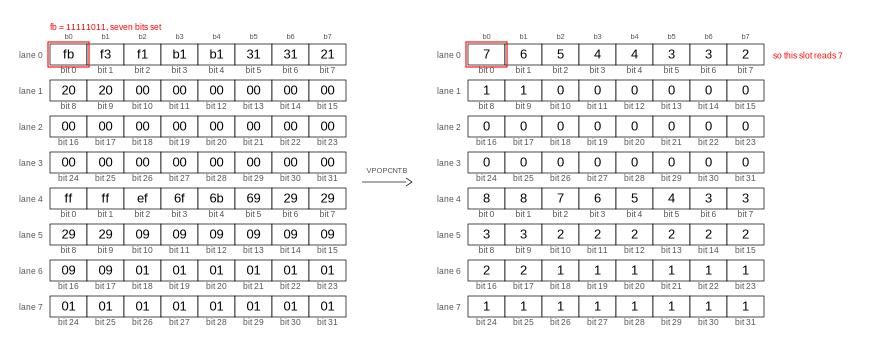
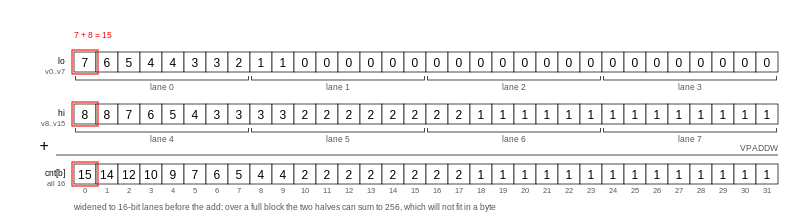
 Welcome to post 59 in the