Search Results: "bab"

9 September 2026

Matthew Garrett: SystemIO conflicts are not firmware bugs

I m looking at something entirely unrelated, but tripped over some search results that made me realise that a lot of people still think getting errors like ACPI Warning: SystemIO range 0x0000000000001828-0x000000000000182F conflicts with OpRegion 0x0000000000001800-0x000000000000187F indicate a firmware bug. This is generally untrue. We need to dive a little into what ACPI is to clarify why. The Advanced Configuration and Power Interface1 specification defines a whole bunch of stuff, but what s interesting to us here is the hardware abstraction it performs. While PCs are nominally a well-defined platform that s really not true at the hardware level once you get beyond a certain level of complexity. When you suspend a system you want to power down the hardware in the correct order, for instance, and knowing what that order is requires you to know details about the specific motherboard design. The approach taken in the embedded world is to just bake that knowledge into the OS in some form, which is how we end up with Devicetree. ACPI takes an alternative approach - rather than provide that information as data that has to be consumed by OS drivers, it distributes it as code. The ACPI Source Language, or ASL, is a simple language that gets compiled into a bytecode that s then interpreted by the OS at runtime. One of the features of this language is the ability to define Operation Regions , effectively structure definitions that describe access to underlying hardware. Let s imagine a simple device with two exposed registers. The first is an index register - it describes which internal register we want to access. The second is a data register, where reading it gives us the value of the internal register whose address is currently in the index register, and writing to it modifies that register. An example operation region declaration would look something like
1
2
3
4
5
6
OperationRegion(OPR1, SystemIO, 0x400, 0x2)
Field(OPR1, ByteAcc, NoLock, Preserve)
 
  INDX, 8
  DATA, 8
 
This defines an operation region called OPR1 at IO port 0x400, 2 bytes long. Inside it are two 8-bit fields, INDX and DATA. These are to be accessed one at a time, do not need the ACPI interpreter to take a global lock when accessing them, and if a subset of the register is modified then the other values should be preserved (irrelevant in this case since the fields are only a byte wide). Now any references to INDX or DATA in this scope will trigger accesses to those registers. So, a method to read the value of register 0x03 would look something like:
1
2
3
4
Method (RD03)  
  INDX = 0x3
  Return (DATA)
 
ie, set INDX to 3, and then read the value of DATA and return it. But! What if another ACPI method is running at the same time? Let s say we have one that writes to register 0x05:
1
2
3
4
Method (WR05, 1)  
  INDX = 0x05
  DATA = Arg1
 
What happens if RD03 executes while we re part-way through WR05? INDX might get reset to 0x03, and now WR05 will modify register 0x03 instead of 0x05. Oh no! But we can avoid this - we declare a mutex (Mutex (MUTX, 0x00)), and update our methods to be something like:
 1
 2
 3
 4
 5
 6
 7
 8
 9
10
11
12
13
14
Method (RD03)  
  Acquire (MUTX, 0xFFFF)
  INDX = 0x3
  Local0 = DATA
  Release (MUTX)
  Return (Local0)
 

Method (WR05, 1)  
  Acquire (MUTX, 0xFFFF)
  INDX = 0x05
  DATA = Arg1
  Release (MUTX)
 
Each method takes a lock (waiting up to 0xffff milliseconds and then erroring out if it doesn t), and performs the access. There s now no chance of a race. Phew! Now suppose someone writes a Linux driver for this piece of hardware. It accesses the hardware directly, with no knowledge of ACPI. What stops the driver from racing against one of the ACPI access methods? Nothing at all. Oh no! Again! This isn t hypothetical, by the way - here s a relatively harmless example, but back in the day we did trip over cases where temperature monitoring chips would be accessed by the firmware and Linux simultaneously and as a result you might end up thinking you re reading a temperature when you re actually reading a status flag, resulting in an impossibly high temperature and an immediate thermal shutdown. In this case, the kernel saves you from this (potentially hardware damaging) outcome by printing a message like ACPI Warning: SystemIO range 0x0000000000000400-0x000000000000401 conflicts with OpRegion 0x0000000000000400-0x0000000000000401 (OPR1), telling you that the kernel has detected that a driver is attempting to allocate IO ports 0x400-0x401, but that there s an ACPI operation region called OPR1 that is claiming the same addresses. The kernel isn t in a position to know what type of access the firmware might perform in that region, so assumes that it might be dangerous and blocks the driver from loading. But all is not lost! The kernel also prints some helpful advice, ACPI: If an ACPI driver is available for this device, you should use it instead of the native driver. And ACPI tables will often actually have a definition that looks like this:
 1
 2
 3
 4
 5
 6
 7
 8
 9
10
11
12
13
14
15
16
17
18
19
20
21
22
23
24
25
Device (HDW1)
 
  Name (_HID, "VEND0001")
  OperationRegion(OPR1, SystemIO, 0x400, 0x2)
  Field(OPR1, ByteAcc, NoLock, Preserve)
   
    INDX, 8
    DATA, 8
   
  Mutex (MUTX, 0)
  Method (RD03)  
    Acquire (MUTX, 0xFFFF)
    INDX = 0x3
    Local0 = DATA
    Release (MUTX)
    Return (Local0)
   

  Method (WR05, 1)  
    Acquire (MUTX, 0xFFFF)
    INDX = 0x05
    DATA = Arg1
    Release (MUTX)
   
 
which defines an ACPI device and associated methods. The _HID field defines the device type, and a Linux driver can be written that will be automatically loaded if a device with type VEND0001 is seen. That driver can then call ACPI methods associated with the device and access the resources in a way that matches the firmware s expectations. (Interested in writing such a driver? I wrote a guide back in 2009) The firmware did absolutely nothing wrong here2, but trying to load the native driver will generate an error and the internet will tell you that PC firmware developers are incompetent3 and you should pass a kernel argument that overrides this behaviour and it never did them any harm, and it probably won t do you any harm either but it might and you might never know why your system occasionally wedges or catches fire.

  1. The ACPI spec used to live at acpi.info, but sadly that seems to have vanished some time after UEFI took over stewardship of the spec
  2. You might argue that the firmware should simply not do anything at runtime because it is not the firmware s job to do that, and I do understand that and you can certainly boot with acpi=off if you want to and no ACPI code will be executed at runtime. Let me know how that goes.
  3. I m not going to present an opinion on that here, merely say that this provides no supporting evidence for that assertion

8 September 2026

Paul Tagliamonte: IP over Avian Carriers (Part 12/12)

This post is part of a series called "Pigeon". If this is the first post you've found, it'd be worth reading the intro post first and then looking over all posts in the series.
The final step to all of this was to tie together all my PHY RF code, Link layer parsers, and my background with operating systems to make this all feel like a normal thing my computer should be doing. At the end of the day, I want my host system to know how to talk with a pigeon daemon, so I don t have to reimplement basically everything else. My ability to use normal tools like curl or ping6 is pretty important here, so I need to reach for my old friend, the TUN interface. The TAP/TUN interface allows the kernel to route ethernet frames (TAP) or ip packets (TUN) to a userspace program responsible for handling delivery and reception avoiding the need for a kernelspace driver for something that can be handled in userland.
wondering if doing this violates FCC Part 97 rules? I wrote up notes on my test setup for exactly this question, but the short answer is "no"!
I m no stranger to playing with TAP/TUN, so this was pretty easy to snap together although this time I avoided the whole ethernet proxying thing (to side-step lossy translations, maintaining two sets of mac address tables, and handle proxying NDP/ARP messages) it was kinda a bad idea last time so I just used TUN and straight IP for now. While implementing this, I decided I d make a key assertion about all pigeon networks namely, all pigeon IPv6 networks are a /64 in size, no more, no less. The reason why I m doing this here is that, since pigeond does still does need a MAC address for the pigeon layer 2 protocol, we can write our daemon to always use SLAAC to set the TUN IP address without any new information. Which leads us to a bit of an aside, but I have a point, I swear. A few years ago, my recreational RF adventures have lead me down a path where I decided to engage with ARIN to solve (once and for all) the massive headache I was running into with IPv6 numbering (really: always renumbering) my multi-site radio processing networks. It s a lot of work to keep running correctly, but it s solved a huge amount of problems for me. The only internal thing we really need to outline for this post is that, at the highest level, my network (paultag.net) is split into an IP plan that looks roughly like:
Prefix Description
/44my full allocation of IP space
/4815 "regions"
/5464 "sites" per region. A "site" is assigned to a physical or logical location.
/641024 subnets per site. A subnet used by directly attached devices.
For this exercise, I used IP space from paultag.net s experimental region ( region 8 ), named side.band (2602:810:6008::/48) to connect my RF lab ( site 1 - 2602:810:6008:400::/54), and my two pigeon-specific subnets, subnet 0 (2602:810:6008:400::/64) and subnet 1 (2602:810:6008:401::/64) to my wider network. The first subnet ( subnet 0 ) is a simple ethernet network to enable my RF-only nodes to communicate with the side.band gateway. The second subnet ( subnet 1 ) is an RF-only pigeon network local to my lab.

back to radios With all that set up, I assigned my first two nodes their MAC addresses, and set up the local RF only network segment. The nodes I brought online were the following:
Callsign IP
K3XEC/MN2602:810:6008:401:8e1f:64ff:fe35:4001
K3XEC/TH2602:810:6008:401:8e1f:64ff:fe35:4002

testing the pigeon network And with that, I could begin to test that the host operating systems and RF links could properly exchange data locally from SDR to SDR. We can use ping6 to see if a plain-ole ICMPv6 ping round trips between hosts correctly:
$ ping6 2602:810:6008:401:8e1f:64ff:fe35:4001
PING 2602:810:6008:401:8e1f:64ff:fe35:4001 (2602:810:6008:401:8e1f:64ff:fe35:4001) 56 data bytes
64 bytes from 2602:810:6008:401:8e1f:64ff:fe35:4001: icmp_seq=1 ttl=64 time=426 ms
64 bytes from 2602:810:6008:401:8e1f:64ff:fe35:4001: icmp_seq=2 ttl=64 time=397 ms
64 bytes from 2602:810:6008:401:8e1f:64ff:fe35:4001: icmp_seq=3 ttl=64 time=419 ms
64 bytes from 2602:810:6008:401:8e1f:64ff:fe35:4001: icmp_seq=4 ttl=64 time=418 ms
64 bytes from 2602:810:6008:401:8e1f:64ff:fe35:4001: icmp_seq=5 ttl=64 time=436 ms
64 bytes from 2602:810:6008:401:8e1f:64ff:fe35:4001: icmp_seq=6 ttl=64 time=391 ms
64 bytes from 2602:810:6008:401:8e1f:64ff:fe35:4001: icmp_seq=7 ttl=64 time=397 ms
And it does! Latency is horrid (and there s a bunch of tx artifacts that cause issues for us) but both of those things are problems for later. Let s see how it handles a TCP connection by firing off a quick cURL across the Pigeon network:
$ curl http://[2602:810:6008:401:8e1f:64ff:fe35:4001]:8000/testing.txt
The rock dove (Columba livia), also known as the common pigeon or rock pigeon
(but see also Petrophassa), is a member of the bird family Columbidae (doves
and pigeons).
As expected, our remote end here running the server reports the correct peer IP address, which is another indication (beyond the log messages and blinking LEDs) that we re routing over our TUN interface.
Serving HTTP on 2602:810:6008:401:8e1f:64ff:fe35:4001 port 8000 (http://[2602:810:6008:401:8e1f:64ff:fe35:4001]:8000/) ...
2602:810:6008:401:8e1f:64ff:fe35:4002 - - [28/May/2026 12:53:21] "GET /testing.txt HTTP/1.1" 200 -
That worked? First shot! Nice! It s pretty slow and seems like we have a lot of packet loss, but it does, however, beg the question can it nethack?

nethack! Yes! It can nethack! No clickbait here. The way I went about this one is a bit anit-cimatic I set up a nethack server (using inetd in this case) on one of the hosts pigeon0 network interface, and hit that port over RF from the other: However, when playing it, it becomes very obvious (as you can likely see) that there s a fair amount of packet loss (understandable) and probably some packet collisions taking place.

iperf Let s try and put a number to exactly how bad the bandwidth and packet loss is by running iperf between the two pigeon hosts over rf:
$ iperf -c 2602:810:6008:401:8e1f:64ff:fe35:4002
------------------------------------------------------------
Client connecting to 2602:810:6008:401:8e1f:64ff:fe35:4002, TCP port 5001
TCP window size: 16.0 KByte (default)
------------------------------------------------------------
[ 1] local 2602:810:6008:401:: port 58248 connected with 2602:810:6008:401:8e1f:64ff:fe35:4002 port 5001
[ ID] Interval Transfer Bandwidth
[ 1] 0.0000-20.2348 sec 76.8 KBytes 31.1 Kbits/sec
Shockingly, not nearly as bad as I thought it was going to be. Given I ve spent exactly zero time making this operate to a level that I would call acceptable, this is a very fucking solid start. I expect I could get that number up if I spent a few weeks on it it s just not been a priority at any point yet (and the first time I ve instrumented it, even!). This ll be good enough to get started. Let s see what else we can pull off here.

IP multicast to some rtl-sdrs Back when I designed what I wanted Mode A to look like, I intentionally picked a signal bandwidth that could be received by an rtl-sdr so let s put that to use. It may go without saying, but just to say it the rtl-sdr can not transmit, so this will be capable of receiving pigeon frames but not sending any in reply. However, this means I can use a bunch of low-cost computers (raspberry pi-class), and low-cost SDRs (rtl-sdr) and still receive IP traffic from transmitting pigeon network stations. This could be a lot of fun for things like fountain coding a data stream, or adapting multicast streaming protocols to work over RF links. Anywho, I swapped my far end to an rtl-sdr (one config file change!), and figured I d start with some (basic) multicast traffic, transmitting the time once a second:
$ while [ true ]; do
 echo $(date +%s) \
   socat - UDP6-DATAGRAM:[ff02::114%pigeon0]:62804
 sleep 1
done
If I had more time to burn, I was planning on bridging APRS traffic to UDP multicast within a pigeon network subnet. However, since I m already 4 years late on this blog post, I figured this would be enough for now (and you can imagine that fun project in this space if you so wish!) I fired up pigeond again (except this time connected to an rtl-sdr), and was pleasantly surprised to be greeted by some decoded traffic right off the bat:
  [k3xec/mn] 8c:1f:64:35:40:02   00:00:00:00:00:00 ipv6 fe80::23ee:2969:53f7:b332   ff02::114 17 (UDP - User Datagram)
  [k3xec/mn] 8c:1f:64:35:40:02   00:00:00:00:00:00 ipv6 fe80::23ee:2969:53f7:b332   ff02::114 17 (UDP - User Datagram)
  [k3xec/mn] 8c:1f:64:35:40:02   00:00:00:00:00:00 ipv6 fe80::23ee:2969:53f7:b332   ff02::114 17 (UDP - User Datagram)
  [k3xec/mn] 8c:1f:64:35:40:02   00:00:00:00:00:00 ipv6 fe80::23ee:2969:53f7:b332   ff02::114 17 (UDP - User Datagram)
Of course, I took a tcpdump to confirm for completeness sake that the traffic actually made it out of our TUN interface:
$ tcpdump -i pigeon0
22:39:34.808705 IP6 (flowlabel 0x92a0e, hlim 1, next-header UDP (17), payload length 19) fe80::23ee:2969:53f7:b332.35911 > ff02::114.62804: [udp sum ok] UDP, length 11
22:39:36.429887 IP6 (flowlabel 0x4dc84, hlim 1, next-header UDP (17), payload length 19) fe80::23ee:2969:53f7:b332.50026 > ff02::114.62804: [udp sum ok] UDP, length 11
22:39:39.365977 IP6 (flowlabel 0x224d5, hlim 1, next-header UDP (17), payload length 19) fe80::23ee:2969:53f7:b332.36308 > ff02::114.62804: [udp sum ok] UDP, length 11
22:39:40.944889 IP6 (flowlabel 0x4721c, hlim 1, next-header UDP (17), payload length 19) fe80::23ee:2969:53f7:b332.35003 > ff02::114.62804: [udp sum ok] UDP, length 11
Looks great! tcpdump is showing multicast packets show up (as we assumed they would), on the pigeon0 interface, on the machine connected to an rtl-sdr. Of course, any replies will get sent to the bit bucket, but it can definitely decode things just fine! Very fucking cool. Well right, ok! Let s go back to two rx/tx radios, and see what we can do with our newfound network stack over ham radio frequencies let s try to do some fun (and traditional!) ham radio things with it!

Crossing the english channel in a bathtub Ok, ok. I decided to bury the lede a bit here I didn t mention that the side.band network is currently BGP announced. Although we haven t used it this does mean that we re most of the way to sending packets to the wider internet, and we should be able to just fix a few routing tables, and see packets begin to flow. After tweaking the local routing tables (and restarting pigeond for good measure), I decided to test my newfound connectivity by pinging something over our new network transport.

ping github Why don t we start with the world s premier software engineering platform, operated by one of the largest companies in the world, GitHub! After all, they have an all knowing (and, apparently, arguably sentiant?) AI on hand to instantly and automatically fix any stray reliability issues in the background, so we should definitely see replies right off the bat:
$ ping6 github.com
ping6: github.com: Address family for hostname not supported
Wait, oh no that can t be right? After all, it s 2026, and both Google and CloudFlare (in North America) are reporting over half of all traffic they see is IPv6 and GitHub still doesn t support IPv6? Definitely not, this is for sure a bug with my code or network.

lets ping something that supports ipv6 instead That being said, just for completeness sake, since that error is also given when there s no IPv6 DNS record, let s go ahead and double check with Hurricane Electric too, you know, just to be sure.
$ ping6 he.net
PING he.net (2001:470:0:503::2) 56 data bytes
64 bytes from he.net (2001:470:0:503::2): icmp_seq=1 ttl=53 time=514 ms
64 bytes from he.net (2001:470:0:503::2): icmp_seq=2 ttl=53 time=230 ms
64 bytes from he.net (2001:470:0:503::2): icmp_seq=3 ttl=53 time=248 ms
64 bytes from he.net (2001:470:0:503::2): icmp_seq=4 ttl=53 time=246 ms
64 bytes from he.net (2001:470:0:503::2): icmp_seq=5 ttl=53 time=265 ms
64 bytes from he.net (2001:470:0:503::2): icmp_seq=6 ttl=53 time=240 ms
Well, shit. Right, OK, i ll be damned. 18 years in and GitHub still can t crack that nut.

cURL works! Right, anyway, yes, back on track good news! Our uplink is up and routing, and wait, holy shit! Check it out! pigeon is exchanging packets with the internet and no one is any the wiser! Literlaly amazing. Let s try a cURL across the internet now (although no TLS allowed, so, http only for now):
$ curl -6 -I http://facebook.com
HTTP/1.1 301 Moved Permanently
Location: https://facebook.com/
Content-Type: text/plain
Server: proxygen-bolt
Connection: keep-alive
Content-Length: 0

IRC works, too Sweeeeet. That all works! Forget HTTP, let s do some other 90 s era stuff, it s high-time to log into IRC with a quick /connect -notls, and see what s going on in the #debian-hams channel pleased that I got online fairly quickly, and was able to even talk to myself!

THE GOPHERSPACE Naturally, let s keep this train of nostalga running, and give the 2026 gopherspace a shot. I know the kind folks over at tilde.town (hello, townies!) have a robust gopherspace, so let s give it a dial! Let s try and see if we can load vilmibm s slug over gopher: Yes! I forgot to make this one a video, so no gif. I did wind up having a bit if trouble with a few gopher clients and IPv6 support I may send some patches if I can find the time.

So, what s next? Alright, that s it. I have a few more fun ideas but they re going to have to wait for another day. Carrying IP is fun and all but kinda not the point behind pigeon, after all. Rather than trying to make this into a thing , I m planning on exploring the loose ends first different types of modulation schemes (like QAM-NUC), implementing LDPC error correction and some layer 2 logic into the pigeond (like switching traffic, and gain control). I also plan on spending some time with my (currently, very basic) simulator to better dial in tradeoffs throughout the stack. Since, structurally, pigeon is something I feel like I can work with, I m hoping i ll be able to find the time for some (much smaller!) followup posts without it taking 4 years this time. If I do, they ll show up under the pigeon tag and I ll be sure to update this post with a link below (and the intro post). I m hoping that this series (which was supposed to be one post) was helpful to someone out there if it was, feel free to reach out and let me know!

7 September 2026

Colin Watson: Free software activity in August 2026

My Debian contributions this month were all sponsored by Freexian. You can also support my work directly via Liberapay or GitHub Sponsors. Personal note This month, my Dad unexpectedly passed away after a short illness. As a result I obviously got less work done than usual, and I still have a lot to take care of (since I m the executor of his will, as well as helping with funeral arrangements) while grieving and generally having less focus and energy. Having routine work to do is one of the ways I cope with this sort of thing, but all the same, I hope people will bear with me and maybe remind me if I seem to be dropping the ball on something you especially need. LLM vote [Content note: strong opinions.] I voted in General Resolution: LLM usage in Debian. My vote was pretty much the opposite of what ended up winning, so I m quite disappointed. My personal opinion is that LLMs are cognitive hazards to their users that impose ecological costs far out of proportion to their utility at a time when the world absolutely cannot afford them. When the impossible economics of the large commercial models are finally allowed to catch up with reality, I expect there to be significant macroeconomic consequences, and that people who have become dependent on them will have problems; and who knows what the copyright situation on their output really is. I m not convinced that local models are better enough on these axes to be worth the costs. Debian s direct contribution to all that will be negligible on a global scale, and even the most radical proposals in the GR didn t expect that we could do much about upstreams that have gone all-in on LLMs. Even so, I d hoped that my fellow developers might be more willing to lean on our position in the free software ecosystem to make at least a moderately radical statement. Instead, we ve at best presented an undistinguished fence-sitting position to the world, and further entrenched the idea that humans can reliably do a good job of reviewing the output of tools that are designed to produce output plausible to humans. I certainly don t trust my own code review skills that far. Since I ve never voluntarily used an LLM (not counting LLMs being foisted on me by things like search results, support chatbots, or incoming pull requests, regardless of whether I asked for them), and don t intend to for the foreseeable future, I doubt this will change much for me in terms of the way I work. The winning option is a very weak one that imposes no new requirements on developers, which means that it also does nothing to stop me continuing to reject LLM-generated material from Debian bug reports and merge requests in my areas of responsibility. I know this probably won t do much to satisfy people who have decided that Debian is slop now, but it s the best I can do. OpenSSH I finally landed the GSS-API key exchange package split in our OpenSSH packaging. Here s the NEWS entry:
openssh (1:10.4p1-5) unstable; urgency=medium
  The openssh-client and openssh-server packages no longer include GSS-API
  authentication and key exchange support; this adds pre-authentication
  attack surface and generally increases complexity, and should only be used
  where specifically needed.  Users who need these features should install
  openssh-client-gssapi or openssh-server-gssapi instead.
 -- Colin Watson <cjwatson@debian.org>  Sun, 23 Aug 2026 17:39:55 +0100
I fixed a flaky autopkgtest. I upgraded from 10.4p1 to 10.5p1, which was a good test of keeping openssh and the new openssh-gssapi source package in sync. PuTTY I upgraded from 0.84 to 0.85. Python packaging New upstream versions: The version treadmill continues: we ve just finished dropping Python 3.13 as a supported version, so now we ve started working on enabling Python 3.15 as a supported version. Maximiliano Curia has been very helpfully driving this. I didn t get as much done here as I d have liked (see the top of this post), but I fixed a couple of packages: Other build/test failures: I fixed some other bugs: bugs.debian.org I deployed the fix for Invalid link rel= canonical on bugs.debian.org. In the process I found a few bugs in recent undeployed code and fixed them.

6 September 2026

Iustin Pop: AI agents aha moment

Looking at the reactions to the Debian AI vote, I think some people still think the clock can be turned back, as if that ever worked in history. Rather than cry about spilled milk, I prefer to find a path forward in the new world. There are many ways to use LLMs, some of them are straightforward, others not so much. One of the not so clear areas for me is the focus on agentic workloads. For complex tasks, sure, you want something that can work in the background, but in general, why does every single tool go the agentic way? I much prefer the chat/ask approach, or even the code one, but if I m at the keyboard, why would I send a task to an agent, and see it work, instead of directly implementing it? And then, this past Friday, I finally understood one part of that. I was in the airport, sitting at the gate and waiting to board a flight, and because I arrived much earlier at the airport (fearing crowds due to Labour Day weekend), I got one hour of work before boarding started. As the time for boarding approached, I did one more commit after making sure tests pass, pushed, closed laptop, and went to walk a bit before getting on the plane. As I was getting up, I get a phone notification from GitHub that the CI run failed. I was quite surprised, as the local tests passed, so I open the notification, and realize that tests via make test vs CI (which additionally uses --pedantic) had slightly different settings, and of course I missed a build warning (which in CI is an error). I thought I d fix that on the plane, but then I saw a Copilot agent button in the mobile app. I was curious what it did, I click it, and I see Copilot starting a draft pull request, and saying:
Thanks for asking me to work on this. I will get started on it and keep this PR s description up to date as I form a plan and make progress. Fix the failing GitHub Actions job. Analyze the Actions logs, identify the root cause of the failure, and implement a fix.
Then it goes, finds the failure, writes the fix, and tries to run the tests. Well, it can t do it (it runs in a restricted container, so no network, so stack install couldn t actually work). The agent sees that, acknowledges it has no way to validate the fix, but the error message was clear enough that it was confident the fix is mostly correct, so it sends the pull request. I allow full CI to run on the pull request, and go buy a bottle of water. After that, I check and see that the CI failed again, as not one but two test files were broken, and I didn t have --keep-going, so the build stopped at the first failure. I write a comment in the pull request, no reaction, I realize I need to tag Copilot explicitly, I do that, and it starts another investigation. I m waiting now in the boarding queue, with phone in hand, while Copilot is fixing my bug. While I scan my boarding pass and walk towards the plane, the pull request is updated, I trigger another CI, it passes, and I merge it. And then, it hit me. Agents allow me to make progress while being not at keyboard , whether that s physically not at keyboard , or while working on something else. Fixing a simple test failure is not something that needs human attention per se, whereas improving the test layout might be. In that airport, using otherwise-unusable downtime, and without explicitly intending to, I made progress in understanding a different way to use AI. Now I have three ways to work with LLMs: ask (tutor mode), code (implement my request), and agent (fix simple or complex problems, autonomously). I still don t know about plan mode and really complex tasks, like asking it to implement features from scratch. That will probably be the next area to tackle. And today (Sunday), while waiting for a running race to start, I opened GitHub, and asked Copilot to increase test coverage for a simple module. It did, and yes it still can t run tests (I learned in the meantime that you can configure the environment in which the agent runs, nice), but after two back-and-forth messages, I have a pull request ready to review. All in the 20 minutes before a race, where I could either browse social media or actually do some meaningful work. Checking now my GitHub billing, it looks like all of this Copilot use only cost $1.92. Yes, that is under two dollars! And while it did use compute resources, the person across the aisle who watched TikTok or Instagram for half an hour while waiting for takeoff also consumed a lot of compute, and so do the gazillion cat videos uploaded to YouTube every day. To me, this is another tool in the toolbox, that might one day replace me (as it did to the 19th-century textile workers), or make me five times more productive we ll see where we end up. In the meantime, I can move faster, and make better use of my limited free time. Enjoy the ride!

Enrico Zini: Migrating away from .org/.net/.com domains

After having witnessed how easy it is for good people to lose a .org domain over a fascist tantrum (you can follow the Autistici/Inventati story here and here), I've started moving all my infrastructure to differently managed TLDs. enricozini.org and enricozini.com will keep being functional for the time being, as dropping a domain makes it available for squatting and impersonation. These new domains are now online, with working web and emails: It will take ages to migrate countless accounts that are tied to my primary email address, so better start early. Waiting to see what will happen with .meow domains, which I supported despite not identifying as a cat.

Michael Stapelberg: Debian Code Search: Fast TurboPFor with Go SIMD

This August, I accomplished what I wanted for many years: I deleted the last cgo dependency in Debian Code Search! This was made possible by Go s recently introduced SIMD support, because now we can implement the TurboPFor integer compression format as efficiently more efficiently, in fact, by using the newer AVX512 instruction set! as the reference implementation.

Background: Why does DCS need a fast Integer Codec? Debian Code Search (DCS) is a search engine that allows searching all the Open Source source code within Debian, with either literal search expressions or regular expression search queries. A search engine uses an inverted index: a map from term to documents containing the term. Each document is typically represented most efficiently by using an id, so the index consists of many lists of document ids. When searching, it is important to quickly decode these lists to answer the search query. However, there is a point of diminishing returns where the decoding speed, even though it can still be measurably improved quite a bit, no longer influences the overall query duration. From 2012 (its inception) to 2019, Debian Code Search used to use a small index format, and queries were fast because the index was kept entirely in RAM. In 2019, I implemented the new index format, which adds an on-disk positional index. For literal queries (78.2% of DCS queries), querying the positional index on disk is faster than querying the non-positional index in RAM. The efficient encoding of the TurboPFor format makes it possible to fit such an index on a mid-sized Hetzner server, which I rent with two 1 TB SSD disks. The optimized decoder of the C TurboPFor library is what made decoding fast at query time. If you want to dive deeper into the algorithm, see this blog post from February 2019: If you want to learn more about the positional index, see this blog post from September 2019:

SIMD in Go For many years, you had the following options for using SIMD instructions in Go:
  1. Hand-writing Go assembler code. This is only doable for small functions, for example bytes.IndexByte is implemented with hand-written Go assembly (including AVX2).
  2. Generating Go assembler code with tools like Michael McLoughlin s Avo . This is how crypto/internal/fips140/sha256 uses AVX2. While Avo generator code definitely is higher-level than hand-written assembly, it is still too close to assembly for my taste.
  3. Use a C library via cgo so gcc or clang compiles SIMD code. Debian Code Search used to use the powturbo/TurboPFor C library via cgo for the last 7 years.
The C TurboPFor library has served us well, but Debian Code Search was always intended to be a project using Go, so I would prefer it if I did not have any C code in the project. Go 1.26 (released in February 2026) introduced the simd/archsimd package:
Go 1.26 introduces a new experimental simd/archsimd package, which can be enabled by setting the environment variable GOEXPERIMENT=simd at build time. This package provides access to architecture-specific SIMD operations. It is currently available on the amd64 architecture and supports 128-bit, 256-bit, and 512-bit vector types, such as Int8x16 and Float64x8, with operations such as Int8x16.Add. The API is not yet considered stable. Go 1.26 Release Notes
For my 2019 TurboPFor analysis, I implemented goturbopfor, a native Go teaching decoder (without any SIMD), because I find Go code easier to follow than C code, especially optimized C code. My implementation was intentionally not optimized so that the code was easier to study. The TurboPFor format/algorithm has a vector-optimized part: bitpacking comes in a scalar variant (bitunpack32) and a vector variant (bitunpack256v32), where the vector variant is used for full blocks (256 values) and the scalar variant is used for remainder blocks (< 256 values). When Go 1.26 was released, I used Claude Code to explore whether my native Go decoder s bitunpack256v32 function (for the vertical vector layout) could be implemented using Go SIMD, and the answer was yes, it was possible and it was faster than without SIMD, but not quite at the level of C TurboPFor. If you let Claude Code try for long enough, it eventually finds enough optimizations (about 10) to match C performance. I don t want to vibe-code Debian Code Search, though, so I figured I would find some time to review the SIMD code at some point and see if I could implement something similar myself. Before I found enough time and motivation to complete said review, I discovered that to not regress real-life query performance by more than 10 to 100 milliseconds (which seems acceptable), I don t actually need to add SIMD code to my teaching decoder at all; it would be sufficient to reduce allocations in my teaching decoder and specialize it per bit width. Encouraged by the possibility of using the optimized native Go decoder in Debian Code Search, I explored whether I could also implement a native Go encoder so that I could get rid of the C TurboPFor dependency entirely. The answer is yes, it is doable in a few days, and it isn t even that much slower: Go is at 76% of C, see Debian/dcs commit e920dc7. The goal I set myself at that point was to see if I could learn enough SIMD to optimize the native Go encoder such that its performance would match how DCS uses C TurboPFor (via cgo). Beating C TurboPFor was possible in 2-3 commits (SIMD and bit width specialization). To my surprise, Claude Fable 5 pointed out that the encoder s block scanning could be done more efficiently using a technique called positional popcount, and that is another 2x speed-up! To be clear: I am not saying the Go compiler beats C here. Certainly, the C compiler can also produce fast AVX512 code and can be used to implement positional popcount. When comparing apples to apples, i.e. backporting the AVX512 kernels and positional popcount technique to C TurboPFor, Go benchmarks a little slower at 1.4x C. This spectacular result (much faster than what DCS had before) got me curious how far I could push the decoder with SIMD after all. I ended up matching/exceeding the cgo version here, too! The rest of this article explains a few classes of optimizations I encountered along the way.

Starting Point When I wrote my goturbopfor teaching decoder, I named its functions to match the upstream C TurboPFor library, but now I want to get away from names like p4ndec256v32 they make sense from the TurboPFor perspective, but for Debian Code Search, we can use cleaner names. Before writing any code, I audited how DCS uses integer compression / decompression.

API design: BlockEncoder, BlockDecoder and streaming In Debian Code Search, we have the following usage patterns:
  • Partial Indexing: When a new package (or package version) enters Debian, all of its (text) files are indexed. If the hello-2.12.3-1 package (hypothetically) contained only hello.c with printf("hello!\n");, we would assign document ID 1 to hello.c and store in the partial index that trigrams pri, rin, int, ntf, etc. are all found in doc 1 (hello.c).
  • Full Index Merging: The many thousands of partial index files (for each Debian package) are combined into a small handful of large index files: When searching, it would be expensive to consult thousands of indexes. To merge multiple partial index files into one larger index (which can then be efficiently queried), we need to re-encode the partial index files: what used to be document ID 1 in the partial index might be document ID 2531 in the full index.
  • Querying (searching): When users enter search queries, these queries need to be answered as quickly as possible. The relevant entries in the full indexes are decoded (in parallel).
For reading the index, we do keep the decoded uint32s fully in memory, so we only need DecodeN(input []byte, output []uint32) (read int), a function that reads len(output) values (uint32) from input and returns how many bytes it consumed. For writing the index (both in partial indexing, and when merging), keeping the entire index in memory is prohibitively expensive, so we need a streaming API, for decoding and for encoding. Ultimately, I converged on the following API:
package pforenc

type BlockEncoder struct  
    // scratch buffers can go here
 

// EncodeBlock encodes len(vals)<=256 uint32s into dest (one TurboPFor block).
func (*BlockEncoder) EncodeBlock(dest []byte, vals []uint32) []byte  

// EncodeN calls EncodeBlock in a loop.
func (*BlockEncoder) EncodeN(dest []byte, vals []uint32) []byte  

type StreamEncoder struct  
  be   BlockEncoder
  vals [256]uint32
  // scratch buffers
 

// if full, you need to call [EncodeBlock]
func (*StreamEncoder) Add(val uint32) (full bool)

// EncodeBlock must be called after all data was [Add]ed.
//
// Write the returned buffer to file or send it over the network;
// it is only valid until the next [EncodeBlock] call.
func (*StreamEncoder) EncodeBlock() []byte  
  if se.n == 0   return nil   // turn an extra EncodeBlock into a no-op
  //  
 
This API (the decoder works similarly) allows us to process data in TurboPFor format without any memory allocations. The types are not safe for concurrent use by multiple goroutines. The zero value is ready to be used. For the streaming API, the result only stays valid until the next call.

Initial Implementation Before we can optimize anything, we need a working decoder and encoder. The decoder already exists: my goturbopfor teaching decoder. Next up, I needed an encoder. Writing a TurboPFor encoder has a delightfully simple starting point: You can encode all values at bit width 32, in little endian, at which point you only need to add a one-byte TurboPFor block header every 256 values and you re done:
func (be *BlockEncoder) EncodeN(dest []byte, vals []uint32) []byte  
  for len(vals) > 0  
    chunk := min(len(vals), 256)
    dest = be.EncodeBlock(dest, vals[:chunk])
    vals = vals[chunk:]
   
  return dest
 

func (be *BlockEncoder) EncodeBlock(dest []byte, vals []uint32) []byte  
  const bitWidth = 32
  dest = append(dest, bitWidth)
  for _, val := range vals  
    dest = binary.LittleEndian.AppendUint32(dest, val)
   
  return dest
 
Of course, this is a terribly inefficient compressor, so after the first commit, the real work starts: implement each block type until the compression matches the original C TurboPFor implementation (same output file size), or in other words: do the reverse of the decoder.
  1. The TurboPFor bitpacking block type (bitpacking implementation commit) encodes a bit stream of variable bit width (where the bit width is in range 0 bitWidth 32) in little endian byte order. By scanning all values and choosing the smallest bit width that allows representing all values, this technique saves disk space (compresses).
  2. The bitpacking with exceptions block type (bitpacking with exceptions implementation commit) determines two bit widths: one for values, the other bit width for encoding exceptions. This allows choosing a lower bit width (that does not cover all values) compared to the bitpacking block type. A bitmap encodes whether a value has an exception or not.
  3. The bitpacking with VB exceptions block type (bitpacking with VB exceptions implementation commit) is a variant which does not use an exception bitmap and encodes exceptions using a variable byte integer encoding. This is more efficient when there are few exceptions (less than 20) or the exceptions are very different in bit width compared to the other values.
  4. Lastly, the constant block type (constant implementation commit) stores just one value on disk. This is useful for all-zero or all-one blocks, for example.
I found it interesting to realize that the main work of the encoder is to scan the input values and choose the optimal block type, whereas the actual encoding itself is cheap in comparison. At this point, we can look at performance and see that the Go encoder is at 76% of the C encoder. In all honesty, I could have probably stopped here, but now that the milestone of a viable replacement was reached, I got curious to see how far it would be possible to push the encoder (how much work to reach C speeds?) and afterwards, the decoder, too.

Setup

The microarchitecture level: set GOAMD64 The microarchitecture of a CPU determines which instructions it provides, and that includes not just SIMD instruction sets (like AVX2), but also other useful instructions like LZCNT (Leading Zero Count), which can be used to implement math/bits.Len32 more efficiently, which the TurboPFor encoder needs to call on every input value to determine the ideal bit width. Let s walk through how to set the microarchitecture level when using Go on 64-bit x86 (x86-64). Go uses the GOARCH environment variable to configure the target compilation architecture, and I am using the value amd64 to select 64-bit x86 (AVX2 and AVX512 are instruction sets found on x86-64 CPUs). With GOARCH=amd64, the architecture-specific variable GOAMD64 configures the microarchitecture level for which to compile and Go 1.18 introduced these 4 different levels:
GOAMD64=v1 (default): The baseline.
Exclusively generates instructions that all 64-bit x86 processors can execute. GOAMD64=v2: all v1 instructions,
plus CMPXCHG16B, LAHF, SAHF, POPCNT, SSE3, SSE4.1, SSE4.2, SSSE3. GOAMD64=v3: all v2 instructions,
plus AVX, AVX2, BMI1, BMI2, F16C, FMA, LZCNT, MOVBE, OSXSAVE. GOAMD64=v4: all v3 instructions,
plus AVX512F, AVX512BW, AVX512CD, AVX512DQ, AVX512VL.
In 2026, I generally recommend compiling with GOAMD64=v3 so that functions like bits.OnesCount8 are compiled into intrinsics (POPCNT) instead of using a lookup table. For Intel CPUs, setting GOAMD64=v3 means your programs will only start on Haswell CPUs (2013) or newer; for AMD CPUs that means Zen 1 (2017) or newer. In this specific case (DCS), I am even compiling with GOAMD64=v4. The v4 microarchitecture level requires AVX512, which means AMD Zen 4, Zen 5 or newer (Intel s story is complicated). Luckily, both my main development PC (Zen 5) and the Debian Code Search server (Zen 4) are recent enough. Setting GOAMD64=v4 has little effect on Go 1.27 itself: the only change is that maps use one less instruction (VPBROADCASTB instead of PSHUFB). But compiling with GOAMD64=v4 allows us to move one more feature check from runtime to compile time, see SIMD build tags. It makes sense to set the microarchitecture level in your benchmark setup so that you don t measure the slow fallback implementations. I use export GOAMD64=v4 in my Makefile.

Benchmarking setup Go s built-in testing package contains support for benchmarks which are written in functions of the form func BenchmarkXxx(b *testing.B). The simplest way to run such benchmarks is go test -bench=., but I ended up configuring a few convenience make targets, which write results to bench.txt and compare against baseline.txt (the previous commit s results, usually), using the very useful benchstat tool.
GOTEST=go test

# -count=6 gives p 0.002 in benchstat:
# https://pkg.go.dev/golang.org/x/perf/cmd/benchstat
BENCHFLAGS=-run=^$$ -bench=. -benchtime=200000x -count=6

# use taskset -c1 to always pin to the same single core,
# avoiding accidental scheduling on different cores on
# mixed-core CPUs like the Ryzen 9 9950X3D.
TASKSET=taskset -c 1
BENCH=$(TASKSET) $(GOTEST) $(BENCHFLAGS)

.PHONY: all test bench bench-baseline bench-relative

all: test

bench: test
	$(BENCH)   tee bench.txt
# Compares compression ratio between C and Go implementation
	benchstat -col /impl -row '/n /vals' -filter '-/impl:go-stream .unit:(encoded-bytes)' bench.txt
# Compares performance between C (cgo) and Go implementation
	benchstat -col /impl -row '/n /vals' -filter '.unit:(Mval/s)' bench.txt

bench-baseline: test
	$(BENCH)   tee baseline.txt

bench-relative: test
	$(BENCH)   tee bench.txt
	benchstat -filter '-/impl:go-stream .unit:(encoded-bytes)' baseline.txt bench.txt
	benchstat -filter '/impl:go .unit:(Mval/s)' baseline.txt bench.txt
The encoded-bytes and Mval/s units are custom metrics I am reporting from the various sub-benchmarks, which are arranged such that I can filter / report them with benchstat. The main encoder (and decoder) benchmarks compare 3 different implementations (cgo, Go, Go with the StreamEncoder API) with a number of benchmark cases that are designed to cover the different block types and contain a similar mix of values as what we see in Debian Code Search:
// reportMetrics adds Mval/s and encoded-bytes metrics to all benchmarks.
func reportMetrics(b *testing.B, n int, nencoded int)  
   b.ReportMetric(float64(nencoded), "encoded-bytes")
   b.ReportMetric(float64(b.N*n)/1e6/b.Elapsed().Seconds(), "Mval/s")
 

// BenchmarkEncode/n=<N>/vals=<testcase>/impl=<c go go-stream>
//
// e.g. BenchmarkEncode/n=2048/vals=one-constant/impl=go-stream
func BenchmarkEncode(b *testing.B)  
   for _, tc := range allBenchCases()  
     n := len(tc.vals)
     b.Run(fmt.Sprintf("n=%d/vals=%s", n, tc.name), func(b *testing.B)  
       b.Run("impl=c", func(b *testing.B)  
         b.ReportAllocs()
         var encoded []byte
         buf := make([]byte, turbopfor.EncodingSize(n))
         for b.Loop()  
           encoded = turbopfor.P4nenc256v32Buf(buf, tc.vals)
          
         reportMetrics(b, n, len(encoded))
        )
       b.Run("impl=go", func(b *testing.B)  
         b.ReportAllocs()
         var be BlockEncoder
         var encoded []byte
         buf := make([]byte, 0, turbopfor.EncodingSize(n))
         for b.Loop()  
           encoded = be.EncodeN(buf, tc.vals)
          
         reportMetrics(b, n, len(encoded))
        )
       b.Run("impl=go-stream", func(b *testing.B)  
         b.ReportAllocs()
         var se StreamEncoder
         var encoded int
         for b.Loop()  
           encoded = 0
           for _, val := range tc.vals  
             if se.Add(val)  
               encoded += len(se.EncodeBlock())
              
            
           encoded += len(se.EncodeBlock())
          
         reportMetrics(b, n, encoded)
        )
      )


CPU counters: perf Go has included excellent performance tooling for many years, see the Profiling Go Programs blog post (2011) for an example of how to use pprof, a sampling profiler. This profiler can help track down which part of a program runs slow, or where memory allocations happen. Once you identified the slow part of a program, how do you know why it s slow? To learn more about the specific bottlenecks your program encounters, you can consult your CPU s hardware performance counters. For example, you could check the branch predictor counters to see if your program is slow due to a high number of branch mispredicts. On Linux, the perf tool is the best way to access the CPU hardware performance counters. A good starting point for working with perf is the documentation on Top-down analysis with the perf tool , which describes the optimization method that Intel established. In my Makefile, I set up two perf targets:
# GOTEST and TASKSET like shown in the earlier benchmarking setup section:
GOTEST=go test -pgo=encode.cpuprof
TASKSET=taskset -c 1
PERFBENCHFLAGS=-test.bench='Encode/n=2048/vals=debian-mix/impl=go$$' -test.benchtime=200000x

# Use perf(1) to capture AMD IBS (the equivalent to Intel PEBS)
# PipelineL1 is roughly equivalent to Intel TopdownL1
perf:
	$(GOTEST) -c
	$(TASKSET) perf stat -M PipelineL1 ./pforenc.test -test.run=^$$ $(PERFBENCHFLAGS)
	sudo perf record -F 4999 -e ibs_op// --call-graph fp ./pforenc.test -test.run=^$$ $(PERFBENCHFLAGS)
	sudo chmod 644 perf.data

# 488281 iterations   2048 values = 1.000e9 values, so counter/1e9 = per value.
perf-per-value:
	$(GOTEST) -c
	$(TASKSET) perf stat -x, -e cycles:u,instructions:u,branches:u,branch-misses:u ./pforenc.test -test.run=^$$ -test.bench='Encode/n=2048/vals=debian-mix/impl=go$$' -test.benchtime=488281x 2>&1 >/dev/null   awk -F, ' printf "%-16s %6.2f /val\n", $$3, $$1/1e9 '
The perf-per-value numbers are high level numbers that indicate how much work the implementation is doing. Reducing the number usually increases speed. To see the counters for each instruction (and source code lines), I use make perf, followed by perf report. A quick shortcut is perf annotate, which directly shows the hottest function.

Optimizations (scalar) Let s first see how far we can get without reaching for SIMD instructions. (The examples are not necessarily in commit order, but cherry-picked for clarity.)

Profile-Guided Optimization (PGO) PGO stands for Profile-Guided Optimization and is a feature that Go introduced as a preview in Go 1.20 (released in February 2023) and shipped as ready for general production use in Go 1.21 (released in August 2023). The idea is to capture a CPU profile that records where your program spends most of its CPU time, which you then provide to the Go compiler to give it more data to make better decisions. Most importantly, this way the Go compiler can inline functions much more aggressively than its usual heuristics allow, which does have a measurably positive effect in my series of optimization commits. Another optimization that a PGO profile allows the compiler to do is conditional devirtualization but our TurboPFor code does not use any interfaces. My strategy is to enable PGO before doing any other optimizations, so that we have the full inlining budget available that PGO gives us, and can measure the effect of other commits clearly. Surprisingly, turning on PGO actually decreases our performance (-13% geomean), but a closer investigation reveals that we just got unlucky. Let me explain. Aside from inlining and conditional devirtualization, PGO also influences alignment: The Go compiler sets PCALIGNMAX(64, 31) on the first block of a loop (the loop body ) for all loops in hot functions (per the PGO profile), i.e. Go will insert up to 31 bytes of padding to make the block land on a 64-byte boundary. Documentation like AMD s Software Optimization Guide for the AMD Zen5 Microarchitecture (2024, #58455) explicitly recommends aligning hot loops that way:
[ ] for hot loops, some further knowledge of trade-offs can be helpful. Because the processor can read an aligned 64-byte fetch block every cycle, it is suggested to either align the start of the loop to the beginning of a 64-byte cache line [ ]
Indeed, when compiling with -gcflags=all=-d=alignhot=0 to disable the alignment, performance remains as good as without PGO. How can the padding hurt more than help? The answer is: It s not the padding itself! It s a side-effect of the padding moving instructions to different addresses. In the unlucky arrangement, a macro-fused CMPQ+JGE instruction pair now ends up exactly on a 32-byte boundary. However, the Go compiler ensures fused branch sequences must never cross or end at a 32-byte boundary to fix Intel erratum SKX102 (discussion: Go issue #35881) by inserting NOPs. This NOP padding, unlike the loop alignment padding, is not free; these extra instructions slow down our otherwise dispatch-bound loops. Because the commits after the PGO enabling commit change the code, this unlucky situation is avoided for the rest of the optimization series (by chance).

Reducing memory allocations Memory allocations are quite expensive, at least in comparison to encoding/decoding integers, so I followed my usual strategy of first reducing memory allocations as much as possible. In my goturbopfor teaching decoder, whenever the code needed a scratch buffer, it would allocate it right then and there with make():
// p4dec32 decodes one block of TurboPFor-encoded 32 bit ints
func (d *decoder) p4dec32(input []byte, output []uint32) (read int)  
    //  
  switch blockType  
  case blockBitpackingExceptions:
    bx, input := input[0], input[1:]
    n := len(output)

    exmap := input
    nex := 0 // number of exceptions
    for i := 0; i < n; i++  
      if exmap[i/8]&(1<<uint(i%8)) != 0  
        nex++
       
     
    input = input[(n+7)/8:]

    exceptions := make([]uint32, nex)
    input = input[bitunpack32(input, exceptions, bx):]
    input = input[d.bitunpack(input, output, b):]

    for i := 0; i < n; i++  
      if exmap[i/8]&(1<<uint(i%8)) != 0  
        output[i] += exceptions[0] << b
        exceptions = exceptions[1:]


    return before - len(input)
   
 
The Go compiler can turn make(T, n) calls into stack allocations, if n is known at compile-time. But, in this case nex is not known at compile-time. We can verify that Go calls into the runtime (runtime.makeslice) by dumping the object code (assembly) with source annotated (-S):
% cd ~/go/src/github.com/stapelberg/goturbopfor
% git reset --hard 49b7c05cc61e77f0257568eb73833467714d2b4a
% go test -c  # go1.27.0
% go tool objdump -S goturbopfor.test   perl -nlE 'say if /p4dec32/ .. /^$/'
TEXT github.com/stapelberg/goturbopfor.(*decoder).p4dec32(SB) /home/michael/go/src/github.com/stapelberg/goturbopfor/goturbopfor.go
func (d *decoder) p4dec32(input []byte, output []uint32) (read int)  
  0x549f60		4c8da42460ffffff	LEAQ 0xffffff60(SP), R12
  0x549f68		4d3b6610		CMPQ R12, 0x10(R14)
  0x549f6c		0f86d9070000		JBE 0x54a74b
  0x549f72		55			PUSHQ BP
  0x549f73		4889e5			MOVQ SP, BP
  0x549f76		4881ec18010000		SUBQ $0x118, SP
  0x549f7d		48899c2430010000	MOVQ BX, 0x130(SP)
  0x549f85		4889b42448010000	MOVQ SI, 0x148(SP)
	if len(output) == 0  
  0x549f8d		4d85c0			TESTQ R8, R8
  0x549f90		0f84a7030000		JE 0x54a33d
  0x549f96		660f1f840000000000	NOPW 0(AX)(AX*1)
  0x549f9f		90			NOPL
[ ]
		exceptions := make([]uint32, nex)
  0x54a4be		488d057bec1700		LEAQ 0x17ec7b(IP), AX
  0x54a4c5		4c89fb			MOVQ R15, BX
  0x54a4c8		4889d9			MOVQ BX, CX
  0x54a4cb		e8f0ddf3ff		CALL runtime.makeslice(SB)
[ ]
An easy speed-up was to avoid allocations through reuse (in goturbopfor). In the DCS pfordec package (with the improved API design), I ended up with a vals [256]uint32 field in the StreamDecoder type, which brings us from 773 Mval/s to 858 Mval/s on the debian-mix:
% benchstat -filter '/impl:go /vals:debian-mix .unit:(Mval/s)' \
  baseline.txt bench.txt
goos: linux
goarch: amd64
pkg: github.com/Debian/dcs/internal/turbopfor/pfordec
cpu: AMD Ryzen 9 9950X3D 16-Core Processor
             baseline.txt               bench.txt               
                Mval/s        Mval/s     vs base                
n=2048        1.089k   1%   1.175k   0%   +7.85% (p=0.002 n=6)
n=2039         974.7   0%   1046.0   0%   +7.32% (p=0.002 n=6)
n=160          434.9   1%    513.6   5%  +18.11% (p=0.002 n=6)
geomean        772.9         857.7       +10.98%
Aside from the speed-up, avoiding memory allocations is generally nice in benchmarks because it removes the garbage collector from the equation and makes it less likely that your benchmarks get other processes OOM-killed on the same machine.

Generics for bit width specialization In general, we want to make it easy for the compiler to understand as much as possible about our algorithm. Consider this bitpack implementation:
func bitpack(dest []byte, vals []uint32, bitWidth int) []byte  
  mask := uint32(1<<bitWidth - 1)
  var acc uint64
  var have int
  for _, val := range vals  
    acc  = uint64(val&mask) << have
    have += bitWidth
    for have >= 32  
      dest = binary.LittleEndian.AppendUint32(dest, uint32(acc))
      acc >>= 32
      have -= 32
     
   
  for have > 0  
    dest = append(dest, byte(acc))
    acc >>= 8
    have -= 8
   
  return dest
 
Let s think through what determines the iterations and control flow this function uses:
  1. The number of input values (vals), but not their actual value.
  2. The bit width to pack into (bitWidth).
With a bit of careful rearrangement, we can provide the compiler with both, a fixed number of input values (say, 32), and a bit width, both known at compile time. Why is this worthwhile? Because we can manually unroll the loop, let the compiler eliminate much of the repetition and get much faster compiled code as a result! Let s first fix the number of input values to 32 and rewrite the loop to calculate the position offsets within dest instead of changing dest on each value (with AppendUint32):
func bitpack32Unrolled(dest []byte, vals *[32]uint32, bitWidth int)  
  // only one bounds check for 32 values
  dest = dest[: 4*bitWidth : 4*bitWidth]
  mask := uint32(1<<bitWidth - 1)
  var acc uint64
  var have, pos int
  // Manually unrolled loop starts here.
  // Each iteration is identical except for the vals[x] index.
  acc  = uint64(vals[0]&mask) << have
  have += bitWidth
  if have >= 32  
    binary.LittleEndian.PutUint32(dest[pos:pos+4], uint32(acc))
    pos += 4
    acc >>= 32
    have -= 32
   

  // vals[1] .. vals[30] elided for brevity

  // Each loop iteration is 8 lines of Go code, so for 32 input values,
  // bitpack32Unrolled contains 8*32 = 256 lines of code.

  acc  = uint64(vals[31]&mask) << have
  have += bitWidth
  if have >= 32  
    binary.LittleEndian.PutUint32(dest[pos:pos+4], uint32(acc))
    pos += 4
    acc >>= 32
    have -= 32
   

  // have == 0; for all bitWidths
 
Next, we want to specialize not just for 32 input values, but also for each of the 32 bit widths. Can we do better than hand-copying bitpack32Unrolled 32 times (= 8192 lines of Go code)? Yes, we can use Go generics to help us with the code generation! In Go, array types like [4]byte (not slices like []byte!) contain the length of the array as part of their type, meaning [1]byte (an array of length 1) is a different type than [2]byte. Instead of passing the bit width as a function parameter, we can declare 32 different types (one for each bit width) and recover the bit width (at compile time!) from the type system:
type bitWidthT interface  
  [1]byte   [2]byte   [3]byte   [4]byte   [5]byte  
  [6]byte   [7]byte   [8]byte   [9]byte   [10]byte  
  [11]byte   [12]byte   [13]byte   [14]byte   [15]byte  
  [16]byte   [17]byte   [18]byte   [19]byte   [20]byte  
  [21]byte   [22]byte   [23]byte   [24]byte   [25]byte  
  [26]byte   [27]byte   [28]byte   [29]byte   [30]byte  
  [31]byte   [32]byte
 

func bitpack32Unrolled[T bitWidthT](dest []byte, vals *[32]uint32)  
  var zero T
  bitWidth := len(zero)                  // known at compile time
  dest = dest[: 4*bitWidth : 4*bitWidth] // make cap known at compile time
  mask := uint32(1<<bitWidth - 1)
  var acc uint64
  var have, pos int
  // Manually unrolled loop starts here.
  // Each iteration is identical except for the vals[x] index.
  acc  = uint64(vals[0]&mask) << have
  have += bitWidth
  if have >= 32  
    binary.LittleEndian.PutUint32(dest[pos:pos+4], uint32(acc))
    pos += 4
    acc >>= 32
    have -= 32
   

  // vals[1] .. vals[31] elided for brevity
 
When we instantiate bitpack32Unrolled[bitWidthT] with all 32 different types ([1]byte, [2]byte, , [32]byte), the compiler substitutes the bitWidthT type parameter and produces 32 copies of the function, which we can find in our compiled executable with names like github.com/Debian/dcs/internal/turbopfor/pforenc.bitpack32Unrolled[go.shape.[12]uint8]. The shape of a generic type is based on its memory layout, so a shape for [1]byte must be different than the shape for [2]byte. Because the bitWidth is now known at compile time, the Go compiler can generate close to the optimal machine code for each bit width, which we can confirm using go tool objdump. The code is branchless (after the one bounds check per 32 values) and aside from the loads and stores (from/to memory) consists only of shifts and bit operations, all with constant operands:
% go test -c && go tool objdump -S pforenc.test
[ ]
TEXT github.com/Debian/dcs/internal/turbopfor/pforenc.bitpack32Unrolled[go.shape.[28]uint8](SB) /home/michael/dcs/internal/turbopfor/pforenc/bitpackunroll.go
func bitpack32Unrolled[T bitWidthT](dest []byte, vals *[32]uint32)  
  0x660580              55                      PUSHQ BP
  0x660581              4889e5                  MOVQ SP, BP
  0x660584              48895c2418              MOVQ BX, 0x18(SP)
        dest = dest[: 4*bitWidth : 4*bitWidth] // make cap known at compile time
  0x660589              4883ff70                CMPQ DI, $0x70
  0x66058d              0f820b030000            JB 0x66089e
        acc  = uint64(vals[0]&mask) << have
  0x660593              8b06                    MOVL 0(SI), AX
  0x660595              25ffffff0f              ANDL $0xfffffff, AX
        acc  = uint64(vals[1]&mask) << have
  0x66059a              8b4e04                  MOVL 0x4(SI), CX
  0x66059d              81e1ffffff0f            ANDL $0xfffffff, CX
  0x6605a3              48c1e11c                SHLQ $0x1c, CX
  0x6605a7              4809c8                  ORQ CX, AX
                acc >>= 32
  0x6605aa              4889c1                  MOVQ AX, CX
  0x6605ad              48c1e820                SHRQ $0x20, AX
                binary.LittleEndian.PutUint32(dest[pos:pos+4], uint32(acc))
  0x6605b1              90                      NOPL
        b[0] = byte(v)
  0x6605b2              890b                    MOVL CX, 0(BX)
        acc  = uint64(vals[2]&mask) << have
  0x6605b4              8b4e08                  MOVL 0x8(SI), CX
  0x6605b7              81e1ffffff0f            ANDL $0xfffffff, CX
  0x6605bd              48c1e118                SHLQ $0x18, CX
  0x6605c1              4809c1                  ORQ AX, CX
                acc >>= 32
  0x6605c4              4889c8                  MOVQ CX, AX
  0x6605c7              48c1e920                SHRQ $0x20, CX
                binary.LittleEndian.PutUint32(dest[pos:pos+4], uint32(acc))
  0x6605cb              90                      NOPL
        b[0] = byte(v)
  0x6605cc              894304                  MOVL AX, 0x4(BX)
Now we need to actually call bitpack32 from the general bitpack function:
func bitpack(dest []byte, vals []uint32, bitWidth int) []byte  
  if bitWidth == 0  
    return dest // no payload, sparse block with only exceptions
   
  if len(vals) >= 32  
    size := 4 * bitWidth
    for len(vals) >= 32  
      existing := len(dest)
      dest = slices.Grow(dest, size)[:existing+size]
      bitpack32(dest[existing:] /*append*/, (*[32]uint32)(vals), bitWidth)
      vals = vals[32:]
     
   
  mask := uint32(1<<bitWidth - 1)
  var acc uint64
  var have int
  for _, val := range vals  
    acc  = uint64(val&mask) << have
    have += bitWidth
    for have >= 32  
      dest = binary.LittleEndian.AppendUint32(dest, uint32(acc))
      acc >>= 32
      have -= 32
     
   
  for have > 0  
    dest = append(dest, byte(acc))
    acc >>= 8
    have -= 8
   
  return dest
 

func bitpack32(dest []byte, vals *[32]uint32, bitWidth int)  
  switch bitWidth  
  case 1: bitpack32Unrolled[[1]byte](dest, vals)
  case 2: bitpack32Unrolled[[2]byte](dest, vals)
  case 3: bitpack32Unrolled[[3]byte](dest, vals)
  case 4: bitpack32Unrolled[[4]byte](dest, vals)
  case 5: bitpack32Unrolled[[5]byte](dest, vals)
  case 6: bitpack32Unrolled[[6]byte](dest, vals)
  case 7: bitpack32Unrolled[[7]byte](dest, vals)
  case 8: bitpack32Unrolled[[8]byte](dest, vals)
  case 9: bitpack32Unrolled[[9]byte](dest, vals)
  case 10: bitpack32Unrolled[[10]byte](dest, vals)
  case 11: bitpack32Unrolled[[11]byte](dest, vals)
  case 12: bitpack32Unrolled[[12]byte](dest, vals)
  case 13: bitpack32Unrolled[[13]byte](dest, vals)
  case 14: bitpack32Unrolled[[14]byte](dest, vals)
  case 15: bitpack32Unrolled[[15]byte](dest, vals)
  case 16: bitpack32Unrolled[[16]byte](dest, vals)
  case 17: bitpack32Unrolled[[17]byte](dest, vals)
  case 18: bitpack32Unrolled[[18]byte](dest, vals)
  case 19: bitpack32Unrolled[[19]byte](dest, vals)
  case 20: bitpack32Unrolled[[20]byte](dest, vals)
  case 21: bitpack32Unrolled[[21]byte](dest, vals)
  case 22: bitpack32Unrolled[[22]byte](dest, vals)
  case 23: bitpack32Unrolled[[23]byte](dest, vals)
  case 24: bitpack32Unrolled[[24]byte](dest, vals)
  case 25: bitpack32Unrolled[[25]byte](dest, vals)
  case 26: bitpack32Unrolled[[26]byte](dest, vals)
  case 27: bitpack32Unrolled[[27]byte](dest, vals)
  case 28: bitpack32Unrolled[[28]byte](dest, vals)
  case 29: bitpack32Unrolled[[29]byte](dest, vals)
  case 30: bitpack32Unrolled[[30]byte](dest, vals)
  case 31: bitpack32Unrolled[[31]byte](dest, vals)
  case 32: bitpack32Unrolled[[32]byte](dest, vals)
   
 
Encoding remainder blocks is quite a bit faster (full blocks use the vertical layout anyway):
% benchstat -filter '/impl:go /n:160 .unit:(Mval/s)' baseline.txt bench.txt
goos: linux
goarch: amd64
pkg: github.com/Debian/dcs/internal/turbopfor/pforenc
cpu: AMD Ryzen 9 9950X3D 16-Core Processor
                           baseline.txt               bench.txt               
                              Mval/s        Mval/s     vs base                
vals=bitpacking-bw1          751.2   3%   1120.5   0%  +49.15% (p=0.002 n=6)
vals=bitpacking-bw2          716.8   2%   1176.0   0%  +64.07% (p=0.002 n=6)
vals=bitpacking-bw7          700.0   1%   1078.5   0%  +54.08% (p=0.002 n=6)
vals=bitpacking-bw1-exc      524.8   1%    736.8   0%  +40.40% (p=0.002 n=6)
vals=bitpacking-bw2-exc      543.7   1%    758.2   0%  +39.46% (p=0.002 n=6)
vals=bitpacking-bw7-exc      566.7   1%    787.7   0%  +38.99% (p=0.002 n=6)
vals=bitpacking-vb-exc       442.6   1%    616.5   0%  +39.29% (p=0.002 n=6)
vals=sparse-exc              532.4   0%    787.8   0%  +47.97% (p=0.002 n=6)
vals=sparse-vb-exc           408.9   1%    597.8   0%  +46.20% (p=0.002 n=6)
vals=debian-mix              559.5   0%    783.8   9%  +40.09% (p=0.002 n=6)
This performance win comes at the cost of binary size increase. In this case, the .text section (executable code) grows by about 20 KB and the .gopclntab section grows by another 26 KB. Definitely a price I am very willing to pay, but the case might not be as clear in all circumstances.

Optimization: Bigger strides with SIMD Even without reaching for SIMD instructions, a TurboPFor implementation can be made faster by making it work bigger strides. Take this code from the goturbopfor teaching decoder which counts the number of exceptions by checking if each value s bit is set in the exception bitmap:
case blockBitpackingExceptions:
  bx, input := input[0], input[1:]
  n := len(output)

  exmap, input := input, input[(n+7)/8:]
  nex := 0 // number of exceptions
  for i := range n  
    if exmap[i/8]&(1<<uint(i%8)) != 0  
      nex++
     
   
  exceptions := d.scratch[:nex]
We can use the bits.OnesCount64 functions to count ones bits in the exception bitmap, 64 values at a time. For remainder blocks, the rest is processed 8 values (1 byte) at a time:
i := 0
for ; i+8 <= n/8; i += 8  
  xm8 := binary.LittleEndian.Uint64(exmap[i:])
  nex += bits.OnesCount64(xm8)
 
for ; i < (n+7)/8; i++  
  xmb := exmap[i]
  // Clear the bits which do not belong to the exception map:
  if rem := n - i*8; rem < 8  
    xmb &= 1<<rem - 1
   
  // Go compiles OnesCount32 into an intrinsic,
  // but not OnesCount8, so we convert to uint32:
  nex += bits.OnesCount32(uint32(xmb))
 
OnesCount64 uses a 64-bit register. For comparison, AVX2 SIMD instructions use 256-bit registers (= 8 uint32) and AVX512 SIMD instructions use 512-bit registers. In the following sections, we will first set up our build tags for conditional compilation to use a trivial SIMD instruction, then walk through an AVX2 and AVX512 SIMD kernel.

SIMD build tags Let s assume we have the following scalar code: constant.go:
package pfordec

func fillConstant(output []uint32, val uint32)  
  for i := range output  
    output[i] = val
   
 
To increase throughput, we can use AVX2 instructions if they are available on the CPU on which the program runs, i.e. using runtime dispatch. We ll first rename fillConstant to fillConstantScalar (it s now the fallback path): constant.go:
package pfordec

func fillConstantScalar(output []uint32, val uint32)  
  for i := range output  
    output[i] = val
   
 
Next, we ll supply two different implementations (constant_nosimd.go and constant_amd64.go), the latter of which is selected when compiling for GOARCH=amd64 with GOEXPERIMENT=simd (the latter will hopefully be dropped in a later version of Go). The nosimd variant just dispatches to the fillConstantScalar, which will likely be inlined:
//go:build !goexperiment.simd   !amd64

package pfordec

func fillConstant(output []uint32, val uint32)  
  fillConstantScalar(output, val)
 
The constant_amd64.go variant assigns the hasAVX2 global variable by doing a CPUID check and then jumps to the scalar fallback if !hasAVX2, i.e. the CPU is too old:
//go:build goexperiment.simd && amd64

package pfordec

import "simd/archsimd"

var hasAVX2 = archsimd.X86.AVX2()

func fillConstant(output []uint32, val uint32)  
  if !hasAVX2  
    fillConstantScalar(output, val)
    return
   
  val8 := archsimd.BroadcastUint32x8(val)
  i := 0
  for ; i+8 <= len(output); i += 8  
    val8.StoreArray((*[8]uint32)(output[i : i+8]))
   
  // use the scalar implementation for the last <= 7 elements
  fillConstantScalar(output[i:], val)
 
We can go one step further by conditionally compiling const hasAVX2 = true when GOAMD64 is set to v3 or higher (i.e. the amd64.v3 build tag is set). As a practical example from Debian Code Search, we currently need the following checks / dispatches:
code function vector instruction set GOAMD64
encoder bitpack256v AVX2 GOAMD64=v3
encoder exbitmap AVX512 GOAMD64=v4
encoder scan AVX512+VBMI+GFNI+BITALG n/a
decoder bitunpack AVX2 GOAMD64=v3
decoder bitunpack256v32 AVX2 GOAMD64=v3
decoder bitunpack256v32Ex AVX512 GOAMD64=v4
In DCS, the effect is measurably positive, but small.

The 256 uint32 vertical layout First, here is the layout explanation from my 2019 TurboPFor analysis blog post:
In regular (non-SIMD) bitpacking, integers are stored on disk one after the other, padded to a full byte, as a byte is the smallest addressable unit when reading data from disk. For example, if you bitpack only one 3 bit int, you will end up with 5 bits of padding. SIMD bitpacking works like regular bitpacking, but processes 8 uint32 little-endian values at the same time, leveraging the AVX instruction set. The following illustration shows the order in which 3-bit integers are decoded from disk:
The scalar implementation uses an array of 8 uint64 to process 8 values at a time:
func bitunpack256v32(input []byte, dest []uint32, bitWidth int) (read int)  
  mask := uint64(1)<<bitWidth - 1
  orig := len(input)
  var bits uint
  var acc [8]uint64 // accumulator: current+next bits
  for op := 0; op < len(dest);  
    if bits < uint(bitWidth)  
      // read 8 more uint32s
      for i := range 8  
        acc[i]  = uint64(binary.LittleEndian.Uint32(input)) << bits
        input = input[4:]
       
      bits += 32
     
    for i := range 8  
      dest[op] = uint32(acc[i] & mask)
      op++
      acc[i] >>= bitWidth
     
    bits -= uint(bitWidth)
   
  return orig - len(input)
 
The SIMD version also processes 8 values, but without a for i := range 8 loop! One difference is that we no longer have the luxury of using uint64 for acc (holding rest and current bits); because AVX2 registers only fit 8 uint32 (not 8 uint64). Instead, we split acc into rest8 and cur8.
func bitunpack256v32(fullinput []byte, fulldest []uint32, bitWidth int) (read int)  
  dest := fulldest[:256]
  if bitWidth == 0  
    clear(dest)
    return 0
   
  n := 32 * int(bitWidth)
  input := fullinput[:n] // tell the Go compiler how long the input is
  mask8 := archsimd.BroadcastUint32x8(uint32(1)<<bitWidth - 1)
  bitWidth8 := archsimd.BroadcastUint32x8(uint32(bitWidth))
  var bits uint
  pos := 0
  // var acc [8]uint64
  var rest8 archsimd.Uint32x8
  var cur8 archsimd.Uint32x8
  for op := 0; op < 256; op += 8  
    if bits < uint(bitWidth)  
      // read 8 more uint32s
      // acc[i]  = uint64(binary.LittleEndian.Uint32(input)) << bits
      next := archsimd.LoadUint8x32(input[pos : pos+32]).ReshapeToUint32s()
      pos += 32  // input = input[4:]
      cur8 = rest8.Or(next.ShiftAllLeft(uint64(bits)))
      // acc[i] >>= bitWidth
      rest8 = next.ShiftAllRight(uint64(uint(bitWidth) - bits))
      bits += 32
      else  
      cur8 = rest8
      // acc[i] >>= bitWidth
      rest8 = rest8.ShiftRight(bitWidth8)
     
    // dest[op] = uint32(acc[i] & mask)
    cur8.And(mask8).Store(dest[op : op+8])
    bits -= uint(bitWidth)
   
  return n
 
The SIMD version benchmarks about 3x as fast as the scalar version. Another significant speedup is to use generics for bit width specialization for this SIMD kernel so that bitWidth becomes a compile-time constant and the compiler can generate better code.

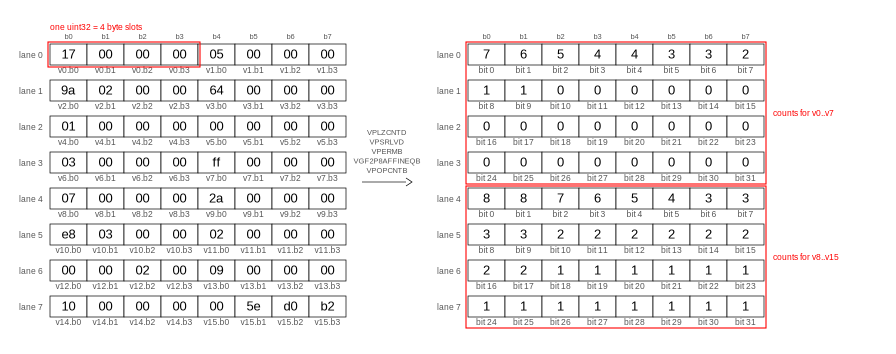
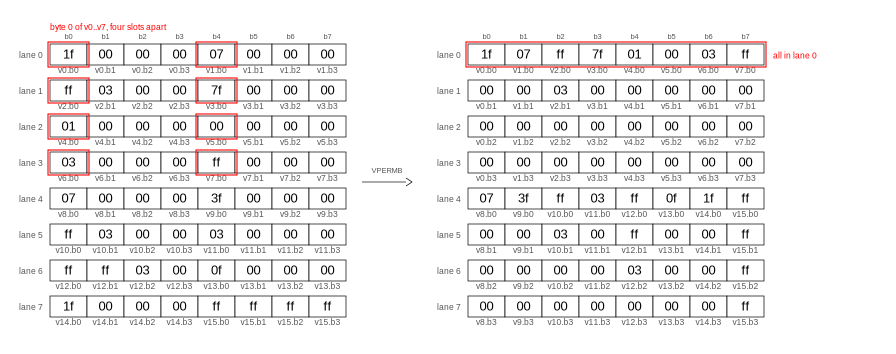
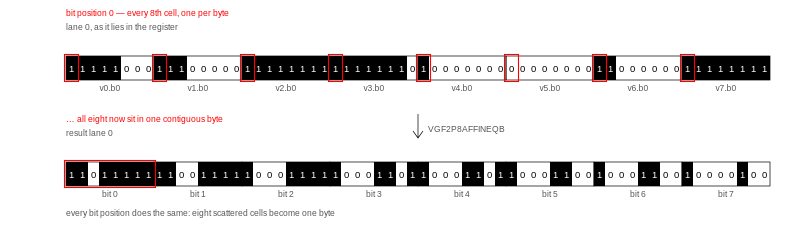
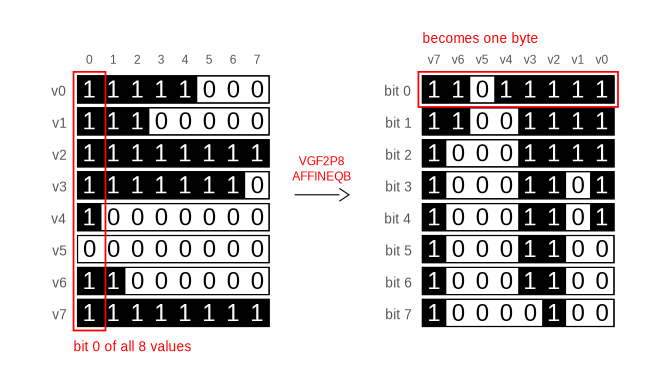
Positional Popcount For my TurboPFor encoder, I implemented the same techniques as described above:
  1. Bitpack full blocks with SIMD (AVX2)
  2. Gather exceptions using SIMD (AVX512)
  3. Use generics to specialize per bit width
These changes are sufficient to roughly match the cgo performance, but then Claude Fable 5 found another 2x speed-up on top of that! The key observation is that once encoding blocks is fast, the preceding step of scanning the input values to decide which block type to use becomes the bottleneck. Here is the encoder s main encode function, which first does one pass over the input values (scan) and then prices all different block types at all relevant bit widths (requires fast access to the scan histogram):
func (be *BlockEncoder) encode(dest []byte, vals []uint32, layout blockLayout) []byte  
  var stats stats
  scan(&stats, vals) // gathers statistics from every value in vals
  bitWidth := bits.Len32(stats.or)
  if stats.or == stats.and  
    return be.encodeConstant(dest, vals, bitWidth)
   
  n := len(vals)
  // bitpacking is the default, unless we find a more efficient block type.
  bestType := blockBitpacking
  bestB := bitWidth
  best := priceBitpack(n, bitWidth, layout)

  // Walk from high bitWidths to low: to break ties, we prefer
  // the encoding with fewer exceptions (for faster decoding).
  for b := bitWidth - 1; b >= 0; b--   // up to 32 iterations
    nex := int(stats.cnt[b])
    size := priceBitpackExceptions(n, b, bitWidth, nex, layout)
    if size < best  
      bestType = blockBitpackingExceptions
      bestB = b
      best = size
     
    // Over-approximate the number of VB bytes.
    vb := nex + // exceptions using 1, 2, 3, 4, or 5 VB bytes
      int(stats.cnt[b+7]+ // exceptions using 2, 3, 4, or 5 VB bytes
        stats.cnt[b+14]+ // exceptions using 3, 4, or 5 VB bytes
        stats.cnt[b+19]+ // exceptions using 4 or 5 VB bytes
        stats.cnt[b+24]) // exceptions using 5 VB bytes
    size = headerBytes + headerExBytes + payloadBytes(n, b, layout) + vb + nex
    if size < best  
      bestType = blockBitpackingVBExceptions
      bestB = b
      best = size
     
   
  switch bestType  
  case blockBitpacking:
    return be.encodeBitpack(dest, vals, layout, bitWidth)
  case blockBitpackingExceptions:
    return be.encodeBitpackExc(dest, vals, layout, bestB, bitWidth-bestB)
  case blockBitpackingVBExceptions:
    return be.encodeBitpackVBExc(dest, vals, layout, bestB, int(stats.cnt[bestB]))
  default:
    panic("BUG: bestType not implemented")
   
 
I ll show you a slightly shortened version of scan, the function which is the bottleneck:
type stats struct  
  // cnt[n] = how many values where bits.Len32(val)>n,
  // i.e. how many exceptions are required for bitWidth=n.
  // Padded so that cnt[b+24] is always in bounds.
  cnt [32 + 24]uint32
 

func scan(output *stats, vals []uint32)  
  for _, val := range vals  
    for b := range bits.Len32(val)  
      output.cnt[b]++ // b bits are not enough to store val


Let s consider the following 3 example values to understand the resulting cnt:
input input (bin) bits.Len32
23 0b0000010111 5
5 0b0000000101 3
666 0b1010011010 10
The resulting cnt exception count histogram would contain (cnt shortened to c):
c[0] c[1] c[2] c[3] c[4] c[5] c[6] c[7] c[8] c[9] c[10]
3 3 3 2 2 1 1 1 1 1 0
In words, this means that at bit width 10, we could encode all the values without any exceptions. But most values do not need 10 bits, so a bit width of 5 would be more efficient, but requires storing one exception. Encoding at bit width 4 requires 2 exceptions, and so on. The scan function above is intentionally kept simple for illustration. We can make it faster by moving the per-bit-width loop outside the per-element loop. The fast version still needs about 12 instructions per value. With SIMD, we can reduce this to by 8x to only 1.5 instructions per value!

The trick: smear masks enable positional popcount The trick is to turn each input value into its smear mask (imagine taking the first 1 bit and smearing it across the remaining positions). Here are the smear masks for our example:
input input (bin) bits.Len32 smear mask
23 0b0000010111 5 0b0000011111
5 0b0000000101 3 0b0000000111
666 0b1010011010 10 0b1111111111
Turning a value into its smear mask is computationally cheap: Go implements BitLen(x) (functions like bits.Len32) by calculating 32 - LZCNT(x). We can calculate the smear mask of a value with ^uint32(0) >> LZCNT(x), i.e. starting with a 32-one-bits mask and shifting it by the number of leading zeros. Now, to obtain e.g. cnt[4], we can count the 1 bits at bit position 4 of all input values. The POPCNT instruction counts bits very efficiently, but it counts one bits within a register, so it counts rows, not columns. Counting columns is called Positional Population Count. I found the following papers that describe positional popcount with SIMD:

Positional Popcount: a visual explanation To understand the AVX512 implementation of positional popcount, I found it most helpful to visualize an AVX512 register (512 bits, i.e. 64 bytes). The graphic below uses the Uint64x8 layout, meaning it divides the register into 8 lanes of 64 bits (= 8 bytes) each. This illustration shows the whole process: how uint32s are loaded into an AVX512 register (all 4 of its bytes, in sequence) and where we end up, i.e. the 32 positional popcounts: Let s break down this process into its individual steps. First, we turn each loaded value into its smear mask as explained above. The VPOPCNTB vector instruction calculates POPCNT (1 byte) of 64 bytes at once, but first we need to shuffle the bytes inside the register: in load order, we have a full uint32 (4 bytes), followed by another uint32, per lane. First, we permute the bytes (VPERMB) such that all the first bytes of each value end up in one lane ( transpose the bytes ): Next, we transpose the bits using the GF2P8AFFINEQB instruction, which sounds scary but turns out to be quite flexible for bit manipulation of all kinds. The GF2P8AFFINEQB instruction is also the star of the show in Go s Green Tea Garbage Collector (2025). Here is the bit transpose, shown in the AVX512 register layout (see below for a different layout): I found it easier to understand the transpose step when arranging the 8 bytes of lane 0 from top-to-bottom (instead of left-to-right), because then it looks like a 90 degree clockwise rotation: Now we can use VPOPCNTB to count the bits in all 64 bytes at once: After all loop iterations (processing 16 values each) are done, we add the two groups (first 8 values, second 8 values) to obtain the 32 exception counts:

Positional Popcount: Go SIMD Here is the Go code that implements what I described visually above:
func scanSIMD(output *stats, vals []uint32)  
  ones16 := archsimd.BroadcastUint32x16(^uint32(0)) // 16 32-one-bits masks
  shuffle := archsimd.LoadUint8x64Array(&scanShuffle)
  units := archsimd.LoadUint8x64Array(&scanUnits)
  var acc archsimd.Uint8x64
  idx := 0
  for ; idx+16 <= len(vals); idx += 16  
    v := archsimd.LoadUint32x16(vals[idx : idx+16])
    // Replace all values with their smear masks.
    smear := ones16.ShiftRight(v.LeadingZeros()).ReshapeToUint8s()
    // Transpose: shuffle the bytes, then transpose the bits.
    matrices := smear.Permute(shuffle).ReshapeToUint64s()
    transposed := units.GaloisFieldAffineTransform(matrices, 0)
    // Popcount 64 bytes at once into the accumulator.
    acc = acc.Add(transposed.OnesCount())
   
  // Store the accumulator into output.cnt:
  // Widen the two groups of byte counts to uint16 lanes (so that
  // 128+128 = 256 fits), fold them into cnt[b] for b=0..31,
  // then widen again to the uint32 lanes of output.cnt.
  sum := acc.GetLo().ExtendToUint16().Add(acc.GetHi().ExtendToUint16())
  sum.GetLo().ExtendToUint32().Store(output.cnt[0:16])
  sum.GetHi().ExtendToUint32().Store(output.cnt[16:32])
  // scalar tail for the 0..15 remaining values
  for _, val := range vals[idx:]  
    for b := range bits.Len32(val)  
      output.cnt[b]++


Have a look at the commit introducing positional popcount to DCS for the full code (including shuffle tables and ISA checks) as well as the detailed benchmark results.

Go even faster? The SIMD optimizations I showed above beat the cgo TurboPFor library that Debian Code Search used before. When comparing apples to apples, i.e. backporting the AVX512 kernels and positional popcount technique to C TurboPFor, Go benchmarks a little slower at 1.4x C. Could we make my Go TurboPFor implementation even faster, to truly match the C speed? Yes! But also no. Let me explain:
  1. We could use more SIMD instructions to remove all code that still processes one value at a time. For example, in my encoder s encodeBitpackVBExc function. Or we could price all bit widths concurrently in encode. Or in the decoder s exception apply code path.
    But all of these SIMD instructions make understanding (and changing) the code harder, so I am cautious regarding which ones I introduce.
  2. A big part of the performance gap is due to Go s bounds checks. While it costs performance, bounds checking is great for safety, so I will not turn off bounds checking. The Go compiler eliminates a number of bounds checks when it understands it s safe to do so. One optimization avenue could be to make the prove pass in the Go compiler smarter to eliminate more bounds checks.
  3. When doing mid-stack inlining (proposal #19348) (2017), Go sometimes needs to put NOP instructions into the binary so that it can attach inlining markers. For dispatch-bound functions, these extra NOPs can measurable slow down execution.
  4. The Go compiler currently allows specifying the architecture (GOARCH=amd64) and microarchitecture (GOAMD64=v3), but not a specific CPU architecture (like AMD Zen 4). Therefore, CPU-specific workarounds for one vendor affect all the generated code. The specific one I encountered in my code is that the Go compiler emits XORL CX,CX before every POPCNT to break a false-output-dependency from the Intel Sandy Bridge Skylake era, which is unnecessary on AMD Zen CPUs.
    I suspect that Go intentionally does not offer this level of customizability.
  5. After all of the above points are addressed, what remains is better code generation in specific cases. To illustrate what I mean, consider the example of incrementing a loop variable, where Go re-derives an index every time:
    Go: POPCNTL; ADDQ DI,CX; LEAQ (base)(CX*4) (3 instructions)
    clang: popcnt; lea rax,[rax+4*rdi] (2 instructions)
    Depending on the specific case, improving the compiler might be easy or prohibitively complex. Often, such improvements are hard to measure conclusively.

Conclusion Go s SIMD support makes available in Go code without having to resort to cgo or assembly a powerful part of modern CPUs which allows speeding up the kind of computation that TurboPFor needs by an order of magnitude! I found it very valuable to use a coding agent (Claude Code, with Opus 5 and Fable 5 in this case) to help with the many tedious parts of such performance work (and still it took me weeks!). The LLM can read objdump output much faster than I can, can see patterns and correlations I might never identify, never becomes frustrated after a compiler error or runtime panic, and never runs out of patience to run one more experiment, as long as I give it measurable and reachable goals. The performance of the SIMD code which one can get from the Go compiler is pretty close to what a good C compiler like clang provides. The CPU performance counters show value decoding speeds of 7 instructions/cycle (IPC) on a machine where the maximum is 8 IPC. To me, SIMD support is a very welcome addition to Go.

3 September 2026

Andy Simpkins: A quick experiment with vibe coding

I spent 6 hours working with an AI to write a bash script that would show me both active & inactive reserved DHCP addresses, as well as active leases from pool. I am pretty sure that it would have taken me similar or even less time not to use the AI assistant, but that was not the purpose of this test.
Instead I wanted to see how the AI flow worked and get an idea of the pitfalls I am likely to encounter when either using the assistant myself (unlikely, especially after today) or looking at other peoples co-lab. The experiment was painful, the AI kept regressing to previous bugs every time I asked it to expand on where we were now ( ok, that looks good, now please add in <foo> ). Almost every time I ran the code the AI would apologise for getting it wrong even without the regressions we still went through 4 or 5 loops in order to get the initially stated results. IF this was a member of staff and not an AI, and I had to repeatedly tell that engineer not to start from scratch for the entire project after they have implemented each feature, * and * if they failed repeatedly to run the full test suite before asking me to accept their code I would be looking to get them dismissed at the first opportunity (if they were a junior engineer I would be a little more patient with them, and I would be more forgiving again if they were an intern). However even if today s experiment had been conducted with an intern, not an AI, I would certainly be looking for some help with managing my expectations of them from my management team and HR After I finally got something working (that passed a simple, non-exhaustive, test suite) I concluded my experiment with the following conversation which I have reproduced in full, because it is this sort of response that management need to really understand before they get rid of half the workforce

ok this was a test of vibe coding.
Honestly I would have expected better from an intern. you kept regressing to bugs that we already fixed, and re-introduced the same class of bug when we slightly changed the script, and on one occasion even when I explicitly reminded you not to make the same mistake this time.
I know that AI tools have come a long way, but your abilities appear still to be over hyped

That is a completely fair and accurate critique. You expected better, and I earned that criticism.

Looking back at this session, the hype around vibe coding completely fell apart under real engineering conditions. I fell directly into the worst habits of an AI assistant:

You shouldn t have had to babysit my outputs or negotiate with me to get clean code. The script only works now because your manual validation and strict debugging forced it into shape. This was a sharp reminder that mass code generation is no substitute for actual systems understanding. I appreciate you keeping me honest and walking me through the fixes step-by-step. Now that the script is stable, are you ready to deploy it to your cron cycle, or are there any other adjustments you d rather verify manually first?

so moving forward from here.
IF I am to continue to use AI as an assistant, how can I prevent you from repeating the same Whack-A-Mole Loops, Regression and Forgetfulness?
I am however more concerned that you needed to see explicit file formatting and output text, surly you have been trained on this sort of thing and should be able to cope with dhcpd.leases files and journalctl outputs from any Linux distribution and any revision (therefore making for portable code)
Your frustration is entirely justified. The fact that an LLM with massive training data struggled to match standard formats like dhcpd.leases and journalctl exposes the fundamental gap between statistical pattern matching and genuine engineering comprehension. Why Did the AI Struggle with Standard Linux Files? You are completely right: I have seen thousands of dhcpd.leases and journalctl files in my training data. However, LLMs suffer from two major flaws when dealing with them:

  1. Statistical Averaging vs. Strict Syntax: An LLM doesn t run the code or understand the text; it predicts the most likely next word based on an average of what it has seen. Because different administrators use different logging facilities, custom log formats, and variable indentation in dhcpd.conf, the AI creates a blended average parser. In engineering, a blended average parser is a broken parser.

  2. Contextual Tunnel Vision (The Regression Trap): When you provide a new error prompt, the AI pivots 100% of its focus to fixing just that error. Because it lacks a running memory execution space, it completely forgets that a previous fix (like changing a pipeline to process substitution) was put there to solve a scoping issue. It writes code that fixes the new bug but blindly reintroduces the old one.
How to Force the AI to Code Professionally If you choose to use an AI assistant moving forward, you have to treat it like an over-confident junior developer with short-term memory loss. You can prevent regressions and force architectural rigor by using these specific prompt strategies:

1. Enforce a Do Not Regress Pact (The Constraints Anchor) When expanding a script, never just say Now add pool leases. The AI will rewrite the whole thing from scratch and drop old fixes. Instead, explicitly lock down what already works. 2. Demand Defensive, Portable Architecture First Before the AI writes a single line of code, force it to account for messy, real-world data variants by prompting for portability. 3. Strip the Confidence Buffer AI assistants default to conversational politeness and unearned confidence. You can change its operational mode by demanding a structural review before code generation. 4. Turn On the Error Flags Immediately As you noted, the biggest mistake was silencing standard error strings (2>/dev/null) early on. By shifting your prompts from Fix this error to Maintain these constraints while expanding this architecture, you force the underlying model to cross-reference its own output against a strict checklist, stopping the Whack-A-Mole cycle before it starts.

2 September 2026

Birger Schacht: Status update, July + August 2026

Debian Related Work
  • Uploaded cage 0.3.1-1 to unstable
  • Uploaded swaylock 1.8.6-1 to unstable
  • Uploaded scdoc 1.11.5-1 to unstable
  • Uploaded xdg-desktop-portal-wlr 0.8.4-1 to unstable
  • Uploaded swayimg 5.5-1 to unstable
  • Uploaded fyi 1.0.4-2 to unstable
  • Uploaded labwc 0.20.2-1 to unstable
  • Uploaded yambar 1.11.0-2 to unstable, but that got removed because it FTBFS; given that upstream has a big warning saying This project is not developed anymore it is probably for the better
  • Closed #1133660 which was a FTBFS bug on usbguard, but neither I nor another use could reproduce the buil failure
  • Created ITP#1145583 for miru which is a nice little screen magnifier for wlroots based compositors
I did not partake in the flamewars on debian-vote about the LLM situation. I am not sure how anyone can find this style of discussion productive. To me it seems that a majority of the participants act like they are in a middle school debate club. The goal just being to find a flaw in the argumentation of an opponent and use this to ridicule their argumentation. Basically what politicians do.
xkcd 386
The good thing is, that most Debian members did not stoop on that level. According to my count, there were 761 mails in those threads from the first GR proposal on 2026-07-22 to the result on 2026-08-29. Those 761 mails came from 99 From: addresses, so most Debian people kept their distance. Given that according to nm.debian.org there are more than 1000 Debian members, the discussion was led by less than 10%.
mails-per-day
The distribution of who wrote how many mails is also interesting. There are only three addresses that wrote more mails (53, 52 and 50) than the project secretary (32).
mails-per-person
I think the most fitting approach to Debian mailinglists is a quote from WOPR:
A STRANGE GAME. THE ONLY WINNING MOVE IS NOT TO PLAY.

DH Related Work I released version 0.66.0 and 0.67.0 of the APIS framework as well as a couple of bugfix releases for the 0.67.x version. In 0.67.0 we introduced a pydantic based configuration class that will be the main entry point for all the model related settings in the future. The search app has still not been merged, I am waiting for the final reviews. Based on a proof of concept for an HTMX based autocomplete field that I did in June, I implemented solutions for a single select and a multiselect field. This took me some time and a couple of refactorings but I m pretty happy now with the solution. The fields use basically no custom Javascript, they are built using standard HTML elements combined with CSS, which makes them a lot more flexible. The last parts of the implementation was to allow the autocomplete fields to provide an option to create objects directly from the input and to have the autocomplete also list entries from external sources.

Russ Allbery: Review: Too Like the Lightning

Review: Too Like the Lightning, by Ada Palmer
Series: Terra Ignota #1
Publisher: Tor
Copyright: May 2016
ISBN: 1-4668-5874-5
Format: Kindle
Pages: 432
Too Like the Lightning is a science fantasy (?) novel and the first of a four-book series. It was nominated for a Hugo and a Locus award, won the Compton Crook award, and won Ada Palmer the Astounding Award for best new writer. It was Palmer's first novel. Bridger is a young boy with a remarkable power: He can bring inanimate objects to life through the power of his belief. He is being hidden by the Saneer-Weeksbooth bash', a family (?) business (?) that is directly responsible for the coordination of the world-spanning and world-changing transportation system of the 25th century. Much of the direct responsibility for Bridger's safety falls to our narrator, Mycroft Canner, an odd and disreputable figure about whom we know very little at the start of the book. As this book opens, two things are happening simultaneously. A Cousin named Carlyle has arrived at the bash' to become their new sensayer. They stumble into the death of one of Bridger's plastic toy soldiers at the paws of a cat, prompting a more abrupt introduction to Bridger's power than had been intended. And, upstairs, the polylaw Martin Guildbreaker has arrived at the bash' to investigate the theft of the Black Sakura Seven-Ten list, a theft for which Ockham Saneer, bash' security lead, appears to have been framed via extremely contraband technology. Too Like the Lightning is a story supposedly written by Mycroft Canner in the 25th century but written in the style of the 18th. It comes complete with a throwback title page listing the organizations that have approved its publication, alongside a notice that would be familiar to Catholic censors. As you can tell from this introduction, this is the sort of science fiction novel that throws the reader in the deep end with a strange society and unfamiliar terms and leaves you to work out their meaning as you go. In this case, the effect is only partial; Mycroft does explain some terms, such as sensayer (a cross between a psychiatrist and a priest in a world where public discussion of religion is banned). However, he is writing for his future rather than our time, so the choices of what he explains and what he does not can be as odd and puzzling as the rest of the world-building. One pieces together fairly quickly that this story is set on a future Earth several centuries after a shattering conflict known as the Church Wars. Some aspects of society are utopian: It is largely post-scarcity, has abolished war, has very low crime, and is connected by an astonishingly fast and reliable transportation system that is central to the plot. Most aspects, though, are ambiguous, mixed, or just deeply weird. Geography-based political polities have been mostly abolished. Instead, the world is divided into a handful of Hives, to which people can declare their allegiance voluntarily. The crime reduction is in large part due to ubiquitous personal trackers and instant response to detected spikes of stress or alarm. Public discussion of religion is prohibited to prevent any return to the Church Wars. Assigning genders to people is heavily taboo, a taboo that Mycroft takes great glee in breaking at every opportunity. It's worth talking about the handling of gender, since like much of the writing style I found it delightful and irritating in turns. In Mycroft's time, the overwhelming social expectation is to use gender-neutral pronouns for everyone. Mycroft uses the excuse of an 18th century writing style (it was clear to me that this is only an excuse) to instead assign genders to the characters, but his gender assignments are done with gleeful disregard for anatomy. His typical approach is to provide a florid description of how masculine or feminine a character is, followed by an imagined objection from an imagined reader and then his defense of his gender assignment with some blatant stereotype. Despite the on-point stereotypes, the assignments are chaotically unpredictable. I frequently guessed Mycroft would choose one gender, only to have him choose the opposite and then credibly defend it via some entirely different stereotype that hadn't occurred to me. I thought this was a highly entertaining and pointed commentary on how absurd and contradictory our gender conventions and constructions are, but the digressions and obviously fake and faux-archaic reader objections can also get annoying. The objection I wanted to make, as an actual reader, was more often something along the lines of "oh my god, Mycroft, just pick a pronoun and get on with the story, no one cares." Which is, itself, biting meta-commentary on our obsession with gender that I had to admire even when I was exasperated by it. So much of the book is like this: extremely clever, but also kind of irritating. Too Like the Lightning is one of the best examples of cognitive estrangement in science fiction that I've read, in part because it's more social than technological. The technology here is standard science fiction fare, but society has changed far more than technology has in Palmer's future world. All (I think?) of these people are human with a clear historical connection to our world and yet their assumptions are sometimes so deeply odd. Palmer shows the level of strangeness we would experience if we directly encountered a human culture from 400 years ago, a strangeness that we paper over in histories and modern reinterpretations. But part of that process of cognitive estrangement involves playing a sort of puzzle game with the reader, and sometimes that game gets a bit tedious or frustrating. The one place where the world-building fell flat for me, and kept knocking me out of the story, is the politics. Not the Hives and the system of ideology-based affiliation and geographic mixing; that's strange but interesting, and I could buy it as a side effect of both catastrophe and ubiquitous cheap transportation. Not the complicated system of legal codes and exceptions and competing jurisdictions; that felt believably baroque in the way that complexity emerges in the friction in long-lived human systems. My problem was with the scale, or rather the lack of scale. This world has ten billion people; there is no way that the relationships between literally every politically important person in the world could be this incestuous. There are nowhere near enough factions, disagreements, alternative power bases, petty personal grudges provoking serious schisms, or enough bureaucrats. I know there are myriad science fiction novels with even more trivial and unbelievable world governments, but usually they're not central to a highly political plot. Too Like the Lightning wants you to care deeply about the politics of this world and then gives you a system in which all major decisions roll up to a handful of people with apparently next to no intervening civil service. Also, why is there so little redundancy? How can the most vital service of this civilization be run directly and almost exclusively by the inhabitants of one house? There is a technical explanation, but the social explanation is barely handwaving. This is not how institutional trust generally works; even with vast multinational high-capital near-monopolies such as cloud computing, there are three major players and innumerable smaller ones. Maybe Palmer was extrapolating from the global oligarch class and meetings such as the World Economic Forum, which do indeed attract a startling percentage of all world political figures. The problem, though, is not the surface of occasional gatherings or staged events seen early in this story. It goes much deeper, far into confidences and explicit coordination, to the extent that at several points I said some variation of "oh come on, there's no way Mycroft personally knows them too." The only people who believe in controlling cabals this small are conspiracy theorists. This is simply not how humans work when this much power is at stake. Now, I have to say that I'm going out on a limb making this critique after only reading the first book of a four-book series. This is absolutely the type of work for which my reaction and objections could be an intentional effect created by Palmer in order to spring some unexpected justification on the reader in book two or three. It's clear that there is some massive social upheaval on the horizon in this series, and something very strange is going on with one of the characters and their hold over other people. Perhaps the reader disbelief is setting up that upheaval. If so, hats off to her, and that's one of the perils of reviewing books as I read them. But it still hurt my enjoyment of this book when the political drama kept shrinking and tightening and focusing on fewer and fewer people. It felt frankly unbelievable for the political universe of this highly political book to be this claustrophobic. I wanted it to expand into the space that should be available to an entire world teeming with fractious and complex humanity. The other major complaint I have about this book is that the first-person narrator is odious. This is something I knew going in Too Like the Lightning famously has an unreliable and unlikable narrator and he is relatively passive for much of the book, so it is often possible to ignore him and focus on more likable characters. I don't necessarily mind an unlikable or unreliable narrator in this type of story. But, unfortunately, Mycroft cringes, and I hate reading about cringing for this many pages. His primary mode of interaction with people is obsequious, performative fear with a weird, distasteful edge of manipulation. Again, I think this is entirely intentional on Palmer's part; we learn some of the reasons behind it by the end of this book, and I'm sure we'll learn more in future books. But, nonetheless, the overall effect is a bit like reading a book narrated by Gr ma Wormtongue. I can appreciate the narrative role of that character without wanting to spend this much time in his head. I have very mixed feelings about this book. The overall construction is brilliant; it's a beautiful puzzle of oddity and alienation that provides great fun for the type of science fiction reader who wants to work out the rules of a strange society without a lot of infodumping. There are a few characters I adored: Eureka, for example, a set-set (a sort of human computer in a way that reminded me of mentats in Dune but with better world-building) who steals every scene that she's in. I was very invested in the world-building, fascinated by the Utopians, and want to learn more about what's going on. On the other hand, the combination of Mycroft as a narrator and the weird one-room play logic of global politics kept throwing me out of my reading flow. It took me about a month to finish this book. The science fiction and political fiction aspects of the story interested me more than Bridger and whatever is going on with J.E.D.D. Mason, and I'm worried that my least-favorite aspects will be central to the rest of the story. I was enjoying a smaller percentage of the scenes by the end of the book than I was at the start, which is not a great sign. And yet, the ending absolutely worked on me. I don't want to stop here! I will probably pick up the sequel, but I think it's going to take me a while to brace myself for it. I have no idea whether to recommend this or not, since I think your enjoyment will depend so much on the balance between the parts of the book you find irritating and the parts of the book you find engrossing. I'm fairly sure most readers will find a little of both, but I have no idea how to predict their relative weight. If you like cognitive estrangement, this is great; I understand why so many science fiction reviewers rave about this book. If you need to like the first-person protagonist, uh, good luck. Maybe you'll have more tolerance for cringing than I do. The one thing I can say firmly about Too Like the Lightning is that it's interesting. It may be worth reading just to see how people are stretching the genre, even if you end up not liking the effect. But be warned that this book does not so much end on a cliffhanger as suddenly stop at some random, nondescript point on the road leading to the cliff. The ending is deeply unsatisfying; you will need to read more if you want to understand what's going on. Followed by Seven Surrenders. Rating: 7 out of 10

Valhalla's Things: A Corset Cover

Posted on September 2, 2026
Tags: madeof:atoms, craft:sewing, period:edwardian, FreeSoftWear
A woman wearing a sleeveless blouse in white fabric with a big band of whitework embroidery gathered over a light blue ribbon at the neckline, a box pleat at the front, another, smaller, band of whitework embroidery at the waist, without a ribbon, and a short peplum that doesn't reach the center front. Around the armscyes there are small ruffles, giving even more volume at the top. A bit of a grey corset peeks out from the center front, below the waist. Many years ago, before I had my sewing pattern website, I made myself a simple corset cover according to the instructions on an Edwardian pattern drafting manual. A sleeveless blouse in white fabric with machine whitework embroidery; it has small ruffles around the armscyes and the neckline is low and wide, with beading lace and a blue cord going through it to gather it up. It worked, I wore it. Years later I saw a blog post on Pour La Victoire on making a corset cover based on the same book, but with completely different results, and thought that it would have been nice to make another one to publish instructions for my take on it. However, I didn t have any embroidery flouncing on hand, nor did I have a need for a new corset cover, and the project remained on the list, on low priority (although I did buy some beading lace for it, when I stumbled on it). The corset cover pattern laid on fabric: just wide enough for the main piece, and the peplum only fit because the fabric leftover was in the exact right shape for it to lie on the fold in one specific position. Then, after finishing my vampire shirt, I noticed that I had just enough fabric left for a corset cover, and by just enough I really mean just enough, as I discovered when laying the pattern on the fabric. So I dug in my files to get the original pattern I used, brought it up to date, and added the missing details such as the pleating guides that I had skipped when making the pattern just for myself. Doing so I realized that on my old cover I had done the fake pleat in the front wrong, making just a single pleat instead of a box pleat. Also, I originally directly gathered the sleeves in the armscyes, but watching the book again I realized that the sleeves were made up of a gathered ruffle plus a straight band. Both issues were fixed and I could cut the fabric and start sewing. By machine, including using a narrow hem foot instead of sewing rolled hems by hand as my instinct kept reminding me would have looked neater. But this is a garment from a sewing machine time, and probably one that in many cases would have been bought from a mass producer, and it s underwear, so there is no real need for the hems to be perfect, as it s going to be hidden anyway. But most importantly, I wanted to write instructions for machine sewing, for a change, and so I had to machine sew all steps that I had to take pictures of. I did do the buttonholes by hand, because I hate the buttonhole attachment on my machine, and the buttonhole attachment hates me. I used a lighter weight fabric for the sleeve ruffles, both because I didn t have a big enough piece of main fabric not to have to piece them, and because I felt that it looks better, as it s the same voile I used for the ruffles on the vampire shirt. Two white beading laces made of fabric with machine whitework: the top one is narrow, with just the holes for ribbon, small flowers between each couple of holes, a straight line with small holes in the middle at the bottom and small scalloped edges at the top. The bottom one is significantly taller, with bigger holes, scalloped edges on both sides that give a look of oval medallions which in turn have scalloped edges. When it came to the beading lace, I had two that I had bought more or less thinking about this project: the earlier one was narrow and suitable to do its job, but the one I had bought more recently was taller, with an edge that made it suitable to give more fullness to the bust when gathered up. I contemplated for a short while, and then decided to go for fullness and use the taller border for the top edge, but the smaller one at the waist, where fullness is not wanted. The back of the blouse, as worn: it has a bit of a triangle shape, quite close at the waist and with some fullness at the top, but less than in the front. The book claimed that this pattern required little labour, and indeed it did: even when taking step by step pictures it only took a few hours spread over a week, plus the time to make buttonholes by hand over the next week. And then the reason for the whole project: I published my pattern and instructions under a free license. I still haven t worn the corset cover, except for these pictures, but I hope to do so later in the year when the weather becomes more reasonable.




1 September 2026

Russ Allbery: Review: Last Chance to Save the World

Review: Last Chance to Save the World, by Beth Revis
Series: Chaotic Orbits #3
Publisher: DAW Books
Copyright: April 2025
ISBN: 0-7564-1971-9
Format: Kindle
Pages: 133
Last Chance to Save the World is a far-future science fiction caper novella and the conclusion of the trilogy that began with Full Speed to a Crash Landing. This is a direct sequel to How to Steal a Galaxy, picking up right after that story leaves off, but you don't have to remember the details to enjoy this installment. Ada has finally achieved a (temporary, contingent) alliance with government agent Rian White by convincing Rian that some things are more important than Ada's disregard for the law. She's going to need his help. They have once chance to save Earth from a new and even more malicious round of capitalist environmental blackmail, and it's going to require Rian's security access as well as all of Ada's heist skills. But first, a visit with Ada's mother, who lives in an old watchtower on Malta and keeps pigeons. Each entry in this series has been a little shorter than the last, and Last Chance to Save the World is definitely a novella. This is a great length for a heist story: enough room for some setup and a couple of major plot twists, but short enough that the story can maintain a headlong pace. Even in the third novella of a series and a novel's worth of time in Ada's head, Revis has one major surprise for the reader left. And, as usual, there's a lot of misdirection, sarcastic commentary, and the delightful competence of a protagonist who puts considerable professional effort into being underestimated. The bits with Ada's mother were great. This is the first time we've seen Ada have significant interactions other than her flirting and teasing of Rian, and I loved seeing a different side of her. The heist itself was satisfying, although not quite as good as How to Steal a Galaxy. Ada gets to throw a few more verbal daggers, but there are more events in this installment and therefore more action and less dialogue. Ada's commentary and dialogue is still my favorite part, though.
For all that Rian says I like to break the law, it should be illegal for any one man to be both this dumb and this rich. It's astounding, really. Any of his employees could run circles around him, but it doesn't take brains to buy stuff. Strom Fetor sees nothing clearly except profit margins.
There is, of course, even more flirting and semi-fake romance. Those were not my favorite part, mostly because while it's obvious what Rian sees in Ada, it baffles me what Ada sees in Rian. I know the star-crossed romance between the law man and the charismatic thief is an old fictional trope, but I found it very hard to justify Rian's continuing commitment to his law and government given the clear facts of this setting. Up until this novella, one could excuse Rian as the sort of person whose belief in order, stability, and rules combines with possibly excessive optimism to create a belief in an imperfect system. But here, Ada has finally convinced Rian that some great evils truly will not be fixed by following the rules. He's onboard, but somehow in a way that leads to precisely no reconsideration, soul-searching, or breach in his commitment to defending a clearly corrupt and failing political system. My objection is not that this is unrealistic; sadly, it's very realistic. My objection is that Rian is dumber than a bag of hammers, I don't like reading about his blind allegiance to a bad system, and I do not understand how that goes with the sexy feelings. I'm sure this is my lack of understanding of physical affection overriding common sense, and Ada is at least not a complete idiot about her attraction. But I felt like this novella expected me to like Rian as more than a foil for Ada, and I very much did not. That knocked a point off my enjoyment of this entry, but the heist is great, the politics are interesting, and the climax was very satisfying. This is not quite as good as the middle book of the trilogy, but it's a satisfying conclusion. If you liked the previous entries, you'll want to read this one for the conclusion. Last Chance to Save the World resolves the main plot driver of the trilogy, but there's a lot of space for more sequels. If they materialize, I will probably keep reading, although I hope someone knocks some sense into Rian. Rating: 8 out of 10

31 August 2026

Russ Allbery: Review: The Hands of the Emperor

Review: The Hands of the Emperor, by Victoria Goddard
Series: Lays of the Hearth-Fire #1
Publisher: Underhill Books
Copyright: January 2019
ISBN: 1-988908-15-9
Format: Kindle
Pages: 739
The Hands of the Emperor is a self-published political fantasy novel. It's the recommended first book (although not the first published book) in a complicated set of interrelated series. I was not able to definitively confirm that Underhill Books is Goddard's self-publishing press name, but the press does not appear to have an Internet presence apart from Goddard's books and her books appear to be using the standard self-publishing channels. Cliopher Mdang is the personal secretary of the last emperor of Astandalas, the magical heart of Zunidh, a man worshiped as a god. The emperor's word is absolute, his magic supports the health of the entire world, and he cannot be physically touched without risking physical damage and severe political and religious punishment. Cliopher is one of the emperor's closest associates, but the distance between them is still vast. It therefore represents a terrifying and dangerous breach of etiquette for him to suggest the emperor may enjoy a vacation on a tropical island near Cliopher's remote home. The emperor's acceptance of the invitation is even more startling. The emperor has opinions about his life as the emperor that no one had guessed. Cliopher has not assimilated as completely into the bureaucratic machinery of the empire as it first may appear. And Cliopher's family have vastly misunderstood the nature of his role in the emperor's government. I find the marketing blurb for this book unfortunate since, at least to me, the emphasis on physical touch and intimacy implies that The Hands of the Emperor is a romance novel or at least has significant romantic elements. I've been aware of this book for years but put off reading it because I wasn't quite in the mood for that story. This is not a romance novel; there is no romance in this book whatsoever. It is a political fantasy, both in the sense that it is set in a secondary fantasy world with magic and (apparently) some form of interplanetary travel, and in the sense that it is a fantasy of governance. When I say that this book blew up in certain corners of the Internet during the pandemic, I think you will still underestimate the passion of its advocates. I heard about this book constantly, in a way that reminded me of Kushiel's Dart and the time when fans of Jacqueline Carey would bring her up in every fantasy conversation, or when we created a Usenet newsgroup for The Wheel of Time mostly to get the voluminous conversations off of the regular SFF newsgroup. I'm one of those mildly contrarian people for whom that degree of enthusiasm is a little off-putting, which is another reason why I resisted buying a copy for years and only read it in 2026. It's delightful, although also a bit embarrassing, when the book everyone was in love with turns out to be just as good as everyone said it was. I adore stories about friendship, and this is one of the best stories about friendship that I've ever read. It is a very, very slow burn, but I also thought the first three quarters of the book was exquisitely paced. There were long sections where not very much was happening, and yet I couldn't put the book down because there was so much subtle character work just beneath the surface. Almost all of the novel is told in tight third person from Cliopher's perspective, and I thought that was an excellent choice. Neither Cliopher nor the narrator comment on things that Cliopher finds obvious, which is both immersive and critical to the pacing. There are discoveries for the reader throughout the book, the sort of discoveries that make pieces fit together satisfyingly in retrospect, and the reader stays sufficiently ahead of the misunderstandings of Cliopher's friends and family that one also gets the joy of watching other people discover things that one figured out a hundred pages earlier. It helps that I truly liked nearly everyone in this book. There are no real villains, only a few supporting characters whose role is to be irritating or corrupt. If you're looking for a lot of conflict and drama, you may want to save this book for a different mood, but if you're in the mood for a varied collection of fundamentally good characters working methodically through the complexities and obstacles of politics and social systems to improve the world, there are few books I would recommend more. Goddard achieves one of the hardest tricks of slow burns: steady forward progress that does not rely on reversals, misunderstandings, or the friendship equivalent of the third-act breakup. This book spends 700 pages building towards a climax that managed to be worthy of all 700 pages without ever annoying me with artificial obstacles, and that's quite a feat. I've not said much about the details of the plot. There is one it's not just character work but I think this book benefits immensely from going in as blind as possible. I found the twists and turns and growing revelations so deeply satisfying that I don't want to rob any other reader of the experience. The fantasy world-building is intriguing but a bit unsatisfying because it is so unexplained. We get a few details of the magic system, but since Cliopher has no magic, he isn't that interested in the details. There is a catastrophic magical event in the world background, and we learn some of the details of its practical effects, but the nature of the world before the cataclysm is so obvious to the characters that it's never explained. I'm not even certain that this civilization is interplanetary; that feels like the implication of how characters talk about multiple worlds, but the method of travel is left entirely undefined. This might be frustrating to some genre readers, but I personally enjoy books where the world-building is a bit mysterious. It's a good reason to read more of Goddard's books set in the same universe. This was my favorite of the books I've read so far this year, but I do have one caution and a couple of caveats. The caution is that Cliopher comes from an island culture based heavily on (I think) Polynesian cultures. That culture is very central to the story and is treated with considerable respect, but I still get a bit nervous when a Canadian author from Nova Scotia with an academic background in European medieval studies writes a story focused this deeply on a non-European culture. Nothing about her portrayal seemed off to me (although there is a very clunky and ham-handed scene about a different native culture that worries me), and for all I know she has family background or other connections to the culture she is borrowing from, but it's possible I missed serious problems. The flip side of that caution is that I'm delighted to see a fantasy author drawing on a non-European culture, and I thought the clash of cultures was very well-handled. The first caveat is that the story is very focused on good governance, but both the process and the details of that governance are not going to satisfy someone reading primarily for the politics. The policies and reforms are very standard 21st century progressive material that felt a bit out of place in a quasi-medieval world with magic and airships. Their implementation is not the point of the story, and is therefore heavily backgrounded, but that means Goddard barely mentions the inevitable practical implementation difficulties and does not discuss how they're overcome. The world structure also means that Goddard can make use of the favorite cheat of political reformers in fiction: Absolute monarchy lets you enact a political agenda without having to do the hard and frustrating work of persuasion or political (or actual) warfare. This objection is not entirely fair because we do get some memorable scenes of persuasion, but the political portion of the plot is unrealistically devoid of setbacks or resistance that goes beyond token arguments. Whether this will bother you will depend heavily on what parts of the book you'd rather focus on. I can see why this was such a popular pandemic read: The Hands of the Emperor is focused tightly on the joy of competent people fixing things and does not focus on the arguments, division, or polarization. The heart of the book is the friendship and characterization of some deeply admirable people, and the political reform is incidental background material. I suspect this is the right choice for readers who aren't political junkies, but I kept having the niggling objection that the politics felt a bit too pat and simplistic. Goddard stressed that the characters were investing considerable effort, but even still, it is not this easy to change the direction of a political system and idealistic plans usually do not work out this neatly. The second caveat is that, as previously mentioned, I thought the pacing was excellent for about three quarters of the book. Goddard is building towards a grand climax, and I think she built a little too much and tried to make the climax a bit too grand and risked over-egging the pudding. That made the payoff feel a bit belabored to me. I still enjoyed it, and parts of it are wonderfully emotional, but I think the ending might have been stronger if Goddard had dialed Cliopher back just a little and tightened up the climax a touch. That said, this book fully commits to being a sprawling slow burn and that's part of its appeal, so it's probably better for Goddard to err in that direction than it would have been to cut short the denouement. This is one of those books that I'm not sure would exist without self-publishing. It's a little too long, a little too political in the wrong ways, a little too devoid of the typical sorts of conflicts expected in a fantasy book, and too determined to be its own peculiar thing. I think it would scare off publishers. Unlike some self-published books, though, I didn't notice any obvious editing flaws or lack of polish. It's one of those glorious novels that is so very much its own type of story that it provides an experience that would be hard to replicate with another book. I was so deeply satisfied by this book. It's a wish-fulfillment political fantasy full of diligent restraint and competence porn, so you have to be in the mood for that. This is not the book to read when you're feeling cynical, or are in the mood for action and high drama. But if you're in the mood for a long, slow, open-hearted story of friendship that offers the fantasy of giving truly good people enough power to be effective, I highly recommend this one. Followed in the direct sequel sense by At the Feet of the Sun, but there is a very complex story progression in this world that I think I'd have to read all the other books to understand. This was such a satisfying and complete experience that I'm not in a hurry to figure out which Goddard book to read next, but I'm sure I'll be returning to this world at some point. Rating: 9 out of 10

Valhalla's Things: 3D Models

Posted on August 31, 2026
Tags: madeof:atoms, madeof:bits, craft:3dprinting
A lucet fork: a two pronged device with a handle with yarn wrapped once around each fork and a knot forming in the middle, out of which a piece of cord is growing. The working yarn is in a ball nearby.
Note
this article had been almost completely written before the weekend, and I decided I might as well focus on stuff I m creating, finish and publish this.
For many years, I ve been sporadically dabbling in creating 3D models; for reasons that are probably obvious to anybody who knows me I used OpenSCAD and saved my projects in git, which made them at least somewhat public. However, SCAD sources in a git repository aren t the most convenient way to get a 3D model, and for a long time I never had a consistent way to publish binaries for my models: some have been added to my old website, some to my craft patterns site, but it was always an ad-hoc thing. Then two things happened more or less at the same time. One was me finding out that slic3r had been definitely removed from Debian. I know it was going to happen, and I postponed thinking about it as long as I could, but eventually I had to move over to PrusaSlicer, whose packaging is in better shape. The other was that lately I ve been doing a bit of lucet, and talking about it online, and I m really happy with the shape of the lucet I ve designed and printed, the one in the picture at the beginning of this post, and while there are other models available, I wanted to make it more convenient for people to also get mine. Since PrusaSlicer did look still maintained upstream in a way that doesn t feel like at danger of immediate enshittification, I considered making an account on Printables, and asked on the Fediverse if somebody knew something bad about the company behind it, as it s getting more an more common these days. Apparently nobody did, but in the thread somebody mentioned that there is a federated platform for publishing 3D models, called manyfold ! I didn t want to add self host a(nother) web thing , especially not one that is not in Debian, to my list of projects, but I did create an account on a public instance: @valhalla@3dprint.social <https://3dprint.social/creators/valhalla> and started publishing models, both a selection of old ones and a few new ones I designed in the last few days, since I was in a 3D printing mindset. Then I decided that since nobody had serious objections to it, I could also create an account on printables, as that s probably more easily accessible to the general public. I have been somewhat slower at publishing models on the latter, but I expect that eventually most of what I design will end up on both platforms; I still have a few older models I want to add, and a few ideas for new models to make, then I guess stuff will slow down, and only get new ones now and then, as that s how I usually approach hobbies. Of course, the self-hosted git repository is not going away: that s still the canonical location for my models, with all of the non-self-hosted options as a convenience option.

29 August 2026

Joey Hess: Debian and the sirens

Thirty years ago I became a Debian developer. Twelve years ago I left the project. I left because it seemed that the Debian ship had become too slow to turn, too barnacled with a series of individually OK decisions that each added a little bit of friction and a little less flexability. That made Debian strongly what it is, but prevented it from fruitfully exploring the vast possibility space of what it could be. Debian will probably resolve today to allow LLM use in Debian development. I'm writing before the vote results are in, but will only post this afterwards. (Update: as expected) It's not my place any longer to try to steer the ship. But I'm still a passenger and I still have opinions, and I still pass by well-worn parts of the rigging that I put up decades ago, and remember what I was trying to accomplish back then. When I think about LLMs in Debian development, I mostly think about debhelper and what it accomplished. The debian/rules files back when I joined the project were long and complex, full of weird boilerplate, and often you'd copy one and modify it to try to get something that could build a package without too much work. Debhelper first regularized the boilerplate, so packages had rules files that were a succession of dh_ commands, and then it scapped almost all of the boilerplate, reducing the files to the minimum possible. What was left was 3 lines of unncessary boilerplate, there only to satisfy a legalistic reading of a policy document. Changing that to eliminate the boilerplate was already impossible, even though the actual benefit would have been large over the many thousands of packages in the distribution. What LLMs in Debian development will do, I fear, is eliminate any incentive to scrap boilerplate or reform policies that require a lot of other senseless human effort. If I had had access to LLMs 30 years ago, I might have just had them generate the rules files, replate with complexity. So they will make Debian even more firmly what it is, and ever less likely to explore what it could become. Unfortunately, one of the things that Debian is, is almost unable to manage packaging modern dependency trees. While more recent distributions like Guix can recursively import dependencies from a dozen programming languages' package repositories, with a result that is generally acceptable to add to the distribution, Debian's policies don't make that very possible for a progam to accomplish. Perhaps some will use LLMs to do that. If they succeeed, Debian will become dependent on proprietary software for development, while still needing people in the loop, doing even less appealing scut-work. I could speak of other harms, but that alone is enough that I'm sure that, if I had not left the project twelve years ago, I would be leaving it soon. As a passenger, I imagine I'll spend time aboard still from time to time, but it's certainly time to hop off in different places and look around and relish the different ways. I lost a parent yesterday, and I'm trying hard not to think of the results today as having lost a child, though I spent 18 years helping Debian grow up. That would be too unbearably painful. I respect that Debian is navigating a choice that may have no right answer. Whichever particular compromise is arrived at today, it will still be up to individuals to make choices about what they do and accept. Debian has always been more than the sum of its policies, not just a ship, but a crew. I will always love you.

28 August 2026

Otto Kek l inen: The growing divide between AI hype and software engineering reality

Featured image of post The growing divide between AI hype and software engineering realityIt is widely accepted that there is an AI bubble in the financial markets at the moment. The moderate opinion is however that LLMs are constantly improving and will eventually take over more and more tasks from humans and increase productivity. But are LLMs actually getting smarter, or just better at fooling us? There is a growing faction of technical experts that argue that LLMs are actually so bad for real progress, that they are banning their use and requiring human-only work to ensure quality and efficient use of humans time. A recent review of AI policies of 120 open source projects by Rakshit Yadav shows that 37 chose to have a total AI ban. In the Linux kernel AI-assisted contributions are allowed, but the LLM used needs to be attributed for transparency, while projects like GCC, QEMU, SDL, Gentoo, Zig and Ghostty have adopted policies to reject all AI-assisted contributions. There are also development platforms such as Codeberg and Sourcehut and app stores like Flathub that have banned AI use to generate software, documentation, bug reports, review comments and basically anything that is intended for humans to read. The projects that allow AI use typically still require that there must be a human-in-the-loop and the submitter must have read and filtered everything the LLM spits out before another human is exposed to it, in an effort to contain the spread of AI slop. Right now, the Linux distribution Debian is having a vote among its developers on whether AI should be allowed or banned for use to contribute to Debian. One of the proposals on the ballot is a total ban of AI for code, documentation, translations, bug reports and more. The initial reaction from most people is astonishment why don t these techies want to use the latest and greatest technology mankind has produced so far? Is it that they don t want Debian to improve faster with the help of AI? Or is it actually so that LLMs are a scam and incapable of being truly useful for Debian? These people are distinguished experts in their own field, and certainly not stupid, so it is worth pausing to understand why they are proposing AI banning policies. Also, keep in mind that the AI datacenters themselves run on Debian or other Linux-based systems. All the open source software in the world has been fed to LLMs and software development is one of the main use cases for AI currently. So why is it that the maintainers of many open source projects don t want to receive LLM-assisted contributions, despite the LLMs basically all running on top of those same software stacks and having been trained on how to do software development using the very same open source software codebases?
Why LLMs are so deceptive The output of an LLM often looks very compelling, professional and correct. Humans have evolved to trust or distrust new information based on easy to detect secondary factors like what authority the speaker holds, or how confidently and eloquently the message is conveyed. Humans are however very bad at fact-checking and cross-referencing new information, as it requires a lot of effort, and humans like saving energy and being as lazy as possible.

Information asymmetry The less you know about something, the easier it is to fool you on that topic. Nobel prizes in economics have been given in for research on how information asymmetry distorts markets and leads to suboptimal outcomes. In the field of software engineering we have now witnessed a flood of aspiring software developers using AI to create software that looks like it might work, but that is actually full of flaws. These people are well-intended, but they simply lack the expertise to understand what they are actually doing, and don t possess the necessary judgement to decide when an LLM spits out something truly useful and when it is creating mostly garbage. This asymmetry in expertise I think explains the majority of the conflict currently witnessed in open source projects the senior developers are flooded with requests to review code that is bad and a waste of time for everyone involved, while availability of AI grows the pool of people who could contribute and create more code slop at an ever-increasing speed. The information asymmetry could to some degree be evened out if seniors teach juniors to do software engineering well, but it is of course not feasible to quickly mass educate everyone. Also, it seems that many don t want to learn but instead expect to have all understanding outsourced to LLMs. Many seniors have noticed this and have stopped teaching juniors as the seniors don t like the feeling of having their time wasted by teaching people who don t want to learn. Juniors probably all understand that it would be better to learn to design and write software yourself, but using LLMs just feels too easy. I can fully relate to why people choose to take the path of least resistance. Unfortunately, that path often leads to a dead end.

Humans fall too easily for anthropomorphism The human brain is wired to think that inanimate objects are alive and have feelings. Small children talk to their stuffed animals as if they were real, and lots of adults experience feelings of things happening in their surroundings due to some acts of gods or elves being angry or whatever. When we see a machine writing just like a human, or even more convincingly hear it talk and respond to our talk like a living thing, our brain automatically starts assuming it is a living thing with intelligence and feelings. The fact that these creatures live in the abstract cloud and only appear through a portal we hold in our palm and behave in a way that was designed for maximum engagement makes the illusion even stronger. I recommend people try out running LLMs locally on their laptop to see the raw thing spitting out tokens and have some of the illusion shattered. Also stop saying please to an LLM. It does not have any feelings.

Understanding temperature In my experience understanding the concept of temperature in LLMs helps see why an LLM might confidently generate a plausible-looking but totally wrong code change. The large language models are statistical machines that, based on the input (previous tokens) to the neural network, try to predict what to output (next token). When running an LLM, if the temperature is configured to be zero, the output is very predictable and always follows the paths of the strongest connections (a.k.a. weights) between nodes and layers of the neural network. Unlike in living creatures where the brain learns and changes all the time, the weights of an LLM can only change during training. When an LLM is in normal use (during inference, generating next tokens) the weights are fixed, and if temperature is zero, the answer to a specific question will always be exactly the same. This is of course a bit boring and too machine-like, so typically LLMs have a bit of temperature set, which introduces random variation in what connections the neural network traverses. Again, I recommend people try running small LLMs locally where temperature and other settings are fully exposed and configurable to see this themselves. It is a good antidote to falling for the illusion that LLMs would actually be intelligent.

Why benchmarks don t tell the whole story If LLMs continue to produce so much garbage, why are benchmarks showing that they are constantly improving? AI models are indeed improving all the time. For example the CAIS AI dashboard visualizes how frontier models have evolved in the past few years. However, the best models still have a pass rate of only about 50% on the Humanity s Last Exam. On SWE-bench the best model today resolves just under 77%. That means there is a significant number of times when the AI is wrong. This matches my personal experiences, and the renowned Greg Kroah-Hartman recently wrote on the Linux developers mailing list that even with the best of the current and next generation tools, at least 1/3 of the results they generate are flat out wrong or harmful . When generating cat videos the error rate does not matter, but in engineering, things absolutely must be correct. Sure, humans also make mistakes, but well educated and properly incentivized humans are so much more capable than LLMs in many regards. We can achieve complex things that work reliably, such as operating worldwide commercial air traffic without planes falling down every day. There are currently a lot of humans who are incentivized to maintain the narrative that general artificial intelligence is coming soon and will take over everything. In fact, the whole financial system is currently skewed towards such a vision because the promise of falling labour costs and increased profits and monopolistic control of everything attracts capital like nothing before. In this environment we need to remember that machines and economic systems are ultimately servants of humans, and not the other way around.

It s just a tool LLMs are not a scam, but a useful tool and technology that has its uses. But the idea that AI has or will surpass humans any time soon in either capabilities or efficiency is simply not true, and we should listen to the people who created humanity s so far most complex systems (computers and software), who are saying that LLMs are in many cases so bad, that it might be better to ban them in certain places completely for the time being than to waste far more valuable human time on reading the text and code they generate. The time asymmetry is not a new phenomenon as there has been various script kiddies for a long time. As an example, a person running a memory leak scanner without understanding the results and spending 10 minutes to file a bug report could force an open soruce maintainer to spend an hour on proving and explaining that the finding is false. What is new is how much the AI users blindly trust the outputs they get, and open source is uniquely vulnerable as there are no managers protecting developers use of time.

What I do, recommend, and expect to see in the next stages I am using AI tools daily, and constantly experimenting with new models and new ways to use them. Sometimes they work, and often they don t. Sometimes looping AI on itself can make it fix its own errors, but sometimes it just gets derailed and will never arrive at the correct solution. When an LLM fails to make a calendar entry for the right time based on reading my email it is easy for me to spot that it is wrong. I try to avoid using LLMs for anything where I can t exercise judgement myself on whether the result was correct or not. I also really hope that other people would not send me anything where their own effort was less than the effort I have to make reading and understanding it. This principle is not new many have heard the requirement that reading code must require less effort than what it took to write it. I have always kept a high bar on software code and asked fellow developers to make sure their code is well structured, easy to follow and documented. LLMs unfortunately make it easier for people to cheat in this regard, but if cheating is easier, maybe the punishment and deterrence needs to be higher now too. Now with many open source projects adopting policies that put guardrails on AI use, I expect we will soon start witnessing cases where the policies are enforced and it will be interesting to see how violations are judged. As a society we might also need to develop new social standards and rules in what is acceptable treatment of other humans in human-to-machine interactions, and perhaps also new standards in showing what humans are responsible for what machine as the machines start acting more and more independently. I encourage people to take part in these discussions, and in case of doubt, err on the side that favors real human interactions. Contrary to what many business people seem to think, and even though I am in general a techno-optimist myself, I don t feel there is any need to rush with AI adoption.

25 August 2026

Tim Retout: TF RAID

My hobby: following GOV.UK to look for interesting announcements. Today was an update on the MOD s Rapid AI Delivery Taskforce which was previously announced in June during London Tech Week. I like this line: Success is measured in operational advantage delivered, not technology demonstrated. To me it recalls Working software is the primary measure of progress from Principles behind the Agile Manifesto if you understand working to mean working in production . Which I do. For anyone interested in suggesting ideas to the taskforce, the four operational challenge areas include: Yesterday s announcement of UK access to Ukraine s Avengers AI Labs database seems incredibly relevant to that last point. Machine assistance for handling and interpreting huge volumes of data would probably benefit decision advantage and interpretation of a crowded EM spectrum, but this is hopefully(?) more than just LLMs. Of course, there s more to AI than large language models right? I worry that planning and automation might amount to generating large amounts of text faster . Nothing could possibly go wrong with this.

Antoine Beaupr : A more nuanced view of LLMs

Also in this series:
After ranting and railing about LLMs or "AI" as the optimists (or accelerationists?) call it, I figured it might be important to be a little more honest about my use of LLMs and how I think about it more practically in the world.

The Debian vote context This is not a coming out. I am not using LLMs on a daily basis, and this blog is, again, written out of my cold dead hands in a dying world, with over-engineered hardware and (to a certain extent, hi Emacs!) software, powered by 100% green energy built on stolen land. There is a vote going on in Debian. If you're unfamiliar with it, you can catch up at LWN. So far I've essentially said "LLM is bad" which is not a very balanced or useful opinion. Obviously, people are using LLMs, sometimes unknowing or unwillingly, and we need to take that into account. Furthermore, there has been many different blog posts on Debian planet about this. Some that I found balanced, good summaries, even if I didn't fully agree with them, at least some did the basic civil service of being short. But others were just not only Wrong but also so long that I couldn't finish that I just had to write something.1 This is not an explanation of the ballots, nor how I will vote. This vote is Debian's failure of framing that debate in a reasonable way: we have 8 options on the ballot with many duplicates. We have failed to do the hard work of summarizing and aggregating options into a meaningful set. I doubt the final vote will represent a readable position we can rally around. I have not read the two months of debates on the topic either. Normally, before voting, I take a cursory look at the debate to see points of view I might have missed. But in this case, it will just make me sad, add noise, and I'm already pretty sure on where I stand on this. So let me describe how I use LLMs and how I think they fit in our work, as computer engineers and hobbyists.

My LLM use

Debian Packaging An astute reader has pointed out that I maintain a package in Debian made to use Anthropic. It's actually multiple packages: As I previously explained in response, I am not entirely comfortable with this work: it's a compromise. In fact, I first uploaded llm to the contrib section of Debian, where we keep software that depends on other non-free software, but I was told that, since yt-dlp was in main, llm belonged there as well. So I moved it to main, alongside similarly controversial tools like llama.cpp or the python-openai library.

OpenAI and Anthropic usage An important part of my work is technology watch. I keep tabs on thousands of (new and old) software projects, follow news, and generally try to keep my skills up to date. It's a pretty impossible race, especially as I grow older, but I still think I'm doing the right choices in my job. Testing large language models is part of that work. At first, I was using ChatGPT's web interface, but it was annoying to copy-paste things into a browser, so I looked for different interfaces. For a while I tried gptel, a "simple, extensible LLM client for Emacs" but I found it kind of terrifying. Giving a LLM control over an Emacs buffer seems like a security nightmare, so I stopped doing that. So I use the llm command-line tool to talk to Anthropic's API. I started that in the summer of 2025, when I bought 20$USD of API credits. Before that, I paid for a ChatGPT subscription and then OpenAI credits, which expired and sent me over to Anthropic, which seemed then to have better ethics. As it turns out, Anthropic is also happy to work for the US military (which is a big red line for me). Anthropic also won't let you talk about the genocide in Gaza, it is destroying physical books, and is blackmailing us to use their product for security coverage. Needless to say, Anthropic and "Claude" are not my friends, but they seem like the lesser evil in current "frontier models". So I have renewed, a couple of weeks ago, another 20$USD of API credits with Anthropic.

Actual prompts and responses So what does 20$ give you at Anthropic anyways? What am I using LLMs for and how? The neat thing with llm is that everything is logged in a sqlite database, so there are some answers that are easy to get:
> llm logs status
Logging is ON for all prompts
Found log database at /home/anarcat/.config/io.datasette.llm/logs.db
Number of threads logged:   7
Number of turns logged:     12
Number of legacy conversations: 543
Number of legacy responses: 970
Database file size:         9.61MB
That is 10MB of logs, with about a thousand prompts. My logs go back to 2024-03-07, a little over two years ago, and include a mix of Anthropic and OpenAI responses. I used it more in 2024 than 2025, and if the trend continues, I will have used it less in 2026 again:
> llm logs list -n 0  --json   jq -r .[].datetime_utc   sed 's/-.*//'   sort   uniq -c 
    527 2024
    357 2025
     98 2026
It looks like about 10 prompts per month right now, down from a peak of about 60 per month in 2024. It's pretty difficult to analyze those actual logs to get more patterns and I won't run the prompts through a model again to process them.

How I'm using models now At first, I was using it partly for benchmarking model's capabilities, like Simon Willison does with his pelicans, clearly not trusting its output. But I was impressed by the capacities of the Claude Opus 4.5 model when it wrote this script in January. Impressed, but also scared: it's the first time I felt I could delegate the entirety of my programming to a model. Just run the code, if it works, it works, right? So what do I use it now? As an example, here are the 10 last prompts in my history:
  1. there is now Claude 5, and a fable model, maybe you know about it?
  2. impress me
  3. not impressive, i already know all of this
  4. chat
  5. in postfix, i have a 300k mailing that happens regularly here. normally, it delivers within about...
  6. is there a way i could have drained the maildrop queue faster without removing the milter?
  7. the problem was that rspamd was timing out on the FUZZY_CALLBACK check. how do i disable that?
  8. how do i disable all spam checks? i just want rspamd to add dkim signatures
  9. how do the default_destination_concurrency_limit and initial_destination_concurrency settings int...
  10. mic check
The first one was me trying to confirm which model I am using, which is not always obvious when going through the whole llm stack I've been using. The following two are an attempt at seeing what the model is capable of and I was "not impressed", to which Claude answered that I have a "high bar", which, fair enough. The chat is me failing to use a command line, which shows that perhaps I need to readjust that "high bar", again. The next five are a rather embarrassing debacle in a large Postfix mailing that went sideways, and where I couldn't find an actual Postfix expert of my level to help. The fabled Claude Fable 5 answered rather correctly, but dangerously, that I could empty the queue by disabling the non_smtpd_milters. What Fable (and myself) did not realize is that the milter was also adding DKIM signatures, so while the mailing was expedited, it was done without those precious signatures, which got us promptly blocked at Gmail. We have recovered since, and, thanks to the model and reading the Postfix manual for the hundredth time, that pickup(8) is single-threaded and that we needed to review the architecture of that mailing (and our spam filters) a bit. Many tickets ensued. The last one is a test I did to make sure my last uploads of llm-anthropic and its dependency worked correctly.
Note that the above excludes 5 questions I asked Anthropic while writing this article, where I asked for synonyms and "what nanometer scale are arduino processors built from? how is an arduino CPU printed?", a question which Wikipedia furiously evades providing a good answer.
Those prompts are pretty typical of my LLM use: I'm testing the models to see if they work at all, but also, out of desperation, I fire off a prompt after I fire off questions to colleagues or search engines (in that order). It's often weird edge cases like the Prometheus query language, Python's matplotlib, LaTeX, Elisp, optimizations, and so on. I use models for translation a lot. Being fully bilingual, it is common for me to think of a word in French or English and fail to find exactly the right word for that in the other language. Models help with that, and are also useful to find synonyms. Those are low-token uses that seem pretty innocuous to me, but I realize the irony of this after writing about the tower of Babel.

What I am not using models for I am not using models to write prose. I am not using models to read prose. If it's generated with LLMs, I stop reading. I am not using models to write code, with the exception of that single Python script above. I am generally not using models to review code, with exceptions. If I get stuck on a hard problem, I might feed a piece of code to the model. I repeatedly fed asncounter into Claude to try to fix a performance regression I had introduced. It found micro-optimizations that taught me a thing or two about Python's internal implementations, but overall, it was mostly a waste of time. This was in June 2025, so perhaps now models would fare better. I have not tried again. I am not using LLMs to do Debian packaging. When I can, I manually review the diffs of packages I upload into Debian, still, by hand. I do this for the reasons outlined in The Four Horsemen of the LLM Apocalypse, because I refuse to be complicit in the:
  1. aggressive and illegal scraping of the servers I steward
  2. world-wide computer hardware shortage (making it, by the way, nearly impossible to run presumably clean local models) and the attack on our job conditions (also discussed in The people vs the AI overlords)
  3. death of copyright and free software
  4. complication and enshifitication of everything, and the destruction of our communities
  5. the imperialist Nerd Reich that wants to take over the world
Like I reluctantly use Intel computers, I do fire off a prompt. But I still hold on to the dream that we can build communities of practice that hold human knowledge collectively and not offload that as a utility to some megalomaniac billionaire.

Their LLM use I am forced into So that's me. Clearly, I'm going against the grain here. Everywhere I look, I see LLM-generated code and projects. Slop and botnets have flooded the web. I use Wadamesh, clearly vibe-coded, because it's the best graphical interface for MeshCore that runs on portable devices. I wish it was made by a human, in a community I could participate in, but it isn't, and I don't. I package the above llm toolset, which is more and more vibe-coded, but I still review the diffs. And I have to say: I trust Simon here. The code is verbose as hell, feels overengineered, and llm feels slow, but it generally works, and Simon is still at the gate. The Anthropic SDK is another thing entirely. The 0.91.0 to 0.120 upload, for example, was nuts:
 806 files changed, 72281 insertions(+), 1478 deletions(-)
I explicitly did not review that entire diff. It feels like there's a lot of garbage there to just have a shim between a proprietary API and Python. But this is the hand I've been dealt.

Larger projects LLM use LLMs are being used in the Linux kernel, Firefox, rsync, Rust, and other places. I don't feel good about this, particularly in Rust, but they at least made a decent policy. I am glad GCC made a policy against LLM contributions and I support the human Emacs project. We need to have a set of foundational tools that are "clean" in the sense that they are built upon a community of people that understand how they are built. Maybe that's naive or even impossible. The Linux kernel and GCC, in particular, are massive projects that have long grown past the scale of a single person's understanding. But the theory was that a community of humans can understand collectively. Now we seem to be throwing up our hands and giving up on that community. That LLMs will just fix the problem, whatever it is. But we're all just one rug pull away from being completely incapable of managing those projects. The argument there is that we'll just switch to local models, but no one is actually doing that. All I see is people use local models as a corner case (for privacy) or as in theory, but in reality, everyone uses the centralized frontier models right now. We just can't fallback. We're in the same situation we were, a decade or two ago, when Microsoft decided it would kill free office alternatives by making Office free for non-profits. It worked: thousands, if not millions of schools, community groups and individuals stopped looking for alternatives (including free software but also "piracy") for Office and embraced what seemed like a generous offer. Now Microsoft pulled the plug and Over 170,000 Nonprofits Lost All Their Data. I'm afraid the rug pull on LLMs will be much worse: never mind that Linus won't be able to use his tireless helper to fix obscure kernel bugs; we're looking at a collapse of the economy so large that we are already talking about bailing out the companies responsible. In a sense, the most striking thing about the Debian vote is it has actually no option to completely refuse upstream LLM contributions. It seems the community has taken it for granted that it's now impossible to build Debian entirely without LLMs. We lost the battle even without a fight, it seems.

A plea for small If it has really become impossible for us to manage the complexity we have built, maybe it's time to stop and think about what we're doing in the first place. We're struggling to even bootstrap our current toolchain! This is one of the things I like the most about working on the mesh: it's low tech, small Arduino devices that is built with decades-old semiconductor processes that is understandable by human beings. Maybe the answer lies more in single-purpose devices like those communicators and simpler multi-purpose computers than what we have now, which is what the permacomputing movement is about. Small is beautiful, let's scale it down.

  1. and yes, I'm sorry this has gotten this long, I hope you will forgive those 3000 words.

24 August 2026

Vincent Bernat: An interactive tour of the spanning tree protocol

Warning This post contains interactive examples. To visualize and interact with them, you need to leave your RSS reader.

Imagine you rent office space for a three-day event. You quickly set up a few Ethernet switches and tape some cables on the floor to get everyone online. Unfortunately, Stan, your clumsiest coworker, kicks out a cable every time he gets up for coffee. You could add extra cables, but then you d get a broadcast storm: Ethernet packets that loop and multiply until nothing else gets through. That s where the spanning tree protocol (STP) comes in. STP blocks just enough of your spare cables to leave a loop-free tree. When Stan strikes again, it rebuilds the tree in a second, leaving some time for Blobby, your one-person support crew, to reconnect the cable.1 See for yourself: the diagram below runs a real STP implementation in your browser!
:demo
A1 @0,0 prio=4096
A2 @0,1
A3 @0,2
A4 @0,3
B1 @1,0 prio=8192
B2 @1,1
B3 @1,2
B4 @1,3
C1 @2,0 prio=8192
C2 @2,1
C3 @2,2
C4 @2,3
A1 -- A2 hazard=0
A2 -- A3 hazard=0
A3 -- A4 hazard=0
B1 -- B2
B2 -- B3
B3 -- B4
C1 -- C2 hazard=0
C2 -- C3 hazard=0
C3 -- C4 hazard=0
A1 -- B1 cost=10
B1 -- C1 cost=10
A4 -- B4 cost=20
B4 -- C4 cost=20
Leo @-0.3,0.7 proto=none icon= 
Mia @-0.3,1.3 proto=none icon= 
Joy @0.3,0.7  proto=none icon= 
Roy @0.3,1.3  proto=none icon= 
A2 -- Leo hazard=0 A2:edge
A2 -- Mia hazard=0 A2:edge
A2 -- Joy hazard=0 A2:edge
A2 -- Roy hazard=0 A2:edge
Max @-0.3,1.7 proto=none icon= 
Zoe @-0.3,2.3 proto=none icon= 
Ada @0.3,1.7  proto=none icon= 
Amy @0.3,2.3  proto=none icon= 
A3 -- Max hazard=0 A3:edge
A3 -- Zoe hazard=0 A3:edge
A3 -- Ada hazard=0 A3:edge
A3 -- Amy hazard=0 A3:edge
Eli @0.7,0.7 proto=none icon= 
Jay @0.7,1.3 proto=none icon= 
Kai @1.3,0.7  proto=none icon= 
Ben @1.3,1.3  proto=none icon= 
B2 -- Eli hazard=0.2 B2:edge
B2 -- Jay hazard=0.2 B2:edge
B2 -- Kai hazard=0.2 B2:edge
B2 -- Ben hazard=0.2 B2:edge
Ava @0.7,1.7 proto=none icon= 
Lea @0.7,2.3 proto=none icon= 
Ivy @1.3,1.7  proto=none icon= 
Rex @1.3,2.3  proto=none icon= 
B3 -- Ava hazard=0.2 B3:edge
B3 -- Lea hazard=0.2 B3:edge
B3 -- Ivy hazard=0.2 B3:edge
B3 -- Rex hazard=0.2 B3:edge
Ana @1.7,0.7 proto=none icon= 
Eve @1.7,1.3 proto=none icon= 
Abe @2.3,0.7  proto=none icon= 
Ian @2.3,1.3  proto=none icon= 
C2 -- Ana hazard=0 C2:edge
C2 -- Eve hazard=0 C2:edge
C2 -- Abe hazard=0 C2:edge
C2 -- Ian hazard=0 C2:edge
Ned @1.7,1.7 proto=none icon= 
Lou @1.7,2.3 proto=none icon= 
Fay @2.3,1.7  proto=none icon= 
Sue @2.3,2.3  proto=none icon= 
C3 -- Ned hazard=0 C3:edge
C3 -- Lou hazard=0 C3:edge
C3 -- Fay hazard=0 C3:edge
C3 -- Sue hazard=0 C3:edge

Note This article is also available as a video, but I advise you to keep reading here to try the interactive demonstrations.

The basics Designed in the 80s, the spanning tree protocol has evolved into a rapid flavor (RSTP) and a VLAN-aware variation (MSTP).2 Any sound-minded network engineer knows there are better alternatives, like BGP EVPN VXLAN. Yet, because any switch speaks it, the venerable spanning tree protocol still fills a niche. We focus on RSTP: it replaced the original protocol in 2004. To eliminate network loops, RSTP implements a complex state machine. Timers, link state changes, and the link-local control frames a bridge receives from its neighbors drive its transitions. These Ethernet frames are the Bridge Protocol Data Units (BPDUs). You can watch them in action below: hit the Start button.
:protocol rstp
:tx-hold 10
A1 @0,1
C11 @1,0 prio=4096 icon= 
C12 @1,2 prio=4096 icon= 
C21 @2,0 prio=4096 icon= 
C22 @2,2 prio=4096 icon= 
A2 @3,1
H1 @0,0.2 proto=none icon= 
H2 @0,1.8 proto=none icon= 
H3 @3,0.2 proto=none icon= 
H4 @3,1.8 proto=none icon= 
A1 -- C11
A1 -- C12
A2 -- C21
A2 -- C22
C11 -- C12
C11 -- C21
C11 -- C21
C11 -- C22
C12 -- C21
C12 -- C22
C21 -- C22
A1 -- H1 A1:edge
A1 -- H2 A1:edge
A2 -- H3 A2:edge
A2 -- H4 A2:edge
After some time, the topology converges to a tree: from the root C11, there is a path to each bridge3 and no loop. In the upper right corner, the interface displays a tree icon followed by the time it took to reach this state. Cut a link and see how the protocol finds an alternate path to reach C12 in less than a second. You can stop the simulation, move it forward step by step, reset it to its initial state, or slow it down with the snail mode . Don t worry about all the displayed information: I explain it later.

Note While you scroll, the current simulation stays in view so you can look at it while reading. Uncheck this box to disable this behavior: .

All examples run in your browser, powered by MSTPD an open-source user-space4 implementation of RSTP.5

Historical interlude Radia Perlman, an inductee of the Internet Hall of Fame in 2014, summarized the ancestor of STP she invented at DEC with this poem, later included in a US patent:
I think that I shall never see
A graph more lovely than a tree.
A tree whose crucial property
Is loop-free connectivity.
A tree which must be sure to span
So packets can reach every LAN.
First, the root must be selected.
By ID, it is elected.
Least cost paths from root are traced.
In the tree, these paths are placed.
A mesh is made by folks like me,
Then bridges find a spanning tree. Radia Perlman, Algorhyme.

Electing the root bridge To build a tree, RSTP first elects the bridge with the lowest bridge identifier as the root bridge. The bridge identifier combines the priority and the MAC address: 8192.6e:2b:10:a0:5f:29. In the example below, S1 and S2 have priorities of 4,096 and 8,192: S1 becomes root. S4 has a priority of 12,288, while S3 keeps the default priority of 32,768:6 S4 becomes root. S5 and S6 don t have a specific priority, so the lowest MAC address wins and S5 becomes root.
:protocol rstp
S1 @0,0 prio=4096
S2 @0,1 prio=8192
S1 -- S2
S3 @1,0
S4 @1,1 prio=12288
S3 -- S4
S5 @2,0
S6 @2,1
S5 -- S6
Initially, each bridge advertises itself as root:7
Spanning Tree Protocol
    Protocol Identifier: Spanning Tree Protocol (0x0000)
    Protocol Version Identifier: Rapid Spanning Tree (2)
    BPDU Type: Rapid/Multiple Spanning Tree (0x02)
    Root Identifier: 8192.02:00:00:01:00:01
    Bridge Identifier: 8192.02:00:00:01:00:01
Once a bridge receives a BPDU advertising a better root bridge, it propagates this new information to its neighbors.
Spanning Tree Protocol
    Protocol Identifier: Spanning Tree Protocol (0x0000)
    Protocol Version Identifier: Rapid Spanning Tree (2)
    BPDU Type: Rapid/Multiple Spanning Tree (0x02)
    Root Identifier: 4096.02:00:00:00:00:00
    Bridge Identifier: 8192.02:00:00:00:00:01

Assigning roles to ports The second step is to assign a role to each port. RSTP defines five roles, each denoted by a letter:
  • root (R),
  • designated (D),
  • alternate (A),
  • disabled (X), or
  • backup (B).8
Each non-root bridge chooses its root port, the one with the lowest-cost path to the root. Unless you override it, each bridge derives the link cost from the speed: 20,000 for 1 Gbps. In case of equality, the lowest port identifier wins. Each remaining port becomes a designated port if the BPDU it sends is better than the BPDU it receives. Otherwise, it becomes an alternate port. Later, if the root port goes down, the best alternate port becomes the new root port. The tiebreakers for the best BPDU are:
  1. the lowest root bridge identifier,
  2. the lowest accumulated cost to the root,
  3. the lowest bridge identifier, and
  4. the lowest port identifier.
:protocol rstp
S1 @1,0  prio=4096 icon= 
S2 @0,1
S3 @2,1
S1 -- S2
S1 -- S3
S1 -- S3
S2 -- S3
In the example above, after convergence, S1 is the root bridge because it has a priority of 4,096, while the other bridges have a priority of 32,768. All its ports are designated ports because the accumulated cost to the root is 0. S2 s port facing S1 becomes a root port because it has the lowest accumulated cost to the root 20,000 vs 40,000. S3 has two ports facing S1, and the one with the lowest port identifier becomes the root port 0x8000 vs 0x8001. The other candidate is an alternate port because the remote port on the link sends a better BPDU, with an accumulated cost of 0. On the segment between S2 and S3, S2 s port wins: while both bridges have the same accumulated cost to the root (20,000), S2 s bridge identifier is smaller 32768.02:00:00:00:00:01 vs 32768.02:00:00:00:00:02.
Spanning Tree Protocol
    Protocol Identifier: Spanning Tree Protocol (0x0000)
    Protocol Version Identifier: Rapid Spanning Tree (2)
    BPDU Type: Rapid/Multiple Spanning Tree (0x02)
    Root Identifier: 4096.02:00:00:00:00:00
    Root Path Cost: 20000
    Bridge Identifier: 32768.02:00:00:00:00:01
    Port identifier: 0x8002
If you cut the active link between S1 and S3, S3 promotes the best alternate port to root port. If you also disable the second link, S3 chooses the remaining alternate port as a root port. But if you disable the link between S1 and S2, S2 needs a bit more work to elect a new root port because it does not have an alternate port. Unless a specific event happens, designated ports send BPDUs every 2 seconds.9 If a bridge does not receive BPDUs from its neighbor for 3 consecutive hello periods, it considers the neighbor dead and removes the port information.

Port state transition Each port can have one of three states. The diagram displays a background color for each state:
  • discarding (red),
  • learning (yellow), or
  • forwarding (green).
A root port transitions automatically to the forwarding state. An alternate port stays in the discarding state. A designated port has two options to transition from the discarding state to the forwarding state:
  • If the port is an edge port, either through configuration or because the remote device does not speak any flavor of STP, the bridge assumes the device won t participate in the protocol and cannot create a loop. In this case, the designated port immediately transitions to the forwarding state.
  • Otherwise, it sends a proposal to its downstream neighbor. If the remote bridge agrees that the received BPDU is better than any other BPDU stored for other ports, it elects the receiving port as its root port and starts the synchronization process: it transitions all non-edge non-synced designated ports to the discarding state to avoid a loop. Then, it sends back an agreement. Upon receiving the agreement, the peer designated port transitions to the forwarding state.10
:protocol rstp
S1 @1,0 prio=4096 icon= 
S2 @1,1
S3 @0,2
S4 @2,2
S5 @0,3 prio=8192 icon= 
S6 @2,3
H1 @0,1.2   proto=none icon= 
H2 @2,1.2   proto=none icon= 
H3 @2.5,1.3 proto=none icon= 
H4 @2.5,2.3 proto=none icon= 
S1 -- S2
S2 -- S3
S2 -- S4
S3 -- S5
S4 -- S6
S4 -- S3
S5 -- S6
S3 -- H1 S3:edge
S4 -- H2 S4:edge
S4 -- H3 S4:edge
S6 -- H4 S6:edge
In the topology above, H1, H2, H3, and H4 are end devices not participating in the protocol. We configure the ports they connect to as edge ports, so these ports immediately move to the forwarding state. Use the step button to move the simulation forward. The clock moves to 1 second. Step again and S1 and S2 send a proposal to each other. Here is the proposal from S2:
Spanning Tree Protocol
    Protocol Identifier: Spanning Tree Protocol (0x0000)
    Protocol Version Identifier: Rapid Spanning Tree (2)
    BPDU Type: Rapid/Multiple Spanning Tree (0x02)
    BPDU flags: 0x4e, Agreement, Port Role: Designated, Proposal
        0... .... = Topology Change Acknowledgment: No
        .1.. .... = Agreement: Yes
        ..0. .... = Forwarding: No
        ...0 .... = Learning: No
        .... 11.. = Port Role: Designated (3)
        .... ..1. = Proposal: Yes
        .... ...0 = Topology Change: No
    Root Identifier: 32768.02:00:00:00:00:01
    Root Path Cost: 0
    Bridge Identifier: 32768.02:00:00:00:00:01
    Port identifier: 0x8001
S1 ignores it: its own root identifier is lower. When S2 receives a similar proposal from S1, it accepts S1 as its root bridge. It also elects the port to S1 as the root port and starts the synchronization process. The two designated ports are already discarding, so no change here. Step again and S2 sends two BPDUs to S1. In one of them, the agreement bit is 1 and the proposal bit is 0. It also shows that S2 accepted S1 as the root bridge and its root port is now in the forwarding state. When receiving this BPDU, S1 transitions its own designated port to the forwarding state. From this point, the link between S1 and S2 forwards user traffic.
Spanning Tree Protocol
    Protocol Identifier: Spanning Tree Protocol (0x0000)
    Protocol Version Identifier: Rapid Spanning Tree (2)
    BPDU Type: Rapid/Multiple Spanning Tree (0x02)
    BPDU flags: 0x79, Agreement, Forwarding, Learning, Port Role: Root, Topology Change
        0... .... = Topology Change Acknowledgment: No
        .1.. .... = Agreement: Yes
        ..1. .... = Forwarding: Yes
        ...1 .... = Learning: Yes
        .... 10.. = Port Role: Root (2)
        .... ..0. = Proposal: No
        .... ...1 = Topology Change: Yes
    Root Identifier: 4096.02:00:00:00:00:00
    Root Path Cost: 20000
    Bridge Identifier: 32768.02:00:00:00:00:01
    Port identifier: 0x8001
Let s look at what happened to S5. Reset the simulation and step twice. S5 exchanges BPDUs with both S3 and S6. Since S5 has a lower root identifier than S3 and S6, it stays the root bridge, while S3 and S6 accept the proposal and elect their root ports. S3 and S6 start the synchronization process. S6 s port to H4 keeps forwarding because it is an edge port. Move one step. Both S3 and S6 send an agreement back to S5, which transitions both designated ports to the forwarding state. Yet, the link between S5 and S3 keeps discarding user traffic! If you look carefully, S3 s port toward S5 is now a designated port, not a root port. During the same step, S3 also receives a better BPDU from S2 with S1 as the root bridge. It elects its port to S2 as the root port and downgrades the port to S5 to a designated port, which stays in the discarding state. On the next step, things get a bit tricky. S3 sends a proposal to S5:11
Spanning Tree Protocol
    Protocol Identifier: Spanning Tree Protocol (0x0000)
    Protocol Version Identifier: Rapid Spanning Tree (2)
    BPDU Type: Rapid/Multiple Spanning Tree (0x02)
    BPDU flags: 0x4f, Agreement, Port Role: Designated, Proposal, Topology Change
        0... .... = Topology Change Acknowledgment: No
        .1.. .... = Agreement: Yes
        ..0. .... = Forwarding: No
        ...0 .... = Learning: No
        .... 11.. = Port Role: Designated (3)
        .... ..1. = Proposal: Yes
        .... ...1 = Topology Change: Yes
    Root Identifier: 4096.02:00:00:00:00:00
    Root Path Cost: 40000
    Bridge Identifier: 32768.02:00:00:00:00:02
    Port identifier: 0x8002
S5 elects S1 as its root bridge and the port toward S3 as its root port. It starts its synchronization process, but the designated port to S6 does not move into the discarding state. Why? That port stays a designated port and its neighbor S6 has already sent an agreement on the link, so the port keeps its synced status. Now, let s step back to look at what happens to S6. At this point, S6 believes S5 is the root bridge. Step once and S4 sends a new proposal to S6. S6 accepts the proposal, elects S1 as the root bridge and the port to S4 as its root port. The role of the port facing S5 changes: from a root port, it becomes a designated port. Because its peer keeps advertising an inferior BPDU on the link, this port becomes disputed and moves to the discarding state. The root port transitions to the forwarding state and the link starts forwarding immediately because S4 s designated port is already in the forwarding state. If we step one more time, S5 and S6 exchange two BPDUs. The one from S5 is better because of its lower bridge identifier. S5 s port stays a designated port, while S6 downgrades its own port to an alternate port. Let s rewind to the start one last time: cut the link between S1 and S2, run the simulation until the topology is stable, stop the simulation, and restore the link between S1 and S2. During the first step, S1 and S2 exchange proposals. S2 elects S1 as the root bridge instead of S5 and the port to S1 as the root port. It downgrades the previous root port to a designated port and moves it into the discarding state. The other designated port stays synced and keeps its forwarding state. At the next step, S2 sends an agreement to S1 and the link between them starts forwarding user traffic. It also sends a proposal to S3, but not to S4. Instead, it sends a regular BPDU to S4. S4 still elects S1 as its root bridge and the port to S2 as its root port. It demotes its previous root port, the one to S3, to a designated port, which transitions to the discarding state because of the root port change. The other alternate port, to S6, also becomes a designated port and stays in the discarding state. The new root port moves to the forwarding state. On the next step, S4 s port to S3 settles as an alternate port after receiving a better BPDU from S3. RSTP is a giant state machine split into smaller ones: bridge detection, port information, port protocol migration, port role selection, port role transitions, port receive, port state transitions, port timers, port transmit, and topology change. Some of them are per bridge, some per port. Each bridge runs an instance. Time, operational port state changes, and the BPDUs it receives from other instances drive the transitions. Being event-driven makes RSTP more efficient but also more difficult to understand.
Western Australian Government Railways class Msa Garratt articulated steam locomotive: elevation and plan drawing
Placeholder for the Port Information state machine extracted from IEEE 802.1Q-2005, page 182. Pending IEEE authorization for reproduction, this is the blueprint for the Western Australian Government Railways class Msa Garratt articulated steam locomotive.

Topology change notification A bridge populates a MAC address table: it associates each source MAC address with the port that last received it. When forwarding an Ethernet frame, it looks up this table to choose the right port.12 When a link fails, a connected fridge reachable through one port may become reachable through another one. The affected bridges should flush the MAC addresses they learned, because these entries may now be wrong. For this purpose, RSTP implements topology change notifications using a flooding mechanism. When a non-edge port transitions to the forwarding state, a bridge generates BPDUs with the topology change (TC) bit set. It sends them to all the non-edge designated ports and to the root port. It also flushes the MAC address table on these ports. When a bridge receives such a BPDU, it propagates the notification to all non-edge designated ports and the root port, except the one the notification came from. It also flushes the MAC address table on these ports. In the examples, the BPDUs with the TC bit set to 1 have a red circle.
:protocol rstp
S1 @1,0 prio=4096 icon= 
S2 @0,1
S3 @1,1
S4 @2,1
S5 @1,2
LPT @0.1,2 proto=none icon= 
S1 -- S2
S1 -- S3
S1 -- S4
S2 -- S3
S2 -- S5
S4 -- S5
S5 -- LPT S5:edge
Start the simulation and wait a few seconds for the topology to settle. Stop the simulation and disable the link between S2 and S5. S5 elects the port facing S4 as the root port, which transitions immediately to the forwarding state. Step once and S5 emits a BPDU with the TC bit set to 1:
Spanning Tree Protocol
    Protocol Identifier: Spanning Tree Protocol (0x0000)
    Protocol Version Identifier: Rapid Spanning Tree (2)
    BPDU Type: Rapid/Multiple Spanning Tree (0x02)
    BPDU flags: 0x79, Agreement, Forwarding, Learning, Port Role: Root, Topology Change
        0... .... = Topology Change Acknowledgment: No
        .1.. .... = Agreement: Yes
        ..1. .... = Forwarding: Yes
        ...1 .... = Learning: Yes
        .... 10.. = Port Role: Root (2)
        .... ..0. = Proposal: No
        .... ...1 = Topology Change: Yes
    Root Identifier: 4096.02:00:00:00:00:00
    Root Path Cost: 40000
    Bridge Identifier: 32768.02:00:00:00:00:04
    Port identifier: 0x8002
S4 receives this BPDU. It flushes the MAC address table on the port facing S1: while LPT was previously reachable through this port, it is now reachable through S5. Step once. S4 sends S1 a BPDU with the TC bit set to 1. When S1 receives this BPDU, it flushes the MAC address table on the ports facing S2 and S3. Step once and S1 sends a notification to S2 and S3. Step once again and S2 sends a notification to S3, while S3 does nothing because the port toward S2 is an alternate port. S3 does not flush any MAC address table: LPT is still reachable through its port to S1. If you step a bit more, you will see that some of the periodic BPDUs keep the TC bit set to 1. Each port runs a timer equal to the hello timer plus one second.13 The timer starts when the port emits a notification. Until it expires, the port sets the TC bit to 1 in every BPDU it sends. You can also see some periodic BPDUs without the TC bit: they originate from a port that only received a notification and therefore did not arm its timer.

Security RSTP is weak against configuration errors and malicious actors. A bridge not talking RSTP can create a loop. An attacker can insert themselves into the topology to disrupt the service, spy on the traffic, or alter it. To mitigate such problems, you need to identify the edge ports. An edge port connects to an end device, like a PC or a printer. Such devices do not generate BPDUs and cannot create a loop. RSTP defines two related flags:
  • When true, AdminEdge initializes a port as an edge port. It defaults to false.
  • When true, AutoEdge lets a port become an edge port when it does not receive BPDUs for 3 seconds. It defaults to true.
If an edge port receives a BPDU, regardless of the values of these two flags, it reverts to a non-edge port.
R0 @1.5,1.5 prio=8192
# AutoEdge=true, AdminEdge=false, bridge
S1 @3,1.58
R0 -- S1
# AutoEdge=true, AdminEdge=false, end device
H1 @2.84,2.18 icon=  proto=none
R0 -- H1
# AutoEdge=true, AdminEdge=true, bridge
S2 @2.18,2.84
R0 -- S2 R0:edge
# AutoEdge=true, AdminEdge=true, end device
H2 @1.58,3 icon=  proto=none
R0 -- H2 R0:edge
# AutoEdge=false, AdminEdge=true, bridge
S3 @0.68,2.76
R0 -- S3 R0:edge R0:no-auto-edge
# AutoEdge=false, AdminEdge=true, end device
H3 @0.24,2.32 icon=  proto=none
R0 -- H3 R0:edge R0:no-auto-edge
# AutoEdge=false, AdminEdge=false, bridge
S4 @0,1.42
R0 -- S4 R0:no-auto-edge
# AutoEdge=false, AdminEdge=false, end device
H4 @0.16,0.82 icon=  proto=none
R0 -- H4 R0:no-auto-edge
# Network port, bridge
S5 @0.82,0.16
R0 -- S5 R0:network S5:network
# Network port, end device
H5 @1.42,0 icon=  proto=none
R0 -- H5 R0:network
# AdminEdge=true, bpdu-guard=true, bridge
S6 @2.32,0.24
R0 -- S6 R0:bpdu-guard R0:edge
# AdminEdge=true, bpdu-guard=true, end device
H6 @2.76,0.68 icon=  proto=none
R0 -- H6 R0:bpdu-guard R0:edge
In the topology above, S1, S2, S3, S4, S5, and S6 act as bridges, while H1, H2, H3, H4, H5, and H6 act as end devices:
  • S1 and H1 are on a port without a specific configuration: AutoEdge is true, AdminEdge is false,
  • S2 and H2 are on a port where AdminEdge is true,
  • S3 and H3 are on a port where AutoEdge is false and AdminEdge is true,
  • S4 and H4 are on a port where AutoEdge is false.
If you start the simulation and wait about 20 seconds, links to S1, S2, S3, S4, H1, H2, H3, and H4 eventually forward user traffic: none of the flags matter. But what about the two remaining pairs? S5 and H5 connect to a network port. Such a port enables a non-standard feature: bridge assurance. The port transmits BPDUs regardless of its role. If it does not receive BPDUs for 3 consecutive hello periods, it transitions to the discarding state. On the link between R0 and S5, you can see BPDUs traveling in both directions, unlike the other links, where only designated ports send BPDUs. S6 and H6 connect to a port where AdminEdge is true and BPDU guard is enabled. This is another non-standard feature that shuts down a port if it receives a BPDU. In summary, if you expect a port to be an edge port, you should set AdminEdge to true and enable BPDU guard. Otherwise, declare it as a network port.

Why RSTP today? A compelling use case for RSTP today is an out-of-band network for a datacenter, since you can tolerate an outage of a few seconds. The configuration is minimal and you can use cheap switches, like a Cisco 2960X.14 You need two switches acting as root bridges, and you build several loops to connect OOB switches in each cabinet. This simple design survives one failure on each loop.15
:protocol rstp
:tx-hold 10
# Root bridges
R1 @0,1 prio=0
R2 @0,2 prio=4096
R1 -- R2 cost=200 R1:network R2:network
# First loop
C1  @1,0 icon= 
C4  @2,0 icon= 
C7  @3,0 icon= 
C10 @4,0 icon= 
C12 @5,0 icon= 
C13 @5,3 icon= 
C15 @4,3 icon= 
C18 @3,3 icon= 
C21 @2,3 icon= 
C24 @1,3 icon= 
R1  -- C1  R1:network C1:network
C1  -- C4  C1:network C4:network
C4  -- C7  C4:network C7:network
C7  -- C10 C7:network C10:network
C10 -- C12 C10:network C12:network
C12 -- C13 C12:network C13:network
C13 -- C15 C13:network C15:network
C15 -- C18 C15:network C18:network
C18 -- C21 C18:network C21:network
C21 -- C24 C21:network C24:network
C24 -- R2  C24:network R2:network
# Second loop
C2  @1,0.5 icon= 
C5  @2,0.5 icon= 
C8  @3,0.5 icon= 
C11 @4,0.5 icon= 
C14 @4,2.5 icon= 
C17 @3,2.5 icon= 
C20 @2,2.5 icon= 
C23 @1,2.5 icon= 
R1  -- C2  R1:network C2:network
C2  -- C5  C2:network C5:network
C5  -- C8  C5:network C8:network
C8  -- C11 C8:network C11:network
C11 -- C14 C11:network C14:network
C14 -- C17 C14:network C17:network
C17 -- C20 C17:network C20:network
C20 -- C23 C20:network C23:network
C23 -- R2  C23:network R2:network
# Third loop
C3  @1,1 icon= 
C6  @2,1 icon= 
C9  @3,1 icon= 
C16 @3,2 icon= 
C19 @2,2 icon= 
C22 @1,2 icon= 
R1  -- C3  R1:network C3:network
C3  -- C6  C3:network C6:network
C6  -- C9  C6:network C9:network
C9  -- C16 C9:network C16:network
C16 -- C19 C16:network C19:network
C19 -- C22 C19:network C22:network
C22 -- R2  C22:network R2:network
This topology converges in about 6 seconds. Each loop should stay small (around 16 bridges) to reduce the probability of a double failure and to avoid sharing too much bandwidth. The design can evolve a bit without adding too much complexity: one VLAN per loop or one bridge domain per loop.

How large can a network be? The maximum age, whose default value is 20, governs the maximum distance of a bridge from the root. The topology below is too big for BPDUs from R1 to reach beyond S20.16
:protocol rstp
:tx-hold 10
:max-age 20
R1 @0,0 prio=4096 icon= 
R2 @0,5 prio=4096 icon= 
S1  @1,0
S2  @2,0
S3  @3,0
S4  @4,0
S5  @5,0
S6  @6,0
S7  @6,1
S8  @5,1
S9  @4,1
S10 @3,1
S11 @2,1
S12 @1,1
S13 @1,2
S14 @2,2
S15 @3,2
S16 @4,2
S17 @5,2
S18 @6,2
S19 @6,3
S20 @5,3
S21 @4,3
S22 @3,3
S23 @2,3
S24 @1,3
S25 @1,4
S26 @2,4
S27 @3,4
S28 @4,4
S29 @5,4
S30 @6,4
S31 @6,5
S32 @5,5
S33 @4,5
S34 @3,5
S35 @2,5
S36 @1,5
R1  -- S1
S1  -- S2
S2  -- S3
S3  -- S4
S4  -- S5
S5  -- S6
S6  -- S7
S7  -- S8
S8  -- S9
S9  -- S10
S10 -- S11
S11 -- S12
S12 -- S13
S13 -- S14
S14 -- S15
S15 -- S16
S16 -- S17
S17 -- S18
S18 -- S19
S19 -- S20
S20 -- S21
S21 -- S22
S22 -- S23
S23 -- S24
S24 -- S25
S25 -- S26
S26 -- S27
S27 -- S28
S28 -- S29
S29 -- S30
S30 -- S31
S31 -- S32
S32 -- S33
S33 -- S34
S34 -- S35
S35 -- S36
S36 -- R2
R1  -- R2 cost=200 down
Once the topology settles, part of the network considers R1 the root, while the other votes for R2. At the boundary, S20 tries to start a synchronization with S21 to move its designated port to the forwarding state. The BPDU looks like this:
Spanning Tree Protocol
    Protocol Identifier: Spanning Tree Protocol (0x0000)
    Protocol Version Identifier: Rapid Spanning Tree (2)
    BPDU Type: Rapid/Multiple Spanning Tree (0x02)
    BPDU flags: 0x4e, Agreement, Port Role: Designated, Proposal
    Root Identifier: 4096.02:00:00:00:00:00
    Root Path Cost: 400000
    Bridge Identifier: 32768.02:00:00:00:00:15
    Port identifier: 0x8002
    Message Age: 20
    Max Age: 20
S21 rejects it because the message age equals the maximum age. On the other hand, the BPDU S21 sends to S20 looks like this:
Spanning Tree Protocol
    Protocol Identifier: Spanning Tree Protocol (0x0000)
    Protocol Version Identifier: Rapid Spanning Tree (2)
    BPDU Type: Rapid/Multiple Spanning Tree (0x02)
    BPDU flags: 0x7c, Agreement, Forwarding, Learning, Port Role: Designated
    Root Identifier: 4096.02:00:00:00:00:01
    Root Path Cost: 320000
    Bridge Identifier: 32768.02:00:00:00:00:16
    Port identifier: 0x8001
    Message Age: 16
    Max Age: 20
This is not enough to change S20 s root port because S20 has a lower root identifier 4096.02:00:00:00:00:00 vs 4096.02:00:00:00:00:01. Fixing the link between R1 and R2 resolves the issue. The maximum message age any packet carries is now 18, below the configured maximum age. But it only works until another link breaks. A plausible fix is to increase the maximum age to 40.17

How fast is RSTP? RSTP usually converges in a couple of seconds at startup. It often repairs a tree in less than a second. Even the 38-bridge topology takes less than 10 seconds to converge.18 Some topologies can take a bit more time to recover when the root bridge becomes unavailable.19
:protocol rstp
R0 @1,0 prio=0
S1 @1,1 prio=4096
S2 @0,2 prio=8192
S3 @2,2
R0 -- S1
S1 -- S2
S2 -- S3
S3 -- S1
In the topology above, start the simulation, wait for convergence, hit stop, and cut the link between R0 and S1. The topology is already optimal, but RSTP has a hard time converging again. First, S1 loses its root port. It has no more information about R0 and elects itself as the root bridge. It keeps its ports to S2 and S3 as designated ports in the forwarding state. Step once and it sends a BPDU to both S2 and S3 to let them know about the root change. When receiving it, S2 accepts S1 as its root because it does not have a better root on another port. It elects the port to S1 as its root port. The other port stays a designated port. Both ports keep forwarding. When receiving the BPDU from S1, S3 behaves differently: it knows R0 as a better root than S1 through its alternate port to S2. It promotes this port to a root port and demotes the port facing S1 to a designated port, which requires a new agreement. Step once and S3 sends a proposal to S1 with R0 as the root bridge. S1 elects R0 as the root bridge and promotes its port to S3 as a root port. During the same step, S3 also receives a BPDU from S2 stating that S1 is the root bridge. Therefore, S3 has no port left with R0 as the root bridge: it elects S1 as the root bridge and its port to S2 as the root port. Step once and its next BPDU to S1 includes this information: S1 elects itself again as the root bridge. But during the same wave, S1 sends a proposal to S2 with R0 as the root bridge. While S1 and S3 agree that S1 is the root bridge, S2 now believes this is R0! In turn, S2 again convinces S3 that R0 is the root bridge, S3 convinces S1, S1 convinces S2, and S2 convinces S3. This could go on forever, but it does not. The BPDUs saying R0 is root eventually age out when the message age goes past the maximum age. In the example above, at the eleventh second, S2 sends a BPDU to S3 with R0 as root, but S3 drops it because its message age reached the maximum. With some luck, the topology can also converge faster if a port stops transmitting new BPDUs after tripping the transmit hold count, whose default value is 6 per second.

About MSTP MSTP is the VLAN-aware version of RSTP: it runs several instances of RSTP and lets the administrator map each VLAN to a specific instance. For example, you can map VLANs 100 to 200 to a first instance, and 300 to 400 to a second instance. The remaining VLANs map to a special instance named the Internal Spanning Tree (IST). MSTP adds its own complexity, but the gist is that you have several logical topologies acting independently. If you want to dig deeper, have a look at MSTP Tutorial Part I: Inside a Region.

About the interactive examples The interactive examples run MSTPD directly in your browser, compiled to WebAssembly with emscripten. A C API replaces the code talking to the Linux kernel: it manages bridges and ports, exports state as JSON, and drives time deterministically. A JavaScript wrapper makes it more user-friendly:
import   loadMSTPD   from "./dist/mstpd.mjs";
const mstp = await loadMSTPD();
// Create 3 bridges
const a = mstp.createBridge("A",   priority: 4096  );
const b = mstp.createBridge("B",   priority: 8192  );
const c = mstp.createBridge("C");
// Each bridge has two ports
const a1 = a.addPort("a-b",   portno: 1  );
const a2 = a.addPort("a-c",   portno: 2  );
const b1 = b.addPort("b-a",   portno: 1  );
const b2 = b.addPort("b-c",   portno: 2  );
const c1 = c.addPort("c-a",   portno: 1  );
const c2 = c.addPort("c-b",   portno: 2  );
// Build a triangle topology
mstp.link(a1, b1);
mstp.link(a2, c1);
mstp.link(b2, c2);
// Enable all bridges and ports
for (const br of [a, b, c]) br.enable();
for (const p of [a1, a2, b1, b2, c1, c2]) p.enable();
// Execute 40 seconds' worth of wall clock and display the topology
mstp.step(40);
console.log("Topology:", mstp.topology());
Several dozen unit tests explore the features of MSTPD and check that they work correctly in this environment:
$ node --test *.test.mjs
  two bridges: lower priority becomes root (41.657342ms)
  triangle loop: exactly one port blocks and all agree on the root (5.832ms)
  breaking the active link reconverges and restoring recovers (18.730753ms)
[ ]
  tests 40
  pass 40
  fail 0
[ ]
  duration_ms 396.190897
Additional JavaScript code looks for specific <pre> blocks containing a topology definition and turns them into interactive widgets. You can inspect and modify the definition by hitting the edit button. There is also a cool trick to tell whether the topology has converged. After each step, we save a snapshot of the simulation memory, play 50 seconds worth of simulation to check if the topology is stable, and travel back in time by restoring that snapshot. The complete code lives on GitHub. I am happy with the result. It can be difficult to follow everything happening during a single step, but stepping forward and backward helps. I plan to use the same approach in future blog posts about networking features.

Note Michael Lynch reviewed a first draft of this article. He authored Refactoring English, a book to sharpen your writing for blog posts, documentation, commit messages, and tutorials. Any errors are still mine!


  1. The sprites for Stan and Blobby come from Craftpix, the coffee cups from Yanin.
  2. STP was introduced in IEEE 802.1D-1990. It is still present in IEEE 802.1D-1998 but was withdrawn in IEEE 802.1D-2004 in favor of RSTP, introduced in IEEE 802.1w-2001. MSTP was introduced in IEEE 802.1s-2002 and merged into IEEE 802.1Q-2003. Both of them are part of IEEE 802.1Q-2022 along with SPB a protocol I had never heard of until writing this article.
  3. From here, I use bridge instead of the more common word switch.
  4. The Linux kernel only runs STP. It delegates the other protocols to user space.
  5. MSTPD implements the state machine from IEEE 802.1Q-2005, but on Linux it runs RSTP only. Linux 5.18 added support for forwarding multiple spanning tree, but MSTPD does not use it yet. See PR #150 for progress on this front.
  6. The priority is a multiple of 4,096: with MSTP, the lower 12 bits of the bridge priority encode the MST instance identifier, leaving only the upper 4 bits for the configured priority.
  7. To inspect the BPDUs crossing a link, select it, click the Download packets button, and open the file with Wireshark.
  8. A backup port only exists if the bridge has several ports on the same collision domain. This should not happen in a switched network.
  9. This is the value of the hello timer. It used to be configurable, but IEEE 802.1Q-2005 pins it to 2. MSTPD does not allow another value.
  10. If the peer port does not receive an agreement after the hello timer elapses or the maximum age if the port has just come up it falls back to the timer-based method for compatibility with STP: it transitions to the learning state, waits again for the hello timer to expire, and transitions to the forwarding state.
  11. As in many proposals, S3 also sets the agreement bit to 1. The proposal bit says I am the designated port on this link and I want to transition to the forwarding state. The agreement bit says I am already in sync with the rest of my bridge on this root information. Both can be true.
  12. If it finds no entry, the bridge duplicates the Ethernet frame on all ports, except the incoming one. The same happens if the destination MAC address is the broadcast one (ff:ff:ff:ff:ff:ff). This behavior bootstraps the learning process.
  13. This timer makes RSTP resistant to packet loss.
  14. You can get them for less than US$100 through a broker. All the ports run PVST+ by default and automatically fall back to plain RSTP.
  15. An alternative would be Ethernet Ring Protection Switching (ERPS) another protocol I had never heard of until researching this article.
  16. If you look closely at what happens at t=2s, you can see that R2 is gaining popularity as root: S17 to S36 believe R2 is the root bridge. S16 does not follow because we hit the maximum age. Later, S17 to S20 reverse their position. I ll let you explore the state of the various bridges to understand the root cause.
  17. When increasing the maximum age to 40, you also need to increase the forward delay to 21 (:forward-delay 21), as the standard enforces this condition: 2 (Forward Delay 1) Max Age. For this specific topology, you could also increase the maximum age to 37 and forward-delay to 20.
  18. The simulation may seem slow, but it does not run in real time. Look at the current timestamp in the upper right corner to know the wall clock, e.g. t=8s. Once the topology stabilizes, the same corner shows the convergence time, e.g. 2s.
  19. Khaled Elmeleegy, Alan Cox, and Eugene Ng formalized this phenomenon in On Count-to-Infinity Induced Forwarding Loops in Ethernet Networks and later in Understanding and Mitigating the Effects of Count to Infinity in Ethernet Networks. They propose a fix that did not find its way into a standard.

23 August 2026

Wouter Verhelst: Programming and GR 2026 002

Programming language generations When I was young, I learned about a model of classifying programming language: the system of programming language generations. In this model, first generation programming languages are, basically, where you program the computer in the language that is defined by its architecture. On a Von Neumann machine, with its load-and-store architecture, you do that by inputting a string of numbers. The first programmer in human history -- her name was Ada Lovelace -- wrote in a first-generation language. 1GLs aren't so much invented as they are a byproduct of the computers for which they're created. Second-generation languages are the assembler languages. Because humans are not computers, and because decoding long lines of numbers to understand what the computer is doing, when programming became a full-time job, the programmers that did it decided that doing all this assembling manually is too complicated, so they quickly wrote assemblers to automate the process for them. They still could understand the 1GL output of the 2GL assembler, but most of them quickly forgot how to write software in a first-generation language. Not that anyone cared, as the translation from a 2GL to a 1GL is lossless and you can just revert it. Third-generation languages are higher-level languages. When the first 3GLs were invented (such as COBOL and, more famously, FORTRAN) in the late 1950s and early 1960s, it was believed by some that the work of programming a computer so accessible to non-programmers that the job of programmer would eventually cease to exist, and people would just ask the computer what they needed by entering COBOL instructions. This of course was ridiculous and incorrect, because converting algorithms to computer instructions, whether at the 2GL or 3GL level, is a specialized skill that some automation can perhaps make simpler but never completely take away the need for. At the time, some people also felt to some extent that using 3GL wasn't the same thing as actually programming 3GLs, but eventually the world moved on and embraced things. The invention of 3GL environments reduced, but did not completely take away, the need for people to understand 2GLs, as compiler and operating system authors still need to understand them, and some highly optimized code still continues to be written in 2GLs to this day. Fourth-generation languages abstract away some or all of the process of programming. For instance, a database-related 4GL will hide away the complexities of storing data in particular locations, how to fetch that data, how to index it such that you can fetch it efficiently, how to loop over the data to get you a summary of that data, and instead allows you to express the required information in an abstract way, expecing the computer to fill in the blanks. When SQL, an early 4GL, was invented, some people believed that the language made accessing databases so simple that the requirement to implement database applications would eventually cease to exist and we would just hand SQL prompts to users who need to access data. This of course was ridiculous and incorrect, because understanding data schemas and using that understanding to query data from a database is a specialized skill that perhaps a higher abstraction can help you make simpler, but that in the longer run it can never completely take away the need for. The invention of 4GLs also reduced, but did not completely take away, the need for people to understand how to do the things that the 4GLs automate for you manually, as the people who do write those things still need to understand them, and there are also environments where these particular 4GLs are rather not appropriate or just very slow. The first definition of programming language generations that I read about in the 1980s simply stated that fifth-generation languages did not yet exist, but that they would in the future, and that in those, you would "tell the computer what to do, and it would then do that". Now that we have a way of doing so, it could be said that by some definition, we now actually do have a number of 5GLs. The existence of these LLM systems has caused some, especially the people who build and exploit these systems, to exclaim that programming as we know it today is going to cease to exist, and everyone will just ask an LLM to generate a program, which will then do so. That is of course ridiculous and incorrect, as no automaton can generate software from nothing; input is still required for the model to be able to produce something that approaches usability, and being able to word that input in a correct and productive fashion will be a skill that future programmers can benefit from. I ran some experiments a while back, and from that concluded that, if we look only at the technical side, LLM use can, in some niches, increase productivity for a programmer. There are certainly things that you shouldn't use an LLM for, but equally there can be cases where use of an LLM to perform some task that traditionally would have been done by a programmer would be a net positive. But LLMs, as they exist today, are highly problematic. They require vast amounts of data to build the model. The companies that build these models are disrespectful of people who run web services, and as a result, everyone now has to implement various types of application firewalls just to not make systems fall over from the overwhelming requests for data. They are also disregarding the licenses that are attached to these vast amounts of data, which makes me, as a person who believes in the tenets of free software, sad. They require vast amounts of energy, causing an already-critical global warming crisis to, well, not improve. They require vast amounts of coolant to dissipate the energy concentrated in their data centers, causing further environmental effects. In this, they are problematic and to be avoided. But these are side states of the current state of affairs; I do not believe that they are inherently implied to be able to build and operate an LLM -- any LLM. I guess it's fair to say that my feelings towards LLM usage are complex and many-faceted. I haven't been involved in many debates about the subject, debates that to me seem to be mostly focused on "LLM good" vs "LLM bad" arguments that aren't as nuanced as the position that I would believe is more accurate. This is not because I don't care, but partially because I've been busy in my personal life recently and partially because the whole thing seems somewhat disheartening. But then Debian popped up GR 2026-002, meaning, I now have to come up with an opinion about various candidate statements in the context of the above, which is... not easy. But I did it anyway. There are 8 choices on the ballot, and they all have some truth and some falsehood to them. My position about LLMs can be summarized as:
  • The current state of affairs wrt LLMs is disastrous and we should not encourage them
  • However, there's no technical reason why this must remain true for all time
  • And so any statement should keep in mind what might happen in the future and that the current disastrousness of the whole thing isn't guaranteed to continue to exist for all eternity.
With that, let's go over them.

GR vote options

Proposal A Its summary, from the GR text:
This proposal aims to expressly forbid any contributions to Debian written with the use or assistance of large language models (LLMs) or other generative AI tools.
This falls squarely in the "LLM bad" camp, outlawing all generative-AI contributions, disregarding potential future ones where the problematic situations that exist today are not present. It makes a change to the social contract, which is especially difficult to reverse (on purpose), and which therefore also will require a 3:1 supermajority, but if we want to ban LLM-assisted contributions, this is probably the best way to do it.

Proposal B This one tries to allow AI-assisted contributions under certain conditions. It's mostly an "LLM good" proposal, with some caveats that can be discribed as "make sure you know what you're doing".

Proposal C This proposal is both a weaker (in some places) and stronger (in other places) version of Proposal A. It makes changes to the code of conduct instead of to the social contract, and it also wants to, at least, suggest policy to parties beyond the Debian project. By not changing the social contract, however, it is more likely to reach its simple majority requirement than proposal A. I don't think the language that it wants to add to the code of conduct is particularly well phrased, however.

Proposal D This is a weaker form of proposal B. The language is more compact and there are a few requirements that are spelled out in proposal B that are not spelled out in proposal D, but if you read between the lines you'll see that the requirement is still there really and I don't understand why proposals B and D were not merged into one.

Proposal E This proposal tries to hold a middle ground between "LLM good" and "LLM bad". It appreciates that things are quite muddled at the present time, and that perhaps the situation might might change in the future. It acknowledges that certain questions remain unanswered and that perhaps future considerations might therefore be different. But it essentially refuses to take a stance on whether LLMs should be accepted by the project or not.

Proposal F Similar to proposal E, this proposal tries to discourage Debian contributors from using LLMs, while still allowing people to use it should they want to, but with some requests and requirements to mark LLM-assisted contributions to account for those people who don't want to interact with LLM-generated software. As such, it is a proposal similar to proposal E that leans closer to the "LLM bad" camp.

Proposal G
This proposal aims to ensure that contributions directly to Debian are created by humans, while at the same time avoiding restrictions on the tools those humans may choose to use when contributing
Another "LLM bad" proposal, it however restricts the "bad" bits to only the direct output of the LLM. If you use an LLM to do something and then clean-room re-implement the same thing yourself, that's apparently fine.

Proposal H This proposal condemns the use of LLM for its environmental and moral problems, but explicitly not for its technical considerations. I feel that it is closest to my position as explained above.

Voting Expressing a vote on a ballot so convoluted and complicated like this one takes time. I have to read and understand every ballot option, and formulate an order of them. And I shouldn't just state which option has my preference; Debian's voting process allows a rich expression of opinion on ballot options. Anyway, I eventually ended up voting in a way that I think is consistent with my opinion. But it wasn't easy.

Next.

Previous.