Search Results: "asb"

30 March 2020

Shirish Agarwal: Covid 19 and the Indian response.

There have been lot of stories about Coronavirus and with it a lot of political blame-game has been happening. The first step that India took of a lockdown is and was a good step but without having a plan as to how especially the poor and the needy and especially the huge migrant population that India has (internal migration) be affected by it. A 2019 World Economic Forum shares the stats. as 139 million people. That is a huge amount of people and there are a variety of both push and pull factors which has displaced these huge number of people. While there have been attempts in the past and probably will continue in future they will be hampered unless we have trust-worthy data which is where there is lots that need to be done. In the recent few years, both the primary and secondary data has generated lot of controversies within India as well as abroad so no point in rehashing all of that. Even the definition of who is a migrant needs to be well-established just as who is a farmer . The simplest lucanae in the later is those who have land are known as farmers but the tenant farmers and their wives are not added as farmers hence the true numbers are never known. Is this an India-specific problem or similar definition issues are there in the rest of the world I don t know.

How our Policies fail to reach the poor and the vulnerable The sad part is most policies in India are made in castles in the air . An interview by the wire shares the conundrum of those who are affected and the policies which are enacted for them (it s a youtube video, sorry)
If one with an open and fresh mind sees the interview it is clear that why there was a huge reverse migration from Indian cities to villages. The poor and marginalized has always seen the Indian state as an extortive force so it doesn t make sense for them to be in the cities. The Prime Minister s annoucement of food for 3 months was a clear indication for the migrant population that for 3 months they will have no work. Faced with such a scenario, the best option for them was to return to their native places. While videos of huge number of migrants were shown of Delhi, this was the scenario of most states and cities, including Pune, my own city . Another interesting point which was made is most of the policies will need the migrants to be back in the villages. Most of these are tied to the accounts which are opened in villages, so even if they want to have the benefits they will have to migrate to villages in order to use them. Of course, everybody in India knows how leaky the administration is. The late Shri Rajiv Gandhi had famously and infamously remarked once how leaky the Public Distribution system and such systems are. It s only 10 paise out of rupee which reaches the poor. And he said this about 30 years ago. There have been numerous reports of both IPS (Indian Police Services) reforms and IAS (Indian Administrative Services) reforms over the years, many of the committee reports have been in public domain and in fact was part of the election manifesto of the ruling party in 2014 but no movement has happened on that part. The only thing which has happened is people from the ruling party have been appointed on various posts which is same as earlier governments. I was discussing with a friend who is a contractor and builder about the construction labour issues which were pointed in the report and if it is true that many a times the migrant labour is not counted. While he shared a number of cases where he knew, a more recent case in public memory was when some labourers died while building Amanora mall which is perhaps one of largest malls in India. There were few accidents while constructing the mall. Apparently, the insurance money which should have gone to the migrant laborer was taken by somebody close to the developers who were building the mall. I have a friend in who lives in Jharkhand who is a labour officer. She has shared with me so many stories of how the labourers are exploited. Keep in mind she has been a labor officer appointed by the state and her salary is paid by the state. So she always has to maintain a balance of ensuring worker s rights and the interests of the state, private entities etc. which are usually in cahoots with the state and it is possible that lot of times the State wins over the worker s rights. Again, as a labour officer, she doesn t have that much power and when she was new to the work, she was often frustrated but as she remarked few months back, she has started taking it easy (routinized) as anyways it wasn t helping her in any good way. Also there have been plenty of cases of labor officers being murdered so its easier to understand why one tries to retain some sanity while doing their job.

The Indian response and the World Response The Indian response has been the lockdown and very limited testing. We seem to be following the pattern of UK and U.S. which had been slow to respond and slow to testing. In the past Kerala showed the way but this time even that is not enough. At the end of the day we need to test, test and test just as shared by the WHO chairman. India is trying to create its own cheap test kits with ICMR approval, for e.g. a firm from my own city Pune MyLab has been given approval. We will know how good or bad they are only after they have been field-tested. For ventilators we have asked Mahindra and Mahindra even though there are companies like Allied Medical and others who have exported to EU and others which the Govt. is still taking time to think through. This is similar to how in UK some companies who are with the Govt. but who have no experience in making ventilators are been given orders while those who have experience and were exporting to Germany and other countries are not been given orders. The playbook is errily similar. In India, we don t have the infrastructure for any new patients, period. Heck only a couple of states have done something proper for the anganwadi workers. In fact, last year there were massive strikes by anganwadi workers all over India but only NDTV showed a bit of it along with some of the news channels from South India. Most mainstream channels chose to ignore it. On the world stage, some of the other countries and how they have responded perhaps need sharing. For e.g. I didn t know that Cuba had so many doctors and the politics between it and Brazil. Or the interesting stats. shared by Andreas Backhaus which seems to show how distributed the issue (age-wise) is rather than just a few groups as has been told in Indian media. What was surprising for me is the 20-29 age group which has not been shared so much in the Indian media which is the bulk of our population. The HBR article also makes a few key points which I hope both the general public and policymakers both in India as well as elsewhere take note of. What is worrying though that people can be infected twice or more as seems to be from Singapore or China and elsewhere. I have read enough of Robin Cook and Michael Crichton books to be aware that viruses can do whatever. They will over time mutate, how things will happen then is anybody s guess. What I found interesting is the world economic forum article which hypothesis that it may be two viruses which got together as well as research paper from journal from poteome research which has recently been published. The biggest myth flying around is that summer will halt or kill the spread which even some of my friends have been victim of . While a part of me wants to believe them, a simple scientific fact has been viruses have probably been around us and evolved over time, just like we have. In fact, there have been cases of people dying due to common cold and other things. Viruses are so prevalent it s unbelivable. What is and was interesting to note is that bat-borne viruses as well as pangolin viruses had been theorized and shared by Chinese researchers going all the way back to 90 s . The problem is even if we killed all the bats in the world, some other virus will take its place for sure. One of the ideas I had, dunno if it s feasible or not that at least in places like Airports, we should have some sort of screenings and a labs working on virology. Of course, this will mean more expenses for flying passengers but for public health and safety maybe it would worth doing so. In any case, virologists should have a field day cataloging various viruses and would make it harder for viruses to spread as fast as this one has. The virus spread also showed a lack of leadership in most of our leaders who didn t react fast enough. While one hopes people do learn from this, I am afraid the whole thing is far from over. These are unprecedented times and hope that all are maintaining social distancing and going out only when needed.

5 November 2017

Dirk Eddelbuettel: pinp 0.0.4: Small tweak

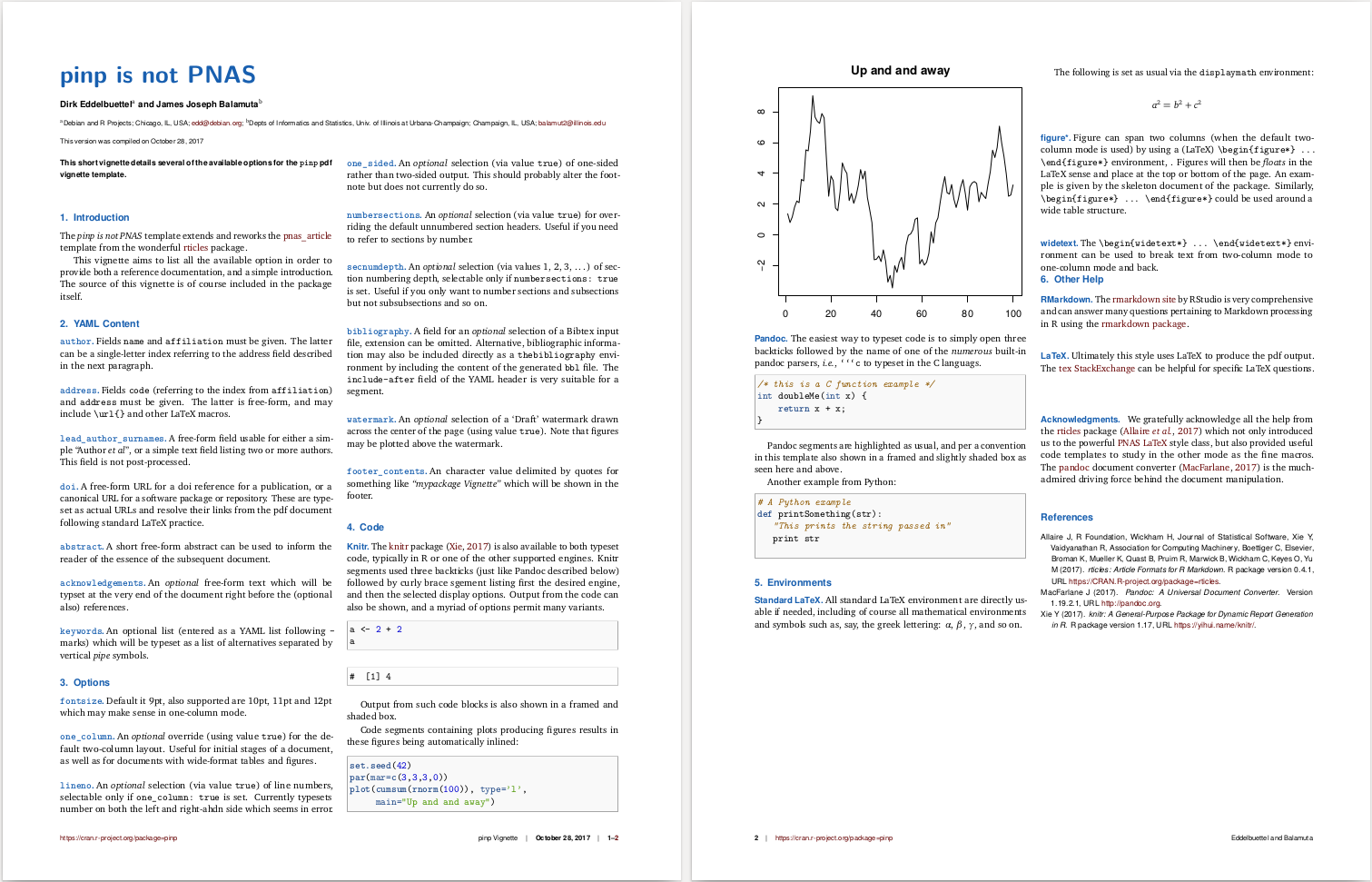
A maintenance release of our pinp package for snazzier one or two column vignettes is now on CRAN as of yesterday. In version 0.0.3, we disabled the default \pnasbreak command we inherit from the PNAS LaTeX style. That change turns out to have been too drastic. So we reverted yet added a new YAML front-matter option skip_final_break which, if set to TRUE, will skip this break. With a default value of FALSE we maintain prior behaviour. A screenshot of the package vignette can be seen below. Additional screenshots of are at the pinp page.
The NEWS entry for this release follows.

Changes in pinp version 0.0.4 (2017-11-04)
  • Correct NEWS headers from 'tint' to 'pinp' (#45).
  • New front-matter variables skip_final_break skips the \pnasbreak on final page which back as default (#47).

Courtesy of CRANberries, there is a comparison to the previous release. More information is on the tint page. For questions or comments use the issue tracker off the GitHub repo.

This post by Dirk Eddelbuettel originated on his Thinking inside the box blog. Please report excessive re-aggregation in third-party for-profit settings.

31 October 2017

Dirk Eddelbuettel: pinp 0.0.3: More docs, more features

Our pinp package for snazzier one or two column vignette received it second update. Now at version 0.0.3, it arrived on CRAN on Saturday with minimal fuzz as an 'CRAN-pretest-publish' transition. We added more frontmatter options, documented more, and streamlined some internals of the LaTeX class borrowed from PNAS. A screenshot of the (updated) vignette can be seen below. Additional screenshots of are at the pinp page.
The NEWS entry for this release follows.

Changes in tint version 0.0.3 (2017-10-28)
  • Section 'Acknowledgements' now conditional on a frontmatter setting, section 'Matmethods' has been removed, pnasbreak no longer used which stabilizes LaTeX float formatting. References are now shown in the column just like other content (Dirk in #36).
  • Vignette now uses new numbered sections frontmatter switch which improves the pdf outline.
  • New front-matter options for title/section header colors, and link colors (Dirk in #39).
  • YAML frontmater options are now documented in the help page for pinp as well (Dirk in #41).
  • Some typos were fixed (Michael in #42 and #43).

Courtesy of CRANberries, there is a comparison to the previous release. More information is on the tint page. For questions or comments use the issue tracker off the GitHub repo.

This post by Dirk Eddelbuettel originated on his Thinking inside the box blog. Please report excessive re-aggregation in third-party for-profit settings.

15 October 2017

Iain R. Learmonth: Free Software Efforts (2017W41)

Here s my weekly report for week 41 of 2017. In this week I have explored some Java 8 features, looked at automatic updates in a few Linux distributions and decided that actually I don t need swap anymore.

Debian The issue that was preventing the migration of the Tasktools Packaging Team s mailing list from Alioth to Savannah has now been resolved. Ana s chkservice package that I sponsored last week has been ACCEPTED into unstable and since MIGRATED to testing.

Tor Project I have produced a patch for the Tor Project website to update links to the Onionoo documentation now this has moved (#23802 ). I ve updated the Debian and Ubuntu relay configuration instructions to use systemctl instead of service where appropriate (#23048 ). When a Tor relay is less than 2 years old, an alert will now appear on Atlas to link to the new relay lifecycle blog post (#23767 ). This should hopefully help new relay operators understand why their relay is not immediately fully loaded but instead it takes some time to ramp up. I have gone through the tickets for Tor Cloud and did not find any tickets that contain any important information that would be useful to someone reviving the project. I have closed out these tickets and the Tor Cloud component no longer has any non-closed tickets (#7763, #8544, #8768, #9064, #9751, #10282, #10637, #11153, #11502, #13391, #14035, #14036, #14073, #15821 ). I ve continued to work on turning the Atlas application into an integrated part of Tor Metrics (#23518 ) and you can see some progress here. Finally, I ve continued hacking on a Twitter bot to tweet factoids about the public Tor network and you can now enjoy some JavaDoc documentation if you d like to learn a little about its internals. I am still waiting for a git repository to be created (#23799 ) but will be publishing the sources shortly after that ticket is actioned.

Sustainability I believe it is important to be clear not only about the work I have already completed but also about the sustainability of this work into the future. I plan to include a short report on the current sustainability of my work in each weekly report. I have not had any free software related expenses this week. The current funds I have available for equipment, travel and other free software expenses remains 60.52. I do not believe that any hardware I rely on is looking at imminent failure. I d like to thank Digital Ocean for providing me with futher credit for their platform to support my open source work. I do not find it likely that I ll be travelling to Cambridge for the miniDebConf as the train alone would be around 350 and hotel accomodation a further 600 (to include both me and Ana).

3 August 2017

Joey Hess: home power monitoring

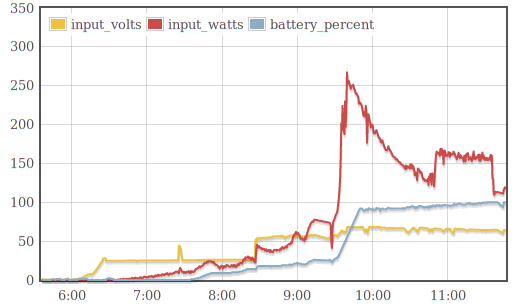
For years I've recorded solar panel data by hand. Filled two notebooks with columns of figures. My new charge controller, an EPsolar Tracer-BN, finally let me automate it.
morning activity; by 8 am the sun is still behind the hill but, 16 watts are being produced, and by 11:30 am, the battery bank is full
You can explore my home power data here: http://homepower.joeyh.name/
(click and drag to zoom) The web interface loads the RRD files into a web browser using javascriptRRD. I wrote a haskell program that drives the epsolar-tracer python library to poll for data, and stores it in RRD files. Could have used collectd or something, but the interface to the charge controller is currently a bit flakey and I have to be careful about retries and polling frequencies. Also I wanted full control over how much data is stored in the RRD files. Full source code

18 June 2017

Simon Josefsson: OpenPGP smartcard under GNOME on Debian 9.0 Stretch

I installed Debian 9.0 Stretch on my Lenovo X201 laptop today. Installation went smooth, as usual. GnuPG/SSH with an OpenPGP smartcard I use a YubiKey NEO does not work out of the box with GNOME though. I wrote about how to fix OpenPGP smartcards under GNOME with Debian 8.0 Jessie earlier, and I thought I d do a similar blog post for Debian 9.0 Stretch . The situation is slightly different than before (e.g., GnuPG works better but SSH doesn t) so there is some progress. May I hope that Debian 10.0 Buster gets this right? Pointers to which package in Debian should have a bug report tracking this issue is welcome (or a pointer to an existing bug report). After first login, I attempt to use gpg --card-status to check if GnuPG can talk to the smartcard.
jas@latte:~$ gpg --card-status
gpg: error getting version from 'scdaemon': No SmartCard daemon
gpg: OpenPGP card not available: No SmartCard daemon
jas@latte:~$ 
This fails because scdaemon is not installed. Isn t a smartcard common enough so that this should be installed by default on a GNOME Desktop Debian installation? Anyway, install it as follows.
root@latte:~# apt-get install scdaemon
Then try again.
jas@latte:~$ gpg --card-status
gpg: selecting openpgp failed: No such device
gpg: OpenPGP card not available: No such device
jas@latte:~$ 
I believe scdaemon here attempts to use its internal CCID implementation, and I do not know why it does not work. At this point I often recall that want pcscd installed since I work with smartcards in general.
root@latte:~# apt-get install pcscd
Now gpg --card-status works!
jas@latte:~$ gpg --card-status
Reader ...........: Yubico Yubikey NEO CCID 00 00
Application ID ...: D2760001240102000006017403230000
Version ..........: 2.0
Manufacturer .....: Yubico
Serial number ....: 01740323
Name of cardholder: Simon Josefsson
Language prefs ...: sv
Sex ..............: male
URL of public key : https://josefsson.org/54265e8c.txt
Login data .......: jas
Signature PIN ....: not forced
Key attributes ...: rsa2048 rsa2048 rsa2048
Max. PIN lengths .: 127 127 127
PIN retry counter : 3 3 3
Signature counter : 8358
Signature key ....: 9941 5CE1 905D 0E55 A9F8  8026 860B 7FBB 32F8 119D
      created ....: 2014-06-22 19:19:04
Encryption key....: DC9F 9B7D 8831 692A A852  D95B 9535 162A 78EC D86B
      created ....: 2014-06-22 19:19:20
Authentication key: 2E08 856F 4B22 2148 A40A  3E45 AF66 08D7 36BA 8F9B
      created ....: 2014-06-22 19:19:41
General key info..: sub  rsa2048/860B7FBB32F8119D 2014-06-22 Simon Josefsson 
sec#  rsa3744/0664A76954265E8C  created: 2014-06-22  expires: 2017-09-04
ssb>  rsa2048/860B7FBB32F8119D  created: 2014-06-22  expires: 2017-09-04
                                card-no: 0006 01740323
ssb>  rsa2048/9535162A78ECD86B  created: 2014-06-22  expires: 2017-09-04
                                card-no: 0006 01740323
ssb>  rsa2048/AF6608D736BA8F9B  created: 2014-06-22  expires: 2017-09-04
                                card-no: 0006 01740323
jas@latte:~$ 
Using the key will not work though.
jas@latte:~$ echo foo gpg -a --sign
gpg: no default secret key: No secret key
gpg: signing failed: No secret key
jas@latte:~$ 
This is because the public key and the secret key stub are not available.
jas@latte:~$ gpg --list-keys
jas@latte:~$ gpg --list-secret-keys
jas@latte:~$ 
You need to import the key for this to work. I have some vague memory that gpg --card-status was supposed to do this, but I may be wrong.
jas@latte:~$ gpg --recv-keys 9AA9BDB11BB1B99A21285A330664A76954265E8C
gpg: failed to start the dirmngr '/usr/bin/dirmngr': No such file or directory
gpg: connecting dirmngr at '/run/user/1000/gnupg/S.dirmngr' failed: No such file or directory
gpg: keyserver receive failed: No dirmngr
jas@latte:~$ 
Surprisingly, dirmngr is also not shipped by default so it has to be installed manually.
root@latte:~# apt-get install dirmngr
Below I proceed to trust the clouds to find my key.
jas@latte:~$ gpg --recv-keys 9AA9BDB11BB1B99A21285A330664A76954265E8C
gpg: key 0664A76954265E8C: public key "Simon Josefsson " imported
gpg: no ultimately trusted keys found
gpg: Total number processed: 1
gpg:               imported: 1
jas@latte:~$ 
Now the public key and the secret key stub are available locally.
jas@latte:~$ gpg --list-keys
/home/jas/.gnupg/pubring.kbx
----------------------------
pub   rsa3744 2014-06-22 [SC] [expires: 2017-09-04]
      9AA9BDB11BB1B99A21285A330664A76954265E8C
uid           [ unknown] Simon Josefsson 
sub   rsa2048 2014-06-22 [S] [expires: 2017-09-04]
sub   rsa2048 2014-06-22 [E] [expires: 2017-09-04]
sub   rsa2048 2014-06-22 [A] [expires: 2017-09-04]
jas@latte:~$ gpg --list-secret-keys
/home/jas/.gnupg/pubring.kbx
----------------------------
sec#  rsa3744 2014-06-22 [SC] [expires: 2017-09-04]
      9AA9BDB11BB1B99A21285A330664A76954265E8C
uid           [ unknown] Simon Josefsson 
ssb>  rsa2048 2014-06-22 [S] [expires: 2017-09-04]
ssb>  rsa2048 2014-06-22 [E] [expires: 2017-09-04]
ssb>  rsa2048 2014-06-22 [A] [expires: 2017-09-04]
jas@latte:~$ 
I am now able to sign data with the smartcard, yay!
jas@latte:~$ echo foo gpg -a --sign
-----BEGIN PGP MESSAGE-----
owGbwMvMwMHYxl2/2+iH4FzG01xJDJFu3+XT8vO5OhmNWRgYORhkxRRZZjrGPJwQ
yxe68keDGkwxKxNIJQMXpwBMRJGd/a98NMPJQt6jaoyO9yUVlmS7s7qm+Kjwr53G
uq9wQ+z+/kOdk9w4Q39+SMvc+mEV72kuH9WaW9bVqj80jN77hUbfTn5mffu2/aVL
h/IneTfaOQaukHij/P8A0//Phg/maWbONUjjySrl+a3tP8ll6/oeCd8g/aeTlH79
i0naanjW4bjv9wnvGuN+LPHLmhUc2zvZdyK3xttN/roHvsdX3f53yTAxeInvXZmd
x7W0/hVPX33Y4nT877T/ak4L057IBSavaPVcf4yhglVI8XuGgaTP666Wuslbliy4
5W5eLasbd33Xd/W0hTINznuz0kJ4r1bLHZW9fvjLduMPq5rS2co9tvW8nX9rhZ/D
zycu/QA=
=I8rt
-----END PGP MESSAGE-----
jas@latte:~$ 
Encrypting to myself will not work smoothly though.
jas@latte:~$ echo foo gpg -a --encrypt -r simon@josefsson.org
gpg: 9535162A78ECD86B: There is no assurance this key belongs to the named user
sub  rsa2048/9535162A78ECD86B 2014-06-22 Simon Josefsson 
 Primary key fingerprint: 9AA9 BDB1 1BB1 B99A 2128  5A33 0664 A769 5426 5E8C
      Subkey fingerprint: DC9F 9B7D 8831 692A A852  D95B 9535 162A 78EC D86B
It is NOT certain that the key belongs to the person named
in the user ID.  If you *really* know what you are doing,
you may answer the next question with yes.
Use this key anyway? (y/N) 
gpg: signal Interrupt caught ... exiting
jas@latte:~$ 
The reason is that the newly imported key has unknown trust settings. I update the trust settings on my key to fix this, and encrypting now works without a prompt.
jas@latte:~$ gpg --edit-key 9AA9BDB11BB1B99A21285A330664A76954265E8C
gpg (GnuPG) 2.1.18; Copyright (C) 2017 Free Software Foundation, Inc.
This is free software: you are free to change and redistribute it.
There is NO WARRANTY, to the extent permitted by law.
Secret key is available.
pub  rsa3744/0664A76954265E8C
     created: 2014-06-22  expires: 2017-09-04  usage: SC  
     trust: unknown       validity: unknown
ssb  rsa2048/860B7FBB32F8119D
     created: 2014-06-22  expires: 2017-09-04  usage: S   
     card-no: 0006 01740323
ssb  rsa2048/9535162A78ECD86B
     created: 2014-06-22  expires: 2017-09-04  usage: E   
     card-no: 0006 01740323
ssb  rsa2048/AF6608D736BA8F9B
     created: 2014-06-22  expires: 2017-09-04  usage: A   
     card-no: 0006 01740323
[ unknown] (1). Simon Josefsson 
[ unknown] (2)  Simon Josefsson 
gpg> trust
pub  rsa3744/0664A76954265E8C
     created: 2014-06-22  expires: 2017-09-04  usage: SC  
     trust: unknown       validity: unknown
ssb  rsa2048/860B7FBB32F8119D
     created: 2014-06-22  expires: 2017-09-04  usage: S   
     card-no: 0006 01740323
ssb  rsa2048/9535162A78ECD86B
     created: 2014-06-22  expires: 2017-09-04  usage: E   
     card-no: 0006 01740323
ssb  rsa2048/AF6608D736BA8F9B
     created: 2014-06-22  expires: 2017-09-04  usage: A   
     card-no: 0006 01740323
[ unknown] (1). Simon Josefsson 
[ unknown] (2)  Simon Josefsson 
Please decide how far you trust this user to correctly verify other users' keys
(by looking at passports, checking fingerprints from different sources, etc.)
  1 = I don't know or won't say
  2 = I do NOT trust
  3 = I trust marginally
  4 = I trust fully
  5 = I trust ultimately
  m = back to the main menu
Your decision? 5
Do you really want to set this key to ultimate trust? (y/N) y
pub  rsa3744/0664A76954265E8C
     created: 2014-06-22  expires: 2017-09-04  usage: SC  
     trust: ultimate      validity: unknown
ssb  rsa2048/860B7FBB32F8119D
     created: 2014-06-22  expires: 2017-09-04  usage: S   
     card-no: 0006 01740323
ssb  rsa2048/9535162A78ECD86B
     created: 2014-06-22  expires: 2017-09-04  usage: E   
     card-no: 0006 01740323
ssb  rsa2048/AF6608D736BA8F9B
     created: 2014-06-22  expires: 2017-09-04  usage: A   
     card-no: 0006 01740323
[ unknown] (1). Simon Josefsson 
[ unknown] (2)  Simon Josefsson 
Please note that the shown key validity is not necessarily correct
unless you restart the program.
gpg> quit
jas@latte:~$ echo foo gpg -a --encrypt -r simon@josefsson.org
-----BEGIN PGP MESSAGE-----
hQEMA5U1Fip47NhrAQgArTvAykj/YRhWVuXb6nzeEigtlvKFSmGHmbNkJgF5+r1/
/hWENR72wsb1L0ROaLIjM3iIwNmyBURMiG+xV8ZE03VNbJdORW+S0fO6Ck4FaIj8
iL2/CXyp1obq1xCeYjdPf2nrz/P2Evu69s1K2/0i9y2KOK+0+u9fEGdAge8Gup6y
PWFDFkNj2YiVa383BqJ+kV51tfquw+T4y5MfVWBoHlhm46GgwjIxXiI+uBa655IM
EgwrONcZTbAWSV4/ShhR9ug9AzGIJgpu9x8k2i+yKcBsgAh/+d8v7joUaPRZlGIr
kim217hpA3/VLIFxTTkkm/BO1KWBlblxvVaL3RZDDNI5AVp0SASswqBqT3W5ew+K
nKdQ6UTMhEFe8xddsLjkI9+AzHfiuDCDxnxNgI1haI6obp9eeouGXUKG
=s6kt
-----END PGP MESSAGE-----
jas@latte:~$ 
So everything is fine, isn t it? Alas, not quite.
jas@latte:~$ ssh-add -L
The agent has no identities.
jas@latte:~$ 
Tracking this down, I now realize that GNOME s keyring is used for SSH but GnuPG s gpg-agent is used for GnuPG. GnuPG uses the environment variable GPG_AGENT_INFO to connect to an agent, and SSH uses the SSH_AUTH_SOCK environment variable to find its agent. The filenames used below leak the knowledge that gpg-agent is used for GnuPG but GNOME keyring is used for SSH.
jas@latte:~$ echo $GPG_AGENT_INFO 
/run/user/1000/gnupg/S.gpg-agent:0:1
jas@latte:~$ echo $SSH_AUTH_SOCK 
/run/user/1000/keyring/ssh
jas@latte:~$ 
Here the same recipe as in my previous blog post works. This time GNOME keyring only has to be disabled for SSH. Disabling GNOME keyring is not sufficient, you also need gpg-agent to start with enable-ssh-support. The simplest way to achieve that is to add a line in ~/.gnupg/gpg-agent.conf as follows. When you login, the script /etc/X11/Xsession.d/90gpg-agent will set the environment variables GPG_AGENT_INFO and SSH_AUTH_SOCK. The latter variable is only set if enable-ssh-support is mentioned in the gpg-agent configuration.
jas@latte:~$ mkdir ~/.config/autostart
jas@latte:~$ cp /etc/xdg/autostart/gnome-keyring-ssh.desktop ~/.config/autostart/
jas@latte:~$ echo 'Hidden=true' >> ~/.config/autostart/gnome-keyring-ssh.desktop 
jas@latte:~$ echo enable-ssh-support >> ~/.gnupg/gpg-agent.conf 
jas@latte:~$ 
Log out from GNOME and log in again. Now you should see ssh-add -L working.
jas@latte:~$ ssh-add -L
ssh-rsa AAAAB3NzaC1yc2EAAAADAQABAAABAQDFP+UOTZJ+OXydpmbKmdGOVoJJz8se7lMs139T+TNLryk3EEWF+GqbB4VgzxzrGjwAMSjeQkAMb7Sbn+VpbJf1JDPFBHoYJQmg6CX4kFRaGZT6DHbYjgia59WkdkEYTtB7KPkbFWleo/RZT2u3f8eTedrP7dhSX0azN0lDuu/wBrwedzSV+AiPr10rQaCTp1V8sKbhz5ryOXHQW0Gcps6JraRzMW+ooKFX3lPq0pZa7qL9F6sE4sDFvtOdbRJoZS1b88aZrENGx8KSrcMzARq9UBn1plsEG4/3BRv/BgHHaF+d97by52R0VVyIXpLlkdp1Uk4D9cQptgaH4UAyI1vr cardno:000601740323
jas@latte:~$ 
Topics for further discussion or research include 1) whether scdaemon, dirmngr and/or pcscd should be pre-installed on Debian desktop systems; 2) whether gpg --card-status should attempt to import the public key and secret key stub automatically; 3) why GNOME keyring is used by default for SSH rather than gpg-agent; 4) whether GNOME keyring should support smartcards, or if it is better to always use gpg-agent for GnuPG/SSH, 5) if something could/should be done to automatically infer the trust setting for a secret key. Enjoy!

2 February 2017

Paul Wise: FLOSS Activities January 2017

Changes

Issues

Review

Administration
  • Debian: reboot 1 non-responsive VM, redirect 2 users to support channels, redirect 1 contributor to xkb upstream, redirect 1 potential contributor, redirect 1 bug reporter to mirror team, ping 7 folks about restarting processes with upgraded libs, manually restart the sectracker process due to upgraded libs, restart the package tracker process due to upgraded libs, investigate failures connecting to the XMPP service, investigate /dev/shm issue on abel.d.o, clean up after rename of the fedmsg group.
  • Debian mentors: lintian/security updates & reboot
  • Debian packages: deploy 2 contributions to the live server
  • Debian wiki: unblacklist 1 IP address, whitelist 10 email addresses, disable 18 accounts with bouncing email, update email for 2 accounts with bouncing email, reported 1 Debian member as MIA, redirect 1 user to support channels, add 4 domains to the whitelist.
  • Reproducible builds: rescheduled Debian pyxplot:amd64/unstable for themill.
  • Openmoko: security updates & reboots.

Debian derivatives
  • Send the annual activity ping mail.
  • Happy new year messages on IRC, forward to the list.
  • Note that SerbianLinux does not provide source packages.
  • Expand URL shortener on SerbianLinux page.
  • Invite PelicanHPC, Netrunner, DietPi, Hamara Linux (on IRC), BitKey to the census.
  • Add research publications link to the census template
  • Fix Symbiosis sources.list
  • Enquired about SalentOS downtime
  • Fixed and removed some 404 BlankOn links (blog, English homepage)
  • Fixed changes to AstraLinux sources.list
  • Welcome Netrunner to the census

Sponsors I renewed my support of Software Freedom Conservancy. The openchange 1:2.2-6+deb8u1 upload was sponsored by my employer. All other work was done on a volunteer basis.

14 January 2016

Sven Hoexter: call for trouble aka RM xchat

Well we want to freeze later this year so I started with the axing now. Maybe a bit premature like Mattia pointed out correctly in #debian-qa, because we've some maintained plugins for xchat around. cwirc a morse code via IRC plugin xchat-xsys system statistics output to a channel Update: There is a xsys plugin included with hexchat. xchat-guile GNU Scheme scripting plugin Update: Lionel agreed and created a RM bug. Thanks! I can survive without them, so I'd be fine with another three RM bugs. Now feel free to flame me, I promise to wear my finest asbestos underwear.

10 July 2015

Gunnar Wolf: Finishing the course on "Free Software and Open Standards"

A couple of months ago, I was invited to give the starting course for the Masters degree in Free Software in the Universidad Andina Sim n Bol var university. UASB is a multinational university, with campuses in (at least) Ecuador, Chile, Bolivia and Colombia; I was doubtful at first regarding the seriousness of this proposal and the viability of the program, but time made my doubts disappear. Bolivia is going through an interesting process, as they have one of the strongest worded government mandates for migration to free software for the public administration in the next couple of years; this migration has prompted the interest of many professionals in the country. In particular, we have over 40 registered people for this Masters degree. Studying a Masters degree is a long-term commitment which signifies a big time investment, and although many of the student are quite new to the idea of free software, they are willing to spend this time (and money, as the university is privately owned and charges for its enrollment). I gave this class together with Alejandro Miranda (a.k.a. @pooka), as we have a very good pair-teaching dynamics; we had already given many conferences together, but this is the first time we had the opportunity to share a whole course and the experience was very good. We have read the students' logs, and many of them clearly agree with this. I had to skip two of the (ten) lessons, as I travelled from Mexico to Argentina halfway through it (of course, we brought the babies to meet my wife's family and friends!), so we had also the honor of having Esteban Lima fill in for those sessions. I am very happy and grateful that the University took care to record our presentations and intend to record and put online all of the classes; as we were the first in the program, there were some understandable hiccups and some sessions were lost, but most are available. Here they are, in case you are interested in refering to them:
Topic Video (my server) Video (Youtube)
Introduction to free software Watch Watch
History Watch Watch
Free culture N/A N/A
The effects of free software Watch Watch
Free software and open standards related to technologic soverignity Watch Watch
The free software ecosystem Watch Watch
Free software implementation in Bolivia Watch Watch
Introduction to intelectual property: Copyright, patents, trademarks, etc. Watch Watch
Who is "the community" and why do we speak about it? Watch Watch
Current status and challenges for the movement N/A N/A
We have yet another video file (which I have not fully followed through) titled ADSIB - Migration plan. It can also be downloaded from my server or watched online at Youtube. All in all: This was a great opportunity and a joy to do. I think the material we used and developed fit well what was expected from us, and we had fun giving somewhat heterodox readings on our movement.

26 April 2015

Erich Schubert: Your big data toolchain is a big security risk!

This post is a follow-up to my earlier post on the "sad state of sysadmin in the age of containers". While I was drafting this post, that story got picked up by HackerNews, Reddit and Twitter, sending a lot of comments and emails my way. Surprisingly many of the comments are supportive of my impression - I would have expected to see much more insults along the lines "you just don't like my-favorite-tool, so you rant against using it". But a lot of people seem to share my concerns. Thanks, you surprised me!
Here is the new rant post, in the slightly different context of big data:

Everybody is doing "big data" these days. Or at least, pretending to do so to upper management. A lot of the time, there is no big data. People do more data anylsis than before, and therefore stick the "big data" label on them to promote themselves and get green light from management, isn't it?
"Big data" is not a technical term. It is a business term, referring to any attempt to get more value out of your business by analyzing data you did not use before. From this point of view, most of such projects are indeed "big data" as in "data-driven revenue generation" projects. It may be unsatisfactory to those interested in the challenges of volume and the other "V's", but this is the reality how the term is used.
But even in those cases where the volume and complexity of the data would warrant the use of all the new toys tools, people overlook a major problem: security of their systems and of their data.

The currently offered "big data technology stack" is all but secure. Sure, companies try to earn money with security add-ons such as Kerberos authentication to sell multi-tenancy, and with offering their version of Hadoop (their "Hadoop distribution").
The security problem is deep inside the "stack". It comes from the way this world ticks: the world of people that constantly follow the latest tool-of-the-day. In many of the projects, you no longer have mostly Linux developers that co-function as system administrators, but you see a lot of Apple iFanboys now. They live in a world where technology is outdated after half a year, so you will not need to support product longer than that. They love reinstalling their development environment frequently - because each time, they get to change something. They also live in a world where you would simply get a new model if your machine breaks down at some point. (Note that this will not work well for your big data project, restarting it from scratch every half year...)
And while Mac users have recently been surprisingly unaffected by various attacks (and unconcerned about e.g. GoToFail, or the fail to fix the rootpipe exploit) the operating system is not considered to be very secure. Combining this with users who do not care is an explosive mixture...
This type of developer, who is good at getting a prototype website for a startup kicking in a short amount of time, rolling out new features every day to beta test on the live users is what currently makes the Dotcom 2.0 bubble grow. It's also this type of user that mainstream products aim at - he has already forgotten what was half a year ago, but is looking for the next tech product to announced soon, and willing to buy it as soon as it is available...
This attitude causes a problem at the very heart of the stack: in the way packages are built, upgrades (and safety updates) are handled etc. - nobody is interested in consistency or reproducability anymore.
Someone commented on my blog that all these tools "seem to be written by 20 year old" kids. He probably is right. It wouldn't be so bad if we had some experienced sysadmins with a cluebat around. People that have experience on how to build systems that can be maintained for 10 years, and securely deployed automatically, instead of relying on puppet hacks, wget and unzipping of unsigned binary code.
I know that a lot of people don't want to hear this, but:
Your Hadoop system contains unsigned binary code in a number of places, that people downloaded, uploaded and redownloaded a countless number of times. There is no guarantee that .jar ever was what people think it is.
Hadoop has a huge set of dependencies, and little of this has been seriously audited for security - and in particular not in a way that would allow you to check that your binaries are built from this audited code anyway.
There might be functionality hidden in the code that just sits there and waits for a system with a hostname somewhat like "yourcompany.com" to start looking for its command and control server to steal some key data from your company. The way your systems are built they probably do not have much of a firewall guarding against such. Much of the software may be constantly calling home, and your DevOps would not notice (nor would they care, anyway).
The mentality of "big data stacks" these days is that of Windows Shareware in the 90s. People downloading random binaries from the Internet, not adequately checked for security (ever heard of anybody running an AntiVirus on his Hadoop cluster?) and installing them everywhere.
And worse: not even keeping track of what they installed over time, or how. Because the tools change every year. But what if that developer leaves? You may never be able to get his stuff running properly again!
Fire-and-forget.
I predict that within the next 5 years, we will have a number of security incidents in various major companies. This is industrial espionage heaven. A lot of companies will cover it up, but some leaks will reach mass media, and there will be a major backlash against this hipster way of stringing together random components.
There is a big "Hadoop bubble" growing, that will eventually burst.
In order to get into a trustworthy state, the big data toolchain needs to:
  • Consolidate. There are too many tools for every job. There are even too many tools to manage your too many tools, and frontends for your frontends.
  • Lose weight. Every project depends on way too many other projects, each of which only contributes a tiny fragment for a very specific use case. Get rid of most dependencies!
  • Modularize. If you can't get rid of a dependency, but it is still only of interest to a small group of users, make it an optional extension module that the user only has to install if he needs this particular functionality.
  • Buildable. Make sure that everybody can build everything from scratch, without having to rely on Maven or Ivy or SBT downloading something automagically in the background. Test your builds offline, with a clean build directory, and document them! Everything must be rebuildable by any sysadmin in a reproducible way, so he can ensure a bug fix is really applied.
  • Distribute. Do not rely on binary downloads from your CDN as sole distribution channel. Instead, encourage and support alternate means of distribution, such as the proper integration in existing and trusted Linux distributions.
  • Maintain compatibility. successful big data projects will not be fire-and-forget. Eventually, they will need to go into production and then it will be necessary to run them over years. It will be necessary to migrate them to newer, larger clusters. And you must not lose all the data while doing so.
  • Sign. Code needs to be signed, end-of-story.
  • Authenticate. All downloads need to come with a way of checking the downloaded files agree with what you uploaded.
  • Integrate. The key feature that makes Linux systems so very good at servers is the all-round integrated software management. When you tell the system to update - and you have different update channels available, such as a more conservative "stable/LTS" channel, a channel that gets you the latest version after basic QA, and a channel that gives you the latest versions shortly after their upload to help with QA. It covers almost all software on your system, so it does not matter whether the security fix is in your kernel, web server, library, auxillary service, extension module, scripting language etc. - it will pull this fix and update you in no time.
Now you may argue that Hortonworks, Cloudera, Bigtop etc. already provide packages. Well ... they provide crap. They have something they call a "package", but it fails by any quality standards. Technically, a Wartburg is a car; but not one that would pass todays safety regulations...
For example, they only support Ubuntu 12.04 - a three year old Ubuntu is the latest version they support... Furthermore, these packages are roughly the same. Cloudera eventually handed over their efforts to "the community" (in other words, they gave up on doing it themselves, and hoped that someone else would clean up their mess); and Hortonworks HDP (any maybe Pivotal HD, too) is derived from these efforts, too. Much of what they do is offering some extra documentation and training for the packages they built using Bigtop with minimal effort.
The "spark" .deb packages of Bigtop, for example, are empty. They forgot to include the .jars in the package. Do I really need to give more examples of bad packaging decisions? All bigtop packages now depend on their own version of groovy - for a single script. Instead of rewriting this script in an already required language - or in a way that it would run on the distribution-provided groovy version - they decided to make yet another package, bigtop-groovy.
When I read about Hortonworks and IBM announcing their "Open Data Platform", I could not care less. As far as I can tell, they are only sticking their label on the existing tools anyway. Thus, I'm also not surprised that Cloudera and MapR do not join this rebranding effort - given the low divergence of Hadoop, who would need such a label anyway?
So why does this matter? Essentially, if anything does not work, you are currently toast. Say there is a bug in Hadoop that makes it fail to process your data. Your business is belly-up because of that, no data is processed anymore, your are vegetable. Who is going to fix it? All these "distributions" are built from the same, messy, branch. There is probably only a dozen of people around the world who have figured this out well enough to be able to fully build this toolchain. Apparently, none of the "Hadoop" companies are able to support a newer Ubuntu than 2012.04 - are you sure they have really understood what they are selling? I have doubts. All the freelancers out there, they know how to download and use Hadoop. But can they get that business-critical bug fix into the toolchain to get you up and running again? This is much worse than with Linux distributions. They have build daemons - servers that continuously check they can compile all the software that is there. You need to type two well-documented lines to rebuild a typical Linux package from scratch on your workstation - any experienced developer can follow the manual, and get a fix into the package. There are even people who try to recompile complete distributions with a different compiler to discover compatibility issues early that may arise in the future.
In other words, the "Hadoop distribution" they are selling you is not code they compiled themselves. It is mostly .jar files they downloaded from unsigned, unencrypted, unverified sources on the internet. They have no idea how to rebuild these parts, who compiled that, and how it was built. At most, they know for the very last layer. You can figure out how to recompile the Hadoop .jar. But when doing so, your computer will download a lot of binaries. It will not warn you of that, and they are included in the Hadoop distributions, too.
As is, I can not recommend to trust your business data into Hadoop.
It is probably okay to copy the data into HDFS and play with it - in particular if you keep your cluster and development machines isolated with strong firewalls - but be prepared to toss everything and restart from scratch. It's not ready yet for prime time, and as they keep on adding more and more unneeded cruft, it does not look like it will be ready anytime soon.

One more examples of the immaturity of the toolchain:
The scala package from scala-lang.org cannot be cleanly installed as an upgrade to the old scala package that already exists in Ubuntu and Debian (and the distributions seem to have given up on compiling a newer Scala due to a stupid Catch-22 build process, making it very hacky to bootstrap scala and sbt compilation).
And the "upstream" package also cannot be easily fixed, because it is not built with standard packaging tools, but with an automagic sbt helper that lacks important functionality (in particular, access to the Replaces: field, or even cleaner: a way of splitting the package properly into components) instead - obviously written by someone with 0 experience in packaging for Ubuntu or Debian; and instead of using the proven tools, he decided to hack some wrapper that tries to automatically do things the wrong way...

I'm convinced that most "big data" projects will turn out to be a miserable failure. Either due to overmanagement or undermanagement, and due to lack of experience with the data, tools, and project management... Except that - of course - nobody will be willing to admit these failures. Since all these projects are political projects, they by definition must be successful, even if they never go into production, and never earn a single dollar.

5 October 2014

Thomas Goirand: OpenStack packaging activity: September 2014

I decided I d post this monthly. It may be a bit boring, sorry, but I think it s a nice thing to have this public. The log starts on the 6th, because on the 4th I was back from Debconf (after a day in San Francisco, plus 20 hours of traveling and 15 hours of time gap). It is to be noted that every time something is uploaded in Debian for Icehouse (in Sid), or for Juno (in Experimental), there s also a corresponding backport produced for Wheezy. Saturday 6th & Sunday 7th:
packaged libjs-twitter-bootstrap-wizard (in new queue)
Uploaded python-pint after reviewing the debian/copyright
Worked on updating python-eventlet in Experimental, and adding Python3 support. It seems Python3 support isn t ready yet, so I will probably remove that feature from the package update.
Tried to apply the Django 1.7 patches for python-django-bootstrap-form. They didn t work, but Raphael came back on Monday morning with new versions
of the patches, which should be good this time.
Helped the DSA (Debian System Administrators) with the Debian OpenStack cloud. It s looking good and working now (note: I helped them during Debconf 14).
Started a page about adding more tasksel tasks: https://wiki.debian.org/tasksel/MoreTasks. It s looking like Joey Hess is adding new tasks by default in Tasksel, with OpenStack compute node and OpenStack proxy node . It will be nice to have them in the default Debian installer! :)
Packaged and uploaded python-dib-utils, now in NEW queue. Monday 8th:
Uploaded fixed python-django-bootstrap-form with patch for Django 1.7.
Packaged and uploaded python-pysaml2.
Finilized and uploaded python-jingo which is needed for python-django-compressor unit tests
Finalized and uploaded python-coffin which is needed for python-django-compressor unit tests
Worked on running the unit tests for python-django-compressor, as I needed to know if it could work with Django 1.7. It was hard to find the correct way to run the unit tests, but finally, they all passed. I will add the unit tests once coffin and jingo will be accepted in Sid.
Applied patches in the Debian BTS for python-django-openstack-auth and Django 1.7. Uploaded the fixed package.
Fixed python-django-pyscss compat with Django 1.7, uploaded the result.
Updated keystone to Juno b3.
Built Wheezy backports of some JS libs needed for Horizon in Juno, which I already uploaded to Sid last summer:
o libjs-twitter-bootstrap-datepicker
o libjs-jquery.quicksearch
o libjs-spin.js
Upstreamed the Django 1.7 patch for python-django-openstack-auth: https://review.openstack.org/119972 Tuesday 9:
Updated and uploaded Swift 2.1.0. Added swift-object-expirer package to it, together with init script. Wednesday 10:
Basically, cleaned the Debian BTS of almost all issues today :P
Added it.po update to nova (Closes: #758305).
Backported libvirt 1.2.7 to Wheezy, to be able to close this bug: https://bugs.debian.org/757548 (eg: changed dependency from libvirt-bin to libvirt-daemon-system)
Uploaded the fixed nova package using libvirt-daemon-system
Upgraded python-trollius to 1.0.1
Fixed tuskar-ui to work with Django 1.7. Disabled pep8 tests during build. Added build-conflicts: python-unittest2.
Fixed python-django-compressor for Django 1.7, and now running unit tests with it, after python-coffin and python-jingo got approved in Sid by FTP masters.
Fixed python-xstatic wrong upstream URLs.
Added it.po debconf translation to Designate.
Added de.po debconf translation to Tuskar.
Fixed copyright holders in python-xstatic-rickshaw
Added python-passlib as dependency for python-cinder. Remaining 3 issues in the BTS: ceilometer FTBFS, Horizon unit test with Django 1.7, Designate fail to install. All of the 3 are harder to fix, and I may try to do so later this week. Thursday 11:
Fixed python-xstatic-angular and python-xstatic-angular-mock to deal with the new libjs-angularjs version (closes 2 Debian RC bugs: uninstallable).
Fixed ceilometer FTBFS (Closes rc bug) Friday 12:
Fixed wrong copyright file for libjs-twitter-bootstrap-wizard after the FTP masters told me, and reuploaded to Sid.
Reuploaded wrong upload of ceilometer (wrong hash for orig.tar.xz)
Packaged and uploaded python-xstatic-bootstrap-scss
Packaged and uploaded python-xstatic-font-awesome
Packaged and uploaded ntpstat Monday 15:
packaged and uploaded python-xstatic-jquery.bootstrap.wizard
Fixed python-xstatic-angular-cookies to use new libjs-angularjs version (fixed version dependencies)
Fixed Ceilometer FTBFS (Closes: #759967)
Backported all python-xtatic packages to Wheezy, including all dependencies. This includes backporting of a bunch of packages from nodejs which were needed as build-dependencies (around 70 packages ). Filed about 5 or 6 release critical bugs as some nodejs packages were not buildable as-is.
Fixed some too restrictive python-xstatic-angular* dependencies on the libjs-angularjs (the libjs-angularjs increased version). Tuesday 16:
Uploaded updates to Experimental:
o python-eventlet 0.15.2 (this one took a long time as it needed maintenance)
o oslo-config
o python-oslo.i18n
Uploaded to Sid:
o python-diskimage-builder 0.1.30-1
o python-django-pyscss 1.0.2-1
Fixed horizon libapache-mode-wsgi to be a dependency of openstack-dashboard-apache and not just openstack-dashboard (in both Icehouse & Juno).
Removed the last failing Django 1.7 unit test from Horizon. It doesn t seem relevant anyway.
Backported python-netaddr 0.7.12 to Wheezy (needed by oslo-config).
Started working on oslo.rootwrap, though it failed to build in Wheezy with a unit test failure. Wednesday 17:
To experimental:
o Uploaded oslo.rootwrap 1.3.0.0~a1. It needed a build-depends on iproute2 because of a new test.
o Uploaded python-oslo.utils 0.3.0
o Uploaded python-oslo.vmware 0.6.0, fixed sphinx-build conf.py and filed a bug about it: https://bugs.launchpad.net/oslo.vmware/+bug/1370370 plus emailed the commiter of the issue (which appeared 2 weeks ago).
o Uploaded python-pycadf 0.6.0
o Uploaded python-pyghmi 0.6.17
o Uploaded python-oslotest 1.1.0.0~a2, including patch for Wheezy, which I also submited upstream: https://review.openstack.org/122171/
o Uploaded glanceclient 0.14.0, added a patch to not use the embedded version of urllib3 in requests: https://review.openstack.org/122184
To Sid:
o Uploaded python-zake_0.1.6-1 Thesday 18:
Backported zeromq3-4.0.4+dfs, pyzmq-14.3.1, pyasn1-0.1.7, python-pyasn1-modules-0.0.5
Uploaded keystoneclient 0.10.1, fixed the saml2 unit tests which were broken using testtools >= 0.9.39. Filed bug, and warned code author: https://bugs.launchpad.net/python-keystoneclient/+bug/1371085
Uploade swiftclient 2.3.0 to experimental.
Uploaded ironicclient 0.2.1 to experimental.
Uploaded saharaclient, filed bug with saharaclient expecting an up and running keystone server: https://bugs.launchpad.net/python-saharaclient/+bug/1371177 Friday 19:
Uploaded keystone Juno b3, filed but about unit tests downloading with git, while no network access should be performed during package build (forbidden by
Debian policy)
Uploaded python-oslo.db 1.0.0 which I forgot in the dependency list, and which was needed for Neutron.
Uploaded nova 2014.2~b3-1 (added a new nova-serialproxy service daemon to the nova-consoleproxy) Saturday 20:
Uploaded Neutron Juno b3.
Uploaded python-retrying 1.2.3 (was missing from depends upload)
Uploaded Glance Juno b3.
Uploaded Cinder Juno b3.
Fixed python-xstatic-angular-mock which had a .pth packaged, as well as the data folder (uploaded debian release -3).
Fixed missing depends and build-conflicts in python-xstatic-jquery. Sunday 21:
Dropped python-pil & python-django-discover-runner from runtime Depends: of python-django-pyscss, as it s only needed for tests. It also created a conflicts, because python-django-discover-runner depends on python-unittest2 and horizon build-conflicts with it.
Forward-ported the Django 1.7 patches for Horizon. Opened new patch: https://review.openstack.org/122992 (since the old fix has gone away after a refactor of the unit test).
Uploaded Horizon Juno b3.
Applied https://review.openstack.org/#/c/122768/ to the keystone package, so that it doesn t do git clone of the keystoneclient during build.
Uploaded oslo.messaging 1.4.0.0 (which really is 1.4.0) to experimental
Uploaded oslo.messaging 1.4.0.0+really+1.3.1-1 to fix the issue in Sid/Jessie after the wrong upload (due to Zul wrong tagging of Keystone in the 2014.1.2 point release). Monday 22:
Uploaded ironic 2014.2~b3-1 to experimental
Uploaded heat 2014.2~b3-1 (with some fixes for sphinx doc build)
Uploaded ceilometer 2014.2~b3-1 to experimental
Uploaded openstack-doc-tools 0.19-1 to experimental
Uploaded openstack-trove 2014.2~b3-1 to experimental Tuesday 23:
Uploaded python-neutronclient with fixed version number for cliff and six. This missing requirement for cliff version produced an error in Trove, which I don t want to happen again.
Added fix for unit tests in Trove: https://review.openstack.org/#/c/123450/1,publish
Uploaded oslo.messaging 1.4.1 in Experimental, fixing the version conflicts with the one in Sid/Jessie. Thanks to Doug Hellman for doing the tagging. I will need to upload new versions of the following packages with the >= 1.4.1 depends:
> ceilometer
> ironic
> keystone
> neutron
> nova
> oslo-config
> oslo.rootwrap
> oslo.i18n
> python-pycadf
See http://lists.openstack.org/pipermail/openstack-dev/2014-September/046795.html for more explanation about the mess I m repairing
Uploaded designate Juno b3. Wednesday 24:
Uploaded oslosphinx 2.2.0.0
Uploaded update to django-openstack-auth (new last minute requirement for Horizon).
Uploaded final oslo-config package version 1.4.0.0 (really is 1.4.0)
Packaged and uploaded Sahara. This needs some tests by someone else as I don t even know how it works. Thuesday 25:
Uploaded python-keystonemiddleware 1.0.0-3, fixing CVE-2014-7144] TLS cert verification option not honoured in paste configs. https://bugs.debian.org/762748
Packaged and uploaded python-yaql, sent pull request for fixing print statements into Python3 compatible print function calls: https://github.com/ativelkov/yaql/pull/15
Packaged and uploaded python-muranoclient.
Started the packaging of Murano (not finished yet).
Uploaded python-keystoneclient 0.10.1-2 with the CVE-2014-7144 fix to Sid, with urgency=high. Uploaded 0.11.1-1 to Experimental.
Uploaded python-keystonemiddleware fix for CVE-2014-7144.
Uploaded openstack-trove 2014.2~b3-3 with last unit test fix from https://review.openstack.org/#/c/123450/ Friday 26:
Uploaded a fix for murano-agent, which makes it run as root.
Finished the packaging of Murano
Started packaging murano-dashboard, sent this patch to fix the wrong usage of the /usr/bin/coverage command: https://review.openstack.org/124444
Fixed wrong BASE_DIR in python-xstatic-angular and python-xstatic-angular-mock Saturday 27:
uploaded python-xstatic-boostrap-scss which I forgot to upload :(
uploaded python-pyscss 1.2.1 Sunday 28:
After a long investigation, I found out that the issue when installing the openstack-dasboard package was due to a wrong patch I did for Python 3.2 in Wheezy in python-pyscss. Corrected the patch from version 1.2.1-1, and uploaded version 1.2.1-2, the dashboard now installs correctly. \o/
Did a new version of an Horizon patch at https://review.openstack.org/122992/ to address Django 1.7 compat. Monday 29:
Uploaded new version of python-pyscss fixing the last issue with Python 3 (there was a release critical bug on it).
Uploaded fixup for python-django-openstack-auth fail to build in the Sid version, which was broken since the last upload of keystoneclient (which makes some of its API now as private).
Uploaded python-glance-store 0.1.8, including Ubuntu patch to fix unit tests.
Reviewed the packaging of python-strict-rfc3339 (see https://bugs.debian.org761152).
Uploaded Sheepdog with fix in the init script to start after corosync (Closes: #759216).
Uploaded pt_BR.po Brazilian Portuguese debconf templates translation for nova Icehouse in Sid (only commited it in Git for Juno).
Same for Glance. Tuesday 30:
Added Python3 support in python-django-appconf, uploaded to Sid
Upgraded to python-django-pyscss 1.0.3, and fixed broken unit tests with this new release under Django 1.7. Created pull request: https://github.com/fusionbox/django-pyscss/pull/22
Fixed designate requirements.txt in Sid (Icehouse) to allow SQLA 0.9.x. Uploaded resulting package to Sid.
Uploaded new Debian fix for python-tooz: kills memcached only if the package scripts started it (plus cleans .testrepository on clean).
Uploaded initial release of murano
Uploaded python-retrying with patch from Ubuntu to remove embedded copy of six.py code.
Uploaded python-oslo.i18n 1.0.0 to experimental (same as before, just bump of version #)
Uploaded python-oslo.utils 1.0.0 to experimental (same as before, just bump of version #)
Uploaded Keystone Juno RC1
Uploaded Glance Juno RC1

23 May 2014

Steve Kemp: Using a cubox as a media platform.

Somebody recent got in touch offering to mail me a Cubox, in exchange for me experimenting with it and writing about it. In the past I've written book reviews in exchange for receiving free copies, and while I don't want to make a habit of it I don't see a problem providing I'm up-front and honest. So, what is the cubox-i? It's another one of those "small computers", roughly similar to the Raspberry Pi, but with slightly different hardware, and a really neat little case design, as the name suggests it just looks like a tiny two inch cube, only spoiled by the mass of cabling attached to the back. Me? I was cheeky and said I'd have no use for one, unless it was the fancy-model. The hardware comes in 4 different versions, which you can read about on the Cubox-i product page. Ignoring the smaller/cheaper models the fancy version is the CuBox-i4Pro, and this differentiates itself from the Rasberry Pi: I had two uses for this toy; the first was to be a random NAS-box hosting local backups, the second was to be a media-center. In the past I used a Rasberry PI as a media-box, but unfortunately performance was appalling, largely because of the low-spead of the USB WiFi dongle I bought. The video playback would stall at times, even though the hardware could display full HD-output, the network constraints seemed to be a limiting factor. In the end I abandoned it and these days use it sporadically for emulation, and little else. I've been meaning to do something more interesting with it, but never quite got round to it. By contrast the Cubox-i is wonderful at being a media-box. I've exported some shares of MP4/AVI files from my desktop host, via NFS, then downloaded a binary image of the geexbox (XBMC) distribution which I installed onto the MicroSD card via dd. The box boots in about seven seconds, was configured to use WiFi (via "Programs Settings"), and was streaming media in less than two minutes. There is a Debian disitribution available for download from the cubox-i wiki, but sadly it is an ancient snapshot of Jessie from December last year. It did install, but there was no WiFi out of the box. Gunnar Wolf wrote about bootstrapping an image from sources, rather than using a binary snapshot. He's kindly shared the resulting image he built, but again sadly no WiFi support, so for the moment I'm just enjoying the media-suport. In the future I need to decide what to do: I also need to look at running Pure Debian, for obvious reasons, but if I can't use WiFi the machine is no good to me. (The TV is in a different room to the office which contains our Linux hosts.) Either way I've not been excited about new hardware for a while, not since I bought a Logitech Squeezebox, and we're both enjoying watching media on the TV.

28 April 2014

Daniel Pocock: SMS logins: an illusion of security

The IT security world is still reeling from the impact of the OpenSSL Heartbleed bug. Thanks to the bug, many experts have been reviewing other technologies to try and find similar risks. While Heartbleed was hidden away in the depths of the OpenSSL code base, another major security risk has been hiding in plain sight: SMS authentication for web site logins. Remarkably, a number of firms have started giving customers the ability to receive single-use passwords over SMS for logging into their secure web sites. Some have even insisted that customers can no longer log in without it, denying customers the right to make an important choice about their own security preferences. Unfortunately, SMS is no substitute to the one-time-passwords generated using proper authentication tokens or the use of other strong authentication schemes such as cryptographic smart cards. Even telephone companies themselves advise that SMS should not be used to secure financial transactions. Ocean's 11 in real life: exploiting the weakest link in the chain To deliver single-use SMS passwords, the SMS must travel through various networks from the firm's headquarters, to a wholesale SMS gateway, international SMS network and finally down the line of the local phone company. In comparison, properly certified token devices generate a code inside the device in the palm of your hand. The code only travels from the screen to your eyes. In a litany of frauds coming in all shapes and sizes, telephone networks have been exploited over and over again because they are almost always the weakest link in the chain. Using the mobile SMS network for authentication is not building on solid ground - some experts even feel it is downright stupidity. One of the most serious examples was the theft of $150,000,000 from a pension fund deposited with JP Morgan: it was described as a real-life case of Ocean's 11. The authentication was meant to be a phone call rather than an SMS: a phone company employee who was in on the scam duly ensured the call never reached the correct place. The insecurity of traditional telephone networks has been on display for all the world to see in the ongoing trial of News Corporation executives for phone hacking. If journalists from a tabloid newspaper can allegedly hack a dozen phones before their first cigarette of the day, is it really wise to use an insecure technology like SMS as the cornerstone of a security system for authorizing transactions? A fraud recently played out on many credit card holders in the UK exploited a low-tech feature of the phone system to trick people to believe they were safe by "calling back" to their bank. A plethora of new attack vectors The staggering reality of the situation is that attackers don't even have to directly hack their victim's phones to access SMS messages. As the Android API documentation demonstrates, SMS reception is notified to all apps in real-time. Apps can process the messages even when the phone is sleeping and the message is not read by the user. Just consider all the apps on a phone that have requested permission to read incoming messages. There was an uproar recently when a new version of the Facebook app started demanding permissions to read incoming SMS. The app can't be installed if the user doesn't agree to these new permissions. WhatsApp, another popular app that has SMS access rights, was recently exposed in a major security scandal which revealed they use a phone's IMEI number as the password. When people install an app like Tinder (which does not yet request SMS access) is the security of their bank account likely to be at the front of their mind? Even if Facebook intends no harm, they have opened the floodgates by further de-sensitizing users to the risks of giving apps un-necessary access to their data. These companies are looking for every piece of data that could give them an edge in their customer profiling and marketing programs. Having real-time access to your SMS is a powerful way for them to understand your activities and feelings at every moment in the day. To facilitate these data analysis techniques, replicating and archiving your messages into their cloud databases (whether you can see them there or not) is par for the course. The cloud, of course, has become a virtual smorgasboard for cyber-criminals, including both hackers and occasionally insiders wanting to peek at private data or harvest it en-masse. Social networking and communication sites are built on a philosophy of sharing data to create interaction and excitement. Unfortunately, this is orthogonal to the needs of security. In this context, the telephone network itself may no longer be the weakest link in the chain. The diligent attacker only needs to look for the cloud operator with an unplugged security hole and use their system as a stepping stone to read any SMS they want, when they want. Would you notice a stray SMS? Maybe you feel that you would notice a stray SMS carrying a login code for your bank account. Would you always be able to react faster than the criminal however? Thanks to social networks, or location data inadvertently leaked by other apps the attacker can easily work out whether you are on holiday, at the gym, at a party or sleeping or in some other situation where you are not likely to check messages immediately. If you receive a flood of SMS spam messages (deliberately sent by an attacker) in the middle of the night and you put your phone into silent mode and ignore it, you may well miss one message that was a login to your bank account. SMS technology was never designed for secure activities. The inconvenience of SMS While security is a headline issue these days, it is also worth reflecting on the inconvenience of SMS in some situations. Travel is at the top of the list: SMS doesn't work universally when abroad. These are usually the times when the only way to access the bank is through the web site. After dealing with the irritations of the hotel or airport wifi registration, do you really need more stress from your bank's systems too? For some networks, SMS can be delayed by hours or days, sometimes never arriving at all. Many people swap their SIM cards when travelling to avoid the excessive roaming charges and there is extra inconvenience in swapping SIM cards back again just to log in to a bank account. Worst of all, if you are tethering with a SIM card from the country you are visiting, then it is impossible for you to receive the SMS message from the bank on your regular SIM card while simultaneously maintaining the SSL connection to their web site over your new SIM card. Other problems like a flat battery, water damage or PIN permanently blocked by children playing with the phone can also leave you without access to your bank account for varying lengths of time. Is there any up-side to SMS authentication? The only potential benefit to SMS authentication is that it weeds out some of the most amateur attempts to compromise your bank account, but this is a false sense of security and it opens up new attack vectors through the cloud as we have just demonstrated. For all other purposes, it smells like a new form of security theater. A more likely reason why it has become popular amongst some firms is that many lenders want to ensure they have mobile phone numbers to contact customers when loan or credit card payments are missed. Making the mobile phone number mandatory for login ensures they almost always have the correct phone number for almost 100% of customers. It is not clear that this benefit justifies the failure to provide proper security and the inconvenience when travelling though. Opting out Next time you log in to a web site, if the firm does try to enrol you in an SMS authentication scheme, it may be a good idea to click the "No thanks" option. If you have already been registered into an SMS authentication scheme, fill out the online complaint form and inform the firm that you will only accept a proper authentication token or cryptographic smart card. These solutions are tried and tested and they are the correct tool for the job.


25 January 2014

Russell Coker: Links January 2014

Fast Coexist has an interesting article about the art that Simon Beck creates by walking in snow [1]. If you are an artist you can create art in any way, even by walking in patterns in the snow. Russ Altman gave an interesting TED talk about using DNA testing before prescribing drugs [2]. I was surprised by the amount of variation in effects of codeine based on genetics, presumably many other drugs have a similar range. Helen Epstein wrote an interesting article about Dr. Sara Josephine Baker who revolutionised child care and saved the lives of a huge number of children [3]. Her tenacity is inspiring. Also it s interesting to note that the US Republican party was awful even before the Southern Strategy . The part about some doctors opposing child care because it s the will of God for children to die and keep them in employment is chilling. Jonathan Weiler wrote an insightful article about the problems with American journalism in defending the government [4]. He criticises the media for paying more attention to policing decorum than to content. Tobias Buckell wrote an interesting post about the so-called socialised health-care in the US [5]. He suggests that Ronald Reagan socialised health-care by preventing hospitals from dumping dying people on the street. I guess if doing nothing for people until they have a medical emergency counts as socialised health-care then the US has it. Kelvin Thomson MP made some insightful comments about climate change, the recent heat-wave in Australia, and renewable energy [6]. Iwan Baan gave an interesting TED talk about ways that people have built cheap homes in unexpected places [7], lots of good pictures. Racialicious has an interesting article by Arturo R. Garc a about research into the effects of concussion and the way the NFL in the US tried to prevent Dr. Bennet Omalu publicising the results of his research [8]. Stani (Jan Schmidt) wrote an interesting post about how they won a competition to design a commemerative Dutch 5 Euro coin [9]. The coin design is really good (a candidate for the geekiest coin ever), I want one! Seriously if anyone knows how to get one at a reasonable price (IE close to face value for circulated or not unreasonably expensive for uncirculated) then please let me know. When writing about Edward Snowden, Nathan says Imagine how great a country would be if if it were governed entirely by people who Dick Cheney would call Traitor [10]. That s so right, that might make the US a country I d be prepared to live in. Andrew Solomon gave an interesting TED talk Love No Matter What about raising different children [11]. Aditi Shankardass gave an interesting TED talk about using an ECG to analyse people diagnosed wit severe Autism and other developmental disorders [12]. Apparently some severe cases of Autism have a root cause that can be treated with anti-seizure medication. George Monbiot wrote an insightful article about the way that Bono and Bob Geldoff promote G8 government intervention in Africa and steal air-time that might be given to allow Africans to represent themselves in public debates [13]. Daniel Pocock wrote an informative article about racism in Australian politics and how it is bad for job-seekers and the economy (in addition to being horribly wrong) [14]. Aeon Magazine has an interesting article by Anne Buchanan about the difference between scientists and farmers [15]. She has some interesting points about the way that the lack of general knowledge impacts research, but misses the point that in most fields of study there is a huge problem of people not knowing about recent developments in their own field. I don t think it s a pipe dream to be well educated in humanities and science, but I guess that depends on the definition of well educated . Brian Cox gave an interesting TED talk titled Why We Need the Explorers about the benefits of scientific research [16]. Yupu Zhang, Abhishek Rajimwale, Andrea C. Arpaci-Dusseau, and Remzi H. Arpaci-Dusseau from the University of Wisconsin-Madison wrote an interesting paper about ZFS corruption in the face of disk and memory errors [17]. One thing to note is that turning off atime can reduce the probability of a memory error leading to corrupt data being written to disk, run zfs set atime=off tank to fix this. The comedian Solomon Georgio celebrated Martin Luther King day by tweeting I love you to racists [18]. It s an interesting approach and appears to have worked well.

2 October 2013

Joey Hess: insured

Here in the US, the Affordable Care Act is finally going into effect, with accompanying drama. I managed to get signed up today at healthcare.gov. After not having health insurance since 2000, I will finally be covered starting January 1 2014. Since my income is mosty publically known anyway, I thought it might be helpful to blog about some details. I was uninsured for 14 years due to a combination of three factors:
  1. Initially, youthful stupidity and/or a perfectly resonable cost/benefit analysis. (Take your pick.)
  2. Due to the US health insurance system being obviously broken, and my preference to avoid things that are broken. Especially when the breakage involved insurers refusing to cover me at any sane level due to a minor and easily controlled pre-existing condition.
  3. Since I'm not much motivated by income levels, and am very motivated to have time to work on things that are important to me, my income has been on average pretty low, and perhaps more importantly, I have intentionally avoided being a full-time employee of anyone at any point in the past 14 years (have rejected job offers), and so was not eligible for any employee plans which were the only reasonable way to be covered in the US. (See point #2.)
So, if you're stuck waiting in line on healthcare.gov (is this an entirely new online experience brought to us by the US government?), or have seen any of the dozen or so failure modes that I saw just trying to register for a login to the site, yeah, it's massively overloaded right now, and it's also quite broken on a number of technical levels. But you can eventually get though it. Based on some of the bugs I saw, it may help to have an large number of email addresses and use a different one for each application attempt. It also wouldn't hurt to write some programs to automate the attempts, because otherwise you may have to fill out the same form dozens of times. And no, you can't use "you+foo@bar.com" for your email; despite funding the development of RFC-822 in the 80's, the US government is clueless about what consititutes a valid email address. But my "favorite" misfeature of the site is that it refuses to let you enter any accented characters, or characters not in the latin alphabet when signing up. Even if they're, you know, part of your name. (Welcome back to Ellis Island..) I want to check the git repository to see if I can find the backstory for these and other interesting technical decisions, but they have forgotten to push anything to it for over 3 months. The good news is that once you get past the initial signup process, and assuming you get the confirmation mail before the really short expiration period of apparently less than 1 hour (another interesting technical choice, given things like greylisting), the actual exchange is not badly overloaded, and nor is it very buggy (comparatively). I was able to complete an application in about an hour. The irony is that after all that, I was only able to choose from one health insurer covering my area on the so-called "exchange". (Blue Cross/Blue Shield) I also signed up for dental insurance (it was a welcome surprise that the site offers this at all) and had a choice of two insurers for that. The application process was made more uncertian for me since I have no idea what I'll end up doing for money once my current crowdsourced year of work is done. The site wants you to know how much income you'll have in 2014, and my guess is anywhere between $6000 (from a rental property) and about what I made this year (approx $25000 before taxes). Or up, if I say, answered the Google pings. The best choice seemed to be to answer what I made this year, which is also close to what I made last year. So, I'll be paying around $200/month for a combination of not very good health insurance, and not very good dental insurance. There is around $750/year of financial aid to people at my guesstimated 2014 income level, which would drop that to $140/month, but I will let them refund me whatever that turns out to be in a lump sum later instead. For comparison, I am lucky to spend rather less renting a three bedroom house situated in 25 acres of woods.. It's strange to think that all of this is an improvement to the system here in the US, especially given all the better options that could have been passed instead, but it seems that it probably is. Especially when I consider the many people around me who are less fortunate than myself. If you'd like a broader perspective on this, see Tobias Buckell's "American healthcare was already socialized by Reagan, we re just fighting about how to pay for it".

12 March 2013

Richard Hartmann: Gitify your life

These Open Source Days were kind of a mixed experience. The social part Things started off quite nicely; the speaker dinner was very pleasant and the people at my table interesting to talk with. The way back to the hotel and breakfast on Saturday were even more interesting; talking with Amelia Andersdotter, a member of the European Parliament for the Swedish Pirate Party, about anti-trust measures, privacy protection, lobbyists, and creating the right incentives for companies to actually protect user data was fun and engaging. My own claim to fame is that I told her that while Microsoft is willing to sign UEFI payloads for x86, they refuse to do so for ARM which she didn't know. From my understanding, their interpretation is that any anti-trust rulings apply to PCs only, and not general computing devices like tablets. It will be interesting to see how that plays out in the long run, especially once ARM processors start appearing in laptops and desktops as main CPUs where Microsoft clearly still has a near monopoly. It was fascinating to discuss all those issues with someone who's actively involved with legislation, mainly because her style of talking was markedly different from what I am used to. One point which she stressed repeatedly is that the most important skill within the context of political work in the EU is to be able to track down, read, and then reference all the content that's being produced in Brussels and Strasbourg. Maybe that tidbit is useful to people who want to try themselves at political activism. She nicely, and maybe unknowingly, emphasized that point by always referring to specific papers, directives, and studies after making any point. Statement of opinion, reference to supporting document. Statement of opinion, reference to supporting document. Statement of opinion, reference to supporting document. Rinse, repeat. It's no secret that I'm continuously disappointed by the political process in general and politicians in particular. Yet, I have to say that this encounter had a lasting and positive impression on me. Amelia has an incredible amount of energy and genuinely cares about the issues which too many other politicians ignore completely. It's good to know someone like this is on our side. If you're Swedish, please inform yourself about her and consider voting in her favour. Other than that, I met several other people, new and old. This year's OSD felt a lot more relaxed and there were more informal and spontaneous conversations going on in hallways and at tables. Even though I failed to have any intense discussion of Mercurial vs git this year, all those conversation were still really interesting. The "workshop" I already knew that the room assignment for my workshop on Saturday afternoon would be a last-minute thing. What I didn't expect was that the final confirmation by Copenhagen Business School would be given on Friday evening. Mixed with a very cumbersome process to update the slides of the CBS-owned and -operated information beamer in the lobby, this resulted in the official schedule showing my room as "Workshop" instead of "SP 214". The official schedule repeatedly stated that people had to pre-register for the workshop which was a left-over from last year where they actually had to plan the amount of hardware kits needed; the registration itself was was very well hidden behind a rather generic link you saw exactly once after purchasing your ticket. Add to this that my room was literally in the farthest corner of the building and on the top floor and things start to turn sour real quick. All other rooms were either close to the main entrance or on the ground floor. Helpers at the front desk had a lot of people asking where my room was and gave out directions, yet... ...the grand total of six people who arrived were all telling me how they couldn't find the room and almost gave up on finding it. As more people asked for directions than turned up at the workshop, this means that even with directions, the room was really hard to find. Myself, it took me two attempts to find the room after which I was led there by one of the helpers who wasn't completely sure we were going in the right direction, himself. Still, I managed to get everyone who had a laptop and access to a UNIX-based system set up with working mr and vcsh repositories they can work from as well as a demo git-annex repository to play with. Sadly, not everyone had a laptop, or access to UNIX, or the tools installed, or even an idea where to install them from, even though I had noted these "requirements" in the description. Next time I do this workshop, I will need to make sure to include information on what distributions have the relevant packages and how to find and install the software on Max OS X in the workshop description. Feedback from the very few people who actually managed to find me was very good and one of the attendants asked if I would be willing to hold the workshop again at another conference in Denmark. I am still awaiting details on this, but I would obviously enjoy having the chance to reach more people. At least I fared better than the guys who did the workshop on "Binary exploitation 101" in yet another room. Two guys held a workshop with a total attendance of... one... I know the organizers of OSD were really unhappy with how this turned out and I believe them when they say that something like this will never happen again. It's the second year that this team is running the conference, running conferences is an incredible amount of work, and things were smoother this year than last year. Iterate and improve, etc. The talk Saturday evening, Alex offered me the chance to hold a reparation talk on Sunday morning to compensate for the botched workshop. Said talk was scheduled for the first slot and not really announced (but the schedule on both www and the beamer was changed over night). Additionally, this was merely an updated and extended version of the talk which I already held at OSD 2012 so at least part of the visitors knew most of what I had to say, already. To be honest I didn't expect too much, but more than twenty people turned up which is a very decent turnout, all things considered. Same as with the workshop, feedback was extremely positive and I was told afterwards by Bryan that several people mentioned my talk as one of the highlights, or even the highlight, of OSD when he was talking to them. To make things even better this talk has, finally, been videotaped; I will update this blog with a link as soon as the video is online.

13 January 2013

Bernhard R. Link: some signature basics

While almost everyone has already worked with cryptographic signatures, they are usually only used as black boxes, without taking a closer look. This article intends to shed some lights behind the scenes. Let's take a look at some signature. In ascii-armoured form or behind a clearsigned message one often does only see something like this:
-----BEGIN PGP SIGNATURE-----
Version: GnuPG v1.4.12 (GNU/Linux)
iQIcBAABAgAGBQJQ8qxQAAoJEH8RcgMj+wLc1QwP+gLQFEvNSwVonSwSCq/Dn2Zy
fHofviINC1z2d/voYea3YFENNqFE+Vw/KMEBw+l4kIdJ7rii1DqRegsWQ2ftpno4
BFhXo74vzkFkTVjo1s05Hmj+kGy+v9aofnX7CA9D/x4RRImzkYzqWKQPLrAEUxpa
xWIije/XlD/INuhmx71xdj954MHjDSCI+9yqfl64xK00+8NFUqEh5oYmOC24NjO1
qqyMXvUO1Thkt6pLKYUtDrnA2GurttK2maodWpNBUHfx9MIMGwOa66U7CbMHReY8
nkLa/1SMp0fHCjpzjvOs95LJv2nlS3xhgw+40LtxJBW6xI3JvMbrNYlVrMhC/p6U
AL+ZcJprcUlVi/LCVWuSYLvUdNQOhv/Z+ZYLDGNROmuciKnvqHb7n/Jai9D89HM7
NUXu4CLdpEEwpzclMG1qwHuywLpDLAgfAGp6+0OJS5hUYCAZiE0Gst0sEvg2OyL5
dq/ggUS6GDxI0qUJisBpR2Wct64r7fyvEoT2Asb8zQ+0gQvOvikBxPej2WhwWxqC
FBYLuz+ToVxdVBgCvIfMi/2JEE3x8MaGzqnBicxNPycTZqIXjiPAGkODkiQ6lMbK
bXnR+mPGInAAbelQKmfsNQQN5DZ5fLu+kQRd1HJ7zNyUmzutpjqJ7nynHr7OAeqa
ybdIb5QeGDP+CTyNbsPa
=kHtn
-----END PGP SIGNATURE-----
This is actually only a form of base64 encoded data stream. It can be translated to the actual byte stream using gpg's --enarmor and --dearmour commands (Can be quite useful if some tool only expects one BEGIN SIGNATURE/END SIGNATURE block but you want to include multiple signatures but cannot generate them with a single gpg invocation because the keys are stored too securely in different places). Reading byte streams manually is not much fun, so I wrote gpg2txt some years ago, which can give you some more information. Above signature looks like the following:
89 02 1C -- packet type 2 (signature) length 540
        04 00 -- version 4 sigclass 0
        01 -- pubkey 1 (RSA)
        02 -- digest 2 (SHA1)
        00 06 -- hashed data of 6 bytes
                05 02 -- subpacket type 2 (signature creation time) length 4
                        50 F2 AC 50 -- created 1358081104 (2013-01-13 12:45:04)
        00 0A -- unhashed data of 10 bytes
                09 10 -- subpacket type 16 (issuer key ID) length 8
                        7F 11 72 03 23 FB 02 DC -- issuer 7F11720323FB02DC
        D5 0C -- digeststart 213,12
        0F FA -- integer with 4090 bits
                02 D0 [....]
Now, what does this mean. First all gpg data (signatures, keyrings, ...) is stored as a series of blocks (which makes it trivial to concatenate public keys, keyrings or signatures). Each block has a type and a length. A single signature is a single block. If you create multiple signatures at once (by giving multiple -u to gpg) there are simple multiple blocks one after the other. Then there is a version and a signature class. Version 4 is the current format, some really old stuff (or things wanting to be compatible with very old stuff) sometimes still have version 3. The signature class means what kind of signature it is. There are roughly two signature classes: A verbatim signature (like this one), or a signature of a clearsigned signature. With a clearsigned signature not the file itself is hashed, but instead a normalized form that is supposed to be invariant under usual modifications by mailers. (This is done so people can still read the text of a mail but the recipient can still verify it even if there were some slight distortions on the way.) Then the type of the key used and the digest algorithm used for creating this signature. The digest algorithm (together with the signclass, see above) describes which hashing algorithm is used. (You never sign a message, you only sign a hashsum. (Otherwise your signature would be as big as your message and it would take ages to create a signature, as asymetric keys are necessarily very slow)). This example uses SHA1, which is no longer recommended: As SHA1 has shown some weaknesses, it may get broken in the not too distant future. And then it might be possible to take this signature and claim it is the signature of something else. (If your signatures are still using SHA1, you might want to edit your key preferences and/or set a digest algorithm to use in your ~/.gnupg/gpg.conf. Then there are some more information about this signature: the time it was generated on and the key it was generated with. Then, after the first 2 bytes of the message digest (I suppose it was added in cleartext to allow checking if the message is OK before starting with expensive cryptograhic stuff, but it might not checked anywhere at all), there is the actual signature. Format-wise the signature itself is the most boring stuff. It's simply one big number for RSA or two smaller numbers for DSA. Some little detail is still missing: What is this "hashed data" and "unhashed data" about? If the signed digest would only be a digest of the message text, then having a timestamp in the signature would not make much sense, as anyone could edit it without making the signature invalid. That's why the digest is not only signed message, but also parts of the information about the signature (those are the hashed parts) but not everything (not the unhashed parts).

11 December 2012

Francesca Ciceri: Welcome Malatesta, Goodbye Kasbah!

Kasbah, my old laptop, is almost dead. It was my first laptop, an Asus X50C, which worked like a charm and was robust like a tank. But then the screen hinges broke. Time for a new one. So, ladies and gentlemen, I'm glad to present you malatesta. Malatesta is a Lenovo Thinkpad E335. Sadly, while kasbah worked with free drivers, malatesta requires proprietary drivers both for the video card and the wifi. Which sounds a bit ironic for a laptop named after a famous anarchist. The only two problems I encountered with it were related to the video card (00:01.0 VGA compatible controller: Advanced Micro Devices [AMD] nee ATI Device 9808) and the special keys. Malatesta worked well with the kernel of Squeeze, but freezed during the boot with Wheezy. Thankfully, I stumbled upon this blogpost by Blars Blarson suggesting to use the fglrx-driver with Sid. And that solved the problem. Another little odissey was the brightness of the monitor. With kernels < 3.2.0-4-amd64 the thinkpad_acpi didn't recognize my model and I was stuck with a brightness level probably visible from the outer space. Neither xrandr nor xbacklight could help, and I was seriously considering to use sunglasses to work (a slight unusual approach to the brightness problem, I know, but I suffer of migraines and couldn't bear an hyper-bright monitor), when the upgrade to Sid solved the problem. On the bright side (pun intended) this laptop was born without Windows. (Both malatesta and kasbah were shipped with FreeDOS). Now, if you're wondering about the names: my first namescheme was "references to songs by the Clash" (and kasbah is obviously for "Rock the Casbah", with a typo). But it wasn't really scalable. Since last year, I've decided to name my systems after famous anarchists. The server is named after one of my all time favourite anarchists, Buenaventura Durruti.
madamezou@durruti:~$ cat /etc/motd
%%%%%%%%%%%%%%%%%%%%%%%%%%%%%%%%%%%%%%%%%%%%%%%%%%%%%%%%%%%%%%%%%%%%%
Llevamos un mundo nuevo en nuestros corazones;
y ese mundo est  creciendo en este instante
                        Buenaventura Durruti
%%%%%%%%%%%%%%%%%%%%%%%%%%%%%%%%%%%%%%%%%%%%%%%%%%%%%%%%%%%%%%%%%%%%%
While the new laptop's name comes from Errico Malatesta.
madamezou@malatesta:~$ cat /etc/motd 
%%%%%%%%%%%%%%%%%%%%%%%%%%%%%%%%%%%%%%%%%%%%%%%%%%%%%%%%%%%%%%%%%%%%%
We anarchists do not want to emancipate the people;
We want the people to emancipate themselves.
            Errico Malatesta, L'Agitazione (18 June 1897)
%%%%%%%%%%%%%%%%%%%%%%%%%%%%%%%%%%%%%%%%%%%%%%%%%%%%%%%%%%%%%%%%%%%%%

27 October 2012

Riku Voipio: My 5 eurocents on the Rasberry Pi opengl driver debacle

The Linux community rather unenthusiastic about the open source shim to Raspberry PI GPU. I think the backslash is a bit unfair, even if the marketing from Raspberry was pompous - It is still a step in the right direction. More raspberry PI hardware enablement code is open source than before. A step in the wrong direction is "locking firmware", where a loadable firmware is made read-only by storing it to a ROM. It has been planned by the GTA04 phone project, and Raspberry foundation also considers making a locked GPU ROM device. This is madness that needs to stop. It may fulfill the letter of FSF guidelines, but it is firmly against the spirit. It does not increase freedom - it takes away vendors ability to provide bugfixes to firmware, and communities possibility of reverse engineering the firmware.

31 July 2012

Martin Pitt: My impressions from GUADEC

I have had the pleasure of attending GUADEC in full this year. TL;DR: A lot of great presentations + lots of hall conversations about QA stuff + the obligatory be er,ach = . Last year I just went to the hackfest, and I never made it to any previous one, so GUADEC 2012 was a kind of first-time experience for me. It was great to put some faces and personal impressions to a lot of the people I have worked with for many years, as well as catching up with others that I did meet before. I discussed various hardware/software testing stuff with Colin Walters, Matthias Clasen, Lennart Poettering, Bertrand Lorentz, and others, so I have a better idea how to proceed with automated testing in plumbing and GNOME now. It was also really nice to meet my fellow PyGObject co-maintainer Paolo Borelli, as well as seeing Simon Schampier and Ignacio Casal Quinteiro again. No need to replicate the whole schedule here (see for yourself on the interwebs), so I just want to point out some personal highlights in the presentations: There were a lot of other good ones, some of them technical and some amusing and enlightening, such as Frederico s review of the history of GNOME. On Monday I prepared and participated in a PyGObject hackfest, but I ll blog about this separately. I want to thank all presenters for the excellent program, as well as the tireless GUADEC organizer team for making everything so smooth and working flawlessly! Great Job, and see you again in Strasbourg or Brno!

Next.

Previous.