Search Results: "alberto"

13 February 2014

Steve Kemp: Secure your rsync shares, please.

Recently I started doing a internet-wide scan for rsync servers, thinking it might be fun to write a toy search-engine/indexer. Even the basics such as searching against the names of exported shares would be interesting, I thought. Today I abandoned that after exploring some of the results, (created with zmap), because there's just too much private data out there, wide open IP redacted for obvious reason:

shelob ~ $ rsync  rsync://xx.xx.xx.xx/
ginevra        	Ginevra backup
krsna          	Alberto Laptop Backup
franziska      	Franz Laptop Backup
genoveffa      	Franz Laptop Backup 2
Some nice shares there. Lets see if they're as open as they appear to be:
shelob ~ $ rsync  rsync://xx.xx.xx.xx/ginevra/home/
drwxrwsr-x        4096 2013/10/30 13:42:29 .
drwxr-sr-x        4096 2009/02/03 10:32:27 abl
drwxr-s---       12288 2014/02/12 20:05:22 alberto
drwxr-xr-x        4096 2011/12/13 17:12:46 alessandra
drwxr-sr-x       20480 2014/02/12 22:55:01 backup
drwxr-xr-x        4096 2008/10/03 14:51:29 bertacci
..
Yup. Backups of /home, /etc/, and more. I found numerous examples of this, along with a significant number of hosts that exported "www" + "sql", as a pair, and a large number of hosts that just exported "squid/". I assume they must be some cpanel-like system, because I can't understand why thousands of people would export the same shares with the same comments otherwise. I still would like to run the indexer, but with so much easy content to steal, well I think the liability would kill me. I considered not posting this, but I suspect "bad people" already know..,

28 November 2012

Alberto Garc a: QEMU and open hardware: SPEC and FMC TDC

Working with open hardware Some weeks ago at LinuxCon EU in Barcelona I talked about how to use QEMU to improve the reliability of device drivers. At Igalia we have been using this for some projects. One of them is the Linux IndustryPack driver. For this project I virtualized two boards: the TEWS TPCI200 PCI carrier and the GE IP-Octal 232 module. This work helped us find some bugs in the device driver and improve its quality. Now, those two boards are examples of products available in the market. But fortunately we can use the same approach to develop for hardware that doesn t exist yet, or is still in a prototype phase. Such is the case of a project we are working on: adding Linux support for this FMC Time-to-digital converter.
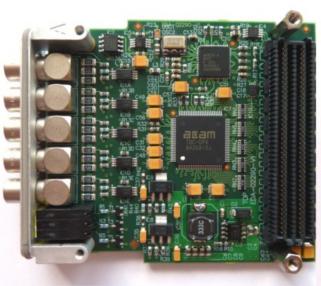
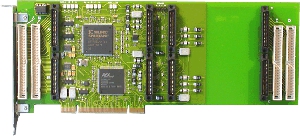
FMC TDC
This piece of hardware is designed by CERN and is published under the CERN Open Hardware Licence, which, in their own words is to hardware what the General Public Licence (GPL) is to software . The Open Hardware repository hosts a number of projects that have been published under this license. Why we use QEMU So we are developing the device driver for this hardware, as my colleague Samuel explains in his blog. I m the responsible of virtualizing it using QEMU. There are two main reasons why we want to do this:
  1. Limited availability of the hardware: although the specification is pretty much ready, this is still a prototype. The board is not (yet) commercially available. With virtual hardware, the whole development team can have as many boards as it needs.
  2. Testing: we can test the software against the virtual driver, force all kinds of conditions and scenarios, including the ones that would probably require us to physically damage the board.
While the first point might be the most obvious one, testing the software is actually the one we re more interested in. My colleague Miguel wrote a detailed blog post on how we have been using QEMU to do testing. Writing the virtual hardware Writing a virtual version of a particular piece of hardware for this purpose is not as hard as it might look. First, the point is not to reproduce accurately how the hardware works, but rather how it behaves from the operating system point of view: the hardware is a black box that the OS talks to. Second, it s not necessary to have a complete emulation of the hardware, there s no need to support every single feature, particularly if your software is not going to use it. The emulation can start with the basic functionality and then grow as needed. The FMC TDC, for example, is an FMC card which is in our case connected to a PCIe bridge called SPEC (also available in the Open Hardware repository). We need to emulate both cards in order to have a working system, but the emulation is, at the moment, treating both as if they were just one, which makes it a bit easier to have a prototype and from the device driver point of view doesn t really make a difference. Later the emulation can be split in two as I did with with TPCI200 and IP-Octal 232. This would allow us to support more FMC hardware without having to rewrite the bridging code. There s also code in the emulation to force different kind of scenarios that we are using to test if the driver behaves as expected and handles errors correctly. Those tests include the simulation of input in the any of the lines, simulation of noise, DMA errors, etc.
Tests
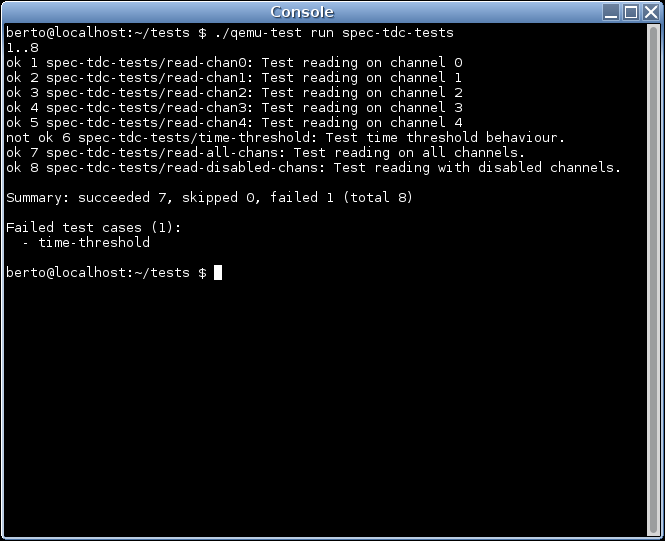
And we have written a set of test cases and a continuous integration system, so the driver is automatically tested every time the code is updated. If you want details on this I recommend you again to read Miguel s post.

5 November 2012

Alberto Garc a: Igalia at LinuxCon Europe

I came to Barcelona with a few other Igalians this week for LinuxCon, the Embedded
Linux Conference
and the KVM Forum. We are sponsoring the event and we have a couple of presentations this year, one about QEMU, device drivers and industrial hardware (which I gave today, slides here) and the other about the Grilo multimedia framework (by Juan Su rez). We ll be around the whole week so you can come and talk to us anytime. You can find us at our booth on the ground floor, where you ll also be able to see a few demos of our latest work and get some merchandising.
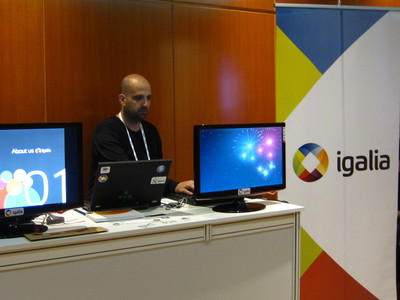
Igalia booth

3 October 2012

Alberto Garc a: IndustryPack, QEMU and LinuxCon

IndustryPack drivers for Linux In the past months we have been working at Igalia to give Linux support to IndustryPack devices. IndustryPack modules are small boards ( mezzanine ) that are attached to a carrier board, which serves as a bridge between them and the host bus (PCI, VME, ). We wrote the drivers for the TEWS TPCI200 PCI carrier and the GE IP-OCTAL-232 module.
TEWS TPCI200
GE IP-OCTAL-232
My mate Samuel was the lead developer of the kernel drivers. He published some details about this work in his blog some time ago. The drivers are available in latest Linux release (3.6 as of this writing) but if you want the bleeding-edge version you can get it from here (make sure to use the staging-next branch). IndustryPack emulation for QEMU Along with Samuel s work on the kernel driver, I have been working to add emulation of the aformentioned IndustryPack devices to QEMU. The work consists on three parts: I decided to split the emulation like this to be as close as possible to how the hardware works and to make it easier to reuse the code to implement other IndustryPack devices. The emulation is functional and can be used with the existing Linux driver. Just make sure to enable CONFIG_IPACK_BUS, CONFIG_BOARD_TPCI200 and CONFIG_SERIAL_IPOCTAL in the kernel configuration. I submitted the code to QEMU, but it hasn t been integrated yet, so if you want to test it you ll need to patch it yourself: get the QEMU source code and apply the TPCI200 patch and the IP-Octal 232 patch. Those patches have been tested with QEMU 1.2.0. And here s how you run QEMU with support for these devices:
$ qemu -device tpci200 -device ipoctal
The IP-Octal board implements eight RS-232 serial ports. Each one of those can be redirected to a character device in the host using the functionality provided by QEMU. The serial0 to serial7 parameters can be used to specify each one of the redirections. Example:
$ qemu -device tpci200 -device ipoctal,serial0=pty
With this, the first serial port of the IP-Octal board ( /dev/ipoctal.0.0.0 on the guest) will be redirected to a newly-allocated pty on the host. LinuxCon Europe Having virtual hardware allows us to test and debug the Linux driver more easily. In November I ll be in Barcelona with the rest of the Igalia OS team for LinuxCon Europe and the KVM Forum. I will be talking about how to use QEMU to improve the robustness of device drivers and speed up their development.. Some other Igalians will also be there, including Juan Su rez who will be talking about the Grilo multimedia framework. See you in Barcelona!

28 July 2012

Alberto Garc a: GUADEC 2012

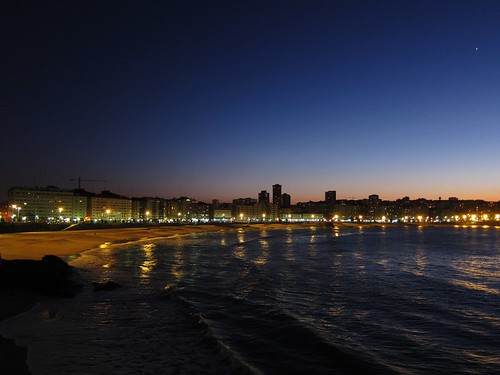
Third day of GUADEC already. And in Coru a! Coru a This is a very special city for me. I came here in 1996 to study Computer Science. Here I discovered UNIX for the first time, and spent hours learning how to use it. It s funny to see now those old UNIX servers being displayed in a small museum in the auditorium where the main track takes place. It was also here where I learnt about free software, installed my first Debian system, helped creating the local LUG and met the awesome people that founded Igalia with me. Then we went international, but our headquarters and many of our people are still here so I guess we can still call this home. So, needless to say, we are very happy to have GUADEC here this time. I hope you all are enjoying the conference as much as we are. I m quite satisfied with how it s been going so far, the local team has done a good job organising everything and taking care of lots of details to make the life of all attendees easier. I especially want to stress all the effort put into the network infrastructure, one of the best that I remember in a GUADEC conference. At Igalia we ve been very busy lately. We re putting lots of effort in making WebKit better, but our work is not limited to that. Our talks this year show some of the things we ve been doing: We are also coordinating 4 BOFs (a11y, GNOME OS, WebKit and Grilo) and hosted a UX hackfest in our offices before the conference. And we have a booth next to the info desk where you can get some merchandising and see our interactivity demos. WebKitGTK+ In case you missed the conference this year, all talks are being recorded and the videos are expected to be published really soon (before the end of the conference). So enjoy the remaining days of GUADEC, and enjoy Coru a! And of course if you re staying after the conference and want to know more about the city or about Galicia, don t hesitate to ask me or anyone from the local team, we ll be glad to help you. Queimada

16 April 2012

Gunnar Wolf: Biking over Cd. Nezahualc yotl

April 15 2012, my friend Alberto and I took on a difficult mission: Cross the allegedly biggest city in the world and conquer Ciudad Nezahualc yotl, one of its populous and famous districts. Alberto had been to Cd. Neza a couple of times, as he is one of the providers for a physical rehabilitation center built in it, but I had never set foot in it. My friend Al and me started cycling in col. Escand n, in Mexico's Center-West, followed roughly along Metrob s' line 2 until its terminal, and at Cabeza de Ju rez entered Cd. Neza. We went along the main avenue "Adolfo L pez Mateos" until Bordo de Xochiaca, then all straight until V a Tapo, almost all around the airport, got lost a couple of times in the way, then back to the heart of the city. I took only a couple of quick shots, which I have uploaded to this album We saw so much, so huge, so surreal things, but the main goal we set for this was just to enjoy cycling. I can just complain about one thing: We cycled for maybe 10Km following the main open sewage line in Mexico City. I had never breathed so much shit in my life take it as literally as you want. But, all in all, an interesting little trip.

6 February 2012

David Welton: BikeChatter.com for sale

What with two kids, a new house, and LiberWriter getting some good traction, I've been looking around for things to give to a good home so as to have less stuff to deal with. So, on the auction block goes BikeChatter.com : https://flippa.com/2696023-professional-cyclists-on-twitter-plus-2-years-of-history

BikeChatter.com is the place to go on the web to follow professional cyclists on twitter. With 500+ racers, and nearly half a million status updates from racers like Lance Armstrong, Alberto Contador, Mark Cavendish, and many, many more, this site is the best place to find out what's going on in the world of professional cycling, directly from the participants. Since I like following the site myself, I really want to see it go to people who will take it and make it even better.

17 November 2011

Alberto Garc a: 10 years

We have many reasons to be happy these days. 10 years rocking in the free world

13 November 2011

Alberto Garc a: Hello Planet Debian!

Hi all! My name is Alberto Garcia and this is my first (well, second) post in Planet Debian. So I ll introduce myself. I m a free software developer and enthusiast from Galicia, Spain. I studied computer science at the Corunha University, where I first heard about GNU/Linux and Debian. After leaving university I co-founded Igalia with a group of friends. We ve been working on lots of different things during all these years, but some projects we ve been particularly involved in include GNOME, Maemo/MeeGo and WebKit. Although I ve been using Debian for more than a decade now (my first -and still running!- installation was in 1997) and I m quite familiar with the distribution, it wasn t until a few years ago that I started maintaining packages officially. Apart from software, my other main hobby is music. When I m not using my computer you ll find me at some concert (preferably small bands: I hate long queues, crowded places and being far from the stage). It s no coincidence that my first Debian package was a Last.fm player ;) I don t have much more to add. I d like to thank Ana for adding me to the planet, and I m proud to be part of the Debian community!

10 November 2011

Alberto Garc a: FileTea now available in Debian

In the past few weeks I ve been preparing the Debian packages of FileTea and its companion EventDance. They re finally available. FileTea is a free, web-based file sharing system that just works. It only requires a browser, and no user registration is needed. If you want to know more about it, you can read my previous blog post. For a more detailed description, read Nathan Willis s excellent article on LWN.net. There have been a few changes since that article (HTTPS support in particular) but it s still the best one you can find on the net. Igalia still provides a FileTea server at http://filetea.me/, that you can use to share your files and see how it works. We plan to keep offering this service, but you don t need to trust it/depend on it anymore: now you can apt-get install filetea and have your own.

15 June 2011

Christian Perrier: So, what happened with Kikithon?

I mentioned this briefly yesterday, but now I'll try to summarize the story of a great surprise and a big moment for me. All this started when my wife Elizabeth and my son Jean-Baptiste wanted to do something special for my 50th birthday. So, it indeed all started months ago, probably early March or something (I don't yet have all the details). Jean-Baptiste described this well on the web site, so I won't go again into details, but basically, this was about getting birthday wishes from my "free software family" in, as you might guess, as many languages as possible. Elizabeth brought the original idea and JB helped her by setting up the website and collecting e-mail addresses of people I usually work with: he grabbed addresses from PO files on Debian website, plus some in his own set of GPG signatures and here we go. And then he started poking dozens of you folks in order to get your wishes for this birthday. Gradually, contributions accumulated on the website, with many challenges for them: be sure to get as many people as possible, poking and re-poking all those FLOSS people who keep forgetting things... It seems that poking people is something that's probably in the Perrier's genes! And they were doing all this without me noticing. As usually in Debian, releasing on time is a no-no. So, it quickly turned out that having everything ready by April 2nd wouldn't be possible. So, their new goal was offering this to me on Pentecost Sunday, which was yesterday. And...here comes the gift. Aha, this looks like a photo album. Could it be a "50 years of Christian" album? But, EH, why is that pic of me, with the red Debconf5 tee-shirt (that features a world map) and a "bubulle" sign, in front of the book? But, EH EH EH, what the .... are doing these word by H0lger, then Fil, then Joey doing on the following pages? And only then, OMG, I discover the real gift they prepared. 106, often bilingual, wishes from 110 people (some were couples!). 18 postcards (one made of wood). 45 languages. One postcard with wishes from nearly every distro representatives at LinuxTag 2011. Dozens of photos from my friends all around the world. All this in a wonderful album. I can't tell what I said. Anyway, JB was shooting a video, so...we'll see. OK, I didn't cry...but it wasn't that far and emotion was really really intense. Guys, ladies, gentlemen, friends....it took me a while to realize what you contributed to. It took me the entire afternoon to realize the investment put by Elizabeth and JB (and JB's sisters support) into this. Yes, as many of you wrote, I have an awesome family and they really know how to share their love. I also have an awesome virtual family all around the world. Your words are wholeheartedly appreciated and some were indeed much much much appreciated. Of course, I'll have the book in Banja Luka so that you can see the result. I know (because JB and Elizabeth told me) that many of you were really awaiting to see how it would be received (yes, that includes you, in Germany, who I visited in early May!!!). Again, thank you so much for this incredible gift. Thank you Holger Levsen, Phil Hands, Joey Hess, Lior Kaplan, Martin Michlmayr, Alberto Gonzalez Iniesta, Kenshi "best friend" Muto, Praveen Arimbrathodiyil, Felipe Augusto van de Wiel, Ana Carolina Comandulli (5 postcards!), Stefano Zacchiroli (1st contribution received by JB, of course), Gunnar Wolf, Enriiiiiico Zini, Clytie Siddall, Frans Pop (by way of Clytie), Tenzin Dendup, Otavio Salvador, Neil McGovern, Konstantinos Margaritis, Luk Claes, Jonas Smedegaard, Pema Geyleg, Meike "sp tzle queen" Reichle, Alexander Reichle-Schmehl, Torsten Werner, "nette BSD" folks, CentOS Ralph and Brian, Fedora people, SUSE's Jan, Ubuntu's Lucia Tamara, Skolelinux' Paul, Rapha l Hertzog, Lars Wirzenius, Andrew McMillan (revenge in September!), Yasa Giridhar Appaji Nag (now I know my name in Telugu), Amaya Rodrigo, St phane Glondu, Martin Krafft, Jon "maddog" Hall (and God save the queen), Eddy Petri or, Daniel Nylander, Aiet Kolkhi, Andreas "die Katze geht in die K che, wunderbar" Tille, Paul "lets bend the elbow" Wise, Jordi "half-marathon in Banja Luka" Mallach, Steve "as ever-young as I am" Langasek, Obey Arthur Liu, YAMANE Hideki, Jaldhar H. Vyas, Vikram Vincent, Margarita "Bronx cross-country queen" Manterola, Patty Langasek, Aigars Mahinovs (finding a pic *with* you on it is tricky!), Thepittak Karoonboonyanan, Javier "nobody expects the Spanish inquisition" Fern ndez-Sanguino, Varun Hiremath, Moray Allan, David Moreno Garza, Ralf "marathon-man" Treinen, Arief S Fitrianto, Penny Leach, Adam D. Barrat, Wolfgang Martin Borgert, Christine "the mentee overtakes the mentor" Spang, Arjuna Rao Chevala, Gerfried "my best contradictor" Fuchs, Stefano Canepa, Samuel Thibault, Eloy "first samba maintainer" Par s, Josip Rodin, Daniel Kahn Gillmor, Steve McIntyre, Guntupalli Karunakar, Jano Gulja , Karolina Kali , Ben Hutchings, Matej Kova i , Khoem Sokhem, Lisandro "I have the longest name in this list" Dami n Nicanor P rez-Meyer, Amanpreet Singh Alam, H ctor Or n, Hans Nordhaugn, Ivan Mas r, Dr. Tirumurti Vasudevan, John "yes, Kansas is as flat as you can imagine" Goerzen, Jean-Baptiste "Piwet" Perrier, Elizabeth "I love you" Perrier, Peter Eisentraut, Jesus "enemy by nature" Climent, Peter Palfrader, Vasudev Kamath, Miroslav "Chicky" Ku e, Mart n Ferrari, Ollivier Robert, Jure uhalev, Yunqiang Su, Jonathan McDowell, Sampada Nakhare, Nayan Nakhare, Dirk "rendez-vous for Chicago marathon" Eddelbuettel, Elian Myftiu, Tim Retout, Giuseppe Sacco, Changwoo Ryu, Pedro Ribeoro, Miguel "oh no, not him again" Figueiredo, Ana Guerrero, Aur lien Jarno, Kumar Appaiah, Arangel Angov, Faidon Liambotis, Mehdi Dogguy, Andrew Lee, Russ Allbery, Bj rn Steensrud, Mathieu Parent, Davide Viti, Steinar H. Gunderson, Kurt Gramlich, Vanja Cvelbar, Adam Conrad, Armi Be irovi , Nattie Mayer-Hutchings, Joerg "dis shuld be REJECTed" Jaspert and Luca Capello. Let's say it gain:

13 June 2011

Christian Perrier: So, what happened with Kikithon?

I mentioned this briefly yesterday, but now I'll try to summarize the story of a great surprise and a big moment for me. All this started when my wife Elizabeth and my son Jean-Baptiste wanted to do something special for my 50th birthday. So, it indeed all started months ago, probably early March or something (I don't yet have all the details). Jean-Baptiste described this well on the web site, so I won't go again into details, but basically, this was about getting birthday wishes from my "free software family" in, as you might guess, as many languages as possible. Elizabeth brought the original idea and JB helped her by setting up the website and collecting e-mail addresses of people I usually work with: he grabbed addresses from PO files on Debian website, plus some in his own set of GPG signatures and here we go. And then he started poking dozens of you folks in order to get your wishes for this birthday. Gradually, contributions accumulated on the website, with many challenges for them: be sure to get as many people as possible, poking and re-poking all those FLOSS people who keep forgetting things... It seems that poking people is something that's probably in the Perrier's genes! And they were doing all this without me noticing. As usually in Debian, releasing on time is a no-no. So, it quickly turned out that having everything ready by April 2nd wouldn't be possible. So, their new goal was offering this to me on Pentecost Sunday, which was yesterday. And...here comes the gift. Aha, this looks like a photo album. Could it be a "50 years of Christian" album? But, EH, why is that pic of me, with the red Debconf5 tee-shirt (that features a world map) and a "bubulle" sign, in front of the book? But, EH EH EH, what the .... are doing these word by H0lger, then Fil, then Joey doing on the following pages? And only then, OMG, I discover the real gift they prepared. 106, often bilingual, wishes from 110 people (some were couples!). 18 postcards (one made of wood). 45 languages. One postcard with wishes from nearly every distro representatives at LinuxTag 2011. Dozens of photos from my friends all around the world. All this in a wonderful album. I can't tell what I said. Anyway, JB was shooting a video, so...we'll see. OK, I didn't cry...but it wasn't that far and emotion was really really intense. Guys, ladies, gentlemen, friends....it took me a while to realize what you contributed to. It took me the entire afternoon to realize the investment put by Elizabeth and JB (and JB's sisters support) into this. Yes, as many of you wrote, I have an awesome family and they really know how to share their love. I also have an awesome virtual family all around the world. Your words are wholeheartedly appreciated and some were indeed much much much appreciated. Of course, I'll have the book in Banja Luka so that you can see the result. I know (because JB and Elizabeth told me) that many of you were really awaiting to see how it would be received (yes, that includes you, in Germany, who I visited in early May!!!). Again, thank you so much for this incredible gift. Thank you Holger Levsen, Phil Hands, Joey Hess, Lior Kaplan, Martin Michlmayr, Alberto Gonzalez Iniesta, Kenshi "best friend" Muto, Praveen Arimbrathodiyil, Felipe Augusto van de Wiel, Ana Carolina Comandulli (5 postcards!), Stefano Zacchiroli (1st contribution received by JB, of course), Gunnar Wolf, Enriiiiiico Zini, Clytie Siddall, Frans Pop (by way of Clytie), Tenzin Dendup, Otavio Salvador, Neil McGovern, Konstantinos Margaritis, Luk Claes, Jonas Smedegaard, Pema Geyleg, Meike "sp tzle queen" Reichle, Alexander Reichle-Schmehl, Torsten Werner, "nette BSD" folks, CentOS Ralph and Brian, Fedora people, SUSE's Jan, Ubuntu's Lucia Tamara, Skolelinux' Paul, Rapha l Hertzog, Lars Wirzenius, Andrew McMillan (revenge in September!), Yasa Giridhar Appaji Nag (now I know my name in Telugu), Amaya Rodrigo, St phane Glondu, Martin Krafft, Jon "maddog" Hall (and God save the queen), Eddy Petri or, Daniel Nylander, Aiet Kolkhi, Andreas "die Katze geht in die K che, wunderbar" Tille, Paul "lets bend the elbow" Wise, Jordi "half-marathon in Banja Luka" Mallach, Steve "as ever-young as I am" Langasek, Obey Arthur Liu, YAMANE Hideki, Jaldhar H. Vyas, Vikram Vincent, Margarita "Bronx cross-country queen" Manterola, Patty Langasek, Aigars Mahinovs (finding a pic *with* you on it is tricky!), Thepittak Karoonboonyanan, Javier "nobody expects the Spanish inquisition" Fern ndez-Sanguino, Varun Hiremath, Moray Allan, David Moreno Garza, Ralf "marathon-man" Treinen, Arief S Fitrianto, Penny Leach, Adam D. Barrat, Wolfgang Martin Borgert, Christine "the mentee overtakes the mentor" Spang, Arjuna Rao Chevala, Gerfried "my best contradictor" Fuchs, Stefano Canepa, Samuel Thibault, Eloy "first samba maintainer" Par s, Josip Rodin, Daniel Kahn Gillmor, Steve McIntyre, Guntupalli Karunakar, Jano Gulja , Karolina Kali , Ben Hutchings, Matej Kova i , Khoem Sokhem, Lisandro "I have the longest name in this list" Dami n Nicanor P rez-Meyer, Amanpreet Singh Alam, H ctor Or n, Hans Nordhaugn, Ivan Mas r, Dr. Tirumurti Vasudevan, John "yes, Kansas is as flat as you can imagine" Goerzen, Jean-Baptiste "Piwet" Perrier, Elizabeth "I love you" Perrier, Peter Eisentraut, Jesus "enemy by nature" Climent, Peter Palfrader, Vasudev Kamath, Miroslav "Chicky" Ku e, Mart n Ferrari, Ollivier Robert, Jure uhalev, Yunqiang Su, Jonathan McDowell, Sampada Nakhare, Nayan Nakhare, Dirk "rendez-vous for Chicago marathon" Eddelbuettel, Elian Myftiu, Tim Retout, Giuseppe Sacco, Changwoo Ryu, Pedro Ribeoro, Miguel "oh no, not him again" Figueiredo, Ana Guerrero, Aur lien Jarno, Kumar Appaiah, Arangel Angov, Faidon Liambotis, Mehdi Dogguy, Andrew Lee, Russ Allbery, Bj rn Steensrud, Mathieu Parent, Davide Viti, Steinar H. Gunderson, Kurt Gramlich, Vanja Cvelbar, Adam Conrad, Armi Be irovi , Nattie Mayer-Hutchings, Joerg "dis shuld be REJECTed" Jaspert and Luca Capello. Let's say it gain:

25 December 2010

Petter Reinholdtsen: The reply from Edgar Villanueva to Microsoft in Peru

A few days ago an article in the Norwegian Computerworld magazine about how version 2.0 of European Interoperability Framework has been successfully lobbied by the proprietary software industry to remove the focus on free software. Nothing very surprising there, given earlier reports on how Microsoft and others have stacked the committees in this work. But I find this very sad. The definition of an open standard from version 1 was very good, and something I believe should be used also in the future, alongside the definition from Digistan. Version 2 have removed the open standard definition from its content. Anyway, the news reminded me of the great reply sent by Dr. Edgar Villanueva, congressman in Peru at the time, to Microsoft as a reply to Microsofts attack on his proposal regarding the use of free software in the public sector in Peru. As the text was not available from a few of the URLs where it used to be available, I copy it here from my source to ensure it is available also in the future. Some background information about that story is available in an article from Linux Journal in 2002.
Lima, 8th of April, 2002
To: Se or JUAN ALBERTO GONZ LEZ
General Manager of Microsoft Per Dear Sir: First of all, I thank you for your letter of March 25, 2002 in which you state the official position of Microsoft relative to Bill Number 1609, Free Software in Public Administration, which is indubitably inspired by the desire for Peru to find a suitable place in the global technological context. In the same spirit, and convinced that we will find the best solutions through an exchange of clear and open ideas, I will take this opportunity to reply to the commentaries included in your letter. While acknowledging that opinions such as yours constitute a significant contribution, it would have been even more worthwhile for me if, rather than formulating objections of a general nature (which we will analyze in detail later) you had gathered solid arguments for the advantages that proprietary software could bring to the Peruvian State, and to its citizens in general, since this would have allowed a more enlightening exchange in respect of each of our positions. With the aim of creating an orderly debate, we will assume that what you call "open source software" is what the Bill defines as "free software", since there exists software for which the source code is distributed together with the program, but which does not fall within the definition established by the Bill; and that what you call "commercial software" is what the Bill defines as "proprietary" or "unfree", given that there exists free software which is sold in the market for a price like any other good or service. It is also necessary to make it clear that the aim of the Bill we are discussing is not directly related to the amount of direct savings that can by made by using free software in state institutions. That is in any case a marginal aggregate value, but in no way is it the chief focus of the Bill. The basic principles which inspire the Bill are linked to the basic guarantees of a state of law, such as:
  • Free access to public information by the citizen.
  • Permanence of public data.
  • Security of the State and citizens.
To guarantee the free access of citizens to public information, it is indispensable that the encoding of data is not tied to a single provider. The use of standard and open formats gives a guarantee of this free access, if necessary through the creation of compatible free software. To guarantee the permanence of public data, it is necessary that the usability and maintenance of the software does not depend on the goodwill of the suppliers, or on the monopoly conditions imposed by them. For this reason the State needs systems the development of which can be guaranteed due to the availability of the source code. To guarantee national security or the security of the State, it is indispensable to be able to rely on systems without elements which allow control from a distance or the undesired transmission of information to third parties. Systems with source code freely accessible to the public are required to allow their inspection by the State itself, by the citizens, and by a large number of independent experts throughout the world. Our proposal brings further security, since the knowledge of the source code will eliminate the growing number of programs with *spy code*. In the same way, our proposal strengthens the security of the citizens, both in their role as legitimate owners of information managed by the state, and in their role as consumers. In this second case, by allowing the growth of a widespread availability of free software not containing *spy code* able to put at risk privacy and individual freedoms. In this sense, the Bill is limited to establishing the conditions under which the state bodies will obtain software in the future, that is, in a way compatible with these basic principles. From reading the Bill it will be clear that once passed:
  • the law does not forbid the production of proprietary software
  • the law does not forbid the sale of proprietary software
  • the law does not specify which concrete software to use
  • the law does not dictate the supplier from whom software will be bought
  • the law does not limit the terms under which a software product can be licensed.
  • What the Bill does express clearly, is that, for software to be acceptable for the state it is not enough that it is technically capable of fulfilling a task, but that further the contractual conditions must satisfy a series of requirements regarding the license, without which the State cannot guarantee the citizen adequate processing of his data, watching over its integrity, confidentiality, and accessibility throughout time, as these are very critical aspects for its normal functioning. We agree, Mr. Gonzalez, that information and communication technology have a significant impact on the quality of life of the citizens (whether it be positive or negative). We surely also agree that the basic values I have pointed out above are fundamental in a democratic state like Peru. So we are very interested to know of any other way of guaranteeing these principles, other than through the use of free software in the terms defined by the Bill. As for the observations you have made, we will now go on to analyze them in detail: Firstly, you point out that: "1. The bill makes it compulsory for all public bodies to use only free software, that is to say open source software, which breaches the principles of equality before the law, that of non-discrimination and the right of free private enterprise, freedom of industry and of contract, protected by the constitution." This understanding is in error. The Bill in no way affects the rights you list; it limits itself entirely to establishing conditions for the use of software on the part of state institutions, without in any way meddling in private sector transactions. It is a well established principle that the State does not enjoy the wide spectrum of contractual freedom of the private sector, as it is limited in its actions precisely by the requirement for transparency of public acts; and in this sense, the preservation of the greater common interest must prevail when legislating on the matter. The Bill protects equality under the law, since no natural or legal person is excluded from the right of offering these goods to the State under the conditions defined in the Bill and without more limitations than those established by the Law of State Contracts and Purchasing (T.U.O. by Supreme Decree No. 012-2001-PCM). The Bill does not introduce any discrimination whatever, since it only establishes *how* the goods have to be provided (which is a state power) and not *who* has to provide them (which would effectively be discriminatory, if restrictions based on national origin, race religion, ideology, sexual preference etc. were imposed). On the contrary, the Bill is decidedly antidiscriminatory. This is so because by defining with no room for doubt the conditions for the provision of software, it prevents state bodies from using software which has a license including discriminatory conditions. It should be obvious from the preceding two paragraphs that the Bill does not harm free private enterprise, since the latter can always choose under what conditions it will produce software; some of these will be acceptable to the State, and others will not be since they contradict the guarantee of the basic principles listed above. This free initiative is of course compatible with the freedom of industry and freedom of contract (in the limited form in which the State can exercise the latter). Any private subject can produce software under the conditions which the State requires, or can refrain from doing so. Nobody is forced to adopt a model of production, but if they wish to provide software to the State, they must provide the mechanisms which guarantee the basic principles, and which are those described in the Bill. By way of an example: nothing in the text of the Bill would prevent your company offering the State bodies an office "suite", under the conditions defined in the Bill and setting the price that you consider satisfactory. If you did not, it would not be due to restrictions imposed by the law, but to business decisions relative to the method of commercializing your products, decisions with which the State is not involved. To continue; you note that:" 2. The bill, by making the use of open source software compulsory, would establish discriminatory and non competitive practices in the contracting and purchasing by public bodies..." This statement is just a reiteration of the previous one, and so the response can be found above. However, let us concern ourselves for a moment with your comment regarding "non-competitive ... practices." Of course, in defining any kind of purchase, the buyer sets conditions which relate to the proposed use of the good or service. From the start, this excludes certain manufacturers from the possibility of competing, but does not exclude them "a priori", but rather based on a series of principles determined by the autonomous will of the purchaser, and so the process takes place in conformance with the law. And in the Bill it is established that *no one* is excluded from competing as far as he guarantees the fulfillment of the basic principles. Furthermore, the Bill *stimulates* competition, since it tends to generate a supply of software with better conditions of usability, and to better existing work, in a model of continuous improvement. On the other hand, the central aspect of competivity is the chance to provide better choices to the consumer. Now, it is impossible to ignore the fact that marketing does not play a neutral role when the product is offered on the market (since accepting the opposite would lead one to suppose that firms' expenses in marketing lack any sense), and that therefore a significant expense under this heading can influence the decisions of the purchaser. This influence of marketing is in large measure reduced by the bill that we are backing, since the choice within the framework proposed is based on the *technical merits* of the product and not on the effort put into commercialization by the producer; in this sense, competitiveness is increased, since the smallest software producer can compete on equal terms with the most powerful corporations. It is necessary to stress that there is no position more anti-competitive than that of the big software producers, which frequently abuse their dominant position, since in innumerable cases they propose as a solution to problems raised by users: "update your software to the new version" (at the user's expense, naturally); furthermore, it is common to find arbitrary cessation of technical help for products, which, in the provider's judgment alone, are "old"; and so, to receive any kind of technical assistance, the user finds himself forced to migrate to new versions (with non-trivial costs, especially as changes in hardware platform are often involved). And as the whole infrastructure is based on proprietary data formats, the user stays "trapped" in the need to continue using products from the same supplier, or to make the huge effort to change to another environment (probably also proprietary). You add: "3. So, by compelling the State to favor a business model based entirely on open source, the bill would only discourage the local and international manufacturing companies, which are the ones which really undertake important expenditures, create a significant number of direct and indirect jobs, as well as contributing to the GNP, as opposed to a model of open source software which tends to have an ever weaker economic impact, since it mainly creates jobs in the service sector." I do not agree with your statement. Partly because of what you yourself point out in paragraph 6 of your letter, regarding the relative weight of services in the context of software use. This contradiction alone would invalidate your position. The service model, adopted by a large number of companies in the software industry, is much larger in economic terms, and with a tendency to increase, than the licensing of programs. On the other hand, the private sector of the economy has the widest possible freedom to choose the economic model which best suits its interests, even if this freedom of choice is often obscured subliminally by the disproportionate expenditure on marketing by the producers of proprietary software. In addition, a reading of your opinion would lead to the conclusion that the State market is crucial and essential for the proprietary software industry, to such a point that the choice made by the State in this bill would completely eliminate the market for these firms. If that is true, we can deduce that the State must be subsidizing the proprietary software industry. In the unlikely event that this were true, the State would have the right to apply the subsidies in the area it considered of greatest social value; it is undeniable, in this improbable hypothesis, that if the State decided to subsidize software, it would have to do so choosing the free over the proprietary, considering its social effect and the rational use of taxpayers money. In respect of the jobs generated by proprietary software in countries like ours, these mainly concern technical tasks of little aggregate value; at the local level, the technicians who provide support for proprietary software produced by transnational companies do not have the possibility of fixing bugs, not necessarily for lack of technical capability or of talent, but because they do not have access to the source code to fix it. With free software one creates more technically qualified employment and a framework of free competence where success is only tied to the ability to offer good technical support and quality of service, one stimulates the market, and one increases the shared fund of knowledge, opening up alternatives to generate services of greater total value and a higher quality level, to the benefit of all involved: producers, service organizations, and consumers. It is a common phenomenon in developing countries that local software industries obtain the majority of their takings in the service sector, or in the creation of "ad hoc" software. Therefore, any negative impact that the application of the Bill might have in this sector will be more than compensated by a growth in demand for services (as long as these are carried out to high quality standards). If the transnational software companies decide not to compete under these new rules of the game, it is likely that they will undergo some decrease in takings in terms of payment for licenses; however, considering that these firms continue to allege that much of the software used by the State has been illegally copied, one can see that the impact will not be very serious. Certainly, in any case their fortune will be determined by market laws, changes in which cannot be avoided; many firms traditionally associated with proprietary software have already set out on the road (supported by copious expense) of providing services associated with free software, which shows that the models are not mutually exclusive. With this bill the State is deciding that it needs to preserve certain fundamental values. And it is deciding this based on its sovereign power, without affecting any of the constitutional guarantees. If these values could be guaranteed without having to choose a particular economic model, the effects of the law would be even more beneficial. In any case, it should be clear that the State does not choose an economic model; if it happens that there only exists one economic model capable of providing software which provides the basic guarantee of these principles, this is because of historical circumstances, not because of an arbitrary choice of a given model. Your letter continues: "4. The bill imposes the use of open source software without considering the dangers that this can bring from the point of view of security, guarantee, and possible violation of the intellectual property rights of third parties." Alluding in an abstract way to "the dangers this can bring", without specifically mentioning a single one of these supposed dangers, shows at the least some lack of knowledge of the topic. So, allow me to enlighten you on these points. On security: National security has already been mentioned in general terms in the initial discussion of the basic principles of the bill. In more specific terms, relative to the security of the software itself, it is well known that all software (whether proprietary or free) contains errors or "bugs" (in programmers' slang). But it is also well known that the bugs in free software are fewer, and are fixed much more quickly, than in proprietary software. It is not in vain that numerous public bodies responsible for the IT security of state systems in developed countries require the use of free software for the same conditions of security and efficiency. What is impossible to prove is that proprietary software is more secure than free, without the public and open inspection of the scientific community and users in general. This demonstration is impossible because the model of proprietary software itself prevents this analysis, so that any guarantee of security is based only on promises of good intentions (biased, by any reckoning) made by the producer itself, or its contractors. It should be remembered that in many cases, the licensing conditions include Non-Disclosure clauses which prevent the user from publicly revealing security flaws found in the licensed proprietary product. In respect of the guarantee: As you know perfectly well, or could find out by reading the "End User License Agreement" of the products you license, in the great majority of cases the guarantees are limited to replacement of the storage medium in case of defects, but in no case is compensation given for direct or indirect damages, loss of profits, etc... If as a result of a security bug in one of your products, not fixed in time by yourselves, an attacker managed to compromise crucial State systems, what guarantees, reparations and compensation would your company make in accordance with your licensing conditions? The guarantees of proprietary software, inasmuch as programs are delivered AS IS'', that is, in the state in which they are, with no additional responsibility of the provider in respect of function, in no way differ from those normal with free software. On Intellectual Property: Questions of intellectual property fall outside the scope of this bill, since they are covered by specific other laws. The model of free software in no way implies ignorance of these laws, and in fact the great majority of free software is covered by copyright. In reality, the inclusion of this question in your observations shows your confusion in respect of the legal framework in which free software is developed. The inclusion of the intellectual property of others in works claimed as one's own is not a practice that has been noted in the free software community; whereas, unfortunately, it has been in the area of proprietary software. As an example, the condemnation by the Commercial Court of Nanterre, France, on 27th September 2001 of Microsoft Corp. to a penalty of 3 million francs in damages and interest, for violation of intellectual property (piracy, to use the unfortunate term that your firm commonly uses in its publicity). You go on to say that: "The bill uses the concept of open source software incorrectly, since it does not necessarily imply that the software is free or of zero cost, and so arrives at mistaken conclusions regarding State savings, with no cost-benefit analysis to validate its position." This observation is wrong; in principle, freedom and lack of cost are orthogonal concepts: there is software which is proprietary and charged for (for example, MS Office), software which is proprietary and free of charge (MS Internet Explorer), software which is free and charged for (Red Hat, SuSE etc GNU/Linux distributions), software which is free and not charged for (Apache, Open Office, Mozilla), and even software which can be licensed in a range of combinations (MySQL). Certainly free software is not necessarily free of charge. And the text of the bill does not state that it has to be so, as you will have noted after reading it. The definitions included in the Bill state clearly *what* should be considered free software, at no point referring to freedom from charges. Although the possibility of savings in payments for proprietary software licenses are mentioned, the foundations of the bill clearly refer to the fundamental guarantees to be preserved and to the stimulus to local technological development. Given that a democratic State must support these principles, it has no other choice than to use software with publicly available source code, and to exchange information only in standard formats. If the State does not use software with these characteristics, it will be weakening basic republican principles. Luckily, free software also implies lower total costs; however, even given the hypothesis (easily disproved) that it was more expensive than proprietary software, the simple existence of an effective free software tool for a particular IT function would oblige the State to use it; not by command of this Bill, but because of the basic principles we enumerated at the start, and which arise from the very essence of the lawful democratic State. You continue: "6. It is wrong to think that Open Source Software is free of charge. Research by the Gartner Group (an important investigator of the technological market recognized at world level) has shown that the cost of purchase of software (operating system and applications) is only 8% of the total cost which firms and institutions take on for a rational and truly beneficial use of the technology. The other 92% consists of: installation costs, enabling, support, maintenance, administration, and down-time." This argument repeats that already given in paragraph 5 and partly contradicts paragraph 3. For the sake of brevity we refer to the comments on those paragraphs. However, allow me to point out that your conclusion is logically false: even if according to Gartner Group the cost of software is on average only 8% of the total cost of use, this does not in any way deny the existence of software which is free of charge, that is, with a licensing cost of zero. In addition, in this paragraph you correctly point out that the service components and losses due to down-time make up the largest part of the total cost of software use, which, as you will note, contradicts your statement regarding the small value of services suggested in paragraph 3. Now the use of free software contributes significantly to reduce the remaining life-cycle costs. This reduction in the costs of installation, support etc. can be noted in several areas: in the first place, the competitive service model of free software, support and maintenance for which can be freely contracted out to a range of suppliers competing on the grounds of quality and low cost. This is true for installation, enabling, and support, and in large part for maintenance. In the second place, due to the reproductive characteristics of the model, maintenance carried out for an application is easily replicable, without incurring large costs (that is, without paying more than once for the same thing) since modifications, if one wishes, can be incorporated in the common fund of knowledge. Thirdly, the huge costs caused by non-functioning software ("blue screens of death", malicious code such as virus, worms, and trojans, exceptions, general protection faults and other well-known problems) are reduced considerably by using more stable software; and it is well known that one of the most notable virtues of free software is its stability. You further state that: "7. One of the arguments behind the bill is the supposed freedom from costs of open-source software, compared with the costs of commercial software, without taking into account the fact that there exist types of volume licensing which can be highly advantageous for the State, as has happened in other countries." I have already pointed out that what is in question is not the cost of the software but the principles of freedom of information, accessibility, and security. These arguments have been covered extensively in the preceding paragraphs to which I would refer you. On the other hand, there certainly exist types of volume licensing (although unfortunately proprietary software does not satisfy the basic principles). But as you correctly pointed out in the immediately preceding paragraph of your letter, they only manage to reduce the impact of a component which makes up no more than 8% of the total. You continue: "8. In addition, the alternative adopted by the bill (I) is clearly more expensive, due to the high costs of software migration, and (II) puts at risk compatibility and interoperability of the IT platforms within the State, and between the State and the private sector, given the hundreds of versions of open source software on the market." Let us analyze your statement in two parts. Your first argument, that migration implies high costs, is in reality an argument in favor of the Bill. Because the more time goes by, the more difficult migration to another technology will become; and at the same time, the security risks associated with proprietary software will continue to increase. In this way, the use of proprietary systems and formats will make the State ever more dependent on specific suppliers. Once a policy of using free software has been established (which certainly, does imply some cost) then on the contrary migration from one system to another becomes very simple, since all data is stored in open formats. On the other hand, migration to an open software context implies no more costs than migration between two different proprietary software contexts, which invalidates your argument completely. The second argument refers to "problems in interoperability of the IT platforms within the State, and between the State and the private sector" This statement implies a certain lack of knowledge of the way in which free software is built, which does not maximize the dependence of the user on a particular platform, as normally happens in the realm of proprietary software. Even when there are multiple free software distributions, and numerous programs which can be used for the same function, interoperability is guaranteed as much by the use of standard formats, as required by the bill, as by the possibility of creating interoperable software given the availability of the source code. You then say that: "9. The majority of open source code does not offer adequate levels of service nor the guarantee from recognized manufacturers of high productivity on the part of the users, which has led various public organizations to retract their decision to go with an open source software solution and to use commercial software in its place." This observation is without foundation. In respect of the guarantee, your argument was rebutted in the response to paragraph 4. In respect of support services, it is possible to use free software without them (just as also happens with proprietary software), but anyone who does need them can obtain support separately, whether from local firms or from international corporations, again just as in the case of proprietary software. On the other hand, it would contribute greatly to our analysis if you could inform us about free software projects *established* in public bodies which have already been abandoned in favor of proprietary software. We know of a good number of cases where the opposite has taken place, but not know of any where what you describe has taken place. You continue by observing that: "10. The bill discourages the creativity of the Peruvian software industry, which invoices 40 million US$/year, exports 4 million US$ (10th in ranking among non-traditional exports, more than handicrafts) and is a source of highly qualified employment. With a law that encourages the use of open source, software programmers lose their intellectual property rights and their main source of payment." It is clear enough that nobody is forced to commercialize their code as free software. The only thing to take into account is that if it is not free software, it cannot be sold to the public sector. This is not in any case the main market for the national software industry. We covered some questions referring to the influence of the Bill on the generation of employment which would be both highly technically qualified and in better conditions for competition above, so it seems unnecessary to insist on this point. What follows in your statement is incorrect. On the one hand, no author of free software loses his intellectual property rights, unless he expressly wishes to place his work in the public domain. The free software movement has always been very respectful of intellectual property, and has generated widespread public recognition of its authors. Names like those of Richard Stallman, Linus Torvalds, Guido van Rossum, Larry Wall, Miguel de Icaza, Andrew Tridgell, Theo de Raadt, Andrea Arcangeli, Bruce Perens, Darren Reed, Alan Cox, Eric Raymond, and many others, are recognized world-wide for their contributions to the development of software that is used today by millions of people throughout the world. On the other hand, to say that the rewards for authors rights make up the main source of payment of Peruvian programmers is in any case a guess, in particular since there is no proof to this effect, nor a demonstration of how the use of free software by the State would influence these payments. You go on to say that: "11. Open source software, since it can be distributed without charge, does not allow the generation of income for its developers through exports. In this way, the multiplier effect of the sale of software to other countries is weakened, and so in turn is the growth of the industry, while Government rules ought on the contrary to stimulate local industry." This statement shows once again complete ignorance of the mechanisms of and market for free software. It tries to claim that the market of sale of non- exclusive rights for use (sale of licenses) is the only possible one for the software industry, when you yourself pointed out several paragraphs above that it is not even the most important one. The incentives that the bill offers for the growth of a supply of better qualified professionals, together with the increase in experience that working on a large scale with free software within the State will bring for Peruvian technicians, will place them in a highly competitive position to offer their services abroad. You then state that: "12. In the Forum, the use of open source software in education was discussed, without mentioning the complete collapse of this initiative in a country like Mexico, where precisely the State employees who founded the project now state that open source software did not make it possible to offer a learning experience to pupils in the schools, did not take into account the capability at a national level to give adequate support to the platform, and that the software did not and does not allow for the levels of platform integration that now exist in schools." In fact Mexico has gone into reverse with the Red Escolar (Schools Network) project. This is due precisely to the fact that the driving forces behind the Mexican project used license costs as their main argument, instead of the other reasons specified in our project, which are far more essential. Because of this conceptual mistake, and as a result of the lack of effective support from the SEP (Secretary of State for Public Education), the assumption was made that to implant free software in schools it would be enough to drop their software budget and send them a CD ROM with Gnu/Linux instead. Of course this failed, and it couldn't have been otherwise, just as school laboratories fail when they use proprietary software and have no budget for implementation and maintenance. That's exactly why our bill is not limited to making the use of free software mandatory, but recognizes the need to create a viable migration plan, in which the State undertakes the technical transition in an orderly way in order to then enjoy the advantages of free software. You end with a rhetorical question: "13. If open source software satisfies all the requirements of State bodies, why do you need a law to adopt it? Shouldn't it be the market which decides freely which products give most benefits or value?" We agree that in the private sector of the economy, it must be the market that decides which products to use, and no state interference is permissible there. However, in the case of the public sector, the reasoning is not the same: as we have already established, the state archives, handles, and transmits information which does not belong to it, but which is entrusted to it by citizens, who have no alternative under the rule of law. As a counterpart to this legal requirement, the State must take extreme measures to safeguard the integrity, confidentiality, and accessibility of this information. The use of proprietary software raises serious doubts as to whether these requirements can be fulfilled, lacks conclusive evidence in this respect, and so is not suitable for use in the public sector. The need for a law is based, firstly, on the realization of the fundamental principles listed above in the specific area of software; secondly, on the fact that the State is not an ideal homogeneous entity, but made up of multiple bodies with varying degrees of autonomy in decision making. Given that it is inappropriate to use proprietary software, the fact of establishing these rules in law will prevent the personal discretion of any state employee from putting at risk the information which belongs to citizens. And above all, because it constitutes an up-to-date reaffirmation in relation to the means of management and communication of information used today, it is based on the republican principle of openness to the public. In conformance with this universally accepted principle, the citizen has the right to know all information held by the State and not covered by well- founded declarations of secrecy based on law. Now, software deals with information and is itself information. Information in a special form, capable of being interpreted by a machine in order to execute actions, but crucial information all the same because the citizen has a legitimate right to know, for example, how his vote is computed or his taxes calculated. And for that he must have free access to the source code and be able to prove to his satisfaction the programs used for electoral computations or calculation of his taxes. I wish you the greatest respect, and would like to repeat that my office will always be open for you to expound your point of view to whatever level of detail you consider suitable. Cordially,
    DR. EDGAR DAVID VILLANUEVA NU EZ
    Congressman of the Republic of Per .

    2 December 2009

    Margarita Manterola: Life after DebConf8

    Finally, after more than a year of preparation, and six months of very very hard work, DebConf8 has come and gone. Even if I'm not yet completely recovered from all that stress, I'm good enough to feel really happy about how things turned out. DebConf8 was a great success. We had great talks, many opportunities for developing interesting ideas, a lot of social interaction, an awesome video team that allowed more than 200 people from all around the world to be part of the conference even if they weren't in Argentina, and in general almost everyone had a very good time. It was really nice to have so many people from Debian over here, and it was specially nice to see them working and enjoying themselves so much. This was all possible thanks to our sponsors, thanks to the many hours spent during the previous months both by the DebConf orga-team (the usual suspects) and specially by the local team, which includes Tincho, Dami n, Romanella, Maxy, Sebas, Zero, Mendieta, Dererk, Melisa, Angasule, Lisandro, Nueces, and also thanks to the all help of the volunteers that came to work with us during DebCamp and DebConf, which include Tom s, Tinchito, M nica, Lucas, Germ n, Diego, Fefu, Nicol s, Mart n, Marcos, Hern n, Alejandro, Mat as, Rodrigo, Alberto and Joaqu n, and finally, DebConf wouldn't have been the great event it was without all the people that managed to travel thousands of kilometers to get here. To all of them, thanks, for making DebConf8 such a great conference Now, at last, DebConf8 is over (although there is some stuff that we still need to do before we can really forget all about it), and life goes on. Today, I did my first NMU after a long time. I'm particularly glad to have time for fixing bugs again, but I won't lie, I'm also extremely satisfied with how DebConf8 turned out. See you in Extremadura!

    Margarita Manterola: tzdata screwed up most computer clocks in Argentina.

    Last year, after many years of peacefully living the whole year in GMT-3, our government decided that Argentina should use DST again. This was done in a rush, but patches were written and applied everywhere to have a correct timezone. Fixing the problem was not enough, tzdata's upstream decided to predict the future:
    # From Paul Eggert (2007-12-22):
    # For dates after mid-2008, the following rules are my guesses and
    # are quite possibly wrong, but are more likely than no DST at all.
    Rule    Arg 2007    only    -   Dec 30  0:00    1:00    S
    Rule    Arg 2008    max -   Mar Sun>=15 0:00    0   -
    Rule    Arg 2008    max -   Oct Sun>=1  0:00    1:00    S
    
    Well, back in December 2007, October 2008 might have seemed like a long time in the future, and they assumed that sometime in the middle the correct date would be announced... But, predictably (knowing Argentina's current government), no DST has yet been announced. However, Paul Eggert's guesses had propagated to almost all UNIX distributions, so that at 0:00 Sunday Oct 5th, all our computers were suddenly one hour ahead of time. Affected systems: Debian, Ubuntu, Gentoo, Red Hat, OpenBSD, FreeBSD, Mac OS. Devices: ipod, maemo, Nokia N95. Websites: Clarin (a major newspaper - still broken 36 hours later), Gmail. And probably many others that I don't know of. I even read that Windows was affected, although I don't know how that might be possible, since as far as I know they don't use tzdata. Anyway, not satisfied with how they mistakenly predicted the future before, a few weeks ago (not enough time in advance to fix almost any systems, only sid had this release), they added this change:
    # From Alexander Krivenyshev (2008-09-05):
    # As per message from Carlos Alberto Fonseca Arauz (Nicaragua),
    # Argentina will start DST on Sunday October 19, 2008.
    #
    # http://www.worldtimezone.com/dst_news/dst_news_argentina03.html
    # http://www.impulsobaires.com.ar/nota.php?id=57832 (in spanish)
    Rule    Arg 2007    only    -   Dec 30  0:00    1:00    S
    Rule    Arg 2008    max -   Mar Sun>=15 0:00    0   -
    Rule    Arg 2008    max -   Oct Sun>=15 0:00    1:00    S
    
    So, they decided to take the word of a guy from Nicaragua (no bad feelings against Nicaragua, but I think that this kind of stuff should be informed by people from the affected country), and from a couple of articles that say that "According to some sources, we might have to change our clocks on the third Sunday of October". Would you change tzdata sources with such information? I definitely wouldn't. Anyway, Aurelien Jarno has already uploaded fixed packages, with no assumption regarding when the DST will happen, which is the sensible thing to do in a case like this. Thanks Aurel!

    30 November 2008

    Adeodato Sim : Snow for the guy from the South

    Ah, seems the days of posting snow pictures in Planet Debian have gone, and in any case I don’t have pictures, but I’ll blog about snow nevertheless. It never snows in Alicante, my home town. It’s by the sea in the south-east of Spain, and the winters are very mild there. I had only seen or touched snow once in my life, when I was about 7 and there was an outing in school to go and see the snow in some nearby mountain. I’m told it was crappy snow anyway. Today we returned from the QA meeting in Extremadura, arriving in Madrid really early in the morning. Knowing this, I had arranged to stay with friends Sunday and Monday, spending the night at agi@’s place. The house is in some mountain, at about 1800 meters over sea level, and there was plenty of snow. There was also a slope, and a plastic sled, so we did the obvious. It was fun, it made me happy, and I should pay Alberto another visit some other time with more appropriate clothing.

    9 November 2008

    Simon McVittie: Spec-writing On A Plane

    (Written on Friday 16th, posted on Monday)

    As I write this, I'm on a plane off the coast of the Netherlands, on the way back from a couple of days designing APIs with Rob McQueen and the RTCom people at NRC Helsinki (who we work with on the chat and VoIP functionality for Nokia internet tablets).

    We've had a very useful couple of days, mainly designing the next-generation channel requesting and dispatch API for Telepathy (the same APIs I've been doing preparatory work for on the Telepathy mailing list in the last couple of weeks). API sketches for review and comment are either on are on Merge Monkey or on the way there.

    Before even reaching Nokia, Rob and I did a lot of design on the plane over to Helsinki, and I took some notes: here they are, by way of a glimpse at how the Telepathy design process works when we don't have a whiteboard[1] :-)

    • Geoloc looks good in principle, needs some more work
      • add more docstrings
      • add a way to ask people for uncached info (RequestLocations)
      • move access control to Co.I.Presence, call it RichPresenceAccessControl?
    • DeliveryReporting looks good, ish
      • improve wording of delivery-echo and rationale
      • when sending a delivery report, add a reason for the status (using Channel_Text_Send_Error?)
    • Uniqueness requirement for (channel, handle_type != 0, handle) is in the way - let's drop it
    • MSN should use "authentic" 1-1 chats, and use Ch.I.UpgradeableToRoom (name tbd) to migrate the underlying switchboard to be a room
    • XMPP should use Ch.I.UpgradeableToRoom too, but the 1-1 channel may also stay open
    • Mutable handle => handle 0 must stay (for requestotron's benefit)
    • bundles ftw
    • renaming: we want SelfHandleChanged in the core
    • TpC* - add ability to subscribe to ifaces ay construct time (blocks Ready) or later
    • Dispatching: when registering a c'handler, specify everything it can handle
    • If a new bundle can be handled in its entirety by the same handler (call it 'the bundle handler'), do it. Otherwise split it up completely (there is no 'bundle handler').
    • If a channel in an existing bundle can be handled by the bundle handler, send it there, else send to the default handler.
    • Group - add SelfHandleChanged, maybe? Also Connection
    • Add HandleOwners: prop a uu , HandleOwnersChanged(a uu , au)
    • Use TargetHandleType, TargetHandle
    • Stringified initiator handle as a separate property
    • Maybe even a FirstMessage property, although this stretches the definition of "immutable"
    • org.freedesktop.Telepathy.Client interface

    Nokia's Mikhail Zabaluev kindly took notes for some further discussion we had with him and Alberto Mardegan about the dispatch API, which he already posted to the mailing list.

    We hope this API will make it possible to integrate Telepathy into the desktop better - it should make it a lot easier to share connections between processes in a useful way and hand out incoming channels to the appropriate handlers, which was always a major goal for Telepathy. It should also let us and others implement exciting new notification mechanisms (hi to the people on IRC and the mailing list wanting to patch their media players to integrate with Telepathy! :-)
    [1]When we do have a whiteboard, the design process is: "Robot101 scribbles on a whiteboard, smcv writes down <tp:rationale> elements"

    22 June 2008

    Daniel Stone: intuition : multi-contributor vcs :: steak : gelato

    I agree pretty much with what ajax said, but Alberto's post struck me as pretty weird. Given that git's internal format has been unbelievably stable (indeed, far more stable than bzr: a few times, I've just given up trying to get code because doing so would require me to compile a new bzr -- barrier to entry like what), I don't see what's stopping anyone from developing alternate git clients that are all Windows-friendly (or OS X-friendly, or Eclipse-friendly, or whatever).

    12 April 2008

    Philipp Kern: Wrapping up Sarge into a nice package

    We escorted Sarge to its last home. 3.1r8 is done, thanks to all the people who made it possible. A big thanks goes to James Troup, our ftpmaster of the day doing all the grunt work of getting a new point release out of the door. To bring in a more personal feeling of who makes this all possible, here is a list of people contributing uploads to 3.1r8 (mostly people from our fabulous Security Team): I would also like to thank dann frazier, Luk Claes, Martin Zobel-Helas and Neil McGovern for helping with the preparation of the point release.

    27 May 2007

    loldebian - Can I has a RC bug?: We are the MIA team

    We are the MIA team

    We are the MIA team. We came for your sunglasses

    Alberto Gonz lez Inhiesta (agi), David Mart nez Moreno (ender)

    Oslo, debconf3, 2003

    Next.

    Previous.