Search Results: "ah"

8 September 2026

Paul Tagliamonte: Mode A (Part 9/12)

This post is part of a series called "Pigeon". If this is the first post you've found, it'd be worth reading the intro post first and then looking over all posts in the series.

If you're looking for it, the intro to the PHY (layer 1) that this belongs at a high level and listing of the parts that make it up (including this one) is on the phy post.
While developing Pigeon, I ve called the group of all the configuration of the Layer 1 PHY parameters the Mode . I ve experimented with a few different modes , but one in particular has been the most resilient to the innumerable mistakes and bugs i ve wrought into existence and that is the first mode I wrote down, Mode A . This is even (mostly) backwards compatible to my original Go implementation of Pigeon Mode A (back in 2022) over the air, and has largely withstood the problems I ve thrown at it. I ve removed the bulk of the support I wrote out for other modes, but i m likely to bring them back over time as I use pigeon to learn more (such as Mode B (QAM-16), Mode C (QAM-16 NUC), and Mode AW which is the exact same as Mode A, except 5MHz in bandwidth. More to come on those as I get further along but for now let s braindump the parameters i ve picked out for Mode A:
Attribute Value Description
Rate 2.5 MHz Sampling Rate / Bandwidth
LCG 3149721335 LCG "RNG" whitening constant (randomly selected)
Preamble seq=16, order=4, count=2 (this is as-written in the preamble post)
Modulation QPSK/QAM-4 2 bits per data subcarrier
FFT Size 64
Cyc Len 16 Cyclic Prefix length (16 IQ samples)
Symbols 168 Number of OFDM Symbols
LDPC Table 802.3an (this is as-written in the ldpc post)
Raw Bits 14448 1806 bytes (168 symbols, 86 data bits per symbol)
LDPC Count 7 Number of packed LDPC encoded messages
Data Bits 12061 1507 bytes
The last bit to describe here is the Subcarrier Plan. The plan is ordered negative first (meaning the 0th bin in-memory is the most negative frequency domain bin of the fft), and within a Mode A OFDM symbol, there are 64 frequency domain bins (so, just to make it explicit: 64 subcarrier usages that make up our Mode A subcarrier plan ). We ll follow the same structure and conventions that we went through in the post all about OFDM Symbols which means, we ll need to place our guard bins, data bins, and pilot bins. I ll include a copy-paste-able version of the images to follow at the end.

Guard Bins First up, let s place our guard bins. As we ve already gone over, we re looking to clear some space right up against the high and low end of the frequency range, so let s go ahead and do that: I gave up the center bin (0 Hz) and 8 of the 64 bits on each side (1/4 of the signal!) to give myself a bit of elbow room. This is perhaps definitely a bit overkill, but it s been an extremely robust choice. If you multiply that through, this accounts for 312.5 kHz of frequency domain padding at the high and low end of the bandwidth, or 625.0 kHz of bandwidth which is not to be used.

Pilot Bins Next up was the pilot bins. We ve already gone over the purpose (and use) of our pilots, but I ve found there to be an art to the placement of the pilots. Interpolation between pilot bins has turned out to be very reliable, but extrapolation, on the other hand, has been a major pain, for reasons I don t fully understand yet. My intent in placement was to pick out roughly even stretches of data bins bracketed between pilots, with as few data subcarriers as practical outside of a pilot (using extrapolation). I ve played a bit with my AGWN simulator(s), as well as logging errors between two SDRs, and the configuration I have this in has been fairly resillant (for whatever reason), and withstood a few rounds of tweaking.

Data Bins Almost as an afterthought all of the remaining bins become data bins. This puts the total number of data bins at 43, which, since Mode A carries data in QPSK/QAM-4 (two bits per data subcarrier), means we can carry 86 bits of data per OFDM symbol. That fairly modest capacity is largely due to the modulation scheme (or fft size, but increasing that has been fraught) we re using for Mode A but I ve made up for it by including 168 OFDM symbols in a single burst in order to have enough data to carry IP traffic without splitting the packet into two bursts. With all that designed and on paper, we re ready to start to tackle the next layer up our Layer 2, named, creatively, link . Let s send some link layer data
Following along at home? Nice! As promised, I've put the full plan copy-pasted from the pigeon source tree below so that no one has to feel the need to transcribe this from the images above. Unlike most of the things I've "left to the reader", manual transcription from images is not a particularly useful task for anyone to do.
The following table is Mode A s OFDM Subcarrier Plan. This is in negative first ordering (meaning the 0th member is the most negative fft bin, and the Nth is the highest frequency fft bin).
SubcarrierPlan([
 Guard,
 Guard,
 Guard,
 Guard,
 Guard,
 Guard,
 Guard,
 Guard,
 Data,
 Data,
 Data,
 Pilot(iq!(-1.0, 0.0)),
 Data,
 Data,
 Data,
 Data,
 Data,
 Data,
 Data,
 Data,
 Data,
 Data,
 Data,
 Data,
 Pilot(iq!(1.0, 0.0)),
 Data,
 Data,
 Data,
 Data,
 Data,
 Data,
 Guard,
 Data,
 Data,
 Data,
 Data,
 Data,
 Data,
 Data,
 Pilot(iq!(0.0, -1.0)),
 Data,
 Data,
 Data,
 Data,
 Data,
 Data,
 Data,
 Data,
 Data,
 Data,
 Data,
 Data,
 Pilot(iq!(0.0, 1.0)),
 Data,
 Data,
 Data,
 Guard,
 Guard,
 Guard,
 Guard,
 Guard,
 Guard,
 Guard,
 Guard,
])
Still following along at home? Nicer! I've put the preamble sequence promised previously copy-pasted from the pigeon source tree below in case that's actually important (I don't think it is, but...).
The following table is Mode A s frequency-domain preamble. This is, as above, in negative first ordering. I don t actually think these values matter much (at all)? but in case they do, here s what I have. I muck with these a lot and haven t found many changes in quality of detection or frequency correction yet.
[
 IQ::new(0.0, 0.0),
 IQ::new(0.0, 0.0),
 IQ::polar((TAU / 13.0) * 2.0, 1.0),
 IQ::polar((TAU / 13.0) * 3.0, 1.0),
 IQ::polar((TAU / 13.0) * 4.0, 1.0),
 IQ::polar((TAU / 13.0) * 5.0, 1.0),
 IQ::polar((TAU / 13.0) * 6.0, 1.0),
 IQ::polar((TAU / 13.0) * 7.0, 1.0),
 IQ::polar((TAU / 13.0) * 8.0, 1.0),
 IQ::polar((TAU / 13.0) * 9.0, 1.0),
 IQ::polar((TAU / 13.0) * 10.0, 1.0),
 IQ::polar((TAU / 13.0) * 11.0, 1.0),
 IQ::polar((TAU / 13.0) * 12.0, 1.0),
 IQ::polar((TAU / 13.0) * 13.0, 1.0),
 IQ::new(0.0, 0.0),
 IQ::new(0.0, 0.0),
]
Let s send some link layer data

Paul Tagliamonte: wrapping it all up (Part 8/12)

This post is part of a series called "Pigeon". If this is the first post you've found, it'd be worth reading the intro post first and then looking over all posts in the series.

If you're looking for it, the intro to the PHY (layer 1) that this belongs at a high level and listing of the parts that make it up (including this one) is on the phy post.
The time has come. If you re following along at home, we now have all the basics we need to glue these parts together and see what this looks like. We re going to build the highest-level constructs for the PHY in code something that takes some number of bytes in and writes out IQ samples fit for transmit over the airwaves (we ll call this the Encoder), and something that takes chunks of IQ samples in, writing out decoded bytes (which we ll call the Decoder).

Encoder Let s begin with the Encoder, since it s slightly less involved. I ve tried to make this a bit more accessible by drawing a diagram out before describing the order of operations, so that it s possible to follow along visually. While the process here can look like a lot, it s really not that bad. We begin by taking the incoming bytes, converting the bytes into bits, and chunk those bits into parts which are sized to fit completely within an LDPC message. We will then encode incoming data into LDPC messages, using our configured LDPC Matrix (the table we appropriated from 802.3an). Next, we apply whitning over all the bits in our encoded (and packed) LDPC messages, using our configured whitening constant. In the case of QPSK, pairs of bits will then be modulated into a QAM subcarrier, where each QAM point represents a range of bits in the message. We ll go through each of those modulated IQ subcarriers, and set each corresponding data subcarrier in order, for each OFDM symbol contained in the pigeon Burst. The preamble configuration is then used to generate (or, more likely, can be used at startup to precompute) the Schmidl-Cox preamble, which is written to the first IQ samples in our output IQ buffer. Finally, we will do a series of inverse FFT operations to convert each OFDM symbol to the time domain, including their cyclic prefix. Let s take a look at doing that, but in code this time now:
// (lightly edited for clarity)
impl Encoder  
 ..

 /// Encode the provided bits into the output time-domain IQ samples.
 fn encode(
 &mut self,
 dst: &mut [IQ],
 src: &Vector,
 ) -> Result<Burst, Error>  
 let src =  
 let mut raw = Vector::new(self.fec.message_len());

 // Set  raw 's data bits, compute and set LDPC
 // checkbits.
 self.fec.add(&mut raw, src);

 // Apply whitening, and return
 raw.xor(&self.whitening)
  ;

 // copy in the precomputed schmidl-cox preamble to  dst 
 let preamble_len = self.preamble_iq.len();
 dst[..preamble_len].copy_from_slice(&self.preamble_iq);

 // allocate a new (frequency domain) 'Burst' container.
 let mut burst = Burst::new(
 &self.mode.ofdm.plan,
 self.mode.ofdm.symbols
 );

 // modulate bits from 'src' as iq, and set each
 // data subcarrier for each ofdm symbol in the
 // burst.
 self.burst_encoder.multiplex(&mut burst, &src);

 // convert from frequency-domain data into time
 // domain iq samples, writing out ofdm symbols
 // and cyclic prefixes to  dst .
 self.burst_encoder
 .transform(&mut dst[preamble_len..], &burst)?;

 // normalize all IQ samples; the maximum magnitude
 // in the IQ buffer may be very small, which weakens
 // our transmitted signal. Scale all IQ samples such
 // that the maximum IQ sample magnitude will be '1.0'.
 dst.norm();

 Ok(burst)
  
 
Using the Encoder should hopefully be fairly straightforward we ll give it a bag of bytes, and get back some IQ samples that we can ask our nearest SDR to transmit. As for what happens on the other end?

Decoder Next up is the mirror image of our Encoder the, imaginatively named, Decoder. The Decoder is slightly more involved (since it has to find the packet in the IQ stream, as well as correct for channel error(s)), so we ll do the same thing as above start with a diagram. My hope is going over the Encoder first helps us only really focus on the new stuff, otherwise it should feel like running the Encoder backwards. Here, we start with an incoming stream of IQ, where we will process scan detections as they come in from our Schmidl-Cox detector and burst Scanner. This will give us a snippit of IQ, sized to exactly our Burst. We ll begin to correct our IQ samples by first doing frequency estimation and correction in the time domain using our preamble and ofdm configuration. We ll then do a series of inverse FFTs to extract each OFDM symbol in our Burst, where we can then do channel estimation and correction. With the OFDM symbols (hopefully) good enough, we can now map each data subcarrier back to bits, and unapply whitning. The resulting bits are then chunked back up into LDPC messages, which are then checked, and concatanated data extracted. Finally the bits are turned back into bytes, which are written to our output buffer. However, before we get into the code to do this there s one last detail. We know bursts won t overlap (if they do, it s likely not possible to recover right now even though other PHYs can and do), so any time we see something we believe to be a burst, we can skip ahead by the burst s (constant) length within the IQ, and avoid trying to decode anything else in there. The nice side-effect here is this also gives us an interesting property for the Decoder namely, we know the maximum number of Burst detections we can get for a given block of incoming IQ data if they were packed end-to-end and we can pre-allocate the memory we need, avoiding allocations for every demodulation attempt (which may or may not even be a valid Burst). This pre-allocated block of memory to hold the burst s data is something that I ve called a frame buffer internally. Each frame buffer contains exactly sized buffers to hold decoded information from the burst an iq buffer that is exactly the same number of samples required to encode the preamble and data, exactly the number of bits needed to store pre and post FEC data, pre-allocated byte array, etc. Not shockingly, the code looks like this:
#[derive(Clone)]
pub struct FrameBuffer  
 /// Corrected IQ samples
 pub samples: Samples,

 /// post-correction OFDM burst
 pub burst: Burst,

 /// demodulated bits from the OFDM burst
 pub bits: Vector,

 /// demodulated bits from the OFDM burst,
 /// after FEC, and cleaned
 pub raw_bits: Vector,

 /// Layer 2 contents of the Frame
 pub contents: Vec<u8>,
 
Of course, that alone is handy but we need to use them. So let s go ahead and do what we promised above each Decoder uses a fixed number of pre-allocated FrameBuffers to store packets in-flight, packed into what is, creatively, called FrameBuffers within my code. As an aside, I likely should have called this a Memory Pool, since that s the common and accepted name for this design pattern but being stuck with unfortunate names is the burden of those of us who stumble into sensible ideas over time. The only nuance here is that I use the pools strictly sequentially we only save the FrameBuffer if the LDPC checksum is correct, allowing us to only keep track of how many successful packets we have and being able to get the valid FrameBuffers, rather than storing a handle to each FrameBuffer as we go a promise that most memory pools do not make, since blocks can usually be taken and returned in any order. Let s go ahead and do the whole Decoder dance now:
// (lightly edited for clarity)

impl Decoder  
 ..

 /// Process incoming IQ for Pigeon Bursts, and
 /// demodulate them.
 pub fn decode(
 &mut self,
 buf: &[IQ],
 ) -> Result<Vec<(Detection, &FrameBuffer)>, Error>  
 let mut ret = Vec::new();
 let mode = self.scanner.mode().clone();

 // reset the "valid frame buffer count" back to 0
 self.frames.reset();

 // call the scanner and get scan detections for
 // this block of iq ( buf )
 for detection in self.scanner.scan(buf)  
 // for each detection, we're (only) going to process
 // the iq snippit, but pass along the metadata
 // such as SNR.
 let ScanDetection  
 snippit,
 snr,
 range,
 m,
   = detection;

 // grab the next free frame buffer to work within.
 let frame_buffer = self.frames.next_mut();

 // Copy the snippit into the frame buffer (a mutable
 // location)
 frame_buffer.samples.copy_from_slice(snippit);

 // estimate the frequency offset based on the
 // Burst's Schmidl-Cox preamble.
 let preamble_fo = preamble::estimate_frequency_offset(
 &mode.preamble,
 mode.rate,
 &frame_buffer.samples[..mode.preamble.samples()],
 );

 // Shift the IQ stream by the estimated frequency
 // offset -- hopefully we're closer to 0Hz
 frame_buffer.samples.shift(mode.rate, preamble_fo);

 // estimate the frequency offset based on the
 // each burst's **cyclic prefix** -- exactly like
 // we did with the Burst Schmidl-Cox preamble,
 // but this time on each OFDM symbol.
 let ofdm_fo = ofdm::estimate_frequency_offset(
 &mode.ofdm,
 mode.rate,
 &frame_buffer.samples[mode.preamble.samples()..],
 );

 // Shift the IQ stream closer yet; hopefully this
 // is a very small nudge even closer still to 0Hz.
 frame_buffer.samples.shift(mode.rate, ofdm_fo);

 // Do a bunch of inverse fft operations for each
 // OFDM symbol, filling the frequency-domain Symbol
 // structs in  frame_buffer.burst  (Burst) struct.
 //
 // this will also do channel estimation and
 // correction before returning.
 self
 .decoder
 .transform(
 &mut frame_buffer.burst,
 &frame_buffer.samples[mode.preamble.samples()..],
 )?;

 // "demultiplex" each data subcarrier's frequency-domain
 // IQ constellation point, setting the correct bit range.
 self.decoder.demultiplex(
 &mut frame_buffer.raw_bits,
 &frame_buffer.burst
 );

 // unapply whitening by XOR-ing the buffer with
 // the well-known whitening vector.
 frame_buffer.raw_bits = frame_buffer.raw_bits.xor(
 &self.whitening);

 // verify that the LDPC message(s) are all correct,
 // and if so, concatanate the the data bits (no check
 // bits) to the  bits  vector.
 if self.fec.decode(
 &mut frame_buffer.bits,
 &frame_buffer.raw_bits
 ).is_err()  
 // this is where invalid packets fail. we gave it a good go.
 // next packet please.
 continue;
  

 // copy the raw bits out, as bytes, to the  contents  buffer.
 frame_buffer.bits.copy_as_bytes(&mut frame_buffer.contents);

 // store metadata/metrics on the demodulation.
 ret.push(Detection  
 m,
 snr,
 index: range.start,
  );

 // save the contents of this frame buffer (don't
 // reuse this buffer next go-around).
 self.frames.save();
  

 // We're going to take out the borrow on the frame at
 // the end since we don't want to deal with telling the
 // compiler via code gymnastics that the mut and non-mut
 // borrows are OK since they're non-overlapping.
 Ok(ret.into_iter().zip(self.frames.iter()).collect())
  
 
Phew. That was kinda a lot. In fact it s basically the whole thing. This function is as close to how do you read an OFDM packet as it gets, and perhaps the most important part of this whole series. Beyond that, though, this is a huge conceptual unlock. This means we now have an incredibly powerful primitive; the ability to take bytes and go to/from IQ samples over the air. Let s talk about pigeon modes

6 September 2026

Iustin Pop: AI agents aha moment

Looking at the reactions to the Debian AI vote, I think some people still think the clock can be turned back, as if that ever worked in history. Rather than cry about spilled milk, I prefer to find a path forward in the new world. There are many ways to use LLMs, some of them are straightforward, others not so much. One of the not so clear areas for me is the focus on agentic workloads. For complex tasks, sure, you want something that can work in the background, but in general, why does every single tool go the agentic way? I much prefer the chat/ask approach, or even the code one, but if I m at the keyboard, why would I send a task to an agent, and see it work, instead of directly implementing it? And then, this past Friday, I finally understood one part of that. I was in the airport, sitting at the gate and waiting to board a flight, and because I arrived much earlier at the airport (fearing crowds due to Labour Day weekend), I got one hour of work before boarding started. As the time for boarding approached, I did one more commit after making sure tests pass, pushed, closed laptop, and went to walk a bit before getting on the plane. As I was getting up, I get a phone notification from GitHub that the CI run failed. I was quite surprised, as the local tests passed, so I open the notification, and realize that tests via make test vs CI (which additionally uses --pedantic) had slightly different settings, and of course I missed a build warning (which in CI is an error). I thought I d fix that on the plane, but then I saw a Copilot agent button in the mobile app. I was curious what it did, I click it, and I see Copilot starting a draft pull request, and saying:
Thanks for asking me to work on this. I will get started on it and keep this PR s description up to date as I form a plan and make progress. Fix the failing GitHub Actions job. Analyze the Actions logs, identify the root cause of the failure, and implement a fix.
Then it goes, finds the failure, writes the fix, and tries to run the tests. Well, it can t do it (it runs in a restricted container, so no network, so stack install couldn t actually work). The agent sees that, acknowledges it has no way to validate the fix, but the error message was clear enough that it was confident the fix is mostly correct, so it sends the pull request. I allow full CI to run on the pull request, and go buy a bottle of water. After that, I check and see that the CI failed again, as not one but two test files were broken, and I didn t have --keep-going, so the build stopped at the first failure. I write a comment in the pull request, no reaction, I realize I need to tag Copilot explicitly, I do that, and it starts another investigation. I m waiting now in the boarding queue, with phone in hand, while Copilot is fixing my bug. While I scan my boarding pass and walk towards the plane, the pull request is updated, I trigger another CI, it passes, and I merge it. And then, it hit me. Agents allow me to make progress while being not at keyboard , whether that s physically not at keyboard , or while working on something else. Fixing a simple test failure is not something that needs human attention per se, whereas improving the test layout might be. In that airport, using otherwise-unusable downtime, and without explicitly intending to, I made progress in understanding a different way to use AI. Now I have three ways to work with LLMs: ask (tutor mode), code (implement my request), and agent (fix simple or complex problems, autonomously). I still don t know about plan mode and really complex tasks, like asking it to implement features from scratch. That will probably be the next area to tackle. And today (Sunday), while waiting for a running race to start, I opened GitHub, and asked Copilot to increase test coverage for a simple module. It did, and yes it still can t run tests (I learned in the meantime that you can configure the environment in which the agent runs, nice), but after two back-and-forth messages, I have a pull request ready to review. All in the 20 minutes before a race, where I could either browse social media or actually do some meaningful work. Checking now my GitHub billing, it looks like all of this Copilot use only cost $1.92. Yes, that is under two dollars! And while it did use compute resources, the person across the aisle who watched TikTok or Instagram for half an hour while waiting for takeoff also consumed a lot of compute, and so do the gazillion cat videos uploaded to YouTube every day. To me, this is another tool in the toolbox, that might one day replace me (as it did to the 19th-century textile workers), or make me five times more productive we ll see where we end up. In the meantime, I can move faster, and make better use of my limited free time. Enjoy the ride!

Michael Stapelberg: Debian Code Search: Fast TurboPFor with Go SIMD

This August, I accomplished what I wanted for many years: I deleted the last cgo dependency in Debian Code Search! This was made possible by Go s recently introduced SIMD support, because now we can implement the TurboPFor integer compression format as efficiently more efficiently, in fact, by using the newer AVX512 instruction set! as the reference implementation.

Background: Why does DCS need a fast Integer Codec? Debian Code Search (DCS) is a search engine that allows searching all the Open Source source code within Debian, with either literal search expressions or regular expression search queries. A search engine uses an inverted index: a map from term to documents containing the term. Each document is typically represented most efficiently by using an id, so the index consists of many lists of document ids. When searching, it is important to quickly decode these lists to answer the search query. However, there is a point of diminishing returns where the decoding speed, even though it can still be measurably improved quite a bit, no longer influences the overall query duration. From 2012 (its inception) to 2019, Debian Code Search used to use a small index format, and queries were fast because the index was kept entirely in RAM. In 2019, I implemented the new index format, which adds an on-disk positional index. For literal queries (78.2% of DCS queries), querying the positional index on disk is faster than querying the non-positional index in RAM. The efficient encoding of the TurboPFor format makes it possible to fit such an index on a mid-sized Hetzner server, which I rent with two 1 TB SSD disks. The optimized decoder of the C TurboPFor library is what made decoding fast at query time. If you want to dive deeper into the algorithm, see this blog post from February 2019: If you want to learn more about the positional index, see this blog post from September 2019:

SIMD in Go For many years, you had the following options for using SIMD instructions in Go:
  1. Hand-writing Go assembler code. This is only doable for small functions, for example bytes.IndexByte is implemented with hand-written Go assembly (including AVX2).
  2. Generating Go assembler code with tools like Michael McLoughlin s Avo . This is how crypto/internal/fips140/sha256 uses AVX2. While Avo generator code definitely is higher-level than hand-written assembly, it is still too close to assembly for my taste.
  3. Use a C library via cgo so gcc or clang compiles SIMD code. Debian Code Search used to use the powturbo/TurboPFor C library via cgo for the last 7 years.
The C TurboPFor library has served us well, but Debian Code Search was always intended to be a project using Go, so I would prefer it if I did not have any C code in the project. Go 1.26 (released in February 2026) introduced the simd/archsimd package:
Go 1.26 introduces a new experimental simd/archsimd package, which can be enabled by setting the environment variable GOEXPERIMENT=simd at build time. This package provides access to architecture-specific SIMD operations. It is currently available on the amd64 architecture and supports 128-bit, 256-bit, and 512-bit vector types, such as Int8x16 and Float64x8, with operations such as Int8x16.Add. The API is not yet considered stable. Go 1.26 Release Notes
For my 2019 TurboPFor analysis, I implemented goturbopfor, a native Go teaching decoder (without any SIMD), because I find Go code easier to follow than C code, especially optimized C code. My implementation was intentionally not optimized so that the code was easier to study. The TurboPFor format/algorithm has a vector-optimized part: bitpacking comes in a scalar variant (bitunpack32) and a vector variant (bitunpack256v32), where the vector variant is used for full blocks (256 values) and the scalar variant is used for remainder blocks (< 256 values). When Go 1.26 was released, I used Claude Code to explore whether my native Go decoder s bitunpack256v32 function (for the vertical vector layout) could be implemented using Go SIMD, and the answer was yes, it was possible and it was faster than without SIMD, but not quite at the level of C TurboPFor. If you let Claude Code try for long enough, it eventually finds enough optimizations (about 10) to match C performance. I don t want to vibe-code Debian Code Search, though, so I figured I would find some time to review the SIMD code at some point and see if I could implement something similar myself. Before I found enough time and motivation to complete said review, I discovered that to not regress real-life query performance by more than 10 to 100 milliseconds (which seems acceptable), I don t actually need to add SIMD code to my teaching decoder at all; it would be sufficient to reduce allocations in my teaching decoder and specialize it per bit width. Encouraged by the possibility of using the optimized native Go decoder in Debian Code Search, I explored whether I could also implement a native Go encoder so that I could get rid of the C TurboPFor dependency entirely. The answer is yes, it is doable in a few days, and it isn t even that much slower: Go is at 76% of C, see Debian/dcs commit e920dc7. The goal I set myself at that point was to see if I could learn enough SIMD to optimize the native Go encoder such that its performance would match how DCS uses C TurboPFor (via cgo). Beating C TurboPFor was possible in 2-3 commits (SIMD and bit width specialization). To my surprise, Claude Fable 5 pointed out that the encoder s block scanning could be done more efficiently using a technique called positional popcount, and that is another 2x speed-up! To be clear: I am not saying the Go compiler beats C here. Certainly, the C compiler can also produce fast AVX512 code and can be used to implement positional popcount. When comparing apples to apples, i.e. backporting the AVX512 kernels and positional popcount technique to C TurboPFor, Go benchmarks a little slower at 1.4x C. This spectacular result (much faster than what DCS had before) got me curious how far I could push the decoder with SIMD after all. I ended up matching/exceeding the cgo version here, too! The rest of this article explains a few classes of optimizations I encountered along the way.

Starting Point When I wrote my goturbopfor teaching decoder, I named its functions to match the upstream C TurboPFor library, but now I want to get away from names like p4ndec256v32 they make sense from the TurboPFor perspective, but for Debian Code Search, we can use cleaner names. Before writing any code, I audited how DCS uses integer compression / decompression.

API design: BlockEncoder, BlockDecoder and streaming In Debian Code Search, we have the following usage patterns:
  • Partial Indexing: When a new package (or package version) enters Debian, all of its (text) files are indexed. If the hello-2.12.3-1 package (hypothetically) contained only hello.c with printf("hello!\n");, we would assign document ID 1 to hello.c and store in the partial index that trigrams pri, rin, int, ntf, etc. are all found in doc 1 (hello.c).
  • Full Index Merging: The many thousands of partial index files (for each Debian package) are combined into a small handful of large index files: When searching, it would be expensive to consult thousands of indexes. To merge multiple partial index files into one larger index (which can then be efficiently queried), we need to re-encode the partial index files: what used to be document ID 1 in the partial index might be document ID 2531 in the full index.
  • Querying (searching): When users enter search queries, these queries need to be answered as quickly as possible. The relevant entries in the full indexes are decoded (in parallel).
For reading the index, we do keep the decoded uint32s fully in memory, so we only need DecodeN(input []byte, output []uint32) (read int), a function that reads len(output) values (uint32) from input and returns how many bytes it consumed. For writing the index (both in partial indexing, and when merging), keeping the entire index in memory is prohibitively expensive, so we need a streaming API, for decoding and for encoding. Ultimately, I converged on the following API:
package pforenc

type BlockEncoder struct  
    // scratch buffers can go here
 

// EncodeBlock encodes len(vals)<=256 uint32s into dest (one TurboPFor block).
func (*BlockEncoder) EncodeBlock(dest []byte, vals []uint32) []byte  

// EncodeN calls EncodeBlock in a loop.
func (*BlockEncoder) EncodeN(dest []byte, vals []uint32) []byte  

type StreamEncoder struct  
  be   BlockEncoder
  vals [256]uint32
  // scratch buffers
 

// if full, you need to call [EncodeBlock]
func (*StreamEncoder) Add(val uint32) (full bool)

// EncodeBlock must be called after all data was [Add]ed.
//
// Write the returned buffer to file or send it over the network;
// it is only valid until the next [EncodeBlock] call.
func (*StreamEncoder) EncodeBlock() []byte  
  if se.n == 0   return nil   // turn an extra EncodeBlock into a no-op
  //  
 
This API (the decoder works similarly) allows us to process data in TurboPFor format without any memory allocations. The types are not safe for concurrent use by multiple goroutines. The zero value is ready to be used. For the streaming API, the result only stays valid until the next call.

Initial Implementation Before we can optimize anything, we need a working decoder and encoder. The decoder already exists: my goturbopfor teaching decoder. Next up, I needed an encoder. Writing a TurboPFor encoder has a delightfully simple starting point: You can encode all values at bit width 32, in little endian, at which point you only need to add a one-byte TurboPFor block header every 256 values and you re done:
func (be *BlockEncoder) EncodeN(dest []byte, vals []uint32) []byte  
  for len(vals) > 0  
    chunk := min(len(vals), 256)
    dest = be.EncodeBlock(dest, vals[:chunk])
    vals = vals[chunk:]
   
  return dest
 

func (be *BlockEncoder) EncodeBlock(dest []byte, vals []uint32) []byte  
  const bitWidth = 32
  dest = append(dest, bitWidth)
  for _, val := range vals  
    dest = binary.LittleEndian.AppendUint32(dest, val)
   
  return dest
 
Of course, this is a terribly inefficient compressor, so after the first commit, the real work starts: implement each block type until the compression matches the original C TurboPFor implementation (same output file size), or in other words: do the reverse of the decoder.
  1. The TurboPFor bitpacking block type (bitpacking implementation commit) encodes a bit stream of variable bit width (where the bit width is in range 0 bitWidth 32) in little endian byte order. By scanning all values and choosing the smallest bit width that allows representing all values, this technique saves disk space (compresses).
  2. The bitpacking with exceptions block type (bitpacking with exceptions implementation commit) determines two bit widths: one for values, the other bit width for encoding exceptions. This allows choosing a lower bit width (that does not cover all values) compared to the bitpacking block type. A bitmap encodes whether a value has an exception or not.
  3. The bitpacking with VB exceptions block type (bitpacking with VB exceptions implementation commit) is a variant which does not use an exception bitmap and encodes exceptions using a variable byte integer encoding. This is more efficient when there are few exceptions (less than 20) or the exceptions are very different in bit width compared to the other values.
  4. Lastly, the constant block type (constant implementation commit) stores just one value on disk. This is useful for all-zero or all-one blocks, for example.
I found it interesting to realize that the main work of the encoder is to scan the input values and choose the optimal block type, whereas the actual encoding itself is cheap in comparison. At this point, we can look at performance and see that the Go encoder is at 76% of the C encoder. In all honesty, I could have probably stopped here, but now that the milestone of a viable replacement was reached, I got curious to see how far it would be possible to push the encoder (how much work to reach C speeds?) and afterwards, the decoder, too.

Setup

The microarchitecture level: set GOAMD64 The microarchitecture of a CPU determines which instructions it provides, and that includes not just SIMD instruction sets (like AVX2), but also other useful instructions like LZCNT (Leading Zero Count), which can be used to implement math/bits.Len32 more efficiently, which the TurboPFor encoder needs to call on every input value to determine the ideal bit width. Let s walk through how to set the microarchitecture level when using Go on 64-bit x86 (x86-64). Go uses the GOARCH environment variable to configure the target compilation architecture, and I am using the value amd64 to select 64-bit x86 (AVX2 and AVX512 are instruction sets found on x86-64 CPUs). With GOARCH=amd64, the architecture-specific variable GOAMD64 configures the microarchitecture level for which to compile and Go 1.18 introduced these 4 different levels:
GOAMD64=v1 (default): The baseline.
Exclusively generates instructions that all 64-bit x86 processors can execute. GOAMD64=v2: all v1 instructions,
plus CMPXCHG16B, LAHF, SAHF, POPCNT, SSE3, SSE4.1, SSE4.2, SSSE3. GOAMD64=v3: all v2 instructions,
plus AVX, AVX2, BMI1, BMI2, F16C, FMA, LZCNT, MOVBE, OSXSAVE. GOAMD64=v4: all v3 instructions,
plus AVX512F, AVX512BW, AVX512CD, AVX512DQ, AVX512VL.
In 2026, I generally recommend compiling with GOAMD64=v3 so that functions like bits.OnesCount8 are compiled into intrinsics (POPCNT) instead of using a lookup table. For Intel CPUs, setting GOAMD64=v3 means your programs will only start on Haswell CPUs (2013) or newer; for AMD CPUs that means Zen 1 (2017) or newer. In this specific case (DCS), I am even compiling with GOAMD64=v4. The v4 microarchitecture level requires AVX512, which means AMD Zen 4, Zen 5 or newer (Intel s story is complicated). Luckily, both my main development PC (Zen 5) and the Debian Code Search server (Zen 4) are recent enough. Setting GOAMD64=v4 has little effect on Go 1.27 itself: the only change is that maps use one less instruction (VPBROADCASTB instead of PSHUFB). But compiling with GOAMD64=v4 allows us to move one more feature check from runtime to compile time, see SIMD build tags. It makes sense to set the microarchitecture level in your benchmark setup so that you don t measure the slow fallback implementations. I use export GOAMD64=v4 in my Makefile.

Benchmarking setup Go s built-in testing package contains support for benchmarks which are written in functions of the form func BenchmarkXxx(b *testing.B). The simplest way to run such benchmarks is go test -bench=., but I ended up configuring a few convenience make targets, which write results to bench.txt and compare against baseline.txt (the previous commit s results, usually), using the very useful benchstat tool.
GOTEST=go test

# -count=6 gives p 0.002 in benchstat:
# https://pkg.go.dev/golang.org/x/perf/cmd/benchstat
BENCHFLAGS=-run=^$$ -bench=. -benchtime=200000x -count=6

# use taskset -c1 to always pin to the same single core,
# avoiding accidental scheduling on different cores on
# mixed-core CPUs like the Ryzen 9 9950X3D.
TASKSET=taskset -c 1
BENCH=$(TASKSET) $(GOTEST) $(BENCHFLAGS)

.PHONY: all test bench bench-baseline bench-relative

all: test

bench: test
	$(BENCH)   tee bench.txt
# Compares compression ratio between C and Go implementation
	benchstat -col /impl -row '/n /vals' -filter '-/impl:go-stream .unit:(encoded-bytes)' bench.txt
# Compares performance between C (cgo) and Go implementation
	benchstat -col /impl -row '/n /vals' -filter '.unit:(Mval/s)' bench.txt

bench-baseline: test
	$(BENCH)   tee baseline.txt

bench-relative: test
	$(BENCH)   tee bench.txt
	benchstat -filter '-/impl:go-stream .unit:(encoded-bytes)' baseline.txt bench.txt
	benchstat -filter '/impl:go .unit:(Mval/s)' baseline.txt bench.txt
The encoded-bytes and Mval/s units are custom metrics I am reporting from the various sub-benchmarks, which are arranged such that I can filter / report them with benchstat. The main encoder (and decoder) benchmarks compare 3 different implementations (cgo, Go, Go with the StreamEncoder API) with a number of benchmark cases that are designed to cover the different block types and contain a similar mix of values as what we see in Debian Code Search:
// reportMetrics adds Mval/s and encoded-bytes metrics to all benchmarks.
func reportMetrics(b *testing.B, n int, nencoded int)  
   b.ReportMetric(float64(nencoded), "encoded-bytes")
   b.ReportMetric(float64(b.N*n)/1e6/b.Elapsed().Seconds(), "Mval/s")
 

// BenchmarkEncode/n=<N>/vals=<testcase>/impl=<c go go-stream>
//
// e.g. BenchmarkEncode/n=2048/vals=one-constant/impl=go-stream
func BenchmarkEncode(b *testing.B)  
   for _, tc := range allBenchCases()  
     n := len(tc.vals)
     b.Run(fmt.Sprintf("n=%d/vals=%s", n, tc.name), func(b *testing.B)  
       b.Run("impl=c", func(b *testing.B)  
         b.ReportAllocs()
         var encoded []byte
         buf := make([]byte, turbopfor.EncodingSize(n))
         for b.Loop()  
           encoded = turbopfor.P4nenc256v32Buf(buf, tc.vals)
          
         reportMetrics(b, n, len(encoded))
        )
       b.Run("impl=go", func(b *testing.B)  
         b.ReportAllocs()
         var be BlockEncoder
         var encoded []byte
         buf := make([]byte, 0, turbopfor.EncodingSize(n))
         for b.Loop()  
           encoded = be.EncodeN(buf, tc.vals)
          
         reportMetrics(b, n, len(encoded))
        )
       b.Run("impl=go-stream", func(b *testing.B)  
         b.ReportAllocs()
         var se StreamEncoder
         var encoded int
         for b.Loop()  
           encoded = 0
           for _, val := range tc.vals  
             if se.Add(val)  
               encoded += len(se.EncodeBlock())
              
            
           encoded += len(se.EncodeBlock())
          
         reportMetrics(b, n, encoded)
        )
      )


CPU counters: perf Go has included excellent performance tooling for many years, see the Profiling Go Programs blog post (2011) for an example of how to use pprof, a sampling profiler. This profiler can help track down which part of a program runs slow, or where memory allocations happen. Once you identified the slow part of a program, how do you know why it s slow? To learn more about the specific bottlenecks your program encounters, you can consult your CPU s hardware performance counters. For example, you could check the branch predictor counters to see if your program is slow due to a high number of branch mispredicts. On Linux, the perf tool is the best way to access the CPU hardware performance counters. A good starting point for working with perf is the documentation on Top-down analysis with the perf tool , which describes the optimization method that Intel established. In my Makefile, I set up two perf targets:
# GOTEST and TASKSET like shown in the earlier benchmarking setup section:
GOTEST=go test -pgo=encode.cpuprof
TASKSET=taskset -c 1
PERFBENCHFLAGS=-test.bench='Encode/n=2048/vals=debian-mix/impl=go$$' -test.benchtime=200000x

# Use perf(1) to capture AMD IBS (the equivalent to Intel PEBS)
# PipelineL1 is roughly equivalent to Intel TopdownL1
perf:
	$(GOTEST) -c
	$(TASKSET) perf stat -M PipelineL1 ./pforenc.test -test.run=^$$ $(PERFBENCHFLAGS)
	sudo perf record -F 4999 -e ibs_op// --call-graph fp ./pforenc.test -test.run=^$$ $(PERFBENCHFLAGS)
	sudo chmod 644 perf.data

# 488281 iterations   2048 values = 1.000e9 values, so counter/1e9 = per value.
perf-per-value:
	$(GOTEST) -c
	$(TASKSET) perf stat -x, -e cycles:u,instructions:u,branches:u,branch-misses:u ./pforenc.test -test.run=^$$ -test.bench='Encode/n=2048/vals=debian-mix/impl=go$$' -test.benchtime=488281x 2>&1 >/dev/null   awk -F, ' printf "%-16s %6.2f /val\n", $$3, $$1/1e9 '
The perf-per-value numbers are high level numbers that indicate how much work the implementation is doing. Reducing the number usually increases speed. To see the counters for each instruction (and source code lines), I use make perf, followed by perf report. A quick shortcut is perf annotate, which directly shows the hottest function.

Optimizations (scalar) Let s first see how far we can get without reaching for SIMD instructions. (The examples are not necessarily in commit order, but cherry-picked for clarity.)

Profile-Guided Optimization (PGO) PGO stands for Profile-Guided Optimization and is a feature that Go introduced as a preview in Go 1.20 (released in February 2023) and shipped as ready for general production use in Go 1.21 (released in August 2023). The idea is to capture a CPU profile that records where your program spends most of its CPU time, which you then provide to the Go compiler to give it more data to make better decisions. Most importantly, this way the Go compiler can inline functions much more aggressively than its usual heuristics allow, which does have a measurably positive effect in my series of optimization commits. Another optimization that a PGO profile allows the compiler to do is conditional devirtualization but our TurboPFor code does not use any interfaces. My strategy is to enable PGO before doing any other optimizations, so that we have the full inlining budget available that PGO gives us, and can measure the effect of other commits clearly. Surprisingly, turning on PGO actually decreases our performance (-13% geomean), but a closer investigation reveals that we just got unlucky. Let me explain. Aside from inlining and conditional devirtualization, PGO also influences alignment: The Go compiler sets PCALIGNMAX(64, 31) on the first block of a loop (the loop body ) for all loops in hot functions (per the PGO profile), i.e. Go will insert up to 31 bytes of padding to make the block land on a 64-byte boundary. Documentation like AMD s Software Optimization Guide for the AMD Zen5 Microarchitecture (2024, #58455) explicitly recommends aligning hot loops that way:
[ ] for hot loops, some further knowledge of trade-offs can be helpful. Because the processor can read an aligned 64-byte fetch block every cycle, it is suggested to either align the start of the loop to the beginning of a 64-byte cache line [ ]
Indeed, when compiling with -gcflags=all=-d=alignhot=0 to disable the alignment, performance remains as good as without PGO. How can the padding hurt more than help? The answer is: It s not the padding itself! It s a side-effect of the padding moving instructions to different addresses. In the unlucky arrangement, a macro-fused CMPQ+JGE instruction pair now ends up exactly on a 32-byte boundary. However, the Go compiler ensures fused branch sequences must never cross or end at a 32-byte boundary to fix Intel erratum SKX102 (discussion: Go issue #35881) by inserting NOPs. This NOP padding, unlike the loop alignment padding, is not free; these extra instructions slow down our otherwise dispatch-bound loops. Because the commits after the PGO enabling commit change the code, this unlucky situation is avoided for the rest of the optimization series (by chance).

Reducing memory allocations Memory allocations are quite expensive, at least in comparison to encoding/decoding integers, so I followed my usual strategy of first reducing memory allocations as much as possible. In my goturbopfor teaching decoder, whenever the code needed a scratch buffer, it would allocate it right then and there with make():
// p4dec32 decodes one block of TurboPFor-encoded 32 bit ints
func (d *decoder) p4dec32(input []byte, output []uint32) (read int)  
    //  
  switch blockType  
  case blockBitpackingExceptions:
    bx, input := input[0], input[1:]
    n := len(output)

    exmap := input
    nex := 0 // number of exceptions
    for i := 0; i < n; i++  
      if exmap[i/8]&(1<<uint(i%8)) != 0  
        nex++
       
     
    input = input[(n+7)/8:]

    exceptions := make([]uint32, nex)
    input = input[bitunpack32(input, exceptions, bx):]
    input = input[d.bitunpack(input, output, b):]

    for i := 0; i < n; i++  
      if exmap[i/8]&(1<<uint(i%8)) != 0  
        output[i] += exceptions[0] << b
        exceptions = exceptions[1:]


    return before - len(input)
   
 
The Go compiler can turn make(T, n) calls into stack allocations, if n is known at compile-time. But, in this case nex is not known at compile-time. We can verify that Go calls into the runtime (runtime.makeslice) by dumping the object code (assembly) with source annotated (-S):
% cd ~/go/src/github.com/stapelberg/goturbopfor
% git reset --hard 49b7c05cc61e77f0257568eb73833467714d2b4a
% go test -c  # go1.27.0
% go tool objdump -S goturbopfor.test   perl -nlE 'say if /p4dec32/ .. /^$/'
TEXT github.com/stapelberg/goturbopfor.(*decoder).p4dec32(SB) /home/michael/go/src/github.com/stapelberg/goturbopfor/goturbopfor.go
func (d *decoder) p4dec32(input []byte, output []uint32) (read int)  
  0x549f60		4c8da42460ffffff	LEAQ 0xffffff60(SP), R12
  0x549f68		4d3b6610		CMPQ R12, 0x10(R14)
  0x549f6c		0f86d9070000		JBE 0x54a74b
  0x549f72		55			PUSHQ BP
  0x549f73		4889e5			MOVQ SP, BP
  0x549f76		4881ec18010000		SUBQ $0x118, SP
  0x549f7d		48899c2430010000	MOVQ BX, 0x130(SP)
  0x549f85		4889b42448010000	MOVQ SI, 0x148(SP)
	if len(output) == 0  
  0x549f8d		4d85c0			TESTQ R8, R8
  0x549f90		0f84a7030000		JE 0x54a33d
  0x549f96		660f1f840000000000	NOPW 0(AX)(AX*1)
  0x549f9f		90			NOPL
[ ]
		exceptions := make([]uint32, nex)
  0x54a4be		488d057bec1700		LEAQ 0x17ec7b(IP), AX
  0x54a4c5		4c89fb			MOVQ R15, BX
  0x54a4c8		4889d9			MOVQ BX, CX
  0x54a4cb		e8f0ddf3ff		CALL runtime.makeslice(SB)
[ ]
An easy speed-up was to avoid allocations through reuse (in goturbopfor). In the DCS pfordec package (with the improved API design), I ended up with a vals [256]uint32 field in the StreamDecoder type, which brings us from 773 Mval/s to 858 Mval/s on the debian-mix:
% benchstat -filter '/impl:go /vals:debian-mix .unit:(Mval/s)' \
  baseline.txt bench.txt
goos: linux
goarch: amd64
pkg: github.com/Debian/dcs/internal/turbopfor/pfordec
cpu: AMD Ryzen 9 9950X3D 16-Core Processor
             baseline.txt               bench.txt               
                Mval/s        Mval/s     vs base                
n=2048        1.089k   1%   1.175k   0%   +7.85% (p=0.002 n=6)
n=2039         974.7   0%   1046.0   0%   +7.32% (p=0.002 n=6)
n=160          434.9   1%    513.6   5%  +18.11% (p=0.002 n=6)
geomean        772.9         857.7       +10.98%
Aside from the speed-up, avoiding memory allocations is generally nice in benchmarks because it removes the garbage collector from the equation and makes it less likely that your benchmarks get other processes OOM-killed on the same machine.

Generics for bit width specialization In general, we want to make it easy for the compiler to understand as much as possible about our algorithm. Consider this bitpack implementation:
func bitpack(dest []byte, vals []uint32, bitWidth int) []byte  
  mask := uint32(1<<bitWidth - 1)
  var acc uint64
  var have int
  for _, val := range vals  
    acc  = uint64(val&mask) << have
    have += bitWidth
    for have >= 32  
      dest = binary.LittleEndian.AppendUint32(dest, uint32(acc))
      acc >>= 32
      have -= 32
     
   
  for have > 0  
    dest = append(dest, byte(acc))
    acc >>= 8
    have -= 8
   
  return dest
 
Let s think through what determines the iterations and control flow this function uses:
  1. The number of input values (vals), but not their actual value.
  2. The bit width to pack into (bitWidth).
With a bit of careful rearrangement, we can provide the compiler with both, a fixed number of input values (say, 32), and a bit width, both known at compile time. Why is this worthwhile? Because we can manually unroll the loop, let the compiler eliminate much of the repetition and get much faster compiled code as a result! Let s first fix the number of input values to 32 and rewrite the loop to calculate the position offsets within dest instead of changing dest on each value (with AppendUint32):
func bitpack32Unrolled(dest []byte, vals *[32]uint32, bitWidth int)  
  // only one bounds check for 32 values
  dest = dest[: 4*bitWidth : 4*bitWidth]
  mask := uint32(1<<bitWidth - 1)
  var acc uint64
  var have, pos int
  // Manually unrolled loop starts here.
  // Each iteration is identical except for the vals[x] index.
  acc  = uint64(vals[0]&mask) << have
  have += bitWidth
  if have >= 32  
    binary.LittleEndian.PutUint32(dest[pos:pos+4], uint32(acc))
    pos += 4
    acc >>= 32
    have -= 32
   

  // vals[1] .. vals[30] elided for brevity

  // Each loop iteration is 8 lines of Go code, so for 32 input values,
  // bitpack32Unrolled contains 8*32 = 256 lines of code.

  acc  = uint64(vals[31]&mask) << have
  have += bitWidth
  if have >= 32  
    binary.LittleEndian.PutUint32(dest[pos:pos+4], uint32(acc))
    pos += 4
    acc >>= 32
    have -= 32
   

  // have == 0; for all bitWidths
 
Next, we want to specialize not just for 32 input values, but also for each of the 32 bit widths. Can we do better than hand-copying bitpack32Unrolled 32 times (= 8192 lines of Go code)? Yes, we can use Go generics to help us with the code generation! In Go, array types like [4]byte (not slices like []byte!) contain the length of the array as part of their type, meaning [1]byte (an array of length 1) is a different type than [2]byte. Instead of passing the bit width as a function parameter, we can declare 32 different types (one for each bit width) and recover the bit width (at compile time!) from the type system:
type bitWidthT interface  
  [1]byte   [2]byte   [3]byte   [4]byte   [5]byte  
  [6]byte   [7]byte   [8]byte   [9]byte   [10]byte  
  [11]byte   [12]byte   [13]byte   [14]byte   [15]byte  
  [16]byte   [17]byte   [18]byte   [19]byte   [20]byte  
  [21]byte   [22]byte   [23]byte   [24]byte   [25]byte  
  [26]byte   [27]byte   [28]byte   [29]byte   [30]byte  
  [31]byte   [32]byte
 

func bitpack32Unrolled[T bitWidthT](dest []byte, vals *[32]uint32)  
  var zero T
  bitWidth := len(zero)                  // known at compile time
  dest = dest[: 4*bitWidth : 4*bitWidth] // make cap known at compile time
  mask := uint32(1<<bitWidth - 1)
  var acc uint64
  var have, pos int
  // Manually unrolled loop starts here.
  // Each iteration is identical except for the vals[x] index.
  acc  = uint64(vals[0]&mask) << have
  have += bitWidth
  if have >= 32  
    binary.LittleEndian.PutUint32(dest[pos:pos+4], uint32(acc))
    pos += 4
    acc >>= 32
    have -= 32
   

  // vals[1] .. vals[31] elided for brevity
 
When we instantiate bitpack32Unrolled[bitWidthT] with all 32 different types ([1]byte, [2]byte, , [32]byte), the compiler substitutes the bitWidthT type parameter and produces 32 copies of the function, which we can find in our compiled executable with names like github.com/Debian/dcs/internal/turbopfor/pforenc.bitpack32Unrolled[go.shape.[12]uint8]. The shape of a generic type is based on its memory layout, so a shape for [1]byte must be different than the shape for [2]byte. Because the bitWidth is now known at compile time, the Go compiler can generate close to the optimal machine code for each bit width, which we can confirm using go tool objdump. The code is branchless (after the one bounds check per 32 values) and aside from the loads and stores (from/to memory) consists only of shifts and bit operations, all with constant operands:
% go test -c && go tool objdump -S pforenc.test
[ ]
TEXT github.com/Debian/dcs/internal/turbopfor/pforenc.bitpack32Unrolled[go.shape.[28]uint8](SB) /home/michael/dcs/internal/turbopfor/pforenc/bitpackunroll.go
func bitpack32Unrolled[T bitWidthT](dest []byte, vals *[32]uint32)  
  0x660580              55                      PUSHQ BP
  0x660581              4889e5                  MOVQ SP, BP
  0x660584              48895c2418              MOVQ BX, 0x18(SP)
        dest = dest[: 4*bitWidth : 4*bitWidth] // make cap known at compile time
  0x660589              4883ff70                CMPQ DI, $0x70
  0x66058d              0f820b030000            JB 0x66089e
        acc  = uint64(vals[0]&mask) << have
  0x660593              8b06                    MOVL 0(SI), AX
  0x660595              25ffffff0f              ANDL $0xfffffff, AX
        acc  = uint64(vals[1]&mask) << have
  0x66059a              8b4e04                  MOVL 0x4(SI), CX
  0x66059d              81e1ffffff0f            ANDL $0xfffffff, CX
  0x6605a3              48c1e11c                SHLQ $0x1c, CX
  0x6605a7              4809c8                  ORQ CX, AX
                acc >>= 32
  0x6605aa              4889c1                  MOVQ AX, CX
  0x6605ad              48c1e820                SHRQ $0x20, AX
                binary.LittleEndian.PutUint32(dest[pos:pos+4], uint32(acc))
  0x6605b1              90                      NOPL
        b[0] = byte(v)
  0x6605b2              890b                    MOVL CX, 0(BX)
        acc  = uint64(vals[2]&mask) << have
  0x6605b4              8b4e08                  MOVL 0x8(SI), CX
  0x6605b7              81e1ffffff0f            ANDL $0xfffffff, CX
  0x6605bd              48c1e118                SHLQ $0x18, CX
  0x6605c1              4809c1                  ORQ AX, CX
                acc >>= 32
  0x6605c4              4889c8                  MOVQ CX, AX
  0x6605c7              48c1e920                SHRQ $0x20, CX
                binary.LittleEndian.PutUint32(dest[pos:pos+4], uint32(acc))
  0x6605cb              90                      NOPL
        b[0] = byte(v)
  0x6605cc              894304                  MOVL AX, 0x4(BX)
Now we need to actually call bitpack32 from the general bitpack function:
func bitpack(dest []byte, vals []uint32, bitWidth int) []byte  
  if bitWidth == 0  
    return dest // no payload, sparse block with only exceptions
   
  if len(vals) >= 32  
    size := 4 * bitWidth
    for len(vals) >= 32  
      existing := len(dest)
      dest = slices.Grow(dest, size)[:existing+size]
      bitpack32(dest[existing:] /*append*/, (*[32]uint32)(vals), bitWidth)
      vals = vals[32:]
     
   
  mask := uint32(1<<bitWidth - 1)
  var acc uint64
  var have int
  for _, val := range vals  
    acc  = uint64(val&mask) << have
    have += bitWidth
    for have >= 32  
      dest = binary.LittleEndian.AppendUint32(dest, uint32(acc))
      acc >>= 32
      have -= 32
     
   
  for have > 0  
    dest = append(dest, byte(acc))
    acc >>= 8
    have -= 8
   
  return dest
 

func bitpack32(dest []byte, vals *[32]uint32, bitWidth int)  
  switch bitWidth  
  case 1: bitpack32Unrolled[[1]byte](dest, vals)
  case 2: bitpack32Unrolled[[2]byte](dest, vals)
  case 3: bitpack32Unrolled[[3]byte](dest, vals)
  case 4: bitpack32Unrolled[[4]byte](dest, vals)
  case 5: bitpack32Unrolled[[5]byte](dest, vals)
  case 6: bitpack32Unrolled[[6]byte](dest, vals)
  case 7: bitpack32Unrolled[[7]byte](dest, vals)
  case 8: bitpack32Unrolled[[8]byte](dest, vals)
  case 9: bitpack32Unrolled[[9]byte](dest, vals)
  case 10: bitpack32Unrolled[[10]byte](dest, vals)
  case 11: bitpack32Unrolled[[11]byte](dest, vals)
  case 12: bitpack32Unrolled[[12]byte](dest, vals)
  case 13: bitpack32Unrolled[[13]byte](dest, vals)
  case 14: bitpack32Unrolled[[14]byte](dest, vals)
  case 15: bitpack32Unrolled[[15]byte](dest, vals)
  case 16: bitpack32Unrolled[[16]byte](dest, vals)
  case 17: bitpack32Unrolled[[17]byte](dest, vals)
  case 18: bitpack32Unrolled[[18]byte](dest, vals)
  case 19: bitpack32Unrolled[[19]byte](dest, vals)
  case 20: bitpack32Unrolled[[20]byte](dest, vals)
  case 21: bitpack32Unrolled[[21]byte](dest, vals)
  case 22: bitpack32Unrolled[[22]byte](dest, vals)
  case 23: bitpack32Unrolled[[23]byte](dest, vals)
  case 24: bitpack32Unrolled[[24]byte](dest, vals)
  case 25: bitpack32Unrolled[[25]byte](dest, vals)
  case 26: bitpack32Unrolled[[26]byte](dest, vals)
  case 27: bitpack32Unrolled[[27]byte](dest, vals)
  case 28: bitpack32Unrolled[[28]byte](dest, vals)
  case 29: bitpack32Unrolled[[29]byte](dest, vals)
  case 30: bitpack32Unrolled[[30]byte](dest, vals)
  case 31: bitpack32Unrolled[[31]byte](dest, vals)
  case 32: bitpack32Unrolled[[32]byte](dest, vals)
   
 
Encoding remainder blocks is quite a bit faster (full blocks use the vertical layout anyway):
% benchstat -filter '/impl:go /n:160 .unit:(Mval/s)' baseline.txt bench.txt
goos: linux
goarch: amd64
pkg: github.com/Debian/dcs/internal/turbopfor/pforenc
cpu: AMD Ryzen 9 9950X3D 16-Core Processor
                           baseline.txt               bench.txt               
                              Mval/s        Mval/s     vs base                
vals=bitpacking-bw1          751.2   3%   1120.5   0%  +49.15% (p=0.002 n=6)
vals=bitpacking-bw2          716.8   2%   1176.0   0%  +64.07% (p=0.002 n=6)
vals=bitpacking-bw7          700.0   1%   1078.5   0%  +54.08% (p=0.002 n=6)
vals=bitpacking-bw1-exc      524.8   1%    736.8   0%  +40.40% (p=0.002 n=6)
vals=bitpacking-bw2-exc      543.7   1%    758.2   0%  +39.46% (p=0.002 n=6)
vals=bitpacking-bw7-exc      566.7   1%    787.7   0%  +38.99% (p=0.002 n=6)
vals=bitpacking-vb-exc       442.6   1%    616.5   0%  +39.29% (p=0.002 n=6)
vals=sparse-exc              532.4   0%    787.8   0%  +47.97% (p=0.002 n=6)
vals=sparse-vb-exc           408.9   1%    597.8   0%  +46.20% (p=0.002 n=6)
vals=debian-mix              559.5   0%    783.8   9%  +40.09% (p=0.002 n=6)
This performance win comes at the cost of binary size increase. In this case, the .text section (executable code) grows by about 20 KB and the .gopclntab section grows by another 26 KB. Definitely a price I am very willing to pay, but the case might not be as clear in all circumstances.

Optimization: Bigger strides with SIMD Even without reaching for SIMD instructions, a TurboPFor implementation can be made faster by making it work bigger strides. Take this code from the goturbopfor teaching decoder which counts the number of exceptions by checking if each value s bit is set in the exception bitmap:
case blockBitpackingExceptions:
  bx, input := input[0], input[1:]
  n := len(output)

  exmap, input := input, input[(n+7)/8:]
  nex := 0 // number of exceptions
  for i := range n  
    if exmap[i/8]&(1<<uint(i%8)) != 0  
      nex++
     
   
  exceptions := d.scratch[:nex]
We can use the bits.OnesCount64 functions to count ones bits in the exception bitmap, 64 values at a time. For remainder blocks, the rest is processed 8 values (1 byte) at a time:
i := 0
for ; i+8 <= n/8; i += 8  
  xm8 := binary.LittleEndian.Uint64(exmap[i:])
  nex += bits.OnesCount64(xm8)
 
for ; i < (n+7)/8; i++  
  xmb := exmap[i]
  // Clear the bits which do not belong to the exception map:
  if rem := n - i*8; rem < 8  
    xmb &= 1<<rem - 1
   
  // Go compiles OnesCount32 into an intrinsic,
  // but not OnesCount8, so we convert to uint32:
  nex += bits.OnesCount32(uint32(xmb))
 
OnesCount64 uses a 64-bit register. For comparison, AVX2 SIMD instructions use 256-bit registers (= 8 uint32) and AVX512 SIMD instructions use 512-bit registers. In the following sections, we will first set up our build tags for conditional compilation to use a trivial SIMD instruction, then walk through an AVX2 and AVX512 SIMD kernel.

SIMD build tags Let s assume we have the following scalar code: constant.go:
package pfordec

func fillConstant(output []uint32, val uint32)  
  for i := range output  
    output[i] = val
   
 
To increase throughput, we can use AVX2 instructions if they are available on the CPU on which the program runs, i.e. using runtime dispatch. We ll first rename fillConstant to fillConstantScalar (it s now the fallback path): constant.go:
package pfordec

func fillConstantScalar(output []uint32, val uint32)  
  for i := range output  
    output[i] = val
   
 
Next, we ll supply two different implementations (constant_nosimd.go and constant_amd64.go), the latter of which is selected when compiling for GOARCH=amd64 with GOEXPERIMENT=simd (the latter will hopefully be dropped in a later version of Go). The nosimd variant just dispatches to the fillConstantScalar, which will likely be inlined:
//go:build !goexperiment.simd   !amd64

package pfordec

func fillConstant(output []uint32, val uint32)  
  fillConstantScalar(output, val)
 
The constant_amd64.go variant assigns the hasAVX2 global variable by doing a CPUID check and then jumps to the scalar fallback if !hasAVX2, i.e. the CPU is too old:
//go:build goexperiment.simd && amd64

package pfordec

import "simd/archsimd"

var hasAVX2 = archsimd.X86.AVX2()

func fillConstant(output []uint32, val uint32)  
  if !hasAVX2  
    fillConstantScalar(output, val)
    return
   
  val8 := archsimd.BroadcastUint32x8(val)
  i := 0
  for ; i+8 <= len(output); i += 8  
    val8.StoreArray((*[8]uint32)(output[i : i+8]))
   
  // use the scalar implementation for the last <= 7 elements
  fillConstantScalar(output[i:], val)
 
We can go one step further by conditionally compiling const hasAVX2 = true when GOAMD64 is set to v3 or higher (i.e. the amd64.v3 build tag is set). As a practical example from Debian Code Search, we currently need the following checks / dispatches:
code function vector instruction set GOAMD64
encoder bitpack256v AVX2 GOAMD64=v3
encoder exbitmap AVX512 GOAMD64=v4
encoder scan AVX512+VBMI+GFNI+BITALG n/a
decoder bitunpack AVX2 GOAMD64=v3
decoder bitunpack256v32 AVX2 GOAMD64=v3
decoder bitunpack256v32Ex AVX512 GOAMD64=v4
In DCS, the effect is measurably positive, but small.

The 256 uint32 vertical layout First, here is the layout explanation from my 2019 TurboPFor analysis blog post:
In regular (non-SIMD) bitpacking, integers are stored on disk one after the other, padded to a full byte, as a byte is the smallest addressable unit when reading data from disk. For example, if you bitpack only one 3 bit int, you will end up with 5 bits of padding. SIMD bitpacking works like regular bitpacking, but processes 8 uint32 little-endian values at the same time, leveraging the AVX instruction set. The following illustration shows the order in which 3-bit integers are decoded from disk:
The scalar implementation uses an array of 8 uint64 to process 8 values at a time:
func bitunpack256v32(input []byte, dest []uint32, bitWidth int) (read int)  
  mask := uint64(1)<<bitWidth - 1
  orig := len(input)
  var bits uint
  var acc [8]uint64 // accumulator: current+next bits
  for op := 0; op < len(dest);  
    if bits < uint(bitWidth)  
      // read 8 more uint32s
      for i := range 8  
        acc[i]  = uint64(binary.LittleEndian.Uint32(input)) << bits
        input = input[4:]
       
      bits += 32
     
    for i := range 8  
      dest[op] = uint32(acc[i] & mask)
      op++
      acc[i] >>= bitWidth
     
    bits -= uint(bitWidth)
   
  return orig - len(input)
 
The SIMD version also processes 8 values, but without a for i := range 8 loop! One difference is that we no longer have the luxury of using uint64 for acc (holding rest and current bits); because AVX2 registers only fit 8 uint32 (not 8 uint64). Instead, we split acc into rest8 and cur8.
func bitunpack256v32(fullinput []byte, fulldest []uint32, bitWidth int) (read int)  
  dest := fulldest[:256]
  if bitWidth == 0  
    clear(dest)
    return 0
   
  n := 32 * int(bitWidth)
  input := fullinput[:n] // tell the Go compiler how long the input is
  mask8 := archsimd.BroadcastUint32x8(uint32(1)<<bitWidth - 1)
  bitWidth8 := archsimd.BroadcastUint32x8(uint32(bitWidth))
  var bits uint
  pos := 0
  // var acc [8]uint64
  var rest8 archsimd.Uint32x8
  var cur8 archsimd.Uint32x8
  for op := 0; op < 256; op += 8  
    if bits < uint(bitWidth)  
      // read 8 more uint32s
      // acc[i]  = uint64(binary.LittleEndian.Uint32(input)) << bits
      next := archsimd.LoadUint8x32(input[pos : pos+32]).ReshapeToUint32s()
      pos += 32  // input = input[4:]
      cur8 = rest8.Or(next.ShiftAllLeft(uint64(bits)))
      // acc[i] >>= bitWidth
      rest8 = next.ShiftAllRight(uint64(uint(bitWidth) - bits))
      bits += 32
      else  
      cur8 = rest8
      // acc[i] >>= bitWidth
      rest8 = rest8.ShiftRight(bitWidth8)
     
    // dest[op] = uint32(acc[i] & mask)
    cur8.And(mask8).Store(dest[op : op+8])
    bits -= uint(bitWidth)
   
  return n
 
The SIMD version benchmarks about 3x as fast as the scalar version. Another significant speedup is to use generics for bit width specialization for this SIMD kernel so that bitWidth becomes a compile-time constant and the compiler can generate better code.

Positional Popcount For my TurboPFor encoder, I implemented the same techniques as described above:
  1. Bitpack full blocks with SIMD (AVX2)
  2. Gather exceptions using SIMD (AVX512)
  3. Use generics to specialize per bit width
These changes are sufficient to roughly match the cgo performance, but then Claude Fable 5 found another 2x speed-up on top of that! The key observation is that once encoding blocks is fast, the preceding step of scanning the input values to decide which block type to use becomes the bottleneck. Here is the encoder s main encode function, which first does one pass over the input values (scan) and then prices all different block types at all relevant bit widths (requires fast access to the scan histogram):
func (be *BlockEncoder) encode(dest []byte, vals []uint32, layout blockLayout) []byte  
  var stats stats
  scan(&stats, vals) // gathers statistics from every value in vals
  bitWidth := bits.Len32(stats.or)
  if stats.or == stats.and  
    return be.encodeConstant(dest, vals, bitWidth)
   
  n := len(vals)
  // bitpacking is the default, unless we find a more efficient block type.
  bestType := blockBitpacking
  bestB := bitWidth
  best := priceBitpack(n, bitWidth, layout)

  // Walk from high bitWidths to low: to break ties, we prefer
  // the encoding with fewer exceptions (for faster decoding).
  for b := bitWidth - 1; b >= 0; b--   // up to 32 iterations
    nex := int(stats.cnt[b])
    size := priceBitpackExceptions(n, b, bitWidth, nex, layout)
    if size < best  
      bestType = blockBitpackingExceptions
      bestB = b
      best = size
     
    // Over-approximate the number of VB bytes.
    vb := nex + // exceptions using 1, 2, 3, 4, or 5 VB bytes
      int(stats.cnt[b+7]+ // exceptions using 2, 3, 4, or 5 VB bytes
        stats.cnt[b+14]+ // exceptions using 3, 4, or 5 VB bytes
        stats.cnt[b+19]+ // exceptions using 4 or 5 VB bytes
        stats.cnt[b+24]) // exceptions using 5 VB bytes
    size = headerBytes + headerExBytes + payloadBytes(n, b, layout) + vb + nex
    if size < best  
      bestType = blockBitpackingVBExceptions
      bestB = b
      best = size
     
   
  switch bestType  
  case blockBitpacking:
    return be.encodeBitpack(dest, vals, layout, bitWidth)
  case blockBitpackingExceptions:
    return be.encodeBitpackExc(dest, vals, layout, bestB, bitWidth-bestB)
  case blockBitpackingVBExceptions:
    return be.encodeBitpackVBExc(dest, vals, layout, bestB, int(stats.cnt[bestB]))
  default:
    panic("BUG: bestType not implemented")
   
 
I ll show you a slightly shortened version of scan, the function which is the bottleneck:
type stats struct  
  // cnt[n] = how many values where bits.Len32(val)>n,
  // i.e. how many exceptions are required for bitWidth=n.
  // Padded so that cnt[b+24] is always in bounds.
  cnt [32 + 24]uint32
 

func scan(output *stats, vals []uint32)  
  for _, val := range vals  
    for b := range bits.Len32(val)  
      output.cnt[b]++ // b bits are not enough to store val


Let s consider the following 3 example values to understand the resulting cnt:
input input (bin) bits.Len32
23 0b0000010111 5
5 0b0000000101 3
666 0b1010011010 10
The resulting cnt exception count histogram would contain (cnt shortened to c):
c[0] c[1] c[2] c[3] c[4] c[5] c[6] c[7] c[8] c[9] c[10]
3 3 3 2 2 1 1 1 1 1 0
In words, this means that at bit width 10, we could encode all the values without any exceptions. But most values do not need 10 bits, so a bit width of 5 would be more efficient, but requires storing one exception. Encoding at bit width 4 requires 2 exceptions, and so on. The scan function above is intentionally kept simple for illustration. We can make it faster by moving the per-bit-width loop outside the per-element loop. The fast version still needs about 12 instructions per value. With SIMD, we can reduce this to by 8x to only 1.5 instructions per value!

The trick: smear masks enable positional popcount The trick is to turn each input value into its smear mask (imagine taking the first 1 bit and smearing it across the remaining positions). Here are the smear masks for our example:
input input (bin) bits.Len32 smear mask
23 0b0000010111 5 0b0000011111
5 0b0000000101 3 0b0000000111
666 0b1010011010 10 0b1111111111
Turning a value into its smear mask is computationally cheap: Go implements BitLen(x) (functions like bits.Len32) by calculating 32 - LZCNT(x). We can calculate the smear mask of a value with ^uint32(0) >> LZCNT(x), i.e. starting with a 32-one-bits mask and shifting it by the number of leading zeros. Now, to obtain e.g. cnt[4], we can count the 1 bits at bit position 4 of all input values. The POPCNT instruction counts bits very efficiently, but it counts one bits within a register, so it counts rows, not columns. Counting columns is called Positional Population Count. I found the following papers that describe positional popcount with SIMD:

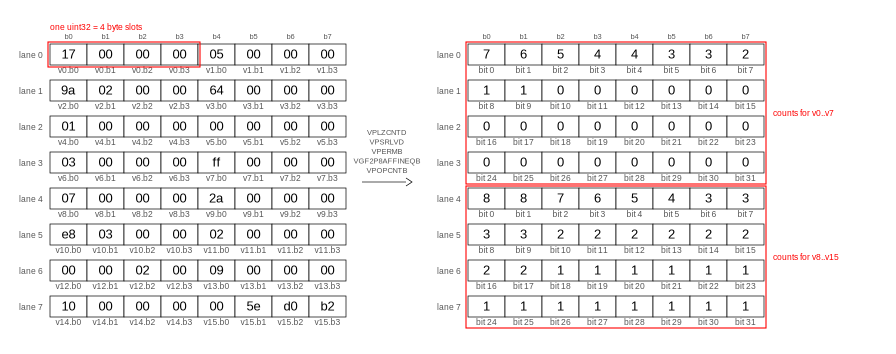
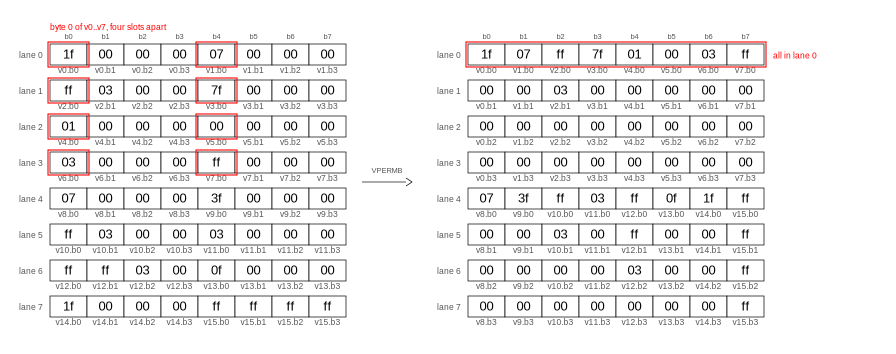
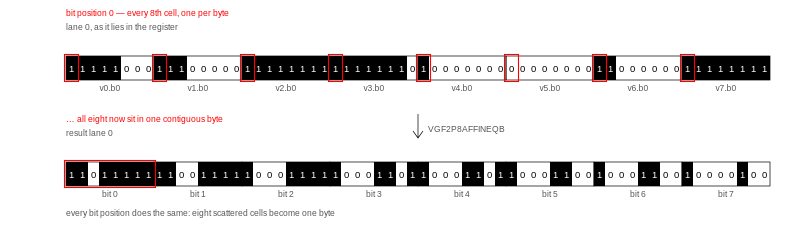
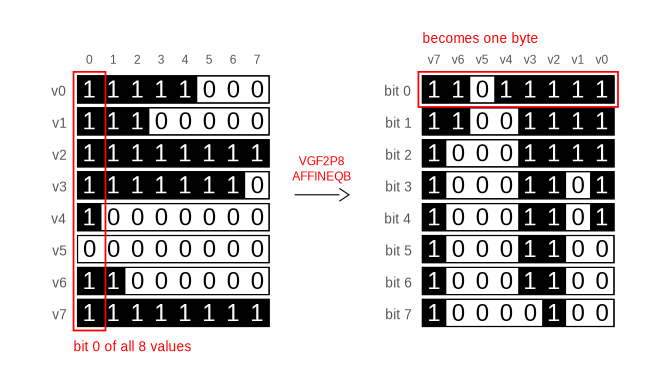
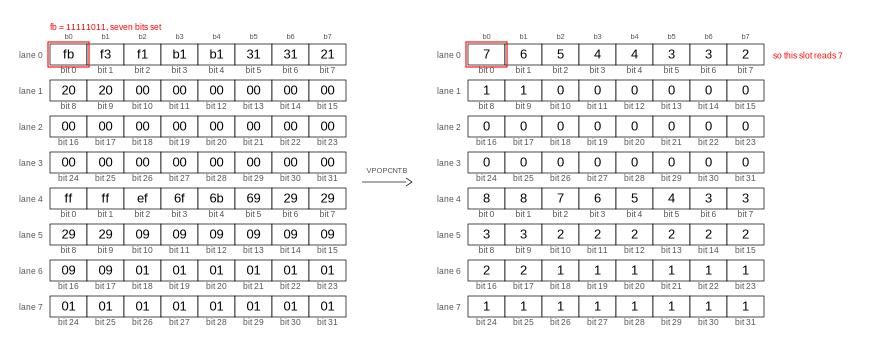
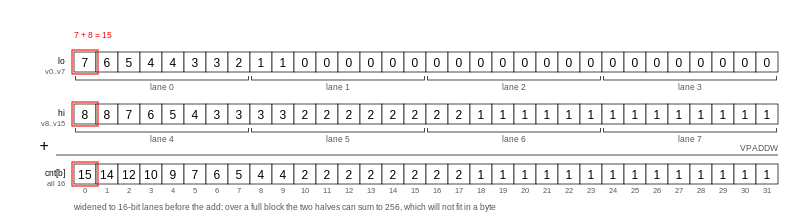
Positional Popcount: a visual explanation To understand the AVX512 implementation of positional popcount, I found it most helpful to visualize an AVX512 register (512 bits, i.e. 64 bytes). The graphic below uses the Uint64x8 layout, meaning it divides the register into 8 lanes of 64 bits (= 8 bytes) each. This illustration shows the whole process: how uint32s are loaded into an AVX512 register (all 4 of its bytes, in sequence) and where we end up, i.e. the 32 positional popcounts: Let s break down this process into its individual steps. First, we turn each loaded value into its smear mask as explained above. The VPOPCNTB vector instruction calculates POPCNT (1 byte) of 64 bytes at once, but first we need to shuffle the bytes inside the register: in load order, we have a full uint32 (4 bytes), followed by another uint32, per lane. First, we permute the bytes (VPERMB) such that all the first bytes of each value end up in one lane ( transpose the bytes ): Next, we transpose the bits using the GF2P8AFFINEQB instruction, which sounds scary but turns out to be quite flexible for bit manipulation of all kinds. The GF2P8AFFINEQB instruction is also the star of the show in Go s Green Tea Garbage Collector (2025). Here is the bit transpose, shown in the AVX512 register layout (see below for a different layout): I found it easier to understand the transpose step when arranging the 8 bytes of lane 0 from top-to-bottom (instead of left-to-right), because then it looks like a 90 degree clockwise rotation: Now we can use VPOPCNTB to count the bits in all 64 bytes at once: After all loop iterations (processing 16 values each) are done, we add the two groups (first 8 values, second 8 values) to obtain the 32 exception counts:

Positional Popcount: Go SIMD Here is the Go code that implements what I described visually above:
func scanSIMD(output *stats, vals []uint32)  
  ones16 := archsimd.BroadcastUint32x16(^uint32(0)) // 16 32-one-bits masks
  shuffle := archsimd.LoadUint8x64Array(&scanShuffle)
  units := archsimd.LoadUint8x64Array(&scanUnits)
  var acc archsimd.Uint8x64
  idx := 0
  for ; idx+16 <= len(vals); idx += 16  
    v := archsimd.LoadUint32x16(vals[idx : idx+16])
    // Replace all values with their smear masks.
    smear := ones16.ShiftRight(v.LeadingZeros()).ReshapeToUint8s()
    // Transpose: shuffle the bytes, then transpose the bits.
    matrices := smear.Permute(shuffle).ReshapeToUint64s()
    transposed := units.GaloisFieldAffineTransform(matrices, 0)
    // Popcount 64 bytes at once into the accumulator.
    acc = acc.Add(transposed.OnesCount())
   
  // Store the accumulator into output.cnt:
  // Widen the two groups of byte counts to uint16 lanes (so that
  // 128+128 = 256 fits), fold them into cnt[b] for b=0..31,
  // then widen again to the uint32 lanes of output.cnt.
  sum := acc.GetLo().ExtendToUint16().Add(acc.GetHi().ExtendToUint16())
  sum.GetLo().ExtendToUint32().Store(output.cnt[0:16])
  sum.GetHi().ExtendToUint32().Store(output.cnt[16:32])
  // scalar tail for the 0..15 remaining values
  for _, val := range vals[idx:]  
    for b := range bits.Len32(val)  
      output.cnt[b]++


Have a look at the commit introducing positional popcount to DCS for the full code (including shuffle tables and ISA checks) as well as the detailed benchmark results.

Go even faster? The SIMD optimizations I showed above beat the cgo TurboPFor library that Debian Code Search used before. When comparing apples to apples, i.e. backporting the AVX512 kernels and positional popcount technique to C TurboPFor, Go benchmarks a little slower at 1.4x C. Could we make my Go TurboPFor implementation even faster, to truly match the C speed? Yes! But also no. Let me explain:
  1. We could use more SIMD instructions to remove all code that still processes one value at a time. For example, in my encoder s encodeBitpackVBExc function. Or we could price all bit widths concurrently in encode. Or in the decoder s exception apply code path.
    But all of these SIMD instructions make understanding (and changing) the code harder, so I am cautious regarding which ones I introduce.
  2. A big part of the performance gap is due to Go s bounds checks. While it costs performance, bounds checking is great for safety, so I will not turn off bounds checking. The Go compiler eliminates a number of bounds checks when it understands it s safe to do so. One optimization avenue could be to make the prove pass in the Go compiler smarter to eliminate more bounds checks.
  3. When doing mid-stack inlining (proposal #19348) (2017), Go sometimes needs to put NOP instructions into the binary so that it can attach inlining markers. For dispatch-bound functions, these extra NOPs can measurable slow down execution.
  4. The Go compiler currently allows specifying the architecture (GOARCH=amd64) and microarchitecture (GOAMD64=v3), but not a specific CPU architecture (like AMD Zen 4). Therefore, CPU-specific workarounds for one vendor affect all the generated code. The specific one I encountered in my code is that the Go compiler emits XORL CX,CX before every POPCNT to break a false-output-dependency from the Intel Sandy Bridge Skylake era, which is unnecessary on AMD Zen CPUs.
    I suspect that Go intentionally does not offer this level of customizability.
  5. After all of the above points are addressed, what remains is better code generation in specific cases. To illustrate what I mean, consider the example of incrementing a loop variable, where Go re-derives an index every time:
    Go: POPCNTL; ADDQ DI,CX; LEAQ (base)(CX*4) (3 instructions)
    clang: popcnt; lea rax,[rax+4*rdi] (2 instructions)
    Depending on the specific case, improving the compiler might be easy or prohibitively complex. Often, such improvements are hard to measure conclusively.

Conclusion Go s SIMD support makes available in Go code without having to resort to cgo or assembly a powerful part of modern CPUs which allows speeding up the kind of computation that TurboPFor needs by an order of magnitude! I found it very valuable to use a coding agent (Claude Code, with Opus 5 and Fable 5 in this case) to help with the many tedious parts of such performance work (and still it took me weeks!). The LLM can read objdump output much faster than I can, can see patterns and correlations I might never identify, never becomes frustrated after a compiler error or runtime panic, and never runs out of patience to run one more experiment, as long as I give it measurable and reachable goals. The performance of the SIMD code which one can get from the Go compiler is pretty close to what a good C compiler like clang provides. The CPU performance counters show value decoding speeds of 7 instructions/cycle (IPC) on a machine where the maximum is 8 IPC. To me, SIMD support is a very welcome addition to Go.

31 August 2026

Russ Allbery: Review: The Hands of the Emperor

Review: The Hands of the Emperor, by Victoria Goddard
Series: Lays of the Hearth-Fire #1
Publisher: Underhill Books
Copyright: January 2019
ISBN: 1-988908-15-9
Format: Kindle
Pages: 739
The Hands of the Emperor is a self-published political fantasy novel. It's the recommended first book (although not the first published book) in a complicated set of interrelated series. I was not able to definitively confirm that Underhill Books is Goddard's self-publishing press name, but the press does not appear to have an Internet presence apart from Goddard's books and her books appear to be using the standard self-publishing channels. Cliopher Mdang is the personal secretary of the last emperor of Astandalas, the magical heart of Zunidh, a man worshiped as a god. The emperor's word is absolute, his magic supports the health of the entire world, and he cannot be physically touched without risking physical damage and severe political and religious punishment. Cliopher is one of the emperor's closest associates, but the distance between them is still vast. It therefore represents a terrifying and dangerous breach of etiquette for him to suggest the emperor may enjoy a vacation on a tropical island near Cliopher's remote home. The emperor's acceptance of the invitation is even more startling. The emperor has opinions about his life as the emperor that no one had guessed. Cliopher has not assimilated as completely into the bureaucratic machinery of the empire as it first may appear. And Cliopher's family have vastly misunderstood the nature of his role in the emperor's government. I find the marketing blurb for this book unfortunate since, at least to me, the emphasis on physical touch and intimacy implies that The Hands of the Emperor is a romance novel or at least has significant romantic elements. I've been aware of this book for years but put off reading it because I wasn't quite in the mood for that story. This is not a romance novel; there is no romance in this book whatsoever. It is a political fantasy, both in the sense that it is set in a secondary fantasy world with magic and (apparently) some form of interplanetary travel, and in the sense that it is a fantasy of governance. When I say that this book blew up in certain corners of the Internet during the pandemic, I think you will still underestimate the passion of its advocates. I heard about this book constantly, in a way that reminded me of Kushiel's Dart and the time when fans of Jacqueline Carey would bring her up in every fantasy conversation, or when we created a Usenet newsgroup for The Wheel of Time mostly to get the voluminous conversations off of the regular SFF newsgroup. I'm one of those mildly contrarian people for whom that degree of enthusiasm is a little off-putting, which is another reason why I resisted buying a copy for years and only read it in 2026. It's delightful, although also a bit embarrassing, when the book everyone was in love with turns out to be just as good as everyone said it was. I adore stories about friendship, and this is one of the best stories about friendship that I've ever read. It is a very, very slow burn, but I also thought the first three quarters of the book was exquisitely paced. There were long sections where not very much was happening, and yet I couldn't put the book down because there was so much subtle character work just beneath the surface. Almost all of the novel is told in tight third person from Cliopher's perspective, and I thought that was an excellent choice. Neither Cliopher nor the narrator comment on things that Cliopher finds obvious, which is both immersive and critical to the pacing. There are discoveries for the reader throughout the book, the sort of discoveries that make pieces fit together satisfyingly in retrospect, and the reader stays sufficiently ahead of the misunderstandings of Cliopher's friends and family that one also gets the joy of watching other people discover things that one figured out a hundred pages earlier. It helps that I truly liked nearly everyone in this book. There are no real villains, only a few supporting characters whose role is to be irritating or corrupt. If you're looking for a lot of conflict and drama, you may want to save this book for a different mood, but if you're in the mood for a varied collection of fundamentally good characters working methodically through the complexities and obstacles of politics and social systems to improve the world, there are few books I would recommend more. Goddard achieves one of the hardest tricks of slow burns: steady forward progress that does not rely on reversals, misunderstandings, or the friendship equivalent of the third-act breakup. This book spends 700 pages building towards a climax that managed to be worthy of all 700 pages without ever annoying me with artificial obstacles, and that's quite a feat. I've not said much about the details of the plot. There is one it's not just character work but I think this book benefits immensely from going in as blind as possible. I found the twists and turns and growing revelations so deeply satisfying that I don't want to rob any other reader of the experience. The fantasy world-building is intriguing but a bit unsatisfying because it is so unexplained. We get a few details of the magic system, but since Cliopher has no magic, he isn't that interested in the details. There is a catastrophic magical event in the world background, and we learn some of the details of its practical effects, but the nature of the world before the cataclysm is so obvious to the characters that it's never explained. I'm not even certain that this civilization is interplanetary; that feels like the implication of how characters talk about multiple worlds, but the method of travel is left entirely undefined. This might be frustrating to some genre readers, but I personally enjoy books where the world-building is a bit mysterious. It's a good reason to read more of Goddard's books set in the same universe. This was my favorite of the books I've read so far this year, but I do have one caution and a couple of caveats. The caution is that Cliopher comes from an island culture based heavily on (I think) Polynesian cultures. That culture is very central to the story and is treated with considerable respect, but I still get a bit nervous when a Canadian author from Nova Scotia with an academic background in European medieval studies writes a story focused this deeply on a non-European culture. Nothing about her portrayal seemed off to me (although there is a very clunky and ham-handed scene about a different native culture that worries me), and for all I know she has family background or other connections to the culture she is borrowing from, but it's possible I missed serious problems. The flip side of that caution is that I'm delighted to see a fantasy author drawing on a non-European culture, and I thought the clash of cultures was very well-handled. The first caveat is that the story is very focused on good governance, but both the process and the details of that governance are not going to satisfy someone reading primarily for the politics. The policies and reforms are very standard 21st century progressive material that felt a bit out of place in a quasi-medieval world with magic and airships. Their implementation is not the point of the story, and is therefore heavily backgrounded, but that means Goddard barely mentions the inevitable practical implementation difficulties and does not discuss how they're overcome. The world structure also means that Goddard can make use of the favorite cheat of political reformers in fiction: Absolute monarchy lets you enact a political agenda without having to do the hard and frustrating work of persuasion or political (or actual) warfare. This objection is not entirely fair because we do get some memorable scenes of persuasion, but the political portion of the plot is unrealistically devoid of setbacks or resistance that goes beyond token arguments. Whether this will bother you will depend heavily on what parts of the book you'd rather focus on. I can see why this was such a popular pandemic read: The Hands of the Emperor is focused tightly on the joy of competent people fixing things and does not focus on the arguments, division, or polarization. The heart of the book is the friendship and characterization of some deeply admirable people, and the political reform is incidental background material. I suspect this is the right choice for readers who aren't political junkies, but I kept having the niggling objection that the politics felt a bit too pat and simplistic. Goddard stressed that the characters were investing considerable effort, but even still, it is not this easy to change the direction of a political system and idealistic plans usually do not work out this neatly. The second caveat is that, as previously mentioned, I thought the pacing was excellent for about three quarters of the book. Goddard is building towards a grand climax, and I think she built a little too much and tried to make the climax a bit too grand and risked over-egging the pudding. That made the payoff feel a bit belabored to me. I still enjoyed it, and parts of it are wonderfully emotional, but I think the ending might have been stronger if Goddard had dialed Cliopher back just a little and tightened up the climax a touch. That said, this book fully commits to being a sprawling slow burn and that's part of its appeal, so it's probably better for Goddard to err in that direction than it would have been to cut short the denouement. This is one of those books that I'm not sure would exist without self-publishing. It's a little too long, a little too political in the wrong ways, a little too devoid of the typical sorts of conflicts expected in a fantasy book, and too determined to be its own peculiar thing. I think it would scare off publishers. Unlike some self-published books, though, I didn't notice any obvious editing flaws or lack of polish. It's one of those glorious novels that is so very much its own type of story that it provides an experience that would be hard to replicate with another book. I was so deeply satisfied by this book. It's a wish-fulfillment political fantasy full of diligent restraint and competence porn, so you have to be in the mood for that. This is not the book to read when you're feeling cynical, or are in the mood for action and high drama. But if you're in the mood for a long, slow, open-hearted story of friendship that offers the fantasy of giving truly good people enough power to be effective, I highly recommend this one. Followed in the direct sequel sense by At the Feet of the Sun, but there is a very complex story progression in this world that I think I'd have to read all the other books to understand. This was such a satisfying and complete experience that I'm not in a hurry to figure out which Goddard book to read next, but I'm sure I'll be returning to this world at some point. Rating: 9 out of 10

30 August 2026

Aigars Mahinovs: Half a year with iX3

Jumping a generation of electric cars This February (2026) marks a full 10 years since I started working for BMW, and a key employment bonus is the ability to drive a company car on special two-year leasing terms. Just before the new year 2026 started, I said goodbye to my latest company car. Now this spring I was able to pick a new car, a car that I have been waiting for and working on for the past ~5 years - the BMW iX3 Neue Klasse. It is a very special car for BMW and also for electromobility in general. Read more (9 min remaining to read)

28 August 2026

Otto Kek l inen: The growing divide between AI hype and software engineering reality

Featured image of post The growing divide between AI hype and software engineering realityIt is widely accepted that there is an AI bubble in the financial markets at the moment. The moderate opinion is however that LLMs are constantly improving and will eventually take over more and more tasks from humans and increase productivity. But are LLMs actually getting smarter, or just better at fooling us? There is a growing faction of technical experts that argue that LLMs are actually so bad for real progress, that they are banning their use and requiring human-only work to ensure quality and efficient use of humans time. A recent review of AI policies of 120 open source projects by Rakshit Yadav shows that 37 chose to have a total AI ban. In the Linux kernel AI-assisted contributions are allowed, but the LLM used needs to be attributed for transparency, while projects like GCC, QEMU, SDL, Gentoo, Zig and Ghostty have adopted policies to reject all AI-assisted contributions. There are also development platforms such as Codeberg and Sourcehut and app stores like Flathub that have banned AI use to generate software, documentation, bug reports, review comments and basically anything that is intended for humans to read. The projects that allow AI use typically still require that there must be a human-in-the-loop and the submitter must have read and filtered everything the LLM spits out before another human is exposed to it, in an effort to contain the spread of AI slop. Right now, the Linux distribution Debian is having a vote among its developers on whether AI should be allowed or banned for use to contribute to Debian. One of the proposals on the ballot is a total ban of AI for code, documentation, translations, bug reports and more. The initial reaction from most people is astonishment why don t these techies want to use the latest and greatest technology mankind has produced so far? Is it that they don t want Debian to improve faster with the help of AI? Or is it actually so that LLMs are a scam and incapable of being truly useful for Debian? These people are distinguished experts in their own field, and certainly not stupid, so it is worth pausing to understand why they are proposing AI banning policies. Also, keep in mind that the AI datacenters themselves run on Debian or other Linux-based systems. All the open source software in the world has been fed to LLMs and software development is one of the main use cases for AI currently. So why is it that the maintainers of many open source projects don t want to receive LLM-assisted contributions, despite the LLMs basically all running on top of those same software stacks and having been trained on how to do software development using the very same open source software codebases?

Why LLMs are so deceptive The output of an LLM often looks very compelling, professional and correct. Humans have evolved to trust or distrust new information based on easy to detect secondary factors like what authority the speaker holds, or how confidently and eloquently the message is conveyed. Humans are however very bad at fact-checking and cross-referencing new information, as it requires a lot of effort, and humans like saving energy and being as lazy as possible.

Information asymmetry The less you know about something, the easier it is to fool you on that topic. Nobel prizes in economics have been given in for research on how information asymmetry distorts markets and leads to suboptimal outcomes. In the field of software engineering we have now witnessed a flood of aspiring software developers using AI to create software that looks like it might work, but that is actually full of flaws. These people are well-intended, but they simply lack the expertise to understand what they are actually doing, and don t possess the necessary judgement to decide when an LLM spits out something truly useful and when it is creating mostly garbage. This asymmetry in expertise I think explains the majority of the conflict currently witnessed in open source projects the senior developers are flooded with requests to review code that is bad and a waste of time for everyone involved, while availability of AI grows the pool of people who could contribute and create more code slop at an ever-increasing speed. The information asymmetry could to some degree be evened out if seniors teach juniors to do software engineering well, but it is of course not feasible to quickly mass educate everyone. Also, it seems that many don t want to learn but instead expect to have all understanding outsourced to LLMs. Many seniors have noticed this and have stopped teaching juniors as the seniors don t like the feeling of having their time wasted by teaching people who don t want to learn. Juniors probably all understand that it would be better to learn to design and write software yourself, but using LLMs just feels too easy. I can fully relate to why people choose to take the path of least resistance. Unfortunately, that path often leads to a dead end.

Humans fall too easily for anthropomorphism The human brain is wired to think that inanimate objects are alive and have feelings. Small children talk to their stuffed animals as if they were real, and lots of adults experience feelings of things happening in their surroundings due to some acts of gods or elves being angry or whatever. When we see a machine writing just like a human, or even more convincingly hear it talk and respond to our talk like a living thing, our brain automatically starts assuming it is a living thing with intelligence and feelings. The fact that these creatures live in the abstract cloud and only appear through a portal we hold in our palm and behave in a way that was designed for maximum engagement makes the illusion even stronger. I recommend people try out running LLMs locally on their laptop to see the raw thing spitting out tokens and have some of the illusion shattered. Also stop saying please to an LLM. It does not have any feelings.

Understanding temperature In my experience understanding the concept of temperature in LLMs helps see why an LLM might confidently generate a plausible-looking but totally wrong code change. The large language models are statistical machines that, based on the input (previous tokens) to the neural network, try to predict what to output (next token). When running an LLM, if the temperature is configured to be zero, the output is very predictable and always follows the paths of the strongest connections (a.k.a. weights) between nodes and layers of the neural network. Unlike in living creatures where the brain learns and changes all the time, the weights of an LLM can only change during training. When an LLM is in normal use (during inference, generating next tokens) the weights are fixed, and if temperature is zero, the answer to a specific question will always be exactly the same. This is of course a bit boring and too machine-like, so typically LLMs have a bit of temperature set, which introduces random variation in what connections the neural network traverses. Again, I recommend people try running small LLMs locally where temperature and other settings are fully exposed and configurable to see this themselves. It is a good antidote to falling for the illusion that LLMs would actually be intelligent.

Why benchmarks don t tell the whole story If LLMs continue to produce so much garbage, why are benchmarks showing that they are constantly improving? AI models are indeed improving all the time. For example the CAIS AI dashboard visualizes how frontier models have evolved in the past few years. However, the best models still have a pass rate of only about 50% on the Humanity s Last Exam. On SWE-bench the best model today resolves just under 77%. That means there is a significant number of times when the AI is wrong. This matches my personal experiences, and the renowned Greg Kroah-Hartman recently wrote on the Linux developers mailing list that even with the best of the current and next generation tools, at least 1/3 of the results they generate are flat out wrong or harmful . When generating cat videos the error rate does not matter, but in engineering, things absolutely must be correct. Sure, humans also make mistakes, but well educated and properly incentivized humans are so much more capable than LLMs in many regards. We can achieve complex things that work reliably, such as operating worldwide commercial air traffic without planes falling down every day. There are currently a lot of humans who are incentivized to maintain the narrative that general artificial intelligence is coming soon and will take over everything. In fact, the whole financial system is currently skewed towards such a vision because the promise of falling labour costs and increased profits and monopolistic control of everything attracts capital like nothing before. In this environment we need to remember that machines and economic systems are ultimately servants of humans, and not the other way around.

It s just a tool LLMs are not a scam, but a useful tool and technology that has its uses. But the idea that AI has or will surpass humans any time soon in either capabilities or efficiency is simply not true, and we should listen to the people who created humanity s so far most complex systems (computers and software), who are saying that LLMs are in many cases so bad, that it might be better to ban them in certain places completely for the time being than to waste far more valuable human time on reading the text and code they generate. The time asymmetry is not a new phenomenon as there has been various script kiddies for a long time. As an example, a person running a memory leak scanner without understanding the results and spending 10 minutes to file a bug report could force an open soruce maintainer to spend an hour on proving and explaining that the finding is false. What is new is how much the AI users blindly trust the outputs they get, and open source is uniquely vulnerable as there are no managers protecting developers use of time.

What I do, recommend, and expect to see in the next stages I am using AI tools daily, and constantly experimenting with new models and new ways to use them. Sometimes they work, and often they don t. Sometimes looping AI on itself can make it fix its own errors, but sometimes it just gets derailed and will never arrive at the correct solution. When an LLM fails to make a calendar entry for the right time based on reading my email it is easy for me to spot that it is wrong. I try to avoid using LLMs for anything where I can t exercise judgement myself on whether the result was correct or not. I also really hope that other people would not send me anything where their own effort was less than the effort I have to make reading and understanding it. This principle is not new many have heard the requirement that reading code must require less effort than what it took to write it. I have always kept a high bar on software code and asked fellow developers to make sure their code is well structured, easy to follow and documented. LLMs unfortunately make it easier for people to cheat in this regard, but if cheating is easier, maybe the punishment and deterrence needs to be higher now too. Now with many open source projects adopting policies that put guardrails on AI use, I expect we will soon start witnessing cases where the policies are enforced and it will be interesting to see how violations are judged. As a society we might also need to develop new social standards and rules in what is acceptable treatment of other humans in human-to-machine interactions, and perhaps also new standards in showing what humans are responsible for what machine as the machines start acting more and more independently. I encourage people to take part in these discussions, and in case of doubt, err on the side that favors real human interactions. Contrary to what many business people seem to think, and even though I am in general a techno-optimist myself, I don t feel there is any need to rush with AI adoption.

25 August 2026

Antoine Beaupr : A more nuanced view of LLMs

Also in this series:
After ranting and railing about LLMs or "AI" as the optimists (or accelerationists?) call it, I figured it might be important to be a little more honest about my use of LLMs and how I think about it more practically in the world.

The Debian vote context This is not a coming out. I am not using LLMs on a daily basis, and this blog is, again, written out of my cold dead hands in a dying world, with over-engineered hardware and (to a certain extent, hi Emacs!) software, powered by 100% green energy built on stolen land. There is a vote going on in Debian. If you're unfamiliar with it, you can catch up at LWN. So far I've essentially said "LLM is bad" which is not a very balanced or useful opinion. Obviously, people are using LLMs, sometimes unknowing or unwillingly, and we need to take that into account. Furthermore, there has been many different blog posts on Debian planet about this. Some that I found balanced, good summaries, even if I didn't fully agree with them, at least some did the basic civil service of being short. But others were just not only Wrong but also so long that I couldn't finish that I just had to write something.1 This is not an explanation of the ballots, nor how I will vote. This vote is Debian's failure of framing that debate in a reasonable way: we have 8 options on the ballot with many duplicates. We have failed to do the hard work of summarizing and aggregating options into a meaningful set. I doubt the final vote will represent a readable position we can rally around. I have not read the two months of debates on the topic either. Normally, before voting, I take a cursory look at the debate to see points of view I might have missed. But in this case, it will just make me sad, add noise, and I'm already pretty sure on where I stand on this. So let me describe how I use LLMs and how I think they fit in our work, as computer engineers and hobbyists.

My LLM use

Debian Packaging An astute reader has pointed out that I maintain a package in Debian made to use Anthropic. It's actually multiple packages: As I previously explained in response, I am not entirely comfortable with this work: it's a compromise. In fact, I first uploaded llm to the contrib section of Debian, where we keep software that depends on other non-free software, but I was told that, since yt-dlp was in main, llm belonged there as well. So I moved it to main, alongside similarly controversial tools like llama.cpp or the python-openai library.

OpenAI and Anthropic usage An important part of my work is technology watch. I keep tabs on thousands of (new and old) software projects, follow news, and generally try to keep my skills up to date. It's a pretty impossible race, especially as I grow older, but I still think I'm doing the right choices in my job. Testing large language models is part of that work. At first, I was using ChatGPT's web interface, but it was annoying to copy-paste things into a browser, so I looked for different interfaces. For a while I tried gptel, a "simple, extensible LLM client for Emacs" but I found it kind of terrifying. Giving a LLM control over an Emacs buffer seems like a security nightmare, so I stopped doing that. So I use the llm command-line tool to talk to Anthropic's API. I started that in the summer of 2025, when I bought 20$USD of API credits. Before that, I paid for a ChatGPT subscription and then OpenAI credits, which expired and sent me over to Anthropic, which seemed then to have better ethics. As it turns out, Anthropic is also happy to work for the US military (which is a big red line for me). Anthropic also won't let you talk about the genocide in Gaza, it is destroying physical books, and is blackmailing us to use their product for security coverage. Needless to say, Anthropic and "Claude" are not my friends, but they seem like the lesser evil in current "frontier models". So I have renewed, a couple of weeks ago, another 20$USD of API credits with Anthropic.

Actual prompts and responses So what does 20$ give you at Anthropic anyways? What am I using LLMs for and how? The neat thing with llm is that everything is logged in a sqlite database, so there are some answers that are easy to get:
> llm logs status
Logging is ON for all prompts
Found log database at /home/anarcat/.config/io.datasette.llm/logs.db
Number of threads logged:   7
Number of turns logged:     12
Number of legacy conversations: 543
Number of legacy responses: 970
Database file size:         9.61MB
That is 10MB of logs, with about a thousand prompts. My logs go back to 2024-03-07, a little over two years ago, and include a mix of Anthropic and OpenAI responses. I used it more in 2024 than 2025, and if the trend continues, I will have used it less in 2026 again:
> llm logs list -n 0  --json   jq -r .[].datetime_utc   sed 's/-.*//'   sort   uniq -c 
    527 2024
    357 2025
     98 2026
It looks like about 10 prompts per month right now, down from a peak of about 60 per month in 2024. It's pretty difficult to analyze those actual logs to get more patterns and I won't run the prompts through a model again to process them.

How I'm using models now At first, I was using it partly for benchmarking model's capabilities, like Simon Willison does with his pelicans, clearly not trusting its output. But I was impressed by the capacities of the Claude Opus 4.5 model when it wrote this script in January. Impressed, but also scared: it's the first time I felt I could delegate the entirety of my programming to a model. Just run the code, if it works, it works, right? So what do I use it now? As an example, here are the 10 last prompts in my history:
  1. there is now Claude 5, and a fable model, maybe you know about it?
  2. impress me
  3. not impressive, i already know all of this
  4. chat
  5. in postfix, i have a 300k mailing that happens regularly here. normally, it delivers within about...
  6. is there a way i could have drained the maildrop queue faster without removing the milter?
  7. the problem was that rspamd was timing out on the FUZZY_CALLBACK check. how do i disable that?
  8. how do i disable all spam checks? i just want rspamd to add dkim signatures
  9. how do the default_destination_concurrency_limit and initial_destination_concurrency settings int...
  10. mic check
The first one was me trying to confirm which model I am using, which is not always obvious when going through the whole llm stack I've been using. The following two are an attempt at seeing what the model is capable of and I was "not impressed", to which Claude answered that I have a "high bar", which, fair enough. The chat is me failing to use a command line, which shows that perhaps I need to readjust that "high bar", again. The next five are a rather embarrassing debacle in a large Postfix mailing that went sideways, and where I couldn't find an actual Postfix expert of my level to help. The fabled Claude Fable 5 answered rather correctly, but dangerously, that I could empty the queue by disabling the non_smtpd_milters. What Fable (and myself) did not realize is that the milter was also adding DKIM signatures, so while the mailing was expedited, it was done without those precious signatures, which got us promptly blocked at Gmail. We have recovered since, and, thanks to the model and reading the Postfix manual for the hundredth time, that pickup(8) is single-threaded and that we needed to review the architecture of that mailing (and our spam filters) a bit. Many tickets ensued. The last one is a test I did to make sure my last uploads of llm-anthropic and its dependency worked correctly.
Note that the above excludes 5 questions I asked Anthropic while writing this article, where I asked for synonyms and "what nanometer scale are arduino processors built from? how is an arduino CPU printed?", a question which Wikipedia furiously evades providing a good answer.
Those prompts are pretty typical of my LLM use: I'm testing the models to see if they work at all, but also, out of desperation, I fire off a prompt after I fire off questions to colleagues or search engines (in that order). It's often weird edge cases like the Prometheus query language, Python's matplotlib, LaTeX, Elisp, optimizations, and so on. I use models for translation a lot. Being fully bilingual, it is common for me to think of a word in French or English and fail to find exactly the right word for that in the other language. Models help with that, and are also useful to find synonyms. Those are low-token uses that seem pretty innocuous to me, but I realize the irony of this after writing about the tower of Babel.

What I am not using models for I am not using models to write prose. I am not using models to read prose. If it's generated with LLMs, I stop reading. I am not using models to write code, with the exception of that single Python script above. I am generally not using models to review code, with exceptions. If I get stuck on a hard problem, I might feed a piece of code to the model. I repeatedly fed asncounter into Claude to try to fix a performance regression I had introduced. It found micro-optimizations that taught me a thing or two about Python's internal implementations, but overall, it was mostly a waste of time. This was in June 2025, so perhaps now models would fare better. I have not tried again. I am not using LLMs to do Debian packaging. When I can, I manually review the diffs of packages I upload into Debian, still, by hand. I do this for the reasons outlined in The Four Horsemen of the LLM Apocalypse, because I refuse to be complicit in the:
  1. aggressive and illegal scraping of the servers I steward
  2. world-wide computer hardware shortage (making it, by the way, nearly impossible to run presumably clean local models) and the attack on our job conditions (also discussed in The people vs the AI overlords)
  3. death of copyright and free software
  4. complication and enshifitication of everything, and the destruction of our communities
  5. the imperialist Nerd Reich that wants to take over the world
Like I reluctantly use Intel computers, I do fire off a prompt. But I still hold on to the dream that we can build communities of practice that hold human knowledge collectively and not offload that as a utility to some megalomaniac billionaire.

Their LLM use I am forced into So that's me. Clearly, I'm going against the grain here. Everywhere I look, I see LLM-generated code and projects. Slop and botnets have flooded the web. I use Wadamesh, clearly vibe-coded, because it's the best graphical interface for MeshCore that runs on portable devices. I wish it was made by a human, in a community I could participate in, but it isn't, and I don't. I package the above llm toolset, which is more and more vibe-coded, but I still review the diffs. And I have to say: I trust Simon here. The code is verbose as hell, feels overengineered, and llm feels slow, but it generally works, and Simon is still at the gate. The Anthropic SDK is another thing entirely. The 0.91.0 to 0.120 upload, for example, was nuts:
 806 files changed, 72281 insertions(+), 1478 deletions(-)
I explicitly did not review that entire diff. It feels like there's a lot of garbage there to just have a shim between a proprietary API and Python. But this is the hand I've been dealt.

Larger projects LLM use LLMs are being used in the Linux kernel, Firefox, rsync, Rust, and other places. I don't feel good about this, particularly in Rust, but they at least made a decent policy. I am glad GCC made a policy against LLM contributions and I support the human Emacs project. We need to have a set of foundational tools that are "clean" in the sense that they are built upon a community of people that understand how they are built. Maybe that's naive or even impossible. The Linux kernel and GCC, in particular, are massive projects that have long grown past the scale of a single person's understanding. But the theory was that a community of humans can understand collectively. Now we seem to be throwing up our hands and giving up on that community. That LLMs will just fix the problem, whatever it is. But we're all just one rug pull away from being completely incapable of managing those projects. The argument there is that we'll just switch to local models, but no one is actually doing that. All I see is people use local models as a corner case (for privacy) or as in theory, but in reality, everyone uses the centralized frontier models right now. We just can't fallback. We're in the same situation we were, a decade or two ago, when Microsoft decided it would kill free office alternatives by making Office free for non-profits. It worked: thousands, if not millions of schools, community groups and individuals stopped looking for alternatives (including free software but also "piracy") for Office and embraced what seemed like a generous offer. Now Microsoft pulled the plug and Over 170,000 Nonprofits Lost All Their Data. I'm afraid the rug pull on LLMs will be much worse: never mind that Linus won't be able to use his tireless helper to fix obscure kernel bugs; we're looking at a collapse of the economy so large that we are already talking about bailing out the companies responsible. In a sense, the most striking thing about the Debian vote is it has actually no option to completely refuse upstream LLM contributions. It seems the community has taken it for granted that it's now impossible to build Debian entirely without LLMs. We lost the battle even without a fight, it seems.

A plea for small If it has really become impossible for us to manage the complexity we have built, maybe it's time to stop and think about what we're doing in the first place. We're struggling to even bootstrap our current toolchain! This is one of the things I like the most about working on the mesh: it's low tech, small Arduino devices that is built with decades-old semiconductor processes that is understandable by human beings. Maybe the answer lies more in single-purpose devices like those communicators and simpler multi-purpose computers than what we have now, which is what the permacomputing movement is about. Small is beautiful, let's scale it down.

  1. and yes, I'm sorry this has gotten this long, I hope you will forgive those 3000 words.

24 August 2026

David Bremner: Reproducing Org mode configuration

Context Recently I was trying to reproduce a bug with citeproc.el and org-mode in emacs. I thought I could use package-vc-install to install a set of upstream emacs packages at fixed versions, and thereby let citeproc upstream test in the same environment as I have. It turns out that getting emacs to load the non-builtin version of org via package-vc-install did not work because
  • org-mode needs to run make after cloning
  • once package.el was initialized, I always seemed to end up with the built in org-mode (yeah, I realize that isn't an explanation).

Recipe part 1: get org Here you can replace 9.8.7 with any other tagged release
  EMACSHOME=$(mktemp -d)
  git clone https://git.sr.ht/~bzg/org-mode $ EMACSHOME /org
  git -C $ EMACSHOME /org reset --hard release_9.8.7 
  make -C $ EMACSHOME /org autoloads
  emacs -Q --batch -L $ EMACSHOME /org/lisp --eval "(progn (require 'org) (message (org-version)))"
This should print 9.8.7, not the version of built in org-mode.

Recipe part 2: add-on packages Now to test some add-on packages, run
    emacs -Q --init-directory $ EMACSHOME  -L $ EMACSHOME /org/lisp
  (progn
    (require 'org)
    (package-initialize)
    (package-vc-install "https://github.com/emacs-straight/queue")
    (package-vc-install "https://github.com/joostkremers/parsebib" "6.7")
    (package-vc-install "https://github.com/rejeep/f.el" "0.21.0")
    (package-vc-install "https://github.com/magnars/s.el" "1.13.0")
    (package-vc-install "https://github.com/akicho8/string-inflection" "1.0.16")
    (package-vc-install "https://github.com/andras-simonyi/citeproc-el" "0.9.5"))
You can then run your tests in that emacs right away, or restart the environment with
  emacs -Q --init-directory $ EMACSHOME  -L $ EMACSHOME /org/lisp

Freexian Collaborators: Monthly report about Debian Long Term Support, July 2026 (by Santiago Ruano Rinc n)

The Debian LTS Team, funded by Freexian s Debian LTS offering, is pleased to report its activities for July.

Activity summary During the month of July, 23 contributors have been paid to work on Debian LTS (links to individual contributor reports are located below). The team released 52 DLAs fixing 2159 CVEs. In July, the Debian Stable Release Managers published the last point release of Debian 12 ( bookworm ), after which the Debian LTS team took full responsibility of Debian 12. This completes the handover from the Security Team, that took place in June. This also marks the second month in a row where the Debian LTS has been focusing on two simultaneous Debian releases. Other than Debian 12, the team is maintaining Debian 11 ( bullseye ), which will reach the end of its Long Term Support on 31 August 2026. After that date, Freexian will continue the security support under the Extended LTS offer. The team published several notable updates:
  • jq (DLA 4662-1 and DLA 4661-1) prepared by Andreas Henriksson in collaboration with Jochen Sprickerhof, addressing multiple vulnerabilities.
  • Several updates for the different linux supported versions prepared by Ben Hutchings, in collaboration with Emilio Pozuelo Monfort. Other than the regular security advisories: DLA 4664-1, DLA 4665-1, DLA 4671-1, DLA 4688-1, and DLA 4700-1, Ben started preparing packages of 6.12 via bookworm-backports.
  • nginx (DLA 4667-1), updated for bookworm by Carlos Henrique Lima Melara, as a follow up of the bullseye update (DLA 4660-1), that was prepared in June.
  • grub2/bullseye (DLA 4685-1), prepared by Emilio. Other than addressing several security issues, this DLA was needed for being able to update the shim boot loader.
  • samba (DLA 4692-1), uploaded by Markus Koschany, to fix several security flaws in bullseye, including issues that could yield to remote code execution.
  • imagemagick (DLA 4680-1 and DLA 4696-1), prepared by Bastien Roucari s, addressing several issues that could lead to denial of service, information disclosure or potentially arbitrary code execution in some scenarios.
  • poppler (DLA 4709-1), by Guilhem Moulin, fixing several vulnerabilities.
  • nss (DLA-4694-1), by Jochen, fixing flaws that may result in or denial of service or potentially the execution of arbitrary code.
Contributions from outside the LTS Team: The LTS Team has also contributed with updates to the latest Debian releases:
  • Bastien also proposed two updates for imagemagick. The first one released as DSA 6383-1, and the second as a trixie point update proposal (#1142554).
  • python-httplib2 by Emmanuel Arias, and released by the security team as DSA 6441-1 in August.
  • hplip (DSA 6402-1), prepared by Thorsten Alteholz, to address privilege escalation and arbitrary code execution related flaws.
  • libnfs trixie update (#1142351), by Thorsten
  • patool update for trixie #1141607, by Abhijith PA
Other contributions: Besides the work on security updates, different documentation and tooling changes were needed, especially in the context of the Debian 12 handover. This work was mainly done by Sylvain Beucler.

Individual Debian LTS contributor reports

Thanks to our sponsors Sponsors that joined recently are in bold.

22 August 2026

Aigars Mahinovs: Optimistic take on AI

As I am writing this, there is a vote ongoing in the Debian project on how to deal with AI in general and AI-assisted contributions to Debian specifically. Massive discussions have happened in debian-vote and other locations. I have also asked questions there and offered my perspective. IMHO now is the time to summarize that, after all the discussions that I've had with people on multiple sides of this debate both online and offline, and explain how I will be voting and why. Hopefully that will be helpful to someone else as well. None of this has been compiled with AI assistance, but only because I think that forming opinions is not something where AI can really be helpful. Spellcheck was used though. So, first I will describe how I see each of the 8 proposals, then what my vote will be, and then a bit more detail on the reasoning and thinking behind this. WARNING - this went long. With all the above considered I will vote like this (earlier options are preferred over later options): Details on rationale Hypocrisy - I find any proposal that would ban AI-assisted contributions to Debian, but at the same time not ban including AI-assisted contributions from upstream projects to be inherently hypocritical. If LLMs and AI are the very incarnation of evil (a puppy-killing machine, as the analogy went in some emails), then any rational proposal would involve excluding any and ALL code contaminated by this evil from the project. What does it matter if puppies were killed in writing the debian subfolder of the source code or the src subfolder? No proposals went there because everyone knows that such a ban would be the death of the relevance of the project for the future. Debian would be frozen on some old version of the Linux kernel forever and other software would be falling to the same problem too, for example as projects on GitHub start enabling AI-supported reviews with patch suggestions. Soon the "development" of Debian could just be stopped as there is nothing to develop without any upstreams. Assumptions - a lot of proposals mention various "concerns" with at most one word, like "practical" or "community" without an explanation of what exactly they mean by that. The proposers assumed that everyone lives in the same info bubble as they do and already know everything that they mean and already agree to that. That is false. Proposal A was a positive stand-out in this area. Debian has contributors all over the world with very different exposure to different information sources and very different world views. If you want to convince the project as a whole that LLMs are bad because of "ethics", then you do really need to explain what you mean by that and give links to sources, at least as well as Proposal A did. All other proposals were really weak in this area. Copyright - the question on how copyright law interacts with training LLMs and their outputs is still not settled law. The closest legal statements we have so far are that - just because an LLM is trained on copyrighted material does not make that LLM itself be a derivative work of the training data (you, however, cannot just create and distribute a "library" of copyrighted materials just because you plan to train LLMs on it). The output of the LLM might not be subject to copyright law at all, like a photo taken by a monkey. It would then be public domain and thus can be modified and then licensed by the user of the LLM. It might also be a derived work of the context of the inference (so for software - if you refactor a GPL project, the refactoring itself is likely GPL too). Any stricter interpretations would break a lot of existing copyright doctrine, such as raising questions like: "does the output of any programmer now become a derived work of the programming manual books they read in college?". In any case it is really not up to Debian to legislate the nuances of copyright law. And I strongly disagree with the concept that an author can tell me how I am allowed to use the learnings that I gained by reading their work. That is not how either copyright or society works. I can look at 10 pictures of a sunset and draw my own, inspired by the ones I saw. No one can forbid me that expression. The same must be true for a machine learning and replicating patterns. Ethics - I've re-read all proposals and emails and the only real specifically ethical concern I could find was the complaint that some LLMs (or their training farms) are running their web scrapers too aggressively and that causes extra load on services. Like that is not an LLM problem. Scraping the web is not an inherent part of the LLM training or inference process. It's just a few misconfigured scripts. We saw the exact same thing in the early days of web search engine proliferation. Then we banned/blocked the misconfigured engines and the survivors learned that obeying robots.txt is one of the rules for surviving. Literally the exact same problem and it will be solved the same way. Did we ban all search engines back then just because some of them were misconfigured? No. Some claims (like in Proposal C) are just bombastic hyperbole ("hazards to users' mental health", "fraud", ...) and on top of that have zero relevance to the topic at hand - AI-assisted contributions to Debian. What "hazard to users' mental health" is created when a Coderabbit spots that a lock is not taken before accessing a resource in a particular function and suggests an AI-generated patch to fix it? What "fraud" is committed by this? There is no sane answer. I get that some people are very busy fighting some culture wars and sometimes, some AI-bros happen to be on the other side of one such war, so it is useful to label everything coming from the AI sphere as "bad" in all possible and impossible ways. You do you. In private. Why pull Debian into that? Why force your position on everyone else in the project? Why deny everyone in the project access to useful tooling, just because you have strong feelings about some of the people promoting some of those tools? This seems to me a repeating pattern here - blaming the technology as a whole or blaming all providers of this type of technology for failings (ethical or technical) of some of those providers. Like refusing to wear all shoes and condemning all shoemakers and sellers, just because some American billionaires figured out a way to make and sell cheap shoes by killing puppies. Not refusing and condemning those providers, but condemning all for the actions of a few. Resource usage - this is a big topic for many and it has reasonable points to it. The LLM and AI technology has no inherent need to be damaging to the environment in any way for it to function. It does not need to burn oil or dig up cobalt. It does not need to sacrifice a ton of water to the Gods. It is perfectly possible to run AI (both inference and training) purely from green, electrical energy and cool data centers in equally sustainable ways, like with simple air-source heat pumps (also known as air conditioning) or even use it beneficially (many data centers are used for heating surrounding buildings via district heating). However, some AI companies do use non-green power for their data centers, some do use locally-limited fresh water for evaporative cooling (evaporated water still rains down as rain, it is not really lost, but that may happen in another location so lack of water can still happen locally). Some even run unlicensed natural gas turbines in their data centers to provide them with power. And those specific providers can and should be shunned and condemned. Not the other ones, who are doing the right things. Not the technology or its users or its outputs. There is a very wide spectrum of options on how an AI system could be powered: starting from local execution on already existing private hardware powered by one's own local solar power (good), to a data center stuffed with borrowed AI-only cards powered by a gas turbine or coal power station that operates solely to supply this data center (bad). Proposals that talk about ecological impact, but do not even consider where on that (very wide) spectrum to draw the line between "good", "acceptable", "discouraged" and "bad" well, I cannot see those proposals being actually serious about the environment to begin with. It feels like they just refer to it for points. And if we go into the power question deeper, well the grid dynamics and economics become very, very complex and often also non-intuitive. Like, all large software companies with data centers (that also happen to provide AI services), like Google, Meta, Apple, Microsoft and others do actually care about sustainability (in part because their customers care and vote with their wallets) and so all of them use 100% green energy for their data centers (including AI data centers) .... "on an annual scale". Wait, what does that mean? Well, the electrical grid is special - the amount of electricity produced and consumed on the whole electrical grid together has to match almost exactly every second. If there is just a single second where there is significantly more energy consumed from the grid than is produced, the frequency will plummet and you get a brownout and risk a grid collapse. The same is true in reverse - that causes a voltage swell. So grid operators manage energy flows every second and command power stations to increase and decrease generation all the time. Some power stations are easier to regulate dynamically than others. In the end, all that means is that even if your data center has a contract for 100% green energy with your power company, at some seconds across the year there might not be enough green energy in the grid to fully supply ALL people and companies that have 100% green energy contracts. This gets compensated in other seconds, so that across the year ("on an annual scale") for each kWh that your data center pulled from the grid, the same amount of kWh of 100% green energy flows into the grid. But it might not happen at the exact same second. Pedantic companies, like Google, take that discrepancy and count that as CO2 emissions for themselves. And then they and the power companies (they have contracts with) invest billions into new green energy projects, better grids and better batteries so that eventually this discrepancy goes down to zero. In this way green AI data centers with their increasing consumption of green energy are actually doing a lot of good work in making our electrical grid more green. They are making more resources than they are consuming. And that is just the tip of the iceberg. This is a deep topic that really abhors generalizations like "more consumption = bad". I've heard similar discussions in the context of electric cars - "so you got an electric car? you'd have fewer emissions if you drove no car at all!". That might be so. And I would also reduce my emissions to zero if I stopped breathing, but I really do not want that kind of thinking to be propagated further, especially when impressionable young people are around who may take it to its logical (but wrong!) conclusion. Instead I talk about how early adopters use electric cars to gather experience and achieve volume to start the network effects working. Once network effects of many electric cars on the roads are sufficient, it becomes an economically logical choice to get an electric car. People who cannot avoid having a car start to switch over. And at the point of mass switchover the reduction of emissions is so massive that those early adopters failing to go all the way to riding a bicycle becomes a rounding error. But surely that does not apply to LLMs? They are only increasing consumption and bring no benefit? Benefit - and here we have to actually talk about benefits. Because you cannot make any cost-benefit analysis if you do not actually fully investigate the benefits. Are there environmental benefits from running those AI models? Yes, in a lot of very diverse ways. Hard to measure, however. There are projects that are easy to quantify - like that Google AI project on contrail avoidance. An advanced, special model trained and executed in Google AI data centers was able to predict where in the air contrails would be produced and could generate proposed course adjustments to commercial flights to avoid specific heights in specific locations at specific times. This stopped these aircraft from creating contrails and those contrails did not make a further contribution to global warming. That benefit in a year was many times higher than the environmental cost of training and running that AI model. And it can keep running for many years accumulating further benefits. On a personal scale, I've had problems that I bashed my head (and computer and CI resources) against without much success years ago solved with a few minutes of compute. Having a good enough candidate solution quickly is much cheaper from a resource perspective than spending days trying different things, running my PC for it, trying different patches on CI executions, doing different rebuilds. I've seen very significant benefits in AI-assisted development in enterprise environments where code way more complex than what is in Debian (especially in Debian tools and packaging) gets analysed, reviewed, modified or even refactored or rewritten in another language with AI assistance. And it generally works. The commonly mentioned "hallucinations" are a thing of last year in the coding context. Nowadays the AIs work in special coding harnesses and use real tools as foundational facts. You cannot "hallucinate" an API call or parameter if you have to run and pass the unit tests and integration tests by your harness before you can return "success" to the caller. I've personally seen high-level AI models read very complex software projects across multiple repositories and point out a very specific design consideration that was encoded in the code logic, but never mentioned in comments or documentation. It was so obscure that even I did not immediately know what it was talking about (and I wrote that code). Only on close inspection of code interaction across three repos did I remember that there was indeed that bug 2 years ago that I fixed by doing the change that this AI picked up (it wasn't in the history of this git repo due to repo migration). It mentioned this because it was very relevant to the task I initially gave it to review. These LLMs in a proper harness with proper system instructions and usage approach are not just fancy spell checkers or auto-complete. They function more like very advanced pattern matchers. They have learned millions of patterns from training data. When they look at the code, they see hundreds or thousands of overlapping patterns. When you ask them to make or change something, they pull out a pattern (or ten) from their training and apply those patterns to the context of your program. You get something that looks just like the surrounding code, same style choices, same language, same comment voice, but it implements something new there, based on other patterns learned. If you've studied design patterns in your CS class, this will be familiar. But people can learn and remember maybe 20-30 patterns, while an LLM can have a million patterns and can combine them when needed. So it takes a pattern of Python code, pattern of standalone script, pattern of parsing command line parameters, pattern of classes, pattern for background threads, pattern for file tree traversing, pattern for pipes, ... and squishes them together to make a solution for your query. And then tries to debug it with compilation, tests and execution until it works as expected. Even if there is zero LLM development going forward, it will take many years to fully appreciate the benefits we can extract from the already trained models. They don't even have to be retrained - for existing languages they just keep working. For new language variations, like a new Python version, you can feed the changelog into context and they will be able to work with a Python version that they never saw in training. And patterns are mostly abstract, so not really specific to any language - human or programming. This is another big enabler that LLMs have created that we have not really explored yet. LLMs have created really free software. People can actually create software that is perfectly suited just for them and no one else. They don't even have to know how to program and don't even need to speak English. I've seen people writing prompts in their native language and LLMs creating and then adjusting web apps or Android/iPhone apps and deploying them to the user's own phone. It was too buggy to work last year, but this year it is actually very functional for simpler use-cases. And the code looks just fine too - I've seen external contractors in a business setting deliver far worse. If you start with a good initial system prompt, the project will have architecture documentation, use-case documentation, unit tests, integration tests, deployment harness, testing and production deployments, audit logs, monitoring, clear git commits, CI validation on commit, ... Modern AI systems have the capabilty to deliver software freedom to people who are not coders. I really can not overstate the consequences this may have on the world. Community - I find the concerns that new people will be using LLMs so much that they will no longer be understanding the actual code they are contributing a bit regressive. I don't see any significant difference between this and people relying on compilers, on high-level languages or on debhelper. Writing modern debhelper packaging feels more like writing configuration and not writing code. It takes really significant effort to dig down through layers of abstraction to find what actually is being executed in debian/rules. AI does not really make this worse. In fact, I find that AI can make it much easier to understand arcane syntax because you can ask an LLM to explain what is happening in any part of the code and it will do a pretty good job of it, digging down through the layers of abstraction for you. All the pro-AI proposals include the requirement that each human contributor needs to understand and stand behind their AI-assisted contribution and I believe that is a good requirement and also a sufficient requirement. Modern LLMs not only produce clear and concise code, but they are also capable of producing good comments explaining why the code is how it is, good commit messages explaining the change and reason behind it and also making corresponding changes to test suites and documentation. You know - the housekeeping stuff that is often skipped because it slows down the actual feature development, but then its lack becomes a problem for future contributors. Responsible use of AI assistance is a great chance to actually strengthen our community and make our software easier to maintain. That said, I have no qualms about flat-out rejecting contributions that do not make sense. And it does not matter if they are made with or without AI assistance. If the contributor will not explain their patch, it might be they do not understand what their AI produced or it could be that the contribution is deliberately hiding a backdoor being planted. It is also quite common for a contribution of a new feature to be rejected because the author/maintainer does not believe that it is a good fit for the project. Featuritis is a real disease. AI or not. There have always been drive-by contributions to various projects. They will continue to exist. Each of them should be evaluated on its merits - is this feature valuable to our users and is the added complexity (if any) worth the functionality? A lot of security bug reports are "drive-by" contributions as well. And many of them nowadays are discovered, exploited and patched with AI assistance. We could reject them, but that just leaves us holding the bag on the now-known exploits. And the New Maintainer process should be able to figure out if an upcoming Developer has actually understood the nuances of Debian packaging or not. A contributor with upload rights to the archive has to be able to create a basic package with no support tooling (maybe even without using debhelper?) and be able to understand and modify more complex packages (possibly with tooling support). IMHO that is a separate discussion that is worth having, involving experts from the educational sector. Conclusion IMHO the Debian project should not restrict what tooling individual contributors use to contribute. Expecting high-quality contributions and that contributors understand what they are contributing (as a first level of review) is enough. However, Debian should provide its contributors (internal or external) with guidance on how to contribute in the best way possible. That could include: In addition to that it would be helpful for Debian, as a project, to reach out to AI service providers to: Questions? Feedback? Just ask here or here.

Dirk Eddelbuettel: RProtoBuf 0.4.28 on CRAN: Small Updates

A new minor release 0.4.28 of RProtoBuf arrived on CRAN today. RProtoBuf provides R with bindings to the Google Protocol Buffers ( ProtoBuf ) data encoding and serialization library used and released by Google, and deployed very widely in numerous projects as a language and operating-system agnostic protocol. The new release is also already as a binary via r2u. This release corrects a really old bug. Troy found, when working on gRPC based extensions, which is in and by itself exciting, that a small part of our interface surface (for service descriptors) was just wrong confusing single and double underscores. adjusts to a change upstream. This has been corrected. I updated a few of the usual continuous integration parts, updated a help page for a newly-added nag by CRAN, and also got a last-minute round of noodling in as the JSS paper vignette was still referencing OmegaHat which the CRAN URL checker objected to. I created a quick one-off repo to serve pdf files should the need arise again, and rebuilt the vignette linking to it. No other changes. The following section from the NEWS.Rd file has all details and links.

Changes in RProtoBuf version 0.4.28 (2026-08-21)
  • Standard maintenance of continuous integration
  • The type help page has received a usage section
  • Cleanup of several methods for ServiceDescriptor, correct several other declaration (Troy Hernandez in #117 fixing #116)
  • Adjusted vignette reference to Omegahat paper to alternate location

Thanks to my CRANberries, there is a diff to the previous release. The RProtoBuf page has copies of the (older) package vignette, the quick overview vignette, and the pre-print of our JSS paper. Questions, comments etc should go to the GitHub issue tracker off the GitHub repo.

This post by Dirk Eddelbuettel originated on his Thinking inside the box blog. If you like this or other open-source work I do, you can sponsor me at GitHub.

15 August 2026

Russell Coker: AMD Video Drivers, LLMs, and Debian Kernels

The AMD GPU Problem For a while I ve been having issues with AMD GPUs, video locking up periodically. I blogged about this late last year but I first had noticeable problems early last year [1]. The problems hadn t only concerned my workstation but also my home server which is also used as a workstation. I ve recently upgraded my machines to Debian/Testing, my home server has been generally OK but my workstation has been crashing a lot. Every second day when on kernel 7.1.6 and then when on 7.1.7 it crashed at least once a day. The AMD GPUs I have are [AMD/ATI] Baffin [Radeon RX 460/560D / Pro 450/455/460/555/555X/560/560X] (rev e5) in my main desktop workstation, [AMD/ATI] Lexa [Radeon 540X/550X/630 / RX 640 / E9171 MCM] (rev c1) in my build server, and [AMD/ATI] Baffin [Radeon RX 460/560D / Pro 450/455/460/555/555X/560/560X] (rev cf) in my home server. They aren t new GPUs, but also aren t really old and they all support 4K and better resolution. Chat GPT Was Useful When I googled the errors I was seeing I found nothing useful. On the suggestion of a friend I tried asking ChatGPT. Generally I don t recommend asking LLMs about such things, but it can be a last resort as long as you know what you are doing. ChatGPT asked me to run a number of commands to get information for it to make more informed decisions. I know that the output of lspci and similar commands isn t a risk, but a novice could be tricked into running commands that expose sensitive data. ChatGPT did give me some useful information, not a solution but an indication that the problem was due to driver bugs. Upgrading to Experimental Debian/Experimental is for packages that are expected to have problems and generally aren t recommended even for the people who usually use Debian/Unstable. It s commonly used for packages that are needed to develop other packages, EG new libraries that aren t fully usable but which are needed to package newer versions of applications. I upgraded my workstation to the Debian/Experimental kernel 7.2~rc7-1~exp1 after having tried every other convenient option. Generally I wouldn t recommend that anyone run an Experimental kernel without a really good reason, but crashing more than once a day is a fairly good reason. That kernel has now given me over 4 days of uptime on a system that previously wouldn t last a day. I installed it on my dual-socket build server that has an old AMD GPU in it for test purposes and that also hasn t crashed since. I installed it on my ML test machine which has an Intel B580 Battlemage GPU with 16G of VRAM and was repeatedly getting a kernel panic related to the GPU a few seconds after boot and now it also works correctly. It seems that the 7.1.x kernels have bugs in the AMD video drivers and in some part of the code that affects Intel video drivers and that the bugs in question are fixed in the tree that will become 7.2. I would not recommend anyone who has a 7.1.x kernel working fine for them try 7.2 RC kernels at this time, but anyone who has GPU related problems (particularly Intel and AMD GPUs) should definitely test it out. I also don t recommend upgrading any system with an AMD GPU to Debian/Testing or Debian/Unstable at this time unless you are also prepared to install an Experimental kernel if it becomes necessary. There are a several kernel log dumps related to this after the break (which won t be in RSS feeds). This is mainly for Google so that other people who have such issues can get more useful results out of Google searches than I got. Future Support Options Separate from the issue of whether commercial LLMs like ChatGPT can be useful for solving technical problems there is the issue of whether they are desirable. I think that we really don t want people solving problems in FOSS systems with closed-source LLMs. This leads to loss of privacy, loss of the control users deserve to have over their own systems, and an implied promotion of non-fee software. I think that the ideal would be to have a cross distribution effort to generate training data for a support LLM system which can then be further trained by each distribution for a greater emphasis on distribution specific issues. Errors on AMD GPUs
2026-08-09T23:03:06.004792+10:00 xev kernel: amdgpu 0000:02:00.0: GPU fault detected: 147 0x00024802
2026-08-09T23:03:06.004792+10:00 xev kernel: amdgpu 0000:02:00.0: Process kscreenlocker_g pid 42037 thread kscreenloc:cs0 pid 42044
2026-08-09T23:03:06.004793+10:00 xev kernel: amdgpu 0000:02:00.0: VM_CONTEXT1_PROTECTION_FAULT_ADDR 0x00000800
2026-08-09T23:03:06.004794+10:00 xev kernel: amdgpu 0000:02:00.0: VM_CONTEXT1_PROTECTION_FAULT_STATUS 0x0F048002
2026-08-09T23:03:06.004795+10:00 xev kernel: amdgpu 0000:02:00.0: VM fault (0x02, vmid 7, pasid 130) at page 2048, write from 'TC0' (0x54433000) (72)
2026-08-09T23:03:06.008762+10:00 xev kernel: amdgpu 0000:02:00.0: GPU fault detected: 147 0x00004802
2026-08-09T23:03:06.008768+10:00 xev kernel: amdgpu 0000:02:00.0: Process kscreenlocker_g pid 42037 thread kscreenloc:cs0 pid 42044
2026-08-04T01:13:37.505839+10:00 xev kernel: ------------[ cut here ]------------ 
2026-08-04T01:13:37.505859+10:00 xev kernel: amdgpu 0000:02:00.0: [drm] drm_WARN_ON_ONCE(cur_vblank != vblank->last) 
2026-08-04T01:13:37.505862+10:00 xev kernel: WARNING: CPU: 6 PID: 210534 at drivers/gpu/drm/drm_vblank.c:362 drm_update_vblank_count+0x2f1/0x3c0 [drm] 
2026-08-04T01:13:37.505866+10:00 xev kernel: snd_intel_dspcfg wmi_bmof rc_core snd_intel_sdw_acpi drm_ttm_helper uas realtek snd_usbmidi_lib snd_hda_codec ttm mdio_devres snd_hda_core snd_seq_midi drm_kms_helper usb_storage mc snd_hwdep libphy snd_seq_midi_event intel_uncore snd_pcm_oss i2c_algo_bit serio_raw snd_rawmidi pcspkr snd_mixer_oss i2c_i801 video snd_seq snd_pcm i2c_smbus lpc_ich snd_seq_device mei_me e1000e snd_timer mei snd tpm_infineon soundcore joydev bnx2 wmi button nfsd auth_rpcgss nfs_acl lockd grace sunrpc coretemp br_netfilter bridge stp llc sg ghash_clmulni_intel loop msr i2c_dev drm efi_pstore configfs nfnetlink ip_tables x_tables autofs4 btrfs blake2b_generic dm_crypt dm_mod raid10 raid456 async_raid6_recov async_memcpy async_pq async_xor async_tx libcrc32c xor raid6_pq raid1 raid0 md_mod ext4 crc16 mbcache jbd2 crc32c_generic virtio_blk evdev hid_generic usbhid hid sd_mod xhci_pci xhci_hcd ahci ehci_pci ehci_hcd libahci crc32c_intel libata usbcore aesni_intel nvme psmouse scsi_mod gf128mul crypto_simd nvme_core cryptd 
2026-08-04T01:13:37.505879+10:00 xev kernel: nvme_auth scsi_common usb_common efivarfs 
2026-08-04T01:13:37.505880+10:00 xev kernel: CPU: 6 UID: 1008 PID: 210534 Comm: sshd-session Tainted: G D 6.12.88+deb13-amd64 #1 Debian 6.12.88-1 
2026-08-04T01:13:37.505881+10:00 xev kernel: Tainted: [D]=DIE 
2026-08-04T01:13:37.505883+10:00 xev kernel: Hardware name: Hewlett-Packard HP Z640 Workstation/212A, BIOS M60 v02.61 03/23/2023 
2026-08-04T01:13:37.505884+10:00 xev kernel: RIP: 0010:drm_update_vblank_count+0x2f1/0x3c0 [drm] 
2026-08-04T01:13:37.505885+10:00 xev kernel: Code: 48 8b 5f 50 48 85 db 75 03 48 8b 1f e8 68 eb 2b cf 48 c7 c1 70 3e cb c0 48 89 da 48 c7 c7 f9 6f cb c0 48 89 c6 e8 af d7 a6 ce <0f> 0b e9 4b fe ff ff 48 8b 4c 24 18 e9 31 fe ff ff 31 f6 48 85 db 
2026-08-04T01:13:37.505887+10:00 xev kernel: RSP: 0000:ffffd3cc8681fca0 EFLAGS: 00010082 
2026-08-04T01:13:37.505888+10:00 xev kernel: RAX: 0000000000000000 RBX: ffff8c6b42b13710 RCX: 0000000000000027 
2026-08-04T01:13:37.505889+10:00 xev kernel: RDX: ffff8c89ef521788 RSI: 0000000000000001 RDI: ffff8c89ef521780 
2026-08-04T01:13:37.505890+10:00 xev kernel: RBP: 0000000000000000 R08: 0000000000000000 R09: ffffd3cc8681fb20 
2026-08-04T01:13:37.505891+10:00 xev kernel: R10: ffff8c8a6fef3628 R11: 0000000000000003 R12: 0000000000000000 
2026-08-04T01:13:37.505892+10:00 xev kernel: R13: ffff8c6c07853828 R14: 0000000000000003 R15: 0000000000000000 
2026-08-04T01:13:37.505893+10:00 xev kernel: FS: 00007ffaf2fd5880(0000) GS:ffff8c89ef500000(0000) knlGS:0000000000000000 
2026-08-04T01:13:37.505895+10:00 xev kernel: CS: 0010 DS: 0000 ES: 0000 CR0: 0000000080050033 
2026-08-04T01:13:37.505896+10:00 xev kernel: CR2: 00007fb1718c8000 CR3: 000000074521a004 CR4: 00000000003706f0 
2026-08-04T01:13:37.505897+10:00 xev kernel: Call Trace: 
2026-08-04T01:13:37.505898+10:00 xev kernel:  
2026-08-04T01:13:37.505899+10:00 xev kernel: drm_crtc_accurate_vblank_count+0x41/0xc0 [drm] 
2026-08-04T01:13:37.505900+10:00 xev kernel: dm_pflip_high_irq+0x155/0x330 [amdgpu] 
2026-08-04T01:13:37.505901+10:00 xev kernel: amdgpu_dm_irq_handler+0x85/0x1f0 [amdgpu] 
2026-08-04T01:13:37.505902+10:00 xev kernel: amdgpu_irq_dispatch+0xd2/0x230 [amdgpu] 
2026-08-04T01:13:37.505903+10:00 xev kernel: amdgpu_ih_process+0x84/0x100 [amdgpu] 
2026-08-04T01:13:37.505904+10:00 xev kernel: amdgpu_irq_handler+0x23/0x60 [amdgpu] 
2026-08-04T01:13:37.505905+10:00 xev kernel: __handle_irq_event_percpu+0x4a/0x190
2026-08-04T01:13:37.505907+10:00 xev kernel: handle_irq_event+0x38/0x80 
2026-08-04T01:13:37.505908+10:00 xev kernel: handle_edge_irq+0x8b/0x230 
2026-08-04T01:13:37.505909+10:00 xev kernel: __common_interrupt+0x45/0xe0 
2026-08-04T01:13:37.505910+10:00 xev kernel: common_interrupt+0x42/0xa0 
2026-08-04T01:13:37.505911+10:00 xev kernel: asm_common_interrupt+0x26/0x40 
2026-08-04T01:13:37.505912+10:00 xev kernel: RIP: 0033:0x7ffaf3c5fd7b 
2026-08-04T01:13:37.505913+10:00 xev kernel: Code: 70 c7 00 66 0f 6e f8 c1 ef 02 66 0f 70 f7 e0 83 c7 01 66 0f ef ff 66 0f fa f2 0f 1f 44 00 00 f3 0f 7e 01 66 0f 6f ce 83 c6 01 <48> 83 e9 08 f2 0f 70 c0 1b 66 0f 6f e0 66 0f 6f e8 66 41 0f f9 c0 
2026-08-04T01:13:37.505915+10:00 xev kernel: RSP: 002b:00007fff86a5e0e0 EFLAGS: 00000202 
2026-08-04T01:13:37.505916+10:00 xev kernel: RAX: 0000000000008000 RBX: 0000562614a04050 RCX: 0000562614982ed8 
2026-08-04T01:13:37.505946+10:00 xev kernel: RDX: 0000000000007fe2 RSI: 0000000000000fad RDI: 0000000000002000 
2026-08-04T01:13:37.505948+10:00 xev kernel: RBP: 0000000000000000 R08: 000056261498ac40 R09: 0000000000008000 
2026-08-04T01:13:37.505949+10:00 xev kernel: R10: 0000000000000066 R11: 0000000000007fe1 R12: 0000000000007efa
2026-08-04T01:13:37.505950+10:00 xev kernel: R13: 0000000000008000 R14: 0000000000008000 R15: 000000000000ffe0 
2026-08-04T01:13:37.505951+10:00 xev kernel:  
2026-08-04T01:13:37.505953+10:00 xev kernel: ---[ end trace 0000000000000000 ]--- 
2026-08-04T01:55:40.844110+10:00 xev kernel: pcieport 0000:00:03.3: AER: Multiple Correctable error message received from 0000:00:03.3 
2026-08-04T01:55:40.844130+10:00 xev kernel: pcieport 0000:00:03.3: PCIe Bus Error: severity=Correctable, type=Data Link Layer, (Receiver ID) 
2026-08-04T01:55:40.844132+10:00 xev kernel: pcieport 0000:00:03.3: device [8086:6f0b] error status/mask=00000040/00002000 
2026-08-04T01:55:40.844134+10:00 xev kernel: pcieport 0000:00:03.3: [ 6] BadTLP
2026-08-11T09:33:33.473855+10:00 xev kernel: amdgpu 0000:02:00.0: GPU fault detected: 147 0x00024802
2026-08-11T09:33:33.473871+10:00 xev kernel: amdgpu 0000:02:00.0: Process kscreenlocker_g pid 150905 thread kscreenloc:cs0 pid 150912
2026-08-11T09:33:33.473871+10:00 xev kernel: amdgpu 0000:02:00.0: VM_CONTEXT1_PROTECTION_FAULT_ADDR 0x00000800
2026-08-11T09:33:33.473873+10:00 xev kernel: amdgpu 0000:02:00.0: VM_CONTEXT1_PROTECTION_FAULT_STATUS 0x0F048002
2026-08-11T09:33:33.473873+10:00 xev kernel: amdgpu 0000:02:00.0: VM fault (0x02, vmid 7, pasid 63) at page 2048, write from 'TC0' (0x54433000) (72)
2026-08-11T09:33:33.473874+10:00 xev kernel: amdgpu 0000:02:00.0: GPU fault detected: 147 0x00004802
2026-08-11T09:33:33.473874+10:00 xev kernel: amdgpu 0000:02:00.0: Process kscreenlocker_g pid 150905 thread kscreenloc:cs0 pid 150912
2026-08-11T09:33:33.473875+10:00 xev kernel: amdgpu 0000:02:00.0: VM_CONTEXT1_PROTECTION_FAULT_ADDR 0x00000800
2026-08-11T09:33:33.473876+10:00 xev kernel: amdgpu 0000:02:00.0: VM_CONTEXT1_PROTECTION_FAULT_STATUS 0x0E048002
2026-08-11T09:33:33.473876+10:00 xev kernel: amdgpu 0000:02:00.0: VM fault (0x02, vmid 7, pasid 63) at page 2048, read from 'TC0' (0x54433000) (72)
2026-08-11T09:33:35.481863+10:00 xev kernel: amdgpu 0000:02:00.0: Dumping IP State
2026-08-11T09:33:35.481875+10:00 xev kernel: amdgpu 0000:02:00.0: Dumping IP State Completed
2026-08-11T09:33:35.481875+10:00 xev kernel: amdgpu 0000:02:00.0: [drm] AMDGPU device coredump file has been created
2026-08-11T09:33:35.481876+10:00 xev kernel: amdgpu 0000:02:00.0: [drm] Check your /sys/class/drm/card0/device/devcoredump/data
2026-08-11T09:33:35.481877+10:00 xev kernel: amdgpu 0000:02:00.0: GPU fault detected: 146 0x0110040c
2026-08-11T09:33:35.481877+10:00 xev kernel: amdgpu 0000:02:00.0: Process kscreenlocker_g pid 150905 thread kscreenloc:cs0 pid 150912
2026-08-11T09:33:35.481878+10:00 xev kernel: amdgpu 0000:02:00.0: VM_CONTEXT1_PROTECTION_FAULT_ADDR 0x00000022
2026-08-11T09:33:35.481879+10:00 xev kernel: amdgpu 0000:02:00.0: VM_CONTEXT1_PROTECTION_FAULT_STATUS 0x0E00400C
2026-08-11T09:33:35.481879+10:00 xev kernel: amdgpu 0000:02:00.0: VM fault (0x0c, vmid 7, pasid 63) at page 34, read from 'TC3' (0x54433300) (4)
2026-08-11T09:33:35.489845+10:00 xev kernel: amdgpu 0000:02:00.0: ring gfx timeout, signaled seq=5123619, emitted seq=5123621
2026-08-11T09:33:35.489853+10:00 xev kernel: amdgpu 0000:02:00.0: Process kscreenlocker_g pid 150905 thread kscreenloc:cs0 pid 150912
2026-08-11T09:33:35.489854+10:00 xev kernel: amdgpu 0000:02:00.0: GPU reset begin!. Source: 1
2026-08-11T09:33:35.493839+10:00 xev kernel: amdgpu 0000:02:00.0: [drm] ERROR Failed to initialize parser -125!
2026-08-11T09:33:35.737848+10:00 xev kernel: amdgpu: cp is busy, skip halt cp
2026-08-11T09:33:35.897842+10:00 xev kernel: amdgpu: rlc is busy, skip halt rlc
2026-08-11T09:33:35.897852+10:00 xev kernel: amdgpu 0000:02:00.0: BACO reset
2026-08-11T09:33:36.485849+10:00 xev kernel: amdgpu 0000:02:00.0: GPU reset succeeded, trying to resume
2026-08-11T09:33:36.485859+10:00 xev kernel: amdgpu 0000:02:00.0: [drm] PCIE GART of 256M enabled (table at 0x000000F402000000).
2026-08-11T09:33:36.485860+10:00 xev kernel: amdgpu 0000:02:00.0: VRAM is lost due to GPU reset!
Errors on Battlemage
Aug 11 17:01:47 ami kernel: ------------[ cut here ]------------
Aug 11 17:01:47 ami kernel: xe 0000:23:00.0: [drm] DMC 1 mmio[0]/0x5f074 incorrect (expected 0x96fc0, current 0x0)
Aug 11 17:01:47 ami kernel: WARNING: drivers/gpu/drm/i915/display/intel_dmc.c:696 at assert_dmc_loaded+0x275/0x430 [xe], CPU#0: kworker/0:3/215
Aug 11 17:01:47 ami kernel: Modules linked in: intel_rapl_msr intel_rapl_common intel_uncore_frequency intel_uncore_frequency_common xe(+) skx_edac snd_h>
Aug 11 17:01:47 ami kernel:  msr i2c_dev configfs efi_pstore efivarfs autofs4 btrfs libblake2b raid6_pq xor mpt3sas raid_class scsi_transport_sas megarai>
Aug 11 17:01:47 ami kernel: CPU: 0 UID: 0 PID: 215 Comm: kworker/0:3 Not tainted 7.1.7+deb14-amd64 #1 PREEMPT(lazy)  Debian 7.1.7-1 
Aug 11 17:01:47 ami kernel: Hardware name: HP HP Z4 G4 Workstation/81C5, BIOS P61 v03.00 04/15/2026
Aug 11 17:01:47 ami kernel: Workqueue: sync_wq local_pci_probe_callback
Aug 11 17:01:47 ami kernel: RIP: 0010:assert_dmc_loaded+0x291/0x430 [xe]
Aug 11 17:01:47 ami kernel: Code: 24 10 e8 f2 e5 a3 ce 48 8d 3d bb 85 0d 00 8b 54 24 0c 45 89 e9 45 89 e0 48 89 c6 52 8b 4c 24 2c 51 8b 4c 24 30 48 8b 54>
Aug 11 17:01:47 ami kernel: RSP: 0018:ffffd27ac0b87b80 EFLAGS: 00010282
Aug 11 17:01:47 ami kernel: RAX: ffffffffc1743dfd RBX: ffff8c5b80e54000 RCX: 0000000000000001
Aug 11 17:01:47 ami kernel: RDX: ffff8c5b81df5a10 RSI: ffffffffc1743dfd RDI: ffffffffc1605860
Aug 11 17:01:47 ami kernel: RBP: ffff8c5b86955000 R08: 0000000000000000 R09: 000000000005f074
Aug 11 17:01:47 ami kernel: R10: 0000000000000000 R11: 0000000000091050 R12: 0000000000000000
Aug 11 17:01:47 ami kernel: R13: 000000000005f074 R14: 0000000000000001 R15: 0000000000000000
Aug 11 17:01:47 ami kernel: FS:  0000000000000000(0000) GS:ffff8c673e172000(0000) knlGS:0000000000000000
Aug 11 17:01:47 ami kernel: CS:  0010 DS: 0000 ES: 0000 CR0: 0000000080050033
Aug 11 17:01:47 ami kernel: CR2: 00007ffed1fdcd00 CR3: 0000000ae942a003 CR4: 00000000003706f0
Aug 11 17:01:47 ami kernel: Call Trace:
Aug 11 17:01:47 ami kernel:  
Aug 11 17:01:47 ami kernel:  intel_dmc_enable_pipe+0xe4/0x290 [xe]
Aug 11 17:01:47 ami kernel:  ? drm_crtc_vblank_reset+0x4d/0x120 [drm]
Aug 11 17:01:47 ami kernel:  intel_modeset_setup_hw_state+0xb50/0x1e10 [xe]
Aug 11 17:01:47 ami kernel:  ? intel_display_driver_probe_nogem+0x138/0x1a0 [xe]
Aug 11 17:01:47 ami kernel:  intel_display_driver_probe_nogem+0x138/0x1a0 [xe]
Aug 11 17:01:47 ami kernel:  xe_display_init_early+0xb2/0x140 [xe]
Aug 11 17:01:47 ami kernel:  xe_device_probe+0x3c8/0xb50 [xe]
Aug 11 17:01:47 ami kernel:  ? xe_pm_init_early+0x152/0x160 [xe]
Aug 11 17:01:47 ami kernel:  xe_pci_probe+0xc26/0x1150 [xe]
Aug 11 17:01:47 ami kernel:  local_pci_probe+0x3e/0x90
Aug 11 17:01:47 ami kernel:  local_pci_probe_callback+0x16/0x20
Aug 11 17:01:47 ami kernel:  process_one_work+0x19d/0x3a0
Aug 11 17:01:47 ami kernel:  worker_thread+0x1af/0x320
Aug 11 17:01:47 ami kernel:  ? __pfx_worker_thread+0x10/0x10
Aug 11 17:01:47 ami kernel:  kthread+0xe3/0x120
Aug 11 17:01:47 ami kernel:  ? __pfx_kthread+0x10/0x10
Aug 11 17:01:47 ami kernel:  ret_from_fork+0x2b2/0x340
Aug 11 17:01:47 ami kernel:  ? __pfx_kthread+0x10/0x10
Aug 11 17:01:47 ami kernel:  ret_from_fork_asm+0x1a/0x30
Aug 11 17:01:47 ami kernel:  
Aug 11 17:01:47 ami kernel: ---[ end trace 0000000000000000 ]---

11 August 2026

Colin Watson: Free software activity in July 2026

About 95% of my Debian contributions this month were sponsored by Freexian. You can also support my work directly via Liberapay or GitHub Sponsors. OpenSSH Now that Ubuntu 26.04 LTS has been released, I ve been getting back to the GSS-API key exchange package split in our OpenSSH packaging. Once I started testing my draft openssh-gssapi source package, I realized that I needed to make some changes in the main openssh source package first in order to support it. The dependency from openssh-server to openssh-client was awkward, as was the (related) fact that openssh-client contained shared documentation for other OpenSSH binary packages. After some thought, I created a new openssh-common binary package, moved shared documentation and the ssh-keygen program to that, and dropped dependencies on openssh-client which were no longer necessary (fixing #699473 and #1070098 in the process). This caused a couple of regressions (#1141420 and #1141550) that I had to fix, and more subtly it also caused a number of autopkgtest regressions in other packages because openssh-client is no longer in base images as a result of a dependency from openssh-server. I believe I have fixes for all of these either pending review or merged (one of which I did in August rather than July): I upgraded from 10.3p1 to 10.4p1, and in the process contributed a GSS-API option handling fix upstream. I made openssh-ssh1 s package description more accurately describe the package, thanks to suggestions from Matthias Lang. Installer team With support from a Freexian customer, I reviewed, tested, edited, and merged a patch to add VLAN support. I described the details of what I did in a comment. This has been vaguely on my to-do list since, er, about 2014, so it was very satisfying to get it sorted out. Python packaging New upstream versions: Other build/test failures: I fixed some other bugs: I adopted transaction for the Python team. I attended the Python BoF at DebConf remotely, although a badly-timed fibre outage in the village I live in really didn t help. Code reviews Other bits and pieces Dan Poltawski pointed out in a Fediverse post that the project history didn t list Sruthi as the current DPL. I fixed that, although it doesn t look as though the fix is in the published version yet. I upgraded yubihsm-shell to 2.8.0.

9 August 2026

Elana Hashman: Managing virtualenvs with a little bash

When you need to install something directly from PyPI, Python virtualenvs have been my go-to for over a decade. A quick virtualenv intro Most of my readers are probably already familiar with virtualenvs, but for completeness, I'll give you a brief introduction. A virtualenv (short for "virtual environment") is an isolated distribution of Python packages, where you can independently install packages without disturbing your system packages or other virtualenvs. You can set one up like this, assuming you are using Python 3.3 or higher:
python3 -m venv ~/.venv/my-virtualenv
The directory specified here is just a convention. I keep all my virtualenvs in the .venv folder in my home directory, but you can pick whatever location you like. To use the virtualenv, you must activate it:
source ~/.venv/my-virtualenv/bin/activate
This activation script is a special shell script that configures your current shell, pointing at all the right paths in order to use the virtual environment. source runs this script in your current shell session to set it up. You will notice that this adds (my-virtualenv) to the beginning of your shell prompt, reminding you that the "my-virtualenv" virtualenv is active. Now when you pip install amazing-package, the software will only be available in this virtual environment. When you're done, you can deactivate it like so:
deactivate
Wonderful! Managing many virtualenvs gets annoying Over time, I end up accumulating many virtualenvs, which can become harder to manage. Maybe something like this:
$ ls ~/.venv/
my-virtualenv cool-project snakes-ahoy
I also don't want to type source ~/.venv/my-virtualenv/bin/activate every time I use the virtualenv, because it gets very repetitive only the name of the venv is really needed. But luckily, we can write a little bit of bash to make managing this less annoying. (Or you can use one of many Python developer tools that are designed to manage this, like pipx, but when I merely want to consume Python software, I might not have a development environment set up. So that's beyond the scope of this post!) If you add the following shell function to your ~/.bashrc or ~/.bash_aliases file, it will nicely wrap our activation command:
setup-venv()  
        source "$HOME/.venv/$1/bin/activate"
 
Now all we need to run is
setup-venv my-virtualenv
So much quicker! Spicing it up with tab completion The first thing I noticed after writing this wrapper was that I started hitting tab on the virtual environment name, but... nothing happened. Wouldn't it be nice to know what virtualenvs I had available, and to not have to type out the whole long thing? Well, we can write it ourselves If for some reason you don't already have bash completion installed, on a Debian-based system, you will need to install it with
apt install bash-completion
In order to configure our bash completion, we will create a new file, /etc/bash_completion.d/venv, with the following contents:
_list_venvs()
 
    local cur prev opts
    COMPREPLY=()
    cur="$ COMP_WORDS[COMP_CWORD] "
    prev="$ COMP_WORDS[COMP_CWORD-1] "
    opts=$(find $HOME/.venv/ -mindepth 1 -maxdepth 1 -type d -printf "%f ")
    COMPREPLY=( $(compgen -W "$ opts " -- $ cur ) )
    return 0
 
complete -F _list_venvs setup-venv
This file defines another shell function order to determine how to autocomplete the options for our setup-venv function. $opts is where we define the options for our function. We generate it with a find command looking at the .venv folder in the current user's home directory, then only including child folders (excluding the current directory itself, .venv, in our results) by using the min/max depth and type arguments, and printing just the individual directory names, deliminated by spaces using our print formatter. Everything else is the standard scaffolding required to use bash completions. Once you save this file and reload your shell, you'll see that you are able to use completions as expected!
setup-venv <tab>
my-virtualenv cool-project snakes-ahoy
setup-venv s<tab>
setup-venv snakes-ahoy
Complaints, comments, questions? Hope this was helpful! If it wasn't, that's too bad. But don't worry you can safely ignore this post.

Reproducible Builds: Reproducible Builds in July 2026

Welcome to the July 2026 report from the Reproducible Builds project! In our reports, we try to outline the most important things that we have been up to over the past month. As a quick recap about what problem our project intends to solve, whilst anyone may inspect the source code of free software for malicious flaws, almost all software is distributed to end users as pre-compiled binaries. The motivation behind the reproducible builds effort is to ensure no flaws have been introduced during this compilation process by promising identical results are always generated from a given source, thus allowing multiple third-parties to come to a consensus on whether a build was compromised or not. If you are interested in contributing to the project, please visit the Contribute page on our website. In this month s report, we cover:

  1. Tool development
  2. Distribution work
  3. Three new scholarly papers
  4. Patches
  5. Misc news

Tool development diffoscope is our in-depth and content-aware diff utility that can locate and diagnose reproducibility issues. This month, Chris Lamb made the following changes, including preparing and uploading versions 324, 325 and 326 to Debian:
  • Fix tests to work with zipdetails 4.0008. (#1141359)
  • Bump debhelper compatibility level to 13. [ ]
  • Update copyright years. [ ]
In addition, Paul Spooren made changes to allow trailing garbage in Gzip files [ ] and Vagrant Cascadian added an external tool reference for the pedump binary to use the mono package under GNU Guix. [ ]
disorderfs is our FUSE-based filesystem that deliberately introduces non-determinism into system calls to reliably flush out reproducibility issues. This month, Christelle Gloor added the option to sort by ctime as returned by the lstat(2) syscall. [ ], which Chris Lamb uploaded whilst bumping the Standards-Version to version 4.7.4 [ ]. Bernhard Wiedemann also updated disorderfs to version 0.7.0 in openSUSE.
Yet again, there were a number of improvements made to our website this month as well. For example, Chris Lamb, by request of Digital Ocean, changed the target of a referral link so that they can manage incoming referrers [ ] and pushed a number of changes to the Tools page [ ].

Distribution work In Debian this month, 32 reviews of Debian packages were added, 26 were updated and a total of 21 were removed this month, adding to our extensive knowledge about identified issues. A number of issue types were added by Chris Lamb, including:
  • python_towncrier_build_date [ ][ ]
  • log_files_installed_in_package [ ]
  • fontforge_varies_by_timezone [ ][ ]
Chris also added a further note for the build_date_in_manpage_generated_by_spf13_cobra issue. [ ]
In addition, there is a new page showing verification rebuilds of OpenWrt APK packages and firmware images, powered by rebuilderd:

Three new scholarly papers Yan Li, Nan Jiang, Qihang Zhou, Shaowen Xu, Yamin Xie and Xiaoqi Jia of the Chinese Academy of Sciences published a paper titled VCAligner: Aligning Source Distribution Versions with Upstream Git Commits to Secure Supply Chain:
We present VCAligner, a content-based alignment methodology that constructs inverted indexes over VCS histories to precisely map released artifacts to their originating commits, independent of fragile version tags. We evaluated VCAligner on a dataset of 2,984 verifiable PyPI packages derived from the 4,000 most-downloaded projects linked to public GitHub upstreams. Our results reveal a critical weakness in conventional tag-based heuristics: while they appear effective on 85% of the dataset, the residual 15% failure rate generates a catastrophic downstream audit workload of over 10.3 million commits. In contrast, VCAligner reduces this burden by two orders of magnitude ( 158 ), bounding the total workload to under 65,000 commits. Furthermore, we provide the large-scale characterization of Packaging Noise, classifying artifact divergence into structural additions (Path Phantoms) and content mutations (Blob Phantoms), thereby isolating the distinct attack surfaces of malicious injection and code tampering.

Jens Dietrich and Spencer Sun from the Victoria University of Wellington together with Tim W. White and Behnaz Hassanshahi from Oracle Inc pre-published their paper No Snake Oil: Verifying Python Package Builds (PDF):
Python has become the default language for interacting with AI, with packages being distributed through registries like the Python Package Index (PyPI). This creates a need to analyse supply chains comprising such packages. One such analysis is to rebuild packages in order to identify compromised builds injecting malware. Independent rebuilds in hardened environments have the added advantage that they can generate and record provenance in order to increase the trustworthiness of packages. Two tools that are designed to automate such rebuilds and run them at scale are macaron and oss-rebuild. We study 12,180 popular releases from PyPI and find that the byte-for-byte equivalence rate is generally low. We analyse the reasons why they produce different wheels, and find that equivalence between the original and rebuilt wheels can often still be established, preserving most of the guarantees users expect from rebuildable releases. We present and evaluate daleq4py, a tool to establish the equivalence of Python wheels through the kernel of a normalisation function that is based on provenance-preserving datalog rules. Experimental results show that daleq4py substantially expands the set of rebuilds that can be accepted as equivalent. Although only 15.4% of macaron rebuilds and 19.1% of oss-rebuild rebuilds are byte-for-byte identical to the published PyPI wheels, daleq4py establishes wheel equivalence for 60.2% and 78.9% of source-equivalent rebuilds, respectively.

Denise Nanni, Julien Malka, Stefano Zacchiroli and Th o Zimmermann from T l com Paris together with Gabriele D Angelo from the University of Bologna pre-published their paper Understanding Build Reproducibility in the F-Droid Ecosystem (PDF), which was accepted at the 2026 ACM Conference on Reproducibility and Replicability:
The security of open source applications benefits considerably from the possibility of rebuilding their source and verifying the output. F-Droid, a prominent distribution for open source Android applications, systematically rebuilds them from source and tests their bitwise reproducibility at app publishing time. However, F-Droid offers no guarantee that app reproducibility will continue to hold in the future. As software ecosystems evolve, reproducibility may degrade, with potential negative consequences for software preservation and security. We present the first empirical study of build reproducibility in the F-Droid app ecosystem. Analyzing historical reproducibility logs, we find that the overall bitwise reproducibility rate has been steadily increasing over time (as new versions of apps are published). We then evaluate how reproducibility holds in time for fixed app versions, by attempting to rebuild 18 904 app versions that F-Droid had previously confirmed bitwise reproducible, published between September 2018 and February 2026, achieving an 83% rebuild success rate, and identify missing dependencies as the dominant cause of failure, accounting for 76% of non-rebuildable cases. Among successfully rebuilt apps, 94% are also bitwise reproducible-i.e., they still yield bitwise identical artifacts upon rebuild. Together, these results show that while bitwise reproducibility largely holds for apps that can be rebuilt, rebuildability itself is highly sensitive to temporal decay.

Patches The Reproducible Builds project detects, dissects and attempts to fix as many currently-unreproducible packages as possible. We endeavour to send all of our patches upstream where applicable or possible. This month, we wrote a large number of such patches, including:

Misc news On our mailing list this month, Colin Winter of Markovian Protocol wrote to our mailing list on the topic of Reproducible verification for retained logs:
Reproducible builds remove trust in the builder: anyone re-derives the same artifact from the same source, byte for byte. The same shape applies one layer over, to a retained record. Most record-keeping regimes (the EU AI Act s Article 12 logging is the current example) require that events be recorded and logs retained, but not that a retained log be verifiable, by a party who was not present, as unaltered and existing when claimed. That leaves an integrity obligation resting on trusting the party being audited.
(Full thread)

Finally, if you are interested in contributing to the Reproducible Builds project, please visit our Contribute page on our website. However, you can get in touch with us via:

6 August 2026

Bits from Debian: DebConf26 closes in Santa Fe and DebConf27 announced

DebConf26 group photo - click to enlarge On Saturday 25 July 2026, the annual Debian Developers and Contributors Conference came to a close. Over 270 attendees representing 35 countries from around the world came together for a combined 90 events (including some which took place during the DebCamp) including more than 27 Talks, 21 Short Talks, 29 Birds of a Feather sessions ("BoF" informal meeting between developers and users), 8 workshops, and activities in support of furthering our distribution and free software, learning from our mentors and peers, building our community, and having a bit of fun. The conference was preceded by the annual DebCamp hacking session held 13 through 19 July where Debian Developers and Contributors convened to focus on their individual Debian-related projects or work in team sprints geared toward in-person collaboration in developing Debian. As has been the case for several years, a special effort has been made to welcome newcomers and help them become familiar with Debian and DebConf by organizing a sprint "New Contributors Onboarding" every day of Debcamp, followed more informally by mentorship during DebConf. Half a dozen new contributors joined the sessions and learned about Debian, free software, packaging and much more. This year, a week-long DebCamp session was dedicated to auditing, patching, and modernizing the Go ecosystem in Debian and enable the transition triggered by the recent upload of dh-golang enabling GO111MODULE=on by default in Experimental. In order to make the conference more accessible for local participants, a local language track was included in the schedule for talks in Spanish, as was done at DebConf19 in Brazil. The actual Debian Developers Conference started on Monday 20 July 2026. In addition to the traditional "Bits from the DPL" talk, the continuous key-signing party, lightning talks, and the announcement of next year's DebConf27, there were several update sessions shared by internal projects and teams. Many of the hosted discussion sessions were presented by our technical core teams with the usual and useful "Meet the Technical Committee", three talks about Linux Kernel, early boot and improving Debian s kernel and installer support for Chromebooks, and about twenty BoFs and talks about Debian packaging policy, Debian infrastructure, security and privacy. This year, and echoing ongoing discussions within the Free Software community, Artificial Intelligence and Age Verification have been the subject of several talks. The Python, Perl, Ruby, Go, and Rust programming language teams also shared updates on their work and efforts. More than 17 BoFs and talks about community, diversity, and local outreach highlighted the work of various teams involved in not just the technical but also the social aspect of our community The schedule was updated each day with planned and ad hoc activities introduced by attendees over the course of the conference. Several traditional activities took place: a poetry performance, the traditional Cheese and Wine party, the Group Photos, and the Day Trip. For those who were not able to attend, most of the talks and sessions were broadcasted live and recorded. One can find the seventy hours of recorded videos available via the conference schedule, or alternatively through this link. Almost all of the sessions facilitated remote participation via IRC and Matrix messaging apps or online collaborative text documents which allowed remote attendees to "be in the room" and ask questions or share comments with the speaker or assembled audience. DebConf26 saw over 341 T-shirts, a day trip, and up to 130 meals planned per day. All of these events, activities, conversations, and streams coupled with our love, interest, and participation in Debian and F/OSS certainly made this conference an overall success both here in Santa Fe, Argentina and online around the world. The DebConf26 website will remain active for archival purposes and will continue to offer links to the presentations and videos of talks and events. Next year, DebConf27 will be held in Asahikawa, Hokkaido, Japan, from Sunday September 5th to Saturday September 11th, 2027. As tradition follows before the next DebConf the local organizers in Japan will start the conference activities with DebCamp with a particular focus on individual and team work towards improving the distribution. DebConf is committed to a safe and welcome environment for all participants. See the web page about the Code of Conduct on the DebConf26 website for more details on this. Debian thanks the commitment of numerous sponsors to support DebConf26, particularly our Platinum Sponsors: Infomaniak, and Proxmox, and our Gold Sponsors : Freexian, and Viridien. We also wish to thank our Video and Infrastructure teams, the DebConf26 and DebConf committees, our host nation of Argentina, and each and every person who helped contribute to this event and to Debian overall. Thank you all for your work in helping Debian continue to be "The Universal Operating System". See you next year! About Debian The Debian Project was founded in 1993 by Ian Murdock to be a truly free community project. Since then the project has grown to be one of the largest and most influential Open Source projects. Thousands of volunteers from all over the world work together to create and maintain Debian software. Available in 70 languages, and supporting a huge range of computer types, Debian calls itself the universal operating system. About DebConf DebConf is the Debian Project's developer conference. In addition to a full schedule of technical, social and policy talks, DebConf provides an opportunity for developers, contributors and other interested people to meet in person and work together more closely. It has taken place annually since 2000 in locations as varied as Scotland, Bosnia and Herzegovina, India, Korea, France. More information about DebConf is available from https://debconf.org/. About Infomaniak Infomaniak is an independent, employee-owned Swiss technology company that designs, develops, and operates its own cloud infrastructure and digital services entirely in Switzerland. With over 300 employees more than 70% engineers and developers the company reinvests all profits into R&D. Its public cloud is built on OpenStack, with managed Kubernetes, Database as a Service, object storage, and sovereign AI services accessible via OpenAI-compatible APIs, all running on its own Swiss infrastructure. Infomaniak also develops a sovereign collaborative suite messaging, email, storage, online office tools, videoconferencing, and a built-in AI assistant developed in-house and as a privacy-respecting solution to proprietary platforms. Open source is central to how Infomaniak operates. Its latest data center (D4) runs on 100% renewable energy and uses no traditional cooling: all the heat generated by its servers is captured and fed into Geneva's district heating network, supplying up to 6,000 homes in winter and hot water year-round. The entire project has been documented and open-sourced at d4project.org. About Proxmox Proxmox develops powerful, yet easy-to-use open-source server solutions. The comprehensive open-source ecosystem is designed to manage divers IT landscapes, from single servers to large-scale distributed data centers. Our unified platform integrates server virtualization, easy backup, and rock-solid email security ensuring seamless interoperability across the entire portfolio. With the Proxmox Datacenter Manager, the ecosystem also offers a "single pane of glass" for centralized management across different locations. Since 2005, all Proxmox solutions have been built on the rock-solid Debian platform. We are proud to return to DebConf26 as a sponsor because the Debian community provides the foundation that makes our work possible. We believe in keeping IT simple, open, and under your control. Contact Information For further information, please visit the DebConf26 web page at https://debconf26.debconf.org/ or send mail to press@debian.org.

1 August 2026

Russ Allbery: Review: How to Steal a Galaxy

Review: How to Steal a Galaxy, by Beth Revis
Series: Chaotic Orbits #2
Publisher: DAW Books
Copyright: December 2024
ISBN: 0-7564-1949-2
Format: Kindle
Pages: 143
How to Steal a Galaxy is a far-future science fiction caper short novel (maybe a novella?) and the sequel to Full Speed to a Crash Landing. You don't have to remember the details of the previous book to enjoy this one. There's an excellent inline summary at the start of this installment. After an annoying negotiation with people who keep trying to preach at her about causes, Ada Lamarr has a new contract. She is going undercover, after a fashion, at a charity gala and auction on Rigel-Earth. While she's there, she's going to steal something. What, precisely, she keeps a mystery from both the other characters and from the reader until the end of the story. Government agent Rian White is working security at this charity gala. Due to its link with the plot of Full Speed to a Crash Landing, he was fairly certain Ada would be there, as indeed she is. What she is planning, however, is maddeningly unclear. Also maddening is how good Ada looks in a dress. As with the previous book, How to Steal a Galaxy is told by Ada in the first person using the same teasing tone and constant misdirection that she uses when verbally fencing with Rian and the other characters. I found this novella even more entertaining and satisfying than the previous one. The charity gala is supposedly intended to benefit the poor people of Earth, and is run with exactly the sort of condescension and disguised capitalist looting typical of such exercises in elite charity. Ada's narration is scathing in a deeply relatable way. Also, there is a trillionaire tech-bro fake philanthropist who is smug and condescending and accustomed to getting exactly what he wants.
"I don't think anyone should have enough personal wealth to decimate a large country's income just because he's going through a midlife crisis."
Ada's interactions with Strom Fetor are an absolute delight. He is so sure of himself that he is incapable of registering her as a threat, and she effortlessly deceives him by hiding in plain sight.
"You really shouldn't be talking about this," Rian starts. Fetor waves aside his concerns. "We're all friends here." "Not me," I say. "I hate you. Remember?" Fetor laughs in a tone I'm sure he thinks is charming.
Fetor's complete inability to realize that a beautiful woman might both sincerely not like him and not be flirting with him is perfect. I was cackling through half of this book. Like any good heist story, there are twists and turns, surprises, double agents, unexpected complications, and a delightful amount of verbal fencing. I adore the narrative tone Revis uses for these stories. Ada has just the right mix of idealism, cynicism, professionalism, and irreverence to carry off the feeling that she's a step ahead of everyone else. Underneath the bones of a delightful plot is a character who cares deeply but is very aware of her limitations, and therefore has taught herself to laugh at and be ruthless with her own emotions. I am finding it an incredibly compelling type of competence porn. I enjoyed the first book of this series, but this one was so much better. These stories are exactly the right length to keep the reader engrossed throughout and satisfied but wanting more at the end. How to Steal a Galaxy ends on a cliffhanger of sorts, to be resolved in the next and final book. I can hardly wait to start it. Highly recommended. Followed by Last Chance to Save the World. Rating: 9 out of 10

31 July 2026

Russell Coker: Links July 2026

Bruce Schneier and Nathan E. Sanders wrote a disturbing and informative article about the use of AI by the US government [1]. Bruce Schneier wrote an interesting blog post about corporate liability for AI decisions and the German court ruling about Google s AI summaries [2]. Cybersecurity News has an interesting article about how Pliny the Liberator succeeded in jailbreaking Anthropic s latest LLM to give instructions on writing exploits, writing exploitable code (backdoors?), and making meth [3]. Andrew Pam wrote about the number of cars with internal combustion engines in NSW decreasing for the first time since 1910, EVs are taking over [4]. Cory Doctorow wrote an informative blog post about Facebook s attempts to silence whistleblowers and what a pathetic little loser Zuckerberg is [5]. Scott Santens wrote an insightful article about how to effectively levy taxes in the future when AI significantly reduces the number of workers [6]. Ron Garrett wrote an insightful post about birthright citizenship in the US and his status as a US citizen who was not born there [7]. The BBC has an interesting article about the Scottish Violence Reduction Unit and how treating violence as a disease can significantly address the problem [8]. The LA Times has an interesting article about Covid19 causing cancer that had been in remission to return, sparking some new research into the effects of viruses on mammals [9]. CMU has an interesting video about ways to physically modify QR codes and how they could be used in real life [10]. Tim Retout wrote an informative post about the pervasive forms of advertising on the Internet, even on the BBC s site and how some of it can be blocked [11]. The Intercept Fund is a project to address respiratory illnesses and the long term mostly unnoticed costs they cause to society, we need governments and corporations to get on board with this [12]. The German news site DW has an interesting article about activists registering neo-nazi slang as trademarks to prevent the sale of nazi merchanise which funds racism [13]. The Conversation has an insightful article about how in South Sudan and other war ravaged countries the peace process usually just allocates the spoils of war and therefore encourages more war [14].

22 July 2026

Freexian Collaborators: Monthly report about Debian Long Term Support, June 2026 (by Thorsten Alteholz)

The Debian LTS Team, funded by [Freexian s Debian LTS offering] (https://www.freexian.com/lts/debian/), is pleased to report its activities for June.

Activity summary During the month of June, 20 contributors have been paid to work on Debian LTS (links to individual contributor reports are located below). The team released 48 DLAs fixing 231 CVEs. Debian 12 ( bookworm ) has been handed over to the LTS Team on June 11th. During this handover Sylvain helped to update relevant tools and documentation. If you benefit from Debian, especially during the full 5-year lifecycle, please consider subscribing as a sponsor of Debian LTS: https://www.freexian.com/lts/debian/. Moreover, Debian 11 ( bullseye ) will reach the end of the Debian LTS period on August 31st. After that, Freexian will continue the security support under the Extended LTS offer. The team published several notable updates:
  • haveged update (DLA-4616-1), prepared by Thorsten, to address local privilege escalation.
  • tomcat9 update (DLA-4619-1), prepared by Markus, to address, among others, an authentication bypass.
  • apache2 update (DLA-4620-1), prepared by Bastien, to address a HTTP/2 bomb.
  • apache2 update (DLA-4629-1), prepared by Bastien, to address, among others, remote code execution and privilege escalation.
  • libinput update (DLA-4626-1), prepared by Santiago, to address local privilege escalation and arbitrary code execution.
  • asterisk update (DLA-4631-1), prepared by Thorsten, to address, among others, wrong processing of invalid or untrusted certificates.
  • nginx update (DLA-4634-1), prepared by Charles, to address a remote code execution and denial of service.
  • firefox-esr update (DLA-4635-1), prepared by Emilio, to address dozens of CVEs, among other things, related to arbitrary code execution and privilege escalation.
  • thunderbird update (DLA-4636-1), prepared by Emilio, to address dozens of CVEs, among other things, related to arbitrary code execution.
  • chromium update (DLA-4654-1), prepared by Emilio, to address dozens of CVEs, among other things, related to arbitrary code execution.
Contributions from outside the LTS Team: We are greatly thankful for the contributions from people outside the LTS Team:
  • Salvatore Bonaccorso prepared a libhttp-daemon-perl update, that was released by Santiago as DLA-4639-1.
  • Salvatore also directly uploaded libgd-perl DLA-4638-1 and libconfig-inifiles-perl DLA-4637-1.
  • Peter Palfrader prepared a tor update, that was released by Santiago as DLA-4656-1.
  • Pieter Lenaerts prepared a beets update, that was released by Emmanuel as DLA-4641-1.
  • Noah Meyerhans prepared a cloud-init update DLA-4645-1.
The LTS Team has also contributed with updates to the latest Debian releases:
  • Besides publishing DLA-4642-1 for package u-boot Andreas also prepared an NMU for an upload to sid and prepared a stable-proposed-update (SPU) bug for trixie, which was already acknowledged by a stable release manager (SRM).
  • Andreas also prepared an upload of package atril for trixie, which was handled by the security team as DSA-6349-1.
  • Besides publishing DLA-4620-1 for package apache Bastien also prepared an upload for trixie, which was handled by the security team as DSA-6323-1.
  • Tobi uploaded package mesa to trixie and bookworm.
  • Thorsten fixed some (not security related but RC) issues in package dahdi-linux. This was in preparation to fix lots of security issues in asterisk. Unfortunately the maintainer ignored the corresponding debdiff and prefered to upload a new upstream version. Anyway, the concerns of the security team about security support of asterisk could be overcome and asterisk can migrate to tesing and again be part of a Debian release.

Individual Debian LTS contributor reports

Thanks to our sponsors Sponsors that joined recently are in bold.

Next.

Previous.