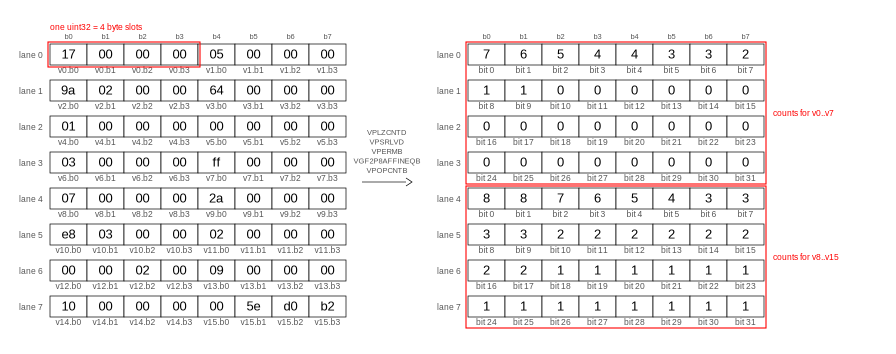
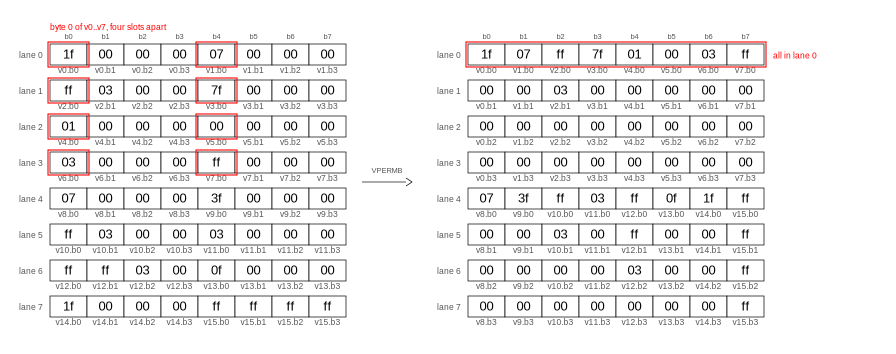
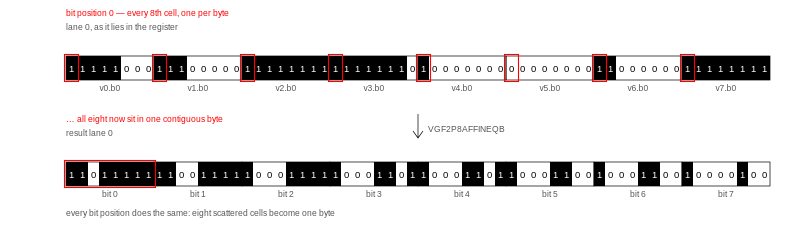
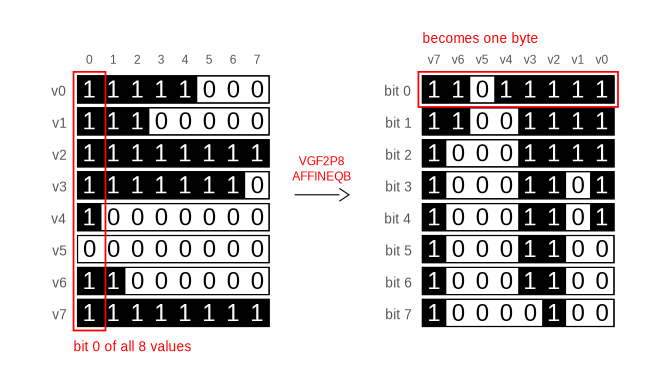
A brand new release 0.1.16 of the RcppSimdJson
package is now on CRAN, has
been built for r2u,
and is updated on r-universe.
RcppSimdJson
wraps the fantastic and genuinely impressive simdjson library by Daniel Lemire and collaborators. Via
very clever algorithmic engineering to obtain largely branch-free code,
coupled with modern C++ and newer compiler instructions, it results in
parsing gigabytes of JSON parsed per second which is quite
mindboggling. The best-case performance is faster than CPU speed as
use of parallel SIMD instructions and careful branch avoidance can lead
to less than one cpu cycle per byte parsed; see the video of the talk by Daniel Lemire
at QCon.
This version updates to the recent 5.0.2 upstream release with
improved performance. Given the strong focus on performance, this
release also alters some of the R and C++ interfaces to be more direct.
Rcpp generally aims for a balance between readable / maintainable code
and good performance; this moves the dial closer to strong performance
gains. As Daniel noted in a table in
the (main) PR for this release, this now consistently beats yyjsonr, and
improves considerably over the previous release of this package. I had
made some smaller interim upgrades earlier (without a CRAN releases),
and made a number of minor standard packaging updates.
The short NEWS entry for this release follows.
Changes in version 0.1.16
(2026-10-09)
simdjson was upgraded to versions 4.6.1
and 4.6.3 (Dirk in #100
and #102
fixing #99
and #101)
simdjson was upgraded to version 5.0.2
(Daniel in #104)
A number of small tweaks to the Rcpp
interface were made too (Daniel in #104)
Diagnostics for gcc and clang are not
suppressed per CRAN Policy (Dirk in #106
closing #105)
The continuous integration matrix was extended to
g++ version 15 and 16 (Dirk in #108
closing #107)
A few minor packaging nags were address (Dirk in #109)
setuptools 84 is now in Debian and no longer contains pkg_resources. Removing uses of that module has been an ongoing project for a while now, but I did another batch of fixes this month:
A new python-coverage version triggered several build regressions due to a known problem in pytest-cov. I worked around these by setting COVERAGE_CORE=ctrace:
A few days ago, a colleague reached out to me, asking if I could help draft a
resolution on digital autonomy and free software for the upcoming renewal of
our collective bargaining agreement. Although she's very politicised and
generally a great individual, she is not a techie and we never really talked
about these issues before.
This took me by surprise. I should have been rejoicing; no, I should have been
the one who brought up this topic in our union. Wasn't I the technical expert
on these issues? But alas, my first reaction when she came to me was to snicker
and tell myself: "That's cute, but nothing's ever gonna change, Big Tech is too
strong and our governments don't give a damn."
How sad and cynical is that? That's not the person I want to be.
Something in the Quebecois political landscape has shifted in the last few
years with regards to tech. More and more "regular" people seem to be talking
about the importance of digital autonomy, how government services shouldn't
rely on Big Tech and how we should be using FOSS on hardware we actually
control.
A few years ago, I would have been at the vanguard of this change. I would have
been part of the creation of Donn es souveraines Qu bec. Heck, they are
organising a whole conference next week and I'm not even going. How did
this happen to me?
I first fell for Free Software for its political ideals: Knowledge Should Be
Free, Cooperation Is More Efficient Than Competition, Centralisation Should Be
Avoided When Possible, etc. I still believe in all of this, but somehow, after
years of fighting for change in the tech world, I have retreated into technical
work. I maintain Debian packages as a hobby and to scratch my own itch. I run
services for myself and a few friends. I organise Debian User Group meetings.
To be clear, I haven't generally given up. I'm very politically active in my
union and at work, I'm a good member of my housing cooperative and I'm still
fighting against the industrialisation of natural spaces in my
neighborhood. But when it comes time to defend freedom in the tech
world, lately, I've just been shrugging and accepting I should use Microsoft
Teams like every one else does. I want this to change and to do so, I need to
free some time.
Lintian
Two years ago, I added myself to Lintian's Uploaders list. Up until
then1, I enjoyed fixing little issues here and there and liked creating
new tags to help out the Python Team, where most of my Debian time was spent.
Lintian was badly in need of a new maintainer and as I felt it was an important
project, I decided to step in. 37 releases and about 160 closed bugs
later2, I'm done.
To be honest, I haven't had much fun maintaining Lintian lately. Bugs keep
piling on the BTS, so much so I have mostly been ignoring them for the past few
months. In fact, most of the actual work triaging, writing code and fixing bug
has been done by Nilesh Patra for a while now.
All this to say, if you care about Lintian, you should consider adding yourself
to the Uploaders list, as I'm out and Nilesh can't do all the work by himself.
He's a great person to work with and since I don't want to suddenly leave him
all alone, I'll be sticking around for a few more weeks in the hope someone
else will volunteer to help out. A smooth transition with a new co-maintainer
would really be nice!
If you're interested, don't hesitate to reach out to me on IRC or by email.
My first technical commit to Lintian was nearly 7 years
ago! Crazy how time flies.
A new release of RcppFastFloat
just arrived on CRAN, and has
been built for r2u.
The package wraps fast_float, another
nice library by Daniel Lemire. For
details, see the arXiv
preprint or published
paper showing that one can convert character representations of
numbers into floating point at rates at or exceeding one gigabyte per
second.
This release updates the underlying fast_float library
version to the current version 8.3.0, and also updates a number of the
standard packaging details.
Changes in version 0.0.6
(2026-09-29)
Update to upstream release 8.3.0 (Daniel Lemire in #6)
Standard package maintenace adding README badge, updating URL,
updating continuous integration, and adding an aspell
dictionary
Completed help page for as_double example with
@return tag
This article appears in a Communications of the ACM series devoted to
showcasing relevant examples where federal funding of academic research
resulted in widely impacting, clearly identifiable technological advances
that have visibly improved or at least changed life far beyond the
technological arena.
The road is far from trivial from the first parallel computing
technologies built completely for research, to a phase that was
preeminently directed at gaming, to the current graphics processing units
(GPUs) that are basically massively parallel supercomputers used for large
language model (LLM) training and inference and other artificial
intelligence (AI) tasks and the authors do a good job outlining it in just
a few pages. The article is written in a clearly divulgatory way, staying
as clear of technical language as possible.
The authors present three main enabling technologies for current GPU
technologies: parallel computing, parallel graphics systems, and stream
processing.
Coming from a technical formation myself, although clearly better grounded
in the software side of computer engineering than the electronics side, the
most interesting nugget of information I took is that parallel computing
was born due to the fact that transistor switching consumes very little
energy, whereas communication along wires consumes much more. Thus, the
more simultaneous operations can be carried out on-chip at once, the less
power will be dissipated as heat (and the less time that will be lost due
to data stores and loads).
Graphics systems are a natural match for parallel systems, as rendering
realistic images basically requires repeating the same blocks of
instructions to a large array of items. Early GPU implementations were
built on fixed-function graphics pipelines. However, by the turn of the
century, when nVidia spun off the research labs at Stanford and started
marketing their product, introducing along the way the GPU term, they
enabled it to implement the full OpenGL graphics pipeline on a single chip.
Stream processing is the arrangement of in-chip electronics so that they
can better exploit producer-consumer locality between stages in order to
achieve greater arithmetic intensity (this is, a greater
computation-to-bandwidth ratio), reducing the total number of memory
accesses.
The authors explain in broad terms the described technologies and how they
fit together, as well as how the technology was transferred from the
universities to the companies behind today s top trending technologies.
The article is engaging and easy to read. As a technologist, I did miss
more details dates when specific advances were made, how some of the
advances led to future inventions, and so on but I also understand the
series is written for outsiders. And, as such, this work very well explains
how trillion-dollar technologies are often the result of decades of funding
research ideas.
One of the primary design principles for Linus Torvalds when creating Git is that it should be a distributed system, capable of working with multiple remotes. However, most people seem to use Git with just one remote, typically having GitHub or GitLab as the only origin.
Version control systems before Git relied on a centralized model. For example in Subversion or CVS you could only sync with one single remote server, which was considered the primary host of the source code. Git however is not just a VCS, but a DVCS, for distributed version control system. If you currently use Git with just one single remote as if it was a centralized version control system, now is the time to change that and learn how to add multiple remotes, and configure more flexible git pull and git push rules.
The first concept to grasp is that Git can have multiple remotes. For example, after running a basic clone command such as git clone https://github.com/ottok/debcraft.git you would end up with a single remote origin pointing to GitHub:
You can push and pull from these individually, or from all at once:
$ git pull --all
Fetching github
Fetching gitlab
Already up to date.
$ git pull --all
Fetching github
Fetching gitlab
Already up to date.
When you review the git history, note the labels gitlab/main and github/main which tell which commit the branch main points to on various remotes. In this case they are all in sync and point to the same 5d1815c:
$ git log --oneline
5d1815c (HEAD -> main, gitlab/main, github/main) Bump Debhelper version from 13 to 14
ca518a7 Temporarily disable automatic copyright year bumping due to frequent bugs
d6e201e Exclude .pm from codespell to decrease false positives (Closes: #1140488)
708ee35 Exclude debian/copyright from codespell due to frequent false positives
When pushing, you can choose what remote to push to. For example, if I am working on branch dev and I only want to push it to GitLab to trigger a CI run there, I can run git push gitlab dev. You can also configure a default remote by running once git push --set-upstream gitlab dev and thereafter simply run git push and it will automatically push the branch dev only to that remote.
A related setting is remote.pushDefault, which tells git which remote to push to when a branch does not define one of its own, and it applies to every branch that lacks a [branch] section in .git/config. Setting it once is what lets a repository have a per-branch pull remote, like the debcraft example below, and still have a single, predictable git push target. To see which remote git will use for each of your branches, run git branch -vv, and to refresh the remote-tracking branches of all remotes at once, run git fetch --all --prune.
If you want to have multiple remotes, but automatically push and pull to all of them at once, you configure one single remote to have multiple URLs with git remote set-url --add. Since git prints one line per push URL, git remote -v then shows the same remote several times, once for each URL it pushes to.
As an illustration, in my actual local Debcraft development project I have all these configured:
$ git remote -v
github-pull-requests git@github.com:ottok/debcraft.git (fetch)
github-pull-requests git@github.com:ottok/debcraft.git (push)
gitlab-merge-requests git@gitlab.com:ottok/debcraft.git (fetch)
gitlab-merge-requests git@gitlab.com:ottok/debcraft.git (push)
origin git@salsa.debian.org:debian/debcraft.git (fetch)
origin git@salsa.debian.org:debian/debcraft.git (push)
origin git@gitlab.com:ottok/debcraft.git (push)
origin git@github.com:ottok/debcraft.git (push)
otto git@salsa.debian.org:otto/debcraft.git (fetch)
otto git@salsa.debian.org:otto/debcraft.git (push)
otto git@gitlab.com:ottok/debcraft.git (push)
otto git@github.com:ottok/debcraft.git (push)
otto git@git.sr.ht:~ottok/debcraft (push)
otto ssh://git@codeberg.org/ottok/Debcraft.git (push)
salsa-merge-requests git@salsa.debian.org:debian/debcraft.git (fetch)
salsa-merge-requests git@salsa.debian.org:debian/debcraft.git (push)
The settings can also be viewed directly in the config file:
Use cases for distributed version control
The most obvious use case for any distributed system is improved availability. In this example, the salsa.debian.org is often overloaded/unavailable, so pushing to GitLab and GitHub as well allows collaborators to use them to fetch git commits if the primary code hosting site is unresponsive. Once it comes back online again, the next git push/pull will automatically bring it up to the same content as what backup hosts had.
The second main benefit is that having the code live on multiple code forges allows collaborators to use their own favorite host. Debcraft itself is a great example of this, as collaborators who don t have a Salsa account can - and have - submitted Merge Requests on GitLab.com and Pull Requests on GitHub.com.
A third use case is code hosting migrations. If you for example want to gradually phase out GitHub.com and replace it with something else, you could configure git to pull from the old location and push to both, ensuring that other collaborators can start using the new code hosting location without disruptions to those who have not yet updated their remotes or done a fresh git clone from the new location.
Automating setting up a project on multiple code forges
While I don t push all projects I work on to all Salsa/GitLab/GitHub, I do set up multiple remotes for enough git projects that I have this script to automate configuring a git repository that is cloned from Salsa to also push to GitLab and GitHub. It accepts the repository whether it was cloned over SSH or HTTPS, and it adds the push URLs and then pushes the current branch, all branches, and tags for you:
#!/bin/bash
# Add GitLab and GitHub push URLs to an existing git remote, so that a plain
# "git push" writes the same commits to all three code forges.
#
# Usage: ./git-multipush-salsa.sh
#
# Environment:
# SALSA_REMOTE remote to turn into a mirror, default origin
# SALSA_USER your Salsa user, only used to detect that the source
# remote is somebody else's project
# GITLAB_USER your GitLab user, default ottok
# GITHUB_USER your GitHub user, default ottok
# PROTOCOL ssh (default) or https, for the push URLs
set -euo pipefail
SCRIPT=$(basename "$0")
SALSA_REMOTE=$ SALSA_REMOTE:-origin
SALSA_USER=$ SALSA_USER:-otto
GITLAB_USER=$ GITLAB_USER:-ottok
GITHUB_USER=$ GITHUB_USER:-ottok
PROTOCOL=$ PROTOCOL:-ssh
die()   echo "$SCRIPT: $*" >&2; exit 1;
# A failing command leaves the push URLs half configured behind, so say how
# to get back to where we started
fail()

echo "$SCRIPT: '$*' failed, the push URLs may already have been added" >&2
echo " git config --unset-all remote.$ SALSA_REMOTE .pushurl" >&2
echo " git remote set-url --add --push $ SALSA_REMOTE  $ SALSA_URL " >&2
exit 1

git rev-parse --git-dir > /dev/null 2>&1   die "not inside a git repository"
git remote   grep -qx "$SALSA_REMOTE"   die "no remote named '$SALSA_REMOTE'"
# Example: git@salsa.debian.org:otto/salsa-ci-pipeline.git
SALSA_URL=$(git remote get-url "$SALSA_REMOTE")
# The source remote may use any of the URL forms salsa.debian.org accepts,
# for example git@salsa.debian.org:otto/salsa-ci-pipeline.git or
# https://salsa.debian.org/otto/salsa-ci-pipeline.git
case "$SALSA_URL" in
git@salsa.debian.org:*) SALSA_PATH=$ SALSA_URL#git@salsa.debian.org:  ;;
ssh://git@salsa.debian.org/*) SALSA_PATH=$ SALSA_URL#ssh://git@salsa.debian.org/  ;;
https://salsa.debian.org/*) SALSA_PATH=$ SALSA_URL#https://salsa.debian.org/  ;;
http://salsa.debian.org/*) SALSA_PATH=$ SALSA_URL#http://salsa.debian.org/  ;;
*) die "unexpected source URL '$SALSA_URL', expected a salsa.debian.org URL" ;;
esac
SALSA_PATH=$ SALSA_PATH%/
SALSA_PATH=$ SALSA_PATH%.git
SOURCE_USER=$ SALSA_PATH%%/*
PROJECT=$ SALSA_PATH##*/
# Write the push URLs in one and the same protocol, no matter how the
# repository happens to have been cloned
if [ "$PROTOCOL" = "https" ]
then
SALSA_URL="https://salsa.debian.org/$ SALSA_PATH .git"
GITLAB_URL="https://gitlab.com/$ GITLAB_USER /$ PROJECT .git"
GITHUB_URL="https://github.com/$ GITHUB_USER /$ PROJECT .git"
else
SALSA_URL="git@salsa.debian.org:$ SALSA_PATH .git"
GITLAB_URL="git@gitlab.com:$ GITLAB_USER /$ PROJECT .git"
GITHUB_URL="git@github.com:$ GITHUB_USER /$ PROJECT .git"
fi
# Mirroring somebody else's project is fine, but it is usually not what you
# want: you most likely want to mirror your own fork instead
if [ "$SOURCE_USER" != "$SALSA_USER" ]
then
echo "Note: $SALSA_REMOTE points to $SOURCE_USER's project, not your own."
echo "To mirror your own fork, run this with SALSA_REMOTE set to its name."
echo
fi
# Bail out instead of adding the same push URLs twice
EXISTING=$(git remote get-url --push --all "$SALSA_REMOTE")
if [ "$(printf '%s\n' "$EXISTING"   wc -l)" -gt 1 ]
then
die "remote '$SALSA_REMOTE' already has multiple push URLs:
$EXISTING"
fi
echo "Mirroring $SALSA_URL to $GITLAB_URL and $GITHUB_URL"
git remote set-url --add --push "$SALSA_REMOTE" "$SALSA_URL"
git remote set-url --add --push "$SALSA_REMOTE" "$GITLAB_URL"
git remote set-url --add --push "$SALSA_REMOTE" "$GITHUB_URL"
# Push the branch you have checked out first, and never with --force: the
# first branch a GitLab or GitHub project receives becomes its default branch,
# the one you then protect
DEFAULT_BRANCH=$(git symbolic-ref --short HEAD)   die "not on a branch, check out a branch first"
git push -u "$SALSA_REMOTE" "$DEFAULT_BRANCH"
git push "$SALSA_REMOTE" --all
git push "$SALSA_REMOTE" --tags
# The push above creates the GitLab and GitHub projects, but GitLab projects
# are private by default, so make the new mirror public with glab if installed.
if command -v glab > /dev/null
then
echo "Make the GitLab project public and describe it as a mirror:"
glab api -X PUT "projects/$ GITLAB_USER %2F$ PROJECT " \
-f visibility=public \
-f description="Mirror of $ SALSA_URL " \
-f notification_email=disabled
else
echo "Install glab to do the same automatically, or visit"
echo "https://gitlab.com/$ GITLAB_USER /$ PROJECT /edit to make the project public"
fi
echo "To undo, drop all push URLs and add back only the original one:"
echo " git config --unset-all remote.$ SALSA_REMOTE .pushurl"
echo " git remote set-url --add --push $ SALSA_REMOTE  $ SALSA_URL "
If you prefer not to install glab, the last part simply reduces to visiting the GitLab project settings once and ticking the project public, and it is also worth setting a description like Mirror of https://salsa.debian.org/debian/debcraft and disabling notification email there, as nobody wants a mirror sending out a flood of emails every time you push.
There are a few caveats worth knowing about before mirroring everything everywhere. Every push to a remote with multiple push URLs writes to all of them, so a project with continuous integration configured on three forges will run its CI three times and cost you roughly three times as much. If one of the push URLs fails, say because the host is momentarily unreachable, git prints the error and stops there, leaving the remotes listed after the failing one without the new commits. Simply re-run the push once the host is reachable again; the remotes that did get the commits will just respond with Everything up-to-date. And you should never force-push to only one of the remotes, as that leaves the mirrors permanently out of sync with your local repository.
Avoid pulling too much
Related to multiple remotes, you should also be aware that git allows one to configure which branches to pull. By default a git clone will track all branches from the remote and pull everything, which in a typical open source project will bring in a lot of temporary development branches in vain.
Thus it is better to run git clone with the --single-branch and --branch parameters to fetch only the branch that matters, which in most cases is the main branch. That can be accomplished with:
git clone --single-branch --branch main https://github.com/ottok/debcraft.git
git clone --single-branch --branch main https://github.com/ottok/debcraft.git
If a repository was already cloned, it can be configured to track only one branch with:
For additional details about any of the tips in this post I recommend reading the git man pages.
Now go and spread your code around
Distributing your code over multiple code forges costs you almost nothing in configuration, and in return you get availability, a choice of host for your collaborators, and freedom to migrate without a big bang. Add the push URLs to the remotes you already have, push once, and you are done.
The rest of the git fundamentals are covered in my other posts. If your commits are not yet polished, start with what makes a good git commit message and git commit messages by example. If you work on Debian packaging, Git-based collaboration in Debian explains why the Salsa merge request workflow is built the way it is, and Salsa merge request best practices covers the review process itself.
There's an optical illusion known by names like the "lunar terminator paradox".
This has much discussion and descriptions online, but none made sense in my
head, so I wrote this program to figure out what was going on. The paradox:
The moon is illuminated by the sun
After sunset, the sun is below, so we would expect the illuminated portion of
the moon to point down, towards where the sun is
This isn't what always happens!
I was camping in the mountains with a friend recently. We were looking up at the
sky, just after the sun has set. The moon was clearly pointing up.
After playing with this program, I have clarity: we're looking up at the moon
from below. The most pathological case is a full moon. Let's say the moon is on
the horizon: elevation=0. If we're looking at this low moon, and the moon is
full, the sun is directly behind us. The moon is fully illuminated, and we see
100% of the moon disc lit up.
Now, what happens if the moon is not at the horizon, but higher up at the sky?
Effectively, the sun is infinitely far away, so the same part of the moon is lit
up. But we're now looking at the moon from below, and we would see some of the
dark side on the bottom edge. I.e. the moon appears bright at the top, but has a
dark slice missing at the bottom: it points up! Even at sunset.
This is the most clearly weird case. A half-moon has no paradoxical behavior,
and the more full the moon, the more clearly we can observe the bright moon
pointing up despite the sun being down.
I produce two plots. At 3/4-full moon at sunset we look at the moon as it rises
from the horizon all the way up to the zenith:
If the moon is at the horizon (elevation = 0), we see the expected 3/4-lit disc.
As the moon rises, we see more and more of its bottom, and thus more and more
dark areas show up: It clearly points up at sunset!
We can also move the sun around. Let's say the moon is 60deg up; let's move the
sun from new-moon to a full-moon:
In the darkest configuration, we can still see a lit crescent on the bottom: the
illumination is all on the opposite side, but we can see a slice of the
illuminated back side. As the sun swings around, we see more and more of the
moon. At azimuth = 90deg, we have a half-lit moon. Past that, more and more of
the moon is visible, always pointing up.
This was also a super interesting study of the current state of AI tools. As I
was writing this and debugging, I would talk to Claude and Gemini about how this
worked and what I should be seeing. They were both completely unable to
comprehend this, and would make infinite circular arguments. Clearly they read
some incomplete explanations on the internet (as I have), and lack the reasoning
capability necessary to distill it into something resembling "understanding".
AGI is not here yet.
Introduction
After bazel-bootstrap 7.7.1 was landed into Debian unstable,
I'm working on packaging newer Mozc (Most famous Japanese input method editor) with Bazel.
Here is the blog entry initial efforts to build Mozc with Bazel at that time.
kenhys.hatenablog.jp
Then, I've shared implementing PoC dh-bazel experiment.
See why dh-bazel is needed, and prototype about dh-bazel.
kenhys.hatenablog.jp
As a Bazel beginner, want to know what should pass to Bazel, what should not pass to Bazel.
What is improved in recent dh-bazel?
In the previous versions of dh-bazel, it supports only basic features
to build with Bazel as a thin wrapper.
Now, with recent changes, it supports the following environment variables to resolve required system libraries in dynamically.
salsa.debian.org
DH_BAZEL_OVERRIDE_MODULE
It search the specified modules from bundled dummy modules in dh-bazel.
It accept ',' separated paramesters. (e.g. DH_BAZEL_OVERRIDE_MODULE=zlib,zstd)
dh-bazel bundles abseil-cpp, apple_support, buildozer, lz4, openssl, protobuf, rules_android_ndk, rules_apple, rules_swift, zlib and zstd as
dummy modules to linking system libraries.
Now you can use it in debian/rules like this:
It is impossible to cover all of system libraries in Debian, so in that case, please consider to use the following DH_BAZEL_PKGCONF_MODULE.
DH_BAZEL_PKGCONF_MODULE
It search the specified modules with pkgconf. It is useful when there is no bundled modules in dh-bazel if you want.
It accept ',' separated paramesters. (e.g. DH_BAZEL_PKGCONF_MODULE=gtk4-x11,gtk4-unix-print).
If DH_BAZEL_PKGCONF_MODULE could not match, then dh-bazel fallback to dig into Build-Depends: field
in debian/control. Note that if it is not deterministic (e.g. -dev package provides multiple .pc files)
dh-bazel gives up fallback with pkgconf.
Now you can use it in debian/rules like this:
Conclusion
dh-bazel is still in very early stage prototype, but it resolves some sort of packaging glitches a bit by bit.
I hope that it will help package maintainer using Bazel.
(dh-bazel is not uploaded into debian/unstable yet, so stay tuned!)
As a graduate of a liberal arts university, I wound up, unsurprisingly, taking a
lot of classes in every possible academic discipline. Thinking back to the
person that I was going into university, I don t think I would have chosen to
take them after all, my degree was in the sciences; I d have been stoked to
do nothing more than wall-to-wall computer science until I ran out of
coursework and filled the rest of my hours with research and independent
studies with my professors (which, I guess I did actually do, just not as
much as I would have otherwise).
Even this blog s CSS theme (now 18 years old and starting to look it) was
something I wrote after receiving and repeatedly re-reading a tattered
third-hand copy of The Laws of Thought by George Boole. It was gifted to me
by a college friend majoring in philosophy while I was crashing at his rental
on the beach. He gave it to me because he knew I liked that shit and, while
it was definitely computer science in nature, I would not have read it
otherwise. I have vivid memories of sleeping on his la-z-boy surrounded by
towers of books he was working through. He went on to do incredible work,
getting his PhD, doing research, brilliant writing his death in 2023 has
robbed humanity of more time with him. The Laws of Thought sits behind me in
my office, and is one of my most valued possessions.
My friends mean more to me than I could ever express, and I definitely don t
show it enough. Each of my classes made me a more thoughtful person. My
professors made me a better, more well-rounded person and a person who
attempts to live up to the oft repeated credo of being men and women for
others . I did the best I could, even though I was never a particularly good
student. Without liberal arts, I don t think I would, dispositionally, have
been capable of pushing myself to this day to continue to learn on nights
and weekends, for no reason other than wanting to learn. I refuse to stop
expanding my perspective, and do my best to approach new problems with as much
humility and curiosity as I can muster.
Every few days for the last year or so, I have been thinking back to a reading
assignment from my junior year that, at the time, I thought was a borderline
throwaway filler assignment for the class. The reading is an essay from 1947 by
the french existentialist philosopher and libertarian marxist, Jean-Paul Sartre
(as some of the more erudite may have now already worked out given the blog s
title), Why Write? . I re-read it this week. It is not filler. I remember this
essay better than some of the classwork I considered more important at the
time.
Why Write?
Why Write? starts off by describing the ways in which writing trying to
communicate your thoughts, opinions, or feelings to others is an act of
projection. The writer will only ever draw from a place of their own
subjectivity writing is taking your person and putting it on display.
You re choosing what words to use, how to use them, pulling from knowledge
you ve accumulated (based on how you ve chosen to spend your time). Spending
any amount of your finite existence in order to convey a thought is, itself,
announcing to the world that you believe it to be a thought worth sharing.
Meanwhile, the act of reading is not simply turning letters into words.
Reading is engaging with the work, and understanding the work in a process
that looks more like what Sartre terms re-invention or discovery the
literary object, though realized through language, is never given in
language . It is not enough to read the words in a book end-to-end; you must,
as a reader, actively engage with the work to understand what is being
communicated by those words. Reading is to take the words on the page, and
exceed the mere words through what he calls directed creation . The reader
is re-inventing / discovering the writer s thoughts by following their
landmarks in the void .
And this all makes pretty good sense to me I know if someone is being
sarcastic because I know the writer; I have read their words and have read
into their words, allowing myself to be directed by the writer into
discovering the thought they have left me in their work. I understand that
their words are humorous, not irate. Knowing who the author of a work is
can completely change the point of a sentence. The fact I m writing about
Sartre at all, or that this very writing has been constrained for presentation
in this blog s CSS is only happening because of who I am, what things I ve
experienced in life, and what has made me, me. Sartre argues that this dyadic
coupling between writer and writing means that I, as a writer, can never truly
read my own writing. I will never be capable of reading my own work and
getting something out of it the work is already an extension of my own
person. I can discover no thought in my own works.
Of course, Sartre, as an existentialist, is honor bound to go one step further
here the reader, by participating in reading a work, is asserting their
own freedom. Every time a writer writes [ ] the writer appeals to the
reader s freedom to collaborate in the production of [their] work . The
creative act may only be complete if both writer and reader have recognized one
another and made a choice to do so. No one is compelled to complete the
creative act. The things you read matter. Reading something fundamentally
alters you as a person you can not simply un-read a thought. Everything you
read changes your universe. I have a hunch Sartre would find things like the
(original early 2010s era) tl;dr reply to obviously terrible writing
absolutely hilarious as a reader s expression of freedom (not to be confused
with modern 2020s era usage as shorthand for summary section ). Using your
freedom to choose to complete the writer s creative act (or not) is inherently
asserting your humanity.
I m a bit fuzzy on the specifics of this quote, but I think it was
sj who told me at one year s
Mystery Hunt that A puzzle is a contract between
puzzle author and puzzle solver, the author promises that the puzzle is
solvable if you re clever enough . The puzzle author and puzzle solver are
engaging in a collaborative production of the work that is only possible by
recognizing one another. Similarly, Sartre whatever connections [the
reader] may establish among the different parts of the book among the chapters
or the words [the reader] has a guarantee, namely, that they have been
expressly willed .
Wall Drawing #123
It follows, Sartre argues, that the act of writing, as a means to convey a
thought to a reader, may only be completed through the act of reading.
Reading can only be done by others; writing, therefore, only exists to be
read it can serve no other purpose. Writing and reading are two halves of
the same creative, collaborative act, only satisfied when both writer and
reader acknowledge one another. Combined, writing and reading are the act of
recognizing one another s humanity, thoughts, experiences, consciousness the
act of co-creation of thought is the critical aspect of writing and reading
reconstructing the author s perspective, thought, intent, point. The
co-creation is the point of both reading and writing.
Writing without anyone to read the work leaves the writer s bid for
co-creation unsatisfied and humanity unrecognized. No thought has been conveyed
to any reader, no one has understood the reason behind the landmarks in the
void you ve carefully placed, leaving you to either [ ] put down [your] pen
or despair . Writing is an appeal to the reader s freedom, and the nature of
that freedom is the writer can not control it never being understood is
always a possibility any time anyone sets out to write.
Nearly 12 years ago, I attempted to read the text on the git manpage
generator for the first time
I remember the exact feeling of my brain going into git manpage parsing
mode where every word was dragging git plumbing megaliths through the sand
from their far-flung homes. I can still feel the surface of my desk as I
instinctually started to trace out logical connections between git internals
referenced as I read along. It took me a good 20 seconds to realize what I was
reading made no sense. This website broke Sartre s writer-reader agreement I
was attempting to read this website, but there was nothing there. You can
mechanically read the git-man-page-generator, but you can never read it
it is not possible to read it. It was funny unsettling. Each grasp at a
real-looking image in front of me misses, my hand coming back empty. I
couldn t get enough of it. I must have tried to read a dozen generations in a
row. I had never had something quite that broken pass that far into my
consciousness before. Although I kept trying, it never did feel quite the same
as that first time; I think fundamentally, I couldn t forget that it was
random.
While never having anyone read your writing drives them to put down your
pen or despair , Sartre never had to contend with the opposite problem being
asked to read that which was not written. Reading that which was not
written does not merely leave someone unrecognized when a reader makes a
choice; instead, it is an inherent violation of the contract between reader
and writer. Not only is no humanity being recognized through attempting to
read words which were not written, but the reader, not the writer,
is the one who bears the burden of unexpected apophenia. The reader,
while engaging in co-creation, must now contort themselves to uphold their end
of the Sartrean agreement, scrutinizing text to ascribe consciousness,
thought and intent only to come back up with pareidolia-fueled echos of
one s own self and disfigured half-thoughts of others. The reality is, the
modern reader must now mechanically read most written work they come
across, scrutinizing text for any signs of thought before truly attempting
to read the work. Failing to do this correctly changes our person
each time it happens, a small part of us is irrevocably altered. Choosing to
engage in this ballet because you wish to do so is one thing this is
your right and freedom as a reader but passing words which were not
written as your own in an attempt to wrestle a reader s freedom of
co-creation from them is another entirely.
If you didn t write it, I don t want to read it (dw;dr). Send me your prompt instead.
Introduction
After bazel-bootstrap 7.7.1 was landed into Debian unstable,
I'm working on packaging newer Mozc (Most famous Japanese input method editor) with Bazel.
Here is the blog entry initial efforts to build Mozc with Bazel at that time.
kenhys.hatenablog.jp
Why dh-bazel?
After that, newer Mozc packages are uploaded into experimental and moved to
testing phase on experimental now.
mozc - Debian Package Tracker
When started packaging efforts for newer Mozc with Bazel, I'm a newbie to do it.
Now I've got a knowledge to do it a bit, I want to know best practice on packaging X on Debian with Bazel furturmore.
Usually there are dh-X for buildsystem X on Debian, but it's not true for Bazel as far as I know.
This is why I had started to write dh-bazel.
I've wrote initial dh-bazel prototype and post a mail to debian-bazel ML.
lists.debian.org
dh-bazel supports the following way:
Conclusion
dh-bazel is in very early stage prototype, but I have succeeded to build newer Mozc with some modifications to Mozc debian/rules on experimental with dh-bazel locally!
dh-bazel is a thin wrapper for Bazel, so it does not reduce packaging glitches dramatically, but it helps some sort of packaging tasks IMHO.
There are some achievement with dh-bazel
It helps to do similar building way like other debhelper buildsystem
It sets comprehensive Bazel startup options
It sets comprehensive Bazel command options
If you want to set extra flags, just specify it as additional user options (--override_module=, and so on)
Note that it only simplify dh_auto_build stage, so you must manually install artifacts
with .install or something correctly.
I hope that it will help package maintainer using Bazel in the future.
(dh-bazel is not uploaded into debian/unstable yet, so stay tuned!)
Replacing lxc with Incus for Debian CI, by Antonio Terceiro
At the beginning of this month,
the default backend for tests was changed to incus-lxc,
leaving only a few dozen packages explicitly configured to run as lxc. Those
packages got bug reports filed
and once those bugs are fixed they will be migrated over to incus-lxc. This
marks an important milestone for Debian CI, as the low level of isolation
between the worker host OS and the OS under test when using lxc was a
significant source of instability in our platform. Common causes for test
failures when comparing runs under plain lxc with runs with incus-lxc are
documented in the wiki page
linked from the bug reports.
security-tracker git performance, by Helmut Grohne
Developers working with Debian s security-tracker
have reporteddegrading
performance for a while. The options for solving this are few with repository
sizes now reaching 30GB for a repository whose working tree is a mere 60MB.
While there have been a number of proposals for changing the storage layout,
Helmut evaluated options not requiring such changes. Much of the problem hinges
on the 50MB data/CVE/list file that is updated in most commits. Efficiency
hinges on representing its content in git packs.
Practically, git frequently fails to represent its content as a delta and stores
a full copy that is typically compressed to 12MB. Add a few thousand 12MB full
blobs and you quickly have a large repository. In particular, the copy at
salsa.debian.org stores many such full blobs, so pulling from it consumes
significant bandwidth.
One might think that running git gc helps, but its utility is limited here.
When git stores objects in packs, it stores the
history in reverse.
It starts with the current version and represents older objects as differences
(deltas) to more recent objects. A delta effectively is a sequence of copying
ranges from a base object and insertion of new content. Given that humans tend
to add content over time, those additions are often represented as deletions.
The crux here is finding that base object. Given that the data/CVE/list file
is large, finding it involves comparing quite a few versions of it with each
other. This requires both a significant amount of RAM and CPU time. How many
objects git considers for this comparison is controlled with the --window
option. It is beneficial if the base object does not come from a direct child
commit but skips over commits. In doing so, long chains of deltas are avoided.
The --depth option controls the maximum chain length.
In this search, git combines all objects into a single window to facilitate file
renames. As such, it tends to compare data/CVE/list with data/DSA/list,
data/DLA/list and others. This is less than helpful and tends to evict all
data/CVE/list versions from the comparison window such that a new full blob of
it becomes required. Since the security-tracker repository rarely renames files,
we can ask git to instead consider one window per filename
via --path-walk. Once doing so, it becomes quite a bit better at finding
suitable deltas. The technique is less applicable to older history (2025 and
earlier), but given a lot of RAM and a bit of partitioning, git gc can shrink
that as well. Combining these techniques, we can shrink the repository into
700MB and keep new growth somewhat under control.
Temporarily, Helmut is providing a proof-of-concept mirror at
git://git.subdivi.de/~helmut/security-tracker.git using these techniques.
Avoid pulling from it directly as it does not provide a secure transport. While
it does reduce the amount of data being downloaded, it does not resolve a number
of related problems. After downloading, a git client will still expend
considerable amounts of CPU on verifying received deltas and attempting to
git blame data/CVE/list is not improved in any way. Still, there is work on
integrating some of the improvements back into salsa.
OpenSSH GSS-API split, by Colin Watson
In an option review
Colin did in 2024, shortly after the xz-utils backdoor,
he explained that having GSS-API authentication and key exchange support in the
main OpenSSH packages is problematic. The key exchange patch is large and
intrusive. Even linking to the necessary libraries isn t without risk: as the
Ebury malware attack demonstrated
way back in 2009, each extra library linked into security-critical daemons such
as sshd (or nowadays into its privilege-separated helper programs) can modify
the behaviour of the daemon even if you aren t doing anything that would involve
calling into that library. Of course some of that risk remains, but as
Damien Miller wrote,
minimizing the number of libraries that end up in the address space of sshd
and friends is still valuable.
This split is now complete in testing. As of openssh 1:10.4p1-5, the OpenSSH
client and server are built without GSS-API authentication and key exchange
support. If you need those features, install openssh-client-gssapi or
openssh-server-gssapi instead, as appropriate. Debian 13 (trixie) already has
packages with those names that just depend on the regular openssh-client and
openssh-server so that you can pre-emptively install them, as
documented in the release notes.
The new openssh-*-gssapi packages have relatively tight dependencies on
openssh-common, in order for the testing migration system to ensure that we
can t forget to keep them up to date. This will mean a bit more ongoing work on
each new upstream version, but it should be manageable.
Catching up on DebConf video publication, by Stefano Rivera
DebConf 25 videos suffered terribly
from a bug in voctomix that
stopped us from being able to publish the videos immediately after the
conference. Ivo De Decker did some work on the videos earlier this year, fixing
enough of the audio problems to make the videos at least intelligible.
While at MiniDebConf Winterthur Stefano
published all the videos from 2025 and 2026 to PeerTube
and YouTube.
DebConf 25 and DebConf 26 videos as well as all the videos from miniconfs that
had got caught up in the backlog were published.
Miscellaneous contributions
Carles used po-debconf-manager
to review and submit Catalan translations for six packages.
Carles prepared a prototype
of building webwml and running tidy (linter) in Salsa.
Carles created different webwml
merge requests
with different fixes: invalid links to different architectures, 404s to external
sites, fixed templates with invalid URL to favicon.ico, making USE_SAMPLE_FILES=1
to avoid fetching external files, typos in English, etc.
Antonio did several Salsa maintenance tasks,
including his first platform security update and investigating an issue that was
causing the background tasks to be severely delayed, imparting the site usability.
Thorsten tried to fix some bugs in hplip and cups. Unfortunately this did not
result in an upload this month, but stay tuned!
Helmut continued to report undeclared file conflicts and correspond about them.
Helmut reviewed and merged Johannes Schauer Marin Rodrigues work on adding
hurd support to debvm.
Helmut fixed a pile of minor issues in the support libraries underpinning
unschroot.
Helmut adapted rebootstrap to archive regressions and improved its handling of
non-default gcc versions.
Santiago continued helping Aryan Karamtoth with the GSoC project on
introducing livepatching support for linux. Several challenges have been
identified in the recent couple of months, and Santiago is trying to guide Aryan
to address them and design the solution. The mentoring is done in collaboration
with Emmanuel Arias.
Lucas onboarded a co-maintainer for Valkey.
Lucas has started to work on a draft for the Debian Outreach project for
onboarding newcomers interested in Debian packaging via a video course.
Stefano worked on the after-math of DebConf 26, handling the bursary expense
reimbursement process and winding down the conference finances.
Stefano uploaded Python 3.15 RC 1 to Debian unstable.
Stefano did some budgeting and travel planning for the DebConf 27 site-visit
in Asahikawa, Japan. The DebConf committee sends a couple of members to meet
with the local team and view the venue together, in advance of the next DebConf.
I m looking at something entirely unrelated, but tripped over some search results that made me realise that a lot of people still think getting errors like ACPI Warning: SystemIO range 0x0000000000001828-0x000000000000182F conflicts with OpRegion 0x0000000000001800-0x000000000000187F indicate a firmware bug. This is generally untrue. We need to dive a little into what ACPI is to clarify why.
The Advanced Configuration and Power Interface1 specification defines a whole bunch of stuff, but what s interesting to us here is the hardware abstraction it performs. While PCs are nominally a well-defined platform that s really not true at the hardware level once you get beyond a certain level of complexity. When you suspend a system you want to power down the hardware in the correct order, for instance, and knowing what that order is requires you to know details about the specific motherboard design. The approach taken in the embedded world is to just bake that knowledge into the OS in some form, which is how we end up with Devicetree. ACPI takes an alternative approach - rather than provide that information as data that has to be consumed by OS drivers, it distributes it as code.
The ACPI Source Language, or ASL, is a simple language that gets compiled into a bytecode that s then interpreted by the OS at runtime. One of the features of this language is the ability to define Operation Regions , effectively structure definitions that describe access to underlying hardware. Let s imagine a simple device with two exposed registers. The first is an index register - it describes which internal register we want to access. The second is a data register, where reading it gives us the value of the internal register whose address is currently in the index register, and writing to it modifies that register. An example operation region declaration would look something like
This defines an operation region called OPR1 at IO port 0x400, 2 bytes long. Inside it are two 8-bit fields, INDX and DATA. These are to be accessed one at a time, do not need the ACPI interpreter to take a global lock when accessing them, and if a subset of the register is modified then the other values should be preserved (irrelevant in this case since the fields are only a byte wide). Now any references to INDX or DATA in this scope will trigger accesses to those registers. So, a method to read the value of register 0x03 would look something like:
1
2
3
4
Method (RD03)
  INDX = 0x3
  Return (DATA)
ie, set INDX to 3, and then read the value of DATA and return it. But! What if another ACPI method is running at the same time? Let s say we have one that writes to register 0x05:
1
2
3
4
Method (WR05, 1)
  INDX = 0x05
  DATA = Arg1
What happens if RD03 executes while we re part-way through WR05? INDX might get reset to 0x03, and now WR05 will modify register 0x03 instead of 0x05. Oh no! But we can avoid this - we declare a mutex (Mutex (MUTX, 0x00)), and update our methods to be something like:
Each method takes a lock (waiting up to 0xffff milliseconds and then erroring out if it doesn t), and performs the access. There s now no chance of a race. Phew!
Now suppose someone writes a Linux driver for this piece of hardware. It accesses the hardware directly, with no knowledge of ACPI. What stops the driver from racing against one of the ACPI access methods? Nothing at all. Oh no! Again! This isn t hypothetical, by the way - here s a relatively harmless example, but back in the day we did trip over cases where temperature monitoring chips would be accessed by the firmware and Linux simultaneously and as a result you might end up thinking you re reading a temperature when you re actually reading a status flag, resulting in an impossibly high temperature and an immediate thermal shutdown.
In this case, the kernel saves you from this (potentially hardware damaging) outcome by printing a message like ACPI Warning: SystemIO range 0x0000000000000400-0x000000000000401 conflicts with OpRegion 0x0000000000000400-0x0000000000000401 (OPR1), telling you that the kernel has detected that a driver is attempting to allocate IO ports 0x400-0x401, but that there s an ACPI operation region called OPR1 that is claiming the same addresses. The kernel isn t in a position to know what type of access the firmware might perform in that region, so assumes that it might be dangerous and blocks the driver from loading.
But all is not lost! The kernel also prints some helpful advice, ACPI: If an ACPI driver is available for this device, you should use it instead of the native driver. And ACPI tables will often actually have a definition that looks like this:
which defines an ACPI device and associated methods. The _HID field defines the device type, and a Linux driver can be written that will be automatically loaded if a device with type VEND0001 is seen. That driver can then call ACPI methods associated with the device and access the resources in a way that matches the firmware s expectations.
(Interested in writing such a driver? I wrote a guide back in 2009)
The firmware did absolutely nothing wrong here2, but trying to load the native driver will generate an error and the internet will tell you that PC firmware developers are incompetent3 and you should pass a kernel argument that overrides this behaviour and it never did them any harm, and it probably won t do you any harm either but it might and you might never know why your system occasionally wedges or catches fire.
The ACPI spec used to live at acpi.info, but sadly that seems to have vanished some time after UEFI took over stewardship of the spec
You might argue that the firmware should simply not do anything at runtime because it is not the firmware s job to do that, and I do understand that and you can certainly boot with acpi=off if you want to and no ACPI code will be executed at runtime. Let me know how that goes.
I m not going to present an opinion on that here, merely say that this provides no supporting evidence for that assertion
A new maintenance release 0.0.7 of RcppXts is now on CRAN, and has been built for r2u. The RcppXts package
demonstrates how to access the export C API of xts which we
contributed a looong time ago. There are by now a more example packages
around this C level access to another package, but this one was an early
example.
This release is strictly maintenance, updating continuous
integration, the README.md file and other packaging conventions adopted
since the last release four years ago.
The NEWS entries follow.
Changes in version 0.0.7
(2026-09-09)
Corrected a docstring for the module
Updated continuous integration setup several times
Simplified setup by removing no-longer-needed Makevars
This post is part of a series called "Pigeon". If this is the first post
you've found, it'd be worth reading the
intro post first and then looking over
all posts in the series.
The final step to all of this was to tie together all my PHY RF
code, Link layer parsers, and my
background with operating systems
to make this all feel like a normal thing my computer should be doing.
At the end of the day, I want my host system to know how to talk with a
pigeon daemon, so I don t have to reimplement basically everything else.
My ability to use normal tools like curl or ping6 is pretty important
here, so I need to reach for my old friend, the
TUN interface. The
TAP/TUN interface allows the kernel to route ethernet frames (TAP) or ip
packets (TUN) to a userspace program responsible for handling delivery and
reception avoiding the need for a kernelspace driver for something that
can be handled in userland.
wondering if doing this violates FCC Part 97 rules? I wrote up
notes on my test setup
for exactly this question, but the short answer is "no"!
I m nostranger to
playing with TAP/TUN, so this was pretty easy to snap together although this
time I avoided the whole ethernet proxying thing (to side-step lossy
translations, maintaining two sets of mac address tables, and handle proxying
NDP/ARP messages) it was kinda a bad idea last time so I just used TUN
and straight IP for now. While implementing this, I decided I d make a key
assertion about all pigeon networks namely, all pigeon IPv6 networks are a
/64 in size, no more, no less. The reason why I m doing this here is that,
since pigeond does still does need a MAC address for the pigeon layer 2
protocol, we can write our daemon to always use
SLAAC
to set the TUN IP address without any new information.
Which leads us to a bit of an aside, but I have a point, I swear. A few years
ago, my recreational RF adventures have lead me down a path where I decided to
engage with ARIN to solve (once and
for all) the massive headache I was running into with IPv6 numbering (really:
always renumbering) my multi-site radio processing networks. It s a lot
of work to keep running correctly, but it s solved a huge amount of
problems for me.
The only internal thing we really need to outline for this post is that, at
the highest level, my network (paultag.net) is split into an IP plan that
looks roughly like:
64 "sites" per region. A "site" is assigned to a physical or logical location.
/64
1024 subnets per site. A subnet used by directly attached devices.
For this exercise, I used IP space from paultag.net s experimental region
( region 8 ), named side.band (2602:810:6008::/48) to connect my RF lab
( site 1 - 2602:810:6008:400::/54), and my two pigeon-specific subnets,
subnet 0 (2602:810:6008:400::/64) and subnet 1 (2602:810:6008:401::/64)
to my wider network. The first subnet ( subnet 0 ) is a simple ethernet network
to enable my RF-only nodes to communicate with the side.band gateway. The
second subnet ( subnet 1 ) is an RF-only pigeon network local to my lab.
back to radios
With all that set up, I assigned my first two nodes their MAC addresses, and
set up the local RF only network segment. The nodes I brought online were the
following:
Callsign
IP
K3XEC/MN
2602:810:6008:401:8e1f:64ff:fe35:4001
K3XEC/TH
2602:810:6008:401:8e1f:64ff:fe35:4002
testing the pigeon network
And with that, I could begin to test that the host operating systems and RF
links could properly exchange data locally from SDR to SDR. We can use
ping6 to see if a plain-ole ICMPv6 ping round trips between hosts correctly:
$ ping6 2602:810:6008:401:8e1f:64ff:fe35:4001
PING 2602:810:6008:401:8e1f:64ff:fe35:4001 (2602:810:6008:401:8e1f:64ff:fe35:4001) 56 data bytes
64 bytes from 2602:810:6008:401:8e1f:64ff:fe35:4001: icmp_seq=1 ttl=64 time=426 ms
64 bytes from 2602:810:6008:401:8e1f:64ff:fe35:4001: icmp_seq=2 ttl=64 time=397 ms
64 bytes from 2602:810:6008:401:8e1f:64ff:fe35:4001: icmp_seq=3 ttl=64 time=419 ms
64 bytes from 2602:810:6008:401:8e1f:64ff:fe35:4001: icmp_seq=4 ttl=64 time=418 ms
64 bytes from 2602:810:6008:401:8e1f:64ff:fe35:4001: icmp_seq=5 ttl=64 time=436 ms
64 bytes from 2602:810:6008:401:8e1f:64ff:fe35:4001: icmp_seq=6 ttl=64 time=391 ms
64 bytes from 2602:810:6008:401:8e1f:64ff:fe35:4001: icmp_seq=7 ttl=64 time=397 ms
And it does! Latency is horrid (and there s a bunch of tx artifacts that
cause issues for us) but both of those things are problems for later. Let s
see how it handles a TCP connection by firing off a quick cURL across the
Pigeon network:
$ curl http://[2602:810:6008:401:8e1f:64ff:fe35:4001]:8000/testing.txt
The rock dove (Columba livia), also known as the common pigeon or rock pigeon
(but see also Petrophassa), is a member of the bird family Columbidae (doves
and pigeons).
As expected, our remote end here running the server reports the correct peer
IP address, which is another indication (beyond the log messages and blinking
LEDs) that we re routing over our TUN interface.
Serving HTTP on 2602:810:6008:401:8e1f:64ff:fe35:4001 port 8000 (http://[2602:810:6008:401:8e1f:64ff:fe35:4001]:8000/) ...
2602:810:6008:401:8e1f:64ff:fe35:4002 - - [28/May/2026 12:53:21] "GET /testing.txt HTTP/1.1" 200 -
That worked? First shot! Nice! It s pretty slow and seems like we have a
lot of packet loss, but it does, however, beg the question can it nethack?
nethack!
Yes! It can nethack! No clickbait here. The way I went about this one is a bit
anit-cimatic I set up a nethack server (using inetd in this case) on one
of the hosts pigeon0 network interface, and hit that port over RF from
the other:
However, when playing it, it becomes very obvious (as you can likely see) that
there s a fair amount of packet loss (understandable) and probably some packet
collisions taking place.
iperf
Let s try and put a number to exactly how bad the bandwidth and packet loss
is by running iperf between the two pigeon hosts over rf:
$ iperf -c 2602:810:6008:401:8e1f:64ff:fe35:4002
------------------------------------------------------------
Client connecting to 2602:810:6008:401:8e1f:64ff:fe35:4002, TCP port 5001
TCP window size: 16.0 KByte (default)
------------------------------------------------------------
[ 1] local 2602:810:6008:401:: port 58248 connected with 2602:810:6008:401:8e1f:64ff:fe35:4002 port 5001
[ ID] Interval Transfer Bandwidth
[ 1] 0.0000-20.2348 sec 76.8 KBytes 31.1 Kbits/sec
Shockingly, not nearly as bad as I thought it was going to be. Given I ve
spent exactly zero time making this operate to a level that I would call
acceptable, this is a very fucking solid start. I expect I could get that
number up if I spent a few weeks on it it s just not been a priority
at any point yet (and the first time I ve instrumented it, even!).
This ll be good enough to get started. Let s see what else we can pull
off here.
IP multicast to some rtl-sdrs
Back when I designed what I wanted Mode A to
look like, I intentionally picked a signal bandwidth that could be received
by an rtl-sdr so let s put that to use. It may go without saying,
but just to say it the rtl-sdr can not transmit, so this will be capable
of receiving pigeon frames but not sending any in reply.
However, this means I can use a bunch of low-cost computers (raspberry
pi-class), and low-cost SDRs (rtl-sdr) and still receive IP traffic from
transmitting pigeon network stations. This could be a lot of fun for things
like fountain coding a data
stream, or adapting multicast streaming protocols to work over RF links.
Anywho, I swapped my far end to an rtl-sdr (one config file change!), and
figured I d start with some (basic) multicast traffic, transmitting the time
once a second:
If I had more time to burn, I was planning on bridging
APRS traffic
to UDP multicast within a pigeon network subnet. However, since I m already 4
years late on this blog post, I figured this would be enough for now (and you
can imagine that fun project in this space if you so wish!)
I fired up pigeond again (except this time connected to an rtl-sdr),
and was pleasantly surprised to be greeted by some decoded traffic right
off the bat:
Looks great! tcpdump is showing multicast packets show up (as we assumed they
would), on the pigeon0 interface, on the machine connected to an rtl-sdr. Of
course, any replies will get sent to the
bit bucket, but it can definitely
decode things just fine! Very fucking cool.
Well right, ok! Let s go back to two rx/tx radios, and see what we can do with
our newfound network stack over ham radio frequencies let s try to do some
fun (and traditional!) ham radio things with it!
Winlink
Winlink is a ham radio mail relay system for ham radio
operators to send, receive or relay mail over the internet, or RF (usually HF
or VHF/2M). Winlink relays are accessible via whatever transport you can
find most commonly telnet (using the internet), ax.25 (usually 2m VHF)
or VARA HF (unsurprisingly, on HF). I use pat as my
Winlink client it s written in Go, doesn t require windows, and is just
generally nice to work with.
Let s try the easy thing first let s connect by proxying the Winlink server
into the pigeon network using socat (lightly edited to remove date/times)
$ pat connect pigeon
Connecting to WL2K (telnet)...
Connected to [2602:810:6008:401:8e1f:64ff:fe35:4002]:8772 (tcp)
[WL2K-5.0-B2FWIHJM$]
;PQ: 54509561
CMS>
>FC EM OLU6BP5HKMG2 240 205 0
>F> 95
FS Y
Remote accepted OLU6BP5HKMG2
Transmitting [Hello, World] [offset 0]
Hello, World: 100%
FF
>FQ
Disconnected.
$
Lo and behold, shortly after, I got this delightful message to my
email address, relayed in from WINLINK:
The only shame is I won t be able to check in to a winlink
wednesday using this scheme unless I further
proxy this message over AX.25 instead of relaying to Winlink s servers over
telnet (which, to be fair, is definitely also possible I just got lazy when
I glued this one together see note above about being 4 years late on this
post).
But, you know, connecting to a host that is using socat to proxy a
connection to an internet resource is interesting but you know what, fuck it
hang on, dear reader let s bang a hard left turn and just ship this thing
hard and directly connect it to the internet. Let s take our dinky,
home-built PHY and Layer 2 and see if we can wire it directly into the internet
something that, every time I go to think about it, reminds me of
Tim FitzHigham and his crapper.
Crossing the english channel in a bathtub
Ok, ok. I decided to bury the lede a bit here I didn t mention that the
side.band network is currently
BGP announced. Although we
haven t used it this does mean that we re most of the way to sending packets
to the wider internet, and we should be able to just fix a few routing
tables, and see packets begin to flow.
After tweaking the local routing tables (and restarting pigeond for good
measure), I decided to test my newfound connectivity by pinging something over
our new network transport.
ping github
Why don t we start with the world s premier software engineering platform,
operated by one of the largest companies in the world, GitHub! After all,
they have an all knowing (and, apparently, arguably sentiant?) AI on hand to
instantly and automatically fix any stray
reliability issues in the
background, so we should definitely see replies right off the bat:
$ ping6 github.com
ping6: github.com: Address family for hostname not supported
Wait, oh no that can t be right?
After all, it s 2026, and both
Google
and CloudFlare
(in North America) are reporting
over half of all traffic they see is IPv6 and GitHub still doesn t support
IPv6? Definitely not, this is for sure a bug with my code or network.
lets ping something that supports ipv6 instead
That being said, just for completeness sake, since that error is also given
when there s no IPv6 DNS record, let s go ahead and double check with
Hurricane Electric too, you know, just to be sure.
$ ping6 he.net
PING he.net (2001:470:0:503::2)56 data bytes
64 bytes from he.net (2001:470:0:503::2): icmp_seq=1 ttl=53 time=514 ms
64 bytes from he.net (2001:470:0:503::2): icmp_seq=2 ttl=53 time=230 ms
64 bytes from he.net (2001:470:0:503::2): icmp_seq=3 ttl=53 time=248 ms
64 bytes from he.net (2001:470:0:503::2): icmp_seq=4 ttl=53 time=246 ms
64 bytes from he.net (2001:470:0:503::2): icmp_seq=5 ttl=53 time=265 ms
64 bytes from he.net (2001:470:0:503::2): icmp_seq=6 ttl=53 time=240 ms
Well, shit. Right, OK, i ll be damned. 18 years in and GitHub still can t crack
that nut.
cURL works!
Right, anyway, yes, back on track good news! Our uplink is up and routing,
and wait, holy shit! Check it out! pigeon is
exchanging packets with the internet and no one is any the wiser!
Literlaly amazing. Let s try a cURL across the internet now (although no
TLS allowed, so, http only for now):
IRC works, too
Sweeeeet. That all works! Forget HTTP, let s do some other 90 s era
stuff, it s high-time to log into IRC with a quick /connect -notls, and see
what s going on in the #debian-hams channel pleased that I got online
fairly quickly, and was able to even talk to myself!
THE GOPHERSPACE
Naturally, let s keep this train of nostalga running, and give
the 2026 gopherspace a
shot.
I know the kind folks over at tilde.town (hello,
townies!) have a robust gopherspace, so let s give it a dial! Let s try and see
if we can load vilmibm s
slug over gopher:
Yes! I forgot to make this one a video, so no gif. I did wind up having a bit
if trouble with a few gopher clients and IPv6 support I may send some
patches if I can find the time.
So, what s next?
Alright, that s it. I have a few more fun ideas but they re going to have to
wait for another day. Carrying IP is fun and all but kinda not the point behind
pigeon, after all. Rather than trying to make this into a thing , I m planning
on exploring the loose ends first different types of modulation schemes
(like QAM-NUC), implementing LDPC error correction and some layer 2 logic
into the pigeond (like switching traffic, and gain control). I also plan
on spending some time with my (currently, very basic) simulator to better dial
in tradeoffs throughout the stack.
Since, structurally, pigeon is something I feel like I can work with, I m
hoping i ll be able to find the time for some (much smaller!) followup posts
without it taking 4 years this time. If I do, they ll show up under the
pigeon tag and I ll be sure to update this post with
a link below (and the intro post).
I m hoping that this series (which was supposed to be one post) was helpful
to someone out there if it was, feel free to reach out and let me know!
This post is part of a series called "Pigeon". If this is the first post
you've found, it'd be worth reading the
intro post first and then looking over
all posts in the series.
If you're looking for it, the intro to the PHY (layer 1) that this belongs at a
high level and listing of the parts that make it up (including this one) is on
the phy post.
The time has come.
If you re following along at home, we now have all the basics we need to glue
these parts together and see what this looks like.
We re going to build the highest-level constructs for the PHY in code
something that takes some number of bytes in and writes out IQ samples fit for
transmit over the airwaves (we ll call this the Encoder), and something that
takes chunks of IQ samples in, writing out decoded bytes (which we ll call the
Decoder).
Encoder
Let s begin with the Encoder, since it s slightly less involved. I ve tried
to make this a bit more accessible by drawing a diagram out before describing
the order of operations, so that it s possible to follow along visually.
While the process here can look like a lot, it s really not that bad.
We begin by taking the incoming bytes, converting the bytes into bits, and chunk
those bits into parts which are sized to fit completely within an LDPC message. We will then
encode incoming data into LDPC messages, using our
configured LDPC Matrix (the table we appropriated from 802.3an). Next, we
apply whitning over all the bits in our
encoded (and packed) LDPC messages, using our configured whitening constant. In
the case of QPSK, pairs of bits will then be
modulated into a QAM subcarrier, where each
QAM point represents a range of bits in the message. We ll go through each of
those modulated IQ subcarriers, and
set each corresponding data subcarrier
in order, for each OFDM symbol contained in the pigeon Burst. The preamble configuration
is then used to generate (or, more likely, can be used at startup to precompute)
the Schmidl-Cox preamble, which is written to the
first IQ samples in our output IQ buffer. Finally, we will do a series of
inverse FFT operations to convert each
OFDM symbol to the time domain, including their cyclic prefix.
Let s take a look at doing that, but in code this time now:
// (lightly edited for clarity)
impl Encoder
../// Encode the provided bits into the output time-domain IQ samples.
fnencode(
&mut self,
dst: &mut [IQ],
src: &Vector,
) -> Result<Burst, Error>let src =letmut raw = Vector::new(self.fec.message_len());
// Set raw 's data bits, compute and set LDPC
// checkbits.
self.fec.add(&mut raw, src);
// Apply whitening, and return
raw.xor(&self.whitening)
;
// copy in the precomputed schmidl-cox preamble to dst
let preamble_len = self.preamble_iq.len();
dst[..preamble_len].copy_from_slice(&self.preamble_iq);
// allocate a new (frequency domain) 'Burst' container.
letmut burst = Burst::new(
&self.mode.ofdm.plan,
self.mode.ofdm.symbols
);
// modulate bits from 'src' as iq, and set each
// data subcarrier for each ofdm symbol in the
// burst.
self.burst_encoder.multiplex(&mut burst, &src);
// convert from frequency-domain data into time
// domain iq samples, writing out ofdm symbols
// and cyclic prefixes to dst .
self.burst_encoder
.transform(&mut dst[preamble_len..], &burst)?;
// normalize all IQ samples; the maximum magnitude
// in the IQ buffer may be very small, which weakens
// our transmitted signal. Scale all IQ samples such
// that the maximum IQ sample magnitude will be '1.0'.
dst.norm();
Ok(burst)
Using the Encoder should hopefully be fairly straightforward we ll
give it a bag of bytes, and get back some IQ samples that we can ask our
nearest SDR to transmit.
As for what happens on the other end?
Decoder
Next up is the mirror image of our Encoder the, imaginatively named,
Decoder. The Decoder is slightly more involved (since it has to find the
packet in the IQ stream, as well as correct for channel error(s)), so we ll do
the same thing as above start with a diagram. My hope is going over the
Encoder first helps us only really focus on the new stuff, otherwise it
should feel like running the Encoder backwards.
Here, we start with an incoming stream of IQ, where we will process
scan detections as they come in
from our Schmidl-Cox detector and burst Scanner. This will give us a snippit
of IQ, sized to exactly our Burst. We ll begin to correct our IQ samples by
first doing
frequency estimation and correction
in the time domain using our preamble and ofdm configuration. We ll then do
a series of inverse FFTs to extract each OFDM symbol
in our Burst, where we can then do
channel estimation and correction.
With the OFDM symbols (hopefully) good enough, we can now
map each data subcarrier back to bits, and
unapply whitning. The resulting
bits are then chunked back up into LDPC messages,
which are then checked, and concatanated data extracted. Finally the bits
are turned back into bytes, which are written to our output buffer.
However, before we get into the code to do this there s one last detail. We
know bursts won t overlap (if they do, it s likely not possible to recover
right now even though other PHYs can and do), so any time we see something we believe
to be a burst, we can skip ahead by the burst s (constant) length within
the IQ, and avoid trying to decode anything else in there.
The nice side-effect here is this also gives us an interesting property for the
Decoder namely, we know the maximum number of Burst detections we can
get for a given block of incoming IQ data if they were packed end-to-end and
we can pre-allocate the memory we need, avoiding allocations for every
demodulation attempt (which may or may not even be a valid Burst).
This pre-allocated block of memory to hold the burst s data is something that
I ve called a frame buffer internally. Each frame buffer contains exactly
sized buffers to hold decoded information from the burst an iq buffer
that is exactly the same number of samples required to encode the preamble
and data, exactly the number of bits needed to store pre and post FEC data,
pre-allocated byte array, etc.
Not shockingly, the code looks like this:
#[derive(Clone)]pubstructFrameBuffer/// Corrected IQ samples
pub samples: Samples,
/// post-correction OFDM burst
pub burst: Burst,
/// demodulated bits from the OFDM burst
pub bits: Vector,
/// demodulated bits from the OFDM burst,
/// after FEC, and cleaned
pub raw_bits: Vector,
/// Layer 2 contents of the Frame
pub contents: Vec<u8>,
Of course, that alone is handy but we need to use them. So let s go ahead
and do what we promised above each Decoder uses a fixed number of
pre-allocated FrameBuffers to store packets in-flight, packed into what
is, creatively, called FrameBuffers within my code.
As an aside, I likely should have called this a
Memory Pool, since that s the
commonand accepted
name for this design pattern but being stuck with unfortunate names is
the burden of those of us who stumble into sensible ideas over time. The only
nuance here is that I use the pools strictly sequentially we only save
the FrameBuffer if the LDPC checksum is correct, allowing us to only keep
track of how many successful packets we have and being able to get the valid
FrameBuffers, rather than storing a handle to each FrameBuffer as we go
a promise that most memory pools do not make, since blocks can usually be
taken and returned in any order.
Let s go ahead and do the whole Decoder dance now:
// (lightly edited for clarity)
impl Decoder
../// Process incoming IQ for Pigeon Bursts, and
/// demodulate them.
pubfndecode(
&mut self,
buf: &[IQ],
) -> Result<Vec<(Detection, &FrameBuffer)>, Error>letmut ret = Vec::new();
let mode = self.scanner.mode().clone();
// reset the "valid frame buffer count" back to 0
self.frames.reset();
// call the scanner and get scan detections for
// this block of iq ( buf )
for detection in self.scanner.scan(buf)
// for each detection, we're (only) going to process
// the iq snippit, but pass along the metadata
// such as SNR.
let ScanDetection
snippit,
snr,
range,
m,
= detection;
// grab the next free frame buffer to work within.
let frame_buffer = self.frames.next_mut();
// Copy the snippit into the frame buffer (a mutable
// location)
frame_buffer.samples.copy_from_slice(snippit);
// estimate the frequency offset based on the
// Burst's Schmidl-Cox preamble.
let preamble_fo = preamble::estimate_frequency_offset(
&mode.preamble,
mode.rate,
&frame_buffer.samples[..mode.preamble.samples()],
);
// Shift the IQ stream by the estimated frequency
// offset -- hopefully we're closer to 0Hz
frame_buffer.samples.shift(mode.rate, preamble_fo);
// estimate the frequency offset based on the
// each burst's **cyclic prefix** -- exactly like
// we did with the Burst Schmidl-Cox preamble,
// but this time on each OFDM symbol.
let ofdm_fo = ofdm::estimate_frequency_offset(
&mode.ofdm,
mode.rate,
&frame_buffer.samples[mode.preamble.samples()..],
);
// Shift the IQ stream closer yet; hopefully this
// is a very small nudge even closer still to 0Hz.
frame_buffer.samples.shift(mode.rate, ofdm_fo);
// Do a bunch of inverse fft operations for each
// OFDM symbol, filling the frequency-domain Symbol
// structs in frame_buffer.burst (Burst) struct.
//
// this will also do channel estimation and
// correction before returning.
self
.decoder
.transform(
&mut frame_buffer.burst,
&frame_buffer.samples[mode.preamble.samples()..],
)?;
// "demultiplex" each data subcarrier's frequency-domain
// IQ constellation point, setting the correct bit range.
self.decoder.demultiplex(
&mut frame_buffer.raw_bits,
&frame_buffer.burst
);
// unapply whitening by XOR-ing the buffer with
// the well-known whitening vector.
frame_buffer.raw_bits = frame_buffer.raw_bits.xor(
&self.whitening);
// verify that the LDPC message(s) are all correct,
// and if so, concatanate the the data bits (no check
// bits) to the bits vector.
if self.fec.decode(
&mut frame_buffer.bits,
&frame_buffer.raw_bits
).is_err()
// this is where invalid packets fail. we gave it a good go.
// next packet please.
continue;
// copy the raw bits out, as bytes, to the contents buffer.
frame_buffer.bits.copy_as_bytes(&mut frame_buffer.contents);
// store metadata/metrics on the demodulation.
ret.push(Detection
m,
snr,
index: range.start,
);
// save the contents of this frame buffer (don't
// reuse this buffer next go-around).
self.frames.save();
// We're going to take out the borrow on the frame at
// the end since we don't want to deal with telling the
// compiler via code gymnastics that the mut and non-mut
// borrows are OK since they're non-overlapping.
Ok(ret.into_iter().zip(self.frames.iter()).collect())
Phew. That was kinda a lot. In fact it s basically the whole thing. This
function is as close to how do you read an OFDM packet as it gets, and
perhaps the most important part of this whole series. Beyond that, though, this
is a huge conceptual unlock. This means we now have an incredibly powerful
primitive; the ability to take bytes and go to/from IQ samples over the air.
Let s talk about pigeon modes
My Debian contributions this month were all sponsored by Freexian.
You can also support my work directly via Liberapay or GitHub Sponsors.
Personal note
This month, my Dad unexpectedly passed away after a short illness. As a result I obviously got less work done than usual, and I still have a lot to take care of (since I m the executor of his will, as well as helping with funeral arrangements) while grieving and generally having less focus and energy. Having routine work to do is one of the ways I cope with this sort of thing, but all the same, I hope people will bear with me and maybe remind me if I seem to be dropping the ball on something you especially need.
LLM vote
[Content note: strong opinions.]
I voted in General Resolution: LLM usage in Debian. My vote was pretty much the opposite of what ended up winning, so I m quite disappointed. My personal opinion is that LLMs are cognitive hazards to their users that impose ecological costs far out of proportion to their utility at a time when the world absolutely cannot afford them. When the impossible economics of the large commercial models are finally allowed to catch up with reality, I expect there to be significant macroeconomic consequences, and that people who have become dependent on them will have problems; and who knows what the copyright situation on their output really is. I m not convinced that local models are better enough on these axes to be worth the costs.
Debian s direct contribution to all that will be negligible on a global scale, and even the most radical proposals in the GR didn t expect that we could do much about upstreams that have gone all-in on LLMs. Even so, I d hoped that my fellow developers might be more willing to lean on our position in the free software ecosystem to make at least a moderately radical statement. Instead, we ve at best presented an undistinguished fence-sitting position to the world, and further entrenched the idea that humans can reliably do a good job of reviewing the output of tools that are designed to produce output plausible to humans. I certainly don t trust my own code review skills that far.
Since I ve never voluntarily used an LLM (not counting LLMs being foisted on me by things like search results, support chatbots, or incoming pull requests, regardless of whether I asked for them), and don t intend to for the foreseeable future, I doubt this will change much for me in terms of the way I work. The winning option is a very weak one that imposes no new requirements on developers, which means that it also does nothing to stop me continuing to reject LLM-generated material from Debian bug reports and merge requests in my areas of responsibility. I know this probably won t do much to satisfy people who have decided that Debian is slop now, but it s the best I can do.
OpenSSH
I finally landed the GSS-API key exchange package split in our OpenSSH packaging. Here s the NEWS entry:
I fixed a flaky autopkgtest.
I upgraded from 10.4p1 to 10.5p1, which was a good test of keeping openssh and the new openssh-gssapi source package in sync.
PuTTY
I upgraded from 0.84 to 0.85.
Python packaging
New upstream versions:
The version treadmill continues: we ve just finished dropping Python 3.13 as a supported version, so now we ve started working on enabling Python 3.15 as a supported version. Maximiliano Curia has been very helpfully driving this. I didn t get as much done here as I d have liked (see the top of this post), but I fixed a couple of packages:
I am a heavy user of sidenotes:1 they keep optional content next to the
text instead of sending the reader to the bottom of the page and back. Tufte
CSS renders them without JavaScript but only accepts inline content. CSS
anchor positioning, now supported by recent browsers,2 is an
elegant alternative. Sidenotes can hold several blocks, still without
JavaScript, and fall back below the paragraph referencing them on narrow
viewports and older browsers.
In 2023, Eric Meyer demonstrated this technique in Nuclear Anchored
Sidenotes. The main improvement over other solutions is that the notes can
sit anywhere in the HTML document. You can place them after the paragraph
referencing them, as regular block elements for text browsers, screen readers,
feed readers, and reader mode to render them properly:
Rendering in Lynx, a text browser
When the viewport is too narrow or the browser does not support CSS anchor
positioning, you can style them so the reader can skip them or glance at them
without losing their position in the text:
Rendering below the paragraph on a narrow viewport
Once the viewport is large enough, they appear in the margin, at the same
vertical position as the matching reference mark, unless they would collide with
a previous sidenote, as in the example below:3
Rendering in the margin on a large viewport
The gist of CSS anchoring is to position an element relative to another
element the anchor. For the sidenotes, the anchor is the reference mark. I use
the following markup, with a data attribute to specify the anchor name:
The matching note is an <aside> element carrying the same data attribute for
the anchor name. We put it after the paragraph holding the reference mark:
<asiderole="note"id="sidenote-YYY"data-anchor="--lf-sn-YYY"><sup>1</sup><p>A first paragraph.</p><p>A second paragraph.</p></aside>
On a narrow viewport or when the browser is too old for CSS anchoring, we style
the sidenote, which stays below its paragraph, with a muted color:
aside[role="note"]margin-block:1rlh;color:#444;
On a wide viewport and when the browser is recent enough, we move the sidenote
to the right margin:
attr() extracts the anchor name for the reference mark from the data-anchor
attribute. It returns a string, unless we specify a CSS unit or a type, like
here: the browser parses the data attribute as a custom
identifier, which anchor-name validates as a dashed
identifier, a custom identifier starting with two
dashes.4
The note itself is absolutely positioned past the right edge of the main block.
It selects the matching reference mark as its anchor with position-anchor set
to the value of the data-anchor attribute. Each note is also an anchor named
--lf-sidenote. We use it to keep the next note from colliding with this one.
The anchor() CSS function lets us position the note s top
edge relative to its anchor: anchor(top) aligns the top edge of the note with
the top edge of the reference mark. It can also take another anchor as a
parameter: anchor(--lf-sidenote bottom) would align the top edge of the note
with the bottom edge of the closest preceding anchor named --lf-sidenote so
the previous note.5 Like attr(), anchor() accepts a fallback
value as its second parameter and use it when the named anchor does not exist.
The top property handles three cases, illustrated in the following diagram:
The three cases for the vertical position of a note
The first note s top edge aligns with the top edge of its reference mark: as
there is no previous note, anchor(--lf-sidenote bottom, -1rlh) + 1rlh
resolves to 0 and max() returns anchor(top).
When the reference mark of a later note sits above the bottom of the previous
note, plus some vertical space, the note goes below the previous one to avoid
a collision. max() returns anchor(--lf-sidenote bottom) + 1rlh.
Otherwise, the note s top edge aligns with the reference mark s top edge, as
max() returns anchor(top).
Have a look at the complete stylesheet, which also adapts the
reference mark to the location of the note: a arrow when the note sits below
the paragraph, a arrow when it moves to the margin. Gwern s Sidenotes In
Web Design lists more implementations and their trade-offs.
Some bloggers aim to write a post in 30 minutes. I planned to publish
three web-related articles this weekend. Instead, I spent an inordinate amount
of time elsewhere: about 15 commits on the build system, a pull request to
update CSS highlighting for nested selectors in Pygments, and a
small correction to MDN s article on the anchor() CSS function. The
SVG illustration took a bit less than an hour and the article itself a handful
of hours. The attr() function came in after I thought inline style looks
ugly, isn t there a better way? But, hey, I still think this is worth it!
My PhD advisor told me this is unwise.
The first bits of anchor positioning are supported from Chrome 125 (May 2024), Firefox 147 (January 2026), and Safari 26 (September 2025).
Before Safari 26.5, sidenotes may collide due to a bug in how dependency
chains are handled. You can detect this situation with some JavaScript.
It is, however, not needed in the solution described here as we depend on a
more recent feature.
If you noticed the runt in the first note, I share your pain and lament that
Firefox does not implement text-wrap: pretty.
Typed attr() is supported from Chrome 133 (February 2025),
Firefox 155 (September 2026), and Safari 27 (September 2026). Check Una
Kravets article for details. To support more
browsers, you can inline the anchor name and the position anchor directly in
the HTML:
The exact rule for the target anchor element is more complex: if an
ancestor of [the note] satisfies the following conditions, return the
nearest such element to [the note]. Otherwise, return the last element in
tree order that satisfies the conditions. One of these conditions is that
[the candidate] is an acceptable anchor element for [the note], which
requires that [the candidate] is laid out strictly before [the note],
where the relevant clause is that [the candidate] is either not absolutely
positioned or occurs earlier in the flat tree order than [the note].
About the project and me
Your program crashes. You open gdb and get ?? instead of a stack trace. So
you go find the right -dbgsym package, for the right version, for the right
architecture, install it, and start again.
Debuginfod removes that
entire detour: gdb asks a server for symbols by the build-ID baked into the
binary. Debusine already built packages, already produced -dbgsym files, and
already hosted the archives; it just couldn t answer the question.
This summer I made it answer. My project was to add debuginfod server
functionality to Debusine so that it not only hosts -dbgsym packages, but
also serves their debug symbols over the
debuginfod(8)
protocol. Debian developers can then debug binaries by setting a single URL
that gdb uses to fetch the matching debug symbols. This project took me
through design, backend work, an extraction pipeline on the worker, HTTP
serving, documentation, and testing from the first blueprint all the way to
a live demo on debusine.debian.net.
Initial planning and design changes
A design first, in
!3030.
The proposal submitted for GSoC 2026 was just an overview of how things will
work, but in reality there were a lot of design questions which needed to be
answered before starting with contribution. Debusine keeps development
blueprints in its docs tree, reviewed like code, it s basically a blueprint
of what feature or new changes are we going to make. I was assigned the work
item
#957,
which was basically about how the idea of implementing a debuginfod server
functionality inside Debusine was initially proposed by a fellow member
which later became a project idea under GSoC 2026. My developer blueprint
pinned down the four decisions everything else depends on: extraction
happens on the worker after the build, symbols are stored as artifacts keyed
by build-ID, they re published into suites alongside their binaries, and
they re served from the archive root rather than per-suite. Settling that up
front meant the design discussions happened in a document instead of across
three merged branches.
One of those arguments became its own fix. My wording implied symbols were
unpacked inside the isolated sbuild environment (the consequence was I was
handed a
bug to
be solved in the first week of contribution period), when they re actually
extracted afterwards on the worker, where the build output already sits, a
distinction that matters, because doing work inside the unshare environment
means extra tooling in the chroot and more ways to affect the build.
!3119
corrected it before the wrong model spread into the code.
A new artifact type
Artifacts
are a major concept in Debusine overall, so as per the developer blueprint
we introduced a new artifact which was
debian:debug-symbols.
It holds every .debug file from one -dbgsym package. Its data is a validated
list of lowercase 40-character build-IDs, and each file is stored under its
build-ID as the path, so answering what are the symbols for this ID? is a
direct lookup, with no path translation in the request handler. One artifact
per package rather than per file: a util-linux build would otherwise spray
hundreds of artifacts, collection items and relations across the database
for no benefit. For implementing debian:debug-symbols artifact, I changed
the main
models.py
file, along with that since it s a norm to write unit tests, all mentioned
under
!3088.
Publishing workflow and solving a bug
Extracting symbols is only useful if they reach the archive people actually
install from, so
!3180
taught package_publish to follow the relates-to relation: copying binaries
into a suite now brings their debug symbols along automatically, with
nothing extra for the publisher to configure. Each build-ID becomes its own
collection item, for example debugsym:hello_2.10-5_amd64_fcc9064 each
carrying the package name, version and architecture copied from the binary,
so the item is meaningful on its own without dereferencing anything.
Uniqueness is enforced at both the suite and archive level, because the
serving URLs are archive-wide and two suites must never disagree about what
a build-ID means: republishing an identical file is accepted quietly, while
two different files claiming the same ID is an error worth failing on. A
partial index on the build-ID keeps the eventual HTTP lookup fast.
That looked finished until symbols started arriving in target suites
disconnected from their binaries published, but unfindable, because copying
items between collections silently dropped their artifact relations, and
that relation is the only thing tying the two together. The fix sat one
level above my feature, in the generic CopyCollectionItems task that does
the copying, and since it was reusable infrastructure rather than anything
debuginfod-specific, Colin implemented it himself in
!3228.
My project needed it to work at all; every other Debusine feature that
copies items now gets it for free.
Endpoint and CI tests
With symbols in the archive,
!3212
added the part users actually touch: GET / scope / workspace /buildid/<build-id>/debuginfo looks the ID up across
every suite in that workspace s archive, streams the file, and sets the
X-DEBUGINFOD-FILE and X-DEBUGINFOD-SIZE headers the protocol expects. It
also handles the two things gdb actually does: a HEAD probe before
committing to a download, and ranged requests to pull individual ELF
sections instead of the whole file. Scoping it to the archive rather than
the suite is what lets one URL cover a whole workspace, so the developer
never has to know which suite their binary came from.
Every merge request above landed with unit tests, but those only tell you
that the pieces behave correctly. What Colin and I wanted was a real gdb
fetching real symbols from a real instance, so
!3261
adds an autopkgtest that builds a package, publishes it, checks the HTTP
headers, then sets DEBUGINFOD_URLS and makes gdb go and get the symbols,
wired into the CI integration tests so it runs on every change. It took me a
day to learn that skipping the signing worker doesn t simplify that test, it
just hangs until the 30-minute timeout, because update_suites needs signing
to produce a usable repository.
The last piece,
!3301
covers the new artifact, the suite and archive changes, the new archive URL,
and a how-to for using it. My first how-to draft explained how everything
worked and offered four ways to set DEBUGINFOD_URLS; the version that
shipped gives one recommended setup and gets out of the way. The same pass
trimmed the blueprint down to only what s still unimplemented, since a
design document describing merged code is just an obstacle for the next
reader.
What s left
Only one item on my original plan didn t land: an archive-level
build_debug_symbols switch, modelled on Launchpad s equivalent, letting an
archive skip building -dbgsym packages entirely by passing
DEB_BUILD_OPTIONS=noautodbgsym to sbuild. It was always the stretch goal
rather than core scope, landing the extract-publish-serve path solidly
mattered more than landing it broadly. The design is written up in the
blueprint, and I intend to implement it myself.
The other gaps were deliberately out of scope from the start, and the
blueprint says so. DWZ supplement files aren t ingested, so packages using
compressed debug info may render without the alternate strings table;
debugging still works, it s just less complete. Source-file serving runs
into the same Debian packaging limits that constrain debuginfod.debian.net
today, making it a design question rather than a coding one. Executable
serving, the metrics and metadata endpoints, and federation to upstream
debuginfod servers were excluded for similar reasons, none of them are
needed for Debusine s core use case, and each would have crowded out the
parts that are.
One open bug is left too. On the last day of the coding period, Stefano
Rivera found that publishing ledger and linux was failing, because I had
told the database that a build-ID identifies one exact debug file which
isn t true in Debian, since dh_dwz runs once per binary package, so when one
object ships in two binary packages their .debug files differ while
describing identical code. How to fix it is still an open discussion
#1582,
though it may not land before the formal end of the project.
None of that is a handoff. GSoC s timeline is ending, my involvement isn t,
I m carrying on with Debusine until both the build_debug_symbols switch and
DWZ supplement support are merged, and I expect to keep contributing beyond
that. This project got me familiar with a codebase I enjoy working in, and
the remaining pieces are mine to finish.
Thanks!
The biggest thanks go to my mentor, Colin Watson, whose reviews consistently
found the thing I hadn t thought about. He also gave me room to get things
wrong first and understand why, which taught me more than being handed the
answer would have.
Thanks as well to Rapha l Hertzog, Enrico Zini, Stefano Rivera, Carles Pina
i Estany and Helmut Grohne and everyone else around Debusine and Freexian
for reviews, comments and patience with my questions.
Special thanks to Freexian for developing Debusine in the open and for
giving me access to test on
debusine.debian.net.
Finally, thanks to the wider Debian community, whose build-ID and -dbgsym
conventions did most of the hard work before I arrived and to Google Summer
of Code for providing a platform and the time to do this properly.
This August, I accomplished what I wanted for many years: I deleted the last cgo
dependency in Debian Code Search! This was made possible by Go s recently
introduced SIMD support, because now we can implement the TurboPFor integer
compression format as efficiently more efficiently, in fact, by using the
newer AVX512 instruction set! as the reference implementation.
Background: Why does DCS need a fast Integer Codec?
Debian Code Search (DCS) is a search engine that allows searching all the Open
Source source code within Debian, with either literal search expressions or
regular expression search queries.
A search engine uses an inverted index: a map from term to documents containing
the term. Each document is typically represented most efficiently by using an
id, so the index consists of many lists of document ids.
When searching, it is important to quickly decode these lists to answer the
search query. However, there is a point of diminishing returns where the
decoding speed, even though it can still be measurably improved quite a bit, no
longer influences the overall query duration.
From 2012 (its inception) to 2019, Debian Code Search used to use a small index
format, and queries were fast because the index was kept entirely in RAM. In
2019, I implemented the new index
format, which adds an
on-disk positional index. For literal queries (78.2% of DCS queries), querying
the positional index on disk is faster than querying the non-positional index in
RAM.
The efficient encoding of the TurboPFor format makes it possible to fit such an
index on a mid-sized Hetzner server, which I rent with two 1 TB SSD disks. The
optimized decoder of the C TurboPFor library is what made decoding fast at query
time.
If you want to dive deeper into the algorithm, see this blog post from February
2019:
Use a C library via cgo so gcc or clang compiles
SIMD code. Debian Code Search used to use the
powturbo/TurboPFor
C library via cgo for the last 7 years.
The C TurboPFor library has served us well, but Debian Code Search was always
intended to be a project using Go, so I would prefer it if I did not have any C
code in the project.
Go 1.26 (released in February 2026) introduced the simd/archsimd package:
Go 1.26 introduces a new experimental simd/archsimd
package, which can be enabled by setting
the environment variable GOEXPERIMENT=simd at build time. This package
provides access to architecture-specific SIMD operations. It is currently
available on the amd64 architecture and supports 128-bit, 256-bit, and
512-bit vector types, such as Int8x16 and Float64x8, with operations such
as Int8x16.Add. The API is not yet considered stable.
Go 1.26 Release Notes
For my 2019 TurboPFor analysis, I implemented goturbopfor, a native Go
teaching decoder (without any SIMD),
because I find Go code easier to follow than C code, especially optimized C
code. My implementation was intentionally not optimized so that the code was
easier to study.
The TurboPFor format/algorithm has a vector-optimized part: bitpacking comes in
a scalar variant (bitunpack32) and a vector variant
(bitunpack256v32),
where the vector variant is used for full blocks (256 values) and the scalar
variant is used for remainder blocks (< 256 values).
When Go 1.26 was released, I used Claude Code to explore whether my native Go
decoder s bitunpack256v32 function (for the vertical vector layout) could be
implemented using Go SIMD, and the answer was yes, it was possible and it was
faster than without SIMD, but not quite at the level of C TurboPFor. If you let
Claude Code try for long enough, it eventually finds enough optimizations (about
10) to match C performance.
I don t want to vibe-code Debian Code Search, though, so I figured I would find
some time to review the SIMD code at some point and see if I could implement
something similar myself.
Before I found enough time and motivation to complete said review, I discovered
that to not regress real-life query performance by more than 10 to 100
milliseconds (which seems acceptable), I don t actually need to add SIMD code to
my teaching decoder at all; it would be sufficient to reduce allocations in my
teaching decoder and specialize it per bit width.
Encouraged by the possibility of using the optimized native Go decoder in Debian
Code Search, I explored whether I could also implement a native Go encoder so
that I could get rid of the C TurboPFor dependency entirely. The answer is yes,
it is doable in a few days, and it isn t even that much slower: Go is at 76% of
C, see Debian/dcs commit
e920dc7.
The goal I set myself at that point was to see if I could learn enough SIMD to
optimize the native Go encoder such that its performance would match how DCS
uses C TurboPFor (via cgo).
Beating C TurboPFor was possible in 2-3 commits (SIMD and bit width
specialization). To my surprise, Claude Fable 5 pointed out that the encoder s
block scanning could be done more efficiently using a technique called
positional popcount, and that is another 2x speed-up!
To be clear: I am not saying the Go compiler beats C here. Certainly, the C
compiler can also produce fast AVX512 code and can be used to implement
positional popcount. When comparing apples to apples, i.e. backporting the
AVX512 kernels and positional popcount technique to C TurboPFor, Go benchmarks a
little slower at 1.4x C.
This spectacular result (much faster than what DCS had before) got me curious
how far I could push the decoder with SIMD after all. I ended up
matching/exceeding the cgo version here, too!
The rest of this article explains a few classes of optimizations I encountered
along the way.
Starting Point
When I wrote my goturbopfor teaching
decoder, I named its functions to
match the upstream C TurboPFor library, but now I want to get away from names
like p4ndec256v32 they make sense from the TurboPFor perspective, but for
Debian Code Search, we can use cleaner names.
Before writing any code, I audited how DCS uses integer compression /
decompression.
API design: BlockEncoder, BlockDecoder and streaming
In Debian Code Search, we have the following usage patterns:
Partial Indexing: When a new package (or package version) enters Debian,
all of its (text) files are indexed. If the hello-2.12.3-1
package (hypothetically) contained
only hello.c with printf("hello!\n");, we would assign document ID 1 to
hello.c and store in the partial index that trigrams pri, rin, int,
ntf, etc. are all found in doc 1 (hello.c).
Full Index Merging: The many thousands of partial index files (for each
Debian package) are combined into a small handful of large index files: When
searching, it would be expensive to consult thousands of indexes. To merge
multiple partial index files into one larger index (which can then be
efficiently queried), we need to re-encode the partial index files: what used
to be document ID 1 in the partial index might be document ID 2531 in the
full index.
Querying (searching): When users enter search queries, these queries need
to be answered as quickly as possible. The relevant entries in the full
indexes are decoded (in parallel).
For reading the index, we do keep the decoded uint32s fully in memory, so we
only need DecodeN(input []byte, output []uint32) (read int), a function that
reads len(output) values (uint32) from input and returns how many bytes it
consumed.
For writing the index (both in partial indexing, and when merging), keeping the
entire index in memory is prohibitively expensive, so we need a streaming API,
for decoding and for encoding.
Ultimately, I converged on the following API:
packagepforenctypeBlockEncoderstruct// scratch buffers can go here// EncodeBlock encodes len(vals)<=256 uint32s into dest (one TurboPFor block).func(*BlockEncoder)EncodeBlock(dest[]byte,vals[]uint32)[]byte// EncodeN calls EncodeBlock in a loop.func(*BlockEncoder)EncodeN(dest[]byte,vals[]uint32)[]bytetypeStreamEncoderstructbeBlockEncodervals[256]uint32// scratch buffers// if full, you need to call [EncodeBlock]func(*StreamEncoder)Add(valuint32)(fullbool)// EncodeBlock must be called after all data was [Add]ed.//
// Write the returned buffer to file or send it over the network;// it is only valid until the next [EncodeBlock] call.func(*StreamEncoder)EncodeBlock()[]byteifse.n==0returnnil// turn an extra EncodeBlock into a no-op//
This API (the decoder works similarly) allows us to process data in TurboPFor
format without any memory allocations. The types are not safe for concurrent use
by multiple goroutines. The zero value is ready to be used. For the streaming
API, the result only stays valid until the next call.
Initial Implementation
Before we can optimize anything, we need a working decoder and encoder. The
decoder already exists: my goturbopfor teaching decoder. Next up, I needed an
encoder.
Writing a TurboPFor encoder has a delightfully simple starting point: You can
encode all values at bit width 32, in little endian, at which point you only
need to add a one-byte TurboPFor block header every 256 values and you re done:
Of course, this is a terribly inefficient compressor, so after the first commit,
the real work starts: implement each block type until the compression matches
the original C TurboPFor implementation (same output file size), or in other
words: do the reverse of the decoder.
The TurboPFor bitpacking block type (bitpacking implementation
commit)
encodes a bit stream of variable bit width (where the bit width is in range
0 bitWidth 32) in little
endian byte order. By scanning all
values and choosing the smallest bit width that allows representing all
values, this technique saves disk space (compresses).
The bitpacking with exceptions block type (bitpacking with exceptions
implementation
commit)
determines two bit widths: one for values, the other bit width for encoding
exceptions. This allows choosing a lower bit width (that does not cover all
values) compared to the bitpacking block type. A bitmap encodes whether a
value has an exception or not.
The bitpacking with VB exceptions block type (bitpacking with VB
exceptions implementation
commit)
is a variant which does not use an exception bitmap and encodes exceptions
using a variable byte integer encoding. This is more efficient when there are
few exceptions (less than 20) or the exceptions are very different in bit
width compared to the other values.
Lastly, the constant block type (constant implementation
commit)
stores just one value on disk. This is useful for all-zero or all-one blocks,
for example.
I found it interesting to realize that the main work of the encoder is to scan
the input values and choose the optimal block type, whereas the actual encoding
itself is cheap in comparison.
At this point, we can look at
performance
and see that the Go encoder is at 76% of the C encoder.
In all honesty, I could have probably stopped here, but now that the milestone
of a viable replacement was reached, I got curious to see how far it would be
possible to push the encoder (how much work to reach C speeds?) and afterwards,
the decoder, too.
Setup
The microarchitecture level: set GOAMD64
The microarchitecture of a CPU determines which instructions it provides, and
that includes not just SIMD instruction sets (like AVX2), but also other useful
instructions like LZCNT (Leading Zero Count), which can be used to implement
math/bits.Len32 more efficiently, which
the TurboPFor encoder needs to call on every input value to determine the ideal
bit width.
Let s walk through how to set the microarchitecture level when using Go on
64-bit x86 (x86-64).
Go uses the GOARCH environment
variable to configure the target
compilation architecture, and I am using the value amd64 to select 64-bit x86
(AVX2 and AVX512 are instruction sets found on x86-64 CPUs). With
GOARCH=amd64, the architecture-specific variable
GOAMD64 configures the
microarchitecture level for which to compile and Go 1.18 introduced these 4
different levels:
GOAMD64=v1 (default): The baseline.
Exclusively generates instructions that all 64-bit x86 processors can execute.
GOAMD64=v2: all v1 instructions,
plus CMPXCHG16B, LAHF, SAHF, POPCNT, SSE3, SSE4.1, SSE4.2, SSSE3.
GOAMD64=v3: all v2 instructions,
plus AVX, AVX2, BMI1, BMI2, F16C, FMA, LZCNT, MOVBE, OSXSAVE.
GOAMD64=v4: all v3 instructions,
plus AVX512F, AVX512BW, AVX512CD, AVX512DQ, AVX512VL.
In 2026, I generally recommend compiling with GOAMD64=v3 so that functions
like bits.OnesCount8 are
compiled into intrinsics
(POPCNT)
instead of using a lookup table.
For Intel CPUs, setting GOAMD64=v3 means your programs will only start on
Haswell CPUs (2013) or newer; for AMD CPUs that means Zen 1 (2017) or newer.
In this specific case (DCS), I am even compiling with GOAMD64=v4. The v4
microarchitecture level requires AVX512, which means AMD Zen 4, Zen 5 or newer
(Intel s story is complicated). Luckily, both my main development PC (Zen 5)
and the Debian Code Search server (Zen 4) are recent enough. Setting
GOAMD64=v4 has little effect on Go 1.27 itself: the only change is that maps
use one less instruction (VPBROADCASTB instead of PSHUFB). But compiling
with GOAMD64=v4 allows us to move one more feature check from runtime to
compile time, see SIMD build tags.
It makes sense to set the microarchitecture level in your benchmark setup so
that you don t measure the slow fallback implementations. I use export GOAMD64=v4 in my Makefile.
Benchmarking setup
Go s built-in testing package contains support for
benchmarks which are written in
functions of the form func BenchmarkXxx(b *testing.B). The simplest way to run
such benchmarks is go test -bench=., but I ended up configuring a few
convenience make targets, which write results to bench.txt and compare
against baseline.txt (the previous commit s results, usually), using the very
useful benchstat tool.
GOTEST=go test# -count=6 gives p 0.002 in benchstat:
# https://pkg.go.dev/golang.org/x/perf/cmd/benchstat
BENCHFLAGS=-run=^$$ -bench=. -benchtime=200000x -count=6# use taskset -c1 to always pin to the same single core,
# avoiding accidental scheduling on different cores on
# mixed-core CPUs like the Ryzen 9 9950X3D.
TASKSET=taskset -c 1BENCH=$(TASKSET)$(GOTEST)$(BENCHFLAGS).PHONY: all test bench bench-baseline bench-relative
all: test
bench: test
$(BENCH) tee bench.txt
# Compares compression ratio between C and Go implementation
benchstat -col /impl -row '/n /vals' -filter '-/impl:go-stream .unit:(encoded-bytes)' bench.txt
# Compares performance between C (cgo) and Go implementation
benchstat -col /impl -row '/n /vals' -filter '.unit:(Mval/s)' bench.txt
bench-baseline: test
$(BENCH) tee baseline.txt
bench-relative: test
$(BENCH) tee bench.txt
benchstat -filter '-/impl:go-stream .unit:(encoded-bytes)' baseline.txt bench.txt
benchstat -filter '/impl:go .unit:(Mval/s)' baseline.txt bench.txt
The encoded-bytes and Mval/s units are custom metrics I am reporting from
the various sub-benchmarks, which are arranged
such that I can filter / report them with benchstat.
The main encoder (and decoder) benchmarks compare 3 different implementations
(cgo, Go, Go with the StreamEncoder API) with a number of benchmark
cases
that are designed to cover the different block types and contain a similar mix
of values as what we see in Debian Code Search:
// reportMetrics adds Mval/s and encoded-bytes metrics to all benchmarks.funcreportMetrics(b*testing.B,nint,nencodedint)b.ReportMetric(float64(nencoded),"encoded-bytes")b.ReportMetric(float64(b.N*n)/1e6/b.Elapsed().Seconds(),"Mval/s")// BenchmarkEncode/n=<N>/vals=<testcase>/impl=<c go go-stream>//
// e.g. BenchmarkEncode/n=2048/vals=one-constant/impl=go-streamfuncBenchmarkEncode(b*testing.B)for_,tc:=rangeallBenchCases()n:=len(tc.vals)b.Run(fmt.Sprintf("n=%d/vals=%s",n,tc.name),func(b*testing.B)b.Run("impl=c",func(b*testing.B)b.ReportAllocs()varencoded[]bytebuf:=make([]byte,turbopfor.EncodingSize(n))forb.Loop()encoded=turbopfor.P4nenc256v32Buf(buf,tc.vals)reportMetrics(b,n,len(encoded)) )b.Run("impl=go",func(b*testing.B)b.ReportAllocs()varbeBlockEncodervarencoded[]bytebuf:=make([]byte,0,turbopfor.EncodingSize(n))forb.Loop()encoded=be.EncodeN(buf,tc.vals)reportMetrics(b,n,len(encoded)) )b.Run("impl=go-stream",func(b*testing.B)b.ReportAllocs()varseStreamEncodervarencodedintforb.Loop()encoded=0for_,val:=rangetc.valsifse.Add(val)encoded+=len(se.EncodeBlock())encoded+=len(se.EncodeBlock())reportMetrics(b,n,encoded) ) )
CPU counters: perf
Go has included excellent performance tooling for many years, see the
Profiling Go Programs blog post (2011) for an
example of how to use pprof, a sampling profiler. This profiler can help track
down which part of a program runs slow, or where memory allocations happen.
Once you identified the slow part of a program, how do you know why it s slow?
To learn more about the specific bottlenecks your program encounters, you can
consult your CPU s hardware performance
counters. For
example, you could check the branch
predictor counters to see if
your program is slow due to a high number of branch mispredicts.
On Linux, the perf tool is the best way to access the CPU hardware performance
counters. A good starting point for working with perf is the documentation on
Top-down analysis with the perf
tool , which describes the
optimization method that Intel established.
In my Makefile, I set up two perf targets:
# GOTEST and TASKSET like shown in the earlier benchmarking setup section:
GOTEST=go test -pgo=encode.cpuprof
TASKSET=taskset -c 1PERFBENCHFLAGS=-test.bench='Encode/n=2048/vals=debian-mix/impl=go$$' -test.benchtime=200000x
# Use perf(1) to capture AMD IBS (the equivalent to Intel PEBS)
# PipelineL1 is roughly equivalent to Intel TopdownL1
perf:$(GOTEST) -c
$(TASKSET) perf stat -M PipelineL1 ./pforenc.test -test.run=^$$$(PERFBENCHFLAGS) sudo perf record -F 4999 -e ibs_op// --call-graph fp ./pforenc.test -test.run=^$$$(PERFBENCHFLAGS) sudo chmod 644 perf.data
# 488281 iterations 2048 values = 1.000e9 values, so counter/1e9 = per value.
perf-per-value:$(GOTEST) -c
$(TASKSET) perf stat -x, -e cycles:u,instructions:u,branches:u,branch-misses:u ./pforenc.test -test.run=^$$ -test.bench='Encode/n=2048/vals=debian-mix/impl=go$$' -test.benchtime=488281x 2>&1 >/dev/null awk -F, ' printf "%-16s %6.2f /val\n", $$3, $$1/1e9 '
The perf-per-value numbers are high level numbers that indicate how much work
the implementation is doing. Reducing the number usually increases speed.
To see the counters for each instruction (and source code lines), I use make perf, followed by perf report. A quick shortcut is perf annotate, which
directly shows the hottest function.
Optimizations (scalar)
Let s first see how far we can get without reaching for SIMD instructions.
(The examples are not necessarily in commit order, but cherry-picked for clarity.)
Profile-Guided Optimization (PGO)
PGO stands for Profile-Guided Optimization and is a feature that Go introduced
as a preview in Go 1.20 (released in February 2023) and shipped as ready for
general production use in Go 1.21 (released in August
2023).
The idea is to capture a CPU profile that records where your program spends most
of its CPU time, which you then provide to the Go compiler to give it more data
to make better decisions.
Most importantly, this way the Go compiler can inline functions much more
aggressively than its usual heuristics allow,
which does have a measurably positive effect in my series of optimization
commits. Another optimization that a PGO profile allows the compiler to do is
conditional devirtualization but
our TurboPFor code does not use any interfaces.
My strategy is to enable PGO before doing any other optimizations, so that we
have the full inlining budget available that PGO gives us, and can measure the
effect of other commits clearly.
Surprisingly, turning on PGO actually decreases our
performance
(-13% geomean), but a closer investigation reveals that we just got unlucky. Let
me explain.
Aside from inlining and conditional devirtualization, PGO also influences
alignment: The Go compiler sets PCALIGNMAX(64, 31) on the first block of a
loop (the loop body ) for all loops in hot functions (per the PGO profile),
i.e. Go will insert up to 31 bytes of padding to make the block land on a
64-byte boundary. Documentation like AMD s Software Optimization Guide for the
AMD Zen5 Microarchitecture (2024,
#58455) explicitly recommends aligning hot loops that way:
[ ] for hot loops, some further knowledge of trade-offs can be
helpful. Because the processor can read an aligned 64-byte fetch block every
cycle, it is suggested to either align the start of the loop to the beginning
of a 64-byte cache line [ ]
Indeed, when compiling with -gcflags=all=-d=alignhot=0 to disable the
alignment, performance remains as good as without PGO. How can the padding hurt
more than help? The answer is: It s not the padding itself! It s a side-effect
of the padding moving instructions to different addresses.
In the unlucky arrangement, a macro-fused CMPQ+JGE instruction pair now ends
up exactly on a 32-byte boundary. However, the Go compiler ensures fused
branch sequences must never cross or end at a 32-byte boundary to fix Intel
erratum
SKX102
(discussion: Go issue #35881) by
inserting NOPs.
This NOP padding, unlike the loop alignment padding, is not free; these extra
instructions slow down our otherwise dispatch-bound loops.
Because the commits after the PGO enabling commit change the code, this unlucky
situation is avoided for the rest of the optimization series (by chance).
Reducing memory allocations
Memory allocations are quite expensive, at least in comparison to
encoding/decoding integers, so I followed my usual strategy of first reducing
memory allocations as much as possible.
In my goturbopfor teaching decoder, whenever the code needed a scratch buffer,
it would allocate it right then and there with make():
// p4dec32 decodes one block of TurboPFor-encoded 32 bit intsfunc(d*decoder)p4dec32(input[]byte,output[]uint32)(readint)// switchblockTypecaseblockBitpackingExceptions:bx,input:=input[0],input[1:]n:=len(output)exmap:=inputnex:=0// number of exceptionsfori:=0;i<n;i++ifexmap[i/8]&(1<<uint(i%8))!=0nex++input=input[(n+7)/8:]exceptions:=make([]uint32,nex)input=input[bitunpack32(input,exceptions,bx):]input=input[d.bitunpack(input,output,b):]fori:=0;i<n;i++ifexmap[i/8]&(1<<uint(i%8))!=0output[i]+=exceptions[0]<<bexceptions=exceptions[1:]returnbefore-len(input)
The Go compiler can turn make(T, n) calls into stack allocations, if n is
known at compile-time. But, in this case nex is not known at compile-time. We
can verify that Go calls into the runtime (runtime.makeslice) by dumping the
object code (assembly) with source annotated (-S):
An easy speed-up was to avoid allocations through
reuse
(in goturbopfor). In the DCS pfordec package (with the improved
API design), I ended up with a vals [256]uint32 field in the StreamDecoder
type, which brings us from 773 Mval/s to 858 Mval/s on the debian-mix:
Aside from the speed-up, avoiding memory allocations is generally nice in
benchmarks because it removes the garbage collector from the equation and makes
it less likely that your benchmarks get other processes OOM-killed on the same
machine.
Generics for bit width specialization
In general, we want to make it easy for the compiler to understand as much as
possible about our algorithm. Consider this bitpack implementation:
Let s think through what determines the iterations and control flow this
function uses:
The number of input values (vals), but not their actual value.
The bit width to pack into (bitWidth).
With a bit of careful rearrangement, we can provide the compiler with both, a
fixed number of input values (say, 32), and a bit width, both known at compile
time. Why is this worthwhile? Because we can manually unroll the loop, let the
compiler eliminate much of the repetition and get much faster compiled code as a
result!
Let s first fix the number of input values to 32 and rewrite the loop to
calculate the position offsets within dest instead of changing dest on each
value (with AppendUint32):
funcbitpack32Unrolled(dest[]byte,vals*[32]uint32,bitWidthint)// only one bounds check for 32 valuesdest=dest[:4*bitWidth:4*bitWidth]mask:=uint32(1<<bitWidth-1)varaccuint64varhave,posint// Manually unrolled loop starts here.// Each iteration is identical except for the vals[x] index.acc =uint64(vals[0]&mask)<<havehave+=bitWidthifhave>=32binary.LittleEndian.PutUint32(dest[pos:pos+4],uint32(acc))pos+=4acc>>=32have-=32// vals[1] .. vals[30] elided for brevity// Each loop iteration is 8 lines of Go code, so for 32 input values,// bitpack32Unrolled contains 8*32 = 256 lines of code.acc =uint64(vals[31]&mask)<<havehave+=bitWidthifhave>=32binary.LittleEndian.PutUint32(dest[pos:pos+4],uint32(acc))pos+=4acc>>=32have-=32// have == 0; for all bitWidths
Next, we want to specialize not just for 32 input values, but also for each of
the 32 bit widths.
Can we do better than hand-copying bitpack32Unrolled 32 times (= 8192 lines of Go code)?
Yes, we can use Go generics to help us with the code generation!
In Go, array types like [4]byte (not
slices like []byte!) contain the length of the array as part of their type,
meaning [1]byte (an array of length 1) is a different type than [2]byte.
Instead of passing the bit width as a function parameter, we can declare 32
different types (one for each bit width) and recover the bit width (at compile
time!) from the type system:
typebitWidthTinterface[1]byte[2]byte[3]byte[4]byte[5]byte[6]byte[7]byte[8]byte[9]byte[10]byte[11]byte[12]byte[13]byte[14]byte[15]byte[16]byte[17]byte[18]byte[19]byte[20]byte[21]byte[22]byte[23]byte[24]byte[25]byte[26]byte[27]byte[28]byte[29]byte[30]byte[31]byte[32]bytefuncbitpack32Unrolled[TbitWidthT](dest[]byte,vals*[32]uint32)varzeroTbitWidth:=len(zero)// known at compile timedest=dest[:4*bitWidth:4*bitWidth]// make cap known at compile timemask:=uint32(1<<bitWidth-1)varaccuint64varhave,posint// Manually unrolled loop starts here.// Each iteration is identical except for the vals[x] index.acc =uint64(vals[0]&mask)<<havehave+=bitWidthifhave>=32binary.LittleEndian.PutUint32(dest[pos:pos+4],uint32(acc))pos+=4acc>>=32have-=32// vals[1] .. vals[31] elided for brevity
When we instantiate bitpack32Unrolled[bitWidthT] with all 32 different types
([1]byte, [2]byte, , [32]byte), the compiler substitutes the bitWidthT
type parameter and produces 32 copies of the function, which we can find in our
compiled executable with names like
github.com/Debian/dcs/internal/turbopfor/pforenc.bitpack32Unrolled[go.shape.[12]uint8]. The
shape of a generic type is based on its memory layout, so a shape for
[1]byte must be different than the shape for [2]byte.
Because the bitWidth is now known at compile time, the Go compiler can
generate close to the optimal machine code for each bit width, which we can
confirm using go tool objdump.
The code is branchless (after the one bounds check per 32 values) and aside from
the loads and stores (from/to memory) consists only of shifts and bit
operations, all with constant operands:
Now we need to actually call bitpack32 from the general bitpack function:
funcbitpack(dest[]byte,vals[]uint32,bitWidthint)[]byteifbitWidth==0returndest// no payload, sparse block with only exceptionsiflen(vals)>=32size:=4*bitWidthforlen(vals)>=32existing:=len(dest)dest=slices.Grow(dest,size)[:existing+size]bitpack32(dest[existing:]/*append*/,(*[32]uint32)(vals),bitWidth)vals=vals[32:]mask:=uint32(1<<bitWidth-1)varaccuint64varhaveintfor_,val:=rangevalsacc =uint64(val&mask)<<havehave+=bitWidthforhave>=32dest=binary.LittleEndian.AppendUint32(dest,uint32(acc))acc>>=32have-=32forhave>0dest=append(dest,byte(acc))acc>>=8have-=8returndestfuncbitpack32(dest[]byte,vals*[32]uint32,bitWidthint)switchbitWidthcase1:bitpack32Unrolled[[1]byte](dest,vals)case2:bitpack32Unrolled[[2]byte](dest,vals)case3:bitpack32Unrolled[[3]byte](dest,vals)case4:bitpack32Unrolled[[4]byte](dest,vals)case5:bitpack32Unrolled[[5]byte](dest,vals)case6:bitpack32Unrolled[[6]byte](dest,vals)case7:bitpack32Unrolled[[7]byte](dest,vals)case8:bitpack32Unrolled[[8]byte](dest,vals)case9:bitpack32Unrolled[[9]byte](dest,vals)case10:bitpack32Unrolled[[10]byte](dest,vals)case11:bitpack32Unrolled[[11]byte](dest,vals)case12:bitpack32Unrolled[[12]byte](dest,vals)case13:bitpack32Unrolled[[13]byte](dest,vals)case14:bitpack32Unrolled[[14]byte](dest,vals)case15:bitpack32Unrolled[[15]byte](dest,vals)case16:bitpack32Unrolled[[16]byte](dest,vals)case17:bitpack32Unrolled[[17]byte](dest,vals)case18:bitpack32Unrolled[[18]byte](dest,vals)case19:bitpack32Unrolled[[19]byte](dest,vals)case20:bitpack32Unrolled[[20]byte](dest,vals)case21:bitpack32Unrolled[[21]byte](dest,vals)case22:bitpack32Unrolled[[22]byte](dest,vals)case23:bitpack32Unrolled[[23]byte](dest,vals)case24:bitpack32Unrolled[[24]byte](dest,vals)case25:bitpack32Unrolled[[25]byte](dest,vals)case26:bitpack32Unrolled[[26]byte](dest,vals)case27:bitpack32Unrolled[[27]byte](dest,vals)case28:bitpack32Unrolled[[28]byte](dest,vals)case29:bitpack32Unrolled[[29]byte](dest,vals)case30:bitpack32Unrolled[[30]byte](dest,vals)case31:bitpack32Unrolled[[31]byte](dest,vals)case32:bitpack32Unrolled[[32]byte](dest,vals)
Encoding remainder blocks is quite a bit faster (full blocks use the vertical
layout anyway):
This performance win comes at the cost of binary size increase. In this case,
the .text section (executable code) grows by about 20 KB and the .gopclntab
section grows by another 26 KB. Definitely a price I am very willing to pay, but
the case might not be as clear in all circumstances.
Optimization: Bigger strides with SIMD
Even without reaching for SIMD instructions, a TurboPFor implementation can be
made faster by making it work bigger strides. Take this code from the
goturbopfor teaching decoder which counts the number of exceptions by checking
if each value s bit is set in the exception bitmap:
caseblockBitpackingExceptions:bx,input:=input[0],input[1:]n:=len(output)exmap,input:=input,input[(n+7)/8:]nex:=0// number of exceptionsfori:=rangenifexmap[i/8]&(1<<uint(i%8))!=0nex++exceptions:=d.scratch[:nex]
We can use the bits.OnesCount64
functions to count ones bits in the exception bitmap, 64 values at a time. For
remainder blocks, the rest is processed 8 values (1 byte) at a time:
i:=0for;i+8<=n/8;i+=8xm8:=binary.LittleEndian.Uint64(exmap[i:])nex+=bits.OnesCount64(xm8)for;i<(n+7)/8;i++xmb:=exmap[i]// Clear the bits which do not belong to the exception map:ifrem:=n-i*8;rem<8xmb&=1<<rem-1// Go compiles OnesCount32 into an intrinsic,// but not OnesCount8, so we convert to uint32:nex+=bits.OnesCount32(uint32(xmb))
OnesCount64 uses a 64-bit register. For comparison, AVX2 SIMD instructions use
256-bit registers (= 8 uint32) and AVX512 SIMD instructions use 512-bit registers.
In the following sections, we will first set up our build tags for conditional
compilation to use a trivial SIMD instruction, then walk through an AVX2 and
AVX512 SIMD kernel.
SIMD build tags
Let s assume we have the following scalar code:
constant.go:
To increase throughput, we can use AVX2 instructions if they are available on the CPU on which the program runs, i.e. using runtime dispatch. We ll first rename fillConstant to fillConstantScalar (it s now the fallback path):
constant.go:
Next, we ll supply two different implementations (constant_nosimd.go and constant_amd64.go), the latter of which is selected when compiling for GOARCH=amd64 with GOEXPERIMENT=simd (the latter will hopefully be dropped in a later version of Go). The nosimd variant just dispatches to the fillConstantScalar, which will likely be inlined:
The constant_amd64.go variant assigns the hasAVX2 global variable by doing a CPUID check and then jumps to the scalar fallback if !hasAVX2, i.e. the CPU is too old:
//go:build goexperiment.simd && amd64packagepfordecimport"simd/archsimd"varhasAVX2=archsimd.X86.AVX2()funcfillConstant(output[]uint32,valuint32)if!hasAVX2fillConstantScalar(output,val)returnval8:=archsimd.BroadcastUint32x8(val)i:=0for;i+8<=len(output);i+=8val8.StoreArray((*[8]uint32)(output[i:i+8]))// use the scalar implementation for the last <= 7 elementsfillConstantScalar(output[i:],val)
We can go one step further by conditionally compiling const hasAVX2 = true
when GOAMD64 is set to v3 or higher (i.e. the amd64.v3 build tag is
set). As a practical example from Debian Code Search, we currently need the
following checks / dispatches:
In regular (non-SIMD) bitpacking, integers are stored on disk one after
the other, padded to a full byte, as a byte is the smallest addressable unit
when reading data from disk. For example, if you bitpack only one 3 bit int,
you will end up with 5 bits of padding.
SIMD bitpacking works like regular bitpacking, but processes 8 uint32
little-endian values at the same time, leveraging the AVX instruction
set. The following
illustration shows the order in which 3-bit integers are decoded from disk:
The scalar implementation uses an array of 8 uint64 to process 8 values at a
time:
funcbitunpack256v32(input[]byte,dest[]uint32,bitWidthint)(readint)mask:=uint64(1)<<bitWidth-1orig:=len(input)varbitsuintvaracc[8]uint64// accumulator: current+next bitsforop:=0;op<len(dest);ifbits<uint(bitWidth)// read 8 more uint32sfori:=range8acc[i] =uint64(binary.LittleEndian.Uint32(input))<<bitsinput=input[4:]bits+=32fori:=range8dest[op]=uint32(acc[i]&mask)op++acc[i]>>=bitWidthbits-=uint(bitWidth)returnorig-len(input)
The SIMD version also processes 8 values, but without a for i := range 8 loop!
One difference is that we no longer have the luxury of using uint64 for acc
(holding rest and current bits); because AVX2 registers only fit 8 uint32 (not
8 uint64). Instead, we split acc into rest8 and cur8.
funcbitunpack256v32(fullinput[]byte,fulldest[]uint32,bitWidthint)(readint)dest:=fulldest[:256]ifbitWidth==0clear(dest)return0n:=32*int(bitWidth)input:=fullinput[:n]// tell the Go compiler how long the input ismask8:=archsimd.BroadcastUint32x8(uint32(1)<<bitWidth-1)bitWidth8:=archsimd.BroadcastUint32x8(uint32(bitWidth))varbitsuintpos:=0// var acc [8]uint64varrest8archsimd.Uint32x8varcur8archsimd.Uint32x8forop:=0;op<256;op+=8ifbits<uint(bitWidth)// read 8 more uint32s// acc[i] = uint64(binary.LittleEndian.Uint32(input)) << bitsnext:=archsimd.LoadUint8x32(input[pos:pos+32]).ReshapeToUint32s()pos+=32// input = input[4:]cur8=rest8.Or(next.ShiftAllLeft(uint64(bits)))// acc[i] >>= bitWidthrest8=next.ShiftAllRight(uint64(uint(bitWidth)-bits))bits+=32elsecur8=rest8// acc[i] >>= bitWidthrest8=rest8.ShiftRight(bitWidth8)// dest[op] = uint32(acc[i] & mask)cur8.And(mask8).Store(dest[op:op+8])bits-=uint(bitWidth)returnn
The SIMD version benchmarks about 3x as fast as the scalar version.
Another significant speedup is to use generics for bit width
specialization for this SIMD kernel so that
bitWidth becomes a compile-time constant and the compiler can generate better
code.
Positional Popcount
For my TurboPFor encoder, I implemented the same techniques as described above:
These changes are sufficient to roughly match the cgo performance, but then
Claude Fable 5 found another 2x speed-up on top of that!
The key observation is that once encoding blocks is fast, the preceding step of
scanning the input values to decide which block type to use becomes the
bottleneck. Here is the encoder s main encode function, which first does one
pass over the input values (scan) and then prices all different block types at
all relevant bit widths (requires fast access to the scan histogram):
func(be*BlockEncoder)encode(dest[]byte,vals[]uint32,layoutblockLayout)[]bytevarstatsstatsscan(&stats,vals)// gathers statistics from every value in valsbitWidth:=bits.Len32(stats.or)ifstats.or==stats.andreturnbe.encodeConstant(dest,vals,bitWidth)n:=len(vals)// bitpacking is the default, unless we find a more efficient block type.bestType:=blockBitpackingbestB:=bitWidthbest:=priceBitpack(n,bitWidth,layout)// Walk from high bitWidths to low: to break ties, we prefer// the encoding with fewer exceptions (for faster decoding).forb:=bitWidth-1;b>=0;b--// up to 32 iterationsnex:=int(stats.cnt[b])size:=priceBitpackExceptions(n,b,bitWidth,nex,layout)ifsize<bestbestType=blockBitpackingExceptionsbestB=bbest=size// Over-approximate the number of VB bytes.vb:=nex+// exceptions using 1, 2, 3, 4, or 5 VB bytesint(stats.cnt[b+7]+// exceptions using 2, 3, 4, or 5 VB bytesstats.cnt[b+14]+// exceptions using 3, 4, or 5 VB bytesstats.cnt[b+19]+// exceptions using 4 or 5 VB bytesstats.cnt[b+24])// exceptions using 5 VB bytessize=headerBytes+headerExBytes+payloadBytes(n,b,layout)+vb+nexifsize<bestbestType=blockBitpackingVBExceptionsbestB=bbest=sizeswitchbestTypecaseblockBitpacking:returnbe.encodeBitpack(dest,vals,layout,bitWidth)caseblockBitpackingExceptions:returnbe.encodeBitpackExc(dest,vals,layout,bestB,bitWidth-bestB)caseblockBitpackingVBExceptions:returnbe.encodeBitpackVBExc(dest,vals,layout,bestB,int(stats.cnt[bestB]))default:panic("BUG: bestType not implemented")
I ll show you a slightly shortened version of scan, the function which is the bottleneck:
typestatsstruct// cnt[n] = how many values where bits.Len32(val)>n,// i.e. how many exceptions are required for bitWidth=n.// Padded so that cnt[b+24] is always in bounds.cnt[32+24]uint32funcscan(output*stats,vals[]uint32)for_,val:=rangevalsforb:=rangebits.Len32(val)output.cnt[b]++// b bits are not enough to store val
Let s consider the following 3 example values to understand the resulting cnt:
input
input (bin)
bits.Len32
23
0b0000010111
5
5
0b0000000101
3
666
0b1010011010
10
The resulting cnt exception count histogram would contain (cnt shortened to c):
c[0]
c[1]
c[2]
c[3]
c[4]
c[5]
c[6]
c[7]
c[8]
c[9]
c[10]
3
3
3
2
2
1
1
1
1
1
0
In words, this means that at bit width 10, we could encode all the values
without any exceptions.
But most values do not need 10 bits, so a bit width of 5 would be more
efficient, but requires storing one exception. Encoding at bit width 4 requires
2 exceptions, and so on.
The scan function above is intentionally kept simple for illustration. We can
make it faster by moving the per-bit-width loop outside the per-element
loop.
The fast version still needs about 12 instructions per value. With SIMD, we can
reduce this to by 8x to only 1.5 instructions per value!
The trick: smear masks enable positional popcount
The trick is to turn each input value into its smear mask (imagine taking the
first 1 bit and smearing it across the remaining positions). Here are the smear
masks for our example:
input
input (bin)
bits.Len32
smear mask
23
0b0000010111
5
0b0000011111
5
0b0000000101
3
0b0000000111
666
0b1010011010
10
0b1111111111
Turning a value into its smear mask is computationally cheap:
Go implements BitLen(x) (functions like bits.Len32) by calculating 32 - LZCNT(x). We can calculate the smear mask of a value with ^uint32(0) >> LZCNT(x), i.e. starting with a 32-one-bits mask and shifting it by the number
of leading zeros.
Now, to obtain e.g. cnt[4], we can count the 1 bits at bit position 4 of all
input values.
The POPCNT instruction counts bits very efficiently, but it counts one bits
within a register, so it counts rows, not columns. Counting columns is called
Positional Population Count.
I found the following papers that describe positional popcount with SIMD:
Positional Popcount: a visual explanation
To understand the AVX512 implementation of positional popcount, I found it most
helpful to visualize an AVX512 register (512 bits, i.e. 64 bytes). The graphic
below uses the Uint64x8 layout, meaning it divides the register into 8 lanes
of 64 bits (= 8 bytes) each.
This illustration shows the whole process: how uint32s are loaded into an
AVX512 register (all 4 of its bytes, in sequence) and where we end up, i.e. the
32 positional popcounts:
Let s break down this process into its individual steps.
First, we turn each loaded value into its smear mask as explained above.
The VPOPCNTB vector instruction calculates POPCNT (1 byte) of 64 bytes at
once, but first we need to shuffle the bytes inside the register: in load
order, we have a full uint32 (4 bytes), followed by another uint32, per
lane. First, we permute the bytes (VPERMB) such that all the first bytes of
each value end up in one lane ( transpose the bytes ):
Next, we transpose the bits using the GF2P8AFFINEQB instruction, which
sounds scary but turns out to be quite flexible for bit manipulation of all
kinds. The GF2P8AFFINEQB instruction is also the star of the show in Go s
Green Tea Garbage Collector (2025). Here is the
bit transpose, shown in the AVX512 register layout (see below for a different
layout):
I found it easier to understand the transpose step when arranging the 8 bytes of
lane 0 from top-to-bottom (instead of left-to-right), because then it looks like
a 90 degree clockwise rotation:
Now we can use VPOPCNTB to count the bits in all 64 bytes at once:
After all loop iterations (processing 16 values each) are done, we add the two
groups (first 8 values, second 8 values) to obtain the 32 exception counts:
Positional Popcount: Go SIMD
Here is the Go code that implements what I described visually above:
funcscanSIMD(output*stats,vals[]uint32)ones16:=archsimd.BroadcastUint32x16(^uint32(0))// 16 32-one-bits masksshuffle:=archsimd.LoadUint8x64Array(&scanShuffle)units:=archsimd.LoadUint8x64Array(&scanUnits)varaccarchsimd.Uint8x64idx:=0for;idx+16<=len(vals);idx+=16v:=archsimd.LoadUint32x16(vals[idx:idx+16])// Replace all values with their smear masks.smear:=ones16.ShiftRight(v.LeadingZeros()).ReshapeToUint8s()// Transpose: shuffle the bytes, then transpose the bits.matrices:=smear.Permute(shuffle).ReshapeToUint64s()transposed:=units.GaloisFieldAffineTransform(matrices,0)// Popcount 64 bytes at once into the accumulator.acc=acc.Add(transposed.OnesCount())// Store the accumulator into output.cnt:// Widen the two groups of byte counts to uint16 lanes (so that// 128+128 = 256 fits), fold them into cnt[b] for b=0..31,// then widen again to the uint32 lanes of output.cnt.sum:=acc.GetLo().ExtendToUint16().Add(acc.GetHi().ExtendToUint16())sum.GetLo().ExtendToUint32().Store(output.cnt[0:16])sum.GetHi().ExtendToUint32().Store(output.cnt[16:32])// scalar tail for the 0..15 remaining valuesfor_,val:=rangevals[idx:]forb:=rangebits.Len32(val)output.cnt[b]++
Go even faster?
The SIMD optimizations I showed above beat the cgo TurboPFor library that Debian
Code Search used before. When comparing apples to apples, i.e. backporting the
AVX512 kernels and positional popcount technique to C TurboPFor, Go benchmarks a
little slower at 1.4x C.
Could we make my Go TurboPFor implementation even faster, to truly match the C
speed?
Yes! But also no. Let me explain:
We could use more SIMD instructions to remove all code that still processes
one value at a time. For example, in my encoder s encodeBitpackVBExc
function. Or we could price all bit widths concurrently in encode. Or in
the decoder s exception apply code path.
But all of these SIMD instructions
make understanding (and changing) the code harder, so I am cautious regarding
which ones I introduce.
A big part of the performance gap is due to Go s bounds
checks. While it costs
performance, bounds checking is great for safety, so I will not turn off
bounds checking. The Go compiler eliminates a number of bounds checks when it
understands it s safe to do so. One optimization avenue could be to make the
prove pass in the Go compiler smarter to eliminate more bounds checks.
When doing mid-stack inlining (proposal
#19348)
(2017), Go sometimes needs to put NOP instructions into the binary so that
it can attach inlining markers. For dispatch-bound functions, these extra
NOPs can measurable slow down execution.
The Go compiler currently allows specifying the architecture (GOARCH=amd64)
and microarchitecture (GOAMD64=v3), but not a specific CPU architecture
(like AMD Zen 4). Therefore, CPU-specific workarounds for one vendor affect
all the generated code. The specific one I encountered in my code is that the
Go compiler emits XORL CX,CX before every POPCNT to break a
false-output-dependency from the Intel Sandy Bridge Skylake era, which is
unnecessary on AMD Zen CPUs.
I suspect that Go intentionally does not offer this level of customizability.
After all of the above points are addressed, what remains is better code
generation in specific cases. To illustrate what I mean, consider the example
of incrementing a loop variable, where Go re-derives an index every time:
Go: POPCNTL; ADDQ DI,CX; LEAQ (base)(CX*4) (3 instructions)
clang: popcnt; lea rax,[rax+4*rdi] (2 instructions)
Depending on the specific case, improving the compiler might be easy or
prohibitively complex. Often, such improvements are hard to measure conclusively.
Conclusion
Go s SIMD support makes available in Go code without having to resort to cgo
or assembly a powerful part of modern CPUs which allows speeding up the kind
of computation that TurboPFor needs by an order of magnitude!
I found it very valuable to use a coding agent (Claude Code, with Opus 5 and
Fable 5 in this case) to help with the many tedious parts of such performance
work (and still it took me weeks!). The LLM can read objdump output much faster
than I can, can see patterns and correlations I might never identify, never
becomes frustrated after a compiler error or runtime panic, and never runs out
of patience to run one more experiment, as long as I give it measurable and
reachable goals.
The performance of the SIMD code which one can get from the Go compiler is
pretty close to what a good C compiler like clang provides. The CPU performance
counters show value decoding speeds of 7 instructions/cycle (IPC) on a machine
where the maximum is 8 IPC.
To me, SIMD support is a very welcome addition to Go.
 A brand new release 0.1.16 of the RcppSimdJson
package is now on CRAN, has
been built for r2u,
and is updated on r-universe.
RcppSimdJson
wraps the fantastic and genuinely impressive simdjson library by Daniel Lemire and collaborators. Via
very clever algorithmic engineering to obtain largely branch-free code,
coupled with modern C++ and newer compiler instructions, it results in
parsing gigabytes of JSON parsed per second which is quite
mindboggling. The best-case performance is faster than CPU speed as
use of parallel SIMD instructions and careful branch avoidance can lead
to less than one cpu cycle per byte parsed; see the video of the talk by Daniel Lemire
at QCon.
This version updates to the recent 5.0.2 upstream release with
improved performance. Given the strong focus on performance, this
release also alters some of the R and C++ interfaces to be more direct.
Rcpp generally aims for a balance between readable / maintainable code
and good performance; this moves the dial closer to strong performance
gains. As Daniel noted in a table in
the (main) PR for this release, this now consistently beats yyjsonr, and
improves considerably over the previous release of this package. I had
made some smaller interim upgrades earlier (without a CRAN releases),
and made a number of minor standard packaging updates.
The short NEWS entry for this release follows.
 My Debian contributions this month were all
 A few days ago, a colleague reached out to me, asking if I could help draft a
resolution on digital autonomy and free software for the upcoming renewal of
our collective bargaining agreement. Although she's very politicised and
generally a great individual, she is not a techie and we never really talked
about these issues before.
This took me by surprise. I should have been rejoicing; no, I should have been
the one who brought up this topic in our union. Wasn't I the technical expert
on these issues? But alas, my first reaction when she came to me was to snicker
and tell myself: "That's cute, but nothing's ever gonna change, Big Tech is too
strong and our governments don't give a damn."
How sad and cynical is that? That's not the person I want to be.
Something in the Quebecois political landscape has shifted in the last few
years with regards to tech. More and more "regular" people seem to be talking
about the importance of digital autonomy, how government services shouldn't
rely on Big Tech and how we should be using FOSS on hardware we actually
control.
A few years ago, I would have been at the vanguard of this change. I would have
been part of the creation of


 One of the primary design principles for Linus Torvalds when creating Git is that it should be a distributed system, capable of working with multiple remotes. However, most people seem to use Git with just one remote, typically having GitHub or GitLab as the only



 As a graduate of a liberal arts university, I wound up, unsurprisingly, taking a
lot of classes in every possible academic discipline. Thinking back to the
person that I was going into university, I don t think I would have chosen to
take them after all, my degree was in the sciences; I d have been stoked to
do nothing more than wall-to-wall computer science until I ran out of
coursework and filled the rest of my hours with research and independent
studies with my professors (which, I guess I did actually do, just not as
much as I would have otherwise).
Even this blog s CSS theme (now 18 years old and starting to look it) was
something I wrote after receiving and repeatedly re-reading a tattered
third-hand copy of The Laws of Thought by George Boole. It was gifted to me
by a college friend majoring in philosophy while I was crashing at his rental
on the beach. He gave it to me because he knew I liked that shit and, while
it was definitely computer science in nature, I would not have read it
otherwise. I have vivid memories of sleeping on his la-z-boy surrounded by
towers of books he was working through. He went on to do incredible work,
getting his PhD, doing research, brilliant writing his death in 2023 has
robbed humanity of more time with him. The Laws of Thought sits behind me in
my office, and is one of my most valued possessions.
My friends mean more to me than I could ever express, and I definitely don t
show it enough. Each of my classes made me a more thoughtful person. My
professors made me a better, more well-rounded person and a person who
attempts to live up to the oft repeated credo of being men and women for
others . I did the best I could, even though I was never a particularly good
student. Without liberal arts, I don t think I would, dispositionally, have
been capable of pushing myself to this day to continue to learn on nights
and weekends, for no reason other than wanting to learn. I refuse to stop
expanding my perspective, and do my best to approach new problems with as much
humility and curiosity as I can muster.
Every few days for the last year or so, I have been thinking back to a reading
assignment from my junior year that, at the time, I thought was a borderline
throwaway filler assignment for the class. The reading is an essay from 1947 by
the french existentialist philosopher and libertarian marxist, Jean-Paul Sartre
(as some of the more erudite may have now already worked out given the blog s
title), Why Write? . I re-read it this week. It is not filler. I remember this
essay better than some of the classwork I considered more important at the
time.

 I m looking at something entirely unrelated, but tripped over some search results that made me realise that a lot of people still think getting errors like
 However, when playing it, it becomes very obvious (as you can likely see) that
there s a fair amount of packet loss (understandable) and probably some packet
collisions taking place.
 After tweaking the local routing tables (and restarting

 Yes! I forgot to make this one a video, so no gif. I did wind up having a bit
if trouble with a few gopher clients and IPv6 support I may send some
patches if I can find the time.
 While the process here can look like a lot, it s really not that bad.
We begin by taking the incoming bytes, converting the bytes into bits, and chunk
those bits into parts which are sized to fit completely within an LDPC message. We will then
 Here, we start with an incoming stream of IQ, where we will process
 Not shockingly, the code looks like this:
 As an aside, I likely should have called this a


 One of those arguments became its own fix. My wording implied symbols were
unpacked inside the isolated sbuild environment (the consequence was I was
handed a


 Every merge request above landed with unit tests, but those only tell you
that the pieces behave correctly. What Colin and I wanted was a real gdb
fetching real symbols from a real instance, so

 SIMD bitpacking works like regular bitpacking, but processes 8