Search Results: "Stefano Zacchiroli"

27 July 2020

Martin Michlmayr: ledger2beancount 2.4 released

I released version 2.4 of ledger2beancount, a ledger to beancount converter. There are two notable changes in this release:
  1. I fixed two regressions introduced in the last release. Sorry about the breakage!
  2. I improved support for hledger. I believe all syntax differences in hledger are supported now.
Here are the changes in 2.4: Thanks to Kirill Goncharov for pointing out one regressions, to Taylor R Campbell for for a patch, to Stefano Zacchiroli for some input, and finally to Simon Michael for input on hledger! You can get ledger2beancount from GitHub

26 June 2020

Martin Michlmayr: ledger2beancount 2.3 released

I released version 2.3 of ledger2beancount, a ledger to beancount converter. There are three notable changes with this release:
  1. Performance has significantly improved. One large, real-world test case has gone from around 160 seconds to 33 seconds. A smaller test case has gone from 11 seconds to ~3.5 seconds.
  2. The documentation is available online now (via Read the Docs).
  3. The repository has moved to the beancount GitHub organization.
Here are the changes in 2.3: Thanks to Colin Dean for some feedback. Thanks to Stefano Zacchiroli for prompting me into investigating performance issues (and thanks to the developers of the Devel::NYTProf profiler). You can get ledger2beancount from GitHub

6 April 2020

Martin Michlmayr: ledger2beancount 2.1 released

I released version 2.1 of ledger2beancount, a ledger to beancount converter. Here are the changes in 2.1: You can get ledger2beancount from GitHub. Thanks to Thierry (thdox) for reporting a bug and for fixing some typos in the documentation. Thanks to Stefano Zacchiroli for some good feedback.

23 August 2017

Antoine Beaupr : The supposed decline of copyleft

At DebConf17, John Sullivan, the executive director of the FSF, gave a talk on the supposed decline of the use of copyleft licenses use free-software projects. In his presentation, Sullivan questioned the notion that permissive licenses, like the BSD or MIT licenses, are gaining ground at the expense of the traditionally dominant copyleft licenses from the FSF. While there does seem to be a rise in the use of permissive licenses, in general, there are several possible explanations for the phenomenon.

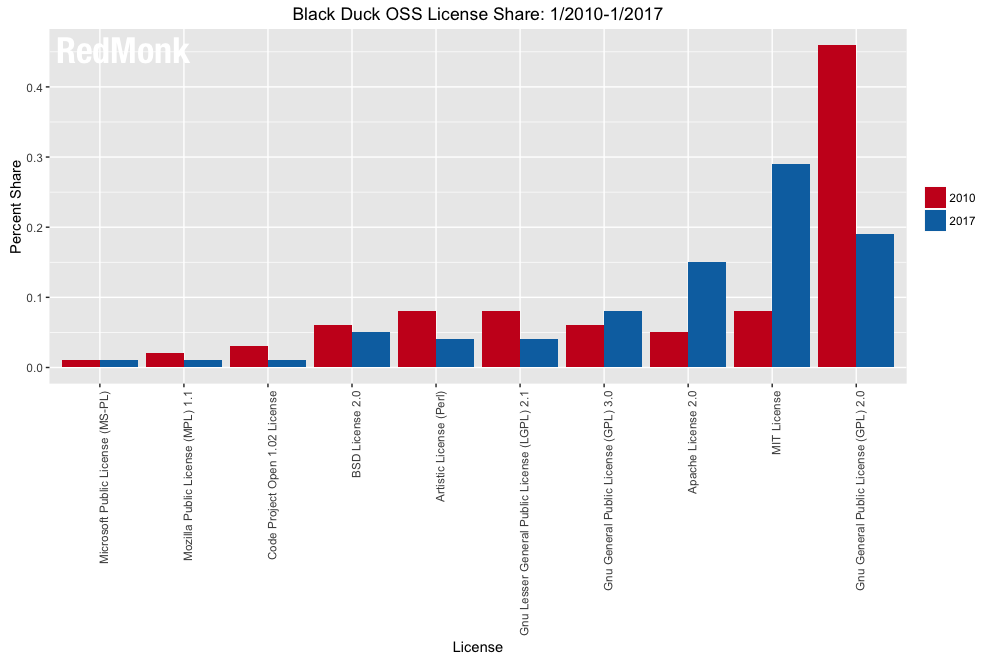
When the rumor mill starts Sullivan gave a recent example of the claim of the decline of copyleft in an article on Opensource.com by Jono Bacon from February 2017 that showed a histogram of license usage between 2010 and 2017 (seen below).
[Black Duck   histogram]
From that, Bacon elaborates possible reasons for the apparent decline of the GPL. The graphic used in the article was actually generated by Stephen O'Grady in a January article, The State Of Open Source Licensing, which said:
In Black Duck's sample, the most popular variant of the GPL version 2 is less than half as popular as it was (46% to 19%). Over the same span, the permissive MIT has gone from 8% share to 29%, while its permissive cousin the Apache License 2.0 jumped from 5% to 15%.
Sullivan, however, argued that the methodology used to create both articles was problematic. Neither contains original research: the graphs actually come from the Black Duck Software "KnowledgeBase" data, which was partly created from the old Ohloh web site now known as Open Hub. To show one problem with the data, Sullivan mentioned two free-software projects, GNU Bash and GNU Emacs, that had been showcased on the front page of Ohloh.net in 2012. On the site, Bash was (and still is) listed as GPLv2+, whereas it changed to GPLv3 in 2011. He also claimed that "Emacs was listed as licensed under GPLv3-only, which is a license Emacs has never had in its history", although I wasn't able to verify that information from the Internet archive. Basically, according to Sullivan, "the two projects featured on the front page of a site that was using [the Black Duck] data set were wrong". This, in turn, seriously brings into question the quality of the data:
I reported this problem and we'll continue to do that but when someone is not sharing the data set that they're using for other people to evaluate it and we see glimpses of it which are incorrect, that should give us a lot of hesitation about accepting any conclusion that comes out of it.
Reproducible observations are necessary to the establishment of solid theories in science. Sullivan didn't try to contact Black Duck to get access to the database, because he assumed (rightly, as it turned out) that he would need to "pay for the data under terms that forbid you to share that information with anybody else". So I wrote Black Duck myself to confirm this information. In an email interview, Patrick Carey from Black Duck confirmed its data set is proprietary. He believes, however, that through a "combination of human and automated techniques", Black Duck is "highly confident at the accuracy and completeness of the data in the KnowledgeBase". He did point out, however, that "the way we track the data may not necessarily be optimal for answering the question on license use trend" as "that would entail examination of new open source projects coming into existence each year and the licenses used by them". In other words, even according to Black Duck, its database may not be useful to establish the conclusions drawn by those articles. Carey did agree with those conclusions intuitively, however, saying that "there seems to be a shift toward Apache and MIT licenses in new projects, though I don't have data to back that up". He suggested that "an effective way to answer the trend question would be to analyze the new projects on GitHub over the last 5-10 years." Carey also suggested that "GitHub has become so dominant over the recent years that just looking at projects on GitHub would give you a reasonable sampling from which to draw conclusions".
[GitHub   graph]
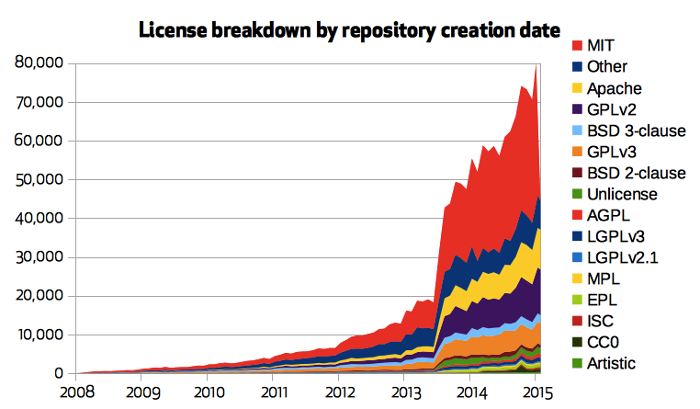
Indeed, GitHub published a report in 2015 that also seems to confirm MIT's popularity (45%), surpassing copyleft licenses (24%). The data is, however, not without its own limitations. For example, in the above graph going back to the inception of GitHub in 2008, we see a rather abnormal spike in 2013, which seems to correlate with the launch of the choosealicense.com site, described by GitHub as "our first pass at making open source licensing on GitHub easier". In his talk, Sullivan was critical of the initial version of the site which he described as biased toward permissive licenses. Because the GitHub project creation page links to the site, Sullivan explained that the site's bias could have actually influenced GitHub users' license choices. Following a talk from Sullivan at FOSDEM 2016, GitHub addressed the problem later that year by rewording parts of the front page to be more accurate, but that any change in license choice obviously doesn't show in the report produced in 2015 and won't affect choices users have already made. Therefore, there can be reasonable doubts that GitHub's subset of software projects may not actually be that representative of the larger free-software community.

In search of solid evidence So it seems we are missing good, reproducible results to confirm or dispel these claims. Sullivan explained that it is a difficult problem, if only in the way you select which projects to analyze: the impact of a MIT-licensed personal wiki will obviously be vastly different from, say, a GPL-licensed C compiler or kernel. We may want to distinguish between active and inactive projects. Then there is the problem of code duplication, both across publication platforms (a project may be published on GitHub and SourceForge for example) but also across projects (code may be copy-pasted between projects). We should think about how to evaluate the license of a given project: different files in the same code base regularly have different licenses often none at all. This is why having a clear, documented and publicly available data set and methodology is critical. Without this, the assumptions made are not clear and it is unreasonable to draw certain conclusions from the results. It turns out that some researchers did that kind of open research in 2016 in a paper called "The Debsources Dataset: Two Decades of Free and Open Source Software" [PDF] by Matthieu Caneill, Daniel M. Germ n, and Stefano Zacchiroli. The Debsources data set is the complete Debian source code that covers a large history of the Debian project and therefore includes thousands of free-software projects of different origins. According to the paper:
The long history of Debian creates a perfect subject to evaluate how FOSS licenses use has evolved over time, and the popularity of licenses currently in use.
Sullivan argued that the Debsources data set is interesting because of its quality: every package in Debian has been reviewed by multiple humans, including the original packager, but also by the FTP masters to ensure that the distribution can legally redistribute the software. The existence of a package in Debian provides a minimal "proof of use": unmaintained packages get removed from Debian on a regular basis and the mere fact that a piece of software gets packaged in Debian means at least some users found it important enough to work on packaging it. Debian packagers make specific efforts to avoid code duplication between packages in order to ease security maintenance. The data set covers a period longer than Black Duck's or GitHub's, as it goes all the way back to the Hamm 2.0 release in 1998. The data and how to reproduce it are freely available under a CC BY-SA 4.0 license.
[Debsource   graph]
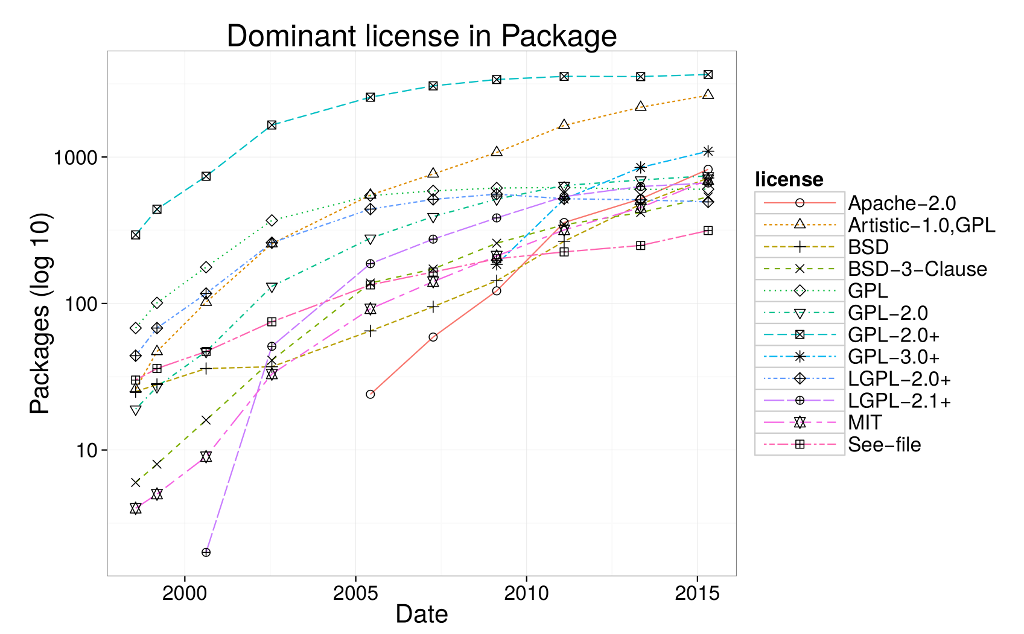
Sullivan presented the above graph from the research paper that showed the evolution of software license use in the Debian archive. Whereas previous graphs showed statistics in percentages, this one showed actual absolute numbers, where we can't actually distinguish a decline in copyleft licenses. To quote the paper again:
The top license is, once again, GPL-2.0+, followed by: Artistic-1.0/GPL dual-licensing (the licensing choice of Perl and most Perl libraries), GPL-3.0+, and Apache-2.0.
Indeed, looking at the graph, at most do we see a rise of the Apache and MIT licenses and no decline of the GPL per se, although its adoption does seem to slow down in recent years. We should also mention the possibility that Debian's data set has the opposite bias: toward GPL software. The Debian project is culturally quite different from the GitHub community and even the larger free-software ecosystem, naturally, which could explain the disparity in the results. We can only hope a similar analysis can be performed on the much larger Software Heritage data set eventually, which may give more representative results. The paper acknowledges this problem:
Debian is likely representative of enterprise use of FOSS as a base operating system, where stable, long-term and seldomly updated software products are desirable. Conversely Debian is unlikely representative of more dynamic FOSS environments (e.g., modern Web-development with micro libraries) where users, who are usually developers themselves, expect to receive library updates on a daily basis.
The Debsources research also shares methodology limitations with Black Duck: while Debian packages are reviewed before uploading and we can rely on the copyright information provided by Debian maintainers, the research also relies on automated tools (specifically FOSSology) to retrieve license information. Sullivan also warned against "ascribing reason to numbers": people may have different reasons for choosing a particular license. Developers may choose the MIT license because it has fewer words, for compatibility reasons, or simply because "their lawyers told them to". It may not imply an actual deliberate philosophical or ideological choice. Finally, he brought up the theory that the rise of non-copyleft licenses isn't necessarily at the detriment of the GPL. He explained that, even if there is an actual decline, it may not be much of a problem if there is an overall growth of free software to the detriment of proprietary software. He reminded the audience that non-copyleft licenses are still free software, according to the FSF and the Debian Free Software Guidelines, so their rise is still a positive outcome. Even if the GPL is a better tool to accomplish the goal of a free-software world, we can all acknowledge that the conversion of proprietary software to more permissive and certainly simpler licenses is definitely heading in the right direction.
[I would like to thank the DebConf organizers for providing meals for me during the conference.] Note: this article first appeared in the Linux Weekly News.

25 February 2017

Stefano Zacchiroli: Software Freedom Conservancy matching

become a Conservancy supporter by February 28th and have your donation matched Non-profits that provide project support have proven themselves to be necessary for the success and advancement of individual projects and Free Software as a whole. The Free Software Foundation (founded in 1985) serves as a home to GNU projects and a canonical list of Free Software licenses. The Open Source Initiative came about in 1998, maintaining the Open Source Definition, based on the Debian Free Software Guidelines, with affiliate members including Debian, Mozilla, and the Wikimedia Foundation. Software in the Public Interest (SPI) was created in the late 90s largely to act as a fiscal sponsor for projects like Debian, enabling it to do things like accept donations and handle other financial transactions. More recently (2006), the Software Freedom Conservancy was formed. Among other activities like serving as a fiscal sponsor, infrastructure provider, and support organization for a number of free software projects including Git, Outreachy, and the Debian Copyright Aggregation Project they protect user freedom via copyleft compliance and GPL enforcement work. Without a willingness to act when licenses are violated, copyleft has no power. Through communication, collaboration, and only as last resort litigation, the Conservancy helps everyone who uses a freedom respecting license. The Conservancy has been aggressively fundraising in order to not just continue its current operations, but expand their work, staff, and efforts. They recently launched a donation matching campaign thanks to the generosity and dedication of an anonymous donor. Everyone who joins the Conservancy as a annual Supporter by February 28th will have their donation matched. A number of us are already supporters, and hope you will join us in supporting the world of an organization that supports us.

12 February 2017

Stefano Zacchiroli: Opening the Software Heritage archive

... one API (and one FOSDEM) at a time [ originally posted on the Software Heritage blog, reposted here with minor adaptations ] Last Saturday at FOSDEM we have opened up the public API of Software Heritage, allowing to programmatically browse its archive. We posted this while I was keynoting with Roberto at FOSDEM 2017, to discuss the role Software Heritage plays in preserving the Free Software commons. To accompany the talk we released our first public API, which allows to navigate the entire content of the Software Heritage archive as a graph of connected development objects (e.g., blobs, directories, commits, releases, etc.). Over the past months we have been busy working on getting source code (with full development history) into the archive, to minimize the risk that important bits of Free/Open Sources Software that are publicly available today disappear forever from the net, due to whatever reason --- crashes, black hat hacking, business decisions, you name it. As a result, our archive is already one of the largest collections of source code in existence, spanning a GitHub mirror, injections of important Free Software collections such as Debian and GNU, and an ongoing import of all Google Code and Gitorious repositories. Up to now, however, the archive was deposit-only. There was no way for the public to access its content. While there is a lot of value in archival per se, our mission is to Collect, Preserve, and Share all the material we collect with everybody. Plus, we totally get that a deposit-only library is much less exciting than a store-and-retrieve one! Last Saturday we took a first important step towards providing full access to the content of our archive: we released version 1 of our public API, which allows to navigate the Software Heritage archive programmatically. You can have a look at the API documentation for full details about how it works. But to briefly recap: conceptually, our archive is a giant Merkle DAG connecting together all development-related objects we encounter while crawling public VCS repositories, source code releases, and GNU/Linux distribution packages. Examples of the objects we store are: file contents, directories, commits, releases; as well as their metadata, such as: log messages, author information, permission bits, etc. The API we have just released allows to pointwise navigate this huge graph. Using the API you can lookup individual objects by their IDs, retrieve their metadata, and jump from one object to another following links --- e.g., from a commit to the corresponding directory or parent commits, from a release to the annotated commit, etc. Additionally, you can retrieve crawling-related information, such as the software origins we track (usually as VCS clone/checkout URLs), and the full list of visits we have done on any known software origin. This allows, for instance, to know when we took snapshots of a Git repository you care about and, for each visit, where each branch of the repo was pointing to at that time. Our resources for offering the API as a public service are still quite limited. This is the reason why you will encounter a couple of limitations. First, no download of the actual content of files we have stored is possible yet --- you can retrieve all content-related metadata (e.g., checksums, detected file types and languages, etc.), but not the actual content as a byte sequence. Second, some pretty severe rate limits apply; API access is entirely anonymous and users are identified by their IP address, each "user" will be able to do a little bit more than 100 requests/hour. This is to keep our infrastructure sane while we grow in capacity and focus our attention to developing other archive features. If you're interested in having rate limits lifted for a specific use case or experiment, please contact us and we will see what we can do to help. If you'd like to contribute to increase our resource pool, have a look at our sponsorship program!

28 January 2017

Bits from Debian: Debian at FOSDEM 2017

On February 4th and 5th, Debian will be attending FOSDEM 2017 in Brussels, Belgium; a yearly gratis event (no registration needed) run by volunteers from the Open Source and Free Software community. It's free, and it's big: more than 600 speakers, over 600 events, in 29 rooms. This year more than 45 current or past Debian contributors will speak at FOSDEM: Alexandre Viau, Bradley M. Kuhn, Daniel Pocock, Guus Sliepen, Johan Van de Wauw, John Sullivan, Josh Triplett, Julien Danjou, Keith Packard, Martin Pitt, Peter Van Eynde, Richard Hartmann, Sebastian Dr ge, Stefano Zacchiroli and Wouter Verhelst, among others. Similar to previous years, the event will be hosted at Universit libre de Bruxelles. Debian contributors and enthusiasts will be taking shifts at the Debian stand with gadgets, T-Shirts and swag. You can find us at stand number 4 in building K, 1 B; CoreOS Linux and PostgreSQL will be our neighbours. See https://wiki.debian.org/DebianEvents/be/2017/FOSDEM for more details. We are looking forward to meeting you all!

28 November 2016

Stefano Zacchiroli: last week to take part in the Debian Contributors Survey

Debian Contributors Survey 2016 About 3 weeks ago, together with Molly and Mathieu, we launched the first edition of the Debian Contributors Survey. I won't harp on it any further, because you can find all relevant information about it on the Debian blog or as part of the original announcement. But it's worth noting that you've now only one week left to participate if you want to: the deadline for participation is 4 December 2016, at 23:59 UTC. If you're a Debian contributor and would like to participate, just go to the survey participation page and fill in!

16 November 2016

Bits from Debian: Debian Contributors Survey 2016

The Debian Contributor Survey launched last week! In order to better understand and document who contributes to Debian, we (Mathieu ONeil, Molly de Blanc, and Stefano Zacchiroli) have created this survey to capture the current state of participation in the Debian Project through the lense of common demographics. We hope a general survey will become an annual effort, and that each year there will also be a focus on a specific aspect of the project or community. The 2016 edition contains sections concerning work, employment, and labour issues in order to learn about who is getting paid to work on and with Debian, and how those relationships affect contributions. We want to hear from as many Debian contributors as possible whether you've submitted a bug report, attended a DebConf, reviewed translations, maintain packages, participated in Debian teams, or are a Debian Developer. Completing the survey should take 10-30 minutes, depending on your current involvement with the project and employment status. In an effort to reflect our own ideals as well as those of the Debian project, we are using LimeSurvey, an entirely free software survey tool, in an instance of it hosted by the LimeSurvey developers. Survey responses are anonymous, IP and HTTP information are not logged, and all questions are optional. As it is still likely possible to determine who a respondent is based on their answers, results will only be distributed in aggregate form, in a way that does not allow deanonymization. The results of the survey will be analyzed as part of ongoing research work by the organizers. A report discussing the results will be published under a DFSG-free license and distributed to the Debian community as soon as it's ready. The raw, disaggregated answers will not be distributed and will be kept under the responsibility of the organizers. We hope you will fill out the Debian Contributor Survey. The deadline for participation is: 4 December 2016, at 23:59 UTC. If you have any questions, don't hesitate to contact us via email at:

10 March 2016

Mike Hommey: RIP Iceweasel, 13 Nov 2006 10 Mar 2016

This took longer than it should have, but a page is now officially turned. I uploaded Firefox and Firefox ESR to Debian unstable. They will have to go through the Debian NEW queue because they are new source packages, so won t be immediately available, but they should arrive soon enough. People using Iceweasel from Debian unstable will be upgraded to Firefox ESR. Debian stable will receive Firefox ESR after Iceweasel/Firefox ESR38 is end-of-lifed, in about 3 months. Thanks go to Sylvestre Ledru, Mike Connor (the same who filed bug 354622) and Stefano Zacchiroli.

8 February 2016

Orestis Ioannou: Debian - your patches and machine readable copyright files are available on Debsources

TL;DR All Debian license and patches are belong to us. Discover them here and here. In case you hadn't already stumbled upon sources.debian.net in the past, Debsources is a simple web application that allows to publish an unpacked Debian source mirror on the Web. On the live instance you can browse the contents of Debian source packages with syntax highlighting, search files matching a SHA-256 hash or a ctag, query its API, highlight lines, view accurate statistics and graphs. It was initially developed at IRILL by Stefano Zacchiroli and Matthieu Caneill. During GSOC 2015 I helped introduce two new features. License Tracker Since Debsources has all the debian/copyright files and that many of them adopted the DEP-5 suggestion (machine readable copyright files) it was interesting to exploit them for end users. You may find interesting the following features: Have a look at the documentation to discover more! Patch tracker The old patch tracker unfortunately died a while ago. Since Debsources stores all the patches it was, probably, natural for it to be able to exploit them and present them over the web. You can navigate through packages by prefix or by searching them here. Among the use cases: Read more about the API! Coming ... I hope you find these new features useful. Don't hesitate to report any bugs or suggestions you come accross.

1 February 2016

Stefano Zacchiroli: guest lecture Overthrowing the Tyranny of Software by John Sullivan

As part of my master class on Free and Open Source (FOSS) Software at University Paris Diderot, I invite guest lecturers to present to my students the point of views of various actors of the FOSS ecosystem --- companies, non-profits, activists, lawyers, etc. Tomorrow, Tuesday 2 February 2016, the students will have the pleasure to have as guest lecturer John Sullivan, Executive Director of the Free Software Foundation, talking about Overthrowing the tyranny of software: Why (and how) free societies respect computer user freedom. The lecture is open to everyone interested, but registration is recommended. Logistic and registration information, as well as the lecture abstract in both English and French is reported below.
John Sullivan's Lecture at University Paris Diderot - Overthrowing the tyranny of software: Why (and how) free societies respect computer user freedom John Sullivan, Executive Director of the Free Software Foundation will give a lecture titled "Overthrowing the tyranny of software: Why (and how) free societies respect computer user freedom" at University Paris Diderot next Tuesday, 2 February 2016, at 12:30 in the Amphi 3B, Halle aux Farines building, Paris 75013. Map at: http://www.openstreetmap.org/way/62378611#map=19/48.82928/2.38183 The lecture will be in English and open to everyone, but registration is recommended at https://framadate.org/iPqfjNTz2535F8u4 or via email writing to zack@pps.univ-paris-diderot.fr. Abstract: Anyone who has used a computer for long has at least sometimes felt like a helpless subject under the tyrant of software, screaming (uselessly) in frustration at the screen to try and get the desired results. But with driverless cars, appliances which eavesdrop on conversations in our homes, mobile devices that transmit our location when we are out and about, and computers with unexpected hidden "features", our inability to control the software supposedly in our possession has become a much more serious problem than the superficial blue-screen-of-death irritations of the past. Software which is free "as in freedom" allows anyone who has it to inspect the code and even modify it -- or ask someone trained in the dark arts of computer programming to do it for them -- so that undesirable behaviors can be removed or defused. This characteristic, applied to all software, should be a major part of foundation of free societies moving forward. To get there, we'll need individual developers, nonprofit organizations, governments, and companies all working together -- with the first two groups leading the way.
Cours Magistral de John Sullivan l'Universit Paris Diderot - Surmonter la tyrannie du logiciel: pourquoi (et comment) les soci t s libres respectent les libert s des utilisateurs John Sullivan, Directeur Ex cutif de la Free Software Foundation donnera un cours magistral ayant pour titre "Surmonter la tyrannie du logiciel: pourquoi (et comment) les soci t s libres respectent les libert s des utilisateurs" l'Universit Paris Diderot Mardi prochain, 2 f vrier 2016, 12h30 dans l'Amphi 3B de la Halle aux Farines, Paris 75013. Plan: http://www.openstreetmap.org/way/62378611#map=19/48.82928/2.38183 Le cours (en langue Anglaise) sera ouvert toutes et tous, mais l'inscription est recommand via le formulaire https://framadate.org/iPqfjNTz2535F8u4 ou par mail l'adresse zack@pps.univ-paris-diderot.fr. R sum : Chacun de nous, au moins une fois dans sa vie, a pest contre son ordinateur dans l'espoir (vain) d'obtenir un r sultat attendu, se sentant d poss de par un tyran logiciel. Mais au jour d'aujourd'hui - avec des voitures autonomes, des dispositifs "intelligents" que nous coutent chez nous, des portables qui transmettent notre position quand nous nous baladons, et des ordinateurs pleins des fonctionnalit s cach es - notre incapacit de contr ler nos biens devient une question beaucoup plus s rieuse par rapport a l'irritation qu'auparavant nous causait l' cran bleu de la mort. Le logiciel libre permet chaque utilisateur d' tudier son fonctionnement et de le modifier --- ou de demander des experts dans la magie noire de la programmation de le faire a sa place --- supprimant, ou du moins r duisant, les comportements ind sir s du logiciel. Cette caract ristique du logiciel libre devrait tre appliqu e chaque type de logiciel et devrait constituer un pilier des soci t s se pr tendant libres. Pour achever cet id al, d veloppeurs, organisations but non lucratif, gouvernements et entreprises doivent travailler ensemble. Et les d veloppeurs et les ONG doivent se positionner au premier rang dans ce combat.

29 December 2015

Stefano Zacchiroli: Shuttleworth Foundation Flash Grant - 2015 report

1 year of Shuttleworth Foundation Flash Grant As announced last year, starting January 2015 I've benefited from a "Flash Grant" kindly awarded to me by the Shuttleworth Foundation. This post reports publicly about how I've used the money to promote Free Software via my own activism, over the period January-December 2015. I'm lucky to have a full-time academic job that provides me with a salary and basic computer hardware. But Free Software not being the only focus of my job, it gets difficult at times to get travel funding to specific Free Software events. So that is what I've mostly used the grant money for: attend Free Software events that I wouldn't have been able to attend otherwise. On grant money I've attended LibrePlanet 2015 (2015-03-19-boston-libreplanet label in the financial reports below), where I've given the talk Distributions and the Free "Cloud", and FSFE's LLW 2015 (2015-04-15-barcelona-fsfe-legal) workshop. Furthermore I've used the grant to reimburse otherwise not reimbursed out of pocket expenses in a trip to San Francisco (2015-11-06-san-francisco-gsoc+osi) that have been otherwise sponsored by Google (to attend the Summer of Code Mentor Summit) and OSI (to attend a F2F meeting of the Board of Directors). Finally, I've used grant money to offer lunch to invited lecturers in my master-level Free Software class at the university (label 2015-foss-class). Actual financial reports are reported below, in ledger format. It should be noted that, contrary to the usual expected 6-month duration of flash grants, I've used only about half the grant amount over a 12-month period; I do not plan to pocket what remains, but rather keep on using it over the next year, reporting again publicly at the end of the period. Also, I did not breakdown further out of pocket expenses, but they invariably stand for public transport tickets and meals. Balance sheet Overall:
         1966,11 EUR  Assets:Funds
        -4052,52 EUR  Equity:Opening balances
         2086,41 EUR  Expenses
           15,90 EUR    Bank:Commissions
          424,00 EUR    Conference:Registration
           56,50 EUR    Teaching:Speaker-invitation
         1590,01 EUR    Travel
          249,02 EUR      Lodgement
          562,51 EUR      Out-of-pocket
          778,48 EUR      Plane
--------------------
                   0

Breakdown by purpose: Journal
2014-12-03 Shuttleworth Foundation flash grant                                    Equity:Opening balances                     -4052,52 EUR    -4052,52 EUR
                                                                                  Assets:Funds                                 4052,52 EUR               0
2014-12-04 bank commissions on incoming transfer                                  Expenses:Bank:Commissions                      15,90 EUR       15,90 EUR
                                                                                  Assets:Funds                                  -15,90 EUR               0
2014-12-24 plane tickets Paris-Boston round trip to attend LibrePlanet 2015       Expenses:Travel:Plane                         627,84 EUR      627,84 EUR
                                                                                  Assets:Funds                                 -627,84 EUR               0
2015-01-02 LibrePlanet 2015 registration + travel fund contribution               Expenses:Conference:Registration              424,00 EUR      424,00 EUR
                                                                                  Assets:Funds                                 -424,00 EUR               0
2015-03-02 plane tickets Paris-Barcelona round trip to attend LLW 2015            Expenses:Travel:Plane                         150,64 EUR      150,64 EUR
                                                                                  Assets:Funds                                 -150,64 EUR               0
2015-03-19 lunch with invited speaker for lecture about FOSS release management   Expenses:Teaching:Speaker-invitation           28,00 EUR       28,00 EUR
                                                                                  Assets:Funds                                  -28,00 EUR               0
2015-03-25 lunch with invited speaker for lecture about FOSS business models      Expenses:Teaching:Speaker-invitation           28,50 EUR       28,50 EUR
                                                                                  Assets:Funds                                  -28,50 EUR               0
2015-04-03 LibrePlanet 2015 out of pocket expenses                                Expenses:Travel:Out-of-pocket                 213,38 EUR      213,38 EUR
                                                                                  Assets:Funds                                 -213,38 EUR               0
2015-04-15 LLW 2015 out of pocket expenses                                        Expenses:Travel:Out-of-pocket                  80,00 EUR       80,00 EUR
                                                                                  Assets:Funds                                  -80,00 EUR               0
2015-05-06 hotel in Barcelona for LLW 2015 (3 nights)                             Expenses:Travel:Lodgement                     249,02 EUR      249,02 EUR
                                                                                  Assets:Funds                                 -249,02 EUR               0
2015-11-29 OSI F2F Fall 2015 out of pocket expenses                               Expenses:Travel:Out-of-pocket                 269,13 EUR      269,13 EUR
                                                                                  Assets:Funds                                 -269,13 EUR               0

24 July 2015

Martin Michlmayr: Congratulations to Stefano Zacchiroli

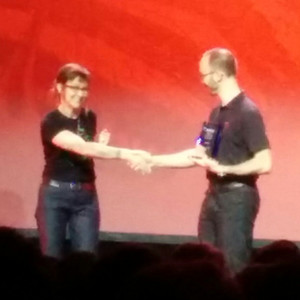
Stefano Zacchiroli receiving the O'Reilly Open Source Award I attended OSCON's closing sessions today and was delighted to see my friend Stefano Zacchiroli (Zack) receive an O'Reilly Open Source Award. Zack acted as Debian Project Leader for three years, is working on important activities at the Open Source Initiative and the Free Software Foundation, and is generally an amazing advocate for free software. Thanks for all your contributions, Zack, and congratulations!

31 March 2015

Zlatan Todori : Interviews with FLOSS developers: Francesca Ciceri

Debian and FLOSS community don't only occupy coding developers. They occupy people who write news, who talk about FLOSS, who help on booths and conferences, who create artistic forms of the community and so many others that contribute in countless ways. A lady, that is doing many of that is Francesca Ciceri, known in Debian as MadameZou. She is non-packaging Debian Developer, a fearless warrior for diversity and a zombie fan. Although it sounds intimidating, she is deep caring and great human being. So, what has MadaZou to tell us? Picture of MadameZou Who are you? My name is Francesca and I'm totally flattered by your intro. The fearless warrior part may be a bit exaggerated, though. What have you done and what are you currently working on in FLOSS world? I've been a Debian contributor since late 2009. My journey in Debian has touched several non-coding areas: from translation to publicity, from videoteam to www. I've been one of the www.debian.org webmasters for a while, a press officer for the Project as well as an editor for DPN. I've dabbled a bit in font packaging, and nowadays I'm mostly working as a Front Desk member. Setup of your main machine? Wow, that's an intimate question! Lenovo Thinkpad, Debian testing. Describe your current most memorable situation as FLOSS member? Oh, there are a few. One awesome, tiring and very satisfying moment was during the release of Squeeze: I was member of the publicity and the www teams at the time, and we had to pull a 10 hours of team work to put everything in place. It was terrible and exciting at the same time. I shudder to think at the amount of work required from ftpmaster and release team during the release. Another awesome moment was my first Debconf: I was so overwhelmed by the sense of belonging in finally meeting all these people I've been worked remotely for so long, and embarassed by my poor English skills, and overall happy for just being there... If you are a Debian contributor I really encourage you to participate to Debian events, be they small and local or as big as DebConf: it really is like finally meeting family. Some memorable moments from Debian conferences? During DC11, the late nights with the "corridor cabal" in the hotel, chatting about everything. A group expedition to watch shooting stars in the middle of nowhere, during DC13. And a very memorable videoteam session: it was my first time directing and everything that could go wrong, went wrong (including the speaker deciding to take a walk outside the room, to demonstrate something, out of the cameras range). It was a disaster, but also fun: at the end of it, all the video crew was literally in stitches. But there are many awesome moments, almost too many to recall. Each conference is precious on that regard: for me the socializing part is extremely important, it's what cements relationships and help remote work go smoothly, and gives you motivation to volunteer in tasks that sometimes are not exactly fun. You are known as Front Desk member for DebConf's - what work does it occupy and why do you enjoy doing it? I'm not really a member of the team: just one of Nattie's minions! You had been also part of DebConf Video team - care to share insights into video team work and benefits it provides to Debian Project? The video team work is extremely important: it makes possible for people not attending to follow the conference, providing both live streaming and recording of all talks. I may be biased, but I think that DebConf video coverage and the high quality of the final recordings are unrivaled among FLOSS conferences - especially since it's all volunteer work and most of us aren't professional in the field. During the conference we take shifts in filming the various talks - for each talk we need approximately 4 volunteers: two camera operators, a sound mixer and the director. After the recording, comes the boring part: reviewing, cutting and sometimes editing the videos. It's a long process and during the conference, you can sometimes spot the videoteam members doing it at night in the hacklab, exhausted after a full day of filming. And then, the videos are finally ready to be uploaded, for your viewing pleasure. During the last years this process has become faster thanks to the commitment of many volunteers, so that now you have to wait only few days, sometimes a week, after the end of the conference to be able to watch the videos. I personally love to contribute to the videoteam: you get to play with all that awesome gear and you actually make a difference for all the people who cannot attend in person. You are also non-packaging Debian Developer - how does that feel like? Feels awesome! The mere fact that the Debian Project decided - in 2009 via a GR - to recognize the many volunteers who contribute without doing packaging work is a great show of inclusiveness, in my opinion. In a big project like Debian just packaging software is not enough: the final result relies heavily on translators, sysadmins, webmasters, publicity people, event organizers and volunteers, graphic artists, etc. It's only fair that these contributions are deemed as valuable as the packaging, and to give an official status to those people. I was one of the firsts non-uploading DD, four years ago, and for a long time it was just really an handful of us. In the last year I've seen many others applying for the role and that makes me really happy: it means that finally the contributors have realized that they deserve to be an official part of Debian and to have "citizenship rights" in the project. You were the leading energy on Debian's diversity statement - what gave you the energy to drive into it? It seemed the logical conclusion of the extremely important work that Debian Women had done in the past. When I first joined Debian, in 2009, as a contributor, I was really surprised to find a friendly community and to not be discriminated on account of my gender or my lack of coding skills. I may have been just lucky, landing in particularly friendly teams, but my impression is that the project has been slowly but unequivocally changed by the work of Debian Women, who raised first the need for inclusiveness and the awareness about the gender problem in Debian. I don't remember exactly how I stumbled upon the fact that Debian didn't have a Diversity Statement, but at first I was very surprised by it. I asked zack (Stefano Zacchiroli), who was DPL at the time, and he encouraged me to start a public discussion about it, sending out a draft - and helped me all the way along the process. It took some back and forth in the debian-project mailing list, but the only thing needed was actually just someone to start the process and try to poke the discussion when it stalled - the main blocker was actually about the wording of the statement. I learned a great deal from that experience, and I think it changed completely my approach in things like online discussions and general communication within the project. At the end of the day, what I took from that is a deep respect for who participated and the realization that constructive criticism does require certainly a lot of work for all parts involved, but can happen. As for the statement in itself: these things are as good as you keep them alive with best practices, but I think that are better stated explicitly rather than being left unsaid. You are involved also with another Front Desk, the Debian's one which is involved with Debian's New Members process - what are tasks of that FD and how rewarding is the work on it? The Debian Front Desk is the team that runs the New Members process: we receive the applications, we assign the applicant a manager, and we verify the final report. In the last years the workflow has been simplified a lot by the re-design of the nm.debian.org website, but it's important to keep things running smoothly so that applicants don't have too lenghty processes or to wait too much before being assigned a manager. I've been doing it for a less more than a month, but it's really satisfying to usher people toward DDship! So this is how I feel everytime I send a report over to DAM for an applicant to be accepted as new Debian Developer: Crazy pic How do you see future of Debian development? Difficult to say. What I can say is that I'm pretty sure that, whatever the technical direction we'll take, Debian will remain focused on excellence and freedom. What are your future plans in Debian, what would you like to work on? Definetely bug wrangling: it's one of the thing I do best and I've not had a chance to do that extensively for Debian yet. Why should developers and users join Debian community? What makes Debian a great and happy place? We are awesome, that's why. We are strongly committed to our Social Contract and to users freedom, we are steadily improving our communication style and trying to be as inclusive as possible. Most of the people I know in Debian are perfectionists and outright brilliant in what they do. Joining Debian means working hard on something you believe, identifying with a whole project, meeting lots of wonderful people and learning new things. It ca be at times frustrating and exhausting, but it's totally worth it. You have been involved in Mozilla as part of OPW - care to share insights into Mozilla, what have you done and compare it to Debian? That has been a very good experience: it meant have the chance to peek into another community, learn about their tools and workflow and contribute in different ways. I was an intern for the Firefox QA team and their work span from setting up specific test and automated checks on the three version of Firefox (Stable, Aurora, Nightly) to general bug triaging. My main job was bug wrangling and I loved the fact that I was a sort of intermediary between developers and users, someone who spoke both languages and could help them work together. As for the comparison, Mozilla is surely more diverse than Debian: both in contributors and users. I'm not only talking demographic, here, but also what tools and systems are used, what kind of skills people have, etc. That meant reach some compromises with myself over little things: like having to install a proprietary tool used for the team meetings (and getting crazy in order to make it work with Debian) or communicating more on IRC than on mailing lists. But those are pretty much the challenges you have to face whenever you go out of your comfort zone . You are also volunteer of the Organization for Transformative Works - what is it, what work do you do and care to share some interesting stuff? OTW is a non profit organization to preserve fan history and cultures, created by fans. Its work range from legal advocacy and lobbying for fair use and copyright related issues, developing and maintaining AO3 -- a huge fanwork archive based on open-source software --, to the production of a peer-reviewed academic journal about fanworks. I'm an avid fanfiction reader and writer, and joining the OTW volunteers seemed a good way to give back to the community - in true Debian fashion . As a volunteer, I work for the Translation Committee: we are more than a hundred people - divided in several language teams - translating the OTW website, the interface of AO3 archive, newsletter, announcements and news posts. We have a orga-wide diversity statement, training for recruits, an ever growing set of procedures to smooth our workflow, monthly meetings and movie nights. It's an awesome group to work with. I'm deeply invested in this kind of work: both for the awesomeness of OTW people and for the big role that fandom and fanworks have in my life. What I find amazing is that the same concept we - as in the FLOSS ecosystem - apply to software can be applied to cultural production: taking a piece of art you love and expand, remix, explore it. Just for the fun of it. Protect and encourage the right to play in this cultural sandbox is IMO essential for our society. Most of the participants in the fandom come from marginalised group or minorities whose point of view is usually not part of the mainstream narratives. This makes the act of writing, remixing and re-interpreting a story not only a creative exercise but a revolutionary one. As Elizabeth Minkel says: "My preferred explanation is the idea that the vast majority of what we watch is from the male perspective authored, directed, and filmed by men, and mostly straight white men at that. Fan fiction gives women and other marginalised groups the chance to subvert that perspective, to fracture a story and recast it in her own way." In other words, "fandom is about putting debate and conversation back into an artistic process". On a personal side - you do a lot of DIY, handmade works. What have you done, what joy does it bring to you and share with us a picture of it? I like to think that the hacker in me morphs in a maker whenever I can actually manipulate stuff. The urge to explore ways of doing things, of create and change is probably the same. I've been blessed with curiousity and craftiness and I love to learn new DIY techniques: I cannot describe it, really, but if I don't make something for a while I actually feel antsy. I need to create stuff. Nowadays, I'm mostly designing and sewing clothes - preferably reproductions of dresses from the 40s and the 50s - and I'm trying to make a living of that. It's a nice challenge: there's a lot of research involved, as I always try to be historically accurate in design, sewing tecniques and material, and many hours of careful attention to details. I'm right in the process of make photoshoots for most of my period stuff, so I'll share with you something different: a t-shirt refashion done with the DebConf11 t-shirt! (here's the tutorial) T-shirt pic

9 March 2015

Stefano Zacchiroli: interview for The Setup

my setup, take #2 Look Ma, I've been interviewed by The Setup, a popular blog with "interviews asking people from all walks of life what they use to get the job done"; so I now sport a fancy http://stefano.zacchiroli.usesthis.com too. While there is overlap with my previous take on my setup, the questions are different so most of the content is novel. In particular, I quite enjoyed the question about what would be my "dream setup", and indulged in free software/hardware desiderata. Many thanks to Daniel Bogan for running the blog and kudos for his editing work: while it's just a detail, such an abundance and quality of link titles is not easy to come by on the Web.

8 January 2015

Stefano Zacchiroli: #JeSuisCharlie - RIP Bernard Maris

R.I.P. Bernard Maris and his thoughts on research and the sharing economy via Le Monde, 16 Sep 2014: Le Monde: Que devrait tre une politique de gauche? Une r gulation du capitalisme ou une politique de rupture radicale avec ce syst me conomique? B.M.: [ ] Nous allons vers une conomie de partage, de la gratuit , du logiciel libre en effet. La figure centrale de demain sera le chercheur qui, lorsqu'il donne quelque chose la communaut , ne le perd pas. Le chercheur r pond aux besoins fondamentaux de l'homme: la cr ation, la curiosit , le changement, le progr s. Il est oblig de coop rer. La coop ration canalise la violence, que le lib ralisme esp rait canaliser par le doux commerce! L'au-del du capitalisme sera une conomie solidaire et fraternelle. Aujourd'hui, la question incontournable porte sur la nature du travail.[ ]
Bernard Maris
23 Sep 1946 - 7 Jan 2015
#JeSuisCharlie
translate to English (via Google Translate)

5 December 2014

Stefano Zacchiroli: Shuttleworth Foundation Flash Grant

Shuttleworth Foundation Flash Grant I'm glad to announce that I've been awarded a 5,000 USD "Flash Grant" by the Shuttleworth Foundation. Flash grants are an interesting funding model, which I've just learned about. You don't need to apply for them. Rather, you get nominated by current fellows, and then selected and approached by the foundation for funding. The grant amount is smaller than actual fellowships, but it comes with very few strings attached: furthering open knowledge (which is the foundation's core mission) and being transparent about how you use the money. I'm lucky enough to already have a full-time job to pay my bills, and I do my Free Software activism mostly in my spare time. So I plan to use the money not to pay my bills, but rather to boost the parts of my Free Software activities that could benefit from some funding. I don't have a fully detailed budget yet but, tentatively: some money will go to fund Debsources development (by others), some into promoting my thoughts on the dark ages of Free Software, and maybe some into helping the upcoming release of Debian. I'll provide a public report at the end of the funding period (~6 months from now). I'd like to thank the Shuttleworth Foundation for the grant and foundation's fellow Jonas berg for making this possible.

27 November 2014

Stefano Zacchiroli: CTTE nomination

Apparently, enough fellow developers have been foolish enough to nominate me as a prospective member of the Debian Technical Committee (CTTE), that I've been approached to formally accept/decline the nomination. (Accepted nominees would then go through a selection process and possibly proposed to the DPL for nomination.) I'm honored by the nominations and I thank the fellow developers that have thrown my name in the hat. But I've respectfully declined the nomination. Given my current involvement in an ongoing attempt to introduce a maximum term limit for CTTE membership, it would have been highly inappropriate for me to accept the nomination at this time. I have no doubt that the current CTTE and the DPL will fill the empty seats with worthy project members.

20 November 2014

Stefano Zacchiroli: Thoughts on the Init System Coupling GR

on perceived hysteria and silent sanity As you probably already know by now, the results of the Debian init system coupling general resolution (GR) look like this:
Init system coupling GR: results (arrow from A to B means that voters preferred A to B by that margin)
results of the init system coupling GR
Some random thoughts about them: My take home message is that we are experiencing a huge gap between the public perception of the state of Debian (both from within and from without the project) and the actual beliefs of the silent majority of people that make Debian with their work, day after day. In part this is old news. The most "senior" members of the project will remember that the topic of "vocal minorities vs silent majority" was a recurrent one in Debian 10+ years ago, when flames were periodically ravaging the project. Since then Debian has grown a lot though, and we are now part of a much larger and varied ecosystem. We are now at a scale at which there are plenty of FOSS "mass-media" covering daily what happens in Debian, inducing feedback loops with our own perception of ourselves which we do not fully grok yet. This is a new factor in the perception gap. This situation is not intrinsically bad, nor there is blame to assign here: after all influential bloggers, news sites, etc., just do their job. And their attention also testifies of the huge interest that there is around Debian and our choices. But we still need to adapt and learn to take perceived hysteria with a pinch (or two) of salt. It might just be time for our decennial check-up. Time to remind ourselves that our ways of doing things might in fact still be much more sane than sometimes we tend to believe. We went on 10+ years ago, after monumental flames. It looks like we are now ready to move on again, putting The Era of the Great systemd Histeria behind us.

Next.

Previous.