Search Results: "Michael Prokop"

26 May 2017

Michael Prokop: The #newinstretch game: dbgsym packages in Debian/stretch

Debug packages include debug symbols and so far were usually named <package>-dbg in Debian. Those packages are essential if you ve to debug failing (especially: crashing) programs. Since December 2015 Debian has automatic dbgsym packages, being built by default. Those packages are available as <package>-dbgsym, so starting with Debian/stretch you should no longer look for -dbg packages but for -dbgsym instead. Currently there are 13.369 dbgsym packages available for the amd64 architecture of Debian/stretch, comparing this to the 2.250 packages which I counted being available for Debian/jessie this is really a huge improvement. (If you re interested in the details of dbgsym packages as a package maintainer take a look at the Automatic Debug Packages page in the Debian wiki.) The dbgsym packages are NOT provided by the usual Debian archive though (which is good thing, since those packages are quite disk space consuming, e.g. just the amd64 stretch mirror of debian-debug consumes 47GB). Instead there s a new archive called debian-debug. To get access to the dbgsym packages via the debian-debug suite on your Debian/stretch system include the following entry in your apt s sources.list configuration (replace deb.debian.org with whatever mirror you prefer):
deb http://deb.debian.org/debian-debug/ stretch-debug main
If you re not yet familiar with usage of such debug packages let me give you a short demo. Let s start with sending SIGILL (Illegal Instruction) to a running sha256sum process, causing it to generate a so called core dump file:
% sha256sum /dev/urandom &
[1] 1126
% kill -4 1126
% 
[1]+  Illegal instruction     (core dumped) sha256sum /dev/urandom
% ls
core
$ file core
core: ELF 64-bit LSB core file x86-64, version 1 (SYSV), SVR4-style, from 'sha256sum /dev/urandom', real uid: 1000, effective uid: 1000, real gid: 1000, effective gid: 1000, execfn: '/usr/bin/sha256sum', platform: 'x86_64'
Now we can run the GNU Debugger (gdb) on this core file, executing:
% gdb sha256sum core
[...]
Type "apropos word" to search for commands related to "word"...
Reading symbols from sha256sum...(no debugging symbols found)...done.
[New LWP 1126]
Core was generated by  sha256sum /dev/urandom'.
Program terminated with signal SIGILL, Illegal instruction.
#0  0x000055fe9aab63db in ?? ()
(gdb) bt
#0  0x000055fe9aab63db in ?? ()
#1  0x000055fe9aab8606 in ?? ()
#2  0x000055fe9aab4e5b in ?? ()
#3  0x000055fe9aab42ea in ?? ()
#4  0x00007faec30872b1 in __libc_start_main (main=0x55fe9aab3ae0, argc=2, argv=0x7ffc512951f8, init=<optimized out>, fini=<optimized out>, rtld_fini=<optimized out>, stack_end=0x7ffc512951e8) at ../csu/libc-start.c:291
#5  0x000055fe9aab4b5a in ?? ()
(gdb) 
As you can see by the several ?? question marks, the bt command (short for backtrace) doesn t provide useful information.
So let s install the according debug package, which is coreutils-dbgsym in this case (since the sha256sum binary which generated the core file is part of the coreutils package). Then let s rerun the same gdb steps:
% gdb sha256sum core
[...]
Type "apropos word" to search for commands related to "word"...
Reading symbols from sha256sum...Reading symbols from /usr/lib/debug/.build-id/a4/b946ef7c161f2d215518ca38d3f0300bcbdbb7.debug...done.
done.
[New LWP 1126]
Core was generated by  sha256sum /dev/urandom'.
Program terminated with signal SIGILL, Illegal instruction.
#0  0x000055fe9aab63db in sha256_process_block (buffer=buffer@entry=0x55fe9be95290, len=len@entry=32768, ctx=ctx@entry=0x7ffc51294eb0) at lib/sha256.c:526
526     lib/sha256.c: No such file or directory.
(gdb) bt
#0  0x000055fe9aab63db in sha256_process_block (buffer=buffer@entry=0x55fe9be95290, len=len@entry=32768, ctx=ctx@entry=0x7ffc51294eb0) at lib/sha256.c:526
#1  0x000055fe9aab8606 in sha256_stream (stream=0x55fe9be95060, resblock=0x7ffc51295080) at lib/sha256.c:230
#2  0x000055fe9aab4e5b in digest_file (filename=0x7ffc51295f3a "/dev/urandom", bin_result=0x7ffc51295080 "\001", missing=0x7ffc51295078, binary=<optimized out>) at src/md5sum.c:624
#3  0x000055fe9aab42ea in main (argc=<optimized out>, argv=<optimized out>) at src/md5sum.c:1036
As you can see it s reading the debug symbols from /usr/lib/debug/.build-id/a4/b946ef7c161f2d215518ca38d3f0300bcbdbb7.debug and this is what we were looking for.
gdb now also tells us that we don t have lib/sha256.c available. For even better debugging it s useful to have the according source code available. This is also just an apt-get source coreutils ; cd coreutils-8.26/ away:
~/coreutils-8.26 % gdb sha256sum ~/core
[...]
Type "apropos word" to search for commands related to "word"...
Reading symbols from sha256sum...Reading symbols from /usr/lib/debug/.build-id/a4/b946ef7c161f2d215518ca38d3f0300bcbdbb7.debug...done.
done.
[New LWP 1126]
Core was generated by  sha256sum /dev/urandom'.
Program terminated with signal SIGILL, Illegal instruction.
#0  0x000055fe9aab63db in sha256_process_block (buffer=buffer@entry=0x55fe9be95290, len=len@entry=32768, ctx=ctx@entry=0x7ffc51294eb0) at lib/sha256.c:526
526           R( h, a, b, c, d, e, f, g, K(25), M(25) );
(gdb) bt
#0  0x000055fe9aab63db in sha256_process_block (buffer=buffer@entry=0x55fe9be95290, len=len@entry=32768, ctx=ctx@entry=0x7ffc51294eb0) at lib/sha256.c:526
#1  0x000055fe9aab8606 in sha256_stream (stream=0x55fe9be95060, resblock=0x7ffc51295080) at lib/sha256.c:230
#2  0x000055fe9aab4e5b in digest_file (filename=0x7ffc51295f3a "/dev/urandom", bin_result=0x7ffc51295080 "\001", missing=0x7ffc51295078, binary=<optimized out>) at src/md5sum.c:624
#3  0x000055fe9aab42ea in main (argc=<optimized out>, argv=<optimized out>) at src/md5sum.c:1036
(gdb) 
Now we re ready for all the debugging magic. :) Thanks to everyone who was involved in getting us the automatic dbgsym package builds in Debian!
25 May 2017

Michael Prokop: The #newinstretch game: new forensic packages in Debian/stretch

Repeating what I did for the last Debian releases with the #newinwheezy and #newinjessie games it s time for the #newinstretch game: Debian/stretch AKA Debian 9.0 will include a bunch of packages for people interested in digital forensics. The packages maintained within the Debian Forensics team which are new in the Debian/stretch release as compared to Debian/jessie (and ignoring jessie-backports): Join the #newinstretch game and present packages and features which are new in Debian/stretch.

19 May 2017

Michael Prokop: Debian stretch: changes in util-linux #newinstretch

We re coming closer to the Debian/stretch stable release and similar to what we had with #newinwheezy and #newinjessie it s time for #newinstretch! Hideki Yamane already started the game by blogging about GitHub s Icon font, fonts-octicons and Arturo Borrero Gonzalez wrote a nice article about nftables in Debian/stretch. One package that isn t new but its tools are used by many of us is util-linux, providing many essential system utilities. We have util-linux v2.25.2 in Debian/jessie and in Debian/stretch there will be util-linux >=v2.29.2. There are many new options available and we also have a few new tools available. Tools that have been taken over from other packages New tools New features/options addpart (show or change the real-time scheduling attributes of a process):
--reload reload prompts on running agetty instances
blkdiscard (discard the content of sectors on a device):
-p, --step <num>    size of the discard iterations within the offset
-z, --zeroout       zero-fill rather than discard
chrt (show or change the real-time scheduling attributes of a process):
-d, --deadline            set policy to SCHED_DEADLINE
-T, --sched-runtime <ns>  runtime parameter for DEADLINE
-P, --sched-period <ns>   period parameter for DEADLINE
-D, --sched-deadline <ns> deadline parameter for DEADLINE
fdformat (do a low-level formatting of a floppy disk):
-f, --from <N>    start at the track N (default 0)
-t, --to <N>      stop at the track N
-r, --repair <N>  try to repair tracks failed during the verification (max N retries)
fdisk (display or manipulate a disk partition table):
-B, --protect-boot            don't erase bootbits when creating a new label
-o, --output <list>           output columns
    --bytes                   print SIZE in bytes rather than in human readable format
-w, --wipe <mode>             wipe signatures (auto, always or never)
-W, --wipe-partitions <mode>  wipe signatures from new partitions (auto, always or never)
New available columns (for -o):
 gpt: Device Start End Sectors Size Type Type-UUID Attrs Name UUID
 dos: Device Start End Sectors Cylinders Size Type Id Attrs Boot End-C/H/S Start-C/H/S
 bsd: Slice Start End Sectors Cylinders Size Type Bsize Cpg Fsize
 sgi: Device Start End Sectors Cylinders Size Type Id Attrs
 sun: Device Start End Sectors Cylinders Size Type Id Flags
findmnt (find a (mounted) filesystem):
-J, --json             use JSON output format
-M, --mountpoint <dir> the mountpoint directory
-x, --verify           verify mount table content (default is fstab)
    --verbose          print more details
flock (manage file locks from shell scripts):
-F, --no-fork            execute command without forking
    --verbose            increase verbosity
getty (open a terminal and set its mode):
--reload               reload prompts on running agetty instances
hwclock (query or set the hardware clock):
--get            read hardware clock and print drift corrected result
--update-drift   update drift factor in /etc/adjtime (requires --set or --systohc)
ldattach (attach a line discipline to a serial line):
-c, --intro-command <string>  intro sent before ldattach
-p, --pause <seconds>         pause between intro and ldattach
logger (enter messages into the system log):
-e, --skip-empty         do not log empty lines when processing files
    --no-act             do everything except the write the log
    --octet-count        use rfc6587 octet counting
-S, --size <size>        maximum size for a single message
    --rfc3164            use the obsolete BSD syslog protocol
    --rfc5424[=<snip>]   use the syslog protocol (the default for remote);
                           <snip> can be notime, or notq, and/or nohost
    --sd-id <id>         rfc5424 structured data ID
    --sd-param <data>    rfc5424 structured data name=value
    --msgid <msgid>      set rfc5424 message id field
    --socket-errors[=<on off auto>] print connection errors when using Unix sockets
losetup (set up and control loop devices):
-L, --nooverlap               avoid possible conflict between devices
    --direct-io[=<on off>]    open backing file with O_DIRECT 
-J, --json                    use JSON --list output format
New available --list column:
DIO  access backing file with direct-io
lsblk (list information about block devices):
-J, --json           use JSON output format
New available columns (for --output):
HOTPLUG  removable or hotplug device (usb, pcmcia, ...)
SUBSYSTEMS  de-duplicated chain of subsystems
lscpu (display information about the CPU architecture):
-y, --physical          print physical instead of logical IDs
New available column:
DRAWER  logical drawer number
lslocks (list local system locks):
-J, --json             use JSON output format
-i, --noinaccessible   ignore locks without read permissions
nsenter (run a program with namespaces of other processes):
-C, --cgroup[=<file>]      enter cgroup namespace
    --preserve-credentials do not touch uids or gids
-Z, --follow-context       set SELinux context according to --target PID
rtcwake (enter a system sleep state until a specified wakeup time):
--date <timestamp>   date time of timestamp to wake
--list-modes         list available modes
-r, --reorder <dev>  fix partitions order (by start offset)
sfdisk (display or manipulate a disk partition table):
New Commands:
-J, --json <dev>                  dump partition table in JSON format
-F, --list-free [<dev> ...]       list unpartitioned free areas of each device
-r, --reorder <dev>               fix partitions order (by start offset)
    --delete <dev> [<part> ...]   delete all or specified partitions
--part-label <dev> <part> [<str>] print or change partition label
--part-type <dev> <part> [<type>] print or change partition type
--part-uuid <dev> <part> [<uuid>] print or change partition uuid
--part-attrs <dev> <part> [<str>] print or change partition attributes
New Options:
-a, --append                   append partitions to existing partition table
-b, --backup                   backup partition table sectors (see -O)
    --bytes                    print SIZE in bytes rather than in human readable format
    --move-data[=<typescript>] move partition data after relocation (requires -N)
    --color[=<when>]           colorize output (auto, always or never)
                               colors are enabled by default
-N, --partno <num>             specify partition number
-n, --no-act                   do everything except write to device
    --no-tell-kernel           do not tell kernel about changes
-O, --backup-file <path>       override default backup file name
-o, --output <list>            output columns
-w, --wipe <mode>              wipe signatures (auto, always or never)
-W, --wipe-partitions <mode>   wipe signatures from new partitions (auto, always or never)
-X, --label <name>             specify label type (dos, gpt, ...)
-Y, --label-nested <name>      specify nested label type (dos, bsd)
Available columns (for -o):
 gpt: Device Start End Sectors Size Type Type-UUID Attrs Name UUID
 dos: Device Start End Sectors Cylinders Size Type Id Attrs Boot End-C/H/S Start-C/H/S
 bsd: Slice Start  End Sectors Cylinders Size Type Bsize Cpg Fsize
 sgi: Device Start End Sectors Cylinders Size Type Id Attrs
 sun: Device Start End Sectors Cylinders Size Type Id Flags
swapon (enable devices and files for paging and swapping):
-o, --options <list>     comma-separated list of swap options
New available columns (for --show):
UUID   swap uuid
LABEL  swap label
unshare (run a program with some namespaces unshared from the parent):
-C, --cgroup[=<file>]                              unshare cgroup namespace
    --propagation slave shared private unchanged   modify mount propagation in mount namespace
-s, --setgroups allow deny                         control the setgroups syscall in user namespaces
Deprecated / removed options sfdisk (display or manipulate a disk partition table):
-c, --id                  change or print partition Id
    --change-id           change Id
    --print-id            print Id
-C, --cylinders <number>  set the number of cylinders to use
-H, --heads <number>      set the number of heads to use
-S, --sectors <number>    set the number of sectors to use
-G, --show-pt-geometry    deprecated, alias to --show-geometry
-L, --Linux               deprecated, only for backward compatibility
-u, --unit S              deprecated, only sector unit is supported

18 May 2017

Michael Prokop: Debugging a mystery: ssh causing strange exit codes?

XKCD comic 1722 Recently we had a WTF moment at a customer of mine which is worth sharing. In an automated deployment procedure we re installing Debian systems and setting up MySQL HA/Scalability. Installation of the first node works fine, but during installation of the second node something weird is going on. Even though the deployment procedure reported that everything went fine: it wasn t fine at all. After bisecting to the relevant command lines where it s going wrong we identified that the failure is happening between two ssh/scp commands, which are invoked inside a chroot through a shell wrapper. The ssh command caused a wrong exit code showing up: instead of bailing out with an error (we re running under set -e ) it returned with exit code 0 and the deployment procedure continued, even though there was a fatal error. Initially we triggered the bug when two ssh/scp command lines close to each other were executed, but I managed to find a minimal example for demonstration purposes:
# cat ssh_wrapper 
chroot << "EOF" / /bin/bash
ssh root@localhost hostname >/dev/null
exit 1
EOF
echo "return code = $?"
What we d expect is the following behavior, receive exit code 1 from the last command line in the chroot wrapper:
# ./ssh_wrapper 
return code = 1
But what we actually get is exit code 0:
# ./ssh_wrapper 
return code = 0
Uhm?! So what s going wrong and what s the fix? Let s find out what s causing the problem:
# cat ssh_wrapper 
chroot << "EOF" / /bin/bash
ssh root@localhost command_does_not_exist >/dev/null 2>&1
exit "$?"
EOF
echo "return code = $?"
# ./ssh_wrapper 
return code = 127
Ok, so if we invoke it with a binary that does not exist we properly get exit code 127, as expected.
What about switching /bin/bash to /bin/sh (which corresponds to dash here) to make sure it s not a bash bug:
# cat ssh_wrapper 
chroot << "EOF" / /bin/sh
ssh root@localhost hostname >/dev/null
exit 1
EOF
echo "return code = $?"
# ./ssh_wrapper 
return code = 1
Oh, but that works as expected!? When looking at this behavior I had the feeling that something is going wrong with file descriptors. So what about wrapping the ssh command line within different tools? No luck with stdbuf -i0 -o0 -e0 ssh root@localhost hostname , nor with script -c ssh root@localhost hostname /dev/null and also not with socat EXEC: ssh root@localhost hostname STDIO . But it works under unbuffer(1) from the expect package:
# cat ssh_wrapper 
chroot << "EOF" / /bin/bash
unbuffer ssh root@localhost hostname >/dev/null
exit 1
EOF
echo "return code = $?"
# ./ssh_wrapper 
return code = 1
So my bet on something with the file descriptor handling was right. Going through the ssh manpage, what about using ssh s -n option to prevent reading from standard input (stdin)?
# cat ssh_wrapper
chroot << "EOF" / /bin/bash
ssh -n root@localhost hostname >/dev/null
exit 1
EOF
echo "return code = $?"
# ./ssh_wrapper 
return code = 1
Bingo! Quoting ssh(1):
     -n      Redirects stdin from /dev/null (actually, prevents reading from stdin).
             This must be used when ssh is run in the background.  A common trick is
             to use this to run X11 programs on a remote machine.  For example,
             ssh -n shadows.cs.hut.fi emacs & will start an emacs on shadows.cs.hut.fi,
             and the X11 connection will be automatically forwarded over an encrypted
             channel.  The ssh program will be put in the background.  (This does not work
             if ssh needs to ask for a password or passphrase; see also the -f option.)
Let s execute the scripts through strace -ff -s500 ./ssh_wrapper to see what s going in more detail.
In the strace run without ssh s -n option we see that it s cloning stdin (file descriptor 0), getting assigned to file descriptor 4:
dup(0)            = 4
[...]
read(4, "exit 1\n", 16384) = 7
while in the strace run with ssh s -n option being present there s no file descriptor duplication but only:
open("/dev/null", O_RDONLY) = 4
This matches ssh.c s ssh_session2_open function (where stdin_null_flag corresponds to ssh s -n option):
        if (stdin_null_flag)                                              
                in = open(_PATH_DEVNULL, O_RDONLY);
          else  
                in = dup(STDIN_FILENO);
         
This behavior can also be simulated if we explicitly read from /dev/null, and this indeed works as well:
# cat ssh_wrapper
chroot << "EOF" / /bin/bash
ssh root@localhost hostname >/dev/null </dev/null
exit 1
EOF
echo "return code = $?"
# ./ssh_wrapper 
return code = 1
The underlying problem is that both bash and ssh are consuming from stdin. This can be verified via:
# cat ssh_wrapper
chroot << "EOF" / /bin/bash
echo "Inner: pre"
while read line; do echo "Eat: $line" ; done
echo "Inner: post"
exit 3
EOF
echo "Outer: exit code = $?"
# ./ssh_wrapper
Inner: pre
Eat: echo "Inner: post"
Eat: exit 3
Outer: exit code = 0
This behavior applies to bash, ksh, mksh, posh and zsh. Only dash doesn t show this behavior.
To understand the difference between bash and dash executions we can use the following test scripts:
# cat stdin-test-cmp
#!/bin/sh
TEST_SH=bash strace -v -s500 -ff ./stdin-test 2>&1   tee stdin-test-bash.out
TEST_SH=dash strace -v -s500 -ff ./stdin-test 2>&1   tee stdin-test-dash.out
# cat stdin-test
#!/bin/sh
: $ TEST_SH:=dash 
$TEST_SH <<"EOF"
echo "Inner: pre"
while read line; do echo "Eat: $line"; done
echo "Inner: post"
exit 3
EOF
echo "Outer: exit code = $?"
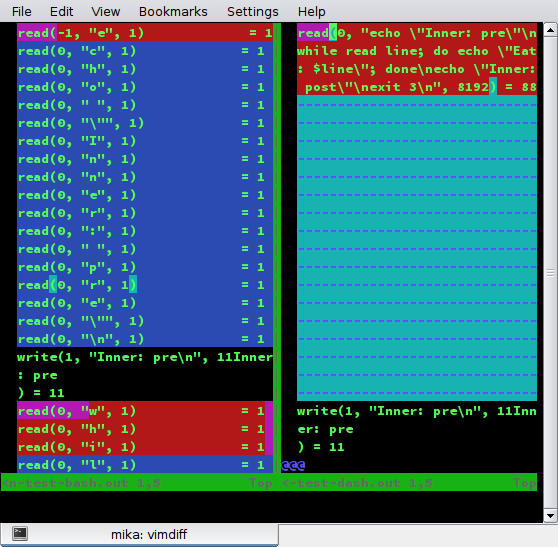
When executing ./stdin-test-cmp and comparing the generated files stdin-test-bash.out and stdin-test-dash.out you ll notice that dash consumes all stdin in one single go (a single read(0, ) ), instead of character-by-character as specified by POSIX and implemented by bash, ksh, mksh, posh and zsh. See stdin-test-bash.out on the left side and stdin-test-dash.out on the right side in this screenshot: screenshot of vimdiff on *.out files So when ssh tries to read from stdin there s nothing there anymore. Quoting POSIX s sh section:

When the shell is using standard input and it invokes a command that also uses standard input, the shell shall ensure that the standard input file pointer points directly after the command it has read when the command begins execution. It shall not read ahead in such a manner that any characters intended to be read by the invoked command are consumed by the shell (whether interpreted by the shell or not) or that characters that are not read by the invoked command are not seen by the shell. When the command expecting to read standard input is started asynchronously by an interactive shell, it is unspecified whether characters are read by the command or interpreted by the shell. If the standard input to sh is a FIFO or terminal device and is set to non-blocking reads, then sh shall enable blocking reads on standard input. This shall remain in effect when the command completes.
So while we learned that both bash and ssh are consuming from stdin and this needs to prevented by either using ssh s -n or explicitly specifying stdin, we also noticed that dash s behavior is different from all the other main shells and could be considered a bug (which we reported as #862907). Lessons learned: Thanks to Guillem Jover for review and feedback regarding this blog post.

28 July 2016

Michael Prokop: systemd backport of v230 available for Debian/jessie

At DebConf 16 I was working on a systemd backport for Debian/jessie. Results are officially available via the Debian archive now. In Debian jessie we have systemd v215 (which originally dates back to 2014-07-03 upstream-wise, plus changes + fixes from pkg-systemd folks of course). Now via Debian backports you have the option to update systemd to a very recent version: v230. If you have jessie-backports enabled it s just an apt install systemd -t jessie-backports away. For the upstream changes between v215 and v230 see upstream s NEWS file for list of changes. (Actually the systemd backport is available since 2016-07-19 for amd64, arm64 + armhf, though for mips, mipsel, powerpc, ppc64el + s390x we had to fight against GCC ICEs when compiling on/for Debian/jessie and for i386 architecture the systemd test-suite identified broken O_TMPFILE permission handling.) Thanks to the Alexander Wirt from the backports team for accepting my backport, thanks to intrigeri for the related apparmor backport, Guus Sliepen for the related ifupdown backport and Didier Raboud for the related usb-modeswitch/usb-modeswitch-data backports. Thanks to everyone testing my systemd backport and reporting feedback. Thanks a lot to Felipe Sateler and Martin Pitt for reviews, feedback and cooperation. And special thanks to Michael Biebl for all his feedback, reviews and help with the systemd backport from its very beginnings until the latest upload. PS: I cannot stress this enough how fantastic Debian s pkg-systemd team is. Responsive, friendly, helpful, dedicated and skilled folks, thanks folks!

19 July 2016

Michael Prokop: DebConf16 in Capetown/South Africa: Lessons learnt

DebConf 16 in Capetown/South Africa was fantastic for many reasons. My Capetown/South Africa/Culture/Flight related lessons: My technical lessons from DebConf16: BTW, thanks to the video team the recordings from the sessions are available online.

26 May 2016

Michael Prokop: My talk at OSDC 2016: Continuous Integration in Data Centers Further 3 Years Later

Open Source Data Center Conference (OSDC) was a pleasure and great event, Netways clearly knows how to run a conference. This year at OSDC 2016 I gave a talk titled Continuous Integration in Data Centers Further 3 Years Later . The slides from this talk are available online (PDF, 6.2MB). Thanks to Netways folks also a recording is available: This embedded video doesn t work for you? Try heading over to YouTube. Note: my talk was kind of an update and extension for the (german) talk I gave at OSDC 2013. If you re interested, the slides (PDF, 4.3MB) and the recording (YouTube) from my talk in 2013 are available online as well.

18 April 2016

Michael Prokop: Event: DebConf 16

* Yes, I m going to DebConf 16! This year DebConf the Debian Developer Conference will take place in Cape Town, South Africa. Outbound: 2016-06-26 15:40 VIE -> 17:10 LHR BA0703
2016-06-26 21:30 LHR -> 09:55 CPT BA0059 Inbound: 2016-07-09 19:30 CPT > 06:15 LHR BA0058
2016-07-10 07:55 LHR > 11:05 VIE BA0696

31 March 2016

Michael Prokop: Event: OSDC 2016

* Open Source Data Center Conference (OSDC) is a conference on open source software in data centers and huge IT environments and will take place in Berlin/Germany in April 2016. I will give a talk titled Continuous Integration in Data Centers Further 3 Years Later there. I gave a talk titled Continuous Integration in data centers at OSDC in 2013, presenting ways how to realize continuous integration/delivery with Jenkins and related tools. Three years later we gained new tools in our continuous delivery pipeline, including Docker, Gerrit and Goss. Over the years we also had to deal with different problems caused by faster release cycles, a growing team and gaining new projects. We therefore established code review in our pipeline, improved our test infrastructure and invested in our infrastructure automation. In this talk I will discuss the lessons we learned over the last years, demonstrate how a proper continuous delivery pipeline can improve your life and how open source tools like Jenkins, Docker and Gerrit can be leveraged for setting up such an environment. Hope to see you there!

24 August 2015

Michael Prokop: DebConf15: Continuous Delivery of Debian packages talk

At the Debian Conference 2015 I gave a talk about Continuous Delivery of Debian packages. My slides are available online (PDF, 753KB). Thanks to the fantastic video team there s also a recording of the talk available: WebM (471MB) and on YouTube.

18 August 2015

Arturo Borrero Gonz lez: 2015 FLOSS summer report

debian logo
Good news. Many things happened since my last report (8 months ago), some of them very interesting :-)

debian maintainer

Back in April 2015 I applied to become Debian Maintainer (DM). I was supported by several Debian Developers (DD), including Ana Guerrero, Anibal Monsalve, Michael Prokop and Vicent Cheng. They are people I have been somehow involved with in the last times (developing, in-person meetings, other talks...).

After a month or two, my PGP key was added to the debian keyring.

And what means this? If a DD gives me the corresponding authorization, I can now upload packages directly to the archive without the need for a sponsor.

I have been maintaining packages as a standard contributor since early 2014. From 2014 to 2015 I've learned many many things about Debian. That knowledge was key to become DM.

Google Summer of Code 2015

This is my 3 year in GSoC. In 2013 and 2014 I was involved with the Netfilter Project, but this time I'm contributing to the Debian project.
In concrete, my project is "Improve the Debian port mipsel".

Most of the software is developed to run in common CPU architectures like amd64 and i386. However, Debian can run in a large variety of arches (not so many operating systems have this power). Developers tend to consider these arches 'exotic' and don't pay much attention to them.
The mips/mipsel architecture is somewhat similar to arm: its mainly intended for small devices.

My tasks consist mainly into fixing bugs and FTBFS errors in the mipsel architecture.

Roughly speaking, this can be done in two ways: emulating the mipsel arch using qemu, or using a physical mipsel machine. The qemu way is very very slow. Fortunately, as part of my GSoC involvement, I was given a ci20 mipsel board by Imagination Technologies. I have been using this board for all my GSoC work.

Detailing my work during this GSoC deserves his own blog post. However, the Debian workflow for GSoC'15 requires a weekly report, and here are mine:

  1. week 1
  2. week 2
  3. week 3
  4. week 4
  5. week 5
  6. week 6
  7. week 7
  8. week 8
  9. week 9
  10. week 10
  11. week 11
  12. week 12

no longer involved with the Netfilter Project

Such is life. Days only have 24 hours. I had to 'refactor' my priorities and my involvement with the Netfilter Project is now almost none. This happened back in May'15. I was in so many business that I had stress and even had anxiety. Among other things, this hard decision meant that I missed the Netfilter Workshop 2015 in Budapest :-(

My plan for 2016 is to focus in the University and pay bills with my full-time job as a system administrator.

other debian sutff

Regarding packaging, it worth mention my latest new package: liquidprompt. For people who get their hands dirty with the CLI, I recommend it :-)
I made lot of updates to the other packages as well.

The nftables package is now in jessie-backports. Debian includes now Linux v4 in jessie-backports as well, which mean you can start playing with a full-featured nftables right now :-)
I'm looking forward to package the following version of upstream nftables, which is to include new exciting changes.

best regards!

9 July 2015

Simon Kainz: DUCK challenge: week 1

After announcing the DUCK challenge last week the following packages were fixed and uploaded into unstable: A big "Thank You" to you. The list of the fixed and updated packages is availabe here. I will try to update this ~daily. If I missed one of your uploads, please drop me a line. There is still lots of time till the end of DebConf15 and the end of the DUCK Challenge, so please get involved.

7 July 2015

Lunar: Reproducible builds: week 10 in Stretch cycle

What happened about the reproducible builds effort this week: Media coverage Daniel Stender published an English translation of the article which originally appeared in Linux Magazin in Admin Magazine. Toolchain fixes Fixes landed in the Debian archive: Lunar submitted to Debian the patch already sent upstream adding a --clamp-mtime option to tar. Patches have been submitted to add support for SOURCE_DATE_EPOCH to txt2man (Reiner Herrmann), epydoc (Reiner Herrmann), GCC (Dhole), and Doxygen (akira). Dhole uploaded a new experimental debhelper to the reproducible repository which exports SOURCE_DATE_EPOCH. As part of the experiment, the patch also sets TZ to UTC which should help with most timezone issues. It might still be problematic for some packages which would change their settings based on this. Mattia Rizzolo sent upstream a patch originally written by Lunar to make the generate-id() function be deterministic in libxslt. While that patch was quickly rejected by upstream, Andrew Ayer came up with a much better one which sadly could have some performance impact. Daniel Veillard replied with another patch that should be deterministic in most cases without needing extra data structures. It's impact is currently being investigated by retesting packages on reproducible.debian.net. akira added a new option to sbuild for configuring the path in which packages are built. This will be needed for the srebuild script. Niko Tyni asked Perl upstream about it using the __DATE__ and __TIME__ C processor macros. Packages fixed The following 143 packages became reproducible due to changes in their build dependencies: alot, argvalidate, astroquery, blender, bpython, brian, calibre, cfourcc, chaussette, checkbox-ng, cloc, configshell, daisy-player, dipy, dnsruby, dput-ng, dsc-statistics, eliom, emacspeak, freeipmi, geant321, gpick, grapefruit, heat-cfntools, imagetooth, jansson, jmapviewer, lava-tool, libhtml-lint-perl, libtime-y2038-perl, lift, lua-ldoc, luarocks, mailman-api, matroxset, maven-hpi-plugin, mknbi, mpi4py, mpmath, msnlib, munkres, musicbrainzngs, nova, pecomato, pgrouting, pngcheck, powerline, profitbricks-client, pyepr, pylibssh2, pylogsparser, pystemmer, pytest, python-amqp, python-apt, python-carrot, python-crypto, python-darts.lib.utils.lru, python-demgengeo, python-graph, python-mock, python-musicbrainz2, python-pathtools, python-pskc, python-psutil, python-pypump, python-repoze.sphinx.autointerface, python-repoze.tm2, python-repoze.what-plugins, python-repoze.what, python-repoze.who-plugins, python-xstatic-term.js, reclass, resource-agents, rgain, rttool, ruby-aggregate, ruby-archive-tar-minitar, ruby-bcat, ruby-blankslate, ruby-coffee-script, ruby-colored, ruby-dbd-mysql, ruby-dbd-odbc, ruby-dbd-pg, ruby-dbd-sqlite3, ruby-dbi, ruby-dirty-memoize, ruby-encryptor, ruby-erubis, ruby-fast-xs, ruby-fusefs, ruby-gd, ruby-git, ruby-globalhotkeys, ruby-god, ruby-hike, ruby-hmac, ruby-integration, ruby-ipaddress, ruby-jnunemaker-matchy, ruby-memoize, ruby-merb-core, ruby-merb-haml, ruby-merb-helpers, ruby-metaid, ruby-mina, ruby-net-irc, ruby-net-netrc, ruby-odbc, ruby-packet, ruby-parseconfig, ruby-platform, ruby-plist, ruby-popen4, ruby-rchardet, ruby-romkan, ruby-rubyforge, ruby-rubytorrent, ruby-samuel, ruby-shoulda-matchers, ruby-sourcify, ruby-test-spec, ruby-validatable, ruby-wirble, ruby-xml-simple, ruby-zoom, ryu, simplejson, spamassassin-heatu, speaklater, stompserver, syncevolution, syncmaildir, thin, ticgit, tox, transmissionrpc, vdr-plugin-xine, waitress, whereami, xlsx2csv, zathura. The following packages became reproducible after getting fixed: Some uploads fixed some reproducibility issues but not all of them: Patches submitted which have not made their way to the archive yet: reproducible.debian.net A new package set for the X Strike Force has been added. (h01ger) Bugs tagged with locale are now visible in the statistics. (h01ger) Some work has been done add tests for NetBSD. (h01ger) Many changes by Mattia Rizzolo have been merged on the whole infrastructure: debbindiff development Version 26 has been released on June 28th fixing the comparison of files of unknown format. (Lunar) A missing dependency identified in python-rpm affecting debbindiff installation without recommended packages was promptly fixed by Michal iha . Lunar also started a massive code rearchitecture to enhance code reuse and enable new features. Nothing visible yet, though. Documentation update josch and Mattia Rizzolo documented how to reschedule packages from Alioth. Package reviews 142 obsolete reviews have been removed, 344 added and 107 updated this week. Chris West (Faux) filled 13 new bugs for packages failing to build from sources. The following new issues have been added: snapshot_placeholder_replaced_with_timestamp_in_pom_properties, different_encoding, timestamps_in_documentation_generated_by_org_mode and timestamps_in_pdf_generated_by_matplotlib.

2 July 2015

Michael Prokop: HAProxy with Debian/squeeze clients causing random Hash Sum mismatch

Update on 2015-07-02 22:15 UTC: as Petter Reinholdtsen noted in the comments:
Try adding /etc/apt/apt.conf.d/90squid with content like this: Acquire::http::Pipeline-Depth 0; It turn off the feature in apt confusing proxies.
this indeed avoids those Hash Sum mismatch failures with HAProxy as well. Thanks, Petter! Many of you might know apt s Hash Sum mismatch issue and there are plenty of bug reports about it (like #517874, #624122, #743298 + #762079). Recently I saw the Hash Sum mismatch usually only when using random mirrors with e.g. httpredir.debian.org in apt s sources.list, but with a static mirror such issues usually don t exist anymore. A customer of mine has a Debian mirror and this issue wasn t a problem there neither, until recently: Since the mirror also includes packages provided to customers and the mirror needs to be available 24/7 we decided to provide another instance of the mirror and put those systems behind HAProxy (version 1.5.8-3 as present in Debian/jessie). The HAProxy setup worked fine and we didn t notice any issues in our tests, until the daily Q/A builds randomly started to report failures:
Failed to fetch http://example.org/foobar_amd64.deb Hash Sum mismatch
When repeating the download there was no problem though. This problem only appeared about once every 15-20 minutes with random package files and it affected only Debian/squeeze clients (wheezy and jessie aren t affected at all). The problem also didn t appear when directly accessing the mirrors behind HAproxy. We tried plenty of different options for apt (Acquire::http::No-Cache=true, Acquire::http::No-Partial=true, ) and also played with some HAProxy configurations, nothing really helped. With apt s Debug::Acquire::http=True we saw that there really was a checksum failure and HTTP status code 102 ( Processing , or in terms of apt: Waiting for headers ) seems to be involved. The actual problem between apt on Debian/squeeze and HAProxy is still unknown to us though. While digging deeper into this issue is on my todo list yet, I found a way to avoid those Hash Sum mismatch failures: switch from http to https in sources.list. As soon as https is used the problem doesn t appear anymore. I m documenting it here just in case anyone else should run into it.

4 May 2015

Michael Prokop: The #newinjessie game: tools related to RPM packages

Continuing the #newinjessie game: Bernhard Miklautz, contributor to jenkins-debian-glue and author of jenkins-package-builder (being in an early stage but under active development to provide support for building RPMs, similar to what jenkins-debian-glue provides for building Debian/Ubuntu packages) pointed out that there are new tools related to RPM packaging available in Debian/jessie:

28 April 2015

Michael Prokop: GLT15: Slides of my Debian 8 aka jessie, what s new talk

* I wasn t sure whether I would make it to Linuxdays Graz (GLT15) this year so I didn t participate in its call for lectures. But when meeting folks on the evening before the main event I came up with the idea of giving a lightning talk as special kind of celebrating the Debian jessie release. So I gave a lightning talk about "Debian 8 aka jessie, what s new" on 25th of April (couldn t have been a better date :)) and the slides of my talk turned up to be more useful than expected (>3000 downloads within the first 48 hours and I received lots of great feedback), so maybe it s worth mentioning them here as well: "Debian 8 aka jessie, what s new" (PDF, 450KB) PS: please join the #newinjessie game, also see #newinjessie on twitter

24 April 2015

Michael Prokop: The #newinjessie game: new forensic packages in Debian/jessie

Repeating what I did for the last Debian release with the #newinwheezy game it s time for the #newinjessie game: Debian/jessie AKA Debian 8.0 includes a bunch of packages for people interested in digital forensics. The packages maintained within the Debian Forensics team which are new in the Debian/jessie stable release as compared to Debian/wheezy (and ignoring wheezy-backports): Join the #newinjessie game and present packages which are new in Debian/jessie.

9 March 2015

Axel Beckert: Do we need a zsh-static package in Debian?

Dear Planet Debian, the Debian Zsh Packaging Team (consisting of Michael Prokop, Frank Terbeck, Richard Hartmann and myself) wonders if there s still a reason to build and ship a zsh-static package in Debian. There are multiple reasons: So we ask you, the Planet Debian reader:

Do you need Debian s zsh-static package? If so, please send an e-mail to us Debian Zsh Maintainers <pkg-zsh-devel@lists.alioth.debian.org> and state that you use zsh-static, and, if you want, please also state why or how you re using it. Thanks in advance! Mika, Frank, RichiH and Axel

23 January 2015

Michael Prokop: check-mk: monitor switches for GBit links

For one of our customers we are using the Open Monitoring Distribution which includes Check_MK as monitoring system. We re monitoring the switches (Cisco) via SNMP. The switches as well as all the servers support GBit connections, though there are some systems in the wild which are still operating at 100MBit (or even worse on 10MBit). Recently there have been some performance issues related to network access. To make sure it s not the fault of a server or a service we decided to monitor the switch ports for their network speed. By default we assume all ports to be running at GBit speed. This can be configured either manually via:
cat etc/check_mk/conf.d/wato/rules.mk
[...]
checkgroup_parameters.setdefault('if', [])
checkgroup_parameters['if'] = [
  (  'speed': 1000000000 , [], ['switch1', 'switch2', 'switch3', 'switch4'], ALL_SERVICES,  'comment': u'GBit links should be used as default on all switches'  ),
] + checkgroup_parameters['if']
or by visting Check_MK s admin web-interface at WATO Configuration -> Host & Service Parameters -> Parameters for Inventorized Checks -> Networking -> Network interfaces and switch ports and creating a rule for the Explicit hosts switch1, switch2, etc and setting Operating speed to 1 GBit/s there. So far so straight forward and this works fine. Thanks to this setup we could identify several systems which used 100Mbit and 10MBit links. Definitely something to investigate on the according systems with their auto-negotiation configuration. But to avoid flooding the monitoring system and its notifications we want to explicitly ignore those systems in the monitoring setup until those issues have been resolved. First step: identify the checks and their format by either invoking cmk -D switch2 or looking at var/check_mk/autochecks/switch2.mk:
OMD[synpros]:~$ cat var/check_mk/autochecks/switch2.mk
[
  ("switch2", "cisco_cpu", None, cisco_cpu_default_levels),
  ("switch2", "cisco_fan", 'Switch#1, Fan#1', None),
  ("switch2", "cisco_mem", 'Driver text', cisco_mem_default_levels),
  ("switch2", "cisco_mem", 'I/O', cisco_mem_default_levels),
  ("switch2", "cisco_mem", 'Processor', cisco_mem_default_levels),
  ("switch2", "cisco_temp_perf", 'SW#1, Sensor#1, GREEN', None),
  ("switch2", "if64", '10101',  'state': ['1'], 'speed': 1000000000 ),
  ("switch2", "if64", '10102',  'state': ['1'], 'speed': 1000000000 ),
  ("switch2", "if64", '10103',  'state': ['1'], 'speed': 1000000000 ),
  [...]
  ("switch2", "snmp_info", None, None),
  ("switch2", "snmp_uptime", None,  ),
]
OMD[synpros]:~$
Second step: translate this into the according format for usage in etc/check_mk/main.mk:
checks = [
  ( 'switch2', 'if64', '10105',  'state': ['1'], 'errors': (0.01, 0.1), 'speed': None ), # MAC: 00:42:de:ad:be:af,  10MBit
  ( 'switch2', 'if64', '10107',  'state': ['1'], 'errors': (0.01, 0.1), 'speed': None ), # MAC: 00:23:de:ad:be:af, 100MBit
  ( 'switch2', 'if64', '10139',  'state': ['1'], 'errors': (0.01, 0.1), 'speed': None ), # MAC: 00:42:de:ad:be:af, 100MBit
  [...]
]
Using this configuration we ignore the operation speed on ports 10105, 10107 and 10139 of switch2 using the the if64 check. We kept the state setting untouched where sensible ( 1 means that the expected operational status of the interface is to be up ). The errors settings specifies the error rates in percent for warnings (0.01%) and critical (0.1%). For further details refer to the online documentation or invoke cmk -M if64 . Final step: after modifying the checks configuration make sure to run cmk -IIu switch2 ; cmk -R to renew the inventory for switch2 and apply the changes. Do not forget to verify the running configuration by invoking cmk -D switch2 : Screenshot of 'cmk -D switch2' execution

Next.

Previous.