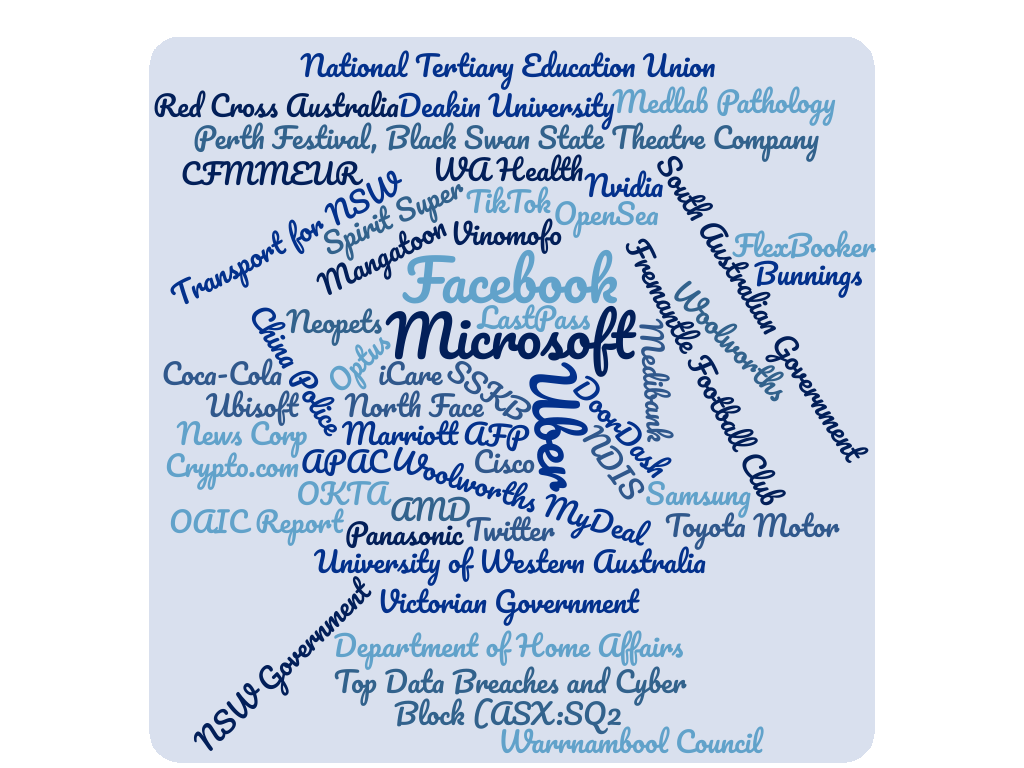
Just some of the organisations that leaked data in 2022
It seems like just about every day there s another report of another company getting hacked and having its sensitive data (or, worse, the sensitive data of its customers) stolen.
Sometimes, people s most intimate information gets dumped for the world to see.
Other times it s just used for identity theft, extortion, and other crimes.
In the least worst case, the attacker gets cold feet, but people suffer stress and inconvenience from having to replace identity documents.
A great way to protect information from being leaked is to encrypt it.
We encrypt data while it s being sent over the Internet (with TLS), and we encrypt it when it s at rest (with disk or volume encryption).
Yet, everyone s data seems to still get stolen on a regular basis.
Why?
Because the data is kept online in an unencrypted form, sitting in the database while its being used.
This means that attackers can just connect to the database, or trick the application into dumping the database, and all the data is just lying there, waiting to be misused.
It s Not the Devs Fault, Though
You may be thinking that leaving an entire database full of sensitive data unencrypted seems like a terrible idea.
And you re right: it is a terrible idea.
But it s seemingly unavoidable.
The problem is that in order to do what a database does best (query, sort, and aggregate data), it needs to be able to know what the data is.
When you encrypt data, however, all the database sees is a locked box.
Not very useful for a database
The database can t tell what s in the locked box whether it s a number equal to 42, or a date that s less than 2023-01-01, or a string that contains the substring foo .
Every value is just an opaque blob of stuff , and the database is rendered completely useless.
Since modern applications usually rely pretty heavily on their database, it s essentially impossible to build an application if you ve turned your database into a glorified flat-file by encrypting everything in it.
Thus, it s hardly surprising that developers have to leave the data laying around unencrypted, for anyone to come along and take.
Introducing Enquo
I said before that having data unencrypted in a database is seemingly unavoidable.
That s because there are some innovative cryptographic techniques that can make it possible to query encrypted data.
Indeed
The purpose of the Enquo project is to provide a common set of cryptographic primitives that implement ENcrypted QUery Operations (ie Enquo ), and integrate those operations into databases, ORMs, and anywhere else that could benefit.
The end goal is to provide the ability to encrypt all the data stored in any database server, while still allowing the data to be queried and aggregated.
So far, the project consists of these components:
the enquo-core library, that implements queryable encrypted integers, dates, and text in Rust and Ruby;
a PostgreSQL extension, pg_enquo, that allows PostgreSQL to query encrypted data; and
a Rails ActiveRecord extension, ActiveEnquo, that augments ActiveRecord to do the encryption/decryption required.
Support for other languages and ORMs is designed to be as straightforward as possible, and integration with other databases is mostly dependent on their own extensibility.
The project s core tenets emphasise both uncompromising security, and a friendly developer experience.
Naturally, all Enquo code is open source, released under the MIT licence.
Would You Like To Know More?
Everyone who uses a database...
If all this sounds relevant to your interests:
If you use Ruby on Rails and PostgreSQL, you re halfway home already.
Follow the ActiveEnquo getting started tutorial and see how much of your data Enquo can already protect.
When you find data you want to encrypt but can t, tell me about it.
If you use Ruby and PostgreSQL with another ORM, such as Sequel, writing a plugin to support Enquo shouldn t be too difficult.
The ActiveEnquo code should give you a good start.
If you get stuck, get in touch.
If you use PostgreSQL with another programming language, tell me what language you use and we ll work together to get bindings for that library created.
If you use another database server, support is coming for your database of choice eventually, but at present there s no timeline on support.
On the off chance that you happen to be a hard-core database hacking expert, and would like to work on getting Enquo support in your preferred database server, I d love to talk to you.
Let s say you re someone who happens to discover an AWS account number, and would
like to take a stab at guessing what IAM users might be valid in that account.
Tricky problem, right? Not with this One Weird Trick!
In your own AWS account, create a KMS key and try to reference an ARN
representing an IAM user in the other account as the principal. If the policy
is accepted by PutKeyPolicy, then that IAM account exists, and if the error
says Policy contains a statement with one or more invalid principals then the
user doesn t exist.
As an example, say you want to guess at IAM users in AWS account 111111111111.
Then make sure this statement is in your key policy:
  "Sid": "Test existence of user",
  "Effect": "Allow",
  "Principal":
    "AWS": "arn:aws:iam::111111111111:user/bob"
   ,
  "Action": "kms:DescribeKey",
  "Resource": "*"
If that policy is accepted, then the account has an IAM user named bob.
Otherwise, the user doesn t exist. Scripting this is left as an exercise for
the reader.
Sadly, wildcards aren t accepted in the username portion of the ARN, otherwise
you could do some funky searching with ...:user/a*, ...:user/b*, etc. You
can t have everything; where would you put it all?
I did mention this to AWS as an account enumeration risk. They re of the opinion
that it s a good thing you can know what users exist in random other AWS accounts.
I guess that means this is a technique you can put in your toolbox safe in the
knowledge it ll work forever.
Given this is intended behaviour, I assume you don t need to use a key policy
for this, but that s where I stumbled over it. Also, you can probably use it
to enumerate roles and anything else that can be a principal, but since I
don t see as much use for that, I didn t bother exploring it.
There you are, then. If you ever need to guess at IAM users in another AWS account,
now you can!
Because posting private keys on the Internet is a bad idea, some
people like to redact their private keys, so that it looks kinda-sorta like a private key,
but it isn t actually giving away anything secret. Unfortunately, due to the way that
private keys are represented, it is easy to redact a key in such a way that it
doesn t actually redact anything at all. RSA private keys are particularly bad at this,
but the problem can (potentially) apply to other keys as well.
I ll show you a bit of Inside Baseball with key formats, and then demonstrate the practical
implications. Finally, we ll go through a practical worked example from an actual not-really-redacted
key I recently stumbled across in my travels.
The Private Lives of Private Keys
Here is what a typical private key looks like, when you come across it:
Obviously, there s some hidden meaning in there computers don t encrypt
things by shouting BEGIN RSA PRIVATE KEY! , after all. What is between the
BEGIN/END lines above is, in fact, a
base64-encoded
DER format
ASN.1 structure representing a PKCS#1 private
key.
In simple terms, it s a list of numbers very important numbers. The list
of numbers is, in order:
A version number (0);
The public modulus , commonly referred to as n ;
The public exponent , or e (which is almost always 65,537, for various unimportant reasons);
The private exponent , or d ;
The two private primes , or p and q ;
Two exponents, which are known as dmp1 and dmq1 ; and
A coefficient, known as iqmp .
Why Is This a Problem?
The thing is, only three of those numbers are actually required in a private
key. The rest, whilst useful to allow the RSA encryption and decryption to be
more efficient, aren t necessary. The three absolutely required values are
e, p, and q.
Of the other numbers, most of them are at least about the same size as each
of p and q. So of the total data in an RSA key, less than a quarter of the
data is required. Let me show you with the above toy key, by breaking it
down piece by piece1:
MGI DER for this is a sequence
CAQ version (0)
CxjdTmecltJEz2PLMpS4BXn
AgMBAAe
ECEDKtuwD17gpagnASq1zQTYd
ECCQDVTYVsjjF7IQp
IJANUYZsIjRsR3q
AgkAkahDUXL0RSdmp1
ECCB78r2SnsJC9dmq1
AghaOK3FsKoELg==iqmp
Remember that in order to reconstruct all of these values, all I need are
e, p, and q and e is pretty much always 65,537. So I could redact
almost all of this key, and still give all the important, private bits of this
key. Let me show you:
Now, I doubt that anyone is going to redact a key precisely like
this but then again, this isn t a typical RSA key. They usually
look a lot more like this:
People typically redact keys by deleting whole lines, and usually replacing them
with [...] and the like. But only about 345 of those 1588 characters
(excluding the header and footer) are required to construct the entire key.
You can redact about 4/5ths of that giant blob of stuff, and your private parts
(or at least, those of your key) are still left uncomfortably exposed.
But Wait! There s More!
Remember how I said that everything in the key other than e, p,
and q could be derived from those three numbers? Let s talk about one
of those numbers: n.
This is known as the public modulus (because, along with e, it is also
present in the public key). It is very easy to calculate: n = p * q. It
is also very early in the key (the second number, in fact).
Since n = p * q, it follows that q = n / p. Thus, as long
as the key is intact up to p, you can derive q by simple division.
Real World Redaction
At this point, I d like to introduce an acquaintance of mine: Mr. Johan Finn.
He is the proud owner of the GitHub repo johanfinn/scripts.
For a while, his repo contained a script that contained a poorly-redacted private
key. He since deleted it, by making a new commit, but of course because
git never really deletes anything, it s
still available.
Of course, Mr. Finn may delete the repo, or force-push a new history without
that commit, so here is the redacted private key, with a bit of the surrounding
shell script, for our illustrative pleasure:
Now, if you try to reconstruct this key by removing the obvious garbage
lines (the ones that are all repeated characters, some of which aren t even valid
base64 characters), it still isn t a key at least, openssl pkey
doesn t want anything to do with it. The key is very much still in there,
though, as we shall soon see.
Using a gem I wrote and a quick bit of
Ruby, we can extract a complete private key. The irb session looks something
like this:
What I ve done, in case you don t speak Ruby, is take the two chunks of
plausible-looking base64 data, chuck them together into a variable named b64,
unbase64 it into a variable named der, pass that into a new DerParse
instance, and then walk the DER value tree until I got all the values I need.
Interestingly, the q value actually traverses the split in the two chunks,
which means that there s always the possibility that there are lines missing
from the key. However, since p and q are supposed to be prime, we can
sanity check them to see if corruption is likely to have occurred:
Excellent! The chances of a corrupted file producing valid-but-incorrect prime
numbers isn t huge, so we can be fairly confident that we ve got the real p
and q. Now, with the help of another one of my
creations we can use e, p,
and q to create a fully-operational battle key:
and there you have it. One fairly redacted-looking private key brought back
to life by maths and far too much free time.
Sorry Mr. Finn, I hope you re not still using that key on anything
Internet-facing.
What About Other Key Types?
EC keys are very different beasts, but they have much the same problems as RSA
keys. A typical EC key contains both private and public data, and the public
portion is twice the size so only about 1/3 of the data in the key is
private material. It is quite plausible that you can redact an EC key and
leave all the actually private bits exposed.
What Do We Do About It?
In short: don t ever try and redact real private keys. For documentation purposes,
just put KEY GOES HERE in the appropriate spot, or something like that. Store your
secrets somewhere that isn t a public (or even private!) git repo.
Generating a dummy private key and sticking it in there isn t a great idea,
for different reasons: people have this odd habit of reusing demo keys in
real
life.
There s no need to encourage that sort of thing.
Technically the pieces aren t 100% aligned with the underlying DER, because of how base64 works.
I felt it was easier to understand if I stuck to chopping up the base64, rather than
decoding into DER and then chopping up the DER.
Whether you re a TDD zealot, or you just occasionally write a quick script
to reproduce some bug, it s a rare coder who doesn t see value in some sort
of automated testing. Yet, somehow, in all of the new-age Infrastructure
as Code mania, we appear to have forgotten this, and the tools that are
commonly used for implementing Infrastructure as Code have absolutely
woeful support for developing your Infrastructure Code. I believe this
has to change.
At present, the state of the art in testing system automation code appears
to be, spin up a test system, run the manifest/state/whatever, and then use
something like serverspec or
testinfra to SSH in and make sure
everything looks OK . It s automated, at least, but it isn t exactly a quick
process. Many people don t even apply that degree of rigour to their system
config systems, and rely on manual testing, or even just doing it live! ,
to shake out the bugs they ve introduced.
Speed in testing is essential. As the edit-build-test-debug cycle gets
longer, frustration grows exponentially. If it takes two minutes to get a
something went wrong report out of my tests, I m not going to run them
very often. If I m not running my tests very often, then I m not likely to
write tests much, and suddenly oops. Everything s on fire. In
traditional software development, the unit tests are the backbone of the
fast feedback cycle. You re running thousands of tests per second,
ideally, and an entire test run might take 5-10 seconds. That s the sweet
spot, where you can code and test in a rapid cycle of ever-increasing
awesomeness.
Interestingly, when I ask the users of most infrastructure management
systems about unit testing, they either get a blank look on their face, or,
at best, point me in the direction of the likes of Test
Kitchen, which is described
quite clearly as an integration platform, not a unit testing platform.
Puppet has rspec-puppet, which is a pretty solid
unit testing framework for Puppet manifests although it isn t widely
used. Others, though nobody seems to have any ideas. The blank look
is near-universal.
If infrastructure developers want to be taken seriously, we need to learn
a little about what s involved in the development part of the title we ve
bestowed upon ourselves. This means knowing what the various types of testing
are, and having tools which enable and encourage that testing. It also means
things like release management, documentation, modularity and reusability,
and considering backwards compatibility.
All of this needs to apply to everything that is within the remit of the
infrastructure developer. You don t get to hand-wave away any of this just
because it s just configuration! . This goes double when your just
configuration! is a hundred lines of YAML interspersed with templating
directives (SaltStack, I m looking at
you).
We are an IT security company from Spain.
We have detected sensitive information belonging to Banesco Banco Universal,
C.A. clientes.
As authorized representative in the resolution of IT security incidents
affecting Banesco Banco Universal, C.A., we demand the deletion of the
content related to Banesco Banco Universal, C.A, clients. This content
violates the law about electronic crime in Venezuela (see Ley Especial
sobre Delitos Inform ticos de Venezuela , Chapter III, Articles 20 y 23).
Note the complete lack of any information regarding what URLs, or even which
site(s), they consider to be problematic. Nope, just delete all our
stuff! and a wave of the against the law somewhere! stick.
Would you like to comment on why you think that DNSSEC+DANE are not a
possible and much better alternative?
Where DANE fails to be a feasible alternative to the current system is that
it is not widely acknowledged to be superior in every possible way . A
weak demonstration of this is that no browser has implemented DANE support,
and very few other TLS-using applications have, either. The only thing I
use which has DANE support that I m aware of is Postfix and SMTP is an
application in which the limitations of DANE have far less impact.
My understanding of the limitations of DANE, for large-scale deployment, are
enumerated below.
DNS Is Awful
Quoting Google security engineer Adam Langley:
But many (~4% in past tests) of users can t resolve a TXT record when they
can resolve an A record for the same name. In practice, consumer DNS is
hijacked by many devices that do a poor job of implementing DNS.
Consider that TXT records are far, far older than TLSA records. It seems
likely that TLSA records would fail to be retrieved greater than 4% of the
time. Extrapolate to the likely failure rate for lookup of TLSA records would
be, and imagine what that would do to the reliability of DANE verification.
It would either be completely unworkable, or else would cause a whole new
round of just click through the security error training. Ugh.
This also impacts DNSSEC itself. Lots of recursive resolvers don t validate
DNSSEC, and some providers mangle DNS responses in some way, which breaks
DNSSEC. Since OSes don t support DNSSEC validation by default (for
example, by having the name resolution APIs indicate DNSSEC validation
status), browsers would essentially have to ship their own validating
resolver code.
Some people have concerns around the single point of control for DNS
records, too. While the weakest link nature of the CA model is terribad,
there is a significant body of opinion that replacing it with a single,
minimally-accountable organisation like ICANN isn t a great trade.
Finally, performance is also a concern. Having to go out-of-band to
retrieve TLSA records delays page generation, and nobody likes slow page
loads.
DNSSEC Is Awful
Lots of people don t like DNSSEC, for all sorts of reasons. While I don t
think it is quite as bad as people make out (I ve deployed it for most
zones I
manage,
there are some legitimate issues that mean browser vendors aren t willing to
rely on DNSSEC.
1024 bit RSA keys are quite common throughout the DNSSEC system.
Getting rid of 1024 bit keys in the PKI has been a long-running effort;
doing the same for DNSSEC is likely to take quite a while. Yes, rapid
rotation is possible, by splitting key-signing and zone-signing (a good
design choice), but since it can t be enforced, it s entirely likely that
long-lived 1024 bit keys for signing DNSSEC zones is the rule, rather than
exception.
DNS Providers are Awful
While we all poke fun at CAs who get compromised, consider how often
someone s DNS control panel gets compromised. Now ponder the fact that, if
DANE is supported, TLSA records can be manipulated in that DNS control
panel. Those records would then automatically be DNSSEC signed by the DNS
provider and served up to anyone who comes along. Ouch.
In theory, of course, you should choose a suitably secure DNS provider, to
prevent this problem. Given that there are regular hijackings of
high-profile domains (which, presumably, the owners of those domains would
also want to prevent), there is something in the DNS service provider
market which prevents optimal consumer behaviour. Market for
lemons,
perchance?
Conclusion
None of these problems are unsolvable, although none are trivial. I like
DANE as a concept, and I d really, really like to see it succeed.
However, the problems I ve listed above are all reasonable objections, made
by people who have their hands in browser codebases, and so unless they re
fixed, I don t see that anyone s going to be able to rely on DANE on the
Internet for a long, long time to come.
The Internet is going
encrypted.
Revelations of mass-surveillance of Internet traffic has given the Internet
community the motivation to roll out encrypted services the biggest of
which is undoubtedly HTTP.
The weak point, though, is SSL Certification Authorities. These are trusted
third parties who are supposed to validate that a person requesting a
certificate for a domain is authorised to have a certificate for that
domain. It is no secret that these companies have
failed to do the job entrusted to them,
again, and
again,
and
again.
Oh, and another
one.
However, at this point, doing away with CAs and finding some other mechanism
isn t feasible. There is no clear alternative, and the inertia in the
current system is overwhelming, to the point where it would take a decade or
more to migrate away from the CA-backed SSL certificate ecosystem, even if
there was something that was widely acknowledged to be superior in every
possible way.
This is where Certificate
Transparency comes in. This
protocol, which works as part of the existing CA ecosystem, requires CAs
to publish every certificate they issue, in order for the certificate to be
considered valid by browsers and other user agents. While it doesn t
guarantee to prevent misissuance, it does mean that a CA can t cover up or
try to minimise the impact of a breach or other screwup their actions are
fully public, for everyone to see.
Much of Certificate Transparency s power, however, is diminished if nobody
is looking at the certificates which are being published. That is why I
have launched sslaware.com, a site for searching the
database of logged certificates. At present, it is rather minimalist,
however I intend on adding more features, such as real-time notifications
(if a new cert for your domain or organisation is logged, you ll get an
e-mail about it), and more advanced searching capabilities.
If you care about the security of your website, you should check out
SSL Aware and see what certificates have been issued
for your site. You may be unpleasantly surprised.
Ever worked at a company (or on a codebase, or whatever) where it seemed
like, no matter what the question was, the answer was written down somewhere
you could easily find it? Most people haven t, sadly, but they do exist,
and I can assure you that it is an absolute pleasure.
On the other hand, practically everyone has experienced completely
undocumented systems and processes, where knowledge is shared by
word-of-mouth, or lost every time someone quits.
Why are there so many more undocumented systems than documented ones out
there, and how can we cause more well-documented systems to exist? The
answer isn t people are lazy , and the solution is simple though not
easy.
Why Johnny Doesn t Read
When someone needs to know something, they might go look for some
documentation, or they might ask someone else or just guess wildly. The
behaviour look for documentation is often reinforced negatively, by the
result documentation doesn t exist .
At the same time, the behaviours ask someone and guess wildly are
positively reinforced, by the results I get my question answered and/or
at least I can get on with my work . Over time, people optimise their
behaviour by skipping the look for documentation step, and just go
straight to asking other people (or guessing wildly).
Why Johnny Doesn t Write
When someone writes documentation, they re hoping that people will read it
and not have to ask them questions in order to be productive and do the
right thing. Hence, the behaviour write documentation is negatively
reinforced by the results I still get asked questions , and nobody does
things the right way around here, dammit!
Worse, though, is that there is very little positive reinforcement for the
author: when someone does read the docs, and thus doesn t ask a question,
the author almost certainly doesn t know they dodged a bullet. Similarly,
when someone does things the right way, it s unlikely that anyone will
notice. It s only the mistakes that catch the attention.
Given that the experience of writing documentation tends to skew towards the
negative, it s not surprising that eventually, the time spent writing
documentation is reallocated to other, more utility-producing activities.
Death Spiral
The combination of these two situations is self-reinforcing. While a
suitably motivated reader might start by strictly looking for
documentation, or an author initially be enthused to always fully
documenting their work, over time the reflex will be for readers to just
go ask someone, because there s never any documentation! , and for authors
to not write documentation because nobody bothers to read what I write
anyway! .
It is important to recognise that this iterative feedback loop is the
natural state of the reader/author ecosystem, resulting in something akin
to thermodynamic entropy. To avoid
the system descending into chaos, energy needs to be constantly applied to
keep the system in order.
The Solution
Effective methods for avoiding the vicious circle can be derived from the
things that cause it. Change the forces that apply themselves to readers
and authors, and they will behave differently.
On the reader s side, the most effective way to encourage people to read
documentation is for it to consistently exist. This means that those in
control of a project or system mustn t consider something done until the
documentation is in a good state. Patches shouldn t be landed, and releases
shouldn t be made, unless the documentation is altered to match the
functional changes being made. Yes, this requires discipline, which is just
a form of energy application to prevent entropic decay.
Writing documentation should be an explicit and well-understood part of
somebody s job description. Whoever is responsible for documentation needs
to be given the time to do it properly. Writing well takes time and mental
energy, and that time needs to be factored into the plans. Never forget
that skimping on documentation, like short-changing QA or customer support,
is a false economy that will cost more in the long term than it saves in the
short term.
Even if the documentation exists, though, some people are going to tend
towards asking people rather than consulting the documentation. This isn t
a moral failing on their part, but only happens when they believe that
asking someone is more beneficial to them than going to the documentation.
To change the behaviour, you need to change the belief.
You could change the belief by increasing the cost of asking. You could
fire (or hellban) anyone who ever asks a question that is answered in the
documentation. But you shouldn t. You could yell
RTFM! at everyone who
asks a question. Thankfully that s one acronym that s falling out of
favour.
Alternately, you can reduce the cost of getting the answer from the
documentation. Possibly the largest single productivity boost for
programmers, for example, has been the existence of Google. Whatever your
problem, there s a pretty good chance that a search or two will find a
solution. For your private documentation, you probably don t have the power
of Google available, but decent full-text search systems are available. Use
them.
Finally, authors would benefit from more positive reinforcement. If you
find good documentation, let the author know! It requires a lot of effort
(comparatively) to look up an author s contact details and send them a nice
e-mail. The like button is a more low-energy way of achieving a similar
outcome you click the button, and the author gets a warm, fuzzy feeling.
If your internal documentation system doesn t have some way to close the
loop and let readers easily give authors a bit of kudos, fix it so it does.
Heck, even if authors just know that a page they wrote was loaded N times
in the past week, that s better than the current situation, in which
deafening silence persists, punctuated by the occasional plaintive cry of
Hey, do you know how to ? .
Do you have any other ideas for how to encourage readers to read, and for
authors to write?
You may have heard that Uber has been under a bit of fire lately for its
desires to hire private investigators to dig up dirt on journalists who
are critical of
Uber.
From using users ride data for party
entertainment,
putting the assistance dogs of blind passengers in the
trunk,
adding a surcharge to reduce the number of dodgy
drivers,
or even booking rides with competitors and then cancelling, or using the
ride to try and convince the driver to change
teams,
it s pretty clear that Uber is a pretty good example of how companies are
inherently
sociopathic.
However, most of those examples are internal stupidities that happened to be
made public. It s a very rare company that doesn t do all sorts of shady
things, on the assumption that the world will never find out about them.
Uber goes quite a bit further, though, and is so out-of-touch with the world
that it blogs about analysing people s sexual activity for
amusement.
You ll note that if you follow the above link, it sends you to the Wayback
Machine, and not Uber s own site. That s because
the original page has recently turned
into a 404. Why? Probably because someone at Uber realised that
bragging about how Uber employees can amuse themselves by perving on your
one night stands might not be a great idea. That still leaves the question
open of what sort of a corporate culture makes anyone ever think that
inspecting user data for amusement would be a good thing, let alone
publicising it? It s horrific.
Thankfully, despite Uber s fairly transparent attempt at whitewashing
( clearwashing ?), the good ol Wayback Machine helps us to remember what
really went on. It would be amusing if Uber tried to pressure the Internet
Archive to remove their copies of this blog post (don t bother, Uber; I ve
got a Save As button and I m not afraid to use it).
In any event, I ve never used Uber (not that I ve got one-night stands to
analyse, anyway), and I ll certainly not be patronising them in the future.
If you re not keen on companies amusing themselves with your private data, I
suggest you might consider doing the same.
Unless you ve been living under a firewalled rock, you know that IPv6 is
coming. There s also a good chance that you ve heard that IPv6 doesn t have
NAT. Or, if you pay close attention to the minutiae of IPv6 development,
you ve heard that IPv6 does have NAT, but you don t have to (and
shouldn t) use it.
So let s say we ll skip NAT for IPv6. Fair enough. However, let s say you
have this use case:
A bunch of containers that need Internet access
That are running in a VM
On your laptop
Behind your home router!
For IPv4, you d just layer on the NAT, right? While SIP and IPsec might
have kittens trying to work through three layers of NAT, for most things
it ll Just Work.
In the Grand Future of IPv6, without NAT, how the hell do you make that
happen? The answer is Prefix
Delegation , which allows
routers to delegate management of a chunk of address space to downstream
routers, and allow those downstream routers to, in turn, delegate pieces of
that chunk to downstream routers.
In the case of our not-so-hypothetical containers-in-VM-on-laptop-at-home
scenario, it would look like this:
My border router (a DNS-323 running
Debian) asks
my ISP for a delegated prefix, using DHCPv6. The ISP delegates a
/561. One /64 out of that is allocated to the network
directly attached to the internal interface, and the rest goes into the
pool , as /60 blocks (so I ve got 15 of them to delegate, if required).
My laptop gets an address on the LAN between itself and the DNS-323 via
stateless auto-addressing ( SLAAC ). It also uses DHCPv6 to request one
of the /60 blocks from the DNS-323. The laptop puts one /64 from
that block as the address space for the virtual LAN (actually a Linux
bridge) that connects the laptop to all my VMs, and puts the other 15
/64 blocks into a pool for delegation.
The VM that will be running the set of containers under test gets an
address on the all VMs virtual LAN via SLAAC, and then requests a
delegated /64 to use for the all containers virtual LAN (another
bridge, this one running on the VM itself) that the containers will each
connect to themselves.
Now, almost all of this Just Works. The current releases of ISC
DHCP support prefix delegation just
fine, and a bit of shell script plumbing between the client and server seals
the deal the client needs to rewrite the server s config file to tell it
the netblock from which it can delegate.
Except for one teensy, tiny problem routing. When the DHCP server
delegates a netblock to a particular machine, the routing table needs to
get updated so that packets going to that netblock actually get sent to the
machine the netblock was delegated to. Without that, traffic destined for
the containers (or the VM) won t actually make it to its destination, and a
one-way Internet connection isn t a whole lot of use.
I cannot understand why this problem hasn t been tripped over before.
It s
absolutely fundamental to the correct operation of the delegation system.
Some people advocate running a dynamic routing protocol, but that s a
sledgehammer to crack a nut if ever I saw one.
Actually, I know this problem has been tripped over before, by
OpenWrt.
Their solution, however, was to use a PHP script to scan logfiles and add
routes. Suffice it to say, that wasn t an option I was keen on exploring.
Instead, I decided to patch ISC DHCP so that the server can run an external
script to add the necessary routes, and perhaps modify firewall rules and
also to reverse the process when the delegation is released (or expired).
If anyone else wants to play around with it, I ve put it up on
Github.
I don t make any promises that it s the right way to do it, necessarily,
but it works, and the script I ve added in
contrib/prefix-delegation-routing.rb
shows how it can be used to good effect. By the way, if anyone knows how
pull requests work over at ISC, drop me a line. From the look of their
website, they don t appear to accept (or at least encourage) external
contributions.
So, that s one small patch for DHCP, one giant leap for my home network.
The standard recommendation is for ISPs to delegate each end-user
customer a /48 (giving 65,536 /64 networks); my ISP is being a
little conservative in only giving me 256 /64s. It works fine for
my purposes, but if you re an ISP getting set for deploying IPv6, make
life easy on your customers and give them a /48.
If you re someone who doesn t like Debian s policy of automatically starting
on install (or its heinous cousin, the RUN or ENABLE variable in
/etc/default/<service>), then running an init system other than systemd
should work out nicely.
For some reason, I seem to end up writing software for
veryesotericuse-cases.
Today, though, I think I ve outdone myself: I sat down and wrote a Ruby
library to get and set process resource limits those things that nobody
ever thinks about except when they run out of file
descriptors.
I didn t even have a direct need for it. Recently I was grovelling through
the EventMachine codebase, looking at the filehandle limit code, and noticed
that the pure-ruby implementation didn t manipulate filehandle limits. I
considered adding it, then realised that there wasn t a library available to
do it. Since I haven t berked around with FFI
for a while, I decided to write rlimit.
Now to find the time to write that patch for EventMachine
Since I doubt there are many people who have a burning need to manipulate
rlimits in Ruby, this gem will no doubt sit quiet and undisturbed in the
dark, dusty corners of rubygems.org. However, for the three people on earth
who find this useful: you re welcome.
If you ve noticed your chrome/chromium on Linux having problems since you
upgraded to somewhere around version 35/36, you re not alone. Thankfully,
it s relatively easy to workaround. It will hit people who keep their
browser open for a long time, or who have lots of tabs (or if you re like
me, and do both).
To tell if you re suffering from this particular problem, crack open your
~/.xsession-errors file (or wherever your system logs stdout/stderr from
programs running under X), and look for lines that look like this:
[22161:22185:0830/124533:ERROR:shared_memory_posix.cc(231)]
Creating shared memory in /dev/shm/.org.chromium.Chromium.gFTQSy
failed: Too many open files
If you see those errors, congratulations! The rest of this blog post will
be of use to you.
There s probably a myriad of bugs open about this problem, but the one I
found was #367037: Shared memory-related tab
crash. It turns
out there s a file handle leak in the chromium codebase somewhere, relating
to shared memory handling. There s no fix available, but the workaround is
quite simple: increase the number of files that processes are allowed to
have open.
System-wide, you can do this by creating a file
/etc/security/limits.d/local-nofile.conf, containing this line:
* - nofile 65535
You could also edit /etc/security/limits.conf to contain the same line, if
you were so inclined. Note that this will only take effect next time you
login, or perhaps even only when you restart X (or, at worst, your entire
machine).
This doesn t help you if you ve got Chromium already open and you d like to
stop it from crashing Right Now (perhaps restarting your machine would be a
terrible hardship, causing you to lose your hard-won uptime record), then
you can use a magical tool called prlimit.
The prlimit syscall is available if you re running a Linux 2.6.36 or later
kernel, and running at least glibc 2.13. You ll have a prlimit command
line program if you ve got util-linux 2.21 or later. If not, you can use
the example source code in the prlimit(2) manpage, changing RLIMIT_CPU
to RLIMIT_NOFILE, and then running it like this:
prlimit <PID> 65535 65535
The <PID> argument is taken from the first number in the log messages from
.xsession-errors in the example above, it s 22161.
And now, you can go back to using your tabs as ersatz bookmarks, like I do.
$ sudo apt-get install -y leiningen
[...]
$ lein new scratch
[...]
$ cd scratch
$ lein repl
Downloading: org/clojure/clojure/1.3.0/clojure-1.3.0.pom from repository central at http://repo1.maven.org/maven2
Transferring 5K from central
Downloading: org/sonatype/oss/oss-parent/5/oss-parent-5.pom from repository central at http://repo1.maven.org/maven2
Transferring 4K from central
Downloading: org/clojure/clojure/1.3.0/clojure-1.3.0.jar from repository central at http://repo1.maven.org/maven2
Transferring 3311K from central
[...]
Wait what? lein downloads some random JARs from a website over
HTTP1, with, as far as far I can tell, no verification that
what I m asking for is what I m getting (has nobody ever heard of
Man-in-the-Middle attacks in Maven land?). It downloads a .sha1 file to
(presumably) do integrity checking, but that s no safety net if I can
serve you a dodgy .jar, I can serve you an equally-dodgy .sha1 file, too
(also, SHA256 is where all the cool kids are at these days). Finally,
jarsigner tells me that there s no signature on the .jar itself, either.
It gets better, though. The repo1.maven.org site is served by the
fastly.net2 pseudo-CDN3, which adds another
set of points in the chain which can be subverted to hijack and spoof
traffic. More routers, more DNS zones, and more servers.
I ve seen Debian take a kicking more than once because packages aren t
individually signed, or because packages aren t served over HTTPS. But at
least Debian s packages can be verified by chaining to a signature made by
a well-known, widely-distributed key, signed by two Debian Developers with
very well-connected keys.
This repository, on the other hand oy gevalt. There are OpenPGP (GPG)
signatures available for each package (tack .asc onto the end of the
.jar URL), but no attempt was made to download the signatures for the
.jar I downloaded. Even if the signature was downloaded and checked,
there s no way for me (or anyone) to trust the signature the signature
was made by a key that s signed by one other key, which itself has no
signatures. If I were an attacker, it wouldn t be hard for me to replace
that key chain with one of my own devising.
Even ignoring everyone living behind a government- or company-run
intercepting proxy, and everyone using public wifi, it s pretty well common
knowledge by now (thanks to Edward Snowden) that playing silly-buggers with
Internet traffic isn t hard to do, and there s no shortage of evidence that
it is, in fact, done on a routine basis by all manner of people. Serving up
executable code to a large number of people, in that threat environment,
with no way for them to have any reasonable assurance that code is
trustworthy, is very disappointing.
Please, for the good of the Internet, improve your act, Maven. Putting
HTTPS on your distribution would be a bare minimum. There are attacks on
SSL, sure, but they re a lot harder to pull off than sitting on public wifi
hijacking TCP connections. Far better would be to start mandating
signatures, requiring signature checks to pass, and having all signatures
chain to a well-known, widely-trusted, and properly secured trust root.
Signing all keys that are allowed to upload to maven.org with a maven.org
distribution root key (itself kept in hardware and only used offline), and
then verifying that all signatures chain to that key, wouldn t be insanely
difficult, and would greatly improve the security of the software supply
chain. Sure, it wouldn t be perfect, but don t make the perfect the enemy
of the good. Cost-effective improvements are possible here.
Yes, security is hard. But you don t get to ignore it just because of that,
when you re creating an attractive nuisance for anyone who wants to own up a
whole passel of machines by slipping some dodgy code into a widely-used
package.
To add insult to injury, it appears to ignore my
http_proxy environment variable, and the repo1.maven.org server
returns plain-text error responses with Content-Type: text/xml. But
at this point, that s just icing on the shit cake.
At one point in the past, my then-employer (a hosting
provider) blocked Fastly s caching servers from their network because
they took down a customer site with a massive number of requests to a
single resource, and the incoming request traffic was indistinguishable
from a botnet-sourced DDoS attack. The requests were coming from IP
space registered to a number of different ISPs, with no distinguishing
rDNS (184-106-82-243.static.cloud-ips.com doesn t help me to
distinguish between I m a professionally-run distributed proxy and
I m a pwned box here to hammer your site into the ground ).
Pretty much all of the new breed of so-called CDNs aren t
actually pro-actively distributing content, they re just proxies.
That isn t a bad thing, per se, but I rather dislike the far-too-common
practice of installing varnish (and perhaps mod_pagespeed, if they re
providing advanced capabilities) on a couple of AWS instances, and
hanging out your shingle as a CDN. I prefer a bit of truth in my
advertising.
Gitolite is a popular way to manage collections of
git repositories entirely from the command line it s configured using
configuration stored in a git repo, which is nicely self-referential.
Providing per-branch access control and a wide range of addons, it s quite a
valuable system.
In recent versions (3.6), it added support for configuring per-repository
git hooks from within the
gitolite-admin repo itself something which previously required directly
jiggering around with the repo metadata on the filesystem. It allows you to
chain multiple hooks together, too, which is a nice touch. You can, for
example, define hooks for validate style guidelines , submit patch to code
review and push to the CI server . Then for each repo you can pick which
of those hooks to execute. It s neat.
There s one glaring problem, though you can only use these chained,
per-repo hooks on the pre-receive, post-receive, and post-update
hooks. The update hook is special, and gitolite wants to make sure you
never, ever forget it. You can hook into the update processing chain by
using something called a virtual
ref ; they re stored in a separate
configuration directory, use a different syntax in the config file, and if
you re trying to learn what they do, you ll spend a fair bit of time on
them. The documentation describes VREFs as a mechanism to add additional
constraints to a push . The association between that and the update hook
is one you get to make for yourself.
The interesting thing is that there s no need for this gratuitous difference
in configuration methods between the different hooks. I wrote a very small
and simple
patch
that makes the update hook configurable in exactly the same way as the other
server-side hooks, with no loss of existing functionality.
The reason I m posting it here is that I tried to submit it to the primary
gitolite developer, and was told I m not touching the update hook [ ] I m
not discussing this [ ] take it or leave it . So instead, I m publicising
this patch for anyone who wants to locally patch their gitolite installation
to have a consistent per-repo hook UI. Share and enjoy!
I just made an account on yet another web service. On the suggestion of my
password manager, I attempted to use the password W:9[$X*F . It was
rejected because Password must contain at least one non-alphabet character,
one lowercase letter, one uppercase letter . OK, how about Passw0rd ?
Yep, that s fine.
Anyone want to guess which of those two passwords is going to fall victim to
a brute-force attack first? Go on, don t be shy, take a wild shot in the
dark!
After dealing with the client side of the DNSSEC puzzle last
week, I thought it behooved me to
also go about getting DNSSEC going on the domains I run DNS for. Like the
resolver configuration, the server side work is straightforward enough once
you know how, but boy howdy are there some landmines to be aware of.
One thing that made my job a little less ordinary is that I use and love
tinydns. It s an amazingly small and simple authoritative DNS server,
strong in the Unix tradition of do one thing and do it well .
Unfortunately, DNSSEC is anything but small and simple and so tinydns
doesn t support DNSSEC out of the box. However, Peter Conrad has produced a
patch for tinydns to do DNSSEC, and that does
the trick very nicely.
A brief aside about tinydns and DNSSEC, if I may Poor key security is
probably the single biggest compromise vector for crypto. So you want to
keep your keys secure. A great way to keep keys secure is to not put them
on machines that run public-facing network services (like DNS servers). So,
you want to keep your keys away from your public DNS servers. A really
great way of doing that would be to have all of your DNS records somewhere
out of the way, and when they change regenerate the zone file, re-sign it,
and push it out to all your DNS servers. That happens to be
exactly how tinydns works. I happen to think that tinydns fits very
nicely into a DNSSEC-enabled world. Anyway, back to the story.
Once I d patched the tinydns source and built updated packages, it was time
to start DNSSEC-enabling zones. This breaks down into a few simple steps:
Generate a key for each zone. This will produce a private key (which, as
the name suggests, you should keep to yourself), a public key in a
DNSKEY DNS record, and a DS DNS record. More on those in a minute.
One thing to be wary of, if you re like me and don t want or need
separate Key Signing and Zone Signing keys. You must generate a
Key Signing key this is a key with a flags value of 257.
Doing this wrong will result in all sorts of odd-ball problems. I wanted
to just sign zones, so I generated a Zone Signing key, which has a
flags value of 256. Big mistake.
Also, the DS record is a hash of everything in the DNSKEY record, so
don t just think you can change the 256 to a 257 and everything will
still work. It won t.
Add the key records to the zone data. For tinydns, this is just a matter of
copying the zone records from the generated key into the zone file itself,
and adding an extra pseudo record (it s all covered in the tinydnssec
howto).
Publish the zone data. Reload your BIND config, run tinydns-sign and
tinydns-data then rsync, or do whatever it is PowerDNS people do (kick
the database until replication starts working again?).
Test everything. I found the Verisign Labs DNSSEC
Debugger to be very helpful.
You want ticks everywhere except for where it s looking for DS records
for your zone in the higher-level zone. If there are any other
freak-outs, you ll want to fix those because broken DNSSEC will take
your domain off the Internet in no time.
Tell the world about your DNSSEC keys. This is simply a matter of giving
your DS record to your domain registrar, for them to add it to the zone
data for your domain s parent. Wherever you d normally go to edit the
nameservers or contact details for your domain, you probably want to do
to the same place and look for something about DS or Domain Signer
records. Copy and paste the details from the DS record in your zone
into there, submit, and wait a minute or two for the records to get
published.
Test again. Before you pat yourself on the back, make sure you ve got a
full board of green ticks in the DNSSEC Debugger. if anything s wrong,
you want to rollback immediately, because broken DNSSEC means that
anyone using a DNSSEC-enabled resolver just lost the ability to see your
domain.
That s it! There s a lot of complicated crypto going on behind the scenes,
and DNSSEC seems to revel in the number of acronyms and concepts that it
introduces, but the actual execution of DNSSEC-enabling your domains is
quite straightforward.
DNSSEC is one of those things that have been on the I should poke at that
sometime list, but today I decided to actually get in and play around with
it. Turns out it s pretty trivially easy to setup, but I got bitten by
a few gotchas during testing, that I thought worthwhile to document.
Since I like to explain things, a lot of this article isn t how to so much
as how does .
Configuring The Resolver
First off, you need a resolver1 that you can trust, and which
implements DNSSEC validation. In theory, you could use your ISP s
resolvers (if they re DNSSEC-enabled), or even Google s public resolvers
(8.8.8.8 and 8.8.4.4), but it s really not recommended how much do
you trust those, really? More importantly, how much do you trust the
network path between them and you? Frankly, running a local on-host caching
resolver is trivial, consumes next-to-no resources, and is highly
recommended. It s what I did.
I used unbound, finally casting free the venerable dnscache, which has
served me well for many years. I chose unbound because it fits the do one
small thing, and do it well philosophy that I cherish (unlike BIND), and
because it s what all the cool kids appear to be using these days.
Installing it was as simple as apt-get install unbound it s available
in pretty much every distro, I believe.
Out of the box, unbound in Debian wheezy comes configured for DNSSEC
validation. Other methods of installation might not be so amenable, so just
make sure your unbound.conf liiks like this, so that DNSSEC is enabled:
The val-log-level line isn t strictly required, but I found it useful to
have unbound log info on validation failures to syslog. Season to taste.
You also have to configure your system to actually use your new, shiny
local resolver. Editing /etc/resolv.conf would, in an ideal world, work
Just Fine, but between Magical Unhelpful Pixies (I m looking at you,
NetworkManager) and DHCP, it often isn t that easy. Ultimately, though, you
should configure your system so that the only resolver in
/etc/resolv.conf is always 127.0.0.1. Anything else is a security hole
waiting to happen. If you re using DHCP and a recent version of ISC
dhclient, adding supersede domain-name-servers 127.0.0.1; to
dhclient.conf should do the needful.
Weighing the (Trust) Anchor
Whatever local resolver you choose, you need to tell it about trust
anchors . This is a key (or keys) which are trusted to sign all the other
data that the resolver will find. Like the rest of the DNS, DNSSEC is
hierarchical, and you need to know who to start with before you can start.
To resolve a name using DNS, you ask the root servers for the answer to a
question (say, what is the address of www.example.com? ). The root
server doesn t know the answer, but it knows who to ask, and it tells you
where to go (typically, go ask the DNS servers for .com, which are X, Y,
and Z ). Then you ask those servers, and they probably don t know, but
they know who to ask, and they tell you to go ask those servers. This
continues until you finally get a server which says, oh, yes, I know the
answer to that! and hands over the information you re after.
In DNSSEC, you get digital signatures that prove that the answers you get
from each DNS server you ask are legit, and not forged. So when you ask the
root servers, what is the address of www.example.com? , they answer, I
don t know, but go ask DNS servers at addresses X, Y, and Z and by the
way, you can trust this answer is legit because here s this signature you
can check . To verify a signature is legit, you need to know that the key
used to make the signature is trustworthy, and it wasn t just any ol key
that made it similar to how an ink scribble on a page doesn t mean
anything unless you know what the signature you re looking at should look
like.
DNSSEC has two ways to make sure you know who to trust. Firstly, those trust
anchors I mentioned three paragraphs ago. These are the keys that the root
servers use to sign the responses they send out. You tell unbound (or your
local DNSSEC-enabled resolver of choice), if you see a signature provided
by this trust anchor key, you can trust it to be legit . The second way to
trust is key is to have someone you already trust say, oh, you can trust
this key, too . This is done by providing more data in the answer that
you get from the root servers. So the full answer you get from the root
servers when you ask, what is the address of www.example.com? looks like
this:
I don t know, but you should ask the DNS servers at addresses X, Y, and Z.
You can trust their answers because they ll sign their responses with key
K. Finally, you can trust that I m legit because of this signature I m
providing you, generated from key T.
Assuming that T is the trust-anchor key you ve already told unbound to
trust, it can then trust all of the information it got from that first
question. When it then goes to DNS server X and asks, Hey, do you know
the address of www.example.com? , that server can send back its own
response saying:
Gee, shucks, I don t know, but DNS servers at P and Q can help you. You
can trust them because they ll sign responses with key S. And just to
show you I m on the level, check out this nifty signature I made, signed
with key K.
Since a server we trust told us to trust key K, and then we got a response
signed by key K that told us to trust key S, when we then go and ask server
P and get a response signed by S, we re still demonstrably secure. Neat
setup, right?
Anyway, now you know all about trust anchors. How do you set it up? For
unbound, it s capable of priming the trust anchor itself. It does this by
retrieving a copy of the trust anchor from [a well-known HTTPS
URL]((https://data.iana.org/root-anchors/root-anchors.xml), which provides
a reasonable measure of security the trust anchor file should be safe as
long as that HTTPS server is trustworthy. For the properly paranoid, you
should determine an alternate means of verifying that you have the correct
root key (a web search for DNSSEC root key attestation would probably be a
good start).
Testing
It s always handy to know that something s working as you expect. For
something that s important for security, that goes double. So, how do you
test that your DNSSEC-capable resolver is, indeed, working as designed?
Well, firstly, you can test that the resolver, by itself, is working. This
is simple: do a query for a zone known to have broken DNSSEC. Thankfully,
some nice people (Comcast, specifically) have already set this up. You can
test a resolver for DNSSEC-correctness with this command:
dig @127.0.0.1 www.dnssec-failed.org
If dig gives you back an IP address, something is broken. The
correct, my DNSSEC works! response should be a status: SERVFAIL
response.
That s all well and good, but having a resolver that works isn t much good
if nothing s actually using it. Your system configuration has probably
got some other resolvers configured into it (such as those provided by a
DHCP server), and you ll want to make sure those aren t getting
used2. The trivial test is to visit
http://www.dnssec-failed.org in your
browser. If that comes back with a page, then something s still wrong.
A more user-friendly test of your DNSSEC configuration is provided by
http://dnssectest.sidnlabs.nl/test.php,
which will display a page either way, and give you a tick or a cross
depending on whether you re DNSSEC-enabled or not.
One thing to be wary of when you re doing browser tests is caching. I spent
far too long trying to work out why unbound wasn t working , when in actual
fact it was working fine, it s just that both my browser and local caching
proxy (squid) were caching DNS requests3. So, even after I d
correctly setup unbound, visiting the test sites was providing me with
erroneous results.
Fixing up the browser was simple enough. In Chromium, visiting
chrome://net-internals#dns will show you what s being cached, what
resolv.conf settings are being used, and allow you to clear the browser s
resolver cache.
Squid was similarly simple, although it took me a while to figure out that
it was causing me grief (software that just works , being so rare, tends to
slip your mind, and so I often forget that squid is actually doing me good).
Restarting squid has the appropriate result (clears the DNS cache), but in
the end I decided that having another layer of caching wasn t going to help
significantly when I ve got an on-host DNS cache already, in unbound. So, I
just turned the knobs for DNS caching in squid right down:
negative_dns_ttl 1 second
positive_dns_ttl 1 second
And voila! All was well.
In summary
DNSSEC is cool. It s easy to get going with, and over time it will provide
more and more practical benefits (I am a
DANE
fanboi). Get started with it now, and you ll be ahead of the curve.
A resolver is a program which takes a name, does all
the DNS queries required to get the data associated with that name, and
return it to whoever wanted to know. This can be a library which links
to a client application, or it can be a separate program which receives
DNS requests itself.
There are usually both types of resolvers in use for a typical Linux
system to resolve names. On every machine, in every program, there is
the so-called stub resolver , which is part of libc, and does nothing
except create DNS requests and send them to the addresses listed in
resolv.conf. Also present, although not always running on every
machine (typically your ISP or network admin has some running for
everyone to share) are one or more recursive resolvers , which are
separate programs which take DNS requests, do all of the queries
themselves, and return the result to the stub resolver for presentation
to the client program which made the request in the first place.
You will see this material again.
You can configure dhclient to use your local resolver instead
of the DHCP-provided ones by simply setting:
supersede domain-name-servers 127.0.0.1;
in your dhclient.conf file.
It also didn t help that I hadn t correctly knobbled
dhclient the first time around, and so even when I thought I was
only resolving against my local unbound server, it was still actually
using the DHCP-provided resolvers
Since first posting my idea for an SSL
co-op a couple of weeks
ago, I ve gotten some positive feedback from people, and further thinking
and research has convinced me that it is feasible to at least attempt it.
As a result, I d like to announce the public unveiling of The SSL
Co-op. It is intended to be a commercial,
not-for-profit1 organisation that issues widely-trusted
certificates to members, for their use or for resale. Eventually, I d like
the co-op to be a root CA in its own right, with its certificate trusted by
all the browsers and other X.509-using applications out there, but that
isn t something that s achievable immediately.
At this stage, the co-op hasn t been formed, and I m looking for expressions
of interest from individuals and organisations who would be interested in
becoming members. If you fit that description, I d really appreciate it if
you could fill out a short
survey so I can get a
better idea of what sort of scale the co-op will be operating at initially.
This is the first step towards an interesting future, where there is more
choice of provider for online identity verification. Exciting times.
Despite a lot of misunderstanding to the contrary,
commercial, not-for-profit is not a contradiction. Commercial
means doing things for money , and not-for-profit means not returning a
dividend to investors . In the case of the SSL co-op, it will be providing
services to members on a cost-recovery basis, and any excess funds left over
from that will be re-invested in the co-op to improve the services provided
to members.
Ten days ago, I blogged about (finally) generating a GPG key transition
statement.
As the title of this post suggests, I have received zero signatures. Have
other people had any success with transition statements? Perhaps it s time
to hit up Debian developers I know one-by-one
To the IRCz!

 Just some of the organisations that leaked data in 2022
 Not very useful for a database
 Indeed
 Everyone who uses a database...