Ian Wienand: Skipping pages with django.core.paginator
Here's a little snippet for compressing the length of long Django
pagination by just
showing context around the currently selected page. What I wanted was
the first few and last few pages always selectable with some context
pages around the currently selected page; e.g.
 If that's what you're looking for, some variation on below may be of
use. In this approach, you build up a list of pages similar to the
paginator object page_range but with only the relevant pages
and the skip-markers identified.
Then somehow pass through the pages_to_show to your view (below I
added it to the paginator object passed) and use a template along
the lines of
If that's what you're looking for, some variation on below may be of
use. In this approach, you build up a list of pages similar to the
paginator object page_range but with only the relevant pages
and the skip-markers identified.
from django.core.paginator import Paginator
import unittest
class Pages:
    def __init__(self, objects, count):
        self.pages = Paginator(objects, count)
    def pages_to_show(self, page):
        # pages_wanted stores the pages we want to see, e.g.
        #  - first and second page always
        #  - two pages before selected page
        #  - the selected page
        #  - two pages after selected page
        #  - last two pages always
        #
        # Turning the pages into a set removes duplicates for edge
        # cases where the "context pages" (before and after the
        # selected) overlap with the "always show" pages.
        pages_wanted = set([1,2,
                            page-2, page-1,
                            page,
                            page+1, page+2,
                            self.pages.num_pages-1, self.pages.num_pages])
        # The intersection with the page_range trims off the invalid
        # pages outside the total number of pages we actually have.
        # Note that includes invalid negative and >page_range "context
        # pages" which we added above.
        pages_to_show = set(self.pages.page_range).intersection(pages_wanted)
        pages_to_show = sorted(pages_to_show)
        # skip_pages will keep a list of page numbers from
        # pages_to_show that should have a skip-marker inserted
        # after them.  For flexibility this is done by looking for
        # anywhere in the list that doesn't increment by 1 over the
        # last entry.
        skip_pages = [ x[1] for x in zip(pages_to_show[:-1],
                                         pages_to_show[1:])
                       if (x[1] - x[0] != 1) ]
        # Each page in skip_pages should be follwed by a skip-marker
        # sentinel (e.g. -1).
        for i in skip_pages:
            pages_to_show.insert(pages_to_show.index(i), -1)
        return pages_to_show
class TestPages(unittest.TestCase):
    def runTest(self):
        objects = [x for x in range(0,1000)]
        p = Pages(objects, 10)
        self.assertEqual(p.pages_to_show(0),
                         [1, 2, -1, 99, 100])
        self.assertEqual(p.pages_to_show(1),
                         [1,2,3,-1,99,100])
        self.assertEqual(p.pages_to_show(2),
                         [1,2,3,4,-1,99,100])
        self.assertEqual(p.pages_to_show(3),
                         [1,2,3,4,5,-1,99,100])
        self.assertEqual(p.pages_to_show(4),
                         [1,2,3,4,5,6,-1,99,100])
        self.assertEqual(p.pages_to_show(5),
                         [1,2,3,4,5,6,7,-1,99,100])
        self.assertEqual(p.pages_to_show(6),
                         [1,2,-1,4,5,6,7,8,-1,99,100])
        self.assertEqual(p.pages_to_show(7),
                         [1,2,-1,5,6,7,8,9,-1,99,100])
        self.assertEqual(p.pages_to_show(50),
                         [1,2,-1,48,49,50,51,52,-1,99,100])
        self.assertEqual(p.pages_to_show(93),
                         [1,2,-1,91,92,93,94,95,-1,99,100])
        self.assertEqual(p.pages_to_show(94),
                         [1,2,-1,92,93,94,95,96,-1,99,100])
        self.assertEqual(p.pages_to_show(95),
                         [1,2,-1,93,94,95,96,97,-1,99,100])
        self.assertEqual(p.pages_to_show(96),
                         [1,2,-1,94,95,96,97,98,99,100])
        self.assertEqual(p.pages_to_show(97),
                         [1,2,-1,95,96,97,98,99,100])
        self.assertEqual(p.pages_to_show(98),
                         [1,2,-1,96,97,98,99,100])
        self.assertEqual(p.pages_to_show(99),
                         [1,2,-1,97,98,99,100])
        self.assertEqual(p.pages_to_show(100),
                         [1,2,-1,98,99,100])
if __name__ == '__main__':
    unittest.main()
<ul class="pagination">
% if pages.has_previous %
<li><a href="foo.html?page= pages.previous_page_number ">«</a></li>
% else %
<li class="disabled"><a href="#">«</a></li>
% endif %
% for page in pages.pages_to_show %
% if page == -1 %
<li class="disabled"><a href="#">…</a></li>
% elif page == pages.number %
<li class="active"><a href="#"> page_num </a></li>
% else %
<li><a href="foo.html?page= page_num "> page_num </a>
% endif %
% endfor %
% if pages.has_next %
<li><a href="foo.html?page= pages.next_page_number ">»</a></li>
% else %
<li class="disabled"><a href="#">»</a></li>
% endif %
</ul>
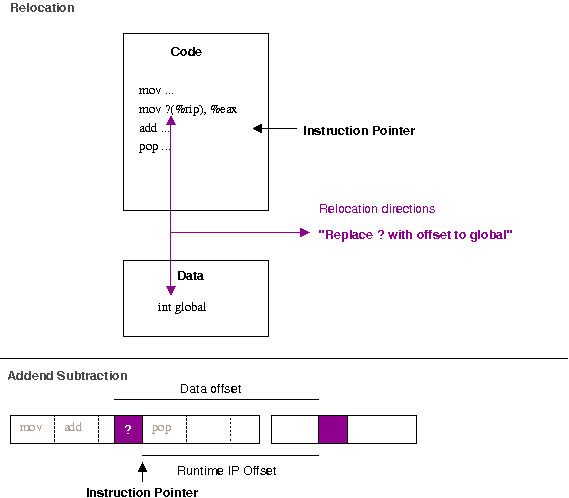 The top portion of the image above gives some idea of how it works. We
can examine relocations in binaries with the readelf tool.
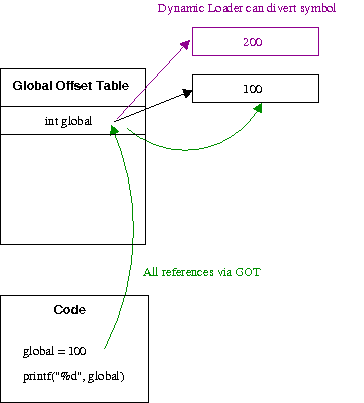 As shown above, the GOT ensures the abstraction required so symbols
can be diverted as expected. Each entry is essentially a pointer to
the real data (hence the extra dereference in the code above). Since
we can assume the GOT is at a fixed offset from the program code
within plus or minus 2Gib, the code can use a 32-bit IP relative
address to gain access to the table entries.
So, taking a look a the final shared-library binary we see a final
offset hard-coded
 In the above diagram on the left, we have the fairly simple
conceptual model of a class with a function. One naturally tends to
think of the function as a part of the class and your instance calls
into that function. This is conceptually correct, but a little
abstracted from what's actually happening.
The right attempts to illustrate the underlying process in some
more depth. The first step, on the top right, is building something
like the following:
 Above, you see a simplified example of the %gs register
loaded with the index value 2, and thus when you access
%gs:20 what you are saying is "find entry 2 in the global
descriptor table (GDT), follow it and offset 20 into that
region.
The kernel gives each thread its own GDT (i.e. the GDT register is
part of the thread-state). Thus __thread variables are
stored based on segment offsets and voila thread-local
storage. Now, there's a few tricks here. For various reasons, a
process can not setup entries in the GDT; this is a privileged
operation that must be done by the kernel. There is actually a
special system call for threads to setup their TLS areas in the GDT
set_thread_area. When a new thread starts, the
thread-library and dynamic linker conspire to allocate and load any
static TLS data (i.e. if you have a global __thread variable
initialised to some value, then every thread must see that value when
it starts) and then calls this to make sure the variables are ready to
go. After that, the gs register is filled with the index of
that GDT entry, and all TLS access goes via it. That, in a nut-shell,
is TLS for x86-32.
Now, to the problem. Take, for example, the following short
program: