Search Results: "Dominique Dumont"

31 May 2015

Dominique Dumont: Improving update of existing debian/copyright file

Hello One of my last blog introduced the new cme update dpkg-copyright command and explained how to use this command to create a debian/copyright file from scratch. We will see in this blog how cme update dpkg-copyright command can also be used if a debian/copyright file already exists. During the lifetime of a package, creating a new debian/copyright copyright file should only happen once. When updating a package to a new upstream version, the content of the copyright file should be modified to reflect upstream changes by: cme update dpkg-copyright can be run with an existing debian/copyright file: the information extracted by licensecheck are merged in debian/copyright. Unfortunately, this merge may bring back the errors coming from licensecheck that you ve cleaned up manually last time. This last part is not optimal as the manual clean up must be repeated after cme update dpkg-copyright is run. Here s a way to avoid the last problem: cme update dpkg-copyright supports a way to modify the content of debian/copyright after the merge: the optional file debian/fix.scanned.copyright contains instructions to tweak the content of debian/copyright. (See Config::Model::Dpkg::Copyright man page for more details) You may remember that Config::Model handles all configuration information as a tree. The information contained in the copyright file is also stored in a tree structure. debian/fix.scanned.copyright contains instructions to navigate this tree and modify the content of the tree. Imagine that there s a robot (or a monkey) in that configuration tree. Each instruction tells the robot either to move in the tree or to perform an operation. The most useful instructions for debian/fix.scanned.copyright are: Otherwise: Let s see a commented example:
# go to the root of the tree (with '!')
# and remove a bogus Files entry (with ":~")
! Files:~"foo/bogus.c"
// go to a Files entry and append (operator '.=') some info to   owner
! Files:"foo/bar.h"
  Copyright.=" Appended info."
# go back to tree root and assign   info
! Files:"foo/baz.c" Copyright="2014, FooBar"
# add a global license and a file entry missed by licensecheck
# global license must be set before using it in Files entry
# note: MIT text license is provided by cme
! License=MIT
! Files:"3rdparty/missed.c" Copyright="2005 FooBar" License short_name=MIT
Other possible instructions for this file are described in Config::Model::Loader doc. The number of instructions depends on the accuracy of licencecheck command. Hopefully, this number can be reduced by improving licensecheck. Last but not least, the following packages are required: You may want to install also libconfig-model-tkui-perl to update the copyright file with cme GUI. In summary, the command cme updated dpkg-copyright associated with instructions stored in debian/fix.scanned.copyright enable Debian packagers to update with less effort debian/copyright file when updating a package. All the best

25 April 2015

Dominique Dumont: The #newinjessie game: automatic configuration upgrade and other stuff in Debian/Jessie

Here are my contribution for the #newinjessie game, i.e. what new stuff I ve contributed to the Jessie release of Debian. See you in 2 years for Stretch release All the best

5 April 2015

Dominique Dumont: Improving creation of debian copyright file

Hello In my opinion, creating and maintaining Debian copyright file is the most boring task required to create a Debian package. Unfortunately, this file is also one of the most important of a package: it specifies some legal aspect regarding the use of the software. Debian copyright file is scrutinized by ftp masters gatekeepers when accepting a new package in Debian project: this file must accurately describe the copyright and licenses of all files of a source package, preferably using a specific syntax. (Kudos to the ftp-masters team: reading copyright files must be even more boring than writing them). The content of the copyright file must reflect accurately the license of all files. This license is often specified in the comments of a source files. The licencecheck command is able to scan sources files and reports the copyright and licenses declared in there. But it does not summarize this information: a copyright line is generated for each file of a package. licensecheck2dep5 (provided by cdbs package as /usr/lib/cdbs/licensecheck2dep5) does better: the output of licensecheck is consolidated and translated in Debian copyright format. The result is better, but must be heavily edited to be reviewable by ftp-masters team. The new update subcommand of cme (available with libconfig-model-dpkg-perl 2.061 currently in experimental) goes further than licensecheck2deb: For instance, here s the (slightly edited) output of cme run for pan package starting without debian/copyright file:
$ cme update dpkg-copyright -quiet
Adding dummy license text for license public-domain 
for path pan/general/sorted-vector.h
Adding dummy license text for license BSD-2-clause 
for path pan/usenet-utils/MersenneTwister.h
$ cat debian/copyright
Format: https://www.debian.org/doc/packaging-manuals/copyright-format/1.0/
Files: *
Copyright: 1994-2001, Frank Pilhofer. The author may
License: GPL-2+
Files: pan/*
Copyright: 2002-2007, Charles Kerr 
License: GPL-2
Files: pan/data/cert-store.cc
  pan/data/cert-store.h
Copyright: 2011, Heinrich M ller 
  2002-2006, Charles Kerr 
License: GPL-2
Files: pan/general/e-util.cc
  pan/general/e-util.h
Copyright: 2000, 2001, Ximian, Inc
License: LGPL-2
Files: pan/general/locking.h
  pan/general/worker-pool.cc
  pan/general/worker-pool.h
Copyright: 2007, Calin Culianu 
  2002-2007, Charles Kerr 
License: LGPL-2+
Files: pan/general/sorted-vector.h
Copyright: 2002, Martin Holzherr (holzherr@infobrain.com).
License: public-domain
 Please fill license public-domain from header
 of pan/general/sorted-vector.h
[ about 100 more lines including license text for Zlib and several 
  GPL licenses ]
This is a good start, but some modifications must be applied to get a correct license file: These modifications can be done: This post has mentioned creation of Debian copyright file, but does not address the problem of updating an existing copyright file when packaging a new version of a software. This will be the subject of a next post. I hope this new feature of cme will save hours of work for Debian packagers. As usual comments and suggestions are welcome All the best

21 February 2015

Dominique Dumont: Performance improvement for cme check dpkg

Hello Thanks to Devel::NYTProf, I ve realized that Module::CoreList was used in a not optimal way (to say the least) in Config::Model::Dpkg::Dependency when checking the dependency between Perl packages. (Note that only Perl packages with many dependencies were affected by this lack of performance) After a rework, the performance are much better. Here s an example comparing check time before and after the modification of libconfig-model-dpkg-perl. With libconfig-model-dpkg-perl 2.059:
$ time cme check dpkg
Using Dpkg
loading data
Reading package lists... Done
Building dependency tree
Reading state information... Done
checking data
check done
real 0m10.235s
user 0m10.136s
sys 0m0.088s With libconfig-model-dpkg-perl 2.060:
$ time cme check dpkg
Using Dpkg
loading data
Reading package lists... Done
Building dependency tree
Reading state information... Done
checking data
check done
real 0m1.565s
user 0m1.468s
sys 0m0.092s All in all, a 8x performance improvement on the dependency check. Note that, due to the freeze, the new version of libconfig-model-dpkg-perl is available only in experimental. All the best
Tagged: Config::Model, debian, dpkg, package

18 July 2014

Dominique Dumont: Looking for help to package Perl6, moar and others for Debian

Let s face reality: I cannot find the time to properly maintain Perl6 related packages for Debian. Given the recent surge of popularity of rakudo, it would be a shame to let these packages rot. Instead of throwing the towel, I d rather call for help to maintain these packages. You don t need to be a Debian Developer or Maintainer: I will gladly review and upload packages. The following packages are looking for maintainer: Next step to help Perl6 on Debian is to join: All the best
Tagged: debian, package, Perl6

6 July 2014

Dominique Dumont: Status and next step on lcdproc automatic configuration upgrade with Perl and Config::Model

Back in March, I uploaded a Debian s version of lcdproc with a unique feature: user and maintainer configurations are merged during package upgrade: user customizations and developers enhancements are both preserved in the new configuration file. (See this blog for more details). This avoids tedious edition of the configuration LCDd.conf file after every upgrade of lcdproc package. At the beginning of June, a new version of lcdproc (0.5.7-1) was uploaded. This triggered another round of automatic upgrades on user s systems. According to the popcon rise of libconfig-model-lcdproc-perl, about 100 people have upgraded lcdproc on their system. Since automatic upgrade has an opt-out feature, one cannot say for sure that 100 people are actually using automatic upgrade, but I bet a fair portion are them are. So far, only one people has complained: a bug report was filed about the many dependencies brought by libconfig-model-lcdproc-perl. The next challenge for lcdproc configuration upgrade is brought by a bug reported on Ubuntu: the device file provided by imon kernel module is a moving target: The device file created by the kernel can be /dev/lcd0 or /dev/lcd1 or even /dev/lcd2. Static configuration files and moving target don t mix well. The obvious solution is to provide a udev rule so that a symbolic link is created from a fixed location (/dev/lcd-imon) to the moving target. Once the udev rule is installed, the user only has to update LCDd.conf file to use the symlink as imon device file and we re done. But, wait The whole point of automatic configuration upgrade is to spare the user this kind of trouble: the upgrade must be completely automatic. Moreover, the upgrade must work in all cases: whether udev is available (Linux) or not. If udev is not available, the value present in the configuration file must be preserved. To know whether udev is available, the upgrade tool (aka cme) will check whether the file provided by udev (/dev/lcd-imon) is present or not. This will be done by lcdproc postinst script (which is run automatically at the end of lcdproc upgrade). Which means that the new udev rule must also be
activated in the postinst script before the upgrade is done. In other words, the next version of lcdproc (0.5.7-2) will: In the lcdproc configuration model installed by libconfig-model-lcdproc-perl, the imon device parameter is enhanced so that running cme check lcdproc or cme migrate lcdproc issues a warning if /dev/lcd-imon exists and if imon driver is not configured to use it. This way, the next installation of lcdproc will deliver a fix for imon and cme will fix user s configuration file without requiring user input. The last point is admittedly bad marketing as users will not be aware of the magic performed by Config::Model Oh well In the previous section, I ve briefly mentioned that imon_device parameter is enhanced in lcdproc configuration model. If you re not already bored, let s lift the hood and see what kind of enhancements was added. Let s peek in lcdproc configuration file, LCDd.conf file which is used to generate lcdproc configuration model. You may remember that the formal description of all LCDd.conf parameters and their properties is generated from LCDd.conf to provide lcdproc configuration model. The comments in LCDd.conf follow a convention so that most properties of the parameters can be extracted from the comments. In the example below, the comments show that NewFirmware is a boolean value expressed as yes or no, the latter being the default :
# Set the firmware version (New means >= 2.0) [default: no; legal: yes, no]
NewFirmware=no
Back to the moving target. In LCDd.conf, imon device file parameter is declared this way:
# Select the output device to use
Device=/dev/lcd0
This means that device is a string where the default value is /dev/lcd0. Which is wrong once the special udev rule provided with Debian packages is activated. With this rule, the default value must be /dev/lcd-imon. To fix this problem, a special comment is added in the Debian version of LCDd.conf to tune further the properties of the device parameter:
# select the device to use
#  %
#   default~
#   compute
#     use_eval=1
#     formula="my $l = '/dev/lcd-imon'; -e $l ? $l : '/dev/lcd0';"
#     allow_override=1 -
#   warn_if:not_lcd_imon
#     code="my $l = '/dev/lcd-imon';defined $_ and -e $l and $_ ne $l ;"
#     msg="imon device does not use /dev/lcd-imon link."
#     fix="$_ = undef;"
#   warn_unless:found_device_file
#     code="defined $_ ? -e : 1"
#     msg="missing imon device file"
#     fix="$_ = undef;"
#   - % 
Device=/dev/lcd0
This special comment between % and % follows the syntax of Config::Model::Loader. A small configuration model is declared there to enhance the model generated from LCDd.conf file. Here are the main parts: In both warn_unless and warn_if parts, the fix code snippet is run when by the command cme fix lcdproc and is used to repair the warning condition. In this case, the fix consists in resetting the device configuration value so the computed value above can be used. cme fix lcdproc is triggered during package post install script installed by dh_cme_upgrade. Come to think of it, generating a configuration model from a configuration file can probably be applied to other projects: for instance, php.ini and kdmrc are also shipped with detailed comments. May be I should make a more generic model generator from the example used to generate lcdproc model Well, I will do it if people show interest. Not in the form yeah, that would be cool , but in the form, yes, I will use your work to generate a configuration model for project [...] . I ll let you fill the blank ;-)
Tagged: Config::Model, configuration, debian, lcdproc, Perl, upgrade

15 June 2014

Dominique Dumont: Edit your debian patch header for DEP-3 compliance with cme

While not required by Debian policy, the patch tagging guidelines (aka DEP-3) recommends to add a structured header to source package patches. Long story short, patches should begin with something like :
Description: tweak lcdproc config for debian
patch LCDd.conf to:
* use syslog instead of stderr to show message
* run LCDd as root (to read /dev/lcd* file)
.
The latter could be done better by tweaking udev rule
Author: dod
Applied-Upstream: NA
Making sure that the DEP-3 recommendation is respected may not be fun. Do not despair: once libconfig-model-dpkg-perl is installed on your system, you can check whether your patches respect the DEP3 recommendation with the following command: $ cme check dpkg-patches
loading data
checking data
check done
You can also check individual patches with: cme check dpkg-patch tweak-conf Note that bash auto-completion is provided only from version 2.049 of libconfig-model-dpkg-perl package. If editing the header of your patches with your favorite editor does not strike you as fun, you can also use cme graphical editor provided by libconfig-model-tkui-perl. Once this package is installed, you can run: cme edit dpkg-patches You will get this editor to update your patches: -usr-bin-cme Dpkg::Patches_001 This editor will show you the available parameters and the associated documentation to let you provide relevant information. Last but not least, patch header check is also performed when you check your whole package with cme check dpkg All the best
Tagged: Config::Model, debian, package, patch

4 May 2014

Dominique Dumont: Deprecating experience level and preset value in Config::Model

Hello The next releases of Config::Model will deprecate 2 (mis)features: The behavior of cme check will not change. People using cme edit with the GUI will see many more configuration parameters. All the best

Dominique Dumont: Another package configuration upgrade project

Hello I ve recently learned that Debian Google Summer of Code 2014 features a project to improve package configuration upgrade based on Elektra library Despite the fact that this project competes directly with the work done for lcdproc upgrades, I m very glad that the idea of improving configuration upgrade is getting more attention and I welcome this new project. All the best
Tagged: configuration, debian, GSoC, upgrade

23 March 2014

Dominique Dumont: Easier Lcdproc package upgrade with automatic configuration merge

Hello This blog explains how next lcdproc package provide easier upgrader with automatic configuration merge. Here s the current situation: lcdproc is shipped with several configuration files, including /etc/LCDd.conf. This file is modified upstream at every lcdproc release to bring configuration for new lcdproc drivers. On the other hand, this file is always customized to suit the specific hardware of the user s system. So upgrading a package will always lead to a conflict during upgrade. User will always be required to choose whether to use current version or upstream version. Next version of libconfig-model-lcdproc-perl will propose user whether to perform automatic merge of the configuration: upstream change are taken into account while preserving user change. The configuration upgrade shown is based on Config::Model can be applied to other package. Current lcdproc situation To function properly, lcdproc configuration must always be adapted to suit the user s hardware. On the following upgrade, upstream configuration is often updated so user will often be shown this question:
Configuration file '/etc/LCDd.conf'
 ==> Modified (by you or by a script) since installation.
 ==> Package distributor has shipped an updated version.
   What would you like to do about it ?  Your options are:
    Y or I  : install the package maintainer's version
    N or O  : keep your currently-installed version
      D     : show the differences between the versions
      Z     : start a shell to examine the situation
 The default action is to keep your current version.
*** LCDd.conf (Y/I/N/O/D/Z) [default=N] ?
This question is asked in the middle of an upgrade and can be puzzling for an average user. Next package with automatic merge Starting from lcdproc 0.5.6, the configuration merge is handled automatically by the packaging script with the help of Config::Model::Lcdproc. When lcdproc is upgraded to 0.5.6, the following changes are visible:
* lcdproc depends on libconfig-model-lcdproc-perl
* user is asked once by debconf whether to use automatic configuration upgrades or not.
* no further question are asked (no ucf style questions). For instance, here s an upgrade from lcdproc_0.5.5 to lcdproc_0.5.6:
$ sudo dpkg -i lcdproc_0.5.6-1_amd64.deb 
(Reading database ... 322757 files and directories currently installed.)
Preparing to unpack lcdproc_0.5.6-1_amd64.deb ...
Stopping LCDd: LCDd.
Unpacking lcdproc (0.5.6-1) over (0.5.5-3) ...
Setting up lcdproc (0.5.6-1) ...
Changes applied to lcdproc configuration:
- server ReportToSyslog: '' -> '1' # use standard value
update-rc.d: warning: start and stop actions are no longer supported; falling back to defaults
Starting LCDd: LCDd.
Processing triggers for man-db (2.6.6-1) ...
Note: the automatic upgrade currently applies only to LCDd.conf. The other configuration files of lcdproc are handled the usual way. Other benefits User will also be able to:
* check lcdproc configuration with sudo cme check lcdproc
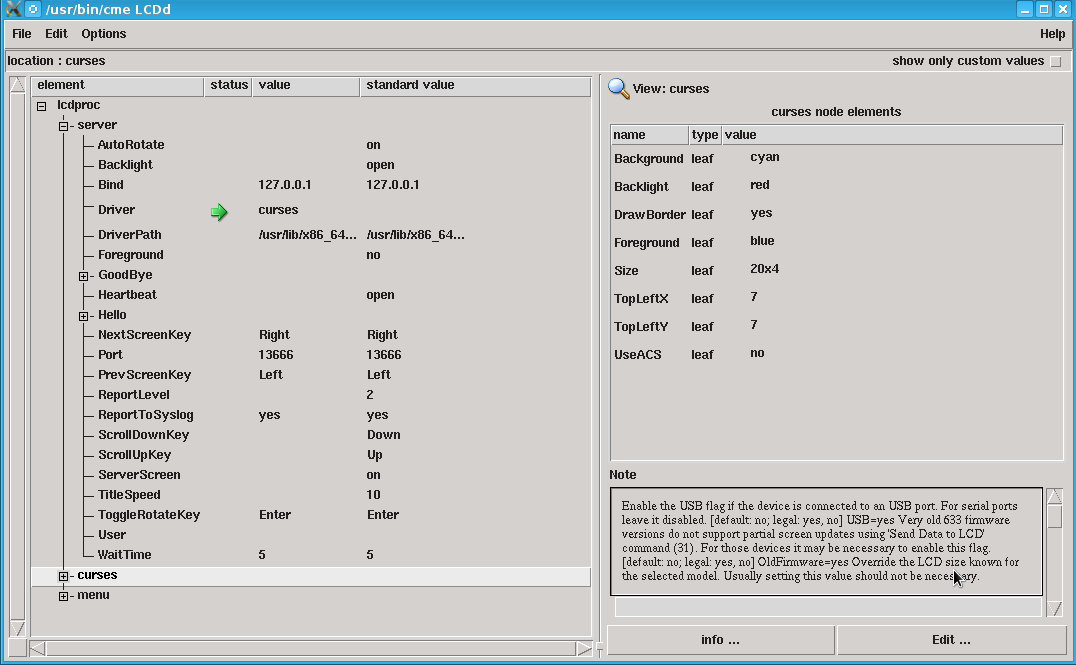
* edit the configuration with a GUI (see Managing Lcdproc configuration with cme for more details) Here s a screenshot of the GUI: GUI to edit lcdproc configuration More information * libconfig-model-lcdproc-perl package page. This package provides a configuration model for lcdproc.
* This blog explains how this model is generated from upstream LCDd.conf.
* How to adapt a package to perform configuration upgrade with Config::Model Next steps Automatic configuration merge can be applied to other packages. But my free time is already taken by the maintenance of Config::Model and the existing models, there s no room for me to take over another package. On the other hand, I will definitely help people who want to provide automatic configuration merge on their packages. Feel free to contact me on:
* config-model-user mailing list
* debian-perl mailing list (where Config::Model is often used to maintain debian package file with cme)
* #debian-perl IRC channel All the best
Tagged: config-model, configuration, debian, Perl, upgrade

1 January 2014

Dominique Dumont: Config::Model::OpenSsh now supports OpenSSH 6.4 configuration

Hello This was long overdue. I ve released Config::Model::OpenSsh 1.232. This new release
supports a lot of new parameters that were added to OpenSSH 6.0 and later versions, like AllowAgentForwarding, AuthenticationMethods or AuthorizedKeysCommand. This new version is also available in Debian. Happy new year !
Tagged: Config::Model, OpenSsh, Perl

7 December 2013

Dominique Dumont: LWP::UserAgent https proxy now fixed in Debian

Hello For more 10 years, opening a https connection throught a proxy was not possible
with LWP::UserAgent. Thanks to Steffen Ullrich, this bug is now fixed in LWP::UserAgent and LWP::Protocol::https repositories. In Debian, I ve updated libwww-perl 6.05-2 and liblwp-protocol-https-perl 6.04-2 to include the same patches. This fix is now available in Debian unstable. See my previous blog for more details on this story. All the best
Tagged: debian, https_proxy, Perl

2 November 2013

Dominique Dumont: About LWP::UserAgent, https and proxy setup

Hello The last few weeks, I ve been banging my head to use uscan, Pithub and JIRA::Client::Automated behind a corporate firewall. They are all written in Perl and use LWP::UserAgent to fetch information from Internet. At $work, using a proxy is mandatory to connect to Internet. But LWP::UserAgent https connection does not work through a proxy. This bug was reported 10 years ago but is still not fixed. Here s my plan to fix (or work-around) this issue, at least for Debian. Before going further, let s step back to explain briefly what is https and how proxies work. https is not a protocol by itself. https is plain http over a socket encrypted with SSL (aka TLS). To create a https connection, the agent must first setup the SSL socket with the server. Then the agent uses http protocol to communicate with the server. All the traffic is encrypted on agent side and decrypted on server side by the SSL layer. When creating a connection through a proxy, things get a little more complicated. Plain http requests (like GET, POST and so on ) are sent to the proxy as if the proxy was the http server. Then, the proxy forwards the request to the actual server. From what I ve read, most proxy servers refuse to plainly forward encrypted data to a web server. First a negotiation to create a tunnel towards the web server must be done by sending a http CONNECT request to the proxy server. The encrypted socket is then set up between the user and the web server through the proxy. Once this encrypted tunnel is set up, the usual http communication can be done. Let s go back to LWP::UserAgent. To create a connection over SSL, LWP::UserAgent will use a SSL library to setup the socket. This SSL library can be IO::Socket::SSL or Net::SSL. Direct https connection with LWP::UserAgent works fine with either library. When trying to setup a https connection through a proxy, LWP::UserAgent will try to use the proxy like a regular http proxy without going through the CONNECT phase. This does not work. Net::SSL is able to setup correctly an SSL socket through a proxy provided the proxy server is specified in an https_proxy environment variable. But LWP::UserAgent will also try to (badly) setup the proxy when this variable is set. One can find various work-around to play with %ENV to bypass LWP::UserAgent. So I ve proposed a patch to make LWP::UserAgent skip the https_proxy variable. Then Net::SSL can handle the connection to the proxy. I hope this blog will push upstream to either apply this path or tell me why it s a bad idea (which is possible, I ve some trouble to believe that a 10 years old bug can be fixed by such a simple patch) [ Edited ] I was right to worry. Turns out that relying on Net::SSL is a bad idea: SSL certificates are not checked correctly with this library. For more details, see https://github.com/libwww-perl/libwww-perl/pull/51 and https://bugzilla.redhat.com/show_bug.cgi?id=705044 . I m going to push JGMYERS set of patches on libwww-perl repositories Anyway, this patch works provided: Even though this patch is probably not ideal, it does fix issues with uscan so I ll push it to Debian. On the other hand, the patch does not work if https_proxy is specified by calling:
$ua->proxy( https => ...);
JGMYERS has proposed a set of patches to fix this problem. But these patches are more invasive and I do not dare to push them to Debian. Last but not least, this blog avoids the issue of host name verification or peer authentication. Net::SSL and Crypt::SSLeay are able to perform such a verification, but I did not verify this point. Next step is to provide simple patches to let uscan, Pithub and JIRA::Client::Automated correctly connect through proxies without jumping through hoops. All the best
Tagged: debian, https_proxy, Perl

13 October 2013

Dominique Dumont: Released Perl ptkdb debugger to experimental

Hello Following Gabor s post, I ve updated the Debian package for libdevel-ptkdb-perl. This new package is now available in experimental repository. Why not in unstable ? This new version of ptkdb (or is it a fork ?) was heavily changed and needs to be tested more before being released to unstable. I will use it during my regular Perl activities. Nevertheless, I would welcome feedback on this new version to help decide when to upload to unstable. All the best
Tagged: debian, Perl

2 July 2013

Dominique Dumont: Seeking help to update OpenSSH configuration editor (Config::Model)

Hello OpenSsh 6.0 has been out for more than a year and the OpenSSH configuration editor still lacks the new parameters introduced by this release (like AllowAgentForwarding). Technically, the task is not difficult, but I lack time to address it: I m swamped by real life job, maintenance of Config::Model, Debian packaging activities So I m looking for volunteer(s) to help me on Config::Model. Updating OpenSSH model is a great way to start ! If you want to help, please: Be sure that you won t be forgotten in the change log ;-) Feel free to contact config-model-users at lists.sourceforge.net to get help, exchange ideas, or to discuss how to handle deprecation or upgrade of OpenSSH parameters All the best update: OpenSSH project name was corrected after Rafal s comment.
Tagged: Config::Model, OpenSsh, Perl

12 June 2013

Dominique Dumont: Improving error messages of Dpkg dependency parser

Hello Config::Model::Dpkg project (a Debian source package model based on Config::Model) is partly based on a ParseRec::Descent grammar. This grammar is used to parse the dependency of a Debian source package. This article will show how such a grammar is written, its limitation regarding error handling and how to improve the situation. Debian package main data is described in debian/control file. This file can feature a list of dependencies, i.e. a list of package that must be installed for the package to work. These dependencies are declared in fields like Build-Depends , or Depends as a list of package. For Dpkg model purpose, I needed only to parse one item of a dependency list at a time. This dependency item can be a simple package name: foo or a package name with a version requirement: foo ( > 1.24 ) or a package name with architectures restrictions: foo [alpha amd64 hurd-arm linux-armeb] or both: foo ( > 1.24 ) [alpha amd64 hurd-arm linux-armeb] or a list of alternate choices combining the possibilities above: foo ( > 1.24 ) bar [ linux-any] baz ( << 3.14 ) [ ! hurd-armel !hurd-armeb ] or a variable that is replaced during package build: $ perl-depends Writing a Parse::RecDescent grammar to parse this is relatively straightforward. The first production handles alternate dependencies separated by and raises an error if some text was not consumed by the dependencies:
dependency_item: depend(s /\ /) eofile  
A dependency as explained above is expressed as:
depend: pkg_dep   variable
A variable like $ foo or $ bar -1.24~ is parsed with:
variable: /\$ [\w:\-]+ [\w\.\-~+]*/
This rule handles a package name with optional version or arch restriction:
pkg_dep: pkg_name dep_version(?) arch_restriction(?) 
pkg_name: /[a-z0-9][a-z0-9\+\-\.]+/
The remaining rules are quite simple:
dep_version: '(' oper version ')' 
oper: '<<'   '<='   '='   '>='   '>>'
version: variable   /[\w\.\-~:+]+/
arch_restriction: '[' arch(s) ']'
arch:  /!?[\w-]+/
eofile: /^\Z/
The grammar above works well to parse the dependency. You can test it with this small Perl script:
#!/usr/bin/perl
use strict;
use warnings;
use 5.010 ;
use Parse::RecDescent ;
my $parser = Parse::RecDescent->new(join('',));
my $dep = shift ;
say "parsing '$dep'";
my $ret = $parser->dependency_item($dep) ;
say "result is ", $ret if $ref ;
__DATA__
# insert grammar here !!!
Unfortunately, any error in the optional parts (i.e version requirements and arch restriction) leads to an error message which is not very helpful. The error message only mention that some text could not be parsed:
parsing 'foo ( != 1.24 )   bar'
       ERROR (line 1): Invalid dependency item: Was expecting /\ / but found
                       "( != 1.24 )   bar" instead
or
parsing 'foo [ arm & armel]   bar'
       ERROR (line 1): Invalid dependency item: Was expecting /\ / but found
                       "[ arm & armel]   bar" instead
The problem comes from the fact that version requirements or arch restrictions are optional. For instance if a version requirement has a syntax error, Parse::RecDescent will try to parse it as an arch restriction. This arch restriction rule will also fail and the last terminal ( eofile ) will fail. So the error message does not hint at the actual syntax problem. To generate better error messages, I improved the suggestion made in Parse::RecDescent FAQ. Instead of calling a plain subroutine, I use a sub reference that will store the error messages in a closure. This sub ref is declared in a start-up action. Note that the sub ref explicitly returns undef. I ll explain why later.
 
    my @dep_errors ;
    my $add_error = sub  
        my ($err, $txt) = @_ ;
        push @dep_errors, "$err: '$txt'" ;
        return ;
      ;
 
The following production always fails while ensuring that the error list is reset. This production is always run at the beginning of the dependency parsing:
dependency:   @dep_errors = ();  
Here s the actual dependency production that is run when dependency method is called on the parser. It will return an array ref containing (1, data) if the dependency is valid or (0, errors) otherwise:
dependency: depend(s /\ /) eofile
   
    $return = [ 1 , @ $item[1]  ] ;


    push( @dep_errors, "Cannot parse: '$text'" ) unless @dep_errors ;
    $return =  [ 0, @dep_errors ];
   
The following productions don t change much:
depend: pkg_dep   variable
variable: /\$ [\w:\-]+ [\w\.\-~+]*/
pkg_dep: pkg_name dep_version(?) arch_restriction(?) 
dep_version: '(' oper version ')'
The first rule of this production parses the package name which must be followed by a space, end of string ( or ['. A positive look-ahead assertion is used so only the package name is consumed. If the first rule fails, the second rule provides a meaningful error message. The second rule will match anything which is not a space and create an error message. Since $add_error returns undef, the second rule returns undef and the production fails. So the text stored in the error message is not consumed:
pkg_name: /[a-z0-9][a-z0-9\+\-\.]+(?=\s \Z \( \[)/
      /\S+/   $add_error->("bad package name", $item[1]) ; 
The same trick is used with these productions:
oper: '<<'   '='   '>>'
      /\S+/   $add_error->("bad dependency version operator", $item[1]) ; 
version: variable   /[\w\.\-~:+]+(?=\s \) \Z)/
      /\S+/   $add_error->("bad dependency version", $item[1]) ; 
The action of this production is a little bit more tricky. The action ensures that '!' are either added before all arch or not at all. Otherwise an error message is generated and added to the list of errors:
arch_restriction: '[' osarch(s) ']'
     
        my $mismatch = 0;
        # $ref contains ['!',os,arch] or ['',os,arch]
        my $ref = $item[2] ;
        for (my $i = 0; $i < $#$ref -1 ; $i++ )  
            $mismatch  = ($ref->[$i][0] xor $ref->[$i+1][0]) ;
         
        my @a = map   ($_->[0]   '') . ($_->[1]   '') . $_->[2]   @$ref ;
        if ($mismatch)  
            $add_error->("some names are prepended with '!' while others aren't.", "@a") ;
         
        else  
            $return = 1 ;
         
     
The check above is possible only if the "osarch" production returns an array ref containing something like ('!','linux','any') for "!linux-any' or ('','linux','any') for "linux-any":
osarch: not(?) os(?) arch
     
        $return =  [ $item[1][0], $item[2][0], $item[3] ];
     
      /.?(?=\s \] \Z)/   $add_error->("bad arch specification: ", $item[1]) ;  
not: '!'
Here's the remaining of the grammar:
os: /(any uclibc-linux linux kfreebsd knetbsd etc...)-/
     /\w+/ '-'   $add_error->("bad os in architecture specification", $item[1]) ; 
arch: / (any  alpha amd64  arm\b  arm64  etc... )
        (?=(\]  ))
      /x
        /\w+/   $add_error->("bad arch in architecture specification", $item[1]) ; 
eofile: /^\Z/
That's all for grammar 2.0... Before someone yells: "Show me the message ! ", here are some example of bad dependencies and their error message generated by the parser:
parse 'foo ( != 1.24 )   bar'
result is: 0 bad dependency version operator: '!='
parsing 'foo [ arm & armel]   bar'
result is: 0 bad arch specification: : '&'
parsing 'foo [ arm armel ]   bar [!moo]'
result is: 0 bad arch specification: : ']' bad arch in architecture specification: 'moo'
The 2 first error messages are spot on the actual error. The second one has a false positive (']' is correct) but correctly highlights the wrong arch name ('moo'). Mission accomplished. In order to keep this post (relatively) simple, I've removed the part that actually store parsed data. They don't really matter for error handling. Nevertheless, you may see the whole grammar in Config::Model::Dpkg::Dependency module. All the best
Tagged: Config::Model, debian, dpkg, package, Parse::RecDescent, Perl

23 March 2013

Dominique Dumont: Next version of Config::Model will use asynchronous check

Hello To check the validity of Debian dependencies in Debian package, Config::Model queries a remote web server to get the list of package version known to Debian. The first version of this check did sequential requests: when the cache was not very fresh, I had to wait more than 60s before getting results for complex package like padre. That was very frustrating (but less frustrating than checking package names manually) For the following version, I addedhacked AnyEvent in Dpkg model to run parrallel queries. This went much faster but gaves weird results: before getting a response from Debian server, the packages were flagged as unknown. To get consistent results, running twice cme check dpkg was required. So, at new year, I ve decided to bite the bullet and implement correctly value checks with asynchronous queries to remote server. This new feature is now ready and will be delivered in Config::Model 2.030. cme will now return consistent results. This new release is mostly backward compatible. You may notice some quirks with some other modules based on Config::Model: These quirks will disappear once these modules are updated. This should not be long since all the updates are ready in github. All the best
Tagged: Config::Model, debian, dpkg, Perl

17 December 2012

Dominique Dumont: Be wary of optimised for devices

Hello This story began with linphone having a weird behavior: every now and then, the mouse pointer would become stuck: the pointer moves, but clikcking on it always activate the same widget. Since this always happened in the middle of phone conference done for work, this was infuriating. Long story short, I finally found that my plantronics USB headset was responsible for this weird behavior. This headset is connected to the USB bus and is seen by the computer as a USB sound card. The bug was triggered by pressing the mute button provided by the headset. Suspicious of this usb device, I used lsusb to find the features provided by the heaset: $ lsusb -v -s 1:3 2>&1 grep InterfaceClass
bInterfaceClass 1 Audio
bInterfaceClass 3 Human Interface Device
Audio devices were expected, but why a HID device ? This device is a headset, not a keyboard or a mouse Testing further, I also saw some number poping up on my screen whenever I pressed the the mute button. The only way to get the mouse back was to unplug the headset. A quick google search gave a solution to setup X11 to ignore the headset. Problem solved. But this did not answer the question regarding the HID device. Then I got a hint in the form of a sticker glued on the headset USB plug: Optimized for Microsoft Lync . This page gave the answer: an optimised for Lync device provides mute/unmute across PC and device . I can only guess that when the mute button is pressed, some data is sent from the HID interface. Unfortunately, the window manager does not like to be on the receiving end of this data. The moral of this story is: optimized for something actually means not standard .
ok. There s a bug somewhere. The comments of this blog have convinced me that I went too far with the moral of this story. It s now overstriked instead of plainly remvoed so the comments still make sense. Thanks everybody for the constructive comments.
All the best
Tagged: wtf

7 December 2012

Dominique Dumont: How to fix a configuration model

Hello I ve written a tutorial to show how a configuration model can be updated to cope with new features provided by new software release. This tutorial shows how to add a new parameter provided by OpenSsh 5.9 into Ssh model. This example can be applied to other models (like Dpkg model). I hope that people will be able now to perform simple enhancements to current models. Feedback are welcome
Tagged: config-model, OpenSsh, Perl

7 October 2012

Dominique Dumont: Dpkg source editor/checker is going native

Hello As Config::Model was becoming too big with too many dependencies, I ve moved all Debian stuff from Config::Model repository into a separate Debian repository. If you install only libconfig-model-perl 2.026-1 (from experimental), the command cme check dpkg will not work. You must also install libconfig-model-dpkg-perl to get it back. libconfig-model-dpkg-perl is currently in experimental. libconfig-model-dpkg-perl repository is hosted on Alioth in debian perl-packaging team and is a Debian native package. Nevertheless, it will be uploaded to CPAN. (just like dh-make-perl).
All people involved in packaging are welcome to hack it or suggest improvements I ll upload both packages into unstable once the dust settles. All the best
Tagged: config-model, debian, dpkg, Perl

Next.

Previous.