Search Results: "Aurelien Jarno"

17 March 2016

Aurelien Jarno: (Pseudo-)virtualizing Intel USB controllers

I own a motherboard an Intel 8-Series Lynx Point chipset, with an Intel Haswell CPU supporting VT-d. This allow me to use Linux s VFIO features and assign PCIe devices to a KVM-based virtual machine. High-end network controllers goes even further with the Single Root I/O Virtualization (SR-IOV) capabilities, allowing them to be shared between to multiple virtual machines. The Lynx Point chipset provides a total of 14 USB ports arranged in 6 USB 3.0 ports and 8 USB 2.0 ports. It would be nice to be able to assign USB ports to virtual machines. QEMU already allows to assign a USB device to a virtual machine, but it works emulating a USB controller, and the traffic goes through userland. In addition it only works for a specific known device, a random device plugged to a given port is not automatically assigned to the guest (though I guess it can be scripted using the libvirt API). The xHCI specification, the one behind USB 3.0, has been designed to also support SR-IOV, to the best of my knowledege none of them actually support it. We ll see that with some hacks it is possible to actually assign a set of USB ports to a virtual machine, with the restrictions that running ports in SuperSpeed mode is allowed only on one side, host or virtual machine. First let s look at how the USB controllers appears on a Lynx Point chipset using lscpi:
00:14.0 USB controller [0c03]: Intel Corporation 8 Series/C220 Series Chipset Family USB xHCI [8086:8c31] (rev 04)
00:1a.0 USB controller [0c03]: Intel Corporation 8 Series/C220 Series Chipset Family USB EHCI #2 [8086:8c2d] (rev 04)
00:1d.0 USB controller [0c03]: Intel Corporation 8 Series/C220 Series Chipset Family USB EHCI #1 [8086:8c26] (rev 04)
As one can see, three controllers are visible, one xHCI one and two EHCI ones. Let s now look at how the USB ports are arranged using lsusb -t
/: Bus 04.Port 1: Dev 1, Class=root_hub, Driver=ehci-pci/3p, 480M
__ Port 1: Dev 2, If 0, Class=Hub, Driver=hub/8p, 480M
/: Bus 03.Port 1: Dev 1, Class=root_hub, Driver=ehci-pci/3p, 480M
__ Port 1: Dev 2, If 0, Class=Hub, Driver=hub/6p, 480M
/: Bus 02.Port 1: Dev 1, Class=root_hub, Driver=xhci_hcd/6p, 5000M
/: Bus 01.Port 1: Dev 1, Class=root_hub, Driver=xhci_hcd/15p, 480M
explain EHCI/OHCI/XHCI http://www.intel.com/content/www/us/en/chipsets/8-series-chipset-pch-datasheet.html the kernel in the VM might move back the devices to the xHCI controller. This is always the case for old kernels (like the 3.2 in Debian Wheezy), but for recent kernel it only happens if there is an intel EHCI controller available (either passed through VFIO or emulated by QEMU). add table Add warning

23 February 2016

Aurelien Jarno: 10 years ago

I joined the Debian GNU libc team and did my first glibc upload. At that time source-only upload were far from exiting, and I was using a HP 9000 model 715/80 HPPA workstation for my Debian builds. Still it seems to me like yesterday.

11 January 2016

Arturo Borrero Gonz lez: Great Debian meeting!


Last week we finally ended with a proper Debian informal meeting at Seville.

A total amount of 9 people attended, 3 of them DDs (Aurelien Jarno, Guillem Jover, Ana Guerrero) and 1 DM (me).

The meeting started with the usual "personal references" round, and then topics ranged from how to get more people involved with Debian, to GSoC-like programs discussions, and some Debian anecdotes as well.

There were also talks about when and how future meetings should be.

This meeting was hosted by http://www.plan4d.eu/, thanks to Pablo Neira (Netfilter project head).

Some pics of the moment:


14 October 2015

Lunar: Reproducible builds: week 24 in Stretch cycle

What happened in the reproducible builds effort this week: Toolchain fixes Scott Kitterman fixed an issue with non-deterministic Depends generated by dh-python identified by Santiago Vila and Chris Lamb. Lunar updated the patch against dpkg which makes the order of files in control.tar.gz deterministic using the new --sort=name option available in GNU Tar 1.28. josch released sbuild version 0.66.0-1 with several fixes and improvements. The most notable one for reproducible builds is the new --build-path option and $build_path configuration variable added by akira which allows to explicitly chose a given build path. Reiner Herrmann wrote a new patch for dh-systemd to sort the list of unit files in the generated maintainer scripts. Packages fixed The following packages became reproducible due to changes in their build dependencies: aoeui, apron, camlmix, cudf, findlib, glpk-java, hawtjni, haxe, java-atk-wrapper, llvm-py, misery, mtasc, ocamldsort, optcomp, spamoracle. The following packages became reproducible after getting fixed: Some uploads fixed some reproducibility issues but not all of them: Untested Patches submitted which have not made their way to the archive yet: reproducible.debian.net ProfitBricks once again increased their support for reproducible builds in Debian and in other free software projects by adding 58 new cores and 138 GiB of RAM to the already existing setup. Two new amd64 build nodes and 16 new amd64 build jobs have been added which doubles the build capacity per day and allows us to spot many kind of problems earlier. The size of the tmpfs where builds are performed has also been increased from 70 to 200 GiB on all amd64 build nodes. Huge thanks! When examining a package, a link now points to a table listing all previous recorded tests for the same package. (Mattia) The menu on the package pages has also been improved. (h01ger) Packages in the depwait state are now rescheduled automatically after five days. (h01ger) Links to documentation and other projects being tested have been made more visible on the landing page. (h01ger) To reduce noise on the team IRC channel five different types of notifications have been turned into mail notifications. The remaining ones have been shortened and the status changes have been limited to unstable and experimental. (h01ger) Maintainer notifications about status changes in a package will only be sent out once per day, and not on each status change. (h01ger) diffoscope development Some more experiments of concurrent processing have been made. None were good and reliable enough to be shared, though. Package reviews 48 reviews have been removed, 189 added and 23 updated this week. 9 FTBFS bugs were reported by Chris Lamb. Misc. h01ger met with Levente Polyak to discuss testing Arch Linux on Debian continuous test system with an easily extensible framework. The idea is to also allow testing of other distributions, and provide a nice package based view like the one for Debian.

4 October 2015

Johannes Schauer: new sbuild release 0.66.0

I just released sbuild 0.66.0-1 into unstable. It fixes a whopping 30 bugs! Thus, I'd like to use this platform to: And a super big thank you to Roger Leigh who, despite having resigned from Debian, was always available to give extremely helpful hints, tips, opinion and guidance with respect to sbuild development. Thank you! Here is a list of the major changes since the last release:

20 August 2014

Aurelien Jarno: MIPS Creator CI20

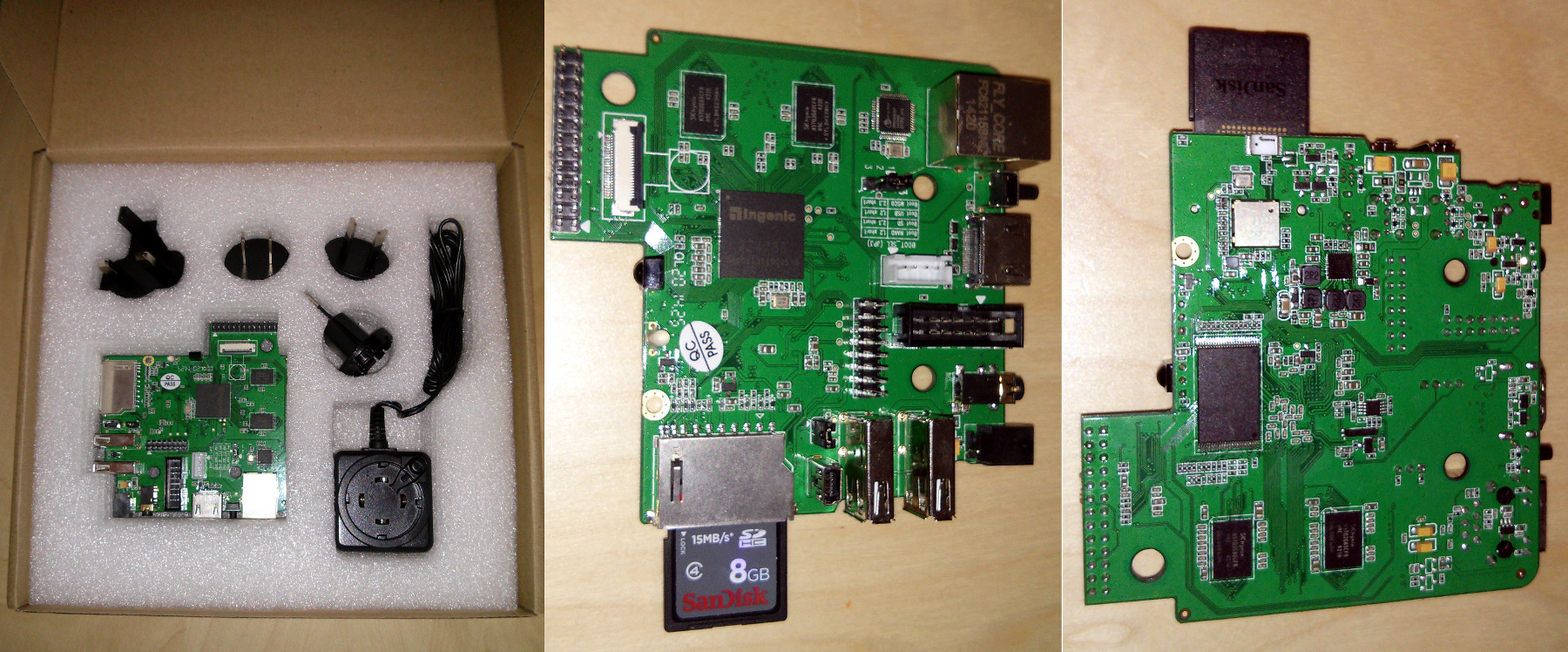
I have received two MIPS Creator CI20 boards, thanks to Imagination Technologies. It s a small MIPS32 development board: mips-ci20 As you can see it comes in a nice packaging with a world-compatible power adapter. It uses a Ingenic JZ4780 SoC with a dual core MIPS32 CPU running at 1.2GHz with a PowerVR SGX540 GPU. The board is fitted with 1GB of RAM, 8GB of NOR flash, HDMI output, USB 2.0 ports, Ethernet + Wi-Fi + BlueTooth, SD card slot, IR receiver, expansion headers and more. The schematics are available. The Linux kernel and the U-Boot bootloader sources are also available. Powering this board with a USB keyboard, a USB mouse and a HDMI display, it boots off the internal flash on a Debian Wheezy up to the XFCE environment. Besides the kernel, the Wi-Fi + Bluetooth firmware, and very few configuration changes, it runs a vanilla Debian. Unfortunately I haven t found time to play more with it yet, but it looks already quite promising. The board has not been formally announced yet, so I do not know when it will become available, nor the price, but if you are interested I ll bring it to DebConf14. Don t hesitate to ask me if you want to look at it or play with it.

15 August 2014

Aurelien Jarno: Intel about to disable TSX instructions?

Last time I changed my desktop computer I bought a CPU from the Intel Haswell family, the one available on the market at that time. I carefully selected the CPU to make sure it supports as many instructions extensions as possible in this family (Intel likes segmentation, even high-end CPUs like the Core i7-4770k do not support all possible instructions). I ended-up choosing the Core i7-4771 as it supports the Transactional Synchronization Extensions (Intel TSX) instructions, which provide transactional memory support. Support for it has been recently added in the GNU libc, and has been activated in Debian. By choosing this CPU, I wanted to be sure that I can debug this support in case of bug report, like for example in bug#751147. Recently some computing websites started to mention that the TSX instructions have bugs on Xeon E3 v3 family (and likely on Core i7-4771 as they share the same silicon and stepping), quoting this Intel document. Indeed one can read on page 49:
HSW136. Software Using Intel TSX May Result in Unpredictable System Behavior

Problem: Under a complex set of internal timing conditions and system events, software using the Intel TSX (Transactional Synchronization Extensions) instructions may result in unpredictable system behavior.
Implication: This erratum may result in unpredictable system behavior.
Workaround: It is possible for the BIOS to contain a workaround for this erratum.
And later on page 51:
Due to Erratum HSw136, TSX instructions are disabled and are only supported for software development. See your Intel representative for details.
The same websites tell that Intel is going to disable the TSX instructions via a microcode update. I hope it won t be the case and that they are going to be able to find a microcode fix. Otherwise it would mean I will have to upgrade my desktop computer earlier than expected. It s a bit expensive to upgrade it every year and that s a the reason why I skipped the Ivy Bridge generation which didn t bring a lot from the instructions point of view. Alternatively I can also skip microcode and BIOS updates, in the hope I won t need another fix from them at some point.

18 June 2014

Aurelien Jarno: Debian is switching (back) to GLIBC

Five years ago Debian and most derivatives switched from the standard GNU C Library (GLIBC) to the Embedded GLIBC (EGLIBC). Debian is now about to take the reverse way switching back to GLIBC, as EGLIBC is now a dead project, the last release being the 2.19 one. At the time of writing the glibc package has been uploaded to experimental and sits in the NEW queue. EGLIBC is dead for a good reason: the GLIBC development has changed a lot in the recent years, due to two major events: Ulrich Drepper leaving Red Hat and the GLIBC development, and the GLIBC steering committe self-dissolving. This has resulted in a much more friendly development based on team work with good cooperation. The development is now based on peer review, which results in less buggy code (humans do make mistakes). It has also resulted in things that were clearly impossible before, like using the same repository for all architectures, and even getting rid of the ports/ directory. Before we used to have two sets of architectures, the main ones in the glibc repository with architectures like x86, SuperH or SPARC, and the secondary ones in the glibc-ports repository with architectures like ARM or MIPS. As you can see the separation was quite arbitrary, and often leaded to missing changes on the secondary architectures. We also got real stable branches, with regular fixes. The most important EGLIBC features have been merged to GLIBC, including for example the use of non-bash but POSIX shell, or the renaming of reserved keywords. The notable exception is the support for configurable components, which we originally planned to use for Debian-Installer, by building a smaller flavor using -Os and without NIS and RPC support. At the end we never worked on that, and it seems that the hardware targeted by Debian has grown faster than the GLIBC size, so that is not really a big loss. At the end, we ended up with only 5 missing patches from the EGLIBC tree: The package names are unchanged (except the source package and the binary package containing the sources) so the transition is fully transparent for the users. I would like to thank all the CodeSourcery employees who worked on EGLIBC, with a special thank to Joseph Myers who spent countless hours to merge the most important EGLIBC changes back to GLIBC, and sent regular emails about the merge status. I would also like to thanks all the people on the GLIBC side that made the change to happen, and all persons participating in the GLIBC development.

16 February 2014

Aurelien Jarno: On configure systems

I will never understand the point of using autotools, cmake or whatever configure system, when later the code uses an hardcoded list of architectures to determine the size of a pointer Unfortunately for porters this pattern is quite common. Update: As people keep asking, the way to check for the size of a given type is explained in the autoconf manual. To check for the size of the pointer, the following entry has to be added to configure.ac: AC_CHECK_SIZEOF(void *) On a 64-bit system, this will lead to the following entry in config.h:

/* The size of void *', as computed by sizeof. */
#define SIZEOF_VOID_P 8

6 January 2014

Aurelien Jarno: Debian QEMU images updated

Following the release of Debian Wheezy, I have (finally) updated my set of Debian QEMU images for both Squeeze (6.0.8) and Wheezy (7.3). The following images are now available: Each of these directories contains a GPG signed README.txt file with the md5sums all files, detailed instructions how to run these images and especially the minimum QEMU version to use. The requirements to run the default desktop environment have increased a lot between Squeeze and Wheezy. An accelerated graphics card is now needed to be able to use Gnome (unless you use the fallback mode), which is not something provided by QEMU (actually there is now a QXL para-virtualized video card, but the driver is only in unstable). In addition GDM now needs more than 128MiB to start, while this is the default amount of memory provided for virtual machines. I have therefore decided to switch the default desktop environment on the Wheezy images to Xfce and the display manager to LightDM. Both Gnome and GDM are still installed on the images, and the original default can easily be restored using the following commands: Beside this the new images only contain minor changes. The filesystems have been tweaked to not run fsck after a certain amount of days, and locales-all and openssh-server are now installed in all images. For MIPS and MIPSEL, 64-bit kernels are now also installed and provided, so that it is possible to choose between a 32-bit or a 64-bit kernel (see the README.txt for more details). There is no Debian Wheezy SPARC image available, as QEMU does not fully support SPARC64 yet (it is actually possible to run it, but then the VM crashes often), and Debian Wheezy now only supports 64-bit kernels. I will also invest time to build an S390X image, but so far I haven t been successful on that. The following images are still available at the same location, though they haven t been updated:

29 October 2013

Aurelien Jarno: Detecting code issues using multiple architectures

Sometimes building the same code on multiple architectures is useful to detect horrors like:

ExEnv::err0() < < sprintf("AtomInfo: invalid name: %s\n",name.c_str());
This code builds using -Werror=format-security with only a few warnings on most architectures, while GCC is correctly detects the issue on some others. This has been reported as bug#728249.

3 June 2012

Aurelien Jarno: How multiarch adds new RC bugs


# dpkg --add-architecture kfreebsd-amd64
# dpkg -i libc0.1-dev_2.13-32_kfreebsd-amd64.deb
Selecting previously unselected package libc0.1-dev.
(Reading database ... 446113 files and directories currently installed.)
Unpacking libc0.1-dev (from libc0.1-dev_2.13-32_kfreebsd-amd64.deb) ...
dpkg: error processing libc0.1-dev_2.13-32_kfreebsd-amd64.deb (--install):
trying to overwrite '/usr/include/_G_config.h', which is also in package libc6-dev 2.13-32
dpkg-deb: error: subprocess paste was killed by signal (Broken pipe)
Errors were encountered while processing:
libc0.1-dev_2.13-32_kfreebsd-amd64.deb
Before multiarch the bug was not existing, and of course none of libc6-dev and libc0.1-dev are marked as Multi-Arch: something. People wanting to delay the release of Wheezy, I am sure you can find much more RC bugs like that.

18 March 2012

Aurelien Jarno: 10 years ago

Date: Mon, 18 Mar 2002 18:22:10 +0000
From: James Troup <troup@samosa.debian.org>
To: Aurelien Jarno <aurelien@aurel32.net>
Cc: da-manager@debian.org
Subject: New Debian maintainer Aurelien Jarno [ This is a long (automatically-generated) mail, but it contains
important information, please read it all carefully. ] Dear Aurelien Jarno! An account has been created for you on developer-accessible machines with username aurel32 . The password for this account can be found encrypted with your PGP or GPG key and appended to this message. A list of machines available to Debian developers can be found at <URL:http://db.debian.org/machines.cgi>. Please take a minute now to familiarize yourself with the Debian Machine Usage Policy, available at <URL:http://www.debian.org/devel/dmup> You have been subscribed to the debian-private mailing list as <aurel32@debian.org>. Please respect the privacy of that list and don t forward mail from it elsewhere. E-mail to <aurel32@debian.org> will be forwarded to <aurelien@aurel32.net>. To change this, please see <URL:http://db.debian.org/forward.html> Also, please subscribe to debian-devel-announce, if you haven t done so already. We strongly suggest that you use your aurel32@debian.org address for the maintainer field in your packages, because that one will be valid as long as you are a Debian developer, even if you change jobs, leave university or change Internet Service providers. If you do so, please add that address to your PGP/GPG key(s) (using gpg edit-key YOUR USER ID ) and send it to the keyring server at keyring.debian.org with gpg keyserver keyring.debian.org send-keys YOUR USER ID . You can find more information useful to developers at <URL:http://www.debian.org/devel/> (in particular, see the subsection titled Debian Developer s reference ). We suggest that you subscribe to debian-mentors@lists.debian.org. This list is for new maintainers who seek help with initial packaging and other developer-related issues. Those who prefer one-on-one help can also post to the list, and an experienced developer may volunteer to help you. You can get online help on IRC, too, if you join the channel #debian-devel on irc.debian.org. Take a look at the support section on www.debian.org in order to find out more information. You should have read these documents before working on your packages. o The Debian Social Contract
<URL:http://www.debian.org/social_contract.html> o The Debian Policy Manual
<URL:http://www.debian.org/doc/debian-policy/> If you have some spare time and want to contribute it to Debian you may wish to take a look at the Work-Needing and Prospective Packages for Debian GNU/Linux also known as WNPP that can be found at <URL:http://www.debian.org/devel/wnpp/> If you plan to make a Debian package from a not yet packaged piece of software you *must* announce your intention on the debian-devel mailing list to make sure nobody else is working on them. The machine ftp-master.debian.org is our main archive server. Every uploaded package finds it s way there (except for Packages covered by US crypto laws which go to non-us.debian.org) eventually. master.debian.org is the home of our bug tracking system. Project web pages and CVS archives are hosted on klecker.debian.org (aka cvs/www.debian.org), klecker is also our general shell server. Web pages should be placed in public_html on klecker and refered to by http://people.debian.org/~aurel32 You should use ssh to log into the machines instead of regular telnet or rlogin. Our LDAP directory is able to share ssh RSA keys among machines, please see <URL:http://db.debian.org/doc-mail.html> Otherwise when you first login a ~/.ssh directory will be created with the appropriate permissions. Please be aware of the security implications of using RSA authentication and ssh agents. Finally, please take a minute to visit <URL:http://db.debian.org/>.
Login using the password information appended to this email, and update your personal information. The information is used to maintain your accounts on various Debian machines, and also to allow other developers and general users to find out more about you. Many of the fields are only visible to other registered Debian developers. This is also the only way to change your password. The passwd program does not yet work. Welcome to the project!
The Debian New Maintainer Team

27 January 2012

Craig Small: Unlucky sometimes

Sometimes life throws little curves at you to see if you are still awake, today has been one of those days. fglrx is (apparently) fixed I ve had a long-running problem with fglrx on my laptop. The problem stems from ATI closed-source drivers with one of those laptops that has an ATI and Intel driver. It means I am basically using the slow Intel chip only. This morning I had enough and backed up my home and started to rebuild the laptop with debian 6.0.3. So I kicked off the very very slow process of reformatting the crypto drive (it has taken 5 hours and still going) let it gurgle on its merry way and started to read my email. One of the emails was that my bug about fglrx not working is closed, apparently it is fixed. If I had read that 10 minutes earlier, a simple apt-get install fglrx-driver would of perhaps fixed it; oh well. My problem is now is do I move to the latest driver and hope their fix is my fix or leave it with some ancient version? My preference is the former; I only hope it works! psmisc 22.15 and buffer overflows psmisc has a program called pstree which prints the set of processes in a tree fashion. It hasn t changed much for quite a while. I released version 22.15 and the Debian package 22.15-1. 22.15-1 I also adopted the harden CFLAGS as suggested for procps. I was a little surprised that I received an important bug. The report was saying I had a buffer overflow introduced in 22.15-1, but no relevant code had changed. The compiler options had done their job and stopped a buffer being overflowed. But where exactly was the overflow? Running gdb on pstree quickly showed that it was line 267 of pstree.c which uses strcpy(). That function set off warning bells. The relevant code is:
    PROC *new;
 
    if (!(new = malloc(sizeof(PROC))))  
        perror("malloc");
        exit(1);
     
    strcpy(new-&gt;comm, comm);
Now comm is the short command name you find in /proc//stat. It is fixed in the kernel at 16 characters. The PROC structure has this field as 17 characters long, one extra for the NUL. I went and checked the Linux source and yes, it is still 16 characters long. The clue was in the name of the program that it died on.
#6  new_proc (comm=0x6111b0 " console-kit-dae ", pid=1571, uid=0)
  at pstree.c:267
That string is 17 characters long. The problem is that 16 characters is for the name only. If the name is in brackets or braces, then that 16 character limit doesn t apply. The buffer overflow bug has been there for a long time, but only with the compiler flags did it become visible. Given you need to read names out of the /proc filesystem and if someone can fiddle with that you have bigger problems it doesn t seem to be too much of an issue. It should be (and is in Debian 22.15-2) fixed but is a nice example of the compiler catching bad things.

5 January 2012

Aurelien Jarno: Performances of open-source Radeon driver

I am the happy owner of a new netbook with an AMD Fusion E-450 APU, which includes a Radeon graphics card. I am using the open-source driver on it, that is a 3.2-rc7 kernel for KMS, and xserver-xorg-video-radeon package from sid. I have to say I am not really happy about the performances. No I don t speak about the graphical performances that are pretty good (especially compared to my Intel Atom N450 based previous netbook) but about the power consumption. With this setup and with the original battery I get 2h30 of autonomy. Switching to UMS and adding some power management options in xorg.conf improves it to 2h40, but breaks suspend to ram/disk (a pity for a netbook) and switch between VT. I then tried the non-free fglrx driver, it also suffers from the suspend to ram/disk issue, in addition to crashing xorg when playing videos On the other hand I get an impressive 3h30 of autonomy, and additionally a silent netbook (contrary to the open-source driver, the fan doesn t spin at idle). I have tried plenty of options, ranging from adding some power management options to xorg.conf, to passing dynclks=1 to the radeon module, including setting /sys/class/drm/card0/device/power_method to dynpm. Right now I have worked around the issue by buying a bigger battery which brings me 5h30 of autonomy, but I would really appreciate any software way to improve it with the open-source driver.

9 August 2011

Aurelien Jarno: Debian s390x port (aka 31 bits is not enough)

During Debconf 11, I got access to a fast s390 machine, and I have started to work on a Debian s390x port, the 64-bit version of the s390 port. One of my goal was to help the SPARC64 port, as some of the issues are the same: both are 64-bit big-endian, don t support unaligned access and behave differently between -fpic and -fPIC. Why such a port? When talking about 64-bit ports, we usually hear: 4GB is enough, handling 64-bit takes more memory . This really sounds like 640K ought to be enough for anybody . The s390 port is actually 31-bit from the address point of view (one bit is reserved for address space extension from 24 to 31 bits), so each process is limited to 2GB only. Nowadays applications which need more than 2GB are not that uncommon, especially on mainframes. Actually the 2GB limit already causes some problem in Debian: in some cases it s not possible to build haskell applications or even C applications using GCC. On the other hand, we already require a 64-bit kernel on the s390 port (only the userland is 32-bit), and applications are handling more and more 64-bit or greater values (files offset, time counters, uid, etc.). What is the status? Bootstrapping the architecture was not really easy (as for any other new architectures), due to a huge amount of dependencies and build-dependencies loops, as explained by Wookey during Debconf11. Now that this part is mostly done, an autobuilder has been started and currently more than 65% of the packages are built. The s390x port is hosted on debian-ports.org. Unfortunately it is not yet deboostrapable, though that should happen in the next few days (only a few packages are missing). The main issues are currently packages which fail to build from source due to linker, gcc-4.6 and curl changes, or due to the libjpeg and multiarch transitions, and thus are not directly related to s390x. If your package is in this case, it would be a good idea to fix it. Otherwise if it has a lot of reverse dependencies and the bug is opened for a while, just expect an NMU (as allowed by the 0-day NMU policy). Of course for a few packages s390x specific fixes are needed, some of them are already in the BTS. How you can help? The list of bugs blocking the s390x port is available through the s390x usertag, fixing these bugs (a lot of them are general FTBFS) would help a lot. Alternatively if you have access to an s390x machine you can take a look at the packages failing to build. Update: Fixed the explanation about the 32th bit, thanks to Bastian Blank for the comment.

28 June 2010

Aurelien Jarno: Debian and the ARM hype

Thanks to the versatility of the Linux kernel, Debian has always been known for supporting a large number of architectures. It has also often been criticized for that as it is said to slow down the development of Debian. Among these architectures, the ARM one was considered dead a few years ago, and some people wanted to get rid of it. Today all major distributions now have an ARM port, one of those distributions being even based on Debian. It seems Debian was right. Now that Android has been ported to MIPS, we may see more and more MIPS based devices. Will the same scenario happen again?

12 June 2010

Aurelien Jarno: bindv6only=1 and GNU/kFreeBSD

A few months ago the netbase package started to install the /etc/sysctl.d/bindv6only.conf file to switch the default bindv6only value from 0 to 1. A lot of people are not happy with this change, but it is not my goal to give my opinion here. On the other hand, people have propagated the rumour that it has been done as the FreeBSD kernel, used in the kfreebsd-amd64 and kfreebsd-i386 ports of Debian, only supports the mode corresponding to 1. Let s give the truth:

Next.

Previous.