Search Results: "ag"

27 January 2010

Craig Small: Manilla, Git and Gjay

Work doesn't often send to me places as great as Manilla in the Philippines, but here I am. It's a reasonably modern place and to me feels more like America than Asia in so many ways, posssibly because of its history. One thing is for sure, noone follows road rules here. Red lights are a suggestion and a zebra crossing is just some painted lines that you do need to stop at.

As for food, it's not that different, in fact this sad lot is about what was different:
Generally though the food has been pretty good but nothing I could get at home.

Good news about Gjay, the previous maintainer said it was ok for SourceForge to hand over the control of the program to me so I've set it up in git and started working on it. Most of the work was getting the code up-to-date to the later gtk APIs and making it work with audacious instead of xmms. It's almost ready for (re)initial release and there is even an ITP ready to go.

Git is a rather interesting and new (for me at least) version control system. I've been using cvs for more years than I'd care to think about and svn but while it is a bit different as you'd expect I haven't had it get in my way. In fact I've been so impressed with Git I have put a few other projects into it, mainly with the collab maintence Debian project for a few of my packages.

<script defer="defer" src="http://static.zemanta.com/readside/loader.js" type="text/javascript"></script>

Joerg Jaspert: HP Mini 5101, gobi_loader problem

A short while ago I bought a new device, a HP Mini 5101. Basically a slightly oversized pocket calculator, but exactly what I wanted: It is painful to do anything real on it, but it can be used if there is really no better way. And this is exactly what I want to take with me on the vacation starting soon. A device that ensures I will not use it for more than the emergency case and as backup storage for pictures I take. This little thing has a tiny 10.1 (non-glare, I want it painful but even there is a limit. Idiot mirrors, brrr) TFT (1366x768), an Atom N280 with 1.66GHz, 2G RAM, a 160Gb disc, 3 usb ports, wifi, gigabit lan, bluetooth and a 3G module. It ships with one of those pain adventures with which the seller shows you how much they hate you (Windows XP), but that did only boot twice yet. Once to check everything works, for the second read on. It weights 1.3kg and HP imagines some 8 and a half hour runtime with the 6-cell battery. ACPI and powertop predict between 7 and 14hours, depending on my workload and probably the phase of the moon. But 7 will do nicely. Of course I put a Debian on this device. It runs all well. As it has no optical drive its either usbboot or netboot and off it goes. Easy install, only need to remember installing the broadcom-sta packages and building the module for the kernel to get wifi. Otherwise its a simple install and the stuff works out of the box. Except for one thing. I can not get this goddamn 3G module to work. It works fine in Windows, confirming this was the second time I did boot this abomination of a bad joke. When using that HP manager thingie for 3G, its all fine and works. When you then reboot into Linux - it also works. Annoying. It is one of those Qualcomm Gobi USB chipsets and to function it needs it firmware transferred over. Fine. Using google one can easily find gobiloader, which is meant to do that. Just get the firmware from Windows and let gobiloader do the rest. Except - it does not work. Everything I can find tells me it should, ie. various posts on various places on the net, the usbids the device has when without firmware and after this windows crap put firmware into it, everything looks exactly like it should. Yet, gobi_loader simply hangs itself right in the first while (1) loop, where it wants to send the first real data after the set of 3 magics it send before. The write never times out, the firmware never gets into the device, its not usable. Argh. Dear lazyweb, anyone out there with an idea? I tested various firmwares (the one I found in Windows, the one you can find at vendors download page, various of the 10 different you find in each), even let it run for some while before interrupting. Unfortunately I do not have enough clue in this area to debug what is happening here, nor to fix this up myself.

Aurelien Jarno: Working on the eglibc package

In the last weeks, I stopped being motivated to work on the eglibc package, it s not fun as it was before. Maintaining this package is taking a lot of my (free) time, and I am not anymore able to follow the bug rate, especially for RC bugs or bugs that I consider high priority. In turn it does not give me time to integrate eglibc 2.11 or other wishlist features I would have liked to see (rework of the locales* packages, using multiarch paths, etc.). I hope it s only a bad moment and that things will change soon, so I can find time to work on GNU/kFreeBSD, QEMU or to do electronics. In any case you can help by handling bug reports or writing patches. Everything is in the BTS!

Gunnar Wolf: Packaging PKP OJS (Open Journals System)

New guidelines for periodic publications' websites at my University favor the different journals we have to use a standardized system And it makes quite a bit of sense. It is quite hard to explain to the people I work with that the content is not only meant to be consumed by humans, but also by other systems; the reasons behind rich content tagging and deep hierarchies for what they would just see as a list of words (think list of authors for an article, list of keywords, and so on). After all, aggregator databases such as Latindex and SciELO have achieved getting this understanding through. And I must be quite grateful, as the University's guidelines point to what appears to be a very well-thought and thorough system, the Open Journal Systems by the Public Knowledge Project, co-funded by several well-regarded universities. OJS is a GPL-2-covered PHP bundle. Anyway I am very glad at least one of my Institute's journal accepted the challenge and decided to go OJS. I know I will quite probably be administering this system long-term. And, being as snobbish as I am, I know I loathe anything installed in my machines that is not either developed by myself or comes in a Debian package. So, as it was not packaged, I made the package Note that I am still not filing an ITP (which means, I have not yet decided whether I will upload this to Debian) because I want first to make sure I do have the needed long-term commitment Besides, I am by far not a PHP person, and being responsible for a package Carries a nontrivial weight. Still, you might be interested in getting it. If you are interested, you can either download the .deb package or add it to your apt repositories (and stay updated with any new releases), by adding this to your /etc/apt/sources.list: deb http://www.iiec.unam.mx/apt/ lenny misc
deb-src http://www.iiec.unam.mx/apt/ lenny misc
Note: My packaging has still a small bug: The installer fails to create the PostgreSQL database. The MySQL database works fine. I will look into it soon So far, I am quite impressed with this program's functionality and the depth/quality of its (online) documentation. Besides, its usage statistics speak for themselves: So, it is quite possible I will be uploading this into Debian in a couple of weeks (hopefully in time to be considered for Squeeze). The reasons I am making it available in my personal repository now is:

Christian Perrier: Translations: LOL, but after?

Of course, one would expect me to react to this post. Apparently, from my cumulated experience, joking about funny translations is a very widespread game among german-speaking developers (of course, as everybody knows, us French do translate everissing and no single Frainche DiDi will make such fun abaouttel10n wouhorke, aha). I'd say: more generally widespread among people .who jargonize about computing so often in their daily work that they often forget that not everybody, even in a country where people are as clever about English as German/Austrian/Swiss folks are (we all know that 100% population in these places speak a very perfect English) do understand what "downgrade" means. Seriously, "funny" translations are our (translators) daily nightmare. We hate them because we know people hate us (or make jokes about our work) when they face them. The example taken by Patrick is a nice case as "downgrade" is tricky for all of us. For instance, French translators have chosen "revenir la version pr c dente" as "bring back to former version". This is about the only "right" way to say what's being done ("d grader" is another option but that has a negative connotation). Of course, I often *hear* people (incl. me) say "downgrader" which is an horrible neologism....and of course doesn't say anything to people who are clueless in English. English is, unfortunately, often a very compact language. This is our daily pain. So, as German translation of "to downgrade", what do *you* propose, Patrick? "Downgradieren"? Tricky, eh? Taken from APT for "downgrade": Hint: you can see this with "apt-get source aptitude" and look in po/ for you favorite language. That sounds funny to you? Fine. But as usual in free software, please report.....and patches welcome...

Bastian Venthur: Query Google Scholar using Python

In desperate need to organize my collection of scientific papers, I had a look at various tools which could help me organizing them. Probably one of the best out there is Mendeley. Mendeley seems to be a very good tool to keep your massive collection of pdfs under control. Unfortunately a very basic function, namely looking up a newly imported paper in Google Scholar to get attributes like: Authors, Year, etc. right, is bundled with a Mendeley account. I guess that s their way of forcing the user to participate to their community stuff, since without the Google Scholar lookup Mendeley is pretty useless unless you want to fill all the attributes manually. So I decided to write my own tool to make the lookup. Unfortunately Google does not really want to give away that precious data: they don t provide an API and even block certain User-Agents from accessing the page. Then, there is also the problem of scraping the results page to get the right data. The first problem can be trivially solved by setting a common User-Agent string, the second one can be elegantly circumvented by using the bibtex files provided in the search results. The bibtex entries are however only showed if you enabled them in the settings, which are stored in a cookie. After a few tries, I figured that the CF attribute (citation format?) controls which bibliography format should be offered in the results page and CF=4 corresponds to bibtex. Generating a fake cookie is easy, but you have to know what must be included. In this case it looks like a 16 digit hex as ID and the CF attribute is sufficient. The ID is probably supposed to be your id, but a randomly generated one also works like a charm. The resulting cookie looks like this: GSP=ID=762a112b5c765732:CF=4 All you have to do now is to query Google Scholar using the user string and the cookie:

...
# fake google id (looks like it is a 16 elements hex)
google_id = hashlib.md5(str(random.random())).hexdigest()[:16]
GOOGLE_SCHOLAR_URL =  http://scholar.google.com 
HEADERS =  User-Agent  :  Mozilla/5.0 ,
         Cookie  :  GSP=ID=%s:CF=4  % google_id  
def query(searchstr):
     "Return a list of bibtex items. " 
    searchstr =  /scholar?q= +urllib2.quote(searchstr)
    url = GOOGLE_SCHOLAR_URL + searchstr
    request = urllib2.Request(url, headers=HEADERS)
    response = urllib2.urlopen(request)
    html = response.read()
    # grab the bibtex links
     

And Google Scholar will offer you links to the bibtex files of the results. Getting those links is easy since they all start with "/scholar.bib". Just search for those and download the targets. The complete code is available on github. It can be used as a python library or a standalone application, you just call it like this: gscolar "some author or title" and it will print the first ten results in bibtex to stdout.

Mike Hommey: Ubuntu switches default search engine. Will Google react ?

Many have commented on the event. As I noted in a reply to Romain Beauxis s post, the only reason Google was the default search engine in Ubuntu, and is still in other distros is because Mozilla has a revenue deal with Google. Which means that actually, Mozilla might be getting money from Debian, Ubuntu and other distros users actions on the Google search engine. (maybe not from Debian, though, because of the search url including iceweasel instead of firefox). Now, at least, Ubuntu will be the one getting the money. One has to know that these revenue deals probably don t cost a dime to Google and Microsoft (through Yahoo), because they may be transferring revenue they get from the extra advertising revenue they can get from these users being using their search engine as default. Anyways, much more interesting to know is how Google is going to react on other services: some core functionalities of Firefox (geolocation, safe browsing) are based on Google services. These are actually a possible problem for Debian, depending on the agreement between Mozilla and Google, and I have yet to address the RC bug I filed on my own package about these. Now, since Google is going to get less advertising revenue from Ubuntu users in favour of one of its competitor, why should they provide the geolocation and safe browsing to these users ?

Romain Beauxis: Voluntering

For those who wonder why Debian is and should remain a voluntary-driven project, here are some insights... I hope I will never read this in a Debian mailing list:
Why? I am pursuing this change because Debian has negotiated a revenue sharing deal with XXXXX
I have nothing against ubuntu and I think it is a great distro. However, I believe that decisions like this go strongly against the principle of free software as we consider, in particular when it comes to putting the user first and not some cash deal. Forcing the user to choose for something because the company gave money for that is totally again this to me.

Patrick Schoenfeld: Debian translations - EPIC LOL

As a german I'm used to strange translations in computer context.
I saw it back when I was using Microsoft products and I regulary stumble upon it on Debian systems. But whats actually kind of funny:Debian is outstanding in that regard.
An example:
Debian has that "wonderful" package manpages-de which provides a german manpage for ps.
It contains a formulation that is so inaccurate and not really funny:

"--cumulative Daten von toten Kindern einbeziehen (als Summe zusammen mit den Eltern)"


For the English only speakers: That can be roughly translated to "Collect data from dead children
(summed with their parents)". For me this somehow sounds like we are a butcher OS and so I reported #495441 but nobody cared about it yet.

Today I had another WTF on german translations because when I wanted to upgrade my system I read the following sentence:

"Sind Sie sich sicher, dass Sie die oben genannten Pakete installieren bzw. aufr sten wollen?"


Cold war, anyone?

Well its a classical case of using a word-by-word translation instead of a meaning-orientied translation. Its a fact that 'upgrade' can be translated to 'aufr sten' (as done above) but in that case its just not appropriate. As a matter of fact most german people I'm aware of would actually confuse the meaning with a meaning such as in a military context (therefore the "Cold war, anyone?" text above). And just btw. if we would rely on computing power to translate it back into English we would get:

Are you sure itself that you want to install and/or rig the packages specified above?


So it seems that Babelfish has a similar pereception.

Russell Coker: The Australian Open and Android Phones (Seer)

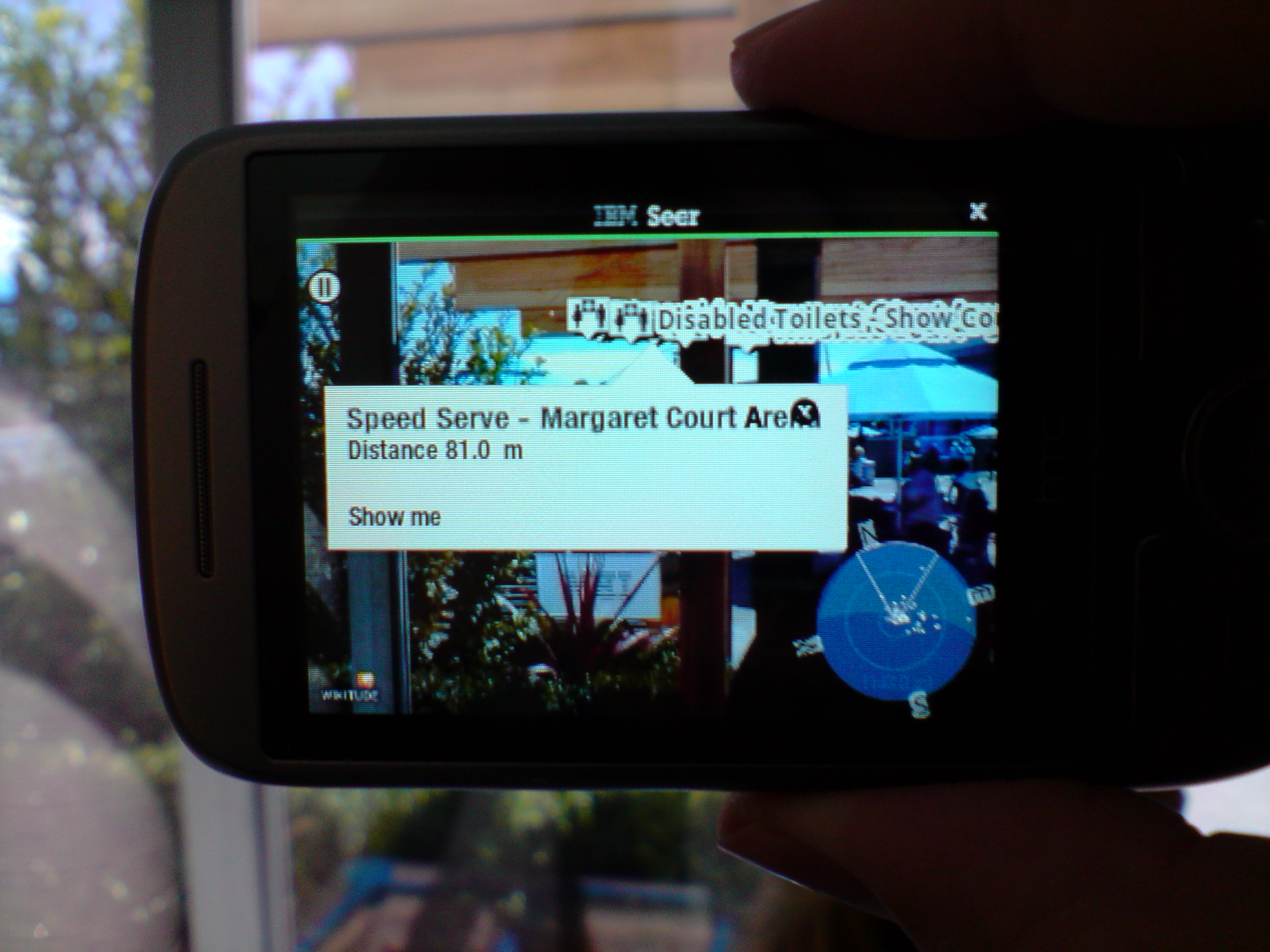
On Monday I visited the Australian Open [1] it s one of the world s greatest tennis championships and it s on in Melbourne right now. IBM sponsored my visit to show me the computer technology that they use to run the event and display the results to the world via their web site and to various media outlets. picture of IBM Seer software running on HTC Hero The first thing that they showed me was the IBM Seer software on the HTC Hero phone (which runs the Google Android OS). Seer can be freely downloaded from the Android store. The most noteworthy feature is that it uses the camera in the Android phone to display a picture of whatever you are looking at with points of interest superimposed (such as the above picture where I asked for locations of events and toilets). But it also displays a map view and has some other features I didn t get a chance to test such as viewing twitter data relevant to the event. We really need this augmented reality feature enabled with tourist data for major cities. I m sure that there s lots of interesting things I haven t seen in my own home city, if I could just pull out a phone and see a map of what s around me whenever I m bored I could see some of them. I think that this has the potential to change the way we use phones, in theory this was available as soon as Google Maps was released, but Seer seems to be the start of a whole new range of developments. One of the uses of this will be for identifying the background in tourist photos, no more of the me in front of old building descriptions. Here is a Youtube Video of the Seer software in action [BMLgHGV4zWM]. The tour guide explained that to get the software to work on an iPhone would require the 3GS for navigation as the earlier iPhones don t have a compass. The Seer software was initially developed for The Championships, Wimbledon 2009 which happened at about the same time as the iPhone 3GS release. I expect that there will be enough iPhone 3GS units sold before Wimbledon 2010 to give IBM a good incentive to port Seer to the iPhone. Three (my phone company at the moment) has just sold out of the HTC Magic which has a digital compass. They are selling the HTC Touch Pro and HTC Touch Diamond that appear to lack a digital compass. Vodaphone is offering a HTC Magic free on the $29 contract right now. The other Australian mobile phone companies don t seem to offer any Android phones. So it seems that the only option right now if I wanted to purchase a phone in Australia that can run Seer is the Vodaphone HTC Magic, and that s a phone that was released almost a year ago (a long time with recent progress in phone development it s the modem before the HTC Hero I tested) and which has only a 3.2MP camera (the LG U990 Viewty I used to take the picture for this post has a 5MP camera and is older than that). So I expect that there aren t many people using Seer in Australia. If you happen to be in Melbourne and have an Android phone with a digital compass then you may want to visit the Australian open to try the Seer software. It should work equally well from outside the security fence I ll write about the other things I saw over the next few days.

Jonathan McDowell: Sinful admission

Knowing full well that it will cause many of my readers to tut and roll their eyes at me I derive slight pleasure from confessing that I have now eaten at McDonalds on 6 continents. To make it worse I only did so in Asia and Australia so I could say I had.

It does lead me into a slightly more valid ramble. I'm not particularly bothered about eating on my own. I like food (even if I'm picky about what I like), but I prefer it with company. This means I'm not particularly great about being organised to cook complicated things when I'm on my own; largely the whole thing just turns into dealing with hunger. It also mean I'm bad at finding nice places to eat out while travelling. Which, when you're travelling for a month to some interesting places, is a bit of a bugger. I've got a bit better at actually going to nice places, and trying not to bolt my food into me so I can get out ASAP but instead enjoy it. A book helps. Also places that aren't quite as busy (which if you have no agenda is nicely achieved by letting your body clock desync from the world around you). Unfortunately I didn't really do so until after Hong Kong. Guess I'll just have to go back at some point...

(More on my travels at some point, maybe. I've started the tortuous journey home now.)

Russell Coker: Costs and Benefits of Search Engines

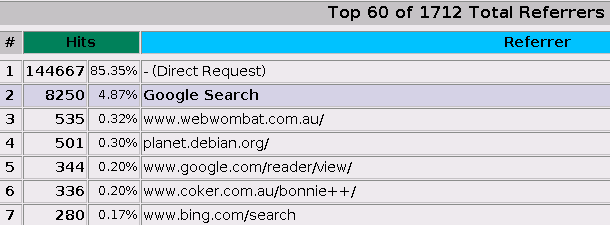
Chris Smart writes about the latest money making schemes for OS distributors, Canonical is getting paid by Yahoo to make them stop using Google as the default Firefox search engine [1]. I think this is OK, the user can easily change it back if desired and it allows them to pay the salaries of more employees who contribute code back to upstream projects. MSN uses 455M, Google uses 189M, and Yahoo uses 109MGoogle referrs 8250 hits, but Bing only refers 280 Above are sections of my Webalizer output related to my blog which show the data transfer use of search.msn.com (Bing presumably) which is 50% greater than that of Google and Yahoo combined. Why does MSN need to do 455MB of transfer so far this month to scan my blog when Google gets the job done with 189M and Yahoo only takes 109M? Also judging by the referrals Bing is only 3% as much use to me as Google. MSN uses 525M, Yahoo uses 132M, and Google only uses 35M Above is a sample of the Webalizer output from www.coker.com.au, MSN is using 525MB of data to scan the site which contains about 1.2G of static files that change very rarely. A Russian malware site seems to be downloading it three times a month, and Google only takes 35MB of data transfer to scan the site (which is probably still excessive). If Bing was a quality search engine that returned appropriate results then this could be forgiven. But however it is a very poor search engine that returns bad results. For example if you query Google or Yahoo for bonnie++ you will get an entire page of search results concerning my Bonnie++ benchmark, and those results are ordered in a sensible way. If you ask Bing then the first four results concern Bonnie (three women and a plant) and most of the first page don t concern my benchmark. Some time ago I had blocked MSN from scanning a server that I ran. The server in question had all the web servers for my domain plus quite a few other small domains. The total MSN data transfer was 3G per month which was almost half the data allowance for the server in question (data plans in Australia suck that s why my web servers are hosted in Germany now), so it was a question of whether to allow normal operation of the business or MSN searches. With Microsoft not running a popular search engine (then or now) it was an easy decision. I think that anyone who accepts money from Microsoft/Bing is doing their users a mis-service. Bing is simply an inferior search engine, it gets bad results and imposes excessive costs on service providers. Yahoo however seems to be a reasonable service, not as good as Google for the web hosters but not too bad. I wonder what would happen if Yahoo offered some sponsorship money to the Debian project in exchange for being the default search engine. I m sure it would be dramatic.

C.J. Adams-Collier: Font for composing Lushootseed

At the recommendation of David Beck, I have installed a TTF font from http://www.languagegeek.com/. It took a few minutes for me to figure out how to get it going, but it was pretty straightforward after that. Here are some quick instructions for those of you running Debian variants such as Ubuntu.
  1. Fetch the zip files from languagegeek.com and unpack:
    $ sudo mkdir -m777 -p /usr/local/share/fonts/truetype/languagegeek/
    $ cd /usr/local/share/fonts/truetype/languagegeek/
    $ for zip in AboriginalSerif.zip AboriginalSans.zip
    do
      wget http://www.languagegeek.com/font/$zip &&
      unzip $zip &&
      rm $zip
    done
    $ sudo chmod -R 755 .
    
  2. Register these fonts with the system using defoma (the debian font manager):
    $ for font in *.ttf
    do
      sudo defoma-font register truetype $PWD/$font
    done
    
While performing the defoma registration, I was presented with a number of warning-ish-looking messages for each file processed. For better or worse, I am ignoring them:
No CIDSupplement specified for Dotum-Bold, defaulting to 0.
No CIDSupplement specified for Batang-Regular, defaulting to 0.
No CIDSupplement specified for ZenHei-CNS, defaulting to 0.
No CIDSupplement specified for Batang-Bold, defaulting to 0.
No CIDSupplement specified for ZenHei, defaulting to 0.
No CIDSupplement specified for Dotum-Regular, defaulting to 0.
I used gnome-appearance-properties (System Preferences Appearance) to set my document font to Aboriginal Sans:
After telling Chromium that it should use these fonts, it renders all of the Lushootseed characters quite nicely.
<script>//<script language="javascript" src="http://reddit.com/button.js?t=1"></script>

Michal &#268;iha&#345;: Gammu is being used in vendor software

I always thought Gammu to be workaround for phones whose vendors do not provide software for your favorite operating system. We try to do our best job to work with variety of phones, even though this is hard and never finished job. However today I was really surprised to find out that some phone vendor built their official application for managing phone on Gammu. The application is of course closed source and available only for Windows, but this does not change anything on the fact they use it. They seem to have modified code slightly, adding some new functions and removing others, separated the code to several DLLs, however I'm 100% sure it is Gammu as they use some unique (read awful) things we have in our code. I'm not going to disclose their name right now as I want to give them fair amount of time for reaction on my asking for sources. But you will for sure find more information later in my blog. PS: Gammu is of course not the only free software used inside this application, you can find more there (and you will find there more than I did if you will look longer than few minutes I spent on examining rest of code).

26 January 2010

Roland Mas: sgeps follow-up

Just an update about sgeps, because it seems to have made a small stir (which is more than I expected).

Joey Hess: issues with openmicroblogging

I tried switching from identi.ca to brainbird today, when my always present frustration with 140 character limit in microblogging boiled over. Again. In the process, I've found some warts in the OpenMicroblogging system, beyond its obsession with fitting into an obsolete sideband communication medium that I will never actually use. Rant mode on. Let's assume that OpenMicroblogging catches on, in a big way, and we're all using it in 10 years. So, it will be something like email. And its federated design allows for that; there can be multiple servers that communicate, and so on. (Which is a very good thing, compared to the twitter monoloth.) But: How many times have you changed your email address? When you did, you probably set up a .forward for the old email address, and emailed some people from the new address to let them update their address book, and it was not a big deal. But the experience when changing an OpenMicroblogging site is not the same. You have to go out and re-follow everyone. For each person, you have to go through a multiple screen (OAUTH) process. This process may not even be automatible. Second problem is that OpenMicroblogging does not use addresses. So to talk to me, one uses @joey'. It's not clear to me how sites determine whether to direct that to joey@identica or to joey@brainbird. Seemed like, if I switched to brainbird, I would need to pick a new username, to avoid having to check both places. Finally, the OpenMicroblogging spec, while really quite a neat approach to piggyback on OAUTH, has some absurd limits. 140 characters for a biography. Even the limit for one's full name is longer than that. Absurd. Suprisingly, no 140 character limit on messages actually exists, that's just a recommendation. But it's unclear how a system that sends a longer message interoperates with systems that use shorter messages. Probably the message will be truncated. And there is no way in the protocol to discover the message limit of a remote system. All in all, I think I prefer RSS, or Google Wave, or even IRC from a protocol perspective. And from a usability perspective, Facebook does not have absurd message limits, and most people read my messages there anyway. Meh.

Lucas Nussbaum: Re: How free is the Nokia N900?

Following my questions on the freeness of the Nokia N900, I received quite a lot of comments. I m trying to summarize the most important points here. For all the details, see the comments and Tollef s blog.

Guido G nther: Git-buildpackage and 3.0 source format

Here's a short overview of 3.0 source format support in git-buildpackage 0.4.64: One loose end is the handling of multiple upstream tarballs (#561071, #561072). I'd be great to hear from people already using this feature how this can best be added into the gbp workflow. The newer kids in town gbp-clone, gbp-pull (for keeping the repo up to date when using team maintenance) and gbp-pq (for managing the quilt patch-queue) don't care about the underlying source package format. These three are a bit underdocumented in the manual but information about the workflow is in the wiki.

Wouter Verhelst: Going, obviously

If you thought otherwise, you're crazy, but just for reference: I'm going to FOSDEM, the Free and Open Source Software Developers' European Meeting This year I volunteered to organize the "distributions" devroom/track, because it seemed to be going nowhere, and the people who where supposed to do so were too busy with other stuff. I'm still not very fond of the idea of mixing all distributions in one room, but at least we managed to avoid complete and utter disaster wherein nearly no talks would have been submitted. Let's see how it goes, now.

Uwe Hermann: Roda RK886EX (Rocky III+) first laptop/notebook being supported by coreboot

coreboot logo Only few days ago a long-standing bug in coreboot, the Free Software x86 BIOS/fimware project, has been fixed: Adding support for a laptop/notebook. The code was developed by coresystems GmbH (thanks a lot!). Quoting from the announcement:
coreboot is running on a multitude of different computers, ranging from tiny embedded systems as small as the palm of your hand over desktop and server systems to super computers with thousands of nodes. However, one might say that in the area of mobile computers coreboot has to catch up, compared to its support of other devices. Thus, I am especially glad to announce that coresystems GmbH is releasing coreboot for the Roda RK886EX a.k.a Rocky III+ notebook today. It's a rugged notebook, protected against shock, vibration, dust and humidity:
http://www.roda-computer.com/en/products/notebooks/rocky-iii-rk886ex.html We have been testing various Linux distributions as well as Windows XP and Windows 7 booting on this nice notebook. I want to sincerely thank those who made this project possible with their funding:
  • secunet Security Networks AG
  • Bundesamt f r Sicherheit in der Informationstechnologie (Federal Office for Information Security, BSI)
A big thank you also goes to everyone who worked with coresystems on this project.
The committed patch series includes improved support for the Intel i945 / ICH7 chipset (which was also written by coresystems), the SMSC LPC47N227 Super I/O, the Texas Instruments Cardbus+Firewire bridge TI PCI7420, and finally the Renesas M3885x Embedded Controller (EC). Btw, the latter, the so-called embedded controller (sometimes integrated in the Super I/O, sometimes it's an extra chip) is one of the major problems for coreboot support on laptops. They are almost always undocumented (i.e., no public datasheets are available), but they have low-level control over power/battery management, early power-up sequence, and often include keyboard controller functionality and other important stuff. Luckily, for this notebook an EC datasheet is available. Checkout the coreboot EC support code for the Renesas M3885x for an impression of what this stuff is all about. Anyway, there is hope that this laptop will only be the first in a row of multiple supported ones in the future. Interested developers and contributors are of course always welcome on the coreboot mailing list :-)

Next.

Previous.