Search Results: "ed"

19 November 2010

Ondřej Čertík: Google Code vs GitHub for hosting opensource projects

Cython is now considering options where to move the main (mercurial) repository, and Robert Bradshaw (one of the main Cython developers) has asked me about my experience with regards to Google Code and GitHub, since we use both with SymPy.

Google Code is older, and it was the first service that provided free (virtually unlimited) number of projects that you could easily and immediately setup. At that time (4 years ago?) that was something unheard of. However, the GitHub guys in the meantime not only made this available too, but also implemented features, that (as far as I know) no one offers at all, in particular hosting your own pages at your own domain (but at GitHub's servers, some examples are sympy.org and docs.sympy.org), commenting on git branches and pull requests before the code gets merged in (I am 100% convinced that this is the right approach, as opposed to comment on the code after it gets in), allow to easily fork the repository and it has simply more social features, that the Google Code doesn't have.

I believe that managing an opensource project is mainly a social activity, and GitHub's social features really make so many things easier. From this point of view, GitHub is clearly the best choice today.

I think there is only one (but potentially big) problem with GitHub, that its issue tracker is very bad, compared to the Google Code one. For that reason (and also because we already use it), we keep our issues at Google Code with SymPy.

The above are the main things to consider. Now there are some little things to keep in mind, that I will briefly touch below: Google Code doesn't support git and blocks access from Cuba and other countries, when you want to change the front page, you need to be an admin, while at GitHub I simply add push access to all sympy developers, so anyone just pushes a patch to this repository: https://github.com/sympy/sympy.github.com, and it automatically appears on our front page (sympy.org), with Google Code we had to write long pages (in our docs) about how to send patches, with GitHub we just say, send us a pull request, and point to: http://help.github.com/pull-requests/. In other words, GitHub takes care of teaching people how to use git and figure out how to send patches, and we can concentrate on reviewing the patches and pushing them in.

Wikipages at github are maintained in git, and they provide the webfrontend to it as opensource, so there is no vendor lock-in. Anyone with github account can modify our wiki pages, while the Google Code pages can only be modified by people that I add to the Google Code project, which forced us to install mediawiki on my linode server (hosted at linode.com, which by the way is an excellent VPS hosting service, that I have been using for couple of years already and I can fully recommend it), and I had to manage it all the time, and now we are moving our pages to the github wiki, so that I have one less thing to worry about.

So as you can see, I, as admin, have less things to worry about, as github manages everything for me now, while with Google Code, I had to manage lots of things on my linodes.

One other thing to consider is that GitHub is only for git, but they also provide svn and hg access (both push and pull, they translate the repository automatically between git and svn/hg), I never really used it much, so I don't know how stable this is. As I wrote before, I think that git is the best tool now for maintaining a project, and I think that github is now the best choice to host it (except the issue tracker, where Google Code is better).

Ian Wienand: Symbol Versions and dependencies

The documentation on ld's symbol versioning syntax is a little bit vague on "dependencies", which it talks about but doesn't give many details on. Let's construct a small example:
$ cat foo.c
#include <stdio.h>
#ifndef VERSION_2
void foo(int f)  
     printf("version 1 called\n");
 
#else
void foo_v1(int f)  
     printf("version 1 called\n");
 
__asm__(".symver foo_v1,foo@VERSION_1");
void foo_v2(int f)  
     printf("version 2 called\n");
 
/* i.e. foo_v2 is really foo@VERSION_2
 * @@ means this is the default version
 */
__asm__(".symver foo_v2,foo@@VERSION_2");
#endif
$ cat 1.ver
VERSION_1  
      global:
      foo;
      local:
        *;
 ;
$ cat 2.ver
VERSION_1  
      local:
        *;
 ;
VERSION_2  
      foo;
  VERSION_1;
$ cat main.c
#include <stdio.h>
void foo(int);
int main(void)  
    foo(100);
    return 0;
 
$ cat Makefile
all: v1 v2
libfoo.so.1 : foo.c
	    gcc -shared -fPIC -o libfoo.so.1 -Wl,--soname='libfoo.so.1' -Wl,--version-script=1.ver foo.c
libfoo.so.2 : foo.c
	    gcc -shared -fPIC -DVERSION_2 -o libfoo.so.2 -Wl,--soname='libfoo.so.2' -Wl,--version-script=2.ver foo.c
v1: main.c libfoo.so.1
    ln -sf libfoo.so.1 libfoo.so
    gcc -Wall -o v1 -lfoo -L. -Wl,-rpath=. main.c
v2: main.c libfoo.so.2
    ln -sf libfoo.so.2 libfoo.so
    gcc -Wall -o v2 -lfoo -L. -Wl,-rpath=. main.c
.PHONY: clean
clean:
	rm -f libfoo* v1 v2
$ ./v1
version 1 called
$ ./v2
version 2 called
In words, we create two libraries; a version 1 and a version 2, where we provide a new version of foo in the version 2 library. The soname is set in the libraries, so v1 and v2 can distinguish the correct library to use. In the updated 2.ver version, we say that VERSION_2 depends on VERSION_1. So, the question is, what does this mean? Does it have any effect? We can examine the version descriptors in the library and see that there is indeed a relationship recorded there.
$ readelf --version-info ./libfoo.so.2
[...]
Version definition section '.gnu.version_d' contains 3 entries:
  Addr: 0x0000000000000264  Offset: 0x000264  Link: 5 (.dynstr)
  000000: Rev: 1  Flags: BASE   Index: 1  Cnt: 1  Name: libfoo.so.2
  0x001c: Rev: 1  Flags: none  Index: 2  Cnt: 1  Name: VERSION_1
  0x0038: Rev: 1  Flags: none  Index: 3  Cnt: 2  Name: VERSION_2
  0x0054: Parent 1: VERSION_1
Looking at the specification we can see that each version definition has a vd_aux field which is a linked list of, essentially, strings that give "the version or dependency name". This is a little vague for a specification, however it appears to mean that the first entry is the name of the version specification, and any following elements are your dependencies. At least, this is how readelf interprets it when it shows you the "Parent" field in the output above. This implies something that the ld documentation doesn't mention; in that you may list multiple dependencies for a version node. That does work, and readelf will just report more parents if you try it. So the question is, what does this dependency actually do? Well, as far as I can tell, nothing really. The dynamic loader doesn't look at the dependency information; and doesn't have any need to it is looking to resolve something specific, foo@VERSION_2 for example, and doesn't really care that VERSION_1 even exists. ld does enforce the dependency, in that if you specify a dependent node but leave it out or accidentally erase it, the link will fail. However, it doesn't really convey anything other than its intrinsic documenation value.

Andrew Pollock: [tech] Finally decided to order something

Okay, I've finally settled on something. I decided to pass on the ASRock box. The price was just too high for my liking, and I've ordered a Zotac ZBOX HD-ID11. Yes, it's going to have a dirty proprietary NVIDIA graphics chipset. The interwebs tell me that it's the only one that will do H.264 decoding in hardware. I'm not sure I particularly care, for my application. It comes with DVI and HDMI, and a DVI-to-VGA dongle, so I should still be able to plug it into whatever floats my boat. What I did did just realise, about 15 minutes after I placed the order and was changing Zoe's diaper, was that I don't have a remote control solution now. The ASRock box included a remote control. I figure I can use one of the 6 USB ports and get some sort of USB infra-red adapter, and probably keep using the Hauppauge remote that came with my PVR-350 card. With the money I've saved buying the ZBOX, I've ordered a 40Gb Intel SSD, so that should make for a nice, no-moving-parts front end (assuming everything works). Everything should arrive before Thanksgiving, so I'll have a few days off work to tinker. Here's hoping I haven't bought a lemon.

Tim Retout: First RTMP connection

Mwahahahaa, just a few moments ago, my local copy of gnash actually got past the RTMP handshake, and got a response from iPlayer. I need to be at work in around 8 hours, though, so no time to push this until tomorrow... and it needs some cleanup. Obviously, no audio has yet been played. Don't be silly.

18 November 2010

Matthew Garrett: Sigh.

About this time last year, I spent a while talking about how Barnes and Noble were failing in their GPL obligations. It took them about two months to release some source code that didn't actually correspond to the hardware - they finally provided it in March, more than three months after shipping the device.

The Nook Color is now shipping. Guess what Barnes and Noble aren't providing yet?

The flood of generic Chinese Android devices with no source code makes it very easy to think that GPL adherence is something that's only problematic with devices sourced from countries with poor records in IP enforcement. In reality, it's a problem everywhere. Barnes and Noble are a US company and the contractors for the Nook were based in Canada. They're aware enough to include the GPL notice in their documentation, but not concerned enough to make sure that they actually posses the source code that they're legally obliged to provide.

I'm glad to see that the Linux Foundation are providing resources to ensure compliance, but it's likely that this is going to continue being a problem until we start engaging in more visible efforts to educate companies about their legal obligations. The idea that a company like Barnes and Noble would ship copies of Windows without paying the appropriate license fees is pretty implausible, but they seem perfectly happy to engage in for-profit copyright violation if nobody's going to chase them down. It'll be interesting to see if this trend continues, or if we start making a sincere effort to remind vendors of their obligations.

In other GPL violation news - Fusion Garage have promised me that they'll provide the source code to their GPLed components on Monday. Given that the device has been end of lifed this is obviously pretty inept. Investors should realise that they're putting money into a company that has knowingly been engaging in criminal behaviour for over 6 months. We'll see how they manage compliance for their Android devices.

Axel Beckert: Useful but Unknown Unix Commandline Options: sort -h

The GNU coreutils command du knows about the option -h to output human readable (or at least human friendly) values with unit prefixes, e.g. k, M or G. The GNU coreutils command sort also can sort by numbers for quite a long time using the option -n , but that doesn t work on the output of du -h . So you usually just did one of the following commands, but couldn t easily combine them:
$ du -h
$ du   sort -n
For approximately a year, GNU sort now knows about another command line option named -h . You guessed it probably: sort -h can sort human readable values with SI prefixes, e.g.
$ du -h   sort -h   tail -15
34M     ./ttf-mplus-033/debian/ttf-mplus
34M     ./ttf-mplus-033/debian/ttf-mplus/usr
34M     ./ttf-mplus-033/debian/ttf-mplus/usr/share
34M     ./ttf-mplus-033/debian/ttf-mplus/usr/share/fonts
34M     ./ttf-mplus-033/debian/ttf-mplus/usr/share/fonts/truetype
34M     ./ttf-mplus-033/debian/ttf-mplus/usr/share/fonts/truetype/ttf-mplus
35M     ./ttf-mplus-034
57M     ./ttf-mplus-029
60M     ./php5-5.2.6/ext
60M     ./ttf-mplus-030
63M     ./ttf-mplus-031
65M     ./ttf-mplus-032
67M     ./ttf-mplus-033
81M     ./php5-5.2.6
1.5G    .
$
You can get this feature already in Debian Unstable (Sid) and Testing (Squeeze, the upcoming stable release), and Ubuntu Maverick and Natty, but not yet in the current Debian Stable release (Lenny) nor in the last Ubuntu LTS release (Lucid Lynx).

Michal &#268;iha&#345;: New phpMyAdmin features - user preferences

The upcoming 3.4 release will bring lot of new functionality. Some of that has been developed by core members, but many contributions were made thanks to Google Summer of Code program, where five students were working on improving phpMyAdmin. If you want to try new features, you can do that on the phpMyAdmin demo server. And I will introduce them in series of blog posts. One of long requested features was ability to change configuration for each user. And phpMyAdmin now has it. If you have configured the phpMyAdmin configuration storage, settings are permanently stored in the database, otherwise in session and optionally in web storage in your browser. You can configure any aspect of phpMyAdmin not affecting security or server performance, like confirming DROP queries, default export settings, user interface tweaks and so on. New phpMyAdmin preferences page This feature was implemented by Piotr Przybylski during Google Summer of Code 2010.

Filed under: Phpmyadmin 0 comments Flattr this!

Julien Viard de Galbert: Did you realize how great format 3.0 (quilt) is ?

I did just yesterday ! I was hacking on fluxbox and rebuilding the package to test directly on my system.
When I was happy with my changes I thought, I should write a patch for this
But guess what ! With format 3.0 (quilt) it was already there, in the debian/patch directory, just waiting to be renamed and completed with a nice DEP-3 header ! It is a lot more easy to contribute with those tools! So thank you debian folks !

Andrew Pollock: [tech] Avoiding Pouslbo like the plague

I got a fair bit of feedback from my latest post about the Boxee Box, none of it particularly favourable about the GMA500/Poulsbo chipset, so regretfully, I won't be buying a Boxee Box. Too bad, it looked cute, and was cheap. A David H rdeman dropped me an email, and brought to my attention the ASRock Core 100HT-BD I was nearly going to buy the wrong thing off Amazon (there's also an NVIDIA ION-based variant), but I found a non-BluRay variant on NewEgg for about $100 less than the BluRay version. It's certainly more expensive than something like a Boxee Box, but hey, if it's going to work... I think if I had the choice, I'd get an SSD for it, but I can see how this goes with a rotating disk. The current MythTV box has a rotating disk in it (just not for storage of recorded content) and it seems sufficiently quiet. The other nice thing about this box is it has VGA and HDMI, so I can totally try this thing out on the current TV before replacing it. Now the question is, do I place an order today...?

Rapha&#235;l Hertzog: 4 tips to maintain a 3.0 (quilt) Debian source package in a VCS

Most Debian packages are managed with a version control system (VCS) like git, subversion, bazaar or mercurial. The particularities of the 3.0 (quilt) source format are not without consequences in terms of integration with the VCS. I ll give you some tips to have a smoother experience. All the samples given in the article assume that you use git as version control system. 1. Add .pc to the VCS ignore list .pc is the directory used by quilt to store its internal data (list of applied patches, backup of modified files). It s also created by dpkg-source so that quilt knows that the patches are in debian/patches (and not in patches which is the default directory used by quilt). For that reason, the directory is kept even if you unapply all the patches. However you don t want to store this directory in your repository, so it s best to put it in the VCS ignore list. With git you simply do:

$ echo ".pc" >>.gitignore
$ git add .gitignore
$ git commit -m "Ignore quilt dir"
The .gitignore file is ignored by dpkg-source, so you re not adding any noise to the generated source package. 2. Unapply patches after the build If you store upstream sources with non-applied patches (most people do), and if you don t build packages in a temporary build directory, then you probably want to unapply the patches after the build so that your repository is again in a clean status. You can do this by adding unapply-patches to debian/source/local-options:
$ echo "unapply-patches" >>debian/source/local-options
$ git add debian/source/local-options
$ git commit -m "Unapply patches after build"
svn-buildpackage always builds in a temporary directory so the repository is left exactly like it was before the build, this option is thus useless. git-buildpackage can also be told to build in a temporary directory with --git-export-dir=../build-area/ (the directory ../build-area/ is the one used by svn-buildpackage, so this option makes git-buildpackage behave like svn-buildpackage in that respect). 3. Manage your quilt patches as a git branch Instead of using quilt to manage the Debian-specific patches, it s possible to use git itself. git-buildpackage comes with gbp-pq ( Git-BuildPackage Patch Queue ): it can export the quilt serie in a git branch that you can manipulate like you want. Each commit represents a patch, so you want to rebase that branch to edit intermediary commits. Check out the upstream documentation of this tool to learn how to work with it. There s an alternative tool as well: git-dpm. Its website explains the principle very well. It s a more complicated than gbp-pq but it has the advantage of keeping the history of all branches used to generate the quilt series of all Debian releases. You might want to read a review made by Sam Hartman, it explains the limits of this tool. 4. Document how to review the changes One of the main benefit of this new source format is that it s easy to review changes because upstream changes are kept as separate patches properly documented (ideally using the DEP-3 format). With the tools above, the commit message becomes the patch header. Thus it s important to write meaningful commit messages. This works well as long as your workflow considers the Debian patches as a branch that you rebase on top of the upstream sources at each release. Some maintainers don t like this workflow and prefer to have the Debian changes applied directly in the packaging branch. They switch to a new upstream version by merging it in their packaging branch. In that case, it s difficult to generate a quilt serie out of the VCS. Instead, you should instruct dpkg-source to store all the changes in a single patch (which is then similar to the good old .diff.gz) and document in the header of that patch how the changes can be better reviewed, for example in the VCS web interface. You do the former with the --single-debian-patch option and the latter by writing the header in debian/source/patch-header:
$ echo "single-debian-patch" >> debian/source/local-options
$ cat >debian/source/patch-header <<END
This patch contains all the Debian-specific
changes mixed together. To review them
separately, please inspect the VCS history
at http://git.debian.org/?=collab-maint/foo.git
<put details="details" here="here" more="more">
END
Subscribe to this blog by RSS, by email or on Facebook.

11 comments Liked this article? Click here. My blog is Flattr-enabled.

Erich Schubert: Myself on Google StreetView

I found myself on Google StreetView (which just launched today for some major cities in Germany)
I'm quite well recognizable if you know me: my (old, this is 2008) bicycle has this quite unique shape with the up-bent middle bar. At that time, the saddle was damaged, so it has tape on it. And I was wearing this black flat cap all the time back then. The T-Shirt probably says tor.eff.org on it, along with an Onion ... and I can fix the date: it must have been the July 10 2008
If you wonder how I found myself: I used this great search engine called "brain memory". When I picked up my thesis from binding (I was heading to hand in my final thesis, that somewhat makes the day special, doesn't it?) I saw the Google car. And obviously, I also remember where I had my thesis bound. So all I needed was to type in the address and see if they used the footage.
On a side note, it's interesting to see how many people let themselves be scared into getting their houses blurred by the politicians. Google StreetView is to German politics what terrorists are to the US: a campaign.

John Goerzen: The TSA: Stupid, Owned, or Complicit?

I have long been in Bruce Schneier s camp, thinking that the TSA is a joke: nothing but security theater. A few recent examples come to mind: I don t get it. They have been completely reactionary since they began. They have a complete failure of institutional imagination. Something happens, and then a new rule comes out to prevent the thing that everybody is now expecting. And what happens about the thing that people aren t expecting yet? Nothing. So we now have to take off our shoes because one guy tried to use them for something nefarious. OK, fine, but the next guy is probably going to try something other than shoes. Which is why, I m sure, many people are pointing out that the TSA is over-reliant on technology and device detection and completely underemphasizing evildoer detection as, we are repeatedly reminded, the Israelis excel at. The TSA s attempt to remedy that was foolish at best, and, according to a recent report, not grounded in science. Which is why I am heartened that, almost a decade after 9/11, Americans are starting to let go of their fear and be ready to reclaim some sense of intelligence at the security line. The fact that politicians think there is something to be gained by being tough on TSA s invasive screening procedures, rather than risk looking soft on terrorism, is evidence of this. So, what I haven t yet worked out is this: What gives, TSA? Are they: (Note: this criticism is directed mostly at the upper levels of TSA management; I do not believe the people most of us see have the ability to change the system, even if they wanted to.) One final word: I also get annoyed at all the people that grouse at the TSA checking 80-year-olds as thoroughly as everyone else. An 80-year-old could be wearing a hidden device just as much as anyone else could, and if we don t check them, then someday they probably will. The key is to be smart about who we check carefully. Use data, behavioral analysis, simple questioning, etc it works, and is a lot better than exempting people under 13 and over 80 from screening on arbitrary grounds. Also, it might help anyone with a blurry groin. And it might just save a bunch of us from getting cancer.

Axel Beckert: Useful but Unknown Unix Tools: friends of du

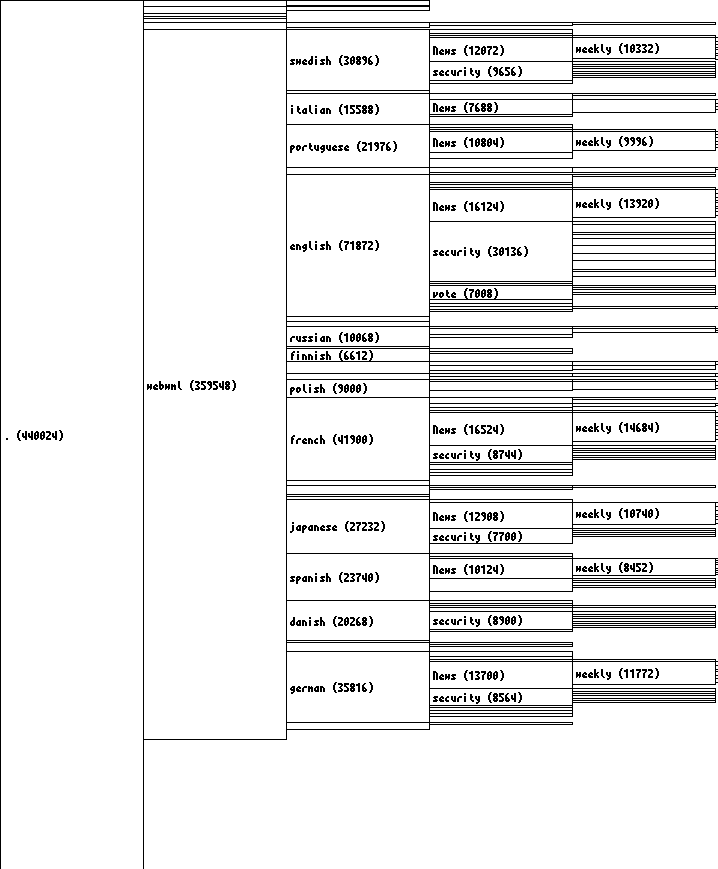
You probably all know du from GNU Coreutils. But there s more than just du around in Debian. du xdu First there is xdu, which displays du output piped into it graphically, even if du is running on some other box with the output coming over an ssh connection:
$ du   xdu
$ ssh server-without-xlibs du some-directory   xdu
Clicking on any directory except the topmost zooms into that directory. Pressing n sorts by size and s toggles the display of sizes in numbers. xdiskusage xdiskusage seems to be a fork of xdu or at least shares some GUI code with it as it looks and behaves quite similar.
But the GUI looks nicer, more modern and you don t need to pipe the output of du into it. It collects the disk usage of a given directory itself. ncdu And then there is ncdu, the ncurses du . (It has nothing to do with the German party CDU . You can easily remember that as Not CDU . ;-) It shows you the disk usage of files and subdirectories in the given directory already sorted by size, optionally displaying also ascii art bars and/or percentage (by pressing g one or more times) for better comparision between file and directory sizes. And all easily and intuitively to navigate in an ncurses text-mode user interface.
ncdu 1.3 ~ Use the arrow keys to navigate, press ? for help
--- /home/abe/debian/webwml ------------------------------------
                             /..
   70.2MB [20.0% ##########] /english
   40.9MB [11.7% #####     ] /french
   35.0MB [10.0% ####      ] /german
   30.2MB [ 8.6% ####      ] /swedish
   26.6MB [ 7.6% ###       ] /japanese
   23.2MB [ 6.6% ###       ] /spanish
   21.5MB [ 6.1% ###       ] /portuguese
   19.8MB [ 5.6% ##        ] /danish
   15.2MB [ 4.3% ##        ] /italian
    9.8MB [ 2.8% #         ] /russian
    8.8MB [ 2.5% #         ] /polish
    6.5MB [ 1.8%           ] /finnish
    5.8MB [ 1.6%           ] /chinese
    4.4MB [ 1.3%           ] /catalan
    4.3MB [ 1.2%           ] /dutch
    3.7MB [ 1.0%           ] /korean
    3.4MB [ 1.0%           ] /ukrainian
    3.0MB [ 0.9%           ] /czech
    2.6MB [ 0.7%           ] /croatian
    2.6MB [ 0.7%           ] /bulgarian
    2.4MB [ 0.7%           ] /norwegian
    1.7MB [ 0.5%           ] /hungarian
    1.6MB [ 0.4%           ] /romanian
    1.2MB [ 0.3%           ] /greek
    1.2MB [ 0.3%           ] /turkish
    1.1MB [ 0.3%           ] /slovak
  576.0kB [ 0.2%           ] /Perl
  556.0kB [ 0.2%           ] /arabic
  428.0kB [ 0.1%           ] /lithuanian
 Total disk usage: 351.1MB  Apparent size: 351.1MB  Items: 70653                                                      
And yes, I uploaded the two screenshots shown above also to screenshots.debian.net as both tools had no screenshots available yet.

Axel Beckert: Useful but Unknown Unix Tools

Most of my talks are either talks about commandline basics (Commandline Helpers about GNU Coreutils and Findutils usage; Understanding Shell Quoting) or collections of small tips and tricks, e.g. about SSH, History Expansion, or commandline tools. Valentin Haenel called this second type of talks nugget talks . I like that term. My newest talk (German only so far, next occasion at the LUGS meeting in Zurich on 16th of December 2010) is such a nugget talk and is about useful but unknown tools. While preparing that talk I noticed that the amount of neat but less known tools I collected for possible inclusion into that talk would be enough for a whole day or so. I noticed that I ll never be able to give a talk about all that stuff. To not letting these tips rot in that file uncommented, I decided that I ll write (more or less) short blog postings about these tools, similar to and inspired by Myon s blog postings about Cool Unix Features as well as the no more existing or at least broken Debian Package of the Day and Debian Package a Day. While Myon mostly posted long-time but still unknown features, my postings will mostly cover useful but unknown packages available in Debian and most debian-derived distributions like grml and Ubuntu. Some postings may also just highlight some features of common tools or packages like e.g. GNU Coreutils. You can subscribe to these tips via RSS or just view all of them in your web browser at http://noone.org/blog/English/Computer/Debian/CoolTools/.

17 November 2010

Daniel Kahn Gillmor: registrars and AAAA glue records

i've been on an IPv6 kick recently, getting dual-stack systems up and working for a bunch of folks.I'd like to make some of these services reachable by IPv6-only clients. this suggests that i need a range of details sorted out, but i think the one piece left for me is the glue records for the nameservice. i use in-bailiwick nameservers for DNS where possible, which means i want mandatory glue records. that is, the primary namserver for example.org is probably something like ns0.example.org, which means that the org nameservers themselves need to store not only the NS record, but an A record that corresponds to the name pointed to by the NS. But for IPv6-only clients that do their own name resolution, i need AAAA glue records, and i haven't yet found a registrar that will push AAAA glue records for the same names as the existing A glue into the org zone. Do you know of a registrar that will do this?I've tried:

dotster
Dotster seems to only allow IPv4 glue to be entered on their Register Nameserver config page (needs a dotster login to see it). They haven't yet yet responded to my query through their support web form about submitting AAAA glue
gandi
gandi at least offers the opportunity to enter AAAA glue, but apparently can't let me have both AAAA and A glue for the same name. A note to their support team got me a response that this is planned for Q1 or Q2 of 2011.
Any suggestions for reasonable registrars that offer this today? Am i being silly in wanting AAAA and A glue for the same names? i note that the root zone and the org zone both offer A and AAAA records for each of their dual-stack nameservers. You can check for yourself:
 dig @a.root-servers.net ns org
 dig @a.root-servers.net ns .
if i don't go for dual records, i could instead use gandi and go with distinct names for the v6 and v4 servers, like this:
;; QUESTION SECTION:
;example.org.				IN	NS
;; AUTHORITY SECTION:
example.org.      172800	IN	NS	a.ns.example.org.
example.org.      172800	IN	NS	b.ns.example.org.
example.org.      172800	IN	NS	c.ns.example.org.
example.org.      172800	IN	NS	d.ns.example.org.
;; ADDITIONAL SECTION:
a.ns.example.org. 172800	IN	A	192.0.2.3
b.ns.example.org. 172800	IN	A	192.0.2.4
c.ns.example.org. 172800	IN	AAAAA	2001:db8::3
d.ns.example.org. 172800	IN	AAAAA	2001:db8::4
But of course what i really want is this:
;; QUESTION SECTION:
;example.org.				IN	NS
;; AUTHORITY SECTION:
example.org.      172800	IN	NS	a.ns.example.org.
example.org.      172800	IN	NS	b.ns.example.org.
;; ADDITIONAL SECTION:
a.ns.example.org. 172800	IN	A	192.0.2.3
a.ns.example.org. 172800	IN	AAAAA	2001:db8::3
b.ns.example.org. 172800	IN	A	192.0.2.4
b.ns.example.org. 172800	IN	AAAAA	2001:db8::4
My concern about this is if some IPv4-only system gets a list like the first one, and decides to use c.ns.example.org or d.ns.example.org, which doesn't have an A record at all. That would be a silly implementation, of course. but uh, we have a lot of silly implementations of things out there.Feedback welcome!Tags: dns, ipv6

Debian News: Debian 6.0 Squeeze Release Update

The Debian Release Team has made a status update on Debian 6.0, Squeeze . They are proud to report that Debian is moving towards the release like a glacier: inevitably and unstoppingly .

Squeeze is almost in its final state: testing of the installer and upgrades are welcome. Once the latest version of the Debian Installer is added, a deep freeze will begin, with minimal changes allowed while the remaining bugs are fixed. Your help is welcome in:

There are two upcoming bug squashing parties you can join: Bern, Switzerland, November 27-28; and Boulogne-Billancourt, France,December 4-5.

Martin Meredith: How bad tech support makes me feel

Dear Lord, please grant me the ability to punch people in the face over standard TCP/IP <script type="text/javascript"> var flattr_wp_ver = '0.9.11'; var flattr_uid = '34168'; var flattr_url = 'http://www.sourceguru.net/bad-tech-support-feel/'; var flattr_btn = 'compact'; var flattr_hide = 0; var flattr_lng = 'en_GB'; var flattr_cat = 'text'; var flattr_tle = 'How bad tech support makes me feel'; var flattr_dsc = ''; var flattr_tag = 'punch,stabby,tech support'; </script> <script src="http://api.flattr.com/button/load.js?v=0.2" type="text/javascript"></script>

Russell Coker: A Mobile Phone for Sysadmin Use

My telco Three have just offered me a deal on getting a new phone a couple of months earlier than my contract was supposed to expire, presumably they have some competition and want to get me locked into another 2 year contract a couple of months before anyone else has the chance.My current phone is a LG U990 Viewty [1] which I am reasonably happy with for the regular phone and camera functionality (apart from it being too slow to take a photo), it s on a $29 per month plan. I also have a 3G modem which is on a $15 per month plan for 1G of data per month for a total cost of $44 per month. As new phones have advanced client functionality (ssh, IMAP, etc) and have Wifi support for providing net access to a laptop there seems to be less need to have a separate phone and modem. So I am considering getting a high-end phone to replace the phone and modem, so while I don t want to pay a lot more than I currently pay, a $49 contract would be quite affordable and a $59 contract is something I can consider.What I need is a system with a good ssh client implementation, a high resolution screen (800*480 or better), preferably a slide out keyboard and an option to use a Bluetooth keyboard.The best option for the OS seems to be Android as it s based on Linux, it s moderately open, and it has a good range of applications. The Nokia N900 has been recommended based on features but a friend had a bad experience with a N900 that broke and didn t get good warranty support. Also the N900 doesn t have a digital compass (so can t do augmented reality). While I m primarily buying a phone for making phone calls, using the net, and being a ssh client I want to be able to do cool things like do Google searches on things that I photograph and have an annotated star map when I point my phone at the sky. Also as I m not using Windows or Apple phones for obvious reasons that leaves Android phones as the only suitable phones that are on offer from my Telco.I have checked some options for buying a grey-market phone, given that I need to get a more expensive phone contract to have the voice and data access I need the cost of buying a grey-market phone and having a no-phone contract would be unreasonable. So selecting a phone that s on offer by Three/Vodaphone seems to be the best option. Moving to another telco would be inconvenient as I would have to convince the relatives that I call often to switch as well (I get free calls to other Three/Vodaphone customers).I previously listed some phones that seemed good without regard as to where I could buy them [2] and some people wrote some really interesting and informative comments (thanks a lot!). But after considering all the options it seems that the costs of the various options force me to choose something that Three offers.Currently the best option from Three for an Android phone seems to be the HTC Desire HD [3]. It has a 800*480 screen, an 8MP camera with face-detection and geo-tagging, wifi, an accelerometer, GPS, and a digital compass. It also runs Android 2.2 (the latest release). Generally it has everything I want apart from a slide-out keyboard. It seems that Bluetooth keyboards are about $100 each, so I could buy such a keyboard and have options of taking just the phone, the phone and keyboard, or phone and laptop depending on how much I can carry and what I expect to be doing.Three PricesThe Desire HD is free on a $59 plan, or costs $15 per month on the $29 plan. So for $44 per month (the same as what I spend now) I can get a Desire HD! The down-side is that the $29 plan only allows 200MB of data per month and has an excess data fee of $0.50 per meg. My average usage has been about 300MB per month, I could reduce this a bit but I do occasionally have a month where I need a lot of data transfer. For an extra $8 per month I can get an additional 500MB of data transfer. That would give me a total cost of $52 per month for my phone, and I could get the same phone for my wife for $44 per month (I doubt that she would use the 200MB of data included). That would take a typical Three bill from $73 to $96.I might just wait a few months. The Viewty and 3G modem combination is working reasonably well, presumably there will be some better deals if I wait a while. At least now after considering all the options I could find and determining that a Desire HD from Three is the best option for me I can now evaluate any new options by comparing them to that.

Andrew Pollock: [tech] More research into the Boxee Box

I received a few emails from my blog post about my MythTV dilemma. Suggestions ranged from using VGA to DVI to HDMI adapters, to getting different TVs that still have VGA connectors, to getting an older NVIDIA card off eBay that has lower power requirements. Firstly, VGA is dead. It's time to make the move. I don't think VGA for a TV the size I'm looking at is ideal for HD anyway. I'm pretty much fixated on the Sony TV as well, because I want to get Google TV. So I need HDMI. Similarly, I suspect that the picture quality of something run through a VGA to HDMI conversion will be similarly shite, so I'm not too keen on that option, although it would tide me over initially, so I'll look into that further. Another suggestion was the fit-PC2, which was something I was already aware of, but I'd heard terrible things about the general Linux support for the graphics adapter. I did some more research into the Boxee Box, (it really is new, it's only been out for 6 days) and it appears to have the same video chipset as the fit-PC2, which seems rather unfortunate. But then, if the Boxee Box is running Linux, then they've obviously got a driver, so the question is how easy is it to transplant this driver from the Boxee distro to, say, Debian? I'm curious enough to place an order soon. Anyone got any interesting Poulsbo-on-Linux war stories they want to share? I know it makes Matthew Garrett sad.

16 November 2010

Simon Josefsson: GNU SASL with SCRAM-SHA-1-PLUS

I have finished the SCRAM implementation in GNU SASL. The remaining feature to be added were support for the enhanced SCRAM-SHA-1-PLUS variant instead of just the normal SCRAM-SHA-1 mechanism. The difference is that the latter supports channel bindings to TLS, which makes it possible to detect man-in-the-middle attacks even if TLS is not used with server authentication. In GnuTLS we recently added an API for applications to extract channel bindings, which you will need to use in order to use SCRAM-SHA-1-PLUS. I announced the experimental version 1.5.4 release together with a writeup on how to test it. With this, our support for SCRAM should be complete.

Next.

Previous.