Search Results: "ed"

25 November 2010

Cyril Brulebois: Debian XSF News

Since people seem to like it, I ll be trying to publish some news about ongoing work on the XSF side, on a (possibly) regular basis. Let s have a look at what happened since last time I blogged about X in Debian, mostly by checking what appeared in my =debian-x mailbox. Debian XSF News #1 What are the XSF plans?

Stefano Zacchiroli: h-index spoofing

Next time you are asked your h-index ... Next time you are asked your h-index, I suggest replying by pointing to related work by Ike Antkare [1].
[1] Ike Antkare. Ike Antkare one of the great stars in the scientific firmament.
April, 2010.
http://membres-lig.imag.fr/labbe/Publi/IkeAntkareSub.pdf,
retrieved November 25th, 2010.
Although some people still don't get it, the bottom line is always the same: you can't rely on a fully automatic method to evaluate intelligent entities which are aware of the evaluation method, as they are very likely to adapt to it. This is even more so when the automatic method relies on a data source which is not under the control of the evaluator(s). Thanks to Lucas for sharing the bibliography entry.

Robert Millan: Re: The Freaky Wall

Heya Sergio Your blog doesn t allow comments :-( so I reply here. First off, thanks for being one of the first Debian developers in trying out my modified installer with ZFS support, you guys made my day! Some quick notes on the bugs you found: The missing //@ prefix bug is #600578, fixed in upstream, in sid and in squeeze. Thanks :-) The boot partition stays in /target/boot in final install bug is not in BTS. It was present in a preliminar version of partman-zfs which was never uploaded. The version currently in the archive correctly uses altroot option to fix this. The /lib/modules is needed for boot problem was reported as #600568, but I haven t been able to persuade the kFreeBSD maintainers that this is necessary. It s not critical anyway. Glad you finally got a working setup.

Raphaël Hertzog: People behind Debian: Colin Watson, the tireless man-db maintainer and a debian-installer developer

Colin Watson is not a high-profile Debian figure, you rarely see him on mailing lists but he cares a lot about Debian and you will see him on Debconf videos sharing many thoughtful comments. I have the pleasure to work with him on dpkg as he maintains the package in Ubuntu, but he does a lot of more interesting things. I also took the opportunity to ask some Ubuntu specific questions since he s worked for Canonical since the start. Read on. My questions are in bold, the rest is by Colin. Who are you? Hi. I m 32 years old, grew up in Belfast in Northern Ireland, but have been living in Cambridge, England, since I was 18. I m married with a stepson and a daughter. I became interested in Debian due to the critical mass of Debian work happening in Cambridge at the time (and perhaps more immediately because my roommate was running Debian: hey, what s that? ), started doing random bits of development in 2000, and joined as a developer in 2001 (a really exciting time, with lots of new people joining who became integral parts of the project). I d only really been intending to do QA work and various bits of packaging around the edges, and maybe some work on the BTS, but then Fabrizio Polacco died and I took over man-db from him, and it sort of snowballed from there. I graduated from university shortly before becoming a Debian developer. I worked for a web server company (Zeus), then a hardware cryptography company (nCipher), before moving to work for Canonical in 2004, since when I ve been working full-time on Ubuntu. By this point, I suspect that going back to work in an office every day would be pretty tough. What s your biggest achievement within Debian or Ubuntu? One thing I should say: I rarely start projects. Firstly I don t think I m very good at it, and secondly I much prefer coming on to an existing project and worrying away at all the broken bits, often after other people have got bored and wandered off to the next new and shiny thing. That s probably why I ended up in the GNU/Linux distribution world in the first place, rather than doing lots of upstream development from the start I like being able to polish things into a finished product that we can give to end users. So, I ve had my fingers in a lot of pies over the years, doing ongoing maintenance and fixing lots of bugs. I think the single project I m most proud of would have to be my work on the Debian installer. I joined that team in early 2004 (a few months before Canonical started up) partly because I was a release assistant at the time and it was an obvious hot-spot, and partly because I thought it d be a good idea to make sure it worked well on the shiny new G4 PowerBook I d just treated myself to. I ended up as one of the powerpc d-i port maintainers for a while (no longer, as that machine is dead), but I ve done a lot of core work as well: much of the work to put progress bars in front of absolutely everything that used to have piles of text output, rescue mode, the current kernel selection framework, a good deal of udev support, several significant debconf extensions, lots of os-prober work, and I think I can claim to be one of the few people who understands the partitioner almost top to bottom. :-) d-i is the very first thing many of our users see, and has a huge range of uses, from simple desktop installs to massive corporate deployments; it s unspeakably important that it works well, and it s a testament to its design that it s been able to trundle along without actually very much serious refactoring for the best part of five years now. I have a soft spot for man-db too. It was my first major project in Debian, starting out from an embarrassingly broken state, and is now nice and stable to the point where I recently had time to spawn a useful generic library out of it (libpipeline). What are your plans for Debian Wheezy? d-i has a lot of code to deal with disks and partitions. Of course a lot of it is in the partitioner, and for that we use libparted so we don t have to worry very much about the minutiae of device naming. But there are several other cases where we do need to care about naming, mainly before the partitioner when detecting disks, and after the partitioner when installing the boot loader. Back in etch, we introduced list-devices , which abstracted away the disk naming assumptions involved in hardware detection. In wheezy, I would like to take all the messy, duplicated, and error-prone code that handles disk naming in the boot loader installers, and design a simple interface to cover all of them. This has only got more important following the addition of the kFreeBSD and Hurd d-i ports in squeeze, but it bites us every time we notice that, say, CCISS arrays aren t handled consistently, and it s a pain to test all that duplicated code. I d also like to spread the use of libpipeline through C programs in the archive, which I think has potential to eliminate a class of security vulnerabilities in a much simpler way than was previously available. If you could spend all your time on Debian, what would you work on? I would love to systematically reduce the need for the current mass of boot loaders. There s a significant cost to having so much variation across architectures here: it s work that needs to be done in N different places, the wildly differing configuration means that d-i has to have huge piles of code to manage them all differently, and there are a bunch of strange arbitrary limitations on what you can do. The reason I m working on GRUB 2 is that, in my view, it s the project with the best chance of centralising all this duplicated work into a single place, and making it easier to bring up new hardware in future (in a way that doesn t compromise software freedom, as many proprietary boot loaders of the kind often found on phones do). Of course, with flexibility tends to come complexity, and some people have a natural objection to that and prefer something simpler. The things I don t quite have time to do here are to figure out a coherent way to address the specific over-complexity problems people have with the configuration framework while still keeping the flexibility we need, and to do enough QA and porting work to be able to roll out GRUB 2 at installation time to all the Debian architectures it theoretically supports. What s the biggest problem of Debian? Backbiting, and too much playing the man rather than the ball. With one or two honourable exceptions, I ve largely stopped reading most Debian mailing lists since it just never seems a productive way to spend time compared to writing code and fixing bugs; and yet I m conscious that they re one of the primary means of communication for the project and I m derelict in not taking part in them. I do find it a bit frustrating that people are seen primarily in terms of their affiliations. I suppose it s natural for people to see me as an Ubuntu guy , but I don t really see myself that way: I ve been working on Debian for nearly twice as long as I ve been working on Ubuntu, and, while I care a great deal about both projects, I ve put far more of my own personal time into Debian and I try to make sure that a decent number of the things I m involved with there aren t to do with work. Work/life separation is a good thing, not that I m very good at it. Generally speaking, when I m working on Debian, I m doing so as a Debian developer, because I want Debian to be better. When that s not the case, if it matters, I try to indicate it explicitly. You re working for Canonical since Ubuntu s inception. If you were Mark Shuttleworth, is there something that you would have done differently? We had many good intentions when we founded Ubuntu. We also had a huge amount of work to deliver, to the point where it wasn t at all clear whether it would be possible (the warty release was named based on the expectations of it, after all, and came out much more usable than we d dared to hope). In hindsight, it might have helped to be quieter about our good intentions, so that we could exceed expectations rather than in some cases failing to meet them. That might have set a very different tone early on. (Personally, I m happy I m not Mark. The decisions in my office are much easier to take.) It seems to me that the community part of Ubuntu is much more eager to cooperate with Debian than the corporate part. It s probably just that more and more Canonical employees are not former Debian contributors. Do you also have this feeling? Are there processes in place to ensure everybody at Canonical is trying to do the right thing towards Debian cooperation? Just to be clear, I m wearing my own hat here which, ironically, is a fedora rather than a company hat. It makes sense for Canonical to be taking on more non-Debian folks; after all, we can t simply hire from the Debian community forever, and a variety of backgrounds is healthy. As you say, it may well be natural that Ubuntu developers who don t work for Canonical are more likely to have a Debianish background, as it tends to take something significant to get people to switch to a very different family of GNU/Linux distributions, and changing jobs is one of the most obvious of those things. Certainly, there was a definite sense among the early developers that we were all part of the Debian family and cared about the success of Debian as well. As Ubuntu has developed its own identity, people involved in it now tend to care primarily about the success of Ubuntu. At the same time, pragmatically, it s still true that getting code changes into Debian is one of the most economical ways to land them; changes made in Debian or upstream land once and tend to stay in place, while changes made only in Ubuntu incur an ongoing merge overhead, which is not at all trivial. In many ways it s human nature to try to fulfil your immediate goals in the most direct way possible. If your goal is to deliver changes to Ubuntu users, then it s natural to concentrate on that rather than looking at the bigger picture (which takes experience). Debian developers often fail to send changes upstream for much the same reason, although there s more variation there because they re normally working on Debian of their own volition and thus tend to have wider goals; the economics are more or less parallel though. Thus, I think the best way to improve things is to make it the path of least resistance for Ubuntu developers to send changes to Debian. We re already seeing how this works with the Ubuntu MOTU group; if you send a patch for review, or work on merging a package from Debian, very often the response includes have you sent these changes to Debian? . We re working on both streamlining our code review through a regular patch pilot programme and requiring more code review for changes in general, so I think this will be a good opportunity to ask more people to work with Debian when they propose changes to Ubuntu. For myself, this may be obvious, but I notice that I m much better at getting changes into Debian when I already have commit access to the Debian package in question. All the work on improving collaborative maintenance in Debian can only help, for Ubuntu as well as for everyone else. It doesn t make so much difference for large changes that require extensive discussion, but there are lots of small changes too. Canonical is upstream of many software projects (unity, indicators infrastructure, etc.). Why aren t those software immediately packaged in Debian? Do you think we can get this to change? I m not sure what the right approach is here, particularly as I haven t been involved with much of that on the Ubuntu side. I suspect it would be helpful to look at this in a similar way to Ubuntu changes in general. It s understandable that those developers have getting changes into Ubuntu as their first goal. And yet, having code in Debian offers a wider, and often technically adept, audience, and most developers like having their code reach a wider audience even if it s not their first priority, particularly if that audience is likely to be able to help with finding problems and fixing bugs. It should be seen as something beneficial to both distributions. The hardest problems will be with things that aren t merely optional add-ons (which should generally be fairly non-controversial in Debian, given the breadth of the archive in general the existence of things like bzr and germinate as Debian packages was never a hard question), but which require changes in established packages. For example, gnome-power-manager in Ubuntu is built with application indicator support, and that s an important part of having a good indicator-based panel: a lot of the point of indicators is consistency. Since I do very little desktop work myself, I don t know exactly what would be involved in making it possible to choose this system based on a Debian desktop, but I think it s probably a bit more complicated than just making sure all the new packages exist in Debian too. Obviously you have to start somewhere. Is there someone in Debian that you admire for his contributions? Christian Perrier is absolutely tireless and has done superb things for the state of translations in Debian. And Russ Allbery, even aside from his fine ongoing work on policy, Lintian, and Kerberos, is a constant voice of sanity and calmness. Release management is incredibly hard work, as I know from my own experience, and anyone who can sustain involvement in it for a long period is somebody pretty special. Steve Langasek and I got involved at about the same time but he outlasted me by quite a few years. He deserves some kind of medal for everything he s done there.
Thank you to Colin for the time spent answering my questions. I hope you enjoyed reading his answers as I did. Subscribe to my newsletter to get my monthly summary of the Debian/Ubuntu news and to not miss further interviews. You can also follow along on Identi.ca, Twitter and Facebook.

11 comments Liked this article? Click here. My blog is Flattr-enabled.

Russell Coker: The Wikireader

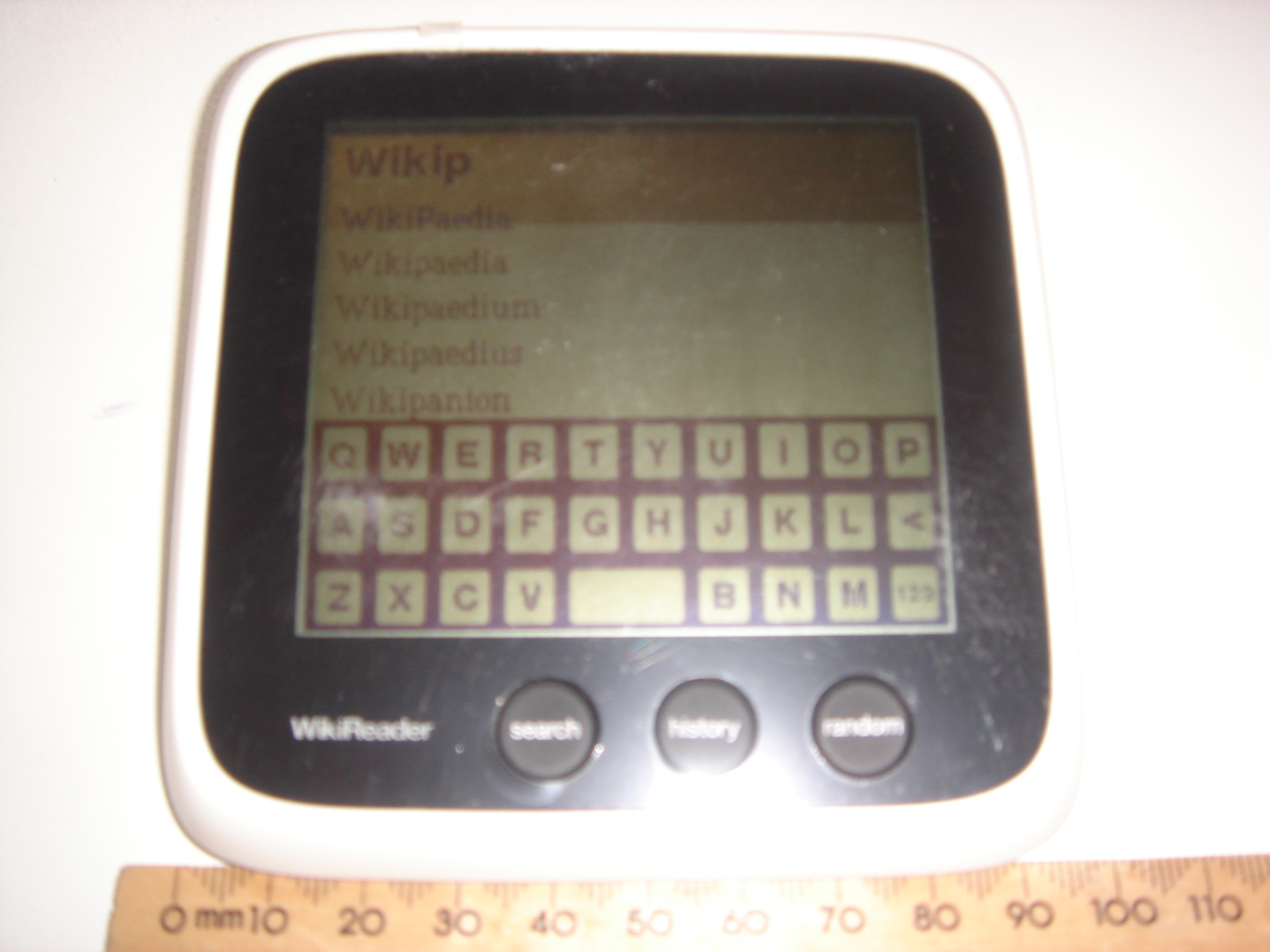
Just over a month ago I bought a Wikireader [1] from Officeworks (an Australian chain of stores that sell all manner of office supplies). It cost only $99, thanks to Brianna for informing me about this [2]. When I purchased my Wikireader an Officeworks employee had to get one from the back office and told me that I was the first person to buy one. I suggested to him that when a product isn t mentioned in their advertising and isn t put on the shelves it s unlikely to sell in quantity and that they shouldn t rely on bloggers to promote what is possibly one of the most desirable products that they stock.The Wikireader stores a copy of the text of the English language version of Wikipedia on a micro-SD card. They have a service whereby you can get two updates posted to you every year for $29, which would make it pretty close to free once postage and the cost of the micro-SD cards is taken into account. Also you can download new content. I have no immediate plans for updating my Wikireader as the content is more than good enough to answer idle questions while waiting for a bus but as it s lacking external links due to no net access and images it can t be used for serious Wiki reading IMHO.Brianna has documented the process of updating a Wikireader to add more content [3], she added the Chinese version and discovered that inter-wiki links are preserved! I have no immediate plans to add extra content (I don t know any other language well enough to read an encyclopaedia). Also an 8GB MicroSD card (which is the minimum requirement to use multiple languages) costs $35 and is a significant portion of the original purchase price.In terms of functionality the device is pretty good. The screen is not back-lit, but if it was then the two AA batteries wouldn t last anywhere near a year. The screen is not high resolution and the touch functionality isn t particularly accurate or sensitive but I guess that s a necessary trade-off to get the $99 price. The Wikipedia content seems quite complete, so far the only page which I found to be missing was the bio of an Australian architect, I m not sure if his page was removed from the Wikireader to save space or whether my device has a snapshot that predates the addition of the page.The Wikipedia page about downloading the database is interesting [4], it s 6GB of compressed data for the text of the English pages (not including history or talk pages) and for years they haven t even tried to provide a dump of the images. So I guess that a Wikireader that displays pictures is out of the question.The Wikireader has a parental filter, in my quick tests the only page that has been blocked is Sexual Intercourse , I could read all about safe-sex, infidelity, and lots of other related adult topics without being asked for a password. It also shows pages about goatse and other related things without asking for a password NB if you don t know what goatse is then you probably don t want to learn, trust me that it s something that most people won t want their children to learn about. The filter is so bad that I think they shouldn t include it, it will just give people false confidence. It s OK to sell a cheap device that is designed to give a detailed description of goatse etc on request to anyone, but IMHO it s not OK to sell such a device with a claim that it is kid safe and has parental controls . Note that holding down the History button will allow you to clear your history this is useful if you have just verified that goatse isn t blocked and you want to give the device to a young child.There is a button to give a random page, I believe that this would be more useful if it had some metric to make it more often return pages that might be interesting. It could weight the randomness by the length of the page (usually a longer page is more interesting to more people and has more links to other pages) or by some other metric that indicates the potential popularity. Random links often get me pages about obscure country towns and other things that probably aren t of interest to people who don t live near them.But overall this is a great product, $99 is not much to pay, and I recommend getting one!

24 November 2010

Sergio Talens-Oliag: The Freaky Wall (Part 2: Initial Installation)

For the Freaky Wall I have installed a Debian GNU/kFreeBSD system using the installer with ZFS support announced on: http://robertmh.wordpress.com/2010/09/06/debian-installer-with-zfs/ I used the mini.iso found on: http://people.debian.org/~rmh/zfs/kfreebsd-amd64/monolithic/mini.iso the 12th of October of 2010; as I had some problems and reported them to Robert is possible that the current image solves part of them. Installation plan I did a standard installation on a machine with two hard disks, but only used the first one from the installer. The plan was to use ZFS with RAID-1, but current versions of grub do not support booting from a ZFS + RAID file system, so I had to use the same technique used for Linux for a long time; three partitions: a swap partition, a small /boot partition and a big partition for /; / and /boot were formated to use ZFS. First reboot After the installation the system failed to boot because of a bug when building the /boot/grub/grub.cfg (some routes were missing a //@ prefix); to be able to boot Iwe edited the config on the grub prompt and later fixed the file:

    --- grub.cfg.orig       2010-10-13 16:40:39.000000000 +0200
    +++ grub.cfg    2010-10-13 18:38:47.535436766 +0200
    @@ -64,7 +64,7 @@
            set root='(hd0,1)'
            search --no-floppy --fs-uuid --set a371979bb836d1fe
            echo                    'Loading kernel of FreeBSD 8.1-1-amd64 ...'
    -       kfreebsd                /kfreebsd-8.1-1-amd64.gz
    +       kfreebsd                //@/kfreebsd-8.1-1-amd64.gz
            insmod part_msdos
            insmod zfs
            set root='(hd0,3)'
    @@ -75,7 +75,7 @@
            insmod zfs
            set root='(hd0,1)'
            search --no-floppy --fs-uuid --set a371979bb836d1fe
    -       kfreebsd_module         /zfs/zpool.cache type=/boot/zfs/zpool.cache
    +       kfreebsd_module         //@/zfs/zpool.cache type=/boot/zfs/zpool.cache
            set kFreeBSD.vfs.root.mountfrom=zfs:dkfbf1-ad4s3
            set kFreeBSD.vfs.root.mountfrom.options=rw
      
I haven't tested the installer since that day, but I believe that the current ZFS installer was fixed by Robert to deal with that problem. Once the system was booted I had to fix a couple of things: Adjusting ZFS to do RAID-1 On the second disk I created the same partitions as the ones on the first disk using parted; the final result was:
    # parted -l     
    Model: ST3250620NS/3BKS (ide)
    Disk /dev/ad6: 250GB
    Sector size (logical/physical): 512B/512B
    Partition Table: msdos
    Number  Start   End     Size    Type     File system  Flags
     1      1049kB  256MB   255MB   primary
     2      256MB   4256MB  4000MB  primary
     3      4256MB  250GB   246GB   primary
    Model: ST3250620NS/3BKS (ide)
    Disk /dev/ad4: 250GB
    Sector size (logical/physical): 512B/512B
    Partition Table: msdos
    Number  Start   End     Size    Type     File system     Flags
      1      1049kB  256MB   255MB   primary
      2      256MB   4256MB  4000MB  primary  linux-swap(v1)
      3      4256MB  250GB   246GB   primary
To use the second partition of both disks as swap I added the following to /etc/fstab:
    /dev/ad4s2      none            swap    sw              0       0
    /dev/ad6s2      none            swap    sw              0       0
To configure the mirroring for the root file system I did the following:
    zpool attach dkfbf1-ad4s3 ad4s3 ad6s3
As the /boot can't work as a replica I adjusted it to make two copies of every file:
    zfs   set copies=2     dkfbf1-ad4s1
Leaving the second disk copy alone, although my plan is to configure it to hold a copy of the /boot partition synchronized with rsync each night. After all those changes the system didn't boot, as the grub-pc generates a buggy /boot/grub/grub.cfg; the problem is on the /etc/grub.d/10_kfreebsd section:
    ### BEGIN /etc/grub.d/10_kfreebsd ###
    menuentry 'Debian GNU/kFreeBSD, with kFreeBSD 8.1-1-amd64' --class debian \
      --class gnu-kfreebsd --class gnu --class os  
          insmod part_msdos
          insmod zfs
          set root='(hd0,1)'
          search --no-floppy --fs-uuid --set a371979bb836d1fe
          echo 'Loading kernel of FreeBSD 8.1-1-amd64 ...'
          kfreebsd /kfreebsd-8.1-1-amd64.gz
          set kFreeBSD.vfs.root.mountfrom=unknown:/dev/ad4s3
          set kFreeBSD.vfs.root.mountfrom.options=rw
     
    ### END /etc/grub.d/10_kfreebsd ###
To fix it there has to be a copy of the modules for ZFS on the boot partition (in my case I moved the /lib/modules directory to /boot and created a link on the root partition to the new directory):
    cd /boot
    mkdir lib
    mv /lib/modules lib
    cd /lib
    ln -s ../boot/lib/modules
And instead of fixing the /etc/grub.d/10_kfreebsd code I wrote a new script (/etc/grub.d/09_zfs_kfreebsd) that creates the right config for my current configuration on the grub.cfg file:
    #!/bin/sh
    prefix=/usr
    exec_prefix=$ prefix 
    bindir=$ exec_prefix /bin
    libdir=$ exec_prefix /lib
    . $ libdir /grub/grub-mkconfig_lib
    prepare_boot_cache="$(prepare_grub_to_access_device $ GRUB_DEVICE_BOOT    sed -e "s/^/\t/")"
    kfreebsd_versions="$(ls /lib/modules/)"
    zfs_root_device="$(zfs list   awk '/\/$/   print $1  '   head -1)"
    for kversion in $kfreebsd_versions; do
      cat << EOF
    # Entry when using ZFS (we have issues with /etc/grub.d/10_kfreebsd)
    menuentry 'Debian GNU/kFreeBSD, with kFreeBSD $kversion and ZFS' --class debian --class gnu-kfreebsd --class gnu --class os  
    $ prepare_boot_cache 
          echo                    'Loading kernel of FreeBSD $kversion ...'
          kfreebsd                //@/kfreebsd-$kversion.gz
          kfreebsd_module_elf     //@/lib/modules/$kversion/opensolaris.ko
          kfreebsd_module_elf     //@/lib/modules/$kversion/zfs.ko
          kfreebsd_module         //@/zfs/zpool.cache type=/boot/zfs/zpool.cache
          set kFreeBSD.vfs.root.mountfrom=zfs:$zfs_root_device
          set kFreeBSD.vfs.root.mountfrom.options=rw
     
    EOF
    done
I solved the problem this way to have a working solution that does not break with squeeze upgrades, assuming that a future grub-pc package will deal well with my config and I'll be able to remove this script, but I guess I'll have to install it from backports. The entry generated by the script when called from update-grub will be similar to:
    ### BEGIN /etc/grub.d/09_zfs-kfreebsd ###
    # Entry when using ZFS (we have issues with /etc/grub.d/10_kfreebsd)
    menuentry 'Debian GNU/kFreeBSD, with kFreeBSD 8.1-1-amd64 @ ITI' --class debian --class gnu-kfreebsd --class gnu --class os  
          insmod part_msdos
          insmod zfs
          set root='(hd0,1)'
          search --no-floppy --fs-uuid --set a371979bb836d1fe
          echo                    'Loading kernel of FreeBSD 8.1-1-amd64 ...'
          kfreebsd                //@/kfreebsd-8.1-1-amd64.gz
          kfreebsd_module_elf     //@/lib/modules/8.1-1-amd64/opensolaris.ko
          kfreebsd_module_elf     //@/lib/modules/8.1-1-amd64/zfs.ko
          kfreebsd_module         //@/zfs/zpool.cache type=/boot/zfs/zpool.cache
          set kFreeBSD.vfs.root.mountfrom=zfs:dkfbf1-ad4s3
          set kFreeBSD.vfs.root.mountfrom.options=rw
     
    ### END /etc/grub.d/10_iti-kfreebsd ###
And after rebooting the machine with this new configuration the system boots OK. On my next post I'll continue explaining how to compile a kernel that supports the use of the OpenBSD Packet Filter and related technologies (CARP, pflog, etc.).

Jelmer Vernooij: On the way to Samba 4

After Samba XP 2008 Andrew and I started keeping a wiki page with our bi-weekly goals and achievements for Samba 4. Because planning in a Free Software project is hard (time availability and priorities change over time, and other volunteers are equally unpredictable) we called this our "Fantasy page"; it listed things we wanted to work on next ("fantasies"), but reality being what it is we would usually actually end up working on something entirely different. We discussed our progress and new plans in - what I would now call - a bi-weekly standup call. There were several reasons for doing this. It gave us some sense of direction as well as a sense of accomplishment; a way to look back at the end of the year and realize how much we had actually achieved. Because Samba 4 is such a long term project (it is 7 years old at this point) it is easy to become disillusioned, to look back at a year of commits and to not see the gradual improvement, just the fact that there is no release yet. We managed to keep this up for two years, much longer than I had anticipated, and eventually started to slip last year. More recently Kai and Tridge have started to blog weekly about their efforts to make Samba 4.0 a reality and I'm going to join them by trying to blog regularly - every two weeks - about my contributions, even if there were none. In the next two weeks I plan to work on finally getting alpha 14 of Samba 4 out and on fixing the daily builds of Samba 4 and OpenChange for Ubuntu on Launchpad after we did a massive reorganization of the private libraries in Samba 4. cp: Zero 7 - Somersault

Axel Beckert: Useful but Unknown Unix Tools: cut

Just recently someone asked on #debian.de how to extract the 3rd to 8th character out of some string. That reminded me that the GNU Coreutils tool cut is also quite unknown. The solution to his problem is:
$ echo Hurzlipuh   cut -c3-8
rzlipu
My favourite usage of cut is to restrict the output of programs which can t do that themselves to 80 columns (common terminal width):
$ dpkg -l   grep -i macro   cut -c-80
ii  docbook-to-man                                       1:2.0.0-28             
ii  latex-cjk-common                                     4.8.2+git20090105-5    
ii  m4                                                   1.4.14-3               
ii  mp4h                                                 1.3.1-5                
rc  swfdec-gnome                                         2.28.0-1               
cut can cut out columns based on characters (-c), bytes (-b), fields (-f) delimited by tab (or the delimiter given by -d). After many comments: Yes, dpkg -l is capable of restricting and even fitting its output to the number of available columns if $COLUMNS is passed as environment variable. (And $COLUMNS is set by default in the shell, but not exported as environment variable as it may change on terminal resize or WINCH signal.)

Tim Retout: The Archers website

For those who are not aware, The Archers is a soap opera about rural life, broadcast on BBC Radio 4. Its website has recently been revamped. Unfortunately, I appear to be served the mobile version when I visit the front page (in all of Chromium, Iceweasel and Epiphany on Debian - admittedly not the most mainstream of browsers). BBC Mobile is doing some over-zealous useragent sniffing, it seems. Also amusing: there's a "Who's Who" database of Archers characters, and several of them share the birthday "1st Jan 1970". There was I thinking that Harry Mason and Fallon Rogers had a 15 year age gap... but no. This will be as a result of the underlying database storing values in Unix time, and having a default value of "0". An explanation of Unix time popped up in an episode of The Infinite Monkey Cage the other week, which was nice to hear.

Jonathan Wiltshire: Shibboleet

Boy, I wish that word worked. Today I had cause to email O2, the local Telefonica outpost, to have them disassociate my phone from the Cloud hotspot network, to which I get a subscription with my contract. This is so that I can associate my new Desire Z instead. I explained that I can connect to the AP, but when I enter my phone number to associate it is refused. Their considered response to this request was as follows:
As you re using a Palm Pre, I d request you to switch on Palm Pre by following the steps provided below
Of course, I m so silly I forgot to switch the phone on! Any suggestions for a UK SIM-only provider with a clue (and optionally including free use of Cloud hotspots)?
Comments flattr this!

Alexander Wirt: Cool things with grub2 and syslinux - booting floppy and iso images

From time to time I have to boot an iso or even a floppy. Unfortunately my X200 doesn't have a CD-Rom or a Floppy. Grub isn't able to boot isos and floppy images on its own, thats the point where syslinux comes into play: from version 4.x the syslinux memdisk driver is able to boot most iso and floppy images. The syslinux wiki has some details about the supported image types. Yesterday I had to boot an iso image and instead of editing grub.cfg by hand I decided to create a snippet for grub.d to automate things. If you drop an .iso or an .img into the IMAGES path and run update-grub2 afterwards you get a nice boot entry that boots the floppy or iso image. The only thing you have to do is to install syslinux and copy /usr/lib/syslinux/memdisk to /boot. And here it comes:
#!/bin/sh
set -e
IMAGES=/boot/images
. /usr/lib/grub/grub-mkconfig_lib
if test -e /boot/memdisk ; then
    MEMDISKPATH=$( make_system_path_relative_to_its_root "/boot/memdisk" )
    echo "Found memdisk: $MEMDISKPATH" >&2
    find $IMAGES -name "*.iso" -o -name '*.img'   sort   
    while read image ; do
        IMAGEPATH=$( make_system_path_relative_to_its_root "$image" )
        case "$image" in
            *.iso)
                echo "Found iso image: $IMAGEPATH" >&2
                cat << EOF
menuentry "Bootable ISO Image: $(basename $IMAGEPATH   sed s/.img//)"  
EOF
                prepare_grub_to_access_device $ GRUB_DEVICE_BOOT    sed -e "s/^/\t/"
                cat << EOF
    linux16 $MEMDISKPATH iso
    initrd16 $IMAGEPATH
 
EOF
                ;;
            *.img)
                echo "Found floppy image: $IMAGEPATH" >&2
                cat << EOF
menuentry "Bootable Floppy Image: $(basename $IMAGEPATH   sed s/.img//)"  
EOF
                prepare_grub_to_access_device $ GRUB_DEVICE_BOOT    sed -e "s/^/\t/"
                cat << EOF
    linux16 $MEMDISKPATH raw
    initrd16 $IMAGEPATH
 
EOF
                ;;
        esac
    done
fi
P.S. I got the idea and some code snippets from several blog and wiki entries in the net and just added the iso part, so thats not all my code :)

Stefano Zacchiroli: GNOME Awesome Applet

using GNOME with Awesome without die trying I'm an avid GNOME user, but I don't want to give up tiling due to that. After 1.5 years with xmonad+GNOME, I've decided it was about time to give Awesome another try. Last time I tried, integration with GNOME was really sub-optimal; in particular I've been it by the showstopping (for me) issue that it was not possible, back then, to disable Awesome systray in favor of GNOME's. Nowadays, GNOME+Awesome integration is much better. It's very easy to disable all you don't want of Awesome (including systray) to rely upon corresponding GNOME desktop components (check my rc.lua for an example). Still, by renouncing Wibox in favor of GNOME Panel, you (used to) lack some features: (1) the ability to monitor the current layout, (2) (GNOME) run application prompt, and (3) Lua code prompt. It is to overcome these limitations that I've hacked GNOME Awesome Applet. Version 0.1.0 is now available for download from the homepage. It's beta-quality and it's the first (hopefully last?) GNOME Applet I've ever written, you know the drill. Feedback, bug reports, features requests, and code patches are more than welcome. Enjoy!

Julien Blache: OFED 1.5.2 for Debian

A few weeks ago, I ve been busy at work updating the OFED packaging for OFED 1.5.2. We needed a version of the stack newer than what s (partially) available in Squeeze. As this has now been tested, we are all happy to contribute this work to Debian, courtesy of my customer, EDF. This morning, I ve pushed out packages for OFED 1.5.2 to the pkg-ofed SVN repository on Alioth. The packages should be made available in experimental at some point too, though a number of them will have to go through NEW. With this update, I ve cleaned up & updated the packaging where needed and also made two important changes that I need to highlight: A number of libraries have changed their interfaces and bumped their soversions. libibcommon is gone, it has been folded into libibumad. The API/ABI between libibverbs and the IB driver modules has changed, so the new libibverbs comes with appropriate Breaks in place. Thanks to Beno t Mortier from pkg-ofed for his 2-day IB & OFED crash course that was instrumental in getting started with the OFED maze.

Matthew Garrett: Viewsonic and the GPL

Somebody linked me to this reddit story about the fact that Viewsonic appear to be engaging in the currently fashionable trend of shipping Android devices without providing any source. This one's more interesting though, in that Viewsonic appear to be entirely happy to publicly state that they have no intention of following their license obligations. I've pulled the kernel image for the device and confirmed that it contains code that's not present in the generic Android Tegra tree, so I don't think they have a leg to stand on here.

So of the companies I'm currently complaining about (Fusion Garage, Barnes and Noble, Viewsonic): One is in Singapore and two are based in the US. Chinese companies may be the current easy target when it comes to complaining about GPL violations, but the truth is that companies in countries with stronger IP enforcement are also either blissfully ignorant or feel that the risk of failing to follow their license obligations is low. This isn't a sustainable position. We've got three real choices here - do nothing, start lawsuits or start educating companies. The third is probably the most productive in the long run, though I wouldn't absolutely rule out the second if we don't get anywhere. I'm currently exploring the education possibilities. We'll see what happens next.

23 November 2010

Matthew Garrett: Barnes and Noble response

<quote>"We are working on consolidating and will be distributing the open sourcecode in the coming weeks."</quote>

So, Barnes and Noble's release process doesn't include them ensuring that they have the source code that they're legally obliged to be able to provide to customers - even after they'd screwed this up once before. Their negligence leaves them open to potential litigation[1], so if you're a shareholder you probably ought to be asking questions about their corporate responsibility.

[1] No, I don't plan to sue them

Russell Coker: Links November 2010

Guy Deutscher wrote an interesting article for the New York Times about how language shapes how we think [1]. The example of people who have no language construct for self-sentered directions and how they describe things is particularly interesting.TED published an interesting interview with Shaffi Mather the founder of India s first organised ambulance service (with differential pricing based on ability to pay) [2]. He also talks about founding schools in small towns and his BribeBusters.com company.World Changing has an interesting article about a legislative change in California that allows car-sharing of personal vehicles [3]. The concept is that if you own a car that you don t use most of the time (as is usually the case) then you can contract with a car-share company to share it to others when you don t need it. This saves the car share company from the capital expense of owning cars and thus allows them to place cars in remote locations that wouldn t otherwise be financially viable (IE the street in front of random people who sign up). The person who owns the car may get about $2 per hour for the time when it s rented. The car owner gets to specify when the car may be available.Charles Stross wrote an entertaining and informative rant about Steam-Punk [4]. He cites Michael Moorcock s informative essay about Starship Troopers and other right-wing apologist themes in sci-fi [5] as well as China Mieville s essay about politics and The Lord of the Rings [6].Glenn Greenwald wrote an informative article about the New York Times defending torture by the US military [7]. I have unsubscrubed from the @Times mailout and will avoid citing NYT articles wherever possible. I sent the URL for Glenn s article to the NYT feedback address but I don t expect them to take any notice.Fate Of the World is a new computer game that s in beta where you have a simulation of the next 200 years of climate change [8]. It s currently in beta for Windows only, they hope to have a Mac version in March and have no stated plans for Linux support.Cory Doctorow wrote an interesting article for Locus about Sci-Fi fans and cosmopolitanism taking the best option after consideration rather than doing what s locally fashionable [9]. He uses the term Martian to refer to some of the viewpoints, but it seems to me that Vulcan would be more appropriate.The Wall St Journal has an interesting article about people who manufacture drugs that aren t yet illegal, every time one drug gets banned they market a new one [10]. This is yet another example of the War on Drugs doing more harm than good, instead of taking drugs which have well known effects (that can be treated by hospitals) people are taking weird new drugs and no-one knows what will happen to them.Mieke Meijer in the Netherlands has invented a new product known as newspaper wood [11], it involves gluing paper together to create a form of chip-board that keeps the layers of paper distinct to give a result like wood grain. The World Changing commentary suggests that this could give a heirloom quality to objects made with it, while I m dubious about that I think that the surface would be pleasing to look at in a kitchen or office environment.Ze Frank gave an interesting TED talk about unusual social projects that he s run on the Internet [12]. This includes an attempt to reconcile Red and Blue voters after the 2008 US presidential election, the creation of inspirational songs, and remixing the Whip Somebody s Ass song. This is really worth watching!The Chronicle Review has an interesting article by someone who is paid to complete academic assignments for other people [13]. The scope of cheating that is claimed is profound. Naturally we have to take claims by someone who admits acting unethically with a grain of salt, but if there is any truth to this then it s a serious matter. I m surprised that no-one has made a serious attempt to catch the customers of such people.David Brin (the famous sci-fi author) gave an interesting short lecture about the future of humanity [14]. He promotes the Lifeboat Foundation (of which he is a director) and describes his concern about the Fermi Paradox.Shimon Schocken gave an inspiring TED talk about his work rehabilitating juvenile prisoners through taking them mountain-bike riding [15]. This shows that anyone can do great things to help other people, he got this idea when riding past a prison, convinced the prison governor that it was a good idea and then started doing it.Conrad Wolfram gave an insightful TED talk about math education [16]. His claim is that the entire mathematical education system is wrong in it s focus on hand calculation, instead the aim should be to teach children how to use computers to solve problems which is what is mostly done in the real world.

Axel Beckert: Useful but Unknown Unix Tools: Convert UTF-8 text files to PostScript with paps

Sometime you get an UTF-8 encoded text file you want to print. But most text to postscript converters (often invoked automatically by your print server) can only render ISO-Latin-1 text files properly and so you get the notorious et al on your printout. This is especially annoying at PGP/GnuPG keysigning parties where nowadays most people have the names in their UIDs encoded in UTF-8. Fortunately there is paps (Debian package), a Pango based commandline tool to convert UTF-8 encoded text files into PostScript. See the paps home page for a neat example. Update 02:10 (CET): Funnily the explicitly as HTML entities &Atilde; and &curren; written above got rendered as in Liferea, but only in the Planet Debian and Planet Symlink feeds, and only until I put that &auml; in this paragraph, because both got converted to their ISO-Latin-1 8-bit equivalent bytes, so that without the &auml; , &Atilde;&curren; , converted to 8-bit ISO-Latin-1 characters looks also like an UTF-8 . And Liferea seems to guess the character set somehow and if it validates as UTF-8, it uses UTF-8 even if it isn t UTF-8. This is a strange Planet.

Jo Shields: Always twirling, twirling, twirling towards Freedom

I ve never quit a job before. Well, not a real job. Quitting PC World was more than easy, it was practically required for my soul not to leave my body. Quitting Waitrose was, well, it was a freaking supermarket job. And Southampton football stadium I just stopped turning up after one girl fainted in the kitchen from heat exhaustion. But a real, proper handing in of notice is something new in no small part because I ve been in the same place since my first job as a new graduate. Not that I m ungrateful, mind. Looking after big iron at the University of Oxford has been pretty awesome more blinky lights than you can shake a stick at but there comes a time when you need to think about your career, and move on to pastures new. I m fairly sure six and a bit years is WELL past that point. When I started looking at work, I had only a few mandatory criteria a sysadmin job, working with Free Software, without any significant decrease to my monthly income. Beyond that well, in this economy, who am I to argue? What I hadn t accounted for, however, was a job whose awesomeness can t be contained. A job with a dedicated Free Software company whose entire staff roster, top to bottom, is filled with the most talented, smart, and generally awesome people you could hope to work with. Such a job would be a fevered dream, the mere ramblings of a madman. Yet, somehow, for the second time running, I find myself in an enviable job, working exclusively on Free Software. Being able to show off root access to a box with 256 cores and a tibibyte of RAM is pretty cool. But you know what s even cooler? A job where I never need to worry about openSUSE 10.1 administration ever again. A job where several of my colleagues are fellow Debian Developers, with all the prestige and knowledge that comes with such a title. And somehow, by rolling proverbial twenties, I find myself in that position. I am very, VERY proud to say that from the start of January, I ll be joining Collabora Ltd as their new Systems Manager.

Romain Beauxis: Smarter Bots..

So, it's not yet a successful Turing Test but here is what I received today through the chat of a famous social network:
Alice: hey bob, got a second??
Bob: yes!
Alice: alright cool, I want you to try something real quick
Bob : ok
Bob : :)
At this point, I had zero suspicion about who was really talking to me..
Alice: alright bob, try this test and show me what you get.. i can't get over like a 105, its pathetic http://stupid-iq-test.com
Yes, looking at the stupid IQ test and knowing some facts about the person asking me to do it, I became suspicious, so I tried a first question:
Bob : what do I get from that ? :)
Alice: lemme know what ya get plz, so far everyone beat me, except for Clarence LOL be carfeful some of the questions are hard ;-)
Not too bad of an answer! Also, Clarence is one of our common friends and knowing Clarence, he could indeed have challenged Alice. But I was still suspicious so I tried a last question:
Bob: how much did you get ?
Alice disconnected
Talking in real life, it appears that it was indeed a bot... I'm quite impressed, though. I wonder now the extend of work they have put in it to make it sound real to me...

Julien Danjou: Color contrast correction

I finally took some time to finish my color contrast corrector. It's now able to compare two colors and to tell if they are readable when used as foreground and background color for text rendering. If they are too close, the code corrects both colors so to they'll become distant enough to be readable. To do that, it uses color coordinates in the CIE L*a*b* colorspace. This allows to determine the luminance difference between 2 colors very easily by comparing the L component of the coordinates. The default threshold used to determine readability based on luminance difference is 40 (on 100), which seems to give pretty good results so far. Then it uses the CIE Delta E 2000 formula to obtain the distance between colors. A distance of 6 is considered to be enough for the colors to be distinctive in our case, but that can be adjusted anyway. That depends on reader's eyes. If both the color and luminance distances are big enough, the color pair is considered readable when used upon each other. If these criteria are not satisfied, the code simply tries to correct the color by adjusting the L (luminance) component of the colors so their difference is 40. Optionally, the background color can be fixed so only the foreground color would be adjusted; this is especially handy when the color background is not provided by any external style, but it the screen one (like the Emacs frame background in my case). Here is an example result generated over 10 pairs of random colors. Left colors are randomly generated, and right colors are the corrected one. <style type="text/css"> </style>

bg: DarkSeaGreen4 fg: gray67 ->                             fg: #4a6b4b bg: #cccccc
bg: SlateGray4 fg: forest green ->                          fg: #9faec0 bg: #005700
bg: grey13 fg: grey36 ->                                    fg: #131313 bg: #6c6c6c
bg: MediumPurple2 fg: honeydew ->                           fg: #9e78ed bg: #f0fff0
bg: grey43 fg: chartreuse3 ->                               fg: #5e5e5e bg: #79de25
bg: linen fg: DeepPink2 ->                                  fg: linen bg: DeepPink2
bg: CadetBlue4 fg: blue1 ->                                 fg: #6c9fa4 bg: #0000e1
bg: gray33 fg: NavajoWhite3 ->                              fg: #525252 bg: #cfb58c
bg: chartreuse1 fg: RosyBrown3 ->                           fg: #9cff38 bg: #b28282
bg: medium violet red fg: DeepPink1 ->                      fg: #9c0060 bg: #ff55b9
All this has been written in Emacs Lisp. The code is now available in Gnus (and therefore in Emacs 24) in the packages color-lab and shr-color. A future work would be to add support for colour blindness. As a side note, several people pointed me at the WCAG formulas to determine luminance and contrast ratio. These are probably good criteria to choose your color when designing a user interface. However, they are not enough to determine if displayed color will be readable. This means you can use them if you are a designer, but IMHO they are pretty weak for detecting and correcting colors you did not choose. Flattr this

Next.

Previous.